
PhysicsQ1–53 of 53 questions
Page 1 of 1 · English
1
PhysicsDifficultMCQAIIMS · 2008
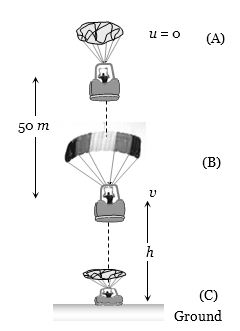
$A$ parachutist after bailing out falls $50\, m$ without friction. When the parachute opens,it decelerates at $2\, m/s^2$. He reaches the ground with a speed of $3\, m/s$. At what height did he bail out (in $, m$)?
A
$293$
B
$111$
C
$91$
D
$182$
Solution
(A) $1$. Free fall phase (from point $A$ to $B$): The parachutist falls freely under gravity for a distance $s_1 = 50\, m$. Initial velocity $u_1 = 0$,acceleration $a_1 = 9.8\, m/s^2$.
The velocity $v$ at point $B$ is given by $v^2 = u_1^2 + 2a_1s_1 = 0 + 2 \times 9.8 \times 50 = 980$.
So,$v = \sqrt{980}\, m/s$.
$2$. Deceleration phase (from point $B$ to $C$): The parachute opens,and the parachutist decelerates at $a_2 = -2\, m/s^2$. The final velocity at the ground is $v_f = 3\, m/s$. Let the distance covered be $h$.
Using $v_f^2 = v^2 + 2a_2h$:
$(3)^2 = 980 + 2(-2)h$
$9 = 980 - 4h$
$4h = 980 - 9 = 971$
$h = 971 / 4 = 242.75\, m$.
$3$. Total height: The total height from which he bailed out is $H = s_1 + h = 50 + 242.75 = 292.75\, m \approx 293\, m$.
The velocity $v$ at point $B$ is given by $v^2 = u_1^2 + 2a_1s_1 = 0 + 2 \times 9.8 \times 50 = 980$.
So,$v = \sqrt{980}\, m/s$.
$2$. Deceleration phase (from point $B$ to $C$): The parachute opens,and the parachutist decelerates at $a_2 = -2\, m/s^2$. The final velocity at the ground is $v_f = 3\, m/s$. Let the distance covered be $h$.
Using $v_f^2 = v^2 + 2a_2h$:
$(3)^2 = 980 + 2(-2)h$
$9 = 980 - 4h$
$4h = 980 - 9 = 971$
$h = 971 / 4 = 242.75\, m$.
$3$. Total height: The total height from which he bailed out is $H = s_1 + h = 50 + 242.75 = 292.75\, m \approx 293\, m$.
2 likesView Solution
2
PhysicsDifficultMCQAIIMS · 2008
The time taken by an object to slide down a $45^{\circ}$ rough inclined plane is $n$ times the time it takes to slide down a perfectly smooth $45^{\circ}$ inclined plane. The coefficient of kinetic friction between the object and the inclined plane is:
A
$\left( 1 - \frac{1}{n^2} \right)$
B
$1 + \frac{1}{n^2}$
C
$\sqrt{1 - \frac{1}{n^2}}$
D
$\sqrt{\frac{1}{1 - n^2}}$
Solution
(A) For a smooth inclined plane,the acceleration is $a_s = g \sin \theta$. The time taken to cover distance $s$ is $t_s = \sqrt{\frac{2s}{g \sin \theta}}$.
For a rough inclined plane,the acceleration is $a_r = g(\sin \theta - \mu \cos \theta)$. The time taken is $t_r = \sqrt{\frac{2s}{g(\sin \theta - \mu \cos \theta)}}$.
Given $t_r = n t_s$,so $t_r^2 = n^2 t_s^2$.
$\frac{2s}{g(\sin \theta - \mu \cos \theta)} = n^2 \frac{2s}{g \sin \theta}$.
$\sin \theta - \mu \cos \theta = \frac{\sin \theta}{n^2}$.
$\mu \cos \theta = \sin \theta \left( 1 - \frac{1}{n^2} \right)$.
$\mu = \tan \theta \left( 1 - \frac{1}{n^2} \right)$.
Since $\theta = 45^{\circ}$,$\tan 45^{\circ} = 1$,so $\mu = 1 - \frac{1}{n^2}$.
For a rough inclined plane,the acceleration is $a_r = g(\sin \theta - \mu \cos \theta)$. The time taken is $t_r = \sqrt{\frac{2s}{g(\sin \theta - \mu \cos \theta)}}$.
Given $t_r = n t_s$,so $t_r^2 = n^2 t_s^2$.
$\frac{2s}{g(\sin \theta - \mu \cos \theta)} = n^2 \frac{2s}{g \sin \theta}$.
$\sin \theta - \mu \cos \theta = \frac{\sin \theta}{n^2}$.
$\mu \cos \theta = \sin \theta \left( 1 - \frac{1}{n^2} \right)$.
$\mu = \tan \theta \left( 1 - \frac{1}{n^2} \right)$.
Since $\theta = 45^{\circ}$,$\tan 45^{\circ} = 1$,so $\mu = 1 - \frac{1}{n^2}$.
0 likesView Solution
3
PhysicsDifficultMCQAIIMS · 2008
$A$ particle of mass $m$ is executing oscillations about the origin on the $X-$axis. Its potential energy is $U(x) = k|x|^3$,where $k$ is a positive constant. If the amplitude of oscillation is $a$,then its time period $T$ is:
A
Proportional to $\frac{1}{\sqrt{a}}$
B
Independent of $a$
C
Proportional to $\sqrt{a}$
D
Proportional to $a^{3/2}$
Solution
(A) The potential energy is given by $U(x) = k|x|^3$.
The force acting on the particle is $F = -\frac{dU}{dx} = -3k|x|^2 \text{sgn}(x)$.
For a particle of mass $m$ oscillating with amplitude $a$,the total energy $E$ is conserved and is equal to the potential energy at the extreme position $(x = a)$:
$E = U(a) = ka^3$.
At any position $x$,the energy is $E = \frac{1}{2}mv^2 + k|x|^3 = ka^3$.
Thus,$v = \frac{dx}{dt} = \sqrt{\frac{2k}{m}(a^3 - |x|^3)}$.
The time period $T$ is given by $T = 4 \int_{0}^{a} \frac{dx}{v} = 4 \int_{0}^{a} \frac{dx}{\sqrt{\frac{2k}{m}(a^3 - x^3)}}$.
Let $x = ay$,then $dx = a dy$. When $x=0, y=0$ and when $x=a, y=1$.
$T = 4 \sqrt{\frac{m}{2k}} \int_{0}^{1} \frac{a dy}{\sqrt{a^3(1 - y^3)}} = 4 \sqrt{\frac{m}{2ka}} \int_{0}^{1} \frac{dy}{\sqrt{1 - y^3}}$.
Since the integral is a constant,$T \propto \frac{1}{\sqrt{a}}$.
The force acting on the particle is $F = -\frac{dU}{dx} = -3k|x|^2 \text{sgn}(x)$.
For a particle of mass $m$ oscillating with amplitude $a$,the total energy $E$ is conserved and is equal to the potential energy at the extreme position $(x = a)$:
$E = U(a) = ka^3$.
At any position $x$,the energy is $E = \frac{1}{2}mv^2 + k|x|^3 = ka^3$.
Thus,$v = \frac{dx}{dt} = \sqrt{\frac{2k}{m}(a^3 - |x|^3)}$.
The time period $T$ is given by $T = 4 \int_{0}^{a} \frac{dx}{v} = 4 \int_{0}^{a} \frac{dx}{\sqrt{\frac{2k}{m}(a^3 - x^3)}}$.
Let $x = ay$,then $dx = a dy$. When $x=0, y=0$ and when $x=a, y=1$.
$T = 4 \sqrt{\frac{m}{2k}} \int_{0}^{1} \frac{a dy}{\sqrt{a^3(1 - y^3)}} = 4 \sqrt{\frac{m}{2ka}} \int_{0}^{1} \frac{dy}{\sqrt{1 - y^3}}$.
Since the integral is a constant,$T \propto \frac{1}{\sqrt{a}}$.
0 likesView Solution
4
PhysicsMediumMCQAIIMS · 2008
The function $\sin^2(\omega t)$ represents:
A
$A$ simple harmonic motion with a period $2\pi /\omega $
B
$A$ simple harmonic motion with a period $\pi /\omega $
C
$A$ periodic but not simple harmonic motion with a period $2\pi /\omega $
D
$A$ periodic but not simple harmonic motion with a period $\pi /\omega $
Solution
(D) Given function is $y = \sin^2(\omega t)$.
Using the trigonometric identity $\sin^2 \theta = \frac{1 - \cos(2\theta)}{2}$,we can rewrite the function as:
$y = \frac{1}{2} - \frac{1}{2}\cos(2\omega t)$.
The period $T$ of a function $\cos(kt)$ is given by $T = \frac{2\pi}{k}$.
Here,$k = 2\omega$,so the period is $T = \frac{2\pi}{2\omega} = \frac{\pi}{\omega}$.
Simple Harmonic Motion $(S.H.M.)$ must satisfy the differential equation $\frac{d^2y}{dt^2} = -\Omega^2 y$. The given function represents a constant offset plus a cosine term,which does not satisfy the condition for $S.H.M.$ because the equilibrium position is shifted and it is not a pure sinusoidal oscillation about the origin. Therefore,it is a periodic motion but not $S.H.M.$
Using the trigonometric identity $\sin^2 \theta = \frac{1 - \cos(2\theta)}{2}$,we can rewrite the function as:
$y = \frac{1}{2} - \frac{1}{2}\cos(2\omega t)$.
The period $T$ of a function $\cos(kt)$ is given by $T = \frac{2\pi}{k}$.
Here,$k = 2\omega$,so the period is $T = \frac{2\pi}{2\omega} = \frac{\pi}{\omega}$.
Simple Harmonic Motion $(S.H.M.)$ must satisfy the differential equation $\frac{d^2y}{dt^2} = -\Omega^2 y$. The given function represents a constant offset plus a cosine term,which does not satisfy the condition for $S.H.M.$ because the equilibrium position is shifted and it is not a pure sinusoidal oscillation about the origin. Therefore,it is a periodic motion but not $S.H.M.$
0 likesView Solution
5
PhysicsMediumMCQAIIMS · 2008
$A$ person speaking normally produces a sound intensity of $40 \ dB$ at a distance of $1 \ m$. If the threshold intensity for reasonable audibility is $20 \ dB$,the maximum distance at which he can be heard clearly is ... $m$.
A
$4$
B
$5$
C
$10$
D
$20$
Solution
(C) The sound intensity level in decibels is given by $\beta = 10 \log_{10} \left( \frac{I}{I_0} \right)$.
At $r_1 = 1 \ m$,$\beta_1 = 40 \ dB$. Thus,$40 = 10 \log_{10} \left( \frac{I_1}{I_0} \right) \implies \frac{I_1}{I_0} = 10^4$.
At distance $r_2$,$\beta_2 = 20 \ dB$. Thus,$20 = 10 \log_{10} \left( \frac{I_2}{I_0} \right) \implies \frac{I_2}{I_0} = 10^2$.
Dividing the two equations: $\frac{I_1}{I_2} = \frac{10^4}{10^2} = 10^2 = 100$.
Since intensity $I \propto \frac{1}{r^2}$,we have $\frac{I_1}{I_2} = \frac{r_2^2}{r_1^2}$.
Substituting the values: $100 = \frac{r_2^2}{(1)^2} \implies r_2^2 = 100 \implies r_2 = 10 \ m$.
At $r_1 = 1 \ m$,$\beta_1 = 40 \ dB$. Thus,$40 = 10 \log_{10} \left( \frac{I_1}{I_0} \right) \implies \frac{I_1}{I_0} = 10^4$.
At distance $r_2$,$\beta_2 = 20 \ dB$. Thus,$20 = 10 \log_{10} \left( \frac{I_2}{I_0} \right) \implies \frac{I_2}{I_0} = 10^2$.
Dividing the two equations: $\frac{I_1}{I_2} = \frac{10^4}{10^2} = 10^2 = 100$.
Since intensity $I \propto \frac{1}{r^2}$,we have $\frac{I_1}{I_2} = \frac{r_2^2}{r_1^2}$.
Substituting the values: $100 = \frac{r_2^2}{(1)^2} \implies r_2^2 = 100 \implies r_2 = 10 \ m$.
0 likesView Solution
6
PhysicsMediumMCQAIIMS · 2008
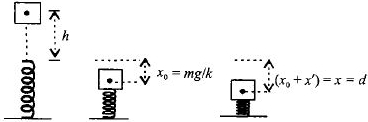
$A$ vertical spring with force constant $k$ is fixed on a table. $A$ ball of mass $m$ at a height $h$ above the free upper end of the spring falls vertically on the spring so that the spring is compressed by a distance $d$. The net work done in the process is
A
$mg(h + d) - \frac{1}{2}kd^2$
B
$mg(h - d) - \frac{1}{2}kd^2$
C
$mg(h - d) + \frac{1}{2}kd^2$
D
$mg(h + d) + \frac{1}{2}kd^2$
Solution
(A) According to the work-energy theorem,the net work done on the system is equal to the change in kinetic energy of the ball.
Let the initial position of the ball be at height $h$ above the spring. The final position is when the spring is compressed by distance $d$.
The total vertical displacement of the ball is $(h + d)$.
The forces acting on the ball are gravity (downward) and the spring force (upward).
The work done by gravity is $W_g = mg(h + d)$.
The work done by the spring force is $W_s = -\int_0^d kx \, dx = -\frac{1}{2}kd^2$.
The net work done on the ball is $W_{net} = W_g + W_s = mg(h + d) - \frac{1}{2}kd^2$.
Since the ball starts from rest and comes to rest momentarily at the maximum compression $d$,the change in kinetic energy is zero,which implies $W_{net} = 0$ for the entire process. However,the question asks for the net work done by the external forces (gravity and spring) during the displacement $d$,which is $mg(h + d) - \frac{1}{2}kd^2$.
Let the initial position of the ball be at height $h$ above the spring. The final position is when the spring is compressed by distance $d$.
The total vertical displacement of the ball is $(h + d)$.
The forces acting on the ball are gravity (downward) and the spring force (upward).
The work done by gravity is $W_g = mg(h + d)$.
The work done by the spring force is $W_s = -\int_0^d kx \, dx = -\frac{1}{2}kd^2$.
The net work done on the ball is $W_{net} = W_g + W_s = mg(h + d) - \frac{1}{2}kd^2$.
Since the ball starts from rest and comes to rest momentarily at the maximum compression $d$,the change in kinetic energy is zero,which implies $W_{net} = 0$ for the entire process. However,the question asks for the net work done by the external forces (gravity and spring) during the displacement $d$,which is $mg(h + d) - \frac{1}{2}kd^2$.
0 likesView Solution
7
PhysicsMediumMCQAIIMS · 2008
If the terminal speed of a sphere of gold (density $= 19.5 \times 10^3 \ kg/m^3$) is $0.2 \ m/s$ in a viscous liquid (density $= 1.5 \times 10^3 \ kg/m^3$), find the terminal speed (in $m/s$) of a sphere of silver (density $= 10.5 \times 10^3 \ kg/m^3$) of the same size in the same liquid.
A
$0.2$
B
$0.4$
C
$0.133$
D
$0.1$
Solution
(D) The terminal velocity $v_T$ of a sphere of radius $r$ and density $\rho$ falling through a liquid of density $\sigma$ and viscosity $\eta$ is given by the formula: $v_T = \frac{2r^2(\rho - \sigma)g}{9\eta}$.
Since the radius $r$, the liquid density $\sigma$, the viscosity $\eta$, and the acceleration due to gravity $g$ are constant for both spheres, we have $v_T \propto (\rho - \sigma)$.
Therefore, $\frac{v_{T, \text{silver}}}{v_{T, \text{gold}}} = \frac{\rho_{\text{silver}} - \sigma}{\rho_{\text{gold}} - \sigma}$.
Given $\rho_{\text{gold}} = 19.5 \times 10^3 \ kg/m^3$, $\rho_{\text{silver}} = 10.5 \times 10^3 \ kg/m^3$, $\sigma = 1.5 \times 10^3 \ kg/m^3$, and $v_{T, \text{gold}} = 0.2 \ m/s$.
Substituting the values: $\frac{v_{T, \text{silver}}}{0.2} = \frac{10.5 - 1.5}{19.5 - 1.5} = \frac{9}{18} = 0.5$.
Thus, $v_{T, \text{silver}} = 0.2 \times 0.5 = 0.1 \ m/s$.
Since the radius $r$, the liquid density $\sigma$, the viscosity $\eta$, and the acceleration due to gravity $g$ are constant for both spheres, we have $v_T \propto (\rho - \sigma)$.
Therefore, $\frac{v_{T, \text{silver}}}{v_{T, \text{gold}}} = \frac{\rho_{\text{silver}} - \sigma}{\rho_{\text{gold}} - \sigma}$.
Given $\rho_{\text{gold}} = 19.5 \times 10^3 \ kg/m^3$, $\rho_{\text{silver}} = 10.5 \times 10^3 \ kg/m^3$, $\sigma = 1.5 \times 10^3 \ kg/m^3$, and $v_{T, \text{gold}} = 0.2 \ m/s$.
Substituting the values: $\frac{v_{T, \text{silver}}}{0.2} = \frac{10.5 - 1.5}{19.5 - 1.5} = \frac{9}{18} = 0.5$.
Thus, $v_{T, \text{silver}} = 0.2 \times 0.5 = 0.1 \ m/s$.
0 likesView Solution
8
PhysicsDifficultMCQAIIMS · 2008
The speed of light $(c)$,gravitational constant $(G)$,and Planck's constant $(h)$ are taken as fundamental units in a system. The dimensions of time in this new system should be
A
$G^{1/2} h^{1/2} c^{-5/2}$
B
$G^{-1/2} h^{1/2} c^{1/2}$
C
$G^{1/2} h^{1/2} c^{-3/2}$
D
$G^{1/2} h^{1/2} c^{1/2}$
Solution
(A) Let time $T \propto c^{x} G^{y} h^{z}$.
$\Rightarrow T = k c^{x} G^{y} h^{z}$.
Taking dimensions on both sides: $[M^{0} L^{0} T^{1}] = [L T^{-1}]^{x} [M^{-1} L^{3} T^{-2}]^{y} [M L^{2} T^{-1}]^{z}$.
$[M^{0} L^{0} T^{1}] = [M^{-y+z} L^{x+3y+2z} T^{-x-2y-z}]$.
Equating powers of $M, L, T$ on both sides:
$-y + z = 0 \implies z = y \quad \dots(1)$
$x + 3y + 2z = 0 \quad \dots(2)$
$-x - 2y - z = 1 \quad \dots(3)$
Adding $(2)$ and $(3)$: $(x + 3y + 2z) + (-x - 2y - z) = 0 + 1 \implies y + z = 1$.
Since $z = y$,we have $2y = 1 \implies y = 1/2$.
Thus,$z = 1/2$.
Substituting into $(2)$: $x + 3(1/2) + 2(1/2) = 0 \implies x + 3/2 + 1 = 0 \implies x = -5/2$.
Therefore,$[T] = [G^{1/2} h^{1/2} c^{-5/2}]$.
$\Rightarrow T = k c^{x} G^{y} h^{z}$.
Taking dimensions on both sides: $[M^{0} L^{0} T^{1}] = [L T^{-1}]^{x} [M^{-1} L^{3} T^{-2}]^{y} [M L^{2} T^{-1}]^{z}$.
$[M^{0} L^{0} T^{1}] = [M^{-y+z} L^{x+3y+2z} T^{-x-2y-z}]$.
Equating powers of $M, L, T$ on both sides:
$-y + z = 0 \implies z = y \quad \dots(1)$
$x + 3y + 2z = 0 \quad \dots(2)$
$-x - 2y - z = 1 \quad \dots(3)$
Adding $(2)$ and $(3)$: $(x + 3y + 2z) + (-x - 2y - z) = 0 + 1 \implies y + z = 1$.
Since $z = y$,we have $2y = 1 \implies y = 1/2$.
Thus,$z = 1/2$.
Substituting into $(2)$: $x + 3(1/2) + 2(1/2) = 0 \implies x + 3/2 + 1 = 0 \implies x = -5/2$.
Therefore,$[T] = [G^{1/2} h^{1/2} c^{-5/2}]$.
1 likesView Solution
9
PhysicsEasyMCQAIIMS · 2008
$Assertion$ : The error in the measurement of radius of the sphere is $0.3\%$. The permissible error in its surface area is $0.6\%$.
$Reason$ : The permissible error is calculated by the formula $\frac{\Delta A}{A} = \frac{4\Delta r}{r}$.
$Reason$ : The permissible error is calculated by the formula $\frac{\Delta A}{A} = \frac{4\Delta r}{r}$.
A
If both Assertion and Reason are correct and the Reason is a correct explanation of the Assertion.
B
If both Assertion and Reason are correct but Reason is not a correct explanation of the Assertion.
C
If the Assertion is correct but Reason is incorrect.
D
If both the Assertion and Reason are incorrect.
Solution
(C) The surface area of a sphere is given by $A = 4\pi r^2$.
Using the rules of error propagation,the relative error in $A$ is given by $\frac{\Delta A}{A} = 2 \frac{\Delta r}{r}$.
Given that the percentage error in the radius is $\frac{\Delta r}{r} \times 100 = 0.3\%$.
Therefore,the percentage error in the surface area is $\frac{\Delta A}{A} \times 100 = 2 \times (0.3\%) = 0.6\%$.
Thus,the Assertion is correct.
The Reason states the formula $\frac{\Delta A}{A} = \frac{4\Delta r}{r}$,which is incorrect because the correct relation is $\frac{\Delta A}{A} = 2 \frac{\Delta r}{r}$.
Hence,the Assertion is correct but the Reason is incorrect.
Using the rules of error propagation,the relative error in $A$ is given by $\frac{\Delta A}{A} = 2 \frac{\Delta r}{r}$.
Given that the percentage error in the radius is $\frac{\Delta r}{r} \times 100 = 0.3\%$.
Therefore,the percentage error in the surface area is $\frac{\Delta A}{A} \times 100 = 2 \times (0.3\%) = 0.6\%$.
Thus,the Assertion is correct.
The Reason states the formula $\frac{\Delta A}{A} = \frac{4\Delta r}{r}$,which is incorrect because the correct relation is $\frac{\Delta A}{A} = 2 \frac{\Delta r}{r}$.
Hence,the Assertion is correct but the Reason is incorrect.
0 likesView Solution
10
PhysicsMediumMCQAIIMS · 2008
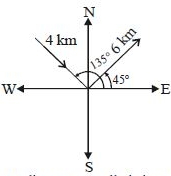
$A$ car travels $6 \, km$ at an angle of $45^\circ$ north of east and then travels $4 \, km$ at an angle of $135^\circ$ north of east. How far is the final point from the starting point? What angle does the straight line joining its initial and final position make with the east?
A
$\sqrt{50} \, km$ and $\tan^{-1}(5)$
B
$10 \, km$ and $\tan^{-1}(\sqrt{5})$
C
$\sqrt{52} \, km$ and $\tan^{-1}(5)$
D
$\sqrt{52} \, km$ and $\tan^{-1}(\sqrt{5})$
Solution
(C) Let the starting point be the origin $(0,0)$.
First displacement vector $\vec{d_1} = 6 \cos(45^\circ) \hat{i} + 6 \sin(45^\circ) \hat{j} = 6(\frac{1}{\sqrt{2}}) \hat{i} + 6(\frac{1}{\sqrt{2}}) \hat{j} = 3\sqrt{2} \hat{i} + 3\sqrt{2} \hat{j} \, km$.
Second displacement vector $\vec{d_2} = 4 \cos(135^\circ) \hat{i} + 4 \sin(135^\circ) \hat{j} = 4(-\frac{1}{\sqrt{2}}) \hat{i} + 4(\frac{1}{\sqrt{2}}) \hat{j} = -2\sqrt{2} \hat{i} + 2\sqrt{2} \hat{j} \, km$.
Resultant displacement $\vec{R} = \vec{d_1} + \vec{d_2} = (3\sqrt{2} - 2\sqrt{2}) \hat{i} + (3\sqrt{2} + 2\sqrt{2}) \hat{j} = \sqrt{2} \hat{i} + 5\sqrt{2} \hat{j} \, km$.
Magnitude $R = \sqrt{(\sqrt{2})^2 + (5\sqrt{2})^2} = \sqrt{2 + 50} = \sqrt{52} \, km$.
Angle $\theta$ with east: $\tan \theta = \frac{R_y}{R_x} = \frac{5\sqrt{2}}{\sqrt{2}} = 5 \implies \theta = \tan^{-1}(5)$.
First displacement vector $\vec{d_1} = 6 \cos(45^\circ) \hat{i} + 6 \sin(45^\circ) \hat{j} = 6(\frac{1}{\sqrt{2}}) \hat{i} + 6(\frac{1}{\sqrt{2}}) \hat{j} = 3\sqrt{2} \hat{i} + 3\sqrt{2} \hat{j} \, km$.
Second displacement vector $\vec{d_2} = 4 \cos(135^\circ) \hat{i} + 4 \sin(135^\circ) \hat{j} = 4(-\frac{1}{\sqrt{2}}) \hat{i} + 4(\frac{1}{\sqrt{2}}) \hat{j} = -2\sqrt{2} \hat{i} + 2\sqrt{2} \hat{j} \, km$.
Resultant displacement $\vec{R} = \vec{d_1} + \vec{d_2} = (3\sqrt{2} - 2\sqrt{2}) \hat{i} + (3\sqrt{2} + 2\sqrt{2}) \hat{j} = \sqrt{2} \hat{i} + 5\sqrt{2} \hat{j} \, km$.
Magnitude $R = \sqrt{(\sqrt{2})^2 + (5\sqrt{2})^2} = \sqrt{2 + 50} = \sqrt{52} \, km$.
Angle $\theta$ with east: $\tan \theta = \frac{R_y}{R_x} = \frac{5\sqrt{2}}{\sqrt{2}} = 5 \implies \theta = \tan^{-1}(5)$.
0 likesView Solution
11
PhysicsMediumMCQAIIMS · 2008
$Assertion$ : Angle of repose is equal to the angle of limiting friction.
$Reason$ : When the body is just at the point of motion, the force of friction in this stage is called limiting friction.
$Reason$ : When the body is just at the point of motion, the force of friction in this stage is called limiting friction.
A
If both Assertion and Reason are correct and the Reason is a correct explanation of the Assertion.
B
If both Assertion and Reason are correct but Reason is not a correct explanation of the Assertion.
C
If the Assertion is correct but Reason is incorrect.
D
If both the Assertion and Reason are incorrect.
Solution
(A) The maximum value of static friction up to which a body does not move is called limiting friction.
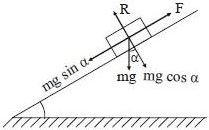
Angle of repose $(\alpha)$ is defined as the angle of the inclined plane with the horizontal such that a body placed on it just begins to slide.
In the limiting condition, the forces are balanced:
$F = mg \sin \alpha$
$R = mg \cos \alpha$
Dividing these equations, we get:
$\frac{F}{R} = \tan \alpha$
Since the coefficient of static friction $\mu_s = \frac{F}{R} = \tan \theta$, where $\theta$ is the angle of friction, we have:
$\tan \theta = \tan \alpha \implies \theta = \alpha$
Thus, the angle of repose is equal to the angle of friction. The reason correctly explains the concept of limiting friction used to derive this equality.
Angle of repose $(\alpha)$ is defined as the angle of the inclined plane with the horizontal such that a body placed on it just begins to slide.
In the limiting condition, the forces are balanced:
$F = mg \sin \alpha$
$R = mg \cos \alpha$
Dividing these equations, we get:
$\frac{F}{R} = \tan \alpha$
Since the coefficient of static friction $\mu_s = \frac{F}{R} = \tan \theta$, where $\theta$ is the angle of friction, we have:
$\tan \theta = \tan \alpha \implies \theta = \alpha$
Thus, the angle of repose is equal to the angle of friction. The reason correctly explains the concept of limiting friction used to derive this equality.
0 likesView Solution
12
PhysicsMediumMCQAIIMS · 2008
$A$ particle of mass $10\, g$ is kept on the surface of a uniform sphere of mass $100\, kg$ and radius $10\, cm$. Find the work to be done against the gravitational force between them to take the particle far away from the sphere (you may take $G = 6.67 \times 10^{-11}\, Nm^2 / kg^2$).
A
$3.33 \times 10^{-10}\,J$
B
$13.34 \times 10^{-10}\,J$
C
$6.67 \times 10^{-10}\,J$
D
$6.67 \times 10^{-9}\,J$
Solution
(C) The gravitational potential energy $U$ of a particle of mass $m$ at the surface of a sphere of mass $M$ and radius $R$ is given by $U = -\frac{GMm}{R}$.
To take the particle to infinity (where potential energy is $0$),the work done $W$ against the gravitational force is equal to the change in potential energy: $W = U_{final} - U_{initial} = 0 - (- \frac{GMm}{R}) = \frac{GMm}{R}$.
Given values:
$M = 100\, kg$
$m = 10\, g = 0.01\, kg$
$R = 10\, cm = 0.1\, m$
$G = 6.67 \times 10^{-11}\, Nm^2/kg^2$
Substituting these values into the formula:
$W = \frac{6.67 \times 10^{-11} \times 100 \times 0.01}{0.1}$
$W = \frac{6.67 \times 10^{-11} \times 1}{0.1} = 6.67 \times 10^{-10}\, J$.
To take the particle to infinity (where potential energy is $0$),the work done $W$ against the gravitational force is equal to the change in potential energy: $W = U_{final} - U_{initial} = 0 - (- \frac{GMm}{R}) = \frac{GMm}{R}$.
Given values:
$M = 100\, kg$
$m = 10\, g = 0.01\, kg$
$R = 10\, cm = 0.1\, m$
$G = 6.67 \times 10^{-11}\, Nm^2/kg^2$
Substituting these values into the formula:
$W = \frac{6.67 \times 10^{-11} \times 100 \times 0.01}{0.1}$
$W = \frac{6.67 \times 10^{-11} \times 1}{0.1} = 6.67 \times 10^{-10}\, J$.
0 likesView Solution
13
PhysicsMediumMCQAIIMS · 2008
$Assertion$ : $A$ quick collision between two bodies is more violent than a slow collision,even when the initial and final velocities are identical.
$Reason$ : The rate of change of momentum is greater in the first case.
$Reason$ : The rate of change of momentum is greater in the first case.
A
If both $Assertion$ and $Reason$ are correct and the $Reason$ is a correct explanation of the $Assertion$.
B
If both $Assertion$ and $Reason$ are correct but $Reason$ is not a correct explanation of the $Assertion$.
C
If the $Assertion$ is correct but $Reason$ is incorrect.
D
If both the $Assertion$ and $Reason$ are incorrect.
Solution
(A) According to Newton's second law,the impulsive force $F$ is given by $F = \frac{\Delta p}{\Delta t}$,where $\Delta p$ is the change in momentum and $\Delta t$ is the time duration of the collision.
In a quick collision,the time duration $\Delta t$ is very small.
Since the change in momentum $\Delta p$ is the same for both cases (as initial and final velocities are identical),the force $F$ is inversely proportional to $\Delta t$ $(F \propto \frac{1}{\Delta t})$.
Therefore,for a smaller $\Delta t$,the force $F$ is much larger,making the collision more violent.
The rate of change of momentum is defined as $\frac{\Delta p}{\Delta t}$,which is exactly the force $F$.
Since $\Delta t$ is smaller in the first case,the rate of change of momentum is indeed greater.
Thus,both the $Assertion$ and $Reason$ are correct,and the $Reason$ is the correct explanation of the $Assertion$.
In a quick collision,the time duration $\Delta t$ is very small.
Since the change in momentum $\Delta p$ is the same for both cases (as initial and final velocities are identical),the force $F$ is inversely proportional to $\Delta t$ $(F \propto \frac{1}{\Delta t})$.
Therefore,for a smaller $\Delta t$,the force $F$ is much larger,making the collision more violent.
The rate of change of momentum is defined as $\frac{\Delta p}{\Delta t}$,which is exactly the force $F$.
Since $\Delta t$ is smaller in the first case,the rate of change of momentum is indeed greater.
Thus,both the $Assertion$ and $Reason$ are correct,and the $Reason$ is the correct explanation of the $Assertion$.
0 likesView Solution
14
PhysicsMediumMCQAIIMS · 2008
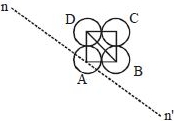
Four point masses,each of value $m$,are placed at the corners of a square $ABCD$ of side $l$. The moment of inertia of this system about an axis passing through $A$ and parallel to $BD$ is
A
$2ml^2$
B
$\sqrt{3}ml^2$
C
$3ml^2$
D
$ml^2$
Solution
(C) Let the square be $ABCD$ with side length $l$. The masses are at $A, B, C, D$.
The axis passes through $A$ and is parallel to the diagonal $BD$.
The distance of point $A$ from the axis is $0$.
The distance of point $B$ from the axis is $d_B = \frac{l}{\sqrt{2}}$.
The distance of point $D$ from the axis is $d_D = \frac{l}{\sqrt{2}}$.
The distance of point $C$ from the axis is $d_C = \sqrt{l^2 + (l/\sqrt{2})^2} = \sqrt{l^2 + l^2/2} = \sqrt{3l^2/2} = l\sqrt{3/2}$.
Alternatively,the distance of $C$ from the diagonal $BD$ is $l\sqrt{2}$.
The moment of inertia $I$ is given by $\sum m_i r_i^2$.
$I = m(0)^2 + m(l/\sqrt{2})^2 + m(l\sqrt{2})^2 + m(l/\sqrt{2})^2$
$I = 0 + m(l^2/2) + 2ml^2 + m(l^2/2)$
$I = ml^2 + 2ml^2 = 3ml^2$.
The axis passes through $A$ and is parallel to the diagonal $BD$.
The distance of point $A$ from the axis is $0$.
The distance of point $B$ from the axis is $d_B = \frac{l}{\sqrt{2}}$.
The distance of point $D$ from the axis is $d_D = \frac{l}{\sqrt{2}}$.
The distance of point $C$ from the axis is $d_C = \sqrt{l^2 + (l/\sqrt{2})^2} = \sqrt{l^2 + l^2/2} = \sqrt{3l^2/2} = l\sqrt{3/2}$.
Alternatively,the distance of $C$ from the diagonal $BD$ is $l\sqrt{2}$.
The moment of inertia $I$ is given by $\sum m_i r_i^2$.
$I = m(0)^2 + m(l/\sqrt{2})^2 + m(l\sqrt{2})^2 + m(l/\sqrt{2})^2$
$I = 0 + m(l^2/2) + 2ml^2 + m(l^2/2)$
$I = ml^2 + 2ml^2 = 3ml^2$.
0 likesView Solution
15
PhysicsMediumMCQAIIMS · 2008
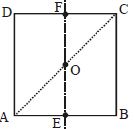
For the given uniform square lamina $ABCD$,whose centre is $O$,
A
${I_{AC}} = \sqrt 2 \,{I_{EF}}$
B
$\sqrt 2 {I_{AC}} = {I_{EF}}$
C
${I_{AD}} = 3{I_{EF}}$
D
$I_{AC} = I_{EF}$
Solution
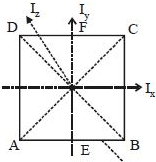
(D) Let the side of the square be $a$. By the theorem of perpendicular axes,the moment of inertia about an axis passing through the center $O$ and perpendicular to the plane of the lamina is $I_z = I_x + I_y$.
For a square lamina,the moment of inertia about any axis passing through the center and lying in the plane of the lamina is the same.
Let $I_{EF}$ be the moment of inertia about the axis $EF$ (passing through the midpoints of sides $AB$ and $CD$). By symmetry,$I_{EF} = I_{GH}$ where $GH$ is the axis passing through the midpoints of sides $AD$ and $BC$.
Thus,$I_z = I_{EF} + I_{GH} = 2I_{EF}$.
Now,consider the diagonal $AC$. The moment of inertia about the diagonal $AC$ is $I_{AC}$. By symmetry,the moment of inertia about the other diagonal $BD$ is $I_{BD} = I_{AC}$.
Since the diagonals are also perpendicular axes in the plane of the lamina,$I_z = I_{AC} + I_{BD} = 2I_{AC}$.
Equating the two expressions for $I_z$,we get $2I_{EF} = 2I_{AC}$,which implies $I_{AC} = I_{EF}$.
For a square lamina,the moment of inertia about any axis passing through the center and lying in the plane of the lamina is the same.
Let $I_{EF}$ be the moment of inertia about the axis $EF$ (passing through the midpoints of sides $AB$ and $CD$). By symmetry,$I_{EF} = I_{GH}$ where $GH$ is the axis passing through the midpoints of sides $AD$ and $BC$.
Thus,$I_z = I_{EF} + I_{GH} = 2I_{EF}$.
Now,consider the diagonal $AC$. The moment of inertia about the diagonal $AC$ is $I_{AC}$. By symmetry,the moment of inertia about the other diagonal $BD$ is $I_{BD} = I_{AC}$.
Since the diagonals are also perpendicular axes in the plane of the lamina,$I_z = I_{AC} + I_{BD} = 2I_{AC}$.
Equating the two expressions for $I_z$,we get $2I_{EF} = 2I_{AC}$,which implies $I_{AC} = I_{EF}$.
0 likesView Solution
16
PhysicsEasyMCQAIIMS · 2008
$A$ wheel has an angular acceleration of $3.0\, rad/s^2$ and an initial angular speed of $2.00\, rad/s$. In a time of $2\, s$,it has rotated through an angle (in radians) of:
A
$6$
B
$10$
C
$12$
D
$4$
Solution
(B) Given:
Initial angular speed,$\omega_0 = 2.00\, rad/s$
Angular acceleration,$\alpha = 3.0\, rad/s^2$
Time,$t = 2\, s$
Using the kinematic equation for angular displacement:
$\theta = \omega_0 t + \frac{1}{2} \alpha t^2$
Substituting the given values:
$\theta = (2.00)(2) + \frac{1}{2}(3.0)(2)^2$
$\theta = 4 + \frac{1}{2}(3.0)(4)$
$\theta = 4 + 6 = 10\, radians$
Thus,the wheel has rotated through an angle of $10\, radians$.
Initial angular speed,$\omega_0 = 2.00\, rad/s$
Angular acceleration,$\alpha = 3.0\, rad/s^2$
Time,$t = 2\, s$
Using the kinematic equation for angular displacement:
$\theta = \omega_0 t + \frac{1}{2} \alpha t^2$
Substituting the given values:
$\theta = (2.00)(2) + \frac{1}{2}(3.0)(2)^2$
$\theta = 4 + \frac{1}{2}(3.0)(4)$
$\theta = 4 + 6 = 10\, radians$
Thus,the wheel has rotated through an angle of $10\, radians$.
0 likesView Solution
17
PhysicsEasyMCQAIIMS · 2008
$Assertion$ : The velocity of a body at the bottom of an inclined plane of given height is more when it slides down the plane,compared to when it rolls down the same plane.
$Reason$ : In rolling down,a body acquires both kinetic energy of translation and rotation.
$Reason$ : In rolling down,a body acquires both kinetic energy of translation and rotation.
A
If both $Assertion$ and $Reason$ are correct and the $Reason$ is a correct explanation of the $Assertion$.
B
If both $Assertion$ and $Reason$ are correct but $Reason$ is not a correct explanation of the $Assertion$.
C
If the $Assertion$ is correct but $Reason$ is incorrect.
D
If both the $Assertion$ and $Reason$ are incorrect.
Solution
(A) When a body slides down an inclined plane of height $h$,the entire potential energy $mgh$ is converted into translational kinetic energy $\frac{1}{2}mv^2$. Thus,$v_{slide} = \sqrt{2gh}$.
When a body rolls down the same plane,the potential energy $mgh$ is converted into both translational kinetic energy $\frac{1}{2}mv^2$ and rotational kinetic energy $\frac{1}{2}I\omega^2$. Thus,$mgh = \frac{1}{2}mv^2 + \frac{1}{2}I\omega^2$.
Since some energy is used for rotation,the translational kinetic energy is less in the rolling case compared to the sliding case.
Consequently,the linear velocity at the bottom is lower for rolling than for sliding.
Therefore,both $Assertion$ and $Reason$ are correct,and the $Reason$ correctly explains the $Assertion$.
When a body rolls down the same plane,the potential energy $mgh$ is converted into both translational kinetic energy $\frac{1}{2}mv^2$ and rotational kinetic energy $\frac{1}{2}I\omega^2$. Thus,$mgh = \frac{1}{2}mv^2 + \frac{1}{2}I\omega^2$.
Since some energy is used for rotation,the translational kinetic energy is less in the rolling case compared to the sliding case.
Consequently,the linear velocity at the bottom is lower for rolling than for sliding.
Therefore,both $Assertion$ and $Reason$ are correct,and the $Reason$ correctly explains the $Assertion$.
0 likesView Solution
18
PhysicsDifficultMCQAIIMS · 2008
Two bodies of masses $m_1$ and $m_2$ are initially at rest at infinite distance apart. They are then allowed to move towards each other under mutual gravitational attraction. Their relative velocity of approach at a separation distance $r$ between them is
A
$[2G(m_1 - m_2)/r]^{1/2}$
B
$[2G(m_1 + m_2)/r]^{1/2}$
C
$[r/(2G m_1 m_2)]^{1/2}$
D
$[2G m_1 m_2/r]^{1/2}$
Solution
(B) Since the bodies are initially at rest,the total momentum of the system is zero. By the law of conservation of momentum,$m_1 v_1 = m_2 v_2$,where $v_1$ and $v_2$ are the speeds of the masses at separation $r$.
By the law of conservation of energy,the decrease in gravitational potential energy equals the increase in kinetic energy: $G m_1 m_2 / r = 1/2 m_1 v_1^2 + 1/2 m_2 v_2^2$.
From the momentum equation,$v_1 = (m_2/m_1) v_2$. Substituting this into the energy equation:
$G m_1 m_2 / r = 1/2 m_1 (m_2/m_1)^2 v_2^2 + 1/2 m_2 v_2^2 = 1/2 (m_2^2/m_1 + m_2) v_2^2 = 1/2 [m_2(m_1 + m_2)/m_1] v_2^2$.
Solving for $v_2$,we get $v_2 = \sqrt{2 G m_1^2 / (r(m_1 + m_2))}$. Similarly,$v_1 = \sqrt{2 G m_2^2 / (r(m_1 + m_2))}$.
The relative velocity of approach is $v_{rel} = v_1 + v_2 = \sqrt{2 G / (r(m_1 + m_2))} (m_1 + m_2) = \sqrt{2 G (m_1 + m_2) / r}$.
By the law of conservation of energy,the decrease in gravitational potential energy equals the increase in kinetic energy: $G m_1 m_2 / r = 1/2 m_1 v_1^2 + 1/2 m_2 v_2^2$.
From the momentum equation,$v_1 = (m_2/m_1) v_2$. Substituting this into the energy equation:
$G m_1 m_2 / r = 1/2 m_1 (m_2/m_1)^2 v_2^2 + 1/2 m_2 v_2^2 = 1/2 (m_2^2/m_1 + m_2) v_2^2 = 1/2 [m_2(m_1 + m_2)/m_1] v_2^2$.
Solving for $v_2$,we get $v_2 = \sqrt{2 G m_1^2 / (r(m_1 + m_2))}$. Similarly,$v_1 = \sqrt{2 G m_2^2 / (r(m_1 + m_2))}$.
The relative velocity of approach is $v_{rel} = v_1 + v_2 = \sqrt{2 G / (r(m_1 + m_2))} (m_1 + m_2) = \sqrt{2 G (m_1 + m_2) / r}$.
0 likesView Solution
19
PhysicsMediumMCQAIIMS · 2008
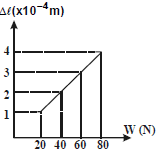
The adjacent graph shows the extension $(\Delta l)$ of a wire of length $1\, m$ suspended from the top of a roof at one end and with a load $W$ connected to the other end. If the cross-sectional area of the wire is $10^{-6}\, m^2$,calculate the Young's modulus of the material of the wire.
A
$2 \times 10^{11} \, N/m^2$
B
$2 \times 10^{-11} \, N/m^2$
C
$3 \times 10^{-12} \, N/m^2$
D
$2 \times 10^{-13} \, N/m^2$
Solution
(A) From the graph,we observe that for a change in load $\Delta W = (40 - 20) \, N = 20 \, N$,the change in extension is $\Delta(\Delta l) = (2 - 1) \times 10^{-4} \, m = 10^{-4} \, m$.
Young's modulus $Y$ is given by the formula $Y = \frac{\text{Stress}}{\text{Strain}} = \frac{F/A}{\Delta l/l} = \frac{F \cdot l}{A \cdot \Delta l}$.
Using the slope of the graph,$\frac{\Delta l}{F} = \frac{10^{-4} \, m}{20 \, N} = 0.05 \times 10^{-4} \, m/N = 5 \times 10^{-6} \, m/N$.
Given $l = 1 \, m$ and $A = 10^{-6} \, m^2$,we have:
$Y = \frac{l}{A} \cdot \frac{F}{\Delta l} = \frac{1}{10^{-6}} \cdot \frac{1}{5 \times 10^{-6}} = \frac{10^6}{5 \times 10^{-6}} = 0.2 \times 10^{12} \, N/m^2 = 2 \times 10^{11} \, N/m^2$.
Young's modulus $Y$ is given by the formula $Y = \frac{\text{Stress}}{\text{Strain}} = \frac{F/A}{\Delta l/l} = \frac{F \cdot l}{A \cdot \Delta l}$.
Using the slope of the graph,$\frac{\Delta l}{F} = \frac{10^{-4} \, m}{20 \, N} = 0.05 \times 10^{-4} \, m/N = 5 \times 10^{-6} \, m/N$.
Given $l = 1 \, m$ and $A = 10^{-6} \, m^2$,we have:
$Y = \frac{l}{A} \cdot \frac{F}{\Delta l} = \frac{1}{10^{-6}} \cdot \frac{1}{5 \times 10^{-6}} = \frac{10^6}{5 \times 10^{-6}} = 0.2 \times 10^{12} \, N/m^2 = 2 \times 10^{11} \, N/m^2$.
0 likesView Solution
20
PhysicsMediumMCQAIIMS · 2008
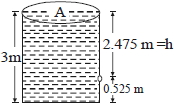
Water is filled in a container up to a height of $3\,m$. $A$ small hole of area $A_0$ is punched in the wall of the container at a height of $52.5\,cm$ from the bottom. The cross-sectional area of the container is $A$. If $A_0/A = 0.1$,then $v^2$ is......... $m^2/s^2$ (where $v$ is the velocity of water coming out of the hole).
A
$50$
B
$50.5$
C
$51$
D
$52$
Solution
(A) The velocity of efflux $v$ is given by the formula derived from Bernoulli's principle:
$v = \sqrt{\frac{2gh}{1 - (A_0/A)^2}}$
where $h$ is the height of the water column above the hole.
Given:
Total height of water = $3\,m$
Height of hole from bottom = $52.5\,cm = 0.525\,m$
$h = 3 - 0.525 = 2.475\,m$
$A_0/A = 0.1$
$g = 10\,m/s^2$
Substituting these values into the formula for $v^2$:
$v^2 = \frac{2gh}{1 - (A_0/A)^2}$
$v^2 = \frac{2 \times 10 \times 2.475}{1 - (0.1)^2}$
$v^2 = \frac{49.5}{1 - 0.01}$
$v^2 = \frac{49.5}{0.99} = 50\,m^2/s^2$
$v = \sqrt{\frac{2gh}{1 - (A_0/A)^2}}$
where $h$ is the height of the water column above the hole.
Given:
Total height of water = $3\,m$
Height of hole from bottom = $52.5\,cm = 0.525\,m$
$h = 3 - 0.525 = 2.475\,m$
$A_0/A = 0.1$
$g = 10\,m/s^2$
Substituting these values into the formula for $v^2$:
$v^2 = \frac{2gh}{1 - (A_0/A)^2}$
$v^2 = \frac{2 \times 10 \times 2.475}{1 - (0.1)^2}$
$v^2 = \frac{49.5}{1 - 0.01}$
$v^2 = \frac{49.5}{0.99} = 50\,m^2/s^2$
0 likesView Solution
21
PhysicsEasyMCQAIIMS · 2008
$Assertion :$ $A$ bubble comes from the bottom of a lake to the top.
$Reason :$ Its radius increases.
$Reason :$ Its radius increases.
A
If both $Assertion$ and $Reason$ are correct and the $Reason$ is a correct explanation of the $Assertion$.
B
If both $Assertion$ and $Reason$ are correct but $Reason$ is not a correct explanation of the $Assertion$.
C
If the $Assertion$ is correct but $Reason$ is incorrect.
D
If both the $Assertion$ and $Reason$ are incorrect.
Solution
(A) The pressure at the bottom of a lake is higher than the pressure at the surface due to the weight of the water column above it $(P = P_{atm} + \rho gh)$.
As the air bubble rises from the bottom to the top,it moves from a region of higher pressure to a region of lower pressure.
According to Boyle's Law,for a fixed amount of gas at a constant temperature,$PV = \text{constant}$.
Since the pressure $P$ decreases as the bubble rises,the volume $V$ of the bubble must increase.
Since the volume of a spherical bubble is $V = \frac{4}{3}\pi r^3$,an increase in volume implies an increase in the radius $r$.
Therefore,both the $Assertion$ and $Reason$ are correct,and the $Reason$ is the correct explanation for the $Assertion$.
As the air bubble rises from the bottom to the top,it moves from a region of higher pressure to a region of lower pressure.
According to Boyle's Law,for a fixed amount of gas at a constant temperature,$PV = \text{constant}$.
Since the pressure $P$ decreases as the bubble rises,the volume $V$ of the bubble must increase.
Since the volume of a spherical bubble is $V = \frac{4}{3}\pi r^3$,an increase in volume implies an increase in the radius $r$.
Therefore,both the $Assertion$ and $Reason$ are correct,and the $Reason$ is the correct explanation for the $Assertion$.
0 likesView Solution
22
PhysicsEasyMCQAIIMS · 2008
$Assertion :$ $A$ brass tumbler feels much colder than a wooden tray on a chilly day.
$Reason :$ The thermal conductivity of brass is more than the thermal conductivity of wood.
$Reason :$ The thermal conductivity of brass is more than the thermal conductivity of wood.
A
If both $Assertion$ and $Reason$ are correct and the $Reason$ is a correct explanation of the $Assertion$.
B
If both $Assertion$ and $Reason$ are correct but $Reason$ is not a correct explanation of the $Assertion$.
C
If the $Assertion$ is correct but $Reason$ is incorrect.
D
If both the $Assertion$ and $Reason$ are incorrect.
Solution
(A) Brass is a metal and a good conductor of heat. On a cold day,when a brass tumbler is touched,heat transfers rapidly from our body to the brass due to its high thermal conductivity. Since our body loses heat quickly,the tumbler feels cold.
On the other hand,wood is a poor conductor of heat (insulator). The transfer of heat from our body to the wood is very slow and minimal,hence the wooden tray does not feel as cold as the brass tumbler.
On the other hand,wood is a poor conductor of heat (insulator). The transfer of heat from our body to the wood is very slow and minimal,hence the wooden tray does not feel as cold as the brass tumbler.
0 likesView Solution
23
PhysicsDifficultMCQAIIMS · 2008
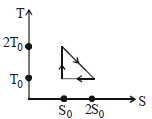
The temperature-entropy $(T-S)$ diagram of a reversible engine cycle is given in the figure. Its efficiency is
A
$1/4$
B
$1/2$
C
$2/3$
D
$1/3$
Solution
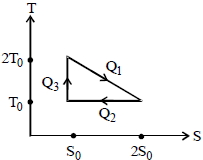
(D) In a $T-S$ diagram,the heat exchanged $Q$ is given by the area under the process curve,i.e.,$Q = \int T dS$.
For the given cycle:
$1$. Heat absorbed $(Q_1)$ during the expansion process (top diagonal line) is the area under the line from $S_0$ to $2S_0$:
$Q_1 = \text{Area of rectangle} + \text{Area of triangle} = (T_0 \times S_0) + \frac{1}{2} \times (T_0 \times S_0) = \frac{3}{2} T_0 S_0$.
$2$. Heat rejected $(Q_2)$ during the constant temperature process (bottom horizontal line) is the area under the line from $2S_0$ to $S_0$:
$Q_2 = T_0 \times (2S_0 - S_0) = T_0 S_0$.
$3$. The process $Q_3$ is an adiabatic process (vertical line),so $Q_3 = 0$.
$4$. The efficiency $\eta$ of the cycle is given by:
$\eta = \frac{W}{Q_1} = \frac{Q_1 - Q_2}{Q_1} = 1 - \frac{Q_2}{Q_1}$.
Substituting the values:
$\eta = 1 - \frac{T_0 S_0}{\frac{3}{2} T_0 S_0} = 1 - \frac{2}{3} = \frac{1}{3}$.
For the given cycle:
$1$. Heat absorbed $(Q_1)$ during the expansion process (top diagonal line) is the area under the line from $S_0$ to $2S_0$:
$Q_1 = \text{Area of rectangle} + \text{Area of triangle} = (T_0 \times S_0) + \frac{1}{2} \times (T_0 \times S_0) = \frac{3}{2} T_0 S_0$.
$2$. Heat rejected $(Q_2)$ during the constant temperature process (bottom horizontal line) is the area under the line from $2S_0$ to $S_0$:
$Q_2 = T_0 \times (2S_0 - S_0) = T_0 S_0$.
$3$. The process $Q_3$ is an adiabatic process (vertical line),so $Q_3 = 0$.
$4$. The efficiency $\eta$ of the cycle is given by:
$\eta = \frac{W}{Q_1} = \frac{Q_1 - Q_2}{Q_1} = 1 - \frac{Q_2}{Q_1}$.
Substituting the values:
$\eta = 1 - \frac{T_0 S_0}{\frac{3}{2} T_0 S_0} = 1 - \frac{2}{3} = \frac{1}{3}$.
0 likesView Solution
24
PhysicsEasyMCQAIIMS · 2008
$Assertion :$ The isothermal curves intersect each other at a certain point.
$Reason :$ The isothermal change takes place slowly,so,the isothermal curves have very little slope.
$Reason :$ The isothermal change takes place slowly,so,the isothermal curves have very little slope.
A
If both Assertion and Reason are correct and the Reason is a correct explanation of the Assertion.
B
If both Assertion and Reason are correct but Reason is not a correct explanation of the Assertion.
C
If the Assertion is correct but Reason is incorrect.
D
If the Assertion is incorrect but the Reason is correct.
Solution
(D) The $Assertion$ is incorrect. Two isothermal curves for different temperatures cannot intersect each other. If they were to intersect at a point,it would imply that at that specific $(P, V)$ state,the system has two different temperatures simultaneously,which is impossible.
The $Reason$ is correct. An isothermal process is a slow process that allows the system to remain in thermal equilibrium with its surroundings. The slope of an isothermal curve on a $P-V$ diagram is given by $-\frac{dP}{dV} = \frac{P}{V}$. Since $P$ and $V$ are positive,the slope is finite and relatively small compared to adiabatic curves (which have a slope of $\gamma \frac{P}{V}$).
The $Reason$ is correct. An isothermal process is a slow process that allows the system to remain in thermal equilibrium with its surroundings. The slope of an isothermal curve on a $P-V$ diagram is given by $-\frac{dP}{dV} = \frac{P}{V}$. Since $P$ and $V$ are positive,the slope is finite and relatively small compared to adiabatic curves (which have a slope of $\gamma \frac{P}{V}$).
0 likesView Solution
25
PhysicsMediumMCQAIIMS · 2008
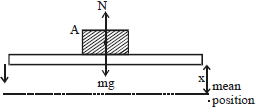
$A$ coin is placed on a horizontal platform which undergoes vertical simple harmonic motion of angular frequency $\omega$. The amplitude of oscillation is gradually increased. The coin will leave contact with the platform for the first time
A
at the mean position of the platform
B
for an amplitude of $\frac{g}{\omega^2}$
C
for an amplitude of $\frac{g^2}{\omega^2}$
D
at the highest position of the platform
Solution
(B) Let $m$ be the mass of the coin and $N$ be the normal reaction force exerted by the platform on the coin.
The equation of motion for the coin in the vertical direction is given by:
$mg - N = m a$
where $a$ is the acceleration of the platform. For simple harmonic motion,the acceleration is $a = -\omega^2 x$,where $x$ is the displacement from the mean position.
Substituting this into the equation of motion:
$mg - N = m(-\omega^2 x)$
$N = m(g + \omega^2 x)$
However,when the platform moves upwards,the acceleration is directed downwards,so $a = -\omega^2 x$ (where $x$ is positive upwards). When the platform is at the highest point,$x = A$ (amplitude),and the acceleration is $a = -\omega^2 A$.
The equation becomes $mg - N = m(-\omega^2 A)$,which implies $N = m(g + \omega^2 A)$. This does not lead to $N=0$.
When the platform moves downwards,the acceleration is directed upwards. At the highest point of the oscillation,the platform's acceleration is directed downwards. The coin loses contact when the normal force $N$ becomes zero.
This happens when the downward acceleration of the platform exceeds the acceleration due to gravity $g$.
The maximum downward acceleration is $\omega^2 A$. Thus,the coin leaves contact when $\omega^2 A \ge g$,or $A \ge \frac{g}{\omega^2}$.
Therefore,the coin will leave contact for the first time when the amplitude reaches $\frac{g}{\omega^2}$ at the highest position of the platform.
The equation of motion for the coin in the vertical direction is given by:
$mg - N = m a$
where $a$ is the acceleration of the platform. For simple harmonic motion,the acceleration is $a = -\omega^2 x$,where $x$ is the displacement from the mean position.
Substituting this into the equation of motion:
$mg - N = m(-\omega^2 x)$
$N = m(g + \omega^2 x)$
However,when the platform moves upwards,the acceleration is directed downwards,so $a = -\omega^2 x$ (where $x$ is positive upwards). When the platform is at the highest point,$x = A$ (amplitude),and the acceleration is $a = -\omega^2 A$.
The equation becomes $mg - N = m(-\omega^2 A)$,which implies $N = m(g + \omega^2 A)$. This does not lead to $N=0$.
When the platform moves downwards,the acceleration is directed upwards. At the highest point of the oscillation,the platform's acceleration is directed downwards. The coin loses contact when the normal force $N$ becomes zero.
This happens when the downward acceleration of the platform exceeds the acceleration due to gravity $g$.
The maximum downward acceleration is $\omega^2 A$. Thus,the coin leaves contact when $\omega^2 A \ge g$,or $A \ge \frac{g}{\omega^2}$.
Therefore,the coin will leave contact for the first time when the amplitude reaches $\frac{g}{\omega^2}$ at the highest position of the platform.
0 likesView Solution
26
PhysicsMediumMCQAIIMS · 2008
$A$ string is stretched between fixed points separated by $75.0\, cm$. It is observed to have resonant frequencies of $420\, Hz$ and $315\, Hz$. There are no other resonant frequencies between these two. Then,the lowest resonant frequency for this string is .... $Hz$
A
$105$
B
$1.05$
C
$1050$
D
$10.5$
Solution
(A) The resonant frequencies of a string fixed at both ends are given by $f_n = n \times f_1$,where $f_1 = \frac{v}{2L}$ is the fundamental frequency and $n = 1, 2, 3, \dots$ is an integer.
Given two consecutive resonant frequencies $f_n = 315\, Hz$ and $f_{n+1} = 420\, Hz$.
We know that the difference between two consecutive resonant frequencies is equal to the fundamental frequency $f_1$.
$f_1 = f_{n+1} - f_n = 420\, Hz - 315\, Hz = 105\, Hz$.
Alternatively,$\frac{f_{n+1}}{f_n} = \frac{n+1}{n} = \frac{420}{315} = \frac{4}{3}$.
This implies $n = 3$,so $f_3 = 315\, Hz$ and $f_4 = 420\, Hz$.
Since $f_3 = 3 \times f_1 = 315\, Hz$,we get $f_1 = \frac{315}{3} = 105\, Hz$.
The lowest resonant frequency is the fundamental frequency $f_1 = 105\, Hz$.
Given two consecutive resonant frequencies $f_n = 315\, Hz$ and $f_{n+1} = 420\, Hz$.
We know that the difference between two consecutive resonant frequencies is equal to the fundamental frequency $f_1$.
$f_1 = f_{n+1} - f_n = 420\, Hz - 315\, Hz = 105\, Hz$.
Alternatively,$\frac{f_{n+1}}{f_n} = \frac{n+1}{n} = \frac{420}{315} = \frac{4}{3}$.
This implies $n = 3$,so $f_3 = 315\, Hz$ and $f_4 = 420\, Hz$.
Since $f_3 = 3 \times f_1 = 315\, Hz$,we get $f_1 = \frac{315}{3} = 105\, Hz$.
The lowest resonant frequency is the fundamental frequency $f_1 = 105\, Hz$.
0 likesView Solution
27
PhysicsEasyMCQAIIMS · 2008
$Assertion :$ The change in air pressure affects the speed of sound.
$Reason :$ The speed of sound in gases is proportional to the square of pressure.
$Reason :$ The speed of sound in gases is proportional to the square of pressure.
A
If both Assertion and Reason are correct and the Reason is a correct explanation of the Assertion.
B
If both Assertion and Reason are correct but Reason is not a correct explanation of the Assertion.
C
If the Assertion is correct but Reason is incorrect.
D
If both the Assertion and Reason are incorrect.
Solution
(D) The speed of sound in a gas is given by the formula $v = \sqrt{\frac{\gamma P}{\rho}}$,where $P$ is the pressure and $\rho$ is the density of the gas.
According to the ideal gas law,$PV = nRT$,which can be written as $P = \frac{\rho RT}{M}$,where $M$ is the molar mass.
Thus,the ratio $\frac{P}{\rho} = \frac{RT}{M}$.
Substituting this into the speed formula,we get $v = \sqrt{\frac{\gamma RT}{M}}$.
Since $R$,$T$,and $M$ are constant at a given temperature,the speed of sound $v$ is independent of pressure $P$.
Therefore,the Assertion is incorrect because pressure change does not affect the speed of sound at a constant temperature.
The Reason is also incorrect because the speed of sound is independent of pressure,not proportional to its square.
Thus,both the Assertion and Reason are incorrect.
According to the ideal gas law,$PV = nRT$,which can be written as $P = \frac{\rho RT}{M}$,where $M$ is the molar mass.
Thus,the ratio $\frac{P}{\rho} = \frac{RT}{M}$.
Substituting this into the speed formula,we get $v = \sqrt{\frac{\gamma RT}{M}}$.
Since $R$,$T$,and $M$ are constant at a given temperature,the speed of sound $v$ is independent of pressure $P$.
Therefore,the Assertion is incorrect because pressure change does not affect the speed of sound at a constant temperature.
The Reason is also incorrect because the speed of sound is independent of pressure,not proportional to its square.
Thus,both the Assertion and Reason are incorrect.
0 likesView Solution
28
PhysicsDifficultMCQAIIMS · 2008
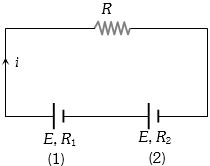
Two sources of equal $emf$ $E$ are connected in series to an external resistance $R$. The internal resistances of the two sources are $R_1$ and $R_2$ $(R_2 > R_1)$. If the potential difference across the source having internal resistance $R_2$ is zero,then:
A
$R = R_1 R_2 / (R_1 + R_2)$
B
$R = R_1 R_2 / (R_2 - R_1)$
C
$R = R_2 (R_1 + R_2) / (R_2 - R_1)$
D
$R = R_2 - R_1$
Solution
(D) The total $emf$ of the series combination is $E_{eq} = E + E = 2E$. The total resistance of the circuit is $R_{eq} = R + R_1 + R_2$. The current in the circuit is given by $i = \frac{2E}{R + R_1 + R_2}$.
The potential difference $V$ across a source with $emf$ $E$ and internal resistance $r$ is given by $V = E - ir$. For the source with internal resistance $R_2$,the potential difference is zero:
$0 = E - i R_2$
$E = i R_2$
Substituting the value of $i$:
$E = \left( \frac{2E}{R + R_1 + R_2} \right) R_2$
$1 = \frac{2 R_2}{R + R_1 + R_2}$
$R + R_1 + R_2 = 2 R_2$
$R = 2 R_2 - R_2 - R_1$
$R = R_2 - R_1$
The potential difference $V$ across a source with $emf$ $E$ and internal resistance $r$ is given by $V = E - ir$. For the source with internal resistance $R_2$,the potential difference is zero:
$0 = E - i R_2$
$E = i R_2$
Substituting the value of $i$:
$E = \left( \frac{2E}{R + R_1 + R_2} \right) R_2$
$1 = \frac{2 R_2}{R + R_1 + R_2}$
$R + R_1 + R_2 = 2 R_2$
$R = 2 R_2 - R_2 - R_1$
$R = R_2 - R_1$
0 likesView Solution
29
PhysicsMediumMCQAIIMS · 2008
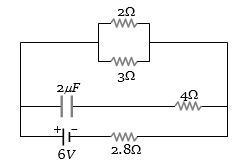
In the figure shown,the capacity of the capacitor $C$ is $2\,\mu F$. The current in the $2\,\Omega$ resistor is ............... $A$.
A
$9$
B
$0.9$
C
$\frac{1}{9}$
D
$\frac{1}{0.9}$
Solution
(B) In a steady state,the capacitor acts as an open circuit,so no current flows through the branch containing the capacitor.
The circuit simplifies to a $6\,V$ battery connected in series with a $2.8\,\Omega$ resistor and a parallel combination of $2\,\Omega$ and $3\,\Omega$ resistors.
The equivalent resistance of the parallel combination is $R_p = \frac{2 \times 3}{2 + 3} = \frac{6}{5} = 1.2\,\Omega$.
The total resistance of the circuit is $R_{eq} = 2.8 + 1.2 = 4.0\,\Omega$.
The total current supplied by the battery is $I = \frac{V}{R_{eq}} = \frac{6}{4} = 1.5\,A$.
Using the current divider rule,the current through the $2\,\Omega$ resistor is $I_{2\Omega} = I \times \frac{3}{2 + 3} = 1.5 \times \frac{3}{5} = 0.9\,A$.
The circuit simplifies to a $6\,V$ battery connected in series with a $2.8\,\Omega$ resistor and a parallel combination of $2\,\Omega$ and $3\,\Omega$ resistors.
The equivalent resistance of the parallel combination is $R_p = \frac{2 \times 3}{2 + 3} = \frac{6}{5} = 1.2\,\Omega$.
The total resistance of the circuit is $R_{eq} = 2.8 + 1.2 = 4.0\,\Omega$.
The total current supplied by the battery is $I = \frac{V}{R_{eq}} = \frac{6}{4} = 1.5\,A$.
Using the current divider rule,the current through the $2\,\Omega$ resistor is $I_{2\Omega} = I \times \frac{3}{2 + 3} = 1.5 \times \frac{3}{5} = 0.9\,A$.
0 likesView Solution
30
PhysicsMediumMCQAIIMS · 2008
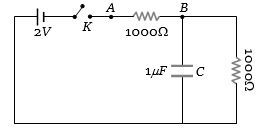
When the key $K$ is pressed at time $t = 0$, which of the following statements about the current $I$ in the resistor $AB$ of the given circuit is true?
A
$I = 2 \,mA$ at all $t$
B
$I$ oscillates between $1 \,mA$ and $2 \,mA$
C
$I = 1 \,mA$ at all $t$
D
At $t = 0$, $I = 2 \,mA$ and with time it goes to $1 \,mA$
Solution
(D) At time $t = 0$, the capacitor acts as a short circuit (zero resistance). The total resistance in the circuit is $1000 \, \Omega$. Thus, the current $I = \frac{2 \,V}{1000 \, \Omega} = 2 \,mA$.
As time passes, the capacitor charges up. When it is fully charged, it acts as an open circuit. The current then flows through the series combination of the $1000 \, \Omega$ resistor and the $1000 \, \Omega$ resistor. The total resistance becomes $2000 \, \Omega$. Thus, the steady-state current $I = \frac{2 \,V}{2000 \, \Omega} = 1 \,mA$. Therefore, the current decreases from $2 \,mA$ to $1 \,mA$ over time.
As time passes, the capacitor charges up. When it is fully charged, it acts as an open circuit. The current then flows through the series combination of the $1000 \, \Omega$ resistor and the $1000 \, \Omega$ resistor. The total resistance becomes $2000 \, \Omega$. Thus, the steady-state current $I = \frac{2 \,V}{2000 \, \Omega} = 1 \,mA$. Therefore, the current decreases from $2 \,mA$ to $1 \,mA$ over time.
0 likesView Solution
31
PhysicsMediumMCQAIIMS · 2008
Two concentric coils each of radius equal to $2\pi \, cm$ are placed at right angles to each other. $3 \, A$ and $4 \, A$ are the currents flowing in each coil respectively. The magnetic induction in $Wb/m^2$ at the centre of the coils will be $(\mu_0 = 4\pi \times 10^{-7} \, Wb/A \cdot m)$.
A
$5 \times 10^{-5}$
B
$7 \times 10^{-5}$
C
$12 \times 10^{-5}$
D
$10^{-5}$
Solution
(A) The magnetic field at the center of a circular coil is given by $B = \frac{\mu_0 i}{2r}$.
Since the two coils are placed at right angles,their magnetic fields $B_1$ and $B_2$ will also be perpendicular to each other.
The resultant magnetic field is $B_{net} = \sqrt{B_1^2 + B_2^2}$.
Substituting $B_1 = \frac{\mu_0 i_1}{2r}$ and $B_2 = \frac{\mu_0 i_2}{2r}$,we get $B_{net} = \frac{\mu_0}{2r} \sqrt{i_1^2 + i_2^2}$.
Given $r = 2\pi \, cm = 2\pi \times 10^{-2} \, m$,$i_1 = 3 \, A$,$i_2 = 4 \, A$,and $\mu_0 = 4\pi \times 10^{-7} \, Wb/A \cdot m$.
$B_{net} = \frac{4\pi \times 10^{-7}}{2 \times 2\pi \times 10^{-2}} \sqrt{3^2 + 4^2}$.
$B_{net} = \frac{4\pi \times 10^{-7}}{4\pi \times 10^{-2}} \sqrt{9 + 16} = 10^{-5} \times \sqrt{25} = 5 \times 10^{-5} \, Wb/m^2$.
Since the two coils are placed at right angles,their magnetic fields $B_1$ and $B_2$ will also be perpendicular to each other.
The resultant magnetic field is $B_{net} = \sqrt{B_1^2 + B_2^2}$.
Substituting $B_1 = \frac{\mu_0 i_1}{2r}$ and $B_2 = \frac{\mu_0 i_2}{2r}$,we get $B_{net} = \frac{\mu_0}{2r} \sqrt{i_1^2 + i_2^2}$.
Given $r = 2\pi \, cm = 2\pi \times 10^{-2} \, m$,$i_1 = 3 \, A$,$i_2 = 4 \, A$,and $\mu_0 = 4\pi \times 10^{-7} \, Wb/A \cdot m$.
$B_{net} = \frac{4\pi \times 10^{-7}}{2 \times 2\pi \times 10^{-2}} \sqrt{3^2 + 4^2}$.
$B_{net} = \frac{4\pi \times 10^{-7}}{4\pi \times 10^{-2}} \sqrt{9 + 16} = 10^{-5} \times \sqrt{25} = 5 \times 10^{-5} \, Wb/m^2$.
0 likesView Solution
32
PhysicsDifficultMCQAIIMS · 2008
An $ac$ source of angular frequency $\omega$ is connected across a resistor $R$ and a capacitor $C$ in series. The current registered is $I$. If the frequency of the source is changed to $\omega/3$ (while maintaining the same voltage),the current in the circuit is found to be halved. Calculate the ratio of reactance to resistance at the original frequency $\omega$.
A
$\sqrt{3/5}$
B
$\sqrt{2/5}$
C
$\sqrt{1/5}$
D
$\sqrt{4/5}$
Solution
(A) At angular frequency $\omega$,the current $I$ in the $RC$ series circuit is given by:
$I = \frac{V}{\sqrt{R^2 + X_C^2}} = \frac{V}{\sqrt{R^2 + (1/\omega C)^2}}$ ......$(i)$
When the frequency is changed to $\omega' = \omega/3$,the new capacitive reactance becomes $X_C' = \frac{1}{(\omega/3)C} = 3X_C$. The new current $I'$ is given as $I/2$:
$I/2 = \frac{V}{\sqrt{R^2 + (3X_C)^2}}$ ......$(ii)$
Dividing equation $(i)$ by equation $(ii)$:
$2 = \frac{\sqrt{R^2 + 9X_C^2}}{\sqrt{R^2 + X_C^2}}$
Squaring both sides:
$4 = \frac{R^2 + 9X_C^2}{R^2 + X_C^2}$
$4R^2 + 4X_C^2 = R^2 + 9X_C^2$
$3R^2 = 5X_C^2$
$\frac{X_C^2}{R^2} = \frac{3}{5}$
$\frac{X_C}{R} = \sqrt{\frac{3}{5}}$
$I = \frac{V}{\sqrt{R^2 + X_C^2}} = \frac{V}{\sqrt{R^2 + (1/\omega C)^2}}$ ......$(i)$
When the frequency is changed to $\omega' = \omega/3$,the new capacitive reactance becomes $X_C' = \frac{1}{(\omega/3)C} = 3X_C$. The new current $I'$ is given as $I/2$:
$I/2 = \frac{V}{\sqrt{R^2 + (3X_C)^2}}$ ......$(ii)$
Dividing equation $(i)$ by equation $(ii)$:
$2 = \frac{\sqrt{R^2 + 9X_C^2}}{\sqrt{R^2 + X_C^2}}$
Squaring both sides:
$4 = \frac{R^2 + 9X_C^2}{R^2 + X_C^2}$
$4R^2 + 4X_C^2 = R^2 + 9X_C^2$
$3R^2 = 5X_C^2$
$\frac{X_C^2}{R^2} = \frac{3}{5}$
$\frac{X_C}{R} = \sqrt{\frac{3}{5}}$
0 likesView Solution
33
PhysicsDifficultMCQAIIMS · 2008
In a photoemissive cell with exciting wavelength $\lambda$,the fastest electron has speed $v$. If the exciting wavelength is changed to $\frac{3\lambda}{4}$,the speed of the fastest emitted electron will be
A
$v(3/4)^{1/2}$
B
$v(4/3)^{1/2}$
C
$< v(4/3)^{1/2}$
D
$> v(4/3)^{1/2}$
Solution
(D) According to Einstein's photoelectric equation: $K_{\max} = \frac{hc}{\lambda} - W_0 = \frac{1}{2}mv^2$,where $W_0 = \frac{hc}{\lambda_0}$ is the work function.
Thus,$v = \sqrt{\frac{2hc}{m} \left( \frac{1}{\lambda} - \frac{1}{\lambda_0} \right)} = \sqrt{\frac{2hc}{m} \left( \frac{\lambda_0 - \lambda}{\lambda \lambda_0} \right)} \dots (i)$
When the wavelength is changed to $\lambda' = \frac{3\lambda}{4}$,the new velocity $v'$ is:
$v' = \sqrt{\frac{2hc}{m} \left( \frac{1}{3\lambda/4} - \frac{1}{\lambda_0} \right)} = \sqrt{\frac{2hc}{m} \left( \frac{4\lambda_0 - 3\lambda}{3\lambda \lambda_0} \right)} \dots (ii)$
Dividing $(ii)$ by $(i)$:
$\frac{v'}{v} = \sqrt{\frac{4\lambda_0 - 3\lambda}{3\lambda \lambda_0} \cdot \frac{\lambda \lambda_0}{\lambda_0 - \lambda}} = \sqrt{\frac{4}{3} \cdot \frac{\lambda_0 - 0.75\lambda}{\lambda_0 - \lambda}}$
Since $\lambda_0 > \lambda$,it follows that $(\lambda_0 - 0.75\lambda) > (\lambda_0 - \lambda)$.
Therefore,$\frac{\lambda_0 - 0.75\lambda}{\lambda_0 - \lambda} > 1$.
This implies $\frac{v'}{v} > \sqrt{\frac{4}{3}}$,or $v' > v(4/3)^{1/2}$.
Thus,$v = \sqrt{\frac{2hc}{m} \left( \frac{1}{\lambda} - \frac{1}{\lambda_0} \right)} = \sqrt{\frac{2hc}{m} \left( \frac{\lambda_0 - \lambda}{\lambda \lambda_0} \right)} \dots (i)$
When the wavelength is changed to $\lambda' = \frac{3\lambda}{4}$,the new velocity $v'$ is:
$v' = \sqrt{\frac{2hc}{m} \left( \frac{1}{3\lambda/4} - \frac{1}{\lambda_0} \right)} = \sqrt{\frac{2hc}{m} \left( \frac{4\lambda_0 - 3\lambda}{3\lambda \lambda_0} \right)} \dots (ii)$
Dividing $(ii)$ by $(i)$:
$\frac{v'}{v} = \sqrt{\frac{4\lambda_0 - 3\lambda}{3\lambda \lambda_0} \cdot \frac{\lambda \lambda_0}{\lambda_0 - \lambda}} = \sqrt{\frac{4}{3} \cdot \frac{\lambda_0 - 0.75\lambda}{\lambda_0 - \lambda}}$
Since $\lambda_0 > \lambda$,it follows that $(\lambda_0 - 0.75\lambda) > (\lambda_0 - \lambda)$.
Therefore,$\frac{\lambda_0 - 0.75\lambda}{\lambda_0 - \lambda} > 1$.
This implies $\frac{v'}{v} > \sqrt{\frac{4}{3}}$,or $v' > v(4/3)^{1/2}$.
0 likesView Solution
34
PhysicsMediumMCQAIIMS · 2008
$A$ radioactive material decays by simultaneous emission of two particles with respective half-lives $1620$ years and $810$ years. The time (in years) after which one-fourth of the material remains is:
A
$1080$
B
$2430$
C
$3240$
D
$4860$
Solution
(A) When a radioactive material decays by two simultaneous processes,the effective decay constant $\lambda$ is given by $\lambda = \lambda_1 + \lambda_2$.
Since the half-life $T$ is related to the decay constant by $T = \frac{\ln 2}{\lambda}$,the effective half-life $T$ is given by $\frac{1}{T} = \frac{1}{T_1} + \frac{1}{T_2}$.
Given $T_1 = 1620$ years and $T_2 = 810$ years,the effective half-life is:
$T = \frac{T_1 T_2}{T_1 + T_2} = \frac{1620 \times 810}{1620 + 810} = \frac{1620 \times 810}{2430} = 540$ years.
We want to find the time $t$ after which $\frac{1}{4}$ of the material remains.
The law of radioactive decay states that $N(t) = N_0 \left(\frac{1}{2}\right)^{t/T}$.
Setting $N(t) = \frac{1}{4} N_0$,we get $\frac{1}{4} = \left(\frac{1}{2}\right)^{t/T}$,which implies $\left(\frac{1}{2}\right)^2 = \left(\frac{1}{2}\right)^{t/T}$.
Thus,$\frac{t}{T} = 2$,so $t = 2T = 2 \times 540 = 1080$ years.
Since the half-life $T$ is related to the decay constant by $T = \frac{\ln 2}{\lambda}$,the effective half-life $T$ is given by $\frac{1}{T} = \frac{1}{T_1} + \frac{1}{T_2}$.
Given $T_1 = 1620$ years and $T_2 = 810$ years,the effective half-life is:
$T = \frac{T_1 T_2}{T_1 + T_2} = \frac{1620 \times 810}{1620 + 810} = \frac{1620 \times 810}{2430} = 540$ years.
We want to find the time $t$ after which $\frac{1}{4}$ of the material remains.
The law of radioactive decay states that $N(t) = N_0 \left(\frac{1}{2}\right)^{t/T}$.
Setting $N(t) = \frac{1}{4} N_0$,we get $\frac{1}{4} = \left(\frac{1}{2}\right)^{t/T}$,which implies $\left(\frac{1}{2}\right)^2 = \left(\frac{1}{2}\right)^{t/T}$.
Thus,$\frac{t}{T} = 2$,so $t = 2T = 2 \times 540 = 1080$ years.
0 likesView Solution
35
PhysicsMediumMCQAIIMS · 2008
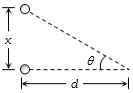
Two point white dots are $1 \ mm$ apart on a black paper. They are viewed by an eye with a pupil diameter of $3 \ mm$. Approximately,what is the maximum distance at which the dots can be resolved by the eye? (Take wavelength of light $= 500 \ nm$)
A
$6$
B
$3$
C
$5$
D
$1$
Solution
(C) The condition for the resolution of two point objects by an optical system is given by the Rayleigh criterion: $\theta = \frac{1.22 \lambda}{a}$,where $\theta$ is the angular separation,$\lambda$ is the wavelength of light,and $a$ is the diameter of the aperture (pupil).
From the geometry of the problem,the angular separation is also given by $\theta = \frac{x}{d}$,where $x$ is the distance between the dots and $d$ is the distance of the observer from the dots.
Equating the two expressions for $\theta$: $\frac{1.22 \lambda}{a} = \frac{x}{d}$.
Rearranging to solve for $d$: $d = \frac{x \cdot a}{1.22 \lambda}$.
Given values: $x = 1 \ mm = 1 \times 10^{-3} \ m$,$a = 3 \ mm = 3 \times 10^{-3} \ m$,$\lambda = 500 \ nm = 500 \times 10^{-9} \ m$.
Substituting these values into the formula:
$d = \frac{(1 \times 10^{-3} \ m) \times (3 \times 10^{-3} \ m)}{1.22 \times 500 \times 10^{-9} \ m}$
$d = \frac{3 \times 10^{-6}}{610 \times 10^{-9}} = \frac{3000}{610} \approx 4.918 \ m$.
Rounding to the nearest integer,the maximum distance is approximately $5 \ m$.
From the geometry of the problem,the angular separation is also given by $\theta = \frac{x}{d}$,where $x$ is the distance between the dots and $d$ is the distance of the observer from the dots.
Equating the two expressions for $\theta$: $\frac{1.22 \lambda}{a} = \frac{x}{d}$.
Rearranging to solve for $d$: $d = \frac{x \cdot a}{1.22 \lambda}$.
Given values: $x = 1 \ mm = 1 \times 10^{-3} \ m$,$a = 3 \ mm = 3 \times 10^{-3} \ m$,$\lambda = 500 \ nm = 500 \times 10^{-9} \ m$.
Substituting these values into the formula:
$d = \frac{(1 \times 10^{-3} \ m) \times (3 \times 10^{-3} \ m)}{1.22 \times 500 \times 10^{-9} \ m}$
$d = \frac{3 \times 10^{-6}}{610 \times 10^{-9}} = \frac{3000}{610} \approx 4.918 \ m$.
Rounding to the nearest integer,the maximum distance is approximately $5 \ m$.
0 likesView Solution
36
PhysicsMediumMCQAIIMS · 2008
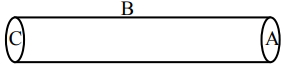
$A$ hollow cylinder has a charge $q$ within it. If $\phi$ is the electric flux in units of $V-m$ associated with the curved surface $B,$ the flux linked with the plane surface $A$ in units of $V-m$ will be
A
$\frac{q}{2\varepsilon_0}$
B
$\frac{\phi}{3}$
C
$\frac{q}{\varepsilon_0} - \phi$
D
$\frac{1}{2}\left(\frac{q}{\varepsilon_0} - \phi\right)$
Solution
(D) Let $\phi_A, \phi_B,$ and $\phi_C$ be the electric flux linked with the surfaces $A, B,$ and $C$ respectively.
According to Gauss's Law,the total electric flux through the closed surface is $\phi_{total} = \phi_A + \phi_B + \phi_C = \frac{q}{\varepsilon_0}$.
Due to the symmetry of the cylinder,the flux linked with the two plane surfaces $A$ and $C$ is equal,so $\phi_A = \phi_C$.
Substituting this into the Gauss's Law equation,we get $2\phi_A + \phi_B = \frac{q}{\varepsilon_0}$.
Given that the flux through the curved surface $B$ is $\phi_B = \phi$,we have $2\phi_A + \phi = \frac{q}{\varepsilon_0}$.
Rearranging for $\phi_A$,we get $2\phi_A = \frac{q}{\varepsilon_0} - \phi$.
Therefore,$\phi_A = \frac{1}{2}\left(\frac{q}{\varepsilon_0} - \phi\right)$.
According to Gauss's Law,the total electric flux through the closed surface is $\phi_{total} = \phi_A + \phi_B + \phi_C = \frac{q}{\varepsilon_0}$.
Due to the symmetry of the cylinder,the flux linked with the two plane surfaces $A$ and $C$ is equal,so $\phi_A = \phi_C$.
Substituting this into the Gauss's Law equation,we get $2\phi_A + \phi_B = \frac{q}{\varepsilon_0}$.
Given that the flux through the curved surface $B$ is $\phi_B = \phi$,we have $2\phi_A + \phi = \frac{q}{\varepsilon_0}$.
Rearranging for $\phi_A$,we get $2\phi_A = \frac{q}{\varepsilon_0} - \phi$.
Therefore,$\phi_A = \frac{1}{2}\left(\frac{q}{\varepsilon_0} - \phi\right)$.
0 likesView Solution
37
PhysicsMediumMCQAIIMS · 2008
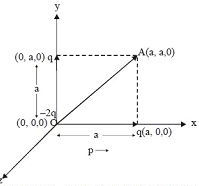
Three point charges $+q$,$-2q$ and $+q$ are placed at points $(x = 0, y = a, z = 0)$,$(x = 0, y = 0, z = 0)$ and $(x = a, y = 0, z = 0)$ respectively. The magnitude and direction of the electric dipole moment vector of this charge assembly are
A
$\sqrt{2}qa$ along $+y$ direction
B
$\sqrt{2}qa$ along the line joining points $(x = 0, y = 0, z = 0)$ and $(x = a, y = a, z = 0)$
C
$qa$ along the line joining points $(x = 0, y = 0, z = 0)$ and $(x = a, y = a, z = 0)$
D
$\sqrt{2}qa$ along $+x$ direction
Solution
(B) The given charge assembly can be represented using the coordinate axes $x$ and $y$ as shown in the figure.
The charge $-2q$ is placed at the origin $O(0, 0, 0)$. One $+q$ charge is placed at $(a, 0, 0)$ and the other $+q$ charge is placed at $(0, a, 0)$.
This system can be viewed as two electric dipoles: one along the $x$-axis with dipole moment $\vec{p}_1 = q a \hat{i}$ and another along the $y$-axis with dipole moment $\vec{p}_2 = q a \hat{j}$.
The resultant dipole moment $\vec{P}_R$ is the vector sum of these two dipoles:
$\vec{P}_R = \vec{p}_1 + \vec{p}_2 = qa \hat{i} + qa \hat{j}$.
The magnitude of the resultant dipole moment is:
$P_R = \sqrt{(qa)^2 + (qa)^2} = \sqrt{2} qa$.
The direction of the resultant dipole moment is along the vector $\hat{i} + \hat{j}$,which is the line joining the origin $(0, 0, 0)$ and the point $(a, a, 0)$.
The charge $-2q$ is placed at the origin $O(0, 0, 0)$. One $+q$ charge is placed at $(a, 0, 0)$ and the other $+q$ charge is placed at $(0, a, 0)$.
This system can be viewed as two electric dipoles: one along the $x$-axis with dipole moment $\vec{p}_1 = q a \hat{i}$ and another along the $y$-axis with dipole moment $\vec{p}_2 = q a \hat{j}$.
The resultant dipole moment $\vec{P}_R$ is the vector sum of these two dipoles:
$\vec{P}_R = \vec{p}_1 + \vec{p}_2 = qa \hat{i} + qa \hat{j}$.
The magnitude of the resultant dipole moment is:
$P_R = \sqrt{(qa)^2 + (qa)^2} = \sqrt{2} qa$.
The direction of the resultant dipole moment is along the vector $\hat{i} + \hat{j}$,which is the line joining the origin $(0, 0, 0)$ and the point $(a, a, 0)$.
0 likesView Solution
38
PhysicsDifficultMCQAIIMS · 2008
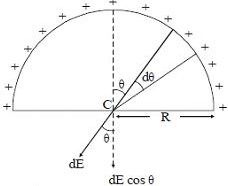
Charge $q$ is uniformly distributed over a thin half ring of radius $R$. The electric field at the centre of the ring is
A
$\frac{q}{2{\pi ^2}{\varepsilon _0}{R^2}}$
B
$\frac{q}{4{\pi ^2}{\varepsilon _0}{R^2}}$
C
$\frac{q}{4{\pi }{\varepsilon _0}{R^2}}$
D
$\frac{q}{2{\pi }{\varepsilon _0}{R^2}}$
Solution
(A) Consider a small element of length $d\ell = R d\theta$ on the half ring.
Charge on this element is $dq = \lambda d\ell = \lambda R d\theta$,where $\lambda = \frac{q}{\pi R}$ is the linear charge density.
The electric field at the centre due to this element is $dE = \frac{1}{4\pi \varepsilon_0} \frac{dq}{R^2} = \frac{1}{4\pi \varepsilon_0} \frac{\lambda R d\theta}{R^2} = \frac{\lambda}{4\pi \varepsilon_0 R} d\theta$.
Due to symmetry,the horizontal components of the electric field cancel out,and only the vertical components add up.
The vertical component is $dE_y = dE \cos \theta$.
Integrating from $-\pi/2$ to $\pi/2$ or $2 \int_{0}^{\pi/2} dE \cos \theta$:
$E = 2 \int_{0}^{\pi/2} \frac{\lambda}{4\pi \varepsilon_0 R} \cos \theta d\theta = \frac{2\lambda}{4\pi \varepsilon_0 R} [\sin \theta]_0^{\pi/2} = \frac{\lambda}{2\pi \varepsilon_0 R}$.
Substituting $\lambda = \frac{q}{\pi R}$,we get $E = \frac{q/(\pi R)}{2\pi \varepsilon_0 R} = \frac{q}{2\pi^2 \varepsilon_0 R^2}$.
Charge on this element is $dq = \lambda d\ell = \lambda R d\theta$,where $\lambda = \frac{q}{\pi R}$ is the linear charge density.
The electric field at the centre due to this element is $dE = \frac{1}{4\pi \varepsilon_0} \frac{dq}{R^2} = \frac{1}{4\pi \varepsilon_0} \frac{\lambda R d\theta}{R^2} = \frac{\lambda}{4\pi \varepsilon_0 R} d\theta$.
Due to symmetry,the horizontal components of the electric field cancel out,and only the vertical components add up.
The vertical component is $dE_y = dE \cos \theta$.
Integrating from $-\pi/2$ to $\pi/2$ or $2 \int_{0}^{\pi/2} dE \cos \theta$:
$E = 2 \int_{0}^{\pi/2} \frac{\lambda}{4\pi \varepsilon_0 R} \cos \theta d\theta = \frac{2\lambda}{4\pi \varepsilon_0 R} [\sin \theta]_0^{\pi/2} = \frac{\lambda}{2\pi \varepsilon_0 R}$.
Substituting $\lambda = \frac{q}{\pi R}$,we get $E = \frac{q/(\pi R)}{2\pi \varepsilon_0 R} = \frac{q}{2\pi^2 \varepsilon_0 R^2}$.
0 likesView Solution
39
PhysicsMediumMCQAIIMS · 2008
Assertion : $A$ parallel plate capacitor is connected across a battery through a key. $A$ dielectric slab of dielectric constant $K$ is introduced between the plates. The energy stored becomes $K$ times.
Reason : The surface density of charge on the plate remains constant or unchanged.
Reason : The surface density of charge on the plate remains constant or unchanged.
A
If both Assertion and Reason are correct and the Reason is a correct explanation of the Assertion.
B
If both Assertion and Reason are correct but Reason is not a correct explanation of the Assertion.
C
If the Assertion is correct but Reason is incorrect.
D
If both the Assertion and Reason are incorrect.
Solution
(C) When a parallel plate capacitor is connected to a battery,the potential difference $V$ across the plates remains constant $(V = V_0)$.
The energy stored in the capacitor is given by $U = \frac{1}{2} CV^2$.
When a dielectric slab of dielectric constant $K$ is introduced between the plates,the capacitance becomes $C' = KC$.
Therefore,the new energy stored is $U' = \frac{1}{2} (KC) V^2 = K U$. Thus,the energy stored becomes $K$ times.
Since $Q = CV$,the charge on the plates becomes $Q' = KCV = KQ$.
The surface charge density is given by $\sigma = \frac{Q}{A}$. Since $Q$ increases by a factor of $K$,the surface charge density $\sigma' = \frac{KQ}{A} = K\sigma_0$ also increases by a factor of $K$.
Therefore,the Reason is incorrect because the surface charge density does not remain constant.
The energy stored in the capacitor is given by $U = \frac{1}{2} CV^2$.
When a dielectric slab of dielectric constant $K$ is introduced between the plates,the capacitance becomes $C' = KC$.
Therefore,the new energy stored is $U' = \frac{1}{2} (KC) V^2 = K U$. Thus,the energy stored becomes $K$ times.
Since $Q = CV$,the charge on the plates becomes $Q' = KCV = KQ$.
The surface charge density is given by $\sigma = \frac{Q}{A}$. Since $Q$ increases by a factor of $K$,the surface charge density $\sigma' = \frac{KQ}{A} = K\sigma_0$ also increases by a factor of $K$.
Therefore,the Reason is incorrect because the surface charge density does not remain constant.
0 likesView Solution
40
PhysicsEasyMCQAIIMS · 2008
Assertion : An electric bulb becomes dim,when the electric heater in parallel circuit is switched on.
Reason : Dimness decreases after sometime.
Reason : Dimness decreases after sometime.
A
If both Assertion and Reason are correct and the Reason is a correct explanation of the Assertion.
B
If both Assertion and Reason are correct but Reason is not a correct explanation of the Assertion.
C
If the Assertion is correct but Reason is incorrect.
D
If both the Assertion and Reason are incorrect.
Solution
(A) The electric power of a heater is significantly higher than that of a bulb. Since $P = V^2/R$,we have $R \propto 1/P$,meaning the resistance of the heater is much lower than that of the bulb.
When the heater is switched on in parallel,the total current drawn from the source increases. Due to the internal resistance of the source (or line resistance),the terminal voltage across the bulb drops,causing it to become dim.
As the heater coil heats up,its resistance increases due to the positive temperature coefficient of the material. Consequently,the current drawn by the heater decreases,the terminal voltage recovers,and the bulb's brightness increases (dimness decreases).
When the heater is switched on in parallel,the total current drawn from the source increases. Due to the internal resistance of the source (or line resistance),the terminal voltage across the bulb drops,causing it to become dim.
As the heater coil heats up,its resistance increases due to the positive temperature coefficient of the material. Consequently,the current drawn by the heater decreases,the terminal voltage recovers,and the bulb's brightness increases (dimness decreases).
0 likesView Solution
41
PhysicsEasyMCQAIIMS · 2008
Assertion: In electric circuits,wires carrying currents in opposite directions are often twisted together.
Reason: If the wires are not twisted together,the combination of the wires forms a current loop,and the magnetic field generated by the loop might affect adjacent circuits or components.
Reason: If the wires are not twisted together,the combination of the wires forms a current loop,and the magnetic field generated by the loop might affect adjacent circuits or components.
A
If both Assertion and Reason are correct and the Reason is a correct explanation of the Assertion.
B
If both Assertion and Reason are correct but Reason is not a correct explanation of the Assertion.
C
If the Assertion is correct but Reason is incorrect.
D
If both the Assertion and Reason are incorrect.
Solution
(A) When two wires carrying currents in opposite directions are twisted together,the magnetic field produced by one wire is equal and opposite to the magnetic field produced by the other wire at any point in the surrounding space.
As a result,the net magnetic field at any point outside the twisted pair is effectively zero.
If the wires are not twisted,they form a loop that generates a magnetic field,which can cause electromagnetic interference $(EMI)$ in nearby sensitive electronic components or circuits.
Therefore,twisting the wires minimizes the magnetic flux and prevents unwanted induction in adjacent circuits.
Thus,both the Assertion and the Reason are correct,and the Reason is the correct explanation of the Assertion.
As a result,the net magnetic field at any point outside the twisted pair is effectively zero.
If the wires are not twisted,they form a loop that generates a magnetic field,which can cause electromagnetic interference $(EMI)$ in nearby sensitive electronic components or circuits.
Therefore,twisting the wires minimizes the magnetic flux and prevents unwanted induction in adjacent circuits.
Thus,both the Assertion and the Reason are correct,and the Reason is the correct explanation of the Assertion.
0 likesView Solution
42
PhysicsMediumMCQAIIMS · 2008
Assertion: The magnetic field produced by a current-carrying solenoid is independent of its length and cross-sectional area.
Reason: The magnetic field inside the solenoid is uniform.
Reason: The magnetic field inside the solenoid is uniform.
A
If both Assertion and Reason are correct and the Reason is a correct explanation of the Assertion.
B
If both Assertion and Reason are correct but Reason is not a correct explanation of the Assertion.
C
If the Assertion is correct but Reason is incorrect.
D
If both the Assertion and Reason are incorrect.
Solution
(A) For an ideal solenoid of infinite length,the magnetic field inside is given by $B = \mu_0 n i$,where $n$ is the number of turns per unit length and $i$ is the current.
This expression shows that the magnetic field $B$ depends only on the number of turns per unit length and the current,making it independent of the total length $l$ and the cross-sectional area $A$ of the solenoid.
Inside an ideal solenoid,the magnetic field is uniform and parallel to the axis.
Therefore,both the Assertion and the Reason are correct,and the Reason correctly explains why the field is independent of the solenoid's dimensions (as the uniform field is a property of the ideal solenoid model).
Thus,the correct option is $A$.
This expression shows that the magnetic field $B$ depends only on the number of turns per unit length and the current,making it independent of the total length $l$ and the cross-sectional area $A$ of the solenoid.
Inside an ideal solenoid,the magnetic field is uniform and parallel to the axis.
Therefore,both the Assertion and the Reason are correct,and the Reason correctly explains why the field is independent of the solenoid's dimensions (as the uniform field is a property of the ideal solenoid model).
Thus,the correct option is $A$.
0 likesView Solution
43
PhysicsEasyMCQAIIMS · 2008
Assertion: If a compass needle is kept at the magnetic north pole of the Earth,the compass needle may stay in any direction.
Reason: $A$ dip needle will stay vertical at the north pole of the Earth.
Reason: $A$ dip needle will stay vertical at the north pole of the Earth.
A
If both Assertion and Reason are correct and the Reason is a correct explanation of the Assertion.
B
If both Assertion and Reason are correct but Reason is not a correct explanation of the Assertion.
C
If the Assertion is correct but Reason is incorrect.
D
If both the Assertion and Reason are incorrect.
Solution
(A) At the magnetic poles of the Earth,the horizontal component of the Earth's magnetic field $(H)$ is zero.
Since a standard compass needle is designed to rotate only in a horizontal plane,it experiences no torque from the horizontal component of the magnetic field.
Therefore,the compass needle can remain in any direction.
This confirms the Assertion is correct.
$A$ dip needle is free to rotate in a vertical plane.
At the magnetic poles,the magnetic field lines are perpendicular to the Earth's surface,meaning the angle of dip is $90^o$.
Consequently,the dip needle aligns itself vertically.
This confirms the Reason is correct.
Since the behavior of the compass needle is a direct consequence of the magnetic field being purely vertical (which is also why the dip needle is vertical),the Reason correctly explains the Assertion.
Since a standard compass needle is designed to rotate only in a horizontal plane,it experiences no torque from the horizontal component of the magnetic field.
Therefore,the compass needle can remain in any direction.
This confirms the Assertion is correct.
$A$ dip needle is free to rotate in a vertical plane.
At the magnetic poles,the magnetic field lines are perpendicular to the Earth's surface,meaning the angle of dip is $90^o$.
Consequently,the dip needle aligns itself vertically.
This confirms the Reason is correct.
Since the behavior of the compass needle is a direct consequence of the magnetic field being purely vertical (which is also why the dip needle is vertical),the Reason correctly explains the Assertion.
0 likesView Solution
44
PhysicsEasyMCQAIIMS · 2008
Assertion : An electric motor will have maximum efficiency when back $emf$ becomes equal to half of applied $emf$.
Reason : Efficiency of electric motor depends only on magnitude of back $emf$.
Reason : Efficiency of electric motor depends only on magnitude of back $emf$.
A
If both Assertion and Reason are correct and the Reason is a correct explanation of the Assertion.
B
If both Assertion and Reason are correct but Reason is not a correct explanation of the Assertion.
C
If the Assertion is correct but Reason is incorrect.
D
If both the Assertion and Reason are incorrect.
Solution
(C) The efficiency $\eta$ of an electric motor is given by $\eta = \frac{P_{out}}{P_{in}} = \frac{e \cdot I}{E \cdot I} = \frac{e}{E}$, where $e$ is the back $emf$ and $E$ is the applied $emf$.
The current in the motor is $I = \frac{E - e}{R}$. The mechanical power output is $P_{out} = e \cdot I = e \left( \frac{E - e}{R} \right) = \frac{eE - e^2}{R}$.
To maximize $P_{out}$, we differentiate with respect to $e$: $\frac{dP_{out}}{de} = \frac{E - 2e}{R} = 0$, which gives $e = \frac{E}{2}$. Thus, the assertion is correct.
The efficiency depends on both the back $emf$ and the applied $emf$, not just the magnitude of the back $emf$. Therefore, the reason is incorrect.
The current in the motor is $I = \frac{E - e}{R}$. The mechanical power output is $P_{out} = e \cdot I = e \left( \frac{E - e}{R} \right) = \frac{eE - e^2}{R}$.
To maximize $P_{out}$, we differentiate with respect to $e$: $\frac{dP_{out}}{de} = \frac{E - 2e}{R} = 0$, which gives $e = \frac{E}{2}$. Thus, the assertion is correct.
The efficiency depends on both the back $emf$ and the applied $emf$, not just the magnitude of the back $emf$. Therefore, the reason is incorrect.
0 likesView Solution
45
PhysicsDifficultMCQAIIMS · 2008
$A$ thin glass (refractive index $1.5$) lens has an optical power of $-5\,D$ in air. Its optical power in a liquid medium with a refractive index of $1.6$ will be: (in $,D$)
A
$-1$
B
$1$
C
$-25$
D
$25$
Solution
(B) The lens maker's formula is given by $\frac{1}{f} = (\mu_{rel} - 1) \left(\frac{1}{R_1} - \frac{1}{R_2}\right)$.
In air $(\mu_a = 1)$: $P_a = \frac{1}{f_a} = (\mu_g - 1) \left(\frac{1}{R_1} - \frac{1}{R_2}\right) = -5\,D$.
So,$(1.5 - 1) \left(\frac{1}{R_1} - \frac{1}{R_2}\right) = -5$,which gives $0.5 \left(\frac{1}{R_1} - \frac{1}{R_2}\right) = -5$,or $\left(\frac{1}{R_1} - \frac{1}{R_2}\right) = -10$.
In liquid $(\mu_m = 1.6)$: $P_m = \frac{\mu_m}{f_m} = \mu_m \left(\frac{\mu_g}{\mu_m} - 1\right) \left(\frac{1}{R_1} - \frac{1}{R_2}\right)$.
$P_m = 1.6 \left(\frac{1.5}{1.6} - 1\right) (-10)$.
$P_m = 1.6 \left(\frac{1.5 - 1.6}{1.6}\right) (-10)$.
$P_m = 1.6 \left(\frac{-0.1}{1.6}\right) (-10) = (-0.1) \times (-10) = 1\,D$.
In air $(\mu_a = 1)$: $P_a = \frac{1}{f_a} = (\mu_g - 1) \left(\frac{1}{R_1} - \frac{1}{R_2}\right) = -5\,D$.
So,$(1.5 - 1) \left(\frac{1}{R_1} - \frac{1}{R_2}\right) = -5$,which gives $0.5 \left(\frac{1}{R_1} - \frac{1}{R_2}\right) = -5$,or $\left(\frac{1}{R_1} - \frac{1}{R_2}\right) = -10$.
In liquid $(\mu_m = 1.6)$: $P_m = \frac{\mu_m}{f_m} = \mu_m \left(\frac{\mu_g}{\mu_m} - 1\right) \left(\frac{1}{R_1} - \frac{1}{R_2}\right)$.
$P_m = 1.6 \left(\frac{1.5}{1.6} - 1\right) (-10)$.
$P_m = 1.6 \left(\frac{1.5 - 1.6}{1.6}\right) (-10)$.
$P_m = 1.6 \left(\frac{-0.1}{1.6}\right) (-10) = (-0.1) \times (-10) = 1\,D$.
0 likesView Solution
46
PhysicsMediumMCQAIIMS · 2008
$A$ fish looking up through the water sees the outside world contained in a circular horizon. If the refractive index of water is $\frac{4}{3}$ and the fish is $12 \, cm$ below the surface,the radius of this circle in $cm$ is
A
$\frac{36}{\sqrt{7}}$
B
$36\sqrt{7}$
C
$4\sqrt{5}$
D
$36\sqrt{5}$
Solution
(A) The light from the outside world reaches the fish only if the angle of incidence is less than or equal to the critical angle $\theta_{c}$.
For water with refractive index $\mu = \frac{4}{3}$,the critical angle $\theta_{c}$ is given by $\sin \theta_{c} = \frac{1}{\mu} = \frac{3}{4}$.
From the geometry of the problem,the radius $R$ of the circular horizon is related to the depth $h = 12 \, cm$ by $R = h \tan \theta_{c}$.
Since $\sin \theta_{c} = \frac{3}{4}$,we have $\cos \theta_{c} = \sqrt{1 - \sin^2 \theta_{c}} = \sqrt{1 - (\frac{3}{4})^2} = \sqrt{1 - \frac{9}{16}} = \sqrt{\frac{7}{16}} = \frac{\sqrt{7}}{4}$.
Therefore,$\tan \theta_{c} = \frac{\sin \theta_{c}}{\cos \theta_{c}} = \frac{3/4}{\sqrt{7}/4} = \frac{3}{\sqrt{7}}$.
Substituting the values,$R = 12 \times \frac{3}{\sqrt{7}} = \frac{36}{\sqrt{7}} \, cm$.
For water with refractive index $\mu = \frac{4}{3}$,the critical angle $\theta_{c}$ is given by $\sin \theta_{c} = \frac{1}{\mu} = \frac{3}{4}$.
From the geometry of the problem,the radius $R$ of the circular horizon is related to the depth $h = 12 \, cm$ by $R = h \tan \theta_{c}$.
Since $\sin \theta_{c} = \frac{3}{4}$,we have $\cos \theta_{c} = \sqrt{1 - \sin^2 \theta_{c}} = \sqrt{1 - (\frac{3}{4})^2} = \sqrt{1 - \frac{9}{16}} = \sqrt{\frac{7}{16}} = \frac{\sqrt{7}}{4}$.
Therefore,$\tan \theta_{c} = \frac{\sin \theta_{c}}{\cos \theta_{c}} = \frac{3/4}{\sqrt{7}/4} = \frac{3}{\sqrt{7}}$.
Substituting the values,$R = 12 \times \frac{3}{\sqrt{7}} = \frac{36}{\sqrt{7}} \, cm$.
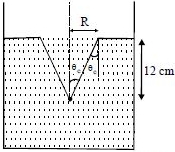
0 likesView Solution
47
PhysicsEasyMCQAIIMS · 2008
Assertion : $A$ concave mirror and convex lens both have the same focal length in air. When they are submerged in water,they will have same focal length.
Reason : The refractive index of water is smaller than the refractive index of air.
Reason : The refractive index of water is smaller than the refractive index of air.
A
If both Assertion and Reason are correct and the Reason is a correct explanation of the Assertion.
B
If both Assertion and Reason are correct but Reason is not a correct explanation of the Assertion.
C
If the Assertion is correct but Reason is incorrect.
D
If both the Assertion and Reason are incorrect.
Solution
(D) The focal length of a mirror is given by $f = R / 2$,which depends only on the radius of curvature $R$ and is independent of the surrounding medium. Thus,the focal length of the concave mirror remains unchanged in water.
For a lens,the focal length $f$ is given by the Lens Maker's Formula: $\frac{1}{f} = (n - 1) \left( \frac{1}{R_1} - \frac{1}{R_2} \right)$,where $n$ is the relative refractive index of the lens material with respect to the medium. When the lens is placed in water,the relative refractive index decreases,causing the focal length of the lens to increase.
Therefore,the focal lengths of the mirror and the lens will not be the same in water. The Assertion is incorrect.
The refractive index of water $(n \approx 1.33)$ is greater than the refractive index of air $(n \approx 1.0)$. Therefore,the Reason is also incorrect.
For a lens,the focal length $f$ is given by the Lens Maker's Formula: $\frac{1}{f} = (n - 1) \left( \frac{1}{R_1} - \frac{1}{R_2} \right)$,where $n$ is the relative refractive index of the lens material with respect to the medium. When the lens is placed in water,the relative refractive index decreases,causing the focal length of the lens to increase.
Therefore,the focal lengths of the mirror and the lens will not be the same in water. The Assertion is incorrect.
The refractive index of water $(n \approx 1.33)$ is greater than the refractive index of air $(n \approx 1.0)$. Therefore,the Reason is also incorrect.
0 likesView Solution
48
PhysicsMediumMCQAIIMS · 2008
Assertion: In Young's double slit experiment,the two slits are at a distance $d$ apart. An interference pattern is observed on a screen at a distance $D$ from the slits. At a point on the screen directly opposite to one of the slits,a dark fringe is observed. Then,the wavelength of the wave is proportional to the square of the distance between the two slits.
Reason: For a dark fringe,the intensity is zero.
Reason: For a dark fringe,the intensity is zero.
A
If both Assertion and Reason are correct and the Reason is a correct explanation of the Assertion.
B
If both Assertion and Reason are correct but Reason is not a correct explanation of the Assertion.
C
If the Assertion is correct but Reason is incorrect.
D
If both the Assertion and Reason are incorrect.
Solution
(B) Let the two slits be $S_1$ and $S_2$. The point $P$ is directly opposite to slit $S_1$. Thus,$S_1P = D$.
The distance $S_2P = \sqrt{D^2 + d^2} = D(1 + \frac{d^2}{D^2})^{1/2}$.
Using the binomial theorem for $d << D$,$S_2P \approx D(1 + \frac{d^2}{2D^2}) = D + \frac{d^2}{2D}$.
The path difference $\Delta x = S_2P - S_1P = (D + \frac{d^2}{2D}) - D = \frac{d^2}{2D}$.
For a dark fringe,the path difference must be an odd multiple of $\lambda/2$. For the first dark fringe,$\Delta x = \frac{\lambda}{2}$.
Equating the two,$\frac{d^2}{2D} = \frac{\lambda}{2}$,which gives $\lambda = \frac{d^2}{D}$.
Thus,$\lambda \propto d^2$. The Assertion is correct.
The Reason states that for a dark fringe,the intensity is zero,which is a correct statement,but it does not explain why the wavelength is proportional to $d^2$ in this specific geometric configuration. Therefore,the Reason is not the correct explanation of the Assertion.
The distance $S_2P = \sqrt{D^2 + d^2} = D(1 + \frac{d^2}{D^2})^{1/2}$.
Using the binomial theorem for $d << D$,$S_2P \approx D(1 + \frac{d^2}{2D^2}) = D + \frac{d^2}{2D}$.
The path difference $\Delta x = S_2P - S_1P = (D + \frac{d^2}{2D}) - D = \frac{d^2}{2D}$.
For a dark fringe,the path difference must be an odd multiple of $\lambda/2$. For the first dark fringe,$\Delta x = \frac{\lambda}{2}$.
Equating the two,$\frac{d^2}{2D} = \frac{\lambda}{2}$,which gives $\lambda = \frac{d^2}{D}$.
Thus,$\lambda \propto d^2$. The Assertion is correct.
The Reason states that for a dark fringe,the intensity is zero,which is a correct statement,but it does not explain why the wavelength is proportional to $d^2$ in this specific geometric configuration. Therefore,the Reason is not the correct explanation of the Assertion.
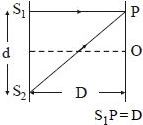
0 likesView Solution
49
PhysicsMediumMCQAIIMS · 2008
Assertion : Balmer series lies in the visible region of the electromagnetic spectrum.
Reason : $\frac{1}{\lambda} = R \left[ \frac{1}{2^2} - \frac{1}{n^2} \right]$,where $n = 3, 4, 5, \dots$
Reason : $\frac{1}{\lambda} = R \left[ \frac{1}{2^2} - \frac{1}{n^2} \right]$,where $n = 3, 4, 5, \dots$
A
If both Assertion and Reason are correct and the Reason is a correct explanation of the Assertion.
B
If both Assertion and Reason are correct but Reason is not a correct explanation of the Assertion.
C
If the Assertion is correct but Reason is incorrect.
D
If both the Assertion and Reason are incorrect.
Solution
(A) The wavelength for the Balmer series is given by the Rydberg formula: $\frac{1}{\lambda} = R \left[ \frac{1}{2^2} - \frac{1}{n^2} \right]$,where $n = 3, 4, 5, \dots$
For the maximum wavelength $(n=3)$:
$\frac{1}{\lambda_{\max}} = R \left[ \frac{1}{4} - \frac{1}{9} \right] = R \left[ \frac{5}{36} \right]$
$\lambda_{\max} = \frac{36}{5R} \approx 6563 \, \mathring{A}$
For the minimum wavelength $(n \to \infty)$:
$\frac{1}{\lambda_{\min}} = R \left[ \frac{1}{4} - 0 \right] = \frac{R}{4}$
$\lambda_{\min} = \frac{4}{R} \approx 3646 \, \mathring{A}$
The range $3646 \, \mathring{A}$ to $6563 \, \mathring{A}$ falls within the visible region of the electromagnetic spectrum. Thus,both the Assertion and the Reason are correct,and the Reason correctly explains the Assertion.
For the maximum wavelength $(n=3)$:
$\frac{1}{\lambda_{\max}} = R \left[ \frac{1}{4} - \frac{1}{9} \right] = R \left[ \frac{5}{36} \right]$
$\lambda_{\max} = \frac{36}{5R} \approx 6563 \, \mathring{A}$
For the minimum wavelength $(n \to \infty)$:
$\frac{1}{\lambda_{\min}} = R \left[ \frac{1}{4} - 0 \right] = \frac{R}{4}$
$\lambda_{\min} = \frac{4}{R} \approx 3646 \, \mathring{A}$
The range $3646 \, \mathring{A}$ to $6563 \, \mathring{A}$ falls within the visible region of the electromagnetic spectrum. Thus,both the Assertion and the Reason are correct,and the Reason correctly explains the Assertion.
0 likesView Solution
50
PhysicsMediumMCQAIIMS · 2008
Starting with a sample of pure ${}^{66}Cu$,$\frac{7}{8}$ of it decays into $Zn$ in $15 \ minutes$. The corresponding half-life is .......... $minutes$.
A
$15$
B
$10$
C
$7\frac{1}{2}$
D
$5$
Solution
(D) Given that $\frac{7}{8}$ of the sample of ${}^{66}Cu$ decays in $15 \ minutes$.
The fraction of the sample remaining undecayed is $N = 1 - \frac{7}{8} = \frac{1}{8}$.
We know that the remaining amount $N$ after $n$ half-lives is given by $N = \left(\frac{1}{2}\right)^n$.
Since $\frac{1}{8} = \left(\frac{1}{2}\right)^3$,the number of half-lives $n$ is $3$.
The relationship between time $t$,number of half-lives $n$,and half-life $T$ is $n = \frac{t}{T}$.
Substituting the values,$3 = \frac{15}{T}$.
Therefore,the half-life $T = \frac{15}{3} = 5 \ minutes$.
The fraction of the sample remaining undecayed is $N = 1 - \frac{7}{8} = \frac{1}{8}$.
We know that the remaining amount $N$ after $n$ half-lives is given by $N = \left(\frac{1}{2}\right)^n$.
Since $\frac{1}{8} = \left(\frac{1}{2}\right)^3$,the number of half-lives $n$ is $3$.
The relationship between time $t$,number of half-lives $n$,and half-life $T$ is $n = \frac{t}{T}$.
Substituting the values,$3 = \frac{15}{T}$.
Therefore,the half-life $T = \frac{15}{3} = 5 \ minutes$.
0 likesView Solution
51
PhysicsMediumMCQAIIMS · 2008
If in a $p-n$ junction diode,a square input signal of $10\, V$ (varying from $+5\, V$ to $-5\, V$) is applied as shown,then the output signal across $R_L$ will be:
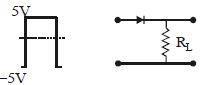
A
B
C
D
Solution
(A) The circuit consists of a $p-n$ junction diode in series with a load resistor $R_L$.
When the input voltage is $+5\, V$,the diode is forward-biased. Assuming an ideal diode,it acts as a short circuit,and the entire input voltage of $+5\, V$ appears across the load resistor $R_L$.
When the input voltage is $-5\, V$,the diode is reverse-biased. It acts as an open circuit,and no current flows through the resistor $R_L$. Therefore,the output voltage across $R_L$ is $0\, V$.
Thus,the output signal is a square wave that varies between $+5\, V$ and $0\, V$.
When the input voltage is $+5\, V$,the diode is forward-biased. Assuming an ideal diode,it acts as a short circuit,and the entire input voltage of $+5\, V$ appears across the load resistor $R_L$.
When the input voltage is $-5\, V$,the diode is reverse-biased. It acts as an open circuit,and no current flows through the resistor $R_L$. Therefore,the output voltage across $R_L$ is $0\, V$.
Thus,the output signal is a square wave that varies between $+5\, V$ and $0\, V$.
0 likesView Solution
52
PhysicsDifficultMCQAIIMS · 2008
The input resistance of a common emitter transistor amplifier,if the output resistance is $500\,k\Omega$,the current gain $\alpha = 0.98$ and power gain is $6.0625 \times 10^6$,is.......$\Omega$.
A
$198$
B
$300$
C
$100$
D
$400$
Solution
(A) Given: Output resistance $R_{o} = 500\,k\Omega = 500 \times 10^3\,\Omega$,current gain $\alpha = 0.98$,and power gain $A_{p} = 6.0625 \times 10^6$.
First,calculate the current gain $\beta$ for the common emitter configuration:
$\beta = \frac{\alpha}{1 - \alpha} = \frac{0.98}{1 - 0.98} = \frac{0.98}{0.02} = 49$.
Power gain is defined as the product of voltage gain $(A_{v})$ and current gain $(\beta)$:
$A_{p} = A_{v} \times \beta$.
Substituting the values: $6.0625 \times 10^6 = A_{v} \times 49$.
$A_{v} = \frac{6.0625 \times 10^6}{49} = 1.237245 \times 10^5$.
Voltage gain is also given by $A_{v} = \beta \times \frac{R_{o}}{R_{i}}$,where $R_{i}$ is the input resistance.
$1.237245 \times 10^5 = 49 \times \frac{500 \times 10^3}{R_{i}}$.
$R_{i} = \frac{49 \times 500 \times 10^3}{1.237245 \times 10^5} = \frac{24500 \times 10^3}{123724.5} \approx 198\,\Omega$.
First,calculate the current gain $\beta$ for the common emitter configuration:
$\beta = \frac{\alpha}{1 - \alpha} = \frac{0.98}{1 - 0.98} = \frac{0.98}{0.02} = 49$.
Power gain is defined as the product of voltage gain $(A_{v})$ and current gain $(\beta)$:
$A_{p} = A_{v} \times \beta$.
Substituting the values: $6.0625 \times 10^6 = A_{v} \times 49$.
$A_{v} = \frac{6.0625 \times 10^6}{49} = 1.237245 \times 10^5$.
Voltage gain is also given by $A_{v} = \beta \times \frac{R_{o}}{R_{i}}$,where $R_{i}$ is the input resistance.
$1.237245 \times 10^5 = 49 \times \frac{500 \times 10^3}{R_{i}}$.
$R_{i} = \frac{49 \times 500 \times 10^3}{1.237245 \times 10^5} = \frac{24500 \times 10^3}{123724.5} \approx 198\,\Omega$.
0 likesView Solution
53
PhysicsDifficultMCQAIIMS · 2008
In a mass spectrometer used for measuring the masses of ions,the ions are initially accelerated by an electric potential $V$ and then made to describe semicircular paths of radius $R$ using a magnetic field $B$. If $V$ and $B$ are kept constant,the ratio $\left(\frac{\text{charge on the ion}}{\text{mass of the ion}}\right)$ will be proportional to
A
$\frac{1}{R}$
B
$\frac{1}{R^{2}}$
C
$R^{2}$
D
$R$
Solution
(B) When an ion of charge $q$ and mass $m$ is accelerated through a potential difference $V$,its kinetic energy is given by: $E = qV = \frac{1}{2}mv^2$. From this,the velocity $v$ is $v = \sqrt{\frac{2qV}{m}}$.
When this ion enters a magnetic field $B$ perpendicular to its motion,it follows a circular path of radius $R$ due to the Lorentz force acting as the centripetal force: $qvB = \frac{mv^2}{R}$.
Substituting the expression for $v$ into the force equation: $qvB = \frac{m}{R} \left(\frac{2qV}{m}\right) = \frac{2qV}{R}$.
Simplifying for the charge-to-mass ratio: $qB = \frac{2qV}{vR} \implies B = \frac{mv}{qR} \implies R = \frac{mv}{qB}$.
Substituting $v = \sqrt{\frac{2qV}{m}}$ into the radius equation: $R = \frac{m}{qB} \sqrt{\frac{2qV}{m}} = \frac{1}{B} \sqrt{\frac{2mV}{q}}$.
Squaring both sides: $R^2 = \frac{2mV}{qB^2}$.
Rearranging to find the ratio $\frac{q}{m}$: $\frac{q}{m} = \frac{2V}{R^2 B^2}$.
Since $V$ and $B$ are constant,$\frac{q}{m} \propto \frac{1}{R^2}$.
When this ion enters a magnetic field $B$ perpendicular to its motion,it follows a circular path of radius $R$ due to the Lorentz force acting as the centripetal force: $qvB = \frac{mv^2}{R}$.
Substituting the expression for $v$ into the force equation: $qvB = \frac{m}{R} \left(\frac{2qV}{m}\right) = \frac{2qV}{R}$.
Simplifying for the charge-to-mass ratio: $qB = \frac{2qV}{vR} \implies B = \frac{mv}{qR} \implies R = \frac{mv}{qB}$.
Substituting $v = \sqrt{\frac{2qV}{m}}$ into the radius equation: $R = \frac{m}{qB} \sqrt{\frac{2qV}{m}} = \frac{1}{B} \sqrt{\frac{2mV}{q}}$.
Squaring both sides: $R^2 = \frac{2mV}{qB^2}$.
Rearranging to find the ratio $\frac{q}{m}$: $\frac{q}{m} = \frac{2V}{R^2 B^2}$.
Since $V$ and $B$ are constant,$\frac{q}{m} \propto \frac{1}{R^2}$.
0 likesView Solution
Vedclass Products
For Students
Vedclass Test Series
Mock tests in real AIIMS style covering Physics with performance analysis. 5-day free trial.
Start Free TrialFor Teachers
Exam Paper Generator
Generate Set A/B/C/D Physics papers from 7.5L+ questions in 2 minutes. 3 chapters free.
Try FreeFor Institutes
Online Exam Module
Run live AIIMS mock exams with unlimited students, 360° analytics & white-label branding.
See DemoFrequently Asked Questions
How many Physics questions are in AIIMS 2008?
There are 53 Physics questions from the AIIMS 2008 paper on Vedclass, each with a detailed step-by-step solution in English.
Are AIIMS 2008 Physics solutions available in English?
Yes. All solutions on this page are in English. You can also switch to English or Hindi using the language buttons above the questions.
Can I practice AIIMS 2008 Physics as a timed test?
Yes. Use the Vedclass Test Series to attempt a full AIIMS mock test covering Physics with time limits and instant score analysis.
Can teachers create Physics papers from AIIMS previous year questions?
Yes. The Vedclass Exam Paper Generator lets teachers mix AIIMS Physics questions and generate Set A/B/C/D papers in minutes.
For Teachers & Institutes
Build a Custom Physics Paper
Pick AIIMS 2008 Physics questions, set difficulty, and generate Set A/B/C/D in 2 minutes.