
ChemistryQ1–77 of 77 questions
Page 1 of 1 · English
1
ChemistryMCQAIIMS · 2005
Which of the following logic gates is a universal gate?
A
$OR$
B
$NOT$
C
$AND$
D
$NOR$
Solution
(D) The $NOR$ gate is considered a universal gate.
This is because any other basic logic gate,such as $AND$,$OR$,or $NOT$,can be constructed using only $NOR$ gates.
This is because any other basic logic gate,such as $AND$,$OR$,or $NOT$,can be constructed using only $NOR$ gates.
0 likesView Solution
2
ChemistryMCQAIIMS · 2005
The condition for a uniform spherical mass $m$ of radius $r$ to be a black hole is [$G$ = gravitational constant and $c$ = speed of light].
A
$(2Gm/r)^{1/2} \le c$
B
$(2Gm/r)^{1/2} = c$
C
$(2Gm/r)^{1/2} \ge c$
D
$(Gm/r)^{1/2} \ge c$
Solution
(C) For an object to become a black hole,its escape velocity must be equal to or greater than the speed of light $(c)$.
The escape velocity $v_e$ from the surface of a spherical mass $m$ of radius $r$ is given by the formula:
$v_e = \sqrt{\frac{2Gm}{r}}$
For the object to be a black hole,the condition is $v_e \ge c$.
Substituting the expression for $v_e$,we get:
$\sqrt{\frac{2Gm}{r}} \ge c$
Therefore,the correct option is $C$.
The escape velocity $v_e$ from the surface of a spherical mass $m$ of radius $r$ is given by the formula:
$v_e = \sqrt{\frac{2Gm}{r}}$
For the object to be a black hole,the condition is $v_e \ge c$.
Substituting the expression for $v_e$,we get:
$\sqrt{\frac{2Gm}{r}} \ge c$
Therefore,the correct option is $C$.
0 likesView Solution
3
ChemistryMediumMCQAIIMS · 2005
The most probable radius (in $pm$) for finding the electron in $He^{+}$ is
A
$0.0$
B
$52.9$
C
$26.5$
D
$105.8$
Solution
(C) The most probable radius for an electron in a hydrogen-like species is given by the formula $r_{mp} = \frac{a_0}{Z}$, where $a_0$ is the Bohr radius $(52.9 \ pm)$ and $Z$ is the atomic number.
For the helium ion $(He^{+})$, the atomic number $Z = 2$.
Substituting the values: $r_{mp} = \frac{52.9 \ pm}{2} = 26.45 \ pm$.
Rounding to the nearest value, we get $26.5 \ pm$.
For the helium ion $(He^{+})$, the atomic number $Z = 2$.
Substituting the values: $r_{mp} = \frac{52.9 \ pm}{2} = 26.45 \ pm$.
Rounding to the nearest value, we get $26.5 \ pm$.
0 likesView Solution
4
ChemistryMediumMCQAIIMS · 2005
The isoelectronic pair is
A
$Cl_2O, ICl_2^-$
B
$ICl_2^-, ClO_2$
C
$IF_2^+, I_3^-$
D
$ClO_2^-, ClF_2^+$
Solution
(D) To determine the isoelectronic pair,we calculate the total number of valence electrons for each species.
For $ClO_2^-$: $7 (Cl) + 2 \times 6 (O) + 1 (\text{charge}) = 20$ valence electrons.
For $ClF_2^+$: $7 (Cl) + 2 \times 7 (F) - 1 (\text{charge}) = 20$ valence electrons.
Since both $ClO_2^-$ and $ClF_2^+$ have $20$ valence electrons,they form an isoelectronic pair.
Therefore,the correct option is $D$.
For $ClO_2^-$: $7 (Cl) + 2 \times 6 (O) + 1 (\text{charge}) = 20$ valence electrons.
For $ClF_2^+$: $7 (Cl) + 2 \times 7 (F) - 1 (\text{charge}) = 20$ valence electrons.
Since both $ClO_2^-$ and $ClF_2^+$ have $20$ valence electrons,they form an isoelectronic pair.
Therefore,the correct option is $D$.
0 likesView Solution
5
ChemistryDifficultMCQAIIMS · 2005
For the chemical equilibrium,$CaCO_{3_{(s)}} \rightleftharpoons CaO_{(s)} + CO_{2_{(g)}}$,$\Delta H_{r}^{\circ}$ can be determined from which one of the following plots?
A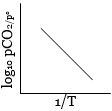
B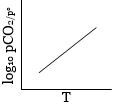
C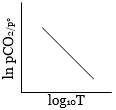
D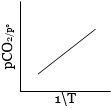
Solution
(A) For the reaction,$CaCO_{3_{(s)}} \rightleftharpoons CaO_{(s)} + CO_{2_{(g)}}$,the equilibrium constant $K_p$ is given by $K_p = pCO_2 / p^{\circ}$.
According to the van't Hoff equation,$\ln K_p = -\frac{\Delta H_r^{\circ}}{RT} + C$.
Converting to base $10$ logarithm,we get $\log_{10} K_p = -\frac{\Delta H_r^{\circ}}{2.303 RT} + \text{constant}$.
Comparing this with the equation of a straight line $y = mx + c$,where $y = \log_{10} (pCO_2 / p^{\circ})$ and $x = 1 / T$,the slope $m = -\frac{\Delta H_r^{\circ}}{2.303 R}$.
Thus,$\Delta H_r^{\circ}$ can be determined from the slope of the plot of $\log_{10} (pCO_2 / p^{\circ})$ versus $1 / T$.
According to the van't Hoff equation,$\ln K_p = -\frac{\Delta H_r^{\circ}}{RT} + C$.
Converting to base $10$ logarithm,we get $\log_{10} K_p = -\frac{\Delta H_r^{\circ}}{2.303 RT} + \text{constant}$.
Comparing this with the equation of a straight line $y = mx + c$,where $y = \log_{10} (pCO_2 / p^{\circ})$ and $x = 1 / T$,the slope $m = -\frac{\Delta H_r^{\circ}}{2.303 R}$.
Thus,$\Delta H_r^{\circ}$ can be determined from the slope of the plot of $\log_{10} (pCO_2 / p^{\circ})$ versus $1 / T$.
0 likesView Solution
6
ChemistryMediumMCQAIIMS · 2005
For the reaction $2NOCl_{(g)} \rightleftharpoons 2NO_{(g)} + Cl_{2(g)}$,$K_C$ at $427\ ^oC$ is $3 \times 10^{-6}\ mol\ L^{-1}$. The value of $K_P$ is nearly $....... \times 10^{-4}$.
A
$0.75$
B
$0.25$
C
$2.50$
D
$1.75$
Solution
(D) The given reaction is $2NOCl_{(g)} \rightleftharpoons 2NO_{(g)} + Cl_{2(g)}$.
The change in the number of moles of gaseous products and reactants is $\Delta n = (2 + 1) - 2 = 1$.
The relationship between $K_P$ and $K_C$ is given by $K_P = K_C(RT)^{\Delta n}$.
Given $K_C = 3 \times 10^{-6}$,$R = 0.0821 \ L\ atm\ K^{-1}\ mol^{-1}$,and $T = 427 + 273 = 700 \ K$.
Substituting the values: $K_P = 3 \times 10^{-6} \times (0.0821 \times 700)^1$.
$K_P = 3 \times 10^{-6} \times 57.47 = 172.41 \times 10^{-6} = 1.7241 \times 10^{-4}$.
Rounding to the nearest value,$K_P \approx 1.75 \times 10^{-4}$.
The change in the number of moles of gaseous products and reactants is $\Delta n = (2 + 1) - 2 = 1$.
The relationship between $K_P$ and $K_C$ is given by $K_P = K_C(RT)^{\Delta n}$.
Given $K_C = 3 \times 10^{-6}$,$R = 0.0821 \ L\ atm\ K^{-1}\ mol^{-1}$,and $T = 427 + 273 = 700 \ K$.
Substituting the values: $K_P = 3 \times 10^{-6} \times (0.0821 \times 700)^1$.
$K_P = 3 \times 10^{-6} \times 57.47 = 172.41 \times 10^{-6} = 1.7241 \times 10^{-4}$.
Rounding to the nearest value,$K_P \approx 1.75 \times 10^{-4}$.
0 likesView Solution
7
ChemistryMediumMCQAIIMS · 2005
When $10 \, mL$ of $0.1 \, M$ acetic acid $(pK_a = 5.0)$ is titrated against $10 \, mL$ of $0.1 \, M$ ammonia solution $(pK_b = 5.0)$,the equivalence point occurs at $pH$:
A
$5$
B
$6$
C
$7$
D
$9$
Solution
(C) The reaction between a weak acid $(CH_3COOH)$ and a weak base $(NH_4OH)$ forms a salt $(CH_3COONH_4)$.
The $pH$ of a salt of a weak acid and a weak base is given by the formula:
$pH = \frac{1}{2} [pK_w + pK_a - pK_b]$
Given:
$pK_w = 14$
$pK_a = 5.0$
$pK_b = 5.0$
Substituting the values:
$pH = \frac{1}{2} [14 + 5.0 - 5.0]$
$pH = \frac{1}{2} [14] = 7$
The $pH$ of a salt of a weak acid and a weak base is given by the formula:
$pH = \frac{1}{2} [pK_w + pK_a - pK_b]$
Given:
$pK_w = 14$
$pK_a = 5.0$
$pK_b = 5.0$
Substituting the values:
$pH = \frac{1}{2} [14 + 5.0 - 5.0]$
$pH = \frac{1}{2} [14] = 7$
0 likesView Solution
8
ChemistryMediumMCQAIIMS · 2005
For the reaction of one mole of zinc dust with one mole of sulphuric acid in a bomb calorimeter,$\Delta U$ and $w$ correspond to
A
$\Delta U < 0, w = 0$
B
$\Delta U = 0, w < 0$
C
$\Delta U > 0, w = 0$
D
$\Delta U < 0, w > 0$
Solution
(A) bomb calorimeter is a rigid,sealed container,which means the volume of the system remains constant throughout the reaction.
Since the volume change $\Delta V = 0$,the work done $w = -P_{ext} \Delta V = 0$.
The reaction between zinc $(Zn)$ and sulphuric acid $(H_2SO_4)$ is an exothermic process,which releases heat to the surroundings.
According to the first law of thermodynamics,$\Delta U = q + w$. Since $w = 0$,$\Delta U = q$.
Because the reaction is exothermic,$q < 0$,therefore $\Delta U < 0$.
Thus,the correct values are $\Delta U < 0$ and $w = 0$.
Since the volume change $\Delta V = 0$,the work done $w = -P_{ext} \Delta V = 0$.
The reaction between zinc $(Zn)$ and sulphuric acid $(H_2SO_4)$ is an exothermic process,which releases heat to the surroundings.
According to the first law of thermodynamics,$\Delta U = q + w$. Since $w = 0$,$\Delta U = q$.
Because the reaction is exothermic,$q < 0$,therefore $\Delta U < 0$.
Thus,the correct values are $\Delta U < 0$ and $w = 0$.
0 likesView Solution
9
ChemistryMediumMCQAIIMS · 2005
The standard enthalpy of formation,$\Delta H^o_f$ $(298 \ K)$,of methanol is represented by which of the following chemical equations?
A
$CH_{4(g)} + 1/2 O_{2(g)} \to CH_3OH_{(l)}$
B
$C_{(graphite)} + 1/2 O_{2(g)} + 2H_{2(g)} \to CH_3OH_{(l)}$
C
$C_{(diamond)} + 1/2 O_{2(g)} + 2H_{2(g)} \to CH_3OH_{(l)}$
D
$CO_{(g)} + 2H_{2(g)} \to CH_3OH_{(l)}$
Solution
(B) The standard enthalpy of formation,$\Delta H^o_f$,is defined as the enthalpy change when $1 \ mol$ of a compound is formed from its constituent elements in their most stable standard states at $298 \ K$ and $1 \ bar$ pressure.
For methanol $(CH_3OH_{(l)})$,the constituent elements are carbon (in its most stable form,graphite),hydrogen $(H_{2(g)})$,and oxygen $(O_{2(g)})$.
The balanced thermochemical equation is:
$C_{(graphite)} + 1/2 O_{2(g)} + 2H_{2(g)} \to CH_3OH_{(l)}$
Therefore,option $B$ correctly represents the standard enthalpy of formation of methanol.
For methanol $(CH_3OH_{(l)})$,the constituent elements are carbon (in its most stable form,graphite),hydrogen $(H_{2(g)})$,and oxygen $(O_{2(g)})$.
The balanced thermochemical equation is:
$C_{(graphite)} + 1/2 O_{2(g)} + 2H_{2(g)} \to CH_3OH_{(l)}$
Therefore,option $B$ correctly represents the standard enthalpy of formation of methanol.
0 likesView Solution
10
ChemistryDifficultMCQAIIMS · 2005
In the balanced chemical reaction,$IO_3^- + a\;I^{-} + b\;H^{+} \to c\;H_2O + d\;I_2$,$a$,$b$,$c$,and $d$ respectively correspond to
A
$5, 6, 3, 3$
B
$5, 3, 6, 3$
C
$3, 5, 3, 6$
D
$5, 6, 5, 5$
Solution
(A) The given reaction is $IO_3^- + aI^{-} + bH^{+} \to cH_2O + dI_2$.
Step $1$: Identify oxidation and reduction half-reactions.
Oxidation: $I^{-} \to I_2$
Reduction: $IO_3^- \to I_2$
Step $2$: Balance the reduction half-reaction: $2IO_3^- + 12H^{+} + 10e^{-} \to I_2 + 6H_2O$.
Step $3$: Balance the oxidation half-reaction: $2I^{-} \to I_2 + 2e^{-}$.
Step $4$: Multiply the oxidation half-reaction by $5$ to balance electrons: $10I^{-} \to 5I_2 + 10e^{-}$.
Step $5$: Add the two half-reactions: $2IO_3^- + 10I^{-} + 12H^{+} \to 6I_2 + 6H_2O$.
Step $6$: Simplify by dividing by $2$: $IO_3^- + 5I^{-} + 6H^{+} \to 3H_2O + 3I_2$.
Comparing this with the given equation $IO_3^- + aI^{-} + bH^{+} \to cH_2O + dI_2$,we get $a = 5, b = 6, c = 3, d = 3$.
Step $1$: Identify oxidation and reduction half-reactions.
Oxidation: $I^{-} \to I_2$
Reduction: $IO_3^- \to I_2$
Step $2$: Balance the reduction half-reaction: $2IO_3^- + 12H^{+} + 10e^{-} \to I_2 + 6H_2O$.
Step $3$: Balance the oxidation half-reaction: $2I^{-} \to I_2 + 2e^{-}$.
Step $4$: Multiply the oxidation half-reaction by $5$ to balance electrons: $10I^{-} \to 5I_2 + 10e^{-}$.
Step $5$: Add the two half-reactions: $2IO_3^- + 10I^{-} + 12H^{+} \to 6I_2 + 6H_2O$.
Step $6$: Simplify by dividing by $2$: $IO_3^- + 5I^{-} + 6H^{+} \to 3H_2O + 3I_2$.
Comparing this with the given equation $IO_3^- + aI^{-} + bH^{+} \to cH_2O + dI_2$,we get $a = 5, b = 6, c = 3, d = 3$.
0 likesView Solution
11
ChemistryMediumMCQAIIMS · 2005
The pair of amphoteric hydroxides is
A
$Al(OH)_3, LiOH$
B
$Be(OH)_2, Mg(OH)_2$
C
$B(OH)_3, Be(OH)_2$
D
$Be(OH)_2, Zn(OH)_2$
Solution
(D) The correct answer is $(D)$.
Both $Be(OH)_2$ and $Zn(OH)_2$ are amphoteric in nature,meaning they can react with both acids and bases.
Both $Be(OH)_2$ and $Zn(OH)_2$ are amphoteric in nature,meaning they can react with both acids and bases.
0 likesView Solution
12
ChemistryMediumMCQAIIMS · 2005
In diborane $(B_2H_6)$,the two $H-B-H$ bond angles are nearly
A
$60^{\circ}, 120^{\circ}$
B
$97^{\circ}, 122^{\circ}$
C
$95^{\circ}, 150^{\circ}$
D
$120^{\circ}, 180^{\circ}$
Solution
(B) In diborane $(B_2H_6)$,there are two types of hydrogen atoms: terminal and bridging.
The terminal $H-B-H$ bond angle is approximately $122^{\circ}$.
The bridging $H-B-H$ bond angle is approximately $97^{\circ}$.
Therefore,the two angles are nearly $97^{\circ}$ and $122^{\circ}$.
The terminal $H-B-H$ bond angle is approximately $122^{\circ}$.
The bridging $H-B-H$ bond angle is approximately $97^{\circ}$.
Therefore,the two angles are nearly $97^{\circ}$ and $122^{\circ}$.
0 likesView Solution
13
ChemistryEasyMCQAIIMS · 2005
Which of the following gives propyne on hydrolysis?
A
$Al_4C_3$
B
$Mg_2C_3$
C
$B_4C$
D
$La_4C_3$
Solution
(B) The hydrolysis of magnesium carbide $(Mg_2C_3)$ yields propyne $(CH_3C \equiv CH)$.
The chemical reaction is as follows:
$Mg_2C_3 + 4H_2O \to CH_3C \equiv CH + 2Mg(OH)_2$
Therefore,the correct option is $(B)$.
The chemical reaction is as follows:
$Mg_2C_3 + 4H_2O \to CH_3C \equiv CH + 2Mg(OH)_2$
Therefore,the correct option is $(B)$.
0 likesView Solution
14
ChemistryDifficultMCQAIIMS · 2005
Among the following,the most stable compound is:
A
$cis-1,2-$cyclohexanediol
B
$trans-1,2-$cyclohexanediol
C
$cis-1,3-$cyclohexanediol
D
$trans-1,3-$cyclohexanediol
Solution
(D) The stability of substituted cyclohexanes depends on steric hindrance and intramolecular interactions.
In $1,2-$cyclohexanediol,the $OH$ groups are closer,leading to higher steric repulsion.
In $1,3-$cyclohexanediol,the $OH$ groups are further apart,reducing steric repulsion.
Between $cis$ and $trans$ isomers,the $trans-1,3-$cyclohexanediol allows both $OH$ groups to occupy equatorial positions in the chair conformation,which significantly minimizes steric strain compared to other isomers.
Therefore,$trans-1,3-$cyclohexanediol is the most stable compound.
In $1,2-$cyclohexanediol,the $OH$ groups are closer,leading to higher steric repulsion.
In $1,3-$cyclohexanediol,the $OH$ groups are further apart,reducing steric repulsion.
Between $cis$ and $trans$ isomers,the $trans-1,3-$cyclohexanediol allows both $OH$ groups to occupy equatorial positions in the chair conformation,which significantly minimizes steric strain compared to other isomers.
Therefore,$trans-1,3-$cyclohexanediol is the most stable compound.
0 likesView Solution
15
ChemistryMediumMCQAIIMS · 2005
$\alpha$-particles can be detected using
A
Thin aluminum sheet
B
Barium sulphate
C
Zinc sulphide screen
D
Gold foil
Solution
(C) Rutherford first used a zinc sulphide $(ZnS)$ screen as a phosphor for the detection of $\alpha$-particles because it produces a flash of light (scintillation) when struck by an $\alpha$-particle.
0 likesView Solution
16
ChemistryDifficultMCQAIIMS · 2005
The major product formed in the following reaction is:
$CH_3-CH(CH_3)-CH_3 \xrightarrow[CH_3OH]{CH_3OBr}$
$CH_3-CH(CH_3)-CH_3 \xrightarrow[CH_3OH]{CH_3OBr}$
A
$CH_3-CH(CH_3)-CH_2OCH_3$
B
$CH_3-CH(OCH_3)-CH_2CH_3$
C
$CH_3-C(CH_3)=CH_2$
D
$CH_3-C(OCH_3)(CH_3)-CH_3$
Solution
(D) The reaction involves the bromination of isobutane $(CH_3-CH(CH_3)-CH_3)$ using $CH_3OBr$ as a brominating agent,which proceeds via a free radical mechanism.
The tertiary hydrogen atom is the most reactive,leading to the formation of tert-butyl bromide $(CH_3-C(CH_3)_2-Br)$ as the intermediate.
Subsequently,the tert-butyl bromide undergoes $S_N1$ solvolysis in the presence of the solvent methanol $(CH_3OH)$ to form the major product,$2$-methoxy-$2$-methylpropane $(CH_3-C(OCH_3)(CH_3)-CH_3)$.
The tertiary hydrogen atom is the most reactive,leading to the formation of tert-butyl bromide $(CH_3-C(CH_3)_2-Br)$ as the intermediate.
Subsequently,the tert-butyl bromide undergoes $S_N1$ solvolysis in the presence of the solvent methanol $(CH_3OH)$ to form the major product,$2$-methoxy-$2$-methylpropane $(CH_3-C(OCH_3)(CH_3)-CH_3)$.
0 likesView Solution
17
ChemistryMCQAIIMS · 2005
Many cells function properly and divide mitotically even though they do not have
A
Plasma membrane
B
Cytoskeleton
C
Mitochondria
D
Plastids
Solution
(D) Plastids are organelles found primarily in plant cells and algae. They are responsible for photosynthesis (chloroplasts),storage of starch (amyloplasts),and pigment synthesis. However,many cells,such as animal cells,fungal cells,and certain specialized plant cells,do not contain plastids. These cells are still capable of performing all essential metabolic functions and undergoing mitosis for cell division,as these processes rely on other organelles like the nucleus,mitochondria,and ribosomes.
0 likesView Solution
18
ChemistryMCQAIIMS · 2005
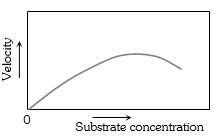
The given graph shows the effect of substrate concentration on the rate of reaction of the enzyme green gram-phosphatase. What does the graph indicate?
A
The rate of enzyme reaction is directly proportional to the substrate concentration.
B
Presence of an enzyme inhibitor in the reaction mixture.
C
Formation of an enzyme-substrate complex.
D
At higher substrate concentration the $pH$ increases.
Solution
(B) The graph shows that as the substrate concentration increases,the velocity of the enzymatic reaction initially increases,reaches a maximum,and then decreases. This decline in reaction velocity at very high substrate concentrations is typically indicative of the presence of an enzyme inhibitor in the reaction mixture,which interferes with the enzyme's activity. Therefore,option $B$ is the correct interpretation of the provided graph.
0 likesView Solution
19
ChemistryMCQAIIMS · 2005
Which one of the following is a correct statement?
A
$Bt$ in "$Bt$-cotton" indicates that it is a genetically modified organism produced through biotechnology.
B
Somatic hybridization involves fusion of two complete plant cells carrying desired genes.
C
The anticoagulant hirudin is being produced from transgenic $Brassica \text{ } napus$ seeds.
D
Flavr Savr variety of tomato has enhanced the production of ethylene which improves its taste.
Solution
(C) Option $C$ is correct. The anticoagulant hirudin is a protein that prevents blood clotting. The gene encoding hirudin was isolated from the medicinal leech $(Hirudo \text{ } medicinalis)$ and expressed in transgenic $Brassica \text{ } napus$ (rapeseed) seeds to produce the protein on a large scale.
Option $A$ is incorrect because $Bt$ stands for the bacterium $Bacillus \text{ } thuringiensis$, not biotechnology.
Option $B$ is incorrect because somatic hybridization involves the fusion of isolated protoplasts, not complete plant cells (which have cell walls).
Option $D$ is incorrect because the Flavr Savr tomato was engineered to delay ripening by inhibiting the production of ethylene, not enhancing it.
Option $A$ is incorrect because $Bt$ stands for the bacterium $Bacillus \text{ } thuringiensis$, not biotechnology.
Option $B$ is incorrect because somatic hybridization involves the fusion of isolated protoplasts, not complete plant cells (which have cell walls).
Option $D$ is incorrect because the Flavr Savr tomato was engineered to delay ripening by inhibiting the production of ethylene, not enhancing it.
0 likesView Solution
20
ChemistryMediumMCQAIIMS · 2005
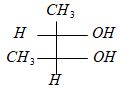
Determine the absolute configuration of the given molecule:
A
$1S, 2S$
B
$1S, 2R$
C
$1R, 2S$
D
$1R, 2R$
Solution
(A) To determine the configuration,assign priorities to the groups attached to each chiral center using Cahn-Ingold-Prelog $(CIP)$ rules.
For the top chiral center $(C1)$: The priorities are $-OH$ $(1)$,$-CH(OH)CH_3$ $(2)$,$-CH_3$ $(3)$,and $-H$ $(4)$. Since the lowest priority group $(-H)$ is on a horizontal bond,the configuration is reversed. The sequence $1$ $\rightarrow 2$ $\rightarrow 3$ is clockwise $(R)$,so it becomes $S$.
For the bottom chiral center $(C2)$: The priorities are $-OH$ $(1)$,$-CH(OH)CH_3$ $(2)$,$-CH_3$ $(3)$,and $-H$ $(4)$. Since the lowest priority group $(-H)$ is on a vertical bond,the configuration is maintained. The sequence $1$ $\rightarrow 2$ $\rightarrow 3$ is counter-clockwise $(S)$,so it remains $S$.
Thus,the configuration is $1S, 2S$.
For the top chiral center $(C1)$: The priorities are $-OH$ $(1)$,$-CH(OH)CH_3$ $(2)$,$-CH_3$ $(3)$,and $-H$ $(4)$. Since the lowest priority group $(-H)$ is on a horizontal bond,the configuration is reversed. The sequence $1$ $\rightarrow 2$ $\rightarrow 3$ is clockwise $(R)$,so it becomes $S$.
For the bottom chiral center $(C2)$: The priorities are $-OH$ $(1)$,$-CH(OH)CH_3$ $(2)$,$-CH_3$ $(3)$,and $-H$ $(4)$. Since the lowest priority group $(-H)$ is on a vertical bond,the configuration is maintained. The sequence $1$ $\rightarrow 2$ $\rightarrow 3$ is counter-clockwise $(S)$,so it remains $S$.
Thus,the configuration is $1S, 2S$.
0 likesView Solution
21
ChemistryMCQAIIMS · 2005
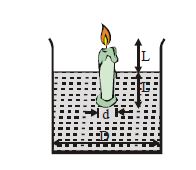
$A$ candle of diameter $d$ is floating on a liquid in a cylindrical container of diameter $D$ $(D >> d)$ as shown in the figure. If it is burning at the rate of $2 \ cm/hour$,then the top of the candle will
A
Remain at the same height
B
Fall at the rate of $1 \ cm/hour$
C
Fall at the rate of $2 \ cm/hour$
D
Go up at the rate of $1 \ cm/hour$
Solution
(B) Let the density of the candle be $\rho_C$ and the density of the liquid be $\rho_L$. Let the total length of the candle be $2L$. Initially,the candle floats with length $L$ submerged.
By the principle of flotation,the weight of the candle equals the weight of the displaced liquid:
$\rho_C \cdot A \cdot (2L) = \rho_L \cdot A \cdot L$
$\Rightarrow \frac{\rho_C}{\rho_L} = \frac{1}{2} \dots (i)$
When the candle burns by a length $\Delta h = 2 \ cm$,let its new total length be $2L - 2$ and the new submerged length be $L'$.
By the principle of flotation: $\rho_C \cdot A \cdot (2L - 2) = \rho_L \cdot A \cdot L'$
Using $(i)$,we get: $\frac{1}{2} \rho_L \cdot A \cdot (2L - 2) = \rho_L \cdot A \cdot L'$
$L - 1 = L'$
The change in submerged length is $\Delta L' = L - L' = 1 \ cm$.
The top of the candle is at a height $h_{top} = L' + (2L - 2 - L') = 2L - 2$ above the bottom of the candle. However,relative to the liquid surface,the top is at height $H = 2L - 2 - L' = L - 1$.
Since $L$ is constant,the change in height of the top relative to the liquid surface is $\Delta H = 1 \ cm$.
Thus,the top of the candle falls at a rate of $1 \ cm/hour$.
By the principle of flotation,the weight of the candle equals the weight of the displaced liquid:
$\rho_C \cdot A \cdot (2L) = \rho_L \cdot A \cdot L$
$\Rightarrow \frac{\rho_C}{\rho_L} = \frac{1}{2} \dots (i)$
When the candle burns by a length $\Delta h = 2 \ cm$,let its new total length be $2L - 2$ and the new submerged length be $L'$.
By the principle of flotation: $\rho_C \cdot A \cdot (2L - 2) = \rho_L \cdot A \cdot L'$
Using $(i)$,we get: $\frac{1}{2} \rho_L \cdot A \cdot (2L - 2) = \rho_L \cdot A \cdot L'$
$L - 1 = L'$
The change in submerged length is $\Delta L' = L - L' = 1 \ cm$.
The top of the candle is at a height $h_{top} = L' + (2L - 2 - L') = 2L - 2$ above the bottom of the candle. However,relative to the liquid surface,the top is at height $H = 2L - 2 - L' = L - 1$.
Since $L$ is constant,the change in height of the top relative to the liquid surface is $\Delta H = 1 \ cm$.
Thus,the top of the candle falls at a rate of $1 \ cm/hour$.
0 likesView Solution
22
ChemistryMCQAIIMS · 2005
On a rainy day,a small oil film on water shows brilliant colours. This is due to
A
Dispersion of light
B
Interference of light
C
Absorption of light
D
Scattering of light
Solution
(B) The phenomenon of brilliant colours seen on a thin oil film on water is due to the interference of light.
When white light falls on a thin film of oil,the light waves reflect from both the top and bottom surfaces of the film.
These reflected waves undergo superposition,leading to constructive or destructive interference depending on the path difference and the wavelength of the light.
Since the thickness of the oil film varies,different wavelengths (colours) undergo constructive interference at different points,resulting in the observation of brilliant colours.
When white light falls on a thin film of oil,the light waves reflect from both the top and bottom surfaces of the film.
These reflected waves undergo superposition,leading to constructive or destructive interference depending on the path difference and the wavelength of the light.
Since the thickness of the oil film varies,different wavelengths (colours) undergo constructive interference at different points,resulting in the observation of brilliant colours.
0 likesView Solution
23
ChemistryMCQAIIMS · 2005
The major product obtained on treatment of $CH_3CH_2CH(F)CH_3$ with $CH_3O^-/CH_3OH$ is
A
$CH_3CH_2CH(OCH_3)CH_3$
B
$CH_3CH=CHCH_3$
C
$CH_3CH_2CH=CH_2$
D
$CH_3CH_2CH_2CH_2OCH_3$
Solution
(B) The reaction of $CH_3CH_2CH(F)CH_3$ with a strong base like $CH_3O^-$ in $CH_3OH$ proceeds via an $E2$ elimination mechanism.
According to Saytzeff's rule,the more substituted alkene is the major product.
Here,the base abstracts a proton from the $\beta$-carbon.
Removing a proton from $C_3$ leads to $CH_3CH=CHCH_3$ (but$-2-$ene),which is more substituted and thus more stable.
Removing a proton from $C_1$ leads to $CH_3CH_2CH=CH_2$ (but$-1-$ene),which is less substituted.
Therefore,$CH_3CH=CHCH_3$ is the major product.
According to Saytzeff's rule,the more substituted alkene is the major product.
Here,the base abstracts a proton from the $\beta$-carbon.
Removing a proton from $C_3$ leads to $CH_3CH=CHCH_3$ (but$-2-$ene),which is more substituted and thus more stable.
Removing a proton from $C_1$ leads to $CH_3CH_2CH=CH_2$ (but$-1-$ene),which is less substituted.
Therefore,$CH_3CH=CHCH_3$ is the major product.
0 likesView Solution
24
ChemistryMCQAIIMS · 2005
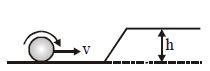
$A$ solid sphere is rolling on a frictionless surface with a translational velocity $v \ m/s$,as shown in the figure. If it is to climb the inclined surface to a height $h$,then $v$ should be:
A
$v \ge \sqrt {\frac{10}{7}gh}$
B
$v \ge \sqrt {2gh}$
C
$v \ge 2gh$
D
$v \ge \frac{10}{7}gh$
Solution
(A) For the solid sphere to climb the inclined surface to a height $h$,its total initial kinetic energy must be greater than or equal to the potential energy gained at height $h$.
The total kinetic energy $(K.E.)_{total}$ is the sum of translational kinetic energy $(K.E.)_{T}$ and rotational kinetic energy $(K.E.)_{R}$:
$(K.E.)_{total} = (K.E.)_{T} + (K.E.)_{R} \ge P.E.$
$\frac{1}{2}mv^2 + \frac{1}{2}I\omega^2 \ge mgh$
For a solid sphere,the moment of inertia $I = \frac{2}{5}mr^2$ and for pure rolling,$\omega = \frac{v}{r}$.
Substituting these values:
$\frac{1}{2}mv^2 + \frac{1}{2}(\frac{2}{5}mr^2)(\frac{v}{r})^2 \ge mgh$
$\frac{1}{2}mv^2 + \frac{1}{5}mv^2 \ge mgh$
$\frac{7}{10}mv^2 \ge mgh$
$v^2 \ge \frac{10gh}{7}$
$v \ge \sqrt{\frac{10gh}{7}}$
The total kinetic energy $(K.E.)_{total}$ is the sum of translational kinetic energy $(K.E.)_{T}$ and rotational kinetic energy $(K.E.)_{R}$:
$(K.E.)_{total} = (K.E.)_{T} + (K.E.)_{R} \ge P.E.$
$\frac{1}{2}mv^2 + \frac{1}{2}I\omega^2 \ge mgh$
For a solid sphere,the moment of inertia $I = \frac{2}{5}mr^2$ and for pure rolling,$\omega = \frac{v}{r}$.
Substituting these values:
$\frac{1}{2}mv^2 + \frac{1}{2}(\frac{2}{5}mr^2)(\frac{v}{r})^2 \ge mgh$
$\frac{1}{2}mv^2 + \frac{1}{5}mv^2 \ge mgh$
$\frac{7}{10}mv^2 \ge mgh$
$v^2 \ge \frac{10gh}{7}$
$v \ge \sqrt{\frac{10gh}{7}}$
0 likesView Solution
25
ChemistryMCQAIIMS · 2005
Four point positive charges of same magnitude $Q$ are placed at four corners of a rigid square frame of side length $L$ as shown in the figure. The plane of the frame is perpendicular to the $Z$-axis. If a negative point charge $-q$ is placed at a distance $z$ away from the centre along the axis $(z << L)$, then:
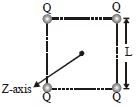
A
The negative charge oscillates along the $Z$-axis.
B
It moves away from the frame.
C
It moves slowly towards the frame and stays in the plane of the frame.
D
It passes through the frame only once.
Solution
(A) Let the side of the square be $L$. The distance of each charge $Q$ from the centre of the square is $r = \frac{L}{\sqrt{2}}$.
When a negative charge $-q$ is placed at a distance $z$ from the centre along the $Z$-axis, the distance of the charge from each corner is $d = \sqrt{r^2 + z^2} = \sqrt{\frac{L^2}{2} + z^2}$.
The force exerted by each charge $Q$ on $-q$ is $F = \frac{kQq}{d^2}$.
The component of this force along the $Z$-axis is $F_z = -F \cos \theta$, where $\cos \theta = \frac{z}{d}$.
Thus, the net force on the charge $-q$ is $F_{net} = 4 \times \left( -\frac{kQq}{d^2} \times \frac{z}{d} \right) = -\frac{4kQqz}{(\frac{L^2}{2} + z^2)^{3/2}}$.
Since $z << L$, we can approximate $d \approx \frac{L}{\sqrt{2}}$.
Then $F_{net} \approx -\frac{4kQqz}{(L^2/2)^{3/2}} = -\left( \frac{4kQq}{L^3 / 2\sqrt{2}} \right) z = -kz$, where $k$ is a positive constant.
Since $F_{net} \propto -z$, the force is a restoring force, and the negative charge will perform simple harmonic motion (oscillate) along the $Z$-axis about the centre of the square.
When a negative charge $-q$ is placed at a distance $z$ from the centre along the $Z$-axis, the distance of the charge from each corner is $d = \sqrt{r^2 + z^2} = \sqrt{\frac{L^2}{2} + z^2}$.
The force exerted by each charge $Q$ on $-q$ is $F = \frac{kQq}{d^2}$.
The component of this force along the $Z$-axis is $F_z = -F \cos \theta$, where $\cos \theta = \frac{z}{d}$.
Thus, the net force on the charge $-q$ is $F_{net} = 4 \times \left( -\frac{kQq}{d^2} \times \frac{z}{d} \right) = -\frac{4kQqz}{(\frac{L^2}{2} + z^2)^{3/2}}$.
Since $z << L$, we can approximate $d \approx \frac{L}{\sqrt{2}}$.
Then $F_{net} \approx -\frac{4kQqz}{(L^2/2)^{3/2}} = -\left( \frac{4kQq}{L^3 / 2\sqrt{2}} \right) z = -kz$, where $k$ is a positive constant.
Since $F_{net} \propto -z$, the force is a restoring force, and the negative charge will perform simple harmonic motion (oscillate) along the $Z$-axis about the centre of the square.
0 likesView Solution
26
ChemistryMCQAIIMS · 2005
$A$ candle of diameter $d$ is floating on a liquid in a cylindrical container of diameter $D$ $(D >> d)$ as shown in the figure. If it is burning at the rate of $2 \, cm/hour$,then the top of the candle will
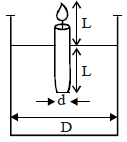
A
remain at the same height
B
fall at the rate of $1 \, cm/hour$
C
fall at the rate of $2 \, cm/hour$
D
go up at the rate of $1 \, cm/hour$
Solution
(B) Let the length of the candle be $L$ and its density be $\rho_c$. Let the density of the liquid be $\rho_l$.
For the candle to float,the weight of the candle must be equal to the buoyant force:
$A \cdot L \cdot \rho_c \cdot g = A \cdot h \cdot \rho_l \cdot g$,where $h$ is the submerged length and $A$ is the cross-sectional area of the candle.
This gives $h = L \cdot (\rho_c / \rho_l)$.
Since the candle is floating,the ratio $\rho_c / \rho_l$ is constant. Let $k = \rho_c / \rho_l$. Then $h = k \cdot L$.
The height of the top of the candle above the liquid surface is $H = L - h = L - k \cdot L = L(1 - k)$.
When the candle burns,its length $L$ decreases at a rate $v = dL/dt = 2 \, cm/hour$.
The rate of change of the height of the top of the candle is $dH/dt = (dL/dt) \cdot (1 - k)$.
Assuming the candle is made of wax with density approximately half that of water (or generally,for a candle to float,$k < 1$),if we assume the candle floats with half its length submerged $(k = 0.5)$,then $dH/dt = 2 \cdot (1 - 0.5) = 1 \, cm/hour$.
Thus,the top of the candle falls at the rate of $1 \, cm/hour$.
For the candle to float,the weight of the candle must be equal to the buoyant force:
$A \cdot L \cdot \rho_c \cdot g = A \cdot h \cdot \rho_l \cdot g$,where $h$ is the submerged length and $A$ is the cross-sectional area of the candle.
This gives $h = L \cdot (\rho_c / \rho_l)$.
Since the candle is floating,the ratio $\rho_c / \rho_l$ is constant. Let $k = \rho_c / \rho_l$. Then $h = k \cdot L$.
The height of the top of the candle above the liquid surface is $H = L - h = L - k \cdot L = L(1 - k)$.
When the candle burns,its length $L$ decreases at a rate $v = dL/dt = 2 \, cm/hour$.
The rate of change of the height of the top of the candle is $dH/dt = (dL/dt) \cdot (1 - k)$.
Assuming the candle is made of wax with density approximately half that of water (or generally,for a candle to float,$k < 1$),if we assume the candle floats with half its length submerged $(k = 0.5)$,then $dH/dt = 2 \cdot (1 - 0.5) = 1 \, cm/hour$.
Thus,the top of the candle falls at the rate of $1 \, cm/hour$.
0 likesView Solution
27
ChemistryMCQAIIMS · 2005
$A$ glass tube of uniform cross-section is filled with water and mounted on a rotatable shaft as shown in the figure. If the tube is rotated with a constant angular velocity $\omega$,then:
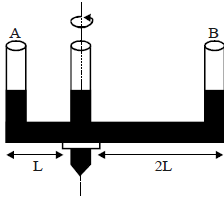
A
water levels in both sections $A$ and $B$ go up
B
water level in section $A$ goes up and that in $B$ comes down
C
water level in section $A$ comes down and that in $B$ goes up
D
water levels remain same in both sections
Solution
(A) When the tube rotates with angular velocity $\omega$,the water in the horizontal arms experiences a centrifugal force directed outwards from the axis of rotation.
This force causes the water to be pushed towards the outer ends of the tube.
As a result,the water level in both vertical arms $A$ and $B$ rises.
The pressure gradient established in the rotating fluid provides the necessary centripetal force for the water to maintain circular motion.
Since both arms are at a distance from the axis of rotation,the water level in both sections $A$ and $B$ will rise.
This force causes the water to be pushed towards the outer ends of the tube.
As a result,the water level in both vertical arms $A$ and $B$ rises.
The pressure gradient established in the rotating fluid provides the necessary centripetal force for the water to maintain circular motion.
Since both arms are at a distance from the axis of rotation,the water level in both sections $A$ and $B$ will rise.
0 likesView Solution
28
ChemistryMCQAIIMS · 2005
Solid targets of different elements are bombarded by highly energetic electron beams. The frequency $(f)$ of the characteristic $X-$rays emitted from different targets varies with atomic number $(Z)$ as
A
$f \propto \sqrt{Z}$
B
$f \propto Z^2$
C
$f \propto Z$
D
$f \propto Z^{3/2}$
Solution
(B) According to Moseley's law,the frequency $(f)$ of the characteristic $X-$rays emitted from a target is given by the relation:
$f = a(Z - b)^2$
where $a$ and $b$ are constants depending on the specific series of $X-$rays (e.g.,$K_{\alpha}, L_{\alpha}$).
For high atomic numbers $(Z)$,the term $b$ becomes negligible compared to $Z$.
Therefore,the relationship simplifies to:
$f \propto Z^2$
Thus,the frequency of characteristic $X-$rays is proportional to the square of the atomic number $(Z)$.
$f = a(Z - b)^2$
where $a$ and $b$ are constants depending on the specific series of $X-$rays (e.g.,$K_{\alpha}, L_{\alpha}$).
For high atomic numbers $(Z)$,the term $b$ becomes negligible compared to $Z$.
Therefore,the relationship simplifies to:
$f \propto Z^2$
Thus,the frequency of characteristic $X-$rays is proportional to the square of the atomic number $(Z)$.
0 likesView Solution
29
ChemistryMediumMCQAIIMS · 2005
Assertion : First ionization energy for nitrogen is lower than oxygen.
Reason : Across a period effective nuclear charge decreases.
Reason : Across a period effective nuclear charge decreases.
A
If both Assertion and Reason are correct and the Reason is a correct explanation of the Assertion.
B
If both Assertion and Reason are correct but Reason is not a correct explanation of the Assertion.
C
If the Assertion is correct but Reason is incorrect.
D
If both the Assertion and Reason are incorrect.
Solution
(D) The first ionization energy of $N$ $(1s^2, 2s^2, 2p^3)$ is higher than that of $O$ $(1s^2, 2s^2, 2p^4)$ because $N$ has a stable,exactly half-filled $2p$ subshell.
Across a period,the effective nuclear charge increases,not decreases,due to the addition of protons in the same shell while shielding remains relatively constant.
Therefore,the Assertion is incorrect and the Reason is also incorrect.
Across a period,the effective nuclear charge increases,not decreases,due to the addition of protons in the same shell while shielding remains relatively constant.
Therefore,the Assertion is incorrect and the Reason is also incorrect.
1 likesView Solution
30
ChemistryDifficultMCQAIIMS · 2005
Assertion : $SeCl_4$ does not have a tetrahedral structure.
Reason : $Se$ in $SeCl_4$ has two lone pairs.
Reason : $Se$ in $SeCl_4$ has two lone pairs.
A
If both Assertion and Reason are correct and the Reason is a correct explanation of the Assertion.
B
If both Assertion and Reason are correct but Reason is not a correct explanation of the Assertion.
C
If the Assertion is correct but Reason is incorrect.
D
If both the Assertion and Reason are incorrect.
Solution
(C) In $SeCl_4$,the central atom $Se$ has $6$ valence electrons. It forms $4$ bonds with $Cl$ atoms and has $1$ lone pair of electrons.
Thus,the total number of electron pairs is $4 + 1 = 5$,which corresponds to $sp^3d$ hybridization.
Due to the presence of one lone pair,the geometry is a see-saw shape,not tetrahedral.
Therefore,the Assertion is correct,but the Reason is incorrect because $Se$ has only one lone pair,not two.
Thus,the total number of electron pairs is $4 + 1 = 5$,which corresponds to $sp^3d$ hybridization.
Due to the presence of one lone pair,the geometry is a see-saw shape,not tetrahedral.
Therefore,the Assertion is correct,but the Reason is incorrect because $Se$ has only one lone pair,not two.
0 likesView Solution
31
ChemistryMediumMCQAIIMS · 2005
Assertion : $B_2$ molecule is diamagnetic. Reason : The highest occupied molecular orbital is of $\sigma$ type.
A
If both Assertion and Reason are correct and the Reason is a correct explanation of the Assertion.
B
If both Assertion and Reason are correct but Reason is not a correct explanation of the Assertion.
C
If the Assertion is correct but Reason is incorrect.
D
If both the Assertion and Reason are incorrect.
Solution
(D) The total number of electrons in a $B_2$ molecule is $10$.
The molecular orbital configuration is $\sigma(1s)^2 \sigma^*(1s)^2 \sigma(2s)^2 \sigma^*(2s)^2 \pi 2p_x^1 \pi 2p_y^1$.
Due to the presence of two unpaired electrons in the $\pi 2p$ orbitals,the $B_2$ molecule is paramagnetic.
The highest occupied molecular orbital $(HOMO)$ is of $\pi$ type,not $\sigma$ type.
Therefore,both the Assertion and the Reason are incorrect.
The molecular orbital configuration is $\sigma(1s)^2 \sigma^*(1s)^2 \sigma(2s)^2 \sigma^*(2s)^2 \pi 2p_x^1 \pi 2p_y^1$.
Due to the presence of two unpaired electrons in the $\pi 2p$ orbitals,the $B_2$ molecule is paramagnetic.
The highest occupied molecular orbital $(HOMO)$ is of $\pi$ type,not $\sigma$ type.
Therefore,both the Assertion and the Reason are incorrect.
0 likesView Solution
32
ChemistryMediumMCQAIIMS · 2005
Assertion : Compressibility factor for hydrogen varies with pressure with positive slope at all pressures.
Reason : Even at low pressure,repulsive forces dominate hydrogen gas.
Reason : Even at low pressure,repulsive forces dominate hydrogen gas.
A
If both Assertion and Reason are correct and the Reason is a correct explanation of the Assertion.
B
If both Assertion and Reason are correct but Reason is not a correct explanation of the Assertion.
C
If the Assertion is correct but Reason is incorrect.
D
If both the Assertion and Reason are incorrect.
Solution
(A) For hydrogen gas $(H_2)$,the compressibility factor $Z$ is defined as $Z = \frac{PV}{nRT}$.
For $H_2$,$Z$ is always greater than $1$ at all pressures,and it increases linearly with pressure.
This indicates that the gas is more difficult to compress than an ideal gas,which is due to the dominance of repulsive forces between the molecules even at low pressures.
Therefore,both the Assertion and the Reason are correct,and the Reason correctly explains the Assertion.
For $H_2$,$Z$ is always greater than $1$ at all pressures,and it increases linearly with pressure.
This indicates that the gas is more difficult to compress than an ideal gas,which is due to the dominance of repulsive forces between the molecules even at low pressures.
Therefore,both the Assertion and the Reason are correct,and the Reason correctly explains the Assertion.
0 likesView Solution
33
ChemistryMediumMCQAIIMS · 2005
Assertion : Addition of $NH_4OH$ to an aqueous solution of $BaCl_2$ in the presence of $NH_4Cl$ (excess) precipitates $Ba(OH)_2$.
Reason : $Ba(OH)_2$ is insoluble in water.
Reason : $Ba(OH)_2$ is insoluble in water.
A
If both Assertion and Reason are correct and the Reason is a correct explanation of the Assertion.
B
If both Assertion and Reason are correct but Reason is not a correct explanation of the Assertion.
C
If the Assertion is correct but Reason is incorrect.
D
If the Assertion is incorrect but the Reason is correct.
Solution
(D) The presence of $NH_4Cl$ (a strong electrolyte) suppresses the dissociation of $NH_4OH$ (a weak base) due to the common ion effect ($NH_4^+$ ions).
This significantly reduces the concentration of $OH^-$ ions in the solution.
For the precipitation of $Ba(OH)_2$ to occur,the ionic product $[Ba^{2+}][OH^-]^2$ must exceed the solubility product constant $(K_{sp})$ of $Ba(OH)_2$.
Since the concentration of $OH^-$ is kept very low,the ionic product does not exceed $K_{sp}$,and no precipitation occurs.
Furthermore,$Ba(OH)_2$ is actually a strong base and is soluble in water.
Therefore,the Assertion is incorrect and the Reason is incorrect.
This significantly reduces the concentration of $OH^-$ ions in the solution.
For the precipitation of $Ba(OH)_2$ to occur,the ionic product $[Ba^{2+}][OH^-]^2$ must exceed the solubility product constant $(K_{sp})$ of $Ba(OH)_2$.
Since the concentration of $OH^-$ is kept very low,the ionic product does not exceed $K_{sp}$,and no precipitation occurs.
Furthermore,$Ba(OH)_2$ is actually a strong base and is soluble in water.
Therefore,the Assertion is incorrect and the Reason is incorrect.
0 likesView Solution
34
ChemistryMediumMCQAIIMS · 2005
Assertion : $SiF_6^{2-}$ is known but $SiCl_6^{2-}$ is not.
Reason : Size of fluorine is small and its lone pair of electrons interacts with $d-$orbitals of $Si$ strongly.
Reason : Size of fluorine is small and its lone pair of electrons interacts with $d-$orbitals of $Si$ strongly.
A
If both Assertion and Reason are correct and the Reason is a correct explanation of the Assertion.
B
If both Assertion and Reason are correct but Reason is not a correct explanation of the Assertion.
C
If the Assertion is correct but Reason is incorrect.
D
If both the Assertion and Reason are incorrect.
Solution
(C) $SiF_6^{2-}$ is known because $F$ has a small size,which allows six $F$ atoms to fit around the $Si$ atom without significant steric hindrance.
In $SiCl_6^{2-}$,the $Cl$ atoms are much larger than $F$ atoms,leading to significant inter-electronic repulsions and steric hindrance,which makes the ion unstable.
The reason provided is incorrect because the stability of $SiF_6^{2-}$ is primarily due to the small size of $F$ minimizing steric hindrance,not due to lone pair interaction with $d-$orbitals.
In $SiCl_6^{2-}$,the $Cl$ atoms are much larger than $F$ atoms,leading to significant inter-electronic repulsions and steric hindrance,which makes the ion unstable.
The reason provided is incorrect because the stability of $SiF_6^{2-}$ is primarily due to the small size of $F$ minimizing steric hindrance,not due to lone pair interaction with $d-$orbitals.
0 likesView Solution
35
ChemistryMediumMCQAIIMS · 2005
Assertion : Rates of nitration of benzene and hexadeuterobenzene are different.
Reason : $C-H$ bond is stronger than $C-D$ bond.
Reason : $C-H$ bond is stronger than $C-D$ bond.
A
If both Assertion and Reason are correct and the Reason is a correct explanation of the Assertion.
B
If both Assertion and Reason are correct but Reason is not a correct explanation of the Assertion.
C
If the Assertion is correct but Reason is incorrect.
D
If both the Assertion and Reason are incorrect.
Solution
(D) The rate of nitration of benzene and hexadeuterobenzene is the same because the rate-determining step (formation of the sigma complex or carbocation) is the same in both cases.
This step does not involve the cleavage of the $C-H$ or $C-D$ bond,which occurs in the subsequent fast step.
Furthermore,the $C-D$ bond is actually stronger than the $C-H$ bond due to lower zero-point energy,making the Reason statement also incorrect.
Therefore,both the Assertion and the Reason are incorrect.
This step does not involve the cleavage of the $C-H$ or $C-D$ bond,which occurs in the subsequent fast step.
Furthermore,the $C-D$ bond is actually stronger than the $C-H$ bond due to lower zero-point energy,making the Reason statement also incorrect.
Therefore,both the Assertion and the Reason are incorrect.
0 likesView Solution
36
ChemistryMediumMCQAIIMS · 2005
Assertion : Cyclopentadienyl anion is much more stable than allyl anion.
Reason : Cyclopentadienyl anion is aromatic in character.
Reason : Cyclopentadienyl anion is aromatic in character.
A
If both Assertion and Reason are correct and the Reason is a correct explanation of the Assertion.
B
If both Assertion and Reason are correct but Reason is not a correct explanation of the Assertion.
C
If the Assertion is correct but Reason is incorrect.
D
If both the Assertion and Reason are incorrect.
Solution
(A) The cyclopentadienyl anion contains $6\pi$ electrons ($4n+2$ where $n=1$),which satisfies $H$ückel's rule for aromaticity. It is planar,cyclic,and fully conjugated,making it highly stable due to aromaticity.
The allyl anion $(CH_2=CH-CH_2^-)$ is stabilized by resonance but is not aromatic.
Since the cyclopentadienyl anion is aromatic,it is significantly more stable than the non-aromatic allyl anion. Thus,both the Assertion and the Reason are correct,and the Reason correctly explains the Assertion.
The allyl anion $(CH_2=CH-CH_2^-)$ is stabilized by resonance but is not aromatic.
Since the cyclopentadienyl anion is aromatic,it is significantly more stable than the non-aromatic allyl anion. Thus,both the Assertion and the Reason are correct,and the Reason correctly explains the Assertion.
0 likesView Solution
37
ChemistryMCQAIIMS · 2005
Assertion : Galvanised iron does not rust.
Reason : Zinc has a more negative electrode potential than iron.
Reason : Zinc has a more negative electrode potential than iron.
A
If both Assertion and Reason are correct and the Reason is a correct explanation of the Assertion.
B
If both Assertion and Reason are correct but Reason is not a correct explanation of the Assertion.
C
If the Assertion is correct but Reason is incorrect.
D
If both the Assertion and Reason are incorrect.
Solution
(A) Galvanised iron is iron coated with a thin layer of zinc.
Since zinc has a more negative standard electrode potential $(E^{\circ}_{Zn^{2+}/Zn} = -0.76 \ V)$ compared to iron $(E^{\circ}_{Fe^{2+}/Fe} = -0.44 \ V)$,zinc acts as a sacrificial anode.
It undergoes oxidation in preference to iron,thereby protecting the iron from rusting.
Thus,both the Assertion and the Reason are correct,and the Reason is the correct explanation of the Assertion.
Since zinc has a more negative standard electrode potential $(E^{\circ}_{Zn^{2+}/Zn} = -0.76 \ V)$ compared to iron $(E^{\circ}_{Fe^{2+}/Fe} = -0.44 \ V)$,zinc acts as a sacrificial anode.
It undergoes oxidation in preference to iron,thereby protecting the iron from rusting.
Thus,both the Assertion and the Reason are correct,and the Reason is the correct explanation of the Assertion.
0 likesView Solution
38
ChemistryMCQAIIMS · 2005
Gibberellins can promote seed germination because of their influence on
A
Rate of cell division
B
Production of hydrolyzing enzymes
C
Synthesis of abscisic acid
D
Absorption of water through hard seed coat.
Solution
(B) Gibberellins promote seed germination in cereals by inducing the synthesis of hydrolyzing enzymes,such as $\alpha$-amylase and proteases. These enzymes break down stored starch and proteins into simpler,soluble forms that the developing embryo can use for growth.
0 likesView Solution
39
ChemistryMCQAIIMS · 2005
Assertion : In humans,the gamete contributed by the male determines whether the child produced will be male or female.
Reason : Sex in humans is a polygenic trait depending upon a cumulative effect of some genes on $X-$ chromosome and some on $Y-$ chromosome.
Reason : Sex in humans is a polygenic trait depending upon a cumulative effect of some genes on $X-$ chromosome and some on $Y-$ chromosome.
A
If both Assertion and Reason are correct and the Reason is a correct explanation of the Assertion.
B
If both Assertion and Reason are correct but Reason is not a correct explanation of the Assertion.
C
If the Assertion is correct but Reason is incorrect.
D
If both the Assertion and Reason are incorrect.
Solution
(C) In humans,sex determination is based on the type of sperm that fertilizes the egg.
Human males are heterogametic,producing two types of gametes: $50\%$ with an $X$ chromosome and $50\%$ with a $Y$ chromosome.
If a sperm carrying an $X$ chromosome fertilizes the egg,the zygote develops into a female $(XX)$.
If a sperm carrying a $Y$ chromosome fertilizes the egg,the zygote develops into a male $(XY)$.
Therefore,the assertion is correct.
However,sex in humans is determined by the presence or absence of the $Y$ chromosome (specifically the $SRY$ gene),not by a polygenic trait involving cumulative effects of genes on $X$ and $Y$ chromosomes.
Thus,the reason is incorrect.
Human males are heterogametic,producing two types of gametes: $50\%$ with an $X$ chromosome and $50\%$ with a $Y$ chromosome.
If a sperm carrying an $X$ chromosome fertilizes the egg,the zygote develops into a female $(XX)$.
If a sperm carrying a $Y$ chromosome fertilizes the egg,the zygote develops into a male $(XY)$.
Therefore,the assertion is correct.
However,sex in humans is determined by the presence or absence of the $Y$ chromosome (specifically the $SRY$ gene),not by a polygenic trait involving cumulative effects of genes on $X$ and $Y$ chromosomes.
Thus,the reason is incorrect.
0 likesView Solution
40
ChemistryMCQAIIMS · 2005
Assertion : In recombinant $DNA$ technology human genes are often transferred into bacteria (prokaryotes) or yeast (eukaryote).
Reason : Both bacteria and yeast multiply very fast to form huge population which expresses the desired gene.
Reason : Both bacteria and yeast multiply very fast to form huge population which expresses the desired gene.
A
If both Assertion and Reason are correct and the Reason is a correct explanation of the Assertion.
B
If both Assertion and Reason are correct but Reason is not a correct explanation of the Assertion.
C
If the Assertion is correct but Reason is incorrect.
D
If both the Assertion and Reason are incorrect.
Solution
(A) In recombinant $DNA$ technology,human genes are frequently inserted into host organisms like bacteria (e.g.,$E. coli$) or yeast because these organisms have a very short generation time and multiply rapidly.
This rapid multiplication allows for the production of a large population of cells,which in turn facilitates the mass production of the desired gene product (protein).
Therefore,the Assertion is correct because these hosts are ideal for cloning and expression,and the Reason correctly explains that their rapid multiplication is the primary reason for their selection.
This rapid multiplication allows for the production of a large population of cells,which in turn facilitates the mass production of the desired gene product (protein).
Therefore,the Assertion is correct because these hosts are ideal for cloning and expression,and the Reason correctly explains that their rapid multiplication is the primary reason for their selection.
0 likesView Solution
41
ChemistryMCQAIIMS · 2005
Which one of the following is a correct statement?
A
$Bt$ in $Bt$-cotton indicates that it is a genetically modified organism produced through biotechnology.
B
Somatic hybridization involves fusion of two complete plant cells carrying desired genes.
C
The anticoagulant hirudin is being produced from transgenic $Brassica \text{ } napus$ seeds.
D
$Flavr \text{ } Savr$ variety of tomato has enhanced the production of ethylene which improves its taste.
Solution
(C) $1$. In $Bt$-cotton, $Bt$ stands for the bacterium $Bacillus \text{ } thuringiensis$, not just biotechnology. Thus, option $A$ is incorrect.
$2$. Somatic hybridization involves the fusion of isolated protoplasts, not complete plant cells (which have cell walls). Thus, option $B$ is incorrect.
$3$. Hirudin is an anticoagulant protein originally found in leeches. It is produced commercially using transgenic $Brassica \text{ } napus$ (rapeseed) seeds. Thus, option $C$ is correct.
$4$. $Flavr \text{ } Savr$ tomato was engineered to delay ripening by inhibiting the production of ethylene (polygalacturonase enzyme inhibition), not enhancing it. Thus, option $D$ is incorrect.
$2$. Somatic hybridization involves the fusion of isolated protoplasts, not complete plant cells (which have cell walls). Thus, option $B$ is incorrect.
$3$. Hirudin is an anticoagulant protein originally found in leeches. It is produced commercially using transgenic $Brassica \text{ } napus$ (rapeseed) seeds. Thus, option $C$ is correct.
$4$. $Flavr \text{ } Savr$ tomato was engineered to delay ripening by inhibiting the production of ethylene (polygalacturonase enzyme inhibition), not enhancing it. Thus, option $D$ is incorrect.
0 likesView Solution
42
ChemistryMCQAIIMS · 2005
Which one of the following is a correct statement?
A
$Bt$ in '$Bt$ cotton' indicates that it is a genetically modified organism produced through biotechnology
B
Somatic hybridization involves fusion of two complete plant cells carrying desired genes
C
The anticoagulant hirudin is being produced from transgenic $Brassica$ $napus$ seeds
D
Flavr $savr$ variety of tomato has enhanced the production of ethylene,which improves its taste
Solution
(C) $Bt$ in '$Bt$ cotton' stands for $Bacillus$ $thuringiensis$,a soil bacterium from which the $Bt$ gene (encoding $Bt$ toxin) is obtained.
Somatic hybridization involves the fusion of protoplasts (i.e.,cells minus cell walls) of two different plant varieties.
$Flavr$ $savr$ is a transgenic tomato variety where the production of ethylene is delayed (not enhanced) to increase shelf life.
The anticoagulant hirudin is indeed produced from the seeds of transgenic $Brassica$ $napus$ at a commercial scale.
Somatic hybridization involves the fusion of protoplasts (i.e.,cells minus cell walls) of two different plant varieties.
$Flavr$ $savr$ is a transgenic tomato variety where the production of ethylene is delayed (not enhanced) to increase shelf life.
The anticoagulant hirudin is indeed produced from the seeds of transgenic $Brassica$ $napus$ at a commercial scale.
0 likesView Solution
43
ChemistryMediumMCQAIIMS · 2005
The number of $P-O-P$ bridges in the structure of phosphorus pentoxide $(P_4O_{10})$ and phosphorus trioxide $(P_4O_6)$ are respectively:
A
$6, 6$
B
$5, 5$
C
$5, 6$
D
$6, 5$
Solution
(A) The structure of phosphorus trioxide $(P_4O_6)$ consists of four phosphorus atoms at the corners of a tetrahedron,with six oxygen atoms bridging the edges between them. Thus,it has $6$ $P-O-P$ bridges.
In phosphorus pentoxide $(P_4O_{10})$,each phosphorus atom is further bonded to an additional terminal oxygen atom via a coordinate bond. The core structure remains the same as $P_4O_6$,meaning it also contains $6$ $P-O-P$ bridges.
Therefore,the number of $P-O-P$ bridges in both $P_4O_{10}$ and $P_4O_6$ is $6$ each.
In phosphorus pentoxide $(P_4O_{10})$,each phosphorus atom is further bonded to an additional terminal oxygen atom via a coordinate bond. The core structure remains the same as $P_4O_6$,meaning it also contains $6$ $P-O-P$ bridges.
Therefore,the number of $P-O-P$ bridges in both $P_4O_{10}$ and $P_4O_6$ is $6$ each.
0 likesView Solution
44
ChemistryMediumMCQAIIMS · 2005
Among the following molecules:
$(i)$ $XeO_3$
$(ii)$ $XeOF_4$
$(iii)$ $XeF_6$
Those having the same number of lone pairs on $Xe$ are:
$(i)$ $XeO_3$
$(ii)$ $XeOF_4$
$(iii)$ $XeF_6$
Those having the same number of lone pairs on $Xe$ are:
A
$(i)$ and $(ii)$ only
B
$(i)$ and $(iii)$ only
C
$(ii)$ and $(iii)$ only
D
$(i)$,$(ii)$ and $(iii)$
Solution
(D) To determine the number of lone pairs on the central $Xe$ atom in each molecule,we use the formula: $\text{Lone pairs} = \frac{1}{2} \times (V - M - C + A)$,where $V$ is the number of valence electrons of the central atom,$M$ is the number of monovalent atoms,$C$ is the cationic charge,and $A$ is the anionic charge.
$1.$ For $XeO_3$:
$Xe$ has $8$ valence electrons. Oxygen is divalent,so $M = 0$.
$\text{Lone pairs} = \frac{1}{2} \times (8 - 0) = 4$ electrons,which corresponds to $1$ lone pair.
$2.$ For $XeOF_4$:
$Xe$ has $8$ valence electrons. $F$ is monovalent $(M = 4)$,$O$ is divalent $(M = 0)$.
$\text{Lone pairs} = \frac{1}{2} \times (8 - 4) = 2$ electrons,which corresponds to $1$ lone pair.
$3.$ For $XeF_6$:
$Xe$ has $8$ valence electrons. $F$ is monovalent $(M = 6)$.
$\text{Lone pairs} = \frac{1}{2} \times (8 - 6) = 2$ electrons,which corresponds to $1$ lone pair.
Since all three molecules ($XeO_3$,$XeOF_4$,and $XeF_6$) have $1$ lone pair on the $Xe$ atom,the correct option is $(D)$.
$1.$ For $XeO_3$:
$Xe$ has $8$ valence electrons. Oxygen is divalent,so $M = 0$.
$\text{Lone pairs} = \frac{1}{2} \times (8 - 0) = 4$ electrons,which corresponds to $1$ lone pair.
$2.$ For $XeOF_4$:
$Xe$ has $8$ valence electrons. $F$ is monovalent $(M = 4)$,$O$ is divalent $(M = 0)$.
$\text{Lone pairs} = \frac{1}{2} \times (8 - 4) = 2$ electrons,which corresponds to $1$ lone pair.
$3.$ For $XeF_6$:
$Xe$ has $8$ valence electrons. $F$ is monovalent $(M = 6)$.
$\text{Lone pairs} = \frac{1}{2} \times (8 - 6) = 2$ electrons,which corresponds to $1$ lone pair.
Since all three molecules ($XeO_3$,$XeOF_4$,and $XeF_6$) have $1$ lone pair on the $Xe$ atom,the correct option is $(D)$.
0 likesView Solution
45
ChemistryMediumMCQAIIMS · 2005
Among the following,the strongest nucleophile is
A
$C_2H_5SH$
B
$CH_3COO^-$
C
$CH_3NH_2$
D
$NCCH_2^-$
Solution
(A) The correct answer is $A$.
Nucleophilicity is the ability of a species to donate an electron pair to an electrophile.
Factors affecting nucleophilicity include charge,electronegativity,and solvent effects.
Comparing the given species:
$1$. $C_2H_5SH$ (Ethanethiol): Sulfur is less electronegative than oxygen and nitrogen,making its lone pair more available for donation.
$2$. $CH_3COO^-$ (Acetate ion): The negative charge is delocalized over two oxygen atoms via resonance,which decreases its nucleophilicity.
$3$. $CH_3NH_2$ (Methylamine): Nitrogen is more electronegative than sulfur,making its lone pair less available.
$4$. $NCCH_2^-$ (Cyanomethyl anion): The negative charge is stabilized by the strong electron-withdrawing $-I$ and $-M$ effect of the cyano $(-CN)$ group,significantly reducing its nucleophilicity.
Therefore,$C_2H_5SH$ acts as the strongest nucleophile among the given options due to the lower electronegativity of sulfur compared to oxygen and nitrogen,and the lack of resonance stabilization or strong electron-withdrawing groups.
Nucleophilicity is the ability of a species to donate an electron pair to an electrophile.
Factors affecting nucleophilicity include charge,electronegativity,and solvent effects.
Comparing the given species:
$1$. $C_2H_5SH$ (Ethanethiol): Sulfur is less electronegative than oxygen and nitrogen,making its lone pair more available for donation.
$2$. $CH_3COO^-$ (Acetate ion): The negative charge is delocalized over two oxygen atoms via resonance,which decreases its nucleophilicity.
$3$. $CH_3NH_2$ (Methylamine): Nitrogen is more electronegative than sulfur,making its lone pair less available.
$4$. $NCCH_2^-$ (Cyanomethyl anion): The negative charge is stabilized by the strong electron-withdrawing $-I$ and $-M$ effect of the cyano $(-CN)$ group,significantly reducing its nucleophilicity.
Therefore,$C_2H_5SH$ acts as the strongest nucleophile among the given options due to the lower electronegativity of sulfur compared to oxygen and nitrogen,and the lack of resonance stabilization or strong electron-withdrawing groups.
0 likesView Solution
46
ChemistryMediumMCQAIIMS · 2005
$3$-Phenylpropene on reaction with $HBr$ gives (as a major product)
A
$C_6H_5CH_2CH(Br)CH_3$
B
$C_6H_5CH(Br)CH_2CH_3$
C
$C_6H_5CH_2CH_2CH_2Br$
D
$C_6H_5CH(Br)CH = CH_2$
Solution
(B) $3$-Phenylpropene $(C_6H_5CH_2CH=CH_2)$ reacts with $HBr$ via electrophilic addition.
According to Markownikoff's rule,the electrophile $(H^+)$ adds to the terminal carbon to form a more stable secondary benzylic carbocation $(C_6H_5CH^+CH_2CH_3)$.
The nucleophile $(Br^-)$ then attacks this carbocation to form the major product,$1$-bromo-$1$-phenylpropane $(C_6H_5CH(Br)CH_2CH_3)$.
According to Markownikoff's rule,the electrophile $(H^+)$ adds to the terminal carbon to form a more stable secondary benzylic carbocation $(C_6H_5CH^+CH_2CH_3)$.
The nucleophile $(Br^-)$ then attacks this carbocation to form the major product,$1$-bromo-$1$-phenylpropane $(C_6H_5CH(Br)CH_2CH_3)$.
0 likesView Solution
47
ChemistryMediumMCQAIIMS · 2005
Pyridine is less basic than triethylamine because
A
Pyridine has aromatic character
B
Nitrogen in pyridine is $sp^2$ hybridized
C
Pyridine is a cyclic system
D
In pyridine,lone pair of nitrogen is delocalized
Solution
(D) The basicity of amines is primarily due to the availability of a lone pair of electrons on the nitrogen atom for donation to a proton or Lewis acid.
In triethylamine,the lone pair on the nitrogen is localized and readily available for donation.
In pyridine,the nitrogen atom is $sp^2$ hybridized,and its lone pair is part of the aromatic $\pi$-electron system (delocalized) to satisfy $H$ückel's rule.
Because the lone pair is delocalized,it is significantly less available for protonation,making pyridine less basic than triethylamine.
In triethylamine,the lone pair on the nitrogen is localized and readily available for donation.
In pyridine,the nitrogen atom is $sp^2$ hybridized,and its lone pair is part of the aromatic $\pi$-electron system (delocalized) to satisfy $H$ückel's rule.
Because the lone pair is delocalized,it is significantly less available for protonation,making pyridine less basic than triethylamine.
0 likesView Solution
48
ChemistryMediumMCQAIIMS · 2005
If $Z$ is the number of atoms in the unit cell that represents the closest packing sequence $ABCABC$,the number of tetrahedral voids in the unit cell is equal to
A
$Z$
B
$2Z$
C
$Z/2$
D
$Z/4$
Solution
(B) The $ABCABC$ packing sequence corresponds to the face-centered cubic $(FCC)$ or cubic close-packed $(CCP)$ structure.
In any close-packed structure,if the number of atoms per unit cell is $Z$,the number of octahedral voids is $Z$ and the number of tetrahedral voids is $2Z$.
Therefore,the number of tetrahedral voids is $2Z$.
In any close-packed structure,if the number of atoms per unit cell is $Z$,the number of octahedral voids is $Z$ and the number of tetrahedral voids is $2Z$.
Therefore,the number of tetrahedral voids is $2Z$.
0 likesView Solution
49
ChemistryMediumMCQAIIMS · 2005
$_{92}U^{238}$ emits $8$ $\alpha$-particles and $6$ $\beta$-particles. The neutron/proton ratio in the product nucleus is
A
$60/41$
B
$61/40$
C
$62/41$
D
$61/42$
Solution
(C) The nuclear reaction is: $_{92}U^{238} \xrightarrow{-8\alpha, -6\beta} _{Z}X^{A}$.
Change in mass number $(A)$: $238 - (8 \times 4) = 238 - 32 = 206$.
Change in atomic number $(Z)$: $92 - (8 \times 2) + (6 \times 1) = 92 - 16 + 6 = 82$.
The product nucleus is $_{82}X^{206}$.
Number of protons $(p)$ $= 82$.
Number of neutrons $(n)$ $= A - Z = 206 - 82 = 124$.
Neutron/proton ratio $= n/p = 124/82 = 62/41$.
Change in mass number $(A)$: $238 - (8 \times 4) = 238 - 32 = 206$.
Change in atomic number $(Z)$: $92 - (8 \times 2) + (6 \times 1) = 92 - 16 + 6 = 82$.
The product nucleus is $_{82}X^{206}$.
Number of protons $(p)$ $= 82$.
Number of neutrons $(n)$ $= A - Z = 206 - 82 = 124$.
Neutron/proton ratio $= n/p = 124/82 = 62/41$.
0 likesView Solution
50
ChemistryDifficultMCQAIIMS · 2005
For the reaction $A \to xP$,when $[A] = 2.2 \, mM$,the rate was found to be $2.4 \, mM \, s^{-1}$. On reducing the concentration of $A$ to half,the rate changes to $0.6 \, mM \, s^{-1}$. The order of reaction with respect to $A$ is
A
$1.5$
B
$2$
C
$2.5$
D
$3$
Solution
(B) The rate law for the reaction is given by: $\text{Rate} = k[A]^n$,where $n$ is the order of reaction.
For the first condition: $2.4 = k(2.2)^n$ ... $(i)$
For the second condition,$[A] = 2.2/2 = 1.1 \, mM$ and $\text{Rate} = 0.6 \, mM \, s^{-1}$:
$0.6 = k(1.1)^n$ ... $(ii)$
Dividing equation $(i)$ by equation $(ii)$:
$\frac{2.4}{0.6} = \frac{k(2.2)^n}{k(1.1)^n}$
$4 = (2)^n$
$2^2 = 2^n$
Therefore,$n = 2$.
The order of reaction with respect to $A$ is $2$.
For the first condition: $2.4 = k(2.2)^n$ ... $(i)$
For the second condition,$[A] = 2.2/2 = 1.1 \, mM$ and $\text{Rate} = 0.6 \, mM \, s^{-1}$:
$0.6 = k(1.1)^n$ ... $(ii)$
Dividing equation $(i)$ by equation $(ii)$:
$\frac{2.4}{0.6} = \frac{k(2.2)^n}{k(1.1)^n}$
$4 = (2)^n$
$2^2 = 2^n$
Therefore,$n = 2$.
The order of reaction with respect to $A$ is $2$.
0 likesView Solution
51
ChemistryMediumMCQAIIMS · 2005
An endothermic reaction with high activation energy for the forward reaction is given by the diagram:
A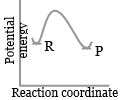
B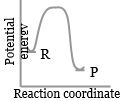
C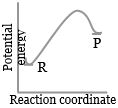
D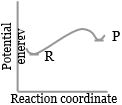
Solution
(C) In an endothermic reaction,the potential energy of the products $(P)$ is higher than that of the reactants $(R)$.
Activation energy $(E_a)$ is the energy difference between the transition state (peak of the curve) and the reactants $(R)$.
Diagram $C$ shows that the energy of the products is higher than the reactants (endothermic) and the energy barrier (peak) is significantly higher than the reactant energy,indicating high activation energy.
Activation energy $(E_a)$ is the energy difference between the transition state (peak of the curve) and the reactants $(R)$.
Diagram $C$ shows that the energy of the products is higher than the reactants (endothermic) and the energy barrier (peak) is significantly higher than the reactant energy,indicating high activation energy.
0 likesView Solution
52
ChemistryMediumMCQAIIMS · 2005
The chemical reaction,$2AgCl_{(s)} + H_{2(g)} \to 2HCl_{(aq)} + 2Ag_{(s)}$ taking place in a galvanic cell is represented by the notation:
A
$Pt | H_{2(g)}, 1 \ bar | 1 \ M \ KCl_{(aq)} | AgCl_{(s)} | Ag_{(s)}$
B
$Pt_{(s)} | H_{2(g)}, 1 \ bar | 1 \ M \ HCl_{(aq)} || 1 \ M \ Ag^{+}_{(aq)} | Ag_{(s)}$
C
$Pt_{(s)} | H_{2(g)}, 1 \ bar | 1 \ M \ HCl_{(aq)} | AgCl_{(s)} | Ag_{(s)}$
D
$Pt_{(s)} | H_{2(g)}, 1 \ bar | 1 \ M \ HCl_{(aq)} | Ag_{(s)} | AgCl_{(s)}$
Solution
(C) The given cell reaction is $2AgCl_{(s)} + H_{2(g)} \to 2HCl_{(aq)} + 2Ag_{(s)}$.
In this reaction,$H_2$ is oxidized to $H^+$ at the anode,and $AgCl$ is reduced to $Ag$ at the cathode.
The anode is a standard hydrogen electrode represented as $Pt_{(s)} | H_{2(g)}, 1 \ bar | H^+_{(aq)}$.
The cathode involves the $Ag/AgCl$ electrode,represented as $Cl^-_{(aq)} | AgCl_{(s)} | Ag_{(s)}$.
Combining these,the cell notation is $Pt_{(s)} | H_{2(g)}, 1 \ bar | 1 \ M \ HCl_{(aq)} | AgCl_{(s)} | Ag_{(s)}$.
In this reaction,$H_2$ is oxidized to $H^+$ at the anode,and $AgCl$ is reduced to $Ag$ at the cathode.
The anode is a standard hydrogen electrode represented as $Pt_{(s)} | H_{2(g)}, 1 \ bar | H^+_{(aq)}$.
The cathode involves the $Ag/AgCl$ electrode,represented as $Cl^-_{(aq)} | AgCl_{(s)} | Ag_{(s)}$.
Combining these,the cell notation is $Pt_{(s)} | H_{2(g)}, 1 \ bar | 1 \ M \ HCl_{(aq)} | AgCl_{(s)} | Ag_{(s)}$.
0 likesView Solution
53
ChemistryDifficultMCQAIIMS · 2005
Which of the following molecules is most suitable to disperse benzene in water?
A
Sodium dodecanoate $(CH_3(CH_2)_{10}COO^- Na^+)$
B
Disodium decanedioate $(Na^+ O^-OC(CH_2)_8COO^- Na^+)$
C
$m$-methyl nonylbenzene $(C_9H_{19}-C_6H_4-CH_3)$
D
$1-$chloro$-4-$phenylbutane $(Cl-(CH_2)_4-C_6H_5)$
Solution
(C) Benzene is a non-polar molecule. According to the principle of 'like dissolves like',non-polar substances are better dispersed by other non-polar substances.
$m$-methyl nonylbenzene is a non-polar molecule with a long hydrocarbon chain and a substituted benzene ring,making it highly lipophilic and suitable for dispersing non-polar benzene.
In contrast,options $(A)$,$(B)$,and $(D)$ contain polar functional groups (carboxylate ions or chlorine atoms),which make them amphiphilic or polar,thus less suitable for dispersing pure non-polar benzene compared to the purely non-polar $m$-methyl nonylbenzene.
$m$-methyl nonylbenzene is a non-polar molecule with a long hydrocarbon chain and a substituted benzene ring,making it highly lipophilic and suitable for dispersing non-polar benzene.
In contrast,options $(A)$,$(B)$,and $(D)$ contain polar functional groups (carboxylate ions or chlorine atoms),which make them amphiphilic or polar,thus less suitable for dispersing pure non-polar benzene compared to the purely non-polar $m$-methyl nonylbenzene.
0 likesView Solution
54
ChemistryMediumMCQAIIMS · 2005
Which of the following is a carbonate ore?
A
Pyrolusite
B
Malachite
C
Diaspore
D
Cassiterite
Solution
(B) The chemical formulas for the given ores are:
$1$. Pyrolusite: $MnO_2$ (Oxide ore)
$2$. Malachite: $CuCO_3 \cdot Cu(OH)_2$ (Carbonate ore)
$3$. Diaspore: $Al_2O_3 \cdot H_2O$ (Oxide/Hydroxide ore)
$4$. Cassiterite: $SnO_2$ (Oxide ore)
Therefore,Malachite is a carbonate ore.
$1$. Pyrolusite: $MnO_2$ (Oxide ore)
$2$. Malachite: $CuCO_3 \cdot Cu(OH)_2$ (Carbonate ore)
$3$. Diaspore: $Al_2O_3 \cdot H_2O$ (Oxide/Hydroxide ore)
$4$. Cassiterite: $SnO_2$ (Oxide ore)
Therefore,Malachite is a carbonate ore.
0 likesView Solution
55
ChemistryMediumMCQAIIMS · 2005
Among the following pairs of ions,the lower oxidation state in aqueous solution is more stable than the other in:
A
$Tl^{+}, Tl^{3+}$
B
$Cu^{+}, Cu^{2+}$
C
$Cr^{2+}, Cr^{3+}$
D
$V^{2+}, VO^{2+}$
Solution
(A) In the case of $Tl$ (Thallium),the $Tl^{+}$ ion is more stable than the $Tl^{3+}$ ion due to the inert pair effect,where the $6s^{2}$ electrons are reluctant to participate in bonding.
Consequently,$Tl^{3+}$ acts as a strong oxidizing agent and gets reduced to $Tl^{+}$:
$Tl^{3+} + 2e^{-} \to Tl^{+}$
In contrast,for $Cu$,$Cr$,and $V$,the higher oxidation states ($Cu^{2+}$,$Cr^{3+}$,$VO^{2+}$) are generally more stable in aqueous solution due to higher hydration energy or electronic configuration stability.
Consequently,$Tl^{3+}$ acts as a strong oxidizing agent and gets reduced to $Tl^{+}$:
$Tl^{3+} + 2e^{-} \to Tl^{+}$
In contrast,for $Cu$,$Cr$,and $V$,the higher oxidation states ($Cu^{2+}$,$Cr^{3+}$,$VO^{2+}$) are generally more stable in aqueous solution due to higher hydration energy or electronic configuration stability.
0 likesView Solution
56
ChemistryMediumMCQAIIMS · 2005
$F_2$ is formed by reacting $K_2MnF_6$ with:
A
$SbF_5$
B
$MnF_3$
C
$KSbF_6$
D
$MnF_4$
Solution
(A) The reaction is: $K_2MnF_6 + 2SbF_5 \rightarrow 2KSbF_6 + MnF_3 + \frac{1}{2}F_2$.
In this reaction,the stronger Lewis acid $SbF_5$ displaces the weaker one,$MnF_4$,from its salt.
$MnF_4$ is unstable and readily decomposes to give $MnF_3$ and fluorine gas $(F_2)$.
In this reaction,the stronger Lewis acid $SbF_5$ displaces the weaker one,$MnF_4$,from its salt.
$MnF_4$ is unstable and readily decomposes to give $MnF_3$ and fluorine gas $(F_2)$.
0 likesView Solution
57
ChemistryDifficultMCQAIIMS · 2005
An aqueous solution of $CoCl_2$ on addition of excess of concentrated $HCl$ turns blue due to the formation of:
A
$[Co(H_2O)_4Cl_2]$
B
$[Co(H_2O)_2Cl_4]^{2-}$
C
$[CoCl_4]^{2-}$
D
$[Co(H_2O)_2Cl_2]$
Solution
(C) The aqueous solution of $CoCl_2$ contains the octahedral complex $[Co(H_2O)_6]^{2+}$,which is pink in color.
Upon adding excess concentrated $HCl$,the chloride ions $(Cl^-)$ act as ligands and displace the water molecules.
This leads to the formation of the tetrahedral complex $[CoCl_4]^{2-}$,which is blue in color.
The reaction is: $[Co(H_2O)_6]^{2+} + 4Cl^- \rightarrow [CoCl_4]^{2-} + 6H_2O$.
Upon adding excess concentrated $HCl$,the chloride ions $(Cl^-)$ act as ligands and displace the water molecules.
This leads to the formation of the tetrahedral complex $[CoCl_4]^{2-}$,which is blue in color.
The reaction is: $[Co(H_2O)_6]^{2+} + 4Cl^- \rightarrow [CoCl_4]^{2-} + 6H_2O$.
0 likesView Solution
58
ChemistryDifficultMCQAIIMS · 2005
The correct order for the wavelength of absorption in the visible region is
A
$[Ni(NO_2)_6]^{4-} < [Ni(NH_3)_6]^{2+} < [Ni(H_2O)_6]^{2+}$
B
$[Ni(NO_2)_6]^{4-} < [Ni(H_2O)_6]^{2+} < [Ni(NH_3)_6]^{2+}$
C
$[Ni(H_2O)_6]^{2+} < [Ni(NH_3)_6]^{2+} < [Ni(NO_2)_6]^{4-}$
D
$[Ni(NH_3)_6]^{2+} < [Ni(H_2O)_6]^{2+} < [Ni(NO_2)_6]^{4-}$
Solution
(A) The energy of absorption $(E)$ is inversely proportional to the wavelength of absorption $(\lambda)$,i.e.,$E = \frac{hc}{\lambda}$.
According to the spectrochemical series,the field strength of the ligands follows the order: $H_2O < NH_3 < NO_2^-$.
Stronger field ligands cause a larger crystal field splitting energy $(\Delta_o)$,which corresponds to higher energy absorption and thus a shorter wavelength of absorption.
Therefore,the order of field strength is $[Ni(H_2O)_6]^{2+} < [Ni(NH_3)_6]^{2+} < [Ni(NO_2)_6]^{4-}$.
Consequently,the order of wavelength of absorption is the inverse: $[Ni(NO_2)_6]^{4-} < [Ni(NH_3)_6]^{2+} < [Ni(H_2O)_6]^{2+}$.
According to the spectrochemical series,the field strength of the ligands follows the order: $H_2O < NH_3 < NO_2^-$.
Stronger field ligands cause a larger crystal field splitting energy $(\Delta_o)$,which corresponds to higher energy absorption and thus a shorter wavelength of absorption.
Therefore,the order of field strength is $[Ni(H_2O)_6]^{2+} < [Ni(NH_3)_6]^{2+} < [Ni(NO_2)_6]^{4-}$.
Consequently,the order of wavelength of absorption is the inverse: $[Ni(NO_2)_6]^{4-} < [Ni(NH_3)_6]^{2+} < [Ni(H_2O)_6]^{2+}$.
0 likesView Solution
59
ChemistryDifficultMCQAIIMS · 2005
In which of the following pairs do both the complexes show optical isomerism?
A
$cis-[Cr(C_2O_4)_2Cl_2]^{3-}$,$cis-[Co(NH_3)_4Cl_2]^+$
B
$[Co(en)_3]Cl_3$,$cis-[Co(en)_2Cl_2]Cl$
C
$[PtCl(dien)]Cl$,$[NiCl_2Br_2]^{2-}$
D
$[Co(NO_3)_3(NH_3)_3]$,$cis-[Pt(en)_2Cl_2]$
Solution
(B) Optical isomerism is shown by complexes that lack a plane of symmetry and a center of inversion (i.e.,they are chiral).
$1$. $[Co(en)_3]Cl_3$: This complex contains three bidentate ethylenediamine $(en)$ ligands. It exists as a pair of non-superimposable mirror images (enantiomers) and thus shows optical isomerism.
$2$. $cis-[Co(en)_2Cl_2]Cl$: In the $cis$ isomer,the two $Cl$ ligands are adjacent. This configuration lacks a plane of symmetry,making it chiral and optically active.
Therefore,both complexes in option $B$ exhibit optical isomerism.
$1$. $[Co(en)_3]Cl_3$: This complex contains three bidentate ethylenediamine $(en)$ ligands. It exists as a pair of non-superimposable mirror images (enantiomers) and thus shows optical isomerism.
$2$. $cis-[Co(en)_2Cl_2]Cl$: In the $cis$ isomer,the two $Cl$ ligands are adjacent. This configuration lacks a plane of symmetry,making it chiral and optically active.
Therefore,both complexes in option $B$ exhibit optical isomerism.
0 likesView Solution
60
ChemistryAdvancedMCQAIIMS · 2005
The major product obtained on treatment of $CH_3CH_2CH(F)CH_3$ with $CH_3O^-/CH_3OH$ is
A
$CH_3CH_2CH(OCH_3)CH_3$
B
$CH_3CH=CHCH_3$
C
$CH_3CH_2CH=CH_2$
D
$CH_3CH_2CH_2CH_2OCH_3$
Solution
(B) The reaction of $CH_3CH_2CH(F)CH_3$ with a strong base like $CH_3O^-$ in $CH_3OH$ proceeds via an $E2$ elimination mechanism.
Two possible alkenes can be formed: $CH_3CH=CHCH_3$ (but-$2$-ene) and $CH_3CH_2CH=CH_2$ (but-$1$-ene).
According to Saytzeff's rule,the more substituted alkene is the major product because it is more stable.
$CH_3CH=CHCH_3$ has two alkyl substituents on the double-bonded carbons,while $CH_3CH_2CH=CH_2$ has only one.
Therefore,$CH_3CH=CHCH_3$ is the major product.
Two possible alkenes can be formed: $CH_3CH=CHCH_3$ (but-$2$-ene) and $CH_3CH_2CH=CH_2$ (but-$1$-ene).
According to Saytzeff's rule,the more substituted alkene is the major product because it is more stable.
$CH_3CH=CHCH_3$ has two alkyl substituents on the double-bonded carbons,while $CH_3CH_2CH=CH_2$ has only one.
Therefore,$CH_3CH=CHCH_3$ is the major product.
0 likesView Solution
61
ChemistryDifficultMCQAIIMS · 2005
$CH_3CO_2C_2H_5$ on reaction with sodium ethoxide in ethanol gives $A$,which on heating in the presence of acid gives $B$. Compound $B$ is
A
$CH_3COCH_2COOH$
B
$CH_3COCH_3$
C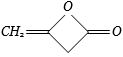
D
$CH_2=C(OC_2H_5)_2$
Solution
(C) Step $I$: Ethyl acetate $(CH_3CO_2C_2H_5)$ undergoes Claisen condensation in the presence of sodium ethoxide $(NaOC_2H_5)$ to form ethyl acetoacetate $(CH_3COCH_2COOC_2H_5)$,which is compound $A$.
Step $II$: Ethyl acetoacetate,when heated in the presence of an acid,undergoes decarboxylation and dehydration/rearrangement to form the cyclic compound shown in the provided image (a derivative of cyclobutanone or similar cyclic structure as per the reaction mechanism provided in the image).
Step $II$: Ethyl acetoacetate,when heated in the presence of an acid,undergoes decarboxylation and dehydration/rearrangement to form the cyclic compound shown in the provided image (a derivative of cyclobutanone or similar cyclic structure as per the reaction mechanism provided in the image).
0 likesView Solution
62
ChemistryMediumMCQAIIMS · 2005
$C_6H_5CONHCH_3$ can be converted into $C_6H_5CH_2NHCH_3$ by
A
$NaBH_4$
B
$H_2 - Pd/C$
C
$LiAlH_4$
D
$Zn - Hg/HCl$
Solution
(C) The conversion of an amide $(C_6H_5CONHCH_3)$ to an amine $(C_6H_5CH_2NHCH_3)$ involves the reduction of the carbonyl group $(C=O)$ to a methylene group $(CH_2)$.
$LiAlH_4$ is a strong reducing agent that reduces amides to amines,but it typically reduces the carbonyl group to a methylene group $(C_6H_5CONHCH_3 \xrightarrow{LiAlH_4} C_6H_5CH_2NHCH_3)$.
However,the Clemmensen reduction $(Zn-Hg/HCl)$ is specifically used to reduce aldehydes and ketones to alkanes,but it is not the standard reagent for reducing amides to amines.
In the context of standard organic chemistry reagents,$LiAlH_4$ is the correct reagent for the reduction of amides to amines.
$LiAlH_4$ is a strong reducing agent that reduces amides to amines,but it typically reduces the carbonyl group to a methylene group $(C_6H_5CONHCH_3 \xrightarrow{LiAlH_4} C_6H_5CH_2NHCH_3)$.
However,the Clemmensen reduction $(Zn-Hg/HCl)$ is specifically used to reduce aldehydes and ketones to alkanes,but it is not the standard reagent for reducing amides to amines.
In the context of standard organic chemistry reagents,$LiAlH_4$ is the correct reagent for the reduction of amides to amines.
0 likesView Solution
63
ChemistryDifficultMCQAIIMS · 2005
Which of the following chemicals are used to manufacture methyl isocyanate that caused the $Bhopal$ $Tragedy$?
$(i)$ $Methylamine$
$(ii)$ $Phosgene$
$(iii)$ $Phosphine$
$(iv)$ $Dimethylamine$
$(i)$ $Methylamine$
$(ii)$ $Phosgene$
$(iii)$ $Phosphine$
$(iv)$ $Dimethylamine$
A
$(i)$ and $(iii)$
B
$(iii)$ and $(iv)$
C
$(i)$ and $(ii)$
D
$(ii)$ and $(iv)$
Solution
(C) Methyl isocyanate $(CH_3NCO)$ is industrially prepared by the reaction of methylamine $(CH_3NH_2)$ with phosgene $(COCl_2)$.
The chemical reaction is:
$CH_3NH_2 + COCl_2 \rightarrow CH_3NHCOCl + HCl$
$CH_3NHCOCl \rightarrow CH_3NCO + HCl$
Thus,the chemicals used are $(i)$ $Methylamine$ and $(ii)$ $Phosgene$.
The chemical reaction is:
$CH_3NH_2 + COCl_2 \rightarrow CH_3NHCOCl + HCl$
$CH_3NHCOCl \rightarrow CH_3NCO + HCl$
Thus,the chemicals used are $(i)$ $Methylamine$ and $(ii)$ $Phosgene$.
0 likesView Solution
64
ChemistryDifficultMCQAIIMS · 2005
Among the following,which one does not act as an intermediate in the Hofmann rearrangement?
A
$R-N=C=O$
B
$R-CO-\ddot{N}$
C
$R-CONHBr$
D
$R-NC$
Solution
(D) In the Hofmann rearrangement (Hofmann bromamide degradation),the reaction proceeds through the formation of several intermediates:
$1.$ $N$-bromoamide $(R-CONHBr)$
$2.$ Acyl nitrene $(R-CO-\ddot{N})$
$3.$ Alkyl isocyanate $(R-N=C=O)$
Alkyl isocyanide $(R-NC)$ is not formed as an intermediate in this reaction.
$1.$ $N$-bromoamide $(R-CONHBr)$
$2.$ Acyl nitrene $(R-CO-\ddot{N})$
$3.$ Alkyl isocyanate $(R-N=C=O)$
Alkyl isocyanide $(R-NC)$ is not formed as an intermediate in this reaction.
0 likesView Solution
65
ChemistryMediumMCQAIIMS · 2005
Which one of the following biomolecules is insoluble in water?
A
$\alpha$-Keratin
B
Haemoglobin
C
Ribonuclease
D
Adenine
Solution
(A) . $\alpha$-Keratin is a fibrous protein. Fibrous proteins are generally insoluble in water due to their long,thread-like structure and extensive hydrogen bonding.
0 likesView Solution
66
ChemistryMediumMCQAIIMS · 2005
The diamagnetic species is
A
$[Ni(CN)_4]^{2-}$
B
$[NiCl_4]^{2-}$
C
$[CoCl_4]^{2-}$
D
$[CoF_6]^{2-}$
Solution
(A) To determine the magnetic property,we look at the electronic configuration of the central metal ion and the nature of the ligand:
$1$. In $[Ni(CN)_4]^{2-}$,$Ni$ is in the $+2$ oxidation state $(3d^8)$. $CN^-$ is a strong field ligand,causing pairing of electrons in the $3d$ orbitals,resulting in no unpaired electrons. Thus,it is diamagnetic.
$2$. In $[NiCl_4]^{2-}$,$Ni^{2+}$ $(3d^8)$ is bonded to $Cl^-$ (a weak field ligand),which does not cause pairing,resulting in two unpaired electrons. Thus,it is paramagnetic.
$3$. In $[CoCl_4]^{2-}$,$Co^{2+}$ $(3d^7)$ is bonded to $Cl^-$ (a weak field ligand),resulting in three unpaired electrons. Thus,it is paramagnetic.
$4$. In $[CoF_6]^{2-}$,$Co^{4+}$ $(3d^5)$ is bonded to $F^-$ (a weak field ligand),resulting in five unpaired electrons. Thus,it is paramagnetic.
Therefore,the correct option is $A$.
$1$. In $[Ni(CN)_4]^{2-}$,$Ni$ is in the $+2$ oxidation state $(3d^8)$. $CN^-$ is a strong field ligand,causing pairing of electrons in the $3d$ orbitals,resulting in no unpaired electrons. Thus,it is diamagnetic.
$2$. In $[NiCl_4]^{2-}$,$Ni^{2+}$ $(3d^8)$ is bonded to $Cl^-$ (a weak field ligand),which does not cause pairing,resulting in two unpaired electrons. Thus,it is paramagnetic.
$3$. In $[CoCl_4]^{2-}$,$Co^{2+}$ $(3d^7)$ is bonded to $Cl^-$ (a weak field ligand),resulting in three unpaired electrons. Thus,it is paramagnetic.
$4$. In $[CoF_6]^{2-}$,$Co^{4+}$ $(3d^5)$ is bonded to $F^-$ (a weak field ligand),resulting in five unpaired electrons. Thus,it is paramagnetic.
Therefore,the correct option is $A$.
0 likesView Solution
67
ChemistryMediumMCQAIIMS · 2005
Which one of the following statements is true for protein synthesis (translation)?
A
Amino acids are directly recognized by $m-RNA$.
B
The third base of the codon is less specific.
C
Only one codon codes for an amino acid.
D
Every $t-RNA$ molecule has more than one amino acid attachment site.
Solution
(B) The correct statement is that the third base of the codon is less specific,which is known as the $Wobble$ $Hypothesis$.
$m-RNA$ does not directly recognize amino acids; instead,$t-RNA$ acts as an adaptor molecule.
Most amino acids are coded by more than one codon (degeneracy of genetic code).
Every $t-RNA$ molecule has only one specific amino acid attachment site at its $3'$-end.
$m-RNA$ does not directly recognize amino acids; instead,$t-RNA$ acts as an adaptor molecule.
Most amino acids are coded by more than one codon (degeneracy of genetic code).
Every $t-RNA$ molecule has only one specific amino acid attachment site at its $3'$-end.
0 likesView Solution
68
ChemistryEasyMCQAIIMS · 2005
Globular protein is present in -
A
Blood
B
Milk
C
Eggs
D
All of these
Solution
(D) Globular proteins are proteins where the polypeptide chain is folded into a spherical shape.
They are found in various biological systems:
$1$. In blood,albumins and globulins are globular proteins.
$2$. In milk,caseinogen is a globular protein.
$3$. In egg white,albumin is a globular protein.
Therefore,all of the given options contain globular proteins.
They are found in various biological systems:
$1$. In blood,albumins and globulins are globular proteins.
$2$. In milk,caseinogen is a globular protein.
$3$. In egg white,albumin is a globular protein.
Therefore,all of the given options contain globular proteins.
0 likesView Solution
69
ChemistryDifficultMCQAIIMS · 2005
Assertion: $Ozone$ is a powerful oxidising agent in comparison to $O_2$.
Reason: $Ozone$ is diamagnetic but $O_2$ is paramagnetic.
Reason: $Ozone$ is diamagnetic but $O_2$ is paramagnetic.
A
If both Assertion and Reason are correct and the Reason is a correct explanation of the Assertion.
B
If both Assertion and Reason are correct but Reason is not a correct explanation of the Assertion.
C
If the Assertion is correct but Reason is incorrect.
D
If both the Assertion and Reason are incorrect.
Solution
(B) $Ozone$ $(O_3)$ is a powerful oxidising agent because it is thermodynamically unstable and readily decomposes to give nascent oxygen $(O_3 \to O_2 + [O])$.
The magnetic property of $O_3$ is diamagnetic,whereas $O_2$ is paramagnetic due to the presence of two unpaired electrons in its antibonding molecular orbitals.
While both statements are factually correct,the magnetic property of $O_3$ is not the reason for its high oxidising power. Therefore,the Reason is not the correct explanation of the Assertion.
The magnetic property of $O_3$ is diamagnetic,whereas $O_2$ is paramagnetic due to the presence of two unpaired electrons in its antibonding molecular orbitals.
While both statements are factually correct,the magnetic property of $O_3$ is not the reason for its high oxidising power. Therefore,the Reason is not the correct explanation of the Assertion.
0 likesView Solution
70
ChemistryMediumMCQAIIMS · 2005
Assertion : The molecular weight of acetic acid determined by depression in freezing point method in benzene and water was found to be different.
Reason : Water is polar and benzene is nonpolar.
Reason : Water is polar and benzene is nonpolar.
A
If both Assertion and Reason are correct and the Reason is a correct explanation of the Assertion.
B
If both Assertion and Reason are correct but Reason is not a correct explanation of the Assertion.
C
If the Assertion is correct but Reason is incorrect.
D
If both the Assertion and Reason are incorrect.
Solution
(A) Acetic acid $(CH_3COOH)$ undergoes dimerization in nonpolar solvents like benzene due to hydrogen bonding,resulting in an observed molecular weight that is double the theoretical value.
In polar solvents like water,acetic acid undergoes dissociation into ions ($CH_3COO^-$ and $H^+$),resulting in an observed molecular weight that is lower than the theoretical value.
Since the extent of association or dissociation depends on the polarity of the solvent,the molecular weight determined by the depression in freezing point method is different in benzene and water.
Thus,both the Assertion and Reason are correct,and the Reason correctly explains why the molecular weight differs due to the solvent's polarity.
In polar solvents like water,acetic acid undergoes dissociation into ions ($CH_3COO^-$ and $H^+$),resulting in an observed molecular weight that is lower than the theoretical value.
Since the extent of association or dissociation depends on the polarity of the solvent,the molecular weight determined by the depression in freezing point method is different in benzene and water.
Thus,both the Assertion and Reason are correct,and the Reason correctly explains why the molecular weight differs due to the solvent's polarity.
0 likesView Solution
71
ChemistryDifficultMCQAIIMS · 2005
Assertion : Extraction of iron metal from iron oxide ore is carried out by heating with coke.
Reason : The reaction,
$Fe_2O_{3(s)} \to Fe_{(s)} + 3/2 O_{2(g)}$ is a spontaneous process.
Reason : The reaction,
$Fe_2O_{3(s)} \to Fe_{(s)} + 3/2 O_{2(g)}$ is a spontaneous process.
A
If both Assertion and Reason are correct and the Reason is a correct explanation of the Assertion.
B
If both Assertion and Reason are correct but Reason is not a correct explanation of the Assertion.
C
If the Assertion is correct but Reason is incorrect.
D
If both the Assertion and Reason are incorrect.
Solution
(C) The extraction of iron from $Fe_2O_3$ is carried out in a blast furnace by heating with coke $(C)$.
The coke reacts with oxygen to form $CO$,which acts as the reducing agent:
$Fe_2O_3 3CO \to 2Fe 3CO_2$
Thus,the assertion is correct.
The reaction $Fe_2O_{3(s)} \to 2Fe_{(s)} 3/2 O_{2(g)}$ is not spontaneous because it involves the breaking of strong metal-oxygen bonds,which is highly endothermic $(\Delta H > 0)$ and results in an increase in entropy $(\Delta S > 0)$,but at standard temperatures,the Gibbs free energy change $(\Delta G = \Delta H - T\Delta S)$ remains positive.
Therefore,the reason is incorrect.
The coke reacts with oxygen to form $CO$,which acts as the reducing agent:
$Fe_2O_3 3CO \to 2Fe 3CO_2$
Thus,the assertion is correct.
The reaction $Fe_2O_{3(s)} \to 2Fe_{(s)} 3/2 O_{2(g)}$ is not spontaneous because it involves the breaking of strong metal-oxygen bonds,which is highly endothermic $(\Delta H > 0)$ and results in an increase in entropy $(\Delta S > 0)$,but at standard temperatures,the Gibbs free energy change $(\Delta G = \Delta H - T\Delta S)$ remains positive.
Therefore,the reason is incorrect.
0 likesView Solution
72
ChemistryMediumMCQAIIMS · 2005
Assertion : Galvanised iron does not rust.
Reason : Zinc has a more negative electrode potential than iron.
Reason : Zinc has a more negative electrode potential than iron.
A
If both Assertion and Reason are correct and the Reason is a correct explanation of the Assertion.
B
If both Assertion and Reason are correct but Reason is not a correct explanation of the Assertion.
C
If the Assertion is correct but Reason is incorrect.
D
If both the Assertion and Reason are incorrect.
Solution
(A) The standard reduction potential of $Zn^{2+}/Zn$ is $-0.76 \ V$,while that of $Fe^{2+}/Fe$ is $-0.44 \ V$.
Since zinc has a more negative electrode potential than iron,it acts as a sacrificial anode.
Zinc gets oxidized in preference to iron,thereby protecting the iron from rusting.
Thus,both the Assertion and the Reason are correct,and the Reason is the correct explanation of the Assertion.
Since zinc has a more negative electrode potential than iron,it acts as a sacrificial anode.
Zinc gets oxidized in preference to iron,thereby protecting the iron from rusting.
Thus,both the Assertion and the Reason are correct,and the Reason is the correct explanation of the Assertion.
0 likesView Solution
73
ChemistryDifficultMCQAIIMS · 2005
Assertion : Reaction of $SO_2$ and $H_2S$ in the presence of $Fe_2O_3$ catalyst gives elemental sulphur.
Reason : $SO_2$ is a reducing agent.
Reason : $SO_2$ is a reducing agent.
A
If both Assertion and Reason are correct and the Reason is a correct explanation of the Assertion.
B
If both Assertion and Reason are correct but Reason is not a correct explanation of the Assertion.
C
If the Assertion is correct but Reason is incorrect.
D
If both the Assertion and Reason are incorrect.
Solution
(C) The reaction between $H_2S$ and $SO_2$ in the presence of $Fe_2O_3$ catalyst is given by: $2H_2S + SO_2 \to 2H_2O + 3S \downarrow$.
In this reaction,$H_2S$ acts as a reducing agent and is oxidized to elemental sulphur $(S)$,while $SO_2$ acts as an oxidizing agent and is reduced.
Therefore,the Assertion is correct,but the Reason is incorrect because $SO_2$ acts as an oxidizing agent in this reaction,not a reducing agent.
In this reaction,$H_2S$ acts as a reducing agent and is oxidized to elemental sulphur $(S)$,while $SO_2$ acts as an oxidizing agent and is reduced.
Therefore,the Assertion is correct,but the Reason is incorrect because $SO_2$ acts as an oxidizing agent in this reaction,not a reducing agent.
0 likesView Solution
74
ChemistryMediumMCQAIIMS · 2005
Assertion : Potassium ferrocyanide is diamagnetic,whereas potassium ferricyanide is paramagnetic.
Reason : Crystal field splitting in ferrocyanide ion is greater than that of ferricyanide ion.
Reason : Crystal field splitting in ferrocyanide ion is greater than that of ferricyanide ion.
A
If both Assertion and Reason are correct and the Reason is a correct explanation of the Assertion.
B
If both Assertion and Reason are correct but Reason is not a correct explanation of the Assertion.
C
If the Assertion is correct but Reason is incorrect.
D
If both the Assertion and Reason are incorrect.
Solution
(C) In potassium ferrocyanide,$K_4[Fe(CN)_6]$,$Fe$ is in the $+2$ oxidation state ($Fe^{2+}$: $3d^6$). Since $CN^-$ is a strong field ligand,it causes pairing of electrons,resulting in $t_{2g}^6 e_g^0$ configuration with $n=0$ unpaired electrons,making it diamagnetic.
In potassium ferricyanide,$K_3[Fe(CN)_6]$,$Fe$ is in the $+3$ oxidation state ($Fe^{3+}$: $3d^5$). $CN^-$ causes pairing,resulting in $t_{2g}^5 e_g^0$ configuration with $n=1$ unpaired electron,making it paramagnetic.
The Assertion is correct.
The Reason states that crystal field splitting in ferrocyanide is greater than in ferricyanide. This is incorrect because crystal field splitting energy $(\Delta_o)$ increases with the oxidation state of the metal ion. Since $Fe^{3+}$ has a higher oxidation state than $Fe^{2+}$,the crystal field splitting in the ferricyanide ion is greater than in the ferrocyanide ion. Thus,the Reason is incorrect.
In potassium ferricyanide,$K_3[Fe(CN)_6]$,$Fe$ is in the $+3$ oxidation state ($Fe^{3+}$: $3d^5$). $CN^-$ causes pairing,resulting in $t_{2g}^5 e_g^0$ configuration with $n=1$ unpaired electron,making it paramagnetic.
The Assertion is correct.
The Reason states that crystal field splitting in ferrocyanide is greater than in ferricyanide. This is incorrect because crystal field splitting energy $(\Delta_o)$ increases with the oxidation state of the metal ion. Since $Fe^{3+}$ has a higher oxidation state than $Fe^{2+}$,the crystal field splitting in the ferricyanide ion is greater than in the ferrocyanide ion. Thus,the Reason is incorrect.
0 likesView Solution
75
ChemistryMediumMCQAIIMS · 2005
Assertion : $p-$nitroacetophenone $(p-O_2N-C_6H_4-COCH_3)$ is prepared by Friedel-Crafts acylation of nitrobenzene.
Reason : Nitrobenzene easily undergoes electrophilic substitution reaction.
Reason : Nitrobenzene easily undergoes electrophilic substitution reaction.
A
If both Assertion and Reason are correct and the Reason is a correct explanation of the Assertion.
B
If both Assertion and Reason are correct but Reason is not a correct explanation of the Assertion.
C
If the Assertion is correct but Reason is incorrect.
D
If both the Assertion and Reason are incorrect.
Solution
(D) Friedel-Crafts reactions (alkylation and acylation) do not occur with nitrobenzene because the strong electron-withdrawing $-NO_2$ group deactivates the benzene ring towards electrophilic attack.
Furthermore,the lone pair on the nitrogen atom of the $-NO_2$ group coordinates with the Lewis acid catalyst (e.g.,$AlCl_3$),which further deactivates the ring.
Therefore,the Assertion is incorrect.
Since nitrobenzene is highly deactivated,it does not easily undergo electrophilic substitution reactions,making the Reason also incorrect.
Furthermore,the lone pair on the nitrogen atom of the $-NO_2$ group coordinates with the Lewis acid catalyst (e.g.,$AlCl_3$),which further deactivates the ring.
Therefore,the Assertion is incorrect.
Since nitrobenzene is highly deactivated,it does not easily undergo electrophilic substitution reactions,making the Reason also incorrect.
0 likesView Solution
76
ChemistryDifficultMCQAIIMS · 2005
Assertion : Alkyl isocyanides in acidified water give alkyl formamides.
Reason : In isocyanides,carbon first acts as a nucleophile and then as an electrophile.
Reason : In isocyanides,carbon first acts as a nucleophile and then as an electrophile.
A
If both Assertion and Reason are correct and the Reason is a correct explanation of the Assertion.
B
If both Assertion and Reason are correct but Reason is not a correct explanation of the Assertion.
C
If the Assertion is correct but Reason is incorrect.
D
If both the Assertion and Reason are incorrect.
Solution
(A) Alkyl isocyanides $(R-NC)$ undergo hydrolysis in the presence of acid to form alkyl formamides $(R-NH-CHO)$.
In the mechanism,the terminal carbon atom of the isocyanide group possesses a lone pair and a partial negative charge,allowing it to act as a nucleophile and get protonated by $H^+$.
After protonation,the carbon atom becomes electron-deficient (electrophilic) and is subsequently attacked by water $(H_2O)$.
The reaction sequence is: $R-N \equiv C$ $\xrightarrow{H^+} R-N^+ \equiv CH$ $\xrightarrow{H_2O} R-N=C(H)(OH) \rightleftharpoons R-NH-CHO$.
In the mechanism,the terminal carbon atom of the isocyanide group possesses a lone pair and a partial negative charge,allowing it to act as a nucleophile and get protonated by $H^+$.
After protonation,the carbon atom becomes electron-deficient (electrophilic) and is subsequently attacked by water $(H_2O)$.
The reaction sequence is: $R-N \equiv C$ $\xrightarrow{H^+} R-N^+ \equiv CH$ $\xrightarrow{H_2O} R-N=C(H)(OH) \rightleftharpoons R-NH-CHO$.
0 likesView Solution
77
ChemistryMediumMCQAIIMS · 2005
Assertion : Borax bead test is not suitable for $Al(III)$.
Reason : $Al_2O_3$ is insoluble in water.
Reason : $Al_2O_3$ is insoluble in water.
A
If both Assertion and Reason are correct and the Reason is a correct explanation of the Assertion.
B
If both Assertion and Reason are correct but Reason is not a correct explanation of the Assertion.
C
If the Assertion is correct but Reason is incorrect.
D
If both the Assertion and Reason are incorrect.
Solution
(B) The borax bead test is used to identify transition metal ions by the formation of characteristic coloured metaborates. $Al^{3+}$ ions do not form coloured metaborates,which is why the test is not suitable for $Al(III)$.
$Al_2O_3$ is indeed insoluble in water,but this property is unrelated to the failure of the borax bead test for aluminium. Therefore,both statements are correct,but the reason does not explain the assertion.
$Al_2O_3$ is indeed insoluble in water,but this property is unrelated to the failure of the borax bead test for aluminium. Therefore,both statements are correct,but the reason does not explain the assertion.
0 likesView Solution
Vedclass Products
For Students
Vedclass Test Series
Mock tests in real AIIMS style covering Chemistry with performance analysis. 5-day free trial.
Start Free TrialFor Teachers
Exam Paper Generator
Generate Set A/B/C/D Chemistry papers from 7.5L+ questions in 2 minutes. 3 chapters free.
Try FreeFor Institutes
Online Exam Module
Run live AIIMS mock exams with unlimited students, 360° analytics & white-label branding.
See DemoFrequently Asked Questions
How many Chemistry questions are in AIIMS 2005?
There are 77 Chemistry questions from the AIIMS 2005 paper on Vedclass, each with a detailed step-by-step solution in English.
Are AIIMS 2005 Chemistry solutions available in English?
Yes. All solutions on this page are in English. You can also switch to English or Hindi using the language buttons above the questions.
Can I practice AIIMS 2005 Chemistry as a timed test?
Yes. Use the Vedclass Test Series to attempt a full AIIMS mock test covering Chemistry with time limits and instant score analysis.
Can teachers create Chemistry papers from AIIMS previous year questions?
Yes. The Vedclass Exam Paper Generator lets teachers mix AIIMS Chemistry questions and generate Set A/B/C/D papers in minutes.
For Teachers & Institutes
Build a Custom Chemistry Paper
Pick AIIMS 2005 Chemistry questions, set difficulty, and generate Set A/B/C/D in 2 minutes.