
BiologyQ1–57 of 57 questions
Page 1 of 1 · English
1
BiologyMediumMCQAIIMS · 2005
Which one of the following groups of structures/organs have similar functions?
A
Typhlosole in earthworm,intestinal villi in rat and contractile vacuole in Amoeba
B
Nephridia in earthworm,Malpighian tubules in cockroach and urinary tubules in rat
C
Antennae of cockroach,tympanum of frog and clitellum of earthworm
D
Incisors of rat,gizzard (proventriculus) of cockroach and tube feet of starfish
Solution
(B) The correct answer is $B$.
$1$. Nephridia in earthworm are excretory organs.
$2$. Malpighian tubules in cockroach are the primary excretory organs.
$3$. Urinary tubules (nephrons) in rat are the functional units of the kidney responsible for excretion.
Since all three structures perform the function of excretion,they are functionally similar.
$1$. Nephridia in earthworm are excretory organs.
$2$. Malpighian tubules in cockroach are the primary excretory organs.
$3$. Urinary tubules (nephrons) in rat are the functional units of the kidney responsible for excretion.
Since all three structures perform the function of excretion,they are functionally similar.
0 likesView Solution
2
BiologyMediumMCQAIIMS · 2005
Which one of the following features is common in silverfish,scorpion,dragonfly,and prawn?
A
Three pairs of legs and segmented body
B
Chitinous cuticle and two pairs of antennae
C
Jointed appendages and chitinous exoskeleton
D
Cephalothorax and tracheae
Solution
(C) Silverfish (insect),scorpion (arachnid),dragonfly (insect),and prawn (crustacean) all belong to the phylum $Arthropoda$.
The defining characteristics of all arthropods include the presence of jointed appendages and a chitinous exoskeleton,which provides protection and support.
Option $A$ is incorrect because scorpions and prawns do not have three pairs of legs.
Option $B$ is incorrect because insects have one pair of antennae,while arachnids have none.
Option $D$ is incorrect because insects do not have a cephalothorax (they have a distinct head,thorax,and abdomen).
The defining characteristics of all arthropods include the presence of jointed appendages and a chitinous exoskeleton,which provides protection and support.
Option $A$ is incorrect because scorpions and prawns do not have three pairs of legs.
Option $B$ is incorrect because insects have one pair of antennae,while arachnids have none.
Option $D$ is incorrect because insects do not have a cephalothorax (they have a distinct head,thorax,and abdomen).
0 likesView Solution
3
BiologyMediumMCQAIIMS · 2005
The family containing mustard,and its main characters are:
A
Brassicaceae - Tetramerous flowers,six stamens,bicarpellary gynoecium,siliqua type fruit.
B
Brassicaceae - Pentamerous flowers,many stamens,pentacarpellary gynoecium,capsule type fruit.
C
Solanaceae - Pentamerous flowers,five stamens,bicarpellary gynoecium,berry type fruit.
D
Poaceae - Trimerous flowers,three stamens,monocarpellary gynoecium,caryopsis type of fruit.
Solution
(A) Mustard belongs to the family $Brassicaceae$ (also known as $Cruciferae$).
Key characteristics of this family include:
$1$. Flowers are $tetramerous$ (parts in fours).
$2$. Androecium consists of $six$ stamens,arranged in two whorls ($tetradynamous$ condition: $2$ outer short and $4$ inner long).
$3$. Gynoecium is $bicarpellary$ (two carpels),syncarpous,and superior.
$4$. The fruit is typically a $siliqua$ or $silicula$.
Key characteristics of this family include:
$1$. Flowers are $tetramerous$ (parts in fours).
$2$. Androecium consists of $six$ stamens,arranged in two whorls ($tetradynamous$ condition: $2$ outer short and $4$ inner long).
$3$. Gynoecium is $bicarpellary$ (two carpels),syncarpous,and superior.
$4$. The fruit is typically a $siliqua$ or $silicula$.
0 likesView Solution
4
BiologyMediumMCQAIIMS · 2005
Which one of the following statements pertaining to plant structure is correct?
A
Cork has no stomata,but lenticels carry out transpiration.
B
Passage cells help in the transfer of food from the cortex to the phloem.
C
Sieve tube elements possess cytoplasm but not nuclei.
D
The shoot apical meristem has a quiescent centre.
Solution
(C) . Sieve tube elements are specialized cells in the phloem that are responsible for the translocation of food. During their maturation,they lose their nuclei and other organelles to facilitate the flow of sap,but they retain a thin layer of cytoplasm along the cell wall.
0 likesView Solution
5
BiologyMediumMCQAIIMS · 2005
Three of the following statements regarding cell organelles are correct while one is wrong. Which one is wrong?
A
Lysosomes are double-membraned vesicles budded off from the Golgi apparatus and contain digestive enzymes.
B
Endoplasmic reticulum consists of a network of membranous tubules and helps in transport,synthesis,and secretion.
C
Leucoplasts are bound by two membranes,lack pigment,but contain their own $DNA$ and protein-synthesizing machinery.
D
Sphaerosomes are single-membrane-bound and are associated with the synthesis and storage of lipids.
Solution
(A) The correct answer is $A$. Lysosomes are single-membraned organelles,not double-membraned. They are small vesicles formed by the budding off from the trans-face of the Golgi apparatus and contain various hydrolytic enzymes (acid hydrolases) that are active at acidic $pH$. The other statements are correct: Endoplasmic reticulum is a network of tubules involved in transport and synthesis; Leucoplasts are plastids that lack pigments and contain $DNA$ and ribosomes; Sphaerosomes are single-membrane-bound organelles involved in lipid metabolism.
0 likesView Solution
6
BiologyMediumMCQAIIMS · 2005
In which one of the following would you expect to find glyoxysomes?
A
Endosperm of wheat
B
Endosperm of castor
C
Palisade cells in leaf
D
Root hairs
Solution
(B) Glyoxysomes are specialized peroxisomes found in plants,particularly in the fat-storing tissues of germinating seeds.
They contain enzymes for the glyoxylate cycle,which converts stored lipids into carbohydrates (gluconeogenesis) to provide energy for the developing embryo.
Castor seeds are oil-rich seeds,and their endosperm contains significant amounts of lipids.
Therefore,glyoxysomes are abundantly found in the endosperm of castor seeds,whereas wheat endosperm is primarily starchy.
They contain enzymes for the glyoxylate cycle,which converts stored lipids into carbohydrates (gluconeogenesis) to provide energy for the developing embryo.
Castor seeds are oil-rich seeds,and their endosperm contains significant amounts of lipids.
Therefore,glyoxysomes are abundantly found in the endosperm of castor seeds,whereas wheat endosperm is primarily starchy.
0 likesView Solution
7
BiologyMediumMCQAIIMS · 2005
Gibberellins can promote seed germination because of their influence on
A
Rate of cell division
B
Production of hydrolyzing enzymes
C
Synthesis of abscisic acid
D
Absorption of water through hard seed coat
Solution
(B) Gibberellins promote seed germination by inducing the synthesis of hydrolytic enzymes such as $\alpha$-amylase,protease,and lipase in the aleurone layer of the endosperm.
These enzymes break down stored food reserves (starch,proteins,and lipids) into simpler,soluble forms that are transported to the developing embryo to support its growth.
Therefore,the correct option is $B$.
These enzymes break down stored food reserves (starch,proteins,and lipids) into simpler,soluble forms that are transported to the developing embryo to support its growth.
Therefore,the correct option is $B$.
0 likesView Solution
8
BiologyMediumMCQAIIMS · 2005
Which one of the following four secretions is correctly matched with its source,target,and nature of action?
A
| Gastrin | Stomach lining | Oxyntic cells | Production of $HCl$ |
B
| Inhibin | Sertoli cells | Hypothalamus | Inhibition of secretion of gonadotropin-releasing hormone |
C
| Enterokinase | Duodenum | Gall bladder | Release of bile juice |
D
| Atrial Natriuretic Factor $(ANF)$ | Atrial wall | Juxtaglomerular apparatus $(JGA)$ | Inhibition of release of renin |
Solution
(D) The correct option is $D$.
$1$. Gastrin is secreted by $G$-cells in the stomach lining and stimulates the gastric glands to secrete $HCl$ and pepsinogen,not specifically targeting oxyntic cells in the manner described.
$2$. Inhibin is secreted by Sertoli cells and acts on the anterior pituitary to inhibit $FSH$ secretion,not the hypothalamus.
$3$. Enterokinase is an enzyme secreted by the intestinal mucosa (duodenum) that activates trypsinogen into trypsin; it does not target the gall bladder.
$4$. Atrial Natriuretic Factor $(ANF)$ is secreted by the atrial wall of the heart in response to increased blood pressure. It acts on the juxtaglomerular apparatus $(JGA)$ to inhibit the release of renin,thereby acting as a vasodilator and reducing blood pressure.
$1$. Gastrin is secreted by $G$-cells in the stomach lining and stimulates the gastric glands to secrete $HCl$ and pepsinogen,not specifically targeting oxyntic cells in the manner described.
$2$. Inhibin is secreted by Sertoli cells and acts on the anterior pituitary to inhibit $FSH$ secretion,not the hypothalamus.
$3$. Enterokinase is an enzyme secreted by the intestinal mucosa (duodenum) that activates trypsinogen into trypsin; it does not target the gall bladder.
$4$. Atrial Natriuretic Factor $(ANF)$ is secreted by the atrial wall of the heart in response to increased blood pressure. It acts on the juxtaglomerular apparatus $(JGA)$ to inhibit the release of renin,thereby acting as a vasodilator and reducing blood pressure.
0 likesView Solution
9
BiologyMediumMCQAIIMS · 2005
Which one of the following statements is correct with respect to salt water balance inside the body of living organisms?
A
When water is not available,camels do not produce urine but store urea in tissues.
B
Salmon fish excretes a lot of stored salt through gill membrane when in fresh water.
C
Paramecium discharges concentrated salt solution by contractile vacuoles.
D
The body fluids of fresh water animals are generally hypotonic to surrounding water.
Solution
(A) The correct statement is that when water is not available,camels do not produce urine but store urea in their tissues to maintain osmotic balance.
Camels are adapted to desert environments where they produce nearly dry feces and highly concentrated urine to conserve water.
In conditions of extreme water scarcity,they rely on metabolic water and accumulate urea in their tissues to prevent water loss.
Camels are adapted to desert environments where they produce nearly dry feces and highly concentrated urine to conserve water.
In conditions of extreme water scarcity,they rely on metabolic water and accumulate urea in their tissues to prevent water loss.
0 likesView Solution
10
BiologyMediumMCQAIIMS · 2005
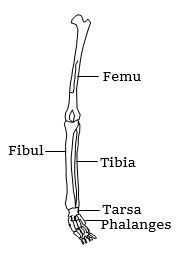
Given below is a diagram of the left human hindlimb as seen from the front. It has certain mistakes in labeling. Two of the wrongly labelled bones are
A
Tibia and tarsals
B
Femur and fibula
C
Fibula and phalanges
D
Tarsals and femur
Solution
(B) In the provided diagram,the labels are as follows:
$1$. The thigh bone is labeled as 'Femu',which is a misspelling of 'Femur'.
$2$. The lateral bone of the lower leg is labeled as 'Fibul',which is a misspelling of 'Fibula'.
$3$. The medial bone of the lower leg is correctly labeled as 'Tibia'.
$4$. The ankle bones are labeled as 'Tarsa',which is a misspelling of 'Tarsals'.
$5$. The toe bones are correctly labeled as 'Phalanges'.
Comparing the labels with the anatomical positions:
- The label 'Femu' points to the Femur (correct bone,incorrect spelling).
- The label 'Fibul' points to the Fibula (correct bone,incorrect spelling).
- The label 'Tibia' points to the Tibia (correct bone,correct spelling).
- The label 'Tarsa' points to the Tarsals (correct bone,incorrect spelling).
- The label 'Phalanges' points to the Phalanges (correct bone,correct spelling).
However,looking at the anatomical orientation of the left hindlimb:
- The Fibula is the lateral bone,and the Tibia is the medial bone. In the diagram,the labels for 'Fibula' and 'Tibia' are swapped. The label 'Fibul' is pointing to the medial side (Tibia),and the label 'Tibia' is pointing to the lateral side (Fibula).
- Therefore,the bones that are wrongly labeled in terms of their anatomical position are the Fibula and the Tibia. Among the given options,the most appropriate choice identifying the mislabeled bones is 'Femur and fibula' (due to the spelling error and positional swap) or 'Tibia and tarsals'. Given the standard interpretation of this specific diagram in textbooks,the labels for 'Femur' and 'Fibula' are the ones typically highlighted as having errors.
$1$. The thigh bone is labeled as 'Femu',which is a misspelling of 'Femur'.
$2$. The lateral bone of the lower leg is labeled as 'Fibul',which is a misspelling of 'Fibula'.
$3$. The medial bone of the lower leg is correctly labeled as 'Tibia'.
$4$. The ankle bones are labeled as 'Tarsa',which is a misspelling of 'Tarsals'.
$5$. The toe bones are correctly labeled as 'Phalanges'.
Comparing the labels with the anatomical positions:
- The label 'Femu' points to the Femur (correct bone,incorrect spelling).
- The label 'Fibul' points to the Fibula (correct bone,incorrect spelling).
- The label 'Tibia' points to the Tibia (correct bone,correct spelling).
- The label 'Tarsa' points to the Tarsals (correct bone,incorrect spelling).
- The label 'Phalanges' points to the Phalanges (correct bone,correct spelling).
However,looking at the anatomical orientation of the left hindlimb:
- The Fibula is the lateral bone,and the Tibia is the medial bone. In the diagram,the labels for 'Fibula' and 'Tibia' are swapped. The label 'Fibul' is pointing to the medial side (Tibia),and the label 'Tibia' is pointing to the lateral side (Fibula).
- Therefore,the bones that are wrongly labeled in terms of their anatomical position are the Fibula and the Tibia. Among the given options,the most appropriate choice identifying the mislabeled bones is 'Femur and fibula' (due to the spelling error and positional swap) or 'Tibia and tarsals'. Given the standard interpretation of this specific diagram in textbooks,the labels for 'Femur' and 'Fibula' are the ones typically highlighted as having errors.
0 likesView Solution
11
BiologyMediumMCQAIIMS · 2005
In which one of the following would you expect to find glyoxysomes?
A
Endosperm of wheat
B
Endosperm of castor
C
Palisade cells in leaf
D
Root hairs
Solution
(B) Glyoxysomes are specialized peroxisomes found in plants, particularly in the fat-storing tissues of germinating seeds.
They contain enzymes for the glyoxylate cycle, which converts stored fatty acids into carbohydrates (sugars) required for the growth of the embryo.
Castor seeds $(Ricinus communis)$ are oil-rich seeds, and their endosperm contains abundant glyoxysomes to facilitate the conversion of fats into energy and building blocks during germination.
Therefore, the correct option is $B$.
They contain enzymes for the glyoxylate cycle, which converts stored fatty acids into carbohydrates (sugars) required for the growth of the embryo.
Castor seeds $(Ricinus communis)$ are oil-rich seeds, and their endosperm contains abundant glyoxysomes to facilitate the conversion of fats into energy and building blocks during germination.
Therefore, the correct option is $B$.
0 likesView Solution
12
BiologyMediumMCQAIIMS · 2005
When synapsis is complete all along the chromosome,the cell is said to have entered a stage called
A
Zygotene
B
Pachytene
C
Diplotene
D
Diakinesis
Solution
(B) The process of synapsis,which involves the pairing of homologous chromosomes,begins during the $Zygotene$ stage.
When synapsis is complete all along the length of the chromosomes,the bivalents are fully formed.
Following the completion of synapsis,the cell enters the $Pachytene$ stage.
In the $Pachytene$ stage,the bivalent chromosomes become clearly visible as tetrads,and the process of crossing over occurs between non-sister chromatids of homologous chromosomes.
When synapsis is complete all along the length of the chromosomes,the bivalents are fully formed.
Following the completion of synapsis,the cell enters the $Pachytene$ stage.
In the $Pachytene$ stage,the bivalent chromosomes become clearly visible as tetrads,and the process of crossing over occurs between non-sister chromatids of homologous chromosomes.
0 likesView Solution
13
BiologyDifficultMCQAIIMS · 2005
Assertion: The fungi are widespread in distribution and they even live on or inside other plants and animals.
Reason: Fungi are able to grow anywhere on land,water or on other organisms because they have a variety of pigments,including chlorophyll,carotenoids,fucoxanthin and phycoerythrin.
Reason: Fungi are able to grow anywhere on land,water or on other organisms because they have a variety of pigments,including chlorophyll,carotenoids,fucoxanthin and phycoerythrin.
A
If both Assertion and Reason are correct and the Reason is a correct explanation of the Assertion.
B
If both Assertion and Reason are correct but Reason is not a correct explanation of the Assertion.
C
If the Assertion is correct but Reason is incorrect.
D
If both the Assertion and Reason are incorrect.
Solution
(C) The Assertion is correct because fungi are cosmopolitan and found in air,water,soil,and on animals and plants.
However,the Reason is incorrect because fungi are heterotrophic organisms that completely lack photosynthetic pigments such as chlorophyll,carotenoids,fucoxanthin,and phycoerythrin.
These pigments are characteristic of algae,not fungi.
Fungi obtain nutrients through saprophytic,parasitic,or symbiotic modes of nutrition.
However,the Reason is incorrect because fungi are heterotrophic organisms that completely lack photosynthetic pigments such as chlorophyll,carotenoids,fucoxanthin,and phycoerythrin.
These pigments are characteristic of algae,not fungi.
Fungi obtain nutrients through saprophytic,parasitic,or symbiotic modes of nutrition.
0 likesView Solution
14
BiologyMediumMCQAIIMS · 2005
Assertion : The duck-billed Platypus and the spiny ant-eater,both are egg-laying animals yet they are grouped under mammals.
Reason : Both of them have seven cervical vertebrae and $12$ pairs of cranial nerves.
Reason : Both of them have seven cervical vertebrae and $12$ pairs of cranial nerves.
A
If both Assertion and Reason are correct and the Reason is a correct explanation of the Assertion.
B
If both Assertion and Reason are correct but Reason is not a correct explanation of the Assertion.
C
If the Assertion is correct but Reason is incorrect.
D
If both the Assertion and Reason are incorrect.
Solution
(C) The Assertion is correct because the duck-billed platypus and the spiny ant-eater (echidna) are prototherian mammals that lay eggs (oviparous) but possess mammary glands.
The Reason is incorrect because,while mammals generally have $7$ cervical vertebrae,the number of cranial nerves in mammals is $12$ pairs,but this specific anatomical feature is not the defining characteristic that classifies them as mammals. Furthermore,the statement implies these are the reasons for their classification as mammals,which is scientifically inaccurate; they are classified as mammals due to the presence of mammary glands,hair,and a diaphragm.
The Reason is incorrect because,while mammals generally have $7$ cervical vertebrae,the number of cranial nerves in mammals is $12$ pairs,but this specific anatomical feature is not the defining characteristic that classifies them as mammals. Furthermore,the statement implies these are the reasons for their classification as mammals,which is scientifically inaccurate; they are classified as mammals due to the presence of mammary glands,hair,and a diaphragm.
0 likesView Solution
15
BiologyMediumMCQAIIMS · 2005
Genes present in the cytoplasm of eukaryotic cells are found in:
A
mitochondria and inherited via egg cytoplasm
B
lysosomes and peroxisomes
C
Golgi bodies and smooth endoplasmic reticulum
D
plastids and inherited via male gamete
Solution
(A) In eukaryotic cells,extranuclear $DNA$ is primarily found in mitochondria and chloroplasts (plastids). These organelles contain their own genome. Mitochondrial $DNA$ is inherited through the egg cytoplasm because the egg provides the bulk of the cytoplasm to the zygote,whereas the sperm contributes primarily nuclear $DNA$.
0 likesView Solution
16
BiologyMediumMCQAIIMS · 2005
Assertion : Mitochondria and chloroplasts are semi-autonomous organelles.
Reason : They are formed by division of preexisting organelles as well as contain $DNA$ but lack protein-synthesizing machinery.
Reason : They are formed by division of preexisting organelles as well as contain $DNA$ but lack protein-synthesizing machinery.
A
If both Assertion and Reason are correct and the Reason is a correct explanation of the Assertion.
B
If both Assertion and Reason are correct but Reason is not a correct explanation of the Assertion.
C
If the Assertion is correct but Reason is incorrect.
D
If both the Assertion and Reason are incorrect.
Solution
(C) Mitochondria and chloroplasts are considered semi-autonomous organelles because they contain their own $DNA$ and ribosomes,which allow them to synthesize some of their own proteins.
They are formed by the division of preexisting organelles.
However,the statement that they 'lack protein-synthesizing machinery' is incorrect because they possess $70S$ ribosomes,which are essential for protein synthesis.
Therefore,the Assertion is correct,but the Reason is incorrect.
They are formed by the division of preexisting organelles.
However,the statement that they 'lack protein-synthesizing machinery' is incorrect because they possess $70S$ ribosomes,which are essential for protein synthesis.
Therefore,the Assertion is correct,but the Reason is incorrect.
0 likesView Solution
17
BiologyMediumMCQAIIMS · 2005
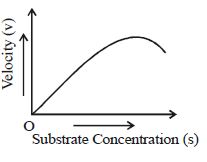
The given graph shows the effect of substrate concentration on the rate of reaction of the enzyme green-gram-phosphatase. What does the graph indicate?
A
The rate of enzyme reaction is directly proportional to the substrate concentration.
B
Presence of an enzyme inhibitor in the reaction mixture.
C
Formation of an enzyme-substrate complex.
D
At higher substrate-concentration the $pH$ increases.
Solution
(B) In a typical enzyme-catalyzed reaction,the velocity increases with substrate concentration until it reaches a maximum $(V_{max})$ and then plateaus.
However,the provided graph shows that after reaching a certain point,the reaction velocity decreases as the substrate concentration increases.
This decline in reaction rate at higher substrate concentrations is a characteristic indicator of the presence of an enzyme inhibitor in the reaction mixture,which interferes with the enzyme's activity.
However,the provided graph shows that after reaching a certain point,the reaction velocity decreases as the substrate concentration increases.
This decline in reaction rate at higher substrate concentrations is a characteristic indicator of the presence of an enzyme inhibitor in the reaction mixture,which interferes with the enzyme's activity.
0 likesView Solution
18
BiologyEasyMCQAIIMS · 2005
Many cells function properly and divide mitotically even though they do not have
A
plasma membrane
B
cytoskeleton
C
mitochondria
D
plastids
Solution
(D) Many cells,such as animal cells,function properly and undergo mitotic division even in the absence of plastids. Plastids are organelles found primarily in plant cells and algae,responsible for photosynthesis and storage,but they are not essential for the basic cellular processes of metabolism or mitosis in all cell types.
0 likesView Solution
19
BiologyMediumMCQAIIMS · 2005
Assertion : $C_4$ photosynthetic pathway is more efficient than the $C_3$ pathway.
Reason : Photorespiration is suppressed in $C_4$ plants.
Reason : Photorespiration is suppressed in $C_4$ plants.
A
If both Assertion and Reason are correct and the Reason is a correct explanation of the Assertion.
B
If both Assertion and Reason are correct but Reason is not a correct explanation of the Assertion.
C
If the Assertion is correct but Reason is incorrect.
D
If both the Assertion and Reason are incorrect.
Solution
(A) $C_4$ plants are more efficient than $C_3$ plants because they have evolved a mechanism to minimize photorespiration.
In $C_4$ plants,the initial $CO_2$ fixation occurs in mesophyll cells via the enzyme $PEP$ carboxylase,which has a high affinity for $CO_2$ and does not bind with $O_2$.
The $CO_2$ is then transported to bundle sheath cells,where it is released at a high concentration,ensuring that the enzyme $RuBisCO$ functions primarily as a carboxylase rather than an oxygenase.
This spatial separation effectively suppresses photorespiration,making the $C_4$ pathway more efficient in terms of carbon fixation and energy utilization compared to the $C_3$ pathway.
Therefore,both the Assertion and the Reason are correct,and the Reason is the correct explanation of the Assertion.
In $C_4$ plants,the initial $CO_2$ fixation occurs in mesophyll cells via the enzyme $PEP$ carboxylase,which has a high affinity for $CO_2$ and does not bind with $O_2$.
The $CO_2$ is then transported to bundle sheath cells,where it is released at a high concentration,ensuring that the enzyme $RuBisCO$ functions primarily as a carboxylase rather than an oxygenase.
This spatial separation effectively suppresses photorespiration,making the $C_4$ pathway more efficient in terms of carbon fixation and energy utilization compared to the $C_3$ pathway.
Therefore,both the Assertion and the Reason are correct,and the Reason is the correct explanation of the Assertion.
0 likesView Solution
20
BiologyMediumMCQAIIMS · 2005
Assertion : The atmospheric concentration of $CO_2$ at which photosynthesis just compensates for respiration is referred to as $CO_2$ compensation point.
Reason : The $CO_2$ compensation point is reached when the amount of $CO_2$ uptake is less than that generated through respiration because the level of $CO_2$ in the atmosphere is more than that required for achieving $CO_2$ compensation point.
Reason : The $CO_2$ compensation point is reached when the amount of $CO_2$ uptake is less than that generated through respiration because the level of $CO_2$ in the atmosphere is more than that required for achieving $CO_2$ compensation point.
A
If both Assertion and Reason are correct and the Reason is a correct explanation of the Assertion.
B
If both Assertion and Reason are correct but Reason is not a correct explanation of the Assertion.
C
If the Assertion is correct but Reason is incorrect.
D
If both the Assertion and Reason are incorrect.
Solution
(C) The $CO_2$ compensation point is defined as the specific atmospheric concentration of $CO_2$ at which the rate of photosynthesis exactly equals the rate of respiration in a plant.
At this point,the net exchange of $CO_2$ between the plant and the atmosphere is zero,meaning the $CO_2$ produced by respiration is entirely consumed by photosynthesis.
The Assertion is correct.
The Reason states that the compensation point is reached when $CO_2$ uptake is less than that generated through respiration,which is incorrect.
At the compensation point,the rate of $CO_2$ uptake is exactly equal to the rate of $CO_2$ release (respiration).
Therefore,the Assertion is correct,but the Reason is incorrect.
At this point,the net exchange of $CO_2$ between the plant and the atmosphere is zero,meaning the $CO_2$ produced by respiration is entirely consumed by photosynthesis.
The Assertion is correct.
The Reason states that the compensation point is reached when $CO_2$ uptake is less than that generated through respiration,which is incorrect.
At the compensation point,the rate of $CO_2$ uptake is exactly equal to the rate of $CO_2$ release (respiration).
Therefore,the Assertion is correct,but the Reason is incorrect.
0 likesView Solution
21
BiologyEasyMCQAIIMS · 2005
Which one of the following four glands is correctly matched with the accompanying description?
A
Thyroid $-$ Hyperactivity in young children causes cretinism
B
Thymus $-$ Starts undergoing atrophy after puberty
C
Parathyroid $-$ Secretes parathormone,which promotes movement of calcium ions from blood into bones during calcification
D
Pancreas $-$ Delta cells of the 'islets of Langerhans' secrete a hormone,which stimulates glycolysis in liver
Solution
(B) The thymus is an organ located in the upper anterior portion of the chest cavity just behind the sternum.
The thymus continues to grow between birth and puberty and then begins to atrophy.
Proportional to thymic size,thymic activity is most active before puberty.
Upon atrophy,the size and activity are dramatically reduced,and the organ is primarily replaced with fat.
The atrophy is due to the increased circulating level of sex hormones,and chemical or physical castration of an adult results in the thymus increasing in size and activity.
In contrast,other options are incorrect: Thyroid hyperactivity causes hyperthyroidism,not cretinism (which is caused by hypothyroidism); Parathormone increases blood calcium levels by mobilizing it from bones; and Delta cells of the pancreas secrete somatostatin,not a hormone that stimulates glycolysis.
The thymus continues to grow between birth and puberty and then begins to atrophy.
Proportional to thymic size,thymic activity is most active before puberty.
Upon atrophy,the size and activity are dramatically reduced,and the organ is primarily replaced with fat.
The atrophy is due to the increased circulating level of sex hormones,and chemical or physical castration of an adult results in the thymus increasing in size and activity.
In contrast,other options are incorrect: Thyroid hyperactivity causes hyperthyroidism,not cretinism (which is caused by hypothyroidism); Parathormone increases blood calcium levels by mobilizing it from bones; and Delta cells of the pancreas secrete somatostatin,not a hormone that stimulates glycolysis.
0 likesView Solution
22
BiologyMediumMCQAIIMS · 2005
Based on cellular mechanisms,there are two major types of regeneration found in animals. Which one of the following is the correct example of the type mentioned?
A
Morphallaxis - Regeneration of two transversely cut equal pieces of a Hydra into two small Hydras
B
Epimorphosis - Replacement of old and dead erythrocytes by the new ones.
C
Morphallaxis - Healing up of a wound in the skin
D
Epimorphosis - Regeneration of crushed and filtered out pieces of a Planaria into as many new Planarians.
Solution
(A) Regeneration is broadly classified into two types: Morphallaxis and Epimorphosis.
$1$. Morphallaxis involves the reorganization of existing body tissues to form a complete organism from a small fragment,as seen in Hydra.
$2$. Epimorphosis involves the proliferation of cells at the site of injury to replace lost parts,such as limb regeneration or the formation of new Planarians from body fragments.
Therefore,the regeneration of two transversely cut equal pieces of a Hydra into two small Hydras is a classic example of Morphallaxis.
$1$. Morphallaxis involves the reorganization of existing body tissues to form a complete organism from a small fragment,as seen in Hydra.
$2$. Epimorphosis involves the proliferation of cells at the site of injury to replace lost parts,such as limb regeneration or the formation of new Planarians from body fragments.
Therefore,the regeneration of two transversely cut equal pieces of a Hydra into two small Hydras is a classic example of Morphallaxis.
0 likesView Solution
23
BiologyMediumMCQAIIMS · 2005
Assertion: Senescence is the time when age-associated defects are manifested.
Reason: Certain genes may be undergoing sequential switching on and off during one's life.
Reason: Certain genes may be undergoing sequential switching on and off during one's life.
A
If both Assertion and Reason are correct and the Reason is a correct explanation of the Assertion.
B
If both Assertion and Reason are correct but Reason is not a correct explanation of the Assertion.
C
If the Assertion is correct but Reason is incorrect.
D
If both the Assertion and Reason are incorrect.
Solution
(A) Senescence refers to the period of decline in biological functions associated with aging,where age-related defects become apparent.
The programmed senescence theory suggests that aging is genetically controlled,involving the sequential activation (switching on) and inactivation (switching off) of specific genes throughout an individual's lifespan.
Therefore,the Reason correctly explains why senescence occurs as a manifestation of these genetic changes.
Thus,both Assertion and Reason are correct,and the Reason is the correct explanation of the Assertion.
The programmed senescence theory suggests that aging is genetically controlled,involving the sequential activation (switching on) and inactivation (switching off) of specific genes throughout an individual's lifespan.
Therefore,the Reason correctly explains why senescence occurs as a manifestation of these genetic changes.
Thus,both Assertion and Reason are correct,and the Reason is the correct explanation of the Assertion.
0 likesView Solution
24
BiologyMediumMCQAIIMS · 2005
Telomerase is an enzyme which is a
A
Simple protein
B
$RNA$
C
Ribonucleoprotein
D
Repetitive $DNA$
Solution
(C) Telomerase is a specialized enzyme that adds specific nucleotide sequences to the ends of eukaryotic chromosomes,known as telomeres.
It is a ribonucleoprotein complex,meaning it consists of both a protein component ($TERT$ - Telomerase Reverse Transcriptase) and an $RNA$ component ($TERC$ - Telomerase $RNA$ Component) that serves as a template for the synthesis of telomeric $DNA$ repeats.
It is a ribonucleoprotein complex,meaning it consists of both a protein component ($TERT$ - Telomerase Reverse Transcriptase) and an $RNA$ component ($TERC$ - Telomerase $RNA$ Component) that serves as a template for the synthesis of telomeric $DNA$ repeats.
0 likesView Solution
25
BiologyMediumMCQAIIMS · 2005
Double fertilization involves
A
Fertilization of the egg by two male gametes
B
Fertilization of two eggs in the same embryo sac by two sperms brought by one pollen tube
C
Fertilization of the egg and the central cell by two sperms brought by different pollen tubes
D
Fertilization of the egg and the central cell by two sperms brought by the same pollen tube
Solution
(D) Double fertilization is a characteristic feature of angiosperms.
It involves two fusion events:
$1$. Syngamy: One male gamete fuses with the egg cell to form a diploid zygote $(2n)$.
$2$. Triple fusion: The second male gamete fuses with the two polar nuclei (or the secondary nucleus) in the central cell to form a triploid primary endosperm nucleus ($PEN$,$3n$).
Both male gametes are delivered to the embryo sac by the same pollen tube.
It involves two fusion events:
$1$. Syngamy: One male gamete fuses with the egg cell to form a diploid zygote $(2n)$.
$2$. Triple fusion: The second male gamete fuses with the two polar nuclei (or the secondary nucleus) in the central cell to form a triploid primary endosperm nucleus ($PEN$,$3n$).
Both male gametes are delivered to the embryo sac by the same pollen tube.
0 likesView Solution
26
BiologyMediumMCQAIIMS · 2005
Which one of the following events is correctly matched with the time period in a normal menstrual cycle?
A
Release of egg : $5^{th}$ day
B
Endometrium regenerates : $5-10$ days
C
Endometrium secretes nutrients for implantation : $11-18$ days
D
Rise in progesterone level : $1-15$ days
Solution
(B) In a normal $28$-day menstrual cycle:
$1$. The menstrual phase occurs from day $1-5$.
$2$. The follicular (proliferative) phase occurs from day $6-13$,during which the endometrium regenerates.
$3$. Ovulation (release of egg) occurs on the $14^{th}$ day.
$4$. The luteal (secretory) phase occurs from day $15-28$,where the endometrium secretes nutrients for implantation due to high progesterone levels.
Therefore,the regeneration of the endometrium typically occurs between days $5$ and $10$ (proliferative phase),making option $B$ the correct match.
$1$. The menstrual phase occurs from day $1-5$.
$2$. The follicular (proliferative) phase occurs from day $6-13$,during which the endometrium regenerates.
$3$. Ovulation (release of egg) occurs on the $14^{th}$ day.
$4$. The luteal (secretory) phase occurs from day $15-28$,where the endometrium secretes nutrients for implantation due to high progesterone levels.
Therefore,the regeneration of the endometrium typically occurs between days $5$ and $10$ (proliferative phase),making option $B$ the correct match.
0 likesView Solution
27
BiologyMediumMCQAIIMS · 2005
$A$ cross section at the midpoint of the middle piece of a human sperm will show:
A
Centriole,mitochondria and $9+2$ arrangement of microtubules
B
Centriole and mitochondria
C
Mitochondria and $9+2$ arrangement of microtubules
D
$9+2$ arrangement of microtubules only
Solution
(C) The middle piece of a human sperm contains numerous mitochondria arranged spirally around the axial filament.
This axial filament runs through the entire length of the sperm tail and possesses the characteristic $9+2$ arrangement of microtubules (axoneme).
Therefore,a cross-section at the midpoint of the middle piece reveals both the mitochondria and the $9+2$ arrangement of microtubules.
This axial filament runs through the entire length of the sperm tail and possesses the characteristic $9+2$ arrangement of microtubules (axoneme).
Therefore,a cross-section at the midpoint of the middle piece reveals both the mitochondria and the $9+2$ arrangement of microtubules.
0 likesView Solution
28
BiologyMediumMCQAIIMS · 2005
Grain colour in wheat is determined by three pairs of polygenes. Following the cross $AABBCC$ (dark colour) $\times$ $aabbcc$ (light colour),in $F_2$ generation,what proportion of the progeny is likely to resemble either parent?
A
None
B
Less than $5$ per cent
C
One third
D
Half
Solution
(B) Grain colour in wheat is an example of polygenic inheritance involving $3$ gene pairs $(n = 3)$.
In the $F_2$ generation of a trihybrid cross,the total number of possible combinations is $4^n = 4^3 = 64$.
The parental phenotypes (extreme phenotypes) are represented by the genotypes $AABBCC$ (darkest) and $aabbcc$ (lightest).
The proportion of individuals resembling either parent is given by the formula $(1/4)^n$.
Substituting $n = 3$,we get $(1/4)^3 = 1/64$.
Since $1/64$ is approximately $0.0156$,which is $1.56\%$,this value is less than $5\%$.
In the $F_2$ generation of a trihybrid cross,the total number of possible combinations is $4^n = 4^3 = 64$.
The parental phenotypes (extreme phenotypes) are represented by the genotypes $AABBCC$ (darkest) and $aabbcc$ (lightest).
The proportion of individuals resembling either parent is given by the formula $(1/4)^n$.
Substituting $n = 3$,we get $(1/4)^3 = 1/64$.
Since $1/64$ is approximately $0.0156$,which is $1.56\%$,this value is less than $5\%$.
0 likesView Solution
29
BiologyEasyMCQAIIMS · 2005
The "cri-du-chat" syndrome is caused by a change in chromosome structure involving:
A
Deletion
B
Duplication
C
Inversion
D
Translocation
Solution
(A) The "cri-du-chat" syndrome is a genetic disorder caused by a partial deletion of the short arm ($p$ arm) of chromosome $5$.
This structural chromosomal abnormality leads to characteristic symptoms, including a high-pitched cry in infants that sounds like a cat, which is why it is named "cri-du-chat" (French for "cry of the cat").
Therefore, the correct mechanism is deletion.
This structural chromosomal abnormality leads to characteristic symptoms, including a high-pitched cry in infants that sounds like a cat, which is why it is named "cri-du-chat" (French for "cry of the cat").
Therefore, the correct mechanism is deletion.
0 likesView Solution
30
BiologyMediumMCQAIIMS · 2005
Somaclonal variation appears in
A
Organisms produced through somatic hybridization
B
Plants growing in highly polluted conditions
C
Apomictic plants
D
Tissue culture raised plants
Solution
(D) Somaclonal variation refers to the genetic variations observed in plants that are regenerated from tissue culture.
These variations arise due to the stress of the culture environment,the use of growth regulators,or the duration of the culture period.
Since plants raised through tissue culture are clones of the parent,any deviation from the parent's genotype is termed as somaclonal variation.
Therefore,the correct answer is $D$.
These variations arise due to the stress of the culture environment,the use of growth regulators,or the duration of the culture period.
Since plants raised through tissue culture are clones of the parent,any deviation from the parent's genotype is termed as somaclonal variation.
Therefore,the correct answer is $D$.
0 likesView Solution
31
BiologyDifficultMCQAIIMS · 2005
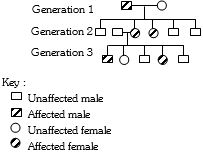
The pedigree chart below shows the inheritance of a particular sex-linked trait. How is the trait being studied in the pedigree chart above inherited?
A
Dominant $X$-linked
B
Recessive $X$-linked
C
Dominant $Y$-linked
D
Recessive $Y$-linked
Solution
(A) $1$. Analyze the pedigree: An affected father (Generation $1$) passes the trait to his daughters (Generation $2$),but not to his sons. This is characteristic of $X$-linked inheritance.
$2$. In Generation $2$,an affected female marries an unaffected male and produces both affected and unaffected offspring of both sexes. This indicates that the trait is dominant because it appears in every generation and affected individuals have affected parents.
$3$. Since an affected father passes the trait to all his daughters and the trait appears in both males and females in subsequent generations,it follows the pattern of $X$-linked dominant inheritance.
$2$. In Generation $2$,an affected female marries an unaffected male and produces both affected and unaffected offspring of both sexes. This indicates that the trait is dominant because it appears in every generation and affected individuals have affected parents.
$3$. Since an affected father passes the trait to all his daughters and the trait appears in both males and females in subsequent generations,it follows the pattern of $X$-linked dominant inheritance.
0 likesView Solution
32
BiologyMediumMCQAIIMS · 2005
The primary source of allelic variation is
A
Independent assortment
B
Recombination
C
Mutation
D
Polyploidy
Solution
(C) The primary source of all genetic variation is $Mutation$.
$Mutation$ refers to a sudden, heritable change in the $DNA$ sequence of an organism.
While $Independent \text{ } assortment$ and $Recombination$ (during meiosis) shuffle existing alleles to create new combinations, they do not create new alleles.
$Mutation$ is the ultimate process that introduces entirely new alleles into a population's gene pool, thereby serving as the fundamental source of genetic diversity.
$Mutation$ refers to a sudden, heritable change in the $DNA$ sequence of an organism.
While $Independent \text{ } assortment$ and $Recombination$ (during meiosis) shuffle existing alleles to create new combinations, they do not create new alleles.
$Mutation$ is the ultimate process that introduces entirely new alleles into a population's gene pool, thereby serving as the fundamental source of genetic diversity.
0 likesView Solution
33
BiologyMediumMCQAIIMS · 2005
Which one of the following is a correct statement?
A
$Bt$ in "$Bt$-cotton" indicates that it is a genetically modified organism produced through biotechnology.
B
Somatic hybridization involves fusion of two complete plant cells carrying desired genes.
C
The anticoagulant $Hirudin$ is being produced from transgenic $Brassica$ $napus$ seeds.
D
$Flavr$ $Savr$ variety of tomato has enhanced the production of ethylene which improves its taste.
Solution
(C) $Bt$ in "$Bt$-cotton" refers to the bacterium $Bacillus$ $thuringiensis$, not just a general term for biotechnology. Thus, option $A$ is incorrect.
Somatic hybridization involves the fusion of protoplasts, not complete plant cells (which include cell walls). Thus, option $B$ is incorrect.
$Hirudin$ is an anticoagulant protein originally found in leeches. Its gene has been transferred into $Brassica$ $napus$ (rapeseed) to produce it in seeds. Thus, option $C$ is correct.
$Flavr$ $Savr$ tomato was engineered to have delayed ripening by inhibiting ethylene production, not enhancing it. Thus, option $D$ is incorrect.
Somatic hybridization involves the fusion of protoplasts, not complete plant cells (which include cell walls). Thus, option $B$ is incorrect.
$Hirudin$ is an anticoagulant protein originally found in leeches. Its gene has been transferred into $Brassica$ $napus$ (rapeseed) to produce it in seeds. Thus, option $C$ is correct.
$Flavr$ $Savr$ tomato was engineered to have delayed ripening by inhibiting ethylene production, not enhancing it. Thus, option $D$ is incorrect.
0 likesView Solution
34
BiologyMediumMCQAIIMS · 2005
Somaclonal variations are produced:
A
By mutagens
B
In tissue culture during differentiation
C
By gamma rays
D
By sexual reproduction
Solution
(B) Somaclonal variations are genetic variations observed in plants regenerated from tissue culture. These variations occur during the process of callus differentiation when cells undergo rapid division and reorganization in an artificial culture medium.
0 likesView Solution
35
BiologyMediumMCQAIIMS · 2005
Which one of the following correctly represents an organism and its ecological niche?
A
Vallisneria and pond
B
Desert locust (Schistocerca) and desert
C
Plant lice (aphids) and leaf
D
Vultures and dense forest
Solution
(C) An ecological niche describes the functional role of an organism in its environment,including its habitat,food sources,and interactions with other species.
$A$. $Vallisneria$ is a submerged plant,but 'pond' is a habitat,not a niche.
$B$. 'Desert' is a habitat,not a niche.
$C$. Plant lice (aphids) feed on the sap of specific leaves; the leaf surface acts as their specific micro-habitat and functional site for feeding,which represents their ecological niche.
$D$. 'Dense forest' is a habitat,not a niche.
Therefore,option $C$ is the most accurate representation of a specific ecological niche.
$A$. $Vallisneria$ is a submerged plant,but 'pond' is a habitat,not a niche.
$B$. 'Desert' is a habitat,not a niche.
$C$. Plant lice (aphids) feed on the sap of specific leaves; the leaf surface acts as their specific micro-habitat and functional site for feeding,which represents their ecological niche.
$D$. 'Dense forest' is a habitat,not a niche.
Therefore,option $C$ is the most accurate representation of a specific ecological niche.
0 likesView Solution
36
BiologyMediumMCQAIIMS · 2005
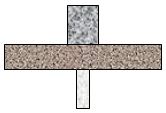
Given below is one of the types of ecological pyramids. This type represents:
A
Pyramid of numbers in a grassland
B
Pyramid of biomass in a fallow land
C
Pyramid of biomass in a lake
D
Energy pyramid in a spring
Solution
(C) The provided image shows an inverted pyramid of biomass. In an aquatic ecosystem like a lake,the biomass of phytoplankton (producers) is much smaller than the biomass of zooplankton and small fish (primary consumers),and even smaller than the biomass of large fish (secondary consumers). Therefore,the pyramid of biomass in a lake is typically inverted.
0 likesView Solution
37
BiologyMediumMCQAIIMS · 2005
Which one of the following is the correct matching of a plant, its habit, and the forest type where it normally occurs?
A
$Saccharum$, grass, forest
B
$Prosopis$, tree, scrub
C
$Shorea \text{ } robusta$, herb, tropical rain forest
D
$Acacia \text{ } catechu$, tree, coniferous forest
Solution
(B) $Prosopis$ is a deep-rooted perennial tree, which is able to absorb water from either the water table or moist strata. It is typically found in desert scrub forests.
$Saccharum$ is a common grass found in grasslands and tropical savannahs.
Both $Shorea \text{ } robusta$ and $Acacia \text{ } catechu$ are trees found in tropical deciduous forests.
In tropical deciduous forests, vegetation includes broad-leaved trees, which shed their leaves during the dry season.
$Saccharum$ is a common grass found in grasslands and tropical savannahs.
Both $Shorea \text{ } robusta$ and $Acacia \text{ } catechu$ are trees found in tropical deciduous forests.
In tropical deciduous forests, vegetation includes broad-leaved trees, which shed their leaves during the dry season.
0 likesView Solution
38
BiologyEasyMCQAIIMS · 2005
One of the ex-situ conservation methods for endangered species is
A
Wildlife Sanctuaries
B
Biosphere Reserves
C
Cryopreservation
D
National parks
Solution
(C) The correct answer is $(c)$.
Cryopreservation is an ex-situ conservation method where biological materials such as tissue cultures, embryos, animal cells/tissues, and spermatozoa are preserved at $-196^{\circ}C$ using liquid nitrogen $(N_2)$.
Ex-situ conservation refers to the conservation of organisms outside their natural habitats.
Other examples of ex-situ conservation include botanical gardens, zoological parks, wildlife safari parks, and gene banks.
Wildlife sanctuaries, biosphere reserves, and national parks are examples of in-situ conservation methods.
Cryopreservation is an ex-situ conservation method where biological materials such as tissue cultures, embryos, animal cells/tissues, and spermatozoa are preserved at $-196^{\circ}C$ using liquid nitrogen $(N_2)$.
Ex-situ conservation refers to the conservation of organisms outside their natural habitats.
Other examples of ex-situ conservation include botanical gardens, zoological parks, wildlife safari parks, and gene banks.
Wildlife sanctuaries, biosphere reserves, and national parks are examples of in-situ conservation methods.
0 likesView Solution
39
BiologyMediumMCQAIIMS · 2005
Genetic diversity in agricultural crops is threatened by
A
Introduction of high-yielding varieties
B
Intensive use of fertilizers
C
Extensive intercropping
D
Intensive use of biopesticides
Solution
(A) The introduction of high-yielding varieties (HYVs) has led to the widespread adoption of a limited number of genetically uniform crop strains.
This practice replaces the traditional,diverse landraces and local varieties that were naturally adapted to various environmental conditions.
As a result,the genetic diversity within agricultural crops is significantly reduced,making the entire crop population more vulnerable to pests,diseases,and changing environmental conditions.
This practice replaces the traditional,diverse landraces and local varieties that were naturally adapted to various environmental conditions.
As a result,the genetic diversity within agricultural crops is significantly reduced,making the entire crop population more vulnerable to pests,diseases,and changing environmental conditions.
0 likesView Solution
40
BiologyEasyMCQAIIMS · 2005
Which of the following is an ex-situ conservation method for endangered species?
A
Wildlife sanctuaries
B
Biosphere reserves
C
Cryopreservation
D
National parks
Solution
(C) Conservation of biodiversity is classified into two types: $In-situ$ (on-site) and $Ex-situ$ (off-site).
$In-situ$ conservation involves protecting species within their natural habitats, such as Wildlife Sanctuaries, National Parks, and Biosphere Reserves.
$Ex-situ$ conservation involves protecting species outside their natural habitats, such as botanical gardens, zoological parks, and cryopreservation (storing gametes or embryos at very low temperatures, e.g., $-196^{\circ}C$ in liquid nitrogen).
Therefore, cryopreservation is an $Ex-situ$ conservation method.
$In-situ$ conservation involves protecting species within their natural habitats, such as Wildlife Sanctuaries, National Parks, and Biosphere Reserves.
$Ex-situ$ conservation involves protecting species outside their natural habitats, such as botanical gardens, zoological parks, and cryopreservation (storing gametes or embryos at very low temperatures, e.g., $-196^{\circ}C$ in liquid nitrogen).
Therefore, cryopreservation is an $Ex-situ$ conservation method.
0 likesView Solution
41
BiologyEasyMCQAIIMS · 2005
$DDT$ is a
A
Non-biodegradable pollutant
B
Biodegradable pollutant
C
Antibiotics
D
None of the above
Solution
(A) $DDT$ (Dichlorodiphenyltrichloroethane) is a non-biodegradable pollutant.
These substances are persistent in the environment because they cannot be broken down naturally or by the metabolic activities of microorganisms.
Due to their chemical stability,they accumulate in the food chain and are not recycled back into the atmosphere or soil in a harmless form.
These substances are persistent in the environment because they cannot be broken down naturally or by the metabolic activities of microorganisms.
Due to their chemical stability,they accumulate in the food chain and are not recycled back into the atmosphere or soil in a harmless form.
0 likesView Solution
42
BiologyMediumMCQAIIMS · 2005
Assertion: Persons suffering from haemophilia fail to produce blood clotting factor $VIII$.
Reason: Prothrombin producing platelets in such persons are found in very low concentration.
Reason: Prothrombin producing platelets in such persons are found in very low concentration.
A
If both Assertion and Reason are correct and the Reason is a correct explanation of the Assertion.
B
If both Assertion and Reason are correct but Reason is not a correct explanation of the Assertion.
C
If the Assertion is correct but Reason is incorrect.
D
If both the Assertion and Reason are incorrect.
Solution
(C) Haemophilia is a sex-linked recessive disorder caused by the deficiency of blood clotting factor $VIII$ (Haemophilia $A$) or factor $IX$ (Haemophilia $B$).
In patients with haemophilia,the blood clotting mechanism is impaired because the cascade of reactions required for fibrin formation is interrupted due to the absence of these specific clotting factors.
The Assertion is correct because haemophilia is indeed characterized by the failure to produce functional clotting factor $VIII$.
The Reason is incorrect because the primary defect in haemophilia is not a low concentration of platelets or a deficiency in prothrombin production; rather,it is a genetic deficiency of specific clotting factors. Platelet counts in haemophiliacs are typically normal.
In patients with haemophilia,the blood clotting mechanism is impaired because the cascade of reactions required for fibrin formation is interrupted due to the absence of these specific clotting factors.
The Assertion is correct because haemophilia is indeed characterized by the failure to produce functional clotting factor $VIII$.
The Reason is incorrect because the primary defect in haemophilia is not a low concentration of platelets or a deficiency in prothrombin production; rather,it is a genetic deficiency of specific clotting factors. Platelet counts in haemophiliacs are typically normal.
0 likesView Solution
43
BiologyMediumMCQAIIMS · 2005
Assertion : In humans,the gamete contributed by the male determines whether the child produced will be male or female.
Reason : Sex in humans is a polygenic trait depending upon a cumulative effect of some genes on $X-$ chromosome and some on $Y-$ chromosome.
Reason : Sex in humans is a polygenic trait depending upon a cumulative effect of some genes on $X-$ chromosome and some on $Y-$ chromosome.
A
If both Assertion and Reason are correct and the Reason is a correct explanation of the Assertion.
B
If both Assertion and Reason are correct but Reason is not a correct explanation of the Assertion.
C
If the Assertion is correct but Reason is incorrect.
D
If both the Assertion and Reason are incorrect.
Solution
(C) In humans,sex determination is based on the $XY$ type. Males produce two types of gametes: $50\%$ carrying the $X$ chromosome and $50\%$ carrying the $Y$ chromosome. Females produce only one type of gamete,all carrying the $X$ chromosome. Therefore,the sex of the child is determined by the sperm (male gamete) that fertilizes the egg. Thus,the Assertion is correct.
Sex in humans is not a polygenic trait; it is determined by the presence or absence of the $Y$ chromosome,specifically the $SRY$ gene located on it. The Reason statement is scientifically incorrect because sex determination in humans is primarily a monogenic trait controlled by the $Y$ chromosome,not a polygenic trait.
Sex in humans is not a polygenic trait; it is determined by the presence or absence of the $Y$ chromosome,specifically the $SRY$ gene located on it. The Reason statement is scientifically incorrect because sex determination in humans is primarily a monogenic trait controlled by the $Y$ chromosome,not a polygenic trait.
0 likesView Solution
44
BiologyMediumMCQAIIMS · 2005
Assertion: Replication and transcription occur in the nucleus,but translation occurs in the cytoplasm.
Reason: $mRNA$ is transferred from the nucleus into the cytoplasm,where ribosomes and amino acids are available for protein synthesis.
Reason: $mRNA$ is transferred from the nucleus into the cytoplasm,where ribosomes and amino acids are available for protein synthesis.
A
If both Assertion and Reason are correct and the Reason is a correct explanation of the Assertion.
B
If both Assertion and Reason are correct but Reason is not a correct explanation of the Assertion.
C
If the Assertion is correct but Reason is incorrect.
D
If both the Assertion and Reason are incorrect.
Solution
(A) $DNA$ replication and transcription occur inside the nucleus in eukaryotic cells. After transcription,the $mRNA$ is processed and exported from the nucleus into the cytoplasm. In the cytoplasm,the $mRNA$ binds to ribosomes,where translation (protein synthesis) takes place using available amino acids and $tRNA$. This flow of genetic information from $DNA$ to $RNA$ to protein is known as the Central Dogma. Since the Reason correctly explains why translation must occur in the cytoplasm (due to the presence of necessary machinery),the Assertion and Reason are both correct,and the Reason is the correct explanation.
0 likesView Solution
45
BiologyMediumMCQAIIMS · 2005
Assertion : Human ancestors never used their tails and so the tail expressing gene has disappeared in them.
Reason : Lamarck's theory of evolution is popularly called theory of continuity of germ plasm.
Reason : Lamarck's theory of evolution is popularly called theory of continuity of germ plasm.
A
If both Assertion and Reason are correct and the Reason is a correct explanation of the Assertion.
B
If both Assertion and Reason are correct but Reason is not a correct explanation of the Assertion.
C
If the Assertion is correct but Reason is incorrect.
D
If both the Assertion and Reason are incorrect.
Solution
(D) The Assertion is incorrect because the tail-expressing genes have not completely disappeared; humans possess vestigial structures like the coccyx (tailbone),which are remnants of ancestral tails. Furthermore,genes are not lost simply due to disuse.
The Reason is incorrect because Lamarck's theory is known as the 'Theory of Inheritance of Acquired Characters'. The 'Theory of Continuity of Germ Plasm' was proposed by August Weismann,which specifically refuted Lamarckism by stating that changes in somatic cells are not inherited.
The Reason is incorrect because Lamarck's theory is known as the 'Theory of Inheritance of Acquired Characters'. The 'Theory of Continuity of Germ Plasm' was proposed by August Weismann,which specifically refuted Lamarckism by stating that changes in somatic cells are not inherited.
0 likesView Solution
46
BiologyMediumMCQAIIMS · 2005
Assertion: Comparative biochemistry provides strong evidence in favour of the common ancestry of living beings.
Reason: The genetic code is universal.
Reason: The genetic code is universal.
A
If both Assertion and Reason are correct and the Reason is a correct explanation of the Assertion.
B
If both Assertion and Reason are correct but Reason is not a correct explanation of the Assertion.
C
If the Assertion is correct but Reason is incorrect.
D
If both the Assertion and Reason are incorrect.
Solution
(A) Comparative biochemistry provides strong evidence for the common ancestry of living beings. The presence of similar biochemical molecules such as proteins,enzymes,hormones,and blood groups across diverse species suggests a shared evolutionary origin.
Furthermore,the genetic code is universal,meaning that the same codons specify the same amino acids in almost all living organisms,from bacteria to humans. This universality is a powerful piece of evidence supporting the theory that all life on Earth evolved from a common ancestor. Therefore,the Reason correctly explains the Assertion.
Furthermore,the genetic code is universal,meaning that the same codons specify the same amino acids in almost all living organisms,from bacteria to humans. This universality is a powerful piece of evidence supporting the theory that all life on Earth evolved from a common ancestor. Therefore,the Reason correctly explains the Assertion.
0 likesView Solution
47
BiologyMediumMCQAIIMS · 2005
Assertion : Darwin's finches show a variety of beaks suited for eating large seeds,flying insects and cactus seeds.
Reason : Ancestral seed-eating stock of Darwin's finches radiated out from South American mainland to different geographical areas of the Galapagos Islands,where they found competitor-free new habitats.
Reason : Ancestral seed-eating stock of Darwin's finches radiated out from South American mainland to different geographical areas of the Galapagos Islands,where they found competitor-free new habitats.
A
If both Assertion and Reason are correct and the Reason is a correct explanation of the Assertion.
B
If both Assertion and Reason are correct but Reason is not a correct explanation of the Assertion.
C
If the Assertion is correct but Reason is incorrect.
D
If both the Assertion and Reason are incorrect.
Solution
(A) Darwin's finches on the Galapagos Islands exhibit a remarkable diversity in beak morphology,which is an adaptation to the specific food sources available in their respective niches,such as large seeds,insects,or cactus fruits.
This phenomenon is a classic example of adaptive radiation,where a single ancestral species evolves into multiple new forms to exploit different ecological niches.
The ancestral seed-eating finches migrated from the South American mainland to the Galapagos Islands.
Upon arrival,they encountered various isolated habitats that were free from competitors,allowing them to diversify and adapt to different diets over time.
Therefore,the Reason correctly explains why the finches evolved different beak shapes as described in the Assertion.
This phenomenon is a classic example of adaptive radiation,where a single ancestral species evolves into multiple new forms to exploit different ecological niches.
The ancestral seed-eating finches migrated from the South American mainland to the Galapagos Islands.
Upon arrival,they encountered various isolated habitats that were free from competitors,allowing them to diversify and adapt to different diets over time.
Therefore,the Reason correctly explains why the finches evolved different beak shapes as described in the Assertion.
0 likesView Solution
48
BiologyMediumMCQAIIMS · 2005
An insect bite may result in inflammation of that spot. This is triggered by the alarm chemicals such as
A
histamine and dopamine
B
histamine and kinins
C
interferons and opsonin
D
interferons and histones
Solution
(B) An insect bite causes tissue damage,which triggers an inflammatory response at the site of the injury.
This response is mediated by the release of chemical mediators known as alarm chemicals.
$Histamine$ is released by mast cells and basophils,which causes vasodilation and increased capillary permeability,leading to redness and swelling.
$Kinins$ (such as bradykinin) are polypeptides that also promote vasodilation,increase vascular permeability,and stimulate pain receptors.
Therefore,the correct combination of alarm chemicals involved in this process is $histamine$ and $kinins$.
This response is mediated by the release of chemical mediators known as alarm chemicals.
$Histamine$ is released by mast cells and basophils,which causes vasodilation and increased capillary permeability,leading to redness and swelling.
$Kinins$ (such as bradykinin) are polypeptides that also promote vasodilation,increase vascular permeability,and stimulate pain receptors.
Therefore,the correct combination of alarm chemicals involved in this process is $histamine$ and $kinins$.
0 likesView Solution
49
BiologyMediumMCQAIIMS · 2005
The antigen-binding site in an antibody is found between:
A
two light chains
B
two heavy chains
C
one heavy and one light chain
D
either between two light chains or between one heavy and one light chain depending upon the nature of antigen
Solution
(C) An antibody molecule is $Y-$shaped and consists of four polypeptide chains: two identical heavy $(H)$ chains and two identical light $(L)$ chains. The antigen-binding site,also known as the paratope,is located at the variable region of the antibody. This site is formed by the interaction between the variable domain of one heavy chain $(V_H)$ and the variable domain of one light chain $(V_L)$. Therefore,the antigen-binding site is found between one heavy and one light chain.
0 likesView Solution
50
BiologyMediumMCQAIIMS · 2005
Assertion : Organ transplantation patients are given immunosuppressive drugs.
Reason : Transplanted tissue has antigens which stimulate the specific immune response of the recipient.
Reason : Transplanted tissue has antigens which stimulate the specific immune response of the recipient.
A
If both Assertion and Reason are correct and the Reason is a correct explanation of the Assertion.
B
If both Assertion and Reason are correct but Reason is not a correct explanation of the Assertion.
C
If the Assertion is correct but Reason is incorrect.
D
If both the Assertion and Reason are incorrect.
Solution
(A) The success of an organ transplant depends on the proper matching of histocompatibility antigens present on the surface of all body cells.
Because the transplanted tissue contains foreign antigens,it is recognized as 'non-self' by the recipient's immune system.
These antigens stimulate the recipient's $T-$cells and antibodies to attack the graft,leading to rejection.
Therefore,patients undergoing organ transplantation are administered immunosuppressive drugs to suppress the immune response and prevent the rejection of the transplanted tissue.
Because the transplanted tissue contains foreign antigens,it is recognized as 'non-self' by the recipient's immune system.
These antigens stimulate the recipient's $T-$cells and antibodies to attack the graft,leading to rejection.
Therefore,patients undergoing organ transplantation are administered immunosuppressive drugs to suppress the immune response and prevent the rejection of the transplanted tissue.
0 likesView Solution
51
BiologyMediumMCQAIIMS · 2005
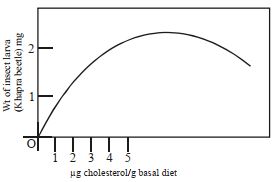
In an experiment,freshly hatched larvae of an insect (Khapra beetle) were reared on a basal diet (complete diet without cholesterol) with increasing amounts of cholesterol. Results obtained are shown in the given graph.
The graph indicates:
The graph indicates:
A
cholesterol is an essential dietary requirement of Khapra beetle
B
growth of Khapra beetle is directly proportional to cholesterol concentration
C
cholesterol concentration of $2 \, \mu g/g$ diet is the optimum level
D
growth of Khapra beetle is inhibited when cholesterol concentration exceeds $5 \, \mu g/g$ diet
Solution
(A) $1$. The graph shows the relationship between the weight of the Khapra beetle larvae and the concentration of cholesterol in their diet.
$2$. At $0 \, \mu g/g$ cholesterol,the growth is minimal or zero,indicating that cholesterol is necessary for the development of these larvae.
$3$. As the concentration of cholesterol increases,the weight of the larvae increases,showing that cholesterol is an essential dietary requirement for the Khapra beetle.
$4$. Option $A$ is the most accurate interpretation because the graph demonstrates that without cholesterol,the larvae do not grow,confirming it is an essential nutrient.
$2$. At $0 \, \mu g/g$ cholesterol,the growth is minimal or zero,indicating that cholesterol is necessary for the development of these larvae.
$3$. As the concentration of cholesterol increases,the weight of the larvae increases,showing that cholesterol is an essential dietary requirement for the Khapra beetle.
$4$. Option $A$ is the most accurate interpretation because the graph demonstrates that without cholesterol,the larvae do not grow,confirming it is an essential nutrient.
0 likesView Solution
52
BiologyMediumMCQAIIMS · 2005
Assertion : $Agrobacterium$ $tumefaciens$ is popular in genetic engineering because this bacterium is associated with the roots of all cereal and pulse crops.
Reason : $A$ gene incorporated in the bacterial chromosomal genome gets automatically transferred to the crop with which the bacterium is associated.
Reason : $A$ gene incorporated in the bacterial chromosomal genome gets automatically transferred to the crop with which the bacterium is associated.
A
If both Assertion and Reason are correct and the Reason is a correct explanation of the Assertion.
B
If both Assertion and Reason are correct but Reason is not a correct explanation of the Assertion.
C
If the Assertion is correct but Reason is incorrect.
D
If both the Assertion and Reason are incorrect.
Solution
(D) $Agrobacterium$ $tumefaciens$ is a soil-inhabiting,plant-pathogenic bacterium that infects broad-leaved crops such as tomato,soybean,sunflower,and cotton,but it does not infect cereals.
Tumor formation (crown galls) is induced by the transfer of its $Ti$ plasmid $DNA$ into the host plant's genome.
The $T-DNA$ segment of the $Ti$ plasmid is responsible for tumor induction.
Because this gene transfer occurs naturally without human intervention,the bacterium is known as the 'natural genetic engineer' of plants.
Since the Assertion incorrectly states that it is associated with all cereal and pulse crops,and the Reason is also factually incorrect regarding the mechanism of gene transfer (it uses $Ti$ plasmid,not the chromosomal genome),both statements are incorrect.
Tumor formation (crown galls) is induced by the transfer of its $Ti$ plasmid $DNA$ into the host plant's genome.
The $T-DNA$ segment of the $Ti$ plasmid is responsible for tumor induction.
Because this gene transfer occurs naturally without human intervention,the bacterium is known as the 'natural genetic engineer' of plants.
Since the Assertion incorrectly states that it is associated with all cereal and pulse crops,and the Reason is also factually incorrect regarding the mechanism of gene transfer (it uses $Ti$ plasmid,not the chromosomal genome),both statements are incorrect.
0 likesView Solution
53
BiologyMediumMCQAIIMS · 2005
Assertion : In recombinant $DNA$ technology,human genes are often transferred into bacteria (prokaryotes) or yeast (eukaryote).
Reason : Both bacteria and yeast multiply very fast to form huge population,which express the desired gene.
Reason : Both bacteria and yeast multiply very fast to form huge population,which express the desired gene.
A
If both Assertion and Reason are correct and the Reason is a correct explanation of the Assertion.
B
If both Assertion and Reason are correct but Reason is not a correct explanation of the Assertion.
C
If the Assertion is correct but Reason is incorrect.
D
If both the Assertion and Reason are incorrect.
Solution
(A) In recombinant $DNA$ technology,human genes are inserted into host organisms like bacteria or yeast to produce large quantities of desired proteins.
Bacteria and yeast are preferred as host cells because they have a very short generation time and multiply rapidly,allowing for the creation of a large population of cells in a short period.
This large population of cells expresses the inserted gene,leading to the efficient production of the recombinant protein.
Therefore,the Reason correctly explains why human genes are transferred into these organisms.
Bacteria and yeast are preferred as host cells because they have a very short generation time and multiply rapidly,allowing for the creation of a large population of cells in a short period.
This large population of cells expresses the inserted gene,leading to the efficient production of the recombinant protein.
Therefore,the Reason correctly explains why human genes are transferred into these organisms.
0 likesView Solution
54
BiologyMediumMCQAIIMS · 2005
Assertion: The sex ratio of Kerala is the highest in India.
Reason: In countries like India,the population is increasing at a rapid rate.
Reason: In countries like India,the population is increasing at a rapid rate.
A
If both Assertion and Reason are correct and the Reason is a correct explanation of the Assertion.
B
If both Assertion and Reason are correct but Reason is not a correct explanation of the Assertion.
C
If the Assertion is correct but Reason is incorrect.
D
If both the Assertion and Reason are incorrect.
Solution
(B) The Assertion is correct because Kerala has the highest sex ratio in India (approximately $1084$ females per $1000$ males according to recent census data).
The Reason is also a factually correct statement regarding the demographic trend in India,as the population is indeed increasing at a rapid rate.
However,the Reason does not explain why Kerala has the highest sex ratio.
Therefore,both statements are correct,but the Reason is not the correct explanation for the Assertion.
The Reason is also a factually correct statement regarding the demographic trend in India,as the population is indeed increasing at a rapid rate.
However,the Reason does not explain why Kerala has the highest sex ratio.
Therefore,both statements are correct,but the Reason is not the correct explanation for the Assertion.
0 likesView Solution
55
BiologyMediumMCQAIIMS · 2005
Assertion: $A$ suspended particulate matter $(SPM)$ is an important pollutant released by diesel vehicles.
Reason: Catalytic converters greatly reduce pollution caused by automobiles.
Reason: Catalytic converters greatly reduce pollution caused by automobiles.
A
If both Assertion and Reason are correct and the Reason is a correct explanation of the Assertion.
B
If both Assertion and Reason are correct but Reason is not a correct explanation of the Assertion.
C
If the Assertion is correct but Reason is incorrect.
D
If both the Assertion and Reason are incorrect.
Solution
(B) The Assertion is correct because diesel vehicles are a major source of suspended particulate matter $(SPM)$,which is harmful to human health.
The Reason is also correct because catalytic converters are used in automobiles to reduce the emission of poisonous gases like carbon monoxide $(CO)$ and nitrogen oxides $(NO_x)$ by converting them into less harmful gases like carbon dioxide $(CO_2)$ and nitrogen $(N_2)$.
However,catalytic converters are ineffective at reducing the emission of $SPM$ (particulate matter).
Therefore,while both statements are true,the Reason does not explain why $SPM$ is released by diesel vehicles.
The Reason is also correct because catalytic converters are used in automobiles to reduce the emission of poisonous gases like carbon monoxide $(CO)$ and nitrogen oxides $(NO_x)$ by converting them into less harmful gases like carbon dioxide $(CO_2)$ and nitrogen $(N_2)$.
However,catalytic converters are ineffective at reducing the emission of $SPM$ (particulate matter).
Therefore,while both statements are true,the Reason does not explain why $SPM$ is released by diesel vehicles.
0 likesView Solution
56
BiologyMediumMCQAIIMS · 2005
Assertion: Presently,the global atmosphere is warming up.
Reason: The depletion of the stratospheric ozone layer has resulted in an increase in ultraviolet radiations reaching the earth.
Reason: The depletion of the stratospheric ozone layer has resulted in an increase in ultraviolet radiations reaching the earth.
A
If both Assertion and Reason are correct and the Reason is a correct explanation of the Assertion.
B
If both Assertion and Reason are correct but Reason is not a correct explanation of the Assertion.
C
If the Assertion is correct but Reason is incorrect.
D
If both the Assertion and Reason are incorrect.
Solution
(B) The Assertion is correct because global warming is a well-documented phenomenon caused by the increase in the concentration of greenhouse gases like $CO_2$,$CH_4$,and $CFCs$ in the atmosphere.
These greenhouse gases trap heat by preventing the escape of long-wave infrared radiations into space,leading to a rise in global temperatures.
The Reason is also a scientifically correct statement regarding the depletion of the ozone layer,which allows more $UV$ radiation to reach the earth's surface.
However,the depletion of the ozone layer is not the cause of global warming; therefore,the Reason is not the correct explanation for the Assertion.
These greenhouse gases trap heat by preventing the escape of long-wave infrared radiations into space,leading to a rise in global temperatures.
The Reason is also a scientifically correct statement regarding the depletion of the ozone layer,which allows more $UV$ radiation to reach the earth's surface.
However,the depletion of the ozone layer is not the cause of global warming; therefore,the Reason is not the correct explanation for the Assertion.
0 likesView Solution
57
BiologyMediumMCQAIIMS · 2005
Assertion : Methane,a component of greenhouse gases,contributes about $20$ percent to global warming.
Reason : The introduction of multi-point fuel injection engines in automobiles has decreased methane content in the exhausts.
Reason : The introduction of multi-point fuel injection engines in automobiles has decreased methane content in the exhausts.
A
If both Assertion and Reason are correct and the Reason is a correct explanation of the Assertion.
B
If both Assertion and Reason are correct but Reason is not a correct explanation of the Assertion.
C
If the Assertion is correct but Reason is incorrect.
D
If both the Assertion and Reason are incorrect.
Solution
(A) Methane is produced by incomplete biomass combustion and anaerobic decomposition by methanogens.
Carbon dioxide contributes about $60\%$ to total global warming,while methane $(CH_4)$ and chlorofluorocarbons $(CFCs)$ contribute $20\%$ and $14\%$ respectively.
Nitrous oxide $(N_2O)$ contributes $6\%$ to total global warming.
Efficient engines,such as multi-point fuel injection engines,improve combustion efficiency,thereby reducing the emission of unburnt hydrocarbons like methane in automobile exhausts.
Therefore,both the Assertion and the Reason are correct,and the Reason explains why methane emissions from vehicles are controlled.
Carbon dioxide contributes about $60\%$ to total global warming,while methane $(CH_4)$ and chlorofluorocarbons $(CFCs)$ contribute $20\%$ and $14\%$ respectively.
Nitrous oxide $(N_2O)$ contributes $6\%$ to total global warming.
Efficient engines,such as multi-point fuel injection engines,improve combustion efficiency,thereby reducing the emission of unburnt hydrocarbons like methane in automobile exhausts.
Therefore,both the Assertion and the Reason are correct,and the Reason explains why methane emissions from vehicles are controlled.
0 likesView Solution
Vedclass Products
For Students
Vedclass Test Series
Mock tests in real AIIMS style covering Biology with performance analysis. 5-day free trial.
Start Free TrialFor Teachers
Exam Paper Generator
Generate Set A/B/C/D Biology papers from 7.5L+ questions in 2 minutes. 3 chapters free.
Try FreeFor Institutes
Online Exam Module
Run live AIIMS mock exams with unlimited students, 360° analytics & white-label branding.
See DemoFrequently Asked Questions
How many Biology questions are in AIIMS 2005?
There are 57 Biology questions from the AIIMS 2005 paper on Vedclass, each with a detailed step-by-step solution in English.
Are AIIMS 2005 Biology solutions available in English?
Yes. All solutions on this page are in English. You can also switch to English or Hindi using the language buttons above the questions.
Can I practice AIIMS 2005 Biology as a timed test?
Yes. Use the Vedclass Test Series to attempt a full AIIMS mock test covering Biology with time limits and instant score analysis.
Can teachers create Biology papers from AIIMS previous year questions?
Yes. The Vedclass Exam Paper Generator lets teachers mix AIIMS Biology questions and generate Set A/B/C/D papers in minutes.
For Teachers & Institutes
Build a Custom Biology Paper
Pick AIIMS 2005 Biology questions, set difficulty, and generate Set A/B/C/D in 2 minutes.