
PhysicsQ1–52 of 52 questions
Page 1 of 1 · English
1
PhysicsEasyMCQAIIMS · 2005
$Parsec$ is a unit of
A
Distance
B
Velocity
C
Time
D
Angle
Solution
(A) $Parsec$ (parallax second) is a unit of length used to measure the large distances to astronomical objects outside the Solar System.
It is defined as the distance at which one astronomical unit $(AU)$ subtends an angle of one arcsecond.
$1 \ Parsec \approx 3.086 \times 10^{16} \ m$.
Therefore,the correct option is $A$.
It is defined as the distance at which one astronomical unit $(AU)$ subtends an angle of one arcsecond.
$1 \ Parsec \approx 3.086 \times 10^{16} \ m$.
Therefore,the correct option is $A$.
0 likesView Solution
2
PhysicsMediumMCQAIIMS · 2005
The dimension of $R$ (Resistance) is:
A
$M L^2 T^{-1}$
B
$M L^2 T^{-3} A^{-2}$
C
$M L^{-1} T^{-2}$
D
None of these
Solution
(B) According to Ohm's law,$R = \frac{V}{I}$.
First,find the dimensions of potential difference $(V)$: $V = \frac{W}{q} = \frac{[M L^2 T^{-2}]}{[A T]} = [M L^2 T^{-3} A^{-1}]$.
Now,substitute the dimensions of $V$ and $I$ into the formula for $R$:
$R = \frac{[M L^2 T^{-3} A^{-1}]}{[A]} = [M L^2 T^{-3} A^{-2}]$.
Therefore,the correct option is $B$.
First,find the dimensions of potential difference $(V)$: $V = \frac{W}{q} = \frac{[M L^2 T^{-2}]}{[A T]} = [M L^2 T^{-3} A^{-1}]$.
Now,substitute the dimensions of $V$ and $I$ into the formula for $R$:
$R = \frac{[M L^2 T^{-3} A^{-1}]}{[A]} = [M L^2 T^{-3} A^{-2}]$.
Therefore,the correct option is $B$.
0 likesView Solution
3
PhysicsMediumMCQAIIMS · 2005
When a ball is thrown up vertically with velocity $V_o$,it reaches a maximum height of $h$. If one wishes to triple the maximum height,then the ball should be thrown with what velocity?
A
$\sqrt{3} V_o$
B
$3 V_o$
C
$9 V_o$
D
$\frac{3}{2} V_o$
Solution
(A) The maximum height $h$ reached by a ball thrown vertically with initial velocity $u$ is given by the formula $h = \frac{u^2}{2g}$.
From this relation,we can see that $h \propto u^2$,which implies $u \propto \sqrt{h}$.
Let the initial velocity be $V_o$ for height $h$,and the new velocity be $V'$ for height $3h$.
Then,$\frac{V'}{V_o} = \sqrt{\frac{3h}{h}} = \sqrt{3}$.
Therefore,$V' = \sqrt{3} V_o$.
From this relation,we can see that $h \propto u^2$,which implies $u \propto \sqrt{h}$.
Let the initial velocity be $V_o$ for height $h$,and the new velocity be $V'$ for height $3h$.
Then,$\frac{V'}{V_o} = \sqrt{\frac{3h}{h}} = \sqrt{3}$.
Therefore,$V' = \sqrt{3} V_o$.
0 likesView Solution
4
PhysicsEasyMCQAIIMS · 2005
$A$ person is standing in an elevator. In which of the following situations does he find his weight to be less than his actual weight?
A
The elevator moves upward with constant acceleration.
B
The elevator moves downward with constant acceleration.
C
The elevator moves upward with uniform velocity.
D
The elevator moves downward with uniform velocity.
Solution
(B) The apparent weight $W'$ of a person in an elevator is given by $W' = m(g \pm a)$,where $m$ is the mass of the person,$g$ is the acceleration due to gravity,and $a$ is the acceleration of the elevator.
When the elevator moves downward with an acceleration $a$,the apparent weight is $W' = m(g - a)$.
Since $(g - a) < g$,the apparent weight $W'$ is less than the actual weight $W = mg$.
Therefore,the person feels lighter when the elevator moves downward with constant acceleration.
When the elevator moves downward with an acceleration $a$,the apparent weight is $W' = m(g - a)$.
Since $(g - a) < g$,the apparent weight $W'$ is less than the actual weight $W = mg$.
Therefore,the person feels lighter when the elevator moves downward with constant acceleration.
0 likesView Solution
5
PhysicsEasyMCQAIIMS · 2005
When a body is stationary,which of the following statements is true?
A
There is no force acting on it.
B
The force acting on it is not in contact with it.
C
The combination of forces acting on it balances each other.
D
The body is in a vacuum.
Solution
(C) According to Newton's First Law of Motion,a body remains in a state of rest or uniform motion unless acted upon by an external unbalanced force.
If a body is stationary,its acceleration is $0$.
By Newton's Second Law,$F_{net} = ma$.
Since $a = 0$,the net force $F_{net}$ acting on the body must be $0$.
This means that the vector sum of all individual forces acting on the body is zero,implying that the forces balance each other out.
Therefore,option $C$ is correct.
If a body is stationary,its acceleration is $0$.
By Newton's Second Law,$F_{net} = ma$.
Since $a = 0$,the net force $F_{net}$ acting on the body must be $0$.
This means that the vector sum of all individual forces acting on the body is zero,implying that the forces balance each other out.
Therefore,option $C$ is correct.
0 likesView Solution
6
PhysicsMediumMCQAIIMS · 2005
The condition for a uniform spherical mass $m$ of radius $r$ to be a black hole is [$G=$ gravitational constant and $c=$ speed of light]
A
$(2Gm/r)^{1/2} \le c$
B
$(2Gm/r)^{1/2} = c$
C
$(2Gm/r)^{1/2} \ge c$
D
$(Gm/r)^{1/2} \ge c$
Solution
(C) The escape velocity $v_e$ from the surface of a spherical mass $m$ of radius $r$ is given by the formula: $v_e = \sqrt{\frac{2Gm}{r}}$.
For an object to be a black hole,not even light can escape its gravitational pull.
Therefore,the escape velocity must be greater than or equal to the speed of light $c$.
Thus,the condition is $\sqrt{\frac{2Gm}{r}} \ge c$ or $(2Gm/r)^{1/2} \ge c$.
For an object to be a black hole,not even light can escape its gravitational pull.
Therefore,the escape velocity must be greater than or equal to the speed of light $c$.
Thus,the condition is $\sqrt{\frac{2Gm}{r}} \ge c$ or $(2Gm/r)^{1/2} \ge c$.
0 likesView Solution
7
PhysicsMediumMCQAIIMS · 2005
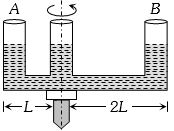
$A$ glass tube of uniform cross-section is filled with water and mounted on a rotatable shaft as shown in the figure. If the tube is rotated with a constant angular velocity $\omega$,then:
A
Water levels in both sections $A$ and $B$ go up.
B
Water level in section $A$ goes up and that in $B$ comes down.
C
Water level in section $A$ comes down and that in $B$ goes up.
D
Water levels remain the same in both sections.
Solution
(A) When the tube rotates with angular velocity $\omega$,the water in the horizontal arms experiences a centrifugal force directed outwards.
For a small element of water of mass $dm$ at a distance $r$ from the axis of rotation,the required centripetal force is provided by the pressure gradient: $dP = \rho \omega^2 r dr$.
Integrating this from the axis $(r=0)$ to a distance $r$,we get the pressure at distance $r$ as $P(r) = P_0 + \frac{1}{2} \rho \omega^2 r^2$,where $P_0$ is the pressure at the axis.
Since the pressure at the surface of the water in the vertical arms must be equal to the atmospheric pressure,the height $h$ of the water column in an arm at distance $r$ from the axis is given by $\rho gh = P(r) - P_{atm}$.
As $r$ increases,the pressure $P(r)$ increases,which means the height $h$ of the water column must increase to balance this pressure.
Since both arms $A$ and $B$ are at distances $L$ and $2L$ respectively from the axis,the water levels in both arms will rise compared to the level at the central axis to provide the necessary centripetal force for the rotation of the water mass.
For a small element of water of mass $dm$ at a distance $r$ from the axis of rotation,the required centripetal force is provided by the pressure gradient: $dP = \rho \omega^2 r dr$.
Integrating this from the axis $(r=0)$ to a distance $r$,we get the pressure at distance $r$ as $P(r) = P_0 + \frac{1}{2} \rho \omega^2 r^2$,where $P_0$ is the pressure at the axis.
Since the pressure at the surface of the water in the vertical arms must be equal to the atmospheric pressure,the height $h$ of the water column in an arm at distance $r$ from the axis is given by $\rho gh = P(r) - P_{atm}$.
As $r$ increases,the pressure $P(r)$ increases,which means the height $h$ of the water column must increase to balance this pressure.
Since both arms $A$ and $B$ are at distances $L$ and $2L$ respectively from the axis,the water levels in both arms will rise compared to the level at the central axis to provide the necessary centripetal force for the rotation of the water mass.
0 likesView Solution
8
PhysicsMediumMCQAIIMS · 2005
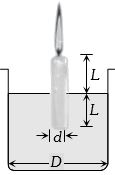
$A$ candle of diameter $d$ is floating on a liquid in a cylindrical container of diameter $D$ $(D >> d)$ as shown in the figure. If it is burning at the rate of $2 \text{ cm/hour}$,then the top of the candle will:
A
Remain at the same height
B
Fall at the rate of $1 \text{ cm/hour}$
C
Fall at the rate of $2 \text{ cm/hour}$
D
Go up at the rate of $1 \text{ cm/hour}$
Solution
(B) Let the density of the candle be $\rho_c$ and the density of the liquid be $\rho_l$. Let the total length of the candle be $L_0$ and the submerged length be $L_s$. According to the principle of floatation,the weight of the candle equals the weight of the displaced liquid:
$\rho_c \cdot A \cdot L_0 = \rho_l \cdot A \cdot L_s$
where $A$ is the cross-sectional area of the candle.
This implies $L_s = (\rho_c / \rho_l) L_0$. Let $k = \rho_c / \rho_l$. Then $L_s = k L_0$.
The height of the top of the candle above the liquid surface is $h = L_0 - L_s = L_0(1 - k)$.
As the candle burns,its total length $L_0$ decreases at a rate $v = dL_0/dt = 2 \text{ cm/hour}$.
The rate of change of the height of the top of the candle is $dh/dt = (dL_0/dt)(1 - k)$.
Assuming the candle is half-submerged (as suggested by the figure),$k = 0.5$.
Therefore,$dh/dt = 2 \text{ cm/hour} \times (1 - 0.5) = 1 \text{ cm/hour}$.
Since $dh/dt$ is positive,the top of the candle falls at a rate of $1 \text{ cm/hour}$.
$\rho_c \cdot A \cdot L_0 = \rho_l \cdot A \cdot L_s$
where $A$ is the cross-sectional area of the candle.
This implies $L_s = (\rho_c / \rho_l) L_0$. Let $k = \rho_c / \rho_l$. Then $L_s = k L_0$.
The height of the top of the candle above the liquid surface is $h = L_0 - L_s = L_0(1 - k)$.
As the candle burns,its total length $L_0$ decreases at a rate $v = dL_0/dt = 2 \text{ cm/hour}$.
The rate of change of the height of the top of the candle is $dh/dt = (dL_0/dt)(1 - k)$.
Assuming the candle is half-submerged (as suggested by the figure),$k = 0.5$.
Therefore,$dh/dt = 2 \text{ cm/hour} \times (1 - 0.5) = 1 \text{ cm/hour}$.
Since $dh/dt$ is positive,the top of the candle falls at a rate of $1 \text{ cm/hour}$.
0 likesView Solution
9
PhysicsMediumMCQAIIMS · 2005
Which of the following functions represents a simple harmonic oscillation?
A
$\sin \omega t - \cos \omega t$
B
$\sin^2 \omega t$
C
$\sin \omega t + \sin 2\omega t$
D
$\sin \omega t - \sin 2\omega t$
Solution
(A) function represents simple harmonic motion $(S.H.M.)$ if it satisfies the differential equation $\frac{d^2x}{dt^2} + \omega^2 x = 0$.
Option $A$: $x = \sin \omega t - \cos \omega t$. This can be written as $x = \sqrt{2} [\frac{1}{\sqrt{2}} \sin \omega t - \frac{1}{\sqrt{2}} \cos \omega t] = \sqrt{2} \sin(\omega t - \frac{\pi}{4})$. This is a standard $S.H.M.$ equation.
Option $B$: $x = \sin^2 \omega t = \frac{1 - \cos 2\omega t}{2}$. This represents motion with a constant shift and frequency $2\omega$,which is not simple harmonic.
Options $C$ and $D$: These are superpositions of two different frequencies ($\omega$ and $2\omega$),which result in periodic motion but not simple harmonic motion.
Therefore,the correct option is $A$.
Option $A$: $x = \sin \omega t - \cos \omega t$. This can be written as $x = \sqrt{2} [\frac{1}{\sqrt{2}} \sin \omega t - \frac{1}{\sqrt{2}} \cos \omega t] = \sqrt{2} \sin(\omega t - \frac{\pi}{4})$. This is a standard $S.H.M.$ equation.
Option $B$: $x = \sin^2 \omega t = \frac{1 - \cos 2\omega t}{2}$. This represents motion with a constant shift and frequency $2\omega$,which is not simple harmonic.
Options $C$ and $D$: These are superpositions of two different frequencies ($\omega$ and $2\omega$),which result in periodic motion but not simple harmonic motion.
Therefore,the correct option is $A$.
0 likesView Solution
10
PhysicsEasyMCQAIIMS · 2005
Which of the following is an amorphous solid?
A
Glass
B
Diamond
C
Salt
D
Sugar
Solution
(A) Amorphous solids are those in which the constituent particles (atoms, molecules, or ions) are arranged in a completely irregular or random manner over long distances.
Among the given options, $\text{Glass}$ is a classic example of an amorphous solid, often referred to as a supercooled liquid.
Diamond, Salt $(NaCl)$, and Sugar are all examples of crystalline solids, which possess a long-range ordered structure.
Therefore, the correct option is $A$.
Among the given options, $\text{Glass}$ is a classic example of an amorphous solid, often referred to as a supercooled liquid.
Diamond, Salt $(NaCl)$, and Sugar are all examples of crystalline solids, which possess a long-range ordered structure.
Therefore, the correct option is $A$.
0 likesView Solution
11
PhysicsEasyMCQAIIMS · 2005
$Assertion$ : Specific gravity of a fluid is a dimensionless quantity.
$Reason$ : It is the ratio of density of fluid to the density of water at $4^{\circ}C$.
$Reason$ : It is the ratio of density of fluid to the density of water at $4^{\circ}C$.
A
If both $Assertion$ and $Reason$ are correct and the $Reason$ is a correct explanation of the $Assertion$.
B
If both $Assertion$ and $Reason$ are correct but $Reason$ is not a correct explanation of the $Assertion$.
C
If the $Assertion$ is correct but $Reason$ is incorrect.
D
If both the $Assertion$ and $Reason$ are incorrect.
Solution
(A) Specific gravity (also known as relative density) is defined as the ratio of the density of a substance to the density of water at a standard temperature (usually $4^{\circ}C$).
$\text{Specific Gravity} = \frac{\rho_{\text{fluid}}}{\rho_{\text{water}}}$
Since it is a ratio of two identical physical quantities (density/density),the units cancel out,making it a dimensionless quantity.
Therefore,both the $Assertion$ and $Reason$ are correct,and the $Reason$ is the correct explanation for the $Assertion$.
$\text{Specific Gravity} = \frac{\rho_{\text{fluid}}}{\rho_{\text{water}}}$
Since it is a ratio of two identical physical quantities (density/density),the units cancel out,making it a dimensionless quantity.
Therefore,both the $Assertion$ and $Reason$ are correct,and the $Reason$ is the correct explanation for the $Assertion$.
0 likesView Solution
12
PhysicsEasyMCQAIIMS · 2005
$Assertion$ : Frictional forces are conservative forces.
$Reason$ : Potential energy can be associated with frictional forces.
$Reason$ : Potential energy can be associated with frictional forces.
A
If both $Assertion$ and $Reason$ are correct and the $Reason$ is a correct explanation of the $Assertion$.
B
If both $Assertion$ and $Reason$ are correct but $Reason$ is not a correct explanation of the $Assertion$.
C
If the $Assertion$ is correct but $Reason$ is incorrect.
D
If both the $Assertion$ and $Reason$ are incorrect.
Solution
(D) force is called conservative if the work done by or against it in moving a particle between two points is independent of the path taken.
Frictional force is a non-conservative force because the work done against friction depends on the path length.
Furthermore,work done against a non-conservative force like friction is dissipated as heat and cannot be recovered as potential energy.
Therefore,both the $Assertion$ and the $Reason$ are incorrect.
Frictional force is a non-conservative force because the work done against friction depends on the path length.
Furthermore,work done against a non-conservative force like friction is dissipated as heat and cannot be recovered as potential energy.
Therefore,both the $Assertion$ and the $Reason$ are incorrect.
0 likesView Solution
13
PhysicsMediumMCQAIIMS · 2005
$A$ horizontal platform is rotating with uniform angular velocity around the vertical axis passing through its centre. At some instant of time, a viscous fluid of mass $m$ is dropped at the centre and is allowed to spread out and finally fall off. The angular velocity during this period
A
decreases continuously
B
decreases initially and increases again
C
remains unaltered
D
increases continuously
Solution
(B) According to the principle of conservation of angular momentum, since no external torque acts on the system, the angular momentum $L = I\omega$ remains constant.
When the viscous fluid is dropped at the centre and spreads out, the distribution of mass moves away from the axis of rotation, which increases the moment of inertia $I$ of the system.
Since $L = I\omega$ is constant, an increase in $I$ leads to a decrease in the angular velocity $\omega$.
As the fluid eventually falls off the platform, the mass of the system decreases, causing the moment of inertia $I$ to decrease back towards its original value.
Consequently, the angular velocity $\omega$ increases again as the fluid leaves the platform.
When the viscous fluid is dropped at the centre and spreads out, the distribution of mass moves away from the axis of rotation, which increases the moment of inertia $I$ of the system.
Since $L = I\omega$ is constant, an increase in $I$ leads to a decrease in the angular velocity $\omega$.
As the fluid eventually falls off the platform, the mass of the system decreases, causing the moment of inertia $I$ to decrease back towards its original value.
Consequently, the angular velocity $\omega$ increases again as the fluid leaves the platform.
0 likesView Solution
14
PhysicsMediumMCQAIIMS · 2005
$A$ solid sphere is rolling on a frictionless surface,as shown in the figure,with a translational velocity $v \, m/s$. If it is to climb the inclined surface to a height $h$,then $v$ should be:

A
$v \ge \sqrt {\frac{10}{7}gh}$
B
$v \ge \sqrt {2gh}$
C
$v \ge 2gh$
D
$v \ge \frac{10}{7}gh$
Solution
(A) To climb the inclined surface to a height $h$,the total initial kinetic energy of the rolling sphere must be at least equal to the potential energy gained at height $h$.
The total kinetic energy of a rolling body is the sum of its translational and rotational kinetic energies:
$K_{total} = K_{trans} + K_{rot} = \frac{1}{2}mv^2 + \frac{1}{2}I\omega^2$
For a solid sphere,the moment of inertia $I = \frac{2}{5}mr^2$ and for pure rolling,$\omega = \frac{v}{r}$.
Substituting these values:
$K_{total} = \frac{1}{2}mv^2 + \frac{1}{2}(\frac{2}{5}mr^2)(\frac{v}{r})^2$
$K_{total} = \frac{1}{2}mv^2 + \frac{1}{5}mv^2 = \frac{7}{10}mv^2$
By the law of conservation of energy,the total kinetic energy must be greater than or equal to the potential energy $mgh$ at the top:
$\frac{7}{10}mv^2 \ge mgh$
$v^2 \ge \frac{10}{7}gh$
$v \ge \sqrt{\frac{10}{7}gh}$
The total kinetic energy of a rolling body is the sum of its translational and rotational kinetic energies:
$K_{total} = K_{trans} + K_{rot} = \frac{1}{2}mv^2 + \frac{1}{2}I\omega^2$
For a solid sphere,the moment of inertia $I = \frac{2}{5}mr^2$ and for pure rolling,$\omega = \frac{v}{r}$.
Substituting these values:
$K_{total} = \frac{1}{2}mv^2 + \frac{1}{2}(\frac{2}{5}mr^2)(\frac{v}{r})^2$
$K_{total} = \frac{1}{2}mv^2 + \frac{1}{5}mv^2 = \frac{7}{10}mv^2$
By the law of conservation of energy,the total kinetic energy must be greater than or equal to the potential energy $mgh$ at the top:
$\frac{7}{10}mv^2 \ge mgh$
$v^2 \ge \frac{10}{7}gh$
$v \ge \sqrt{\frac{10}{7}gh}$
0 likesView Solution
15
PhysicsMediumMCQAIIMS · 2005
$A$ ladder is leaned against a smooth wall and it is allowed to slip on a frictionless floor. Which figure represents the track of its centre of mass?
A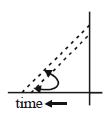
B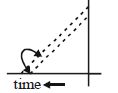
C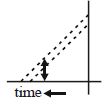
D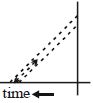
Solution
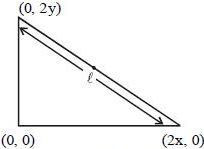
(B) Let $\ell$ be the length of the ladder and $(x, y)$ be the coordinates of its center of mass,which is the midpoint of the ladder.
From the geometry of the ladder leaning against the wall,the coordinates of the ends are $(2x, 0)$ and $(0, 2y)$.
Using the Pythagorean theorem for the length of the ladder $\ell$:
$(2x)^2 + (2y)^2 = \ell^2$
$4x^2 + 4y^2 = \ell^2$
$x^2 + y^2 = \left(\frac{\ell}{2}\right)^2$
This is the equation of a circle with radius $R = \frac{\ell}{2}$ centered at the origin $(0, 0)$.
As the ladder slips,the center of mass traces a circular arc. Therefore,the correct representation is a circular path.
From the geometry of the ladder leaning against the wall,the coordinates of the ends are $(2x, 0)$ and $(0, 2y)$.
Using the Pythagorean theorem for the length of the ladder $\ell$:
$(2x)^2 + (2y)^2 = \ell^2$
$4x^2 + 4y^2 = \ell^2$
$x^2 + y^2 = \left(\frac{\ell}{2}\right)^2$
This is the equation of a circle with radius $R = \frac{\ell}{2}$ centered at the origin $(0, 0)$.
As the ladder slips,the center of mass traces a circular arc. Therefore,the correct representation is a circular path.
0 likesView Solution
16
PhysicsEasyMCQAIIMS · 2005
$Assertion$ : For a system of particles under a central force field,the total angular momentum is conserved.
$Reason$ : The torque acting on such a system is zero.
$Reason$ : The torque acting on such a system is zero.
A
If both $Assertion$ and $Reason$ are correct and the $Reason$ is a correct explanation of the $Assertion$.
B
If both $Assertion$ and $Reason$ are correct but $Reason$ is not a correct explanation of the $Assertion$.
C
If the $Assertion$ is correct but $Reason$ is incorrect.
D
If both the $Assertion$ and $Reason$ are incorrect.
Solution
(A) In a central force field,the force acting on each particle is directed along the line joining the center of force and the particle.
Since the force is radial,the position vector $\vec{r}$ and the force vector $\vec{F}$ are collinear.
The torque $\vec{\tau}$ is defined as $\vec{\tau} = \vec{r} \times \vec{F}$.
Since $\vec{r}$ and $\vec{F}$ are parallel,the cross product is zero,meaning the net torque acting on the system is zero.
According to the principle of conservation of angular momentum,if the net external torque acting on a system is zero,the total angular momentum $\vec{L}$ remains constant.
Therefore,both the $Assertion$ and $Reason$ are correct,and the $Reason$ is the correct explanation of the $Assertion$.
Since the force is radial,the position vector $\vec{r}$ and the force vector $\vec{F}$ are collinear.
The torque $\vec{\tau}$ is defined as $\vec{\tau} = \vec{r} \times \vec{F}$.
Since $\vec{r}$ and $\vec{F}$ are parallel,the cross product is zero,meaning the net torque acting on the system is zero.
According to the principle of conservation of angular momentum,if the net external torque acting on a system is zero,the total angular momentum $\vec{L}$ remains constant.
Therefore,both the $Assertion$ and $Reason$ are correct,and the $Reason$ is the correct explanation of the $Assertion$.
0 likesView Solution
17
PhysicsEasyMCQAIIMS · 2005
$Assertion :$ For Reynolds number $Re > 2000$, the flow of fluid is turbulent.
$Reason :$ Inertial forces are dominant compared to the viscous forces at such high Reynolds numbers.
$Reason :$ Inertial forces are dominant compared to the viscous forces at such high Reynolds numbers.
A
If both Assertion and Reason are correct and the Reason is a correct explanation of the Assertion.
B
If both Assertion and Reason are correct but Reason is not a correct explanation of the Assertion.
C
If the Assertion is correct but Reason is incorrect.
D
If both the Assertion and Reason are incorrect.
Solution
$(A)$ The Reynolds number $(Re)$ is defined as the ratio of inertial forces to viscous forces in a fluid flow: $Re = \frac{\text{Inertial Force}}{\text{Viscous Force}}$.
For $Re < 2000$, the flow is typically laminar, where viscous forces dominate.
For $Re > 2000$, the flow becomes turbulent, meaning inertial forces are dominant compared to viscous forces.
Therefore, the Assertion is correct, and the Reason correctly explains why the flow becomes turbulent at high Reynolds numbers.
For $Re < 2000$, the flow is typically laminar, where viscous forces dominate.
For $Re > 2000$, the flow becomes turbulent, meaning inertial forces are dominant compared to viscous forces.
Therefore, the Assertion is correct, and the Reason correctly explains why the flow becomes turbulent at high Reynolds numbers.
0 likesView Solution
18
PhysicsEasyMCQAIIMS · 2005
$Assertion :$ $A$ body that is a good radiator is also a good absorber of radiation at a given wavelength.
$Reason :$ According to Kirchhoff's law,the absorptivity of a body is equal to its emissivity at a given wavelength.
$Reason :$ According to Kirchhoff's law,the absorptivity of a body is equal to its emissivity at a given wavelength.
A
If both Assertion and Reason are correct and the Reason is a correct explanation of the Assertion.
B
If both Assertion and Reason are correct but Reason is not a correct explanation of the Assertion.
C
If the Assertion is correct but Reason is incorrect.
D
If both the Assertion and Reason are incorrect.
Solution
(A) According to Kirchhoff's law of radiation,for an arbitrary body,the ratio of its emissive power $(e_{\lambda})$ to its absorptivity $(a_{\lambda})$ at a given wavelength and temperature is equal to the emissive power $(E_{\lambda})$ of a perfectly black body at the same wavelength and temperature.
Mathematically,$\frac{e_{\lambda}}{a_{\lambda}} = E_{\lambda}$.
Since $E_{\lambda}$ is a constant for a given wavelength and temperature,it follows that $e_{\lambda} \propto a_{\lambda}$.
This implies that a body with high emissivity (good radiator) must also have high absorptivity (good absorber) at that specific wavelength. Thus,both the Assertion and the Reason are correct,and the Reason is the correct explanation of the Assertion.
Mathematically,$\frac{e_{\lambda}}{a_{\lambda}} = E_{\lambda}$.
Since $E_{\lambda}$ is a constant for a given wavelength and temperature,it follows that $e_{\lambda} \propto a_{\lambda}$.
This implies that a body with high emissivity (good radiator) must also have high absorptivity (good absorber) at that specific wavelength. Thus,both the Assertion and the Reason are correct,and the Reason is the correct explanation of the Assertion.
0 likesView Solution
19
PhysicsEasyMCQAIIMS · 2005
$Assertion :$ In the pressure-temperature $(P-T)$ phase diagram of water,the slope of the melting curve is found to be negative.
$Reason :$ Ice contracts on melting to water.
$Reason :$ Ice contracts on melting to water.
A
If both Assertion and Reason are correct and the Reason is a correct explanation of the Assertion.
B
If both Assertion and Reason are correct but Reason is not a correct explanation of the Assertion.
C
If the Assertion is correct but Reason is incorrect.
D
If both the Assertion and Reason are incorrect.
Solution
(A) According to the Clausius-Clapeyron equation,the slope of the melting curve is given by $\frac{dP}{dT} = \frac{L}{T(V_2 - V_1)}$,where $L$ is the latent heat of fusion,$T$ is the temperature,$V_2$ is the volume of the liquid phase,and $V_1$ is the volume of the solid phase.
For water,ice contracts upon melting,meaning the volume of water $(V_2)$ is less than the volume of ice $(V_1)$.
Therefore,$(V_2 - V_1) < 0$,which makes the slope $\frac{dP}{dT}$ negative.
Thus,both the Assertion and the Reason are correct,and the Reason is the correct explanation for the Assertion.
For water,ice contracts upon melting,meaning the volume of water $(V_2)$ is less than the volume of ice $(V_1)$.
Therefore,$(V_2 - V_1) < 0$,which makes the slope $\frac{dP}{dT}$ negative.
Thus,both the Assertion and the Reason are correct,and the Reason is the correct explanation for the Assertion.
0 likesView Solution
20
PhysicsEasyMCQAIIMS · 2005
$Assertion :$ For higher temperature, the peak emission wavelength of a blackbody shifts to lower wavelengths.
$Reason :$ Peak emission wavelength of a blackbody is proportional to the fourth power of temperature.
$Reason :$ Peak emission wavelength of a blackbody is proportional to the fourth power of temperature.
A
If both Assertion and Reason are correct and the Reason is a correct explanation of the Assertion.
B
If both Assertion and Reason are correct but Reason is not a correct explanation of the Assertion.
C
If the Assertion is correct but Reason is incorrect.
D
If both the Assertion and Reason are incorrect.
Solution
(C) According to Wien's displacement law, $\lambda_m T = \text{constant}$.
This implies that $\lambda_m \propto 1/T$. Therefore, as the temperature $T$ increases, the peak emission wavelength $\lambda_m$ decreases. Thus, the Assertion is correct.
According to the Stefan-Boltzmann law, the total energy radiated per unit area per unit time is $E = \sigma T^4$. This law relates energy to temperature, not the peak wavelength. The peak wavelength is governed by Wien's displacement law, not the fourth power of temperature. Thus, the Reason is incorrect.
This implies that $\lambda_m \propto 1/T$. Therefore, as the temperature $T$ increases, the peak emission wavelength $\lambda_m$ decreases. Thus, the Assertion is correct.
According to the Stefan-Boltzmann law, the total energy radiated per unit area per unit time is $E = \sigma T^4$. This law relates energy to temperature, not the peak wavelength. The peak wavelength is governed by Wien's displacement law, not the fourth power of temperature. Thus, the Reason is incorrect.
0 likesView Solution
21
PhysicsEasyMCQAIIMS · 2005
$Assertion :$ Reversible systems are difficult to find in the real world.
$Reason :$ Most processes are dissipative in nature.
$Reason :$ Most processes are dissipative in nature.
A
If both $Assertion$ and $Reason$ are correct and the $Reason$ is a correct explanation of the $Assertion$.
B
If both $Assertion$ and $Reason$ are correct but $Reason$ is not a correct explanation of the $Assertion$.
C
If the $Assertion$ is correct but $Reason$ is incorrect.
D
If both the $Assertion$ and $Reason$ are incorrect.
Solution
(A) In any real-world process,some energy is inevitably converted into heat due to friction,viscosity,or other resistive forces,which is dissipative in nature.
Because of this energy loss,the system cannot be returned to its original state without leaving a change in the surroundings.
Therefore,all natural processes are irreversible,making perfectly reversible systems impossible to find in reality.
Thus,the $Assertion$ is correct,and the $Reason$ is the correct explanation for it.
Because of this energy loss,the system cannot be returned to its original state without leaving a change in the surroundings.
Therefore,all natural processes are irreversible,making perfectly reversible systems impossible to find in reality.
Thus,the $Assertion$ is correct,and the $Reason$ is the correct explanation for it.
0 likesView Solution
22
PhysicsEasyMCQAIIMS · 2005
$Assertion :$ Air quickly leaking out of a balloon becomes cooler.
$Reason :$ The leaking air undergoes adiabatic expansion.
$Reason :$ The leaking air undergoes adiabatic expansion.
A
If both Assertion and Reason are correct and the Reason is a correct explanation of the Assertion.
B
If both Assertion and Reason are correct but Reason is not a correct explanation of the Assertion.
C
If the Assertion is correct but Reason is incorrect.
D
If both the Assertion and Reason are incorrect.
Solution
(A) When air leaks out of a balloon quickly,the process happens so fast that there is no time for heat exchange with the surroundings,making it an adiabatic process.
During this process,the air expands against the external atmospheric pressure.
Since the air does work at the expense of its internal energy,its temperature decreases,causing the air to cool down.
During this process,the air expands against the external atmospheric pressure.
Since the air does work at the expense of its internal energy,its temperature decreases,causing the air to cool down.
0 likesView Solution
23
PhysicsEasyMCQAIIMS · 2005
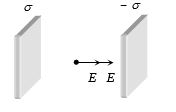
Two infinitely long parallel conducting plates having surface charge densities $+\sigma$ and $-\sigma$ respectively,are separated by a small distance. The medium between the plates is vacuum. If $\varepsilon_0$ is the dielectric permittivity of vacuum,then the electric field in the region between the plates is
A
$0 \text{ V/m}$
B
$\frac{\sigma}{2\varepsilon_0} \text{ V/m}$
C
$\frac{\sigma}{\varepsilon_0} \text{ V/m}$
D
$\frac{2\sigma}{\varepsilon_0} \text{ V/m}$
Solution
(C) The electric field due to an infinitely large thin sheet of charge with surface charge density $\sigma$ is given by $E = \frac{\sigma}{2\varepsilon_0}$.
For two parallel plates with charge densities $+\sigma$ and $-\sigma$,the electric field from the positively charged plate points away from it,and the electric field from the negatively charged plate points towards it.
In the region between the plates,both electric fields point in the same direction (from the positive plate to the negative plate).
Therefore,the net electric field $E_{net}$ is the sum of the magnitudes of the individual fields:
$E_{net} = E_1 + E_2 = \frac{\sigma}{2\varepsilon_0} + \frac{|-\sigma|}{2\varepsilon_0} = \frac{\sigma}{2\varepsilon_0} + \frac{\sigma}{2\varepsilon_0} = \frac{\sigma}{\varepsilon_0} \text{ V/m}$.
For two parallel plates with charge densities $+\sigma$ and $-\sigma$,the electric field from the positively charged plate points away from it,and the electric field from the negatively charged plate points towards it.
In the region between the plates,both electric fields point in the same direction (from the positive plate to the negative plate).
Therefore,the net electric field $E_{net}$ is the sum of the magnitudes of the individual fields:
$E_{net} = E_1 + E_2 = \frac{\sigma}{2\varepsilon_0} + \frac{|-\sigma|}{2\varepsilon_0} = \frac{\sigma}{2\varepsilon_0} + \frac{\sigma}{2\varepsilon_0} = \frac{\sigma}{\varepsilon_0} \text{ V/m}$.
0 likesView Solution
24
PhysicsMediumMCQAIIMS · 2005
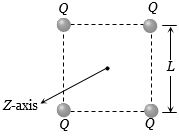
Four point positive charges of same magnitude $(Q)$ are placed at four corners of a rigid square frame of side $L$ as shown in the figure. The plane of the frame is perpendicular to the $Z$-axis. If a negative point charge $(-q)$ is placed at a small distance $z$ away from the center of the frame along the $Z$-axis $(z < < L)$, then:
A
The negative charge oscillates along the $Z$-axis.
B
It moves away from the frame.
C
It moves slowly towards the frame and stays in the plane of the frame.
D
It passes through the frame only once.
Solution
(A) The four positive charges $(Q)$ at the corners of the square create an electric field directed towards the center of the square along the $Z$-axis.
For a negative charge $(-q)$ placed at a small distance $z$ on the $Z$-axis, the net electrostatic force exerted by the four charges will be directed towards the center of the square frame.
The magnitude of this force is proportional to the displacement $z$ for small $z$ (i.e., $F \propto -z$).
This acts as a restoring force. As the negative charge is attracted towards the center, it accelerates. When it reaches the center (the plane of the frame), the net force is zero, but due to its acquired velocity (inertia), it crosses the center and moves to the other side.
The restoring force then acts in the opposite direction, slowing it down until it stops and is pulled back again.
Thus, the negative charge performs simple harmonic motion (oscillates) along the $Z$-axis about the center of the frame.
For a negative charge $(-q)$ placed at a small distance $z$ on the $Z$-axis, the net electrostatic force exerted by the four charges will be directed towards the center of the square frame.
The magnitude of this force is proportional to the displacement $z$ for small $z$ (i.e., $F \propto -z$).
This acts as a restoring force. As the negative charge is attracted towards the center, it accelerates. When it reaches the center (the plane of the frame), the net force is zero, but due to its acquired velocity (inertia), it crosses the center and moves to the other side.
The restoring force then acts in the opposite direction, slowing it down until it stops and is pulled back again.
Thus, the negative charge performs simple harmonic motion (oscillates) along the $Z$-axis about the center of the frame.
0 likesView Solution
25
PhysicsDifficultMCQAIIMS · 2005
Two concentric conducting thin spherical shells $A$ and $B$ having radii $r_A$ and $r_B$ $(r_B > r_A)$ are charged to $Q_A$ and $-Q_B$ $(|Q_B| > |Q_A|)$. The electric field along a line passing through the centre is:
A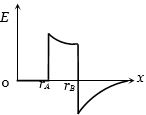
B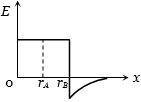
C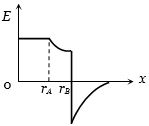
D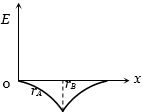
Solution
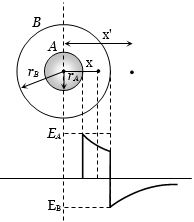
(A) The electric field $E$ at a distance $x$ from the common centre is determined using Gauss's Law:
$1$. For $x < r_A$: The interior of a conducting shell has no electric field. Thus,$E = 0$.
$2$. For $r_A < x < r_B$: Only the charge $Q_A$ on shell $A$ contributes to the field. Thus,$E = \frac{k Q_A}{x^2}$. This is a positive value that decreases as $x$ increases.
$3$. For $x > r_B$: Both charges $Q_A$ and $-Q_B$ contribute to the field. The net charge is $(Q_A - Q_B)$. Since $|Q_B| > |Q_A|$,the net charge is negative. Thus,$E = \frac{k(Q_A - Q_B)}{x^2}$. This is a negative value that approaches zero as $x \to \infty$.
Comparing these characteristics with the given options,the graph shows $E=0$ for $x < r_A$,a positive $1/x^2$ curve for $r_A < x < r_B$,and a negative $1/x^2$ curve for $x > r_B$.
$1$. For $x < r_A$: The interior of a conducting shell has no electric field. Thus,$E = 0$.
$2$. For $r_A < x < r_B$: Only the charge $Q_A$ on shell $A$ contributes to the field. Thus,$E = \frac{k Q_A}{x^2}$. This is a positive value that decreases as $x$ increases.
$3$. For $x > r_B$: Both charges $Q_A$ and $-Q_B$ contribute to the field. The net charge is $(Q_A - Q_B)$. Since $|Q_B| > |Q_A|$,the net charge is negative. Thus,$E = \frac{k(Q_A - Q_B)}{x^2}$. This is a negative value that approaches zero as $x \to \infty$.
Comparing these characteristics with the given options,the graph shows $E=0$ for $x < r_A$,a positive $1/x^2$ curve for $r_A < x < r_B$,and a negative $1/x^2$ curve for $x > r_B$.
0 likesView Solution
26
PhysicsDifficultMCQAIIMS · 2005
For ensuring the dissipation of the same energy in all three resistors $({R_1}, {R_2}, {R_3})$ connected as shown in the figure,their values must be related as:
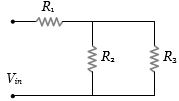
A
${R_1} = {R_2} = {R_3}$
B
${R_2} = {R_3}$ and ${R_1} = 4{R_2}$
C
${R_2} = {R_3}$ and ${R_1} = \frac{1}{4}{R_2}$
D
${R_1} = {R_2} + {R_3}$
Solution
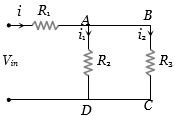
(C) Let the energy dissipated in each resistor be $H$. Since the resistors ${R_2}$ and ${R_3}$ are connected in parallel,the potential difference across them is the same. Therefore,the energy dissipated in them is given by $H = \frac{V^2}{R}t$. For the energy to be the same,we must have ${R_2} = {R_3}$.
Let the total current flowing through the circuit be $i$. The current ${R_1}$ is $i$. The current splits into ${i_1}$ and ${i_2}$ at the junction. Since ${R_2} = {R_3}$,the current splits equally,so ${i_1} = {i_2} = \frac{i}{2}$.
The energy dissipated in ${R_1}$ is $H = i^2 {R_1} t$.
The energy dissipated in ${R_2}$ is $H = i_1^2 {R_2} t = (\frac{i}{2})^2 {R_2} t = \frac{i^2}{4} {R_2} t$.
Since the energy dissipated in all resistors is the same,we equate the energy in ${R_1}$ and ${R_2}$:
$i^2 {R_1} t = \frac{i^2}{4} {R_2} t$
${R_1} = \frac{{R_2}}{4}$.
Let the total current flowing through the circuit be $i$. The current ${R_1}$ is $i$. The current splits into ${i_1}$ and ${i_2}$ at the junction. Since ${R_2} = {R_3}$,the current splits equally,so ${i_1} = {i_2} = \frac{i}{2}$.
The energy dissipated in ${R_1}$ is $H = i^2 {R_1} t$.
The energy dissipated in ${R_2}$ is $H = i_1^2 {R_2} t = (\frac{i}{2})^2 {R_2} t = \frac{i^2}{4} {R_2} t$.
Since the energy dissipated in all resistors is the same,we equate the energy in ${R_1}$ and ${R_2}$:
$i^2 {R_1} t = \frac{i^2}{4} {R_2} t$
${R_1} = \frac{{R_2}}{4}$.
0 likesView Solution
27
PhysicsDifficultMCQAIIMS · 2005
$A$ conducting ring of radius $1\,m$ is placed in a uniform magnetic field $B$ of $0.01\,T$ oscillating with a frequency of $100\,Hz$,with its plane at right angles to $B$. What will be the induced electric field in $V/m$?
A
$\pi$
B
$2$
C
$10$
D
$62$
Solution
(B) The magnetic field is given by $B(t) = B_0 \sin(\omega t)$,where $B_0 = 0.01\,T$ and $\omega = 2\pi f = 2\pi \times 100 = 200\pi\,rad/s$.
Using Faraday's law of induction,the induced emf $\varepsilon$ is given by $\varepsilon = -\frac{d\phi}{dt} = -A \frac{dB}{dt}$.
The magnetic flux $\phi = B \cdot A = B_0 \sin(\omega t) \cdot \pi r^2$.
Thus,$\varepsilon = -\pi r^2 \frac{d}{dt}(B_0 \sin(\omega t)) = -\pi r^2 B_0 \omega \cos(\omega t)$.
The induced electric field $E$ along the circumference of the ring is given by $\oint E \cdot dl = \varepsilon$.
$E(2\pi r) = \pi r^2 \frac{dB}{dt} \implies E = \frac{r}{2} \frac{dB}{dt}$.
Since $\frac{dB}{dt} = B_0 \omega \cos(\omega t)$,the maximum induced electric field is $E_{max} = \frac{r}{2} B_0 \omega$.
Substituting the values: $E_{max} = \frac{1}{2} \times 0.01 \times 200\pi = \pi \approx 3.14\,V/m$.
However,considering the average induced emf approach provided in the context of the question: $\varepsilon_{avg} = \frac{\Delta \phi}{\Delta t} = \frac{B_0 A}{T/4} = 4 B_0 A f = 4 \times 0.01 \times \pi(1)^2 \times 100 = 4\pi$.
Then $E = \frac{\varepsilon}{2\pi r} = \frac{4\pi}{2\pi(1)} = 2\,V/m$.
Using Faraday's law of induction,the induced emf $\varepsilon$ is given by $\varepsilon = -\frac{d\phi}{dt} = -A \frac{dB}{dt}$.
The magnetic flux $\phi = B \cdot A = B_0 \sin(\omega t) \cdot \pi r^2$.
Thus,$\varepsilon = -\pi r^2 \frac{d}{dt}(B_0 \sin(\omega t)) = -\pi r^2 B_0 \omega \cos(\omega t)$.
The induced electric field $E$ along the circumference of the ring is given by $\oint E \cdot dl = \varepsilon$.
$E(2\pi r) = \pi r^2 \frac{dB}{dt} \implies E = \frac{r}{2} \frac{dB}{dt}$.
Since $\frac{dB}{dt} = B_0 \omega \cos(\omega t)$,the maximum induced electric field is $E_{max} = \frac{r}{2} B_0 \omega$.
Substituting the values: $E_{max} = \frac{1}{2} \times 0.01 \times 200\pi = \pi \approx 3.14\,V/m$.
However,considering the average induced emf approach provided in the context of the question: $\varepsilon_{avg} = \frac{\Delta \phi}{\Delta t} = \frac{B_0 A}{T/4} = 4 B_0 A f = 4 \times 0.01 \times \pi(1)^2 \times 100 = 4\pi$.
Then $E = \frac{\varepsilon}{2\pi r} = \frac{4\pi}{2\pi(1)} = 2\,V/m$.
0 likesView Solution
28
PhysicsMediumMCQAIIMS · 2005
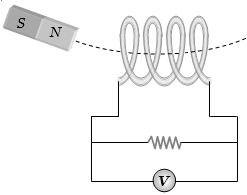
$A$ magnet is made to oscillate with a particular frequency,passing through a coil as shown in the figure. The time variation of the magnitude of $e.m.f.$ generated across the coil during one cycle is
A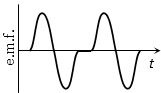
B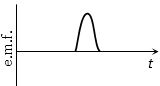
C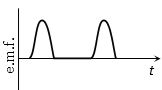
D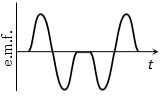
Solution
(A) According to Faraday's law of electromagnetic induction,the induced $e.m.f.$ is given by $\varepsilon = -\frac{d\phi}{dt}$.
When the north pole of the magnet approaches the coil,the magnetic flux through the coil increases,inducing an $e.m.f.$ of one polarity (e.g.,positive) and a current that flows in an anticlockwise direction to oppose the motion.
As the magnet passes through the center of the coil,the rate of change of flux becomes zero momentarily,so the induced $e.m.f.$ becomes zero.
As the magnet moves away,the flux decreases,inducing an $e.m.f.$ of the opposite polarity (e.g.,negative) and a current in the clockwise direction.
When the magnet reaches the extreme end of its oscillation,it is momentarily at rest,so the $e.m.f.$ is zero.
As it returns,the process repeats in reverse,creating a symmetric variation in the $e.m.f.$ over one full cycle of oscillation. This results in a waveform that shows both positive and negative peaks,as depicted in the first option.
When the north pole of the magnet approaches the coil,the magnetic flux through the coil increases,inducing an $e.m.f.$ of one polarity (e.g.,positive) and a current that flows in an anticlockwise direction to oppose the motion.
As the magnet passes through the center of the coil,the rate of change of flux becomes zero momentarily,so the induced $e.m.f.$ becomes zero.
As the magnet moves away,the flux decreases,inducing an $e.m.f.$ of the opposite polarity (e.g.,negative) and a current in the clockwise direction.
When the magnet reaches the extreme end of its oscillation,it is momentarily at rest,so the $e.m.f.$ is zero.
As it returns,the process repeats in reverse,creating a symmetric variation in the $e.m.f.$ over one full cycle of oscillation. This results in a waveform that shows both positive and negative peaks,as depicted in the first option.
0 likesView Solution
29
PhysicsEasyMCQAIIMS · 2005
Solid targets of different elements are bombarded by highly energetic electron beams. The frequency $(f)$ of the characteristic $X-$rays emitted from different targets varies with atomic number $Z$ as
A
$f \propto \sqrt{Z}$
B
$f \propto Z^2$
C
$f \propto Z$
D
$f \propto Z^{3/2}$
Solution
(B) According to Moseley's Law,the frequency $(f)$ of the characteristic $X-$rays emitted by an element is related to its atomic number $(Z)$ by the equation: $f = a(Z - b)^2$,where $a$ and $b$ are constants.
For high atomic numbers,$b$ is negligible,so $f \propto Z^2$.
Therefore,the frequency of characteristic $X-$rays varies with the square of the atomic number.
For high atomic numbers,$b$ is negligible,so $f \propto Z^2$.
Therefore,the frequency of characteristic $X-$rays varies with the square of the atomic number.
0 likesView Solution
30
PhysicsEasyMCQAIIMS · 2005
The ground state energy of a hydrogen atom is $-13.6 \, eV$. What is the potential energy of the electron in this state in $eV$ (in $, eV$)?
A
$0$
B
$-27.2$
C
$13.6$
D
$27.2$
Solution
(B) For a hydrogen atom,the total energy $(E)$,kinetic energy $(K)$,and potential energy $(U)$ are related as follows:
$E = -K$
$U = 2E$
Given the ground state energy $E = -13.6 \, eV$.
Therefore,the potential energy $U = 2 \times (-13.6 \, eV) = -27.2 \, eV$.
$E = -K$
$U = 2E$
Given the ground state energy $E = -13.6 \, eV$.
Therefore,the potential energy $U = 2 \times (-13.6 \, eV) = -27.2 \, eV$.
0 likesView Solution
31
PhysicsMediumMCQAIIMS · 2005
The magnetic moment $(\mu)$ of a revolving electron around the nucleus varies with principal quantum number $n$ as
A
$\mu \propto n$
B
$\mu \propto 1/n$
C
$\mu \propto n^2$
D
$\mu \propto 1/n^2$
Solution
(A) The magnetic moment $(\mu)$ of a revolving electron is given by the relation $\mu = \frac{e}{2m} L$,where $L$ is the angular momentum.
According to Bohr's quantization condition,the angular momentum $L$ of an electron in the $n$-th orbit is $L = \frac{nh}{2\pi}$.
Substituting this value into the expression for magnetic moment,we get $\mu = \frac{e}{2m} \left( \frac{nh}{2\pi} \right)$.
Rearranging the terms,we have $\mu = n \left( \frac{eh}{4\pi m} \right)$.
Since $e$,$h$,and $m$ are constants,the term $\frac{eh}{4\pi m}$ is also a constant (related to the Bohr magneton $\mu_B = \frac{eh}{4\pi m}$).
Therefore,$\mu \propto n$.
According to Bohr's quantization condition,the angular momentum $L$ of an electron in the $n$-th orbit is $L = \frac{nh}{2\pi}$.
Substituting this value into the expression for magnetic moment,we get $\mu = \frac{e}{2m} \left( \frac{nh}{2\pi} \right)$.
Rearranging the terms,we have $\mu = n \left( \frac{eh}{4\pi m} \right)$.
Since $e$,$h$,and $m$ are constants,the term $\frac{eh}{4\pi m}$ is also a constant (related to the Bohr magneton $\mu_B = \frac{eh}{4\pi m}$).
Therefore,$\mu \propto n$.
0 likesView Solution
32
PhysicsMediumMCQAIIMS · 2005
$A$ radioactive material has a half-life of $10$ days. What fraction of the material would remain after $30$ days?
A
$0.5$
B
$0.25$
C
$0.125$
D
$0.33$
Solution
(C) The number of radioactive nuclei remaining after time $t$ is given by the formula: $N = N_0 \left( \frac{1}{2} \right)^{\frac{t}{T_{1/2}}}$.
Here,the initial amount is $N_0$,the half-life $T_{1/2} = 10$ days,and the total time $t = 30$ days.
The fraction of the material remaining is $\frac{N}{N_0} = \left( \frac{1}{2} \right)^{\frac{30}{10}}$.
$\frac{N}{N_0} = \left( \frac{1}{2} \right)^3 = \frac{1}{8}$.
$\frac{N}{N_0} = 0.125$.
Here,the initial amount is $N_0$,the half-life $T_{1/2} = 10$ days,and the total time $t = 30$ days.
The fraction of the material remaining is $\frac{N}{N_0} = \left( \frac{1}{2} \right)^{\frac{30}{10}}$.
$\frac{N}{N_0} = \left( \frac{1}{2} \right)^3 = \frac{1}{8}$.
$\frac{N}{N_0} = 0.125$.
0 likesView Solution
33
PhysicsEasyMCQAIIMS · 2005
In a semiconducting material,the mobilities of electrons and holes are $\mu_e$ and $\mu_h$ respectively. Which of the following is true?
A
$\mu_e > \mu_h$
B
$\mu_e < \mu_h$
C
$\mu_e = \mu_h$
D
$\mu_e < 0; \mu_h > 0$
Solution
(A) In a semiconductor,the mobility of charge carriers is defined as the drift velocity per unit electric field.
Electrons are lighter and move through the conduction band,whereas holes are essentially vacancies in the valence band that move through a process of successive electron jumps.
Due to their lower effective mass and the nature of their movement in the conduction band,electrons encounter less scattering and have a higher mobility compared to holes.
Therefore,the mobility of electrons is always greater than the mobility of holes,i.e.,$\mu_e > \mu_h$.
Electrons are lighter and move through the conduction band,whereas holes are essentially vacancies in the valence band that move through a process of successive electron jumps.
Due to their lower effective mass and the nature of their movement in the conduction band,electrons encounter less scattering and have a higher mobility compared to holes.
Therefore,the mobility of electrons is always greater than the mobility of holes,i.e.,$\mu_e > \mu_h$.
0 likesView Solution
34
PhysicsMediumMCQAIIMS · 2005
Consider an $NPN$ transistor amplifier in common-emitter configuration. The current gain of the transistor is $100$. If the collector current changes by $1\, mA$,what will be the change in emitter current in $mA$?
A
$1.1$
B
$1.01$
C
$0.01$
D
$10$
Solution
(B) Given: Current gain $\beta = 100$,Change in collector current $\Delta I_c = 1\, mA$.
We know that the current gain in common-emitter configuration is defined as $\beta = \frac{\Delta I_c}{\Delta I_b}$.
Therefore,the change in base current is $\Delta I_b = \frac{\Delta I_c}{\beta} = \frac{1\, mA}{100} = 0.01\, mA$.
The relationship between emitter,collector,and base currents is $\Delta I_e = \Delta I_c + \Delta I_b$.
Substituting the values,we get $\Delta I_e = 1\, mA + 0.01\, mA = 1.01\, mA$.
Thus,the change in emitter current is $1.01\, mA$.
We know that the current gain in common-emitter configuration is defined as $\beta = \frac{\Delta I_c}{\Delta I_b}$.
Therefore,the change in base current is $\Delta I_b = \frac{\Delta I_c}{\beta} = \frac{1\, mA}{100} = 0.01\, mA$.
The relationship between emitter,collector,and base currents is $\Delta I_e = \Delta I_c + \Delta I_b$.
Substituting the values,we get $\Delta I_e = 1\, mA + 0.01\, mA = 1.01\, mA$.
Thus,the change in emitter current is $1.01\, mA$.
0 likesView Solution
35
PhysicsMediumMCQAIIMS · 2005
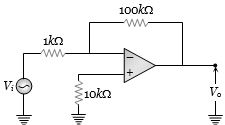
The voltage gain of the following amplifier is
A
$10$
B
$100$
C
$1000$
D
$9.9$
Solution
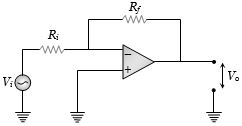
(B) The given circuit is an inverting amplifier configuration using an operational amplifier (op-amp).
For an inverting amplifier,the voltage gain $A_v$ is given by the formula:
$A_v = -\frac{R_f}{R_i}$
Where $R_f$ is the feedback resistance and $R_i$ is the input resistance.
From the circuit diagram,we have:
$R_f = 100 \, k\Omega$
$R_i = 1 \, k\Omega$
Substituting these values into the formula,we get:
$A_v = -\frac{100 \, k\Omega}{1 \, k\Omega} = -100$
The magnitude of the voltage gain is $|A_v| = 100$.
Therefore,the correct option is $(b)$.
For an inverting amplifier,the voltage gain $A_v$ is given by the formula:
$A_v = -\frac{R_f}{R_i}$
Where $R_f$ is the feedback resistance and $R_i$ is the input resistance.
From the circuit diagram,we have:
$R_f = 100 \, k\Omega$
$R_i = 1 \, k\Omega$
Substituting these values into the formula,we get:
$A_v = -\frac{100 \, k\Omega}{1 \, k\Omega} = -100$
The magnitude of the voltage gain is $|A_v| = 100$.
Therefore,the correct option is $(b)$.
0 likesView Solution
36
PhysicsMediumMCQAIIMS · 2005
What should be the maximum acceptance angle at the air-core interface of an optical fibre if $n_1$ and $n_2$ are the refractive indices of the core and the cladding,respectively?
A
$\sin^{-1}(n_2/n_1)$
B
$\sin^{-1}\sqrt{n_1^2 - n_2^2}$
C
$\tan^{-1}(n_2/n_1)$
D
$\tan^{-1}(n_1/n_2)$
Solution
(B) The acceptance angle $\theta_a$ is defined as the maximum angle that a light ray can make with the axis of the optical fibre and still be guided through the core by total internal reflection.
Applying Snell's Law at the air-core interface: $1 \cdot \sin \theta_a = n_1 \cdot \sin \theta_r$,where $\theta_r$ is the angle of refraction.
At the core-cladding interface,for total internal reflection to occur,the angle of incidence $\theta_i$ must be at least the critical angle $\theta_c$,where $\sin \theta_c = n_2/n_1$.
Since $\theta_r + \theta_i = 90^\circ$,we have $\sin \theta_r = \cos \theta_i = \sqrt{1 - \sin^2 \theta_i} = \sqrt{1 - (n_2/n_1)^2} = \frac{\sqrt{n_1^2 - n_2^2}}{n_1}$.
Substituting this into the first equation: $\sin \theta_a = n_1 \cdot \frac{\sqrt{n_1^2 - n_2^2}}{n_1} = \sqrt{n_1^2 - n_2^2}$.
Therefore,$\theta_a = \sin^{-1}\sqrt{n_1^2 - n_2^2}$.
Applying Snell's Law at the air-core interface: $1 \cdot \sin \theta_a = n_1 \cdot \sin \theta_r$,where $\theta_r$ is the angle of refraction.
At the core-cladding interface,for total internal reflection to occur,the angle of incidence $\theta_i$ must be at least the critical angle $\theta_c$,where $\sin \theta_c = n_2/n_1$.
Since $\theta_r + \theta_i = 90^\circ$,we have $\sin \theta_r = \cos \theta_i = \sqrt{1 - \sin^2 \theta_i} = \sqrt{1 - (n_2/n_1)^2} = \frac{\sqrt{n_1^2 - n_2^2}}{n_1}$.
Substituting this into the first equation: $\sin \theta_a = n_1 \cdot \frac{\sqrt{n_1^2 - n_2^2}}{n_1} = \sqrt{n_1^2 - n_2^2}$.
Therefore,$\theta_a = \sin^{-1}\sqrt{n_1^2 - n_2^2}$.
0 likesView Solution
37
PhysicsMediumMCQAIIMS · 2005
$A$ telescope has an objective lens of focal length $200 \, cm$ and an eyepiece with focal length $2 \, cm$. If this telescope is used to see a $50 \, m$ tall building at a distance of $2 \, km$,what is the height of the image of the building formed by the objective lens in $cm$?
A
$5$
B
$10$
C
$1$
D
$2$
Solution
(A) The magnification produced by the objective lens of a telescope is given by the ratio of the height of the image $(I)$ to the height of the object $(O)$,which is also equal to the ratio of the focal length of the objective $(f_0)$ to the object distance $(u_0)$:
$m = \frac{I}{O} = \frac{f_0}{u_0}$
Given:
Height of the building $(O)$ = $50 \, m = 5000 \, cm$
Focal length of objective $(f_0)$ = $200 \, cm$
Distance of the building $(u_0)$ = $2 \, km = 2000 \, m = 200,000 \, cm$
Substituting the values into the formula:
$\frac{I}{5000} = \frac{200}{200000}$
$I = 5000 \times \frac{200}{200000}$
$I = 5000 \times \frac{1}{1000} = 5 \, cm$
Therefore,the height of the image formed by the objective lens is $5 \, cm$.
$m = \frac{I}{O} = \frac{f_0}{u_0}$
Given:
Height of the building $(O)$ = $50 \, m = 5000 \, cm$
Focal length of objective $(f_0)$ = $200 \, cm$
Distance of the building $(u_0)$ = $2 \, km = 2000 \, m = 200,000 \, cm$
Substituting the values into the formula:
$\frac{I}{5000} = \frac{200}{200000}$
$I = 5000 \times \frac{200}{200000}$
$I = 5000 \times \frac{1}{1000} = 5 \, cm$
Therefore,the height of the image formed by the objective lens is $5 \, cm$.
0 likesView Solution
38
PhysicsDifficultMCQAIIMS · 2005
The apparent depth of water in a cylindrical water tank of diameter $2R \, cm$ is reducing at the rate of $x \, cm/minute$ when water is being drained out at a constant rate. The amount of water drained in $c.c./minute$ is ($n_1 =$ refractive index of air,$n_2 =$ refractive index of water).
A
$x \pi R^2 n_1/n_2$
B
$x \pi R^2 n_2/n_1$
C
$2x \pi R n_1/n_2$
D
$\pi R^2 x$
Solution
(B) The apparent depth $h'$ is related to the real depth $h$ by the formula $h' = h / \mu$,where $\mu = n_2/n_1$ is the refractive index of water with respect to air.
Given that the apparent depth is reducing at a rate of $x \, cm/min$,we have $\frac{dh'}{dt} = -x$.
Since $h' = h \cdot (n_1/n_2)$,differentiating with respect to time $t$ gives $\frac{dh'}{dt} = \frac{n_1}{n_2} \frac{dh}{dt}$.
Substituting the given rate: $-x = \frac{n_1}{n_2} \frac{dh}{dt}$,which implies $\frac{dh}{dt} = -x \cdot (n_2/n_1)$. Thus,the real depth is decreasing at a rate of $x \cdot (n_2/n_1) \, cm/min$.
The volume of water in the cylindrical tank is $V = \pi R^2 h$.
The rate of change of volume is $\frac{dV}{dt} = \pi R^2 \frac{dh}{dt}$.
Substituting the magnitude of $\frac{dh}{dt}$,the volume of water drained per minute is $\frac{dV}{dt} = \pi R^2 \cdot x \cdot (n_2/n_1) = x \pi R^2 (n_2/n_1)$.
Given that the apparent depth is reducing at a rate of $x \, cm/min$,we have $\frac{dh'}{dt} = -x$.
Since $h' = h \cdot (n_1/n_2)$,differentiating with respect to time $t$ gives $\frac{dh'}{dt} = \frac{n_1}{n_2} \frac{dh}{dt}$.
Substituting the given rate: $-x = \frac{n_1}{n_2} \frac{dh}{dt}$,which implies $\frac{dh}{dt} = -x \cdot (n_2/n_1)$. Thus,the real depth is decreasing at a rate of $x \cdot (n_2/n_1) \, cm/min$.
The volume of water in the cylindrical tank is $V = \pi R^2 h$.
The rate of change of volume is $\frac{dV}{dt} = \pi R^2 \frac{dh}{dt}$.
Substituting the magnitude of $\frac{dh}{dt}$,the volume of water drained per minute is $\frac{dV}{dt} = \pi R^2 \cdot x \cdot (n_2/n_1) = x \pi R^2 (n_2/n_1)$.
0 likesView Solution
39
PhysicsEasyMCQAIIMS · 2005
On a rainy day,a small oil film on water shows brilliant colours. This is due to:
A
Dispersion of light
B
Interference of light
C
Absorption of light
D
Scattering of light
Solution
(B) When light falls on a thin film of oil on water,it undergoes reflection and refraction at both the top and bottom surfaces of the oil film.
These reflected light waves from the upper and lower surfaces of the thin film interfere with each other.
Depending on the thickness of the film and the angle of incidence,some wavelengths of light undergo constructive interference (appearing bright) while others undergo destructive interference (appearing dark).
This phenomenon of superposition of light waves reflected from the two surfaces of a thin film is known as the interference of light,which results in the observation of brilliant colours.
These reflected light waves from the upper and lower surfaces of the thin film interfere with each other.
Depending on the thickness of the film and the angle of incidence,some wavelengths of light undergo constructive interference (appearing bright) while others undergo destructive interference (appearing dark).
This phenomenon of superposition of light waves reflected from the two surfaces of a thin film is known as the interference of light,which results in the observation of brilliant colours.
0 likesView Solution
40
PhysicsEasyMCQAIIMS · 2005
In the case of linearly polarized light,the magnitude of the electric field vector:
A
Does not change with time
B
Varies periodically with time
C
Increases and decreases linearly with time
D
Is parallel to the direction of propagation
Solution
(B) In an electromagnetic wave,the electric field vector $\vec{E}$ at any point in space is given by $\vec{E} = E_0 \sin(kx - \omega t) \hat{n}$.
Here,$E_0$ is the amplitude,$k$ is the wave number,$\omega$ is the angular frequency,and $t$ is time.
The magnitude of the electric field vector is $|\vec{E}| = |E_0 \sin(kx - \omega t)|$.
Since the sine function oscillates between $-1$ and $1$,the magnitude of the electric field vector varies periodically with time at any fixed position $x$.
Here,$E_0$ is the amplitude,$k$ is the wave number,$\omega$ is the angular frequency,and $t$ is time.
The magnitude of the electric field vector is $|\vec{E}| = |E_0 \sin(kx - \omega t)|$.
Since the sine function oscillates between $-1$ and $1$,the magnitude of the electric field vector varies periodically with time at any fixed position $x$.
0 likesView Solution
41
PhysicsMediumMCQAIIMS · 2005
According to Hubble's law,the redshift $(Z)$ of a receding galaxy and its distance $r$ from Earth are related as
A
$Z \propto r$
B
$Z \propto 1/r$
C
$Z \propto 1/r^2$
D
$Z \propto r^{3/2}$
Solution
(A) Hubble's law states that the recessional velocity $(v)$ of a galaxy is directly proportional to its distance $(r)$ from the observer.
Mathematically,this is expressed as $v = H_0 r$,where $H_0$ is the Hubble constant.
Since the redshift $(Z)$ is directly proportional to the recessional velocity $(v)$ for non-relativistic speeds,we have $Z \propto v$.
Substituting the relationship,we get $Z \propto r$.
Therefore,the redshift of a receding galaxy is directly proportional to its distance from Earth.
Mathematically,this is expressed as $v = H_0 r$,where $H_0$ is the Hubble constant.
Since the redshift $(Z)$ is directly proportional to the recessional velocity $(v)$ for non-relativistic speeds,we have $Z \propto v$.
Substituting the relationship,we get $Z \propto r$.
Therefore,the redshift of a receding galaxy is directly proportional to its distance from Earth.
0 likesView Solution
42
PhysicsEasyMCQAIIMS · 2005
Assertion: $A$ disc-shaped magnet is levitated above a superconducting material that has been cooled by liquid nitrogen.
Reason: Superconductors repel a magnet.
Reason: Superconductors repel a magnet.
A
If both Assertion and Reason are correct and the Reason is a correct explanation of the Assertion.
B
If both Assertion and Reason are correct but Reason is not a correct explanation of the Assertion.
C
If the Assertion is correct but Reason is incorrect.
D
If both the Assertion and Reason are incorrect.
Solution
(A) Superconductors exhibit the Meissner effect,which means they expel magnetic fields from their interior when cooled below their critical temperature $(T_c)$.
Because of this,they act as perfect diamagnets.
When a magnet is placed near a superconductor,the superconductor generates surface currents that create a magnetic field opposing the magnet's field.
This results in a repulsive force that allows the magnet to levitate above the superconductor.
Therefore,the Assertion is correct because the magnet levitates,and the Reason is correct because superconductors exhibit a repulsive force towards magnets due to the Meissner effect.
Because of this,they act as perfect diamagnets.
When a magnet is placed near a superconductor,the superconductor generates surface currents that create a magnetic field opposing the magnet's field.
This results in a repulsive force that allows the magnet to levitate above the superconductor.
Therefore,the Assertion is correct because the magnet levitates,and the Reason is correct because superconductors exhibit a repulsive force towards magnets due to the Meissner effect.
0 likesView Solution
43
PhysicsEasyMCQAIIMS · 2005
Assertion: By roughening the surface of a glass sheet,its transparency can be reduced.
Reason: Glass sheet with a rough surface absorbs more light.
Reason: Glass sheet with a rough surface absorbs more light.
A
If both Assertion and Reason are correct and the Reason is a correct explanation of the Assertion.
B
If both Assertion and Reason are correct but Reason is not a correct explanation of the Assertion.
C
If the Assertion is correct but Reason is incorrect.
D
If both the Assertion and Reason are incorrect.
Solution
(C) The Assertion is correct because roughening the surface of a glass sheet causes diffuse reflection or scattering of light,which reduces the amount of light transmitted directly through the glass,thereby reducing its transparency.
The Reason is incorrect because a rough surface does not necessarily absorb more light; rather,it scatters the incident light in various directions. The reduction in transparency is primarily due to scattering,not increased absorption.
The Reason is incorrect because a rough surface does not necessarily absorb more light; rather,it scatters the incident light in various directions. The reduction in transparency is primarily due to scattering,not increased absorption.
0 likesView Solution
44
PhysicsEasyMCQAIIMS · 2005
Assertion: Diamond glitters brilliantly.
Reason: Diamond does not absorb sunlight.
Reason: Diamond does not absorb sunlight.
A
If both Assertion and Reason are correct and the Reason is a correct explanation of the Assertion.
B
If both Assertion and Reason are correct but Reason is not a correct explanation of the Assertion.
C
If the Assertion is correct but Reason is incorrect.
D
If both the Assertion and Reason are incorrect.
Solution
(C) The Assertion is correct because diamond has a very high refractive index $(n \approx 2.42)$,which results in a very small critical angle $(C \approx 24.4^\circ)$.
When light enters a diamond,it undergoes multiple internal reflections due to this small critical angle,causing it to glitter brilliantly.
The Reason is incorrect because the glittering of a diamond is not related to the absorption of sunlight,but rather to the phenomenon of Total Internal Reflection $(TIR)$.
When light enters a diamond,it undergoes multiple internal reflections due to this small critical angle,causing it to glitter brilliantly.
The Reason is incorrect because the glittering of a diamond is not related to the absorption of sunlight,but rather to the phenomenon of Total Internal Reflection $(TIR)$.
0 likesView Solution
45
PhysicsEasyMCQAIIMS · 2005
Assertion: The clouds in the sky generally appear to be whitish.
Reason: Diffraction due to clouds is efficient in equal measure at all wavelengths.
Reason: Diffraction due to clouds is efficient in equal measure at all wavelengths.
A
If both Assertion and Reason is a correct explanation of the Assertion.
B
If both Assertion and Reason are correct but Reason is not a correct explanation of the Assertion.
C
If the Assertion is correct but Reason is incorrect.
D
If both the Assertion and Reason are incorrect.
Solution
(C) The Assertion is correct because clouds appear white due to the scattering of light by water droplets.
The size of water droplets in clouds is much larger than the wavelength of visible light.
According to the theory of scattering, when the size of the scattering particle $(a)$ is much larger than the wavelength of light $(\lambda)$, i.e., $a \gg \lambda$, the scattering is independent of the wavelength.
Since all wavelengths of visible light are scattered equally, the combined effect is perceived as white light.
Diffraction is a phenomenon that occurs when light encounters an obstacle or aperture of a size comparable to its wavelength. Since cloud particles are much larger than the wavelength of light, they do not cause significant diffraction of visible light.
Therefore, the Reason is incorrect.
The size of water droplets in clouds is much larger than the wavelength of visible light.
According to the theory of scattering, when the size of the scattering particle $(a)$ is much larger than the wavelength of light $(\lambda)$, i.e., $a \gg \lambda$, the scattering is independent of the wavelength.
Since all wavelengths of visible light are scattered equally, the combined effect is perceived as white light.
Diffraction is a phenomenon that occurs when light encounters an obstacle or aperture of a size comparable to its wavelength. Since cloud particles are much larger than the wavelength of light, they do not cause significant diffraction of visible light.
Therefore, the Reason is incorrect.
0 likesView Solution
46
PhysicsEasyMCQAIIMS · 2005
Assertion: The resolving power of a telescope is more if the diameter of the objective lens is more.
Reason: Objective lens of large diameter collects more light.
Reason: Objective lens of large diameter collects more light.
A
If both Assertion and Reason are correct and the Reason is a correct explanation of the Assertion.
B
If both Assertion and Reason are correct but Reason is not a correct explanation of the Assertion.
C
If the Assertion is correct but Reason is incorrect.
D
If both the Assertion and Reason are incorrect.
Solution
(B) The resolving power of a telescope is defined as the inverse of the smallest angular separation between two distant objects that can be just resolved by the telescope.
The formula for the resolving power of a telescope is given by: $\text{Resolving Power} = \frac{D}{1.22 \lambda}$,where $D$ is the diameter of the objective lens and $\lambda$ is the wavelength of light used.
From this formula,it is clear that the resolving power is directly proportional to the diameter $D$ of the objective lens. Thus,the Assertion is correct.
The Reason states that an objective lens of large diameter collects more light. This statement is physically true,as a larger aperture allows more light to enter the telescope,which increases its light-gathering power (brightness of the image). However,this is not the reason for the increase in resolving power. The resolving power depends on the diffraction limit,not the light-gathering capacity.
Therefore,both statements are correct,but the Reason is not the correct explanation for the Assertion.
The formula for the resolving power of a telescope is given by: $\text{Resolving Power} = \frac{D}{1.22 \lambda}$,where $D$ is the diameter of the objective lens and $\lambda$ is the wavelength of light used.
From this formula,it is clear that the resolving power is directly proportional to the diameter $D$ of the objective lens. Thus,the Assertion is correct.
The Reason states that an objective lens of large diameter collects more light. This statement is physically true,as a larger aperture allows more light to enter the telescope,which increases its light-gathering power (brightness of the image). However,this is not the reason for the increase in resolving power. The resolving power depends on the diffraction limit,not the light-gathering capacity.
Therefore,both statements are correct,but the Reason is not the correct explanation for the Assertion.
0 likesView Solution
47
PhysicsEasyMCQAIIMS · 2005
Assertion: The energy $(E)$ and momentum $(p)$ of a photon are related by $p = E/c$.
Reason: The photon behaves like a particle.
Reason: The photon behaves like a particle.
A
If both Assertion and Reason are correct and the Reason is a correct explanation of the Assertion.
B
If both Assertion and Reason are correct but Reason is not a correct explanation of the Assertion.
C
If the Assertion is correct but Reason is incorrect.
D
If both the Assertion and Reason are incorrect.
Solution
(A) According to the theory of relativity,the energy of a particle is given by $E^2 = (pc)^2 + (m_0c^2)^2$.
For a photon,the rest mass $m_0$ is $0$.
Therefore,$E^2 = (pc)^2$,which simplifies to $E = pc$ or $p = E/c$.
This relationship is derived specifically from the particle nature of the photon,which allows it to possess momentum despite having no rest mass.
Thus,the Assertion is correct,and the Reason is the correct explanation for the Assertion.
For a photon,the rest mass $m_0$ is $0$.
Therefore,$E^2 = (pc)^2$,which simplifies to $E = pc$ or $p = E/c$.
This relationship is derived specifically from the particle nature of the photon,which allows it to possess momentum despite having no rest mass.
Thus,the Assertion is correct,and the Reason is the correct explanation for the Assertion.
0 likesView Solution
48
PhysicsEasyMCQAIIMS · 2005
Assertion : It is not possible to use ${}^{35}Cl$ as the fuel for fusion energy.
Reason : The binding energy of ${}^{35}Cl$ is too small.
Reason : The binding energy of ${}^{35}Cl$ is too small.
A
If both Assertion and Reason are correct and the Reason is a correct explanation of the Assertion.
B
If both Assertion and Reason are correct but Reason is not a correct explanation of the Assertion.
C
If the Assertion is correct but Reason is incorrect.
D
If both the Assertion and Reason are incorrect.
Solution
(C) Nuclear fusion involves the combining of light nuclei to form a heavier,more stable nucleus,releasing energy in the process.
${}^{35}Cl$ is a relatively stable,medium-mass nucleus with a high binding energy per nucleon.
Because it is already stable,it does not undergo fusion to release energy.
The Assertion is correct because ${}^{35}Cl$ cannot be used as fuel for fusion.
The Reason is incorrect because the binding energy of ${}^{35}Cl$ is actually quite high,not small,which is precisely why it is stable and does not undergo fusion.
${}^{35}Cl$ is a relatively stable,medium-mass nucleus with a high binding energy per nucleon.
Because it is already stable,it does not undergo fusion to release energy.
The Assertion is correct because ${}^{35}Cl$ cannot be used as fuel for fusion.
The Reason is incorrect because the binding energy of ${}^{35}Cl$ is actually quite high,not small,which is precisely why it is stable and does not undergo fusion.
0 likesView Solution
49
PhysicsEasyMCQAIIMS · 2005
Assertion: The logic gate $NOT$ can be built using a diode.
Reason: The output voltage and the input voltage of the diode have a $180^o$ phase difference.
Reason: The output voltage and the input voltage of the diode have a $180^o$ phase difference.
A
If both Assertion and Reason are correct and the Reason is a correct explanation of the Assertion.
B
If both Assertion and Reason are correct but Reason is not a correct explanation of the Assertion.
C
If the Assertion is correct but Reason is incorrect.
D
If both the Assertion and Reason are incorrect.
Solution
(D) $NOT$ gate is an inverter that requires an active component like a transistor to perform the inversion logic. $A$ diode is a passive,unidirectional device that allows current to flow in only one direction and cannot perform the logical inversion required for a $NOT$ gate.
Furthermore,a diode does not introduce a $180^o$ phase shift between the input and output voltages. Therefore,both the Assertion and the Reason are incorrect.
Furthermore,a diode does not introduce a $180^o$ phase shift between the input and output voltages. Therefore,both the Assertion and the Reason are incorrect.
0 likesView Solution
50
PhysicsMediumMCQAIIMS · 2005
Assertion: The number of electrons in a $p-$type silicon semiconductor is less than the number of electrons in a pure silicon semiconductor at room temperature.
Reason: It is due to the law of mass action.
Reason: It is due to the law of mass action.
A
If both Assertion and Reason are correct and the Reason is a correct explanation of the Assertion.
B
If both Assertion and Reason are correct but Reason is not a correct explanation of the Assertion.
C
If the Assertion is correct but Reason is incorrect.
D
If both the Assertion and Reason are incorrect.
Solution
(A) According to the law of mass action,for a semiconductor,the product of the number density of electrons $(n_e)$ and holes $(n_h)$ is constant at a given temperature: $n_e n_h = n_i^2$,where $n_i$ is the intrinsic carrier concentration.
In a $p-$type semiconductor,trivalent impurity atoms are added,which significantly increases the number of holes $(n_h > n_i)$.
Since the product $n_e n_h$ must remain equal to $n_i^2$,an increase in $n_h$ leads to a decrease in the number of electrons $(n_e)$ such that $n_e = n_i^2 / n_h$. Since $n_h > n_i$,it follows that $n_e < n_i$.
Therefore,the number of electrons in a $p-$type semiconductor is less than the number of electrons in an intrinsic (pure) semiconductor at the same temperature.
Both the Assertion and the Reason are correct,and the Reason correctly explains the Assertion.
In a $p-$type semiconductor,trivalent impurity atoms are added,which significantly increases the number of holes $(n_h > n_i)$.
Since the product $n_e n_h$ must remain equal to $n_i^2$,an increase in $n_h$ leads to a decrease in the number of electrons $(n_e)$ such that $n_e = n_i^2 / n_h$. Since $n_h > n_i$,it follows that $n_e < n_i$.
Therefore,the number of electrons in a $p-$type semiconductor is less than the number of electrons in an intrinsic (pure) semiconductor at the same temperature.
Both the Assertion and the Reason are correct,and the Reason correctly explains the Assertion.
0 likesView Solution
51
PhysicsEasyMCQAIIMS · 2005
Assertion : In a common emitter transistor amplifier,the input current is much less than the output current.
Reason : The common emitter transistor amplifier has very high input impedance.
Reason : The common emitter transistor amplifier has very high input impedance.
A
If both Assertion and Reason are correct and the Reason is a correct explanation of the Assertion.
B
If both Assertion and Reason are correct but Reason is not a correct explanation of the Assertion.
C
If the Assertion is correct but Reason is incorrect.
D
If both the Assertion and Reason are incorrect.
Solution
(C) In a common emitter transistor amplifier,the input current is the base current $(I_B)$ and the output current is the collector current $(I_C)$.
Since the current gain $\beta = I_C / I_B$ is typically much greater than $1$,it follows that $I_C \gg I_B$,meaning the input current is much less than the output current. Thus,the Assertion is correct.
However,a common emitter transistor amplifier is characterized by low input impedance,not high input impedance.
Therefore,the Reason is incorrect.
Since the current gain $\beta = I_C / I_B$ is typically much greater than $1$,it follows that $I_C \gg I_B$,meaning the input current is much less than the output current. Thus,the Assertion is correct.
However,a common emitter transistor amplifier is characterized by low input impedance,not high input impedance.
Therefore,the Reason is incorrect.
0 likesView Solution
52
PhysicsEasyMCQAIIMS · 2005
Which of the following logic gates is a universal gate?
A
$AND$
B
$OR$
C
$NOT$
D
$NAND$
Solution
(D) universal gate is a logic gate that can be used to implement any other logic gate or Boolean function without the need for any other type of gate.
$NAND$ and $NOR$ gates are known as universal gates.
In the given options,$NAND$ is a universal gate.
Therefore,the correct option is $D$.
$NAND$ and $NOR$ gates are known as universal gates.
In the given options,$NAND$ is a universal gate.
Therefore,the correct option is $D$.
0 likesView Solution
Vedclass Products
For Students
Vedclass Test Series
Mock tests in real AIIMS style covering Physics with performance analysis. 5-day free trial.
Start Free TrialFor Teachers
Exam Paper Generator
Generate Set A/B/C/D Physics papers from 7.5L+ questions in 2 minutes. 3 chapters free.
Try FreeFor Institutes
Online Exam Module
Run live AIIMS mock exams with unlimited students, 360° analytics & white-label branding.
See DemoFrequently Asked Questions
How many Physics questions are in AIIMS 2005?
There are 52 Physics questions from the AIIMS 2005 paper on Vedclass, each with a detailed step-by-step solution in English.
Are AIIMS 2005 Physics solutions available in English?
Yes. All solutions on this page are in English. You can also switch to English or Hindi using the language buttons above the questions.
Can I practice AIIMS 2005 Physics as a timed test?
Yes. Use the Vedclass Test Series to attempt a full AIIMS mock test covering Physics with time limits and instant score analysis.
Can teachers create Physics papers from AIIMS previous year questions?
Yes. The Vedclass Exam Paper Generator lets teachers mix AIIMS Physics questions and generate Set A/B/C/D papers in minutes.
For Teachers & Institutes
Build a Custom Physics Paper
Pick AIIMS 2005 Physics questions, set difficulty, and generate Set A/B/C/D in 2 minutes.