
ChemistryQ1–83 of 83 questions
Page 1 of 1 · English
1
ChemistryMCQAIIMS · 2004
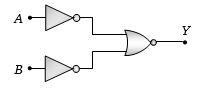
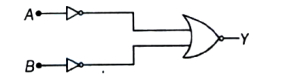
Which logic gate is represented by the following combination of logic gates?
A
$OR$
B
$NAND$
C
$AND$
D
$NOR$
Solution
(C) The given circuit consists of two $NOT$ gates connected to the inputs $A$ and $B$,followed by a $NOR$ gate.
The outputs of the $NOT$ gates are $\bar{A}$ and $\bar{B}$.
These are fed as inputs to the $NOR$ gate.
The output $Y$ of the $NOR$ gate is given by:
$Y = \overline{\bar{A} + \bar{B}}$
According to De Morgan's theorem,$\overline{\bar{A} + \bar{B}} = \bar{\bar{A}} \cdot \bar{\bar{B}} = A \cdot B$.
Thus,$Y = A \cdot B$,which is the Boolean expression for an $AND$ gate.
The outputs of the $NOT$ gates are $\bar{A}$ and $\bar{B}$.
These are fed as inputs to the $NOR$ gate.
The output $Y$ of the $NOR$ gate is given by:
$Y = \overline{\bar{A} + \bar{B}}$
According to De Morgan's theorem,$\overline{\bar{A} + \bar{B}} = \bar{\bar{A}} \cdot \bar{\bar{B}} = A \cdot B$.
Thus,$Y = A \cdot B$,which is the Boolean expression for an $AND$ gate.
0 likesView Solution
2
ChemistryMediumMCQAIIMS · 2004
For principal quantum number $n = 4$,the total number of orbitals having $l = 3$ is:
A
$3$
B
$7$
C
$5$
D
$9$
Solution
(B) The principal quantum number is given as $n = 4$.
For a given $n$,the azimuthal quantum number $l$ can take values from $0$ to $n-1$.
When $l = 3$,it corresponds to the $f$-subshell.
The number of orbitals in a subshell is given by the formula $(2l + 1)$.
Substituting $l = 3$ into the formula: $2(3) + 1 = 6 + 1 = 7$.
Therefore,there are $7$ orbitals in the $4f$ subshell.
For a given $n$,the azimuthal quantum number $l$ can take values from $0$ to $n-1$.
When $l = 3$,it corresponds to the $f$-subshell.
The number of orbitals in a subshell is given by the formula $(2l + 1)$.
Substituting $l = 3$ into the formula: $2(3) + 1 = 6 + 1 = 7$.
Therefore,there are $7$ orbitals in the $4f$ subshell.
0 likesView Solution
3
ChemistryEasyMCQAIIMS · 2004
For the following reaction,which change will shift the equilibrium towards the product?
$I_{2(g)} \rightleftharpoons 2I_{(g)}; \Delta H_r^o(298 \ K) = +150 \ kJ$
$I_{2(g)} \rightleftharpoons 2I_{(g)}; \Delta H_r^o(298 \ K) = +150 \ kJ$
A
Increase in concentration of $I$
B
Decrease in concentration of $I_2$
C
Increase in temperature
D
Increase in total pressure
Solution
(C) The given reaction is $I_{2(g)} \rightleftharpoons 2I_{(g)}$ with $\Delta H_r^o = +150 \ kJ$.
Since $\Delta H_r^o > 0$,the reaction is endothermic.
According to Le Chatelier's principle,for an endothermic reaction,an increase in temperature shifts the equilibrium in the forward direction (towards the product side) to absorb the excess heat.
Therefore,increasing the temperature will shift the reaction towards the product.
Since $\Delta H_r^o > 0$,the reaction is endothermic.
According to Le Chatelier's principle,for an endothermic reaction,an increase in temperature shifts the equilibrium in the forward direction (towards the product side) to absorb the excess heat.
Therefore,increasing the temperature will shift the reaction towards the product.
0 likesView Solution
4
ChemistryMediumMCQAIIMS · 2004
How much $kJ$ energy is released when $6 \ mol$ of octane is burnt in air? Given $\Delta H_f^o$ for $CO_{2(g)}$,$H_2O_{(g)}$ and $C_8H_{18(l)}$ respectively are $-490$,$-240$,and $+160 \ kJ/mol$.
A
$-6.2 \times 10^3$
B
$-37.4 \times 10^3$
C
$-35.5 \times 10^3$
D
$-20.0 \times 10^3$
Solution
(B) The combustion reaction for octane is: $C_8H_{18(l)} + \frac{25}{2} O_{2(g)} \to 8 CO_{2(g)} + 9 H_2O_{(g)}$.
$\Delta H_{comb}^o = [8 \times \Delta H_f^o(CO_2) + 9 \times \Delta H_f^o(H_2O)] - [\Delta H_f^o(C_8H_{18})]$.
$\Delta H_{comb}^o = [8 \times (-490) + 9 \times (-240)] - [160]$.
$\Delta H_{comb}^o = [-3920 - 2160] - 160 = -6240 \ kJ/mol$.
For $6 \ mol$ of octane,the energy released is: $\Delta H = 6 \times (-6240) = -37440 \ kJ = -37.44 \times 10^3 \ kJ$.
$\Delta H_{comb}^o = [8 \times \Delta H_f^o(CO_2) + 9 \times \Delta H_f^o(H_2O)] - [\Delta H_f^o(C_8H_{18})]$.
$\Delta H_{comb}^o = [8 \times (-490) + 9 \times (-240)] - [160]$.
$\Delta H_{comb}^o = [-3920 - 2160] - 160 = -6240 \ kJ/mol$.
For $6 \ mol$ of octane,the energy released is: $\Delta H = 6 \times (-6240) = -37440 \ kJ = -37.44 \times 10^3 \ kJ$.
0 likesView Solution
5
ChemistryMediumMCQAIIMS · 2004
For the decolourization of $1 \ mole$ of $KMnO_4$,the moles of $H_2O_2$ required is: (in $.5$)
A
$0$
B
$1$
C
$2$
D
$3$
Solution
(C) The balanced chemical equation for the reaction between $KMnO_4$ and $H_2O_2$ in an acidic medium is:
$2KMnO_4 + 3H_2SO_4 + 5H_2O_2 \rightarrow K_2SO_4 + 2MnSO_4 + 8H_2O + 5O_2$
From the stoichiometry of the balanced equation,$2 \ moles$ of $KMnO_4$ react with $5 \ moles$ of $H_2O_2$.
Therefore,$1 \ mole$ of $KMnO_4$ requires $\frac{5}{2} = 2.5 \ moles$ of $H_2O_2$.
$2KMnO_4 + 3H_2SO_4 + 5H_2O_2 \rightarrow K_2SO_4 + 2MnSO_4 + 8H_2O + 5O_2$
From the stoichiometry of the balanced equation,$2 \ moles$ of $KMnO_4$ react with $5 \ moles$ of $H_2O_2$.
Therefore,$1 \ mole$ of $KMnO_4$ requires $\frac{5}{2} = 2.5 \ moles$ of $H_2O_2$.
0 likesView Solution
6
ChemistryEasyMCQAIIMS · 2004
For electron affinity of halogens,which of the following is correct?
A
$Br > F$
B
$F > Cl$
C
$Br < Cl$
D
$F > I$
Solution
(C) The correct order of electron affinity for halogens is $Cl > F > Br > I$.
Although electron affinity generally decreases down a group,Chlorine $(Cl)$ has a higher electron affinity than Fluorine $(F)$ because the small size of the $F$ atom leads to strong inter-electronic repulsions in its relatively compact $2p$ subshell.
Therefore,the statement $Br < Cl$ is correct.
Although electron affinity generally decreases down a group,Chlorine $(Cl)$ has a higher electron affinity than Fluorine $(F)$ because the small size of the $F$ atom leads to strong inter-electronic repulsions in its relatively compact $2p$ subshell.
Therefore,the statement $Br < Cl$ is correct.
0 likesView Solution
7
ChemistryEasyMCQAIIMS · 2004
Which of the following is only acidic in nature?
A
$Be(OH)_2$
B
$Mg(OH)_2$
C
$B(OH)_3$
D
$Al(OH)_3$
Solution
(C) $B(OH)_3$ is the hydroxide of a non-metal and exhibits acidic nature in aqueous solution by accepting $OH^-$ ions from water.
In contrast,$Be(OH)_2$,$Mg(OH)_2$,and $Al(OH)_3$ are metallic hydroxides that exhibit basic or amphoteric character.
In contrast,$Be(OH)_2$,$Mg(OH)_2$,and $Al(OH)_3$ are metallic hydroxides that exhibit basic or amphoteric character.
0 likesView Solution
8
ChemistryMediumMCQAIIMS · 2004
The shape of $O_2F_2$ is similar to that of
A
$C_2F_2$
B
$H_2O_2$
C
$H_2F_2$
D
$C_2H_2$
Solution
(B) Both $O_2F_2$ and $H_2O_2$ have a non-planar,open-book structure.
In both molecules,the central oxygen atoms are bonded to each other with a single bond,and each oxygen atom is further bonded to a terminal atom ($F$ in $O_2F_2$ and $H$ in $H_2O_2$).
The dihedral angle in $O_2F_2$ is $87.5^{\circ}$,which is similar to the dihedral angle in $H_2O_2$ ($111.5^{\circ}$ in gas phase).
Therefore,the shape of $O_2F_2$ is similar to that of $H_2O_2$.
In both molecules,the central oxygen atoms are bonded to each other with a single bond,and each oxygen atom is further bonded to a terminal atom ($F$ in $O_2F_2$ and $H$ in $H_2O_2$).
The dihedral angle in $O_2F_2$ is $87.5^{\circ}$,which is similar to the dihedral angle in $H_2O_2$ ($111.5^{\circ}$ in gas phase).
Therefore,the shape of $O_2F_2$ is similar to that of $H_2O_2$.
0 likesView Solution
9
ChemistryMediumMCQAIIMS · 2004
The compound having only primary hydrogen atoms is
A
Isobutene
B
$2,3-$Dimethylbutane
C
Cyclohexane
D
Neopentane
Solution
(D) primary hydrogen atom is one that is attached to a primary carbon atom (a carbon atom bonded to only one other carbon atom).
$A$. Isobutene $(CH_2=C(CH_3)_2)$ contains both primary and secondary hydrogens.
$B$. $2,3-$Dimethylbutane contains primary and tertiary hydrogens.
$C$. Cyclohexane contains only secondary hydrogens.
$D$. Neopentane $(C(CH_3)_4)$ has a central quaternary carbon atom bonded to four methyl groups. All $12$ hydrogen atoms are attached to primary carbon atoms,making them all primary hydrogen atoms.
$A$. Isobutene $(CH_2=C(CH_3)_2)$ contains both primary and secondary hydrogens.
$B$. $2,3-$Dimethylbutane contains primary and tertiary hydrogens.
$C$. Cyclohexane contains only secondary hydrogens.
$D$. Neopentane $(C(CH_3)_4)$ has a central quaternary carbon atom bonded to four methyl groups. All $12$ hydrogen atoms are attached to primary carbon atoms,making them all primary hydrogen atoms.
0 likesView Solution
10
ChemistryDifficultMCQAIIMS · 2004
Which of the following compounds shows geometrical isomerism?
A
B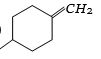
C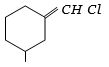
D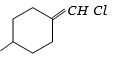
Solution
(C) For a compound to exhibit geometrical isomerism,the atoms or groups attached to each carbon atom of the double bond must be different.
In the given structures,the double bond is exocyclic to a cyclohexane ring.
In options $A$,$B$,and $D$,the exocyclic double bond is $C=CH_2$. Since the two groups attached to the terminal carbon of the double bond are both hydrogen atoms ($-H$ and $-H$),these compounds cannot show geometrical isomerism.
In option $C$,the exocyclic double bond is $C=CHCl$. Here,the terminal carbon of the double bond is attached to one hydrogen atom $(-H)$ and one chlorine atom $(-Cl)$. Since these two groups are different,this compound can exhibit geometrical isomerism (cis-trans isomerism).
In the given structures,the double bond is exocyclic to a cyclohexane ring.
In options $A$,$B$,and $D$,the exocyclic double bond is $C=CH_2$. Since the two groups attached to the terminal carbon of the double bond are both hydrogen atoms ($-H$ and $-H$),these compounds cannot show geometrical isomerism.
In option $C$,the exocyclic double bond is $C=CHCl$. Here,the terminal carbon of the double bond is attached to one hydrogen atom $(-H)$ and one chlorine atom $(-Cl)$. Since these two groups are different,this compound can exhibit geometrical isomerism (cis-trans isomerism).
0 likesView Solution
11
ChemistryDifficultMCQAIIMS · 2004
In the given conformation,if $C_2$ is rotated about the $C_2-C_3$ bond anticlockwise by an angle of $120^{\circ}$,then the conformation obtained is:
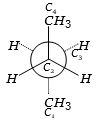
A
Fully eclipsed conformation
B
Partially eclipsed conformation
C
Gauche conformation
D
Staggered conformation
Solution
(C) The given structure is a Newman projection of butane.
In the initial conformation,the two $CH_3$ groups are anti to each other ($180^{\circ}$ apart).
Rotating the front carbon $(C_2)$ anticlockwise by $120^{\circ}$ moves the $CH_3$ group from the bottom position to the position $120^{\circ}$ away from the back $CH_3$ group.
In this new position,the $CH_3$ group on $C_2$ is at a $60^{\circ}$ dihedral angle with respect to the $CH_3$ group on $C_3$.
This specific arrangement,where the bulky groups are at a $60^{\circ}$ dihedral angle,is known as the Gauche conformation.
In the initial conformation,the two $CH_3$ groups are anti to each other ($180^{\circ}$ apart).
Rotating the front carbon $(C_2)$ anticlockwise by $120^{\circ}$ moves the $CH_3$ group from the bottom position to the position $120^{\circ}$ away from the back $CH_3$ group.
In this new position,the $CH_3$ group on $C_2$ is at a $60^{\circ}$ dihedral angle with respect to the $CH_3$ group on $C_3$.
This specific arrangement,where the bulky groups are at a $60^{\circ}$ dihedral angle,is known as the Gauche conformation.
0 likesView Solution
12
ChemistryDifficultMCQAIIMS · 2004
Among the following,the dissociation constant $(K_a)$ is highest for:
A
$C_6H_5OH$
B
$C_6H_5CH_2OH$
C
$CH_3C \equiv CH$
D
$CH_3NH_3^+Cl^-$
Solution
(D) The dissociation constant $(K_a)$ is a measure of the acidity of a substance.
$1$. $CH_3NH_3^+Cl^-$ is a salt of a weak base $(CH_3NH_2)$ and a strong acid $(HCl)$,making it acidic.
$2$. $C_6H_5OH$ (Phenol) has a $pK_a$ of approximately $10$.
$3$. $C_6H_5CH_2OH$ (Benzyl alcohol) is very weakly acidic $(pK_a \approx 15-16)$.
$4$. $CH_3C \equiv CH$ (Propyne) is very weakly acidic $(pK_a \approx 25)$.
Comparing these,the conjugate acid of the weak base $CH_3NH_2$,which is $CH_3NH_3^+$,is significantly more acidic than the others. Therefore,$CH_3NH_3^+Cl^-$ has the highest dissociation constant.
$1$. $CH_3NH_3^+Cl^-$ is a salt of a weak base $(CH_3NH_2)$ and a strong acid $(HCl)$,making it acidic.
$2$. $C_6H_5OH$ (Phenol) has a $pK_a$ of approximately $10$.
$3$. $C_6H_5CH_2OH$ (Benzyl alcohol) is very weakly acidic $(pK_a \approx 15-16)$.
$4$. $CH_3C \equiv CH$ (Propyne) is very weakly acidic $(pK_a \approx 25)$.
Comparing these,the conjugate acid of the weak base $CH_3NH_2$,which is $CH_3NH_3^+$,is significantly more acidic than the others. Therefore,$CH_3NH_3^+Cl^-$ has the highest dissociation constant.
0 likesView Solution
13
ChemistryMediumMCQAIIMS · 2004
Among the following,the aromatic compound is:
A
Cyclopropenyl cation
B
Cyclobutadiene
C
Cyclopentadienyl cation
D
Cyclopropenyl anion
Solution
(A) According to $H$ückel's rule for aromaticity,a molecule must be planar,cyclic,and possess a delocalized $(4n + 2) \, \pi$ electron system,where $n$ is an integer $(n = 0, 1, 2, 3, \dots)$.
$1.$ The cyclopropenyl cation has $2 \, \pi$ electrons $(n = 0)$,making it aromatic.
$2.$ Cyclobutadiene has $4 \, \pi$ electrons ($4n$ system),making it anti-aromatic.
$3.$ The cyclopentadienyl cation has $4 \, \pi$ electrons ($4n$ system),making it anti-aromatic.
$4.$ The cyclopropenyl anion has $4 \, \pi$ electrons ($4n$ system),making it anti-aromatic.
Therefore,the cyclopropenyl cation is the aromatic compound.
$1.$ The cyclopropenyl cation has $2 \, \pi$ electrons $(n = 0)$,making it aromatic.
$2.$ Cyclobutadiene has $4 \, \pi$ electrons ($4n$ system),making it anti-aromatic.
$3.$ The cyclopentadienyl cation has $4 \, \pi$ electrons ($4n$ system),making it anti-aromatic.
$4.$ The cyclopropenyl anion has $4 \, \pi$ electrons ($4n$ system),making it anti-aromatic.
Therefore,the cyclopropenyl cation is the aromatic compound.
0 likesView Solution
14
ChemistryEasyMCQAIIMS · 2004
The compound insoluble in water is
A
Mercurous nitrate
B
Mercuric nitrate
C
Mercurous chloride
D
Mercurous perchlorate
Solution
(C) The compound $Hg_2Cl_2$ (Mercurous chloride) is insoluble in water.
In contrast,$Hg_2(NO_3)_2$ (Mercurous nitrate),$Hg(NO_3)_2$ (Mercuric nitrate),and $Hg_2(ClO_4)_2$ (Mercurous perchlorate) are soluble in water.
In contrast,$Hg_2(NO_3)_2$ (Mercurous nitrate),$Hg(NO_3)_2$ (Mercuric nitrate),and $Hg_2(ClO_4)_2$ (Mercurous perchlorate) are soluble in water.
0 likesView Solution
15
ChemistryMCQAIIMS · 2004
Which one feature is common to leech,cockroach,and scorpion?
A
Nephridia
B
Ventral nerve cord
C
Cephalization
D
Antennae
Solution
(B) Leech (Annelida),cockroach (Arthropoda),and scorpion (Arthropoda) are all invertebrates belonging to the Bilateria group.
$A$ fundamental characteristic shared by these organisms is the presence of a $Ventral$ nerve cord.
In these phyla,the central nervous system consists of a solid,double,$Ventral$ nerve cord with ganglia,which is a distinct feature of protostome invertebrates.
$A$ fundamental characteristic shared by these organisms is the presence of a $Ventral$ nerve cord.
In these phyla,the central nervous system consists of a solid,double,$Ventral$ nerve cord with ganglia,which is a distinct feature of protostome invertebrates.
0 likesView Solution
16
ChemistryMCQAIIMS · 2004
Cultivation of $Bt$ Cotton has been much in the news. The prefix "$Bt$" means
A
$Barium$-treated cotton seeds
B
Bigger thread variety of cotton with better tensile strength
C
Production by "biotechnology" using restriction enzymes and ligases
D
Carrying an endotoxin gene from $Bacillus$ $thuringiensis$
Solution
(D) $Bt$ stands for $Bacillus$ $thuringiensis$.
$Bt$ Cotton is a genetically modified organism $(GMO)$ that has been engineered to express an endotoxin gene derived from the soil bacterium $Bacillus$ $thuringiensis$.
This toxin is specific to certain insect pests (like bollworms) and provides resistance to them, reducing the need for chemical pesticides.
$Bt$ Cotton is a genetically modified organism $(GMO)$ that has been engineered to express an endotoxin gene derived from the soil bacterium $Bacillus$ $thuringiensis$.
This toxin is specific to certain insect pests (like bollworms) and provides resistance to them, reducing the need for chemical pesticides.
0 likesView Solution
17
ChemistryMCQAIIMS · 2004
Minamata disease was caused due to the consumption of
A
Sea food containing lot of cadmium
B
Fish contaminated with mercury
C
Oyster with lot of pesticide
D
Sea food contaminated with selenium
Solution
(B) Minamata disease is a neurological syndrome caused by severe mercury poisoning.
It was first discovered in Minamata City,Japan,in $1956$.
This disease occurred due to the consumption of fish and shellfish contaminated with methylmercury,which was discharged into the Minamata Bay by a chemical factory.
Therefore,the correct option is $B$.
It was first discovered in Minamata City,Japan,in $1956$.
This disease occurred due to the consumption of fish and shellfish contaminated with methylmercury,which was discharged into the Minamata Bay by a chemical factory.
Therefore,the correct option is $B$.
0 likesView Solution
18
ChemistryMCQAIIMS · 2004
Which of the following is a biodegradable polymer?
A
Cellulose
B
Polythene
C
Polyvinyl chloride
D
Nylon-$6$
Solution
(A) Cellulose is a natural polymer found in plants.
It is biodegradable because microorganisms can break down its glycosidic linkages.
In contrast,synthetic polymers like Polythene,Polyvinyl chloride,and Nylon-$6$ are generally non-biodegradable.
It is biodegradable because microorganisms can break down its glycosidic linkages.
In contrast,synthetic polymers like Polythene,Polyvinyl chloride,and Nylon-$6$ are generally non-biodegradable.
0 likesView Solution
19
ChemistryMCQAIIMS · 2004
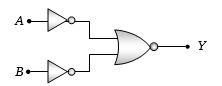
Which logic gate is represented by the following combination of logic gates?
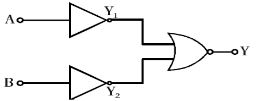
A
$OR$
B
$NAND$
C
$AND$
D
$NOR$
Solution
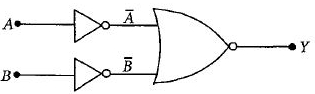
(C) The given circuit consists of two $NOT$ gates connected to the inputs $A$ and $B$,followed by a $NOR$ gate.
The outputs of the $NOT$ gates are $\bar{A}$ and $\bar{B}$.
These are fed as inputs to the $NOR$ gate,so the final output $Y$ is given by the Boolean expression:
$Y = \overline{\bar{A} + \bar{B}}$
Using De Morgan's theorem,$\overline{X + Y} = \bar{X} \cdot \bar{Y}$. Applying this to the expression:
$Y = \overline{\bar{A}} \cdot \overline{\bar{B}}$
Since $\overline{\bar{A}} = A$ and $\overline{\bar{B}} = B$,we get:
$Y = A \cdot B$
This is the Boolean expression for an $AND$ gate. Therefore,the combination represents an $AND$ gate.
The outputs of the $NOT$ gates are $\bar{A}$ and $\bar{B}$.
These are fed as inputs to the $NOR$ gate,so the final output $Y$ is given by the Boolean expression:
$Y = \overline{\bar{A} + \bar{B}}$
Using De Morgan's theorem,$\overline{X + Y} = \bar{X} \cdot \bar{Y}$. Applying this to the expression:
$Y = \overline{\bar{A}} \cdot \overline{\bar{B}}$
Since $\overline{\bar{A}} = A$ and $\overline{\bar{B}} = B$,we get:
$Y = A \cdot B$
This is the Boolean expression for an $AND$ gate. Therefore,the combination represents an $AND$ gate.
0 likesView Solution
20
ChemistryMediumMCQAIIMS · 2004
For the equilibrium $H_2O_{(l)} \rightleftharpoons H_2O_{(g)}$ at $1 \ atm$ and $298 \ K$,which of the following statements is correct?
A
Standard free energy change is equal to zero $(\Delta G^o = 0)$
B
Free energy change is less than zero $(\Delta G < 0)$
C
Standard free energy change is less than zero $(\Delta G^o < 0)$
D
Standard free energy change is greater than zero $(\Delta G^o > 0)$
Solution
(D) At $298 \ K$ and $1 \ atm$,liquid water is the stable phase,meaning the process $H_2O_{(l)} \rightarrow H_2O_{(g)}$ is non-spontaneous.
Since the process is non-spontaneous,the Gibbs free energy change $\Delta G$ for the forward reaction is greater than zero $(\Delta G > 0)$.
However,the question asks about the equilibrium state at these conditions.
Actually,at $298 \ K$ and $1 \ atm$,the equilibrium constant $K_p = P_{H_2O} = 0.0313 \ atm$.
Since $\Delta G^o = -RT \ln K_p$,and $K_p < 1$,$\Delta G^o$ must be positive $(\Delta G^o > 0)$.
Since the process is non-spontaneous,the Gibbs free energy change $\Delta G$ for the forward reaction is greater than zero $(\Delta G > 0)$.
However,the question asks about the equilibrium state at these conditions.
Actually,at $298 \ K$ and $1 \ atm$,the equilibrium constant $K_p = P_{H_2O} = 0.0313 \ atm$.
Since $\Delta G^o = -RT \ln K_p$,and $K_p < 1$,$\Delta G^o$ must be positive $(\Delta G^o > 0)$.
0 likesView Solution
21
ChemistryMediumMCQAIIMS · 2004
The $O-N-O$ bond angle is maximum in:
A
$NO_3^-$
B
$NO_2^-$
C
$NO_2$
D
$NO_2^+$
Solution
(D) The bond angles for the given species are as follows:
$NO_2^+$: The nitrogen atom is $sp$ hybridized,resulting in a linear geometry with a bond angle of $180^\circ$.
$NO_2$: The nitrogen atom is $sp^2$ hybridized with one unpaired electron,resulting in a bent geometry with a bond angle of approximately $134^\circ$.
$NO_2^-$: The nitrogen atom is $sp^2$ hybridized with one lone pair,resulting in a bent geometry with a bond angle of approximately $115^\circ$.
$NO_3^-$: The nitrogen atom is $sp^2$ hybridized,resulting in a trigonal planar geometry with a bond angle of $120^\circ$.
Comparing these values,the $O-N-O$ bond angle is maximum in $NO_2^+$.
Therefore,the correct option is $(D)$.
$NO_2^+$: The nitrogen atom is $sp$ hybridized,resulting in a linear geometry with a bond angle of $180^\circ$.
$NO_2$: The nitrogen atom is $sp^2$ hybridized with one unpaired electron,resulting in a bent geometry with a bond angle of approximately $134^\circ$.
$NO_2^-$: The nitrogen atom is $sp^2$ hybridized with one lone pair,resulting in a bent geometry with a bond angle of approximately $115^\circ$.
$NO_3^-$: The nitrogen atom is $sp^2$ hybridized,resulting in a trigonal planar geometry with a bond angle of $120^\circ$.
Comparing these values,the $O-N-O$ bond angle is maximum in $NO_2^+$.
Therefore,the correct option is $(D)$.
0 likesView Solution
22
ChemistryMCQAIIMS · 2004
$A$ $Ge$ specimen is doped with $Al$. The concentration of acceptor atoms is $\sim 10^{21} \text{ atoms}/m^3$. Given that the intrinsic concentration of electron-hole pairs is $\sim 10^{19} /m^3$,the concentration of electrons in the specimen is:
A
$10^{17} /m^3$
B
$10^{15} /m^3$
C
$10^4 /m^3$
D
$10^2 /m^3$
Solution
(A) When a $Ge$ specimen is doped with $Al$ (a trivalent impurity),it becomes a $p$-type semiconductor.
The concentration of acceptor atoms $(N_A)$ is approximately equal to the concentration of holes $(p_0)$: $p_0 \approx N_A = 10^{21} /m^3$.
According to the law of mass action for semiconductors,the product of the concentration of electrons $(n_0)$ and holes $(p_0)$ is equal to the square of the intrinsic carrier concentration $(n_i)$:
$n_i^2 = n_0 \times p_0$
Given:
$n_i = 10^{19} /m^3$
$p_0 = 10^{21} /m^3$
Substituting the values:
$(10^{19})^2 = n_0 \times 10^{21}$
$10^{38} = n_0 \times 10^{21}$
$n_0 = \frac{10^{38}}{10^{21}} = 10^{17} /m^3$
Thus,the concentration of electrons in the specimen is $10^{17} /m^3$.
The concentration of acceptor atoms $(N_A)$ is approximately equal to the concentration of holes $(p_0)$: $p_0 \approx N_A = 10^{21} /m^3$.
According to the law of mass action for semiconductors,the product of the concentration of electrons $(n_0)$ and holes $(p_0)$ is equal to the square of the intrinsic carrier concentration $(n_i)$:
$n_i^2 = n_0 \times p_0$
Given:
$n_i = 10^{19} /m^3$
$p_0 = 10^{21} /m^3$
Substituting the values:
$(10^{19})^2 = n_0 \times 10^{21}$
$10^{38} = n_0 \times 10^{21}$
$n_0 = \frac{10^{38}}{10^{21}} = 10^{17} /m^3$
Thus,the concentration of electrons in the specimen is $10^{17} /m^3$.
0 likesView Solution
23
ChemistryMCQAIIMS · 2004
Which of the following is not considered an organometallic compound?
A
Ferrocene
B
Ziese’s salt
C
Grignard reagent
D
Cis-platin
Solution
(D) An organometallic compound is defined as a compound containing at least one $M-C$ bond (metal-carbon bond).
$1$. Ferrocene $(Fe(C_5H_5)_2)$ contains $Fe-C$ bonds.
$2$. Ziese’s salt $(K[PtCl_3(C_2H_4)])$ contains a $Pt-C$ bond.
$3$. Grignard reagent $(R-Mg-X)$ contains a $Mg-C$ bond.
$4$. Cis-platin $([Pt(NH_3)_2Cl_2])$ is a coordination compound that does not contain any $Pt-C$ bond.
Therefore,Cis-platin is not an organometallic compound.
$1$. Ferrocene $(Fe(C_5H_5)_2)$ contains $Fe-C$ bonds.
$2$. Ziese’s salt $(K[PtCl_3(C_2H_4)])$ contains a $Pt-C$ bond.
$3$. Grignard reagent $(R-Mg-X)$ contains a $Mg-C$ bond.
$4$. Cis-platin $([Pt(NH_3)_2Cl_2])$ is a coordination compound that does not contain any $Pt-C$ bond.
Therefore,Cis-platin is not an organometallic compound.
0 likesView Solution
24
ChemistryMCQAIIMS · 2004
$A$ $Ge$ specimen is doped with $Al$. The concentration of acceptor atoms is $\sim 10^{21} \, \text{atoms}/m^3$. Given that the intrinsic concentration of electron-hole pairs is $\sim 10^{19}/m^3$, the concentration of electrons in the specimen is:
A
$10^{17}/m^3$
B
$10^{15}/m^3$
C
$10^4/m^3$
D
$10^2/m^3$
Solution
(A) In a $p$-type semiconductor, the concentration of holes $(p_0)$ is approximately equal to the concentration of acceptor atoms $(N_A)$.
Given, $N_A = p_0 = 10^{21} \, \text{atoms}/m^3$.
The intrinsic carrier concentration is $n_i = 10^{19}/m^3$.
According to the law of mass action for semiconductors, $n_i^2 = n_0 \cdot p_0$, where $n_0$ is the concentration of electrons.
Substituting the values: $(10^{19})^2 = n_0 \cdot 10^{21}$.
$10^{38} = n_0 \cdot 10^{21}$.
$n_0 = \frac{10^{38}}{10^{21}} = 10^{17}/m^3$.
Given, $N_A = p_0 = 10^{21} \, \text{atoms}/m^3$.
The intrinsic carrier concentration is $n_i = 10^{19}/m^3$.
According to the law of mass action for semiconductors, $n_i^2 = n_0 \cdot p_0$, where $n_0$ is the concentration of electrons.
Substituting the values: $(10^{19})^2 = n_0 \cdot 10^{21}$.
$10^{38} = n_0 \cdot 10^{21}$.
$n_0 = \frac{10^{38}}{10^{21}} = 10^{17}/m^3$.
0 likesView Solution
25
ChemistryMCQAIIMS · 2004
Which of the following is not considered as an organometallic compound?
A
Ferrocene
B
cis-platin
C
Zeise's salt
D
Grignard reagent
Solution
(B) An organometallic compound is defined as a compound containing at least one direct metal-carbon $(M-C)$ bond.
$1$. Ferrocene $(Fe(C_5H_5)_2)$ contains $Fe-C$ bonds.
$2$. Zeise's salt $(K[PtCl_3(C_2H_4)])$ contains a $Pt-C$ bond.
$3$. Grignard reagent $(R-Mg-X)$ contains a $Mg-C$ bond.
$4$. $cis$-platin $([Pt(NH_3)_2Cl_2])$ is a coordination compound where the metal $(Pt)$ is bonded to $N$ and $Cl$ atoms,not to carbon. Therefore,it is not an organometallic compound.
$1$. Ferrocene $(Fe(C_5H_5)_2)$ contains $Fe-C$ bonds.
$2$. Zeise's salt $(K[PtCl_3(C_2H_4)])$ contains a $Pt-C$ bond.
$3$. Grignard reagent $(R-Mg-X)$ contains a $Mg-C$ bond.
$4$. $cis$-platin $([Pt(NH_3)_2Cl_2])$ is a coordination compound where the metal $(Pt)$ is bonded to $N$ and $Cl$ atoms,not to carbon. Therefore,it is not an organometallic compound.
0 likesView Solution
26
ChemistryMCQAIIMS · 2004
The cyclotron frequency of an electron gyrating in a magnetic field of $1\, T$ is approximately
A
$28\, MHz$
B
$280\, MHz$
C
$2.8\, GHz$
D
$28\, GHz$
Solution
(D) The cyclotron frequency $f$ is given by the formula $f = \frac{qB}{2\pi m}$.
Given:
Charge of electron $q = 1.6 \times 10^{-19}\, C$
Magnetic field $B = 1\, T$
Mass of electron $m = 9.1 \times 10^{-31}\, kg$
Substituting the values:
$f = \frac{1.6 \times 10^{-19} \times 1}{2 \times 3.14159 \times 9.1 \times 10^{-31}}$
$f \approx \frac{1.6}{57.17} \times 10^{12}\, Hz$
$f \approx 0.02798 \times 10^{12}\, Hz$
$f \approx 27.98 \times 10^9\, Hz \approx 28\, GHz$.
Given:
Charge of electron $q = 1.6 \times 10^{-19}\, C$
Magnetic field $B = 1\, T$
Mass of electron $m = 9.1 \times 10^{-31}\, kg$
Substituting the values:
$f = \frac{1.6 \times 10^{-19} \times 1}{2 \times 3.14159 \times 9.1 \times 10^{-31}}$
$f \approx \frac{1.6}{57.17} \times 10^{12}\, Hz$
$f \approx 0.02798 \times 10^{12}\, Hz$
$f \approx 27.98 \times 10^9\, Hz \approx 28\, GHz$.
0 likesView Solution
27
ChemistryMCQAIIMS · 2004
Which of the following is a biodegradable polymer?
A
Cellulose
B
Polyvinyl chloride
C
Polyethylene
D
Nylon-$6$
Solution
(A) Biodegradable polymers are polymers that can be decomposed by microorganisms.
Cellulose is a natural,biodegradable polymer found in plant cell walls.
Polyvinyl chloride,polyethylene,and Nylon-$6$ are synthetic polymers that are generally non-biodegradable.
Cellulose is a natural,biodegradable polymer found in plant cell walls.
Polyvinyl chloride,polyethylene,and Nylon-$6$ are synthetic polymers that are generally non-biodegradable.
0 likesView Solution
28
ChemistryMCQAIIMS · 2004
$Assertion$ : The driver in a vehicle moving with a constant speed on a straight road is in a non-inertial frame of reference.
$Reason$ : $A$ reference frame in which Newton's laws of motion are applicable is non-inertial.
$Reason$ : $A$ reference frame in which Newton's laws of motion are applicable is non-inertial.
A
If both $Assertion$ and $Reason$ are correct and the $Reason$ is a correct explanation of the $Assertion$.
B
If both $Assertion$ and $Reason$ are correct but $Reason$ is not a correct explanation of the $Assertion$.
C
If the $Assertion$ is correct but $Reason$ is incorrect.
D
If both the $Assertion$ and $Reason$ are incorrect.
Solution
(D) An inertial frame of reference is one in which Newton's laws of motion are valid.
$A$ vehicle moving with a constant speed on a straight road has zero acceleration $(a = 0)$. Therefore,it is an inertial frame of reference.
The $Assertion$ states that the driver is in a non-inertial frame,which is incorrect.
The $Reason$ states that a frame where Newton's laws are applicable is non-inertial,which is also incorrect because Newton's laws are applicable in inertial frames.
Thus,both $Assertion$ and $Reason$ are incorrect.
$A$ vehicle moving with a constant speed on a straight road has zero acceleration $(a = 0)$. Therefore,it is an inertial frame of reference.
The $Assertion$ states that the driver is in a non-inertial frame,which is incorrect.
The $Reason$ states that a frame where Newton's laws are applicable is non-inertial,which is also incorrect because Newton's laws are applicable in inertial frames.
Thus,both $Assertion$ and $Reason$ are incorrect.
0 likesView Solution
29
ChemistryMCQAIIMS · 2004
The direction of the angular velocity vector is along
A
the tangent to the circular path
B
the inward radius
C
the outward radius
D
the axis of rotation
Solution
(D) The angular velocity vector $\vec{\omega}$ is defined such that its magnitude is $\omega = \frac{d\theta}{dt}$.
By the right-hand rule,the direction of the angular velocity vector $\vec{\omega}$ is always perpendicular to the plane of rotation.
For a body rotating about a fixed axis,this vector points along the axis of rotation.
Therefore,the correct option is $D$.
By the right-hand rule,the direction of the angular velocity vector $\vec{\omega}$ is always perpendicular to the plane of rotation.
For a body rotating about a fixed axis,this vector points along the axis of rotation.
Therefore,the correct option is $D$.
0 likesView Solution
30
ChemistryDifficultMCQAIIMS · 2004
Assertion : All $F-S-F$ angles in $SF_4$ are greater than $90^\circ$ but less than $180^\circ$.
Reason : The lone pair-bond pair repulsion is weaker than bond pair-bond pair repulsion.
Reason : The lone pair-bond pair repulsion is weaker than bond pair-bond pair repulsion.
A
If both Assertion and Reason are correct and the Reason is a correct explanation of the Assertion.
B
If both Assertion and Reason are correct but Reason is not a correct explanation of the Assertion.
C
If the Assertion is correct but Reason is incorrect.
D
If both the Assertion and Reason are incorrect.
Solution
(D) $SF_4$ has a see-saw molecular geometry with $sp^3d$ hybridization. It contains one lone pair on the sulfur atom.
According to $VSEPR$ theory,the repulsion order is $lp-lp > lp-bp > bp-bp$.
The lone pair occupies an equatorial position to minimize repulsion. This lone pair exerts a strong repulsion on the adjacent bond pairs,causing the equatorial $F-S-F$ bond angle to decrease from $120^\circ$ to approximately $101^\circ$ and the axial $F-S-F$ bond angle to decrease from $180^\circ$ to approximately $173^\circ$.
The other $F-S-F$ bond angle is approximately $89^\circ$.
Since one of the bond angles $(89^\circ)$ is less than $90^\circ$,the Assertion is incorrect.
The Reason is also incorrect because $lp-bp$ repulsion is actually stronger than $bp-bp$ repulsion.
According to $VSEPR$ theory,the repulsion order is $lp-lp > lp-bp > bp-bp$.
The lone pair occupies an equatorial position to minimize repulsion. This lone pair exerts a strong repulsion on the adjacent bond pairs,causing the equatorial $F-S-F$ bond angle to decrease from $120^\circ$ to approximately $101^\circ$ and the axial $F-S-F$ bond angle to decrease from $180^\circ$ to approximately $173^\circ$.
The other $F-S-F$ bond angle is approximately $89^\circ$.
Since one of the bond angles $(89^\circ)$ is less than $90^\circ$,the Assertion is incorrect.
The Reason is also incorrect because $lp-bp$ repulsion is actually stronger than $bp-bp$ repulsion.
0 likesView Solution
31
ChemistryMediumMCQAIIMS · 2004
Assertion : Molar enthalpy of vaporisation of water is different from ethanol.
Reason : Water is more polar than ethanol.
Reason : Water is more polar than ethanol.
A
If both Assertion and Reason are correct and the Reason is a correct explanation of the Assertion.
B
If both Assertion and Reason are correct but Reason is not a correct explanation of the Assertion.
C
If the Assertion is correct but Reason is incorrect.
D
If both the Assertion and Reason are incorrect.
Solution
(A) The molar enthalpy of vaporisation of water is $40.7 \ kJ/mol$,while for ethanol it is $38.6 \ kJ/mol$.
This difference arises because water molecules exhibit stronger hydrogen bonding compared to ethanol molecules.
Water is indeed more polar than ethanol due to the presence of two $O-H$ bonds and a higher dipole moment.
However,the primary reason for the difference in enthalpy of vaporisation is the extent and strength of hydrogen bonding,which is directly related to the polarity of the molecules.
Therefore,both statements are correct and the reason explains the assertion.
This difference arises because water molecules exhibit stronger hydrogen bonding compared to ethanol molecules.
Water is indeed more polar than ethanol due to the presence of two $O-H$ bonds and a higher dipole moment.
However,the primary reason for the difference in enthalpy of vaporisation is the extent and strength of hydrogen bonding,which is directly related to the polarity of the molecules.
Therefore,both statements are correct and the reason explains the assertion.
0 likesView Solution
32
ChemistryMediumMCQAIIMS · 2004
Assertion : Addition of silver ions to a mixture of aqueous sodium chloride and sodium bromide solution will first precipitate $AgBr$ rather than $AgCl$.
Reason : $K_{sp}$ of $AgCl < K_{sp}$ of $AgBr$.
Reason : $K_{sp}$ of $AgCl < K_{sp}$ of $AgBr$.
A
If both Assertion and Reason are correct and the Reason is a correct explanation of the Assertion.
B
If both Assertion and Reason are correct but Reason is not a correct explanation of the Assertion.
C
If the Assertion is correct but Reason is incorrect.
D
If both the Assertion and Reason are incorrect.
Solution
(C) The solubility product constant $(K_{sp})$ values at $25^{\circ}C$ are approximately $K_{sp}(AgCl) \approx 1.8 \times 10^{-10}$ and $K_{sp}(AgBr) \approx 5.0 \times 10^{-13}$.
Since $K_{sp}(AgBr) < K_{sp}(AgCl)$,$AgBr$ requires a lower concentration of $Ag^+$ ions to exceed its solubility product compared to $AgCl$.
Therefore,$AgBr$ will precipitate first.
The Assertion is correct,but the Reason is incorrect because it states $K_{sp}(AgCl) < K_{sp}(AgBr)$,which is false.
Since $K_{sp}(AgBr) < K_{sp}(AgCl)$,$AgBr$ requires a lower concentration of $Ag^+$ ions to exceed its solubility product compared to $AgCl$.
Therefore,$AgBr$ will precipitate first.
The Assertion is correct,but the Reason is incorrect because it states $K_{sp}(AgCl) < K_{sp}(AgBr)$,which is false.
0 likesView Solution
33
ChemistryMCQAIIMS · 2004
Assertion : $HClO_4$ is a stronger acid than $HClO_3$.
Reason : Oxidation state of $Cl$ in $HClO_4$ is $+7$ and in $HClO_3$,it is $+5$.
Reason : Oxidation state of $Cl$ in $HClO_4$ is $+7$ and in $HClO_3$,it is $+5$.
A
If both Assertion and Reason are correct and the Reason is a correct explanation of the Assertion.
B
If both Assertion and Reason are correct but Reason is not a correct explanation of the Assertion.
C
If the Assertion is correct but Reason is incorrect.
D
If both the Assertion and Reason are incorrect.
Solution
(A) The acidic strength of oxoacids of chlorine increases with an increase in the oxidation state of the central chlorine atom.
In $HClO_4$,the oxidation state of $Cl$ is $+7$,whereas in $HClO_3$,it is $+5$.
Higher oxidation state leads to greater electron-withdrawing power of the $Cl$ atom,which weakens the $O-H$ bond and facilitates the release of $H^+$ ions.
Thus,$HClO_4$ is a stronger acid than $HClO_3$ and the reason correctly explains the assertion.
In $HClO_4$,the oxidation state of $Cl$ is $+7$,whereas in $HClO_3$,it is $+5$.
Higher oxidation state leads to greater electron-withdrawing power of the $Cl$ atom,which weakens the $O-H$ bond and facilitates the release of $H^+$ ions.
Thus,$HClO_4$ is a stronger acid than $HClO_3$ and the reason correctly explains the assertion.
0 likesView Solution
34
ChemistryDifficultMCQAIIMS · 2004
Assertion : $HClO_4$ is a stronger acid than $HClO_3$.
Reason : Oxidation state of $Cl$ in $HClO_4$ is $+VII$ and in $HClO_3$ is $+V$.
Reason : Oxidation state of $Cl$ in $HClO_4$ is $+VII$ and in $HClO_3$ is $+V$.
A
If both Assertion and Reason are correct and the Reason is a correct explanation of the Assertion.
B
If both Assertion and Reason are correct but Reason is not a correct explanation of the Assertion.
C
If the Assertion is correct but Reason is incorrect.
D
If both the Assertion and Reason are incorrect.
Solution
(B) The Assertion is correct: $HClO_4$ is indeed a stronger acid than $HClO_3$.
The Reason is also correct: The oxidation state of $Cl$ in $HClO_4$ is $+VII$ and in $HClO_3$ is $+V$.
However,the Reason is not the correct explanation for the Assertion. The acidity of oxyacids is determined by the number of non-hydroxylated oxygen atoms $(n)$ in the general formula $(HO)_m ZO_n$.
For $HClO_4$ $(HOClO_3)$,$n = 3$. For $HClO_3$ $(HOClO_2)$,$n = 2$.
As the number of non-hydroxylated oxygen atoms $(n)$ increases,the electron-withdrawing effect on the $Cl$ atom increases,which in turn weakens the $O-H$ bond,facilitating the release of the $H^+$ ion. Thus,the acidity depends on the number of non-hydroxylated oxygen atoms,not directly on the oxidation state of the central atom.
The Reason is also correct: The oxidation state of $Cl$ in $HClO_4$ is $+VII$ and in $HClO_3$ is $+V$.
However,the Reason is not the correct explanation for the Assertion. The acidity of oxyacids is determined by the number of non-hydroxylated oxygen atoms $(n)$ in the general formula $(HO)_m ZO_n$.
For $HClO_4$ $(HOClO_3)$,$n = 3$. For $HClO_3$ $(HOClO_2)$,$n = 2$.
As the number of non-hydroxylated oxygen atoms $(n)$ increases,the electron-withdrawing effect on the $Cl$ atom increases,which in turn weakens the $O-H$ bond,facilitating the release of the $H^+$ ion. Thus,the acidity depends on the number of non-hydroxylated oxygen atoms,not directly on the oxidation state of the central atom.
0 likesView Solution
35
ChemistryDifficultMCQAIIMS · 2004
Assertion : $Sb(III)$ is not precipitated as sulphide when $H_2S$ is passed through its alkaline solution.
Reason : The concentration of $S^{2-}$ ion in alkaline medium is inadequate for precipitation.
Reason : The concentration of $S^{2-}$ ion in alkaline medium is inadequate for precipitation.
A
If both Assertion and Reason are correct and the Reason is a correct explanation of the Assertion.
B
If both Assertion and Reason are correct but Reason is not a correct explanation of the Assertion.
C
If the Assertion is correct but Reason is incorrect.
D
If both the Assertion and Reason are incorrect.
Solution
(D) $Sb(III)$ belongs to the $II$ group of qualitative analysis and is precipitated as $Sb_2S_3$ by passing $H_2S$ in an acidic medium (presence of $HCl$).
The $HCl$ provides $H^+$ ions,which suppress the dissociation of $H_2S$ due to the common ion effect,keeping the concentration of $S^{2-}$ low,which is sufficient for $II$ group precipitation but not for higher groups.
In an alkaline medium,$OH^-$ ions react with $H^+$ ions from $H_2S$ to form water $(H^+ + OH^- \rightleftharpoons H_2O)$.
This shifts the equilibrium $H_2S \rightleftharpoons 2H^+ + S^{2-}$ to the right,significantly increasing the concentration of $S^{2-}$ ions.
Since the concentration of $S^{2-}$ is very high in an alkaline medium,$Sb(III)$ will definitely precipitate as a sulphide.
Therefore,the Assertion is false because $Sb(III)$ is indeed precipitated in an alkaline medium,and the Reason is false because the concentration of $S^{2-}$ is actually very high,not inadequate.
The $HCl$ provides $H^+$ ions,which suppress the dissociation of $H_2S$ due to the common ion effect,keeping the concentration of $S^{2-}$ low,which is sufficient for $II$ group precipitation but not for higher groups.
In an alkaline medium,$OH^-$ ions react with $H^+$ ions from $H_2S$ to form water $(H^+ + OH^- \rightleftharpoons H_2O)$.
This shifts the equilibrium $H_2S \rightleftharpoons 2H^+ + S^{2-}$ to the right,significantly increasing the concentration of $S^{2-}$ ions.
Since the concentration of $S^{2-}$ is very high in an alkaline medium,$Sb(III)$ will definitely precipitate as a sulphide.
Therefore,the Assertion is false because $Sb(III)$ is indeed precipitated in an alkaline medium,and the Reason is false because the concentration of $S^{2-}$ is actually very high,not inadequate.
0 likesView Solution
36
ChemistryMCQAIIMS · 2004
Assertion : Cyclic pathway of photosynthesis first appeared in some eubacterial species.
Reason : Oxygen started accumulating in the atmosphere after the non-cyclic pathway of photosynthesis evolved.
Reason : Oxygen started accumulating in the atmosphere after the non-cyclic pathway of photosynthesis evolved.
A
If both Assertion and Reason are correct and the Reason is a correct explanation of the Assertion.
B
If both Assertion and Reason are correct but Reason is not a correct explanation of the Assertion.
C
If the Assertion is correct but Reason is incorrect.
D
If both the Assertion and Reason are incorrect.
Solution
(A) The cyclic pathway of photosynthesis is considered the most primitive form of photosynthesis,which first appeared in ancient eubacterial species (like purple and green sulfur bacteria) that did not evolve oxygen.
Non-cyclic photophosphorylation ($Z$-scheme) involves the photolysis of water,which releases $O_2$ as a byproduct.
As non-cyclic photosynthesis evolved,oxygen began to accumulate in the atmosphere,leading to the oxygenation of the Earth's atmosphere.
Both the Assertion and Reason are correct,and the evolution of the non-cyclic pathway is the reason for the accumulation of atmospheric oxygen,which distinguishes it from the primitive cyclic pathway.
Non-cyclic photophosphorylation ($Z$-scheme) involves the photolysis of water,which releases $O_2$ as a byproduct.
As non-cyclic photosynthesis evolved,oxygen began to accumulate in the atmosphere,leading to the oxygenation of the Earth's atmosphere.
Both the Assertion and Reason are correct,and the evolution of the non-cyclic pathway is the reason for the accumulation of atmospheric oxygen,which distinguishes it from the primitive cyclic pathway.
0 likesView Solution
37
ChemistryMCQAIIMS · 2004
The total number of nitrogenous bases in the human genome is estimated to be about
A
$3.5$ million
B
$35$ thousand
C
$35$ million
D
$3.1$ billion
Solution
(D) The human genome consists of approximately $3.1$ billion base pairs ($3.1 \times 10^9$ bp).
These base pairs are organized into $24$ distinct,physically separate microscopic units known as chromosomes.
The genome represents the complete set of genetic instructions required to build and maintain an organism.
These base pairs are organized into $24$ distinct,physically separate microscopic units known as chromosomes.
The genome represents the complete set of genetic instructions required to build and maintain an organism.
0 likesView Solution
38
ChemistryMCQAIIMS · 2004
Which one of the following pairs is correctly matched with regard to the codon and the amino acid coded by it?
A
$UUA - \text{Leucine}$
B
$AAA - \text{Lysine}$
C
$AUG - \text{Cysteine}$
D
$CCC - \text{Alanine}$
Solution
(B) The genetic code is degenerate, meaning multiple codons can code for the same amino acid.
$1$. $UUA$ codes for Leucine, not Valine.
$2$. $AAA$ codes for Lysine. This is a correct match.
$3$. $AUG$ codes for Methionine (the start codon), not Cysteine.
$4$. $CCC$ codes for Proline, not Alanine.
Therefore, the pair $AAA - \text{Lysine}$ is correctly matched.
$1$. $UUA$ codes for Leucine, not Valine.
$2$. $AAA$ codes for Lysine. This is a correct match.
$3$. $AUG$ codes for Methionine (the start codon), not Cysteine.
$4$. $CCC$ codes for Proline, not Alanine.
Therefore, the pair $AAA - \text{Lysine}$ is correctly matched.
0 likesView Solution
39
ChemistryMCQAIIMS · 2004
Assertion : Cattle breeds can be improved by super ovulation and embryo transplantation.
Reason : Superovulation in high milk-yielding cows is induced by hormonal injection.
Reason : Superovulation in high milk-yielding cows is induced by hormonal injection.
A
If both Assertion and Reason are correct and the Reason is a correct explanation of the Assertion.
B
If both Assertion and Reason are correct but Reason is not a correct explanation of the Assertion.
C
If the Assertion is correct but Reason is incorrect.
D
If both the Assertion and Reason are incorrect.
Solution
(A) Superovulation is a technique used in animal breeding where a cow is treated with hormones (like $FSH$) to induce the maturation of multiple follicles,resulting in the production of more than one egg per cycle.
This technique,combined with embryo transplantation,allows for the rapid multiplication of high-quality cattle breeds by transferring embryos from a high-yielding donor cow to surrogate mothers.
Since the process of superovulation is indeed induced by hormonal injections,the Reason correctly explains why cattle breeds can be improved through this method.
Therefore,both the Assertion and the Reason are correct,and the Reason is the correct explanation of the Assertion.
This technique,combined with embryo transplantation,allows for the rapid multiplication of high-quality cattle breeds by transferring embryos from a high-yielding donor cow to surrogate mothers.
Since the process of superovulation is indeed induced by hormonal injections,the Reason correctly explains why cattle breeds can be improved through this method.
Therefore,both the Assertion and the Reason are correct,and the Reason is the correct explanation of the Assertion.
0 likesView Solution
40
ChemistryMCQAIIMS · 2004
Mosses and ferns are found in moist and shady places because both
A
Require presence of water for fertilization
B
Do not need sunlight for photosynthesis
C
Depend for their nutrition on microorganisms,which can survive only at low temperature
D
Cannot compete with sun-loving plants
Solution
(A) Mosses (Bryophytes) and ferns (Pteridophytes) require water for the process of fertilization. In these plants,the male gametes (antherozoids) are flagellated and motile,and they need a film of water to swim to the female gamete (archegonium) to achieve fertilization. Therefore,they are restricted to moist and shady habitats.
0 likesView Solution
41
ChemistryMCQAIIMS · 2004
Potato and sweet potato:
A
Have edible parts,which are homologous organs
B
Have edible parts,which are analogous organs
C
Have been introduced in India from the same place
D
Are two species of the same genus
Solution
(B) Analogous organs are those that have different embryonic origins and structural anatomy but perform similar functions,such as storage of food.
Potato is a modified stem (stem tuber),whereas sweet potato is a modified root (tuberous root).
Since they arise from different plant parts but both serve the function of food storage,they are considered analogous organs.
Potato is a modified stem (stem tuber),whereas sweet potato is a modified root (tuberous root).
Since they arise from different plant parts but both serve the function of food storage,they are considered analogous organs.
0 likesView Solution
42
ChemistryMCQAIIMS · 2004
Companion cells in plants are associated with
A
Vessels
B
Sperms
C
Sieve elements
D
Guard cells
Solution
(C) Companion cells are specialized parenchyma cells that are closely associated with sieve tube elements in the phloem of angiosperms.
These cells are connected to the sieve tube elements via plasmodesmata.
Since mature sieve tube elements lack a nucleus,they rely on the companion cells for the regulation of metabolic activities and the maintenance of their cellular functions.
These cells are connected to the sieve tube elements via plasmodesmata.
Since mature sieve tube elements lack a nucleus,they rely on the companion cells for the regulation of metabolic activities and the maintenance of their cellular functions.
0 likesView Solution
43
ChemistryMCQAIIMS · 2004
An artificial pacemaker is implanted subcutaneously and connected to the heart in patients:
A
Having $90\%$ blockage of the three main coronary arteries
B
Having a very high blood pressure
C
With irregularity in the heart rhythm
D
Suffering from arteriosclerosis
Solution
(C) The $SA$ node (sino-atrial node) initiates heartbeats and thereby sets the basic pace of the heartbeat; hence,it is called the natural pacemaker. An artificial pacemaker is an electronic device implanted subcutaneously and connected to the heart in patients suffering from an irregular heart rhythm (arrhythmia) to ensure a steady and normal heartbeat.
0 likesView Solution
44
ChemistryMCQAIIMS · 2004
The total number of nitrogenous bases in the human genome is estimated to be about:
A
$35$ million
B
$3.1$ billion
C
$3.5$ million
D
$35$ thousand
Solution
(B) $DNA$ is a double-stranded molecule. The size of the genome is expressed in base pairs $(bp)$,which represents the total number of nucleotides in the genome. The human genome contains approximately $3.1647$ billion base pairs,which is commonly estimated to be about $3.1$ billion nitrogenous bases.
0 likesView Solution
45
ChemistryMCQAIIMS · 2004
Cultivation of $Bt$ cotton has been much in the news. The prefix $Bt$ means
A
Barium-treated cotton seeds
B
Bigger thread variety of cotton with better tensile strength
C
Produced by biotechnology using restriction enzymes and ligases
D
Carrying an endotoxin gene from Bacillus thuringiensis
Solution
(D) $Bt$ cotton, $Bt$ tobacco, $Bt$ tomato, etc., are transgenic plants having the $Bt$ gene encoding $Bt$ toxin (e.g., thurioside).
$Bt$ toxin gene has been isolated from a bacterium $Bacillus \text{ } thuringiensis$; therefore, it is called $Bt$ (i.e., $Bacillus \text{ } thuringiensis$).
These plants are resistant to more than $140$ species of insects, including common cabbage worm, caterpillars, bag worms, canker worms, gypsy worm, etc.
$Bt$ toxin gene has been isolated from a bacterium $Bacillus \text{ } thuringiensis$; therefore, it is called $Bt$ (i.e., $Bacillus \text{ } thuringiensis$).
These plants are resistant to more than $140$ species of insects, including common cabbage worm, caterpillars, bag worms, canker worms, gypsy worm, etc.
0 likesView Solution
46
ChemistryMCQAIIMS · 2004
Which logic gate is represented by the following combination of logic gates?
A
$NAND$
B
$AND$
C
$NOR$
D
$OR$
Solution
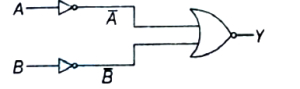
(B) The given circuit consists of two $NOT$ gates connected to the inputs $A$ and $B$,followed by a $NOR$ gate.
Let the inputs to the $NOR$ gate be $\bar{A}$ and $\bar{B}$.
The output $Y$ of the $NOR$ gate is given by:
$Y = \overline{\bar{A} + \bar{B}}$
Using De Morgan's Law,$\overline{x + y} = \bar{x} \cdot \bar{y}$,we get:
$Y = \overline{\bar{A}} \cdot \overline{\bar{B}}$
Since $\overline{\bar{A}} = A$ and $\overline{\bar{B}} = B$,the expression simplifies to:
$Y = A \cdot B$
This is the Boolean expression for an $AND$ gate.
Therefore,the combination represents an $AND$ gate.
Let the inputs to the $NOR$ gate be $\bar{A}$ and $\bar{B}$.
The output $Y$ of the $NOR$ gate is given by:
$Y = \overline{\bar{A} + \bar{B}}$
Using De Morgan's Law,$\overline{x + y} = \bar{x} \cdot \bar{y}$,we get:
$Y = \overline{\bar{A}} \cdot \overline{\bar{B}}$
Since $\overline{\bar{A}} = A$ and $\overline{\bar{B}} = B$,the expression simplifies to:
$Y = A \cdot B$
This is the Boolean expression for an $AND$ gate.
Therefore,the combination represents an $AND$ gate.
0 likesView Solution
47
ChemistryMediumMCQAIIMS · 2004
What is the $pH$ of $0.01 \ M$ glycine solution? For glycine,$K_{a1} = 4.5 \times 10^{-3}$ and $K_{a2} = 1.7 \times 10^{-10}$ at $298 \ K$.
A
$3$
B
$10$
C
$6.1$
D
$7.2$
Solution
(C) Glycine is an amphoteric amino acid. The $pH$ of an amphoteric amino acid solution is given by the formula: $pH = \frac{pK_{a1} + pK_{a2}}{2}$.
$pK_{a1} = -\log(4.5 \times 10^{-3}) = 3 - 0.653 = 2.347$.
$pK_{a2} = -\log(1.7 \times 10^{-10}) = 10 - 0.23 = 9.77$.
$pH = \frac{2.347 + 9.77}{2} = \frac{12.117}{2} \approx 6.06 \approx 6.1$.
$pK_{a1} = -\log(4.5 \times 10^{-3}) = 3 - 0.653 = 2.347$.
$pK_{a2} = -\log(1.7 \times 10^{-10}) = 10 - 0.23 = 9.77$.
$pH = \frac{2.347 + 9.77}{2} = \frac{12.117}{2} \approx 6.06 \approx 6.1$.
0 likesView Solution
48
ChemistryEasyMCQAIIMS · 2004
Which of the following metals expands on solidification?
A
$Ga$
B
$Al$
C
$Zn$
D
$Cu$
Solution
(A) The correct answer is $(A)$.
$Ga$ (Gallium) is one of the few substances that expands upon solidification,similar to water.
This behavior is due to the unique crystal structure of $Ga$ in the solid state,which involves weak metallic bonding and the formation of $Ga_2$ molecules,leading to a lower density in the solid phase compared to the liquid phase.
$Ga$ (Gallium) is one of the few substances that expands upon solidification,similar to water.
This behavior is due to the unique crystal structure of $Ga$ in the solid state,which involves weak metallic bonding and the formation of $Ga_2$ molecules,leading to a lower density in the solid phase compared to the liquid phase.
0 likesView Solution
49
ChemistryMediumMCQAIIMS · 2004
The element which forms oxides in all oxidation states from $+I$ to $+V$ is
A
$N$
B
$P$
C
$As$
D
$Sb$
Solution
(A) Nitrogen is unique among the group $15$ elements because it can form a wide variety of oxides in all oxidation states from $+I$ to $+V$.
These include $N_2O$ $(+I)$,$NO$ $(+II)$,$N_2O_3$ $(+III)$,$NO_2$ $(+IV)$,and $N_2O_5$ $(+V)$.
These include $N_2O$ $(+I)$,$NO$ $(+II)$,$N_2O_3$ $(+III)$,$NO_2$ $(+IV)$,and $N_2O_5$ $(+V)$.
0 likesView Solution
50
ChemistryDifficultMCQAIIMS · 2004
The dipole moment is the highest for
A
$Trans-2-butene$
B
$1, 3-Dimethylbenzene$
C
$Acetophenone$
D
$Ethanol$
Solution
(C) The dipole moments of the given compounds are as follows:
$(i)$ $Trans-2-butene$: The dipole moment is $0$ due to the cancellation of bond dipoles.
$(ii)$ $1, 3-Dimethylbenzene$: It has a small dipole moment due to the inductive effect of the two methyl groups.
$(iii)$ $Acetophenone$ $(C_6H_5COCH_3)$: It has a high dipole moment due to the strong electron-withdrawing nature of the carbonyl group $(C=O)$,which creates a significant charge separation.
$(iv)$ $Ethanol$ $(C_2H_5OH)$: It has a moderate dipole moment due to the electronegativity difference between oxygen and hydrogen.
Comparing these,$Acetophenone$ has the highest dipole moment among the given options.
$(i)$ $Trans-2-butene$: The dipole moment is $0$ due to the cancellation of bond dipoles.
$(ii)$ $1, 3-Dimethylbenzene$: It has a small dipole moment due to the inductive effect of the two methyl groups.
$(iii)$ $Acetophenone$ $(C_6H_5COCH_3)$: It has a high dipole moment due to the strong electron-withdrawing nature of the carbonyl group $(C=O)$,which creates a significant charge separation.
$(iv)$ $Ethanol$ $(C_2H_5OH)$: It has a moderate dipole moment due to the electronegativity difference between oxygen and hydrogen.
Comparing these,$Acetophenone$ has the highest dipole moment among the given options.
0 likesView Solution
51
ChemistryEasyMCQAIIMS · 2004
The average osmotic pressure of human blood is $7.8 \ bar$ at $37\ ^oC$. What is the concentration of an aqueous $NaCl$ solution that could be used in the blood stream (in $mol/L$)?
A
$0.16$
B
$0.32$
C
$0.60$
D
$0.45$
Solution
(B) The osmotic pressure formula is given by $\pi = i \cdot C \cdot R \cdot T$.
For an aqueous $NaCl$ solution,the van't Hoff factor $i = 2$ because $NaCl$ dissociates into $Na^+$ and $Cl^-$.
Given: $\pi = 7.8 \ bar$,$T = 37 + 273 = 310 \ K$,$R = 0.08314 \ L \cdot bar \cdot K^{-1} \cdot mol^{-1}$.
Substituting the values: $7.8 = 2 \times C \times 0.08314 \times 310$.
$C = \frac{7.8}{2 \times 0.08314 \times 310} \approx \frac{7.8}{51.55} \approx 0.15 \ mol/L$.
However,considering the osmotic pressure of blood is isotonic to $0.9 \% \ NaCl$ solution,which is approximately $0.154 \ M$ $(0.308 \ osmolar)$,the closest option provided is $0.32 \ mol/L$ if considering the total osmolarity (van't Hoff factor included in the concentration value).
Thus,the correct option is $B$.
For an aqueous $NaCl$ solution,the van't Hoff factor $i = 2$ because $NaCl$ dissociates into $Na^+$ and $Cl^-$.
Given: $\pi = 7.8 \ bar$,$T = 37 + 273 = 310 \ K$,$R = 0.08314 \ L \cdot bar \cdot K^{-1} \cdot mol^{-1}$.
Substituting the values: $7.8 = 2 \times C \times 0.08314 \times 310$.
$C = \frac{7.8}{2 \times 0.08314 \times 310} \approx \frac{7.8}{51.55} \approx 0.15 \ mol/L$.
However,considering the osmotic pressure of blood is isotonic to $0.9 \% \ NaCl$ solution,which is approximately $0.154 \ M$ $(0.308 \ osmolar)$,the closest option provided is $0.32 \ mol/L$ if considering the total osmolarity (van't Hoff factor included in the concentration value).
Thus,the correct option is $B$.
0 likesView Solution
52
ChemistryDifficultMCQAIIMS · 2004
The crystal system of a compound with unit cell dimensions $a = 0.387 \ nm$,$b = 0.387 \ nm$ and $c = 0.504 \ nm$ and $\alpha = \beta = 90^{\circ}$ and $\gamma = 120^{\circ}$ is:
A
Cubic
B
Hexagonal
C
Orthorhombic
D
Rhombohedral
Solution
(B) The crystal system is determined by the unit cell parameters $a, b, c$ and the interfacial angles $\alpha, \beta, \gamma$.
Given parameters are $a = b = 0.387 \ nm$,$c = 0.504 \ nm$,which implies $a = b \neq c$.
The angles are $\alpha = \beta = 90^{\circ}$ and $\gamma = 120^{\circ}$.
These specific conditions ($a = b \neq c$ and $\alpha = \beta = 90^{\circ}, \gamma = 120^{\circ}$) correspond to the Hexagonal crystal system.
Given parameters are $a = b = 0.387 \ nm$,$c = 0.504 \ nm$,which implies $a = b \neq c$.
The angles are $\alpha = \beta = 90^{\circ}$ and $\gamma = 120^{\circ}$.
These specific conditions ($a = b \neq c$ and $\alpha = \beta = 90^{\circ}, \gamma = 120^{\circ}$) correspond to the Hexagonal crystal system.
0 likesView Solution
53
ChemistryMediumMCQAIIMS · 2004
The rate constant $k$,for the reaction ${N_2}{O_5}_{(g)} \to 2N{O_2}_{(g)} + \frac{1}{2}{O_2}_{(g)}$ is $2.3 \times 10^{-2} \ s^{-1}$. Which equation given below describes the change of $[{N_2}{O_5}]$ with time? $[{N_2}{O_5}]_0$ and $[{N_2}{O_5}]_t$ correspond to concentration of ${N_2}{O_5}$ initially and at time $t$.
A
$[{N_2}{O_5}]_t = [{N_2}{O_5}]_0 + kt$
B
$[{N_2}{O_5}]_0 = [{N_2}{O_5}]_t e^{kt}$
C
$\log_{10} [{N_2}{O_5}]_t = \log_{10} [{N_2}{O_5}]_0 - kt$
D
$\ln \frac{[{N_2}{O_5}]_0}{[{N_2}{O_5}]_t} = kt$
Solution
(D) The unit of the rate constant $k$ is $s^{-1}$,which indicates that the reaction is a first-order reaction.
For a first-order reaction,the integrated rate equation is given by $kt = \ln \frac{[{N_2}{O_5}]_0}{[{N_2}{O_5}]_t}$.
Therefore,the correct equation is $\ln \frac{[{N_2}{O_5}]_0}{[{N_2}{O_5}]_t} = kt$.
For a first-order reaction,the integrated rate equation is given by $kt = \ln \frac{[{N_2}{O_5}]_0}{[{N_2}{O_5}]_t}$.
Therefore,the correct equation is $\ln \frac{[{N_2}{O_5}]_0}{[{N_2}{O_5}]_t} = kt$.
0 likesView Solution
54
ChemistryDifficultMCQAIIMS · 2004
Which of the following statements is true for the electrochemical $Daniel$ cell?
A
Electrons flow from copper electrode to zinc electrode.
B
Current flows from zinc electrode to copper electrode.
C
Cations move toward copper electrode which is cathode.
D
Cations move toward zinc electrode.
Solution
(C) In a $Daniel$ cell,the copper electrode acts as the cathode. \\ During the operation of the cell,cations in the electrolyte move toward the cathode (copper electrode) to maintain electrical neutrality,where reduction takes place. \\ Therefore,statement $(c)$ is correct.
0 likesView Solution
55
ChemistryMediumMCQAIIMS · 2004
Which one of the following organizations' iron and steel plant was built to use charcoal as a source of power,to start with,but later switched over to hydroelectricity?
A
The Tata Iron and Steel Company
B
The Indian Iron and Steel Company
C
Mysore Iron and Steel Limited
D
Hindustan Steel Limited
Solution
(C) The correct answer is $C$.
$Mysore$ $Iron$ $and$ $Steel$ $Limited$ (now known as $Visvesvaraya$ $Iron$ $and$ $Steel$ $Plant$) was established in $1923$ at $Bhadravati$.
Initially,it used charcoal as a fuel source for its blast furnaces because of the proximity to forests.
Later,it switched to hydroelectric power generated from the $Sharavathi$ river project.
$Mysore$ $Iron$ $and$ $Steel$ $Limited$ (now known as $Visvesvaraya$ $Iron$ $and$ $Steel$ $Plant$) was established in $1923$ at $Bhadravati$.
Initially,it used charcoal as a fuel source for its blast furnaces because of the proximity to forests.
Later,it switched to hydroelectric power generated from the $Sharavathi$ river project.
0 likesView Solution
56
ChemistryAdvancedMCQAIIMS · 2004
Which one of the following forms a complex with an excess of $CN^{-}$ (cyanide) having a coordination number of two?
A
$Cu^{+}$
B
$Ag^{+}$
C
$Ni^{2+}$
D
$Fe^{2+}$
Solution
(B) The correct answer is $B$.
$Ag^{+}$ ion reacts with an excess of $CN^{-}$ ions to form the dicyanoargentate$(I)$ complex,which is $[Ag(CN)_2]^{-}$.
In this complex,the coordination number of the central metal ion $Ag^{+}$ is $2$.
$Ag^{+}$ ion reacts with an excess of $CN^{-}$ ions to form the dicyanoargentate$(I)$ complex,which is $[Ag(CN)_2]^{-}$.
In this complex,the coordination number of the central metal ion $Ag^{+}$ is $2$.
0 likesView Solution
57
ChemistryMediumMCQAIIMS · 2004
Which of the following is not considered as an organometallic compound?
A
Cis-platin
B
Ferrocene
C
Zeise's salt
D
Grignard reagent
Solution
(A) An organometallic compound is defined as a compound containing at least one direct metal-carbon $(M-C)$ bond.
$A$. Cis-platin is $[Pt(NH_3)_2Cl_2]$. It contains $Pt-N$ and $Pt-Cl$ bonds,but no direct $Pt-C$ bond. Therefore,it is not an organometallic compound.
$B$. Ferrocene is $Fe(\eta^5-C_5H_5)_2$. It contains direct $Fe-C$ bonds.
$C$. Zeise's salt is $K[PtCl_3(\eta^2-C_2H_4)]$. It contains a direct $Pt-C$ bond (between $Pt$ and the ethylene ligand).
$D$. Grignard reagent is $R-Mg-X$. It contains a direct $Mg-C$ bond.
$A$. Cis-platin is $[Pt(NH_3)_2Cl_2]$. It contains $Pt-N$ and $Pt-Cl$ bonds,but no direct $Pt-C$ bond. Therefore,it is not an organometallic compound.
$B$. Ferrocene is $Fe(\eta^5-C_5H_5)_2$. It contains direct $Fe-C$ bonds.
$C$. Zeise's salt is $K[PtCl_3(\eta^2-C_2H_4)]$. It contains a direct $Pt-C$ bond (between $Pt$ and the ethylene ligand).
$D$. Grignard reagent is $R-Mg-X$. It contains a direct $Mg-C$ bond.
0 likesView Solution
58
ChemistryDifficultMCQAIIMS · 2004
Which of the following does not have optical isomers?
A
$[Co(NH_3)_3Cl_3]$
B
$[Co(en)_3]Cl_3$
C
$[Co(en)_2Cl_2]Cl$
D
$[Co(en)(NH_3)_2Cl_2]Cl$
Solution
(A) . $[Co(NH_3)_3Cl_3]$ does not exhibit optical isomerism because it follows the $MA_3B_3$ type geometry,which possesses a plane of symmetry in both its facial $(fac)$ and meridional $(mer)$ isomers.
0 likesView Solution
59
ChemistryDifficultMCQAIIMS · 2004
Dimethyl glyoxime gives a red precipitate with $Ni^{2+}$,which is used for its detection. To get this precipitate readily,the best $pH$ range is
A
$< 1$
B
$2-3$
C
$3-4$
D
$9-11$
Solution
(D) The reaction between $Ni^{2+}$ and dimethyl glyoxime $(DMG)$ forms a nickel dimethylglyoximate complex,which is a bright red precipitate.
This reaction is typically performed in an ammoniacal medium,which provides an alkaline $pH$ range of $9-11$.
In this $pH$ range,the deprotonation of the $DMG$ ligand occurs,allowing it to coordinate effectively with the $Ni^{2+}$ ion.
This reaction is typically performed in an ammoniacal medium,which provides an alkaline $pH$ range of $9-11$.
In this $pH$ range,the deprotonation of the $DMG$ ligand occurs,allowing it to coordinate effectively with the $Ni^{2+}$ ion.
0 likesView Solution
60
ChemistryAdvancedMCQAIIMS · 2004
Among the following,the one which reacts most readily with ethanol is
A
$p-$nitrobenzyl bromide
B
$p-$chlorobenzyl bromide
C
$p-$methoxybenzyl bromide
D
$p-$methylbenzyl bromide
Solution
(C) The reaction of benzyl bromides with ethanol proceeds via an $S_N1$ mechanism,which involves the formation of a carbocation intermediate.
The stability of the carbocation determines the reactivity. Electron-donating groups $(EDG)$ stabilize the carbocation,while electron-withdrawing groups $(EWG)$ destabilize it.
$1$. $p-$methoxybenzyl bromide: The methoxy group $(-OCH_3)$ is a strong electron-donating group by resonance ($+M$ effect),which significantly stabilizes the carbocation.
$2$. $p-$methylbenzyl bromide: The methyl group $(-CH_3)$ is a weak electron-donating group by hyperconjugation ($+H$ effect).
$3$. $p-$chlorobenzyl bromide: The chloro group $(-Cl)$ is electron-withdrawing by induction ($-I$ effect).
$4$. $p-$nitrobenzyl bromide: The nitro group $(-NO_2)$ is a strong electron-withdrawing group by both resonance $(-M)$ and induction $(-I)$ effects.
Therefore,$p-$methoxybenzyl bromide forms the most stable carbocation and reacts most readily with ethanol.
The stability of the carbocation determines the reactivity. Electron-donating groups $(EDG)$ stabilize the carbocation,while electron-withdrawing groups $(EWG)$ destabilize it.
$1$. $p-$methoxybenzyl bromide: The methoxy group $(-OCH_3)$ is a strong electron-donating group by resonance ($+M$ effect),which significantly stabilizes the carbocation.
$2$. $p-$methylbenzyl bromide: The methyl group $(-CH_3)$ is a weak electron-donating group by hyperconjugation ($+H$ effect).
$3$. $p-$chlorobenzyl bromide: The chloro group $(-Cl)$ is electron-withdrawing by induction ($-I$ effect).
$4$. $p-$nitrobenzyl bromide: The nitro group $(-NO_2)$ is a strong electron-withdrawing group by both resonance $(-M)$ and induction $(-I)$ effects.
Therefore,$p-$methoxybenzyl bromide forms the most stable carbocation and reacts most readily with ethanol.
0 likesView Solution
61
ChemistryDifficultMCQAIIMS · 2004
Among the following,the most reactive towards alcoholic $KOH$ is:
A
$CH_2=CHBr$
B
$CH_3COCH_2CH_2Br$
C
$CH_3CH_2Br$
D
$CH_3CH_2CH_2Br$
Solution
(D) The reaction of haloalkanes with alcoholic $KOH$ proceeds via the $E2$ elimination mechanism.
In $CH_3CH_2CH_2Br$ (a primary alkyl halide),the presence of the alkyl group provides a $+I$ effect,which facilitates the elimination of the leaving group.
$CH_2=CHBr$ is a vinyl halide where the $C-X$ bond has partial double bond character,making it very unreactive towards elimination.
$CH_3COCH_2CH_2Br$ contains an electron-withdrawing $-CO$ group ($-I$ effect),which destabilizes the transition state for elimination compared to a simple alkyl halide.
Comparing $CH_3CH_2Br$ and $CH_3CH_2CH_2Br$,the latter has a slightly higher $+I$ effect,making it more reactive in this context.
$CH_3CH_2CH_2Br + KOH \xrightarrow{\text{alc.}} CH_3CH=CH_2 + KBr + H_2O$
In $CH_3CH_2CH_2Br$ (a primary alkyl halide),the presence of the alkyl group provides a $+I$ effect,which facilitates the elimination of the leaving group.
$CH_2=CHBr$ is a vinyl halide where the $C-X$ bond has partial double bond character,making it very unreactive towards elimination.
$CH_3COCH_2CH_2Br$ contains an electron-withdrawing $-CO$ group ($-I$ effect),which destabilizes the transition state for elimination compared to a simple alkyl halide.
Comparing $CH_3CH_2Br$ and $CH_3CH_2CH_2Br$,the latter has a slightly higher $+I$ effect,making it more reactive in this context.
$CH_3CH_2CH_2Br + KOH \xrightarrow{\text{alc.}} CH_3CH=CH_2 + KBr + H_2O$
0 likesView Solution
62
ChemistryEasyMCQAIIMS · 2004
The most suitable reagent for the conversion of $RCH_2OH \to RCHO$ is
A
$KMnO_4$
B
$K_2Cr_2O_7$
C
$CrO_3$
D
$PCC$ (Pyridinium chlorochromate)
Solution
(D) The conversion of primary alcohols $(RCH_2OH)$ to aldehydes $(RCHO)$ requires a mild oxidizing agent that does not further oxidize the aldehyde to a carboxylic acid.
$PCC$ (Pyridinium chlorochromate,$(C_5H_5NH^+)(CrO_3Cl^-)$) is a selective oxidizing agent that stops the oxidation at the aldehyde stage.
Other reagents like $KMnO_4$ and $K_2Cr_2O_7$ are strong oxidizing agents that typically oxidize primary alcohols directly to carboxylic acids.
Therefore,$PCC$ is the most suitable reagent for this specific transformation.
$PCC$ (Pyridinium chlorochromate,$(C_5H_5NH^+)(CrO_3Cl^-)$) is a selective oxidizing agent that stops the oxidation at the aldehyde stage.
Other reagents like $KMnO_4$ and $K_2Cr_2O_7$ are strong oxidizing agents that typically oxidize primary alcohols directly to carboxylic acids.
Therefore,$PCC$ is the most suitable reagent for this specific transformation.
0 likesView Solution
63
ChemistryDifficultMCQAIIMS · 2004
$o$-Toluic acid on reaction with $Br_2 + Fe$ gives:
A
B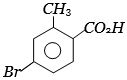
C
D
Solution
(B) The reaction is an electrophilic aromatic substitution (bromination) of $o$-toluic acid.
$o$-Toluic acid contains two groups attached to the benzene ring: a methyl group $(-CH_3)$ and a carboxylic acid group $(-COOH)$.
$1$. The $-CH_3$ group is ortho/para-directing.
$2$. The $-COOH$ group is meta-directing.
In $o$-toluic acid,the positions ortho to the $-CH_3$ group are either occupied by the $-COOH$ group or are sterically hindered. The position para to the $-CH_3$ group is the most reactive site for electrophilic substitution.
Therefore,the bromine atom enters the position para to the $-CH_3$ group,which corresponds to the meta position with respect to the $-COOH$ group.
The product is $5$-bromo-$2$-methylbenzoic acid.
$o$-Toluic acid contains two groups attached to the benzene ring: a methyl group $(-CH_3)$ and a carboxylic acid group $(-COOH)$.
$1$. The $-CH_3$ group is ortho/para-directing.
$2$. The $-COOH$ group is meta-directing.
In $o$-toluic acid,the positions ortho to the $-CH_3$ group are either occupied by the $-COOH$ group or are sterically hindered. The position para to the $-CH_3$ group is the most reactive site for electrophilic substitution.
Therefore,the bromine atom enters the position para to the $-CH_3$ group,which corresponds to the meta position with respect to the $-COOH$ group.
The product is $5$-bromo-$2$-methylbenzoic acid.
0 likesView Solution
64
ChemistryMediumMCQAIIMS · 2004
Aromatic nitriles $(ArCN)$ are not prepared by which reaction?
A
$ArX + KCN$
B
$ArN_2^+ + CuCN$
C
$ArCONH_2 + P_2O_5$
D
$ArCONH_2 + SOCl_2$
Solution
(A) In aryl halides $(ArX)$,the carbon-halogen bond acquires partial double bond character due to resonance,making it resistant to nucleophilic substitution by $CN^-$. Thus,$ArX$ does not react with $KCN$ under normal conditions to form $ArCN$.
$(B)$ $ArN_2^+ + CuCN \to ArCN + N_2 + Cu^+$ (Sandmeyer reaction).
$(C)$ $ArCONH_2 \xrightarrow{P_2O_5} ArCN + H_2O$ (Dehydration of amide).
$(D)$ $ArCONH_2 + SOCl_2 \to ArCN + SO_2 + 2HCl$ (Dehydration of amide).
$(B)$ $ArN_2^+ + CuCN \to ArCN + N_2 + Cu^+$ (Sandmeyer reaction).
$(C)$ $ArCONH_2 \xrightarrow{P_2O_5} ArCN + H_2O$ (Dehydration of amide).
$(D)$ $ArCONH_2 + SOCl_2 \to ArCN + SO_2 + 2HCl$ (Dehydration of amide).
0 likesView Solution
65
ChemistryDifficultMCQAIIMS · 2004
The strongest base among the following is
A
Pyridine
B
Pyrrole
C
Piperidine
D
Aniline
Solution
(C) The basicity of an amine depends on the availability of the lone pair of electrons on the nitrogen atom.
In $A$ (Pyridine),$B$ (Pyrrole),and $D$ (Aniline),the lone pair of electrons on the nitrogen atom is involved in resonance or is part of the aromatic system,making it less available for protonation.
In $C$ (Piperidine),the nitrogen atom is $sp^3$ hybridized and the lone pair is not involved in any resonance or aromatic system,making it highly available for protonation.
Therefore,Piperidine is the strongest base among the given options.
In $A$ (Pyridine),$B$ (Pyrrole),and $D$ (Aniline),the lone pair of electrons on the nitrogen atom is involved in resonance or is part of the aromatic system,making it less available for protonation.
In $C$ (Piperidine),the nitrogen atom is $sp^3$ hybridized and the lone pair is not involved in any resonance or aromatic system,making it highly available for protonation.
Therefore,Piperidine is the strongest base among the given options.
0 likesView Solution
66
ChemistryMediumMCQAIIMS · 2004
Which of the following is a biodegradable polymer?
A
Cellulose
B
Polythene
C
Polyvinyl chloride
D
Nylon-$6$
Solution
(A) Cellulose is a natural polymer that is biodegradable.
Polythene,Polyvinyl chloride,and Nylon-$6$ are synthetic polymers,which are generally non-biodegradable.
Polythene,Polyvinyl chloride,and Nylon-$6$ are synthetic polymers,which are generally non-biodegradable.
0 likesView Solution
67
ChemistryMediumMCQAIIMS · 2004
The nucleic acid base having two possible binding sites is
A
Thymine
B
Cytosine
C
Guanine
D
Adenine
Solution
(C) $Guanine$ is the nucleic acid base that possesses two possible binding sites for hydrogen bonding in the context of base pairing,specifically involving the $N-H$ group and the carbonyl oxygen or nitrogen atoms.
0 likesView Solution
68
ChemistryMediumMCQAIIMS · 2004
The statement true for $N_3^-$ is
A
It has a non-linear structure
B
It is called pseudohalogen
C
The formal oxidation state of nitrogen in this anion is $-1/3$
D
It is isoelectronic with $NO_2$
Solution
(B) The azide ion $(N_3^-)$ has a linear structure with a bond angle of $180^{\circ}$.
It is considered a pseudohalogen because its chemistry resembles that of halide ions.
The formal oxidation state of nitrogen in $N_3^-$ is calculated as: $3x = -1$,so $x = -1/3$.
$N_3^-$ has $22$ electrons,while $NO_2$ has $23$ electrons,so they are not isoelectronic.
It is considered a pseudohalogen because its chemistry resembles that of halide ions.
The formal oxidation state of nitrogen in $N_3^-$ is calculated as: $3x = -1$,so $x = -1/3$.
$N_3^-$ has $22$ electrons,while $NO_2$ has $23$ electrons,so they are not isoelectronic.
0 likesView Solution
69
ChemistryDifficultMCQAIIMS · 2004
The reagent used for the separation of acetaldehyde from acetophenone is
A
$NaHSO_3$
B
$C_6H_5NHNH_2$
C
$NH_2OH$
D
$NaOH - I_2$
Solution
(A) $NaHSO_3$ forms a crystalline addition product with acetaldehyde (an aliphatic aldehyde),whereas acetophenone (an aromatic ketone) does not react with $NaHSO_3$ due to steric hindrance.
$CH_3CHO + NaHSO_3 \to CH_3CH(OH)SO_3Na$ (White crystalline solid)
$C_6H_5COCH_3 + NaHSO_3 \to \text{No reaction}$
The addition product can be separated by filtration and then decomposed by dilute acid or base to recover the pure acetaldehyde.
$CH_3CHO + NaHSO_3 \to CH_3CH(OH)SO_3Na$ (White crystalline solid)
$C_6H_5COCH_3 + NaHSO_3 \to \text{No reaction}$
The addition product can be separated by filtration and then decomposed by dilute acid or base to recover the pure acetaldehyde.
0 likesView Solution
70
ChemistryMediumMCQAIIMS · 2004
Melting points are normally the highest for
A
Tertiary amides
B
Secondary amides
C
Primary amides
D
Amines
Solution
(C) The correct answer is $(C)$.
Amides exhibit high melting and boiling points due to strong intermolecular hydrogen bonding.
In primary amides $(R-CONH_2)$,there are two hydrogen atoms attached to the nitrogen atom,which allows for extensive intermolecular hydrogen bonding.
In secondary amides $(R-CONHR)$,there is only one hydrogen atom available for hydrogen bonding.
Tertiary amides $(R-CONR_2)$ lack hydrogen atoms attached to the nitrogen atom,preventing them from forming intermolecular hydrogen bonds with each other.
Therefore,the order of melting/boiling points is: $\text{Primary amides} > \text{Secondary amides} > \text{Tertiary amides} > \text{Amines}$.
Amides exhibit high melting and boiling points due to strong intermolecular hydrogen bonding.
In primary amides $(R-CONH_2)$,there are two hydrogen atoms attached to the nitrogen atom,which allows for extensive intermolecular hydrogen bonding.
In secondary amides $(R-CONHR)$,there is only one hydrogen atom available for hydrogen bonding.
Tertiary amides $(R-CONR_2)$ lack hydrogen atoms attached to the nitrogen atom,preventing them from forming intermolecular hydrogen bonds with each other.
Therefore,the order of melting/boiling points is: $\text{Primary amides} > \text{Secondary amides} > \text{Tertiary amides} > \text{Amines}$.
0 likesView Solution
71
ChemistryMediumMCQAIIMS · 2004
Assertion : Nuclear binding energy per nucleon is in the order $_4^9Be > \,_3^7Li > \,_2^4He$.
Reason : Binding energy per nucleon increases linearly with the difference in the number of neutrons and protons.
Reason : Binding energy per nucleon increases linearly with the difference in the number of neutrons and protons.
A
If both Assertion and Reason are correct and the Reason is a correct explanation of the Assertion.
B
If both Assertion and Reason are correct but Reason is not a correct explanation of the Assertion.
C
If the Assertion is correct but Reason is incorrect.
D
If both the Assertion and Reason are incorrect.
Solution
(D) The binding energy per nucleon is a measure of the stability of a nucleus. The actual order of binding energy per nucleon for these isotopes is $_2^4He > \,_3^7Li > \,_4^9Be$. Therefore,the Assertion is incorrect.
Furthermore,the binding energy per nucleon does not increase linearly with the difference in the number of neutrons and protons; it depends on the mass defect and the stability of the nuclear configuration. Therefore,the Reason is also incorrect.
Furthermore,the binding energy per nucleon does not increase linearly with the difference in the number of neutrons and protons; it depends on the mass defect and the stability of the nuclear configuration. Therefore,the Reason is also incorrect.
0 likesView Solution
72
ChemistryDifficultMCQAIIMS · 2004
Assertion : $Mg$ is not present in the enamel of human teeth.
Reason : $Mg$ is an essential element for the biological functions of humans.
Reason : $Mg$ is an essential element for the biological functions of humans.
A
If both Assertion and Reason are correct and the Reason is a correct explanation of the Assertion.
B
If both Assertion and Reason are correct but Reason is not a correct explanation of the Assertion.
C
If the Assertion is correct but Reason is incorrect.
D
If the Assertion is incorrect but the Reason is correct.
Solution
(D) The enamel of human teeth is primarily composed of hydroxyapatite,$Ca_{10}(PO_4)_6(OH)_2$,which contains calcium. Magnesium $(Mg)$ is not a primary component of enamel.
Magnesium is indeed an essential element for various biological functions in the human body,such as acting as a cofactor for many enzymes and maintaining nerve and muscle function.
Since the Assertion is incorrect (as $Mg$ is present in trace amounts in teeth) and the Reason is correct,the correct option is $D$.
Magnesium is indeed an essential element for various biological functions in the human body,such as acting as a cofactor for many enzymes and maintaining nerve and muscle function.
Since the Assertion is incorrect (as $Mg$ is present in trace amounts in teeth) and the Reason is correct,the correct option is $D$.
0 likesView Solution
73
ChemistryDifficultMCQAIIMS · 2004
Assertion: $2-$Bromobutane on reaction with sodium ethoxide in ethanol gives $1-$butene as a major product.
Reason: $1-$Butene is more stable than $2-$butene. According to Saytzeff's rule,$2-$butene should be the product which is more branched or substituted compound and hence,more stable than $1-$butene.
Reason: $1-$Butene is more stable than $2-$butene. According to Saytzeff's rule,$2-$butene should be the product which is more branched or substituted compound and hence,more stable than $1-$butene.
A
If both Assertion and Reason are correct and the Reason is a correct explanation of the Assertion.
B
If both Assertion and Reason are correct but Reason is not a correct explanation of the Assertion.
C
If the Assertion is correct but Reason is incorrect.
D
If both the Assertion and Reason are incorrect.
Solution
(D) $2-$Bromobutane on reaction with sodium ethoxide in ethanol undergoes dehydrohalogenation to give $2-$butene as the major product according to Saytzeff's rule,which states that the more substituted alkene is the preferred product.
Thus,the assertion is incorrect because $1-$butene is the minor product.
$2-$Butene is more stable than $1-$butene due to greater substitution and hyperconjugation.
The reason statement claims $1-$butene is more stable than $2-$butene,which is false.
Therefore,both the assertion and the reason are incorrect.
Thus,the assertion is incorrect because $1-$butene is the minor product.
$2-$Butene is more stable than $1-$butene due to greater substitution and hyperconjugation.
The reason statement claims $1-$butene is more stable than $2-$butene,which is false.
Therefore,both the assertion and the reason are incorrect.
0 likesView Solution
74
ChemistryMediumMCQAIIMS · 2004
Assertion : Copper metal gets readily corroded in an acidic aqueous solution.
Reason : Free energy change for this process is positive.
Reason : Free energy change for this process is positive.
A
If both Assertion and Reason are correct and the Reason is a correct explanation of the Assertion.
B
If both Assertion and Reason are correct but Reason is not a correct explanation of the Assertion.
C
If the Assertion is correct but Reason is incorrect.
D
If both the Assertion and Reason are incorrect.
Solution
(D) Copper lies below hydrogen in the electrochemical series,meaning its standard reduction potential is higher than that of hydrogen ($E^o_{Cu^{2+}/Cu} = +0.34 \ V$ vs $E^o_{H^+/H_2} = 0.00 \ V$).
Therefore,copper cannot displace $H_2$ from dilute acids,and the reaction is non-spontaneous.
Since the reaction is non-spontaneous,the free energy change $(\Delta G)$ for this process is positive.
Thus,the Assertion is incorrect because copper does not corrode in acidic solutions,but the Reason is correct.
Therefore,copper cannot displace $H_2$ from dilute acids,and the reaction is non-spontaneous.
Since the reaction is non-spontaneous,the free energy change $(\Delta G)$ for this process is positive.
Thus,the Assertion is incorrect because copper does not corrode in acidic solutions,but the Reason is correct.
0 likesView Solution
75
ChemistryMediumMCQAIIMS · 2004
Assertion : Aqueous gold colloidal solution is red in colour.
Reason : The colour arises due to scattering of light by colloidal gold particles.
Reason : The colour arises due to scattering of light by colloidal gold particles.
A
If both Assertion and Reason are correct and the Reason is a correct explanation of the Assertion.
B
If both Assertion and Reason are correct but Reason is not a correct explanation of the Assertion.
C
If the Assertion is correct but Reason is incorrect.
D
If both the Assertion and Reason are incorrect.
Solution
(A) The colour of colloidal solutions depends on the size of the colloidal particles.
For gold sol,the colour varies with the particle size; very fine gold sol is red in colour.
This colour arises due to the scattering of light by the colloidal gold particles.
For gold sol,the colour varies with the particle size; very fine gold sol is red in colour.
This colour arises due to the scattering of light by the colloidal gold particles.
0 likesView Solution
76
ChemistryMediumMCQAIIMS · 2004
Assertion : Alcohols are dehydrated to hydrocarbons in the presence of acidic zeolites.
Reason : Zeolites are porous catalysts.
Reason : Zeolites are porous catalysts.
A
If both Assertion and Reason are correct and the Reason is a correct explanation of the Assertion.
B
If both Assertion and Reason are correct but Reason is not a correct explanation of the Assertion.
C
If the Assertion is correct but Reason is incorrect.
D
If both the Assertion and Reason are incorrect.
Solution
(B) In the petroleum industry,zeolites are used to convert alcohols directly into hydrocarbons by dehydration.
Zeolites are indeed porous catalysts,which allows them to act as shape-selective catalysts.
However,the dehydration of alcohols to hydrocarbons is specifically due to the acidic nature of the zeolites,not just their porosity.
Therefore,both statements are correct,but the Reason is not the correct explanation for the Assertion.
Zeolites are indeed porous catalysts,which allows them to act as shape-selective catalysts.
However,the dehydration of alcohols to hydrocarbons is specifically due to the acidic nature of the zeolites,not just their porosity.
Therefore,both statements are correct,but the Reason is not the correct explanation for the Assertion.
0 likesView Solution
77
ChemistryEasyMCQAIIMS · 2004
Assertion : The free gaseous $Cr$ atom has six unpaired electrons.
Reason : Half-filled $s$ orbital has greater stability.
Reason : Half-filled $s$ orbital has greater stability.
A
If both Assertion and Reason are correct and the Reason is a correct explanation of the Assertion.
B
If both Assertion and Reason are correct but Reason is not a correct explanation of the Assertion.
C
If the Assertion is correct but Reason is incorrect.
D
If both the Assertion and Reason are incorrect.
Solution
(C) The electronic configuration of $Cr$ $(Z=24)$ is $[Ar] \, 3d^5 \, 4s^1$.
In this configuration,there are $5$ unpaired electrons in the $3d$ subshell and $1$ unpaired electron in the $4s$ subshell,totaling $6$ unpaired electrons.
The stability of the $Cr$ atom is due to the half-filled $d$ subshell $(3d^5)$,not the $s$ orbital.
Therefore,the Assertion is correct,but the Reason is incorrect.
In this configuration,there are $5$ unpaired electrons in the $3d$ subshell and $1$ unpaired electron in the $4s$ subshell,totaling $6$ unpaired electrons.
The stability of the $Cr$ atom is due to the half-filled $d$ subshell $(3d^5)$,not the $s$ orbital.
Therefore,the Assertion is correct,but the Reason is incorrect.
0 likesView Solution
78
ChemistryMediumMCQAIIMS · 2004
Assertion : The $[Ni(en)_3]Cl_2$ ($en =$ ethylenediamine) has lower stability than $[Ni(NH_3)_6]Cl_2$.
Reason : In $[Ni(en)_3]Cl_2$,the geometry of $Ni$ is trigonal bipyramidal.
Reason : In $[Ni(en)_3]Cl_2$,the geometry of $Ni$ is trigonal bipyramidal.
A
If both Assertion and Reason are correct and the Reason is a correct explanation of the Assertion.
B
If both Assertion and Reason are correct but Reason is not a correct explanation of the Assertion.
C
If the Assertion is correct but Reason is incorrect.
D
If both the Assertion and Reason are incorrect.
Solution
(D) The Assertion is incorrect because $[Ni(en)_3]Cl_2$ is more stable than $[Ni(NH_3)_6]Cl_2$ due to the chelate effect.
Ethylenediamine $(en)$ is a bidentate ligand,which forms stable five-membered chelate rings with the $Ni^{2+}$ ion,whereas $NH_3$ is a monodentate ligand.
The Reason is also incorrect because the geometry of $Ni$ in $[Ni(en)_3]Cl_2$ is octahedral,not trigonal bipyramidal.
Ethylenediamine $(en)$ is a bidentate ligand,which forms stable five-membered chelate rings with the $Ni^{2+}$ ion,whereas $NH_3$ is a monodentate ligand.
The Reason is also incorrect because the geometry of $Ni$ in $[Ni(en)_3]Cl_2$ is octahedral,not trigonal bipyramidal.
0 likesView Solution
79
ChemistryMediumMCQAIIMS · 2004
Assertion : The major products formed by heating $C_6H_5CH_2OCH_3$ with $HI$ are $C_6H_5CH_2I$ and $CH_3OH$.
Reason : Benzyl cation is more stable than methyl cation.
Reason : Benzyl cation is more stable than methyl cation.
A
If both Assertion and Reason are correct and the Reason is a correct explanation of the Assertion.
B
If both Assertion and Reason are correct but Reason is not a correct explanation of the Assertion.
C
If the Assertion is correct but Reason is incorrect.
D
If both the Assertion and Reason are incorrect.
Solution
(A) The reaction of $C_6H_5CH_2OCH_3$ with $HI$ proceeds via an $S_N1$ mechanism because the benzyl carbocation $(C_6H_5CH_2^+)$ is highly stable due to resonance.
The cleavage of the $C-O$ bond occurs such that the more stable carbocation is formed.
Since the benzyl carbocation is more stable than the methyl carbocation $(CH_3^+)$,the iodide ion attacks the benzyl group to form $C_6H_5CH_2I$,while the methoxide group is protonated to form $CH_3OH$.
Therefore,both the Assertion and the Reason are correct,and the Reason is the correct explanation of the Assertion.
The cleavage of the $C-O$ bond occurs such that the more stable carbocation is formed.
Since the benzyl carbocation is more stable than the methyl carbocation $(CH_3^+)$,the iodide ion attacks the benzyl group to form $C_6H_5CH_2I$,while the methoxide group is protonated to form $CH_3OH$.
Therefore,both the Assertion and the Reason are correct,and the Reason is the correct explanation of the Assertion.
0 likesView Solution
80
ChemistryMediumMCQAIIMS · 2004
Assertion : Isobutanal does not give iodoform test.
Reason : It does not have $\alpha - $ hydrogen.
Reason : It does not have $\alpha - $ hydrogen.
A
If both Assertion and Reason are correct and the Reason is a correct explanation of the Assertion.
B
If both Assertion and Reason are correct but Reason is not a correct explanation of the Assertion.
C
If the Assertion is correct but Reason is incorrect.
D
If both the Assertion and Reason are incorrect.
Solution
(C) The iodoform test is given by compounds containing the $CH_3CO-$ group or compounds that can be oxidized to this group (like ethanol or secondary alcohols with a methyl group).
Isobutanal is $(CH_3)_2CHCHO$. It does not contain the $CH_3CO-$ group,so it does not give the iodoform test.
The reason provided is incorrect because isobutanal does have an $\alpha$-hydrogen atom (the hydrogen attached to the carbon adjacent to the carbonyl group).
Therefore,the Assertion is correct,but the Reason is incorrect.
Isobutanal is $(CH_3)_2CHCHO$. It does not contain the $CH_3CO-$ group,so it does not give the iodoform test.
The reason provided is incorrect because isobutanal does have an $\alpha$-hydrogen atom (the hydrogen attached to the carbon adjacent to the carbonyl group).
Therefore,the Assertion is correct,but the Reason is incorrect.
0 likesView Solution
81
ChemistryMediumMCQAIIMS · 2004
Assertion : The $pK_a$ of acetic acid is lower than that of phenol.
Reason : Phenoxide ion is more resonance stabilised.
Reason : Phenoxide ion is more resonance stabilised.
A
If both Assertion and Reason are correct and the Reason is a correct explanation of the Assertion.
B
If both Assertion and Reason are correct but Reason is not a correct explanation of the Assertion.
C
If the Assertion is correct but Reason is incorrect.
D
If both the Assertion and Reason are incorrect.
Solution
(C) lower $pK_a$ value indicates a stronger acid. Acetic acid $(pK_a \approx 4.76)$ is a stronger acid than phenol $(pK_a \approx 10)$.
The acidity of carboxylic acids is due to the resonance stabilization of the carboxylate ion,where the negative charge is delocalized over two highly electronegative oxygen atoms in equivalent resonance structures.
In contrast,the negative charge in the phenoxide ion is delocalized over the carbon atoms of the ring,which is less effective. Therefore,the Assertion is correct,but the Reason is incorrect.
The acidity of carboxylic acids is due to the resonance stabilization of the carboxylate ion,where the negative charge is delocalized over two highly electronegative oxygen atoms in equivalent resonance structures.
In contrast,the negative charge in the phenoxide ion is delocalized over the carbon atoms of the ring,which is less effective. Therefore,the Assertion is correct,but the Reason is incorrect.
0 likesView Solution
82
ChemistryMediumMCQAIIMS · 2004
Assertion : Carboxypeptidase is an exopeptidase.
Reason : It cleaves the $N$-terminal bond.
Reason : It cleaves the $N$-terminal bond.
A
If both Assertion and Reason are correct and the Reason is a correct explanation of the Assertion.
B
If both Assertion and Reason are correct but Reason is not a correct explanation of the Assertion.
C
If the Assertion is correct but Reason is incorrect.
D
If both the Assertion and Reason are incorrect.
Solution
(C) Carboxypeptidase is an exopeptidase that specifically cleaves the peptide bond at the $C$-terminal end of a polypeptide chain.
The Reason states that it cleaves the $N$-terminal bond,which is incorrect; aminopeptidases cleave the $N$-terminal bond.
Therefore,the Assertion is correct,but the Reason is incorrect.
The Reason states that it cleaves the $N$-terminal bond,which is incorrect; aminopeptidases cleave the $N$-terminal bond.
Therefore,the Assertion is correct,but the Reason is incorrect.
0 likesView Solution
83
ChemistryMediumMCQAIIMS · 2004
Assertion : Sucrose is a non-reducing sugar.
Reason : It has glycosidic linkage.
Reason : It has glycosidic linkage.
A
If both Assertion and Reason are correct and the Reason is a correct explanation of the Assertion.
B
If both Assertion and Reason are correct but Reason is not a correct explanation of the Assertion.
C
If the Assertion is correct but Reason is incorrect.
D
If both the Assertion and Reason are incorrect.
Solution
(A) Sucrose is a disaccharide composed of glucose and fructose units joined by a glycosidic linkage between $C1$ of glucose and $C2$ of fructose.
Since both the anomeric carbons (the aldehyde group of glucose and the ketonic group of fructose) are involved in the formation of the glycosidic bond,there is no free aldehyde or ketonic group available to act as a reducing agent.
Therefore,sucrose is a non-reducing sugar.
Both statements are correct,and the presence of the glycosidic linkage (specifically the involvement of both anomeric carbons) explains why it is non-reducing.
Since both the anomeric carbons (the aldehyde group of glucose and the ketonic group of fructose) are involved in the formation of the glycosidic bond,there is no free aldehyde or ketonic group available to act as a reducing agent.
Therefore,sucrose is a non-reducing sugar.
Both statements are correct,and the presence of the glycosidic linkage (specifically the involvement of both anomeric carbons) explains why it is non-reducing.
0 likesView Solution
Vedclass Products
For Students
Vedclass Test Series
Mock tests in real AIIMS style covering Chemistry with performance analysis. 5-day free trial.
Start Free TrialFor Teachers
Exam Paper Generator
Generate Set A/B/C/D Chemistry papers from 7.5L+ questions in 2 minutes. 3 chapters free.
Try FreeFor Institutes
Online Exam Module
Run live AIIMS mock exams with unlimited students, 360° analytics & white-label branding.
See DemoFrequently Asked Questions
How many Chemistry questions are in AIIMS 2004?
There are 83 Chemistry questions from the AIIMS 2004 paper on Vedclass, each with a detailed step-by-step solution in English.
Are AIIMS 2004 Chemistry solutions available in English?
Yes. All solutions on this page are in English. You can also switch to English or Hindi using the language buttons above the questions.
Can I practice AIIMS 2004 Chemistry as a timed test?
Yes. Use the Vedclass Test Series to attempt a full AIIMS mock test covering Chemistry with time limits and instant score analysis.
Can teachers create Chemistry papers from AIIMS previous year questions?
Yes. The Vedclass Exam Paper Generator lets teachers mix AIIMS Chemistry questions and generate Set A/B/C/D papers in minutes.
For Teachers & Institutes
Build a Custom Chemistry Paper
Pick AIIMS 2004 Chemistry questions, set difficulty, and generate Set A/B/C/D in 2 minutes.