
PhysicsQ1–54 of 54 questions
Page 1 of 1 · English
1
PhysicsMediumMCQAIIMS · 2004
The dimensions of permittivity ${\varepsilon _0}$ are
A
${A^2}{T^2}{M^{ - 1}}{L^{ - 3}}$
B
${A^2}{T^4}{M^{ - 1}}{L^{ - 3}}$
C
${A^{ - 2}}{T^{ - 4}}M{L^3}$
D
${A^2}{T^{ - 4}}{M^{ - 1}}{L^{ - 3}}$
Solution
(B) According to Coulomb's Law,the force $F$ between two charges $q_1$ and $q_2$ separated by a distance $r$ is given by:
$F = \frac{1}{{4\pi {\varepsilon _0}}}\,\frac{{{q_1}{q_2}}}{{{r^2}}}$
Rearranging the formula to solve for permittivity ${\varepsilon _0}$:
${\varepsilon _0} = \frac{{{q_1}{q_2}}}{{4\pi F{r^2}}}$
Substituting the dimensions of each quantity:
$[q] = [AT]$
$[F] = [MLT^{-2}]$
$[r] = [L]$
Therefore,the dimensions of ${\varepsilon _0}$ are:
$[{\varepsilon _0}] = \frac{[AT][AT]}{[MLT^{-2}][L^2]}$
$[{\varepsilon _0}] = \frac{[A^2T^2]}{[ML^3T^{-2}]}$
$[{\varepsilon _0}] = [A^2T^4M^{-1}L^{-3}]$
Thus,the correct option is $B$.
$F = \frac{1}{{4\pi {\varepsilon _0}}}\,\frac{{{q_1}{q_2}}}{{{r^2}}}$
Rearranging the formula to solve for permittivity ${\varepsilon _0}$:
${\varepsilon _0} = \frac{{{q_1}{q_2}}}{{4\pi F{r^2}}}$
Substituting the dimensions of each quantity:
$[q] = [AT]$
$[F] = [MLT^{-2}]$
$[r] = [L]$
Therefore,the dimensions of ${\varepsilon _0}$ are:
$[{\varepsilon _0}] = \frac{[AT][AT]}{[MLT^{-2}][L^2]}$
$[{\varepsilon _0}] = \frac{[A^2T^2]}{[ML^3T^{-2}]}$
$[{\varepsilon _0}] = [A^2T^4M^{-1}L^{-3}]$
Thus,the correct option is $B$.
0 likesView Solution
2
PhysicsEasyMCQAIIMS · 2004
Which of the following velocity-time graphs shows a realistic situation for a body in motion?
A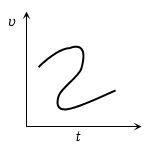
B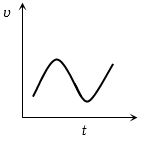
C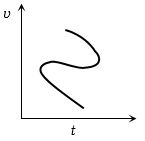
D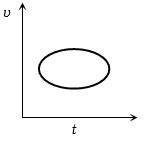
Solution
(B) For a body in motion,at any single instant of time $t$,there can be only one unique value of velocity $v$.
In graphs $A$,$C$,and $D$,for a single value of time $t$,the graph shows multiple values of velocity $v$,which is physically impossible.
Graph $B$ represents a realistic situation where the velocity varies continuously with time,having a unique value for every instant $t$.
In graphs $A$,$C$,and $D$,for a single value of time $t$,the graph shows multiple values of velocity $v$,which is physically impossible.
Graph $B$ represents a realistic situation where the velocity varies continuously with time,having a unique value for every instant $t$.
0 likesView Solution
3
PhysicsMediumMCQAIIMS · 2004
$A$ bomb of mass $3.0 \, kg$ explodes in air into two pieces of masses $2.0 \, kg$ and $1.0 \, kg$. The smaller mass travels at a speed of $80 \, m/s$. The total energy imparted to the two fragments is ............. $kJ$.
A
$1.07$
B
$2.14$
C
$2.4$
D
$4.8$
Solution
(D) According to the law of conservation of linear momentum,the total momentum before the explosion is zero,so the two fragments must have equal and opposite linear momenta: $m_1 v_1 = m_2 v_2$.
Given $m_1 = 1.0 \, kg$,$v_1 = 80 \, m/s$,and $m_2 = 2.0 \, kg$.
$1.0 \times 80 = 2.0 \times v_2 \implies v_2 = 40 \, m/s$.
The total kinetic energy imparted to the fragments is $K = \frac{1}{2} m_1 v_1^2 + \frac{1}{2} m_2 v_2^2$.
$K = \frac{1}{2} \times 1.0 \times (80)^2 + \frac{1}{2} \times 2.0 \times (40)^2$.
$K = \frac{1}{2} \times 6400 + 1.0 \times 1600 = 3200 + 1600 = 4800 \, J$.
Converting to $kJ$,$K = 4.8 \, kJ$.
Given $m_1 = 1.0 \, kg$,$v_1 = 80 \, m/s$,and $m_2 = 2.0 \, kg$.
$1.0 \times 80 = 2.0 \times v_2 \implies v_2 = 40 \, m/s$.
The total kinetic energy imparted to the fragments is $K = \frac{1}{2} m_1 v_1^2 + \frac{1}{2} m_2 v_2^2$.
$K = \frac{1}{2} \times 1.0 \times (80)^2 + \frac{1}{2} \times 2.0 \times (40)^2$.
$K = \frac{1}{2} \times 6400 + 1.0 \times 1600 = 3200 + 1600 = 4800 \, J$.
Converting to $kJ$,$K = 4.8 \, kJ$.
0 likesView Solution
4
PhysicsEasyMCQAIIMS · 2004
For a gas at a temperature $T$,the root-mean-square velocity ${v_{rms}}$,the most probable speed ${v_{mp}}$,and the average speed ${v_{av}}$ obey the relationship:
A
${v_{av}} > {v_{rms}} > {v_{mp}}$
B
${v_{rms}} > {v_{av}} > {v_{mp}}$
C
${v_{mp}} > {v_{av}} > {v_{rms}}$
D
${v_{mp}} > {v_{rms}} > {v_{av}}$
Solution
(B) The expressions for the three speeds of a gas at temperature $T$ are given by:
${v_{rms}} = \sqrt{\frac{3RT}{M}}$
${v_{av}} = \sqrt{\frac{8RT}{\pi M}}$
${v_{mp}} = \sqrt{\frac{2RT}{M}}$
Comparing the coefficients:
${v_{rms}} = \sqrt{3} \cdot \sqrt{\frac{RT}{M}} \approx 1.732 \cdot \sqrt{\frac{RT}{M}}$
${v_{av}} = \sqrt{\frac{8}{3.14}} \cdot \sqrt{\frac{RT}{M}} \approx \sqrt{2.546} \cdot \sqrt{\frac{RT}{M}} \approx 1.596 \cdot \sqrt{\frac{RT}{M}}$
${v_{mp}} = \sqrt{2} \cdot \sqrt{\frac{RT}{M}} \approx 1.414 \cdot \sqrt{\frac{RT}{M}}$
Thus,the relationship is ${v_{rms}} > {v_{av}} > {v_{mp}}$.
${v_{rms}} = \sqrt{\frac{3RT}{M}}$
${v_{av}} = \sqrt{\frac{8RT}{\pi M}}$
${v_{mp}} = \sqrt{\frac{2RT}{M}}$
Comparing the coefficients:
${v_{rms}} = \sqrt{3} \cdot \sqrt{\frac{RT}{M}} \approx 1.732 \cdot \sqrt{\frac{RT}{M}}$
${v_{av}} = \sqrt{\frac{8}{3.14}} \cdot \sqrt{\frac{RT}{M}} \approx \sqrt{2.546} \cdot \sqrt{\frac{RT}{M}} \approx 1.596 \cdot \sqrt{\frac{RT}{M}}$
${v_{mp}} = \sqrt{2} \cdot \sqrt{\frac{RT}{M}} \approx 1.414 \cdot \sqrt{\frac{RT}{M}}$
Thus,the relationship is ${v_{rms}} > {v_{av}} > {v_{mp}}$.
0 likesView Solution
5
PhysicsMediumMCQAIIMS · 2004
Suppose the sun expands so that its radius becomes $100$ times its present radius and its surface temperature becomes half of its present value. The total energy emitted by it then will increase by a factor of
A
$10^4$
B
$625$
C
$256$
D
$16$
Solution
(B) According to the Stefan-Boltzmann law,the total power (energy emitted per unit time) radiated by a black body is given by $P = \sigma A T^4$,where $A = 4\pi r^2$ is the surface area.
Therefore,$P \propto r^2 T^4$.
Let the initial radius be $r_1$ and initial temperature be $T_1$. Let the final radius be $r_2 = 100r_1$ and final temperature be $T_2 = T_1 / 2$.
The ratio of the final energy emitted $(P_2)$ to the initial energy emitted $(P_1)$ is:
$\frac{P_2}{P_1} = \left( \frac{r_2}{r_1} \right)^2 \times \left( \frac{T_2}{T_1} \right)^4$
Substituting the values:
$\frac{P_2}{P_1} = (100)^2 \times \left( \frac{1}{2} \right)^4$
$\frac{P_2}{P_1} = 10000 \times \frac{1}{16} = 625$.
Thus,the total energy emitted increases by a factor of $625$.
Therefore,$P \propto r^2 T^4$.
Let the initial radius be $r_1$ and initial temperature be $T_1$. Let the final radius be $r_2 = 100r_1$ and final temperature be $T_2 = T_1 / 2$.
The ratio of the final energy emitted $(P_2)$ to the initial energy emitted $(P_1)$ is:
$\frac{P_2}{P_1} = \left( \frac{r_2}{r_1} \right)^2 \times \left( \frac{T_2}{T_1} \right)^4$
Substituting the values:
$\frac{P_2}{P_1} = (100)^2 \times \left( \frac{1}{2} \right)^4$
$\frac{P_2}{P_1} = 10000 \times \frac{1}{16} = 625$.
Thus,the total energy emitted increases by a factor of $625$.
0 likesView Solution
6
PhysicsEasyMCQAIIMS · 2004
Water waves are
A
Longitudinal
B
Transverse
C
Both longitudinal and transverse
D
Neither longitudinal nor transverse
Solution
(C) Water waves are complex waves. On the surface of the water,the particles move in circular paths,which involves both longitudinal and transverse components. Therefore,water waves are considered to be both longitudinal and transverse in nature.
0 likesView Solution
7
PhysicsDifficultMCQAIIMS · 2004
An organ pipe closed at one end has a fundamental frequency of $1500 \ Hz$. The maximum number of overtones generated by this pipe which a normal person can hear is:
A
$14$
B
$13$
C
$6$
D
$9$
Solution
(C) The maximum frequency a normal human can hear is $20,000 \ Hz$.
For a closed organ pipe,the frequency of the $N^{th}$ mode is given by $f_N = (2N - 1)f_1$,where $f_1 = 1500 \ Hz$ is the fundamental frequency.
We require $f_N \le 20,000 \ Hz$.
$(2N - 1) \times 1500 \le 20,000$
$2N - 1 \le \frac{20,000}{1500} \approx 13.33$
$2N \le 14.33 \implies N \le 7.16$.
Since $N$ must be an integer,the maximum mode number is $N = 7$.
The number of overtones is given by $(N - 1)$.
Therefore,the number of overtones $= 7 - 1 = 6$.
For a closed organ pipe,the frequency of the $N^{th}$ mode is given by $f_N = (2N - 1)f_1$,where $f_1 = 1500 \ Hz$ is the fundamental frequency.
We require $f_N \le 20,000 \ Hz$.
$(2N - 1) \times 1500 \le 20,000$
$2N - 1 \le \frac{20,000}{1500} \approx 13.33$
$2N \le 14.33 \implies N \le 7.16$.
Since $N$ must be an integer,the maximum mode number is $N = 7$.
The number of overtones is given by $(N - 1)$.
Therefore,the number of overtones $= 7 - 1 = 6$.
0 likesView Solution
8
PhysicsEasyMCQAIIMS · 2004
The direction of the angular velocity vector is along which of the following?
A
Tangent to the circular path
B
Radially inward
C
Radially outward
D
Axis of rotation
Solution
(D) The angular velocity vector $\vec{\omega}$ is defined as an axial vector. By the right-hand rule,its direction is always along the axis of rotation of the body. Therefore,the correct option is $D$.
0 likesView Solution
9
PhysicsEasyMCQAIIMS · 2004
In orbital motion,the angular momentum vector is directed:
A
Along the radial vector
B
Parallel to the linear momentum
C
In the orbital plane
D
Perpendicular to the orbital plane
Solution
(D) The angular momentum $L$ is defined as the cross product of the position vector $r$ and the linear momentum vector $p$,given by $L = r \times p$.
By the definition of the cross product,the resulting vector $L$ is always perpendicular to the plane containing both vectors $r$ and $p$.
Since both the position vector $r$ and the linear momentum vector $p$ lie in the orbital plane,the angular momentum vector $L$ must be perpendicular to the orbital plane.
By the definition of the cross product,the resulting vector $L$ is always perpendicular to the plane containing both vectors $r$ and $p$.
Since both the position vector $r$ and the linear momentum vector $p$ lie in the orbital plane,the angular momentum vector $L$ must be perpendicular to the orbital plane.
0 likesView Solution
10
PhysicsEasyMCQAIIMS · 2004
The terminal velocity of a small sphere of radius $a$ in a viscous liquid is proportional to
A
$a^2$
B
$a^3$
C
$a$
D
$a^{-1}$
Solution
(A) According to Stokes' Law,when a small sphere of radius $a$ falls through a viscous liquid,it attains a constant velocity known as terminal velocity $(V_T)$.
The formula for terminal velocity is given by:
$V_T = \frac{2a^2(\rho - \sigma)g}{9\eta}$
Where:
$a$ = radius of the sphere
$\rho$ = density of the sphere
$\sigma$ = density of the liquid
$g$ = acceleration due to gravity
$\eta$ = coefficient of viscosity of the liquid
From the formula,it is clear that $V_T \propto a^2$.
Therefore,the terminal velocity is proportional to the square of the radius of the sphere.
The formula for terminal velocity is given by:
$V_T = \frac{2a^2(\rho - \sigma)g}{9\eta}$
Where:
$a$ = radius of the sphere
$\rho$ = density of the sphere
$\sigma$ = density of the liquid
$g$ = acceleration due to gravity
$\eta$ = coefficient of viscosity of the liquid
From the formula,it is clear that $V_T \propto a^2$.
Therefore,the terminal velocity is proportional to the square of the radius of the sphere.
0 likesView Solution
11
PhysicsEasyMCQAIIMS · 2004
$Assertion$ : The driver in a vehicle moving with a constant speed on a straight road is an inertial frame of reference.
$Reason$ : $A$ reference frame in which Newton's laws of motion are applicable is non-inertial.
$Reason$ : $A$ reference frame in which Newton's laws of motion are applicable is non-inertial.
A
If both $Assertion$ and $Reason$ are correct and the $Reason$ is a correct explanation of the $Assertion$.
B
If both $Assertion$ and $Reason$ are correct but $Reason$ is not a correct explanation of the $Assertion$.
C
If the $Assertion$ is correct but $Reason$ is incorrect.
D
If both the $Assertion$ and $Reason$ are incorrect.
Solution
(C) An inertial frame of reference is defined as a frame in which Newton's laws of motion are valid.
Since the vehicle is moving with a constant speed on a straight road,its acceleration is $0$. Therefore,it is an inertial frame of reference.
Thus,the $Assertion$ is correct.
However,the $Reason$ states that a frame where Newton's laws are applicable is non-inertial,which is false. Newton's laws are applicable in inertial frames,not non-inertial frames.
Therefore,the $Assertion$ is correct but the $Reason$ is incorrect.
Since the vehicle is moving with a constant speed on a straight road,its acceleration is $0$. Therefore,it is an inertial frame of reference.
Thus,the $Assertion$ is correct.
However,the $Reason$ states that a frame where Newton's laws are applicable is non-inertial,which is false. Newton's laws are applicable in inertial frames,not non-inertial frames.
Therefore,the $Assertion$ is correct but the $Reason$ is incorrect.
0 likesView Solution
12
PhysicsEasyMCQAIIMS · 2004
The direction of the angular velocity vector is along
A
the tangent to the circular path
B
the inward radius
C
the outward radius
D
the axis of rotation
Solution
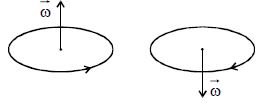
(D) Angular velocity $\vec{\omega}$ is an axial vector. Its direction is always perpendicular to the plane of the circular motion,which corresponds to the axis of rotation. According to the right-hand rule,if the fingers of the right hand are curled in the direction of rotation,the thumb points in the direction of the angular velocity vector $\vec{\omega}$. This is clearly illustrated in the provided figure,where the vector $\vec{\omega}$ lies along the axis of rotation.
0 likesView Solution
13
PhysicsEasyMCQAIIMS · 2004
In an orbital motion,the angular momentum vector is
A
along the radius vector
B
parallel to the linear momentum
C
in the orbital plane
D
perpendicular to the orbital plane
Solution
(D) The angular momentum $\vec{L}$ of a particle in orbital motion is defined by the cross product of its position vector $\vec{r}$ and its linear momentum $\vec{p}$,given by $\vec{L} = \vec{r} \times \vec{p}$.
By the definition of the cross product,the resulting vector $\vec{L}$ is always perpendicular to the plane containing both $\vec{r}$ and $\vec{p}$.
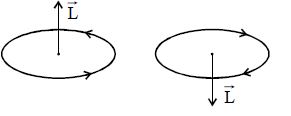
Since both the position vector and the linear momentum vector lie within the orbital plane,the angular momentum vector $\vec{L}$ must be perpendicular to the orbital plane. This is consistent with the right-hand rule,where the direction of $\vec{L}$ points along the axis of rotation.
By the definition of the cross product,the resulting vector $\vec{L}$ is always perpendicular to the plane containing both $\vec{r}$ and $\vec{p}$.
Since both the position vector and the linear momentum vector lie within the orbital plane,the angular momentum vector $\vec{L}$ must be perpendicular to the orbital plane. This is consistent with the right-hand rule,where the direction of $\vec{L}$ points along the axis of rotation.
0 likesView Solution
14
PhysicsEasyMCQAIIMS · 2004
$Assertion$ : There are very small sporadic changes in the speed of rotation of the earth.
$Reason$ : Shifting of large air masses in the earth's atmosphere produces a change in the moment of inertia of the earth, causing its speed of rotation to change.
$Reason$ : Shifting of large air masses in the earth's atmosphere produces a change in the moment of inertia of the earth, causing its speed of rotation to change.
A
If both $Assertion$ and $Reason$ are correct and the $Reason$ is a correct explanation of the $Assertion$.
B
If both $Assertion$ and $Reason$ are correct but $Reason$ is not a correct explanation of the $Assertion$.
C
If the $Assertion$ is correct but $Reason$ is incorrect.
D
If both the $Assertion$ and $Reason$ are incorrect.
Solution
(A) The earth and its atmosphere form a system. The total angular momentum of this system is conserved in the absence of external torques.
$L = I\omega = \text{constant}$
When large air masses shift within the atmosphere, the distribution of mass relative to the axis of rotation changes, which leads to a change in the total moment of inertia $(I)$ of the earth-atmosphere system.
Since the angular momentum $(L)$ must remain constant, any change in the moment of inertia $(I)$ results in a corresponding change in the angular velocity $(\omega)$ of the earth.
Therefore, the shifting of air masses causes small, sporadic changes in the earth's rotational speed.
Thus, both the $Assertion$ and $Reason$ are correct, and the $Reason$ is the correct explanation of the $Assertion$.
$L = I\omega = \text{constant}$
When large air masses shift within the atmosphere, the distribution of mass relative to the axis of rotation changes, which leads to a change in the total moment of inertia $(I)$ of the earth-atmosphere system.
Since the angular momentum $(L)$ must remain constant, any change in the moment of inertia $(I)$ results in a corresponding change in the angular velocity $(\omega)$ of the earth.
Therefore, the shifting of air masses causes small, sporadic changes in the earth's rotational speed.
Thus, both the $Assertion$ and $Reason$ are correct, and the $Reason$ is the correct explanation of the $Assertion$.
0 likesView Solution
15
PhysicsEasyMCQAIIMS · 2004
In old age,arteries carrying blood in the human body become narrow,resulting in an increase in blood pressure. This follows from:
A
Pascal's law
B
Stoke's law
C
Bernoulli's principle
D
Archimedes principle
Solution
(C) According to Bernoulli's principle,for an incompressible,non-viscous fluid in steady flow,the sum of pressure energy,kinetic energy,and potential energy per unit volume remains constant along a streamline $(P + \frac{1}{2}\rho v^2 + \rho gh = \text{constant})$.
In the human circulatory system,as arteries become narrow due to aging or plaque buildup,the blood flow velocity $(v)$ changes. While the relationship is complex due to the viscosity of blood,Bernoulli's principle explains that a decrease in the cross-sectional area of a vessel leads to changes in pressure. Specifically,the narrowing of arteries increases the resistance to flow,and the pressure dynamics within the vessel are governed by the principles of fluid mechanics,primarily Bernoulli's principle,which relates pressure and velocity in fluid flow.
In the human circulatory system,as arteries become narrow due to aging or plaque buildup,the blood flow velocity $(v)$ changes. While the relationship is complex due to the viscosity of blood,Bernoulli's principle explains that a decrease in the cross-sectional area of a vessel leads to changes in pressure. Specifically,the narrowing of arteries increases the resistance to flow,and the pressure dynamics within the vessel are governed by the principles of fluid mechanics,primarily Bernoulli's principle,which relates pressure and velocity in fluid flow.
0 likesView Solution
16
PhysicsMediumMCQAIIMS · 2004
$Assertion :$ In a pressure cooker,water is brought to a boil. The cooker is then removed from the stove. Now,upon removing the lid of the pressure cooker,the water starts boiling again.
$Reason :$ The impurities in water bring down its boiling point.
$Reason :$ The impurities in water bring down its boiling point.
A
If both Assertion and Reason are correct and the Reason is a correct explanation of the Assertion.
B
If both Assertion and Reason are correct but Reason is not a correct explanation of the Assertion.
C
If the Assertion is correct but Reason is incorrect.
D
If both the Assertion and Reason are incorrect.
Solution
(C) The water starts boiling a second time because when the pressure cooker cools down,the pressure inside decreases.
According to the relationship between pressure and boiling point,a decrease in pressure leads to a decrease in the boiling point $(B.P.)$ of water.
When the lid is removed,the pressure drops to atmospheric pressure,which is lower than the pressure inside the closed cooker.
Since the water is already at a high temperature,this reduction in pressure causes the water to boil again.
The Reason provided is incorrect because impurities generally increase the boiling point of water (elevation of boiling point),not decrease it.
According to the relationship between pressure and boiling point,a decrease in pressure leads to a decrease in the boiling point $(B.P.)$ of water.
When the lid is removed,the pressure drops to atmospheric pressure,which is lower than the pressure inside the closed cooker.
Since the water is already at a high temperature,this reduction in pressure causes the water to boil again.
The Reason provided is incorrect because impurities generally increase the boiling point of water (elevation of boiling point),not decrease it.
0 likesView Solution
17
PhysicsEasyMCQAIIMS · 2004
$Assertion :$ Smaller drops of liquid resist deforming forces better than the larger drops.
$Reason :$ Excess pressure inside a drop is directly proportional to its surface area.
$Reason :$ Excess pressure inside a drop is directly proportional to its surface area.
A
If both Assertion and Reason are correct and the Reason is a correct explanation of the Assertion.
B
If the Assertion is correct but Reason is incorrect.
C
If both Assertion and Reason are correct but Reason is not a correct explanation of the Assertion.
D
If both the Assertion and Reason are incorrect.
Solution
(B) The excess pressure inside a liquid drop is given by the formula $P = \frac{2T}{r}$,where $T$ is the surface tension and $r$ is the radius of the drop.
From this relation,it is clear that the excess pressure $P$ is inversely proportional to the radius $r$ $(P \propto \frac{1}{r})$.
As the radius $r$ decreases,the excess pressure $P$ increases.
Therefore,smaller drops have a higher excess pressure,which makes them more stable and better able to resist deforming forces.
Since the excess pressure is inversely proportional to the radius and not directly proportional to the surface area,the Reason is incorrect.
Thus,the Assertion is correct,but the Reason is incorrect.
From this relation,it is clear that the excess pressure $P$ is inversely proportional to the radius $r$ $(P \propto \frac{1}{r})$.
As the radius $r$ decreases,the excess pressure $P$ increases.
Therefore,smaller drops have a higher excess pressure,which makes them more stable and better able to resist deforming forces.
Since the excess pressure is inversely proportional to the radius and not directly proportional to the surface area,the Reason is incorrect.
Thus,the Assertion is correct,but the Reason is incorrect.
0 likesView Solution
18
PhysicsEasyMCQAIIMS · 2004
$Assertion :$ Thermodynamic processes in nature are irreversible.
$Reason :$ Dissipative effects cannot be eliminated.
$Reason :$ Dissipative effects cannot be eliminated.
A
If both $Assertion$ and $Reason$ are correct and the $Reason$ is a correct explanation of the $Assertion$.
B
If both $Assertion$ and $Reason$ are correct but $Reason$ is not a correct explanation of the $Assertion$.
C
If the $Assertion$ is correct but $Reason$ is incorrect.
D
If both the $Assertion$ and $Reason$ are incorrect.
Solution
(A) Most phenomena in nature are irreversible. $A$ process becomes irreversible if some energy is dissipated,typically converted into heat energy due to friction,viscosity,or other resistive forces. This is known as a dissipative effect. Since these dissipative effects cannot be completely eliminated in any real-world process,all natural thermodynamic processes are irreversible.
0 likesView Solution
19
PhysicsEasyMCQAIIMS · 2004
The angular acceleration of a body, moving along the circumference of a circle, is :
A
along the axis of rotation
B
along the tangent to its position
C
along the radius towards the centre
D
along the radius, away from centre
Solution
(A) Angular acceleration $(\vec{\alpha})$ is defined as the rate of change of angular velocity $(\vec{\omega})$ with respect to time, given by $\vec{\alpha} = \frac{d\vec{\omega}}{dt}$.
Since the angular velocity vector $(\vec{\omega})$ for a body moving in a circular path is directed along the axis of rotation, the rate of change of this vector, which is the angular acceleration $(\vec{\alpha})$, also acts along the same axis of rotation.
Since the angular velocity vector $(\vec{\omega})$ for a body moving in a circular path is directed along the axis of rotation, the rate of change of this vector, which is the angular acceleration $(\vec{\alpha})$, also acts along the same axis of rotation.

0 likesView Solution
20
PhysicsMediumMCQAIIMS · 2004
Equipotential surfaces associated with an electric field which is increasing in magnitude along the $x$-direction are
A
Planes parallel to $yz$-plane
B
Planes parallel to $xy$-plane
C
Planes parallel to $xz$-plane
D
Coaxial cylinders of increasing radii around the $x$-axis
Solution
(A) The electric field $\vec{E}$ is directed along the $x$-axis. The relation between electric field and potential is given by $\vec{E} = -\nabla V$.
Since the electric field is only in the $x$-direction, the potential $V$ depends only on $x$, i.e., $V = V(x)$.
An equipotential surface is a surface where the potential $V$ is constant.
For $V(x) = \text{constant}$, $x$ must be constant.
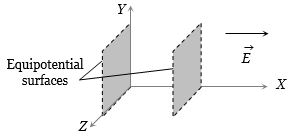
A surface defined by $x = \text{constant}$ is a plane parallel to the $yz$-plane.
Even if the magnitude of the electric field increases along the $x$-direction, the equipotential surfaces remain planes perpendicular to the direction of the electric field (i.e., parallel to the $yz$-plane), although their spacing will decrease as the field strength increases.
Since the electric field is only in the $x$-direction, the potential $V$ depends only on $x$, i.e., $V = V(x)$.
An equipotential surface is a surface where the potential $V$ is constant.
For $V(x) = \text{constant}$, $x$ must be constant.
A surface defined by $x = \text{constant}$ is a plane parallel to the $yz$-plane.
Even if the magnitude of the electric field increases along the $x$-direction, the equipotential surfaces remain planes perpendicular to the direction of the electric field (i.e., parallel to the $yz$-plane), although their spacing will decrease as the field strength increases.
0 likesView Solution
21
PhysicsMediumMCQAIIMS · 2004
$A$ $40 \, \mu F$ capacitor in a defibrillator is charged to $3000 \, V$. The energy stored in the capacitor is sent through the patient during a pulse of duration $2 \, ms$. The power delivered to the patient is ...... $kW$.
A
$45$
B
$90$
C
$180$
D
$360$
Solution
(B) The energy $U$ stored in a capacitor is given by the formula $U = \frac{1}{2} C V^2$.
Given: $C = 40 \, \mu F = 40 \times 10^{-6} \, F$,$V = 3000 \, V$,and $t = 2 \, ms = 2 \times 10^{-3} \, s$.
First,calculate the energy stored:
$U = \frac{1}{2} \times (40 \times 10^{-6}) \times (3000)^2$
$U = 20 \times 10^{-6} \times 9 \times 10^6 = 180 \, J$.
Power $P$ is defined as the energy delivered per unit time:
$P = \frac{U}{t} = \frac{180 \, J}{2 \times 10^{-3} \, s} = 90 \times 10^3 \, W = 90 \, kW$.
Given: $C = 40 \, \mu F = 40 \times 10^{-6} \, F$,$V = 3000 \, V$,and $t = 2 \, ms = 2 \times 10^{-3} \, s$.
First,calculate the energy stored:
$U = \frac{1}{2} \times (40 \times 10^{-6}) \times (3000)^2$
$U = 20 \times 10^{-6} \times 9 \times 10^6 = 180 \, J$.
Power $P$ is defined as the energy delivered per unit time:
$P = \frac{U}{t} = \frac{180 \, J}{2 \times 10^{-3} \, s} = 90 \times 10^3 \, W = 90 \, kW$.
0 likesView Solution
22
PhysicsMediumMCQAIIMS · 2004
The electric field due to a uniformly charged sphere of radius $R$ as a function of the distance $r$ from its centre is represented graphically by
A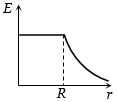
B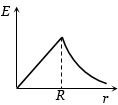
C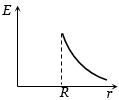
D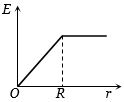
Solution
(B) For a uniformly charged sphere of radius $R$ with volume charge density $\rho$:
$1$. Inside the sphere $(r < R)$,the electric field is given by $E_{inside} = \frac{\rho r}{3\varepsilon_0}$. This shows that $E \propto r$,which is a linear relationship passing through the origin.
$2$. Outside the sphere $(r \ge R)$,the electric field is given by $E_{outside} = \frac{\rho R^3}{3\varepsilon_0 r^2}$. This shows that $E \propto \frac{1}{r^2}$,which is an inverse-square relationship.
$3$. Combining these,the graph starts from the origin,increases linearly until $r = R$,and then decreases following an inverse-square curve for $r > R$. This corresponds to the graph shown in option $B$.
$1$. Inside the sphere $(r < R)$,the electric field is given by $E_{inside} = \frac{\rho r}{3\varepsilon_0}$. This shows that $E \propto r$,which is a linear relationship passing through the origin.
$2$. Outside the sphere $(r \ge R)$,the electric field is given by $E_{outside} = \frac{\rho R^3}{3\varepsilon_0 r^2}$. This shows that $E \propto \frac{1}{r^2}$,which is an inverse-square relationship.
$3$. Combining these,the graph starts from the origin,increases linearly until $r = R$,and then decreases following an inverse-square curve for $r > R$. This corresponds to the graph shown in option $B$.
0 likesView Solution
23
PhysicsDifficultMCQAIIMS · 2004
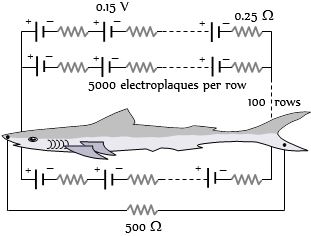
Eels are able to generate current with biological cells called electroplaques. The electroplaques in an eel are arranged in $100$ rows,each row stretching horizontally along the body of the fish containing $5000$ electroplaques. The arrangement is shown below. Each electroplaque has an emf of $0.15\, V$ and internal resistance of $0.25\,\Omega$. The water surrounding the eel completes a circuit between the head and its tail. If the water surrounding it has a resistance of $500\,\Omega$,the current an eel can produce in water is about .............. $A$.
A
$1.5$
B
$3$
C
$15$
D
$30$
Solution
(A) The given problem represents a mixed grouping of cells.
Let $n$ be the number of cells in each row and $m$ be the number of rows.
Given: $n = 5000$,$m = 100$,$E = 0.15\, V$,$r = 0.25\,\Omega$,and external resistance $R = 500\,\Omega$.
The total emf of the arrangement is $E_{eq} = nE = 5000 \times 0.15 = 750\, V$.
The total internal resistance of the arrangement is $r_{eq} = \frac{nr}{m} = \frac{5000 \times 0.25}{100} = 50 \times 0.25 = 12.5\,\Omega$.
The total current $i$ in the circuit is given by $i = \frac{E_{eq}}{R + r_{eq}}$.
Substituting the values: $i = \frac{750}{500 + 12.5} = \frac{750}{512.5} \approx 1.463\, A$.
Rounding to the nearest option,the current is approximately $1.5\, A$.
Let $n$ be the number of cells in each row and $m$ be the number of rows.
Given: $n = 5000$,$m = 100$,$E = 0.15\, V$,$r = 0.25\,\Omega$,and external resistance $R = 500\,\Omega$.
The total emf of the arrangement is $E_{eq} = nE = 5000 \times 0.15 = 750\, V$.
The total internal resistance of the arrangement is $r_{eq} = \frac{nr}{m} = \frac{5000 \times 0.25}{100} = 50 \times 0.25 = 12.5\,\Omega$.
The total current $i$ in the circuit is given by $i = \frac{E_{eq}}{R + r_{eq}}$.
Substituting the values: $i = \frac{750}{500 + 12.5} = \frac{750}{512.5} \approx 1.463\, A$.
Rounding to the nearest option,the current is approximately $1.5\, A$.
0 likesView Solution
24
PhysicsMediumMCQAIIMS · 2004
$A$ circular coil of radius $R$ carries an electric current. The magnetic field due to the coil at a point on the axis of the coil located at a distance $r$ from the centre of the coil,such that $r \gg R$,varies as:
A
$1/r$
B
$1/r^{3/2}$
C
$1/r^2$
D
$1/r^3$
Solution
(D) The magnetic field $B$ on the axis of a circular coil of radius $R$ carrying current $i$ at a distance $r$ from its center is given by the formula:
$B = \frac{\mu_0 i R^2}{2(R^2 + r^2)^{3/2}}$
Given the condition $r \gg R$,we can neglect $R^2$ in the denominator:
$B \approx \frac{\mu_0 i R^2}{2(r^2)^{3/2}} = \frac{\mu_0 i R^2}{2r^3}$
Since $\mu_0$,$i$,and $R$ are constants,we find that $B \propto \frac{1}{r^3}$.
$B = \frac{\mu_0 i R^2}{2(R^2 + r^2)^{3/2}}$
Given the condition $r \gg R$,we can neglect $R^2$ in the denominator:
$B \approx \frac{\mu_0 i R^2}{2(r^2)^{3/2}} = \frac{\mu_0 i R^2}{2r^3}$
Since $\mu_0$,$i$,and $R$ are constants,we find that $B \propto \frac{1}{r^3}$.
0 likesView Solution
25
PhysicsEasyMCQAIIMS · 2004
The magnetic moment of a current $(i)$ carrying circular coil of radius $(r)$ and number of turns $(n)$ varies as
A
$1/r^2$
B
$1/r$
C
$r$
D
$r^2$
Solution
(D) The magnetic moment $(M)$ of a current-carrying coil is given by the formula $M = niA$,where $n$ is the number of turns,$i$ is the current,and $A$ is the area of the coil.
For a circular coil of radius $r$,the area $A = \pi r^2$.
Substituting the area into the formula,we get $M = ni(\pi r^2)$.
Since $n$,$i$,and $\pi$ are constants for a given coil,the magnetic moment $M$ is directly proportional to the square of the radius,i.e.,$M \propto r^2$.
For a circular coil of radius $r$,the area $A = \pi r^2$.
Substituting the area into the formula,we get $M = ni(\pi r^2)$.
Since $n$,$i$,and $\pi$ are constants for a given coil,the magnetic moment $M$ is directly proportional to the square of the radius,i.e.,$M \propto r^2$.
0 likesView Solution
26
PhysicsMediumMCQAIIMS · 2004
An $\alpha$-particle and a proton travel with the same velocity in a magnetic field perpendicular to the direction of their velocities. Find the ratio of the radii of their circular paths.
A
$4:1$
B
$1:4$
C
$2:1$
D
$1:2$
Solution
(C) The radius of the circular path of a charged particle moving in a perpendicular magnetic field is given by $r = \frac{mv}{qB}$.
Since the velocity $v$ and magnetic field $B$ are the same for both particles,the ratio of the radii is $\frac{r_{\alpha}}{r_p} = \frac{m_{\alpha}}{m_p} \times \frac{q_p}{q_{\alpha}}$.
For an $\alpha$-particle,the mass $m_{\alpha} = 4m_p$ and the charge $q_{\alpha} = 2q_p$.
Substituting these values,we get $\frac{r_{\alpha}}{r_p} = \frac{4m_p}{m_p} \times \frac{q_p}{2q_p} = 4 \times \frac{1}{2} = \frac{2}{1}$.
Therefore,the ratio is $2:1$.
Since the velocity $v$ and magnetic field $B$ are the same for both particles,the ratio of the radii is $\frac{r_{\alpha}}{r_p} = \frac{m_{\alpha}}{m_p} \times \frac{q_p}{q_{\alpha}}$.
For an $\alpha$-particle,the mass $m_{\alpha} = 4m_p$ and the charge $q_{\alpha} = 2q_p$.
Substituting these values,we get $\frac{r_{\alpha}}{r_p} = \frac{4m_p}{m_p} \times \frac{q_p}{2q_p} = 4 \times \frac{1}{2} = \frac{2}{1}$.
Therefore,the ratio is $2:1$.
0 likesView Solution
27
PhysicsMediumMCQAIIMS · 2004
The cyclotron frequency of an electron gyrating in a magnetic field of $1\, T$ is approximately
A
$28\, MHz$
B
$280\, MHz$
C
$2.8\, GHz$
D
$28\, GHz$
Solution
(D) The cyclotron frequency $v$ is given by the formula $v = \frac{qB}{2\pi m}$.
Given: $B = 1\, T$,$q = 1.6 \times 10^{-19}\, C$,and $m = 9.1 \times 10^{-31}\, kg$.
Substituting the values:
$v = \frac{1 \times 1.6 \times 10^{-19}}{2 \times 3.14 \times 9.1 \times 10^{-31}}$
$v = \frac{1.6}{57.148} \times 10^{12}\, Hz$
$v \approx 0.02799 \times 10^{12}\, Hz = 27.99 \times 10^9\, Hz$
$v \approx 28\, GHz$.
Given: $B = 1\, T$,$q = 1.6 \times 10^{-19}\, C$,and $m = 9.1 \times 10^{-31}\, kg$.
Substituting the values:
$v = \frac{1 \times 1.6 \times 10^{-19}}{2 \times 3.14 \times 9.1 \times 10^{-31}}$
$v = \frac{1.6}{57.148} \times 10^{12}\, Hz$
$v \approx 0.02799 \times 10^{12}\, Hz = 27.99 \times 10^9\, Hz$
$v \approx 28\, GHz$.
0 likesView Solution
28
PhysicsEasyMCQAIIMS · 2004
If two streams of protons move parallel to each other in the same direction,then they
A
Do not exert any force on each other
B
Repel each other
C
Attract each other
D
Get rotated to be perpendicular to each other
Solution
(B) When two streams of protons move parallel to each other in the same direction,two types of forces act between them: the electrostatic force and the magnetic force.
$1$. The electrostatic force between two streams of protons is repulsive because both streams consist of positively charged particles.
$2$. The magnetic force between two parallel currents moving in the same direction is attractive.
$3$. However,for charged particles moving in space,the electrostatic repulsive force is significantly stronger than the magnetic attractive force.
$4$. Therefore,the net force between the two streams is repulsive,causing them to repel each other.
$1$. The electrostatic force between two streams of protons is repulsive because both streams consist of positively charged particles.
$2$. The magnetic force between two parallel currents moving in the same direction is attractive.
$3$. However,for charged particles moving in space,the electrostatic repulsive force is significantly stronger than the magnetic attractive force.
$4$. Therefore,the net force between the two streams is repulsive,causing them to repel each other.
0 likesView Solution
29
PhysicsMediumMCQAIIMS · 2004
The magnetic field due to a straight conductor of uniform cross-section of radius $a$ and carrying a steady current is represented by
A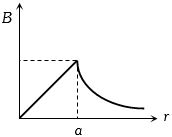
B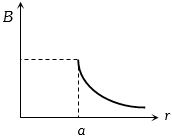
C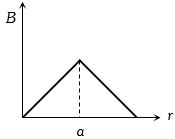
D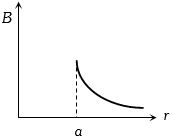
Solution
(A) According to Ampere's circuital law, for a cylindrical conductor of radius $a$ carrying a steady current $I$:
$1$. Inside the conductor $(r < a)$: The magnetic field $B_{in}$ is given by $B_{in} = \frac{\mu_0 I r}{2 \pi a^2}$. Thus, $B_{in} \propto r$, which represents a straight line passing through the origin.
$2$. Outside the conductor $(r > a)$: The magnetic field $B_{out}$ is given by $B_{out} = \frac{\mu_0 I}{2 \pi r}$. Thus, $B_{out} \propto \frac{1}{r}$, which represents a rectangular hyperbola.
Therefore, the graph shows a linear increase up to $r = a$ and a hyperbolic decrease for $r > a$, which corresponds to the first option.
$1$. Inside the conductor $(r < a)$: The magnetic field $B_{in}$ is given by $B_{in} = \frac{\mu_0 I r}{2 \pi a^2}$. Thus, $B_{in} \propto r$, which represents a straight line passing through the origin.
$2$. Outside the conductor $(r > a)$: The magnetic field $B_{out}$ is given by $B_{out} = \frac{\mu_0 I}{2 \pi r}$. Thus, $B_{out} \propto \frac{1}{r}$, which represents a rectangular hyperbola.
Therefore, the graph shows a linear increase up to $r = a$ and a hyperbolic decrease for $r > a$, which corresponds to the first option.
0 likesView Solution
30
PhysicsEasyMCQAIIMS · 2004
Liquid oxygen remains suspended between two pole faces of a magnet because it is
A
Diamagnetic
B
Paramagnetic
C
Ferromagnetic
D
Antiferromagnetic
Solution
(B) Liquid oxygen is $Paramagnetic$ in nature.
Paramagnetic substances are weakly attracted by magnetic fields.
When liquid oxygen is placed between the two pole faces of a magnet,it experiences an attractive force towards both poles.
If the liquid is placed exactly in the center,the magnetic forces exerted by the two poles are equal in magnitude and opposite in direction.
As a result,the net magnetic force on the liquid oxygen becomes zero,causing it to remain suspended between the pole faces.
Paramagnetic substances are weakly attracted by magnetic fields.
When liquid oxygen is placed between the two pole faces of a magnet,it experiences an attractive force towards both poles.
If the liquid is placed exactly in the center,the magnetic forces exerted by the two poles are equal in magnitude and opposite in direction.
As a result,the net magnetic force on the liquid oxygen becomes zero,causing it to remain suspended between the pole faces.
0 likesView Solution
31
PhysicsMediumMCQAIIMS · 2004
An electron is accelerated through a potential difference $(p.d.)$ of $45.5 \ V$. The velocity acquired by it is (in $m \ s^{-1}$)
A
$4 \times 10^6$
B
$4 \times 10^4$
C
$10^6$
D
$0$
Solution
(A) The kinetic energy gained by an electron accelerated through a potential difference $V$ is given by $K.E. = eV = \frac{1}{2}mv^2$.
Solving for velocity $v$,we get $v = \sqrt{\frac{2eV}{m}}$.
Given: $e = 1.6 \times 10^{-19} \ C$,$V = 45.5 \ V$,and $m = 9.1 \times 10^{-31} \ kg$.
Substituting the values: $v = \sqrt{\frac{2 \times 1.6 \times 10^{-19} \times 45.5}{9.1 \times 10^{-31}}}$.
$v = \sqrt{\frac{145.6 \times 10^{-19}}{9.1 \times 10^{-31}}} = \sqrt{16 \times 10^{12}}$.
$v = 4 \times 10^6 \ m \ s^{-1}$.
Solving for velocity $v$,we get $v = \sqrt{\frac{2eV}{m}}$.
Given: $e = 1.6 \times 10^{-19} \ C$,$V = 45.5 \ V$,and $m = 9.1 \times 10^{-31} \ kg$.
Substituting the values: $v = \sqrt{\frac{2 \times 1.6 \times 10^{-19} \times 45.5}{9.1 \times 10^{-31}}}$.
$v = \sqrt{\frac{145.6 \times 10^{-19}}{9.1 \times 10^{-31}}} = \sqrt{16 \times 10^{12}}$.
$v = 4 \times 10^6 \ m \ s^{-1}$.
0 likesView Solution
32
PhysicsEasyMCQAIIMS · 2004
$4 \ eV$ is the energy of the incident photon and the work function is $2 \ eV$. What is the stopping potential in $V$?
A
$2$
B
$4$
C
$6$
D
$2\sqrt{2}$
Solution
(A) According to Einstein's photoelectric equation,the energy of the incident photon $(E)$ is equal to the sum of the work function $(W_0)$ and the maximum kinetic energy $(K_{max})$ of the emitted photoelectrons.
$E = W_0 + K_{max}$
Given that $K_{max} = eV_0$,where $V_0$ is the stopping potential,the equation becomes:
$E = W_0 + eV_0$
Substituting the given values ($E = 4 \ eV$ and $W_0 = 2 \ eV$):
$4 \ eV = 2 \ eV + eV_0$
$eV_0 = 4 \ eV - 2 \ eV$
$eV_0 = 2 \ eV$
Therefore,the stopping potential $V_0 = 2 \ V$.
$E = W_0 + K_{max}$
Given that $K_{max} = eV_0$,where $V_0$ is the stopping potential,the equation becomes:
$E = W_0 + eV_0$
Substituting the given values ($E = 4 \ eV$ and $W_0 = 2 \ eV$):
$4 \ eV = 2 \ eV + eV_0$
$eV_0 = 4 \ eV - 2 \ eV$
$eV_0 = 2 \ eV$
Therefore,the stopping potential $V_0 = 2 \ V$.
0 likesView Solution
33
PhysicsEasyMCQAIIMS · 2004
When ultraviolet rays are incident on a metal plate, the photoelectric effect does not occur. It occurs by the incidence of:
A
$X$-rays
B
Radio waves
C
Infrared rays
D
Greenhouse effect
Solution
(A) The photoelectric effect occurs when the incident radiation has a frequency greater than the threshold frequency of the metal, or equivalently, a wavelength shorter than the threshold wavelength.
Since ultraviolet $(UV)$ rays do not cause the photoelectric effect, the incident radiation must have a higher energy (shorter wavelength) than $UV$ rays.
Among the given options, $X$-rays have a shorter wavelength $(\lambda_{X-ray} < \lambda_{UV-ray})$ and thus higher energy than $UV$ rays.
Therefore, $X$-rays will cause the photoelectric effect.
Since ultraviolet $(UV)$ rays do not cause the photoelectric effect, the incident radiation must have a higher energy (shorter wavelength) than $UV$ rays.
Among the given options, $X$-rays have a shorter wavelength $(\lambda_{X-ray} < \lambda_{UV-ray})$ and thus higher energy than $UV$ rays.
Therefore, $X$-rays will cause the photoelectric effect.
0 likesView Solution
34
PhysicsEasyMCQAIIMS · 2004
If an electron and a positron annihilate,then the energy released is
A
$3.2 \times 10^{-13} \ J$
B
$1.6 \times 10^{-13} \ J$
C
$4.8 \times 10^{-13} \ J$
D
$6.4 \times 10^{-13} \ J$
Solution
(B) The mass of an electron $(m_e)$ is $9.1 \times 10^{-31} \ kg$.
Since a positron has the same mass as an electron,the total mass involved in the annihilation is $2m_e$.
The energy released $(E)$ is given by Einstein's mass-energy equivalence formula: $E = (2m_e)c^2$.
Substituting the values: $E = 2 \times (9.1 \times 10^{-31} \ kg) \times (3 \times 10^8 \ m/s)^2$.
$E = 18.2 \times 10^{-31} \times 9 \times 10^{16} \ J$.
$E = 163.8 \times 10^{-15} \ J = 1.638 \times 10^{-13} \ J$.
Rounding to the nearest provided option,the energy released is approximately $1.6 \times 10^{-13} \ J$.
Since a positron has the same mass as an electron,the total mass involved in the annihilation is $2m_e$.
The energy released $(E)$ is given by Einstein's mass-energy equivalence formula: $E = (2m_e)c^2$.
Substituting the values: $E = 2 \times (9.1 \times 10^{-31} \ kg) \times (3 \times 10^8 \ m/s)^2$.
$E = 18.2 \times 10^{-31} \times 9 \times 10^{16} \ J$.
$E = 163.8 \times 10^{-15} \ J = 1.638 \times 10^{-13} \ J$.
Rounding to the nearest provided option,the energy released is approximately $1.6 \times 10^{-13} \ J$.
0 likesView Solution
35
PhysicsEasyMCQAIIMS · 2004
Carbon dating is best suited for determining the age of fossils if their age in years is of the order of
A
$10^3$
B
$10^4$
C
$10^5$
D
$10^6$
Solution
(B) Carbon dating is primarily used to determine the age of organic materials such as fossils.
It relies on the decay of the radioactive isotope Carbon-$14$ $(^{14}C)$,which has a half-life of approximately $5730$ years.
Due to the half-life of $^{14}C$,this method is effective for dating samples up to approximately $45,000$ to $50,000$ years old.
Therefore,the age range for which carbon dating is best suited is of the order of $10^4$ years.
For much older geological samples,other methods like the Potassium-Argon dating method are preferred.
It relies on the decay of the radioactive isotope Carbon-$14$ $(^{14}C)$,which has a half-life of approximately $5730$ years.
Due to the half-life of $^{14}C$,this method is effective for dating samples up to approximately $45,000$ to $50,000$ years old.
Therefore,the age range for which carbon dating is best suited is of the order of $10^4$ years.
For much older geological samples,other methods like the Potassium-Argon dating method are preferred.
0 likesView Solution
36
PhysicsMediumMCQAIIMS · 2004
$A$ radioactive nucleus undergoes $\alpha$-emission to form a stable element. What will be the recoil velocity of the daughter nucleus if $V$ is the velocity of $\alpha$-emission and $A$ is the atomic mass of the radioactive nucleus?
A
$\frac{4V}{A - 4}$
B
$\frac{2V}{A - 4}$
C
$\frac{4V}{A + 4}$
D
$\frac{2V}{A + 4}$
Solution
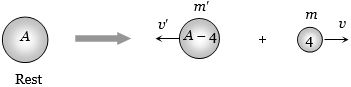
(A) Let the mass of the parent radioactive nucleus be $A$.
After $\alpha$-emission,the mass of the $\alpha$-particle is $4$ and the mass of the daughter nucleus is $(A - 4)$.
Initially,the radioactive nucleus is at rest,so its initial momentum is $0$.
According to the law of conservation of linear momentum:
Initial momentum = Final momentum
$0 = (A - 4)v' + 4V$
Here,$v'$ is the recoil velocity of the daughter nucleus and $V$ is the velocity of the $\alpha$-particle.
$(A - 4)v' = -4V$
The negative sign indicates that the daughter nucleus moves in the opposite direction to the $\alpha$-particle.
The magnitude of the recoil velocity is $v' = \frac{4V}{A - 4}$.
After $\alpha$-emission,the mass of the $\alpha$-particle is $4$ and the mass of the daughter nucleus is $(A - 4)$.
Initially,the radioactive nucleus is at rest,so its initial momentum is $0$.
According to the law of conservation of linear momentum:
Initial momentum = Final momentum
$0 = (A - 4)v' + 4V$
Here,$v'$ is the recoil velocity of the daughter nucleus and $V$ is the velocity of the $\alpha$-particle.
$(A - 4)v' = -4V$
The negative sign indicates that the daughter nucleus moves in the opposite direction to the $\alpha$-particle.
The magnitude of the recoil velocity is $v' = \frac{4V}{A - 4}$.
0 likesView Solution
37
PhysicsMediumMCQAIIMS · 2004
The dependence of binding energy per nucleon,$B_N$ on the mass number,$A$,is represented by
A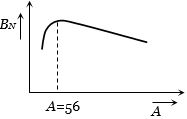
B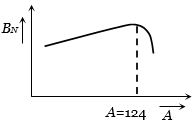
C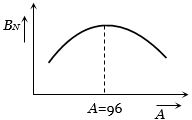
D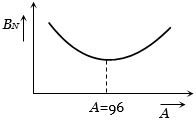
Solution
(A) The binding energy per nucleon $(B_N)$ is a measure of the stability of a nucleus.
Experimental observations show that $B_N$ increases rapidly for light nuclei and reaches a maximum value of approximately $8.8 \text{ MeV}$ for iron $(Fe^{56})$,which corresponds to a mass number $A = 56$.
For nuclei with $A > 56$,the binding energy per nucleon gradually decreases as the mass number increases.
Therefore,the graph that correctly represents this dependence shows a peak at $A = 56$.
Experimental observations show that $B_N$ increases rapidly for light nuclei and reaches a maximum value of approximately $8.8 \text{ MeV}$ for iron $(Fe^{56})$,which corresponds to a mass number $A = 56$.
For nuclei with $A > 56$,the binding energy per nucleon gradually decreases as the mass number increases.
Therefore,the graph that correctly represents this dependence shows a peak at $A = 56$.
0 likesView Solution
38
PhysicsEasyMCQAIIMS · 2004
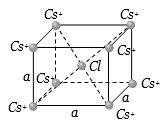
What is the net force on a $Cl^{-}$ ion placed at the centre of the $bcc$ structure of $CsCl$?
A
Zero
B
$k{e^2}/{a^2}$
C
$k{e^2}{a^2}$
D
Data is incomplete
Solution
(A) In a $CsCl$ crystal,the $Cs^{+}$ ions are located at the eight corners of a cube of side length $a$.
The $Cl^{-}$ ion is placed at the exact centre of this cube.
Due to the symmetry of the $bcc$ structure,each $Cs^{+}$ ion at a corner exerts an electrostatic force on the central $Cl^{-}$ ion.
For every $Cs^{+}$ ion,there is an identical $Cs^{+}$ ion located diametrically opposite to it with respect to the centre.
The forces exerted by these pairs of $Cs^{+}$ ions on the central $Cl^{-}$ ion are equal in magnitude and opposite in direction.
According to the principle of superposition,the vector sum of all these forces is zero.
Therefore,the net electrostatic force on the $Cl^{-}$ ion is zero.
The $Cl^{-}$ ion is placed at the exact centre of this cube.
Due to the symmetry of the $bcc$ structure,each $Cs^{+}$ ion at a corner exerts an electrostatic force on the central $Cl^{-}$ ion.
For every $Cs^{+}$ ion,there is an identical $Cs^{+}$ ion located diametrically opposite to it with respect to the centre.
The forces exerted by these pairs of $Cs^{+}$ ions on the central $Cl^{-}$ ion are equal in magnitude and opposite in direction.
According to the principle of superposition,the vector sum of all these forces is zero.
Therefore,the net electrostatic force on the $Cl^{-}$ ion is zero.
0 likesView Solution
39
PhysicsEasyMCQAIIMS · 2004
$A$ $Ge$ specimen is doped with $Al$. The concentration of acceptor atoms is $10^{21} \text{ atoms}/m^3$. Given that the intrinsic concentration of electron-hole pairs is $10^{19} /m^3$, the concentration of electrons in the specimen is:
A
$10^{17} /m^3$
B
$10^{15} /m^3$
C
$10^4 /m^3$
D
$10^2 /m^3$
Solution
(A) In a $p$-type semiconductor, the concentration of holes $(n_h)$ is approximately equal to the concentration of acceptor atoms $(N_A)$.
Given: $n_h \approx N_A = 10^{21} /m^3$.
The intrinsic concentration of electron-hole pairs is $n_i = 10^{19} /m^3$.
Using the law of mass action for semiconductors: $n_e \cdot n_h = n_i^2$.
Substituting the values: $n_e \cdot 10^{21} = (10^{19})^2$.
$n_e \cdot 10^{21} = 10^{38}$.
$n_e = 10^{38} / 10^{21} = 10^{17} /m^3$.
Therefore, the concentration of electrons is $10^{17} /m^3$.
Given: $n_h \approx N_A = 10^{21} /m^3$.
The intrinsic concentration of electron-hole pairs is $n_i = 10^{19} /m^3$.
Using the law of mass action for semiconductors: $n_e \cdot n_h = n_i^2$.
Substituting the values: $n_e \cdot 10^{21} = (10^{19})^2$.
$n_e \cdot 10^{21} = 10^{38}$.
$n_e = 10^{38} / 10^{21} = 10^{17} /m^3$.
Therefore, the concentration of electrons is $10^{17} /m^3$.
0 likesView Solution
40
PhysicsMediumMCQAIIMS · 2004
The temperature $(T)$ dependence of resistivity $(\rho)$ of a semiconductor is represented by
A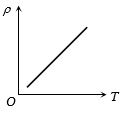
B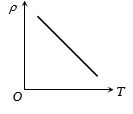
C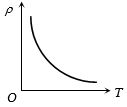
D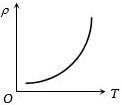
Solution
(C) In semiconductors,the number of charge carriers (electrons and holes) increases exponentially with an increase in temperature $(T)$ due to the thermal excitation of electrons from the valence band to the conduction band.
Since resistivity $(\rho)$ is inversely proportional to the number density of charge carriers $(n)$,i.e.,$\rho = \frac{m}{ne^2\tau}$,the resistivity decreases as the temperature increases.
This relationship is given by the expression $\rho(T) = \rho_0 e^{E_g / 2k_BT}$,which represents an exponential decay.
Therefore,the correct graphical representation of the temperature dependence of resistivity for a semiconductor is shown in Graph $C$.
Since resistivity $(\rho)$ is inversely proportional to the number density of charge carriers $(n)$,i.e.,$\rho = \frac{m}{ne^2\tau}$,the resistivity decreases as the temperature increases.
This relationship is given by the expression $\rho(T) = \rho_0 e^{E_g / 2k_BT}$,which represents an exponential decay.
Therefore,the correct graphical representation of the temperature dependence of resistivity for a semiconductor is shown in Graph $C$.
0 likesView Solution
41
PhysicsEasyMCQAIIMS · 2004
An object is immersed in a fluid. In order that the object becomes invisible,it should
A
Behave as a perfect reflector
B
Absorb all light falling on it
C
Have refractive index one
D
Have refractive index exactly matching with that of the surrounding fluid
Solution
(D) When an object is immersed in a fluid,light rays undergo refraction at the interface of the object and the fluid.
If the refractive index of the object $(n_1)$ is equal to the refractive index of the surrounding fluid $(n_2)$,then the light rays do not bend or reflect at the interface.
As a result,the object becomes invisible because there is no change in the optical path of the light passing through the medium.
Therefore,the correct condition is that the refractive index of the object must exactly match that of the surrounding fluid.
If the refractive index of the object $(n_1)$ is equal to the refractive index of the surrounding fluid $(n_2)$,then the light rays do not bend or reflect at the interface.
As a result,the object becomes invisible because there is no change in the optical path of the light passing through the medium.
Therefore,the correct condition is that the refractive index of the object must exactly match that of the surrounding fluid.
0 likesView Solution
42
PhysicsEasyMCQAIIMS · 2004
An endoscope is employed by a physician to view the internal parts of a body organ. It is based on the principle of
A
Refraction
B
Reflection
C
Total internal reflection
D
Dispersion
Solution
(C) An endoscope uses optical fibers to transmit light into and out of the body.
These optical fibers work on the principle of $Total \text{ } Internal \text{ } Reflection$ $(TIR)$.
When light enters the fiber at an angle greater than the critical angle, it undergoes multiple total internal reflections along the length of the fiber without significant loss of intensity.
This allows the physician to view clear images of internal organs.
These optical fibers work on the principle of $Total \text{ } Internal \text{ } Reflection$ $(TIR)$.
When light enters the fiber at an angle greater than the critical angle, it undergoes multiple total internal reflections along the length of the fiber without significant loss of intensity.
This allows the physician to view clear images of internal organs.
0 likesView Solution
43
PhysicsMediumMCQAIIMS · 2004
We wish to see inside an atom. Assuming the atom to have a diameter of $100 \ pm$, this means that one must be able to resolve a width of say $10 \ pm$. If an electron microscope is used, the minimum electron energy required is about....... $KeV$.
A
$1.5$
B
$15$
C
$150$
D
$0.15$
Solution
(B) The wavelength of the electron wave must be $\lambda = 10 \ pm = 10 \times 10^{-12} \ m$.
Using the de Broglie wavelength formula: $\lambda = \frac{h}{\sqrt{2mE}}$, we can solve for energy $E$:
$E = \frac{h^2}{2m\lambda^2}$
Substituting the values $h = 6.63 \times 10^{-34} \ J \cdot s$, $m = 9.1 \times 10^{-31} \ kg$, and $\lambda = 10^{-11} \ m$:
$E = \frac{(6.63 \times 10^{-34})^2}{2 \times 9.1 \times 10^{-31} \times (10^{-11})^2} \ J$
$E \approx 2.41 \times 10^{-15} \ J$
To convert this energy into $eV$, divide by $1.6 \times 10^{-19} \ J/eV$:
$E = \frac{2.41 \times 10^{-15}}{1.6 \times 10^{-19}} \ eV \approx 15062 \ eV \approx 15 \ KeV$.
Using the de Broglie wavelength formula: $\lambda = \frac{h}{\sqrt{2mE}}$, we can solve for energy $E$:
$E = \frac{h^2}{2m\lambda^2}$
Substituting the values $h = 6.63 \times 10^{-34} \ J \cdot s$, $m = 9.1 \times 10^{-31} \ kg$, and $\lambda = 10^{-11} \ m$:
$E = \frac{(6.63 \times 10^{-34})^2}{2 \times 9.1 \times 10^{-31} \times (10^{-11})^2} \ J$
$E \approx 2.41 \times 10^{-15} \ J$
To convert this energy into $eV$, divide by $1.6 \times 10^{-19} \ J/eV$:
$E = \frac{2.41 \times 10^{-15}}{1.6 \times 10^{-19}} \ eV \approx 15062 \ eV \approx 15 \ KeV$.
0 likesView Solution
44
PhysicsEasyMCQAIIMS · 2004
When a compact disc is illuminated by a source of white light,coloured 'lanes' are observed. This is due to
A
Dispersion
B
Diffraction
C
Interference
D
Refraction
Solution
(B) The coloured 'lanes' observed on a compact disc $(CD)$ when illuminated by white light are primarily due to the phenomenon of diffraction.
The surface of a $CD$ contains a series of closely spaced,microscopic tracks (grooves) that act as a reflection diffraction grating.
When white light strikes these grooves,the light waves are diffracted at different angles depending on their wavelength (colour).
This causes the white light to spread out into its constituent spectral colours,creating the rainbow-like appearance observed on the disc's surface.
The surface of a $CD$ contains a series of closely spaced,microscopic tracks (grooves) that act as a reflection diffraction grating.
When white light strikes these grooves,the light waves are diffracted at different angles depending on their wavelength (colour).
This causes the white light to spread out into its constituent spectral colours,creating the rainbow-like appearance observed on the disc's surface.
0 likesView Solution
45
PhysicsEasyMCQAIIMS · 2004
Assertion : $A$ larger dry cell has higher $emf$.
Reason : The $emf$ of a dry cell is proportional to its size.
Reason : The $emf$ of a dry cell is proportional to its size.
A
If both Assertion and Reason are correct and the Reason is a correct explanation of the Assertion.
B
If both Assertion and Reason are correct but Reason is not a correct explanation of the Assertion.
C
If the Assertion is correct but Reason is incorrect.
D
If both the Assertion and Reason are incorrect.
Solution
(D) The $emf$ of a dry cell depends on the electrode potentials of the cathode and anode,which are determined by the chemical reactions occurring and the concentration of the electrolyte.
It does not depend on the physical dimensions or the size of the cell.
Therefore,both the Assertion and the Reason are incorrect.
It does not depend on the physical dimensions or the size of the cell.
Therefore,both the Assertion and the Reason are incorrect.
0 likesView Solution
46
PhysicsEasyMCQAIIMS · 2004
Assertion : The true geographic north direction is found by using a compass needle.
Reason : The magnetic meridian of the earth is along the axis of rotation of the earth.
Reason : The magnetic meridian of the earth is along the axis of rotation of the earth.
A
If both Assertion and Reason are correct and the Reason is a correct explanation of the Assertion.
B
If both Assertion and Reason are correct but Reason is not a correct explanation of the Assertion.
C
If the Assertion is correct but Reason is incorrect.
D
If both the Assertion and Reason are incorrect.
Solution
(D) The true geographic north-south direction is inclined at an angle with the magnetic north-south direction. This angle is known as magnetic declination.
$A$ compass needle aligns itself with the magnetic north-south direction,not the geographic north-south direction.
The magnetic meridian passes through the magnetic north and south poles,whereas the geographic meridian passes through the geographic north and south poles (the axis of rotation).
Since the magnetic axis and the geographic axis are not coincident,both the Assertion and the Reason are incorrect.
$A$ compass needle aligns itself with the magnetic north-south direction,not the geographic north-south direction.
The magnetic meridian passes through the magnetic north and south poles,whereas the geographic meridian passes through the geographic north and south poles (the axis of rotation).
Since the magnetic axis and the geographic axis are not coincident,both the Assertion and the Reason are incorrect.
0 likesView Solution
47
PhysicsEasyMCQAIIMS · 2004
Assertion : $A$ red object appears dark in the yellow light.
Reason : The red colour is scattered less.
Reason : The red colour is scattered less.
A
If both Assertion and Reason are correct and the Reason is a correct explanation of the Assertion.
B
If both Assertion and Reason are correct but Reason is not a correct explanation of the Assertion.
C
If the Assertion is correct but Reason is incorrect.
D
If both the Assertion and Reason are incorrect.
Solution
(B) red object appears red because it reflects red light and absorbs all other wavelengths of light incident on it.
When a red object is placed in yellow light,there is no red component in the incident light for the object to reflect.
Consequently,the object absorbs the yellow light and reflects almost nothing,making it appear dark or black.
Therefore,the Assertion is correct.
The Reason states that red colour is scattered less,which is a scientifically true statement based on Rayleigh scattering $(I \propto 1/\lambda^4)$,but it does not explain why a red object appears dark in yellow light.
Thus,both statements are correct,but the Reason is not the correct explanation of the Assertion.
When a red object is placed in yellow light,there is no red component in the incident light for the object to reflect.
Consequently,the object absorbs the yellow light and reflects almost nothing,making it appear dark or black.
Therefore,the Assertion is correct.
The Reason states that red colour is scattered less,which is a scientifically true statement based on Rayleigh scattering $(I \propto 1/\lambda^4)$,but it does not explain why a red object appears dark in yellow light.
Thus,both statements are correct,but the Reason is not the correct explanation of the Assertion.
0 likesView Solution
48
PhysicsEasyMCQAIIMS · 2004
Assertion: At the first glance,the top surface of the Morpho butterfly's wing appears a beautiful blue-green. If the wind moves the colour changes.
Reason: Different pigments in the wing reflect light at different angles.
Reason: Different pigments in the wing reflect light at different angles.
A
If both Assertion and Reason are correct and the Reason is a correct explanation of the Assertion.
B
If both Assertion and Reason are correct but Reason is not a correct explanation of the Assertion.
C
If the Assertion is correct but Reason is incorrect.
D
If both the Assertion and Reason are incorrect.
Solution
(C) The Assertion is correct. The colour of the Morpho butterfly's wing is not due to pigments,but due to structural colouration caused by the interference of light reflected from the microscopic scales on the wing surface.
When the wind moves the wing,the angle of incidence and the path difference between the light waves reflected from different layers of the scales change. This causes a shift in the interference pattern,resulting in a change in the observed colour.
The Reason is incorrect because the colour is not caused by pigments,but by the physical structure of the wing surface (thin-film interference).
Therefore,the correct option is $(C)$.
When the wind moves the wing,the angle of incidence and the path difference between the light waves reflected from different layers of the scales change. This causes a shift in the interference pattern,resulting in a change in the observed colour.
The Reason is incorrect because the colour is not caused by pigments,but by the physical structure of the wing surface (thin-film interference).
Therefore,the correct option is $(C)$.
0 likesView Solution
49
PhysicsMediumMCQAIIMS · 2004
Assertion : $A$ famous painting was painted by not using brush strokes in the usual manner,but rather a myriad of small colour dots. In this painting the colour you see at any given place on the painting changes as you move away.
Reason : The angular separation of adjacent dots changes with the distance from the painting.
Reason : The angular separation of adjacent dots changes with the distance from the painting.
A
If both Assertion and Reason are correct and the Reason is a correct explanation of the Assertion.
B
If both Assertion and Reason are correct but Reason is not a correct explanation of the Assertion.
C
If the Assertion is correct but Reason is incorrect.
D
If both the Assertion and Reason are incorrect.
Solution
(A) We see two closely situated very small dots as separate when their angular separation for the viewer is more than that required by Rayleigh's criterion.
$\theta_{R} = 1.22 \frac{\lambda}{d}$
Here,$d$ is the diameter of the eye pupil and $\lambda$ is the wavelength of light. If the distance between two dots is $D$ and $L$ is the distance of the observer from the painting,then the angular separation is $\theta = \frac{D}{L}$.
According to Rayleigh's criterion,the dots are resolved if $\theta \geq 1.22 \frac{\lambda}{d}$.
Thus,$\frac{D}{L} \geq 1.22 \frac{\lambda}{d}$,which implies $L \leq \frac{D d}{1.22 \lambda}$.
As the observer moves away from the painting (increasing $L$),the angular separation $\theta$ decreases. When $\theta$ becomes less than the resolution limit of the eye,the individual dots are no longer resolved and their colours blend together due to the eye's inability to distinguish them. Since different colours have different wavelengths $(\lambda)$,the distance at which they blend varies,causing the perceived colour at a specific point to change as the observer moves. Therefore,both the Assertion and the Reason are correct,and the Reason explains the phenomenon.
$\theta_{R} = 1.22 \frac{\lambda}{d}$
Here,$d$ is the diameter of the eye pupil and $\lambda$ is the wavelength of light. If the distance between two dots is $D$ and $L$ is the distance of the observer from the painting,then the angular separation is $\theta = \frac{D}{L}$.
According to Rayleigh's criterion,the dots are resolved if $\theta \geq 1.22 \frac{\lambda}{d}$.
Thus,$\frac{D}{L} \geq 1.22 \frac{\lambda}{d}$,which implies $L \leq \frac{D d}{1.22 \lambda}$.
As the observer moves away from the painting (increasing $L$),the angular separation $\theta$ decreases. When $\theta$ becomes less than the resolution limit of the eye,the individual dots are no longer resolved and their colours blend together due to the eye's inability to distinguish them. Since different colours have different wavelengths $(\lambda)$,the distance at which they blend varies,causing the perceived colour at a specific point to change as the observer moves. Therefore,both the Assertion and the Reason are correct,and the Reason explains the phenomenon.
0 likesView Solution
50
PhysicsEasyMCQAIIMS · 2004
Assertion : Photoelectric effect demonstrates the wave nature of light.
Reason : The number of photoelectrons is proportional to the frequency of light.
Reason : The number of photoelectrons is proportional to the frequency of light.
A
If both Assertion and Reason are correct and the Reason is a correct explanation of the Assertion.
B
If both Assertion and Reason are correct but Reason is not a correct explanation of the Assertion.
C
If the Assertion is correct but Reason is incorrect.
D
If both the Assertion and Reason are incorrect.
Solution
(D) The photoelectric effect demonstrates the particle nature of light,not the wave nature. Therefore,the Assertion is incorrect.
The number of photoelectrons emitted per second is directly proportional to the intensity of the incident light,not its frequency. Therefore,the Reason is also incorrect.
Since both the Assertion and the Reason are incorrect,the correct option is $(D)$.
The number of photoelectrons emitted per second is directly proportional to the intensity of the incident light,not its frequency. Therefore,the Reason is also incorrect.
Since both the Assertion and the Reason are incorrect,the correct option is $(D)$.
0 likesView Solution
51
PhysicsEasyMCQAIIMS · 2004
Assertion: ${}^{90}Sr$ from the radioactive fallout of a nuclear bomb ends up in the bones of human beings through the milk consumed by them. It causes impairment of the production of red blood cells.
Reason: The energetic $\beta$-particles emitted in the decay of ${}^{90}Sr$ damage the bone marrow.
Reason: The energetic $\beta$-particles emitted in the decay of ${}^{90}Sr$ damage the bone marrow.
A
If both Assertion and Reason are correct and the Reason is a correct explanation of the Assertion.
B
If both Assertion and Reason are correct but Reason is not a correct explanation of the Assertion.
C
If the Assertion is correct but Reason is incorrect.
D
If both the Assertion and Reason are incorrect.
Solution
(A) ${}^{90}Sr$ is chemically similar to calcium and is absorbed by the body,accumulating in the bones.
Red blood cells $(RBCs)$ are produced in the bone marrow.
The energetic $\beta$-particles emitted during the radioactive decay of ${}^{90}Sr$ damage the bone marrow tissue.
This damage leads to a significant reduction or impairment in the production of red blood cells.
Therefore,the Reason correctly explains why the Assertion is true.
Red blood cells $(RBCs)$ are produced in the bone marrow.
The energetic $\beta$-particles emitted during the radioactive decay of ${}^{90}Sr$ damage the bone marrow tissue.
This damage leads to a significant reduction or impairment in the production of red blood cells.
Therefore,the Reason correctly explains why the Assertion is true.
0 likesView Solution
52
PhysicsEasyMCQAIIMS · 2004
Assertion : Energy is released in nuclear fission.
Reason : Total binding energy of the fission fragments is larger than the total binding energy of the parent nucleus.
Reason : Total binding energy of the fission fragments is larger than the total binding energy of the parent nucleus.
A
If both Assertion and Reason are correct and the Reason is a correct explanation of the Assertion.
B
If both Assertion and Reason are correct but Reason is not a correct explanation of the Assertion.
C
If the Assertion is correct but Reason is incorrect.
D
If both the Assertion and Reason are incorrect.
Solution
(A) In nuclear fission,a heavy nucleus splits into two or more lighter nuclei (fragments).
Binding energy per nucleon is higher for the fission fragments compared to the parent nucleus.
Since the total binding energy of the fragments is greater than the total binding energy of the parent nucleus,the mass defect $\Delta m$ is converted into energy according to Einstein's mass-energy equivalence principle,$E = \Delta m c^2$.
Therefore,energy is released in the process.
Thus,both the Assertion and the Reason are correct,and the Reason is the correct explanation of the Assertion.
Binding energy per nucleon is higher for the fission fragments compared to the parent nucleus.
Since the total binding energy of the fragments is greater than the total binding energy of the parent nucleus,the mass defect $\Delta m$ is converted into energy according to Einstein's mass-energy equivalence principle,$E = \Delta m c^2$.
Therefore,energy is released in the process.
Thus,both the Assertion and the Reason are correct,and the Reason is the correct explanation of the Assertion.
0 likesView Solution
53
PhysicsEasyMCQAIIMS · 2004
Assertion: In a transistor,the base is made thin.
Reason: $A$ thin base makes the transistor stable.
Reason: $A$ thin base makes the transistor stable.
A
If both Assertion and Reason are correct and the Reason is a correct explanation of the Assertion.
B
If both Assertion and Reason are correct but Reason is not a correct explanation of the Assertion.
C
If the Assertion is correct but Reason is incorrect.
D
If both the Assertion and Reason are incorrect.
Solution
(C) In a transistor,the base is made very thin and lightly doped to ensure that most of the charge carriers injected from the emitter pass through to the collector.
If the base were thick,more charge carriers would recombine in the base region,leading to a large base current $(I_b)$ and a significantly reduced collector current $(I_c)$.
Since $I_e = I_b + I_c$,a thin base minimizes $I_b$,allowing for high current gain.
The reason provided,'$A$ thin base makes the transistor stable',is incorrect because the primary purpose of a thin base is to ensure efficient charge carrier transport and high current gain,not stability.
Therefore,the Assertion is correct,but the Reason is incorrect.
If the base were thick,more charge carriers would recombine in the base region,leading to a large base current $(I_b)$ and a significantly reduced collector current $(I_c)$.
Since $I_e = I_b + I_c$,a thin base minimizes $I_b$,allowing for high current gain.
The reason provided,'$A$ thin base makes the transistor stable',is incorrect because the primary purpose of a thin base is to ensure efficient charge carrier transport and high current gain,not stability.
Therefore,the Assertion is correct,but the Reason is incorrect.
0 likesView Solution
54
PhysicsEasyMCQAIIMS · 2004
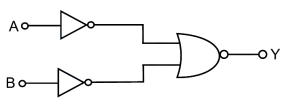
Which logic gate is represented by the following combination of logic gates?
A
$NAND$
B
$AND$
C
$NOR$
D
$OR$
Solution
(B) The given circuit consists of two $NOT$ gates connected to the inputs $A$ and $B$,followed by a $NOR$ gate.
$1$. The outputs of the two $NOT$ gates are $\overline{A}$ and $\overline{B}$.
$2$. These are fed as inputs to a $NOR$ gate.
$3$. The output $Y$ of the $NOR$ gate is given by $Y = \overline{\overline{A} + \overline{B}}$.
$4$. Using De Morgan's theorem,$\overline{\overline{A} + \overline{B}} = \overline{\overline{A}} \cdot \overline{\overline{B}} = A \cdot B$.
$5$. The expression $A \cdot B$ represents the operation of an $AND$ gate.
Therefore,the combination represents an $AND$ gate.
$1$. The outputs of the two $NOT$ gates are $\overline{A}$ and $\overline{B}$.
$2$. These are fed as inputs to a $NOR$ gate.
$3$. The output $Y$ of the $NOR$ gate is given by $Y = \overline{\overline{A} + \overline{B}}$.
$4$. Using De Morgan's theorem,$\overline{\overline{A} + \overline{B}} = \overline{\overline{A}} \cdot \overline{\overline{B}} = A \cdot B$.
$5$. The expression $A \cdot B$ represents the operation of an $AND$ gate.
Therefore,the combination represents an $AND$ gate.
0 likesView Solution
Vedclass Products
For Students
Vedclass Test Series
Mock tests in real AIIMS style covering Physics with performance analysis. 5-day free trial.
Start Free TrialFor Teachers
Exam Paper Generator
Generate Set A/B/C/D Physics papers from 7.5L+ questions in 2 minutes. 3 chapters free.
Try FreeFor Institutes
Online Exam Module
Run live AIIMS mock exams with unlimited students, 360° analytics & white-label branding.
See DemoFrequently Asked Questions
How many Physics questions are in AIIMS 2004?
There are 54 Physics questions from the AIIMS 2004 paper on Vedclass, each with a detailed step-by-step solution in English.
Are AIIMS 2004 Physics solutions available in English?
Yes. All solutions on this page are in English. You can also switch to English or Hindi using the language buttons above the questions.
Can I practice AIIMS 2004 Physics as a timed test?
Yes. Use the Vedclass Test Series to attempt a full AIIMS mock test covering Physics with time limits and instant score analysis.
Can teachers create Physics papers from AIIMS previous year questions?
Yes. The Vedclass Exam Paper Generator lets teachers mix AIIMS Physics questions and generate Set A/B/C/D papers in minutes.
For Teachers & Institutes
Build a Custom Physics Paper
Pick AIIMS 2004 Physics questions, set difficulty, and generate Set A/B/C/D in 2 minutes.