
PhysicsQ1–64 of 64 questions
Page 1 of 1 · English
1
PhysicsMediumMCQAIIMS · 2000
If $|\overrightarrow A \times \overrightarrow B | = |\overrightarrow A \cdot \overrightarrow B |$,then the angle between $\overrightarrow A$ and $\overrightarrow B$ will be ........ $^o$.
A
$30$
B
$45$
C
$60$
D
$90$
Solution
(B) Given that $|\overrightarrow A \times \overrightarrow B | = |\overrightarrow A \cdot \overrightarrow B |$.
Using the definitions of cross product and dot product:
$|\overrightarrow A | |\overrightarrow B | \sin \theta = |\overrightarrow A | |\overrightarrow B | \cos \theta$.
Dividing both sides by $|\overrightarrow A | |\overrightarrow B | \cos \theta$ (assuming $\overrightarrow A, \overrightarrow B \neq 0$):
$\frac{\sin \theta}{\cos \theta} = 1$.
$\tan \theta = 1$.
Since $\tan 45^\circ = 1$,the angle $\theta = 45^\circ$.
Using the definitions of cross product and dot product:
$|\overrightarrow A | |\overrightarrow B | \sin \theta = |\overrightarrow A | |\overrightarrow B | \cos \theta$.
Dividing both sides by $|\overrightarrow A | |\overrightarrow B | \cos \theta$ (assuming $\overrightarrow A, \overrightarrow B \neq 0$):
$\frac{\sin \theta}{\cos \theta} = 1$.
$\tan \theta = 1$.
Since $\tan 45^\circ = 1$,the angle $\theta = 45^\circ$.
0 likesView Solution
2
PhysicsEasyMCQAIIMS · 2000
If a body is in equilibrium under a set of non-collinear forces,then the minimum number of forces has to be
A
$4$
B
$3$
C
$2$
D
$5$
Solution
(B) For a body to be in equilibrium,the vector sum of all forces acting on it must be zero,i.e.,$\sum \vec{F} = 0$.
If there are only two forces,they must be equal in magnitude and opposite in direction to cancel each other out,which means they must be collinear.
Since the problem states that the forces are non-collinear,two forces cannot satisfy the equilibrium condition.
Therefore,at least three non-collinear forces are required to form a closed triangle of vectors,such that their resultant is zero.
An example of this is three equal forces acting at angles of $120^{\circ}$ to each other.
Thus,the minimum number of forces is $3$.
If there are only two forces,they must be equal in magnitude and opposite in direction to cancel each other out,which means they must be collinear.
Since the problem states that the forces are non-collinear,two forces cannot satisfy the equilibrium condition.
Therefore,at least three non-collinear forces are required to form a closed triangle of vectors,such that their resultant is zero.
An example of this is three equal forces acting at angles of $120^{\circ}$ to each other.
Thus,the minimum number of forces is $3$.
0 likesView Solution
3
PhysicsMediumMCQAIIMS · 2000
The dimensions of the universal gravitational constant are:
A
${M^{ - 2}}{L^2}{T^{ - 2}}$
B
${M^{ - 1}}{L^3}{T^{ - 2}}$
C
$M{L^{ - 1}}{T^{ - 2}}$
D
$M{L^2}{T^{ - 2}}$
Solution
(B) According to Newton's law of universal gravitation,the force $F$ between two masses $m_1$ and $m_2$ separated by a distance $d$ is given by $F = \frac{G m_1 m_2}{d^2}$.
Rearranging the formula to solve for the gravitational constant $G$,we get $G = \frac{F d^2}{m_1 m_2}$.
The dimensional formula for force $F$ is $[MLT^{-2}]$,for distance $d$ is $[L]$,and for mass $m$ is $[M]$.
Substituting these into the expression for $G$: $[G] = \frac{[MLT^{-2}][L^2]}{[M][M]} = \frac{[ML^3T^{-2}]}{[M^2]} = [M^{-1}L^3T^{-2}]$.
Rearranging the formula to solve for the gravitational constant $G$,we get $G = \frac{F d^2}{m_1 m_2}$.
The dimensional formula for force $F$ is $[MLT^{-2}]$,for distance $d$ is $[L]$,and for mass $m$ is $[M]$.
Substituting these into the expression for $G$: $[G] = \frac{[MLT^{-2}][L^2]}{[M][M]} = \frac{[ML^3T^{-2}]}{[M^2]} = [M^{-1}L^3T^{-2}]$.
0 likesView Solution
4
PhysicsMediumMCQAIIMS · 2000
From the top of a tower,a particle is thrown vertically downwards with a velocity of $10\; m/s$. The ratio of the distances covered by it in the $3^{rd}$ and $2^{nd}$ seconds of the motion is (Take $g = 10\; m/s^2$).
A
$5:7$
B
$7:5$
C
$3:6$
D
$6:3$
Solution
(B) The distance covered in the $n^{th}$ second is given by the formula: $S_n = u + \frac{g}{2}(2n - 1)$.
Given: Initial velocity $u = 10\; m/s$,acceleration $g = 10\; m/s^2$.
For the $3^{rd}$ second $(n=3)$:
$S_3 = 10 + \frac{10}{2}(2 \times 3 - 1) = 10 + 5(5) = 10 + 25 = 35\; m$.
For the $2^{nd}$ second $(n=2)$:
$S_2 = 10 + \frac{10}{2}(2 \times 2 - 1) = 10 + 5(3) = 10 + 15 = 25\; m$.
The ratio of the distances is $\frac{S_3}{S_2} = \frac{35}{25} = \frac{7}{5}$.
Given: Initial velocity $u = 10\; m/s$,acceleration $g = 10\; m/s^2$.
For the $3^{rd}$ second $(n=3)$:
$S_3 = 10 + \frac{10}{2}(2 \times 3 - 1) = 10 + 5(5) = 10 + 25 = 35\; m$.
For the $2^{nd}$ second $(n=2)$:
$S_2 = 10 + \frac{10}{2}(2 \times 2 - 1) = 10 + 5(3) = 10 + 15 = 25\; m$.
The ratio of the distances is $\frac{S_3}{S_2} = \frac{35}{25} = \frac{7}{5}$.
0 likesView Solution
5
PhysicsEasyMCQAIIMS · 2000
$A$ man is standing on a spring platform. The reading of the spring balance is $60\, kg$ wt. If the man jumps off the platform,what happens to the reading of the spring balance?
A
First increases then decreases to zero
B
Decreases
C
Increases
D
Remains same
Solution
(A) When a man wants to jump off a platform,he must exert an additional downward force on the platform to gain upward momentum according to Newton's $3^{rd}$ law of motion.
This additional force causes the spring balance reading to increase momentarily.
As the man leaves the platform,the contact force becomes zero,and consequently,the reading of the spring balance drops to zero.
This additional force causes the spring balance reading to increase momentarily.
As the man leaves the platform,the contact force becomes zero,and consequently,the reading of the spring balance drops to zero.
0 likesView Solution
6
PhysicsEasyMCQAIIMS · 2000
$A$ body,whose momentum is constant,must have constant
A
Force
B
Velocity
C
Acceleration
D
All of these
Solution
(B) The momentum $p$ of a body is defined as the product of its mass $m$ and velocity $v$,given by $p = mv$.
If the momentum $p$ is constant and the mass $m$ of the body is assumed to be constant,then the velocity $v = p/m$ must also be constant.
Since velocity is constant,the acceleration $a = dv/dt$ must be zero.
According to Newton's second law,the net force $F = ma$ acting on the body must also be zero.
Therefore,if momentum is constant,the velocity must be constant.
If the momentum $p$ is constant and the mass $m$ of the body is assumed to be constant,then the velocity $v = p/m$ must also be constant.
Since velocity is constant,the acceleration $a = dv/dt$ must be zero.
According to Newton's second law,the net force $F = ma$ acting on the body must also be zero.
Therefore,if momentum is constant,the velocity must be constant.
0 likesView Solution
7
PhysicsMediumMCQAIIMS · 2000
$A$ block of mass $50\, kg$ slides over a horizontal distance of $1\, m$. If the coefficient of friction between their surfaces is $0.2$,then the work done against friction is ......... $J$.
A
$98$
B
$72$
C
$56$
D
$34$
Solution
(A) The work done against friction is given by the formula $W = f_k \times S$,where $f_k$ is the kinetic frictional force and $S$ is the displacement.
Since the surface is horizontal,the normal force $N = mg$.
The frictional force is $f_k = \mu N = \mu mg$.
Given: mass $m = 50\, kg$,distance $S = 1\, m$,coefficient of friction $\mu = 0.2$,and acceleration due to gravity $g = 9.8\, m/s^2$.
Substituting the values: $W = 0.2 \times 50 \times 9.8 \times 1$.
$W = 10 \times 9.8 = 98\, J$.
Since the surface is horizontal,the normal force $N = mg$.
The frictional force is $f_k = \mu N = \mu mg$.
Given: mass $m = 50\, kg$,distance $S = 1\, m$,coefficient of friction $\mu = 0.2$,and acceleration due to gravity $g = 9.8\, m/s^2$.
Substituting the values: $W = 0.2 \times 50 \times 9.8 \times 1$.
$W = 10 \times 9.8 = 98\, J$.
0 likesView Solution
8
PhysicsEasyMCQAIIMS · 2000
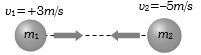
Two equal masses $m_1$ and $m_2$ moving along the same straight line with velocities $+3 \, m/s$ and $-5 \, m/s$ respectively collide elastically. Their velocities after the collision will be respectively
A
$+4 \, m/s$ for both
B
$-3 \, m/s$ and $+5 \, m/s$
C
$-4 \, m/s$ and $+4 \, m/s$
D
$-5 \, m/s$ and $+3 \, m/s$
Solution
(D) In a one-dimensional elastic collision between two bodies of equal mass,the velocities of the bodies are interchanged after the collision.
Given: Initial velocity of mass $m_1$ is $u_1 = +3 \, m/s$ and initial velocity of mass $m_2$ is $u_2 = -5 \, m/s$.
Since $m_1 = m_2$,after the elastic collision,the final velocity of mass $m_1$ becomes $v_1 = u_2 = -5 \, m/s$ and the final velocity of mass $m_2$ becomes $v_2 = u_1 = +3 \, m/s$.
Given: Initial velocity of mass $m_1$ is $u_1 = +3 \, m/s$ and initial velocity of mass $m_2$ is $u_2 = -5 \, m/s$.
Since $m_1 = m_2$,after the elastic collision,the final velocity of mass $m_1$ becomes $v_1 = u_2 = -5 \, m/s$ and the final velocity of mass $m_2$ becomes $v_2 = u_1 = +3 \, m/s$.
0 likesView Solution
9
PhysicsMediumMCQAIIMS · 2000
$A$ body falling from a height of $10\,m$ rebounds from a hard floor. If it loses $20\%$ of its energy in the impact,then the coefficient of restitution is:
A
$0.89$
B
$0.56$
C
$0.23$
D
$0.18$
Solution
(A) Let the initial height be $h_1 = 10\,m$ and the rebound height be $h_2$.
Since the body loses $20\%$ of its energy during the impact,the remaining energy is $80\%$ of the initial potential energy.
Thus,$mgh_2 = 0.80 \times mgh_1$.
This simplifies to $\frac{h_2}{h_1} = 0.8$.
The coefficient of restitution $e$ for a body rebounding from a floor is given by $e = \sqrt{\frac{h_2}{h_1}}$.
Substituting the value,$e = \sqrt{0.8} \approx 0.894$.
Therefore,the coefficient of restitution is approximately $0.89$.
Since the body loses $20\%$ of its energy during the impact,the remaining energy is $80\%$ of the initial potential energy.
Thus,$mgh_2 = 0.80 \times mgh_1$.
This simplifies to $\frac{h_2}{h_1} = 0.8$.
The coefficient of restitution $e$ for a body rebounding from a floor is given by $e = \sqrt{\frac{h_2}{h_1}}$.
Substituting the value,$e = \sqrt{0.8} \approx 0.894$.
Therefore,the coefficient of restitution is approximately $0.89$.
2 likesView Solution
10
PhysicsMediumMCQAIIMS · 2000
$A$ body weighs $72 \ N$ on the surface of the earth. What is the gravitational force on it at a height equal to half the radius of the earth (in $N$)?
A
$32$
B
$30$
C
$24$
D
$48$
Solution
(A) The weight of a body at the surface of the earth is given by $W = mg = 72 \ N$.
At a height $h$ above the surface of the earth,the acceleration due to gravity $g'$ is given by the formula $g' = g \left( \frac{R}{R + h} \right)^2$,where $R$ is the radius of the earth.
Given $h = \frac{R}{2}$,we substitute this into the formula:
$g' = g \left( \frac{R}{R + \frac{R}{2}} \right)^2 = g \left( \frac{R}{\frac{3R}{2}} \right)^2 = g \left( \frac{2}{3} \right)^2 = \frac{4}{9}g$.
The weight of the body at height $h$ is $W' = mg' = m \left( \frac{4}{9}g \right) = \frac{4}{9} W$.
Substituting the value of $W = 72 \ N$:
$W' = \frac{4}{9} \times 72 = 4 \times 8 = 32 \ N$.
At a height $h$ above the surface of the earth,the acceleration due to gravity $g'$ is given by the formula $g' = g \left( \frac{R}{R + h} \right)^2$,where $R$ is the radius of the earth.
Given $h = \frac{R}{2}$,we substitute this into the formula:
$g' = g \left( \frac{R}{R + \frac{R}{2}} \right)^2 = g \left( \frac{R}{\frac{3R}{2}} \right)^2 = g \left( \frac{2}{3} \right)^2 = \frac{4}{9}g$.
The weight of the body at height $h$ is $W' = mg' = m \left( \frac{4}{9}g \right) = \frac{4}{9} W$.
Substituting the value of $W = 72 \ N$:
$W' = \frac{4}{9} \times 72 = 4 \times 8 = 32 \ N$.
1 likesView Solution
11
PhysicsMediumMCQAIIMS · 2000
The gravitational potential energy of a body of mass $m$ at the earth's surface is $-mgR_e$. Its gravitational potential energy at a height $R_e$ from the earth's surface will be (Here $R_e$ is the radius of the earth).
A
$-2mgR_e$
B
$2mgR_e$
C
$\frac{1}{2}mgR_e$
D
$-\frac{1}{2}mgR_e$
Solution
(D) The gravitational potential energy $U$ at a distance $r$ from the center of the earth is given by $U = -\frac{GMm}{r}$.
At the earth's surface,$r = R_e$,so $U_1 = -\frac{GMm}{R_e} = -mgR_e$ (since $g = \frac{GM}{R_e^2}$).
At a height $h = R_e$ from the surface,the distance from the center is $r = R_e + h = R_e + R_e = 2R_e$.
The potential energy at this height is $U_2 = -\frac{GMm}{2R_e}$.
Substituting $GM = gR_e^2$,we get $U_2 = -\frac{(gR_e^2)m}{2R_e} = -\frac{1}{2}mgR_e$.
At the earth's surface,$r = R_e$,so $U_1 = -\frac{GMm}{R_e} = -mgR_e$ (since $g = \frac{GM}{R_e^2}$).
At a height $h = R_e$ from the surface,the distance from the center is $r = R_e + h = R_e + R_e = 2R_e$.
The potential energy at this height is $U_2 = -\frac{GMm}{2R_e}$.
Substituting $GM = gR_e^2$,we get $U_2 = -\frac{(gR_e^2)m}{2R_e} = -\frac{1}{2}mgR_e$.
0 likesView Solution
12
PhysicsMediumMCQAIIMS · 2000
Given the mass of the moon is $1/81$ of the mass of the earth and its radius is $1/4$ of the earth's radius. If the escape velocity on the earth's surface is $11.2 \, km/s$,the value of the escape velocity on the surface of the moon is ......... $km/s$.
A
$0.14$
B
$0.5$
C
$2.5$
D
$5$
Solution
(C) The formula for escape velocity is given by $v_e = \sqrt{\frac{2GM}{R}}$.
For the Earth,$v_e = \sqrt{\frac{2GM_e}{R_e}} = 11.2 \, km/s$.
For the Moon,the mass $M_m = \frac{M_e}{81}$ and the radius $R_m = \frac{R_e}{4}$.
The escape velocity on the Moon is $v_m = \sqrt{\frac{2GM_m}{R_m}} = \sqrt{\frac{2G(M_e/81)}{(R_e/4)}} = \sqrt{\frac{2GM_e}{R_e} \times \frac{4}{81}}$.
Substituting the values,$v_m = \sqrt{\frac{4}{81}} \times \sqrt{\frac{2GM_e}{R_e}} = \frac{2}{9} \times 11.2 \, km/s$.
$v_m = 0.222 \times 11.2 \approx 2.488 \, km/s$,which is approximately $2.5 \, km/s$.
For the Earth,$v_e = \sqrt{\frac{2GM_e}{R_e}} = 11.2 \, km/s$.
For the Moon,the mass $M_m = \frac{M_e}{81}$ and the radius $R_m = \frac{R_e}{4}$.
The escape velocity on the Moon is $v_m = \sqrt{\frac{2GM_m}{R_m}} = \sqrt{\frac{2G(M_e/81)}{(R_e/4)}} = \sqrt{\frac{2GM_e}{R_e} \times \frac{4}{81}}$.
Substituting the values,$v_m = \sqrt{\frac{4}{81}} \times \sqrt{\frac{2GM_e}{R_e}} = \frac{2}{9} \times 11.2 \, km/s$.
$v_m = 0.222 \times 11.2 \approx 2.488 \, km/s$,which is approximately $2.5 \, km/s$.
0 likesView Solution
13
PhysicsMediumMCQAIIMS · 2000
Potential energy of a satellite having mass $m$ and rotating at a height of $6.4 \times 10^6 \ m$ from the Earth's surface is
A
$ - 0.5 \, mgR_e $
B
$ - mgR_e $
C
$ - 2 \, mgR_e $
D
$ 4 \, mgR_e $
Solution
(A) The potential energy $U$ of a satellite of mass $m$ at a distance $r$ from the center of the Earth is given by $U = -\frac{GMm}{r}$.
Here,$r = R_e + h$,where $R_e$ is the radius of the Earth and $h$ is the height of the satellite.
Given $h = 6.4 \times 10^6 \ m$ and $R_e \approx 6.4 \times 10^6 \ m$,we have $r = R_e + R_e = 2R_e$.
Using the relation $g = \frac{GM}{R_e^2}$,we can write $GM = gR_e^2$.
Substituting these into the potential energy formula:
$U = -\frac{(gR_e^2)m}{2R_e} = -\frac{1}{2}mgR_e = -0.5 \, mgR_e$.
Here,$r = R_e + h$,where $R_e$ is the radius of the Earth and $h$ is the height of the satellite.
Given $h = 6.4 \times 10^6 \ m$ and $R_e \approx 6.4 \times 10^6 \ m$,we have $r = R_e + R_e = 2R_e$.
Using the relation $g = \frac{GM}{R_e^2}$,we can write $GM = gR_e^2$.
Substituting these into the potential energy formula:
$U = -\frac{(gR_e^2)m}{2R_e} = -\frac{1}{2}mgR_e = -0.5 \, mgR_e$.
0 likesView Solution
14
PhysicsMediumMCQAIIMS · 2000
The period of a satellite in a circular orbit of radius $R$ is $T$. The period of another satellite in a circular orbit of radius $4R$ is:
A
$4T$
B
$T/4$
C
$8T$
D
$T/8$
Solution
(C) According to Kepler's third law of planetary motion,the square of the time period $T$ is proportional to the cube of the orbital radius $R$,i.e.,$T^2 \propto R^3$.
Given for the first satellite: $T_1 = T$ and $R_1 = R$.
For the second satellite: $R_2 = 4R$ and we need to find $T_2$.
Using the ratio formula:
$\frac{T_2}{T_1} = \left( \frac{R_2}{R_1} \right)^{3/2}$
Substituting the values:
$\frac{T_2}{T} = \left( \frac{4R}{R} \right)^{3/2}$
$\frac{T_2}{T} = (4)^{3/2}$
$\frac{T_2}{T} = (2^2)^{3/2} = 2^3 = 8$
Therefore,$T_2 = 8T$.
Given for the first satellite: $T_1 = T$ and $R_1 = R$.
For the second satellite: $R_2 = 4R$ and we need to find $T_2$.
Using the ratio formula:
$\frac{T_2}{T_1} = \left( \frac{R_2}{R_1} \right)^{3/2}$
Substituting the values:
$\frac{T_2}{T} = \left( \frac{4R}{R} \right)^{3/2}$
$\frac{T_2}{T} = (4)^{3/2}$
$\frac{T_2}{T} = (2^2)^{3/2} = 2^3 = 8$
Therefore,$T_2 = 8T$.
0 likesView Solution
15
PhysicsEasyMCQAIIMS · 2000
The isothermal bulk modulus of a gas at atmospheric pressure is:
A
$1\,mm$ of $Hg$
B
$13.6\,mm$ of $Hg$
C
$1.013 \times 10^5\,N/m^2$
D
$2.026 \times 10^5\,N/m^2$
Solution
(C) The isothermal bulk modulus $(K_i)$ of an ideal gas is defined as the pressure $(P)$ of the gas.
For a gas at atmospheric pressure,the pressure is $P = 1\,atm$.
We know that $1\,atm = 1.013 \times 10^5\,N/m^2$.
Therefore,the isothermal bulk modulus is $K_i = 1.013 \times 10^5\,N/m^2$.
For a gas at atmospheric pressure,the pressure is $P = 1\,atm$.
We know that $1\,atm = 1.013 \times 10^5\,N/m^2$.
Therefore,the isothermal bulk modulus is $K_i = 1.013 \times 10^5\,N/m^2$.
0 likesView Solution
16
PhysicsEasyMCQAIIMS · 2000
$A$ stretched rubber band has:
A
Increased kinetic energy
B
Increased potential energy
C
Decreased kinetic energy
D
Decreased potential energy
Solution
(B) When a rubber band is stretched,work is done against the internal elastic forces of the material.
This work done is stored within the rubber band in the form of elastic potential energy.
Therefore,a stretched rubber band possesses increased potential energy compared to its unstretched state.
This work done is stored within the rubber band in the form of elastic potential energy.
Therefore,a stretched rubber band possesses increased potential energy compared to its unstretched state.
0 likesView Solution
17
PhysicsMediumMCQAIIMS · 2000
The work done in increasing the size of a soap film from $10 \, cm \times 6 \, cm$ to $10 \, cm \times 11 \, cm$ is $3 \times 10^{-4} \, J$. The surface tension of the film is:
A
$1.5 \times 10^{-2} \, N/m$
B
$3.0 \times 10^{-2} \, N/m$
C
$6.0 \times 10^{-2} \, N/m$
D
$11.0 \times 10^{-2} \, N/m$
Solution
(B) The work done $(W)$ in increasing the surface area of a soap film is given by $W = T \times \Delta A_{total}$.
Since a soap film has two surfaces,the total change in area is $\Delta A_{total} = 2 \times (A_{final} - A_{initial})$.
Initial area $A_i = 10 \, cm \times 6 \, cm = 60 \, cm^2 = 60 \times 10^{-4} \, m^2$.
Final area $A_f = 10 \, cm \times 11 \, cm = 110 \, cm^2 = 110 \times 10^{-4} \, m^2$.
Change in area $\Delta A = A_f - A_i = (110 - 60) \times 10^{-4} \, m^2 = 50 \times 10^{-4} \, m^2$.
Total change in area $\Delta A_{total} = 2 \times 50 \times 10^{-4} \, m^2 = 100 \times 10^{-4} \, m^2 = 10^{-2} \, m^2$.
Given $W = 3 \times 10^{-4} \, J$.
Using $W = T \times \Delta A_{total}$,we get $T = \frac{W}{\Delta A_{total}} = \frac{3 \times 10^{-4}}{10^{-2}} = 3 \times 10^{-2} \, N/m$.
Since a soap film has two surfaces,the total change in area is $\Delta A_{total} = 2 \times (A_{final} - A_{initial})$.
Initial area $A_i = 10 \, cm \times 6 \, cm = 60 \, cm^2 = 60 \times 10^{-4} \, m^2$.
Final area $A_f = 10 \, cm \times 11 \, cm = 110 \, cm^2 = 110 \times 10^{-4} \, m^2$.
Change in area $\Delta A = A_f - A_i = (110 - 60) \times 10^{-4} \, m^2 = 50 \times 10^{-4} \, m^2$.
Total change in area $\Delta A_{total} = 2 \times 50 \times 10^{-4} \, m^2 = 100 \times 10^{-4} \, m^2 = 10^{-2} \, m^2$.
Given $W = 3 \times 10^{-4} \, J$.
Using $W = T \times \Delta A_{total}$,we get $T = \frac{W}{\Delta A_{total}} = \frac{3 \times 10^{-4}}{10^{-2}} = 3 \times 10^{-2} \, N/m$.
0 likesView Solution
18
PhysicsEasyMCQAIIMS · 2000
If the work done in increasing the size of a soap film from $10\;cm \times 6\;cm$ to $10\;cm \times 11\;cm$ is $2 \times 10^{-4}\;J$,then the surface tension is:
A
$2 \times 10^{-2}\;N/m$
B
$2 \times 10^{-4}\;N/m$
C
$2 \times 10^{-6}\;N/m$
D
$2 \times 10^{-8}\;N/m$
Solution
(A) The work done $W$ in increasing the area of a soap film is given by $W = T \times \Delta A \times 2$,where $T$ is the surface tension and the factor $2$ accounts for the two surfaces of the soap film.
Initial area $A_1 = 10\;cm \times 6\;cm = 60\;cm^2 = 60 \times 10^{-4}\;m^2$.
Final area $A_2 = 10\;cm \times 11\;cm = 110\;cm^2 = 110 \times 10^{-4}\;m^2$.
Change in area $\Delta A = A_2 - A_1 = (110 - 60) \times 10^{-4}\;m^2 = 50 \times 10^{-4}\;m^2$.
Given $W = 2 \times 10^{-4}\;J$.
Using the formula $W = 2T \Delta A$,we get $T = \frac{W}{2 \Delta A}$.
$T = \frac{2 \times 10^{-4}}{2 \times (50 \times 10^{-4})} = \frac{1}{50} = 0.02\;N/m = 2 \times 10^{-2}\;N/m$.
Initial area $A_1 = 10\;cm \times 6\;cm = 60\;cm^2 = 60 \times 10^{-4}\;m^2$.
Final area $A_2 = 10\;cm \times 11\;cm = 110\;cm^2 = 110 \times 10^{-4}\;m^2$.
Change in area $\Delta A = A_2 - A_1 = (110 - 60) \times 10^{-4}\;m^2 = 50 \times 10^{-4}\;m^2$.
Given $W = 2 \times 10^{-4}\;J$.
Using the formula $W = 2T \Delta A$,we get $T = \frac{W}{2 \Delta A}$.
$T = \frac{2 \times 10^{-4}}{2 \times (50 \times 10^{-4})} = \frac{1}{50} = 0.02\;N/m = 2 \times 10^{-2}\;N/m$.
1 likesView Solution
19
PhysicsEasyMCQAIIMS · 2000
If the radius of a soap bubble is four times that of another,then the ratio of their excess pressures will be
A
$1:4$
B
$4:1$
C
$16:1$
D
$1:16$
Solution
(B) The excess pressure $\Delta P$ inside a soap bubble of radius $r$ is given by the formula $\Delta P = \frac{4T}{r}$,where $T$ is the surface tension of the soap solution.
From this relation,we can see that $\Delta P \propto \frac{1}{r}$.
Let the radius of the first bubble be $r_1 = r$ and the radius of the second bubble be $r_2 = 4r$.
The ratio of their excess pressures is $\frac{\Delta P_1}{\Delta P_2} = \frac{r_2}{r_1} = \frac{4r}{r} = \frac{4}{1}$.
Wait,re-evaluating: If the first bubble has radius $r$ and the second has $4r$,then $\Delta P_1 = \frac{4T}{r}$ and $\Delta P_2 = \frac{4T}{4r} = \frac{T}{r}$.
Thus,the ratio $\Delta P_1 : \Delta P_2 = 4:1$.
From this relation,we can see that $\Delta P \propto \frac{1}{r}$.
Let the radius of the first bubble be $r_1 = r$ and the radius of the second bubble be $r_2 = 4r$.
The ratio of their excess pressures is $\frac{\Delta P_1}{\Delta P_2} = \frac{r_2}{r_1} = \frac{4r}{r} = \frac{4}{1}$.
Wait,re-evaluating: If the first bubble has radius $r$ and the second has $4r$,then $\Delta P_1 = \frac{4T}{r}$ and $\Delta P_2 = \frac{4T}{4r} = \frac{T}{r}$.
Thus,the ratio $\Delta P_1 : \Delta P_2 = 4:1$.
0 likesView Solution
20
PhysicsMediumMCQAIIMS · 2000
$A$ spherical drop of water has a radius of $1\, mm$. If the surface tension of water is $70 \times 10^{-3}\, N/m$,the difference of pressure between the inside and outside of the spherical drop is ........ $N/m^2$.
A
$35$
B
$70$
C
$140$
D
$0$
Solution
(C) The excess pressure $\Delta P$ inside a spherical drop is given by the formula $\Delta P = \frac{2T}{R}$.
Given:
Surface tension $T = 70 \times 10^{-3}\, N/m$
Radius $R = 1\, mm = 1 \times 10^{-3}\, m$
Substituting the values:
$\Delta P = \frac{2 \times 70 \times 10^{-3}}{1 \times 10^{-3}}$
$\Delta P = 2 \times 70 = 140\, N/m^2$.
Therefore,the correct option is $C$.
Given:
Surface tension $T = 70 \times 10^{-3}\, N/m$
Radius $R = 1\, mm = 1 \times 10^{-3}\, m$
Substituting the values:
$\Delta P = \frac{2 \times 70 \times 10^{-3}}{1 \times 10^{-3}}$
$\Delta P = 2 \times 70 = 140\, N/m^2$.
Therefore,the correct option is $C$.
0 likesView Solution
21
PhysicsMediumMCQAIIMS · 2000
The real coefficient of volume expansion of glycerine is $0.000597 \text{ /}^{\circ}\text{C}$ and the linear coefficient of expansion of glass is $0.000009 \text{ /}^{\circ}\text{C}$. The apparent volume coefficient of expansion of glycerine is:
A
$0.000558 \text{ /}^{\circ}\text{C}$
B
$0.00057 \text{ /}^{\circ}\text{C}$
C
$0.00027 \text{ /}^{\circ}\text{C}$
D
$0.00066 \text{ /}^{\circ}\text{C}$
Solution
(B) The apparent expansion of a liquid is the difference between its real expansion and the expansion of the container.
The volume expansion coefficient of the glass vessel $(\gamma_{vessel})$ is related to the linear expansion coefficient $(\alpha)$ by the formula $\gamma_{vessel} = 3\alpha$.
$\gamma_{vessel} = 3 \times 0.000009 = 0.000027 \text{ /}^{\circ}\text{C}$.
The apparent volume expansion coefficient $(\gamma_{app})$ is given by $\gamma_{app} = \gamma_{real} - \gamma_{vessel}$.
$\gamma_{app} = 0.000597 - 0.000027 = 0.00057 \text{ /}^{\circ}\text{C}$.
The volume expansion coefficient of the glass vessel $(\gamma_{vessel})$ is related to the linear expansion coefficient $(\alpha)$ by the formula $\gamma_{vessel} = 3\alpha$.
$\gamma_{vessel} = 3 \times 0.000009 = 0.000027 \text{ /}^{\circ}\text{C}$.
The apparent volume expansion coefficient $(\gamma_{app})$ is given by $\gamma_{app} = \gamma_{real} - \gamma_{vessel}$.
$\gamma_{app} = 0.000597 - 0.000027 = 0.00057 \text{ /}^{\circ}\text{C}$.
0 likesView Solution
22
PhysicsEasyMCQAIIMS · 2000
Air in a cylinder is suddenly compressed by a piston,which is then maintained at the same position. With the passage of time,
A
The pressure decreases
B
The pressure increases
C
The pressure remains the same
D
The pressure may increase or decrease depending upon the nature of the gas
Solution
(A) When air in a cylinder is suddenly compressed,the process is adiabatic.
Due to the sudden compression,the work done on the gas increases its internal energy,causing the temperature of the system to rise significantly.
After the compression,the piston is held at a fixed position,meaning the volume remains constant.
Since the system is at a higher temperature than the surroundings,heat flows from the system to the surroundings until thermal equilibrium is reached.
As the temperature of the gas decreases while the volume remains constant,according to the ideal gas law $(PV = nRT)$,the pressure of the gas must decrease.
Due to the sudden compression,the work done on the gas increases its internal energy,causing the temperature of the system to rise significantly.
After the compression,the piston is held at a fixed position,meaning the volume remains constant.
Since the system is at a higher temperature than the surroundings,heat flows from the system to the surroundings until thermal equilibrium is reached.
As the temperature of the gas decreases while the volume remains constant,according to the ideal gas law $(PV = nRT)$,the pressure of the gas must decrease.
0 likesView Solution
23
PhysicsEasyMCQAIIMS · 2000
It is hotter for the same distance over the top of a fire than it is in the side of it,mainly because
A
Air conducts heat upwards
B
Heat is radiated upwards
C
Convection takes more heat upwards
D
Convection,conduction and radiation all contribute significantly transferring heat upwards
Solution
(C) The primary mode of heat transfer in fluids (like air) is convection. When air near a fire is heated,it becomes less dense and rises due to buoyancy. This rising current of hot air carries a significant amount of heat upwards. Therefore,the temperature is much higher directly above the fire compared to the sides,where the air is not being actively replaced by the rising hot currents. Thus,option $C$ is correct.
0 likesView Solution
24
PhysicsEasyMCQAIIMS · 2000
The intensity of radiation emitted by the sun has its maximum value at a wavelength of $510\;nm$ and that emitted by the north star has the maximum value at $350\;nm$. If these stars behave like black bodies,then the ratio of the surface temperature of the sun and north star is
A
$1.46$
B
$0.69$
C
$1.21$
D
$0.83$
Solution
(B) According to Wien's displacement law,the product of the wavelength corresponding to maximum intensity $(\lambda_{\max})$ and the absolute temperature $(T)$ of a black body is constant.
$\lambda_{\max} T = b$ (constant)
Therefore,$T \propto \frac{1}{\lambda_{\max}}$.
Let $T_S$ and $\lambda_S$ be the temperature and wavelength of maximum intensity for the sun,and $T_N$ and $\lambda_N$ be those for the north star.
Given: $\lambda_S = 510\;nm$ and $\lambda_N = 350\;nm$.
The ratio of the surface temperatures is given by:
$\frac{T_S}{T_N} = \frac{\lambda_N}{\lambda_S} = \frac{350}{510} \approx 0.686$.
Rounding to two decimal places,we get $0.69$.
$\lambda_{\max} T = b$ (constant)
Therefore,$T \propto \frac{1}{\lambda_{\max}}$.
Let $T_S$ and $\lambda_S$ be the temperature and wavelength of maximum intensity for the sun,and $T_N$ and $\lambda_N$ be those for the north star.
Given: $\lambda_S = 510\;nm$ and $\lambda_N = 350\;nm$.
The ratio of the surface temperatures is given by:
$\frac{T_S}{T_N} = \frac{\lambda_N}{\lambda_S} = \frac{350}{510} \approx 0.686$.
Rounding to two decimal places,we get $0.69$.
0 likesView Solution
25
PhysicsEasyMCQAIIMS · 2000
The amount of radiation emitted by a perfectly black body is proportional to
A
Temperature on ideal gas scale
B
Fourth root of temperature on ideal gas scale
C
Fourth power of temperature on ideal gas scale
D
Source of temperature on ideal gas scale
Solution
(C) According to Stefan-Boltzmann law,the total energy $E$ radiated per unit surface area of a black body per unit time is directly proportional to the fourth power of its absolute temperature $T$.
Mathematically,this is expressed as $E = \sigma T^4$,where $\sigma$ is the Stefan-Boltzmann constant.
Therefore,the amount of radiation emitted is proportional to the fourth power of the temperature on the ideal gas scale.
Mathematically,this is expressed as $E = \sigma T^4$,where $\sigma$ is the Stefan-Boltzmann constant.
Therefore,the amount of radiation emitted is proportional to the fourth power of the temperature on the ideal gas scale.
0 likesView Solution
26
PhysicsMediumMCQAIIMS · 2000
The temperatures of two bodies $A$ and $B$ are respectively $727^{\circ}C$ and $327^{\circ}C$. The ratio $H_A:H_B$ of the rates of heat radiated by them is
A
$727:327$
B
$5:3$
C
$25:9$
D
$625:81$
Solution
(D) According to Stefan-Boltzmann Law,the rate of heat radiation $H$ is proportional to the fourth power of the absolute temperature $T$ $(H \propto T^4)$.
First,convert the temperatures from Celsius to Kelvin:
$T_A = 727 + 273 = 1000 \ K$
$T_B = 327 + 273 = 600 \ K$
The ratio of the rates of heat radiated is given by:
$\frac{H_A}{H_B} = \left( \frac{T_A}{T_B} \right)^4$
$\frac{H_A}{H_B} = \left( \frac{1000}{600} \right)^4 = \left( \frac{10}{6} \right)^4 = \left( \frac{5}{3} \right)^4$
$\frac{H_A}{H_B} = \frac{5^4}{3^4} = \frac{625}{81}$
Therefore,the ratio is $625:81$.
First,convert the temperatures from Celsius to Kelvin:
$T_A = 727 + 273 = 1000 \ K$
$T_B = 327 + 273 = 600 \ K$
The ratio of the rates of heat radiated is given by:
$\frac{H_A}{H_B} = \left( \frac{T_A}{T_B} \right)^4$
$\frac{H_A}{H_B} = \left( \frac{1000}{600} \right)^4 = \left( \frac{10}{6} \right)^4 = \left( \frac{5}{3} \right)^4$
$\frac{H_A}{H_B} = \frac{5^4}{3^4} = \frac{625}{81}$
Therefore,the ratio is $625:81$.
0 likesView Solution
27
PhysicsMediumMCQAIIMS · 2000
$A$ mass $m$ attached to a spring oscillates every $2 \, s$. If the mass is increased by $2 \, kg$,then the time period increases by $1 \, s$. The initial mass is ..... $kg$.
A
$1.6$
B
$3.9$
C
$9.6$
D
$12.6$
Solution
(A) The time period of a mass-spring system is given by $T = 2\pi \sqrt{\frac{m}{k}}$.
For the initial state,$T_1 = 2 \, s$ and mass is $m_1 = m$.
So,$2 = 2\pi \sqrt{\frac{m}{k}} \implies 1 = \pi \sqrt{\frac{m}{k}}$.
For the final state,the mass is increased by $2 \, kg$,so $m_2 = m + 2$. The time period increases by $1 \, s$,so $T_2 = 2 + 1 = 3 \, s$.
So,$3 = 2\pi \sqrt{\frac{m+2}{k}}$.
Dividing the two equations:
$\frac{T_2}{T_1} = \frac{3}{2} = \sqrt{\frac{m+2}{m}}$.
Squaring both sides:
$\frac{9}{4} = \frac{m+2}{m}$.
Cross-multiplying:
$9m = 4(m + 2) \implies 9m = 4m + 8$.
$5m = 8 \implies m = \frac{8}{5} \, kg = 1.6 \, kg$.
For the initial state,$T_1 = 2 \, s$ and mass is $m_1 = m$.
So,$2 = 2\pi \sqrt{\frac{m}{k}} \implies 1 = \pi \sqrt{\frac{m}{k}}$.
For the final state,the mass is increased by $2 \, kg$,so $m_2 = m + 2$. The time period increases by $1 \, s$,so $T_2 = 2 + 1 = 3 \, s$.
So,$3 = 2\pi \sqrt{\frac{m+2}{k}}$.
Dividing the two equations:
$\frac{T_2}{T_1} = \frac{3}{2} = \sqrt{\frac{m+2}{m}}$.
Squaring both sides:
$\frac{9}{4} = \frac{m+2}{m}$.
Cross-multiplying:
$9m = 4(m + 2) \implies 9m = 4m + 8$.
$5m = 8 \implies m = \frac{8}{5} \, kg = 1.6 \, kg$.
0 likesView Solution
28
PhysicsMediumMCQAIIMS · 2000
The equation of a transverse wave travelling on a rope is given by $y = 10\sin \pi (0.01x - 2.00t)$ where $y$ and $x$ are in $cm$ and $t$ is in $seconds$. The maximum transverse speed of a particle in the rope is about .... $cm/s$.
A
$63$
B
$75$
C
$100$
D
$121$
Solution
(A) The given equation is $y = 10\sin(0.01\pi x - 2\pi t)$.
Comparing this with the standard wave equation $y = A\sin(kx - \omega t)$,we get the amplitude $A = 10 \ cm$ and the angular frequency $\omega = 2\pi \ rad/s$.
The maximum transverse speed of a particle in the rope is given by the formula $v_{\max} = A\omega$.
Substituting the values,we get $v_{\max} = 10 \times 2\pi$.
$v_{\max} = 20 \times 3.14159 = 62.83 \ cm/s$.
Rounding to the nearest integer,we get $v_{\max} \approx 63 \ cm/s$.
Comparing this with the standard wave equation $y = A\sin(kx - \omega t)$,we get the amplitude $A = 10 \ cm$ and the angular frequency $\omega = 2\pi \ rad/s$.
The maximum transverse speed of a particle in the rope is given by the formula $v_{\max} = A\omega$.
Substituting the values,we get $v_{\max} = 10 \times 2\pi$.
$v_{\max} = 20 \times 3.14159 = 62.83 \ cm/s$.
Rounding to the nearest integer,we get $v_{\max} \approx 63 \ cm/s$.
0 likesView Solution
29
PhysicsEasyMCQAIIMS · 2000
$A$ wave is represented by the equation: $y = a \sin(0.01x - 2t)$,where $a$ and $x$ are in $cm$. The velocity of propagation of the wave is .... $cm/s$.
A
$10$
B
$50$
C
$100$
D
$200$
Solution
(D) The standard equation of a progressive wave is given by $y = a \sin(kx - \omega t)$.
Comparing the given equation $y = a \sin(0.01x - 2t)$ with the standard equation,we get:
Wave number $k = 0.01 \, cm^{-1}$
Angular frequency $\omega = 2 \, rad/s$
The velocity of propagation of the wave is given by $v = \frac{\omega}{k}$.
Substituting the values,we get $v = \frac{2}{0.01} = 200 \, cm/s$.
Comparing the given equation $y = a \sin(0.01x - 2t)$ with the standard equation,we get:
Wave number $k = 0.01 \, cm^{-1}$
Angular frequency $\omega = 2 \, rad/s$
The velocity of propagation of the wave is given by $v = \frac{\omega}{k}$.
Substituting the values,we get $v = \frac{2}{0.01} = 200 \, cm/s$.
0 likesView Solution
30
PhysicsEasyMCQAIIMS · 2000
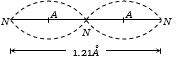
$A$ standing wave having $3$ nodes and $2$ antinodes is formed between two atoms having a distance of $1.21 \; \mathring{A}$ between them. The wavelength of the standing wave is .... $\mathring{A}$
A
$1.21$
B
$2.42$
C
$0.605$
D
$3.63$
Solution
(A) The distance between two consecutive nodes is $\frac{\lambda}{2}$.
In a standing wave with $3$ nodes and $2$ antinodes,there are $2$ loops.
The total length $L$ between the two extreme nodes is given by $L = 2 \times \frac{\lambda}{2} = \lambda$.
Given that the distance between the two atoms (which act as the extreme nodes) is $1.21 \; \mathring{A}$,we have $L = 1.21 \; \mathring{A}$.
Therefore,the wavelength $\lambda = 1.21 \; \mathring{A}$.
In a standing wave with $3$ nodes and $2$ antinodes,there are $2$ loops.
The total length $L$ between the two extreme nodes is given by $L = 2 \times \frac{\lambda}{2} = \lambda$.
Given that the distance between the two atoms (which act as the extreme nodes) is $1.21 \; \mathring{A}$,we have $L = 1.21 \; \mathring{A}$.
Therefore,the wavelength $\lambda = 1.21 \; \mathring{A}$.
0 likesView Solution
31
PhysicsEasyMCQAIIMS · 2000
$A$ vehicle with a horn of frequency $n$ is moving with a velocity of $30\, m/s$ in a direction perpendicular to the straight line joining the observer and the vehicle. The observer perceives the sound to have a frequency $n + n_1$. Then (if the sound velocity in air is $300\, m/s$):
A
$n_1 = 10\,n$
B
$n_1 = 0$
C
$n_1 = 0.1\,n$
D
$n_1 = -0.1\,n$
Solution
(B) The Doppler effect occurs when there is a relative velocity between the source and the observer along the line joining them.
In this problem,the vehicle is moving in a direction perpendicular to the line joining the observer and the vehicle.
Therefore,the component of the velocity of the source along the line joining the observer and the source is $v_s \cos(90^{\circ}) = 0$.
Since there is no relative motion along the line of sight,the frequency perceived by the observer remains the same as the source frequency.
Thus,the observed frequency is $n' = n$.
Given that the observed frequency is $n + n_1$,we have $n + n_1 = n$,which implies $n_1 = 0$.
In this problem,the vehicle is moving in a direction perpendicular to the line joining the observer and the vehicle.
Therefore,the component of the velocity of the source along the line joining the observer and the source is $v_s \cos(90^{\circ}) = 0$.
Since there is no relative motion along the line of sight,the frequency perceived by the observer remains the same as the source frequency.
Thus,the observed frequency is $n' = n$.
Given that the observed frequency is $n + n_1$,we have $n + n_1 = n$,which implies $n_1 = 0$.
0 likesView Solution
32
PhysicsMediumMCQAIIMS · 2000
The Sun emits light with a maximum wavelength of $510 \, nm$,while another star $X$ emits light with a maximum wavelength of $350 \, nm$. What is the ratio of the surface temperature of the Sun to that of star $X$?
A
$2.1$
B
$0.68$
C
$0.46$
D
$1.45$
Solution
(B) According to Wien's displacement law,the wavelength corresponding to maximum emission intensity is inversely proportional to the absolute temperature of the black body: $\lambda_{max} \propto \frac{1}{T}$.
Let $T_S$ and $\lambda_S$ be the temperature and maximum wavelength of the Sun,and $T_X$ and $\lambda_X$ be the temperature and maximum wavelength of star $X$.
Given: $\lambda_S = 510 \, nm$ and $\lambda_X = 350 \, nm$.
The ratio of the temperatures is given by: $\frac{T_S}{T_X} = \frac{\lambda_X}{\lambda_S}$.
Substituting the values: $\frac{T_S}{T_X} = \frac{350}{510} \approx 0.686$.
Rounding to two decimal places,the ratio is $0.68$.
Let $T_S$ and $\lambda_S$ be the temperature and maximum wavelength of the Sun,and $T_X$ and $\lambda_X$ be the temperature and maximum wavelength of star $X$.
Given: $\lambda_S = 510 \, nm$ and $\lambda_X = 350 \, nm$.
The ratio of the temperatures is given by: $\frac{T_S}{T_X} = \frac{\lambda_X}{\lambda_S}$.
Substituting the values: $\frac{T_S}{T_X} = \frac{350}{510} \approx 0.686$.
Rounding to two decimal places,the ratio is $0.68$.
0 likesView Solution
33
PhysicsMediumMCQAIIMS · 2000
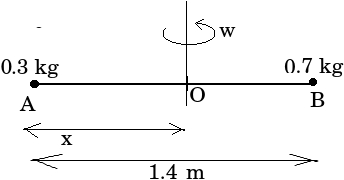
Two point masses of $0.3 \ kg$ and $0.7 \ kg$ are fixed at the ends of a rod of length $1.4 \ m$ and of negligible mass. The rod is set rotating about an axis perpendicular to its length with a uniform angular speed. The point on the rod through which the axis should pass in order that the work required for rotation of the rod is minimum is located at a distance of
A
$0.4 \ m$ from mass of $0.3 \ kg$
B
$0.98 \ m$ from mass of $0.3 \ kg$
C
$0.70 \ m$ from mass of $0.7 \ kg$
D
$0.98 \ m$ from mass of $0.7 \ kg$
Solution
(B) According to the work-energy theorem,the work done is given by $W = \frac{1}{2} I \omega^2$.
Since the angular speed $\omega$ is constant,the work done is minimum when the moment of inertia $I$ is minimum.
Let the axis of rotation pass through a point at a distance $x$ from the $0.3 \ kg$ mass. Then the distance from the $0.7 \ kg$ mass is $(1.4 - x)$.
The moment of inertia $I$ is given by $I = 0.3x^2 + 0.7(1.4 - x)^2$.
To find the minimum value of $I$,we differentiate with respect to $x$ and set it to zero:
$\frac{dI}{dx} = 0.3(2x) + 0.7(2)(1.4 - x)(-1) = 0$
$0.6x - 1.4(1.4 - x) = 0$
$0.6x - 1.96 + 1.4x = 0$
$2.0x = 1.96$
$x = 0.98 \ m$.
Thus,the axis should pass at a distance of $0.98 \ m$ from the $0.3 \ kg$ mass.
Since the angular speed $\omega$ is constant,the work done is minimum when the moment of inertia $I$ is minimum.
Let the axis of rotation pass through a point at a distance $x$ from the $0.3 \ kg$ mass. Then the distance from the $0.7 \ kg$ mass is $(1.4 - x)$.
The moment of inertia $I$ is given by $I = 0.3x^2 + 0.7(1.4 - x)^2$.
To find the minimum value of $I$,we differentiate with respect to $x$ and set it to zero:
$\frac{dI}{dx} = 0.3(2x) + 0.7(2)(1.4 - x)(-1) = 0$
$0.6x - 1.4(1.4 - x) = 0$
$0.6x - 1.96 + 1.4x = 0$
$2.0x = 1.96$
$x = 0.98 \ m$.
Thus,the axis should pass at a distance of $0.98 \ m$ from the $0.3 \ kg$ mass.
0 likesView Solution
34
PhysicsMediumMCQAIIMS · 2000
$Assertion$: If a body is thrown upwards,the distance covered by it in the last second of upward motion is about $5 \ m$ irrespective of its initial speed.
$Reason$: The distance covered in the last second of upward motion is equal to that covered in the first second of downward motion when the particle is dropped.
$Reason$: The distance covered in the last second of upward motion is equal to that covered in the first second of downward motion when the particle is dropped.
A
If both Assertion and Reason are correct and the Reason is a correct explanation of the Assertion.
B
If both Assertion and Reason are correct but Reason is not a correct explanation of the Assertion.
C
If the Assertion is correct but Reason is incorrect.
D
If both the Assertion and Reason are incorrect.
Solution
(A) For the upward motion,the final velocity at the highest point is $v = 0$.
Using the equation of motion $v = u + at$,for the last second of motion,the initial velocity $u'$ at the start of that last second is $u' = v - at = 0 - (-g)(1) = g$.
The distance covered in the last second is $s = u't + \frac{1}{2}at^2 = g(1) + \frac{1}{2}(-g)(1)^2 = g - \frac{g}{2} = \frac{g}{2}$.
Taking $g \approx 10 \ m/s^2$,we get $s = \frac{10}{2} = 5 \ m$.
This distance is independent of the initial velocity of projection.
The reason is also correct because the motion is symmetric; the distance covered in the last second of upward motion is identical to the distance covered in the first second of free fall (downward motion) starting from rest $(u=0)$.
Thus,both Assertion and Reason are correct,and the Reason explains the Assertion.
Using the equation of motion $v = u + at$,for the last second of motion,the initial velocity $u'$ at the start of that last second is $u' = v - at = 0 - (-g)(1) = g$.
The distance covered in the last second is $s = u't + \frac{1}{2}at^2 = g(1) + \frac{1}{2}(-g)(1)^2 = g - \frac{g}{2} = \frac{g}{2}$.
Taking $g \approx 10 \ m/s^2$,we get $s = \frac{10}{2} = 5 \ m$.
This distance is independent of the initial velocity of projection.
The reason is also correct because the motion is symmetric; the distance covered in the last second of upward motion is identical to the distance covered in the first second of free fall (downward motion) starting from rest $(u=0)$.
Thus,both Assertion and Reason are correct,and the Reason explains the Assertion.
0 likesView Solution
35
PhysicsEasyMCQAIIMS · 2000
$Assertion$ : $A$ balloon filled with hydrogen will fall with acceleration $\frac{g}{6}$ on the moon.
$Reason$ : Moon has no atmosphere.
$Reason$ : Moon has no atmosphere.
A
If both $Assertion$ and $Reason$ are correct and the $Reason$ is a correct explanation of the $Assertion$.
B
If both $Assertion$ and $Reason$ are correct but $Reason$ is not a correct explanation of the $Assertion$.
C
If the $Assertion$ is correct but $Reason$ is incorrect.
D
If both the $Assertion$ and $Reason$ are incorrect.
Solution
(A) On Earth,a balloon filled with hydrogen rises because the buoyant force (upthrust) is greater than the weight of the balloon.
On the moon,there is no atmosphere,which means there is no air to provide a buoyant force.
Therefore,the balloon will undergo free fall under the influence of the moon's gravity alone.
The acceleration due to gravity on the moon is $\frac{g}{6}$,where $g$ is the acceleration due to gravity on Earth.
Since the balloon is in free fall,its acceleration will be equal to the acceleration due to gravity on the moon,which is $\frac{g}{6}$.
Thus,both the $Assertion$ and $Reason$ are correct,and the $Reason$ correctly explains why the balloon falls with that specific acceleration.
On the moon,there is no atmosphere,which means there is no air to provide a buoyant force.
Therefore,the balloon will undergo free fall under the influence of the moon's gravity alone.
The acceleration due to gravity on the moon is $\frac{g}{6}$,where $g$ is the acceleration due to gravity on Earth.
Since the balloon is in free fall,its acceleration will be equal to the acceleration due to gravity on the moon,which is $\frac{g}{6}$.
Thus,both the $Assertion$ and $Reason$ are correct,and the $Reason$ correctly explains why the balloon falls with that specific acceleration.
0 likesView Solution
36
PhysicsMediumMCQAIIMS · 2000
$A$ hole is made at the bottom of a tank filled with water (density $1000 \, kg/m^3$). If the total pressure at the bottom of the tank is $3 \, atm$ $(1 \, atm = 10^5 \, N/m^2)$,then the velocity of efflux is:
A
$\sqrt{200} \, m/s$
B
$\sqrt{400} \, m/s$
C
$\sqrt{500} \, m/s$
D
$\sqrt{800} \, m/s$
Solution
(B) The velocity of efflux is given by Torricelli's law: $v = \sqrt{2gh}$.
The total pressure at the bottom of the tank is the sum of atmospheric pressure $(P_{atm})$ and gauge pressure due to the water column $(h\rho g)$.
Given,$P_{total} = P_{atm} + h\rho g = 3 \, atm$.
Since $P_{atm} = 1 \, atm$,the gauge pressure is $h\rho g = 3 \, atm - 1 \, atm = 2 \, atm$.
Substituting the values: $h\rho g = 2 \times 10^5 \, N/m^2$.
$gh = \frac{2 \times 10^5}{\rho} = \frac{2 \times 10^5}{10^3} = 200 \, m^2/s^2$.
Now,substituting $gh$ into the velocity formula:
$v = \sqrt{2 \times (gh)} = \sqrt{2 \times 200} = \sqrt{400} \, m/s$.
The total pressure at the bottom of the tank is the sum of atmospheric pressure $(P_{atm})$ and gauge pressure due to the water column $(h\rho g)$.
Given,$P_{total} = P_{atm} + h\rho g = 3 \, atm$.
Since $P_{atm} = 1 \, atm$,the gauge pressure is $h\rho g = 3 \, atm - 1 \, atm = 2 \, atm$.
Substituting the values: $h\rho g = 2 \times 10^5 \, N/m^2$.
$gh = \frac{2 \times 10^5}{\rho} = \frac{2 \times 10^5}{10^3} = 200 \, m^2/s^2$.
Now,substituting $gh$ into the velocity formula:
$v = \sqrt{2 \times (gh)} = \sqrt{2 \times 200} = \sqrt{400} \, m/s$.
0 likesView Solution
37
PhysicsEasyMCQAIIMS · 2000
$Assertion :$ For a gas atom,the number of degrees of freedom is $3$.
$Reason :$ $\frac{C_P}{C_V} = \gamma $
$Reason :$ $\frac{C_P}{C_V} = \gamma $
A
If both Assertion and Reason are correct and the Reason is a correct explanation of the Assertion.
B
If both Assertion and Reason are correct but Reason is not a correct explanation of the Assertion.
C
If the Assertion is correct but Reason is incorrect.
D
If both the Assertion and Reason are incorrect.
Solution
(B) monoatomic gas atom has $3$ degrees of freedom because it can only undergo translational motion along the $X-$,$Y-$,and $Z-$ axes. Rotational and vibrational degrees of freedom are not present for a single point-like atom.
Therefore,the Assertion is correct.
The expression $\frac{C_P}{C_V} = \gamma$ is a standard thermodynamic relation for the ratio of molar specific heats,which is also correct.
However,the value of the degrees of freedom is determined by the structure of the molecule (monoatomic,diatomic,etc.),not by the ratio of specific heats $\gamma$. Thus,the Reason is not the correct explanation of the Assertion.
Therefore,the Assertion is correct.
The expression $\frac{C_P}{C_V} = \gamma$ is a standard thermodynamic relation for the ratio of molar specific heats,which is also correct.
However,the value of the degrees of freedom is determined by the structure of the molecule (monoatomic,diatomic,etc.),not by the ratio of specific heats $\gamma$. Thus,the Reason is not the correct explanation of the Assertion.
0 likesView Solution
38
PhysicsMediumMCQAIIMS · 2000
$Assertion :$ Sound travels faster in solids than gases.
$Reason :$ Solids possess greater density than gases.
$Reason :$ Solids possess greater density than gases.
A
If both Assertion and Reason are correct and the Reason is a correct explanation of the Assertion.
B
If both Assertion and Reason are correct but Reason is not a correct explanation of the Assertion.
C
If the Assertion is correct but Reason is incorrect.
D
If both the Assertion and Reason are incorrect.
Solution
(B) The speed of sound in a medium is given by the formula $v = \sqrt{\frac{E}{\rho}}$,where $E$ is the modulus of elasticity and $\rho$ is the density of the medium.
Sound travels faster in solids than in gases because the elasticity $(E)$ of solids is significantly higher than that of gases.
While it is true that solids generally possess greater density than gases,density is in the denominator of the velocity formula $(v \propto \frac{1}{\sqrt{\rho}})$. Therefore,higher density actually tends to decrease the speed of sound.
The reason sound travels faster in solids is primarily due to the much higher elasticity of solids,which outweighs the effect of their higher density. Thus,the Reason is a true statement,but it is not the correct explanation for the Assertion.
Sound travels faster in solids than in gases because the elasticity $(E)$ of solids is significantly higher than that of gases.
While it is true that solids generally possess greater density than gases,density is in the denominator of the velocity formula $(v \propto \frac{1}{\sqrt{\rho}})$. Therefore,higher density actually tends to decrease the speed of sound.
The reason sound travels faster in solids is primarily due to the much higher elasticity of solids,which outweighs the effect of their higher density. Thus,the Reason is a true statement,but it is not the correct explanation for the Assertion.
0 likesView Solution
39
PhysicsEasyMCQAIIMS · 2000
There is $10$ units of charge at the centre of a circle of radius $10\,m$. The work done in moving $1\,unit$ of charge around the circle once is...........$units$.
A
$0$
B
$10$
C
$100$
D
$1$
Solution
(A) The electric potential $V$ at any point on a circle of radius $r$ due to a charge $q$ at its center is given by $V = \frac{kq}{r}$.
Since the radius $r$ is constant for all points on the circle, the electric potential is the same at every point on the circumference.
Therefore, the circle acts as an equipotential surface.
The work done $W$ in moving a charge $q_0$ between two points with potential difference $\Delta V$ is given by $W = q_0 \Delta V$.
Since the charge is moved around the circle once, the initial and final points are the same, so $\Delta V = 0$.
Thus, the work done $W = 1 \times 0 = 0\,units$.
Since the radius $r$ is constant for all points on the circle, the electric potential is the same at every point on the circumference.
Therefore, the circle acts as an equipotential surface.
The work done $W$ in moving a charge $q_0$ between two points with potential difference $\Delta V$ is given by $W = q_0 \Delta V$.
Since the charge is moved around the circle once, the initial and final points are the same, so $\Delta V = 0$.
Thus, the work done $W = 1 \times 0 = 0\,units$.
0 likesView Solution
40
PhysicsMediumMCQAIIMS · 2000
Three capacitors of capacitance $3\,\mu F$,$10\,\mu F$,and $15\,\mu F$ are connected in series to a voltage source of $100\,V$. The charge on $15\,\mu F$ is ....... $\mu C$.
A
$50$
B
$100$
C
$200$
D
$280$
Solution
(C) When capacitors are connected in series,the equivalent capacitance $C_{eq}$ is given by the formula: $\frac{1}{C_{eq}} = \frac{1}{C_1} + \frac{1}{C_2} + \frac{1}{C_3}$.
Substituting the given values: $\frac{1}{C_{eq}} = \frac{1}{3} + \frac{1}{10} + \frac{1}{15}$.
Finding a common denominator $(30)$: $\frac{1}{C_{eq}} = \frac{10 + 3 + 2}{30} = \frac{15}{30} = \frac{1}{2}$.
Therefore,$C_{eq} = 2\,\mu F$.
The total charge $Q$ supplied by the source is $Q = C_{eq} \times V = 2\,\mu F \times 100\,V = 200\,\mu C$.
In a series combination,the charge on each capacitor is the same and is equal to the total charge supplied by the source.
Thus,the charge on the $15\,\mu F$ capacitor is $200\,\mu C$.
Substituting the given values: $\frac{1}{C_{eq}} = \frac{1}{3} + \frac{1}{10} + \frac{1}{15}$.
Finding a common denominator $(30)$: $\frac{1}{C_{eq}} = \frac{10 + 3 + 2}{30} = \frac{15}{30} = \frac{1}{2}$.
Therefore,$C_{eq} = 2\,\mu F$.
The total charge $Q$ supplied by the source is $Q = C_{eq} \times V = 2\,\mu F \times 100\,V = 200\,\mu C$.
In a series combination,the charge on each capacitor is the same and is equal to the total charge supplied by the source.
Thus,the charge on the $15\,\mu F$ capacitor is $200\,\mu C$.
0 likesView Solution
41
PhysicsDifficultMCQAIIMS · 2000
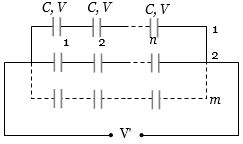
To form a composite $16\,\mu F, 1000\,V$ capacitor from a supply of identical capacitors marked $8\,\mu F, 250\,V$,we require a minimum number of capacitors:
A
$40$
B
$32$
C
$8$
D
$2$
Solution
(B) Let the given capacitor have capacitance $C = 8\,\mu F$ and voltage rating $V = 250\,V$. The required composite capacitor has capacitance $C' = 16\,\mu F$ and voltage rating $V' = 1000\,V$.
Suppose $m$ rows of capacitors are connected in parallel,and each row contains $n$ capacitors connected in series.
The potential difference across each capacitor in a series row is $V = \frac{V'}{n}$.
Substituting the values: $250 = \frac{1000}{n} \implies n = 4$.
The equivalent capacitance of the network is $C' = \frac{mC}{n}$.
Substituting the values: $16 = \frac{m \times 8}{4} \implies 16 = 2m \implies m = 8$.
The total number of capacitors required is $N = n \times m = 4 \times 8 = 32$.
Alternatively,using the formula: $N = \frac{C'}{C} \times \left( \frac{V'}{V} \right)^2 = \frac{16}{8} \times \left( \frac{1000}{250} \right)^2 = 2 \times (4)^2 = 2 \times 16 = 32$.
Suppose $m$ rows of capacitors are connected in parallel,and each row contains $n$ capacitors connected in series.
The potential difference across each capacitor in a series row is $V = \frac{V'}{n}$.
Substituting the values: $250 = \frac{1000}{n} \implies n = 4$.
The equivalent capacitance of the network is $C' = \frac{mC}{n}$.
Substituting the values: $16 = \frac{m \times 8}{4} \implies 16 = 2m \implies m = 8$.
The total number of capacitors required is $N = n \times m = 4 \times 8 = 32$.
Alternatively,using the formula: $N = \frac{C'}{C} \times \left( \frac{V'}{V} \right)^2 = \frac{16}{8} \times \left( \frac{1000}{250} \right)^2 = 2 \times (4)^2 = 2 \times 16 = 32$.
0 likesView Solution
42
PhysicsEasyMCQAIIMS · 2000
Kirchhoff's first law,$i.e.$,$\Sigma i = 0$ at a junction,is based on the law of conservation of:
A
Charge
B
Energy
C
Momentum
D
Angular momentum
Solution
(A) Kirchhoff's first law,also known as the Kirchhoff's Current Law $(KCL)$,states that the algebraic sum of currents meeting at a junction in an electric circuit is zero,i.e.,$\Sigma i = 0$.
This law implies that the total charge entering a junction must equal the total charge leaving the junction in the same time interval.
Since electric charge cannot be created or destroyed at a junction,this law is a direct consequence of the law of conservation of charge.
This law implies that the total charge entering a junction must equal the total charge leaving the junction in the same time interval.
Since electric charge cannot be created or destroyed at a junction,this law is a direct consequence of the law of conservation of charge.
0 likesView Solution
43
PhysicsEasyMCQAIIMS · 2000
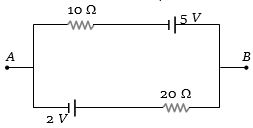
The current in the given circuit is ................ $A$.
A
$0.1$
B
$0.2$
C
$0.3$
D
$0.4$
Solution
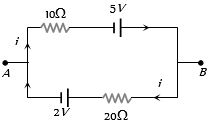
(A) To find the current $i$ in the circuit,we apply Kirchhoff's voltage law $(KVL)$ to the loop.
Starting from point $A$ and moving clockwise through the upper branch:
$-10i + 5 - 20i - 2 = 0$
Combining the terms:
$-30i + 3 = 0$
$30i = 3$
$i = \frac{3}{30} = 0.1 \, A$
Therefore,the current in the circuit is $0.1 \, A$.
Starting from point $A$ and moving clockwise through the upper branch:
$-10i + 5 - 20i - 2 = 0$
Combining the terms:
$-30i + 3 = 0$
$30i = 3$
$i = \frac{3}{30} = 0.1 \, A$
Therefore,the current in the circuit is $0.1 \, A$.
0 likesView Solution
44
PhysicsMediumMCQAIIMS · 2000
Two heater wires of equal length are first connected in series and then in parallel. The ratio of heat produced in the two cases is
A
$2:1$
B
$1:2$
C
$4:1$
D
$1:4$
Solution
(D) Let the resistance of each heater wire be $R$.
When connected in series,the equivalent resistance is $R_s = R + R = 2R$.
When connected in parallel,the equivalent resistance is $R_p = \frac{R \cdot R}{R + R} = \frac{R}{2}$.
For a constant potential difference $V$,the heat produced $H$ is given by $H = \frac{V^2}{R_{eq}} \cdot t$.
Therefore,$H \propto \frac{1}{R_{eq}}$.
The ratio of heat produced in series $(H_s)$ to parallel $(H_p)$ is $\frac{H_s}{H_p} = \frac{R_p}{R_s} = \frac{R/2}{2R} = \frac{1}{4}$.
Thus,the ratio is $1:4$.
When connected in series,the equivalent resistance is $R_s = R + R = 2R$.
When connected in parallel,the equivalent resistance is $R_p = \frac{R \cdot R}{R + R} = \frac{R}{2}$.
For a constant potential difference $V$,the heat produced $H$ is given by $H = \frac{V^2}{R_{eq}} \cdot t$.
Therefore,$H \propto \frac{1}{R_{eq}}$.
The ratio of heat produced in series $(H_s)$ to parallel $(H_p)$ is $\frac{H_s}{H_p} = \frac{R_p}{R_s} = \frac{R/2}{2R} = \frac{1}{4}$.
Thus,the ratio is $1:4$.
0 likesView Solution
45
PhysicsMediumMCQAIIMS · 2000
$A$ magnet makes $40$ oscillations per minute at a place having magnetic field intensity of $0.1 \times 10^{-5} \,T$. At another place,it takes $2.5 \,s$ to complete one vibration. The value of earth's horizontal field at that place is:
A
$0.25 \times 10^{-6} \,T$
B
$0.36 \times 10^{-6} \,T$
C
$0.66 \times 10^{-6} \,T$
D
$1.2 \times 10^{-6} \,T$
Solution
(B) The time period of oscillation of a magnet in a magnetic field is given by $T = 2\pi \sqrt{\frac{I}{M B_H}}$,where $I$ is the moment of inertia and $M$ is the magnetic moment.
This implies $T \propto \frac{1}{\sqrt{B_H}}$,or $B_H \propto \frac{1}{T^2}$.
At the first place,the frequency is $40 \text{ oscillations/min}$,so the time period $T_1 = \frac{60}{40} = 1.5 \,s$. The magnetic field is $(B_H)_1 = 0.1 \times 10^{-5} \,T = 10^{-6} \,T$.
At the second place,the time period $T_2 = 2.5 \,s$.
Using the ratio $\frac{(B_H)_2}{(B_H)_1} = \left( \frac{T_1}{T_2} \right)^2$,we get:
$(B_H)_2 = (B_H)_1 \times \left( \frac{1.5}{2.5} \right)^2$
$(B_H)_2 = 10^{-6} \times \left( \frac{3}{5} \right)^2 = 10^{-6} \times \frac{9}{25} = 10^{-6} \times 0.36 = 0.36 \times 10^{-6} \,T$.
This implies $T \propto \frac{1}{\sqrt{B_H}}$,or $B_H \propto \frac{1}{T^2}$.
At the first place,the frequency is $40 \text{ oscillations/min}$,so the time period $T_1 = \frac{60}{40} = 1.5 \,s$. The magnetic field is $(B_H)_1 = 0.1 \times 10^{-5} \,T = 10^{-6} \,T$.
At the second place,the time period $T_2 = 2.5 \,s$.
Using the ratio $\frac{(B_H)_2}{(B_H)_1} = \left( \frac{T_1}{T_2} \right)^2$,we get:
$(B_H)_2 = (B_H)_1 \times \left( \frac{1.5}{2.5} \right)^2$
$(B_H)_2 = 10^{-6} \times \left( \frac{3}{5} \right)^2 = 10^{-6} \times \frac{9}{25} = 10^{-6} \times 0.36 = 0.36 \times 10^{-6} \,T$.
0 likesView Solution
46
PhysicsEasyMCQAIIMS · 2000
The magnetic needle of a tangent galvanometer is deflected at an angle $30^\circ$ due to a magnet. The horizontal component of Earth's magnetic field $0.34 \times 10^{-4} \, T$ is along the plane of the coil. The magnetic intensity is
A
$1.96 \times 10^{-4} \, T$
B
$1.96 \times 10^{-5} \, T$
C
$1.96 \times 10^{4} \, T$
D
$1.96 \times 10^{5} \, T$
Solution
(B) In a tangent galvanometer,the magnetic field $B$ produced by the coil is related to the horizontal component of the Earth's magnetic field $B_H$ and the deflection angle $\theta$ by the formula:
$B = B_H \tan \theta$
Given:
$B_H = 0.34 \times 10^{-4} \, T$
$\theta = 30^\circ$
Substituting the values:
$B = (0.34 \times 10^{-4}) \times \tan 30^\circ$
Since $\tan 30^\circ = \frac{1}{\sqrt{3}} \approx 0.577$:
$B = 0.34 \times 10^{-4} \times 0.577$
$B \approx 0.196 \times 10^{-4} \, T$
$B = 1.96 \times 10^{-5} \, T$
$B = B_H \tan \theta$
Given:
$B_H = 0.34 \times 10^{-4} \, T$
$\theta = 30^\circ$
Substituting the values:
$B = (0.34 \times 10^{-4}) \times \tan 30^\circ$
Since $\tan 30^\circ = \frac{1}{\sqrt{3}} \approx 0.577$:
$B = 0.34 \times 10^{-4} \times 0.577$
$B \approx 0.196 \times 10^{-4} \, T$
$B = 1.96 \times 10^{-5} \, T$
0 likesView Solution
47
PhysicsEasyMCQAIIMS · 2000
Magnetic permeability is maximum for
A
Diamagnetic substance
B
Paramagnetic substance
C
Ferromagnetic substance
D
All of these
Solution
(C) Magnetic permeability $(\mu)$ of a material is defined as its ability to support the formation of a magnetic field within itself when placed in an external magnetic field.
For diamagnetic substances, $\mu < \mu_0$.
For paramagnetic substances, $\mu > \mu_0$.
For ferromagnetic substances, $\mu \gg \mu_0$.
Therefore, magnetic permeability is maximum for ferromagnetic substances.
For diamagnetic substances, $\mu < \mu_0$.
For paramagnetic substances, $\mu > \mu_0$.
For ferromagnetic substances, $\mu \gg \mu_0$.
Therefore, magnetic permeability is maximum for ferromagnetic substances.
0 likesView Solution
48
PhysicsEasyMCQAIIMS · 2000
$A$ diamagnetic material in a magnetic field moves:
A
From weaker to the stronger parts of the field
B
Perpendicular to the field
C
From stronger to the weaker parts of the field
D
In none of the above directions
Solution
(C) Diamagnetic materials are weakly repelled by magnetic fields. When placed in a non-uniform magnetic field,they experience a force that pushes them towards the region of lower magnetic field intensity. Therefore,a diamagnetic material moves from the stronger to the weaker parts of the field.
0 likesView Solution
49
PhysicsEasyMCQAIIMS · 2000
If the rotational velocity of a dynamo armature is doubled, then the induced $e.m.f.$ will become
A
Half
B
Two times
C
Four times
D
Unchanged
Solution
(B) The induced $e.m.f.$ $(e)$ in a dynamo armature is given by the formula $e = N B A \omega \sin(\omega t)$, where $N$ is the number of turns, $B$ is the magnetic field, $A$ is the area of the coil, and $\omega$ is the angular (rotational) velocity.
From this relation, we can see that the induced $e.m.f.$ is directly proportional to the rotational velocity, i.e., $e \propto \omega$.
If the rotational velocity $\omega$ is doubled $(2\omega)$, the induced $e.m.f.$ will also become two times the original value.
From this relation, we can see that the induced $e.m.f.$ is directly proportional to the rotational velocity, i.e., $e \propto \omega$.
If the rotational velocity $\omega$ is doubled $(2\omega)$, the induced $e.m.f.$ will also become two times the original value.
0 likesView Solution
50
PhysicsEasyMCQAIIMS · 2000
In a step-up transformer, the turn ratio is $1 : 2$. A Leclanche cell $(e.m.f. = 1.5 \, V)$ is connected across the primary. The voltage developed in the secondary would be ......... $V$.
A
$3$
B
$0.75$
C
$1.5$
D
$0$
Solution
(D) Transformer works on the principle of mutual induction, which requires a changing magnetic flux to induce an electromotive force $(e.m.f.)$ in the secondary coil.
Since a Leclanche cell provides a constant direct current $(dc)$, the current flowing through the primary coil is constant.
A constant current produces a constant magnetic flux, which does not change with time.
According to Faraday's law of electromagnetic induction, an induced $e.m.f.$ is produced only when there is a change in magnetic flux $(\frac{d\phi}{dt} \neq 0)$.
Therefore, for a $dc$ input, the induced $e.m.f.$ in the secondary coil is $0 \, V$.
Since a Leclanche cell provides a constant direct current $(dc)$, the current flowing through the primary coil is constant.
A constant current produces a constant magnetic flux, which does not change with time.
According to Faraday's law of electromagnetic induction, an induced $e.m.f.$ is produced only when there is a change in magnetic flux $(\frac{d\phi}{dt} \neq 0)$.
Therefore, for a $dc$ input, the induced $e.m.f.$ in the secondary coil is $0 \, V$.
0 likesView Solution
51
PhysicsEasyMCQAIIMS · 2000
An alternating current of frequency $f$ is flowing in a circuit containing a resistance $R$ and a choke $L$ in series. The impedance of this circuit is
A
$R + 2\pi fL$
B
$\sqrt{R^2 + 4\pi^2 f^2 L^2}$
C
$\sqrt{R^2 + L^2}$
D
$\sqrt{R^2 + 2\pi fL}$
Solution
(B) In an $LR$ series circuit,the impedance $Z$ is given by the formula $Z = \sqrt{R^2 + X_L^2}$.
Here,$X_L$ is the inductive reactance,which is defined as $X_L = \omega L$.
Since the angular frequency $\omega = 2\pi f$,we can substitute this into the expression for $X_L$ to get $X_L = 2\pi fL$.
Substituting $X_L$ back into the impedance formula,we get $Z = \sqrt{R^2 + (2\pi fL)^2}$.
Therefore,$Z = \sqrt{R^2 + 4\pi^2 f^2 L^2}$.
Here,$X_L$ is the inductive reactance,which is defined as $X_L = \omega L$.
Since the angular frequency $\omega = 2\pi f$,we can substitute this into the expression for $X_L$ to get $X_L = 2\pi fL$.
Substituting $X_L$ back into the impedance formula,we get $Z = \sqrt{R^2 + (2\pi fL)^2}$.
Therefore,$Z = \sqrt{R^2 + 4\pi^2 f^2 L^2}$.
0 likesView Solution
52
PhysicsEasyMCQAIIMS · 2000
The particle nature and wave nature of electromagnetic waves and electrons can be demonstrated by which of the following?
A
Electron has small mass and is deflected by a metal sheet
B
$X$-rays are diffracted and reflected by a thick metal sheet
C
Light is refracted and diffracted
D
Photoelectricity and electron microscopy
Solution
(D) The particle nature of light is demonstrated by the photoelectric effect,where light behaves as a stream of photons. The wave nature of electrons is demonstrated by electron microscopy,where an electron beam behaves as a wave with a specific wavelength (de Broglie wavelength) to achieve high resolution. Thus,both natures are exhibited by these phenomena.
0 likesView Solution
53
PhysicsEasyMCQAIIMS · 2000
$A$ neutrino is a particle,which is
A
Charged and has spin
B
Charged and has no spin
C
Chargeless and has spin
D
Chargeless and has no spin
Solution
(C) neutrino is an elementary subatomic particle that interacts only via the weak subatomic force and gravity. It has no electric charge (it is chargeless) and possesses an intrinsic angular momentum (spin) of $1/2$. Therefore,the correct description is that it is chargeless and has spin.
0 likesView Solution
54
PhysicsDifficultMCQAIIMS · 2000
Half-life of a radioactive substance is $20 \ min$. The difference between the points of time when it is $33\%$ disintegrated and $67\%$ disintegrated is approximately ........... $min$.
A
$10$
B
$20$
C
$30$
D
$40$
Solution
(B) The decay constant $\lambda$ is given by $\lambda = \frac{0.693}{T_{1/2}} = \frac{0.693}{20} = 0.03465 \ min^{-1}$.
The time $t$ required for a substance to decay is given by $t = \frac{2.303}{\lambda} \log_{10} \left( \frac{N_0}{N} \right)$.
For $33\%$ disintegration,the remaining amount $N = N_0 - 0.33N_0 = 0.67N_0$. Thus,$t_1 = \frac{2.303}{0.03465} \log_{10} \left( \frac{100}{67} \right) \approx 66.46 \times 0.1739 \approx 11.56 \ min$.
For $67\%$ disintegration,the remaining amount $N = N_0 - 0.67N_0 = 0.33N_0$. Thus,$t_2 = \frac{2.303}{0.03465} \log_{10} \left( \frac{100}{33} \right) \approx 66.46 \times 0.4815 \approx 32.00 \ min$.
The time difference is $\Delta t = t_2 - t_1 = 32.00 - 11.56 = 20.44 \ min \approx 20 \ min$.
The time $t$ required for a substance to decay is given by $t = \frac{2.303}{\lambda} \log_{10} \left( \frac{N_0}{N} \right)$.
For $33\%$ disintegration,the remaining amount $N = N_0 - 0.33N_0 = 0.67N_0$. Thus,$t_1 = \frac{2.303}{0.03465} \log_{10} \left( \frac{100}{67} \right) \approx 66.46 \times 0.1739 \approx 11.56 \ min$.
For $67\%$ disintegration,the remaining amount $N = N_0 - 0.67N_0 = 0.33N_0$. Thus,$t_2 = \frac{2.303}{0.03465} \log_{10} \left( \frac{100}{33} \right) \approx 66.46 \times 0.4815 \approx 32.00 \ min$.
The time difference is $\Delta t = t_2 - t_1 = 32.00 - 11.56 = 20.44 \ min \approx 20 \ min$.
0 likesView Solution
55
PhysicsEasyMCQAIIMS · 2000
The valence of the impurity atom that is to be added to a germanium crystal to make it an $N$-type semiconductor is:
A
$6$
B
$5$
C
$4$
D
$3$
Solution
(B) To create an $N$-type semiconductor,we need to add a pentavalent impurity (an element with $5$ valence electrons) to an intrinsic semiconductor like germanium $(Ge)$.
When a pentavalent atom (such as phosphorus,arsenic,or antimony) is added,$4$ of its valence electrons form covalent bonds with the neighboring germanium atoms,while the $5$th electron remains free to conduct electricity.
Therefore,the valence of the impurity atom must be $5$.
When a pentavalent atom (such as phosphorus,arsenic,or antimony) is added,$4$ of its valence electrons form covalent bonds with the neighboring germanium atoms,while the $5$th electron remains free to conduct electricity.
Therefore,the valence of the impurity atom must be $5$.
0 likesView Solution
56
PhysicsEasyMCQAIIMS · 2000
In a semiconductor,the separation between the conduction band and the valence band is of the order of $... \, eV$.
A
$100$
B
$10$
C
$1$
D
$0$
Solution
(C) In semiconductors,the forbidden energy gap (the energy separation between the conduction band and the valence band) is typically of the order of $1 \, eV$. For example,Silicon has a band gap of approximately $1.1 \, eV$ and Germanium has a band gap of approximately $0.7 \, eV$.
0 likesView Solution
57
PhysicsEasyMCQAIIMS · 2000
$N-$ type semiconductors are obtained when germanium is doped with:
A
Phosphorus
B
Aluminium
C
Arsenic
D
Both $(a)$ and $(c)$
Solution
(D) To obtain an $N-$ type semiconductor,an intrinsic semiconductor like germanium (a group $14$ element) must be doped with a pentavalent impurity (a group $15$ element).
Pentavalent impurities have $5$ valence electrons.
When added to the germanium crystal lattice,$4$ electrons form covalent bonds with neighboring germanium atoms,and the $5$th electron becomes a free charge carrier (electron).
Both Phosphorus $(P)$ and Arsenic $(As)$ are pentavalent elements.
Therefore,doping germanium with either Phosphorus or Arsenic results in an $N-$ type semiconductor.
Thus,the correct option is $(d)$.
Pentavalent impurities have $5$ valence electrons.
When added to the germanium crystal lattice,$4$ electrons form covalent bonds with neighboring germanium atoms,and the $5$th electron becomes a free charge carrier (electron).
Both Phosphorus $(P)$ and Arsenic $(As)$ are pentavalent elements.
Therefore,doping germanium with either Phosphorus or Arsenic results in an $N-$ type semiconductor.
Thus,the correct option is $(d)$.
0 likesView Solution
58
PhysicsEasyMCQAIIMS · 2000
The dominant mechanisms for motion of charge carriers in forward and reverse biased silicon $P-N$ junctions are
A
Drift in forward bias,diffusion in reverse bias
B
Diffusion in forward bias,drift in reverse bias
C
Diffusion in both forward and reverse bias
D
Drift in both forward and reverse bias
Solution
(B) In a forward-biased $P-N$ junction,the potential barrier is reduced,which allows majority charge carriers to cross the junction easily. This process is known as diffusion,which becomes the dominant mechanism for current flow.
In a reverse-biased $P-N$ junction,the potential barrier increases,which prevents majority charge carriers from crossing the junction. However,minority charge carriers can still cross the junction due to the electric field present in the depletion region. This process is known as drift,which becomes the dominant mechanism for the small reverse saturation current.
In a reverse-biased $P-N$ junction,the potential barrier increases,which prevents majority charge carriers from crossing the junction. However,minority charge carriers can still cross the junction due to the electric field present in the depletion region. This process is known as drift,which becomes the dominant mechanism for the small reverse saturation current.
0 likesView Solution
59
PhysicsMediumMCQAIIMS · 2000
The ratio of intensities of two waves is $9 : 1$. They are producing interference. The ratio of maximum and minimum intensities will be
A
$10:8$
B
$9:1$
C
$4:1$
D
$2:1$
Solution
(C) Given the ratio of intensities of two waves is $\frac{I_1}{I_2} = \frac{9}{1}$.
Let the amplitudes of the two waves be $A_1$ and $A_2$. Since intensity $I \propto A^2$,the ratio of amplitudes is $\frac{A_1}{A_2} = \sqrt{\frac{I_1}{I_2}} = \sqrt{\frac{9}{1}} = \frac{3}{1}$.
The ratio of maximum to minimum intensity is given by the formula:
$\frac{I_{\max}}{I_{\min}} = \left( \frac{A_1 + A_2}{A_1 - A_2} \right)^2$.
Substituting the values:
$\frac{I_{\max}}{I_{\min}} = \left( \frac{3 + 1}{3 - 1} \right)^2 = \left( \frac{4}{2} \right)^2 = (2)^2 = \frac{4}{1}$.
Thus,the ratio is $4:1$.
Let the amplitudes of the two waves be $A_1$ and $A_2$. Since intensity $I \propto A^2$,the ratio of amplitudes is $\frac{A_1}{A_2} = \sqrt{\frac{I_1}{I_2}} = \sqrt{\frac{9}{1}} = \frac{3}{1}$.
The ratio of maximum to minimum intensity is given by the formula:
$\frac{I_{\max}}{I_{\min}} = \left( \frac{A_1 + A_2}{A_1 - A_2} \right)^2$.
Substituting the values:
$\frac{I_{\max}}{I_{\min}} = \left( \frac{3 + 1}{3 - 1} \right)^2 = \left( \frac{4}{2} \right)^2 = (2)^2 = \frac{4}{1}$.
Thus,the ratio is $4:1$.
0 likesView Solution
60
PhysicsEasyMCQAIIMS · 2000
Assertion: Cyclotron does not accelerate electrons.
Reason: Mass of the electrons is very small.
Reason: Mass of the electrons is very small.
A
If the Assertion is correct but Reason is incorrect.
B
If both Assertion and Reason are correct but Reason is not a correct explanation of the Assertion.
C
If both Assertion and Reason are correct and the Reason is a correct explanation of the Assertion.
D
If both the Assertion and Reason are incorrect.
Solution
(C) cyclotron operates on the principle that the frequency of the oscillating electric field matches the cyclotron frequency of the particle,which is given by $f = \frac{qB}{2\pi m}$.
Because the mass of an electron $(m)$ is very small,it gains speed very rapidly when accelerated.
According to the theory of relativity,as the speed of the electron approaches the speed of light,its relativistic mass increases significantly $(m = \frac{m_0}{\sqrt{1 - v^2/c^2}})$.
This increase in mass causes the cyclotron frequency to change,leading to a mismatch between the frequency of the $a.c.$ source and the particle's rotation frequency in the Dees.
Consequently,the electron falls out of phase with the electric field and is no longer accelerated effectively. Thus,both the assertion and the reason are correct,and the reason is the correct explanation for the assertion.
Because the mass of an electron $(m)$ is very small,it gains speed very rapidly when accelerated.
According to the theory of relativity,as the speed of the electron approaches the speed of light,its relativistic mass increases significantly $(m = \frac{m_0}{\sqrt{1 - v^2/c^2}})$.
This increase in mass causes the cyclotron frequency to change,leading to a mismatch between the frequency of the $a.c.$ source and the particle's rotation frequency in the Dees.
Consequently,the electron falls out of phase with the electric field and is no longer accelerated effectively. Thus,both the assertion and the reason are correct,and the reason is the correct explanation for the assertion.
0 likesView Solution
61
PhysicsMediumMCQAIIMS · 2000
Assertion: The refractive index of diamond is $\sqrt{6}$ and that of liquid is $\sqrt{3}$. If the light travels from diamond to the liquid,it will be totally internally reflected when the angle of incidence is $30^{\circ}$.
Reason: $\mu = \frac{1}{\sin C}$,where $\mu$ is the refractive index of diamond with respect to the liquid.
Reason: $\mu = \frac{1}{\sin C}$,where $\mu$ is the refractive index of diamond with respect to the liquid.
A
If both Assertion and Reason are correct and the Reason is a correct explanation of the Assertion.
B
If both Assertion and Reason are correct but Reason is not a correct explanation of the Assertion.
C
If the Assertion is correct but Reason is incorrect.
D
If both the Assertion and Reason are incorrect.
Solution
(C) Given: Refractive index of diamond with respect to air,$\mu_d = \sqrt{6}$. Refractive index of liquid with respect to air,$\mu_l = \sqrt{3}$.
The refractive index of diamond with respect to the liquid is given by $\mu = \frac{\mu_d}{\mu_l} = \frac{\sqrt{6}}{\sqrt{3}} = \sqrt{2}$.
For total internal reflection to occur,the angle of incidence $i$ must be greater than the critical angle $C$. The critical angle $C$ is given by $\sin C = \frac{1}{\mu} = \frac{1}{\sqrt{2}}$.
Thus,$C = 45^{\circ}$.
Since the given angle of incidence $i = 30^{\circ}$ is less than the critical angle $C = 45^{\circ}$,total internal reflection will not occur. Therefore,the Assertion is incorrect.
The Reason states $\mu = \frac{1}{\sin C}$,which is the correct formula for the critical angle where $\mu$ is the refractive index of the denser medium with respect to the rarer medium. Thus,the Reason is correct.
The refractive index of diamond with respect to the liquid is given by $\mu = \frac{\mu_d}{\mu_l} = \frac{\sqrt{6}}{\sqrt{3}} = \sqrt{2}$.
For total internal reflection to occur,the angle of incidence $i$ must be greater than the critical angle $C$. The critical angle $C$ is given by $\sin C = \frac{1}{\mu} = \frac{1}{\sqrt{2}}$.
Thus,$C = 45^{\circ}$.
Since the given angle of incidence $i = 30^{\circ}$ is less than the critical angle $C = 45^{\circ}$,total internal reflection will not occur. Therefore,the Assertion is incorrect.
The Reason states $\mu = \frac{1}{\sin C}$,which is the correct formula for the critical angle where $\mu$ is the refractive index of the denser medium with respect to the rarer medium. Thus,the Reason is correct.
0 likesView Solution
62
PhysicsEasyMCQAIIMS · 2000
Assertion : The setting sun appears to be red.
Reason : Scattering of light is directly proportional to the wavelength.
Reason : Scattering of light is directly proportional to the wavelength.
A
If both Assertion and Reason are correct and the Reason is a correct explanation of the Assertion.
B
If both Assertion and Reason are correct but Reason is not a correct explanation of the Assertion.
C
If the Assertion is correct but Reason is incorrect.
D
If both the Assertion and Reason are incorrect.
Solution
(C) The assertion is correct: The setting sun appears red because, at sunset, the sun's light travels a longer distance through the atmosphere. During this journey, most of the shorter wavelengths (blue and violet) are scattered away by atmospheric particles, leaving mostly the longer wavelengths (red) to reach our eyes.
The reason is incorrect: According to Rayleigh's law of scattering, the intensity of scattered light $(I)$ is inversely proportional to the fourth power of its wavelength $(\lambda)$, i.e., $I \propto 1/\lambda^4$. Therefore, scattering is inversely proportional to the wavelength, not directly proportional.
The reason is incorrect: According to Rayleigh's law of scattering, the intensity of scattered light $(I)$ is inversely proportional to the fourth power of its wavelength $(\lambda)$, i.e., $I \propto 1/\lambda^4$. Therefore, scattering is inversely proportional to the wavelength, not directly proportional.
0 likesView Solution
63
PhysicsEasyMCQAIIMS · 2000
Assertion: If the speed of a charged particle increases,both the mass and the charge increase.
Reason: If $m_0$ is the rest mass and $m$ is the mass at velocity $v$,then $m = \frac{m_0}{\sqrt{1 - \frac{v^2}{c^2}}}$,where $c$ is the speed of light.
Reason: If $m_0$ is the rest mass and $m$ is the mass at velocity $v$,then $m = \frac{m_0}{\sqrt{1 - \frac{v^2}{c^2}}}$,where $c$ is the speed of light.
A
If both Assertion and Reason are correct and the Reason is a correct explanation of the Assertion.
B
If both Assertion and Reason are correct but Reason is not a correct explanation of the Assertion.
C
If the Assertion is correct but Reason is incorrect.
D
If the Assertion is incorrect but the Reason is correct.
Solution
(D) According to the theory of relativity,the mass of a particle increases with its speed $v$ as $m = \frac{m_0}{\sqrt{1 - \frac{v^2}{c^2}}}$.
However,the electric charge of a particle is an invariant quantity and does not change with its speed.
Therefore,the Assertion is incorrect because the charge remains constant,while the Reason is correct as it accurately describes the relativistic mass variation.
However,the electric charge of a particle is an invariant quantity and does not change with its speed.
Therefore,the Assertion is incorrect because the charge remains constant,while the Reason is correct as it accurately describes the relativistic mass variation.
0 likesView Solution
64
PhysicsEasyMCQAIIMS · 2000
Assertion: Mass of a moving photon varies inversely as the wavelength.
Reason: Energy of the particle $= \text{mass} \times (\text{speed of light})^2$
Reason: Energy of the particle $= \text{mass} \times (\text{speed of light})^2$
A
If both Assertion and Reason are correct and the Reason is a correct explanation of the Assertion.
B
If both Assertion and Reason are correct but Reason is not a correct explanation of the Assertion.
C
If the Assertion is correct but Reason is incorrect.
D
If both the Assertion and Reason are incorrect.
Solution
(B) The momentum of a photon is given by $p = \frac{h}{\lambda}$. Since $p = mc$ (where $m$ is the relativistic mass of the photon and $c$ is the speed of light), we have $mc = \frac{h}{\lambda}$, which implies $m = \frac{h}{c\lambda}$. Thus, the mass $m$ of a moving photon is inversely proportional to its wavelength $\lambda$. The Assertion is correct.
The Reason states $E = mc^2$. While this is Einstein's mass-energy equivalence relation, it describes the energy of a particle at rest or the energy equivalent of a mass. It does not explain the relationship between the mass of a photon and its wavelength. Therefore, the Reason is not the correct explanation for the Assertion.
The Reason states $E = mc^2$. While this is Einstein's mass-energy equivalence relation, it describes the energy of a particle at rest or the energy equivalent of a mass. It does not explain the relationship between the mass of a photon and its wavelength. Therefore, the Reason is not the correct explanation for the Assertion.
0 likesView Solution
Vedclass Products
For Students
Vedclass Test Series
Mock tests in real AIIMS style covering Physics with performance analysis. 5-day free trial.
Start Free TrialFor Teachers
Exam Paper Generator
Generate Set A/B/C/D Physics papers from 7.5L+ questions in 2 minutes. 3 chapters free.
Try FreeFor Institutes
Online Exam Module
Run live AIIMS mock exams with unlimited students, 360° analytics & white-label branding.
See DemoFrequently Asked Questions
How many Physics questions are in AIIMS 2000?
There are 64 Physics questions from the AIIMS 2000 paper on Vedclass, each with a detailed step-by-step solution in English.
Are AIIMS 2000 Physics solutions available in English?
Yes. All solutions on this page are in English. You can also switch to English or Hindi using the language buttons above the questions.
Can I practice AIIMS 2000 Physics as a timed test?
Yes. Use the Vedclass Test Series to attempt a full AIIMS mock test covering Physics with time limits and instant score analysis.
Can teachers create Physics papers from AIIMS previous year questions?
Yes. The Vedclass Exam Paper Generator lets teachers mix AIIMS Physics questions and generate Set A/B/C/D papers in minutes.
For Teachers & Institutes
Build a Custom Physics Paper
Pick AIIMS 2000 Physics questions, set difficulty, and generate Set A/B/C/D in 2 minutes.