
PhysicsQ1–63 of 63 questions
Page 1 of 1 · English
1
PhysicsEasyMCQAIIMS · 2017
$A$ bucket tied at the end of a $1.6\, m$ long string is whirled in a vertical circle with constant speed. What should be the minimum speed so that the water from the bucket does not spill,when the bucket is at the highest position? (Take $g = 10\, m/s^2$)
A
$4$
B
$6.25$
C
$16$
D
None of the above
Solution
(A) The condition for water not to spill from a bucket at the highest point of a vertical circle is that the centripetal force must be at least equal to the gravitational force.
At the highest point,the minimum velocity $v$ is given by the formula $v = \sqrt{gR}$.
Given,radius $R = 1.6\, m$ and acceleration due to gravity $g = 10\, m/s^2$.
Substituting the values: $v = \sqrt{10 \times 1.6} = \sqrt{16} = 4\, m/s$.
Therefore,the minimum speed required is $4\, m/s$.
At the highest point,the minimum velocity $v$ is given by the formula $v = \sqrt{gR}$.
Given,radius $R = 1.6\, m$ and acceleration due to gravity $g = 10\, m/s^2$.
Substituting the values: $v = \sqrt{10 \times 1.6} = \sqrt{16} = 4\, m/s$.
Therefore,the minimum speed required is $4\, m/s$.
0 likesView Solution
2
PhysicsDifficultMCQAIIMS · 2017
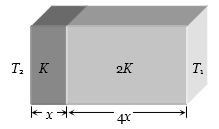
The temperatures of the two outer surfaces of a composite slab,consisting of two materials having coefficients of thermal conductivity $K$ and $2K$ and thicknesses $x$ and $4x$ respectively,are $T_2$ and $T_1$ $(T_2 > T_1)$. The rate of heat transfer through the slab in a steady state is $\left( \frac{A(T_2 - T_1)K}{x} \right)f$,where $f$ is equal to:
A
$1$
B
$\frac{1}{2}$
C
$\frac{2}{3}$
D
$\frac{1}{3}$
Solution
(D) In a steady state,the rate of heat flow $H$ through a composite slab of two materials in series is given by $H = \frac{A(T_2 - T_1)}{R_1 + R_2}$,where $R_1 = \frac{x}{KA}$ and $R_2 = \frac{4x}{(2K)A} = \frac{2x}{KA}$.
The total thermal resistance is $R_{eq} = R_1 + R_2 = \frac{x}{KA} + \frac{2x}{KA} = \frac{3x}{KA}$.
Therefore,the rate of heat transfer is $H = \frac{A(T_2 - T_1)}{\frac{3x}{KA}} = \frac{1}{3} \frac{AK(T_2 - T_1)}{x}$.
Comparing this with the given expression $\left( \frac{A(T_2 - T_1)K}{x} \right)f$,we find that $f = \frac{1}{3}$.
The total thermal resistance is $R_{eq} = R_1 + R_2 = \frac{x}{KA} + \frac{2x}{KA} = \frac{3x}{KA}$.
Therefore,the rate of heat transfer is $H = \frac{A(T_2 - T_1)}{\frac{3x}{KA}} = \frac{1}{3} \frac{AK(T_2 - T_1)}{x}$.
Comparing this with the given expression $\left( \frac{A(T_2 - T_1)K}{x} \right)f$,we find that $f = \frac{1}{3}$.
0 likesView Solution
3
PhysicsMediumMCQAIIMS · 2017
An organ pipe open at one end is vibrating in its first overtone and is in resonance with another pipe open at both ends vibrating in its third harmonic. The ratio of the length of the two pipes is:
A
$1:2$
B
$4:1$
C
$8:3$
D
$3:8$
Solution
(A) For an organ pipe open at one end,the frequency of the first overtone is given by $n_c = \frac{3v}{4l_c}$,where $v$ is the speed of sound and $l_c$ is the length of the closed pipe.
For an organ pipe open at both ends,the frequency of the third harmonic is given by $n_o = \frac{3v}{2l_o}$,where $l_o$ is the length of the open pipe.
Since the pipes are in resonance,$n_c = n_o$.
Equating the two expressions: $\frac{3v}{4l_c} = \frac{3v}{2l_o}$.
Simplifying this,we get $\frac{1}{4l_c} = \frac{1}{2l_o}$,which implies $\frac{l_c}{l_o} = \frac{2}{4} = \frac{1}{2}$.
Thus,the ratio of the length of the closed pipe to the open pipe is $1:2$.
For an organ pipe open at both ends,the frequency of the third harmonic is given by $n_o = \frac{3v}{2l_o}$,where $l_o$ is the length of the open pipe.
Since the pipes are in resonance,$n_c = n_o$.
Equating the two expressions: $\frac{3v}{4l_c} = \frac{3v}{2l_o}$.
Simplifying this,we get $\frac{1}{4l_c} = \frac{1}{2l_o}$,which implies $\frac{l_c}{l_o} = \frac{2}{4} = \frac{1}{2}$.
Thus,the ratio of the length of the closed pipe to the open pipe is $1:2$.
0 likesView Solution
4
PhysicsMediumMCQAIIMS · 2017
The wheel of a car is rotating at the rate of $1200$ revolutions per minute. On pressing the accelerator for $10 \ s$,it starts rotating at $4500$ revolutions per minute. The angular acceleration of the wheel is:
A
$30 \ rad/s^2$
B
$1880 \ deg/s^2$
C
$40 \ rad/s^2$
D
$1980 \ deg/s^2$
Solution
(D) Initial angular speed,$\omega_1 = 1200 \ rpm = \frac{1200 \times 2\pi}{60} \ rad/s = 40\pi \ rad/s$.
Final angular speed,$\omega_2 = 4500 \ rpm = \frac{4500 \times 2\pi}{60} \ rad/s = 150\pi \ rad/s$.
Time interval,$t = 10 \ s$.
Angular acceleration,$\alpha = \frac{\omega_2 - \omega_1}{t} = \frac{150\pi - 40\pi}{10} = \frac{110\pi}{10} = 11\pi \ rad/s^2$.
To convert $rad/s^2$ to $deg/s^2$,multiply by $\frac{180}{\pi}$:
$\alpha = 11\pi \times \frac{180}{\pi} = 11 \times 180 = 1980 \ deg/s^2$.
Final angular speed,$\omega_2 = 4500 \ rpm = \frac{4500 \times 2\pi}{60} \ rad/s = 150\pi \ rad/s$.
Time interval,$t = 10 \ s$.
Angular acceleration,$\alpha = \frac{\omega_2 - \omega_1}{t} = \frac{150\pi - 40\pi}{10} = \frac{110\pi}{10} = 11\pi \ rad/s^2$.
To convert $rad/s^2$ to $deg/s^2$,multiply by $\frac{180}{\pi}$:
$\alpha = 11\pi \times \frac{180}{\pi} = 11 \times 180 = 1980 \ deg/s^2$.
0 likesView Solution
5
PhysicsDifficultMCQAIIMS · 2017
$A$ small block of mass $m$ is kept on a rough inclined surface of inclination $\theta$ fixed in an elevator. The elevator goes up with a uniform velocity $v$ and the block does not slide on the wedge. The work done by the force of friction on the block in time $t$ as seen by the observer on the inclined plane will be
A
zero
B
$mgvt \cos^2 \theta$
C
$mgvt \sin^2 \theta$
D
$mgvt \sin 2 \theta$
Solution
(A) The observer is on the inclined plane. Since the block does not slide on the wedge,its displacement relative to the inclined plane is zero.
Work done $W = \vec{F} \cdot \vec{S}$.
Since the displacement $\vec{S} = 0$ relative to the observer on the inclined plane,the work done by the force of friction on the block as seen by this observer is zero.
Work done $W = \vec{F} \cdot \vec{S}$.
Since the displacement $\vec{S} = 0$ relative to the observer on the inclined plane,the work done by the force of friction on the block as seen by this observer is zero.

0 likesView Solution
6
PhysicsDifficultMCQAIIMS · 2017
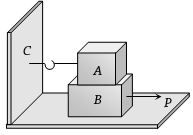
Block $A$ weighing $100 \, kg$ rests on a block $B$ and is tied with a horizontal string to the wall at $C$. Block $B$ weighs $200 \, kg$. The coefficient of friction between $A$ and $B$ is $0.25$ and between $B$ and the surface is $1/3$. The horizontal force $P$ necessary to move the block $B$ should be ........ $N$ $(g = 10 \, m/s^2)$.
A
$1150$
B
$1250$
C
$1300$
D
$1420$
Solution
(B) To move block $B$,the applied force $P$ must overcome the frictional forces acting on it.
$1$. The friction between block $A$ and block $B$ $(F_{AB})$ acts on the top surface of block $B$ in the direction opposite to the motion. Since block $A$ is stationary,$F_{AB} = \mu_{AB} \cdot N_A = \mu_{AB} \cdot m_A \cdot g = 0.25 \times 100 \times 10 = 250 \, N$.
$2$. The friction between block $B$ and the ground $(F_{BS})$ acts on the bottom surface of block $B$. The normal force on the ground is the sum of the weights of both blocks: $N_{ground} = (m_A + m_B)g = (100 + 200) \times 10 = 3000 \, N$. Thus,$F_{BS} = \mu_{BS} \cdot N_{ground} = (1/3) \times 3000 = 1000 \, N$.
$3$. The total force $P$ required is the sum of these two frictional forces: $P = F_{AB} + F_{BS} = 250 + 1000 = 1250 \, N$.
$1$. The friction between block $A$ and block $B$ $(F_{AB})$ acts on the top surface of block $B$ in the direction opposite to the motion. Since block $A$ is stationary,$F_{AB} = \mu_{AB} \cdot N_A = \mu_{AB} \cdot m_A \cdot g = 0.25 \times 100 \times 10 = 250 \, N$.
$2$. The friction between block $B$ and the ground $(F_{BS})$ acts on the bottom surface of block $B$. The normal force on the ground is the sum of the weights of both blocks: $N_{ground} = (m_A + m_B)g = (100 + 200) \times 10 = 3000 \, N$. Thus,$F_{BS} = \mu_{BS} \cdot N_{ground} = (1/3) \times 3000 = 1000 \, N$.
$3$. The total force $P$ required is the sum of these two frictional forces: $P = F_{AB} + F_{BS} = 250 + 1000 = 1250 \, N$.
0 likesView Solution
7
PhysicsDifficultMCQAIIMS · 2017
Hail stones are observed to strike the surface of a frozen lake at $30^{\circ}$ with the vertical and rebound at $60^{\circ}$ with the vertical. Assuming the contact to be smooth,the coefficient of restitution is
A
$e=\frac{1}{3}$
B
$e=\frac{1}{\sqrt{3}}$
C
$e=\sqrt{3}$
D
$e=3$
Solution
(A) Let $u$ be the velocity of the hail stone before impact and $v$ be the velocity after impact.
Since the surface is smooth,there is no impulsive force parallel to the surface. Thus,the component of velocity parallel to the surface remains unchanged:
$u \sin 30^{\circ} = v \sin 60^{\circ}$ $(1)$
For the component normal to the surface,the coefficient of restitution $e$ is defined as the ratio of the velocity of separation to the velocity of approach:
$v \cos 60^{\circ} = e (u \cos 30^{\circ})$ $(2)$
Dividing equation $(2)$ by equation $(1)$:
$\frac{v \cos 60^{\circ}}{v \sin 60^{\circ}} = \frac{e u \cos 30^{\circ}}{u \sin 30^{\circ}}$
$\cot 60^{\circ} = e \cot 30^{\circ}$
Since $\cot 60^{\circ} = \frac{1}{\sqrt{3}}$ and $\cot 30^{\circ} = \sqrt{3}$:
$\frac{1}{\sqrt{3}} = e (\sqrt{3})$
$e = \frac{1}{\sqrt{3} \cdot \sqrt{3}} = \frac{1}{3}$
Since the surface is smooth,there is no impulsive force parallel to the surface. Thus,the component of velocity parallel to the surface remains unchanged:
$u \sin 30^{\circ} = v \sin 60^{\circ}$ $(1)$
For the component normal to the surface,the coefficient of restitution $e$ is defined as the ratio of the velocity of separation to the velocity of approach:
$v \cos 60^{\circ} = e (u \cos 30^{\circ})$ $(2)$
Dividing equation $(2)$ by equation $(1)$:
$\frac{v \cos 60^{\circ}}{v \sin 60^{\circ}} = \frac{e u \cos 30^{\circ}}{u \sin 30^{\circ}}$
$\cot 60^{\circ} = e \cot 30^{\circ}$
Since $\cot 60^{\circ} = \frac{1}{\sqrt{3}}$ and $\cot 30^{\circ} = \sqrt{3}$:
$\frac{1}{\sqrt{3}} = e (\sqrt{3})$
$e = \frac{1}{\sqrt{3} \cdot \sqrt{3}} = \frac{1}{3}$
0 likesView Solution
8
PhysicsDifficultMCQAIIMS · 2017
The potential energy of a particle varies with distance $x$ from a fixed origin as $V = \frac{A\sqrt{x}}{x + B}$,where $A$ and $B$ are constants. The dimensions of $AB$ are
A
$ML^{5/2} T^{-2}$
B
$M^1 L^2 T^{-2}$
C
$M^{3/2} L^{3/2} T^{-2}$
D
$M^1 L^{7/2} T^{-2}$
Solution
(D) The potential energy $V$ has dimensions of work or energy,which is $[M L^2 T^{-2}]$.
In the denominator $(x + B)$,since $x$ is a distance,the dimension of $B$ must be the same as the dimension of $x$. Therefore,$[B] = [L]$.
The expression is $V = \frac{A\sqrt{x}}{x + B}$. Rearranging for $A$,we get $A = \frac{V(x + B)}{\sqrt{x}}$.
Substituting the dimensions: $[A] = \frac{[M L^2 T^{-2}] [L]}{[L^{1/2}]} = [M L^2 T^{-2}] [L^{1/2}] = [M L^{5/2} T^{-2}]$.
Now,the dimension of $AB$ is $[A][B] = [M L^{5/2} T^{-2}] [L] = [M L^{7/2} T^{-2}]$.
In the denominator $(x + B)$,since $x$ is a distance,the dimension of $B$ must be the same as the dimension of $x$. Therefore,$[B] = [L]$.
The expression is $V = \frac{A\sqrt{x}}{x + B}$. Rearranging for $A$,we get $A = \frac{V(x + B)}{\sqrt{x}}$.
Substituting the dimensions: $[A] = \frac{[M L^2 T^{-2}] [L]}{[L^{1/2}]} = [M L^2 T^{-2}] [L^{1/2}] = [M L^{5/2} T^{-2}]$.
Now,the dimension of $AB$ is $[A][B] = [M L^{5/2} T^{-2}] [L] = [M L^{7/2} T^{-2}]$.
0 likesView Solution
9
PhysicsEasyMCQAIIMS · 2017
Which of the following displacement $(X)$ time graphs is not possible?
A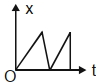
B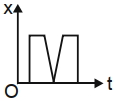
C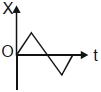
D
Solution
(B) In a displacement $(X)$ versus time $(t)$ graph,the slope represents the velocity of the particle. For a graph to be physically possible,a particle must have only one unique position at any given instant of time $(t)$.
Option $(A)$ is possible as it represents a particle moving away and then returning.
Option $(C)$ is possible as it shows motion in both directions.
Option $(D)$ is possible as it represents a particle moving with constant velocity,resetting,and repeating.
Option $(B)$ is not possible because at a specific instant of time $(t)$,the graph shows two different values of displacement $(X)$. Since a particle cannot be at two places at the same time,this graph is physically impossible.
Option $(A)$ is possible as it represents a particle moving away and then returning.
Option $(C)$ is possible as it shows motion in both directions.
Option $(D)$ is possible as it represents a particle moving with constant velocity,resetting,and repeating.
Option $(B)$ is not possible because at a specific instant of time $(t)$,the graph shows two different values of displacement $(X)$. Since a particle cannot be at two places at the same time,this graph is physically impossible.
0 likesView Solution
10
PhysicsEasyMCQAIIMS · 2017
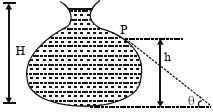
The figure shows the vertical cross-section of a vessel filled with a liquid of density $\rho$. The normal thrust per unit area on the walls of the vessel at the point $P$,as shown,will be
A
$h\rho g$
B
$(H - h)\rho g$
C
$H\rho g$
D
$(H - h)\rho g \cos \theta$
Solution
(B) The pressure at any point in a static fluid is given by $P = h'\rho g$,where $h'$ is the depth of the point below the free surface of the liquid.
In the given figure,the total height of the liquid column is $H$ and the height of point $P$ from the bottom is $h$. Therefore,the depth of point $P$ below the free surface is $H - h$.
The normal thrust per unit area is equivalent to the hydrostatic pressure at that point.
Thus,the normal thrust per unit area at point $P$ is $(H - h)\rho g$.
In the given figure,the total height of the liquid column is $H$ and the height of point $P$ from the bottom is $h$. Therefore,the depth of point $P$ below the free surface is $H - h$.
The normal thrust per unit area is equivalent to the hydrostatic pressure at that point.
Thus,the normal thrust per unit area at point $P$ is $(H - h)\rho g$.
0 likesView Solution
11
PhysicsEasyMCQAIIMS · 2017
$Assertion$: In the measurement of physical quantities,direct and indirect methods are used.
$Reason$: The accuracy and precision of measuring instruments,along with errors in measurements,should be taken into account while expressing the result.
$Reason$: The accuracy and precision of measuring instruments,along with errors in measurements,should be taken into account while expressing the result.
A
If both $Assertion$ and $Reason$ are correct and the $Reason$ is a correct explanation of the $Assertion$.
B
If both $Assertion$ and $Reason$ are correct but $Reason$ is not a correct explanation of the $Assertion$.
C
If the $Assertion$ is correct but $Reason$ is incorrect.
D
If both the $Assertion$ and $Reason$ are incorrect.
Solution
(B) The $Assertion$ is correct because physical quantities can be measured directly (e.g.,using a meter scale) or indirectly (e.g.,using parallax method for distance of stars).
The $Reason$ is also correct because the reliability of any measurement depends on the precision and accuracy of the instrument used,and the final result must account for the associated uncertainties or errors.
However,the $Reason$ does not explain why we use direct or indirect methods; it explains the criteria for reporting a measurement. Therefore,the $Reason$ is not the correct explanation of the $Assertion$.
The $Reason$ is also correct because the reliability of any measurement depends on the precision and accuracy of the instrument used,and the final result must account for the associated uncertainties or errors.
However,the $Reason$ does not explain why we use direct or indirect methods; it explains the criteria for reporting a measurement. Therefore,the $Reason$ is not the correct explanation of the $Assertion$.
0 likesView Solution
12
PhysicsEasyMCQAIIMS · 2017
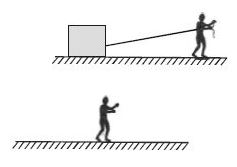
$Assertion$ : $A$ man and a block rest on a smooth horizontal surface. The man holds a rope which is connected to the block. The man cannot move on the horizontal surface.
$Reason$ : $A$ man standing at rest on a smooth horizontal surface cannot start walking due to the absence of friction (The man is only in contact with the floor as shown).
$Reason$ : $A$ man standing at rest on a smooth horizontal surface cannot start walking due to the absence of friction (The man is only in contact with the floor as shown).
A
If both Assertion and Reason are correct and the Reason is a correct explanation of the Assertion.
B
If both Assertion and Reason are correct but Reason is not a correct explanation of the Assertion.
C
If the Assertion is correct but Reason is incorrect.
D
If both the Assertion and Reason are incorrect.
Solution
(D) The $Assertion$ states that the man cannot move on the horizontal surface while holding a rope connected to a block. This is incorrect because the man can exert a force on the block by pulling the rope. According to Newton's third law,the block will exert an equal and opposite force on the man,causing him to move towards the block.
The $Reason$ states that a man standing at rest on a smooth horizontal surface cannot start walking due to the absence of friction. This is correct. Walking requires friction to push the ground backward,which in turn provides a forward reaction force. Without friction,the man's feet would simply slip.
Since the $Assertion$ is incorrect and the $Reason$ is correct,the correct option is $D$ (based on standard assertion-reason logic where the assertion is false).
The $Reason$ states that a man standing at rest on a smooth horizontal surface cannot start walking due to the absence of friction. This is correct. Walking requires friction to push the ground backward,which in turn provides a forward reaction force. Without friction,the man's feet would simply slip.
Since the $Assertion$ is incorrect and the $Reason$ is correct,the correct option is $D$ (based on standard assertion-reason logic where the assertion is false).
0 likesView Solution
13
PhysicsEasyMCQAIIMS · 2017
$Assertion$ : Graph between potential energy of a spring versus the extension or compression of the spring is a straight line.
$Reason$ : Potential energy of a stretched or compressed spring is proportional to the square of extension or compression.
$Reason$ : Potential energy of a stretched or compressed spring is proportional to the square of extension or compression.
A
If both $Assertion$ and $Reason$ are correct and the $Reason$ is a correct explanation of the $Assertion$.
B
If both $Assertion$ and $Reason$ are correct but $Reason$ is not a correct explanation of the $Assertion$.
C
If both the $Assertion$ and $Reason$ are incorrect.
D
If the $Assertion$ is incorrect but $Reason$ is correct.
Solution
(D) The potential energy $U$ of a spring is given by the formula $U = \frac{1}{2} K x^2$,where $K$ is the spring constant and $x$ is the extension or compression.
This equation shows that $U \propto x^2$.
The graph of $U$ versus $x$ represents a parabola,not a straight line.
Therefore,the $Assertion$ is incorrect because the relationship is quadratic,not linear.
The $Reason$ is correct because it correctly states that the potential energy is proportional to the square of the extension or compression $(U \propto x^2)$.
This equation shows that $U \propto x^2$.
The graph of $U$ versus $x$ represents a parabola,not a straight line.
Therefore,the $Assertion$ is incorrect because the relationship is quadratic,not linear.
The $Reason$ is correct because it correctly states that the potential energy is proportional to the square of the extension or compression $(U \propto x^2)$.
0 likesView Solution
14
PhysicsEasyMCQAIIMS · 2017
$Assertion$ : Radius of gyration of a body is a constant quantity.
$Reason$ : The radius of gyration of a body about an axis of rotation may be defined as the root mean square distance of the particles from the axis of rotation.
$Reason$ : The radius of gyration of a body about an axis of rotation may be defined as the root mean square distance of the particles from the axis of rotation.
A
If both $Assertion$ and $Reason$ are correct and the $Reason$ is a correct explanation of the $Assertion$.
B
If both $Assertion$ and $Reason$ are correct but $Reason$ is not a correct explanation of the $Assertion$.
C
If the $Assertion$ is correct but $Reason$ is incorrect.
D
If both the $Assertion$ and $Reason$ are incorrect.
Solution
(D) The radius of gyration $K$ of a body is defined as $K = \sqrt{\frac{\sum m_i r_i^2}{M}}$,where $M$ is the total mass and $r_i$ is the distance of the $i$-th particle from the axis of rotation.
It is not a constant quantity because its value depends on the position and orientation of the axis of rotation.
Therefore,the $Assertion$ is incorrect.
The $Reason$ correctly defines the radius of gyration as the root mean square distance of the particles from the axis of rotation.
Thus,the $Assertion$ is incorrect,but the $Reason$ is correct.
It is not a constant quantity because its value depends on the position and orientation of the axis of rotation.
Therefore,the $Assertion$ is incorrect.
The $Reason$ correctly defines the radius of gyration as the root mean square distance of the particles from the axis of rotation.
Thus,the $Assertion$ is incorrect,but the $Reason$ is correct.
0 likesView Solution
15
PhysicsEasyMCQAIIMS · 2017
$Assertion$: Space rockets are usually launched in the equatorial line from west to east.
$Reason$: The acceleration due to gravity is minimum at the equator.
$Reason$: The acceleration due to gravity is minimum at the equator.
A
If both $Assertion$ and $Reason$ are correct but $Reason$ is not a correct explanation of the $Assertion$.
B
If both $Assertion$ and $Reason$ are correct and the $Reason$ is a correct explanation of the $Assertion$.
C
If the $Assertion$ is correct but $Reason$ is incorrect.
D
If both the $Assertion$ and $Reason$ are incorrect.
Solution
(A) The $Assertion$ is correct: Rockets are launched from west to east to take advantage of the Earth's rotational velocity,which helps in achieving orbital velocity with less fuel.
The $Reason$ is also correct: The effective acceleration due to gravity $g'$ is given by $g' = g - \omega^2 R \cos^2 \lambda$. At the equator,the latitude $\lambda = 0$,so $\cos \lambda = 1$,making $g' = g - \omega^2 R$,which is the minimum value.
However,the $Reason$ does not explain why rockets are launched from west to east. The launch direction is based on the Earth's rotation,not the value of $g$ at the equator. Therefore,both are correct,but the $Reason$ is not the correct explanation for the $Assertion$.
The $Reason$ is also correct: The effective acceleration due to gravity $g'$ is given by $g' = g - \omega^2 R \cos^2 \lambda$. At the equator,the latitude $\lambda = 0$,so $\cos \lambda = 1$,making $g' = g - \omega^2 R$,which is the minimum value.
However,the $Reason$ does not explain why rockets are launched from west to east. The launch direction is based on the Earth's rotation,not the value of $g$ at the equator. Therefore,both are correct,but the $Reason$ is not the correct explanation for the $Assertion$.
0 likesView Solution
16
PhysicsEasyMCQAIIMS · 2017
$Assertion :$ Solids are least compressible and gases are most compressible.
$Reason :$ Solids have a definite shape and volume,but gases do not have either a definite shape or a definite volume.
$Reason :$ Solids have a definite shape and volume,but gases do not have either a definite shape or a definite volume.
A
If both $Assertion$ and $Reason$ are correct and the $Reason$ is a correct explanation of the $Assertion$.
B
If both $Assertion$ and $Reason$ are correct but $Reason$ is not a correct explanation of the $Assertion$.
C
If the $Assertion$ is correct but $Reason$ is incorrect.
D
If both the $Assertion$ and $Reason$ are incorrect.
Solution
(B) The compressibility of a substance depends on the intermolecular forces and the distance between its molecules.
In solids,the atoms or molecules are held together by strong intermolecular forces and are closely packed,making them least compressible.
In gases,the intermolecular forces are negligible and the molecules are far apart,allowing them to be easily compressed.
While the $Reason$ correctly states the properties of solids and gases regarding shape and volume,it does not directly explain the physical mechanism (intermolecular forces) behind their compressibility. Therefore,both statements are correct,but the $Reason$ is not the correct explanation for the $Assertion$.
In solids,the atoms or molecules are held together by strong intermolecular forces and are closely packed,making them least compressible.
In gases,the intermolecular forces are negligible and the molecules are far apart,allowing them to be easily compressed.
While the $Reason$ correctly states the properties of solids and gases regarding shape and volume,it does not directly explain the physical mechanism (intermolecular forces) behind their compressibility. Therefore,both statements are correct,but the $Reason$ is not the correct explanation for the $Assertion$.
0 likesView Solution
17
PhysicsEasyMCQAIIMS · 2017
$Assertion :$ The pressure of water increases when it flows from a narrow pipe to a wider pipe.
$Reason :$ According to the equation of continuity,$A_1v_1 = A_2v_2$,and by Bernoulli's principle,where velocity is high,pressure is low.
$Reason :$ According to the equation of continuity,$A_1v_1 = A_2v_2$,and by Bernoulli's principle,where velocity is high,pressure is low.
A
If both Assertion and Reason are correct and the Reason is a correct explanation of the Assertion.
B
If both Assertion and Reason are correct but Reason is not a correct explanation of the Assertion.
C
If the Assertion is correct but Reason is incorrect.
D
If both the Assertion and Reason are incorrect.
Solution
(A) According to the equation of continuity,$A_1v_1 = A_2v_2$. When water flows from a narrow pipe (small area $A_1$) to a wider pipe (large area $A_2$),the velocity $v$ decreases because $v \propto 1/A$.
According to Bernoulli's principle,$P + \frac{1}{2}\rho v^2 + \rho gh = \text{constant}$.
For a horizontal pipe $(h = \text{constant})$,as the velocity $v$ decreases,the pressure $P$ must increase to keep the sum constant.
Therefore,the pressure increases when water flows from a narrow pipe to a wider pipe.
Both the Assertion and the Reason are correct,and the Reason correctly explains the Assertion.
According to Bernoulli's principle,$P + \frac{1}{2}\rho v^2 + \rho gh = \text{constant}$.
For a horizontal pipe $(h = \text{constant})$,as the velocity $v$ decreases,the pressure $P$ must increase to keep the sum constant.
Therefore,the pressure increases when water flows from a narrow pipe to a wider pipe.
Both the Assertion and the Reason are correct,and the Reason correctly explains the Assertion.
0 likesView Solution
18
PhysicsEasyMCQAIIMS · 2017
$Assertion:$ The heat supplied to a system is always equal to the increase in its internal energy.
$Reason:$ When a system changes from one thermal equilibrium to another,some heat is absorbed by it.
$Reason:$ When a system changes from one thermal equilibrium to another,some heat is absorbed by it.
A
If both $Assertion$ and $Reason$ are correct and the $Reason$ is a correct explanation of the $Assertion$.
B
If both $Assertion$ and $Reason$ are correct but $Reason$ is not a correct explanation of the $Assertion$.
C
If the $Assertion$ is correct but $Reason$ is incorrect.
D
If both the $Assertion$ and $Reason$ are incorrect.
Solution
(D) According to the first law of thermodynamics,$\Delta Q = \Delta U + \Delta W = \Delta U + P\Delta V$.
If heat is supplied in such a manner that the volume does not change $(\Delta V = 0)$,i.e.,an isochoric process,then the whole of the heat energy supplied to the system will increase the internal energy only.
However,in any other process where work is done,the heat supplied is distributed between the change in internal energy and the work done by the system.
Therefore,the $Assertion$ is incorrect.
The $Reason$ is also incorrect because when a system changes from one thermal equilibrium to another,heat may be absorbed,evolved,or remain zero depending on the process.
If heat is supplied in such a manner that the volume does not change $(\Delta V = 0)$,i.e.,an isochoric process,then the whole of the heat energy supplied to the system will increase the internal energy only.
However,in any other process where work is done,the heat supplied is distributed between the change in internal energy and the work done by the system.
Therefore,the $Assertion$ is incorrect.
The $Reason$ is also incorrect because when a system changes from one thermal equilibrium to another,heat may be absorbed,evolved,or remain zero depending on the process.
0 likesView Solution
19
PhysicsEasyMCQAIIMS · 2017
$Assertion :$ Air pressure in a car tyre increases during driving.
$Reason :$ Absolute zero temperature is not zero energy temperature.
$Reason :$ Absolute zero temperature is not zero energy temperature.
A
If both Assertion and Reason are correct and the Reason is a correct explanation of the Assertion.
B
If both Assertion and Reason are correct but Reason is not a correct explanation of the Assertion.
C
If the Assertion is correct but Reason is incorrect.
D
If both the Assertion and Reason are incorrect.
Solution
(B) During driving,the friction between the tyre and the road,along with the continuous compression and expansion of the tyre,generates heat. This increases the temperature of the air trapped inside the tyre.
According to Gay-Lussac's Law,for a fixed mass of gas at constant volume,the pressure $P$ is directly proportional to its absolute temperature $T$ $(P \propto T)$. Therefore,as the temperature increases,the air pressure inside the tyre increases. This confirms the Assertion is correct.
Regarding the Reason,absolute zero temperature $(0 \ K)$ is defined as the temperature at which the classical kinetic energy of gas molecules becomes zero. However,in quantum mechanics,the zero-point energy exists even at absolute zero. Thus,the statement that 'Absolute zero temperature is not zero energy temperature' is scientifically correct.
However,the Reason does not explain why the pressure increases in a car tyre; the pressure increase is due to the temperature rise caused by friction,not the nature of absolute zero energy. Therefore,both are correct,but the Reason is not the correct explanation of the Assertion.
According to Gay-Lussac's Law,for a fixed mass of gas at constant volume,the pressure $P$ is directly proportional to its absolute temperature $T$ $(P \propto T)$. Therefore,as the temperature increases,the air pressure inside the tyre increases. This confirms the Assertion is correct.
Regarding the Reason,absolute zero temperature $(0 \ K)$ is defined as the temperature at which the classical kinetic energy of gas molecules becomes zero. However,in quantum mechanics,the zero-point energy exists even at absolute zero. Thus,the statement that 'Absolute zero temperature is not zero energy temperature' is scientifically correct.
However,the Reason does not explain why the pressure increases in a car tyre; the pressure increase is due to the temperature rise caused by friction,not the nature of absolute zero energy. Therefore,both are correct,but the Reason is not the correct explanation of the Assertion.
0 likesView Solution
20
PhysicsDifficultMCQAIIMS · 2017
$A$ point particle of mass $0.1\, kg$ is executing $S.H.M.$ with an amplitude of $0.1\, m$. When the particle passes through the mean position,its kinetic energy is $8 \times 10^{-3} \, J$. Obtain the equation of motion of this particle if the initial phase of oscillation is $45^o$.
A
$y = 0.1 \sin (\pm 4t + \pi/4)$
B
$y = 0.2 \sin (\pm 4t + \pi/4)$
C
$y = 0.1 \sin (\pm 2t + \pi/4)$
D
$y = 0.2 \sin (\pm 2t + \pi/4)$
Solution
(A) The displacement of a particle in $S.H.M.$ is given by $y = a \sin(\omega t + \phi)$.
The velocity is given by $v = \frac{dy}{dt} = a\omega \cos(\omega t + \phi)$.
The velocity is maximum at the mean position,where $v_{max} = a\omega$.
The kinetic energy at the mean position is $K.E._{max} = \frac{1}{2} m v_{max}^2 = \frac{1}{2} m (a\omega)^2$.
Given $m = 0.1 \, kg$,$a = 0.1 \, m$,and $K.E._{max} = 8 \times 10^{-3} \, J$.
Substituting these values: $\frac{1}{2} \times 0.1 \times \omega^2 \times (0.1)^2 = 8 \times 10^{-3}$.
$0.05 \times 0.01 \times \omega^2 = 8 \times 10^{-3} \implies 0.0005 \times \omega^2 = 0.008$.
$\omega^2 = \frac{0.008}{0.0005} = 16 \implies \omega = 4 \, rad/s$.
The initial phase $\phi = 45^o = \pi/4 \, rad$.
Thus,the equation of motion is $y = 0.1 \sin(\pm 4t + \pi/4)$.
The velocity is given by $v = \frac{dy}{dt} = a\omega \cos(\omega t + \phi)$.
The velocity is maximum at the mean position,where $v_{max} = a\omega$.
The kinetic energy at the mean position is $K.E._{max} = \frac{1}{2} m v_{max}^2 = \frac{1}{2} m (a\omega)^2$.
Given $m = 0.1 \, kg$,$a = 0.1 \, m$,and $K.E._{max} = 8 \times 10^{-3} \, J$.
Substituting these values: $\frac{1}{2} \times 0.1 \times \omega^2 \times (0.1)^2 = 8 \times 10^{-3}$.
$0.05 \times 0.01 \times \omega^2 = 8 \times 10^{-3} \implies 0.0005 \times \omega^2 = 0.008$.
$\omega^2 = \frac{0.008}{0.0005} = 16 \implies \omega = 4 \, rad/s$.
The initial phase $\phi = 45^o = \pi/4 \, rad$.
Thus,the equation of motion is $y = 0.1 \sin(\pm 4t + \pi/4)$.
0 likesView Solution
21
PhysicsEasyMCQAIIMS · 2017
$Assertion :$ The fundamental frequency of an open organ pipe increases as the temperature is increased.
$Reason :$ As the temperature increases,the velocity of sound increases more rapidly than the length of the pipe.
$Reason :$ As the temperature increases,the velocity of sound increases more rapidly than the length of the pipe.
A
If both Assertion and Reason are correct and the Reason is a correct explanation of the Assertion.
B
If both Assertion and Reason are correct but Reason is not a correct explanation of the Assertion.
C
If the Assertion is correct but Reason is incorrect.
D
If both the Assertion and Reason are incorrect.
Solution
(A) The fundamental frequency $f$ of an open organ pipe of length $l$ is given by $f = \frac{v}{2l}$,where $v$ is the velocity of sound in the air column.
As the temperature $T$ increases,the velocity of sound $v$ increases according to the relation $v = \sqrt{\frac{\gamma RT}{M}}$.
While the length $l$ of the pipe may increase slightly due to thermal expansion,the increase in the velocity of sound $v$ is much more significant.
Since $f \propto v$ and $f \propto \frac{1}{l}$,the increase in $v$ dominates the effect of the slight increase in $l$,leading to an overall increase in the fundamental frequency $f$.
Therefore,both the Assertion and the Reason are correct,and the Reason provides a correct explanation for the Assertion.
As the temperature $T$ increases,the velocity of sound $v$ increases according to the relation $v = \sqrt{\frac{\gamma RT}{M}}$.
While the length $l$ of the pipe may increase slightly due to thermal expansion,the increase in the velocity of sound $v$ is much more significant.
Since $f \propto v$ and $f \propto \frac{1}{l}$,the increase in $v$ dominates the effect of the slight increase in $l$,leading to an overall increase in the fundamental frequency $f$.
Therefore,both the Assertion and the Reason are correct,and the Reason provides a correct explanation for the Assertion.
0 likesView Solution
22
PhysicsMediumMCQAIIMS · 2017
If the formula is $X = 3 Y Z^{2}$,where $X$ and $Z$ have dimensions of capacitance and magnetic induction respectively,then the dimensions of $Y$ in the $MKSQ$ system are:
A
$[M^{-3} L^{-2} T^{4} Q^{4}]$
B
$[M L^{2} T^{8} Q^{4}]$
C
$[M^{-2} L^{-3} T^{2} Q^{4}]$
D
$[M^{-2} L^{-2} T Q^{2}]$
Solution
(A) Given the formula $X = 3 Y Z^{2}$.
We know the dimensions of capacitance $C$ in $MKSQ$ system are $[X] = [C] = [M^{-1} L^{-2} T^{2} Q^{2}]$.
We know the dimensions of magnetic induction $B$ in $MKSQ$ system are $[Z] = [B] = [M T^{-1} Q^{-1}]$.
Rearranging the formula for $Y$,we get $Y = \frac{X}{3 Z^{2}}$.
Ignoring the dimensionless constant $3$,the dimensional formula is $[Y] = \frac{[X]}{[Z^{2}]}$.
Substituting the dimensions: $[Y] = \frac{[M^{-1} L^{-2} T^{2} Q^{2}]}{[M T^{-1} Q^{-1}]^{2}}$.
$[Y] = \frac{[M^{-1} L^{-2} T^{2} Q^{2}]}{[M^{2} T^{-2} Q^{-2}]}$.
$[Y] = [M^{-1-2} L^{-2} T^{2-(-2)} Q^{2-(-2)}] = [M^{-3} L^{-2} T^{4} Q^{4}]$.
We know the dimensions of capacitance $C$ in $MKSQ$ system are $[X] = [C] = [M^{-1} L^{-2} T^{2} Q^{2}]$.
We know the dimensions of magnetic induction $B$ in $MKSQ$ system are $[Z] = [B] = [M T^{-1} Q^{-1}]$.
Rearranging the formula for $Y$,we get $Y = \frac{X}{3 Z^{2}}$.
Ignoring the dimensionless constant $3$,the dimensional formula is $[Y] = \frac{[X]}{[Z^{2}]}$.
Substituting the dimensions: $[Y] = \frac{[M^{-1} L^{-2} T^{2} Q^{2}]}{[M T^{-1} Q^{-1}]^{2}}$.
$[Y] = \frac{[M^{-1} L^{-2} T^{2} Q^{2}]}{[M^{2} T^{-2} Q^{-2}]}$.
$[Y] = [M^{-1-2} L^{-2} T^{2-(-2)} Q^{2-(-2)}] = [M^{-3} L^{-2} T^{4} Q^{4}]$.
0 likesView Solution
23
PhysicsMediumMCQAIIMS · 2017
The normal density of a material is $\rho$ and its bulk modulus of elasticity is $K$. The magnitude of increase in density of the material,when a pressure $P$ is applied uniformly on all sides,will be
A
$\frac{\rho K}{P}$
B
$\frac{\rho P}{K}$
C
$\frac{K}{\rho P}$
D
$\frac{PK}{\rho}$
Solution
(B) The density $\rho$ is given by $\rho = \frac{M}{V}$,where $M$ is the mass and $V$ is the volume.
Taking the logarithmic derivative,we get $\frac{d\rho}{\rho} = -\frac{dV}{V}$.
The bulk modulus $K$ is defined as $K = -\frac{P}{dV/V}$,which implies $-\frac{dV}{V} = \frac{P}{K}$.
Substituting this into the density relation,we get $\frac{d\rho}{\rho} = \frac{P}{K}$.
Therefore,the magnitude of the increase in density is $d\rho = \frac{\rho P}{K}$.
Taking the logarithmic derivative,we get $\frac{d\rho}{\rho} = -\frac{dV}{V}$.
The bulk modulus $K$ is defined as $K = -\frac{P}{dV/V}$,which implies $-\frac{dV}{V} = \frac{P}{K}$.
Substituting this into the density relation,we get $\frac{d\rho}{\rho} = \frac{P}{K}$.
Therefore,the magnitude of the increase in density is $d\rho = \frac{\rho P}{K}$.
0 likesView Solution
24
PhysicsEasyMCQAIIMS · 2017
The work done in which of the following processes is equal to the internal energy of the system?
A
Adiabatic process
B
Isothermal process
C
Isochoric process
D
None of these
Solution
(A) According to the first law of thermodynamics,$\Delta Q = \Delta U + \Delta W$,where $\Delta Q$ is the heat exchanged,$\Delta U$ is the change in internal energy,and $\Delta W$ is the work done by the system.
In an adiabatic process,there is no exchange of heat with the surroundings,so $\Delta Q = 0$.
Substituting this into the first law equation: $0 = \Delta U + \Delta W$.
This simplifies to $\Delta W = -\Delta U$ or $\Delta U = -\Delta W$.
If we consider the magnitude of work done on the system $(W_{on} = -\Delta W)$,then $W_{on} = \Delta U$.
Thus,in an adiabatic process,the work done on the system is equal to the change in internal energy of the system.
In an adiabatic process,there is no exchange of heat with the surroundings,so $\Delta Q = 0$.
Substituting this into the first law equation: $0 = \Delta U + \Delta W$.
This simplifies to $\Delta W = -\Delta U$ or $\Delta U = -\Delta W$.
If we consider the magnitude of work done on the system $(W_{on} = -\Delta W)$,then $W_{on} = \Delta U$.
Thus,in an adiabatic process,the work done on the system is equal to the change in internal energy of the system.
0 likesView Solution
25
PhysicsMediumMCQAIIMS · 2017
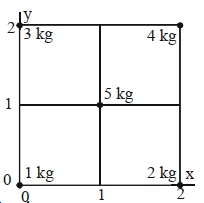
Five masses are placed in a plane as shown in the figure. The coordinates of the centre of mass are nearest to:
A
$(1.2, 1.4)$
B
$(1.3, 1.1)$
C
$(1.1, 1.3)$
D
$(1.0, 1.0)$
Solution
(C) From the figure,the coordinates $(x, y)$ and masses $m$ are:
$m_1 = 1 \text{ kg}$ at $(0, 0)$
$m_2 = 2 \text{ kg}$ at $(2, 0)$
$m_3 = 3 \text{ kg}$ at $(0, 2)$
$m_4 = 4 \text{ kg}$ at $(2, 2)$
$m_5 = 5 \text{ kg}$ at $(1, 1)$
The total mass $M = 1 + 2 + 3 + 4 + 5 = 15 \text{ kg}$.
The $x$-coordinate of the centre of mass is:
$x_{cm} = \frac{\sum m_i x_i}{M} = \frac{(1 \times 0) + (2 \times 2) + (3 \times 0) + (4 \times 2) + (5 \times 1)}{15} = \frac{0 + 4 + 0 + 8 + 5}{15} = \frac{17}{15} \approx 1.13$
The $y$-coordinate of the centre of mass is:
$y_{cm} = \frac{\sum m_i y_i}{M} = \frac{(1 \times 0) + (2 \times 0) + (3 \times 2) + (4 \times 2) + (5 \times 1)}{15} = \frac{0 + 0 + 6 + 8 + 5}{15} = \frac{19}{15} \approx 1.27$
Thus,the coordinates are approximately $(1.1, 1.3)$. The correct option is $C$.
$m_1 = 1 \text{ kg}$ at $(0, 0)$
$m_2 = 2 \text{ kg}$ at $(2, 0)$
$m_3 = 3 \text{ kg}$ at $(0, 2)$
$m_4 = 4 \text{ kg}$ at $(2, 2)$
$m_5 = 5 \text{ kg}$ at $(1, 1)$
The total mass $M = 1 + 2 + 3 + 4 + 5 = 15 \text{ kg}$.
The $x$-coordinate of the centre of mass is:
$x_{cm} = \frac{\sum m_i x_i}{M} = \frac{(1 \times 0) + (2 \times 2) + (3 \times 0) + (4 \times 2) + (5 \times 1)}{15} = \frac{0 + 4 + 0 + 8 + 5}{15} = \frac{17}{15} \approx 1.13$
The $y$-coordinate of the centre of mass is:
$y_{cm} = \frac{\sum m_i y_i}{M} = \frac{(1 \times 0) + (2 \times 0) + (3 \times 2) + (4 \times 2) + (5 \times 1)}{15} = \frac{0 + 0 + 6 + 8 + 5}{15} = \frac{19}{15} \approx 1.27$
Thus,the coordinates are approximately $(1.1, 1.3)$. The correct option is $C$.
0 likesView Solution
26
PhysicsMediumMCQAIIMS · 2017
The molar heat capacity of a mixture of two gases at constant volume is $13R/6$. The ratio of the number of moles of the first gas to the second is $1:2$. The respective gases may be:
A
$O_2$ and $N_2$
B
$He$ and $Ne$
C
$He$ and $N_2$
D
$N_2$ and $He$
Solution
(C) The molar heat capacity at constant volume for a mixture is given by $C_{V, \text{mix}} = \frac{n_1 C_{V_1} + n_2 C_{V_2}}{n_1 + n_2} = \frac{13R}{6}$.
Given the ratio $n_1 : n_2 = 1 : 2$,let $n_1 = n$ and $n_2 = 2n$.
Substituting these values: $\frac{n C_{V_1} + 2n C_{V_2}}{n + 2n} = \frac{13R}{6}$.
$\frac{C_{V_1} + 2C_{V_2}}{3} = \frac{13R}{6} \implies C_{V_1} + 2C_{V_2} = \frac{13R}{2}$.
For monatomic gases,$C_V = 3R/2$. For diatomic gases,$C_V = 5R/2$.
If gas $1$ is monatomic $(C_{V_1} = 3R/2)$ and gas $2$ is diatomic $(C_{V_2} = 5R/2)$:
$3R/2 + 2(5R/2) = 3R/2 + 5R = 13R/2$.
This matches the condition. Thus,the first gas is monatomic $(He)$ and the second is diatomic $(N_2)$.
Given the ratio $n_1 : n_2 = 1 : 2$,let $n_1 = n$ and $n_2 = 2n$.
Substituting these values: $\frac{n C_{V_1} + 2n C_{V_2}}{n + 2n} = \frac{13R}{6}$.
$\frac{C_{V_1} + 2C_{V_2}}{3} = \frac{13R}{6} \implies C_{V_1} + 2C_{V_2} = \frac{13R}{2}$.
For monatomic gases,$C_V = 3R/2$. For diatomic gases,$C_V = 5R/2$.
If gas $1$ is monatomic $(C_{V_1} = 3R/2)$ and gas $2$ is diatomic $(C_{V_2} = 5R/2)$:
$3R/2 + 2(5R/2) = 3R/2 + 5R = 13R/2$.
This matches the condition. Thus,the first gas is monatomic $(He)$ and the second is diatomic $(N_2)$.
0 likesView Solution
27
PhysicsMediumMCQAIIMS · 2017
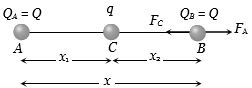
$A$ charge $q$ is placed at the centre of the line joining two equal charges $Q$. The system of the three charges will be in equilibrium if $q$ is equal to:
A
$ - \frac{Q}{2} $
B
$ - \frac{Q}{4} $
C
$ + \frac{Q}{4} $
D
$ + \frac{Q}{2} $
Solution
(B) For the system of three charges to be in equilibrium,the net force on each charge must be zero.
Let the two charges $Q$ be placed at points $A$ and $B$ separated by a distance $x$. The charge $q$ is placed at the midpoint $C$ (distance $x/2$ from both $A$ and $B$).
Consider the equilibrium of charge $Q$ at point $B$. The force exerted by charge $Q$ at $A$ on charge $Q$ at $B$ must be balanced by the force exerted by charge $q$ at $C$ on charge $Q$ at $B$.
$F_{AB} + F_{CB} = 0$
$\frac{1}{4\pi\varepsilon_0} \frac{Q^2}{x^2} + \frac{1}{4\pi\varepsilon_0} \frac{qQ}{(x/2)^2} = 0$
$\frac{Q^2}{x^2} + \frac{4qQ}{x^2} = 0$
$Q^2 + 4qQ = 0$
$4qQ = -Q^2$
$q = -\frac{Q}{4}$
Let the two charges $Q$ be placed at points $A$ and $B$ separated by a distance $x$. The charge $q$ is placed at the midpoint $C$ (distance $x/2$ from both $A$ and $B$).
Consider the equilibrium of charge $Q$ at point $B$. The force exerted by charge $Q$ at $A$ on charge $Q$ at $B$ must be balanced by the force exerted by charge $q$ at $C$ on charge $Q$ at $B$.
$F_{AB} + F_{CB} = 0$
$\frac{1}{4\pi\varepsilon_0} \frac{Q^2}{x^2} + \frac{1}{4\pi\varepsilon_0} \frac{qQ}{(x/2)^2} = 0$
$\frac{Q^2}{x^2} + \frac{4qQ}{x^2} = 0$
$Q^2 + 4qQ = 0$
$4qQ = -Q^2$
$q = -\frac{Q}{4}$
0 likesView Solution
28
PhysicsEasyMCQAIIMS · 2017
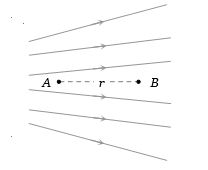
The figure shows the electric lines of force emerging from a charged body. If the electric field at $A$ and $B$ are $E_A$ and $E_B$ respectively,and if the distance between $A$ and $B$ is $r$,then:
A
$E_A > E_B$
B
$E_A < E_B$
C
$E_A = \frac{E_B}{r}$
D
$E_A = \frac{E_B}{r^2}$
Solution
(A) The strength of an electric field is represented by the density of electric field lines.
In the given figure,the electric field lines are closer together (denser) at point $A$ compared to point $B$.
Since the density of field lines is higher at $A$,the magnitude of the electric field at $A$ $(E_A)$ must be greater than the magnitude of the electric field at $B$ $(E_B)$.
Therefore,$E_A > E_B$.
In the given figure,the electric field lines are closer together (denser) at point $A$ compared to point $B$.
Since the density of field lines is higher at $A$,the magnitude of the electric field at $A$ $(E_A)$ must be greater than the magnitude of the electric field at $B$ $(E_B)$.
Therefore,$E_A > E_B$.
0 likesView Solution
29
PhysicsEasyMCQAIIMS · 2017
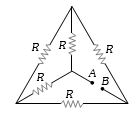
Each of the resistances in the network shown in the figure is equal to $R$. The resistance between the terminals $A$ and $B$ is
A
$5 R$
B
$3 R$
C
$R$
D
$R/2$
Solution
(C) Let the nodes be labeled. The circuit consists of a central node connected to three outer nodes,each with a resistance $R$. The outer nodes form a triangle with resistances $R$ between them. Terminals $A$ and $B$ are connected to two of these outer nodes.
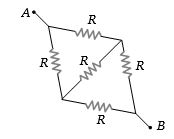
By analyzing the symmetry and redrawing the circuit,we can see that the path from $A$ to $B$ consists of two parallel branches.
One branch is the direct resistance $R$ between $A$ and $B$.
The other branch consists of the remaining resistances in series and parallel combinations.
Specifically,the equivalent resistance of this network between terminals $A$ and $B$ simplifies to $R$.
By analyzing the symmetry and redrawing the circuit,we can see that the path from $A$ to $B$ consists of two parallel branches.
One branch is the direct resistance $R$ between $A$ and $B$.
The other branch consists of the remaining resistances in series and parallel combinations.
Specifically,the equivalent resistance of this network between terminals $A$ and $B$ simplifies to $R$.
0 likesView Solution
30
PhysicsEasyMCQAIIMS · 2017
If in the experiment of Wheatstone's bridge,the positions of cells and galvanometer are interchanged,then the balance point will
A
Change
B
Remain unchanged
C
Depend on the internal resistance of the cell and the resistance of the galvanometer
D
None of these
Solution
(B) In a Wheatstone bridge circuit,the condition for balance is given by the ratio of resistances $\frac{P}{Q} = \frac{R}{S}$.
This balance condition is independent of the positions of the cell and the galvanometer.
According to the principle of reciprocity in electrical networks,if the positions of the source (cell) and the detector (galvanometer) are interchanged,the current through the galvanometer remains the same for a given potential difference.
Therefore,the balance point of the Wheatstone bridge remains unchanged.
This balance condition is independent of the positions of the cell and the galvanometer.
According to the principle of reciprocity in electrical networks,if the positions of the source (cell) and the detector (galvanometer) are interchanged,the current through the galvanometer remains the same for a given potential difference.
Therefore,the balance point of the Wheatstone bridge remains unchanged.
0 likesView Solution
31
PhysicsEasyMCQAIIMS · 2017
Curie temperature is the temperature above which
A
$A$ paramagnetic material becomes ferromagnetic
B
$A$ ferromagnetic material becomes paramagnetic
C
$A$ paramagnetic material becomes diamagnetic
D
$A$ ferromagnetic material becomes diamagnetic
Solution
(B) The Curie temperature $(T_C)$ is a characteristic property of ferromagnetic materials.
At temperatures below $T_C$,the material exhibits ferromagnetic properties due to the alignment of magnetic domains.
As the temperature increases and reaches $T_C$,the thermal agitation becomes strong enough to overcome the exchange coupling that maintains the alignment of these domains.
Consequently,above the Curie temperature,the material loses its spontaneous magnetization and transitions into a paramagnetic state.
Therefore,the correct option is $(B)$.
At temperatures below $T_C$,the material exhibits ferromagnetic properties due to the alignment of magnetic domains.
As the temperature increases and reaches $T_C$,the thermal agitation becomes strong enough to overcome the exchange coupling that maintains the alignment of these domains.
Consequently,above the Curie temperature,the material loses its spontaneous magnetization and transitions into a paramagnetic state.
Therefore,the correct option is $(B)$.
0 likesView Solution
32
PhysicsDifficultMCQAIIMS · 2017
If a magnet is suspended at an angle $30^o$ to the magnetic meridian,it makes an angle of $45^o$ with the horizontal. The real dip is
A
$\tan^{-1}(\sqrt{3}/2)$
B
$\tan^{-1}(\sqrt{3})$
C
$\tan^{-1}(\sqrt{3/2})$
D
$\tan^{-1}(2/\sqrt{3})$
Solution
(A) Let the real dip be $\phi$. The vertical component of the Earth's magnetic field is $B_V$ and the horizontal component is $B_H$. The real dip is given by $\tan \phi = \frac{B_V}{B_H}$.
When the magnet is suspended at an angle $\beta = 30^o$ to the magnetic meridian,the effective horizontal component becomes $B_H' = B_H \cos \beta$.
The apparent dip $\phi'$ is given by $\tan \phi' = \frac{B_V}{B_H \cos \beta}$.
Given $\phi' = 45^o$ and $\beta = 30^o$,we have $\tan 45^o = \frac{B_V}{B_H \cos 30^o}$.
Since $\tan 45^o = 1$ and $\cos 30^o = \frac{\sqrt{3}}{2}$,we get $1 = \frac{B_V}{B_H (\sqrt{3}/2)}$.
This simplifies to $\frac{B_V}{B_H} = \frac{\sqrt{3}}{2}$.
Therefore,$\tan \phi = \frac{\sqrt{3}}{2}$,which implies $\phi = \tan^{-1}\left(\frac{\sqrt{3}}{2}\right)$.
When the magnet is suspended at an angle $\beta = 30^o$ to the magnetic meridian,the effective horizontal component becomes $B_H' = B_H \cos \beta$.
The apparent dip $\phi'$ is given by $\tan \phi' = \frac{B_V}{B_H \cos \beta}$.
Given $\phi' = 45^o$ and $\beta = 30^o$,we have $\tan 45^o = \frac{B_V}{B_H \cos 30^o}$.
Since $\tan 45^o = 1$ and $\cos 30^o = \frac{\sqrt{3}}{2}$,we get $1 = \frac{B_V}{B_H (\sqrt{3}/2)}$.
This simplifies to $\frac{B_V}{B_H} = \frac{\sqrt{3}}{2}$.
Therefore,$\tan \phi = \frac{\sqrt{3}}{2}$,which implies $\phi = \tan^{-1}\left(\frac{\sqrt{3}}{2}\right)$.
0 likesView Solution
33
PhysicsEasyMCQAIIMS · 2017
In an $ac$ circuit,the current is given by $i = 5 \sin \left( 100 t - \frac{\pi}{2} \right)$ and the $ac$ potential is $V = 200 \sin (100 t) \text{ volts}$. Then the power consumption is $....... \text{ watts}$.
A
$20$
B
$40$
C
$1000$
D
$0$
Solution
(D) The given current is $i = 5 \sin \left( 100 t - \frac{\pi}{2} \right)$ and the potential is $V = 200 \sin (100 t)$.
Comparing these with the standard forms $i = I_0 \sin(\omega t + \phi_1)$ and $V = V_0 \sin(\omega t + \phi_2)$,we get the phase of current $\phi_1 = -\frac{\pi}{2}$ and the phase of voltage $\phi_2 = 0$.
The phase difference $\phi$ between voltage and current is $\phi = \phi_2 - \phi_1 = 0 - \left( -\frac{\pi}{2} \right) = \frac{\pi}{2}$.
The average power consumption in an $ac$ circuit is given by $P = V_{rms} I_{rms} \cos \phi$.
Since $\phi = \frac{\pi}{2}$,the power factor $\cos \phi = \cos \left( \frac{\pi}{2} \right) = 0$.
Therefore,the power consumption $P = V_{rms} I_{rms} \times 0 = 0 \text{ watts}$.
Comparing these with the standard forms $i = I_0 \sin(\omega t + \phi_1)$ and $V = V_0 \sin(\omega t + \phi_2)$,we get the phase of current $\phi_1 = -\frac{\pi}{2}$ and the phase of voltage $\phi_2 = 0$.
The phase difference $\phi$ between voltage and current is $\phi = \phi_2 - \phi_1 = 0 - \left( -\frac{\pi}{2} \right) = \frac{\pi}{2}$.
The average power consumption in an $ac$ circuit is given by $P = V_{rms} I_{rms} \cos \phi$.
Since $\phi = \frac{\pi}{2}$,the power factor $\cos \phi = \cos \left( \frac{\pi}{2} \right) = 0$.
Therefore,the power consumption $P = V_{rms} I_{rms} \times 0 = 0 \text{ watts}$.
0 likesView Solution
34
PhysicsMediumMCQAIIMS · 2017
The ratio of the longest to shortest wavelengths in the Brackett series of hydrogen spectra is
A
$\frac{25}{9}$
B
$\frac{17}{6}$
C
$\frac{9}{5}$
D
$\frac{4}{3}$
Solution
(A) For the Brackett series,the wavelength $\lambda$ is given by the Rydberg formula: $\frac{1}{\lambda} = R \left[ \frac{1}{n_1^2} - \frac{1}{n_2^2} \right]$,where $n_1 = 4$ and $n_2 = 5, 6, 7, \dots$
The longest wavelength $(\lambda_{\max})$ corresponds to the transition from $n_2 = 5$ to $n_1 = 4$:
$\frac{1}{\lambda_{\max}} = R \left[ \frac{1}{4^2} - \frac{1}{5^2} \right] = R \left[ \frac{1}{16} - \frac{1}{25} \right] = R \left[ \frac{25 - 16}{400} \right] = \frac{9R}{400}$
$\lambda_{\max} = \frac{400}{9R}$
The shortest wavelength $(\lambda_{\min})$ corresponds to the transition from $n_2 = \infty$ to $n_1 = 4$:
$\frac{1}{\lambda_{\min}} = R \left[ \frac{1}{4^2} - \frac{1}{\infty^2} \right] = R \left[ \frac{1}{16} - 0 \right] = \frac{R}{16}$
$\lambda_{\min} = \frac{16}{R}$
The ratio of the longest to shortest wavelength is:
$\frac{\lambda_{\max}}{\lambda_{\min}} = \frac{400/9R}{16/R} = \frac{400}{9 \times 16} = \frac{25}{9}$
The longest wavelength $(\lambda_{\max})$ corresponds to the transition from $n_2 = 5$ to $n_1 = 4$:
$\frac{1}{\lambda_{\max}} = R \left[ \frac{1}{4^2} - \frac{1}{5^2} \right] = R \left[ \frac{1}{16} - \frac{1}{25} \right] = R \left[ \frac{25 - 16}{400} \right] = \frac{9R}{400}$
$\lambda_{\max} = \frac{400}{9R}$
The shortest wavelength $(\lambda_{\min})$ corresponds to the transition from $n_2 = \infty$ to $n_1 = 4$:
$\frac{1}{\lambda_{\min}} = R \left[ \frac{1}{4^2} - \frac{1}{\infty^2} \right] = R \left[ \frac{1}{16} - 0 \right] = \frac{R}{16}$
$\lambda_{\min} = \frac{16}{R}$
The ratio of the longest to shortest wavelength is:
$\frac{\lambda_{\max}}{\lambda_{\min}} = \frac{400/9R}{16/R} = \frac{400}{9 \times 16} = \frac{25}{9}$
0 likesView Solution
35
PhysicsMediumMCQAIIMS · 2017
The binding energy per nucleon for ${}_1^2H$ and ${}_2^4He$ are $1.1 \; MeV$ and $7.1 \; MeV$ respectively. The energy released in $MeV$ when two ${}_1^2H$ nuclei fuse to form one ${}_2^4He$ nucleus is:
A
$4.4$
B
$24$
C
$8.2$
D
$13.9$
Solution
(B) The nuclear fusion reaction is given by: ${}_1^2H + {}_1^2H \to {}_2^4He + Q$.
Total binding energy of the reactants: $2 \times (2 \times 1.1 \; MeV) = 4.4 \; MeV$.
Total binding energy of the product: $4 \times 7.1 \; MeV = 28.4 \; MeV$.
The energy released $Q$ is the difference between the total binding energy of the product and the reactants:
$Q = 28.4 \; MeV - 4.4 \; MeV = 24 \; MeV$.
Total binding energy of the reactants: $2 \times (2 \times 1.1 \; MeV) = 4.4 \; MeV$.
Total binding energy of the product: $4 \times 7.1 \; MeV = 28.4 \; MeV$.
The energy released $Q$ is the difference between the total binding energy of the product and the reactants:
$Q = 28.4 \; MeV - 4.4 \; MeV = 24 \; MeV$.
0 likesView Solution
36
PhysicsDifficultMCQAIIMS · 2017
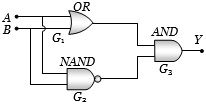
The following configuration of gate is equivalent to
A
$NAND$
B
$XOR$
C
$OR$
D
$NOR$
Solution
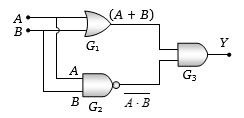
(B) The output of the $OR$ gate $(G_1)$ is $(A + B)$.
The output of the $NAND$ gate $(G_2)$ is $\overline{A \cdot B}$.
These two outputs are fed into the $AND$ gate $(G_3)$,so the final output $Y$ is:
$Y = (A + B) \cdot (\overline{A \cdot B})$
Using De Morgan's theorem,$\overline{A \cdot B} = \bar{A} + \bar{B}$.
Substituting this into the equation:
$Y = (A + B) \cdot (\bar{A} + \bar{B})$
$Y = A \cdot \bar{A} + A \cdot \bar{B} + B \cdot \bar{A} + B \cdot \bar{B}$
Since $A \cdot \bar{A} = 0$ and $B \cdot \bar{B} = 0$,the expression simplifies to:
$Y = 0 + A \cdot \bar{B} + \bar{A} \cdot B + 0$
$Y = A \cdot \bar{B} + \bar{A} \cdot B$
This is the Boolean expression for an $XOR$ gate.
The output of the $NAND$ gate $(G_2)$ is $\overline{A \cdot B}$.
These two outputs are fed into the $AND$ gate $(G_3)$,so the final output $Y$ is:
$Y = (A + B) \cdot (\overline{A \cdot B})$
Using De Morgan's theorem,$\overline{A \cdot B} = \bar{A} + \bar{B}$.
Substituting this into the equation:
$Y = (A + B) \cdot (\bar{A} + \bar{B})$
$Y = A \cdot \bar{A} + A \cdot \bar{B} + B \cdot \bar{A} + B \cdot \bar{B}$
Since $A \cdot \bar{A} = 0$ and $B \cdot \bar{B} = 0$,the expression simplifies to:
$Y = 0 + A \cdot \bar{B} + \bar{A} \cdot B + 0$
$Y = A \cdot \bar{B} + \bar{A} \cdot B$
This is the Boolean expression for an $XOR$ gate.
0 likesView Solution
37
PhysicsEasyMCQAIIMS · 2017
Radio waves and visible light in vacuum have
A
Same velocity but different wavelength
B
Continuous emission spectrum
C
Band absorption spectrum
D
Line emission spectrum
Solution
(A) In vacuum, all electromagnetic $(EM)$ waves travel with the same speed, which is the speed of light, $c \approx 3 \times 10^8 \ m/s$.
Since the frequency $(f)$ and wavelength $(\lambda)$ are related by the equation $c = f \lambda$, and different types of electromagnetic waves have different frequencies, they must have different wavelengths.
Therefore, radio waves and visible light have the same velocity but different wavelengths.
Since the frequency $(f)$ and wavelength $(\lambda)$ are related by the equation $c = f \lambda$, and different types of electromagnetic waves have different frequencies, they must have different wavelengths.
Therefore, radio waves and visible light have the same velocity but different wavelengths.
0 likesView Solution
38
PhysicsMediumMCQAIIMS · 2017
Gauss's law states that
A
the total electric flux through a closed surface is $\frac{1}{\varepsilon_0}$ times the total charge placed near the closed surface.
B
the total electric flux through a closed surface is $\frac{1}{\varepsilon_0}$ times the total charge enclosed by the closed surface.
C
the total electric flux through an open surface is $\frac{1}{\varepsilon_0}$ times the total charge placed near the open surface.
D
the line integral of electric field around the boundary of an open surface is $\frac{1}{\varepsilon_0}$ times the total charge placed near the open surface.
Solution
(B) Gauss's law states that the total electric flux $\phi_E$ through any closed surface (a Gaussian surface) is equal to $\frac{1}{\varepsilon_0}$ times the net charge $Q_{enclosed}$ enclosed by the surface.
Mathematically,it is expressed as $\phi_E = \oint_S \vec{E} \cdot d\vec{A} = \frac{Q_{enclosed}}{\varepsilon_0}$.
Therefore,option $B$ is the correct statement.
Mathematically,it is expressed as $\phi_E = \oint_S \vec{E} \cdot d\vec{A} = \frac{Q_{enclosed}}{\varepsilon_0}$.
Therefore,option $B$ is the correct statement.
0 likesView Solution
39
PhysicsMediumMCQAIIMS · 2017
In an $npn$ transistor, $10^{10}$ electrons enter the emitter in $10^{-6} \; s$. If $4\%$ of the electrons are lost in the base, the current transfer ratio $(\alpha)$ will be:
A
$0.98$
B
$0.97$
C
$0.96$
D
$0.94$
Solution
(C) The number of electrons entering the emitter is $n_E = 10^{10}$.
Since $4\%$ of the electrons are lost in the base, the number of electrons reaching the collector is $n_C = n_E - (0.04 \times n_E) = 0.96 \times n_E$.
The emitter current is given by $I_E = \frac{n_E \times e}{t}$, where $e$ is the electronic charge and $t$ is the time.
The collector current is given by $I_C = \frac{n_C \times e}{t} = \frac{0.96 \times n_E \times e}{t}$.
The current transfer ratio $\alpha$ is defined as the ratio of collector current to emitter current:
$\alpha = \frac{I_C}{I_E} = \frac{n_C}{n_E} = \frac{0.96 \times n_E}{n_E} = 0.96$.
Since $4\%$ of the electrons are lost in the base, the number of electrons reaching the collector is $n_C = n_E - (0.04 \times n_E) = 0.96 \times n_E$.
The emitter current is given by $I_E = \frac{n_E \times e}{t}$, where $e$ is the electronic charge and $t$ is the time.
The collector current is given by $I_C = \frac{n_C \times e}{t} = \frac{0.96 \times n_E \times e}{t}$.
The current transfer ratio $\alpha$ is defined as the ratio of collector current to emitter current:
$\alpha = \frac{I_C}{I_E} = \frac{n_C}{n_E} = \frac{0.96 \times n_E}{n_E} = 0.96$.
0 likesView Solution
40
PhysicsMediumMCQAIIMS · 2017
The potential difference that must be applied to stop the fastest photoelectrons emitted by a nickel surface,having work function $5.01 \, eV$,when ultraviolet light of $200 \, nm$ falls on it,must be ............... $V$.
A
$2.4$
B
$-1.2$
C
$-2.4$
D
$1.2$
Solution
(B) Given:
Incident wavelength,$\lambda = 200 \, nm$
Work function,$\phi_{0} = 5.01 \, eV$
According to Einstein's photoelectric equation:
$K_{max} = E - \phi_{0}$
$e V_{s} = \frac{hc}{\lambda} - \phi_{0}$
Using the relation $hc \approx 1240 \, eV \cdot nm$:
$e V_{s} = \frac{1240 \, eV \cdot nm}{200 \, nm} - 5.01 \, eV$
$e V_{s} = 6.2 \, eV - 5.01 \, eV = 1.19 \, eV \approx 1.2 \, eV$
Thus,the stopping potential $V_{s} = 1.2 \, V$.
The potential difference that must be applied to stop the photoelectrons is the negative of the stopping potential,which is $-1.2 \, V$.
Incident wavelength,$\lambda = 200 \, nm$
Work function,$\phi_{0} = 5.01 \, eV$
According to Einstein's photoelectric equation:
$K_{max} = E - \phi_{0}$
$e V_{s} = \frac{hc}{\lambda} - \phi_{0}$
Using the relation $hc \approx 1240 \, eV \cdot nm$:
$e V_{s} = \frac{1240 \, eV \cdot nm}{200 \, nm} - 5.01 \, eV$
$e V_{s} = 6.2 \, eV - 5.01 \, eV = 1.19 \, eV \approx 1.2 \, eV$
Thus,the stopping potential $V_{s} = 1.2 \, V$.
The potential difference that must be applied to stop the photoelectrons is the negative of the stopping potential,which is $-1.2 \, V$.
0 likesView Solution
41
PhysicsMediumMCQAIIMS · 2017
$A$ beam of light of $\lambda = 600 \, nm$ from a distant source falls on a single slit $1 \, mm$ wide and the resulting diffraction pattern is observed on a screen $2 \, m$ away. The distance between the first dark fringes on either side of the central bright fringe is:
A
$1.2 \, cm$
B
$1.2 \, mm$
C
$2.4 \, cm$
D
$2.4 \, mm$
Solution
(D) Given: $\lambda = 600 \, nm = 600 \times 10^{-9} \, m$,slit width $a = 1 \, mm = 10^{-3} \, m$,and distance $D = 2 \, m$.
The distance between the first dark fringes on either side of the central bright fringe is equal to the width of the central maximum.
The formula for the width of the central maximum is given by $w = \frac{2 \lambda D}{a}$.
Substituting the values:
$w = \frac{2 \times (600 \times 10^{-9} \, m) \times 2 \, m}{10^{-3} \, m}$
$w = \frac{2400 \times 10^{-9}}{10^{-3}} \, m$
$w = 2400 \times 10^{-6} \, m = 2.4 \times 10^{-3} \, m = 2.4 \, mm$.
The distance between the first dark fringes on either side of the central bright fringe is equal to the width of the central maximum.
The formula for the width of the central maximum is given by $w = \frac{2 \lambda D}{a}$.
Substituting the values:
$w = \frac{2 \times (600 \times 10^{-9} \, m) \times 2 \, m}{10^{-3} \, m}$
$w = \frac{2400 \times 10^{-9}}{10^{-3}} \, m$
$w = 2400 \times 10^{-6} \, m = 2.4 \times 10^{-3} \, m = 2.4 \, mm$.
0 likesView Solution
42
PhysicsMediumMCQAIIMS · 2017
Which of the following figures shows the correct equipotential surfaces of a system of two positive charges?
A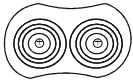
B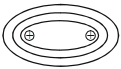
C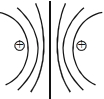
D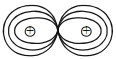
Solution
(B) For a system of two identical positive charges,the electric field lines originate from each charge and repel each other.
Equipotential surfaces are surfaces where the electric potential is constant.
Near each individual charge,the equipotential surfaces are approximately spherical.
As we move further away from the charges,the surfaces become distorted and eventually merge to form a single,larger,roughly oval-shaped surface that encloses both charges.
Figure $B$ correctly depicts this behavior,where the inner surfaces are centered around each charge,and the outer surfaces encompass both charges,reflecting the repulsive nature of the two positive charges.
Equipotential surfaces are surfaces where the electric potential is constant.
Near each individual charge,the equipotential surfaces are approximately spherical.
As we move further away from the charges,the surfaces become distorted and eventually merge to form a single,larger,roughly oval-shaped surface that encloses both charges.
Figure $B$ correctly depicts this behavior,where the inner surfaces are centered around each charge,and the outer surfaces encompass both charges,reflecting the repulsive nature of the two positive charges.
0 likesView Solution
43
PhysicsDifficultMCQAIIMS · 2017
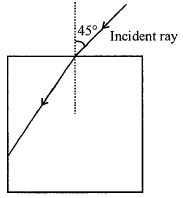
$A$ light ray falls on a square glass slab as shown in the diagram. The index of refraction of the glass,if total internal reflection is to occur at the vertical face,is equal to
A
$\frac{(\sqrt{2} + 1)}{2}$
B
$\sqrt{\frac{5}{2}}$
C
$\frac{3}{2}$
D
$\sqrt{\frac{3}{2}}$
Solution
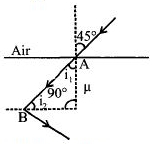
(D) At point $A$,by Snell's law:
$1 \cdot \sin 45^{\circ} = \mu \cdot \sin r$
$\sin r = \frac{1}{\mu \sqrt{2}}$ ..... $(i)$
At point $B$,for total internal reflection to occur at the vertical face,the angle of incidence $i_1$ must be greater than or equal to the critical angle $C$.
$\sin i_1 = \frac{1}{\mu}$
From the geometry of the triangle,$i_1 = 90^{\circ} - r$.
Therefore,$\sin(90^{\circ} - r) = \frac{1}{\mu} \Rightarrow \cos r = \frac{1}{\mu}$ ..... $(ii)$
Using the identity $\sin^2 r + \cos^2 r = 1$:
$\left(\frac{1}{\mu \sqrt{2}}\right)^2 + \left(\frac{1}{\mu}\right)^2 = 1$
$\frac{1}{2\mu^2} + \frac{1}{\mu^2} = 1$
$\frac{1 + 2}{2\mu^2} = 1$
$\frac{3}{2\mu^2} = 1 \Rightarrow \mu^2 = \frac{3}{2}$
$\mu = \sqrt{\frac{3}{2}}$
$1 \cdot \sin 45^{\circ} = \mu \cdot \sin r$
$\sin r = \frac{1}{\mu \sqrt{2}}$ ..... $(i)$
At point $B$,for total internal reflection to occur at the vertical face,the angle of incidence $i_1$ must be greater than or equal to the critical angle $C$.
$\sin i_1 = \frac{1}{\mu}$
From the geometry of the triangle,$i_1 = 90^{\circ} - r$.
Therefore,$\sin(90^{\circ} - r) = \frac{1}{\mu} \Rightarrow \cos r = \frac{1}{\mu}$ ..... $(ii)$
Using the identity $\sin^2 r + \cos^2 r = 1$:
$\left(\frac{1}{\mu \sqrt{2}}\right)^2 + \left(\frac{1}{\mu}\right)^2 = 1$
$\frac{1}{2\mu^2} + \frac{1}{\mu^2} = 1$
$\frac{1 + 2}{2\mu^2} = 1$
$\frac{3}{2\mu^2} = 1 \Rightarrow \mu^2 = \frac{3}{2}$
$\mu = \sqrt{\frac{3}{2}}$
0 likesView Solution
44
PhysicsEasyMCQAIIMS · 2017
$A$ current-carrying coil is subjected to a uniform magnetic field. The coil will orient itself so that its plane becomes
A
inclined at $45^{\circ}$ to the magnetic field
B
inclined at any arbitrary angle to the magnetic field
C
parallel to the magnetic field
D
perpendicular to the magnetic field
Solution
(D) The torque on a current-carrying coil in a uniform magnetic field is given by $\vec{\tau} = \vec{m} \times \vec{B}$,where $\vec{m}$ is the magnetic moment and $\vec{B}$ is the magnetic field.
The coil experiences zero torque when the magnetic moment $\vec{m}$ is parallel to the magnetic field $\vec{B}$.
The magnetic moment vector $\vec{m}$ is always perpendicular to the plane of the coil.
For $\vec{m}$ to be parallel to $\vec{B}$,the plane of the coil must be perpendicular to the magnetic field $\vec{B}$.
The coil experiences zero torque when the magnetic moment $\vec{m}$ is parallel to the magnetic field $\vec{B}$.
The magnetic moment vector $\vec{m}$ is always perpendicular to the plane of the coil.
For $\vec{m}$ to be parallel to $\vec{B}$,the plane of the coil must be perpendicular to the magnetic field $\vec{B}$.
0 likesView Solution
45
PhysicsMediumMCQAIIMS · 2017
Flux $\phi$ (in weber) in a closed circuit of resistance $10 \, \Omega$ varies with time $t$ (in $s$) according to the equation $\phi = 6t^2 - 5t + 1$. What is the magnitude of the induced current at $t = 0.25 \, s$ (in $, A$)?
A
$1.2$
B
$0.8$
C
$0.6$
D
$0.2$
Solution
(D) According to Faraday's law of electromagnetic induction,the induced electromotive force $(EMF)$ is given by $e = -\frac{d\phi}{dt}$.
Given $\phi = 6t^2 - 5t + 1$,we differentiate with respect to $t$:
$\frac{d\phi}{dt} = \frac{d}{dt}(6t^2 - 5t + 1) = 12t - 5$.
The induced current $i$ is given by $i = \frac{|e|}{R} = \frac{1}{R} |\frac{d\phi}{dt}|$.
Given resistance $R = 10 \, \Omega$,at $t = 0.25 \, s$:
$|\frac{d\phi}{dt}| = |12(0.25) - 5| = |3 - 5| = |-2| = 2 \, Wb/s$.
Therefore,$i = \frac{2}{10} = 0.2 \, A$.
Given $\phi = 6t^2 - 5t + 1$,we differentiate with respect to $t$:
$\frac{d\phi}{dt} = \frac{d}{dt}(6t^2 - 5t + 1) = 12t - 5$.
The induced current $i$ is given by $i = \frac{|e|}{R} = \frac{1}{R} |\frac{d\phi}{dt}|$.
Given resistance $R = 10 \, \Omega$,at $t = 0.25 \, s$:
$|\frac{d\phi}{dt}| = |12(0.25) - 5| = |3 - 5| = |-2| = 2 \, Wb/s$.
Therefore,$i = \frac{2}{10} = 0.2 \, A$.
0 likesView Solution
46
PhysicsEasyMCQAIIMS · 2017
Assertion: $A$ positive charge particle is placed in front of a spherical uncharged conductor. The number of lines of force terminating on the sphere will be more than those emerging from it.
Reason: The surface charge density at a point on the sphere nearest to the point charge will be negative and maximum in magnitude compared to other points on the sphere.
Reason: The surface charge density at a point on the sphere nearest to the point charge will be negative and maximum in magnitude compared to other points on the sphere.
A
If both Assertion and Reason are correct and Reason is the correct explanation of Assertion.
B
If both Assertion and Reason are correct, but Reason is not the correct explanation of Assertion.
C
If Assertion is correct but Reason is incorrect.
D
If both the Assertion and Reason are incorrect.
Solution
(D) For any closed surface enclosing a net charge of $0$, the total electric flux through the surface is $0$ according to Gauss's Law $(\Phi = \oint E \cdot dA = q_{enclosed} / \epsilon_0 = 0)$.
This means the number of electric field lines entering the surface must exactly equal the number of lines leaving the surface.
Therefore, the Assertion is incorrect because the number of lines terminating on the sphere cannot be more than those emerging from it.
The Reason is correct because, due to electrostatic induction, the side of the conductor closer to the positive point charge develops a negative induced charge, which has the highest surface charge density in magnitude.
Since the Assertion is incorrect and the Reason is correct, the correct choice is $D$ (based on standard logic for this specific question type).
This means the number of electric field lines entering the surface must exactly equal the number of lines leaving the surface.
Therefore, the Assertion is incorrect because the number of lines terminating on the sphere cannot be more than those emerging from it.
The Reason is correct because, due to electrostatic induction, the side of the conductor closer to the positive point charge develops a negative induced charge, which has the highest surface charge density in magnitude.
Since the Assertion is incorrect and the Reason is correct, the correct choice is $D$ (based on standard logic for this specific question type).
0 likesView Solution
47
PhysicsMediumMCQAIIMS · 2017
Two spherical conductors $A$ and $B$ of radii $a$ and $b$ $(b > a)$ are placed concentrically in air. The two are connected by a copper wire as shown in the figure. Then the equivalent capacitance of the system is
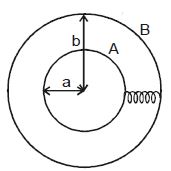
A
$4\pi {\varepsilon _0}\frac{{ab}}{{b - a}}$
B
$4\pi {\varepsilon _0}(a + b)$
C
$4\pi {\varepsilon _0}b$
D
$4\pi {\varepsilon _0}a$
Solution
(C) When two conductors are connected by a conducting wire,they reach the same electric potential.
Since the inner sphere $A$ is connected to the outer sphere $B$ by a copper wire,all the charge given to the system will reside on the outer surface of the outer sphere $B$ because the inner sphere is at a higher potential than the outer sphere if they were isolated,but the wire forces them to be at the same potential.
Effectively,the entire system acts as a single isolated spherical conductor of radius $b$.
The capacitance of an isolated spherical conductor of radius $R$ is given by $C = 4\pi \varepsilon_0 R$.
Therefore,the equivalent capacitance of this system is $C = 4\pi \varepsilon_0 b$.
Since the inner sphere $A$ is connected to the outer sphere $B$ by a copper wire,all the charge given to the system will reside on the outer surface of the outer sphere $B$ because the inner sphere is at a higher potential than the outer sphere if they were isolated,but the wire forces them to be at the same potential.
Effectively,the entire system acts as a single isolated spherical conductor of radius $b$.
The capacitance of an isolated spherical conductor of radius $R$ is given by $C = 4\pi \varepsilon_0 R$.
Therefore,the equivalent capacitance of this system is $C = 4\pi \varepsilon_0 b$.
0 likesView Solution
48
PhysicsEasyMCQAIIMS · 2017
Assertion : Electric potential and electric potential energy are different quantities.
Reason : For a system of a positive test charge and a point charge,electric potential energy $=$ electric potential.
Reason : For a system of a positive test charge and a point charge,electric potential energy $=$ electric potential.
A
If both Assertion and Reason are correct and Reason is the correct explanation of Assertion.
B
If both Assertion and Reason are correct,but Reason is not the correct explanation of Assertion.
C
If Assertion is correct but Reason is incorrect.
D
If both the Assertion and Reason are incorrect.
Solution
(C) Electric potential $(V)$ at a point is defined as the work done per unit positive charge in bringing it from infinity to that point,given by $V = W/q$.
Electric potential energy $(U)$ is the total work done in assembling a system of charges,given by $U = qV$.
Since $U$ and $V$ have different physical dimensions ($[ML^2T^{-3}A^{-1}]$ for $V$ and $[ML^2T^{-2}A^{-1}]$ for $U$),they are distinct physical quantities.
The Assertion is correct.
The Reason states that $U = V$,which is dimensionally inconsistent and physically incorrect.
Therefore,the Assertion is correct but the Reason is incorrect.
Electric potential energy $(U)$ is the total work done in assembling a system of charges,given by $U = qV$.
Since $U$ and $V$ have different physical dimensions ($[ML^2T^{-3}A^{-1}]$ for $V$ and $[ML^2T^{-2}A^{-1}]$ for $U$),they are distinct physical quantities.
The Assertion is correct.
The Reason states that $U = V$,which is dimensionally inconsistent and physically incorrect.
Therefore,the Assertion is correct but the Reason is incorrect.
0 likesView Solution
49
PhysicsEasyMCQAIIMS · 2017
Assertion : Kirchhoff's junction rule follows from the conservation of charge.
Reason : Kirchhoff's loop rule follows from the conservation of momentum.
Reason : Kirchhoff's loop rule follows from the conservation of momentum.
A
If both Assertion and Reason are correct and Reason is the correct explanation of Assertion.
B
If both Assertion and Reason are correct,but Reason is not the correct explanation of Assertion.
C
If Assertion is correct but Reason is incorrect.
D
If both the Assertion and Reason are incorrect.
Solution
(C) Kirchhoff's junction rule is based on the principle of conservation of charge,which states that the total charge entering a junction must equal the total charge leaving it.
Kirchhoff's loop rule is based on the principle of conservation of energy,which states that the algebraic sum of potential changes in any closed loop is zero.
Since the Assertion is correct and the Reason is incorrect,the correct option is $C$.
Kirchhoff's loop rule is based on the principle of conservation of energy,which states that the algebraic sum of potential changes in any closed loop is zero.
Since the Assertion is correct and the Reason is incorrect,the correct option is $C$.
0 likesView Solution
50
PhysicsEasyMCQAIIMS · 2017
Assertion : If the current in a solenoid is reversed in direction while keeping the same magnitude,the magnetic field energy stored in the solenoid remains unchanged.
Reason : Magnetic field energy density is proportional to the magnetic field.
Reason : Magnetic field energy density is proportional to the magnetic field.
A
If both Assertion and Reason are correct and Reason is the correct explanation of Assertion.
B
If both Assertion and Reason are correct,but Reason is not the correct explanation of Assertion.
C
If Assertion is correct but Reason is incorrect.
D
If both the Assertion and Reason are incorrect.
Solution
(C) The magnetic field $B$ produced by a solenoid is given by $B = \mu_0 n I$. When the current $I$ is reversed,the direction of the magnetic field $B$ is reversed,but its magnitude remains the same.
The magnetic field energy density $u$ is given by the formula $u = \frac{B^2}{2\mu_0}$.
Since the energy density depends on the square of the magnetic field magnitude $(B^2)$,the sign of $B$ does not affect the energy density.
Therefore,the total magnetic field energy stored in the solenoid,$U = u \times V$ (where $V$ is the volume),remains unchanged.
However,the Reason states that the energy density is proportional to the magnetic field,which is incorrect because it is proportional to the square of the magnetic field $(B^2)$.
Thus,the Assertion is correct,but the Reason is incorrect.
The magnetic field energy density $u$ is given by the formula $u = \frac{B^2}{2\mu_0}$.
Since the energy density depends on the square of the magnetic field magnitude $(B^2)$,the sign of $B$ does not affect the energy density.
Therefore,the total magnetic field energy stored in the solenoid,$U = u \times V$ (where $V$ is the volume),remains unchanged.
However,the Reason states that the energy density is proportional to the magnetic field,which is incorrect because it is proportional to the square of the magnetic field $(B^2)$.
Thus,the Assertion is correct,but the Reason is incorrect.
0 likesView Solution
51
PhysicsEasyMCQAIIMS · 2017
Assertion: The poles of a magnet cannot be separated by breaking it into two pieces.
Reason: The magnetic moment will be reduced to half when a magnet is broken into two equal pieces.
Reason: The magnetic moment will be reduced to half when a magnet is broken into two equal pieces.
A
If both Assertion and Reason are correct and the Reason is a correct explanation of the Assertion.
B
If both Assertion and Reason are correct but the Reason is not a correct explanation of the Assertion.
C
If the Assertion is correct but the Reason is incorrect.
D
If both the Assertion and Reason are incorrect.
Solution
(B) The Assertion is correct because magnetic monopoles do not exist; breaking a magnet simply creates two smaller magnets,each with its own north and south pole.
The Reason is also correct. The magnetic moment $M$ of a bar magnet is given by $M = m \times 2l$,where $m$ is the pole strength and $2l$ is the length. When the magnet is cut into two equal pieces perpendicular to its length,the pole strength $m$ remains the same,but the length of each piece becomes $l$. Therefore,the new magnetic moment $M' = m \times l = M/2$.
Since the Reason explains why the magnetic properties change but does not explain why poles cannot be isolated,the correct option is $B$.
The Reason is also correct. The magnetic moment $M$ of a bar magnet is given by $M = m \times 2l$,where $m$ is the pole strength and $2l$ is the length. When the magnet is cut into two equal pieces perpendicular to its length,the pole strength $m$ remains the same,but the length of each piece becomes $l$. Therefore,the new magnetic moment $M' = m \times l = M/2$.
Since the Reason explains why the magnetic properties change but does not explain why poles cannot be isolated,the correct option is $B$.
0 likesView Solution
52
PhysicsEasyMCQAIIMS · 2017
Assertion : Faraday's laws are a consequence of the conservation of energy.
Reason : In a purely resistive $AC$ circuit,the current lags behind the $emf$ in phase.
Reason : In a purely resistive $AC$ circuit,the current lags behind the $emf$ in phase.
A
If both Assertion and Reason are correct and the Reason is a correct explanation of the Assertion.
B
If both Assertion and Reason are correct but Reason is not a correct explanation of the Assertion.
C
If the Assertion is correct but Reason is incorrect.
D
If both the Assertion and Reason are incorrect.
Solution
(C) Faraday's law,specifically Lenz's law,is a direct consequence of the law of conservation of energy. If this were not true,we could create energy out of nothing,which violates physical laws.
In a purely resistive $AC$ circuit,the voltage $(emf)$ and current are in the same phase. The phase difference between them is $0$. Therefore,the statement in the Reason is incorrect.
Thus,the Assertion is correct,but the Reason is incorrect.
In a purely resistive $AC$ circuit,the voltage $(emf)$ and current are in the same phase. The phase difference between them is $0$. Therefore,the statement in the Reason is incorrect.
Thus,the Assertion is correct,but the Reason is incorrect.
0 likesView Solution
53
PhysicsEasyMCQAIIMS · 2017
Assertion: $A$ laminated core is used in transformers to increase eddy currents.
Reason: The efficiency of a transformer increases with increase in eddy currents.
Reason: The efficiency of a transformer increases with increase in eddy currents.
A
If both Assertion and Reason are correct and the Reason is a correct explanation of the Assertion.
B
If both Assertion and Reason are correct but Reason is not a correct explanation of the Assertion.
C
If the Assertion is correct but Reason is incorrect.
D
If both the Assertion and Reason are incorrect.
Solution
(D) Large eddy currents are produced in a non-laminated iron core of a transformer by the induced $emf$,as the resistance of a bulk iron core is very small.
By using thin iron sheets as a core,the electrical resistance is increased.
Laminating the core substantially reduces the eddy currents.
Eddy currents heat up the core of the transformer,leading to energy loss in the form of heat.
Therefore,more eddy currents result in greater energy loss,which decreases the efficiency of the transformer.
Since both the Assertion and the Reason are false,the correct option is $D$.
By using thin iron sheets as a core,the electrical resistance is increased.
Laminating the core substantially reduces the eddy currents.
Eddy currents heat up the core of the transformer,leading to energy loss in the form of heat.
Therefore,more eddy currents result in greater energy loss,which decreases the efficiency of the transformer.
Since both the Assertion and the Reason are false,the correct option is $D$.
0 likesView Solution
54
PhysicsEasyMCQAIIMS · 2017
Assertion : Microwaves are better carrier of signals than optical waves.
Reason : Microwaves move faster than optical waves.
Reason : Microwaves move faster than optical waves.
A
If both Assertion and Reason are correct and the Reason is a correct explanation of the Assertion.
B
If both Assertion and Reason are correct but Reason is not a correct explanation of the Assertion.
C
If the Assertion is correct but Reason is incorrect.
D
If both the Assertion and Reason are incorrect.
Solution
(D) The Assertion is incorrect because optical waves (like those used in optical fibres) have a much higher frequency and bandwidth compared to microwaves,making them superior for signal transmission.
The Reason is also incorrect because all electromagnetic waves,including microwaves and optical waves,travel at the same speed $(c = 3 \times 10^8 \ m/s)$ in a vacuum.
Therefore,both the Assertion and the Reason are incorrect.
The Reason is also incorrect because all electromagnetic waves,including microwaves and optical waves,travel at the same speed $(c = 3 \times 10^8 \ m/s)$ in a vacuum.
Therefore,both the Assertion and the Reason are incorrect.
0 likesView Solution
55
PhysicsEasyMCQAIIMS · 2017
Assertion : Plane mirror may form real image.
Reason : Plane mirror forms virtual image,if object is real.
Reason : Plane mirror forms virtual image,if object is real.
A
If both Assertion and Reason are correct and the Reason is a correct explanation of the Assertion.
B
If both Assertion and Reason are correct but Reason is not a correct explanation of the Assertion.
C
If the Assertion is correct but Reason is incorrect.
D
If both the Assertion and Reason are incorrect.
Solution
(B) plane mirror forms a real image when the object is virtual. $A$ virtual object is formed when converging light rays are incident on the mirror. The reflected rays then converge at a point in front of the mirror,forming a real image.
Conversely,if the object is real (diverging rays from a point source),the plane mirror forms a virtual image behind the mirror.
Therefore,the Assertion is correct because a plane mirror can form a real image if the incident rays are converging (virtual object).
The Reason is also correct because a plane mirror forms a virtual image for a real object.
However,the Reason does not explain why the Assertion is true; it describes a different case (real object vs. virtual object). Thus,both are correct,but the Reason is not the correct explanation of the Assertion.
Conversely,if the object is real (diverging rays from a point source),the plane mirror forms a virtual image behind the mirror.
Therefore,the Assertion is correct because a plane mirror can form a real image if the incident rays are converging (virtual object).
The Reason is also correct because a plane mirror forms a virtual image for a real object.
However,the Reason does not explain why the Assertion is true; it describes a different case (real object vs. virtual object). Thus,both are correct,but the Reason is not the correct explanation of the Assertion.
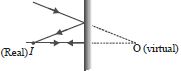
0 likesView Solution
56
PhysicsMediumMCQAIIMS · 2017
Assertion : Diffraction takes place for all types of waves,mechanical or non-mechanical,transverse or longitudinal.
Reason : Diffraction effects are perceptible only if the wavelength of the wave is comparable to the dimensions of the diffracting device.
Reason : Diffraction effects are perceptible only if the wavelength of the wave is comparable to the dimensions of the diffracting device.
A
If both Assertion and Reason are correct and the Reason is a correct explanation of the Assertion.
B
If both Assertion and Reason are correct but Reason is not a correct explanation of the Assertion.
C
If the Assertion is correct but Reason is incorrect.
D
If both the Assertion and Reason are incorrect.
Solution
(A) Diffraction is a general characteristic of all types of waves,including mechanical (like sound) and non-mechanical (like light),as well as transverse and longitudinal waves. Thus,the Assertion is correct.
For diffraction to be significant or perceptible,the size of the obstacle or aperture must be of the order of the wavelength of the wave. If the wavelength is much smaller than the obstacle,the wave behaves like a ray and diffraction is negligible. Thus,the Reason is also correct and explains why diffraction is observed in specific conditions. Therefore,the correct option is $A$.
For diffraction to be significant or perceptible,the size of the obstacle or aperture must be of the order of the wavelength of the wave. If the wavelength is much smaller than the obstacle,the wave behaves like a ray and diffraction is negligible. Thus,the Reason is also correct and explains why diffraction is observed in specific conditions. Therefore,the correct option is $A$.
0 likesView Solution
57
PhysicsMediumMCQAIIMS · 2017
Assertion: The photoelectrons produced by a monochromatic light beam incident on a metal surface have a spread in their kinetic energies.
Reason: The work function of the metal is its characteristic property.
Reason: The work function of the metal is its characteristic property.
A
If both Assertion and Reason are correct and the Reason is a correct explanation of the Assertion.
B
If both Assertion and Reason are correct but Reason is not a correct explanation of the Assertion.
C
If the Assertion is correct but Reason is incorrect.
D
If both the Assertion and Reason are incorrect.
Solution
(B) According to Einstein's photoelectric equation, $K_{max} = h\nu - \Phi$, where $h\nu$ is the energy of the incident photon and $\Phi$ is the work function of the metal.
While the maximum kinetic energy is fixed for a given frequency, photoelectrons are emitted from different depths within the metal surface.
Electrons emitted from deeper layers lose some energy due to collisions before escaping the surface, resulting in a range of kinetic energies from $0$ to $K_{max}$.
Thus, the Assertion is correct.
The work function $\Phi$ is indeed a characteristic property of the metal, making the Reason correct.
However, the Reason does not explain why there is a spread in kinetic energies; the spread is due to the varying depths of emission and subsequent energy loss.
Therefore, both are correct, but the Reason is not the correct explanation of the Assertion.
While the maximum kinetic energy is fixed for a given frequency, photoelectrons are emitted from different depths within the metal surface.
Electrons emitted from deeper layers lose some energy due to collisions before escaping the surface, resulting in a range of kinetic energies from $0$ to $K_{max}$.
Thus, the Assertion is correct.
The work function $\Phi$ is indeed a characteristic property of the metal, making the Reason correct.
However, the Reason does not explain why there is a spread in kinetic energies; the spread is due to the varying depths of emission and subsequent energy loss.
Therefore, both are correct, but the Reason is not the correct explanation of the Assertion.
0 likesView Solution
58
PhysicsEasyMCQAIIMS · 2017
Assertion : Bohr had to postulate that the electrons in stationary orbits around the nucleus do not radiate.
Reason : According to classical physics all moving electrons radiate.
Reason : According to classical physics all moving electrons radiate.
A
If both Assertion and Reason are correct and the Reason is a correct explanation of the Assertion.
B
If both Assertion and Reason are correct but Reason is not a correct explanation of the Assertion.
C
If the Assertion is correct but Reason is incorrect.
D
If both the Assertion and Reason are incorrect.
Solution
(B) According to classical physics,any charged particle undergoing acceleration must radiate electromagnetic energy. Since an electron revolving in an orbit around the nucleus is undergoing centripetal acceleration,classical electrodynamics predicts it should continuously lose energy and spiral into the nucleus.
To resolve this instability,Bohr postulated that electrons in specific 'stationary' orbits do not radiate energy.
Both the Assertion and the Reason are scientifically correct statements. However,the Reason describes the classical conflict,while the Assertion describes Bohr's specific quantum postulate to overcome that conflict. The Reason does not explain *why* Bohr's postulate is true; it only explains why the postulate was *necessary*. Therefore,the Reason is not the correct explanation of the Assertion.
To resolve this instability,Bohr postulated that electrons in specific 'stationary' orbits do not radiate energy.
Both the Assertion and the Reason are scientifically correct statements. However,the Reason describes the classical conflict,while the Assertion describes Bohr's specific quantum postulate to overcome that conflict. The Reason does not explain *why* Bohr's postulate is true; it only explains why the postulate was *necessary*. Therefore,the Reason is not the correct explanation of the Assertion.
0 likesView Solution
59
PhysicsEasyMCQAIIMS · 2017
Assertion : Between any two given energy levels,the number of absorption transitions is always less than the number of emission transitions.
Reason : Absorption transitions start from the lowest energy level only and may end at any higher energy level. But emission transitions may start from any higher energy level and end at any energy level below it.
Reason : Absorption transitions start from the lowest energy level only and may end at any higher energy level. But emission transitions may start from any higher energy level and end at any energy level below it.
A
If both Assertion and Reason are correct and the Reason is a correct explanation of the Assertion.
B
If both Assertion and Reason are correct but Reason is not a correct explanation of the Assertion.
C
If the Assertion is correct but Reason is incorrect.
D
If both the Assertion and Reason are incorrect.
Solution
(A) In an absorption transition,an electron in a lower energy state absorbs a photon and jumps to a higher energy state. For a system with energy levels $A, B, C$ (where $A < B < C$),absorption can only occur from the ground state $A$ to $B$ or $A$ to $C$. Thus,there are $2$ possible absorption transitions.
In an emission transition,an electron in a higher energy state drops to a lower energy state by emitting a photon. For the same levels,emission can occur from $C \rightarrow B$,$C \rightarrow A$,and $B \rightarrow A$. Thus,there are $3$ possible emission transitions.
Since $2 < 3$,the number of absorption transitions is less than the number of emission transitions. The Reason correctly explains that absorption is restricted to starting from the lower level,whereas emission can occur between any two levels where the initial state is higher than the final state.
In an emission transition,an electron in a higher energy state drops to a lower energy state by emitting a photon. For the same levels,emission can occur from $C \rightarrow B$,$C \rightarrow A$,and $B \rightarrow A$. Thus,there are $3$ possible emission transitions.
Since $2 < 3$,the number of absorption transitions is less than the number of emission transitions. The Reason correctly explains that absorption is restricted to starting from the lower level,whereas emission can occur between any two levels where the initial state is higher than the final state.
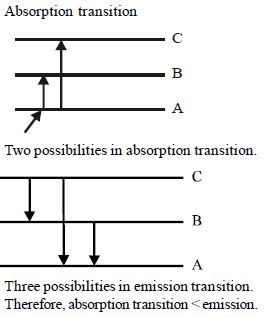
0 likesView Solution
60
PhysicsEasyMCQAIIMS · 2017
Assertion: Energy is released when heavy nuclei undergo fission or light nuclei undergo fusion.
Reason: For heavy nuclei,binding energy per nucleon increases with increasing $Z$,while for light nuclei,it decreases with increasing $Z$.
Reason: For heavy nuclei,binding energy per nucleon increases with increasing $Z$,while for light nuclei,it decreases with increasing $Z$.
A
If both Assertion and Reason are correct and the Reason is a correct explanation of the Assertion.
B
If both Assertion and Reason are correct but Reason is not a correct explanation of the Assertion.
C
If the Assertion is correct but Reason is incorrect.
D
If both the Assertion and Reason are incorrect.
Solution
(C) The Assertion is correct because energy is released in nuclear fission of heavy nuclei and nuclear fusion of light nuclei due to the increase in binding energy per nucleon of the product nuclei compared to the reactants.
The Reason is incorrect because the binding energy per nucleon curve shows that for heavy nuclei,the binding energy per nucleon decreases with increasing atomic number $Z$ (making them unstable and prone to fission),while for light nuclei,the binding energy per nucleon increases with increasing $Z$ (making them prone to fusion to reach a more stable state).
The Reason is incorrect because the binding energy per nucleon curve shows that for heavy nuclei,the binding energy per nucleon decreases with increasing atomic number $Z$ (making them unstable and prone to fission),while for light nuclei,the binding energy per nucleon increases with increasing $Z$ (making them prone to fusion to reach a more stable state).
0 likesView Solution
61
PhysicsEasyMCQAIIMS · 2017
Assertion : Diode lasers are used as optical sources in optical communication.
Reason : Diode lasers consume less energy.
Reason : Diode lasers consume less energy.
A
If both Assertion and Reason are correct and the Reason is a correct explanation of the Assertion.
B
If both Assertion and Reason are correct but Reason is not a correct explanation of the Assertion.
C
If the Assertion is correct but Reason is incorrect.
D
If both the Assertion and Reason are incorrect.
Solution
(A) Diode lasers are widely used in optical communication because they are compact,have high efficiency,and can be easily modulated at high frequencies.
They also consume significantly less energy compared to other light sources like gas lasers or incandescent bulbs.
Since the high efficiency and low energy consumption are key reasons for their preference in optical communication,the Reason correctly explains the Assertion.
They also consume significantly less energy compared to other light sources like gas lasers or incandescent bulbs.
Since the high efficiency and low energy consumption are key reasons for their preference in optical communication,the Reason correctly explains the Assertion.
0 likesView Solution
62
PhysicsMediumMCQAIIMS · 2017
Half-lives for $\alpha$ and $\beta$ emission of a radioactive material are $16$ years and $48$ years respectively. When the material decays by giving $\alpha$ and $\beta$ emission simultaneously,the time in which $3/4$th of the material decays is ....... years.
A
$29$
B
$24$
C
$64$
D
$12$
Solution
(B) When a radioactive material decays through two different processes simultaneously,the effective decay constant $\lambda_{eff}$ is the sum of the individual decay constants: $\lambda_{eff} = \lambda_{\alpha} + \lambda_{\beta}$.
Given $T_{\alpha} = 16$ years and $T_{\beta} = 48$ years.
The decay constants are $\lambda_{\alpha} = \frac{\ln 2}{16}$ and $\lambda_{\beta} = \frac{\ln 2}{48}$.
Thus,$\lambda_{eff} = \frac{\ln 2}{16} + \frac{\ln 2}{48} = \ln 2 \left( \frac{3+1}{48} \right) = \frac{\ln 2}{12}$.
The effective half-life $T_{eff} = \frac{\ln 2}{\lambda_{eff}} = 12$ years.
We want to find the time $t$ when $3/4$th of the material has decayed,which means $1/4$th of the material remains.
Using the radioactive decay law: $\frac{N}{N_0} = \left( \frac{1}{2} \right)^{t/T_{eff}}$.
$\frac{1}{4} = \left( \frac{1}{2} \right)^{t/12} \implies \left( \frac{1}{2} \right)^2 = \left( \frac{1}{2} \right)^{t/12}$.
Equating the exponents: $2 = \frac{t}{12} \implies t = 24$ years.
Given $T_{\alpha} = 16$ years and $T_{\beta} = 48$ years.
The decay constants are $\lambda_{\alpha} = \frac{\ln 2}{16}$ and $\lambda_{\beta} = \frac{\ln 2}{48}$.
Thus,$\lambda_{eff} = \frac{\ln 2}{16} + \frac{\ln 2}{48} = \ln 2 \left( \frac{3+1}{48} \right) = \frac{\ln 2}{12}$.
The effective half-life $T_{eff} = \frac{\ln 2}{\lambda_{eff}} = 12$ years.
We want to find the time $t$ when $3/4$th of the material has decayed,which means $1/4$th of the material remains.
Using the radioactive decay law: $\frac{N}{N_0} = \left( \frac{1}{2} \right)^{t/T_{eff}}$.
$\frac{1}{4} = \left( \frac{1}{2} \right)^{t/12} \implies \left( \frac{1}{2} \right)^2 = \left( \frac{1}{2} \right)^{t/12}$.
Equating the exponents: $2 = \frac{t}{12} \implies t = 24$ years.
0 likesView Solution
63
PhysicsMediumMCQAIIMS · 2017
The magnitude of the de-Broglie wavelength $(\lambda)$ of electron $(e)$,proton $(p)$,neutron $(n)$ and $\alpha-$ particle $(\alpha)$ all having the same energy of $1\,MeV$,in the increasing order will follow the sequence
A
$\lambda_{ e }, \lambda_{ p }, \lambda_{ n }, \lambda_\alpha$
B
$\lambda_{ e }, \lambda_{ n }, \lambda_{ p }, \lambda_\alpha$
C
$\lambda_\alpha, \lambda_{ n }, \lambda_{ p }, \lambda_{ e }$
D
$\lambda_{ p }, \lambda_{ e }, \lambda_\alpha, \lambda_{ n }$
Solution
(C) The de-Broglie wavelength $(\lambda)$ is given by $\lambda = \frac{h}{p}$,where $p$ is the momentum.
Since kinetic energy $E = \frac{p^2}{2m}$,we have $p = \sqrt{2mE}$.
Substituting this into the wavelength formula: $\lambda = \frac{h}{\sqrt{2mE}}$.
Given that the energy $E$ is the same for all particles,we have $\lambda \propto \frac{1}{\sqrt{m}}$.
Comparing the masses: $m_e < m_p \approx m_n < m_\alpha$.
Since $\lambda$ is inversely proportional to the square root of mass,the order of wavelengths will be $\lambda_\alpha < \lambda_n \approx \lambda_p < \lambda_e$.
Thus,the increasing order is $\lambda_\alpha, \lambda_n, \lambda_p, \lambda_e$.
Since kinetic energy $E = \frac{p^2}{2m}$,we have $p = \sqrt{2mE}$.
Substituting this into the wavelength formula: $\lambda = \frac{h}{\sqrt{2mE}}$.
Given that the energy $E$ is the same for all particles,we have $\lambda \propto \frac{1}{\sqrt{m}}$.
Comparing the masses: $m_e < m_p \approx m_n < m_\alpha$.
Since $\lambda$ is inversely proportional to the square root of mass,the order of wavelengths will be $\lambda_\alpha < \lambda_n \approx \lambda_p < \lambda_e$.
Thus,the increasing order is $\lambda_\alpha, \lambda_n, \lambda_p, \lambda_e$.
0 likesView Solution
Vedclass Products
For Students
Vedclass Test Series
Mock tests in real AIIMS style covering Physics with performance analysis. 5-day free trial.
Start Free TrialFor Teachers
Exam Paper Generator
Generate Set A/B/C/D Physics papers from 7.5L+ questions in 2 minutes. 3 chapters free.
Try FreeFor Institutes
Online Exam Module
Run live AIIMS mock exams with unlimited students, 360° analytics & white-label branding.
See DemoFrequently Asked Questions
How many Physics questions are in AIIMS 2017?
There are 63 Physics questions from the AIIMS 2017 paper on Vedclass, each with a detailed step-by-step solution in English.
Are AIIMS 2017 Physics solutions available in English?
Yes. All solutions on this page are in English. You can also switch to English or Hindi using the language buttons above the questions.
Can I practice AIIMS 2017 Physics as a timed test?
Yes. Use the Vedclass Test Series to attempt a full AIIMS mock test covering Physics with time limits and instant score analysis.
Can teachers create Physics papers from AIIMS previous year questions?
Yes. The Vedclass Exam Paper Generator lets teachers mix AIIMS Physics questions and generate Set A/B/C/D papers in minutes.
For Teachers & Institutes
Build a Custom Physics Paper
Pick AIIMS 2017 Physics questions, set difficulty, and generate Set A/B/C/D in 2 minutes.