
PhysicsQ1–52 of 52 questions
Page 1 of 1 · English
1
PhysicsMediumMCQAIIMS · 2012
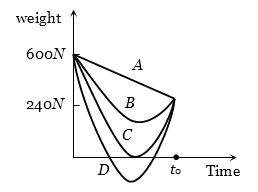
Suppose,the acceleration due to gravity at the earth's surface is $10 \, m/s^2$ and at the surface of Mars it is $4.0 \, m/s^2$. $A$ $60 \, kg$ passenger goes from the earth to the Mars in a spaceship moving with a constant velocity. Neglect all other objects in the sky. Which part of the figure best represents the weight (net gravitational force) of the passenger as a function of time?
A
$A$
B
$B$
C
$C$
D
$D$
Solution
(D) The weight of the passenger is the net gravitational force acting on them. Let $M_e$ and $M_m$ be the masses of Earth and Mars,and $R_e$ and $R_m$ be their radii. The gravitational force $F$ at a distance $x$ from Earth along the path is given by $F = |F_e - F_m| = |\frac{G M_e m}{x^2} - \frac{G M_m m}{(d-x)^2}|$,where $d$ is the distance between Earth and Mars.
At the surface of Earth $(x = R_e)$,the weight is $W_e = m g_e = 60 \times 10 = 600 \, N$.
At the surface of Mars $(x = d - R_m)$,the weight is $W_m = m g_m = 60 \times 4 = 240 \, N$.
As the spaceship moves from Earth to Mars,the gravitational pull of Earth decreases and the gravitational pull of Mars increases. At some point between the two planets,the gravitational forces from Earth and Mars will be equal in magnitude,making the net gravitational force (weight) zero.
Since the spaceship moves with constant velocity,the distance $x$ is proportional to time $t$. Therefore,the graph of weight versus time must decrease from $600 \, N$,reach $0 \, N$ at some intermediate time,and then increase to $240 \, N$ at the arrival time $t_0$. Curve $D$ is the only one that shows the weight becoming zero and then increasing to $240 \, N$.
At the surface of Earth $(x = R_e)$,the weight is $W_e = m g_e = 60 \times 10 = 600 \, N$.
At the surface of Mars $(x = d - R_m)$,the weight is $W_m = m g_m = 60 \times 4 = 240 \, N$.
As the spaceship moves from Earth to Mars,the gravitational pull of Earth decreases and the gravitational pull of Mars increases. At some point between the two planets,the gravitational forces from Earth and Mars will be equal in magnitude,making the net gravitational force (weight) zero.
Since the spaceship moves with constant velocity,the distance $x$ is proportional to time $t$. Therefore,the graph of weight versus time must decrease from $600 \, N$,reach $0 \, N$ at some intermediate time,and then increase to $240 \, N$ at the arrival time $t_0$. Curve $D$ is the only one that shows the weight becoming zero and then increasing to $240 \, N$.
0 likesView Solution
2
PhysicsEasyMCQAIIMS · 2012
$A$ particle is moving in a circle with uniform speed. Its motion is
A
Periodic and simple harmonic
B
Periodic but not simple harmonic
C
Aperiodic
D
None of the above
Solution
(B) When a particle moves in a circle with uniform speed,it covers equal distances in equal intervals of time along the circumference.
Since it returns to the same position after a fixed time interval (the time period),the motion is periodic.
However,simple harmonic motion $(SHM)$ requires a restoring force proportional to the displacement from the mean position $(F = -kx)$,which is not the case for uniform circular motion.
Therefore,the motion is periodic but not simple harmonic.
Since it returns to the same position after a fixed time interval (the time period),the motion is periodic.
However,simple harmonic motion $(SHM)$ requires a restoring force proportional to the displacement from the mean position $(F = -kx)$,which is not the case for uniform circular motion.
Therefore,the motion is periodic but not simple harmonic.
0 likesView Solution
3
PhysicsEasyMCQAIIMS · 2012
$A$ chimpanzee swinging on a swing in a sitting position,stands up suddenly,the time period will
A
Become infinite
B
Remain same
C
Increase
D
Decrease
Solution
(D) The time period of a simple pendulum is given by the formula $T = 2\pi \sqrt{\frac{l}{g}}$,where $l$ is the effective length of the pendulum (distance from the point of suspension to the center of mass of the oscillating body).
When the chimpanzee stands up,the center of mass of the system shifts upward,closer to the point of suspension.
This results in a decrease in the effective length $l$ of the swing.
Since $T \propto \sqrt{l}$,a decrease in $l$ leads to a decrease in the time period $T$.
When the chimpanzee stands up,the center of mass of the system shifts upward,closer to the point of suspension.
This results in a decrease in the effective length $l$ of the swing.
Since $T \propto \sqrt{l}$,a decrease in $l$ leads to a decrease in the time period $T$.
0 likesView Solution
4
PhysicsMediumMCQAIIMS · 2012
Water rises to a height of $10$ cm in a capillary tube and mercury falls to a depth of $3.112$ cm in the same capillary tube. If the density of mercury is $13.6 \text{ g/cm}^3$ and the angle of contact for mercury is $135^o$,the ratio of surface tension of water and mercury is (Assume density of water = $1 \text{ g/cm}^3$ and angle of contact for water = $0^o$)
A
$1:0.15$
B
$1:3$
C
$1:6$
D
$1.5:1$
Solution
(C) The height of liquid in a capillary tube is given by $h = \frac{2T \cos \theta}{rdg}$,where $T$ is surface tension,$r$ is the radius,$d$ is density,$g$ is acceleration due to gravity,and $\theta$ is the angle of contact.
Rearranging for surface tension: $T = \frac{hrdg}{2 \cos \theta}$.
For water $(1)$ and mercury $(2)$: $\frac{T_1}{T_2} = \frac{h_1}{h_2} \times \frac{d_1}{d_2} \times \frac{\cos \theta_2}{\cos \theta_1}$.
Given: $h_1 = 10 \text{ cm}$,$h_2 = -3.112 \text{ cm}$ (depression),$d_1 = 1 \text{ g/cm}^3$,$d_2 = 13.6 \text{ g/cm}^3$,$\theta_1 = 0^o$,$\theta_2 = 135^o$.
Note: For capillary rise/fall,we consider the magnitude of height: $|h_2| = 3.112 \text{ cm}$.
$\frac{T_1}{T_2} = \frac{10}{3.112} \times \frac{1}{13.6} \times \frac{\cos(135^o)}{\cos(0^o)} = \frac{10}{3.112 \times 13.6} \times \frac{1}{\sqrt{2}} \approx \frac{10}{42.32} \times 0.707 \approx \frac{1}{6}$.
Rearranging for surface tension: $T = \frac{hrdg}{2 \cos \theta}$.
For water $(1)$ and mercury $(2)$: $\frac{T_1}{T_2} = \frac{h_1}{h_2} \times \frac{d_1}{d_2} \times \frac{\cos \theta_2}{\cos \theta_1}$.
Given: $h_1 = 10 \text{ cm}$,$h_2 = -3.112 \text{ cm}$ (depression),$d_1 = 1 \text{ g/cm}^3$,$d_2 = 13.6 \text{ g/cm}^3$,$\theta_1 = 0^o$,$\theta_2 = 135^o$.
Note: For capillary rise/fall,we consider the magnitude of height: $|h_2| = 3.112 \text{ cm}$.
$\frac{T_1}{T_2} = \frac{10}{3.112} \times \frac{1}{13.6} \times \frac{\cos(135^o)}{\cos(0^o)} = \frac{10}{3.112 \times 13.6} \times \frac{1}{\sqrt{2}} \approx \frac{10}{42.32} \times 0.707 \approx \frac{1}{6}$.
0 likesView Solution
5
PhysicsMediumMCQAIIMS · 2012
$A$ sound absorber attenuates the sound level by $20 \ dB$. The intensity decreases by a factor of
A
$10000$
B
$10$
C
$100$
D
$1000$
Solution
(C) The sound level $L$ in decibels $(dB)$ is given by $L = 10 \log_{10} \left( \frac{I}{I_0} \right)$,where $I$ is the intensity and $I_0$ is the reference intensity.
The change in sound level is given by $\Delta L = L_1 - L_2 = 20 \ dB$.
Substituting the formula,we get $\Delta L = 10 \log_{10} \left( \frac{I_1}{I_0} \right) - 10 \log_{10} \left( \frac{I_2}{I_0} \right) = 10 \log_{10} \left( \frac{I_1}{I_2} \right)$.
Given $\Delta L = 20$,we have $20 = 10 \log_{10} \left( \frac{I_1}{I_2} \right)$.
Dividing by $10$,we get $2 = \log_{10} \left( \frac{I_1}{I_2} \right)$.
Taking the antilog,we get $\frac{I_1}{I_2} = 10^2 = 100$.
Therefore,the intensity decreases by a factor of $100$.
The change in sound level is given by $\Delta L = L_1 - L_2 = 20 \ dB$.
Substituting the formula,we get $\Delta L = 10 \log_{10} \left( \frac{I_1}{I_0} \right) - 10 \log_{10} \left( \frac{I_2}{I_0} \right) = 10 \log_{10} \left( \frac{I_1}{I_2} \right)$.
Given $\Delta L = 20$,we have $20 = 10 \log_{10} \left( \frac{I_1}{I_2} \right)$.
Dividing by $10$,we get $2 = \log_{10} \left( \frac{I_1}{I_2} \right)$.
Taking the antilog,we get $\frac{I_1}{I_2} = 10^2 = 100$.
Therefore,the intensity decreases by a factor of $100$.
0 likesView Solution
6
PhysicsEasyMCQAIIMS · 2012
What is the fractional error in $g$ calculated from $T = 2\pi \sqrt {l/g}$? Given fractional errors in $T$ and $l$ are $\pm x$ and $\pm y$ respectively?
A
$x + y$
B
$x - y$
C
$2x + y$
D
$2x - y$
Solution
(C) Given the formula for the time period of a simple pendulum: $T = 2\pi \sqrt{\frac{l}{g}}$.
Squaring both sides,we get $T^2 = 4\pi^2 \frac{l}{g}$.
Rearranging for $g$,we get $g = 4\pi^2 \frac{l}{T^2}$.
Taking the relative error,we use the rule for multiplication and division: $\frac{\Delta g}{g} = \frac{\Delta l}{l} + 2 \frac{\Delta T}{T}$.
Given that the fractional error in $l$ is $\frac{\Delta l}{l} = y$ and the fractional error in $T$ is $\frac{\Delta T}{T} = x$.
Substituting these values,we get $\frac{\Delta g}{g} = y + 2x$ or $2x + y$.
Squaring both sides,we get $T^2 = 4\pi^2 \frac{l}{g}$.
Rearranging for $g$,we get $g = 4\pi^2 \frac{l}{T^2}$.
Taking the relative error,we use the rule for multiplication and division: $\frac{\Delta g}{g} = \frac{\Delta l}{l} + 2 \frac{\Delta T}{T}$.
Given that the fractional error in $l$ is $\frac{\Delta l}{l} = y$ and the fractional error in $T$ is $\frac{\Delta T}{T} = x$.
Substituting these values,we get $\frac{\Delta g}{g} = y + 2x$ or $2x + y$.
0 likesView Solution
7
PhysicsMediumMCQAIIMS · 2012
The dimensional formula of farad is
A
$[M^{-1}L^{-2}T^2Q^2]$
B
$[M^{-1}L^{-2}T^2Q]$
C
$[M^{-1}L^{-2}TQ^2]$
D
$[M^{-1}L^{-2}T^2Q^2]$
Solution
(A) The capacitance $C$ is defined as $C = \frac{Q}{V}$,where $Q$ is charge and $V$ is potential difference.
Since potential difference $V = \frac{W}{Q}$,where $W$ is work done,we can write $C = \frac{Q^2}{W}$.
The dimensional formula for work $W$ is $[ML^2T^{-2}]$.
Substituting the dimensions,we get $[C] = \frac{[Q^2]}{[ML^2T^{-2}]}$.
Therefore,$[C] = [M^{-1}L^{-2}T^2Q^2]$.
Since potential difference $V = \frac{W}{Q}$,where $W$ is work done,we can write $C = \frac{Q^2}{W}$.
The dimensional formula for work $W$ is $[ML^2T^{-2}]$.
Substituting the dimensions,we get $[C] = \frac{[Q^2]}{[ML^2T^{-2}]}$.
Therefore,$[C] = [M^{-1}L^{-2}T^2Q^2]$.
0 likesView Solution
8
PhysicsEasyMCQAIIMS · 2012
The coordinates of a moving particle at any time $t$ are given by $x = a\, t^2$ and $y = b\, t^2$. The speed of the particle is
A
$2t\, (a + b)$
B
$2t\,\sqrt{a^2 + b^2}$
C
$2t\,\sqrt{a^2 - b^2}$
D
$\sqrt{a^2 + b^2}$
Solution
(B) The velocity component along the $X$-axis is given by $v_x = \frac{dx}{dt} = \frac{d}{dt}(at^2) = 2at$.
The velocity component along the $Y$-axis is given by $v_y = \frac{dy}{dt} = \frac{d}{dt}(bt^2) = 2bt$.
The speed $v$ of the particle is the magnitude of the velocity vector,given by $v = \sqrt{v_x^2 + v_y^2}$.
Substituting the values,$v = \sqrt{(2at)^2 + (2bt)^2} = \sqrt{4a^2t^2 + 4b^2t^2} = \sqrt{4t^2(a^2 + b^2)}$.
Therefore,$v = 2t\sqrt{a^2 + b^2}$.
The velocity component along the $Y$-axis is given by $v_y = \frac{dy}{dt} = \frac{d}{dt}(bt^2) = 2bt$.
The speed $v$ of the particle is the magnitude of the velocity vector,given by $v = \sqrt{v_x^2 + v_y^2}$.
Substituting the values,$v = \sqrt{(2at)^2 + (2bt)^2} = \sqrt{4a^2t^2 + 4b^2t^2} = \sqrt{4t^2(a^2 + b^2)}$.
Therefore,$v = 2t\sqrt{a^2 + b^2}$.
1 likesView Solution
9
PhysicsMediumMCQAIIMS · 2012
$A$ ball is released from the top of a tower of height $h$ meters. It takes $T$ seconds to reach the ground. What is the position of the ball at $T/3$ seconds?
A
$8h/9$ meters from the ground
B
$7h/9$ meters from the ground
C
$h/9$ meters from the ground
D
$17h/18$ meters from the ground
Solution
(A) The total height $h$ of the tower is given by the equation of motion for a body falling from rest: $h = \frac{1}{2}gT^2$.
At time $t = T/3$,the distance $h'$ covered by the ball from the top is: $h' = \frac{1}{2}g(T/3)^2 = \frac{1}{2}g(T^2/9) = \frac{1}{9}(\frac{1}{2}gT^2) = \frac{h}{9}$.
The position of the ball from the ground is the total height minus the distance covered from the top: $h_{ground} = h - h' = h - \frac{h}{9} = \frac{8h}{9}$ meters.
At time $t = T/3$,the distance $h'$ covered by the ball from the top is: $h' = \frac{1}{2}g(T/3)^2 = \frac{1}{2}g(T^2/9) = \frac{1}{9}(\frac{1}{2}gT^2) = \frac{h}{9}$.
The position of the ball from the ground is the total height minus the distance covered from the top: $h_{ground} = h - h' = h - \frac{h}{9} = \frac{8h}{9}$ meters.
0 likesView Solution
10
PhysicsMediumMCQAIIMS · 2012
$A$ particle moves in a circle of radius $25\, cm$ at two revolutions per second. The acceleration of the particle in $m/s^2$ is
A
${\pi ^2}$
B
$8\,{\pi ^2}$
C
$4\,{\pi ^2}$
D
$2\,{\pi ^2}$
Solution
(C) Given radius $r = 25\, cm = 0.25\, m$.
Frequency $f = 2\, rev/s$.
The angular velocity is given by $\omega = 2\pi f = 2\pi \times 2 = 4\pi\, rad/s$.
The centripetal acceleration $a_c$ is given by the formula $a_c = r\omega^2$.
Substituting the values: $a_c = 0.25 \times (4\pi)^2$.
$a_c = 0.25 \times 16\pi^2$.
$a_c = 4\pi^2\, m/s^2$.
Frequency $f = 2\, rev/s$.
The angular velocity is given by $\omega = 2\pi f = 2\pi \times 2 = 4\pi\, rad/s$.
The centripetal acceleration $a_c$ is given by the formula $a_c = r\omega^2$.
Substituting the values: $a_c = 0.25 \times (4\pi)^2$.
$a_c = 0.25 \times 16\pi^2$.
$a_c = 4\pi^2\, m/s^2$.
0 likesView Solution
11
PhysicsMediumMCQAIIMS · 2012
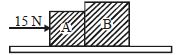
On a smooth plane surface,two blocks $A$ and $B$ are accelerated by applying a force of $15 \, N$ on block $A$. If the mass of block $B$ is twice that of block $A$,the force on block $B$ is ........... $N$.
A
$30$
B
$15$
C
$10$
D
$5$
Solution
(C) Let the mass of block $A$ be $m$ and the mass of block $B$ be $2m$.
The total mass of the system is $M = m + 2m = 3m$.
The applied force is $F = 15 \, N$.
The acceleration $a$ of the system is given by $a = \frac{F}{M} = \frac{15}{3m} = \frac{5}{m} \, m/s^2$.
The force on block $B$ is the force exerted by block $A$ on block $B$,which causes block $B$ to accelerate. This is given by $F_B = m_B \times a$.
Substituting the values,$F_B = (2m) \times \left(\frac{5}{m}\right) = 10 \, N$.
The total mass of the system is $M = m + 2m = 3m$.
The applied force is $F = 15 \, N$.
The acceleration $a$ of the system is given by $a = \frac{F}{M} = \frac{15}{3m} = \frac{5}{m} \, m/s^2$.
The force on block $B$ is the force exerted by block $A$ on block $B$,which causes block $B$ to accelerate. This is given by $F_B = m_B \times a$.
Substituting the values,$F_B = (2m) \times \left(\frac{5}{m}\right) = 10 \, N$.
0 likesView Solution
12
PhysicsEasyMCQAIIMS · 2012
From a building, two balls $A$ and $B$ are thrown such that $A$ is thrown upwards and $B$ is thrown downwards (both vertically) with the same speed. If $v_A$ and $v_B$ are their respective velocities on reaching the ground, then:
A
$v_A > v_B$
B
$v_A = v_B$
C
$v_A < v_B$
D
Their velocities depend on their masses.
Solution
(B) According to the Law of Conservation of Energy, the total mechanical energy of the system remains constant.
For ball $A$ thrown upwards with speed $u$ from height $h$: $\frac{1}{2}mu^2 + mgh = \frac{1}{2}mv_A^2$.
For ball $B$ thrown downwards with speed $u$ from height $h$: $\frac{1}{2}mu^2 + mgh = \frac{1}{2}mv_B^2$.
Since the initial kinetic energy and potential energy are identical for both balls, the final kinetic energy at the ground must be the same.
Therefore, $v_A^2 = v_B^2$, which implies $v_A = v_B$.
For ball $A$ thrown upwards with speed $u$ from height $h$: $\frac{1}{2}mu^2 + mgh = \frac{1}{2}mv_A^2$.
For ball $B$ thrown downwards with speed $u$ from height $h$: $\frac{1}{2}mu^2 + mgh = \frac{1}{2}mv_B^2$.
Since the initial kinetic energy and potential energy are identical for both balls, the final kinetic energy at the ground must be the same.
Therefore, $v_A^2 = v_B^2$, which implies $v_A = v_B$.
0 likesView Solution
13
PhysicsEasyMCQAIIMS · 2012
$A$ motor drives a body along a straight line with a constant force. The power $P$ developed by the motor must vary with time $t$ according to
A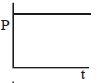
B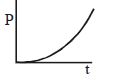
C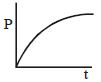
D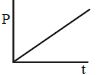
Solution
(D) The power $P$ delivered by a force $F$ moving an object with velocity $v$ is given by $P = F \cdot v$.
Since the force $F$ is constant,the acceleration $a = F/m$ is also constant.
Assuming the body starts from rest $(u = 0)$,the velocity at time $t$ is $v = a \cdot t = (F/m) \cdot t$.
Substituting this into the power equation,we get $P = F \cdot (F/m) \cdot t = (F^2/m) \cdot t$.
Since $F$ and $m$ are constants,$P \propto t$.
This represents a straight line passing through the origin,which corresponds to the graph in option $D$.
Since the force $F$ is constant,the acceleration $a = F/m$ is also constant.
Assuming the body starts from rest $(u = 0)$,the velocity at time $t$ is $v = a \cdot t = (F/m) \cdot t$.
Substituting this into the power equation,we get $P = F \cdot (F/m) \cdot t = (F^2/m) \cdot t$.
Since $F$ and $m$ are constants,$P \propto t$.
This represents a straight line passing through the origin,which corresponds to the graph in option $D$.
0 likesView Solution
14
PhysicsMediumMCQAIIMS · 2012
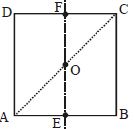
For the given uniform square lamina $ABCD$,whose centre is $O$,
A
${I_{AC}} = \sqrt 2 \,{I_{EF}}$
B
$\sqrt 2 {I_{AC}} = {I_{EF}}$
C
${I_{AD}} = 3{I_{EF}}$
D
$I_{AC} = I_{EF}$
Solution
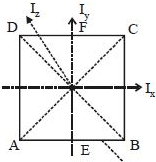
(D) Let the side of the square be $a$. By the theorem of perpendicular axes,the moment of inertia about an axis passing through the center $O$ and perpendicular to the plane of the lamina is $I_z = I_x + I_y$.
For a square lamina,the moment of inertia about any axis passing through the center and lying in the plane of the lamina is the same.
Let $I_{EF}$ be the moment of inertia about the axis $EF$ (passing through the midpoints of sides $AB$ and $CD$). By symmetry,$I_{EF} = I_{GH}$ where $GH$ is the axis passing through the midpoints of sides $AD$ and $BC$.
Thus,$I_z = I_{EF} + I_{GH} = 2I_{EF}$.
Now,consider the diagonal $AC$. The moment of inertia about the diagonal $AC$ is $I_{AC}$. By symmetry,the moment of inertia about the other diagonal $BD$ is $I_{BD} = I_{AC}$.
Since the diagonals are also perpendicular axes in the plane of the lamina,$I_z = I_{AC} + I_{BD} = 2I_{AC}$.
Equating the two expressions for $I_z$,we get $2I_{EF} = 2I_{AC}$,which implies $I_{AC} = I_{EF}$.
For a square lamina,the moment of inertia about any axis passing through the center and lying in the plane of the lamina is the same.
Let $I_{EF}$ be the moment of inertia about the axis $EF$ (passing through the midpoints of sides $AB$ and $CD$). By symmetry,$I_{EF} = I_{GH}$ where $GH$ is the axis passing through the midpoints of sides $AD$ and $BC$.
Thus,$I_z = I_{EF} + I_{GH} = 2I_{EF}$.
Now,consider the diagonal $AC$. The moment of inertia about the diagonal $AC$ is $I_{AC}$. By symmetry,the moment of inertia about the other diagonal $BD$ is $I_{BD} = I_{AC}$.
Since the diagonals are also perpendicular axes in the plane of the lamina,$I_z = I_{AC} + I_{BD} = 2I_{AC}$.
Equating the two expressions for $I_z$,we get $2I_{EF} = 2I_{AC}$,which implies $I_{AC} = I_{EF}$.
0 likesView Solution
15
PhysicsMediumMCQAIIMS · 2012
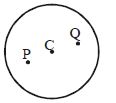
$A$ disc is rolling (without slipping) on a horizontal surface. $C$ is its centre and $Q$ and $P$ are two points on the same horizontal line passing through $C$,such that $Q$ is at a distance $r$ from $C$ and $P$ is at a distance $r$ from $C$ on the opposite side. Let $V_P, V_Q$ and $V_C$ be the magnitudes of velocities of points $P, Q$ and $C$ respectively,then:
A
$V_Q > V_C > V_P$
B
$V_Q < V_C < V_P$
C
$V_Q = V_P, V_C = \frac{1}{2} V_P$
D
$V_Q = V_C = V_P$
Solution
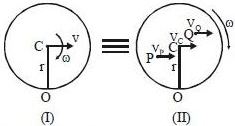
(A) rolling motion can be considered as a combination of pure translation of the centre of mass $C$ with velocity $V_C = R\omega$ and pure rotation about the centre $C$ with angular velocity $\omega$.
For any point at a distance $r$ from the centre $C$,the velocity due to rotation is $v_{rot} = r\omega$.
The velocity of any point is the vector sum of the translational velocity $\vec{V}_C$ and the rotational velocity $\vec{v}_{rot}$.
For points $P$ and $Q$ on the horizontal diameter:
$1$. At point $Q$,the rotational velocity is in the same direction as the translational velocity. Thus,$V_Q = V_C + r\omega = R\omega + r\omega = (R+r)\omega$.
$2$. At point $P$,the rotational velocity is in the opposite direction to the translational velocity. Thus,$V_P = |V_C - r\omega| = |R\omega - r\omega| = (R-r)\omega$.
Since $R > r$,we have $V_Q > V_C > V_P$.
For any point at a distance $r$ from the centre $C$,the velocity due to rotation is $v_{rot} = r\omega$.
The velocity of any point is the vector sum of the translational velocity $\vec{V}_C$ and the rotational velocity $\vec{v}_{rot}$.
For points $P$ and $Q$ on the horizontal diameter:
$1$. At point $Q$,the rotational velocity is in the same direction as the translational velocity. Thus,$V_Q = V_C + r\omega = R\omega + r\omega = (R+r)\omega$.
$2$. At point $P$,the rotational velocity is in the opposite direction to the translational velocity. Thus,$V_P = |V_C - r\omega| = |R\omega - r\omega| = (R-r)\omega$.
Since $R > r$,we have $V_Q > V_C > V_P$.
0 likesView Solution
16
PhysicsMediumMCQAIIMS · 2012
Two masses $m_1$ and $m_2$ $(m_1 < m_2)$ are released from rest from a finite distance. They start moving under their mutual gravitational attraction.
A
acceleration of $m_1$ is more than that of $m_2$
B
acceleration of $m_2$ is more than that of $m_1$
C
centre of mass of system will remain at rest in all the reference frame
D
total energy of system does not remain constant
Solution
(A) The gravitational force $F$ acting on both masses is equal in magnitude and opposite in direction.
According to Newton's second law,$F = ma$,which implies $a = F/m$.
Since the force $F$ is the same for both,the acceleration $a$ is inversely proportional to the mass $m$ $(a \propto 1/m)$.
Given $m_1 < m_2$,it follows that $a_1 > a_2$. Thus,the acceleration of $m_1$ is greater than that of $m_2$.
Since the gravitational force is an internal force for the system,there is no external force acting on the system.
Therefore,the total energy of the system remains constant.
According to Newton's second law,$F = ma$,which implies $a = F/m$.
Since the force $F$ is the same for both,the acceleration $a$ is inversely proportional to the mass $m$ $(a \propto 1/m)$.
Given $m_1 < m_2$,it follows that $a_1 > a_2$. Thus,the acceleration of $m_1$ is greater than that of $m_2$.
Since the gravitational force is an internal force for the system,there is no external force acting on the system.
Therefore,the total energy of the system remains constant.
0 likesView Solution
17
PhysicsEasyMCQAIIMS · 2012
The lift of an airplane is based on
A
Torricelli's theorem
B
Bernoulli's theorem
C
Law of gravitation
D
Conservation of linear momentum
Solution
(B) The lift of an airplane wing is based on Bernoulli's principle.
An airplane wing is designed with a special shape called an airfoil.
Due to this shape,the air velocity above the wing is higher than the air velocity below the wing.
According to Bernoulli's theorem,where the velocity of a fluid is higher,the pressure is lower.
Therefore,the pressure below the wing is greater than the pressure above the wing,which creates an upward force known as lift.
An airplane wing is designed with a special shape called an airfoil.
Due to this shape,the air velocity above the wing is higher than the air velocity below the wing.
According to Bernoulli's theorem,where the velocity of a fluid is higher,the pressure is lower.
Therefore,the pressure below the wing is greater than the pressure above the wing,which creates an upward force known as lift.
0 likesView Solution
18
PhysicsMediumMCQAIIMS · 2012
If liquefied oxygen at $1$ atmospheric pressure is heated from $50\, K$ to $300\, K$ by supplying heat at a constant rate,the graph of temperature vs. time will be:
A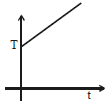
B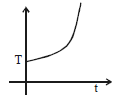
C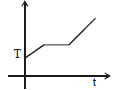
D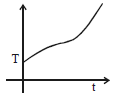
Solution
(C) The heat supplied at a constant rate is given by $Q = K t$,where $K$ is the heating rate.
For a substance in a single phase,the temperature change is given by $Q = m c \Delta T$,which implies $K t = m c (T - T_0)$. Thus,$T = T_0 + (K / mc) t$. This shows that the temperature increases linearly with time during the heating of a single phase.
When the substance undergoes a phase change (e.g.,vaporization),the heat supplied is used to change the state at a constant temperature,given by $Q = m L$. During this process,the temperature remains constant,resulting in a horizontal line on the $T-t$ graph.
Since oxygen at $1$ atmospheric pressure undergoes a phase change (boiling) between $50\, K$ and $300\, K$,the graph will show a linear increase,followed by a horizontal segment during phase change,and then another linear increase.
Therefore,the correct graph is $C$.
For a substance in a single phase,the temperature change is given by $Q = m c \Delta T$,which implies $K t = m c (T - T_0)$. Thus,$T = T_0 + (K / mc) t$. This shows that the temperature increases linearly with time during the heating of a single phase.
When the substance undergoes a phase change (e.g.,vaporization),the heat supplied is used to change the state at a constant temperature,given by $Q = m L$. During this process,the temperature remains constant,resulting in a horizontal line on the $T-t$ graph.
Since oxygen at $1$ atmospheric pressure undergoes a phase change (boiling) between $50\, K$ and $300\, K$,the graph will show a linear increase,followed by a horizontal segment during phase change,and then another linear increase.
Therefore,the correct graph is $C$.
0 likesView Solution
19
PhysicsMediumMCQAIIMS · 2012
An open and a closed organ pipe have the same length. The ratio of the $p^{th}$ mode of frequency of vibration of the two pipes is
A
$1$
B
$p$
C
$p(2p + 1)$
D
$\frac{2p}{2p - 1}$
Solution
(D) For an open organ pipe of length $\ell$,the frequency of the $p^{th}$ mode is given by $f_{open} = p \frac{v}{2\ell}$,where $v$ is the speed of sound.
For a closed organ pipe of length $\ell$,the frequency of the $p^{th}$ mode (where $p$ is the harmonic number) is given by $f_{closed} = (2p - 1) \frac{v}{4\ell}$.
To find the ratio of the $p^{th}$ mode frequency of the open pipe to the closed pipe,we divide the two expressions:
$\frac{f_{open}}{f_{closed}} = \frac{p \frac{v}{2\ell}}{(2p - 1) \frac{v}{4\ell}}$
Simplifying the expression:
$\frac{f_{open}}{f_{closed}} = \frac{p}{2\ell} \times \frac{4\ell}{2p - 1} = \frac{2p}{2p - 1}$
Thus,the ratio is $\frac{2p}{2p - 1}$.
For a closed organ pipe of length $\ell$,the frequency of the $p^{th}$ mode (where $p$ is the harmonic number) is given by $f_{closed} = (2p - 1) \frac{v}{4\ell}$.
To find the ratio of the $p^{th}$ mode frequency of the open pipe to the closed pipe,we divide the two expressions:
$\frac{f_{open}}{f_{closed}} = \frac{p \frac{v}{2\ell}}{(2p - 1) \frac{v}{4\ell}}$
Simplifying the expression:
$\frac{f_{open}}{f_{closed}} = \frac{p}{2\ell} \times \frac{4\ell}{2p - 1} = \frac{2p}{2p - 1}$
Thus,the ratio is $\frac{2p}{2p - 1}$.
0 likesView Solution
20
PhysicsMediumMCQAIIMS · 2012
When two tuning forks (fork $1$ and fork $2$) are sounded simultaneously,$4$ beats per second are heard. Now,some tape is attached to the prong of fork $2$. When the tuning forks are sounded again,$6$ beats per second are heard. If the frequency of fork $1$ is $200 \, Hz$,then what was the original frequency of fork $2$ (in $, Hz$)?
A
$202$
B
$200$
C
$204$
D
$196$
Solution
(D) Let the frequency of fork $1$ be $n_1 = 200 \, Hz$ and the frequency of fork $2$ be $n_2$.
Initially,the beat frequency is $|n_1 - n_2| = 4 \, Hz$. This implies $n_2 = 200 \pm 4$,so $n_2 = 204 \, Hz$ or $n_2 = 196 \, Hz$.
When tape is attached to the prong of fork $2$,its frequency $n_2$ decreases.
If $n_2$ was $204 \, Hz$,decreasing it would make the beat frequency $|200 - n_2'|$ smaller than $4 \, Hz$.
If $n_2$ was $196 \, Hz$,decreasing it further (e.g.,to $194 \, Hz$) would make the beat frequency $|200 - 194| = 6 \, Hz$.
Since the beat frequency increased to $6 \, Hz$,the original frequency of fork $2$ must have been $196 \, Hz$.
Initially,the beat frequency is $|n_1 - n_2| = 4 \, Hz$. This implies $n_2 = 200 \pm 4$,so $n_2 = 204 \, Hz$ or $n_2 = 196 \, Hz$.
When tape is attached to the prong of fork $2$,its frequency $n_2$ decreases.
If $n_2$ was $204 \, Hz$,decreasing it would make the beat frequency $|200 - n_2'|$ smaller than $4 \, Hz$.
If $n_2$ was $196 \, Hz$,decreasing it further (e.g.,to $194 \, Hz$) would make the beat frequency $|200 - 194| = 6 \, Hz$.
Since the beat frequency increased to $6 \, Hz$,the original frequency of fork $2$ must have been $196 \, Hz$.
0 likesView Solution
21
PhysicsMediumMCQAIIMS · 2012
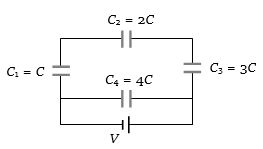
$A$ network of four capacitors with capacitances $C_1 = C$,$C_2 = 2C$,$C_3 = 3C$,and $C_4 = 4C$ is connected to a battery of potential $V$ as shown in the figure. The ratio of the charges on $C_2$ and $C_4$ is:
A
$\frac{22}{3}$
B
$\frac{3}{22}$
C
$\frac{7}{4}$
D
$\frac{4}{7}$
Solution
(B) The circuit consists of two parallel branches connected to a battery of potential $V$.
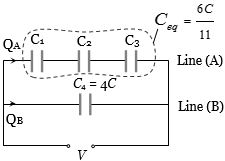
Branch $1$ contains capacitors $C_1, C_2,$ and $C_3$ in series. The equivalent capacitance $C_{eq1}$ of this branch is given by:
$\frac{1}{C_{eq1}} = \frac{1}{C_1} + \frac{1}{C_2} + \frac{1}{C_3} = \frac{1}{C} + \frac{1}{2C} + \frac{1}{3C} = \frac{6+3+2}{6C} = \frac{11}{6C}$
Thus,$C_{eq1} = \frac{6C}{11}$.
The charge $Q_1$ on each capacitor in this series branch is $Q_1 = C_{eq1} V = \frac{6CV}{11}$.
Since $C_1, C_2,$ and $C_3$ are in series,the charge on $C_2$ is $Q_{C2} = Q_1 = \frac{6CV}{11}$.
Branch $2$ contains only capacitor $C_4$ connected directly across the battery. The charge on $C_4$ is $Q_{C4} = C_4 V = 4CV$.
The ratio of the charges on $C_2$ and $C_4$ is:
$\frac{Q_{C2}}{Q_{C4}} = \frac{\frac{6CV}{11}}{4CV} = \frac{6}{11 \times 4} = \frac{6}{44} = \frac{3}{22}$.
Branch $1$ contains capacitors $C_1, C_2,$ and $C_3$ in series. The equivalent capacitance $C_{eq1}$ of this branch is given by:
$\frac{1}{C_{eq1}} = \frac{1}{C_1} + \frac{1}{C_2} + \frac{1}{C_3} = \frac{1}{C} + \frac{1}{2C} + \frac{1}{3C} = \frac{6+3+2}{6C} = \frac{11}{6C}$
Thus,$C_{eq1} = \frac{6C}{11}$.
The charge $Q_1$ on each capacitor in this series branch is $Q_1 = C_{eq1} V = \frac{6CV}{11}$.
Since $C_1, C_2,$ and $C_3$ are in series,the charge on $C_2$ is $Q_{C2} = Q_1 = \frac{6CV}{11}$.
Branch $2$ contains only capacitor $C_4$ connected directly across the battery. The charge on $C_4$ is $Q_{C4} = C_4 V = 4CV$.
The ratio of the charges on $C_2$ and $C_4$ is:
$\frac{Q_{C2}}{Q_{C4}} = \frac{\frac{6CV}{11}}{4CV} = \frac{6}{11 \times 4} = \frac{6}{44} = \frac{3}{22}$.
0 likesView Solution
22
PhysicsMediumMCQAIIMS · 2012
Two wires of same metal have the same length but their cross-sections are in the ratio $3:1$. They are joined in series. The resistance of the thicker wire is $10\,\Omega$. The total resistance of the combination will be ............. $\Omega$.
A
$40$
B
$\frac{40}{3}$
C
$\frac{5}{2}$
D
$100$
Solution
(A) The resistance of a wire is given by $R = \rho \frac{L}{A}$.
Since the wires are of the same material and length,$R \propto \frac{1}{A}$.
Given the ratio of cross-sectional areas is $A_1 : A_2 = 3 : 1$,where $A_1$ is the thicker wire and $A_2$ is the thinner wire.
Therefore,the ratio of resistances is $\frac{R_1}{R_2} = \frac{A_2}{A_1} = \frac{1}{3}$,which implies $R_2 = 3R_1$.
Given the resistance of the thicker wire $R_1 = 10\,\Omega$.
Thus,the resistance of the thinner wire $R_2 = 3 \times 10 = 30\,\Omega$.
When joined in series,the total resistance $R_{eq} = R_1 + R_2 = 10 + 30 = 40\,\Omega$.
Since the wires are of the same material and length,$R \propto \frac{1}{A}$.
Given the ratio of cross-sectional areas is $A_1 : A_2 = 3 : 1$,where $A_1$ is the thicker wire and $A_2$ is the thinner wire.
Therefore,the ratio of resistances is $\frac{R_1}{R_2} = \frac{A_2}{A_1} = \frac{1}{3}$,which implies $R_2 = 3R_1$.
Given the resistance of the thicker wire $R_1 = 10\,\Omega$.
Thus,the resistance of the thinner wire $R_2 = 3 \times 10 = 30\,\Omega$.
When joined in series,the total resistance $R_{eq} = R_1 + R_2 = 10 + 30 = 40\,\Omega$.
0 likesView Solution
23
PhysicsEasyMCQAIIMS · 2012
Curie temperature is the temperature above which
A
$A$ paramagnetic material becomes ferromagnetic
B
$A$ ferromagnetic material becomes paramagnetic
C
$A$ paramagnetic material becomes diamagnetic
D
$A$ ferromagnetic material becomes diamagnetic
Solution
(B) The Curie temperature $(T_C)$ is a characteristic property of ferromagnetic materials.
At temperatures below $T_C$,the material exhibits ferromagnetic properties due to the alignment of magnetic domains.
As the temperature increases and reaches $T_C$,the thermal agitation becomes strong enough to overcome the exchange coupling that maintains the alignment of these domains.
Consequently,above the Curie temperature,the material loses its spontaneous magnetization and transitions into a paramagnetic state.
Therefore,the correct option is $(B)$.
At temperatures below $T_C$,the material exhibits ferromagnetic properties due to the alignment of magnetic domains.
As the temperature increases and reaches $T_C$,the thermal agitation becomes strong enough to overcome the exchange coupling that maintains the alignment of these domains.
Consequently,above the Curie temperature,the material loses its spontaneous magnetization and transitions into a paramagnetic state.
Therefore,the correct option is $(B)$.
0 likesView Solution
24
PhysicsEasyMCQAIIMS · 2012
The quality factor of an $LCR$ circuit having resistance $(R)$ and inductance $(L)$ at resonance frequency $(\omega)$ is given by:
A
$\frac{\omega L}{R}$
B
$\frac{R}{\omega L}$
C
$(\frac{\omega L}{R})^{1/2}$
D
$(\frac{\omega L}{R})^2$
Solution
(A) The quality factor $(Q)$ of an $LCR$ circuit is defined as the ratio of the voltage across the inductor $(V_L)$ or capacitor $(V_C)$ to the voltage across the resistor $(V_R)$ at resonance.
Mathematically,$Q = \frac{V_L}{V_R} = \frac{I \cdot X_L}{I \cdot R} = \frac{X_L}{R}$.
Since the inductive reactance is given by $X_L = \omega L$,we substitute this into the expression.
Therefore,the quality factor is $Q = \frac{\omega L}{R}$.
Mathematically,$Q = \frac{V_L}{V_R} = \frac{I \cdot X_L}{I \cdot R} = \frac{X_L}{R}$.
Since the inductive reactance is given by $X_L = \omega L$,we substitute this into the expression.
Therefore,the quality factor is $Q = \frac{\omega L}{R}$.
0 likesView Solution
25
PhysicsEasyMCQAIIMS · 2012
Wavelengths of light used in an optical instrument are $\lambda_1 = 4000 \; \mathring{A}$ and $\lambda_2 = 5000 \; \mathring{A}$. The ratio of their respective resolving powers (corresponding to $\lambda_1$ and $\lambda_2$) is:
A
$16:25$
B
$9:1$
C
$4:5$
D
$5:4$
Solution
(D) The resolving power $(R.P.)$ of an optical instrument is inversely proportional to the wavelength $(\lambda)$ of the light used,i.e.,$R.P. \propto \frac{1}{\lambda}$.
Therefore,the ratio of the resolving powers for $\lambda_1$ and $\lambda_2$ is given by:
$\frac{(R.P.)_1}{(R.P.)_2} = \frac{\lambda_2}{\lambda_1}$
Substituting the given values:
$\frac{(R.P.)_1}{(R.P.)_2} = \frac{5000 \; \mathring{A}}{4000 \; \mathring{A}} = \frac{5}{4}$
Thus,the ratio is $5:4$.
Therefore,the ratio of the resolving powers for $\lambda_1$ and $\lambda_2$ is given by:
$\frac{(R.P.)_1}{(R.P.)_2} = \frac{\lambda_2}{\lambda_1}$
Substituting the given values:
$\frac{(R.P.)_1}{(R.P.)_2} = \frac{5000 \; \mathring{A}}{4000 \; \mathring{A}} = \frac{5}{4}$
Thus,the ratio is $5:4$.
0 likesView Solution
26
PhysicsMediumMCQAIIMS · 2012
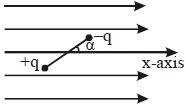
There exists a non-uniform electric field along the $x-$ axis as shown in the figure below. The field increases at a uniform rate along the $+ve$ $x-$ axis. $A$ dipole is placed inside the field as shown. Which one of the following is correct for the dipole?
A
Dipole moves along positive $x-$ axis and undergoes a clockwise rotation
B
Dipole moves along negative $x-$ axis and undergoes a clockwise rotation
C
Dipole moves along positive $x-$ axis and undergoes an anticlockwise rotation
D
Dipole moves along negative $x-$ axis and undergoes an anticlockwise rotation
Solution
(D) The electric field $E$ increases along the positive $x-$ axis.
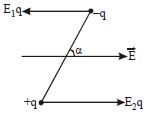
Let $E_1$ be the field at the position of the negative charge $(-q)$ and $E_2$ be the field at the position of the positive charge $(+q)$.
Since the field increases along the positive $x-$ axis,$E_2 > E_1$.
The force on the positive charge is $F_2 = qE_2$ (directed along the positive $x-$ axis).
The force on the negative charge is $F_1 = qE_1$ (directed along the negative $x-$ axis).
Since $E_2 > E_1$,the net force $F_{net} = F_2 - F_1 = q(E_2 - E_1)$ is directed along the positive $x-$ axis.
Wait,looking at the diagram,the negative charge is at a larger $x$ coordinate than the positive charge. Therefore,the field at the negative charge is stronger.
Let $x_{-q} > x_{+q}$,so $E(-q) > E(+q)$.
Force on $-q$ is $F_1 = qE(-q)$ (towards negative $x-$ axis).
Force on $+q$ is $F_2 = qE(+q)$ (towards positive $x-$ axis).
Since $E(-q) > E(+q)$,the net force is towards the negative $x-$ axis.
The torque $\tau = p \times E$ tends to rotate the dipole to align with the field. In this configuration,the torque causes an anticlockwise rotation.
Let $E_1$ be the field at the position of the negative charge $(-q)$ and $E_2$ be the field at the position of the positive charge $(+q)$.
Since the field increases along the positive $x-$ axis,$E_2 > E_1$.
The force on the positive charge is $F_2 = qE_2$ (directed along the positive $x-$ axis).
The force on the negative charge is $F_1 = qE_1$ (directed along the negative $x-$ axis).
Since $E_2 > E_1$,the net force $F_{net} = F_2 - F_1 = q(E_2 - E_1)$ is directed along the positive $x-$ axis.
Wait,looking at the diagram,the negative charge is at a larger $x$ coordinate than the positive charge. Therefore,the field at the negative charge is stronger.
Let $x_{-q} > x_{+q}$,so $E(-q) > E(+q)$.
Force on $-q$ is $F_1 = qE(-q)$ (towards negative $x-$ axis).
Force on $+q$ is $F_2 = qE(+q)$ (towards positive $x-$ axis).
Since $E(-q) > E(+q)$,the net force is towards the negative $x-$ axis.
The torque $\tau = p \times E$ tends to rotate the dipole to align with the field. In this configuration,the torque causes an anticlockwise rotation.
0 likesView Solution
27
PhysicsEasyMCQAIIMS · 2012
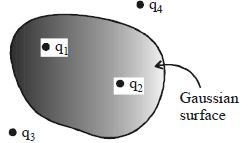
Assertion: Four point charges $q_1, q_2, q_3$ and $q_4$ are as shown in the figure. The flux over the shown Gaussian surface depends only on charges $q_1$ and $q_2$.
Reason: Electric field at all points on the Gaussian surface depends only on charges $q_1$ and $q_2$.
Reason: Electric field at all points on the Gaussian surface depends only on charges $q_1$ and $q_2$.
A
If both Assertion and Reason are correct and Reason is the correct explanation of Assertion.
B
If both Assertion and Reason are correct,but Reason is not the correct explanation of Assertion.
C
If Assertion is correct but Reason is incorrect.
D
If both the Assertion and Reason are incorrect.
Solution
(C) According to Gauss's Law,the total electric flux $\phi$ through a closed surface is given by $\phi = \frac{q_{\text{enclosed}}}{\epsilon_0}$.
In the given figure,the charges enclosed by the Gaussian surface are $q_1$ and $q_2$. Therefore,the flux depends only on $q_1$ and $q_2$. Thus,the Assertion is correct.
However,the electric field at any point on the Gaussian surface is the vector sum of the electric fields produced by all the charges present in the space ($q_1, q_2, q_3$ and $q_4$). Therefore,the electric field at any point on the surface depends on all the charges,not just the enclosed ones. Thus,the Reason is incorrect.
In the given figure,the charges enclosed by the Gaussian surface are $q_1$ and $q_2$. Therefore,the flux depends only on $q_1$ and $q_2$. Thus,the Assertion is correct.
However,the electric field at any point on the Gaussian surface is the vector sum of the electric fields produced by all the charges present in the space ($q_1, q_2, q_3$ and $q_4$). Therefore,the electric field at any point on the surface depends on all the charges,not just the enclosed ones. Thus,the Reason is incorrect.
0 likesView Solution
28
PhysicsEasyMCQAIIMS · 2012
If a dipole of dipole moment $\vec{p}$ is placed in a uniform electric field $\vec{E}$,then the torque acting on it is given by:
A
$\vec{\tau} = \vec{p} \cdot \vec{E}$
B
$\vec{\tau} = \vec{p} \times \vec{E}$
C
$\vec{\tau} = \vec{p} + \vec{E}$
D
$\vec{\tau} = \vec{p} - \vec{E}$
Solution
(B) The dipole moment of the dipole is $\vec{p}$ and the uniform electric field is $\vec{E}$.
When an electric dipole is placed in a uniform electric field,each charge $q$ experiences a force $\vec{F} = q\vec{E}$ and $\vec{F} = -q\vec{E}$.
These two equal and opposite forces form a couple,which exerts a torque on the dipole.
The magnitude of the torque is given by the product of the magnitude of one of the forces and the perpendicular distance between them.
$\tau = F \times (d \sin \theta) = (qE) \times (a \sin \theta) = (qa) E \sin \theta$.
Since the dipole moment $p = qa$,we have $\tau = pE \sin \theta$.
In vector form,this is expressed as $\vec{\tau} = \vec{p} \times \vec{E}$.
When an electric dipole is placed in a uniform electric field,each charge $q$ experiences a force $\vec{F} = q\vec{E}$ and $\vec{F} = -q\vec{E}$.
These two equal and opposite forces form a couple,which exerts a torque on the dipole.
The magnitude of the torque is given by the product of the magnitude of one of the forces and the perpendicular distance between them.
$\tau = F \times (d \sin \theta) = (qE) \times (a \sin \theta) = (qa) E \sin \theta$.
Since the dipole moment $p = qa$,we have $\tau = pE \sin \theta$.
In vector form,this is expressed as $\vec{\tau} = \vec{p} \times \vec{E}$.
0 likesView Solution
29
PhysicsMediumMCQAIIMS · 2012
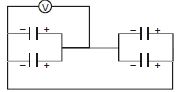
The four capacitors,each of $25\,\mu F$,are connected as shown in the figure. The $dc$ voltmeter reads $200\,V$. The charge on each plate of the capacitor is
A
$\pm 2 \times 10^{-3}\,C$
B
$\pm 5 \times 10^{-3}\,C$
C
$\pm 2 \times 10^{-2}\,C$
D
$\pm 5 \times 10^{-2}\,C$
Solution
(B) From the circuit diagram,the voltmeter is connected across the parallel combination of the two capacitors on the left.
Since the capacitors are connected in parallel,the potential difference across each capacitor is equal to the reading of the voltmeter,which is $V = 200\,V$.
The capacitance of each capacitor is $C = 25\,\mu F = 25 \times 10^{-6}\,F$.
The charge $Q$ on each plate of a capacitor is given by the formula $Q = CV$.
Substituting the given values:
$Q = (25 \times 10^{-6}\,F) \times (200\,V)$
$Q = 5000 \times 10^{-6}\,C$
$Q = 5 \times 10^{-3}\,C$.
Thus,the charge on each plate is $\pm 5 \times 10^{-3}\,C$.
Since the capacitors are connected in parallel,the potential difference across each capacitor is equal to the reading of the voltmeter,which is $V = 200\,V$.
The capacitance of each capacitor is $C = 25\,\mu F = 25 \times 10^{-6}\,F$.
The charge $Q$ on each plate of a capacitor is given by the formula $Q = CV$.
Substituting the given values:
$Q = (25 \times 10^{-6}\,F) \times (200\,V)$
$Q = 5000 \times 10^{-6}\,C$
$Q = 5 \times 10^{-3}\,C$.
Thus,the charge on each plate is $\pm 5 \times 10^{-3}\,C$.
0 likesView Solution
30
PhysicsMediumMCQAIIMS · 2012
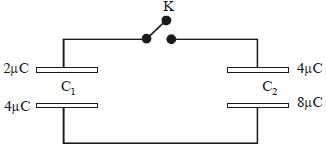
Assertion: Charges are given to plates of two plane parallel plate capacitors $C_1$ and $C_2$ (such that $C_2 = 2C_1$) as shown in the figure. Then the key $K$ is pressed to complete the circuit. Finally,the net charge on the upper plate and the net charge on the lower plate of capacitor $C_1$ is positive.
Reason: In a parallel plate capacitor,both plates always carry equal and opposite charge.
Reason: In a parallel plate capacitor,both plates always carry equal and opposite charge.
A
If both Assertion and Reason are correct and Reason is the correct explanation of Assertion.
B
If both Assertion and Reason are correct,but Reason is not the correct explanation of Assertion.
C
If Assertion is correct but Reason is incorrect.
D
If both the Assertion and Reason are incorrect.
Solution
(C) For capacitor $C_1$,the charges on the plates are $q_1 = 2 \mu C$ and $q_2 = 4 \mu C$. The potential difference across $C_1$ is $V_1 = (q_2 - q_1) / (2C_1) = (4 - 2) / (2C_1) = 1 / C_1$.
For capacitor $C_2$,the charges on the plates are $q_3 = 4 \mu C$ and $q_4 = 8 \mu C$. The potential difference across $C_2$ is $V_2 = (q_4 - q_3) / (2C_2) = (8 - 4) / (2 \times 2C_1) = 4 / (4C_1) = 1 / C_1$.
Since $V_1 = V_2$,there is no potential difference between the plates when the key $K$ is closed,so no charge flows.
The net charge on the upper plate of $C_1$ is $2 \mu C$ (positive) and on the lower plate is $4 \mu C$ (positive). Thus,the Assertion is correct.
The Reason is incorrect because,in an isolated capacitor,the plates carry equal and opposite charges,but when connected to external circuits or given arbitrary charges,the plates do not necessarily carry equal and opposite charges.
For capacitor $C_2$,the charges on the plates are $q_3 = 4 \mu C$ and $q_4 = 8 \mu C$. The potential difference across $C_2$ is $V_2 = (q_4 - q_3) / (2C_2) = (8 - 4) / (2 \times 2C_1) = 4 / (4C_1) = 1 / C_1$.
Since $V_1 = V_2$,there is no potential difference between the plates when the key $K$ is closed,so no charge flows.
The net charge on the upper plate of $C_1$ is $2 \mu C$ (positive) and on the lower plate is $4 \mu C$ (positive). Thus,the Assertion is correct.
The Reason is incorrect because,in an isolated capacitor,the plates carry equal and opposite charges,but when connected to external circuits or given arbitrary charges,the plates do not necessarily carry equal and opposite charges.
0 likesView Solution
31
PhysicsMediumMCQAIIMS · 2012
$A$ constant voltage is applied between the two ends of a uniform metallic wire. Some heat is developed in it. The heat developed is doubled if
A
both the length and radius of the wire are halved
B
both the length and radius of the wire are doubled
C
the radius of the wire is doubled
D
the length of the wire is doubled
Solution
(B) The heat developed in a wire with constant voltage $V$ is given by $H = \frac{V^2}{R} t$. For the heat to be doubled,the resistance $R$ must be halved $(R' = R/2)$.
Resistance is given by $R = \frac{\rho \ell}{A} = \frac{\rho \ell}{\pi r^2}$.
If both length $\ell$ and radius $r$ are halved,$\ell' = \ell/2$ and $r' = r/2$.
Then $R' = \frac{\rho (\ell/2)}{\pi (r/2)^2} = \frac{\rho \ell / 2}{\pi r^2 / 4} = 2 \left( \frac{\rho \ell}{\pi r^2} \right) = 2R$.
If both length $\ell$ and radius $r$ are doubled,$\ell' = 2\ell$ and $r' = 2r$.
Then $R' = \frac{\rho (2\ell)}{\pi (2r)^2} = \frac{2\rho \ell}{4\pi r^2} = \frac{1}{2} \left( \frac{\rho \ell}{\pi r^2} \right) = \frac{R}{2}$.
Since $R' = R/2$,the heat $H' = \frac{V^2}{R'} t = \frac{V^2}{R/2} t = 2 \left( \frac{V^2}{R} t \right) = 2H$. Thus,the heat is doubled.
Resistance is given by $R = \frac{\rho \ell}{A} = \frac{\rho \ell}{\pi r^2}$.
If both length $\ell$ and radius $r$ are halved,$\ell' = \ell/2$ and $r' = r/2$.
Then $R' = \frac{\rho (\ell/2)}{\pi (r/2)^2} = \frac{\rho \ell / 2}{\pi r^2 / 4} = 2 \left( \frac{\rho \ell}{\pi r^2} \right) = 2R$.
If both length $\ell$ and radius $r$ are doubled,$\ell' = 2\ell$ and $r' = 2r$.
Then $R' = \frac{\rho (2\ell)}{\pi (2r)^2} = \frac{2\rho \ell}{4\pi r^2} = \frac{1}{2} \left( \frac{\rho \ell}{\pi r^2} \right) = \frac{R}{2}$.
Since $R' = R/2$,the heat $H' = \frac{V^2}{R'} t = \frac{V^2}{R/2} t = 2 \left( \frac{V^2}{R} t \right) = 2H$. Thus,the heat is doubled.
0 likesView Solution
32
PhysicsMediumMCQAIIMS · 2012
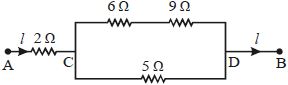
In the circuit shown in the figure,the $5\,\Omega$ resistance develops $20.00\,cal/s$ due to the current flowing through it. The heat developed in the $2\,\Omega$ resistance (in $cal/s$) is
A
$23.8$
B
$14.2$
C
$11.9$
D
$7.1$
Solution
(B) Let $I_1$ be the current through the $5\,\Omega$ resistance and $I_2$ be the current through the $(6+9)\,\Omega$ branch.
Given that the heat developed in the $5\,\Omega$ resistance is $20.00\,cal/s$,we have:
$P_1 = I_1^2 R_1 = 20.00\,cal/s$
$I_1^2 \times 5 = 20 \implies I_1^2 = 4 \implies I_1 = 2\,A$.
The potential difference across points $C$ and $D$ is $V_{CD} = I_1 \times 5 = 2 \times 5 = 10\,V$.
The current through the upper branch $(6\,\Omega + 9\,\Omega)$ is $I_2 = \frac{V_{CD}}{6+9} = \frac{10}{15} = \frac{2}{3}\,A$.
The total current $I$ flowing through the $2\,\Omega$ resistance is $I = I_1 + I_2 = 2 + \frac{2}{3} = \frac{8}{3}\,A$.
The heat developed per second in the $2\,\Omega$ resistance is $P = I^2 R = \left(\frac{8}{3}\right)^2 \times 2 = \frac{64}{9} \times 2 = \frac{128}{9} \approx 14.22\,cal/s$.
Given that the heat developed in the $5\,\Omega$ resistance is $20.00\,cal/s$,we have:
$P_1 = I_1^2 R_1 = 20.00\,cal/s$
$I_1^2 \times 5 = 20 \implies I_1^2 = 4 \implies I_1 = 2\,A$.
The potential difference across points $C$ and $D$ is $V_{CD} = I_1 \times 5 = 2 \times 5 = 10\,V$.
The current through the upper branch $(6\,\Omega + 9\,\Omega)$ is $I_2 = \frac{V_{CD}}{6+9} = \frac{10}{15} = \frac{2}{3}\,A$.
The total current $I$ flowing through the $2\,\Omega$ resistance is $I = I_1 + I_2 = 2 + \frac{2}{3} = \frac{8}{3}\,A$.
The heat developed per second in the $2\,\Omega$ resistance is $P = I^2 R = \left(\frac{8}{3}\right)^2 \times 2 = \frac{64}{9} \times 2 = \frac{128}{9} \approx 14.22\,cal/s$.
0 likesView Solution
33
PhysicsMediumMCQAIIMS · 2012
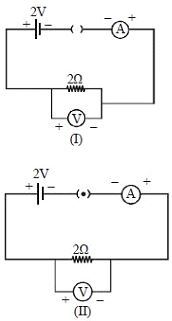
For the circuits shown in figures $I$ and $II$,the voltmeter reading would be
A
$2 \ V$ in circuit $I$ and $0 \ V$ in circuit $II$
B
$0 \ V$ in both circuits
C
$2 \ V$ in both circuits
D
$0 \ V$ in circuit $I$ and $2 \ V$ in circuit $II$
Solution
(D) In circuit $I$,the switch (key) is open,which means the circuit is incomplete. Therefore,no current flows through the resistor $(I = 0 \ A)$. According to Ohm's law,the voltage drop across the resistor is $V = I \times R = 0 \times 2 = 0 \ V$. Thus,the voltmeter reads $0 \ V$.
In circuit $II$,the switch is closed,completing the circuit. The current flows through the resistor. Since the internal resistance of the battery is not mentioned,we assume it to be ideal. The entire electromotive force $(2 \ V)$ appears across the $2 \ \Omega$ resistor. Therefore,the voltmeter reads $2 \ V$.
In circuit $II$,the switch is closed,completing the circuit. The current flows through the resistor. Since the internal resistance of the battery is not mentioned,we assume it to be ideal. The entire electromotive force $(2 \ V)$ appears across the $2 \ \Omega$ resistor. Therefore,the voltmeter reads $2 \ V$.
0 likesView Solution
34
PhysicsEasyMCQAIIMS · 2012
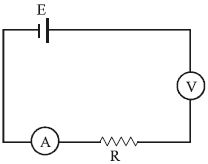
Assertion : All electric devices shown in the circuit are ideal. The reading of each of ammeter $(A)$ and voltmeter $(V)$ is zero.
Reason : An ideal voltmeter draws almost no current due to very large resistance, and hence $(V)$ and $(A)$ will read zero.
Reason : An ideal voltmeter draws almost no current due to very large resistance, and hence $(V)$ and $(A)$ will read zero.
A
If both Assertion and Reason are correct and Reason is the correct explanation of Assertion.
B
If both Assertion and Reason are correct, but Reason is not the correct explanation of Assertion.
C
If Assertion is correct but Reason is incorrect.
D
If both the Assertion and Reason are incorrect.
Solution
(D) In the given circuit, the battery $E$, ammeter $A$, resistor $R$, and voltmeter $V$ are connected in series.
An ideal voltmeter has infinite resistance, which prevents any current from flowing through the circuit.
Since the circuit is effectively open due to the infinite resistance of the ideal voltmeter, the current $I$ flowing through the ammeter is $I = \frac{E}{R + R_V} = \frac{E}{R + \infty} = 0$.
Therefore, the ammeter reading is $0$.
The voltmeter is connected in series with the rest of the circuit. The potential difference across the ideal voltmeter will be the entire $EMF$ of the battery, $V = E$. Thus, the voltmeter reading is not zero.
Therefore, the Assertion is incorrect, and the Reason is also incorrect.
An ideal voltmeter has infinite resistance, which prevents any current from flowing through the circuit.
Since the circuit is effectively open due to the infinite resistance of the ideal voltmeter, the current $I$ flowing through the ammeter is $I = \frac{E}{R + R_V} = \frac{E}{R + \infty} = 0$.
Therefore, the ammeter reading is $0$.
The voltmeter is connected in series with the rest of the circuit. The potential difference across the ideal voltmeter will be the entire $EMF$ of the battery, $V = E$. Thus, the voltmeter reading is not zero.
Therefore, the Assertion is incorrect, and the Reason is also incorrect.
0 likesView Solution
35
PhysicsEasyMCQAIIMS · 2012
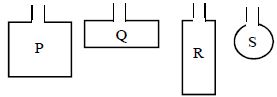
Four wires,each of length $2.0\,m$,are bent into four loops $P, Q, R$ and $S$ and then suspended in a uniform magnetic field. If the same current is passed in each,then the torque will be maximum on the loop:
A
$P$
B
$Q$
C
$R$
D
$S$
Solution
(D) The torque acting on a current-carrying loop in a uniform magnetic field is given by $\tau = NIAB \sin \theta$,where $N$ is the number of turns,$I$ is the current,$A$ is the area of the loop,$B$ is the magnetic field,and $\theta$ is the angle between the normal to the loop and the magnetic field.
For a given perimeter (length of wire $L = 2.0\,m$),the area $A$ enclosed by a loop is maximum for a circle.
Since the torque $\tau$ is directly proportional to the area $A$ $(\tau \propto A)$,the torque will be maximum for the loop with the largest area.
Among the given shapes,the circular loop $S$ encloses the maximum area for a fixed perimeter.
Therefore,the torque is maximum on the loop $S$.
For a given perimeter (length of wire $L = 2.0\,m$),the area $A$ enclosed by a loop is maximum for a circle.
Since the torque $\tau$ is directly proportional to the area $A$ $(\tau \propto A)$,the torque will be maximum for the loop with the largest area.
Among the given shapes,the circular loop $S$ encloses the maximum area for a fixed perimeter.
Therefore,the torque is maximum on the loop $S$.
0 likesView Solution
36
PhysicsMediumMCQAIIMS · 2012
$A$ square coil of side $a$ carries a current $I$. The magnetic field at the centre of the coil is
A
$\frac{\mu_0 I}{a\pi}$
B
$\frac{\sqrt{2}\mu_0 I}{a\pi}$
C
$\frac{\mu_0 I}{\sqrt{2}a\pi}$
D
$\frac{2\sqrt{2}\mu_0 I}{a\pi}$
Solution
(D) The magnetic field due to a straight wire of length $L$ at a perpendicular distance $d$ is given by $B = \frac{\mu_0 I}{4\pi d}(\sin \theta_1 + \sin \theta_2)$.
For a square coil of side $a$,the distance from the centre to any side is $d = a/2$.
The angles subtended by the corners at the centre are $\theta_1 = \theta_2 = 45^\circ$ (or $\pi/4$ radians).
The magnetic field due to one side is $B_{\text{side}} = \frac{\mu_0 I}{4\pi (a/2)}(\sin 45^\circ + \sin 45^\circ) = \frac{\mu_0 I}{2\pi a}(\frac{1}{\sqrt{2}} + \frac{1}{\sqrt{2}}) = \frac{\mu_0 I}{2\pi a}(\frac{2}{\sqrt{2}}) = \frac{\sqrt{2}\mu_0 I}{2\pi a} = \frac{\mu_0 I}{\sqrt{2}\pi a}$.
Since there are $4$ identical sides,the total magnetic field at the centre is $B_{\text{total}} = 4 \times B_{\text{side}} = 4 \times \frac{\mu_0 I}{\sqrt{2}\pi a} = \frac{4}{\sqrt{2}} \frac{\mu_0 I}{\pi a} = \frac{2\sqrt{2}\mu_0 I}{\pi a}$.
For a square coil of side $a$,the distance from the centre to any side is $d = a/2$.
The angles subtended by the corners at the centre are $\theta_1 = \theta_2 = 45^\circ$ (or $\pi/4$ radians).
The magnetic field due to one side is $B_{\text{side}} = \frac{\mu_0 I}{4\pi (a/2)}(\sin 45^\circ + \sin 45^\circ) = \frac{\mu_0 I}{2\pi a}(\frac{1}{\sqrt{2}} + \frac{1}{\sqrt{2}}) = \frac{\mu_0 I}{2\pi a}(\frac{2}{\sqrt{2}}) = \frac{\sqrt{2}\mu_0 I}{2\pi a} = \frac{\mu_0 I}{\sqrt{2}\pi a}$.
Since there are $4$ identical sides,the total magnetic field at the centre is $B_{\text{total}} = 4 \times B_{\text{side}} = 4 \times \frac{\mu_0 I}{\sqrt{2}\pi a} = \frac{4}{\sqrt{2}} \frac{\mu_0 I}{\pi a} = \frac{2\sqrt{2}\mu_0 I}{\pi a}$.
0 likesView Solution
37
PhysicsEasyMCQAIIMS · 2012
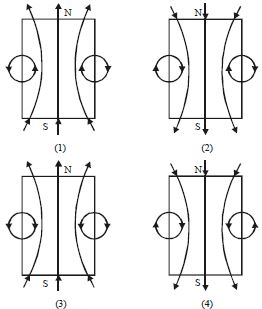
In the following figures,the lines of magnetic induction due to a magnet $SN$ are given by:
A
$1$
B
$2$
C
$3$
D
$4$
Solution
(A) Magnetic field lines are continuous closed loops. Outside the magnet,they emerge from the North pole $(N)$ and enter the South pole $(S)$. Inside the magnet,they travel from the South pole $(S)$ to the North pole $(N)$. This ensures that the lines of magnetic induction form continuous paths. Looking at the provided figures,figure $(1)$ correctly depicts these lines emerging from the North pole,entering the South pole,and continuing through the interior of the magnet from $S$ to $N$.
0 likesView Solution
38
PhysicsMediumMCQAIIMS · 2012
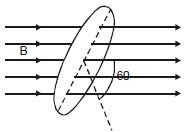
The figure represents an area $A = 0.5\,m^2$ situated in a uniform magnetic field $B = 2.0\,Wb/m^2$. The area makes an angle of $60^o$ with the magnetic field. The value of the magnetic flux through the area is equal to......$Wb$.
A
$2$
B
$\sqrt{3}$
C
$\sqrt{3}/2$
D
$0.5$
Solution
(C) The magnetic flux $\phi$ is given by the formula $\phi = B A \cos \theta$,where $\theta$ is the angle between the magnetic field vector $\vec{B}$ and the area vector $\vec{n}$ (normal to the surface).
Given that the area makes an angle of $60^o$ with the magnetic field,the angle $\theta$ between the normal to the area and the magnetic field is $\theta = 90^o - 60^o = 30^o$.
Substituting the values: $\phi = 2.0 \times 0.5 \times \cos(30^o)$.
$\phi = 1.0 \times \frac{\sqrt{3}}{2} = \frac{\sqrt{3}}{2} \, Wb$.
Given that the area makes an angle of $60^o$ with the magnetic field,the angle $\theta$ between the normal to the area and the magnetic field is $\theta = 90^o - 60^o = 30^o$.
Substituting the values: $\phi = 2.0 \times 0.5 \times \cos(30^o)$.
$\phi = 1.0 \times \frac{\sqrt{3}}{2} = \frac{\sqrt{3}}{2} \, Wb$.
0 likesView Solution
39
PhysicsEasyMCQAIIMS · 2012
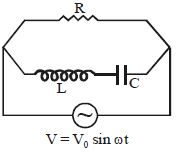
The current in resistance $R$ at resonance is
A
zero
B
minimum but finite
C
maximum but finite
D
infinite
Solution
(C) In the given parallel $LCR$ circuit,at resonance,the inductive reactance $X_L$ equals the capacitive reactance $X_C$ $(X_L = X_C)$.
This means the impedance of the $LC$ branch becomes zero (assuming ideal components).
However,the current in the resistance $R$ is determined by the applied voltage $V$ and the resistance $R$ itself,as $I = V/R$.
Since $R$ is in parallel with the $LC$ combination,the voltage across $R$ remains equal to the source voltage $V$.
Therefore,the current in the resistance $R$ is $I_{max} = V/R$,which is the maximum possible value for this circuit and is finite.
This means the impedance of the $LC$ branch becomes zero (assuming ideal components).
However,the current in the resistance $R$ is determined by the applied voltage $V$ and the resistance $R$ itself,as $I = V/R$.
Since $R$ is in parallel with the $LC$ combination,the voltage across $R$ remains equal to the source voltage $V$.
Therefore,the current in the resistance $R$ is $I_{max} = V/R$,which is the maximum possible value for this circuit and is finite.
0 likesView Solution
40
PhysicsEasyMCQAIIMS · 2012
Assertion : In the purely resistive element of a series $LCR$ $AC$ circuit,the maximum value of $rms$ current increases with an increase in the angular frequency of the applied $e.m.f$.
Reason : $I_{\max} = \frac{\varepsilon_{\max}}{Z}$,where $Z = \sqrt{R^2 + (\omega L - \frac{1}{\omega C})^2}$ and $I_{\max}$ is the peak current in a cycle.
Reason : $I_{\max} = \frac{\varepsilon_{\max}}{Z}$,where $Z = \sqrt{R^2 + (\omega L - \frac{1}{\omega C})^2}$ and $I_{\max}$ is the peak current in a cycle.
A
If both Assertion and Reason are correct and the Reason is a correct explanation of the Assertion.
B
If both Assertion and Reason are correct but Reason is not a correct explanation of the Assertion.
C
If the Assertion is correct but Reason is incorrect.
D
If both the Assertion and Reason are incorrect.
Solution
(D) The peak current in a series $LCR$ circuit is given by $I_{\max} = \frac{\varepsilon_{\max}}{Z}$,where $Z = \sqrt{R^2 + (\omega L - \frac{1}{\omega C})^2}$.
In a purely resistive element,the current is independent of frequency,but in a series $LCR$ circuit,the impedance $Z$ depends on the angular frequency $\omega$.
As $\omega$ increases,the term $(\omega L - \frac{1}{\omega C})^2$ changes. Specifically,the current $I_{\max}$ reaches its maximum value at resonance $(\omega = \frac{1}{\sqrt{LC}})$ and decreases as we move away from resonance in either direction.
Therefore,the assertion that the current always increases with an increase in angular frequency is incorrect.
The reason provided is a correct formula for peak current,but it does not support the false assertion.
Thus,the Assertion is incorrect and the Reason is correct.
In a purely resistive element,the current is independent of frequency,but in a series $LCR$ circuit,the impedance $Z$ depends on the angular frequency $\omega$.
As $\omega$ increases,the term $(\omega L - \frac{1}{\omega C})^2$ changes. Specifically,the current $I_{\max}$ reaches its maximum value at resonance $(\omega = \frac{1}{\sqrt{LC}})$ and decreases as we move away from resonance in either direction.
Therefore,the assertion that the current always increases with an increase in angular frequency is incorrect.
The reason provided is a correct formula for peak current,but it does not support the false assertion.
Thus,the Assertion is incorrect and the Reason is correct.
0 likesView Solution
41
PhysicsEasyMCQAIIMS · 2012
The focal lengths of a converging lens are $f_V$ and $f_R$ for violet and red light,respectively. Which of the following relations is correct?
A
$f_V > f_R$
B
$f_V = f_R$
C
$f_V < f_R$
D
None of these
Solution
(C) According to Cauchy's equation,the refractive index $\mu$ of a material depends on the wavelength $\lambda$ of light,where $\mu$ is inversely proportional to $\lambda$. Since the wavelength of red light is greater than that of violet light $(\lambda_R > \lambda_V)$,the refractive index for red light is less than that for violet light $(\mu_R < \mu_V)$.
Using the lens maker's formula,$\frac{1}{f} = (\mu - 1)(\frac{1}{R_1} - \frac{1}{R_2})$,we see that $\frac{1}{f} \propto (\mu - 1)$.
Since $\mu_V > \mu_R$,it follows that $(\mu_V - 1) > (\mu_R - 1)$.
Therefore,$\frac{1}{f_V} > \frac{1}{f_R}$,which implies $f_V < f_R$.
Using the lens maker's formula,$\frac{1}{f} = (\mu - 1)(\frac{1}{R_1} - \frac{1}{R_2})$,we see that $\frac{1}{f} \propto (\mu - 1)$.
Since $\mu_V > \mu_R$,it follows that $(\mu_V - 1) > (\mu_R - 1)$.
Therefore,$\frac{1}{f_V} > \frac{1}{f_R}$,which implies $f_V < f_R$.
0 likesView Solution
42
PhysicsEasyMCQAIIMS · 2012
Assertion : $A$ point object is placed at a distance of $26 \ cm$ from a convex mirror of focal length $26 \ cm$. The image will not form at infinity.
Reason : For the above-given system,the equation $\frac{1}{v} + \frac{1}{u} = \frac{1}{f}$ gives $v = \infty$.
Reason : For the above-given system,the equation $\frac{1}{v} + \frac{1}{u} = \frac{1}{f}$ gives $v = \infty$.
A
If both Assertion and Reason are correct and the Reason is a correct explanation of the Assertion.
B
If both Assertion and Reason are correct but Reason is not a correct explanation of the Assertion.
C
If the Assertion is correct but Reason is incorrect.
D
If both the Assertion and Reason are incorrect.
Solution
(C) For a convex mirror,the focal length $f$ is taken as positive $(f = +26 \ cm)$. The object distance $u$ is always taken as negative $(u = -26 \ cm)$.
Using the mirror formula: $\frac{1}{v} + \frac{1}{u} = \frac{1}{f}$.
Substituting the values: $\frac{1}{v} + \frac{1}{-26} = \frac{1}{26}$.
$\frac{1}{v} = \frac{1}{26} + \frac{1}{26} = \frac{2}{26} = \frac{1}{13}$.
Thus,$v = +13 \ cm$.
The image is formed at $13 \ cm$ behind the mirror,not at infinity. Therefore,the Assertion is correct.
The Reason states that the equation gives $v = \infty$,which is mathematically incorrect based on the sign convention. Thus,the Reason is incorrect.
Using the mirror formula: $\frac{1}{v} + \frac{1}{u} = \frac{1}{f}$.
Substituting the values: $\frac{1}{v} + \frac{1}{-26} = \frac{1}{26}$.
$\frac{1}{v} = \frac{1}{26} + \frac{1}{26} = \frac{2}{26} = \frac{1}{13}$.
Thus,$v = +13 \ cm$.
The image is formed at $13 \ cm$ behind the mirror,not at infinity. Therefore,the Assertion is correct.
The Reason states that the equation gives $v = \infty$,which is mathematically incorrect based on the sign convention. Thus,the Reason is incorrect.
0 likesView Solution
43
PhysicsEasyMCQAIIMS · 2012
The correct formula for fringe visibility is
A
$V = \frac{I_{\max} - I_{\min}}{I_{\max} + I_{\min}}$
B
$V = \frac{I_{\max} + I_{\min}}{I_{\max} - I_{\min}}$
C
$V = \frac{I_{\max}}{I_{\min}}$
D
$V = \frac{I_{\min}}{I_{\max}}$
Solution
(A) Fringe visibility $(V)$ is a measure of the contrast in an interference pattern.
It is defined as the ratio of the difference between the maximum and minimum intensities to the sum of the maximum and minimum intensities.
The formula is given by:
$V = \frac{I_{\max} - I_{\min}}{I_{\max} + I_{\min}}$
It is defined as the ratio of the difference between the maximum and minimum intensities to the sum of the maximum and minimum intensities.
The formula is given by:
$V = \frac{I_{\max} - I_{\min}}{I_{\max} + I_{\min}}$
0 likesView Solution
44
PhysicsMediumMCQAIIMS · 2012
In Young's experiment,the distance between two slits is $d/3$ and the distance between the screen and the slits is $3D$. The number of fringes in $1/3 \ m$ on the screen,formed by monochromatic light of wavelength $3\lambda$,will be
A
$d / (9D\lambda)$
B
$d / (27D\lambda)$
C
$d / (81D\lambda)$
D
$d / (D\lambda)$
Solution
(C) The fringe width $\beta$ is given by the formula $\beta = \frac{\lambda' D'}{d'}$.
Given: $\lambda' = 3\lambda$,$D' = 3D$,and $d' = d/3$.
Substituting these values,we get $\beta = \frac{(3\lambda)(3D)}{d/3} = \frac{9\lambda D}{d/3} = 27 \frac{\lambda D}{d}$.
The number of fringes $n$ in a distance $x = 1/3 \ m$ is given by $n = \frac{x}{\beta}$.
Therefore,$n = \frac{1/3}{27 \lambda D / d} = \frac{d}{81 \lambda D}$.
Given: $\lambda' = 3\lambda$,$D' = 3D$,and $d' = d/3$.
Substituting these values,we get $\beta = \frac{(3\lambda)(3D)}{d/3} = \frac{9\lambda D}{d/3} = 27 \frac{\lambda D}{d}$.
The number of fringes $n$ in a distance $x = 1/3 \ m$ is given by $n = \frac{x}{\beta}$.
Therefore,$n = \frac{1/3}{27 \lambda D / d} = \frac{d}{81 \lambda D}$.
0 likesView Solution
45
PhysicsMediumMCQAIIMS · 2012
$A$ radioactive element decays to form a stable nuclide. The graph representing the number of radioactive nuclei $(N)$ versus time $(t)$ is:
A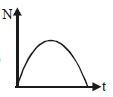
B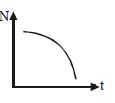
C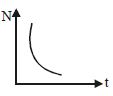
D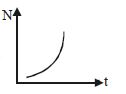
Solution
(C) The number of radioactive nuclei $N$ at any time $t$ is given by the radioactive decay law:
$N(t) = N_0 e^{-\lambda t}$
Where $N_0$ is the initial number of radioactive nuclei at $t = 0$ and $\lambda$ is the decay constant.
This equation represents an exponential decay function,which is of the form $y = a e^{-kx}$.
As $t$ increases,$N$ decreases exponentially from the initial value $N_0$ and approaches zero as $t \to \infty$.
Therefore,the correct graph is the one showing an exponential decay curve starting from a positive value on the $N$-axis,which corresponds to option $C$.
$N(t) = N_0 e^{-\lambda t}$
Where $N_0$ is the initial number of radioactive nuclei at $t = 0$ and $\lambda$ is the decay constant.
This equation represents an exponential decay function,which is of the form $y = a e^{-kx}$.
As $t$ increases,$N$ decreases exponentially from the initial value $N_0$ and approaches zero as $t \to \infty$.
Therefore,the correct graph is the one showing an exponential decay curve starting from a positive value on the $N$-axis,which corresponds to option $C$.
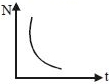
0 likesView Solution
46
PhysicsEasyMCQAIIMS · 2012
$A$ nuclear reaction is given by ${}_{Z}X^{A} \to {}_{Z+1}Y^{A} + {}_{-1}e^{0} + \bar{\nu}$,which represents:
A
fission
B
$\beta^{-}$ decay
C
$\sigma^{-}$ decay
D
fusion
Solution
(B) The particle ${}_{-1}e^{0}$ is known as a $\beta^{-}$ particle (electron),and $\bar{\nu}$ is known as an antineutrino.
In this reaction,a neutron is converted into a proton,emitting an electron and an antineutrino.
Since the reaction involves the emission of a $\beta^{-}$ particle,it is classified as $\beta^{-}$ decay.
In this reaction,a neutron is converted into a proton,emitting an electron and an antineutrino.
Since the reaction involves the emission of a $\beta^{-}$ particle,it is classified as $\beta^{-}$ decay.
0 likesView Solution
47
PhysicsEasyMCQAIIMS · 2012
Assertion : In a decay process of a nucleus, the mass of products is less than that of the parent.
Reason : The rest mass energy of the products must be less than that of the parent.
Reason : The rest mass energy of the products must be less than that of the parent.
A
If both Assertion and Reason are correct and the Reason is a correct explanation of the Assertion.
B
If both Assertion and Reason are correct but Reason is not a correct explanation of the Assertion.
C
If the Assertion is correct but Reason is incorrect.
D
If both the Assertion and Reason are incorrect.
Solution
(A) In a nuclear decay process, energy is released because the total mass of the products is less than the mass of the parent nucleus. This mass difference, known as the mass defect $(\Delta m)$, is converted into energy according to Einstein's mass-energy equivalence principle, $E = \Delta m c^2$.
Since energy is released, the total rest mass energy of the products must be less than the rest mass energy of the parent nucleus to satisfy the law of conservation of energy.
Therefore, both the Assertion and the Reason are correct, and the Reason provides the correct explanation for the Assertion.
Since energy is released, the total rest mass energy of the products must be less than the rest mass energy of the parent nucleus to satisfy the law of conservation of energy.
Therefore, both the Assertion and the Reason are correct, and the Reason provides the correct explanation for the Assertion.
0 likesView Solution
48
PhysicsEasyMCQAIIMS · 2012
Assertion : Binding energy (or mass defect) of hydrogen nucleus is zero.
Reason : Hydrogen nucleus contains only one nucleon.
Reason : Hydrogen nucleus contains only one nucleon.
A
If both Assertion and Reason are correct and the Reason is a correct explanation of the Assertion.
B
If both Assertion and Reason are correct but Reason is not a correct explanation of the Assertion.
C
If the Assertion is correct but Reason is incorrect.
D
If both the Assertion and Reason are incorrect.
Solution
(A) The nucleus of a hydrogen atom $(_{1}^{1}H)$ consists of only a single proton.
Nuclear binding energy is defined as the energy required to disassemble a nucleus into its constituent protons and neutrons (nucleons).
Since a hydrogen nucleus contains only one nucleon (a proton),there are no other nucleons to bind with,and thus no nuclear force is acting to hold it together.
Therefore,the binding energy and mass defect of a hydrogen nucleus are zero.
Since the Assertion is true and the Reason correctly explains why the binding energy is zero (due to the presence of only one nucleon),the correct option is $A$.
Nuclear binding energy is defined as the energy required to disassemble a nucleus into its constituent protons and neutrons (nucleons).
Since a hydrogen nucleus contains only one nucleon (a proton),there are no other nucleons to bind with,and thus no nuclear force is acting to hold it together.
Therefore,the binding energy and mass defect of a hydrogen nucleus are zero.
Since the Assertion is true and the Reason correctly explains why the binding energy is zero (due to the presence of only one nucleon),the correct option is $A$.
0 likesView Solution
49
PhysicsEasyMCQAIIMS · 2012
Which represents $NAND$ gate?
A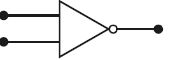
B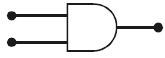
C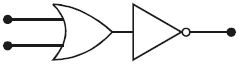
D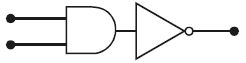
Solution
(D) $NAND$ gate is formed by connecting a $NOT$ gate to the output of an $AND$ gate.
In the given options,option $D$ shows an $AND$ gate followed by a $NOT$ gate,which is the standard representation of a $NAND$ gate.
In the given options,option $D$ shows an $AND$ gate followed by a $NOT$ gate,which is the standard representation of a $NAND$ gate.
0 likesView Solution
50
PhysicsMediumMCQAIIMS · 2012
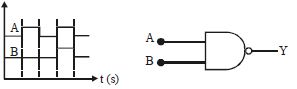
The real-time variation of input signals $A$ and $B$ are as shown below. If the inputs are fed into a $NAND$ gate,then select the output signal from the following.
A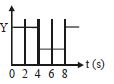
B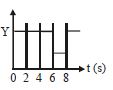
C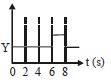
D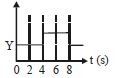
Solution
(B) $NAND$ gate produces an output of $0$ only when both inputs are $1$. Otherwise,it produces an output of $1$.
Based on the input waveforms for $A$ and $B$:
- For $t = 0$ to $2 \ s$: $A=0, B=0 \implies Y=1$.
- For $t = 2$ to $4 \ s$: $A=1, B=0 \implies Y=1$.
- For $t = 4$ to $6 \ s$: $A=0, B=0 \implies Y=1$.
- For $t = 6$ to $8 \ s$: $A=1, B=1 \implies Y=0$.
- For $t > 8 \ s$: $A=0, B=0 \implies Y=1$.
Comparing this sequence $(1, 1, 1, 0, 1)$ with the given options,the waveform in option $B$ matches this output.
Based on the input waveforms for $A$ and $B$:
- For $t = 0$ to $2 \ s$: $A=0, B=0 \implies Y=1$.
- For $t = 2$ to $4 \ s$: $A=1, B=0 \implies Y=1$.
- For $t = 4$ to $6 \ s$: $A=0, B=0 \implies Y=1$.
- For $t = 6$ to $8 \ s$: $A=1, B=1 \implies Y=0$.
- For $t > 8 \ s$: $A=0, B=0 \implies Y=1$.
Comparing this sequence $(1, 1, 1, 0, 1)$ with the given options,the waveform in option $B$ matches this output.
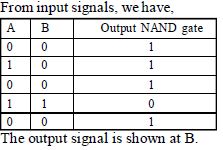
0 likesView Solution
51
PhysicsEasyMCQAIIMS · 2012
Assertion: $A$ $p-n$ junction with reverse bias can be used as a photo-diode to measure light intensity.
Reason: In a reverse bias condition,the current is small but is more sensitive to changes in incident light intensity.
Reason: In a reverse bias condition,the current is small but is more sensitive to changes in incident light intensity.
A
If both Assertion and Reason are correct and the Reason is a correct explanation of the Assertion.
B
If both Assertion and Reason are correct but Reason is not a correct explanation of the Assertion.
C
If the Assertion is correct but Reason is incorrect.
D
If both the Assertion and Reason are incorrect.
Solution
(A) photo-diode is a reverse-biased $p-n$ junction diode. At the $p-n$ junction,there exists a junction electric field which,at equilibrium,does not permit the flow of charge carriers across the junction.
When such a $p-n$ diode is illuminated with light photons having energy $h
u > E_{g}$,electron-hole pairs are generated in the depletion layer (or near the junction). These charge carriers are separated by the junction field and made to flow across the junction,resulting in a change in the reverse saturation current.
Because the reverse current is highly sensitive to the generation of these photo-excited carriers,the change in current is directly proportional to the incident light intensity. Thus,the device acts as a photo-detector.
When such a $p-n$ diode is illuminated with light photons having energy $h
u > E_{g}$,electron-hole pairs are generated in the depletion layer (or near the junction). These charge carriers are separated by the junction field and made to flow across the junction,resulting in a change in the reverse saturation current.
Because the reverse current is highly sensitive to the generation of these photo-excited carriers,the change in current is directly proportional to the incident light intensity. Thus,the device acts as a photo-detector.
0 likesView Solution
52
PhysicsMediumMCQAIIMS · 2012
$12$ signals,each band-limited to $5\, kHz$,are to be transmitted by frequency-division multiplexing. If an $AM-SSB$ modulation guard band of $1\, kHz$ is used,then the bandwidth of the multiplexed signal is ....... $kHz$.
A
$101$
B
$99$
C
$84$
D
$71$
Solution
(D) The bandwidth of each signal is $5\, kHz$. Since there are $12$ signals,the total signal bandwidth is $12 \times 5\, kHz = 60\, kHz$.
For $N$ signals,the number of guard bands required between them is $N-1$.
Here,$N = 12$,so the number of guard bands required is $12 - 1 = 11$.
Each guard band has a bandwidth of $1\, kHz$.
Therefore,the total guard bandwidth is $11 \times 1\, kHz = 11\, kHz$.
The total bandwidth of the multiplexed signal is the sum of the signal bandwidths and the guard bandwidths:
Total Bandwidth $= 60\, kHz + 11\, kHz = 71\, kHz$.
For $N$ signals,the number of guard bands required between them is $N-1$.
Here,$N = 12$,so the number of guard bands required is $12 - 1 = 11$.
Each guard band has a bandwidth of $1\, kHz$.
Therefore,the total guard bandwidth is $11 \times 1\, kHz = 11\, kHz$.
The total bandwidth of the multiplexed signal is the sum of the signal bandwidths and the guard bandwidths:
Total Bandwidth $= 60\, kHz + 11\, kHz = 71\, kHz$.
0 likesView Solution
Vedclass Products
For Students
Vedclass Test Series
Mock tests in real AIIMS style covering Physics with performance analysis. 5-day free trial.
Start Free TrialFor Teachers
Exam Paper Generator
Generate Set A/B/C/D Physics papers from 7.5L+ questions in 2 minutes. 3 chapters free.
Try FreeFor Institutes
Online Exam Module
Run live AIIMS mock exams with unlimited students, 360° analytics & white-label branding.
See DemoFrequently Asked Questions
How many Physics questions are in AIIMS 2012?
There are 52 Physics questions from the AIIMS 2012 paper on Vedclass, each with a detailed step-by-step solution in English.
Are AIIMS 2012 Physics solutions available in English?
Yes. All solutions on this page are in English. You can also switch to English or Hindi using the language buttons above the questions.
Can I practice AIIMS 2012 Physics as a timed test?
Yes. Use the Vedclass Test Series to attempt a full AIIMS mock test covering Physics with time limits and instant score analysis.
Can teachers create Physics papers from AIIMS previous year questions?
Yes. The Vedclass Exam Paper Generator lets teachers mix AIIMS Physics questions and generate Set A/B/C/D papers in minutes.
For Teachers & Institutes
Build a Custom Physics Paper
Pick AIIMS 2012 Physics questions, set difficulty, and generate Set A/B/C/D in 2 minutes.