
MathematicsQ1–38 of 38 questions
Page 1 of 1 · English
1
MathematicsDifficultMCQAIEEE · 2007
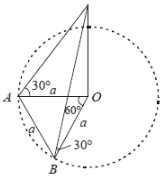
$A$ tower stands at the centre of a circular park. $A$ and $B$ are two points on the boundary of the park such that $AB = a$ subtends an angle of $60^{\circ}$ at the foot of the tower,and the angle of elevation of the top of the tower from $A$ or $B$ is $30^{\circ}$. The height of the tower is
A
$\frac{a}{\sqrt{3}}$
B
$a\sqrt{3}$
C
$\frac{2a}{\sqrt{3}}$
D
$2a\sqrt{3}$
Solution
(A) Let $O$ be the centre of the circular park and $P$ be the top of the tower. Thus,$OP$ is the height of the tower.
Since $O$ is the centre,$OA = OB = R$ (radius of the park).
Given that $\angle AOB = 60^{\circ}$ and $OA = OB$,$\Delta AOB$ is an equilateral triangle.
Therefore,$OA = OB = AB = a$.
In the right-angled triangle $\Delta AOP$,where $\angle OAP = 30^{\circ}$ is the angle of elevation:
$\tan 30^{\circ} = \frac{OP}{OA}$
$\frac{1}{\sqrt{3}} = \frac{OP}{a}$
$OP = \frac{a}{\sqrt{3}}$
Thus,the height of the tower is $\frac{a}{\sqrt{3}}$.
Since $O$ is the centre,$OA = OB = R$ (radius of the park).
Given that $\angle AOB = 60^{\circ}$ and $OA = OB$,$\Delta AOB$ is an equilateral triangle.
Therefore,$OA = OB = AB = a$.
In the right-angled triangle $\Delta AOP$,where $\angle OAP = 30^{\circ}$ is the angle of elevation:
$\tan 30^{\circ} = \frac{OP}{OA}$
$\frac{1}{\sqrt{3}} = \frac{OP}{a}$
$OP = \frac{a}{\sqrt{3}}$
Thus,the height of the tower is $\frac{a}{\sqrt{3}}$.
0 likesView Solution
2
MathematicsMediumMCQAIEEE · 2007
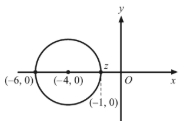
If $|z + 4| \le 3$,then the maximum value of $|z + 1|$ is
A
$6$
B
$0$
C
$4$
D
$10$
Solution
(A) The inequality $|z - (-4)| \le 3$ represents the set of all points $z$ that lie on or inside a circle with center $C(-4, 0)$ and radius $r = 3$.
We want to find the maximum value of $|z - (-1)|$,which represents the distance between $z$ and the point $A(-1, 0)$.
The distance between the center $C(-4, 0)$ and the point $A(-1, 0)$ is $d = \sqrt{(-1 - (-4))^2 + (0 - 0)^2} = \sqrt{3^2} = 3$.
The maximum distance from a point $A$ to any point $z$ inside or on the circle is given by $d + r$.
Therefore,the maximum value is $3 + 3 = 6$.
We want to find the maximum value of $|z - (-1)|$,which represents the distance between $z$ and the point $A(-1, 0)$.
The distance between the center $C(-4, 0)$ and the point $A(-1, 0)$ is $d = \sqrt{(-1 - (-4))^2 + (0 - 0)^2} = \sqrt{3^2} = 3$.
The maximum distance from a point $A$ to any point $z$ inside or on the circle is given by $d + r$.
Therefore,the maximum value is $3 + 3 = 6$.
0 likesView Solution
3
MathematicsDifficultMCQAIEEE · 2007
The set $S = \{1, 2, 3, \dots, 12\}$ is to be partitioned into three sets $A, B, C$ of equal size such that $A \cup B \cup C = S$ and $A \cap B = B \cap C = C \cap A = \emptyset$. The number of ways to partition $S$ is:
A
$\frac{12!}{(4!)^3}$
B
$\frac{12!}{(4!)^4}$
C
$\frac{12!}{3!(4!)^3}$
D
$\frac{12!}{3!(4!)^4}$
Solution
(C) The set $S$ contains $12$ elements.
We need to partition $S$ into three disjoint sets $A, B, C$ of equal size.
Since $|S| = 12$,each set must contain $12 / 3 = 4$ elements.
The number of ways to distribute $12$ distinct items into $3$ unlabeled groups of size $4$ is given by the formula $\frac{1}{3!} \binom{12}{4, 4, 4}$.
This is calculated as:
$\frac{1}{3!} \times \binom{12}{4} \times \binom{8}{4} \times \binom{4}{4} = \frac{1}{3!} \times \frac{12!}{4!8!} \times \frac{8!}{4!4!} \times \frac{4!}{4!0!} = \frac{12!}{3!(4!)^3}$.
We need to partition $S$ into three disjoint sets $A, B, C$ of equal size.
Since $|S| = 12$,each set must contain $12 / 3 = 4$ elements.
The number of ways to distribute $12$ distinct items into $3$ unlabeled groups of size $4$ is given by the formula $\frac{1}{3!} \binom{12}{4, 4, 4}$.
This is calculated as:
$\frac{1}{3!} \times \binom{12}{4} \times \binom{8}{4} \times \binom{4}{4} = \frac{1}{3!} \times \frac{12!}{4!8!} \times \frac{8!}{4!4!} \times \frac{4!}{4!0!} = \frac{12!}{3!(4!)^3}$.
0 likesView Solution
4
MathematicsMediumMCQAIEEE · 2007
In the binomial expansion of $(a - b)^n, n \ge 5,$ the sum of the $5^{th}$ and $6^{th}$ terms is zero. Then $a/b$ equals:
A
$\frac{n - 5}{6}$
B
$\frac{n - 4}{5}$
C
$\frac{5}{n - 4}$
D
$\frac{6}{n - 5}$
Solution
(B) The general term in the expansion of $(a - b)^n$ is given by $T_{r+1} = ^nC_r a^{n-r} (-b)^r$.
For the $5^{th}$ term $(r=4)$: $T_5 = ^nC_4 a^{n-4} (-b)^4 = ^nC_4 a^{n-4} b^4$.
For the $6^{th}$ term $(r=5)$: $T_6 = ^nC_5 a^{n-5} (-b)^5 = -^nC_5 a^{n-5} b^5$.
Given $T_5 + T_6 = 0$,we have:
$^nC_4 a^{n-4} b^4 - ^nC_5 a^{n-5} b^5 = 0$.
Rearranging the terms:
$^nC_4 a^{n-4} b^4 = ^nC_5 a^{n-5} b^5$.
Dividing both sides by $a^{n-5} b^4$:
$\frac{a}{b} = \frac{^nC_5}{^nC_4}$.
Using the formula $\frac{^nC_r}{^nC_{r-1}} = \frac{n-r+1}{r}$:
$\frac{a}{b} = \frac{n-5+1}{5} = \frac{n-4}{5}$.
For the $5^{th}$ term $(r=4)$: $T_5 = ^nC_4 a^{n-4} (-b)^4 = ^nC_4 a^{n-4} b^4$.
For the $6^{th}$ term $(r=5)$: $T_6 = ^nC_5 a^{n-5} (-b)^5 = -^nC_5 a^{n-5} b^5$.
Given $T_5 + T_6 = 0$,we have:
$^nC_4 a^{n-4} b^4 - ^nC_5 a^{n-5} b^5 = 0$.
Rearranging the terms:
$^nC_4 a^{n-4} b^4 = ^nC_5 a^{n-5} b^5$.
Dividing both sides by $a^{n-5} b^4$:
$\frac{a}{b} = \frac{^nC_5}{^nC_4}$.
Using the formula $\frac{^nC_r}{^nC_{r-1}} = \frac{n-r+1}{r}$:
$\frac{a}{b} = \frac{n-5+1}{5} = \frac{n-4}{5}$.
0 likesView Solution
5
MathematicsDifficultMCQAIEEE · 2007
The sum of the series $\binom{20}{0} - \binom{20}{1} + \binom{20}{2} - \binom{20}{3} + \dots + \binom{20}{10}$ is:
A
$0$
B
$\binom{20}{10}$
C
$-\binom{20}{10}$
D
$\frac{1}{2} \binom{20}{10}$
Solution
(D) Let $S = \binom{20}{0} - \binom{20}{1} + \binom{20}{2} - \dots + \binom{20}{10}$.
We know that $\binom{n}{r} = \binom{n}{n-r}$.
Thus,$\binom{20}{0} = \binom{20}{20}$,$\binom{20}{1} = \binom{20}{19}$,...,$\binom{20}{9} = \binom{20}{11}$.
Consider the expansion $(1-1)^{20} = \sum_{r=0}^{20} (-1)^r \binom{20}{r} = 0$.
This gives $\binom{20}{0} - \binom{20}{1} + \dots - \binom{20}{9} + \binom{20}{10} - \binom{20}{11} + \dots + \binom{20}{20} = 0$.
Using symmetry,$\binom{20}{0} - \binom{20}{1} + \dots - \binom{20}{9} + \binom{20}{10} - \binom{20}{9} + \dots + \binom{20}{0} = 0$.
$2[\binom{20}{0} - \binom{20}{1} + \dots - \binom{20}{9}] + \binom{20}{10} = 0$.
Let $X = \binom{20}{0} - \binom{20}{1} + \dots - \binom{20}{9}$. Then $2X + \binom{20}{10} = 0$,so $X = -\frac{1}{2} \binom{20}{10}$.
The required sum is $S = X + \binom{20}{10} = -\frac{1}{2} \binom{20}{10} + \binom{20}{10} = \frac{1}{2} \binom{20}{10}$.
We know that $\binom{n}{r} = \binom{n}{n-r}$.
Thus,$\binom{20}{0} = \binom{20}{20}$,$\binom{20}{1} = \binom{20}{19}$,...,$\binom{20}{9} = \binom{20}{11}$.
Consider the expansion $(1-1)^{20} = \sum_{r=0}^{20} (-1)^r \binom{20}{r} = 0$.
This gives $\binom{20}{0} - \binom{20}{1} + \dots - \binom{20}{9} + \binom{20}{10} - \binom{20}{11} + \dots + \binom{20}{20} = 0$.
Using symmetry,$\binom{20}{0} - \binom{20}{1} + \dots - \binom{20}{9} + \binom{20}{10} - \binom{20}{9} + \dots + \binom{20}{0} = 0$.
$2[\binom{20}{0} - \binom{20}{1} + \dots - \binom{20}{9}] + \binom{20}{10} = 0$.
Let $X = \binom{20}{0} - \binom{20}{1} + \dots - \binom{20}{9}$. Then $2X + \binom{20}{10} = 0$,so $X = -\frac{1}{2} \binom{20}{10}$.
The required sum is $S = X + \binom{20}{10} = -\frac{1}{2} \binom{20}{10} + \binom{20}{10} = \frac{1}{2} \binom{20}{10}$.
0 likesView Solution
6
MathematicsDifficultMCQAIEEE · 2007
The sum of the series $\frac{1}{2!} - \frac{1}{3!} + \frac{1}{4!} - \dots$ up to infinity is
A
$e^{-1/2}$
B
$e^{1/2}$
C
$e^{-2}$
D
$e^{-1}$
Solution
(D) We know the expansion of $e^x$ is given by:
$e^x = 1 + x + \frac{x^2}{2!} + \frac{x^3}{3!} + \frac{x^4}{4!} + \dots$
Substitute $x = -1$ into the expansion:
$e^{-1} = 1 + (-1) + \frac{(-1)^2}{2!} + \frac{(-1)^3}{3!} + \frac{(-1)^4}{4!} + \dots$
$e^{-1} = 1 - 1 + \frac{1}{2!} - \frac{1}{3!} + \frac{1}{4!} - \dots$
Simplifying the expression:
$e^{-1} = 0 + \frac{1}{2!} - \frac{1}{3!} + \frac{1}{4!} - \dots$
$e^{-1} = \frac{1}{2!} - \frac{1}{3!} + \frac{1}{4!} - \dots$
Thus,the sum of the series is $e^{-1}$.
$e^x = 1 + x + \frac{x^2}{2!} + \frac{x^3}{3!} + \frac{x^4}{4!} + \dots$
Substitute $x = -1$ into the expansion:
$e^{-1} = 1 + (-1) + \frac{(-1)^2}{2!} + \frac{(-1)^3}{3!} + \frac{(-1)^4}{4!} + \dots$
$e^{-1} = 1 - 1 + \frac{1}{2!} - \frac{1}{3!} + \frac{1}{4!} - \dots$
Simplifying the expression:
$e^{-1} = 0 + \frac{1}{2!} - \frac{1}{3!} + \frac{1}{4!} - \dots$
$e^{-1} = \frac{1}{2!} - \frac{1}{3!} + \frac{1}{4!} - \dots$
Thus,the sum of the series is $e^{-1}$.
0 likesView Solution
7
MathematicsMediumMCQAIEEE · 2007
In a geometric progression consisting of positive terms,each term equals the sum of the next two terms. Then the common ratio of its progression is equal to:
A
$\frac{\sqrt{5} - 1}{2}$
B
$\frac{1 - \sqrt{5}}{2}$
C
$1$
D
$2\sqrt{5}$
Solution
(A) Let the terms of the geometric progression be $a, ar, ar^2, \ldots$ where $a > 0$ and $r > 0$.
Given that each term equals the sum of the next two terms,we have:
$a = ar + ar^2$
Since $a \neq 0$,we can divide by $a$:
$1 = r + r^2$
$r^2 + r - 1 = 0$
Using the quadratic formula $r = \frac{-b \pm \sqrt{b^2 - 4ac}}{2a}$:
$r = \frac{-1 \pm \sqrt{1^2 - 4(1)(-1)}}{2(1)}$
$r = \frac{-1 \pm \sqrt{5}}{2}$
Since the terms are positive,the common ratio $r$ must be positive.
Therefore,$r = \frac{\sqrt{5} - 1}{2}$.
Given that each term equals the sum of the next two terms,we have:
$a = ar + ar^2$
Since $a \neq 0$,we can divide by $a$:
$1 = r + r^2$
$r^2 + r - 1 = 0$
Using the quadratic formula $r = \frac{-b \pm \sqrt{b^2 - 4ac}}{2a}$:
$r = \frac{-1 \pm \sqrt{1^2 - 4(1)(-1)}}{2(1)}$
$r = \frac{-1 \pm \sqrt{5}}{2}$
Since the terms are positive,the common ratio $r$ must be positive.
Therefore,$r = \frac{\sqrt{5} - 1}{2}$.
0 likesView Solution
8
MathematicsDifficultMCQAIEEE · 2007
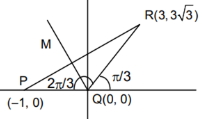
Let $P(-1, 0)$,$Q(0, 0)$,and $R(3, 3\sqrt{3})$ be three points. The equation of the bisector of the angle $\angle PQR$ is:
A
$\frac{\sqrt{3}}{2}x + y = 0$
B
$x + \sqrt{3}y = 0$
C
$\sqrt{3}x + y = 0$
D
$x + \frac{\sqrt{3}}{2}y = 0$
Solution
(C) The line $QP$ lies along the negative $x$-axis,so its angle with the positive $x$-axis is $\pi$. The line $QR$ passes through $(0, 0)$ and $(3, 3\sqrt{3})$,so its slope is $m = \frac{3\sqrt{3} - 0}{3 - 0} = \sqrt{3}$. The angle $\theta$ that $QR$ makes with the positive $x$-axis is $\tan \theta = \sqrt{3}$,which means $\theta = \frac{\pi}{3}$.
The angle $\angle PQR$ is the angle between the line $QP$ (angle $\pi$) and the line $QR$ (angle $\frac{\pi}{3}$).
The measure of $\angle PQR = \pi - \frac{\pi}{3} = \frac{2\pi}{3}$.
The bisector of $\angle PQR$ will make an angle $\alpha$ with the positive $x$-axis,where $\alpha = \frac{\pi + \frac{\pi}{3}}{2} = \frac{4\pi/3}{2} = \frac{2\pi}{3}$.
The slope of the bisector is $\tan(\frac{2\pi}{3}) = -\sqrt{3}$.
Since the bisector passes through the origin $Q(0, 0)$,its equation is $y - 0 = -\sqrt{3}(x - 0)$,which simplifies to $y = -\sqrt{3}x$,or $\sqrt{3}x + y = 0$.
The angle $\angle PQR$ is the angle between the line $QP$ (angle $\pi$) and the line $QR$ (angle $\frac{\pi}{3}$).
The measure of $\angle PQR = \pi - \frac{\pi}{3} = \frac{2\pi}{3}$.
The bisector of $\angle PQR$ will make an angle $\alpha$ with the positive $x$-axis,where $\alpha = \frac{\pi + \frac{\pi}{3}}{2} = \frac{4\pi/3}{2} = \frac{2\pi}{3}$.
The slope of the bisector is $\tan(\frac{2\pi}{3}) = -\sqrt{3}$.
Since the bisector passes through the origin $Q(0, 0)$,its equation is $y - 0 = -\sqrt{3}(x - 0)$,which simplifies to $y = -\sqrt{3}x$,or $\sqrt{3}x + y = 0$.
0 likesView Solution
9
MathematicsDifficultMCQAIEEE · 2007
Let $A(h, k)$,$B(1, 1)$,and $C(2, 1)$ be the vertices of a right-angled triangle with $AC$ as its hypotenuse. If the area of the triangle is $1$ square unit,then the set of values which $k$ can take is given by
A
$\{-1, 3\}$
B
$\{-3, -2\}$
C
$\{1, 3\}$
D
$\{0, 2\}$
Solution
(A) Given vertices are $A(h, k)$,$B(1, 1)$,and $C(2, 1)$.
Since $AC$ is the hypotenuse,the right angle is at $B$. Thus,$AB \perp BC$.
The slope of $AB$ is $m_1 = \frac{k-1}{h-1}$ and the slope of $BC$ is $m_2 = \frac{1-1}{2-1} = 0$.
Since $AB \perp BC$,the line $AB$ must be vertical,so $h = 1$.
Now,the area of the triangle is given by $\frac{1}{2} \times \text{base} \times \text{height} = 1$.
Here,base $BC = \sqrt{(2-1)^2 + (1-1)^2} = 1$.
Height $AB = \sqrt{(1-1)^2 + (k-1)^2} = |k-1|$.
So,$\frac{1}{2} \times 1 \times |k-1| = 1$.
$|k-1| = 2$.
$k-1 = 2$ or $k-1 = -2$.
$k = 3$ or $k = -1$.
Therefore,the set of values for $k$ is $\{-1, 3\}$.
Since $AC$ is the hypotenuse,the right angle is at $B$. Thus,$AB \perp BC$.
The slope of $AB$ is $m_1 = \frac{k-1}{h-1}$ and the slope of $BC$ is $m_2 = \frac{1-1}{2-1} = 0$.
Since $AB \perp BC$,the line $AB$ must be vertical,so $h = 1$.
Now,the area of the triangle is given by $\frac{1}{2} \times \text{base} \times \text{height} = 1$.
Here,base $BC = \sqrt{(2-1)^2 + (1-1)^2} = 1$.
Height $AB = \sqrt{(1-1)^2 + (k-1)^2} = |k-1|$.
So,$\frac{1}{2} \times 1 \times |k-1| = 1$.
$|k-1| = 2$.
$k-1 = 2$ or $k-1 = -2$.
$k = 3$ or $k = -1$.
Therefore,the set of values for $k$ is $\{-1, 3\}$.
0 likesView Solution
10
MathematicsDifficultMCQAIEEE · 2007
If one of the lines $my^2 + (1 - m^2)xy - mx^2 = 0$ is a bisector of the angle between the lines $xy = 0$,then $m$ is
A
$1$
B
$2$
C
$-0.5$
D
$-2$
Solution
(A) The given pair of lines is $my^2 + (1 - m^2)xy - mx^2 = 0$.
This can be rewritten as $-mx^2 + (1 - m^2)xy + my^2 = 0$,or $mx^2 - (1 - m^2)xy - my^2 = 0$.
The lines $xy = 0$ represent the coordinate axes,$x = 0$ and $y = 0$.
The angle bisectors of the lines $x = 0$ and $y = 0$ are given by $x^2 - y^2 = 0$,which implies $x = y$ and $x = -y$.
If one of the lines $my^2 + (1 - m^2)xy - mx^2 = 0$ is a bisector,it must be either $x - y = 0$ or $x + y = 0$.
For $x - y = 0$,the equation is $x^2 - xy - xy + y^2 = 0$ (not matching) or by substituting $y = x$ into the original equation:
$m(x^2) + (1 - m^2)x^2 - mx^2 = 0 \Rightarrow (1 - m^2)x^2 = 0$,which implies $m^2 = 1$,so $m = \pm 1$.
However,if $m = 1$,the equation becomes $y^2 - x^2 = 0$,i.e.,$(y - x)(y + x) = 0$,which are the bisectors of $xy = 0$.
If $m = -1$,the equation becomes $-y^2 + 2xy + x^2 = 0$,which are not the bisectors.
Thus,$m = \pm 1$. Given the options,$m = 1$ is the correct choice.
This can be rewritten as $-mx^2 + (1 - m^2)xy + my^2 = 0$,or $mx^2 - (1 - m^2)xy - my^2 = 0$.
The lines $xy = 0$ represent the coordinate axes,$x = 0$ and $y = 0$.
The angle bisectors of the lines $x = 0$ and $y = 0$ are given by $x^2 - y^2 = 0$,which implies $x = y$ and $x = -y$.
If one of the lines $my^2 + (1 - m^2)xy - mx^2 = 0$ is a bisector,it must be either $x - y = 0$ or $x + y = 0$.
For $x - y = 0$,the equation is $x^2 - xy - xy + y^2 = 0$ (not matching) or by substituting $y = x$ into the original equation:
$m(x^2) + (1 - m^2)x^2 - mx^2 = 0 \Rightarrow (1 - m^2)x^2 = 0$,which implies $m^2 = 1$,so $m = \pm 1$.
However,if $m = 1$,the equation becomes $y^2 - x^2 = 0$,i.e.,$(y - x)(y + x) = 0$,which are the bisectors of $xy = 0$.
If $m = -1$,the equation becomes $-y^2 + 2xy + x^2 = 0$,which are not the bisectors.
Thus,$m = \pm 1$. Given the options,$m = 1$ is the correct choice.
0 likesView Solution
11
MathematicsDifficultMCQAIEEE · 2007
Consider a family of circles which are passing through the point $(-1, 1)$ and are tangent to the $x$-axis. If $(h, k)$ are the coordinates of the center of the circles,then the set of values of $k$ is given by the interval:
A
$k \le \frac{1}{2}$
B
$k \ge \frac{1}{2}$
C
$-\frac{1}{2} \le k \le \frac{1}{2}$
D
$0 < k < \frac{1}{2}$
Solution
(B) The equation of a circle with center $(h, k)$ tangent to the $x$-axis is $(x-h)^{2} + (y-k)^{2} = k^{2}$.
Since the circle passes through the point $(-1, 1)$,we substitute these coordinates into the equation:
$(-1-h)^{2} + (1-k)^{2} = k^{2}$
$1 + 2h + h^{2} + 1 - 2k + k^{2} = k^{2}$
$h^{2} + 2h + 2 - 2k = 0$
For $h$ to be a real coordinate,the discriminant $D$ of this quadratic equation in $h$ must be greater than or equal to $0$:
$D = (2)^{2} - 4(1)(2 - 2k) \ge 0$
$4 - 8 + 8k \ge 0$
$8k - 4 \ge 0$
$8k \ge 4$
$k \ge \frac{1}{2}$
Since the circle passes through the point $(-1, 1)$,we substitute these coordinates into the equation:
$(-1-h)^{2} + (1-k)^{2} = k^{2}$
$1 + 2h + h^{2} + 1 - 2k + k^{2} = k^{2}$
$h^{2} + 2h + 2 - 2k = 0$
For $h$ to be a real coordinate,the discriminant $D$ of this quadratic equation in $h$ must be greater than or equal to $0$:
$D = (2)^{2} - 4(1)(2 - 2k) \ge 0$
$4 - 8 + 8k \ge 0$
$8k - 4 \ge 0$
$8k \ge 4$
$k \ge \frac{1}{2}$
0 likesView Solution
12
MathematicsDifficultMCQAIEEE · 2007
The equation of a tangent to the parabola $y^2 = 8x$ is $y = x + 2$. The point on this line from which the other tangent to the parabola is perpendicular to the given tangent is
A
$(-1, 1)$
B
$(2, 4)$
C
$(0, 2)$
D
$(-2, 0)$
Solution
(D) The equation of the parabola is $y^2 = 8x$,which is of the form $y^2 = 4ax$,where $4a = 8$,so $a = 2$.
The directrix of the parabola $y^2 = 4ax$ is given by $x = -a$,which is $x = -2$.
It is a standard property of parabolas that the locus of the intersection of two perpendicular tangents is the directrix of the parabola.
Since the point lies on the given tangent line $y = x + 2$ and also on the directrix $x = -2$,we substitute $x = -2$ into the line equation:
$y = (-2) + 2 = 0$.
Thus,the required point is $(-2, 0)$.
The directrix of the parabola $y^2 = 4ax$ is given by $x = -a$,which is $x = -2$.
It is a standard property of parabolas that the locus of the intersection of two perpendicular tangents is the directrix of the parabola.
Since the point lies on the given tangent line $y = x + 2$ and also on the directrix $x = -2$,we substitute $x = -2$ into the line equation:
$y = (-2) + 2 = 0$.
Thus,the required point is $(-2, 0)$.
0 likesView Solution
13
MathematicsMediumMCQAIEEE · 2007
For the hyperbola $x^2 \sec^2 \theta - y^2 \csc^2 \theta = 1$,which of the following remains constant when $\theta$ varies?
A
Focus
B
Directrix
C
Eccentricity
D
Length of Latus rectum
Solution
(A) The given equation is $x^2 \sec^2 \theta - y^2 \csc^2 \theta = 1$,which can be written as $\frac{x^2}{\cos^2 \theta} - \frac{y^2}{\sin^2 \theta} = 1$.
Comparing this with the standard form $\frac{x^2}{a^2} - \frac{y^2}{b^2} = 1$,we get $a^2 = \cos^2 \theta$ and $b^2 = \sin^2 \theta$.
The eccentricity $e$ is given by $e = \sqrt{1 + \frac{b^2}{a^2}} = \sqrt{1 + \frac{\sin^2 \theta}{\cos^2 \theta}} = \sqrt{1 + \tan^2 \theta} = \sqrt{\sec^2 \theta} = \sec \theta$.
The coordinates of the foci are $(\pm ae, 0)$.
$ae = \sqrt{a^2} \cdot e = \sqrt{\cos^2 \theta} \cdot \sec \theta = \cos \theta \cdot \frac{1}{\cos \theta} = 1$.
Since the distance of the foci from the center is $ae = 1$,which is independent of $\theta$,the foci remain constant.
Comparing this with the standard form $\frac{x^2}{a^2} - \frac{y^2}{b^2} = 1$,we get $a^2 = \cos^2 \theta$ and $b^2 = \sin^2 \theta$.
The eccentricity $e$ is given by $e = \sqrt{1 + \frac{b^2}{a^2}} = \sqrt{1 + \frac{\sin^2 \theta}{\cos^2 \theta}} = \sqrt{1 + \tan^2 \theta} = \sqrt{\sec^2 \theta} = \sec \theta$.
The coordinates of the foci are $(\pm ae, 0)$.
$ae = \sqrt{a^2} \cdot e = \sqrt{\cos^2 \theta} \cdot \sec \theta = \cos \theta \cdot \frac{1}{\cos \theta} = 1$.
Since the distance of the foci from the center is $ae = 1$,which is independent of $\theta$,the foci remain constant.
0 likesView Solution
14
MathematicsMediumMCQAIEEE · 2007
The average marks of boys in a class is $52$ and that of girls is $42$. The average marks of boys and girls combined is $50$. The percentage of boys in the class is:
A
$80$
B
$60$
C
$40$
D
$20$
Solution
(A) Let the number of boys be $x$ and the number of girls be $y$.
The total marks of boys is $52x$ and the total marks of girls is $42y$.
The combined average marks is given by $\frac{52x + 42y}{x + y} = 50$.
Multiplying both sides by $(x + y)$,we get $52x + 42y = 50(x + y)$.
Expanding the equation: $52x + 42y = 50x + 50y$.
Rearranging the terms: $52x - 50x = 50y - 42y$.
$2x = 8y$,which simplifies to $x = 4y$.
The total number of students is $x + y = 4y + y = 5y$.
The percentage of boys is $\frac{x}{x + y} \times 100 = \frac{4y}{5y} \times 100 = 80\%$.
The total marks of boys is $52x$ and the total marks of girls is $42y$.
The combined average marks is given by $\frac{52x + 42y}{x + y} = 50$.
Multiplying both sides by $(x + y)$,we get $52x + 42y = 50(x + y)$.
Expanding the equation: $52x + 42y = 50x + 50y$.
Rearranging the terms: $52x - 50x = 50y - 42y$.
$2x = 8y$,which simplifies to $x = 4y$.
The total number of students is $x + y = 4y + y = 5y$.
The percentage of boys is $\frac{x}{x + y} \times 100 = \frac{4y}{5y} \times 100 = 80\%$.
0 likesView Solution
15
MathematicsDifficultMCQAIEEE · 2007
If the difference between the roots of the equation $x^2 + ax + 1 = 0$ is less than $\sqrt{5}$,then the set of possible values of $a$ is
A
$(3, \infty)$
B
$(-\infty, -3)$
C
$(-3, 3)$
D
$(-3, \infty)$
Solution
(C) Let $\alpha$ and $\beta$ be the roots of the equation $x^2 + ax + 1 = 0$.
Then,$\alpha + \beta = -a$ and $\alpha \beta = 1$.
The difference between the roots is given by $|\alpha - \beta| = \sqrt{(\alpha + \beta)^2 - 4\alpha \beta}$.
Substituting the values,we get $|\alpha - \beta| = \sqrt{a^2 - 4}$.
According to the given condition,$|\alpha - \beta| < \sqrt{5}$.
Therefore,$\sqrt{a^2 - 4} < \sqrt{5}$.
Squaring both sides,we get $a^2 - 4 < 5$,which implies $a^2 < 9$.
This inequality holds when $|a| < 3$,which means $a \in (-3, 3)$.
Then,$\alpha + \beta = -a$ and $\alpha \beta = 1$.
The difference between the roots is given by $|\alpha - \beta| = \sqrt{(\alpha + \beta)^2 - 4\alpha \beta}$.
Substituting the values,we get $|\alpha - \beta| = \sqrt{a^2 - 4}$.
According to the given condition,$|\alpha - \beta| < \sqrt{5}$.
Therefore,$\sqrt{a^2 - 4} < \sqrt{5}$.
Squaring both sides,we get $a^2 - 4 < 5$,which implies $a^2 < 9$.
This inequality holds when $|a| < 3$,which means $a \in (-3, 3)$.
0 likesView Solution
16
MathematicsMediumMCQAIEEE · 2007
If $p$ and $q$ are positive real numbers such that $p^{2} + q^{2} = 1$,then the maximum value of $(p+q)$ is:
A
$2$
B
$\frac{1}{2}$
C
$\frac{1}{\sqrt{2}}$
D
$\sqrt{2}$
Solution
(D) Given $p^{2} + q^{2} = 1$ where $p, q > 0$.
We know the identity $(p+q)^{2} = p^{2} + q^{2} + 2pq$.
Substituting the given value: $(p+q)^{2} = 1 + 2pq$.
By the $AM \geq GM$ inequality,for positive real numbers $p^{2}$ and $q^{2}$,we have $\frac{p^{2} + q^{2}}{2} \geq \sqrt{p^{2}q^{2}} = pq$.
Since $p^{2} + q^{2} = 1$,we get $\frac{1}{2} \geq pq$,which implies $2pq \leq 1$.
Substituting this into the identity: $(p+q)^{2} = 1 + 2pq \leq 1 + 1 = 2$.
Taking the square root on both sides,we get $p+q \leq \sqrt{2}$.
Thus,the maximum value of $(p+q)$ is $\sqrt{2}$.
We know the identity $(p+q)^{2} = p^{2} + q^{2} + 2pq$.
Substituting the given value: $(p+q)^{2} = 1 + 2pq$.
By the $AM \geq GM$ inequality,for positive real numbers $p^{2}$ and $q^{2}$,we have $\frac{p^{2} + q^{2}}{2} \geq \sqrt{p^{2}q^{2}} = pq$.
Since $p^{2} + q^{2} = 1$,we get $\frac{1}{2} \geq pq$,which implies $2pq \leq 1$.
Substituting this into the identity: $(p+q)^{2} = 1 + 2pq \leq 1 + 1 = 2$.
Taking the square root on both sides,we get $p+q \leq \sqrt{2}$.
Thus,the maximum value of $(p+q)$ is $\sqrt{2}$.
0 likesView Solution
17
MathematicsEasyMCQAIEEE · 2007
If a line makes an angle of $\frac{\pi}{4}$ with the positive directions of each of the $x$-axis and $y$-axis,then the angle that the line makes with the positive direction of the $z$-axis is
A
$\frac{\pi}{4}$
B
$\frac{\pi}{2}$
C
$\frac{\pi}{6}$
D
$\frac{\pi}{3}$
Solution
(B) Let the angles made by the line with the positive directions of the $x$,$y$,and $z$-axes be $\alpha$,$\beta$,and $\gamma$ respectively.
Given $\alpha = \frac{\pi}{4}$ and $\beta = \frac{\pi}{4}$.
The direction cosines of the line are $l = \cos \alpha$,$m = \cos \beta$,and $n = \cos \gamma$.
We know that $l^2 + m^2 + n^2 = 1$.
Substituting the values,we get $\cos^2(\frac{\pi}{4}) + \cos^2(\frac{\pi}{4}) + \cos^2 \gamma = 1$.
Since $\cos(\frac{\pi}{4}) = \frac{1}{\sqrt{2}}$,we have $(\frac{1}{\sqrt{2}})^2 + (\frac{1}{\sqrt{2}})^2 + \cos^2 \gamma = 1$.
$\frac{1}{2} + \frac{1}{2} + \cos^2 \gamma = 1$.
$1 + \cos^2 \gamma = 1$.
$\cos^2 \gamma = 0$,which implies $\cos \gamma = 0$.
Therefore,$\gamma = \frac{\pi}{2}$.
Given $\alpha = \frac{\pi}{4}$ and $\beta = \frac{\pi}{4}$.
The direction cosines of the line are $l = \cos \alpha$,$m = \cos \beta$,and $n = \cos \gamma$.
We know that $l^2 + m^2 + n^2 = 1$.
Substituting the values,we get $\cos^2(\frac{\pi}{4}) + \cos^2(\frac{\pi}{4}) + \cos^2 \gamma = 1$.
Since $\cos(\frac{\pi}{4}) = \frac{1}{\sqrt{2}}$,we have $(\frac{1}{\sqrt{2}})^2 + (\frac{1}{\sqrt{2}})^2 + \cos^2 \gamma = 1$.
$\frac{1}{2} + \frac{1}{2} + \cos^2 \gamma = 1$.
$1 + \cos^2 \gamma = 1$.
$\cos^2 \gamma = 0$,which implies $\cos \gamma = 0$.
Therefore,$\gamma = \frac{\pi}{2}$.
0 likesView Solution
18
MathematicsMediumMCQAIEEE · 2007
Let $L$ be the line of intersection of the planes $2x+3y+z=1$ and $x+3y+2z=1$. If $L$ makes an angle $\alpha$ with the positive $x$-axis,then $\cos \alpha$ equals:
A
$\frac{1}{\sqrt{2}}$
B
$\frac{1}{\sqrt{3}}$
C
$1$
D
$\frac{1}{2}$
Solution
(B) Let the direction ratios of the line $L$ be $(a, b, c)$.
Since the line $L$ lies in both planes,it is perpendicular to the normals of both planes.
The normal vectors are $\vec{n_1} = (2, 3, 1)$ and $\vec{n_2} = (1, 3, 2)$.
The direction vector $\vec{v}$ of the line $L$ is given by the cross product $\vec{n_1} \times \vec{n_2}$:
$\vec{v} = \begin{vmatrix} \hat{i} & \hat{j} & \hat{k} \\ 2 & 3 & 1 \\ 1 & 3 & 2 \end{vmatrix} = \hat{i}(6-3) - \hat{j}(4-1) + \hat{k}(6-3) = 3\hat{i} - 3\hat{j} + 3\hat{k}$.
We can simplify the direction vector to $(1, -1, 1)$.
The direction cosines $(\ell, m, n)$ are obtained by normalizing the vector $(1, -1, 1)$:
Magnitude $= \sqrt{1^2 + (-1)^2 + 1^2} = \sqrt{3}$.
Thus,$\ell = \frac{1}{\sqrt{3}}$,$m = -\frac{1}{\sqrt{3}}$,$n = \frac{1}{\sqrt{3}}$.
The angle $\alpha$ with the positive $x$-axis satisfies $\cos \alpha = \ell = \frac{1}{\sqrt{3}}$.
Since the line $L$ lies in both planes,it is perpendicular to the normals of both planes.
The normal vectors are $\vec{n_1} = (2, 3, 1)$ and $\vec{n_2} = (1, 3, 2)$.
The direction vector $\vec{v}$ of the line $L$ is given by the cross product $\vec{n_1} \times \vec{n_2}$:
$\vec{v} = \begin{vmatrix} \hat{i} & \hat{j} & \hat{k} \\ 2 & 3 & 1 \\ 1 & 3 & 2 \end{vmatrix} = \hat{i}(6-3) - \hat{j}(4-1) + \hat{k}(6-3) = 3\hat{i} - 3\hat{j} + 3\hat{k}$.
We can simplify the direction vector to $(1, -1, 1)$.
The direction cosines $(\ell, m, n)$ are obtained by normalizing the vector $(1, -1, 1)$:
Magnitude $= \sqrt{1^2 + (-1)^2 + 1^2} = \sqrt{3}$.
Thus,$\ell = \frac{1}{\sqrt{3}}$,$m = -\frac{1}{\sqrt{3}}$,$n = \frac{1}{\sqrt{3}}$.
The angle $\alpha$ with the positive $x$-axis satisfies $\cos \alpha = \ell = \frac{1}{\sqrt{3}}$.
0 likesView Solution
19
MathematicsEasyMCQAIEEE · 2007
If $(2, 3, 5)$ is one end of a diameter of the sphere $x^2 + y^2 + z^2 - 6x - 12y - 2z + 20 = 0$,then the coordinates of the other end of the diameter are:
A
$(4, 3, 5)$
B
$(4, 3, -3)$
C
$(4, -3, 3)$
D
$(4, 9, -3)$
Solution
(D) The equation of the given sphere is $x^2 + y^2 + z^2 - 6x - 12y - 2z + 20 = 0$.
Comparing this with the general equation $x^2 + y^2 + z^2 + 2ux + 2vy + 2wz + d = 0$,we get $2u = -6, 2v = -12, 2w = -2$.
Thus,$u = -3, v = -6, w = -1$.
The center of the sphere is $(-u, -v, -w) = (3, 6, 1)$.
Let the given end of the diameter be $A = (2, 3, 5)$ and the other end be $B = (\alpha, \beta, \gamma)$.
Since the center of the sphere is the midpoint of the diameter,we have:
$\frac{\alpha + 2}{2} = 3 \Rightarrow \alpha + 2 = 6 \Rightarrow \alpha = 4$
$\frac{\beta + 3}{2} = 6 \Rightarrow \beta + 3 = 12 \Rightarrow \beta = 9$
$\frac{\gamma + 5}{2} = 1 \Rightarrow \gamma + 5 = 2 \Rightarrow \gamma = -3$
Therefore,the coordinates of the other end are $(4, 9, -3)$.
Comparing this with the general equation $x^2 + y^2 + z^2 + 2ux + 2vy + 2wz + d = 0$,we get $2u = -6, 2v = -12, 2w = -2$.
Thus,$u = -3, v = -6, w = -1$.
The center of the sphere is $(-u, -v, -w) = (3, 6, 1)$.
Let the given end of the diameter be $A = (2, 3, 5)$ and the other end be $B = (\alpha, \beta, \gamma)$.
Since the center of the sphere is the midpoint of the diameter,we have:
$\frac{\alpha + 2}{2} = 3 \Rightarrow \alpha + 2 = 6 \Rightarrow \alpha = 4$
$\frac{\beta + 3}{2} = 6 \Rightarrow \beta + 3 = 12 \Rightarrow \beta = 9$
$\frac{\gamma + 5}{2} = 1 \Rightarrow \gamma + 5 = 2 \Rightarrow \gamma = -3$
Therefore,the coordinates of the other end are $(4, 9, -3)$.
0 likesView Solution
20
MathematicsDifficultMCQAIEEE · 2007
If $F(x) = f(x) + f\left(\frac{1}{x}\right)$,where $f(x) = \int_{1}^{x} \frac{\log_{e} t}{1+t} dt$,then $F(e) = $
A
$1$
B
$2$
C
$0.5$
D
$0$
Solution
(C) Given $f(x) = \int_{1}^{x} \frac{\log_{e} t}{1+t} dt$.
Consider $f\left(\frac{1}{x}\right) = \int_{1}^{1/x} \frac{\log_{e} t}{1+t} dt$.
Let $t = \frac{1}{u}$,then $dt = -\frac{1}{u^2} du$.
When $t=1, u=1$. When $t=1/x, u=x$.
$f\left(\frac{1}{x}\right) = \int_{1}^{x} \frac{\log_{e}(1/u)}{1+(1/u)} \left(-\frac{1}{u^2}\right) du = \int_{1}^{x} \frac{-\log_{e} u}{\frac{u+1}{u}} \left(\frac{1}{u^2}\right) du = \int_{1}^{x} \frac{-\log_{e} u}{u(u+1)} du$.
Now,$F(x) = f(x) + f\left(\frac{1}{x}\right) = \int_{1}^{x} \frac{\log_{e} t}{1+t} dt - \int_{1}^{x} \frac{\log_{e} t}{t(1+t)} dt$.
$F(x) = \int_{1}^{x} \log_{e} t \left( \frac{1}{1+t} - \frac{1}{t(1+t)} \right) dt = \int_{1}^{x} \log_{e} t \left( \frac{t-1}{t(1+t)} \right) dt$.
Wait,let's re-evaluate: $F(x) = \int_{1}^{x} \frac{\log_{e} t}{1+t} \left( 1 - \frac{1}{t} \right) dt = \int_{1}^{x} \frac{\log_{e} t}{1+t} \left( \frac{t-1}{t} \right) dt$.
Actually,$f(x) + f(1/x) = \int_{1}^{x} \frac{\log_{e} t}{1+t} dt + \int_{1}^{1/x} \frac{\log_{e} t}{1+t} dt$.
Using the property $\int_{1}^{1/x} \frac{\log_{e} t}{1+t} dt = \int_{1}^{x} \frac{\log_{e}(1/u)}{1+(1/u)} (-du/u^2) = \int_{1}^{x} \frac{\log_{e} u}{u(u+1)} du$.
$F(x) = \int_{1}^{x} \frac{\log_{e} t}{1+t} (1 + 1/t) dt = \int_{1}^{x} \frac{\log_{e} t}{t} dt$.
$F(x) = \left[ \frac{(\log_{e} t)^2}{2} \right]_{1}^{x} = \frac{(\log_{e} x)^2}{2}$.
For $x=e$,$F(e) = \frac{(\log_{e} e)^2}{2} = \frac{1}{2} = 0.5$.
Consider $f\left(\frac{1}{x}\right) = \int_{1}^{1/x} \frac{\log_{e} t}{1+t} dt$.
Let $t = \frac{1}{u}$,then $dt = -\frac{1}{u^2} du$.
When $t=1, u=1$. When $t=1/x, u=x$.
$f\left(\frac{1}{x}\right) = \int_{1}^{x} \frac{\log_{e}(1/u)}{1+(1/u)} \left(-\frac{1}{u^2}\right) du = \int_{1}^{x} \frac{-\log_{e} u}{\frac{u+1}{u}} \left(\frac{1}{u^2}\right) du = \int_{1}^{x} \frac{-\log_{e} u}{u(u+1)} du$.
Now,$F(x) = f(x) + f\left(\frac{1}{x}\right) = \int_{1}^{x} \frac{\log_{e} t}{1+t} dt - \int_{1}^{x} \frac{\log_{e} t}{t(1+t)} dt$.
$F(x) = \int_{1}^{x} \log_{e} t \left( \frac{1}{1+t} - \frac{1}{t(1+t)} \right) dt = \int_{1}^{x} \log_{e} t \left( \frac{t-1}{t(1+t)} \right) dt$.
Wait,let's re-evaluate: $F(x) = \int_{1}^{x} \frac{\log_{e} t}{1+t} \left( 1 - \frac{1}{t} \right) dt = \int_{1}^{x} \frac{\log_{e} t}{1+t} \left( \frac{t-1}{t} \right) dt$.
Actually,$f(x) + f(1/x) = \int_{1}^{x} \frac{\log_{e} t}{1+t} dt + \int_{1}^{1/x} \frac{\log_{e} t}{1+t} dt$.
Using the property $\int_{1}^{1/x} \frac{\log_{e} t}{1+t} dt = \int_{1}^{x} \frac{\log_{e}(1/u)}{1+(1/u)} (-du/u^2) = \int_{1}^{x} \frac{\log_{e} u}{u(u+1)} du$.
$F(x) = \int_{1}^{x} \frac{\log_{e} t}{1+t} (1 + 1/t) dt = \int_{1}^{x} \frac{\log_{e} t}{t} dt$.
$F(x) = \left[ \frac{(\log_{e} t)^2}{2} \right]_{1}^{x} = \frac{(\log_{e} x)^2}{2}$.
For $x=e$,$F(e) = \frac{(\log_{e} e)^2}{2} = \frac{1}{2} = 0.5$.
0 likesView Solution
21
MathematicsMediumMCQAIEEE · 2007
The solution for $x$ of the equation $\int_{\sqrt{2}}^{x} \frac{dt}{t\sqrt{t^2-1}} = \frac{\pi}{2}$ is
A
$\frac{\sqrt{3}}{2}$
B
$2\sqrt{2}$
C
$2$
D
none of these
Solution
(D) We are given the equation $\int_{\sqrt{2}}^{x} \frac{dt}{t\sqrt{t^2-1}} = \frac{\pi}{2}$.
Using the standard integral formula $\int \frac{dt}{t\sqrt{t^2-1}} = \sec^{-1} t$,we evaluate the definite integral:
$\left[\sec^{-1} t\right]_{\sqrt{2}}^{x} = \frac{\pi}{2}$.
Substituting the limits,we get:
$\sec^{-1} x - \sec^{-1} \sqrt{2} = \frac{\pi}{2}$.
Since $\sec^{-1} \sqrt{2} = \frac{\pi}{4}$,the equation becomes:
$\sec^{-1} x - \frac{\pi}{4} = \frac{\pi}{2}$.
Solving for $\sec^{-1} x$:
$\sec^{-1} x = \frac{\pi}{2} + \frac{\pi}{4} = \frac{3\pi}{4}$.
Therefore,$x = \sec\left(\frac{3\pi}{4}\right) = -\sqrt{2}$.
Since $-\sqrt{2}$ is not among the given options,the correct choice is $(D)$.
Using the standard integral formula $\int \frac{dt}{t\sqrt{t^2-1}} = \sec^{-1} t$,we evaluate the definite integral:
$\left[\sec^{-1} t\right]_{\sqrt{2}}^{x} = \frac{\pi}{2}$.
Substituting the limits,we get:
$\sec^{-1} x - \sec^{-1} \sqrt{2} = \frac{\pi}{2}$.
Since $\sec^{-1} \sqrt{2} = \frac{\pi}{4}$,the equation becomes:
$\sec^{-1} x - \frac{\pi}{4} = \frac{\pi}{2}$.
Solving for $\sec^{-1} x$:
$\sec^{-1} x = \frac{\pi}{2} + \frac{\pi}{4} = \frac{3\pi}{4}$.
Therefore,$x = \sec\left(\frac{3\pi}{4}\right) = -\sqrt{2}$.
Since $-\sqrt{2}$ is not among the given options,the correct choice is $(D)$.
0 likesView Solution
22
MathematicsMediumMCQAIEEE · 2007
The area enclosed between the curves $y^2 = x$ and $y = |x|$ is
A
$\frac{1}{6}$
B
$\frac{1}{3}$
C
$\frac{2}{3}$
D
$1$
Solution
(A) The curves are $y^2 = x$ and $y = |x|$.
Since $y = |x|$,the curves are $y^2 = x$ and $y = x$ (for $x \ge 0$) and $y = -x$ (for $x < 0$).
However,$y^2 = x$ implies $x \ge 0$,so we only consider the region where $x \ge 0$ and $y = x$.
The intersection points are found by $x^2 = x$,which gives $x(x-1) = 0$,so $x = 0$ and $x = 1$.
In the interval $[0, 1]$,$\sqrt{x} \ge x$.
The required area is given by $\int_{0}^{1} (\sqrt{x} - x) dx$.
$= \left[ \frac{x^{3/2}}{3/2} - \frac{x^2}{2} \right]_{0}^{1}$.
$= \left( \frac{2}{3} - \frac{1}{2} \right) - (0 - 0) = \frac{4-3}{6} = \frac{1}{6}$.
Since $y = |x|$,the curves are $y^2 = x$ and $y = x$ (for $x \ge 0$) and $y = -x$ (for $x < 0$).
However,$y^2 = x$ implies $x \ge 0$,so we only consider the region where $x \ge 0$ and $y = x$.
The intersection points are found by $x^2 = x$,which gives $x(x-1) = 0$,so $x = 0$ and $x = 1$.
In the interval $[0, 1]$,$\sqrt{x} \ge x$.
The required area is given by $\int_{0}^{1} (\sqrt{x} - x) dx$.
$= \left[ \frac{x^{3/2}}{3/2} - \frac{x^2}{2} \right]_{0}^{1}$.
$= \left( \frac{2}{3} - \frac{1}{2} \right) - (0 - 0) = \frac{4-3}{6} = \frac{1}{6}$.
0 likesView Solution
23
MathematicsMediumMCQAIEEE · 2007
If $D = \left| \begin{array}{ccc} 1 & 1 & 1 \\ 1 & 1+x & 1 \\ 1 & 1 & 1+y \end{array} \right|$ for $x \neq 0, y \neq 0$,then $D$ is
A
divisible by $x$ but not $y$
B
divisible by $y$ but not $x$
C
divisible by neither $x$ nor $y$
D
divisible by both $x$ and $y$
Solution
(D) Given,$D = \left| \begin{array}{ccc} 1 & 1 & 1 \\ 1 & 1+x & 1 \\ 1 & 1 & 1+y \end{array} \right|$.
Apply row operations $R_2 \rightarrow R_2 - R_1$ and $R_3 \rightarrow R_3 - R_1$:
$D = \left| \begin{array}{ccc} 1 & 1 & 1 \\ 0 & x & 0 \\ 0 & 0 & y \end{array} \right|$.
Expanding along the first column:
$D = 1 \cdot (x \cdot y - 0 \cdot 0) - 0 + 0 = xy$.
Since $D = xy$,it is clearly divisible by both $x$ and $y$.
Apply row operations $R_2 \rightarrow R_2 - R_1$ and $R_3 \rightarrow R_3 - R_1$:
$D = \left| \begin{array}{ccc} 1 & 1 & 1 \\ 0 & x & 0 \\ 0 & 0 & y \end{array} \right|$.
Expanding along the first column:
$D = 1 \cdot (x \cdot y - 0 \cdot 0) - 0 + 0 = xy$.
Since $D = xy$,it is clearly divisible by both $x$ and $y$.
0 likesView Solution
24
MathematicsMediumMCQAIEEE · 2007
Let $A = \begin{bmatrix} 5 & 5\alpha & \alpha \\ 0 & \alpha & 5\alpha \\ 0 & 0 & 5 \end{bmatrix}$. If $|A|^2 = 25$,then $|\alpha|$ equals:
A
$\frac{1}{5}$
B
$5$
C
$25$
D
$1$
Solution
(A) Given the matrix $A = \begin{bmatrix} 5 & 5\alpha & \alpha \\ 0 & \alpha & 5\alpha \\ 0 & 0 & 5 \end{bmatrix}$.
Since $A$ is an upper triangular matrix,its determinant $|A|$ is the product of its diagonal elements.
$|A| = 5 \times \alpha \times 5 = 25\alpha$.
We are given that $|A|^2 = 25$.
Substituting the value of $|A|$,we get $(25\alpha)^2 = 25$.
$625\alpha^2 = 25$.
$\alpha^2 = \frac{25}{625} = \frac{1}{25}$.
Taking the square root on both sides,$|\alpha| = \sqrt{\frac{1}{25}} = \frac{1}{5}$.
Since $A$ is an upper triangular matrix,its determinant $|A|$ is the product of its diagonal elements.
$|A| = 5 \times \alpha \times 5 = 25\alpha$.
We are given that $|A|^2 = 25$.
Substituting the value of $|A|$,we get $(25\alpha)^2 = 25$.
$625\alpha^2 = 25$.
$\alpha^2 = \frac{25}{625} = \frac{1}{25}$.
Taking the square root on both sides,$|\alpha| = \sqrt{\frac{1}{25}} = \frac{1}{5}$.
0 likesView Solution
25
MathematicsMediumMCQAIEEE · 2007
The function $f: R - \{0\} \to R$,given by $f(x) = \frac{1}{x} - \frac{2}{e^{2x} - 1}$ can be made continuous at $x = 0$ by defining $f(0)$ as:
A
$2$
B
$-1$
C
$0$
D
$1$
Solution
(D) For the function to be continuous at $x = 0$,we must define $f(0) = \lim_{x \to 0} f(x)$.
$\lim_{x \to 0} f(x) = \lim_{x \to 0} \left[ \frac{1}{x} - \frac{2}{e^{2x} - 1} \right]$
$= \lim_{x \to 0} \frac{e^{2x} - 1 - 2x}{x(e^{2x} - 1)}$
Using the Taylor series expansion $e^{2x} = 1 + 2x + \frac{(2x)^2}{2!} + \frac{(2x)^3}{3!} + \dots$,we get:
$= \lim_{x \to 0} \frac{(1 + 2x + \frac{4x^2}{2} + \dots) - 1 - 2x}{x(1 + 2x + \dots - 1)}$
$= \lim_{x \to 0} \frac{\frac{4x^2}{2} + \dots}{x(2x + \dots)}$
$= \lim_{x \to 0} \frac{2x^2 + \dots}{2x^2 + \dots} = \frac{2}{2} = 1$.
Thus,$f(0) = 1$.
$\lim_{x \to 0} f(x) = \lim_{x \to 0} \left[ \frac{1}{x} - \frac{2}{e^{2x} - 1} \right]$
$= \lim_{x \to 0} \frac{e^{2x} - 1 - 2x}{x(e^{2x} - 1)}$
Using the Taylor series expansion $e^{2x} = 1 + 2x + \frac{(2x)^2}{2!} + \frac{(2x)^3}{3!} + \dots$,we get:
$= \lim_{x \to 0} \frac{(1 + 2x + \frac{4x^2}{2} + \dots) - 1 - 2x}{x(1 + 2x + \dots - 1)}$
$= \lim_{x \to 0} \frac{\frac{4x^2}{2} + \dots}{x(2x + \dots)}$
$= \lim_{x \to 0} \frac{2x^2 + \dots}{2x^2 + \dots} = \frac{2}{2} = 1$.
Thus,$f(0) = 1$.
0 likesView Solution
26
MathematicsMediumMCQAIEEE · 2007
The function $f(x) = \tan^{-1}(\sin x + \cos x)$ is an increasing function in
A
$(0, \frac{\pi}{2})$
B
$(-\frac{\pi}{2}, \frac{\pi}{2})$
C
$(\frac{\pi}{4}, \frac{\pi}{2})$
D
$(-\frac{\pi}{2}, \frac{\pi}{4})$
Solution
(D) Given $f(x) = \tan^{-1}(\sin x + \cos x)$.
To find where the function is increasing,we calculate the derivative $f'(x)$.
$f'(x) = \frac{1}{1 + (\sin x + \cos x)^2} \cdot (\cos x - \sin x)$.
$f'(x) = \frac{\cos x - \sin x}{1 + (\sin^2 x + \cos^2 x + 2\sin x \cos x)} = \frac{\cos x - \sin x}{2 + \sin 2x}$.
For the function to be increasing,we require $f'(x) > 0$.
Since $2 + \sin 2x > 0$ for all $x$,we must have $\cos x - \sin x > 0$.
$\cos x > \sin x$.
Dividing by $\cos x$ (assuming $\cos x > 0$),we get $1 > \tan x$,which implies $x < \frac{\pi}{4}$.
Considering the domain of the function,the interval where $f'(x) > 0$ is $(-\frac{\pi}{2}, \frac{\pi}{4})$.
To find where the function is increasing,we calculate the derivative $f'(x)$.
$f'(x) = \frac{1}{1 + (\sin x + \cos x)^2} \cdot (\cos x - \sin x)$.
$f'(x) = \frac{\cos x - \sin x}{1 + (\sin^2 x + \cos^2 x + 2\sin x \cos x)} = \frac{\cos x - \sin x}{2 + \sin 2x}$.
For the function to be increasing,we require $f'(x) > 0$.
Since $2 + \sin 2x > 0$ for all $x$,we must have $\cos x - \sin x > 0$.
$\cos x > \sin x$.
Dividing by $\cos x$ (assuming $\cos x > 0$),we get $1 > \tan x$,which implies $x < \frac{\pi}{4}$.
Considering the domain of the function,the interval where $f'(x) > 0$ is $(-\frac{\pi}{2}, \frac{\pi}{4})$.
0 likesView Solution
27
MathematicsMediumMCQAIEEE · 2007
$A$ value of $c$ for which the conclusion of the Mean Value Theorem holds for the function $f(x) = \log_e x$ on the interval $[1, 3]$ is
A
$2 \log_3 e$
B
$\frac{1}{2} \log_e 3$
C
$\log_3 e$
D
$\log_e 3$
Solution
(A) According to the Mean Value Theorem,there exists a value $c \in (1, 3)$ such that $f'(c) = \frac{f(b) - f(a)}{b - a}$.
Given $f(x) = \log_e x$,we have $f'(x) = \frac{1}{x}$.
Here,$a = 1$ and $b = 3$.
So,$f'(c) = \frac{f(3) - f(1)}{3 - 1} = \frac{\log_e 3 - \log_e 1}{2}$.
Since $\log_e 1 = 0$,we get $f'(c) = \frac{\log_e 3}{2}$.
Substituting $f'(c) = \frac{1}{c}$,we have $\frac{1}{c} = \frac{\log_e 3}{2}$.
Therefore,$c = \frac{2}{\log_e 3} = 2 \log_3 e$.
Given $f(x) = \log_e x$,we have $f'(x) = \frac{1}{x}$.
Here,$a = 1$ and $b = 3$.
So,$f'(c) = \frac{f(3) - f(1)}{3 - 1} = \frac{\log_e 3 - \log_e 1}{2}$.
Since $\log_e 1 = 0$,we get $f'(c) = \frac{\log_e 3}{2}$.
Substituting $f'(c) = \frac{1}{c}$,we have $\frac{1}{c} = \frac{\log_e 3}{2}$.
Therefore,$c = \frac{2}{\log_e 3} = 2 \log_3 e$.
0 likesView Solution
28
MathematicsMediumMCQAIEEE · 2007
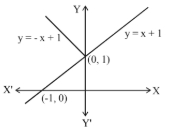
Let $f:R \to R$ be a function defined by $f(x) = \text{Min}\{x + 1, |x| + 1\}$. Then which of the following is true?
A
$f(x) \ge 1$ for all $x \in R$
B
$f(x)$ is not differentiable at $x = 1$
C
$f(x)$ is differentiable everywhere
D
$f(x)$ is not differentiable at $x = 0$
Solution
(C) The function is defined as $f(x) = \text{Min}\{x + 1, |x| + 1\}$.
We can analyze this by considering two cases for $x$:
Case $1$: $x \ge 0$. Then $|x| = x$,so $f(x) = \text{Min}\{x + 1, x + 1\} = x + 1$.
Case $2$: $x < 0$. Then $|x| = -x$,so $f(x) = \text{Min}\{x + 1, -x + 1\}$.
For $x < 0$,$x + 1 < -x + 1$ is equivalent to $2x < 0$,which is true for all $x < 0$.
Thus,$f(x) = x + 1$ for all $x < 0$.
Combining these,$f(x) = x + 1$ for all $x \in R$.
Since $f(x) = x + 1$ is a linear polynomial,it is differentiable everywhere in $R$.
Therefore,option $C$ is correct.
We can analyze this by considering two cases for $x$:
Case $1$: $x \ge 0$. Then $|x| = x$,so $f(x) = \text{Min}\{x + 1, x + 1\} = x + 1$.
Case $2$: $x < 0$. Then $|x| = -x$,so $f(x) = \text{Min}\{x + 1, -x + 1\}$.
For $x < 0$,$x + 1 < -x + 1$ is equivalent to $2x < 0$,which is true for all $x < 0$.
Thus,$f(x) = x + 1$ for all $x < 0$.
Combining these,$f(x) = x + 1$ for all $x \in R$.
Since $f(x) = x + 1$ is a linear polynomial,it is differentiable everywhere in $R$.
Therefore,option $C$ is correct.
0 likesView Solution
29
MathematicsMediumMCQAIEEE · 2007
The differential equation of all circles passing through the origin and having their centres on the $x$-axis is
A
$y^2 = x^2 + 2xy\frac{dy}{dx}$
B
$y^2 = x^2 - 2xy\frac{dy}{dx}$
C
$x^2 = y^2 + xy\frac{dy}{dx}$
D
$x^2 = y^2 + 3xy\frac{dy}{dx}$
Solution
(A) All circles passing through the origin and having their center on the $x$-axis at $(a, 0)$ will have a radius of $a$.
The general equation of such circles is given by:
$(x - a)^2 + y^2 = a^2$
$x^2 - 2ax + a^2 + y^2 = a^2$
$x^2 + y^2 - 2ax = 0$ --- $(i)$
This equation has only one arbitrary constant,$a$. Therefore,we differentiate it once with respect to $x$:
$2x + 2y\frac{dy}{dx} - 2a = 0$
$x + y\frac{dy}{dx} = a$
Substituting the value of $a$ into equation $(i)$:
$x^2 + y^2 - 2x(x + y\frac{dy}{dx}) = 0$
$x^2 + y^2 - 2x^2 - 2xy\frac{dy}{dx} = 0$
$y^2 - x^2 - 2xy\frac{dy}{dx} = 0$
$y^2 = x^2 + 2xy\frac{dy}{dx}$
The general equation of such circles is given by:
$(x - a)^2 + y^2 = a^2$
$x^2 - 2ax + a^2 + y^2 = a^2$
$x^2 + y^2 - 2ax = 0$ --- $(i)$
This equation has only one arbitrary constant,$a$. Therefore,we differentiate it once with respect to $x$:
$2x + 2y\frac{dy}{dx} - 2a = 0$
$x + y\frac{dy}{dx} = a$
Substituting the value of $a$ into equation $(i)$:
$x^2 + y^2 - 2x(x + y\frac{dy}{dx}) = 0$
$x^2 + y^2 - 2x^2 - 2xy\frac{dy}{dx} = 0$
$y^2 - x^2 - 2xy\frac{dy}{dx} = 0$
$y^2 = x^2 + 2xy\frac{dy}{dx}$
0 likesView Solution
30
MathematicsMediumMCQAIEEE · 2007
$\int \frac{dx}{\cos x + \sqrt{3} \sin x} = $
A
$\log \tan \left( \frac{x}{2} + \frac{\pi}{12} \right) + c$
B
$\log \tan \left( \frac{x}{2} - \frac{\pi}{12} \right) + c$
C
$\frac{1}{2} \log \tan \left( \frac{x}{2} + \frac{\pi}{12} \right) + c$
D
$\frac{1}{2} \log \tan \left( \frac{x}{2} - \frac{\pi}{12} \right) + c$
Solution
(C) Let $I = \int \frac{dx}{\cos x + \sqrt{3} \sin x}$.
Multiply and divide by $2$:
$I = \int \frac{dx}{2 \left( \frac{1}{2} \cos x + \frac{\sqrt{3}}{2} \sin x \right)}$.
Using $\sin \frac{\pi}{6} = \frac{1}{2}$ and $\cos \frac{\pi}{6} = \frac{\sqrt{3}}{2}$:
$I = \frac{1}{2} \int \frac{dx}{\sin \frac{\pi}{6} \cos x + \cos \frac{\pi}{6} \sin x}$.
Using the formula $\sin(A+B) = \sin A \cos B + \cos A \sin B$:
$I = \frac{1}{2} \int \frac{dx}{\sin(x + \frac{\pi}{6})} = \frac{1}{2} \int \csc(x + \frac{\pi}{6}) dx$.
Using the standard integral $\int \csc \theta d\theta = \log |\tan \frac{\theta}{2}| + C$:
$I = \frac{1}{2} \log |\tan(\frac{x}{2} + \frac{\pi}{12})| + C$.
Multiply and divide by $2$:
$I = \int \frac{dx}{2 \left( \frac{1}{2} \cos x + \frac{\sqrt{3}}{2} \sin x \right)}$.
Using $\sin \frac{\pi}{6} = \frac{1}{2}$ and $\cos \frac{\pi}{6} = \frac{\sqrt{3}}{2}$:
$I = \frac{1}{2} \int \frac{dx}{\sin \frac{\pi}{6} \cos x + \cos \frac{\pi}{6} \sin x}$.
Using the formula $\sin(A+B) = \sin A \cos B + \cos A \sin B$:
$I = \frac{1}{2} \int \frac{dx}{\sin(x + \frac{\pi}{6})} = \frac{1}{2} \int \csc(x + \frac{\pi}{6}) dx$.
Using the standard integral $\int \csc \theta d\theta = \log |\tan \frac{\theta}{2}| + C$:
$I = \frac{1}{2} \log |\tan(\frac{x}{2} + \frac{\pi}{12})| + C$.
0 likesView Solution
31
MathematicsEasyMCQAIEEE · 2007
If $\sin ^{-1}\left(\frac{x}{5}\right) + \csc ^{-1}\left(\frac{5}{4}\right) = \frac{\pi}{2}$,then $x = $
A
$4$
B
$5$
C
$1$
D
$3$
Solution
(D) Given the equation: $\sin ^{-1}\left(\frac{x}{5}\right) + \csc ^{-1}\left(\frac{5}{4}\right) = \frac{\pi}{2}$
We know that $\csc ^{-1}(z) = \sin ^{-1}\left(\frac{1}{z}\right)$. Therefore,$\csc ^{-1}\left(\frac{5}{4}\right) = \sin ^{-1}\left(\frac{4}{5}\right)$.
Substituting this into the equation: $\sin ^{-1}\left(\frac{x}{5}\right) + \sin ^{-1}\left(\frac{4}{5}\right) = \frac{\pi}{2}$
Rearranging the terms: $\sin ^{-1}\left(\frac{x}{5}\right) = \frac{\pi}{2} - \sin ^{-1}\left(\frac{4}{5}\right)$
Using the identity $\sin ^{-1}(y) + \cos ^{-1}(y) = \frac{\pi}{2}$,we have $\frac{\pi}{2} - \sin ^{-1}\left(\frac{4}{5}\right) = \cos ^{-1}\left(\frac{4}{5}\right)$.
So,$\sin ^{-1}\left(\frac{x}{5}\right) = \cos ^{-1}\left(\frac{4}{5}\right)$.
To solve for $x$,convert $\cos ^{-1}\left(\frac{4}{5}\right)$ to $\sin ^{-1}$. Since $\cos \theta = \frac{4}{5}$,the opposite side is $\sqrt{5^2 - 4^2} = 3$,so $\sin \theta = \frac{3}{5}$.
Thus,$\sin ^{-1}\left(\frac{x}{5}\right) = \sin ^{-1}\left(\frac{3}{5}\right)$.
Comparing the arguments,$\frac{x}{5} = \frac{3}{5}$,which gives $x = 3$.
We know that $\csc ^{-1}(z) = \sin ^{-1}\left(\frac{1}{z}\right)$. Therefore,$\csc ^{-1}\left(\frac{5}{4}\right) = \sin ^{-1}\left(\frac{4}{5}\right)$.
Substituting this into the equation: $\sin ^{-1}\left(\frac{x}{5}\right) + \sin ^{-1}\left(\frac{4}{5}\right) = \frac{\pi}{2}$
Rearranging the terms: $\sin ^{-1}\left(\frac{x}{5}\right) = \frac{\pi}{2} - \sin ^{-1}\left(\frac{4}{5}\right)$
Using the identity $\sin ^{-1}(y) + \cos ^{-1}(y) = \frac{\pi}{2}$,we have $\frac{\pi}{2} - \sin ^{-1}\left(\frac{4}{5}\right) = \cos ^{-1}\left(\frac{4}{5}\right)$.
So,$\sin ^{-1}\left(\frac{x}{5}\right) = \cos ^{-1}\left(\frac{4}{5}\right)$.
To solve for $x$,convert $\cos ^{-1}\left(\frac{4}{5}\right)$ to $\sin ^{-1}$. Since $\cos \theta = \frac{4}{5}$,the opposite side is $\sqrt{5^2 - 4^2} = 3$,so $\sin \theta = \frac{3}{5}$.
Thus,$\sin ^{-1}\left(\frac{x}{5}\right) = \sin ^{-1}\left(\frac{3}{5}\right)$.
Comparing the arguments,$\frac{x}{5} = \frac{3}{5}$,which gives $x = 3$.
0 likesView Solution
32
MathematicsMediumMCQAIEEE · 2007
Two aeroplanes $I$ and $II$ bomb a target in succession. The probabilities of $I$ and $II$ scoring a hit are $0.3$ and $0.2$,respectively. The second plane will bomb only if the first misses the target. The probability that the target is hit by the second plane is
A
$0.2$
B
$0.7$
C
$0.14$
D
$0.32$
0 likesView Solution
33
MathematicsMediumMCQAIEEE · 2007
$A$ pair of fair dice is thrown independently three times. The probability of getting a score of exactly $9$ twice is
A
$\frac{8}{729}$
B
$\frac{8}{243}$
C
$\frac{1}{729}$
D
$\frac{8}{9}$
Solution
(B) The total number of outcomes when a pair of dice is thrown is $6 \times 6 = 36$.
To get a score of $9$,the possible outcomes are $(3, 6), (4, 5), (5, 4), (6, 3)$.
Thus,the number of favorable outcomes is $4$.
The probability of getting a score of $9$ in a single throw is $p = \frac{4}{36} = \frac{1}{9}$.
The probability of not getting a score of $9$ is $q = 1 - p = 1 - \frac{1}{9} = \frac{8}{9}$.
Using the binomial distribution formula $P(X = k) = nC_k \times p^k \times q^{n-k}$,where $n = 3$ and $k = 2$:
$P(X = 2) = 3C_2 \times (\frac{1}{9})^2 \times (\frac{8}{9})^{3-2}$
$= 3 \times \frac{1}{81} \times \frac{8}{9}$
$= \frac{24}{729} = \frac{8}{243}$.
To get a score of $9$,the possible outcomes are $(3, 6), (4, 5), (5, 4), (6, 3)$.
Thus,the number of favorable outcomes is $4$.
The probability of getting a score of $9$ in a single throw is $p = \frac{4}{36} = \frac{1}{9}$.
The probability of not getting a score of $9$ is $q = 1 - p = 1 - \frac{1}{9} = \frac{8}{9}$.
Using the binomial distribution formula $P(X = k) = nC_k \times p^k \times q^{n-k}$,where $n = 3$ and $k = 2$:
$P(X = 2) = 3C_2 \times (\frac{1}{9})^2 \times (\frac{8}{9})^{3-2}$
$= 3 \times \frac{1}{81} \times \frac{8}{9}$
$= \frac{24}{729} = \frac{8}{243}$.
0 likesView Solution
34
MathematicsDifficultMCQAIEEE · 2007
The largest interval lying in $\left( -\frac{\pi}{2}, \frac{\pi}{2} \right)$ for which the function $f(x) = 4^{-x^2} + \cos^{-1}\left( \frac{x}{2} - 1 \right) + \log(\cos x)$ is defined is:
A
$\left[ -\frac{\pi}{4}, \frac{\pi}{2} \right)$
B
$\left[ 0, \frac{\pi}{2} \right)$
C
$\left[ 0, \pi \right]$
D
$\left( -\frac{\pi}{2}, \frac{\pi}{2} \right)$
Solution
(B) The function $f(x) = 4^{-x^2} + \cos^{-1}\left( \frac{x}{2} - 1 \right) + \log(\cos x)$ is defined if all its components are defined.
$1$. For $\cos^{-1}\left( \frac{x}{2} - 1 \right)$ to be defined,we must have $-1 \leq \frac{x}{2} - 1 \leq 1$.
Adding $1$ to all parts: $0 \leq \frac{x}{2} \leq 2$.
Multiplying by $2$: $0 \leq x \leq 4$.
$2$. For $\log(\cos x)$ to be defined,we must have $\cos x > 0$.
In the interval $\left( -\frac{\pi}{2}, \frac{\pi}{2} \right)$,$\cos x > 0$ is always true.
$3$. Combining these conditions with the given interval $\left( -\frac{\pi}{2}, \frac{\pi}{2} \right)$:
We need $x \in [0, 4]$ $AND$ $x \in \left( -\frac{\pi}{2}, \frac{\pi}{2} \right)$.
Since $\frac{\pi}{2} \approx 1.57$,the intersection is $[0, \frac{\pi}{2})$.
Thus,the largest interval is $\left[ 0, \frac{\pi}{2} \right)$.
$1$. For $\cos^{-1}\left( \frac{x}{2} - 1 \right)$ to be defined,we must have $-1 \leq \frac{x}{2} - 1 \leq 1$.
Adding $1$ to all parts: $0 \leq \frac{x}{2} \leq 2$.
Multiplying by $2$: $0 \leq x \leq 4$.
$2$. For $\log(\cos x)$ to be defined,we must have $\cos x > 0$.
In the interval $\left( -\frac{\pi}{2}, \frac{\pi}{2} \right)$,$\cos x > 0$ is always true.
$3$. Combining these conditions with the given interval $\left( -\frac{\pi}{2}, \frac{\pi}{2} \right)$:
We need $x \in [0, 4]$ $AND$ $x \in \left( -\frac{\pi}{2}, \frac{\pi}{2} \right)$.
Since $\frac{\pi}{2} \approx 1.57$,the intersection is $[0, \frac{\pi}{2})$.
Thus,the largest interval is $\left[ 0, \frac{\pi}{2} \right)$.
0 likesView Solution
35
MathematicsEasyMCQAIEEE · 2007
If a line makes an angle of $45^\circ$ with the positive directions of each of $x$-axis and $y$-axis,then the angle that the line makes with the positive direction of the $z$-axis is .............. $^\circ$.
A
$30$
B
$45$
C
$60$
D
$90$
Solution
(D) Let the angles the line makes with the positive directions of the $x$,$y$,and $z$-axes be $\alpha, \beta$,and $\gamma$ respectively.
Given that $\alpha = 45^\circ$ and $\beta = 45^\circ$.
Let the direction cosines of the line be $l, m, n$.
Then $l = \cos \alpha = \cos 45^\circ = \frac{1}{\sqrt{2}}$,
$m = \cos \beta = \cos 45^\circ = \frac{1}{\sqrt{2}}$,
$n = \cos \gamma$.
We know that $l^2 + m^2 + n^2 = 1$.
Substituting the values,we get $(\frac{1}{\sqrt{2}})^2 + (\frac{1}{\sqrt{2}})^2 + \cos^2 \gamma = 1$.
$\frac{1}{2} + \frac{1}{2} + \cos^2 \gamma = 1$.
$1 + \cos^2 \gamma = 1$.
$\cos^2 \gamma = 0$.
$\cos \gamma = 0$.
Therefore,$\gamma = 90^\circ$.
Given that $\alpha = 45^\circ$ and $\beta = 45^\circ$.
Let the direction cosines of the line be $l, m, n$.
Then $l = \cos \alpha = \cos 45^\circ = \frac{1}{\sqrt{2}}$,
$m = \cos \beta = \cos 45^\circ = \frac{1}{\sqrt{2}}$,
$n = \cos \gamma$.
We know that $l^2 + m^2 + n^2 = 1$.
Substituting the values,we get $(\frac{1}{\sqrt{2}})^2 + (\frac{1}{\sqrt{2}})^2 + \cos^2 \gamma = 1$.
$\frac{1}{2} + \frac{1}{2} + \cos^2 \gamma = 1$.
$1 + \cos^2 \gamma = 1$.
$\cos^2 \gamma = 0$.
$\cos \gamma = 0$.
Therefore,$\gamma = 90^\circ$.
0 likesView Solution
36
MathematicsMediumMCQAIEEE · 2007
If $\vec{u}$ and $\vec{v}$ are unit vectors and $\theta$ is the acute angle between them,then $2\vec{u} \times 3\vec{v}$ is a unit vector for
A
exactly one value of $\theta$
B
exactly two values of $\theta$
C
more than two values of $\theta$
D
no value of $\theta$
Solution
(A) Given that $2\vec{u} \times 3\vec{v}$ is a unit vector,its magnitude must be $1$.
Thus,$|2\vec{u} \times 3\vec{v}| = 1$.
Since $\vec{u}$ and $\vec{v}$ are unit vectors,we have $|\vec{u}| = 1$ and $|\vec{v}| = 1$.
Using the property of the cross product,$|2\vec{u} \times 3\vec{v}| = 6|\vec{u}||\vec{v}|\sin\theta = 6(1)(1)\sin\theta = 6\sin\theta$.
According to the problem,$6\sin\theta = 1$,which implies $\sin\theta = \frac{1}{6}$.
Since $\theta$ is an acute angle,there exists exactly one value of $\theta$ such that $\theta = \arcsin(\frac{1}{6})$.
Thus,$|2\vec{u} \times 3\vec{v}| = 1$.
Since $\vec{u}$ and $\vec{v}$ are unit vectors,we have $|\vec{u}| = 1$ and $|\vec{v}| = 1$.
Using the property of the cross product,$|2\vec{u} \times 3\vec{v}| = 6|\vec{u}||\vec{v}|\sin\theta = 6(1)(1)\sin\theta = 6\sin\theta$.
According to the problem,$6\sin\theta = 1$,which implies $\sin\theta = \frac{1}{6}$.
Since $\theta$ is an acute angle,there exists exactly one value of $\theta$ such that $\theta = \arcsin(\frac{1}{6})$.
0 likesView Solution
37
MathematicsMediumMCQAIEEE · 2007
Let $\vec{a} = \hat{i} + \hat{j} + \hat{k}$,$\vec{b} = \hat{i} - \hat{j} + 2\hat{k}$,and $\vec{c} = x\hat{i} + (x-2)\hat{j} - \hat{k}$. If the vector $\vec{c}$ lies in the plane of $\vec{a}$ and $\vec{b}$,then $x$ equals:
A
$0$
B
$1$
C
$-4$
D
$-2$
Solution
(D) Given vectors are $\vec{a} = \hat{i} + \hat{j} + \hat{k}$,$\vec{b} = \hat{i} - \hat{j} + 2\hat{k}$,and $\vec{c} = x\hat{i} + (x-2)\hat{j} - \hat{k}$.
Since $\vec{c}$ lies in the plane of $\vec{a}$ and $\vec{b}$,the scalar triple product $[\vec{a} \vec{b} \vec{c}]$ must be zero.
This implies the determinant of the components is zero:
$\begin{vmatrix} 1 & 1 & 1 \\ 1 & -1 & 2 \\ x & x-2 & -1 \end{vmatrix} = 0$
Expanding the determinant along the first row:
$1((-1)(-1) - 2(x-2)) - 1((1)(-1) - 2(x)) + 1((1)(x-2) - (-1)(x)) = 0$
$1(1 - 2x + 4) - 1(-1 - 2x) + 1(x - 2 + x) = 0$
$(5 - 2x) + (1 + 2x) + (2x - 2) = 0$
$5 - 2x + 1 + 2x + 2x - 2 = 0$
$2x + 4 = 0$
$2x = -4$
$x = -2$
Since $\vec{c}$ lies in the plane of $\vec{a}$ and $\vec{b}$,the scalar triple product $[\vec{a} \vec{b} \vec{c}]$ must be zero.
This implies the determinant of the components is zero:
$\begin{vmatrix} 1 & 1 & 1 \\ 1 & -1 & 2 \\ x & x-2 & -1 \end{vmatrix} = 0$
Expanding the determinant along the first row:
$1((-1)(-1) - 2(x-2)) - 1((1)(-1) - 2(x)) + 1((1)(x-2) - (-1)(x)) = 0$
$1(1 - 2x + 4) - 1(-1 - 2x) + 1(x - 2 + x) = 0$
$(5 - 2x) + (1 + 2x) + (2x - 2) = 0$
$5 - 2x + 1 + 2x + 2x - 2 = 0$
$2x + 4 = 0$
$2x = -4$
$x = -2$
0 likesView Solution
38
MathematicsMediumMCQAIEEE · 2007
The vector $\vec{a} = (\alpha, 2, \beta)$ lies in the plane of the vectors $\vec{b} = (1, 1, 0)$ and $\vec{c} = (0, 1, 1)$ and bisects the angle between $\vec{b}$ and $\vec{c}$. Then which one of the following gives the possible values of $\alpha$ and $\beta$?
A
$\alpha = 2, \beta = 2$
B
$\alpha = -1, \beta = 1$
C
$\alpha = 2, \beta = 1$
D
$\alpha = 1, \beta = 1$
Solution
(D) Since $\vec{a}, \vec{b},$ and $\vec{c}$ are coplanar,their scalar triple product is zero:
$[\vec{a} \vec{b} \vec{c}] = 0$
$\begin{vmatrix} \alpha & 2 & \beta \\ 1 & 1 & 0 \\ 0 & 1 & 1 \end{vmatrix} = 0$
$\alpha(1-0) - 2(1-0) + \beta(1-0) = 0 \Rightarrow \alpha - 2 + \beta = 0 \Rightarrow \alpha + \beta = 2 \dots (i)$
Since $\vec{a}$ bisects the angle between $\vec{b}$ and $\vec{c}$,$\vec{a}$ must be proportional to the sum of the unit vectors along $\vec{b}$ and $\vec{c}$:
$\hat{b} = \frac{\vec{b}}{|\vec{b}|} = \frac{(1, 1, 0)}{\sqrt{2}}, \hat{c} = \frac{\vec{c}}{|\vec{c}|} = \frac{(0, 1, 1)}{\sqrt{2}}$
$\vec{a} = k(\hat{b} + \hat{c}) = \frac{k}{\sqrt{2}}(1, 2, 1)$
Comparing this with $\vec{a} = (\alpha, 2, \beta)$,we get $\frac{k}{\sqrt{2}} = 1$,so $k = \sqrt{2}$.
Thus,$\alpha = 1$ and $\beta = 1$.
$[\vec{a} \vec{b} \vec{c}] = 0$
$\begin{vmatrix} \alpha & 2 & \beta \\ 1 & 1 & 0 \\ 0 & 1 & 1 \end{vmatrix} = 0$
$\alpha(1-0) - 2(1-0) + \beta(1-0) = 0 \Rightarrow \alpha - 2 + \beta = 0 \Rightarrow \alpha + \beta = 2 \dots (i)$
Since $\vec{a}$ bisects the angle between $\vec{b}$ and $\vec{c}$,$\vec{a}$ must be proportional to the sum of the unit vectors along $\vec{b}$ and $\vec{c}$:
$\hat{b} = \frac{\vec{b}}{|\vec{b}|} = \frac{(1, 1, 0)}{\sqrt{2}}, \hat{c} = \frac{\vec{c}}{|\vec{c}|} = \frac{(0, 1, 1)}{\sqrt{2}}$
$\vec{a} = k(\hat{b} + \hat{c}) = \frac{k}{\sqrt{2}}(1, 2, 1)$
Comparing this with $\vec{a} = (\alpha, 2, \beta)$,we get $\frac{k}{\sqrt{2}} = 1$,so $k = \sqrt{2}$.
Thus,$\alpha = 1$ and $\beta = 1$.
0 likesView Solution
Vedclass Products
For Students
Vedclass Test Series
Mock tests in real AIEEE style covering Mathematics with performance analysis. 5-day free trial.
Start Free TrialFor Teachers
Exam Paper Generator
Generate Set A/B/C/D Mathematics papers from 7.5L+ questions in 2 minutes. 3 chapters free.
Try FreeFor Institutes
Online Exam Module
Run live AIEEE mock exams with unlimited students, 360° analytics & white-label branding.
See DemoFrequently Asked Questions
How many Mathematics questions are in AIEEE 2007?
There are 38 Mathematics questions from the AIEEE 2007 paper on Vedclass, each with a detailed step-by-step solution in English.
Are AIEEE 2007 Mathematics solutions available in English?
Yes. All solutions on this page are in English. You can also switch to English or Hindi using the language buttons above the questions.
Can I practice AIEEE 2007 Mathematics as a timed test?
Yes. Use the Vedclass Test Series to attempt a full AIEEE mock test covering Mathematics with time limits and instant score analysis.
Can teachers create Mathematics papers from AIEEE previous year questions?
Yes. The Vedclass Exam Paper Generator lets teachers mix AIEEE Mathematics questions and generate Set A/B/C/D papers in minutes.
For Teachers & Institutes
Build a Custom Mathematics Paper
Pick AIEEE 2007 Mathematics questions, set difficulty, and generate Set A/B/C/D in 2 minutes.