
MathematicsQ1–64 of 64 questions
Page 1 of 1 · English
1
MathematicsEasyMCQAIEEE · 2002
The inequality $|z - 4| < |z - 2|$ represents the region given by
A
$\text{Re}(z) > 0$
B
$\text{Re}(z) < 0$
C
$\text{Re}(z) > 2$
D
None of these
Solution
(D) Given inequality: $|z - 4| < |z - 2|$
Squaring both sides: $|z - 4|^2 < |z - 2|^2$
Let $z = x + iy$. Then $|(x - 4) + iy|^2 < |(x - 2) + iy|^2$
$(x - 4)^2 + y^2 < (x - 2)^2 + y^2$
$x^2 - 8x + 16 + y^2 < x^2 - 4x + 4 + y^2$
$-8x + 16 < -4x + 4$
$12 < 4x$
$x > 3$
Since $x = \text{Re}(z)$,the region is $\text{Re}(z) > 3$.
Thus,the correct option is $D$.
Squaring both sides: $|z - 4|^2 < |z - 2|^2$
Let $z = x + iy$. Then $|(x - 4) + iy|^2 < |(x - 2) + iy|^2$
$(x - 4)^2 + y^2 < (x - 2)^2 + y^2$
$x^2 - 8x + 16 + y^2 < x^2 - 4x + 4 + y^2$
$-8x + 16 < -4x + 4$
$12 < 4x$
$x > 3$
Since $x = \text{Re}(z)$,the region is $\text{Re}(z) > 3$.
Thus,the correct option is $D$.
0 likesView Solution
2
MathematicsMediumMCQAIEEE · 2002
Let $z$ and $w$ be two non-zero complex numbers such that $|z| = |w|$ and $arg(z) + arg(w) = \pi$. Then $z$ is equal to:
A
$w$
B
$-w$
C
$\overline{w}$
D
$-\overline{w}$
Solution
(D) Let $z = r(\cos \theta_1 + i \sin \theta_1)$ and $w = r(\cos \theta_2 + i \sin \theta_2)$,where $|z| = |w| = r$.
Given $arg(z) + arg(w) = \theta_1 + \theta_2 = \pi$,so $\theta_1 = \pi - \theta_2$.
Substituting this into $z$:
$z = r(\cos(\pi - \theta_2) + i \sin(\pi - \theta_2))$
$z = r(-\cos \theta_2 + i \sin \theta_2)$
Since $\overline{w} = r(\cos \theta_2 - i \sin \theta_2)$,we have $-\overline{w} = r(-\cos \theta_2 + i \sin \theta_2)$.
Thus,$z = -\overline{w}$.
Given $arg(z) + arg(w) = \theta_1 + \theta_2 = \pi$,so $\theta_1 = \pi - \theta_2$.
Substituting this into $z$:
$z = r(\cos(\pi - \theta_2) + i \sin(\pi - \theta_2))$
$z = r(-\cos \theta_2 + i \sin \theta_2)$
Since $\overline{w} = r(\cos \theta_2 - i \sin \theta_2)$,we have $-\overline{w} = r(-\cos \theta_2 + i \sin \theta_2)$.
Thus,$z = -\overline{w}$.
0 likesView Solution
3
MathematicsEasyMCQAIEEE · 2002
If the fifth term of a $G.P.$ is $2$,then the product of its first $9$ terms is:
A
$256$
B
$512$
C
$1024$
D
None of these
Solution
(B) Let the $9$ terms of a $G.P.$ be $\frac{a}{r^4}, \frac{a}{r^3}, \frac{a}{r^2}, \frac{a}{r}, a, ar, ar^2, ar^3, ar^4$.
The fifth term is $a = 2$.
The product of these $9$ terms is $P = \left(\frac{a}{r^4}\right) \times \left(\frac{a}{r^3}\right) \times \left(\frac{a}{r^2}\right) \times \left(\frac{a}{r}\right) \times a \times (ar) \times (ar^2) \times (ar^3) \times (ar^4)$.
Simplifying the product,we get $P = a^9$.
Since $a = 2$,the product is $P = 2^9 = 512$.
The fifth term is $a = 2$.
The product of these $9$ terms is $P = \left(\frac{a}{r^4}\right) \times \left(\frac{a}{r^3}\right) \times \left(\frac{a}{r^2}\right) \times \left(\frac{a}{r}\right) \times a \times (ar) \times (ar^2) \times (ar^3) \times (ar^4)$.
Simplifying the product,we get $P = a^9$.
Since $a = 2$,the product is $P = 2^9 = 512$.
0 likesView Solution
4
MathematicsMediumMCQAIEEE · 2002
The sum of an infinite number of terms in a $G.P.$ is $20$ and the sum of their squares is $100$. The common ratio of the $G.P.$ is:
A
$5$
B
$3/5$
C
$8/5$
D
$1/5$
Solution
(B) Let the first term be $a$ and the common ratio be $r$. The sum of an infinite $G.P.$ is given by $S = \frac{a}{1-r} = 20 \quad (i)$.
The sum of the squares of the terms is given by $\frac{a^2}{1-r^2} = 100 \quad (ii)$.
We can rewrite $(ii)$ as $\frac{a}{1-r} \times \frac{a}{1+r} = 100$.
Substituting $(i)$ into this equation: $20 \times \frac{a}{1+r} = 100$,which simplifies to $\frac{a}{1+r} = 5 \quad (iii)$.
From $(i)$,$a = 20(1-r)$. Substituting this into $(iii)$:
$\frac{20(1-r)}{1+r} = 5$
$4(1-r) = 1+r$
$4 - 4r = 1 + r$
$3 = 5r$
$r = 3/5$.
The sum of the squares of the terms is given by $\frac{a^2}{1-r^2} = 100 \quad (ii)$.
We can rewrite $(ii)$ as $\frac{a}{1-r} \times \frac{a}{1+r} = 100$.
Substituting $(i)$ into this equation: $20 \times \frac{a}{1+r} = 100$,which simplifies to $\frac{a}{1+r} = 5 \quad (iii)$.
From $(i)$,$a = 20(1-r)$. Substituting this into $(iii)$:
$\frac{20(1-r)}{1+r} = 5$
$4(1-r) = 1+r$
$4 - 4r = 1 + r$
$3 = 5r$
$r = 3/5$.
0 likesView Solution
5
MathematicsMediumMCQAIEEE · 2002
$2^{1/4} \cdot 4^{1/8} \cdot 8^{1/16} \cdot 16^{1/32} \cdots$ is equal to
A
$1$
B
$2$
C
$\frac{3}{2}$
D
$\frac{5}{2}$
Solution
(B) Let the given expression be $P = 2^{1/4} \cdot 4^{1/8} \cdot 8^{1/16} \cdot 16^{1/32} \cdots$
Expressing all terms with base $2$:
$P = 2^{1/4} \cdot (2^2)^{1/8} \cdot (2^3)^{1/16} \cdot (2^4)^{1/32} \cdots$
$P = 2^{1/4 + 2/8 + 3/16 + 4/32 + \cdots} = 2^S$,where $S = \sum_{n=1}^{\infty} \frac{n}{2^{n+1}}$.
$S = \frac{1}{4} + \frac{2}{8} + \frac{3}{16} + \frac{4}{32} + \cdots$ $(i)$
$\frac{1}{2}S = \frac{1}{8} + \frac{2}{16} + \frac{3}{32} + \cdots$ $(ii)$
Subtracting $(ii)$ from $(i)$:
$S - \frac{1}{2}S = \frac{1}{4} + (\frac{2}{8} - \frac{1}{8}) + (\frac{3}{16} - \frac{2}{16}) + \cdots$
$\frac{1}{2}S = \frac{1}{4} + \frac{1}{8} + \frac{1}{16} + \cdots$
This is an infinite geometric series with $a = 1/4$ and $r = 1/2$.
$\frac{1}{2}S = \frac{1/4}{1 - 1/2} = \frac{1/4}{1/2} = \frac{1}{2}$.
Thus,$S = 1$.
Therefore,$P = 2^1 = 2$.
Expressing all terms with base $2$:
$P = 2^{1/4} \cdot (2^2)^{1/8} \cdot (2^3)^{1/16} \cdot (2^4)^{1/32} \cdots$
$P = 2^{1/4 + 2/8 + 3/16 + 4/32 + \cdots} = 2^S$,where $S = \sum_{n=1}^{\infty} \frac{n}{2^{n+1}}$.
$S = \frac{1}{4} + \frac{2}{8} + \frac{3}{16} + \frac{4}{32} + \cdots$ $(i)$
$\frac{1}{2}S = \frac{1}{8} + \frac{2}{16} + \frac{3}{32} + \cdots$ $(ii)$
Subtracting $(ii)$ from $(i)$:
$S - \frac{1}{2}S = \frac{1}{4} + (\frac{2}{8} - \frac{1}{8}) + (\frac{3}{16} - \frac{2}{16}) + \cdots$
$\frac{1}{2}S = \frac{1}{4} + \frac{1}{8} + \frac{1}{16} + \cdots$
This is an infinite geometric series with $a = 1/4$ and $r = 1/2$.
$\frac{1}{2}S = \frac{1/4}{1 - 1/2} = \frac{1/4}{1/2} = \frac{1}{2}$.
Thus,$S = 1$.
Therefore,$P = 2^1 = 2$.
0 likesView Solution
6
MathematicsEasyMCQAIEEE · 2002
If $p$ and $q$ are the roots of $x^2 + px + q = 0$,then
A
$p = 1, q = -2$
B
$p = -2, q = 1$
C
$p = 1, q = 0$
D
$p = -2, q = 0$
Solution
(A) For the quadratic equation $x^2 + px + q = 0$,the sum of the roots is $p + q = -p$ and the product of the roots is $pq = q$.
From $pq = q$,we have $q(p - 1) = 0$,which implies $q = 0$ or $p = 1$.
Case $1$: If $q = 0$,then $p + 0 = -p$,which gives $2p = 0$,so $p = 0$. This gives the roots $(0, 0)$.
Case $2$: If $p = 1$,then $1 + q = -1$,which gives $q = -2$. This gives the roots $(1, -2)$.
Comparing with the given options,the correct pair is $p = 1, q = -2$.
From $pq = q$,we have $q(p - 1) = 0$,which implies $q = 0$ or $p = 1$.
Case $1$: If $q = 0$,then $p + 0 = -p$,which gives $2p = 0$,so $p = 0$. This gives the roots $(0, 0)$.
Case $2$: If $p = 1$,then $1 + q = -1$,which gives $q = -2$. This gives the roots $(1, -2)$.
Comparing with the given options,the correct pair is $p = 1, q = -2$.
0 likesView Solution
7
MathematicsMediumMCQAIEEE · 2002
If $\alpha \ne \beta$ but $\alpha^2 = 5\alpha - 3$ and $\beta^2 = 5\beta - 3$,then the equation whose roots are $\frac{\alpha}{\beta}$ and $\frac{\beta}{\alpha}$ is
A
$3x^2 - 25x + 3 = 0$
B
$x^2 + 5x - 3 = 0$
C
$x^2 - 5x + 3 = 0$
D
$3x^2 - 19x + 3 = 0$
Solution
(D) Given $\alpha^2 - 5\alpha + 3 = 0$ and $\beta^2 - 5\beta + 3 = 0$.
This implies that $\alpha$ and $\beta$ are the roots of the quadratic equation $x^2 - 5x + 3 = 0$.
From the properties of roots,we have:
Sum of roots: $\alpha + \beta = 5$
Product of roots: $\alpha \beta = 3$
We need to find the equation whose roots are $\frac{\alpha}{\beta}$ and $\frac{\beta}{\alpha}$.
Sum of new roots: $S = \frac{\alpha}{\beta} + \frac{\beta}{\alpha} = \frac{\alpha^2 + \beta^2}{\alpha \beta} = \frac{(\alpha + \beta)^2 - 2\alpha \beta}{\alpha \beta} = \frac{5^2 - 2(3)}{3} = \frac{25 - 6}{3} = \frac{19}{3}$.
Product of new roots: $P = \frac{\alpha}{\beta} \times \frac{\beta}{\alpha} = 1$.
The required equation is $x^2 - Sx + P = 0$.
Substituting the values: $x^2 - \frac{19}{3}x + 1 = 0$.
Multiplying by $3$,we get $3x^2 - 19x + 3 = 0$.
This implies that $\alpha$ and $\beta$ are the roots of the quadratic equation $x^2 - 5x + 3 = 0$.
From the properties of roots,we have:
Sum of roots: $\alpha + \beta = 5$
Product of roots: $\alpha \beta = 3$
We need to find the equation whose roots are $\frac{\alpha}{\beta}$ and $\frac{\beta}{\alpha}$.
Sum of new roots: $S = \frac{\alpha}{\beta} + \frac{\beta}{\alpha} = \frac{\alpha^2 + \beta^2}{\alpha \beta} = \frac{(\alpha + \beta)^2 - 2\alpha \beta}{\alpha \beta} = \frac{5^2 - 2(3)}{3} = \frac{25 - 6}{3} = \frac{19}{3}$.
Product of new roots: $P = \frac{\alpha}{\beta} \times \frac{\beta}{\alpha} = 1$.
The required equation is $x^2 - Sx + P = 0$.
Substituting the values: $x^2 - \frac{19}{3}x + 1 = 0$.
Multiplying by $3$,we get $3x^2 - 19x + 3 = 0$.
0 likesView Solution
8
MathematicsEasyMCQAIEEE · 2002
What is the product of the real roots of the equation ${t^2}{x^2} + |x| + 9 = 0$?
A
Is always positive
B
Is always negative
C
Does not exist
D
None of these
Solution
(C) Given the equation ${t^2}{x^2} + |x| + 9 = 0$.
For any real number $t$ and $x$,we know that ${t^2}{x^2} \ge 0$ and $|x| \ge 0$.
Therefore,${t^2}{x^2} + |x| + 9 \ge 9$.
Since the expression is always greater than or equal to $9$,it can never be equal to $0$.
Thus,the equation has no real roots.
Consequently,the product of the real roots does not exist.
For any real number $t$ and $x$,we know that ${t^2}{x^2} \ge 0$ and $|x| \ge 0$.
Therefore,${t^2}{x^2} + |x| + 9 \ge 9$.
Since the expression is always greater than or equal to $9$,it can never be equal to $0$.
Thus,the equation has no real roots.
Consequently,the product of the real roots does not exist.
0 likesView Solution
9
MathematicsEasyMCQAIEEE · 2002
Numbers greater than $1000$ but not greater than $4000$ which can be formed with the digits $0, 1, 2, 3, 4$ (repetition of digits is allowed),are
A
$350$
B
$375$
C
$450$
D
$576$
Solution
(B) The numbers are $4$-digit numbers formed using the set $\{0, 1, 2, 3, 4\}$.
Since the number must be greater than $1000$ and less than or equal to $4000$,the first digit can be $1, 2, 3,$ or $4$.
Case $1$: First digit is $1, 2,$ or $3$.
For each of these $3$ choices,the remaining $3$ positions can each be filled in $5$ ways (digits $0, 1, 2, 3, 4$).
Total numbers for these cases $= 3 \times 5 \times 5 \times 5 = 375$.
However,we must exclude the case where the number is $1000$ (since it must be greater than $1000$).
So,$375 - 1 = 374$ numbers.
Case $2$: First digit is $4$.
The only number $\le 4000$ starting with $4$ is $4000$ itself.
Adding this to our count: $374 + 1 = 375$.
Thus,the total count is $375$.
Since the number must be greater than $1000$ and less than or equal to $4000$,the first digit can be $1, 2, 3,$ or $4$.
Case $1$: First digit is $1, 2,$ or $3$.
For each of these $3$ choices,the remaining $3$ positions can each be filled in $5$ ways (digits $0, 1, 2, 3, 4$).
Total numbers for these cases $= 3 \times 5 \times 5 \times 5 = 375$.
However,we must exclude the case where the number is $1000$ (since it must be greater than $1000$).
So,$375 - 1 = 374$ numbers.
Case $2$: First digit is $4$.
The only number $\le 4000$ starting with $4$ is $4000$ itself.
Adding this to our count: $374 + 1 = 375$.
Thus,the total count is $375$.
0 likesView Solution
10
MathematicsEasyMCQAIEEE · 2002
Total number of four-digit odd numbers that can be formed using $0, 1, 2, 3, 5, 7$ (repetition is allowed) is:
A
$216$
B
$375$
C
$400$
D
$720$
Solution
(D) four-digit number is represented as $d_1 d_2 d_3 d_4$.
For the number to be odd,the last digit $d_4$ must be chosen from the set $\{1, 3, 5, 7\}$. There are $4$ ways to fill $d_4$.
For the first digit $d_1$,it cannot be $0$ (otherwise it would be a three-digit number). Thus,$d_1$ can be chosen from $\{1, 2, 3, 5, 7\}$,which gives $5$ ways.
For the second digit $d_2$ and third digit $d_3$,since repetition is allowed,each can be filled by any of the $6$ digits $\{0, 1, 2, 3, 5, 7\}$. Thus,there are $6$ ways for $d_2$ and $6$ ways for $d_3$.
Using the fundamental principle of counting,the total number of such odd numbers is $5 \times 6 \times 6 \times 4 = 720$.
For the number to be odd,the last digit $d_4$ must be chosen from the set $\{1, 3, 5, 7\}$. There are $4$ ways to fill $d_4$.
For the first digit $d_1$,it cannot be $0$ (otherwise it would be a three-digit number). Thus,$d_1$ can be chosen from $\{1, 2, 3, 5, 7\}$,which gives $5$ ways.
For the second digit $d_2$ and third digit $d_3$,since repetition is allowed,each can be filled by any of the $6$ digits $\{0, 1, 2, 3, 5, 7\}$. Thus,there are $6$ ways for $d_2$ and $6$ ways for $d_3$.
Using the fundamental principle of counting,the total number of such odd numbers is $5 \times 6 \times 6 \times 4 = 720$.
0 likesView Solution
11
MathematicsMediumMCQAIEEE · 2002
$A$ five-digit number divisible by $3$ has to be formed using the numerals $0, 1, 2, 3, 4,$ and $5$ without repetition. The total number of ways in which this can be done is:
A
$216$
B
$240$
C
$600$
D
$3125$
Solution
(A) number is divisible by $3$ if the sum of its digits is divisible by $3$. The sum of all given digits ${0, 1, 2, 3, 4, 5}$ is $15$. To form a $5$-digit number,we must exclude one digit such that the sum of the remaining $5$ digits is divisible by $3$.
Case $1$: Exclude $0$. The remaining digits are ${1, 2, 3, 4, 5}$. The sum is $15$,which is divisible by $3$. The number of $5$-digit numbers is $5! = 120$.
Case $2$: Exclude $3$. The remaining digits are ${0, 1, 2, 4, 5}$. The sum is $12$,which is divisible by $3$. The number of $5$-digit numbers is $5! - 4! = 120 - 24 = 96$ (subtracting cases where $0$ is in the first position).
Total ways = $120 + 96 = 216$.
Case $1$: Exclude $0$. The remaining digits are ${1, 2, 3, 4, 5}$. The sum is $15$,which is divisible by $3$. The number of $5$-digit numbers is $5! = 120$.
Case $2$: Exclude $3$. The remaining digits are ${0, 1, 2, 4, 5}$. The sum is $12$,which is divisible by $3$. The number of $5$-digit numbers is $5! - 4! = 120 - 24 = 96$ (subtracting cases where $0$ is in the first position).
Total ways = $120 + 96 = 216$.
0 likesView Solution
12
MathematicsMediumMCQAIEEE · 2002
The positive integer just greater than $(1 + 0.0001)^{10000}$ is
A
$4$
B
$5$
C
$2$
D
$3$
Solution
(D) We know that $e = \lim_{n \to \infty} (1 + \frac{1}{n})^n$ and $2 < e < 3$.
For $n = 10000$,the expression $(1 + \frac{1}{10000})^{10000} = (1 + 0.0001)^{10000}$.
Since the sequence $(1 + \frac{1}{n})^n$ is strictly increasing and approaches $e$ from below,we have $(1 + 0.0001)^{10000} < e < 3$.
Using the binomial expansion,$(1 + 0.0001)^{10000} = 1 + 10000(0.0001) + \frac{10000 \times 9999}{2!} (0.0001)^2 + \dots = 1 + 1 + \frac{0.9999}{2} + \dots > 2$.
Thus,$2 < (1 + 0.0001)^{10000} < 3$.
The positive integer just greater than $(1 + 0.0001)^{10000}$ is $3$.
Therefore,the correct option is $D$.
For $n = 10000$,the expression $(1 + \frac{1}{10000})^{10000} = (1 + 0.0001)^{10000}$.
Since the sequence $(1 + \frac{1}{n})^n$ is strictly increasing and approaches $e$ from below,we have $(1 + 0.0001)^{10000} < e < 3$.
Using the binomial expansion,$(1 + 0.0001)^{10000} = 1 + 10000(0.0001) + \frac{10000 \times 9999}{2!} (0.0001)^2 + \dots = 1 + 1 + \frac{0.9999}{2} + \dots > 2$.
Thus,$2 < (1 + 0.0001)^{10000} < 3$.
The positive integer just greater than $(1 + 0.0001)^{10000}$ is $3$.
Therefore,the correct option is $D$.
0 likesView Solution
13
MathematicsEasyMCQAIEEE · 2002
If $p$ and $q$ are positive integers,then the coefficients of $x^p$ and $x^q$ in the expansion of $(1 + x)^{p + q}$ are
A
Equal
B
Equal in magnitude but opposite in sign
C
Reciprocal to each other
D
None of these
Solution
(A) The general term in the expansion of $(1 + x)^n$ is given by $T_{r+1} = ^nC_r x^r$.
For the expansion of $(1 + x)^{p+q}$,the coefficient of $x^p$ is $^{p+q}C_p$.
Similarly,the coefficient of $x^q$ is $^{p+q}C_q$.
Using the property of binomial coefficients,$^nC_r = ^nC_{n-r}$,we have:
$^{p+q}C_p = ^{p+q}C_{(p+q)-p} = ^{p+q}C_q$.
Therefore,the coefficients of $x^p$ and $x^q$ are equal.
For the expansion of $(1 + x)^{p+q}$,the coefficient of $x^p$ is $^{p+q}C_p$.
Similarly,the coefficient of $x^q$ is $^{p+q}C_q$.
Using the property of binomial coefficients,$^nC_r = ^nC_{n-r}$,we have:
$^{p+q}C_p = ^{p+q}C_{(p+q)-p} = ^{p+q}C_q$.
Therefore,the coefficients of $x^p$ and $x^q$ are equal.
0 likesView Solution
14
MathematicsMediumMCQAIEEE · 2002
${\left( {\frac{a}{{a + x}}} \right)^{\frac{1}{2}}} + {\left( {\frac{a}{{a - x}}} \right)^{\frac{1}{2}}} = $
A
$2 + \frac{{3{x^2}}}{{4{a^2}}} + \dots$
B
$1 + \frac{{3{x^2}}}{{8{a^2}}} + \dots$
C
$2 + \frac{x}{a} + \frac{{3{x^2}}}{{4{a^2}}} + \dots$
D
$2 - \frac{x}{a} + \frac{{3{x^2}}}{{4{a^2}}} + \dots$
Solution
(A) We have the expression: ${\left( {1 + \frac{x}{a}} \right)^{-1/2}} + {\left( {1 - \frac{x}{a}} \right)^{-1/2}}$.
Using the binomial expansion $(1+z)^n = 1 + nz + \frac{n(n-1)}{2!}z^2 + \dots$,we expand both terms:
${\left( {1 + \frac{x}{a}} \right)^{-1/2}} = 1 - \frac{1}{2}\left( \frac{x}{a} \right) + \frac{(-1/2)(-3/2)}{2}\left( \frac{x}{a} \right)^2 + \dots = 1 - \frac{x}{2a} + \frac{3x^2}{8a^2} + \dots$
${\left( {1 - \frac{x}{a}} \right)^{-1/2}} = 1 - \frac{1}{2}\left( -\frac{x}{a} \right) + \frac{(-1/2)(-3/2)}{2}\left( -\frac{x}{a} \right)^2 + \dots = 1 + \frac{x}{2a} + \frac{3x^2}{8a^2} + \dots$
Adding these two expansions,the odd terms (involving $x/a$) cancel out:
$(1 + 1) + (-\frac{x}{2a} + \frac{x}{2a}) + (\frac{3x^2}{8a^2} + \frac{3x^2}{8a^2}) + \dots = 2 + \frac{6x^2}{8a^2} + \dots = 2 + \frac{3x^2}{4a^2} + \dots$
Using the binomial expansion $(1+z)^n = 1 + nz + \frac{n(n-1)}{2!}z^2 + \dots$,we expand both terms:
${\left( {1 + \frac{x}{a}} \right)^{-1/2}} = 1 - \frac{1}{2}\left( \frac{x}{a} \right) + \frac{(-1/2)(-3/2)}{2}\left( \frac{x}{a} \right)^2 + \dots = 1 - \frac{x}{2a} + \frac{3x^2}{8a^2} + \dots$
${\left( {1 - \frac{x}{a}} \right)^{-1/2}} = 1 - \frac{1}{2}\left( -\frac{x}{a} \right) + \frac{(-1/2)(-3/2)}{2}\left( -\frac{x}{a} \right)^2 + \dots = 1 + \frac{x}{2a} + \frac{3x^2}{8a^2} + \dots$
Adding these two expansions,the odd terms (involving $x/a$) cancel out:
$(1 + 1) + (-\frac{x}{2a} + \frac{x}{2a}) + (\frac{3x^2}{8a^2} + \frac{3x^2}{8a^2}) + \dots = 2 + \frac{6x^2}{8a^2} + \dots = 2 + \frac{3x^2}{4a^2} + \dots$
0 likesView Solution
15
MathematicsMediumMCQAIEEE · 2002
The sum of the coefficients in the expansion of $(x + y)^n$ is $4096$. The greatest coefficient in the expansion is
A
$1024$
B
$924$
C
$824$
D
$724$
Solution
(B) The sum of the coefficients in the expansion of $(x + y)^n$ is given by putting $x = 1$ and $y = 1$,which is $(1 + 1)^n = 2^n$.
Given $2^n = 4096 = 2^{12}$,so $n = 12$.
The greatest coefficient in the expansion of $(x + y)^n$ when $n$ is even is given by the middle term coefficient,which is $^nC_{n/2}$.
For $n = 12$,the greatest coefficient is $^{12}C_6 = \frac{12 \times 11 \times 10 \times 9 \times 8 \times 7}{6 \times 5 \times 4 \times 3 \times 2 \times 1} = 924$.
Given $2^n = 4096 = 2^{12}$,so $n = 12$.
The greatest coefficient in the expansion of $(x + y)^n$ when $n$ is even is given by the middle term coefficient,which is $^nC_{n/2}$.
For $n = 12$,the greatest coefficient is $^{12}C_6 = \frac{12 \times 11 \times 10 \times 9 \times 8 \times 7}{6 \times 5 \times 4 \times 3 \times 2 \times 1} = 924$.
0 likesView Solution
16
MathematicsMediumMCQAIEEE · 2002
The period of $\sin^2 x$ is
A
$\pi$
B
$2\pi$
C
$\frac{\pi}{2}$
D
None of these
Solution
(A) We know that $\sin^2 x = \frac{1 - \cos(2x)}{2}$.
The period of $\cos(kx)$ is given by $\frac{2\pi}{|k|}$.
Here,$k = 2$,so the period is $\frac{2\pi}{2} = \pi$.
Thus,the period of $\sin^2 x$ is $\pi$.
The period of $\cos(kx)$ is given by $\frac{2\pi}{|k|}$.
Here,$k = 2$,so the period is $\frac{2\pi}{2} = \pi$.
Thus,the period of $\sin^2 x$ is $\pi$.
0 likesView Solution
17
MathematicsMediumMCQAIEEE · 2002
The sides of a triangle are $3x + 4y$,$4x + 3y$,and $5x + 5y$ units,where $x, y > 0$. The triangle is:
A
Right angled
B
Equilateral
C
Obtuse angled
D
None of these
Solution
(C) Let the sides be $a = 3x + 4y$,$b = 4x + 3y$,and $c = 5x + 5y$.
Since $x, y > 0$,we compare the sides. Note that $c = 5x + 5y$ is the largest side because $5x + 5y > 3x + 4y$ and $5x + 5y > 4x + 3y$.
For a triangle to be obtuse,the square of the largest side must be greater than the sum of the squares of the other two sides $(c^2 > a^2 + b^2)$.
$a^2 + b^2 = (3x + 4y)^2 + (4x + 3y)^2 = (9x^2 + 24xy + 16y^2) + (16x^2 + 24xy + 9y^2) = 25x^2 + 48xy + 25y^2$.
$c^2 = (5x + 5y)^2 = 25x^2 + 50xy + 25y^2$.
Comparing $c^2$ and $a^2 + b^2$,we see that $25x^2 + 50xy + 25y^2 > 25x^2 + 48xy + 25y^2$ since $x, y > 0$.
Thus,$c^2 > a^2 + b^2$,which implies the triangle is obtuse angled.
Since $x, y > 0$,we compare the sides. Note that $c = 5x + 5y$ is the largest side because $5x + 5y > 3x + 4y$ and $5x + 5y > 4x + 3y$.
For a triangle to be obtuse,the square of the largest side must be greater than the sum of the squares of the other two sides $(c^2 > a^2 + b^2)$.
$a^2 + b^2 = (3x + 4y)^2 + (4x + 3y)^2 = (9x^2 + 24xy + 16y^2) + (16x^2 + 24xy + 9y^2) = 25x^2 + 48xy + 25y^2$.
$c^2 = (5x + 5y)^2 = 25x^2 + 50xy + 25y^2$.
Comparing $c^2$ and $a^2 + b^2$,we see that $25x^2 + 50xy + 25y^2 > 25x^2 + 48xy + 25y^2$ since $x, y > 0$.
Thus,$c^2 > a^2 + b^2$,which implies the triangle is obtuse angled.
0 likesView Solution
18
MathematicsEasyMCQAIEEE · 2002
$A$ triangle with vertices $(4, 0), (-1, -1), (3, 5)$ is
A
Isosceles and right angled
B
Isosceles but not right angled
C
Right angled but not isosceles
D
Neither right angled nor isosceles
Solution
(A) Let the vertices be $A(4, 0)$,$B(-1, -1)$,and $C(3, 5)$.
Using the distance formula $d = \sqrt{(x_2 - x_1)^2 + (y_2 - y_1)^2}$:
$AB = \sqrt{(-1 - 4)^2 + (-1 - 0)^2} = \sqrt{(-5)^2 + (-1)^2} = \sqrt{25 + 1} = \sqrt{26}$.
$AC = \sqrt{(3 - 4)^2 + (5 - 0)^2} = \sqrt{(-1)^2 + 5^2} = \sqrt{1 + 25} = \sqrt{26}$.
$BC = \sqrt{(3 - (-1))^2 + (5 - (-1))^2} = \sqrt{4^2 + 6^2} = \sqrt{16 + 36} = \sqrt{52}$.
Since $AB = AC = \sqrt{26}$,the triangle is isosceles.
Also,$AB^2 + AC^2 = 26 + 26 = 52$ and $BC^2 = 52$.
Since $AB^2 + AC^2 = BC^2$,the triangle is right-angled at $A$ by the converse of the Pythagorean theorem.
Thus,the triangle is isosceles and right-angled.
Using the distance formula $d = \sqrt{(x_2 - x_1)^2 + (y_2 - y_1)^2}$:
$AB = \sqrt{(-1 - 4)^2 + (-1 - 0)^2} = \sqrt{(-5)^2 + (-1)^2} = \sqrt{25 + 1} = \sqrt{26}$.
$AC = \sqrt{(3 - 4)^2 + (5 - 0)^2} = \sqrt{(-1)^2 + 5^2} = \sqrt{1 + 25} = \sqrt{26}$.
$BC = \sqrt{(3 - (-1))^2 + (5 - (-1))^2} = \sqrt{4^2 + 6^2} = \sqrt{16 + 36} = \sqrt{52}$.
Since $AB = AC = \sqrt{26}$,the triangle is isosceles.
Also,$AB^2 + AC^2 = 26 + 26 = 52$ and $BC^2 = 52$.
Since $AB^2 + AC^2 = BC^2$,the triangle is right-angled at $A$ by the converse of the Pythagorean theorem.
Thus,the triangle is isosceles and right-angled.
0 likesView Solution
19
MathematicsMediumMCQAIEEE · 2002
The locus of the mid-point of the segment intercepted between the axes by the variable line $x \cos \alpha + y \sin \alpha = p$,where $p$ is a constant,is
A
$x^2 + y^2 = 4p^2$
B
$\frac{1}{x^2} + \frac{1}{y^2} = \frac{4}{p^2}$
C
$x^2 + y^2 = \frac{4}{p^2}$
D
$\frac{1}{x^2} + \frac{1}{y^2} = \frac{2}{p^2}$
Solution
(B) The given line is $x \cos \alpha + y \sin \alpha = p$.
To find the $x$-intercept,set $y = 0$: $x \cos \alpha = p \Rightarrow x = \frac{p}{\cos \alpha}$. So,point $A = (\frac{p}{\cos \alpha}, 0)$.
To find the $y$-intercept,set $x = 0$: $y \sin \alpha = p \Rightarrow y = \frac{p}{\sin \alpha}$. So,point $B = (0, \frac{p}{\sin \alpha})$.
Let $(h, k)$ be the mid-point of the segment $AB$.
Then $h = \frac{p}{2 \cos \alpha}$ and $k = \frac{p}{2 \sin \alpha}$.
This implies $\cos \alpha = \frac{p}{2h}$ and $\sin \alpha = \frac{p}{2k}$.
Using the identity $\sin^2 \alpha + \cos^2 \alpha = 1$,we get $(\frac{p}{2k})^2 + (\frac{p}{2h})^2 = 1$.
$\frac{p^2}{4k^2} + \frac{p^2}{4h^2} = 1 \Rightarrow \frac{1}{h^2} + \frac{1}{k^2} = \frac{4}{p^2}$.
Replacing $(h, k)$ with $(x, y)$,the locus is $\frac{1}{x^2} + \frac{1}{y^2} = \frac{4}{p^2}$.
To find the $x$-intercept,set $y = 0$: $x \cos \alpha = p \Rightarrow x = \frac{p}{\cos \alpha}$. So,point $A = (\frac{p}{\cos \alpha}, 0)$.
To find the $y$-intercept,set $x = 0$: $y \sin \alpha = p \Rightarrow y = \frac{p}{\sin \alpha}$. So,point $B = (0, \frac{p}{\sin \alpha})$.
Let $(h, k)$ be the mid-point of the segment $AB$.
Then $h = \frac{p}{2 \cos \alpha}$ and $k = \frac{p}{2 \sin \alpha}$.
This implies $\cos \alpha = \frac{p}{2h}$ and $\sin \alpha = \frac{p}{2k}$.
Using the identity $\sin^2 \alpha + \cos^2 \alpha = 1$,we get $(\frac{p}{2k})^2 + (\frac{p}{2h})^2 = 1$.
$\frac{p^2}{4k^2} + \frac{p^2}{4h^2} = 1 \Rightarrow \frac{1}{h^2} + \frac{1}{k^2} = \frac{4}{p^2}$.
Replacing $(h, k)$ with $(x, y)$,the locus is $\frac{1}{x^2} + \frac{1}{y^2} = \frac{4}{p^2}$.
0 likesView Solution
20
MathematicsEasyMCQAIEEE · 2002
The pair of lines represented by $3ax^2 + 5xy + (a^2 - 2)y^2 = 0$ are perpendicular to each other for
A
Two values of $a$
B
$\forall \, a$
C
One value of $a$
D
No value of $a$
Solution
(A) The general equation of a pair of lines passing through the origin is given by $Ax^2 + 2Hxy + By^2 = 0$.
For these lines to be perpendicular,the condition is that the sum of the coefficients of $x^2$ and $y^2$ must be zero,i.e.,$A + B = 0$.
In the given equation $3ax^2 + 5xy + (a^2 - 2)y^2 = 0$,we have $A = 3a$ and $B = a^2 - 2$.
Setting $A + B = 0$,we get $3a + a^2 - 2 = 0$,which simplifies to $a^2 + 3a - 2 = 0$.
This is a quadratic equation in $a$. The discriminant $D = b^2 - 4ac = (3)^2 - 4(1)(-2) = 9 + 8 = 17$.
Since $D > 0$,the quadratic equation $a^2 + 3a - 2 = 0$ has two distinct real roots for $a$.
Therefore,the lines are perpendicular to each other for two values of $a$.
For these lines to be perpendicular,the condition is that the sum of the coefficients of $x^2$ and $y^2$ must be zero,i.e.,$A + B = 0$.
In the given equation $3ax^2 + 5xy + (a^2 - 2)y^2 = 0$,we have $A = 3a$ and $B = a^2 - 2$.
Setting $A + B = 0$,we get $3a + a^2 - 2 = 0$,which simplifies to $a^2 + 3a - 2 = 0$.
This is a quadratic equation in $a$. The discriminant $D = b^2 - 4ac = (3)^2 - 4(1)(-2) = 9 + 8 = 17$.
Since $D > 0$,the quadratic equation $a^2 + 3a - 2 = 0$ has two distinct real roots for $a$.
Therefore,the lines are perpendicular to each other for two values of $a$.
0 likesView Solution
21
MathematicsDifficultMCQAIEEE · 2002
If the chord $y = mx + 1$ of the circle ${x^2} + {y^2} = 1$ subtends an angle of measure ${45^\circ}$ at the major segment of the circle,then the value of $m$ is:
A
$2$
B
$-2$
C
$-1$
D
None of these
Solution
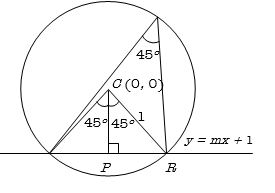
(C) The angle subtended by a chord at the center is twice the angle subtended by it at the major segment.
Given the angle at the major segment is ${45^\circ}$,the angle at the center $C(0,0)$ is $2 \times {45^\circ} = {90^\circ}$.
Let $P$ be the foot of the perpendicular from the center $C(0,0)$ to the chord $y = mx + 1$.
In the right-angled triangle $CPR$,where $CR$ is the radius $r = 1$,the angle $\angle PCR = {45^\circ}$.
Thus,$CP = r \cos({45^\circ}) = 1 \times \frac{1}{\sqrt{2}} = \frac{1}{\sqrt{2}}$.
The perpendicular distance from $(0,0)$ to $mx - y + 1 = 0$ is given by $\frac{|m(0) - 0 + 1|}{\sqrt{m^2 + (-1)^2}} = \frac{1}{\sqrt{m^2 + 1}}$.
Equating the two expressions for $CP$:
$\frac{1}{\sqrt{m^2 + 1}} = \frac{1}{\sqrt{2}}$
$m^2 + 1 = 2$
$m^2 = 1$
$m = \pm 1$.
Since the options provided include $-1$ but not $1$,and the question asks for the value of $m$,the correct choice is $-1$.
Given the angle at the major segment is ${45^\circ}$,the angle at the center $C(0,0)$ is $2 \times {45^\circ} = {90^\circ}$.
Let $P$ be the foot of the perpendicular from the center $C(0,0)$ to the chord $y = mx + 1$.
In the right-angled triangle $CPR$,where $CR$ is the radius $r = 1$,the angle $\angle PCR = {45^\circ}$.
Thus,$CP = r \cos({45^\circ}) = 1 \times \frac{1}{\sqrt{2}} = \frac{1}{\sqrt{2}}$.
The perpendicular distance from $(0,0)$ to $mx - y + 1 = 0$ is given by $\frac{|m(0) - 0 + 1|}{\sqrt{m^2 + (-1)^2}} = \frac{1}{\sqrt{m^2 + 1}}$.
Equating the two expressions for $CP$:
$\frac{1}{\sqrt{m^2 + 1}} = \frac{1}{\sqrt{2}}$
$m^2 + 1 = 2$
$m^2 = 1$
$m = \pm 1$.
Since the options provided include $-1$ but not $1$,and the question asks for the value of $m$,the correct choice is $-1$.
0 likesView Solution
22
MathematicsMediumMCQAIEEE · 2002
The equation of the circle with the origin as the centre passing through the vertices of an equilateral triangle whose median is of length $3a$ is
A
$x^2 + y^2 = 9a^2$
B
$x^2 + y^2 = 16a^2$
C
$x^2 + y^2 = a^2$
D
None of these
Solution
(D) For an equilateral triangle,the centroid coincides with the circumcentre.
Given the origin $(0, 0)$ is the centre of the circle passing through the vertices,it is the circumcentre of the triangle.
The centroid divides the median in the ratio $2:1$.
Since the length of the median is $3a$,the distance from the centroid to the vertex (which is the radius $R$ of the circumcircle) is $R = \frac{2}{3} \times 3a = 2a$.
The equation of the circle with centre $(0, 0)$ and radius $R = 2a$ is $x^2 + y^2 = (2a)^2 = 4a^2$.
Since $4a^2$ is not among the given options,the correct answer is $(d)$.
Given the origin $(0, 0)$ is the centre of the circle passing through the vertices,it is the circumcentre of the triangle.
The centroid divides the median in the ratio $2:1$.
Since the length of the median is $3a$,the distance from the centroid to the vertex (which is the radius $R$ of the circumcircle) is $R = \frac{2}{3} \times 3a = 2a$.
The equation of the circle with centre $(0, 0)$ and radius $R = 2a$ is $x^2 + y^2 = (2a)^2 = 4a^2$.
Since $4a^2$ is not among the given options,the correct answer is $(d)$.
0 likesView Solution
23
MathematicsDifficultMCQAIEEE · 2002
The centre of the circle passing through $(0, 0)$ and $(1, 0)$ and touching the circle $x^2 + y^2 = 9$ is
A
$\left( \frac{1}{2}, \frac{1}{2} \right)$
B
$\left( \frac{1}{2}, -\sqrt{2} \right)$
C
$\left( \frac{3}{2}, \frac{1}{2} \right)$
D
$\left( \frac{1}{2}, \frac{3}{2} \right)$
Solution
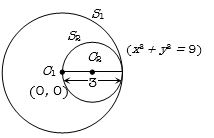
(B) Let the required circle be $S_2$ with centre $(h, k)$ and radius $r$.
Since it passes through $(0, 0)$ and $(1, 0)$,the perpendicular bisector of the chord joining $(0, 0)$ and $(1, 0)$ must contain the centre. The midpoint is $(\frac{1}{2}, 0)$,so $h = \frac{1}{2}$.
The radius $r$ is the distance from $(\frac{1}{2}, k)$ to $(0, 0)$,so $r^2 = (\frac{1}{2})^2 + k^2 = \frac{1}{4} + k^2$.
The circle $S_2$ touches $x^2 + y^2 = 9$ (centre $(0, 0)$,radius $R = 3$).
For internal contact,the distance between centres $d = R - r$.
$d^2 = (\frac{1}{2})^2 + k^2 = r^2$.
So $r^2 = (3 - r)^2 = 9 - 6r + r^2$,which gives $6r = 9$,so $r = \frac{3}{2}$.
Substituting $r^2 = \frac{9}{4}$ into $r^2 = \frac{1}{4} + k^2$ gives $\frac{9}{4} = \frac{1}{4} + k^2$,so $k^2 = 2$,$k = \pm \sqrt{2}$.
Thus,the centre is $\left( \frac{1}{2}, \pm \sqrt{2} \right)$. Given the options,the correct choice is $\left( \frac{1}{2}, -\sqrt{2} \right)$.
Since it passes through $(0, 0)$ and $(1, 0)$,the perpendicular bisector of the chord joining $(0, 0)$ and $(1, 0)$ must contain the centre. The midpoint is $(\frac{1}{2}, 0)$,so $h = \frac{1}{2}$.
The radius $r$ is the distance from $(\frac{1}{2}, k)$ to $(0, 0)$,so $r^2 = (\frac{1}{2})^2 + k^2 = \frac{1}{4} + k^2$.
The circle $S_2$ touches $x^2 + y^2 = 9$ (centre $(0, 0)$,radius $R = 3$).
For internal contact,the distance between centres $d = R - r$.
$d^2 = (\frac{1}{2})^2 + k^2 = r^2$.
So $r^2 = (3 - r)^2 = 9 - 6r + r^2$,which gives $6r = 9$,so $r = \frac{3}{2}$.
Substituting $r^2 = \frac{9}{4}$ into $r^2 = \frac{1}{4} + k^2$ gives $\frac{9}{4} = \frac{1}{4} + k^2$,so $k^2 = 2$,$k = \pm \sqrt{2}$.
Thus,the centre is $\left( \frac{1}{2}, \pm \sqrt{2} \right)$. Given the options,the correct choice is $\left( \frac{1}{2}, -\sqrt{2} \right)$.
0 likesView Solution
24
MathematicsMediumMCQAIEEE · 2002
$\mathop {\lim }\limits_{x \to 0} \frac{{\sqrt {\frac{1}{2}(1 - \cos 2x)} }}{x} = $
A
$1$
B
$-1$
C
$0$
D
$\text{Does not exist}$
Solution
(D) We know that $1 - \cos 2x = 2 \sin^2 x$.
Substituting this into the expression,we get $\sqrt{\frac{1}{2}(2 \sin^2 x)} = \sqrt{\sin^2 x} = |\sin x|$.
Thus,the limit becomes $\mathop {\lim }\limits_{x \to 0} \frac{|\sin x|}{x}$.
For the right-hand limit $(x \to 0^+)$,$|\sin x| = \sin x$,so $\mathop {\lim }\limits_{x \to 0^+} \frac{\sin x}{x} = 1$.
For the left-hand limit $(x \to 0^-)$,$|\sin x| = -\sin x$,so $\mathop {\lim }\limits_{x \to 0^-} \frac{-\sin x}{x} = -1$.
Since the left-hand limit and right-hand limit are not equal,the limit does not exist.
Substituting this into the expression,we get $\sqrt{\frac{1}{2}(2 \sin^2 x)} = \sqrt{\sin^2 x} = |\sin x|$.
Thus,the limit becomes $\mathop {\lim }\limits_{x \to 0} \frac{|\sin x|}{x}$.
For the right-hand limit $(x \to 0^+)$,$|\sin x| = \sin x$,so $\mathop {\lim }\limits_{x \to 0^+} \frac{\sin x}{x} = 1$.
For the left-hand limit $(x \to 0^-)$,$|\sin x| = -\sin x$,so $\mathop {\lim }\limits_{x \to 0^-} \frac{-\sin x}{x} = -1$.
Since the left-hand limit and right-hand limit are not equal,the limit does not exist.
0 likesView Solution
25
MathematicsMediumMCQAIEEE · 2002
Let $f(2) = 4$ and $f'(2) = 4$,then $\mathop {\lim }\limits_{x \to 2} \,\frac{{xf(2) - 2f(x)}}{{x - 2}}$ equals
A
$2$
B
$-2$
C
$-4$
D
$3$
Solution
(C) Let $L = \mathop {\lim }\limits_{x \to 2} \frac{{xf(2) - 2f(x)}}{{x - 2}}$.
Since the limit is of the form $\frac{0}{0}$ at $x = 2$,we can apply $L$'$H$ôpital's rule or manipulate the expression.
Adding and subtracting $2f(2)$ in the numerator:
$L = \mathop {\lim }\limits_{x \to 2} \frac{{xf(2) - 2f(2) + 2f(2) - 2f(x)}}{{x - 2}}$
$L = \mathop {\lim }\limits_{x \to 2} \left[ \frac{f(2)(x - 2)}{x - 2} - 2\frac{f(x) - f(2)}{x - 2} \right]$
$L = f(2) - 2 \mathop {\lim }\limits_{x \to 2} \frac{f(x) - f(2)}{x - 2}$
$L = f(2) - 2f'(2)$
Given $f(2) = 4$ and $f'(2) = 4$:
$L = 4 - 2(4) = 4 - 8 = -4$.
Since the limit is of the form $\frac{0}{0}$ at $x = 2$,we can apply $L$'$H$ôpital's rule or manipulate the expression.
Adding and subtracting $2f(2)$ in the numerator:
$L = \mathop {\lim }\limits_{x \to 2} \frac{{xf(2) - 2f(2) + 2f(2) - 2f(x)}}{{x - 2}}$
$L = \mathop {\lim }\limits_{x \to 2} \left[ \frac{f(2)(x - 2)}{x - 2} - 2\frac{f(x) - f(2)}{x - 2} \right]$
$L = f(2) - 2 \mathop {\lim }\limits_{x \to 2} \frac{f(x) - f(2)}{x - 2}$
$L = f(2) - 2f'(2)$
Given $f(2) = 4$ and $f'(2) = 4$:
$L = 4 - 2(4) = 4 - 8 = -4$.
0 likesView Solution
26
MathematicsEasyMCQAIEEE · 2002
Evaluate $\mathop {\lim }\limits_{x \to \infty } \frac{{\log {x^n} - [x]}}{{[x]}},$ where $n \in N$ and $[x]$ denotes the greatest integer less than or equal to $x$.
A
Has value $-1$
B
Has value $0$
C
Has value $1$
D
Does not exist
Solution
(A) We are given the limit $\mathop {\lim }\limits_{x \to \infty } \frac{{\log {x^n} - [x]}}{{[x]}}.$
This can be rewritten as $\mathop {\lim }\limits_{x \to \infty } \left( \frac{{\log {x^n}}}{{[x]}} - \frac{{[x]}}{{[x]}} \right).$
Since $x - 1 < [x] \le x,$ as $x \to \infty,$ $[x] \approx x.$
Thus,$\mathop {\lim }\limits_{x \to \infty } \frac{{\log {x^n}}}{{[x]}} = \mathop {\lim }\limits_{x \to \infty } \frac{{n \log x}}{x}.$
Using $L$'Hopital's rule or the standard limit $\mathop {\lim }\limits_{x \to \infty } \frac{{\log x}}{x} = 0,$ we get $n \times 0 = 0.$
Therefore,the expression becomes $0 - 1 = -1.$
This can be rewritten as $\mathop {\lim }\limits_{x \to \infty } \left( \frac{{\log {x^n}}}{{[x]}} - \frac{{[x]}}{{[x]}} \right).$
Since $x - 1 < [x] \le x,$ as $x \to \infty,$ $[x] \approx x.$
Thus,$\mathop {\lim }\limits_{x \to \infty } \frac{{\log {x^n}}}{{[x]}} = \mathop {\lim }\limits_{x \to \infty } \frac{{n \log x}}{x}.$
Using $L$'Hopital's rule or the standard limit $\mathop {\lim }\limits_{x \to \infty } \frac{{\log x}}{x} = 0,$ we get $n \times 0 = 0.$
Therefore,the expression becomes $0 - 1 = -1.$
0 likesView Solution
27
MathematicsEasyMCQAIEEE · 2002
If $f(1) = 1$ and $f'(1) = 2$,then $\mathop {\lim }\limits_{x \to 1} \frac{{\sqrt {f(x)} - 1}}{{\sqrt x - 1}}$ is
A
$2$
B
$4$
C
$1$
D
$1/2$
Solution
(A) Let $y = \mathop {\lim }\limits_{x \to 1} \frac{{\sqrt {f(x)} - 1}}{{\sqrt x - 1}}$.
Multiplying the numerator and denominator by the conjugates $(\sqrt{f(x)} + 1)$ and $(\sqrt{x} + 1)$:
$y = \mathop {\lim }\limits_{x \to 1} \frac{(\sqrt{f(x)} - 1)(\sqrt{f(x)} + 1)}{(\sqrt{x} - 1)(\sqrt{x} + 1)} \times \frac{\sqrt{x} + 1}{\sqrt{f(x)} + 1}$
$y = \mathop {\lim }\limits_{x \to 1} \frac{f(x) - 1}{x - 1} \times \frac{\sqrt{x} + 1}{\sqrt{f(x)} + 1}$
Since $f(1) = 1$,we can write $f(x) - 1$ as $f(x) - f(1)$:
$y = \left( \mathop {\lim }\limits_{x \to 1} \frac{f(x) - f(1)}{x - 1} \right) \times \left( \mathop {\lim }\limits_{x \to 1} \frac{\sqrt{x} + 1}{\sqrt{f(x)} + 1} \right)$
$y = f'(1) \times \frac{\sqrt{1} + 1}{\sqrt{f(1)} + 1} = 2 \times \frac{2}{1 + 1} = 2 \times 1 = 2$.
Alternatively,using $L$-Hospital's rule:
$\mathop {\lim }\limits_{x \to 1} \frac{\frac{1}{2\sqrt{f(x)}} f'(x)}{\frac{1}{2\sqrt{x}}} = \mathop {\lim }\limits_{x \to 1} \frac{f'(x) \sqrt{x}}{\sqrt{f(x)}} = \frac{f'(1) \sqrt{1}}{\sqrt{f(1)}} = \frac{2 \times 1}{1} = 2$.
Multiplying the numerator and denominator by the conjugates $(\sqrt{f(x)} + 1)$ and $(\sqrt{x} + 1)$:
$y = \mathop {\lim }\limits_{x \to 1} \frac{(\sqrt{f(x)} - 1)(\sqrt{f(x)} + 1)}{(\sqrt{x} - 1)(\sqrt{x} + 1)} \times \frac{\sqrt{x} + 1}{\sqrt{f(x)} + 1}$
$y = \mathop {\lim }\limits_{x \to 1} \frac{f(x) - 1}{x - 1} \times \frac{\sqrt{x} + 1}{\sqrt{f(x)} + 1}$
Since $f(1) = 1$,we can write $f(x) - 1$ as $f(x) - f(1)$:
$y = \left( \mathop {\lim }\limits_{x \to 1} \frac{f(x) - f(1)}{x - 1} \right) \times \left( \mathop {\lim }\limits_{x \to 1} \frac{\sqrt{x} + 1}{\sqrt{f(x)} + 1} \right)$
$y = f'(1) \times \frac{\sqrt{1} + 1}{\sqrt{f(1)} + 1} = 2 \times \frac{2}{1 + 1} = 2 \times 1 = 2$.
Alternatively,using $L$-Hospital's rule:
$\mathop {\lim }\limits_{x \to 1} \frac{\frac{1}{2\sqrt{f(x)}} f'(x)}{\frac{1}{2\sqrt{x}}} = \mathop {\lim }\limits_{x \to 1} \frac{f'(x) \sqrt{x}}{\sqrt{f(x)}} = \frac{f'(1) \sqrt{1}}{\sqrt{f(1)}} = \frac{2 \times 1}{1} = 2$.
0 likesView Solution
28
MathematicsDifficultMCQAIEEE · 2002
$A$ problem in Mathematics is given to three students $A, B, C$ and their respective probabilities of solving the problem are $\frac{1}{2}, \frac{1}{3},$ and $\frac{1}{4}$. What is the probability that the problem is solved?
A
$\frac{3}{4}$
B
$\frac{1}{2}$
C
$\frac{2}{3}$
D
$\frac{1}{3}$
Solution
(A) Let $P(A), P(B),$ and $P(C)$ be the probabilities of students $A, B,$ and $C$ solving the problem respectively.
$P(A) = \frac{1}{2}, P(B) = \frac{1}{3}, P(C) = \frac{1}{4}$.
The probability that the problem is not solved by $A$ is $P(A') = 1 - \frac{1}{2} = \frac{1}{2}$.
The probability that the problem is not solved by $B$ is $P(B') = 1 - \frac{1}{3} = \frac{2}{3}$.
The probability that the problem is not solved by $C$ is $P(C') = 1 - \frac{1}{4} = \frac{3}{4}$.
The probability that the problem is not solved by any of them is $P(\text{none}) = P(A') \times P(B') \times P(C') = \frac{1}{2} \times \frac{2}{3} \times \frac{3}{4} = \frac{6}{24} = \frac{1}{4}$.
The probability that the problem is solved is $P(\text{solved}) = 1 - P(\text{none}) = 1 - \frac{1}{4} = \frac{3}{4}$.
$P(A) = \frac{1}{2}, P(B) = \frac{1}{3}, P(C) = \frac{1}{4}$.
The probability that the problem is not solved by $A$ is $P(A') = 1 - \frac{1}{2} = \frac{1}{2}$.
The probability that the problem is not solved by $B$ is $P(B') = 1 - \frac{1}{3} = \frac{2}{3}$.
The probability that the problem is not solved by $C$ is $P(C') = 1 - \frac{1}{4} = \frac{3}{4}$.
The probability that the problem is not solved by any of them is $P(\text{none}) = P(A') \times P(B') \times P(C') = \frac{1}{2} \times \frac{2}{3} \times \frac{3}{4} = \frac{6}{24} = \frac{1}{4}$.
The probability that the problem is solved is $P(\text{solved}) = 1 - P(\text{none}) = 1 - \frac{1}{4} = \frac{3}{4}$.
0 likesView Solution
29
MathematicsMediumMCQAIEEE · 2002
If $A$ and $B$ are events such that $P(A \cup B) = 3/4,$ $P(A \cap B) = 1/4,$ and $P(\bar{A}) = 2/3,$ then $P(\bar{A} \cap B)$ is
A
$5/12$
B
$3/8$
C
$5/8$
D
$1/4$
Solution
(A) Given: $P(A \cup B) = 3/4,$ $P(A \cap B) = 1/4,$ and $P(\bar{A}) = 2/3.$
First,find $P(A):$
$P(A) = 1 - P(\bar{A}) = 1 - 2/3 = 1/3.$
Using the addition theorem of probability: $P(A \cup B) = P(A) + P(B) - P(A \cap B).$
$3/4 = 1/3 + P(B) - 1/4.$
$P(B) = 3/4 + 1/4 - 1/3 = 1 - 1/3 = 2/3.$
Now,calculate $P(\bar{A} \cap B):$
$P(\bar{A} \cap B) = P(B) - P(A \cap B).$
$P(\bar{A} \cap B) = 2/3 - 1/4 = (8 - 3)/12 = 5/12.$
First,find $P(A):$
$P(A) = 1 - P(\bar{A}) = 1 - 2/3 = 1/3.$
Using the addition theorem of probability: $P(A \cup B) = P(A) + P(B) - P(A \cap B).$
$3/4 = 1/3 + P(B) - 1/4.$
$P(B) = 3/4 + 1/4 - 1/3 = 1 - 1/3 = 2/3.$
Now,calculate $P(\bar{A} \cap B):$
$P(\bar{A} \cap B) = P(B) - P(A \cap B).$
$P(\bar{A} \cap B) = 2/3 - 1/4 = (8 - 3)/12 = 5/12.$
0 likesView Solution
30
MathematicsMediumMCQAIEEE · 2002
In a class of $100$ students,there are $70$ boys whose average marks in a subject are $75$. If the average marks of the complete class are $72$,then what are the average marks of the girls?
A
$73$
B
$65$
C
$68$
D
$74$
Solution
(B) Let the average marks of the girls be $x$.
Total number of students = $100$.
Number of boys = $70$,so number of girls = $100 - 70 = 30$.
Total marks of the class = $100 \times 72 = 7200$.
Total marks of boys = $70 \times 75 = 5250$.
Total marks of girls = $7200 - 5250 = 1950$.
Average marks of girls = $\frac{1950}{30} = 65$.
Total number of students = $100$.
Number of boys = $70$,so number of girls = $100 - 70 = 30$.
Total marks of the class = $100 \times 72 = 7200$.
Total marks of boys = $70 \times 75 = 5250$.
Total marks of girls = $7200 - 5250 = 1950$.
Average marks of girls = $\frac{1950}{30} = 65$.
0 likesView Solution
31
MathematicsDifficultMCQAIEEE · 2002
If for positive integers $r > 1$ and $n > 2$,the coefficients of the $(3r)^{th}$ and $(r + 2)^{th}$ powers of $x$ in the expansion of $(1 + x)^{2n}$ are equal,then:
A
$n = 2r$
B
$n = 3r$
C
$n = 2r + 1$
D
None of these
Solution
(C) In the expansion of $(1 + x)^{2n}$,the coefficient of $x^k$ is given by $^{2n}C_k$,where $0 \le k \le 2n$.
Given that the coefficients of $x^{3r}$ and $x^{r+2}$ are equal,we have $^{2n}C_{3r} = ^{2n}C_{r+2}$.
Using the property $^{n}C_a = ^{n}C_b$,which implies $a = b$ or $a + b = n$,we get two cases:
Case $1$: $3r = r + 2$ $\Rightarrow 2r = 2$ $\Rightarrow r = 1$. However,it is given that $r > 1$,so this case is rejected.
Case $2$: $3r + (r + 2) = 2n$ $\Rightarrow 4r + 2 = 2n$ $\Rightarrow 2n = 4r + 2$ $\Rightarrow n = 2r + 1$.
Thus,the correct relation is $n = 2r + 1$.
Given that the coefficients of $x^{3r}$ and $x^{r+2}$ are equal,we have $^{2n}C_{3r} = ^{2n}C_{r+2}$.
Using the property $^{n}C_a = ^{n}C_b$,which implies $a = b$ or $a + b = n$,we get two cases:
Case $1$: $3r = r + 2$ $\Rightarrow 2r = 2$ $\Rightarrow r = 1$. However,it is given that $r > 1$,so this case is rejected.
Case $2$: $3r + (r + 2) = 2n$ $\Rightarrow 4r + 2 = 2n$ $\Rightarrow 2n = 4r + 2$ $\Rightarrow n = 2r + 1$.
Thus,the correct relation is $n = 2r + 1$.
0 likesView Solution
32
MathematicsMediumMCQAIEEE · 2002
If the pair of lines $ax^2 + 2hxy + by^2 + 2gx + 2fy + c = 0$ intersect on the $y$-axis,then:
A
$2fgh = bg^2 + ch^2$
B
$bg^2 \neq ch^2$
C
$abc = 2fgh$
D
None of these
Solution
(A) The given equation of the pair of lines is $f(x, y) = ax^2 + 2hxy + by^2 + 2gx + 2fy + c = 0$.
To find the point of intersection,we take partial derivatives with respect to $x$ and $y$:
$\frac{\partial f}{\partial x} = 2ax + 2hy + 2g = 0 \implies ax + hy + g = 0$
$\frac{\partial f}{\partial y} = 2hx + 2by + 2f = 0 \implies hx + by + f = 0$
Since the lines intersect on the $y$-axis,the $x$-coordinate of the point of intersection is $x = 0$.
Substituting $x = 0$ into the first partial derivative equation: $h(y) + g = 0 \implies y = -g/h$.
Now,substitute $(0, -g/h)$ into the original equation $f(x, y) = 0$:
$a(0)^2 + 2h(0)(-g/h) + b(-g/h)^2 + 2g(0) + 2f(-g/h) + c = 0$
$b(g^2/h^2) - 2fg/h + c = 0$
Multiplying by $h^2$,we get $bg^2 - 2fgh + ch^2 = 0$,which simplifies to $bg^2 + ch^2 = 2fgh$.
To find the point of intersection,we take partial derivatives with respect to $x$ and $y$:
$\frac{\partial f}{\partial x} = 2ax + 2hy + 2g = 0 \implies ax + hy + g = 0$
$\frac{\partial f}{\partial y} = 2hx + 2by + 2f = 0 \implies hx + by + f = 0$
Since the lines intersect on the $y$-axis,the $x$-coordinate of the point of intersection is $x = 0$.
Substituting $x = 0$ into the first partial derivative equation: $h(y) + g = 0 \implies y = -g/h$.
Now,substitute $(0, -g/h)$ into the original equation $f(x, y) = 0$:
$a(0)^2 + 2h(0)(-g/h) + b(-g/h)^2 + 2g(0) + 2f(-g/h) + c = 0$
$b(g^2/h^2) - 2fg/h + c = 0$
Multiplying by $h^2$,we get $bg^2 - 2fgh + ch^2 = 0$,which simplifies to $bg^2 + ch^2 = 2fgh$.
0 likesView Solution
33
MathematicsDifficultMCQAIEEE · 2002
The centres of a set of circles,each of radius $3$,lie on the circle ${x^2} + {y^2} = 25$. The locus of any point in the set is
A
$4 \le {x^2} + {y^2} \le 64$
B
${x^2} + {y^2} \le 25$
C
${x^2} + {y^2} \ge 25$
D
$3 \le {x^2} + {y^2} \le 9$
Solution
(A) Let $(h, k)$ be the center of a circle with radius $r = 3$. The equation of such a circle is $(x - h)^2 + (y - k)^2 = 3^2 = 9$.
Since the center $(h, k)$ lies on the circle $x^2 + y^2 = 25$,the distance of the center from the origin is $\sqrt{h^2 + k^2} = 5$.
Any point $(x, y)$ on a circle with center $(h, k)$ and radius $3$ satisfies the condition that its distance from $(h, k)$ is $3$.
By the triangle inequality,the distance $d$ of any point $(x, y)$ from the origin satisfies $|\sqrt{h^2 + k^2} - 3| \le \sqrt{x^2 + y^2} \le \sqrt{h^2 + k^2} + 3$.
Substituting $\sqrt{h^2 + k^2} = 5$,we get $|5 - 3| \le \sqrt{x^2 + y^2} \le 5 + 3$.
This simplifies to $2 \le \sqrt{x^2 + y^2} \le 8$.
Squaring the inequality,we get $4 \le x^2 + y^2 \le 64$.
Since the center $(h, k)$ lies on the circle $x^2 + y^2 = 25$,the distance of the center from the origin is $\sqrt{h^2 + k^2} = 5$.
Any point $(x, y)$ on a circle with center $(h, k)$ and radius $3$ satisfies the condition that its distance from $(h, k)$ is $3$.
By the triangle inequality,the distance $d$ of any point $(x, y)$ from the origin satisfies $|\sqrt{h^2 + k^2} - 3| \le \sqrt{x^2 + y^2} \le \sqrt{h^2 + k^2} + 3$.
Substituting $\sqrt{h^2 + k^2} = 5$,we get $|5 - 3| \le \sqrt{x^2 + y^2} \le 5 + 3$.
This simplifies to $2 \le \sqrt{x^2 + y^2} \le 8$.
Squaring the inequality,we get $4 \le x^2 + y^2 \le 64$.
0 likesView Solution
34
MathematicsDifficultMCQAIEEE · 2002
Two common tangents to the circle ${x^2} + {y^2} = 2{a^2}$ and the parabola ${y^2} = 8ax$ are
A
$x = \pm (y + 2a)$
B
$y = \pm (x + 2a)$
C
$x = \pm (y + a)$
D
$y = \pm (x + a)$
Solution
(B) The equation of any tangent to the parabola ${y^2} = 8ax$ is given by $y = mx + \frac{2a}{m}$.
This line is also a tangent to the circle ${x^2} + {y^2} = 2{a^2}$.
The perpendicular distance from the center $(0, 0)$ of the circle to the line $mx - y + \frac{2a}{m} = 0$ must be equal to the radius $r = \sqrt{2}a$.
Thus,$\frac{|\frac{2a}{m}|}{\sqrt{m^2 + 1}} = \sqrt{2}a$.
Squaring both sides,we get $\frac{4a^2}{m^2(m^2 + 1)} = 2a^2$.
This simplifies to $m^2(m^2 + 1) = 2$,or $m^4 + m^2 - 2 = 0$.
Factoring the quadratic in $m^2$,we have $(m^2 - 1)(m^2 + 2) = 0$.
Since $m^2$ must be real and positive,we have $m^2 = 1$,which gives $m = \pm 1$.
Substituting $m = \pm 1$ into the tangent equation $y = mx + \frac{2a}{m}$,we get $y = \pm (x + 2a)$.
This line is also a tangent to the circle ${x^2} + {y^2} = 2{a^2}$.
The perpendicular distance from the center $(0, 0)$ of the circle to the line $mx - y + \frac{2a}{m} = 0$ must be equal to the radius $r = \sqrt{2}a$.
Thus,$\frac{|\frac{2a}{m}|}{\sqrt{m^2 + 1}} = \sqrt{2}a$.
Squaring both sides,we get $\frac{4a^2}{m^2(m^2 + 1)} = 2a^2$.
This simplifies to $m^2(m^2 + 1) = 2$,or $m^4 + m^2 - 2 = 0$.
Factoring the quadratic in $m^2$,we have $(m^2 - 1)(m^2 + 2) = 0$.
Since $m^2$ must be real and positive,we have $m^2 = 1$,which gives $m = \pm 1$.
Substituting $m = \pm 1$ into the tangent equation $y = mx + \frac{2a}{m}$,we get $y = \pm (x + 2a)$.
0 likesView Solution
35
MathematicsDifficultMCQAIEEE · 2002
$\mathop {\lim }\limits_{x \to \infty } {\left( {\frac{{{x^2} + 5x + 3}}{{{x^2} + x + 3}}} \right)^x} = $
A
$e^4$
B
$e^2$
C
$e^3$
D
$e$
Solution
(A) We know that $\mathop {\lim }\limits_{x \to \infty } {(1 + f(x))^{g(x)}} = e^{\mathop {\lim }\limits_{x \to \infty } f(x)g(x)}$ if the form is $1^\infty$.
Here,$\mathop {\lim }\limits_{x \to \infty } \frac{x^2 + 5x + 3}{x^2 + x + 3} = 1$.
So,the expression is of the form $1^\infty$.
Let $f(x) = \frac{x^2 + 5x + 3}{x^2 + x + 3} - 1 = \frac{x^2 + 5x + 3 - x^2 - x - 3}{x^2 + x + 3} = \frac{4x}{x^2 + x + 3}$.
Then,$\mathop {\lim }\limits_{x \to \infty } f(x)g(x) = \mathop {\lim }\limits_{x \to \infty } \left( \frac{4x}{x^2 + x + 3} \cdot x \right) = \mathop {\lim }\limits_{x \to \infty } \frac{4x^2}{x^2 + x + 3}$.
Dividing numerator and denominator by $x^2$,we get $\mathop {\lim }\limits_{x \to \infty } \frac{4}{1 + \frac{1}{x} + \frac{3}{x^2}} = \frac{4}{1 + 0 + 0} = 4$.
Therefore,the limit is $e^4$.
Here,$\mathop {\lim }\limits_{x \to \infty } \frac{x^2 + 5x + 3}{x^2 + x + 3} = 1$.
So,the expression is of the form $1^\infty$.
Let $f(x) = \frac{x^2 + 5x + 3}{x^2 + x + 3} - 1 = \frac{x^2 + 5x + 3 - x^2 - x - 3}{x^2 + x + 3} = \frac{4x}{x^2 + x + 3}$.
Then,$\mathop {\lim }\limits_{x \to \infty } f(x)g(x) = \mathop {\lim }\limits_{x \to \infty } \left( \frac{4x}{x^2 + x + 3} \cdot x \right) = \mathop {\lim }\limits_{x \to \infty } \frac{4x^2}{x^2 + x + 3}$.
Dividing numerator and denominator by $x^2$,we get $\mathop {\lim }\limits_{x \to \infty } \frac{4}{1 + \frac{1}{x} + \frac{3}{x^2}} = \frac{4}{1 + 0 + 0} = 4$.
Therefore,the limit is $e^4$.
0 likesView Solution
36
MathematicsEasyMCQAIEEE · 2002
If the difference between the roots of the equations $x^2+ax+b=0$ and $x^2+bx+a=0$ is the same,and $a \neq b$,then:
A
$a+b-4=0$
B
$a-b-4=0$
C
$a-b+4=0$
D
$a+b+4=0$
Solution
(D) Let $\alpha, \beta$ be the roots of $x^2+ax+b=0$ and $\gamma, \delta$ be the roots of $x^2+bx+a=0$.
From the relations between roots and coefficients:
$\alpha+\beta = -a, \alpha\beta = b$
$\gamma+\delta = -b, \gamma\delta = a$
Given that the difference between the roots is the same:
$|\alpha-\beta| = |\gamma-\delta|$
Squaring both sides:
$(\alpha-\beta)^2 = (\gamma-\delta)^2$
$(\alpha+\beta)^2 - 4\alpha\beta = (\gamma+\delta)^2 - 4\gamma\delta$
$(-a)^2 - 4b = (-b)^2 - 4a$
$a^2 - 4b = b^2 - 4a$
$a^2 - b^2 + 4a - 4b = 0$
$(a-b)(a+b) + 4(a-b) = 0$
$(a-b)(a+b+4) = 0$
Since $a \neq b$,we have $a-b \neq 0$.
Therefore,$a+b+4 = 0$.
From the relations between roots and coefficients:
$\alpha+\beta = -a, \alpha\beta = b$
$\gamma+\delta = -b, \gamma\delta = a$
Given that the difference between the roots is the same:
$|\alpha-\beta| = |\gamma-\delta|$
Squaring both sides:
$(\alpha-\beta)^2 = (\gamma-\delta)^2$
$(\alpha+\beta)^2 - 4\alpha\beta = (\gamma+\delta)^2 - 4\gamma\delta$
$(-a)^2 - 4b = (-b)^2 - 4a$
$a^2 - 4b = b^2 - 4a$
$a^2 - b^2 + 4a - 4b = 0$
$(a-b)(a+b) + 4(a-b) = 0$
$(a-b)(a+b+4) = 0$
Since $a \neq b$,we have $a-b \neq 0$.
Therefore,$a+b+4 = 0$.
0 likesView Solution
37
MathematicsMediumMCQAIEEE · 2002
If $1, \log _9(3^{1-x}+2), \log _3(4 \cdot 3^x-1)$ are in $A.P.$,then $x$ equals
A
$\log _3 4$
B
$1-\log _3 4$
C
$1-\log _4 3$
D
$\log _4 3$
Solution
(B) Given that $1, \log _9(3^{1-x}+2), \log _3(4 \cdot 3^x-1)$ are in $A.P.$
Since $2b = a + c$ for an $A.P.$,we have:
$2 \log _9(3^{1-x}+2) = 1 + \log _3(4 \cdot 3^x-1)$
Using the property $\log_{a^n} b = \frac{1}{n} \log_a b$,we get $\log_9(y) = \frac{1}{2} \log_3(y)$:
$2 \cdot \frac{1}{2} \log _3(3^{1-x}+2) = \log _3 3 + \log _3(4 \cdot 3^x-1)$
$\log _3(3^{1-x}+2) = \log _3(3(4 \cdot 3^x-1))$
$3^{1-x}+2 = 12 \cdot 3^x - 3$
Let $3^x = t$. Then $\frac{3}{t} + 2 = 12t - 3$
$3 + 2t = 12t^2 - 3t$
$12t^2 - 5t - 3 = 0$
$(4t - 3)(3t + 1) = 0$
Since $t = 3^x > 0$,we have $t = \frac{3}{4}$.
$3^x = \frac{3}{4} \Rightarrow x = \log_3 \left(\frac{3}{4}\right) = \log_3 3 - \log_3 4 = 1 - \log_3 4$.
Since $2b = a + c$ for an $A.P.$,we have:
$2 \log _9(3^{1-x}+2) = 1 + \log _3(4 \cdot 3^x-1)$
Using the property $\log_{a^n} b = \frac{1}{n} \log_a b$,we get $\log_9(y) = \frac{1}{2} \log_3(y)$:
$2 \cdot \frac{1}{2} \log _3(3^{1-x}+2) = \log _3 3 + \log _3(4 \cdot 3^x-1)$
$\log _3(3^{1-x}+2) = \log _3(3(4 \cdot 3^x-1))$
$3^{1-x}+2 = 12 \cdot 3^x - 3$
Let $3^x = t$. Then $\frac{3}{t} + 2 = 12t - 3$
$3 + 2t = 12t^2 - 3t$
$12t^2 - 5t - 3 = 0$
$(4t - 3)(3t + 1) = 0$
Since $t = 3^x > 0$,we have $t = \frac{3}{4}$.
$3^x = \frac{3}{4} \Rightarrow x = \log_3 \left(\frac{3}{4}\right) = \log_3 3 - \log_3 4 = 1 - \log_3 4$.
0 likesView Solution
38
MathematicsDifficultMCQAIEEE · 2002
If $2a + 3b + 6c = 0$,then at least one root of the equation $ax^2 + bx + c = 0$ lies in the interval:
A
$(0, 1)$
B
$(1, 2)$
C
$(2, 3)$
D
$(3, 4)$
Solution
(A) Let $f(x) = ax^2 + bx + c$.
Define $F(x) = \int_{0}^{x} f(t) dt = \frac{a}{3}x^3 + \frac{b}{2}x^2 + cx$.
Clearly,$F(0) = 0$.
Also,$F(1) = \frac{a}{3} + \frac{b}{2} + c = \frac{2a + 3b + 6c}{6}$.
Given $2a + 3b + 6c = 0$,we have $F(1) = 0$.
Since $F(0) = F(1) = 0$ and $F(x)$ is a polynomial (and thus continuous and differentiable),by Rolle's Theorem,there exists at least one $x \in (0, 1)$ such that $F'(x) = 0$.
Since $F'(x) = f(x) = ax^2 + bx + c$,there exists at least one root of $ax^2 + bx + c = 0$ in the interval $(0, 1)$.
Define $F(x) = \int_{0}^{x} f(t) dt = \frac{a}{3}x^3 + \frac{b}{2}x^2 + cx$.
Clearly,$F(0) = 0$.
Also,$F(1) = \frac{a}{3} + \frac{b}{2} + c = \frac{2a + 3b + 6c}{6}$.
Given $2a + 3b + 6c = 0$,we have $F(1) = 0$.
Since $F(0) = F(1) = 0$ and $F(x)$ is a polynomial (and thus continuous and differentiable),by Rolle's Theorem,there exists at least one $x \in (0, 1)$ such that $F'(x) = 0$.
Since $F'(x) = f(x) = ax^2 + bx + c$,there exists at least one root of $ax^2 + bx + c = 0$ in the interval $(0, 1)$.
0 likesView Solution
39
MathematicsDifficultMCQAIEEE · 2002
If $a > 0$ and the discriminant of $ax^2 + 2bx + c$ is negative,then $\left| \begin{array}{ccc} a & b & ax + b \\ b & c & bx + c \\ ax + b & bx + c & 0 \end{array} \right|$ is
A
Positive
B
$(ac - b^2)(ax^2 + 2bx + c)$
C
Negative
D
$0$
Solution
(C) Let $\Delta = \left| \begin{array}{ccc} a & b & ax + b \\ b & c & bx + c \\ ax + b & bx + c & 0 \end{array} \right|$.
Applying the row operation $R_3 \to R_3 - xR_1 - R_2$,we get:
$\Delta = \left| \begin{array}{ccc} a & b & ax + b \\ b & c & bx + c \\ 0 & 0 & -(ax^2 + 2bx + c) \end{array} \right|$.
Expanding along the third row:
$\Delta = -(ax^2 + 2bx + c) \times (ac - b^2) = (b^2 - ac)(ax^2 + 2bx + c)$.
Given that the discriminant $D = (2b)^2 - 4ac = 4(b^2 - ac) < 0$,it follows that $b^2 - ac < 0$.
Since $a > 0$ and the discriminant is negative,the quadratic expression $ax^2 + 2bx + c$ is always positive for all $x \in \mathbb{R}$.
Therefore,$\Delta = (b^2 - ac)(ax^2 + 2bx + c)$ is the product of a negative value and a positive value,which results in a negative value.
Applying the row operation $R_3 \to R_3 - xR_1 - R_2$,we get:
$\Delta = \left| \begin{array}{ccc} a & b & ax + b \\ b & c & bx + c \\ 0 & 0 & -(ax^2 + 2bx + c) \end{array} \right|$.
Expanding along the third row:
$\Delta = -(ax^2 + 2bx + c) \times (ac - b^2) = (b^2 - ac)(ax^2 + 2bx + c)$.
Given that the discriminant $D = (2b)^2 - 4ac = 4(b^2 - ac) < 0$,it follows that $b^2 - ac < 0$.
Since $a > 0$ and the discriminant is negative,the quadratic expression $ax^2 + 2bx + c$ is always positive for all $x \in \mathbb{R}$.
Therefore,$\Delta = (b^2 - ac)(ax^2 + 2bx + c)$ is the product of a negative value and a positive value,which results in a negative value.
0 likesView Solution
40
MathematicsMediumMCQAIEEE · 2002
For what value of $\lambda$,the system of equations $x + y + z = 6$,$x + 2y + 3z = 10$,and $x + 2y + \lambda z = 12$ is inconsistent? $\lambda = $ ........
A
$1$
B
$2$
C
$-2$
D
$3$
Solution
(D) The system of equations is given by:
$x + y + z = 6$
$x + 2y + 3z = 10$
$x + 2y + \lambda z = 12$
$A$ system of linear equations $AX = B$ is inconsistent if the determinant of the coefficient matrix $D = 0$ and at least one of the Cramer's rule determinants $(D_x, D_y, D_z)$ is non-zero.
First,calculate the determinant $D$:
$D = \begin{vmatrix} 1 & 1 & 1 \\ 1 & 2 & 3 \\ 1 & 2 & \lambda \end{vmatrix}$
Expanding along the first row:
$D = 1(2\lambda - 6) - 1(\lambda - 3) + 1(2 - 2)$
$D = 2\lambda - 6 - \lambda + 3 + 0$
$D = \lambda - 3$
For the system to be inconsistent,we set $D = 0$:
$\lambda - 3 = 0 \Rightarrow \lambda = 3$
Now,check for consistency at $\lambda = 3$ by calculating $D_z$:
$D_z = \begin{vmatrix} 1 & 1 & 6 \\ 1 & 2 & 10 \\ 1 & 2 & 12 \end{vmatrix}$
$D_z = 1(24 - 20) - 1(12 - 10) + 6(2 - 2)$
$D_z = 1(4) - 1(2) + 6(0) = 4 - 2 = 2$
Since $D = 0$ and $D_z \neq 0$,the system is inconsistent when $\lambda = 3$.
$x + y + z = 6$
$x + 2y + 3z = 10$
$x + 2y + \lambda z = 12$
$A$ system of linear equations $AX = B$ is inconsistent if the determinant of the coefficient matrix $D = 0$ and at least one of the Cramer's rule determinants $(D_x, D_y, D_z)$ is non-zero.
First,calculate the determinant $D$:
$D = \begin{vmatrix} 1 & 1 & 1 \\ 1 & 2 & 3 \\ 1 & 2 & \lambda \end{vmatrix}$
Expanding along the first row:
$D = 1(2\lambda - 6) - 1(\lambda - 3) + 1(2 - 2)$
$D = 2\lambda - 6 - \lambda + 3 + 0$
$D = \lambda - 3$
For the system to be inconsistent,we set $D = 0$:
$\lambda - 3 = 0 \Rightarrow \lambda = 3$
Now,check for consistency at $\lambda = 3$ by calculating $D_z$:
$D_z = \begin{vmatrix} 1 & 1 & 6 \\ 1 & 2 & 10 \\ 1 & 2 & 12 \end{vmatrix}$
$D_z = 1(24 - 20) - 1(12 - 10) + 6(2 - 2)$
$D_z = 1(4) - 1(2) + 6(0) = 4 - 2 = 2$
Since $D = 0$ and $D_z \neq 0$,the system is inconsistent when $\lambda = 3$.
0 likesView Solution
41
MathematicsMediumMCQAIEEE · 2002
$l, m, n$ are the $p^{th}, q^{th}$ and $r^{th}$ terms of a $G$.$P$.,all positive,then $\left| \begin{array}{ccc} \log l & p & 1 \\ \log m & q & 1 \\ \log n & r & 1 \end{array} \right|$ equals
A
$-1$
B
$2$
C
$1$
D
$0$
Solution
(D) Let $A$ be the first term and $R$ be the common ratio of the $G$.$P$. Then,
$l = A R^{p-1} \Rightarrow \log l = \log A + (p-1) \log R$ ... $(i)$
$m = A R^{q-1} \Rightarrow \log m = \log A + (q-1) \log R$ ... $(ii)$
$n = A R^{r-1} \Rightarrow \log n = \log A + (r-1) \log R$ ... $(iii)$
Let the determinant be $\Delta = \left| \begin{array}{ccc} \log l & p & 1 \\ \log m & q & 1 \\ \log n & r & 1 \end{array} \right|$.
Applying the column operations $C_1 \to C_1 - (\log A) C_3$ and then $C_1 \to C_1 / (\log R)$,we observe that the first column becomes proportional to the second column shifted by a constant. More simply,applying $C_1 \to C_1 - (\log A) C_3$,we get $\log l - \log A = (p-1) \log R$,etc. Since the columns become linearly dependent (specifically,$C_1$ is a linear combination of $C_2$ and $C_3$),the value of the determinant is $0$.
$l = A R^{p-1} \Rightarrow \log l = \log A + (p-1) \log R$ ... $(i)$
$m = A R^{q-1} \Rightarrow \log m = \log A + (q-1) \log R$ ... $(ii)$
$n = A R^{r-1} \Rightarrow \log n = \log A + (r-1) \log R$ ... $(iii)$
Let the determinant be $\Delta = \left| \begin{array}{ccc} \log l & p & 1 \\ \log m & q & 1 \\ \log n & r & 1 \end{array} \right|$.
Applying the column operations $C_1 \to C_1 - (\log A) C_3$ and then $C_1 \to C_1 / (\log R)$,we observe that the first column becomes proportional to the second column shifted by a constant. More simply,applying $C_1 \to C_1 - (\log A) C_3$,we get $\log l - \log A = (p-1) \log R$,etc. Since the columns become linearly dependent (specifically,$C_1$ is a linear combination of $C_2$ and $C_3$),the value of the determinant is $0$.
0 likesView Solution
42
MathematicsDifficultMCQAIEEE · 2002
If $\cot^{-1}[(\cos \alpha)^{1/2}] - \tan^{-1}[(\cos \alpha)^{1/2}] = x$,then $\sin x = $
A
$\tan^2(\frac{\alpha}{2})$
B
$\cot^2(\frac{\alpha}{2})$
C
$\tan \alpha$
D
$\cot(\frac{\alpha}{2})$
Solution
(A) Given: $\cot^{-1}[(\cos \alpha)^{1/2}] - \tan^{-1}[(\cos \alpha)^{1/2}] = x$
Using the identity $\cot^{-1}(y) = \tan^{-1}(\frac{1}{y})$,we get:
$\tan^{-1}[\frac{1}{\sqrt{\cos \alpha}}] - \tan^{-1}[\sqrt{\cos \alpha}] = x$
Using the formula $\tan^{-1}(A) - \tan^{-1}(B) = \tan^{-1}(\frac{A-B}{1+AB})$:
$\tan^{-1}[\frac{\frac{1}{\sqrt{\cos \alpha}} - \sqrt{\cos \alpha}}{1 + (\frac{1}{\sqrt{\cos \alpha}})(\sqrt{\cos \alpha})}] = x$
$\tan^{-1}[\frac{\frac{1-\cos \alpha}{\sqrt{\cos \alpha}}}{1+1}] = x$
$\tan x = \frac{1-\cos \alpha}{2\sqrt{\cos \alpha}}$
Now,we need to find $\sin x$. Using the identity $\sin x = \frac{\tan x}{\sqrt{1+\tan^2 x}}$ or by constructing a right triangle where the opposite side is $1-\cos \alpha$ and the adjacent side is $2\sqrt{\cos \alpha}$:
Hypotenuse = $\sqrt{(1-\cos \alpha)^2 + (2\sqrt{\cos \alpha})^2} = \sqrt{1 - 2\cos \alpha + \cos^2 \alpha + 4\cos \alpha} = \sqrt{1 + 2\cos \alpha + \cos^2 \alpha} = \sqrt{(1+\cos \alpha)^2} = 1+\cos \alpha$
Therefore,$\sin x = \frac{\text{Opposite}}{\text{Hypotenuse}} = \frac{1-\cos \alpha}{1+\cos \alpha} = \frac{2\sin^2(\alpha/2)}{2\cos^2(\alpha/2)} = \tan^2(\frac{\alpha}{2})$.
Using the identity $\cot^{-1}(y) = \tan^{-1}(\frac{1}{y})$,we get:
$\tan^{-1}[\frac{1}{\sqrt{\cos \alpha}}] - \tan^{-1}[\sqrt{\cos \alpha}] = x$
Using the formula $\tan^{-1}(A) - \tan^{-1}(B) = \tan^{-1}(\frac{A-B}{1+AB})$:
$\tan^{-1}[\frac{\frac{1}{\sqrt{\cos \alpha}} - \sqrt{\cos \alpha}}{1 + (\frac{1}{\sqrt{\cos \alpha}})(\sqrt{\cos \alpha})}] = x$
$\tan^{-1}[\frac{\frac{1-\cos \alpha}{\sqrt{\cos \alpha}}}{1+1}] = x$
$\tan x = \frac{1-\cos \alpha}{2\sqrt{\cos \alpha}}$
Now,we need to find $\sin x$. Using the identity $\sin x = \frac{\tan x}{\sqrt{1+\tan^2 x}}$ or by constructing a right triangle where the opposite side is $1-\cos \alpha$ and the adjacent side is $2\sqrt{\cos \alpha}$:
Hypotenuse = $\sqrt{(1-\cos \alpha)^2 + (2\sqrt{\cos \alpha})^2} = \sqrt{1 - 2\cos \alpha + \cos^2 \alpha + 4\cos \alpha} = \sqrt{1 + 2\cos \alpha + \cos^2 \alpha} = \sqrt{(1+\cos \alpha)^2} = 1+\cos \alpha$
Therefore,$\sin x = \frac{\text{Opposite}}{\text{Hypotenuse}} = \frac{1-\cos \alpha}{1+\cos \alpha} = \frac{2\sin^2(\alpha/2)}{2\cos^2(\alpha/2)} = \tan^2(\frac{\alpha}{2})$.
0 likesView Solution
43
MathematicsDifficultMCQAIEEE · 2002
The sum of two forces is $18 \ N$ and the resultant,whose direction is at right angles to the smaller force,is $12 \ N$. The magnitudes of the two forces are:
A
$13 \ N, 5 \ N$
B
$12 \ N, 6 \ N$
C
$14 \ N, 4 \ N$
D
$11 \ N, 7 \ N$
Solution
(A) Let the two forces be $P$ and $Q$,where $Q > P$.
Given that the sum of the forces is $P + Q = 18 \ N$.
Let the resultant $R = 12 \ N$ be perpendicular to the smaller force $P$.
The angle between the resultant $R$ and the force $P$ is $90^o$.
The formula for the direction of the resultant is given by $\tan \alpha = \frac{Q \sin \theta}{P + Q \cos \theta}$,where $\theta$ is the angle between the forces.
Since the resultant is perpendicular to $P$,$\tan 90^o = \infty$,which implies $P + Q \cos \theta = 0$,or $\cos \theta = -\frac{P}{Q}$.
Using the magnitude formula for the resultant: $R^2 = P^2 + Q^2 + 2PQ \cos \theta$.
Substituting $\cos \theta = -\frac{P}{Q}$:
$12^2 = P^2 + Q^2 + 2PQ(-\frac{P}{Q}) = P^2 + Q^2 - 2P^2 = Q^2 - P^2$.
$144 = (Q - P)(Q + P)$.
Since $Q + P = 18$,we have $144 = (Q - P) \times 18$,so $Q - P = 8$.
Solving the system $Q + P = 18$ and $Q - P = 8$:
Adding the equations: $2Q = 26 \Rightarrow Q = 13 \ N$.
Subtracting the equations: $2P = 10 \Rightarrow P = 5 \ N$.
Thus,the magnitudes of the two forces are $13 \ N$ and $5 \ N$.
Given that the sum of the forces is $P + Q = 18 \ N$.
Let the resultant $R = 12 \ N$ be perpendicular to the smaller force $P$.
The angle between the resultant $R$ and the force $P$ is $90^o$.
The formula for the direction of the resultant is given by $\tan \alpha = \frac{Q \sin \theta}{P + Q \cos \theta}$,where $\theta$ is the angle between the forces.
Since the resultant is perpendicular to $P$,$\tan 90^o = \infty$,which implies $P + Q \cos \theta = 0$,or $\cos \theta = -\frac{P}{Q}$.
Using the magnitude formula for the resultant: $R^2 = P^2 + Q^2 + 2PQ \cos \theta$.
Substituting $\cos \theta = -\frac{P}{Q}$:
$12^2 = P^2 + Q^2 + 2PQ(-\frac{P}{Q}) = P^2 + Q^2 - 2P^2 = Q^2 - P^2$.
$144 = (Q - P)(Q + P)$.
Since $Q + P = 18$,we have $144 = (Q - P) \times 18$,so $Q - P = 8$.
Solving the system $Q + P = 18$ and $Q - P = 8$:
Adding the equations: $2Q = 26 \Rightarrow Q = 13 \ N$.
Subtracting the equations: $2P = 10 \Rightarrow P = 5 \ N$.
Thus,the magnitudes of the two forces are $13 \ N$ and $5 \ N$.
0 likesView Solution
44
MathematicsMediumMCQAIEEE · 2002
Let $a, b$ and $c$ be vectors with magnitudes $3, 4$ and $5$ respectively and $a + b + c = 0$. Then the value of $a \cdot b + b \cdot c + c \cdot a$ is:
A
$47$
B
$25$
C
$50$
D
$-25$
Solution
(D) Given that $|a| = 3$,$|b| = 4$,and $|c| = 5$.
Also,$a + b + c = 0$.
Squaring both sides of the equation $a + b + c = 0$,we get:
$|a + b + c|^2 = 0^2$
$|a|^2 + |b|^2 + |c|^2 + 2(a \cdot b + b \cdot c + c \cdot a) = 0$
Substituting the given magnitudes:
$3^2 + 4^2 + 5^2 + 2(a \cdot b + b \cdot c + c \cdot a) = 0$
$9 + 16 + 25 + 2(a \cdot b + b \cdot c + c \cdot a) = 0$
$50 + 2(a \cdot b + b \cdot c + c \cdot a) = 0$
$2(a \cdot b + b \cdot c + c \cdot a) = -50$
$a \cdot b + b \cdot c + c \cdot a = -25$.
Also,$a + b + c = 0$.
Squaring both sides of the equation $a + b + c = 0$,we get:
$|a + b + c|^2 = 0^2$
$|a|^2 + |b|^2 + |c|^2 + 2(a \cdot b + b \cdot c + c \cdot a) = 0$
Substituting the given magnitudes:
$3^2 + 4^2 + 5^2 + 2(a \cdot b + b \cdot c + c \cdot a) = 0$
$9 + 16 + 25 + 2(a \cdot b + b \cdot c + c \cdot a) = 0$
$50 + 2(a \cdot b + b \cdot c + c \cdot a) = 0$
$2(a \cdot b + b \cdot c + c \cdot a) = -50$
$a \cdot b + b \cdot c + c \cdot a = -25$.
0 likesView Solution
45
MathematicsMediumMCQAIEEE · 2002
If three vectors $a, b, c$ satisfy $a + b + c = 0$ and $|a| = 3, |b| = 5, |c| = 7,$ then the angle between $a$ and $b$ is .............. $^o$
A
$30$
B
$45$
C
$60$
D
$90$
Solution
(C) Given,$a + b + c = 0 \Rightarrow a + b = -c$.
Squaring both sides,we get $|a + b|^2 = |-c|^2$.
Using the property $|u|^2 = u \cdot u$,we have $|a|^2 + |b|^2 + 2(a \cdot b) = |c|^2$.
Since $a \cdot b = |a||b| \cos \theta$,where $\theta$ is the angle between $a$ and $b$,we have $|a|^2 + |b|^2 + 2|a||b| \cos \theta = |c|^2$.
Substituting the given values $|a| = 3, |b| = 5, |c| = 7$:
$3^2 + 5^2 + 2(3)(5) \cos \theta = 7^2$.
$9 + 25 + 30 \cos \theta = 49$.
$34 + 30 \cos \theta = 49$.
$30 \cos \theta = 49 - 34 = 15$.
$\cos \theta = \frac{15}{30} = \frac{1}{2}$.
Therefore,$\theta = 60^\circ$.
Squaring both sides,we get $|a + b|^2 = |-c|^2$.
Using the property $|u|^2 = u \cdot u$,we have $|a|^2 + |b|^2 + 2(a \cdot b) = |c|^2$.
Since $a \cdot b = |a||b| \cos \theta$,where $\theta$ is the angle between $a$ and $b$,we have $|a|^2 + |b|^2 + 2|a||b| \cos \theta = |c|^2$.
Substituting the given values $|a| = 3, |b| = 5, |c| = 7$:
$3^2 + 5^2 + 2(3)(5) \cos \theta = 7^2$.
$9 + 25 + 30 \cos \theta = 49$.
$34 + 30 \cos \theta = 49$.
$30 \cos \theta = 49 - 34 = 15$.
$\cos \theta = \frac{15}{30} = \frac{1}{2}$.
Therefore,$\theta = 60^\circ$.
0 likesView Solution
46
MathematicsEasyMCQAIEEE · 2002
If $a + b + c = 0,$ then which relation is correct?
A
$a = b = c = 0$
B
$a \cdot b = b \cdot c = c \cdot a$
C
$a \times b = b \times c = c \times a$
D
None of these
Solution
(C) Given that $a + b + c = 0.$
Taking the cross product with $a$ on both sides:
$a \times (a + b + c) = a \times 0$
$a \times a + a \times b + a \times c = 0$
Since $a \times a = 0,$ we have $a \times b + a \times c = 0,$ which implies $a \times b = - (a \times c) = c \times a$ .....$(i)$
Similarly,taking the cross product with $b$ on both sides:
$b \times (a + b + c) = b \times 0$
$b \times a + b \times b + b \times c = 0$
Since $b \times b = 0,$ we have $b \times a + b \times c = 0,$ which implies $-(a \times b) = b \times c,$ or $a \times b = b \times c$ .....$(ii)$
From $(i)$ and $(ii),$ we get $a \times b = b \times c = c \times a.$
Taking the cross product with $a$ on both sides:
$a \times (a + b + c) = a \times 0$
$a \times a + a \times b + a \times c = 0$
Since $a \times a = 0,$ we have $a \times b + a \times c = 0,$ which implies $a \times b = - (a \times c) = c \times a$ .....$(i)$
Similarly,taking the cross product with $b$ on both sides:
$b \times (a + b + c) = b \times 0$
$b \times a + b \times b + b \times c = 0$
Since $b \times b = 0,$ we have $b \times a + b \times c = 0,$ which implies $-(a \times b) = b \times c,$ or $a \times b = b \times c$ .....$(ii)$
From $(i)$ and $(ii),$ we get $a \times b = b \times c = c \times a.$
0 likesView Solution
47
MathematicsEasyMCQAIEEE · 2002
If $|a| = 4$,$|b| = 2$ and the angle between $a$ and $b$ is $\frac{\pi}{6}$,then $|a \times b|^2$ is equal to
A
$48$
B
$16$
C
$8$
D
None of these
Solution
(B) We know that the magnitude of the cross product of two vectors $a$ and $b$ is given by $|a \times b| = |a||b| \sin \theta$,where $\theta$ is the angle between the vectors.
Given $|a| = 4$,$|b| = 2$,and $\theta = \frac{\pi}{6}$.
Substituting these values,we get $|a \times b| = 4 \times 2 \times \sin\left(\frac{\pi}{6}\right)$.
Since $\sin\left(\frac{\pi}{6}\right) = \frac{1}{2}$,we have $|a \times b| = 8 \times \frac{1}{2} = 4$.
Therefore,$|a \times b|^2 = 4^2 = 16$.
Given $|a| = 4$,$|b| = 2$,and $\theta = \frac{\pi}{6}$.
Substituting these values,we get $|a \times b| = 4 \times 2 \times \sin\left(\frac{\pi}{6}\right)$.
Since $\sin\left(\frac{\pi}{6}\right) = \frac{1}{2}$,we have $|a \times b| = 8 \times \frac{1}{2} = 4$.
Therefore,$|a \times b|^2 = 4^2 = 16$.
0 likesView Solution
48
MathematicsMediumMCQAIEEE · 2002
If $a, b, c$ are vectors such that $[a, b, c] = 4$,then $[a \times b, b \times c, c \times a] = $
A
$16$
B
$64$
C
$4$
D
$8$
Solution
(A) We know that the scalar triple product of three vectors $x, y, z$ is given by $[x, y, z] = x \cdot (y \times z)$.
Let $x = a \times b$,$y = b \times c$,and $z = c \times a$.
Then $[a \times b, b \times c, c \times a] = (a \times b) \cdot ((b \times c) \times (c \times a))$.
Using the vector triple product identity $(p \times q) \times r = (p \cdot r)q - (q \cdot r)p$,we have:
$(b \times c) \times (c \times a) = ([b, c, a]c - [b, c, c]a)$.
Since $[b, c, c] = 0$ and $[b, c, a] = [a, b, c]$,we get:
$(b \times c) \times (c \times a) = [a, b, c]c$.
Substituting this back into the expression:
$[a \times b, b \times c, c \times a] = (a \times b) \cdot ([a, b, c]c) = [a, b, c] (a \times b) \cdot c = [a, b, c] [a, b, c]$.
Given $[a, b, c] = 4$,we have:
$[a \times b, b \times c, c \times a] = 4 \times 4 = 16$.
Let $x = a \times b$,$y = b \times c$,and $z = c \times a$.
Then $[a \times b, b \times c, c \times a] = (a \times b) \cdot ((b \times c) \times (c \times a))$.
Using the vector triple product identity $(p \times q) \times r = (p \cdot r)q - (q \cdot r)p$,we have:
$(b \times c) \times (c \times a) = ([b, c, a]c - [b, c, c]a)$.
Since $[b, c, c] = 0$ and $[b, c, a] = [a, b, c]$,we get:
$(b \times c) \times (c \times a) = [a, b, c]c$.
Substituting this back into the expression:
$[a \times b, b \times c, c \times a] = (a \times b) \cdot ([a, b, c]c) = [a, b, c] (a \times b) \cdot c = [a, b, c] [a, b, c]$.
Given $[a, b, c] = 4$,we have:
$[a \times b, b \times c, c \times a] = 4 \times 4 = 16$.
0 likesView Solution
49
MathematicsMediumMCQAIEEE · 2002
$A$ plane which passes through the point $(3, 2, 0)$ and the line $\frac{x - 3}{1} = \frac{y - 6}{5} = \frac{z - 4}{4}$ is
A
$x - y + z = 1$
B
$x + y + z = 5$
C
$x + 2y - z = 0$
D
$2x - y + z = 5$
Solution
(A) The equation of a plane passing through the point $(3, 2, 0)$ is given by $A(x - 3) + B(y - 2) + C(z - 0) = 0 \dots (i)$.
Since the plane contains the line $\frac{x - 3}{1} = \frac{y - 6}{5} = \frac{z - 4}{4}$,it must pass through the point $(3, 6, 4)$ on the line.
Substituting $(3, 6, 4)$ into $(i)$,we get $A(3 - 3) + B(6 - 2) + C(4 - 0) = 0$,which simplifies to $4B + 4C = 0$,or $B + C = 0 \dots (ii)$.
Also,the normal vector of the plane $(A, B, C)$ must be perpendicular to the direction vector of the line $(1, 5, 4)$. Thus,$1A + 5B + 4C = 0 \dots (iii)$.
From $(ii)$,$C = -B$. Substituting into $(iii)$,we get $A + 5B - 4B = 0$,so $A = -B$.
Let $B = -1$,then $A = 1$ and $C = 1$.
Substituting these into $(i)$,we get $1(x - 3) - 1(y - 2) + 1(z - 0) = 0$,which simplifies to $x - y + z = 1$.
Since the plane contains the line $\frac{x - 3}{1} = \frac{y - 6}{5} = \frac{z - 4}{4}$,it must pass through the point $(3, 6, 4)$ on the line.
Substituting $(3, 6, 4)$ into $(i)$,we get $A(3 - 3) + B(6 - 2) + C(4 - 0) = 0$,which simplifies to $4B + 4C = 0$,or $B + C = 0 \dots (ii)$.
Also,the normal vector of the plane $(A, B, C)$ must be perpendicular to the direction vector of the line $(1, 5, 4)$. Thus,$1A + 5B + 4C = 0 \dots (iii)$.
From $(ii)$,$C = -B$. Substituting into $(iii)$,we get $A + 5B - 4B = 0$,so $A = -B$.
Let $B = -1$,then $A = 1$ and $C = 1$.
Substituting these into $(i)$,we get $1(x - 3) - 1(y - 2) + 1(z - 0) = 0$,which simplifies to $x - y + z = 1$.
0 likesView Solution
50
MathematicsDifficultMCQAIEEE · 2002
The direction ratios of the normal to the plane passing through $(1, 0, 0)$ and $(0, 1, 0)$ which makes an angle $\frac{\pi}{4}$ with the plane $x + y = 3$ are:
A
$1, \sqrt{2}, 1$
B
$1, 1, \sqrt{2}$
C
$1, 1, 2$
D
$\sqrt{2}, 1, 1$
Solution
(B) The equation of a plane passing through $(1, 0, 0)$ and $(0, 1, 0)$ can be written in intercept form as $\frac{x}{1} + \frac{y}{1} + \frac{z}{c} = 1$,where $c$ is the $z$-intercept.
This simplifies to $x + y + \frac{z}{c} = 1$.
The direction ratios of the normal to this plane are $(1, 1, \frac{1}{c})$.
The given plane is $x + y = 3$,and its normal vector has direction ratios $(1, 1, 0)$.
The angle $\theta$ between two planes with normals $\vec{n_1} = (a_1, b_1, c_1)$ and $\vec{n_2} = (a_2, b_2, c_2)$ is given by $\cos \theta = \frac{|a_1 a_2 + b_1 b_2 + c_1 c_2|}{\sqrt{a_1^2 + b_1^2 + c_1^2} \sqrt{a_2^2 + b_2^2 + c_2^2}}$.
Given $\theta = \frac{\pi}{4}$,we have $\cos \frac{\pi}{4} = \frac{1}{\sqrt{2}}$.
Substituting the values: $\frac{1}{\sqrt{2}} = \frac{|1(1) + 1(1) + \frac{1}{c}(0)|}{\sqrt{1^2 + 1^2 + (\frac{1}{c})^2} \sqrt{1^2 + 1^2 + 0^2}}$.
$\frac{1}{\sqrt{2}} = \frac{2}{\sqrt{2 + \frac{1}{c^2}} \cdot \sqrt{2}}$.
$\frac{1}{\sqrt{2}} = \frac{2}{\sqrt{2} \sqrt{2 + \frac{1}{c^2}}}$.
$1 = \frac{2}{\sqrt{2 + \frac{1}{c^2}}}$.
$\sqrt{2 + \frac{1}{c^2}} = 2$.
Squaring both sides: $2 + \frac{1}{c^2} = 4$.
$\frac{1}{c^2} = 2 \Rightarrow c^2 = \frac{1}{2} \Rightarrow c = \frac{1}{\sqrt{2}}$.
The direction ratios are $(1, 1, \frac{1}{c}) = (1, 1, \sqrt{2})$.
This simplifies to $x + y + \frac{z}{c} = 1$.
The direction ratios of the normal to this plane are $(1, 1, \frac{1}{c})$.
The given plane is $x + y = 3$,and its normal vector has direction ratios $(1, 1, 0)$.
The angle $\theta$ between two planes with normals $\vec{n_1} = (a_1, b_1, c_1)$ and $\vec{n_2} = (a_2, b_2, c_2)$ is given by $\cos \theta = \frac{|a_1 a_2 + b_1 b_2 + c_1 c_2|}{\sqrt{a_1^2 + b_1^2 + c_1^2} \sqrt{a_2^2 + b_2^2 + c_2^2}}$.
Given $\theta = \frac{\pi}{4}$,we have $\cos \frac{\pi}{4} = \frac{1}{\sqrt{2}}$.
Substituting the values: $\frac{1}{\sqrt{2}} = \frac{|1(1) + 1(1) + \frac{1}{c}(0)|}{\sqrt{1^2 + 1^2 + (\frac{1}{c})^2} \sqrt{1^2 + 1^2 + 0^2}}$.
$\frac{1}{\sqrt{2}} = \frac{2}{\sqrt{2 + \frac{1}{c^2}} \cdot \sqrt{2}}$.
$\frac{1}{\sqrt{2}} = \frac{2}{\sqrt{2} \sqrt{2 + \frac{1}{c^2}}}$.
$1 = \frac{2}{\sqrt{2 + \frac{1}{c^2}}}$.
$\sqrt{2 + \frac{1}{c^2}} = 2$.
Squaring both sides: $2 + \frac{1}{c^2} = 4$.
$\frac{1}{c^2} = 2 \Rightarrow c^2 = \frac{1}{2} \Rightarrow c = \frac{1}{\sqrt{2}}$.
The direction ratios are $(1, 1, \frac{1}{c}) = (1, 1, \sqrt{2})$.
0 likesView Solution
51
MathematicsMediumMCQAIEEE · 2002
The domain of $\sin^{-1} \left[ \log_3 \left( \frac{x}{3} \right) \right]$ is
A
$[1, 9]$
B
$[-1, 9]$
C
$[-9, 1]$
D
$[-9, -1]$
Solution
(A) The given function is $f(x) = \sin^{-1} \left[ \log_3 \left( \frac{x}{3} \right) \right]$.
For the function $\sin^{-1}(u)$ to be defined,the argument $u$ must satisfy $-1 \le u \le 1$.
Therefore,we must have $-1 \le \log_3 \left( \frac{x}{3} \right) \le 1$.
Applying the definition of the logarithm,we exponentiate with base $3$:
$3^{-1} \le \frac{x}{3} \le 3^1$.
This simplifies to $\frac{1}{3} \le \frac{x}{3} \le 3$.
Multiplying the entire inequality by $3$,we get $1 \le x \le 9$.
Thus,the domain is $x \in [1, 9]$.
For the function $\sin^{-1}(u)$ to be defined,the argument $u$ must satisfy $-1 \le u \le 1$.
Therefore,we must have $-1 \le \log_3 \left( \frac{x}{3} \right) \le 1$.
Applying the definition of the logarithm,we exponentiate with base $3$:
$3^{-1} \le \frac{x}{3} \le 3^1$.
This simplifies to $\frac{1}{3} \le \frac{x}{3} \le 3$.
Multiplying the entire inequality by $3$,we get $1 \le x \le 9$.
Thus,the domain is $x \in [1, 9]$.
0 likesView Solution
52
MathematicsDifficultMCQAIEEE · 2002
If $y = (x + \sqrt{1 + x^2})^n$,then $(1 + x^2)\frac{d^2y}{dx^2} + x\frac{dy}{dx}$ is equal to:
A
$n^2y$
B
$-n^2y$
C
$-y$
D
$2x^2y$
Solution
(A) Given $y = (x + \sqrt{1 + x^2})^n$.
Differentiating with respect to $x$,we get:
$\frac{dy}{dx} = n(x + \sqrt{1 + x^2})^{n-1} \cdot (1 + \frac{x}{\sqrt{1 + x^2}})$
$\frac{dy}{dx} = n(x + \sqrt{1 + x^2})^{n-1} \cdot \frac{\sqrt{1 + x^2} + x}{\sqrt{1 + x^2}}$
$\frac{dy}{dx} = \frac{n(x + \sqrt{1 + x^2})^n}{\sqrt{1 + x^2}}$
$\sqrt{1 + x^2} \frac{dy}{dx} = ny$.
Differentiating both sides with respect to $x$ again:
$\frac{d}{dx}(\sqrt{1 + x^2} \frac{dy}{dx}) = \frac{d}{dx}(ny)$
$\sqrt{1 + x^2} \frac{d^2y}{dx^2} + \frac{dy}{dx} \cdot \frac{x}{\sqrt{1 + x^2}} = n \frac{dy}{dx}$
Multiply both sides by $\sqrt{1 + x^2}$:
$(1 + x^2) \frac{d^2y}{dx^2} + x \frac{dy}{dx} = n \sqrt{1 + x^2} \frac{dy}{dx}$
Since $\sqrt{1 + x^2} \frac{dy}{dx} = ny$,we substitute this into the equation:
$(1 + x^2) \frac{d^2y}{dx^2} + x \frac{dy}{dx} = n(ny) = n^2y$.
Differentiating with respect to $x$,we get:
$\frac{dy}{dx} = n(x + \sqrt{1 + x^2})^{n-1} \cdot (1 + \frac{x}{\sqrt{1 + x^2}})$
$\frac{dy}{dx} = n(x + \sqrt{1 + x^2})^{n-1} \cdot \frac{\sqrt{1 + x^2} + x}{\sqrt{1 + x^2}}$
$\frac{dy}{dx} = \frac{n(x + \sqrt{1 + x^2})^n}{\sqrt{1 + x^2}}$
$\sqrt{1 + x^2} \frac{dy}{dx} = ny$.
Differentiating both sides with respect to $x$ again:
$\frac{d}{dx}(\sqrt{1 + x^2} \frac{dy}{dx}) = \frac{d}{dx}(ny)$
$\sqrt{1 + x^2} \frac{d^2y}{dx^2} + \frac{dy}{dx} \cdot \frac{x}{\sqrt{1 + x^2}} = n \frac{dy}{dx}$
Multiply both sides by $\sqrt{1 + x^2}$:
$(1 + x^2) \frac{d^2y}{dx^2} + x \frac{dy}{dx} = n \sqrt{1 + x^2} \frac{dy}{dx}$
Since $\sqrt{1 + x^2} \frac{dy}{dx} = ny$,we substitute this into the equation:
$(1 + x^2) \frac{d^2y}{dx^2} + x \frac{dy}{dx} = n(ny) = n^2y$.
0 likesView Solution
53
MathematicsDifficultMCQAIEEE · 2002
$f(x)$ and $g(x)$ are two differentiable functions on $[0, 2]$ such that $f''(x) - g''(x) = 0$,$f'(1) = 2$,$g'(1) = 4$,$f(2) = 3$,and $g(2) = 9$. Then $f(x) - g(x)$ at $x = 3/2$ is:
A
$0$
B
$2$
C
$10$
D
$-5$
Solution
(D) Given $f''(x) - g''(x) = 0$.
Integrating with respect to $x$,we get $f'(x) - g'(x) = c$,where $c$ is a constant.
At $x = 1$,$f'(1) - g'(1) = c \implies 2 - 4 = c \implies c = -2$.
Thus,$f'(x) - g'(x) = -2$.
Integrating again with respect to $x$,we get $f(x) - g(x) = -2x + c_1$,where $c_1$ is a constant.
At $x = 2$,$f(2) - g(2) = -2(2) + c_1 \implies 3 - 9 = -4 + c_1 \implies -6 = -4 + c_1 \implies c_1 = -2$.
Therefore,$f(x) - g(x) = -2x - 2$.
At $x = 3/2$,$f(3/2) - g(3/2) = -2(3/2) - 2 = -3 - 2 = -5$.
Integrating with respect to $x$,we get $f'(x) - g'(x) = c$,where $c$ is a constant.
At $x = 1$,$f'(1) - g'(1) = c \implies 2 - 4 = c \implies c = -2$.
Thus,$f'(x) - g'(x) = -2$.
Integrating again with respect to $x$,we get $f(x) - g(x) = -2x + c_1$,where $c_1$ is a constant.
At $x = 2$,$f(2) - g(2) = -2(2) + c_1 \implies 3 - 9 = -4 + c_1 \implies -6 = -4 + c_1 \implies c_1 = -2$.
Therefore,$f(x) - g(x) = -2x - 2$.
At $x = 3/2$,$f(3/2) - g(3/2) = -2(3/2) - 2 = -3 - 2 = -5$.
0 likesView Solution
54
MathematicsMediumMCQAIEEE · 2002
If $f(x + y) = f(x)f(y)$ for all $x$ and $y$ and $f(5) = 2$,$f'(0) = 3$,then $f'(5)$ will be
A
$2$
B
$4$
C
$6$
D
$8$
Solution
(C) Given the functional equation $f(x + y) = f(x)f(y)$.
Setting $y = 0$,we get $f(x + 0) = f(x)f(0)$,which implies $f(x) = f(x)f(0)$. Since $f(5) = 2$,$f(x)$ is not identically zero,so $f(0) = 1$.
By the definition of the derivative,$f'(x) = \lim_{h \to 0} \frac{f(x + h) - f(x)}{h}$.
Substituting $f(x + h) = f(x)f(h)$,we get $f'(x) = \lim_{h \to 0} \frac{f(x)f(h) - f(x)}{h} = f(x) \lim_{h \to 0} \frac{f(h) - 1}{h}$.
Since $f(0) = 1$,this is $f'(x) = f(x) \lim_{h \to 0} \frac{f(h) - f(0)}{h} = f(x)f'(0)$.
Given $f(5) = 2$ and $f'(0) = 3$,we have $f'(5) = f(5)f'(0) = 2 \times 3 = 6$.
Setting $y = 0$,we get $f(x + 0) = f(x)f(0)$,which implies $f(x) = f(x)f(0)$. Since $f(5) = 2$,$f(x)$ is not identically zero,so $f(0) = 1$.
By the definition of the derivative,$f'(x) = \lim_{h \to 0} \frac{f(x + h) - f(x)}{h}$.
Substituting $f(x + h) = f(x)f(h)$,we get $f'(x) = \lim_{h \to 0} \frac{f(x)f(h) - f(x)}{h} = f(x) \lim_{h \to 0} \frac{f(h) - 1}{h}$.
Since $f(0) = 1$,this is $f'(x) = f(x) \lim_{h \to 0} \frac{f(h) - f(0)}{h} = f(x)f'(0)$.
Given $f(5) = 2$ and $f'(0) = 3$,we have $f'(5) = f(5)f'(0) = 2 \times 3 = 6$.
0 likesView Solution
55
MathematicsDifficultMCQAIEEE · 2002
The value of $\int_{0}^{\sqrt{2}} [x^2] \, dx$,where $[.]$ denotes the greatest integer function.
A
$2 - \sqrt{2}$
B
$2 + \sqrt{2}$
C
$\sqrt{2} - 1$
D
$\sqrt{2} - 2$
Solution
(C) Let $I = \int_{0}^{\sqrt{2}} [x^2] \, dx$.
Since the function $[x^2]$ changes its value at points where $x^2$ is an integer,we split the interval $[0, \sqrt{2}]$.
For $0 \le x < 1$,$0 \le x^2 < 1$,so $[x^2] = 0$.
For $1 \le x \le \sqrt{2}$,$1 \le x^2 \le 2$,so $[x^2] = 1$.
Thus,$I = \int_{0}^{1} 0 \, dx + \int_{1}^{\sqrt{2}} 1 \, dx$.
$I = 0 + [x]_{1}^{\sqrt{2}}$.
$I = \sqrt{2} - 1$.
Since the function $[x^2]$ changes its value at points where $x^2$ is an integer,we split the interval $[0, \sqrt{2}]$.
For $0 \le x < 1$,$0 \le x^2 < 1$,so $[x^2] = 0$.
For $1 \le x \le \sqrt{2}$,$1 \le x^2 \le 2$,so $[x^2] = 1$.
Thus,$I = \int_{0}^{1} 0 \, dx + \int_{1}^{\sqrt{2}} 1 \, dx$.
$I = 0 + [x]_{1}^{\sqrt{2}}$.
$I = \sqrt{2} - 1$.
0 likesView Solution
56
MathematicsDifficultMCQAIEEE · 2002
$\mathop {\lim }\limits_{n \to \infty } \frac{{{1^p} + {2^p} + {3^p} + ..... + {n^p}}}{{{n^{p + 1}}}} = $
A
$\frac{1}{{p + 1}}$
B
$\frac{1}{{1 - p}}$
C
$\frac{1}{p} - \frac{1}{{p - 1}}$
D
$\frac{1}{{p + 2}}$
Solution
(A) We are given the limit: $\mathop {\lim }\limits_{n \to \infty } \frac{{{1^p} + {2^p} + {3^p} + ..... + {n^p}}}{{{n^{p + 1}}}}$
This can be written in summation notation as: $\mathop {\lim }\limits_{n \to \infty } \frac{1}{n} \sum\limits_{r = 1}^n {\left( {\frac{r}{n}} \right)^p}$
Using the definition of a definite integral as the limit of a sum,$\mathop {\lim }\limits_{n \to \infty } \frac{1}{n} \sum\limits_{r = 1}^n {f\left( {\frac{r}{n}} \right)} = \int_0^1 {f(x)dx}$,where $f(x) = x^p$.
Thus,the integral becomes: $\int_0^1 {x^p dx}$
Evaluating the integral: $\left[ {\frac{{{x^{p + 1}}}}{{p + 1}}} \right]_0^1 = \frac{1^{p+1}}{p+1} - \frac{0^{p+1}}{p+1} = \frac{1}{{p + 1}}$.
This can be written in summation notation as: $\mathop {\lim }\limits_{n \to \infty } \frac{1}{n} \sum\limits_{r = 1}^n {\left( {\frac{r}{n}} \right)^p}$
Using the definition of a definite integral as the limit of a sum,$\mathop {\lim }\limits_{n \to \infty } \frac{1}{n} \sum\limits_{r = 1}^n {f\left( {\frac{r}{n}} \right)} = \int_0^1 {f(x)dx}$,where $f(x) = x^p$.
Thus,the integral becomes: $\int_0^1 {x^p dx}$
Evaluating the integral: $\left[ {\frac{{{x^{p + 1}}}}{{p + 1}}} \right]_0^1 = \frac{1^{p+1}}{p+1} - \frac{0^{p+1}}{p+1} = \frac{1}{{p + 1}}$.
0 likesView Solution
57
MathematicsMediumMCQAIEEE · 2002
If ${I_n} = \int_{0}^{\pi /4} {\tan^n x} \,dx$,then $\lim_{n \to \infty} n[{I_n} + {I_{n - 2}}]$ equals
A
$1/2$
B
$1$
C
$\infty$
D
$0$
Solution
(B) Given ${I_n} = \int_{0}^{\pi /4} {\tan^n x} \,dx$.
We know that $\tan^2 x = \sec^2 x - 1$.
So,${I_n} = \int_{0}^{\pi /4} {\tan^{n-2} x (\sec^2 x - 1)} \,dx$.
${I_n} = \int_{0}^{\pi /4} {\tan^{n-2} x \sec^2 x} \,dx - \int_{0}^{\pi /4} {\tan^{n-2} x} \,dx$.
${I_n} = \left[ \frac{\tan^{n-1} x}{n-1} \right]_{0}^{\pi /4} - {I_{n-2}}$.
Since $\tan(\pi/4) = 1$ and $\tan(0) = 0$,we get ${I_n} = \frac{1}{n-1} - {I_{n-2}}$.
Thus,${I_n} + {I_{n-2}} = \frac{1}{n-1}$.
Now,we need to find $\lim_{n \to \infty} n[{I_n} + {I_{n-2}}]$.
$\lim_{n \to \infty} n \left( \frac{1}{n-1} \right) = \lim_{n \to \infty} \frac{n}{n-1} = \lim_{n \to \infty} \frac{1}{1 - 1/n} = 1$.
We know that $\tan^2 x = \sec^2 x - 1$.
So,${I_n} = \int_{0}^{\pi /4} {\tan^{n-2} x (\sec^2 x - 1)} \,dx$.
${I_n} = \int_{0}^{\pi /4} {\tan^{n-2} x \sec^2 x} \,dx - \int_{0}^{\pi /4} {\tan^{n-2} x} \,dx$.
${I_n} = \left[ \frac{\tan^{n-1} x}{n-1} \right]_{0}^{\pi /4} - {I_{n-2}}$.
Since $\tan(\pi/4) = 1$ and $\tan(0) = 0$,we get ${I_n} = \frac{1}{n-1} - {I_{n-2}}$.
Thus,${I_n} + {I_{n-2}} = \frac{1}{n-1}$.
Now,we need to find $\lim_{n \to \infty} n[{I_n} + {I_{n-2}}]$.
$\lim_{n \to \infty} n \left( \frac{1}{n-1} \right) = \lim_{n \to \infty} \frac{n}{n-1} = \lim_{n \to \infty} \frac{1}{1 - 1/n} = 1$.
0 likesView Solution
58
MathematicsDifficultMCQAIEEE · 2002
The area bounded by the curves $y = \ln x$,$y = \ln |x|$,$y = |\ln x|$ and $y = |\ln |x||$ is ......... $sq. \,unit$.
A
$4$
B
$6$
C
$10$
D
None of these
Solution
(A) We know that $\ln x$ is defined for $x > 0$ and $\ln |x|$ is defined for all $x \in \mathbb{R} - \{0\}$.
Also,$|\ln x| \ge 0$ and $|\ln |x|| \ge 0$.
The region bounded by these curves is symmetric about both the $x$-axis and the $y$-axis.
The area is given by $4 \times \int_{0}^{1} |\ln x| \, dx$.
Since for $x \in (0, 1)$,$\ln x < 0$,we have $|\ln x| = -\ln x$.
Area $= -4 \int_{0}^{1} \ln x \, dx$.
Using integration by parts,$\int \ln x \, dx = x \ln x - x$.
Area $= -4 [x \ln x - x]_{0}^{1} = -4 [(1 \ln 1 - 1) - (\lim_{x \to 0^+} x \ln x - 0)]$.
Since $\lim_{x \to 0^+} x \ln x = 0$,the area $= -4 [0 - 1 - 0] = -4(-1) = 4 \, sq. \, units$.
Also,$|\ln x| \ge 0$ and $|\ln |x|| \ge 0$.
The region bounded by these curves is symmetric about both the $x$-axis and the $y$-axis.
The area is given by $4 \times \int_{0}^{1} |\ln x| \, dx$.
Since for $x \in (0, 1)$,$\ln x < 0$,we have $|\ln x| = -\ln x$.
Area $= -4 \int_{0}^{1} \ln x \, dx$.
Using integration by parts,$\int \ln x \, dx = x \ln x - x$.
Area $= -4 [x \ln x - x]_{0}^{1} = -4 [(1 \ln 1 - 1) - (\lim_{x \to 0^+} x \ln x - 0)]$.
Since $\lim_{x \to 0^+} x \ln x = 0$,the area $= -4 [0 - 1 - 0] = -4(-1) = 4 \, sq. \, units$.
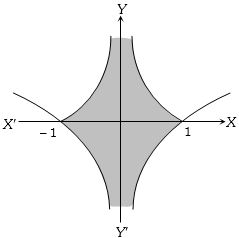
0 likesView Solution
59
MathematicsMediumMCQAIEEE · 2002
$\int_{\,\pi }^{\,10\pi } {|\sin x|dx}$ is
A
$20$
B
$8$
C
$10$
D
$18$
Solution
(D) We know that the function $f(x) = |\sin x|$ is periodic with period $\pi$.
Using the property $\int_{a}^{a+nT} f(x) dx = n \int_{0}^{T} f(x) dx$,where $T$ is the period,we have:
$\int_{\,\pi }^{\,10\pi } {|\sin x|dx} = \int_{\,0}^{\,9\pi } {|\sin x|dx}$ (by shifting the limits by $-\pi$).
Since the period is $\pi$,we can write this as:
$9 \int_{\,0}^{\,\pi } {|\sin x|dx} = 9 \int_{\,0}^{\,\pi } {\sin x dx}$ (since $\sin x \ge 0$ in $[0, \pi]$).
Evaluating the integral:
$9 [-\cos x]_{0}^{\pi} = 9 (-(\cos \pi) + \cos 0) = 9 (-(-1) + 1) = 9(1 + 1) = 18$.
Using the property $\int_{a}^{a+nT} f(x) dx = n \int_{0}^{T} f(x) dx$,where $T$ is the period,we have:
$\int_{\,\pi }^{\,10\pi } {|\sin x|dx} = \int_{\,0}^{\,9\pi } {|\sin x|dx}$ (by shifting the limits by $-\pi$).
Since the period is $\pi$,we can write this as:
$9 \int_{\,0}^{\,\pi } {|\sin x|dx} = 9 \int_{\,0}^{\,\pi } {\sin x dx}$ (since $\sin x \ge 0$ in $[0, \pi]$).
Evaluating the integral:
$9 [-\cos x]_{0}^{\pi} = 9 (-(\cos \pi) + \cos 0) = 9 (-(-1) + 1) = 9(1 + 1) = 18$.
0 likesView Solution
60
MathematicsDifficultMCQAIEEE · 2002
$\int_{ - \pi }^{\pi } {\frac{{2x(1 + \sin x)}}{{1 + {{\cos }^2}x}}dx} $ is
A
${\pi ^2}/4$
B
${\pi ^2}$
C
$0$
D
$\pi /2$
Solution
(B) Let $I = \int_{ - \pi }^\pi {\frac{{2x(1 + \sin x)}}{{1 + {{\cos }^2}x}}dx} $.
We can split the integral into two parts:
$I = \int_{ - \pi }^\pi {\frac{{2x}}{{1 + {{\cos }^2}x}}dx} + \int_{ - \pi }^\pi {\frac{{2x\sin x}}{{1 + {{\cos }^2}x}}dx} $.
For the first part,let $f(x) = \frac{2x}{1 + \cos^2 x}$. Since $f(-x) = \frac{-2x}{1 + \cos^2(-x)} = -f(x)$,the function is odd. Thus,$\int_{-\pi}^{\pi} f(x) dx = 0$.
For the second part,let $g(x) = \frac{2x\sin x}{1 + \cos^2 x}$. Since $g(-x) = \frac{2(-x)\sin(-x)}{1 + \cos^2(-x)} = \frac{2x\sin x}{1 + \cos^2 x} = g(x)$,the function is even. Thus,$\int_{-\pi}^{\pi} g(x) dx = 2 \int_0^{\pi} g(x) dx$.
So,$I = 2 \int_0^{\pi} \frac{2x\sin x}{1 + \cos^2 x} dx = 4 \int_0^{\pi} \frac{x\sin x}{1 + \cos^2 x} dx$ ... $(i)$.
Using the property $\int_0^a f(x) dx = \int_0^a f(a-x) dx$,we have:
$I = 4 \int_0^{\pi} \frac{(\pi - x)\sin(\pi - x)}{1 + \cos^2(\pi - x)} dx = 4 \int_0^{\pi} \frac{(\pi - x)\sin x}{1 + \cos^2 x} dx$ ... $(ii)$.
Adding $(i)$ and $(ii)$:
$2I = 4 \int_0^{\pi} \frac{x\sin x + (\pi - x)\sin x}{1 + \cos^2 x} dx = 4\pi \int_0^{\pi} \frac{\sin x}{1 + \cos^2 x} dx$.
$I = 2\pi \int_0^{\pi} \frac{\sin x}{1 + \cos^2 x} dx$.
Let $t = \cos x$,then $dt = -\sin x dx$. When $x=0, t=1$; when $x=\pi, t=-1$.
$I = 2\pi \int_1^{-1} \frac{-dt}{1 + t^2} = 2\pi \int_{-1}^1 \frac{dt}{1 + t^2} = 2\pi [\tan^{-1} t]_{-1}^1$.
$I = 2\pi (\tan^{-1}(1) - \tan^{-1}(-1)) = 2\pi (\frac{\pi}{4} - (-\frac{\pi}{4})) = 2\pi (\frac{\pi}{2}) = \pi^2$.
We can split the integral into two parts:
$I = \int_{ - \pi }^\pi {\frac{{2x}}{{1 + {{\cos }^2}x}}dx} + \int_{ - \pi }^\pi {\frac{{2x\sin x}}{{1 + {{\cos }^2}x}}dx} $.
For the first part,let $f(x) = \frac{2x}{1 + \cos^2 x}$. Since $f(-x) = \frac{-2x}{1 + \cos^2(-x)} = -f(x)$,the function is odd. Thus,$\int_{-\pi}^{\pi} f(x) dx = 0$.
For the second part,let $g(x) = \frac{2x\sin x}{1 + \cos^2 x}$. Since $g(-x) = \frac{2(-x)\sin(-x)}{1 + \cos^2(-x)} = \frac{2x\sin x}{1 + \cos^2 x} = g(x)$,the function is even. Thus,$\int_{-\pi}^{\pi} g(x) dx = 2 \int_0^{\pi} g(x) dx$.
So,$I = 2 \int_0^{\pi} \frac{2x\sin x}{1 + \cos^2 x} dx = 4 \int_0^{\pi} \frac{x\sin x}{1 + \cos^2 x} dx$ ... $(i)$.
Using the property $\int_0^a f(x) dx = \int_0^a f(a-x) dx$,we have:
$I = 4 \int_0^{\pi} \frac{(\pi - x)\sin(\pi - x)}{1 + \cos^2(\pi - x)} dx = 4 \int_0^{\pi} \frac{(\pi - x)\sin x}{1 + \cos^2 x} dx$ ... $(ii)$.
Adding $(i)$ and $(ii)$:
$2I = 4 \int_0^{\pi} \frac{x\sin x + (\pi - x)\sin x}{1 + \cos^2 x} dx = 4\pi \int_0^{\pi} \frac{\sin x}{1 + \cos^2 x} dx$.
$I = 2\pi \int_0^{\pi} \frac{\sin x}{1 + \cos^2 x} dx$.
Let $t = \cos x$,then $dt = -\sin x dx$. When $x=0, t=1$; when $x=\pi, t=-1$.
$I = 2\pi \int_1^{-1} \frac{-dt}{1 + t^2} = 2\pi \int_{-1}^1 \frac{dt}{1 + t^2} = 2\pi [\tan^{-1} t]_{-1}^1$.
$I = 2\pi (\tan^{-1}(1) - \tan^{-1}(-1)) = 2\pi (\frac{\pi}{4} - (-\frac{\pi}{4})) = 2\pi (\frac{\pi}{2}) = \pi^2$.
0 likesView Solution
61
MathematicsMediumMCQAIEEE · 2002
The solution of the equation $\frac{d^2y}{dx^2} = e^{-2x}$ is
A
$\frac{1}{4}e^{-2x}$
B
$\frac{1}{4}e^{-2x} + cx + d$
C
$\frac{1}{4}e^{-2x} + cx^2 + d$
D
$\frac{1}{4}e^{-2x} + c + d$
Solution
(B) Given the differential equation: $\frac{d^2y}{dx^2} = e^{-2x}$.
Integrating both sides with respect to $x$ once:
$\int \frac{d^2y}{dx^2} dx = \int e^{-2x} dx$
$\frac{dy}{dx} = \frac{e^{-2x}}{-2} + c = -\frac{1}{2}e^{-2x} + c$.
Integrating both sides with respect to $x$ again:
$\int \frac{dy}{dx} dx = \int (-\frac{1}{2}e^{-2x} + c) dx$
$y = -\frac{1}{2} \cdot \frac{e^{-2x}}{-2} + cx + d$
$y = \frac{1}{4}e^{-2x} + cx + d$.
Thus,the correct option is $B$.
Integrating both sides with respect to $x$ once:
$\int \frac{d^2y}{dx^2} dx = \int e^{-2x} dx$
$\frac{dy}{dx} = \frac{e^{-2x}}{-2} + c = -\frac{1}{2}e^{-2x} + c$.
Integrating both sides with respect to $x$ again:
$\int \frac{dy}{dx} dx = \int (-\frac{1}{2}e^{-2x} + c) dx$
$y = -\frac{1}{2} \cdot \frac{e^{-2x}}{-2} + cx + d$
$y = \frac{1}{4}e^{-2x} + cx + d$.
Thus,the correct option is $B$.
0 likesView Solution
62
MathematicsEasyMCQAIEEE · 2002
The order and degree of the differential equation ${\left( {1 + 3\frac{{dy}}{{dx}}} \right)^{\frac{2}{3}}} = 4\frac{{{d^3}y}}{{d{x^3}}}$ are
A
$1, \frac{2}{3}$
B
$3, 1$
C
$3, 3$
D
$1, 2$
Solution
(C) To find the order and degree of the differential equation,we must first eliminate the fractional exponent by raising both sides to the power of $3$.
Given equation: ${\left( {1 + 3\frac{{dy}}{{dx}}} \right)^{\frac{2}{3}}} = 4\frac{{{d^3}y}}{{d{x^3}}}$
Cubing both sides:
${\left( {1 + 3\frac{{dy}}{{dx}}} \right)^2} = {\left( {4\frac{{{d^3}y}}{{d{x^3}}}} \right)^3}$
Now,the equation is a polynomial in terms of derivatives.
The order of a differential equation is the highest derivative present,which is $\frac{{{d^3}y}}{{d{x^3}}}$,so the order is $3$.
The degree of a differential equation is the power of the highest order derivative when the equation is expressed as a polynomial in derivatives. Here,the power of $\frac{{{d^3}y}}{{d{x^3}}}$ is $3$.
Thus,the order is $3$ and the degree is $3$.
Given equation: ${\left( {1 + 3\frac{{dy}}{{dx}}} \right)^{\frac{2}{3}}} = 4\frac{{{d^3}y}}{{d{x^3}}}$
Cubing both sides:
${\left( {1 + 3\frac{{dy}}{{dx}}} \right)^2} = {\left( {4\frac{{{d^3}y}}{{d{x^3}}}} \right)^3}$
Now,the equation is a polynomial in terms of derivatives.
The order of a differential equation is the highest derivative present,which is $\frac{{{d^3}y}}{{d{x^3}}}$,so the order is $3$.
The degree of a differential equation is the power of the highest order derivative when the equation is expressed as a polynomial in derivatives. Here,the power of $\frac{{{d^3}y}}{{d{x^3}}}$ is $3$.
Thus,the order is $3$ and the degree is $3$.
0 likesView Solution
63
MathematicsEasyMCQAIEEE · 2002
$A$ die is tossed $5$ times. Getting an odd number is considered a success. Then the variance of the distribution of success is
A
$\frac{8}{3}$
B
$\frac{3}{8}$
C
$\frac{4}{5}$
D
$\frac{5}{4}$
Solution
(D) This is a binomial distribution problem where $n = 5$ trials are performed.
The probability of getting an odd number (success) in a single toss of a die is $p = \frac{3}{6} = \frac{1}{2}$.
The probability of failure is $q = 1 - p = 1 - \frac{1}{2} = \frac{1}{2}$.
The variance of a binomial distribution is given by the formula $\text{Variance} = npq$.
Substituting the values: $\text{Variance} = 5 \times \frac{1}{2} \times \frac{1}{2} = \frac{5}{4}$.
The probability of getting an odd number (success) in a single toss of a die is $p = \frac{3}{6} = \frac{1}{2}$.
The probability of failure is $q = 1 - p = 1 - \frac{1}{2} = \frac{1}{2}$.
The variance of a binomial distribution is given by the formula $\text{Variance} = npq$.
Substituting the values: $\text{Variance} = 5 \times \frac{1}{2} \times \frac{1}{2} = \frac{5}{4}$.
0 likesView Solution
64
MathematicsMediumMCQAIEEE · 2002
$a = 3i - 5j$ and $b = 6i + 3j$ are two vectors and $c$ is a vector such that $c = a \times b$,then $|a|:|b|:|c|$ is
A
$\sqrt{34} : \sqrt{45} : \sqrt{39}$
B
$\sqrt{34} : \sqrt{45} : 39$
C
$34 : 39 : 45$
D
$39 : 35 : 34$
Solution
(B) Given vectors are $a = 3i - 5j$ and $b = 6i + 3j$.
First,we calculate the cross product $c = a \times b$:
$c = \begin{vmatrix} i & j & k \\ 3 & -5 & 0 \\ 6 & 3 & 0 \end{vmatrix} = i(0 - 0) - j(0 - 0) + k(9 - (-30)) = 39k$.
Now,we find the magnitudes of the vectors:
$|a| = \sqrt{3^2 + (-5)^2} = \sqrt{9 + 25} = \sqrt{34}$.
$|b| = \sqrt{6^2 + 3^2} = \sqrt{36 + 9} = \sqrt{45}$.
$|c| = \sqrt{0^2 + 0^2 + 39^2} = 39$.
Therefore,the ratio $|a|:|b|:|c|$ is $\sqrt{34} : \sqrt{45} : 39$.
First,we calculate the cross product $c = a \times b$:
$c = \begin{vmatrix} i & j & k \\ 3 & -5 & 0 \\ 6 & 3 & 0 \end{vmatrix} = i(0 - 0) - j(0 - 0) + k(9 - (-30)) = 39k$.
Now,we find the magnitudes of the vectors:
$|a| = \sqrt{3^2 + (-5)^2} = \sqrt{9 + 25} = \sqrt{34}$.
$|b| = \sqrt{6^2 + 3^2} = \sqrt{36 + 9} = \sqrt{45}$.
$|c| = \sqrt{0^2 + 0^2 + 39^2} = 39$.
Therefore,the ratio $|a|:|b|:|c|$ is $\sqrt{34} : \sqrt{45} : 39$.
0 likesView Solution
Vedclass Products
For Students
Vedclass Test Series
Mock tests in real AIEEE style covering Mathematics with performance analysis. 5-day free trial.
Start Free TrialFor Teachers
Exam Paper Generator
Generate Set A/B/C/D Mathematics papers from 7.5L+ questions in 2 minutes. 3 chapters free.
Try FreeFor Institutes
Online Exam Module
Run live AIEEE mock exams with unlimited students, 360° analytics & white-label branding.
See DemoFrequently Asked Questions
How many Mathematics questions are in AIEEE 2002?
There are 64 Mathematics questions from the AIEEE 2002 paper on Vedclass, each with a detailed step-by-step solution in English.
Are AIEEE 2002 Mathematics solutions available in English?
Yes. All solutions on this page are in English. You can also switch to English or Hindi using the language buttons above the questions.
Can I practice AIEEE 2002 Mathematics as a timed test?
Yes. Use the Vedclass Test Series to attempt a full AIEEE mock test covering Mathematics with time limits and instant score analysis.
Can teachers create Mathematics papers from AIEEE previous year questions?
Yes. The Vedclass Exam Paper Generator lets teachers mix AIEEE Mathematics questions and generate Set A/B/C/D papers in minutes.
For Teachers & Institutes
Build a Custom Mathematics Paper
Pick AIEEE 2002 Mathematics questions, set difficulty, and generate Set A/B/C/D in 2 minutes.