
MathematicsQ1–36 of 36 questions
Page 1 of 1 · English
1
MathematicsDifficultMCQAIEEE · 2011
If $A = \sin^2 x + \cos^4 x$,then for all real $x :$
A
$1 \le A \le 2$
B
$\frac{13}{16} \le A \le 1$
C
$\frac{3}{4} \le A \le 1$
D
$\frac{3}{4} \le A \le \frac{13}{16}$
Solution
(C) Given $A = \sin^2 x + \cos^4 x$.
Let $t = \sin^2 x$,then $0 \le t \le 1$. Since $\cos^2 x = 1 - \sin^2 x = 1 - t$,we have $\cos^4 x = (1 - t)^2$.
Substituting these into the expression for $A$:
$A = t + (1 - t)^2 = t + 1 - 2t + t^2 = t^2 - t + 1$.
This is a quadratic expression in $t$ where $t \in [0, 1]$.
The vertex of the parabola $f(t) = t^2 - t + 1$ is at $t = -(-1)/(2 \times 1) = 1/2$.
Since $1/2$ is within the interval $[0, 1]$,the minimum value is $f(1/2) = (1/2)^2 - (1/2) + 1 = 1/4 - 1/2 + 1 = 3/4$.
The maximum value occurs at the boundaries $t=0$ or $t=1$:
$f(0) = 0^2 - 0 + 1 = 1$.
$f(1) = 1^2 - 1 + 1 = 1$.
Thus,the range of $A$ is $\frac{3}{4} \le A \le 1$.
Let $t = \sin^2 x$,then $0 \le t \le 1$. Since $\cos^2 x = 1 - \sin^2 x = 1 - t$,we have $\cos^4 x = (1 - t)^2$.
Substituting these into the expression for $A$:
$A = t + (1 - t)^2 = t + 1 - 2t + t^2 = t^2 - t + 1$.
This is a quadratic expression in $t$ where $t \in [0, 1]$.
The vertex of the parabola $f(t) = t^2 - t + 1$ is at $t = -(-1)/(2 \times 1) = 1/2$.
Since $1/2$ is within the interval $[0, 1]$,the minimum value is $f(1/2) = (1/2)^2 - (1/2) + 1 = 1/4 - 1/2 + 1 = 3/4$.
The maximum value occurs at the boundaries $t=0$ or $t=1$:
$f(0) = 0^2 - 0 + 1 = 1$.
$f(1) = 1^2 - 1 + 1 = 1$.
Thus,the range of $A$ is $\frac{3}{4} \le A \le 1$.
0 likesView Solution
2
MathematicsMediumMCQAIEEE · 2011
If $\omega (\neq 1)$ is a cube root of unity and $(1 + \omega)^7 = A + B\omega$,then $A$ and $B$ are equal to:
A
$0, 1$
B
$1, 0$
C
$1, 1$
D
$-1, 1$
Solution
(C) We know that for the cube roots of unity,$1 + \omega + \omega^2 = 0$,which implies $1 + \omega = -\omega^2$.
Substituting this into the given expression:
$(1 + \omega)^7 = (-\omega^2)^7$
$= -\omega^{14}$
Since $\omega^3 = 1$,we have $\omega^{14} = \omega^{12} \cdot \omega^2 = (\omega^3)^4 \cdot \omega^2 = 1^4 \cdot \omega^2 = \omega^2$.
Thus,$(1 + \omega)^7 = -\omega^2$.
Using the identity $1 + \omega + \omega^2 = 0$,we get $-\omega^2 = 1 + \omega$.
Comparing $1 + \omega$ with $A + B\omega$,we get $A = 1$ and $B = 1$.
Substituting this into the given expression:
$(1 + \omega)^7 = (-\omega^2)^7$
$= -\omega^{14}$
Since $\omega^3 = 1$,we have $\omega^{14} = \omega^{12} \cdot \omega^2 = (\omega^3)^4 \cdot \omega^2 = 1^4 \cdot \omega^2 = \omega^2$.
Thus,$(1 + \omega)^7 = -\omega^2$.
Using the identity $1 + \omega + \omega^2 = 0$,we get $-\omega^2 = 1 + \omega$.
Comparing $1 + \omega$ with $A + B\omega$,we get $A = 1$ and $B = 1$.
0 likesView Solution
3
MathematicsDifficultMCQAIEEE · 2011
Statement-$1:$ The number of ways of distributing $10$ identical balls in $4$ distinct boxes such that no box is empty is $^9C_3$.
Statement-$2:$ The number of ways of choosing any $3$ places from $9$ different places is $^9C_3$.
Statement-$2:$ The number of ways of choosing any $3$ places from $9$ different places is $^9C_3$.
A
Statement-$1$ is false,Statement-$2$ is true.
B
Statement-$1$ is true,Statement-$2$ is false.
C
Statement-$1$ is true,Statement-$2$ is true; Statement-$2$ is not a correct explanation for Statement-$1$.
D
Statement-$1$ is true,Statement-$2$ is true; Statement-$2$ is a correct explanation for Statement-$1$.
Solution
(D) For Statement-$1$: The number of ways to distribute $n$ identical items into $r$ distinct boxes such that no box is empty is given by the formula $^{n-1}C_{r-1}$.
Here,$n = 10$ and $r = 4$.
So,the number of ways is $^{10-1}C_{4-1} = ^9C_3$.
Thus,Statement-$1$ is true.
For Statement-$2$: The number of ways to choose $r$ items from $n$ distinct items is $^nC_r$.
Here,$n = 9$ and $r = 3$,so the number of ways is $^9C_3$.
Thus,Statement-$2$ is true.
Since the formula for distributing identical items into distinct boxes (stars and bars method) is derived using the concept of choosing positions,Statement-$2$ is the correct explanation for Statement-$1$.
Here,$n = 10$ and $r = 4$.
So,the number of ways is $^{10-1}C_{4-1} = ^9C_3$.
Thus,Statement-$1$ is true.
For Statement-$2$: The number of ways to choose $r$ items from $n$ distinct items is $^nC_r$.
Here,$n = 9$ and $r = 3$,so the number of ways is $^9C_3$.
Thus,Statement-$2$ is true.
Since the formula for distributing identical items into distinct boxes (stars and bars method) is derived using the concept of choosing positions,Statement-$2$ is the correct explanation for Statement-$1$.
0 likesView Solution
4
MathematicsDifficultMCQAIEEE · 2011
The coefficient of $x^7$ in the expansion of $(1 - x - x^2 + x^3)^6$ is
A
$-132$
B
$-144$
C
$132$
D
$144$
Solution
(B) Given expression: $(1 - x - x^2 + x^3)^6 = ((1 - x)(1 - x^2))^6 = (1 - x)^6 (1 - x^2)^6 = (1 - x)^6 (1 - x)^6 (1 + x)^6 = (1 - x)^{12} (1 + x)^6$.
We need the coefficient of $x^7$ in $(1 - x)^{12} (1 + x)^6$.
Let $(1 - x)^{12} = \sum_{i=0}^{12} (-1)^i \binom{12}{i} x^i$ and $(1 + x)^6 = \sum_{j=0}^{6} \binom{6}{j} x^j$.
The coefficient of $x^7$ is $\sum_{i+j=7} (-1)^i \binom{12}{i} \binom{6}{j}$.
For $i=1, j=6: -\binom{12}{1} \binom{6}{6} = -12 \times 1 = -12$.
For $i=2, j=5: \binom{12}{2} \binom{6}{5} = 66 \times 6 = 396$.
For $i=3, j=4: -\binom{12}{3} \binom{6}{4} = -220 \times 15 = -3300$.
For $i=4, j=3: \binom{12}{4} \binom{6}{3} = 495 \times 20 = 9900$.
For $i=5, j=2: -\binom{12}{5} \binom{6}{2} = -792 \times 15 = -11880$.
For $i=6, j=1: \binom{12}{6} \binom{6}{1} = 924 \times 6 = 5544$.
For $i=7, j=0: -\binom{12}{7} \binom{6}{0} = -792 \times 1 = -792$.
Summing these: $-12 + 396 - 3300 + 9900 - 11880 + 5544 - 792 = -144$.
We need the coefficient of $x^7$ in $(1 - x)^{12} (1 + x)^6$.
Let $(1 - x)^{12} = \sum_{i=0}^{12} (-1)^i \binom{12}{i} x^i$ and $(1 + x)^6 = \sum_{j=0}^{6} \binom{6}{j} x^j$.
The coefficient of $x^7$ is $\sum_{i+j=7} (-1)^i \binom{12}{i} \binom{6}{j}$.
For $i=1, j=6: -\binom{12}{1} \binom{6}{6} = -12 \times 1 = -12$.
For $i=2, j=5: \binom{12}{2} \binom{6}{5} = 66 \times 6 = 396$.
For $i=3, j=4: -\binom{12}{3} \binom{6}{4} = -220 \times 15 = -3300$.
For $i=4, j=3: \binom{12}{4} \binom{6}{3} = 495 \times 20 = 9900$.
For $i=5, j=2: -\binom{12}{5} \binom{6}{2} = -792 \times 15 = -11880$.
For $i=6, j=1: \binom{12}{6} \binom{6}{1} = 924 \times 6 = 5544$.
For $i=7, j=0: -\binom{12}{7} \binom{6}{0} = -792 \times 1 = -792$.
Summing these: $-12 + 396 - 3300 + 9900 - 11880 + 5544 - 792 = -144$.
0 likesView Solution
5
MathematicsMediumMCQAIEEE · 2011
Statement $-1$: For every natural number $n$,$(n + 1)^7 - n^7 - 1$ is divisible by $7$.
Statement $-2$: For every natural number $n$,$n^7 - n$ is divisible by $7$.
Statement $-2$: For every natural number $n$,$n^7 - n$ is divisible by $7$.
A
Statement $-1$ is false,Statement $-2$ is true.
B
Statement $-1$ is true,Statement $-2$ is false.
C
Statement $-1$ is true,Statement $-2$ is true; Statement $-2$ is not a correct explanation for Statement $-1$.
D
Statement $-1$ is true,Statement $-2$ is true; Statement $-2$ is a correct explanation for Statement $-1$.
Solution
(D) For Statement $-2$: By Fermat's Little Theorem,for any prime $p$ and integer $n$,$n^p \equiv n \pmod{p}$. Here $p = 7$,so $n^7 \equiv n \pmod{7}$,which means $n^7 - n$ is divisible by $7$. Thus,Statement $-2$ is true.
For Statement $-1$: Expand $(n + 1)^7$ using the Binomial Theorem: $(n + 1)^7 = n^7 + 7n^6 + 21n^5 + 35n^4 + 35n^3 + 21n^2 + 7n + 1$.
Then $(n + 1)^7 - n^7 - 1 = 7n^6 + 21n^5 + 35n^4 + 35n^3 + 21n^2 + 7n = 7(n^6 + 3n^5 + 5n^4 + 5n^3 + 3n^2 + n)$.
This expression is clearly divisible by $7$. Thus,Statement $-1$ is true.
Note that Statement $-1$ can be written as $(n+1)^7 - (n+1) - (n^7 - n) = 7k$. Since both $(n+1)^7 - (n+1)$ and $n^7 - n$ are divisible by $7$ (by Statement $-2$),their difference is also divisible by $7$. Therefore,Statement $-2$ is a correct explanation for Statement $-1$.
For Statement $-1$: Expand $(n + 1)^7$ using the Binomial Theorem: $(n + 1)^7 = n^7 + 7n^6 + 21n^5 + 35n^4 + 35n^3 + 21n^2 + 7n + 1$.
Then $(n + 1)^7 - n^7 - 1 = 7n^6 + 21n^5 + 35n^4 + 35n^3 + 21n^2 + 7n = 7(n^6 + 3n^5 + 5n^4 + 5n^3 + 3n^2 + n)$.
This expression is clearly divisible by $7$. Thus,Statement $-1$ is true.
Note that Statement $-1$ can be written as $(n+1)^7 - (n+1) - (n^7 - n) = 7k$. Since both $(n+1)^7 - (n+1)$ and $n^7 - n$ are divisible by $7$ (by Statement $-2$),their difference is also divisible by $7$. Therefore,Statement $-2$ is a correct explanation for Statement $-1$.
0 likesView Solution
6
MathematicsDifficultMCQAIEEE · 2011
$A$ man saves $200$ in each of the first three months of his service. In each of the subsequent months,his saving increases by $40$ more than the saving of the immediately previous month. His total saving from the start of service will be $11040$ after ............ months.
A
$19$
B
$20$
C
$21$
D
$18$
Solution
(C) The savings for the first few months are:
Month $1: 200$,Month $2: 200$,Month $3: 200$.
From month $4$ onwards,the savings form an Arithmetic Progression $(AP)$ with first term $a = 240$ and common difference $d = 40$.
Let the total number of months be $n$. The total savings is given by:
$600 + \sum_{k=1}^{n-3} [240 + (k-1)40] = 11040$
$600 + \frac{n-3}{2} [2(240) + (n-3-1)40] = 11040$
$600 + (n-3) [240 + (n-4)20] = 11040$
$(n-3) [240 + 20n - 80] = 10440$
$(n-3) [20n + 160] = 10440$
$(n-3)(n+8) = 522$
$n^2 + 5n - 24 = 522$
$n^2 + 5n - 546 = 0$
Solving the quadratic equation $n^2 + 5n - 546 = 0$:
$n = \frac{-5 \pm \sqrt{25 - 4(1)(-546)}}{2} = \frac{-5 \pm \sqrt{2209}}{2} = \frac{-5 \pm 47}{2}$
Taking the positive value,$n = \frac{42}{2} = 21$.
Thus,the total saving will be $11040$ after $21$ months.
Month $1: 200$,Month $2: 200$,Month $3: 200$.
From month $4$ onwards,the savings form an Arithmetic Progression $(AP)$ with first term $a = 240$ and common difference $d = 40$.
Let the total number of months be $n$. The total savings is given by:
$600 + \sum_{k=1}^{n-3} [240 + (k-1)40] = 11040$
$600 + \frac{n-3}{2} [2(240) + (n-3-1)40] = 11040$
$600 + (n-3) [240 + (n-4)20] = 11040$
$(n-3) [240 + 20n - 80] = 10440$
$(n-3) [20n + 160] = 10440$
$(n-3)(n+8) = 522$
$n^2 + 5n - 24 = 522$
$n^2 + 5n - 546 = 0$
Solving the quadratic equation $n^2 + 5n - 546 = 0$:
$n = \frac{-5 \pm \sqrt{25 - 4(1)(-546)}}{2} = \frac{-5 \pm \sqrt{2209}}{2} = \frac{-5 \pm 47}{2}$
Taking the positive value,$n = \frac{42}{2} = 21$.
Thus,the total saving will be $11040$ after $21$ months.
1 likesView Solution
7
MathematicsDifficultMCQAIEEE · 2011
Two circles $x^2 + y^2 = ax$ and $x^2 + y^2 = c^2$ touch each other if:
A
$|a| = c$
B
$a = 2c$
C
$|a| = 2c$
D
$2|a| = c$
Solution
(A) The given equations are $x^2 + y^2 - ax = 0$ and $x^2 + y^2 = c^2$.
For the first circle,the centre $C_1 = (\frac{a}{2}, 0)$ and radius $r_1 = |\frac{a}{2}|$.
For the second circle,the centre $C_2 = (0, 0)$ and radius $r_2 = |c|$.
The distance between the centres is $d = \sqrt{(\frac{a}{2} - 0)^2 + (0 - 0)^2} = |\frac{a}{2}|$.
Two circles touch each other if the distance between their centres is equal to the sum or difference of their radii,i.e.,$d = |r_1 \pm r_2|$.
$|\frac{a}{2}| = ||\frac{a}{2}| \pm |c||$.
Case $1$: $|\frac{a}{2}| = |\frac{a}{2}| + |c| \Rightarrow |c| = 0$ (not possible for a circle).
Case $2$: $|\frac{a}{2}| = | |\frac{a}{2}| - |c| |$.
This implies $|\frac{a}{2}| = |c| - |\frac{a}{2}|$ (assuming $|c| > |\frac{a}{2}|$) or $|\frac{a}{2}| = |\frac{a}{2}| - |c|$ (not possible).
Thus,$2|\frac{a}{2}| = |c|$,which simplifies to $|a| = |c|$ or $|a| = c$ (since $c$ is a radius,$c > 0$).
For the first circle,the centre $C_1 = (\frac{a}{2}, 0)$ and radius $r_1 = |\frac{a}{2}|$.
For the second circle,the centre $C_2 = (0, 0)$ and radius $r_2 = |c|$.
The distance between the centres is $d = \sqrt{(\frac{a}{2} - 0)^2 + (0 - 0)^2} = |\frac{a}{2}|$.
Two circles touch each other if the distance between their centres is equal to the sum or difference of their radii,i.e.,$d = |r_1 \pm r_2|$.
$|\frac{a}{2}| = ||\frac{a}{2}| \pm |c||$.
Case $1$: $|\frac{a}{2}| = |\frac{a}{2}| + |c| \Rightarrow |c| = 0$ (not possible for a circle).
Case $2$: $|\frac{a}{2}| = | |\frac{a}{2}| - |c| |$.
This implies $|\frac{a}{2}| = |c| - |\frac{a}{2}|$ (assuming $|c| > |\frac{a}{2}|$) or $|\frac{a}{2}| = |\frac{a}{2}| - |c|$ (not possible).
Thus,$2|\frac{a}{2}| = |c|$,which simplifies to $|a| = |c|$ or $|a| = c$ (since $c$ is a radius,$c > 0$).
0 likesView Solution
8
MathematicsMediumMCQAIEEE · 2011
The equation of the ellipse whose axes are the coordinate axes,which passes through the point $(-3, 1)$,and has an eccentricity $e = \sqrt{\frac{2}{5}}$ is:
A
$5x^{2} + 3y^{2} - 48 = 0$
B
$3x^{2} + 5y^{2} - 15 = 0$
C
$5x^{2} + 3y^{2} - 32 = 0$
D
$3x^{2} + 5y^{2} - 32 = 0$
Solution
(D) Let the equation of the ellipse be $\frac{x^{2}}{a^{2}} + \frac{y^{2}}{b^{2}} = 1$.
Since it passes through $(-3, 1)$,we have $\frac{9}{a^{2}} + \frac{1}{b^{2}} = 1$.
Given $e^{2} = \frac{2}{5}$,we know $b^{2} = a^{2}(1 - e^{2}) = a^{2}(1 - \frac{2}{5}) = \frac{3}{5}a^{2}$.
Substituting $b^{2}$ into the equation: $\frac{9}{a^{2}} + \frac{1}{\frac{3}{5}a^{2}} = 1$.
$\frac{9}{a^{2}} + \frac{5}{3a^{2}} = 1$ $\Rightarrow \frac{27 + 5}{3a^{2}} = 1$ $\Rightarrow 3a^{2} = 32$ $\Rightarrow a^{2} = \frac{32}{3}$.
Then $b^{2} = \frac{3}{5} \times \frac{32}{3} = \frac{32}{5}$.
The equation is $\frac{x^{2}}{32/3} + \frac{y^{2}}{32/5} = 1$,which simplifies to $\frac{3x^{2}}{32} + \frac{5y^{2}}{32} = 1$.
Thus,$3x^{2} + 5y^{2} = 32$ or $3x^{2} + 5y^{2} - 32 = 0$.
Since it passes through $(-3, 1)$,we have $\frac{9}{a^{2}} + \frac{1}{b^{2}} = 1$.
Given $e^{2} = \frac{2}{5}$,we know $b^{2} = a^{2}(1 - e^{2}) = a^{2}(1 - \frac{2}{5}) = \frac{3}{5}a^{2}$.
Substituting $b^{2}$ into the equation: $\frac{9}{a^{2}} + \frac{1}{\frac{3}{5}a^{2}} = 1$.
$\frac{9}{a^{2}} + \frac{5}{3a^{2}} = 1$ $\Rightarrow \frac{27 + 5}{3a^{2}} = 1$ $\Rightarrow 3a^{2} = 32$ $\Rightarrow a^{2} = \frac{32}{3}$.
Then $b^{2} = \frac{3}{5} \times \frac{32}{3} = \frac{32}{5}$.
The equation is $\frac{x^{2}}{32/3} + \frac{y^{2}}{32/5} = 1$,which simplifies to $\frac{3x^{2}}{32} + \frac{5y^{2}}{32} = 1$.
Thus,$3x^{2} + 5y^{2} = 32$ or $3x^{2} + 5y^{2} - 32 = 0$.
0 likesView Solution
9
MathematicsMediumMCQAIEEE · 2011
$\mathop {\lim }\limits_{x \to 2} \left( {\frac{{\sqrt {1 - \cos \{ 2(x - 2)\} } }}{{x - 2}}} \right) = $
A
$\sqrt 2 $
B
$-\sqrt 2 $
C
$\frac{1}{{\sqrt 2 }}$
D
$\text{does not exist}$
Solution
(D) Let $f(x) = \frac{\sqrt{1 - \cos\{2(x - 2)\}}}{x - 2}$.
Using the identity $1 - \cos(2\theta) = 2\sin^2(\theta)$,we get $1 - \cos\{2(x - 2)\} = 2\sin^2(x - 2)$.
Thus,$f(x) = \frac{\sqrt{2\sin^2(x - 2)}}{x - 2} = \frac{\sqrt{2}|\sin(x - 2)|}{x - 2}$.
For the Left Hand Limit $(LHL)$: $\mathop {\lim }\limits_{x \to 2^-} \frac{\sqrt{2}|\sin(x - 2)|}{x - 2}$. As $x \to 2^-$,$(x - 2) < 0$,so $|\sin(x - 2)| = -\sin(x - 2)$.
$LHL = \mathop {\lim }\limits_{x \to 2^-} \frac{-\sqrt{2}\sin(x - 2)}{x - 2} = -\sqrt{2}(1) = -\sqrt{2}$.
For the Right Hand Limit $(RHL)$: $\mathop {\lim }\limits_{x \to 2^+} \frac{\sqrt{2}|\sin(x - 2)|}{x - 2}$. As $x \to 2^+$,$(x - 2) > 0$,so $|\sin(x - 2)| = \sin(x - 2)$.
$RHL = \mathop {\lim }\limits_{x \to 2^+} \frac{\sqrt{2}\sin(x - 2)}{x - 2} = \sqrt{2}(1) = \sqrt{2}$.
Since $LHL \neq RHL$,the limit does not exist.
Using the identity $1 - \cos(2\theta) = 2\sin^2(\theta)$,we get $1 - \cos\{2(x - 2)\} = 2\sin^2(x - 2)$.
Thus,$f(x) = \frac{\sqrt{2\sin^2(x - 2)}}{x - 2} = \frac{\sqrt{2}|\sin(x - 2)|}{x - 2}$.
For the Left Hand Limit $(LHL)$: $\mathop {\lim }\limits_{x \to 2^-} \frac{\sqrt{2}|\sin(x - 2)|}{x - 2}$. As $x \to 2^-$,$(x - 2) < 0$,so $|\sin(x - 2)| = -\sin(x - 2)$.
$LHL = \mathop {\lim }\limits_{x \to 2^-} \frac{-\sqrt{2}\sin(x - 2)}{x - 2} = -\sqrt{2}(1) = -\sqrt{2}$.
For the Right Hand Limit $(RHL)$: $\mathop {\lim }\limits_{x \to 2^+} \frac{\sqrt{2}|\sin(x - 2)|}{x - 2}$. As $x \to 2^+$,$(x - 2) > 0$,so $|\sin(x - 2)| = \sin(x - 2)$.
$RHL = \mathop {\lim }\limits_{x \to 2^+} \frac{\sqrt{2}\sin(x - 2)}{x - 2} = \sqrt{2}(1) = \sqrt{2}$.
Since $LHL \neq RHL$,the limit does not exist.
0 likesView Solution
10
MathematicsMediumMCQAIEEE · 2011
If $f: R \to [0, \infty)$ is such that $\lim_{x \to 5} f(x)$ exists and $\lim_{x \to 5} \frac{(f(x))^2 - 9}{\sqrt{|x - 5|}} = 0$,then $\lim_{x \to 5} f(x)$ equals:
A
$0$
B
$1$
C
$2$
D
$3$
Solution
(D) Given that $\lim_{x \to 5} \frac{(f(x))^2 - 9}{\sqrt{|x - 5|}} = 0$.
Let $L = \lim_{x \to 5} f(x)$.
Since the limit exists,we can write $\lim_{x \to 5} ((f(x))^2 - 9) = L^2 - 9$.
If $L^2 - 9 \neq 0$,then the limit $\lim_{x \to 5} \frac{(f(x))^2 - 9}{\sqrt{|x - 5|}}$ would be of the form $\frac{k}{0}$ (where $k \neq 0$),which would be $\infty$.
Since the given limit is $0$,the numerator must approach $0$ as $x \to 5$.
Therefore,$L^2 - 9 = 0$,which implies $L^2 = 9$.
Since the codomain of $f$ is $[0, \infty)$,$L$ must be non-negative.
Thus,$L = 3$.
Let $L = \lim_{x \to 5} f(x)$.
Since the limit exists,we can write $\lim_{x \to 5} ((f(x))^2 - 9) = L^2 - 9$.
If $L^2 - 9 \neq 0$,then the limit $\lim_{x \to 5} \frac{(f(x))^2 - 9}{\sqrt{|x - 5|}}$ would be of the form $\frac{k}{0}$ (where $k \neq 0$),which would be $\infty$.
Since the given limit is $0$,the numerator must approach $0$ as $x \to 5$.
Therefore,$L^2 - 9 = 0$,which implies $L^2 = 9$.
Since the codomain of $f$ is $[0, \infty)$,$L$ must be non-negative.
Thus,$L = 3$.
0 likesView Solution
11
MathematicsMediumMCQAIEEE · 2011
If the mean deviation about the median of the numbers $a, 2a, 3a, \dots, 50a$ is $50$,then $|a|$ equals:
A
$3$
B
$4$
C
$5$
D
$2$
Solution
(B) The given numbers are $a, 2a, 3a, \dots, 50a$. The total number of terms is $n = 50$.
Since $n$ is even,the median is the average of the $25^{th}$ and $26^{th}$ terms:
$\text{Median} = \frac{25a + 26a}{2} = 25.5a$.
Mean deviation about the median is given by $\frac{1}{n} \sum_{i=1}^{n} |x_i - \text{Median}| = 50$.
$\frac{1}{50} \sum_{i=1}^{50} |ia - 25.5a| = 50$.
$\sum_{i=1}^{50} |i - 25.5| |a| = 2500$.
$|a| (|25.5 - 1| + |25.5 - 2| + \dots + |25.5 - 50|) = 2500$.
$|a| (24.5 + 23.5 + \dots + 0.5 + 0.5 + \dots + 24.5) = 2500$.
$|a| \times 2 \times (0.5 + 1.5 + \dots + 24.5) = 2500$.
$|a| \times 2 \times \frac{25}{2} (0.5 + 24.5) = 2500$.
$|a| \times 25 \times 25 = 2500$.
$|a| \times 625 = 2500$.
$|a| = 4$.
Since $n$ is even,the median is the average of the $25^{th}$ and $26^{th}$ terms:
$\text{Median} = \frac{25a + 26a}{2} = 25.5a$.
Mean deviation about the median is given by $\frac{1}{n} \sum_{i=1}^{n} |x_i - \text{Median}| = 50$.
$\frac{1}{50} \sum_{i=1}^{50} |ia - 25.5a| = 50$.
$\sum_{i=1}^{50} |i - 25.5| |a| = 2500$.
$|a| (|25.5 - 1| + |25.5 - 2| + \dots + |25.5 - 50|) = 2500$.
$|a| (24.5 + 23.5 + \dots + 0.5 + 0.5 + \dots + 24.5) = 2500$.
$|a| \times 2 \times (0.5 + 1.5 + \dots + 24.5) = 2500$.
$|a| \times 2 \times \frac{25}{2} (0.5 + 24.5) = 2500$.
$|a| \times 25 \times 25 = 2500$.
$|a| \times 625 = 2500$.
$|a| = 4$.
0 likesView Solution
12
MathematicsDifficultMCQAIEEE · 2011
Sachin and Rahul attempted to solve a quadratic equation. Sachin made a mistake in writing down the constant term and ended up with roots $(4, 3)$. Rahul made a mistake in writing down the coefficient of $x$ and ended up with roots $(3, 2)$. The correct roots of the equation are:
A
$6, 1$
B
$4, 3$
C
$-6, -1$
D
$-4, -3$
Solution
(A) Let the quadratic equation be $ax^{2} + bx + c = 0$.
Sachin made a mistake in the constant term,so the sum of the roots is correct.
Sum of roots $= 4 + 3 = 7$.
Rahul made a mistake in the coefficient of $x$,so the product of the roots is correct.
Product of roots $= 3 \times 2 = 6$.
The correct quadratic equation is $x^{2} - (\text{sum of roots})x + (\text{product of roots}) = 0$.
Substituting the values,we get $x^{2} - 7x + 6 = 0$.
Factoring the equation: $x^{2} - 6x - x + 6 = 0 \implies x(x - 6) - 1(x - 6) = 0 \implies (x - 6)(x - 1) = 0$.
Thus,the correct roots are $6$ and $1$.
Sachin made a mistake in the constant term,so the sum of the roots is correct.
Sum of roots $= 4 + 3 = 7$.
Rahul made a mistake in the coefficient of $x$,so the product of the roots is correct.
Product of roots $= 3 \times 2 = 6$.
The correct quadratic equation is $x^{2} - (\text{sum of roots})x + (\text{product of roots}) = 0$.
Substituting the values,we get $x^{2} - 7x + 6 = 0$.
Factoring the equation: $x^{2} - 6x - x + 6 = 0 \implies x(x - 6) - 1(x - 6) = 0 \implies (x - 6)(x - 1) = 0$.
Thus,the correct roots are $6$ and $1$.
0 likesView Solution
13
MathematicsDifficultMCQAIEEE · 2011
Let $a \ne a_1 \ne 0,$ $f(x) = ax^2 + bx + c,$ $g(x) = a_1x^2 + b_1x + c_1,$ and $p(x) = f(x) - g(x).$ If $p(x) = 0$ only for $x = -1$ and $p(-2) = 2,$ then the value of $p(2)$ is
A
$9$
B
$6$
C
$3$
D
$18$
Solution
(D) Given $p(x) = f(x) - g(x) = (a - a_1)x^2 + (b - b_1)x + (c - c_1).$
Since $p(x) = 0$ has only one root at $x = -1,$ the quadratic $p(x)$ must be a perfect square of the form $p(x) = k(x + 1)^2$ for some constant $k = a - a_1 \ne 0.$
Given $p(-2) = 2,$
$k(-2 + 1)^2 = 2 \Rightarrow k(-1)^2 = 2 \Rightarrow k = 2.$
Thus,$p(x) = 2(x + 1)^2.$
Now,we need to find $p(2):$
$p(2) = 2(2 + 1)^2 = 2(3)^2 = 2 \times 9 = 18.$
Since $p(x) = 0$ has only one root at $x = -1,$ the quadratic $p(x)$ must be a perfect square of the form $p(x) = k(x + 1)^2$ for some constant $k = a - a_1 \ne 0.$
Given $p(-2) = 2,$
$k(-2 + 1)^2 = 2 \Rightarrow k(-1)^2 = 2 \Rightarrow k = 2.$
Thus,$p(x) = 2(x + 1)^2.$
Now,we need to find $p(2):$
$p(2) = 2(2 + 1)^2 = 2(3)^2 = 2 \times 9 = 18.$
0 likesView Solution
14
MathematicsMediumMCQAIEEE · 2011
If $f(x)$ is an odd periodic function with period $1$,then $f(2)$ is equal to:
A
$0$
B
$1$
C
$-1$
D
Cannot be determined
Solution
(A) Given that $f(x)$ is an odd function,we have $f(-x) = -f(x)$.
For any odd function,$f(0) = -f(0)$,which implies $2f(0) = 0$,so $f(0) = 0$.
Given that $f(x)$ is a periodic function with period $T = 1$,we have $f(x + 1) = f(x)$ for all $x$.
By the property of periodicity,$f(x + nT) = f(x)$ for any integer $n$.
Therefore,$f(2) = f(0 + 2 \times 1) = f(0)$.
Since $f(0) = 0$,it follows that $f(2) = 0$.
For any odd function,$f(0) = -f(0)$,which implies $2f(0) = 0$,so $f(0) = 0$.
Given that $f(x)$ is a periodic function with period $T = 1$,we have $f(x + 1) = f(x)$ for all $x$.
By the property of periodicity,$f(x + nT) = f(x)$ for any integer $n$.
Therefore,$f(2) = f(0 + 2 \times 1) = f(0)$.
Since $f(0) = 0$,it follows that $f(2) = 0$.
0 likesView Solution
15
MathematicsEasyMCQAIEEE · 2011
Consider the following statements:
$P :$ Suman is brilliant
$Q :$ Suman is rich
$R :$ Suman is honest
The negation of the statement "Suman is brilliant and dishonest if and only if Suman is rich" can be expressed as:
$P :$ Suman is brilliant
$Q :$ Suman is rich
$R :$ Suman is honest
The negation of the statement "Suman is brilliant and dishonest if and only if Suman is rich" can be expressed as:
A
$\sim (Q \leftrightarrow (P \wedge \sim R))$
B
$\sim Q \leftrightarrow (\sim P \wedge R)$
C
$\sim (P \wedge \sim R) \leftrightarrow Q$
D
$\sim P \wedge (Q \leftrightarrow \sim R)$
Solution
(A) Let the given statements be:
$P :$ Suman is brilliant
$Q :$ Suman is rich
$R :$ Suman is honest
The statement "Suman is brilliant and dishonest" is represented as $(P \wedge \sim R)$.
The statement "Suman is brilliant and dishonest if and only if Suman is rich" is represented as $(P \wedge \sim R) \leftrightarrow Q$.
Since the biconditional operator is commutative,this is equivalent to $Q \leftrightarrow (P \wedge \sim R)$.
The negation of a statement $S$ is denoted by $\sim S$.
Therefore,the negation of the given statement is $\sim (Q \leftrightarrow (P \wedge \sim R))$.
$P :$ Suman is brilliant
$Q :$ Suman is rich
$R :$ Suman is honest
The statement "Suman is brilliant and dishonest" is represented as $(P \wedge \sim R)$.
The statement "Suman is brilliant and dishonest if and only if Suman is rich" is represented as $(P \wedge \sim R) \leftrightarrow Q$.
Since the biconditional operator is commutative,this is equivalent to $Q \leftrightarrow (P \wedge \sim R)$.
The negation of a statement $S$ is denoted by $\sim S$.
Therefore,the negation of the given statement is $\sim (Q \leftrightarrow (P \wedge \sim R))$.
0 likesView Solution
16
MathematicsMediumMCQAIEEE · 2011
If the angle between the line $x = \frac{y - 1}{2} = \frac{z - 3}{\lambda}$ and the plane $x + 2y + 3z = 4$ is $\cos^{-1}\left(\sqrt{\frac{5}{14}}\right)$,then $\lambda$ equals:
A
$\frac{3}{2}$
B
$\frac{2}{5}$
C
$\frac{5}{3}$
D
$\frac{2}{3}$
Solution
(D) The line is given by $\frac{x-0}{1} = \frac{y-1}{2} = \frac{z-3}{\lambda}$. The direction vector of the line is $\vec{b} = (1, 2, \lambda)$.
The normal vector to the plane $x + 2y + 3z = 4$ is $\vec{n} = (1, 2, 3)$.
Let $\theta$ be the angle between the line and the plane. The formula for the angle is $\sin \theta = \frac{|\vec{b} \cdot \vec{n}|}{|\vec{b}| |\vec{n}|}$.
Given $\theta = \cos^{-1}\left(\sqrt{\frac{5}{14}}\right)$,we have $\cos \theta = \sqrt{\frac{5}{14}}$.
Using $\sin^2 \theta + \cos^2 \theta = 1$,we get $\sin \theta = \sqrt{1 - \frac{5}{14}} = \sqrt{\frac{9}{14}} = \frac{3}{\sqrt{14}}$.
Now,$\frac{|(1)(1) + (2)(2) + (3)(\lambda)|}{\sqrt{1^2 + 2^2 + \lambda^2} \sqrt{1^2 + 2^2 + 3^2}} = \frac{3}{\sqrt{14}}$.
$\frac{|1 + 4 + 3\lambda|}{\sqrt{5 + \lambda^2} \sqrt{14}} = \frac{3}{\sqrt{14}}$.
$|5 + 3\lambda| = 3\sqrt{5 + \lambda^2}$.
Squaring both sides: $(5 + 3\lambda)^2 = 9(5 + \lambda^2)$.
$25 + 9\lambda^2 + 30\lambda = 45 + 9\lambda^2$.
$30\lambda = 20$.
$\lambda = \frac{20}{30} = \frac{2}{3}$.
The normal vector to the plane $x + 2y + 3z = 4$ is $\vec{n} = (1, 2, 3)$.
Let $\theta$ be the angle between the line and the plane. The formula for the angle is $\sin \theta = \frac{|\vec{b} \cdot \vec{n}|}{|\vec{b}| |\vec{n}|}$.
Given $\theta = \cos^{-1}\left(\sqrt{\frac{5}{14}}\right)$,we have $\cos \theta = \sqrt{\frac{5}{14}}$.
Using $\sin^2 \theta + \cos^2 \theta = 1$,we get $\sin \theta = \sqrt{1 - \frac{5}{14}} = \sqrt{\frac{9}{14}} = \frac{3}{\sqrt{14}}$.
Now,$\frac{|(1)(1) + (2)(2) + (3)(\lambda)|}{\sqrt{1^2 + 2^2 + \lambda^2} \sqrt{1^2 + 2^2 + 3^2}} = \frac{3}{\sqrt{14}}$.
$\frac{|1 + 4 + 3\lambda|}{\sqrt{5 + \lambda^2} \sqrt{14}} = \frac{3}{\sqrt{14}}$.
$|5 + 3\lambda| = 3\sqrt{5 + \lambda^2}$.
Squaring both sides: $(5 + 3\lambda)^2 = 9(5 + \lambda^2)$.
$25 + 9\lambda^2 + 30\lambda = 45 + 9\lambda^2$.
$30\lambda = 20$.
$\lambda = \frac{20}{30} = \frac{2}{3}$.
0 likesView Solution
17
MathematicsMediumMCQAIEEE · 2011
Statement $-1$: The point $A(1, 0, 7)$ is the mirror image of the point $B(1, 6, 3)$ in the line $\frac{x}{1} = \frac{y - 1}{2} = \frac{z - 2}{3}$.
Statement $-2$: The line $\frac{x}{1} = \frac{y - 1}{2} = \frac{z - 2}{3}$ bisects the line segment joining $A(1, 0, 7)$ and $B(1, 6, 3)$.
Statement $-2$: The line $\frac{x}{1} = \frac{y - 1}{2} = \frac{z - 2}{3}$ bisects the line segment joining $A(1, 0, 7)$ and $B(1, 6, 3)$.
A
Statement $-1$ is false,Statement $-2$ is true.
B
Statement $-1$ is true,Statement $-2$ is false.
C
Statement $-1$ is true,Statement $-2$ is true; Statement $-2$ is not a correct explanation for Statement $-1$.
D
Statement $-1$ is true,Statement $-2$ is true; Statement $-2$ is a correct explanation for Statement $-1$.
Solution
(D) Let the line be $L: \frac{x}{1} = \frac{y - 1}{2} = \frac{z - 2}{3} = k$. Any point on the line is $P(k, 2k + 1, 3k + 2)$.
For $A(1, 0, 7)$ to be the mirror image of $B(1, 6, 3)$ in line $L$,the line $AB$ must be perpendicular to $L$ and the midpoint of $AB$ must lie on $L$.
$1$. Midpoint of $AB$ is $M = (\frac{1+1}{2}, \frac{0+6}{2}, \frac{7+3}{2}) = (1, 3, 5)$.
Checking if $M$ lies on $L$: $\frac{1}{1} = \frac{3-1}{2} = \frac{5-2}{3} \implies 1 = 1 = 1$. Thus,$M$ lies on $L$.
$2$. Direction ratios of $AB$ are $(1-1, 6-0, 3-7) = (0, 6, -4)$.
Direction ratios of $L$ are $(1, 2, 3)$.
Dot product: $(0)(1) + (6)(2) + (-4)(3) = 0 + 12 - 12 = 0$.
Since the dot product is $0$,$AB$ is perpendicular to $L$.
Both conditions are satisfied,so Statement $-1$ is true. Statement $-2$ is also true because the line $L$ passes through the midpoint of $AB$ and is perpendicular to $AB$,which is the definition of a mirror image in a line. Thus,Statement $-2$ is the correct explanation for Statement $-1$.
For $A(1, 0, 7)$ to be the mirror image of $B(1, 6, 3)$ in line $L$,the line $AB$ must be perpendicular to $L$ and the midpoint of $AB$ must lie on $L$.
$1$. Midpoint of $AB$ is $M = (\frac{1+1}{2}, \frac{0+6}{2}, \frac{7+3}{2}) = (1, 3, 5)$.
Checking if $M$ lies on $L$: $\frac{1}{1} = \frac{3-1}{2} = \frac{5-2}{3} \implies 1 = 1 = 1$. Thus,$M$ lies on $L$.
$2$. Direction ratios of $AB$ are $(1-1, 6-0, 3-7) = (0, 6, -4)$.
Direction ratios of $L$ are $(1, 2, 3)$.
Dot product: $(0)(1) + (6)(2) + (-4)(3) = 0 + 12 - 12 = 0$.
Since the dot product is $0$,$AB$ is perpendicular to $L$.
Both conditions are satisfied,so Statement $-1$ is true. Statement $-2$ is also true because the line $L$ passes through the midpoint of $AB$ and is perpendicular to $AB$,which is the definition of a mirror image in a line. Thus,Statement $-2$ is the correct explanation for Statement $-1$.
0 likesView Solution
18
MathematicsDifficultMCQAIEEE · 2011
$\int_{0}^{1} \frac{8 \log(1+x)}{1+x^{2}} dx = $
A
$\frac{\pi}{8} \log 2$
B
$\frac{\pi}{2} \log 2$
C
$\log 2$
D
$\pi \log 2$
Solution
(D) Let $I = \int_{0}^{1} \frac{8 \log(1+x)}{1+x^{2}} dx$.
Substitute $x = \tan \theta$,so $dx = \sec^{2} \theta d\theta$.
When $x=0, \theta=0$ and when $x=1, \theta=\frac{\pi}{4}$.
$I = 8 \int_{0}^{\pi/4} \frac{\log(1+\tan \theta)}{1+\tan^{2} \theta} \sec^{2} \theta d\theta = 8 \int_{0}^{\pi/4} \log(1+\tan \theta) d\theta$ ... $(i)$.
Using the property $\int_{0}^{a} f(x) dx = \int_{0}^{a} f(a-x) dx$:
$I = 8 \int_{0}^{\pi/4} \log(1+\tan(\frac{\pi}{4}-\theta)) d\theta$.
Since $\tan(\frac{\pi}{4}-\theta) = \frac{1-\tan \theta}{1+\tan \theta}$,we have:
$I = 8 \int_{0}^{\pi/4} \log(1 + \frac{1-\tan \theta}{1+\tan \theta}) d\theta = 8 \int_{0}^{\pi/4} \log(\frac{2}{1+\tan \theta}) d\theta$.
$I = 8 \int_{0}^{\pi/4} (\log 2 - \log(1+\tan \theta)) d\theta$.
$I = 8 \log 2 [\theta]_{0}^{\pi/4} - 8 \int_{0}^{\pi/4} \log(1+\tan \theta) d\theta$.
$I = 8 \log 2 (\frac{\pi}{4}) - I$.
$2I = 2\pi \log 2 \Rightarrow I = \pi \log 2$.
Substitute $x = \tan \theta$,so $dx = \sec^{2} \theta d\theta$.
When $x=0, \theta=0$ and when $x=1, \theta=\frac{\pi}{4}$.
$I = 8 \int_{0}^{\pi/4} \frac{\log(1+\tan \theta)}{1+\tan^{2} \theta} \sec^{2} \theta d\theta = 8 \int_{0}^{\pi/4} \log(1+\tan \theta) d\theta$ ... $(i)$.
Using the property $\int_{0}^{a} f(x) dx = \int_{0}^{a} f(a-x) dx$:
$I = 8 \int_{0}^{\pi/4} \log(1+\tan(\frac{\pi}{4}-\theta)) d\theta$.
Since $\tan(\frac{\pi}{4}-\theta) = \frac{1-\tan \theta}{1+\tan \theta}$,we have:
$I = 8 \int_{0}^{\pi/4} \log(1 + \frac{1-\tan \theta}{1+\tan \theta}) d\theta = 8 \int_{0}^{\pi/4} \log(\frac{2}{1+\tan \theta}) d\theta$.
$I = 8 \int_{0}^{\pi/4} (\log 2 - \log(1+\tan \theta)) d\theta$.
$I = 8 \log 2 [\theta]_{0}^{\pi/4} - 8 \int_{0}^{\pi/4} \log(1+\tan \theta) d\theta$.
$I = 8 \log 2 (\frac{\pi}{4}) - I$.
$2I = 2\pi \log 2 \Rightarrow I = \pi \log 2$.
0 likesView Solution
19
MathematicsDifficultMCQAIEEE · 2011
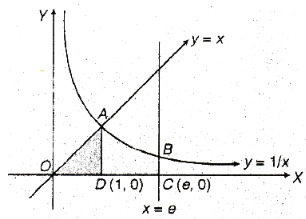
The area of the region enclosed by the curves $y = x$,$y = \frac{1}{x}$,$x = e$ and the positive $X$-axis is
A
$1$
B
$\frac{3}{2}$
C
$\frac{5}{2}$
D
$\frac{1}{2}$
Solution
(B) Given curves are $y = x$,$y = \frac{1}{x}$,$x = e$ and the positive $X$-axis $(y = 0)$.
The intersection point of $y = x$ and $y = \frac{1}{x}$ is found by setting $x = \frac{1}{x}$,which gives $x^2 = 1$. Since we are in the first quadrant,$x = 1$. Thus,the point of intersection is $(1, 1)$.
The region is bounded by $y = x$ from $x = 0$ to $x = 1$,and by $y = \frac{1}{x}$ from $x = 1$ to $x = e$.
Required Area = $\int_{0}^{1} x \, dx + \int_{1}^{e} \frac{1}{x} \, dx$
$= \left[ \frac{x^2}{2} \right]_{0}^{1} + [\ln |x|]_{1}^{e}$
$= \left( \frac{1}{2} - 0 \right) + (\ln e - \ln 1)$
$= \frac{1}{2} + (1 - 0) = \frac{1}{2} + 1 = \frac{3}{2} \text{ sq units}$.
The intersection point of $y = x$ and $y = \frac{1}{x}$ is found by setting $x = \frac{1}{x}$,which gives $x^2 = 1$. Since we are in the first quadrant,$x = 1$. Thus,the point of intersection is $(1, 1)$.
The region is bounded by $y = x$ from $x = 0$ to $x = 1$,and by $y = \frac{1}{x}$ from $x = 1$ to $x = e$.
Required Area = $\int_{0}^{1} x \, dx + \int_{1}^{e} \frac{1}{x} \, dx$
$= \left[ \frac{x^2}{2} \right]_{0}^{1} + [\ln |x|]_{1}^{e}$
$= \left( \frac{1}{2} - 0 \right) + (\ln e - \ln 1)$
$= \frac{1}{2} + (1 - 0) = \frac{1}{2} + 1 = \frac{3}{2} \text{ sq units}$.
0 likesView Solution
20
MathematicsDifficultMCQAIEEE · 2011
$\int_0^{1.5} x[x^2] dx = $
A
$0$
B
$\frac{3}{2}$
C
$\frac{3}{4}$
D
$\frac{5}{4}$
Solution
(C) We need to evaluate the integral $I = \int_0^{1.5} x[x^2] dx$.
Since $[x^2]$ changes its value at $x^2 = 1$ and $x^2 = 2$,we split the integral at $x = 1$ and $x = \sqrt{2}$.
$I = \int_0^1 x[x^2] dx + \int_1^{\sqrt{2}} x[x^2] dx + \int_{\sqrt{2}}^{1.5} x[x^2] dx$.
For $0 \le x < 1$,$0 \le x^2 < 1$,so $[x^2] = 0$.
For $1 \le x < \sqrt{2}$,$1 \le x^2 < 2$,so $[x^2] = 1$.
For $\sqrt{2} \le x < 1.5$,$2 \le x^2 < 2.25$,so $[x^2] = 2$.
Thus,$I = \int_0^1 x(0) dx + \int_1^{\sqrt{2}} x(1) dx + \int_{\sqrt{2}}^{1.5} x(2) dx$.
$I = 0 + \left[ \frac{x^2}{2} \right]_1^{\sqrt{2}} + 2 \left[ \frac{x^2}{2} \right]_{\sqrt{2}}^{1.5}$.
$I = \left( \frac{2-1}{2} \right) + (1.5^2 - (\sqrt{2})^2) = \frac{1}{2} + (2.25 - 2) = 0.5 + 0.25 = 0.75 = \frac{3}{4}$.
Since $[x^2]$ changes its value at $x^2 = 1$ and $x^2 = 2$,we split the integral at $x = 1$ and $x = \sqrt{2}$.
$I = \int_0^1 x[x^2] dx + \int_1^{\sqrt{2}} x[x^2] dx + \int_{\sqrt{2}}^{1.5} x[x^2] dx$.
For $0 \le x < 1$,$0 \le x^2 < 1$,so $[x^2] = 0$.
For $1 \le x < \sqrt{2}$,$1 \le x^2 < 2$,so $[x^2] = 1$.
For $\sqrt{2} \le x < 1.5$,$2 \le x^2 < 2.25$,so $[x^2] = 2$.
Thus,$I = \int_0^1 x(0) dx + \int_1^{\sqrt{2}} x(1) dx + \int_{\sqrt{2}}^{1.5} x(2) dx$.
$I = 0 + \left[ \frac{x^2}{2} \right]_1^{\sqrt{2}} + 2 \left[ \frac{x^2}{2} \right]_{\sqrt{2}}^{1.5}$.
$I = \left( \frac{2-1}{2} \right) + (1.5^2 - (\sqrt{2})^2) = \frac{1}{2} + (2.25 - 2) = 0.5 + 0.25 = 0.75 = \frac{3}{4}$.
0 likesView Solution
21
MathematicsDifficultMCQAIEEE · 2011
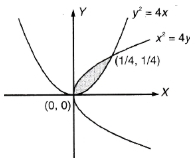
The area of the region enclosed by the parabolas $y^2 = 4x$ and $x^2 = 4y$ is
A
$\frac{32}{3}$
B
$\frac{16}{3}$
C
$\frac{8}{3}$
D
$0$
Solution
(B) To find the intersection points,substitute $y = \frac{x^2}{4}$ into $y^2 = 4x$:
$(\frac{x^2}{4})^2 = 4x$
$\frac{x^4}{16} = 4x$
$x^4 = 64x$
$x(x^3 - 64) = 0$
So,$x = 0$ or $x = 4$.
When $x = 0, y = 0$. When $x = 4, y = 4$.
The intersection points are $(0,0)$ and $(4,4)$.
The area enclosed is given by:
$\text{Area} = \int_{0}^{4} (\sqrt{4x} - \frac{x^2}{4}) dx$
$= \int_{0}^{4} (2\sqrt{x} - \frac{x^2}{4}) dx$
$= [2 \cdot \frac{2}{3} x^{3/2} - \frac{1}{4} \cdot \frac{x^3}{3}]_{0}^{4}$
$= [\frac{4}{3} x^{3/2} - \frac{x^3}{12}]_{0}^{4}$
$= (\frac{4}{3} \cdot 8 - \frac{64}{12}) - 0$
$= \frac{32}{3} - \frac{16}{3} = \frac{16}{3} \text{ sq. units}$.
$(\frac{x^2}{4})^2 = 4x$
$\frac{x^4}{16} = 4x$
$x^4 = 64x$
$x(x^3 - 64) = 0$
So,$x = 0$ or $x = 4$.
When $x = 0, y = 0$. When $x = 4, y = 4$.
The intersection points are $(0,0)$ and $(4,4)$.
The area enclosed is given by:
$\text{Area} = \int_{0}^{4} (\sqrt{4x} - \frac{x^2}{4}) dx$
$= \int_{0}^{4} (2\sqrt{x} - \frac{x^2}{4}) dx$
$= [2 \cdot \frac{2}{3} x^{3/2} - \frac{1}{4} \cdot \frac{x^3}{3}]_{0}^{4}$
$= [\frac{4}{3} x^{3/2} - \frac{x^3}{12}]_{0}^{4}$
$= (\frac{4}{3} \cdot 8 - \frac{64}{12}) - 0$
$= \frac{32}{3} - \frac{16}{3} = \frac{16}{3} \text{ sq. units}$.
0 likesView Solution
22
MathematicsMediumMCQAIEEE · 2011
Let $A$ and $B$ be two symmetric matrices of order $3$.
Statement $-1$: $A(BA)$ and $(AB)A$ are symmetric matrices.
Statement $-2$: $AB$ is a symmetric matrix if the matrix multiplication of $A$ with $B$ is commutative.
Statement $-1$: $A(BA)$ and $(AB)A$ are symmetric matrices.
Statement $-2$: $AB$ is a symmetric matrix if the matrix multiplication of $A$ with $B$ is commutative.
A
Statement $-1$ is true,Statement $-2$ is false.
B
Statement $-1$ is false,Statement $-2$ is true.
C
Statement $-1$ is true,Statement $-2$ is true; Statement $-2$ is not a correct explanation for Statement $-1$.
D
Statement $-1$ is true,Statement $-2$ is true; Statement $-2$ is a correct explanation for Statement $-1$.
Solution
(C) Given that $A$ and $B$ are symmetric matrices,we have $A^{\prime} = A$ and $B^{\prime} = B$.
For Statement $-1$:
Consider $(A(BA))^{\prime} = (BA)^{\prime} A^{\prime} = (A^{\prime} B^{\prime}) A^{\prime} = (AB)A = A(BA)$.
Since $(A(BA))^{\prime} = A(BA)$,$A(BA)$ is symmetric.
Similarly,$((AB)A)^{\prime} = A^{\prime} (AB)^{\prime} = A(B^{\prime} A^{\prime}) = A(BA) = (AB)A$.
Thus,$(AB)A$ is also symmetric. So,Statement $-1$ is true.
For Statement $-2$:
Consider $(AB)^{\prime} = B^{\prime} A^{\prime} = BA$.
If $AB$ is symmetric,then $(AB)^{\prime} = AB$,which implies $BA = AB$.
Conversely,if $BA = AB$,then $(AB)^{\prime} = BA = AB$,so $AB$ is symmetric.
Thus,Statement $-2$ is true.
However,Statement $-2$ describes the condition for $AB$ to be symmetric,whereas Statement $-1$ deals with the symmetry of $A(BA)$ and $(AB)A$ regardless of commutativity. Therefore,Statement $-2$ is not a correct explanation for Statement $-1$.
For Statement $-1$:
Consider $(A(BA))^{\prime} = (BA)^{\prime} A^{\prime} = (A^{\prime} B^{\prime}) A^{\prime} = (AB)A = A(BA)$.
Since $(A(BA))^{\prime} = A(BA)$,$A(BA)$ is symmetric.
Similarly,$((AB)A)^{\prime} = A^{\prime} (AB)^{\prime} = A(B^{\prime} A^{\prime}) = A(BA) = (AB)A$.
Thus,$(AB)A$ is also symmetric. So,Statement $-1$ is true.
For Statement $-2$:
Consider $(AB)^{\prime} = B^{\prime} A^{\prime} = BA$.
If $AB$ is symmetric,then $(AB)^{\prime} = AB$,which implies $BA = AB$.
Conversely,if $BA = AB$,then $(AB)^{\prime} = BA = AB$,so $AB$ is symmetric.
Thus,Statement $-2$ is true.
However,Statement $-2$ describes the condition for $AB$ to be symmetric,whereas Statement $-1$ deals with the symmetry of $A(BA)$ and $(AB)A$ regardless of commutativity. Therefore,Statement $-2$ is not a correct explanation for Statement $-1$.
0 likesView Solution
23
MathematicsMediumMCQAIEEE · 2011
Consider the following relation $R$ on the set of real square matrices of order $3$. $R = \{(A,B) | A = P^{-1}BP \text{ for some invertible matrix } P\}$.
\textbf{Statement-$1$:} $R$ is an equivalence relation.
\textbf{Statement-$2$:} For any two invertible $3 \times 3$ matrices $M$ and $N$,$(MN)^{-1} = N^{-1}M^{-1}$.
\textbf{Statement-$1$:} $R$ is an equivalence relation.
\textbf{Statement-$2$:} For any two invertible $3 \times 3$ matrices $M$ and $N$,$(MN)^{-1} = N^{-1}M^{-1}$.
A
Statement-$1$ is true,Statement-$2$ is true; Statement-$2$ is not a correct explanation for Statement-$1$.
B
Statement-$1$ is false,Statement-$2$ is true.
C
Statement-$1$ is true,Statement-$2$ is true; Statement-$2$ is a correct explanation for Statement-$1$.
D
Statement-$1$ is true,Statement-$2$ is false.
Solution
(A) For reflexive property:
$(A, A) \in R$ because $A = I^{-1}AI$,where $I$ is the identity matrix,which is invertible. Thus,$R$ is reflexive.
For symmetric property:
If $(A, B) \in R$,then $A = P^{-1}BP$ for some invertible matrix $P$.
Multiplying by $P$ on the left and $P^{-1}$ on the right: $PAP^{-1} = B$.
Let $Q = P^{-1}$. Since $P$ is invertible,$Q$ is also invertible.
Then $B = Q^{-1}AQ$,so $(B, A) \in R$. Thus,$R$ is symmetric.
For transitive property:
If $(A, B) \in R$ and $(B, C) \in R$,then $A = P^{-1}BP$ and $B = Q^{-1}CQ$ for some invertible matrices $P$ and $Q$.
Substituting $B$: $A = P^{-1}(Q^{-1}CQ)P = (QP)^{-1}C(QP)$.
Since $QP$ is invertible,$(A, C) \in R$. Thus,$R$ is transitive.
Therefore,$R$ is an equivalence relation. Statement-$1$ is true.
Statement-$2$ is a standard property of invertible matrices: $(MN)^{-1} = N^{-1}M^{-1}$. This is true.
However,Statement-$2$ is a general property of matrix inversion and is not the specific reason why the relation $R$ (similarity) is an equivalence relation. Thus,Statement-$2$ is not the correct explanation for Statement-$1$.
$(A, A) \in R$ because $A = I^{-1}AI$,where $I$ is the identity matrix,which is invertible. Thus,$R$ is reflexive.
For symmetric property:
If $(A, B) \in R$,then $A = P^{-1}BP$ for some invertible matrix $P$.
Multiplying by $P$ on the left and $P^{-1}$ on the right: $PAP^{-1} = B$.
Let $Q = P^{-1}$. Since $P$ is invertible,$Q$ is also invertible.
Then $B = Q^{-1}AQ$,so $(B, A) \in R$. Thus,$R$ is symmetric.
For transitive property:
If $(A, B) \in R$ and $(B, C) \in R$,then $A = P^{-1}BP$ and $B = Q^{-1}CQ$ for some invertible matrices $P$ and $Q$.
Substituting $B$: $A = P^{-1}(Q^{-1}CQ)P = (QP)^{-1}C(QP)$.
Since $QP$ is invertible,$(A, C) \in R$. Thus,$R$ is transitive.
Therefore,$R$ is an equivalence relation. Statement-$1$ is true.
Statement-$2$ is a standard property of invertible matrices: $(MN)^{-1} = N^{-1}M^{-1}$. This is true.
However,Statement-$2$ is a general property of matrix inversion and is not the specific reason why the relation $R$ (similarity) is an equivalence relation. Thus,Statement-$2$ is not the correct explanation for Statement-$1$.
0 likesView Solution
24
MathematicsMediumMCQAIEEE · 2011
Statement-$1$: The determinant of a skew-symmetric matrix of order $3$ is zero.
Statement-$2$: For any square matrix $A$ of order $n$,$\det(A^T) = \det(A)$ and $\det(-A) = (-1)^n \det(A)$.
Statement-$2$: For any square matrix $A$ of order $n$,$\det(A^T) = \det(A)$ and $\det(-A) = (-1)^n \det(A)$.
A
Statement-$1$ is true,Statement-$2$ is true; Statement-$2$ is a correct explanation for Statement-$1$.
B
Statement-$1$ is true,Statement-$2$ is true; Statement-$2$ is not a correct explanation for Statement-$1$.
C
Statement-$1$ is false,Statement-$2$ is true.
D
Statement-$1$ is true,Statement-$2$ is false.
Solution
(A) For Statement-$1$: $A$ skew-symmetric matrix $A$ satisfies $A^T = -A$. Taking the determinant on both sides,we get $\det(A^T) = \det(-A)$. Since $\det(A^T) = \det(A)$ and $\det(-A) = (-1)^n \det(A)$ for a matrix of order $n$,we have $\det(A) = (-1)^n \det(A)$. For $n=3$,$\det(A) = -\det(A)$,which implies $2 \det(A) = 0$,so $\det(A) = 0$. Thus,Statement-$1$ is true.
For Statement-$2$: The property $\det(A^T) = \det(A)$ is always true. The property $\det(-A) = (-1)^n \det(A)$ is also true for a matrix of order $n$. Therefore,Statement-$2$ is true.
Since Statement-$2$ provides the mathematical properties used to prove Statement-$1$,it is the correct explanation for Statement-$1$.
For Statement-$2$: The property $\det(A^T) = \det(A)$ is always true. The property $\det(-A) = (-1)^n \det(A)$ is also true for a matrix of order $n$. Therefore,Statement-$2$ is true.
Since Statement-$2$ provides the mathematical properties used to prove Statement-$1$,it is the correct explanation for Statement-$1$.
0 likesView Solution
25
MathematicsMediumMCQAIEEE · 2011
If $\omega \neq 1$ is a cube root of unity and $H = \begin{bmatrix} \omega & 0 \\ 0 & \omega \end{bmatrix}$,then $H^{70}$ is equal to:
A
$0$
B
$-H$
C
$H$
D
$H^2$
Solution
(C) Given $H = \begin{bmatrix} \omega & 0 \\ 0 & \omega \end{bmatrix}$.
We calculate the powers of $H$:
$H^2 = \begin{bmatrix} \omega & 0 \\ 0 & \omega \end{bmatrix} \begin{bmatrix} \omega & 0 \\ 0 & \omega \end{bmatrix} = \begin{bmatrix} \omega^2 & 0 \\ 0 & \omega^2 \end{bmatrix}$.
By induction,$H^n = \begin{bmatrix} \omega^n & 0 \\ 0 & \omega^n \end{bmatrix}$.
For $n = 70$,$H^{70} = \begin{bmatrix} \omega^{70} & 0 \\ 0 & \omega^{70} \end{bmatrix}$.
Since $\omega^3 = 1$,we have $\omega^{70} = (\omega^3)^{23} \cdot \omega = (1)^{23} \cdot \omega = \omega$.
Therefore,$H^{70} = \begin{bmatrix} \omega & 0 \\ 0 & \omega \end{bmatrix} = H$.
We calculate the powers of $H$:
$H^2 = \begin{bmatrix} \omega & 0 \\ 0 & \omega \end{bmatrix} \begin{bmatrix} \omega & 0 \\ 0 & \omega \end{bmatrix} = \begin{bmatrix} \omega^2 & 0 \\ 0 & \omega^2 \end{bmatrix}$.
By induction,$H^n = \begin{bmatrix} \omega^n & 0 \\ 0 & \omega^n \end{bmatrix}$.
For $n = 70$,$H^{70} = \begin{bmatrix} \omega^{70} & 0 \\ 0 & \omega^{70} \end{bmatrix}$.
Since $\omega^3 = 1$,we have $\omega^{70} = (\omega^3)^{23} \cdot \omega = (1)^{23} \cdot \omega = \omega$.
Therefore,$H^{70} = \begin{bmatrix} \omega & 0 \\ 0 & \omega \end{bmatrix} = H$.
0 likesView Solution
26
MathematicsMediumMCQAIEEE · 2011
The values of $p$ and $q$ for which the function $f(x) = \begin{cases} \frac{\sin(p+1)x + \sin x}{x} & x < 0 \\ q & x = 0 \\ \frac{\sqrt{x+x^2} - \sqrt{x}}{x^{3/2}} & x > 0 \end{cases}$ is continuous for $\forall x \in R$ are
A
$(-3/2, 1/2)$
B
$(1/2, 3/2)$
C
$(1/2, -3/2)$
D
$(5/2, 1/2)$
Solution
(A) For $f(x)$ to be continuous at $x=0$,we must have $\lim_{x \to 0^-} f(x) = \lim_{x \to 0^+} f(x) = f(0) = q$.
First,calculate the Right Hand Limit ($R$.$H$.$L$.):
$\lim_{x \to 0^+} f(x) = \lim_{x \to 0^+} \frac{\sqrt{x+x^2} - \sqrt{x}}{x^{3/2}} = \lim_{x \to 0^+} \frac{\sqrt{x}(\sqrt{1+x} - 1)}{x \cdot \sqrt{x}} = \lim_{x \to 0^+} \frac{\sqrt{1+x} - 1}{x}$.
Multiplying by the conjugate $\frac{\sqrt{1+x}+1}{\sqrt{1+x}+1}$,we get:
$\lim_{x \to 0^+} \frac{(1+x) - 1}{x(\sqrt{1+x} + 1)} = \lim_{x \to 0^+} \frac{x}{x(\sqrt{1+x} + 1)} = \lim_{x \to 0^+} \frac{1}{\sqrt{1+x} + 1} = \frac{1}{1+1} = \frac{1}{2}$.
Thus,$q = 1/2$.
Next,calculate the Left Hand Limit ($L$.$H$.$L$.):
$\lim_{x \to 0^-} f(x) = \lim_{x \to 0^-} \frac{\sin(p+1)x + \sin x}{x} = \lim_{x \to 0^-} \left( \frac{\sin(p+1)x}{x} + \frac{\sin x}{x} \right)$.
Using $\lim_{\theta \to 0} \frac{\sin \theta}{\theta} = 1$,we get:
$(p+1) + 1 = p+2$.
Since $L.H.L. = q$,we have $p+2 = 1/2$,which implies $p = 1/2 - 2 = -3/2$.
Therefore,the values are $(p, q) = (-3/2, 1/2)$.
First,calculate the Right Hand Limit ($R$.$H$.$L$.):
$\lim_{x \to 0^+} f(x) = \lim_{x \to 0^+} \frac{\sqrt{x+x^2} - \sqrt{x}}{x^{3/2}} = \lim_{x \to 0^+} \frac{\sqrt{x}(\sqrt{1+x} - 1)}{x \cdot \sqrt{x}} = \lim_{x \to 0^+} \frac{\sqrt{1+x} - 1}{x}$.
Multiplying by the conjugate $\frac{\sqrt{1+x}+1}{\sqrt{1+x}+1}$,we get:
$\lim_{x \to 0^+} \frac{(1+x) - 1}{x(\sqrt{1+x} + 1)} = \lim_{x \to 0^+} \frac{x}{x(\sqrt{1+x} + 1)} = \lim_{x \to 0^+} \frac{1}{\sqrt{1+x} + 1} = \frac{1}{1+1} = \frac{1}{2}$.
Thus,$q = 1/2$.
Next,calculate the Left Hand Limit ($L$.$H$.$L$.):
$\lim_{x \to 0^-} f(x) = \lim_{x \to 0^-} \frac{\sin(p+1)x + \sin x}{x} = \lim_{x \to 0^-} \left( \frac{\sin(p+1)x}{x} + \frac{\sin x}{x} \right)$.
Using $\lim_{\theta \to 0} \frac{\sin \theta}{\theta} = 1$,we get:
$(p+1) + 1 = p+2$.
Since $L.H.L. = q$,we have $p+2 = 1/2$,which implies $p = 1/2 - 2 = -3/2$.
Therefore,the values are $(p, q) = (-3/2, 1/2)$.
0 likesView Solution
27
MathematicsDifficultMCQAIEEE · 2011
$\frac{d^2x}{dy^2} = $
A
$ - \left( \frac{d^2y}{dx^2} \right)^{-1} \left( \frac{dy}{dx} \right)^{-3}$
B
$\left( \frac{d^2y}{dx^2} \right) \left( \frac{dy}{dx} \right)^{-2}$
C
$ - \left( \frac{d^2y}{dx^2} \right) \left( \frac{dy}{dx} \right)^{-3}$
D
$\left( \frac{d^2y}{dx^2} \right)^{-1}$
Solution
(C) We know that $\frac{dx}{dy} = \frac{1}{\frac{dy}{dx}}$.
Now,differentiate with respect to $y$:
$\frac{d^2x}{dy^2} = \frac{d}{dy} \left( \frac{dx}{dy} \right) = \frac{d}{dy} \left( \left( \frac{dy}{dx} \right)^{-1} \right)$.
Using the chain rule,$\frac{d}{dy} = \frac{dx}{dy} \cdot \frac{d}{dx} = \frac{1}{\frac{dy}{dx}} \cdot \frac{d}{dx}$:
$\frac{d^2x}{dy^2} = \left( \frac{1}{\frac{dy}{dx}} \right) \cdot \frac{d}{dx} \left( \left( \frac{dy}{dx} \right)^{-1} \right)$.
Applying the power rule:
$\frac{d^2x}{dy^2} = \left( \frac{1}{\frac{dy}{dx}} \right) \cdot \left( -1 \left( \frac{dy}{dx} \right)^{-2} \cdot \frac{d^2y}{dx^2} \right)$.
Simplifying the expression:
$\frac{d^2x}{dy^2} = - \left( \frac{dy}{dx} \right)^{-1} \cdot \left( \frac{dy}{dx} \right)^{-2} \cdot \frac{d^2y}{dx^2} = - \left( \frac{dy}{dx} \right)^{-3} \left( \frac{d^2y}{dx^2} \right)$.
Now,differentiate with respect to $y$:
$\frac{d^2x}{dy^2} = \frac{d}{dy} \left( \frac{dx}{dy} \right) = \frac{d}{dy} \left( \left( \frac{dy}{dx} \right)^{-1} \right)$.
Using the chain rule,$\frac{d}{dy} = \frac{dx}{dy} \cdot \frac{d}{dx} = \frac{1}{\frac{dy}{dx}} \cdot \frac{d}{dx}$:
$\frac{d^2x}{dy^2} = \left( \frac{1}{\frac{dy}{dx}} \right) \cdot \frac{d}{dx} \left( \left( \frac{dy}{dx} \right)^{-1} \right)$.
Applying the power rule:
$\frac{d^2x}{dy^2} = \left( \frac{1}{\frac{dy}{dx}} \right) \cdot \left( -1 \left( \frac{dy}{dx} \right)^{-2} \cdot \frac{d^2y}{dx^2} \right)$.
Simplifying the expression:
$\frac{d^2x}{dy^2} = - \left( \frac{dy}{dx} \right)^{-1} \cdot \left( \frac{dy}{dx} \right)^{-2} \cdot \frac{d^2y}{dx^2} = - \left( \frac{dy}{dx} \right)^{-3} \left( \frac{d^2y}{dx^2} \right)$.
0 likesView Solution
28
MathematicsMediumMCQAIEEE · 2011
If $\frac{dy}{dx} = y + 3 > 0$ and $y(0) = 2$,then $y(\ln 2)$ is equal to:
A
$5$
B
$13$
C
$-2$
D
$7$
Solution
(D) Given the differential equation $\frac{dy}{dx} = y + 3$.
Separating the variables,we get $\frac{dy}{y + 3} = dx$.
Integrating both sides,we obtain $\int \frac{dy}{y + 3} = \int dx$,which gives $\ln|y + 3| = x + C$.
Since $y + 3 > 0$,we have $y + 3 = e^{x + C} = e^C \cdot e^x$.
Let $e^C = A$,so $y + 3 = A e^x$.
Using the initial condition $y(0) = 2$,we substitute $x = 0$ and $y = 2$:
$2 + 3 = A e^0 \Rightarrow A = 5$.
Thus,the particular solution is $y + 3 = 5 e^x$,or $y = 5 e^x - 3$.
To find $y(\ln 2)$,substitute $x = \ln 2$:
$y(\ln 2) = 5 e^{\ln 2} - 3$.
Since $e^{\ln 2} = 2$,we have $y(\ln 2) = 5(2) - 3 = 10 - 3 = 7$.
Separating the variables,we get $\frac{dy}{y + 3} = dx$.
Integrating both sides,we obtain $\int \frac{dy}{y + 3} = \int dx$,which gives $\ln|y + 3| = x + C$.
Since $y + 3 > 0$,we have $y + 3 = e^{x + C} = e^C \cdot e^x$.
Let $e^C = A$,so $y + 3 = A e^x$.
Using the initial condition $y(0) = 2$,we substitute $x = 0$ and $y = 2$:
$2 + 3 = A e^0 \Rightarrow A = 5$.
Thus,the particular solution is $y + 3 = 5 e^x$,or $y = 5 e^x - 3$.
To find $y(\ln 2)$,substitute $x = \ln 2$:
$y(\ln 2) = 5 e^{\ln 2} - 3$.
Since $e^{\ln 2} = 2$,we have $y(\ln 2) = 5(2) - 3 = 10 - 3 = 7$.
0 likesView Solution
29
MathematicsDifficultMCQAIEEE · 2011
Let $I$ be the purchase value of an equipment and $V(t)$ be the value after it has been used for $t$ years. The value $V(t)$ depreciates at a rate given by the differential equation $\frac{dV(t)}{dt} = -k(T - t)$,where $k > 0$ is a constant and $T$ is the total life in years of the equipment. Then the scrap value $V(T)$ of the equipment is:
A
$I - \frac{kT^2}{2}$
B
$I - \frac{k(T - t)^2}{2}$
C
$e^{-kT}$
D
$T^2 - \frac{1}{k}$
Solution
(A) Given the differential equation: $\frac{dV}{dt} = -k(T - t)$.
Integrating both sides with respect to $t$:
$V(t) = \int -k(T - t) dt = k \int (T - t) d(T - t) = \frac{k(T - t)^2}{2} + C$.
At $t = 0$,the value of the equipment is the purchase value $I$,so $V(0) = I$:
$I = \frac{k(T - 0)^2}{2} + C \implies I = \frac{kT^2}{2} + C \implies C = I - \frac{kT^2}{2}$.
Substituting $C$ back into the equation for $V(t)$:
$V(t) = \frac{k(T - t)^2}{2} + I - \frac{kT^2}{2}$.
The scrap value $V(T)$ is the value at $t = T$:
$V(T) = \frac{k(T - T)^2}{2} + I - \frac{kT^2}{2} = 0 + I - \frac{kT^2}{2} = I - \frac{kT^2}{2}$.
Integrating both sides with respect to $t$:
$V(t) = \int -k(T - t) dt = k \int (T - t) d(T - t) = \frac{k(T - t)^2}{2} + C$.
At $t = 0$,the value of the equipment is the purchase value $I$,so $V(0) = I$:
$I = \frac{k(T - 0)^2}{2} + C \implies I = \frac{kT^2}{2} + C \implies C = I - \frac{kT^2}{2}$.
Substituting $C$ back into the equation for $V(t)$:
$V(t) = \frac{k(T - t)^2}{2} + I - \frac{kT^2}{2}$.
The scrap value $V(T)$ is the value at $t = T$:
$V(T) = \frac{k(T - T)^2}{2} + I - \frac{kT^2}{2} = 0 + I - \frac{kT^2}{2} = I - \frac{kT^2}{2}$.
0 likesView Solution
30
MathematicsDifficultMCQAIEEE · 2011
For the differential equation $y^2 dx + \left( x - \frac{1}{y} \right) dy = 0$ with the initial condition $y(1) = 1$,find $x$.
A
$4 - \frac{2}{y} - \frac{e^{\frac{1}{y}}}{e}$
B
$3 - \frac{1}{y} - \frac{e^{\frac{1}{y}}}{e}$
C
$1 + \frac{1}{y} - \frac{e^{\frac{1}{y}}}{e}$
D
$1 - \frac{1}{y} + \frac{e^{\frac{1}{y}}}{e}$
Solution
(C) Given the differential equation $y^2 dx + (x - \frac{1}{y}) dy = 0$.
Dividing by $y^2 dy$,we get $\frac{dx}{dy} + \frac{x}{y^2} = \frac{1}{y^3}$.
This is a linear differential equation of the form $\frac{dx}{dy} + P(y)x = Q(y)$,where $P(y) = \frac{1}{y^2}$ and $Q(y) = \frac{1}{y^3}$.
The Integrating Factor $(IF)$ is $e^{\int P(y) dy} = e^{\int \frac{1}{y^2} dy} = e^{-\frac{1}{y}}$.
The general solution is $x \cdot IF = \int Q(y) \cdot IF dy + C$.
$x e^{-\frac{1}{y}} = \int \frac{1}{y^3} e^{-\frac{1}{y}} dy + C$.
Let $t = -\frac{1}{y}$,then $dt = \frac{1}{y^2} dy$. Also,$\frac{1}{y} = -t$.
Substituting these,$x e^{-\frac{1}{y}} = \int (-t) e^t dt + C = - (t e^t - e^t) + C = (1 - t) e^t + C$.
$x e^{-\frac{1}{y}} = (1 + \frac{1}{y}) e^{-\frac{1}{y}} + C$.
Using $y(1) = 1$,we have $1 \cdot e^{-1} = (1 + 1) e^{-1} + C \Rightarrow e^{-1} = 2e^{-1} + C \Rightarrow C = -e^{-1} = -\frac{1}{e}$.
Thus,$x e^{-\frac{1}{y}} = (1 + \frac{1}{y}) e^{-\frac{1}{y}} - \frac{1}{e}$.
Dividing by $e^{-\frac{1}{y}}$,we get $x = 1 + \frac{1}{y} - \frac{e^{\frac{1}{y}}}{e}$.
Dividing by $y^2 dy$,we get $\frac{dx}{dy} + \frac{x}{y^2} = \frac{1}{y^3}$.
This is a linear differential equation of the form $\frac{dx}{dy} + P(y)x = Q(y)$,where $P(y) = \frac{1}{y^2}$ and $Q(y) = \frac{1}{y^3}$.
The Integrating Factor $(IF)$ is $e^{\int P(y) dy} = e^{\int \frac{1}{y^2} dy} = e^{-\frac{1}{y}}$.
The general solution is $x \cdot IF = \int Q(y) \cdot IF dy + C$.
$x e^{-\frac{1}{y}} = \int \frac{1}{y^3} e^{-\frac{1}{y}} dy + C$.
Let $t = -\frac{1}{y}$,then $dt = \frac{1}{y^2} dy$. Also,$\frac{1}{y} = -t$.
Substituting these,$x e^{-\frac{1}{y}} = \int (-t) e^t dt + C = - (t e^t - e^t) + C = (1 - t) e^t + C$.
$x e^{-\frac{1}{y}} = (1 + \frac{1}{y}) e^{-\frac{1}{y}} + C$.
Using $y(1) = 1$,we have $1 \cdot e^{-1} = (1 + 1) e^{-1} + C \Rightarrow e^{-1} = 2e^{-1} + C \Rightarrow C = -e^{-1} = -\frac{1}{e}$.
Thus,$x e^{-\frac{1}{y}} = (1 + \frac{1}{y}) e^{-\frac{1}{y}} - \frac{1}{e}$.
Dividing by $e^{-\frac{1}{y}}$,we get $x = 1 + \frac{1}{y} - \frac{e^{\frac{1}{y}}}{e}$.
0 likesView Solution
31
MathematicsEasyMCQAIEEE · 2011
If $C$ and $D$ are two events such that $P(D) \neq 0$,then which of the following statements is correct?
A
$P(C|D) \ge P(C)$
B
$P(C|D) < P(C)$
C
$P(C|D) \ge \frac{P(C)}{P(D)}$
D
$P(C|D) = P(C)$
Solution
(A) The conditional probability of an event $C$ given that event $D$ has occurred is defined as $P(C|D) = \frac{P(C \cap D)}{P(D)}$.
If $C \subset D$,then $C \cap D = C$,which implies $P(C \cap D) = P(C)$.
Substituting this into the formula,we get $P(C|D) = \frac{P(C)}{P(D)}$.
Since $D$ is an event,$P(D) \le 1$. Therefore,$\frac{1}{P(D)} \ge 1$.
Multiplying both sides by $P(C)$,we get $\frac{P(C)}{P(D)} \ge P(C)$.
Thus,$P(C|D) \ge P(C)$.
If $C \subset D$,then $C \cap D = C$,which implies $P(C \cap D) = P(C)$.
Substituting this into the formula,we get $P(C|D) = \frac{P(C)}{P(D)}$.
Since $D$ is an event,$P(D) \le 1$. Therefore,$\frac{1}{P(D)} \ge 1$.
Multiplying both sides by $P(C)$,we get $\frac{P(C)}{P(D)} \ge P(C)$.
Thus,$P(C|D) \ge P(C)$.
0 likesView Solution
32
MathematicsMediumMCQAIEEE · 2011
Consider $5$ independent Bernoulli trials each with probability of success $p$. If the probability of at least one failure is greater than or equal to $\frac{31}{32}$,then $p$ lies in the interval:
A
$(\frac{3}{4}, \frac{11}{12}]$
B
$[0, \frac{1}{2}]$
C
$(\frac{11}{12}, 1)$
D
$(\frac{1}{2}, \frac{3}{4})$
Solution
(B) Let $X$ be the number of successes in $5$ independent Bernoulli trials. The probability of success is $p$ and the probability of failure is $q = 1 - p$.
The probability of at least one failure is given by $1 - P(\text{no failure}) = 1 - P(X = 5)$.
Since the trials are independent,$P(X = 5) = p^5$.
According to the problem,the probability of at least one failure is at least $\frac{31}{32}$:
$1 - p^5 \geq \frac{31}{32}$
Rearranging the inequality:
$1 - \frac{31}{32} \geq p^5$
$\frac{1}{32} \geq p^5$
Taking the fifth root on both sides:
$p \leq (\frac{1}{32})^{1/5}$
$p \leq \frac{1}{2}$
Since $p$ is a probability,$p \geq 0$. Therefore,$p \in [0, \frac{1}{2}]$.
The probability of at least one failure is given by $1 - P(\text{no failure}) = 1 - P(X = 5)$.
Since the trials are independent,$P(X = 5) = p^5$.
According to the problem,the probability of at least one failure is at least $\frac{31}{32}$:
$1 - p^5 \geq \frac{31}{32}$
Rearranging the inequality:
$1 - \frac{31}{32} \geq p^5$
$\frac{1}{32} \geq p^5$
Taking the fifth root on both sides:
$p \leq (\frac{1}{32})^{1/5}$
$p \leq \frac{1}{2}$
Since $p$ is a probability,$p \geq 0$. Therefore,$p \in [0, \frac{1}{2}]$.
0 likesView Solution
33
MathematicsDifficultMCQAIEEE · 2011
Let $A, B, C$ be pairwise independent events with $P(C) > 0$ and $P(A \cap B \cap C) = 0$. Then $P(A' \cap B' | C) = $
A
$P(A') - P(B)$
B
$P(A) - P(B')$
C
$P(A') + P(B)$
D
$P(A') - P(B')$
Solution
(A) We need to find $P(A' \cap B' | C)$. By the definition of conditional probability:
$P(A' \cap B' | C) = \frac{P(A' \cap B' \cap C)}{P(C)}$
Using the property $P(X \cap Y \cap Z) = P(Z) - P(X' \cap Z) - P(Y' \cap Z) + P(X' \cap Y' \cap Z)$ is not direct,so we use the inclusion-exclusion principle for sets:
$P(A' \cap B' \cap C) = P(C \setminus ((A \cup B) \cap C)) = P(C) - P((A \cup B) \cap C)$
$P(A' \cap B' \cap C) = P(C) - [P(A \cap C) + P(B \cap C) - P(A \cap B \cap C)]$
Given $P(A \cap B \cap C) = 0$ and $A, B, C$ are pairwise independent,we have $P(A \cap C) = P(A)P(C)$ and $P(B \cap C) = P(B)P(C)$.
Substituting these values:
$P(A' \cap B' \cap C) = P(C) - P(A)P(C) - P(B)P(C) + 0$
$P(A' \cap B' \cap C) = P(C)(1 - P(A) - P(B))$
Therefore,$P(A' \cap B' | C) = \frac{P(C)(1 - P(A) - P(B))}{P(C)} = 1 - P(A) - P(B)$
Since $1 - P(A) = P(A')$,we get $P(A' \cap B' | C) = P(A') - P(B)$.
$P(A' \cap B' | C) = \frac{P(A' \cap B' \cap C)}{P(C)}$
Using the property $P(X \cap Y \cap Z) = P(Z) - P(X' \cap Z) - P(Y' \cap Z) + P(X' \cap Y' \cap Z)$ is not direct,so we use the inclusion-exclusion principle for sets:
$P(A' \cap B' \cap C) = P(C \setminus ((A \cup B) \cap C)) = P(C) - P((A \cup B) \cap C)$
$P(A' \cap B' \cap C) = P(C) - [P(A \cap C) + P(B \cap C) - P(A \cap B \cap C)]$
Given $P(A \cap B \cap C) = 0$ and $A, B, C$ are pairwise independent,we have $P(A \cap C) = P(A)P(C)$ and $P(B \cap C) = P(B)P(C)$.
Substituting these values:
$P(A' \cap B' \cap C) = P(C) - P(A)P(C) - P(B)P(C) + 0$
$P(A' \cap B' \cap C) = P(C)(1 - P(A) - P(B))$
Therefore,$P(A' \cap B' | C) = \frac{P(C)(1 - P(A) - P(B))}{P(C)} = 1 - P(A) - P(B)$
Since $1 - P(A) = P(A')$,we get $P(A' \cap B' | C) = P(A') - P(B)$.
0 likesView Solution
34
MathematicsEasyMCQAIEEE · 2011
The range of the function $f(x) = \frac{1}{\sqrt{x-[x]}}$ is
A
$(1, \infty)$
B
$(-\infty, \infty)$
C
$(0, \infty)$
D
$\emptyset$
Solution
(A) The function is defined as $f(x) = \frac{1}{\sqrt{x-[x]}}$.
Domain of $f$:
We know that $0 \leq x-[x] < 1$ for all $x \in \mathbb{R}$.
Also,$x-[x] = 0$ when $x \in \mathbb{Z}$.
Since the denominator cannot be zero,$x-[x] > 0$,which implies $x \notin \mathbb{Z}$.
Thus,the domain is $\mathbb{R} - \mathbb{Z}$.
Range of $f$:
For $x \in \mathbb{R} - \mathbb{Z}$,we have $0 < x-[x] < 1$.
Taking the square root,$0 < \sqrt{x-[x]} < 1$.
Taking the reciprocal,$\frac{1}{\sqrt{x-[x]}} > 1$.
Therefore,$f(x) \in (1, \infty)$.
Hence,the range of $f$ is $(1, \infty)$.
Domain of $f$:
We know that $0 \leq x-[x] < 1$ for all $x \in \mathbb{R}$.
Also,$x-[x] = 0$ when $x \in \mathbb{Z}$.
Since the denominator cannot be zero,$x-[x] > 0$,which implies $x \notin \mathbb{Z}$.
Thus,the domain is $\mathbb{R} - \mathbb{Z}$.
Range of $f$:
For $x \in \mathbb{R} - \mathbb{Z}$,we have $0 < x-[x] < 1$.
Taking the square root,$0 < \sqrt{x-[x]} < 1$.
Taking the reciprocal,$\frac{1}{\sqrt{x-[x]}} > 1$.
Therefore,$f(x) \in (1, \infty)$.
Hence,the range of $f$ is $(1, \infty)$.
0 likesView Solution
35
MathematicsDifficultMCQAIEEE · 2011
Let $f(x) = (x - 1)^2 + 1$ for $x \ge 1$.
Statement-$1$: $S = \{x : f(x) = f^{-1}(x)\} = \{1, 2\}$.
Statement-$2$: $f$ is a bijection and $f^{-1}(x) = 1 + \sqrt{x - 1}$ for $x \ge 1$.
Statement-$1$: $S = \{x : f(x) = f^{-1}(x)\} = \{1, 2\}$.
Statement-$2$: $f$ is a bijection and $f^{-1}(x) = 1 + \sqrt{x - 1}$ for $x \ge 1$.
A
Statement-$1$ is true,Statement-$2$ is false.
B
Statement-$1$ is false,Statement-$2$ is true.
C
Statement-$1$ is true,Statement-$2$ is true; Statement-$2$ is not a correct explanation for Statement-$1$.
D
Statement-$1$ is true,Statement-$2$ is true; Statement-$2$ is a correct explanation for Statement-$1$.
Solution
(D) Given $f(x) = (x - 1)^2 + 1$ for $x \ge 1$.
To find $f^{-1}(x)$,set $y = (x - 1)^2 + 1$.
Then $y - 1 = (x - 1)^2$. Since $x \ge 1$,we have $x - 1 = \sqrt{y - 1}$,so $x = 1 + \sqrt{y - 1}$.
Thus,$f^{-1}(x) = 1 + \sqrt{x - 1}$ for $x \ge 1$. So,Statement-$2$ is true.
To find $S = \{x : f(x) = f^{-1}(x)\}$,we solve $f(x) = x$.
$(x - 1)^2 + 1 = x \implies x^2 - 2x + 1 + 1 = x \implies x^2 - 3x + 2 = 0$.
$(x - 1)(x - 2) = 0$,so $x = 1$ or $x = 2$.
Since both values satisfy $x \ge 1$,$S = \{1, 2\}$. So,Statement-$1$ is true.
Since $f(x) = f^{-1}(x)$ is equivalent to $f(x) = x$ for increasing functions,Statement-$2$ explains Statement-$1$.
To find $f^{-1}(x)$,set $y = (x - 1)^2 + 1$.
Then $y - 1 = (x - 1)^2$. Since $x \ge 1$,we have $x - 1 = \sqrt{y - 1}$,so $x = 1 + \sqrt{y - 1}$.
Thus,$f^{-1}(x) = 1 + \sqrt{x - 1}$ for $x \ge 1$. So,Statement-$2$ is true.
To find $S = \{x : f(x) = f^{-1}(x)\}$,we solve $f(x) = x$.
$(x - 1)^2 + 1 = x \implies x^2 - 2x + 1 + 1 = x \implies x^2 - 3x + 2 = 0$.
$(x - 1)(x - 2) = 0$,so $x = 1$ or $x = 2$.
Since both values satisfy $x \ge 1$,$S = \{1, 2\}$. So,Statement-$1$ is true.
Since $f(x) = f^{-1}(x)$ is equivalent to $f(x) = x$ for increasing functions,Statement-$2$ explains Statement-$1$.
0 likesView Solution
36
MathematicsDifficultMCQAIEEE · 2011
The vectors $\vec{a}$ and $\vec{b}$ are not perpendicular and $\vec{c}$ and $\vec{d}$ are two vectors satisfying $\vec{b} \times \vec{c} = \vec{b} \times \vec{d}$ and $\vec{a} \cdot \vec{d} = 0$. Then the vector $\vec{d}$ is equal to:
A
$\vec{c} + \left( \frac{\vec{a} \cdot \vec{c}}{\vec{a} \cdot \vec{b}} \right) \vec{b}$
B
$\vec{b} + \left( \frac{\vec{b} \cdot \vec{c}}{\vec{a} \cdot \vec{b}} \right) \vec{c}$
C
$\vec{c} - \left( \frac{\vec{a} \cdot \vec{c}}{\vec{a} \cdot \vec{b}} \right) \vec{b}$
D
$\vec{b} - \left( \frac{\vec{b} \cdot \vec{c}}{\vec{a} \cdot \vec{b}} \right) \vec{c}$
Solution
(C) Given $\vec{b} \times \vec{c} = \vec{b} \times \vec{d}$.
Taking the cross product with $\vec{a}$ on both sides: $\vec{a} \times (\vec{b} \times \vec{c}) = \vec{a} \times (\vec{b} \times \vec{d})$.
Using the vector triple product formula $\vec{a} \times (\vec{b} \times \vec{c}) = (\vec{a} \cdot \vec{c}) \vec{b} - (\vec{a} \cdot \vec{b}) \vec{c}$,we get:
$(\vec{a} \cdot \vec{c}) \vec{b} - (\vec{a} \cdot \vec{b}) \vec{c} = (\vec{a} \cdot \vec{d}) \vec{b} - (\vec{a} \cdot \vec{b}) \vec{d}$.
Since $\vec{a} \cdot \vec{d} = 0$,the equation simplifies to:
$(\vec{a} \cdot \vec{c}) \vec{b} - (\vec{a} \cdot \vec{b}) \vec{c} = 0 - (\vec{a} \cdot \vec{b}) \vec{d}$.
Rearranging for $\vec{d}$:
$(\vec{a} \cdot \vec{b}) \vec{d} = (\vec{a} \cdot \vec{b}) \vec{c} - (\vec{a} \cdot \vec{c}) \vec{b}$.
Dividing by $(\vec{a} \cdot \vec{b})$ (which is non-zero as $\vec{a}$ and $\vec{b}$ are not perpendicular):
$\vec{d} = \vec{c} - \left( \frac{\vec{a} \cdot \vec{c}}{\vec{a} \cdot \vec{b}} \right) \vec{b}$.
Taking the cross product with $\vec{a}$ on both sides: $\vec{a} \times (\vec{b} \times \vec{c}) = \vec{a} \times (\vec{b} \times \vec{d})$.
Using the vector triple product formula $\vec{a} \times (\vec{b} \times \vec{c}) = (\vec{a} \cdot \vec{c}) \vec{b} - (\vec{a} \cdot \vec{b}) \vec{c}$,we get:
$(\vec{a} \cdot \vec{c}) \vec{b} - (\vec{a} \cdot \vec{b}) \vec{c} = (\vec{a} \cdot \vec{d}) \vec{b} - (\vec{a} \cdot \vec{b}) \vec{d}$.
Since $\vec{a} \cdot \vec{d} = 0$,the equation simplifies to:
$(\vec{a} \cdot \vec{c}) \vec{b} - (\vec{a} \cdot \vec{b}) \vec{c} = 0 - (\vec{a} \cdot \vec{b}) \vec{d}$.
Rearranging for $\vec{d}$:
$(\vec{a} \cdot \vec{b}) \vec{d} = (\vec{a} \cdot \vec{b}) \vec{c} - (\vec{a} \cdot \vec{c}) \vec{b}$.
Dividing by $(\vec{a} \cdot \vec{b})$ (which is non-zero as $\vec{a}$ and $\vec{b}$ are not perpendicular):
$\vec{d} = \vec{c} - \left( \frac{\vec{a} \cdot \vec{c}}{\vec{a} \cdot \vec{b}} \right) \vec{b}$.
0 likesView Solution
Vedclass Products
For Students
Vedclass Test Series
Mock tests in real AIEEE style covering Mathematics with performance analysis. 5-day free trial.
Start Free TrialFor Teachers
Exam Paper Generator
Generate Set A/B/C/D Mathematics papers from 7.5L+ questions in 2 minutes. 3 chapters free.
Try FreeFor Institutes
Online Exam Module
Run live AIEEE mock exams with unlimited students, 360° analytics & white-label branding.
See DemoFrequently Asked Questions
How many Mathematics questions are in AIEEE 2011?
There are 36 Mathematics questions from the AIEEE 2011 paper on Vedclass, each with a detailed step-by-step solution in English.
Are AIEEE 2011 Mathematics solutions available in English?
Yes. All solutions on this page are in English. You can also switch to English or Hindi using the language buttons above the questions.
Can I practice AIEEE 2011 Mathematics as a timed test?
Yes. Use the Vedclass Test Series to attempt a full AIEEE mock test covering Mathematics with time limits and instant score analysis.
Can teachers create Mathematics papers from AIEEE previous year questions?
Yes. The Vedclass Exam Paper Generator lets teachers mix AIEEE Mathematics questions and generate Set A/B/C/D papers in minutes.
For Teachers & Institutes
Build a Custom Mathematics Paper
Pick AIEEE 2011 Mathematics questions, set difficulty, and generate Set A/B/C/D in 2 minutes.