
ChemistryQ51–59 of 96 questions
Page 2 of 2 · English
51
ChemistryMCQAIEEE · 2002
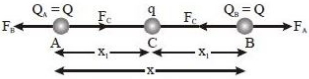
$A$ charge $q$ is placed at the centre of the line joining two equal charges $Q$. The system of the three charges will be in equilibrium if $q$ is equal to:
A
$ - \frac{Q}{2} $
B
$ - \frac{Q}{4} $
C
$ + \frac{Q}{4} $
D
$ + \frac{Q}{2} $
Solution
(B) Let the two charges $Q$ be at points $A$ and $B$,separated by a distance $x$. The charge $q$ is placed at point $C$,the midpoint of $AB$,so $AC = CB = x/2$.
For the system to be in equilibrium,the net force on each charge must be zero.
Consider the equilibrium of charge $Q$ at point $A$. The force exerted by charge $Q$ at $B$ on $A$ is $F_{BA} = \frac{1}{4 \pi \varepsilon_0} \frac{Q^2}{x^2}$ (repulsive).
The force exerted by charge $q$ at $C$ on $A$ is $F_{CA} = \frac{1}{4 \pi \varepsilon_0} \frac{qQ}{(x/2)^2}$ (attractive,so $q$ must be negative).
For equilibrium,$F_{BA} + F_{CA} = 0$,so $\frac{1}{4 \pi \varepsilon_0} \frac{Q^2}{x^2} + \frac{1}{4 \pi \varepsilon_0} \frac{qQ}{x^2/4} = 0$.
$\frac{Q^2}{x^2} + \frac{4qQ}{x^2} = 0 \Rightarrow Q + 4q = 0 \Rightarrow q = -\frac{Q}{4}$.
For the system to be in equilibrium,the net force on each charge must be zero.
Consider the equilibrium of charge $Q$ at point $A$. The force exerted by charge $Q$ at $B$ on $A$ is $F_{BA} = \frac{1}{4 \pi \varepsilon_0} \frac{Q^2}{x^2}$ (repulsive).
The force exerted by charge $q$ at $C$ on $A$ is $F_{CA} = \frac{1}{4 \pi \varepsilon_0} \frac{qQ}{(x/2)^2}$ (attractive,so $q$ must be negative).
For equilibrium,$F_{BA} + F_{CA} = 0$,so $\frac{1}{4 \pi \varepsilon_0} \frac{Q^2}{x^2} + \frac{1}{4 \pi \varepsilon_0} \frac{qQ}{x^2/4} = 0$.
$\frac{Q^2}{x^2} + \frac{4qQ}{x^2} = 0 \Rightarrow Q + 4q = 0 \Rightarrow q = -\frac{Q}{4}$.
0 likesView Solution
52
ChemistryMCQAIEEE · 2002
In a transformer,the number of turns in the primary coil is $140$ and that in the secondary coil is $280$. If the current in the primary coil is $4 \, A$,then the current in the secondary coil is......$A$.
A
$4$
B
$2$
C
$6$
D
$10$
Solution
(B) For an ideal transformer,the relationship between the number of turns $(N)$ and the current $(I)$ is given by the inverse ratio: $\frac{N_{1}}{N_{2}} = \frac{I_{2}}{I_{1}}$.
Given: $N_{1} = 140$,$N_{2} = 280$,and $I_{1} = 4 \, A$.
Substituting the values into the formula: $\frac{140}{280} = \frac{I_{2}}{4}$.
Simplifying the fraction: $\frac{1}{2} = \frac{I_{2}}{4}$.
Solving for $I_{2}$: $I_{2} = \frac{4}{2} = 2 \, A$.
Given: $N_{1} = 140$,$N_{2} = 280$,and $I_{1} = 4 \, A$.
Substituting the values into the formula: $\frac{140}{280} = \frac{I_{2}}{4}$.
Simplifying the fraction: $\frac{1}{2} = \frac{I_{2}}{4}$.
Solving for $I_{2}$: $I_{2} = \frac{4}{2} = 2 \, A$.
0 likesView Solution
53
ChemistryMCQAIEEE · 2002
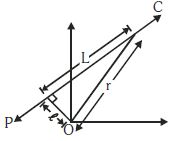
$A$ particle of mass $m$ moves along line $PC$ with velocity $v$ as shown. What is the angular momentum of the particle about $O$?
A
$mvL$
B
$mvl$
C
$mvr$
D
zero
Solution
(B) The angular momentum $L_O$ of a particle about a point $O$ is defined as the cross product of its position vector $\vec{r}$ and its linear momentum $\vec{p} = m\vec{v}$.
Mathematically,$L_O = |\vec{r} \times \vec{p}| = m v d_{\perp}$,where $d_{\perp}$ is the perpendicular distance (lever arm) from the point $O$ to the line of motion of the particle.
From the given figure,the perpendicular distance from point $O$ to the line $PC$ is $l$.
Therefore,the angular momentum of the particle about $O$ is $L_O = mvl$.
Mathematically,$L_O = |\vec{r} \times \vec{p}| = m v d_{\perp}$,where $d_{\perp}$ is the perpendicular distance (lever arm) from the point $O$ to the line of motion of the particle.
From the given figure,the perpendicular distance from point $O$ to the line $PC$ is $l$.
Therefore,the angular momentum of the particle about $O$ is $L_O = mvl$.
0 likesView Solution
54
ChemistryMCQAIEEE · 2002
$A$ solid sphere,a hollow sphere,and a ring are released from the top of an inclined plane (frictionless) so that they slide down the plane. Then,the maximum acceleration down the plane is for (no rolling):
A
solid sphere
B
hollow sphere
C
ring
D
all same
Solution
(D) Since the inclined plane is frictionless,there is no rolling motion,and the objects will only slide down the plane.
The force acting along the inclined plane is $F = mg \sin \theta$.
According to Newton's second law,$F = ma$,so $ma = mg \sin \theta$.
Thus,the acceleration is $a = g \sin \theta$.
Since this acceleration depends only on the gravitational acceleration $g$ and the angle of inclination $\theta$,it is independent of the shape or mass of the object.
Therefore,the acceleration is the same for the solid sphere,the hollow sphere,and the ring.
The force acting along the inclined plane is $F = mg \sin \theta$.
According to Newton's second law,$F = ma$,so $ma = mg \sin \theta$.
Thus,the acceleration is $a = g \sin \theta$.
Since this acceleration depends only on the gravitational acceleration $g$ and the angle of inclination $\theta$,it is independent of the shape or mass of the object.
Therefore,the acceleration is the same for the solid sphere,the hollow sphere,and the ring.
0 likesView Solution
55
ChemistryMCQAIEEE · 2002
In a simple harmonic oscillator,at the mean position
A
Kinetic energy is minimum,potential energy is maximum
B
Both kinetic and potential energies are maximum
C
Kinetic energy is maximum,potential energy is minimum
D
Both kinetic and potential energies are minimum
Solution
(C) In $S.H.M.$,the kinetic energy of a particle at any displacement $x$ is given by:
$K.E. = \frac{1}{2} m \omega^{2} (a^{2} - x^{2})$
The potential energy of a particle at any displacement $x$ is given by:
$P.E. = \frac{1}{2} m \omega^{2} x^{2}$
where $a$ is the amplitude of the particle and $x$ is the displacement from the mean position.
At the mean position,the displacement $x = 0$.
Substituting $x = 0$ into the equations:
$K.E. = \frac{1}{2} m \omega^{2} a^{2}$ (which is the maximum value).
$P.E. = \frac{1}{2} m \omega^{2} (0)^{2} = 0$ (which is the minimum value).
Therefore,at the mean position,kinetic energy is maximum and potential energy is minimum.
$K.E. = \frac{1}{2} m \omega^{2} (a^{2} - x^{2})$
The potential energy of a particle at any displacement $x$ is given by:
$P.E. = \frac{1}{2} m \omega^{2} x^{2}$
where $a$ is the amplitude of the particle and $x$ is the displacement from the mean position.
At the mean position,the displacement $x = 0$.
Substituting $x = 0$ into the equations:
$K.E. = \frac{1}{2} m \omega^{2} a^{2}$ (which is the maximum value).
$P.E. = \frac{1}{2} m \omega^{2} (0)^{2} = 0$ (which is the minimum value).
Therefore,at the mean position,kinetic energy is maximum and potential energy is minimum.
0 likesView Solution
56
ChemistryMCQAIEEE · 2002
In a compound,$C, H,$ and $N$ atoms are present in the ratio $9 : 1 : 3.5$ by weight. If the molecular weight of the compound is $108$,what is its molecular formula?
A
$C_2H_6N_2$
B
$C_3H_4N$
C
$C_6H_8N_2$
D
$C_9H_{12}N_3$
Solution
(C) The total ratio sum is $9 + 1 + 3.5 = 13.5$.
Calculate the moles of each element in $108 \ g$ of the compound:
Moles of $C = \frac{(9 / 13.5) \times 108}{12} = \frac{0.6667 \times 108}{12} = 6 \ mol$.
Moles of $H = \frac{(1 / 13.5) \times 108}{1} = \frac{0.0741 \times 108}{1} = 8 \ mol$.
Moles of $N = \frac{(3.5 / 13.5) \times 108}{14} = \frac{0.2593 \times 108}{14} = 2 \ mol$.
Thus,the molecular formula is $C_6H_8N_2$.
Calculate the moles of each element in $108 \ g$ of the compound:
Moles of $C = \frac{(9 / 13.5) \times 108}{12} = \frac{0.6667 \times 108}{12} = 6 \ mol$.
Moles of $H = \frac{(1 / 13.5) \times 108}{1} = \frac{0.0741 \times 108}{1} = 8 \ mol$.
Moles of $N = \frac{(3.5 / 13.5) \times 108}{14} = \frac{0.2593 \times 108}{14} = 2 \ mol$.
Thus,the molecular formula is $C_6H_8N_2$.
0 likesView Solution
57
ChemistryMCQAIEEE · 2002
In a transformer,the number of turns in the primary coil is $140$ and that in the secondary coil is $280$. If the current in the primary coil is $4\,A$,then the current in the secondary coil is.....$A$.
A
$4$
B
$2$
C
$6$
D
$10$
Solution
(B) For an ideal transformer,the power input equals the power output,which implies $V_{1}I_{1} = V_{2}I_{2}$.
Since the voltage ratio is proportional to the turns ratio,$\frac{V_{1}}{V_{2}} = \frac{N_{1}}{N_{2}}$.
Combining these,we get the relationship $\frac{N_{1}}{N_{2}} = \frac{I_{2}}{I_{1}}$.
Given $N_{1} = 140$,$N_{2} = 280$,and $I_{1} = 4\,A$.
Substituting the values: $\frac{140}{280} = \frac{I_{2}}{4}$.
$\frac{1}{2} = \frac{I_{2}}{4}$.
$I_{2} = \frac{4}{2} = 2\,A$.
Since the voltage ratio is proportional to the turns ratio,$\frac{V_{1}}{V_{2}} = \frac{N_{1}}{N_{2}}$.
Combining these,we get the relationship $\frac{N_{1}}{N_{2}} = \frac{I_{2}}{I_{1}}$.
Given $N_{1} = 140$,$N_{2} = 280$,and $I_{1} = 4\,A$.
Substituting the values: $\frac{140}{280} = \frac{I_{2}}{4}$.
$\frac{1}{2} = \frac{I_{2}}{4}$.
$I_{2} = \frac{4}{2} = 2\,A$.
0 likesView Solution
58
ChemistryMCQAIEEE · 2002
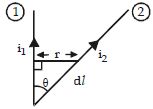
Wires $1$ and $2$ carrying currents $i_1$ and $i_2$ respectively are inclined at an angle $\theta$ to each other. What is the force on a small element $dl$ of wire $2$ at a distance of $r$ from wire $1$ (as shown in figure) due to the magnetic field of wire $1$?
A
$\frac{\mu_0}{2\pi r} i_1 i_2 \, dl \tan \theta$
B
$\frac{\mu_0}{2\pi r} i_1 i_2 \, dl \sin \theta$
C
$\frac{\mu_0}{2\pi r} i_1 i_2 \, dl \cos \theta$
D
$\frac{\mu_0}{4\pi r} i_1 i_2 \, dl \sin \theta$
Solution
(B) The magnetic field $B$ produced by the long straight wire $1$ carrying current $i_1$ at a distance $r$ is given by the formula $B = \frac{\mu_0 i_1}{2\pi r}$.
This magnetic field is directed perpendicular to the plane containing the wires.
The force $dF$ on a small current element $i_2 \vec{dl}$ placed in a magnetic field $\vec{B}$ is given by $d\vec{F} = i_2 (\vec{dl} \times \vec{B})$.
The magnitude of this force is $dF = i_2 dl B \sin \alpha$,where $\alpha$ is the angle between the current element $dl$ and the magnetic field $B$.
Since the magnetic field $B$ is perpendicular to the plane of the wires,it is perpendicular to the current element $dl$ as well. Therefore,$\alpha = 90^\circ$ and $\sin 90^\circ = 1$.
Thus,the magnitude of the force is $dF = i_2 dl B = i_2 dl \left( \frac{\mu_0 i_1}{2\pi r} \right) = \frac{\mu_0 i_1 i_2}{2\pi r} dl$.
This magnetic field is directed perpendicular to the plane containing the wires.
The force $dF$ on a small current element $i_2 \vec{dl}$ placed in a magnetic field $\vec{B}$ is given by $d\vec{F} = i_2 (\vec{dl} \times \vec{B})$.
The magnitude of this force is $dF = i_2 dl B \sin \alpha$,where $\alpha$ is the angle between the current element $dl$ and the magnetic field $B$.
Since the magnetic field $B$ is perpendicular to the plane of the wires,it is perpendicular to the current element $dl$ as well. Therefore,$\alpha = 90^\circ$ and $\sin 90^\circ = 1$.
Thus,the magnitude of the force is $dF = i_2 dl B = i_2 dl \left( \frac{\mu_0 i_1}{2\pi r} \right) = \frac{\mu_0 i_1 i_2}{2\pi r} dl$.
0 likesView Solution
59
ChemistryMCQAIEEE · 2002
In a compound,$C$,$H$,and $N$ atoms are present in the ratio $9 : 1 : 3.5$ by weight. The molecular weight of the compound is $108$. Its molecular formula is:
A
$C_2H_6N_2$
B
$C_3H_4N$
C
$C_6H_8N_2$
D
$C_9H_{12}N_3$
Solution
(C) The sum of the weight ratios is $9 + 1 + 3.5 = 13.5$.
To find the number of moles of each element in $108 \ g$ of the compound:
For $C$: $\text{Moles} = \frac{(9 / 13.5) \times 108}{12} = \frac{0.6667 \times 108}{12} = 6$.
For $H$: $\text{Moles} = \frac{(1 / 13.5) \times 108}{1} = \frac{0.0741 \times 108}{1} = 8$.
For $N$: $\text{Moles} = \frac{(3.5 / 13.5) \times 108}{14} = \frac{0.2593 \times 108}{14} = 2$.
Thus,the molecular formula is $C_6H_8N_2$.
To find the number of moles of each element in $108 \ g$ of the compound:
For $C$: $\text{Moles} = \frac{(9 / 13.5) \times 108}{12} = \frac{0.6667 \times 108}{12} = 6$.
For $H$: $\text{Moles} = \frac{(1 / 13.5) \times 108}{1} = \frac{0.0741 \times 108}{1} = 8$.
For $N$: $\text{Moles} = \frac{(3.5 / 13.5) \times 108}{14} = \frac{0.2593 \times 108}{14} = 2$.
Thus,the molecular formula is $C_6H_8N_2$.
0 likesView Solution
Vedclass Products
For Students
Vedclass Test Series
Mock tests in real AIEEE style covering Chemistry with performance analysis. 5-day free trial.
Start Free TrialFor Teachers
Exam Paper Generator
Generate Set A/B/C/D Chemistry papers from 7.5L+ questions in 2 minutes. 3 chapters free.
Try FreeFor Institutes
Online Exam Module
Run live AIEEE mock exams with unlimited students, 360° analytics & white-label branding.
See DemoFrequently Asked Questions
How many Chemistry questions are in AIEEE 2002?
There are 96 Chemistry questions from the AIEEE 2002 paper on Vedclass, each with a detailed step-by-step solution in English.
Are AIEEE 2002 Chemistry solutions available in English?
Yes. All solutions on this page are in English. You can also switch to English or Hindi using the language buttons above the questions.
Can I practice AIEEE 2002 Chemistry as a timed test?
Yes. Use the Vedclass Test Series to attempt a full AIEEE mock test covering Chemistry with time limits and instant score analysis.
Can teachers create Chemistry papers from AIEEE previous year questions?
Yes. The Vedclass Exam Paper Generator lets teachers mix AIEEE Chemistry questions and generate Set A/B/C/D papers in minutes.
For Teachers & Institutes
Build a Custom Chemistry Paper
Pick AIEEE 2002 Chemistry questions, set difficulty, and generate Set A/B/C/D in 2 minutes.