
अ Hindi
Trigonometry Questions in Hindi
Competitive Exam Quantitative Aptitude · Trigonometry · Trigonometry
648+
Questions
Hindi
Language
100%
With Solutions
Showing 50 of 648 questions in Hindi
401
AdvancedMCQ
यदि $\sin \theta = \frac{1}{2} \left( \sqrt{\frac{x}{y}} + \sqrt{\frac{y}{x}} \right)$,जहाँ $x, y \in R - \{0\}$ है,तो:
A
$x = y$
B
$x < y$
C
$x > y$
D
$x + y = 1 \ \forall \ x, y \in R$
Solution
(A) हम जानते हैं कि किसी भी धनात्मक वास्तविक संख्याओं $a$ और $b$ के लिए,समांतर माध्य,गुणोत्तर माध्य से बड़ा या उसके बराबर होता है ($AM$ $\ge$ $GM$)।
$\sqrt{\frac{x}{y}}$ और $\sqrt{\frac{y}{x}}$ पर इसे लागू करने पर:
$\frac{1}{2} \left( \sqrt{\frac{x}{y}} + \sqrt{\frac{y}{x}} \right) \ge \sqrt{\sqrt{\frac{x}{y}} \cdot \sqrt{\frac{y}{x}}}$
$\Rightarrow \frac{1}{2} \left( \sqrt{\frac{x}{y}} + \sqrt{\frac{y}{x}} \right) \ge \sqrt{1} = 1$
चूंकि $\sin \theta$ का मान $1$ से अधिक नहीं हो सकता,इसलिए यह व्यंजक $1$ के बराबर होना चाहिए।
$\sin \theta = 1 \Rightarrow \frac{1}{2} \left( \sqrt{\frac{x}{y}} + \sqrt{\frac{y}{x}} \right) = 1$
यह समानता तभी संभव है जब $\sqrt{\frac{x}{y}} = \sqrt{\frac{y}{x}}$ हो,जिसका अर्थ है $\frac{x}{y} = 1$,अर्थात $x = y$।
$\sqrt{\frac{x}{y}}$ और $\sqrt{\frac{y}{x}}$ पर इसे लागू करने पर:
$\frac{1}{2} \left( \sqrt{\frac{x}{y}} + \sqrt{\frac{y}{x}} \right) \ge \sqrt{\sqrt{\frac{x}{y}} \cdot \sqrt{\frac{y}{x}}}$
$\Rightarrow \frac{1}{2} \left( \sqrt{\frac{x}{y}} + \sqrt{\frac{y}{x}} \right) \ge \sqrt{1} = 1$
चूंकि $\sin \theta$ का मान $1$ से अधिक नहीं हो सकता,इसलिए यह व्यंजक $1$ के बराबर होना चाहिए।
$\sin \theta = 1 \Rightarrow \frac{1}{2} \left( \sqrt{\frac{x}{y}} + \sqrt{\frac{y}{x}} \right) = 1$
यह समानता तभी संभव है जब $\sqrt{\frac{x}{y}} = \sqrt{\frac{y}{x}}$ हो,जिसका अर्थ है $\frac{x}{y} = 1$,अर्थात $x = y$।
0 likes
View Solution402
AdvancedMCQ
यदि $\alpha, \beta, \gamma$ धनात्मक संख्याएँ इस प्रकार हैं कि $\alpha + \beta = \pi$ और $\beta + \gamma = \alpha$,तो $\tan \alpha$ का मान ज्ञात कीजिए - (जहाँ $\gamma \neq n\pi, n \in I$)
A
$-2\sqrt{\frac{\tan \beta + \tan \gamma}{\tan \gamma}}$
B
$\sqrt{\frac{2\tan \beta + \tan \gamma}{\tan \gamma}}$
C
$-\sqrt{\frac{2\tan \beta + \tan \gamma}{\tan \gamma}}$
D
$\sqrt{\frac{\tan \beta + \tan \gamma}{\tan \gamma}}$
Solution
(C) दिया गया है कि $\alpha + \beta = \pi$ और $\beta + \gamma = \alpha$.
$\alpha + \beta = \pi$ से,$\alpha = \pi - \beta$,इसलिए $\tan \alpha = \tan(\pi - \beta) = -\tan \beta$.
चूंकि $\alpha, \beta, \gamma$ धनात्मक हैं और $\alpha + \beta = \pi$,इसलिए $\alpha$ दूसरे चतुर्थांश में होगा (क्योंकि $\beta > 0$),अतः $\tan \alpha < 0$.
$\beta + \gamma = \alpha$ से,$\tan \alpha = \tan(\beta + \gamma) = \frac{\tan \beta + \tan \gamma}{1 - \tan \beta \tan \gamma}$.
समीकरण में $\tan \beta = -\tan \alpha$ रखने पर:
$\tan \alpha = \frac{-\tan \alpha + \tan \gamma}{1 - (-\tan \alpha) \tan \gamma} = \frac{-\tan \alpha + \tan \gamma}{1 + \tan \alpha \tan \gamma}$.
$\tan \alpha (1 + \tan \alpha \tan \gamma) = -\tan \alpha + \tan \gamma$.
$\tan \alpha + \tan^2 \alpha \tan \gamma = -\tan \alpha + \tan \gamma$.
$\tan^2 \alpha \tan \gamma = -2 \tan \alpha + \tan \gamma$.
यह $\tan \alpha$ में एक द्विघात समीकरण है: $(\tan \gamma) \tan^2 \alpha + (2) \tan \alpha - \tan \gamma = 0$.
द्विघात सूत्र $x = \frac{-b \pm \sqrt{b^2 - 4ac}}{2a}$ का उपयोग करने पर:
$\tan \alpha = \frac{-2 \pm \sqrt{4 - 4(\tan \gamma)(-\tan \gamma)}}{2 \tan \gamma} = \frac{-2 \pm \sqrt{4 + 4 \tan^2 \gamma}}{2 \tan \gamma} = \frac{-2 \pm 2 \sqrt{1 + \tan^2 \gamma}}{2 \tan \gamma} = \frac{-1 \pm \sec \gamma}{\tan \gamma}$.
वैकल्पिक रूप से,$\tan^2 \alpha \tan \gamma = -2 \tan \alpha + \tan \gamma$ से,हमें प्राप्त होता है $\tan^2 \alpha = \frac{-2 \tan \alpha + \tan \gamma}{\tan \gamma}$. चूंकि $\tan \alpha = -\tan \beta$,इसलिए $\tan^2 \alpha = \frac{2 \tan \beta + \tan \gamma}{\tan \gamma}$.
अतः,$\tan \alpha = -\sqrt{\frac{2 \tan \beta + \tan \gamma}{\tan \gamma}}$ (ऋणात्मक वर्गमूल लिया गया है क्योंकि $\tan \alpha < 0$)।
$\alpha + \beta = \pi$ से,$\alpha = \pi - \beta$,इसलिए $\tan \alpha = \tan(\pi - \beta) = -\tan \beta$.
चूंकि $\alpha, \beta, \gamma$ धनात्मक हैं और $\alpha + \beta = \pi$,इसलिए $\alpha$ दूसरे चतुर्थांश में होगा (क्योंकि $\beta > 0$),अतः $\tan \alpha < 0$.
$\beta + \gamma = \alpha$ से,$\tan \alpha = \tan(\beta + \gamma) = \frac{\tan \beta + \tan \gamma}{1 - \tan \beta \tan \gamma}$.
समीकरण में $\tan \beta = -\tan \alpha$ रखने पर:
$\tan \alpha = \frac{-\tan \alpha + \tan \gamma}{1 - (-\tan \alpha) \tan \gamma} = \frac{-\tan \alpha + \tan \gamma}{1 + \tan \alpha \tan \gamma}$.
$\tan \alpha (1 + \tan \alpha \tan \gamma) = -\tan \alpha + \tan \gamma$.
$\tan \alpha + \tan^2 \alpha \tan \gamma = -\tan \alpha + \tan \gamma$.
$\tan^2 \alpha \tan \gamma = -2 \tan \alpha + \tan \gamma$.
यह $\tan \alpha$ में एक द्विघात समीकरण है: $(\tan \gamma) \tan^2 \alpha + (2) \tan \alpha - \tan \gamma = 0$.
द्विघात सूत्र $x = \frac{-b \pm \sqrt{b^2 - 4ac}}{2a}$ का उपयोग करने पर:
$\tan \alpha = \frac{-2 \pm \sqrt{4 - 4(\tan \gamma)(-\tan \gamma)}}{2 \tan \gamma} = \frac{-2 \pm \sqrt{4 + 4 \tan^2 \gamma}}{2 \tan \gamma} = \frac{-2 \pm 2 \sqrt{1 + \tan^2 \gamma}}{2 \tan \gamma} = \frac{-1 \pm \sec \gamma}{\tan \gamma}$.
वैकल्पिक रूप से,$\tan^2 \alpha \tan \gamma = -2 \tan \alpha + \tan \gamma$ से,हमें प्राप्त होता है $\tan^2 \alpha = \frac{-2 \tan \alpha + \tan \gamma}{\tan \gamma}$. चूंकि $\tan \alpha = -\tan \beta$,इसलिए $\tan^2 \alpha = \frac{2 \tan \beta + \tan \gamma}{\tan \gamma}$.
अतः,$\tan \alpha = -\sqrt{\frac{2 \tan \beta + \tan \gamma}{\tan \gamma}}$ (ऋणात्मक वर्गमूल लिया गया है क्योंकि $\tan \alpha < 0$)।
0 likes
View Solution403
AdvancedMCQ
यदि $\tan \left( \frac{\pi}{4} + \theta \right) + \tan \left( \frac{\pi}{4} - \theta \right) = \lambda \sec 2\theta$ है,तो $\lambda$ =
A
$3$
B
$4$
C
$1$
D
$2$
Solution
(D) हम जानते हैं कि $\tan(A + B) = \frac{\tan A + \tan B}{1 - \tan A \tan B}$ और $\tan(A - B) = \frac{\tan A - \tan B}{1 + \tan A \tan B}$ होता है।
इनका उपयोग करते हुए,$\tan \left( \frac{\pi}{4} + \theta \right) = \frac{1 + \tan \theta}{1 - \tan \theta}$ और $\tan \left( \frac{\pi}{4} - \theta \right) = \frac{1 - \tan \theta}{1 + \tan \theta}$ है।
इन दोनों पदों को जोड़ने पर:
$\frac{1 + \tan \theta}{1 - \tan \theta} + \frac{1 - \tan \theta}{1 + \tan \theta} = \frac{(1 + \tan \theta)^2 + (1 - \tan \theta)^2}{(1 - \tan \theta)(1 + \tan \theta)}$
$= \frac{1 + \tan^2 \theta + 2 \tan \theta + 1 + \tan^2 \theta - 2 \tan \theta}{1 - \tan^2 \theta}$
$= \frac{2(1 + \tan^2 \theta)}{1 - \tan^2 \theta}$
चूंकि $\cos 2\theta = \frac{1 - \tan^2 \theta}{1 + \tan^2 \theta}$ होता है,इसलिए $\sec 2\theta = \frac{1 + \tan^2 \theta}{1 - \tan^2 \theta}$ होगा।
अतः,व्यंजक $2 \sec 2\theta$ बन जाता है।
इसे $\lambda \sec 2\theta$ के साथ तुलना करने पर,हमें $\lambda = 2$ प्राप्त होता है।
इनका उपयोग करते हुए,$\tan \left( \frac{\pi}{4} + \theta \right) = \frac{1 + \tan \theta}{1 - \tan \theta}$ और $\tan \left( \frac{\pi}{4} - \theta \right) = \frac{1 - \tan \theta}{1 + \tan \theta}$ है।
इन दोनों पदों को जोड़ने पर:
$\frac{1 + \tan \theta}{1 - \tan \theta} + \frac{1 - \tan \theta}{1 + \tan \theta} = \frac{(1 + \tan \theta)^2 + (1 - \tan \theta)^2}{(1 - \tan \theta)(1 + \tan \theta)}$
$= \frac{1 + \tan^2 \theta + 2 \tan \theta + 1 + \tan^2 \theta - 2 \tan \theta}{1 - \tan^2 \theta}$
$= \frac{2(1 + \tan^2 \theta)}{1 - \tan^2 \theta}$
चूंकि $\cos 2\theta = \frac{1 - \tan^2 \theta}{1 + \tan^2 \theta}$ होता है,इसलिए $\sec 2\theta = \frac{1 + \tan^2 \theta}{1 - \tan^2 \theta}$ होगा।
अतः,व्यंजक $2 \sec 2\theta$ बन जाता है।
इसे $\lambda \sec 2\theta$ के साथ तुलना करने पर,हमें $\lambda = 2$ प्राप्त होता है।
0 likes
View Solution404
AdvancedMCQ
$\cot 5^o - \tan 5^o - 2 \tan 10^o - 4 \tan 20^o - 8 \cot 40^o$ का मान ज्ञात कीजिए।
A
$0$
B
$4 \tan 40^o$
C
$8 \tan 40^o$
D
$8 \cot 40^o$
Solution
(A) हम त्रिकोणमितीय सर्वसमिका $\cot \theta - \tan \theta = 2 \cot 2\theta$ का उपयोग करेंगे।
चरण $1$: पहले दो पदों को सरल करने पर: $\cot 5^o - \tan 5^o = 2 \cot 10^o$.
चरण $2$: अब व्यंजक $2 \cot 10^o - 2 \tan 10^o - 4 \tan 20^o - 8 \cot 40^o$ हो जाता है।
चरण $3$: $2$ कॉमन लेने पर: $2(\cot 10^o - \tan 10^o) - 4 \tan 20^o - 8 \cot 40^o = 2(2 \cot 20^o) - 4 \tan 20^o - 8 \cot 40^o = 4 \cot 20^o - 4 \tan 20^o - 8 \cot 40^o$.
चरण $4$: $4$ कॉमन लेने पर: $4(\cot 20^o - \tan 20^o) - 8 \cot 40^o = 4(2 \cot 40^o) - 8 \cot 40^o = 8 \cot 40^o - 8 \cot 40^o = 0$.
चरण $1$: पहले दो पदों को सरल करने पर: $\cot 5^o - \tan 5^o = 2 \cot 10^o$.
चरण $2$: अब व्यंजक $2 \cot 10^o - 2 \tan 10^o - 4 \tan 20^o - 8 \cot 40^o$ हो जाता है।
चरण $3$: $2$ कॉमन लेने पर: $2(\cot 10^o - \tan 10^o) - 4 \tan 20^o - 8 \cot 40^o = 2(2 \cot 20^o) - 4 \tan 20^o - 8 \cot 40^o = 4 \cot 20^o - 4 \tan 20^o - 8 \cot 40^o$.
चरण $4$: $4$ कॉमन लेने पर: $4(\cot 20^o - \tan 20^o) - 8 \cot 40^o = 4(2 \cot 40^o) - 8 \cot 40^o = 8 \cot 40^o - 8 \cot 40^o = 0$.
0 likes
View Solution405
AdvancedMCQ
$E = \frac{25 \sec^4 x - 50 \sec^2 x + 74}{\tan^2 x}$ का न्यूनतम मान क्या है?
A
$50$
B
$70$
C
$75$
D
$90$
Solution
(B) दिया गया व्यंजक $E = \frac{25 \sec^4 x - 50 \sec^2 x + 74}{\tan^2 x}$ है।
हम जानते हैं कि $\sec^2 x = 1 + \tan^2 x$ होता है।
इसे प्रतिस्थापित करने पर,$E = \frac{25(1 + \tan^2 x)^2 - 50(1 + \tan^2 x) + 74}{\tan^2 x}$ प्राप्त होता है।
माना $t = \tan^2 x$. तब $E = \frac{25(1 + t)^2 - 50(1 + t) + 74}{t}$.
$E = \frac{25(1 + 2t + t^2) - 50 - 50t + 74}{t} = \frac{25 + 50t + 25t^2 - 50 - 50t + 74}{t}$.
$E = \frac{25t^2 + 49}{t} = 25t + \frac{49}{t}$.
अंकगणितीय माध्य-ज्यामितीय माध्य असमिका $(AM \ge GM)$ का उपयोग करने पर,$\frac{25t + \frac{49}{t}}{2} \ge \sqrt{25t \cdot \frac{49}{t}}$.
$25t + \frac{49}{t} \ge 2 \sqrt{25 \cdot 49} = 2 \cdot 5 \cdot 7 = 70$.
अतः,न्यूनतम मान $70$ है।
हम जानते हैं कि $\sec^2 x = 1 + \tan^2 x$ होता है।
इसे प्रतिस्थापित करने पर,$E = \frac{25(1 + \tan^2 x)^2 - 50(1 + \tan^2 x) + 74}{\tan^2 x}$ प्राप्त होता है।
माना $t = \tan^2 x$. तब $E = \frac{25(1 + t)^2 - 50(1 + t) + 74}{t}$.
$E = \frac{25(1 + 2t + t^2) - 50 - 50t + 74}{t} = \frac{25 + 50t + 25t^2 - 50 - 50t + 74}{t}$.
$E = \frac{25t^2 + 49}{t} = 25t + \frac{49}{t}$.
अंकगणितीय माध्य-ज्यामितीय माध्य असमिका $(AM \ge GM)$ का उपयोग करने पर,$\frac{25t + \frac{49}{t}}{2} \ge \sqrt{25t \cdot \frac{49}{t}}$.
$25t + \frac{49}{t} \ge 2 \sqrt{25 \cdot 49} = 2 \cdot 5 \cdot 7 = 70$.
अतः,न्यूनतम मान $70$ है।
0 likes
View Solution406
AdvancedMCQ
एक त्रिभुज $ABC$ में,यदि $A = \frac{\pi}{4}$ और $\tan B \tan C = K$ है,तो $K$ को किस शर्त को संतुष्ट करना चाहिए?
A
$K^2 - 6K + 1 \geqslant 0$
B
$K^2 - 6K + 1 = 0$
C
$K^2 - 6K + 1 \leqslant 0$
D
$3 - 2\sqrt{2} < K$
Solution
(A) त्रिभुज $ABC$ में,हम जानते हैं कि $\tan A + \tan B + \tan C = \tan A \tan B \tan C$ होता है।
चूंकि $A = \frac{\pi}{4}$,इसलिए $\tan A = 1$ है।
इसे प्रतिस्थापित करने पर,हमें $1 + \tan B + \tan C = \tan B \tan C$ प्राप्त होता है।
दिया गया है कि $\tan B \tan C = K$,अतः $\tan B + \tan C = K - 1$ है।
चूंकि $\tan B$ और $\tan C$ द्विघात समीकरण $x^2 - (\tan B + \tan C)x + \tan B \tan C = 0$ के मूल हैं,इसलिए $x^2 - (K - 1)x + K = 0$ होगा।
$\tan B$ और $\tan C$ के वास्तविक होने के लिए,विविक्तकर (discriminant) $D \geqslant 0$ होना चाहिए।
$D = (K - 1)^2 - 4K \geqslant 0$.
$K^2 - 2K + 1 - 4K \geqslant 0$.
$K^2 - 6K + 1 \geqslant 0$.
चूंकि $A = \frac{\pi}{4}$,इसलिए $\tan A = 1$ है।
इसे प्रतिस्थापित करने पर,हमें $1 + \tan B + \tan C = \tan B \tan C$ प्राप्त होता है।
दिया गया है कि $\tan B \tan C = K$,अतः $\tan B + \tan C = K - 1$ है।
चूंकि $\tan B$ और $\tan C$ द्विघात समीकरण $x^2 - (\tan B + \tan C)x + \tan B \tan C = 0$ के मूल हैं,इसलिए $x^2 - (K - 1)x + K = 0$ होगा।
$\tan B$ और $\tan C$ के वास्तविक होने के लिए,विविक्तकर (discriminant) $D \geqslant 0$ होना चाहिए।
$D = (K - 1)^2 - 4K \geqslant 0$.
$K^2 - 2K + 1 - 4K \geqslant 0$.
$K^2 - 6K + 1 \geqslant 0$.
0 likes
View Solution407
AdvancedMCQ
$cosec^2 \theta = \frac{4xy}{(x + y)^2}$ केवल तब सत्य है यदि
A
$x + y \neq 0$
B
$x = y, x \neq 0$
C
$x = y$
D
$x \neq 0, y \neq 0$
Solution
(B) हम जानते हैं कि किन्हीं भी वास्तविक संख्याओं $x$ और $y$ के लिए,समांतर माध्य,गुणोत्तर माध्य से बड़ा या उसके बराबर होता है,अर्थात $\frac{x+y}{2} \geq \sqrt{xy}$।
दोनों पक्षों का वर्ग करने पर,हमें $\frac{(x+y)^2}{4} \geq xy$ प्राप्त होता है,जिसका अर्थ है कि $\frac{4xy}{(x+y)^2} \leq 1$।
सभी वास्तविक $\theta$ के लिए $cosec^2 \theta \geq 1$ होता है,इसलिए समीकरण $cosec^2 \theta = \frac{4xy}{(x+y)^2}$ केवल तभी सत्य हो सकता है जब दोनों पक्ष $1$ के बराबर हों।
इसके लिए $\frac{4xy}{(x+y)^2} = 1$ होना आवश्यक है,जो सरल होकर $4xy = (x+y)^2$ या $(x-y)^2 = 0$ देता है,जिसका अर्थ है $x = y$।
इसके अतिरिक्त,चूंकि यदि हर शून्य हो तो $cosec^2 \theta$ अपरिभाषित होता है,इसलिए $x+y \neq 0$ होना चाहिए। $x=y$ होने के कारण,इसका अर्थ है $2x \neq 0$,अर्थात $x \neq 0$।
अतः,सही शर्त $x = y$ और $x \neq 0$ है।
दोनों पक्षों का वर्ग करने पर,हमें $\frac{(x+y)^2}{4} \geq xy$ प्राप्त होता है,जिसका अर्थ है कि $\frac{4xy}{(x+y)^2} \leq 1$।
सभी वास्तविक $\theta$ के लिए $cosec^2 \theta \geq 1$ होता है,इसलिए समीकरण $cosec^2 \theta = \frac{4xy}{(x+y)^2}$ केवल तभी सत्य हो सकता है जब दोनों पक्ष $1$ के बराबर हों।
इसके लिए $\frac{4xy}{(x+y)^2} = 1$ होना आवश्यक है,जो सरल होकर $4xy = (x+y)^2$ या $(x-y)^2 = 0$ देता है,जिसका अर्थ है $x = y$।
इसके अतिरिक्त,चूंकि यदि हर शून्य हो तो $cosec^2 \theta$ अपरिभाषित होता है,इसलिए $x+y \neq 0$ होना चाहिए। $x=y$ होने के कारण,इसका अर्थ है $2x \neq 0$,अर्थात $x \neq 0$।
अतः,सही शर्त $x = y$ और $x \neq 0$ है।
0 likes
View Solution408
AdvancedMCQ
यदि $\tan 80^{\circ} = a$ और $\tan 47^{\circ} = b$ है,तो $\tan 37^{\circ}$ का मान क्या होगा?
A
$\frac{a - b}{1 + ab}$
B
$\frac{ab + 1}{a - b}$
C
$\frac{ab - 1}{a + b}$
D
$\frac{a + b}{1 - ab}$
Solution
(C) दिया गया है: $\tan 80^{\circ} = a$ और $\tan 47^{\circ} = b$.
हम जानते हैं कि $\tan 80^{\circ} = \cot 10^{\circ} = \frac{1}{\tan 10^{\circ}}$,इसलिए $\tan 10^{\circ} = \frac{1}{a}$.
हमें $\tan 37^{\circ}$ का मान ज्ञात करना है।
हम $\tan 37^{\circ} = \tan(47^{\circ} - 10^{\circ})$ लिख सकते हैं।
सूत्र $\tan(A - B) = \frac{\tan A - \tan B}{1 + \tan A \tan B}$ का उपयोग करने पर:
$\tan 37^{\circ} = \frac{\tan 47^{\circ} - \tan 10^{\circ}}{1 + \tan 47^{\circ} \tan 10^{\circ}}$.
मान रखने पर,हमें प्राप्त होता है:
$\tan 37^{\circ} = \frac{b - \frac{1}{a}}{1 + b \cdot \frac{1}{a}}$.
अंश और हर को $a$ से गुणा करने पर,हमें मिलता है:
$\tan 37^{\circ} = \frac{ab - 1}{a + b}$.
हम जानते हैं कि $\tan 80^{\circ} = \cot 10^{\circ} = \frac{1}{\tan 10^{\circ}}$,इसलिए $\tan 10^{\circ} = \frac{1}{a}$.
हमें $\tan 37^{\circ}$ का मान ज्ञात करना है।
हम $\tan 37^{\circ} = \tan(47^{\circ} - 10^{\circ})$ लिख सकते हैं।
सूत्र $\tan(A - B) = \frac{\tan A - \tan B}{1 + \tan A \tan B}$ का उपयोग करने पर:
$\tan 37^{\circ} = \frac{\tan 47^{\circ} - \tan 10^{\circ}}{1 + \tan 47^{\circ} \tan 10^{\circ}}$.
मान रखने पर,हमें प्राप्त होता है:
$\tan 37^{\circ} = \frac{b - \frac{1}{a}}{1 + b \cdot \frac{1}{a}}$.
अंश और हर को $a$ से गुणा करने पर,हमें मिलता है:
$\tan 37^{\circ} = \frac{ab - 1}{a + b}$.
0 likes
View Solution409
AdvancedMCQ
व्यंजक $E = \sin \theta + \cos \theta + \sin 2\theta$ का अधिकतम मान है-
A
$1 + \sqrt{2}$
B
$\tan \frac{\pi}{3}$
C
$\tan \frac{\pi}{8}$
D
$\tan \frac{3\pi}{8}$
Solution
(D) दिया गया व्यंजक: $E = \sin \theta + \cos \theta + \sin 2\theta$.
हम जानते हैं कि $\sin 2\theta = 2 \sin \theta \cos \theta$.
मान लीजिए $t = \sin \theta + \cos \theta$. दोनों पक्षों का वर्ग करने पर,$t^2 = \sin^2 \theta + \cos^2 \theta + 2 \sin \theta \cos \theta = 1 + \sin 2\theta$.
अतः,$\sin 2\theta = t^2 - 1$.
$t = \sin \theta + \cos \theta = \sqrt{2} \sin(\theta + \frac{\pi}{4})$ का परिसर $[-\sqrt{2}, \sqrt{2}]$ है।
$E$ में $t$ का मान रखने पर: $E = t + t^2 - 1 = t^2 + t - 1$.
अंतराल $[-\sqrt{2}, \sqrt{2}]$ पर $E$ का अधिकतम मान ज्ञात करने के लिए,हम द्विघात समीकरण $f(t) = t^2 + t - 1$ का सीमाओं पर मान जाँचते हैं।
$t = \sqrt{2}$ के लिए,$E = (\sqrt{2})^2 + \sqrt{2} - 1 = 2 + \sqrt{2} - 1 = 1 + \sqrt{2}$.
$t = -\sqrt{2}$ के लिए,$E = (-\sqrt{2})^2 - \sqrt{2} - 1 = 2 - \sqrt{2} - 1 = 1 - \sqrt{2}$.
अतः,अधिकतम मान $1 + \sqrt{2}$ है,जो $\tan \frac{3\pi}{8}$ के बराबर है।
हम जानते हैं कि $\sin 2\theta = 2 \sin \theta \cos \theta$.
मान लीजिए $t = \sin \theta + \cos \theta$. दोनों पक्षों का वर्ग करने पर,$t^2 = \sin^2 \theta + \cos^2 \theta + 2 \sin \theta \cos \theta = 1 + \sin 2\theta$.
अतः,$\sin 2\theta = t^2 - 1$.
$t = \sin \theta + \cos \theta = \sqrt{2} \sin(\theta + \frac{\pi}{4})$ का परिसर $[-\sqrt{2}, \sqrt{2}]$ है।
$E$ में $t$ का मान रखने पर: $E = t + t^2 - 1 = t^2 + t - 1$.
अंतराल $[-\sqrt{2}, \sqrt{2}]$ पर $E$ का अधिकतम मान ज्ञात करने के लिए,हम द्विघात समीकरण $f(t) = t^2 + t - 1$ का सीमाओं पर मान जाँचते हैं।
$t = \sqrt{2}$ के लिए,$E = (\sqrt{2})^2 + \sqrt{2} - 1 = 2 + \sqrt{2} - 1 = 1 + \sqrt{2}$.
$t = -\sqrt{2}$ के लिए,$E = (-\sqrt{2})^2 - \sqrt{2} - 1 = 2 - \sqrt{2} - 1 = 1 - \sqrt{2}$.
अतः,अधिकतम मान $1 + \sqrt{2}$ है,जो $\tan \frac{3\pi}{8}$ के बराबर है।
0 likes
View Solution410
AdvancedMCQ
यदि $\tan 3^{\circ} + 2\tan 6^{\circ} + 4\tan 12^{\circ} + 8\cot 24^{\circ} = \cot \theta^{\circ}$ है,तो:
A
$\cot (10\theta)^{\circ} = 1$
B
$\cot (15\theta)^{\circ} = 1$
C
$\cot \theta^{\circ} = 0$
D
$\cot (15\theta)^{\circ} = \sqrt{3}$
Solution
(B) हम सर्वसमिका $\cot \alpha - \tan \alpha = 2\cot 2\alpha$ का उपयोग करते हैं,जिसका अर्थ है $\tan \alpha = \cot \alpha - 2\cot 2\alpha$.
दिया गया व्यंजक: $E = \tan 3^{\circ} + 2\tan 6^{\circ} + 4\tan 12^{\circ} + 8\cot 24^{\circ}$.
$\tan 3^{\circ} = \cot 3^{\circ} - 2\cot 6^{\circ}$ रखने पर:
$E = (\cot 3^{\circ} - 2\cot 6^{\circ}) + 2\tan 6^{\circ} + 4\tan 12^{\circ} + 8\cot 24^{\circ}$.
$2\tan 6^{\circ} = 2(\cot 6^{\circ} - 2\cot 12^{\circ}) = 2\cot 6^{\circ} - 4\cot 12^{\circ}$ रखने पर:
$E = \cot 3^{\circ} - 2\cot 6^{\circ} + 2\cot 6^{\circ} - 4\cot 12^{\circ} + 4\tan 12^{\circ} + 8\cot 24^{\circ}$.
सरल करने पर:
$E = \cot 3^{\circ} - 4\cot 12^{\circ} + 4\tan 12^{\circ} + 8\cot 24^{\circ}$.
$4\tan 12^{\circ} = 4(\cot 12^{\circ} - 2\cot 24^{\circ}) = 4\cot 12^{\circ} - 8\cot 24^{\circ}$ रखने पर:
$E = \cot 3^{\circ} - 4\cot 12^{\circ} + 4\cot 12^{\circ} - 8\cot 24^{\circ} + 8\cot 24^{\circ} = \cot 3^{\circ}$.
अतः,$\cot \theta^{\circ} = \cot 3^{\circ}$,इसलिए $\theta = 3$.
विकल्पों की जाँच करने पर: $\cot (15 \times 3)^{\circ} = \cot 45^{\circ} = 1$.
दिया गया व्यंजक: $E = \tan 3^{\circ} + 2\tan 6^{\circ} + 4\tan 12^{\circ} + 8\cot 24^{\circ}$.
$\tan 3^{\circ} = \cot 3^{\circ} - 2\cot 6^{\circ}$ रखने पर:
$E = (\cot 3^{\circ} - 2\cot 6^{\circ}) + 2\tan 6^{\circ} + 4\tan 12^{\circ} + 8\cot 24^{\circ}$.
$2\tan 6^{\circ} = 2(\cot 6^{\circ} - 2\cot 12^{\circ}) = 2\cot 6^{\circ} - 4\cot 12^{\circ}$ रखने पर:
$E = \cot 3^{\circ} - 2\cot 6^{\circ} + 2\cot 6^{\circ} - 4\cot 12^{\circ} + 4\tan 12^{\circ} + 8\cot 24^{\circ}$.
सरल करने पर:
$E = \cot 3^{\circ} - 4\cot 12^{\circ} + 4\tan 12^{\circ} + 8\cot 24^{\circ}$.
$4\tan 12^{\circ} = 4(\cot 12^{\circ} - 2\cot 24^{\circ}) = 4\cot 12^{\circ} - 8\cot 24^{\circ}$ रखने पर:
$E = \cot 3^{\circ} - 4\cot 12^{\circ} + 4\cot 12^{\circ} - 8\cot 24^{\circ} + 8\cot 24^{\circ} = \cot 3^{\circ}$.
अतः,$\cot \theta^{\circ} = \cot 3^{\circ}$,इसलिए $\theta = 3$.
विकल्पों की जाँच करने पर: $\cot (15 \times 3)^{\circ} = \cot 45^{\circ} = 1$.
0 likes
View Solution411
AdvancedMCQ
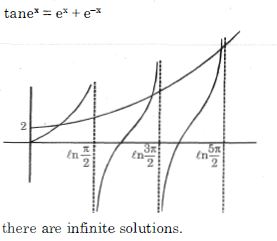
$x > 0$ के लिए समीकरण $\tan(e^x) = e^x + e^{-x}$ के वास्तविक हलों की संख्या क्या है?
A
$0$
B
$1$
C
$2$
D
इनमें से कोई नहीं
Solution
(D) माना $f(x) = \tan(e^x)$ और $g(x) = e^x + e^{-x}$ है।
हमें $x > 0$ के लिए $y = \tan(e^x)$ और $y = e^x + e^{-x}$ के प्रतिच्छेदन बिंदुओं की संख्या ज्ञात करनी है।
ध्यान दें कि $e^x + e^{-x} = 2 \cosh(x)$,जो सभी वास्तविक $x$ के लिए हमेशा $\ge 2$ होता है।
जैसे-जैसे $x$,$0$ से $\infty$ तक बढ़ता है,$e^x$,$1$ से $\infty$ तक बढ़ता है।
फलन $\tan(e^x)$,$e^x$ के सापेक्ष आवर्ती (periodic) है और $e^x = (2n+1)\frac{\pi}{2}$ (जहाँ $n = 0, 1, 2, \dots$) पर ऊर्ध्वाधर अनंतस्पर्शी (vertical asymptotes) रखता है।
चूंकि $x$ के $(0, \infty)$ में होने पर $e^x$,$(1, \infty)$ में सभी मान लेता है,इसलिए फलन $\tan(e^x)$ अनंत बार $-\infty$ और $+\infty$ के बीच दोलन करेगा।
विशेष रूप से,प्रत्येक अंतराल में जहाँ $e^x$ का मान $\pi$ बढ़ता है,$\tan(e^x)$ का मान $(-\infty, \infty)$ के परास को कवर करता है।
चूंकि $e^x + e^{-x} \ge 2$ है,इसलिए $y = e^x + e^{-x}$ का ग्राफ $\tan(e^x)$ की प्रत्येक शाखा को कम से कम एक बार प्रतिच्छेद करेगा,जब तक कि वह शाखा $\ge 2$ मान तक पहुँचती है।
चूंकि $x \to \infty$ होने पर ऐसी अनंत शाखाएँ होती हैं,इसलिए यहाँ अनंत हल प्राप्त होते हैं।
अतः,सही उत्तर 'इनमें से कोई नहीं' है।
हमें $x > 0$ के लिए $y = \tan(e^x)$ और $y = e^x + e^{-x}$ के प्रतिच्छेदन बिंदुओं की संख्या ज्ञात करनी है।
ध्यान दें कि $e^x + e^{-x} = 2 \cosh(x)$,जो सभी वास्तविक $x$ के लिए हमेशा $\ge 2$ होता है।
जैसे-जैसे $x$,$0$ से $\infty$ तक बढ़ता है,$e^x$,$1$ से $\infty$ तक बढ़ता है।
फलन $\tan(e^x)$,$e^x$ के सापेक्ष आवर्ती (periodic) है और $e^x = (2n+1)\frac{\pi}{2}$ (जहाँ $n = 0, 1, 2, \dots$) पर ऊर्ध्वाधर अनंतस्पर्शी (vertical asymptotes) रखता है।
चूंकि $x$ के $(0, \infty)$ में होने पर $e^x$,$(1, \infty)$ में सभी मान लेता है,इसलिए फलन $\tan(e^x)$ अनंत बार $-\infty$ और $+\infty$ के बीच दोलन करेगा।
विशेष रूप से,प्रत्येक अंतराल में जहाँ $e^x$ का मान $\pi$ बढ़ता है,$\tan(e^x)$ का मान $(-\infty, \infty)$ के परास को कवर करता है।
चूंकि $e^x + e^{-x} \ge 2$ है,इसलिए $y = e^x + e^{-x}$ का ग्राफ $\tan(e^x)$ की प्रत्येक शाखा को कम से कम एक बार प्रतिच्छेद करेगा,जब तक कि वह शाखा $\ge 2$ मान तक पहुँचती है।
चूंकि $x \to \infty$ होने पर ऐसी अनंत शाखाएँ होती हैं,इसलिए यहाँ अनंत हल प्राप्त होते हैं।
अतः,सही उत्तर 'इनमें से कोई नहीं' है।
0 likes
View Solution412
AdvancedMCQ
यदि $y = \frac{7 + 6 \tan x - \tan^2 x}{1 + \tan^2 x}$ का अधिकतम मान $\lambda$ है,तो $\log_{\sqrt{2}}(\lambda)$ का मान ज्ञात कीजिए।
A
$0$
B
$6$
C
$8$
D
$1$
Solution
(B) दिया गया है $y = \frac{7 + 6 \tan x - \tan^2 x}{1 + \tan^2 x}$.
चूंकि $1 + \tan^2 x = \sec^2 x$,इसलिए $y = (7 + 6 \tan x - \tan^2 x) \cos^2 x$.
$y = 7 \cos^2 x + 6 \sin x \cos x - \sin^2 x$.
त्रिकोणमितीय सर्वसमिकाओं $\cos^2 x = \frac{1 + \cos 2x}{2}$,$\sin^2 x = \frac{1 - \cos 2x}{2}$,और $\sin x \cos x = \frac{\sin 2x}{2}$ का उपयोग करने पर:
$y = 7 \left( \frac{1 + \cos 2x}{2} \right) + 6 \left( \frac{\sin 2x}{2} \right) - \left( \frac{1 - \cos 2x}{2} \right)$.
$y = \frac{7 + 7 \cos 2x + 6 \sin 2x - 1 + \cos 2x}{2} = \frac{6 + 8 \cos 2x + 6 \sin 2x}{2} = 3 + 4 \cos 2x + 3 \sin 2x$.
व्यंजक $a \sin \theta + b \cos \theta$ का अधिकतम मान $\sqrt{a^2 + b^2}$ होता है।
यहाँ,$3 \sin 2x + 4 \cos 2x$ का अधिकतम मान $\sqrt{3^2 + 4^2} = \sqrt{9 + 16} = 5$ है।
अतः,$y$ का अधिकतम मान $\lambda = 3 + 5 = 8$ है।
हमें $\log_{\sqrt{2}}(\lambda) = \log_{\sqrt{2}}(8)$ का मान ज्ञात करना है।
चूंकि $8 = 2^3 = (\sqrt{2})^6$,इसलिए $\log_{\sqrt{2}}((\sqrt{2})^6) = 6$ प्राप्त होता है।
चूंकि $1 + \tan^2 x = \sec^2 x$,इसलिए $y = (7 + 6 \tan x - \tan^2 x) \cos^2 x$.
$y = 7 \cos^2 x + 6 \sin x \cos x - \sin^2 x$.
त्रिकोणमितीय सर्वसमिकाओं $\cos^2 x = \frac{1 + \cos 2x}{2}$,$\sin^2 x = \frac{1 - \cos 2x}{2}$,और $\sin x \cos x = \frac{\sin 2x}{2}$ का उपयोग करने पर:
$y = 7 \left( \frac{1 + \cos 2x}{2} \right) + 6 \left( \frac{\sin 2x}{2} \right) - \left( \frac{1 - \cos 2x}{2} \right)$.
$y = \frac{7 + 7 \cos 2x + 6 \sin 2x - 1 + \cos 2x}{2} = \frac{6 + 8 \cos 2x + 6 \sin 2x}{2} = 3 + 4 \cos 2x + 3 \sin 2x$.
व्यंजक $a \sin \theta + b \cos \theta$ का अधिकतम मान $\sqrt{a^2 + b^2}$ होता है।
यहाँ,$3 \sin 2x + 4 \cos 2x$ का अधिकतम मान $\sqrt{3^2 + 4^2} = \sqrt{9 + 16} = 5$ है।
अतः,$y$ का अधिकतम मान $\lambda = 3 + 5 = 8$ है।
हमें $\log_{\sqrt{2}}(\lambda) = \log_{\sqrt{2}}(8)$ का मान ज्ञात करना है।
चूंकि $8 = 2^3 = (\sqrt{2})^6$,इसलिए $\log_{\sqrt{2}}((\sqrt{2})^6) = 6$ प्राप्त होता है।
0 likes
View Solution413
AdvancedMCQ
यदि $3\cos \theta + 4\sin \theta = 5$ है,तो $3\sin \theta - 4\cos \theta$ का मान ज्ञात कीजिए।
A
$1$
B
$-1$
C
$0$
D
$\frac{1}{2}$
Solution
(C) माना $3\cos \theta + 4\sin \theta = 5$ समीकरण $(1)$ है और $3\sin \theta - 4\cos \theta = x$ समीकरण $(2)$ है।
दोनों समीकरणों का वर्ग करके उन्हें जोड़ने पर:
$(3\cos \theta + 4\sin \theta)^2 + (3\sin \theta - 4\cos \theta)^2 = 5^2 + x^2$
$(9\cos^2 \theta + 16\sin^2 \theta + 24\sin \theta \cos \theta) + (9\sin^2 \theta + 16\cos^2 \theta - 24\sin \theta \cos \theta) = 25 + x^2$
$9(\cos^2 \theta + \sin^2 \theta) + 16(\sin^2 \theta + \cos^2 \theta) = 25 + x^2$
चूँकि $\sin^2 \theta + \cos^2 \theta = 1$,हमें प्राप्त होता है:
$9(1) + 16(1) = 25 + x^2$
$25 = 25 + x^2$
$x^2 = 0$
अतः,$x = 0$.
दोनों समीकरणों का वर्ग करके उन्हें जोड़ने पर:
$(3\cos \theta + 4\sin \theta)^2 + (3\sin \theta - 4\cos \theta)^2 = 5^2 + x^2$
$(9\cos^2 \theta + 16\sin^2 \theta + 24\sin \theta \cos \theta) + (9\sin^2 \theta + 16\cos^2 \theta - 24\sin \theta \cos \theta) = 25 + x^2$
$9(\cos^2 \theta + \sin^2 \theta) + 16(\sin^2 \theta + \cos^2 \theta) = 25 + x^2$
चूँकि $\sin^2 \theta + \cos^2 \theta = 1$,हमें प्राप्त होता है:
$9(1) + 16(1) = 25 + x^2$
$25 = 25 + x^2$
$x^2 = 0$
अतः,$x = 0$.
0 likes
View Solution414
AdvancedMCQ
यदि $\cos A + \cos B = \cos C$ और $\sin A + \sin B = \sin C$ है,तो व्यंजक $\frac{\sin(A + B)}{\sin 2C}$ का मान क्या है?
A
$0$
B
$1$
C
$2$
D
$3$
Solution
(B) दिए गए समीकरण हैं:
$1) \cos A + \cos B = \cos C$
$2) \sin A + \sin B = \sin C$
माना $z_1 = e^{iA}$,$z_2 = e^{iB}$,और $z_3 = e^{iC}$ है।
दोनों समीकरणों को जोड़ने पर: $(\cos A + \cos B) + i(\sin A + \sin B) = \cos C + i\sin C$
इससे $e^{iA} + e^{iB} = e^{iC}$ प्राप्त होता है।
समीकरणों का संयुग्मी (conjugate) लेने पर:
$\cos A + \cos B = \cos C$
$-\sin A - \sin B = -\sin C$
इन्हें जोड़ने पर $e^{-iA} + e^{-iB} = e^{-iC}$ प्राप्त होता है।
$e^{iA} + e^{iB} = e^{iC}$ से,
दोनों संयुग्मी रूपों को विभाजित करने पर:
$\frac{e^{iA} + e^{iB}}{e^{-iA} + e^{-iB}} = \frac{e^{iC}}{e^{-iC}}$
$\frac{e^{iA} + e^{iB}}{e^{-i(A+B)}(e^{iB} + e^{iA})} = e^{2iC}$
$e^{i(A+B)} = e^{2iC}$
काल्पनिक भागों की तुलना करने पर:
$\sin(A + B) = \sin 2C$
अतः,$\frac{\sin(A + B)}{\sin 2C} = 1$।
$1) \cos A + \cos B = \cos C$
$2) \sin A + \sin B = \sin C$
माना $z_1 = e^{iA}$,$z_2 = e^{iB}$,और $z_3 = e^{iC}$ है।
दोनों समीकरणों को जोड़ने पर: $(\cos A + \cos B) + i(\sin A + \sin B) = \cos C + i\sin C$
इससे $e^{iA} + e^{iB} = e^{iC}$ प्राप्त होता है।
समीकरणों का संयुग्मी (conjugate) लेने पर:
$\cos A + \cos B = \cos C$
$-\sin A - \sin B = -\sin C$
इन्हें जोड़ने पर $e^{-iA} + e^{-iB} = e^{-iC}$ प्राप्त होता है।
$e^{iA} + e^{iB} = e^{iC}$ से,
दोनों संयुग्मी रूपों को विभाजित करने पर:
$\frac{e^{iA} + e^{iB}}{e^{-iA} + e^{-iB}} = \frac{e^{iC}}{e^{-iC}}$
$\frac{e^{iA} + e^{iB}}{e^{-i(A+B)}(e^{iB} + e^{iA})} = e^{2iC}$
$e^{i(A+B)} = e^{2iC}$
काल्पनिक भागों की तुलना करने पर:
$\sin(A + B) = \sin 2C$
अतः,$\frac{\sin(A + B)}{\sin 2C} = 1$।
0 likes
View Solution415
AdvancedMCQ
यदि $A$ तीसरे चतुर्थांश में स्थित है और $3 \tan A - 4 = 0$ है,तो $5 \sin 2A + 3 \sin A + 4 \cos A$ का मान ज्ञात कीजिए।
A
$0$
B
$1$
C
$2$
D
इनमें से कोई नहीं
Solution
(A) दिया गया है $3 \tan A - 4 = 0$,इसलिए $\tan A = \frac{4}{3}$।
चूंकि $A$ तीसरे चतुर्थांश में स्थित है,इसलिए $\sin A$ और $\cos A$ दोनों ऋणात्मक होंगे।
$\tan A = \frac{4}{3}$ का उपयोग करके,कर्ण $r = \sqrt{3^2 + 4^2} = 5$ प्राप्त होता है।
अतः,$\sin A = -\frac{4}{5}$ और $\cos A = -\frac{3}{5}$।
अब,इन मानों को व्यंजक $5 \sin 2A + 3 \sin A + 4 \cos A$ में प्रतिस्थापित करने पर:
$5(2 \sin A \cos A) + 3 \sin A + 4 \cos A$
$= 10 \left(-\frac{4}{5}\right) \left(-\frac{3}{5}\right) + 3 \left(-\frac{4}{5}\right) + 4 \left(-\frac{3}{5}\right)$
$= 10 \left(\frac{12}{25}\right) - \frac{12}{5} - \frac{12}{5}$
$= \frac{120}{25} - \frac{24}{5} = \frac{24}{5} - \frac{24}{5} = 0$।
चूंकि $A$ तीसरे चतुर्थांश में स्थित है,इसलिए $\sin A$ और $\cos A$ दोनों ऋणात्मक होंगे।
$\tan A = \frac{4}{3}$ का उपयोग करके,कर्ण $r = \sqrt{3^2 + 4^2} = 5$ प्राप्त होता है।
अतः,$\sin A = -\frac{4}{5}$ और $\cos A = -\frac{3}{5}$।
अब,इन मानों को व्यंजक $5 \sin 2A + 3 \sin A + 4 \cos A$ में प्रतिस्थापित करने पर:
$5(2 \sin A \cos A) + 3 \sin A + 4 \cos A$
$= 10 \left(-\frac{4}{5}\right) \left(-\frac{3}{5}\right) + 3 \left(-\frac{4}{5}\right) + 4 \left(-\frac{3}{5}\right)$
$= 10 \left(\frac{12}{25}\right) - \frac{12}{5} - \frac{12}{5}$
$= \frac{120}{25} - \frac{24}{5} = \frac{24}{5} - \frac{24}{5} = 0$।
0 likes
View Solution416
AdvancedMCQ
मान लीजिए $f(x) = Ax^3 - Bx - \tan x \cdot \text{sgn}(x)$ सभी $x \in \mathbb{R} - \left\{ (2n + 1) \frac{\pi}{2}, n \in \mathbb{Z} \right\}$ के लिए एक सम फलन (even function) है, जहाँ $A = \sin^2 \alpha - \sin \alpha + \frac{1}{4}$ और $B = \tan^2 \alpha + \frac{2}{\sqrt{3}} \tan \alpha + \frac{1}{3}$ है। तो $\left[ -\frac{3\pi}{2}, 2\pi \right]$ में $\alpha$ के मानों की संख्या ज्ञात कीजिए (जहाँ $\text{sgn}(x)$, $x$ का सिग्नल फलन दर्शाता है)।
A
$0$
B
$1$
C
$2$
D
$4$
Solution
(C) $f(x)$ को एक सम फलन होने के लिए, डोमेन के सभी $x$ के लिए $f(x) = f(-x)$ होना चाहिए।
दिया गया है $f(x) = Ax^3 - Bx - \tan x \cdot \text{sgn}(x)$।
चूँकि $\tan(-x) = -\tan x$ और $\text{sgn}(-x) = -\text{sgn}(x)$, इसलिए $\tan(-x) \cdot \text{sgn}(-x) = (-\tan x) \cdot (-\text{sgn}(x)) = \tan x \cdot \text{sgn}(x)$।
अतः, $f(-x) = A(-x)^3 - B(-x) - \tan(-x) \cdot \text{sgn}(-x) = -Ax^3 + Bx - \tan x \cdot \text{sgn}(x)$।
$f(x) = f(-x)$ के लिए, $Ax^3 - Bx - \tan x \cdot \text{sgn}(x) = -Ax^3 + Bx - \tan x \cdot \text{sgn}(x)$ होना चाहिए।
इसे सरल करने पर $2Ax^3 - 2Bx = 0$ प्राप्त होता है, जिसका अर्थ है कि $A = 0$ और $B = 0$ एक साथ होने चाहिए।
$A = \sin^2 \alpha - \sin \alpha + \frac{1}{4} = (\sin \alpha - \frac{1}{2})^2 = 0 \implies \sin \alpha = \frac{1}{2}$।
$B = \tan^2 \alpha + \frac{2}{\sqrt{3}} \tan \alpha + \frac{1}{3} = (\tan \alpha + \frac{1}{\sqrt{3}})^2 = 0 \implies \tan \alpha = -\frac{1}{\sqrt{3}}$।
हमें $\alpha \in [-\frac{3\pi}{2}, 2\pi]$ ज्ञात करना है जहाँ $\sin \alpha = \frac{1}{2}$ और $\tan \alpha = -\frac{1}{\sqrt{3}}$ दोनों सत्य हों।
$\sin \alpha = \frac{1}{2}$ के लिए, $\alpha = \frac{\pi}{6}, \frac{5\pi}{6}, -\frac{7\pi}{6}, -\frac{11\pi}{6}$।
$\tan \alpha = -\frac{1}{\sqrt{3}}$ के लिए, $\alpha = \frac{5\pi}{6}, -\frac{\pi}{6}, \frac{11\pi}{6}, -\frac{7\pi}{6}$।
उभयनिष्ठ मान $\alpha = \frac{5\pi}{6}$ और $\alpha = -\frac{7\pi}{6}$ हैं।
अतः, कुल $2$ मान प्राप्त होते हैं।
दिया गया है $f(x) = Ax^3 - Bx - \tan x \cdot \text{sgn}(x)$।
चूँकि $\tan(-x) = -\tan x$ और $\text{sgn}(-x) = -\text{sgn}(x)$, इसलिए $\tan(-x) \cdot \text{sgn}(-x) = (-\tan x) \cdot (-\text{sgn}(x)) = \tan x \cdot \text{sgn}(x)$।
अतः, $f(-x) = A(-x)^3 - B(-x) - \tan(-x) \cdot \text{sgn}(-x) = -Ax^3 + Bx - \tan x \cdot \text{sgn}(x)$।
$f(x) = f(-x)$ के लिए, $Ax^3 - Bx - \tan x \cdot \text{sgn}(x) = -Ax^3 + Bx - \tan x \cdot \text{sgn}(x)$ होना चाहिए।
इसे सरल करने पर $2Ax^3 - 2Bx = 0$ प्राप्त होता है, जिसका अर्थ है कि $A = 0$ और $B = 0$ एक साथ होने चाहिए।
$A = \sin^2 \alpha - \sin \alpha + \frac{1}{4} = (\sin \alpha - \frac{1}{2})^2 = 0 \implies \sin \alpha = \frac{1}{2}$।
$B = \tan^2 \alpha + \frac{2}{\sqrt{3}} \tan \alpha + \frac{1}{3} = (\tan \alpha + \frac{1}{\sqrt{3}})^2 = 0 \implies \tan \alpha = -\frac{1}{\sqrt{3}}$।
हमें $\alpha \in [-\frac{3\pi}{2}, 2\pi]$ ज्ञात करना है जहाँ $\sin \alpha = \frac{1}{2}$ और $\tan \alpha = -\frac{1}{\sqrt{3}}$ दोनों सत्य हों।
$\sin \alpha = \frac{1}{2}$ के लिए, $\alpha = \frac{\pi}{6}, \frac{5\pi}{6}, -\frac{7\pi}{6}, -\frac{11\pi}{6}$।
$\tan \alpha = -\frac{1}{\sqrt{3}}$ के लिए, $\alpha = \frac{5\pi}{6}, -\frac{\pi}{6}, \frac{11\pi}{6}, -\frac{7\pi}{6}$।
उभयनिष्ठ मान $\alpha = \frac{5\pi}{6}$ और $\alpha = -\frac{7\pi}{6}$ हैं।
अतः, कुल $2$ मान प्राप्त होते हैं।
0 likes
View Solution417
AdvancedMCQ
$\log _{\frac{1}{8}\csc^2 \frac{\pi}{8}} \sin^2 \frac{3\pi}{8}$ का मान ज्ञात कीजिए।
A
$0$
B
$\frac{1}{2}$
C
$1$
D
परिभाषित नहीं
Solution
(C) माना $E = \log_{\frac{1}{8}\csc^2 \frac{\pi}{8}} \sin^2 \frac{3\pi}{8}$ है।
सबसे पहले,आधार को सरल करते हैं: $\csc^2 \frac{\pi}{8} = \frac{1}{\sin^2 \frac{\pi}{8}} = \frac{1}{\frac{1-\cos(\pi/4)}{2}} = \frac{2}{1-\frac{1}{\sqrt{2}}} = \frac{2\sqrt{2}}{\sqrt{2}-1} = 2\sqrt{2}(\sqrt{2}+1) = 4+2\sqrt{2}$।
अतः,आधार $\frac{1}{8}(4+2\sqrt{2}) = \frac{2+\sqrt{2}}{4} = \frac{\sqrt{2}(\sqrt{2}+1)}{4} = \frac{\sqrt{2}+1}{2\sqrt{2}}$ है।
अब,पद को सरल करते हैं: $\sin^2 \frac{3\pi}{8} = \frac{1-\cos(3\pi/4)}{2} = \frac{1-(-\frac{1}{\sqrt{2}})}{2} = \frac{1+\frac{1}{\sqrt{2}}}{2} = \frac{\sqrt{2}+1}{2\sqrt{2}}$।
इस प्रकार,$E = \log_{\frac{\sqrt{2}+1}{2\sqrt{2}}} \left( \frac{\sqrt{2}+1}{2\sqrt{2}} \right) = 1$।
सबसे पहले,आधार को सरल करते हैं: $\csc^2 \frac{\pi}{8} = \frac{1}{\sin^2 \frac{\pi}{8}} = \frac{1}{\frac{1-\cos(\pi/4)}{2}} = \frac{2}{1-\frac{1}{\sqrt{2}}} = \frac{2\sqrt{2}}{\sqrt{2}-1} = 2\sqrt{2}(\sqrt{2}+1) = 4+2\sqrt{2}$।
अतः,आधार $\frac{1}{8}(4+2\sqrt{2}) = \frac{2+\sqrt{2}}{4} = \frac{\sqrt{2}(\sqrt{2}+1)}{4} = \frac{\sqrt{2}+1}{2\sqrt{2}}$ है।
अब,पद को सरल करते हैं: $\sin^2 \frac{3\pi}{8} = \frac{1-\cos(3\pi/4)}{2} = \frac{1-(-\frac{1}{\sqrt{2}})}{2} = \frac{1+\frac{1}{\sqrt{2}}}{2} = \frac{\sqrt{2}+1}{2\sqrt{2}}$।
इस प्रकार,$E = \log_{\frac{\sqrt{2}+1}{2\sqrt{2}}} \left( \frac{\sqrt{2}+1}{2\sqrt{2}} \right) = 1$।
0 likes
View Solution418
AdvancedMCQ
$\frac{4 \sin 9^{\circ} \sin 21^{\circ} \sin 39^{\circ} \sin 51^{\circ} \sin 69^{\circ} \sin 81^{\circ}}{\sin 54^{\circ}}$ का मान ज्ञात कीजिए।
A
$\frac{1}{16}$
B
$\frac{1}{32}$
C
$\frac{1}{8}$
D
$\frac{1}{4}$
Solution
(C) माना व्यंजक $E = \frac{4 \sin 9^{\circ} \sin 21^{\circ} \sin 39^{\circ} \sin 51^{\circ} \sin 69^{\circ} \sin 81^{\circ}}{\sin 54^{\circ}}$ है।
सर्वसमिका $\sin \theta \sin(60^{\circ}-\theta) \sin(60^{\circ}+\theta) = \frac{1}{4} \sin 3\theta$ का उपयोग करते हुए,पदों को समूहित करने पर:
$E = \frac{4}{\sin 54^{\circ}} [(\sin 9^{\circ} \sin 51^{\circ} \sin 69^{\circ}) \cdot (\sin 21^{\circ} \sin 39^{\circ} \sin 81^{\circ})]$.
चूंकि $\sin 51^{\circ} = \sin(60^{\circ}-9^{\circ})$ और $\sin 69^{\circ} = \sin(60^{\circ}+9^{\circ})$,इसलिए $\sin 9^{\circ} \sin 51^{\circ} \sin 69^{\circ} = \frac{1}{4} \sin(3 \times 9^{\circ}) = \frac{1}{4} \sin 27^{\circ}$ होगा।
इसी प्रकार,$\sin 21^{\circ} \sin 39^{\circ} \sin 81^{\circ} = \sin 21^{\circ} \sin(60^{\circ}-21^{\circ}) \sin(60^{\circ}+21^{\circ}) = \frac{1}{4} \sin(3 \times 21^{\circ}) = \frac{1}{4} \sin 63^{\circ}$ होगा।
इन मानों को $E$ में प्रतिस्थापित करने पर:
$E = \frac{4}{\sin 54^{\circ}} \cdot \frac{1}{4} \sin 27^{\circ} \cdot \frac{1}{4} \sin 63^{\circ} = \frac{\sin 27^{\circ} \sin 63^{\circ}}{4 \sin 54^{\circ}}$.
चूंकि $\sin 63^{\circ} = \cos 27^{\circ}$,इसलिए $E = \frac{\sin 27^{\circ} \cos 27^{\circ}}{4 \sin 54^{\circ}} = \frac{2 \sin 27^{\circ} \cos 27^{\circ}}{8 \sin 54^{\circ}} = \frac{\sin 54^{\circ}}{8 \sin 54^{\circ}} = \frac{1}{8}$।
सर्वसमिका $\sin \theta \sin(60^{\circ}-\theta) \sin(60^{\circ}+\theta) = \frac{1}{4} \sin 3\theta$ का उपयोग करते हुए,पदों को समूहित करने पर:
$E = \frac{4}{\sin 54^{\circ}} [(\sin 9^{\circ} \sin 51^{\circ} \sin 69^{\circ}) \cdot (\sin 21^{\circ} \sin 39^{\circ} \sin 81^{\circ})]$.
चूंकि $\sin 51^{\circ} = \sin(60^{\circ}-9^{\circ})$ और $\sin 69^{\circ} = \sin(60^{\circ}+9^{\circ})$,इसलिए $\sin 9^{\circ} \sin 51^{\circ} \sin 69^{\circ} = \frac{1}{4} \sin(3 \times 9^{\circ}) = \frac{1}{4} \sin 27^{\circ}$ होगा।
इसी प्रकार,$\sin 21^{\circ} \sin 39^{\circ} \sin 81^{\circ} = \sin 21^{\circ} \sin(60^{\circ}-21^{\circ}) \sin(60^{\circ}+21^{\circ}) = \frac{1}{4} \sin(3 \times 21^{\circ}) = \frac{1}{4} \sin 63^{\circ}$ होगा।
इन मानों को $E$ में प्रतिस्थापित करने पर:
$E = \frac{4}{\sin 54^{\circ}} \cdot \frac{1}{4} \sin 27^{\circ} \cdot \frac{1}{4} \sin 63^{\circ} = \frac{\sin 27^{\circ} \sin 63^{\circ}}{4 \sin 54^{\circ}}$.
चूंकि $\sin 63^{\circ} = \cos 27^{\circ}$,इसलिए $E = \frac{\sin 27^{\circ} \cos 27^{\circ}}{4 \sin 54^{\circ}} = \frac{2 \sin 27^{\circ} \cos 27^{\circ}}{8 \sin 54^{\circ}} = \frac{\sin 54^{\circ}}{8 \sin 54^{\circ}} = \frac{1}{8}$।
0 likes
View Solution419
AdvancedMCQ
मान लीजिए $A = \{ \theta : 2\cos^2 \theta + \sin \theta \le 2 \}$ और $B = \{ \theta : \frac{\pi}{2} \le \theta \le \frac{3\pi}{2} \}$,तो $A \cap B$ है
A
$\left\{ \theta : \theta \in \left[ \pi, \frac{3\pi}{2} \right] \right\}$
B
$\left\{ \theta : \theta \in \left[ \frac{\pi}{2}, \frac{7\pi}{6} \right] \right\}$
C
$\left\{ \theta : \theta \in \left[ \frac{\pi}{2}, \frac{\pi}{6} \right] \right\}$
D
$\left\{ \theta : \theta \in \left[ \frac{\pi}{2}, \frac{5\pi}{6} \right] \cup \left[ \pi, \frac{3\pi}{2} \right] \right\}$
Solution
(D) दिया गया है $2\cos^2 \theta + \sin \theta \le 2$.
$\cos^2 \theta = 1 - \sin^2 \theta$ का उपयोग करने पर,हमें प्राप्त होता है $2(1 - \sin^2 \theta) + \sin \theta \le 2$.
$2 - 2\sin^2 \theta + \sin \theta \le 2$.
$-2\sin^2 \theta + \sin \theta \le 0$.
$-1$ से गुणा करने पर,$2\sin^2 \theta - \sin \theta \ge 0$.
$\sin \theta(2\sin \theta - 1) \ge 0$.
यह असमिका तब सत्य होती है जब $\sin \theta \le 0$ या $\sin \theta \ge \frac{1}{2}$ हो।
$\sin \theta \le 0$ के लिए,$\theta \in [\pi, 2\pi]$.
$\sin \theta \ge \frac{1}{2}$ के लिए,$\theta \in [\frac{\pi}{6}, \frac{5\pi}{6}]$.
अतः,$A = [\frac{\pi}{6}, \frac{5\pi}{6}] \cup [\pi, 2\pi]$.
दिया गया है $B = [\frac{\pi}{2}, \frac{3\pi}{2}]$.
सर्वनिष्ठ $A \cap B$ लेने पर:
$A \cap B = ([\frac{\pi}{6}, \frac{5\pi}{6}] \cup [\pi, 2\pi]) \cap [\frac{\pi}{2}, \frac{3\pi}{2}]$.
$A \cap B = [\frac{\pi}{2}, \frac{5\pi}{6}] \cup [\pi, \frac{3\pi}{2}]$.
$\cos^2 \theta = 1 - \sin^2 \theta$ का उपयोग करने पर,हमें प्राप्त होता है $2(1 - \sin^2 \theta) + \sin \theta \le 2$.
$2 - 2\sin^2 \theta + \sin \theta \le 2$.
$-2\sin^2 \theta + \sin \theta \le 0$.
$-1$ से गुणा करने पर,$2\sin^2 \theta - \sin \theta \ge 0$.
$\sin \theta(2\sin \theta - 1) \ge 0$.
यह असमिका तब सत्य होती है जब $\sin \theta \le 0$ या $\sin \theta \ge \frac{1}{2}$ हो।
$\sin \theta \le 0$ के लिए,$\theta \in [\pi, 2\pi]$.
$\sin \theta \ge \frac{1}{2}$ के लिए,$\theta \in [\frac{\pi}{6}, \frac{5\pi}{6}]$.
अतः,$A = [\frac{\pi}{6}, \frac{5\pi}{6}] \cup [\pi, 2\pi]$.
दिया गया है $B = [\frac{\pi}{2}, \frac{3\pi}{2}]$.
सर्वनिष्ठ $A \cap B$ लेने पर:
$A \cap B = ([\frac{\pi}{6}, \frac{5\pi}{6}] \cup [\pi, 2\pi]) \cap [\frac{\pi}{2}, \frac{3\pi}{2}]$.
$A \cap B = [\frac{\pi}{2}, \frac{5\pi}{6}] \cup [\pi, \frac{3\pi}{2}]$.
0 likes
View Solution420
AdvancedMCQ
$\frac{\sin 81^\circ + \cos 81^\circ}{\sin 81^\circ - \cos 81^\circ}$ का मान ज्ञात कीजिए।
A
$\cot 9^\circ$
B
$\tan 9^\circ$
C
$\cot 54^\circ$
D
$\tan 54^\circ$
Solution
(D) दिया गया व्यंजक: $E = \frac{\sin 81^\circ + \cos 81^\circ}{\sin 81^\circ - \cos 81^\circ}$
अंश और हर को $\cos 81^\circ$ से विभाजित करने पर:
$E = \frac{\tan 81^\circ + 1}{\tan 81^\circ - 1}$
हम जानते हैं कि $\sin 81^\circ = \cos 9^\circ$ और $\cos 81^\circ = \sin 9^\circ$ होता है।
अतः,$E = \frac{\cos 9^\circ + \sin 9^\circ}{\cos 9^\circ - \sin 9^\circ}$
अब अंश और हर को $\cos 9^\circ$ से विभाजित करने पर:
$E = \frac{1 + \tan 9^\circ}{1 - \tan 9^\circ}$
चूंकि $\tan 45^\circ = 1$,यह व्यंजक $\tan(45^\circ + 9^\circ)$ के रूप में है।
$E = \tan 54^\circ$
अंश और हर को $\cos 81^\circ$ से विभाजित करने पर:
$E = \frac{\tan 81^\circ + 1}{\tan 81^\circ - 1}$
हम जानते हैं कि $\sin 81^\circ = \cos 9^\circ$ और $\cos 81^\circ = \sin 9^\circ$ होता है।
अतः,$E = \frac{\cos 9^\circ + \sin 9^\circ}{\cos 9^\circ - \sin 9^\circ}$
अब अंश और हर को $\cos 9^\circ$ से विभाजित करने पर:
$E = \frac{1 + \tan 9^\circ}{1 - \tan 9^\circ}$
चूंकि $\tan 45^\circ = 1$,यह व्यंजक $\tan(45^\circ + 9^\circ)$ के रूप में है।
$E = \tan 54^\circ$
0 likes
View Solution421
MediumMCQ
वास्तविक मान $\theta$ के लिए $\cos 2\theta + \cos \theta$ का न्यूनतम मान क्या है?
A
$-9/8$
B
$0$
C
$-2$
D
इनमें से कोई नहीं
Solution
(A) माना $S = \cos 2\theta + \cos \theta$.
सर्वसमिका $\cos 2\theta = 2\cos^2 \theta - 1$ का उपयोग करने पर:
$S = 2\cos^2 \theta - 1 + \cos \theta$.
न्यूनतम मान ज्ञात करने के लिए,हम $\cos \theta$ में द्विघात व्यंजक को पूर्ण वर्ग के रूप में लिखते हैं:
$S = 2(\cos^2 \theta + \frac{1}{2}\cos \theta) - 1$.
$S = 2(\cos^2 \theta + \frac{1}{2}\cos \theta + \frac{1}{16} - \frac{1}{16}) - 1$.
$S = 2(\cos \theta + \frac{1}{4})^2 - \frac{1}{8} - 1$.
$S = 2(\cos \theta + \frac{1}{4})^2 - \frac{9}{8}$.
चूंकि वर्ग पद $2(\cos \theta + \frac{1}{4})^2 \geq 0$ है,इसलिए $S$ का न्यूनतम मान तब प्राप्त होता है जब $\cos \theta = -1/4$ हो।
अतः,न्यूनतम मान $-9/8$ है।
सर्वसमिका $\cos 2\theta = 2\cos^2 \theta - 1$ का उपयोग करने पर:
$S = 2\cos^2 \theta - 1 + \cos \theta$.
न्यूनतम मान ज्ञात करने के लिए,हम $\cos \theta$ में द्विघात व्यंजक को पूर्ण वर्ग के रूप में लिखते हैं:
$S = 2(\cos^2 \theta + \frac{1}{2}\cos \theta) - 1$.
$S = 2(\cos^2 \theta + \frac{1}{2}\cos \theta + \frac{1}{16} - \frac{1}{16}) - 1$.
$S = 2(\cos \theta + \frac{1}{4})^2 - \frac{1}{8} - 1$.
$S = 2(\cos \theta + \frac{1}{4})^2 - \frac{9}{8}$.
चूंकि वर्ग पद $2(\cos \theta + \frac{1}{4})^2 \geq 0$ है,इसलिए $S$ का न्यूनतम मान तब प्राप्त होता है जब $\cos \theta = -1/4$ हो।
अतः,न्यूनतम मान $-9/8$ है।
0 likes
View Solution422
AdvancedMCQ
यदि $\sin \alpha$ और $\cos \alpha$ समीकरण $ax^2 + bx + c = 0$ $(c \neq 0)$ के मूल हैं,तो:
A
$a^2 - b^2 + 2ac = 0$
B
$(a + c)^2 = b^2 - c^2$
C
$a^2 + b^2 - 2ac = 0$
D
$(a - c)^2 = b^2 + c^2$
Solution
(A) दिया गया है कि $\sin \alpha$ और $\cos \alpha$ समीकरण $ax^2 + bx + c = 0$ के मूल हैं।
द्विघात समीकरण के गुणों के अनुसार,मूलों का योग $\sin \alpha + \cos \alpha = -\frac{b}{a}$ और मूलों का गुणनफल $\sin \alpha \cos \alpha = \frac{c}{a}$ है।
हम सर्वसमिका $\sin^2 \alpha + \cos^2 \alpha = 1$ जानते हैं।
इसे $(\sin \alpha + \cos \alpha)^2 - 2 \sin \alpha \cos \alpha = 1$ के रूप में लिखा जा सकता है।
मान रखने पर,हमें $(-\frac{b}{a})^2 - 2(\frac{c}{a}) = 1$ प्राप्त होता है।
$\frac{b^2}{a^2} - \frac{2c}{a} = 1$.
$a^2$ से गुणा करने पर,हमें $b^2 - 2ac = a^2$ प्राप्त होता है।
पदों को व्यवस्थित करने पर,हमें $a^2 - b^2 + 2ac = 0$ प्राप्त होता है।
द्विघात समीकरण के गुणों के अनुसार,मूलों का योग $\sin \alpha + \cos \alpha = -\frac{b}{a}$ और मूलों का गुणनफल $\sin \alpha \cos \alpha = \frac{c}{a}$ है।
हम सर्वसमिका $\sin^2 \alpha + \cos^2 \alpha = 1$ जानते हैं।
इसे $(\sin \alpha + \cos \alpha)^2 - 2 \sin \alpha \cos \alpha = 1$ के रूप में लिखा जा सकता है।
मान रखने पर,हमें $(-\frac{b}{a})^2 - 2(\frac{c}{a}) = 1$ प्राप्त होता है।
$\frac{b^2}{a^2} - \frac{2c}{a} = 1$.
$a^2$ से गुणा करने पर,हमें $b^2 - 2ac = a^2$ प्राप्त होता है।
पदों को व्यवस्थित करने पर,हमें $a^2 - b^2 + 2ac = 0$ प्राप्त होता है।
0 likes
View Solution423
AdvancedMCQ
यदि $A = \sin 45^{\circ} + \cos 45^{\circ}$ और $B = \sin 44^{\circ} + \cos 44^{\circ}$ है,तो
A
$A > B$
B
$A < B$
C
$A = B$
D
इनमें से कोई नहीं
Solution
(A) हम जानते हैं कि $A = \sin 45^{\circ} + \cos 45^{\circ} = \frac{1}{\sqrt{2}} + \frac{1}{\sqrt{2}} = \frac{2}{\sqrt{2}} = \sqrt{2}$.
वैकल्पिक रूप से,$A = \sqrt{2} (\frac{1}{\sqrt{2}} \sin 45^{\circ} + \frac{1}{\sqrt{2}} \cos 45^{\circ}) = \sqrt{2} \sin(45^{\circ} + 45^{\circ}) = \sqrt{2} \sin 90^{\circ} = \sqrt{2}(1) = \sqrt{2}$.
अब,$B = \sin 44^{\circ} + \cos 44^{\circ} = \sqrt{2} (\frac{1}{\sqrt{2}} \sin 44^{\circ} + \frac{1}{\sqrt{2}} \cos 44^{\circ})$.
सूत्र $\sin(x + y) = \sin x \cos y + \cos x \sin y$ का उपयोग करने पर,हमें $B = \sqrt{2} \sin(44^{\circ} + 45^{\circ}) = \sqrt{2} \sin 89^{\circ}$ प्राप्त होता है।
चूंकि $\sin 89^{\circ} < \sin 90^{\circ}$,इसलिए $\sqrt{2} \sin 89^{\circ} < \sqrt{2} \sin 90^{\circ}$ होता है।
अतः,$B < A$ या $A > B$।
वैकल्पिक रूप से,$A = \sqrt{2} (\frac{1}{\sqrt{2}} \sin 45^{\circ} + \frac{1}{\sqrt{2}} \cos 45^{\circ}) = \sqrt{2} \sin(45^{\circ} + 45^{\circ}) = \sqrt{2} \sin 90^{\circ} = \sqrt{2}(1) = \sqrt{2}$.
अब,$B = \sin 44^{\circ} + \cos 44^{\circ} = \sqrt{2} (\frac{1}{\sqrt{2}} \sin 44^{\circ} + \frac{1}{\sqrt{2}} \cos 44^{\circ})$.
सूत्र $\sin(x + y) = \sin x \cos y + \cos x \sin y$ का उपयोग करने पर,हमें $B = \sqrt{2} \sin(44^{\circ} + 45^{\circ}) = \sqrt{2} \sin 89^{\circ}$ प्राप्त होता है।
चूंकि $\sin 89^{\circ} < \sin 90^{\circ}$,इसलिए $\sqrt{2} \sin 89^{\circ} < \sqrt{2} \sin 90^{\circ}$ होता है।
अतः,$B < A$ या $A > B$।
0 likes
View Solution424
DifficultMCQ
यदि $0 < \theta < \pi$ है,तो $3\sin \theta + \csc^3 \theta$ का न्यूनतम मान क्या है?
A
$4$
B
$3$
C
$5$
D
$6$
Solution
(A) यहाँ हम चार धनात्मक पदों $\sin \theta, \sin \theta, \sin \theta$ और $\csc^3 \theta$ के लिए समांतर माध्य-गुणोत्तर माध्य $(AM \ge GM)$ असमिका का उपयोग करेंगे।
$\frac{\sin \theta + \sin \theta + \sin \theta + \csc^3 \theta}{4} \ge \sqrt[4]{(\sin \theta \cdot \sin \theta \cdot \sin \theta \cdot \csc^3 \theta)}$
$\frac{3\sin \theta + \csc^3 \theta}{4} \ge \sqrt[4]{(\sin^3 \theta \cdot \frac{1}{\sin^3 \theta})}$
$\frac{3\sin \theta + \csc^3 \theta}{4} \ge \sqrt[4]{1}$
$3\sin \theta + \csc^3 \theta \ge 4 \times 1$
अतः,न्यूनतम मान $4$ है।
$\frac{\sin \theta + \sin \theta + \sin \theta + \csc^3 \theta}{4} \ge \sqrt[4]{(\sin \theta \cdot \sin \theta \cdot \sin \theta \cdot \csc^3 \theta)}$
$\frac{3\sin \theta + \csc^3 \theta}{4} \ge \sqrt[4]{(\sin^3 \theta \cdot \frac{1}{\sin^3 \theta})}$
$\frac{3\sin \theta + \csc^3 \theta}{4} \ge \sqrt[4]{1}$
$3\sin \theta + \csc^3 \theta \ge 4 \times 1$
अतः,न्यूनतम मान $4$ है।
0 likes
View Solution425
AdvancedMCQ
$\cos \frac{\pi}{7} \cos \frac{2\pi}{7} \cos \frac{3\pi}{7} =$
A
$-\frac{1}{8}$
B
$\frac{1}{16}$
C
$\frac{1}{8}$
D
कोई नहीं
Solution
(C) माना $P = \cos \frac{\pi}{7} \cos \frac{2\pi}{7} \cos \frac{3\pi}{7}$ है।
$2 \sin \frac{\pi}{7}$ से गुणा और भाग करने पर:
$P = \frac{1}{2 \sin \frac{\pi}{7}} \left( 2 \sin \frac{\pi}{7} \cos \frac{\pi}{7} \right) \cos \frac{2\pi}{7} \cos \frac{3\pi}{7}$
$2 \sin \theta \cos \theta = \sin 2\theta$ सूत्र का उपयोग करने पर:
$P = \frac{1}{2 \sin \frac{\pi}{7}} \left( \sin \frac{2\pi}{7} \cos \frac{2\pi}{7} \right) \cos \frac{3\pi}{7}$
$2$ से गुणा और भाग करने पर:
$P = \frac{1}{4 \sin \frac{\pi}{7}} \left( 2 \sin \frac{2\pi}{7} \cos \frac{2\pi}{7} \right) \cos \frac{3\pi}{7} = \frac{1}{4 \sin \frac{\pi}{7}} \sin \frac{4\pi}{7} \cos \frac{3\pi}{7}$
चूंकि $\sin \frac{4\pi}{7} = \sin \left( \pi - \frac{3\pi}{7} \right) = \sin \frac{3\pi}{7}$:
$P = \frac{1}{4 \sin \frac{\pi}{7}} \sin \frac{3\pi}{7} \cos \frac{3\pi}{7}$
$2$ से गुणा और भाग करने पर:
$P = \frac{1}{8 \sin \frac{\pi}{7}} \left( 2 \sin \frac{3\pi}{7} \cos \frac{3\pi}{7} \right) = \frac{1}{8 \sin \frac{\pi}{7}} \sin \frac{6\pi}{7}$
चूंकि $\sin \frac{6\pi}{7} = \sin \left( \pi - \frac{\pi}{7} \right) = \sin \frac{\pi}{7}$:
$P = \frac{\sin \frac{\pi}{7}}{8 \sin \frac{\pi}{7}} = \frac{1}{8}$.
$2 \sin \frac{\pi}{7}$ से गुणा और भाग करने पर:
$P = \frac{1}{2 \sin \frac{\pi}{7}} \left( 2 \sin \frac{\pi}{7} \cos \frac{\pi}{7} \right) \cos \frac{2\pi}{7} \cos \frac{3\pi}{7}$
$2 \sin \theta \cos \theta = \sin 2\theta$ सूत्र का उपयोग करने पर:
$P = \frac{1}{2 \sin \frac{\pi}{7}} \left( \sin \frac{2\pi}{7} \cos \frac{2\pi}{7} \right) \cos \frac{3\pi}{7}$
$2$ से गुणा और भाग करने पर:
$P = \frac{1}{4 \sin \frac{\pi}{7}} \left( 2 \sin \frac{2\pi}{7} \cos \frac{2\pi}{7} \right) \cos \frac{3\pi}{7} = \frac{1}{4 \sin \frac{\pi}{7}} \sin \frac{4\pi}{7} \cos \frac{3\pi}{7}$
चूंकि $\sin \frac{4\pi}{7} = \sin \left( \pi - \frac{3\pi}{7} \right) = \sin \frac{3\pi}{7}$:
$P = \frac{1}{4 \sin \frac{\pi}{7}} \sin \frac{3\pi}{7} \cos \frac{3\pi}{7}$
$2$ से गुणा और भाग करने पर:
$P = \frac{1}{8 \sin \frac{\pi}{7}} \left( 2 \sin \frac{3\pi}{7} \cos \frac{3\pi}{7} \right) = \frac{1}{8 \sin \frac{\pi}{7}} \sin \frac{6\pi}{7}$
चूंकि $\sin \frac{6\pi}{7} = \sin \left( \pi - \frac{\pi}{7} \right) = \sin \frac{\pi}{7}$:
$P = \frac{\sin \frac{\pi}{7}}{8 \sin \frac{\pi}{7}} = \frac{1}{8}$.
0 likes
View Solution426
MediumMCQ
यदि $\sin \theta_1 + \sin \theta_2 + \sin \theta_3 = 3$ है,तो $\cos \theta_1 + \cos \theta_2 + \cos \theta_3 =$
A
$3$
B
$2$
C
$1$
D
$0$
Solution
(D) दिया गया है कि $\sin \theta_1 + \sin \theta_2 + \sin \theta_3 = 3$ है।
चूंकि $\sin$ फलन का अधिकतम मान $1$ होता है,इसलिए तीन $\sin$ पदों का योग $3$ तभी संभव है जब प्रत्येक पद $1$ के बराबर हो।
अतः,$\sin \theta_1 = 1, \sin \theta_2 = 1,$ और $\sin \theta_3 = 1$ है।
इसका अर्थ है कि $\theta_1 = \theta_2 = \theta_3 = \frac{\pi}{2}$ है।
अब,हम कोसाइन का योग ज्ञात करते हैं: $\cos \theta_1 + \cos \theta_2 + \cos \theta_3$।
चूंकि $\cos(\frac{\pi}{2}) = 0$ होता है,इसलिए $\cos \theta_1 = 0, \cos \theta_2 = 0,$ और $\cos \theta_3 = 0$ है।
अतः,$0 + 0 + 0 = 0$।
चूंकि $\sin$ फलन का अधिकतम मान $1$ होता है,इसलिए तीन $\sin$ पदों का योग $3$ तभी संभव है जब प्रत्येक पद $1$ के बराबर हो।
अतः,$\sin \theta_1 = 1, \sin \theta_2 = 1,$ और $\sin \theta_3 = 1$ है।
इसका अर्थ है कि $\theta_1 = \theta_2 = \theta_3 = \frac{\pi}{2}$ है।
अब,हम कोसाइन का योग ज्ञात करते हैं: $\cos \theta_1 + \cos \theta_2 + \cos \theta_3$।
चूंकि $\cos(\frac{\pi}{2}) = 0$ होता है,इसलिए $\cos \theta_1 = 0, \cos \theta_2 = 0,$ और $\cos \theta_3 = 0$ है।
अतः,$0 + 0 + 0 = 0$।
0 likes
View Solution427
AdvancedMCQ
$\sin^2 \frac{\pi}{8} + \sin^2 \frac{3\pi}{8} + \sin^2 \frac{5\pi}{8} + \sin^2 \frac{7\pi}{8}$ का मान क्या है?
A
$1$
B
$2$
C
$1\frac{1}{8}$
D
$2\frac{1}{8}$
Solution
(B) हम जानते हैं कि $\sin(\pi - \theta) = \sin \theta$.
इसलिए,$\sin \frac{7\pi}{8} = \sin(\pi - \frac{\pi}{8}) = \sin \frac{\pi}{8}$ और $\sin \frac{5\pi}{8} = \sin(\pi - \frac{3\pi}{8}) = \sin \frac{3\pi}{8}$.
दी गई व्यंजक इस प्रकार हो जाती है: $2 \sin^2 \frac{\pi}{8} + 2 \sin^2 \frac{3\pi}{8} = 2 [\sin^2 \frac{\pi}{8} + \sin^2 \frac{3\pi}{8}]$.
चूंकि $\sin \frac{3\pi}{8} = \sin(\frac{\pi}{2} - \frac{\pi}{8}) = \cos \frac{\pi}{8}$,इसलिए $\sin^2 \frac{3\pi}{8} = \cos^2 \frac{\pi}{8}$ होता है।
इस मान को व्यंजक में रखने पर: $2 [\sin^2 \frac{\pi}{8} + \cos^2 \frac{\pi}{8}] = 2(1) = 2$.
इसलिए,$\sin \frac{7\pi}{8} = \sin(\pi - \frac{\pi}{8}) = \sin \frac{\pi}{8}$ और $\sin \frac{5\pi}{8} = \sin(\pi - \frac{3\pi}{8}) = \sin \frac{3\pi}{8}$.
दी गई व्यंजक इस प्रकार हो जाती है: $2 \sin^2 \frac{\pi}{8} + 2 \sin^2 \frac{3\pi}{8} = 2 [\sin^2 \frac{\pi}{8} + \sin^2 \frac{3\pi}{8}]$.
चूंकि $\sin \frac{3\pi}{8} = \sin(\frac{\pi}{2} - \frac{\pi}{8}) = \cos \frac{\pi}{8}$,इसलिए $\sin^2 \frac{3\pi}{8} = \cos^2 \frac{\pi}{8}$ होता है।
इस मान को व्यंजक में रखने पर: $2 [\sin^2 \frac{\pi}{8} + \cos^2 \frac{\pi}{8}] = 2(1) = 2$.
0 likes
View Solution428
AdvancedMCQ
$\frac{3 + \cot 76^{\circ} \cot 16^{\circ}}{\cot 76^{\circ} + \cot 16^{\circ}}$ का मान ज्ञात कीजिए।
A
$\cot 46^{\circ}$
B
$\tan 44^{\circ}$
C
$\tan 2^{\circ}$
D
$\cot 44^{\circ}$
Solution
(D) दी गई व्यंजक: $E = \frac{3 + \cot 76^{\circ} \cot 16^{\circ}}{\cot 76^{\circ} + \cot 16^{\circ}}$
$\sin$ और $\cos$ में बदलने पर: $E = \frac{3 + \frac{\cos 76^{\circ} \cos 16^{\circ}}{\sin 76^{\circ} \sin 16^{\circ}}}{\frac{\cos 76^{\circ}}{\sin 76^{\circ}} + \frac{\cos 16^{\circ}}{\sin 16^{\circ}}} = \frac{3 \sin 76^{\circ} \sin 16^{\circ} + \cos 76^{\circ} \cos 16^{\circ}}{\cos 76^{\circ} \sin 16^{\circ} + \sin 76^{\circ} \cos 16^{\circ}}$
$\sin A \sin B = \frac{1}{2} [\cos(A-B) - \cos(A+B)]$ और $\sin(A+B) = \sin A \cos B + \cos A \sin B$ का उपयोग करने पर:
अंश: $2 \sin 76^{\circ} \sin 16^{\circ} + (\sin 76^{\circ} \sin 16^{\circ} + \cos 76^{\circ} \cos 16^{\circ}) = 2 \sin 76^{\circ} \sin 16^{\circ} + \cos(76^{\circ} - 16^{\circ}) = 2 \sin 76^{\circ} \sin 16^{\circ} + \cos 60^{\circ} = 2 \sin 76^{\circ} \sin 16^{\circ} + \frac{1}{2}$
हर: $\sin(76^{\circ} + 16^{\circ}) = \sin 92^{\circ}$
$2 \sin A \sin B = \cos(A-B) - \cos(A+B)$ का उपयोग करने पर:
$E = \frac{\cos(76^{\circ}-16^{\circ}) - \cos(76^{\circ}+16^{\circ}) + \frac{1}{2}}{\sin 92^{\circ}} = \frac{\cos 60^{\circ} - \cos 92^{\circ} + \frac{1}{2}}{\sin 92^{\circ}} = \frac{\frac{1}{2} - \cos 92^{\circ} + \frac{1}{2}}{\sin 92^{\circ}} = \frac{1 - \cos 92^{\circ}}{\sin 92^{\circ}}$
अर्ध-कोण सूत्रों $1 - \cos \theta = 2 \sin^2(\frac{\theta}{2})$ और $\sin \theta = 2 \sin(\frac{\theta}{2}) \cos(\frac{\theta}{2})$ का उपयोग करने पर:
$E = \frac{2 \sin^2 46^{\circ}}{2 \sin 46^{\circ} \cos 46^{\circ}} = \tan 46^{\circ} = \cot(90^{\circ} - 46^{\circ}) = \cot 44^{\circ}$
$\sin$ और $\cos$ में बदलने पर: $E = \frac{3 + \frac{\cos 76^{\circ} \cos 16^{\circ}}{\sin 76^{\circ} \sin 16^{\circ}}}{\frac{\cos 76^{\circ}}{\sin 76^{\circ}} + \frac{\cos 16^{\circ}}{\sin 16^{\circ}}} = \frac{3 \sin 76^{\circ} \sin 16^{\circ} + \cos 76^{\circ} \cos 16^{\circ}}{\cos 76^{\circ} \sin 16^{\circ} + \sin 76^{\circ} \cos 16^{\circ}}$
$\sin A \sin B = \frac{1}{2} [\cos(A-B) - \cos(A+B)]$ और $\sin(A+B) = \sin A \cos B + \cos A \sin B$ का उपयोग करने पर:
अंश: $2 \sin 76^{\circ} \sin 16^{\circ} + (\sin 76^{\circ} \sin 16^{\circ} + \cos 76^{\circ} \cos 16^{\circ}) = 2 \sin 76^{\circ} \sin 16^{\circ} + \cos(76^{\circ} - 16^{\circ}) = 2 \sin 76^{\circ} \sin 16^{\circ} + \cos 60^{\circ} = 2 \sin 76^{\circ} \sin 16^{\circ} + \frac{1}{2}$
हर: $\sin(76^{\circ} + 16^{\circ}) = \sin 92^{\circ}$
$2 \sin A \sin B = \cos(A-B) - \cos(A+B)$ का उपयोग करने पर:
$E = \frac{\cos(76^{\circ}-16^{\circ}) - \cos(76^{\circ}+16^{\circ}) + \frac{1}{2}}{\sin 92^{\circ}} = \frac{\cos 60^{\circ} - \cos 92^{\circ} + \frac{1}{2}}{\sin 92^{\circ}} = \frac{\frac{1}{2} - \cos 92^{\circ} + \frac{1}{2}}{\sin 92^{\circ}} = \frac{1 - \cos 92^{\circ}}{\sin 92^{\circ}}$
अर्ध-कोण सूत्रों $1 - \cos \theta = 2 \sin^2(\frac{\theta}{2})$ और $\sin \theta = 2 \sin(\frac{\theta}{2}) \cos(\frac{\theta}{2})$ का उपयोग करने पर:
$E = \frac{2 \sin^2 46^{\circ}}{2 \sin 46^{\circ} \cos 46^{\circ}} = \tan 46^{\circ} = \cot(90^{\circ} - 46^{\circ}) = \cot 44^{\circ}$
0 likes
View Solution429
AdvancedMCQ
$5 \cos \theta + 3 \cos \left( \theta + \frac{\pi}{3} \right) - 1$ का अधिकतम मान है
A
$5$
B
$6$
C
$7$
D
$8$
Solution
(B) दिया गया व्यंजक: $5 \cos \theta + 3 \cos \left( \theta + \frac{\pi}{3} \right) - 1$
सर्वसमिका $\cos(A + B) = \cos A \cos B - \sin A \sin B$ का उपयोग करने पर:
$= 5 \cos \theta + 3 \left( \cos \theta \cdot \cos \frac{\pi}{3} - \sin \theta \cdot \sin \frac{\pi}{3} \right) - 1$
$\cos \frac{\pi}{3} = \frac{1}{2}$ और $\sin \frac{\pi}{3} = \frac{\sqrt{3}}{2}$ रखने पर:
$= 5 \cos \theta + 3 \left( \frac{1}{2} \cos \theta - \frac{\sqrt{3}}{2} \sin \theta \right) - 1$
$= 5 \cos \theta + \frac{3}{2} \cos \theta - \frac{3\sqrt{3}}{2} \sin \theta - 1$
$= \frac{13}{2} \cos \theta - \frac{3\sqrt{3}}{2} \sin \theta - 1$
यह व्यंजक $a \cos \theta + b \sin \theta + c$ के रूप में है,जहाँ अधिकतम मान $\sqrt{a^2 + b^2} + c$ होता है।
यहाँ,$a = \frac{13}{2}$,$b = -\frac{3\sqrt{3}}{2}$,और $c = -1$ है।
अधिकतम मान $= \sqrt{\left( \frac{13}{2} \right)^2 + \left( -\frac{3\sqrt{3}}{2} \right)^2} - 1$
$= \sqrt{\frac{169}{4} + \frac{27}{4}} - 1$
$= \sqrt{\frac{196}{4}} - 1$
$= \sqrt{49} - 1 = 7 - 1 = 6$.
सर्वसमिका $\cos(A + B) = \cos A \cos B - \sin A \sin B$ का उपयोग करने पर:
$= 5 \cos \theta + 3 \left( \cos \theta \cdot \cos \frac{\pi}{3} - \sin \theta \cdot \sin \frac{\pi}{3} \right) - 1$
$\cos \frac{\pi}{3} = \frac{1}{2}$ और $\sin \frac{\pi}{3} = \frac{\sqrt{3}}{2}$ रखने पर:
$= 5 \cos \theta + 3 \left( \frac{1}{2} \cos \theta - \frac{\sqrt{3}}{2} \sin \theta \right) - 1$
$= 5 \cos \theta + \frac{3}{2} \cos \theta - \frac{3\sqrt{3}}{2} \sin \theta - 1$
$= \frac{13}{2} \cos \theta - \frac{3\sqrt{3}}{2} \sin \theta - 1$
यह व्यंजक $a \cos \theta + b \sin \theta + c$ के रूप में है,जहाँ अधिकतम मान $\sqrt{a^2 + b^2} + c$ होता है।
यहाँ,$a = \frac{13}{2}$,$b = -\frac{3\sqrt{3}}{2}$,और $c = -1$ है।
अधिकतम मान $= \sqrt{\left( \frac{13}{2} \right)^2 + \left( -\frac{3\sqrt{3}}{2} \right)^2} - 1$
$= \sqrt{\frac{169}{4} + \frac{27}{4}} - 1$
$= \sqrt{\frac{196}{4}} - 1$
$= \sqrt{49} - 1 = 7 - 1 = 6$.
0 likes
View Solution430
AdvancedMCQ
यदि $A + B + C = \frac{\pi}{2}$ है,तो $\tan A \tan B + \tan B \tan C + \tan C \tan A$ का मान ज्ञात कीजिए।
A
$0$
B
$\tan A \tan B \tan C$
C
$1$
D
$-1$
Solution
(C) दिया गया है कि $A + B + C = \frac{\pi}{2} = 90^\circ$ है।
अतः,$A + B = 90^\circ - C$ है।
दोनों पक्षों में टेंजेंट (tangent) लेने पर:
$\tan(A + B) = \tan(90^\circ - C)$
सर्वसमिका $\tan(A + B) = \frac{\tan A + \tan B}{1 - \tan A \tan B}$ और $\tan(90^\circ - C) = \cot C = \frac{1}{\tan C}$ का उपयोग करने पर,हमें प्राप्त होता है:
$\frac{\tan A + \tan B}{1 - \tan A \tan B} = \frac{1}{\tan C}$
तिर्यक गुणा (cross-multiplication) करने पर:
$\tan C(\tan A + \tan B) = 1 - \tan A \tan B$
बाएँ पक्ष का विस्तार करने पर:
$\tan C \tan A + \tan C \tan B = 1 - \tan A \tan B$
पदों को व्यवस्थित करने पर:
$\tan A \tan B + \tan B \tan C + \tan C \tan A = 1$.
अतः,$A + B = 90^\circ - C$ है।
दोनों पक्षों में टेंजेंट (tangent) लेने पर:
$\tan(A + B) = \tan(90^\circ - C)$
सर्वसमिका $\tan(A + B) = \frac{\tan A + \tan B}{1 - \tan A \tan B}$ और $\tan(90^\circ - C) = \cot C = \frac{1}{\tan C}$ का उपयोग करने पर,हमें प्राप्त होता है:
$\frac{\tan A + \tan B}{1 - \tan A \tan B} = \frac{1}{\tan C}$
तिर्यक गुणा (cross-multiplication) करने पर:
$\tan C(\tan A + \tan B) = 1 - \tan A \tan B$
बाएँ पक्ष का विस्तार करने पर:
$\tan C \tan A + \tan C \tan B = 1 - \tan A \tan B$
पदों को व्यवस्थित करने पर:
$\tan A \tan B + \tan B \tan C + \tan C \tan A = 1$.
0 likes
View Solution431
AdvancedMCQ
निम्नलिखित में से कौन सा सही है?
A
$sin1 > sin2 > sin3$
B
$sin1 < sin2 < sin3$
C
$sin1 < sin3 < sin2$
D
$sin3 < sin1 < sin2$
Solution
(D) हम जानते हैं कि $1 \text{ रेडियन} \approx 57.296^\circ$ होता है।
$\sin(1 \text{ rad}) = \sin(57.296^\circ)$
$\sin(2 \text{ rad}) = \sin(114.592^\circ) = \sin(180^\circ - 114.592^\circ) = \sin(65.408^\circ)$
$\sin(3 \text{ rad}) = \sin(171.887^\circ) = \sin(180^\circ - 171.887^\circ) = \sin(8.113^\circ)$
चूंकि फलन $y = \sin x$ अंतराल $[0, \pi/2]$ में वर्धमान है,इसलिए हम प्रथम चतुर्थांश में कोणों की तुलना करते हैं:
$8.113^\circ < 57.296^\circ < 65.408^\circ$
अतः,$\sin(8.113^\circ) < \sin(57.296^\circ) < \sin(65.408^\circ)$।
इस प्रकार,$\sin 3 < \sin 1 < \sin 2$।
$\sin(1 \text{ rad}) = \sin(57.296^\circ)$
$\sin(2 \text{ rad}) = \sin(114.592^\circ) = \sin(180^\circ - 114.592^\circ) = \sin(65.408^\circ)$
$\sin(3 \text{ rad}) = \sin(171.887^\circ) = \sin(180^\circ - 171.887^\circ) = \sin(8.113^\circ)$
चूंकि फलन $y = \sin x$ अंतराल $[0, \pi/2]$ में वर्धमान है,इसलिए हम प्रथम चतुर्थांश में कोणों की तुलना करते हैं:
$8.113^\circ < 57.296^\circ < 65.408^\circ$
अतः,$\sin(8.113^\circ) < \sin(57.296^\circ) < \sin(65.408^\circ)$।
इस प्रकार,$\sin 3 < \sin 1 < \sin 2$।
0 likes
View Solution432
AdvancedMCQ
यदि $\alpha$ और $\beta$,$\sin^2 x + a \sin x + b = 0$ तथा $\cos^2 x + c \cos x + d = 0$ के हल हैं,तो $\sin(\alpha + \beta)$ का मान क्या होगा?
A
$\frac{2bd}{b^2 + d^2}$
B
$\frac{a^2 + c^2}{2ac}$
C
$\frac{b^2 + d^2}{2bd}$
D
$\frac{2ac}{a^2 + c^2}$
Solution
(D) दिया गया है कि $\alpha$ और $\beta$,$\sin^2 x + a \sin x + b = 0$ के मूल हैं,अतः $\sin \alpha + \sin \beta = -a$ प्राप्त होता है।
इसी प्रकार,$\cos^2 x + c \cos x + d = 0$ के लिए,$\cos \alpha + \cos \beta = -c$ प्राप्त होता है।
योग को गुणनफल में बदलने वाले सूत्रों का उपयोग करने पर:
$2 \sin \frac{\alpha + \beta}{2} \cos \frac{\alpha - \beta}{2} = -a$ .....$(1)$
$2 \cos \frac{\alpha + \beta}{2} \cos \frac{\alpha - \beta}{2} = -c$ .....$(2)$
समीकरण $(1)$ को $(2)$ से भाग देने पर:
$\frac{\sin \frac{\alpha + \beta}{2}}{\cos \frac{\alpha + \beta}{2}} = \frac{-a}{-c} \Rightarrow \tan \frac{\alpha + \beta}{2} = \frac{a}{c}$.
सर्वसमिका $\sin \theta = \frac{2 \tan(\theta/2)}{1 + \tan^2(\theta/2)}$ का उपयोग करने पर,जहाँ $\theta = \alpha + \beta$:
$\sin(\alpha + \beta) = \frac{2(a/c)}{1 + (a/c)^2} = \frac{2a/c}{(c^2 + a^2)/c^2} = \frac{2ac}{a^2 + c^2}$.
इसी प्रकार,$\cos^2 x + c \cos x + d = 0$ के लिए,$\cos \alpha + \cos \beta = -c$ प्राप्त होता है।
योग को गुणनफल में बदलने वाले सूत्रों का उपयोग करने पर:
$2 \sin \frac{\alpha + \beta}{2} \cos \frac{\alpha - \beta}{2} = -a$ .....$(1)$
$2 \cos \frac{\alpha + \beta}{2} \cos \frac{\alpha - \beta}{2} = -c$ .....$(2)$
समीकरण $(1)$ को $(2)$ से भाग देने पर:
$\frac{\sin \frac{\alpha + \beta}{2}}{\cos \frac{\alpha + \beta}{2}} = \frac{-a}{-c} \Rightarrow \tan \frac{\alpha + \beta}{2} = \frac{a}{c}$.
सर्वसमिका $\sin \theta = \frac{2 \tan(\theta/2)}{1 + \tan^2(\theta/2)}$ का उपयोग करने पर,जहाँ $\theta = \alpha + \beta$:
$\sin(\alpha + \beta) = \frac{2(a/c)}{1 + (a/c)^2} = \frac{2a/c}{(c^2 + a^2)/c^2} = \frac{2ac}{a^2 + c^2}$.
0 likes
View Solution433
DifficultMCQ
यदि $\tan A$ और $\tan B$ द्विघात समीकरण $3x^2 - 10x - 25 = 0$ के मूल हैं,तो $3 \sin^2 (A + B) - 10 \sin (A + B) \cos (A + B) - 25 \cos^2 (A + B)$ का मान क्या है?
A
$25$
B
$-25$
C
$-10$
D
$10$
Solution
(B) दिया गया है कि $\tan A$ और $\tan B$ द्विघात समीकरण $3x^2 - 10x - 25 = 0$ के मूल हैं।
द्विघात समीकरण के गुणों के अनुसार,$\tan A + \tan B = \frac{10}{3}$ और $\tan A \tan B = -\frac{25}{3}$ है।
हम जानते हैं कि $\tan (A + B) = \frac{\tan A + \tan B}{1 - \tan A \tan B} = \frac{10/3}{1 - (-25/3)} = \frac{10/3}{28/3} = \frac{10}{28} = \frac{5}{14}$ है।
अब,व्यंजक $E = 3 \sin^2 (A + B) - 10 \sin (A + B) \cos (A + B) - 25 \cos^2 (A + B)$ है।
पूरे व्यंजक को $\cos^2 (A + B)$ से विभाजित करने पर,हमें $E = \cos^2 (A + B) [3 \tan^2 (A + B) - 10 \tan (A + B) - 25]$ प्राप्त होता है।
चूंकि $\tan (A + B) = \frac{5}{14}$,कोष्ठक के अंदर का पद $3(\frac{5}{14})^2 - 10(\frac{5}{14}) - 25 = 3(\frac{25}{196}) - \frac{50}{14} - 25 = \frac{75}{196} - \frac{700}{196} - \frac{4900}{196} = \frac{-5525}{196}$ है।
साथ ही,$\cos^2 (A + B) = \frac{1}{1 + \tan^2 (A + B)} = \frac{1}{1 + (5/14)^2} = \frac{1}{1 + 25/196} = \frac{196}{221}$ है।
अतः,$E = \frac{196}{221} \times \frac{-5525}{196} = -\frac{5525}{221} = -25$।
द्विघात समीकरण के गुणों के अनुसार,$\tan A + \tan B = \frac{10}{3}$ और $\tan A \tan B = -\frac{25}{3}$ है।
हम जानते हैं कि $\tan (A + B) = \frac{\tan A + \tan B}{1 - \tan A \tan B} = \frac{10/3}{1 - (-25/3)} = \frac{10/3}{28/3} = \frac{10}{28} = \frac{5}{14}$ है।
अब,व्यंजक $E = 3 \sin^2 (A + B) - 10 \sin (A + B) \cos (A + B) - 25 \cos^2 (A + B)$ है।
पूरे व्यंजक को $\cos^2 (A + B)$ से विभाजित करने पर,हमें $E = \cos^2 (A + B) [3 \tan^2 (A + B) - 10 \tan (A + B) - 25]$ प्राप्त होता है।
चूंकि $\tan (A + B) = \frac{5}{14}$,कोष्ठक के अंदर का पद $3(\frac{5}{14})^2 - 10(\frac{5}{14}) - 25 = 3(\frac{25}{196}) - \frac{50}{14} - 25 = \frac{75}{196} - \frac{700}{196} - \frac{4900}{196} = \frac{-5525}{196}$ है।
साथ ही,$\cos^2 (A + B) = \frac{1}{1 + \tan^2 (A + B)} = \frac{1}{1 + (5/14)^2} = \frac{1}{1 + 25/196} = \frac{196}{221}$ है।
अतः,$E = \frac{196}{221} \times \frac{-5525}{196} = -\frac{5525}{221} = -25$।
0 likes
View Solution434
DifficultMCQ
निम्नलिखित दो कथनों पर विचार करें।
कथन $p$: समीकरण $2 \sin \frac{\theta}{2} = \sqrt{1 + \sin \theta} - \sqrt{1 - \sin \theta}$ में $\theta = 240^\circ$ रखकर $\sin 120^\circ$ का मान प्राप्त किया जा सकता है।
कथन $q$: किसी भी चतुर्भुज $ABCD$ के कोण $A, B, C$ और $D$ समीकरण $\cos \left( \frac{1}{2}(A + C) \right) + \cos \left( \frac{1}{2}(B + D) \right) = 0$ को संतुष्ट करते हैं।
तो $p$ और $q$ के सत्यता मान क्रमशः क्या हैं?
कथन $p$: समीकरण $2 \sin \frac{\theta}{2} = \sqrt{1 + \sin \theta} - \sqrt{1 - \sin \theta}$ में $\theta = 240^\circ$ रखकर $\sin 120^\circ$ का मान प्राप्त किया जा सकता है।
कथन $q$: किसी भी चतुर्भुज $ABCD$ के कोण $A, B, C$ और $D$ समीकरण $\cos \left( \frac{1}{2}(A + C) \right) + \cos \left( \frac{1}{2}(B + D) \right) = 0$ को संतुष्ट करते हैं।
तो $p$ और $q$ के सत्यता मान क्रमशः क्या हैं?
A
$F, T$
B
$T, T$
C
$F, F$
D
$T, F$
Solution
(A) कथन $p$ के लिए: हम जानते हैं कि $\sin 120^\circ = \frac{\sqrt{3}}{2}$,इसलिए $2 \sin 120^\circ = \sqrt{3}$।
दाएँ पक्ष में $\theta = 240^\circ$ रखने पर: $\sqrt{1 + \sin 240^\circ} - \sqrt{1 - \sin 240^\circ} = \sqrt{1 - \frac{\sqrt{3}}{2}} - \sqrt{1 + \frac{\sqrt{3}}{2}} = \sqrt{\frac{2 - \sqrt{3}}{2}} - \sqrt{\frac{2 + \sqrt{3}}{2}}$।
चूंकि $\sqrt{2 \pm \sqrt{3}} = \frac{\sqrt{3} \pm 1}{\sqrt{2}}$,यह पद $\frac{\sqrt{3}-1}{2} - \frac{\sqrt{3}+1}{2} = -1 \neq \sqrt{3}$ हो जाता है। अतः,कथन $p$ असत्य है।
कथन $q$ के लिए: किसी भी चतुर्भुज $ABCD$ में,$A + B + C + D = 360^\circ = 2\pi$। इसलिए,$\frac{A+C}{2} + \frac{B+D}{2} = \pi$। मान लीजिए $\alpha = \frac{A+C}{2}$,तो $\frac{B+D}{2} = \pi - \alpha$। समीकरण $\cos \alpha + \cos(\pi - \alpha) = \cos \alpha - \cos \alpha = 0$ हो जाता है। अतः,कथन $q$ सत्य है।
इसलिए,सत्यता मान $F, T$ हैं।
दाएँ पक्ष में $\theta = 240^\circ$ रखने पर: $\sqrt{1 + \sin 240^\circ} - \sqrt{1 - \sin 240^\circ} = \sqrt{1 - \frac{\sqrt{3}}{2}} - \sqrt{1 + \frac{\sqrt{3}}{2}} = \sqrt{\frac{2 - \sqrt{3}}{2}} - \sqrt{\frac{2 + \sqrt{3}}{2}}$।
चूंकि $\sqrt{2 \pm \sqrt{3}} = \frac{\sqrt{3} \pm 1}{\sqrt{2}}$,यह पद $\frac{\sqrt{3}-1}{2} - \frac{\sqrt{3}+1}{2} = -1 \neq \sqrt{3}$ हो जाता है। अतः,कथन $p$ असत्य है।
कथन $q$ के लिए: किसी भी चतुर्भुज $ABCD$ में,$A + B + C + D = 360^\circ = 2\pi$। इसलिए,$\frac{A+C}{2} + \frac{B+D}{2} = \pi$। मान लीजिए $\alpha = \frac{A+C}{2}$,तो $\frac{B+D}{2} = \pi - \alpha$। समीकरण $\cos \alpha + \cos(\pi - \alpha) = \cos \alpha - \cos \alpha = 0$ हो जाता है। अतः,कथन $q$ सत्य है।
इसलिए,सत्यता मान $F, T$ हैं।
0 likes
View Solution435
DifficultMCQ
यदि $m$ और $M$ फलन $4 + \frac{1}{2} \sin^2 2x - 2 \cos^4 x$ के न्यूनतम और अधिकतम मान हैं,जहाँ $x \in R$,तो $M - m$ का मान ज्ञात कीजिए।
A
$\frac{9}{4}$
B
$\frac{15}{4}$
C
$\frac{7}{4}$
D
$\frac{1}{4}$
Solution
(A) माना $f(x) = 4 + \frac{1}{2} \sin^2 2x - 2 \cos^4 x$.
$\sin^2 2x = 4 \sin^2 x \cos^2 x = 4(1 - \cos^2 x) \cos^2 x$ का उपयोग करने पर:
$f(x) = 4 + \frac{1}{2} [4(1 - \cos^2 x) \cos^2 x] - 2 \cos^4 x$
$f(x) = 4 + 2 \cos^2 x - 2 \cos^4 x - 2 \cos^4 x$
$f(x) = 4 + 2 \cos^2 x - 4 \cos^4 x$.
माना $t = \cos^2 x$,जहाँ $0 \le t \le 1$.
$f(t) = -4t^2 + 2t + 4$.
यह एक नीचे की ओर खुलने वाला परवलय है जिसका शीर्ष $t = -\frac{b}{2a} = -\frac{2}{2(-4)} = \frac{1}{4}$ पर है।
चूँकि $\frac{1}{4} \in [0, 1]$,अधिकतम मान $M$,$t = \frac{1}{4}$ पर प्राप्त होता है:
$M = f(\frac{1}{4}) = -4(\frac{1}{16}) + 2(\frac{1}{4}) + 4 = -\frac{1}{4} + \frac{1}{2} + 4 = \frac{1}{4} + 4 = \frac{17}{4}$.
न्यूनतम मान $m$,सीमाओं $t=0$ या $t=1$ पर प्राप्त होता है:
$f(0) = 4$.
$f(1) = -4(1)^2 + 2(1) + 4 = 2$.
अतः,$m = 2$.
$M - m = \frac{17}{4} - 2 = \frac{17 - 8}{4} = \frac{9}{4}$.
$\sin^2 2x = 4 \sin^2 x \cos^2 x = 4(1 - \cos^2 x) \cos^2 x$ का उपयोग करने पर:
$f(x) = 4 + \frac{1}{2} [4(1 - \cos^2 x) \cos^2 x] - 2 \cos^4 x$
$f(x) = 4 + 2 \cos^2 x - 2 \cos^4 x - 2 \cos^4 x$
$f(x) = 4 + 2 \cos^2 x - 4 \cos^4 x$.
माना $t = \cos^2 x$,जहाँ $0 \le t \le 1$.
$f(t) = -4t^2 + 2t + 4$.
यह एक नीचे की ओर खुलने वाला परवलय है जिसका शीर्ष $t = -\frac{b}{2a} = -\frac{2}{2(-4)} = \frac{1}{4}$ पर है।
चूँकि $\frac{1}{4} \in [0, 1]$,अधिकतम मान $M$,$t = \frac{1}{4}$ पर प्राप्त होता है:
$M = f(\frac{1}{4}) = -4(\frac{1}{16}) + 2(\frac{1}{4}) + 4 = -\frac{1}{4} + \frac{1}{2} + 4 = \frac{1}{4} + 4 = \frac{17}{4}$.
न्यूनतम मान $m$,सीमाओं $t=0$ या $t=1$ पर प्राप्त होता है:
$f(0) = 4$.
$f(1) = -4(1)^2 + 2(1) + 4 = 2$.
अतः,$m = 2$.
$M - m = \frac{17}{4} - 2 = \frac{17 - 8}{4} = \frac{9}{4}$.
0 likes
View Solution436
DifficultMCQ
यदि $A > 0, B > 0$ और $A + B = \frac{\pi}{6}$ है,तो $\tan A + \tan B$ का न्यूनतम मान ज्ञात कीजिए।
A
$2\sqrt{3} - 2$
B
$4 - 2\sqrt{3}$
C
$\frac{2}{\sqrt{3}}$
D
$2 - \sqrt{3}$
Solution
(B) दिया गया है $A + B = \frac{\pi}{6}$। मान लीजिए $y = \tan A + \tan B$ है।
सूत्र $\tan(A + B) = \frac{\tan A + \tan B}{1 - \tan A \tan B}$ का उपयोग करने पर,हमें प्राप्त होता है $\tan(\frac{\pi}{6}) = \frac{y}{1 - \tan A \tan B} = \frac{1}{\sqrt{3}}$।
अतः,$1 - \tan A \tan B = \sqrt{3}y$,जिसका अर्थ है $\tan A \tan B = 1 - \sqrt{3}y$।
चूंकि $A, B > 0$ और $A+B = \frac{\pi}{6}$,इसलिए $\tan A$ और $\tan B$ दोनों धनात्मक हैं। समांतर माध्य-गुणोत्तर माध्य $(AM-GM)$ असमिका के अनुसार:
$\frac{\tan A + \tan B}{2} \ge \sqrt{\tan A \tan B}$
$\frac{y}{2} \ge \sqrt{1 - \sqrt{3}y}$
दोनों पक्षों का वर्ग करने पर: $\frac{y^2}{4} \ge 1 - \sqrt{3}y \Rightarrow y^2 + 4\sqrt{3}y - 4 \ge 0$।
द्विघात सूत्र $y = \frac{-b \pm \sqrt{b^2 - 4ac}}{2a}$ का उपयोग करके $y^2 + 4\sqrt{3}y - 4 = 0$ को हल करने पर:
$y = \frac{-4\sqrt{3} \pm \sqrt{48 - 4(1)(-4)}}{2} = \frac{-4\sqrt{3} \pm \sqrt{64}}{2} = -2\sqrt{3} \pm 4$।
चूंकि $y > 0$,हम $y \ge 4 - 2\sqrt{3}$ लेंगे।
अतः,न्यूनतम मान $4 - 2\sqrt{3}$ है।
सूत्र $\tan(A + B) = \frac{\tan A + \tan B}{1 - \tan A \tan B}$ का उपयोग करने पर,हमें प्राप्त होता है $\tan(\frac{\pi}{6}) = \frac{y}{1 - \tan A \tan B} = \frac{1}{\sqrt{3}}$।
अतः,$1 - \tan A \tan B = \sqrt{3}y$,जिसका अर्थ है $\tan A \tan B = 1 - \sqrt{3}y$।
चूंकि $A, B > 0$ और $A+B = \frac{\pi}{6}$,इसलिए $\tan A$ और $\tan B$ दोनों धनात्मक हैं। समांतर माध्य-गुणोत्तर माध्य $(AM-GM)$ असमिका के अनुसार:
$\frac{\tan A + \tan B}{2} \ge \sqrt{\tan A \tan B}$
$\frac{y}{2} \ge \sqrt{1 - \sqrt{3}y}$
दोनों पक्षों का वर्ग करने पर: $\frac{y^2}{4} \ge 1 - \sqrt{3}y \Rightarrow y^2 + 4\sqrt{3}y - 4 \ge 0$।
द्विघात सूत्र $y = \frac{-b \pm \sqrt{b^2 - 4ac}}{2a}$ का उपयोग करके $y^2 + 4\sqrt{3}y - 4 = 0$ को हल करने पर:
$y = \frac{-4\sqrt{3} \pm \sqrt{48 - 4(1)(-4)}}{2} = \frac{-4\sqrt{3} \pm \sqrt{64}}{2} = -2\sqrt{3} \pm 4$।
चूंकि $y > 0$,हम $y \ge 4 - 2\sqrt{3}$ लेंगे।
अतः,न्यूनतम मान $4 - 2\sqrt{3}$ है।
0 likes
View Solution437
DifficultMCQ
मान लीजिए कि $f$ वास्तविक संख्याओं के समुच्चय पर परिभाषित एक विषम फलन है,इस प्रकार कि $x \geq 0$ के लिए $f(x) = 3 \sin x + 4 \cos x$ है। तो $x = -\frac{11\pi}{6}$ पर $f(x)$ का मान ज्ञात कीजिए।
A
$\frac{3}{2} + 2\sqrt{3}$
B
$-\frac{3}{2} + 2\sqrt{3}$
C
$\frac{3}{2} - 2\sqrt{3}$
D
$-\frac{3}{2} - 2\sqrt{3}$
Solution
(C) दिया गया है कि $f$ एक विषम फलन है,परिभाषा के अनुसार $f(-x) = -f(x)$ होता है।
हमें $x \geq 0$ के लिए $f(x) = 3 \sin x + 4 \cos x$ दिया गया है।
$f\left(-\frac{11\pi}{6}\right)$ ज्ञात करने के लिए,विषम फलन के गुण का उपयोग करते हुए: $f\left(-\frac{11\pi}{6}\right) = -f\left(\frac{11\pi}{6}\right)$.
सबसे पहले,$f\left(\frac{11\pi}{6}\right)$ की गणना करते हैं:
$f\left(\frac{11\pi}{6}\right) = 3 \sin\left(\frac{11\pi}{6}\right) + 4 \cos\left(\frac{11\pi}{6}\right)$.
चूंकि $\frac{11\pi}{6} = 2\pi - \frac{\pi}{6}$,इसलिए:
$\sin\left(\frac{11\pi}{6}\right) = \sin\left(2\pi - \frac{\pi}{6}\right) = -\sin\left(\frac{\pi}{6}\right) = -\frac{1}{2}$.
$\cos\left(\frac{11\pi}{6}\right) = \cos\left(2\pi - \frac{\pi}{6}\right) = \cos\left(\frac{\pi}{6}\right) = \frac{\sqrt{3}}{2}$.
अतः,$f\left(\frac{11\pi}{6}\right) = 3\left(-\frac{1}{2}\right) + 4\left(\frac{\sqrt{3}}{2}\right) = -\frac{3}{2} + 2\sqrt{3}$.
अंत में,$f\left(-\frac{11\pi}{6}\right) = -f\left(\frac{11\pi}{6}\right) = -\left(-\frac{3}{2} + 2\sqrt{3}\right) = \frac{3}{2} - 2\sqrt{3}$.
हमें $x \geq 0$ के लिए $f(x) = 3 \sin x + 4 \cos x$ दिया गया है।
$f\left(-\frac{11\pi}{6}\right)$ ज्ञात करने के लिए,विषम फलन के गुण का उपयोग करते हुए: $f\left(-\frac{11\pi}{6}\right) = -f\left(\frac{11\pi}{6}\right)$.
सबसे पहले,$f\left(\frac{11\pi}{6}\right)$ की गणना करते हैं:
$f\left(\frac{11\pi}{6}\right) = 3 \sin\left(\frac{11\pi}{6}\right) + 4 \cos\left(\frac{11\pi}{6}\right)$.
चूंकि $\frac{11\pi}{6} = 2\pi - \frac{\pi}{6}$,इसलिए:
$\sin\left(\frac{11\pi}{6}\right) = \sin\left(2\pi - \frac{\pi}{6}\right) = -\sin\left(\frac{\pi}{6}\right) = -\frac{1}{2}$.
$\cos\left(\frac{11\pi}{6}\right) = \cos\left(2\pi - \frac{\pi}{6}\right) = \cos\left(\frac{\pi}{6}\right) = \frac{\sqrt{3}}{2}$.
अतः,$f\left(\frac{11\pi}{6}\right) = 3\left(-\frac{1}{2}\right) + 4\left(\frac{\sqrt{3}}{2}\right) = -\frac{3}{2} + 2\sqrt{3}$.
अंत में,$f\left(-\frac{11\pi}{6}\right) = -f\left(\frac{11\pi}{6}\right) = -\left(-\frac{3}{2} + 2\sqrt{3}\right) = \frac{3}{2} - 2\sqrt{3}$.
0 likes
View Solution438
DifficultMCQ
मान लीजिए $\theta$ और $\phi (\neq 0)$ इस प्रकार हैं कि $\sec(\theta + \phi)$,$\sec\theta$,और $\sec(\theta - \phi)$ $A.P.$ में हैं। यदि किसी $k$ के लिए $\cos\theta = k \cos(\frac{\phi}{2})$ है,तो $k$ का मान ज्ञात कीजिए।
A
$\pm \sqrt{2}$
B
$\pm 1$
C
$\pm \frac{1}{\sqrt{2}}$
D
$\pm 2$
Solution
(A) दिया गया है कि $\sec(\theta - \phi)$,$\sec\theta$,और $\sec(\theta + \phi)$ $A.P.$ में हैं।
अतः,$2 \sec\theta = \sec(\theta - \phi) + \sec(\theta + \phi)$.
$\frac{2}{\cos\theta} = \frac{1}{\cos(\theta - \phi)} + \frac{1}{\cos(\theta + \phi)}$
$\frac{2}{\cos\theta} = \frac{\cos(\theta + \phi) + \cos(\theta - \phi)}{\cos(\theta - \phi) \cos(\theta + \phi)}$
सर्वसमिका $\cos(A+B) + \cos(A-B) = 2 \cos A \cos B$ का उपयोग करने पर:
$\frac{2}{\cos\theta} = \frac{2 \cos\theta \cos\phi}{\cos^2\theta - \sin^2\phi}$
$\cos^2\theta - \sin^2\phi = \cos^2\theta \cos\phi$
$\cos^2\theta(1 - \cos\phi) = \sin^2\phi$
$\cos^2\theta(1 - \cos\phi) = 1 - \cos^2\phi = (1 - \cos\phi)(1 + \cos\phi)$
चूंकि $\phi \neq 0$,इसलिए $1 - \cos\phi \neq 0$,अतः हम $(1 - \cos\phi)$ से विभाजित कर सकते हैं:
$\cos^2\theta = 1 + \cos\phi = 2 \cos^2(\frac{\phi}{2})$
दोनों पक्षों का वर्गमूल लेने पर:
$\cos\theta = \pm \sqrt{2} \cos(\frac{\phi}{2})$
इसकी तुलना $\cos\theta = k \cos(\frac{\phi}{2})$ से करने पर,हमें $k = \pm \sqrt{2}$ प्राप्त होता है।
अतः,$2 \sec\theta = \sec(\theta - \phi) + \sec(\theta + \phi)$.
$\frac{2}{\cos\theta} = \frac{1}{\cos(\theta - \phi)} + \frac{1}{\cos(\theta + \phi)}$
$\frac{2}{\cos\theta} = \frac{\cos(\theta + \phi) + \cos(\theta - \phi)}{\cos(\theta - \phi) \cos(\theta + \phi)}$
सर्वसमिका $\cos(A+B) + \cos(A-B) = 2 \cos A \cos B$ का उपयोग करने पर:
$\frac{2}{\cos\theta} = \frac{2 \cos\theta \cos\phi}{\cos^2\theta - \sin^2\phi}$
$\cos^2\theta - \sin^2\phi = \cos^2\theta \cos\phi$
$\cos^2\theta(1 - \cos\phi) = \sin^2\phi$
$\cos^2\theta(1 - \cos\phi) = 1 - \cos^2\phi = (1 - \cos\phi)(1 + \cos\phi)$
चूंकि $\phi \neq 0$,इसलिए $1 - \cos\phi \neq 0$,अतः हम $(1 - \cos\phi)$ से विभाजित कर सकते हैं:
$\cos^2\theta = 1 + \cos\phi = 2 \cos^2(\frac{\phi}{2})$
दोनों पक्षों का वर्गमूल लेने पर:
$\cos\theta = \pm \sqrt{2} \cos(\frac{\phi}{2})$
इसकी तुलना $\cos\theta = k \cos(\frac{\phi}{2})$ से करने पर,हमें $k = \pm \sqrt{2}$ प्राप्त होता है।
0 likes
View Solution439
DifficultMCQ
$\cos 255^o + \sin 195^o$ का मान क्या है?
A
$\frac{\sqrt{3} - 1}{2\sqrt{2}}$
B
$\frac{\sqrt{3} - 1}{\sqrt{2}}$
C
$-\frac{\sqrt{3} - 1}{\sqrt{2}}$
D
$\frac{\sqrt{3} + 1}{\sqrt{2}}$
Solution
(C) दी गई व्यंजक: $\cos 255^o + \sin 195^o$
हम कोणों को इस प्रकार लिख सकते हैं:
$\cos 255^o = \cos(270^o - 15^o) = -\sin 15^o$
$\sin 195^o = \sin(180^o + 15^o) = -\sin 15^o$
इन मानों को प्रतिस्थापित करने पर:
$-\sin 15^o - \sin 15^o = -2 \sin 15^o$
हम जानते हैं कि $\sin 15^o = \sin(45^o - 30^o) = \sin 45^o \cos 30^o - \cos 45^o \sin 30^o = \frac{1}{\sqrt{2}} \cdot \frac{\sqrt{3}}{2} - \frac{1}{\sqrt{2}} \cdot \frac{1}{2} = \frac{\sqrt{3} - 1}{2\sqrt{2}}$
अतः,$-2 \sin 15^o = -2 \left( \frac{\sqrt{3} - 1}{2\sqrt{2}} \right) = -\frac{\sqrt{3} - 1}{\sqrt{2}}$
हम कोणों को इस प्रकार लिख सकते हैं:
$\cos 255^o = \cos(270^o - 15^o) = -\sin 15^o$
$\sin 195^o = \sin(180^o + 15^o) = -\sin 15^o$
इन मानों को प्रतिस्थापित करने पर:
$-\sin 15^o - \sin 15^o = -2 \sin 15^o$
हम जानते हैं कि $\sin 15^o = \sin(45^o - 30^o) = \sin 45^o \cos 30^o - \cos 45^o \sin 30^o = \frac{1}{\sqrt{2}} \cdot \frac{\sqrt{3}}{2} - \frac{1}{\sqrt{2}} \cdot \frac{1}{2} = \frac{\sqrt{3} - 1}{2\sqrt{2}}$
अतः,$-2 \sin 15^o = -2 \left( \frac{\sqrt{3} - 1}{2\sqrt{2}} \right) = -\frac{\sqrt{3} - 1}{\sqrt{2}}$
0 likes
View Solution440
DifficultMCQ
किसी भी $\theta \in \left( \frac{\pi}{4}, \frac{\pi}{2} \right)$ के लिए,व्यंजक $3(\sin \theta - \cos \theta)^4 + 6(\sin \theta + \cos \theta)^2 + 4\sin^6 \theta$ का मान क्या होगा?
A
$13 - 4\cos^2 \theta + 6\sin^2 \theta \cos^2 \theta$
B
$13 - 4\cos^6 \theta$
C
$13 - 4\cos^2 \theta + 6\cos^4 \theta$
D
$13 - 4\cos^4 \theta + 2\sin^2 \theta \cos^2 \theta$
Solution
(B) माना व्यंजक $E = 3(\sin \theta - \cos \theta)^4 + 6(\sin \theta + \cos \theta)^2 + 4\sin^6 \theta$ है।
हम जानते हैं कि $(\sin \theta - \cos \theta)^2 = 1 - \sin 2\theta$ और $(\sin \theta + \cos \theta)^2 = 1 + \sin 2\theta$ होता है।
अतः,$E = 3(1 - \sin 2\theta)^2 + 6(1 + \sin 2\theta) + 4\sin^6 \theta$.
पदों का विस्तार करने पर: $E = 3(1 - 2\sin 2\theta + \sin^2 2\theta) + 6 + 6\sin 2\theta + 4\sin^6 \theta$.
$E = 3 - 6\sin 2\theta + 3\sin^2 2\theta + 6 + 6\sin 2\theta + 4\sin^6 \theta$.
$E = 9 + 3\sin^2 2\theta + 4\sin^6 \theta$.
$\sin 2\theta = 2\sin \theta \cos \theta$ का उपयोग करने पर,हमें प्राप्त होता है $E = 9 + 3(4\sin^2 \theta \cos^2 \theta) + 4\sin^6 \theta = 9 + 12\sin^2 \theta \cos^2 \theta + 4\sin^6 \theta$.
$\sin^2 \theta = 1 - \cos^2 \theta$ प्रतिस्थापित करने पर:
$E = 9 + 12(1 - \cos^2 \theta)\cos^2 \theta + 4(1 - \cos^2 \theta)^3$.
$E = 9 + 12\cos^2 \theta - 12\cos^4 \theta + 4(1 - 3\cos^2 \theta + 3\cos^4 \theta - \cos^6 \theta)$.
$E = 9 + 12\cos^2 \theta - 12\cos^4 \theta + 4 - 12\cos^2 \theta + 12\cos^4 \theta - 4\cos^6 \theta$.
$E = 13 - 4\cos^6 \theta$.
हम जानते हैं कि $(\sin \theta - \cos \theta)^2 = 1 - \sin 2\theta$ और $(\sin \theta + \cos \theta)^2 = 1 + \sin 2\theta$ होता है।
अतः,$E = 3(1 - \sin 2\theta)^2 + 6(1 + \sin 2\theta) + 4\sin^6 \theta$.
पदों का विस्तार करने पर: $E = 3(1 - 2\sin 2\theta + \sin^2 2\theta) + 6 + 6\sin 2\theta + 4\sin^6 \theta$.
$E = 3 - 6\sin 2\theta + 3\sin^2 2\theta + 6 + 6\sin 2\theta + 4\sin^6 \theta$.
$E = 9 + 3\sin^2 2\theta + 4\sin^6 \theta$.
$\sin 2\theta = 2\sin \theta \cos \theta$ का उपयोग करने पर,हमें प्राप्त होता है $E = 9 + 3(4\sin^2 \theta \cos^2 \theta) + 4\sin^6 \theta = 9 + 12\sin^2 \theta \cos^2 \theta + 4\sin^6 \theta$.
$\sin^2 \theta = 1 - \cos^2 \theta$ प्रतिस्थापित करने पर:
$E = 9 + 12(1 - \cos^2 \theta)\cos^2 \theta + 4(1 - \cos^2 \theta)^3$.
$E = 9 + 12\cos^2 \theta - 12\cos^4 \theta + 4(1 - 3\cos^2 \theta + 3\cos^4 \theta - \cos^6 \theta)$.
$E = 9 + 12\cos^2 \theta - 12\cos^4 \theta + 4 - 12\cos^2 \theta + 12\cos^4 \theta - 4\cos^6 \theta$.
$E = 13 - 4\cos^6 \theta$.
0 likes
View Solution441
DifficultMCQ
$\sin^2 2\theta + \cos^4 2\theta = \frac{3}{4}$ को संतुष्ट करने वाले $\theta \in (0, \frac{\pi}{2})$ के सभी मानों का योग क्या है?
A
$\pi$
B
$\frac{5\pi}{4}$
C
$\frac{\pi}{2}$
D
$\frac{3\pi}{8}$
Solution
(C) दिया गया समीकरण: $\sin^2 2\theta + \cos^4 2\theta = \frac{3}{4}$।
सर्वसमिका $\sin^2 2\theta = 1 - \cos^2 2\theta$ का उपयोग करने पर:
$1 - \cos^2 2\theta + \cos^4 2\theta = \frac{3}{4}$।
माना $t = \cos^2 2\theta$। तब समीकरण $t^2 - t + 1 = \frac{3}{4}$ हो जाता है,जो सरल होकर $t^2 - t + \frac{1}{4} = 0$ बनता है।
यह $(t - \frac{1}{2})^2 = 0$ है,इसलिए $t = \frac{1}{2}$।
अतः,$\cos^2 2\theta = \frac{1}{2}$,जिसका अर्थ है कि $\cos 4\theta = 2\cos^2 2\theta - 1 = 2(\frac{1}{2}) - 1 = 0$।
$\theta \in (0, \frac{\pi}{2})$ के लिए,$4\theta \in (0, 2\pi)$ होगा।
$\cos 4\theta = 0$ का अर्थ है कि $4\theta = \frac{\pi}{2}, \frac{3\pi}{2}$।
इसलिए,$\theta = \frac{\pi}{8}, \frac{3\pi}{8}$।
इन मानों का योग $\frac{\pi}{8} + \frac{3\pi}{8} = \frac{4\pi}{8} = \frac{\pi}{2}$ है।
सर्वसमिका $\sin^2 2\theta = 1 - \cos^2 2\theta$ का उपयोग करने पर:
$1 - \cos^2 2\theta + \cos^4 2\theta = \frac{3}{4}$।
माना $t = \cos^2 2\theta$। तब समीकरण $t^2 - t + 1 = \frac{3}{4}$ हो जाता है,जो सरल होकर $t^2 - t + \frac{1}{4} = 0$ बनता है।
यह $(t - \frac{1}{2})^2 = 0$ है,इसलिए $t = \frac{1}{2}$।
अतः,$\cos^2 2\theta = \frac{1}{2}$,जिसका अर्थ है कि $\cos 4\theta = 2\cos^2 2\theta - 1 = 2(\frac{1}{2}) - 1 = 0$।
$\theta \in (0, \frac{\pi}{2})$ के लिए,$4\theta \in (0, 2\pi)$ होगा।
$\cos 4\theta = 0$ का अर्थ है कि $4\theta = \frac{\pi}{2}, \frac{3\pi}{2}$।
इसलिए,$\theta = \frac{\pi}{8}, \frac{3\pi}{8}$।
इन मानों का योग $\frac{\pi}{8} + \frac{3\pi}{8} = \frac{4\pi}{8} = \frac{\pi}{2}$ है।
0 likes
View Solution442
DifficultMCQ
$\cos \frac{\pi}{2^2} \cdot \cos \frac{\pi}{2^3} \cdot \dots \cdot \cos \frac{\pi}{2^{10}} \cdot \sin \frac{\pi}{2^{10}}$ का मान ज्ञात कीजिए।
A
$\frac{1}{512}$
B
$\frac{1}{1024}$
C
$\frac{1}{256}$
D
$\frac{1}{2}$
Solution
(A) हम सर्वसमिका $\cos A \cdot \cos 2A \cdot \cos 4A \cdot \dots \cdot \cos 2^{n-1}A = \frac{\sin(2^n A)}{2^n \sin A}$ का उपयोग करेंगे।
माना $A = \frac{\pi}{2^{10}}$. दिया गया व्यंजक $P = \cos \frac{\pi}{2^2} \cdot \cos \frac{\pi}{2^3} \cdot \dots \cdot \cos \frac{\pi}{2^{10}} \cdot \sin \frac{\pi}{2^{10}}$ है।
यहाँ $\frac{\pi}{2^2} = 2^8 \cdot \frac{\pi}{2^{10}}$,$\frac{\pi}{2^3} = 2^7 \cdot \frac{\pi}{2^{10}}$,इत्यादि है।
यह व्यंजक $\cos(2^8 A) \cdot \cos(2^7 A) \cdot \dots \cdot \cos(A) \cdot \sin A$ के बराबर है।
गुणनफल को पुनर्व्यवस्थित करने पर: $(\cos A \cdot \cos 2A \cdot \dots \cdot \cos 2^8 A) \cdot \sin A$.
$n=9$ के लिए सूत्र का उपयोग करने पर: $\frac{\sin(2^9 A)}{2^9 \sin A} \cdot \sin A = \frac{\sin(2^9 \cdot \frac{\pi}{2^{10}})}{2^9} = \frac{\sin(\frac{\pi}{2})}{512} = \frac{1}{512}$.
माना $A = \frac{\pi}{2^{10}}$. दिया गया व्यंजक $P = \cos \frac{\pi}{2^2} \cdot \cos \frac{\pi}{2^3} \cdot \dots \cdot \cos \frac{\pi}{2^{10}} \cdot \sin \frac{\pi}{2^{10}}$ है।
यहाँ $\frac{\pi}{2^2} = 2^8 \cdot \frac{\pi}{2^{10}}$,$\frac{\pi}{2^3} = 2^7 \cdot \frac{\pi}{2^{10}}$,इत्यादि है।
यह व्यंजक $\cos(2^8 A) \cdot \cos(2^7 A) \cdot \dots \cdot \cos(A) \cdot \sin A$ के बराबर है।
गुणनफल को पुनर्व्यवस्थित करने पर: $(\cos A \cdot \cos 2A \cdot \dots \cdot \cos 2^8 A) \cdot \sin A$.
$n=9$ के लिए सूत्र का उपयोग करने पर: $\frac{\sin(2^9 A)}{2^9 \sin A} \cdot \sin A = \frac{\sin(2^9 \cdot \frac{\pi}{2^{10}})}{2^9} = \frac{\sin(\frac{\pi}{2})}{512} = \frac{1}{512}$.
0 likes
View Solution443
DifficultMCQ
मान लीजिए कि $k = 1, 2, 3, ...$ के लिए ${f_k}(x) = \frac{1}{k}(\sin^k x + \cos^k x)$ है। तो सभी $x \in R$ के लिए,$f_4(x) - f_6(x)$ का मान किसके बराबर है?
A
$\frac{1}{12}$
B
$\frac{1}{4}$
C
$-\frac{1}{12}$
D
$\frac{5}{12}$
Solution
(A) दिया गया है ${f_k}(x) = \frac{1}{k}(\sin^k x + \cos^k x)$।
$k=4$ के लिए,${f_4}(x) = \frac{\sin^4 x + \cos^4 x}{4}$।
सर्वसमिका $\sin^4 x + \cos^4 x = (\sin^2 x + \cos^2 x)^2 - 2\sin^2 x \cos^2 x = 1 - 2\sin^2 x \cos^2 x$ का उपयोग करने पर,हमें प्राप्त होता है:
${f_4}(x) = \frac{1 - 2\sin^2 x \cos^2 x}{4} = \frac{1}{4} - \frac{1}{2}\sin^2 x \cos^2 x$।
$k=6$ के लिए,${f_6}(x) = \frac{\sin^6 x + \cos^6 x}{6}$।
सर्वसमिका $\sin^6 x + \cos^6 x = (\sin^2 x + \cos^2 x)(\sin^4 x - \sin^2 x \cos^2 x + \cos^4 x) = 1 - 3\sin^2 x \cos^2 x$ का उपयोग करने पर,हमें प्राप्त होता है:
${f_6}(x) = \frac{1 - 3\sin^2 x \cos^2 x}{6} = \frac{1}{6} - \frac{1}{2}\sin^2 x \cos^2 x$।
अब,${f_4}(x) - {f_6}(x) = (\frac{1}{4} - \frac{1}{2}\sin^2 x \cos^2 x) - (\frac{1}{6} - \frac{1}{2}\sin^2 x \cos^2 x) = \frac{1}{4} - \frac{1}{6} = \frac{3-2}{12} = \frac{1}{12}$।
$k=4$ के लिए,${f_4}(x) = \frac{\sin^4 x + \cos^4 x}{4}$।
सर्वसमिका $\sin^4 x + \cos^4 x = (\sin^2 x + \cos^2 x)^2 - 2\sin^2 x \cos^2 x = 1 - 2\sin^2 x \cos^2 x$ का उपयोग करने पर,हमें प्राप्त होता है:
${f_4}(x) = \frac{1 - 2\sin^2 x \cos^2 x}{4} = \frac{1}{4} - \frac{1}{2}\sin^2 x \cos^2 x$।
$k=6$ के लिए,${f_6}(x) = \frac{\sin^6 x + \cos^6 x}{6}$।
सर्वसमिका $\sin^6 x + \cos^6 x = (\sin^2 x + \cos^2 x)(\sin^4 x - \sin^2 x \cos^2 x + \cos^4 x) = 1 - 3\sin^2 x \cos^2 x$ का उपयोग करने पर,हमें प्राप्त होता है:
${f_6}(x) = \frac{1 - 3\sin^2 x \cos^2 x}{6} = \frac{1}{6} - \frac{1}{2}\sin^2 x \cos^2 x$।
अब,${f_4}(x) - {f_6}(x) = (\frac{1}{4} - \frac{1}{2}\sin^2 x \cos^2 x) - (\frac{1}{6} - \frac{1}{2}\sin^2 x \cos^2 x) = \frac{1}{4} - \frac{1}{6} = \frac{3-2}{12} = \frac{1}{12}$।
0 likes
View Solution444
DifficultMCQ
$\theta$ के किसी भी वास्तविक मान के लिए $3 \cos \theta + 5 \sin \left( \theta - \frac{\pi}{6} \right)$ का अधिकतम मान क्या है?
A
$\sqrt{19}$
B
$\frac{\sqrt{79}}{2}$
C
$\sqrt{34}$
D
$\sqrt{31}$
Solution
(A) माना $f(\theta) = 3 \cos \theta + 5 \sin \left( \theta - \frac{\pi}{6} \right)$.
सर्वसमिका $\sin(A - B) = \sin A \cos B - \cos A \sin B$ का उपयोग करने पर:
$f(\theta) = 3 \cos \theta + 5 \left( \sin \theta \cos \frac{\pi}{6} - \cos \theta \sin \frac{\pi}{6} \right)$
$f(\theta) = 3 \cos \theta + 5 \left( \frac{\sqrt{3}}{2} \sin \theta - \frac{1}{2} \cos \theta \right)$
$f(\theta) = \frac{5\sqrt{3}}{2} \sin \theta + \left( 3 - \frac{5}{2} \right) \cos \theta$
$f(\theta) = \frac{5\sqrt{3}}{2} \sin \theta + \frac{1}{2} \cos \theta$.
यह व्यंजक $a \sin \theta + b \cos \theta$ के रूप में है,जिसका अधिकतम मान $\sqrt{a^2 + b^2}$ होता है।
अधिकतम मान $= \sqrt{\left( \frac{5\sqrt{3}}{2} \right)^2 + \left( \frac{1}{2} \right)^2}$
$= \sqrt{\frac{25 \times 3}{4} + \frac{1}{4}} = \sqrt{\frac{75 + 1}{4}} = \sqrt{\frac{76}{4}} = \sqrt{19}$.
सर्वसमिका $\sin(A - B) = \sin A \cos B - \cos A \sin B$ का उपयोग करने पर:
$f(\theta) = 3 \cos \theta + 5 \left( \sin \theta \cos \frac{\pi}{6} - \cos \theta \sin \frac{\pi}{6} \right)$
$f(\theta) = 3 \cos \theta + 5 \left( \frac{\sqrt{3}}{2} \sin \theta - \frac{1}{2} \cos \theta \right)$
$f(\theta) = \frac{5\sqrt{3}}{2} \sin \theta + \left( 3 - \frac{5}{2} \right) \cos \theta$
$f(\theta) = \frac{5\sqrt{3}}{2} \sin \theta + \frac{1}{2} \cos \theta$.
यह व्यंजक $a \sin \theta + b \cos \theta$ के रूप में है,जिसका अधिकतम मान $\sqrt{a^2 + b^2}$ होता है।
अधिकतम मान $= \sqrt{\left( \frac{5\sqrt{3}}{2} \right)^2 + \left( \frac{1}{2} \right)^2}$
$= \sqrt{\frac{25 \times 3}{4} + \frac{1}{4}} = \sqrt{\frac{75 + 1}{4}} = \sqrt{\frac{76}{4}} = \sqrt{19}$.
0 likes
View Solution445
DifficultMCQ
यदि $\cos(\alpha + \beta) = \frac{3}{5}$,$\sin(\alpha - \beta) = \frac{5}{13}$ और $0 < \alpha, \beta < \frac{\pi}{4}$ है,तो $\tan(2\alpha)$ का मान ज्ञात कीजिए।
A
$\frac{63}{52}$
B
$\frac{33}{52}$
C
$\frac{63}{16}$
D
$\frac{21}{16}$
Solution
(C) दिया गया है कि $0 < \alpha, \beta < \frac{\pi}{4}$,इसलिए $0 < \alpha + \beta < \frac{\pi}{2}$ और $-\frac{\pi}{4} < \alpha - \beta < \frac{\pi}{4}$ है।
चूंकि $\cos(\alpha + \beta) = \frac{3}{5}$,इसलिए $\tan(\alpha + \beta) = \frac{\sqrt{1 - (3/5)^2}}{3/5} = \frac{4/5}{3/5} = \frac{4}{3}$ होगा।
चूंकि $\sin(\alpha - \beta) = \frac{5}{13}$,इसलिए $\tan(\alpha - \beta) = \frac{5/13}{\sqrt{1 - (5/13)^2}} = \frac{5/13}{12/13} = \frac{5}{12}$ होगा।
अब,$\tan(2\alpha) = \tan((\alpha + \beta) + (\alpha - \beta))$ होगा।
सूत्र $\tan(A + B) = \frac{\tan A + \tan B}{1 - \tan A \tan B}$ का उपयोग करने पर:
$\tan(2\alpha) = \frac{\frac{4}{3} + \frac{5}{12}}{1 - (\frac{4}{3} \cdot \frac{5}{12})} = \frac{\frac{16+5}{12}}{1 - \frac{20}{36}} = \frac{21/12}{16/36} = \frac{21}{12} \cdot \frac{36}{16} = \frac{21 \cdot 3}{16} = \frac{63}{16}$।
चूंकि $\cos(\alpha + \beta) = \frac{3}{5}$,इसलिए $\tan(\alpha + \beta) = \frac{\sqrt{1 - (3/5)^2}}{3/5} = \frac{4/5}{3/5} = \frac{4}{3}$ होगा।
चूंकि $\sin(\alpha - \beta) = \frac{5}{13}$,इसलिए $\tan(\alpha - \beta) = \frac{5/13}{\sqrt{1 - (5/13)^2}} = \frac{5/13}{12/13} = \frac{5}{12}$ होगा।
अब,$\tan(2\alpha) = \tan((\alpha + \beta) + (\alpha - \beta))$ होगा।
सूत्र $\tan(A + B) = \frac{\tan A + \tan B}{1 - \tan A \tan B}$ का उपयोग करने पर:
$\tan(2\alpha) = \frac{\frac{4}{3} + \frac{5}{12}}{1 - (\frac{4}{3} \cdot \frac{5}{12})} = \frac{\frac{16+5}{12}}{1 - \frac{20}{36}} = \frac{21/12}{16/36} = \frac{21}{12} \cdot \frac{36}{16} = \frac{21 \cdot 3}{16} = \frac{63}{16}$।
0 likes
View Solution446
DifficultMCQ
$\cos^2 10^\circ - \cos 10^\circ \cos 50^\circ + \cos^2 50^\circ$ का मान क्या है?
A
$\frac{3}{2}(1 + \cos 20^\circ)$
B
$\frac{3}{4}$
C
$\frac{3}{2}$
D
$\frac{3}{4} + \cos 20^\circ$
Solution
(B) माना $E = \cos^2 10^\circ - \cos 10^\circ \cos 50^\circ + \cos^2 50^\circ$.
$2$ से गुणा और भाग करने पर:
$E = \frac{1}{2} [2 \cos^2 10^\circ - 2 \cos 10^\circ \cos 50^\circ + 2 \cos^2 50^\circ]$
सर्वसमिका $2 \cos^2 \theta = 1 + \cos 2\theta$ और $2 \cos A \cos B = \cos(A+B) + \cos(A-B)$ का उपयोग करने पर:
$E = \frac{1}{2} [(1 + \cos 20^\circ) - (\cos 60^\circ + \cos(-40^\circ)) + (1 + \cos 100^\circ)]$
$E = \frac{1}{2} [1 + \cos 20^\circ - \frac{1}{2} - \cos 40^\circ + 1 + \cos 100^\circ]$
$E = \frac{1}{2} [\frac{3}{2} + \cos 20^\circ - (\cos 40^\circ - \cos 100^\circ)]$
$\cos C - \cos D = 2 \sin(\frac{C+D}{2}) \sin(\frac{D-C}{2})$ का उपयोग करने पर:
$\cos 40^\circ - \cos 100^\circ = 2 \sin(\frac{140^\circ}{2}) \sin(\frac{60^\circ}{2}) = 2 \sin 70^\circ \sin 30^\circ = 2 \sin 70^\circ (\frac{1}{2}) = \sin 70^\circ = \cos 20^\circ$.
मान प्रतिस्थापित करने पर:
$E = \frac{1}{2} [\frac{3}{2} + \cos 20^\circ - \cos 20^\circ] = \frac{1}{2} \times \frac{3}{2} = \frac{3}{4}$.
$2$ से गुणा और भाग करने पर:
$E = \frac{1}{2} [2 \cos^2 10^\circ - 2 \cos 10^\circ \cos 50^\circ + 2 \cos^2 50^\circ]$
सर्वसमिका $2 \cos^2 \theta = 1 + \cos 2\theta$ और $2 \cos A \cos B = \cos(A+B) + \cos(A-B)$ का उपयोग करने पर:
$E = \frac{1}{2} [(1 + \cos 20^\circ) - (\cos 60^\circ + \cos(-40^\circ)) + (1 + \cos 100^\circ)]$
$E = \frac{1}{2} [1 + \cos 20^\circ - \frac{1}{2} - \cos 40^\circ + 1 + \cos 100^\circ]$
$E = \frac{1}{2} [\frac{3}{2} + \cos 20^\circ - (\cos 40^\circ - \cos 100^\circ)]$
$\cos C - \cos D = 2 \sin(\frac{C+D}{2}) \sin(\frac{D-C}{2})$ का उपयोग करने पर:
$\cos 40^\circ - \cos 100^\circ = 2 \sin(\frac{140^\circ}{2}) \sin(\frac{60^\circ}{2}) = 2 \sin 70^\circ \sin 30^\circ = 2 \sin 70^\circ (\frac{1}{2}) = \sin 70^\circ = \cos 20^\circ$.
मान प्रतिस्थापित करने पर:
$E = \frac{1}{2} [\frac{3}{2} + \cos 20^\circ - \cos 20^\circ] = \frac{1}{2} \times \frac{3}{2} = \frac{3}{4}$.
0 likes
View Solution447
DifficultMCQ
$\sin 10^\circ \sin 30^\circ \sin 50^\circ \sin 70^\circ$ का मान ज्ञात कीजिए।
A
$\frac{1}{36}$
B
$\frac{1}{32}$
C
$\frac{1}{18}$
D
$\frac{1}{16}$
Solution
(D) हम सर्वसमिका $\sin \theta \sin(60^\circ - \theta) \sin(60^\circ + \theta) = \frac{1}{4} \sin 3\theta$ का उपयोग करेंगे।
दी गई अभिव्यक्ति: $E = \sin 10^\circ \sin 30^\circ \sin 50^\circ \sin 70^\circ$.
पदों को व्यवस्थित करने पर: $E = \sin 30^\circ [\sin 10^\circ \sin(60^\circ - 10^\circ) \sin(60^\circ + 10^\circ)]$.
$\theta = 10^\circ$ के लिए सर्वसमिका का उपयोग करने पर: $E = \sin 30^\circ [\frac{1}{4} \sin(3 \times 10^\circ)]$.
चूंकि $\sin 30^\circ = \frac{1}{2}$,इसलिए $E = \frac{1}{2} [\frac{1}{4} \sin 30^\circ]$.
पुनः $\sin 30^\circ = \frac{1}{2}$ रखने पर: $E = \frac{1}{2} [\frac{1}{4} \times \frac{1}{2}] = \frac{1}{2} \times \frac{1}{8} = \frac{1}{16}$.
दी गई अभिव्यक्ति: $E = \sin 10^\circ \sin 30^\circ \sin 50^\circ \sin 70^\circ$.
पदों को व्यवस्थित करने पर: $E = \sin 30^\circ [\sin 10^\circ \sin(60^\circ - 10^\circ) \sin(60^\circ + 10^\circ)]$.
$\theta = 10^\circ$ के लिए सर्वसमिका का उपयोग करने पर: $E = \sin 30^\circ [\frac{1}{4} \sin(3 \times 10^\circ)]$.
चूंकि $\sin 30^\circ = \frac{1}{2}$,इसलिए $E = \frac{1}{2} [\frac{1}{4} \sin 30^\circ]$.
पुनः $\sin 30^\circ = \frac{1}{2}$ रखने पर: $E = \frac{1}{2} [\frac{1}{4} \times \frac{1}{2}] = \frac{1}{2} \times \frac{1}{8} = \frac{1}{16}$.
0 likes
View Solution448
EasyMCQ
यदि $y = 3\,sin\,x + 4\,cos\,x$ है,तो $y$ का अधिकतम मान ज्ञात कीजिए।
A
$-5$
B
$+5$
C
$7$
D
$1$
Solution
(B) यह व्यंजक $y = a\,sin\,x + b\,cos\,x$ के रूप में है।
इस व्यंजक का अधिकतम मान $\sqrt{a^2 + b^2}$ द्वारा दिया जाता है।
यहाँ,$a = 3$ और $b = 4$ है।
अतः,अधिकतम मान $\sqrt{3^2 + 4^2} = \sqrt{9 + 16} = \sqrt{25} = 5$ है।
इस व्यंजक का अधिकतम मान $\sqrt{a^2 + b^2}$ द्वारा दिया जाता है।
यहाँ,$a = 3$ और $b = 4$ है।
अतः,अधिकतम मान $\sqrt{3^2 + 4^2} = \sqrt{9 + 16} = \sqrt{25} = 5$ है।
0 likes
View Solution449
DifficultMCQ
मान लीजिए कि $\alpha$ और $\beta$ समीकरण $(k+1) \tan ^{2} x-\sqrt{2} \lambda \tan x=(1-k)$ के दो वास्तविक मूल हैं,जहाँ $k(\neq-1)$ और $\lambda$ वास्तविक संख्याएँ हैं। यदि $\tan ^{2}(\alpha+\beta)=50$ है,तो $\lambda$ का एक मान ज्ञात कीजिए:
A
$5$
B
$10$
C
$5\sqrt{2}$
D
$10\sqrt{2}$
Solution
(B) दिया गया समीकरण $(k+1) \tan^2 x - (\sqrt{2} \lambda) \tan x + (k-1) = 0$ है।
मान लीजिए $t = \tan x$ है। द्विघात समीकरण $(k+1)t^2 - (\sqrt{2} \lambda)t + (k-1) = 0$ के मूल $\tan \alpha$ और $\tan \beta$ हैं।
द्विघात समीकरण के गुणों के अनुसार,मूलों का योग $\tan \alpha + \tan \beta = \frac{\sqrt{2} \lambda}{k+1}$ और मूलों का गुणनफल $\tan \alpha \tan \beta = \frac{k-1}{k+1}$ है।
टैंजेंट के योग सूत्र का उपयोग करते हुए,$\tan(\alpha + \beta) = \frac{\tan \alpha + \tan \beta}{1 - \tan \alpha \tan \beta}$ है।
मान रखने पर,$\tan(\alpha + \beta) = \frac{\frac{\sqrt{2} \lambda}{k+1}}{1 - \frac{k-1}{k+1}} = \frac{\sqrt{2} \lambda}{k+1 - k + 1} = \frac{\sqrt{2} \lambda}{2} = \frac{\lambda}{\sqrt{2}}$ प्राप्त होता है।
दिया गया है कि $\tan^2(\alpha + \beta) = 50$,इसलिए $\left(\frac{\lambda}{\sqrt{2}}\right)^2 = 50$ है।
$\frac{\lambda^2}{2} = 50 \Rightarrow \lambda^2 = 100 \Rightarrow \lambda = \pm 10$ है।
अतः,$\lambda$ का एक संभावित मान $10$ है।
मान लीजिए $t = \tan x$ है। द्विघात समीकरण $(k+1)t^2 - (\sqrt{2} \lambda)t + (k-1) = 0$ के मूल $\tan \alpha$ और $\tan \beta$ हैं।
द्विघात समीकरण के गुणों के अनुसार,मूलों का योग $\tan \alpha + \tan \beta = \frac{\sqrt{2} \lambda}{k+1}$ और मूलों का गुणनफल $\tan \alpha \tan \beta = \frac{k-1}{k+1}$ है।
टैंजेंट के योग सूत्र का उपयोग करते हुए,$\tan(\alpha + \beta) = \frac{\tan \alpha + \tan \beta}{1 - \tan \alpha \tan \beta}$ है।
मान रखने पर,$\tan(\alpha + \beta) = \frac{\frac{\sqrt{2} \lambda}{k+1}}{1 - \frac{k-1}{k+1}} = \frac{\sqrt{2} \lambda}{k+1 - k + 1} = \frac{\sqrt{2} \lambda}{2} = \frac{\lambda}{\sqrt{2}}$ प्राप्त होता है।
दिया गया है कि $\tan^2(\alpha + \beta) = 50$,इसलिए $\left(\frac{\lambda}{\sqrt{2}}\right)^2 = 50$ है।
$\frac{\lambda^2}{2} = 50 \Rightarrow \lambda^2 = 100 \Rightarrow \lambda = \pm 10$ है।
अतः,$\lambda$ का एक संभावित मान $10$ है।
0 likes
View Solution450
DifficultMCQ
यदि $\frac{\sqrt{2} \sin \alpha}{\sqrt{1+\cos 2 \alpha}}=\frac{1}{7}$ और $\sqrt{\frac{1-\cos 2 \beta}{2}}=\frac{1}{\sqrt{10}}$ जहाँ $\alpha, \beta \in (0, \frac{\pi}{2})$ है,तो $\tan (\alpha+2 \beta)$ का मान ज्ञात कीजिए।
A
$1$
B
$2$
C
$2.5$
D
$3.5$
Solution
(A) दिया गया है कि $\frac{\sqrt{2} \sin \alpha}{\sqrt{1+\cos 2 \alpha}} = \frac{1}{7}$।
सर्वसमिका $1+\cos 2 \alpha = 2 \cos^2 \alpha$ का उपयोग करने पर,$\frac{\sqrt{2} \sin \alpha}{\sqrt{2 \cos^2 \alpha}} = \frac{\sqrt{2} \sin \alpha}{\sqrt{2} \cos \alpha} = \tan \alpha = \frac{1}{7}$ प्राप्त होता है।
दिया गया है कि $\sqrt{\frac{1-\cos 2 \beta}{2}} = \frac{1}{\sqrt{10}}$।
सर्वसमिका $1-\cos 2 \beta = 2 \sin^2 \beta$ का उपयोग करने पर,$\sqrt{\frac{2 \sin^2 \beta}{2}} = \sin \beta = \frac{1}{\sqrt{10}}$ प्राप्त होता है।
चूंकि $\sin \beta = \frac{1}{\sqrt{10}}$,इसलिए $\cos \beta = \sqrt{1 - \frac{1}{10}} = \frac{3}{\sqrt{10}}$,अतः $\tan \beta = \frac{1}{3}$ होगा।
अब,$\tan 2 \beta = \frac{2 \tan \beta}{1 - \tan^2 \beta} = \frac{2(1/3)}{1 - (1/9)} = \frac{2/3}{8/9} = \frac{2}{3} \times \frac{9}{8} = \frac{3}{4}$।
अंत में,$\tan (\alpha + 2 \beta) = \frac{\tan \alpha + \tan 2 \beta}{1 - \tan \alpha \tan 2 \beta} = \frac{1/7 + 3/4}{1 - (1/7)(3/4)} = \frac{(4+21)/28}{(28-3)/28} = \frac{25}{25} = 1$।
सर्वसमिका $1+\cos 2 \alpha = 2 \cos^2 \alpha$ का उपयोग करने पर,$\frac{\sqrt{2} \sin \alpha}{\sqrt{2 \cos^2 \alpha}} = \frac{\sqrt{2} \sin \alpha}{\sqrt{2} \cos \alpha} = \tan \alpha = \frac{1}{7}$ प्राप्त होता है।
दिया गया है कि $\sqrt{\frac{1-\cos 2 \beta}{2}} = \frac{1}{\sqrt{10}}$।
सर्वसमिका $1-\cos 2 \beta = 2 \sin^2 \beta$ का उपयोग करने पर,$\sqrt{\frac{2 \sin^2 \beta}{2}} = \sin \beta = \frac{1}{\sqrt{10}}$ प्राप्त होता है।
चूंकि $\sin \beta = \frac{1}{\sqrt{10}}$,इसलिए $\cos \beta = \sqrt{1 - \frac{1}{10}} = \frac{3}{\sqrt{10}}$,अतः $\tan \beta = \frac{1}{3}$ होगा।
अब,$\tan 2 \beta = \frac{2 \tan \beta}{1 - \tan^2 \beta} = \frac{2(1/3)}{1 - (1/9)} = \frac{2/3}{8/9} = \frac{2}{3} \times \frac{9}{8} = \frac{3}{4}$।
अंत में,$\tan (\alpha + 2 \beta) = \frac{\tan \alpha + \tan 2 \beta}{1 - \tan \alpha \tan 2 \beta} = \frac{1/7 + 3/4}{1 - (1/7)(3/4)} = \frac{(4+21)/28}{(28-3)/28} = \frac{25}{25} = 1$।
0 likes
View SolutionTrigonometry — Trigonometry · Frequently Asked Questions
1Are these Trigonometry questions useful for JEE and NEET?
Yes. All questions in this section are mapped to JEE Main and NEET exam patterns. Previous year questions from JEE Main, NEET, GUJCET and state-level exams are included with full solutions.
2Can I switch to Hindi or Gujarati for these questions?
Yes. Use the language tabs in the hero section or the sidebar to view the same questions and solutions in English, Hindi or Gujarati.
3How do I generate a question paper from this subtopic?
Use the Vedclass Exam Paper Generator — select the chapter and subtopic, set difficulty, and generate Sets A, B, C, D automatically. First 3 chapters of every subject are free.
Vedclass Products
For Students
Vedclass Test Series
Mock tests in real JEE/NEET style with performance analysis. 5-day free trial.
Start Free TrialFor Teachers
Exam Paper Generator
Generate Set A/B/C/D papers from this chapter in 2 minutes. 3 chapters free.
Try FreeFor Institutes
Online Exam Module
Live online exams with unlimited students, 360° analytics & white-label branding.
See DemoFor Teachers & Institutes
Generate a Trigonometry Exam Paper in 2 Minutes
Select subtopic & difficulty — Sets A, B, C, D auto-generated with No Repeat logic.
First 3 chapters of every subject are free — no payment required.