
A English
Spherical Mirror Questions in English
Class 12 Physics · Ray Optics and Optical Instruments · Spherical Mirror
233+
Questions
English
Language
100%
With Solutions
Showing 50 of 233 questions in English
101
MediumMCQ
The distance of an object from the pole of a concave mirror is equal to its radius of curvature. The image must be:
A
real
B
inverted
C
same sized
D
erect
Solution
(A) For a concave mirror,the radius of curvature $R$ is equal to $2f$. The object distance $u = -R = -2f$.
Using the mirror formula $\frac{1}{v} + \frac{1}{u} = \frac{1}{f}$,we substitute $u = -2f$:
$\frac{1}{v} + \frac{1}{-2f} = \frac{1}{-f}$
$\frac{1}{v} = \frac{1}{2f} - \frac{1}{f} = -\frac{1}{2f}$
Thus,$v = -2f = -R$.
The image is formed at the same position as the object (the centre of curvature).
Since the image is formed in front of the mirror,it is real and inverted,and its size is equal to the size of the object.
Using the mirror formula $\frac{1}{v} + \frac{1}{u} = \frac{1}{f}$,we substitute $u = -2f$:
$\frac{1}{v} + \frac{1}{-2f} = \frac{1}{-f}$
$\frac{1}{v} = \frac{1}{2f} - \frac{1}{f} = -\frac{1}{2f}$
Thus,$v = -2f = -R$.
The image is formed at the same position as the object (the centre of curvature).
Since the image is formed in front of the mirror,it is real and inverted,and its size is equal to the size of the object.
0 likes
View Solution102
MediumMCQ
$A$ straight line joining the object point and image point is always perpendicular to the mirror:
A
if mirror is plane only
B
if mirror is concave only
C
if mirror is convex only
D
irrespective of the type of mirror.
Solution
(D) For any spherical mirror,the line joining the object point and the image point always passes through the centre of curvature $(C)$ of the mirror.
This is because any light ray passing through the centre of curvature strikes the mirror surface normally (at an angle of incidence $i = 0^{\circ}$),and according to the laws of reflection,it retraces its path back.
Since the normal to the mirror at any point on a spherical surface always passes through the centre of curvature,the line connecting the object and its image is always perpendicular to the mirror surface at the point of incidence,regardless of whether the mirror is plane,concave,or convex.
This is because any light ray passing through the centre of curvature strikes the mirror surface normally (at an angle of incidence $i = 0^{\circ}$),and according to the laws of reflection,it retraces its path back.
Since the normal to the mirror at any point on a spherical surface always passes through the centre of curvature,the line connecting the object and its image is always perpendicular to the mirror surface at the point of incidence,regardless of whether the mirror is plane,concave,or convex.
0 likes
View Solution103
AdvancedMCQ
$A$ concave mirror forms a real image three times larger than the object on a screen. The object and screen are moved until the image becomes twice the size of the object. If the shift of the object is $6 \ cm$,find the shift of the screen and the focal length of the mirror.
A
$36 \ cm, 36 \ cm$
B
$36 \ cm, 16 \ cm$
C
$72 \ cm, 36 \ cm$
D
none of these
Solution
(A) For the first case,magnification $m_1 = -3$ (real image). So,$v_1 = 3u_1$. Let $u_1 = u$,then $v_1 = 3u$.
Using mirror formula $\frac{1}{v} + \frac{1}{u} = \frac{1}{f} \Rightarrow \frac{1}{3u} + \frac{1}{u} = \frac{1}{f} \Rightarrow \frac{4}{3u} = \frac{1}{f} \Rightarrow f = \frac{3u}{4}$.
For the second case,magnification $m_2 = -2$. The object is shifted by $6 \ cm$,so $u_2 = u + 6$. Then $v_2 = 2(u + 6)$.
Using mirror formula $\frac{1}{v_2} + \frac{1}{u_2} = \frac{1}{f} \Rightarrow \frac{1}{2(u+6)} + \frac{1}{u+6} = \frac{1}{f} \Rightarrow \frac{3}{2(u+6)} = \frac{1}{f}$.
Equating the two expressions for $f$: $\frac{3u}{4} = \frac{2(u+6)}{3} \Rightarrow 9u = 8u + 48 \Rightarrow u = 48 \ cm$.
Then $f = \frac{3(48)}{4} = 36 \ cm$.
Initial screen position $v_1 = 3(48) = 144 \ cm$. Final screen position $v_2 = 2(48+6) = 108 \ cm$.
Shift of screen = $v_1 - v_2 = 144 - 108 = 36 \ cm$.
Using mirror formula $\frac{1}{v} + \frac{1}{u} = \frac{1}{f} \Rightarrow \frac{1}{3u} + \frac{1}{u} = \frac{1}{f} \Rightarrow \frac{4}{3u} = \frac{1}{f} \Rightarrow f = \frac{3u}{4}$.
For the second case,magnification $m_2 = -2$. The object is shifted by $6 \ cm$,so $u_2 = u + 6$. Then $v_2 = 2(u + 6)$.
Using mirror formula $\frac{1}{v_2} + \frac{1}{u_2} = \frac{1}{f} \Rightarrow \frac{1}{2(u+6)} + \frac{1}{u+6} = \frac{1}{f} \Rightarrow \frac{3}{2(u+6)} = \frac{1}{f}$.
Equating the two expressions for $f$: $\frac{3u}{4} = \frac{2(u+6)}{3} \Rightarrow 9u = 8u + 48 \Rightarrow u = 48 \ cm$.
Then $f = \frac{3(48)}{4} = 36 \ cm$.
Initial screen position $v_1 = 3(48) = 144 \ cm$. Final screen position $v_2 = 2(48+6) = 108 \ cm$.
Shift of screen = $v_1 - v_2 = 144 - 108 = 36 \ cm$.
0 likes
View Solution104
AdvancedMCQ
The distance of a real object from the focus of a convex mirror of radius of curvature $a$ is $b$. Then the distance of the image from the focus is
A
$\frac{b^2}{4a}$
B
$\frac{a}{b^2}$
C
$\frac{a^2}{4b}$
D
none of these
Solution
(D) For a convex mirror,the focal length $f = +\frac{a}{2}$.
The object is placed at a distance $b$ from the focus. Since the object is real,it is placed in front of the mirror. The distance of the object from the pole is $u = -(b + \frac{a}{2})$.
Using the mirror formula $\frac{1}{v} + \frac{1}{u} = \frac{1}{f}$:
$\frac{1}{v} + \frac{1}{-(b + a/2)} = \frac{1}{a/2}$
$\frac{1}{v} = \frac{2}{a} + \frac{1}{b + a/2} = \frac{2}{a} + \frac{2}{2b + a}$
$\frac{1}{v} = \frac{2(2b + a) + 2a}{a(2b + a)} = \frac{4b + 4a}{a(2b + a)}$
$v = \frac{a(2b + a)}{4(b + a)}$
The distance of the image from the focus is $|v - f|$:
$|v - f| = |\frac{2ab + a^2}{4(b + a)} - \frac{a}{2}| = |\frac{2ab + a^2 - 2a(b + a)}{4(b + a)}|$
$= |\frac{2ab + a^2 - 2ab - 2a^2}{4(b + a)}| = |\frac{-a^2}{4(b + a)}| = \frac{a^2}{4(b + a)}$
Since this result is not among the options,the correct answer is $D$.
The object is placed at a distance $b$ from the focus. Since the object is real,it is placed in front of the mirror. The distance of the object from the pole is $u = -(b + \frac{a}{2})$.
Using the mirror formula $\frac{1}{v} + \frac{1}{u} = \frac{1}{f}$:
$\frac{1}{v} + \frac{1}{-(b + a/2)} = \frac{1}{a/2}$
$\frac{1}{v} = \frac{2}{a} + \frac{1}{b + a/2} = \frac{2}{a} + \frac{2}{2b + a}$
$\frac{1}{v} = \frac{2(2b + a) + 2a}{a(2b + a)} = \frac{4b + 4a}{a(2b + a)}$
$v = \frac{a(2b + a)}{4(b + a)}$
The distance of the image from the focus is $|v - f|$:
$|v - f| = |\frac{2ab + a^2}{4(b + a)} - \frac{a}{2}| = |\frac{2ab + a^2 - 2a(b + a)}{4(b + a)}|$
$= |\frac{2ab + a^2 - 2ab - 2a^2}{4(b + a)}| = |\frac{-a^2}{4(b + a)}| = \frac{a^2}{4(b + a)}$
Since this result is not among the options,the correct answer is $D$.
0 likes
View Solution105
MediumMCQ
$A$ concave mirror is used to form an image of the Sun on a white screen. If the lower half of the mirror were covered with an opaque card,the effect on the image on the screen would be
A
negligible
B
to make the image less bright than before
C
to make the upper half of the image disappear
D
to make the lower half of the image disappear
Solution
(B) When a concave mirror forms an image of a distant object like the Sun,every part of the mirror contributes to the formation of the complete image.
If the lower half of the mirror is covered,the light rays from the Sun that would have reflected off that portion are blocked.
However,the remaining upper half of the mirror still receives light from all parts of the Sun and focuses it to form the complete image.
Since the total amount of light reaching the screen is reduced,the intensity (brightness) of the image decreases,but the image remains complete.
If the lower half of the mirror is covered,the light rays from the Sun that would have reflected off that portion are blocked.
However,the remaining upper half of the mirror still receives light from all parts of the Sun and focuses it to form the complete image.
Since the total amount of light reaching the screen is reduced,the intensity (brightness) of the image decreases,but the image remains complete.
0 likes
View Solution106
MediumMCQ
$A$ point object is between the Pole and Focus of a concave mirror,and moving away from the mirror with a constant speed. Then,the velocity of the image is:
A
away from mirror and increasing in magnitude
B
towards mirror and increasing in magnitude
C
away from mirror and decreasing in magnitude
D
towards mirror and decreasing in magnitude
Solution
(A) For a concave mirror,the mirror formula is given by $\frac{1}{v} + \frac{1}{u} = \frac{1}{f}$.
Differentiating with respect to time $t$,we get $-\frac{1}{v^2} \frac{dv}{dt} - \frac{1}{u^2} \frac{du}{dt} = 0$.
Thus,the velocity of the image $v_i = \frac{dv}{dt} = -(\frac{v}{u})^2 \frac{du}{dt}$.
Here,the object is between the Pole $(P)$ and Focus $(F)$,so $u < f$. The image formed is virtual,erect,and magnified,located behind the mirror ($v$ is positive).
As the object moves away from the mirror,$u$ increases (becomes less negative),and the image also moves away from the mirror ($v$ increases).
The magnification $m = \frac{v}{|u|} = \frac{f}{f-u}$. As $u$ increases towards $f$,the magnitude of $m$ increases rapidly.
Since $v_i = -m^2 v_o$,and $m$ increases as the object moves away from the mirror,the magnitude of the image velocity $|v_i| = m^2 |v_o|$ increases.
Therefore,the image moves away from the mirror with an increasing magnitude of velocity.
Differentiating with respect to time $t$,we get $-\frac{1}{v^2} \frac{dv}{dt} - \frac{1}{u^2} \frac{du}{dt} = 0$.
Thus,the velocity of the image $v_i = \frac{dv}{dt} = -(\frac{v}{u})^2 \frac{du}{dt}$.
Here,the object is between the Pole $(P)$ and Focus $(F)$,so $u < f$. The image formed is virtual,erect,and magnified,located behind the mirror ($v$ is positive).
As the object moves away from the mirror,$u$ increases (becomes less negative),and the image also moves away from the mirror ($v$ increases).
The magnification $m = \frac{v}{|u|} = \frac{f}{f-u}$. As $u$ increases towards $f$,the magnitude of $m$ increases rapidly.
Since $v_i = -m^2 v_o$,and $m$ increases as the object moves away from the mirror,the magnitude of the image velocity $|v_i| = m^2 |v_o|$ increases.
Therefore,the image moves away from the mirror with an increasing magnitude of velocity.
0 likes
View Solution107
DifficultMCQ
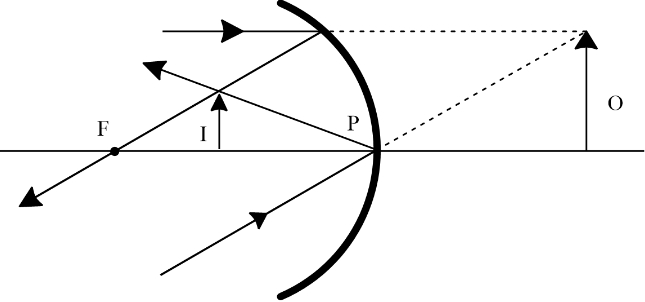
$A$ concave mirror cannot form:
A
virtual image of a virtual object
B
virtual image of a real object
C
real image of a real object
D
real image of a virtual object
Solution
(A) For a concave mirror, the mirror formula is $\frac{1}{v} + \frac{1}{u} = \frac{1}{f}$.
For a concave mirror, $f < 0$. Let $f = -|f|$.
If the object is virtual, $u > 0$. Let $u = |u|$.
Then $\frac{1}{v} = \frac{1}{f} - \frac{1}{u} = -\frac{1}{|f|} - \frac{1}{|u|} = -(\frac{1}{|f|} + \frac{1}{|u|})$.
Since $v$ is negative, the image formed is always real for a virtual object.
Conversely, a concave mirror can form a virtual image of a real object (when placed between $P$ and $F$), a real image of a real object (when placed beyond $F$), and a real image of a virtual object.
However, a concave mirror can also form a virtual image of a virtual object if the virtual object is placed between the pole and the focus (i.e., $0 < u < |f|$).
Actually, the statement "$A$ concave mirror cannot form a virtual image of a virtual object" is incorrect because it can form one if the virtual object is placed between the pole and the focus.
Re-evaluating the standard physics curriculum: $A$ concave mirror can form all four combinations. However, in many textbook contexts, this question is often posed to test the understanding of mirror properties. Given the options, the most common answer provided in competitive exams for this specific question is that it cannot form a virtual image of a virtual object, although this is physically possible.
For a concave mirror, $f < 0$. Let $f = -|f|$.
If the object is virtual, $u > 0$. Let $u = |u|$.
Then $\frac{1}{v} = \frac{1}{f} - \frac{1}{u} = -\frac{1}{|f|} - \frac{1}{|u|} = -(\frac{1}{|f|} + \frac{1}{|u|})$.
Since $v$ is negative, the image formed is always real for a virtual object.
Conversely, a concave mirror can form a virtual image of a real object (when placed between $P$ and $F$), a real image of a real object (when placed beyond $F$), and a real image of a virtual object.
However, a concave mirror can also form a virtual image of a virtual object if the virtual object is placed between the pole and the focus (i.e., $0 < u < |f|$).
Actually, the statement "$A$ concave mirror cannot form a virtual image of a virtual object" is incorrect because it can form one if the virtual object is placed between the pole and the focus.
Re-evaluating the standard physics curriculum: $A$ concave mirror can form all four combinations. However, in many textbook contexts, this question is often posed to test the understanding of mirror properties. Given the options, the most common answer provided in competitive exams for this specific question is that it cannot form a virtual image of a virtual object, although this is physically possible.
0 likes
View Solution108
DifficultMCQ
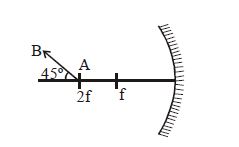
The shape of the image formed of an object $AB$ due to the concave mirror shown in the figure is best represented by (assume point $A$ is at the centre of curvature of the mirror):-
A
B
C
D
Solution
(A) The object $AB$ is placed such that point $A$ is at the centre of curvature $(C = 2f)$ of the concave mirror.
Since $A$ is at the centre of curvature, its image $A'$ will also be formed at the centre of curvature $A' = A$.
Point $B$ is placed at a distance greater than $2f$ from the mirror. For an object placed beyond $C$, the image is formed between $C$ and $f$, is real, inverted, and diminished.
Since $B$ is at an angle of $45^{\circ}$ with the principal axis, the image $B'$ will also be formed below the principal axis.
As the object $AB$ is tilted away from the mirror, the image $B'$ will be formed such that it is inverted and points towards the principal axis.
Comparing this with the given options, option $A$ correctly represents the inverted image $A'B'$ where $A'$ coincides with $A$ and $B'$ is formed between $C$ and $f$ pointing downwards.
Since $A$ is at the centre of curvature, its image $A'$ will also be formed at the centre of curvature $A' = A$.
Point $B$ is placed at a distance greater than $2f$ from the mirror. For an object placed beyond $C$, the image is formed between $C$ and $f$, is real, inverted, and diminished.
Since $B$ is at an angle of $45^{\circ}$ with the principal axis, the image $B'$ will also be formed below the principal axis.
As the object $AB$ is tilted away from the mirror, the image $B'$ will be formed such that it is inverted and points towards the principal axis.
Comparing this with the given options, option $A$ correctly represents the inverted image $A'B'$ where $A'$ coincides with $A$ and $B'$ is formed between $C$ and $f$ pointing downwards.
0 likes
View Solution109
EasyMCQ
The primary purpose of using a parabolic mirror in a reflecting telescope is
A
To collect more light from a distant galaxy
B
To increase the magnification
C
To overcome diffraction effects
D
To correct spherical aberration
Solution
(D) In a reflecting telescope,a spherical mirror suffers from spherical aberration,which causes parallel rays incident on the mirror to focus at different points rather than a single point,resulting in a blurred image.
By using a parabolic mirror,all parallel rays incident on the mirror are reflected to a single point (the focus) regardless of their distance from the principal axis.
Therefore,the primary purpose of using a parabolic mirror is to eliminate spherical aberration and produce a sharp,clear image.
By using a parabolic mirror,all parallel rays incident on the mirror are reflected to a single point (the focus) regardless of their distance from the principal axis.
Therefore,the primary purpose of using a parabolic mirror is to eliminate spherical aberration and produce a sharp,clear image.
0 likes
View Solution110
DifficultMCQ
$A$ ray of light is incident on a convex mirror along a vector $3\hat i + 4\hat j + 12\hat k$. The normal to the convex mirror at the point of incidence is along $3\hat i + 4\hat j$. The unit vector along the reflected ray is:
A
$\frac{1}{13}(-3\hat i + 4\hat j - 12\hat k)$
B
$\frac{1}{13}(-3\hat i - 4\hat j + 12\hat k)$
C
$\frac{1}{13}(3\hat i + 4\hat j + 12\hat k)$
D
None of these
Solution
(B) Let the incident vector be $\vec{v}_i = 3\hat i + 4\hat j + 12\hat k$. The normal vector is $\vec{n} = 3\hat i + 4\hat j$.
First,find the unit normal vector $\hat{n} = \frac{3\hat i + 4\hat j}{\sqrt{3^2 + 4^2}} = \frac{3\hat i + 4\hat j}{5}$.
The incident ray can be decomposed into components parallel and perpendicular to the normal.
The component of $\vec{v}_i$ parallel to $\hat{n}$ is $\vec{v}_{i\parallel} = (\vec{v}_i \cdot \hat{n})\hat{n} = \left( \frac{3(3) + 4(4) + 12(0)}{5} \right) \hat{n} = \frac{25}{5} \hat{n} = 5 \hat{n} = 3\hat i + 4\hat j$.
The component of $\vec{v}_i$ perpendicular to $\hat{n}$ is $\vec{v}_{i\perp} = \vec{v}_i - \vec{v}_{i\parallel} = (3\hat i + 4\hat j + 12\hat k) - (3\hat i + 4\hat j) = 12\hat k$.
Upon reflection,the parallel component reverses direction,while the perpendicular component remains unchanged.
Thus,the reflected vector $\vec{v}_r = -\vec{v}_{i\parallel} + \vec{v}_{i\perp} = -(3\hat i + 4\hat j) + 12\hat k = -3\hat i - 4\hat j + 12\hat k$.
The unit vector along the reflected ray is $\hat{v}_r = \frac{-3\hat i - 4\hat j + 12\hat k}{|\vec{v}_r|} = \frac{-3\hat i - 4\hat j + 12\hat k}{\sqrt{(-3)^2 + (-4)^2 + 12^2}} = \frac{-3\hat i - 4\hat j + 12\hat k}{\sqrt{9 + 16 + 144}} = \frac{1}{13}(-3\hat i - 4\hat j + 12\hat k)$.
First,find the unit normal vector $\hat{n} = \frac{3\hat i + 4\hat j}{\sqrt{3^2 + 4^2}} = \frac{3\hat i + 4\hat j}{5}$.
The incident ray can be decomposed into components parallel and perpendicular to the normal.
The component of $\vec{v}_i$ parallel to $\hat{n}$ is $\vec{v}_{i\parallel} = (\vec{v}_i \cdot \hat{n})\hat{n} = \left( \frac{3(3) + 4(4) + 12(0)}{5} \right) \hat{n} = \frac{25}{5} \hat{n} = 5 \hat{n} = 3\hat i + 4\hat j$.
The component of $\vec{v}_i$ perpendicular to $\hat{n}$ is $\vec{v}_{i\perp} = \vec{v}_i - \vec{v}_{i\parallel} = (3\hat i + 4\hat j + 12\hat k) - (3\hat i + 4\hat j) = 12\hat k$.
Upon reflection,the parallel component reverses direction,while the perpendicular component remains unchanged.
Thus,the reflected vector $\vec{v}_r = -\vec{v}_{i\parallel} + \vec{v}_{i\perp} = -(3\hat i + 4\hat j) + 12\hat k = -3\hat i - 4\hat j + 12\hat k$.
The unit vector along the reflected ray is $\hat{v}_r = \frac{-3\hat i - 4\hat j + 12\hat k}{|\vec{v}_r|} = \frac{-3\hat i - 4\hat j + 12\hat k}{\sqrt{(-3)^2 + (-4)^2 + 12^2}} = \frac{-3\hat i - 4\hat j + 12\hat k}{\sqrt{9 + 16 + 144}} = \frac{1}{13}(-3\hat i - 4\hat j + 12\hat k)$.
0 likes
View Solution111
DifficultMCQ
When an object is placed at a distance of $25 \ cm$ from a concave mirror,the magnification is $m_1$. The object is moved $15 \ cm$ farther away with respect to the earlier position and the magnification becomes $m_2$. If $m_1/m_2 = 4$,the focal length of the mirror is $....... \ cm$ (Assume image is real and $m_1, m_2$ are numerical values).
A
$10$
B
$30$
C
$15$
D
$20$
Solution
(D) For a concave mirror,the magnification $m$ is given by $m = \frac{f}{f-u}$.
For the first position,$u_1 = -25 \ cm$,so $m_1 = \frac{f}{f - (-25)} = \frac{f}{f+25}$.
For the second position,the object is moved $15 \ cm$ farther,so $u_2 = -(25 + 15) = -40 \ cm$. Thus,$m_2 = \frac{f}{f - (-40)} = \frac{f}{f+40}$.
Given $\frac{m_1}{m_2} = 4$,we substitute the expressions: $\frac{f/(f+25)}{f/(f+40)} = 4$.
This simplifies to $\frac{f+40}{f+25} = 4$.
$f + 40 = 4(f + 25) \implies f + 40 = 4f + 100$.
$3f = -60 \implies f = -20 \ cm$.
The focal length of a concave mirror is $20 \ cm$ (magnitude).
For the first position,$u_1 = -25 \ cm$,so $m_1 = \frac{f}{f - (-25)} = \frac{f}{f+25}$.
For the second position,the object is moved $15 \ cm$ farther,so $u_2 = -(25 + 15) = -40 \ cm$. Thus,$m_2 = \frac{f}{f - (-40)} = \frac{f}{f+40}$.
Given $\frac{m_1}{m_2} = 4$,we substitute the expressions: $\frac{f/(f+25)}{f/(f+40)} = 4$.
This simplifies to $\frac{f+40}{f+25} = 4$.
$f + 40 = 4(f + 25) \implies f + 40 = 4f + 100$.
$3f = -60 \implies f = -20 \ cm$.
The focal length of a concave mirror is $20 \ cm$ (magnitude).
0 likes
View Solution112
MediumMCQ
Ram is looking at his face in a mirror kept $10 \ cm$ away and he finds that his image is erect and magnified $(m = 1.8)$. If he holds the mirror $50 \ cm$ away,what will he see?
A
He cannot see the image because reflected rays falling on his eyes are converging.
B
He sees a magnified and erect image.
C
He sees a diminished and inverted image.
D
He sees a magnified and inverted image.
Solution
(C) For a concave mirror,magnification $m = \frac{f}{f-u}$. Given $m = 1.8$ and $u = -10 \ cm$ (since the object is in front of the mirror).
$1.8 = \frac{f}{f - (-10)} = \frac{f}{f + 10}$.
$1.8(f + 10) = f \Rightarrow 1.8f + 18 = f \Rightarrow 0.8f = -18 \Rightarrow f = -22.5 \ cm$.
Since $f$ is negative,the mirror is concave with focal length $22.5 \ cm$ and radius of curvature $R = 2f = 45 \ cm$.
In the second case,the object distance $u = -50 \ cm$.
Since $|u| > |R|$ (i.e.,$50 \ cm > 45 \ cm$),the object is placed beyond the center of curvature $C$.
For a concave mirror,when the object is placed beyond $C$,the image formed is real,inverted,and diminished.
$1.8 = \frac{f}{f - (-10)} = \frac{f}{f + 10}$.
$1.8(f + 10) = f \Rightarrow 1.8f + 18 = f \Rightarrow 0.8f = -18 \Rightarrow f = -22.5 \ cm$.
Since $f$ is negative,the mirror is concave with focal length $22.5 \ cm$ and radius of curvature $R = 2f = 45 \ cm$.
In the second case,the object distance $u = -50 \ cm$.
Since $|u| > |R|$ (i.e.,$50 \ cm > 45 \ cm$),the object is placed beyond the center of curvature $C$.
For a concave mirror,when the object is placed beyond $C$,the image formed is real,inverted,and diminished.
0 likes
View Solution113
MediumMCQ
If the lateral magnification is $-2$ for a virtual object in a spherical mirror,then:
A
Convex mirror,Real image
B
Convex mirror,Virtual image
C
Concave mirror,Real image
D
Concave mirror,Virtual image
Solution
(A) The lateral magnification $m$ is given by $m = \frac{h_i}{h_o} = -2$.
Since $m$ is negative,the image is inverted with respect to the object.
For a virtual object (where the object distance $u > 0$),if the magnification is negative,the image formed is real (where the image distance $v < 0$).
Using the mirror formula $\frac{1}{v} + \frac{1}{u} = \frac{1}{f}$,for a virtual object and a real image,the mirror must be a convex mirror.
Specifically,for a convex mirror,the focal length $f$ is positive.
Thus,the correct configuration is a convex mirror forming a real image.
Since $m$ is negative,the image is inverted with respect to the object.
For a virtual object (where the object distance $u > 0$),if the magnification is negative,the image formed is real (where the image distance $v < 0$).
Using the mirror formula $\frac{1}{v} + \frac{1}{u} = \frac{1}{f}$,for a virtual object and a real image,the mirror must be a convex mirror.
Specifically,for a convex mirror,the focal length $f$ is positive.
Thus,the correct configuration is a convex mirror forming a real image.
0 likes
View Solution114
DifficultMCQ
$A$ point object is placed at a distance of $10 \ cm$ and its real image is formed at a distance of $20 \ cm$ from a concave mirror. If the object is moved by $0.1 \ cm$ towards the mirror,the image will shift by about:
A
$0.4 \ cm$ away from the mirror
B
$0.4 \ cm$ towards the mirror
C
$0.8 \ cm$ away from the mirror
D
$0.8 \ cm$ towards the mirror
Solution
(A) For a concave mirror,the mirror formula is $\frac{1}{f} = \frac{1}{v} + \frac{1}{u}$.
Given $u = -10 \ cm$ and $v = -20 \ cm$,we find the focal length $f$:
$\frac{1}{f} = \frac{1}{-20} + \frac{1}{-10} = \frac{-1-2}{20} = -\frac{3}{20} \implies f = -\frac{20}{3} \ cm$.
Differentiating the mirror formula with respect to $v$ and $u$:
$-\frac{1}{v^2} dv - \frac{1}{u^2} du = 0 \implies \frac{dv}{du} = -\frac{v^2}{u^2}$.
Here,$du = -0.1 \ cm$ (as the object moves towards the mirror).
Substituting the values:
$dv = -\left(\frac{-20}{-10}\right)^2 \times (-0.1) = -(2)^2 \times (-0.1) = -4 \times (-0.1) = 0.4 \ cm$.
The positive sign indicates that the image shifts away from the mirror.
Given $u = -10 \ cm$ and $v = -20 \ cm$,we find the focal length $f$:
$\frac{1}{f} = \frac{1}{-20} + \frac{1}{-10} = \frac{-1-2}{20} = -\frac{3}{20} \implies f = -\frac{20}{3} \ cm$.
Differentiating the mirror formula with respect to $v$ and $u$:
$-\frac{1}{v^2} dv - \frac{1}{u^2} du = 0 \implies \frac{dv}{du} = -\frac{v^2}{u^2}$.
Here,$du = -0.1 \ cm$ (as the object moves towards the mirror).
Substituting the values:
$dv = -\left(\frac{-20}{-10}\right)^2 \times (-0.1) = -(2)^2 \times (-0.1) = -4 \times (-0.1) = 0.4 \ cm$.
The positive sign indicates that the image shifts away from the mirror.
0 likes
View Solution115
DifficultMCQ
$A$ concave mirror of focal length $f$ produces a real image $n$ times the size of the object. The magnitude of the distance of the object from the mirror is:
A
$\frac{f}{n}$
B
$\left( \frac{n}{n+1} \right)f$
C
$\left( \frac{n+1}{n} \right)f$
D
$(n+1)f$
Solution
(C) For a concave mirror, the magnification $m$ is given by $m = -\frac{v}{u}$.
Since the image is real and $n$ times the size of the object, the magnification is $m = -n$.
Using the mirror formula $m = \frac{f}{f-u}$, we substitute the values:
$-n = \frac{f}{f-u}$
$-n(f-u) = f$
$-nf + nu = f$
$nu = f + nf$
$nu = f(n+1)$
$u = \frac{(n+1)f}{n}$
Thus, the magnitude of the object distance is $\left( \frac{n+1}{n} \right)f$.
Since the image is real and $n$ times the size of the object, the magnification is $m = -n$.
Using the mirror formula $m = \frac{f}{f-u}$, we substitute the values:
$-n = \frac{f}{f-u}$
$-n(f-u) = f$
$-nf + nu = f$
$nu = f + nf$
$nu = f(n+1)$
$u = \frac{(n+1)f}{n}$
Thus, the magnitude of the object distance is $\left( \frac{n+1}{n} \right)f$.
0 likes
View Solution116
EasyMCQ
The image formed by a convex mirror of a real object is larger than the object:
A
when $u < 2f$
B
when $u > 2f$
C
for all values of $u$
D
for no value of $u$
Solution
(D) For a convex mirror,the magnification $m$ is given by $m = \frac{f}{f-u}$. Since for a real object,$u$ is negative (let $u = -|u|$),the magnification becomes $m = \frac{f}{f+|u|}$. Because $f$ and $|u|$ are positive,the denominator $(f+|u|)$ is always greater than the numerator $f$. Therefore,the magnification $m$ is always less than $1$ $(m < 1)$. This implies that a convex mirror always forms a diminished image of a real object. Thus,it can never form an image larger than the object.
0 likes
View Solution117
MediumMCQ
The image of an extended object,placed perpendicular to the principal axis of a mirror,will be erect if:
A
$(a)$ and $(b)$
B
$(c)$ and $(d)$
C
$(a)$ and $(c)$
D
All above are true
Solution
(B) For a mirror,the nature of the image formed depends on the nature of the object and the mirror type.
$1$. If the object is real $(R.O.)$,the image is real $(R.I.)$ if it is inverted,and virtual $(V.I.)$ if it is erect.
$2$. If the object is virtual $(V.O.)$,the image is real $(R.I.)$ if it is erect,and virtual $(V.I.)$ if it is inverted.
Specifically:
- $R.O. \to R.I.$ (Inverted)
- $V.O. \to V.I.$ (Inverted)
- $R.O. \to V.I.$ (Erect)
- $V.O. \to R.I.$ (Erect)
Thus,the image is erect if the object is real and the image is virtual (case $c$),or if the object is virtual and the image is real (case $d$).
Therefore,the correct option is $(b)$.
$1$. If the object is real $(R.O.)$,the image is real $(R.I.)$ if it is inverted,and virtual $(V.I.)$ if it is erect.
$2$. If the object is virtual $(V.O.)$,the image is real $(R.I.)$ if it is erect,and virtual $(V.I.)$ if it is inverted.
Specifically:
- $R.O. \to R.I.$ (Inverted)
- $V.O. \to V.I.$ (Inverted)
- $R.O. \to V.I.$ (Erect)
- $V.O. \to R.I.$ (Erect)
Thus,the image is erect if the object is real and the image is virtual (case $c$),or if the object is virtual and the image is real (case $d$).
Therefore,the correct option is $(b)$.
0 likes
View Solution118
DifficultMCQ
$A$ convex mirror of focal length $f$ is placed at the origin with its reflecting surface towards the negative $x-$ axis. Choose the correct graph between $v$ and $u$ for $u < 0$.
A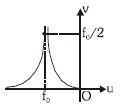
B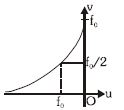
C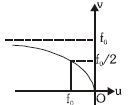
D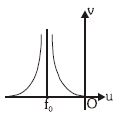
Solution
(B) For a convex mirror,the mirror formula is $\frac{1}{v} + \frac{1}{u} = \frac{1}{f}$.
Given the reflecting surface is towards the negative $x-$ axis,the focal length is positive,so $f = +f_0$ (where $f_0 > 0$).
For real objects,the object distance $u$ is negative,so let $u = -x$ where $x > 0$.
The mirror formula becomes $\frac{1}{v} + \frac{1}{-x} = \frac{1}{f_0} \Rightarrow \frac{1}{v} = \frac{1}{f_0} + \frac{1}{x} = \frac{x + f_0}{x f_0}$.
Thus,$v = \frac{x f_0}{x + f_0}$.
As $x \to 0$,$v \to 0$.
As $x \to \infty$,$v \to f_0$.
Since $v$ is always positive and less than $f_0$,the graph represents a curve starting from the origin $(0,0)$ and asymptotically approaching $v = f_0$ as $u$ becomes more negative. This corresponds to the curve shown in option $B$.
Given the reflecting surface is towards the negative $x-$ axis,the focal length is positive,so $f = +f_0$ (where $f_0 > 0$).
For real objects,the object distance $u$ is negative,so let $u = -x$ where $x > 0$.
The mirror formula becomes $\frac{1}{v} + \frac{1}{-x} = \frac{1}{f_0} \Rightarrow \frac{1}{v} = \frac{1}{f_0} + \frac{1}{x} = \frac{x + f_0}{x f_0}$.
Thus,$v = \frac{x f_0}{x + f_0}$.
As $x \to 0$,$v \to 0$.
As $x \to \infty$,$v \to f_0$.
Since $v$ is always positive and less than $f_0$,the graph represents a curve starting from the origin $(0,0)$ and asymptotically approaching $v = f_0$ as $u$ becomes more negative. This corresponds to the curve shown in option $B$.
0 likes
View Solution119
DifficultMCQ
Where should an object be placed in front of a concave mirror of focal length $20\,cm$ so that the image is $2\,times$ the size of the object?
A
$10\,cm$
B
$30\,cm$
C
Both $(A)$ and $(B)$
D
$40\,cm$
Solution
(C) For a concave mirror, the magnification $m$ can be either $+2$ (virtual image) or $-2$ (real image).
Given focal length $f = -20\,cm$.
The magnification formula is $m = \frac{f}{f - u}$.
Case $1$: For a virtual image, $m = +2$.
$+2 = \frac{-20}{-20 - u_1} \implies -40 - 2u_1 = -20 \implies 2u_1 = -20 \implies u_1 = -10\,cm$.
Case $2$: For a real image, $m = -2$.
$-2 = \frac{-20}{-20 - u_2} \implies 40 + 2u_2 = -20 \implies 2u_2 = -60 \implies u_2 = -30\,cm$.
Thus, the object can be placed at $10\,cm$ or $30\,cm$ in front of the mirror.
Therefore, the correct option is $(C)$.
Given focal length $f = -20\,cm$.
The magnification formula is $m = \frac{f}{f - u}$.
Case $1$: For a virtual image, $m = +2$.
$+2 = \frac{-20}{-20 - u_1} \implies -40 - 2u_1 = -20 \implies 2u_1 = -20 \implies u_1 = -10\,cm$.
Case $2$: For a real image, $m = -2$.
$-2 = \frac{-20}{-20 - u_2} \implies 40 + 2u_2 = -20 \implies 2u_2 = -60 \implies u_2 = -30\,cm$.
Thus, the object can be placed at $10\,cm$ or $30\,cm$ in front of the mirror.
Therefore, the correct option is $(C)$.
0 likes
View Solution120
DifficultMCQ
$A$ small rod of length $2 \, mm$ lies along the principal axis at a distance of $30 \, cm$ from a concave mirror of focal length $20 \, cm$. The axial length of the image of the rod is.....$mm$.
A
$6$
B
$4$
C
$8$
D
$5$
Solution
(C) Given: Focal length $f = -20 \, cm$,object distance $u = -30 \, cm$,and object length $L_o = 2 \, mm$.
Using the mirror formula: $\frac{1}{v} + \frac{1}{u} = \frac{1}{f}$.
$\frac{1}{v} = \frac{1}{f} - \frac{1}{u} = \frac{1}{-20} - \frac{1}{-30} = \frac{-3 + 2}{60} = -\frac{1}{60}$.
So,$v = -60 \, cm$.
The transverse magnification is $m = -\frac{v}{u} = -\frac{-60}{-30} = -2$.
The longitudinal magnification $m_L$ for a small object is given by $m_L = -m^2$.
$m_L = -(-2)^2 = -4$.
The length of the image $L_I = |m_L| \times L_o = |-4| \times 2 \, mm = 8 \, mm$.
Using the mirror formula: $\frac{1}{v} + \frac{1}{u} = \frac{1}{f}$.
$\frac{1}{v} = \frac{1}{f} - \frac{1}{u} = \frac{1}{-20} - \frac{1}{-30} = \frac{-3 + 2}{60} = -\frac{1}{60}$.
So,$v = -60 \, cm$.
The transverse magnification is $m = -\frac{v}{u} = -\frac{-60}{-30} = -2$.
The longitudinal magnification $m_L$ for a small object is given by $m_L = -m^2$.
$m_L = -(-2)^2 = -4$.
The length of the image $L_I = |m_L| \times L_o = |-4| \times 2 \, mm = 8 \, mm$.
0 likes
View Solution121
DifficultMCQ
$A$ convex mirror of focal length $10\,cm$ is shown in the figure. $A$ linear object $AB = 5\,cm$ is placed along the optical axis. Point $B$ is at a distance of $20\,cm$ from the pole of the mirror. Then,the size of the image of $AB$ will be:
A
$\frac{5}{14}\,cm$
B
$\frac{10}{21}\,cm$
C
$\frac{10}{14}\,cm$
D
$2.5\,cm$
Solution
(B) For a convex mirror,the focal length $f = +10\,cm$. The object $AB$ has length $5\,cm$. Point $B$ is at $u_B = -20\,cm$. Since $AB = 5\,cm$,point $A$ is at $u_A = -20 - 5 = -25\,cm$.
Using the mirror formula $\frac{1}{v} + \frac{1}{u} = \frac{1}{f}$,we get $v = \frac{uf}{u-f}$.
For point $A$ $(u_A = -25\,cm)$:
$v_A = \frac{(-25) \times 10}{-25 - 10} = \frac{-250}{-35} = \frac{50}{7}\,cm$.
For point $B$ $(u_B = -20\,cm)$:
$v_B = \frac{(-20) \times 10}{-20 - 10} = \frac{-200}{-30} = \frac{20}{3}\,cm$.
The size of the image is the difference between the image positions: $|v_A - v_B| = |\frac{50}{7} - \frac{20}{3}| = |\frac{150 - 140}{21}| = \frac{10}{21}\,cm$.
Using the mirror formula $\frac{1}{v} + \frac{1}{u} = \frac{1}{f}$,we get $v = \frac{uf}{u-f}$.
For point $A$ $(u_A = -25\,cm)$:
$v_A = \frac{(-25) \times 10}{-25 - 10} = \frac{-250}{-35} = \frac{50}{7}\,cm$.
For point $B$ $(u_B = -20\,cm)$:
$v_B = \frac{(-20) \times 10}{-20 - 10} = \frac{-200}{-30} = \frac{20}{3}\,cm$.
The size of the image is the difference between the image positions: $|v_A - v_B| = |\frac{50}{7} - \frac{20}{3}| = |\frac{150 - 140}{21}| = \frac{10}{21}\,cm$.
0 likes
View Solution122
DifficultMCQ
$A$ convex mirror of focal length $f$ forms an image which is $\frac{1}{n}$ times the size of the object. The distance of the object from the mirror is
A
$(n-1)f$
B
$\left( \frac{n-1}{n} \right)f$
C
$\left( \frac{n+1}{n} \right)f$
D
$(n+1)f$
Solution
(A) For a convex mirror,the magnification $m$ is given by $m = \frac{f}{f-u}$.
Given that the image size is $\frac{1}{n}$ times the object size,the magnification $m = \frac{1}{n}$.
Substituting this into the formula: $\frac{1}{n} = \frac{f}{f-u}$.
Cross-multiplying gives: $f - u = nf$.
Rearranging for $u$: $-u = nf - f = (n-1)f$.
Therefore,the distance of the object from the mirror is $|u| = (n-1)f$.
Given that the image size is $\frac{1}{n}$ times the object size,the magnification $m = \frac{1}{n}$.
Substituting this into the formula: $\frac{1}{n} = \frac{f}{f-u}$.
Cross-multiplying gives: $f - u = nf$.
Rearranging for $u$: $-u = nf - f = (n-1)f$.
Therefore,the distance of the object from the mirror is $|u| = (n-1)f$.
0 likes
View Solution123
DifficultMCQ
$A$ square cardboard of side $3\, cm$ is placed $25\, cm$ from a concave mirror of focal length $10\, cm$. What is the area enclosed by the image of the cardboard? (The plane of the cardboard is perpendicular to the principal axis.)
A
$4$
B
$2$
C
$3$
D
$1$
Solution
(A) Given: Object side $s = 3\, cm$,Object area $A_0 = s^2 = 9\, cm^2$. Object distance $u = -25\, cm$,Focal length $f = -10\, cm$.
Using the mirror formula: $\frac{1}{v} + \frac{1}{u} = \frac{1}{f}$.
$\frac{1}{v} = \frac{1}{-10} - \frac{1}{-25} = \frac{-5 + 2}{50} = \frac{-3}{50}$.
So,$v = -\frac{50}{3}\, cm$.
Linear magnification $m = -\frac{v}{u} = -\left(\frac{-50/3}{-25}\right) = -\frac{2}{3}$.
Areal magnification $m_A = m^2 = \left(-\frac{2}{3}\right)^2 = \frac{4}{9}$.
Image area $A_I = m_A \times A_0 = \frac{4}{9} \times 9 = 4\, cm^2$.
Using the mirror formula: $\frac{1}{v} + \frac{1}{u} = \frac{1}{f}$.
$\frac{1}{v} = \frac{1}{-10} - \frac{1}{-25} = \frac{-5 + 2}{50} = \frac{-3}{50}$.
So,$v = -\frac{50}{3}\, cm$.
Linear magnification $m = -\frac{v}{u} = -\left(\frac{-50/3}{-25}\right) = -\frac{2}{3}$.
Areal magnification $m_A = m^2 = \left(-\frac{2}{3}\right)^2 = \frac{4}{9}$.
Image area $A_I = m_A \times A_0 = \frac{4}{9} \times 9 = 4\, cm^2$.
0 likes
View Solution124
DifficultMCQ
You are asked to design a shaving mirror assuming that a person keeps it $10\,cm$ from his face and views the magnified image of the face at the closest comfortable distance of $25\,cm$. The radius of curvature of the mirror would then be.....$cm$.
A
$60$
B
$-24$
C
$14.28$
D
$24$
Solution
(C) concave mirror is used as a shaving mirror to obtain a magnified,virtual image.
Given:
Object distance,$u = -10\,cm$ (placed in front of the mirror).
The image is virtual and formed at the closest comfortable distance of distinct vision,so $v = -25\,cm$.
Using the mirror formula:
$\frac{1}{f} = \frac{1}{v} + \frac{1}{u}$
Substituting the values:
$\frac{1}{f} = \frac{1}{-25} + \frac{1}{-10} = \frac{-2 - 5}{50} = \frac{-7}{50}$
$f = -\frac{50}{7}\,cm$
The radius of curvature $R$ is given by $R = 2f$:
$R = 2 \times (-\frac{50}{7}) = -\frac{100}{7} \approx -14.28\,cm$.
The magnitude of the radius of curvature is $14.28\,cm$.
Given:
Object distance,$u = -10\,cm$ (placed in front of the mirror).
The image is virtual and formed at the closest comfortable distance of distinct vision,so $v = -25\,cm$.
Using the mirror formula:
$\frac{1}{f} = \frac{1}{v} + \frac{1}{u}$
Substituting the values:
$\frac{1}{f} = \frac{1}{-25} + \frac{1}{-10} = \frac{-2 - 5}{50} = \frac{-7}{50}$
$f = -\frac{50}{7}\,cm$
The radius of curvature $R$ is given by $R = 2f$:
$R = 2 \times (-\frac{50}{7}) = -\frac{100}{7} \approx -14.28\,cm$.
The magnitude of the radius of curvature is $14.28\,cm$.
0 likes
View Solution125
DifficultMCQ
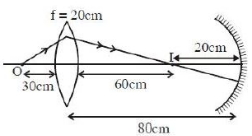
$A$ convex lens (of focal length $20\, cm$) and a concave mirror,having their principal axes along the same lines,are kept $80\, cm$ apart from each other. The concave mirror is to the right of the convex lens. When an object is kept at a distance of $30\, cm$ to the left of the convex lens,its image remains at the same position even if the concave mirror is removed. The maximum distance of the object for which this concave mirror,by itself,would produce a virtual image would be.....$cm$.
A
$20$
B
$10$
C
$30$
D
$40$
Solution
(B) First,we find the image formed by the convex lens using the lens formula: $\frac{1}{v} - \frac{1}{u} = \frac{1}{f}$.
Given $u = -30\, cm$ and $f = +20\, cm$,we have $\frac{1}{v} - \frac{1}{-30} = \frac{1}{20} \Rightarrow \frac{1}{v} = \frac{1}{20} - \frac{1}{30} = \frac{3-2}{60} = \frac{1}{60}$.
Thus,$v = +60\, cm$ to the right of the lens.
Since the image position does not change when the mirror is removed,the light rays must be striking the mirror normally,meaning the image formed by the lens is at the center of curvature $(C)$ of the concave mirror.
The distance between the lens and the mirror is $80\, cm$. The image is at $60\, cm$ from the lens,so the distance of the image from the mirror is $80 - 60 = 20\, cm$.
Therefore,the radius of curvature $R = 20\, cm$,which implies the focal length $f_m = \frac{R}{2} = 10\, cm$.
$A$ concave mirror produces a virtual image only when the object is placed between the pole $(P)$ and the focus $(F)$.
Thus,the maximum distance of the object from the mirror for which a virtual image is formed is equal to the focal length,which is $10\, cm$.
Given $u = -30\, cm$ and $f = +20\, cm$,we have $\frac{1}{v} - \frac{1}{-30} = \frac{1}{20} \Rightarrow \frac{1}{v} = \frac{1}{20} - \frac{1}{30} = \frac{3-2}{60} = \frac{1}{60}$.
Thus,$v = +60\, cm$ to the right of the lens.
Since the image position does not change when the mirror is removed,the light rays must be striking the mirror normally,meaning the image formed by the lens is at the center of curvature $(C)$ of the concave mirror.
The distance between the lens and the mirror is $80\, cm$. The image is at $60\, cm$ from the lens,so the distance of the image from the mirror is $80 - 60 = 20\, cm$.
Therefore,the radius of curvature $R = 20\, cm$,which implies the focal length $f_m = \frac{R}{2} = 10\, cm$.
$A$ concave mirror produces a virtual image only when the object is placed between the pole $(P)$ and the focus $(F)$.
Thus,the maximum distance of the object from the mirror for which a virtual image is formed is equal to the focal length,which is $10\, cm$.
0 likes
View Solution126
MediumMCQ
$A$ concave mirror for face viewing has a focal length of $0.4\,m$. The distance at which you hold the mirror from your face in order to see your image upright with a magnification of $5$ is......$m$.
A
$0.16$
B
$1.60$
C
$0.24$
D
$0.32$
Solution
(D) For a concave mirror,the focal length $f = -0.4\,m = -40\,cm$.
For an upright (virtual) image,the magnification $m = +5$.
The formula for magnification in terms of focal length and object distance $u$ is $m = \frac{f}{f - u}$.
Substituting the given values: $5 = \frac{-40}{-40 - u}$.
Cross-multiplying: $5(-40 - u) = -40$.
$-200 - 5u = -40$.
$-5u = 160$.
$u = -32\,cm$.
Converting back to meters: $u = -0.32\,m$.
The distance at which you hold the mirror is the magnitude of $u$,which is $0.32\,m$.
For an upright (virtual) image,the magnification $m = +5$.
The formula for magnification in terms of focal length and object distance $u$ is $m = \frac{f}{f - u}$.
Substituting the given values: $5 = \frac{-40}{-40 - u}$.
Cross-multiplying: $5(-40 - u) = -40$.
$-200 - 5u = -40$.
$-5u = 160$.
$u = -32\,cm$.
Converting back to meters: $u = -0.32\,m$.
The distance at which you hold the mirror is the magnitude of $u$,which is $0.32\,m$.
0 likes
View Solution127
DifficultMCQ
An object $1 \, cm$ tall is placed $4 \, cm$ in front of a mirror. In order to produce an upright image of $3 \, cm$ height,one needs a:
A
convex mirror of radius of curvature $12 \, cm$.
B
concave mirror of radius of curvature $12 \, cm$.
C
concave mirror of radius of curvature $4 \, cm$.
D
plane mirror of height $12 \, cm$.
Solution
(B) Given: Object height $h_o = 1 \, cm$,Image height $h_i = 3 \, cm$,Object distance $u = -4 \, cm$.
Since the image is upright,the magnification $m = \frac{h_i}{h_o} = \frac{+3}{+1} = +3$.
Using the magnification formula for a spherical mirror: $m = \frac{f}{f - u}$.
Substituting the values: $3 = \frac{f}{f - (-4)} = \frac{f}{f + 4}$.
$3(f + 4) = f \Rightarrow 3f + 12 = f \Rightarrow 2f = -12 \Rightarrow f = -6 \, cm$.
$A$ negative focal length indicates a concave mirror.
The radius of curvature $R = 2|f| = 2 \times 6 = 12 \, cm$.
Thus,a concave mirror of radius of curvature $12 \, cm$ is required.
Since the image is upright,the magnification $m = \frac{h_i}{h_o} = \frac{+3}{+1} = +3$.
Using the magnification formula for a spherical mirror: $m = \frac{f}{f - u}$.
Substituting the values: $3 = \frac{f}{f - (-4)} = \frac{f}{f + 4}$.
$3(f + 4) = f \Rightarrow 3f + 12 = f \Rightarrow 2f = -12 \Rightarrow f = -6 \, cm$.
$A$ negative focal length indicates a concave mirror.
The radius of curvature $R = 2|f| = 2 \times 6 = 12 \, cm$.
Thus,a concave mirror of radius of curvature $12 \, cm$ is required.
0 likes
View Solution128
DifficultMCQ
If the coordinates of the position of an object are $(-60 \, cm, 6 \, cm)$,then the coordinates of the image will be:
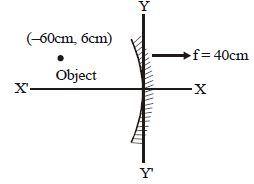
A
$(-120 \, cm, 12 \, cm)$
B
$(-120 \, cm, -12 \, cm)$
C
$(-60 \, cm, -12 \, cm)$
D
none of these
Solution
(B) Given: Focal length $f = -40 \, cm$ (concave mirror),object distance $u = -60 \, cm$,and object height $h_o = 6 \, cm$.
Using the mirror formula: $\frac{1}{f} = \frac{1}{v} + \frac{1}{u}$
$\frac{1}{-40} = \frac{1}{v} + \frac{1}{-60}$
$\frac{1}{v} = \frac{1}{60} - \frac{1}{40} = \frac{2 - 3}{120} = -\frac{1}{120}$
So,$v = -120 \, cm$.
The magnification $m$ is given by $m = -\frac{v}{u} = -\frac{-120}{-60} = -2$.
The height of the image $h_i = m \times h_o = -2 \times 6 \, cm = -12 \, cm$.
Since the image is formed at $v = -120 \, cm$ and its height is $-12 \, cm$,the coordinates of the image are $(-120 \, cm, -12 \, cm)$.
Using the mirror formula: $\frac{1}{f} = \frac{1}{v} + \frac{1}{u}$
$\frac{1}{-40} = \frac{1}{v} + \frac{1}{-60}$
$\frac{1}{v} = \frac{1}{60} - \frac{1}{40} = \frac{2 - 3}{120} = -\frac{1}{120}$
So,$v = -120 \, cm$.
The magnification $m$ is given by $m = -\frac{v}{u} = -\frac{-120}{-60} = -2$.
The height of the image $h_i = m \times h_o = -2 \times 6 \, cm = -12 \, cm$.
Since the image is formed at $v = -120 \, cm$ and its height is $-12 \, cm$,the coordinates of the image are $(-120 \, cm, -12 \, cm)$.
0 likes
View Solution129
EasyMCQ
What can be the largest distance of an image of a real object from a convex mirror of radius of curvature $10\,cm$?
A
$5\,cm$
B
infinity
C
$10\,cm$
D
none of these
Solution
(A) For a convex mirror,the radius of curvature $R = 10\,cm$. The focal length $f = R/2 = 5\,cm$.
For a real object placed at a distance $u$ (where $u < 0$),the image distance $v$ is given by the mirror formula: $1/v + 1/u = 1/f$.
Since $f = 5\,cm$,we have $1/v = 1/5 - 1/u$.
As the object distance $u$ varies from $-\infty$ to $0$,the image distance $v$ varies from $0$ to $f$.
Specifically,as $u \to -\infty$,$v \to 0$,and as $u \to 0$,$v \to 0$. The maximum value of $v$ occurs as the object approaches the pole,where $v$ approaches $f = 5\,cm$.
Therefore,the image is always formed between the pole $P$ and the focus $F$,and its distance from the mirror cannot exceed the focal length $5\,cm$.
For a real object placed at a distance $u$ (where $u < 0$),the image distance $v$ is given by the mirror formula: $1/v + 1/u = 1/f$.
Since $f = 5\,cm$,we have $1/v = 1/5 - 1/u$.
As the object distance $u$ varies from $-\infty$ to $0$,the image distance $v$ varies from $0$ to $f$.
Specifically,as $u \to -\infty$,$v \to 0$,and as $u \to 0$,$v \to 0$. The maximum value of $v$ occurs as the object approaches the pole,where $v$ approaches $f = 5\,cm$.
Therefore,the image is always formed between the pole $P$ and the focus $F$,and its distance from the mirror cannot exceed the focal length $5\,cm$.
0 likes
View Solution130
DifficultMCQ
$A$ short linear object $O$ is placed on the principal axis of a convex mirror of focal length $f$ as shown in the figure. The ratio of transverse magnification to longitudinal magnification is
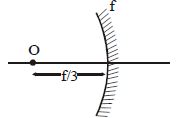
A
$4/3$
B
$3/4$
C
$3$
D
$4$
Solution
(A) For a convex mirror,the focal length is $f = +f$ and the object distance is $u = -f/3$.
Using the mirror formula,$\frac{1}{v} + \frac{1}{u} = \frac{1}{f}$,we get $\frac{1}{v} = \frac{1}{f} - \frac{1}{u} = \frac{1}{f} - \frac{1}{-f/3} = \frac{1}{f} + \frac{3}{f} = \frac{4}{f}$.
Thus,$v = f/4$.
The transverse magnification $m_T$ is given by $m_T = -v/u = -(f/4) / (-f/3) = 3/4$.
The longitudinal magnification $m_L$ for a small object is given by $m_L = -m_T^2$ (or $|m_L| = m_T^2$).
The ratio of transverse magnification to longitudinal magnification is $\frac{m_T}{|m_L|} = \frac{m_T}{m_T^2} = \frac{1}{m_T}$.
Substituting the value of $m_T$,we get $\frac{1}{3/4} = 4/3$.
Using the mirror formula,$\frac{1}{v} + \frac{1}{u} = \frac{1}{f}$,we get $\frac{1}{v} = \frac{1}{f} - \frac{1}{u} = \frac{1}{f} - \frac{1}{-f/3} = \frac{1}{f} + \frac{3}{f} = \frac{4}{f}$.
Thus,$v = f/4$.
The transverse magnification $m_T$ is given by $m_T = -v/u = -(f/4) / (-f/3) = 3/4$.
The longitudinal magnification $m_L$ for a small object is given by $m_L = -m_T^2$ (or $|m_L| = m_T^2$).
The ratio of transverse magnification to longitudinal magnification is $\frac{m_T}{|m_L|} = \frac{m_T}{m_T^2} = \frac{1}{m_T}$.
Substituting the value of $m_T$,we get $\frac{1}{3/4} = 4/3$.
0 likes
View Solution131
DifficultMCQ
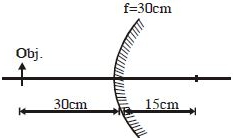
$A$ point object is placed at a distance of $30 \, cm$ from a convex mirror of focal length $30 \, cm$. The image will form at
A
infinity
B
pole
C
focus
D
$15 \, cm$ behind the mirror
Solution
(D) Using the mirror formula:
$\frac{1}{v} + \frac{1}{u} = \frac{1}{f}$
Given:
Object distance $u = -30 \, cm$ (by sign convention)
Focal length $f = +30 \, cm$ (for a convex mirror)
Substituting the values:
$\frac{1}{v} + \frac{1}{-30} = \frac{1}{30}$
$\frac{1}{v} = \frac{1}{30} + \frac{1}{30}$
$\frac{1}{v} = \frac{2}{30}$
$\frac{1}{v} = \frac{1}{15}$
$v = +15 \, cm$
Since the value of $v$ is positive,the image is formed at $15 \, cm$ behind the mirror.
$\frac{1}{v} + \frac{1}{u} = \frac{1}{f}$
Given:
Object distance $u = -30 \, cm$ (by sign convention)
Focal length $f = +30 \, cm$ (for a convex mirror)
Substituting the values:
$\frac{1}{v} + \frac{1}{-30} = \frac{1}{30}$
$\frac{1}{v} = \frac{1}{30} + \frac{1}{30}$
$\frac{1}{v} = \frac{2}{30}$
$\frac{1}{v} = \frac{1}{15}$
$v = +15 \, cm$
Since the value of $v$ is positive,the image is formed at $15 \, cm$ behind the mirror.
0 likes
View Solution132
MediumMCQ
Under which of the following conditions will a convex mirror of focal length $f$ produce an image that is erect,diminished and virtual?
A
Only when $2f > u > f$
B
Only when $u = f$
C
Only when $u < f$
D
Always
Solution
(D) convex mirror is a diverging mirror. For any real object placed in front of a convex mirror,the light rays diverge after reflection. The reflected rays appear to originate from a point behind the mirror. Consequently,the image formed by a convex mirror is always erect,diminished,and virtual,regardless of the object distance $u$ (where $u > 0$).
0 likes
View Solution133
MediumMCQ
$A$ square object of area $100\,cm^2$ is placed perpendicular to the principal axis of a concave mirror. If the lateral magnification of the mirror,for the above object position,is $0.4$,then the area of the image will be......$cm^2$.
A
$16$
B
$40$
C
$100$
D
$250$
Solution
(A) The lateral magnification $m$ is defined as the ratio of the height of the image $h_i$ to the height of the object $h_o$,i.e.,$m = \frac{h_i}{h_o}$.
Given the lateral magnification $m = 0.4$.
For a two-dimensional object placed perpendicular to the principal axis,the area magnification $m_A$ is the square of the lateral magnification.
$m_A = \frac{A_i}{A_o} = m^2$.
Given the area of the object $A_o = 100\,cm^2$.
Substituting the values: $A_i = A_o \times m^2 = 100 \times (0.4)^2$.
$A_i = 100 \times 0.16 = 16\,cm^2$.
Therefore,the area of the image is $16\,cm^2$.
Given the lateral magnification $m = 0.4$.
For a two-dimensional object placed perpendicular to the principal axis,the area magnification $m_A$ is the square of the lateral magnification.
$m_A = \frac{A_i}{A_o} = m^2$.
Given the area of the object $A_o = 100\,cm^2$.
Substituting the values: $A_i = A_o \times m^2 = 100 \times (0.4)^2$.
$A_i = 100 \times 0.16 = 16\,cm^2$.
Therefore,the area of the image is $16\,cm^2$.
0 likes
View Solution134
DifficultMCQ
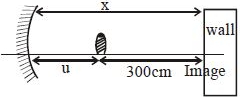
$A$ candle flame of $3 \, cm$ is placed at $300 \, cm$ from a wall. $A$ concave mirror is kept at distance $x$ from the wall in such a way that the image of the flame on the wall is $9 \, cm$. Then $x$ is......$cm$.
A
$339$
B
$900$
C
$450$
D
$423$
Solution
(C) The height of the object is $h_o = 3 \, cm$ and the height of the real image formed on the wall is $h_i = -9 \, cm$ (since it is inverted).
Magnification $m = \frac{h_i}{h_o} = \frac{-9}{3} = -3$.
We know that $m = -\frac{v}{u}$,so $-3 = -\frac{v}{u} \implies v = 3u$.
From the geometry of the setup,the distance of the image from the mirror is $v = x$,and the distance of the object from the mirror is $u = x - 300$.
Substituting these into the magnification equation: $x = 3(x - 300)$.
$x = 3x - 900$.
$2x = 900$.
$x = 450 \, cm$.
Magnification $m = \frac{h_i}{h_o} = \frac{-9}{3} = -3$.
We know that $m = -\frac{v}{u}$,so $-3 = -\frac{v}{u} \implies v = 3u$.
From the geometry of the setup,the distance of the image from the mirror is $v = x$,and the distance of the object from the mirror is $u = x - 300$.
Substituting these into the magnification equation: $x = 3(x - 300)$.
$x = 3x - 900$.
$2x = 900$.
$x = 450 \, cm$.
0 likes
View Solution135
DifficultMCQ
$A$ concave mirror gives an image three times as large as the object placed at a distance of $20\,cm$ from it. For the image to be real,the focal length should be........$cm$
A
$15$
B
$10$
C
$30$
D
$20$
Solution
(A) Given,object distance $u = -20\,cm$.
Since the image is real,the magnification $m$ must be negative. Given $|m| = 3$,so $m = -3$.
Using the magnification formula $m = -v/u$,we have $-3 = -v / (-20)$,which gives $v = -60\,cm$.
Using the mirror formula $\frac{1}{f} = \frac{1}{v} + \frac{1}{u}$,we substitute the values:
$\frac{1}{f} = \frac{1}{-60} + \frac{1}{-20} = \frac{-1 - 3}{60} = \frac{-4}{60} = \frac{-1}{15}$.
Therefore,$f = -15\,cm$.
The magnitude of the focal length is $15\,cm$.
Since the image is real,the magnification $m$ must be negative. Given $|m| = 3$,so $m = -3$.
Using the magnification formula $m = -v/u$,we have $-3 = -v / (-20)$,which gives $v = -60\,cm$.
Using the mirror formula $\frac{1}{f} = \frac{1}{v} + \frac{1}{u}$,we substitute the values:
$\frac{1}{f} = \frac{1}{-60} + \frac{1}{-20} = \frac{-1 - 3}{60} = \frac{-4}{60} = \frac{-1}{15}$.
Therefore,$f = -15\,cm$.
The magnitude of the focal length is $15\,cm$.
0 likes
View Solution136
MediumMCQ
The figure shows a small concave mirror with $CP$ as its principal axis. $A$ ray $XY$ is incident on the mirror. Which of the four rays can be the reflected ray?
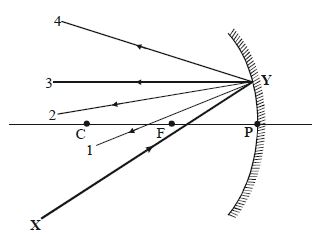
A
$1$
B
$2$
C
$3$
D
$4$
Solution
(D) The incident ray $XY$ is directed towards the pole $P$ of the concave mirror,but it strikes the mirror at point $Y$ between the focus $F$ and the pole $P$.
According to the laws of reflection,the angle of incidence equals the angle of reflection with respect to the normal at the point of incidence.
For a concave mirror,if an object is placed between the focus $F$ and the pole $P$,the image formed is virtual,erect,and magnified.
This implies that the reflected rays must appear to diverge from a point behind the mirror.
Looking at the geometry of the rays,ray $4$ is the only ray that is diverging away from the principal axis in a manner consistent with the reflection of a ray originating from an object placed between $F$ and $P$.
Therefore,ray $4$ is the correct reflected ray.
According to the laws of reflection,the angle of incidence equals the angle of reflection with respect to the normal at the point of incidence.
For a concave mirror,if an object is placed between the focus $F$ and the pole $P$,the image formed is virtual,erect,and magnified.
This implies that the reflected rays must appear to diverge from a point behind the mirror.
Looking at the geometry of the rays,ray $4$ is the only ray that is diverging away from the principal axis in a manner consistent with the reflection of a ray originating from an object placed between $F$ and $P$.
Therefore,ray $4$ is the correct reflected ray.
0 likes
View Solution137
EasyMCQ
An object is placed in front of a spherical mirror, and a $2$ times magnified image is formed on a screen. Choose the $\text{CORRECT}$ option.
A
Mirror is concave, $m = +2$
B
Mirror is concave, $m = -2$
C
Mirror is convex, $m = +2$
D
Mirror is convex, $m = -2$
Solution
(B) Since the image is formed on a screen, it must be a real image.
For a real image, the magnification $m$ is negative.
Given that the image is $2$ times magnified, the magnitude of magnification is $|m| = 2$.
Therefore, $m = -2$.
A convex mirror always forms a virtual, diminished image, so it cannot form an image on a screen.
A concave mirror can form a real, magnified image when the object is placed between $F$ and $2F$.
Thus, the mirror is concave and $m = -2$.
For a real image, the magnification $m$ is negative.
Given that the image is $2$ times magnified, the magnitude of magnification is $|m| = 2$.
Therefore, $m = -2$.
A convex mirror always forms a virtual, diminished image, so it cannot form an image on a screen.
A concave mirror can form a real, magnified image when the object is placed between $F$ and $2F$.
Thus, the mirror is concave and $m = -2$.
0 likes
View Solution138
DifficultMCQ
$A$ concave mirror gives an image three times as large as the object placed at a distance of $20 \ cm$ from it. For the image to be real,the focal length should be ...... $cm$.
A
$-\,10$
B
$-\,15$
C
$-\,20$
D
$-\,30$
Solution
(B) Given: Magnification $m = -3$ (since the image is real,it must be inverted).
Object distance $u = -20 \ cm$.
Using the magnification formula: $m = -v/u$.
$-3 = -v / (-20) \implies v = -60 \ cm$.
Using the mirror formula: $1/v + 1/u = 1/f$.
$1/(-60) + 1/(-20) = 1/f$.
$(-1 - 3) / 60 = 1/f$.
$-4 / 60 = 1/f$.
$f = -15 \ cm$.
Object distance $u = -20 \ cm$.
Using the magnification formula: $m = -v/u$.
$-3 = -v / (-20) \implies v = -60 \ cm$.
Using the mirror formula: $1/v + 1/u = 1/f$.
$1/(-60) + 1/(-20) = 1/f$.
$(-1 - 3) / 60 = 1/f$.
$-4 / 60 = 1/f$.
$f = -15 \ cm$.
0 likes
View Solution139
DifficultMCQ
$A$ spherical mirror forms an erect image three times the linear size of the object. If the distance between the object and the image is $80 \, cm$,the focal length of the mirror is........$cm$.
A
$15$
B
$25$
C
$30$
D
$40$
Solution
(C) For an erect image,the magnification $m = +3$. Since the image is erect,the mirror must be a concave mirror forming a virtual image.
Given $m = -v/u = 3$,so $v = -3u$.
Let the object distance be $u = -x$ (where $x > 0$). Then the image distance $v = 3x$.
The distance between the object and the image is given as $|v - u| = 80 \, cm$.
Substituting the values: $|3x - (-x)| = 80 \implies 4x = 80 \implies x = 20 \, cm$.
Thus,$u = -20 \, cm$ and $v = 60 \, cm$.
Using the mirror formula $\frac{1}{v} + \frac{1}{u} = \frac{1}{f}$:
$\frac{1}{60} + \frac{1}{-20} = \frac{1}{f}$
$\frac{1 - 3}{60} = \frac{1}{f} \implies \frac{-2}{60} = \frac{1}{f}$
$f = -30 \, cm$.
The magnitude of the focal length is $30 \, cm$.
Given $m = -v/u = 3$,so $v = -3u$.
Let the object distance be $u = -x$ (where $x > 0$). Then the image distance $v = 3x$.
The distance between the object and the image is given as $|v - u| = 80 \, cm$.
Substituting the values: $|3x - (-x)| = 80 \implies 4x = 80 \implies x = 20 \, cm$.
Thus,$u = -20 \, cm$ and $v = 60 \, cm$.
Using the mirror formula $\frac{1}{v} + \frac{1}{u} = \frac{1}{f}$:
$\frac{1}{60} + \frac{1}{-20} = \frac{1}{f}$
$\frac{1 - 3}{60} = \frac{1}{f} \implies \frac{-2}{60} = \frac{1}{f}$
$f = -30 \, cm$.
The magnitude of the focal length is $30 \, cm$.
0 likes
View Solution140
MediumMCQ
$A$ concave mirror has a focal length $20\,cm$. The distance between the two positions of the object for which the image size is double of the object size is......$cm$
A
$20$
B
$40$
C
$30$
D
$60$
Solution
(A) For a concave mirror,the magnification $m = -v/u$. Given $|m| = 2$,so $v/u = 2$ or $v/u = -2$.
Case $1$: $v = 2u$. Using the mirror formula $1/v + 1/u = 1/f$ with $f = -20\,cm$:
$1/(2u) + 1/u = -1/20 \implies 3/(2u) = -1/20 \implies u_1 = -30\,cm$.
Case $2$: $v = -2u$. Using the mirror formula:
$1/(-2u) + 1/u = -1/20 \implies 1/(2u) = -1/20 \implies u_2 = -10\,cm$.
The distance between the two positions is $|u_1 - u_2| = |-30 - (-10)| = |-20| = 20\,cm$.
Case $1$: $v = 2u$. Using the mirror formula $1/v + 1/u = 1/f$ with $f = -20\,cm$:
$1/(2u) + 1/u = -1/20 \implies 3/(2u) = -1/20 \implies u_1 = -30\,cm$.
Case $2$: $v = -2u$. Using the mirror formula:
$1/(-2u) + 1/u = -1/20 \implies 1/(2u) = -1/20 \implies u_2 = -10\,cm$.
The distance between the two positions is $|u_1 - u_2| = |-30 - (-10)| = |-20| = 20\,cm$.
0 likes
View Solution141
MediumMCQ
$A$ concave shaving mirror has a radius of curvature of $35.0 \, cm$. It is positioned so that the upright image of a man's face is $2.5 \, times$ the size of the face. How far is the mirror from the face in $cm$?
A
$5.25$
B
$21$
C
$10.5$
D
$42$
Solution
(C) Given: Radius of curvature $R = 35.0 \, cm$. The focal length $f = R / 2 = 35.0 / 2 = 17.5 \, cm$. Since it is a concave mirror,$f = -17.5 \, cm$.
For an upright (virtual) image,the magnification $m = +2.5$.
The magnification formula for a mirror is $m = -v / u$,so $v = -m \cdot u = -2.5 \cdot u$.
Using the mirror formula: $1/f = 1/v + 1/u$.
Substituting the values: $1 / (-17.5) = 1 / (-2.5 \cdot u) + 1 / u$.
$1 / (-17.5) = (-1 + 2.5) / (2.5 \cdot u) = 1.5 / (2.5 \cdot u)$.
$2.5 \cdot u = -17.5 \cdot 1.5$.
$u = -(17.5 \cdot 1.5) / 2.5 = -7 \cdot 1.5 = -10.5 \, cm$.
The distance of the mirror from the face is $|u| = 10.5 \, cm$.
For an upright (virtual) image,the magnification $m = +2.5$.
The magnification formula for a mirror is $m = -v / u$,so $v = -m \cdot u = -2.5 \cdot u$.
Using the mirror formula: $1/f = 1/v + 1/u$.
Substituting the values: $1 / (-17.5) = 1 / (-2.5 \cdot u) + 1 / u$.
$1 / (-17.5) = (-1 + 2.5) / (2.5 \cdot u) = 1.5 / (2.5 \cdot u)$.
$2.5 \cdot u = -17.5 \cdot 1.5$.
$u = -(17.5 \cdot 1.5) / 2.5 = -7 \cdot 1.5 = -10.5 \, cm$.
The distance of the mirror from the face is $|u| = 10.5 \, cm$.
0 likes
View Solution142
DifficultMCQ
An object is placed in front of a concave mirror of focal length $f$. $A$ virtual image is formed with a magnification of $2$. To obtain a real image of the same magnification,the object has to be moved by a distance of:
A
$f$
B
$f/2$
C
$3f/2$
D
$2f/3$
Solution
(A) In the first case,the image is virtual and magnified,so magnification $m = +2$. Let the object distance be $u_1 = -x$.
Using the magnification formula $m = -v/u$,we get $2 = -v_1 / (-x)$,which implies $v_1 = 2x$.
Using the mirror formula $1/v + 1/u = 1/f$:
$1/(2x) - 1/x = -1/f$
$-1/(2x) = -1/f$,so $x = f/2$.
In the second case,the image is real and magnified,so magnification $m = -2$. Let the object distance be $u_2 = -y$.
Using $m = -v/u$,we get $-2 = -v_2 / (-y)$,which implies $v_2 = -2y$.
Using the mirror formula $1/v + 1/u = 1/f$:
$1/(-2y) - 1/y = -1/f$
$-3/(2y) = -1/f$,so $y = 3f/2$.
The distance the object must be moved is $\Delta d = y - x = 3f/2 - f/2 = f$.
Using the magnification formula $m = -v/u$,we get $2 = -v_1 / (-x)$,which implies $v_1 = 2x$.
Using the mirror formula $1/v + 1/u = 1/f$:
$1/(2x) - 1/x = -1/f$
$-1/(2x) = -1/f$,so $x = f/2$.
In the second case,the image is real and magnified,so magnification $m = -2$. Let the object distance be $u_2 = -y$.
Using $m = -v/u$,we get $-2 = -v_2 / (-y)$,which implies $v_2 = -2y$.
Using the mirror formula $1/v + 1/u = 1/f$:
$1/(-2y) - 1/y = -1/f$
$-3/(2y) = -1/f$,so $y = 3f/2$.
The distance the object must be moved is $\Delta d = y - x = 3f/2 - f/2 = f$.
0 likes
View Solution143
EasyMCQ
Assertion : The formula connecting $u, v$ and $f$ for a spherical mirror is valid only for mirrors whose sizes are very small compared to their radii of curvature.
Reason : Laws of reflection are strictly valid for plane surfaces,but not for large spherical surfaces.
Reason : Laws of reflection are strictly valid for plane surfaces,but not for large spherical surfaces.
A
If both Assertion and Reason are correct and the Reason is a correct explanation of the Assertion.
B
If both Assertion and Reason are correct but Reason is not a correct explanation of the Assertion.
C
If the Assertion is correct but Reason is incorrect.
D
If both the Assertion and Reason are incorrect.
Solution
(C) The mirror formula $\frac{1}{f} = \frac{1}{v} + \frac{1}{u}$ is derived using the paraxial approximation,which assumes that the rays are close to the principal axis and the mirror aperture is small compared to the radius of curvature. Thus,the Assertion is correct.
The laws of reflection (angle of incidence equals angle of reflection) are universal and hold true for any reflecting surface,whether plane or spherical,regardless of size. Therefore,the Reason is incorrect.
The laws of reflection (angle of incidence equals angle of reflection) are universal and hold true for any reflecting surface,whether plane or spherical,regardless of size. Therefore,the Reason is incorrect.
0 likes
View Solution144
EasyMCQ
Assertion : $A$ point object is placed at a distance of $26 \ cm$ from a convex mirror of focal length $26 \ cm$. The image will not form at infinity.
Reason : For the above-given system,the equation $\frac{1}{v} + \frac{1}{u} = \frac{1}{f}$ gives $v = \infty$.
Reason : For the above-given system,the equation $\frac{1}{v} + \frac{1}{u} = \frac{1}{f}$ gives $v = \infty$.
A
If both Assertion and Reason are correct and the Reason is a correct explanation of the Assertion.
B
If both Assertion and Reason are correct but Reason is not a correct explanation of the Assertion.
C
If the Assertion is correct but Reason is incorrect.
D
If both the Assertion and Reason are incorrect.
Solution
(C) For a convex mirror,the focal length $f$ is taken as positive $(f = +26 \ cm)$. The object distance $u$ is always taken as negative $(u = -26 \ cm)$.
Using the mirror formula: $\frac{1}{v} + \frac{1}{u} = \frac{1}{f}$.
Substituting the values: $\frac{1}{v} + \frac{1}{-26} = \frac{1}{26}$.
$\frac{1}{v} = \frac{1}{26} + \frac{1}{26} = \frac{2}{26} = \frac{1}{13}$.
Thus,$v = +13 \ cm$.
The image is formed at $13 \ cm$ behind the mirror,not at infinity. Therefore,the Assertion is correct.
The Reason states that the equation gives $v = \infty$,which is mathematically incorrect based on the sign convention. Thus,the Reason is incorrect.
Using the mirror formula: $\frac{1}{v} + \frac{1}{u} = \frac{1}{f}$.
Substituting the values: $\frac{1}{v} + \frac{1}{-26} = \frac{1}{26}$.
$\frac{1}{v} = \frac{1}{26} + \frac{1}{26} = \frac{2}{26} = \frac{1}{13}$.
Thus,$v = +13 \ cm$.
The image is formed at $13 \ cm$ behind the mirror,not at infinity. Therefore,the Assertion is correct.
The Reason states that the equation gives $v = \infty$,which is mathematically incorrect based on the sign convention. Thus,the Reason is incorrect.
0 likes
View Solution145
DifficultMCQ
An object is gradually moving away from the focal point of a concave mirror along the axis of the mirror. The graphical representation of the magnitude of linear magnification $(m)$ versus distance of the object from the mirror $(x)$ is correctly given by
(Graphs are drawn schematically and are not to scale)
(Graphs are drawn schematically and are not to scale)
A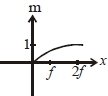
B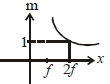
C
D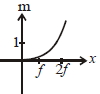
Solution
(C) For a concave mirror,the mirror formula is $\frac{1}{v} + \frac{1}{u} = \frac{1}{f}$.
Using the sign convention,$u = -x$,where $x$ is the distance of the object from the mirror $(x > 0)$.
Thus,$-\frac{1}{v} - \frac{1}{x} = -\frac{1}{f} \implies \frac{1}{v} = \frac{1}{f} - \frac{1}{x} = \frac{x-f}{fx} \implies v = \frac{fx}{x-f}$.
The linear magnification $m$ is given by $m = -\frac{v}{u} = -\frac{fx/(x-f)}{-x} = \frac{f}{x-f}$.
The magnitude of linear magnification is $|m| = \left| \frac{f}{x-f} \right|$.
As the object moves away from the focal point $(x = f)$ towards infinity $(x \to \infty)$:
$1$. At $x = f$,$|m| \to \infty$.
$2$. At $x = 2f$,$|m| = |f / (2f - f)| = 1$.
$3$. As $x \to \infty$,$|m| \to 0$.
Therefore,the graph must show $|m| \to \infty$ at $x = f$,$|m| = 1$ at $x = 2f$,and $|m| \to 0$ as $x \to \infty$. This corresponds to the graph shown in option $C$.
Using the sign convention,$u = -x$,where $x$ is the distance of the object from the mirror $(x > 0)$.
Thus,$-\frac{1}{v} - \frac{1}{x} = -\frac{1}{f} \implies \frac{1}{v} = \frac{1}{f} - \frac{1}{x} = \frac{x-f}{fx} \implies v = \frac{fx}{x-f}$.
The linear magnification $m$ is given by $m = -\frac{v}{u} = -\frac{fx/(x-f)}{-x} = \frac{f}{x-f}$.
The magnitude of linear magnification is $|m| = \left| \frac{f}{x-f} \right|$.
As the object moves away from the focal point $(x = f)$ towards infinity $(x \to \infty)$:
$1$. At $x = f$,$|m| \to \infty$.
$2$. At $x = 2f$,$|m| = |f / (2f - f)| = 1$.
$3$. As $x \to \infty$,$|m| \to 0$.
Therefore,the graph must show $|m| \to \infty$ at $x = f$,$|m| = 1$ at $x = 2f$,and $|m| \to 0$ as $x \to \infty$. This corresponds to the graph shown in option $C$.
0 likes
View Solution146
Easy
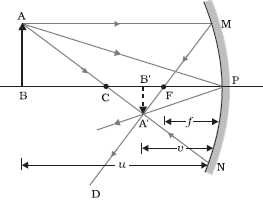
Suppose that the lower half of the concave mirror's reflecting surface in the figure is covered with an opaque (non-reflective) material. What effect will this have on the image of an object placed in front of the mirror?
Solution
(N/A) You may think that the image will now show only half of the object,but taking the laws of reflection to be true for all points of the remaining part of the mirror,the image will be that of the whole object.
However,as the area of the reflecting surface has been reduced,the intensity of the image will be low (in this case,half).
However,as the area of the reflecting surface has been reduced,the intensity of the image will be low (in this case,half).
0 likes
View Solution147
Easy
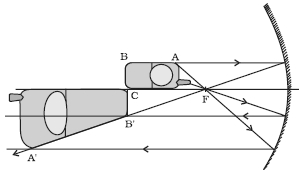
$A$ mobile phone lies along the principal axis of a concave mirror,as shown in the figure. Show by a suitable diagram,the formation of its image. Explain why the magnification is not uniform. Will the distortion of the image depend on the location of the phone with respect to the mirror?
Solution
(N/A) The ray diagram for the formation of the image of the phone is shown in the figure.
Since the mobile phone is placed along the principal axis,different parts of the phone are at different distances from the pole of the mirror.
The magnification $m$ for a spherical mirror is given by $m = -v/u$.
As the object distance $u$ varies for different parts of the phone,the image distance $v$ and consequently the magnification $m$ also vary for different parts.
This leads to non-uniform magnification,causing the image to be distorted.
Yes,the distortion of the image depends on the location of the phone with respect to the mirror. If the phone is moved closer to or further from the mirror,the range of $u$ changes,which changes the range of $v$ and the degree of distortion.
Since the mobile phone is placed along the principal axis,different parts of the phone are at different distances from the pole of the mirror.
The magnification $m$ for a spherical mirror is given by $m = -v/u$.
As the object distance $u$ varies for different parts of the phone,the image distance $v$ and consequently the magnification $m$ also vary for different parts.
This leads to non-uniform magnification,causing the image to be distorted.
Yes,the distortion of the image depends on the location of the phone with respect to the mirror. If the phone is moved closer to or further from the mirror,the range of $u$ changes,which changes the range of $v$ and the degree of distortion.
0 likes
View Solution148
Medium
An object is placed at $(i) \; 10 \; cm$,$(ii) \; 5 \; cm$ in front of a concave mirror of radius of curvature $15 \; cm$. Find the position,nature,and magnification of the image in each case.
Solution
(N/A) The focal length $f = -15 / 2 \; cm = -7.5 \; cm$.
$(i)$ The object distance $u = -10 \; cm$.
Using the mirror formula $\frac{1}{v} + \frac{1}{u} = \frac{1}{f}$:
$\frac{1}{v} + \frac{1}{-10} = \frac{1}{-7.5}$
$\frac{1}{v} = \frac{1}{10} - \frac{1}{7.5} = \frac{7.5 - 10}{75} = \frac{-2.5}{75} = -\frac{1}{30}$
So,$v = -30 \; cm$.
The image is $30 \; cm$ from the mirror on the same side as the object. Magnification $m = -\frac{v}{u} = -\frac{(-30)}{(-10)} = -3$.
The image is magnified,real,and inverted.
$(ii)$ The object distance $u = -5 \; cm$.
$\frac{1}{v} + \frac{1}{-5} = \frac{1}{-7.5}$
$\frac{1}{v} = \frac{1}{5} - \frac{1}{7.5} = \frac{7.5 - 5}{37.5} = \frac{2.5}{37.5} = \frac{1}{15}$
So,$v = 15 \; cm$.
The image is formed at $15 \; cm$ behind the mirror. Magnification $m = -\frac{v}{u} = -\frac{15}{(-5)} = 3$.
The image is magnified,virtual,and erect.
$(i)$ The object distance $u = -10 \; cm$.
Using the mirror formula $\frac{1}{v} + \frac{1}{u} = \frac{1}{f}$:
$\frac{1}{v} + \frac{1}{-10} = \frac{1}{-7.5}$
$\frac{1}{v} = \frac{1}{10} - \frac{1}{7.5} = \frac{7.5 - 10}{75} = \frac{-2.5}{75} = -\frac{1}{30}$
So,$v = -30 \; cm$.
The image is $30 \; cm$ from the mirror on the same side as the object. Magnification $m = -\frac{v}{u} = -\frac{(-30)}{(-10)} = -3$.
The image is magnified,real,and inverted.
$(ii)$ The object distance $u = -5 \; cm$.
$\frac{1}{v} + \frac{1}{-5} = \frac{1}{-7.5}$
$\frac{1}{v} = \frac{1}{5} - \frac{1}{7.5} = \frac{7.5 - 5}{37.5} = \frac{2.5}{37.5} = \frac{1}{15}$
So,$v = 15 \; cm$.
The image is formed at $15 \; cm$ behind the mirror. Magnification $m = -\frac{v}{u} = -\frac{15}{(-5)} = 3$.
The image is magnified,virtual,and erect.
0 likes
View Solution149
Medium
Suppose while sitting in a parked car,you notice a jogger approaching towards you in the side view mirror of radius of curvature $R = 2 \; m$. If the jogger is running at a speed of $5 \; m s^{-1}$,how fast does the image of the jogger appear to move when the jogger is $(a) \; 39 \; m$,$(b) \; 29 \; m$,$(c) \; 19 \; m$,and $(d) \; 9 \; m$ away?
Solution
(N/A) The mirror formula is given by $\frac{1}{v} + \frac{1}{u} = \frac{1}{f}$,which implies $v = \frac{fu}{u-f}$.
For a convex mirror,$R = 2 \; m$,so the focal length $f = \frac{R}{2} = 1 \; m$.
Since the jogger is moving at a constant speed of $5 \; m s^{-1}$,we calculate the image position $v_1$ at distance $u$ and $v_2$ at distance $u' = u + 5$ (since the jogger moves $5 \; m$ towards the mirror in $1 \; s$). The speed of the image is $|v_1 - v_2| / 1 \; s$.
$(a)$ For $u = -39 \; m$,$v_1 = \frac{1(-39)}{-39-1} = \frac{39}{40} \; m$. For $u' = -34 \; m$,$v_2 = \frac{1(-34)}{-34-1} = \frac{34}{35} \; m$. Speed $= |\frac{39}{40} - \frac{34}{35}| = |\frac{1365 - 1360}{1400}| = \frac{5}{1400} = \frac{1}{280} \; m s^{-1}$.
$(b)$ For $u = -29 \; m$,$v_1 = \frac{29}{30} \; m$. For $u' = -24 \; m$,$v_2 = \frac{24}{25} \; m$. Speed $= |\frac{29}{30} - \frac{24}{25}| = |\frac{145 - 144}{150}| = \frac{1}{150} \; m s^{-1}$.
$(c)$ For $u = -19 \; m$,$v_1 = \frac{19}{20} \; m$. For $u' = -14 \; m$,$v_2 = \frac{14}{15} \; m$. Speed $= |\frac{19}{20} - \frac{14}{15}| = |\frac{57 - 56}{60}| = \frac{1}{60} \; m s^{-1}$.
$(d)$ For $u = -9 \; m$,$v_1 = \frac{9}{10} \; m$. For $u' = -4 \; m$,$v_2 = \frac{4}{5} \; m$. Speed $= |\frac{9}{10} - \frac{4}{5}| = |\frac{9 - 8}{10}| = \frac{1}{10} \; m s^{-1}$.
For a convex mirror,$R = 2 \; m$,so the focal length $f = \frac{R}{2} = 1 \; m$.
Since the jogger is moving at a constant speed of $5 \; m s^{-1}$,we calculate the image position $v_1$ at distance $u$ and $v_2$ at distance $u' = u + 5$ (since the jogger moves $5 \; m$ towards the mirror in $1 \; s$). The speed of the image is $|v_1 - v_2| / 1 \; s$.
$(a)$ For $u = -39 \; m$,$v_1 = \frac{1(-39)}{-39-1} = \frac{39}{40} \; m$. For $u' = -34 \; m$,$v_2 = \frac{1(-34)}{-34-1} = \frac{34}{35} \; m$. Speed $= |\frac{39}{40} - \frac{34}{35}| = |\frac{1365 - 1360}{1400}| = \frac{5}{1400} = \frac{1}{280} \; m s^{-1}$.
$(b)$ For $u = -29 \; m$,$v_1 = \frac{29}{30} \; m$. For $u' = -24 \; m$,$v_2 = \frac{24}{25} \; m$. Speed $= |\frac{29}{30} - \frac{24}{25}| = |\frac{145 - 144}{150}| = \frac{1}{150} \; m s^{-1}$.
$(c)$ For $u = -19 \; m$,$v_1 = \frac{19}{20} \; m$. For $u' = -14 \; m$,$v_2 = \frac{14}{15} \; m$. Speed $= |\frac{19}{20} - \frac{14}{15}| = |\frac{57 - 56}{60}| = \frac{1}{60} \; m s^{-1}$.
$(d)$ For $u = -9 \; m$,$v_1 = \frac{9}{10} \; m$. For $u' = -4 \; m$,$v_2 = \frac{4}{5} \; m$. Speed $= |\frac{9}{10} - \frac{4}{5}| = |\frac{9 - 8}{10}| = \frac{1}{10} \; m s^{-1}$.
0 likes
View Solution150
Medium
$A$ small candle,$2.5\; cm$ in size,is placed at $27\; cm$ in front of a concave mirror of radius of curvature $36\; cm$. At what distance from the mirror should a screen be placed in order to obtain a sharp image? Describe the nature and size of the image. If the candle is moved closer to the mirror,how would the screen have to be moved?
Solution
(D) Given: Size of the candle,$h = 2.5\; cm$. Object distance,$u = -27\; cm$. Radius of curvature,$R = -36\; cm$.
Focal length,$f = R/2 = -18\; cm$.
Using the mirror formula: $\frac{1}{v} + \frac{1}{u} = \frac{1}{f}$.
$\frac{1}{v} = \frac{1}{f} - \frac{1}{u} = \frac{1}{-18} - \frac{1}{-27} = \frac{-3 + 2}{54} = -\frac{1}{54}$.
Thus,$v = -54\; cm$. The screen should be placed $54\; cm$ in front of the mirror.
Magnification $m = \frac{h'}{h} = -\frac{v}{u}$.
$h' = -\frac{v}{u} \times h = -\left(\frac{-54}{-27}\right) \times 2.5 = -5\; cm$.
The image is real,inverted,and $5\; cm$ in size.
If the candle is moved closer to the mirror (i.e.,$u$ decreases),the image distance $v$ increases,so the screen must be moved away from the mirror.
Focal length,$f = R/2 = -18\; cm$.
Using the mirror formula: $\frac{1}{v} + \frac{1}{u} = \frac{1}{f}$.
$\frac{1}{v} = \frac{1}{f} - \frac{1}{u} = \frac{1}{-18} - \frac{1}{-27} = \frac{-3 + 2}{54} = -\frac{1}{54}$.
Thus,$v = -54\; cm$. The screen should be placed $54\; cm$ in front of the mirror.
Magnification $m = \frac{h'}{h} = -\frac{v}{u}$.
$h' = -\frac{v}{u} \times h = -\left(\frac{-54}{-27}\right) \times 2.5 = -5\; cm$.
The image is real,inverted,and $5\; cm$ in size.
If the candle is moved closer to the mirror (i.e.,$u$ decreases),the image distance $v$ increases,so the screen must be moved away from the mirror.
0 likes
View SolutionRay Optics and Optical Instruments — Spherical Mirror · Frequently Asked Questions
1Are these Ray Optics and Optical Instruments questions useful for JEE and NEET?
Yes. All questions in this section are mapped to JEE Main and NEET exam patterns. Previous year questions from JEE Main, NEET, GUJCET and state-level exams are included with full solutions.
2Can I switch to Hindi or Gujarati for these questions?
Yes. Use the language tabs in the hero section or the sidebar to view the same questions and solutions in English, Hindi or Gujarati.
3How do I generate a question paper from this subtopic?
Use the Vedclass Exam Paper Generator — select the chapter and subtopic, set difficulty, and generate Sets A, B, C, D automatically. First 3 chapters of every subject are free.
Vedclass Products
For Students
Vedclass Test Series
Mock tests in real JEE/NEET style with performance analysis. 5-day free trial.
Start Free TrialFor Teachers
Exam Paper Generator
Generate Set A/B/C/D papers from this chapter in 2 minutes. 3 chapters free.
Try FreeFor Institutes
Online Exam Module
Live online exams with unlimited students, 360° analytics & white-label branding.
See DemoFor Teachers & Institutes
Generate a Ray Optics and Optical Instruments Exam Paper in 2 Minutes
Select subtopic & difficulty — Sets A, B, C, D auto-generated with No Repeat logic.
First 3 chapters of every subject are free — no payment required.