
A English
Spherical Mirror Questions in English
Class 12 Physics · Ray Optics and Optical Instruments · Spherical Mirror
233+
Questions
English
Language
100%
With Solutions
Showing 50 of 233 questions in English
151
Medium
$A$ $4.5 \;cm$ needle is placed $12 \;cm$ away from a convex mirror of focal length $15 \;cm$. Give the location of the image and the magnification. Describe what happens as the needle is moved farther from the mirror.
Solution
(N/A) Height of the needle,$h_{1} = 4.5 \; cm$.
Object distance,$u = -12 \; cm$.
Focal length of the convex mirror,$f = 15 \; cm$.
Using the mirror formula,$\frac{1}{v} + \frac{1}{u} = \frac{1}{f}$,we have $\frac{1}{v} = \frac{1}{f} - \frac{1}{u} = \frac{1}{15} - (\frac{1}{-12}) = \frac{1}{15} + \frac{1}{12} = \frac{4+5}{60} = \frac{9}{60}$.
Thus,$v = \frac{60}{9} \approx 6.7 \; cm$.
The image is formed $6.7 \; cm$ behind the mirror.
Magnification $m = -\frac{v}{u} = -\frac{6.7}{-12} \approx 0.56$.
The height of the image $h_{2} = m \times h_{1} = 0.56 \times 4.5 \approx 2.5 \; cm$.
The image is virtual,erect,and diminished.
As the needle is moved farther from the mirror,the object distance $u$ increases,causing the image distance $v$ to increase towards the focus $f$,and the size of the image decreases.
Object distance,$u = -12 \; cm$.
Focal length of the convex mirror,$f = 15 \; cm$.
Using the mirror formula,$\frac{1}{v} + \frac{1}{u} = \frac{1}{f}$,we have $\frac{1}{v} = \frac{1}{f} - \frac{1}{u} = \frac{1}{15} - (\frac{1}{-12}) = \frac{1}{15} + \frac{1}{12} = \frac{4+5}{60} = \frac{9}{60}$.
Thus,$v = \frac{60}{9} \approx 6.7 \; cm$.
The image is formed $6.7 \; cm$ behind the mirror.
Magnification $m = -\frac{v}{u} = -\frac{6.7}{-12} \approx 0.56$.
The height of the image $h_{2} = m \times h_{1} = 0.56 \times 4.5 \approx 2.5 \; cm$.
The image is virtual,erect,and diminished.
As the needle is moved farther from the mirror,the object distance $u$ increases,causing the image distance $v$ to increase towards the focus $f$,and the size of the image decreases.
0 likes
View Solution152
Medium
Use the mirror equation to deduce that:
$(a)$ an object placed between $f$ and $2f$ of a concave mirror produces a real image beyond $2f$.
$(b)$ a convex mirror always produces a virtual image independent of the location of the object.
$(c)$ the virtual image produced by a convex mirror is always diminished in size and is located between the focus and the pole.
$(d)$ an object placed between the pole and focus of a concave mirror produces a virtual and enlarged image.
$(a)$ an object placed between $f$ and $2f$ of a concave mirror produces a real image beyond $2f$.
$(b)$ a convex mirror always produces a virtual image independent of the location of the object.
$(c)$ the virtual image produced by a convex mirror is always diminished in size and is located between the focus and the pole.
$(d)$ an object placed between the pole and focus of a concave mirror produces a virtual and enlarged image.
Solution
(N/A) For a concave mirror,the focal length $(f)$ is negative,$f < 0$. When the object is placed on the left side of the mirror,the object distance $(u)$ is negative,$u < 0$. Using the mirror formula $\frac{1}{v} + \frac{1}{u} = \frac{1}{f}$,we get $\frac{1}{v} = \frac{1}{f} - \frac{1}{u}$. Since the object lies between $f$ and $2f$,we have $2f < u < f$ (considering magnitudes). This leads to $\frac{1}{2f} > \frac{1}{u} > \frac{1}{f}$,which implies $\frac{1}{v} < 0$. Thus,$v$ is negative,and the image is real and formed beyond $2f$.
$(b)$ For a convex mirror,$f > 0$ and $u < 0$. From $\frac{1}{v} = \frac{1}{f} - \frac{1}{u}$,since $f > 0$ and $u < 0$,$\frac{1}{v}$ is always positive. Thus,$v > 0$,meaning the image is always virtual and formed behind the mirror,regardless of $u$.
$(c)$ For a convex mirror,$f > 0$ and $u < 0$. From $\frac{1}{v} = \frac{1}{f} - \frac{1}{u}$,we see $\frac{1}{v} > \frac{1}{f}$,which implies $v < f$. Thus,the image is always located between the pole and the focus. Since magnification $m = -\frac{v}{u}$ and $|v| < |u|$,the image is diminished.
$(d)$ For a concave mirror,$f < 0$. When $0 < |u| < |f|$,then $\frac{1}{v} = \frac{1}{f} - \frac{1}{u}$ results in $\frac{1}{v} > 0$,so $v > 0$. The image is virtual. Since $|v| > |u|$,the magnification $m = |\frac{v}{u}| > 1$,so the image is enlarged.
$(b)$ For a convex mirror,$f > 0$ and $u < 0$. From $\frac{1}{v} = \frac{1}{f} - \frac{1}{u}$,since $f > 0$ and $u < 0$,$\frac{1}{v}$ is always positive. Thus,$v > 0$,meaning the image is always virtual and formed behind the mirror,regardless of $u$.
$(c)$ For a convex mirror,$f > 0$ and $u < 0$. From $\frac{1}{v} = \frac{1}{f} - \frac{1}{u}$,we see $\frac{1}{v} > \frac{1}{f}$,which implies $v < f$. Thus,the image is always located between the pole and the focus. Since magnification $m = -\frac{v}{u}$ and $|v| < |u|$,the image is diminished.
$(d)$ For a concave mirror,$f < 0$. When $0 < |u| < |f|$,then $\frac{1}{v} = \frac{1}{f} - \frac{1}{u}$ results in $\frac{1}{v} > 0$,so $v > 0$. The image is virtual. Since $|v| > |u|$,the magnification $m = |\frac{v}{u}| > 1$,so the image is enlarged.
0 likes
View Solution153
Medium
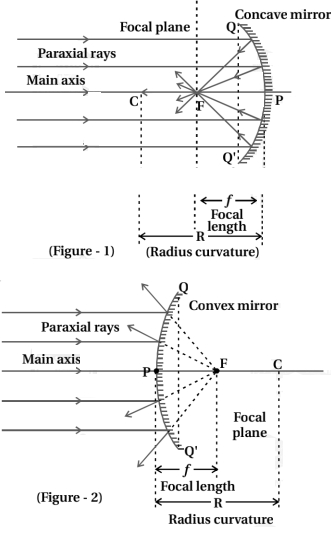
Define the following for curved mirrors: $(1)$ Radius of curvature,$(2)$ Centre of curvature,$(3)$ Pole,$(4)$ Principal axis,$(5)$ Aperture,$(6)$ Principal focus,$(7)$ Focal plane,$(8)$ Focal length,$(9)$ Paraxial rays.
Solution
(N/A) $(1)$ Radius of Curvature $(R)$: The radius of the spherical shell of which the mirror is a part is called the radius of curvature.
$(2)$ Centre of Curvature $(C)$: The centre of the spherical shell of which the mirror is a part is called the centre of curvature.
$(3)$ Pole $(P)$: The geometric centre of the reflecting surface of a spherical mirror is called its pole.
$(4)$ Principal Axis: The straight line passing through the pole $(P)$ and the centre of curvature $(C)$ is called the principal axis.
$(5)$ Aperture: The diameter of the reflecting surface of a spherical mirror is called its aperture.
$(6)$ Principal Focus $(F)$: The point on the principal axis where rays parallel to the principal axis converge (concave mirror) or appear to diverge (convex mirror) after reflection is called the principal focus.
$(7)$ Focal Plane: $A$ plane passing through the principal focus and perpendicular to the principal axis is called the focal plane.
$(8)$ Focal Length $(f)$: The distance between the pole $(P)$ and the principal focus $(F)$ is called the focal length.
$(9)$ Paraxial Rays: Rays of light that are close to the principal axis and make small angles with it are called paraxial rays.
$(2)$ Centre of Curvature $(C)$: The centre of the spherical shell of which the mirror is a part is called the centre of curvature.
$(3)$ Pole $(P)$: The geometric centre of the reflecting surface of a spherical mirror is called its pole.
$(4)$ Principal Axis: The straight line passing through the pole $(P)$ and the centre of curvature $(C)$ is called the principal axis.
$(5)$ Aperture: The diameter of the reflecting surface of a spherical mirror is called its aperture.
$(6)$ Principal Focus $(F)$: The point on the principal axis where rays parallel to the principal axis converge (concave mirror) or appear to diverge (convex mirror) after reflection is called the principal focus.
$(7)$ Focal Plane: $A$ plane passing through the principal focus and perpendicular to the principal axis is called the focal plane.
$(8)$ Focal Length $(f)$: The distance between the pole $(P)$ and the principal focus $(F)$ is called the focal length.
$(9)$ Paraxial Rays: Rays of light that are close to the principal axis and make small angles with it are called paraxial rays.
0 likes
View Solution154
Medium
Derive the relationship between the focal length $(f)$ and the radius of curvature $(R)$ for a spherical mirror.
Solution
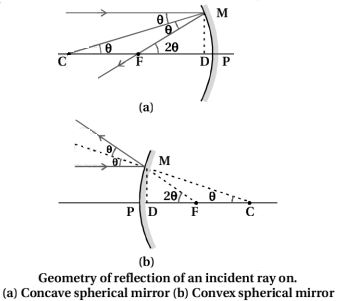
(N/A) Let $C$ be the centre of curvature and $P$ be the pole of the spherical mirror.
Consider a light ray parallel to the principal axis striking the mirror at point $M$. The line $CM$ is normal to the mirror at $M$.
Let $\theta$ be the angle of incidence. According to the law of reflection,the angle of reflection is also $\theta$.
From the geometry,$\angle MCP = \theta$ (alternate interior angles) and $\angle MFP = 2\theta$ (exterior angle of $\triangle MCF$ is equal to the sum of opposite interior angles).
Let $MD$ be the perpendicular from $M$ to the principal axis. For paraxial rays,$D$ is very close to $P$,so $CD \approx CP = R$ and $FD \approx FP = f$.
In $\triangle MDC$,$\tan \theta = \frac{MD}{CD} \approx \frac{MD}{R}$. For small $\theta$,$\tan \theta \approx \theta$,so $\theta \approx \frac{MD}{R}$.
In $\triangle MDF$,$\tan 2\theta = \frac{MD}{FD} \approx \frac{MD}{f}$. For small $\theta$,$\tan 2\theta \approx 2\theta$,so $2\theta \approx \frac{MD}{f}$.
Substituting $\theta$ from the first equation into the second: $2(\frac{MD}{R}) = \frac{MD}{f}$.
Therefore,$R = 2f$ or $f = \frac{R}{2}$.
Consider a light ray parallel to the principal axis striking the mirror at point $M$. The line $CM$ is normal to the mirror at $M$.
Let $\theta$ be the angle of incidence. According to the law of reflection,the angle of reflection is also $\theta$.
From the geometry,$\angle MCP = \theta$ (alternate interior angles) and $\angle MFP = 2\theta$ (exterior angle of $\triangle MCF$ is equal to the sum of opposite interior angles).
Let $MD$ be the perpendicular from $M$ to the principal axis. For paraxial rays,$D$ is very close to $P$,so $CD \approx CP = R$ and $FD \approx FP = f$.
In $\triangle MDC$,$\tan \theta = \frac{MD}{CD} \approx \frac{MD}{R}$. For small $\theta$,$\tan \theta \approx \theta$,so $\theta \approx \frac{MD}{R}$.
In $\triangle MDF$,$\tan 2\theta = \frac{MD}{FD} \approx \frac{MD}{f}$. For small $\theta$,$\tan 2\theta \approx 2\theta$,so $2\theta \approx \frac{MD}{f}$.
Substituting $\theta$ from the first equation into the second: $2(\frac{MD}{R}) = \frac{MD}{f}$.
Therefore,$R = 2f$ or $f = \frac{R}{2}$.
0 likes
View Solution155
Medium
How is it convenient to obtain an image by reflection from a spherical mirror?
Solution
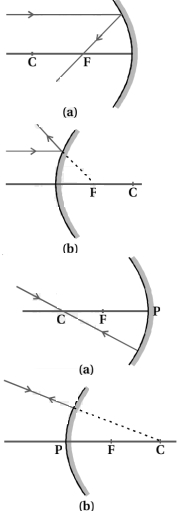
(N/A) We can take any two rays emanating from a point on an object,trace their paths,find their point of intersection,and thus,obtain the image of the point due to reflection at a spherical mirror.
In practice,however,it is convenient to choose any two of the following rays:
$(i)$ The ray from the point which is parallel to the principal axis. The reflected ray goes through the focus of the mirror.
$(ii)$ The ray passing through the centre of curvature of a concave mirror or appearing to pass through it for a convex mirror. The reflected ray simply retraces the path.
$(iii)$ The ray directed towards the pole of the mirror. The reflected ray follows the laws of reflection,making equal angles with the principal axis.
$(iv)$ The ray passing through the focus of a concave mirror or directed towards the focus of a convex mirror. The reflected ray becomes parallel to the principal axis.
In practice,however,it is convenient to choose any two of the following rays:
$(i)$ The ray from the point which is parallel to the principal axis. The reflected ray goes through the focus of the mirror.
$(ii)$ The ray passing through the centre of curvature of a concave mirror or appearing to pass through it for a convex mirror. The reflected ray simply retraces the path.
$(iii)$ The ray directed towards the pole of the mirror. The reflected ray follows the laws of reflection,making equal angles with the principal axis.
$(iv)$ The ray passing through the focus of a concave mirror or directed towards the focus of a convex mirror. The reflected ray becomes parallel to the principal axis.
0 likes
View Solution156
Easy
Explain the ray diagram for the image obtained by a concave mirror by considering three rays.
Solution
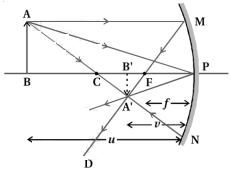
(N/A) The figure shows the ray diagram considering three rays originating from point $A$ of an object $AB$.
$1$. $A$ ray parallel to the principal axis,after reflection,passes through the principal focus $F$.
$2$. $A$ ray passing through the center of curvature $C$ is reflected back along the same path.
$3$. $A$ ray incident at the pole $P$ is reflected at an equal angle with the principal axis.
These three rays intersect at point $A^{\prime}$,which is the image of point $A$. By dropping a perpendicular from $A^{\prime}$ to the principal axis,we get the image $A^{\prime}B^{\prime}$ of the object $AB$. Since rays actually intersect at $A^{\prime}$,the image is real and inverted.
$1$. $A$ ray parallel to the principal axis,after reflection,passes through the principal focus $F$.
$2$. $A$ ray passing through the center of curvature $C$ is reflected back along the same path.
$3$. $A$ ray incident at the pole $P$ is reflected at an equal angle with the principal axis.
These three rays intersect at point $A^{\prime}$,which is the image of point $A$. By dropping a perpendicular from $A^{\prime}$ to the principal axis,we get the image $A^{\prime}B^{\prime}$ of the object $AB$. Since rays actually intersect at $A^{\prime}$,the image is real and inverted.
0 likes
View Solution157
Medium
Obtain the mirror equation for the real image formed by a concave mirror.
Solution
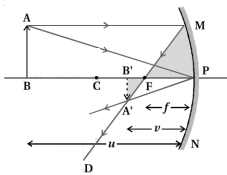
(N/A) Consider an object $AB$ placed perpendicular to the principal axis beyond the center of curvature $C$ of a concave mirror.
$A$ ray $AM$ from point $A$ incident on the mirror at $M$ reflects through the principal focus $F$.
$A$ ray $AP$ from point $A$ incident on the pole $P$ reflects back following the law of reflection,such that $\angle APB = \angle A'PB'$.
These reflected rays intersect at $A'$,forming a real image $A'B'$.
Let $FP = f$ (focal length),$CP = R$ (radius of curvature),$BP = u$ (object distance),and $B'P = v$ (image distance).
For paraxial rays,$MP$ can be considered a straight line perpendicular to the principal axis.
The right-angled triangles $\triangle A'B'F$ and $\triangle MPF$ are similar.
Therefore,$\frac{B'A'}{PM} = \frac{B'F}{FP}$. Since $PM = AB$,we have $\frac{B'A'}{AB} = \frac{B'F}{FP} = \frac{B'P - FP}{FP} = \frac{v - f}{f} \quad \dots (1)$
Similarly,$\triangle A'B'P$ and $\triangle ABP$ are similar.
Therefore,$\frac{B'A'}{AB} = \frac{B'P}{BP} = \frac{v}{u} \quad \dots (2)$
Equating $(1)$ and $(2)$,we get $\frac{v - f}{f} = \frac{v}{u}$.
Dividing by $v$,we get $\frac{1}{f} - \frac{1}{v} = \frac{1}{u}$,which simplifies to the mirror equation: $\frac{1}{f} = \frac{1}{v} + \frac{1}{u}$.
$A$ ray $AM$ from point $A$ incident on the mirror at $M$ reflects through the principal focus $F$.
$A$ ray $AP$ from point $A$ incident on the pole $P$ reflects back following the law of reflection,such that $\angle APB = \angle A'PB'$.
These reflected rays intersect at $A'$,forming a real image $A'B'$.
Let $FP = f$ (focal length),$CP = R$ (radius of curvature),$BP = u$ (object distance),and $B'P = v$ (image distance).
For paraxial rays,$MP$ can be considered a straight line perpendicular to the principal axis.
The right-angled triangles $\triangle A'B'F$ and $\triangle MPF$ are similar.
Therefore,$\frac{B'A'}{PM} = \frac{B'F}{FP}$. Since $PM = AB$,we have $\frac{B'A'}{AB} = \frac{B'F}{FP} = \frac{B'P - FP}{FP} = \frac{v - f}{f} \quad \dots (1)$
Similarly,$\triangle A'B'P$ and $\triangle ABP$ are similar.
Therefore,$\frac{B'A'}{AB} = \frac{B'P}{BP} = \frac{v}{u} \quad \dots (2)$
Equating $(1)$ and $(2)$,we get $\frac{v - f}{f} = \frac{v}{u}$.
Dividing by $v$,we get $\frac{1}{f} - \frac{1}{v} = \frac{1}{u}$,which simplifies to the mirror equation: $\frac{1}{f} = \frac{1}{v} + \frac{1}{u}$.
0 likes
View Solution158
Easy
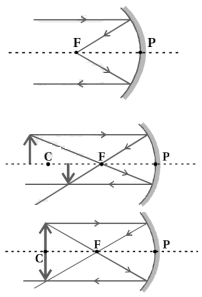
Provide the object and image distances,type,size,and magnification for an object placed in front of a concave spherical mirror for the cases shown in the image.
Solution
(N/A) $(1)$ Object position: $(u = \infty)$
Image position: At principal focus $F$
Image type: Real and inverted
Image size: Highly diminished (point-sized)
Magnification: $m \approx 0$
$(2)$ Object position: Beyond $C$ $(\infty > u > R)$
Image position: Between $F$ and $C$
Image type: Real and inverted
Image size: Diminished
Magnification: $-1 < m < 0$
$(3)$ Object position: At $C$ $(u = 2f = R)$
Image position: At $C$
Image type: Real and inverted
Image size: Same as the object
Magnification: $m = -1$
Image position: At principal focus $F$
Image type: Real and inverted
Image size: Highly diminished (point-sized)
Magnification: $m \approx 0$
$(2)$ Object position: Beyond $C$ $(\infty > u > R)$
Image position: Between $F$ and $C$
Image type: Real and inverted
Image size: Diminished
Magnification: $-1 < m < 0$
$(3)$ Object position: At $C$ $(u = 2f = R)$
Image position: At $C$
Image type: Real and inverted
Image size: Same as the object
Magnification: $m = -1$
0 likes
View Solution159
Medium
What is linear magnification? Obtain the equation of linear magnification for a concave mirror.
Solution
(N/A) Linear magnification $(m)$ is defined as the ratio of the height of the image $(h^{\prime})$ to the height of the object $(h)$.
$\therefore m = \frac{h^{\prime}}{h} \quad \dots (1)$
Consider an object $AB$ of height $h$ placed on the principal axis in front of a concave mirror as shown in the figure.
Two rays $AQ$ and $AP$ intersect at $A^{\prime}$ after reflection from the mirror,where $A^{\prime}$ is the image of $A$. Rays from object $AB$ form an image $A^{\prime}B^{\prime}$ after reflection. Let $A^{\prime}B^{\prime} = h^{\prime}$.
From the figure,triangles $\triangle A^{\prime}B^{\prime}P$ and $\triangle ABP$ are similar.
Therefore,$\frac{B^{\prime}A^{\prime}}{BA} = \frac{B^{\prime}P}{BP}$.
According to the sign convention,$B^{\prime}A^{\prime} = -h^{\prime}$ (downward),$BA = h$ (upward),$B^{\prime}P = -v$,and $BP = -u$.
Substituting these values:
$\frac{-h^{\prime}}{h} = \frac{-v}{-u}$
$\therefore \frac{h^{\prime}}{h} = -\frac{v}{u}$
$\therefore m = -\frac{v}{u} \quad (\text{From equation } 1)$.
For a real image,the image formed is inverted,hence its magnification is negative. For a virtual image,the image formed is erect,hence its magnification is positive.
$\therefore m = \frac{h^{\prime}}{h} \quad \dots (1)$
Consider an object $AB$ of height $h$ placed on the principal axis in front of a concave mirror as shown in the figure.
Two rays $AQ$ and $AP$ intersect at $A^{\prime}$ after reflection from the mirror,where $A^{\prime}$ is the image of $A$. Rays from object $AB$ form an image $A^{\prime}B^{\prime}$ after reflection. Let $A^{\prime}B^{\prime} = h^{\prime}$.
From the figure,triangles $\triangle A^{\prime}B^{\prime}P$ and $\triangle ABP$ are similar.
Therefore,$\frac{B^{\prime}A^{\prime}}{BA} = \frac{B^{\prime}P}{BP}$.
According to the sign convention,$B^{\prime}A^{\prime} = -h^{\prime}$ (downward),$BA = h$ (upward),$B^{\prime}P = -v$,and $BP = -u$.
Substituting these values:
$\frac{-h^{\prime}}{h} = \frac{-v}{-u}$
$\therefore \frac{h^{\prime}}{h} = -\frac{v}{u}$
$\therefore m = -\frac{v}{u} \quad (\text{From equation } 1)$.
For a real image,the image formed is inverted,hence its magnification is negative. For a virtual image,the image formed is erect,hence its magnification is positive.
0 likes
View Solution160
Easy
Define the centre of curvature for a convex mirror.
Solution
(N/A) The centre of curvature of a convex mirror is the centre of the sphere of which the mirror is a part. For a convex mirror,the centre of curvature lies behind the mirror surface.
0 likes
View Solution161
Medium
Define the focal plane of a concave mirror.
Solution
(N/A) The focal plane of a concave mirror is defined as a plane passing through the focus $(F)$ of the mirror and oriented perpendicular to the principal axis.
Any parallel beam of light rays that is incident on the mirror at an angle to the principal axis will converge at a point on this focal plane after reflection.
Any parallel beam of light rays that is incident on the mirror at an angle to the principal axis will converge at a point on this focal plane after reflection.
0 likes
View Solution162
Easy
Write the relationship between the radius of curvature and the focal length for a spherical mirror.
Solution
(N/A) For a spherical mirror of small aperture,the relationship between the radius of curvature $(R)$ and the focal length $(f)$ is given by the formula:
$R = 2f$
Alternatively,it can be expressed as:
$f = \frac{R}{2}$
This indicates that the focal length is half of the radius of curvature.
$R = 2f$
Alternatively,it can be expressed as:
$f = \frac{R}{2}$
This indicates that the focal length is half of the radius of curvature.
0 likes
View Solution163
Easy
Write the mirror equation for a spherical mirror.
Solution
(N/A) The mirror equation relates the object distance $(u)$,the image distance $(v)$,and the focal length $(f)$ of a spherical mirror. It is given by the formula:
$\frac{1}{f} = \frac{1}{v} + \frac{1}{u}$
Where:
$f$ is the focal length of the mirror.
$v$ is the distance of the image from the pole of the mirror.
$u$ is the distance of the object from the pole of the mirror.
$\frac{1}{f} = \frac{1}{v} + \frac{1}{u}$
Where:
$f$ is the focal length of the mirror.
$v$ is the distance of the image from the pole of the mirror.
$u$ is the distance of the object from the pole of the mirror.
0 likes
View Solution164
EasyMCQ
Draw the ray diagram when an object is placed between the focus $(F)$ and the pole $(P)$ of a concave mirror.
A
The image formed is real,inverted,and magnified.
B
The image formed is virtual,erect,and magnified.
C
The image formed is virtual,erect,and diminished.
D
The image formed is real,erect,and magnified.
Solution
(B) When an object is placed between the focus $(F)$ and the pole $(P)$ of a concave mirror,the light rays diverge after reflection.
$1$. $A$ ray parallel to the principal axis passes through the focus $(F)$ after reflection.
$2$. $A$ ray passing through the center of curvature $(C)$ reflects back along the same path.
$3$. By extending these reflected rays backward,they appear to meet behind the mirror.
$4$. The image formed is virtual,erect,and magnified,located behind the mirror.
$1$. $A$ ray parallel to the principal axis passes through the focus $(F)$ after reflection.
$2$. $A$ ray passing through the center of curvature $(C)$ reflects back along the same path.
$3$. By extending these reflected rays backward,they appear to meet behind the mirror.
$4$. The image formed is virtual,erect,and magnified,located behind the mirror.
0 likes
View Solution165
Medium
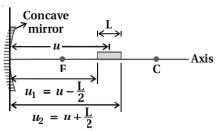
$A$ short object of length $L$ is placed along the principal axis of a concave mirror away from focus. The object distance is $u$. If the mirror has a focal length $f,$ what will be the length of the image? You may take $L << |u-f|$.
Solution
(N/A) The mirror formula is given by $\frac{1}{f} = \frac{1}{v} + \frac{1}{u}$.
Differentiating both sides with respect to $u$,we get $-\frac{1}{v^2} \frac{dv}{du} - \frac{1}{u^2} = 0$.
Therefore,$\frac{dv}{du} = -\frac{v^2}{u^2}$.
Since $v = \frac{fu}{u-f}$,we have $\frac{dv}{du} = -\left(\frac{fu}{u-f}\right)^2 \cdot \frac{1}{u^2} = -\left(\frac{f}{u-f}\right)^2$.
The length of the image $L'$ is given by $|dv| = |\frac{dv}{du}| \cdot L$.
Substituting the value of $\frac{dv}{du}$,we get $L' = \left(\frac{f}{u-f}\right)^2 L$.
Differentiating both sides with respect to $u$,we get $-\frac{1}{v^2} \frac{dv}{du} - \frac{1}{u^2} = 0$.
Therefore,$\frac{dv}{du} = -\frac{v^2}{u^2}$.
Since $v = \frac{fu}{u-f}$,we have $\frac{dv}{du} = -\left(\frac{fu}{u-f}\right)^2 \cdot \frac{1}{u^2} = -\left(\frac{f}{u-f}\right)^2$.
The length of the image $L'$ is given by $|dv| = |\frac{dv}{du}| \cdot L$.
Substituting the value of $\frac{dv}{du}$,we get $L' = \left(\frac{f}{u-f}\right)^2 L$.
0 likes
View Solution166
DifficultMCQ
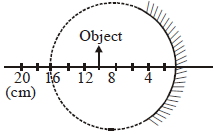
$A$ spherical mirror is obtained as shown in the figure from a hollow glass sphere. If an object is positioned in front of the mirror,what will be the nature and magnification of the image of the object? (Figure drawn as schematic and not to scale)
A
Inverted,real and magnified
B
Erect,virtual and magnified
C
Erect,virtual and unmagnified
D
Inverted,real and diminished
Solution
(A) From the figure,the radius of curvature $R = 16 \ cm$. Since the inner surface is reflecting,it is a concave mirror.
Focal length $f = \frac{R}{2} = \frac{-16}{2} = -8 \ cm$.
The object is placed at $u = -10 \ cm$.
Using the mirror formula $\frac{1}{v} + \frac{1}{u} = \frac{1}{f}$:
$\frac{1}{v} + \frac{1}{-10} = \frac{1}{-8}$
$\frac{1}{v} = \frac{1}{10} - \frac{1}{8} = \frac{4 - 5}{40} = \frac{-1}{40}$
$v = -40 \ cm$.
Magnification $m = \frac{-v}{u} = \frac{-(-40)}{-10} = -4$.
Since $m$ is negative,the image is real and inverted. Since $|m| = 4 > 1$,the image is magnified.
Focal length $f = \frac{R}{2} = \frac{-16}{2} = -8 \ cm$.
The object is placed at $u = -10 \ cm$.
Using the mirror formula $\frac{1}{v} + \frac{1}{u} = \frac{1}{f}$:
$\frac{1}{v} + \frac{1}{-10} = \frac{1}{-8}$
$\frac{1}{v} = \frac{1}{10} - \frac{1}{8} = \frac{4 - 5}{40} = \frac{-1}{40}$
$v = -40 \ cm$.
Magnification $m = \frac{-v}{u} = \frac{-(-40)}{-10} = -4$.
Since $m$ is negative,the image is real and inverted. Since $|m| = 4 > 1$,the image is magnified.
0 likes
View Solution167
MediumMCQ
An object is placed on the principal axis of a concave mirror at a distance of $1.5 f$ ($f$ is the focal length). The image will be at ....... $f$.
A
$3$
B
$-3$
C
$1.5$
D
$-1.5$
Solution
(B) Using the mirror formula: $\frac{1}{v} + \frac{1}{u} = \frac{1}{f}$.
For a concave mirror,the focal length $f$ is taken as negative,so $f_{mirror} = -f$.
The object distance $u$ is also negative,so $u = -1.5 f = -\frac{3 f}{2}$.
Substituting these values into the mirror formula:
$\frac{1}{v} + \frac{1}{-1.5 f} = \frac{1}{-f}$
$\frac{1}{v} - \frac{2}{3 f} = -\frac{1}{f}$
$\frac{1}{v} = -\frac{1}{f} + \frac{2}{3 f}$
$\frac{1}{v} = \frac{-3 + 2}{3 f}$
$\frac{1}{v} = -\frac{1}{3 f}$
Therefore,$v = -3 f$. The image is formed at a distance of $3 f$ in front of the mirror.
For a concave mirror,the focal length $f$ is taken as negative,so $f_{mirror} = -f$.
The object distance $u$ is also negative,so $u = -1.5 f = -\frac{3 f}{2}$.
Substituting these values into the mirror formula:
$\frac{1}{v} + \frac{1}{-1.5 f} = \frac{1}{-f}$
$\frac{1}{v} - \frac{2}{3 f} = -\frac{1}{f}$
$\frac{1}{v} = -\frac{1}{f} + \frac{2}{3 f}$
$\frac{1}{v} = \frac{-3 + 2}{3 f}$
$\frac{1}{v} = -\frac{1}{3 f}$
Therefore,$v = -3 f$. The image is formed at a distance of $3 f$ in front of the mirror.
0 likes
View Solution168
EasyMCQ
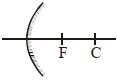
The focal length $f$ is related to the radius of curvature $R$ of a spherical convex mirror by
A
$f = +\frac{1}{2} R$
B
$f = -R$
C
$f = -\frac{1}{2} R$
D
$f = R$
Solution
(A) For a spherical mirror,the relationship between focal length $f$ and radius of curvature $R$ is given by $f = \frac{R}{2}$.
For a convex mirror,the focus $F$ and the center of curvature $C$ are located behind the mirror.
According to the sign convention,distances measured in the direction of incident light (behind the mirror) are taken as positive.
Therefore,for a convex mirror,both $f$ and $R$ are positive.
Thus,the relationship is $f = +\frac{R}{2}$.
For a convex mirror,the focus $F$ and the center of curvature $C$ are located behind the mirror.
According to the sign convention,distances measured in the direction of incident light (behind the mirror) are taken as positive.
Therefore,for a convex mirror,both $f$ and $R$ are positive.
Thus,the relationship is $f = +\frac{R}{2}$.
0 likes
View Solution169
DifficultMCQ
$A$ short straight object of height $100\, cm$ lies before the central axis of a spherical mirror whose focal length has absolute value $|f|=40\, cm$. The image of the object produced by the mirror is of height $25\, cm$ and has the same orientation as the object. One may conclude from the information:
A
Image is real,same side of concave mirror.
B
Image is virtual,opposite side of concave mirror.
C
Image is real,same side of convex mirror.
D
Image is virtual,opposite side of convex mirror.
Solution
(D) $1$. The magnification $m$ is given by the ratio of image height to object height: $m = \frac{h_i}{h_o} = \frac{25\, cm}{100\, cm} = +0.25$.
$2$. Since the magnification is positive $(m > 0)$,the image is erect (same orientation as the object) and virtual.
$3$. For a spherical mirror,a virtual and erect image is formed by both concave and convex mirrors. However,a concave mirror produces a magnified virtual image $(|m| > 1)$,whereas a convex mirror produces a diminished virtual image $(|m| < 1)$.
$4$. Since the image height $(25\, cm)$ is less than the object height $(100\, cm)$,the magnification is less than $1$. Therefore,the mirror must be a convex mirror.
$5$. $A$ virtual image formed by a mirror is always located on the opposite side of the mirror relative to the object.
$2$. Since the magnification is positive $(m > 0)$,the image is erect (same orientation as the object) and virtual.
$3$. For a spherical mirror,a virtual and erect image is formed by both concave and convex mirrors. However,a concave mirror produces a magnified virtual image $(|m| > 1)$,whereas a convex mirror produces a diminished virtual image $(|m| < 1)$.
$4$. Since the image height $(25\, cm)$ is less than the object height $(100\, cm)$,the magnification is less than $1$. Therefore,the mirror must be a convex mirror.
$5$. $A$ virtual image formed by a mirror is always located on the opposite side of the mirror relative to the object.
0 likes
View Solution170
DifficultMCQ
An object is placed beyond the centre of curvature $C$ of a concave mirror. If the distance of the object is $d_{1}$ from $C$ and the distance of the image formed is $d_{2}$ from $C$,the radius of curvature of this mirror is
A
$\frac{2 d_{1} d_{2}}{d_{1}-d_{2}}$
B
$\frac{2 d_{1} d_{2}}{d_{1}+d_{2}}$
C
$\frac{d_{1} d_{2}}{d_{1}+d_{2}}$
D
$\frac{d_{1} d_{2}}{d_{1}-d_{2}}$
Solution
(A) For a spherical mirror,Newton's formula relates the distances of the object and image from the focus $F$. Let $x_{1}$ and $x_{2}$ be the distances of the object and image from the focus,respectively. The formula is $x_{1} x_{2} = f^{2}$.
In this problem,the distances are measured from the centre of curvature $C$. The distance of the focus $F$ from $C$ is the focal length $f$.
Thus,the distance of the object from the focus is $x_{1} = d_{1} + f$,and the distance of the image from the focus is $x_{2} = f - d_{2}$.
Substituting these into Newton's formula: $(f + d_{1})(f - d_{2}) = f^{2}$.
Expanding the equation: $f^{2} - f d_{2} + f d_{1} - d_{1} d_{2} = f^{2}$.
Simplifying: $f(d_{1} - d_{2}) = d_{1} d_{2}$.
Therefore,the focal length is $f = \frac{d_{1} d_{2}}{d_{1} - d_{2}}$.
The radius of curvature $R$ is given by $R = 2f$.
Hence,$R = \frac{2 d_{1} d_{2}}{d_{1} - d_{2}}$.
In this problem,the distances are measured from the centre of curvature $C$. The distance of the focus $F$ from $C$ is the focal length $f$.
Thus,the distance of the object from the focus is $x_{1} = d_{1} + f$,and the distance of the image from the focus is $x_{2} = f - d_{2}$.
Substituting these into Newton's formula: $(f + d_{1})(f - d_{2}) = f^{2}$.
Expanding the equation: $f^{2} - f d_{2} + f d_{1} - d_{1} d_{2} = f^{2}$.
Simplifying: $f(d_{1} - d_{2}) = d_{1} d_{2}$.
Therefore,the focal length is $f = \frac{d_{1} d_{2}}{d_{1} - d_{2}}$.
The radius of curvature $R$ is given by $R = 2f$.
Hence,$R = \frac{2 d_{1} d_{2}}{d_{1} - d_{2}}$.
1 likes
View Solution171
DifficultMCQ
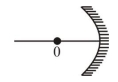
An object ' $O$ ' is placed at a distance of $100\,cm$ in front of a concave mirror of radius of curvature $200\,cm$ as shown in the figure. The object starts moving towards the mirror at a speed of $2\,cm/s$. The position of the image from the mirror after $10\,s$ will be at ...... $cm$.
A
$40$
B
$405$
C
$402$
D
$400$
Solution
(D) Given: Initial distance of object $u_0 = -100\,cm$. Radius of curvature $R = -200\,cm$. Focal length $f = R/2 = -100\,cm$.
Speed of object $v_{obj} = 2\,cm/s$ towards the mirror.
After time $t = 10\,s$,the distance moved by the object is $d = v_{obj} \times t = 2\,cm/s \times 10\,s = 20\,cm$.
The new position of the object from the mirror is $u = u_0 + d = -100\,cm + 20\,cm = -80\,cm$.
Using the mirror formula: $\frac{1}{v} + \frac{1}{u} = \frac{1}{f}$.
Substituting the values: $\frac{1}{v} + \frac{1}{-80} = \frac{1}{-100}$.
$\frac{1}{v} = \frac{1}{80} - \frac{1}{100} = \frac{5 - 4}{400} = \frac{1}{400}$.
Therefore,$v = 400\,cm$.
Speed of object $v_{obj} = 2\,cm/s$ towards the mirror.
After time $t = 10\,s$,the distance moved by the object is $d = v_{obj} \times t = 2\,cm/s \times 10\,s = 20\,cm$.
The new position of the object from the mirror is $u = u_0 + d = -100\,cm + 20\,cm = -80\,cm$.
Using the mirror formula: $\frac{1}{v} + \frac{1}{u} = \frac{1}{f}$.
Substituting the values: $\frac{1}{v} + \frac{1}{-80} = \frac{1}{-100}$.
$\frac{1}{v} = \frac{1}{80} - \frac{1}{100} = \frac{5 - 4}{400} = \frac{1}{400}$.
Therefore,$v = 400\,cm$.
0 likes
View Solution172
AdvancedMCQ
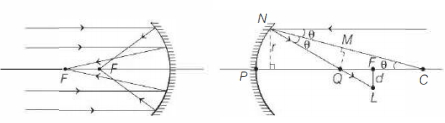
$A$ concave mirror of radius of curvature $R$ has a circular outline of radius $r$. $A$ circular disc is to be placed normal to the axis at the focus,so that it collects all the light that is reflected from the mirror from a beam parallel to the axis. For $r \ll R$,the area of this disc has to be at least
A
$\frac{\pi r^6}{4 R^4}$
B
$\frac{\pi r^4}{4 R^2}$
C
$\frac{\pi r^5}{4 R^3}$
D
$\frac{\pi r^4}{R^2}$
Solution
(A) For a large aperture mirror,rays parallel to the axis do not converge at a single point (focus $F$) due to spherical aberration. Instead,they form a circular patch at the focal plane.
Let $N$ be a point on the periphery of the mirror at a distance $r$ from the axis. Let the ray reflected from $N$ intersect the axis at $Q$. In $\triangle NQC$,where $C$ is the center of curvature,the angle of incidence equals the angle of reflection,both being $\theta$. Thus,$\angle N C P = \theta$ and $\angle N Q C = \theta$.
In $\triangle NQC$,by the law of sines or geometry,$QC = \frac{R}{2 \cos \theta}$.
The distance of $Q$ from the pole $P$ is $PQ = R - QC = R - \frac{R}{2 \cos \theta}$.
The distance of $Q$ from the focus $F$ is $QF = PF - PQ = \frac{R}{2} - (R - \frac{R}{2 \cos \theta}) = \frac{R}{2 \cos \theta} - \frac{R}{2} = \frac{R}{2} (\sec \theta - 1)$.
Let $d$ be the radius of the disc at the focus. From similar triangles formed by the reflected ray,the radius $d$ is given by $d = QF \tan(2\theta)$.
For small $\theta$,$\sin \theta \approx \tan \theta \approx \frac{r}{R}$. Also,$\sec \theta = (1 - \sin^2 \theta)^{-1/2} \approx 1 + \frac{\theta^2}{2} = 1 + \frac{r^2}{2R^2}$.
Substituting these,$QF \approx \frac{R}{2} (1 + \frac{r^2}{2R^2} - 1) = \frac{r^2}{4R}$.
Since $\tan(2\theta) \approx 2\theta \approx 2(\frac{r}{R})$,we have $d = QF \cdot 2\theta = (\frac{r^2}{4R}) \cdot (\frac{2r}{R}) = \frac{r^3}{2R^2}$.
The area of the disc is $A = \pi d^2 = \pi (\frac{r^3}{2R^2})^2 = \frac{\pi r^6}{4R^4}$.
Let $N$ be a point on the periphery of the mirror at a distance $r$ from the axis. Let the ray reflected from $N$ intersect the axis at $Q$. In $\triangle NQC$,where $C$ is the center of curvature,the angle of incidence equals the angle of reflection,both being $\theta$. Thus,$\angle N C P = \theta$ and $\angle N Q C = \theta$.
In $\triangle NQC$,by the law of sines or geometry,$QC = \frac{R}{2 \cos \theta}$.
The distance of $Q$ from the pole $P$ is $PQ = R - QC = R - \frac{R}{2 \cos \theta}$.
The distance of $Q$ from the focus $F$ is $QF = PF - PQ = \frac{R}{2} - (R - \frac{R}{2 \cos \theta}) = \frac{R}{2 \cos \theta} - \frac{R}{2} = \frac{R}{2} (\sec \theta - 1)$.
Let $d$ be the radius of the disc at the focus. From similar triangles formed by the reflected ray,the radius $d$ is given by $d = QF \tan(2\theta)$.
For small $\theta$,$\sin \theta \approx \tan \theta \approx \frac{r}{R}$. Also,$\sec \theta = (1 - \sin^2 \theta)^{-1/2} \approx 1 + \frac{\theta^2}{2} = 1 + \frac{r^2}{2R^2}$.
Substituting these,$QF \approx \frac{R}{2} (1 + \frac{r^2}{2R^2} - 1) = \frac{r^2}{4R}$.
Since $\tan(2\theta) \approx 2\theta \approx 2(\frac{r}{R})$,we have $d = QF \cdot 2\theta = (\frac{r^2}{4R}) \cdot (\frac{2r}{R}) = \frac{r^3}{2R^2}$.
The area of the disc is $A = \pi d^2 = \pi (\frac{r^3}{2R^2})^2 = \frac{\pi r^6}{4R^4}$.
0 likes
View Solution173
AdvancedMCQ
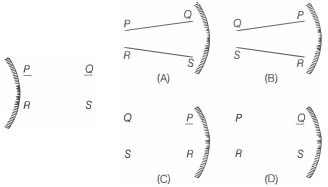
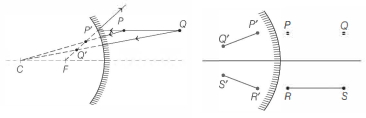
$A$ person looks at the image of two parallel finite length lines $PQ$ and $RS$ in a convex mirror (see figure). Which of the following represents schematically the image correctly? Note: Letters $P, Q, R$ and $S$ are used only to denote the endpoints of the lines.
A
$A$
B
$B$
C
$C$
D
$D$
Solution
(B) For a convex mirror,the image formed is always virtual,erect,and diminished.
Consider the line $PQ$. Point $Q$ is farther from the mirror than point $P$. For a convex mirror,the magnification $m = -v/u$ is positive and less than $1$. Since $Q$ is farther from the mirror $(u_Q > u_P)$,the image of $Q$ $(Q')$ will be closer to the mirror than the image of $P$ $(P')$,and the distance between $P'$ and $Q'$ will be smaller than the distance between $P$ and $Q$.
Furthermore,because the mirror is convex,the rays from points farther from the pole appear to originate from points closer to the focus. Thus,the image $P'Q'$ will appear tilted such that the end closer to the mirror $(P')$ is further from the principal axis than the end farther from the mirror $(Q')$.
Applying this logic to both lines $PQ$ and $RS$,we find that the correct schematic representation is given by option $B$.
Consider the line $PQ$. Point $Q$ is farther from the mirror than point $P$. For a convex mirror,the magnification $m = -v/u$ is positive and less than $1$. Since $Q$ is farther from the mirror $(u_Q > u_P)$,the image of $Q$ $(Q')$ will be closer to the mirror than the image of $P$ $(P')$,and the distance between $P'$ and $Q'$ will be smaller than the distance between $P$ and $Q$.
Furthermore,because the mirror is convex,the rays from points farther from the pole appear to originate from points closer to the focus. Thus,the image $P'Q'$ will appear tilted such that the end closer to the mirror $(P')$ is further from the principal axis than the end farther from the mirror $(Q')$.
Applying this logic to both lines $PQ$ and $RS$,we find that the correct schematic representation is given by option $B$.
0 likes
View Solution174
MediumMCQ
In a car,a rear-view mirror having a radius of curvature $1.50 \, m$ forms a virtual image of a bus located $10.0 \, m$ from the mirror. The factor by which the mirror magnifies the size of the bus is close to
A
$0.06$
B
$0.07$
C
$0.08$
D
$0.09$
Solution
(B) rear-view mirror is a convex mirror.
Given: Radius of curvature $R = 1.50 \, m$,Object distance $u = -10.0 \, m$.
The focal length $f = \frac{R}{2} = \frac{1.5}{2} = 0.75 \, m$.
Using the mirror formula: $\frac{1}{v} + \frac{1}{u} = \frac{1}{f}$.
$\frac{1}{v} = \frac{1}{f} - \frac{1}{u} = \frac{1}{0.75} - \frac{1}{-10} = \frac{4}{3} + \frac{1}{10} = \frac{40 + 3}{30} = \frac{43}{30}$.
Thus,$v = \frac{30}{43} \, m$.
The magnification $m$ is given by $m = -\frac{v}{u}$.
$m = -\frac{(30/43)}{-10} = \frac{30}{430} = \frac{3}{43} \approx 0.0697$.
Rounding to two decimal places,the magnification factor is approximately $0.07$.
Given: Radius of curvature $R = 1.50 \, m$,Object distance $u = -10.0 \, m$.
The focal length $f = \frac{R}{2} = \frac{1.5}{2} = 0.75 \, m$.
Using the mirror formula: $\frac{1}{v} + \frac{1}{u} = \frac{1}{f}$.
$\frac{1}{v} = \frac{1}{f} - \frac{1}{u} = \frac{1}{0.75} - \frac{1}{-10} = \frac{4}{3} + \frac{1}{10} = \frac{40 + 3}{30} = \frac{43}{30}$.
Thus,$v = \frac{30}{43} \, m$.
The magnification $m$ is given by $m = -\frac{v}{u}$.
$m = -\frac{(30/43)}{-10} = \frac{30}{430} = \frac{3}{43} \approx 0.0697$.
Rounding to two decimal places,the magnification factor is approximately $0.07$.
0 likes
View Solution175
EasyMCQ
While capturing solar energy for commercial purposes,we use:
A
Parabolic mirrors
B
Plane mirrors
C
Convex mirrors
D
Concave mirrors
Solution
(A) For commercial solar energy applications,parabolic mirrors are preferred.
These mirrors are designed to focus parallel rays of sunlight coming from infinity onto a single focal point.
This concentration of solar radiation generates high temperatures,which are necessary for efficient energy conversion processes.
These mirrors are designed to focus parallel rays of sunlight coming from infinity onto a single focal point.
This concentration of solar radiation generates high temperatures,which are necessary for efficient energy conversion processes.
0 likes
View Solution176
EasyMCQ
An object placed in front of a concave mirror of focal length $0.15 \,m$ produces a virtual image,which is twice the size of the object. The position of the object with respect to the mirror is ........... $cm$. (in $.5$)
A
$5$
B
$6$
C
$7$
D
$8$
Solution
(C) For a concave mirror,the focal length $f = -0.15 \,m = -15 \,cm$.
Since the image is virtual and magnified,the magnification $m = +2$.
The formula for magnification is $m = \frac{f}{f-u}$.
Substituting the values: $2 = \frac{-15}{-15 - u}$.
$2(-15 - u) = -15$.
$-30 - 2u = -15$.
$-2u = 15$.
$u = -7.5 \,cm$.
The negative sign indicates that the object is placed in front of the mirror at a distance of $7.5 \,cm$.
Since the image is virtual and magnified,the magnification $m = +2$.
The formula for magnification is $m = \frac{f}{f-u}$.
Substituting the values: $2 = \frac{-15}{-15 - u}$.
$2(-15 - u) = -15$.
$-30 - 2u = -15$.
$-2u = 15$.
$u = -7.5 \,cm$.
The negative sign indicates that the object is placed in front of the mirror at a distance of $7.5 \,cm$.
0 likes
View Solution177
MediumMCQ
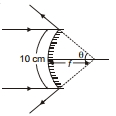
$A$ driving mirror consists of a cylindrical mirror of radius of curvature $10 \,cm$ and the length over the curved surface is $10 \,cm$. If the eye of the driver is assumed to be at a great distance from the mirror,then the field of view in radians is: (in $.0$)
A
$2$
B
$4$
C
$3$
D
$5$
Solution
(A) The radius of curvature of the cylindrical mirror is $R = 10 \,cm$.
The focal length $f$ of the mirror is given by $f = \frac{R}{2} = \frac{10 \,cm}{2} = 5 \,cm$.
The field of view $\theta$ (in radians) for an observer at a large distance is determined by the arc length $s$ and the focal length $f$ as $\theta = \frac{s}{f}$.
Given the arc length $s = 10 \,cm$ and $f = 5 \,cm$,we have:
$\theta = \frac{10 \,cm}{5 \,cm} = 2 \,rad$.
Thus,the correct option is $A$.
The focal length $f$ of the mirror is given by $f = \frac{R}{2} = \frac{10 \,cm}{2} = 5 \,cm$.
The field of view $\theta$ (in radians) for an observer at a large distance is determined by the arc length $s$ and the focal length $f$ as $\theta = \frac{s}{f}$.
Given the arc length $s = 10 \,cm$ and $f = 5 \,cm$,we have:
$\theta = \frac{10 \,cm}{5 \,cm} = 2 \,rad$.
Thus,the correct option is $A$.
0 likes
View Solution178
MediumMCQ
Assertion $(A):$ The relation among $u, v$ and $f$ for a spherical mirror is valid only for mirrors whose sizes are very small compared to their radii of curvature.
Reason $(R):$ The laws of reflection are strictly valid for plane surfaces but not for large spherical surfaces.
Reason $(R):$ The laws of reflection are strictly valid for plane surfaces but not for large spherical surfaces.
A
If Assertion is true but Reason is false.
B
If both Assertion and Reason are true but Reason is not the correct explanation of Assertion.
C
If both Assertion and Reason are true and Reason is correct explanation of Assertion.
D
If both Assertion and Reason are false.
Solution
(A) The mirror formula $\frac{1}{v} + \frac{1}{u} = \frac{1}{f}$ is derived using the paraxial approximation,which assumes that the rays are close to the principal axis and the mirror aperture is small compared to the radius of curvature. Thus,the Assertion $(A)$ is true.
The laws of reflection (angle of incidence equals angle of reflection) are fundamental laws of optics and are valid for any reflecting surface,whether plane or spherical,regardless of size. Therefore,the Reason $(R)$ is false.
The laws of reflection (angle of incidence equals angle of reflection) are fundamental laws of optics and are valid for any reflecting surface,whether plane or spherical,regardless of size. Therefore,the Reason $(R)$ is false.
0 likes
View Solution179
DifficultMCQ
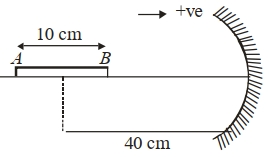
$A$ thin cylindrical rod of length $10\,cm$ is placed horizontally on the principal axis of a concave mirror of focal length $20\,cm$. The rod is placed in such a way that the midpoint of the rod is at $40\,cm$ from the pole of the mirror. The length of the image formed by the mirror will be $\frac{x}{3}\,cm$. The value of $x$ is $............$.
A
$30$
B
$32$
C
$31$
D
$59$
Solution
(B) Given: Focal length $f = -20\,cm$. The midpoint of the rod is at $40\,cm$ from the pole. Since the rod length is $10\,cm$,the ends $A$ and $B$ are at distances $u_A = -(40 + 5) = -45\,cm$ and $u_B = -(40 - 5) = -35\,cm$ from the pole.
Using the mirror formula $\frac{1}{v} + \frac{1}{u} = \frac{1}{f}$,we have $v = \frac{uf}{u-f}$.
For end $A$: $v_A = \frac{(-45)(-20)}{-45 - (-20)} = \frac{900}{-25} = -36\,cm$.
For end $B$: $v_B = \frac{(-35)(-20)}{-35 - (-20)} = \frac{700}{-15} = -\frac{140}{3}\,cm$.
The length of the image is $|v_A - v_B| = |-36 - (-140/3)| = |-108/3 + 140/3| = |32/3|\,cm$.
Comparing this with $\frac{x}{3}\,cm$,we get $x = 32$.
Using the mirror formula $\frac{1}{v} + \frac{1}{u} = \frac{1}{f}$,we have $v = \frac{uf}{u-f}$.
For end $A$: $v_A = \frac{(-45)(-20)}{-45 - (-20)} = \frac{900}{-25} = -36\,cm$.
For end $B$: $v_B = \frac{(-35)(-20)}{-35 - (-20)} = \frac{700}{-15} = -\frac{140}{3}\,cm$.
The length of the image is $|v_A - v_B| = |-36 - (-140/3)| = |-108/3 + 140/3| = |32/3|\,cm$.
Comparing this with $\frac{x}{3}\,cm$,we get $x = 32$.
1 likes
View Solution180
MediumMCQ
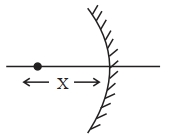
Two objects $A$ and $B$ are placed at $15\,cm$ and $25\,cm$ from the pole in front of a concave mirror having a radius of curvature $40\,cm$. The distance between the images formed by the mirror is $..........\,cm$.
A
$40$
B
$60$
C
$160$
D
$100$
Solution
(C) Given: Radius of curvature $R = -40\,cm$ (for concave mirror). Focal length $f = R/2 = -20\,cm$.
Using the mirror formula: $\frac{1}{v} + \frac{1}{u} = \frac{1}{f}$.
For object $A$ at $u_1 = -15\,cm$:
$\frac{1}{v_1} + \frac{1}{-15} = \frac{1}{-20} \implies \frac{1}{v_1} = -\frac{1}{20} + \frac{1}{15} = \frac{-3 + 4}{60} = \frac{1}{60}$.
So,$v_1 = 60\,cm$ (image is virtual and behind the mirror).
For object $B$ at $u_2 = -25\,cm$:
$\frac{1}{v_2} + \frac{1}{-25} = \frac{1}{-20} \implies \frac{1}{v_2} = -\frac{1}{20} + \frac{1}{25} = \frac{-5 + 4}{100} = -\frac{1}{100}$.
So,$v_2 = -100\,cm$ (image is real and in front of the mirror).
The distance between the images is $d = |v_1 - v_2| = |60 - (-100)| = 160\,cm$.
Using the mirror formula: $\frac{1}{v} + \frac{1}{u} = \frac{1}{f}$.
For object $A$ at $u_1 = -15\,cm$:
$\frac{1}{v_1} + \frac{1}{-15} = \frac{1}{-20} \implies \frac{1}{v_1} = -\frac{1}{20} + \frac{1}{15} = \frac{-3 + 4}{60} = \frac{1}{60}$.
So,$v_1 = 60\,cm$ (image is virtual and behind the mirror).
For object $B$ at $u_2 = -25\,cm$:
$\frac{1}{v_2} + \frac{1}{-25} = \frac{1}{-20} \implies \frac{1}{v_2} = -\frac{1}{20} + \frac{1}{25} = \frac{-5 + 4}{100} = -\frac{1}{100}$.
So,$v_2 = -100\,cm$ (image is real and in front of the mirror).
The distance between the images is $d = |v_1 - v_2| = |60 - (-100)| = 160\,cm$.
0 likes
View Solution181
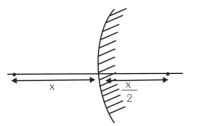
DifficultMCQ
$A$ convex mirror of radius of curvature $30 \,cm$ forms an image that is half the size of the object. The object distance is: (in $\,cm$)
A
$-15$
B
$45$
C
$-45$
D
$15$
Solution
(A) Given: Radius of curvature $R = 30 \,cm$.
Focal length $f = R / 2 = +15 \,cm$ (for a convex mirror).
Magnification $m = +1/2$ (since a convex mirror always forms a virtual, erect image for a real object).
Using the magnification formula for mirrors: $m = f / (f - u)$.
Substituting the values: $1/2 = 15 / (15 - u)$.
$15 - u = 30$.
$-u = 30 - 15$.
$-u = 15$.
$u = -15 \,cm$.
Thus, the object distance is $-15 \,cm$.
Focal length $f = R / 2 = +15 \,cm$ (for a convex mirror).
Magnification $m = +1/2$ (since a convex mirror always forms a virtual, erect image for a real object).
Using the magnification formula for mirrors: $m = f / (f - u)$.
Substituting the values: $1/2 = 15 / (15 - u)$.
$15 - u = 30$.
$-u = 30 - 15$.
$-u = 15$.
$u = -15 \,cm$.
Thus, the object distance is $-15 \,cm$.
0 likes
View Solution182
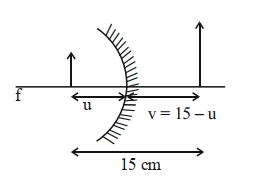
DifficultMCQ
If the distance between an object and its two times magnified virtual image produced by a curved mirror is $15 \,cm$, the focal length of the mirror must be:
A
$15 \,cm$
B
$-12 \,cm$
C
$-10 \,cm$
D
$10/3 \,cm$
Solution
(C) For a virtual image, magnification $m = +2$.
Using the magnification formula for a spherical mirror, $m = -v/u$.
Since the image is virtual, it is formed behind the mirror, so $v$ is positive. Let the object distance be $u$ (where $u$ is negative by sign convention).
The distance between the object and the image is $|v - u| = 15 \,cm$.
Since the object is in front of the mirror $(u < 0)$ and the virtual image is behind the mirror $(v > 0)$, the distance is $v - u = 15$.
Substituting $v = -mu = -2u$:
$-2u - u = 15
-3u = 15
u = -5 \,cm$.
Then, $v = -2(-5) = 10 \,cm$.
Using the mirror formula, $\frac{1}{f} = \frac{1}{v} + \frac{1}{u}$:
$\frac{1}{f} = \frac{1}{10} + \frac{1}{-5} = \frac{1 - 2}{10} = -\frac{1}{10}$.
Therefore, $f = -10 \,cm$.
Using the magnification formula for a spherical mirror, $m = -v/u$.
Since the image is virtual, it is formed behind the mirror, so $v$ is positive. Let the object distance be $u$ (where $u$ is negative by sign convention).
The distance between the object and the image is $|v - u| = 15 \,cm$.
Since the object is in front of the mirror $(u < 0)$ and the virtual image is behind the mirror $(v > 0)$, the distance is $v - u = 15$.
Substituting $v = -mu = -2u$:
$-2u - u = 15
-3u = 15
u = -5 \,cm$.
Then, $v = -2(-5) = 10 \,cm$.
Using the mirror formula, $\frac{1}{f} = \frac{1}{v} + \frac{1}{u}$:
$\frac{1}{f} = \frac{1}{10} + \frac{1}{-5} = \frac{1 - 2}{10} = -\frac{1}{10}$.
Therefore, $f = -10 \,cm$.
1 likes
View Solution183
AdvancedMCQ
In an experiment to determine the focal length $(f)$ of a concave mirror by the $u-v$ method,a student places the object pin $A$ on the principal axis at a distance $x$ from the pole $P$. The student looks at the pin and its inverted image from a distance keeping his/her eye in line with $PA$. When the student shifts his/her eye towards left,the image appears to the right of the object pin. Then,
A
$x < f$
B
$f < x < 2 f$
C
$x = 2 f$
D
$x > 2 f$
Solution
(B) The phenomenon described is known as parallax. When the eye is moved to the left,if the image appears to move to the right relative to the object,it indicates that the image is located behind the object pin (further from the mirror).
For a concave mirror,an inverted image is formed when the object is placed beyond the focal point $f$.
If the object is placed between $f$ and $2f$,the image is formed beyond $2f$.
Since the image is formed at a distance greater than the object distance,the image will appear to shift in the opposite direction to the eye's movement relative to the object.
Therefore,the object must be placed in the region $f < x < 2f$.
For a concave mirror,an inverted image is formed when the object is placed beyond the focal point $f$.
If the object is placed between $f$ and $2f$,the image is formed beyond $2f$.
Since the image is formed at a distance greater than the object distance,the image will appear to shift in the opposite direction to the eye's movement relative to the object.
Therefore,the object must be placed in the region $f < x < 2f$.
0 likes
View Solution184
MediumMCQ
$STATEMENT-1$: The formula connecting $u, v$ and $f$ for a spherical mirror is valid only for mirrors whose sizes are very small compared to their radii of curvature. because
$STATEMENT-2$: Laws of reflection are strictly valid for plane surfaces, but not for large spherical surfaces.
$STATEMENT-2$: Laws of reflection are strictly valid for plane surfaces, but not for large spherical surfaces.
A
$Statement-1$ is True, $Statement-2$ is True; $Statement-2$ is a correct explanation for $Statement-1$.
B
$Statement-1$ is True, $Statement-2$ is True; $Statement-2$ is $NOT$ a correct explanation for $Statement-1$.
C
$Statement-1$ is True, $Statement-2$ is False.
D
$Statement-1$ is False, $Statement-2$ is True.
Solution
(C) $Statement-1$ is True. The mirror formula $\frac{1}{f} = \frac{1}{v} + \frac{1}{u}$ is derived using the paraxial approximation, which assumes that the rays are close to the principal axis and the aperture of the mirror is small compared to the radius of curvature $(R)$.
$Statement-2$ is False. The laws of reflection (angle of incidence equals angle of reflection) are fundamental and hold true for any reflecting surface, whether plane or spherical, regardless of size. The deviation in large spherical mirrors is due to spherical aberration, not a violation of the laws of reflection.
$Statement-2$ is False. The laws of reflection (angle of incidence equals angle of reflection) are fundamental and hold true for any reflecting surface, whether plane or spherical, regardless of size. The deviation in large spherical mirrors is due to spherical aberration, not a violation of the laws of reflection.
0 likes
View Solution185
DifficultMCQ
$A$ student performed the experiment of determination of focal length of a concave mirror by $u-v$ method using an optical bench of length $1.5 \ m$. The focal length of the mirror used is $24 \ cm$. The maximum error in the location of the image can be $0.2 \ cm$. The $5$ sets of $(u, v)$ values recorded by the student (in $cm$) are: $(42, 56), (48, 48), (60, 40), (66, 33), (78, 39)$. The data set$(s)$ that cannot come from the experiment and is (are) incorrectly recorded,is (are):
$(A) (42, 56)$
$(B) (48, 48)$
$(C) (66, 33)$
$(D) (78, 39)$
$(A) (42, 56)$
$(B) (48, 48)$
$(C) (66, 33)$
$(D) (78, 39)$
A
$(B, D)$
B
$(C, A)$
C
$(C, D)$
D
$(A, B)$
Solution
(C) For a concave mirror,the focal length $f = -24 \ cm$. The mirror formula is $\frac{1}{v} + \frac{1}{u} = \frac{1}{f}$,which gives $v = \frac{uf}{u-f}$.
We check the recorded values against the theoretical values calculated using the mirror formula:
$1$. For $u = -42 \ cm$: $v = \frac{(-42)(-24)}{-42+24} = \frac{1008}{-18} = -56 \ cm$. (Matches)
$2$. For $u = -48 \ cm$: $v = \frac{(-48)(-24)}{-48+24} = \frac{1152}{-24} = -48 \ cm$. (Matches)
$3$. For $u = -60 \ cm$: $v = \frac{(-60)(-24)}{-60+24} = \frac{1440}{-36} = -40 \ cm$. (Matches)
$4$. For $u = -66 \ cm$: $v = \frac{(-66)(-24)}{-66+24} = \frac{1584}{-42} \approx -37.71 \ cm$. The recorded value is $33 \ cm$. The difference $|37.71 - 33| = 4.71 \ cm$,which is much greater than the error limit of $0.2 \ cm$.
$5$. For $u = -78 \ cm$: $v = \frac{(-78)(-24)}{-78+24} = \frac{1872}{-54} \approx -34.66 \ cm$. The recorded value is $39 \ cm$. The difference $|34.66 - 39| = 4.34 \ cm$,which is much greater than the error limit of $0.2 \ cm$.
Thus,the data sets $(66, 33)$ and $(78, 39)$ are incorrectly recorded.
We check the recorded values against the theoretical values calculated using the mirror formula:
$1$. For $u = -42 \ cm$: $v = \frac{(-42)(-24)}{-42+24} = \frac{1008}{-18} = -56 \ cm$. (Matches)
$2$. For $u = -48 \ cm$: $v = \frac{(-48)(-24)}{-48+24} = \frac{1152}{-24} = -48 \ cm$. (Matches)
$3$. For $u = -60 \ cm$: $v = \frac{(-60)(-24)}{-60+24} = \frac{1440}{-36} = -40 \ cm$. (Matches)
$4$. For $u = -66 \ cm$: $v = \frac{(-66)(-24)}{-66+24} = \frac{1584}{-42} \approx -37.71 \ cm$. The recorded value is $33 \ cm$. The difference $|37.71 - 33| = 4.71 \ cm$,which is much greater than the error limit of $0.2 \ cm$.
$5$. For $u = -78 \ cm$: $v = \frac{(-78)(-24)}{-78+24} = \frac{1872}{-54} \approx -34.66 \ cm$. The recorded value is $39 \ cm$. The difference $|34.66 - 39| = 4.34 \ cm$,which is much greater than the error limit of $0.2 \ cm$.
Thus,the data sets $(66, 33)$ and $(78, 39)$ are incorrectly recorded.
0 likes
View Solution186
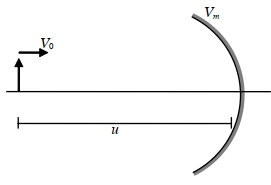
DifficultMCQ
An object and a concave mirror of focal length $f=10 \text{ cm}$ both move along the principal axis of the mirror with constant speeds. The object moves with speed $V_0=15 \text{ cm s}^{-1}$ towards the mirror with respect to a laboratory frame. The distance between the object and the mirror at a given moment is denoted by $u$. When $u=30 \text{ cm}$,the speed of the mirror $V_m$ is such that the image is instantaneously at rest with respect to the laboratory frame,and the object forms a real image. The magnitude of $V_m$ is . . . . . $\text{cm s}^{-1}$.
A
$3$
B
$4$
C
$5$
D
$6$
Solution
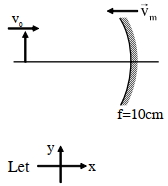
(A) Given: Focal length $f = -10 \text{ cm}$ (for a concave mirror),object distance $u = -30 \text{ cm}$.
Using the mirror formula $\frac{1}{v} + \frac{1}{u} = \frac{1}{f}$,we have $\frac{1}{v} = \frac{1}{-10} - \frac{1}{-30} = \frac{-3+1}{30} = -\frac{2}{30} = -\frac{1}{15}$.
Thus,$v = -15 \text{ cm}$.
The velocity of the image $v_I$ with respect to the mirror $v_m$ is given by $v_{I/m} = -\left(\frac{v}{u}\right)^2 v_{o/m}$.
Here,$v_{o/m} = v_o - v_m$ and $v_{I/m} = v_I - v_m$.
Given that the image is at rest with respect to the laboratory frame,$v_I = 0$.
So,$0 - v_m = -\left(\frac{-15}{-30}\right)^2 (v_o - v_m)$.
$-v_m = -\left(\frac{1}{2}\right)^2 (v_o - v_m) = -\frac{1}{4} (v_o - v_m)$.
$v_m = \frac{1}{4} v_o - \frac{1}{4} v_m$.
$\frac{5}{4} v_m = \frac{1}{4} v_o$.
$v_m = \frac{v_o}{5} = \frac{15}{5} = 3 \text{ cm s}^{-1}$.
Therefore,the magnitude of $V_m$ is $3 \text{ cm s}^{-1}$.
Using the mirror formula $\frac{1}{v} + \frac{1}{u} = \frac{1}{f}$,we have $\frac{1}{v} = \frac{1}{-10} - \frac{1}{-30} = \frac{-3+1}{30} = -\frac{2}{30} = -\frac{1}{15}$.
Thus,$v = -15 \text{ cm}$.
The velocity of the image $v_I$ with respect to the mirror $v_m$ is given by $v_{I/m} = -\left(\frac{v}{u}\right)^2 v_{o/m}$.
Here,$v_{o/m} = v_o - v_m$ and $v_{I/m} = v_I - v_m$.
Given that the image is at rest with respect to the laboratory frame,$v_I = 0$.
So,$0 - v_m = -\left(\frac{-15}{-30}\right)^2 (v_o - v_m)$.
$-v_m = -\left(\frac{1}{2}\right)^2 (v_o - v_m) = -\frac{1}{4} (v_o - v_m)$.
$v_m = \frac{1}{4} v_o - \frac{1}{4} v_m$.
$\frac{5}{4} v_m = \frac{1}{4} v_o$.
$v_m = \frac{v_o}{5} = \frac{15}{5} = 3 \text{ cm s}^{-1}$.
Therefore,the magnitude of $V_m$ is $3 \text{ cm s}^{-1}$.
0 likes
View Solution187
DifficultMCQ
$A$ driver sitting inside a parked car is watching vehicles approaching from behind with the help of a side-view mirror,which is a convex mirror with a radius of curvature $R = 2 \ m$. Another car approaches from behind with a uniform speed of $90 \ km/h$. When the car is at a distance of $24 \ m$ from the mirror,the magnitude of the acceleration of the image in the side-view mirror is $a$. The value of $100a$ is $m/s^2$.
A
$7$
B
$8$
C
$5$
D
$4$
Solution
(B) Given: $R = 2 \ m$,so focal length $f = R/2 = 1 \ m$. The speed of the object $v_0 = 90 \ km/h = 90 \times (5/18) = 25 \ m/s$. Since the object is approaching,$u = -24 \ m$ and $du/dt = v_0 = 25 \ m/s$.
Using the mirror formula $\frac{1}{v} + \frac{1}{u} = \frac{1}{f}$,we differentiate with respect to time: $-\frac{1}{v^2} \frac{dv}{dt} - \frac{1}{u^2} \frac{du}{dt} = 0$,which gives $v_I = \frac{dv}{dt} = -(\frac{v}{u})^2 v_0 = -m^2 v_0$.
For $u = -24 \ m$ and $f = 1 \ m$,$v = \frac{uf}{u-f} = \frac{(-24)(1)}{-24-1} = \frac{24}{25} \ m$.
Magnification $m = -v/u = -(\frac{24/25}{-24}) = \frac{1}{25}$.
Velocity of image $v_I = -m^2 v_0 = -(\frac{1}{25})^2 (25) = -\frac{1}{25} \ m/s$.
Differentiating the velocity equation $\frac{dv}{dt} = -(\frac{v}{u})^2 \frac{du}{dt}$ again with respect to time:
$a_I = \frac{d^2v}{dt^2} = -[2(\frac{v}{u})(\frac{u \frac{dv}{dt} - v \frac{du}{dt}}{u^2})] v_0 - (\frac{v}{u})^2 a_0$. Since $a_0 = 0$,$a_I = -2(\frac{v}{u})(\frac{u v_I - v v_0}{u^2}) v_0$.
Substituting values: $a_I = -2(\frac{24/25}{-24})(\frac{(-24)(-1/25) - (24/25)(25)}{(-24)^2}) (25) = -2(-\frac{1}{25})(\frac{24/25 - 24}{576}) (25) = 2(\frac{1}{25})(\frac{24 - 600}{25 \times 576}) (25) = 2(\frac{-576}{25 \times 576}) = -\frac{2}{25} \ m/s^2$.
The magnitude $a = |-\frac{2}{25}| = 0.08 \ m/s^2$. Thus,$100a = 100 \times 0.08 = 8$.
Using the mirror formula $\frac{1}{v} + \frac{1}{u} = \frac{1}{f}$,we differentiate with respect to time: $-\frac{1}{v^2} \frac{dv}{dt} - \frac{1}{u^2} \frac{du}{dt} = 0$,which gives $v_I = \frac{dv}{dt} = -(\frac{v}{u})^2 v_0 = -m^2 v_0$.
For $u = -24 \ m$ and $f = 1 \ m$,$v = \frac{uf}{u-f} = \frac{(-24)(1)}{-24-1} = \frac{24}{25} \ m$.
Magnification $m = -v/u = -(\frac{24/25}{-24}) = \frac{1}{25}$.
Velocity of image $v_I = -m^2 v_0 = -(\frac{1}{25})^2 (25) = -\frac{1}{25} \ m/s$.
Differentiating the velocity equation $\frac{dv}{dt} = -(\frac{v}{u})^2 \frac{du}{dt}$ again with respect to time:
$a_I = \frac{d^2v}{dt^2} = -[2(\frac{v}{u})(\frac{u \frac{dv}{dt} - v \frac{du}{dt}}{u^2})] v_0 - (\frac{v}{u})^2 a_0$. Since $a_0 = 0$,$a_I = -2(\frac{v}{u})(\frac{u v_I - v v_0}{u^2}) v_0$.
Substituting values: $a_I = -2(\frac{24/25}{-24})(\frac{(-24)(-1/25) - (24/25)(25)}{(-24)^2}) (25) = -2(-\frac{1}{25})(\frac{24/25 - 24}{576}) (25) = 2(\frac{1}{25})(\frac{24 - 600}{25 \times 576}) (25) = 2(\frac{-576}{25 \times 576}) = -\frac{2}{25} \ m/s^2$.
The magnitude $a = |-\frac{2}{25}| = 0.08 \ m/s^2$. Thus,$100a = 100 \times 0.08 = 8$.
0 likes
View Solution188
EasyMCQ
$A$ concave mirror of focal length $f$ in air is dipped in a liquid of refractive index $\mu$. Its focal length in the liquid will be $:$
A
$\frac{f}{\mu}$
B
$\frac{f}{(\mu-1)}$
C
$\mu f$
D
$f$
Solution
(D) The focal length of a spherical mirror is given by the formula $f = \frac{R}{2}$,where $R$ is the radius of curvature of the mirror.
This formula depends only on the geometry of the mirror surface.
Unlike lenses,the focal length of a mirror does not depend on the refractive index of the surrounding medium.
Therefore,when the mirror is dipped in a liquid of refractive index $\mu$,its focal length remains unchanged.
Thus,the focal length in the liquid will be $f$.
This formula depends only on the geometry of the mirror surface.
Unlike lenses,the focal length of a mirror does not depend on the refractive index of the surrounding medium.
Therefore,when the mirror is dipped in a liquid of refractive index $\mu$,its focal length remains unchanged.
Thus,the focal length in the liquid will be $f$.
0 likes
View Solution189
MediumMCQ
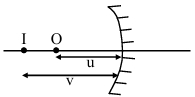
$A$ concave mirror produces an image of an object such that the distance between the object and the image is $20\ cm$. If the magnification of the image is $-3$,then the magnitude of the radius of curvature of the mirror is: (in $cm$)
A
$3.75$
B
$30$
C
$7.5$
D
$15$
Solution
(D) Given magnification $m = -3$. We know that $m = -v/u$,so $-v/u = -3$,which implies $v = 3u$.
Since the image is real and formed by a concave mirror,both $u$ and $v$ are negative. The distance between the object and the image is $|v - u| = 20\ cm$.
Since the image is formed at a greater distance than the object for $m = -3$,we have $|v| > |u|$. Thus,$v - u = -20\ cm$ (using sign convention where $v$ and $u$ are negative).
Substituting $v = 3u$,we get $3u - u = -20$,so $2u = -20$,which gives $u = -10\ cm$.
Then $v = 3(-10) = -30\ cm$.
Using the mirror formula $1/f = 1/v + 1/u = 1/(-30) + 1/(-10) = (-1 - 3)/30 = -4/30 = -2/15$.
So,$f = -7.5\ cm$.
The radius of curvature $R = 2|f| = 2 \times 7.5 = 15\ cm$.
Since the image is real and formed by a concave mirror,both $u$ and $v$ are negative. The distance between the object and the image is $|v - u| = 20\ cm$.
Since the image is formed at a greater distance than the object for $m = -3$,we have $|v| > |u|$. Thus,$v - u = -20\ cm$ (using sign convention where $v$ and $u$ are negative).
Substituting $v = 3u$,we get $3u - u = -20$,so $2u = -20$,which gives $u = -10\ cm$.
Then $v = 3(-10) = -30\ cm$.
Using the mirror formula $1/f = 1/v + 1/u = 1/(-30) + 1/(-10) = (-1 - 3)/30 = -4/30 = -2/15$.
So,$f = -7.5\ cm$.
The radius of curvature $R = 2|f| = 2 \times 7.5 = 15\ cm$.
0 likes
View Solution190
DifficultMCQ
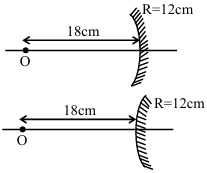
Two identical objects are placed in front of a convex mirror and a concave mirror,both having a radius of curvature of $12 \ cm$,at the same distance of $18 \ cm$ from the respective mirrors. The ratio of the sizes of the images formed by the convex mirror to that formed by the concave mirror is:
A
$1 / 2$
B
$2$
C
$3$
D
$1 / 3$
Solution
(A) Given,radius of curvature $R = 12 \ cm$. The focal length $f = R / 2 = 6 \ cm$.
For a concave mirror,$f = -6 \ cm$ and object distance $u = -18 \ cm$. Using the magnification formula $m = f / (f - u)$:
$m_{concave} = -6 / (-6 - (-18)) = -6 / 12 = -1 / 2$. The size of the image is $|m_{concave}| = 1 / 2$.
For a convex mirror,$f = +6 \ cm$ and object distance $u = -18 \ cm$. Using the magnification formula $m = f / (f - u)$:
$m_{convex} = 6 / (6 - (-18)) = 6 / 24 = 1 / 4$. The size of the image is $|m_{convex}| = 1 / 4$.
The ratio of the size of the image formed by the convex mirror to that formed by the concave mirror is:
Ratio $= |m_{convex}| / |m_{concave}| = (1 / 4) / (1 / 2) = 1 / 2$.
For a concave mirror,$f = -6 \ cm$ and object distance $u = -18 \ cm$. Using the magnification formula $m = f / (f - u)$:
$m_{concave} = -6 / (-6 - (-18)) = -6 / 12 = -1 / 2$. The size of the image is $|m_{concave}| = 1 / 2$.
For a convex mirror,$f = +6 \ cm$ and object distance $u = -18 \ cm$. Using the magnification formula $m = f / (f - u)$:
$m_{convex} = 6 / (6 - (-18)) = 6 / 24 = 1 / 4$. The size of the image is $|m_{convex}| = 1 / 4$.
The ratio of the size of the image formed by the convex mirror to that formed by the concave mirror is:
Ratio $= |m_{convex}| / |m_{concave}| = (1 / 4) / (1 / 2) = 1 / 2$.
0 likes
View Solution191
DifficultMCQ
When an object is placed $40\ cm$ away from a spherical mirror,an image of magnification $\frac{1}{2}$ is produced. To obtain an image with magnification of $\frac{1}{3}$,the object is to be moved $:$
A
$40\ cm$ away from the mirror.
B
$80\ cm$ away from the mirror.
C
$20\ cm$ towards the mirror.
D
$20\ cm$ away from the mirror.
Solution
(A) The magnification formula for a spherical mirror is $m = \frac{f}{f-u}$.
Given $m = \frac{1}{2}$ and $u = -40\ cm$,we have $\frac{1}{2} = \frac{f}{f - (-40)}$.
$f + 40 = 2f$,which gives $f = 40\ cm$.
Now,to obtain a magnification of $m = \frac{1}{3}$,we use the same formula: $\frac{1}{3} = \frac{40}{40 - u'}$.
$40 - u' = 120$,so $u' = -80\ cm$.
The object was initially at $40\ cm$ and is now at $80\ cm$ from the mirror.
Therefore,the object must be moved $80 - 40 = 40\ cm$ away from the mirror.
Given $m = \frac{1}{2}$ and $u = -40\ cm$,we have $\frac{1}{2} = \frac{f}{f - (-40)}$.
$f + 40 = 2f$,which gives $f = 40\ cm$.
Now,to obtain a magnification of $m = \frac{1}{3}$,we use the same formula: $\frac{1}{3} = \frac{40}{40 - u'}$.
$40 - u' = 120$,so $u' = -80\ cm$.
The object was initially at $40\ cm$ and is now at $80\ cm$ from the mirror.
Therefore,the object must be moved $80 - 40 = 40\ cm$ away from the mirror.
0 likes
View Solution192
DifficultMCQ
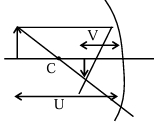
The distance between an object and its image (magnified by $-\frac{1}{3}$) is $30 \ cm$. The focal length of the mirror used is $\left(\frac{x}{4}\right) \ cm$,where the magnitude of the value of $x$ is . . . . . . .
A
$45$
B
$44$
C
$49$
D
$46$
Solution
(A) Given magnification $M = -\frac{1}{3}$.
Since $M = -\frac{v}{u}$,we have $-\frac{v}{u} = -\frac{1}{3}$,which implies $v = \frac{u}{3}$.
The distance between the object and the image is given by $|u - v| = 30 \ cm$. Since the image is real and inverted (magnification is negative),both object and image are on the same side of the mirror. Thus,$|u| - |v| = 30 \ cm$. Let $u = -u_0$ and $v = -v_0$,then $u_0 - v_0 = 30$.
Substituting $v_0 = \frac{u_0}{3}$,we get $u_0 - \frac{u_0}{3} = 30 \Rightarrow \frac{2u_0}{3} = 30 \Rightarrow u_0 = 45 \ cm$.
So,$u = -45 \ cm$ and $v = -15 \ cm$.
Using the mirror formula $\frac{1}{f} = \frac{1}{v} + \frac{1}{u}$:
$\frac{1}{f} = \frac{1}{-15} + \frac{1}{-45} = \frac{-3 - 1}{45} = -\frac{4}{45}$.
Therefore,$f = -\frac{45}{4} \ cm$.
The magnitude of the focal length is $\frac{45}{4} \ cm$. Comparing this with $\frac{x}{4} \ cm$,we get $x = 45$.
Since $M = -\frac{v}{u}$,we have $-\frac{v}{u} = -\frac{1}{3}$,which implies $v = \frac{u}{3}$.
The distance between the object and the image is given by $|u - v| = 30 \ cm$. Since the image is real and inverted (magnification is negative),both object and image are on the same side of the mirror. Thus,$|u| - |v| = 30 \ cm$. Let $u = -u_0$ and $v = -v_0$,then $u_0 - v_0 = 30$.
Substituting $v_0 = \frac{u_0}{3}$,we get $u_0 - \frac{u_0}{3} = 30 \Rightarrow \frac{2u_0}{3} = 30 \Rightarrow u_0 = 45 \ cm$.
So,$u = -45 \ cm$ and $v = -15 \ cm$.
Using the mirror formula $\frac{1}{f} = \frac{1}{v} + \frac{1}{u}$:
$\frac{1}{f} = \frac{1}{-15} + \frac{1}{-45} = \frac{-3 - 1}{45} = -\frac{4}{45}$.
Therefore,$f = -\frac{45}{4} \ cm$.
The magnitude of the focal length is $\frac{45}{4} \ cm$. Comparing this with $\frac{x}{4} \ cm$,we get $x = 45$.
0 likes
View Solution193
DifficultMCQ
$A$ mirror is used to produce an image with magnification of $\frac{1}{4}$. If the distance between the object and its image is $40 \ cm$,then the focal length of the mirror is . . . . . . . (in $cm$)
A
$10$
B
$12.7$
C
$10.7$
D
$15$
Solution
(C) Given magnification $m = \frac{1}{4}$. Since the image is smaller than the object and formed by a mirror,we assume a concave mirror forming a real image.
For a real image,$m = -\frac{v}{u} = -\frac{1}{4}$,so $u = 4v$.
The distance between the object and the image is $|u - v| = 40 \ cm$.
Since $u$ and $v$ are on the same side for a real image,$u - v = 40 \ cm$.
Substituting $u = 4v$,we get $4v - v = 40 \implies 3v = 40 \implies v = \frac{40}{3} \ cm$.
Then $u = 4 \times \frac{40}{3} = \frac{160}{3} \ cm$.
Using the mirror formula $\frac{1}{f} = \frac{1}{v} + \frac{1}{u}$ with sign convention ($u = -\frac{160}{3} \ cm$,$v = -\frac{40}{3} \ cm$):
$\frac{1}{f} = -\frac{3}{40} - \frac{3}{160} = \frac{-12 - 3}{160} = -\frac{15}{160} = -\frac{3}{32}$.
$f = -\frac{32}{3} \approx -10.7 \ cm$.
The magnitude of the focal length is $10.7 \ cm$.
For a real image,$m = -\frac{v}{u} = -\frac{1}{4}$,so $u = 4v$.
The distance between the object and the image is $|u - v| = 40 \ cm$.
Since $u$ and $v$ are on the same side for a real image,$u - v = 40 \ cm$.
Substituting $u = 4v$,we get $4v - v = 40 \implies 3v = 40 \implies v = \frac{40}{3} \ cm$.
Then $u = 4 \times \frac{40}{3} = \frac{160}{3} \ cm$.
Using the mirror formula $\frac{1}{f} = \frac{1}{v} + \frac{1}{u}$ with sign convention ($u = -\frac{160}{3} \ cm$,$v = -\frac{40}{3} \ cm$):
$\frac{1}{f} = -\frac{3}{40} - \frac{3}{160} = \frac{-12 - 3}{160} = -\frac{15}{160} = -\frac{3}{32}$.
$f = -\frac{32}{3} \approx -10.7 \ cm$.
The magnitude of the focal length is $10.7 \ cm$.
0 likes
View Solution194
DifficultMCQ
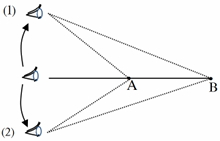
In an experiment to determine the focal length $(f)$ of a concave mirror by the parallax method,a student places the object pin $\text{A}$ on the principal axis at a distance $x$ from the pole $\text{P}$. The student looks at the pin and its inverted image from a distance,keeping his/her eye in line with $\text{PA}$. When the student shifts his/her eye towards the left,the image appears to the right of the pin. Then:
A
$x < f$
B
$f < x < 2f$
C
$x = 2f$
D
$x > 2f$
Solution
(B) In the parallax method,if the eye is shifted to the left and the image appears to shift to the right relative to the object pin,it implies that the image is further away from the eye than the object pin.
Let the position of the object pin be $O$ and the position of the image be $I$. If the image $I$ is further from the eye than the object $O$,then the image $I$ is behind the object $O$ (further from the pole $\text{P}$).
For a concave mirror,an inverted image is formed behind the object when the object is placed between the focus $f$ and the center of curvature $2f$. In this region,the image is formed beyond $2f$.
Therefore,the condition for the object distance $x$ is $f < x < 2f$.
Let the position of the object pin be $O$ and the position of the image be $I$. If the image $I$ is further from the eye than the object $O$,then the image $I$ is behind the object $O$ (further from the pole $\text{P}$).
For a concave mirror,an inverted image is formed behind the object when the object is placed between the focus $f$ and the center of curvature $2f$. In this region,the image is formed beyond $2f$.
Therefore,the condition for the object distance $x$ is $f < x < 2f$.
0 likes
View Solution195
MediumMCQ
What will be the height of the image when an object of height $2 \ mm$ is placed on the principal axis of a convex mirror (of radius of curvature $40 \ cm$) at a distance of $20 \ cm$ from the mirror?
A
$20$
B
$10$
C
$6$
D
$1$
Solution
(D) Given: Object height $h_o = 2 \ mm = 2 \times 10^{-3} \ m$. Radius of curvature $R = +40 \ cm$ (for convex mirror). Focal length $f = R/2 = +20 \ cm$. Object distance $u = -20 \ cm$.
Using the mirror formula: $\frac{1}{v} + \frac{1}{u} = \frac{1}{f} \Rightarrow \frac{1}{v} - \frac{1}{20} = \frac{1}{20}$.
$\frac{1}{v} = \frac{1}{20} + \frac{1}{20} = \frac{2}{20} = \frac{1}{10} \Rightarrow v = +10 \ cm$.
Magnification $m = -\frac{v}{u} = \frac{h_i}{h_o}$.
$m = -\frac{10}{-20} = +0.5$.
$h_i = m \times h_o = 0.5 \times 2 \ mm = 1 \ mm$.
Using the mirror formula: $\frac{1}{v} + \frac{1}{u} = \frac{1}{f} \Rightarrow \frac{1}{v} - \frac{1}{20} = \frac{1}{20}$.
$\frac{1}{v} = \frac{1}{20} + \frac{1}{20} = \frac{2}{20} = \frac{1}{10} \Rightarrow v = +10 \ cm$.
Magnification $m = -\frac{v}{u} = \frac{h_i}{h_o}$.
$m = -\frac{10}{-20} = +0.5$.
$h_i = m \times h_o = 0.5 \times 2 \ mm = 1 \ mm$.
0 likes
View Solution196
MediumMCQ
The focal length of a concave mirror is $20 \ cm$. Determine where an object must be placed to form an image,magnified two times and real.
A
$30 \ cm$ from the mirror
B
$10 \ cm$ from the mirror
C
$20 \ cm$ from the mirror
D
$15 \ cm$ from the mirror
Solution
(A) For a concave mirror,the focal length $f = -20 \ cm$.
Since the image is real and magnified two times,the magnification $m = -2$.
The formula for magnification in terms of focal length and object distance is $m = \frac{f}{f - u}$.
Substituting the values: $-2 = \frac{-20}{-20 - u}$.
$-2(-20 - u) = -20$.
$40 + 2u = -20$.
$2u = -60$.
$u = -30 \ cm$.
Thus,the object must be placed at a distance of $30 \ cm$ in front of the mirror.
Since the image is real and magnified two times,the magnification $m = -2$.
The formula for magnification in terms of focal length and object distance is $m = \frac{f}{f - u}$.
Substituting the values: $-2 = \frac{-20}{-20 - u}$.
$-2(-20 - u) = -20$.
$40 + 2u = -20$.
$2u = -60$.
$u = -30 \ cm$.
Thus,the object must be placed at a distance of $30 \ cm$ in front of the mirror.
0 likes
View Solution197
MediumMCQ
The focal length of a concave mirror is $f$ and the distance from the object to the principal focus is $x$. The magnification will be:
A
$\frac{f}{x}$
B
$\frac{x}{f}$
C
$\sqrt{\frac{f}{x}}$
D
$\frac{f^2}{x^2}$
Solution
(A) For a concave mirror,the focal length is taken as $-f$.
The distance of the object from the principal focus is $x$. Since the object is placed in front of the mirror,the object distance $u = -(f + x)$.
Using the mirror formula: $\frac{1}{v} + \frac{1}{u} = \frac{1}{f_{mirror}}$
$\frac{1}{v} + \frac{1}{-(f+x)} = \frac{1}{-f}$
$\frac{1}{v} = \frac{1}{f+x} - \frac{1}{f} = \frac{f - (f+x)}{f(f+x)} = \frac{-x}{f(f+x)}$
$v = -\frac{f(f+x)}{x}$
Magnification $m = -\frac{v}{u} = -\left( \frac{-\frac{f(f+x)}{x}}{-(f+x)} \right) = -\frac{f}{x}$
The magnitude of magnification is $|m| = \frac{f}{x}$.
The distance of the object from the principal focus is $x$. Since the object is placed in front of the mirror,the object distance $u = -(f + x)$.
Using the mirror formula: $\frac{1}{v} + \frac{1}{u} = \frac{1}{f_{mirror}}$
$\frac{1}{v} + \frac{1}{-(f+x)} = \frac{1}{-f}$
$\frac{1}{v} = \frac{1}{f+x} - \frac{1}{f} = \frac{f - (f+x)}{f(f+x)} = \frac{-x}{f(f+x)}$
$v = -\frac{f(f+x)}{x}$
Magnification $m = -\frac{v}{u} = -\left( \frac{-\frac{f(f+x)}{x}}{-(f+x)} \right) = -\frac{f}{x}$
The magnitude of magnification is $|m| = \frac{f}{x}$.
0 likes
View Solution198
MediumMCQ
Incident parallel rays make an angle of $5^{\circ}$ with the axis of a concave mirror of focal length $20 \ cm$. The perpendicular distance of the image from the axis is nearly $-$ (in $cm$)
A
$0$
B
$1.75$
C
$20$
D
$10$
Solution
(B) For a concave mirror,parallel rays incident at an angle $\theta$ with the principal axis focus on the focal plane at a distance $y$ from the axis.
Using the small angle approximation,the distance $y$ from the axis is given by $y = f \tan \theta$.
Given $f = 20 \ cm$ and $\theta = 5^{\circ}$.
Converting the angle to radians: $\theta = 5 \times \frac{\pi}{180} \approx 0.0873 \ rad$.
Since $\tan \theta \approx \theta$ for small angles,$y = 20 \times (5 \times \frac{\pi}{180})$.
$y = 20 \times 0.08726 = 1.745 \ cm$.
Rounding to the nearest value,$y \approx 1.75 \ cm$.
Using the small angle approximation,the distance $y$ from the axis is given by $y = f \tan \theta$.
Given $f = 20 \ cm$ and $\theta = 5^{\circ}$.
Converting the angle to radians: $\theta = 5 \times \frac{\pi}{180} \approx 0.0873 \ rad$.
Since $\tan \theta \approx \theta$ for small angles,$y = 20 \times (5 \times \frac{\pi}{180})$.
$y = 20 \times 0.08726 = 1.745 \ cm$.
Rounding to the nearest value,$y \approx 1.75 \ cm$.
0 likes
View Solution199
EasyMCQ
$A$ concave mirror of focal length $60 \ cm$ forms a real image of size $5$ times the size of a real object. Find the distance between the mirror and the object. (in $cm$)
A
$48$
B
$80$
C
$56$
D
$72$
Solution
(D) For a concave mirror,the focal length $f = -60 \ cm$.
Since the image is real,the magnification $m = -5$.
The formula for magnification in terms of focal length and object distance $u$ is $m = \frac{f}{f - u}$.
Substituting the given values: $-5 = \frac{-60}{-60 - u}$.
Multiplying both sides by $(-60 - u)$,we get: $-5(-60 - u) = -60$.
$300 + 5u = -60$.
$5u = -60 - 300$.
$5u = -360$.
$u = -72 \ cm$.
The distance between the mirror and the object is the magnitude of $u$,which is $72 \ cm$.
Since the image is real,the magnification $m = -5$.
The formula for magnification in terms of focal length and object distance $u$ is $m = \frac{f}{f - u}$.
Substituting the given values: $-5 = \frac{-60}{-60 - u}$.
Multiplying both sides by $(-60 - u)$,we get: $-5(-60 - u) = -60$.
$300 + 5u = -60$.
$5u = -60 - 300$.
$5u = -360$.
$u = -72 \ cm$.
The distance between the mirror and the object is the magnitude of $u$,which is $72 \ cm$.
0 likes
View Solution200
DifficultMCQ
$A$ square wire frame of side $3 \ cm$ is placed $25 \ cm$ away from a concave mirror of focal length $10 \ cm$. What is the area enclosed by the image of the wire? (The centre of the square wire is on the axis of the mirror and the plane is perpendicular to the principal axis).
A
$2$
B
$4$
C
$9$
D
$0$
Solution
(B) Given: Focal length $f = -10 \ cm$,Object distance $u = -25 \ cm$,Area of object $A_{\text{obj}} = (3 \ cm)^2 = 9 \ cm^2$.
Using the mirror formula $\frac{1}{v} + \frac{1}{u} = \frac{1}{f}$,the magnification $m$ is given by $m = \frac{f}{f-u}$.
Substituting the values: $m = \frac{-10}{-10 - (-25)} = \frac{-10}{15} = -\frac{2}{3}$.
The area of the image $A_{\text{image}}$ is related to the area of the object by $A_{\text{image}} = m^2 \times A_{\text{obj}}$.
$A_{\text{image}} = \left(-\frac{2}{3}\right)^2 \times 9 = \frac{4}{9} \times 9 = 4 \ cm^2$.
Using the mirror formula $\frac{1}{v} + \frac{1}{u} = \frac{1}{f}$,the magnification $m$ is given by $m = \frac{f}{f-u}$.
Substituting the values: $m = \frac{-10}{-10 - (-25)} = \frac{-10}{15} = -\frac{2}{3}$.
The area of the image $A_{\text{image}}$ is related to the area of the object by $A_{\text{image}} = m^2 \times A_{\text{obj}}$.
$A_{\text{image}} = \left(-\frac{2}{3}\right)^2 \times 9 = \frac{4}{9} \times 9 = 4 \ cm^2$.
0 likes
View SolutionRay Optics and Optical Instruments — Spherical Mirror · Frequently Asked Questions
1Are these Ray Optics and Optical Instruments questions useful for JEE and NEET?
Yes. All questions in this section are mapped to JEE Main and NEET exam patterns. Previous year questions from JEE Main, NEET, GUJCET and state-level exams are included with full solutions.
2Can I switch to Hindi or Gujarati for these questions?
Yes. Use the language tabs in the hero section or the sidebar to view the same questions and solutions in English, Hindi or Gujarati.
3How do I generate a question paper from this subtopic?
Use the Vedclass Exam Paper Generator — select the chapter and subtopic, set difficulty, and generate Sets A, B, C, D automatically. First 3 chapters of every subject are free.
Vedclass Products
For Students
Vedclass Test Series
Mock tests in real JEE/NEET style with performance analysis. 5-day free trial.
Start Free TrialFor Teachers
Exam Paper Generator
Generate Set A/B/C/D papers from this chapter in 2 minutes. 3 chapters free.
Try FreeFor Institutes
Online Exam Module
Live online exams with unlimited students, 360° analytics & white-label branding.
See DemoFor Teachers & Institutes
Generate a Ray Optics and Optical Instruments Exam Paper in 2 Minutes
Select subtopic & difficulty — Sets A, B, C, D auto-generated with No Repeat logic.
First 3 chapters of every subject are free — no payment required.