
A English
Scattering of light and Some Natural Phenomenon of Sunlight Questions in English
Class 12 Physics · Ray Optics and Optical Instruments · Scattering of light and Some Natural Phenomenon of Sunlight
50+
Questions
English
Language
100%
With Solutions
Showing 49 of 50 questions in English
1
EasyMCQ
To an astronaut in a spaceship,the sky appears
A
Black
B
White
C
Green
D
Blue
Solution
(A) The sky appears blue from the surface of the Earth due to the scattering of sunlight by the atmosphere (Rayleigh scattering). However,in space,there is no atmosphere to scatter the sunlight. Since there is no scattering of light,no light reaches the astronaut's eyes from the direction of the sky,making it appear black. Therefore,the correct option is $A$.
0 likes
View Solution2
EasyMCQ
To an observer on the earth,the stars appear to twinkle. This can be ascribed to
A
The fact that stars do not emit light continuously
B
Frequent absorption of star light by their own atmosphere
C
Frequent absorption of star light by the earth's atmosphere
D
The refractive index fluctuations in the earth's atmosphere
Solution
(D) The twinkling of stars is caused by atmospheric refraction.
As light from a star enters the $Earth$'s atmosphere,it undergoes continuous refraction due to the changing refractive index of the air layers at different altitudes.
These layers have varying temperatures and densities,which cause the path of the light to fluctuate.
Consequently,the apparent position and brightness of the star change rapidly,which we perceive as twinkling.
As light from a star enters the $Earth$'s atmosphere,it undergoes continuous refraction due to the changing refractive index of the air layers at different altitudes.
These layers have varying temperatures and densities,which cause the path of the light to fluctuate.
Consequently,the apparent position and brightness of the star change rapidly,which we perceive as twinkling.
0 likes
View Solution3
EasyMCQ
The reason for seeing the Sun a little before the sunrise is:
A
Reflection of light
B
Refraction of light
C
Scattering of light
D
Dispersion of light
Solution
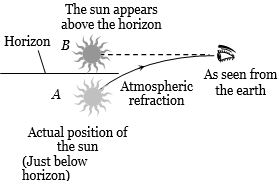
(B) The Earth's atmosphere consists of layers of air with varying densities. As sunlight enters the atmosphere from space,it travels from a rarer medium to a denser medium,causing it to bend towards the normal. This phenomenon is known as atmospheric refraction.
When the Sun is slightly below the horizon,the light rays from the Sun travel through the atmosphere and bend due to refraction. This bending makes the Sun appear to be at a higher position than its actual position. Consequently,an observer on Earth sees the Sun a few minutes before it actually rises above the horizon.
When the Sun is slightly below the horizon,the light rays from the Sun travel through the atmosphere and bend due to refraction. This bending makes the Sun appear to be at a higher position than its actual position. Consequently,an observer on Earth sees the Sun a few minutes before it actually rises above the horizon.
0 likes
View Solution4
EasyMCQ
Stars are twinkling due to
A
Diffraction
B
Reflection
C
Refraction
D
Scattering
Solution
(C) The twinkling of stars is caused by the atmospheric refraction of starlight.
As starlight enters the Earth's atmosphere,it undergoes continuous refraction due to the changing refractive index of the different layers of air.
These layers have varying temperatures and densities,which cause the light to bend along a curved path.
Because the atmosphere is turbulent and constantly moving,the amount of light reaching the observer's eye fluctuates,resulting in the apparent twinkling effect.
As starlight enters the Earth's atmosphere,it undergoes continuous refraction due to the changing refractive index of the different layers of air.
These layers have varying temperatures and densities,which cause the light to bend along a curved path.
Because the atmosphere is turbulent and constantly moving,the amount of light reaching the observer's eye fluctuates,resulting in the apparent twinkling effect.
0 likes
View Solution5
EasyMCQ
An astronaut in a spaceship sees the outer space as
A
White
B
Black
C
Blue
D
Red
Solution
(B) The outer space appears black to an astronaut in a spaceship because there is no atmosphere present in space.
Due to the absence of an atmosphere,there are no gas molecules or particles to scatter the sunlight.
Since scattering of light is the phenomenon responsible for the blue color of the sky on Earth,its absence in space results in the sky appearing black.
Due to the absence of an atmosphere,there are no gas molecules or particles to scatter the sunlight.
Since scattering of light is the phenomenon responsible for the blue color of the sky on Earth,its absence in space results in the sky appearing black.
0 likes
View Solution6
EasyMCQ
The fine powder of a coloured glass is seen as
A
Coloured
B
White
C
That of the glass colour
D
Black
Solution
(B) When a coloured glass is ground into a fine powder,the individual particles become very small.
Each particle acts as a tiny surface that reflects all the incident light falling on it,rather than absorbing specific wavelengths as the bulk glass does.
Because the light is scattered and reflected from these numerous tiny surfaces in all directions,the powder appears white to the human eye.
Therefore,the correct option is $B$.
Each particle acts as a tiny surface that reflects all the incident light falling on it,rather than absorbing specific wavelengths as the bulk glass does.
Because the light is scattered and reflected from these numerous tiny surfaces in all directions,the powder appears white to the human eye.
Therefore,the correct option is $B$.
0 likes
View Solution7
EasyMCQ
Which of the following statements is true regarding rainbows?
A
The order of colours in the primary and the secondary rainbows is the same.
B
The intensity of colours in the primary and the secondary rainbows is the same.
C
The intensity of light in the primary rainbow is greater and the order of colours is the same as in the secondary rainbow.
D
The intensity of light for different colours in the primary rainbow is greater and the order of colours is reversed compared to the secondary rainbow.
Solution
(D) primary rainbow is formed due to one total internal reflection and two refractions of white light within a water droplet.
$A$ secondary rainbow is formed when light entering a raindrop undergoes two internal reflections,which results in a loss of intensity due to the extra reflection.
In a primary rainbow,the red colour is on the outer edge and violet is on the inner edge. In a secondary rainbow,this order is reversed (violet on the outer edge and red on the inner edge).
Therefore,the primary rainbow is brighter than the secondary rainbow,and their colour orders are reversed.
$A$ secondary rainbow is formed when light entering a raindrop undergoes two internal reflections,which results in a loss of intensity due to the extra reflection.
In a primary rainbow,the red colour is on the outer edge and violet is on the inner edge. In a secondary rainbow,this order is reversed (violet on the outer edge and red on the inner edge).
Therefore,the primary rainbow is brighter than the secondary rainbow,and their colour orders are reversed.
0 likes
View Solution8
EasyMCQ
What will be the colour of the sky as seen from the Earth if there were no atmosphere?
A
Black
B
Blue
C
Orange
D
Red
Solution
(A) The blue colour of the sky is due to the scattering of sunlight by the particles present in the atmosphere.
In the absence of an atmosphere,there would be no particles to scatter the sunlight.
Therefore,no light would reach the observer's eye from the directions other than the Sun.
Consequently,the sky would appear black.
In the absence of an atmosphere,there would be no particles to scatter the sunlight.
Therefore,no light would reach the observer's eye from the directions other than the Sun.
Consequently,the sky would appear black.
0 likes
View Solution9
EasyMCQ
At sunrise or sunset,the sun looks more red than at midday because
A
The sun is hottest at these times
B
Of the scattering of light
C
Of the effects of refraction
D
Of the effects of diffraction
Solution
(B) The correct answer is $(B)$.
According to Rayleigh's law of scattering,the intensity of scattered light $(I)$ is inversely proportional to the fourth power of its wavelength $(\lambda)$: $I \propto \frac{1}{\lambda^4}$.
At sunrise or sunset,the sun's light travels through a much thicker layer of the Earth's atmosphere compared to midday.
During this long journey,light with shorter wavelengths (like blue and violet) is scattered away by atmospheric particles.
Since red light has the longest wavelength in the visible spectrum,it is scattered the least and reaches our eyes,making the sun appear red.
According to Rayleigh's law of scattering,the intensity of scattered light $(I)$ is inversely proportional to the fourth power of its wavelength $(\lambda)$: $I \propto \frac{1}{\lambda^4}$.
At sunrise or sunset,the sun's light travels through a much thicker layer of the Earth's atmosphere compared to midday.
During this long journey,light with shorter wavelengths (like blue and violet) is scattered away by atmospheric particles.
Since red light has the longest wavelength in the visible spectrum,it is scattered the least and reaches our eyes,making the sun appear red.
0 likes
View Solution10
EasyMCQ
The colour of the sky is blue due to
A
Scattering of light
B
Total internal reflection
C
Total emission
D
None of the above
Solution
(A) According to Rayleigh's law of scattering, the intensity of scattered light $I$ is inversely proportional to the fourth power of its wavelength, given by $I \propto \frac{1}{\lambda^4}$.
Since the wavelength of blue light $(\lambda_{blue})$ is the shortest among the visible spectrum, it undergoes maximum scattering by the atmospheric particles.
Therefore, the sky appears blue to our eyes.
Since the wavelength of blue light $(\lambda_{blue})$ is the shortest among the visible spectrum, it undergoes maximum scattering by the atmospheric particles.
Therefore, the sky appears blue to our eyes.
0 likes
View Solution11
EasyMCQ
Stars are not visible in the daytime because
A
Stars hide behind the sun
B
Stars do not reflect sun rays during day
C
Stars vanish during the day
D
Atmosphere scatters sunlight into a blanket of extreme brightness through which faint stars cannot be visible
Solution
(D) During the night,the sunlight does not reach the part of the Earth where we reside,making the sky dark and allowing the faint light from stars to be visible.
During the daytime,sunlight reaches our part of the Earth directly. The particles present in the atmosphere cause the phenomenon of atmospheric scattering,which scatters sunlight brightly across the sky. This brightness is so intense that the light emitted by the stars is completely overwhelmed by the scattered sunlight,making them invisible to the human eye.
During the daytime,sunlight reaches our part of the Earth directly. The particles present in the atmosphere cause the phenomenon of atmospheric scattering,which scatters sunlight brightly across the sky. This brightness is so intense that the light emitted by the stars is completely overwhelmed by the scattered sunlight,making them invisible to the human eye.
0 likes
View Solution12
EasyMCQ
Why does the Sun have an elliptical shape at the time of sunrise and sunset? It is due to:
A
Refraction
B
Reflection
C
Scattering
D
Dispersion
Solution
(A) At sunrise and sunset,the Sun is near the horizon.
Light rays from the lower and upper parts of the Sun pass through different layers of the Earth's atmosphere with varying densities.
Since the refractive index of the atmosphere decreases with height,the light rays from the lower part of the Sun are refracted more than those from the upper part.
This unequal refraction causes the image of the Sun to appear distorted,specifically flattened or elliptical,rather than perfectly circular.
Light rays from the lower and upper parts of the Sun pass through different layers of the Earth's atmosphere with varying densities.
Since the refractive index of the atmosphere decreases with height,the light rays from the lower part of the Sun are refracted more than those from the upper part.
This unequal refraction causes the image of the Sun to appear distorted,specifically flattened or elliptical,rather than perfectly circular.
0 likes
View Solution13
EasyMCQ
$A$ rainbow is formed due to
A
Diffraction and dispersion
B
Reflection only
C
Total internal reflection and dispersion
D
Scattering and refraction
Solution
(C) The formation of a rainbow is a complex optical phenomenon involving multiple processes.
$1$. Sunlight enters a water droplet and undergoes refraction and dispersion,splitting into its constituent colors.
$2$. The light then undergoes total internal reflection $(TIR)$ at the back surface of the droplet.
$3$. Finally,the light refracts again as it exits the droplet.
Therefore,the primary processes involved are refraction,dispersion,and total internal reflection.
$1$. Sunlight enters a water droplet and undergoes refraction and dispersion,splitting into its constituent colors.
$2$. The light then undergoes total internal reflection $(TIR)$ at the back surface of the droplet.
$3$. Finally,the light refracts again as it exits the droplet.
Therefore,the primary processes involved are refraction,dispersion,and total internal reflection.
0 likes
View Solution14
EasyMCQ
The sky would appear red instead of blue if
A
Atmospheric particles scatter blue light more than red light
B
Atmospheric particles scatter all colours equally
C
Atmospheric particles scatter red light more than the blue light
D
The sun was much hotter
Solution
(C) According to Rayleigh's law of scattering, the intensity of scattered light is inversely proportional to the fourth power of its wavelength $(I \propto 1/\lambda^4)$.
Currently, blue light has a shorter wavelength than red light, so it is scattered more, making the sky appear blue.
If atmospheric particles were to scatter red light more than blue light, the red component of sunlight would reach our eyes from all directions, causing the sky to appear red.
Currently, blue light has a shorter wavelength than red light, so it is scattered more, making the sky appear blue.
If atmospheric particles were to scatter red light more than blue light, the red component of sunlight would reach our eyes from all directions, causing the sky to appear red.
0 likes
View Solution15
EasyMCQ
Sir $C.V.$ Raman was awarded the Nobel Prize for his work connected with which of the following phenomena of radiation?
A
Scattering
B
Diffraction
C
Interference
D
Polarisation
Solution
(A) The Nobel Prize in Physics $1930$ was awarded to Sir Chandrasekhara Venkata Raman for his work on the scattering of light and for the discovery of the effect named after him,known as the Raman Effect.
0 likes
View Solution16
EasyMCQ
Which radiation in sunlight causes a heating effect?
A
Ultraviolet
B
Infrared
C
Visible light
D
All of these
Solution
(B) The heating effect of sunlight is primarily due to infrared radiation. Infrared waves have frequencies lower than visible light and are absorbed by matter,causing an increase in the internal energy of the molecules,which manifests as heat.
0 likes
View Solution17
MediumMCQ
The rising and setting sun appears to be reddish because:
A
Diffraction sends red rays to the earth at these times
B
Scattering due to dust particles and air molecules is responsible
C
Refraction is responsible
D
Polarization is responsible
Solution
(B) The rising and setting sun appears red because the light from the sun travels a longer distance through the Earth's atmosphere when it is near the horizon compared to when it is overhead.
According to Rayleigh's law of scattering,the intensity of scattered light is inversely proportional to the fourth power of its wavelength,i.e.,$I \propto \frac{1}{\lambda^{4}}$.
Since the wavelength of blue light $(\lambda_{b})$ is much smaller than the wavelength of red light $(\lambda_{r})$,blue light is scattered away more effectively by dust particles and air molecules.
Consequently,the red light,which is scattered the least,reaches our eyes,making the sun appear reddish.
According to Rayleigh's law of scattering,the intensity of scattered light is inversely proportional to the fourth power of its wavelength,i.e.,$I \propto \frac{1}{\lambda^{4}}$.
Since the wavelength of blue light $(\lambda_{b})$ is much smaller than the wavelength of red light $(\lambda_{r})$,blue light is scattered away more effectively by dust particles and air molecules.
Consequently,the red light,which is scattered the least,reaches our eyes,making the sun appear reddish.
0 likes
View Solution18
EasyMCQ
In heavy fog,the yellow colour of a vehicle's headlight is preferred compared to other colours. Why?
A
Yellow colour is maximum scattered.
B
Yellow colour is minimum scattered.
C
Yellow colour is maximum sensitive to the human eye.
D
Yellow colour originates from less power consumption.
Solution
(C) The human eye is most sensitive to yellow-green light (wavelength approximately $550 \ nm$). In heavy fog,light scattering occurs due to water droplets. While red light scatters the least,yellow light provides a better balance between visibility and sensitivity for the human eye,making it easier to perceive in low-visibility conditions.
0 likes
View Solution19
DifficultMCQ
Which of the following processes play a part in the formation of a rainbow?
$(i)$ Refraction
$(ii)$ Total internal reflection
$(iii)$ Dispersion
$(iv)$ Interference
$(i)$ Refraction
$(ii)$ Total internal reflection
$(iii)$ Dispersion
$(iv)$ Interference
A
$(i), (ii)$ and $(iii)$
B
$(i)$ and $(ii)$
C
$(i), (ii)$ and $(iv)$
D
$(iii)$ and $(iv)$
Solution
(A) rainbow is a natural phenomenon caused by the interaction of sunlight with water droplets in the atmosphere.
When sunlight enters a water droplet,it undergoes refraction and dispersion,splitting into its constituent colors.
Inside the droplet,the light undergoes total internal reflection $(TIR)$ at the back surface.
Finally,the light refracts again as it exits the droplet,reaching the observer's eye.
Therefore,the processes involved are refraction,dispersion,and total internal reflection. Interference does not play a role in the formation of a primary or secondary rainbow.
When sunlight enters a water droplet,it undergoes refraction and dispersion,splitting into its constituent colors.
Inside the droplet,the light undergoes total internal reflection $(TIR)$ at the back surface.
Finally,the light refracts again as it exits the droplet,reaching the observer's eye.
Therefore,the processes involved are refraction,dispersion,and total internal reflection. Interference does not play a role in the formation of a primary or secondary rainbow.
0 likes
View Solution20
EasyMCQ
Assertion : The setting sun appears to be red.
Reason : Scattering of light is directly proportional to the wavelength.
Reason : Scattering of light is directly proportional to the wavelength.
A
If both Assertion and Reason are correct and the Reason is a correct explanation of the Assertion.
B
If both Assertion and Reason are correct but Reason is not a correct explanation of the Assertion.
C
If the Assertion is correct but Reason is incorrect.
D
If both the Assertion and Reason are incorrect.
Solution
(C) The assertion is correct: The setting sun appears red because, at sunset, the sun's light travels a longer distance through the atmosphere. During this journey, most of the shorter wavelengths (blue and violet) are scattered away by atmospheric particles, leaving mostly the longer wavelengths (red) to reach our eyes.
The reason is incorrect: According to Rayleigh's law of scattering, the intensity of scattered light $(I)$ is inversely proportional to the fourth power of its wavelength $(\lambda)$, i.e., $I \propto 1/\lambda^4$. Therefore, scattering is inversely proportional to the wavelength, not directly proportional.
The reason is incorrect: According to Rayleigh's law of scattering, the intensity of scattered light $(I)$ is inversely proportional to the fourth power of its wavelength $(\lambda)$, i.e., $I \propto 1/\lambda^4$. Therefore, scattering is inversely proportional to the wavelength, not directly proportional.
0 likes
View Solution21
EasyMCQ
Assertion : The blue colour of the sky appears due to the scattering of blue light.
Reason : Blue light has the shortest wavelength in the visible spectrum.
Reason : Blue light has the shortest wavelength in the visible spectrum.
A
If both Assertion and Reason are correct and the Reason is a correct explanation of the Assertion.
B
If both Assertion and Reason are correct but Reason is not a correct explanation of the Assertion.
C
If the Assertion is correct but Reason is incorrect.
D
If both the Assertion and Reason are incorrect.
Solution
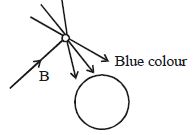
(A) According to Rayleigh's law of scattering, the intensity of scattered light is inversely proportional to the fourth power of its wavelength $(I \propto 1/\lambda^4)$.
Since blue light has a shorter wavelength compared to other colours in the visible spectrum, it is scattered to the maximum extent by the molecules and fine particles in the atmosphere.
Therefore, the blue colour appears to be coming from the sky. Both the Assertion and the Reason are correct, and the Reason is the correct explanation of the Assertion.
Since blue light has a shorter wavelength compared to other colours in the visible spectrum, it is scattered to the maximum extent by the molecules and fine particles in the atmosphere.
Therefore, the blue colour appears to be coming from the sky. Both the Assertion and the Reason are correct, and the Reason is the correct explanation of the Assertion.
0 likes
View Solution22
EasyMCQ
Assertion: The stars twinkle while the planets do not.
Reason: The stars are much bigger in size than the planets.
Reason: The stars are much bigger in size than the planets.
A
If both Assertion and Reason are correct and the Reason is a correct explanation of the Assertion.
B
If both Assertion and Reason are correct but Reason is not a correct explanation of the Assertion.
C
If the Assertion is correct but Reason is incorrect.
D
If both the Assertion and Reason are incorrect.
Solution
(B) The twinkling of stars is due to the atmospheric refraction caused by the changing refractive index of the atmosphere.
Stars appear as point-sized sources because they are very far away. Due to the small apparent size,the fluctuations in the path of light rays are significant,leading to the twinkling effect.
Planets are much closer to the Earth and appear as extended sources (collection of many point-sized sources). The total variation in the light coming from all these point sources averages out to zero,so they do not twinkle.
The Reason provided states that stars are bigger than planets,which is a fact,but it is not the reason why stars twinkle and planets do not. The actual reason is the difference in their apparent size (point-sized vs. extended source).
Stars appear as point-sized sources because they are very far away. Due to the small apparent size,the fluctuations in the path of light rays are significant,leading to the twinkling effect.
Planets are much closer to the Earth and appear as extended sources (collection of many point-sized sources). The total variation in the light coming from all these point sources averages out to zero,so they do not twinkle.
The Reason provided states that stars are bigger than planets,which is a fact,but it is not the reason why stars twinkle and planets do not. The actual reason is the difference in their apparent size (point-sized vs. extended source).
0 likes
View Solution23
EasyMCQ
Pick the wrong answer in the context of a rainbow.
A
When the light rays undergo two internal reflections in a water drop,a secondary rainbow is formed.
B
The order of colours is reversed in the secondary rainbow.
C
An observer can see a rainbow when his front is towards the sun.
D
Rainbow is a combined effect of dispersion,refraction,and reflection of sunlight.
Solution
(C) The correct condition to observe a rainbow is that the observer must have their back towards the sun. Therefore,the statement that an observer can see a rainbow when their front is towards the sun is incorrect. Thus,option $C$ is the wrong answer.
0 likes
View Solution24
Medium
The Sun is visible before actual sunrise and after actual sunset for some time. Explain this phenomenon.
Solution
(N/A) Actual sunrise is the moment the Sun crosses the horizon.
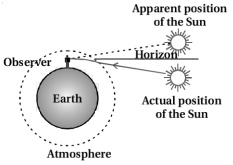
The Sun is visible a little before the actual sunrise and until a little after the actual sunset due to the refraction of light through the Earth's atmosphere. The figure illustrates the actual and apparent positions of the Sun with respect to the horizon.
The refractive index of air with respect to a vacuum is approximately $1.00029$. Due to this,the light rays from the Sun bend as they enter the atmosphere,causing an apparent shift in the Sun's position by about $0.5^{\circ}$.
The time taken for the Earth to rotate by $180^{\circ}$ is $12 \times 60 \text{ minutes}$. Therefore,the time taken for a displacement of $0.5^{\circ}$ is calculated as:
$t = \frac{12 \times 60 \times 0.5}{180} = 2 \text{ minutes}$.
Thus,the time difference between the real and apparent sunrise,as well as between the real and apparent sunset,is about $2 \text{ minutes}$.
Additionally,the oval shape of the Sun observed at the time of sunrise and sunset is also caused by atmospheric refraction.
The Sun is visible a little before the actual sunrise and until a little after the actual sunset due to the refraction of light through the Earth's atmosphere. The figure illustrates the actual and apparent positions of the Sun with respect to the horizon.
The refractive index of air with respect to a vacuum is approximately $1.00029$. Due to this,the light rays from the Sun bend as they enter the atmosphere,causing an apparent shift in the Sun's position by about $0.5^{\circ}$.
The time taken for the Earth to rotate by $180^{\circ}$ is $12 \times 60 \text{ minutes}$. Therefore,the time taken for a displacement of $0.5^{\circ}$ is calculated as:
$t = \frac{12 \times 60 \times 0.5}{180} = 2 \text{ minutes}$.
Thus,the time difference between the real and apparent sunrise,as well as between the real and apparent sunset,is about $2 \text{ minutes}$.
Additionally,the oval shape of the Sun observed at the time of sunrise and sunset is also caused by atmospheric refraction.
0 likes
View Solution25
Medium
Discuss the natural phenomena that occur due to sunlight.
Solution
(N/A) The interplay of light with objects around us gives rise to several beautiful phenomena. The spectacle of colour that we see around us all the time is possible only due to sunlight.
The blue colour of the sky,the white appearance of clouds,the red hue at sunrise and sunset,the formation of a rainbow,and the brilliant colours seen in some pearls,shells,and the wings of birds are just a few of the natural wonders that occur due to the interaction of sunlight with the atmosphere and matter.
The blue colour of the sky,the white appearance of clouds,the red hue at sunrise and sunset,the formation of a rainbow,and the brilliant colours seen in some pearls,shells,and the wings of birds are just a few of the natural wonders that occur due to the interaction of sunlight with the atmosphere and matter.
0 likes
View Solution26
Difficult
Write a note on rainbow.
Solution
(N/A) rainbow is a natural phenomenon caused by the dispersion,refraction,and reflection of sunlight by spherical water droplets in the atmosphere.
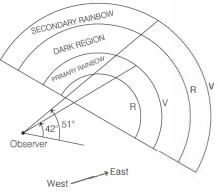
Conditions for observing a rainbow: The sun must be shining in one part of the sky (e.g.,near the western horizon) while it is raining in the opposite part (e.g.,eastern horizon). An observer can see a rainbow only when their back is towards the sun.
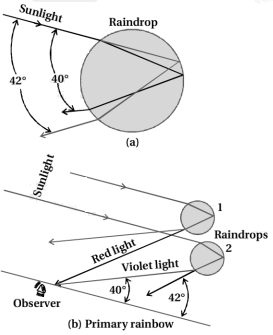
Formation of rainbows: Sunlight is first refracted as it enters a raindrop,which causes the different wavelengths (colours) of white light to separate. Longer wavelengths of light (red) are bent the least,while shorter wavelengths (violet) are bent the most.
These component rays strike the inner surface of the water drop and undergo internal reflection if the angle of incidence is appropriate. The reflected light is refracted again as it emerges from the drop. It is observed that violet light emerges at an angle of $40^{\circ}$ relative to the incoming sunlight,and red light emerges at an angle of $42^{\circ}$. For other colours,the angles lie between these two values.
Conditions for observing a rainbow: The sun must be shining in one part of the sky (e.g.,near the western horizon) while it is raining in the opposite part (e.g.,eastern horizon). An observer can see a rainbow only when their back is towards the sun.
Formation of rainbows: Sunlight is first refracted as it enters a raindrop,which causes the different wavelengths (colours) of white light to separate. Longer wavelengths of light (red) are bent the least,while shorter wavelengths (violet) are bent the most.
These component rays strike the inner surface of the water drop and undergo internal reflection if the angle of incidence is appropriate. The reflected light is refracted again as it emerges from the drop. It is observed that violet light emerges at an angle of $40^{\circ}$ relative to the incoming sunlight,and red light emerges at an angle of $42^{\circ}$. For other colours,the angles lie between these two values.
0 likes
View Solution27
Difficult
What is scattering of light? And on what factors does the scattering depend?
Solution
(N/A) Scattering of light is the phenomenon in which light rays deviate from their straight path upon striking particles present in the atmosphere.
As sunlight travels through the Earth's atmosphere, it gets scattered by atmospheric particles. Light of shorter wavelengths is scattered much more than light of longer wavelengths.
The amount of scattering is inversely proportional to the fourth power of the wavelength $(\lambda)$. This is known as Rayleigh scattering, given by the relation: $I \propto \frac{1}{\lambda^4}$.
Hence, the bluish colour predominates in a clear sky since blue has a shorter wavelength than red and is scattered much more strongly.
The scattering depends on the relative size of the wavelength of light $(\lambda)$ and the size of the scatterer $(a)$:
$1$. For $a << \lambda$, Rayleigh scattering occurs, which is proportional to $\frac{1}{\lambda^4}$.
$2$. For $a >> \lambda$, it is called geometric scattering.
$3$. For $a \approx \lambda$, it is called Mie scattering.
As sunlight travels through the Earth's atmosphere, it gets scattered by atmospheric particles. Light of shorter wavelengths is scattered much more than light of longer wavelengths.
The amount of scattering is inversely proportional to the fourth power of the wavelength $(\lambda)$. This is known as Rayleigh scattering, given by the relation: $I \propto \frac{1}{\lambda^4}$.
Hence, the bluish colour predominates in a clear sky since blue has a shorter wavelength than red and is scattered much more strongly.
The scattering depends on the relative size of the wavelength of light $(\lambda)$ and the size of the scatterer $(a)$:
$1$. For $a << \lambda$, Rayleigh scattering occurs, which is proportional to $\frac{1}{\lambda^4}$.
$2$. For $a >> \lambda$, it is called geometric scattering.
$3$. For $a \approx \lambda$, it is called Mie scattering.
0 likes
View Solution28
Medium
Why does the sky appear blue when we look at it?
Solution
(N/A) The intensity of scattered light is inversely proportional to the fourth power of its wavelength,a phenomenon known as Rayleigh scattering.
In a clear sky,the blue color predominates because blue light has a shorter wavelength compared to red light,causing it to be scattered much more strongly by atmospheric molecules.
Although violet light has an even shorter wavelength and is scattered more intensely than blue light,our eyes are significantly more sensitive to blue light than to violet light.
Consequently,the sky appears blue to human observers.
In a clear sky,the blue color predominates because blue light has a shorter wavelength compared to red light,causing it to be scattered much more strongly by atmospheric molecules.
Although violet light has an even shorter wavelength and is scattered more intensely than blue light,our eyes are significantly more sensitive to blue light than to violet light.
Consequently,the sky appears blue to human observers.
0 likes
View Solution29
Medium
Why does the Sun look reddish at the time of sunrise and sunset?
Solution
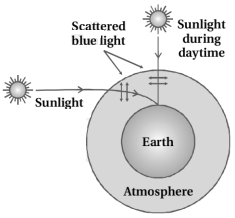
At sunrise or sunset,the Sun is near the horizon. The light from the Sun has to travel a larger distance through the Earth's atmosphere to reach our eyes.
During this journey,most of the blue light and other shorter wavelengths are scattered away by the atmospheric particles (Rayleigh scattering).
Only the light with longer wavelengths,such as red light,is able to reach our eyes as it is the least scattered.
Therefore,the Sun appears reddish at the time of sunrise and sunset.
During this journey,most of the blue light and other shorter wavelengths are scattered away by the atmospheric particles (Rayleigh scattering).
Only the light with longer wavelengths,such as red light,is able to reach our eyes as it is the least scattered.
Therefore,the Sun appears reddish at the time of sunrise and sunset.
1 likes
View Solution30
Medium
Why is the Moon seen reddish at the time of its rise and set?
Solution
(N/A) When the Moon is near the horizon, its light has to travel through a much larger distance in the Earth's atmosphere compared to when it is overhead.
According to Rayleigh's law of scattering, the intensity of scattered light is inversely proportional to the fourth power of its wavelength $(I \propto 1/\lambda^4)$.
As the light travels through the thicker layers of the atmosphere, most of the blue and shorter wavelengths are scattered away by air molecules and fine particles.
The light that reaches our eyes is primarily composed of longer wavelengths, such as red, which undergo the least scattering.
Consequently, the Moon appears reddish when it is near the horizon during its rise or set.
According to Rayleigh's law of scattering, the intensity of scattered light is inversely proportional to the fourth power of its wavelength $(I \propto 1/\lambda^4)$.
As the light travels through the thicker layers of the atmosphere, most of the blue and shorter wavelengths are scattered away by air molecules and fine particles.
The light that reaches our eyes is primarily composed of longer wavelengths, such as red, which undergo the least scattering.
Consequently, the Moon appears reddish when it is near the horizon during its rise or set.
0 likes
View Solution31
Medium
Why are clouds seen to be of white colour?
Solution
(N/A) The intensity of scattered light is proportional to $\frac{1}{\lambda^{4}}$ (Rayleigh scattering).
However,this law holds true only when the size of the scattering particles $(a)$ is much smaller than the wavelength of light $(\lambda)$,i.e.,$a << \lambda$.
For clouds,the water droplets have a size $(a)$ much larger than the wavelength of visible light $(a >> \lambda)$.
In this regime,all wavelengths of visible light are scattered nearly equally.
Since all colours of the visible spectrum are scattered with almost the same intensity,the resulting combination of scattered light appears white to our eyes.
However,this law holds true only when the size of the scattering particles $(a)$ is much smaller than the wavelength of light $(\lambda)$,i.e.,$a << \lambda$.
For clouds,the water droplets have a size $(a)$ much larger than the wavelength of visible light $(a >> \lambda)$.
In this regime,all wavelengths of visible light are scattered nearly equally.
Since all colours of the visible spectrum are scattered with almost the same intensity,the resulting combination of scattered light appears white to our eyes.
0 likes
View Solution32
EasyMCQ
Can a rainbow be seen at noon?
A
Yes,always.
B
No,never.
C
Yes,if it rains.
D
Only in the morning.
Solution
(B) rainbow is formed due to the dispersion,refraction,and internal reflection of sunlight by water droplets. For a rainbow to be visible,the sun must be behind the observer,and the water droplets must be in front. At noon,the sun is directly overhead. Therefore,the angle required to see the rainbow (which is typically $42^{\circ}$ from the anti-solar point) cannot be achieved on the ground. Thus,a rainbow cannot be seen at noon.
0 likes
View Solution33
EasyMCQ
Mention the colours of a primary rainbow.
A
Red,Orange,Yellow,Green,Blue,Indigo,Violet
B
Violet,Indigo,Blue,Green,Yellow,Orange,Red
C
Red,Yellow,Green,Blue,Violet
D
Blue,Green,Yellow,Orange,Red
Solution
(A) primary rainbow is formed by one internal reflection and two refractions of sunlight within water droplets.
In a primary rainbow,the red colour appears on the outer edge,and the violet colour appears on the inner edge.
The sequence of colours from the outer edge to the inner edge is: $Red, Orange, Yellow, Green, Blue, Indigo, Violet$ (often remembered by the acronym $VIBGYOR$ in reverse order).
In a primary rainbow,the red colour appears on the outer edge,and the violet colour appears on the inner edge.
The sequence of colours from the outer edge to the inner edge is: $Red, Orange, Yellow, Green, Blue, Indigo, Violet$ (often remembered by the acronym $VIBGYOR$ in reverse order).
0 likes
View Solution34
EasyMCQ
Which is the uppermost color in a secondary rainbow?
A
Red
B
Violet
C
Blue
D
Yellow
Solution
(B) In a secondary rainbow,the light undergoes two internal reflections within the water droplets.
Due to these two reflections,the order of colors is reversed compared to the primary rainbow.
In the primary rainbow,the red color is at the top (outer edge) and violet is at the bottom (inner edge).
In the secondary rainbow,the violet color is at the top (outer edge) and the red color is at the bottom (inner edge).
Therefore,the uppermost color in a secondary rainbow is violet.
Due to these two reflections,the order of colors is reversed compared to the primary rainbow.
In the primary rainbow,the red color is at the top (outer edge) and violet is at the bottom (inner edge).
In the secondary rainbow,the violet color is at the top (outer edge) and the red color is at the bottom (inner edge).
Therefore,the uppermost color in a secondary rainbow is violet.
0 likes
View Solution35
EasyMCQ
Why is the intensity of light low in a secondary rainbow?
A
Due to multiple refractions and reflections.
B
Due to the absorption of light by water droplets.
C
Due to the scattering of light in the atmosphere.
D
Due to the dispersion of light at different angles.
Solution
(A) secondary rainbow is formed by two internal reflections and two refractions of sunlight within the water droplets.
Each reflection results in a significant loss of light intensity because a portion of the light is transmitted out of the droplet instead of being reflected.
Since the secondary rainbow involves two such reflections,the cumulative loss of light energy is greater than that in a primary rainbow,which involves only one internal reflection.
Therefore,the intensity of light in a secondary rainbow is significantly lower.
Each reflection results in a significant loss of light intensity because a portion of the light is transmitted out of the droplet instead of being reflected.
Since the secondary rainbow involves two such reflections,the cumulative loss of light energy is greater than that in a primary rainbow,which involves only one internal reflection.
Therefore,the intensity of light in a secondary rainbow is significantly lower.
0 likes
View Solution36
EasyMCQ
What is scattering of light?
A
The process of reflection of light from a smooth surface.
B
The phenomenon of change in direction of light on interacting with particles of dimensions comparable to the wavelength of light.
C
The bending of light around the corners of an obstacle.
D
The splitting of white light into its constituent colors.
Solution
(B) Scattering of light is the phenomenon in which light rays deviate from their straight path upon striking an obstacle, such as dust particles, gas molecules, or water droplets in the atmosphere. When light interacts with particles whose size is comparable to the wavelength of the incident light, the light is redirected in various directions. This process is known as scattering. $A$ common example is the blue color of the sky, which occurs because shorter wavelengths (blue) are scattered more strongly by atmospheric molecules than longer wavelengths (red) according to Rayleigh's scattering law, which states that the intensity of scattered light is inversely proportional to the fourth power of the wavelength $(I \propto 1/\lambda^4)$.
0 likes
View Solution37
EasyMCQ
On which does the scattering of light depend?
A
Wavelength of light
B
Size of the scattering particle
C
Both $(A)$ and $(B)$
D
None of these
Solution
(C) The scattering of light depends on the wavelength of the incident light and the size of the scattering particles.
According to Rayleigh's law of scattering,the intensity of scattered light $I$ is inversely proportional to the fourth power of the wavelength $\lambda$ of the incident light,i.e.,$I \propto 1/\lambda^4$.
Additionally,the nature of scattering also depends on the size of the particles relative to the wavelength of light. For very small particles (Rayleigh scattering),the intensity follows the $\lambda^{-4}$ law. For larger particles (like water droplets in clouds),the scattering is less dependent on wavelength (Mie scattering).
Therefore,both factors are significant.
According to Rayleigh's law of scattering,the intensity of scattered light $I$ is inversely proportional to the fourth power of the wavelength $\lambda$ of the incident light,i.e.,$I \propto 1/\lambda^4$.
Additionally,the nature of scattering also depends on the size of the particles relative to the wavelength of light. For very small particles (Rayleigh scattering),the intensity follows the $\lambda^{-4}$ law. For larger particles (like water droplets in clouds),the scattering is less dependent on wavelength (Mie scattering).
Therefore,both factors are significant.
0 likes
View Solution38
EasyMCQ
What is Rayleigh scattering?
A
The scattering of light by particles much larger than the wavelength of light.
B
The scattering of light by particles much smaller than the wavelength of light.
C
The scattering of light by particles equal to the wavelength of light.
D
The reflection of light from a smooth surface.
Solution
(B) Rayleigh scattering is the scattering of light by particles (such as air molecules) that are much smaller than the wavelength of the incident light.
According to Rayleigh's law,the intensity of scattered light $I$ is inversely proportional to the fourth power of the wavelength $\lambda$ of the incident light,given by the relation $I \propto \frac{1}{\lambda^4}$.
This phenomenon explains why the sky appears blue,as shorter wavelengths (blue light) are scattered more strongly than longer wavelengths (red light) by the molecules in the Earth's atmosphere.
According to Rayleigh's law,the intensity of scattered light $I$ is inversely proportional to the fourth power of the wavelength $\lambda$ of the incident light,given by the relation $I \propto \frac{1}{\lambda^4}$.
This phenomenon explains why the sky appears blue,as shorter wavelengths (blue light) are scattered more strongly than longer wavelengths (red light) by the molecules in the Earth's atmosphere.
0 likes
View Solution39
DifficultMCQ
Select the correct statement about a rainbow.
A
We can see a rainbow in the western sky in the late afternoon.
B
The double rainbow has red on the inside and violet on the outside.
C
$A$ rainbow has an arc shape,since the earth is round.
D
$A$ rainbow on the moon is violet on the inside and red on the outside.
Solution
(B) The correct statement is $(b)$.
$1$. In the late afternoon,a rainbow is visible in the eastern sky when sunlight from the west is reflected and refracted by a layer of water droplets.
$2$. $A$ rainbow is circular because the locus of reflected rays reaching the observer's eye forms a circle. Its shape is not due to the roundness of the Earth.
$3$. There is no rainbow on the Moon due to the lack of an atmosphere.
$4$. In a primary rainbow,the violet color is on the inside and the red color is on the outside of the arc.
$5$. In a secondary rainbow,the red color is on the inside and the violet color is on the outside of the arc.
$6$. Therefore,statement $(b)$ is correct as it accurately describes the color arrangement of a secondary rainbow.
$1$. In the late afternoon,a rainbow is visible in the eastern sky when sunlight from the west is reflected and refracted by a layer of water droplets.
$2$. $A$ rainbow is circular because the locus of reflected rays reaching the observer's eye forms a circle. Its shape is not due to the roundness of the Earth.
$3$. There is no rainbow on the Moon due to the lack of an atmosphere.
$4$. In a primary rainbow,the violet color is on the inside and the red color is on the outside of the arc.
$5$. In a secondary rainbow,the red color is on the inside and the violet color is on the outside of the arc.
$6$. Therefore,statement $(b)$ is correct as it accurately describes the color arrangement of a secondary rainbow.
0 likes
View Solution40
EasyMCQ
The spectrum of sunlight is an example of
A
continuous absorption spectrum
B
band emission spectrum
C
line absorption spectrum
D
continuous emission spectrum
Solution
(D) The spectrum of sunlight is a continuous emission spectrum. The core of the Sun emits radiation across a wide range of wavelengths,resulting in a continuous spectrum. Although dark lines (Fraunhofer lines) appear due to absorption by the cooler gases in the Sun's atmosphere,the primary nature of the solar spectrum is classified as a continuous emission spectrum.
0 likes
View Solution41
MediumMCQ
During the scattering of light, the amount of scattering is inversely proportional to the . . . . . . of the wavelength of light.
A
Cube
B
Square
C
Fourth power
D
Half
Solution
(C) According to Rayleigh's law of scattering, the intensity of scattered light $(I)$ is inversely proportional to the fourth power of its wavelength $(\lambda)$.
Mathematically, this is expressed as:
$I \propto \frac{1}{\lambda^4}$
This phenomenon is known as Rayleigh Scattering.
Mathematically, this is expressed as:
$I \propto \frac{1}{\lambda^4}$
This phenomenon is known as Rayleigh Scattering.
0 likes
View Solution42
EasyMCQ
Blue colour of sea water is due to
A
interference of sunlight reflected from the water surface
B
scattering of sunlight by the water molecules
C
image of sky in water
D
refraction of sunlight
Solution
(B) The blue colour of sea water is primarily due to the scattering of sunlight by water molecules. When sunlight enters the water,the shorter wavelengths (blue light) are scattered more effectively by the water molecules compared to longer wavelengths,which gives the sea its characteristic blue appearance.
0 likes
View Solution43
MediumMCQ
Frequencies of light incident on a system of scattering particles are in the ratio of $1: 2$. Then, the intensity of scattered light in a particular direction is
A
$1: 16$
B
$1: 4$
C
$1: 2$
D
$1: 8$
Solution
(A) According to Rayleigh's law of scattering, the intensity of scattered light $(I)$ is inversely proportional to the fourth power of its wavelength $(\lambda)$: $I \propto \frac{1}{\lambda^{4}}$.
Since the frequency $(f)$ is inversely proportional to the wavelength $(\lambda = \frac{c}{f})$, we can express the intensity in terms of frequency as $I \propto f^{4}$.
Given the ratio of frequencies $f_{1} : f_{2} = 1 : 2$, the ratio of intensities of scattered light is $\frac{I_{1}}{I_{2}} = \left(\frac{f_{1}}{f_{2}}\right)^{4}$.
Substituting the values, we get $\frac{I_{1}}{I_{2}} = \left(\frac{1}{2}\right)^{4} = \frac{1}{16}$.
Therefore, the ratio of the intensity of scattered light is $1: 16$.
Since the frequency $(f)$ is inversely proportional to the wavelength $(\lambda = \frac{c}{f})$, we can express the intensity in terms of frequency as $I \propto f^{4}$.
Given the ratio of frequencies $f_{1} : f_{2} = 1 : 2$, the ratio of intensities of scattered light is $\frac{I_{1}}{I_{2}} = \left(\frac{f_{1}}{f_{2}}\right)^{4}$.
Substituting the values, we get $\frac{I_{1}}{I_{2}} = \left(\frac{1}{2}\right)^{4} = \frac{1}{16}$.
Therefore, the ratio of the intensity of scattered light is $1: 16$.
0 likes
View Solution44
DifficultMCQ
If the scattering intensity of a liquid is $8 \text{ units}$ at a wavelength of $500 \text{ nm}$, then the scattering intensity at a wavelength of $400 \text{ nm}$ will be approximately: (in $\text{ units}$)
A
$13$
B
$16$
C
$20$
D
$24$
Solution
(C) According to Rayleigh's law of scattering, the scattering intensity $I$ is inversely proportional to the fourth power of the wavelength $\lambda$:
$I \propto \frac{1}{\lambda^{4}}$
Given $I_{1} = 8 \text{ units}$ at $\lambda_{1} = 500 \text{ nm}$ and we need to find $I_{2}$ at $\lambda_{2} = 400 \text{ nm}$.
Using the ratio formula:
$\frac{I_{2}}{I_{1}} = \left(\frac{\lambda_{1}}{\lambda_{2}}\right)^{4}$
$\frac{I_{2}}{8} = \left(\frac{500}{400}\right)^{4} = (1.25)^{4}$
$(1.25)^{4} = 2.4414 \approx 2.5$
$I_{2} = 8 \times 2.4414 \approx 19.53 \text{ units}$
Rounding to the nearest provided option, $I_{2} \approx 20 \text{ units}$.
$I \propto \frac{1}{\lambda^{4}}$
Given $I_{1} = 8 \text{ units}$ at $\lambda_{1} = 500 \text{ nm}$ and we need to find $I_{2}$ at $\lambda_{2} = 400 \text{ nm}$.
Using the ratio formula:
$\frac{I_{2}}{I_{1}} = \left(\frac{\lambda_{1}}{\lambda_{2}}\right)^{4}$
$\frac{I_{2}}{8} = \left(\frac{500}{400}\right)^{4} = (1.25)^{4}$
$(1.25)^{4} = 2.4414 \approx 2.5$
$I_{2} = 8 \times 2.4414 \approx 19.53 \text{ units}$
Rounding to the nearest provided option, $I_{2} \approx 20 \text{ units}$.
0 likes
View Solution45
MediumMCQ
In a given direction,the intensities of the scattered light by a scattering substance for two beams of light are in the ratio of $256:81$. The ratio of the frequency of the first beam to the frequency of the second beam is:
A
$64:127$
B
$1:2$
C
$64:27$
D
None of these
Solution
(D) According to the Rayleigh scattering law,the intensity of scattered light $(I)$ is proportional to the fourth power of its frequency $(f)$,i.e.,$I \propto f^4$.
Given the ratio of intensities $\frac{I_1}{I_2} = \frac{256}{81}$.
Therefore,the ratio of frequencies is $\frac{f_1}{f_2} = (\frac{I_1}{I_2})^{1/4} = (\frac{256}{81})^{1/4} = \frac{4}{3}$.
Since the ratio $4:3$ is not provided in the options,the correct answer is 'None of these'.
Given the ratio of intensities $\frac{I_1}{I_2} = \frac{256}{81}$.
Therefore,the ratio of frequencies is $\frac{f_1}{f_2} = (\frac{I_1}{I_2})^{1/4} = (\frac{256}{81})^{1/4} = \frac{4}{3}$.
Since the ratio $4:3$ is not provided in the options,the correct answer is 'None of these'.
0 likes
View Solution46
EasyMCQ
Blue colour of the sky is due to
A
reflection of light
B
refraction of light
C
diffraction of light
D
scattering of light
Solution
(D) The blue colour of the sky is due to the scattering of light.
According to Rayleigh's law of scattering,the intensity of scattered light is inversely proportional to the fourth power of its wavelength,i.e.,$I \propto \frac{1}{\lambda^4}$.
Among the visible colours,blue light has a shorter wavelength compared to red light.
Because the wavelength of blue light is smaller,it is scattered much more strongly by the atmospheric particles (molecules of air) than other colours.
Therefore,the sky appears blue to our eyes.
According to Rayleigh's law of scattering,the intensity of scattered light is inversely proportional to the fourth power of its wavelength,i.e.,$I \propto \frac{1}{\lambda^4}$.
Among the visible colours,blue light has a shorter wavelength compared to red light.
Because the wavelength of blue light is smaller,it is scattered much more strongly by the atmospheric particles (molecules of air) than other colours.
Therefore,the sky appears blue to our eyes.
0 likes
View Solution47
EasyMCQ
Sir $C$.$V$. Raman was awarded the Nobel Prize in Physics for his work on:
A
reflection of light
B
refraction of light
C
scattering of light
D
dispersion of light
Solution
(C) Sir $C$.$V$. Raman was awarded the Nobel Prize in Physics in $1930$ for his pioneering work on the scattering of light,a phenomenon now known as the Raman Effect.
He discovered that when a beam of light traverses a transparent medium,a small fraction of the light is scattered in directions other than the incident direction,and this scattered light undergoes a change in wavelength and frequency.
He discovered that when a beam of light traverses a transparent medium,a small fraction of the light is scattered in directions other than the incident direction,and this scattered light undergoes a change in wavelength and frequency.
0 likes
View Solution48
EasyMCQ
According to Rayleigh, when sunlight travels through the atmosphere, the amount of scattering is proportional to the $n^{\text{th}}$ power of the wavelength of light. Then the value of '$n$' is:
A
$4$
B
$-4$
C
$3$
D
$-3$
Solution
(B) According to Rayleigh's law of scattering, the intensity of scattered light $(I)$ is inversely proportional to the fourth power of its wavelength $(\lambda)$ for particles much smaller than the wavelength of light.
Mathematically, this is expressed as $I \propto \frac{1}{\lambda^4}$.
This can be rewritten as $I \propto \lambda^{-4}$.
Comparing this with the given expression $I \propto \lambda^n$, we get $n = -4$.
Therefore, the correct option is $B$.
Mathematically, this is expressed as $I \propto \frac{1}{\lambda^4}$.
This can be rewritten as $I \propto \lambda^{-4}$.
Comparing this with the given expression $I \propto \lambda^n$, we get $n = -4$.
Therefore, the correct option is $B$.
0 likes
View Solution49
EasyMCQ
Let $S_1$ be the amount of Rayleigh scattered light of wavelength $\lambda_1$ and $S_2$ that of light of wavelength $\lambda_2$ from a particle of size $a$. Which of the following statements is true?
A
$\frac{S_1}{S_2}=\left(\frac{\lambda_2}{\lambda_1}\right)^4$,if $\lambda_1, \lambda_2 > a$
B
$\frac{S_1}{S_2}=\left(\frac{\lambda_1}{\lambda_2}\right)^4$,if $\lambda_1, \lambda_2 \gg a$
C
$\frac{S_1}{S_2}=\left(\frac{\lambda_2}{\lambda_1}\right)^4$,if $\lambda_1, \lambda_2 \ll a$
D
$\frac{S_1}{S_2}=\left(\frac{\lambda_1}{\lambda_2}\right)^4$,if $\lambda_1, \lambda_2 \ll a$
Solution
(A) The condition for Rayleigh scattering is that the wavelength of the incident light must be much larger than the size of the scattering particle,i.e.,$\lambda \gg a$.
According to Rayleigh's law of scattering,the intensity (or amount) of scattered light $S$ is inversely proportional to the fourth power of its wavelength $\lambda$,which is expressed as $S \propto \frac{1}{\lambda^4}$.
Therefore,for two different wavelengths $\lambda_1$ and $\lambda_2$,the ratio of the scattered light amounts is given by $\frac{S_1}{S_2} = \frac{1/\lambda_1^4}{1/\lambda_2^4} = \left(\frac{\lambda_2}{\lambda_1}\right)^4$.
This relationship holds true under the condition $\lambda_1, \lambda_2 \gg a$.
According to Rayleigh's law of scattering,the intensity (or amount) of scattered light $S$ is inversely proportional to the fourth power of its wavelength $\lambda$,which is expressed as $S \propto \frac{1}{\lambda^4}$.
Therefore,for two different wavelengths $\lambda_1$ and $\lambda_2$,the ratio of the scattered light amounts is given by $\frac{S_1}{S_2} = \frac{1/\lambda_1^4}{1/\lambda_2^4} = \left(\frac{\lambda_2}{\lambda_1}\right)^4$.
This relationship holds true under the condition $\lambda_1, \lambda_2 \gg a$.
0 likes
View SolutionRay Optics and Optical Instruments — Scattering of light and Some Natural Phenomenon of Sunlight · Frequently Asked Questions
1Are these Ray Optics and Optical Instruments questions useful for JEE and NEET?
Yes. All questions in this section are mapped to JEE Main and NEET exam patterns. Previous year questions from JEE Main, NEET, GUJCET and state-level exams are included with full solutions.
2Can I switch to Hindi or Gujarati for these questions?
Yes. Use the language tabs in the hero section or the sidebar to view the same questions and solutions in English, Hindi or Gujarati.
3How do I generate a question paper from this subtopic?
Use the Vedclass Exam Paper Generator — select the chapter and subtopic, set difficulty, and generate Sets A, B, C, D automatically. First 3 chapters of every subject are free.
Vedclass Products
For Students
Vedclass Test Series
Mock tests in real JEE/NEET style with performance analysis. 5-day free trial.
Start Free TrialFor Teachers
Exam Paper Generator
Generate Set A/B/C/D papers from this chapter in 2 minutes. 3 chapters free.
Try FreeFor Institutes
Online Exam Module
Live online exams with unlimited students, 360° analytics & white-label branding.
See DemoFor Teachers & Institutes
Generate a Ray Optics and Optical Instruments Exam Paper in 2 Minutes
Select subtopic & difficulty — Sets A, B, C, D auto-generated with No Repeat logic.
First 3 chapters of every subject are free — no payment required.