
A English
Spherical Mirror Questions in English
Class 12 Physics · Ray Optics and Optical Instruments · Spherical Mirror
233+
Questions
English
Language
100%
With Solutions
Showing 33 of 233 questions in English
201
MediumMCQ
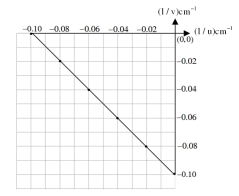
For a concave mirror,the $\frac{1}{u}$ versus $\frac{1}{v}$ graph obtained by the parallax method is as shown in the figure. The graph is a straight line with a slope of $-1$. The estimated value of the focal length of the mirror is: (in $cm$)
A
$5$
B
$20$
C
$-5$
D
$-10$
Solution
(D) The mirror equation is given by $\frac{1}{v} + \frac{1}{u} = \frac{1}{f}$.
Rearranging this into the form of a straight-line equation $y = mx + c$,we get $\frac{1}{v} = -\frac{1}{u} + \frac{1}{f}$.
Comparing this with $y = mx + c$,where $y = \frac{1}{v}$ and $x = \frac{1}{u}$,the slope $m = -1$ and the intercept $c = \frac{1}{f}$.
From the graph,the intercept on the $\frac{1}{v}$ axis (when $\frac{1}{u} = 0$) is $-0.10 \ cm^{-1}$.
Therefore,$\frac{1}{f} = -0.10 \ cm^{-1}$.
Calculating the focal length,$f = \frac{1}{-0.10} = -10 \ cm$.
Rearranging this into the form of a straight-line equation $y = mx + c$,we get $\frac{1}{v} = -\frac{1}{u} + \frac{1}{f}$.
Comparing this with $y = mx + c$,where $y = \frac{1}{v}$ and $x = \frac{1}{u}$,the slope $m = -1$ and the intercept $c = \frac{1}{f}$.
From the graph,the intercept on the $\frac{1}{v}$ axis (when $\frac{1}{u} = 0$) is $-0.10 \ cm^{-1}$.
Therefore,$\frac{1}{f} = -0.10 \ cm^{-1}$.
Calculating the focal length,$f = \frac{1}{-0.10} = -10 \ cm$.
0 likes
View Solution202
DifficultMCQ
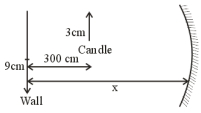
$A$ candle of height $3 \ cm$ is placed at $300 \ cm$ from a wall. $A$ concave mirror is kept at a distance $x$ from the wall in such a way that the image of the flame on the wall is $9 \ cm$. Then $x$ is $.... \ cm$.
A
$339$
B
$900$
C
$450$
D
$423$
Solution
(C) Given: Height of object $h_o = 3 \ cm$,Height of image $h_i = -9 \ cm$ (real image formed on the wall is inverted).
Distance of object from mirror $u = -(x - 300) \ cm$.
Distance of image from mirror $v = -x \ cm$.
Using magnification formula $m = \frac{h_i}{h_o} = -\frac{v}{u}$:
$\frac{-9}{3} = -\frac{-x}{-(x - 300)}$
$-3 = -\frac{x}{x - 300}$
$3 = \frac{x}{x - 300}$
$3(x - 300) = x$
$3x - 900 = x$
$2x = 900$
$x = 450 \ cm$.
Distance of object from mirror $u = -(x - 300) \ cm$.
Distance of image from mirror $v = -x \ cm$.
Using magnification formula $m = \frac{h_i}{h_o} = -\frac{v}{u}$:
$\frac{-9}{3} = -\frac{-x}{-(x - 300)}$
$-3 = -\frac{x}{x - 300}$
$3 = \frac{x}{x - 300}$
$3(x - 300) = x$
$3x - 900 = x$
$2x = 900$
$x = 450 \ cm$.
0 likes
View Solution203
MediumMCQ
$A$ concave mirror of focal length '$f$' produces an image '$n$' times the size of the object. If the image is real, then the distance of the object from the mirror is
A
$(n-1) f$
B
$\left(\frac{n-1}{n}\right) f$
C
$\left(\frac{n+1}{n}\right) f$
D
$(n+1) f$
Solution
(C) For a concave mirror, the magnification $m$ for a real image is negative, so $m = -n$.
By definition of magnification, $m = -\frac{v}{u}$, where $v$ is the image distance and $u$ is the object distance.
Thus, $-n = -\frac{v}{u} \implies v = nu$.
Using the mirror formula: $\frac{1}{f} = \frac{1}{v} + \frac{1}{u}$.
Since the mirror is concave, the focal length $f$ is negative, i.e., $-f$. The object distance $u$ is also negative, i.e., $-u$.
Substituting these values: $\frac{1}{-f} = \frac{1}{-nu} + \frac{1}{-u}$.
Multiplying by $-1$: $\frac{1}{f} = \frac{1}{nu} + \frac{1}{u} = \frac{1+n}{nu}$.
Rearranging for $u$: $u = \left(\frac{n+1}{n}\right) f$.
By definition of magnification, $m = -\frac{v}{u}$, where $v$ is the image distance and $u$ is the object distance.
Thus, $-n = -\frac{v}{u} \implies v = nu$.
Using the mirror formula: $\frac{1}{f} = \frac{1}{v} + \frac{1}{u}$.
Since the mirror is concave, the focal length $f$ is negative, i.e., $-f$. The object distance $u$ is also negative, i.e., $-u$.
Substituting these values: $\frac{1}{-f} = \frac{1}{-nu} + \frac{1}{-u}$.
Multiplying by $-1$: $\frac{1}{f} = \frac{1}{nu} + \frac{1}{u} = \frac{1+n}{nu}$.
Rearranging for $u$: $u = \left(\frac{n+1}{n}\right) f$.
0 likes
View Solution204
EasyMCQ
In the case of spherical mirrors,the images formed on the side of the object and images formed on the opposite side are respectively
A
virtual and real.
B
virtual and virtual.
C
real and real.
D
real and virtual.
Solution
(D) For a spherical mirror,the sign convention states that the direction of incident light is taken as positive.
When an image is formed on the same side as the object,the image distance $v$ is negative,which corresponds to a real image.
When an image is formed on the opposite side of the object (behind the mirror),the image distance $v$ is positive,which corresponds to a virtual image.
Therefore,images formed on the side of the object are real,and images formed on the opposite side are virtual.
When an image is formed on the same side as the object,the image distance $v$ is negative,which corresponds to a real image.
When an image is formed on the opposite side of the object (behind the mirror),the image distance $v$ is positive,which corresponds to a virtual image.
Therefore,images formed on the side of the object are real,and images formed on the opposite side are virtual.
0 likes
View Solution205
EasyMCQ
What is the nature of the image formed for an object placed on the principal axis of a concave mirror between the pole and the focus?
A
Real,inverted and magnified
B
Virtual,erect and diminished
C
Real,inverted and diminished
D
Virtual,erect and magnified
Solution
(D) When an object is placed between the pole $(P)$ and the focus $(F)$ of a concave mirror,the light rays diverge after reflection. By extending these rays backward,they appear to meet behind the mirror. Thus,the image formed is virtual,erect,and magnified.
0 likes
View Solution206
EasyMCQ
$A$ person wants a real image of his own,$3$ times enlarged. Where should he stand in front of a concave mirror of radius of curvature $30 \ cm$ (in $cm$)?
A
$10$
B
$30$
C
$90$
D
$20$
Solution
(D) Given: Magnification $m = -3$ (since the image is real,it must be inverted). Radius of curvature $R = -30 \ cm$. Focal length $f = R/2 = -15 \ cm$.
Using the magnification formula: $m = -v/u \Rightarrow -3 = -v/u \Rightarrow v = 3u$.
Using the mirror formula: $1/f = 1/v + 1/u$.
Substituting the values: $1/(-15) = 1/(3u) + 1/u$.
$1/(-15) = (1 + 3)/(3u) = 4/(3u)$.
$-3u = 60 \Rightarrow u = -20 \ cm$.
The negative sign indicates that the person should stand $20 \ cm$ in front of the concave mirror.
Using the magnification formula: $m = -v/u \Rightarrow -3 = -v/u \Rightarrow v = 3u$.
Using the mirror formula: $1/f = 1/v + 1/u$.
Substituting the values: $1/(-15) = 1/(3u) + 1/u$.
$1/(-15) = (1 + 3)/(3u) = 4/(3u)$.
$-3u = 60 \Rightarrow u = -20 \ cm$.
The negative sign indicates that the person should stand $20 \ cm$ in front of the concave mirror.
0 likes
View Solution207
MediumMCQ
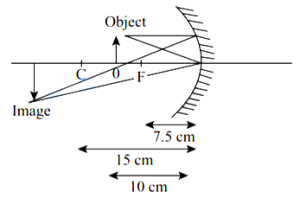
$A$ linear object of height $10 \text{ cm}$ is kept in front of a concave mirror of radius of curvature $15 \text{ cm}$,at a distance of $10 \text{ cm}$. The image formed is
A
magnified and erect
B
magnified and inverted
C
diminished and erect
D
diminished and inverted
Solution
(B) Given: Height of object $h = 10 \text{ cm}$,radius of curvature $R = 15 \text{ cm}$,object distance $u = -10 \text{ cm}$.
Focal length $f = R/2 = 15/2 = 7.5 \text{ cm}$. For a concave mirror,$f = -7.5 \text{ cm}$.
Since the object is placed at $u = -10 \text{ cm}$,and the focal length is $f = -7.5 \text{ cm}$,the object is placed between the focus $(F)$ and the centre of curvature $(C)$ because $f < |u| < R$ (i.e.,$7.5 \text{ cm} < 10 \text{ cm} < 15 \text{ cm}$).
When an object is placed between $F$ and $C$ in front of a concave mirror,the image formed is real,inverted,and magnified.
Focal length $f = R/2 = 15/2 = 7.5 \text{ cm}$. For a concave mirror,$f = -7.5 \text{ cm}$.
Since the object is placed at $u = -10 \text{ cm}$,and the focal length is $f = -7.5 \text{ cm}$,the object is placed between the focus $(F)$ and the centre of curvature $(C)$ because $f < |u| < R$ (i.e.,$7.5 \text{ cm} < 10 \text{ cm} < 15 \text{ cm}$).
When an object is placed between $F$ and $C$ in front of a concave mirror,the image formed is real,inverted,and magnified.
0 likes
View Solution208
EasyMCQ
For a point object,which of the following always produces a virtual image in air?
A
Concave mirror
B
Plano-convex lens
C
Convex mirror
D
Biconvex lens
Solution
(C) convex mirror always forms a virtual,erect,and diminished image for any real object placed in front of it,regardless of the object's distance from the mirror.
0 likes
View Solution209
EasyMCQ
An object is placed at the principal focus of a convex mirror. The image will be at
A
Center of curvature
B
Principal focus
C
Infinity
D
No image will be formed
Solution
(D) For a convex mirror,the principal focus $(F)$ is located behind the mirror.
When an object is placed at the principal focus of a convex mirror,the rays of light originating from the object appear to diverge from the focus after reflection.
However,since the focus is behind the mirror,the rays cannot actually meet or appear to meet at any point to form an image in the conventional sense for this specific configuration.
Therefore,no image is formed at the principal focus of a convex mirror.
When an object is placed at the principal focus of a convex mirror,the rays of light originating from the object appear to diverge from the focus after reflection.
However,since the focus is behind the mirror,the rays cannot actually meet or appear to meet at any point to form an image in the conventional sense for this specific configuration.
Therefore,no image is formed at the principal focus of a convex mirror.
0 likes
View Solution210
MediumMCQ
An object is placed at a distance of $20 \ cm$ from the pole of a concave mirror of focal length $10 \ cm$. The distance of the image formed is
A
$+20 \ cm$
B
$+10 \ cm$
C
$-20 \ cm$
D
$-10 \ cm$
Solution
(C) Using the mirror formula,we have $\frac{1}{f} = \frac{1}{v} + \frac{1}{u}$.
Here,the object distance $u = -20 \ cm$ and the focal length $f = -10 \ cm$ (for a concave mirror).
Substituting these values into the formula:
$\frac{1}{-10} = \frac{1}{v} + \frac{1}{-20}$.
Rearranging to solve for $v$:
$\frac{1}{v} = \frac{1}{20} - \frac{1}{10}$.
$\frac{1}{v} = \frac{1 - 2}{20} = \frac{-1}{20}$.
Therefore,$v = -20 \ cm$.
Here,the object distance $u = -20 \ cm$ and the focal length $f = -10 \ cm$ (for a concave mirror).
Substituting these values into the formula:
$\frac{1}{-10} = \frac{1}{v} + \frac{1}{-20}$.
Rearranging to solve for $v$:
$\frac{1}{v} = \frac{1}{20} - \frac{1}{10}$.
$\frac{1}{v} = \frac{1 - 2}{20} = \frac{-1}{20}$.
Therefore,$v = -20 \ cm$.
0 likes
View Solution211
EasyMCQ
An object is placed at $20 \ cm$ in front of a concave mirror,which produces a three times magnified real image. What is the focal length of the concave mirror (in $cm$)?
A
$15$
B
$6.6$
C
$10$
D
$7.5$
Solution
(A) Given: Object distance $u = -20 \ cm$ (by sign convention).
Magnification $m = -3$ (since the image is real and magnified).
Using the magnification formula $m = -\frac{v}{u}$,we have:
$-3 = -\frac{v}{-20} \Rightarrow v = -60 \ cm$.
Using the mirror formula $\frac{1}{f} = \frac{1}{v} + \frac{1}{u}$,we get:
$\frac{1}{f} = \frac{1}{-60} + \frac{1}{-20} = \frac{-1 - 3}{60} = \frac{-4}{60} = -\frac{1}{15}$.
Therefore,the focal length $f = -15 \ cm$.
The magnitude of the focal length is $15 \ cm$.
Magnification $m = -3$ (since the image is real and magnified).
Using the magnification formula $m = -\frac{v}{u}$,we have:
$-3 = -\frac{v}{-20} \Rightarrow v = -60 \ cm$.
Using the mirror formula $\frac{1}{f} = \frac{1}{v} + \frac{1}{u}$,we get:
$\frac{1}{f} = \frac{1}{-60} + \frac{1}{-20} = \frac{-1 - 3}{60} = \frac{-4}{60} = -\frac{1}{15}$.
Therefore,the focal length $f = -15 \ cm$.
The magnitude of the focal length is $15 \ cm$.
0 likes
View Solution212
EasyMCQ
The image formed by a convex mirror of focal length $30 \,cm$ is a quarter of the size of the object. The distance of the object from the mirror is (in $\,cm$)
A
$30$
B
$90$
C
$120$
D
$60$
Solution
(B) For a convex mirror, the focal length $f = +30 \,cm$.
Magnification $m = \frac{h_i}{h_o} = +\frac{1}{4}$ (since the image formed by a convex mirror is always virtual and erect).
Using the magnification formula $m = -\frac{v}{u}$, we get $\frac{1}{4} = -\frac{v}{u}$, which implies $v = -\frac{u}{4}$.
Using the mirror formula $\frac{1}{f} = \frac{1}{v} + \frac{1}{u}$:
$\frac{1}{30} = \frac{1}{-u/4} + \frac{1}{u}$
$\frac{1}{30} = -\frac{4}{u} + \frac{1}{u}$
$\frac{1}{30} = -\frac{3}{u}$
$u = -30 \times 3 = -90 \,cm$.
The distance of the object from the mirror is $90 \,cm$.
Magnification $m = \frac{h_i}{h_o} = +\frac{1}{4}$ (since the image formed by a convex mirror is always virtual and erect).
Using the magnification formula $m = -\frac{v}{u}$, we get $\frac{1}{4} = -\frac{v}{u}$, which implies $v = -\frac{u}{4}$.
Using the mirror formula $\frac{1}{f} = \frac{1}{v} + \frac{1}{u}$:
$\frac{1}{30} = \frac{1}{-u/4} + \frac{1}{u}$
$\frac{1}{30} = -\frac{4}{u} + \frac{1}{u}$
$\frac{1}{30} = -\frac{3}{u}$
$u = -30 \times 3 = -90 \,cm$.
The distance of the object from the mirror is $90 \,cm$.
0 likes
View Solution213
MediumMCQ
When an object is placed in front of a convex mirror at a distance '$u$' from the pole of the mirror such that the size of the image is '$1/n$' times that of the object,then the object distance '$u$' =
A
$f(1-n)$
B
$f(n-1)$
C
$f(1/n - 1)$
D
$f(1 + n)$
Solution
(B) For a convex mirror,the magnification $m$ is given by $m = \frac{h_i}{h_o} = -\frac{v}{u}$.
Given that the size of the image is $1/n$ times the size of the object,we have $m = 1/n$.
Thus,$1/n = -v/u$,which implies $v = -u/n$.
Using the mirror formula $\frac{1}{v} + \frac{1}{u} = \frac{1}{f}$,where $f$ is the focal length of the convex mirror (positive).
Substituting $v = -u/n$ into the mirror formula:
$\frac{1}{-u/n} + \frac{1}{u} = \frac{1}{f}$
$-\frac{n}{u} + \frac{1}{u} = \frac{1}{f}$
$\frac{1-n}{u} = \frac{1}{f}$
$u = f(1-n)$.
Since the object distance $u$ is conventionally negative,the magnitude is $|u| = f(n-1)$.
Given that the size of the image is $1/n$ times the size of the object,we have $m = 1/n$.
Thus,$1/n = -v/u$,which implies $v = -u/n$.
Using the mirror formula $\frac{1}{v} + \frac{1}{u} = \frac{1}{f}$,where $f$ is the focal length of the convex mirror (positive).
Substituting $v = -u/n$ into the mirror formula:
$\frac{1}{-u/n} + \frac{1}{u} = \frac{1}{f}$
$-\frac{n}{u} + \frac{1}{u} = \frac{1}{f}$
$\frac{1-n}{u} = \frac{1}{f}$
$u = f(1-n)$.
Since the object distance $u$ is conventionally negative,the magnitude is $|u| = f(n-1)$.
0 likes
View Solution214
EasyMCQ
An object is placed at a distance of $18 \ cm$ in front of a mirror. If the image is formed at a distance of $4 \ cm$ on the other side,then the focal length,nature of the mirror,and nature of the image are respectively:
A
$3.14 \ cm$,concave mirror and real image
B
$3.14 \ cm$,convex mirror and real image
C
$5.14 \ cm$,convex mirror and virtual image
D
$5.14 \ cm$,concave mirror and virtual image
Solution
(C) Given: Object distance $u = -18 \ cm$ (in front of the mirror).
Image distance $v = +4 \ cm$ (on the other side of the mirror).
Using the mirror formula: $\frac{1}{f} = \frac{1}{v} + \frac{1}{u}$.
Substituting the values: $\frac{1}{f} = \frac{1}{4} + \frac{1}{-18} = \frac{9 - 2}{36} = \frac{7}{36}$.
Therefore,$f = \frac{36}{7} \ cm \approx 5.14 \ cm$.
Since the focal length $f$ is positive,the mirror is a convex mirror.
Since the image is formed on the other side of the mirror,it is a virtual image.
Image distance $v = +4 \ cm$ (on the other side of the mirror).
Using the mirror formula: $\frac{1}{f} = \frac{1}{v} + \frac{1}{u}$.
Substituting the values: $\frac{1}{f} = \frac{1}{4} + \frac{1}{-18} = \frac{9 - 2}{36} = \frac{7}{36}$.
Therefore,$f = \frac{36}{7} \ cm \approx 5.14 \ cm$.
Since the focal length $f$ is positive,the mirror is a convex mirror.
Since the image is formed on the other side of the mirror,it is a virtual image.
0 likes
View Solution215
EasyMCQ
An infinitely long rod lies along the axis of a concave mirror of focal length $f$. The nearer end of the rod is at a distance $u$ $(u > f)$ from the mirror. Its image will have a length:
A
$\frac{u f}{u+f}$
B
$\frac{u f}{u-f}$
C
$\frac{f^2}{u+f}$
D
$\frac{f^2}{u-f}$
Solution
(D) For a concave mirror,the mirror formula is $\frac{1}{v} + \frac{1}{u} = \frac{1}{f}$.
Using sign convention,$u$ is replaced by $-u$ and $f$ by $-f$.
So,$\frac{1}{v} - \frac{1}{u} = -\frac{1}{f}$.
Rearranging for $v$,we get $\frac{1}{v} = \frac{1}{u} - \frac{1}{f} = \frac{f-u}{uf}$.
Thus,$v = \frac{uf}{f-u}$.
The magnitude of the image position is $|v| = \left| \frac{uf}{f-u} \right| = \frac{uf}{u-f}$.
The rod extends from $u$ to $\infty$. The image of the nearer end is at $v_1 = \frac{uf}{u-f}$.
The image of the farther end (at $\infty$) is at the focus $v_2 = f$.
The length of the image is $L = |v_1 - v_2| = \left| \frac{uf}{u-f} - f \right|$.
$L = \left| \frac{uf - f(u-f)}{u-f} \right| = \left| \frac{uf - uf + f^2}{u-f} \right| = \frac{f^2}{u-f}$.
Using sign convention,$u$ is replaced by $-u$ and $f$ by $-f$.
So,$\frac{1}{v} - \frac{1}{u} = -\frac{1}{f}$.
Rearranging for $v$,we get $\frac{1}{v} = \frac{1}{u} - \frac{1}{f} = \frac{f-u}{uf}$.
Thus,$v = \frac{uf}{f-u}$.
The magnitude of the image position is $|v| = \left| \frac{uf}{f-u} \right| = \frac{uf}{u-f}$.
The rod extends from $u$ to $\infty$. The image of the nearer end is at $v_1 = \frac{uf}{u-f}$.
The image of the farther end (at $\infty$) is at the focus $v_2 = f$.
The length of the image is $L = |v_1 - v_2| = \left| \frac{uf}{u-f} - f \right|$.
$L = \left| \frac{uf - f(u-f)}{u-f} \right| = \left| \frac{uf - uf + f^2}{u-f} \right| = \frac{f^2}{u-f}$.
0 likes
View Solution216
DifficultMCQ
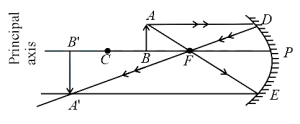
An object is placed in front of a spherical concave mirror between the focal point $(F)$ and the center of curvature $(C)$. Its image is:
A
Inverted,real,farther than the center of curvature from the mirror.
B
Inverted,virtual,closer than the focal point to the mirror.
C
Upright,real,farther than the center of curvature from the mirror.
D
Inverted,real,closer than the center of curvature to the mirror.
Solution
(A) When an object is placed between the focal point $(F)$ and the center of curvature $(C)$ of a concave mirror,the light rays from the object reflect off the mirror and converge at a point beyond the center of curvature $(C)$.
This results in an image that is real,inverted,and magnified (larger than the object).
Therefore,the image is formed farther than the center of curvature from the mirror.
This results in an image that is real,inverted,and magnified (larger than the object).
Therefore,the image is formed farther than the center of curvature from the mirror.
0 likes
View Solution217
MediumMCQ
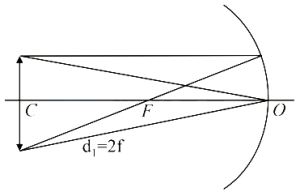
An object is placed at a distance of $40 \ cm$ in front of a concave mirror of focal length $20 \ cm$. The image produced is
A
real,inverted and smaller in size
B
real,inverted and of same size
C
real and erect
D
virtual and inverted
Solution
(B) Given,focal length of the concave mirror $f = 20 \ cm$.
The radius of curvature $R = 2f = 2 \times 20 \ cm = 40 \ cm$.
The object distance $u = 40 \ cm$.
Since the object is placed at the centre of curvature $(u = R)$,the image formed by a concave mirror is real,inverted,and of the same size as the object,and it is formed at the centre of curvature itself.
The radius of curvature $R = 2f = 2 \times 20 \ cm = 40 \ cm$.
The object distance $u = 40 \ cm$.
Since the object is placed at the centre of curvature $(u = R)$,the image formed by a concave mirror is real,inverted,and of the same size as the object,and it is formed at the centre of curvature itself.
0 likes
View Solution218
MediumMCQ
An object of height $3.6 \ cm$ is placed normally on the principal axis of a concave mirror of radius of curvature $30 \ cm$. If the object is at a distance of $10 \ cm$ from the principal focus of the mirror,then the height of the real image formed due to the mirror is (in $cm$)
A
$5.4$
B
$3.6$
C
$1.8$
D
$2.7$
Solution
(A) Given: Height of object $h_o = 3.6 \ cm$,Radius of curvature $R = 30 \ cm$.
Focal length $f = R/2 = 30/2 = 15 \ cm$.
Since it is a concave mirror,$f = -15 \ cm$.
The object is at a distance of $10 \ cm$ from the principal focus.
Position of object $u = -(f + 10) = -(15 + 10) = -25 \ cm$.
Using mirror formula: $1/v + 1/u = 1/f$.
$1/v = 1/f - 1/u = 1/(-15) - 1/(-25) = -1/15 + 1/25 = (-5 + 3)/75 = -2/75$.
$v = -75/2 = -37.5 \ cm$.
Magnification $m = -v/u = h_i/h_o$.
$m = -(-37.5) / (-25) = -37.5 / 25 = -1.5$.
Height of image $h_i = m \times h_o = -1.5 \times 3.6 = -5.4 \ cm$.
The magnitude of the height of the real image is $5.4 \ cm$.
Focal length $f = R/2 = 30/2 = 15 \ cm$.
Since it is a concave mirror,$f = -15 \ cm$.
The object is at a distance of $10 \ cm$ from the principal focus.
Position of object $u = -(f + 10) = -(15 + 10) = -25 \ cm$.
Using mirror formula: $1/v + 1/u = 1/f$.
$1/v = 1/f - 1/u = 1/(-15) - 1/(-25) = -1/15 + 1/25 = (-5 + 3)/75 = -2/75$.
$v = -75/2 = -37.5 \ cm$.
Magnification $m = -v/u = h_i/h_o$.
$m = -(-37.5) / (-25) = -37.5 / 25 = -1.5$.
Height of image $h_i = m \times h_o = -1.5 \times 3.6 = -5.4 \ cm$.
The magnitude of the height of the real image is $5.4 \ cm$.
0 likes
View Solution219
MediumMCQ
If the distances of the object and its real image from the principal focus of a concave mirror are $16 \ cm$ and $9 \ cm$ respectively,then the focal length of the mirror is (in $cm$)
A
$30$
B
$12$
C
$18$
D
$24$
Solution
(B) For a concave mirror,the distances of the object $(x_1)$ and the real image $(x_2)$ from the principal focus are related to the focal length $(f)$ by Newton's formula: $f^2 = x_1 \cdot x_2$.
Given,$x_1 = 16 \ cm$ and $x_2 = 9 \ cm$.
Substituting these values into the formula:
$f^2 = 16 \ cm \times 9 \ cm = 144 \ cm^2$.
Taking the square root on both sides:
$f = \sqrt{144} \ cm = 12 \ cm$.
Therefore,the focal length of the mirror is $12 \ cm$.
Given,$x_1 = 16 \ cm$ and $x_2 = 9 \ cm$.
Substituting these values into the formula:
$f^2 = 16 \ cm \times 9 \ cm = 144 \ cm^2$.
Taking the square root on both sides:
$f = \sqrt{144} \ cm = 12 \ cm$.
Therefore,the focal length of the mirror is $12 \ cm$.
0 likes
View Solution220
MediumMCQ
$A$ straight metal rod of length $6 \ cm$ is placed along the principal axis of a concave mirror of focal length $9 \ cm$ such that the end of the rod closer to the mirror is at a distance of $15 \ cm$ from the pole of the mirror. The length of the image of the rod is (in $cm$)
A
$6$
B
$12$
C
$8.75$
D
$6.75$
Solution
(D) Given: Focal length $f = -9 \ cm$ (concave mirror). The rod is placed along the principal axis. The end closer to the mirror is at $u_1 = -15 \ cm$. The length of the rod is $6 \ cm$,so the farther end is at $u_2 = -15 - 6 = -21 \ cm$.
Using the mirror formula $\frac{1}{v} + \frac{1}{u} = \frac{1}{f}$,we find the image positions $v_1$ and $v_2$.
For $u_1 = -15 \ cm$: $\frac{1}{v_1} = \frac{1}{-9} - \frac{1}{-15} = \frac{-5 + 3}{45} = \frac{-2}{45} \implies v_1 = -22.5 \ cm$.
For $u_2 = -21 \ cm$: $\frac{1}{v_2} = \frac{1}{-9} - \frac{1}{-21} = \frac{-7 + 3}{63} = \frac{-4}{63} \implies v_2 = -15.75 \ cm$.
The length of the image is $|v_1 - v_2| = |-22.5 - (-15.75)| = |-6.75| = 6.75 \ cm$.
Using the mirror formula $\frac{1}{v} + \frac{1}{u} = \frac{1}{f}$,we find the image positions $v_1$ and $v_2$.
For $u_1 = -15 \ cm$: $\frac{1}{v_1} = \frac{1}{-9} - \frac{1}{-15} = \frac{-5 + 3}{45} = \frac{-2}{45} \implies v_1 = -22.5 \ cm$.
For $u_2 = -21 \ cm$: $\frac{1}{v_2} = \frac{1}{-9} - \frac{1}{-21} = \frac{-7 + 3}{63} = \frac{-4}{63} \implies v_2 = -15.75 \ cm$.
The length of the image is $|v_1 - v_2| = |-22.5 - (-15.75)| = |-6.75| = 6.75 \ cm$.
0 likes
View Solution221
EasyMCQ
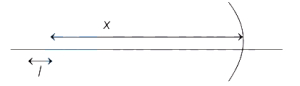
$A$ short straight object of length $l$ lies along the central axis of a spherical concave mirror,at a distance $X$ from the mirror. The focal length of the mirror is $F$. If the length of the image in the mirror is $l^{\prime}$,then the ratio $\left(\frac{l^{\prime}}{l}\right)$ is (assume $l << X$ and $l << F$):
A
$\frac{F-X}{F}$
B
$\left(\frac{F-X}{F}\right)^2$
C
$\left(\frac{F}{F-X}\right)^2$
D
$\frac{F}{X}$
Solution
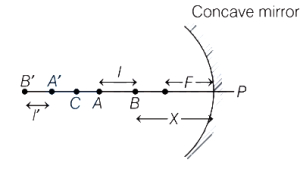
(C) The given situation is shown in the figure.
Let $AB$ be the object and $A^{\prime}B^{\prime}$ be the image.
Here,$AB = l$,$A^{\prime}B^{\prime} = l^{\prime}$,and the object distance $u = -X$.
Using the mirror formula,$\frac{1}{f} = \frac{1}{v} + \frac{1}{u}$,where $f = -F$ for a concave mirror:
$\frac{1}{-F} = \frac{1}{v} + \frac{1}{-X}$
$\frac{1}{v} = \frac{1}{X} - \frac{1}{F} = \frac{F-X}{FX}$
$v = \frac{FX}{F-X}$
For a small object placed along the principal axis,the longitudinal magnification $M$ is given by:
$M = \frac{l^{\prime}}{l} = -\frac{dv}{du} = -\frac{d}{du} \left( \frac{fu}{u-f} \right) = -\frac{f^2}{(u-f)^2}$
Substituting $u = -X$ and $f = -F$:
$M = -\frac{(-F)^2}{(-X - (-F))^2} = -\frac{F^2}{(F-X)^2}$
The magnitude of the longitudinal magnification is:
$\left| \frac{l^{\prime}}{l} \right| = \left( \frac{F}{F-X} \right)^2$
Let $AB$ be the object and $A^{\prime}B^{\prime}$ be the image.
Here,$AB = l$,$A^{\prime}B^{\prime} = l^{\prime}$,and the object distance $u = -X$.
Using the mirror formula,$\frac{1}{f} = \frac{1}{v} + \frac{1}{u}$,where $f = -F$ for a concave mirror:
$\frac{1}{-F} = \frac{1}{v} + \frac{1}{-X}$
$\frac{1}{v} = \frac{1}{X} - \frac{1}{F} = \frac{F-X}{FX}$
$v = \frac{FX}{F-X}$
For a small object placed along the principal axis,the longitudinal magnification $M$ is given by:
$M = \frac{l^{\prime}}{l} = -\frac{dv}{du} = -\frac{d}{du} \left( \frac{fu}{u-f} \right) = -\frac{f^2}{(u-f)^2}$
Substituting $u = -X$ and $f = -F$:
$M = -\frac{(-F)^2}{(-X - (-F))^2} = -\frac{F^2}{(F-X)^2}$
The magnitude of the longitudinal magnification is:
$\left| \frac{l^{\prime}}{l} \right| = \left( \frac{F}{F-X} \right)^2$
0 likes
View Solution222
EasyMCQ
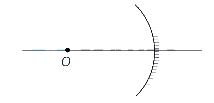
An object $O$ is placed at $7 \,cm$ to the left of a concave mirror of radius of curvature $12 \,cm$ as shown in the figure. The position of the image will be at a distance of
A
$20 \,cm$ from the mirror to the left.
B
$30 \,cm$ from the mirror to the right.
C
$42 \,cm$ from the mirror to the left.
D
$42 \,cm$ from the mirror to the right.
Solution
(C) Given, distance between object and mirror, $u = -7 \,cm$.
Radius of curvature, $R = -12 \,cm$.
Therefore, focal length, $f = \frac{R}{2} = \frac{-12}{2} = -6 \,cm$.
Using the mirror formula, $\frac{1}{v} + \frac{1}{u} = \frac{1}{f}$.
Substituting the given values:
$\frac{1}{v} + \frac{1}{-7} = \frac{1}{-6}$
$\frac{1}{v} = \frac{1}{7} - \frac{1}{6} = \frac{6 - 7}{42} = -\frac{1}{42}$
$v = -42 \,cm$.
The negative sign indicates that the image is formed at a distance of $42 \,cm$ to the left of the mirror.
Radius of curvature, $R = -12 \,cm$.
Therefore, focal length, $f = \frac{R}{2} = \frac{-12}{2} = -6 \,cm$.
Using the mirror formula, $\frac{1}{v} + \frac{1}{u} = \frac{1}{f}$.
Substituting the given values:
$\frac{1}{v} + \frac{1}{-7} = \frac{1}{-6}$
$\frac{1}{v} = \frac{1}{7} - \frac{1}{6} = \frac{6 - 7}{42} = -\frac{1}{42}$
$v = -42 \,cm$.
The negative sign indicates that the image is formed at a distance of $42 \,cm$ to the left of the mirror.
0 likes
View Solution223
EasyMCQ
Consider a concave mirror of $10 \,cm$ focal length illuminated by an object kept at a distance of $25 \,cm$. The distance at which the image is formed and its magnification respectively are
A
$-16.7 \,cm$ and $-0.67$
B
$7.1 \,cm$ and $0.29$
C
$-16.7 \,cm$ and $0.67$
D
$7.1 \,cm$ and $-0.29$
Solution
(A) Using the mirror equation,we have:
$\frac{1}{v} + \frac{1}{u} = \frac{1}{f}$
Given that for a concave mirror,the focal length $f = -10 \,cm$ and the object distance $u = -25 \,cm$.
Substituting these values into the equation:
$\frac{1}{v} = \frac{1}{f} - \frac{1}{u} = \frac{1}{-10} - \frac{1}{-25}$
$\frac{1}{v} = -\frac{1}{10} + \frac{1}{25} = \frac{-5 + 2}{50} = -\frac{3}{50}$
$v = -\frac{50}{3} \approx -16.7 \,cm$
The magnification $m$ is given by:
$m = -\frac{v}{u} = -\frac{-16.7}{-25} = -0.67$
Thus,the image is formed at $-16.7 \,cm$ and the magnification is $-0.67$.
$\frac{1}{v} + \frac{1}{u} = \frac{1}{f}$
Given that for a concave mirror,the focal length $f = -10 \,cm$ and the object distance $u = -25 \,cm$.
Substituting these values into the equation:
$\frac{1}{v} = \frac{1}{f} - \frac{1}{u} = \frac{1}{-10} - \frac{1}{-25}$
$\frac{1}{v} = -\frac{1}{10} + \frac{1}{25} = \frac{-5 + 2}{50} = -\frac{3}{50}$
$v = -\frac{50}{3} \approx -16.7 \,cm$
The magnification $m$ is given by:
$m = -\frac{v}{u} = -\frac{-16.7}{-25} = -0.67$
Thus,the image is formed at $-16.7 \,cm$ and the magnification is $-0.67$.
0 likes
View Solution224
EasyMCQ
Consider a light source placed at a distance of $1.5 \ m$ along the axis facing the convex side of a spherical mirror of radius of curvature $1 \ m$. The position $(s^{\prime})$,nature and magnification $(m)$ of the image are
A
$s^{\prime}=0.375 \ m$,virtual,upright,$m=0.25$
B
$s^{\prime}=0.375 \ m$,real,inverted,$m=0.25$
C
$s^{\prime}=3.75 \ m$,virtual,inverted,$m=2.5$
D
$s^{\prime}=3.75 \ m$,real,upright,$m=2.5$
Solution
(A) Given: Distance of light source $(u) = -1.5 \ m = -\frac{3}{2} \ m$. Radius of curvature of the convex mirror $(R) = +1 \ m$. Focal length $(f) = \frac{R}{2} = +0.5 \ m$.
Using the mirror formula: $\frac{1}{f} = \frac{1}{v} + \frac{1}{u}$.
Substituting the values: $\frac{1}{0.5} = \frac{1}{v} + \frac{1}{-1.5} \Rightarrow 2 = \frac{1}{v} - \frac{2}{3}$.
Solving for $v$: $\frac{1}{v} = 2 + \frac{2}{3} = \frac{6+2}{3} = \frac{8}{3}$.
Therefore,$v = \frac{3}{8} = 0.375 \ m$.
Since $v$ is positive,the image is formed behind the mirror,making it virtual and upright.
Magnification $(m) = -\frac{v}{u} = -\frac{0.375}{-1.5} = \frac{0.375}{1.5} = 0.25$.
Using the mirror formula: $\frac{1}{f} = \frac{1}{v} + \frac{1}{u}$.
Substituting the values: $\frac{1}{0.5} = \frac{1}{v} + \frac{1}{-1.5} \Rightarrow 2 = \frac{1}{v} - \frac{2}{3}$.
Solving for $v$: $\frac{1}{v} = 2 + \frac{2}{3} = \frac{6+2}{3} = \frac{8}{3}$.
Therefore,$v = \frac{3}{8} = 0.375 \ m$.
Since $v$ is positive,the image is formed behind the mirror,making it virtual and upright.
Magnification $(m) = -\frac{v}{u} = -\frac{0.375}{-1.5} = \frac{0.375}{1.5} = 0.25$.
0 likes
View Solution225
MediumMCQ
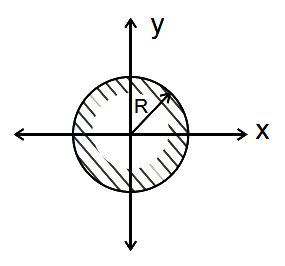
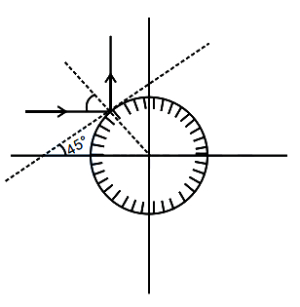
The cross-section of a reflecting surface is represented by the equation $x^{2}+y^{2}=R^{2}$ as shown in the figure. $A$ ray travelling in the positive $x$ direction is directed toward the positive $y$ direction after reflection from the surface at point $M$. The coordinate of the point $M$ on the reflecting surface is
A
$\left(\frac{R}{\sqrt{2}}, \frac{R}{\sqrt{2}}\right)$
B
$\left(-\frac{R}{2},-\frac{R}{2}\right)$
C
$\left(-\frac{R}{\sqrt{2}}, \frac{R}{\sqrt{2}}\right)$
D
$\left(\frac{R}{\sqrt{2}},-\frac{R}{\sqrt{2}}\right)$
Solution
(C) The equation of the reflecting surface is $x^{2}+y^{2}=R^{2}$.
Differentiating with respect to $x$,we get $2x + 2y \frac{dy}{dx} = 0$,which implies $\frac{dy}{dx} = -\frac{x}{y}$.
This $\frac{dy}{dx}$ represents the slope of the tangent at point $M$. The normal at point $M$ makes an angle of $45^{\circ}$ with the $x$-axis because the incident ray is horizontal and the reflected ray is vertical,making the angle of incidence equal to the angle of reflection ($22.5^{\circ}$ each relative to the normal).
Alternatively,for the ray to turn $90^{\circ}$ (from $+x$ to $+y$),the normal at $M$ must make an angle of $45^{\circ}$ with the $x$-axis.
The slope of the normal is $\tan(45^{\circ}) = 1$. Since the normal is perpendicular to the tangent,the slope of the tangent is $-1$.
Thus,$-\frac{x}{y} = -1$,which means $x = y$.
Substituting $x = y$ into the equation $x^{2}+y^{2}=R^{2}$,we get $2x^{2} = R^{2}$,so $x = \pm \frac{R}{\sqrt{2}}$.
Based on the geometry of the reflection (ray coming from left,reflecting to $+y$),point $M$ must be in the second quadrant,where $x < 0$ and $y > 0$.
Therefore,the coordinates are $M = \left(-\frac{R}{\sqrt{2}}, \frac{R}{\sqrt{2}}\right)$.
Differentiating with respect to $x$,we get $2x + 2y \frac{dy}{dx} = 0$,which implies $\frac{dy}{dx} = -\frac{x}{y}$.
This $\frac{dy}{dx}$ represents the slope of the tangent at point $M$. The normal at point $M$ makes an angle of $45^{\circ}$ with the $x$-axis because the incident ray is horizontal and the reflected ray is vertical,making the angle of incidence equal to the angle of reflection ($22.5^{\circ}$ each relative to the normal).
Alternatively,for the ray to turn $90^{\circ}$ (from $+x$ to $+y$),the normal at $M$ must make an angle of $45^{\circ}$ with the $x$-axis.
The slope of the normal is $\tan(45^{\circ}) = 1$. Since the normal is perpendicular to the tangent,the slope of the tangent is $-1$.
Thus,$-\frac{x}{y} = -1$,which means $x = y$.
Substituting $x = y$ into the equation $x^{2}+y^{2}=R^{2}$,we get $2x^{2} = R^{2}$,so $x = \pm \frac{R}{\sqrt{2}}$.
Based on the geometry of the reflection (ray coming from left,reflecting to $+y$),point $M$ must be in the second quadrant,where $x < 0$ and $y > 0$.
Therefore,the coordinates are $M = \left(-\frac{R}{\sqrt{2}}, \frac{R}{\sqrt{2}}\right)$.
0 likes
View Solution226
MediumMCQ
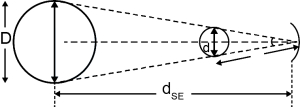
The ratio of the diameter of the sun to the distance between the earth and the sun is approximately $0.009$. The approximate diameter of the image of the sun formed by a concave spherical mirror of radius of curvature $0.4 \ m$ is
A
$4.5 \times 10^{-6} \ m$
B
$4.0 \times 10^{-6} \ m$
C
$3.6 \times 10^{-3} \ m$
D
$1.8 \times 10^{-3} \ m$
Solution
(D) The angle $\theta$ subtended by the sun at the mirror is given by the ratio of the diameter of the sun $(D)$ to the distance between the earth and the sun $(d_{SE})$.
Since the sun is at a very large distance,its image is formed at the focus of the concave mirror.
The angular size $\theta$ is given by $\theta = \frac{D}{d_{SE}} = 0.009 \ rad$.
The diameter of the image $(d)$ formed at the focal plane is given by $d = f \times \theta$,where $f$ is the focal length of the mirror.
The focal length $f$ is half of the radius of curvature $R = 0.4 \ m$,so $f = \frac{R}{2} = \frac{0.4}{2} = 0.2 \ m$.
Substituting the values,we get $d = 0.2 \ m \times 0.009 = 0.0018 \ m$.
Therefore,$d = 1.8 \times 10^{-3} \ m$.
Since the sun is at a very large distance,its image is formed at the focus of the concave mirror.
The angular size $\theta$ is given by $\theta = \frac{D}{d_{SE}} = 0.009 \ rad$.
The diameter of the image $(d)$ formed at the focal plane is given by $d = f \times \theta$,where $f$ is the focal length of the mirror.
The focal length $f$ is half of the radius of curvature $R = 0.4 \ m$,so $f = \frac{R}{2} = \frac{0.4}{2} = 0.2 \ m$.
Substituting the values,we get $d = 0.2 \ m \times 0.009 = 0.0018 \ m$.
Therefore,$d = 1.8 \times 10^{-3} \ m$.
0 likes
View Solution227
MediumMCQ
An object placed in front of a concave mirror at a distance of $x \ cm$ from the pole gives a $3$ times magnified real image. If it is moved to a distance of $(x+5) \ cm$, the magnification of the image becomes $2$. The focal length of the mirror is: (in $cm$)
A
$15$
B
$20$
C
$25$
D
$30$
Solution
(D) For a concave mirror, the magnification $m$ for a real image is negative, so $m = -3$ and $m = -2$.
Using the mirror formula $\frac{1}{v} + \frac{1}{u} = \frac{1}{f}$ and magnification $m = -\frac{v}{u}$, we have $v = -mu$.
Case $1$: $u_1 = -x$, $m_1 = -3$, so $v_1 = -(-3)(-x) = -3x$.
$\frac{1}{-3x} + \frac{1}{-x} = \frac{1}{f} \implies \frac{-1-3}{3x} = \frac{1}{f} \implies \frac{1}{f} = \frac{-4}{3x} \quad (i)$
Case $2$: $u_2 = -(x+5)$, $m_2 = -2$, so $v_2 = -(-2)(-(x+5)) = -2(x+5)$.
$\frac{1}{-2(x+5)} + \frac{1}{-(x+5)} = \frac{1}{f} \implies \frac{-1-2}{2(x+5)} = \frac{1}{f} \implies \frac{1}{f} = \frac{-3}{2(x+5)} \quad (ii)$
Equating $(i)$ and $(ii)$:
$\frac{-4}{3x} = \frac{-3}{2(x+5)} \implies 8(x+5) = 9x \implies 8x + 40 = 9x \implies x = 40 \ cm$.
Substituting $x = 40$ into $(i)$:
$\frac{1}{f} = \frac{-4}{3(40)} = \frac{-4}{120} = \frac{-1}{30} \implies f = -30 \ cm$.
The magnitude of the focal length is $30 \ cm$.
Using the mirror formula $\frac{1}{v} + \frac{1}{u} = \frac{1}{f}$ and magnification $m = -\frac{v}{u}$, we have $v = -mu$.
Case $1$: $u_1 = -x$, $m_1 = -3$, so $v_1 = -(-3)(-x) = -3x$.
$\frac{1}{-3x} + \frac{1}{-x} = \frac{1}{f} \implies \frac{-1-3}{3x} = \frac{1}{f} \implies \frac{1}{f} = \frac{-4}{3x} \quad (i)$
Case $2$: $u_2 = -(x+5)$, $m_2 = -2$, so $v_2 = -(-2)(-(x+5)) = -2(x+5)$.
$\frac{1}{-2(x+5)} + \frac{1}{-(x+5)} = \frac{1}{f} \implies \frac{-1-2}{2(x+5)} = \frac{1}{f} \implies \frac{1}{f} = \frac{-3}{2(x+5)} \quad (ii)$
Equating $(i)$ and $(ii)$:
$\frac{-4}{3x} = \frac{-3}{2(x+5)} \implies 8(x+5) = 9x \implies 8x + 40 = 9x \implies x = 40 \ cm$.
Substituting $x = 40$ into $(i)$:
$\frac{1}{f} = \frac{-4}{3(40)} = \frac{-4}{120} = \frac{-1}{30} \implies f = -30 \ cm$.
The magnitude of the focal length is $30 \ cm$.
0 likes
View Solution228
EasyMCQ
$A$ $2.0 \,cm$ object is placed $15 \,cm$ in front of a concave mirror of focal length $10 \,cm$. What is the size and nature of the image?
A
$4 \,cm$,real
B
$4 \,cm$,virtual
C
$1.0 \,cm$,real
D
None
Solution
(A) Given: Object height $h_o = 2.0 \,cm$,Object distance $u = -15 \,cm$,Focal length $f = -10 \,cm$.
Using the mirror formula: $\frac{1}{v} + \frac{1}{u} = \frac{1}{f}$.
Substituting the values: $\frac{1}{v} + \frac{1}{-15} = \frac{1}{-10} \Rightarrow \frac{1}{v} = \frac{1}{15} - \frac{1}{10} = \frac{2-3}{30} = -\frac{1}{30}$.
So,$v = -30 \,cm$.
The magnification $m = -\frac{v}{u} = -\frac{-30}{-15} = -2$.
Image height $h_i = m \times h_o = -2 \times 2.0 = -4.0 \,cm$.
The negative sign indicates that the image is real and inverted. The size of the image is $4.0 \,cm$.
Using the mirror formula: $\frac{1}{v} + \frac{1}{u} = \frac{1}{f}$.
Substituting the values: $\frac{1}{v} + \frac{1}{-15} = \frac{1}{-10} \Rightarrow \frac{1}{v} = \frac{1}{15} - \frac{1}{10} = \frac{2-3}{30} = -\frac{1}{30}$.
So,$v = -30 \,cm$.
The magnification $m = -\frac{v}{u} = -\frac{-30}{-15} = -2$.
Image height $h_i = m \times h_o = -2 \times 2.0 = -4.0 \,cm$.
The negative sign indicates that the image is real and inverted. The size of the image is $4.0 \,cm$.
0 likes
View Solution229
MediumMCQ
Distance between an object and its three times magnified real image is $40 \ cm$. The focal length of the mirror used is . . . . . . $cm$.
A
$-7.5$
B
$-10$
C
$-20$
D
$-15$
Solution
(D) For a real image,magnification $m = -3$. Since $m = -v/u$,we have $-3 = -v/u$,which implies $v = 3u$.
Given that the distance between the object and the image is $40 \ cm$,and for a real image formed by a concave mirror,both object and image are on the same side,the distance is $|v - u| = 40 \ cm$.
Substituting $v = 3u$,we get $|3u - u| = 40$,so $|2u| = 40$,which gives $u = -20 \ cm$ (using sign convention).
Then $v = 3(-20) = -60 \ cm$.
Using the mirror formula $\frac{1}{f} = \frac{1}{v} + \frac{1}{u}$:
$\frac{1}{f} = \frac{1}{-60} + \frac{1}{-20} = \frac{-1 - 3}{60} = \frac{-4}{60} = \frac{-1}{15}$.
Therefore,$f = -15 \ cm$.
Given that the distance between the object and the image is $40 \ cm$,and for a real image formed by a concave mirror,both object and image are on the same side,the distance is $|v - u| = 40 \ cm$.
Substituting $v = 3u$,we get $|3u - u| = 40$,so $|2u| = 40$,which gives $u = -20 \ cm$ (using sign convention).
Then $v = 3(-20) = -60 \ cm$.
Using the mirror formula $\frac{1}{f} = \frac{1}{v} + \frac{1}{u}$:
$\frac{1}{f} = \frac{1}{-60} + \frac{1}{-20} = \frac{-1 - 3}{60} = \frac{-4}{60} = \frac{-1}{15}$.
Therefore,$f = -15 \ cm$.
0 likes
View Solution230
DifficultMCQ
In the parallax method for the determination of the focal length of a concave mirror,the object should always be placed:
A
between the focus $(F)$ and the centre of curvature $(C)$ of the mirror $ONLY$
B
at any point beyond the focus $(F)$ of the mirror
C
beyond the centre of curvature $(C)$ of the mirror $ONLY$
D
between the pole $(P)$ and the focus $(F)$ of the concave mirror $ONLY$
Solution
(B) In the parallax method,we need to form a real image of the object to observe the parallax between the image and the needle.
For a concave mirror,a real image is formed only when the object is placed beyond the focus $(F)$.
If the object is placed between the pole $(P)$ and the focus $(F)$,the image formed is virtual,erect,and magnified,which cannot be used for the parallax method as it cannot be captured on a screen or observed as a real point of coincidence.
Therefore,the object must be placed at any point beyond the focus $(F)$.
For a concave mirror,a real image is formed only when the object is placed beyond the focus $(F)$.
If the object is placed between the pole $(P)$ and the focus $(F)$,the image formed is virtual,erect,and magnified,which cannot be used for the parallax method as it cannot be captured on a screen or observed as a real point of coincidence.
Therefore,the object must be placed at any point beyond the focus $(F)$.
0 likes
View Solution231
MediumMCQ
An object is placed at $10 \text{ cm}$ in front of a concave mirror of focal length $15 \text{ cm}$. The image formed will be . . . . . . .
A
virtual,erect and magnified
B
real,inverted and diminished
C
virtual,erect and diminished
D
real,inverted and magnified
Solution
(A) For a concave mirror,the focal length $f = -15 \text{ cm}$ and the object distance $u = -10 \text{ cm}$.
Using the mirror formula $\frac{1}{v} + \frac{1}{u} = \frac{1}{f}$:
$\frac{1}{v} = \frac{1}{f} - \frac{1}{u} = \frac{1}{-15} - \frac{1}{-10} = -\frac{1}{15} + \frac{1}{10} = \frac{-2 + 3}{30} = \frac{1}{30}$.
Thus,$v = +30 \text{ cm}$.
Since $v$ is positive,the image is formed behind the mirror,which means it is virtual and erect.
The magnification $m = -\frac{v}{u} = -\frac{30}{-10} = +3$.
Since the magnification $m$ is positive and $|m| > 1$,the image is virtual,erect,and magnified.
Using the mirror formula $\frac{1}{v} + \frac{1}{u} = \frac{1}{f}$:
$\frac{1}{v} = \frac{1}{f} - \frac{1}{u} = \frac{1}{-15} - \frac{1}{-10} = -\frac{1}{15} + \frac{1}{10} = \frac{-2 + 3}{30} = \frac{1}{30}$.
Thus,$v = +30 \text{ cm}$.
Since $v$ is positive,the image is formed behind the mirror,which means it is virtual and erect.
The magnification $m = -\frac{v}{u} = -\frac{30}{-10} = +3$.
Since the magnification $m$ is positive and $|m| > 1$,the image is virtual,erect,and magnified.
0 likes
View Solution232
DifficultMCQ
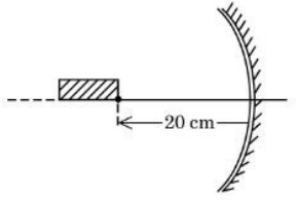
$A$ rod of length $10 \text{ cm}$ lies along the principal axis of a concave mirror of focal length $10 \text{ cm}$ as shown in the figure. The length of the image is . . . . . . $\text{cm}$.
A
$2.5$
B
$5$
C
$7.5$
D
$7$
Solution
(B) For a concave mirror,the focal length $f = -10 \text{ cm}$.
The rod is placed from $u_1 = -20 \text{ cm}$ to $u_2 = -30 \text{ cm}$ (since the length is $10 \text{ cm}$ and the near end is at $20 \text{ cm}$ from the pole).
Using the mirror formula $\frac{1}{v} + \frac{1}{u} = \frac{1}{f}$:
For the near end at $u_1 = -20 \text{ cm}$:
$\frac{1}{v_1} - \frac{1}{20} = -\frac{1}{10} \implies \frac{1}{v_1} = -\frac{1}{10} + \frac{1}{20} = -\frac{1}{20} \implies v_1 = -20 \text{ cm}$.
For the far end at $u_2 = -30 \text{ cm}$:
$\frac{1}{v_2} - \frac{1}{30} = -\frac{1}{10} \implies \frac{1}{v_2} = -\frac{1}{10} + \frac{1}{30} = -\frac{2}{30} = -\frac{1}{15} \implies v_2 = -15 \text{ cm}$.
The length of the image is the distance between the images of the two ends:
$\text{Length of image} = |v_1 - v_2| = |-20 - (-15)| = |-5| = 5 \text{ cm}$.
The rod is placed from $u_1 = -20 \text{ cm}$ to $u_2 = -30 \text{ cm}$ (since the length is $10 \text{ cm}$ and the near end is at $20 \text{ cm}$ from the pole).
Using the mirror formula $\frac{1}{v} + \frac{1}{u} = \frac{1}{f}$:
For the near end at $u_1 = -20 \text{ cm}$:
$\frac{1}{v_1} - \frac{1}{20} = -\frac{1}{10} \implies \frac{1}{v_1} = -\frac{1}{10} + \frac{1}{20} = -\frac{1}{20} \implies v_1 = -20 \text{ cm}$.
For the far end at $u_2 = -30 \text{ cm}$:
$\frac{1}{v_2} - \frac{1}{30} = -\frac{1}{10} \implies \frac{1}{v_2} = -\frac{1}{10} + \frac{1}{30} = -\frac{2}{30} = -\frac{1}{15} \implies v_2 = -15 \text{ cm}$.
The length of the image is the distance between the images of the two ends:
$\text{Length of image} = |v_1 - v_2| = |-20 - (-15)| = |-5| = 5 \text{ cm}$.
0 likes
View Solution233
DifficultMCQ
$A$ concave mirror of focal length $10$ cm forms an image which is double the size of the object when the object is placed at two different positions. The distance between the two positions of the object is . . . . . . cm.
A
$5$
B
$10$
C
$15$
D
$20$
Solution
(B) For a concave mirror,the magnification $m$ can be $\pm 2$ because the image can be real (inverted) or virtual (erect).
The focal length $f = -10$ cm.
$1$) For real image,$m = -2$:
Using $m = \frac{f}{f-u}$,we have $-2 = \frac{-10}{-10-u} \Rightarrow -2 = \frac{10}{10+u} \Rightarrow -20 - 2u = 10 \Rightarrow 2u = -30 \Rightarrow u_1 = -15$ cm.
$2$) For virtual image,$m = +2$:
Using $m = \frac{f}{f-u}$,we have $2 = \frac{-10}{-10-u} \Rightarrow 2 = \frac{10}{10+u} \Rightarrow 20 + 2u = 10 \Rightarrow 2u = -10 \Rightarrow u_2 = -5$ cm.
The distance between the two positions is $|u_1 - u_2| = |-15 - (-5)| = |-10| = 10$ cm.
The focal length $f = -10$ cm.
$1$) For real image,$m = -2$:
Using $m = \frac{f}{f-u}$,we have $-2 = \frac{-10}{-10-u} \Rightarrow -2 = \frac{10}{10+u} \Rightarrow -20 - 2u = 10 \Rightarrow 2u = -30 \Rightarrow u_1 = -15$ cm.
$2$) For virtual image,$m = +2$:
Using $m = \frac{f}{f-u}$,we have $2 = \frac{-10}{-10-u} \Rightarrow 2 = \frac{10}{10+u} \Rightarrow 20 + 2u = 10 \Rightarrow 2u = -10 \Rightarrow u_2 = -5$ cm.
The distance between the two positions is $|u_1 - u_2| = |-15 - (-5)| = |-10| = 10$ cm.
0 likes
View SolutionRay Optics and Optical Instruments — Spherical Mirror · Frequently Asked Questions
1Are these Ray Optics and Optical Instruments questions useful for JEE and NEET?
Yes. All questions in this section are mapped to JEE Main and NEET exam patterns. Previous year questions from JEE Main, NEET, GUJCET and state-level exams are included with full solutions.
2Can I switch to Hindi or Gujarati for these questions?
Yes. Use the language tabs in the hero section or the sidebar to view the same questions and solutions in English, Hindi or Gujarati.
3How do I generate a question paper from this subtopic?
Use the Vedclass Exam Paper Generator — select the chapter and subtopic, set difficulty, and generate Sets A, B, C, D automatically. First 3 chapters of every subject are free.
Vedclass Products
For Students
Vedclass Test Series
Mock tests in real JEE/NEET style with performance analysis. 5-day free trial.
Start Free TrialFor Teachers
Exam Paper Generator
Generate Set A/B/C/D papers from this chapter in 2 minutes. 3 chapters free.
Try FreeFor Institutes
Online Exam Module
Live online exams with unlimited students, 360° analytics & white-label branding.
See DemoFor Teachers & Institutes
Generate a Ray Optics and Optical Instruments Exam Paper in 2 Minutes
Select subtopic & difficulty — Sets A, B, C, D auto-generated with No Repeat logic.
First 3 chapters of every subject are free — no payment required.