
A English
Refraction by Lenses Questions in English
Class 12 Physics · Ray Optics and Optical Instruments · Refraction by Lenses
470+
Questions
English
Language
100%
With Solutions
Showing 50 of 470 questions in English
1
MediumMCQ
The radius of curvature for a convex lens is $40 \ cm$ for each surface. Its refractive index is $1.5$. The focal length will be ...... $cm$.
A
$40$
B
$20$
C
$80$
D
$30$
Solution
(A) Using the Lens Maker's formula: $\frac{1}{f} = (\mu - 1) \left( \frac{1}{R_1} - \frac{1}{R_2} \right)$.
For a convex lens,the first surface is convex $(R_1 = +40 \ cm)$ and the second surface is concave $(R_2 = -40 \ cm)$.
Substituting the values: $\frac{1}{f} = (1.5 - 1) \left( \frac{1}{40} - \frac{1}{-40} \right)$.
$\frac{1}{f} = (0.5) \left( \frac{1}{40} + \frac{1}{40} \right) = 0.5 \times \frac{2}{40} = 0.5 \times \frac{1}{20} = \frac{1}{40}$.
Therefore,$f = 40 \ cm$.
For a convex lens,the first surface is convex $(R_1 = +40 \ cm)$ and the second surface is concave $(R_2 = -40 \ cm)$.
Substituting the values: $\frac{1}{f} = (1.5 - 1) \left( \frac{1}{40} - \frac{1}{-40} \right)$.
$\frac{1}{f} = (0.5) \left( \frac{1}{40} + \frac{1}{40} \right) = 0.5 \times \frac{2}{40} = 0.5 \times \frac{1}{20} = \frac{1}{40}$.
Therefore,$f = 40 \ cm$.
0 likes
View Solution2
MediumMCQ
$A$ convex lens of focal length $f$ is placed somewhere in between an object and a screen. The distance between the object and the screen is $x$. If the numerical value of the magnification produced by the lens is $m$, then the focal length of the lens is
A
$\frac{mx}{(m + 1)^2}$
B
$\frac{mx}{(m - 1)^2}$
C
$\frac{(m + 1)^2}{m}x$
D
$\frac{(m - 1)^2}{m}x$
Solution
(A) Let the distance of the object from the lens be $u$ and the distance of the image (screen) from the lens be $v$. Since the image is formed on a screen, it is a real image.
Given that the distance between the object and the screen is $x$, we have $v + u = x$.
The magnification $m$ is given by $m = |v/u| = v/u$, so $v = mu$.
Substituting $v = mu$ into the distance equation: $mu + u = x$, which gives $u(m + 1) = x$, or $u = x / (m + 1)$.
Then, $v = x - u = x - x / (m + 1) = mx / (m + 1)$.
Using the lens formula $\frac{1}{f} = \frac{1}{v} - \frac{1}{u}$:
$\frac{1}{f} = \frac{1}{mx / (m + 1)} - \frac{1}{x / (m + 1)} = \frac{m + 1}{mx} - \frac{m + 1}{x} = \frac{m + 1 - m(m + 1)}{mx} = \frac{m + 1 - m^2 - m}{mx} = \frac{1 - m^2}{mx}$.
Wait, for a real image, $v$ is positive and $u$ is negative. The lens formula is $\frac{1}{f} = \frac{1}{v} - \frac{1}{u}$. With $v = mu$ and $u = -u_0$ (where $u_0$ is distance), $m = v/u_0$. Thus $v = mu_0$ and $u_0 + v = x$. $u_0(1+m) = x \Rightarrow u_0 = x/(1+m)$ and $v = mx/(1+m)$.
$\frac{1}{f} = \frac{1}{v} + \frac{1}{u_0} = \frac{1+m}{mx} + \frac{1+m}{x} = \frac{1+m + m(1+m)}{mx} = \frac{(1+m)^2}{mx}$.
Therefore, $f = \frac{mx}{(m+1)^2}$.
Given that the distance between the object and the screen is $x$, we have $v + u = x$.
The magnification $m$ is given by $m = |v/u| = v/u$, so $v = mu$.
Substituting $v = mu$ into the distance equation: $mu + u = x$, which gives $u(m + 1) = x$, or $u = x / (m + 1)$.
Then, $v = x - u = x - x / (m + 1) = mx / (m + 1)$.
Using the lens formula $\frac{1}{f} = \frac{1}{v} - \frac{1}{u}$:
$\frac{1}{f} = \frac{1}{mx / (m + 1)} - \frac{1}{x / (m + 1)} = \frac{m + 1}{mx} - \frac{m + 1}{x} = \frac{m + 1 - m(m + 1)}{mx} = \frac{m + 1 - m^2 - m}{mx} = \frac{1 - m^2}{mx}$.
Wait, for a real image, $v$ is positive and $u$ is negative. The lens formula is $\frac{1}{f} = \frac{1}{v} - \frac{1}{u}$. With $v = mu$ and $u = -u_0$ (where $u_0$ is distance), $m = v/u_0$. Thus $v = mu_0$ and $u_0 + v = x$. $u_0(1+m) = x \Rightarrow u_0 = x/(1+m)$ and $v = mx/(1+m)$.
$\frac{1}{f} = \frac{1}{v} + \frac{1}{u_0} = \frac{1+m}{mx} + \frac{1+m}{x} = \frac{1+m + m(1+m)}{mx} = \frac{(1+m)^2}{mx}$.
Therefore, $f = \frac{mx}{(m+1)^2}$.
0 likes
View Solution3
MediumMCQ
$A$ lens having focal length $f$ and aperture of diameter $d$ forms an image of intensity $I$. If the central region of the lens with aperture diameter $\frac{d}{2}$ is covered by black paper,what will be the new focal length and intensity of the image?
A
$f/2$ and $I/2$
B
$f$ and $I/4$
C
$3f/4$ and $I/2$
D
$f$ and $3I/4$
Solution
(D) The focal length $f$ of a lens depends on its refractive index and the radii of curvature of its surfaces. Covering a part of the lens does not change these properties,so the focal length remains $f$.
The intensity $I$ of the image formed by a lens is directly proportional to the area $A$ of the aperture through which light passes $(I \propto A)$.
The initial area of the aperture is $A_1 = \pi (d/2)^2 = \pi d^2/4$.
When the central region with diameter $d/2$ (radius $d/4$) is covered,the area of the covered part is $A_{covered} = \pi (d/4)^2 = \pi d^2/16$.
The new area of the aperture through which light passes is $A_2 = A_1 - A_{covered} = \frac{\pi d^2}{4} - \frac{\pi d^2}{16} = \frac{3\pi d^2}{16}$.
The ratio of the new intensity $I_2$ to the initial intensity $I_1$ is given by the ratio of the areas: $\frac{I_2}{I_1} = \frac{A_2}{A_1} = \frac{3\pi d^2/16}{\pi d^2/4} = \frac{3}{4}$.
Therefore,the new intensity is $I_2 = \frac{3}{4}I$ and the focal length remains $f$.
The intensity $I$ of the image formed by a lens is directly proportional to the area $A$ of the aperture through which light passes $(I \propto A)$.
The initial area of the aperture is $A_1 = \pi (d/2)^2 = \pi d^2/4$.
When the central region with diameter $d/2$ (radius $d/4$) is covered,the area of the covered part is $A_{covered} = \pi (d/4)^2 = \pi d^2/16$.
The new area of the aperture through which light passes is $A_2 = A_1 - A_{covered} = \frac{\pi d^2}{4} - \frac{\pi d^2}{16} = \frac{3\pi d^2}{16}$.
The ratio of the new intensity $I_2$ to the initial intensity $I_1$ is given by the ratio of the areas: $\frac{I_2}{I_1} = \frac{A_2}{A_1} = \frac{3\pi d^2/16}{\pi d^2/4} = \frac{3}{4}$.
Therefore,the new intensity is $I_2 = \frac{3}{4}I$ and the focal length remains $f$.
0 likes
View Solution4
EasyMCQ
If in a plano-convex lens,the radius of curvature of the convex surface is $10 \ cm$ and the focal length of the lens is $30 \ cm,$ then the refractive index of the material of the lens will be
A
$1.5$
B
$1.66$
C
$1.33$
D
$3$
Solution
(C) For a plano-convex lens,the lens maker's formula is given by $\frac{1}{f} = (\mu - 1) \left( \frac{1}{R_1} - \frac{1}{R_2} \right)$.
Given that the lens is plano-convex,$R_1 = 10 \ cm$ and $R_2 = \infty$.
The focal length $f = 30 \ cm$.
Substituting these values into the formula:
$\frac{1}{30} = (\mu - 1) \left( \frac{1}{10} - \frac{1}{\infty} \right)$
Since $\frac{1}{\infty} = 0$,we have:
$\frac{1}{30} = (\mu - 1) \left( \frac{1}{10} \right)$
$\frac{10}{30} = \mu - 1$
$\frac{1}{3} = \mu - 1$
$\mu = 1 + 0.333 = 1.33$.
Given that the lens is plano-convex,$R_1 = 10 \ cm$ and $R_2 = \infty$.
The focal length $f = 30 \ cm$.
Substituting these values into the formula:
$\frac{1}{30} = (\mu - 1) \left( \frac{1}{10} - \frac{1}{\infty} \right)$
Since $\frac{1}{\infty} = 0$,we have:
$\frac{1}{30} = (\mu - 1) \left( \frac{1}{10} \right)$
$\frac{10}{30} = \mu - 1$
$\frac{1}{3} = \mu - 1$
$\mu = 1 + 0.333 = 1.33$.
0 likes
View Solution5
EasyMCQ
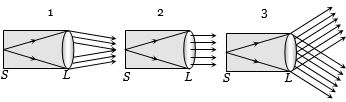
The slit of a collimator is illuminated by a source as shown in the adjoining figures. The distance between the slit $S$ and the collimating lens $L$ is equal to the focal length of the lens. The correct direction of the emergent beam will be as shown in figure:
A
$1$
B
$3$
C
$2$
D
None of the figures
Solution
(C) In the case of a convex lens,if the light rays originate from the principal focus,the emergent rays after refraction become parallel to the principal axis.
Since the distance between the slit $S$ and the collimating lens $L$ is equal to the focal length of the lens,the slit $S$ acts as a point source placed at the focus.
Therefore,the rays of light emerging from the lens will be parallel to the principal axis,which is correctly depicted in figure $2$.
Since the distance between the slit $S$ and the collimating lens $L$ is equal to the focal length of the lens,the slit $S$ acts as a point source placed at the focus.
Therefore,the rays of light emerging from the lens will be parallel to the principal axis,which is correctly depicted in figure $2$.
0 likes
View Solution6
EasyMCQ
$A$ converging lens is used to form an image on a screen. When the upper half of the lens is covered by an opaque screen,
A
Half the image will disappear
B
Complete image will be formed of same intensity
C
Half image will be formed of same intensity
D
Complete image will be formed of decreased intensity
Solution
(D) When the upper half of the lens is covered,the light rays from the object still pass through the remaining lower half of the lens.
Since every point on the object sends light rays to all parts of the lens,the lower half of the lens is sufficient to form the complete image of the object at the same position.
However,because the total amount of light passing through the lens is reduced (as half of the aperture is blocked),the intensity of the image decreases.
Therefore,the complete image is formed,but with decreased intensity.
Since every point on the object sends light rays to all parts of the lens,the lower half of the lens is sufficient to form the complete image of the object at the same position.
However,because the total amount of light passing through the lens is reduced (as half of the aperture is blocked),the intensity of the image decreases.
Therefore,the complete image is formed,but with decreased intensity.
0 likes
View Solution7
MediumMCQ
$A$ convex lens makes a real image $4 \, cm$ long on a screen. When the lens is shifted to a new position without disturbing the object,we again get a real image on the screen which is $16 \, cm$ tall. The length of the object must be.......$cm$
A
$0.25$
B
$8$
C
$12$
D
$20$
Solution
(B) For the displacement method of a convex lens,when the object and screen are fixed at a distance $D$,there are two positions of the lens where a real image is formed on the screen.
Let the size of the object be $O$,and the sizes of the two images be $I_1$ and $I_2$.
The relationship between the object size and the image sizes is given by the formula $O = \sqrt{I_1 \times I_2}$.
Given: $I_1 = 4 \, cm$ and $I_2 = 16 \, cm$.
Substituting these values into the formula:
$O = \sqrt{4 \times 16} = \sqrt{64} = 8 \, cm$.
Therefore,the length of the object is $8 \, cm$.
Let the size of the object be $O$,and the sizes of the two images be $I_1$ and $I_2$.
The relationship between the object size and the image sizes is given by the formula $O = \sqrt{I_1 \times I_2}$.
Given: $I_1 = 4 \, cm$ and $I_2 = 16 \, cm$.
Substituting these values into the formula:
$O = \sqrt{4 \times 16} = \sqrt{64} = 8 \, cm$.
Therefore,the length of the object is $8 \, cm$.
0 likes
View Solution8
EasyMCQ
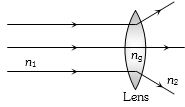
The ray diagram shown could be correct:
A
If ${n_1} = {n_2} = {n_g}$
B
If ${n_1} = {n_2}$ and ${n_1} < {n_g}$
C
If ${n_1} = {n_2}$ and ${n_1} > {n_g}$
D
Under no circumstances
Solution
(C) The ray diagram shows a convex lens causing incident parallel rays to diverge after passing through it.
This indicates that the convex lens is behaving like a concave lens.
According to the lens maker's formula,the focal length $f$ of a lens in a medium is given by $\frac{1}{f} = (\frac{n_g}{n_m} - 1)(\frac{1}{R_1} - \frac{1}{R_2})$.
When the surrounding medium refractive index $n_m$ (here $n_1 = n_2 = n_m$) is greater than the refractive index of the lens material $n_g$,the term $(\frac{n_g}{n_m} - 1)$ becomes negative.
Consequently,the focal length $f$ becomes negative,and the convex lens behaves as a diverging (concave) lens.
Therefore,the condition for this behavior is $n_1 = n_2$ and $n_1 > n_g$.
This indicates that the convex lens is behaving like a concave lens.
According to the lens maker's formula,the focal length $f$ of a lens in a medium is given by $\frac{1}{f} = (\frac{n_g}{n_m} - 1)(\frac{1}{R_1} - \frac{1}{R_2})$.
When the surrounding medium refractive index $n_m$ (here $n_1 = n_2 = n_m$) is greater than the refractive index of the lens material $n_g$,the term $(\frac{n_g}{n_m} - 1)$ becomes negative.
Consequently,the focal length $f$ becomes negative,and the convex lens behaves as a diverging (concave) lens.
Therefore,the condition for this behavior is $n_1 = n_2$ and $n_1 > n_g$.
0 likes
View Solution9
MediumMCQ
$A$ thin convex lens of refractive index $1.5$ has a focal length of $15\, cm$ in air. When the lens is placed in a liquid of refractive index $4/3$,its focal length will be......$cm$.
A
$15$
B
$10$
C
$30$
D
$60$
Solution
(D) Using the Lens Maker's Formula,the focal length of a lens in a medium is given by $\frac{1}{f} = (\mu_{rel} - 1) \left( \frac{1}{R_1} - \frac{1}{R_2} \right)$.
For air: $\frac{1}{f_a} = (\mu_g - 1) \left( \frac{1}{R_1} - \frac{1}{R_2} \right) = \frac{1}{15}$.
For liquid: $\frac{1}{f_l} = \left( \frac{\mu_g}{\mu_l} - 1 \right) \left( \frac{1}{R_1} - \frac{1}{R_2} \right)$.
Dividing the two equations: $\frac{f_l}{f_a} = \frac{(\mu_g - 1)}{(\frac{\mu_g}{\mu_l} - 1)}$.
Given $\mu_g = 1.5$,$\mu_l = 4/3 = 1.33$,and $f_a = 15\, cm$.
$\frac{f_l}{15} = \frac{1.5 - 1}{\frac{1.5}{4/3} - 1} = \frac{0.5}{1.125 - 1} = \frac{0.5}{0.125} = 4$.
Therefore,$f_l = 15 \times 4 = 60\, cm$.
For air: $\frac{1}{f_a} = (\mu_g - 1) \left( \frac{1}{R_1} - \frac{1}{R_2} \right) = \frac{1}{15}$.
For liquid: $\frac{1}{f_l} = \left( \frac{\mu_g}{\mu_l} - 1 \right) \left( \frac{1}{R_1} - \frac{1}{R_2} \right)$.
Dividing the two equations: $\frac{f_l}{f_a} = \frac{(\mu_g - 1)}{(\frac{\mu_g}{\mu_l} - 1)}$.
Given $\mu_g = 1.5$,$\mu_l = 4/3 = 1.33$,and $f_a = 15\, cm$.
$\frac{f_l}{15} = \frac{1.5 - 1}{\frac{1.5}{4/3} - 1} = \frac{0.5}{1.125 - 1} = \frac{0.5}{0.125} = 4$.
Therefore,$f_l = 15 \times 4 = 60\, cm$.
0 likes
View Solution10
EasyMCQ
$A$ glass lens is placed in a medium in which it is found to behave like a glass plate. The refractive index of the medium will be:
A
Greater than the refractive index of glass
B
Smaller than the refractive index of glass
C
Equal to the refractive index of glass
D
No case will be possible from above
Solution
(C) According to the Lens Maker's Formula,the focal length $f_l$ of a lens in a medium is given by $\frac{1}{f_l} = (_{\mu} - 1) \left( \frac{1}{R_1} - \frac{1}{R_2} \right)$,where $_{\mu}$ is the refractive index of the lens material with respect to the medium.
If the lens behaves like a glass plate,its focal length $f_l$ must be infinite $(\infty)$,meaning the lens has no converging or diverging power.
For $f_l = \infty$,the term $(_{\mu} - 1)$ must be zero.
This implies $_{\mu} = 1$.
Since $_{\mu} = \frac{\mu_g}{\mu_m}$ (where $\mu_g$ is the refractive index of glass and $\mu_m$ is the refractive index of the medium),we have $\frac{\mu_g}{\mu_m} = 1$,which means $\mu_g = \mu_m$.
Therefore,the refractive index of the medium must be equal to the refractive index of the glass.
If the lens behaves like a glass plate,its focal length $f_l$ must be infinite $(\infty)$,meaning the lens has no converging or diverging power.
For $f_l = \infty$,the term $(_{\mu} - 1)$ must be zero.
This implies $_{\mu} = 1$.
Since $_{\mu} = \frac{\mu_g}{\mu_m}$ (where $\mu_g$ is the refractive index of glass and $\mu_m$ is the refractive index of the medium),we have $\frac{\mu_g}{\mu_m} = 1$,which means $\mu_g = \mu_m$.
Therefore,the refractive index of the medium must be equal to the refractive index of the glass.
0 likes
View Solution11
EasyMCQ
If ${I_1}$ and ${I_2}$ are the sizes of the images for the two positions of the lens in the displacement method,then the size of the object is given by:
A
${I_1}/{I_2}$
B
${I_1} \times {I_2}$
C
$\sqrt {{I_1} \times {I_2}} $
D
$\sqrt {{I_1}/{I_2}} $
Solution
(C) In the displacement method for a convex lens,for the two positions of the lens,the magnification $m_1$ and $m_2$ are given by:
$m_1 = \frac{I_1}{O} = \frac{v}{u}$
$m_2 = \frac{I_2}{O} = \frac{u}{v}$
Multiplying these two equations:
$\frac{I_1}{O} \times \frac{I_2}{O} = \frac{v}{u} \times \frac{u}{v} = 1$
$\frac{I_1 I_2}{O^2} = 1$
$O^2 = I_1 I_2$
$O = \sqrt{I_1 I_2}$
Therefore,the size of the object is $\sqrt{I_1 I_2}$.
$m_1 = \frac{I_1}{O} = \frac{v}{u}$
$m_2 = \frac{I_2}{O} = \frac{u}{v}$
Multiplying these two equations:
$\frac{I_1}{O} \times \frac{I_2}{O} = \frac{v}{u} \times \frac{u}{v} = 1$
$\frac{I_1 I_2}{O^2} = 1$
$O^2 = I_1 I_2$
$O = \sqrt{I_1 I_2}$
Therefore,the size of the object is $\sqrt{I_1 I_2}$.
0 likes
View Solution12
EasyMCQ
$A$ convex lens of crown glass $(n = 1.525)$ will behave as a divergent lens if immersed in:
A
Water $(n = 1.33)$
B
$A$ medium of $n = 1.525$
C
Carbon disulphide $(n = 1.66)$
D
It cannot act as a divergent lens
Solution
(C) According to the Lens Maker's Formula,the focal length $f$ of a lens in a medium is given by $\frac{1}{f} = (\frac{n_l}{n_m} - 1)(\frac{1}{R_1} - \frac{1}{R_2})$.
For a convex lens,the term $(\frac{1}{R_1} - \frac{1}{R_2})$ is positive.
If the refractive index of the medium $n_m$ is greater than the refractive index of the lens $n_l$,then the term $(\frac{n_l}{n_m} - 1)$ becomes negative.
Consequently,the focal length $f$ becomes negative,and the lens behaves as a divergent (concave) lens.
Given $n_l = 1.525$,the lens will behave as a divergent lens if $n_m > 1.525$.
Among the options,Carbon disulphide has $n = 1.66$,which is greater than $1.525$.
For a convex lens,the term $(\frac{1}{R_1} - \frac{1}{R_2})$ is positive.
If the refractive index of the medium $n_m$ is greater than the refractive index of the lens $n_l$,then the term $(\frac{n_l}{n_m} - 1)$ becomes negative.
Consequently,the focal length $f$ becomes negative,and the lens behaves as a divergent (concave) lens.
Given $n_l = 1.525$,the lens will behave as a divergent lens if $n_m > 1.525$.
Among the options,Carbon disulphide has $n = 1.66$,which is greater than $1.525$.
0 likes
View Solution13
EasyMCQ
$A$ divergent lens will produce
A
Always a virtual image
B
Always real image
C
Sometimes real and sometimes virtual
D
None of the above
Solution
(A) divergent lens,also known as a concave lens,is thinner at the center than at the edges.
For any real object placed in front of a concave lens,the light rays diverge after refraction.
When these rays are traced backward,they appear to meet at a point on the same side as the object.
Therefore,a concave lens always forms a virtual,erect,and diminished image for all real objects.
For any real object placed in front of a concave lens,the light rays diverge after refraction.
When these rays are traced backward,they appear to meet at a point on the same side as the object.
Therefore,a concave lens always forms a virtual,erect,and diminished image for all real objects.
0 likes
View Solution14
MediumMCQ
An object is placed at a distance of $20 \ cm$ from a convex lens of focal length $10 \ cm$. The image is formed on the other side of the lens at a distance of . . . . . . $cm$.
A
$20$
B
$10$
C
$40$
D
$30$
Solution
(A) Using the lens formula: $\frac{1}{f} = \frac{1}{v} - \frac{1}{u}$.
Given: Object distance $u = -20 \ cm$,Focal length $f = +10 \ cm$.
Substituting the values into the formula:
$\frac{1}{10} = \frac{1}{v} - \frac{1}{-20}$
$\frac{1}{10} = \frac{1}{v} + \frac{1}{20}$
$\frac{1}{v} = \frac{1}{10} - \frac{1}{20}$
$\frac{1}{v} = \frac{2 - 1}{20} = \frac{1}{20}$
Therefore,$v = 20 \ cm$.
The image is formed at a distance of $20 \ cm$ on the other side of the lens.
Given: Object distance $u = -20 \ cm$,Focal length $f = +10 \ cm$.
Substituting the values into the formula:
$\frac{1}{10} = \frac{1}{v} - \frac{1}{-20}$
$\frac{1}{10} = \frac{1}{v} + \frac{1}{20}$
$\frac{1}{v} = \frac{1}{10} - \frac{1}{20}$
$\frac{1}{v} = \frac{2 - 1}{20} = \frac{1}{20}$
Therefore,$v = 20 \ cm$.
The image is formed at a distance of $20 \ cm$ on the other side of the lens.
0 likes
View Solution15
EasyMCQ
$A$ double convex lens of focal length $20 \ cm$ is made of glass of refractive index $3/2$. When placed completely in water $(_{a}\mu_{w} = 4/3)$,its focal length will be.....$cm$.
A
$80$
B
$15$
C
$17.7$
D
$22.5$
Solution
(A) The lens maker's formula is given by $\frac{1}{f} = (\mu - 1) \left( \frac{1}{R_1} - \frac{1}{R_2} \right)$.
In air,$\frac{1}{f_a} = (_{a}\mu_{g} - 1) \left( \frac{1}{R_1} - \frac{1}{R_2} \right) = (1.5 - 1) \left( \frac{1}{R_1} - \frac{1}{R_2} \right) = 0.5 \left( \frac{1}{R_1} - \frac{1}{R_2} \right)$.
Given $f_a = 20 \ cm$,so $0.5 \left( \frac{1}{R_1} - \frac{1}{R_2} \right) = \frac{1}{20}$,which means $\left( \frac{1}{R_1} - \frac{1}{R_2} \right) = \frac{1}{10}$.
In water,$\frac{1}{f_w} = (_{w}\mu_{g} - 1) \left( \frac{1}{R_1} - \frac{1}{R_2} \right)$,where $_{w}\mu_{g} = \frac{_{a}\mu_{g}}{_{a}\mu_{w}} = \frac{1.5}{4/3} = \frac{1.5 \times 3}{4} = \frac{4.5}{4} = 1.125$.
So,$\frac{1}{f_w} = (1.125 - 1) \times \frac{1}{10} = 0.125 \times \frac{1}{10} = \frac{0.125}{10} = \frac{1}{80}$.
Therefore,$f_w = 80 \ cm$.
In air,$\frac{1}{f_a} = (_{a}\mu_{g} - 1) \left( \frac{1}{R_1} - \frac{1}{R_2} \right) = (1.5 - 1) \left( \frac{1}{R_1} - \frac{1}{R_2} \right) = 0.5 \left( \frac{1}{R_1} - \frac{1}{R_2} \right)$.
Given $f_a = 20 \ cm$,so $0.5 \left( \frac{1}{R_1} - \frac{1}{R_2} \right) = \frac{1}{20}$,which means $\left( \frac{1}{R_1} - \frac{1}{R_2} \right) = \frac{1}{10}$.
In water,$\frac{1}{f_w} = (_{w}\mu_{g} - 1) \left( \frac{1}{R_1} - \frac{1}{R_2} \right)$,where $_{w}\mu_{g} = \frac{_{a}\mu_{g}}{_{a}\mu_{w}} = \frac{1.5}{4/3} = \frac{1.5 \times 3}{4} = \frac{4.5}{4} = 1.125$.
So,$\frac{1}{f_w} = (1.125 - 1) \times \frac{1}{10} = 0.125 \times \frac{1}{10} = \frac{0.125}{10} = \frac{1}{80}$.
Therefore,$f_w = 80 \ cm$.
0 likes
View Solution16
DifficultMCQ
An object is placed at a distance of $f/2$ from a convex lens. The image will be
A
At one of the foci,virtual and double its size
B
At $3f/2$,real and inverted
C
At $2f$,virtual and erect
D
None of these
Solution
(A) Using the lens formula: $\frac{1}{f} = \frac{1}{v} - \frac{1}{u}$.
Given that the object distance $u = -f/2$ (using sign convention).
Substituting the values: $\frac{1}{f} = \frac{1}{v} - \frac{1}{-f/2} = \frac{1}{v} + \frac{2}{f}$.
Rearranging to solve for $v$: $\frac{1}{v} = \frac{1}{f} - \frac{2}{f} = -\frac{1}{f}$.
Thus,$v = -f$. The negative sign indicates that the image is formed on the same side as the object,meaning it is virtual.
The magnification $m = \frac{v}{u} = \frac{-f}{-f/2} = 2$.
Since $m$ is positive and greater than $1$,the image is virtual,erect,and double the size of the object.
Given that the object distance $u = -f/2$ (using sign convention).
Substituting the values: $\frac{1}{f} = \frac{1}{v} - \frac{1}{-f/2} = \frac{1}{v} + \frac{2}{f}$.
Rearranging to solve for $v$: $\frac{1}{v} = \frac{1}{f} - \frac{2}{f} = -\frac{1}{f}$.
Thus,$v = -f$. The negative sign indicates that the image is formed on the same side as the object,meaning it is virtual.
The magnification $m = \frac{v}{u} = \frac{-f}{-f/2} = 2$.
Since $m$ is positive and greater than $1$,the image is virtual,erect,and double the size of the object.
0 likes
View Solution17
MediumMCQ
$A$ double convex thin lens made of glass (refractive index $\mu = 1.5$) has both radii of curvature of magnitude $20 \ cm$. Incident light rays parallel to the axis of the lens will converge at a distance $L$ such that $L = ...... \ cm$.
A
$20$
B
$10$
C
$40$
D
$6.67$
Solution
(A) The lens maker's formula is given by $\frac{1}{f} = (\mu - 1) \left( \frac{1}{R_1} - \frac{1}{R_2} \right)$.
Given that the lens is double convex,$R_1 = +20 \ cm$ and $R_2 = -20 \ cm$,with refractive index $\mu = 1.5$.
Substituting these values into the formula:
$\frac{1}{f} = (1.5 - 1) \left( \frac{1}{20} - \frac{1}{-20} \right)$
$\frac{1}{f} = (0.5) \left( \frac{1}{20} + \frac{1}{20} \right)$
$\frac{1}{f} = (0.5) \left( \frac{2}{20} \right) = (0.5) \left( \frac{1}{10} \right) = \frac{1}{20}$.
Therefore,$f = 20 \ cm$.
Since incident light rays parallel to the axis converge at the focal point,the distance $L$ is equal to the focal length $f$,so $L = 20 \ cm$.
Given that the lens is double convex,$R_1 = +20 \ cm$ and $R_2 = -20 \ cm$,with refractive index $\mu = 1.5$.
Substituting these values into the formula:
$\frac{1}{f} = (1.5 - 1) \left( \frac{1}{20} - \frac{1}{-20} \right)$
$\frac{1}{f} = (0.5) \left( \frac{1}{20} + \frac{1}{20} \right)$
$\frac{1}{f} = (0.5) \left( \frac{2}{20} \right) = (0.5) \left( \frac{1}{10} \right) = \frac{1}{20}$.
Therefore,$f = 20 \ cm$.
Since incident light rays parallel to the axis converge at the focal point,the distance $L$ is equal to the focal length $f$,so $L = 20 \ cm$.
0 likes
View Solution18
EasyMCQ
$A$ lens behaves as a converging lens in air and a diverging lens in water. The refractive index of the material of the lens is:
A
Equal to unity
B
Equal to $1.33$
C
Between unity and $1.33$
D
Greater than $1.33$
Solution
(C) The focal length of a lens in a medium is given by the lens maker's formula: $\frac{1}{f} = (\frac{\mu_l}{\mu_m} - 1)(\frac{1}{R_1} - \frac{1}{R_2})$.
In air $(\mu_m = 1)$,the lens is converging,so $f > 0$,which implies $\mu_l > 1$.
In water $(\mu_m = 1.33)$,the lens is diverging,so $f < 0$,which implies $\frac{\mu_l}{1.33} - 1 < 0$.
This leads to $\frac{\mu_l}{1.33} < 1$,or $\mu_l < 1.33$.
Combining these,we get $1 < \mu_l < 1.33$.
In air $(\mu_m = 1)$,the lens is converging,so $f > 0$,which implies $\mu_l > 1$.
In water $(\mu_m = 1.33)$,the lens is diverging,so $f < 0$,which implies $\frac{\mu_l}{1.33} - 1 < 0$.
This leads to $\frac{\mu_l}{1.33} < 1$,or $\mu_l < 1.33$.
Combining these,we get $1 < \mu_l < 1.33$.
0 likes
View Solution19
MediumMCQ
The radius of curvature of the convex surface of a thin plano-convex lens is $15 \, cm$ and the refractive index of its material is $1.6$. The power of the lens will be:
A
$+1 \, D$
B
$-2 \, D$
C
$+3 \, D$
D
$+4 \, D$
Solution
(D) For a plano-convex lens, the lens maker's formula is given by $\frac{1}{f} = (\mu - 1) \left( \frac{1}{R_1} - \frac{1}{R_2} \right)$.
For a plano-convex lens, $R_1 = R = 15 \, cm$ and $R_2 = \infty$.
Substituting the values: $\frac{1}{f} = (1.6 - 1) \left( \frac{1}{15} - \frac{1}{\infty} \right) = 0.6 \times \frac{1}{15} = \frac{0.6}{15} = \frac{1}{25} \, cm^{-1}$.
Thus, the focal length $f = 25 \, cm = 0.25 \, m$.
The power of the lens $P$ is given by $P = \frac{1}{f(in \, meters)} = \frac{1}{0.25} = +4 \, D$.
For a plano-convex lens, $R_1 = R = 15 \, cm$ and $R_2 = \infty$.
Substituting the values: $\frac{1}{f} = (1.6 - 1) \left( \frac{1}{15} - \frac{1}{\infty} \right) = 0.6 \times \frac{1}{15} = \frac{0.6}{15} = \frac{1}{25} \, cm^{-1}$.
Thus, the focal length $f = 25 \, cm = 0.25 \, m$.
The power of the lens $P$ is given by $P = \frac{1}{f(in \, meters)} = \frac{1}{0.25} = +4 \, D$.
0 likes
View Solution20
MediumMCQ
$A$ lens is placed between a source of light and a wall. It forms images of area $A_1$ and $A_2$ on the wall for its two different positions. The area of the source of light is
A
$\frac{A_1 + A_2}{2}$
B
$\frac{1}{A_1} + \frac{1}{A_2}$
C
$\sqrt{A_1 A_2}$
D
$\frac{A_1 - A_2}{2}$
Solution
(C) Let the area of the source of light be $O$. For two different positions of the lens,the magnifications are $m_1$ and $m_2$.
The area of the image is given by $A = m^2 O$,so $m^2 = \frac{A}{O}$.
For the two positions,we have $m_1^2 = \frac{A_1}{O}$ and $m_2^2 = \frac{A_2}{O}$.
Multiplying these,we get $m_1^2 m_2^2 = \frac{A_1 A_2}{O^2}$.
For the displacement method,the product of magnifications is $m_1 m_2 = 1$,which implies $m_1^2 m_2^2 = 1$.
Therefore,$1 = \frac{A_1 A_2}{O^2}$,which gives $O^2 = A_1 A_2$.
Thus,the area of the source of light is $O = \sqrt{A_1 A_2}$.
The area of the image is given by $A = m^2 O$,so $m^2 = \frac{A}{O}$.
For the two positions,we have $m_1^2 = \frac{A_1}{O}$ and $m_2^2 = \frac{A_2}{O}$.
Multiplying these,we get $m_1^2 m_2^2 = \frac{A_1 A_2}{O^2}$.
For the displacement method,the product of magnifications is $m_1 m_2 = 1$,which implies $m_1^2 m_2^2 = 1$.
Therefore,$1 = \frac{A_1 A_2}{O^2}$,which gives $O^2 = A_1 A_2$.
Thus,the area of the source of light is $O = \sqrt{A_1 A_2}$.
0 likes
View Solution21
EasyMCQ
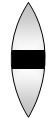
If the central portion of a convex lens is wrapped in black paper as shown in the figure,
A
No image will be formed by the remaining portion of the lens.
B
The full image will be formed but it will be less bright.
C
The central portion of the image will be missing.
D
There will be two images each produced by one of the exposed portions of the lens.
Solution
(B) When the central portion of a convex lens is covered with black paper,the effective aperture of the lens decreases.
Since the light rays from the object can still pass through the remaining exposed parts of the lens,a complete image of the object will still be formed at the same position.
However,because the total amount of light passing through the lens is reduced,the intensity of the image decreases,making it less bright.
Therefore,the correct option is $B$.
Since the light rays from the object can still pass through the remaining exposed parts of the lens,a complete image of the object will still be formed at the same position.
However,because the total amount of light passing through the lens is reduced,the intensity of the image decreases,making it less bright.
Therefore,the correct option is $B$.
0 likes
View Solution22
EasyMCQ
$A$ diminished image of an object is to be obtained on a screen $1.0 \ m$ from it. This can be achieved by appropriately placing
A
$A$ convex mirror of suitable focal length
B
$A$ concave mirror of suitable focal length
C
$A$ concave lens of suitable focal length
D
$A$ convex lens of suitable focal length less than $0.25 \ m$
Solution
(D) The image is to be obtained on a screen,which means the image must be real.
Convex mirrors and concave lenses always form virtual images,so they cannot form an image on a screen.
$A$ concave mirror can form a real image,but for a real image to be diminished,the object must be placed beyond the center of curvature $(u > 2f)$. In this case,the image is formed between $f$ and $2f$. However,the magnification $m = v/u$ for a real image formed by a concave mirror is only less than $1$ (diminished) if the object is placed beyond $2f$. While possible,the standard lens formula application for a fixed screen distance $D$ requires $f < D/4$ for a real,diminished image using a convex lens.
For a convex lens,the condition for obtaining a real image on a screen at distance $D$ is $f \leq D/4$. Here $D = 1.0 \ m$,so $f \leq 0.25 \ m$. Thus,a convex lens with a focal length less than $0.25 \ m$ will produce a diminished real image.
Convex mirrors and concave lenses always form virtual images,so they cannot form an image on a screen.
$A$ concave mirror can form a real image,but for a real image to be diminished,the object must be placed beyond the center of curvature $(u > 2f)$. In this case,the image is formed between $f$ and $2f$. However,the magnification $m = v/u$ for a real image formed by a concave mirror is only less than $1$ (diminished) if the object is placed beyond $2f$. While possible,the standard lens formula application for a fixed screen distance $D$ requires $f < D/4$ for a real,diminished image using a convex lens.
For a convex lens,the condition for obtaining a real image on a screen at distance $D$ is $f \leq D/4$. Here $D = 1.0 \ m$,so $f \leq 0.25 \ m$. Thus,a convex lens with a focal length less than $0.25 \ m$ will produce a diminished real image.
0 likes
View Solution23
MediumMCQ
The focal length of a convex lens is $30 \ cm$ and the size of the image is a quarter of the object,then the object distance is ........ $cm$.
A
$150$
B
$60$
C
$30$
D
$40$
Solution
(A) For a convex lens,the magnification $m$ is given by the formula $m = \frac{f}{f + u}$.
Given that the image is real and inverted (as it is a convex lens forming a smaller image),the magnification $m = -\frac{1}{4}$.
The focal length $f = +30 \ cm$.
Substituting these values into the formula:
$-\frac{1}{4} = \frac{30}{30 + u}$
$-(30 + u) = 120$
$-30 - u = 120$
$-u = 150$
$u = -150 \ cm$.
Therefore,the object distance is $150 \ cm$.
Given that the image is real and inverted (as it is a convex lens forming a smaller image),the magnification $m = -\frac{1}{4}$.
The focal length $f = +30 \ cm$.
Substituting these values into the formula:
$-\frac{1}{4} = \frac{30}{30 + u}$
$-(30 + u) = 120$
$-30 - u = 120$
$-u = 150$
$u = -150 \ cm$.
Therefore,the object distance is $150 \ cm$.
0 likes
View Solution24
EasyMCQ
$A$ convex lens forms a real image of a point object placed on its principal axis. If the upper half of the lens is painted black,the image will
A
Be shifted downwards
B
Be shifted upwards
C
Not be shifted
D
Shift on the principal axis
Solution
(C) When a portion of the lens is covered or painted black,the remaining part of the lens still forms a complete image of the object.
This is because every point on the object sends light rays to all parts of the lens,and these rays are refracted to converge at the same image point.
Covering half of the lens reduces the intensity (brightness) of the image because fewer light rays reach the image plane,but the position and size of the image remain unchanged.
This is because every point on the object sends light rays to all parts of the lens,and these rays are refracted to converge at the same image point.
Covering half of the lens reduces the intensity (brightness) of the image because fewer light rays reach the image plane,but the position and size of the image remain unchanged.
0 likes
View Solution25
EasyMCQ
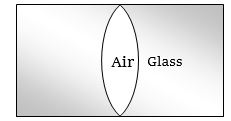
In the figure,an air lens of radii of curvature $10 \ cm$ ($R_1 = 10 \ cm$,$R_2 = -10 \ cm$) is cut in a cylinder of glass $(\mu = 1.5)$. The focal length and the nature of the lens is:
A
$15 \ cm$,concave
B
$15 \ cm$,convex
C
$\infty$,neither concave nor convex
D
$0$,concave
Solution
(A) The lens is made of air $(\mu_l = 1)$ and is placed in a glass medium $(\mu_m = 1.5)$.
Using the lens maker's formula for a lens in a medium:
$\frac{1}{f} = \left( \frac{\mu_l}{\mu_m} - 1 \right) \left( \frac{1}{R_1} - \frac{1}{R_2} \right)$
Given $R_1 = 10 \ cm$ and $R_2 = -10 \ cm$ (for a biconcave air lens shape):
$\frac{1}{f} = \left( \frac{1}{1.5} - 1 \right) \left( \frac{1}{10} - \frac{1}{-10} \right)$
$\frac{1}{f} = \left( \frac{2}{3} - 1 \right) \left( \frac{1}{10} + \frac{1}{10} \right)$
$\frac{1}{f} = \left( -\frac{1}{3} \right) \left( \frac{2}{10} \right) = -\frac{2}{30} = -\frac{1}{15}$
$f = -15 \ cm$.
$A$ negative focal length indicates that the lens behaves as a concave lens.
Using the lens maker's formula for a lens in a medium:
$\frac{1}{f} = \left( \frac{\mu_l}{\mu_m} - 1 \right) \left( \frac{1}{R_1} - \frac{1}{R_2} \right)$
Given $R_1 = 10 \ cm$ and $R_2 = -10 \ cm$ (for a biconcave air lens shape):
$\frac{1}{f} = \left( \frac{1}{1.5} - 1 \right) \left( \frac{1}{10} - \frac{1}{-10} \right)$
$\frac{1}{f} = \left( \frac{2}{3} - 1 \right) \left( \frac{1}{10} + \frac{1}{10} \right)$
$\frac{1}{f} = \left( -\frac{1}{3} \right) \left( \frac{2}{10} \right) = -\frac{2}{30} = -\frac{1}{15}$
$f = -15 \ cm$.
$A$ negative focal length indicates that the lens behaves as a concave lens.
0 likes
View Solution26
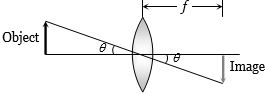
EasyMCQ
$A$ lens with a focal length of $50 \ cm$ forms an image of a distant object that subtends an angle of $1 \text{ milliradian}$ at the lens. What is the size of the image in $mm$?
A
$5$
B
$1$
C
$0.5$
D
$0.1$
Solution
(C) For a distant object,the image is formed at the focal plane of the lens.
The size of the image $(h_i)$ is given by the formula $h_i = f \times \theta$,where $f$ is the focal length and $\theta$ is the angle subtended by the object in radians.
Given:
Focal length $f = 50 \ cm = 500 \ mm$.
Angle $\theta = 1 \text{ milliradian} = 1 \times 10^{-3} \text{ radians}$.
Therefore,the size of the image $h_i = 500 \ mm \times (1 \times 10^{-3}) = 0.5 \ mm$.
The size of the image $(h_i)$ is given by the formula $h_i = f \times \theta$,where $f$ is the focal length and $\theta$ is the angle subtended by the object in radians.
Given:
Focal length $f = 50 \ cm = 500 \ mm$.
Angle $\theta = 1 \text{ milliradian} = 1 \times 10^{-3} \text{ radians}$.
Therefore,the size of the image $h_i = 500 \ mm \times (1 \times 10^{-3}) = 0.5 \ mm$.
0 likes
View Solution27
MediumMCQ
$A$ convex lens of focal length $12 \ cm$ is made of glass of refractive index $\mu_g = \frac{3}{2}$. What will be its focal length when immersed in a liquid of refractive index $\mu_l = \frac{5}{4}$? (in $cm$)
A
$6$
B
$12$
C
$24$
D
$30$
Solution
(D) The focal length of a lens in a medium is given by the Lens Maker's Formula: $\frac{1}{f} = (\mu - 1)(\frac{1}{R_1} - \frac{1}{R_2})$.
For a lens in air $(f_a = 12 \ cm)$: $\frac{1}{f_a} = (\mu_g - 1)K$,where $K = (\frac{1}{R_1} - \frac{1}{R_2})$.
For a lens in liquid $(f_l)$: $\frac{1}{f_l} = (\frac{\mu_g}{\mu_l} - 1)K$.
Dividing the two equations: $\frac{f_l}{f_a} = \frac{\mu_g - 1}{\frac{\mu_g}{\mu_l} - 1}$.
Substituting the values: $\frac{f_l}{12} = \frac{\frac{3}{2} - 1}{\frac{3/2}{5/4} - 1} = \frac{1/2}{\frac{6}{5} - 1} = \frac{1/2}{1/5} = \frac{5}{2}$.
Therefore,$f_l = 12 \times \frac{5}{2} = 30 \ cm$.
For a lens in air $(f_a = 12 \ cm)$: $\frac{1}{f_a} = (\mu_g - 1)K$,where $K = (\frac{1}{R_1} - \frac{1}{R_2})$.
For a lens in liquid $(f_l)$: $\frac{1}{f_l} = (\frac{\mu_g}{\mu_l} - 1)K$.
Dividing the two equations: $\frac{f_l}{f_a} = \frac{\mu_g - 1}{\frac{\mu_g}{\mu_l} - 1}$.
Substituting the values: $\frac{f_l}{12} = \frac{\frac{3}{2} - 1}{\frac{3/2}{5/4} - 1} = \frac{1/2}{\frac{6}{5} - 1} = \frac{1/2}{1/5} = \frac{5}{2}$.
Therefore,$f_l = 12 \times \frac{5}{2} = 30 \ cm$.
0 likes
View Solution28
MediumMCQ
The dispersive powers of the glasses of lenses used in an achromatic pair are in the ratio $5 : 3$. If the focal length of the concave lens is $15 \ cm$,then the nature and focal length of the other lens would be:
A
Convex,$9 \ cm$
B
Concave,$9 \ cm$
C
Convex,$25 \ cm$
D
Concave,$25 \ cm$
Solution
(A) For an achromatic doublet,the condition is given by $\frac{\omega_1}{f_1} + \frac{\omega_2}{f_2} = 0$,which implies $\frac{\omega_1}{\omega_2} = -\frac{f_1}{f_2}$.
Given the ratio of dispersive powers $\frac{\omega_1}{\omega_2} = \frac{5}{3}$.
Let the concave lens be the first lens,so $f_1 = -15 \ cm$.
Substituting the values: $\frac{5}{3} = -\frac{-15}{f_2}$.
$\frac{5}{3} = \frac{15}{f_2} \Rightarrow 5f_2 = 45 \Rightarrow f_2 = 9 \ cm$.
Since $f_2$ is positive,the second lens must be a convex lens.
Therefore,the other lens is convex with a focal length of $9 \ cm$.
Given the ratio of dispersive powers $\frac{\omega_1}{\omega_2} = \frac{5}{3}$.
Let the concave lens be the first lens,so $f_1 = -15 \ cm$.
Substituting the values: $\frac{5}{3} = -\frac{-15}{f_2}$.
$\frac{5}{3} = \frac{15}{f_2} \Rightarrow 5f_2 = 45 \Rightarrow f_2 = 9 \ cm$.
Since $f_2$ is positive,the second lens must be a convex lens.
Therefore,the other lens is convex with a focal length of $9 \ cm$.
0 likes
View Solution29
EasyMCQ
$A$ thin double convex lens has radii of curvature each of magnitude $40 \; cm$ and is made of glass with refractive index $1.65$. Its focal length is nearly....... $cm$.
A
$20$
B
$31$
C
$35$
D
$50$
Solution
(B) The lens maker's formula is given by $\frac{1}{f} = (\mu - 1) \left( \frac{1}{R_1} - \frac{1}{R_2} \right)$.
For a double convex lens,$R_1 = +40 \; cm$ and $R_2 = -40 \; cm$.
The refractive index $\mu = 1.65$.
Substituting these values into the formula:
$\frac{1}{f} = (1.65 - 1) \left( \frac{1}{40} - \frac{1}{-40} \right)$
$\frac{1}{f} = (0.65) \left( \frac{1}{40} + \frac{1}{40} \right)$
$\frac{1}{f} = 0.65 \times \frac{2}{40} = \frac{0.65}{20} = 0.0325$
$f = \frac{1}{0.0325} \approx 30.77 \; cm$.
Rounding to the nearest integer,the focal length is approximately $31 \; cm$.
For a double convex lens,$R_1 = +40 \; cm$ and $R_2 = -40 \; cm$.
The refractive index $\mu = 1.65$.
Substituting these values into the formula:
$\frac{1}{f} = (1.65 - 1) \left( \frac{1}{40} - \frac{1}{-40} \right)$
$\frac{1}{f} = (0.65) \left( \frac{1}{40} + \frac{1}{40} \right)$
$\frac{1}{f} = 0.65 \times \frac{2}{40} = \frac{0.65}{20} = 0.0325$
$f = \frac{1}{0.0325} \approx 30.77 \; cm$.
Rounding to the nearest integer,the focal length is approximately $31 \; cm$.
0 likes
View Solution30
DifficultMCQ
$A$ lens of refractive index $n$ is placed in a liquid of refractive index $n'$. If the focal length of the lens in air is $f$,what will be its focal length in the liquid?
A
$ - \frac{fn'(n - 1)}{n' - n}$
B
$ - \frac{f(n' - n)}{n'(n - 1)}$
C
$ - \frac{n'(n - 1)}{f(n' - n)}$
D
$\frac{fn'n}{n - n'}$
Solution
(A) The focal length of a lens in air is given by the Lens Maker's Formula: $\frac{1}{f} = (n - 1) \left( \frac{1}{R_1} - \frac{1}{R_2} \right)$.
When the lens is placed in a liquid of refractive index $n'$,the focal length $f'$ is given by: $\frac{1}{f'} = \left( \frac{n}{n'} - 1 \right) \left( \frac{1}{R_1} - \frac{1}{R_2} \right) = \left( \frac{n - n'}{n'} \right) \left( \frac{1}{R_1} - \frac{1}{R_2} \right)$.
Dividing the two equations: $\frac{f'}{f} = \frac{(n - 1)}{\frac{n - n'}{n'}} = \frac{n'(n - 1)}{n - n'}$.
Rearranging for $f'$: $f' = \frac{fn'(n - 1)}{n - n'} = - \frac{fn'(n - 1)}{n' - n}$.
When the lens is placed in a liquid of refractive index $n'$,the focal length $f'$ is given by: $\frac{1}{f'} = \left( \frac{n}{n'} - 1 \right) \left( \frac{1}{R_1} - \frac{1}{R_2} \right) = \left( \frac{n - n'}{n'} \right) \left( \frac{1}{R_1} - \frac{1}{R_2} \right)$.
Dividing the two equations: $\frac{f'}{f} = \frac{(n - 1)}{\frac{n - n'}{n'}} = \frac{n'(n - 1)}{n - n'}$.
Rearranging for $f'$: $f' = \frac{fn'(n - 1)}{n - n'} = - \frac{fn'(n - 1)}{n' - n}$.
0 likes
View Solution31
MediumMCQ
An object of height $1.5 \ cm$ is placed on the axis of a convex lens of focal length $25 \ cm$. $A$ real image is formed at a distance of $75 \ cm$ from the lens. The size of the image will be........$cm$.
A
$4.5$
B
$3$
C
$0.75$
D
$0.5$
Solution
(B) Given: Object height $h_o = 1.5 \ cm$,Focal length $f = +25 \ cm$ (for convex lens),Image distance $v = +75 \ cm$ (real image formed by a single lens is inverted and on the opposite side).
Using the lens formula: $\frac{1}{f} = \frac{1}{v} - \frac{1}{u}$.
$\frac{1}{25} = \frac{1}{75} - \frac{1}{u} \Rightarrow \frac{1}{u} = \frac{1}{75} - \frac{1}{25} = \frac{1-3}{75} = -\frac{2}{75}$.
So,$u = -37.5 \ cm$.
Magnification $m = \frac{h_i}{h_o} = \frac{v}{u}$.
$h_i = h_o \times \frac{v}{u} = 1.5 \times \frac{75}{-37.5} = 1.5 \times (-2) = -3 \ cm$.
The size (magnitude) of the image is $3 \ cm$.
Using the lens formula: $\frac{1}{f} = \frac{1}{v} - \frac{1}{u}$.
$\frac{1}{25} = \frac{1}{75} - \frac{1}{u} \Rightarrow \frac{1}{u} = \frac{1}{75} - \frac{1}{25} = \frac{1-3}{75} = -\frac{2}{75}$.
So,$u = -37.5 \ cm$.
Magnification $m = \frac{h_i}{h_o} = \frac{v}{u}$.
$h_i = h_o \times \frac{v}{u} = 1.5 \times \frac{75}{-37.5} = 1.5 \times (-2) = -3 \ cm$.
The size (magnitude) of the image is $3 \ cm$.
0 likes
View Solution32
EasyMCQ
$A$ plano-convex lens is made of a material with a refractive index of $1.6$. The radius of curvature of the curved surface is $60 \ cm$. The focal length of the lens is.....$cm$.
A
$50$
B
$100$
C
$200$
D
$400$
Solution
(B) The focal length $f$ of a lens is given by the Lens Maker's Formula: $\frac{1}{f} = (\mu - 1) \left( \frac{1}{R_1} - \frac{1}{R_2} \right)$.
For a plano-convex lens,one surface is plane $(R_1 = \infty)$ and the other is curved ($R_2 = -R = -60 \ cm$ using sign convention).
Substituting the values: $\frac{1}{f} = (1.6 - 1) \left( \frac{1}{\infty} - \frac{1}{-60} \right)$.
$\frac{1}{f} = (0.6) \left( 0 + \frac{1}{60} \right) = \frac{0.6}{60} = \frac{1}{100}$.
Therefore,$f = 100 \ cm$.
For a plano-convex lens,one surface is plane $(R_1 = \infty)$ and the other is curved ($R_2 = -R = -60 \ cm$ using sign convention).
Substituting the values: $\frac{1}{f} = (1.6 - 1) \left( \frac{1}{\infty} - \frac{1}{-60} \right)$.
$\frac{1}{f} = (0.6) \left( 0 + \frac{1}{60} \right) = \frac{0.6}{60} = \frac{1}{100}$.
Therefore,$f = 100 \ cm$.
0 likes
View Solution33
MediumMCQ
$A$ concave lens of glass,refractive index $1.5$,has both surfaces of same radius of curvature $R$. On immersion in a medium of refractive index $1.75$,it will behave as a
A
Convergent lens of focal length $3.5 R$
B
Convergent lens of focal length $3.0 R$
C
Divergent lens of focal length $3.5 R$
D
Divergent lens of focal length $3.0 R$
Solution
(A) The lens maker's formula is given by $\frac{1}{f} = (\mu_{rel} - 1) \left( \frac{1}{R_1} - \frac{1}{R_2} \right)$.
For a concave lens in air,$R_1 = -R$ and $R_2 = +R$,so $\frac{1}{f_a} = (1.5 - 1) \left( \frac{1}{-R} - \frac{1}{R} \right) = 0.5 \left( -\frac{2}{R} \right) = -\frac{1}{R}$,which means $f_a = -R$.
When immersed in a medium of refractive index $\mu_m = 1.75$,the relative refractive index is $\mu_{rel} = \frac{\mu_g}{\mu_m} = \frac{1.5}{1.75} = \frac{6}{7}$.
The new focal length $f_l$ is given by $\frac{1}{f_l} = \left( \frac{6}{7} - 1 \right) \left( -\frac{2}{R} \right) = \left( -\frac{1}{7} \right) \left( -\frac{2}{R} \right) = \frac{2}{7R}$.
Thus,$f_l = +3.5 R$.
Since the focal length is positive,the lens behaves as a convergent (convex) lens.
For a concave lens in air,$R_1 = -R$ and $R_2 = +R$,so $\frac{1}{f_a} = (1.5 - 1) \left( \frac{1}{-R} - \frac{1}{R} \right) = 0.5 \left( -\frac{2}{R} \right) = -\frac{1}{R}$,which means $f_a = -R$.
When immersed in a medium of refractive index $\mu_m = 1.75$,the relative refractive index is $\mu_{rel} = \frac{\mu_g}{\mu_m} = \frac{1.5}{1.75} = \frac{6}{7}$.
The new focal length $f_l$ is given by $\frac{1}{f_l} = \left( \frac{6}{7} - 1 \right) \left( -\frac{2}{R} \right) = \left( -\frac{1}{7} \right) \left( -\frac{2}{R} \right) = \frac{2}{7R}$.
Thus,$f_l = +3.5 R$.
Since the focal length is positive,the lens behaves as a convergent (convex) lens.
0 likes
View Solution34
EasyMCQ
$A$ double convex lens is made of glass of refractive index $1.5$. If its focal length is $30 \ cm$,then the radius of curvature of each of its curved surfaces is:
A
$10 \ cm$
B
$15 \ cm$
C
$18 \ cm$
D
None of these
Solution
(D) The lens maker's formula is given by: $\frac{1}{f} = (\mu - 1) \left( \frac{1}{R_1} - \frac{1}{R_2} \right)$.
For a double convex lens,$R_1 = R$ and $R_2 = -R$.
Substituting the given values: $\frac{1}{30} = (1.5 - 1) \left( \frac{1}{R} - \frac{1}{-R} \right)$.
$\frac{1}{30} = 0.5 \left( \frac{2}{R} \right)$.
$\frac{1}{30} = \frac{1}{R}$.
Therefore,$R = 30 \ cm$.
Since $30 \ cm$ is not among the options $A, B,$ or $C$,the correct answer is $D$.
For a double convex lens,$R_1 = R$ and $R_2 = -R$.
Substituting the given values: $\frac{1}{30} = (1.5 - 1) \left( \frac{1}{R} - \frac{1}{-R} \right)$.
$\frac{1}{30} = 0.5 \left( \frac{2}{R} \right)$.
$\frac{1}{30} = \frac{1}{R}$.
Therefore,$R = 30 \ cm$.
Since $30 \ cm$ is not among the options $A, B,$ or $C$,the correct answer is $D$.
0 likes
View Solution35
MediumMCQ
$A$ thin lens made of glass of refractive index $1.5$ has a front surface $+ 11 D$ power and back surface $-6 D.$ If this lens is submerged in a liquid of refractive index $1.6,$ the resulting power of the lens is
A
$-0.5 D$
B
$+ 0.5 D$
C
$-0.625 D$
D
$+ 0.625 D$
Solution
(C) The power of a lens in air is given by the sum of the powers of its surfaces: $P_a = P_1 + P_2 = 11 D - 6 D = 5 D$.
Using the lens maker's formula,the power of a lens in a medium is related to its power in air by the ratio: $\frac{P_l}{P_a} = \frac{_l\mu_g - 1}{_a\mu_g - 1}$.
Here,$_a\mu_g = 1.5$ and $_l\mu_g = \frac{_a\mu_g}{_a\mu_l} = \frac{1.5}{1.6} = 0.9375$.
Substituting the values: $\frac{P_l}{5} = \frac{0.9375 - 1}{1.5 - 1} = \frac{-0.0625}{0.5} = -0.125$.
Therefore,$P_l = 5 \times (-0.125) = -0.625 D$.
Using the lens maker's formula,the power of a lens in a medium is related to its power in air by the ratio: $\frac{P_l}{P_a} = \frac{_l\mu_g - 1}{_a\mu_g - 1}$.
Here,$_a\mu_g = 1.5$ and $_l\mu_g = \frac{_a\mu_g}{_a\mu_l} = \frac{1.5}{1.6} = 0.9375$.
Substituting the values: $\frac{P_l}{5} = \frac{0.9375 - 1}{1.5 - 1} = \frac{-0.0625}{0.5} = -0.125$.
Therefore,$P_l = 5 \times (-0.125) = -0.625 D$.
0 likes
View Solution36
MediumMCQ
An object is placed first at infinity and then at $20 \ cm$ from the object-side focal plane of a convex lens. The two images thus formed are $5 \ cm$ apart. The focal length of the lens is $...... \ cm$.
A
$5$
B
$10$
C
$15$
D
$20$
Solution
(B) Case $1$: When the object is at infinity,the image is formed at the focal point $F_2$. So,$v_1 = f$.
Case $2$: The object is placed at $20 \ cm$ from the object-side focal plane. This means the object distance $u = -(f + 20) \ cm$.
Using the lens formula $\frac{1}{f} = \frac{1}{v} - \frac{1}{u}$:
$\frac{1}{f} = \frac{1}{v_2} - \frac{1}{-(f + 20)} \Rightarrow \frac{1}{v_2} = \frac{1}{f} - \frac{1}{f + 20} = \frac{f + 20 - f}{f(f + 20)} = \frac{20}{f(f + 20)}$.
Thus,$v_2 = \frac{f(f + 20)}{20}$.
The distance between the two images is $|v_2 - v_1| = 5 \ cm$.
$\frac{f^2 + 20f}{20} - f = 5 \Rightarrow f^2 + 20f - 20f = 100 \Rightarrow f^2 = 100 \Rightarrow f = 10 \ cm$.
Alternatively,using Newton's form of the lens equation $x_1 x_2 = f^2$,where $x_1 = 20 \ cm$ and $x_2 = 5 \ cm$,we get $f^2 = 20 \times 5 = 100$,so $f = 10 \ cm$.
Case $2$: The object is placed at $20 \ cm$ from the object-side focal plane. This means the object distance $u = -(f + 20) \ cm$.
Using the lens formula $\frac{1}{f} = \frac{1}{v} - \frac{1}{u}$:
$\frac{1}{f} = \frac{1}{v_2} - \frac{1}{-(f + 20)} \Rightarrow \frac{1}{v_2} = \frac{1}{f} - \frac{1}{f + 20} = \frac{f + 20 - f}{f(f + 20)} = \frac{20}{f(f + 20)}$.
Thus,$v_2 = \frac{f(f + 20)}{20}$.
The distance between the two images is $|v_2 - v_1| = 5 \ cm$.
$\frac{f^2 + 20f}{20} - f = 5 \Rightarrow f^2 + 20f - 20f = 100 \Rightarrow f^2 = 100 \Rightarrow f = 10 \ cm$.
Alternatively,using Newton's form of the lens equation $x_1 x_2 = f^2$,where $x_1 = 20 \ cm$ and $x_2 = 5 \ cm$,we get $f^2 = 20 \times 5 = 100$,so $f = 10 \ cm$.
0 likes
View Solution37
DifficultMCQ
The distance between an object and the screen is $100 \ cm$. $A$ lens produces an image on the screen when placed at either of the positions $40 \ cm$ apart. The power of the lens is
A
$ \approx 3 \ D$
B
$ \approx 5 \ D$
C
$ \approx 7 \ D$
D
$ \approx 9 \ D$
Solution
(B) The displacement method for finding the focal length of a convex lens states that for a fixed distance $D$ between the object and the screen,if the lens is placed at two positions separated by distance $x$,the focal length $f$ is given by $f = \frac{D^2 - x^2}{4D}$.
Given: $D = 100 \ cm$ and $x = 40 \ cm$.
Substituting these values: $f = \frac{(100)^2 - (40)^2}{4 \times 100} = \frac{10000 - 1600}{400} = \frac{8400}{400} = 21 \ cm$.
The power of the lens $P$ is given by $P = \frac{100}{f(cm)} = \frac{100}{21} \approx 4.76 \ D$.
Rounding to the nearest integer,the power is approximately $5 \ D$.
Given: $D = 100 \ cm$ and $x = 40 \ cm$.
Substituting these values: $f = \frac{(100)^2 - (40)^2}{4 \times 100} = \frac{10000 - 1600}{400} = \frac{8400}{400} = 21 \ cm$.
The power of the lens $P$ is given by $P = \frac{100}{f(cm)} = \frac{100}{21} \approx 4.76 \ D$.
Rounding to the nearest integer,the power is approximately $5 \ D$.
0 likes
View Solution38
EasyMCQ
The image distance of an object placed $10 \ cm$ in front of a thin lens of focal length $+ 5 \ cm$ is......$cm$.
A
$6.5$
B
$8$
C
$9.5$
D
$10$
Solution
(D) Given: Focal length $f = +5 \ cm$,Object distance $u = -10 \ cm$.
Using the lens formula: $\frac{1}{f} = \frac{1}{v} - \frac{1}{u}$.
Substituting the values: $\frac{1}{5} = \frac{1}{v} - \frac{1}{-10}$.
$\frac{1}{5} = \frac{1}{v} + \frac{1}{10}$.
$\frac{1}{v} = \frac{1}{5} - \frac{1}{10} = \frac{2-1}{10} = \frac{1}{10}$.
Therefore,$v = 10 \ cm$.
Using the lens formula: $\frac{1}{f} = \frac{1}{v} - \frac{1}{u}$.
Substituting the values: $\frac{1}{5} = \frac{1}{v} - \frac{1}{-10}$.
$\frac{1}{5} = \frac{1}{v} + \frac{1}{10}$.
$\frac{1}{v} = \frac{1}{5} - \frac{1}{10} = \frac{2-1}{10} = \frac{1}{10}$.
Therefore,$v = 10 \ cm$.
0 likes
View Solution39
EasyMCQ
An achromatic combination is made with a lens of focal length $f$ and dispersive power $\omega$ with a lens having a dispersive power of $2\omega$. The focal length of the second lens will be:
A
$2 f$
B
$f/2$
C
$-f/2$
D
$-2 f$
Solution
(D) For an achromatic combination of two thin lenses in contact,the condition is given by:
$\frac{\omega_1}{f_1} + \frac{\omega_2}{f_2} = 0$
Given:
$f_1 = f$
$\omega_1 = \omega$
$\omega_2 = 2\omega$
Substituting these values into the condition:
$\frac{\omega}{f} + \frac{2\omega}{f_2} = 0$
$\frac{2\omega}{f_2} = -\frac{\omega}{f}$
$\frac{2}{f_2} = -\frac{1}{f}$
$f_2 = -2f$
Therefore,the focal length of the second lens is $-2f$.
$\frac{\omega_1}{f_1} + \frac{\omega_2}{f_2} = 0$
Given:
$f_1 = f$
$\omega_1 = \omega$
$\omega_2 = 2\omega$
Substituting these values into the condition:
$\frac{\omega}{f} + \frac{2\omega}{f_2} = 0$
$\frac{2\omega}{f_2} = -\frac{\omega}{f}$
$\frac{2}{f_2} = -\frac{1}{f}$
$f_2 = -2f$
Therefore,the focal length of the second lens is $-2f$.
0 likes
View Solution40
MediumMCQ
$A$ biconvex lens with equal radii of curvature has a refractive index of $1.6$ and a focal length of $10 \ cm$. Its radius of curvature will be.......$cm$.
A
$20$
B
$16$
C
$10$
D
$12$
Solution
(D) The lens maker's formula is given by: $\frac{1}{f} = (\mu - 1) \left( \frac{1}{R_1} - \frac{1}{R_2} \right)$.
For a biconvex lens with equal radii of curvature,we have $R_1 = R$ and $R_2 = -R$.
Substituting these values into the formula: $\frac{1}{f} = (\mu - 1) \left( \frac{1}{R} - \frac{1}{-R} \right) = (\mu - 1) \left( \frac{2}{R} \right)$.
Given $f = 10 \ cm$ and $\mu = 1.6$,we have: $\frac{1}{10} = (1.6 - 1) \left( \frac{2}{R} \right)$.
$\frac{1}{10} = (0.6) \left( \frac{2}{R} \right) = \frac{1.2}{R}$.
Therefore,$R = 1.2 \times 10 = 12 \ cm$.
For a biconvex lens with equal radii of curvature,we have $R_1 = R$ and $R_2 = -R$.
Substituting these values into the formula: $\frac{1}{f} = (\mu - 1) \left( \frac{1}{R} - \frac{1}{-R} \right) = (\mu - 1) \left( \frac{2}{R} \right)$.
Given $f = 10 \ cm$ and $\mu = 1.6$,we have: $\frac{1}{10} = (1.6 - 1) \left( \frac{2}{R} \right)$.
$\frac{1}{10} = (0.6) \left( \frac{2}{R} \right) = \frac{1.2}{R}$.
Therefore,$R = 1.2 \times 10 = 12 \ cm$.
0 likes
View Solution41
EasyMCQ
$A$ convex lens:
A
Converges light rays
B
Diverges light rays
C
Forms real images always
D
Always forms virtual images
Solution
(A) convex lens is thicker at the center than at the edges. When parallel light rays pass through a convex lens,they are refracted and converge at a single point called the principal focus. Therefore,a convex lens is known as a converging lens. It can form both real and virtual images depending on the position of the object relative to the lens. Thus,option $A$ is the correct statement.
0 likes
View Solution42
MediumMCQ
The focal length of a converging lens in air is $R$. If it is dipped in water of refractive index $1.33$,then its focal length will be around (Refractive index of lens material is $1.5$).
A
$R$
B
$2R$
C
$4R$
D
$R / 2$
Solution
(C) The lens maker's formula is given by $\frac{1}{f} = (\mu - 1) \left( \frac{1}{R_1} - \frac{1}{R_2} \right)$.
In air,the focal length $f_a = R$,so $\frac{1}{R} = (\mu_g - 1) K$,where $K = (\frac{1}{R_1} - \frac{1}{R_2})$.
Given $\mu_g = 1.5$,we have $\frac{1}{R} = (1.5 - 1) K = 0.5 K$,which implies $K = \frac{2}{R}$.
When the lens is dipped in water $(\mu_w = 1.33 \approx 4/3)$,the new focal length $f_w$ is given by $\frac{1}{f_w} = (\frac{\mu_g}{\mu_w} - 1) K$.
Substituting the values: $\frac{1}{f_w} = (\frac{1.5}{4/3} - 1) \times \frac{2}{R} = (\frac{4.5}{4} - 1) \times \frac{2}{R} = (1.125 - 1) \times \frac{2}{R} = 0.125 \times \frac{2}{R} = \frac{0.25}{R} = \frac{1}{4R}$.
Therefore,$f_w = 4R$.
In air,the focal length $f_a = R$,so $\frac{1}{R} = (\mu_g - 1) K$,where $K = (\frac{1}{R_1} - \frac{1}{R_2})$.
Given $\mu_g = 1.5$,we have $\frac{1}{R} = (1.5 - 1) K = 0.5 K$,which implies $K = \frac{2}{R}$.
When the lens is dipped in water $(\mu_w = 1.33 \approx 4/3)$,the new focal length $f_w$ is given by $\frac{1}{f_w} = (\frac{\mu_g}{\mu_w} - 1) K$.
Substituting the values: $\frac{1}{f_w} = (\frac{1.5}{4/3} - 1) \times \frac{2}{R} = (\frac{4.5}{4} - 1) \times \frac{2}{R} = (1.125 - 1) \times \frac{2}{R} = 0.125 \times \frac{2}{R} = \frac{0.25}{R} = \frac{1}{4R}$.
Therefore,$f_w = 4R$.
0 likes
View Solution43
MediumMCQ
The focal length of a convex lens of refractive index $1.5$ is $2 \ cm$. What will be the focal length of the lens when it is immersed in a liquid of refractive index $1.25$?
A
$10$
B
$2.5$
C
$5$
D
$7.5$
Solution
(C) Using the Lens Maker's Formula: $\frac{1}{f} = (\mu - 1) \left( \frac{1}{R_1} - \frac{1}{R_2} \right)$.
For a lens in air ($f_a = 2 \ cm$,$\mu_g = 1.5$): $\frac{1}{2} = (1.5 - 1) K$,where $K = (\frac{1}{R_1} - \frac{1}{R_2})$.
So,$K = \frac{1}{2 \times 0.5} = 1$.
When immersed in a liquid of refractive index $\mu_l = 1.25$,the new focal length $f_l$ is given by: $\frac{1}{f_l} = (\frac{\mu_g}{\mu_l} - 1) K$.
Substituting the values: $\frac{1}{f_l} = (\frac{1.5}{1.25} - 1) \times 1$.
$\frac{1}{f_l} = (1.2 - 1) = 0.2$.
Therefore,$f_l = \frac{1}{0.2} = 5 \ cm$.
For a lens in air ($f_a = 2 \ cm$,$\mu_g = 1.5$): $\frac{1}{2} = (1.5 - 1) K$,where $K = (\frac{1}{R_1} - \frac{1}{R_2})$.
So,$K = \frac{1}{2 \times 0.5} = 1$.
When immersed in a liquid of refractive index $\mu_l = 1.25$,the new focal length $f_l$ is given by: $\frac{1}{f_l} = (\frac{\mu_g}{\mu_l} - 1) K$.
Substituting the values: $\frac{1}{f_l} = (\frac{1.5}{1.25} - 1) \times 1$.
$\frac{1}{f_l} = (1.2 - 1) = 0.2$.
Therefore,$f_l = \frac{1}{0.2} = 5 \ cm$.
0 likes
View Solution44
EasyMCQ
The focal length of a convex lens depends upon
A
Frequency of the light ray
B
Wavelength of the light ray
C
Both $(a)$ and $(b)$
D
None of these
Solution
(B) The focal length $f$ of a lens is given by the Lens Maker's Formula: $\frac{1}{f} = (\mu - 1) \left( \frac{1}{R_1} - \frac{1}{R_2} \right)$.
Here,$\mu$ is the refractive index of the lens material relative to the surrounding medium.
According to Cauchy's equation,the refractive index $\mu$ depends on the wavelength $\lambda$ of the light,given by $\mu = A + \frac{B}{\lambda^2} + \dots$,where $A$ and $B$ are constants.
Since $\mu$ varies with $\lambda$,the focal length $f$ also varies with the wavelength $\lambda$ of the light ray.
Frequency is an intrinsic property of the light source and does not change with the medium,so it does not affect the refractive index or the focal length.
Therefore,the focal length depends on the wavelength of the light ray.
Here,$\mu$ is the refractive index of the lens material relative to the surrounding medium.
According to Cauchy's equation,the refractive index $\mu$ depends on the wavelength $\lambda$ of the light,given by $\mu = A + \frac{B}{\lambda^2} + \dots$,where $A$ and $B$ are constants.
Since $\mu$ varies with $\lambda$,the focal length $f$ also varies with the wavelength $\lambda$ of the light ray.
Frequency is an intrinsic property of the light source and does not change with the medium,so it does not affect the refractive index or the focal length.
Therefore,the focal length depends on the wavelength of the light ray.
0 likes
View Solution45
MediumMCQ
$f_V$ and $f_R$ are the focal lengths of a convex lens for violet and red light respectively,and $F_V$ and $F_R$ are the focal lengths of a concave lens for violet and red light respectively. Then:
A
$f_V < f_R$ and $F_V < F_R$
B
$f_V < f_R$ and $F_V > F_R$
C
$f_V > f_R$ and $F_V > F_R$
D
$f_V > f_R$ and $F_V < F_R$
Solution
(B) The refractive index of a material is higher for violet light than for red light $(n_V > n_R)$.
For a convex lens,the focal length is given by the lens maker's formula: $\frac{1}{f} = (n - 1) \left( \frac{1}{R_1} - \frac{1}{R_2} \right)$. Since $n_V > n_R$,the power of the lens is greater for violet light,meaning the focal length $f_V$ is smaller than $f_R$ $(f_V < f_R)$.
For a concave lens,the focal length is negative. The magnitude of the focal length $|F|$ follows the same logic as the convex lens,where $|F_V| < |F_R|$. Since both are negative,a smaller magnitude for a negative number implies a larger value: $F_V > F_R$ (e.g.,$-2 > -5$).
For a convex lens,the focal length is given by the lens maker's formula: $\frac{1}{f} = (n - 1) \left( \frac{1}{R_1} - \frac{1}{R_2} \right)$. Since $n_V > n_R$,the power of the lens is greater for violet light,meaning the focal length $f_V$ is smaller than $f_R$ $(f_V < f_R)$.
For a concave lens,the focal length is negative. The magnitude of the focal length $|F|$ follows the same logic as the convex lens,where $|F_V| < |F_R|$. Since both are negative,a smaller magnitude for a negative number implies a larger value: $F_V > F_R$ (e.g.,$-2 > -5$).
0 likes
View Solution46
EasyMCQ
$A$ convex lens of focal length $f$ produces an image $\frac{1}{n}$ times the size of the object. The distance of the object from the lens is:
A
$nf$
B
$\frac{f}{n}$
C
$(n + 1)f$
D
$(n - 1)f$
Solution
(C) For a convex lens,the magnification $m$ is given by the formula $m = \frac{f}{f + u}$,where $f$ is the focal length and $u$ is the object distance.
Given that the image size is $\frac{1}{n}$ times the object size,the magnification $m = -\frac{1}{n}$ (for a real image).
Substituting the values: $-\frac{1}{n} = \frac{f}{f + u}$.
Cross-multiplying gives: $-(f + u) = nf$.
$-f - u = nf$.
$u = -nf - f = -(n + 1)f$.
The distance of the object from the lens is the magnitude of $u$,which is $(n + 1)f$.
Given that the image size is $\frac{1}{n}$ times the object size,the magnification $m = -\frac{1}{n}$ (for a real image).
Substituting the values: $-\frac{1}{n} = \frac{f}{f + u}$.
Cross-multiplying gives: $-(f + u) = nf$.
$-f - u = nf$.
$u = -nf - f = -(n + 1)f$.
The distance of the object from the lens is the magnitude of $u$,which is $(n + 1)f$.
0 likes
View Solution47
EasyMCQ
$A$ substance is behaving as a convex lens in air and a concave lens in water. What is its refractive index?
A
Smaller than air
B
Greater than both air and water
C
Greater than air but less than water
D
Almost equal to water
Solution
(C) The focal length of a lens is given by the Lens Maker's Formula: $\frac{1}{f} = (\mu_{lens} - 1) (\frac{1}{R_1} - \frac{1}{R_2})$.
In air,the lens acts as a convex lens,so $f > 0$,which implies $\mu_{lens} > 1$ (since $\mu_{air} = 1$).
In water,the lens acts as a concave lens,so $f < 0$. The formula becomes $\frac{1}{f} = (\frac{\mu_{lens}}{\mu_{water}} - 1) (\frac{1}{R_1} - \frac{1}{R_2})$.
For the sign of $f$ to change,the term $(\frac{\mu_{lens}}{\mu_{water}} - 1)$ must be negative.
This implies $\frac{\mu_{lens}}{\mu_{water}} < 1$,or $\mu_{lens} < \mu_{water}$.
Since $\mu_{air} < \mu_{lens} < \mu_{water}$,the refractive index of the substance is greater than air but less than water.
In air,the lens acts as a convex lens,so $f > 0$,which implies $\mu_{lens} > 1$ (since $\mu_{air} = 1$).
In water,the lens acts as a concave lens,so $f < 0$. The formula becomes $\frac{1}{f} = (\frac{\mu_{lens}}{\mu_{water}} - 1) (\frac{1}{R_1} - \frac{1}{R_2})$.
For the sign of $f$ to change,the term $(\frac{\mu_{lens}}{\mu_{water}} - 1)$ must be negative.
This implies $\frac{\mu_{lens}}{\mu_{water}} < 1$,or $\mu_{lens} < \mu_{water}$.
Since $\mu_{air} < \mu_{lens} < \mu_{water}$,the refractive index of the substance is greater than air but less than water.
0 likes
View Solution48
EasyMCQ
$A$ convex lens is used to form a real image of an object on a screen. It is observed that even when the positions of the object and the screen are fixed,there are two positions of the lens that form real images. If the heights of the images are $4 \ cm$ and $9 \ cm$ respectively,the height of the object is.....$cm$.
A
$2.25$
B
$6$
C
$6.50$
D
$36$
Solution
(B) For the displacement method of a convex lens,if the object and screen are fixed at a distance $D$,there are two positions of the lens where a real image is formed on the screen.
Let the height of the object be $O$ and the heights of the two images be $I_1$ and $I_2$.
The relationship between the object height and the image heights is given by the formula: $O = \sqrt{I_1 \times I_2}$.
Given $I_1 = 4 \ cm$ and $I_2 = 9 \ cm$.
Substituting these values into the formula:
$O = \sqrt{4 \times 9}$
$O = \sqrt{36}$
$O = 6 \ cm$.
Therefore,the height of the object is $6 \ cm$.
Let the height of the object be $O$ and the heights of the two images be $I_1$ and $I_2$.
The relationship between the object height and the image heights is given by the formula: $O = \sqrt{I_1 \times I_2}$.
Given $I_1 = 4 \ cm$ and $I_2 = 9 \ cm$.
Substituting these values into the formula:
$O = \sqrt{4 \times 9}$
$O = \sqrt{36}$
$O = 6 \ cm$.
Therefore,the height of the object is $6 \ cm$.
0 likes
View Solution49
EasyMCQ
$A$ double convex lens of glass of $\mu = 1.5$ has a radius of curvature of each of its surfaces equal to $0.2 \ m$. The power of the lens is:
A
$+10 \ D$
B
$-10 \ D$
C
$-5 \ D$
D
$+5 \ D$
Solution
(D) The lens maker's formula is given by: $\frac{1}{f} = (\mu - 1) \left( \frac{1}{R_1} - \frac{1}{R_2} \right)$.
For a double convex lens,$R_1 = +0.2 \ m$ and $R_2 = -0.2 \ m$.
Given $\mu = 1.5$,we have:
$\frac{1}{f} = (1.5 - 1) \left( \frac{1}{0.2} - \frac{1}{-0.2} \right)$
$\frac{1}{f} = (0.5) \left( \frac{1}{0.2} + \frac{1}{0.2} \right) = 0.5 \times \frac{2}{0.2} = 0.5 \times 10 = 5 \ m^{-1}$.
Since power $P = \frac{1}{f}$ (in meters),$P = +5 \ D$.
For a double convex lens,$R_1 = +0.2 \ m$ and $R_2 = -0.2 \ m$.
Given $\mu = 1.5$,we have:
$\frac{1}{f} = (1.5 - 1) \left( \frac{1}{0.2} - \frac{1}{-0.2} \right)$
$\frac{1}{f} = (0.5) \left( \frac{1}{0.2} + \frac{1}{0.2} \right) = 0.5 \times \frac{2}{0.2} = 0.5 \times 10 = 5 \ m^{-1}$.
Since power $P = \frac{1}{f}$ (in meters),$P = +5 \ D$.
0 likes
View Solution50
EasyMCQ
$A$ lens of focal power $0.5 D$ is
A
$A$ convex lens of focal length $0.5 m$
B
$A$ concave lens of focal length $0.5 m$
C
$A$ convex lens of focal length $2 m$
D
$A$ concave lens of focal length $2 m$
Solution
(C) The power of a lens is given by the formula $P = \frac{1}{f}$,where $f$ is the focal length in meters.
Given the power $P = 0.5 D$.
Since the power is positive,the lens is a convex lens.
Substituting the value of $P$ into the formula: $0.5 = \frac{1}{f}$.
Therefore,$f = \frac{1}{0.5} = 2 m$.
Thus,it is a convex lens of focal length $2 m$.
Given the power $P = 0.5 D$.
Since the power is positive,the lens is a convex lens.
Substituting the value of $P$ into the formula: $0.5 = \frac{1}{f}$.
Therefore,$f = \frac{1}{0.5} = 2 m$.
Thus,it is a convex lens of focal length $2 m$.
0 likes
View SolutionRay Optics and Optical Instruments — Refraction by Lenses · Frequently Asked Questions
1Are these Ray Optics and Optical Instruments questions useful for JEE and NEET?
Yes. All questions in this section are mapped to JEE Main and NEET exam patterns. Previous year questions from JEE Main, NEET, GUJCET and state-level exams are included with full solutions.
2Can I switch to Hindi or Gujarati for these questions?
Yes. Use the language tabs in the hero section or the sidebar to view the same questions and solutions in English, Hindi or Gujarati.
3How do I generate a question paper from this subtopic?
Use the Vedclass Exam Paper Generator — select the chapter and subtopic, set difficulty, and generate Sets A, B, C, D automatically. First 3 chapters of every subject are free.
Vedclass Products
For Students
Vedclass Test Series
Mock tests in real JEE/NEET style with performance analysis. 5-day free trial.
Start Free TrialFor Teachers
Exam Paper Generator
Generate Set A/B/C/D papers from this chapter in 2 minutes. 3 chapters free.
Try FreeFor Institutes
Online Exam Module
Live online exams with unlimited students, 360° analytics & white-label branding.
See DemoFor Teachers & Institutes
Generate a Ray Optics and Optical Instruments Exam Paper in 2 Minutes
Select subtopic & difficulty — Sets A, B, C, D auto-generated with No Repeat logic.
First 3 chapters of every subject are free — no payment required.