
A English
Spherical Mirror Questions in English
Class 12 Physics · Ray Optics and Optical Instruments · Spherical Mirror
233+
Questions
English
Language
100%
With Solutions
Showing 50 of 233 questions in English
51
MediumMCQ
For a concave mirror,the minimum distance between a real object and its real image is ...........
A
$0$
B
$f$
C
$2f$
D
$4f$
Solution
(A) For a concave mirror,a real image is formed when the object is placed beyond the focus $F$.
When the object is placed at the center of curvature $C$ (i.e.,at a distance of $2f$ from the pole),the image is also formed at the center of curvature $C$.
In this specific case,the object and the image coincide at the same point.
Therefore,the distance between the real object and the real image is $0$.
When the object is placed at the center of curvature $C$ (i.e.,at a distance of $2f$ from the pole),the image is also formed at the center of curvature $C$.
In this specific case,the object and the image coincide at the same point.
Therefore,the distance between the real object and the real image is $0$.
0 likes
View Solution52
DifficultMCQ
$A$ square of side $3 \ cm$ is placed at a distance of $25 \ cm$ from a concave mirror of focal length $10 \ cm$. The center of the square is on the axis of the mirror and the plane is perpendicular to the axis. The area enclosed by the image of the square is ........ $cm^2$.
A
$4$
B
$6$
C
$16$
D
$36$
Solution
(A) Given: Focal length $f = -10 \ cm$,object distance $u = -25 \ cm$,side of square $s = 3 \ cm$.
Area of the object $A_0 = s^2 = 3^2 = 9 \ cm^2$.
The magnification $m$ is given by $m = \frac{f}{f - u} = \frac{-10}{-10 - (-25)} = \frac{-10}{15} = -\frac{2}{3}$.
The area of the image $A_i$ is given by $A_i = m^2 \times A_0$.
$A_i = \left(-\frac{2}{3}\right)^2 \times 9 = \frac{4}{9} \times 9 = 4 \ cm^2$.
Area of the object $A_0 = s^2 = 3^2 = 9 \ cm^2$.
The magnification $m$ is given by $m = \frac{f}{f - u} = \frac{-10}{-10 - (-25)} = \frac{-10}{15} = -\frac{2}{3}$.
The area of the image $A_i$ is given by $A_i = m^2 \times A_0$.
$A_i = \left(-\frac{2}{3}\right)^2 \times 9 = \frac{4}{9} \times 9 = 4 \ cm^2$.
0 likes
View Solution53
DifficultMCQ
An image formed by a convex mirror of focal length $30 \ cm$ is one-fourth the size of the object. The distance of the object from the mirror is ...... $cm$.
A
$30$
B
$90$
C
$120$
D
$60$
Solution
(B) For a convex mirror,the focal length $f = +30 \ cm$.
The magnification $m$ is given as $m = +1/4$ (since the image formed by a convex mirror is always virtual and erect).
The formula for magnification is $m = \frac{f}{f - u}$.
Substituting the values: $\frac{1}{4} = \frac{30}{30 - u}$.
Cross-multiplying: $30 - u = 120$.
Solving for $u$: $u = 30 - 120 = -90 \ cm$.
The distance of the object from the mirror is the magnitude of $u$,which is $90 \ cm$.
The magnification $m$ is given as $m = +1/4$ (since the image formed by a convex mirror is always virtual and erect).
The formula for magnification is $m = \frac{f}{f - u}$.
Substituting the values: $\frac{1}{4} = \frac{30}{30 - u}$.
Cross-multiplying: $30 - u = 120$.
Solving for $u$: $u = 30 - 120 = -90 \ cm$.
The distance of the object from the mirror is the magnitude of $u$,which is $90 \ cm$.
0 likes
View Solution54
DifficultMCQ
$A$ square wire frame of side length $3.0 \, cm$ is placed $25 \, cm$ away from a concave mirror of focal length $10 \, cm$. The center of the wire frame is on the axis of the mirror,with two of its sides perpendicular to the axis. The area of the image will be $..... \, cm^2$.
A
$3.5$
B
$4$
C
$2.9$
D
$4.6$
Solution
(B) Given: Focal length $f = -10 \, cm$,Object distance $u = -25 \, cm$,Area of object $A_{obj} = (3.0 \, cm)^2 = 9 \, cm^2$.
Using the mirror formula,$\frac{1}{v} + \frac{1}{u} = \frac{1}{f}$,we find the magnification $m = \frac{f}{f - u}$.
$m = \frac{-10}{-10 - (-25)} = \frac{-10}{15} = -\frac{2}{3}$.
The area of the image is given by $A_{image} = m^2 \times A_{obj}$.
$A_{image} = \left( -\frac{2}{3} \right)^2 \times 9 = \frac{4}{9} \times 9 = 4 \, cm^2$.
Using the mirror formula,$\frac{1}{v} + \frac{1}{u} = \frac{1}{f}$,we find the magnification $m = \frac{f}{f - u}$.
$m = \frac{-10}{-10 - (-25)} = \frac{-10}{15} = -\frac{2}{3}$.
The area of the image is given by $A_{image} = m^2 \times A_{obj}$.
$A_{image} = \left( -\frac{2}{3} \right)^2 \times 9 = \frac{4}{9} \times 9 = 4 \, cm^2$.
0 likes
View Solution55
MediumMCQ
The focal length of a concave mirror is $12\; cm$. Where should an object of length $4\; cm$ be placed,so that a real image of $1\; cm$ length is formed (in $; cm$)?
A
$48$
B
$3$
C
$60$
D
$15$
Solution
(C) Given: Focal length of the concave mirror $f = -12\; cm$ (sign convention).
Object height $h = 4\; cm$.
Image height $h' = -1\; cm$ (since the image is real,it is inverted).
Magnification $m = \frac{h'}{h} = \frac{-1}{4} = -0.25$.
We know that magnification $m = \frac{-v}{u}$,so $\frac{-v}{u} = -0.25$,which gives $v = 0.25u$.
Using the mirror formula: $\frac{1}{f} = \frac{1}{v} + \frac{1}{u}$.
Substituting the values: $\frac{1}{-12} = \frac{1}{0.25u} + \frac{1}{u}$.
$\frac{1}{-12} = \frac{4}{u} + \frac{1}{u} = \frac{5}{u}$.
$u = -12 \times 5 = -60\; cm$.
Thus,the object should be placed at a distance of $60\; cm$ in front of the mirror.
Object height $h = 4\; cm$.
Image height $h' = -1\; cm$ (since the image is real,it is inverted).
Magnification $m = \frac{h'}{h} = \frac{-1}{4} = -0.25$.
We know that magnification $m = \frac{-v}{u}$,so $\frac{-v}{u} = -0.25$,which gives $v = 0.25u$.
Using the mirror formula: $\frac{1}{f} = \frac{1}{v} + \frac{1}{u}$.
Substituting the values: $\frac{1}{-12} = \frac{1}{0.25u} + \frac{1}{u}$.
$\frac{1}{-12} = \frac{4}{u} + \frac{1}{u} = \frac{5}{u}$.
$u = -12 \times 5 = -60\; cm$.
Thus,the object should be placed at a distance of $60\; cm$ in front of the mirror.
0 likes
View Solution56
DifficultMCQ
The focal length of a concave mirror is $50 \ cm$. At what distance (in $cm$) should an object be placed to obtain a real and inverted image of double the size?
A
$75$
B
$72$
C
$63$
D
$50$
Solution
(A) For a concave mirror,the focal length $f = -50 \ cm$.
Since the image is real and inverted,the magnification $m = -2$.
The formula for magnification is $m = \frac{f}{f - u}$.
Substituting the values: $-2 = \frac{-50}{-50 - u}$.
$-2(-50 - u) = -50$.
$100 + 2u = -50$.
$2u = -150$.
$u = -75 \ cm$.
The object should be placed at a distance of $75 \ cm$ from the mirror.
Since the image is real and inverted,the magnification $m = -2$.
The formula for magnification is $m = \frac{f}{f - u}$.
Substituting the values: $-2 = \frac{-50}{-50 - u}$.
$-2(-50 - u) = -50$.
$100 + 2u = -50$.
$2u = -150$.
$u = -75 \ cm$.
The object should be placed at a distance of $75 \ cm$ from the mirror.
0 likes
View Solution57
DifficultMCQ
An object of length $6 \ cm$ is placed at a distance of $4f$ on the principal axis of a concave mirror of focal length $f$. The length of the image will be ......$cm$.
A
$-2$
B
$12$
C
$4$
D
$1.2$
Solution
(A) Using the mirror formula: $\frac{1}{f} = \frac{1}{v} + \frac{1}{u}$.
For a concave mirror,$f$ is negative,so $\frac{1}{-f} = \frac{1}{v} + \frac{1}{-4f}$.
Rearranging gives: $\frac{1}{v} = \frac{1}{4f} - \frac{1}{f} = \frac{1-4}{4f} = -\frac{3}{4f}$.
Thus,$v = -\frac{4f}{3}$.
The magnification $m$ is given by $m = \frac{I}{O} = -\frac{v}{u}$.
Substituting the values: $\frac{I}{6} = -\frac{(-4f/3)}{-4f}$.
$\frac{I}{6} = -\frac{1}{3}$.
$I = -\frac{6}{3} = -2 \ cm$.
The magnitude of the length of the image is $2 \ cm$ (the negative sign indicates an inverted image).
For a concave mirror,$f$ is negative,so $\frac{1}{-f} = \frac{1}{v} + \frac{1}{-4f}$.
Rearranging gives: $\frac{1}{v} = \frac{1}{4f} - \frac{1}{f} = \frac{1-4}{4f} = -\frac{3}{4f}$.
Thus,$v = -\frac{4f}{3}$.
The magnification $m$ is given by $m = \frac{I}{O} = -\frac{v}{u}$.
Substituting the values: $\frac{I}{6} = -\frac{(-4f/3)}{-4f}$.
$\frac{I}{6} = -\frac{1}{3}$.
$I = -\frac{6}{3} = -2 \ cm$.
The magnitude of the length of the image is $2 \ cm$ (the negative sign indicates an inverted image).
0 likes
View Solution58
EasyMCQ
$A$ convex mirror has a radius of curvature of $22 \; cm$. If an object is placed $14 \; cm$ away from the mirror,then its image is formed at:
A
$6.2 \; cm$ on the front side of the mirror.
B
$6.2 \; cm$ on the back side of the mirror.
C
$51.3 \; cm$ on the front of the mirror.
D
$51.3 \; cm$ on the back side of the mirror.
Solution
(B) Given: Radius of curvature $R = 22 \; cm$.
For a convex mirror,the focal length $f$ is positive.
$f = \frac{R}{2} = \frac{22}{2} = 11 \; cm$.
The object distance $u$ is always taken as negative in the sign convention: $u = -14 \; cm$.
Using the mirror formula: $\frac{1}{f} = \frac{1}{v} + \frac{1}{u}$.
Substituting the values: $\frac{1}{11} = \frac{1}{v} + \frac{1}{-14}$.
Rearranging for $v$: $\frac{1}{v} = \frac{1}{11} + \frac{1}{14}$.
$\frac{1}{v} = \frac{14 + 11}{154} = \frac{25}{154}$.
$v = \frac{154}{25} = 6.16 \; cm \approx 6.2 \; cm$.
Since $v$ is positive,the image is formed at $6.2 \; cm$ on the back side of the mirror.
For a convex mirror,the focal length $f$ is positive.
$f = \frac{R}{2} = \frac{22}{2} = 11 \; cm$.
The object distance $u$ is always taken as negative in the sign convention: $u = -14 \; cm$.
Using the mirror formula: $\frac{1}{f} = \frac{1}{v} + \frac{1}{u}$.
Substituting the values: $\frac{1}{11} = \frac{1}{v} + \frac{1}{-14}$.
Rearranging for $v$: $\frac{1}{v} = \frac{1}{11} + \frac{1}{14}$.
$\frac{1}{v} = \frac{14 + 11}{154} = \frac{25}{154}$.
$v = \frac{154}{25} = 6.16 \; cm \approx 6.2 \; cm$.
Since $v$ is positive,the image is formed at $6.2 \; cm$ on the back side of the mirror.
0 likes
View Solution59
DifficultMCQ
$A$ point object is placed at a distance of $30 \, cm$ from a convex mirror of focal length $30 \, cm$. Where will the image be formed?
A
At infinity
B
At the focus
C
At the pole
D
$15 \, cm$ behind the mirror
Solution
(D) Given: Object distance $u = -30 \, cm$ (by sign convention).
Focal length of convex mirror $f = +30 \, cm$.
Using the mirror formula: $\frac{1}{f} = \frac{1}{v} + \frac{1}{u}$.
Substituting the values: $\frac{1}{30} = \frac{1}{v} + \frac{1}{-30}$.
Rearranging the terms: $\frac{1}{v} = \frac{1}{30} + \frac{1}{30} = \frac{2}{30} = \frac{1}{15}$.
Therefore,$v = +15 \, cm$.
The positive sign indicates that the image is formed $15 \, cm$ behind the mirror.
Focal length of convex mirror $f = +30 \, cm$.
Using the mirror formula: $\frac{1}{f} = \frac{1}{v} + \frac{1}{u}$.
Substituting the values: $\frac{1}{30} = \frac{1}{v} + \frac{1}{-30}$.
Rearranging the terms: $\frac{1}{v} = \frac{1}{30} + \frac{1}{30} = \frac{2}{30} = \frac{1}{15}$.
Therefore,$v = +15 \, cm$.
The positive sign indicates that the image is formed $15 \, cm$ behind the mirror.
0 likes
View Solution60
MediumMCQ
The sun (diameter $d$) subtends an angle $\theta$ radian at the pole of a concave mirror of focal length $f$. What is the diameter of the image of the sun formed by the mirror?
A
$3f \theta$
B
$f^2 \theta$
C
$2f \theta$
D
$f \theta$
Solution
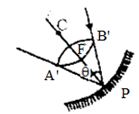
(D) The sun is at an effectively infinite distance from the concave mirror,so the object distance $u = \infty$.
Using the mirror formula: $\frac{1}{v} + \frac{1}{u} = \frac{1}{f}$.
Substituting $u = \infty$,we get $\frac{1}{v} + 0 = \frac{1}{f}$,which implies $v = f$.
Thus,the image of the sun is formed at the focus $F$ of the concave mirror.
Let $D_i$ be the diameter of the image formed at the focal plane.
Since the angle subtended by the sun at the pole $P$ is $\theta$,the image formed at the focus also subtends the same angle $\theta$ at the pole.
Using the definition of angle in radians,$\theta = \frac{\text{arc length}}{\text{radius}} = \frac{D_i}{f}$.
Therefore,the diameter of the image is $D_i = f \theta$.
Using the mirror formula: $\frac{1}{v} + \frac{1}{u} = \frac{1}{f}$.
Substituting $u = \infty$,we get $\frac{1}{v} + 0 = \frac{1}{f}$,which implies $v = f$.
Thus,the image of the sun is formed at the focus $F$ of the concave mirror.
Let $D_i$ be the diameter of the image formed at the focal plane.
Since the angle subtended by the sun at the pole $P$ is $\theta$,the image formed at the focus also subtends the same angle $\theta$ at the pole.
Using the definition of angle in radians,$\theta = \frac{\text{arc length}}{\text{radius}} = \frac{D_i}{f}$.
Therefore,the diameter of the image is $D_i = f \theta$.
0 likes
View Solution61
MediumMCQ
At what distance from a concave mirror of focal length $10 \, cm$ should an object be placed to get a magnification of $2$?
A
Only $5 \, cm$
B
Only $15 \, cm$
C
$5 \, cm$ or $15 \, cm$
D
$10 \, cm$
Solution
(C) For a concave mirror,the focal length $f = -10 \, cm$. The magnification $m$ can be $2$ (virtual image) or $-2$ (real image).
Using the magnification formula $m = \frac{f}{f - u}$:
Case $1$: For $m = 2$ (virtual image),
$2 = \frac{-10}{-10 - u} \implies -20 - 2u = -10 \implies 2u = -10 \implies u = -5 \, cm$.
Case $2$: For $m = -2$ (real image),
$-2 = \frac{-10}{-10 - u} \implies 20 + 2u = -10 \implies 2u = -30 \implies u = -15 \, cm$.
Thus,the object can be placed at $5 \, cm$ or $15 \, cm$ from the mirror.
Using the magnification formula $m = \frac{f}{f - u}$:
Case $1$: For $m = 2$ (virtual image),
$2 = \frac{-10}{-10 - u} \implies -20 - 2u = -10 \implies 2u = -10 \implies u = -5 \, cm$.
Case $2$: For $m = -2$ (real image),
$-2 = \frac{-10}{-10 - u} \implies 20 + 2u = -10 \implies 2u = -30 \implies u = -15 \, cm$.
Thus,the object can be placed at $5 \, cm$ or $15 \, cm$ from the mirror.
0 likes
View Solution62
DifficultMCQ
$A$ small linear object of length $b$ is placed on the axis of a concave mirror of focal length $f$ at a distance $u$ from its pole. What is the approximate length of the image?
A
$b \left( \frac{u - f}{f} \right)^{1/2}$
B
$b \left( \frac{f}{u - f} \right)^{1/2}$
C
$b \left( \frac{u - f}{f} \right)$
D
$b \left( \frac{f}{u - f} \right)^2$
Solution
(D) From the mirror formula,$\frac{1}{v} + \frac{1}{u} = \frac{1}{f}$.
Differentiating both sides with respect to $u$,we get $-\frac{1}{v^2} dv - \frac{1}{u^2} du = 0$.
This implies $dv = -\frac{v^2}{u^2} du$. The magnitude of the image length $|dv|$ is given by $|dv| = \left( \frac{v}{u} \right)^2 |du|$.
Since the object is small,$|du| = b$,so the image length is $L = \left( \frac{v}{u} \right)^2 b$.
From the mirror formula,$\frac{1}{v} = \frac{1}{f} - \frac{1}{u} = \frac{u - f}{fu}$,which gives $\frac{v}{u} = \frac{f}{u - f}$.
Substituting this into the expression for $L$,we get $L = b \left( \frac{f}{u - f} \right)^2$.
Differentiating both sides with respect to $u$,we get $-\frac{1}{v^2} dv - \frac{1}{u^2} du = 0$.
This implies $dv = -\frac{v^2}{u^2} du$. The magnitude of the image length $|dv|$ is given by $|dv| = \left( \frac{v}{u} \right)^2 |du|$.
Since the object is small,$|du| = b$,so the image length is $L = \left( \frac{v}{u} \right)^2 b$.
From the mirror formula,$\frac{1}{v} = \frac{1}{f} - \frac{1}{u} = \frac{u - f}{fu}$,which gives $\frac{v}{u} = \frac{f}{u - f}$.
Substituting this into the expression for $L$,we get $L = b \left( \frac{f}{u - f} \right)^2$.
0 likes
View Solution63
MediumMCQ
An object is placed at a distance of $40 \,cm$ from a concave mirror of focal length $20 \,cm$. The image formed is . . . . . . .
A
Real,inverted,and of the same size
B
Real,inverted,and smaller
C
Virtual,erect,and larger
D
Virtual,erect,and smaller
Solution
(A) Given: Focal length $f = -20 \,cm$ (for a concave mirror),Object distance $u = -40 \,cm$.
Using the mirror formula: $\frac{1}{f} = \frac{1}{v} + \frac{1}{u}$.
Substituting the values: $\frac{1}{-20} = \frac{1}{v} + \frac{1}{-40}$.
Rearranging: $\frac{1}{v} = \frac{1}{40} - \frac{1}{20} = \frac{1 - 2}{40} = -\frac{1}{40}$.
Thus,$v = -40 \,cm$.
The magnification $m = -\frac{v}{u} = -\frac{-40}{-40} = -1$.
Since $v$ is negative,the image is real. Since $m = -1$,the image is inverted and of the same size as the object.
Using the mirror formula: $\frac{1}{f} = \frac{1}{v} + \frac{1}{u}$.
Substituting the values: $\frac{1}{-20} = \frac{1}{v} + \frac{1}{-40}$.
Rearranging: $\frac{1}{v} = \frac{1}{40} - \frac{1}{20} = \frac{1 - 2}{40} = -\frac{1}{40}$.
Thus,$v = -40 \,cm$.
The magnification $m = -\frac{v}{u} = -\frac{-40}{-40} = -1$.
Since $v$ is negative,the image is real. Since $m = -1$,the image is inverted and of the same size as the object.
0 likes
View Solution64
DifficultMCQ
The image formed by a convex mirror of focal length $f$ is $(1/n)$ times the size of the object. The distance of the object from the mirror is:
A
$nf$
B
$f/n$
C
$(n - 1) f$
D
$(n + 1) f$
Solution
(C) For a convex mirror,the magnification $m$ is given by $m = \frac{f}{f - u}$,where $f$ is the focal length and $u$ is the object distance (which is negative).
Given that the image size is $(1/n)$ times the object size,the magnification $m = +\frac{1}{n}$ (since the image is virtual and erect).
Substituting the values: $\frac{1}{n} = \frac{f}{f - u}$.
Rearranging the equation: $f - u = nf$.
Solving for $u$: $u = f - nf = -(n - 1)f$.
The distance of the object from the mirror is the magnitude of $u$,which is $|u| = (n - 1)f$.
Given that the image size is $(1/n)$ times the object size,the magnification $m = +\frac{1}{n}$ (since the image is virtual and erect).
Substituting the values: $\frac{1}{n} = \frac{f}{f - u}$.
Rearranging the equation: $f - u = nf$.
Solving for $u$: $u = f - nf = -(n - 1)f$.
The distance of the object from the mirror is the magnitude of $u$,which is $|u| = (n - 1)f$.
0 likes
View Solution65
MediumMCQ
At what distance in front of a concave mirror of focal length $30\; cm$,should an object be placed (in $cm$) so that its real image of size three times that of the object is obtained?
A
$30$
B
$40$
C
$60$
D
$20$
Solution
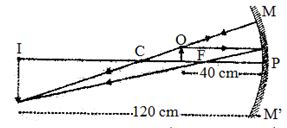
(B) For a concave mirror,the focal length $f = -30\; cm$.
Since the image is real,the magnification $m = -3$.
The formula for magnification is $m = \frac{f}{f - u}$.
Substituting the values: $-3 = \frac{-30}{-30 - u}$.
$-3(-30 - u) = -30$.
$90 + 3u = -30$.
$3u = -120$.
$u = -40\; cm$.
The object should be placed at a distance of $40\; cm$ in front of the mirror.
Since the image is real,the magnification $m = -3$.
The formula for magnification is $m = \frac{f}{f - u}$.
Substituting the values: $-3 = \frac{-30}{-30 - u}$.
$-3(-30 - u) = -30$.
$90 + 3u = -30$.
$3u = -120$.
$u = -40\; cm$.
The object should be placed at a distance of $40\; cm$ in front of the mirror.
0 likes
View Solution66
MediumMCQ
$A$ concave mirror has a focal length of $30 \, cm$. If the image formed is erect (virtual),at what distance from the mirror should an object be placed so that the image is three times the size of the object (in $, cm$)?
A
$30$
B
$40$
C
$60$
D
$20$
Solution
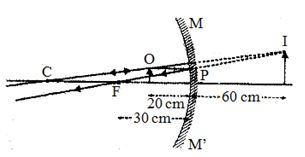
(D) For a concave mirror,the focal length $f = -30 \, cm$.
Given that the image is erect (virtual),the magnification $m$ must be positive.
Since the image is three times the size of the object,$m = +3$.
The formula for magnification in terms of focal length and object distance $u$ is $m = \frac{f}{f - u}$.
Substituting the given values:
$3 = \frac{-30}{-30 - u}$
$3(-30 - u) = -30$
$-90 - 3u = -30$
$-3u = 60$
$u = -20 \, cm$.
The negative sign indicates that the object is placed $20 \, cm$ in front of the mirror.
Given that the image is erect (virtual),the magnification $m$ must be positive.
Since the image is three times the size of the object,$m = +3$.
The formula for magnification in terms of focal length and object distance $u$ is $m = \frac{f}{f - u}$.
Substituting the given values:
$3 = \frac{-30}{-30 - u}$
$3(-30 - u) = -30$
$-90 - 3u = -30$
$-3u = 60$
$u = -20 \, cm$.
The negative sign indicates that the object is placed $20 \, cm$ in front of the mirror.
0 likes
View Solution67
DifficultMCQ
$A$ spherical mirror forms an erect image of an object,three times the size of the object. If the distance between the object and the image is $80 \ cm$,then the focal length of the mirror is ......... $cm$.
A
$15$
B
$- 15$
C
$30$
D
$40$
Solution
(C) For an erect image,the magnification $m = +3$.
Since $m = -v/u$,we have $3 = -v/u$,which implies $v = -3u$.
The distance between the object and the image is given as $|v - u| = 80 \ cm$.
Substituting $v = -3u$,we get $|-3u - u| = 80$,so $|-4u| = 80$,which gives $u = -20 \ cm$.
Then,$v = -3(-20) = 60 \ cm$.
Using the mirror formula $\frac{1}{f} = \frac{1}{v} + \frac{1}{u}$:
$\frac{1}{f} = \frac{1}{60} + \frac{1}{-20} = \frac{1 - 3}{60} = \frac{-2}{60} = -\frac{1}{30}$.
Therefore,$f = -30 \ cm$.
Since $m = -v/u$,we have $3 = -v/u$,which implies $v = -3u$.
The distance between the object and the image is given as $|v - u| = 80 \ cm$.
Substituting $v = -3u$,we get $|-3u - u| = 80$,so $|-4u| = 80$,which gives $u = -20 \ cm$.
Then,$v = -3(-20) = 60 \ cm$.
Using the mirror formula $\frac{1}{f} = \frac{1}{v} + \frac{1}{u}$:
$\frac{1}{f} = \frac{1}{60} + \frac{1}{-20} = \frac{1 - 3}{60} = \frac{-2}{60} = -\frac{1}{30}$.
Therefore,$f = -30 \ cm$.
0 likes
View Solution68
EasyMCQ
In the case of a spherical mirror,if the object distance $(u)$ and image distance $(v)$ are measured from the pole,then the graph plotted between $(1/u)$ and $(1/v)$ will be:
A
$A$ straight line passing through the origin
B
$A$ straight line not passing through the origin
C
$A$ parabola
D
$A$ hyperbola
Solution
(B) The mirror formula is given by: $\frac{1}{v} + \frac{1}{u} = \frac{1}{f}$.
Rearranging this equation in the form of a linear equation $y = mx + c$,we get: $\frac{1}{v} = -\frac{1}{u} + \frac{1}{f}$.
Here,$y = \frac{1}{v}$,$x = \frac{1}{u}$,slope $m = -1$,and intercept $c = \frac{1}{f}$.
Since the intercept $c = \frac{1}{f}$ is non-zero for a spherical mirror,the graph of $\frac{1}{v}$ versus $\frac{1}{u}$ is a straight line that does not pass through the origin.
Rearranging this equation in the form of a linear equation $y = mx + c$,we get: $\frac{1}{v} = -\frac{1}{u} + \frac{1}{f}$.
Here,$y = \frac{1}{v}$,$x = \frac{1}{u}$,slope $m = -1$,and intercept $c = \frac{1}{f}$.
Since the intercept $c = \frac{1}{f}$ is non-zero for a spherical mirror,the graph of $\frac{1}{v}$ versus $\frac{1}{u}$ is a straight line that does not pass through the origin.
0 likes
View Solution69
MediumMCQ
An object is placed at a distance $u$ from a concave mirror of focal length $f$. $A$ real image is formed on a screen placed at a distance $v$ from the mirror. As $u$ changes,$v$ also changes. Which of the following graphs correctly represents the variation of $1/v$ with $1/u$?
A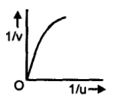
$A$
B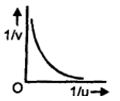
$B$
C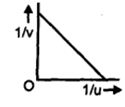
$C$
D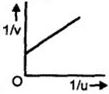
$D$
Solution
(C) The mirror formula is given by: $\frac{1}{f} = \frac{1}{u} + \frac{1}{v}$
Rearranging this equation to express $1/v$ in terms of $1/u$,we get:
$\frac{1}{v} = -\frac{1}{u} + \frac{1}{f}$
This equation is of the form $y = mx + c$,where:
$y = \frac{1}{v}$
$x = \frac{1}{u}$
$m = -1$ (slope is negative)
$c = \frac{1}{f}$ (positive y-intercept)
This represents a straight line with a negative slope and a positive y-intercept. Comparing this with the given options,graph $C$ represents a straight line with a negative slope and a positive intercept on the $1/v$ axis.
Rearranging this equation to express $1/v$ in terms of $1/u$,we get:
$\frac{1}{v} = -\frac{1}{u} + \frac{1}{f}$
This equation is of the form $y = mx + c$,where:
$y = \frac{1}{v}$
$x = \frac{1}{u}$
$m = -1$ (slope is negative)
$c = \frac{1}{f}$ (positive y-intercept)
This represents a straight line with a negative slope and a positive y-intercept. Comparing this with the given options,graph $C$ represents a straight line with a negative slope and a positive intercept on the $1/v$ axis.
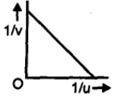
0 likes
View Solution70
EasyMCQ
Consider the following statements regarding an object placed between the pole and the focus of a concave mirror: $I$. The image is real. $II$. The image is magnified. $III$. The image is erect. Which of the following is correct?
A
$I$ and $II$ are correct.
B
$I$ and $III$ are correct.
C
$II$ and $III$ are correct.
D
$I, II,$ and $III$ are correct.
Solution
(C) When an object is placed between the pole $(P)$ and the focus $(F)$ of a concave mirror,the light rays diverge after reflection.
By extending these rays backward,a virtual image is formed behind the mirror.
Properties of this image are:
$1$. It is virtual (not real).
$2$. It is magnified (larger than the object).
$3$. It is erect (upright).
Therefore,statements $II$ and $III$ are correct,while statement $I$ is incorrect.
By extending these rays backward,a virtual image is formed behind the mirror.
Properties of this image are:
$1$. It is virtual (not real).
$2$. It is magnified (larger than the object).
$3$. It is erect (upright).
Therefore,statements $II$ and $III$ are correct,while statement $I$ is incorrect.
0 likes
View Solution71
EasyMCQ
What is the maximum distance at which an image can be formed by a convex mirror of focal length $10 \ cm$?
A
$20 \ cm$
B
$10 \ cm$
C
$5 \ cm$
D
None of these
Solution
(B) For a convex mirror,the focal length $f$ is positive $(f = +10 \ cm)$.
The mirror formula is $\frac{1}{v} + \frac{1}{u} = \frac{1}{f}$.
As the object distance $u$ varies from $-\infty$ to $0$,the image distance $v$ varies from $f$ to $0$.
Specifically,when the object is at infinity $(u = -\infty)$,the image is formed at the focus $(v = f = 10 \ cm)$.
When the object is at the pole $(u = 0)$,the image is formed at the pole $(v = 0)$.
Therefore,the image always forms between the pole and the focus of the convex mirror.
The maximum distance of the image from the mirror is equal to the focal length,which is $10 \ cm$.
The mirror formula is $\frac{1}{v} + \frac{1}{u} = \frac{1}{f}$.
As the object distance $u$ varies from $-\infty$ to $0$,the image distance $v$ varies from $f$ to $0$.
Specifically,when the object is at infinity $(u = -\infty)$,the image is formed at the focus $(v = f = 10 \ cm)$.
When the object is at the pole $(u = 0)$,the image is formed at the pole $(v = 0)$.
Therefore,the image always forms between the pole and the focus of the convex mirror.
The maximum distance of the image from the mirror is equal to the focal length,which is $10 \ cm$.
0 likes
View Solution72
DifficultMCQ
$A$ boy stands $30 \,cm$ in front of a mirror. The height of his erect image is $1/5 \,th$ of his actual height. The mirror used is ..... .
A
Plane
B
Convex
C
Concave
D
Convex lens
Solution
(B) Given: Object distance $u = -30 \,cm$. Magnification $m = +1/5$ (since the image is erect).
For a spherical mirror,magnification $m = -v/u$.
Substituting the values: $1/5 = -v / (-30)$.
$1/5 = v / 30 \implies v = 6 \,cm$.
Since the image distance $v$ is positive,the image is formed behind the mirror.
Using the mirror formula: $1/f = 1/v + 1/u$.
$1/f = 1/6 + 1/(-30) = 5/30 - 1/30 = 4/30 = 2/15$.
$f = 15/2 = +7.5 \,cm$.
Since the focal length $f$ is positive,the mirror is a convex mirror.
For a spherical mirror,magnification $m = -v/u$.
Substituting the values: $1/5 = -v / (-30)$.
$1/5 = v / 30 \implies v = 6 \,cm$.
Since the image distance $v$ is positive,the image is formed behind the mirror.
Using the mirror formula: $1/f = 1/v + 1/u$.
$1/f = 1/6 + 1/(-30) = 5/30 - 1/30 = 4/30 = 2/15$.
$f = 15/2 = +7.5 \,cm$.
Since the focal length $f$ is positive,the mirror is a convex mirror.
0 likes
View Solution73
DifficultMCQ
An object is at a distance $x_1$ from the focus of a concave mirror,and its image is formed at a distance $x_2$ from the focus. The focal length of the mirror is:
A
$x_1 x_2$
B
$\sqrt{x_1 x_2}$
C
$(x_1 + x_2) / 2$
D
$\sqrt{x_1 / x_2}$
Solution
(B) Let $f$ be the focal length of the concave mirror.
According to Newton's formula for mirrors,the distance of the object from the focus is $x_1$ and the distance of the image from the focus is $x_2$.
The relationship between these distances and the focal length $f$ is given by $f^2 = x_1 x_2$.
Therefore,the focal length is $f = \sqrt{x_1 x_2}$.
According to Newton's formula for mirrors,the distance of the object from the focus is $x_1$ and the distance of the image from the focus is $x_2$.
The relationship between these distances and the focal length $f$ is given by $f^2 = x_1 x_2$.
Therefore,the focal length is $f = \sqrt{x_1 x_2}$.
0 likes
View Solution74
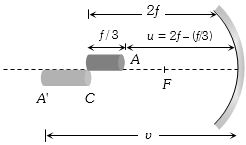
DifficultMCQ
$A$ thin rod of length $f/3$ lies along the axis of a concave mirror of focal length $f$. One end of its magnified image touches an end of the rod. The longitudinal magnification of the image is
A
$ - 1/3 $
B
$ - 1/2 $
C
$ - 2/3 $
D
$ - 3/2 $
Solution
(D) Let the rod be $AB$ with length $L = f/3$. The end $B$ is at distance $u_B = 5f/3$ from the pole,and end $A$ is at $u_A = 2f$.
Using the mirror formula $\frac{1}{v} + \frac{1}{u} = \frac{1}{f}$ with sign convention (all distances negative):
For end $B$ $(u_B = -5f/3)$: $\frac{1}{v_B} + \frac{1}{-5f/3} = \frac{1}{-f} \Rightarrow \frac{1}{v_B} = -\frac{1}{f} + \frac{3}{5f} = -\frac{2}{5f} \Rightarrow v_B = -2.5f$.
For end $A$ $(u_A = -2f)$: $\frac{1}{v_A} + \frac{1}{-2f} = \frac{1}{-f} \Rightarrow \frac{1}{v_A} = -\frac{1}{f} + \frac{1}{2f} = -\frac{1}{2f} \Rightarrow v_A = -2f$.
The length of the image is $|v_B - v_A| = |-2.5f - (-2f)| = 0.5f = f/2$.
The longitudinal magnification $m = \frac{\text{length of image}}{\text{length of object}} = \frac{f/2}{f/3} = 1.5$.
Since the image is inverted,the magnification is $m = -3/2$.
Using the mirror formula $\frac{1}{v} + \frac{1}{u} = \frac{1}{f}$ with sign convention (all distances negative):
For end $B$ $(u_B = -5f/3)$: $\frac{1}{v_B} + \frac{1}{-5f/3} = \frac{1}{-f} \Rightarrow \frac{1}{v_B} = -\frac{1}{f} + \frac{3}{5f} = -\frac{2}{5f} \Rightarrow v_B = -2.5f$.
For end $A$ $(u_A = -2f)$: $\frac{1}{v_A} + \frac{1}{-2f} = \frac{1}{-f} \Rightarrow \frac{1}{v_A} = -\frac{1}{f} + \frac{1}{2f} = -\frac{1}{2f} \Rightarrow v_A = -2f$.
The length of the image is $|v_B - v_A| = |-2.5f - (-2f)| = 0.5f = f/2$.
The longitudinal magnification $m = \frac{\text{length of image}}{\text{length of object}} = \frac{f/2}{f/3} = 1.5$.
Since the image is inverted,the magnification is $m = -3/2$.
0 likes
View Solution75
MediumMCQ
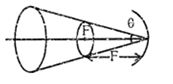
The sun (diameter $D$) subtends an angle $\theta$ at the pole of a concave mirror of focal length $f$. What will be the diameter of the image formed by the mirror?
A
$f \theta$
B
$2f \theta$
C
$f^{2} \theta / D$
D
$D \theta$
Solution
(A) The sun is at a very large distance from the mirror,so the rays coming from the sun are parallel to the principal axis.
These rays will focus at the focal plane of the mirror.
The image of the sun is formed at the focal plane.
From the geometry of the setup,the angle subtended by the sun at the pole is $\theta$.
Since the image is formed at the focal plane at a distance $f$ from the pole,we can use the relation: $\text{Angle} = \frac{\text{Arc}}{\text{Radius}}$.
Here,the arc corresponds to the diameter of the image $(d)$ and the radius corresponds to the focal length $(f)$.
Therefore,$\theta = \frac{d}{f}$.
Thus,the diameter of the image is $d = f \theta$.
These rays will focus at the focal plane of the mirror.
The image of the sun is formed at the focal plane.
From the geometry of the setup,the angle subtended by the sun at the pole is $\theta$.
Since the image is formed at the focal plane at a distance $f$ from the pole,we can use the relation: $\text{Angle} = \frac{\text{Arc}}{\text{Radius}}$.
Here,the arc corresponds to the diameter of the image $(d)$ and the radius corresponds to the focal length $(f)$.
Therefore,$\theta = \frac{d}{f}$.
Thus,the diameter of the image is $d = f \theta$.
0 likes
View Solution76
EasyMCQ
The focal length of a spherical mirror is .......
A
Maximum for red light
B
Maximum for blue light
C
Maximum for white light
D
Same for all
Solution
(D) The focal length of a spherical mirror is determined solely by its radius of curvature $(f = R/2)$.
Unlike lenses,where the refractive index depends on the wavelength of light (causing chromatic aberration),the reflection of light from a mirror surface is independent of the wavelength or color of the incident light.
Therefore,the focal length remains the same for all colors of light.
Unlike lenses,where the refractive index depends on the wavelength of light (causing chromatic aberration),the reflection of light from a mirror surface is independent of the wavelength or color of the incident light.
Therefore,the focal length remains the same for all colors of light.
0 likes
View Solution77
MediumMCQ
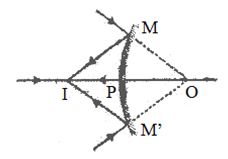
$A$ beam of light is converging towards a point $O$ behind a convex mirror of focal length $20 \, cm$. If the point $O$ is $10 \, cm$ behind the mirror,then the position of the image is at a distance of ..... $cm$.
A
$30$
B
$40$
C
$60$
D
$20$
Solution
(D) For this situation,the incident rays are converging towards a point $O$ behind the mirror,which acts as a virtual object.
Here,the object distance $u = +10 \, cm$ (since it is behind the mirror) and the focal length of the convex mirror $f = +20 \, cm$.
Using the mirror formula: $\frac{1}{v} + \frac{1}{u} = \frac{1}{f}$
Substituting the values: $\frac{1}{v} + \frac{1}{10} = \frac{1}{20}$
$\frac{1}{v} = \frac{1}{20} - \frac{1}{10} = \frac{1 - 2}{20} = -\frac{1}{20}$
Therefore,$v = -20 \, cm$.
The negative sign indicates that the image is formed in front of the mirror at a distance of $20 \, cm$ from the pole.
Here,the object distance $u = +10 \, cm$ (since it is behind the mirror) and the focal length of the convex mirror $f = +20 \, cm$.
Using the mirror formula: $\frac{1}{v} + \frac{1}{u} = \frac{1}{f}$
Substituting the values: $\frac{1}{v} + \frac{1}{10} = \frac{1}{20}$
$\frac{1}{v} = \frac{1}{20} - \frac{1}{10} = \frac{1 - 2}{20} = -\frac{1}{20}$
Therefore,$v = -20 \, cm$.
The negative sign indicates that the image is formed in front of the mirror at a distance of $20 \, cm$ from the pole.
0 likes
View Solution78
EasyMCQ
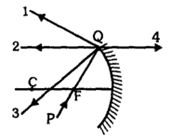
The direction of a ray of light incident on a concave mirror is shown by $PQ$,while the directions in which the ray would travel after reflection are shown by four rays marked $1, 2, 3,$ and $4$. Which of the four rays correctly shows the direction of the reflected ray?
A
$1$
B
$2$
C
$3$
D
$4$
Solution
(B) According to the rules of reflection for a concave mirror,a light ray passing through the principal focus $(F)$ of the mirror will become parallel to the principal axis after reflection.
In the given diagram,the incident ray $PQ$ passes through the focus $(F)$.
Therefore,after reflection from the concave mirror,the ray must travel parallel to the principal axis.
Among the given options,ray $2$ is the only one that is parallel to the principal axis.
Thus,ray $2$ correctly represents the reflected ray.
In the given diagram,the incident ray $PQ$ passes through the focus $(F)$.
Therefore,after reflection from the concave mirror,the ray must travel parallel to the principal axis.
Among the given options,ray $2$ is the only one that is parallel to the principal axis.
Thus,ray $2$ correctly represents the reflected ray.
0 likes
View Solution79
DifficultMCQ
An object is placed at a distance of $10 \, cm$ from a concave mirror of focal length $20 \, cm$. The image formed will be .......
A
Diminished,erect,virtual
B
Magnified,erect,virtual
C
Diminished,inverted,real
D
Magnified,inverted,real
Solution
(B) Given: Focal length $f = -20 \, cm$ (for a concave mirror),Object distance $u = -10 \, cm$.
Using the mirror formula: $\frac{1}{f} = \frac{1}{v} + \frac{1}{u}$.
Substituting the values: $\frac{1}{-20} = \frac{1}{v} + \frac{1}{-10}$.
$\frac{1}{v} = \frac{1}{10} - \frac{1}{20} = \frac{2-1}{20} = \frac{1}{20}$.
So,$v = +20 \, cm$.
Since $v$ is positive,the image is formed behind the mirror,which means it is virtual.
The magnification $m = -\frac{v}{u} = -\frac{20}{-10} = +2$.
Since $m$ is positive,the image is erect.
Since $|m| > 1$,the image is magnified.
Therefore,the image is magnified,erect,and virtual.
Using the mirror formula: $\frac{1}{f} = \frac{1}{v} + \frac{1}{u}$.
Substituting the values: $\frac{1}{-20} = \frac{1}{v} + \frac{1}{-10}$.
$\frac{1}{v} = \frac{1}{10} - \frac{1}{20} = \frac{2-1}{20} = \frac{1}{20}$.
So,$v = +20 \, cm$.
Since $v$ is positive,the image is formed behind the mirror,which means it is virtual.
The magnification $m = -\frac{v}{u} = -\frac{20}{-10} = +2$.
Since $m$ is positive,the image is erect.
Since $|m| > 1$,the image is magnified.
Therefore,the image is magnified,erect,and virtual.
0 likes
View Solution80
DifficultMCQ
$A$ concave mirror of focal length $f$ forms an image $n$ times the size of the object. If the image is real, then the distance of the object from the mirror is .......
A
$(n - 1) f / n$
B
$[(n - 1) / n] f$
C
$[(n + 1) / n] f$
D
$(n + 1) f$
Solution
(C) For a concave mirror, the magnification $m$ is given by $m = -v/u$. Given that the image is real and $n$ times the size of the object, the magnification $m = -n$.
Thus, $-n = -v/u$, which implies $v = nu$.
Using the mirror formula: $1/f = 1/v + 1/u$.
Substituting $v = nu$: $1/f = 1/(nu) + 1/u$.
$1/f = (1 + n) / (nu)$.
Rearranging for $u$: $u = f(n + 1) / n = [(n + 1) / n] f$.
Therefore, the distance of the object from the mirror is $[(n + 1) / n] f$.
Thus, $-n = -v/u$, which implies $v = nu$.
Using the mirror formula: $1/f = 1/v + 1/u$.
Substituting $v = nu$: $1/f = 1/(nu) + 1/u$.
$1/f = (1 + n) / (nu)$.
Rearranging for $u$: $u = f(n + 1) / n = [(n + 1) / n] f$.
Therefore, the distance of the object from the mirror is $[(n + 1) / n] f$.
0 likes
View Solution81
DifficultMCQ
An object is placed in front of a concave mirror of focal length $15 \ cm$. The image formed is twice the size of the object. If the image is virtual,the position of the object is at ...... $cm$.
A
$22.5$
B
$7.5$
C
$30$
D
$45$
Solution
(B) Given: Focal length $f = -15 \ cm$ (for a concave mirror).
Magnification $m = +2$ (since the image is virtual and erect,magnification is positive).
The formula for magnification in terms of focal length and object distance $u$ is $m = \frac{f}{f - u}$.
Substituting the values: $2 = \frac{-15}{-15 - u}$.
$2(-15 - u) = -15$.
$-30 - 2u = -15$.
$-2u = -15 + 30$.
$-2u = 15$.
$u = -7.5 \ cm$.
The negative sign indicates that the object is placed in front of the mirror at a distance of $7.5 \ cm$.
Magnification $m = +2$ (since the image is virtual and erect,magnification is positive).
The formula for magnification in terms of focal length and object distance $u$ is $m = \frac{f}{f - u}$.
Substituting the values: $2 = \frac{-15}{-15 - u}$.
$2(-15 - u) = -15$.
$-30 - 2u = -15$.
$-2u = -15 + 30$.
$-2u = 15$.
$u = -7.5 \ cm$.
The negative sign indicates that the object is placed in front of the mirror at a distance of $7.5 \ cm$.
0 likes
View Solution82
EasyMCQ
$A$ small linear object is placed on the optical axis of a concave mirror. If the distance of the nearest end of the object from the mirror is greater than the radius of curvature,then:
A
$A$ real and magnified image will be formed.
B
$A$ virtual and magnified image will be formed.
C
$A$ real and diminished image will be formed.
D
$A$ virtual and diminished image will be formed.
Solution
(C) For a concave mirror,the radius of curvature is $R = 2f$.
Given that the nearest end of the object is at a distance $u > R = 2f$.
Since the entire object is placed beyond the center of curvature $(C)$,the image of every point of the object will be formed between the focus $(F)$ and the center of curvature $(C)$.
For an object placed beyond $C$,the image formed by a concave mirror is always real,inverted,and diminished (smaller than the object).
Therefore,the correct option is $C$.
Given that the nearest end of the object is at a distance $u > R = 2f$.
Since the entire object is placed beyond the center of curvature $(C)$,the image of every point of the object will be formed between the focus $(F)$ and the center of curvature $(C)$.
For an object placed beyond $C$,the image formed by a concave mirror is always real,inverted,and diminished (smaller than the object).
Therefore,the correct option is $C$.
0 likes
View Solution83
MediumMCQ
$A$ spherical mirror forms an erect image three times the linear size of the object. If the distance between the object and the image is $80 \, cm$,the focal length of the mirror is........ (in $, cm$)
A
$15$
B
$-15$
C
$-30$
D
$40$
Solution
(C) For an erect image,the magnification $m = +3$.
Since $m = -v/u$,we have $v = -3u$.
Let the object distance be $u = -x$ (where $x > 0$). Then $v = 3x$.
The distance between the object and the image is given as $|v - u| = 80 \, cm$.
Substituting the values: $|3x - (-x)| = 80 \implies 4x = 80 \implies x = 20 \, cm$.
Thus,$u = -20 \, cm$ and $v = 60 \, cm$.
Using the mirror formula $\frac{1}{f} = \frac{1}{v} + \frac{1}{u}$:
$\frac{1}{f} = \frac{1}{60} + \frac{1}{-20} = \frac{1 - 3}{60} = \frac{-2}{60} = \frac{-1}{30}$.
Therefore,$f = -30 \, cm$.
Since $m = -v/u$,we have $v = -3u$.
Let the object distance be $u = -x$ (where $x > 0$). Then $v = 3x$.
The distance between the object and the image is given as $|v - u| = 80 \, cm$.
Substituting the values: $|3x - (-x)| = 80 \implies 4x = 80 \implies x = 20 \, cm$.
Thus,$u = -20 \, cm$ and $v = 60 \, cm$.
Using the mirror formula $\frac{1}{f} = \frac{1}{v} + \frac{1}{u}$:
$\frac{1}{f} = \frac{1}{60} + \frac{1}{-20} = \frac{1 - 3}{60} = \frac{-2}{60} = \frac{-1}{30}$.
Therefore,$f = -30 \, cm$.
0 likes
View Solution84
DifficultMCQ
An object of height $5 \, cm$ is placed at a distance of $1 \, m$ from a concave mirror of radius of curvature $20 \, cm$. What will be the height of the image in $cm$?
A
$0.11$
B
$0.50$
C
$0.55$
D
$0.60$
Solution
(C) Given: Height of object $O = 5 \, cm$,Radius of curvature $R = 20 \, cm$,Object distance $u = -1 \, m = -100 \, cm$.
For a concave mirror,focal length $f = -R/2 = -10 \, cm$.
The magnification formula is given by $m = I/O = f/(f - u)$.
Substituting the values: $I/5 = -10 / (-10 - (-100))$.
$I/5 = -10 / (-10 + 100) = -10 / 90 = -1/9$.
$I = -5/9 \, cm \approx -0.55 \, cm$.
The magnitude of the height of the image is $0.55 \, cm$.
For a concave mirror,focal length $f = -R/2 = -10 \, cm$.
The magnification formula is given by $m = I/O = f/(f - u)$.
Substituting the values: $I/5 = -10 / (-10 - (-100))$.
$I/5 = -10 / (-10 + 100) = -10 / 90 = -1/9$.
$I = -5/9 \, cm \approx -0.55 \, cm$.
The magnitude of the height of the image is $0.55 \, cm$.
0 likes
View Solution85
MediumMCQ
An object is placed at a distance of $f$ from the pole of a convex mirror of focal length $f$. Where will the image be formed?
A
$\infty$
B
$f$
C
$f / 2$
D
$2f$
Solution
(C) Using the mirror formula: $\frac{1}{f} = \frac{1}{v} + \frac{1}{u}$.
For a convex mirror,the focal length $f$ is positive $(+f)$ and the object distance $u$ is negative $(-f)$.
Substituting these values into the formula: $\frac{1}{+f} = \frac{1}{v} + \frac{1}{-f}$.
Rearranging the terms: $\frac{1}{v} = \frac{1}{f} + \frac{1}{f} = \frac{2}{f}$.
Therefore,$v = \frac{f}{2}$.
The image is formed at a distance of $f/2$ behind the mirror.
For a convex mirror,the focal length $f$ is positive $(+f)$ and the object distance $u$ is negative $(-f)$.
Substituting these values into the formula: $\frac{1}{+f} = \frac{1}{v} + \frac{1}{-f}$.
Rearranging the terms: $\frac{1}{v} = \frac{1}{f} + \frac{1}{f} = \frac{2}{f}$.
Therefore,$v = \frac{f}{2}$.
The image is formed at a distance of $f/2$ behind the mirror.
0 likes
View Solution86
DifficultMCQ
$A$ square wire frame of side $3 \, cm$ is placed at a distance of $25 \, cm$ from a concave mirror of focal length $10 \, cm$. The area of the image is ........ $cm^2$.
A
$4$
B
$6$
C
$16$
D
$36$
Solution
(A) Given: Focal length $f = -10 \, cm$,Object distance $u = -25 \, cm$,Side of square object $s_o = 3 \, cm$.
Area of the object $A_o = (s_o)^2 = (3)^2 = 9 \, cm^2$.
The magnification $m$ is given by $m = \frac{f}{f - u}$.
Substituting the values: $m = \frac{-10}{-10 - (-25)} = \frac{-10}{15} = -\frac{2}{3}$.
The relationship between the area of the image $A_i$ and the area of the object $A_o$ is $A_i = m^2 \times A_o$.
$A_i = (-\frac{2}{3})^2 \times 9 = \frac{4}{9} \times 9 = 4 \, cm^2$.
Area of the object $A_o = (s_o)^2 = (3)^2 = 9 \, cm^2$.
The magnification $m$ is given by $m = \frac{f}{f - u}$.
Substituting the values: $m = \frac{-10}{-10 - (-25)} = \frac{-10}{15} = -\frac{2}{3}$.
The relationship between the area of the image $A_i$ and the area of the object $A_o$ is $A_i = m^2 \times A_o$.
$A_i = (-\frac{2}{3})^2 \times 9 = \frac{4}{9} \times 9 = 4 \, cm^2$.
0 likes
View Solution87
MediumMCQ
$A$ concave mirror of focal length $10 \, cm$ is immersed in water $(\mu = 4/3)$. The new focal length will be ...... $cm$.
A
$10$
B
$40/3$
C
$30/4$
D
None of these
Solution
(A) The focal length of a spherical mirror is given by $f = R/2$, where $R$ is the radius of curvature.
This formula depends only on the geometry (radius of curvature) of the mirror and is independent of the refractive index of the surrounding medium.
Therefore, when the concave mirror is immersed in water, its focal length remains unchanged.
Thus, the new focal length is $10 \, cm$.
This formula depends only on the geometry (radius of curvature) of the mirror and is independent of the refractive index of the surrounding medium.
Therefore, when the concave mirror is immersed in water, its focal length remains unchanged.
Thus, the new focal length is $10 \, cm$.
0 likes
View Solution88
MediumMCQ
$A$ candle flame of $3\, cm$ is placed at $3\, m$ from a wall. $A$ concave mirror is kept at a distance $x$ from the wall in such a way that the image of the flame on the wall is $9\, cm$. Then $x$ is......$cm$.
A
$225$
B
$300$
C
$450$
D
$650$
Solution
(C) Given: Object height $O = +3\, cm$. Image height $I = -9\, cm$ (since the image is formed on the wall,it is real and inverted).
Distance of the object from the mirror $u = -(x - 3)\, m = -100(x - 3)\, cm$.
Distance of the image from the mirror $v = -x\, m = -100x\, cm$.
Using the magnification formula $m = \frac{I}{O} = -\frac{v}{u}$:
$\frac{-9}{3} = -\frac{-100x}{-100(x - 3)}$
$-3 = -\frac{x}{x - 3}$
$3(x - 3) = x$
$3x - 9 = x$
$2x = 9$
$x = 4.5\, m = 450\, cm$.
Distance of the object from the mirror $u = -(x - 3)\, m = -100(x - 3)\, cm$.
Distance of the image from the mirror $v = -x\, m = -100x\, cm$.
Using the magnification formula $m = \frac{I}{O} = -\frac{v}{u}$:
$\frac{-9}{3} = -\frac{-100x}{-100(x - 3)}$
$-3 = -\frac{x}{x - 3}$
$3(x - 3) = x$
$3x - 9 = x$
$2x = 9$
$x = 4.5\, m = 450\, cm$.
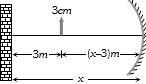
0 likes
View Solution89
DifficultMCQ
An object of length $f/3$ is placed on the principal axis of a concave mirror of focal length $f$. The image of the end of the object farthest from the mirror is formed at the same position. Find the length of the image.
A
$f$
B
$f/2$
C
$2f$
D
$f/4$
Solution
(B) The object is placed such that its farthest end is at the center of curvature $C$ (distance $2f$ from the mirror). Since the image of the farthest end is formed at the same position,the farthest end is at $u = -2f$,and its image is at $v = -2f$.
The nearest end of the object is at a distance $u' = -(2f - f/3) = -5f/3$ from the mirror.
Using the mirror formula $\frac{1}{f} = \frac{1}{v'} + \frac{1}{u'}$:
$\frac{1}{-f} = \frac{1}{v'} + \frac{1}{-5f/3}$
$\frac{1}{v'} = \frac{3}{5f} - \frac{1}{f} = \frac{3-5}{5f} = \frac{-2}{5f}$
$v' = -2.5f = -5f/2$.
The length of the image is the distance between the image of the farthest end (at $2f$) and the image of the nearest end (at $2.5f$):
Length $= |v'| - |v| = 2.5f - 2f = 0.5f = f/2$.
The nearest end of the object is at a distance $u' = -(2f - f/3) = -5f/3$ from the mirror.
Using the mirror formula $\frac{1}{f} = \frac{1}{v'} + \frac{1}{u'}$:
$\frac{1}{-f} = \frac{1}{v'} + \frac{1}{-5f/3}$
$\frac{1}{v'} = \frac{3}{5f} - \frac{1}{f} = \frac{3-5}{5f} = \frac{-2}{5f}$
$v' = -2.5f = -5f/2$.
The length of the image is the distance between the image of the farthest end (at $2f$) and the image of the nearest end (at $2.5f$):
Length $= |v'| - |v| = 2.5f - 2f = 0.5f = f/2$.
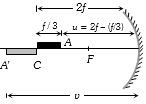
0 likes
View Solution90
DifficultMCQ
$A$ rod of length $10\, cm$ lies along the principal axis of a concave mirror of focal length $10\, cm$ in such a way that its end closer to the pole is $20\, cm$ away from the mirror. The length of the image is ......$cm$.
A
$10$
B
$15$
C
$2.5$
D
$5$
Solution
(D) Given,focal length of the concave mirror $f = -10\, cm$.
For end $A$ of the rod,the object distance is $u_A = -20\, cm$.
Using the mirror formula $\frac{1}{v} + \frac{1}{u} = \frac{1}{f}$:
$\frac{1}{v_A} + \frac{1}{-20} = \frac{1}{-10}$
$\frac{1}{v_A} = -\frac{1}{10} + \frac{1}{20} = -\frac{1}{20}$
$v_A = -20\, cm$.
For end $B$ of the rod,the object distance is $u_B = -(20 + 10) = -30\, cm$.
Using the mirror formula:
$\frac{1}{v_B} + \frac{1}{-30} = \frac{1}{-10}$
$\frac{1}{v_B} = -\frac{1}{10} + \frac{1}{30} = -\frac{2}{30} = -\frac{1}{15}$
$v_B = -15\, cm$.
The length of the image is the distance between the image positions of the two ends:
$L = |v_A - v_B| = |-20 - (-15)| = |-5| = 5\, cm$.
For end $A$ of the rod,the object distance is $u_A = -20\, cm$.
Using the mirror formula $\frac{1}{v} + \frac{1}{u} = \frac{1}{f}$:
$\frac{1}{v_A} + \frac{1}{-20} = \frac{1}{-10}$
$\frac{1}{v_A} = -\frac{1}{10} + \frac{1}{20} = -\frac{1}{20}$
$v_A = -20\, cm$.
For end $B$ of the rod,the object distance is $u_B = -(20 + 10) = -30\, cm$.
Using the mirror formula:
$\frac{1}{v_B} + \frac{1}{-30} = \frac{1}{-10}$
$\frac{1}{v_B} = -\frac{1}{10} + \frac{1}{30} = -\frac{2}{30} = -\frac{1}{15}$
$v_B = -15\, cm$.
The length of the image is the distance between the image positions of the two ends:
$L = |v_A - v_B| = |-20 - (-15)| = |-5| = 5\, cm$.
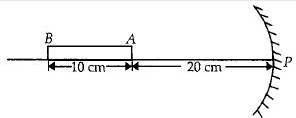
0 likes
View Solution91
MediumMCQ
Match the corresponding entries of Column-$I$ with Column-$II$. [Where $m$ is the magnification produced by the mirror]
| Column-$I$ | Column-$II$ |
| $1$. $m = -2$ | a. Convex mirror |
| $2$. $m = -1/2$ | b. Concave mirror |
| $3$. $m = +2$ | c. Real image |
| $4$. $m = +1/2$ | d. Virtual image |
A
$(1-a, c), (2-a, d), (3-a, b), (4-c, d)$
B
$(1-a, d), (2-b, c), (3-b, d), (4-b, c)$
C
$(1-c, d), (2-b, d), (3-b, c), (4-a, d)$
D
$(1-b, c), (2-b, c), (3-b, d), (4-a, d)$
Solution
(D) The magnification for a spherical mirror is given by $m = -v/u$.
$1$. For $m = -2$: Since $m$ is negative,the image is real. $A$ real image is always inverted and formed by a concave mirror. Thus,$(1-b, c)$.
$2$. For $m = -1/2$: Since $m$ is negative,the image is real. $A$ real image is formed by a concave mirror. Thus,$(2-b, c)$.
$3$. For $m = +2$: Since $m$ is positive,the image is virtual. $A$ virtual image with magnification greater than $1$ is formed by a concave mirror. Thus,$(3-b, d)$.
$4$. For $m = +1/2$: Since $m$ is positive,the image is virtual. $A$ virtual image with magnification less than $1$ is formed by a convex mirror. Thus,$(4-a, d)$.
Therefore,the correct matching is $(1-b, c), (2-b, c), (3-b, d), (4-a, d)$.
$1$. For $m = -2$: Since $m$ is negative,the image is real. $A$ real image is always inverted and formed by a concave mirror. Thus,$(1-b, c)$.
$2$. For $m = -1/2$: Since $m$ is negative,the image is real. $A$ real image is formed by a concave mirror. Thus,$(2-b, c)$.
$3$. For $m = +2$: Since $m$ is positive,the image is virtual. $A$ virtual image with magnification greater than $1$ is formed by a concave mirror. Thus,$(3-b, d)$.
$4$. For $m = +1/2$: Since $m$ is positive,the image is virtual. $A$ virtual image with magnification less than $1$ is formed by a convex mirror. Thus,$(4-a, d)$.
Therefore,the correct matching is $(1-b, c), (2-b, c), (3-b, d), (4-a, d)$.
0 likes
View Solution92
MediumMCQ
An object is placed at a distance of $40 \, cm$ from a concave mirror of focal length $15 \, cm$. If the object is displaced through a distance of $20 \, cm$ towards the mirror,the displacement of the image will be:
A
$30 \, cm$ away from the mirror
B
$36 \, cm$ away from the mirror
C
$36 \, cm$ towards the mirror
D
$30 \, cm$ towards the mirror
Solution
(B) Using the mirror formula,$\frac{1}{f} = \frac{1}{v} + \frac{1}{u}$.
For a concave mirror,$f = -15 \, cm$.
Initially,the object distance $u_1 = -40 \, cm$.
$\frac{1}{-15} = \frac{1}{v_1} + \frac{1}{-40} \Rightarrow \frac{1}{v_1} = \frac{1}{40} - \frac{1}{15} = \frac{3 - 8}{120} = \frac{-5}{120} = -\frac{1}{24}$.
So,$v_1 = -24 \, cm$ (image is $24 \, cm$ in front of the mirror).
When the object is displaced by $20 \, cm$ towards the mirror,the new object distance $u_2 = -(40 - 20) = -20 \, cm$.
$\frac{1}{-15} = \frac{1}{v_2} + \frac{1}{-20} \Rightarrow \frac{1}{v_2} = \frac{1}{20} - \frac{1}{15} = \frac{3 - 4}{60} = -\frac{1}{60}$.
So,$v_2 = -60 \, cm$ (image is $60 \, cm$ in front of the mirror).
The displacement of the image is $|v_2 - v_1| = |-60 - (-24)| = |-36| = 36 \, cm$.
Since the magnitude of the image distance increased,the image shifts $36 \, cm$ away from the mirror.
For a concave mirror,$f = -15 \, cm$.
Initially,the object distance $u_1 = -40 \, cm$.
$\frac{1}{-15} = \frac{1}{v_1} + \frac{1}{-40} \Rightarrow \frac{1}{v_1} = \frac{1}{40} - \frac{1}{15} = \frac{3 - 8}{120} = \frac{-5}{120} = -\frac{1}{24}$.
So,$v_1 = -24 \, cm$ (image is $24 \, cm$ in front of the mirror).
When the object is displaced by $20 \, cm$ towards the mirror,the new object distance $u_2 = -(40 - 20) = -20 \, cm$.
$\frac{1}{-15} = \frac{1}{v_2} + \frac{1}{-20} \Rightarrow \frac{1}{v_2} = \frac{1}{20} - \frac{1}{15} = \frac{3 - 4}{60} = -\frac{1}{60}$.
So,$v_2 = -60 \, cm$ (image is $60 \, cm$ in front of the mirror).
The displacement of the image is $|v_2 - v_1| = |-60 - (-24)| = |-36| = 36 \, cm$.
Since the magnitude of the image distance increased,the image shifts $36 \, cm$ away from the mirror.
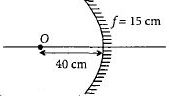
0 likes
View Solution93
EasyMCQ
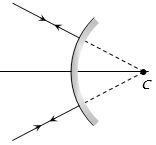
$A$ convergent beam of light is incident on a convex mirror so as to converge to a distance $12 \, cm$ from the pole of the mirror. An inverted image of the same size is formed coincident with the virtual object. What is the focal length of the mirror? $(cm)$
A
$24$
B
$12$
C
$6$
D
$3$
Solution
(C) The incident light rays are converging towards a point $12 \, cm$ behind the convex mirror. This point acts as a virtual object for the mirror.
Since the image is formed at the same position as the virtual object,the light rays must be striking the mirror normally (along the radius of curvature).
This implies that the virtual object is located at the center of curvature $(C)$ of the convex mirror.
Therefore,the radius of curvature $R = 12 \, cm$.
The focal length $f$ of the mirror is given by $f = \frac{R}{2}$.
Substituting the value of $R$,we get $f = \frac{12 \, cm}{2} = 6 \, cm$.
Since the image is formed at the same position as the virtual object,the light rays must be striking the mirror normally (along the radius of curvature).
This implies that the virtual object is located at the center of curvature $(C)$ of the convex mirror.
Therefore,the radius of curvature $R = 12 \, cm$.
The focal length $f$ of the mirror is given by $f = \frac{R}{2}$.
Substituting the value of $R$,we get $f = \frac{12 \, cm}{2} = 6 \, cm$.
0 likes
View Solution94
MediumMCQ
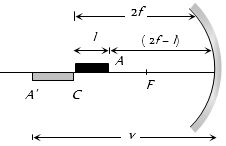
$A$ thin rod of $5 \, cm$ length is kept along the axis of a concave mirror of $10 \, cm$ focal length such that its image is real and magnified. If one end of the rod is at a distance of $2f$ from the mirror,what will be its magnification?
A
$1$
B
$2$
C
$3$
D
$4$
Solution
(B) Given: Focal length $f = -10 \, cm$,length of the rod $l = 5 \, cm$.
One end of the rod is at $2f = 20 \, cm$ from the mirror. Let this end be $A$. The other end is at $u = 20 - 5 = 15 \, cm$ from the mirror.
Using the mirror formula $\frac{1}{f} = \frac{1}{v} + \frac{1}{u}$:
For end $A$ at $u_A = 20 \, cm$,the image $v_A = 20 \, cm$ (at the center of curvature).
For the other end at $u_B = 15 \, cm$:
$\frac{1}{-10} = \frac{1}{v_B} + \frac{1}{-15}$
$\frac{1}{v_B} = \frac{1}{15} - \frac{1}{10} = \frac{2-3}{30} = -\frac{1}{30}$
So,$v_B = -30 \, cm$.
The length of the image is $|v_A - v_B| = |20 - 30| = 10 \, cm$.
Magnification $m = \frac{\text{Length of image}}{\text{Length of object}} = \frac{10 \, cm}{5 \, cm} = 2$.
One end of the rod is at $2f = 20 \, cm$ from the mirror. Let this end be $A$. The other end is at $u = 20 - 5 = 15 \, cm$ from the mirror.
Using the mirror formula $\frac{1}{f} = \frac{1}{v} + \frac{1}{u}$:
For end $A$ at $u_A = 20 \, cm$,the image $v_A = 20 \, cm$ (at the center of curvature).
For the other end at $u_B = 15 \, cm$:
$\frac{1}{-10} = \frac{1}{v_B} + \frac{1}{-15}$
$\frac{1}{v_B} = \frac{1}{15} - \frac{1}{10} = \frac{2-3}{30} = -\frac{1}{30}$
So,$v_B = -30 \, cm$.
The length of the image is $|v_A - v_B| = |20 - 30| = 10 \, cm$.
Magnification $m = \frac{\text{Length of image}}{\text{Length of object}} = \frac{10 \, cm}{5 \, cm} = 2$.
0 likes
View Solution95
EasyMCQ
The distance of an object from a spherical mirror is equal to the focal length of the mirror. Then the image:
A
must be at infinity
B
may be at infinity
C
may be at the focus
D
none
Solution
(B) For a concave mirror,when an object is placed at the focus $(u = -f)$,the image is formed at infinity.
However,for a convex mirror,if an object is placed at a distance equal to the focal length $(u = -f)$,the image is formed behind the mirror at a distance of $f/2$ from the pole.
Since the question specifies a 'spherical mirror' without distinguishing between concave and convex,the image formation depends on the type of mirror.
Therefore,the image may be at infinity (if the mirror is concave) or at another position (if the mirror is convex).
Thus,the correct option is that the image 'may be at infinity'.
However,for a convex mirror,if an object is placed at a distance equal to the focal length $(u = -f)$,the image is formed behind the mirror at a distance of $f/2$ from the pole.
Since the question specifies a 'spherical mirror' without distinguishing between concave and convex,the image formation depends on the type of mirror.
Therefore,the image may be at infinity (if the mirror is concave) or at another position (if the mirror is convex).
Thus,the correct option is that the image 'may be at infinity'.
0 likes
View Solution96
DifficultMCQ
The circular boundary of the concave mirror subtends a cone of half-angle $\theta$ at its centre of curvature. The minimum value of $\theta$ for which a ray incident on this mirror parallel to the principal axis suffers more than one reflection is......$^o$

A
$30$
B
$45$
C
$60$
D
$75$
Solution
(B) For a ray incident parallel to the principal axis to undergo multiple reflections,it must strike the mirror at a point such that after the first reflection,it is directed towards another point on the mirror.
Consider a ray incident at the edge of the mirror. After reflection,the angle of incidence equals the angle of reflection. The normal at any point on the spherical mirror passes through the centre of curvature $C$.
For the ray to hit the other end of the mirror after the first reflection,the reflected ray must make an angle of $90^{\circ}$ with the incident ray (which is parallel to the principal axis).
From the geometry of the reflection,the angle between the normal and the reflected ray is $\theta$. The angle between the incident ray and the normal is also $\theta$.
Thus,the angle between the incident ray and the reflected ray is $2\theta$. For the reflected ray to be perpendicular to the incident ray,we must have $2\theta = 90^{\circ}$.
Therefore,$\theta = 45^{\circ}$.
Consider a ray incident at the edge of the mirror. After reflection,the angle of incidence equals the angle of reflection. The normal at any point on the spherical mirror passes through the centre of curvature $C$.
For the ray to hit the other end of the mirror after the first reflection,the reflected ray must make an angle of $90^{\circ}$ with the incident ray (which is parallel to the principal axis).
From the geometry of the reflection,the angle between the normal and the reflected ray is $\theta$. The angle between the incident ray and the normal is also $\theta$.
Thus,the angle between the incident ray and the reflected ray is $2\theta$. For the reflected ray to be perpendicular to the incident ray,we must have $2\theta = 90^{\circ}$.
Therefore,$\theta = 45^{\circ}$.
0 likes
View Solution97
AdvancedMCQ
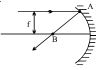
$A$ ray of light is incident on a concave mirror. It is parallel to the principal axis and its height from the principal axis is equal to the focal length of the mirror. The ratio of the distance of point $B$ (where the reflected ray intersects the principal axis) to the distance of the focus from the centre of curvature is ($AB$ is the reflected ray).
A
$\frac{2}{\sqrt{3}}$
B
$\frac{\sqrt{3}}{2}$
C
$\frac{2}{3}$
D
$\frac{1}{2}$
Solution
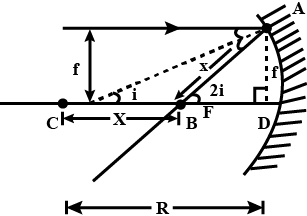
(A) Let $C$ be the center of curvature and $F$ be the focus of the concave mirror. Let the incident ray strike the mirror at point $A$. The height of the incident ray from the principal axis is $AD = f$,where $f$ is the focal length.
In $\Delta ADC$,where $D$ is the projection of $A$ on the principal axis,$\sin i = \frac{AD}{AC} = \frac{f}{R} = \frac{f}{2f} = \frac{1}{2}$.
Thus,the angle of incidence $i = 30^{\circ}$.
Since the reflected ray $AB$ makes an angle $2i$ with the principal axis,in $\Delta ADB$,$\sin 2i = \frac{AD}{AB} = \frac{f}{AB}$.
Therefore,$AB = \frac{f}{\sin 60^{\circ}} = \frac{f}{\sqrt{3}/2} = \frac{2f}{\sqrt{3}}$.
In $\Delta ABC$,since $CA$ is the normal,$\angle CAB = i = 30^{\circ}$. Also,$\angle ACB = i = 30^{\circ}$ (alternate interior angles). Thus,$\Delta ABC$ is isosceles with $CB = AB = \frac{2f}{\sqrt{3}}$.
The distance of the focus from the center of curvature is $FC = R - f = 2f - f = f$.
The required ratio is $\frac{CB}{FC} = \frac{2f/\sqrt{3}}{f} = \frac{2}{\sqrt{3}}$.
In $\Delta ADC$,where $D$ is the projection of $A$ on the principal axis,$\sin i = \frac{AD}{AC} = \frac{f}{R} = \frac{f}{2f} = \frac{1}{2}$.
Thus,the angle of incidence $i = 30^{\circ}$.
Since the reflected ray $AB$ makes an angle $2i$ with the principal axis,in $\Delta ADB$,$\sin 2i = \frac{AD}{AB} = \frac{f}{AB}$.
Therefore,$AB = \frac{f}{\sin 60^{\circ}} = \frac{f}{\sqrt{3}/2} = \frac{2f}{\sqrt{3}}$.
In $\Delta ABC$,since $CA$ is the normal,$\angle CAB = i = 30^{\circ}$. Also,$\angle ACB = i = 30^{\circ}$ (alternate interior angles). Thus,$\Delta ABC$ is isosceles with $CB = AB = \frac{2f}{\sqrt{3}}$.
The distance of the focus from the center of curvature is $FC = R - f = 2f - f = f$.
The required ratio is $\frac{CB}{FC} = \frac{2f/\sqrt{3}}{f} = \frac{2}{\sqrt{3}}$.
0 likes
View Solution98
AdvancedMCQ
$A$ point source is situated at a distance $x < f$ from the pole of a concave mirror of focal length $f$. At time $t = 0$,the point source starts moving away from the mirror with constant velocity. Which of the graphs below represents best the variation of image distance $|v|$ with the distance $x$ between the pole of the mirror and the source?
A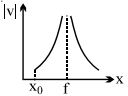
B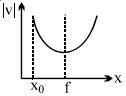
C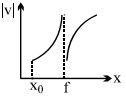
D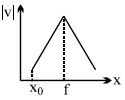
Solution
(C) For a concave mirror,the mirror formula is given by $\frac{1}{f} = \frac{1}{u} + \frac{1}{v}$.
Using sign convention,$u = -x$ and $v = -v_{i}$ (where $v_{i}$ is the image distance,and we are interested in $|v_{i}|$).
Substituting these,we get $\frac{1}{f} = -\frac{1}{x} - \frac{1}{v_{i}}$,which simplifies to $\frac{1}{v_{i}} = -(\frac{1}{f} + \frac{1}{x}) = -(\frac{x+f}{xf})$.
Thus,$|v_{i}| = \frac{xf}{f-x}$.
As $x \to 0$,$|v_{i}| \to 0$.
As $x \to f$,$|v_{i}| \to \infty$.
For $x > f$,the image becomes real and inverted. The mirror formula is $\frac{1}{f} = \frac{1}{u} + \frac{1}{v}$. With $u = -x$,we have $\frac{1}{v} = \frac{1}{f} - \frac{1}{x} = \frac{x-f}{xf}$,so $v = \frac{xf}{x-f}$.
Thus,$|v| = \frac{xf}{x-f}$.
As $x \to f^{+}$,$|v| \to \infty$.
As $x \to \infty$,$|v| \to f$.
Comparing these behaviors,the graph in option $C$ correctly shows the asymptotic behavior at $x = f$ and the limits as $x \to 0$ and $x \to \infty$.
Using sign convention,$u = -x$ and $v = -v_{i}$ (where $v_{i}$ is the image distance,and we are interested in $|v_{i}|$).
Substituting these,we get $\frac{1}{f} = -\frac{1}{x} - \frac{1}{v_{i}}$,which simplifies to $\frac{1}{v_{i}} = -(\frac{1}{f} + \frac{1}{x}) = -(\frac{x+f}{xf})$.
Thus,$|v_{i}| = \frac{xf}{f-x}$.
As $x \to 0$,$|v_{i}| \to 0$.
As $x \to f$,$|v_{i}| \to \infty$.
For $x > f$,the image becomes real and inverted. The mirror formula is $\frac{1}{f} = \frac{1}{u} + \frac{1}{v}$. With $u = -x$,we have $\frac{1}{v} = \frac{1}{f} - \frac{1}{x} = \frac{x-f}{xf}$,so $v = \frac{xf}{x-f}$.
Thus,$|v| = \frac{xf}{x-f}$.
As $x \to f^{+}$,$|v| \to \infty$.
As $x \to \infty$,$|v| \to f$.
Comparing these behaviors,the graph in option $C$ correctly shows the asymptotic behavior at $x = f$ and the limits as $x \to 0$ and $x \to \infty$.
0 likes
View Solution99
MediumMCQ
In the figure shown,the image of a real object $O$ is formed at point $I$. $AB$ is the principal axis of the mirror. The mirror must be:
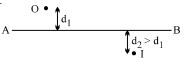
A
concave & placed towards right of $I$
B
concave & placed towards left of $I$
C
convex and placed towards right of $I$
D
convex & placed towards left of $I$
Solution
(A) $1$. The object $O$ is above the principal axis $AB$,and the image $I$ is below the principal axis $AB$. This indicates that the image is inverted.
$2$. The distance of the object from the principal axis is $d_1$,and the distance of the image from the principal axis is $d_2$. Since $d_2 > d_1$,the image is magnified.
$3$. $A$ convex mirror always forms a virtual,erect,and diminished image. Therefore,the mirror cannot be convex.
$4$. $A$ concave mirror can form a real,inverted,and magnified image when the object is placed between the focus $F$ and the center of curvature $C$.
$5$. For a real object to form a real image,the mirror must be placed on the side of the object and image. Since the light rays must travel from the object to the mirror and reflect back to form the image at $I$,the mirror must be placed to the right of both $O$ and $I$ (or specifically,to the right of $I$ to intercept the rays). Looking at the geometry,the mirror must be placed to the right of $I$ to reflect the rays from $O$ to $I$.
$2$. The distance of the object from the principal axis is $d_1$,and the distance of the image from the principal axis is $d_2$. Since $d_2 > d_1$,the image is magnified.
$3$. $A$ convex mirror always forms a virtual,erect,and diminished image. Therefore,the mirror cannot be convex.
$4$. $A$ concave mirror can form a real,inverted,and magnified image when the object is placed between the focus $F$ and the center of curvature $C$.
$5$. For a real object to form a real image,the mirror must be placed on the side of the object and image. Since the light rays must travel from the object to the mirror and reflect back to form the image at $I$,the mirror must be placed to the right of both $O$ and $I$ (or specifically,to the right of $I$ to intercept the rays). Looking at the geometry,the mirror must be placed to the right of $I$ to reflect the rays from $O$ to $I$.
0 likes
View Solution100
MediumMCQ
All of the following statements are correct except (for a real object):
A
The magnification produced by a convex mirror is always less than or equal to $1$.
B
$A$ virtual,erect,same-sized image can be obtained using a plane mirror.
C
$A$ virtual,erect,magnified image can be formed using a concave mirror.
D
$A$ real,inverted,same-sized image can be formed using a convex mirror.
Solution
(D) For a real object,a convex mirror always forms a virtual,erect,and diminished image.
$1$. The magnification $m$ for a convex mirror is always $0 < m < 1$,so statement $A$ is correct.
$2$. $A$ plane mirror forms a virtual,erect,and same-sized image,so statement $B$ is correct.
$3$. $A$ concave mirror forms a virtual,erect,and magnified image when the object is placed between the pole and the focus,so statement $C$ is correct.
$4$. $A$ convex mirror can never form a real image for a real object. Therefore,statement $D$ is incorrect.
$1$. The magnification $m$ for a convex mirror is always $0 < m < 1$,so statement $A$ is correct.
$2$. $A$ plane mirror forms a virtual,erect,and same-sized image,so statement $B$ is correct.
$3$. $A$ concave mirror forms a virtual,erect,and magnified image when the object is placed between the pole and the focus,so statement $C$ is correct.
$4$. $A$ convex mirror can never form a real image for a real object. Therefore,statement $D$ is incorrect.
0 likes
View SolutionRay Optics and Optical Instruments — Spherical Mirror · Frequently Asked Questions
1Are these Ray Optics and Optical Instruments questions useful for JEE and NEET?
Yes. All questions in this section are mapped to JEE Main and NEET exam patterns. Previous year questions from JEE Main, NEET, GUJCET and state-level exams are included with full solutions.
2Can I switch to Hindi or Gujarati for these questions?
Yes. Use the language tabs in the hero section or the sidebar to view the same questions and solutions in English, Hindi or Gujarati.
3How do I generate a question paper from this subtopic?
Use the Vedclass Exam Paper Generator — select the chapter and subtopic, set difficulty, and generate Sets A, B, C, D automatically. First 3 chapters of every subject are free.
Vedclass Products
For Students
Vedclass Test Series
Mock tests in real JEE/NEET style with performance analysis. 5-day free trial.
Start Free TrialFor Teachers
Exam Paper Generator
Generate Set A/B/C/D papers from this chapter in 2 minutes. 3 chapters free.
Try FreeFor Institutes
Online Exam Module
Live online exams with unlimited students, 360° analytics & white-label branding.
See DemoFor Teachers & Institutes
Generate a Ray Optics and Optical Instruments Exam Paper in 2 Minutes
Select subtopic & difficulty — Sets A, B, C, D auto-generated with No Repeat logic.
First 3 chapters of every subject are free — no payment required.