
A English
Refraction Through Prism Questions in English
Class 12 Physics · Ray Optics and Optical Instruments · Refraction Through Prism
354+
Questions
English
Language
100%
With Solutions
Showing 49 of 354 questions in English
1
EasyMCQ
Which of the following prisms is used to see the infrared spectrum of light?
A
Rock-salt
B
Nicol
C
Flint
D
Crown
Solution
(A) Ordinary glass prisms,such as $Crown$ or $Flint$ glass,absorb infrared radiation and are therefore unsuitable for studying the infrared spectrum.
$Rock-salt$ $(NaCl)$ crystals are transparent to infrared radiation,allowing them to pass through without significant absorption.
Therefore,a $Rock-salt$ prism is used to obtain and study the spectrum of infrared radiation.
$Rock-salt$ $(NaCl)$ crystals are transparent to infrared radiation,allowing them to pass through without significant absorption.
Therefore,a $Rock-salt$ prism is used to obtain and study the spectrum of infrared radiation.
0 likes
View Solution2
EasyMCQ
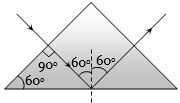
The critical angle between an equilateral prism and air is $45^o$. If the incident ray is perpendicular to the refracting surface,then
A
After deviation it will emerge from the second refracting surface.
B
It is totally reflected on the second surface and emerges out perpendicularly from the third surface in air.
C
It is totally reflected from the second and third refracting surfaces and finally emerges out from the first surface.
D
It is totally reflected from all the three sides of the prism and never emerges out.
Solution
(B) For an equilateral prism,the angle of the prism $A = 60^o$.
Given that the incident ray is perpendicular to the first refracting surface,the angle of incidence $i = 0^o$.
Therefore,the angle of refraction at the first surface $r_1 = 0^o$.
The angle of incidence at the second surface is $r_2 = A - r_1 = 60^o - 0^o = 60^o$.
The critical angle $C$ is given as $45^o$.
Since the angle of incidence at the second surface $(60^o)$ is greater than the critical angle $(45^o)$,total internal reflection occurs at the second surface.
The reflected ray then strikes the third surface (the base) at an angle of incidence of $30^o$ (calculated from the geometry of the triangle).
Since $30^o < 45^o$,the ray refracts out of the third surface.
Thus,the ray is totally reflected on the second surface and emerges out from the third surface.
Given that the incident ray is perpendicular to the first refracting surface,the angle of incidence $i = 0^o$.
Therefore,the angle of refraction at the first surface $r_1 = 0^o$.
The angle of incidence at the second surface is $r_2 = A - r_1 = 60^o - 0^o = 60^o$.
The critical angle $C$ is given as $45^o$.
Since the angle of incidence at the second surface $(60^o)$ is greater than the critical angle $(45^o)$,total internal reflection occurs at the second surface.
The reflected ray then strikes the third surface (the base) at an angle of incidence of $30^o$ (calculated from the geometry of the triangle).
Since $30^o < 45^o$,the ray refracts out of the third surface.
Thus,the ray is totally reflected on the second surface and emerges out from the third surface.
0 likes
View Solution3
EasyMCQ
When white light passes through a glass prism,one gets a spectrum on the other side of the prism. In the emergent beam,the ray which deviates the least is:
A
Violet ray
B
Green ray
C
Red ray
D
Yellow ray
Solution
(C) The deviation produced by a thin prism is given by the formula $\delta = (\mu - 1)A$,where $\mu$ is the refractive index of the material of the prism and $A$ is the angle of the prism.
Since the refractive index of glass is lowest for red light $(\mu_R < \mu_V)$,the deviation $\delta$ is directly proportional to $(\mu - 1)$.
Therefore,the deviation is minimum for the red ray ($\delta_R$ is least).
Since the refractive index of glass is lowest for red light $(\mu_R < \mu_V)$,the deviation $\delta$ is directly proportional to $(\mu - 1)$.
Therefore,the deviation is minimum for the red ray ($\delta_R$ is least).
0 likes
View Solution4
EasyMCQ
We use a flint glass prism to disperse polychromatic light because light of different colours:
A
Travel with the same speed
B
Travel with the same speed but deviate differently due to the shape of the prism
C
Travel with different speeds in the glass medium
D
Have different anisotropic properties while travelling through the prism
Solution
(C) Dispersion is the phenomenon of splitting of white light into its constituent colours.
In a medium like glass, the refractive index $(n)$ depends on the wavelength $(\lambda)$ of the light, a property known as dispersion.
The speed of light in a medium is given by $v = c/n$.
Since different colours (wavelengths) have different refractive indices in the flint glass, they travel at different speeds $(v)$ within the prism.
This difference in speed leads to different angles of deviation for each colour, causing the light to disperse.
Therefore, the correct reason is that light of different colours travels with different speeds in the glass medium.
In a medium like glass, the refractive index $(n)$ depends on the wavelength $(\lambda)$ of the light, a property known as dispersion.
The speed of light in a medium is given by $v = c/n$.
Since different colours (wavelengths) have different refractive indices in the flint glass, they travel at different speeds $(v)$ within the prism.
This difference in speed leads to different angles of deviation for each colour, causing the light to disperse.
Therefore, the correct reason is that light of different colours travels with different speeds in the glass medium.
0 likes
View Solution5
MediumMCQ
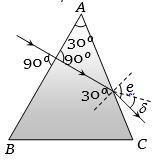
$A$ prism $(\mu = 1.5)$ has a refracting angle of $30^\circ$. The deviation of a monochromatic ray incident normally on one of its surfaces will be $(\sin 48^\circ 36' = 0.75)$.
A
$18^\circ 36'$
B
$20^\circ 30'$
C
$18^\circ$
D
$22^\circ 1'$
Solution
(A) Given: Refractive index $\mu = 1.5$,Prism angle $A = 30^\circ$.
Since the ray is incident normally on one surface,the angle of incidence $i_1 = 0^\circ$,which implies the angle of refraction $r_1 = 0^\circ$.
Using the relation $r_1 + r_2 = A$,we get $0^\circ + r_2 = 30^\circ$,so $r_2 = 30^\circ$.
Applying Snell's Law at the second surface: $\mu \sin r_2 = 1 \cdot \sin e$,where $e$ is the angle of emergence.
$1.5 \times \sin 30^\circ = \sin e$
$1.5 \times 0.5 = \sin e$
$\sin e = 0.75$
Given $\sin 48^\circ 36' = 0.75$,therefore $e = 48^\circ 36'$.
The deviation $\delta$ for a prism is given by $\delta = i_1 + e - A$.
Since $i_1 = 0^\circ$,$\delta = e - A = 48^\circ 36' - 30^\circ = 18^\circ 36'$.
Thus,the correct option is $A$.
Since the ray is incident normally on one surface,the angle of incidence $i_1 = 0^\circ$,which implies the angle of refraction $r_1 = 0^\circ$.
Using the relation $r_1 + r_2 = A$,we get $0^\circ + r_2 = 30^\circ$,so $r_2 = 30^\circ$.
Applying Snell's Law at the second surface: $\mu \sin r_2 = 1 \cdot \sin e$,where $e$ is the angle of emergence.
$1.5 \times \sin 30^\circ = \sin e$
$1.5 \times 0.5 = \sin e$
$\sin e = 0.75$
Given $\sin 48^\circ 36' = 0.75$,therefore $e = 48^\circ 36'$.
The deviation $\delta$ for a prism is given by $\delta = i_1 + e - A$.
Since $i_1 = 0^\circ$,$\delta = e - A = 48^\circ 36' - 30^\circ = 18^\circ 36'$.
Thus,the correct option is $A$.
0 likes
View Solution6
MediumMCQ
When light rays are incident on a prism at an angle of $45^o$,the minimum deviation is obtained. If the refractive index of the material of the prism is $\sqrt{2}$,then the angle of the prism will be......$^o$
A
$30$
B
$40$
C
$50$
D
$60$
Solution
(D) For minimum deviation,the angle of incidence $i$ is related to the angle of prism $A$ and the angle of minimum deviation $\delta_m$ by the relation $i = \frac{A + \delta_m}{2}$.
Given that the angle of incidence $i = 45^o$ and the refractive index $\mu = \sqrt{2}$.
The formula for the refractive index of a prism is $\mu = \frac{\sin(\frac{A + \delta_m}{2})}{\sin(A/2)}$.
Substituting $i = \frac{A + \delta_m}{2} = 45^o$,we get $\mu = \frac{\sin(45^o)}{\sin(A/2)}$.
Substituting the values: $\sqrt{2} = \frac{1/\sqrt{2}}{\sin(A/2)}$.
This simplifies to $\sin(A/2) = \frac{1}{\sqrt{2} \cdot \sqrt{2}} = \frac{1}{2}$.
Therefore,$A/2 = 30^o$,which gives $A = 60^o$.
Given that the angle of incidence $i = 45^o$ and the refractive index $\mu = \sqrt{2}$.
The formula for the refractive index of a prism is $\mu = \frac{\sin(\frac{A + \delta_m}{2})}{\sin(A/2)}$.
Substituting $i = \frac{A + \delta_m}{2} = 45^o$,we get $\mu = \frac{\sin(45^o)}{\sin(A/2)}$.
Substituting the values: $\sqrt{2} = \frac{1/\sqrt{2}}{\sin(A/2)}$.
This simplifies to $\sin(A/2) = \frac{1}{\sqrt{2} \cdot \sqrt{2}} = \frac{1}{2}$.
Therefore,$A/2 = 30^o$,which gives $A = 60^o$.
0 likes
View Solution7
EasyMCQ
$A$ spectrum is formed by a prism of dispersive power $\omega$. If the angle of deviation is $\delta$,then the angular dispersion is
A
$\omega / \delta$
B
$\delta / \omega$
C
$1 / (\omega \delta)$
D
$\omega \delta$
Solution
(D) The dispersive power $\omega$ of a prism is defined as the ratio of the angular dispersion to the mean deviation.
Mathematically,$\omega = \frac{\delta_v - \delta_r}{\delta}$,where $\delta_v - \delta_r$ is the angular dispersion and $\delta$ is the mean deviation.
Therefore,the angular dispersion $\theta = \delta_v - \delta_r = \omega \delta$.
Mathematically,$\omega = \frac{\delta_v - \delta_r}{\delta}$,where $\delta_v - \delta_r$ is the angular dispersion and $\delta$ is the mean deviation.
Therefore,the angular dispersion $\theta = \delta_v - \delta_r = \omega \delta$.
0 likes
View Solution8
MediumMCQ
The angle of minimum deviation for a prism of refractive index $1.5$ is equal to the angle of the prism. The angle of the prism is.......$^o$ (Given: $\cos 41^o = 0.75$)
A
$62$
B
$41$
C
$82$
D
$31$
Solution
(C) The formula for the refractive index $n$ of a prism in terms of the angle of prism $A$ and the angle of minimum deviation $\delta_m$ is given by: $n = \frac{\sin(\frac{A + \delta_m}{2})}{\sin(\frac{A}{2})}$.
Given that the angle of minimum deviation is equal to the angle of the prism,i.e.,$\delta_m = A$.
Substituting this into the formula: $n = \frac{\sin(\frac{A + A}{2})}{\sin(\frac{A}{2})} = \frac{\sin(A)}{\sin(\frac{A}{2})}$.
Using the trigonometric identity $\sin(2\theta) = 2\sin(\theta)\cos(\theta)$,we can write $\sin(A) = 2\sin(\frac{A}{2})\cos(\frac{A}{2})$.
Therefore,$n = \frac{2\sin(\frac{A}{2})\cos(\frac{A}{2})}{\sin(\frac{A}{2})} = 2\cos(\frac{A}{2})$.
Given $n = 1.5$,we have $1.5 = 2\cos(\frac{A}{2})$,which implies $\cos(\frac{A}{2}) = \frac{1.5}{2} = 0.75$.
Given $\cos(41^o) = 0.75$,we equate the angles: $\frac{A}{2} = 41^o$.
Thus,$A = 82^o$.
Given that the angle of minimum deviation is equal to the angle of the prism,i.e.,$\delta_m = A$.
Substituting this into the formula: $n = \frac{\sin(\frac{A + A}{2})}{\sin(\frac{A}{2})} = \frac{\sin(A)}{\sin(\frac{A}{2})}$.
Using the trigonometric identity $\sin(2\theta) = 2\sin(\theta)\cos(\theta)$,we can write $\sin(A) = 2\sin(\frac{A}{2})\cos(\frac{A}{2})$.
Therefore,$n = \frac{2\sin(\frac{A}{2})\cos(\frac{A}{2})}{\sin(\frac{A}{2})} = 2\cos(\frac{A}{2})$.
Given $n = 1.5$,we have $1.5 = 2\cos(\frac{A}{2})$,which implies $\cos(\frac{A}{2}) = \frac{1.5}{2} = 0.75$.
Given $\cos(41^o) = 0.75$,we equate the angles: $\frac{A}{2} = 41^o$.
Thus,$A = 82^o$.
0 likes
View Solution9
EasyMCQ
When white light passes through an achromatic combination of prisms,what is observed?
A
Only deviation
B
Only dispersion
C
Deviation and dispersion
D
None of the above
Solution
(A) An achromatic combination of prisms is designed to produce deviation without dispersion.
In this combination,the dispersive powers of the two prisms are chosen such that the dispersion produced by the first prism is cancelled by the second prism.
However,the deviation produced by the prisms is not cancelled.
Therefore,when white light passes through an achromatic combination,only deviation is observed.
In this combination,the dispersive powers of the two prisms are chosen such that the dispersion produced by the first prism is cancelled by the second prism.
However,the deviation produced by the prisms is not cancelled.
Therefore,when white light passes through an achromatic combination,only deviation is observed.
0 likes
View Solution10
MediumMCQ
$A$ ray of light suffers minimum deviation when incident on a prism having an angle of the prism equal to $60^{\circ}$. The refractive index of the prism material is $\sqrt{2}$. The angle of incidence (in degrees) is . . . . . . .
A
$30$
B
$45$
C
$60$
D
$75$
Solution
(B) For a prism in the condition of minimum deviation,the refractive index $\mu$ is given by the formula: $\mu = \frac{\sin(\frac{A + \delta_m}{2})}{\sin(\frac{A}{2})}$.
Also,at minimum deviation,the angle of incidence $i$ is related to the prism angle $A$ and the angle of minimum deviation $\delta_m$ as $i = \frac{A + \delta_m}{2}$.
Substituting this into the refractive index formula,we get: $\mu = \frac{\sin i}{\sin(A/2)}$.
Given: $\mu = \sqrt{2}$ and $A = 60^{\circ}$.
Substituting the values: $\sqrt{2} = \frac{\sin i}{\sin(60^{\circ}/2)}$.
$\sqrt{2} = \frac{\sin i}{\sin 30^{\circ}}$.
Since $\sin 30^{\circ} = 0.5$,we have: $\sin i = \sqrt{2} \times 0.5 = \frac{\sqrt{2}}{2} = \frac{1}{\sqrt{2}}$.
Therefore,$i = \arcsin(\frac{1}{\sqrt{2}}) = 45^{\circ}$.
Also,at minimum deviation,the angle of incidence $i$ is related to the prism angle $A$ and the angle of minimum deviation $\delta_m$ as $i = \frac{A + \delta_m}{2}$.
Substituting this into the refractive index formula,we get: $\mu = \frac{\sin i}{\sin(A/2)}$.
Given: $\mu = \sqrt{2}$ and $A = 60^{\circ}$.
Substituting the values: $\sqrt{2} = \frac{\sin i}{\sin(60^{\circ}/2)}$.
$\sqrt{2} = \frac{\sin i}{\sin 30^{\circ}}$.
Since $\sin 30^{\circ} = 0.5$,we have: $\sin i = \sqrt{2} \times 0.5 = \frac{\sqrt{2}}{2} = \frac{1}{\sqrt{2}}$.
Therefore,$i = \arcsin(\frac{1}{\sqrt{2}}) = 45^{\circ}$.
0 likes
View Solution11
MediumMCQ
The ratio of the angle of minimum deviation of a prism in air to that when it is dipped in water is (given $_a\mu_g = 3/2$ and $_a\mu_w = 4/3$).
A
$1/8$
B
$1/2$
C
$3/4$
D
$1/4$
Solution
(D) For a thin prism,the angle of minimum deviation is given by $\delta = (\mu - 1)A$,where $A$ is the prism angle and $\mu$ is the refractive index of the prism material relative to the surrounding medium.
In air,$\delta_a = (_a\mu_g - 1)A$.
In water,$\delta_w = (_w\mu_g - 1)A$.
The ratio is $\frac{\delta_w}{\delta_a} = \frac{(_w\mu_g - 1)}{(_a\mu_g - 1)}$.
Given $_w\mu_g = \frac{_a\mu_g}{_a\mu_w} = \frac{3/2}{4/3} = \frac{9}{8}$.
Substituting the values: $\frac{\delta_w}{\delta_a} = \frac{(9/8 - 1)}{(3/2 - 1)} = \frac{1/8}{1/2} = \frac{1}{8} \times 2 = \frac{1}{4}$.
In air,$\delta_a = (_a\mu_g - 1)A$.
In water,$\delta_w = (_w\mu_g - 1)A$.
The ratio is $\frac{\delta_w}{\delta_a} = \frac{(_w\mu_g - 1)}{(_a\mu_g - 1)}$.
Given $_w\mu_g = \frac{_a\mu_g}{_a\mu_w} = \frac{3/2}{4/3} = \frac{9}{8}$.
Substituting the values: $\frac{\delta_w}{\delta_a} = \frac{(9/8 - 1)}{(3/2 - 1)} = \frac{1/8}{1/2} = \frac{1}{8} \times 2 = \frac{1}{4}$.
0 likes
View Solution12
MediumMCQ
The respective angles of the flint and crown glass prisms are $A'$ and $A$. They are to be used for dispersion without deviation. The ratio of their angles $A'/A$ will be:
A
$-\frac{(\mu_y - 1)}{(\mu_y' - 1)}$
B
$\frac{(\mu_y' - 1)}{(\mu_y - 1)}$
C
$(\mu_y' - 1)$
D
$(\mu_y - 1)$
Solution
(A) For dispersion without deviation,the net deviation produced by the combination of two prisms must be zero.
The deviation produced by a prism is given by $\delta = A(\mu - 1)$.
For the combination of crown glass prism (angle $A$,refractive index $\mu_y$) and flint glass prism (angle $A'$,refractive index $\mu_y'$),the total deviation is $\delta_{net} = A(\mu_y - 1) + A'(\mu_y' - 1) = 0$.
Rearranging the equation to find the ratio $A'/A$:
$A'(\mu_y' - 1) = -A(\mu_y - 1)$
$\frac{A'}{A} = -\frac{(\mu_y - 1)}{(\mu_y' - 1)}$.
The deviation produced by a prism is given by $\delta = A(\mu - 1)$.
For the combination of crown glass prism (angle $A$,refractive index $\mu_y$) and flint glass prism (angle $A'$,refractive index $\mu_y'$),the total deviation is $\delta_{net} = A(\mu_y - 1) + A'(\mu_y' - 1) = 0$.
Rearranging the equation to find the ratio $A'/A$:
$A'(\mu_y' - 1) = -A(\mu_y - 1)$
$\frac{A'}{A} = -\frac{(\mu_y - 1)}{(\mu_y' - 1)}$.
0 likes
View Solution13
EasyMCQ
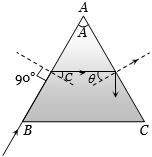
$A$ light ray is incident by grazing one of the faces of a prism. After refraction,the ray does not emerge out from the other face. What should be the angle of the prism if the critical angle is $C$?
A
Equal to $2C$
B
Less than $2C$
C
More than $2C$
D
None of the above
Solution
(C) Let the angle of the prism be $A$. When a light ray is incident by grazing one face,the angle of incidence is $90^{\circ}$,and the angle of refraction at the first surface is equal to the critical angle $C$.
In the triangle formed by the refracted ray and the two faces of the prism,the angle at the second face is $\theta$. From the geometry of the prism,$A = C + \theta$.
For the ray not to emerge from the second face,it must undergo Total Internal Reflection $(TIR)$ at that face. This requires the angle of incidence at the second face to be greater than the critical angle,i.e.,$\theta > C$.
Substituting this into the prism angle equation: $A = C + \theta > C + C$,which gives $A > 2C$.
In the triangle formed by the refracted ray and the two faces of the prism,the angle at the second face is $\theta$. From the geometry of the prism,$A = C + \theta$.
For the ray not to emerge from the second face,it must undergo Total Internal Reflection $(TIR)$ at that face. This requires the angle of incidence at the second face to be greater than the critical angle,i.e.,$\theta > C$.
Substituting this into the prism angle equation: $A = C + \theta > C + C$,which gives $A > 2C$.
0 likes
View Solution14
MediumMCQ
$A$ parallel beam of monochromatic light is incident at one surface of an equilateral prism. The angle of incidence is $55^o$ and the angle of emergence is $46^o$. The angle of minimum deviation will be:
A
Less than $41^o$
B
Equal to $41^o$
C
More than $41^o$
D
None of the above
Solution
(A) For a prism,the relation between the angle of incidence $(i_1)$,angle of emergence $(i_2)$,prism angle $(A)$,and angle of deviation $(\delta)$ is given by:
$i_1 + i_2 = A + \delta$
Given: $i_1 = 55^o$,$i_2 = 46^o$,and for an equilateral prism,$A = 60^o$.
Substituting these values:
$55^o + 46^o = 60^o + \delta$
$101^o = 60^o + \delta$
$\delta = 41^o$
We know that the angle of minimum deviation $(\delta_m)$ occurs when the angle of incidence equals the angle of emergence $(i_1 = i_2)$. Since $i_1 \neq i_2$ $(55^o \neq 46^o)$,the deviation $\delta = 41^o$ is not the minimum deviation.
Since the deviation curve is a parabola with the minimum at $i_1 = i_2$,any deviation measured at $i_1 \neq i_2$ must be greater than the minimum deviation.
Therefore,$\delta_m < \delta$,which implies $\delta_m < 41^o$.
$i_1 + i_2 = A + \delta$
Given: $i_1 = 55^o$,$i_2 = 46^o$,and for an equilateral prism,$A = 60^o$.
Substituting these values:
$55^o + 46^o = 60^o + \delta$
$101^o = 60^o + \delta$
$\delta = 41^o$
We know that the angle of minimum deviation $(\delta_m)$ occurs when the angle of incidence equals the angle of emergence $(i_1 = i_2)$. Since $i_1 \neq i_2$ $(55^o \neq 46^o)$,the deviation $\delta = 41^o$ is not the minimum deviation.
Since the deviation curve is a parabola with the minimum at $i_1 = i_2$,any deviation measured at $i_1 \neq i_2$ must be greater than the minimum deviation.
Therefore,$\delta_m < \delta$,which implies $\delta_m < 41^o$.
0 likes
View Solution15
EasyMCQ
Light rays from a source are incident on a glass prism of refractive index $\mu$ and prism angle $\alpha$. At near-normal incidence,the angle of deviation of the emerging rays is:
A
$(\mu - 2)\alpha$
B
$(\mu - 1)\alpha$
C
$(\mu + 1)\alpha$
D
$(\mu + 2)\alpha$
Solution
(B) For a thin prism or at near-normal incidence,the angle of deviation $\delta$ is given by the formula $\delta = (\mu - 1)A$,where $\mu$ is the refractive index and $A$ is the angle of the prism.
Given that the angle of the prism is $\alpha$,we substitute $A = \alpha$ into the formula.
Therefore,the angle of deviation is $\delta = (\mu - 1)\alpha$.
Thus,the correct option is $B$.
Given that the angle of the prism is $\alpha$,we substitute $A = \alpha$ into the formula.
Therefore,the angle of deviation is $\delta = (\mu - 1)\alpha$.
Thus,the correct option is $B$.
0 likes
View Solution16
EasyMCQ
By placing the prism in the minimum deviation position,the images of the spectrum:
A
Becomes inverted
B
Becomes broader
C
Becomes distinct
D
Becomes intensive
Solution
(C) When a prism is placed in the position of minimum deviation,the rays of light pass through the prism symmetrically.
In this position,the refraction of light is most uniform,which minimizes the aberration effects.
As a result,the images of the spectrum formed are sharp,clear,and distinct.
In this position,the refraction of light is most uniform,which minimizes the aberration effects.
As a result,the images of the spectrum formed are sharp,clear,and distinct.
0 likes
View Solution17
MediumMCQ
Three prisms of crown glass,each having a prism angle of $9^o$,and two prisms of flint glass are used to make a direct vision spectroscope. What will be the angle of the flint glass prisms in degrees if the refractive index $\mu$ for flint glass is $1.60$ and $\mu$ for crown glass is $1.53$ (in $^o$)?
A
$11.9$
B
$16$
C
$15.3$
D
$9.11$
Solution
(A) For a direct vision spectroscope,the net deviation produced by the combination of prisms must be zero.
Let $A_c = 9^o$ be the angle of the crown glass prisms and $A_f$ be the angle of the flint glass prisms.
The refractive indices are $\mu_c = 1.53$ and $\mu_f = 1.60$.
The total deviation $\delta_{net} = 3 \times \delta_c - 2 \times \delta_f = 0$.
Substituting the formula for deviation $\delta = (\mu - 1)A$:
$3(\mu_c - 1)A_c - 2(\mu_f - 1)A_f = 0$.
$3(1.53 - 1) \times 9^o = 2(1.60 - 1) \times A_f$.
$3(0.53) \times 9^o = 2(0.60) \times A_f$.
$14.31^o = 1.2 \times A_f$.
$A_f = \frac{14.31}{1.2} = 11.925^o \approx 11.9^o$.
Let $A_c = 9^o$ be the angle of the crown glass prisms and $A_f$ be the angle of the flint glass prisms.
The refractive indices are $\mu_c = 1.53$ and $\mu_f = 1.60$.
The total deviation $\delta_{net} = 3 \times \delta_c - 2 \times \delta_f = 0$.
Substituting the formula for deviation $\delta = (\mu - 1)A$:
$3(\mu_c - 1)A_c - 2(\mu_f - 1)A_f = 0$.
$3(1.53 - 1) \times 9^o = 2(1.60 - 1) \times A_f$.
$3(0.53) \times 9^o = 2(0.60) \times A_f$.
$14.31^o = 1.2 \times A_f$.
$A_f = \frac{14.31}{1.2} = 11.925^o \approx 11.9^o$.
0 likes
View Solution18
MediumMCQ
$A$ flint glass prism is joined with a crown glass prism to produce dispersion without deviation. The refractive indices of these for mean rays are $1.602$ and $1.500$ respectively. If the angle of the flint glass prism is $10^{\circ}$,then the angle of the crown glass prism will be:
A
$12^{\circ} 2.4'$
B
$12^{\circ} 4'$
C
$1.24^{\circ}$
D
$12^{\circ}$
Solution
(A) For dispersion without deviation,the net deviation produced by the combination must be zero.
The condition for dispersion without deviation is given by: $(\mu - 1)A + (\mu' - 1)A' = 0$.
Here,$\mu = 1.602$ (flint glass),$A = 10^{\circ}$,and $\mu' = 1.500$ (crown glass).
Taking the magnitudes,we have: $(\mu - 1)A = (\mu' - 1)A'$.
Substituting the values: $(1.602 - 1) \times 10^{\circ} = (1.500 - 1) \times A'$.
$0.602 \times 10^{\circ} = 0.500 \times A'$.
$A' = \frac{6.02}{0.500} = 12.04^{\circ}$.
Since $0.04^{\circ} = 0.04 \times 60' = 2.4'$,the angle $A' = 12^{\circ} 2.4'$.
The condition for dispersion without deviation is given by: $(\mu - 1)A + (\mu' - 1)A' = 0$.
Here,$\mu = 1.602$ (flint glass),$A = 10^{\circ}$,and $\mu' = 1.500$ (crown glass).
Taking the magnitudes,we have: $(\mu - 1)A = (\mu' - 1)A'$.
Substituting the values: $(1.602 - 1) \times 10^{\circ} = (1.500 - 1) \times A'$.
$0.602 \times 10^{\circ} = 0.500 \times A'$.
$A' = \frac{6.02}{0.500} = 12.04^{\circ}$.
Since $0.04^{\circ} = 0.04 \times 60' = 2.4'$,the angle $A' = 12^{\circ} 2.4'$.
0 likes
View Solution19
EasyMCQ
The angle of minimum deviation for a prism is $40^o$ and the angle of the prism is $60^o$. The angle of incidence in this position will be.....$^o$
A
$30$
B
$60$
C
$50$
D
$100$
Solution
(C) For a prism,the angle of incidence $i$ at the position of minimum deviation is given by the formula:
$i = \frac{A + \delta_m}{2}$
Given:
Angle of prism,$A = 60^o$
Angle of minimum deviation,$\delta_m = 40^o$
Substituting these values into the formula:
$i = \frac{60^o + 40^o}{2}$
$i = \frac{100^o}{2}$
$i = 50^o$
Therefore,the angle of incidence is $50^o$.
$i = \frac{A + \delta_m}{2}$
Given:
Angle of prism,$A = 60^o$
Angle of minimum deviation,$\delta_m = 40^o$
Substituting these values into the formula:
$i = \frac{60^o + 40^o}{2}$
$i = \frac{100^o}{2}$
$i = 50^o$
Therefore,the angle of incidence is $50^o$.
0 likes
View Solution20
EasyMCQ
In the position of minimum deviation when a ray of yellow light passes through a prism,its angle of incidence is
A
Less than the emergent angle
B
Greater than the emergent angle
C
Sum of the angle of incidence and emergent angle is $90^{\circ}$
D
Equal to the emergent angle
Solution
(D) In the position of minimum deviation,the light ray passes through the prism symmetrically.
According to the properties of a prism,the angle of incidence $(i)$ is equal to the angle of emergence $(e)$ when the deviation is minimum.
Therefore,$\angle i = \angle e$.
According to the properties of a prism,the angle of incidence $(i)$ is equal to the angle of emergence $(e)$ when the deviation is minimum.
Therefore,$\angle i = \angle e$.
0 likes
View Solution21
EasyMCQ
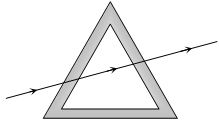
When a white light passes through a hollow prism,then
A
There is no dispersion and no deviation
B
Dispersion but no deviation
C
Deviation but no dispersion
D
There is dispersion and deviation both
Solution
(A) hollow prism is filled with air. Since the refractive index of air is approximately $1$,the light ray passes through the prism without undergoing any significant refraction at the interfaces.
As a result,there is no change in the direction of the light (no deviation) and no splitting of white light into its constituent colors (no dispersion).
Therefore,the correct option is $A$.
As a result,there is no change in the direction of the light (no deviation) and no splitting of white light into its constituent colors (no dispersion).
Therefore,the correct option is $A$.
0 likes
View Solution22
DifficultMCQ
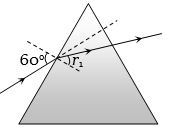
$A$ light ray is incident at an angle of $60^o$ on a prism of angle $45^o$. When the light ray emerges from the other surface at $90^o$ to the surface,the refractive index of the material of the prism $\mu$ and the angle of deviation $\delta$ are given by:
A
$\mu = \sqrt{2}, \delta = 30^o$
B
$\mu = 1.5, \delta = 15^o$
C
$\mu = \frac{\sqrt{3}}{2}, \delta = 30^o$
D
$\mu = \sqrt{\frac{3}{2}}, \delta = 15^o$
Solution
(D) Given: Angle of incidence $i = 60^o$,Prism angle $A = 45^o$,Emergent angle $e = 90^o$ (relative to the surface,so the angle of emergence $e' = 0^o$ relative to the normal).
$1$. From the geometry of the prism,the angle of refraction at the second surface $r_2 = 0^o$ because the ray emerges normally.
$2$. Using the relation $A = r_1 + r_2$,we get $45^o = r_1 + 0^o$,so $r_1 = 45^o$.
$3$. Using Snell's law at the first surface: $\mu = \frac{\sin i}{\sin r_1} = \frac{\sin 60^o}{\sin 45^o} = \frac{\sqrt{3}/2}{1/\sqrt{2}} = \sqrt{\frac{3}{2}}$.
$4$. The angle of deviation $\delta$ is given by $\delta = i + e' - A$. Since the ray emerges normally,the angle of emergence relative to the normal is $e' = 0^o$.
$5$. Thus,$\delta = 60^o + 0^o - 45^o = 15^o$.
Therefore,$\mu = \sqrt{\frac{3}{2}}$ and $\delta = 15^o$.
$1$. From the geometry of the prism,the angle of refraction at the second surface $r_2 = 0^o$ because the ray emerges normally.
$2$. Using the relation $A = r_1 + r_2$,we get $45^o = r_1 + 0^o$,so $r_1 = 45^o$.
$3$. Using Snell's law at the first surface: $\mu = \frac{\sin i}{\sin r_1} = \frac{\sin 60^o}{\sin 45^o} = \frac{\sqrt{3}/2}{1/\sqrt{2}} = \sqrt{\frac{3}{2}}$.
$4$. The angle of deviation $\delta$ is given by $\delta = i + e' - A$. Since the ray emerges normally,the angle of emergence relative to the normal is $e' = 0^o$.
$5$. Thus,$\delta = 60^o + 0^o - 45^o = 15^o$.
Therefore,$\mu = \sqrt{\frac{3}{2}}$ and $\delta = 15^o$.
0 likes
View Solution23
EasyMCQ
$A$ deviation of $5^o$ is observed from a prism whose angle is small and whose refractive index is $1.5$. The angle of the prism is.......$^o$
A
$7.5$
B
$10$
C
$5$
D
$3.3$
Solution
(B) For a thin prism,the angle of deviation $\delta$ is given by the formula: $\delta = (\mu - 1)A$,where $\mu$ is the refractive index and $A$ is the angle of the prism.
Given: $\delta = 5^o$ and $\mu = 1.5$.
Substituting the values into the formula:
$5^o = (1.5 - 1)A$
$5^o = 0.5 \times A$
$A = \frac{5}{0.5} = 10^o$.
Therefore,the angle of the prism is $10^o$.
Given: $\delta = 5^o$ and $\mu = 1.5$.
Substituting the values into the formula:
$5^o = (1.5 - 1)A$
$5^o = 0.5 \times A$
$A = \frac{5}{0.5} = 10^o$.
Therefore,the angle of the prism is $10^o$.
0 likes
View Solution24
MediumMCQ
The angle of minimum deviation measured with a prism is $30^o$ and the angle of the prism is $60^o$. The refractive index of the prism material is:
A
$\sqrt{2}$
B
$2$
C
$3/2$
D
$4/3$
Solution
(A) The formula for the refractive index $\mu$ of a prism in terms of the angle of prism $A$ and the angle of minimum deviation $\delta_m$ is given by:
$\mu = \frac{\sin((A + \delta_m)/2)}{\sin(A/2)}$
Given $A = 60^o$ and $\delta_m = 30^o$:
$\mu = \frac{\sin((60^o + 30^o)/2)}{\sin(60^o/2)}$
$\mu = \frac{\sin(45^o)}{\sin(30^o)}$
$\mu = \frac{1/\sqrt{2}}{1/2} = \frac{2}{\sqrt{2}} = \sqrt{2}$
Therefore,the refractive index is $\sqrt{2}$.
$\mu = \frac{\sin((A + \delta_m)/2)}{\sin(A/2)}$
Given $A = 60^o$ and $\delta_m = 30^o$:
$\mu = \frac{\sin((60^o + 30^o)/2)}{\sin(60^o/2)}$
$\mu = \frac{\sin(45^o)}{\sin(30^o)}$
$\mu = \frac{1/\sqrt{2}}{1/2} = \frac{2}{\sqrt{2}} = \sqrt{2}$
Therefore,the refractive index is $\sqrt{2}$.
0 likes
View Solution25
EasyMCQ
Minimum deviation is observed with a prism having angle of prism $A$,angle of deviation $\delta$,angle of incidence $i$,and angle of emergence $e$. We then have generally
A
$i > e$
B
$i < e$
C
$i = e$
D
$i = e = \delta$
Solution
(C) In the condition of minimum deviation,the light ray passes through the prism symmetrically.
This symmetry implies that the angle of incidence is equal to the angle of emergence.
Therefore,at the angle of minimum deviation,we have $\angle i = \angle e$ and $\angle r_1 = \angle r_2$.
This symmetry implies that the angle of incidence is equal to the angle of emergence.
Therefore,at the angle of minimum deviation,we have $\angle i = \angle e$ and $\angle r_1 = \angle r_2$.
0 likes
View Solution26
MediumMCQ
$A$ thin prism $P_1$ with angle $4^o$ and made from glass of refractive index $1.54$ is combined with another thin prism $P_2$ made from glass of refractive index $1.72$ to produce dispersion without deviation. The angle of prism $P_2$ is......$^o$
A
$2.6$
B
$3$
C
$4$
D
$5.33$
Solution
(B) For dispersion without deviation,the net deviation produced by the combination of two thin prisms must be zero.
The condition for dispersion without deviation is given by: $(\mu - 1)A + (\mu' - 1)A' = 0$.
Here,$A = 4^o$,$\mu = 1.54$,and $\mu' = 1.72$.
Since the prisms are combined to produce dispersion without deviation,the deviation produced by the first prism must be balanced by the second prism in the opposite direction.
Thus,$(\mu - 1)A = -(\mu' - 1)A'$.
Taking the magnitude: $(\mu - 1)A = (\mu' - 1)A'$.
Substituting the values: $(1.54 - 1) \times 4^o = (1.72 - 1) \times A'$.
$0.54 \times 4^o = 0.72 \times A'$.
$A' = \frac{0.54 \times 4}{0.72} = \frac{2.16}{0.72} = 3^o$.
Therefore,the angle of prism $P_2$ is $3^o$.
The condition for dispersion without deviation is given by: $(\mu - 1)A + (\mu' - 1)A' = 0$.
Here,$A = 4^o$,$\mu = 1.54$,and $\mu' = 1.72$.
Since the prisms are combined to produce dispersion without deviation,the deviation produced by the first prism must be balanced by the second prism in the opposite direction.
Thus,$(\mu - 1)A = -(\mu' - 1)A'$.
Taking the magnitude: $(\mu - 1)A = (\mu' - 1)A'$.
Substituting the values: $(1.54 - 1) \times 4^o = (1.72 - 1) \times A'$.
$0.54 \times 4^o = 0.72 \times A'$.
$A' = \frac{0.54 \times 4}{0.72} = \frac{2.16}{0.72} = 3^o$.
Therefore,the angle of prism $P_2$ is $3^o$.
0 likes
View Solution27
EasyMCQ
An achromatic prism is made by combining two prisms $P_1$ $(\mu_v = 1.523, \mu_r = 1.515)$ and $P_2$ $(\mu'_v = 1.666, \mu'_r = 1.650)$,where $\mu$ represents the refractive index. If the angle of the prism $P_1$ is $10^o$,then the angle of the prism $P_2$ will be.....$^o$
A
$5$
B
$7.8$
C
$10.6$
D
$20$
Solution
(A) For an achromatic combination of two prisms,the net dispersion must be zero.
The condition for zero net dispersion is given by: $A(\mu_v - \mu_r) + A'(\mu'_v - \mu'_r) = 0$.
Here,$A = 10^o$,$\mu_v - \mu_r = 1.523 - 1.515 = 0.008$,and $\mu'_v - \mu'_r = 1.666 - 1.650 = 0.016$.
Substituting these values into the equation:
$10^o(0.008) + A'(0.016) = 0$.
$0.08 + A'(0.016) = 0$.
$A'(0.016) = -0.08$.
$A' = -\frac{0.08}{0.016} = -5^o$.
The magnitude of the prism angle is $5^o$ (the negative sign indicates that the second prism must be oriented in the opposite direction to the first).
The condition for zero net dispersion is given by: $A(\mu_v - \mu_r) + A'(\mu'_v - \mu'_r) = 0$.
Here,$A = 10^o$,$\mu_v - \mu_r = 1.523 - 1.515 = 0.008$,and $\mu'_v - \mu'_r = 1.666 - 1.650 = 0.016$.
Substituting these values into the equation:
$10^o(0.008) + A'(0.016) = 0$.
$0.08 + A'(0.016) = 0$.
$A'(0.016) = -0.08$.
$A' = -\frac{0.08}{0.016} = -5^o$.
The magnitude of the prism angle is $5^o$ (the negative sign indicates that the second prism must be oriented in the opposite direction to the first).
0 likes
View Solution28
DifficultMCQ
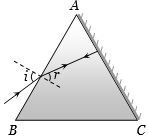
The angle of a prism is $30^o$ and its refractive index is $\sqrt{2}$. One of its surfaces is silvered. At what angle of incidence should a ray be incident on the other surface so that after reflection from the silvered surface,it retraces its path?
A
$30^o$
B
$60^o$
C
$45^o$
D
$\sin^{-1}(\sqrt{1.5})$
Solution
(C) For a light ray to retrace its path after reflection from a silvered surface,it must strike the silvered surface normally (at an angle of $90^o$ to the surface,or $0^o$ to the normal).
In a prism,the angle of the prism $A$ is given by $A = r_1 + r_2$. Here,the ray strikes the second surface normally,so $r_2 = 0^o$.
Given $A = 30^o$,we have $30^o = r_1 + 0^o$,which implies $r_1 = 30^o$.
Applying Snell's law at the first surface:
$\mu = \frac{\sin i}{\sin r_1}$
$\sqrt{2} = \frac{\sin i}{\sin 30^o}$
$\sin i = \sqrt{2} \times \sin 30^o = \sqrt{2} \times \frac{1}{2} = \frac{1}{\sqrt{2}}$
$i = \sin^{-1}\left(\frac{1}{\sqrt{2}}\right) = 45^o$.
Thus,the angle of incidence is $45^o$.
In a prism,the angle of the prism $A$ is given by $A = r_1 + r_2$. Here,the ray strikes the second surface normally,so $r_2 = 0^o$.
Given $A = 30^o$,we have $30^o = r_1 + 0^o$,which implies $r_1 = 30^o$.
Applying Snell's law at the first surface:
$\mu = \frac{\sin i}{\sin r_1}$
$\sqrt{2} = \frac{\sin i}{\sin 30^o}$
$\sin i = \sqrt{2} \times \sin 30^o = \sqrt{2} \times \frac{1}{2} = \frac{1}{\sqrt{2}}$
$i = \sin^{-1}\left(\frac{1}{\sqrt{2}}\right) = 45^o$.
Thus,the angle of incidence is $45^o$.
0 likes
View Solution29
EasyMCQ
$A$ ray of light is incident at an angle of $60^o$ on one face of a prism of angle $30^o$. The ray emerging out of the prism makes an angle of $30^o$ with the incident ray. The emergent ray is
A
Normal to the face through which it emerges
B
Inclined at $30^o$ to the face through which it emerges
C
Inclined at $60^o$ to the face through which it emerges
D
None of these
Solution
(A) The deviation produced by a prism is given by the formula $\delta = i + e - A$,where $i$ is the angle of incidence,$e$ is the angle of emergence,and $A$ is the prism angle.
Given: $i = 60^o$,$A = 30^o$,and $\delta = 30^o$.
Substituting these values into the formula: $30^o = 60^o + e - 30^o$.
Solving for $e$: $e = 30^o + 30^o - 60^o = 0^o$.
Since the angle of emergence $e$ is $0^o$,the emergent ray is normal (perpendicular) to the surface of the prism.
Therefore,the emergent ray makes an angle of $90^o$ with the face through which it emerges.
Given: $i = 60^o$,$A = 30^o$,and $\delta = 30^o$.
Substituting these values into the formula: $30^o = 60^o + e - 30^o$.
Solving for $e$: $e = 30^o + 30^o - 60^o = 0^o$.
Since the angle of emergence $e$ is $0^o$,the emergent ray is normal (perpendicular) to the surface of the prism.
Therefore,the emergent ray makes an angle of $90^o$ with the face through which it emerges.
0 likes
View Solution30
EasyMCQ
In a thin prism of glass (refractive index $\mu = 1.5$),which of the following relations between the angle of minimum deviation $\delta_m$ and the angle of the prism $A$ (where $A = 2r$ for a thin prism) is correct?
A
$\delta_m = r$
B
$\delta_m = 1.5r$
C
$\delta_m = 2r$
D
$\delta_m = 0.5r$
Solution
(A) For a thin prism,the angle of minimum deviation $\delta_m$ is given by the formula: $\delta_m = (\mu - 1)A$.
In a thin prism,the angle of the prism $A$ is related to the angle of refraction $r$ by the relation $A = 2r$.
Substituting the given refractive index $\mu = 1.5$ and $A = 2r$ into the formula:
$\delta_m = (1.5 - 1) \times (2r)$
$\delta_m = 0.5 \times 2r$
$\delta_m = r$.
Therefore,the correct relation is $\delta_m = r$.
In a thin prism,the angle of the prism $A$ is related to the angle of refraction $r$ by the relation $A = 2r$.
Substituting the given refractive index $\mu = 1.5$ and $A = 2r$ into the formula:
$\delta_m = (1.5 - 1) \times (2r)$
$\delta_m = 0.5 \times 2r$
$\delta_m = r$.
Therefore,the correct relation is $\delta_m = r$.
0 likes
View Solution31
EasyMCQ
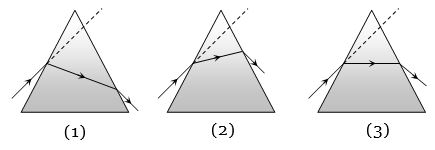
The figures represent three cases of a ray passing through a prism of angle $A$. The case corresponding to minimum deviation is
A
$1$
B
$2$
C
$3$
D
None of these
Solution
(C) For a prism,the condition for minimum deviation is that the angle of incidence $(i)$ is equal to the angle of emergence $(e)$.
This symmetry implies that the refracted ray inside the prism is parallel to the base of the prism.
In the given figures,case $(3)$ shows the refracted ray inside the prism running parallel to the base of the prism.
Therefore,case $(3)$ corresponds to the condition of minimum deviation.
This symmetry implies that the refracted ray inside the prism is parallel to the base of the prism.
In the given figures,case $(3)$ shows the refracted ray inside the prism running parallel to the base of the prism.
Therefore,case $(3)$ corresponds to the condition of minimum deviation.
0 likes
View Solution32
MediumMCQ
$A$ ray of light passes through an equilateral glass prism in such a manner that the angle of incidence is equal to the angle of emergence and each of these angles is equal to $3/4$ of the angle of the prism. The angle of deviation is......$^o$
A
$45$
B
$39$
C
$20$
D
$30$
Solution
(D) Given that the prism is equilateral,the angle of the prism $A = 60^o$.
According to the problem,the angle of incidence $i$ is equal to the angle of emergence $e$,and both are equal to $3/4$ of the angle of the prism.
Thus,$i = e = \frac{3}{4} \times 60^o = 45^o$.
For a prism,the relationship between the angle of incidence,angle of emergence,angle of the prism,and the angle of deviation $\delta$ is given by the formula: $i + e = A + \delta$.
Substituting the known values: $45^o + 45^o = 60^o + \delta$.
$90^o = 60^o + \delta$.
Therefore,the angle of deviation $\delta = 90^o - 60^o = 30^o$.
According to the problem,the angle of incidence $i$ is equal to the angle of emergence $e$,and both are equal to $3/4$ of the angle of the prism.
Thus,$i = e = \frac{3}{4} \times 60^o = 45^o$.
For a prism,the relationship between the angle of incidence,angle of emergence,angle of the prism,and the angle of deviation $\delta$ is given by the formula: $i + e = A + \delta$.
Substituting the known values: $45^o + 45^o = 60^o + \delta$.
$90^o = 60^o + \delta$.
Therefore,the angle of deviation $\delta = 90^o - 60^o = 30^o$.
0 likes
View Solution33
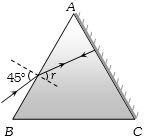
MediumMCQ
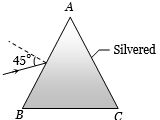
$A$ prism $ABC$ of angle $30^\circ$ has its face $AC$ silvered. $A$ ray of light incident at an angle of $45^\circ$ at the face $AB$ retraces its path after refraction at face $AB$ and reflection at face $AC$. The refractive index of the material of the prism is
A
$1.5$
B
$\frac{3}{\sqrt{2}}$
C
$\sqrt{2}$
D
$\frac{4}{3}$
Solution
(C) For the light ray to retrace its path,it must strike the silvered face $AC$ normally.
Let $i = 45^\circ$ be the angle of incidence at face $AB$ and $r$ be the angle of refraction.
From the geometry of the prism,the angle of the prism $A = 30^\circ$.
Since the ray strikes face $AC$ normally,the angle of incidence at face $AC$ is $0^\circ$.
In a prism,the angle $A = r_1 + r_2$. Here,$r_1 = r$ and $r_2 = 0^\circ$.
Thus,$r = A = 30^\circ$.
Using Snell's law at face $AB$: $\mu = \frac{\sin i}{\sin r} = \frac{\sin 45^\circ}{\sin 30^\circ}$.
$\mu = \frac{1/\sqrt{2}}{1/2} = \frac{2}{\sqrt{2}} = \sqrt{2}$.
Therefore,the refractive index of the material of the prism is $\sqrt{2}$.
Let $i = 45^\circ$ be the angle of incidence at face $AB$ and $r$ be the angle of refraction.
From the geometry of the prism,the angle of the prism $A = 30^\circ$.
Since the ray strikes face $AC$ normally,the angle of incidence at face $AC$ is $0^\circ$.
In a prism,the angle $A = r_1 + r_2$. Here,$r_1 = r$ and $r_2 = 0^\circ$.
Thus,$r = A = 30^\circ$.
Using Snell's law at face $AB$: $\mu = \frac{\sin i}{\sin r} = \frac{\sin 45^\circ}{\sin 30^\circ}$.
$\mu = \frac{1/\sqrt{2}}{1/2} = \frac{2}{\sqrt{2}} = \sqrt{2}$.
Therefore,the refractive index of the material of the prism is $\sqrt{2}$.
0 likes
View Solution34
EasyMCQ
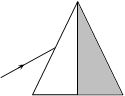
$A$ light ray is incident upon a prism in minimum deviation position and suffers a deviation of $34^o$. If the shaded half of the prism is removed,the ray will
A
Suffer a deviation of $34^o$
B
Suffer a deviation of $68^o$
C
Suffer a deviation of $17^o$
D
Not come out of the prism
Solution
(C) For a thin prism,the angle of deviation $\delta$ is given by $\delta = (n - 1)A$,where $n$ is the refractive index and $A$ is the prism angle.
Initially,the deviation is $\delta = 34^o = (n - 1)A$.
When the shaded half is removed,the effective prism angle becomes $A' = A/2$.
The new deviation $\delta'$ will be $\delta' = (n - 1)A' = (n - 1)(A/2)$.
Substituting the initial value: $\delta' = \frac{1}{2} \times (n - 1)A = \frac{1}{2} \times 34^o = 17^o$.
Thus,the ray will suffer a deviation of $17^o$.
Initially,the deviation is $\delta = 34^o = (n - 1)A$.
When the shaded half is removed,the effective prism angle becomes $A' = A/2$.
The new deviation $\delta'$ will be $\delta' = (n - 1)A' = (n - 1)(A/2)$.
Substituting the initial value: $\delta' = \frac{1}{2} \times (n - 1)A = \frac{1}{2} \times 34^o = 17^o$.
Thus,the ray will suffer a deviation of $17^o$.
0 likes
View Solution35
MediumMCQ
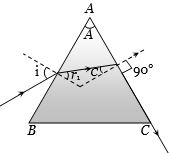
$A$ ray of monochromatic light is incident on one refracting face of a prism of angle $75^o$. It passes through the prism and is incident on the other face at the critical angle. If the refractive index of the material of the prism is $\sqrt{2}$,the angle of incidence on the first face of the prism is.......$^o$.
A
$30$
B
$45$
C
$60$
D
$0$
Solution
(B) Given: Prism angle $A = 75^o$,refractive index $\mu = \sqrt{2}$.
Let $r_1$ be the angle of refraction at the first face and $r_2$ be the angle of incidence at the second face. Since the ray is incident at the critical angle $C$ on the second face,$r_2 = C$.
We know that for a prism,$A = r_1 + r_2 = r_1 + C$.
The critical angle $C$ is given by $\sin C = \frac{1}{\mu} = \frac{1}{\sqrt{2}}$. Thus,$C = 45^o$.
Substituting the values: $75^o = r_1 + 45^o$,which gives $r_1 = 30^o$.
Applying Snell's law at the first face: $\mu = \frac{\sin i}{\sin r_1}$.
$\sqrt{2} = \frac{\sin i}{\sin 30^o} = \frac{\sin i}{0.5}$.
$\sin i = \sqrt{2} \times 0.5 = \frac{\sqrt{2}}{2} = \frac{1}{\sqrt{2}}$.
Therefore,$i = 45^o$.
Let $r_1$ be the angle of refraction at the first face and $r_2$ be the angle of incidence at the second face. Since the ray is incident at the critical angle $C$ on the second face,$r_2 = C$.
We know that for a prism,$A = r_1 + r_2 = r_1 + C$.
The critical angle $C$ is given by $\sin C = \frac{1}{\mu} = \frac{1}{\sqrt{2}}$. Thus,$C = 45^o$.
Substituting the values: $75^o = r_1 + 45^o$,which gives $r_1 = 30^o$.
Applying Snell's law at the first face: $\mu = \frac{\sin i}{\sin r_1}$.
$\sqrt{2} = \frac{\sin i}{\sin 30^o} = \frac{\sin i}{0.5}$.
$\sin i = \sqrt{2} \times 0.5 = \frac{\sqrt{2}}{2} = \frac{1}{\sqrt{2}}$.
Therefore,$i = 45^o$.
0 likes
View Solution36
EasyMCQ
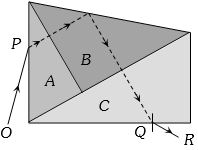
Three glass prisms $A, B$ and $C$ of the same refractive index are placed in contact with each other as shown in the figure,with no air gap between the prisms. $A$ monochromatic ray of light $OP$ passes through the prism assembly and emerges as $QR$. The conditions of minimum deviation are satisfied in which prisms?
A
$A$ and $C$
B
$B$ and $C$
C
$A$ and $B$
D
In all prisms $A, B$ and $C$
Solution
(C) The condition for minimum deviation in a prism is that the refracted ray inside the prism must be parallel to the base of the prism.
Looking at the path of the light ray in the figure,the ray inside prism $A$ is parallel to its base,and the ray inside prism $B$ is also parallel to its base.
Therefore,the condition of minimum deviation is satisfied in prisms $A$ and $B$.
Looking at the path of the light ray in the figure,the ray inside prism $A$ is parallel to its base,and the ray inside prism $B$ is also parallel to its base.
Therefore,the condition of minimum deviation is satisfied in prisms $A$ and $B$.
0 likes
View Solution37
EasyMCQ
The refractive index of a material of a prism of angles $45^o -45^o -90^o$ is $1.5$. The path of the ray of light incident normally on the hypotenuse side is shown in
A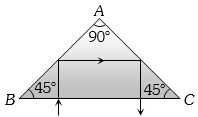
B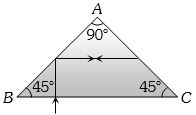
C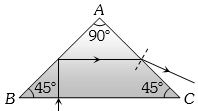
D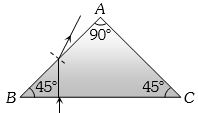
Solution
(A) The critical angle $i_c$ for the prism material is given by $\sin(i_c) = \frac{1}{\mu} = \frac{1}{1.5} = \frac{2}{3} \approx 0.667$.
Since $\sin(45^o) = \frac{1}{\sqrt{2}} \approx 0.707$,we have $\sin(45^o) > \sin(i_c)$,which implies $45^o > i_c$.
When a light ray is incident normally on the hypotenuse $BC$,it enters the prism without deviation and strikes the face $AB$ at an angle of incidence of $45^o$.
Since the angle of incidence $45^o$ is greater than the critical angle $i_c$,the ray undergoes Total Internal Reflection $(TIR)$ at face $AB$.
After reflection,the ray travels parallel to the base $BC$ and strikes the face $AC$ at an angle of incidence of $45^o$.
Again,since $45^o > i_c$,the ray undergoes $TIR$ at face $AC$ and emerges normally from the hypotenuse $BC$.
This path corresponds to the diagram shown in option $A$.
Since $\sin(45^o) = \frac{1}{\sqrt{2}} \approx 0.707$,we have $\sin(45^o) > \sin(i_c)$,which implies $45^o > i_c$.
When a light ray is incident normally on the hypotenuse $BC$,it enters the prism without deviation and strikes the face $AB$ at an angle of incidence of $45^o$.
Since the angle of incidence $45^o$ is greater than the critical angle $i_c$,the ray undergoes Total Internal Reflection $(TIR)$ at face $AB$.
After reflection,the ray travels parallel to the base $BC$ and strikes the face $AC$ at an angle of incidence of $45^o$.
Again,since $45^o > i_c$,the ray undergoes $TIR$ at face $AC$ and emerges normally from the hypotenuse $BC$.
This path corresponds to the diagram shown in option $A$.
0 likes
View Solution38
EasyMCQ
Angle of deviation $(\delta)$ by a prism (refractive index = $\mu$ and supposing the angle of prism $A$ to be small) can be given by
A
$\delta = (\mu - 1)A$
B
$\delta = (\mu + 1)A$
C
$\delta = \frac{\sin \frac{A + \delta}{2}}{\sin \frac{A}{2}}$
D
$\delta = \frac{\mu - 1}{\mu + 1}A$
Solution
(A) The refractive index of a prism is given by the formula:
$\mu = \frac{\sin \left(\frac{A + \delta}{2}\right)}{\sin \left(\frac{A}{2}\right)}$
For a very thin prism,the angle of prism $A$ and the angle of deviation $\delta$ are very small. Therefore,we can use the approximation $\sin \theta \approx \theta$.
Substituting this into the formula:
$\mu \approx \frac{\frac{A + \delta}{2}}{\frac{A}{2}}$
Simplifying the expression:
$\mu = \frac{A + \delta}{A}$
$\mu A = A + \delta$
$\delta = \mu A - A$
$\delta = (\mu - 1)A$
Thus,the angle of deviation for a thin prism is given by $\delta = (\mu - 1)A$.
$\mu = \frac{\sin \left(\frac{A + \delta}{2}\right)}{\sin \left(\frac{A}{2}\right)}$
For a very thin prism,the angle of prism $A$ and the angle of deviation $\delta$ are very small. Therefore,we can use the approximation $\sin \theta \approx \theta$.
Substituting this into the formula:
$\mu \approx \frac{\frac{A + \delta}{2}}{\frac{A}{2}}$
Simplifying the expression:
$\mu = \frac{A + \delta}{A}$
$\mu A = A + \delta$
$\delta = \mu A - A$
$\delta = (\mu - 1)A$
Thus,the angle of deviation for a thin prism is given by $\delta = (\mu - 1)A$.
0 likes
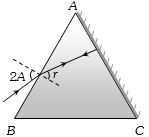
View Solution39
DifficultMCQ
The angle of a prism is $A$. One of its refracting surfaces is silvered. Light rays falling at an angle of incidence $2A$ on the first surface return back through the same path after suffering reflection at the silvered surface. The refractive index $\mu$ of the prism is:
A
$2 \sin A$
B
$2 \cos A$
C
$\frac{1}{2} \cos A$
D
$\tan A$
Solution
(A) For the light ray to retrace its path,it must strike the silvered surface normally (at an angle of $90^{\circ}$).
In the triangle formed inside the prism,the angle at the silvered surface is $90^{\circ}$,and the angle at the apex is $A$. Thus,the angle of refraction $r$ at the first surface must be $r = 90^{\circ} - A$.
According to Snell's Law at the first surface: $\mu = \frac{\sin i}{\sin r}$.
Given $i = 2A$ and $r = 90^{\circ} - A$,we have:
$\mu = \frac{\sin(2A)}{\sin(90^{\circ} - A)}$
$\mu = \frac{2 \sin A \cos A}{\cos A}$
$\mu = 2 \sin A$.
In the triangle formed inside the prism,the angle at the silvered surface is $90^{\circ}$,and the angle at the apex is $A$. Thus,the angle of refraction $r$ at the first surface must be $r = 90^{\circ} - A$.
According to Snell's Law at the first surface: $\mu = \frac{\sin i}{\sin r}$.
Given $i = 2A$ and $r = 90^{\circ} - A$,we have:
$\mu = \frac{\sin(2A)}{\sin(90^{\circ} - A)}$
$\mu = \frac{2 \sin A \cos A}{\cos A}$
$\mu = 2 \sin A$.
0 likes
View Solution40
EasyMCQ
$A$ ray passes through a prism of angle $60^\circ$ in the minimum deviation position and suffers a deviation of $30^\circ$. What is the angle of incidence on the prism?
A
$30$
B
$45$
C
$60$
D
$90$
Solution
(B) In the position of minimum deviation,the angle of incidence $i$ is related to the prism angle $A$ and the angle of minimum deviation $\delta_m$ by the formula:
$i = \frac{A + \delta_m}{2}$
Given:
Prism angle $A = 60^\circ$
Angle of minimum deviation $\delta_m = 30^\circ$
Substituting these values into the formula:
$i = \frac{60^\circ + 30^\circ}{2} = \frac{90^\circ}{2} = 45^\circ$
Therefore,the angle of incidence is $45^\circ$.
$i = \frac{A + \delta_m}{2}$
Given:
Prism angle $A = 60^\circ$
Angle of minimum deviation $\delta_m = 30^\circ$
Substituting these values into the formula:
$i = \frac{60^\circ + 30^\circ}{2} = \frac{90^\circ}{2} = 45^\circ$
Therefore,the angle of incidence is $45^\circ$.
0 likes
View Solution41
MediumMCQ
When light of wavelength $\lambda$ is incident on an equilateral prism kept in its minimum deviation position,it is found that the angle of deviation equals the angle of the prism itself. The refractive index of the material of the prism for the wavelength $\lambda$ is,then
A
$\sqrt{3}$
B
$\frac{\sqrt{3}}{2}$
C
$2$
D
$\sqrt{2}$
Solution
(A) For an equilateral prism,the angle of the prism $A = 60^{\circ}$.
In the position of minimum deviation,the angle of deviation $\delta_m$ is given as equal to the angle of the prism,so $\delta_m = A = 60^{\circ}$.
The formula for the refractive index $\mu$ of the prism material is given by:
$\mu = \frac{\sin\left(\frac{A + \delta_m}{2}\right)}{\sin\left(\frac{A}{2}\right)}$
Substituting the values $A = 60^{\circ}$ and $\delta_m = 60^{\circ}$:
$\mu = \frac{\sin\left(\frac{60^{\circ} + 60^{\circ}}{2}\right)}{\sin\left(\frac{60^{\circ}}{2}\right)}$
$\mu = \frac{\sin(60^{\circ})}{\sin(30^{\circ})}$
$\mu = \frac{\sqrt{3}/2}{1/2} = \sqrt{3}$
In the position of minimum deviation,the angle of deviation $\delta_m$ is given as equal to the angle of the prism,so $\delta_m = A = 60^{\circ}$.
The formula for the refractive index $\mu$ of the prism material is given by:
$\mu = \frac{\sin\left(\frac{A + \delta_m}{2}\right)}{\sin\left(\frac{A}{2}\right)}$
Substituting the values $A = 60^{\circ}$ and $\delta_m = 60^{\circ}$:
$\mu = \frac{\sin\left(\frac{60^{\circ} + 60^{\circ}}{2}\right)}{\sin\left(\frac{60^{\circ}}{2}\right)}$
$\mu = \frac{\sin(60^{\circ})}{\sin(30^{\circ})}$
$\mu = \frac{\sqrt{3}/2}{1/2} = \sqrt{3}$
0 likes
View Solution42
EasyMCQ
Which of the following diagrams correctly shows the dispersion of white light by a prism?
A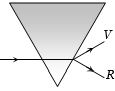
B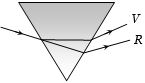
C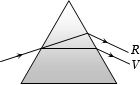
D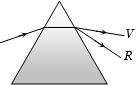
Solution
(D) The correct diagram is $(D)$.
When white light passes through a prism,it undergoes dispersion due to the difference in refractive indices for different wavelengths of light.
According to Cauchy's formula,the refractive index is higher for shorter wavelengths (violet) and lower for longer wavelengths (red).
Consequently,the violet light deviates the most,and the red light deviates the least.
In the correct representation,the violet ray $(V)$ should be at the bottom and the red ray $(R)$ should be at the top after emerging from the prism,as shown in diagram $(D)$.
When white light passes through a prism,it undergoes dispersion due to the difference in refractive indices for different wavelengths of light.
According to Cauchy's formula,the refractive index is higher for shorter wavelengths (violet) and lower for longer wavelengths (red).
Consequently,the violet light deviates the most,and the red light deviates the least.
In the correct representation,the violet ray $(V)$ should be at the bottom and the red ray $(R)$ should be at the top after emerging from the prism,as shown in diagram $(D)$.
0 likes
View Solution43
MediumMCQ
$A$ triangular prism of glass is shown in the figure. $A$ ray incident normally to one face is totally reflected,if $\theta = 45^o$. The index of refraction of glass is
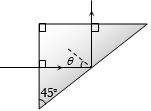
A
$n < \frac{1}{2}$
B
$n > \frac{1}{\sqrt{2}}$
C
$n > \sqrt{2}$
D
$n < \sqrt{2}$
Solution
(C) For total internal reflection,the angle of incidence $i$ must be greater than the critical angle $C$,i.e.,$i > C$.
From the figure,the ray strikes the hypotenuse at an angle of incidence $i = \theta = 45^o$.
For total internal reflection to occur,we must have $\theta > C$.
Taking the sine on both sides,$\sin \theta > \sin C$.
Since $\sin C = \frac{1}{n}$,where $n$ is the refractive index of the glass relative to air,we have $\sin \theta > \frac{1}{n}$.
Rearranging for $n$,we get $n > \frac{1}{\sin \theta}$.
Substituting $\theta = 45^o$,we get $n > \frac{1}{\sin 45^o} = \frac{1}{1/\sqrt{2}} = \sqrt{2}$.
Thus,the refractive index of the glass must be $n > \sqrt{2}$.
From the figure,the ray strikes the hypotenuse at an angle of incidence $i = \theta = 45^o$.
For total internal reflection to occur,we must have $\theta > C$.
Taking the sine on both sides,$\sin \theta > \sin C$.
Since $\sin C = \frac{1}{n}$,where $n$ is the refractive index of the glass relative to air,we have $\sin \theta > \frac{1}{n}$.
Rearranging for $n$,we get $n > \frac{1}{\sin \theta}$.
Substituting $\theta = 45^o$,we get $n > \frac{1}{\sin 45^o} = \frac{1}{1/\sqrt{2}} = \sqrt{2}$.
Thus,the refractive index of the glass must be $n > \sqrt{2}$.
0 likes
View Solution44
EasyMCQ
White light is passed through a prism whose angle is $5^o$. If the refractive indices for rays of red and blue colour are respectively $1.64$ and $1.66$,the angle of deviation between the two colours will be.....$^o$.
A
$0.1$
B
$0.2$
C
$0.3$
D
$0.4$
Solution
(A) The angular dispersion $\theta$ produced by a thin prism is given by the formula: $\theta = (\mu_b - \mu_r)A$,where $\mu_b$ is the refractive index for blue light,$\mu_r$ is the refractive index for red light,and $A$ is the prism angle.
Given:
$\mu_b = 1.66$
$\mu_r = 1.64$
$A = 5^o$
Substituting these values into the formula:
$\theta = (1.66 - 1.64) \times 5^o$
$\theta = 0.02 \times 5^o$
$\theta = 0.1^o$
Therefore,the angle of deviation between the two colours is $0.1^o$.
Given:
$\mu_b = 1.66$
$\mu_r = 1.64$
$A = 5^o$
Substituting these values into the formula:
$\theta = (1.66 - 1.64) \times 5^o$
$\theta = 0.02 \times 5^o$
$\theta = 0.1^o$
Therefore,the angle of deviation between the two colours is $0.1^o$.
0 likes
View Solution45
MediumMCQ
$A$ thin prism $P_1$ with angle $6^o$ and made from glass of refractive index $1.54$ is combined with another thin prism $P_2$ of refractive index $1.72$ to produce dispersion without deviation. The angle of prism $P_2$ will be:
A
$5^o 24'$
B
$4^o 30'$
C
$6^o$
D
$8^o$
Solution
(B) For a combination of two thin prisms to produce dispersion without deviation,the net deviation produced by the combination must be zero.
The condition for no deviation is given by: $(\mu_1 - 1)A + (\mu_2 - 1)A' = 0$.
Here,$A = 6^o$,$\mu_1 = 1.54$,and $\mu_2 = 1.72$.
Substituting the values: $(1.54 - 1) \times 6^o + (1.72 - 1) \times A' = 0$.
$0.54 \times 6^o + 0.72 \times A' = 0$.
$3.24^o + 0.72 \times A' = 0$.
$A' = -\frac{3.24^o}{0.72} = -4.5^o$.
The negative sign indicates that the second prism is inverted relative to the first.
The magnitude of the angle is $4.5^o$,which is equal to $4^o 30'$.
The condition for no deviation is given by: $(\mu_1 - 1)A + (\mu_2 - 1)A' = 0$.
Here,$A = 6^o$,$\mu_1 = 1.54$,and $\mu_2 = 1.72$.
Substituting the values: $(1.54 - 1) \times 6^o + (1.72 - 1) \times A' = 0$.
$0.54 \times 6^o + 0.72 \times A' = 0$.
$3.24^o + 0.72 \times A' = 0$.
$A' = -\frac{3.24^o}{0.72} = -4.5^o$.
The negative sign indicates that the second prism is inverted relative to the first.
The magnitude of the angle is $4.5^o$,which is equal to $4^o 30'$.
0 likes
View Solution46
DifficultMCQ
If the refractive index of a material of an equilateral prism is $\sqrt{3}$,then the angle of minimum deviation of the prism is......$^o$
A
$30$
B
$45$
C
$60$
D
$75$
Solution
(C) For an equilateral prism,the angle of the prism $A = 60^\circ$.
The formula for the refractive index $\mu$ in terms of the angle of minimum deviation $\delta_m$ is given by:
$\mu = \frac{\sin\left(\frac{A + \delta_m}{2}\right)}{\sin\left(\frac{A}{2}\right)}$
Given $\mu = \sqrt{3}$ and $A = 60^\circ$,we substitute these values:
$\sqrt{3} = \frac{\sin\left(\frac{60^\circ + \delta_m}{2}\right)}{\sin(30^\circ)}$
Since $\sin(30^\circ) = 0.5 = \frac{1}{2}$,we have:
$\sqrt{3} \times \frac{1}{2} = \sin\left(30^\circ + \frac{\delta_m}{2}\right)$
$\frac{\sqrt{3}}{2} = \sin\left(30^\circ + \frac{\delta_m}{2}\right)$
We know that $\sin(60^\circ) = \frac{\sqrt{3}}{2}$,so:
$60^\circ = 30^\circ + \frac{\delta_m}{2}$
$\frac{\delta_m}{2} = 30^\circ$
$\delta_m = 60^\circ$
The formula for the refractive index $\mu$ in terms of the angle of minimum deviation $\delta_m$ is given by:
$\mu = \frac{\sin\left(\frac{A + \delta_m}{2}\right)}{\sin\left(\frac{A}{2}\right)}$
Given $\mu = \sqrt{3}$ and $A = 60^\circ$,we substitute these values:
$\sqrt{3} = \frac{\sin\left(\frac{60^\circ + \delta_m}{2}\right)}{\sin(30^\circ)}$
Since $\sin(30^\circ) = 0.5 = \frac{1}{2}$,we have:
$\sqrt{3} \times \frac{1}{2} = \sin\left(30^\circ + \frac{\delta_m}{2}\right)$
$\frac{\sqrt{3}}{2} = \sin\left(30^\circ + \frac{\delta_m}{2}\right)$
We know that $\sin(60^\circ) = \frac{\sqrt{3}}{2}$,so:
$60^\circ = 30^\circ + \frac{\delta_m}{2}$
$\frac{\delta_m}{2} = 30^\circ$
$\delta_m = 60^\circ$
0 likes
View Solution47
EasyMCQ
The path of a refracted ray of light in a prism is parallel to the base of the prism only when the
A
Light is of a particular wavelength
B
Ray is incident normally at one face
C
Ray undergoes minimum deviation
D
Prism is made of a particular type of glass
Solution
(C) When the angle of incidence increases,the angle of deviation decreases until it reaches a minimum value at a specific angle of incidence.
This minimum value of the angle of deviation for a triangular prism is known as the angle of minimum deviation.
Under the condition of minimum deviation,the refracted ray inside the prism becomes parallel to the base of the prism.
This minimum value of the angle of deviation for a triangular prism is known as the angle of minimum deviation.
Under the condition of minimum deviation,the refracted ray inside the prism becomes parallel to the base of the prism.
0 likes
View Solution48
DifficultMCQ
The angle of a prism is $60^o$ and its refractive index is $\sqrt{2}$. The angle of minimum deviation suffered by a ray of light in passing through it is......$^o$
A
$20$
B
$30$
C
$60$
D
$45$
Solution
(B) The formula for the refractive index of a prism is given by $\mu = \frac{\sin((A + \delta_m)/2)}{\sin(A/2)}$.
Given: Prism angle $A = 60^o$,refractive index $\mu = \sqrt{2}$.
Substituting the values: $\sqrt{2} = \frac{\sin((60^o + \delta_m)/2)}{\sin(60^o/2)}$.
$\sqrt{2} = \frac{\sin((60^o + \delta_m)/2)}{\sin(30^o)}$.
Since $\sin(30^o) = 0.5$,we have $\sqrt{2} \times 0.5 = \sin((60^o + \delta_m)/2)$.
$\frac{1}{\sqrt{2}} = \sin((60^o + \delta_m)/2)$.
We know that $\sin(45^o) = \frac{1}{\sqrt{2}}$,therefore $(60^o + \delta_m)/2 = 45^o$.
$60^o + \delta_m = 90^o$.
$\delta_m = 30^o$.
Given: Prism angle $A = 60^o$,refractive index $\mu = \sqrt{2}$.
Substituting the values: $\sqrt{2} = \frac{\sin((60^o + \delta_m)/2)}{\sin(60^o/2)}$.
$\sqrt{2} = \frac{\sin((60^o + \delta_m)/2)}{\sin(30^o)}$.
Since $\sin(30^o) = 0.5$,we have $\sqrt{2} \times 0.5 = \sin((60^o + \delta_m)/2)$.
$\frac{1}{\sqrt{2}} = \sin((60^o + \delta_m)/2)$.
We know that $\sin(45^o) = \frac{1}{\sqrt{2}}$,therefore $(60^o + \delta_m)/2 = 45^o$.
$60^o + \delta_m = 90^o$.
$\delta_m = 30^o$.
0 likes
View Solution49
EasyMCQ
Which of the following colours suffers maximum deviation in a prism?
A
Yellow
B
Blue
C
Green
D
Orange
Solution
(B) The deviation produced by a prism is given by the formula $\delta = (\mu - 1)A$,where $\mu$ is the refractive index of the material of the prism and $A$ is the angle of the prism.
According to Cauchy's formula,the refractive index $\mu$ is inversely proportional to the square of the wavelength $\lambda$ $(\mu \propto 1/\lambda^2)$.
Therefore,light with a shorter wavelength experiences a higher refractive index and consequently suffers greater deviation.
Among the given options (Yellow,Blue,Green,Orange),Blue light has the shortest wavelength.
Thus,Blue light suffers the maximum deviation.
According to Cauchy's formula,the refractive index $\mu$ is inversely proportional to the square of the wavelength $\lambda$ $(\mu \propto 1/\lambda^2)$.
Therefore,light with a shorter wavelength experiences a higher refractive index and consequently suffers greater deviation.
Among the given options (Yellow,Blue,Green,Orange),Blue light has the shortest wavelength.
Thus,Blue light suffers the maximum deviation.
0 likes
View SolutionRay Optics and Optical Instruments — Refraction Through Prism · Frequently Asked Questions
1Are these Ray Optics and Optical Instruments questions useful for JEE and NEET?
Yes. All questions in this section are mapped to JEE Main and NEET exam patterns. Previous year questions from JEE Main, NEET, GUJCET and state-level exams are included with full solutions.
2Can I switch to Hindi or Gujarati for these questions?
Yes. Use the language tabs in the hero section or the sidebar to view the same questions and solutions in English, Hindi or Gujarati.
3How do I generate a question paper from this subtopic?
Use the Vedclass Exam Paper Generator — select the chapter and subtopic, set difficulty, and generate Sets A, B, C, D automatically. First 3 chapters of every subject are free.
Vedclass Products
For Students
Vedclass Test Series
Mock tests in real JEE/NEET style with performance analysis. 5-day free trial.
Start Free TrialFor Teachers
Exam Paper Generator
Generate Set A/B/C/D papers from this chapter in 2 minutes. 3 chapters free.
Try FreeFor Institutes
Online Exam Module
Live online exams with unlimited students, 360° analytics & white-label branding.
See DemoFor Teachers & Institutes
Generate a Ray Optics and Optical Instruments Exam Paper in 2 Minutes
Select subtopic & difficulty — Sets A, B, C, D auto-generated with No Repeat logic.
First 3 chapters of every subject are free — no payment required.