
A English
Plane Mirror Questions in English
Class 12 Physics · Ray Optics and Optical Instruments · Plane Mirror
163+
Questions
English
Language
100%
With Solutions
Showing 49 of 163 questions in English
1
EasyMCQ
Two vertical plane mirrors are inclined at an angle of $60^\circ$ with each other. $A$ ray of light travelling horizontally is reflected first from one mirror and then from the other. The resultant deviation is.....$^o$
A
$60$
B
$120$
C
$180$
D
$240$
Solution
(D) When a light ray undergoes successive reflections from two plane mirrors inclined at an angle $\theta$,the total deviation $\delta$ produced is given by the formula $\delta = 360^\circ - 2\theta$.
Here,the angle of inclination between the two mirrors is $\theta = 60^\circ$.
Substituting the value of $\theta$ into the formula:
$\delta = 360^\circ - 2 \times 60^\circ$
$\delta = 360^\circ - 120^\circ$
$\delta = 240^\circ$.
Therefore,the resultant deviation is $240^\circ$.
Here,the angle of inclination between the two mirrors is $\theta = 60^\circ$.
Substituting the value of $\theta$ into the formula:
$\delta = 360^\circ - 2 \times 60^\circ$
$\delta = 360^\circ - 120^\circ$
$\delta = 240^\circ$.
Therefore,the resultant deviation is $240^\circ$.
0 likes
View Solution2
EasyMCQ
$A$ plane mirror reflects a pencil of light to form a real image. Then the pencil of light incident on the mirror is
A
Parallel
B
Convergent
C
Divergent
D
None of the above
Solution
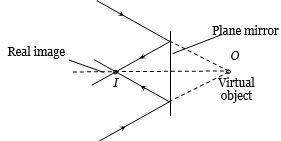
(B) plane mirror typically forms a virtual image for a real object. However,if the incident light rays are converging towards a point behind the mirror (a virtual object),the plane mirror reflects these rays such that they actually meet at a point in front of the mirror. This results in the formation of a real image. Therefore,the incident pencil of light must be convergent.
0 likes
View Solution3
MediumMCQ
What should be the angle between two plane mirrors so that whatever be the angle of incidence,the incident ray and the reflected ray from the two mirrors are parallel to each other (in $^o$)?
A
$60$
B
$90$
C
$120$
D
$175$
Solution
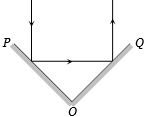
(B) When two plane mirrors are inclined at an angle $\theta$,the total deviation $\delta$ produced by the two reflections is given by $\delta = 360^o - 2\theta$.
For the incident ray and the finally reflected ray to be parallel to each other,the total deviation must be $\delta = 180^o$.
Substituting this into the formula: $180^o = 360^o - 2\theta$.
$2\theta = 360^o - 180^o = 180^o$.
$\theta = 90^o$.
Thus,the angle between the two mirrors should be $90^o$.
For the incident ray and the finally reflected ray to be parallel to each other,the total deviation must be $\delta = 180^o$.
Substituting this into the formula: $180^o = 360^o - 2\theta$.
$2\theta = 360^o - 180^o = 180^o$.
$\theta = 90^o$.
Thus,the angle between the two mirrors should be $90^o$.
0 likes
View Solution4
EasyMCQ
$A$ plane mirror reflecting a ray of incident light is rotated through an angle $\theta$ about an axis through the point of incidence in the plane of the mirror perpendicular to the plane of incidence,then
A
The reflected ray does not rotate
B
The incident ray is fixed
C
The reflected ray rotates through an angle $2\theta$
D
Both $(b)$ and $(c)$
Solution
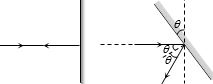
(D) When a plane mirror is rotated by an angle $\theta$ while keeping the incident ray fixed,the normal to the mirror also rotates by an angle $\theta$.
Initially,the angle of incidence is $i$. After rotation,the new angle of incidence becomes $i + \theta$ or $i - \theta$.
The angle of reflection also changes accordingly,resulting in the reflected ray rotating by an angle of $2\theta$ in the same direction as the mirror's rotation.
Therefore,both statements $(b)$ and $(c)$ are correct.
Initially,the angle of incidence is $i$. After rotation,the new angle of incidence becomes $i + \theta$ or $i - \theta$.
The angle of reflection also changes accordingly,resulting in the reflected ray rotating by an angle of $2\theta$ in the same direction as the mirror's rotation.
Therefore,both statements $(b)$ and $(c)$ are correct.
0 likes
View Solution5
EasyMCQ
$A$ plane mirror is approaching you at a speed of $10\,cm/sec$. You can see your image in it. At what speed will your image approach you in $cm/sec$?
A
$10$
B
$5$
C
$20$
D
$15$
Solution
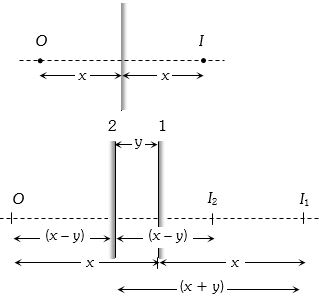
(C) Let the distance between the object (you) and the plane mirror be $x$ at any instant.
Since the image formed by a plane mirror is at the same distance behind the mirror as the object is in front of it, the distance of the image from the mirror is also $x$.
When the mirror moves towards the object by a distance $y$, the new distance between the object and the mirror becomes $(x - y)$.
The new position of the image will be at a distance $(x - y)$ behind the mirror.
The initial distance of the image from the object was $2x$.
The final distance of the image from the object is $(x - y) + (x - y) = 2(x - y) = 2x - 2y$.
The change in the distance of the image from the object is $2x - (2x - 2y) = 2y$.
Since the change in distance is $2y$ for a displacement $y$ of the mirror, the speed of the image relative to the object is twice the speed of the mirror.
Speed of image $= 2 \times \text{speed of mirror} = 2 \times 10\,cm/sec = 20\,cm/sec$.
Since the image formed by a plane mirror is at the same distance behind the mirror as the object is in front of it, the distance of the image from the mirror is also $x$.
When the mirror moves towards the object by a distance $y$, the new distance between the object and the mirror becomes $(x - y)$.
The new position of the image will be at a distance $(x - y)$ behind the mirror.
The initial distance of the image from the object was $2x$.
The final distance of the image from the object is $(x - y) + (x - y) = 2(x - y) = 2x - 2y$.
The change in the distance of the image from the object is $2x - (2x - 2y) = 2y$.
Since the change in distance is $2y$ for a displacement $y$ of the mirror, the speed of the image relative to the object is twice the speed of the mirror.
Speed of image $= 2 \times \text{speed of mirror} = 2 \times 10\,cm/sec = 20\,cm/sec$.
0 likes
View Solution6
EasyMCQ
$A$ light bulb is placed between two plane mirrors inclined at an angle of $60^{\circ}$. The number of images formed is:
A
$6$
B
$7$
C
$5$
D
$8$
Solution
(C) The number of images $n$ formed by two plane mirrors inclined at an angle $\theta$ is given by the formula $n = \frac{360^{\circ}}{\theta} - 1$,provided that $\frac{360^{\circ}}{\theta}$ is an even integer.
Given $\theta = 60^{\circ}$,we calculate the ratio: $\frac{360^{\circ}}{60^{\circ}} = 6$.
Since $6$ is an even integer,the number of images is $n = 6 - 1 = 5$.
Given $\theta = 60^{\circ}$,we calculate the ratio: $\frac{360^{\circ}}{60^{\circ}} = 6$.
Since $6$ is an even integer,the number of images is $n = 6 - 1 = 5$.
0 likes
View Solution7
MediumMCQ
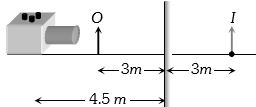
It is desired to photograph the image of an object placed at a distance of $3\;m$ from a plane mirror. The camera,which is at a distance of $4.5\;m$ from the mirror,should be focused for a distance of......$m$.
A
$3$
B
$4.5$
C
$6$
D
$7.5$
Solution
(D) plane mirror forms a virtual image of an object at the same distance behind the mirror as the object is in front of it.
Given that the object is $3\;m$ in front of the mirror,its image will be formed $3\;m$ behind the mirror.
The camera is placed $4.5\;m$ in front of the mirror.
To photograph the image,the camera must be focused on the position of the image.
The total distance from the camera to the image is the sum of the distance from the camera to the mirror and the distance from the mirror to the image.
Total distance $= 4.5\;m + 3\;m = 7.5\;m$.
Therefore,the camera should be focused for a distance of $7.5\;m$.
Given that the object is $3\;m$ in front of the mirror,its image will be formed $3\;m$ behind the mirror.
The camera is placed $4.5\;m$ in front of the mirror.
To photograph the image,the camera must be focused on the position of the image.
The total distance from the camera to the image is the sum of the distance from the camera to the mirror and the distance from the mirror to the image.
Total distance $= 4.5\;m + 3\;m = 7.5\;m$.
Therefore,the camera should be focused for a distance of $7.5\;m$.
0 likes
View Solution8
EasyMCQ
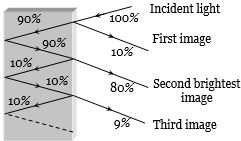
$A$ thick plane mirror shows a number of images of the filament of an electric bulb. Of these,the brightest image is the
A
First
B
Second
C
Fourth
D
Last
Solution
(B) When light is incident on a thick plane mirror,a small fraction of light is reflected from the front surface,while a much larger fraction enters the glass,undergoes multiple internal reflections at the silvered back surface,and then emerges from the front surface.
$1$. The first reflection occurs at the front surface,which is a glass-air interface. Since the refractive index difference is small,only a small percentage (typically about $4\%$ to $10\%$) of the light is reflected,forming the first image.
$2$. The light that enters the glass is reflected by the silvered back surface,which acts as a highly efficient mirror. This light then travels back through the glass and emerges from the front surface. Because this reflection occurs at the silvered surface,a much larger portion of the light is reflected,making the second image the brightest.
$3$. Subsequent images are formed by further internal reflections,but each time the light emerges,its intensity decreases significantly due to partial reflection and absorption.
Therefore,the second image is the brightest.
$1$. The first reflection occurs at the front surface,which is a glass-air interface. Since the refractive index difference is small,only a small percentage (typically about $4\%$ to $10\%$) of the light is reflected,forming the first image.
$2$. The light that enters the glass is reflected by the silvered back surface,which acts as a highly efficient mirror. This light then travels back through the glass and emerges from the front surface. Because this reflection occurs at the silvered surface,a much larger portion of the light is reflected,making the second image the brightest.
$3$. Subsequent images are formed by further internal reflections,but each time the light emerges,its intensity decreases significantly due to partial reflection and absorption.
Therefore,the second image is the brightest.
0 likes
View Solution9
MediumMCQ
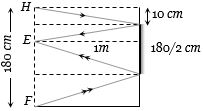
$A$ man is $180\,cm$ tall and his eyes are $10\,cm$ below the top of his head. In order to see his entire height from toe to head,he uses a plane mirror kept at a distance of $1\,m$ from him. The minimum length of the plane mirror required is.....$cm$.
A
$180$
B
$90$
C
$85$
D
$170$
Solution
(B) To see the full image of an object of height $H$ in a plane mirror,the minimum length of the mirror required is $H/2$,regardless of the distance of the mirror from the observer.
Here,the height of the man is $H = 180\,cm$.
Therefore,the minimum length of the mirror required is $L = H/2 = 180/2 = 90\,cm$.
The position of the eyes does not affect the minimum length of the mirror required to see the full image,as the rays from the top of the head and the toes must reach the eyes after reflection. The mirror must cover the vertical range from the midpoint between the eyes and the top of the head to the midpoint between the eyes and the toes.
Here,the height of the man is $H = 180\,cm$.
Therefore,the minimum length of the mirror required is $L = H/2 = 180/2 = 90\,cm$.
The position of the eyes does not affect the minimum length of the mirror required to see the full image,as the rays from the top of the head and the toes must reach the eyes after reflection. The mirror must cover the vertical range from the midpoint between the eyes and the top of the head to the midpoint between the eyes and the toes.
0 likes
View Solution10
MediumMCQ
$A$ person is in a room whose ceiling and two adjacent walls are mirrors. How many images are formed?
A
$5$
B
$6$
C
$7$
D
$8$
Solution
(C) The two adjacent walls act as two plane mirrors inclined at an angle of $\theta = 90^\circ$. The number of images formed by these two mirrors is given by $n = \frac{360^\circ}{\theta} - 1 = \frac{360^\circ}{90^\circ} - 1 = 4 - 1 = 3$.
These $3$ images plus the original person act as objects for the ceiling mirror. Since the ceiling mirror is parallel to the floor,it forms an image for every object placed in the room.
There are $3$ images from the walls and $1$ original person,totaling $4$ objects for the ceiling mirror. The ceiling mirror forms $4$ images of these objects.
Therefore,the total number of images formed is $3$ (from the walls) $+ 4$ (from the ceiling mirror) $= 7$ images.
These $3$ images plus the original person act as objects for the ceiling mirror. Since the ceiling mirror is parallel to the floor,it forms an image for every object placed in the room.
There are $3$ images from the walls and $1$ original person,totaling $4$ objects for the ceiling mirror. The ceiling mirror forms $4$ images of these objects.
Therefore,the total number of images formed is $3$ (from the walls) $+ 4$ (from the ceiling mirror) $= 7$ images.
0 likes
View Solution11
MediumMCQ
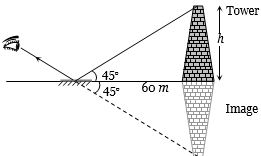
When a plane mirror is placed horizontally on a level ground at a distance of $60 \ m$ from the foot of a tower,the top of the tower and its image in the mirror subtend an angle of $90^\circ$ at the eye. The height of the tower will be.....$m$.
A
$30$
B
$60$
C
$90$
D
$120$
Solution
(B) Let the height of the tower be $h$. The distance of the mirror from the foot of the tower is $d = 60 \ m$.
The angle subtended by the top of the tower and its image at the eye is $90^\circ$. Since the mirror is horizontal,the angle of elevation of the top of the tower from the mirror is $45^\circ$ (as the total angle is $90^\circ$ and the image is formed at an equal depth below the mirror).
From the geometry of the triangle formed by the tower and the mirror,we have:
$\tan 45^\circ = \frac{\text{height of tower}}{\text{distance from tower}} = \frac{h}{60}$
Since $\tan 45^\circ = 1$,we get:
$1 = \frac{h}{60}$
$h = 60 \ m$.
The angle subtended by the top of the tower and its image at the eye is $90^\circ$. Since the mirror is horizontal,the angle of elevation of the top of the tower from the mirror is $45^\circ$ (as the total angle is $90^\circ$ and the image is formed at an equal depth below the mirror).
From the geometry of the triangle formed by the tower and the mirror,we have:
$\tan 45^\circ = \frac{\text{height of tower}}{\text{distance from tower}} = \frac{h}{60}$
Since $\tan 45^\circ = 1$,we get:
$1 = \frac{h}{60}$
$h = 60 \ m$.
0 likes
View Solution12
EasyMCQ
$A$ ray of light is incident on a plane mirror at an angle of $30^\circ$. The deviation produced in the ray is....$^\circ$.
A
$30$
B
$60$
C
$90$
D
$120$
Solution
(D) The angle of incidence $i$ is given as $30^\circ$.
When a light ray reflects from a plane mirror,the angle of reflection $r$ is equal to the angle of incidence $i$,so $r = 30^\circ$.
The total angle turned by the ray (deviation $\delta$) is given by the formula $\delta = 180^\circ - (i + r)$.
Substituting the values,we get $\delta = 180^\circ - (30^\circ + 30^\circ) = 180^\circ - 60^\circ = 120^\circ$.
Alternatively,the deviation produced by a plane mirror is $\delta = 180^\circ - 2i = 180^\circ - 2(30^\circ) = 120^\circ$.
When a light ray reflects from a plane mirror,the angle of reflection $r$ is equal to the angle of incidence $i$,so $r = 30^\circ$.
The total angle turned by the ray (deviation $\delta$) is given by the formula $\delta = 180^\circ - (i + r)$.
Substituting the values,we get $\delta = 180^\circ - (30^\circ + 30^\circ) = 180^\circ - 60^\circ = 120^\circ$.
Alternatively,the deviation produced by a plane mirror is $\delta = 180^\circ - 2i = 180^\circ - 2(30^\circ) = 120^\circ$.
0 likes
View Solution13
EasyMCQ
$A$ ray of light is incident normally on a plane mirror. The angle of reflection will be......$^o$
A
$0$
B
$90$
C
Will not be reflected
D
None of the above
Solution
(A) When a ray of light is incident normally on a plane mirror,the angle of incidence $(i)$ is the angle between the incident ray and the normal. Since the ray is incident normally,it lies along the normal,so $i = 0^\circ$.
According to the laws of reflection,the angle of incidence is equal to the angle of reflection $(i = r)$.
Therefore,the angle of reflection $r = 0^\circ$.
According to the laws of reflection,the angle of incidence is equal to the angle of reflection $(i = r)$.
Therefore,the angle of reflection $r = 0^\circ$.
0 likes
View Solution14
EasyMCQ
$A$ ray is reflected in turn by three plane mirrors mutually at right angles to each other. The angle between the incident and the reflected rays is......$^o$
A
$90$
B
$60$
C
$180$
D
None of these
Solution
(C) Let the incident ray be represented by the vector $\vec{v} = (l, m, n)$,where $l^2 + m^2 + n^2 = 1$.
When a ray reflects off a mirror perpendicular to the $x$-axis,the $x$-component of the velocity vector reverses sign: $(l, m, n) \rightarrow (-l, m, n)$.
After reflection from three mutually perpendicular mirrors (perpendicular to the $x, y,$ and $z$ axes respectively),the final direction of the ray becomes $(-l, -m, -n) = -\vec{v}$.
The angle $\theta$ between the incident ray $\vec{v}$ and the reflected ray $-\vec{v}$ is given by $\cos \theta = \frac{\vec{v} \cdot (-\vec{v})}{ |\vec{v}| |-\vec{v}| } = -1$.
Thus,$\theta = 180^o$.
Therefore,the ray becomes anti-parallel to the incident ray.
When a ray reflects off a mirror perpendicular to the $x$-axis,the $x$-component of the velocity vector reverses sign: $(l, m, n) \rightarrow (-l, m, n)$.
After reflection from three mutually perpendicular mirrors (perpendicular to the $x, y,$ and $z$ axes respectively),the final direction of the ray becomes $(-l, -m, -n) = -\vec{v}$.
The angle $\theta$ between the incident ray $\vec{v}$ and the reflected ray $-\vec{v}$ is given by $\cos \theta = \frac{\vec{v} \cdot (-\vec{v})}{ |\vec{v}| |-\vec{v}| } = -1$.
Thus,$\theta = 180^o$.
Therefore,the ray becomes anti-parallel to the incident ray.
0 likes
View Solution15
EasyMCQ
Two plane mirrors are at right angles to each other. $A$ man stands between them and combs his hair with his right hand. In how many of the images will he be seen using his right hand?
A
None
B
$1$
C
$2$
D
$3$
Solution
(B) When two plane mirrors are placed at an angle of $90^{\circ}$,the number of images formed is given by $n = (360^{\circ}/\theta) - 1 = (360^{\circ}/90^{\circ}) - 1 = 3$ images.
Let the man be at position $(x, y)$ relative to the mirrors along the $x$ and $y$ axes.
The three images are formed at positions $(x, -y)$,$(-x, y)$,and $(-x, -y)$.
$1$. The image at $(x, -y)$ is formed by reflection in one mirror; it undergoes lateral inversion,so the right hand appears as the left hand.
$2$. The image at $(-x, y)$ is formed by reflection in the other mirror; it also undergoes lateral inversion,so the right hand appears as the left hand.
$3$. The image at $(-x, -y)$ is formed by two successive reflections (one in each mirror). Each reflection causes a lateral inversion. Two lateral inversions cancel each other out,resulting in an erect image where the right hand still appears as the right hand.
Therefore,in only $1$ image will he be seen using his right hand.
Let the man be at position $(x, y)$ relative to the mirrors along the $x$ and $y$ axes.
The three images are formed at positions $(x, -y)$,$(-x, y)$,and $(-x, -y)$.
$1$. The image at $(x, -y)$ is formed by reflection in one mirror; it undergoes lateral inversion,so the right hand appears as the left hand.
$2$. The image at $(-x, y)$ is formed by reflection in the other mirror; it also undergoes lateral inversion,so the right hand appears as the left hand.
$3$. The image at $(-x, -y)$ is formed by two successive reflections (one in each mirror). Each reflection causes a lateral inversion. Two lateral inversions cancel each other out,resulting in an erect image where the right hand still appears as the right hand.
Therefore,in only $1$ image will he be seen using his right hand.
0 likes
View Solution16
EasyMCQ
When a plane mirror is rotated through an angle $\theta$,the reflected ray turns through an angle $2\theta$. What happens to the size of the image?
A
Is doubled
B
Is halved
C
Remains the same
D
Becomes infinite
Solution
(C) When a plane mirror is rotated by an angle $\theta$,the reflected ray rotates by an angle $2\theta$. However,the size of the image formed by a plane mirror depends only on the size of the object and the distance of the object from the mirror. It is independent of the angle of rotation of the mirror. Therefore,the size of the image remains the same.
0 likes
View Solution17
EasyMCQ
$A$ plane mirror produces a magnification of
A
$ - 1$
B
$ + 1$
C
Zero
D
Between $0$ and $ + \infty $
Solution
(B) The magnification $m$ of a mirror is defined as the ratio of the height of the image $(h_i)$ to the height of the object $(h_o)$,given by $m = h_i / h_o$.
For a plane mirror,the image formed is virtual,erect,and of the same size as the object.
Since the image is erect,the magnification is positive.
Since the size of the image is equal to the size of the object $(h_i = h_o)$,the ratio $h_i / h_o = 1$.
Therefore,the magnification produced by a plane mirror is $m = + 1$.
For a plane mirror,the image formed is virtual,erect,and of the same size as the object.
Since the image is erect,the magnification is positive.
Since the size of the image is equal to the size of the object $(h_i = h_o)$,the ratio $h_i / h_o = 1$.
Therefore,the magnification produced by a plane mirror is $m = + 1$.
0 likes
View Solution18
EasyMCQ
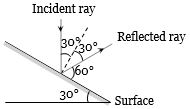
$A$ plane mirror makes an angle of $30^\circ$ with the horizontal. If a vertical ray strikes the mirror,find the angle between the mirror and the reflected ray.
A
$30$
B
$45$
C
$60$
D
$90$
Solution
(C) The angle between the mirror and the horizontal surface is $30^\circ$.
The incident ray is vertical,meaning it makes an angle of $90^\circ$ with the horizontal.
The angle between the incident ray and the mirror surface is $90^\circ - 30^\circ = 60^\circ$.
According to the law of reflection,the angle of incidence equals the angle of reflection.
Since the angle of incidence (angle between incident ray and normal) is $90^\circ - 60^\circ = 30^\circ$,the angle of reflection (angle between reflected ray and normal) is also $30^\circ$.
The angle between the reflected ray and the mirror surface is $90^\circ - 30^\circ = 60^\circ$.
The incident ray is vertical,meaning it makes an angle of $90^\circ$ with the horizontal.
The angle between the incident ray and the mirror surface is $90^\circ - 30^\circ = 60^\circ$.
According to the law of reflection,the angle of incidence equals the angle of reflection.
Since the angle of incidence (angle between incident ray and normal) is $90^\circ - 60^\circ = 30^\circ$,the angle of reflection (angle between reflected ray and normal) is also $30^\circ$.
The angle between the reflected ray and the mirror surface is $90^\circ - 30^\circ = 60^\circ$.
0 likes
View Solution19
EasyMCQ
$A$ watch shows time as $3:25$ when seen through a mirror,the time appeared will be
A
$8:35$
B
$9:35$
C
$7:35$
D
$8:25$
Solution
(A) To find the time seen in a mirror,subtract the given time from $11:60$ (which is equivalent to $12:00$).
Given time = $3:25$.
Mirror time = $11:60 - 3:25 = 8:35$.
Therefore,the time appeared in the mirror will be $8:35$.
Given time = $3:25$.
Mirror time = $11:60 - 3:25 = 8:35$.
Therefore,the time appeared in the mirror will be $8:35$.
0 likes
View Solution20
EasyMCQ
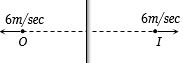
If an observer is walking away from a plane mirror with a velocity of $6\;m/s$,then the velocity of the image with respect to the observer will be........$m/s$.
A
$6$
B
$-6$
C
$12$
D
$3$
Solution
(C) Let the velocity of the observer (object) be $v_o = -6\;m/s$ (moving away from the mirror).
The velocity of the image $v_i$ formed by a plane mirror is equal and opposite to the velocity of the object if the mirror is stationary. Thus,$v_i = +6\;m/s$.
The velocity of the image with respect to the observer is given by $v_{io} = v_i - v_o$.
Substituting the values: $v_{io} = 6 - (-6) = 6 + 6 = 12\;m/s$.
The velocity of the image $v_i$ formed by a plane mirror is equal and opposite to the velocity of the object if the mirror is stationary. Thus,$v_i = +6\;m/s$.
The velocity of the image with respect to the observer is given by $v_{io} = v_i - v_o$.
Substituting the values: $v_{io} = 6 - (-6) = 6 + 6 = 12\;m/s$.
0 likes
View Solution21
EasyMCQ
$A$ man runs towards a plane mirror at a speed of $15 \ m/s$. What is the speed of his image relative to the mirror? (in $m/s$)
A
$7.5$
B
$15$
C
$30$
D
$45$
Solution
(B) For a plane mirror,the image is formed at the same distance behind the mirror as the object is in front of it.
If the object moves towards the mirror with a speed $v$,the image also moves towards the mirror with the same speed $v$ relative to the mirror.
Given,the speed of the man (object) is $v = 15 \ m/s$.
Therefore,the speed of his image relative to the mirror is $15 \ m/s$.
If the object moves towards the mirror with a speed $v$,the image also moves towards the mirror with the same speed $v$ relative to the mirror.
Given,the speed of the man (object) is $v = 15 \ m/s$.
Therefore,the speed of his image relative to the mirror is $15 \ m/s$.
0 likes
View Solution22
EasyMCQ
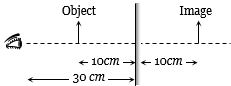
$A$ small object is placed $10\, cm$ in front of a plane mirror. If you stand behind the object $30\, cm$ from the mirror and look at its image,the distance focused for your eye will be........$cm$.
A
$60$
B
$20$
C
$40$
D
$80$
Solution
(C) For a plane mirror,the image is formed at the same distance behind the mirror as the object is in front of it.
Given that the object is $10\, cm$ in front of the mirror,the image is formed $10\, cm$ behind the mirror.
You are standing $30\, cm$ in front of the mirror.
The total distance from your eye to the image is the sum of your distance from the mirror and the distance of the image behind the mirror.
Distance $= 30\, cm + 10\, cm = 40\, cm$.
Therefore,your eye must focus at a distance of $40\, cm$.
Given that the object is $10\, cm$ in front of the mirror,the image is formed $10\, cm$ behind the mirror.
You are standing $30\, cm$ in front of the mirror.
The total distance from your eye to the image is the sum of your distance from the mirror and the distance of the image behind the mirror.
Distance $= 30\, cm + 10\, cm = 40\, cm$.
Therefore,your eye must focus at a distance of $40\, cm$.
0 likes
View Solution23
EasyMCQ
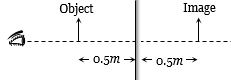
An object is at a distance of $0.5 \ m$ in front of a plane mirror. The distance between the object and its image is ..... $m$.
A
$0.5$
B
$1$
C
$0.25$
D
$1.5$
Solution
(B) For a plane mirror,the distance of the object from the mirror is equal to the distance of the image from the mirror.
Given,distance of object from mirror = $0.5 \ m$.
Therefore,distance of image from mirror = $0.5 \ m$.
The total distance between the object and the image is the sum of the distance of the object from the mirror and the distance of the image from the mirror.
Total distance = $0.5 \ m + 0.5 \ m = 1 \ m$.
Given,distance of object from mirror = $0.5 \ m$.
Therefore,distance of image from mirror = $0.5 \ m$.
The total distance between the object and the image is the sum of the distance of the object from the mirror and the distance of the image from the mirror.
Total distance = $0.5 \ m + 0.5 \ m = 1 \ m$.
0 likes
View Solution24
EasyMCQ
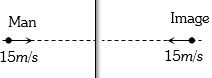
$A$ man runs towards a plane mirror at a speed of $15 \, m/s$. The speed of the image relative to the man is $...... \, m/s$.
A
$15$
B
$30$
C
$35$
D
$20$
Solution
(B) Let the velocity of the man be $v_m = +15 \, m/s$ (towards the mirror).
Since the image in a plane mirror moves in the opposite direction with the same speed,the velocity of the image is $v_i = -15 \, m/s$.
The relative velocity of the image with respect to the man is given by $v_{im} = v_i - v_m$.
Substituting the values,we get $v_{im} = -15 - 15 = -30 \, m/s$.
The speed is the magnitude of the relative velocity,which is $|-30| = 30 \, m/s$.
Since the image in a plane mirror moves in the opposite direction with the same speed,the velocity of the image is $v_i = -15 \, m/s$.
The relative velocity of the image with respect to the man is given by $v_{im} = v_i - v_m$.
Substituting the values,we get $v_{im} = -15 - 15 = -30 \, m/s$.
The speed is the magnitude of the relative velocity,which is $|-30| = 30 \, m/s$.
0 likes
View Solution25
EasyMCQ
The light reflected by a plane mirror may form a real image:
A
If the rays incident on the mirror are diverging
B
If the rays incident on the mirror are converging
C
If the object is placed very close to the mirror
D
Under no circumstances
Solution
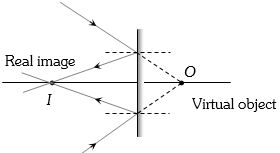
(B) plane mirror forms a real image only when the incident rays are converging.
In this case,the point where the rays would have converged (if the mirror were not present) acts as a virtual object for the mirror.
The reflected rays then actually intersect at a point in front of the mirror,forming a real image.
This is shown in the provided diagram where the virtual object $O$ leads to the formation of a real image $I$.
In this case,the point where the rays would have converged (if the mirror were not present) acts as a virtual object for the mirror.
The reflected rays then actually intersect at a point in front of the mirror,forming a real image.
This is shown in the provided diagram where the virtual object $O$ leads to the formation of a real image $I$.
0 likes
View Solution26
MediumMCQ
Two plane mirrors are inclined at an angle of $72^{\circ}$. The number of images of a point object placed between them will be
A
$2$
B
$3$
C
$4$
D
$5$
Solution
(C) The number of images $n$ formed by two plane mirrors inclined at an angle $\theta$ is given by the formula $n = \frac{360^{\circ}}{\theta} - 1$, provided that $\frac{360^{\circ}}{\theta}$ is an even integer.
Given $\theta = 72^{\circ}$.
Calculating the ratio: $\frac{360^{\circ}}{72^{\circ}} = 5$.
Since $5$ is an odd integer, the formula depends on the position of the object. Assuming the object is placed symmetrically, the number of images is $n = \frac{360^{\circ}}{\theta} - 1 = 5 - 1 = 4$.
Therefore, the number of images is $4$.
Given $\theta = 72^{\circ}$.
Calculating the ratio: $\frac{360^{\circ}}{72^{\circ}} = 5$.
Since $5$ is an odd integer, the formula depends on the position of the object. Assuming the object is placed symmetrically, the number of images is $n = \frac{360^{\circ}}{\theta} - 1 = 5 - 1 = 4$.
Therefore, the number of images is $4$.
0 likes
View Solution27
MediumMCQ
To get three images of a single object, one should have two plane mirrors at an angle of $...^\circ$.
A
$30$
B
$60$
C
$90$
D
$150$
Solution
(C) The number of images $n$ formed by two plane mirrors inclined at an angle $\theta$ is given by the formula:
$n = \frac{360^\circ}{\theta} - 1$
Given that the number of images $n = 3$, we substitute this into the formula:
$3 = \frac{360^\circ}{\theta} - 1$
$3 + 1 = \frac{360^\circ}{\theta}$
$4 = \frac{360^\circ}{\theta}$
$\theta = \frac{360^\circ}{4} = 90^\circ$
Thus, the mirrors should be placed at an angle of $90^\circ$.
$n = \frac{360^\circ}{\theta} - 1$
Given that the number of images $n = 3$, we substitute this into the formula:
$3 = \frac{360^\circ}{\theta} - 1$
$3 + 1 = \frac{360^\circ}{\theta}$
$4 = \frac{360^\circ}{\theta}$
$\theta = \frac{360^\circ}{4} = 90^\circ$
Thus, the mirrors should be placed at an angle of $90^\circ$.
0 likes
View Solution28
MediumMCQ
$A$ man of height $h$ requires a mirror to see his own complete image. The minimum height of the mirror required is:
A
$\frac{h}{4}$
B
$\frac{h}{3}$
C
$\frac{h}{2}$
D
$h$
Solution
(C) To see the complete image of an object of height $h$ in a plane mirror,the light rays from the top of the head and the feet must reach the eyes.
By applying the law of reflection and the properties of similar triangles,it can be shown that the minimum height of the mirror required is exactly half the height of the person.
Therefore,the minimum height of the mirror is $\frac{h}{2}$.
By applying the law of reflection and the properties of similar triangles,it can be shown that the minimum height of the mirror required is exactly half the height of the person.
Therefore,the minimum height of the mirror is $\frac{h}{2}$.
0 likes
View Solution29
MediumMCQ
Two plane mirrors are at $45^{\circ}$ to each other. If an object is placed between them,then the number of images will be
A
$5$
B
$9$
C
$7$
D
$8$
Solution
(C) The number of images $n$ formed by two plane mirrors inclined at an angle $\theta$ is given by the formula $n = \frac{360^{\circ}}{\theta} - 1$,provided that $\frac{360^{\circ}}{\theta}$ is an integer.
Given $\theta = 45^{\circ}$.
Calculating the value: $\frac{360^{\circ}}{45^{\circ}} = 8$.
Since $8$ is an even integer,the number of images $n = 8 - 1 = 7$.
Given $\theta = 45^{\circ}$.
Calculating the value: $\frac{360^{\circ}}{45^{\circ}} = 8$.
Since $8$ is an even integer,the number of images $n = 8 - 1 = 7$.
0 likes
View Solution30
EasyMCQ
$A$ light beam is being reflected by using two mirrors,as in a periscope used in submarines. If one of the mirrors rotates by an angle $\theta$,the reflected light will deviate from its original path by the angle
A
$2\theta$
B
$0^o$
C
$\theta$
D
$4\theta$
Solution
(A) When a plane mirror is rotated by an angle $\theta$ about an axis in its plane,the reflected ray rotates by an angle $2\theta$ in the same direction.
In a periscope,there are two mirrors. If only one mirror is rotated by an angle $\theta$,the reflected ray from that mirror deviates by $2\theta$. Since the second mirror is fixed,the final emergent ray will also deviate by $2\theta$ from its original direction.
In a periscope,there are two mirrors. If only one mirror is rotated by an angle $\theta$,the reflected ray from that mirror deviates by $2\theta$. Since the second mirror is fixed,the final emergent ray will also deviate by $2\theta$ from its original direction.
0 likes
View Solution31
EasyMCQ
The focal length of a plane mirror is:
A
Zero
B
Infinite
C
Very small
D
Indefinite
Solution
(B) The relationship between focal length $f$ and radius of curvature $R$ is given by $f = \frac{R}{2}$.
For a plane mirror,the surface is flat,which means it can be considered as a part of a sphere with an infinite radius of curvature $(R = \infty)$.
Substituting this into the formula,we get $f = \frac{\infty}{2} = \infty$.
Therefore,the focal length of a plane mirror is infinite.
For a plane mirror,the surface is flat,which means it can be considered as a part of a sphere with an infinite radius of curvature $(R = \infty)$.
Substituting this into the formula,we get $f = \frac{\infty}{2} = \infty$.
Therefore,the focal length of a plane mirror is infinite.
0 likes
View Solution32
DifficultMCQ
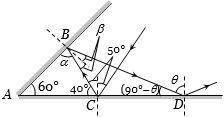
$A$ ray of light is incident at $50^{\circ}$ on the middle of one of the two mirrors arranged at an angle of $60^{\circ}$ between them. The ray then touches the second mirror,gets reflected back to the first mirror,making an angle of incidence of.........$^{\circ}$
A
$50$
B
$60$
C
$70$
D
$80$
Solution
(C) Let the required angle of incidence at the first mirror after reflection from the second mirror be $\theta$.
From the geometry of the figure:
$1$. At the first point of incidence $C$ on the lower mirror,the angle of incidence is $50^{\circ}$. Thus,the angle of reflection is also $50^{\circ}$. The angle the reflected ray makes with the mirror surface is $90^{\circ} - 50^{\circ} = 40^{\circ}$.
$2$. In $\Delta ABC$,where $\angle A = 60^{\circ}$ and the angle at $C$ is $40^{\circ}$,the angle $\alpha$ at vertex $B$ is $\alpha = 180^{\circ} - (60^{\circ} + 40^{\circ}) = 80^{\circ}$.
$3$. The ray hits the second mirror at $B$. The angle of incidence at $B$ is $\beta = 90^{\circ} - \alpha = 90^{\circ} - 80^{\circ} = 10^{\circ}$.
$4$. The ray reflects from $B$ and hits the first mirror again at point $D$. In $\Delta ABD$,the angle at $A$ is $60^{\circ}$. The angle at $B$ is $\angle ABD = \alpha + \beta = 80^{\circ} + 10^{\circ} = 90^{\circ}$ (since the reflected ray makes an angle $\beta$ with the normal,the angle with the mirror is $90^{\circ}-\beta$,and the total angle at $B$ inside the triangle is $\alpha + \beta$).
$5$. In $\Delta ABD$,the sum of angles is $180^{\circ}$. Thus,$60^{\circ} + 90^{\circ} + (90^{\circ} - \theta) = 180^{\circ}$.
$6$. Solving for $\theta$: $240^{\circ} - \theta = 180^{\circ} \implies \theta = 70^{\circ}$.
From the geometry of the figure:
$1$. At the first point of incidence $C$ on the lower mirror,the angle of incidence is $50^{\circ}$. Thus,the angle of reflection is also $50^{\circ}$. The angle the reflected ray makes with the mirror surface is $90^{\circ} - 50^{\circ} = 40^{\circ}$.
$2$. In $\Delta ABC$,where $\angle A = 60^{\circ}$ and the angle at $C$ is $40^{\circ}$,the angle $\alpha$ at vertex $B$ is $\alpha = 180^{\circ} - (60^{\circ} + 40^{\circ}) = 80^{\circ}$.
$3$. The ray hits the second mirror at $B$. The angle of incidence at $B$ is $\beta = 90^{\circ} - \alpha = 90^{\circ} - 80^{\circ} = 10^{\circ}$.
$4$. The ray reflects from $B$ and hits the first mirror again at point $D$. In $\Delta ABD$,the angle at $A$ is $60^{\circ}$. The angle at $B$ is $\angle ABD = \alpha + \beta = 80^{\circ} + 10^{\circ} = 90^{\circ}$ (since the reflected ray makes an angle $\beta$ with the normal,the angle with the mirror is $90^{\circ}-\beta$,and the total angle at $B$ inside the triangle is $\alpha + \beta$).
$5$. In $\Delta ABD$,the sum of angles is $180^{\circ}$. Thus,$60^{\circ} + 90^{\circ} + (90^{\circ} - \theta) = 180^{\circ}$.
$6$. Solving for $\theta$: $240^{\circ} - \theta = 180^{\circ} \implies \theta = 70^{\circ}$.
0 likes
View Solution33
EasyMCQ
Which one of the following statements is true?
A
An object situated at the principal focus of a concave lens will have its image formed at infinity.
B
$A$ concave mirror can give a diminished virtual image.
C
Given a point source of light,a convex mirror can produce a parallel beam of light.
D
The virtual image formed in a plane mirror can be photographed.
Solution
(D) plane mirror forms a virtual image of an object placed in front of it. Although the image is virtual,it is formed by the reflection of light rays that actually diverge from the mirror's surface. When a camera is placed in front of the mirror,these reflected rays enter the camera lens and are focused onto the film or sensor,thereby creating a real image of the virtual object on the sensor. Thus,the virtual image formed by a plane mirror can be photographed. Option $D$ is correct.
0 likes
View Solution34
DifficultMCQ
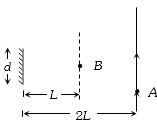
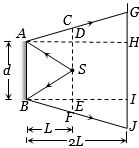
$A$ point source of light $B$ is placed at a distance $L$ in front of the centre of a mirror of width $d$ hung vertically on a wall. $A$ man walks in front of the mirror along a line parallel to the mirror at a distance $2L$ from it as shown. The greatest distance over which he can see the image of the light source in the mirror is
A
$d/2$
B
$d$
C
$2d$
D
$3d$
Solution
(D) Let the mirror be $AB$ with length $d$. The light source $S$ is at a distance $L$ from the mirror. The man walks at a distance $2L$ from the mirror.
$1$. The image of the source $S$ is formed behind the mirror at a distance $L$. Let this image be $S'$.
$2$. The rays from the source $S$ reflect off the edges of the mirror $A$ and $B$. These reflected rays appear to come from $S'$.
$3$. The field of view is determined by the rays passing through the edges $A$ and $B$ of the mirror.
$4$. By similar triangles,the width of the field of view at a distance $2L$ from the mirror is $3d$.
$5$. Specifically,the distance between the extreme rays at the man's path is $GJ = GH + HI + IJ$. Since $HI = d$ and $GH = IJ = d$,the total distance is $3d$.
$1$. The image of the source $S$ is formed behind the mirror at a distance $L$. Let this image be $S'$.
$2$. The rays from the source $S$ reflect off the edges of the mirror $A$ and $B$. These reflected rays appear to come from $S'$.
$3$. The field of view is determined by the rays passing through the edges $A$ and $B$ of the mirror.
$4$. By similar triangles,the width of the field of view at a distance $2L$ from the mirror is $3d$.
$5$. Specifically,the distance between the extreme rays at the man's path is $GJ = GH + HI + IJ$. Since $HI = d$ and $GH = IJ = d$,the total distance is $3d$.
0 likes
View Solution35
MediumMCQ
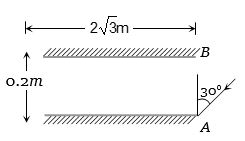
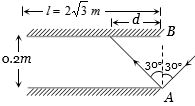
Two plane mirrors $A$ and $B$ are aligned parallel to each other,as shown in the figure. $A$ light ray is incident at an angle of $30^\circ$ at a point just inside one end of $A$. The plane of incidence coincides with the plane of the figure. The maximum number of times the ray undergoes reflections (including the first one) before it emerges out is
A
$28$
B
$30$
C
$32$
D
$34$
Solution
(B) Let the distance between the two mirrors be $h = 0.2 \ m$ and the length of the mirrors be $L = 2\sqrt{3} \ m$.
The angle of incidence is $i = 30^\circ$.
When the ray reflects between the two parallel mirrors,the horizontal distance $d$ covered by the ray between two consecutive reflections is given by:
$d = h \tan(i) = 0.2 \tan(30^\circ) = 0.2 \times \frac{1}{\sqrt{3}} \ m$.
The total horizontal distance covered by the ray before it emerges is $L = 2\sqrt{3} \ m$.
The number of reflections $n$ is given by the ratio of the total length to the horizontal distance per reflection:
$n = \frac{L}{d} = \frac{2\sqrt{3}}{0.2 / \sqrt{3}} = \frac{2 \times 3}{0.2} = \frac{6}{0.2} = 30$.
Thus,the maximum number of reflections is $30$.
The angle of incidence is $i = 30^\circ$.
When the ray reflects between the two parallel mirrors,the horizontal distance $d$ covered by the ray between two consecutive reflections is given by:
$d = h \tan(i) = 0.2 \tan(30^\circ) = 0.2 \times \frac{1}{\sqrt{3}} \ m$.
The total horizontal distance covered by the ray before it emerges is $L = 2\sqrt{3} \ m$.
The number of reflections $n$ is given by the ratio of the total length to the horizontal distance per reflection:
$n = \frac{L}{d} = \frac{2\sqrt{3}}{0.2 / \sqrt{3}} = \frac{2 \times 3}{0.2} = \frac{6}{0.2} = 30$.
Thus,the maximum number of reflections is $30$.
0 likes
View Solution36
MediumMCQ
$A$ small plane mirror is placed at the centre of a spherical screen of radius $R$. $A$ beam of light is falling on the mirror. If the mirror makes $n$ revolutions per second,the speed of the reflected light spot on the screen will be:
A
$4\pi nR$
B
$2\pi nR$
C
$\frac{nR}{2\pi}$
D
$\frac{nR}{4\pi}$
Solution
(A) When a plane mirror rotates by an angle $\theta$,the reflected ray rotates by an angle $2\theta$.
If the mirror rotates at a frequency of $n$ revolutions per second,its angular velocity is $\omega_m = 2\pi n$ rad/s.
The angular velocity of the reflected ray is $\omega_r = 2\omega_m = 2(2\pi n) = 4\pi n$ rad/s.
The linear speed $v$ of the light spot on the spherical screen of radius $R$ is given by $v = R \omega_r$.
Substituting the value of $\omega_r$,we get $v = R(4\pi n) = 4\pi nR$.
If the mirror rotates at a frequency of $n$ revolutions per second,its angular velocity is $\omega_m = 2\pi n$ rad/s.
The angular velocity of the reflected ray is $\omega_r = 2\omega_m = 2(2\pi n) = 4\pi n$ rad/s.
The linear speed $v$ of the light spot on the spherical screen of radius $R$ is given by $v = R \omega_r$.
Substituting the value of $\omega_r$,we get $v = R(4\pi n) = 4\pi nR$.
0 likes
View Solution37
MediumMCQ
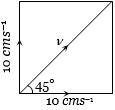
$A$ cubical room is made of mirrors. An insect is moving along the diagonal on the floor such that the velocity of the image of the insect on two adjacent wall mirrors is $10 \, cm \, s^{-1}$. The velocity of the image of the insect in the ceiling mirror is:
A
$10 \, cm \, s^{-1}$
B
$20 \, cm \, s^{-1}$
C
$\frac{10}{\sqrt{2}} \, cm \, s^{-1}$
D
$10\sqrt{2} \, cm \, s^{-1}$
Solution
(D) Let the velocity of the insect be $v$ along the diagonal of the floor. The diagonal makes an angle of $45^\circ$ with the adjacent walls.
When an object moves with velocity $v$ at an angle $\theta$ with a plane mirror,the velocity of its image component perpendicular to the mirror is $v \sin \theta$ (towards the mirror) and parallel to the mirror is $v \cos \theta$.
However,for a mirror,the velocity of the image is the reflection of the object's velocity vector. If the insect moves with velocity $v$ at $45^\circ$ to the wall,the component of velocity perpendicular to the wall is $v \sin 45^\circ$. The image moves with the same perpendicular component in the opposite direction.
Given that the velocity of the image on the wall mirror is $10 \, cm \, s^{-1}$,this refers to the component of the insect's velocity perpendicular to the mirror,which is $v \sin 45^\circ = 10 \, cm \, s^{-1}$.
Thus,$v \times \frac{1}{\sqrt{2}} = 10$,which gives $v = 10\sqrt{2} \, cm \, s^{-1}$.
Since the ceiling mirror is parallel to the floor,the image of the insect in the ceiling mirror moves with the same velocity as the insect itself,which is $v = 10\sqrt{2} \, cm \, s^{-1}$.
When an object moves with velocity $v$ at an angle $\theta$ with a plane mirror,the velocity of its image component perpendicular to the mirror is $v \sin \theta$ (towards the mirror) and parallel to the mirror is $v \cos \theta$.
However,for a mirror,the velocity of the image is the reflection of the object's velocity vector. If the insect moves with velocity $v$ at $45^\circ$ to the wall,the component of velocity perpendicular to the wall is $v \sin 45^\circ$. The image moves with the same perpendicular component in the opposite direction.
Given that the velocity of the image on the wall mirror is $10 \, cm \, s^{-1}$,this refers to the component of the insect's velocity perpendicular to the mirror,which is $v \sin 45^\circ = 10 \, cm \, s^{-1}$.
Thus,$v \times \frac{1}{\sqrt{2}} = 10$,which gives $v = 10\sqrt{2} \, cm \, s^{-1}$.
Since the ceiling mirror is parallel to the floor,the image of the insect in the ceiling mirror moves with the same velocity as the insect itself,which is $v = 10\sqrt{2} \, cm \, s^{-1}$.
0 likes
View Solution38
MediumMCQ
The figure shows a cubical room $ABCD$ with the wall $CD$ as a plane mirror. Each side of the room is $3\,m$. $A$ camera is placed at the midpoint of the wall $AB$. At what distance should the camera be focused to photograph an object placed at $A$?
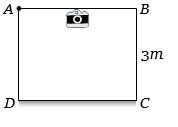
A
$1.5\,m$
B
$3\,m$
C
$6\,m$
D
More than $6\,m$
Solution
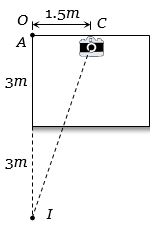
(D) The wall $CD$ acts as a plane mirror. The image of the object at $A$ will be formed behind the mirror $CD$ at a distance equal to the distance of $A$ from $CD$. Since the room is a cube of side $3\,m$,the distance of $A$ from $CD$ is $3\,m$. Thus,the image $I$ is formed $3\,m$ behind the wall $CD$.
The camera is at the midpoint of wall $AB$. The perpendicular distance of the camera from the wall $CD$ is $3\,m$. The horizontal distance of the camera from the line passing through $A$ perpendicular to $CD$ is $1.5\,m$.
The distance of the image $I$ from the camera is the hypotenuse of a right-angled triangle with base $1.5\,m$ and height $(3\,m + 3\,m) = 6\,m$.
Distance $= \sqrt{(6)^2 + (1.5)^2} = \sqrt{36 + 2.25} = \sqrt{38.25} \approx 6.18\,m$.
Therefore,the camera should be focused at a distance of approximately $6.18\,m$,which is more than $6\,m$.
The camera is at the midpoint of wall $AB$. The perpendicular distance of the camera from the wall $CD$ is $3\,m$. The horizontal distance of the camera from the line passing through $A$ perpendicular to $CD$ is $1.5\,m$.
The distance of the image $I$ from the camera is the hypotenuse of a right-angled triangle with base $1.5\,m$ and height $(3\,m + 3\,m) = 6\,m$.
Distance $= \sqrt{(6)^2 + (1.5)^2} = \sqrt{36 + 2.25} = \sqrt{38.25} \approx 6.18\,m$.
Therefore,the camera should be focused at a distance of approximately $6.18\,m$,which is more than $6\,m$.
0 likes
View Solution39
MediumMCQ
$A$ person runs with a speed $u$ towards a bicycle moving away from him with speed $v$. The person approaches his image in the mirror fixed at the rear of the bicycle with a speed of:
A
$u - v$
B
$u - 2v$
C
$2u - v$
D
$2(u - v)$
Solution
(D) Let the velocity of the person be $v_p = u$ and the velocity of the bicycle (and the mirror) be $v_m = v$.
Since the person is moving towards the bicycle,the relative velocity of the person with respect to the mirror is $v_{rel} = v_p - v_m = u - v$.
When an object moves towards a plane mirror with a relative velocity $v_{rel}$,the image moves towards the object with a velocity of $2v_{rel}$.
Therefore,the speed with which the person approaches his image is $2(u - v)$.
Since the person is moving towards the bicycle,the relative velocity of the person with respect to the mirror is $v_{rel} = v_p - v_m = u - v$.
When an object moves towards a plane mirror with a relative velocity $v_{rel}$,the image moves towards the object with a velocity of $2v_{rel}$.
Therefore,the speed with which the person approaches his image is $2(u - v)$.
0 likes
View Solution40
DifficultMCQ
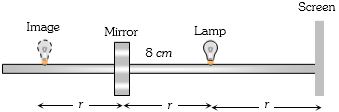
The separation between the screen and a plane mirror is $2r$. An isotropic point source of light is placed exactly midway between the mirror and the screen. Assume that the mirror reflects $100\%$ of the incident light. Then the ratio of illuminances on the screen with and without the mirror is
A
$10:1$
B
$2:1$
C
$10:9$
D
$9:1$
Solution
(C) Let $L$ be the luminous intensity of the point source.
Without the mirror,the distance between the source and the screen is $r$. The illuminance $I_1$ on the screen is given by $I_1 = \frac{L}{r^2}$.
With the mirror,the screen receives light from the source directly and from the image formed by the mirror. The source is at a distance $r$ from the mirror,so its image is formed at a distance $r$ behind the mirror. The distance from the image to the screen is $r + r + r = 3r$.
The illuminance $I_2$ on the screen with the mirror is the sum of the illuminance from the source and the illuminance from the image:
$I_2 = \frac{L}{r^2} + \frac{L}{(3r)^2} = \frac{L}{r^2} + \frac{L}{9r^2} = \frac{L}{r^2} \left(1 + \frac{1}{9}\right) = \frac{10}{9} \frac{L}{r^2}$.
Therefore,the ratio of the illuminances is:
$\frac{I_2}{I_1} = \frac{\frac{10}{9} \frac{L}{r^2}}{\frac{L}{r^2}} = \frac{10}{9} = 10:9$.
Without the mirror,the distance between the source and the screen is $r$. The illuminance $I_1$ on the screen is given by $I_1 = \frac{L}{r^2}$.
With the mirror,the screen receives light from the source directly and from the image formed by the mirror. The source is at a distance $r$ from the mirror,so its image is formed at a distance $r$ behind the mirror. The distance from the image to the screen is $r + r + r = 3r$.
The illuminance $I_2$ on the screen with the mirror is the sum of the illuminance from the source and the illuminance from the image:
$I_2 = \frac{L}{r^2} + \frac{L}{(3r)^2} = \frac{L}{r^2} + \frac{L}{9r^2} = \frac{L}{r^2} \left(1 + \frac{1}{9}\right) = \frac{10}{9} \frac{L}{r^2}$.
Therefore,the ratio of the illuminances is:
$\frac{I_2}{I_1} = \frac{\frac{10}{9} \frac{L}{r^2}}{\frac{L}{r^2}} = \frac{10}{9} = 10:9$.
0 likes
View Solution41
MediumMCQ
$A$ light ray is incident on a plane mirror at an angle of incidence of $30^\circ$. The deviation produced by the mirror is ........$^\circ$.
A
$30$
B
$60$
C
$90$
D
$120$
Solution
(D) The angle of incidence is given as $i = 30^\circ$.
When a light ray strikes a plane mirror,the angle of reflection $r$ is equal to the angle of incidence $i$,so $r = 30^\circ$.
The total angle of deviation $\delta$ produced by a plane mirror is given by the formula $\delta = 180^\circ - (i + r)$.
Since $i = r$,the formula becomes $\delta = 180^\circ - 2i$.
Substituting the value of $i$:
$\delta = 180^\circ - 2(30^\circ) = 180^\circ - 60^\circ = 120^\circ$.
Therefore,the deviation produced by the mirror is $120^\circ$.
When a light ray strikes a plane mirror,the angle of reflection $r$ is equal to the angle of incidence $i$,so $r = 30^\circ$.
The total angle of deviation $\delta$ produced by a plane mirror is given by the formula $\delta = 180^\circ - (i + r)$.
Since $i = r$,the formula becomes $\delta = 180^\circ - 2i$.
Substituting the value of $i$:
$\delta = 180^\circ - 2(30^\circ) = 180^\circ - 60^\circ = 120^\circ$.
Therefore,the deviation produced by the mirror is $120^\circ$.
0 likes
View Solution42
MediumMCQ
An object is initially at a distance of $100 \; cm$ from a plane mirror. If the mirror approaches the object at a speed of $10 \; cm/s$,then after $6 \; s$,the distance between the object and its image will be: (in $; cm$)
A
$60$
B
$80$
C
$70$
D
$50$
Solution
(B) Initial distance of the object from the mirror is $u = 100 \; cm$.
Since the mirror moves towards the object at a speed of $v = 10 \; cm/s$,the distance covered by the mirror in $t = 6 \; s$ is $d = v \times t = 10 \times 6 = 60 \; cm$.
After $6 \; s$,the new distance between the object and the mirror is $u' = 100 - 60 = 40 \; cm$.
In a plane mirror,the image is formed at the same distance behind the mirror as the object is in front of it.
Thus,the distance of the image from the mirror is also $40 \; cm$.
The total distance between the object and its image is the sum of the distance of the object from the mirror and the distance of the image from the mirror: $40 \; cm + 40 \; cm = 80 \; cm$.
Since the mirror moves towards the object at a speed of $v = 10 \; cm/s$,the distance covered by the mirror in $t = 6 \; s$ is $d = v \times t = 10 \times 6 = 60 \; cm$.
After $6 \; s$,the new distance between the object and the mirror is $u' = 100 - 60 = 40 \; cm$.
In a plane mirror,the image is formed at the same distance behind the mirror as the object is in front of it.
Thus,the distance of the image from the mirror is also $40 \; cm$.
The total distance between the object and its image is the sum of the distance of the object from the mirror and the distance of the image from the mirror: $40 \; cm + 40 \; cm = 80 \; cm$.
0 likes
View Solution43
MediumMCQ
$A$ wall clock has marks instead of numbers. It is placed opposite to a mirror. The time observed in the mirror reflection is $8:20$. What is the actual time on the clock?
A
$3:40$
B
$4:40$
C
$5:20$
D
$4:20$
Solution
(A) To find the actual time from the mirror image,subtract the observed time from $11:60$ (or $12:00$).
Actual Time = $11:60 - 8:20 = 3:40$.
Therefore,the actual time on the clock is $3:40$.
Actual Time = $11:60 - 8:20 = 3:40$.
Therefore,the actual time on the clock is $3:40$.
0 likes
View Solution44
EasyMCQ
When an object is placed between two parallel mirrors,the number of images formed is:
A
$4$
B
$1$
C
$2$
D
infinite
Solution
(D) The formula for the number of images $n$ formed by two plane mirrors inclined at an angle $\theta$ is given by $n = \frac{360^\circ}{\theta} - 1$ if $\frac{360^\circ}{\theta}$ is an even integer,and $n = \frac{360^\circ}{\theta}$ if $\frac{360^\circ}{\theta}$ is an odd integer.
For two parallel mirrors,the angle between them is $\theta = 0^\circ$.
Substituting this into the expression,we get $\frac{360^\circ}{0^\circ} = \infty$.
Therefore,an infinite number of images are formed.
For two parallel mirrors,the angle between them is $\theta = 0^\circ$.
Substituting this into the expression,we get $\frac{360^\circ}{0^\circ} = \infty$.
Therefore,an infinite number of images are formed.
0 likes
View Solution45
DifficultMCQ
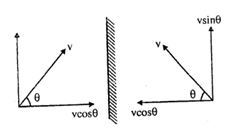
$A$ man moves towards a plane mirror with a velocity $v$ in a direction making an angle $\theta$ with the normal to the mirror. The magnitude of the velocity of the image relative to the man is:
A
$2v$
B
$2v \cos\theta$
C
$2v \sin\theta$
D
$2v/\cos\theta$
Solution
(B) Let the velocity of the man be $\vec{v} = v \cos\theta \hat{i} + v \sin\theta \hat{j}$,where the mirror is in the $yz$-plane and the normal is along the $x$-axis.
The velocity of the image $\vec{v}_i$ is given by $\vec{v}_i = -v \cos\theta \hat{i} + v \sin\theta \hat{j}$.
The velocity of the image relative to the man is $\vec{v}_{im} = \vec{v}_i - \vec{v}_m = (-v \cos\theta - v \cos\theta) \hat{i} + (v \sin\theta - v \sin\theta) \hat{j} = -2v \cos\theta \hat{i}$.
The magnitude of this relative velocity is $|\vec{v}_{im}| = 2v \cos\theta$.
The velocity of the image $\vec{v}_i$ is given by $\vec{v}_i = -v \cos\theta \hat{i} + v \sin\theta \hat{j}$.
The velocity of the image relative to the man is $\vec{v}_{im} = \vec{v}_i - \vec{v}_m = (-v \cos\theta - v \cos\theta) \hat{i} + (v \sin\theta - v \sin\theta) \hat{j} = -2v \cos\theta \hat{i}$.
The magnitude of this relative velocity is $|\vec{v}_{im}| = 2v \cos\theta$.
0 likes
View Solution46
EasyMCQ
$A$ ray gets successively reflected from two mirrors inclined at an angle of $40^o$. If the angle of incidence on the first mirror is $30^o$,then the net deviation of this ray after two reflections is: (in $^o$)
A
$40$
B
$280$
C
$80$
D
$240$
Solution
(B) When a light ray undergoes successive reflections from two plane mirrors inclined at an angle $\theta$,the total deviation $\delta$ produced is given by the formula $\delta = 360^o - 2\theta$.
Here,the angle of inclination between the mirrors is $\theta = 40^o$.
Substituting the value of $\theta$ into the formula:
$\delta = 360^o - 2(40^o)$
$\delta = 360^o - 80^o$
$\delta = 280^o$.
Note: The angle of incidence on the first mirror does not affect the net deviation when the ray reflects off both mirrors.
Here,the angle of inclination between the mirrors is $\theta = 40^o$.
Substituting the value of $\theta$ into the formula:
$\delta = 360^o - 2(40^o)$
$\delta = 360^o - 80^o$
$\delta = 280^o$.
Note: The angle of incidence on the first mirror does not affect the net deviation when the ray reflects off both mirrors.
0 likes
View Solution47
DifficultMCQ
$A$ small object of size $10\, cm$ is placed in front of a plane mirror. $A$ person stands $30\, cm$ behind the object and views the image of the object. At what distance (in $cm$) from the person's eyes must the image be focused?
A
$25$
B
$35$
C
$45$
D
$40$
Solution
(D) The object is placed in front of the plane mirror. Let the distance of the object from the mirror be $u$. Since the object is $10\, cm$ in size,we consider its position relative to the mirror. Assuming the object is placed at a distance $d$ from the mirror,the image is formed at a distance $d$ behind the mirror.
Given that the person is standing $30\, cm$ behind the object,the total distance of the person from the mirror is $d + 30\, cm$.
The image is formed at a distance $d$ behind the mirror.
The distance of the image from the person's eyes is the sum of the distance of the person from the mirror and the distance of the image behind the mirror.
Distance $= (d + 30) + d = 2d + 30$.
If the object is placed very close to the mirror (i.e.,$d \approx 5\, cm$ from the center of the object),the distance becomes $2(5) + 30 = 40\, cm$.
Thus,the person must focus their eyes at a distance of $40\, cm$.
Given that the person is standing $30\, cm$ behind the object,the total distance of the person from the mirror is $d + 30\, cm$.
The image is formed at a distance $d$ behind the mirror.
The distance of the image from the person's eyes is the sum of the distance of the person from the mirror and the distance of the image behind the mirror.
Distance $= (d + 30) + d = 2d + 30$.
If the object is placed very close to the mirror (i.e.,$d \approx 5\, cm$ from the center of the object),the distance becomes $2(5) + 30 = 40\, cm$.
Thus,the person must focus their eyes at a distance of $40\, cm$.
0 likes
View Solution48
MediumMCQ
Two plane mirrors are inclined at an angle of $45^{\circ}$ to each other. If an object is placed between them,how many images will be formed?
A
$5$
B
$9$
C
$7$
D
$8$
Solution
(C) The number of images $n$ formed by two plane mirrors inclined at an angle $\theta$ is given by the formula $n = \frac{360^{\circ}}{\theta} - 1$.
Given $\theta = 45^{\circ}$.
Substituting the value into the formula: $n = \frac{360^{\circ}}{45^{\circ}} - 1$.
$n = 8 - 1 = 7$.
Therefore,$7$ images will be formed.
Given $\theta = 45^{\circ}$.
Substituting the value into the formula: $n = \frac{360^{\circ}}{45^{\circ}} - 1$.
$n = 8 - 1 = 7$.
Therefore,$7$ images will be formed.
0 likes
View Solution49
EasyMCQ
$A$ plane mirror rotating at an angular velocity of $3 \; rad/s$ reflects a light beam. The angular velocity of the reflected beam is ........ $rad/s$.
A
$3$
B
$6$
C
$9$
D
$12$
Solution
(B) When a plane mirror is rotated by an angle $\theta$,the reflected ray rotates by an angle $2\theta$.
Given the angular velocity of the mirror is $\omega = 3 \; rad/s$.
The angular velocity of the reflected ray $\omega'$ is given by the relation $\omega' = 2\omega$.
Substituting the value: $\omega' = 2 \times 3 = 6 \; rad/s$.
Given the angular velocity of the mirror is $\omega = 3 \; rad/s$.
The angular velocity of the reflected ray $\omega'$ is given by the relation $\omega' = 2\omega$.
Substituting the value: $\omega' = 2 \times 3 = 6 \; rad/s$.
0 likes
View SolutionRay Optics and Optical Instruments — Plane Mirror · Frequently Asked Questions
1Are these Ray Optics and Optical Instruments questions useful for JEE and NEET?
Yes. All questions in this section are mapped to JEE Main and NEET exam patterns. Previous year questions from JEE Main, NEET, GUJCET and state-level exams are included with full solutions.
2Can I switch to Hindi or Gujarati for these questions?
Yes. Use the language tabs in the hero section or the sidebar to view the same questions and solutions in English, Hindi or Gujarati.
3How do I generate a question paper from this subtopic?
Use the Vedclass Exam Paper Generator — select the chapter and subtopic, set difficulty, and generate Sets A, B, C, D automatically. First 3 chapters of every subject are free.
Vedclass Products
For Students
Vedclass Test Series
Mock tests in real JEE/NEET style with performance analysis. 5-day free trial.
Start Free TrialFor Teachers
Exam Paper Generator
Generate Set A/B/C/D papers from this chapter in 2 minutes. 3 chapters free.
Try FreeFor Institutes
Online Exam Module
Live online exams with unlimited students, 360° analytics & white-label branding.
See DemoFor Teachers & Institutes
Generate a Ray Optics and Optical Instruments Exam Paper in 2 Minutes
Select subtopic & difficulty — Sets A, B, C, D auto-generated with No Repeat logic.
First 3 chapters of every subject are free — no payment required.