
A English
Dispersion of Light Questions in English
Class 12 Physics · Ray Optics and Optical Instruments · Dispersion of Light
47+
Questions
English
Language
100%
With Solutions
Showing 46 of 47 questions in English
1
EasyMCQ
The refractive index of a piece of transparent quartz is the greatest for
A
Red light
B
Violet light
C
Green light
D
Yellow light
Solution
(B) According to Cauchy's dispersion formula,the refractive index $\mu$ of a material is inversely proportional to the square of the wavelength $\lambda$ of light,expressed as $\mu \approx A + \frac{B}{\lambda^2}$.
Since the wavelength of violet light $(\lambda_v)$ is the shortest among the visible spectrum and the wavelength of red light $(\lambda_r)$ is the longest $(\lambda_v < \lambda_r)$,the refractive index is inversely related to the wavelength.
Therefore,the refractive index is greatest for the light with the shortest wavelength,which is violet light.
Since the wavelength of violet light $(\lambda_v)$ is the shortest among the visible spectrum and the wavelength of red light $(\lambda_r)$ is the longest $(\lambda_v < \lambda_r)$,the refractive index is inversely related to the wavelength.
Therefore,the refractive index is greatest for the light with the shortest wavelength,which is violet light.
0 likes
View Solution2
MediumMCQ
The focal lengths of a convex lens for red and blue light are $100 \text{ cm}$ and $96.8 \text{ cm}$ respectively. The dispersive power of the material of the lens is:
A
$0.325$
B
$0.0325$
C
$0.98$
D
$0.968$
Solution
(B) The dispersive power $\omega$ of a lens is defined as $\omega = \frac{f_R - f_V}{f_y}$, where $f_R$ is the focal length for red light, $f_V$ is the focal length for violet (or blue) light, and $f_y$ is the mean focal length.
For a thin lens, the mean focal length is approximately $f_y = \sqrt{f_R f_V}$.
Given: $f_R = 100 \text{ cm}$, $f_V = 96.8 \text{ cm}$.
First, calculate the mean focal length: $f_y = \sqrt{100 \times 96.8} = \sqrt{9680} \approx 98.387 \text{ cm}$.
Now, calculate the dispersive power: $\omega = \frac{100 - 96.8}{98.387} = \frac{3.2}{98.387} \approx 0.0325$.
Thus, the correct option is $B$.
For a thin lens, the mean focal length is approximately $f_y = \sqrt{f_R f_V}$.
Given: $f_R = 100 \text{ cm}$, $f_V = 96.8 \text{ cm}$.
First, calculate the mean focal length: $f_y = \sqrt{100 \times 96.8} = \sqrt{9680} \approx 98.387 \text{ cm}$.
Now, calculate the dispersive power: $\omega = \frac{100 - 96.8}{98.387} = \frac{3.2}{98.387} \approx 0.0325$.
Thus, the correct option is $B$.
0 likes
View Solution3
EasyMCQ
If the refractive indices of crown glass for red,yellow,and violet colours are respectively $\mu_r$,$\mu_y$,and $\mu_v$,then the dispersive power of this glass would be
A
$\frac{\mu_v - \mu_y}{\mu_r - 1}$
B
$\frac{\mu_v - \mu_r}{\mu_y - 1}$
C
$\frac{\mu_v - \mu_y}{\mu_y - \mu_r}$
D
$\frac{\mu_v - \mu_r}{\mu_y} - 1$
Solution
(B) The dispersive power $(\omega)$ of a material is defined as the ratio of the angular dispersion for the extreme colours (violet and red) to the mean deviation produced by the prism.
Mathematically,it is expressed as:
$\omega = \frac{\delta_v - \delta_r}{\delta_y}$
Since the deviation $\delta$ produced by a thin prism is given by $\delta = (\mu - 1)A$,where $A$ is the angle of the prism,we substitute this into the formula:
$\omega = \frac{(\mu_v - 1)A - (\mu_r - 1)A}{(\mu_y - 1)A}$
Simplifying the expression by cancelling $A$:
$\omega = \frac{\mu_v - 1 - \mu_r + 1}{\mu_y - 1}$
$\omega = \frac{\mu_v - \mu_r}{\mu_y - 1}$
Therefore,the correct option is $B$.
Mathematically,it is expressed as:
$\omega = \frac{\delta_v - \delta_r}{\delta_y}$
Since the deviation $\delta$ produced by a thin prism is given by $\delta = (\mu - 1)A$,where $A$ is the angle of the prism,we substitute this into the formula:
$\omega = \frac{(\mu_v - 1)A - (\mu_r - 1)A}{(\mu_y - 1)A}$
Simplifying the expression by cancelling $A$:
$\omega = \frac{\mu_v - 1 - \mu_r + 1}{\mu_y - 1}$
$\omega = \frac{\mu_v - \mu_r}{\mu_y - 1}$
Therefore,the correct option is $B$.
0 likes
View Solution4
EasyMCQ
Dispersive power depends upon
A
The shape of prism
B
Material of prism
C
Angle of prism
D
Height of the prism
Solution
(B) The dispersive power $\omega$ of a prism is defined as the ratio of the angular dispersion to the mean deviation produced by the prism.
Mathematically,$\omega = \frac{\mu_v - \mu_r}{\mu - 1}$,where $\mu_v$ and $\mu_r$ are the refractive indices for violet and red light,and $\mu$ is the mean refractive index.
Since $\mu_v, \mu_r,$ and $\mu$ are properties of the material of the prism,the dispersive power $\omega$ depends only on the nature of the material of the prism and is independent of the prism's angle or shape.
Mathematically,$\omega = \frac{\mu_v - \mu_r}{\mu - 1}$,where $\mu_v$ and $\mu_r$ are the refractive indices for violet and red light,and $\mu$ is the mean refractive index.
Since $\mu_v, \mu_r,$ and $\mu$ are properties of the material of the prism,the dispersive power $\omega$ depends only on the nature of the material of the prism and is independent of the prism's angle or shape.
0 likes
View Solution5
MediumMCQ
The dispersion for a medium of wavelength $\lambda$ is $D$. Then,the dispersion for the wavelength $2\lambda$ will be:
A
$D/8$
B
$D/4$
C
$D/2$
D
$D$
Solution
(A) According to Cauchy's equation,the refractive index $\mu$ is given by $\mu = a + \frac{b}{\lambda^2}$,where $a$ and $b$ are constants.
Dispersion $D$ is defined as the magnitude of the rate of change of refractive index with respect to wavelength: $D = |\frac{d\mu}{d\lambda}|$.
Calculating the derivative: $\frac{d\mu}{d\lambda} = \frac{d}{d\lambda}(a + b\lambda^{-2}) = -2b\lambda^{-3}$.
Thus,$D = | -\frac{2b}{\lambda^3} | = \frac{2b}{\lambda^3}$.
This shows that $D \propto \frac{1}{\lambda^3}$.
For a new wavelength $\lambda' = 2\lambda$,the new dispersion $D'$ is given by $\frac{D'}{D} = (\frac{\lambda}{\lambda'})^3 = (\frac{\lambda}{2\lambda})^3 = \frac{1}{8}$.
Therefore,$D' = \frac{D}{8}$.
Dispersion $D$ is defined as the magnitude of the rate of change of refractive index with respect to wavelength: $D = |\frac{d\mu}{d\lambda}|$.
Calculating the derivative: $\frac{d\mu}{d\lambda} = \frac{d}{d\lambda}(a + b\lambda^{-2}) = -2b\lambda^{-3}$.
Thus,$D = | -\frac{2b}{\lambda^3} | = \frac{2b}{\lambda^3}$.
This shows that $D \propto \frac{1}{\lambda^3}$.
For a new wavelength $\lambda' = 2\lambda$,the new dispersion $D'$ is given by $\frac{D'}{D} = (\frac{\lambda}{\lambda'})^3 = (\frac{\lambda}{2\lambda})^3 = \frac{1}{8}$.
Therefore,$D' = \frac{D}{8}$.
0 likes
View Solution6
EasyMCQ
The dispersive power is maximum for the material
A
Flint glass
B
Crown glass
C
Mixture of both
D
None of the above
Solution
(A) The dispersive power $(\omega)$ of a material is defined as the ratio of the angular dispersion to the mean deviation produced by a prism.
Mathematically,it is given by $\omega = \frac{\mu_v - \mu_r}{\mu - 1}$,where $\mu_v, \mu_r$ are refractive indices for violet and red light,and $\mu$ is the mean refractive index.
Flint glass has a higher refractive index and a greater difference between the refractive indices of extreme colors compared to crown glass.
Therefore,the dispersive power of flint glass is higher than that of crown glass.
Mathematically,it is given by $\omega = \frac{\mu_v - \mu_r}{\mu - 1}$,where $\mu_v, \mu_r$ are refractive indices for violet and red light,and $\mu$ is the mean refractive index.
Flint glass has a higher refractive index and a greater difference between the refractive indices of extreme colors compared to crown glass.
Therefore,the dispersive power of flint glass is higher than that of crown glass.
0 likes
View Solution7
MediumMCQ
If the refractive indices of crown glass for red,yellow,and violet colours are $1.5140, 1.5170$,and $1.5318$ respectively,and for flint glass these are $1.6434, 1.6499$,and $1.6852$ respectively,then the dispersive powers for crown and flint glass are respectively:
A
$0.034$ and $0.064$
B
$0.064$ and $0.034$
C
$1.00$ and $0.064$
D
$0.034$ and $1.0$
Solution
(A) The dispersive power $\omega$ is given by the formula $\omega = \frac{n_v - n_r}{n_y - 1}$,where $n_v, n_r$,and $n_y$ are the refractive indices for violet,red,and yellow colours respectively.
For crown glass:
$\omega_{\text{crown}} = \frac{1.5318 - 1.5140}{1.5170 - 1} = \frac{0.0178}{0.5170} \approx 0.034$
For flint glass:
$\omega_{\text{flint}} = \frac{1.6852 - 1.6434}{1.6499 - 1} = \frac{0.0418}{0.6499} \approx 0.064$
Thus,the dispersive powers are $0.034$ and $0.064$ respectively.
For crown glass:
$\omega_{\text{crown}} = \frac{1.5318 - 1.5140}{1.5170 - 1} = \frac{0.0178}{0.5170} \approx 0.034$
For flint glass:
$\omega_{\text{flint}} = \frac{1.6852 - 1.6434}{1.6499 - 1} = \frac{0.0418}{0.6499} \approx 0.064$
Thus,the dispersive powers are $0.034$ and $0.064$ respectively.
0 likes
View Solution8
EasyMCQ
In the phenomenon of dispersion without deviation,which of the following statements is true?
A
The emergent rays of all the colours are parallel to the incident ray.
B
The yellow coloured ray is parallel to the incident ray.
C
Only the red coloured ray is parallel to the incident ray.
D
All the rays are parallel,but not parallel to the incident ray.
Solution
(B) Dispersion without deviation is achieved by using a combination of two prisms (usually crown and flint glass) such that the net deviation produced is zero for the mean colour.
In the visible spectrum,the mean colour is taken to be yellow.
Therefore,the net deviation for the yellow ray is zero,which means the emergent yellow ray is parallel to the incident ray.
Thus,the correct option is $B$.
In the visible spectrum,the mean colour is taken to be yellow.
Therefore,the net deviation for the yellow ray is zero,which means the emergent yellow ray is parallel to the incident ray.
Thus,the correct option is $B$.
0 likes
View Solution9
EasyMCQ
The refractive indices of violet and red light are $1.54$ and $1.52$ respectively. If the angle of prism is $10^{\circ}$,then the angular dispersion is
A
$0.02$
B
$0.2$
C
$3.06$
D
$30.6$
Solution
(B) The angular dispersion produced by a prism is given by the formula: $\theta = (\mu_v - \mu_r)A$.
Given:
Refractive index for violet light,$\mu_v = 1.54$.
Refractive index for red light,$\mu_r = 1.52$.
Angle of the prism,$A = 10^{\circ}$.
Substituting the values into the formula:
$\theta = (1.54 - 1.52) \times 10^{\circ}$.
$\theta = 0.02 \times 10^{\circ}$.
$\theta = 0.2^{\circ}$.
Therefore,the angular dispersion is $0.2^{\circ}$.
Given:
Refractive index for violet light,$\mu_v = 1.54$.
Refractive index for red light,$\mu_r = 1.52$.
Angle of the prism,$A = 10^{\circ}$.
Substituting the values into the formula:
$\theta = (1.54 - 1.52) \times 10^{\circ}$.
$\theta = 0.02 \times 10^{\circ}$.
$\theta = 0.2^{\circ}$.
Therefore,the angular dispersion is $0.2^{\circ}$.
0 likes
View Solution10
EasyMCQ
If the refractive indices of a prism for red,yellow,and violet colours are $1.61$,$1.63$,and $1.65$ respectively,then the dispersive power of the prism will be:
A
$\frac{1.65 - 1.62}{1.61 - 1}$
B
$\frac{1.62 - 1.61}{1.65 - 1}$
C
$\frac{1.65 - 1.61}{1.63 - 1}$
D
$\frac{1.65 - 1.63}{1.61 - 1}$
Solution
(C) The dispersive power $\omega$ of a prism is defined as the ratio of the angular dispersion between the extreme colours (violet and red) to the mean deviation produced by the prism.
Mathematically,$\omega = \frac{\mu_V - \mu_R}{\mu_Y - 1}$,where $\mu_V$,$\mu_R$,and $\mu_Y$ are the refractive indices for violet,red,and yellow colours respectively.
Given: $\mu_R = 1.61$,$\mu_Y = 1.63$,and $\mu_V = 1.65$.
Substituting these values into the formula:
$\omega = \frac{1.65 - 1.61}{1.63 - 1}$.
Thus,the correct option is $C$.
Mathematically,$\omega = \frac{\mu_V - \mu_R}{\mu_Y - 1}$,where $\mu_V$,$\mu_R$,and $\mu_Y$ are the refractive indices for violet,red,and yellow colours respectively.
Given: $\mu_R = 1.61$,$\mu_Y = 1.63$,and $\mu_V = 1.65$.
Substituting these values into the formula:
$\omega = \frac{1.65 - 1.61}{1.63 - 1}$.
Thus,the correct option is $C$.
0 likes
View Solution11
EasyMCQ
For a material,the refractive indices for red,violet,and yellow color light are respectively $1.52, 1.64,$ and $1.60.$ The dispersive power of the material is:
A
$0.2$
B
$0.45$
C
$0.24$
D
$0.045$
Solution
(A) The dispersive power $(\omega)$ of a material is defined as the ratio of the angular dispersion for extreme colors to the mean deviation.
It is given by the formula: $\omega = \frac{\mu_v - \mu_r}{\mu_y - 1}$
Given:
Refractive index for violet light,$\mu_v = 1.64$
Refractive index for red light,$\mu_r = 1.52$
Refractive index for yellow light,$\mu_y = 1.60$
Substituting the values in the formula:
$\omega = \frac{1.64 - 1.52}{1.60 - 1}$
$\omega = \frac{0.12}{0.60}$
$\omega = 0.2$
Thus,the dispersive power of the material is $0.2$.
It is given by the formula: $\omega = \frac{\mu_v - \mu_r}{\mu_y - 1}$
Given:
Refractive index for violet light,$\mu_v = 1.64$
Refractive index for red light,$\mu_r = 1.52$
Refractive index for yellow light,$\mu_y = 1.60$
Substituting the values in the formula:
$\omega = \frac{1.64 - 1.52}{1.60 - 1}$
$\omega = \frac{0.12}{0.60}$
$\omega = 0.2$
Thus,the dispersive power of the material is $0.2$.
0 likes
View Solution12
EasyMCQ
$A$ medium is said to be dispersive,if
A
Light of different wavelengths propagate at different speeds
B
Light of different wavelengths propagate at same speed but has different frequencies
C
Light is gradually bent rather than sharply refracted at an interface between the medium and air
D
Light is never totally internally reflected
Solution
(A) Dispersion occurs because the refractive index of a medium depends on the wavelength of light.
Since the refractive index $n$ is related to the speed of light $v$ in the medium by $n = c/v$,where $c$ is the speed of light in a vacuum,a variation in refractive index for different wavelengths implies that light of different wavelengths propagates at different speeds in the medium.
For example,in glass,the refractive index for red light is lower than that for violet light,meaning red light travels faster than violet light.
Therefore,the correct condition for a medium to be dispersive is that light of different wavelengths propagates at different speeds.
Since the refractive index $n$ is related to the speed of light $v$ in the medium by $n = c/v$,where $c$ is the speed of light in a vacuum,a variation in refractive index for different wavelengths implies that light of different wavelengths propagates at different speeds in the medium.
For example,in glass,the refractive index for red light is lower than that for violet light,meaning red light travels faster than violet light.
Therefore,the correct condition for a medium to be dispersive is that light of different wavelengths propagates at different speeds.
0 likes
View Solution13
MediumMCQ
The refractive index of flint glass for blue $F$ line is $1.6333$ and red $C$ line is $1.6161.$ If the refractive index for yellow $D$ line is $1.622,$ the dispersive power of the glass is
A
$0.0276$
B
$0.276$
C
$2.76$
D
$0.106$
Solution
(A) The dispersive power $\omega$ of a material is defined as the ratio of the angular dispersion between the extreme colors to the mean deviation.
Mathematically,it is given by the formula: $\omega = \frac{\mu_F - \mu_C}{\mu_D - 1}$
Given:
Refractive index for blue $F$ line,$\mu_F = 1.6333$
Refractive index for red $C$ line,$\mu_C = 1.6161$
Refractive index for yellow $D$ line,$\mu_D = 1.622$
Substituting the values into the formula:
$\omega = \frac{1.6333 - 1.6161}{1.622 - 1}$
$\omega = \frac{0.0172}{0.622}$
$\omega = 0.02765... \approx 0.0276$
Thus,the correct option is $A$.
Mathematically,it is given by the formula: $\omega = \frac{\mu_F - \mu_C}{\mu_D - 1}$
Given:
Refractive index for blue $F$ line,$\mu_F = 1.6333$
Refractive index for red $C$ line,$\mu_C = 1.6161$
Refractive index for yellow $D$ line,$\mu_D = 1.622$
Substituting the values into the formula:
$\omega = \frac{1.6333 - 1.6161}{1.622 - 1}$
$\omega = \frac{0.0172}{0.622}$
$\omega = 0.02765... \approx 0.0276$
Thus,the correct option is $A$.
0 likes
View Solution14
EasyMCQ
The splitting of white light into several colours on passing through a glass prism is due to
A
Refraction
B
Reflection
C
Interference
D
Dispersion
Solution
(A) When white light passes through a glass prism,it splits into its constituent colours. This phenomenon is known as dispersion. Dispersion occurs because the refractive index $(\mu)$ of the glass prism depends on the wavelength $(\lambda)$ of the light. Since different colours have different wavelengths,they undergo different amounts of refraction,causing them to separate. Therefore,the splitting of white light is primarily due to refraction.
0 likes
View Solution15
EasyMCQ
For a medium,the refractive indices for violet,red,and yellow light are $1.62$,$1.52$,and $1.55$ respectively. Calculate the dispersive power of the medium.
A
$0.65$
B
$0.22$
C
$0.18$
D
$0.02$
Solution
(C) The dispersive power $(\omega)$ of a medium is defined as the ratio of the angular dispersion to the mean deviation.
It is given by the formula: $\omega = \frac{\mu_v - \mu_R}{\mu_y - 1}$
Given values:
Refractive index for violet light,$\mu_v = 1.62$
Refractive index for red light,$\mu_R = 1.52$
Refractive index for yellow light,$\mu_y = 1.55$
Substituting these values into the formula:
$\omega = \frac{1.62 - 1.52}{1.55 - 1}$
$\omega = \frac{0.10}{0.55}$
$\omega = \frac{10}{55} = \frac{2}{11} \approx 0.1818$
Rounding to two decimal places,we get $\omega = 0.18$.
It is given by the formula: $\omega = \frac{\mu_v - \mu_R}{\mu_y - 1}$
Given values:
Refractive index for violet light,$\mu_v = 1.62$
Refractive index for red light,$\mu_R = 1.52$
Refractive index for yellow light,$\mu_y = 1.55$
Substituting these values into the formula:
$\omega = \frac{1.62 - 1.52}{1.55 - 1}$
$\omega = \frac{0.10}{0.55}$
$\omega = \frac{10}{55} = \frac{2}{11} \approx 0.1818$
Rounding to two decimal places,we get $\omega = 0.18$.
0 likes
View Solution16
EasyMCQ
If the refractive indices of red,violet,and yellow lights are $1.42$,$1.62$,and $1.50$ respectively for a medium,its dispersive power will be:
A
$0.4$
B
$0.3$
C
$0.2$
D
$0.1$
Solution
(A) The dispersive power $\omega$ of a medium is defined as the ratio of the angular dispersion to the mean deviation.
Mathematically,it is given by the formula: $\omega = \frac{\mu_V - \mu_R}{\mu_Y - 1}$
Given:
Refractive index for violet light,$\mu_V = 1.62$
Refractive index for red light,$\mu_R = 1.42$
Refractive index for yellow light,$\mu_Y = 1.50$
Substituting these values into the formula:
$\omega = \frac{1.62 - 1.42}{1.50 - 1}$
$\omega = \frac{0.20}{0.50}$
$\omega = 0.4$
Thus,the dispersive power of the medium is $0.4$.
Mathematically,it is given by the formula: $\omega = \frac{\mu_V - \mu_R}{\mu_Y - 1}$
Given:
Refractive index for violet light,$\mu_V = 1.62$
Refractive index for red light,$\mu_R = 1.42$
Refractive index for yellow light,$\mu_Y = 1.50$
Substituting these values into the formula:
$\omega = \frac{1.62 - 1.42}{1.50 - 1}$
$\omega = \frac{0.20}{0.50}$
$\omega = 0.4$
Thus,the dispersive power of the medium is $0.4$.
0 likes
View Solution17
EasyMCQ
The refractive index of the material of the prism for violet colour is $1.69$ and that for red is $1.65$. If the refractive index for the mean colour is $1.66$,calculate the dispersive power of the material of the prism.
A
$0.66$
B
$0.06$
C
$0.65$
D
$0.69$
Solution
(B) The dispersive power $(\omega)$ of a prism is defined as the ratio of the angular dispersion to the mean deviation.
It is given by the formula: $\omega = \frac{\mu_v - \mu_r}{\mu_y - 1}$
Where:
$\mu_v = 1.69$ (refractive index for violet colour)
$\mu_r = 1.65$ (refractive index for red colour)
$\mu_y = 1.66$ (refractive index for mean colour)
Substituting the values into the formula:
$\omega = \frac{1.69 - 1.65}{1.66 - 1}$
$\omega = \frac{0.04}{0.66}$
$\omega = \frac{4}{66} = \frac{2}{33} \approx 0.0606$
Rounding to two decimal places,we get $\omega = 0.06$.
It is given by the formula: $\omega = \frac{\mu_v - \mu_r}{\mu_y - 1}$
Where:
$\mu_v = 1.69$ (refractive index for violet colour)
$\mu_r = 1.65$ (refractive index for red colour)
$\mu_y = 1.66$ (refractive index for mean colour)
Substituting the values into the formula:
$\omega = \frac{1.69 - 1.65}{1.66 - 1}$
$\omega = \frac{0.04}{0.66}$
$\omega = \frac{4}{66} = \frac{2}{33} \approx 0.0606$
Rounding to two decimal places,we get $\omega = 0.06$.
0 likes
View Solution18
EasyMCQ
The deviations caused in red,yellow,and violet colors for a crown glass prism are $2.84^\circ$,$3.28^\circ$,and $3.72^\circ$ respectively. The dispersive power of the prism material is:
A
$0.268$
B
$0.368$
C
$0.468$
D
$0.568$
Solution
(A) The dispersive power $(\omega)$ of a prism is defined as the ratio of the angular dispersion between the extreme colors (violet and red) to the mean deviation (yellow color).
Formula: $\omega = \frac{\delta_V - \delta_R}{\delta_Y}$
Given:
$\delta_V = 3.72^\circ$
$\delta_R = 2.84^\circ$
$\delta_Y = 3.28^\circ$
Substituting the values:
$\omega = \frac{3.72 - 2.84}{3.28}$
$\omega = \frac{0.88}{3.28}$
$\omega = 0.268$
Thus,the dispersive power of the prism material is $0.268$.
Formula: $\omega = \frac{\delta_V - \delta_R}{\delta_Y}$
Given:
$\delta_V = 3.72^\circ$
$\delta_R = 2.84^\circ$
$\delta_Y = 3.28^\circ$
Substituting the values:
$\omega = \frac{3.72 - 2.84}{3.28}$
$\omega = \frac{0.88}{3.28}$
$\omega = 0.268$
Thus,the dispersive power of the prism material is $0.268$.
0 likes
View Solution19
EasyMCQ
Dispersion of light is due to
A
Wavelength
B
Intensity of light
C
Density of medium
D
None of these
Solution
(A) Dispersion of light is the phenomenon of splitting of white light into its constituent colors when it passes through a prism.
This occurs because the refractive index of the material of the prism depends on the wavelength of the light.
According to Cauchy's formula,the refractive index $n$ is related to the wavelength $\lambda$ by $n(\lambda) = A + B/\lambda^2 + C/\lambda^4 + \dots$.
Since different colors have different wavelengths,they travel at different speeds in the medium and undergo different amounts of deviation,leading to dispersion.
Therefore,the correct option is $A$.
This occurs because the refractive index of the material of the prism depends on the wavelength of the light.
According to Cauchy's formula,the refractive index $n$ is related to the wavelength $\lambda$ by $n(\lambda) = A + B/\lambda^2 + C/\lambda^4 + \dots$.
Since different colors have different wavelengths,they travel at different speeds in the medium and undergo different amounts of deviation,leading to dispersion.
Therefore,the correct option is $A$.
0 likes
View Solution20
EasyMCQ
When white light enters a prism,it gets split into its constituent colours. This is due to
A
High density of prism material
B
Because $\mu$ is different for different $\lambda$
C
Diffraction of light
D
Velocity changes for different frequencies
Solution
(B) The phenomenon of splitting white light into its constituent colours is called dispersion. The refractive index $\mu$ of the prism material depends on the wavelength $\lambda$ of the light,as given by Cauchy's equation $\mu(\lambda) = A + B/\lambda^2 + ...$. Since different colours have different wavelengths,they experience different refractive indices $\mu$ within the prism. Consequently,each colour undergoes a different angle of deviation according to the prism formula $\delta = (\mu - 1)A$. Thus,the correct reason is that $\mu$ is different for different $\lambda$.
0 likes
View Solution21
EasyMCQ
The Cauchy's dispersion formula is:
A
$n = A + B\lambda^{-2} + C\lambda^{-4}$
B
$n = A + B\lambda^{2} + C\lambda^{-4}$
C
$n = A + B\lambda^{-2} + C\lambda^{4}$
D
$n = A + B\lambda^{2} + C\lambda^{4}$
Solution
(A) Cauchy's dispersion formula describes the relationship between the refractive index $n$ of a transparent medium and the wavelength $\lambda$ of light passing through it.
It is empirically given by the expression: $n(\lambda) = A + \frac{B}{\lambda^2} + \frac{C}{\lambda^4} + \dots$
Where $A$,$B$,and $C$ are constants specific to the material.
Thus,the correct formula is $n = A + B\lambda^{-2} + C\lambda^{-4}$.
It is empirically given by the expression: $n(\lambda) = A + \frac{B}{\lambda^2} + \frac{C}{\lambda^4} + \dots$
Where $A$,$B$,and $C$ are constants specific to the material.
Thus,the correct formula is $n = A + B\lambda^{-2} + C\lambda^{-4}$.
0 likes
View Solution22
EasyMCQ
$A$ convex lens,a glass slab,a glass prism,and a solid sphere are all made of the same glass. The dispersive power will be:
A
In the glass slab and prism
B
In the lens and solid sphere
C
Only in prism
D
In all the four
Solution
(D) Dispersive power is an intrinsic property of the material of the optical element. It depends only on the refractive indices of the material for different wavelengths of light (specifically for violet,red,and yellow light). Since all the given objects (convex lens,glass slab,glass prism,and solid sphere) are made of the same glass,they all possess the same dispersive power. Therefore,the property of dispersion exists in all four objects.
0 likes
View Solution23
MediumMCQ
$A$ parallel beam of white light falls on a convex lens. Images of blue,yellow,and red light are formed on the other side of the lens at distances of $0.20 \ m$,$0.205 \ m$,and $0.214 \ m$ respectively. The dispersive power of the material of the lens will be:
A
$619/1000$
B
$9/200$
C
$14/205$
D
$5/214$
Solution
(C) The dispersive power $\omega$ of a lens is defined as the ratio of the difference in focal lengths for red and blue light to the mean focal length (yellow light).
Given:
Focal length for blue light,$f_v = 0.20 \ m$
Focal length for yellow light,$f_y = 0.205 \ m$
Focal length for red light,$f_r = 0.214 \ m$
The formula for dispersive power is $\omega = \frac{f_r - f_v}{f_y}$.
Substituting the values:
$\omega = \frac{0.214 - 0.200}{0.205} = \frac{0.014}{0.205} = \frac{14}{205}$.
Given:
Focal length for blue light,$f_v = 0.20 \ m$
Focal length for yellow light,$f_y = 0.205 \ m$
Focal length for red light,$f_r = 0.214 \ m$
The formula for dispersive power is $\omega = \frac{f_r - f_v}{f_y}$.
Substituting the values:
$\omega = \frac{0.214 - 0.200}{0.205} = \frac{0.014}{0.205} = \frac{14}{205}$.
0 likes
View Solution24
EasyMCQ
The refractive index of a particular material is $1.67$ for blue light,$1.65$ for yellow light,and $1.63$ for red light. The dispersive power of the material is .........
A
$0.0615$
B
$0.024$
C
$0.031$
D
$1.6$
Solution
(A) The dispersive power $\omega$ of a material is defined as the ratio of the angular dispersion to the mean deviation.
It is given by the formula: $\omega = \frac{\mu_v - \mu_r}{\mu_y - 1}$
Given values:
Refractive index for blue light (violet end),$\mu_v = 1.67$
Refractive index for red light,$\mu_r = 1.63$
Refractive index for yellow light (mean),$\mu_y = 1.65$
Substituting these values into the formula:
$\omega = \frac{1.67 - 1.63}{1.65 - 1}$
$\omega = \frac{0.04}{0.65}$
$\omega = \frac{4}{65} \approx 0.0615$
Thus,the dispersive power of the material is $0.0615$.
It is given by the formula: $\omega = \frac{\mu_v - \mu_r}{\mu_y - 1}$
Given values:
Refractive index for blue light (violet end),$\mu_v = 1.67$
Refractive index for red light,$\mu_r = 1.63$
Refractive index for yellow light (mean),$\mu_y = 1.65$
Substituting these values into the formula:
$\omega = \frac{1.67 - 1.63}{1.65 - 1}$
$\omega = \frac{0.04}{0.65}$
$\omega = \frac{4}{65} \approx 0.0615$
Thus,the dispersive power of the material is $0.0615$.
0 likes
View Solution25
MediumMCQ
The prism angle of a prism is $10^{\circ}$. The refractive indices for red and violet colors are $1.51$ and $1.52$ respectively. The dispersive power will be .....
A
$0.954$
B
$1.256$
C
$0.019$
D
$2.321$
Solution
(C) The formula for dispersive power is $\omega = \frac{\mu_v - \mu_r}{\mu_y - 1}$.
First,we calculate the mean refractive index $\mu_y$ using the formula $\mu_y = \frac{\mu_v + \mu_r}{2}$.
Substituting the given values: $\mu_y = \frac{1.52 + 1.51}{2} = \frac{3.03}{2} = 1.515$.
Now,substitute $\mu_y$,$\mu_v$,and $\mu_r$ into the dispersive power formula:
$\omega = \frac{1.52 - 1.51}{1.515 - 1} = \frac{0.01}{0.515} \approx 0.0194$.
Rounding to the given options,the correct value is $0.019$.
First,we calculate the mean refractive index $\mu_y$ using the formula $\mu_y = \frac{\mu_v + \mu_r}{2}$.
Substituting the given values: $\mu_y = \frac{1.52 + 1.51}{2} = \frac{3.03}{2} = 1.515$.
Now,substitute $\mu_y$,$\mu_v$,and $\mu_r$ into the dispersive power formula:
$\omega = \frac{1.52 - 1.51}{1.515 - 1} = \frac{0.01}{0.515} \approx 0.0194$.
Rounding to the given options,the correct value is $0.019$.
0 likes
View Solution26
MediumMCQ
The focal length of a lens is $20 \ cm$ and its dispersive power is $0.08$. What is its longitudinal chromatic aberration in $cm$?
A
$0.08$
B
$0.8$
C
$1.6$
D
$0.16$
Solution
(C) The longitudinal chromatic aberration $(LCA)$ of a thin lens is given by the product of its dispersive power $(\omega)$ and its focal length $(f)$.
$LCA = \omega \times f$
Given:
Dispersive power $(\omega) = 0.08$
Focal length $(f) = 20 \ cm$
Therefore, $LCA = 0.08 \times 20 \ cm = 1.6 \ cm$.
Thus, the correct option is $C$.
$LCA = \omega \times f$
Given:
Dispersive power $(\omega) = 0.08$
Focal length $(f) = 20 \ cm$
Therefore, $LCA = 0.08 \times 20 \ cm = 1.6 \ cm$.
Thus, the correct option is $C$.
0 likes
View Solution27
MediumMCQ
The focal length of a lens is $20 \ cm$ and its dispersive power is $0.08$. What is its longitudinal chromatic aberration in $cm$?
A
$0.08$
B
$1.60$
C
$1.6$
D
$0.16$
Solution
(C) The longitudinal chromatic aberration $(LCA)$ of a thin lens is given by the formula:
$LCA = \omega \times f$
where $\omega$ is the dispersive power and $f$ is the focal length of the lens.
Given:
Focal length $(f)$ = $20 \ cm$
Dispersive power $(\omega)$ = $0.08$
Substituting the values:
$LCA = 0.08 \times 20 \ cm$
$LCA = 1.6 \ cm$
Therefore,the longitudinal chromatic aberration is $1.6 \ cm$.
$LCA = \omega \times f$
where $\omega$ is the dispersive power and $f$ is the focal length of the lens.
Given:
Focal length $(f)$ = $20 \ cm$
Dispersive power $(\omega)$ = $0.08$
Substituting the values:
$LCA = 0.08 \times 20 \ cm$
$LCA = 1.6 \ cm$
Therefore,the longitudinal chromatic aberration is $1.6 \ cm$.
0 likes
View Solution28
DifficultMCQ
The refractive indices of red,yellow,and violet colors for a prism are $1.5140, 1.5170$,and $1.5318$ respectively. Calculate the dispersive power of this prism. For a second prism,the refractive indices for red,yellow,and violet colors are $1.6434, 1.6499$,and $1.6852$ respectively. Calculate the dispersive power of the second prism.
A
$0.034$ and $0.064$
B
$0.064$ and $0.034$
C
$1.00$ and $0.064$
D
$0.034$ and $1.0$
Solution
(A) The dispersive power $\omega$ of a prism is given by the formula: $\omega = \frac{\mu_v - \mu_r}{\mu_y - 1}$,where $\mu_v, \mu_r, \mu_y$ are the refractive indices for violet,red,and yellow colors respectively.
For the first prism:
$\omega_1 = \frac{1.5318 - 1.5140}{1.5170 - 1} = \frac{0.0178}{0.5170} \approx 0.034$.
For the second prism:
$\omega_2 = \frac{1.6852 - 1.6434}{1.6499 - 1} = \frac{0.0418}{0.6499} \approx 0.064$.
Thus,the dispersive powers are $0.034$ and $0.064$ respectively.
For the first prism:
$\omega_1 = \frac{1.5318 - 1.5140}{1.5170 - 1} = \frac{0.0178}{0.5170} \approx 0.034$.
For the second prism:
$\omega_2 = \frac{1.6852 - 1.6434}{1.6499 - 1} = \frac{0.0418}{0.6499} \approx 0.064$.
Thus,the dispersive powers are $0.034$ and $0.064$ respectively.
0 likes
View Solution29
DifficultMCQ
Two incident monochromatic waves whose wavelengths differ by a small amount $d\lambda$ are separated angularly at $\theta$ and $\theta + d\theta$ with respect to the incident ray. The dispersive power is given by
A
$d\theta / \theta$
B
$d\theta / d\lambda$
C
$d\lambda / \lambda$
D
$\lambda (d\lambda / d\theta)$
Solution
(B) The angular dispersion is the difference in the angles of deviation for the two wavelengths,which is $(\theta + d\theta) - \theta = d\theta$.
The change in wavelength is given as $d\lambda$.
The dispersive power $\omega$ of a medium or prism is defined as the ratio of the angular dispersion produced by the two wavelengths to the deviation of the mean ray.
Mathematically,$\omega = \frac{\text{Angular dispersion}}{\text{Deviation in mean ray}} = \frac{d\theta}{d\lambda}$.
The change in wavelength is given as $d\lambda$.
The dispersive power $\omega$ of a medium or prism is defined as the ratio of the angular dispersion produced by the two wavelengths to the deviation of the mean ray.
Mathematically,$\omega = \frac{\text{Angular dispersion}}{\text{Deviation in mean ray}} = \frac{d\theta}{d\lambda}$.
0 likes
View Solution30
MediumMCQ
Which of the following quantities related to a lens depend on the wavelength of the incident light?
A
Refractive index
B
Focal length
C
Power
D
All of the above
Solution
(D) The refractive index $(n)$ of a material depends on the wavelength $(\lambda)$ of the incident light, a phenomenon known as dispersion. According to Cauchy's equation, $n(\lambda) = A + B/\lambda^2 + C/\lambda^4 + ...$, where $A, B, C$ are constants.
Since the focal length $(f)$ of a lens is given by the Lens Maker's Formula: $\frac{1}{f} = (n - 1) \left( \frac{1}{R_1} - \frac{1}{R_2} \right)$, it follows that $f$ also depends on the wavelength $\lambda$ because $n$ depends on $\lambda$.
Power $(P)$ of a lens is defined as $P = \frac{1}{f}$. Since $f$ depends on $\lambda$, the power $P$ also depends on the wavelength $\lambda$.
Therefore, all the given quantities (refractive index, focal length, and power) depend on the wavelength of the incident light.
Since the focal length $(f)$ of a lens is given by the Lens Maker's Formula: $\frac{1}{f} = (n - 1) \left( \frac{1}{R_1} - \frac{1}{R_2} \right)$, it follows that $f$ also depends on the wavelength $\lambda$ because $n$ depends on $\lambda$.
Power $(P)$ of a lens is defined as $P = \frac{1}{f}$. Since $f$ depends on $\lambda$, the power $P$ also depends on the wavelength $\lambda$.
Therefore, all the given quantities (refractive index, focal length, and power) depend on the wavelength of the incident light.
0 likes
View Solution31
MediumMCQ
Consider the four different cases of dispersion of a light ray which has all the wavelengths from ${\lambda _1}$ to ${\lambda _2}$ (where ${\lambda _1} > {\lambda _2}$). The dotted line represents the light ray of wavelength ${\lambda _{avg}}$. Which ray diagram shows the maximum dispersive power?
A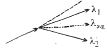
B
C
D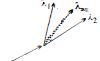
Solution
(B) Dispersive power $(\omega)$ is defined as the ratio of angular dispersion to the mean deviation.
Mathematically, $\omega = \frac{\delta_2 - \delta_1}{\delta_{avg}}$, where $\delta_2$ and $\delta_1$ are the deviations of the extreme wavelengths and $\delta_{avg}$ is the deviation of the mean wavelength.
Visually, the dispersive power is proportional to the angular spread between the extreme rays ($\lambda_1$ and $\lambda_2$) relative to the deviation of the mean ray $(\lambda_{avg})$.
In diagram $B$, the angular separation between the rays corresponding to $\lambda_1$ and $\lambda_2$ is the largest relative to the deviation of the mean ray $\lambda_{avg}$.
Therefore, diagram $B$ represents the case with the maximum dispersive power.
Mathematically, $\omega = \frac{\delta_2 - \delta_1}{\delta_{avg}}$, where $\delta_2$ and $\delta_1$ are the deviations of the extreme wavelengths and $\delta_{avg}$ is the deviation of the mean wavelength.
Visually, the dispersive power is proportional to the angular spread between the extreme rays ($\lambda_1$ and $\lambda_2$) relative to the deviation of the mean ray $(\lambda_{avg})$.
In diagram $B$, the angular separation between the rays corresponding to $\lambda_1$ and $\lambda_2$ is the largest relative to the deviation of the mean ray $\lambda_{avg}$.
Therefore, diagram $B$ represents the case with the maximum dispersive power.
0 likes
View Solution32
MediumMCQ
The angle of a prism is $10^o$. The refractive indices for red and violet colours are $1.51$ and $1.52$ respectively. Find the dispersive power.
A
$1.515$
B
$0.019$
C
$2.5$
D
None
Solution
(B) The dispersive power $\omega$ is given by the formula: $\omega = \frac{\mu_{v} - \mu_{R}}{\mu_{y} - 1}$.
Here,$\mu_{v} = 1.52$ and $\mu_{R} = 1.51$.
The mean refractive index $\mu_{y}$ is calculated as: $\mu_{y} = \frac{\mu_{v} + \mu_{R}}{2} = \frac{1.52 + 1.51}{2} = 1.515$.
Now,substituting these values into the formula for dispersive power:
$\omega = \frac{1.52 - 1.51}{1.515 - 1} = \frac{0.01}{0.515}$.
$\omega \approx 0.0194$.
Rounding to three decimal places,we get $\omega = 0.019$.
Here,$\mu_{v} = 1.52$ and $\mu_{R} = 1.51$.
The mean refractive index $\mu_{y}$ is calculated as: $\mu_{y} = \frac{\mu_{v} + \mu_{R}}{2} = \frac{1.52 + 1.51}{2} = 1.515$.
Now,substituting these values into the formula for dispersive power:
$\omega = \frac{1.52 - 1.51}{1.515 - 1} = \frac{0.01}{0.515}$.
$\omega \approx 0.0194$.
Rounding to three decimal places,we get $\omega = 0.019$.
0 likes
View Solution33
EasyMCQ
The refractive index of flint glass for blue light is $1.6333$ and for red light is $1.6161$. Calculate the dispersive power of the prism,assuming the mean refractive index is approximately the average of the two given values.
A
$0.0276$
B
$0.276$
C
$2.76$
D
$0.106$
Solution
(A) The dispersive power $\omega$ is given by the formula $\omega = \frac{\mu_V - \mu_R}{\mu_y - 1}$.
Given: $\mu_V = 1.6333$ (blue) and $\mu_R = 1.6161$ (red).
The mean refractive index $\mu_y$ is calculated as $\mu_y = \frac{\mu_V + \mu_R}{2} = \frac{1.6333 + 1.6161}{2} = 1.6247$.
Now,substitute the values into the formula:
$\omega = \frac{1.6333 - 1.6161}{1.6247 - 1} = \frac{0.0172}{0.6247} \approx 0.02753$.
Rounding to the nearest provided option,we get $\omega = 0.0276$.
Given: $\mu_V = 1.6333$ (blue) and $\mu_R = 1.6161$ (red).
The mean refractive index $\mu_y$ is calculated as $\mu_y = \frac{\mu_V + \mu_R}{2} = \frac{1.6333 + 1.6161}{2} = 1.6247$.
Now,substitute the values into the formula:
$\omega = \frac{1.6333 - 1.6161}{1.6247 - 1} = \frac{0.0172}{0.6247} \approx 0.02753$.
Rounding to the nearest provided option,we get $\omega = 0.0276$.
0 likes
View Solution34
MediumMCQ
Which of the following curves gives the correct graphical representation between the refractive index $\mu$ of glass and the wavelength $\lambda$ of light?
A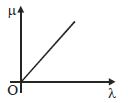
B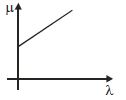
C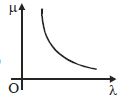
D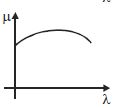
Solution
(C) The relationship between the refractive index $\mu$ and the wavelength $\lambda$ of light is given by Cauchy's dispersion formula,which is approximately $\mu = A + \frac{B}{\lambda^2}$,where $A$ and $B$ are constants.
This equation shows that as the wavelength $\lambda$ increases,the refractive index $\mu$ decreases.
Graphically,this represents a curve that starts at a high value of $\mu$ for small $\lambda$ and decreases as $\lambda$ increases,asymptotically approaching a constant value $A$ as $\lambda \rightarrow \infty$.
Among the given options,the curve in option $C$ represents this inverse relationship correctly.
Therefore,option $C$ is the most suitable.
This equation shows that as the wavelength $\lambda$ increases,the refractive index $\mu$ decreases.
Graphically,this represents a curve that starts at a high value of $\mu$ for small $\lambda$ and decreases as $\lambda$ increases,asymptotically approaching a constant value $A$ as $\lambda \rightarrow \infty$.
Among the given options,the curve in option $C$ represents this inverse relationship correctly.
Therefore,option $C$ is the most suitable.
0 likes
View Solution35
MediumMCQ
Calculate the dispersive power for crown glass from the given data if $\mu_v = 1.5230$ and $\mu_r = 1.5145$.
A
$2$
B
$3$
C
$0.0164$
D
$2.5$
Solution
(C) The dispersive power $\omega$ is defined as the ratio of the angular dispersion to the mean deviation.
It is given by the formula: $\omega = \frac{\mu_v - \mu_r}{\mu_y - 1}$,where $\mu_y \approx \frac{\mu_v + \mu_r}{2}$.
Given: $\mu_v = 1.5230$ and $\mu_r = 1.5145$.
First,calculate the mean refractive index: $\mu_y = \frac{1.5230 + 1.5145}{2} = \frac{3.0375}{2} = 1.51875$.
Now,substitute the values into the formula: $\omega = \frac{1.5230 - 1.5145}{1.51875 - 1} = \frac{0.0085}{0.51875}$.
Calculating the final value: $\omega \approx 0.016385$,which rounds to $0.0164$.
It is given by the formula: $\omega = \frac{\mu_v - \mu_r}{\mu_y - 1}$,where $\mu_y \approx \frac{\mu_v + \mu_r}{2}$.
Given: $\mu_v = 1.5230$ and $\mu_r = 1.5145$.
First,calculate the mean refractive index: $\mu_y = \frac{1.5230 + 1.5145}{2} = \frac{3.0375}{2} = 1.51875$.
Now,substitute the values into the formula: $\omega = \frac{1.5230 - 1.5145}{1.51875 - 1} = \frac{0.0085}{0.51875}$.
Calculating the final value: $\omega \approx 0.016385$,which rounds to $0.0164$.
0 likes
View Solution36
Medium
Let us list some of the factors,which could possibly influence the speed of wave propagation:
$(i)$ nature of the source.
$(ii)$ direction of propagation.
$(iii)$ motion of the source and/or observer.
$(iv)$ wavelength.
$(v)$ intensity of the wave.
On which of these factors,if any,does
$(a)$ the speed of light in vacuum,
$(b)$ the speed of light in a medium (say,glass or water),depend?
$(i)$ nature of the source.
$(ii)$ direction of propagation.
$(iii)$ motion of the source and/or observer.
$(iv)$ wavelength.
$(v)$ intensity of the wave.
On which of these factors,if any,does
$(a)$ the speed of light in vacuum,
$(b)$ the speed of light in a medium (say,glass or water),depend?
Solution
(N/A) The speed of light in a vacuum,i.e.,$3 \times 10^{8} \ m/s$ (approximately),is a universal constant. It is not affected by the motion of the source,the observer,or both. Hence,none of the given factors affect the speed of light in a vacuum.
$(b)$ The speed of light in a medium depends on the wavelength of light in that medium (due to the phenomenon of dispersion).
$(b)$ The speed of light in a medium depends on the wavelength of light in that medium (due to the phenomenon of dispersion).
0 likes
View Solution37
Medium
Explain the dispersion of white light.
Solution
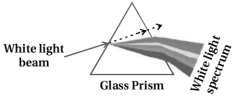
It has been known for a long time that when a narrow beam of sunlight,usually called white light,is incident on a glass prism,the emergent light is seen to consist of several colours.
There is actually a continuous variation of colour,but broadly,the different component colours that appear in sequence are: violet,indigo,blue,green,yellow,orange,and red (given by the acronym $VIBGYOR$).
The red light bends the least,while the violet light bends the most.
The phenomenon of the splitting of light into its component colours is known as dispersion.
The pattern of colour components of light is called the spectrum of light.
There is actually a continuous variation of colour,but broadly,the different component colours that appear in sequence are: violet,indigo,blue,green,yellow,orange,and red (given by the acronym $VIBGYOR$).
The red light bends the least,while the violet light bends the most.
The phenomenon of the splitting of light into its component colours is known as dispersion.
The pattern of colour components of light is called the spectrum of light.
0 likes
View Solution38
Medium
Explain the refractive index for light of different colours.
Solution
(N/A) Each colour is associated with a specific wavelength of light.
In the visible spectrum, red light is at the long-wavelength end $(\sim 700 \, nm)$, while violet light is at the short-wavelength end $(\sim 400 \, nm)$.
Dispersion occurs because the refractive index of a medium is different for different wavelengths (colours).
For example, the bending (deviation) of the red component of white light is the least, while it is the most for the violet component.
Equivalently, red light travels faster than violet light in a glass prism.
The table below provides the refractive indices for different wavelengths for crown glass and flint glass:
In the visible spectrum, red light is at the long-wavelength end $(\sim 700 \, nm)$, while violet light is at the short-wavelength end $(\sim 400 \, nm)$.
Dispersion occurs because the refractive index of a medium is different for different wavelengths (colours).
For example, the bending (deviation) of the red component of white light is the least, while it is the most for the violet component.
Equivalently, red light travels faster than violet light in a glass prism.
The table below provides the refractive indices for different wavelengths for crown glass and flint glass:
| Colour | Wavelength $(nm)$ | Crown glass | Flint glass |
| Violet | $396.9$ | $1.533$ | $1.663$ |
| Blue | $486.1$ | $1.523$ | $1.639$ |
| Yellow | $589.3$ | $1.517$ | $1.627$ |
| Red | $656.3$ | $1.515$ | $1.622$ |
0 likes
View Solution39
Easy
Explain dispersive and non-dispersive medium.
Solution
(N/A) medium is called $dispersive$ if the refractive index of the medium depends on the wavelength of light. In such a medium,different colors (wavelengths) travel at different speeds,causing light to disperse into its constituent colors.
$A$ medium is called $non-dispersive$ if the refractive index of the medium is independent of the wavelength of light. In such a medium,all colors travel at the same speed.
$1$. $Non-dispersive$ medium: Vacuum (or air,approximately) is a $non-dispersive$ medium. This is why sunlight reaches us as white light rather than separated colors.
$2$. $Dispersive$ medium: Glass or water are examples of $dispersive$ media,as they cause the separation of white light into its spectrum (dispersion).
$A$ medium is called $non-dispersive$ if the refractive index of the medium is independent of the wavelength of light. In such a medium,all colors travel at the same speed.
$1$. $Non-dispersive$ medium: Vacuum (or air,approximately) is a $non-dispersive$ medium. This is why sunlight reaches us as white light rather than separated colors.
$2$. $Dispersive$ medium: Glass or water are examples of $dispersive$ media,as they cause the separation of white light into its spectrum (dispersion).
0 likes
View Solution40
EasyMCQ
Mention the constituent colors of white light.
A
Red,Orange,Yellow,Green,Blue,Indigo,Violet
B
Red,Orange,Yellow,Green,Blue,Violet,Indigo
C
Violet,Indigo,Blue,Green,Yellow,Orange,Red
D
Red,Yellow,Green,Blue,Indigo,Violet,Orange
Solution
(C) White light is composed of seven distinct colors,which are collectively known as the spectrum. These colors are arranged in the order of increasing frequency and decreasing wavelength,commonly remembered by the acronym $VIBGYOR$.
The constituent colors are:
$1$. Violet
$2$. Indigo
$3$. Blue
$4$. Green
$5$. Yellow
$6$. Orange
$7$. Red
Therefore,the correct sequence of colors in white light is Violet,Indigo,Blue,Green,Yellow,Orange,and Red.
The constituent colors are:
$1$. Violet
$2$. Indigo
$3$. Blue
$4$. Green
$5$. Yellow
$6$. Orange
$7$. Red
Therefore,the correct sequence of colors in white light is Violet,Indigo,Blue,Green,Yellow,Orange,and Red.
0 likes
View Solution41
EasyMCQ
What is dispersion of light?
A
The bending of light around corners.
B
The splitting of white light into its constituent colors.
C
The change in speed of light in different media.
D
The reflection of light from a smooth surface.
Solution
(B) Dispersion of light is the phenomenon in which white light is split into its constituent colors (spectrum) when it passes through a refractive medium like a glass prism.
This occurs because the refractive index of the material depends on the wavelength of the light.
As a result,different colors travel at different speeds within the medium and bend by different angles,causing them to separate.
This occurs because the refractive index of the material depends on the wavelength of the light.
As a result,different colors travel at different speeds within the medium and bend by different angles,causing them to separate.
0 likes
View Solution42
Medium
What is a dispersive medium?
Solution
(N/A) dispersive medium is a medium in which the phase velocity of a wave depends on its frequency. In the context of optics,a dispersive medium is one where the refractive index $n$ varies with the wavelength $\lambda$ of light. As a result,different colors (wavelengths) of light travel at different speeds through the medium,causing them to refract at different angles. $A$ classic example of a dispersive medium is glass or water,which causes white light to split into its constituent colors (dispersion) when passing through a prism.
0 likes
View Solution43
EasyMCQ
Compare the dispersive powers of two prisms if one of them deviates the blue and red rays through $10^{\circ}$ and $6^{\circ}$ respectively,and the second prism through $8^{\circ}$ and $4.5^{\circ}$.
A
$0.69$
B
$0.79$
C
$0.89$
D
$0.99$
Solution
(C) The dispersive power $\omega$ of a prism is defined as $\omega = \frac{\delta_v - \delta_r}{\delta_y}$,where $\delta_v$ and $\delta_r$ are the deviations of violet (or blue) and red rays,and $\delta_y$ is the mean deviation,given by $\delta_y = \frac{\delta_v + \delta_r}{2}$.
For the first prism: $\delta_v = 10^{\circ}$,$\delta_r = 6^{\circ}$.
$\delta_{y1} = \frac{10^{\circ} + 6^{\circ}}{2} = 8^{\circ}$.
$\omega_1 = \frac{10^{\circ} - 6^{\circ}}{8^{\circ}} = \frac{4}{8} = 0.5$.
For the second prism: $\delta_v = 8^{\circ}$,$\delta_r = 4.5^{\circ}$.
$\delta_{y2} = \frac{8^{\circ} + 4.5^{\circ}}{2} = 6.25^{\circ}$.
$\omega_2 = \frac{8^{\circ} - 4.5^{\circ}}{6.25^{\circ}} = \frac{3.5}{6.25} = 0.56$.
The ratio of dispersive powers is $\frac{\omega_1}{\omega_2} = \frac{0.5}{0.56} \approx 0.89$.
For the first prism: $\delta_v = 10^{\circ}$,$\delta_r = 6^{\circ}$.
$\delta_{y1} = \frac{10^{\circ} + 6^{\circ}}{2} = 8^{\circ}$.
$\omega_1 = \frac{10^{\circ} - 6^{\circ}}{8^{\circ}} = \frac{4}{8} = 0.5$.
For the second prism: $\delta_v = 8^{\circ}$,$\delta_r = 4.5^{\circ}$.
$\delta_{y2} = \frac{8^{\circ} + 4.5^{\circ}}{2} = 6.25^{\circ}$.
$\omega_2 = \frac{8^{\circ} - 4.5^{\circ}}{6.25^{\circ}} = \frac{3.5}{6.25} = 0.56$.
The ratio of dispersive powers is $\frac{\omega_1}{\omega_2} = \frac{0.5}{0.56} \approx 0.89$.
0 likes
View Solution44
EasyMCQ
The property of light that explains the formation of coloured images due to thick lenses is
A
Refraction
B
Dispersion
C
Reflection
D
Total internal reflection
Solution
(B) When light passes through a thick lens,it behaves similarly to a prism.
Different wavelengths (colors) of light travel at different speeds within the lens material,leading to different refractive indices for each color.
This phenomenon,where white light splits into its constituent colors due to the variation of refractive index with wavelength,is known as dispersion.
Consequently,the lens focuses different colors at slightly different points,resulting in colored fringes or blurred images,a defect known as chromatic aberration.
Therefore,the formation of colored images due to thick lenses is explained by the property of dispersion.
Different wavelengths (colors) of light travel at different speeds within the lens material,leading to different refractive indices for each color.
This phenomenon,where white light splits into its constituent colors due to the variation of refractive index with wavelength,is known as dispersion.
Consequently,the lens focuses different colors at slightly different points,resulting in colored fringes or blurred images,a defect known as chromatic aberration.
Therefore,the formation of colored images due to thick lenses is explained by the property of dispersion.
0 likes
View Solution45
EasyMCQ
Which of the following statements is incorrect?
A
Dispersion is maximum for violet colour.
B
Red light travels faster than violet light in a medium.
C
In vacuum,red light travels faster than others.
D
Refractive index of violet light is higher in flint glass as compared to crown glass.
Solution
(C) In a vacuum,all electromagnetic waves,regardless of their frequency or wavelength,travel at the same speed,which is $c \approx 3 \times 10^8 \ m/s$.
Therefore,the statement that red light travels faster than other colours in a vacuum is incorrect,as all colours of white light travel at the same speed in a vacuum.
Option $A$ is correct because violet light has the shortest wavelength and experiences the most deviation.
Option $B$ is correct because the refractive index for red light is lower than that for violet light in any material medium,implying $v = c/n$ is higher for red light.
Option $D$ is correct because flint glass has a higher dispersive power and generally higher refractive indices than crown glass.
Therefore,the statement that red light travels faster than other colours in a vacuum is incorrect,as all colours of white light travel at the same speed in a vacuum.
Option $A$ is correct because violet light has the shortest wavelength and experiences the most deviation.
Option $B$ is correct because the refractive index for red light is lower than that for violet light in any material medium,implying $v = c/n$ is higher for red light.
Option $D$ is correct because flint glass has a higher dispersive power and generally higher refractive indices than crown glass.
0 likes
View Solution46
EasyMCQ
Dispersive power depends on the following:
A
material of the prism
B
shape of the prism
C
size of the prism
D
size,shape and material of the prism
Solution
(A) The dispersive power $(\omega)$ of a prism is defined as the ratio of the angular dispersion $(\delta_v - \delta_r)$ to the mean deviation $(\delta_y)$.
Mathematically, $\omega = \frac{\delta_v - \delta_r}{\delta_y} = \frac{(\mu_v - 1)A - (\mu_r - 1)A}{(\mu_y - 1)A} = \frac{\mu_v - \mu_r}{\mu_y - 1}$.
From this formula, it is clear that the dispersive power depends only on the refractive indices $(\mu_v, \mu_r, \mu_y)$ of the material of the prism for different colors.
It is independent of the angle of the prism $(A)$, the shape, or the size of the prism.
Therefore, the correct option is $A$.
Mathematically, $\omega = \frac{\delta_v - \delta_r}{\delta_y} = \frac{(\mu_v - 1)A - (\mu_r - 1)A}{(\mu_y - 1)A} = \frac{\mu_v - \mu_r}{\mu_y - 1}$.
From this formula, it is clear that the dispersive power depends only on the refractive indices $(\mu_v, \mu_r, \mu_y)$ of the material of the prism for different colors.
It is independent of the angle of the prism $(A)$, the shape, or the size of the prism.
Therefore, the correct option is $A$.
0 likes
View SolutionRay Optics and Optical Instruments — Dispersion of Light · Frequently Asked Questions
1Are these Ray Optics and Optical Instruments questions useful for JEE and NEET?
Yes. All questions in this section are mapped to JEE Main and NEET exam patterns. Previous year questions from JEE Main, NEET, GUJCET and state-level exams are included with full solutions.
2Can I switch to Hindi or Gujarati for these questions?
Yes. Use the language tabs in the hero section or the sidebar to view the same questions and solutions in English, Hindi or Gujarati.
3How do I generate a question paper from this subtopic?
Use the Vedclass Exam Paper Generator — select the chapter and subtopic, set difficulty, and generate Sets A, B, C, D automatically. First 3 chapters of every subject are free.
Vedclass Products
For Students
Vedclass Test Series
Mock tests in real JEE/NEET style with performance analysis. 5-day free trial.
Start Free TrialFor Teachers
Exam Paper Generator
Generate Set A/B/C/D papers from this chapter in 2 minutes. 3 chapters free.
Try FreeFor Institutes
Online Exam Module
Live online exams with unlimited students, 360° analytics & white-label branding.
See DemoFor Teachers & Institutes
Generate a Ray Optics and Optical Instruments Exam Paper in 2 Minutes
Select subtopic & difficulty — Sets A, B, C, D auto-generated with No Repeat logic.
First 3 chapters of every subject are free — no payment required.