
A English
Spherical Mirror Questions in English
Class 12 Physics · Ray Optics and Optical Instruments · Spherical Mirror
233+
Questions
English
Language
100%
With Solutions
Showing 50 of 233 questions in English
1
EasyMCQ
$A$ man having height $6 \ m$ observes an erect image of height $2 \ m$. The mirror used is:
A
Concave
B
Convex
C
Plane
D
None of these
Solution
(B) The magnification $m$ is given by the ratio of the height of the image $(h_i)$ to the height of the object $(h_o)$.
Here,$h_i = 2 \ m$ and $h_o = 6 \ m$.
Magnification $m = \frac{h_i}{h_o} = \frac{2}{6} = \frac{1}{3}$.
Since the image is erect and diminished $(|m| < 1)$,the mirror must be a convex mirror. $A$ plane mirror always produces an image of the same size as the object,and a concave mirror produces a diminished erect image only when the object is placed between the pole and the focus,but it is not the standard case for general observation.
Here,$h_i = 2 \ m$ and $h_o = 6 \ m$.
Magnification $m = \frac{h_i}{h_o} = \frac{2}{6} = \frac{1}{3}$.
Since the image is erect and diminished $(|m| < 1)$,the mirror must be a convex mirror. $A$ plane mirror always produces an image of the same size as the object,and a concave mirror produces a diminished erect image only when the object is placed between the pole and the focus,but it is not the standard case for general observation.
0 likes
View Solution2
EasyMCQ
$A$ diminished virtual image can be formed only in
A
Plane mirror
B
$A$ concave mirror
C
$A$ convex mirror
D
Concave-parabolic mirror
Solution
(C) convex mirror always forms a virtual,erect,and diminished image for all positions of the object placed in front of it. $A$ plane mirror always forms an image of the same size as the object. $A$ concave mirror can form a virtual image,but it is always magnified. Therefore,the correct option is $C$.
0 likes
View Solution3
EasyMCQ
An object $5 \ cm$ tall is placed $1 \ m$ from a concave spherical mirror which has a radius of curvature of $20 \ cm$. The size of the image is $...... \ cm$.
A
$0.11$
B
$0.50$
C
$0.55$
D
$0.60$
Solution
(C) Given: Object height $O = 5 \ cm$,Object distance $u = -100 \ cm$,Radius of curvature $R = -20 \ cm$.
Focal length $f = R/2 = -10 \ cm$.
Using the mirror formula: $\frac{1}{v} + \frac{1}{u} = \frac{1}{f}$.
$\frac{1}{v} + \frac{1}{-100} = \frac{1}{-10} \Rightarrow \frac{1}{v} = -\frac{1}{10} + \frac{1}{100} = \frac{-10+1}{100} = -\frac{9}{100}$.
So,$v = -\frac{100}{9} \ cm$.
Magnification $m = \frac{I}{O} = -\frac{v}{u}$.
$I = O \times (-\frac{v}{u}) = 5 \times (-\frac{-100/9}{-100}) = 5 \times (-\frac{1}{9}) = -\frac{5}{9} \approx -0.55 \ cm$.
The size of the image is $0.55 \ cm$.
Focal length $f = R/2 = -10 \ cm$.
Using the mirror formula: $\frac{1}{v} + \frac{1}{u} = \frac{1}{f}$.
$\frac{1}{v} + \frac{1}{-100} = \frac{1}{-10} \Rightarrow \frac{1}{v} = -\frac{1}{10} + \frac{1}{100} = \frac{-10+1}{100} = -\frac{9}{100}$.
So,$v = -\frac{100}{9} \ cm$.
Magnification $m = \frac{I}{O} = -\frac{v}{u}$.
$I = O \times (-\frac{v}{u}) = 5 \times (-\frac{-100/9}{-100}) = 5 \times (-\frac{1}{9}) = -\frac{5}{9} \approx -0.55 \ cm$.
The size of the image is $0.55 \ cm$.
0 likes
View Solution4
MediumMCQ
The focal length of a concave mirror is $50 \, cm$. Where should an object be placed so that its image is two times magnified and inverted?
A
$75$
B
$72$
C
$63$
D
$50$
Solution
(A) For a concave mirror,the focal length $f = -50 \, cm$.
Since the image is inverted and magnified,it must be a real image.
For a real image,the magnification $m = -2$.
Using the magnification formula $m = \frac{f}{f - u}$:
$-2 = \frac{-50}{-50 - u}$
$-2(-50 - u) = -50$
$100 + 2u = -50$
$2u = -150$
$u = -75 \, cm$.
Thus,the object should be placed at a distance of $75 \, cm$ in front of the mirror.
Since the image is inverted and magnified,it must be a real image.
For a real image,the magnification $m = -2$.
Using the magnification formula $m = \frac{f}{f - u}$:
$-2 = \frac{-50}{-50 - u}$
$-2(-50 - u) = -50$
$100 + 2u = -50$
$2u = -150$
$u = -75 \, cm$.
Thus,the object should be placed at a distance of $75 \, cm$ in front of the mirror.
0 likes
View Solution5
MediumMCQ
An object of size $7.5 \ cm$ is placed in front of a convex mirror of radius of curvature $25 \ cm$ at a distance of $40 \ cm$. The size of the image should be ........ $cm$.
A
$2.3$
B
$1.78$
C
$1$
D
$0.8$
Solution
(B) Given: Object size $O = 7.5 \ cm$,Radius of curvature $R = 25 \ cm$,Object distance $u = -40 \ cm$.
For a convex mirror,the focal length $f = R/2 = 25/2 = 12.5 \ cm$.
Using the magnification formula for a mirror: $m = \frac{I}{O} = -\frac{v}{u}$.
Also,from the mirror formula $\frac{1}{v} + \frac{1}{u} = \frac{1}{f}$,we have $v = \frac{uf}{f - u}$.
Substituting $v$ into the magnification formula: $\frac{I}{O} = -\left(\frac{uf}{f - u}\right) \cdot \frac{1}{u} = \frac{f}{f - u}$.
Substituting the values: $\frac{I}{7.5} = \frac{12.5}{12.5 - (-40)} = \frac{12.5}{52.5}$.
$I = 7.5 \times \frac{12.5}{52.5} = 7.5 \times \frac{1}{4.2} \approx 1.78 \ cm$.
For a convex mirror,the focal length $f = R/2 = 25/2 = 12.5 \ cm$.
Using the magnification formula for a mirror: $m = \frac{I}{O} = -\frac{v}{u}$.
Also,from the mirror formula $\frac{1}{v} + \frac{1}{u} = \frac{1}{f}$,we have $v = \frac{uf}{f - u}$.
Substituting $v$ into the magnification formula: $\frac{I}{O} = -\left(\frac{uf}{f - u}\right) \cdot \frac{1}{u} = \frac{f}{f - u}$.
Substituting the values: $\frac{I}{7.5} = \frac{12.5}{12.5 - (-40)} = \frac{12.5}{52.5}$.
$I = 7.5 \times \frac{12.5}{52.5} = 7.5 \times \frac{1}{4.2} \approx 1.78 \ cm$.
0 likes
View Solution6
EasyMCQ
The field of view is maximum for
A
Plane mirror
B
Concave mirror
C
Convex mirror
D
Cylindrical mirror
Solution
(C) convex mirror is a spherical mirror that curves outward.
Because of its outward curvature,it diverges the incident rays of light.
This divergence allows the mirror to capture light from a much wider area compared to plane or concave mirrors of the same size.
Consequently,the field of view is maximum for a convex mirror.
Because of its outward curvature,it diverges the incident rays of light.
This divergence allows the mirror to capture light from a much wider area compared to plane or concave mirrors of the same size.
Consequently,the field of view is maximum for a convex mirror.
0 likes
View Solution7
MediumMCQ
The focal length of a concave mirror is $f$ and the distance from the object to the principal focus is $x$. The ratio of the size of the image to the size of the object is
A
$\frac{f + x}{f}$
B
$\frac{f}{x}$
C
$\sqrt{\frac{f}{x}}$
D
$\frac{f^2}{x^2}$
Solution
(B) For a concave mirror,the magnification $m$ is given by $m = \frac{I}{O} = \frac{f}{f - u}$.
Here,$u$ is the object distance from the pole. The distance of the object from the principal focus is $x$.
Since the object is placed in front of the mirror,the distance from the pole is $u = -(f + x)$.
Substituting this into the magnification formula:
$m = \frac{f}{f - (-(f + x))} = \frac{f}{f + f + x} = \frac{f}{2f + x}$.
However,using Newton's form of the mirror equation,$x_1 x_2 = f^2$,where $x_1$ and $x_2$ are distances of object and image from the focus respectively.
Here $x_1 = x$. So,$x_2 = \frac{f^2}{x}$.
The magnification $m = \frac{f}{x_1} = \frac{f}{x}$ (magnitude).
Thus,the ratio of the size of the image to the size of the object is $\frac{f}{x}$.
Here,$u$ is the object distance from the pole. The distance of the object from the principal focus is $x$.
Since the object is placed in front of the mirror,the distance from the pole is $u = -(f + x)$.
Substituting this into the magnification formula:
$m = \frac{f}{f - (-(f + x))} = \frac{f}{f + f + x} = \frac{f}{2f + x}$.
However,using Newton's form of the mirror equation,$x_1 x_2 = f^2$,where $x_1$ and $x_2$ are distances of object and image from the focus respectively.
Here $x_1 = x$. So,$x_2 = \frac{f^2}{x}$.
The magnification $m = \frac{f}{x_1} = \frac{f}{x}$ (magnitude).
Thus,the ratio of the size of the image to the size of the object is $\frac{f}{x}$.
0 likes
View Solution8
EasyMCQ
The image formed by a convex mirror is always:
A
Virtual
B
Real
C
Enlarged
D
Inverted
Solution
(A) convex mirror always forms a virtual,erect,and diminished image for any real object placed in front of it.
Since the reflected rays appear to diverge from a point behind the mirror,the image is virtual.
Since the reflected rays appear to diverge from a point behind the mirror,the image is virtual.
0 likes
View Solution9
MediumMCQ
In a concave mirror experiment,an object is placed at a distance ${x_1}$ from the focus and the image is formed at a distance ${x_2}$ from the focus. The focal length of the mirror would be
A
${x_1}{x_2}$
B
$\sqrt {{x_1}{x_2}} $
C
$\frac{{{x_1} + {x_2}}}{2}$
D
$\sqrt {\frac{{{x_1}}}{{{x_2}}}} $
Solution
(B) According to Newton's formula for mirrors,when distances are measured from the focus,the relationship is given by $x_1 x_2 = f^2$,where $x_1$ is the distance of the object from the focus and $x_2$ is the distance of the image from the focus.
Alternatively,using the mirror formula $\frac{1}{v} + \frac{1}{u} = \frac{1}{f}$:
Let the object distance be $u = -(f + x_1)$ and the image distance be $v = -(f + x_2)$.
Substituting these into the mirror formula:
$\frac{1}{-(f + x_2)} + \frac{1}{-(f + x_1)} = -\frac{1}{f}$
$\frac{1}{f + x_2} + \frac{1}{f + x_1} = \frac{1}{f}$
$\frac{(f + x_1) + (f + x_2)}{(f + x_1)(f + x_2)} = \frac{1}{f}$
$f(2f + x_1 + x_2) = (f + x_1)(f + x_2)$
$2f^2 + f x_1 + f x_2 = f^2 + f x_1 + f x_2 + x_1 x_2$
$f^2 = x_1 x_2$
$f = \sqrt{x_1 x_2}$
Alternatively,using the mirror formula $\frac{1}{v} + \frac{1}{u} = \frac{1}{f}$:
Let the object distance be $u = -(f + x_1)$ and the image distance be $v = -(f + x_2)$.
Substituting these into the mirror formula:
$\frac{1}{-(f + x_2)} + \frac{1}{-(f + x_1)} = -\frac{1}{f}$
$\frac{1}{f + x_2} + \frac{1}{f + x_1} = \frac{1}{f}$
$\frac{(f + x_1) + (f + x_2)}{(f + x_1)(f + x_2)} = \frac{1}{f}$
$f(2f + x_1 + x_2) = (f + x_1)(f + x_2)$
$2f^2 + f x_1 + f x_2 = f^2 + f x_1 + f x_2 + x_1 x_2$
$f^2 = x_1 x_2$
$f = \sqrt{x_1 x_2}$
0 likes
View Solution10
EasyMCQ
$A$ convex mirror is used to form the image of an object. Then which of the following statements is wrong?
A
The image lies between the pole and the focus.
B
The image is diminished in size.
C
The image is erect.
D
The image is real.
Solution
(D) convex mirror always forms a virtual,erect,and diminished image for any real object placed in front of it. The image is always formed between the pole $(P)$ and the focus $(F)$ behind the mirror. Therefore,the statement that the image is real is incorrect.
0 likes
View Solution11
EasyMCQ
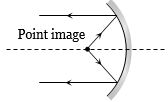
Given a point source of light,which of the following can produce a parallel beam of light?
A
Convex mirror
B
Concave mirror
C
Concave lens
D
Two plane mirrors inclined at an angle of $90^\circ$
Solution
(B) When a point source of light is placed at the principal focus $(F)$ of a concave mirror,the light rays originating from the source strike the mirror and are reflected parallel to the principal axis.
This is because,according to the laws of reflection,any ray passing through the focus of a concave mirror becomes parallel to the principal axis after reflection.
Therefore,a concave mirror can produce a parallel beam of light from a point source.
This is because,according to the laws of reflection,any ray passing through the focus of a concave mirror becomes parallel to the principal axis after reflection.
Therefore,a concave mirror can produce a parallel beam of light from a point source.
0 likes
View Solution12
MediumMCQ
The image formed by a convex mirror of focal length $30 \ cm$ is a quarter of the size of the object. The distance of the object from the mirror is......$cm$
A
$30$
B
$90$
C
$120$
D
$60$
Solution
(B) For a convex mirror,the focal length $f$ is positive,so $f = +30 \ cm$.
The magnification $m$ for a virtual and erect image formed by a convex mirror is positive. Given that the image size is a quarter of the object size,$m = +\frac{1}{4}$.
The formula for magnification in terms of focal length and object distance $u$ is $m = \frac{f}{f - u}$.
Substituting the values: $\frac{1}{4} = \frac{30}{30 - u}$.
Cross-multiplying gives: $30 - u = 120$.
Solving for $u$: $u = 30 - 120 = -90 \ cm$.
The negative sign indicates that the object is placed in front of the mirror at a distance of $90 \ cm$.
The magnification $m$ for a virtual and erect image formed by a convex mirror is positive. Given that the image size is a quarter of the object size,$m = +\frac{1}{4}$.
The formula for magnification in terms of focal length and object distance $u$ is $m = \frac{f}{f - u}$.
Substituting the values: $\frac{1}{4} = \frac{30}{30 - u}$.
Cross-multiplying gives: $30 - u = 120$.
Solving for $u$: $u = 30 - 120 = -90 \ cm$.
The negative sign indicates that the object is placed in front of the mirror at a distance of $90 \ cm$.
0 likes
View Solution13
EasyMCQ
$A$ boy stands straight in front of a mirror at a distance of $30 \ cm$ away from it. He sees his erect image whose height is $\frac{1}{5}$ of his real height. The mirror he is using is
A
Plane mirror
B
Convex mirror
C
Concave mirror
D
Plano-convex mirror
Solution
(B) The magnification $m$ is given by the ratio of the height of the image to the height of the object,which is $m = \frac{h_i}{h_o} = \frac{1}{5}$.
Since the image is erect,the magnification is positive $(m = +0.2)$.
$A$ plane mirror always produces an image of the same size $(m = 1)$,so it is not a plane mirror.
$A$ concave mirror can produce an erect image only when the object is placed between the pole and the focus,but in that case,the image is always magnified $(m > 1)$.
$A$ convex mirror always forms a virtual,erect,and diminished image for all positions of the object.
Therefore,the mirror must be a convex mirror.
Since the image is erect,the magnification is positive $(m = +0.2)$.
$A$ plane mirror always produces an image of the same size $(m = 1)$,so it is not a plane mirror.
$A$ concave mirror can produce an erect image only when the object is placed between the pole and the focus,but in that case,the image is always magnified $(m > 1)$.
$A$ convex mirror always forms a virtual,erect,and diminished image for all positions of the object.
Therefore,the mirror must be a convex mirror.
0 likes
View Solution14
EasyMCQ
$A$ person sees his virtual image by holding a mirror very close to the face. When he moves the mirror away from his face,the image becomes inverted. What type of mirror is he using?
A
Plane mirror
B
Convex mirror
C
Concave mirror
D
None of these
Solution
(C) plane mirror always forms a virtual and erect image regardless of the distance.
$A$ convex mirror also always forms a virtual and erect image for all positions of the object.
$A$ concave mirror forms a virtual and erect image when the object is placed between the pole $(P)$ and the focus $(F)$. As the object moves beyond the focus $(F)$,the image becomes real and inverted.
Since the image changes from virtual to inverted as the mirror is moved away,the mirror must be a concave mirror.
$A$ convex mirror also always forms a virtual and erect image for all positions of the object.
$A$ concave mirror forms a virtual and erect image when the object is placed between the pole $(P)$ and the focus $(F)$. As the object moves beyond the focus $(F)$,the image becomes real and inverted.
Since the image changes from virtual to inverted as the mirror is moved away,the mirror must be a concave mirror.
0 likes
View Solution15
MediumMCQ
The relation between the linear magnification $m$,the object distance $u$,and the focal length $f$ is:
A
$m = \frac{f - u}{f}$
B
$m = \frac{f}{f - u}$
C
$m = \frac{f + u}{f}$
D
$m = \frac{f}{f + u}$
Solution
(B) The linear magnification $m$ for a spherical mirror is given by $m = -\frac{v}{u}$.
From the mirror formula,we have $\frac{1}{f} = \frac{1}{v} + \frac{1}{u}$.
Multiplying both sides by $u$,we get $\frac{u}{f} = \frac{u}{v} + 1$.
Rearranging the terms,we get $\frac{u}{v} = \frac{u}{f} - 1 = \frac{u - f}{f}$.
Taking the reciprocal,we get $\frac{v}{u} = \frac{f}{u - f}$.
Since $m = -\frac{v}{u}$,we have $m = -\frac{f}{u - f} = \frac{f}{f - u}$.
Therefore,the correct relation is $m = \frac{f}{f - u}$.
From the mirror formula,we have $\frac{1}{f} = \frac{1}{v} + \frac{1}{u}$.
Multiplying both sides by $u$,we get $\frac{u}{f} = \frac{u}{v} + 1$.
Rearranging the terms,we get $\frac{u}{v} = \frac{u}{f} - 1 = \frac{u - f}{f}$.
Taking the reciprocal,we get $\frac{v}{u} = \frac{f}{u - f}$.
Since $m = -\frac{v}{u}$,we have $m = -\frac{f}{u - f} = \frac{f}{f - u}$.
Therefore,the correct relation is $m = \frac{f}{f - u}$.
0 likes
View Solution16
EasyMCQ
While using an electric bulb for street lighting, the reflector should be a:
A
Concave mirror
B
Convex mirror
C
Cylindrical mirror
D
Parabolic mirror
Solution
(B) For street lighting, the goal is to spread the light over a wide area. A $Convex$ mirror is a diverging mirror, which spreads the light rays falling on it. Therefore, it is used as a reflector in street lamps to ensure the light covers a larger region on the road.
0 likes
View Solution17
MediumMCQ
$A$ concave mirror is used to focus the image of a flower on a nearby wall $120 \ cm$ from the flower. If a lateral magnification of $16$ is desired,the distance of the flower from the mirror should be $... \ cm$.
A
$8$
B
$12$
C
$80$
D
$120$
Solution
(A) Let the distance of the flower from the mirror be $u$. Since the image is formed on a wall,the image is real,so the magnification $m = -16$.
By definition,magnification $m = -\frac{v}{u}$. Thus,$-\frac{v}{u} = -16$,which gives $v = 16u$.
The distance between the object (flower) and the image (wall) is given as $120 \ cm$. Since the image is real and formed by a concave mirror,the image is formed on the same side as the object. The distance between them is $|v - u| = 120$.
Substituting $v = 16u$,we get $|16u - u| = 120$,which simplifies to $15u = 120$.
Therefore,$u = \frac{120}{15} = 8 \ cm$.
By definition,magnification $m = -\frac{v}{u}$. Thus,$-\frac{v}{u} = -16$,which gives $v = 16u$.
The distance between the object (flower) and the image (wall) is given as $120 \ cm$. Since the image is real and formed by a concave mirror,the image is formed on the same side as the object. The distance between them is $|v - u| = 120$.
Substituting $v = 16u$,we get $|16u - u| = 120$,which simplifies to $15u = 120$.
Therefore,$u = \frac{120}{15} = 8 \ cm$.
0 likes
View Solution18
EasyMCQ
$A$ virtual image larger than the object can be obtained by
A
Concave mirror
B
Convex mirror
C
Plane mirror
D
Concave lens
Solution
(A) concave mirror forms a virtual,erect,and magnified (larger than the object) image when the object is placed between the pole $(P)$ and the principal focus $(F)$ of the mirror.
In contrast,a convex mirror and a concave lens always form virtual images that are smaller than the object.
$A$ plane mirror always forms a virtual image that is equal in size to the object.
Therefore,the correct option is $A$.
In contrast,a convex mirror and a concave lens always form virtual images that are smaller than the object.
$A$ plane mirror always forms a virtual image that is equal in size to the object.
Therefore,the correct option is $A$.
0 likes
View Solution19
EasyMCQ
An object is placed $40\;cm$ from a concave mirror of focal length $20\;cm.$ The image formed is
A
Real,inverted and same in size
B
Real,inverted and smaller
C
Virtual,erect and larger
D
Virtual,erect and smaller
Solution
(A) Given: Focal length of the concave mirror $f = -20\;cm$. Object distance $u = -40\;cm$.
Since the object is placed at a distance of $40\;cm$ from the mirror,and the radius of curvature $R = 2f = 2 \times 20 = 40\;cm$,the object is placed at the centre of curvature $(C)$.
According to the rules of image formation by a concave mirror,when an object is placed at the centre of curvature,the image is formed at the same position.
The image formed is real,inverted,and of the same size as the object.
Since the object is placed at a distance of $40\;cm$ from the mirror,and the radius of curvature $R = 2f = 2 \times 20 = 40\;cm$,the object is placed at the centre of curvature $(C)$.
According to the rules of image formation by a concave mirror,when an object is placed at the centre of curvature,the image is formed at the same position.
The image formed is real,inverted,and of the same size as the object.
0 likes
View Solution20
MediumMCQ
$A$ virtual image three times the size of the object is obtained with a concave mirror of radius of curvature $36 \ cm$. The distance of the object from the mirror is ........ $cm$.
A
$5$
B
$12$
C
$10$
D
$20$
Solution
(B) For a concave mirror,the radius of curvature $R = -36 \ cm$ (by sign convention).
Therefore,the focal length $f = R/2 = -18 \ cm$.
Since the image is virtual and magnified three times,the magnification $m = +3$.
The formula for magnification in terms of focal length and object distance $u$ is $m = f / (f - u)$.
Substituting the values: $3 = -18 / (-18 - u)$.
Multiplying both sides: $3(-18 - u) = -18$.
$-54 - 3u = -18$.
$-3u = 54 - 18 = 36$.
$u = -12 \ cm$.
The distance of the object from the mirror is $12 \ cm$.
Therefore,the focal length $f = R/2 = -18 \ cm$.
Since the image is virtual and magnified three times,the magnification $m = +3$.
The formula for magnification in terms of focal length and object distance $u$ is $m = f / (f - u)$.
Substituting the values: $3 = -18 / (-18 - u)$.
Multiplying both sides: $3(-18 - u) = -18$.
$-54 - 3u = -18$.
$-3u = 54 - 18 = 36$.
$u = -12 \ cm$.
The distance of the object from the mirror is $12 \ cm$.
0 likes
View Solution21
MediumMCQ
The radius of curvature of a concave mirror is $40 \ cm$ and the size of the image is twice that of the object. The object distance is $... \ cm$.
A
$60$
B
$20$
C
$40$
D
$30$
Solution
(D) Given: Radius of curvature $R = -40 \ cm$ (for concave mirror),so focal length $f = R/2 = -20 \ cm$. Magnification $m = \pm 2$.
Case $1$: For a real image,$m = -2$.
Using the formula $m = f / (f - u)$:
$-2 = -20 / (-20 - u)$
$-2(-20 - u) = -20$
$40 + 2u = -20$
$2u = -60 \Rightarrow u = -30 \ cm$.
Case $2$: For a virtual image,$m = +2$.
Using the formula $m = f / (f - u)$:
$2 = -20 / (-20 - u)$
$2(-20 - u) = -20$
$-40 - 2u = -20$
$-2u = 20 \Rightarrow u = -10 \ cm$.
Since $30 \ cm$ is the only option provided that matches the real image case,the correct answer is $30 \ cm$.
Case $1$: For a real image,$m = -2$.
Using the formula $m = f / (f - u)$:
$-2 = -20 / (-20 - u)$
$-2(-20 - u) = -20$
$40 + 2u = -20$
$2u = -60 \Rightarrow u = -30 \ cm$.
Case $2$: For a virtual image,$m = +2$.
Using the formula $m = f / (f - u)$:
$2 = -20 / (-20 - u)$
$2(-20 - u) = -20$
$-40 - 2u = -20$
$-2u = 20 \Rightarrow u = -10 \ cm$.
Since $30 \ cm$ is the only option provided that matches the real image case,the correct answer is $30 \ cm$.
0 likes
View Solution22
MediumMCQ
All of the following statements are correct except:
A
The magnification produced by a convex mirror is always less than one.
B
$A$ virtual,erect,same-sized image can be obtained using a plane mirror.
C
$A$ virtual,erect,magnified image can be formed using a concave mirror.
D
$A$ real,inverted,same-sized image can be formed using a convex mirror.
Solution
(D) convex mirror always forms a virtual,erect,and diminished (smaller) image for any real object placed in front of it.
Therefore,the statement that a real,inverted,same-sized image can be formed using a convex mirror is incorrect.
Thus,the correct option is $D$.
Therefore,the statement that a real,inverted,same-sized image can be formed using a convex mirror is incorrect.
Thus,the correct option is $D$.
0 likes
View Solution23
EasyMCQ
If an object is placed $10 \ cm$ in front of a concave mirror of focal length $20 \ cm,$ the image will be
A
Diminished,upright,virtual
B
Enlarged,upright,virtual
C
Diminished,inverted,real
D
Enlarged,upright,real
Solution
(B) Given: Focal length $f = -20 \ cm$ (for a concave mirror),Object distance $u = -10 \ cm$.
Using the mirror formula: $\frac{1}{f} = \frac{1}{v} + \frac{1}{u}$.
Substituting the values: $\frac{1}{-20} = \frac{1}{v} + \frac{1}{-10}$.
$\frac{1}{v} = \frac{1}{10} - \frac{1}{20} = \frac{2-1}{20} = \frac{1}{20}$.
So,$v = +20 \ cm$.
The positive sign of $v$ indicates that the image is formed behind the mirror,which means it is virtual.
The magnification $m = -\frac{v}{u} = -\frac{20}{-10} = +2$.
Since $m$ is positive,the image is upright. Since $|m| > 1$,the image is enlarged.
Therefore,the image is enlarged,upright,and virtual.
Using the mirror formula: $\frac{1}{f} = \frac{1}{v} + \frac{1}{u}$.
Substituting the values: $\frac{1}{-20} = \frac{1}{v} + \frac{1}{-10}$.
$\frac{1}{v} = \frac{1}{10} - \frac{1}{20} = \frac{2-1}{20} = \frac{1}{20}$.
So,$v = +20 \ cm$.
The positive sign of $v$ indicates that the image is formed behind the mirror,which means it is virtual.
The magnification $m = -\frac{v}{u} = -\frac{20}{-10} = +2$.
Since $m$ is positive,the image is upright. Since $|m| > 1$,the image is enlarged.
Therefore,the image is enlarged,upright,and virtual.
0 likes
View Solution24
MediumMCQ
$A$ convex mirror has a focal length $f$. $A$ real object is placed at a distance $f$ in front of it from the pole. The image is produced at:
A
Infinity
B
$f$
C
$f/2$
D
$2f$
Solution
(C) For a convex mirror,the focal length is taken as positive,so $f_{mirror} = +f$.
Since the object is placed in front of the mirror,the object distance is $u = -f$.
Using the mirror formula: $\frac{1}{f_{mirror}} = \frac{1}{v} + \frac{1}{u}$.
Substituting the values: $\frac{1}{f} = \frac{1}{v} + \frac{1}{-f}$.
Rearranging the terms: $\frac{1}{v} = \frac{1}{f} + \frac{1}{f} = \frac{2}{f}$.
Therefore,the image distance is $v = f/2$.
Since the object is placed in front of the mirror,the object distance is $u = -f$.
Using the mirror formula: $\frac{1}{f_{mirror}} = \frac{1}{v} + \frac{1}{u}$.
Substituting the values: $\frac{1}{f} = \frac{1}{v} + \frac{1}{-f}$.
Rearranging the terms: $\frac{1}{v} = \frac{1}{f} + \frac{1}{f} = \frac{2}{f}$.
Therefore,the image distance is $v = f/2$.
0 likes
View Solution25
EasyMCQ
The minimum distance between the object and its real image for a concave mirror is
A
$f$
B
$2f$
C
$4f$
D
$Zero$
Solution
(D) For a concave mirror,a real image is formed when the object is placed at a distance greater than the focal length $f$ from the mirror.
When the object is placed at the centre of curvature $(u = 2f)$,the image is also formed at the centre of curvature $(v = 2f)$.
In this specific case,the object and the image coincide at the same point.
Therefore,the distance between the object and its real image is $Zero$.
When the object is placed at the centre of curvature $(u = 2f)$,the image is also formed at the centre of curvature $(v = 2f)$.
In this specific case,the object and the image coincide at the same point.
Therefore,the distance between the object and its real image is $Zero$.
0 likes
View Solution26
MediumMCQ
An object is placed at $20 \, cm$ from a convex mirror of focal length $10 \, cm$. The image formed by the mirror is
A
Real and at $20 \, cm$ from the mirror
B
Virtual and at $20 \, cm$ from the mirror
C
Virtual and at $\frac{20}{3} \, cm$ from the mirror
D
Real and at $\frac{20}{3} \, cm$ from the mirror
Solution
(C) Given: Object distance $u = -20 \, cm$,Focal length $f = +10 \, cm$ (for a convex mirror).
Using the mirror formula: $\frac{1}{f} = \frac{1}{v} + \frac{1}{u}$.
Substituting the values: $\frac{1}{10} = \frac{1}{v} + \frac{1}{-20}$.
Rearranging for $v$: $\frac{1}{v} = \frac{1}{10} + \frac{1}{20} = \frac{2+1}{20} = \frac{3}{20}$.
Thus,$v = +\frac{20}{3} \, cm$.
Since $v$ is positive,the image is virtual and formed behind the mirror at a distance of $\frac{20}{3} \, cm$.
Using the mirror formula: $\frac{1}{f} = \frac{1}{v} + \frac{1}{u}$.
Substituting the values: $\frac{1}{10} = \frac{1}{v} + \frac{1}{-20}$.
Rearranging for $v$: $\frac{1}{v} = \frac{1}{10} + \frac{1}{20} = \frac{2+1}{20} = \frac{3}{20}$.
Thus,$v = +\frac{20}{3} \, cm$.
Since $v$ is positive,the image is virtual and formed behind the mirror at a distance of $\frac{20}{3} \, cm$.
0 likes
View Solution27
EasyMCQ
The focal length of a convex mirror is $20\, cm$. Its radius of curvature will be.....$cm$.
A
$10$
B
$20$
C
$30$
D
$40$
Solution
(D) The relationship between the focal length $(f)$ and the radius of curvature $(R)$ of a spherical mirror is given by the formula: $f = \frac{R}{2}$.
Given,the focal length of the convex mirror is $f = 20\, cm$.
Substituting the value into the formula: $20 = \frac{R}{2}$.
Therefore,the radius of curvature is $R = 20 \times 2 = 40\, cm$.
Thus,the correct option is $D$.
Given,the focal length of the convex mirror is $f = 20\, cm$.
Substituting the value into the formula: $20 = \frac{R}{2}$.
Therefore,the radius of curvature is $R = 20 \times 2 = 40\, cm$.
Thus,the correct option is $D$.
0 likes
View Solution28
MediumMCQ
$A$ concave mirror of focal length $15\, cm$ forms an image having twice the linear dimensions of the object. The position of the object when the image is virtual will be........$cm$
A
$22.5$
B
$7.5$
C
$30$
D
$45$
Solution
(B) For a concave mirror,the focal length $f = -15\, cm$.
Since the image is virtual,the magnification $m = +2$.
Using the magnification formula $m = -\frac{v}{u}$,we get $2 = -\frac{v}{u}$,which implies $v = -2u$.
Applying the mirror formula $\frac{1}{f} = \frac{1}{v} + \frac{1}{u}$:
$\frac{1}{-15} = \frac{1}{-2u} + \frac{1}{u}$
$\frac{1}{-15} = \frac{-1 + 2}{2u}$
$\frac{1}{-15} = \frac{1}{2u}$
$2u = -15$
$u = -7.5\, cm$.
Thus,the object is placed at a distance of $7.5\, cm$ from the mirror.
Since the image is virtual,the magnification $m = +2$.
Using the magnification formula $m = -\frac{v}{u}$,we get $2 = -\frac{v}{u}$,which implies $v = -2u$.
Applying the mirror formula $\frac{1}{f} = \frac{1}{v} + \frac{1}{u}$:
$\frac{1}{-15} = \frac{1}{-2u} + \frac{1}{u}$
$\frac{1}{-15} = \frac{-1 + 2}{2u}$
$\frac{1}{-15} = \frac{1}{2u}$
$2u = -15$
$u = -7.5\, cm$.
Thus,the object is placed at a distance of $7.5\, cm$ from the mirror.
0 likes
View Solution29
MediumMCQ
An object $2.5 \, cm$ high is placed at a distance of $10 \, cm$ from a concave mirror of radius of curvature $30 \, cm$. The size of the image is ........ $cm$.
A
$9.2$
B
$10.5$
C
$5.6$
D
$7.5$
Solution
(D) Given: Object height $O = +2.5 \, cm$,object distance $u = -10 \, cm$,and radius of curvature $R = -30 \, cm$ (for a concave mirror).
Focal length $f = R/2 = -30/2 = -15 \, cm$.
Using the mirror formula: $\frac{1}{f} = \frac{1}{v} + \frac{1}{u}$.
Substituting the values: $\frac{1}{-15} = \frac{1}{v} + \frac{1}{-10}$.
$\frac{1}{v} = \frac{1}{10} - \frac{1}{15} = \frac{3-2}{30} = \frac{1}{30}$.
So,$v = +30 \, cm$.
Magnification $m = \frac{I}{O} = -\frac{v}{u}$.
$\frac{I}{2.5} = -\frac{30}{-10} = 3$.
$I = 3 \times 2.5 = 7.5 \, cm$.
Focal length $f = R/2 = -30/2 = -15 \, cm$.
Using the mirror formula: $\frac{1}{f} = \frac{1}{v} + \frac{1}{u}$.
Substituting the values: $\frac{1}{-15} = \frac{1}{v} + \frac{1}{-10}$.
$\frac{1}{v} = \frac{1}{10} - \frac{1}{15} = \frac{3-2}{30} = \frac{1}{30}$.
So,$v = +30 \, cm$.
Magnification $m = \frac{I}{O} = -\frac{v}{u}$.
$\frac{I}{2.5} = -\frac{30}{-10} = 3$.
$I = 3 \times 2.5 = 7.5 \, cm$.
0 likes
View Solution30
EasyMCQ
For a real object,which of the following can produce a real image?
A
Plane mirror
B
Concave lens
C
Convex mirror
D
Concave mirror
Solution
(D) concave mirror has a reflecting surface that bulges inwards,which causes incident light rays from real objects to converge and meet at a point after reflection.
This convergence of reflected rays results in the formation of a real image,provided the real object is not placed between the focus $(F)$ and the pole $(P)$ of the mirror.
This convergence of reflected rays results in the formation of a real image,provided the real object is not placed between the focus $(F)$ and the pole $(P)$ of the mirror.
0 likes
View Solution31
MediumMCQ
An object of length $6 \ cm$ is placed on the principal axis of a concave mirror of focal length $f$ at a distance of $4f$. The length of the image will be......$cm$.
A
$2$
B
$12$
C
$4$
D
$1.2$
Solution
(A) For a concave mirror,the focal length $f$ is taken as negative,so $f_{mirror} = -f$. The object distance $u$ is also negative,so $u = -4f$. The height of the object $h_o = 6 \ cm$.
Using the mirror formula,$\frac{1}{v} + \frac{1}{u} = \frac{1}{f}$,we get $\frac{1}{v} + \frac{1}{-4f} = \frac{1}{-f}$.
$\frac{1}{v} = \frac{1}{4f} - \frac{1}{f} = \frac{1 - 4}{4f} = -\frac{3}{4f}$.
Thus,$v = -\frac{4f}{3}$.
The magnification $m$ is given by $m = -\frac{v}{u} = \frac{h_i}{h_o}$.
$m = -\frac{(-4f/3)}{(-4f)} = -\frac{1}{3}$.
Therefore,$h_i = m \times h_o = -\frac{1}{3} \times 6 \ cm = -2 \ cm$.
The length (magnitude) of the image is $2 \ cm$.
Using the mirror formula,$\frac{1}{v} + \frac{1}{u} = \frac{1}{f}$,we get $\frac{1}{v} + \frac{1}{-4f} = \frac{1}{-f}$.
$\frac{1}{v} = \frac{1}{4f} - \frac{1}{f} = \frac{1 - 4}{4f} = -\frac{3}{4f}$.
Thus,$v = -\frac{4f}{3}$.
The magnification $m$ is given by $m = -\frac{v}{u} = \frac{h_i}{h_o}$.
$m = -\frac{(-4f/3)}{(-4f)} = -\frac{1}{3}$.
Therefore,$h_i = m \times h_o = -\frac{1}{3} \times 6 \ cm = -2 \ cm$.
The length (magnitude) of the image is $2 \ cm$.
0 likes
View Solution32
EasyMCQ
The convergence of a concave mirror can be decreased by dipping it in which of the following?
A
Water
B
Oil
C
Both
D
None of these
Solution
(D) The convergence (or power) of a mirror is defined by its focal length,which is given by $f = R/2$. This focal length depends only on the radius of curvature $R$ of the mirror surface. Unlike lenses,the reflection of light by a mirror does not depend on the refractive index of the surrounding medium. Therefore,dipping a concave mirror in any medium like water or oil does not change its focal length or its convergence. Thus,the correct answer is $D$.
0 likes
View Solution33
MediumMCQ
What will be the height of the image (in $mm$) when an object of $2 \, mm$ is placed on the axis of a convex mirror at a distance of $20 \, cm$,given the radius of curvature is $40 \, cm$?
A
$20$
B
$10$
C
$6$
D
$1$
Solution
(D) Given: Object height $O = 2 \, mm$,Object distance $u = -20 \, cm$,Radius of curvature $R = +40 \, cm$ (for a convex mirror).
Focal length $f = R/2 = 40/2 = +20 \, cm$.
Using the magnification formula for a mirror: $m = \frac{I}{O} = -\frac{v}{u}$.
Using the mirror formula: $\frac{1}{v} + \frac{1}{u} = \frac{1}{f} \Rightarrow \frac{1}{v} = \frac{1}{f} - \frac{1}{u} = \frac{1}{20} - \frac{1}{-20} = \frac{1}{20} + \frac{1}{20} = \frac{2}{20} = \frac{1}{10}$.
So,$v = +10 \, cm$.
Magnification $m = -\frac{v}{u} = -\frac{10}{-20} = 0.5$.
Image height $I = m \times O = 0.5 \times 2 \, mm = 1 \, mm$.
Focal length $f = R/2 = 40/2 = +20 \, cm$.
Using the magnification formula for a mirror: $m = \frac{I}{O} = -\frac{v}{u}$.
Using the mirror formula: $\frac{1}{v} + \frac{1}{u} = \frac{1}{f} \Rightarrow \frac{1}{v} = \frac{1}{f} - \frac{1}{u} = \frac{1}{20} - \frac{1}{-20} = \frac{1}{20} + \frac{1}{20} = \frac{2}{20} = \frac{1}{10}$.
So,$v = +10 \, cm$.
Magnification $m = -\frac{v}{u} = -\frac{10}{-20} = 0.5$.
Image height $I = m \times O = 0.5 \times 2 \, mm = 1 \, mm$.
0 likes
View Solution34
MediumMCQ
An image formed by a concave mirror of focal length $6 \, cm$ is $3$ times the size of the object. The distance of the object from the mirror is......$cm$.
A
$-4$
B
$8$
C
$6$
D
$12$
Solution
(A) For a concave mirror,the focal length $f = -6 \, cm$. The magnification $m = \pm 3$.
Using the formula $m = \frac{f}{f - u}$,we have $\pm 3 = \frac{-6}{-6 - u}$.
Case $1$: For a real image,$m = -3$.
$-3 = \frac{-6}{-6 - u} \implies -3(-6 - u) = -6 \implies 18 + 3u = -6 \implies 3u = -24 \implies u = -8 \, cm$.
Case $2$: For a virtual image,$m = +3$.
$3 = \frac{-6}{-6 - u} \implies 3(-6 - u) = -6 \implies -18 - 3u = -6 \implies -3u = 12 \implies u = -4 \, cm$.
Thus,the possible distances of the object from the mirror are $4 \, cm$ or $8 \, cm$.
Using the formula $m = \frac{f}{f - u}$,we have $\pm 3 = \frac{-6}{-6 - u}$.
Case $1$: For a real image,$m = -3$.
$-3 = \frac{-6}{-6 - u} \implies -3(-6 - u) = -6 \implies 18 + 3u = -6 \implies 3u = -24 \implies u = -8 \, cm$.
Case $2$: For a virtual image,$m = +3$.
$3 = \frac{-6}{-6 - u} \implies 3(-6 - u) = -6 \implies -18 - 3u = -6 \implies -3u = 12 \implies u = -4 \, cm$.
Thus,the possible distances of the object from the mirror are $4 \, cm$ or $8 \, cm$.
0 likes
View Solution35
EasyMCQ
$A$ concave mirror of focal length $f$ (in air) is immersed in water $(\mu = 4/3)$. The focal length of the mirror in water will be
A
$f$
B
$\frac{4}{3}f$
C
$\frac{3}{4}f$
D
$\frac{7}{3}f$
Solution
(A) The focal length of a spherical mirror is given by $f = R/2$, where $R$ is the radius of curvature of the mirror.
This formula depends only on the geometry of the mirror surface.
Unlike a lens, the reflection of light by a mirror does not depend on the refractive index of the surrounding medium.
Therefore, when the mirror is immersed in water, its focal length remains unchanged.
Thus, the focal length in water is $f$.
This formula depends only on the geometry of the mirror surface.
Unlike a lens, the reflection of light by a mirror does not depend on the refractive index of the surrounding medium.
Therefore, when the mirror is immersed in water, its focal length remains unchanged.
Thus, the focal length in water is $f$.
0 likes
View Solution36
MediumMCQ
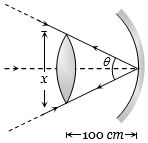
$A$ concave mirror of focal length $100 \ cm$ is used to obtain the image of the sun,which subtends an angle of $30'$. The diameter of the image of the sun will be.....$cm$.
A
$1.74$
B
$0.87$
C
$0.435$
D
$100$
Solution
(B) The sun is at a very large distance,so its image is formed at the focus of the concave mirror. The distance of the image from the pole of the mirror is equal to the focal length,$f = 100 \ cm$.
Let $x$ be the diameter of the image of the sun.
The angle subtended by the sun at the mirror is $\theta = 30' = (30/60)^\circ = 0.5^\circ$.
Converting the angle into radians:
$\theta = 0.5 \times (\pi / 180) \ rad = \pi / 360 \ rad$.
Using the relation $\text{Angle} = \text{Arc} / \text{Radius}$,where the arc is the diameter $x$ and the radius is the focal length $f$:
$\theta = x / f$
$x = f \times \theta = 100 \times (\pi / 360) \ cm$.
$x = 100 \times 3.14159 / 360 \approx 0.872 \ cm$.
Thus,the diameter of the image is approximately $0.87 \ cm$.
Let $x$ be the diameter of the image of the sun.
The angle subtended by the sun at the mirror is $\theta = 30' = (30/60)^\circ = 0.5^\circ$.
Converting the angle into radians:
$\theta = 0.5 \times (\pi / 180) \ rad = \pi / 360 \ rad$.
Using the relation $\text{Angle} = \text{Arc} / \text{Radius}$,where the arc is the diameter $x$ and the radius is the focal length $f$:
$\theta = x / f$
$x = f \times \theta = 100 \times (\pi / 360) \ cm$.
$x = 100 \times 3.14159 / 360 \approx 0.872 \ cm$.
Thus,the diameter of the image is approximately $0.87 \ cm$.
0 likes
View Solution37
DifficultMCQ
$A$ short linear object of length $l$ lies along the axis of a concave mirror of focal length $f$ at a distance $u$ from the pole of the mirror. The size of the image is approximately equal to
A
$l{\left( {\frac{{u - f}}{f}} \right)^{1/2}}$
B
$l{\left( {\frac{{u - f}}{f}} \right)^2}$
C
$l{\left( {\frac{f}{{u - f}}} \right)^{1/2}}$
D
$l{\left( {\frac{f}{{u - f}}} \right)^2}$
Solution
(D) From the mirror formula,$\frac{1}{f} = \frac{1}{v} + \frac{1}{u}$ .....$(i)$
Differentiating equation $(i)$ with respect to $u$,we get:
$0 = - \frac{1}{v^2} \frac{dv}{du} - \frac{1}{u^2}$
$\frac{dv}{du} = - \left( \frac{v}{u} \right)^2$
Since the object length $l = du$ is small,the image length $dv$ is given by $dv = - \left( \frac{v}{u} \right)^2 du$ .....$(ii)$
From the mirror formula,we can express the magnification $m = \frac{v}{u}$ as:
$\frac{1}{v} = \frac{1}{f} - \frac{1}{u} = \frac{u - f}{fu}$
$\frac{v}{u} = \frac{f}{u - f}$ .....$(iii)$
Substituting equation $(iii)$ into equation $(ii)$,we get:
$dv = - \left( \frac{f}{u - f} \right)^2 l$
The magnitude of the size of the image is $l' = |dv| = l \left( \frac{f}{u - f} \right)^2$.
Differentiating equation $(i)$ with respect to $u$,we get:
$0 = - \frac{1}{v^2} \frac{dv}{du} - \frac{1}{u^2}$
$\frac{dv}{du} = - \left( \frac{v}{u} \right)^2$
Since the object length $l = du$ is small,the image length $dv$ is given by $dv = - \left( \frac{v}{u} \right)^2 du$ .....$(ii)$
From the mirror formula,we can express the magnification $m = \frac{v}{u}$ as:
$\frac{1}{v} = \frac{1}{f} - \frac{1}{u} = \frac{u - f}{fu}$
$\frac{v}{u} = \frac{f}{u - f}$ .....$(iii)$
Substituting equation $(iii)$ into equation $(ii)$,we get:
$dv = - \left( \frac{f}{u - f} \right)^2 l$
The magnitude of the size of the image is $l' = |dv| = l \left( \frac{f}{u - f} \right)^2$.
0 likes
View Solution38
DifficultMCQ
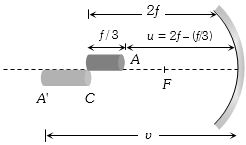
$A$ thin rod of length $f/3$ lies along the axis of a concave mirror of focal length $f$. One end of its magnified image touches an end of the rod. The length of the image is
A
$f$
B
$\frac{1}{2}f$
C
$2f$
D
$\frac{1}{4}f$
Solution
(B) Let the rod be placed between $u = 2f - f/3 = 5f/3$ and $u = 2f$ from the concave mirror. The end of the rod at $u = 2f$ forms an image at $v = 2f$.
For the other end of the rod at $u = 5f/3$,we use the mirror formula $\frac{1}{f_{mirror}} = \frac{1}{v} + \frac{1}{u}$.
Using sign convention,$f_{mirror} = -f$ and $u = -5f/3$.
$\frac{1}{-f} = \frac{1}{v} + \frac{1}{-5f/3} \Rightarrow \frac{1}{v} = \frac{3}{5f} - \frac{1}{f} = \frac{3-5}{5f} = -\frac{2}{5f}$.
Thus,$v = -2.5f$.
The length of the image is the distance between the two image positions: $|2.5f - 2f| = 0.5f = f/2$.
For the other end of the rod at $u = 5f/3$,we use the mirror formula $\frac{1}{f_{mirror}} = \frac{1}{v} + \frac{1}{u}$.
Using sign convention,$f_{mirror} = -f$ and $u = -5f/3$.
$\frac{1}{-f} = \frac{1}{v} + \frac{1}{-5f/3} \Rightarrow \frac{1}{v} = \frac{3}{5f} - \frac{1}{f} = \frac{3-5}{5f} = -\frac{2}{5f}$.
Thus,$v = -2.5f$.
The length of the image is the distance between the two image positions: $|2.5f - 2f| = 0.5f = f/2$.
0 likes
View Solution39
DifficultMCQ
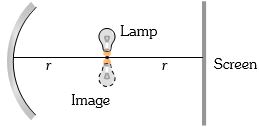
The separation between the screen and a concave mirror is $2r$. An isotropic point source of light is placed exactly midway between the mirror and the screen. The mirror has a radius of curvature $r$ and reflects $100\%$ of the incident light. Find the ratio of illuminances on the screen with and without the mirror.
A
$10:1$
B
$2:1$
C
$10:9$
D
$9:1$
Solution
(B) $1$. Without the mirror,the illuminance $I_1$ on the screen due to the point source at a distance $r$ is given by $I_1 = \frac{L}{r^2}$,where $L$ is the luminous intensity of the source.
$2$. With the mirror,the source is placed at the center of curvature $(u = r)$. For a concave mirror,an object placed at the center of curvature forms a real image at the same position $(v = r)$.
$3$. The light reaching the screen now consists of two parts: the direct light from the source and the light reflected from the mirror,which appears to come from the image formed at the same location as the source.
$4$. The illuminance due to the reflected light is also $I_{reflected} = \frac{L}{r^2}$.
$5$. The total illuminance on the screen with the mirror is $I_2 = I_{direct} + I_{reflected} = \frac{L}{r^2} + \frac{L}{r^2} = \frac{2L}{r^2}$.
$6$. Therefore,the ratio of illuminances is $\frac{I_2}{I_1} = \frac{2L/r^2}{L/r^2} = 2:1$.
$2$. With the mirror,the source is placed at the center of curvature $(u = r)$. For a concave mirror,an object placed at the center of curvature forms a real image at the same position $(v = r)$.
$3$. The light reaching the screen now consists of two parts: the direct light from the source and the light reflected from the mirror,which appears to come from the image formed at the same location as the source.
$4$. The illuminance due to the reflected light is also $I_{reflected} = \frac{L}{r^2}$.
$5$. The total illuminance on the screen with the mirror is $I_2 = I_{direct} + I_{reflected} = \frac{L}{r^2} + \frac{L}{r^2} = \frac{2L}{r^2}$.
$6$. Therefore,the ratio of illuminances is $\frac{I_2}{I_1} = \frac{2L/r^2}{L/r^2} = 2:1$.
0 likes
View Solution40
EasyMCQ
In an experiment to find the focal length of a concave mirror,a graph is drawn between the magnitudes of $u$ and $v$. The graph looks like:
A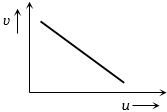
B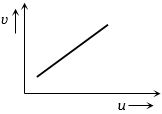
C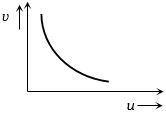
D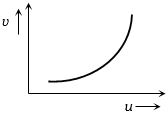
Solution
(C) The mirror formula is given by $\frac{1}{v} + \frac{1}{u} = \frac{1}{f}$.
For a concave mirror,using sign convention,$u$ and $v$ are negative. Let their magnitudes be $u$ and $v$. Then $\frac{1}{v} + \frac{1}{u} = \frac{1}{f}$,which can be written as $v = \frac{uf}{u-f}$.
As $u \to f$,$v \to \infty$.
As $u \to \infty$,$v \to f$.
This represents a rectangular hyperbola where $v$ decreases as $u$ increases,which corresponds to the curve shown in graph $C$.
For a concave mirror,using sign convention,$u$ and $v$ are negative. Let their magnitudes be $u$ and $v$. Then $\frac{1}{v} + \frac{1}{u} = \frac{1}{f}$,which can be written as $v = \frac{uf}{u-f}$.
As $u \to f$,$v \to \infty$.
As $u \to \infty$,$v \to f$.
This represents a rectangular hyperbola where $v$ decreases as $u$ increases,which corresponds to the curve shown in graph $C$.
0 likes
View Solution41
MediumMCQ
As the position of an object $(u)$ reflected from a concave mirror is varied,the position of the image $(v)$ also varies. By letting the $u$ change from $0$ to $+\infty$,the graph between $v$ versus $u$ will be:
A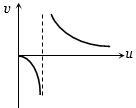
B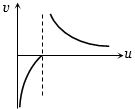
C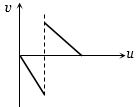
D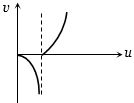
Solution
(A) For a concave mirror,the mirror formula is given by: $\frac{1}{v} + \frac{1}{u} = \frac{1}{f}$.
Using sign convention,$f = -|f|$. Thus,$\frac{1}{v} = -\frac{1}{|f|} - \frac{1}{u}$.
$1$. When $u = 0$,$\frac{1}{v} = -\infty$,so $v = 0$.
$2$. When $u = |f|$,$\frac{1}{v} = -\frac{1}{|f|} + \frac{1}{|f|} = 0$,so $v = \infty$.
$3$. When $u = \infty$,$\frac{1}{v} = -\frac{1}{|f|}$,so $v = -|f|$.
As $u$ increases from $0$ to $|f|$,$v$ changes from $0$ to $-\infty$. As $u$ increases from $|f|$ to $\infty$,$v$ changes from $+\infty$ to $-|f|$.
Comparing these characteristics with the given graphs,option $A$ correctly represents this behavior.
Using sign convention,$f = -|f|$. Thus,$\frac{1}{v} = -\frac{1}{|f|} - \frac{1}{u}$.
$1$. When $u = 0$,$\frac{1}{v} = -\infty$,so $v = 0$.
$2$. When $u = |f|$,$\frac{1}{v} = -\frac{1}{|f|} + \frac{1}{|f|} = 0$,so $v = \infty$.
$3$. When $u = \infty$,$\frac{1}{v} = -\frac{1}{|f|}$,so $v = -|f|$.
As $u$ increases from $0$ to $|f|$,$v$ changes from $0$ to $-\infty$. As $u$ increases from $|f|$ to $\infty$,$v$ changes from $+\infty$ to $-|f|$.
Comparing these characteristics with the given graphs,option $A$ correctly represents this behavior.
0 likes
View Solution42
EasyMCQ
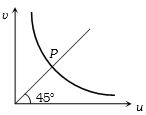
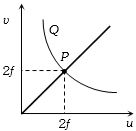
The graph shows the variation of $v$ with change in $u$ for a mirror. Points plotted above the point $P$ on the curve are for values of $v$:
A
Smaller than $f$
B
Smaller than $2f$
C
Larger than $2f$
D
Larger than $f$
Solution
(C) For a spherical mirror,the mirror formula is $\frac{1}{v} + \frac{1}{u} = \frac{1}{f}$.
At point $P$,the graph intersects the line $v = u$,which implies $u = v$. Substituting this into the mirror formula: $\frac{1}{u} + \frac{1}{u} = \frac{1}{f} \implies \frac{2}{u} = \frac{1}{f} \implies u = 2f$. Thus,at point $P$,$u = v = 2f$.
For points on the curve above $P$,the value of $v$ is greater than the value of $v$ at $P$. Since $v_P = 2f$,any point above $P$ on the curve corresponds to $v > 2f$.
At point $P$,the graph intersects the line $v = u$,which implies $u = v$. Substituting this into the mirror formula: $\frac{1}{u} + \frac{1}{u} = \frac{1}{f} \implies \frac{2}{u} = \frac{1}{f} \implies u = 2f$. Thus,at point $P$,$u = v = 2f$.
For points on the curve above $P$,the value of $v$ is greater than the value of $v$ at $P$. Since $v_P = 2f$,any point above $P$ on the curve corresponds to $v > 2f$.
0 likes
View Solution43
EasyMCQ
The graph between $u$ and $v$ for a convex mirror is
A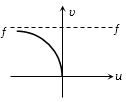
B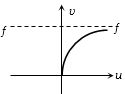
C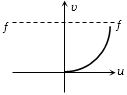
D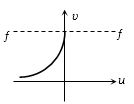
Solution
(B) For a convex mirror,the mirror formula is given by $\frac{1}{v} + \frac{1}{u} = \frac{1}{f}$.
Since the focal length $f$ is positive for a convex mirror,we have $\frac{1}{v} = \frac{1}{f} - \frac{1}{u}$.
Using sign convention,$u$ is negative,so let $u = -x$ where $x > 0$. Then $\frac{1}{v} = \frac{1}{f} + \frac{1}{x} = \frac{x+f}{xf}$.
Thus,$v = \frac{xf}{x+f}$.
As $u$ varies from $0$ to $-\infty$,$x$ varies from $0$ to $+\infty$.
When $x = 0$,$v = 0$.
When $x \to \infty$,$v \to f$.
As $x$ increases,$v$ increases from $0$ to $f$. The graph shows $v$ on the $y$-axis and $u$ on the $x$-axis (where $u$ is negative). The correct representation is Graph $B$.
Since the focal length $f$ is positive for a convex mirror,we have $\frac{1}{v} = \frac{1}{f} - \frac{1}{u}$.
Using sign convention,$u$ is negative,so let $u = -x$ where $x > 0$. Then $\frac{1}{v} = \frac{1}{f} + \frac{1}{x} = \frac{x+f}{xf}$.
Thus,$v = \frac{xf}{x+f}$.
As $u$ varies from $0$ to $-\infty$,$x$ varies from $0$ to $+\infty$.
When $x = 0$,$v = 0$.
When $x \to \infty$,$v \to f$.
As $x$ increases,$v$ increases from $0$ to $f$. The graph shows $v$ on the $y$-axis and $u$ on the $x$-axis (where $u$ is negative). The correct representation is Graph $B$.
0 likes
View Solution44
MediumMCQ
Which of the following graphs represents the magnification of a real image against the distance from the focus of a concave mirror?
A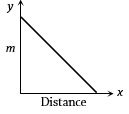
B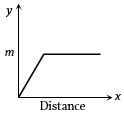
C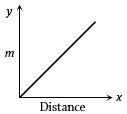
D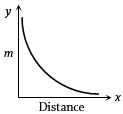
Solution
(D) For a concave mirror,the magnification $m$ is given by $m = \frac{f}{f - u}$.
For a real image,the object distance $u$ is greater than the focal length $f$ $(u > f)$. Let $x$ be the distance of the object from the focus,so $x = u - f$.
Substituting $u = f + x$ into the magnification formula:
$m = \frac{f}{f - (f + x)} = \frac{f}{-x} = -\frac{f}{x}$.
Taking the magnitude of magnification $|m| = \frac{f}{x}$,we see that $|m| \propto \frac{1}{x}$.
This relationship represents a rectangular hyperbola,which corresponds to the graph shown in option $D$.
For a real image,the object distance $u$ is greater than the focal length $f$ $(u > f)$. Let $x$ be the distance of the object from the focus,so $x = u - f$.
Substituting $u = f + x$ into the magnification formula:
$m = \frac{f}{f - (f + x)} = \frac{f}{-x} = -\frac{f}{x}$.
Taking the magnitude of magnification $|m| = \frac{f}{x}$,we see that $|m| \propto \frac{1}{x}$.
This relationship represents a rectangular hyperbola,which corresponds to the graph shown in option $D$.
0 likes
View Solution45
EasyMCQ
If $x$ is the distance of an object from the focus of a concave mirror and $y$ is the distance of the image from the focus, then which of the following graphs is correct between $x$ and $y$?
A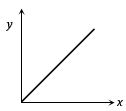
B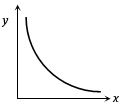
C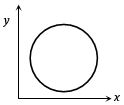
D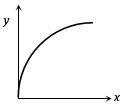
Solution
(B) According to Newton's formula for mirrors, the relationship between the distance of the object from the focus $(x)$ and the distance of the image from the focus $(y)$ is given by $xy = f^2$, where $f$ is the focal length of the mirror.
Since $f$ is constant for a given mirror, $xy = \text{constant}$.
This equation represents a rectangular hyperbola.
Among the given options, the graph that represents a rectangular hyperbola is Graph $B$.
Since $f$ is constant for a given mirror, $xy = \text{constant}$.
This equation represents a rectangular hyperbola.
Among the given options, the graph that represents a rectangular hyperbola is Graph $B$.
0 likes
View Solution46
DifficultMCQ
When an object is placed at a distance of $25 \; cm$ from a mirror,the magnification is $m_1$. The object is moved $15 \; cm$ away with respect to the earlier position,magnification becomes $m_2$. If $\frac{m_1}{m_2} = 4$,the focal length of the mirror is: (in $; cm$)
A
$-10$
B
$-30$
C
$-15$
D
$-20$
Solution
(D) For a spherical mirror,the magnification $m$ is given by $m = \frac{f}{f - u}$.
In the first case,the object distance $u_1 = -25 \; cm$. Thus,$m_1 = \frac{f}{f - (-25)} = \frac{f}{f + 25}$.
In the second case,the object is moved $15 \; cm$ further away,so the new object distance $u_2 = -(25 + 15) = -40 \; cm$. Thus,$m_2 = \frac{f}{f - (-40)} = \frac{f}{f + 40}$.
Given the ratio $\frac{m_1}{m_2} = 4$,we have:
$\frac{f / (f + 25)}{f / (f + 40)} = 4$
$\frac{f + 40}{f + 25} = 4$
$f + 40 = 4(f + 25)$
$f + 40 = 4f + 100$
$3f = -60$
$f = -20 \; cm$.
In the first case,the object distance $u_1 = -25 \; cm$. Thus,$m_1 = \frac{f}{f - (-25)} = \frac{f}{f + 25}$.
In the second case,the object is moved $15 \; cm$ further away,so the new object distance $u_2 = -(25 + 15) = -40 \; cm$. Thus,$m_2 = \frac{f}{f - (-40)} = \frac{f}{f + 40}$.
Given the ratio $\frac{m_1}{m_2} = 4$,we have:
$\frac{f / (f + 25)}{f / (f + 40)} = 4$
$\frac{f + 40}{f + 25} = 4$
$f + 40 = 4(f + 25)$
$f + 40 = 4f + 100$
$3f = -60$
$f = -20 \; cm$.
0 likes
View Solution47
MediumMCQ
$A$ mirror of focal length $f$ is immersed in water $(\mu = 4/3)$. The focal length of the mirror in water will be ......
A
$f$
B
$\frac{4}{3} f$
C
$\frac{3}{4} f$
D
$\frac{7}{3} f$
Solution
(A) The focal length of a spherical mirror depends only on its radius of curvature $(R)$ and is given by the formula $f = R/2$.
Since the radius of curvature of a mirror is a geometric property and does not depend on the refractive index of the surrounding medium, the focal length remains unchanged when the mirror is immersed in water.
Therefore, the focal length in water remains $f$.
Since the radius of curvature of a mirror is a geometric property and does not depend on the refractive index of the surrounding medium, the focal length remains unchanged when the mirror is immersed in water.
Therefore, the focal length in water remains $f$.
0 likes
View Solution48
DifficultMCQ
An object of height $5 \, cm$ is placed at a distance of $1 \, m$ from a concave mirror having a radius of curvature of $20 \, cm$. The height of the image is ....... $cm$.
A
$0.11$
B
$0.50$
C
$0.55$
D
$0.60$
Solution
(C) Given: Height of object $h_1 = 5 \, cm$,Object distance $u = -100 \, cm$ $(1 \, m = 100 \, cm)$,Radius of curvature $R = -20 \, cm$.
Focal length $f = R/2 = -20/2 = -10 \, cm$.
Using the magnification formula for a mirror: $m = \frac{h_2}{h_1} = -\frac{v}{u}$.
Also,$m = \frac{f}{f - u}$.
Substituting the values: $\frac{h_2}{5} = \frac{-10}{-10 - (-100)} = \frac{-10}{-10 + 100} = \frac{-10}{90} = -\frac{1}{9}$.
$h_2 = 5 \times (-\frac{1}{9}) = -\frac{5}{9} \approx -0.55 \, cm$.
The magnitude of the height of the image is $0.55 \, cm$.
Focal length $f = R/2 = -20/2 = -10 \, cm$.
Using the magnification formula for a mirror: $m = \frac{h_2}{h_1} = -\frac{v}{u}$.
Also,$m = \frac{f}{f - u}$.
Substituting the values: $\frac{h_2}{5} = \frac{-10}{-10 - (-100)} = \frac{-10}{-10 + 100} = \frac{-10}{90} = -\frac{1}{9}$.
$h_2 = 5 \times (-\frac{1}{9}) = -\frac{5}{9} \approx -0.55 \, cm$.
The magnitude of the height of the image is $0.55 \, cm$.
0 likes
View Solution49
MediumMCQ
Let the transverse magnification produced by a spherical mirror be $m$. Then,for the same position of the object,the longitudinal magnification will be:
A
$m$
B
$\sqrt{m}$
C
$m^2$
D
$1/m$
Solution
(C) Transverse magnification is given by $m = -\frac{v}{u}$.
Longitudinal magnification $(m_L)$ is defined as the ratio of the change in image position to the change in object position: $m_L = \frac{dv}{du}$.
From the mirror formula: $\frac{1}{f} = \frac{1}{v} + \frac{1}{u}$.
Differentiating both sides with respect to $u$:
$0 = -\frac{1}{v^2} \frac{dv}{du} - \frac{1}{u^2}$.
Rearranging the terms:
$\frac{dv}{du} = -\frac{v^2}{u^2}$.
Since $m = -\frac{v}{u}$,it follows that $m^2 = \frac{v^2}{u^2}$.
Therefore,$m_L = -m^2$. In terms of magnitude,the longitudinal magnification is $m^2$.
Longitudinal magnification $(m_L)$ is defined as the ratio of the change in image position to the change in object position: $m_L = \frac{dv}{du}$.
From the mirror formula: $\frac{1}{f} = \frac{1}{v} + \frac{1}{u}$.
Differentiating both sides with respect to $u$:
$0 = -\frac{1}{v^2} \frac{dv}{du} - \frac{1}{u^2}$.
Rearranging the terms:
$\frac{dv}{du} = -\frac{v^2}{u^2}$.
Since $m = -\frac{v}{u}$,it follows that $m^2 = \frac{v^2}{u^2}$.
Therefore,$m_L = -m^2$. In terms of magnitude,the longitudinal magnification is $m^2$.
0 likes
View Solution50
EasyMCQ
The image formed by a concave mirror is
A
always real.
B
always virtual.
C
certainly real if the object is virtual.
D
certainly virtual if the object is real.
Solution
(C) Using the mirror equation,$\frac{1}{v} + \frac{1}{u} = \frac{1}{f}$.
Rearranging for image distance,$\frac{1}{v} = \frac{1}{f} - \frac{1}{u}$.
For a concave mirror,the focal length $f$ is negative $(f < 0)$.
If the object is virtual,the object distance $u$ is positive $(u > 0)$. Substituting these into the equation,$\frac{1}{v} = \frac{1}{f} - \frac{1}{u}$ results in a negative value for $\frac{1}{v}$,meaning $v < 0$. Since the image distance is negative,the image is formed by the actual intersection of reflected rays,making it a real image.
If the object is real,the object distance $u$ is negative $(u < 0)$. In this case,the image distance $v$ can be positive or negative depending on whether the object is placed between the pole and the focus or beyond the focus.
Rearranging for image distance,$\frac{1}{v} = \frac{1}{f} - \frac{1}{u}$.
For a concave mirror,the focal length $f$ is negative $(f < 0)$.
If the object is virtual,the object distance $u$ is positive $(u > 0)$. Substituting these into the equation,$\frac{1}{v} = \frac{1}{f} - \frac{1}{u}$ results in a negative value for $\frac{1}{v}$,meaning $v < 0$. Since the image distance is negative,the image is formed by the actual intersection of reflected rays,making it a real image.
If the object is real,the object distance $u$ is negative $(u < 0)$. In this case,the image distance $v$ can be positive or negative depending on whether the object is placed between the pole and the focus or beyond the focus.
0 likes
View SolutionRay Optics and Optical Instruments — Spherical Mirror · Frequently Asked Questions
1Are these Ray Optics and Optical Instruments questions useful for JEE and NEET?
Yes. All questions in this section are mapped to JEE Main and NEET exam patterns. Previous year questions from JEE Main, NEET, GUJCET and state-level exams are included with full solutions.
2Can I switch to Hindi or Gujarati for these questions?
Yes. Use the language tabs in the hero section or the sidebar to view the same questions and solutions in English, Hindi or Gujarati.
3How do I generate a question paper from this subtopic?
Use the Vedclass Exam Paper Generator — select the chapter and subtopic, set difficulty, and generate Sets A, B, C, D automatically. First 3 chapters of every subject are free.
Vedclass Products
For Students
Vedclass Test Series
Mock tests in real JEE/NEET style with performance analysis. 5-day free trial.
Start Free TrialFor Teachers
Exam Paper Generator
Generate Set A/B/C/D papers from this chapter in 2 minutes. 3 chapters free.
Try FreeFor Institutes
Online Exam Module
Live online exams with unlimited students, 360° analytics & white-label branding.
See DemoFor Teachers & Institutes
Generate a Ray Optics and Optical Instruments Exam Paper in 2 Minutes
Select subtopic & difficulty — Sets A, B, C, D auto-generated with No Repeat logic.
First 3 chapters of every subject are free — no payment required.