
A English
Combination of Lenses Questions in English
Class 12 Physics · Ray Optics and Optical Instruments · Combination of Lenses
190+
Questions
English
Language
100%
With Solutions
Showing 49 of 190 questions in English
1
DifficultMCQ
$A$ convex lens of focal length $40 \; cm$ is in contact with a concave lens of focal length $25 \; cm$. The power of the combination is:
A
$-1.5 \; D$
B
$-6.5 \; D$
C
$+ 6.5 \; D$
D
$+ 6.67 \; D$
Solution
(A) The focal length of a convex lens is $f_1 = +40 \; cm$ and the focal length of a concave lens is $f_2 = -25 \; cm$.
The power of a lens is given by $P = \frac{100}{f(cm)} \; D$.
The power of the convex lens is $P_1 = \frac{100}{40} = +2.5 \; D$.
The power of the concave lens is $P_2 = \frac{100}{-25} = -4.0 \; D$.
The power of the combination of thin lenses in contact is the algebraic sum of their individual powers:
$P = P_1 + P_2$
$P = 2.5 \; D + (-4.0 \; D) = -1.5 \; D$.
The power of a lens is given by $P = \frac{100}{f(cm)} \; D$.
The power of the convex lens is $P_1 = \frac{100}{40} = +2.5 \; D$.
The power of the concave lens is $P_2 = \frac{100}{-25} = -4.0 \; D$.
The power of the combination of thin lenses in contact is the algebraic sum of their individual powers:
$P = P_1 + P_2$
$P = 2.5 \; D + (-4.0 \; D) = -1.5 \; D$.
0 likes
View Solution2
MediumMCQ
Two lenses are placed in contact with each other and the focal length of the combination is $80 \ cm$. If the focal length of one lens is $20 \ cm$,then the power of the other lens will be: (in $D$)
A
$1.66$
B
$4.00$
C
$-1.00$
D
$-3.75$
Solution
(D) The formula for the focal length of two thin lenses in contact is given by $\frac{1}{F} = \frac{1}{f_1} + \frac{1}{f_2}$.
Given: $F = 80 \ cm$ and $f_1 = 20 \ cm$.
Substituting the values: $\frac{1}{80} = \frac{1}{20} + \frac{1}{f_2}$.
Rearranging for $f_2$: $\frac{1}{f_2} = \frac{1}{80} - \frac{1}{20} = \frac{1 - 4}{80} = -\frac{3}{80}$.
Thus,$f_2 = -\frac{80}{3} \ cm$.
The power $P$ of a lens in Diopters $(D)$ is given by $P = \frac{100}{f(cm)}$.
$P_2 = \frac{100}{-80/3} = -\frac{300}{80} = -3.75 \ D$.
Given: $F = 80 \ cm$ and $f_1 = 20 \ cm$.
Substituting the values: $\frac{1}{80} = \frac{1}{20} + \frac{1}{f_2}$.
Rearranging for $f_2$: $\frac{1}{f_2} = \frac{1}{80} - \frac{1}{20} = \frac{1 - 4}{80} = -\frac{3}{80}$.
Thus,$f_2 = -\frac{80}{3} \ cm$.
The power $P$ of a lens in Diopters $(D)$ is given by $P = \frac{100}{f(cm)}$.
$P_2 = \frac{100}{-80/3} = -\frac{300}{80} = -3.75 \ D$.
0 likes
View Solution3
EasyMCQ
Two lenses of power $+12 \ D$ and $-2 \ D$ are placed in contact. What will be the focal length of the combination in $cm$?
A
$10$
B
$12.5$
C
$16.6$
D
$8.33$
Solution
(A) The power of a combination of thin lenses in contact is given by the algebraic sum of their individual powers: $P = P_1 + P_2$.
Given $P_1 = +12 \ D$ and $P_2 = -2 \ D$.
Therefore,the total power $P = 12 \ D + (-2 \ D) = 10 \ D$.
The focal length $F$ of the combination in centimeters is given by the formula $F = \frac{100}{P}$.
Substituting the value of $P$,we get $F = \frac{100}{10} = 10 \ cm$.
Given $P_1 = +12 \ D$ and $P_2 = -2 \ D$.
Therefore,the total power $P = 12 \ D + (-2 \ D) = 10 \ D$.
The focal length $F$ of the combination in centimeters is given by the formula $F = \frac{100}{P}$.
Substituting the value of $P$,we get $F = \frac{100}{10} = 10 \ cm$.
0 likes
View Solution4
EasyMCQ
$A$ concave and a convex lens have the same focal length of $20 \ cm$ and are put into contact to form a lens combination. The combination is used to view an object of $5 \ cm$ length kept at $20 \ cm$ from the lens combination. As compared to the object,the image will be
A
Magnified and inverted
B
Reduced and erect
C
Of the same size as the object and erect
D
Of the same size as the object but inverted
Solution
(C) The focal length of a convex lens is $f_1 = +20 \ cm$ and that of a concave lens is $f_2 = -20 \ cm$.
When placed in contact,the equivalent focal length $F$ is given by the formula: $\frac{1}{F} = \frac{1}{f_1} + \frac{1}{f_2}$.
Substituting the values: $\frac{1}{F} = \frac{1}{20} + \frac{1}{-20} = 0$.
This implies $F = \infty$.
$A$ lens combination with an infinite focal length acts as a plane glass slab.
For a plane glass slab,the magnification $m = +1$.
Therefore,the image formed is of the same size as the object and is erect.
When placed in contact,the equivalent focal length $F$ is given by the formula: $\frac{1}{F} = \frac{1}{f_1} + \frac{1}{f_2}$.
Substituting the values: $\frac{1}{F} = \frac{1}{20} + \frac{1}{-20} = 0$.
This implies $F = \infty$.
$A$ lens combination with an infinite focal length acts as a plane glass slab.
For a plane glass slab,the magnification $m = +1$.
Therefore,the image formed is of the same size as the object and is erect.
0 likes
View Solution5
EasyMCQ
$A$ thin convex lens of focal length $10 \ cm$ is placed in contact with a concave lens of the same material and of the same focal length. The focal length of the combination will be:
A
$Zero$
B
$Infinity$
C
$10 \ cm$
D
$20 \ cm$
Solution
(B) The focal length of a convex lens is $f_1 = +10 \ cm$.
The focal length of a concave lens of the same material and focal length is $f_2 = -10 \ cm$.
When two thin lenses are placed in contact,the equivalent focal length $F$ is given by the formula:
$\frac{1}{F} = \frac{1}{f_1} + \frac{1}{f_2}$
Substituting the values:
$\frac{1}{F} = \frac{1}{10} + \frac{1}{-10} = \frac{1}{10} - \frac{1}{10} = 0$
Therefore,$\frac{1}{F} = 0$,which implies $F = \infty$.
Thus,the focal length of the combination is $Infinity$.
The focal length of a concave lens of the same material and focal length is $f_2 = -10 \ cm$.
When two thin lenses are placed in contact,the equivalent focal length $F$ is given by the formula:
$\frac{1}{F} = \frac{1}{f_1} + \frac{1}{f_2}$
Substituting the values:
$\frac{1}{F} = \frac{1}{10} + \frac{1}{-10} = \frac{1}{10} - \frac{1}{10} = 0$
Therefore,$\frac{1}{F} = 0$,which implies $F = \infty$.
Thus,the focal length of the combination is $Infinity$.
0 likes
View Solution6
MediumMCQ
$A$ convex lens of focal length $84 \ cm$ is in contact with a concave lens of focal length $12 \ cm$. The power of the combination (in diopters) is:
A
$25/24$
B
$25/18$
C
$-50/7$
D
$+50/7$
Solution
(C) The focal length of a convex lens is $f_1 = +84 \ cm$ and the focal length of a concave lens is $f_2 = -12 \ cm$.
For a combination of thin lenses in contact,the equivalent focal length $F$ is given by the formula:
$\frac{1}{F} = \frac{1}{f_1} + \frac{1}{f_2}$
Substituting the values:
$\frac{1}{F} = \frac{1}{84} + \frac{1}{-12} = \frac{1 - 7}{84} = \frac{-6}{84} = -\frac{1}{14} \ cm^{-1}$
Thus,$F = -14 \ cm$.
The power $P$ of the combination in diopters $(D)$ is given by $P = \frac{100}{F(cm)}$:
$P = \frac{100}{-14} = -\frac{50}{7} \ D$.
For a combination of thin lenses in contact,the equivalent focal length $F$ is given by the formula:
$\frac{1}{F} = \frac{1}{f_1} + \frac{1}{f_2}$
Substituting the values:
$\frac{1}{F} = \frac{1}{84} + \frac{1}{-12} = \frac{1 - 7}{84} = \frac{-6}{84} = -\frac{1}{14} \ cm^{-1}$
Thus,$F = -14 \ cm$.
The power $P$ of the combination in diopters $(D)$ is given by $P = \frac{100}{F(cm)}$:
$P = \frac{100}{-14} = -\frac{50}{7} \ D$.
0 likes
View Solution7
EasyMCQ
Two thin lenses,one of focal length $+ 60 \ cm$ and the other of focal length $-20 \ cm$ are put in contact. The combined focal length is........$cm$.
A
$+ 15$
B
$-15$
C
$+ 30$
D
$-30$
Solution
(D) When two thin lenses of focal lengths $f_1$ and $f_2$ are placed in contact,the equivalent focal length $F$ of the combination is given by the formula:
$\frac{1}{F} = \frac{1}{f_1} + \frac{1}{f_2}$
Given:
$f_1 = + 60 \ cm$
$f_2 = - 20 \ cm$
Substituting the values into the formula:
$\frac{1}{F} = \frac{1}{60} + \frac{1}{-20}$
$\frac{1}{F} = \frac{1}{60} - \frac{1}{20}$
$\frac{1}{F} = \frac{1 - 3}{60}$
$\frac{1}{F} = \frac{-2}{60}$
$\frac{1}{F} = -\frac{1}{30}$
Therefore,$F = -30 \ cm$.
$\frac{1}{F} = \frac{1}{f_1} + \frac{1}{f_2}$
Given:
$f_1 = + 60 \ cm$
$f_2 = - 20 \ cm$
Substituting the values into the formula:
$\frac{1}{F} = \frac{1}{60} + \frac{1}{-20}$
$\frac{1}{F} = \frac{1}{60} - \frac{1}{20}$
$\frac{1}{F} = \frac{1 - 3}{60}$
$\frac{1}{F} = \frac{-2}{60}$
$\frac{1}{F} = -\frac{1}{30}$
Therefore,$F = -30 \ cm$.
0 likes
View Solution8
MediumMCQ
Two thin convex lenses of focal lengths $20 \; cm$ and $25 \; cm$ are placed in contact. The effective power of the combination is:
A
$45$ dioptres
B
$9$ dioptres
C
$1/9$ dioptre
D
$6$ dioptres
Solution
(B) The focal lengths of the two lenses are $f_1 = 20 \; cm = 0.2 \; m$ and $f_2 = 25 \; cm = 0.25 \; m$.
The power of the individual lenses are $P_1 = \frac{1}{f_1} = \frac{1}{0.2} = 5 \; D$ and $P_2 = \frac{1}{f_2} = \frac{1}{0.25} = 4 \; D$.
When two thin lenses are placed in contact,the effective power of the combination is given by $P = P_1 + P_2$.
Therefore,$P = 5 \; D + 4 \; D = 9 \; D$.
The power of the individual lenses are $P_1 = \frac{1}{f_1} = \frac{1}{0.2} = 5 \; D$ and $P_2 = \frac{1}{f_2} = \frac{1}{0.25} = 4 \; D$.
When two thin lenses are placed in contact,the effective power of the combination is given by $P = P_1 + P_2$.
Therefore,$P = 5 \; D + 4 \; D = 9 \; D$.
0 likes
View Solution9
EasyMCQ
Two lenses of power $6D$ and $-2D$ are combined to form a single lens. The focal length of this lens will be (in $m$)
A
$0.25$
B
$0.5$
C
$4$
D
$0.125$
Solution
(A) The power of the combination of lenses is given by the sum of the individual powers: $P = P_1 + P_2$.
Given $P_1 = 6 \ D$ and $P_2 = -2 \ D$.
Therefore,the combined power $P = 6 \ D + (-2 \ D) = 4 \ D$.
The focal length $f$ of the combination is the reciprocal of the total power: $f = \frac{1}{P}$.
Substituting the value of $P$,we get $f = \frac{1}{4} \ m = 0.25 \ m$.
Given $P_1 = 6 \ D$ and $P_2 = -2 \ D$.
Therefore,the combined power $P = 6 \ D + (-2 \ D) = 4 \ D$.
The focal length $f$ of the combination is the reciprocal of the total power: $f = \frac{1}{P}$.
Substituting the value of $P$,we get $f = \frac{1}{4} \ m = 0.25 \ m$.
0 likes
View Solution10
DifficultMCQ
$A$ combination of two thin lenses with focal lengths $f_1$ and $f_2$ respectively forms an image of a distant object at a distance of $60 \ cm$ when the lenses are in contact. The position of this image shifts by $30 \ cm$ towards the combination when the two lenses are separated by $10 \ cm$. The corresponding values of $f_1$ and $f_2$ are:
A
$30 \ cm, -60 \ cm$
B
$20 \ cm, -30 \ cm$
C
$15 \ cm, -20 \ cm$
D
$12 \ cm, -15 \ cm$
Solution
(B) When lenses are in contact,the effective focal length $F$ is given by $\frac{1}{F} = \frac{1}{f_1} + \frac{1}{f_2}$. Since the object is at infinity,the image is formed at the focus $F = 60 \ cm$. Thus,$\frac{1}{f_1} + \frac{1}{f_2} = \frac{1}{60}$ ... $(i)$.
When the lenses are separated by $d = 10 \ cm$,the equivalent focal length $F'$ is given by $\frac{1}{F'} = \frac{1}{f_1} + \frac{1}{f_2} - \frac{d}{f_1 f_2}$. The image shifts by $30 \ cm$ towards the combination,so the new image distance is $60 \ cm - 30 \ cm = 30 \ cm$. Thus,$\frac{1}{30} = \frac{1}{f_1} + \frac{1}{f_2} - \frac{10}{f_1 f_2}$ ... $(ii)$.
Substituting $(i)$ into $(ii)$: $\frac{1}{30} = \frac{1}{60} - \frac{10}{f_1 f_2} \implies \frac{10}{f_1 f_2} = \frac{1}{60} - \frac{1}{30} = -\frac{1}{60} \implies f_1 f_2 = -600$.
From $(i)$,$\frac{f_1 + f_2}{f_1 f_2} = \frac{1}{60} \implies f_1 + f_2 = \frac{-600}{60} = -10$.
Solving $x^2 - (f_1+f_2)x + f_1 f_2 = 0 \implies x^2 + 10x - 600 = 0 \implies (x+30)(x-20) = 0$. Thus,the focal lengths are $20 \ cm$ and $-30 \ cm$.
When the lenses are separated by $d = 10 \ cm$,the equivalent focal length $F'$ is given by $\frac{1}{F'} = \frac{1}{f_1} + \frac{1}{f_2} - \frac{d}{f_1 f_2}$. The image shifts by $30 \ cm$ towards the combination,so the new image distance is $60 \ cm - 30 \ cm = 30 \ cm$. Thus,$\frac{1}{30} = \frac{1}{f_1} + \frac{1}{f_2} - \frac{10}{f_1 f_2}$ ... $(ii)$.
Substituting $(i)$ into $(ii)$: $\frac{1}{30} = \frac{1}{60} - \frac{10}{f_1 f_2} \implies \frac{10}{f_1 f_2} = \frac{1}{60} - \frac{1}{30} = -\frac{1}{60} \implies f_1 f_2 = -600$.
From $(i)$,$\frac{f_1 + f_2}{f_1 f_2} = \frac{1}{60} \implies f_1 + f_2 = \frac{-600}{60} = -10$.
Solving $x^2 - (f_1+f_2)x + f_1 f_2 = 0 \implies x^2 + 10x - 600 = 0 \implies (x+30)(x-20) = 0$. Thus,the focal lengths are $20 \ cm$ and $-30 \ cm$.
1 likes
View Solution11
EasyMCQ
An achromatic combination of lenses is formed by joining
A
$2$ convex lenses
B
$2$ concave lenses
C
$1$ convex lens and $1$ concave lens
D
Convex lens and plane mirror
Solution
(C) For an achromatic combination,the condition is given by $\frac{\omega_1}{f_1} + \frac{\omega_2}{f_2} = 0$.
Here,$\omega_1$ and $\omega_2$ are the dispersive powers of the two lenses,and $f_1$ and $f_2$ are their respective focal lengths.
Since the dispersive powers $\omega_1$ and $\omega_2$ are always positive,the focal lengths $f_1$ and $f_2$ must have opposite signs for the sum to be zero.
This implies that one lens must be convex (positive focal length) and the other must be concave (negative focal length).
Therefore,an achromatic combination is formed by joining $1$ convex lens and $1$ concave lens.
Here,$\omega_1$ and $\omega_2$ are the dispersive powers of the two lenses,and $f_1$ and $f_2$ are their respective focal lengths.
Since the dispersive powers $\omega_1$ and $\omega_2$ are always positive,the focal lengths $f_1$ and $f_2$ must have opposite signs for the sum to be zero.
This implies that one lens must be convex (positive focal length) and the other must be concave (negative focal length).
Therefore,an achromatic combination is formed by joining $1$ convex lens and $1$ concave lens.
0 likes
View Solution12
EasyMCQ
Two thin lenses of focal lengths $f_1$ and $f_2$ are in contact and coaxial. The combination is equivalent to a single lens of power:
A
$f_1 + f_2$
B
$\frac{f_1 f_2}{f_1 + f_2}$
C
$\frac{1}{2}(f_1 + f_2)$
D
$\frac{f_1 + f_2}{f_1 f_2}$
Solution
(D) When two thin lenses of focal lengths $f_1$ and $f_2$ are placed in contact,the equivalent focal length $F$ of the combination is given by the formula:
$\frac{1}{F} = \frac{1}{f_1} + \frac{1}{f_2}$
Taking the common denominator,we get:
$\frac{1}{F} = \frac{f_2 + f_1}{f_1 f_2}$
The power $P$ of a lens is defined as the reciprocal of its focal length in meters,i.e.,$P = \frac{1}{F}$.
Therefore,the power of the combination is $P = \frac{f_1 + f_2}{f_1 f_2}$.
$\frac{1}{F} = \frac{1}{f_1} + \frac{1}{f_2}$
Taking the common denominator,we get:
$\frac{1}{F} = \frac{f_2 + f_1}{f_1 f_2}$
The power $P$ of a lens is defined as the reciprocal of its focal length in meters,i.e.,$P = \frac{1}{F}$.
Therefore,the power of the combination is $P = \frac{f_1 + f_2}{f_1 f_2}$.
0 likes
View Solution13
MediumMCQ
Two lenses have focal lengths $f_1$ and $f_2$ and their dispersive powers are $\omega_1$ and $\omega_2$ respectively. They will together form an achromatic combination if
A
$\omega_1 f_1 = \omega_2 f_2$
B
$\omega_1 f_2 + \omega_2 f_1 = 0$
C
$\omega_1 + f_1 = \omega_2 + f_2$
D
$\omega_1 - f_1 = \omega_2 - f_2$
Solution
(B) For an achromatic combination of two thin lenses in contact,the condition is that the net dispersive power of the combination must be zero.
The condition for achromatism is given by the equation: $\frac{\omega_1}{f_1} + \frac{\omega_2}{f_2} = 0$.
Multiplying the entire equation by $f_1 f_2$,we get: $\omega_1 f_2 + \omega_2 f_1 = 0$.
Therefore,the correct condition is $\omega_1 f_2 + \omega_2 f_1 = 0$.
The condition for achromatism is given by the equation: $\frac{\omega_1}{f_1} + \frac{\omega_2}{f_2} = 0$.
Multiplying the entire equation by $f_1 f_2$,we get: $\omega_1 f_2 + \omega_2 f_1 = 0$.
Therefore,the correct condition is $\omega_1 f_2 + \omega_2 f_1 = 0$.
0 likes
View Solution14
EasyMCQ
$A$ convex lens of focal length $0.5 \ m$ and a concave lens of focal length $1 \ m$ are combined. The power of the resulting lens will be: (in $D$)
A
$1$
B
$-1$
C
$0.5$
D
$-0.5$
Solution
(A) The power $P$ of a lens is given by $P = \frac{1}{f}$,where $f$ is the focal length in meters.
For a convex lens,the focal length is positive,so $f_1 = 0.5 \ m$. Its power is $P_1 = \frac{1}{0.5} = 2 \ D$.
For a concave lens,the focal length is negative,so $f_2 = -1 \ m$. Its power is $P_2 = \frac{1}{-1} = -1 \ D$.
When lenses are combined,the total power is the sum of individual powers: $P = P_1 + P_2$.
$P = 2 \ D + (-1 \ D) = 1 \ D$.
For a convex lens,the focal length is positive,so $f_1 = 0.5 \ m$. Its power is $P_1 = \frac{1}{0.5} = 2 \ D$.
For a concave lens,the focal length is negative,so $f_2 = -1 \ m$. Its power is $P_2 = \frac{1}{-1} = -1 \ D$.
When lenses are combined,the total power is the sum of individual powers: $P = P_1 + P_2$.
$P = 2 \ D + (-1 \ D) = 1 \ D$.
0 likes
View Solution15
EasyMCQ
The focal length of a combination of lenses formed with lenses having powers of $+2.50 \ D$ and $-3.75 \ D$ will be .... $cm$.
A
$-20$
B
$-40$
C
$-60$
D
$-80$
Solution
(D) The power of a combination of thin lenses in contact is given by the algebraic sum of their individual powers: $P = P_1 + P_2$.
Given $P_1 = +2.50 \ D$ and $P_2 = -3.75 \ D$.
Therefore,the total power $P = 2.50 \ D + (-3.75 \ D) = -1.25 \ D$.
The focal length $f$ in centimeters is given by the formula $f = \frac{100}{P}$.
Substituting the value of $P$: $f = \frac{100}{-1.25} = -80 \ cm$.
Thus,the focal length of the combination is $-80 \ cm$.
Given $P_1 = +2.50 \ D$ and $P_2 = -3.75 \ D$.
Therefore,the total power $P = 2.50 \ D + (-3.75 \ D) = -1.25 \ D$.
The focal length $f$ in centimeters is given by the formula $f = \frac{100}{P}$.
Substituting the value of $P$: $f = \frac{100}{-1.25} = -80 \ cm$.
Thus,the focal length of the combination is $-80 \ cm$.
0 likes
View Solution16
MediumMCQ
If a convex lens of focal length $80 \;cm$ and a concave lens of focal length $50 \;cm$ are combined together,what will be their resulting power?
A
$+ 6.5 \; D$
B
$- 6.5 \; D$
C
$+ 7.5 \; D$
D
$- 0.75 \; D$
Solution
(D) The power of a lens is given by $P = \frac{1}{f}$ (where $f$ is in meters).
For a convex lens,the focal length $f_1 = + 80 \; cm = + 0.8 \; m$.
For a concave lens,the focal length $f_2 = - 50 \; cm = - 0.5 \; m$.
The power of the combination is $P = P_1 + P_2 = \frac{1}{f_1} + \frac{1}{f_2}$.
Substituting the values: $P = \frac{1}{0.8} + \frac{1}{-0.5} = 1.25 - 2.0 = - 0.75 \; D$.
For a convex lens,the focal length $f_1 = + 80 \; cm = + 0.8 \; m$.
For a concave lens,the focal length $f_2 = - 50 \; cm = - 0.5 \; m$.
The power of the combination is $P = P_1 + P_2 = \frac{1}{f_1} + \frac{1}{f_2}$.
Substituting the values: $P = \frac{1}{0.8} + \frac{1}{-0.5} = 1.25 - 2.0 = - 0.75 \; D$.
0 likes
View Solution17
EasyMCQ
Two thin lenses whose powers are $+2 \ D$ and $-4 \ D$ respectively are combined. The power of the combination is:
A
$-2 \ D$
B
$+2 \ D$
C
$-4 \ D$
D
$+4 \ D$
Solution
(A) When two thin lenses with powers $P_1$ and $P_2$ are placed in contact,the equivalent power $P$ of the combination is given by the algebraic sum of their individual powers.
$P = P_1 + P_2$
Given $P_1 = +2 \ D$ and $P_2 = -4 \ D$.
Substituting these values into the formula:
$P = (+2 \ D) + (-4 \ D) = -2 \ D$.
Therefore,the power of the combination is $-2 \ D$.
$P = P_1 + P_2$
Given $P_1 = +2 \ D$ and $P_2 = -4 \ D$.
Substituting these values into the formula:
$P = (+2 \ D) + (-4 \ D) = -2 \ D$.
Therefore,the power of the combination is $-2 \ D$.
0 likes
View Solution18
EasyMCQ
$A$ convex lens of power $+6 D$ is placed in contact with a concave lens of power $-4 D$. What is the nature and focal length of the combination?
A
Concave,$25 cm$
B
Convex,$50 cm$
C
Concave,$20 cm$
D
Convex,$100 cm$
Solution
(B) When two thin lenses are placed in contact,the equivalent power $P$ of the combination is given by the algebraic sum of the individual powers: $P = P_1 + P_2$.
Given $P_1 = +6 D$ and $P_2 = -4 D$.
Therefore,$P = +6 D + (-4 D) = +2 D$.
Since the equivalent power $P$ is positive,the combination behaves as a convex lens.
The focal length $f$ is given by $f = \frac{1}{P}$ (in meters) or $f = \frac{100}{P}$ (in cm).
$f = \frac{100}{2} = +50 cm$.
Thus,the combination is a convex lens with a focal length of $50 cm$.
Given $P_1 = +6 D$ and $P_2 = -4 D$.
Therefore,$P = +6 D + (-4 D) = +2 D$.
Since the equivalent power $P$ is positive,the combination behaves as a convex lens.
The focal length $f$ is given by $f = \frac{1}{P}$ (in meters) or $f = \frac{100}{P}$ (in cm).
$f = \frac{100}{2} = +50 cm$.
Thus,the combination is a convex lens with a focal length of $50 cm$.
0 likes
View Solution19
EasyMCQ
$A$ convex lens has $9 \ cm$ focal length and a concave lens has $-18 \ cm$ focal length. The focal length of the combination in contact will be.....$cm$
A
$9$
B
$-18$
C
$-9$
D
$18$
Solution
(D) The formula for the focal length of two thin lenses in contact is given by $\frac{1}{F} = \frac{1}{f_1} + \frac{1}{f_2}$.
Given,the focal length of the convex lens is $f_1 = 9 \ cm$ and the focal length of the concave lens is $f_2 = -18 \ cm$.
Substituting these values into the formula:
$\frac{1}{F} = \frac{1}{9} + \frac{1}{-18}$
$\frac{1}{F} = \frac{2}{18} - \frac{1}{18}$
$\frac{1}{F} = \frac{1}{18}$
Therefore,the focal length of the combination is $F = 18 \ cm$.
Given,the focal length of the convex lens is $f_1 = 9 \ cm$ and the focal length of the concave lens is $f_2 = -18 \ cm$.
Substituting these values into the formula:
$\frac{1}{F} = \frac{1}{9} + \frac{1}{-18}$
$\frac{1}{F} = \frac{2}{18} - \frac{1}{18}$
$\frac{1}{F} = \frac{1}{18}$
Therefore,the focal length of the combination is $F = 18 \ cm$.
0 likes
View Solution20
EasyMCQ
$A$ lens of power $+2 \text{ D}$ is placed in contact with a lens of power $-1 \text{ D}$. The combination will behave like:
A
$A$ divergent lens of focal length $50 \text{ cm}$
B
$A$ convergent lens of focal length $50 \text{ cm}$
C
$A$ convergent lens of focal length $100 \text{ cm}$
D
$A$ divergent lens of focal length $100 \text{ cm}$
Solution
(C) When two thin lenses are placed in contact, the equivalent power $P$ of the combination is the algebraic sum of the individual powers:
$P = P_1 + P_2$
Given $P_1 = +2 \text{ D}$ and $P_2 = -1 \text{ D}$, the equivalent power is:
$P = (+2 \text{ D}) + (-1 \text{ D}) = +1 \text{ D}$
Since the power is positive, the combination behaves as a convergent (convex) lens.
The focal length $f$ is given by:
$f = \frac{100}{P} \text{ cm} = \frac{100}{+1} \text{ cm} = +100 \text{ cm}$
Thus, the combination acts as a convergent lens of focal length $100 \text{ cm}$.
$P = P_1 + P_2$
Given $P_1 = +2 \text{ D}$ and $P_2 = -1 \text{ D}$, the equivalent power is:
$P = (+2 \text{ D}) + (-1 \text{ D}) = +1 \text{ D}$
Since the power is positive, the combination behaves as a convergent (convex) lens.
The focal length $f$ is given by:
$f = \frac{100}{P} \text{ cm} = \frac{100}{+1} \text{ cm} = +100 \text{ cm}$
Thus, the combination acts as a convergent lens of focal length $100 \text{ cm}$.
0 likes
View Solution21
EasyMCQ
We combined a convex lens of focal length $f_1$ and a concave lens of focal length $f_2$. Their combined focal length is $F$. The combination of these lenses will behave like a concave lens if:
A
$f_1 > f_2$
B
$f_1 < f_2$
C
$f_1 = f_2$
D
$f_1 \le f_2$
Solution
(A) For a combination of two thin lenses in contact,the equivalent focal length $F$ is given by the formula: $\frac{1}{F} = \frac{1}{f_1} + \frac{1}{f_2}$.
Here,$f_1$ is the focal length of the convex lens (positive,so $f_1 > 0$) and $f_2$ is the focal length of the concave lens (negative,so let $f_2 = -|f_2|$).
Substituting these,we get: $\frac{1}{F} = \frac{1}{f_1} - \frac{1}{|f_2|} = \frac{|f_2| - f_1}{f_1 |f_2|}$.
Thus,$F = \frac{f_1 |f_2|}{|f_2| - f_1}$.
For the combination to behave like a concave lens,the equivalent focal length $F$ must be negative.
This occurs when the denominator $|f_2| - f_1 < 0$,which implies $f_1 > |f_2|$.
Therefore,the combination behaves like a concave lens if $f_1 > f_2$ (where $f_2$ represents the magnitude of the focal length).
Here,$f_1$ is the focal length of the convex lens (positive,so $f_1 > 0$) and $f_2$ is the focal length of the concave lens (negative,so let $f_2 = -|f_2|$).
Substituting these,we get: $\frac{1}{F} = \frac{1}{f_1} - \frac{1}{|f_2|} = \frac{|f_2| - f_1}{f_1 |f_2|}$.
Thus,$F = \frac{f_1 |f_2|}{|f_2| - f_1}$.
For the combination to behave like a concave lens,the equivalent focal length $F$ must be negative.
This occurs when the denominator $|f_2| - f_1 < 0$,which implies $f_1 > |f_2|$.
Therefore,the combination behaves like a concave lens if $f_1 > f_2$ (where $f_2$ represents the magnitude of the focal length).
0 likes
View Solution22
EasyMCQ
The combination of a convex lens $(f = 18 \ cm)$ and a thin concave lens $(f = 9 \ cm)$ is:
A
$A$ concave lens $(f = 18 \ cm)$
B
$A$ convex lens $(f = 18 \ cm)$
C
$A$ convex lens $(f = 6 \ cm)$
D
$A$ concave lens $(f = 6 \ cm)$
Solution
(A) The focal length of a convex lens is taken as positive,so $f_1 = +18 \ cm$.
The focal length of a concave lens is taken as negative,so $f_2 = -9 \ cm$.
The equivalent focal length $F$ of the combination is given by the formula:
$\frac{1}{F} = \frac{1}{f_1} + \frac{1}{f_2}$
Substituting the values:
$\frac{1}{F} = \frac{1}{18} + \frac{1}{-9}$
$\frac{1}{F} = \frac{1}{18} - \frac{2}{18} = -\frac{1}{18}$
Therefore,$F = -18 \ cm$.
Since the equivalent focal length is negative,the combination acts as a concave lens with a focal length of $18 \ cm$.
The focal length of a concave lens is taken as negative,so $f_2 = -9 \ cm$.
The equivalent focal length $F$ of the combination is given by the formula:
$\frac{1}{F} = \frac{1}{f_1} + \frac{1}{f_2}$
Substituting the values:
$\frac{1}{F} = \frac{1}{18} + \frac{1}{-9}$
$\frac{1}{F} = \frac{1}{18} - \frac{2}{18} = -\frac{1}{18}$
Therefore,$F = -18 \ cm$.
Since the equivalent focal length is negative,the combination acts as a concave lens with a focal length of $18 \ cm$.
0 likes
View Solution23
MediumMCQ
$A$ convex lens of focal length $25 \ cm$ and a concave lens of focal length $10 \ cm$ are joined together. The power of the combination will be
A
$-6 \ D$
B
$+6 \ D$
C
$-16 \ D$
D
$+16 \ D$
Solution
(A) The power $P$ of a lens is given by the formula $P = \frac{100}{f}$ (where $f$ is in $cm$).
For a convex lens,the focal length $f_1 = +25 \ cm$. Therefore,its power $P_1 = \frac{100}{25} = +4 \ D$.
For a concave lens,the focal length $f_2 = -10 \ cm$. Therefore,its power $P_2 = \frac{100}{-10} = -10 \ D$.
The power of the combination of lenses in contact is given by $P_{eq} = P_1 + P_2$.
$P_{eq} = (+4 \ D) + (-10 \ D) = -6 \ D$.
Thus,the power of the combination is $-6 \ D$.
For a convex lens,the focal length $f_1 = +25 \ cm$. Therefore,its power $P_1 = \frac{100}{25} = +4 \ D$.
For a concave lens,the focal length $f_2 = -10 \ cm$. Therefore,its power $P_2 = \frac{100}{-10} = -10 \ D$.
The power of the combination of lenses in contact is given by $P_{eq} = P_1 + P_2$.
$P_{eq} = (+4 \ D) + (-10 \ D) = -6 \ D$.
Thus,the power of the combination is $-6 \ D$.
0 likes
View Solution24
MediumMCQ
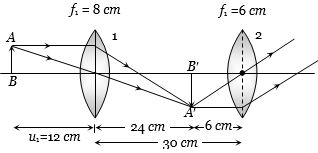
An object is placed $12 \ cm$ to the left of a converging lens of focal length $8 \ cm$. Another converging lens of $6 \ cm$ focal length is placed at a distance of $30 \ cm$ to the right of the first lens. The second lens will produce
A
No image
B
$A$ virtual enlarged image
C
$A$ real enlarged image
D
$A$ real smaller image
Solution
(C) For lens $1$: Using the lens formula $\frac{1}{f} = \frac{1}{v} - \frac{1}{u}$,where $f = +8 \ cm$ and $u = -12 \ cm$.
$\frac{1}{8} = \frac{1}{v_1} - \frac{1}{-12} \Rightarrow \frac{1}{v_1} = \frac{1}{8} - \frac{1}{12} = \frac{3-2}{24} = \frac{1}{24}$.
So,$v_1 = 24 \ cm$. The image $A'B'$ is formed $24 \ cm$ to the right of the first lens.
The distance of this image from the second lens is $d = 30 \ cm - 24 \ cm = 6 \ cm$.
Since the focal length of the second lens is $f_2 = 6 \ cm$,the image $A'B'$ acts as an object placed exactly at the focus of the second lens.
Therefore,the rays emerging from the second lens will be parallel,and the final image will be formed at infinity. In optical terms,an image at infinity is considered real and highly enlarged.
$\frac{1}{8} = \frac{1}{v_1} - \frac{1}{-12} \Rightarrow \frac{1}{v_1} = \frac{1}{8} - \frac{1}{12} = \frac{3-2}{24} = \frac{1}{24}$.
So,$v_1 = 24 \ cm$. The image $A'B'$ is formed $24 \ cm$ to the right of the first lens.
The distance of this image from the second lens is $d = 30 \ cm - 24 \ cm = 6 \ cm$.
Since the focal length of the second lens is $f_2 = 6 \ cm$,the image $A'B'$ acts as an object placed exactly at the focus of the second lens.
Therefore,the rays emerging from the second lens will be parallel,and the final image will be formed at infinity. In optical terms,an image at infinity is considered real and highly enlarged.
0 likes
View Solution25
MediumMCQ
Two thin lenses of focal lengths $f_1$ and $f_2$ are in contact. The focal length of this combination is
A
$\frac{f_1 f_2}{f_1 - f_2}$
B
$\frac{f_1 f_2}{f_1 + f_2}$
C
$\frac{2 f_1 f_2}{f_1 - f_2}$
D
$\frac{2 f_1 f_2}{f_1 + f_2}$
Solution
(B) When two thin lenses of focal lengths $f_1$ and $f_2$ are placed in contact coaxially,the equivalent focal length $F$ of the combination is given by the formula:
$\frac{1}{F} = \frac{1}{f_1} + \frac{1}{f_2}$
To find $F$,we take the common denominator:
$\frac{1}{F} = \frac{f_2 + f_1}{f_1 f_2}$
Taking the reciprocal of both sides,we get:
$F = \frac{f_1 f_2}{f_1 + f_2}$
Therefore,the correct option is $B$.
$\frac{1}{F} = \frac{1}{f_1} + \frac{1}{f_2}$
To find $F$,we take the common denominator:
$\frac{1}{F} = \frac{f_2 + f_1}{f_1 f_2}$
Taking the reciprocal of both sides,we get:
$F = \frac{f_1 f_2}{f_1 + f_2}$
Therefore,the correct option is $B$.
0 likes
View Solution26
MediumMCQ
$A$ beam of parallel rays is brought to a focus by a plano-convex lens. $A$ thin concave lens of the same focal length is joined to the first lens. The effect of this is:
A
The focal point shifts away from the lens by a small distance
B
The focus remains undisturbed
C
The focus shifts to infinity
D
The focal point shifts towards the lens by a small distance
Solution
(C) The focal length of a plano-convex lens is $f_1 = f$. The focal length of a thin concave lens is $f_2 = -f$ (since it is a concave lens of the same focal length).
When two thin lenses are placed in contact,the equivalent focal length $F$ is given by the formula:
$\frac{1}{F} = \frac{1}{f_1} + \frac{1}{f_2}$
Substituting the values:
$\frac{1}{F} = \frac{1}{f} + \frac{1}{-f} = 0$
Therefore,$F = \infty$.
Since the equivalent focal length is infinite,the parallel rays will remain parallel after passing through the combination,meaning the focus shifts to infinity.
When two thin lenses are placed in contact,the equivalent focal length $F$ is given by the formula:
$\frac{1}{F} = \frac{1}{f_1} + \frac{1}{f_2}$
Substituting the values:
$\frac{1}{F} = \frac{1}{f} + \frac{1}{-f} = 0$
Therefore,$F = \infty$.
Since the equivalent focal length is infinite,the parallel rays will remain parallel after passing through the combination,meaning the focus shifts to infinity.
0 likes
View Solution27
EasyMCQ
$A$ combination of two thin convex lenses of focal lengths $0.3 \, m$ and $0.1 \, m$ will have minimum spherical and chromatic aberrations if the distance between them is . . . . . . $m$.
A
$0.1$
B
$0.2$
C
$0.3$
D
$0.4$
Solution
(B) For a combination of two thin lenses to have minimum spherical and chromatic aberration,the distance $d$ between the two lenses must satisfy the condition $d = f_1 - f_2$,where $f_1$ and $f_2$ are the focal lengths of the two lenses.
Given,$f_1 = 0.3 \, m$ and $f_2 = 0.1 \, m$.
Substituting these values into the formula:
$d = 0.3 \, m - 0.1 \, m = 0.2 \, m$.
Therefore,the required distance is $0.2 \, m$.
Given,$f_1 = 0.3 \, m$ and $f_2 = 0.1 \, m$.
Substituting these values into the formula:
$d = 0.3 \, m - 0.1 \, m = 0.2 \, m$.
Therefore,the required distance is $0.2 \, m$.
0 likes
View Solution28
MediumMCQ
The power of an achromatic convergent lens combination consisting of two lenses is $+ 2D$. The power of the convex lens is $+ 5D$. The ratio of the dispersive power of the convex lens to the concave lens will be:
A
$5:3$
B
$3:5$
C
$2:5$
D
$5:2$
Solution
(B) Given: Total power of the combination $P = P_1 + P_2 = + 2D$.
Power of the convex lens $P_1 = + 5D$.
Therefore,the power of the concave lens $P_2 = P - P_1 = 2D - 5D = - 3D$.
For an achromatic combination,the condition is $\frac{\omega_1}{f_1} + \frac{\omega_2}{f_2} = 0$,which can be written in terms of power as $\omega_1 P_1 + \omega_2 P_2 = 0$.
This implies $\frac{\omega_1}{\omega_2} = - \frac{P_2}{P_1}$.
Substituting the values: $\frac{\omega_1}{\omega_2} = - \left( \frac{- 3D}{5D} \right) = \frac{3}{5}$.
Thus,the ratio of the dispersive power of the convex lens to the concave lens is $3:5$.
Power of the convex lens $P_1 = + 5D$.
Therefore,the power of the concave lens $P_2 = P - P_1 = 2D - 5D = - 3D$.
For an achromatic combination,the condition is $\frac{\omega_1}{f_1} + \frac{\omega_2}{f_2} = 0$,which can be written in terms of power as $\omega_1 P_1 + \omega_2 P_2 = 0$.
This implies $\frac{\omega_1}{\omega_2} = - \frac{P_2}{P_1}$.
Substituting the values: $\frac{\omega_1}{\omega_2} = - \left( \frac{- 3D}{5D} \right) = \frac{3}{5}$.
Thus,the ratio of the dispersive power of the convex lens to the concave lens is $3:5$.
0 likes
View Solution29
MediumMCQ
Two lenses of power $+12 \ D$ and $-2 \ D$ are placed in contact. The combined focal length of the combination will be ....... $cm$.
A
$8.33$
B
$1.66$
C
$12.5$
D
$10$
Solution
(D) The power of the combination of lenses in contact is given by the sum of their individual powers: $P = P_1 + P_2$.
Given $P_1 = +12 \ D$ and $P_2 = -2 \ D$.
Therefore,the total power $P = 12 \ D - 2 \ D = 10 \ D$.
The focal length $F$ in meters is given by $F = \frac{1}{P}$.
$F = \frac{1}{10} \ m = 0.1 \ m$.
To convert the focal length into centimeters,multiply by $100$: $F = 0.1 \times 100 \ cm = 10 \ cm$.
Given $P_1 = +12 \ D$ and $P_2 = -2 \ D$.
Therefore,the total power $P = 12 \ D - 2 \ D = 10 \ D$.
The focal length $F$ in meters is given by $F = \frac{1}{P}$.
$F = \frac{1}{10} \ m = 0.1 \ m$.
To convert the focal length into centimeters,multiply by $100$: $F = 0.1 \times 100 \ cm = 10 \ cm$.
0 likes
View Solution30
MediumMCQ
$A$ convex lens is in contact with a concave lens. The magnitude of the ratio of their focal lengths is $2/3$. Their equivalent focal length is $30 \ cm$. What are their individual focal lengths?
A
$-75, 50$
B
$-10, 15$
C
$75, 50$
D
$-15, 10$
Solution
(D) Let the focal length of the convex lens be $f_1$ and the concave lens be $f_2$. Since the lens is concave,$f_2$ is negative.
Given the ratio of magnitudes: $|f_1| / |f_2| = 2/3$,so $f_1 / (-f_2) = 2/3$,which implies $f_2 = -1.5 f_1$.
The formula for the equivalent focal length $F$ of two thin lenses in contact is $1/F = 1/f_1 + 1/f_2$.
Given $F = 30 \ cm$,we have $1/30 = 1/f_1 - 1/|f_2|$.
Substituting $|f_2| = 1.5 f_1$: $1/30 = 1/f_1 - 1/(1.5 f_1) = (1.5 - 1) / (1.5 f_1) = 0.5 / (1.5 f_1) = 1 / (3 f_1)$.
Thus,$3 f_1 = 30$,so $f_1 = 10 \ cm$.
Then,$|f_2| = 1.5 \times 10 = 15 \ cm$. Since it is a concave lens,$f_2 = -15 \ cm$.
Therefore,the focal lengths are $10 \ cm$ and $-15 \ cm$.
Given the ratio of magnitudes: $|f_1| / |f_2| = 2/3$,so $f_1 / (-f_2) = 2/3$,which implies $f_2 = -1.5 f_1$.
The formula for the equivalent focal length $F$ of two thin lenses in contact is $1/F = 1/f_1 + 1/f_2$.
Given $F = 30 \ cm$,we have $1/30 = 1/f_1 - 1/|f_2|$.
Substituting $|f_2| = 1.5 f_1$: $1/30 = 1/f_1 - 1/(1.5 f_1) = (1.5 - 1) / (1.5 f_1) = 0.5 / (1.5 f_1) = 1 / (3 f_1)$.
Thus,$3 f_1 = 30$,so $f_1 = 10 \ cm$.
Then,$|f_2| = 1.5 \times 10 = 15 \ cm$. Since it is a concave lens,$f_2 = -15 \ cm$.
Therefore,the focal lengths are $10 \ cm$ and $-15 \ cm$.
0 likes
View Solution31
MediumMCQ
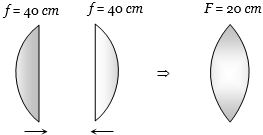
The plane faces of two identical plano-convex lenses,each having a focal length of $40 \ cm$,are pressed against each other to form a biconvex lens. The distance from this lens at which an object must be placed to obtain a real,inverted image with a magnification of $1$ is ....... $cm$.
A
$80$
B
$40$
C
$20$
D
$160$
Solution
(B) When two thin lenses are placed in contact,the equivalent focal length $F$ is given by $\frac{1}{F} = \frac{1}{f_1} + \frac{1}{f_2}$.
Given $f_1 = f_2 = 40 \ cm$,the equivalent focal length is $\frac{1}{F} = \frac{1}{40} + \frac{1}{40} = \frac{2}{40} = \frac{1}{20}$,so $F = 20 \ cm$.
To obtain a real,inverted image of the same size (magnification $m = -1$),the object must be placed at a distance of $2F$ from the lens.
Therefore,the object distance $u = 2 \times 20 \ cm = 40 \ cm$.
Given $f_1 = f_2 = 40 \ cm$,the equivalent focal length is $\frac{1}{F} = \frac{1}{40} + \frac{1}{40} = \frac{2}{40} = \frac{1}{20}$,so $F = 20 \ cm$.
To obtain a real,inverted image of the same size (magnification $m = -1$),the object must be placed at a distance of $2F$ from the lens.
Therefore,the object distance $u = 2 \times 20 \ cm = 40 \ cm$.
0 likes
View Solution32
DifficultMCQ
If two lenses of $+5$ diopters are mounted at some distance apart,the equivalent power will always be negative if the distance is
A
Greater than $40 \ cm$
B
Equal to $40 \ cm$
C
Equal to $10 \ cm$
D
Less than $10 \ cm$
Solution
(A) The equivalent power $P$ of two lenses separated by a distance $d$ is given by the formula: $P = P_1 + P_2 - d \cdot P_1 \cdot P_2$.
Given $P_1 = +5 \ D$ and $P_2 = +5 \ D$.
For the equivalent power to be negative,we require $P < 0$.
Substituting the values: $5 + 5 - d(5)(5) < 0$.
$10 - 25d < 0$.
$10 < 25d$.
$d > \frac{10}{25} \ m$.
$d > 0.4 \ m$.
Converting to centimeters: $d > 0.4 \times 100 \ cm = 40 \ cm$.
Thus,the equivalent power will be negative if the distance is greater than $40 \ cm$.
Given $P_1 = +5 \ D$ and $P_2 = +5 \ D$.
For the equivalent power to be negative,we require $P < 0$.
Substituting the values: $5 + 5 - d(5)(5) < 0$.
$10 - 25d < 0$.
$10 < 25d$.
$d > \frac{10}{25} \ m$.
$d > 0.4 \ m$.
Converting to centimeters: $d > 0.4 \times 100 \ cm = 40 \ cm$.
Thus,the equivalent power will be negative if the distance is greater than $40 \ cm$.
0 likes
View Solution33
MediumMCQ
$A$ concave lens and a convex lens have the same focal length of $20 \ cm$ and are placed in contact. This combination is used to view an object $5 \ cm$ long kept at $20 \ cm$ from the lens combination. As compared to the object,the image will be:
A
Magnified and inverted
B
Reduced and erect
C
Of the same size and erect
D
Of the same size and inverted
Solution
(C) The focal length of a convex lens is $f_1 = +20 \ cm$ and the focal length of a concave lens is $f_2 = -20 \ cm$.
When placed in contact,the equivalent focal length $F$ is given by $\frac{1}{F} = \frac{1}{f_1} + \frac{1}{f_2}$.
Substituting the values: $\frac{1}{F} = \frac{1}{20} + \frac{1}{-20} = 0$,which implies $F = \infty$.
$A$ combination with infinite focal length acts as a plane glass plate.
$A$ plane glass plate forms a virtual,erect image of the same size as the object at the same distance behind the plate.
When placed in contact,the equivalent focal length $F$ is given by $\frac{1}{F} = \frac{1}{f_1} + \frac{1}{f_2}$.
Substituting the values: $\frac{1}{F} = \frac{1}{20} + \frac{1}{-20} = 0$,which implies $F = \infty$.
$A$ combination with infinite focal length acts as a plane glass plate.
$A$ plane glass plate forms a virtual,erect image of the same size as the object at the same distance behind the plate.
0 likes
View Solution34
MediumMCQ
The focal length of the field lens (which is an achromatic combination of two lenses) of a telescope is $90 \ cm$. The dispersive powers of the two lenses in the combination are $0.024$ and $0.036$. The focal lengths of the two lenses are:
A
$30 \ cm$ and $60 \ cm$
B
$30 \ cm$ and $-45 \ cm$
C
$45 \ cm$ and $90 \ cm$
D
$15 \ cm$ and $45 \ cm$
Solution
(B) For an achromatic combination,the condition is $\frac{f_1}{\omega_1} + \frac{f_2}{\omega_2} = 0$,which implies $\frac{f_1}{f_2} = -\frac{\omega_1}{\omega_2}$.
Given $\omega_1 = 0.024$ and $\omega_2 = 0.036$,we have $\frac{f_1}{f_2} = -\frac{0.024}{0.036} = -\frac{2}{3}$,so $f_2 = -1.5 f_1$.
The equivalent focal length $F$ is given by $\frac{1}{F} = \frac{1}{f_1} + \frac{1}{f_2} = \frac{1}{90}$.
Substituting $f_2 = -1.5 f_1$ into the equation: $\frac{1}{f_1} - \frac{1}{1.5 f_1} = \frac{1}{90}$.
$\frac{1.5 - 1}{1.5 f_1} = \frac{1}{90} \implies \frac{0.5}{1.5 f_1} = \frac{1}{90} \implies \frac{1}{3 f_1} = \frac{1}{90}$.
Thus,$f_1 = 30 \ cm$ and $f_2 = -1.5(30) = -45 \ cm$.
Given $\omega_1 = 0.024$ and $\omega_2 = 0.036$,we have $\frac{f_1}{f_2} = -\frac{0.024}{0.036} = -\frac{2}{3}$,so $f_2 = -1.5 f_1$.
The equivalent focal length $F$ is given by $\frac{1}{F} = \frac{1}{f_1} + \frac{1}{f_2} = \frac{1}{90}$.
Substituting $f_2 = -1.5 f_1$ into the equation: $\frac{1}{f_1} - \frac{1}{1.5 f_1} = \frac{1}{90}$.
$\frac{1.5 - 1}{1.5 f_1} = \frac{1}{90} \implies \frac{0.5}{1.5 f_1} = \frac{1}{90} \implies \frac{1}{3 f_1} = \frac{1}{90}$.
Thus,$f_1 = 30 \ cm$ and $f_2 = -1.5(30) = -45 \ cm$.
0 likes
View Solution35
MediumMCQ
$A$ combination of two thin lenses of the same material with focal lengths $f_1$ and $f_2$,arranged on a common axis,minimizes chromatic aberration if the distance between them is:
A
$\frac{f_1 + f_2}{4}$
B
$\frac{f_1 + f_2}{2}$
C
$f_1 + f_2$
D
$2(f_1 + f_2)$
Solution
(B) For a combination of two thin lenses made of the same material,the condition to minimize chromatic aberration is that the distance $d$ between the lenses must be equal to the average of their focal lengths.
Mathematically,this is expressed as:
$d = \frac{f_1 + f_2}{2}$
Therefore,the correct option is $B$.
Mathematically,this is expressed as:
$d = \frac{f_1 + f_2}{2}$
Therefore,the correct option is $B$.
0 likes
View Solution36
MediumMCQ
Two lenses having focal lengths in the ratio $f_1:f_2 = 2:3$ are combined to produce no net dispersion. Find the ratio of the dispersive powers of the glasses used.
A
$2:3$
B
$3:2$
C
$4:9$
D
$9:4$
Solution
(A) For a combination of two thin lenses to produce no net dispersion (achromatic doublet),the condition is given by $\frac{\omega_1}{f_1} + \frac{\omega_2}{f_2} = 0$.
This implies $\frac{\omega_1}{\omega_2} = -\frac{f_1}{f_2}$.
Given the ratio of focal lengths is $\frac{f_1}{f_2} = \frac{2}{3}$.
Substituting this value,we get $\frac{\omega_1}{\omega_2} = -\frac{2}{3}$.
Since dispersive power is a positive quantity,we consider the magnitude of the ratio,which is $2:3$.
This implies $\frac{\omega_1}{\omega_2} = -\frac{f_1}{f_2}$.
Given the ratio of focal lengths is $\frac{f_1}{f_2} = \frac{2}{3}$.
Substituting this value,we get $\frac{\omega_1}{\omega_2} = -\frac{2}{3}$.
Since dispersive power is a positive quantity,we consider the magnitude of the ratio,which is $2:3$.
0 likes
View Solution37
MediumMCQ
An eye specialist prescribes spectacles having a combination of a convex lens of focal length $40\, cm$ in contact with a concave lens of focal length $25\, cm$. The power of this lens combination in diopters is
A
$+ 1.5$
B
$- 1.5$
C
$+ 6.67$
D
$- 6.67$
Solution
(B) The power $P$ of a lens is given by $P = \frac{100}{f(cm)}\, D$.
For the convex lens,the focal length $f_1 = +40\, cm$.
Therefore,the power $P_1 = \frac{100}{40} = +2.5\, D$.
For the concave lens,the focal length $f_2 = -25\, cm$.
Therefore,the power $P_2 = \frac{100}{-25} = -4.0\, D$.
The power of the combination of lenses in contact is given by $P = P_1 + P_2$.
$P = 2.5\, D + (-4.0\, D) = -1.5\, D$.
For the convex lens,the focal length $f_1 = +40\, cm$.
Therefore,the power $P_1 = \frac{100}{40} = +2.5\, D$.
For the concave lens,the focal length $f_2 = -25\, cm$.
Therefore,the power $P_2 = \frac{100}{-25} = -4.0\, D$.
The power of the combination of lenses in contact is given by $P = P_1 + P_2$.
$P = 2.5\, D + (-4.0\, D) = -1.5\, D$.
0 likes
View Solution38
MediumMCQ
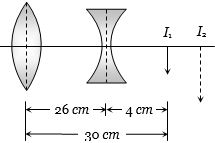
The size of the image of an object, which is at infinity, as formed by a convex lens of focal length $30\,cm$ is $2\,cm$. If a concave lens of focal length $20\,cm$ is placed between the convex lens and the image at a distance of $26\,cm$ from the convex lens, calculate the new size of the image. (in $cm$)
A
$1.25$
B
$2.5$
C
$1.05$
D
$2$
Solution
(B) $1$. The convex lens forms an image $I_1$ at its focal point. Since the object is at infinity, the image $I_1$ is formed at $f = 30\,cm$ from the convex lens.
$2$. The size of this image $I_1$ is $2\,cm$.
$3$. A concave lens of focal length $f_2 = -20\,cm$ is placed at $26\,cm$ from the convex lens. The image $I_1$ acts as a virtual object for the concave lens.
$4$. The distance of the virtual object from the concave lens is $u = 30\,cm - 26\,cm = 4\,cm$. Since it is on the right side, we take $u = +4\,cm$.
$5$. Using the lens formula $\frac{1}{v} - \frac{1}{u} = \frac{1}{f}$:
$\frac{1}{v} - \frac{1}{4} = \frac{1}{-20}$
$\frac{1}{v} = \frac{1}{4} - \frac{1}{20} = \frac{5-1}{20} = \frac{4}{20} = \frac{1}{5}$
$v = 5\,cm$.
$6$. The magnification $m$ for the concave lens is $m = \frac{v}{u} = \frac{5}{4} = 1.25$.
$7$. The new size of the image $I_2$ is $m \times (\text{size of } I_1) = 1.25 \times 2\,cm = 2.5\,cm$.
$2$. The size of this image $I_1$ is $2\,cm$.
$3$. A concave lens of focal length $f_2 = -20\,cm$ is placed at $26\,cm$ from the convex lens. The image $I_1$ acts as a virtual object for the concave lens.
$4$. The distance of the virtual object from the concave lens is $u = 30\,cm - 26\,cm = 4\,cm$. Since it is on the right side, we take $u = +4\,cm$.
$5$. Using the lens formula $\frac{1}{v} - \frac{1}{u} = \frac{1}{f}$:
$\frac{1}{v} - \frac{1}{4} = \frac{1}{-20}$
$\frac{1}{v} = \frac{1}{4} - \frac{1}{20} = \frac{5-1}{20} = \frac{4}{20} = \frac{1}{5}$
$v = 5\,cm$.
$6$. The magnification $m$ for the concave lens is $m = \frac{v}{u} = \frac{5}{4} = 1.25$.
$7$. The new size of the image $I_2$ is $m \times (\text{size of } I_1) = 1.25 \times 2\,cm = 2.5\,cm$.
0 likes
View Solution39
MediumMCQ
$A$ convex lens of focal length $30 \ cm$ and a concave lens of $10 \ cm$ focal length are placed so as to have the same axis. If a parallel beam of light falling on the convex lens leaves the concave lens as a parallel beam,then the distance between the two lenses will be.......$cm$.
A
$40$
B
$30$
C
$20$
D
$10$
Solution
(C) Let the focal length of the convex lens be $f_1 = +30 \ cm$ and the concave lens be $f_2 = -10 \ cm$.
Let the distance between the two lenses be $d$.
For a parallel beam of light to remain parallel after passing through the combination,the effective focal length $F$ of the system must be infinite $(F = \infty)$.
The formula for the effective focal length of two lenses separated by a distance $d$ is given by:
$\frac{1}{F} = \frac{1}{f_1} + \frac{1}{f_2} - \frac{d}{f_1 f_2}$
Substituting $F = \infty$,$f_1 = 30$,and $f_2 = -10$:
$0 = \frac{1}{30} + \frac{1}{-10} - \frac{d}{(30)(-10)}$
$0 = \frac{1}{30} - \frac{1}{10} + \frac{d}{300}$
Multiplying by $300$:
$0 = 10 - 30 + d$
$d = 20 \ cm$.
Thus,the distance between the two lenses is $20 \ cm$.
Let the distance between the two lenses be $d$.
For a parallel beam of light to remain parallel after passing through the combination,the effective focal length $F$ of the system must be infinite $(F = \infty)$.
The formula for the effective focal length of two lenses separated by a distance $d$ is given by:
$\frac{1}{F} = \frac{1}{f_1} + \frac{1}{f_2} - \frac{d}{f_1 f_2}$
Substituting $F = \infty$,$f_1 = 30$,and $f_2 = -10$:
$0 = \frac{1}{30} + \frac{1}{-10} - \frac{d}{(30)(-10)}$
$0 = \frac{1}{30} - \frac{1}{10} + \frac{d}{300}$
Multiplying by $300$:
$0 = 10 - 30 + d$
$d = 20 \ cm$.
Thus,the distance between the two lenses is $20 \ cm$.
0 likes
View Solution40
MediumMCQ
$A$ lens of power $3.5 \, D$ is placed in contact with a lens of power $-2.5 \, D$. The combination behaves as:
A
$A$ converging lens of focal length $100 \, cm$
B
$A$ diverging lens of focal length $100 \, cm$
C
$A$ converging lens of focal length $200 \, cm$
D
$A$ diverging lens of focal length $200 \, cm$
Solution
(A) The equivalent power of two lenses in contact is given by $P = P_1 + P_2$.
Substituting the given values: $P = 3.5 \, D + (-2.5 \, D) = 1.0 \, D$.
Since the power is positive,the combination acts as a converging lens.
The focal length $f$ is given by $f = \frac{100}{P} \, cm$.
$f = \frac{100}{1} = 100 \, cm$.
Therefore,the combination behaves as a converging lens of focal length $100 \, cm$.
Substituting the given values: $P = 3.5 \, D + (-2.5 \, D) = 1.0 \, D$.
Since the power is positive,the combination acts as a converging lens.
The focal length $f$ is given by $f = \frac{100}{P} \, cm$.
$f = \frac{100}{1} = 100 \, cm$.
Therefore,the combination behaves as a converging lens of focal length $100 \, cm$.
0 likes
View Solution41
EasyMCQ
Two lenses of power $-15 \, D$ and $5 \, D$ are placed in contact with each other. The focal length of this combination will be ....... $cm$.
A
$-20$
B
$-10$
C
$20$
D
$10$
Solution
(B) The power of the combination of lenses in contact is given by the sum of their individual powers: $P = P_1 + P_2$.
Given $P_1 = -15 \, D$ and $P_2 = 5 \, D$.
Therefore,$P = -15 \, D + 5 \, D = -10 \, D$.
The focal length $f$ of the combination is given by $f = \frac{1}{P}$ (in meters).
$f = \frac{1}{-10} \, m = -0.1 \, m$.
To convert the focal length into centimeters,multiply by $100$: $f = -0.1 \times 100 \, cm = -10 \, cm$.
Given $P_1 = -15 \, D$ and $P_2 = 5 \, D$.
Therefore,$P = -15 \, D + 5 \, D = -10 \, D$.
The focal length $f$ of the combination is given by $f = \frac{1}{P}$ (in meters).
$f = \frac{1}{-10} \, m = -0.1 \, m$.
To convert the focal length into centimeters,multiply by $100$: $f = -0.1 \times 100 \, cm = -10 \, cm$.
0 likes
View Solution42
EasyMCQ
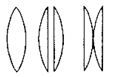
$A$ convex lens of focal length $20 \, cm$ is cut into two equal parts. This results in two plano-convex lenses as shown in the figure. These two parts are then placed in contact with each other as shown in the figure. What will be the focal length of the system in $cm$?
A
$0$
B
$5$
C
$10$
D
$20$
Solution
(D) When a convex lens of focal length $f$ is cut perpendicular to its principal axis into two equal parts,each part becomes a plano-convex lens with a focal length of $2f$.
Given $f = 20 \, cm$,the focal length of each plano-convex lens is $f' = 2f = 40 \, cm$.
When these two lenses are placed in contact as shown in the figure (with their curved surfaces facing each other),the equivalent focal length $F$ is given by the lens combination formula:
$\frac{1}{F} = \frac{1}{f'} + \frac{1}{f'} = \frac{1}{40} + \frac{1}{40} = \frac{2}{40} = \frac{1}{20}$.
Therefore,$F = 20 \, cm$.
Given $f = 20 \, cm$,the focal length of each plano-convex lens is $f' = 2f = 40 \, cm$.
When these two lenses are placed in contact as shown in the figure (with their curved surfaces facing each other),the equivalent focal length $F$ is given by the lens combination formula:
$\frac{1}{F} = \frac{1}{f'} + \frac{1}{f'} = \frac{1}{40} + \frac{1}{40} = \frac{2}{40} = \frac{1}{20}$.
Therefore,$F = 20 \, cm$.
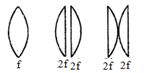
0 likes
View Solution43
EasyMCQ
Two lenses of power $6 \, D$ and $-2 \, D$ are placed in contact to form a single lens. The focal length of the combination is:
A
$\frac{3}{2} \, m$
B
$\frac{1}{4} \, m$
C
$4 \, m$
D
$\frac{1}{8} \, m$
Solution
(B) When two thin lenses are placed in contact,the total power $P$ of the combination is the algebraic sum of the individual powers of the lenses.
Given: $P_1 = 6 \, D$ and $P_2 = -2 \, D$.
The total power $P = P_1 + P_2 = 6 \, D + (-2 \, D) = 4 \, D$.
The focal length $f$ of the combination is given by the formula $f = \frac{1}{P}$.
Substituting the value of $P$,we get $f = \frac{1}{4} \, m$.
Given: $P_1 = 6 \, D$ and $P_2 = -2 \, D$.
The total power $P = P_1 + P_2 = 6 \, D + (-2 \, D) = 4 \, D$.
The focal length $f$ of the combination is given by the formula $f = \frac{1}{P}$.
Substituting the value of $P$,we get $f = \frac{1}{4} \, m$.
0 likes
View Solution44
MediumMCQ
Two lenses have focal lengths of $+10 \ cm$ and $-15 \ cm$. When they are placed in contact,the combination acts as a convex lens. If the chromatic aberration is zero,what is the ratio of their dispersive powers?
A
$3/2$
B
$2/3$
C
$-3/2$
D
$-2/3$
Solution
(B) For an achromatic combination of two thin lenses in contact,the condition for zero chromatic aberration is given by:
$\frac{\omega_1}{f_1} + \frac{\omega_2}{f_2} = 0$
Rearranging the equation to find the ratio of the dispersive powers $\frac{\omega_1}{\omega_2}$:
$\frac{\omega_1}{\omega_2} = -\frac{f_1}{f_2}$
Given the focal lengths $f_1 = +10 \ cm$ and $f_2 = -15 \ cm$:
$\frac{\omega_1}{\omega_2} = -\frac{10}{-15}$
$\frac{\omega_1}{\omega_2} = \frac{10}{15} = \frac{2}{3}$
Thus,the ratio of their dispersive powers is $2/3$.
$\frac{\omega_1}{f_1} + \frac{\omega_2}{f_2} = 0$
Rearranging the equation to find the ratio of the dispersive powers $\frac{\omega_1}{\omega_2}$:
$\frac{\omega_1}{\omega_2} = -\frac{f_1}{f_2}$
Given the focal lengths $f_1 = +10 \ cm$ and $f_2 = -15 \ cm$:
$\frac{\omega_1}{\omega_2} = -\frac{10}{-15}$
$\frac{\omega_1}{\omega_2} = \frac{10}{15} = \frac{2}{3}$
Thus,the ratio of their dispersive powers is $2/3$.
0 likes
View Solution45
MediumMCQ
Two lenses of power $3\,D$ and $-5\,D$ are combined to form a compound lens. An object is placed at a distance of $50\,cm$ from this combination. At what distance (in $cm$) will the image be formed?
A
$-10$
B
$+10$
C
$-25$
D
$+25$
Solution
(C) The power of the combination of lenses is given by $P = P_1 + P_2$.
Given $P_1 = +3\,D$ and $P_2 = -5\,D$,the total power is $P = 3 + (-5) = -2\,D$.
The focal length $f$ of the combination is $f = \frac{1}{P} = \frac{1}{-2}\,m = -0.5\,m = -50\,cm$.
The object distance is $u = -50\,cm$.
Using the lens formula $\frac{1}{f} = \frac{1}{v} - \frac{1}{u}$,we have $\frac{1}{v} = \frac{1}{f} + \frac{1}{u}$.
Substituting the values,$\frac{1}{v} = \frac{1}{-50} + \frac{1}{-50} = -\frac{2}{50} = -\frac{1}{25}$.
Therefore,$v = -25\,cm$.
Given $P_1 = +3\,D$ and $P_2 = -5\,D$,the total power is $P = 3 + (-5) = -2\,D$.
The focal length $f$ of the combination is $f = \frac{1}{P} = \frac{1}{-2}\,m = -0.5\,m = -50\,cm$.
The object distance is $u = -50\,cm$.
Using the lens formula $\frac{1}{f} = \frac{1}{v} - \frac{1}{u}$,we have $\frac{1}{v} = \frac{1}{f} + \frac{1}{u}$.
Substituting the values,$\frac{1}{v} = \frac{1}{-50} + \frac{1}{-50} = -\frac{2}{50} = -\frac{1}{25}$.
Therefore,$v = -25\,cm$.
0 likes
View Solution46
EasyMCQ
$A$ convex lens of focal length $10 \, cm$ is placed in contact with a concave lens. The focal length of the combination is numerically equal to that of the concave lens. The focal length of the concave lens is ............ $cm$.
A
$10$
B
$15$
C
$5$
D
$-20$
Solution
(D) Let the focal length of the convex lens be $f_1 = 10 \, cm$ and the focal length of the concave lens be $f_2 = -f$ (where $f > 0$).
According to the lens combination formula,the effective focal length $F$ is given by $\frac{1}{F} = \frac{1}{f_1} + \frac{1}{f_2}$.
Given that the focal length of the combination is numerically equal to that of the concave lens,we have $F = -f$.
Substituting the values: $\frac{1}{-f} = \frac{1}{10} + \frac{1}{-f}$.
Wait,the problem states the combination's focal length is numerically equal to the concave lens. Let the concave lens focal length be $-x$. Then the combination focal length is $-x$.
So,$\frac{1}{-x} = \frac{1}{10} - \frac{1}{x}$.
Adding $\frac{1}{x}$ to both sides: $0 = \frac{1}{10}$. This implies a contradiction unless the combination focal length is defined differently.
Re-evaluating: If the combination focal length $F$ is numerically equal to the concave lens focal length $f_c$,and $f_c$ is negative,then $F = f_c$.
$\frac{1}{f_c} = \frac{1}{10} + \frac{1}{f_c}$. This is impossible.
However,if the magnitude is equal,$|F| = |f_c|$. Since the combination is $F = \frac{10(-f)}{10-f}$,and we set $F = f$ (magnitude),then $f = \frac{10f}{f-10} \Rightarrow f-10 = 10 \Rightarrow f = 20$.
Thus,the concave lens focal length is $-20 \, cm$.
According to the lens combination formula,the effective focal length $F$ is given by $\frac{1}{F} = \frac{1}{f_1} + \frac{1}{f_2}$.
Given that the focal length of the combination is numerically equal to that of the concave lens,we have $F = -f$.
Substituting the values: $\frac{1}{-f} = \frac{1}{10} + \frac{1}{-f}$.
Wait,the problem states the combination's focal length is numerically equal to the concave lens. Let the concave lens focal length be $-x$. Then the combination focal length is $-x$.
So,$\frac{1}{-x} = \frac{1}{10} - \frac{1}{x}$.
Adding $\frac{1}{x}$ to both sides: $0 = \frac{1}{10}$. This implies a contradiction unless the combination focal length is defined differently.
Re-evaluating: If the combination focal length $F$ is numerically equal to the concave lens focal length $f_c$,and $f_c$ is negative,then $F = f_c$.
$\frac{1}{f_c} = \frac{1}{10} + \frac{1}{f_c}$. This is impossible.
However,if the magnitude is equal,$|F| = |f_c|$. Since the combination is $F = \frac{10(-f)}{10-f}$,and we set $F = f$ (magnitude),then $f = \frac{10f}{f-10} \Rightarrow f-10 = 10 \Rightarrow f = 20$.
Thus,the concave lens focal length is $-20 \, cm$.
0 likes
View Solution47
MediumMCQ
Two thin lenses in contact form an achromatic doublet of power $+2 \text{ D}$. The power of the convex lens is $+5 \text{ D}$. What is the ratio of the dispersive powers of the converging and diverging lenses?
A
$2 : 5$
B
$3 : 5$
C
$5 : 2$
D
$5 : 3$
Solution
(B) The total power of the combination is $P = P_1 + P_2 = +2 \text{ D}$.
Given the power of the convex lens $P_1 = +5 \text{ D}$, we find the power of the second lens $P_2 = P - P_1 = 2 - 5 = -3 \text{ D}$.
For an achromatic doublet, the condition is $\omega_1 P_1 + \omega_2 P_2 = 0$, where $\omega_1$ and $\omega_2$ are the dispersive powers.
This implies $\frac{\omega_1}{\omega_2} = -\frac{P_2}{P_1}$.
Substituting the values, $\frac{\omega_1}{\omega_2} = -\left( \frac{-3}{5} \right) = \frac{3}{5}$.
Thus, the ratio of the dispersive powers is $3 : 5$.
Given the power of the convex lens $P_1 = +5 \text{ D}$, we find the power of the second lens $P_2 = P - P_1 = 2 - 5 = -3 \text{ D}$.
For an achromatic doublet, the condition is $\omega_1 P_1 + \omega_2 P_2 = 0$, where $\omega_1$ and $\omega_2$ are the dispersive powers.
This implies $\frac{\omega_1}{\omega_2} = -\frac{P_2}{P_1}$.
Substituting the values, $\frac{\omega_1}{\omega_2} = -\left( \frac{-3}{5} \right) = \frac{3}{5}$.
Thus, the ratio of the dispersive powers is $3 : 5$.
0 likes
View Solution48
MediumMCQ
$A$ glass convex lens of focal length $0.1 \ m$ is cut into two equal parts along its axis. The ratio of the focal length of the new lenses is:
A
$1 : 1$
B
$1 : 2$
C
$2 : 1$
D
$2 : 1/2$
Solution
(A) When a convex lens of focal length $f$ is cut into two equal parts along its principal axis (vertically),each part becomes a plano-convex lens.
According to the lens maker's formula,$\frac{1}{f} = (n-1) \left( \frac{1}{R_1} - \frac{1}{R_2} \right)$.
For the original lens,$R_1 = R$ and $R_2 = -R$,so $\frac{1}{f} = (n-1) \left( \frac{2}{R} \right)$.
When cut vertically,each new lens has one surface with radius $R$ and the other surface is flat $(R = \infty)$.
Thus,for the new lens,$\frac{1}{f'} = (n-1) \left( \frac{1}{R} - \frac{1}{\infty} \right) = \frac{n-1}{R}$.
Comparing the two,we get $f' = 2f$.
Since both parts are identical,their focal lengths are equal,so the ratio is $2f : 2f = 1 : 1$.
According to the lens maker's formula,$\frac{1}{f} = (n-1) \left( \frac{1}{R_1} - \frac{1}{R_2} \right)$.
For the original lens,$R_1 = R$ and $R_2 = -R$,so $\frac{1}{f} = (n-1) \left( \frac{2}{R} \right)$.
When cut vertically,each new lens has one surface with radius $R$ and the other surface is flat $(R = \infty)$.
Thus,for the new lens,$\frac{1}{f'} = (n-1) \left( \frac{1}{R} - \frac{1}{\infty} \right) = \frac{n-1}{R}$.
Comparing the two,we get $f' = 2f$.
Since both parts are identical,their focal lengths are equal,so the ratio is $2f : 2f = 1 : 1$.
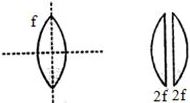
0 likes
View Solution49
MediumMCQ
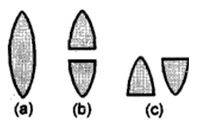
$A$ biconvex glass lens has a focal length $f$ and power $P$. It is cut into two symmetric parts along its principal axis. If these two parts are joined as shown in figure $(b)$,what is the new power of the combination?
A
$P$
B
$P/2$
C
$2P$
D
$0$
Solution
(C) When a biconvex lens is cut along its principal axis (horizontal cut),each half has the same focal length $f$ as the original lens.
This is because the radius of curvature of the surfaces remains unchanged for each part.
Thus,the power of each part remains $P = 1/f$.
When these two parts are joined as shown in figure $(b)$,they form a combination of two lenses in contact.
The total power of the combination is the sum of the powers of the individual lenses: $P_{net} = P_1 + P_2$.
Since $P_1 = P$ and $P_2 = P$,the net power is $P_{net} = P + P = 2P$.
This is because the radius of curvature of the surfaces remains unchanged for each part.
Thus,the power of each part remains $P = 1/f$.
When these two parts are joined as shown in figure $(b)$,they form a combination of two lenses in contact.
The total power of the combination is the sum of the powers of the individual lenses: $P_{net} = P_1 + P_2$.
Since $P_1 = P$ and $P_2 = P$,the net power is $P_{net} = P + P = 2P$.
0 likes
View SolutionRay Optics and Optical Instruments — Combination of Lenses · Frequently Asked Questions
1Are these Ray Optics and Optical Instruments questions useful for JEE and NEET?
Yes. All questions in this section are mapped to JEE Main and NEET exam patterns. Previous year questions from JEE Main, NEET, GUJCET and state-level exams are included with full solutions.
2Can I switch to Hindi or Gujarati for these questions?
Yes. Use the language tabs in the hero section or the sidebar to view the same questions and solutions in English, Hindi or Gujarati.
3How do I generate a question paper from this subtopic?
Use the Vedclass Exam Paper Generator — select the chapter and subtopic, set difficulty, and generate Sets A, B, C, D automatically. First 3 chapters of every subject are free.
Vedclass Products
For Students
Vedclass Test Series
Mock tests in real JEE/NEET style with performance analysis. 5-day free trial.
Start Free TrialFor Teachers
Exam Paper Generator
Generate Set A/B/C/D papers from this chapter in 2 minutes. 3 chapters free.
Try FreeFor Institutes
Online Exam Module
Live online exams with unlimited students, 360° analytics & white-label branding.
See DemoFor Teachers & Institutes
Generate a Ray Optics and Optical Instruments Exam Paper in 2 Minutes
Select subtopic & difficulty — Sets A, B, C, D auto-generated with No Repeat logic.
First 3 chapters of every subject are free — no payment required.