
A English
Earth Magnetism Questions in English
Class 12 Physics · Magnetism and Matter · Earth Magnetism
162+
Questions
English
Language
100%
With Solutions
Showing 50 of 162 questions in English
1
EasyMCQ
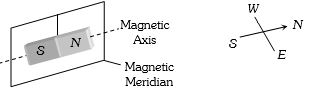
If a magnet is suspended freely such that it can rotate about its magnetic axis,in which plane does it come to rest?
A
Magnetic meridian
B
Geometric meridian
C
Angle of dip
D
None of these
Solution
(A) When a magnet is suspended freely,it aligns itself with the Earth's magnetic field. The vertical plane passing through the magnetic axis of the freely suspended magnet is known as the magnetic meridian. Therefore,the magnet comes to rest in the magnetic meridian.
0 likes
View Solution2
EasyMCQ
The intensity of the magnetic field due to the Earth at a point inside a hollow steel box is:
A
Less than outside
B
More than outside
C
Same
D
Zero
Solution
(D) The phenomenon of magnetic shielding occurs when a material with high magnetic permeability (like steel) is used to enclose a region.
When a hollow steel box is placed in an external magnetic field,the magnetic field lines prefer to pass through the steel walls due to their high permeability rather than through the hollow cavity inside.
Consequently,the magnetic field inside the cavity becomes effectively zero.
Therefore,the correct option is $D$.
When a hollow steel box is placed in an external magnetic field,the magnetic field lines prefer to pass through the steel walls due to their high permeability rather than through the hollow cavity inside.
Consequently,the magnetic field inside the cavity becomes effectively zero.
Therefore,the correct option is $D$.
0 likes
View Solution3
EasyMCQ
Earth's magnetic field always has a horizontal component except at,or the horizontal component of Earth's magnetic field remains zero at:
A
Equator
B
Magnetic poles
C
$A$ latitude of $60^o$
D
An altitude of $60^o$
Solution
(B) The horizontal component of the Earth's magnetic field is given by the formula $B_H = B \cos \theta$,where $B$ is the total magnetic field and $\theta$ is the angle of dip (inclination).
At the magnetic poles,the magnetic field lines are perpendicular to the Earth's surface,meaning the angle of dip $\theta = 90^o$.
Substituting this into the formula: $B_H = B \cos(90^o) = B \times 0 = 0$.
Therefore,the horizontal component of the Earth's magnetic field is zero at the magnetic poles.
At the magnetic poles,the magnetic field lines are perpendicular to the Earth's surface,meaning the angle of dip $\theta = 90^o$.
Substituting this into the formula: $B_H = B \cos(90^o) = B \times 0 = 0$.
Therefore,the horizontal component of the Earth's magnetic field is zero at the magnetic poles.
0 likes
View Solution4
EasyMCQ
$A$ dip needle in a plane perpendicular to the magnetic meridian will remain:
A
Vertical
B
Horizontal
C
In any direction
D
At an angle of dip to the horizontal
Solution
(A) The magnetic meridian is the vertical plane passing through the magnetic North and South poles of the Earth. The Earth's magnetic field vector $\vec{B}$ lies entirely within this plane.
When a dip needle is placed in a plane perpendicular to the magnetic meridian,the horizontal component of the Earth's magnetic field $(B_H)$ is perpendicular to this plane. Therefore,the effective horizontal component of the magnetic field acting on the needle in this plane is zero.
Only the vertical component of the Earth's magnetic field $(B_V)$ acts on the needle in this plane. Since the magnetic force on the needle is directed along the vertical component,the needle will align itself vertically.
Thus,the dip needle will remain vertical.
When a dip needle is placed in a plane perpendicular to the magnetic meridian,the horizontal component of the Earth's magnetic field $(B_H)$ is perpendicular to this plane. Therefore,the effective horizontal component of the magnetic field acting on the needle in this plane is zero.
Only the vertical component of the Earth's magnetic field $(B_V)$ acts on the needle in this plane. Since the magnetic force on the needle is directed along the vertical component,the needle will align itself vertically.
Thus,the dip needle will remain vertical.
0 likes
View Solution5
EasyMCQ
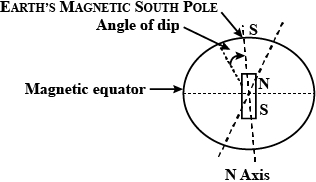
At the magnetic poles of the Earth,the angle of dip is .....$^o$.
A
$0$
B
$45$
C
$90$
D
$180$
Solution
(C) The angle of dip (or magnetic inclination) is the angle that the total magnetic field of the Earth makes with the horizontal direction.
At the magnetic equator,the magnetic field lines are parallel to the Earth's surface,so the angle of dip is $0^{\circ}$.
At the magnetic poles,the magnetic field lines are perpendicular to the Earth's surface (pointing vertically downwards or upwards),so the angle of dip is $90^{\circ}$.
Therefore,the correct option is $(C)$.
At the magnetic equator,the magnetic field lines are parallel to the Earth's surface,so the angle of dip is $0^{\circ}$.
At the magnetic poles,the magnetic field lines are perpendicular to the Earth's surface (pointing vertically downwards or upwards),so the angle of dip is $90^{\circ}$.
Therefore,the correct option is $(C)$.
0 likes
View Solution6
EasyMCQ
The correct relation is:
$B_H$ = Horizontal component of earth's magnetic field; $B_V$ = Vertical component of earth's magnetic field and $B$ = Total intensity of earth's magnetic field.
$B_H$ = Horizontal component of earth's magnetic field; $B_V$ = Vertical component of earth's magnetic field and $B$ = Total intensity of earth's magnetic field.
A
$B = \frac{B_V}{B_H}$
B
$B = B_V \times B_H$
C
$|B| = \sqrt{B_H^2 + B_V^2}$
D
$B = B_H + B_V$
Solution
(C) The horizontal and vertical components of the Earth's magnetic field are $B_H$ and $B_V$ respectively.
We know that the horizontal component is given by $B_H = B \cos \delta$,where $B$ is the total magnetic field and $\delta$ is the angle of dip.
The vertical component is given by $B_V = B \sin \delta$.
Squaring and adding both equations:
$B_H^2 + B_V^2 = (B \cos \delta)^2 + (B \sin \delta)^2$
$B_H^2 + B_V^2 = B^2 (\cos^2 \delta + \sin^2 \delta)$
Since $\cos^2 \delta + \sin^2 \delta = 1$,we get:
$B^2 = B_H^2 + B_V^2$
$B = \sqrt{B_H^2 + B_V^2}$
We know that the horizontal component is given by $B_H = B \cos \delta$,where $B$ is the total magnetic field and $\delta$ is the angle of dip.
The vertical component is given by $B_V = B \sin \delta$.
Squaring and adding both equations:
$B_H^2 + B_V^2 = (B \cos \delta)^2 + (B \sin \delta)^2$
$B_H^2 + B_V^2 = B^2 (\cos^2 \delta + \sin^2 \delta)$
Since $\cos^2 \delta + \sin^2 \delta = 1$,we get:
$B^2 = B_H^2 + B_V^2$
$B = \sqrt{B_H^2 + B_V^2}$
0 likes
View Solution7
EasyMCQ
The vertical component of the Earth's magnetic field is zero at:
A
Magnetic poles
B
Geographical poles
C
Every place
D
Magnetic equator
Solution
(D) At the magnetic equator,the angle of dip (inclination) is $0^{\circ}$. The vertical component of the Earth's magnetic field is given by $V = B \sin \delta$,where $B$ is the total magnetic field and $\delta$ is the angle of dip. Since $\delta = 0^{\circ}$ at the magnetic equator,$V = B \sin(0^{\circ}) = 0$. Therefore,the vertical component is zero at the magnetic equator.
0 likes
View Solution8
EasyMCQ
The angle between the magnetic meridian and geographical meridian is called
A
Angle of dip
B
Angle of declination
C
Magnetic moment
D
Power of magnetic field
Solution
(B) The angle between the magnetic meridian and the geographical meridian at a given place is defined as the angle of declination. It represents the deviation of the magnetic compass needle from the true geographical north.
0 likes
View Solution9
EasyMCQ
The lines of force due to the Earth's horizontal component of the magnetic field are:
A
Parallel straight lines
B
Concentric circles
C
Elliptical
D
Parabolic
Solution
(A) The Earth's magnetic field is approximately uniform over a small region on its surface. The horizontal component of the Earth's magnetic field $(B_H)$ represents the magnetic field lines running parallel to the Earth's surface in a specific direction. In a localized region,these magnetic field lines are represented as parallel straight lines.
0 likes
View Solution10
EasyMCQ
At a place,if the earth's horizontal and vertical components of magnetic fields are equal,then the angle of dip will be.......$^o$
A
$30$
B
$75$
C
$45$
D
$60$
Solution
(C) The angle of dip $\phi$ is related to the vertical component $B_V$ and the horizontal component $B_H$ of the Earth's magnetic field by the formula: $\tan \phi = \frac{B_V}{B_H}$.
Given that the horizontal and vertical components are equal,we have $B_V = B_H$.
Substituting this into the formula,we get $\tan \phi = \frac{B_H}{B_H} = 1$.
Since $\tan \phi = 1$,the angle of dip is $\phi = \tan^{-1}(1) = 45^o$.
Given that the horizontal and vertical components are equal,we have $B_V = B_H$.
Substituting this into the formula,we get $\tan \phi = \frac{B_H}{B_H} = 1$.
Since $\tan \phi = 1$,the angle of dip is $\phi = \tan^{-1}(1) = 45^o$.
0 likes
View Solution11
DifficultMCQ
At a place,the earth's horizontal component of magnetic field is $0.36 \times 10^{-4} \ Wb/m^2$. If the angle of dip at that place is $60^o$,then the vertical component of the earth's magnetic field at that place in $Wb/m^2$ will be approximately:
A
$0.12 \times 10^{-4}$
B
$0.24 \times 10^{-4}$
C
$0.40 \times 10^{-4}$
D
$0.62 \times 10^{-4}$
Solution
(D) The horizontal component of the earth's magnetic field is given by $B_H = B \cos \phi$,and the vertical component is given by $B_V = B \sin \phi$,where $\phi$ is the angle of dip.
Dividing the two equations,we get $\frac{B_V}{B_H} = \tan \phi$.
Therefore,the vertical component is $B_V = B_H \tan \phi$.
Given $B_H = 0.36 \times 10^{-4} \ Wb/m^2$ and $\phi = 60^o$.
Substituting the values: $B_V = (0.36 \times 10^{-4}) \times \tan(60^o)$.
Since $\tan(60^o) = \sqrt{3} \approx 1.732$,
$B_V = 0.36 \times 1.732 \times 10^{-4} \approx 0.623 \times 10^{-4} \ Wb/m^2$.
Thus,the correct option is $D$.
Dividing the two equations,we get $\frac{B_V}{B_H} = \tan \phi$.
Therefore,the vertical component is $B_V = B_H \tan \phi$.
Given $B_H = 0.36 \times 10^{-4} \ Wb/m^2$ and $\phi = 60^o$.
Substituting the values: $B_V = (0.36 \times 10^{-4}) \times \tan(60^o)$.
Since $\tan(60^o) = \sqrt{3} \approx 1.732$,
$B_V = 0.36 \times 1.732 \times 10^{-4} \approx 0.623 \times 10^{-4} \ Wb/m^2$.
Thus,the correct option is $D$.
0 likes
View Solution12
MediumMCQ
The angle of dip at a place is $40.6^\circ$ and the intensity of the vertical component of the earth's magnetic field $V = 6 \times 10^{-5} \text{ Tesla}$. The total intensity of the earth's magnetic field $(I)$ at this place is:
A
$7 \times 10^{-5} \text{ Tesla}$
B
$6 \times 10^{-5} \text{ Tesla}$
C
$5 \times 10^{-5} \text{ Tesla}$
D
$9.2 \times 10^{-5} \text{ Tesla}$
Solution
(D) The vertical component of the earth's magnetic field is given by the formula: $V = I \sin \phi$,where $I$ is the total intensity and $\phi$ is the angle of dip.
Given: $V = 6 \times 10^{-5} \text{ Tesla}$ and $\phi = 40.6^\circ$.
Rearranging the formula to solve for $I$: $I = \frac{V}{\sin \phi}$.
Substituting the values: $I = \frac{6 \times 10^{-5}}{\sin 40.6^\circ}$.
Using $\sin 40.6^\circ \approx 0.65$,we get: $I = \frac{6 \times 10^{-5}}{0.65} \approx 9.23 \times 10^{-5} \text{ Tesla}$.
Thus,the total intensity is approximately $9.2 \times 10^{-5} \text{ Tesla}$.
Given: $V = 6 \times 10^{-5} \text{ Tesla}$ and $\phi = 40.6^\circ$.
Rearranging the formula to solve for $I$: $I = \frac{V}{\sin \phi}$.
Substituting the values: $I = \frac{6 \times 10^{-5}}{\sin 40.6^\circ}$.
Using $\sin 40.6^\circ \approx 0.65$,we get: $I = \frac{6 \times 10^{-5}}{0.65} \approx 9.23 \times 10^{-5} \text{ Tesla}$.
Thus,the total intensity is approximately $9.2 \times 10^{-5} \text{ Tesla}$.
0 likes
View Solution13
EasyMCQ
The angle of dip is the angle
A
Between the vertical component of earth's magnetic field and magnetic meridian
B
Between the vertical component of earth's magnetic field and geographical meridian
C
Between the earth's magnetic field direction and horizontal direction
D
Between the magnetic meridian and the geographical meridian
Solution
(C) The angle of dip (or magnetic inclination) is defined as the angle that the total magnetic field vector of the earth makes with the horizontal direction in the magnetic meridian.
Let $B$ be the total magnetic field of the earth.
The horizontal component is given by $B_{H} = B \cos \theta$.
The vertical component is given by $B_{V} = B \sin \theta$.
Here,$\theta$ represents the angle of dip. Therefore,the angle of dip is the angle between the earth's magnetic field direction and the horizontal direction.
Let $B$ be the total magnetic field of the earth.
The horizontal component is given by $B_{H} = B \cos \theta$.
The vertical component is given by $B_{V} = B \sin \theta$.
Here,$\theta$ represents the angle of dip. Therefore,the angle of dip is the angle between the earth's magnetic field direction and the horizontal direction.
0 likes
View Solution14
MediumMCQ
At a certain place,the angle of dip is $30^{\circ}$ and the horizontal component of the Earth's magnetic field is $0.50 \text{ Oersted}$. The Earth's total magnetic field is:
A
$\sqrt{3} \text{ Oersted}$
B
$1 \text{ Oersted}$
C
$\frac{1}{\sqrt{3}} \text{ Oersted}$
D
$\frac{1}{2} \text{ Oersted}$
Solution
(C) The horizontal component of the Earth's magnetic field $(B_H)$ is related to the total magnetic field $(B)$ and the angle of dip $(\phi)$ by the formula: $B_H = B \cos \phi$.
Given: $B_H = 0.50 \text{ Oersted}$ and $\phi = 30^{\circ}$.
Substituting the values: $0.50 = B \cos(30^{\circ})$.
Since $\cos(30^{\circ}) = \frac{\sqrt{3}}{2}$,we have $0.50 = B \times \frac{\sqrt{3}}{2}$.
Therefore,$B = \frac{0.50 \times 2}{\sqrt{3}} = \frac{1}{\sqrt{3}} \text{ Oersted}$.
Given: $B_H = 0.50 \text{ Oersted}$ and $\phi = 30^{\circ}$.
Substituting the values: $0.50 = B \cos(30^{\circ})$.
Since $\cos(30^{\circ}) = \frac{\sqrt{3}}{2}$,we have $0.50 = B \times \frac{\sqrt{3}}{2}$.
Therefore,$B = \frac{0.50 \times 2}{\sqrt{3}} = \frac{1}{\sqrt{3}} \text{ Oersted}$.
0 likes
View Solution15
EasyMCQ
The angle of dip at the magnetic equator is....$^o$
A
$0$
B
$45$
C
$30$
D
$90$
Solution
(A) At the magnetic equator,the vertical component of the Earth's magnetic field,$B_{V}$,is equal to $0$.
The angle of dip $\phi$ is defined by the relation $\tan \phi = \frac{B_{V}}{B_{H}}$,where $B_{H}$ is the horizontal component of the Earth's magnetic field.
Since $B_{V} = 0$,we have $\tan \phi = \frac{0}{B_{H}} = 0$.
Therefore,$\phi = 0^{\circ}$.
The angle of dip $\phi$ is defined by the relation $\tan \phi = \frac{B_{V}}{B_{H}}$,where $B_{H}$ is the horizontal component of the Earth's magnetic field.
Since $B_{V} = 0$,we have $\tan \phi = \frac{0}{B_{H}} = 0$.
Therefore,$\phi = 0^{\circ}$.
0 likes
View Solution16
EasyMCQ
The line on the earth's surface joining the points where the magnetic field is horizontal is known as:
A
Magnetic meridian
B
Magnetic axis
C
Magnetic line
D
Magnetic equator
Solution
(D) The earth's magnetic field is a vector quantity that can be resolved into horizontal $(B_H)$ and vertical $(B_V)$ components.
At the magnetic poles,the magnetic field lines are perpendicular to the earth's surface. Therefore,the field is entirely vertical,and the horizontal component is zero.
At the magnetic equator,the magnetic field lines are parallel to the earth's surface. Therefore,the field is entirely horizontal,and the vertical component is zero.
The line on the earth's surface joining all points where the magnetic field is purely horizontal (i.e.,the angle of dip is $0^{\circ}$) is defined as the magnetic equator.
Thus,the correct option is $(D)$.
At the magnetic poles,the magnetic field lines are perpendicular to the earth's surface. Therefore,the field is entirely vertical,and the horizontal component is zero.
At the magnetic equator,the magnetic field lines are parallel to the earth's surface. Therefore,the field is entirely horizontal,and the vertical component is zero.
The line on the earth's surface joining all points where the magnetic field is purely horizontal (i.e.,the angle of dip is $0^{\circ}$) is defined as the magnetic equator.
Thus,the correct option is $(D)$.
0 likes
View Solution17
EasyMCQ
The angle between the Earth's magnetic axis and the Earth's geographical axis is approximately $... ^\circ$.
A
$0$
B
$11.3$
C
$23.5$
D
None of these
Solution
(D) The Earth's magnetic axis is tilted at an angle of approximately $11.3^\circ$ (often rounded to $11^\circ$ or $12^\circ$ in various textbooks) with respect to the Earth's geographical axis (the axis of rotation). Since $11.3^\circ$ is not explicitly listed in the options provided $(0, 17, 23)$,the correct choice is $D$ (None of these).
0 likes
View Solution18
EasyMCQ
The lines joining the places of the same horizontal intensity are known as
A
Isogonic lines
B
Aclinic lines
C
Isoclinic lines
D
Isodynamic lines
Solution
(D) The lines joining the places of the same horizontal intensity are known as Isodynamic lines.
Isogonic lines join places of the same magnetic declination.
Isoclinic lines join places of the same magnetic inclination (dip).
Aclinic lines are lines where the magnetic dip is zero (magnetic equator).
Isogonic lines join places of the same magnetic declination.
Isoclinic lines join places of the same magnetic inclination (dip).
Aclinic lines are lines where the magnetic dip is zero (magnetic equator).
0 likes
View Solution19
EasyMCQ
The ratio between the total intensity of the magnetic field at the equator to the poles is:
A
$1:1$
B
$1:2$
C
$2:1$
D
$1:4$
Solution
(B) The magnetic field of the Earth can be modeled as a magnetic dipole.
At the magnetic equator,the horizontal component of the Earth's magnetic field is $B_e = \frac{\mu_0}{4\pi} \frac{M}{R^3}$.
At the magnetic poles,the vertical component of the Earth's magnetic field is $B_p = \frac{\mu_0}{4\pi} \frac{2M}{R^3}$.
Therefore,the ratio of the intensity at the equator to the poles is $\frac{B_e}{B_p} = \frac{\frac{\mu_0 M}{4\pi R^3}}{\frac{2\mu_0 M}{4\pi R^3}} = \frac{1}{2}$.
Thus,the ratio is $1:2$.
At the magnetic equator,the horizontal component of the Earth's magnetic field is $B_e = \frac{\mu_0}{4\pi} \frac{M}{R^3}$.
At the magnetic poles,the vertical component of the Earth's magnetic field is $B_p = \frac{\mu_0}{4\pi} \frac{2M}{R^3}$.
Therefore,the ratio of the intensity at the equator to the poles is $\frac{B_e}{B_p} = \frac{\frac{\mu_0 M}{4\pi R^3}}{\frac{2\mu_0 M}{4\pi R^3}} = \frac{1}{2}$.
Thus,the ratio is $1:2$.
0 likes
View Solution20
EasyMCQ
$A$ line passing through places having zero value of magnetic dip is called
A
Isoclinic line
B
Agonic line
C
Isogonic line
D
Aclinic line
Solution
(D) The magnetic dip (or inclination) is the angle that the Earth's magnetic field makes with the horizontal at any point on the surface.
At the magnetic equator,the magnetic field lines are parallel to the Earth's surface,meaning the angle of dip is $0^{\circ}$.
$A$ line connecting all such points on the Earth's surface where the magnetic dip is zero is known as the magnetic equator or the Aclinic line.
Therefore,the correct option is $D$.
At the magnetic equator,the magnetic field lines are parallel to the Earth's surface,meaning the angle of dip is $0^{\circ}$.
$A$ line connecting all such points on the Earth's surface where the magnetic dip is zero is known as the magnetic equator or the Aclinic line.
Therefore,the correct option is $D$.
0 likes
View Solution21
MediumMCQ
At a place,the horizontal and vertical intensities of the Earth's magnetic field are $0.30 \ G$ and $0.173 \ G$ respectively. The angle of dip at this place is.....$^o$
A
$30$
B
$90$
C
$60$
D
$45$
Solution
(A) The angle of dip $\phi$ is given by the relation $\tan \phi = \frac{B_V}{B_H}$,where $B_V$ is the vertical component and $B_H$ is the horizontal component of the Earth's magnetic field.
Given: $B_H = 0.30 \ G$ and $B_V = 0.173 \ G$.
Substituting the values: $\tan \phi = \frac{0.173}{0.30} = \frac{1.73}{3.0}$.
Since $\sqrt{3} \approx 1.732$,we have $\tan \phi = \frac{\sqrt{3}}{3} = \frac{1}{\sqrt{3}}$.
Therefore,$\phi = \tan^{-1}(\frac{1}{\sqrt{3}}) = 30^o$.
Given: $B_H = 0.30 \ G$ and $B_V = 0.173 \ G$.
Substituting the values: $\tan \phi = \frac{0.173}{0.30} = \frac{1.73}{3.0}$.
Since $\sqrt{3} \approx 1.732$,we have $\tan \phi = \frac{\sqrt{3}}{3} = \frac{1}{\sqrt{3}}$.
Therefore,$\phi = \tan^{-1}(\frac{1}{\sqrt{3}}) = 30^o$.
0 likes
View Solution22
MediumMCQ
The angle of dip at a place is $60^{\circ}$. At this place,the total intensity of the Earth's magnetic field is $0.64 \text{ units}$. The horizontal intensity of the Earth's magnetic field at this place is . . . . . . $\text{units}$.
A
$1.28$
B
$0.64$
C
$0.16$
D
$0.32$
Solution
(D) The horizontal component of the Earth's magnetic field $(B_H)$ is related to the total magnetic field $(B)$ and the angle of dip $(\phi)$ by the formula:
$B_H = B \cos \phi$
Given:
Total intensity $B = 0.64 \text{ units}$
Angle of dip $\phi = 60^{\circ}$
Substituting the values:
$B_H = 0.64 \times \cos 60^{\circ}$
Since $\cos 60^{\circ} = 0.5$
$B_H = 0.64 \times 0.5 = 0.32 \text{ units}$
Therefore,the correct option is $D$.
$B_H = B \cos \phi$
Given:
Total intensity $B = 0.64 \text{ units}$
Angle of dip $\phi = 60^{\circ}$
Substituting the values:
$B_H = 0.64 \times \cos 60^{\circ}$
Since $\cos 60^{\circ} = 0.5$
$B_H = 0.64 \times 0.5 = 0.32 \text{ units}$
Therefore,the correct option is $D$.
0 likes
View Solution23
EasyMCQ
The magnetic compass is not useful for navigation near the magnetic poles because
A
The magnetic field near the poles is zero
B
The magnetic field near the poles is almost vertical
C
At low temperature,the compass needle loses its magnetic properties
D
Neither of the above
Solution
(B) magnetic compass needle is designed to rotate in a horizontal plane to indicate the direction of the horizontal component of the Earth's magnetic field $(B_H)$.
Near the magnetic poles,the Earth's magnetic field lines are almost perpendicular to the surface of the Earth,meaning the field is almost entirely vertical.
Consequently,the horizontal component $(B_H)$ becomes negligible or zero.
Since the compass needle cannot align itself horizontally in the absence of a horizontal magnetic field,it becomes useless for navigation in these regions.
Near the magnetic poles,the Earth's magnetic field lines are almost perpendicular to the surface of the Earth,meaning the field is almost entirely vertical.
Consequently,the horizontal component $(B_H)$ becomes negligible or zero.
Since the compass needle cannot align itself horizontally in the absence of a horizontal magnetic field,it becomes useless for navigation in these regions.
0 likes
View Solution24
EasyMCQ
The angle of dip at a place on the earth gives:
A
The horizontal component of the earth's magnetic field
B
The location of the geographic meridian
C
The vertical component of the earth's field
D
The direction of the earth's magnetic field
Solution
(D) The angle of dip at a place on the Earth represents the direction of the Earth's total magnetic field $\vec{B}$ relative to the horizontal direction in the magnetic meridian.
By definition,the angle of dip (or magnetic inclination) is the angle made by the Earth's total magnetic field vector with the horizontal plane.
Experimentally,if a magnetic needle is pivoted such that it is free to rotate in a vertical plane coinciding with the magnetic meridian,it will align itself along the direction of the Earth's total magnetic field.
The angle between the horizontal and the final orientation of this needle provides the angle of dip at that specific location.
Therefore,the correct option is $D$.
By definition,the angle of dip (or magnetic inclination) is the angle made by the Earth's total magnetic field vector with the horizontal plane.
Experimentally,if a magnetic needle is pivoted such that it is free to rotate in a vertical plane coinciding with the magnetic meridian,it will align itself along the direction of the Earth's total magnetic field.
The angle between the horizontal and the final orientation of this needle provides the angle of dip at that specific location.
Therefore,the correct option is $D$.
0 likes
View Solution25
EasyMCQ
At the magnetic north pole of the earth, the value of the horizontal component of the earth's magnetic field and the angle of dip are, respectively:
A
$Zero, 90^{\circ}$
B
$Maximum, 0^{\circ}$
C
$Maximum, 90^{\circ}$
D
$Zero, 0^{\circ}$
Solution
(A) The earth's magnetic field $B$ can be resolved into two components: the horizontal component $H$ and the vertical component $V$.
At the magnetic poles, the magnetic field lines are perpendicular to the earth's surface.
Therefore, the angle of dip $\delta$ is $90^{\circ}$.
The horizontal component is given by $H = B \cos(\delta)$.
Substituting $\delta = 90^{\circ}$, we get $H = B \cos(90^{\circ}) = B \times 0 = 0$.
Thus, at the magnetic north pole, the horizontal component is $0$ and the angle of dip is $90^{\circ}$.
At the magnetic poles, the magnetic field lines are perpendicular to the earth's surface.
Therefore, the angle of dip $\delta$ is $90^{\circ}$.
The horizontal component is given by $H = B \cos(\delta)$.
Substituting $\delta = 90^{\circ}$, we get $H = B \cos(90^{\circ}) = B \times 0 = 0$.
Thus, at the magnetic north pole, the horizontal component is $0$ and the angle of dip is $90^{\circ}$.
0 likes
View Solution26
MediumMCQ
At a place,the magnitudes of the horizontal component and total intensity of the magnetic field of the earth are $0.3 \; Oersted$ and $0.6 \; Oersted$ respectively. The value of the angle of dip at this place will be.....$^o$
A
$60$
B
$45$
C
$30$
D
$0$
Solution
(A) Given: Horizontal component of Earth's magnetic field,$B_H = 0.3 \; Oersted$.
Total intensity of Earth's magnetic field,$I = 0.6 \; Oersted$.
The relationship between the horizontal component,total intensity,and the angle of dip $(\phi)$ is given by: $B_H = I \cos \phi$.
Rearranging for $\cos \phi$: $\cos \phi = \frac{B_H}{I}$.
Substituting the values: $\cos \phi = \frac{0.3}{0.6} = \frac{1}{2}$.
Since $\cos \phi = \frac{1}{2}$,the angle of dip is $\phi = 60^o$.
Total intensity of Earth's magnetic field,$I = 0.6 \; Oersted$.
The relationship between the horizontal component,total intensity,and the angle of dip $(\phi)$ is given by: $B_H = I \cos \phi$.
Rearranging for $\cos \phi$: $\cos \phi = \frac{B_H}{I}$.
Substituting the values: $\cos \phi = \frac{0.3}{0.6} = \frac{1}{2}$.
Since $\cos \phi = \frac{1}{2}$,the angle of dip is $\phi = 60^o$.
0 likes
View Solution27
MediumMCQ
$A$ dip circle is at a right angle to the magnetic meridian. What will be the apparent dip in degrees?
A
$0$
B
$30$
C
$60$
D
$90$
Solution
(D) The relation between the apparent dip $(\alpha_{1})$ and the true dip $(\alpha)$ when the dip circle is at an angle $\alpha_{2}$ with the magnetic meridian is given by:
$\cot \alpha_{1} = \cot \alpha \cdot \cos \alpha_{2}$
Here, $\alpha_{2} = 90^{\circ}$ because the dip circle is at a right angle to the magnetic meridian.
Substituting the value:
$\cot \alpha_{1} = \cot \alpha \cdot \cos 90^{\circ}$
Since $\cos 90^{\circ} = 0$, we get:
$\cot \alpha_{1} = 0$
This implies $\alpha_{1} = 90^{\circ}$.
Therefore, the apparent dip is $90^{\circ}$.
$\cot \alpha_{1} = \cot \alpha \cdot \cos \alpha_{2}$
Here, $\alpha_{2} = 90^{\circ}$ because the dip circle is at a right angle to the magnetic meridian.
Substituting the value:
$\cot \alpha_{1} = \cot \alpha \cdot \cos 90^{\circ}$
Since $\cos 90^{\circ} = 0$, we get:
$\cot \alpha_{1} = 0$
This implies $\alpha_{1} = 90^{\circ}$.
Therefore, the apparent dip is $90^{\circ}$.
0 likes
View Solution28
EasyMCQ
The magnetic field due to the Earth is closely equivalent to that due to:
A
$A$ large magnet of length equal to the diameter of the Earth
B
$A$ magnetic dipole placed at the centre of the Earth
C
$A$ large coil carrying current
D
Neither of the above
Solution
(A) The Earth's magnetic field is often modeled as a magnetic dipole located at the center of the Earth. However,in terms of the physical representation of the field lines and the magnetic moment,it is equivalent to a large bar magnet placed at the center of the Earth with a length equal to the diameter of the Earth. Therefore,option $A$ is the most accurate description of the equivalent magnet model.
0 likes
View Solution29
MediumMCQ
The Earth's magnetic field at a certain place has a horizontal component of $0.3 \ G$ and the total strength of $0.5 \ G$. The angle of dip is:
A
$\tan^{-1} \left( \frac{3}{4} \right)$
B
$\sin^{-1} \left( \frac{3}{4} \right)$
C
$\tan^{-1} \left( \frac{4}{3} \right)$
D
$\sin^{-1} \left( \frac{3}{5} \right)$
Solution
(C) The total magnetic field $B$ is related to its horizontal component $B_H$ and vertical component $B_V$ by the equation $B^2 = B_V^2 + B_H^2$.
Given $B = 0.5 \ G$ and $B_H = 0.3 \ G$,we can find $B_V$:
$B_V = \sqrt{B^2 - B_H^2} = \sqrt{(0.5)^2 - (0.3)^2} = \sqrt{0.25 - 0.09} = \sqrt{0.16} = 0.4 \ G$.
The angle of dip $\phi$ is given by the relation $\tan \phi = \frac{B_V}{B_H}$.
Substituting the values,$\tan \phi = \frac{0.4}{0.3} = \frac{4}{3}$.
Therefore,$\phi = \tan^{-1} \left( \frac{4}{3} \right)$.
Given $B = 0.5 \ G$ and $B_H = 0.3 \ G$,we can find $B_V$:
$B_V = \sqrt{B^2 - B_H^2} = \sqrt{(0.5)^2 - (0.3)^2} = \sqrt{0.25 - 0.09} = \sqrt{0.16} = 0.4 \ G$.
The angle of dip $\phi$ is given by the relation $\tan \phi = \frac{B_V}{B_H}$.
Substituting the values,$\tan \phi = \frac{0.4}{0.3} = \frac{4}{3}$.
Therefore,$\phi = \tan^{-1} \left( \frac{4}{3} \right)$.
0 likes
View Solution30
MediumMCQ
The value of the horizontal component of the earth's magnetic field and the angle of dip are $1.8 \times 10^{-5} \, Wb/m^2$ and $30^{\circ}$ respectively at a certain place. The total intensity of the earth's magnetic field at that place will be:
A
$2.08 \times 10^{-5} \, Wb/m^2$
B
$3.67 \times 10^{-5} \, Wb/m^2$
C
$3.18 \times 10^{-5} \, Wb/m^2$
D
$5.0 \times 10^{-5} \, Wb/m^2$
Solution
(A) The horizontal component of the earth's magnetic field is given by $B_H = B \cos \phi$,where $B$ is the total intensity and $\phi$ is the angle of dip.
Given: $B_H = 1.8 \times 10^{-5} \, Wb/m^2$ and $\phi = 30^{\circ}$.
We need to find the total intensity $B = \frac{B_H}{\cos \phi}$.
Substituting the values: $B = \frac{1.8 \times 10^{-5}}{\cos 30^{\circ}}$.
Since $\cos 30^{\circ} = \frac{\sqrt{3}}{2} \approx 0.866$,we have $B = \frac{1.8 \times 10^{-5}}{0.866} \approx 2.08 \times 10^{-5} \, Wb/m^2$.
Given: $B_H = 1.8 \times 10^{-5} \, Wb/m^2$ and $\phi = 30^{\circ}$.
We need to find the total intensity $B = \frac{B_H}{\cos \phi}$.
Substituting the values: $B = \frac{1.8 \times 10^{-5}}{\cos 30^{\circ}}$.
Since $\cos 30^{\circ} = \frac{\sqrt{3}}{2} \approx 0.866$,we have $B = \frac{1.8 \times 10^{-5}}{0.866} \approx 2.08 \times 10^{-5} \, Wb/m^2$.
0 likes
View Solution31
EasyMCQ
Lines which represent places of constant angle of dip are called
A
Isobaric lines
B
Isogonic lines
C
Isoclinic lines
D
All of the above
Solution
(C) Lines that connect places on the Earth's surface having the same angle of dip (or magnetic inclination) are known as Isoclinic lines.
Isogonic lines connect places with the same magnetic declination,while Isobaric lines connect places with the same atmospheric pressure.
Isogonic lines connect places with the same magnetic declination,while Isobaric lines connect places with the same atmospheric pressure.
0 likes
View Solution32
EasyMCQ
The vertical component of the earth's magnetic field is zero at a place where the angle of dip is.....$^o$
A
$0$
B
$45$
C
$60$
D
$90$
Solution
(A) The vertical component $(B_v)$ of the earth's magnetic field is given by the formula $B_v = B \sin(\delta)$,where $B$ is the total magnetic field and $\delta$ is the angle of dip.
For the vertical component to be zero $(B_v = 0)$,we must have $\sin(\delta) = 0$.
This implies that the angle of dip $\delta = 0^o$.
This condition occurs at the magnetic equator of the earth.
For the vertical component to be zero $(B_v = 0)$,we must have $\sin(\delta) = 0$.
This implies that the angle of dip $\delta = 0^o$.
This condition occurs at the magnetic equator of the earth.
0 likes
View Solution33
EasyMCQ
At a certain place,the horizontal component ${B_0}$ and the vertical component ${V_0}$ of the Earth's magnetic field are equal in magnitude. The total intensity at the place will be
A
${B_0}$
B
$B_0^2$
C
$2{B_0}$
D
$\sqrt{2}{B_0}$
Solution
(D) The total magnetic field intensity $B$ of the Earth is given by the vector sum of its horizontal component ${B_0}$ and vertical component ${V_0}$.
Mathematically,$B = \sqrt{B_0^2 + V_0^2}$.
Given that the magnitudes are equal,we have ${B_0} = {V_0}$.
Substituting this into the formula,we get $B = \sqrt{B_0^2 + B_0^2}$.
$B = \sqrt{2B_0^2}$.
Therefore,$B = \sqrt{2}{B_0}$.
Mathematically,$B = \sqrt{B_0^2 + V_0^2}$.
Given that the magnitudes are equal,we have ${B_0} = {V_0}$.
Substituting this into the formula,we get $B = \sqrt{B_0^2 + B_0^2}$.
$B = \sqrt{2B_0^2}$.
Therefore,$B = \sqrt{2}{B_0}$.
0 likes
View Solution34
EasyMCQ
$A$ compass needle will show which one of the following directions at the Earth's magnetic pole?
A
Vertical
B
No particular direction
C
Bent at $45^{\circ}$ to the vertical
D
Horizontal
Solution
(A) At the Earth's magnetic poles,the magnetic field lines are perpendicular to the Earth's surface.
Since a compass needle aligns itself with the local magnetic field,it will point vertically downward at the North Magnetic Pole and vertically upward at the South Magnetic Pole.
Therefore,the needle will show a vertical direction.
Since a compass needle aligns itself with the local magnetic field,it will point vertically downward at the North Magnetic Pole and vertically upward at the South Magnetic Pole.
Therefore,the needle will show a vertical direction.
0 likes
View Solution35
EasyMCQ
The north pole of the earth's magnet is near the geographical
A
South
B
East
C
West
D
North
Solution
(A) The magnetic poles of the Earth are inverted relative to its geographic poles.
By convention,the north pole of a compass needle points towards the geographic north pole. Since opposite poles attract,the magnetic pole located near the geographic north pole must be a magnetic south pole.
Conversely,the magnetic pole located near the geographic south pole must be a magnetic north pole.
Therefore,the north pole of the Earth's internal magnet is situated near the geographic south pole.
Hence,the correct option is $A$.
By convention,the north pole of a compass needle points towards the geographic north pole. Since opposite poles attract,the magnetic pole located near the geographic north pole must be a magnetic south pole.
Conversely,the magnetic pole located near the geographic south pole must be a magnetic north pole.
Therefore,the north pole of the Earth's internal magnet is situated near the geographic south pole.
Hence,the correct option is $A$.
0 likes
View Solution36
EasyMCQ
The magnetic field of the Earth is due to
A
Motion and distribution of some material in and outside the Earth
B
Interaction of cosmic rays with the current of the Earth
C
$A$ magnetic dipole buried at the centre of the Earth
D
Induction effect of the Sun
Solution
(A) The Earth's magnetic field is primarily generated by the dynamo effect,which involves the motion of molten iron and nickel in the Earth's outer core. These convection currents,combined with the Earth's rotation,create electric currents that generate the magnetic field. Therefore,the magnetic field of the Earth is due to the motion and distribution of material in and outside the Earth.
0 likes
View Solution37
EasyMCQ
Due to the earth's magnetic field,charged cosmic ray particles
A
Can never reach the equator
B
Require less kinetic energy to reach the equator than the poles
C
Require greater kinetic energy to reach the equator than the poles
D
Can never reach the poles
Solution
(C) The earth's magnetic field lines are perpendicular to the surface at the poles and parallel to the surface at the equator. Charged particles moving towards the equator experience a magnetic force $F = q(v \times B)$ that deflects them. To overcome this magnetic influence and reach the equatorial region,the charged particles must possess higher kinetic energy compared to those reaching the polar regions.
0 likes
View Solution38
MediumMCQ
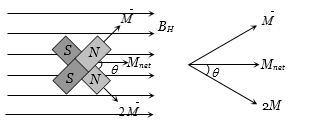
Two bar magnets with magnetic moments $2M$ and $M$ are fastened together at right angles to each other at their centres to form a crossed system,which can rotate freely about a vertical axis through the centre. The crossed system sets in the Earth's magnetic field with the magnet having magnetic moment $2M$ making an angle $\theta$ with the magnetic meridian such that:
A
$\theta = \tan^{-1}\left(\frac{1}{\sqrt{3}}\right)$
B
$\theta = \tan^{-1}(\sqrt{3})$
C
$\theta = \tan^{-1}\left(\frac{1}{2}\right)$
D
$\theta = \tan^{-1}\left(\frac{3}{4}\right)$
Solution
(C) When a magnetic system is placed in a uniform magnetic field $B_H$,it comes to equilibrium when its net magnetic moment $M_{net}$ aligns with the direction of the magnetic field.
Let the magnetic moment $2M$ be along the $x$-axis and $M$ be along the $y$-axis.
The net magnetic moment vector is $\vec{M}_{net} = 2M \hat{i} + M \hat{j}$.
In equilibrium,the net magnetic moment aligns with the external magnetic field $B_H$.
The angle $\theta$ that the magnet with moment $2M$ makes with the magnetic meridian (direction of $B_H$) is given by the ratio of the perpendicular component to the parallel component of the net magnetic moment.
$\tan \theta = \frac{M}{2M} = \frac{1}{2}$.
Therefore,$\theta = \tan^{-1}\left(\frac{1}{2}\right)$.
Let the magnetic moment $2M$ be along the $x$-axis and $M$ be along the $y$-axis.
The net magnetic moment vector is $\vec{M}_{net} = 2M \hat{i} + M \hat{j}$.
In equilibrium,the net magnetic moment aligns with the external magnetic field $B_H$.
The angle $\theta$ that the magnet with moment $2M$ makes with the magnetic meridian (direction of $B_H$) is given by the ratio of the perpendicular component to the parallel component of the net magnetic moment.
$\tan \theta = \frac{M}{2M} = \frac{1}{2}$.
Therefore,$\theta = \tan^{-1}\left(\frac{1}{2}\right)$.
0 likes
View Solution39
EasyMCQ
The angle of dip is $90^{\circ}$ at:
A
Poles
B
Equator
C
Both $(a)$ and $(b)$
D
None of these
Solution
(A) The angle of dip (or magnetic inclination) is defined as the angle that the total magnetic field of the Earth makes with the surface of the Earth.
At the magnetic poles,the Earth's magnetic field lines are perpendicular to the surface of the Earth.
Therefore,the angle of dip at the poles is $90^{\circ}$.
At the magnetic poles,the Earth's magnetic field lines are perpendicular to the surface of the Earth.
Therefore,the angle of dip at the poles is $90^{\circ}$.
0 likes
View Solution40
MediumMCQ
At a certain place,the horizontal component of the Earth's magnetic field is $B_0$ and the angle of dip is $45^o$. The total intensity of the Earth's magnetic field at that place will be:
A
$B_0$
B
$\sqrt{2} B_0$
C
$2 B_0$
D
$B_0^2$
Solution
(B) The horizontal component of the Earth's magnetic field is given by $B_H = B \cos \delta$,where $B$ is the total intensity and $\delta$ is the angle of dip.
Given $B_H = B_0$ and $\delta = 45^o$.
Substituting the values,we get $B_0 = B \cos 45^o$.
Since $\cos 45^o = \frac{1}{\sqrt{2}}$,we have $B_0 = B \times \frac{1}{\sqrt{2}}$.
Therefore,the total intensity $B = \sqrt{2} B_0$.
Given $B_H = B_0$ and $\delta = 45^o$.
Substituting the values,we get $B_0 = B \cos 45^o$.
Since $\cos 45^o = \frac{1}{\sqrt{2}}$,we have $B_0 = B \times \frac{1}{\sqrt{2}}$.
Therefore,the total intensity $B = \sqrt{2} B_0$.
0 likes
View Solution41
EasyMCQ
The value of the angle of dip is zero at the magnetic equator because on it:
A
$V$ and $H$ are equal
B
The value of $V$ and $H$ is zero
C
The value of $V$ is zero
D
The value of $H$ is zero
Solution
(C) The angle of dip (or magnetic inclination) $\delta$ is defined by the relation $\tan \delta = \frac{V}{H}$,where $V$ is the vertical component of the Earth's magnetic field and $H$ is the horizontal component.
At the magnetic equator,the Earth's magnetic field lines are parallel to the surface of the Earth.
Therefore,the vertical component $V$ of the Earth's magnetic field is zero at the magnetic equator.
Substituting $V = 0$ into the formula,we get $\tan \delta = \frac{0}{H} = 0$,which implies $\delta = 0^\circ$.
Thus,the correct option is $C$.
At the magnetic equator,the Earth's magnetic field lines are parallel to the surface of the Earth.
Therefore,the vertical component $V$ of the Earth's magnetic field is zero at the magnetic equator.
Substituting $V = 0$ into the formula,we get $\tan \delta = \frac{0}{H} = 0$,which implies $\delta = 0^\circ$.
Thus,the correct option is $C$.
0 likes
View Solution42
MediumMCQ
Which of the following relations is correct in the context of Earth's magnetism?
A
$I^2 = V^2 + H^2$
B
$I = V + H$
C
$V = I^2 + H^2$
D
$V^2 = I + H$
Solution
(A) In the study of Earth's magnetism,the total intensity of the Earth's magnetic field $(I)$ can be resolved into two rectangular components:
$1$. The horizontal component $(H)$ acting along the Earth's surface.
$2$. The vertical component $(V)$ acting perpendicular to the Earth's surface.
According to the Pythagorean theorem for the vector triangle formed by these components,the relationship is given by $I^2 = V^2 + H^2$,where $I$ is the resultant magnetic field intensity.
$1$. The horizontal component $(H)$ acting along the Earth's surface.
$2$. The vertical component $(V)$ acting perpendicular to the Earth's surface.
According to the Pythagorean theorem for the vector triangle formed by these components,the relationship is given by $I^2 = V^2 + H^2$,where $I$ is the resultant magnetic field intensity.
0 likes
View Solution43
EasyMCQ
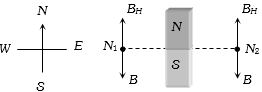
The direction of the null points is on the equatorial line of a bar magnet,when the north pole of the magnet is pointing
A
North
B
South
C
East
D
West
Solution
(A) Null points are the points where the magnetic field due to the bar magnet is equal and opposite to the horizontal component of the Earth's magnetic field $(B_H)$.
When the north pole of a bar magnet points towards the geographic North,the magnetic field lines of the magnet on its equatorial line are directed from the magnetic North pole to the magnetic South pole (i.e.,from North to South).
Since the Earth's horizontal magnetic field $(B_H)$ is directed from geographic South to geographic North,the magnetic field of the magnet $(B)$ on the equatorial line opposes $B_H$.
Thus,the null points $N_1$ and $N_2$ are located on the equatorial line of the magnet when the north pole of the magnet points towards the geographic North.
When the north pole of a bar magnet points towards the geographic North,the magnetic field lines of the magnet on its equatorial line are directed from the magnetic North pole to the magnetic South pole (i.e.,from North to South).
Since the Earth's horizontal magnetic field $(B_H)$ is directed from geographic South to geographic North,the magnetic field of the magnet $(B)$ on the equatorial line opposes $B_H$.
Thus,the null points $N_1$ and $N_2$ are located on the equatorial line of the magnet when the north pole of the magnet points towards the geographic North.
0 likes
View Solution44
EasyMCQ
Magnetic meridian is a
A
Point
B
Horizontal plane
C
Vertical plane
D
Line along $N-S$
Solution
(C) The magnetic meridian at any point on the Earth's surface is defined as the vertical plane passing through the magnetic North and South poles of the Earth at that location.
It represents the plane in which a freely suspended magnetic needle aligns itself under the influence of the Earth's magnetic field.
Therefore,the magnetic meridian is a vertical plane.
It represents the plane in which a freely suspended magnetic needle aligns itself under the influence of the Earth's magnetic field.
Therefore,the magnetic meridian is a vertical plane.
0 likes
View Solution45
MediumMCQ
The angle of dip at a certain place is $30^o$. If the horizontal component of the earth's magnetic field is $H$,the intensity of the total magnetic field is:
A
$\frac{H}{2}$
B
$\frac{2H}{\sqrt{3}}$
C
$H\sqrt{2}$
D
$H\sqrt{3}$
Solution
(B) The horizontal component of the Earth's magnetic field $(B_H)$ is related to the total magnetic field $(B)$ and the angle of dip $(\phi)$ by the formula: $B_H = B \cos \phi$.
Given that $B_H = H$ and $\phi = 30^o$,we can substitute these values into the equation:
$H = B \cos 30^o$
Since $\cos 30^o = \frac{\sqrt{3}}{2}$,we have:
$H = B \times \frac{\sqrt{3}}{2}$
Solving for the total magnetic field $B$:
$B = \frac{2H}{\sqrt{3}}$
Therefore,the intensity of the total magnetic field is $\frac{2H}{\sqrt{3}}$.
Given that $B_H = H$ and $\phi = 30^o$,we can substitute these values into the equation:
$H = B \cos 30^o$
Since $\cos 30^o = \frac{\sqrt{3}}{2}$,we have:
$H = B \times \frac{\sqrt{3}}{2}$
Solving for the total magnetic field $B$:
$B = \frac{2H}{\sqrt{3}}$
Therefore,the intensity of the total magnetic field is $\frac{2H}{\sqrt{3}}$.
0 likes
View Solution46
MediumMCQ
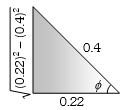
The horizontal component of the Earth's magnetic field is $0.22 \ G$ and the total magnetic field is $0.4 \ G$. The angle of dip is:
A
$\tan^{-1}(1)$
B
$\tan^{-1}(\infty)$
C
$\tan^{-1}(1.518)$
D
$\tan^{-1}(\pi)$
Solution
(C) Given:
Horizontal component of Earth's magnetic field,$B_H = 0.22 \ G$
Total magnetic field,$B = 0.4 \ G$
Let $\phi$ be the angle of dip.
The horizontal component is given by $B_H = B \cos \phi$.
Therefore,$\cos \phi = \frac{B_H}{B} = \frac{0.22}{0.4} = 0.55$.
The vertical component is $B_V = B \sin \phi = \sqrt{B^2 - B_H^2} = \sqrt{(0.4)^2 - (0.22)^2} = \sqrt{0.16 - 0.0484} = \sqrt{0.1116} \approx 0.334 \ G$.
The angle of dip $\phi$ is given by $\tan \phi = \frac{B_V}{B_H} = \frac{\sqrt{B^2 - B_H^2}}{B_H} = \frac{\sqrt{(0.4)^2 - (0.22)^2}}{0.22} = \frac{\sqrt{0.1116}}{0.22} \approx \frac{0.334}{0.22} \approx 1.518$.
Thus,$\phi = \tan^{-1}(1.518)$.
Horizontal component of Earth's magnetic field,$B_H = 0.22 \ G$
Total magnetic field,$B = 0.4 \ G$
Let $\phi$ be the angle of dip.
The horizontal component is given by $B_H = B \cos \phi$.
Therefore,$\cos \phi = \frac{B_H}{B} = \frac{0.22}{0.4} = 0.55$.
The vertical component is $B_V = B \sin \phi = \sqrt{B^2 - B_H^2} = \sqrt{(0.4)^2 - (0.22)^2} = \sqrt{0.16 - 0.0484} = \sqrt{0.1116} \approx 0.334 \ G$.
The angle of dip $\phi$ is given by $\tan \phi = \frac{B_V}{B_H} = \frac{\sqrt{B^2 - B_H^2}}{B_H} = \frac{\sqrt{(0.4)^2 - (0.22)^2}}{0.22} = \frac{\sqrt{0.1116}}{0.22} \approx \frac{0.334}{0.22} \approx 1.518$.
Thus,$\phi = \tan^{-1}(1.518)$.
0 likes
View Solution47
EasyMCQ
At which place does the Earth's magnetism become horizontal?
A
Magnetic pole
B
Geographical pole
C
Magnetic meridian
D
Magnetic equator
Solution
(D) The angle of dip (or magnetic inclination) is the angle that the total magnetic field of the Earth makes with the surface of the Earth.
At the magnetic poles,the magnetic field lines are perpendicular to the surface,so the angle of dip is $90^{\circ}$.
At the magnetic equator,the magnetic field lines are parallel to the surface of the Earth,meaning the angle of dip is $0^{\circ}$.
When the angle of dip is $0^{\circ}$,the Earth's magnetic field is purely horizontal.
Therefore,the correct answer is the magnetic equator.
At the magnetic poles,the magnetic field lines are perpendicular to the surface,so the angle of dip is $90^{\circ}$.
At the magnetic equator,the magnetic field lines are parallel to the surface of the Earth,meaning the angle of dip is $0^{\circ}$.
When the angle of dip is $0^{\circ}$,the Earth's magnetic field is purely horizontal.
Therefore,the correct answer is the magnetic equator.
0 likes
View Solution48
EasyMCQ
Isogonic lines on a magnetic map will have
A
Zero angle of dip
B
Zero angle of declination
C
Same angle of declination
D
Same angle of dip
Solution
(C) Isogonic lines (or isogonal lines) are lines drawn on a map connecting points on the Earth's surface that have the same magnetic declination.
Magnetic declination is the angle between magnetic north and true (geographic) north at a particular location.
Therefore,all points along an isogonic line share the same value of magnetic declination.
Thus,the correct option is $C$.
Magnetic declination is the angle between magnetic north and true (geographic) north at a particular location.
Therefore,all points along an isogonic line share the same value of magnetic declination.
Thus,the correct option is $C$.
0 likes
View Solution49
EasyMCQ
Let $V$ and $H$ be the vertical and horizontal components of the Earth's magnetic field at any point on Earth. Near the North Pole:
A
$V >> H$
B
$V << H$
C
$V = H$
D
$V = H = 0$
Solution
(A) The Earth's magnetic field $B_E$ can be resolved into two components: the horizontal component $H = B_E \cos \delta$ and the vertical component $V = B_E \sin \delta$,where $\delta$ is the angle of dip.
Near the North Pole,the magnetic field lines are almost perpendicular to the Earth's surface.
Therefore,the angle of dip $\delta$ is nearly $90^{\circ}$.
Since $\cos 90^{\circ} = 0$,the horizontal component $H$ becomes very small $(H \approx 0)$.
Since $\sin 90^{\circ} = 1$,the vertical component $V$ becomes nearly equal to the total magnetic field $B_E$ $(V \approx B_E)$.
Thus,near the North Pole,$V >> H$.
Near the North Pole,the magnetic field lines are almost perpendicular to the Earth's surface.
Therefore,the angle of dip $\delta$ is nearly $90^{\circ}$.
Since $\cos 90^{\circ} = 0$,the horizontal component $H$ becomes very small $(H \approx 0)$.
Since $\sin 90^{\circ} = 1$,the vertical component $V$ becomes nearly equal to the total magnetic field $B_E$ $(V \approx B_E)$.
Thus,near the North Pole,$V >> H$.
0 likes
View Solution50
EasyMCQ
At the magnetic poles of the earth,a compass needle will be
A
Vertical
B
Bent slightly
C
Horizontal
D
Inclined at $45^{\circ}$ to the horizontal
Solution
(A) The magnetic field lines of the Earth are perpendicular to the surface at the magnetic poles.
Since a compass needle aligns itself along the direction of the magnetic field lines,it will point vertically downwards or upwards at the poles.
Therefore,the compass needle will be in a vertical position at the magnetic poles of the Earth.
Since a compass needle aligns itself along the direction of the magnetic field lines,it will point vertically downwards or upwards at the poles.
Therefore,the compass needle will be in a vertical position at the magnetic poles of the Earth.
0 likes
View SolutionMagnetism and Matter — Earth Magnetism · Frequently Asked Questions
1Are these Magnetism and Matter questions useful for JEE and NEET?
Yes. All questions in this section are mapped to JEE Main and NEET exam patterns. Previous year questions from JEE Main, NEET, GUJCET and state-level exams are included with full solutions.
2Can I switch to Hindi or Gujarati for these questions?
Yes. Use the language tabs in the hero section or the sidebar to view the same questions and solutions in English, Hindi or Gujarati.
3How do I generate a question paper from this subtopic?
Use the Vedclass Exam Paper Generator — select the chapter and subtopic, set difficulty, and generate Sets A, B, C, D automatically. First 3 chapters of every subject are free.
Vedclass Products
For Students
Vedclass Test Series
Mock tests in real JEE/NEET style with performance analysis. 5-day free trial.
Start Free TrialFor Teachers
Exam Paper Generator
Generate Set A/B/C/D papers from this chapter in 2 minutes. 3 chapters free.
Try FreeFor Institutes
Online Exam Module
Live online exams with unlimited students, 360° analytics & white-label branding.
See DemoFor Teachers & Institutes
Generate a Magnetism and Matter Exam Paper in 2 Minutes
Select subtopic & difficulty — Sets A, B, C, D auto-generated with No Repeat logic.
First 3 chapters of every subject are free — no payment required.