
A English
Magnetization, Magnetic Induction Susceptibility Questions in English
Class 12 Physics · Magnetism and Matter · Magnetization, Magnetic Induction Susceptibility
102+
Questions
English
Language
100%
With Solutions
Showing 50 of 102 questions in English
1
MediumMCQ
Oersted is a unit of
A
Dip
B
Magnetic intensity
C
Magnetic moment
D
Pole strength
Solution
(B) The Oersted $(Oe)$ is the $CGS$ unit of magnetic field strength $(H)$.
It is defined as the magnetic field strength in a vacuum at a distance of $1 \ cm$ from a unit magnetic pole.
In the $CGS$ system,the magnetic intensity is measured in Oersted.
Therefore,the correct option is $(B)$.
It is defined as the magnetic field strength in a vacuum at a distance of $1 \ cm$ from a unit magnetic pole.
In the $CGS$ system,the magnetic intensity is measured in Oersted.
Therefore,the correct option is $(B)$.
0 likes
View Solution2
EasyMCQ
The $S.I.$ unit of magnetic permeability is
A
$A m^{-1}$
B
$A m$
C
$Henry m^{-1}$
D
No unit, it is a dimensionless number
Solution
(C) The magnetic permeability $\mu$ is defined by the relation $B = \mu H$, where $B$ is the magnetic flux density and $H$ is the magnetic field intensity.
Since the unit of $B$ is Tesla $(T)$ or $Weber/m^2$ $(Wb/m^2)$ and the unit of $H$ is $Ampere/meter$ $(A/m)$,
the unit of $\mu$ is $(Wb/m^2) / (A/m) = Wb / (A m)$.
Since $1 \ Henry (H) = 1 \ Wb/A$, the unit of $\mu$ can be written as $H/m$ or $Henry m^{-1}$.
Therefore, the correct option is $C$.
Since the unit of $B$ is Tesla $(T)$ or $Weber/m^2$ $(Wb/m^2)$ and the unit of $H$ is $Ampere/meter$ $(A/m)$,
the unit of $\mu$ is $(Wb/m^2) / (A/m) = Wb / (A m)$.
Since $1 \ Henry (H) = 1 \ Wb/A$, the unit of $\mu$ can be written as $H/m$ or $Henry m^{-1}$.
Therefore, the correct option is $C$.
0 likes
View Solution3
EasyMCQ
According to Curie's law,the magnetic susceptibility of a substance at an absolute temperature $T$ is proportional to
A
$T^2$
B
$T$
C
$\frac{1}{T^2}$
D
$\frac{1}{T}$
Solution
(D) According to Curie's law,for a paramagnetic material,the magnetic susceptibility $\chi$ is inversely proportional to the absolute temperature $T$.
Mathematically,it is expressed as $\chi \propto \frac{1}{T}$ or $\chi = \frac{C}{T}$,where $C$ is the Curie constant.
Therefore,the magnetic susceptibility is proportional to $\frac{1}{T}$.
Mathematically,it is expressed as $\chi \propto \frac{1}{T}$ or $\chi = \frac{C}{T}$,where $C$ is the Curie constant.
Therefore,the magnetic susceptibility is proportional to $\frac{1}{T}$.
0 likes
View Solution4
EasyMCQ
The magnetic susceptibility is defined as:
A
$\chi = \frac{I}{H}$
B
$\chi = \frac{B}{H}$
C
$\chi = \frac{M}{V}$
D
$\chi = \frac{M}{H}$
Solution
(A) Magnetic susceptibility $(\chi)$ is a dimensionless quantity that represents the degree to which a substance can be magnetized when placed in an external magnetic field.
It is defined as the ratio of the intensity of magnetization $(I)$ to the magnetic intensity $(H)$.
Mathematically,it is expressed as $\chi = \frac{I}{H}$.
Therefore,the correct option is $A$.
It is defined as the ratio of the intensity of magnetization $(I)$ to the magnetic intensity $(H)$.
Mathematically,it is expressed as $\chi = \frac{I}{H}$.
Therefore,the correct option is $A$.
0 likes
View Solution5
EasyMCQ
The relative permeability of iron is $5500$. What will be its magnetic susceptibility?
A
$5500 \times 10^7$
B
$5500 \times 10^{-7}$
C
$5501$
D
$5499$
Solution
(D) The relationship between magnetic susceptibility $(\chi_m)$ and relative permeability $(\mu_r)$ is given by the formula:
$\chi_m = \mu_r - 1$
Given that the relative permeability of iron is $\mu_r = 5500$.
Substituting this value into the formula:
$\chi_m = 5500 - 1 = 5499$
Therefore,the magnetic susceptibility of iron is $5499$.
$\chi_m = \mu_r - 1$
Given that the relative permeability of iron is $\mu_r = 5500$.
Substituting this value into the formula:
$\chi_m = 5500 - 1 = 5499$
Therefore,the magnetic susceptibility of iron is $5499$.
0 likes
View Solution6
EasyMCQ
For an isotropic medium,$B$,$\mu_0$,$H$,and $M$ are related as (where $B$,$\mu_0$,$H$,and $M$ have their usual meanings in the context of magnetic materials):
A
$B - M = \mu_0 H$
B
$M = \mu_0(H + M)$
C
$H = \mu_0(H + M)$
D
$B = \mu_0(H + M)$
Solution
(D) The total magnetic induction $B$ in a magnetic material is the sum of the magnetic induction due to the external magnetic field $(B_0)$ and the magnetic induction due to the magnetization of the material $(B_m)$.
$B = B_0 + B_m$
Since $B_0 = \mu_0 H$ and $B_m = \mu_0 M$,we have:
$B = \mu_0 H + \mu_0 M$
$B = \mu_0(H + M)$
Therefore,the correct relation is $B = \mu_0(H + M)$.
$B = B_0 + B_m$
Since $B_0 = \mu_0 H$ and $B_m = \mu_0 M$,we have:
$B = \mu_0 H + \mu_0 M$
$B = \mu_0(H + M)$
Therefore,the correct relation is $B = \mu_0(H + M)$.
0 likes
View Solution7
EasyMCQ
The magnetic susceptibility of any paramagnetic material changes with absolute temperature $T$ as
A
Directly proportional to $T$
B
Remains constant
C
Inversely proportional to $T$
D
Exponentially decaying with $T$
Solution
(C) According to Curie's Law,the magnetic susceptibility $\chi$ of a paramagnetic material is inversely proportional to its absolute temperature $T$.
Mathematically,this is expressed as $\chi \propto \frac{1}{T}$ or $\chi = \frac{C}{T}$,where $C$ is the Curie constant.
Therefore,as the absolute temperature $T$ increases,the magnetic susceptibility $\chi$ decreases.
Mathematically,this is expressed as $\chi \propto \frac{1}{T}$ or $\chi = \frac{C}{T}$,where $C$ is the Curie constant.
Therefore,as the absolute temperature $T$ increases,the magnetic susceptibility $\chi$ decreases.
0 likes
View Solution8
EasyMCQ
When a piece of a ferromagnetic substance is placed in a uniform magnetic field,the flux density inside it is four times the flux density away from the piece. The magnetic permeability of the material is
A
$1$
B
$2$
C
$3$
D
$4$
Solution
(D) The magnetic flux density $B$ inside a material is given by $B = \mu H$,where $\mu$ is the absolute permeability and $H$ is the magnetic field intensity.
The flux density away from the piece (in vacuum or air) is $B_0 = \mu_0 H$.
Given that the flux density inside the material is four times the flux density outside,we have $B = 4 B_0$.
Substituting the expressions,we get $\mu H = 4 \mu_0 H$.
Dividing both sides by $\mu_0 H$,we find the relative permeability $\mu_r = \frac{\mu}{\mu_0} = 4$.
The flux density away from the piece (in vacuum or air) is $B_0 = \mu_0 H$.
Given that the flux density inside the material is four times the flux density outside,we have $B = 4 B_0$.
Substituting the expressions,we get $\mu H = 4 \mu_0 H$.
Dividing both sides by $\mu_0 H$,we find the relative permeability $\mu_r = \frac{\mu}{\mu_0} = 4$.
0 likes
View Solution9
EasyMCQ
The magnetic susceptibility of a ferromagnetic substance is
A
> $1$
B
< $1$
C
$0$
D
$1$
Solution
(A) The magnetic susceptibility $(\chi)$ of a ferromagnetic substance is positive and very large, typically much greater than $1$.
Ferromagnetic materials, such as iron, nickel, and cobalt, exhibit high magnetic susceptibility, often exceeding values of $10,000$.
Ferromagnetic materials, such as iron, nickel, and cobalt, exhibit high magnetic susceptibility, often exceeding values of $10,000$.
0 likes
View Solution10
MediumMCQ
The dipole moment of each molecule of a paramagnetic gas is $1.5 \times 10^{-23} \, A \cdot m^2$. The temperature of the gas is $27 \, ^\circ C$ and the number of molecules per unit volume is $2 \times 10^{26} \, m^{-3}$. The maximum possible intensity of magnetization in the gas will be:
A
$3 \times 10^3 \, A/m$
B
$4 \times 10^{-3} \, A/m$
C
$5 \times 10^5 \, A/m$
D
$6 \times 10^{-4} \, A/m$
Solution
(A) The intensity of magnetization $I$ is defined as the net magnetic dipole moment per unit volume.
For maximum magnetization,all molecular dipoles must be aligned in the same direction.
Given:
Dipole moment of each molecule,$\mu = 1.5 \times 10^{-23} \, A \cdot m^2$
Number of molecules per unit volume,$n = \frac{N}{V} = 2 \times 10^{26} \, m^{-3}$
The formula for intensity of magnetization is $I = n \times \mu$.
Substituting the values:
$I = (2 \times 10^{26} \, m^{-3}) \times (1.5 \times 10^{-23} \, A \cdot m^2)$
$I = 3 \times 10^3 \, A/m$.
Thus,the maximum possible intensity of magnetization is $3 \times 10^3 \, A/m$.
For maximum magnetization,all molecular dipoles must be aligned in the same direction.
Given:
Dipole moment of each molecule,$\mu = 1.5 \times 10^{-23} \, A \cdot m^2$
Number of molecules per unit volume,$n = \frac{N}{V} = 2 \times 10^{26} \, m^{-3}$
The formula for intensity of magnetization is $I = n \times \mu$.
Substituting the values:
$I = (2 \times 10^{26} \, m^{-3}) \times (1.5 \times 10^{-23} \, A \cdot m^2)$
$I = 3 \times 10^3 \, A/m$.
Thus,the maximum possible intensity of magnetization is $3 \times 10^3 \, A/m$.
0 likes
View Solution11
DifficultMCQ
An iron rod of volume $10^{-4} \, m^3$ and relative permeability $1000$ is placed inside a long solenoid wound with $5 \, \text{turns/cm}$. If a current of $0.5 \, A$ is passed through the solenoid, then the magnetic moment of the rod is .... $A m^2$.
A
$10$
B
$15$
C
$20$
D
$25$
Solution
(D) The magnetic intensity $H$ inside the solenoid is given by $H = ni$.
Given $n = 5 \, \text{turns/cm} = 500 \, \text{turns/m}$ and $i = 0.5 \, A$.
So, $H = 500 \times 0.5 = 250 \, A/m$.
The intensity of magnetization $I$ is given by $I = (\mu_r - 1)H$.
Given $\mu_r = 1000$, so $I = (1000 - 1) \times 250 = 999 \times 250 = 249750 \, A/m \approx 2.5 \times 10^5 \, A/m$.
The magnetic moment $M$ is given by $M = I \times V$, where $V = 10^{-4} \, m^3$.
$M = 2.5 \times 10^5 \times 10^{-4} = 25 \, A m^2$.
Given $n = 5 \, \text{turns/cm} = 500 \, \text{turns/m}$ and $i = 0.5 \, A$.
So, $H = 500 \times 0.5 = 250 \, A/m$.
The intensity of magnetization $I$ is given by $I = (\mu_r - 1)H$.
Given $\mu_r = 1000$, so $I = (1000 - 1) \times 250 = 999 \times 250 = 249750 \, A/m \approx 2.5 \times 10^5 \, A/m$.
The magnetic moment $M$ is given by $M = I \times V$, where $V = 10^{-4} \, m^3$.
$M = 2.5 \times 10^5 \times 10^{-4} = 25 \, A m^2$.
0 likes
View Solution12
MediumMCQ
The unit for molar susceptibility is
A
$m^3$
B
$kg \cdot m^{-3}$
C
$kg^{-1} \cdot m^3$
D
No units
Solution
(A) Molar susceptibility is defined as the product of volume susceptibility and molar volume.
Mathematically,$\chi_m = \chi_v \times V_m$,where $\chi_v$ is the volume susceptibility (dimensionless) and $V_m$ is the molar volume.
The unit of molar volume $(V_m)$ is $m^3 \cdot mol^{-1}$.
However,in many physics contexts,molar susceptibility is defined as $\chi_m = \frac{\chi_v}{\rho} \times M$,where $\rho$ is density $(kg \cdot m^{-3})$ and $M$ is molar mass $(kg \cdot mol^{-1})$.
Thus,the unit is $\frac{1}{kg \cdot m^{-3}} \times kg \cdot mol^{-1} = m^3 \cdot mol^{-1}$.
Given the options provided,the standard $SI$ unit for molar susceptibility is $m^3 \cdot mol^{-1}$. Since the question asks for the unit and $m^3$ is the primary dimensional component listed in the options,option $A$ is the correct choice.
Mathematically,$\chi_m = \chi_v \times V_m$,where $\chi_v$ is the volume susceptibility (dimensionless) and $V_m$ is the molar volume.
The unit of molar volume $(V_m)$ is $m^3 \cdot mol^{-1}$.
However,in many physics contexts,molar susceptibility is defined as $\chi_m = \frac{\chi_v}{\rho} \times M$,where $\rho$ is density $(kg \cdot m^{-3})$ and $M$ is molar mass $(kg \cdot mol^{-1})$.
Thus,the unit is $\frac{1}{kg \cdot m^{-3}} \times kg \cdot mol^{-1} = m^3 \cdot mol^{-1}$.
Given the options provided,the standard $SI$ unit for molar susceptibility is $m^3 \cdot mol^{-1}$. Since the question asks for the unit and $m^3$ is the primary dimensional component listed in the options,option $A$ is the correct choice.
0 likes
View Solution13
EasyMCQ
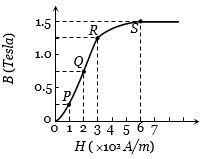
The basic magnetization curve for a ferromagnetic material is shown in the figure. Then,the value of relative permeability is highest for the point
A
$P$
B
$Q$
C
$R$
D
$S$
Solution
(B) The relationship between magnetic flux density $B$ and magnetic field intensity $H$ is given by $B = \mu_0 \mu_r H$.
From this,the relative permeability $\mu_r$ is proportional to the ratio $\frac{B}{H}$,which represents the slope of the $B-H$ curve at any given point.
$\mu_r \propto \frac{B}{H} = \text{slope of } B-H \text{ curve}$.
To find the highest relative permeability,we need to identify the point on the curve where the slope is maximum.
By observing the given $B-H$ graph,the curve is steepest in the region around point $Q$. Therefore,the slope is highest at point $Q$.
From this,the relative permeability $\mu_r$ is proportional to the ratio $\frac{B}{H}$,which represents the slope of the $B-H$ curve at any given point.
$\mu_r \propto \frac{B}{H} = \text{slope of } B-H \text{ curve}$.
To find the highest relative permeability,we need to identify the point on the curve where the slope is maximum.
By observing the given $B-H$ graph,the curve is steepest in the region around point $Q$. Therefore,the slope is highest at point $Q$.
0 likes
View Solution14
MediumMCQ
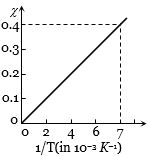
The $\chi - 1/T$ graph for an alloy of paramagnetic nature is shown in the figure. The Curie constant is,then....$K$.
A
$57$
B
$2.8 \times 10^{-3}$
C
$570$
D
$17.5 \times 10^{-3}$
Solution
(A) According to Curie's law for paramagnetic materials,the magnetic susceptibility $\chi$ is given by $\chi = C \times (1/T)$,where $C$ is the Curie constant.
From the given graph,the slope of the line represents the Curie constant $C$.
Slope $C = \frac{\Delta \chi}{\Delta (1/T)} = \frac{0.4}{7 \times 10^{-3} \text{ K}^{-1}}$.
$C = \frac{0.4}{0.007} = \frac{400}{7} \approx 57.14 \text{ K}$.
Rounding to the nearest integer,the Curie constant is $57 \text{ K}$.
From the given graph,the slope of the line represents the Curie constant $C$.
Slope $C = \frac{\Delta \chi}{\Delta (1/T)} = \frac{0.4}{7 \times 10^{-3} \text{ K}^{-1}}$.
$C = \frac{0.4}{0.007} = \frac{400}{7} \approx 57.14 \text{ K}$.
Rounding to the nearest integer,the Curie constant is $57 \text{ K}$.
1 likes
View Solution15
MediumMCQ
An iron rod of cross-sectional area $2 \times 10^{-5} \ m^2$ is subjected to a magnetizing field intensity of $2000 \ A/m$. If the magnetic flux produced in the rod is $6.28 \times 10^{-4} \ Wb$,what is the magnetic permeability of the rod?
A
$0.75 \times 10^{-2}$
B
$1.25 \times 10^4$
C
$0.25$
D
$1.01$
Solution
(B) The magnetic flux density $B$ is given by the ratio of magnetic flux $\phi$ to the cross-sectional area $A$:
$B = \frac{\phi}{A} = \frac{6.28 \times 10^{-4} \ Wb}{2 \times 10^{-5} \ m^2} = 31.4 \ T$
The relationship between magnetic flux density $B$,permeability $\mu$,and magnetizing field intensity $H$ is $B = \mu H$.
Therefore,the permeability $\mu$ is:
$\mu = \frac{B}{H} = \frac{31.4 \ T}{2000 \ A/m} = 0.0157 \ T \cdot m/A$
However,calculating the relative permeability $\mu_r$ using $\mu = \mu_0 \mu_r$:
$\mu_r = \frac{\mu}{\mu_0} = \frac{0.0157}{4\pi \times 10^{-7}} \approx 1.25 \times 10^4$
Thus,the magnetic permeability $\mu$ is approximately $1.25 \times 10^4 \ \mu_0$.
$B = \frac{\phi}{A} = \frac{6.28 \times 10^{-4} \ Wb}{2 \times 10^{-5} \ m^2} = 31.4 \ T$
The relationship between magnetic flux density $B$,permeability $\mu$,and magnetizing field intensity $H$ is $B = \mu H$.
Therefore,the permeability $\mu$ is:
$\mu = \frac{B}{H} = \frac{31.4 \ T}{2000 \ A/m} = 0.0157 \ T \cdot m/A$
However,calculating the relative permeability $\mu_r$ using $\mu = \mu_0 \mu_r$:
$\mu_r = \frac{\mu}{\mu_0} = \frac{0.0157}{4\pi \times 10^{-7}} \approx 1.25 \times 10^4$
Thus,the magnetic permeability $\mu$ is approximately $1.25 \times 10^4 \ \mu_0$.
0 likes
View Solution16
MediumMCQ
$A$ substance has a mass of $1 \, g$ and a density of $5 \, g/cm^3$. Its magnetic dipole moment is $6 \times 10^{-7} \, A \cdot m^2$. What is the magnetization in $A/m$?
A
$8.3 \times 10^6$
B
$3$
C
$1.2 \times 10^{-7}$
D
$3 \times 10^{-6}$
Solution
(B) Magnetization $I$ (or $M$) is defined as the magnetic dipole moment per unit volume: $I = \frac{M_{dipole}}{V}$.
Given:
Mass $m = 1 \, g = 10^{-3} \, kg$.
Density $\rho = 5 \, g/cm^3 = 5000 \, kg/m^3 = 5 \times 10^3 \, kg/m^3$.
Magnetic dipole moment $M_{dipole} = 6 \times 10^{-7} \, A \cdot m^2$.
First,calculate the volume $V$:
$V = \frac{m}{\rho} = \frac{1 \, g}{5 \, g/cm^3} = 0.2 \, cm^3 = 0.2 \times 10^{-6} \, m^3 = 2 \times 10^{-7} \, m^3$.
Now,calculate the magnetization $I$:
$I = \frac{6 \times 10^{-7} \, A \cdot m^2}{2 \times 10^{-7} \, m^3} = 3 \, A/m$.
Given:
Mass $m = 1 \, g = 10^{-3} \, kg$.
Density $\rho = 5 \, g/cm^3 = 5000 \, kg/m^3 = 5 \times 10^3 \, kg/m^3$.
Magnetic dipole moment $M_{dipole} = 6 \times 10^{-7} \, A \cdot m^2$.
First,calculate the volume $V$:
$V = \frac{m}{\rho} = \frac{1 \, g}{5 \, g/cm^3} = 0.2 \, cm^3 = 0.2 \times 10^{-6} \, m^3 = 2 \times 10^{-7} \, m^3$.
Now,calculate the magnetization $I$:
$I = \frac{6 \times 10^{-7} \, A \cdot m^2}{2 \times 10^{-7} \, m^3} = 3 \, A/m$.
0 likes
View Solution17
MediumMCQ
An iron rod of cross-sectional area $0.2 \, cm^2$ is subjected to a magnetizing field intensity of $1600 \, A \cdot m^{-1}$. If the magnetic flux produced in the rod is $2.4 \times 10^{-5} \, Wb$, what is the magnetic susceptibility of the material of the rod?
A
$298$
B
$596$
C
$1192$
D
$1788$
Solution
(B) The magnetic flux $\phi$ is given by $\phi = B \cdot A$, where $B$ is the magnetic field induction and $A$ is the cross-sectional area.
$B = \frac{\phi}{A} = \frac{2.4 \times 10^{-5} \, Wb}{0.2 \times 10^{-4} \, m^2} = 1.2 \, T$.
The relation between magnetic field $B$, magnetic intensity $H$, and relative permeability $\mu_r$ is $B = \mu_0 \mu_r H$.
Thus, $\mu_r = \frac{B}{\mu_0 H} = \frac{1.2}{(4\pi \times 10^{-7}) \times 1600}$.
$\mu_r = \frac{1.2}{2.01 \times 10^{-3}} \approx 596.8$.
Since $\mu_r = 1 + \chi_m$, the magnetic susceptibility $\chi_m = \mu_r - 1$.
$\chi_m = 596.8 - 1 = 595.8 \approx 596$.
$B = \frac{\phi}{A} = \frac{2.4 \times 10^{-5} \, Wb}{0.2 \times 10^{-4} \, m^2} = 1.2 \, T$.
The relation between magnetic field $B$, magnetic intensity $H$, and relative permeability $\mu_r$ is $B = \mu_0 \mu_r H$.
Thus, $\mu_r = \frac{B}{\mu_0 H} = \frac{1.2}{(4\pi \times 10^{-7}) \times 1600}$.
$\mu_r = \frac{1.2}{2.01 \times 10^{-3}} \approx 596.8$.
Since $\mu_r = 1 + \chi_m$, the magnetic susceptibility $\chi_m = \mu_r - 1$.
$\chi_m = 596.8 - 1 = 595.8 \approx 596$.
0 likes
View Solution18
EasyMCQ
$A$ substance has a mass of $0.075 \, kg$ and a density of $7500 \, kg/m^3$. If its magnetic dipole moment is $8 \times 10^{-7} \, A \cdot m^2$,what is its magnetization in $A/m$?
A
$8$
B
$0.8$
C
$0.08$
D
$0.008$
Solution
(C) The magnetization $M_{z}$ is defined as the magnetic dipole moment per unit volume: $M_{z} = \frac{m_{d}}{V}$.
Given mass $m = 0.075 \, kg$ and density $\rho = 7500 \, kg/m^3$,the volume $V$ is calculated as $V = \frac{m}{\rho} = \frac{0.075}{7500} = 10^{-5} \, m^3$.
The magnetic dipole moment $m_{d} = 8 \times 10^{-7} \, A \cdot m^2$.
Therefore,$M_{z} = \frac{8 \times 10^{-7}}{10^{-5}} = 8 \times 10^{-2} = 0.08 \, A/m$.
Given mass $m = 0.075 \, kg$ and density $\rho = 7500 \, kg/m^3$,the volume $V$ is calculated as $V = \frac{m}{\rho} = \frac{0.075}{7500} = 10^{-5} \, m^3$.
The magnetic dipole moment $m_{d} = 8 \times 10^{-7} \, A \cdot m^2$.
Therefore,$M_{z} = \frac{8 \times 10^{-7}}{10^{-5}} = 8 \times 10^{-2} = 0.08 \, A/m$.
0 likes
View Solution19
MediumMCQ
Susceptibility of $Mg$ at $300\, K$ is $1.2 \times 10^{-5}$. The temperature at which susceptibility will be $1.8 \times 10^{-5}$ is......$K$.
A
$450$
B
$200$
C
$375$
D
None of these
Solution
(B) According to Curie's Law for paramagnetic substances,the magnetic susceptibility $\chi$ is inversely proportional to the absolute temperature $T$,i.e.,$\chi \propto \frac{1}{T}$.
This implies $\chi_1 T_1 = \chi_2 T_2$.
Given: $\chi_1 = 1.2 \times 10^{-5}$,$T_1 = 300\, K$,and $\chi_2 = 1.8 \times 10^{-5}$.
Substituting the values: $(1.2 \times 10^{-5}) \times 300 = (1.8 \times 10^{-5}) \times T_2$.
$T_2 = \frac{1.2 \times 10^{-5} \times 300}{1.8 \times 10^{-5}} = \frac{1.2}{1.8} \times 300 = \frac{2}{3} \times 300 = 200\, K$.
This implies $\chi_1 T_1 = \chi_2 T_2$.
Given: $\chi_1 = 1.2 \times 10^{-5}$,$T_1 = 300\, K$,and $\chi_2 = 1.8 \times 10^{-5}$.
Substituting the values: $(1.2 \times 10^{-5}) \times 300 = (1.8 \times 10^{-5}) \times T_2$.
$T_2 = \frac{1.2 \times 10^{-5} \times 300}{1.8 \times 10^{-5}} = \frac{1.2}{1.8} \times 300 = \frac{2}{3} \times 300 = 200\, K$.
0 likes
View Solution20
EasyMCQ
$A$ magnetizing field of $2 \times 10^3 \, A/m$ produces a magnetic flux density of $8 \pi \, T$ in an iron rod. The relative permeability of the rod will be -
A
$100$
B
$10$
C
$1000$
D
$10000$
Solution
(D) The relation between magnetic flux density $B$,relative permeability $\mu_r$,permeability of free space $\mu_0$,and magnetizing field $H$ is given by $B = \mu_r \mu_0 H$.
Given:
$H = 2 \times 10^3 \, A/m$
$B = 8 \pi \, T$
$\mu_0 = 4 \pi \times 10^{-7} \, T \cdot m/A$
Rearranging the formula for $\mu_r$:
$\mu_r = \frac{B}{\mu_0 H}$
Substituting the values:
$\mu_r = \frac{8 \pi}{(4 \pi \times 10^{-7}) \times (2 \times 10^3)}$
$\mu_r = \frac{8 \pi}{8 \pi \times 10^{-4}}$
$\mu_r = \frac{1}{10^{-4}} = 10^4 = 10000$
Given:
$H = 2 \times 10^3 \, A/m$
$B = 8 \pi \, T$
$\mu_0 = 4 \pi \times 10^{-7} \, T \cdot m/A$
Rearranging the formula for $\mu_r$:
$\mu_r = \frac{B}{\mu_0 H}$
Substituting the values:
$\mu_r = \frac{8 \pi}{(4 \pi \times 10^{-7}) \times (2 \times 10^3)}$
$\mu_r = \frac{8 \pi}{8 \pi \times 10^{-4}}$
$\mu_r = \frac{1}{10^{-4}} = 10^4 = 10000$
0 likes
View Solution21
EasyMCQ
The magnetic susceptibility of a material is $7.54 \times 10^{-3}$. The nature and relative permeability of the substance are:
A
diamagnetic,$0.99246$
B
paramagnetic,$1.00754$
C
ferromagnetic,$7.5 \times 10^3$
D
none of these
Solution
(B) The magnetic susceptibility $\chi$ is given as $7.54 \times 10^{-3} = 0.00754$.
Since $\chi$ is positive and small,the material is paramagnetic.
The relative permeability $\mu_r$ is related to susceptibility by the formula $\mu_r = 1 + \chi$.
Substituting the value: $\mu_r = 1 + 0.00754 = 1.00754$.
Therefore,the substance is paramagnetic and its relative permeability is $1.00754$.
Since $\chi$ is positive and small,the material is paramagnetic.
The relative permeability $\mu_r$ is related to susceptibility by the formula $\mu_r = 1 + \chi$.
Substituting the value: $\mu_r = 1 + 0.00754 = 1.00754$.
Therefore,the substance is paramagnetic and its relative permeability is $1.00754$.
0 likes
View Solution22
DifficultMCQ
By putting a magnetic substance of volume $30\, cm^3$ in a magnetising field of strength $\frac{1250}{\pi} \, A/m$,the value of the produced magnetic moment is $6\, A\cdot m^2$. Calculate the value of magnetic induction produced in the substance in $T$.
A
$0.25$
B
$0.50$
C
$0.12$
D
$1$
Solution
(A) Given: Volume $V = 30\, cm^3 = 30 \times 10^{-6} \, m^3$,Magnetising field $H = \frac{1250}{\pi} \, A/m$,Magnetic moment $M = 6 \, A\cdot m^2$.
First,calculate the intensity of magnetisation $I$:
$I = \frac{M}{V} = \frac{6}{30 \times 10^{-6}} = 0.2 \times 10^6 = 2 \times 10^5 \, A/m$.
Next,calculate the magnetic susceptibility $\chi$:
$\chi = \frac{I}{H} = \frac{2 \times 10^5}{1250/\pi} = \frac{2 \times 10^5 \times \pi}{1250} = 160\pi$.
Calculate relative permeability $\mu_r$:
$\mu_r = 1 + \chi = 1 + 160\pi \approx 1 + 502.65 = 503.65$.
Finally,calculate magnetic induction $B$:
$B = \mu_0 \mu_r H = (4\pi \times 10^{-7}) \times (1 + 160\pi) \times \frac{1250}{\pi}$.
$B = 4 \times 10^{-7} \times (1 + 160\pi) \times 1250 = 5000 \times 10^{-7} \times (1 + 160\pi)$.
$B = 5 \times 10^{-4} \times (1 + 502.65) = 5 \times 10^{-4} \times 503.65 \approx 0.2518 \, T$.
Rounding to the nearest option,the value is $0.25 \, T$.
First,calculate the intensity of magnetisation $I$:
$I = \frac{M}{V} = \frac{6}{30 \times 10^{-6}} = 0.2 \times 10^6 = 2 \times 10^5 \, A/m$.
Next,calculate the magnetic susceptibility $\chi$:
$\chi = \frac{I}{H} = \frac{2 \times 10^5}{1250/\pi} = \frac{2 \times 10^5 \times \pi}{1250} = 160\pi$.
Calculate relative permeability $\mu_r$:
$\mu_r = 1 + \chi = 1 + 160\pi \approx 1 + 502.65 = 503.65$.
Finally,calculate magnetic induction $B$:
$B = \mu_0 \mu_r H = (4\pi \times 10^{-7}) \times (1 + 160\pi) \times \frac{1250}{\pi}$.
$B = 4 \times 10^{-7} \times (1 + 160\pi) \times 1250 = 5000 \times 10^{-7} \times (1 + 160\pi)$.
$B = 5 \times 10^{-4} \times (1 + 502.65) = 5 \times 10^{-4} \times 503.65 \approx 0.2518 \, T$.
Rounding to the nearest option,the value is $0.25 \, T$.
0 likes
View Solution23
EasyMCQ
Curie's law states that
A
magnetic susceptibility is inversely proportional to the absolute temperature
B
magnetic susceptibility is inversely proportional to the square root of the absolute temperature
C
magnetic susceptibility is directly proportional to the absolute temperature
D
magnetic susceptibility is constant
Solution
(A) Curie's Law states that for a paramagnetic material,the magnetic susceptibility $\chi$ is inversely proportional to the absolute temperature $T$.
The mathematical expression is given by:
$\chi = \frac{C}{T}$
where:
$\chi$ is the magnetic susceptibility.
$C$ is the Curie constant,which is specific to the material.
$T$ is the absolute temperature measured in kelvins $(K)$.
This law indicates that as the temperature increases,the magnetic susceptibility of a paramagnetic material decreases,meaning it becomes less magnetic in the presence of an external field.
The mathematical expression is given by:
$\chi = \frac{C}{T}$
where:
$\chi$ is the magnetic susceptibility.
$C$ is the Curie constant,which is specific to the material.
$T$ is the absolute temperature measured in kelvins $(K)$.
This law indicates that as the temperature increases,the magnetic susceptibility of a paramagnetic material decreases,meaning it becomes less magnetic in the presence of an external field.
0 likes
View Solution24
DifficultMCQ
$A$ rod of ferromagnetic material with dimensions $10 \, cm \times 0.5 \, cm \times 0.2 \, cm$ is placed in a magnetic field of strength $0.5 \times 10^4 \, A/m$. As a result,a magnetic moment of $5 \, A \cdot m^2$ is produced in the rod. The value of the total magnetic induction will be (in $Tesla$):
A
$0.54$
B
$0.358$
C
$2.519$
D
$6.28$
Solution
(D) The magnetic induction $B$ is given by the formula $B = \mu_0(M_v + H)$,where $M_v$ is the intensity of magnetization and $H$ is the magnetic field strength.
First,calculate the volume $V$ of the rod: $V = 10 \, cm \times 0.5 \, cm \times 0.2 \, cm = 10^{-1} \, m \times 0.5 \times 10^{-2} \, m \times 0.2 \times 10^{-2} \, m = 10^{-6} \, m^3$.
The intensity of magnetization $M_v$ is $M_v = \frac{M}{V} = \frac{5 \, A \cdot m^2}{10^{-6} \, m^3} = 5 \times 10^6 \, A/m$.
The magnetic field strength $H = 0.5 \times 10^4 \, A/m = 5000 \, A/m$.
Now,$B = 4\pi \times 10^{-7} \times (5 \times 10^6 + 5000) = 4 \times 3.14 \times 10^{-7} \times (5,005,000) \approx 12.56 \times 10^{-7} \times 5 \times 10^6 = 6.28 \, T$.
First,calculate the volume $V$ of the rod: $V = 10 \, cm \times 0.5 \, cm \times 0.2 \, cm = 10^{-1} \, m \times 0.5 \times 10^{-2} \, m \times 0.2 \times 10^{-2} \, m = 10^{-6} \, m^3$.
The intensity of magnetization $M_v$ is $M_v = \frac{M}{V} = \frac{5 \, A \cdot m^2}{10^{-6} \, m^3} = 5 \times 10^6 \, A/m$.
The magnetic field strength $H = 0.5 \times 10^4 \, A/m = 5000 \, A/m$.
Now,$B = 4\pi \times 10^{-7} \times (5 \times 10^6 + 5000) = 4 \times 3.14 \times 10^{-7} \times (5,005,000) \approx 12.56 \times 10^{-7} \times 5 \times 10^6 = 6.28 \, T$.
0 likes
View Solution25
MediumMCQ
$A$ paramagnetic substance in the form of a cube with sides $1\, cm$ has a magnetic dipole moment of $20 \times 10^{-6}\, J/T$ when a magnetic intensity of $60 \times 10^3\, A/m$ is applied. Its magnetic susceptibility is
A
$3.3 \times 10^{-2}$
B
$40.3 \times 10^{-2}$
C
$2.3 \times 10^{-2}$
D
$3.3 \times 10^{-4}$
Solution
(D) The volume of the cube is $V = (1\, cm)^3 = (10^{-2}\, m)^3 = 10^{-6}\, m^3$.
The intensity of magnetization $I$ is defined as the magnetic dipole moment per unit volume:
$I = \frac{M}{V} = \frac{20 \times 10^{-6}\, J/T}{10^{-6}\, m^3} = 20\, A/m$.
The magnetic susceptibility $\chi$ is given by the ratio of the intensity of magnetization $I$ to the magnetic intensity $H$:
$\chi = \frac{I}{H}$.
Given $H = 60 \times 10^3\, A/m$,we have:
$\chi = \frac{20}{60 \times 10^3} = \frac{1}{3} \times 10^{-3} = 0.333 \times 10^{-3} = 3.33 \times 10^{-4}$.
The intensity of magnetization $I$ is defined as the magnetic dipole moment per unit volume:
$I = \frac{M}{V} = \frac{20 \times 10^{-6}\, J/T}{10^{-6}\, m^3} = 20\, A/m$.
The magnetic susceptibility $\chi$ is given by the ratio of the intensity of magnetization $I$ to the magnetic intensity $H$:
$\chi = \frac{I}{H}$.
Given $H = 60 \times 10^3\, A/m$,we have:
$\chi = \frac{20}{60 \times 10^3} = \frac{1}{3} \times 10^{-3} = 0.333 \times 10^{-3} = 3.33 \times 10^{-4}$.
0 likes
View Solution26
MediumMCQ
$A$ rod of ferromagnetic material with dimensions $10 \, cm \times 0.5 \, cm \times 0.2 \, cm$ is placed in a magnetic field of strength $0.5 \times 10^4 \, Am^{-1}$. As a result,a magnetic moment of $5 \, Am^2$ is produced in the rod. The value of magnetic induction will be.... $T$
A
$0.54$
B
$6.28$
C
$0.358$
D
$2.591$
Solution
(B) Volume of the rod $V = 10 \times 0.5 \times 0.2 \, cm^3 = 1 \, cm^3 = 10^{-6} \, m^3$.
Given magnetic field strength $H = 0.5 \times 10^4 \, Am^{-1}$ and magnetic moment $M = 5 \, Am^2$.
Intensity of magnetization $I = \frac{M}{V} = \frac{5}{10^{-6}} = 5 \times 10^6 \, Am^{-1}$.
Magnetic induction $B$ is given by $B = \mu_0(I + H)$.
Since $I \gg H$,we have $B \approx \mu_0 I$.
$B = 4\pi \times 10^{-7} \times 5 \times 10^6 = 20\pi \times 10^{-1} = 2\pi \approx 6.28 \, T$.
Given magnetic field strength $H = 0.5 \times 10^4 \, Am^{-1}$ and magnetic moment $M = 5 \, Am^2$.
Intensity of magnetization $I = \frac{M}{V} = \frac{5}{10^{-6}} = 5 \times 10^6 \, Am^{-1}$.
Magnetic induction $B$ is given by $B = \mu_0(I + H)$.
Since $I \gg H$,we have $B \approx \mu_0 I$.
$B = 4\pi \times 10^{-7} \times 5 \times 10^6 = 20\pi \times 10^{-1} = 2\pi \approx 6.28 \, T$.
0 likes
View Solution27
EasyMCQ
The relation between the magnetic susceptibility $\chi$ and the relative magnetic permeability $\mu_r$ is:
A
$\chi = \mu_r - 1$
B
$\chi = \mu_r + 1$
C
$\chi = \mu_r$
D
$\chi = 1 - \mu_r$
Solution
(A) The magnetic field intensity $H$ and magnetization $M$ are related to the magnetic flux density $B$ by the equation: $B = \mu_0(H + M)$.
Dividing by $H$, we get $B/H = \mu_0(1 + M/H)$.
Since $B/H = \mu$ (absolute permeability) and $M/H = \chi$ (magnetic susceptibility), we have $\mu = \mu_0(1 + \chi)$.
Dividing by $\mu_0$, we get $\mu/\mu_0 = 1 + \chi$.
Since the relative permeability $\mu_r = \mu/\mu_0$, we obtain the relation $\mu_r = 1 + \chi$, which can be rearranged as $\chi = \mu_r - 1$.
Dividing by $H$, we get $B/H = \mu_0(1 + M/H)$.
Since $B/H = \mu$ (absolute permeability) and $M/H = \chi$ (magnetic susceptibility), we have $\mu = \mu_0(1 + \chi)$.
Dividing by $\mu_0$, we get $\mu/\mu_0 = 1 + \chi$.
Since the relative permeability $\mu_r = \mu/\mu_0$, we obtain the relation $\mu_r = 1 + \chi$, which can be rearranged as $\chi = \mu_r - 1$.
0 likes
View Solution28
MediumMCQ
At a temperature of $30\,^oC$,the susceptibility of a ferromagnetic material is found to be $\chi$. Its susceptibility at $333\,^oC$ is....$\chi$.
A
$1$
B
$0.5$
C
$2$
D
$11.1$
Solution
(B) According to Curie's law for ferromagnetic materials above the Curie temperature,the magnetic susceptibility $\chi_m$ is inversely proportional to the absolute temperature $T$,given by $\chi_m = \frac{C}{T - T_c}$. However,for general problems involving temperature dependence of susceptibility where the Curie temperature is not specified,we use the relation $\chi_m \propto \frac{1}{T}$.
Given:
$T_1 = 30\,^oC = 30 + 273 = 303\,K$
$T_2 = 333\,^oC = 333 + 273 = 606\,K$
$\chi_1 = \chi$
Using the relation $\frac{\chi_1}{\chi_2} = \frac{T_2}{T_1}$:
$\frac{\chi}{\chi_2} = \frac{606}{303} = 2$
Therefore,$\chi_2 = \frac{\chi}{2} = 0.5\chi$.
Given:
$T_1 = 30\,^oC = 30 + 273 = 303\,K$
$T_2 = 333\,^oC = 333 + 273 = 606\,K$
$\chi_1 = \chi$
Using the relation $\frac{\chi_1}{\chi_2} = \frac{T_2}{T_1}$:
$\frac{\chi}{\chi_2} = \frac{606}{303} = 2$
Therefore,$\chi_2 = \frac{\chi}{2} = 0.5\chi$.
0 likes
View Solution29
Medium
$A$ solenoid has a core of a material with relative permeability $400$. The windings of the solenoid are insulated from the core and carry a current of $2 \; A$. If the number of turns is $1000$ per metre,calculate $(a) \; H$,$(b) \; M$,$(c) \; B$ and $(d)$ the magnetising current $I_m$.
Solution
(D) The magnetic field intensity $H$ is independent of the material of the core and is given by:
$H = nI = 1000 \times 2.0 = 2 \times 10^3 \; A/m$.
$(b)$ The magnetic field $B$ is given by $B = \mu_r \mu_0 H$:
$B = 400 \times (4\pi \times 10^{-7} \; T \cdot m/A) \times 2 \times 10^3 \; A/m \approx 1.0 \; T$.
$(c)$ Magnetisation $M$ is given by $M = \chi_m H = (\mu_r - 1)H$:
$M = (400 - 1) \times 2 \times 10^3 = 399 \times 2000 = 7.98 \times 10^5 \; A/m \approx 8 \times 10^5 \; A/m$.
$(d)$ The magnetising current $I_m$ is the additional current required to produce the same magnetic field $B$ in the absence of the core. The relation is $B = \mu_0 n (I + I_m)$.
Since $B = \mu_r \mu_0 n I$,we have $\mu_r \mu_0 n I = \mu_0 n (I + I_m)$,
$\mu_r I = I + I_m \implies I_m = I(\mu_r - 1)$,
$I_m = 2 \times (400 - 1) = 2 \times 399 = 798 \; A$.
$H = nI = 1000 \times 2.0 = 2 \times 10^3 \; A/m$.
$(b)$ The magnetic field $B$ is given by $B = \mu_r \mu_0 H$:
$B = 400 \times (4\pi \times 10^{-7} \; T \cdot m/A) \times 2 \times 10^3 \; A/m \approx 1.0 \; T$.
$(c)$ Magnetisation $M$ is given by $M = \chi_m H = (\mu_r - 1)H$:
$M = (400 - 1) \times 2 \times 10^3 = 399 \times 2000 = 7.98 \times 10^5 \; A/m \approx 8 \times 10^5 \; A/m$.
$(d)$ The magnetising current $I_m$ is the additional current required to produce the same magnetic field $B$ in the absence of the core. The relation is $B = \mu_0 n (I + I_m)$.
Since $B = \mu_r \mu_0 n I$,we have $\mu_r \mu_0 n I = \mu_0 n (I + I_m)$,
$\mu_r I = I + I_m \implies I_m = I(\mu_r - 1)$,
$I_m = 2 \times (400 - 1) = 2 \times 399 = 798 \; A$.
0 likes
View Solution30
Medium
$A$ domain in ferromagnetic iron is in the form of a cube of side length $1\; \mu m$. Estimate the number of iron atoms in the domain and the maximum possible dipole moment and magnetisation of the domain. The molecular mass of iron is $55\; g/mol$ and its density is $7.9\; g/cm^3$. Assume that each iron atom has a dipole moment of $9.27 \times 10^{-24}\; A m^2$.
Solution
(N/A) The volume of the cubic domain is $V = (10^{-6}\; m)^3 = 10^{-18}\; m^3 = 10^{-12}\; cm^3$.
The mass of the domain is $\text{volume} \times \text{density} = 7.9\; g/cm^3 \times 10^{-12}\; cm^3 = 7.9 \times 10^{-12}\; g$.
Using Avogadro's number $(N_A = 6.023 \times 10^{23}\; mol^{-1})$,the number of iron atoms $N$ is given by $N = \frac{\text{mass}}{\text{molar mass}} \times N_A = \frac{7.9 \times 10^{-12}\; g}{55\; g/mol} \times 6.023 \times 10^{23}\; mol^{-1} \approx 8.65 \times 10^{10}$ atoms.
The maximum possible dipole moment $m_{\max}$ is achieved when all atomic moments are perfectly aligned: $m_{\max} = N \times (9.27 \times 10^{-24}\; A m^2) = (8.65 \times 10^{10}) \times (9.27 \times 10^{-24}) \approx 8.0 \times 10^{-13}\; A m^2$.
The magnetisation $M_{\max}$ is $m_{\max} / V = (8.0 \times 10^{-13}\; A m^2) / (10^{-18}\; m^3) = 8.0 \times 10^5\; A/m$.
The mass of the domain is $\text{volume} \times \text{density} = 7.9\; g/cm^3 \times 10^{-12}\; cm^3 = 7.9 \times 10^{-12}\; g$.
Using Avogadro's number $(N_A = 6.023 \times 10^{23}\; mol^{-1})$,the number of iron atoms $N$ is given by $N = \frac{\text{mass}}{\text{molar mass}} \times N_A = \frac{7.9 \times 10^{-12}\; g}{55\; g/mol} \times 6.023 \times 10^{23}\; mol^{-1} \approx 8.65 \times 10^{10}$ atoms.
The maximum possible dipole moment $m_{\max}$ is achieved when all atomic moments are perfectly aligned: $m_{\max} = N \times (9.27 \times 10^{-24}\; A m^2) = (8.65 \times 10^{10}) \times (9.27 \times 10^{-24}) \approx 8.0 \times 10^{-13}\; A m^2$.
The magnetisation $M_{\max}$ is $m_{\max} / V = (8.0 \times 10^{-13}\; A m^2) / (10^{-18}\; m^3) = 8.0 \times 10^5\; A/m$.
0 likes
View Solution31
EasyMCQ
$A$ Rowland ring of mean radius $15\; cm$ has $3500$ turns of wire wound on a ferromagnetic core of relative permeability $800$. What is the magnetic field $B$ (in $T$) in the core for a magnetizing current of $1.2\; A$?
A
$1.62$
B
$9.98$
C
$4.48$
D
$12.75$
Solution
(C) The mean radius of the Rowland ring is $r = 15\; cm = 0.15\; m$.
The number of turns on the ferromagnetic core is $N = 3500$.
The relative permeability of the core material is $\mu_r = 800$.
The magnetizing current is $I = 1.2\; A$.
The magnetic field $B$ inside a toroid (Rowland ring) is given by the formula:
$B = \frac{\mu_r \mu_0 N I}{2 \pi r}$
Where $\mu_0$ is the permeability of free space,$\mu_0 = 4 \pi \times 10^{-7}\; T\cdot m/A$.
Substituting the values:
$B = \frac{800 \times (4 \pi \times 10^{-7}) \times 3500 \times 1.2}{2 \pi \times 0.15}$
$B = \frac{800 \times 2 \times 10^{-7} \times 3500 \times 1.2}{0.15}$
$B = \frac{800 \times 2 \times 10^{-7} \times 4200}{0.15} = \frac{0.672}{0.15} = 4.48\; T$.
Thus,the magnetic field in the core is $4.48\; T$.
The number of turns on the ferromagnetic core is $N = 3500$.
The relative permeability of the core material is $\mu_r = 800$.
The magnetizing current is $I = 1.2\; A$.
The magnetic field $B$ inside a toroid (Rowland ring) is given by the formula:
$B = \frac{\mu_r \mu_0 N I}{2 \pi r}$
Where $\mu_0$ is the permeability of free space,$\mu_0 = 4 \pi \times 10^{-7}\; T\cdot m/A$.
Substituting the values:
$B = \frac{800 \times (4 \pi \times 10^{-7}) \times 3500 \times 1.2}{2 \pi \times 0.15}$
$B = \frac{800 \times 2 \times 10^{-7} \times 3500 \times 1.2}{0.15}$
$B = \frac{800 \times 2 \times 10^{-7} \times 4200}{0.15} = \frac{0.672}{0.15} = 4.48\; T$.
Thus,the magnetic field in the core is $4.48\; T$.
0 likes
View Solution32
Medium
Define magnetisation $(M)$ and give its unit and dimension.
Solution
(N/A) Magnetisation $M$ of a sample is defined as its net magnetic moment per unit volume.
$\vec{M} = \frac{\vec{m}_{\text{net}}}{V}$ $(1)$
$M$ is a vector quantity.
The dimension of $M$ is $[L^{-1} A]$.
The $SI$ unit of magnetisation is $A/m$.
$\vec{M} = \frac{\vec{m}_{\text{net}}}{V}$ $(1)$
$M$ is a vector quantity.
The dimension of $M$ is $[L^{-1} A]$.
The $SI$ unit of magnetisation is $A/m$.
0 likes
View Solution33
Easy
Obtain the relation between magnetisation $\vec{M}$ and magnetic intensity $\vec{H}$ for a solenoid.
Solution
(N/A) Consider a long solenoid with $n$ turns per unit length carrying a current $I$.
The magnetic field in the interior of the solenoid due to the current is:
$\vec{B}_{0} = \mu_{0} n I \quad \dots (1)$
If the interior of the solenoid is filled with a magnetic material,the total magnetic field $\vec{B}$ inside the solenoid is the sum of the field due to the current $(\vec{B}_{0})$ and the field due to the magnetization of the material $(\vec{B}_{m})$:
$\vec{B} = \vec{B}_{0} + \vec{B}_{m} \quad \dots (2)$
The additional field $\vec{B}_{m}$ is proportional to the magnetization $\vec{M}$ of the material:
$\vec{B}_{m} = \mu_{0} \vec{M} \quad \dots (3)$
We define the magnetic intensity $\vec{H}$ as:
$\vec{H} = \frac{\vec{B}}{\mu_{0}} - \vec{M} \quad \dots (4)$
Rearranging this equation,we get the relation for the total magnetic field $\vec{B}$:
$\vec{B} = \mu_{0}(\vec{H} + \vec{M}) \quad \dots (5)$
Here,$\vec{H}$ represents the contribution from external currents,and $\vec{M}$ represents the contribution from the magnetic material.
The magnetic field in the interior of the solenoid due to the current is:
$\vec{B}_{0} = \mu_{0} n I \quad \dots (1)$
If the interior of the solenoid is filled with a magnetic material,the total magnetic field $\vec{B}$ inside the solenoid is the sum of the field due to the current $(\vec{B}_{0})$ and the field due to the magnetization of the material $(\vec{B}_{m})$:
$\vec{B} = \vec{B}_{0} + \vec{B}_{m} \quad \dots (2)$
The additional field $\vec{B}_{m}$ is proportional to the magnetization $\vec{M}$ of the material:
$\vec{B}_{m} = \mu_{0} \vec{M} \quad \dots (3)$
We define the magnetic intensity $\vec{H}$ as:
$\vec{H} = \frac{\vec{B}}{\mu_{0}} - \vec{M} \quad \dots (4)$
Rearranging this equation,we get the relation for the total magnetic field $\vec{B}$:
$\vec{B} = \mu_{0}(\vec{H} + \vec{M}) \quad \dots (5)$
Here,$\vec{H}$ represents the contribution from external currents,and $\vec{M}$ represents the contribution from the magnetic material.
0 likes
View Solution34
Medium
Explain the magnetic susceptibility $(\chi)$ of a material. From it,explain the relative magnetic permeability and magnetic permeability of the material. Obtain the relation between them.
Solution
(N/A) The magnetization $M$ of a material is proportional to the magnetic intensity $(H)$.
$\overrightarrow{M} = \chi \overrightarrow{H}$....$(1)$
Here,$\chi$ is a dimensionless quantity called magnetic susceptibility. It measures how a magnetic material responds to an external field.
For paramagnetic materials,$\chi$ is small and positive.
For diamagnetic materials,$\chi$ is small and negative because $\overrightarrow{M}$ and $\overrightarrow{H}$ are in opposite directions.
Consider a magnetic material placed inside a solenoid. The total magnetic field $B$ when a current $I$ flows through the solenoid is:
$\overrightarrow{B} = \mu_{0}(\overrightarrow{H} + \overrightarrow{M})$....$(2)$
Substituting equation $(1)$ into $(2)$:
$\overrightarrow{B} = \mu_{0}(\overrightarrow{H} + \chi \overrightarrow{H}) = \mu_{0}(1 + \chi) \overrightarrow{H}$....$(3)$
Here,$\mu = \mu_{0}(1 + \chi)$ is defined as the magnetic permeability of the material.
Thus,$\mu = \mu_{0}(1 + \chi)$....$(4)$
Dividing by $\mu_{0}$,we get the relative magnetic permeability $\mu_{r}$:
$\mu_{r} = \frac{\mu}{\mu_{0}} = 1 + \chi$....$(5)$
Therefore,the relation is $\mu = \mu_{0} \mu_{r}$....$(6)$
Substituting this into equation $(3)$,we get:
$\overrightarrow{B} = \mu \overrightarrow{H}$....$(7)$
$\mu_{r}$ is a dimensionless quantity,analogous to the dielectric constant in electrostatics.
$\overrightarrow{M} = \chi \overrightarrow{H}$....$(1)$
Here,$\chi$ is a dimensionless quantity called magnetic susceptibility. It measures how a magnetic material responds to an external field.
For paramagnetic materials,$\chi$ is small and positive.
For diamagnetic materials,$\chi$ is small and negative because $\overrightarrow{M}$ and $\overrightarrow{H}$ are in opposite directions.
Consider a magnetic material placed inside a solenoid. The total magnetic field $B$ when a current $I$ flows through the solenoid is:
$\overrightarrow{B} = \mu_{0}(\overrightarrow{H} + \overrightarrow{M})$....$(2)$
Substituting equation $(1)$ into $(2)$:
$\overrightarrow{B} = \mu_{0}(\overrightarrow{H} + \chi \overrightarrow{H}) = \mu_{0}(1 + \chi) \overrightarrow{H}$....$(3)$
Here,$\mu = \mu_{0}(1 + \chi)$ is defined as the magnetic permeability of the material.
Thus,$\mu = \mu_{0}(1 + \chi)$....$(4)$
Dividing by $\mu_{0}$,we get the relative magnetic permeability $\mu_{r}$:
$\mu_{r} = \frac{\mu}{\mu_{0}} = 1 + \chi$....$(5)$
Therefore,the relation is $\mu = \mu_{0} \mu_{r}$....$(6)$
Substituting this into equation $(3)$,we get:
$\overrightarrow{B} = \mu \overrightarrow{H}$....$(7)$
$\mu_{r}$ is a dimensionless quantity,analogous to the dielectric constant in electrostatics.
0 likes
View Solution35
Easy
What is the magnetisation of a substance?
Solution
(N/A) Magnetisation $(M)$ of a substance is defined as the net magnetic dipole moment per unit volume of the material.
Mathematically,it is expressed as:
$M = \frac{m_{net}}{V}$
where $m_{net}$ is the net magnetic dipole moment and $V$ is the volume of the substance.
The $SI$ unit of magnetisation is $A/m$ (ampere per meter).
Mathematically,it is expressed as:
$M = \frac{m_{net}}{V}$
where $m_{net}$ is the net magnetic dipole moment and $V$ is the volume of the substance.
The $SI$ unit of magnetisation is $A/m$ (ampere per meter).
0 likes
View Solution36
Easy
Give the unit and dimensional formula of magnetisation.
Solution
(N/A) Magnetisation $(M)$ is defined as the magnetic moment per unit volume of a material.
Mathematically,$M = \frac{m_{net}}{V}$,where $m_{net}$ is the net magnetic moment and $V$ is the volume.
The $SI$ unit of magnetic moment $(m_{net})$ is $A \cdot m^2$ and the unit of volume $(V)$ is $m^3$.
Therefore,the $SI$ unit of magnetisation is $\frac{A \cdot m^2}{m^3} = A \cdot m^{-1}$ (Ampere per meter).
The dimensional formula of magnetic moment is $[M^0 L^2 T^0 I^1]$ and the dimensional formula of volume is $[M^0 L^3 T^0 I^0]$.
Thus,the dimensional formula of magnetisation is $\frac{[I^1 L^2]}{[L^3]} = [M^0 L^{-1} T^0 I^1]$.
Mathematically,$M = \frac{m_{net}}{V}$,where $m_{net}$ is the net magnetic moment and $V$ is the volume.
The $SI$ unit of magnetic moment $(m_{net})$ is $A \cdot m^2$ and the unit of volume $(V)$ is $m^3$.
Therefore,the $SI$ unit of magnetisation is $\frac{A \cdot m^2}{m^3} = A \cdot m^{-1}$ (Ampere per meter).
The dimensional formula of magnetic moment is $[M^0 L^2 T^0 I^1]$ and the dimensional formula of volume is $[M^0 L^3 T^0 I^0]$.
Thus,the dimensional formula of magnetisation is $\frac{[I^1 L^2]}{[L^3]} = [M^0 L^{-1} T^0 I^1]$.
0 likes
View Solution37
Difficult
Write the equation of the magnetic field obtained in the core of a solenoid in the form of $\vec{H}$ and $\vec{M}$.
Solution
(N/A) The total magnetic field $\vec{B}$ inside the core of a solenoid is the sum of the magnetic field due to the current in the solenoid windings $(\vec{B}_0)$ and the magnetic field due to the magnetization of the material $(\vec{B}_m)$.
Mathematically,this is expressed as:
$\vec{B} = \vec{B}_0 + \vec{B}_m$
Since $\vec{B}_0 = \mu_0 \vec{H}$ and $\vec{B}_m = \mu_0 \vec{M}$,where $\vec{H}$ is the magnetic intensity and $\vec{M}$ is the magnetization of the material,we can write:
$\vec{B} = \mu_0 \vec{H} + \mu_0 \vec{M}$
$\vec{B} = \mu_0 (\vec{H} + \vec{M})$
Mathematically,this is expressed as:
$\vec{B} = \vec{B}_0 + \vec{B}_m$
Since $\vec{B}_0 = \mu_0 \vec{H}$ and $\vec{B}_m = \mu_0 \vec{M}$,where $\vec{H}$ is the magnetic intensity and $\vec{M}$ is the magnetization of the material,we can write:
$\vec{B} = \mu_0 \vec{H} + \mu_0 \vec{M}$
$\vec{B} = \mu_0 (\vec{H} + \vec{M})$
0 likes
View Solution38
MediumMCQ
What does the magnetic susceptibility of a material show?
A
The ability of a material to be magnetized.
B
The electrical conductivity of a material.
C
The thermal expansion coefficient of a material.
D
The density of a material.
Solution
(A) Magnetic susceptibility,denoted by the symbol $\chi_m$,is a dimensionless proportionality constant that indicates the degree of magnetization of a material in response to an applied magnetic field.
Mathematically,it is defined as the ratio of the intensity of magnetization $(M)$ to the magnetic intensity $(H)$: $\chi_m = \frac{M}{H}$.
Therefore,it shows how easily a material can be magnetized when placed in an external magnetic field.
Mathematically,it is defined as the ratio of the intensity of magnetization $(M)$ to the magnetic intensity $(H)$: $\chi_m = \frac{M}{H}$.
Therefore,it shows how easily a material can be magnetized when placed in an external magnetic field.
0 likes
View Solution39
EasyMCQ
$A$ permanent magnet in the shape of a thin cylinder of length $10$ $cm$ has magnetization $M = 10^6$ $A/m$. Calculate the magnetization current $I_M$.
A
$10^4$ $A$
B
$10^5$ $A$
C
$10^6$ $A$
D
$10^7$ $A$
Solution
(B) Given: Intensity of magnetization $M = 10^6$ $A/m$. Length of the cylinder $l = 10$ $cm = 0.1$ $m = 10^{-1}$ $m$.
Magnetization current $I_M$ is related to magnetization $M$ by the formula:
$M = \frac{I_M}{l}$
Therefore,the magnetization current is:
$I_M = M \times l$
Substituting the given values:
$I_M = (10^6$ $A/m) \times (10^{-1}$ $m)$
$I_M = 10^5$ $A$.
Magnetization current $I_M$ is related to magnetization $M$ by the formula:
$M = \frac{I_M}{l}$
Therefore,the magnetization current is:
$I_M = M \times l$
Substituting the given values:
$I_M = (10^6$ $A/m) \times (10^{-1}$ $m)$
$I_M = 10^5$ $A$.
0 likes
View Solution40
Medium
What are the dimensions of $\chi$,the magnetic susceptibility? Consider an $H$-atom. Guess an expression for $\chi$,up to a constant,by constructing a quantity of dimensions of $\chi$ out of parameters of the atom: $e, m, v, R$ and $\mu_0$. Here,$m$ is the electronic mass,$v$ is electronic velocity,$R$ is Bohr radius. Estimate the number so obtained and compare with the value of $|\chi| \approx 10^{-5}$ for many solid materials.
Solution
(A) Magnetic susceptibility $\chi$ is defined as the ratio of magnetization $M$ to magnetic field intensity $H$. Since both $M$ and $H$ have the same units $(A/m)$,$\chi$ is a dimensionless quantity,i.e.,$[M^0 L^0 T^0]$.
To construct an expression for $\chi$ using $e, m, v, R, \mu_0$,we note that $\mu_0$ has dimensions $[M L T^{-2} Q^{-2}]$ and $e^2$ has dimensions $[Q^2]$. Thus,$\mu_0 e^2$ has dimensions $[M L T^{-2}]$.
Let $\chi = \mu_0 e^2 m^a v^b R^c$.
Substituting dimensions: $[M^0 L^0 T^0] = [M L T^{-2}] [M]^a [L T^{-1}]^b [L]^c$.
Equating powers of $M, L, T$:
For $M$: $1 + a = 0 \implies a = -1$.
For $T$: $-2 - b = 0 \implies b = -2$.
For $L$: $1 + b + c = 0 \implies 1 - 2 + c = 0 \implies c = 1$.
Thus,$\chi \propto \frac{\mu_0 e^2 R}{m v^2}$.
Using Bohr's model,$v^2 = \frac{e^2}{4 \pi \epsilon_0 m R}$,so $\frac{e^2}{m R} \approx v^2$. Substituting this,$\chi \approx \mu_0 \epsilon_0 v^2 \approx \frac{v^2}{c^2}$.
Given $v \approx \alpha c$ (where $\alpha \approx 1/137$),$\chi \approx \alpha^2 \approx (1/137)^2 \approx 5 \times 10^{-5}$,which is consistent with the order of $10^{-5}$ for diamagnetic materials.
To construct an expression for $\chi$ using $e, m, v, R, \mu_0$,we note that $\mu_0$ has dimensions $[M L T^{-2} Q^{-2}]$ and $e^2$ has dimensions $[Q^2]$. Thus,$\mu_0 e^2$ has dimensions $[M L T^{-2}]$.
Let $\chi = \mu_0 e^2 m^a v^b R^c$.
Substituting dimensions: $[M^0 L^0 T^0] = [M L T^{-2}] [M]^a [L T^{-1}]^b [L]^c$.
Equating powers of $M, L, T$:
For $M$: $1 + a = 0 \implies a = -1$.
For $T$: $-2 - b = 0 \implies b = -2$.
For $L$: $1 + b + c = 0 \implies 1 - 2 + c = 0 \implies c = 1$.
Thus,$\chi \propto \frac{\mu_0 e^2 R}{m v^2}$.
Using Bohr's model,$v^2 = \frac{e^2}{4 \pi \epsilon_0 m R}$,so $\frac{e^2}{m R} \approx v^2$. Substituting this,$\chi \approx \mu_0 \epsilon_0 v^2 \approx \frac{v^2}{c^2}$.
Given $v \approx \alpha c$ (where $\alpha \approx 1/137$),$\chi \approx \alpha^2 \approx (1/137)^2 \approx 5 \times 10^{-5}$,which is consistent with the order of $10^{-5}$ for diamagnetic materials.
0 likes
View Solution41
MediumMCQ
An iron rod of volume $10^{-3} \ m^3$ and relative permeability $1000$ is placed as a core in a solenoid with $10 \ turns/cm$. If a current of $0.5 \ A$ is passed through the solenoid,then the magnetic moment of the rod will be $........... \ Am^2$.
A
$0.5 \times 10^2$
B
$50 \times 10^2$
C
$500 \times 10^2$
D
$5 \times 10^2$
Solution
(D) The magnetic field inside the solenoid is $B_0 = \mu_0 n i$.
When an iron rod is placed inside,the magnetic field becomes $B = \mu_r B_0 = \mu_r \mu_0 n i$.
The magnetization $M_z$ is given by $M_z = \frac{B - \mu_0 H}{\mu_0} = (\mu_r - 1) H$.
Since $\mu_r = 1000 \gg 1$,we can approximate $M_z \approx \mu_r H = \mu_r n i$.
The magnetic moment $m$ is given by $m = M_z \times V$,where $V$ is the volume of the rod.
Given: $V = 10^{-3} \ m^3$,$\mu_r = 1000$,$n = 10 \ turns/cm = 1000 \ turns/m$,$i = 0.5 \ A$.
$m = (\mu_r n i) V = 1000 \times 1000 \times 0.5 \times 10^{-3}$.
$m = 10^6 \times 0.5 \times 10^{-3} = 0.5 \times 10^3 = 500 \ Am^2$.
$m = 5 \times 10^2 \ Am^2$.
When an iron rod is placed inside,the magnetic field becomes $B = \mu_r B_0 = \mu_r \mu_0 n i$.
The magnetization $M_z$ is given by $M_z = \frac{B - \mu_0 H}{\mu_0} = (\mu_r - 1) H$.
Since $\mu_r = 1000 \gg 1$,we can approximate $M_z \approx \mu_r H = \mu_r n i$.
The magnetic moment $m$ is given by $m = M_z \times V$,where $V$ is the volume of the rod.
Given: $V = 10^{-3} \ m^3$,$\mu_r = 1000$,$n = 10 \ turns/cm = 1000 \ turns/m$,$i = 0.5 \ A$.
$m = (\mu_r n i) V = 1000 \times 1000 \times 0.5 \times 10^{-3}$.
$m = 10^6 \times 0.5 \times 10^{-3} = 0.5 \times 10^3 = 500 \ Am^2$.
$m = 5 \times 10^2 \ Am^2$.
0 likes
View Solution42
MediumMCQ
An iron rod of susceptibility $599$ is subjected to a magnetising field of $1200 \, A m^{-1}$. The permeability of the material of the rod is $(\mu_{0} = 4 \pi \times 10^{-7} \, T m A^{-1})$.
A
$2.4 \pi \times 10^{-7} \, T m A^{-1}$
B
$2.4 \pi \times 10^{-4} \, T m A^{-1}$
C
$8.0 \times 10^{-5} \, T m A^{-1}$
D
$2.4 \pi \times 10^{-5} \, T m A^{-1}$
Solution
(B) The relative permeability $\mu_{r}$ is related to magnetic susceptibility $\chi_{m}$ by the formula: $\mu_{r} = 1 + \chi_{m}$.
Given $\chi_{m} = 599$,we have $\mu_{r} = 1 + 599 = 600$.
The absolute permeability $\mu$ of the material is given by $\mu = \mu_{0} \mu_{r}$.
Substituting the values,$\mu = (4 \pi \times 10^{-7} \, T m A^{-1}) \times 600$.
$\mu = 2400 \pi \times 10^{-7} \, T m A^{-1} = 2.4 \pi \times 10^{-4} \, T m A^{-1}$.
Given $\chi_{m} = 599$,we have $\mu_{r} = 1 + 599 = 600$.
The absolute permeability $\mu$ of the material is given by $\mu = \mu_{0} \mu_{r}$.
Substituting the values,$\mu = (4 \pi \times 10^{-7} \, T m A^{-1}) \times 600$.
$\mu = 2400 \pi \times 10^{-7} \, T m A^{-1} = 2.4 \pi \times 10^{-4} \, T m A^{-1}$.
0 likes
View Solution43
MediumMCQ
$A$ toroid has an average diameter of $2.5\,m$,$400$ turns,and a current of $2\,A$. If the total magnetic field inside the toroid is $10\,T$,what is the intensity of magnetization (in $A/m$)?
A
$\frac{10^{5}}{4 \pi}$
B
$\frac{10^{8}}{4 \pi}$
C
$\frac{10^{8}}{2 \pi}$
D
$\frac{10^{2}}{2 \pi}$
Solution
(B) The total magnetic field $B$ inside a toroid is given by $B = \mu_{0}(H + I)$,where $H$ is the magnetic field intensity and $I$ is the intensity of magnetization.
The magnetic field intensity $H$ for a toroid is given by $H = \frac{N i}{2 \pi r}$,where $N = 400$,$i = 2\,A$,and the radius $r = \frac{2.5}{2} = 1.25\,m$.
$H = \frac{400 \times 2}{2 \pi \times 1.25} = \frac{800}{2.5 \pi} = \frac{320}{\pi} \approx 101.86\,A/m$.
Given $B = 10\,T$ and $\mu_{0} = 4 \pi \times 10^{-7}\,T\cdot m/A$,we have:
$10 = 4 \pi \times 10^{-7} (H + I)$
$H + I = \frac{10}{4 \pi \times 10^{-7}} = \frac{10^{8}}{4 \pi}$
Since $H$ is very small compared to $I$ (as $I \approx \frac{10^{8}}{4 \pi} \approx 7.96 \times 10^{6}$),the intensity of magnetization $I \approx \frac{10^{8}}{4 \pi}\,A/m$.
The magnetic field intensity $H$ for a toroid is given by $H = \frac{N i}{2 \pi r}$,where $N = 400$,$i = 2\,A$,and the radius $r = \frac{2.5}{2} = 1.25\,m$.
$H = \frac{400 \times 2}{2 \pi \times 1.25} = \frac{800}{2.5 \pi} = \frac{320}{\pi} \approx 101.86\,A/m$.
Given $B = 10\,T$ and $\mu_{0} = 4 \pi \times 10^{-7}\,T\cdot m/A$,we have:
$10 = 4 \pi \times 10^{-7} (H + I)$
$H + I = \frac{10}{4 \pi \times 10^{-7}} = \frac{10^{8}}{4 \pi}$
Since $H$ is very small compared to $I$ (as $I \approx \frac{10^{8}}{4 \pi} \approx 7.96 \times 10^{6}$),the intensity of magnetization $I \approx \frac{10^{8}}{4 \pi}\,A/m$.
0 likes
View Solution44
MediumMCQ
The magnetic susceptibility of a material of a rod is $499$. Permeability in vacuum is $4\pi \times 10^{-7} \text{ H/m}$. Absolute permeability of the material of the rod is $....\pi \times 10^{-4} \text{ H/m}$.
A
$4$
B
$1$
C
$2$
D
$3$
Solution
(C) The absolute permeability $\mu$ is given by the formula: $\mu = \mu_0(1 + \chi_m)$,where $\mu_0$ is the permeability of free space and $\chi_m$ is the magnetic susceptibility.
Given: $\mu_0 = 4\pi \times 10^{-7} \text{ H/m}$ and $\chi_m = 499$.
Substituting the values:
$\mu = 4\pi \times 10^{-7} \times (1 + 499)$
$\mu = 4\pi \times 10^{-7} \times 500$
$\mu = 4\pi \times 10^{-7} \times 5 \times 10^2$
$\mu = 20\pi \times 10^{-5} \text{ H/m}$
$\mu = 2\pi \times 10^{-4} \text{ H/m}$.
Comparing this with the given format $....\pi \times 10^{-4} \text{ H/m}$,the missing value is $2$.
Given: $\mu_0 = 4\pi \times 10^{-7} \text{ H/m}$ and $\chi_m = 499$.
Substituting the values:
$\mu = 4\pi \times 10^{-7} \times (1 + 499)$
$\mu = 4\pi \times 10^{-7} \times 500$
$\mu = 4\pi \times 10^{-7} \times 5 \times 10^2$
$\mu = 20\pi \times 10^{-5} \text{ H/m}$
$\mu = 2\pi \times 10^{-4} \text{ H/m}$.
Comparing this with the given format $....\pi \times 10^{-4} \text{ H/m}$,the missing value is $2$.
0 likes
View Solution45
DifficultMCQ
The value of aluminium susceptibility is $2.2 \times 10^{-5}$. The percentage increase in the magnetic field if space within a current-carrying toroid is filled with aluminium is $\frac{x}{10^{4}}$. Then the value of $x$ is ...... .
A
$22$
B
$44$
C
$66$
D
$2$
Solution
(A) The magnetic field $B$ inside a material is given by $B = \mu_0(H + M) = \mu_0 H(1 + \chi)$,where $\chi$ is the magnetic susceptibility.
The magnetic field in vacuum is $B_0 = \mu_0 H$.
Thus,$B = B_0(1 + \chi)$.
The increase in the magnetic field is $\Delta B = B - B_0 = B_0 \chi$.
The percentage increase is given by $\frac{\Delta B}{B_0} \times 100 = \chi \times 100$.
Given $\chi = 2.2 \times 10^{-5}$,the percentage increase is $(2.2 \times 10^{-5}) \times 100 = 2.2 \times 10^{-3} = \frac{2.2}{10^3} = \frac{22}{10^4}$.
Comparing this with $\frac{x}{10^4}$,we get $x = 22$.
The magnetic field in vacuum is $B_0 = \mu_0 H$.
Thus,$B = B_0(1 + \chi)$.
The increase in the magnetic field is $\Delta B = B - B_0 = B_0 \chi$.
The percentage increase is given by $\frac{\Delta B}{B_0} \times 100 = \chi \times 100$.
Given $\chi = 2.2 \times 10^{-5}$,the percentage increase is $(2.2 \times 10^{-5}) \times 100 = 2.2 \times 10^{-3} = \frac{2.2}{10^3} = \frac{22}{10^4}$.
Comparing this with $\frac{x}{10^4}$,we get $x = 22$.
0 likes
View Solution46
MediumMCQ
The dimensions $[MLT^{-2}A^{-2}]$ belong to:
A
self inductance
B
magnetic permeability
C
electric permittivity
D
magnetic flux
Solution
(B) The magnetic force on a current-carrying conductor is given by $F = BIl \sin \theta$. Thus,the magnetic field $B = F / (Il)$.
The dimensions of force $F$ are $[MLT^{-2}]$.
The dimensions of current $I$ are $[A]$.
The dimensions of length $l$ are $[L]$.
Therefore,the dimensions of $B$ are $[MLT^{-2}] / ([A][L]) = [MT^{-2}A^{-1}]$.
The magnetic permeability $\mu$ is related to $B$ and $H$ by $B = \mu H$,where $H$ has dimensions $[IL^{-1}] = [AL^{-1}]$.
Thus,$\mu = B / H = [MT^{-2}A^{-1}] / [AL^{-1}] = [MLT^{-2}A^{-2}]$.
Hence,the dimensions $[MLT^{-2}A^{-2}]$ correspond to magnetic permeability.
The dimensions of force $F$ are $[MLT^{-2}]$.
The dimensions of current $I$ are $[A]$.
The dimensions of length $l$ are $[L]$.
Therefore,the dimensions of $B$ are $[MLT^{-2}] / ([A][L]) = [MT^{-2}A^{-1}]$.
The magnetic permeability $\mu$ is related to $B$ and $H$ by $B = \mu H$,where $H$ has dimensions $[IL^{-1}] = [AL^{-1}]$.
Thus,$\mu = B / H = [MT^{-2}A^{-1}] / [AL^{-1}] = [MLT^{-2}A^{-2}]$.
Hence,the dimensions $[MLT^{-2}A^{-2}]$ correspond to magnetic permeability.
0 likes
View Solution47
MediumMCQ
The magnetic susceptibility of a paramagnetic material is $99$. The permeability of the material in $Wb / A-m$ is: [Permeability of free space $\mu_{0} = 4 \pi \times 10^{-7} \ Wb / A-m$]
A
$4 \pi \times 10^{-7}$
B
$4 \pi \times 10^{-4}$
C
$4 \pi \times 10^{-5}$
D
$4 \pi \times 10^{-6}$
Solution
(C) Given,magnetic susceptibility $\chi = 99$.
The relative permeability $\mu_{r}$ is related to susceptibility by the formula $\mu_{r} = 1 + \chi$.
Substituting the value of $\chi$,we get $\mu_{r} = 1 + 99 = 100$.
The absolute permeability $\mu$ is given by $\mu = \mu_{0} \mu_{r}$.
Given $\mu_{0} = 4 \pi \times 10^{-7} \ Wb / A-m$.
Therefore,$\mu = (4 \pi \times 10^{-7}) \times 100$.
$\mu = 4 \pi \times 10^{-5} \ Wb / A-m$.
The relative permeability $\mu_{r}$ is related to susceptibility by the formula $\mu_{r} = 1 + \chi$.
Substituting the value of $\chi$,we get $\mu_{r} = 1 + 99 = 100$.
The absolute permeability $\mu$ is given by $\mu = \mu_{0} \mu_{r}$.
Given $\mu_{0} = 4 \pi \times 10^{-7} \ Wb / A-m$.
Therefore,$\mu = (4 \pi \times 10^{-7}) \times 100$.
$\mu = 4 \pi \times 10^{-5} \ Wb / A-m$.
0 likes
View Solution48
MediumMCQ
The space inside a straight current-carrying solenoid is filled with a magnetic material having magnetic susceptibility equal to $1.2 \times 10^{-5}$. What is the fractional increase in the magnetic field inside the solenoid with respect to the magnetic field when air is the medium inside the solenoid?
A
$1.2 \times 10^{-5}$
B
$1.2 \times 10^{-3}$
C
$1.8 \times 10^{-3}$
D
$2.4 \times 10^{-5}$
Solution
(A) The magnetic field inside an air-cored solenoid is given by $B_0 = \mu_0 n I$.
When the solenoid is filled with a magnetic material of relative permeability $\mu_r$,the magnetic field becomes $B = \mu_0 \mu_r n I$.
The magnetic susceptibility $\chi$ is related to relative permeability by the formula $\mu_r = 1 + \chi$.
Given $\chi = 1.2 \times 10^{-5}$,we have $\mu_r = 1 + 1.2 \times 10^{-5}$.
The fractional increase in the magnetic field is given by $\frac{\Delta B}{B_0} = \frac{B - B_0}{B_0} = \frac{\mu_0 \mu_r n I - \mu_0 n I}{\mu_0 n I} = \mu_r - 1$.
Substituting $\mu_r = 1 + \chi$,we get $\frac{\Delta B}{B_0} = (1 + \chi) - 1 = \chi$.
Therefore,the fractional increase is $1.2 \times 10^{-5}$.
When the solenoid is filled with a magnetic material of relative permeability $\mu_r$,the magnetic field becomes $B = \mu_0 \mu_r n I$.
The magnetic susceptibility $\chi$ is related to relative permeability by the formula $\mu_r = 1 + \chi$.
Given $\chi = 1.2 \times 10^{-5}$,we have $\mu_r = 1 + 1.2 \times 10^{-5}$.
The fractional increase in the magnetic field is given by $\frac{\Delta B}{B_0} = \frac{B - B_0}{B_0} = \frac{\mu_0 \mu_r n I - \mu_0 n I}{\mu_0 n I} = \mu_r - 1$.
Substituting $\mu_r = 1 + \chi$,we get $\frac{\Delta B}{B_0} = (1 + \chi) - 1 = \chi$.
Therefore,the fractional increase is $1.2 \times 10^{-5}$.
0 likes
View Solution49
MediumMCQ
The magnetic induction and magnetising field intensity in a sample of magnetic material are $B$ and $H$ respectively. The magnetic susceptibility of the material is
A
$\frac{B}{\mu_0 H}$
B
$\frac{B}{\mu_0 H}-1$
C
$\frac{B}{H}-1$
D
$\frac{\mu_0 H}{B}-1$
Solution
(B) The magnetic induction $B$ in a material is given by the relation:
$B = \mu_0(M + H)$,where $M$ is the intensity of magnetization and $H$ is the magnetising field intensity.
We know that the magnetic susceptibility $\chi_m$ is defined as the ratio of magnetization to the magnetising field intensity:
$M = \chi_m H$.
Substituting this into the first equation:
$B = \mu_0(\chi_m H + H) = \mu_0 H(\chi_m + 1)$.
Rearranging the terms to solve for $\chi_m$:
$\frac{B}{\mu_0 H} = \chi_m + 1$.
Therefore,$\chi_m = \frac{B}{\mu_0 H} - 1$.
$B = \mu_0(M + H)$,where $M$ is the intensity of magnetization and $H$ is the magnetising field intensity.
We know that the magnetic susceptibility $\chi_m$ is defined as the ratio of magnetization to the magnetising field intensity:
$M = \chi_m H$.
Substituting this into the first equation:
$B = \mu_0(\chi_m H + H) = \mu_0 H(\chi_m + 1)$.
Rearranging the terms to solve for $\chi_m$:
$\frac{B}{\mu_0 H} = \chi_m + 1$.
Therefore,$\chi_m = \frac{B}{\mu_0 H} - 1$.
0 likes
View Solution50
MediumMCQ
If the magnetizing field on a ferromagnetic material is increased,its permeability
A
decreases
B
increases
C
is unaffected
D
may be increased or decreased
Solution
(A) The magnetic permeability $\mu$ of a substance is defined as the ratio of the magnetic flux density $B$ to the magnetizing field $H$,given by $\mu = \frac{B}{H}$.
For a ferromagnetic material,as the magnetizing field $H$ increases,the magnetic flux density $B$ increases initially but eventually reaches a state of magnetic saturation.
Since $B$ approaches a constant saturation value while $H$ continues to increase,the ratio $\mu = \frac{B}{H}$ decreases as $H$ increases. Therefore,the permeability of a ferromagnetic material decreases with an increase in the magnetizing field.
For a ferromagnetic material,as the magnetizing field $H$ increases,the magnetic flux density $B$ increases initially but eventually reaches a state of magnetic saturation.
Since $B$ approaches a constant saturation value while $H$ continues to increase,the ratio $\mu = \frac{B}{H}$ decreases as $H$ increases. Therefore,the permeability of a ferromagnetic material decreases with an increase in the magnetizing field.
0 likes
View SolutionMagnetism and Matter — Magnetization, Magnetic Induction Susceptibility · Frequently Asked Questions
1Are these Magnetism and Matter questions useful for JEE and NEET?
Yes. All questions in this section are mapped to JEE Main and NEET exam patterns. Previous year questions from JEE Main, NEET, GUJCET and state-level exams are included with full solutions.
2Can I switch to Hindi or Gujarati for these questions?
Yes. Use the language tabs in the hero section or the sidebar to view the same questions and solutions in English, Hindi or Gujarati.
3How do I generate a question paper from this subtopic?
Use the Vedclass Exam Paper Generator — select the chapter and subtopic, set difficulty, and generate Sets A, B, C, D automatically. First 3 chapters of every subject are free.
Vedclass Products
For Students
Vedclass Test Series
Mock tests in real JEE/NEET style with performance analysis. 5-day free trial.
Start Free TrialFor Teachers
Exam Paper Generator
Generate Set A/B/C/D papers from this chapter in 2 minutes. 3 chapters free.
Try FreeFor Institutes
Online Exam Module
Live online exams with unlimited students, 360° analytics & white-label branding.
See DemoFor Teachers & Institutes
Generate a Magnetism and Matter Exam Paper in 2 Minutes
Select subtopic & difficulty — Sets A, B, C, D auto-generated with No Repeat logic.
First 3 chapters of every subject are free — no payment required.