
A English
Magnetic field due to magnetic dipole and Dipole in Magnetic Field and Poential Energy and Work Done Questions in English
Class 12 Physics · Magnetism and Matter · Magnetic field due to magnetic dipole and Dipole in Magnetic Field and Poential Energy and Work Done
173+
Questions
English
Language
100%
With Solutions
Showing 50 of 173 questions in English
1
MediumMCQ
The magnetic moment of a current-carrying loop is $2.1 \times 10^{-25} \text{ A m}^2$. The magnetic field at a point on its axis at a distance of $1 \text{ Å}$ is:
A
$4.2 \times 10^{-2} \text{ Wb/m}^2$
B
$4.2 \times 10^{-3} \text{ Wb/m}^2$
C
$4.2 \times 10^{-4} \text{ Wb/m}^2$
D
$4.2 \times 10^{-5} \text{ Wb/m}^2$
Solution
(A) The magnetic field $B$ on the axis of a magnetic dipole (current loop) at a distance $x$ is given by the formula:
$B = \frac{\mu_0}{4\pi} \cdot \frac{2M}{x^3}$
Given:
$M$ = $2.1 \times 10^{-25} \text{ A m}^2$
x = $1 \text{ Å} = 10^{-10} \text{ m}$
$\frac{\mu_0}{4\pi} = 10^{-7} \text{ T m/A}$
Substituting the values:
$B = 10^{-7} \times \frac{2 \times 2.1 \times 10^{-25}}{(10^{-10})^3}$
$B = 10^{-7} \times \frac{4.2 \times 10^{-25}}{10^{-30}}$
$B = 4.2 \times 10^{-7} \times 10^{-25} \times 10^{30}$
$B = 4.2 \times 10^{-2} \text{ Wb/m}^2$
$B = \frac{\mu_0}{4\pi} \cdot \frac{2M}{x^3}$
Given:
$M$ = $2.1 \times 10^{-25} \text{ A m}^2$
x = $1 \text{ Å} = 10^{-10} \text{ m}$
$\frac{\mu_0}{4\pi} = 10^{-7} \text{ T m/A}$
Substituting the values:
$B = 10^{-7} \times \frac{2 \times 2.1 \times 10^{-25}}{(10^{-10})^3}$
$B = 10^{-7} \times \frac{4.2 \times 10^{-25}}{10^{-30}}$
$B = 4.2 \times 10^{-7} \times 10^{-25} \times 10^{30}$
$B = 4.2 \times 10^{-2} \text{ Wb/m}^2$
0 likes
View Solution2
EasyMCQ
Magnetic intensity for an axial point due to a short bar magnet of magnetic moment $M$ is given by
A
$\frac{\mu_0}{4\pi} \times \frac{M}{d^3}$
B
$\frac{\mu_0}{4\pi} \times \frac{M}{d^2}$
C
$\frac{\mu_0}{2\pi} \times \frac{M}{d^3}$
D
$\frac{\mu_0}{2\pi} \times \frac{M}{d^2}$
Solution
(C) The magnetic field $B$ at an axial point at a distance $d$ from the center of a short bar magnet of magnetic moment $M$ is given by the formula:
$B_{axial} = \frac{\mu_0}{4\pi} \times \frac{2M}{d^3}$
By simplifying the expression:
$B_{axial} = \frac{\mu_0}{2\pi} \times \frac{M}{d^3}$
Therefore,the correct option is $C$.
$B_{axial} = \frac{\mu_0}{4\pi} \times \frac{2M}{d^3}$
By simplifying the expression:
$B_{axial} = \frac{\mu_0}{2\pi} \times \frac{M}{d^3}$
Therefore,the correct option is $C$.
0 likes
View Solution3
MediumMCQ
Points $A$ and $B$ are situated along the extended axis of a $2 \ cm$ long bar magnet at distances $x$ and $2x$ $cm$ respectively from the nearer pole. The ratio of the magnetic field at $A$ and $B$ will be:
A
$4 : 1$ exactly
B
$4 : 1$ approx.
C
$8 : 1$ exactly
D
$8 : 1$ approx.
Solution
(D) The magnetic field $B$ on the axial line of a short bar magnet is given by $B = \frac{\mu_0}{4\pi} \cdot \frac{2M}{d^3}$,where $d$ is the distance from the center of the magnet.
However,the problem specifies the distance $x$ from the nearer pole. Let the length of the magnet be $2l = 2 \ cm$,so $l = 1 \ cm$. The distance from the center is $r = (x + l)$.
For a short magnet approximation where $x \gg l$,the magnetic field $B \propto \frac{1}{x^3}$.
Thus,the ratio of the magnetic fields at $A$ and $B$ is $\frac{B_A}{B_B} = \left( \frac{2x}{x} \right)^3 = \frac{8}{1}$.
Since the magnet length is small compared to the distances,this is an approximate result.
However,the problem specifies the distance $x$ from the nearer pole. Let the length of the magnet be $2l = 2 \ cm$,so $l = 1 \ cm$. The distance from the center is $r = (x + l)$.
For a short magnet approximation where $x \gg l$,the magnetic field $B \propto \frac{1}{x^3}$.
Thus,the ratio of the magnetic fields at $A$ and $B$ is $\frac{B_A}{B_B} = \left( \frac{2x}{x} \right)^3 = \frac{8}{1}$.
Since the magnet length is small compared to the distances,this is an approximate result.
0 likes
View Solution4
MediumMCQ
The distance of two points on the axis of a magnet from its centre is $10 \, cm$ and $20 \, cm$ respectively. The ratio of magnetic intensity at these points is $12.5 : 1$. The length of the magnet will be......$cm$.
A
$5$
B
$25$
C
$10$
D
$20$
Solution
(C) The magnetic field on the axis of a bar magnet at a distance $d$ from its centre is given by $B = \frac{\mu_0}{4\pi} \frac{2Md}{(d^2 - l^2)^2}$,where $2l$ is the length of the magnet.
Given $d_1 = 10 \, cm$ and $d_2 = 20 \, cm$.
The ratio of magnetic intensities is $\frac{B_1}{B_2} = \frac{d_1}{d_2} \left( \frac{d_2^2 - l^2}{d_1^2 - l^2} \right)^2 = 12.5$.
Substituting the values: $\frac{10}{20} \left( \frac{400 - l^2}{100 - l^2} \right)^2 = 12.5$.
$\frac{1}{2} \left( \frac{400 - l^2}{100 - l^2} \right)^2 = 12.5 \Rightarrow \left( \frac{400 - l^2}{100 - l^2} \right)^2 = 25$.
Taking the square root: $\frac{400 - l^2}{100 - l^2} = 5$.
$400 - l^2 = 500 - 5l^2 \Rightarrow 4l^2 = 100 \Rightarrow l^2 = 25 \Rightarrow l = 5 \, cm$.
The length of the magnet is $2l = 2 \times 5 = 10 \, cm$.
Given $d_1 = 10 \, cm$ and $d_2 = 20 \, cm$.
The ratio of magnetic intensities is $\frac{B_1}{B_2} = \frac{d_1}{d_2} \left( \frac{d_2^2 - l^2}{d_1^2 - l^2} \right)^2 = 12.5$.
Substituting the values: $\frac{10}{20} \left( \frac{400 - l^2}{100 - l^2} \right)^2 = 12.5$.
$\frac{1}{2} \left( \frac{400 - l^2}{100 - l^2} \right)^2 = 12.5 \Rightarrow \left( \frac{400 - l^2}{100 - l^2} \right)^2 = 25$.
Taking the square root: $\frac{400 - l^2}{100 - l^2} = 5$.
$400 - l^2 = 500 - 5l^2 \Rightarrow 4l^2 = 100 \Rightarrow l^2 = 25 \Rightarrow l = 5 \, cm$.
The length of the magnet is $2l = 2 \times 5 = 10 \, cm$.
0 likes
View Solution5
EasyMCQ
The ratio of magnetic intensities for an axial point and a point on the broad side-on (equatorial) position at an equal distance $d$ from the centre of a short bar magnet is:
A
$1:1$
B
$2:3$
C
$2:1$
D
$3:2$
Solution
(C) For a short bar magnet of magnetic moment $M$,the magnetic field at an axial point (longitudinal position) at distance $d$ is given by $B_1 = \frac{\mu_0}{4\pi} \cdot \frac{2M}{d^3}$.
For the same magnet,the magnetic field at an equatorial point (broad side-on position) at distance $d$ is given by $B_2 = \frac{\mu_0}{4\pi} \cdot \frac{M}{d^3}$.
Taking the ratio of the two fields,we get $\frac{B_1}{B_2} = \frac{\frac{\mu_0}{4\pi} \cdot \frac{2M}{d^3}}{\frac{\mu_0}{4\pi} \cdot \frac{M}{d^3}} = \frac{2}{1}$.
Therefore,the ratio is $2:1$.
For the same magnet,the magnetic field at an equatorial point (broad side-on position) at distance $d$ is given by $B_2 = \frac{\mu_0}{4\pi} \cdot \frac{M}{d^3}$.
Taking the ratio of the two fields,we get $\frac{B_1}{B_2} = \frac{\frac{\mu_0}{4\pi} \cdot \frac{2M}{d^3}}{\frac{\mu_0}{4\pi} \cdot \frac{M}{d^3}} = \frac{2}{1}$.
Therefore,the ratio is $2:1$.
0 likes
View Solution6
EasyMCQ
The pole strength of a bar magnet is $48 \, A \cdot m$ and the distance between its poles is $25 \, cm$. The torque required to hold the magnet at an angle of $30^{\circ}$ with a uniform magnetic field of flux density $0.15 \, N \cdot A^{-1} \cdot m^{-1}$ is . . . . . . $N \cdot m$.
A
$12$
B
$18$
C
$0.9$
D
None of the above
Solution
(C) The magnetic moment $M$ of the bar magnet is given by the product of pole strength $m$ and the magnetic length $l$:
$M = m \times l = 48 \, A \cdot m \times 0.25 \, m = 12 \, A \cdot m^2$.
The torque $\tau$ acting on a magnetic dipole in a uniform magnetic field $B$ is given by $\tau = MB \sin \theta$.
Given $M = 12 \, A \cdot m^2$,$B = 0.15 \, N \cdot A^{-1} \cdot m^{-1}$,and $\theta = 30^{\circ}$.
$\tau = 12 \times 0.15 \times \sin(30^{\circ}) = 12 \times 0.15 \times 0.5 = 0.9 \, N \cdot m$.
$M = m \times l = 48 \, A \cdot m \times 0.25 \, m = 12 \, A \cdot m^2$.
The torque $\tau$ acting on a magnetic dipole in a uniform magnetic field $B$ is given by $\tau = MB \sin \theta$.
Given $M = 12 \, A \cdot m^2$,$B = 0.15 \, N \cdot A^{-1} \cdot m^{-1}$,and $\theta = 30^{\circ}$.
$\tau = 12 \times 0.15 \times \sin(30^{\circ}) = 12 \times 0.15 \times 0.5 = 0.9 \, N \cdot m$.
0 likes
View Solution7
DifficultMCQ
$A$ magnet of magnetic moment $20$ $C.G.S.$ units is freely suspended in a uniform magnetic field of intensity $0.3$ $C.G.S.$ units. The amount of work done in deflecting it by an angle of $30^{\circ}$ in $C.G.S.$ units is:
A
$6$
B
$3\sqrt{3}$
C
$3(2 - \sqrt{3})$
D
$3$
Solution
(C) The work done $W$ in rotating a magnet of magnetic moment $M$ in a uniform magnetic field $B$ by an angle $\theta$ from its equilibrium position is given by the formula:
$W = MB(1 - \cos \theta)$
Given:
Magnetic moment $M = 20$ $C.G.S.$ units
Magnetic field intensity $B = 0.3$ $C.G.S.$ units
Angle of deflection $\theta = 30^{\circ}$
Substituting the values into the formula:
$W = 20 \times 0.3 \times (1 - \cos 30^{\circ})$
$W = 6 \times (1 - \frac{\sqrt{3}}{2})$
$W = 3 \times (2 - \sqrt{3})$ $C.G.S.$ units.
$W = MB(1 - \cos \theta)$
Given:
Magnetic moment $M = 20$ $C.G.S.$ units
Magnetic field intensity $B = 0.3$ $C.G.S.$ units
Angle of deflection $\theta = 30^{\circ}$
Substituting the values into the formula:
$W = 20 \times 0.3 \times (1 - \cos 30^{\circ})$
$W = 6 \times (1 - \frac{\sqrt{3}}{2})$
$W = 3 \times (2 - \sqrt{3})$ $C.G.S.$ units.
0 likes
View Solution8
EasyMCQ
The magnetic field due to a short magnet at a point on its axis at a distance $X \, cm$ from the center of the magnet is $200 \, G$. The magnetic field at a point on the equatorial axis at a distance $X \, cm$ from the center of the magnet is.....$G$.
A
$100$
B
$400$
C
$50$
D
$200$
Solution
(A) For a short bar magnet,the magnetic field on the axial line is given by $B_{axial} = \frac{\mu_0}{4\pi} \cdot \frac{2M}{X^3} = 200 \, G$.
The magnetic field on the equatorial line (neutral axis) at the same distance $X$ is given by $B_{equatorial} = \frac{\mu_0}{4\pi} \cdot \frac{M}{X^3}$.
Comparing the two expressions,we get $B_{equatorial} = \frac{B_{axial}}{2}$.
Substituting the given value: $B_{equatorial} = \frac{200 \, G}{2} = 100 \, G$.
The magnetic field on the equatorial line (neutral axis) at the same distance $X$ is given by $B_{equatorial} = \frac{\mu_0}{4\pi} \cdot \frac{M}{X^3}$.
Comparing the two expressions,we get $B_{equatorial} = \frac{B_{axial}}{2}$.
Substituting the given value: $B_{equatorial} = \frac{200 \, G}{2} = 100 \, G$.
0 likes
View Solution9
EasyMCQ
The magnetic field due to a bar magnet at a distance $R$ from the center of the magnet (where $R$ is much larger than the length of the magnet) is proportional to:
A
$R^2$
B
$R^3$
C
$1/R^2$
D
$1/R^3$
Solution
(D) The magnetic field $B$ on the axial line of a short bar magnet is given by $B = \frac{\mu_0}{4\pi} \cdot \frac{2M}{R^3}$.
The magnetic field $B$ on the equatorial line of a short bar magnet is given by $B = \frac{\mu_0}{4\pi} \cdot \frac{M}{R^3}$.
In both cases,for a short magnet where the distance $R$ is much larger than the length of the magnet,the magnetic field is inversely proportional to the cube of the distance from the center.
Therefore,$B \propto 1/R^3$.
The magnetic field $B$ on the equatorial line of a short bar magnet is given by $B = \frac{\mu_0}{4\pi} \cdot \frac{M}{R^3}$.
In both cases,for a short magnet where the distance $R$ is much larger than the length of the magnet,the magnetic field is inversely proportional to the cube of the distance from the center.
Therefore,$B \propto 1/R^3$.
0 likes
View Solution10
MediumMCQ
Points $A$ and $B$ are situated perpendicular to the axis of a $2 \ cm$ long bar magnet at large distances $X$ and $3X$ from its centre on opposite sides. The ratio of the magnetic fields at $A$ and $B$ will be approximately equal to:
A
$1:9$
B
$2:9$
C
$27:1$
D
$9:1$
Solution
(C) The magnetic field $B$ at a point on the equatorial line (perpendicular to the axis) of a short bar magnet at a distance $r$ from its centre is given by $B = \frac{\mu_0}{4\pi} \frac{M}{r^3}$,where $M$ is the magnetic dipole moment.
Since the points are at large distances,we can use the formula for a short dipole.
Thus,$B \propto \frac{1}{r^3}$.
Given distances are $r_A = X$ and $r_B = 3X$.
The ratio of the magnetic fields is $\frac{B_A}{B_B} = \left( \frac{r_B}{r_A} \right)^3$.
Substituting the values,$\frac{B_A}{B_B} = \left( \frac{3X}{X} \right)^3 = (3)^3 = 27$.
Therefore,the ratio is $27:1$.
Since the points are at large distances,we can use the formula for a short dipole.
Thus,$B \propto \frac{1}{r^3}$.
Given distances are $r_A = X$ and $r_B = 3X$.
The ratio of the magnetic fields is $\frac{B_A}{B_B} = \left( \frac{r_B}{r_A} \right)^3$.
Substituting the values,$\frac{B_A}{B_B} = \left( \frac{3X}{X} \right)^3 = (3)^3 = 27$.
Therefore,the ratio is $27:1$.
0 likes
View Solution11
EasyMCQ
Two short magnets with their axes horizontal and perpendicular to the magnetic meridian are placed with their centres $40 \, cm$ east and $50 \, cm$ west of a magnetic needle. If the needle remains undeflected,the ratio of their magnetic moments $M_1:M_2$ is
A
$4:5$
B
$16:25$
C
$64:125$
D
$2:\sqrt{5}$
Solution
(C) For a short magnet placed such that its axis is perpendicular to the magnetic meridian,the magnetic field at the center of the needle (on the axial line of the magnet) is given by $B = \frac{\mu_0}{4\pi} \cdot \frac{2M}{d^3}$.
Since the needle remains undeflected,the magnetic fields produced by both magnets at the position of the needle must be equal in magnitude and opposite in direction.
Thus,$B_1 = B_2$.
$\frac{\mu_0}{4\pi} \cdot \frac{2M_1}{d_1^3} = \frac{\mu_0}{4\pi} \cdot \frac{2M_2}{d_2^3}$.
This simplifies to $\frac{M_1}{M_2} = \left( \frac{d_1}{d_2} \right)^3$.
Given $d_1 = 40 \, cm$ and $d_2 = 50 \, cm$,we have $\frac{M_1}{M_2} = \left( \frac{40}{50} \right)^3 = \left( \frac{4}{5} \right)^3 = \frac{64}{125}$.
Since the needle remains undeflected,the magnetic fields produced by both magnets at the position of the needle must be equal in magnitude and opposite in direction.
Thus,$B_1 = B_2$.
$\frac{\mu_0}{4\pi} \cdot \frac{2M_1}{d_1^3} = \frac{\mu_0}{4\pi} \cdot \frac{2M_2}{d_2^3}$.
This simplifies to $\frac{M_1}{M_2} = \left( \frac{d_1}{d_2} \right)^3$.
Given $d_1 = 40 \, cm$ and $d_2 = 50 \, cm$,we have $\frac{M_1}{M_2} = \left( \frac{40}{50} \right)^3 = \left( \frac{4}{5} \right)^3 = \frac{64}{125}$.
0 likes
View Solution12
MediumMCQ
If a bar magnet of magnetic moment $M$ is freely suspended in a uniform magnetic field of strength $B$,the work done in rotating the magnet through an angle $\theta$ is
A
$MB(1 - \sin \theta)$
B
$MB\sin \theta$
C
$MB\cos \theta$
D
$MB(1 - \cos \theta)$
Solution
(D) The potential energy of a magnetic dipole in a magnetic field is given by $U = -MB \cos \theta$.
The work done $W$ in rotating the magnet from an initial angle $\theta_1 = 0^\circ$ (stable equilibrium) to a final angle $\theta$ is given by the change in potential energy:
$W = U_f - U_i$
$W = (-MB \cos \theta) - (-MB \cos 0^\circ)$
$W = -MB \cos \theta + MB(1)$
$W = MB(1 - \cos \theta)$
Alternatively,using integration:
$W = \int_{0}^{\theta} \tau \, d\theta = \int_{0}^{\theta} MB \sin \theta \, d\theta$
$W = MB [-\cos \theta]_{0}^{\theta}$
$W = MB(-\cos \theta - (-1)) = MB(1 - \cos \theta)$.
The work done $W$ in rotating the magnet from an initial angle $\theta_1 = 0^\circ$ (stable equilibrium) to a final angle $\theta$ is given by the change in potential energy:
$W = U_f - U_i$
$W = (-MB \cos \theta) - (-MB \cos 0^\circ)$
$W = -MB \cos \theta + MB(1)$
$W = MB(1 - \cos \theta)$
Alternatively,using integration:
$W = \int_{0}^{\theta} \tau \, d\theta = \int_{0}^{\theta} MB \sin \theta \, d\theta$
$W = MB [-\cos \theta]_{0}^{\theta}$
$W = MB(-\cos \theta - (-1)) = MB(1 - \cos \theta)$.
0 likes
View Solution13
MediumMCQ
Two small bar magnets are placed in a line with like poles facing each other at a certain distance $d$ apart. If the length of each magnet is negligible as compared to $d$,the force between them will be inversely proportional to
A
$d$
B
$d^2$
C
$1/d^2$
D
$d^4$
Solution
(D) For two short bar magnets (magnetic dipoles) placed in an end-on (axial) position,the magnetic field $B$ produced by one magnet at the position of the other is given by $B = \frac{\mu_0}{4\pi} \cdot \frac{2M}{d^3}$.
The force $F$ experienced by the second magnet of magnetic moment $M'$ in this field is $F = M' \cdot \frac{dB}{dr}$.
Since $B \propto \frac{1}{d^3}$,the derivative $\frac{dB}{dd} \propto \frac{1}{d^4}$.
Therefore,the force $F$ between the two magnets is inversely proportional to $d^4$,i.e.,$F \propto \frac{1}{d^4}$.
The force $F$ experienced by the second magnet of magnetic moment $M'$ in this field is $F = M' \cdot \frac{dB}{dr}$.
Since $B \propto \frac{1}{d^3}$,the derivative $\frac{dB}{dd} \propto \frac{1}{d^4}$.
Therefore,the force $F$ between the two magnets is inversely proportional to $d^4$,i.e.,$F \propto \frac{1}{d^4}$.
0 likes
View Solution14
MediumMCQ
$A$ magnet of magnetic moment $M$ is situated with its axis along the direction of a magnetic field of strength $B$. The work done in rotating it by an angle of $180^{\circ}$ will be
A
$ - MB$
B
$ + MB$
C
$0$
D
$ + 2MB$
Solution
(D) The work done $W$ in rotating a magnetic dipole in a magnetic field is given by the formula: $W = MB(\cos \theta_1 - \cos \theta_2)$.
Initially, the magnet is along the direction of the magnetic field, so the initial angle $\theta_1 = 0^{\circ}$.
We need to rotate it by an angle of $180^{\circ}$, so the final angle $\theta_2 = 180^{\circ}$.
Substituting these values into the formula:
$W = MB(\cos 0^{\circ} - \cos 180^{\circ})$
Since $\cos 0^{\circ} = 1$ and $\cos 180^{\circ} = -1$, we get:
$W = MB(1 - (-1)) = MB(1 + 1) = 2MB$.
Therefore, the work done is $2MB$.
Initially, the magnet is along the direction of the magnetic field, so the initial angle $\theta_1 = 0^{\circ}$.
We need to rotate it by an angle of $180^{\circ}$, so the final angle $\theta_2 = 180^{\circ}$.
Substituting these values into the formula:
$W = MB(\cos 0^{\circ} - \cos 180^{\circ})$
Since $\cos 0^{\circ} = 1$ and $\cos 180^{\circ} = -1$, we get:
$W = MB(1 - (-1)) = MB(1 + 1) = 2MB$.
Therefore, the work done is $2MB$.
0 likes
View Solution15
EasyMCQ
$A$ small bar magnet of magnetic moment $M$ is placed in a uniform magnetic field $H$. If the magnet makes an angle of $30^{\circ}$ with the field,the torque acting on the magnet is:
A
$MH$
B
$\frac{MH}{2}$
C
$\frac{MH}{3}$
D
$\frac{MH}{4}$
Solution
(B) The torque $\tau$ acting on a magnetic dipole of moment $M$ placed in a uniform magnetic field $H$ is given by the formula: $\tau = MH \sin \theta$.
Given that the angle $\theta = 30^{\circ}$,we substitute the value into the formula:
$\tau = MH \sin(30^{\circ})$.
Since $\sin(30^{\circ}) = \frac{1}{2}$,the torque becomes:
$\tau = MH \times \frac{1}{2} = \frac{MH}{2}$.
Therefore,the correct option is $B$.
Given that the angle $\theta = 30^{\circ}$,we substitute the value into the formula:
$\tau = MH \sin(30^{\circ})$.
Since $\sin(30^{\circ}) = \frac{1}{2}$,the torque becomes:
$\tau = MH \times \frac{1}{2} = \frac{MH}{2}$.
Therefore,the correct option is $B$.
0 likes
View Solution16
EasyMCQ
Two small magnets, each of magnetic moment $10 \, A \cdot m^2$, are placed in an end-on position at a distance of $0.1 \, m$ apart from their centers. The force acting between them is .... $N$.
A
$0.6 \times 10^7$
B
$0.06 \times 10^7$
C
$0.6$
D
$0.06$
Solution
(C) The force $F$ between two small magnets of magnetic moments $M$ and $M'$ placed in an end-on (axial) position at a distance $d$ is given by the formula:
$F = \frac{\mu_0}{4\pi} \left( \frac{6MM'}{d^4} \right)$
Given:
$M = M' = 10 \, A \cdot m^2$
$d = 0.1 \, m = 10^{-1} \, m$
$\frac{\mu_0}{4\pi} = 10^{-7} \, T \cdot m/A$
Substituting the values:
$F = 10^{-7} \times \frac{6 \times 10 \times 10}{(0.1)^4}$
$F = 10^{-7} \times \frac{600}{10^{-4}}$
$F = 600 \times 10^{-7} \times 10^4$
$F = 600 \times 10^{-3} = 0.6 \, N$
$F = \frac{\mu_0}{4\pi} \left( \frac{6MM'}{d^4} \right)$
Given:
$M = M' = 10 \, A \cdot m^2$
$d = 0.1 \, m = 10^{-1} \, m$
$\frac{\mu_0}{4\pi} = 10^{-7} \, T \cdot m/A$
Substituting the values:
$F = 10^{-7} \times \frac{6 \times 10 \times 10}{(0.1)^4}$
$F = 10^{-7} \times \frac{600}{10^{-4}}$
$F = 600 \times 10^{-7} \times 10^4$
$F = 600 \times 10^{-3} = 0.6 \, N$
0 likes
View Solution17
EasyMCQ
The rate of change of torque $\tau$ with respect to deflection $\theta$ is maximum for a magnet suspended freely in a uniform magnetic field of induction $B$ when $\theta = ........ ^\circ$.
A
$0$
B
$45$
C
$60$
D
$90$
Solution
(A) The torque acting on a magnetic dipole in a uniform magnetic field is given by $\tau = MB \sin \theta$.
To find the rate of change of torque with respect to deflection,we differentiate $\tau$ with respect to $\theta$:
$\frac{d\tau}{d\theta} = \frac{d}{d\theta}(MB \sin \theta) = MB \cos \theta$.
For the rate of change $\frac{d\tau}{d\theta}$ to be maximum,the value of $\cos \theta$ must be maximum.
The maximum value of $\cos \theta$ is $1$,which occurs when $\theta = 0^\circ$.
To find the rate of change of torque with respect to deflection,we differentiate $\tau$ with respect to $\theta$:
$\frac{d\tau}{d\theta} = \frac{d}{d\theta}(MB \sin \theta) = MB \cos \theta$.
For the rate of change $\frac{d\tau}{d\theta}$ to be maximum,the value of $\cos \theta$ must be maximum.
The maximum value of $\cos \theta$ is $1$,which occurs when $\theta = 0^\circ$.
0 likes
View Solution18
EasyMCQ
$A$ magnet of magnetic moment $M$ is rotated through $360^{\circ}$ in a magnetic field $H$. The work done will be:
A
$MH$
B
$2MH$
C
$2\pi MH$
D
Zero
Solution
(D) The work done $W$ in rotating a magnetic dipole of magnetic moment $M$ in a magnetic field $B$ (or $H$) from an angle $\theta_1$ to $\theta_2$ is given by the formula:
$W = MB(\cos \theta_1 - \cos \theta_2)$
Here,the magnet is rotated through $360^{\circ}$,so $\theta_1 = 0^{\circ}$ and $\theta_2 = 360^{\circ}$.
Substituting these values into the formula:
$W = MH(\cos 0^{\circ} - \cos 360^{\circ})$
Since $\cos 0^{\circ} = 1$ and $\cos 360^{\circ} = 1$:
$W = MH(1 - 1) = 0$
Therefore,the total work done is zero.
$W = MB(\cos \theta_1 - \cos \theta_2)$
Here,the magnet is rotated through $360^{\circ}$,so $\theta_1 = 0^{\circ}$ and $\theta_2 = 360^{\circ}$.
Substituting these values into the formula:
$W = MH(\cos 0^{\circ} - \cos 360^{\circ})$
Since $\cos 0^{\circ} = 1$ and $\cos 360^{\circ} = 1$:
$W = MH(1 - 1) = 0$
Therefore,the total work done is zero.
0 likes
View Solution19
MediumMCQ
The work done in turning a magnet of magnetic moment $M$ by an angle of $90^{\circ}$ from the magnetic meridian is $n$ times the corresponding work done to turn it through an angle of $60^{\circ}$. The value of $n$ is:
A
$0.5$
B
$2$
C
$0.25$
D
$1$
Solution
(B) The work done in rotating a magnetic dipole in a uniform magnetic field $B$ from an angle $\theta_1$ to $\theta_2$ is given by $W = MB(\cos \theta_1 - \cos \theta_2)$.
For the first case,the magnet is turned from the meridian $(\theta_1 = 0^{\circ})$ to $\theta_2 = 90^{\circ}$:
$W_1 = MB(\cos 0^{\circ} - \cos 90^{\circ}) = MB(1 - 0) = MB$.
For the second case,the magnet is turned from the meridian $(\theta_1 = 0^{\circ})$ to $\theta_2 = 60^{\circ}$:
$W_2 = MB(\cos 0^{\circ} - \cos 60^{\circ}) = MB(1 - 0.5) = 0.5MB = \frac{MB}{2}$.
Given that $W_1 = n W_2$,we have:
$MB = n \times \frac{MB}{2}$.
Solving for $n$,we get $n = 2$.
For the first case,the magnet is turned from the meridian $(\theta_1 = 0^{\circ})$ to $\theta_2 = 90^{\circ}$:
$W_1 = MB(\cos 0^{\circ} - \cos 90^{\circ}) = MB(1 - 0) = MB$.
For the second case,the magnet is turned from the meridian $(\theta_1 = 0^{\circ})$ to $\theta_2 = 60^{\circ}$:
$W_2 = MB(\cos 0^{\circ} - \cos 60^{\circ}) = MB(1 - 0.5) = 0.5MB = \frac{MB}{2}$.
Given that $W_1 = n W_2$,we have:
$MB = n \times \frac{MB}{2}$.
Solving for $n$,we get $n = 2$.
0 likes
View Solution20
MediumMCQ
$A$ bar magnet of magnetic moment $10^4\,J/T$ is free to rotate in a horizontal plane. The work done in rotating the magnet slowly from a direction parallel to a horizontal magnetic field of $4 \times 10^{-5}\,T$ to a direction $60^\circ$ from the field will be... $J$.
A
$0.2$
B
$2$
C
$4.18$
D
$2 \times 10^2$
Solution
(A) The work done $W$ in rotating a magnetic dipole in a uniform magnetic field from an angle $\theta_1$ to $\theta_2$ is given by the formula:
$W = MB(\cos \theta_1 - \cos \theta_2)$
Here,the initial angle $\theta_1 = 0^\circ$ (parallel to the field) and the final angle $\theta_2 = 60^\circ$.
The magnetic moment $M = 10^4\,J/T$ and the magnetic field $B = 4 \times 10^{-5}\,T$.
Substituting the values:
$W = (10^4) \times (4 \times 10^{-5}) \times (\cos 0^\circ - \cos 60^\circ)$
$W = 0.4 \times (1 - 0.5)$
$W = 0.4 \times 0.5 = 0.2\,J$.
$W = MB(\cos \theta_1 - \cos \theta_2)$
Here,the initial angle $\theta_1 = 0^\circ$ (parallel to the field) and the final angle $\theta_2 = 60^\circ$.
The magnetic moment $M = 10^4\,J/T$ and the magnetic field $B = 4 \times 10^{-5}\,T$.
Substituting the values:
$W = (10^4) \times (4 \times 10^{-5}) \times (\cos 0^\circ - \cos 60^\circ)$
$W = 0.4 \times (1 - 0.5)$
$W = 0.4 \times 0.5 = 0.2\,J$.
0 likes
View Solution21
MediumMCQ
The dipole moment of a short bar magnet is $1.25 \, A-m^2$. The magnetic field on its axis at a distance of $0.5 \, m$ from the centre of the magnet is:
A
$1.0 \times 10^{-4} \, T$
B
$4 \times 10^{-2} \, T$
C
$2 \times 10^{-6} \, T$
D
$6.64 \times 10^{-8} \, T$
Solution
(C) The magnetic field $B$ on the axial line of a short bar magnet is given by the formula:
$B = \frac{\mu_0}{4\pi} \cdot \frac{2M}{d^3}$
Given:
Magnetic dipole moment $M = 1.25 \, A-m^2$
Distance $d = 0.5 \, m$
Constant $\frac{\mu_0}{4\pi} = 10^{-7} \, T-m/A$
Substituting the values:
$B = 10^{-7} \times \frac{2 \times 1.25}{(0.5)^3}$
$B = 10^{-7} \times \frac{2.5}{0.125}$
$B = 10^{-7} \times 20$
$B = 2 \times 10^{-6} \, T$
Thus,the correct option is $C$.
$B = \frac{\mu_0}{4\pi} \cdot \frac{2M}{d^3}$
Given:
Magnetic dipole moment $M = 1.25 \, A-m^2$
Distance $d = 0.5 \, m$
Constant $\frac{\mu_0}{4\pi} = 10^{-7} \, T-m/A$
Substituting the values:
$B = 10^{-7} \times \frac{2 \times 1.25}{(0.5)^3}$
$B = 10^{-7} \times \frac{2.5}{0.125}$
$B = 10^{-7} \times 20$
$B = 2 \times 10^{-6} \, T$
Thus,the correct option is $C$.
0 likes
View Solution22
EasyMCQ
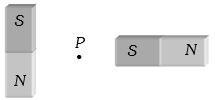
Two equal bar magnets are kept as shown in the figure. The direction of the resultant magnetic field,indicated by the arrowhead at point $P$,is (approximately):
A
$\rightarrow$
B
$\nearrow$
C
$\searrow$
D
$\uparrow$
Solution
(B) The magnetic field at point $P$ is the vector sum of the magnetic fields produced by the two magnets.
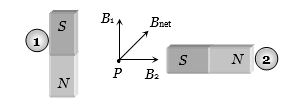
$1$. For the vertical magnet,point $P$ is on its equatorial line. The magnetic field $B_1$ due to this magnet at point $P$ points upwards (from $N$ to $S$ inside the magnet,but outside it points away from $N$ and towards $S$). Specifically,at the equatorial point,the field is directed opposite to the magnetic moment,i.e.,upwards.
$2$. For the horizontal magnet,point $P$ is on its axial line. The magnetic field $B_2$ due to this magnet at point $P$ points towards the right (away from the $N$ pole).
$3$. The resultant magnetic field $B_{\text{net}} = B_1 + B_2$ will be the vector sum of these two perpendicular fields. Since $B_1$ is directed upwards and $B_2$ is directed to the right,the resultant vector $B_{\text{net}}$ will point in the north-east direction,which is represented by $\nearrow$.
$1$. For the vertical magnet,point $P$ is on its equatorial line. The magnetic field $B_1$ due to this magnet at point $P$ points upwards (from $N$ to $S$ inside the magnet,but outside it points away from $N$ and towards $S$). Specifically,at the equatorial point,the field is directed opposite to the magnetic moment,i.e.,upwards.
$2$. For the horizontal magnet,point $P$ is on its axial line. The magnetic field $B_2$ due to this magnet at point $P$ points towards the right (away from the $N$ pole).
$3$. The resultant magnetic field $B_{\text{net}} = B_1 + B_2$ will be the vector sum of these two perpendicular fields. Since $B_1$ is directed upwards and $B_2$ is directed to the right,the resultant vector $B_{\text{net}}$ will point in the north-east direction,which is represented by $\nearrow$.
0 likes
View Solution23
MediumMCQ
$A$ short bar magnet placed with its axis at $30^{\circ}$ with a uniform external magnetic field of $0.16 \ T$ experiences a torque of magnitude $0.032 \ J$. The magnetic moment of the bar magnet will be......$J/T$.
A
$0.23$
B
$0.40$
C
$0.80$
D
$0$
Solution
(B) The torque $\tau$ experienced by a magnetic dipole in a uniform magnetic field $B$ is given by the formula $\tau = MB \sin \theta$.
Given:
Torque $\tau = 0.032 \ J$
Magnetic field $B = 0.16 \ T$
Angle $\theta = 30^{\circ}$
Substituting the values into the formula:
$0.032 = M \times 0.16 \times \sin(30^{\circ})$
Since $\sin(30^{\circ}) = 0.5$,we have:
$0.032 = M \times 0.16 \times 0.5$
$0.032 = M \times 0.08$
$M = \frac{0.032}{0.08} = 0.4 \ J/T$.
Therefore,the magnetic moment of the bar magnet is $0.4 \ J/T$.
Given:
Torque $\tau = 0.032 \ J$
Magnetic field $B = 0.16 \ T$
Angle $\theta = 30^{\circ}$
Substituting the values into the formula:
$0.032 = M \times 0.16 \times \sin(30^{\circ})$
Since $\sin(30^{\circ}) = 0.5$,we have:
$0.032 = M \times 0.16 \times 0.5$
$0.032 = M \times 0.08$
$M = \frac{0.032}{0.08} = 0.4 \ J/T$.
Therefore,the magnetic moment of the bar magnet is $0.4 \ J/T$.
0 likes
View Solution24
EasyMCQ
The magnetic field due to a small magnetic dipole of magnetic moment $M$,at a distance $r$ from the centre on the equatorial line is given by (in $M.K.S.$ system):
A
$\frac{\mu_0}{4\pi} \times \frac{M}{r^2}$
B
$\frac{\mu_0}{4\pi} \times \frac{M}{r^3}$
C
$\frac{\mu_0}{4\pi} \times \frac{2M}{r^2}$
D
$\frac{\mu_0}{4\pi} \times \frac{2M}{r^3}$
Solution
(B) For a short magnetic dipole of magnetic moment $M$,the magnetic field $B$ at a point on the equatorial line at a distance $r$ from the centre is given by the formula:
$B_{equatorial} = \frac{\mu_0}{4\pi} \frac{M}{r^3}$
This formula is derived from the superposition of the magnetic fields produced by the north and south poles of the dipole at the equatorial point.
Thus,the correct option is $B$.
$B_{equatorial} = \frac{\mu_0}{4\pi} \frac{M}{r^3}$
This formula is derived from the superposition of the magnetic fields produced by the north and south poles of the dipole at the equatorial point.
Thus,the correct option is $B$.
0 likes
View Solution25
MediumMCQ
$A$ bar magnet of magnetic moment $\overrightarrow{M}$ is placed in a magnetic field of induction $\overrightarrow{B}$. The torque exerted on it is
A
$\overrightarrow{M} \cdot \overrightarrow{B}$
B
$-\overrightarrow{M} \cdot \overrightarrow{B}$
C
$\overrightarrow{M} \times \overrightarrow{B}$
D
$\overrightarrow{B} \times \overrightarrow{M}$
Solution
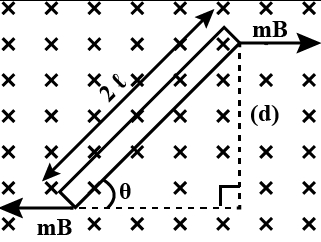
(C) Consider a bar magnet of length $2l$ placed in a uniform magnetic field $\overrightarrow{B}$ at an angle $\theta$ with the direction of the field.
The force acting on each pole of the magnet is $F = mB$, where $m$ is the pole strength.
These two equal and opposite forces form a couple that exerts a torque $\tau$ on the magnet.
The torque is given by: $\tau = \text{Force} \times \text{perpendicular distance } (d)$.
From the geometry, the perpendicular distance between the forces is $d = 2l \sin \theta$.
Therefore, $\tau = (mB) \times (2l \sin \theta) = (m \times 2l) B \sin \theta$.
Since the magnetic moment is defined as $M = m \times 2l$, we have $\tau = MB \sin \theta$.
In vector form, this is expressed as $\overrightarrow{\tau} = \overrightarrow{M} \times \overrightarrow{B}$.
The force acting on each pole of the magnet is $F = mB$, where $m$ is the pole strength.
These two equal and opposite forces form a couple that exerts a torque $\tau$ on the magnet.
The torque is given by: $\tau = \text{Force} \times \text{perpendicular distance } (d)$.
From the geometry, the perpendicular distance between the forces is $d = 2l \sin \theta$.
Therefore, $\tau = (mB) \times (2l \sin \theta) = (m \times 2l) B \sin \theta$.
Since the magnetic moment is defined as $M = m \times 2l$, we have $\tau = MB \sin \theta$.
In vector form, this is expressed as $\overrightarrow{\tau} = \overrightarrow{M} \times \overrightarrow{B}$.
0 likes
View Solution26
MediumMCQ
If a magnet of length $10 \, cm$ and pole strength $40 \, A-m$ is placed at an angle of $45^\circ$ in a uniform magnetic field of intensity $2 \times 10^{-4} \, T$,the torque acting on it is:
A
$0.5656 \times 10^{-4} \, N-m$
B
$0.5656 \times 10^{-3} \, N-m$
C
$0.656 \times 10^{-4} \, N-m$
D
$0.656 \times 10^{-5} \, N-m$
Solution
(B) The torque $\tau$ acting on a magnetic dipole in a uniform magnetic field is given by $\tau = MB \sin \theta$.
Here,$M$ is the magnetic dipole moment,$M = m \times L$,where $m = 40 \, A-m$ is the pole strength and $L = 10 \, cm = 0.1 \, m$ is the length of the magnet.
$M = 40 \times 0.1 = 4 \, A-m^2$.
The magnetic field intensity $B = 2 \times 10^{-4} \, T$ and the angle $\theta = 45^\circ$.
Substituting these values into the formula:
$\tau = 4 \times (2 \times 10^{-4}) \times \sin 45^\circ$
$\tau = 8 \times 10^{-4} \times \frac{1}{\sqrt{2}}$
$\tau = 8 \times 10^{-4} \times 0.7071$
$\tau = 5.6568 \times 10^{-4} \, N-m = 0.5656 \times 10^{-3} \, N-m$.
Here,$M$ is the magnetic dipole moment,$M = m \times L$,where $m = 40 \, A-m$ is the pole strength and $L = 10 \, cm = 0.1 \, m$ is the length of the magnet.
$M = 40 \times 0.1 = 4 \, A-m^2$.
The magnetic field intensity $B = 2 \times 10^{-4} \, T$ and the angle $\theta = 45^\circ$.
Substituting these values into the formula:
$\tau = 4 \times (2 \times 10^{-4}) \times \sin 45^\circ$
$\tau = 8 \times 10^{-4} \times \frac{1}{\sqrt{2}}$
$\tau = 8 \times 10^{-4} \times 0.7071$
$\tau = 5.6568 \times 10^{-4} \, N-m = 0.5656 \times 10^{-3} \, N-m$.
0 likes
View Solution27
EasyMCQ
The intensity of the magnetic field is $H$ and the magnetic moment of the magnet is $M$. The maximum potential energy is $..... MH$.
A
$1$
B
$2$
C
$3$
D
$4$
Solution
(A) The potential energy $U$ of a magnetic dipole in a magnetic field is given by the formula $U = -M \cdot H = -MH \cos \theta$, where $\theta$ is the angle between the magnetic moment $M$ and the magnetic field $H$.
To find the maximum potential energy, we look for the value of $\theta$ that maximizes $U$.
The potential energy is maximum when $\cos \theta = -1$, which occurs at $\theta = 180^\circ$.
Substituting $\cos 180^\circ = -1$ into the formula, we get $U_{\max} = -MH(-1) = MH$.
Therefore, the coefficient of $MH$ is $1$.
To find the maximum potential energy, we look for the value of $\theta$ that maximizes $U$.
The potential energy is maximum when $\cos \theta = -1$, which occurs at $\theta = 180^\circ$.
Substituting $\cos 180^\circ = -1$ into the formula, we get $U_{\max} = -MH(-1) = MH$.
Therefore, the coefficient of $MH$ is $1$.
0 likes
View Solution28
EasyMCQ
$A$ bar magnet of magnetic moment $200 \, A-m^2$ is suspended in a magnetic field of intensity $0.25 \, N/A-m$. The torque required to deflect it through $30^\circ$ is .... $N-m$.
A
$50$
B
$25$
C
$20$
D
$15$
Solution
(B) The torque $\tau$ acting on a magnetic dipole in a magnetic field is given by the formula: $\tau = MB \sin \theta$.
Here,the magnetic moment $M = 200 \, A-m^2$,the magnetic field intensity $B = 0.25 \, N/A-m$,and the angle of deflection $\theta = 30^\circ$.
Substituting these values into the formula:
$\tau = 200 \times 0.25 \times \sin 30^\circ$
$\tau = 50 \times 0.5$
$\tau = 25 \, N-m$.
Here,the magnetic moment $M = 200 \, A-m^2$,the magnetic field intensity $B = 0.25 \, N/A-m$,and the angle of deflection $\theta = 30^\circ$.
Substituting these values into the formula:
$\tau = 200 \times 0.25 \times \sin 30^\circ$
$\tau = 50 \times 0.5$
$\tau = 25 \, N-m$.
0 likes
View Solution29
MediumMCQ
$A$ bar magnet is held perpendicular to a uniform magnetic field. If the couple acting on the magnet is to be halved by rotating it,then the angle by which it is to be rotated is....$^o$
A
$30$
B
$45$
C
$60$
D
$90$
Solution
(C) The torque (couple) acting on a bar magnet in a uniform magnetic field is given by $\tau = MB \sin \theta$,where $M$ is the magnetic moment,$B$ is the magnetic field,and $\theta$ is the angle between the magnetic moment and the field.
Initially,the magnet is perpendicular to the field,so $\theta_1 = 90^\circ$. Thus,$\tau_1 = MB \sin 90^\circ = MB$.
We want the new torque $\tau_2$ to be half of the initial torque,so $\tau_2 = \frac{\tau_1}{2} = \frac{MB}{2}$.
Using the formula $\tau_2 = MB \sin \theta_2$,we have $\frac{MB}{2} = MB \sin \theta_2$.
This gives $\sin \theta_2 = \frac{1}{2}$,which means $\theta_2 = 30^\circ$.
The angle of rotation is the difference between the initial and final angles: $\Delta \theta = 90^\circ - 30^\circ = 60^\circ$.
Initially,the magnet is perpendicular to the field,so $\theta_1 = 90^\circ$. Thus,$\tau_1 = MB \sin 90^\circ = MB$.
We want the new torque $\tau_2$ to be half of the initial torque,so $\tau_2 = \frac{\tau_1}{2} = \frac{MB}{2}$.
Using the formula $\tau_2 = MB \sin \theta_2$,we have $\frac{MB}{2} = MB \sin \theta_2$.
This gives $\sin \theta_2 = \frac{1}{2}$,which means $\theta_2 = 30^\circ$.
The angle of rotation is the difference between the initial and final angles: $\Delta \theta = 90^\circ - 30^\circ = 60^\circ$.
0 likes
View Solution30
MediumMCQ
$A$ bar magnet,when placed at an angle of $30^o$ to the direction of a magnetic field of induction $5 \times 10^{-2} \,T$,experiences a torque of $25 \times 10^{-6} \,N-m$. If the length of the magnet is $5 \,cm$,what is its pole strength?
A
$2 \times 10^{-2} \,A-m$
B
$5 \times 10^{-2} \,A-m$
C
$2 \,A-m$
D
$5 \,A-m$
Solution
(A) The torque $\tau$ experienced by a magnetic dipole in a magnetic field is given by $\tau = MB \sin \theta$,where $M$ is the magnetic dipole moment,$B$ is the magnetic field,and $\theta$ is the angle.
Since $M = m \times L$ (where $m$ is the pole strength and $L$ is the length of the magnet),the formula becomes $\tau = (m \times L) B \sin \theta$.
Given: $\tau = 25 \times 10^{-6} \,N-m$,$B = 5 \times 10^{-2} \,T$,$L = 5 \,cm = 5 \times 10^{-2} \,m$,and $\theta = 30^o$.
Substituting the values: $25 \times 10^{-6} = (m \times 5 \times 10^{-2}) \times (5 \times 10^{-2}) \times \sin 30^o$.
Since $\sin 30^o = 0.5$,we have $25 \times 10^{-6} = m \times 25 \times 10^{-4} \times 0.5$.
$25 \times 10^{-6} = m \times 12.5 \times 10^{-4}$.
$m = \frac{25 \times 10^{-6}}{12.5 \times 10^{-4}} = 2 \times 10^{-2} \,A-m$.
Since $M = m \times L$ (where $m$ is the pole strength and $L$ is the length of the magnet),the formula becomes $\tau = (m \times L) B \sin \theta$.
Given: $\tau = 25 \times 10^{-6} \,N-m$,$B = 5 \times 10^{-2} \,T$,$L = 5 \,cm = 5 \times 10^{-2} \,m$,and $\theta = 30^o$.
Substituting the values: $25 \times 10^{-6} = (m \times 5 \times 10^{-2}) \times (5 \times 10^{-2}) \times \sin 30^o$.
Since $\sin 30^o = 0.5$,we have $25 \times 10^{-6} = m \times 25 \times 10^{-4} \times 0.5$.
$25 \times 10^{-6} = m \times 12.5 \times 10^{-4}$.
$m = \frac{25 \times 10^{-6}}{12.5 \times 10^{-4}} = 2 \times 10^{-2} \,A-m$.
0 likes
View Solution31
MediumMCQ
The work done in rotating a magnet of magnetic moment $2 \, A-m^2$ in a magnetic field of $5 \times 10^{-3} \, T$ from the direction along the magnetic field to the opposite direction to the magnetic field is:
A
$Zero$
B
$2 \times 10^{-2} \, J$
C
$10^{-2} \, J$
D
$10 \, J$
Solution
(B) The work done $W$ in rotating a magnetic dipole in a magnetic field is given by the formula $W = MB(\cos \theta_1 - \cos \theta_2)$.
Here,the initial angle $\theta_1 = 0^\circ$ (along the field) and the final angle $\theta_2 = 180^\circ$ (opposite to the field).
Substituting the values: $W = MB(\cos 0^\circ - \cos 180^\circ)$.
Since $\cos 0^\circ = 1$ and $\cos 180^\circ = -1$,we get $W = MB(1 - (-1)) = 2MB$.
Given $M = 2 \, A-m^2$ and $B = 5 \times 10^{-3} \, T$.
$W = 2 \times (2) \times (5 \times 10^{-3}) = 20 \times 10^{-3} = 2 \times 10^{-2} \, J$.
Here,the initial angle $\theta_1 = 0^\circ$ (along the field) and the final angle $\theta_2 = 180^\circ$ (opposite to the field).
Substituting the values: $W = MB(\cos 0^\circ - \cos 180^\circ)$.
Since $\cos 0^\circ = 1$ and $\cos 180^\circ = -1$,we get $W = MB(1 - (-1)) = 2MB$.
Given $M = 2 \, A-m^2$ and $B = 5 \times 10^{-3} \, T$.
$W = 2 \times (2) \times (5 \times 10^{-3}) = 20 \times 10^{-3} = 2 \times 10^{-2} \, J$.
0 likes
View Solution32
EasyMCQ
$A$ magnet of magnetic moment $2 \, J \, T^{-1}$ is aligned in the direction of a magnetic field of $0.1 \, T$. What is the net work done to bring the magnet normal to the magnetic field?
A
$0.1$
B
$0.2$
C
$1$
D
$2$
Solution
(B) The work done $W$ in rotating a magnetic dipole in a magnetic field is given by the formula $W = MB(\cos \theta_1 - \cos \theta_2)$.
Here,the initial angle $\theta_1 = 0^\circ$ (aligned with the field) and the final angle $\theta_2 = 90^\circ$ (normal to the field).
Given: Magnetic moment $M = 2 \, J \, T^{-1}$,Magnetic field $B = 0.1 \, T$.
Substituting the values: $W = 2 \times 0.1 \times (\cos 0^\circ - \cos 90^\circ)$.
$W = 0.2 \times (1 - 0) = 0.2 \, J$.
Here,the initial angle $\theta_1 = 0^\circ$ (aligned with the field) and the final angle $\theta_2 = 90^\circ$ (normal to the field).
Given: Magnetic moment $M = 2 \, J \, T^{-1}$,Magnetic field $B = 0.1 \, T$.
Substituting the values: $W = 2 \times 0.1 \times (\cos 0^\circ - \cos 90^\circ)$.
$W = 0.2 \times (1 - 0) = 0.2 \, J$.
0 likes
View Solution33
MediumMCQ
The magnetic potential at a point on the axial line of a bar magnet of dipole moment $M$ is $V$. What is the magnetic potential due to a bar magnet of dipole moment $\frac{M}{4}$ at the same point?
A
$4\,V$
B
$2\,V$
C
$\frac{V}{2}$
D
$\frac{V}{4}$
Solution
(D) The magnetic potential $V$ at a distance $d$ from the center of a bar magnet on its axial line is given by the formula:
$V = \frac{\mu_0}{4\pi} \cdot \frac{M}{d^2}$
From this expression,it is clear that the magnetic potential is directly proportional to the magnetic dipole moment,i.e.,$V \propto M$.
Given that the initial dipole moment is $M_1 = M$ and the potential is $V_1 = V$,and the new dipole moment is $M_2 = \frac{M}{4}$,we can write:
$\frac{V_1}{V_2} = \frac{M_1}{M_2}$
Substituting the values:
$\frac{V}{V_2} = \frac{M}{M/4} = 4$
Therefore,the new magnetic potential $V_2$ is:
$V_2 = \frac{V}{4}$
$V = \frac{\mu_0}{4\pi} \cdot \frac{M}{d^2}$
From this expression,it is clear that the magnetic potential is directly proportional to the magnetic dipole moment,i.e.,$V \propto M$.
Given that the initial dipole moment is $M_1 = M$ and the potential is $V_1 = V$,and the new dipole moment is $M_2 = \frac{M}{4}$,we can write:
$\frac{V_1}{V_2} = \frac{M_1}{M_2}$
Substituting the values:
$\frac{V}{V_2} = \frac{M}{M/4} = 4$
Therefore,the new magnetic potential $V_2$ is:
$V_2 = \frac{V}{4}$
0 likes
View Solution34
EasyMCQ
$A$ small bar magnet has a magnetic moment $1.2 \, A-m^2$. The magnetic field at a distance $0.1 \, m$ on its axis will be: $(\mu_0 = 4\pi \times 10^{-7} \, T-m/A)$
A
$1.2 \times 10^{-4} \, T$
B
$2.4 \times 10^{-4} \, T$
C
$2.4 \times 10^{4} \, T$
D
$1.2 \times 10^{4} \, T$
Solution
(B) The magnetic field $B$ on the axial line of a short bar magnet is given by the formula:
$B = \frac{\mu_0}{4\pi} \cdot \frac{2M}{d^3}$
Given:
Magnetic moment $M = 1.2 \, A-m^2$
Distance $d = 0.1 \, m$
Permeability constant $\frac{\mu_0}{4\pi} = 10^{-7} \, T-m/A$
Substituting the values into the formula:
$B = 10^{-7} \times \frac{2 \times 1.2}{(0.1)^3}$
$B = 10^{-7} \times \frac{2.4}{0.001}$
$B = 10^{-7} \times 2400$
$B = 2.4 \times 10^{-4} \, T$
Therefore,the correct option is $B$.
$B = \frac{\mu_0}{4\pi} \cdot \frac{2M}{d^3}$
Given:
Magnetic moment $M = 1.2 \, A-m^2$
Distance $d = 0.1 \, m$
Permeability constant $\frac{\mu_0}{4\pi} = 10^{-7} \, T-m/A$
Substituting the values into the formula:
$B = 10^{-7} \times \frac{2 \times 1.2}{(0.1)^3}$
$B = 10^{-7} \times \frac{2.4}{0.001}$
$B = 10^{-7} \times 2400$
$B = 2.4 \times 10^{-4} \, T$
Therefore,the correct option is $B$.
0 likes
View Solution35
DifficultMCQ
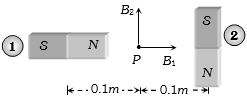
Two identical short bar magnets,each having a magnetic moment of $10 \, Am^2$,are arranged such that their axial lines are perpendicular to each other and their centres lie along the same straight line in a horizontal plane. If the distance between their centres is $0.2 \, m$,find the resultant magnetic induction at a point midway between them. (Given: $\mu_0 = 4\pi \times 10^{-7} \, Hm^{-1}$)
A
$\sqrt{2} \times 10^{-7} \, T$
B
$\sqrt{5} \times 10^{-7} \, T$
C
$\sqrt{2} \times 10^{-3} \, T$
D
$\sqrt{5} \times 10^{-3} \, T$
Solution
(D) Let the two magnets be $M_1$ and $M_2$ with magnetic moment $M = 10 \, Am^2$. The distance between their centres is $0.2 \, m$,so the distance from the centre of each magnet to the midpoint $P$ is $d = 0.1 \, m$.
For magnet $1$,point $P$ lies on its axial line. The magnetic field $B_a$ is given by $B_a = \frac{\mu_0}{4\pi} \cdot \frac{2M}{d^3}$.
For magnet $2$,point $P$ lies on its equatorial line. The magnetic field $B_e$ is given by $B_e = \frac{\mu_0}{4\pi} \cdot \frac{M}{d^3}$.
Since these fields are perpendicular,the resultant magnetic field is $B_{net} = \sqrt{B_a^2 + B_e^2}$.
$B_{net} = \sqrt{\left( \frac{\mu_0}{4\pi} \cdot \frac{2M}{d^3} \right)^2 + \left( \frac{\mu_0}{4\pi} \cdot \frac{M}{d^3} \right)^2} = \frac{\mu_0}{4\pi} \cdot \frac{M}{d^3} \sqrt{2^2 + 1^2} = \frac{\mu_0}{4\pi} \cdot \frac{M}{d^3} \sqrt{5}$.
Substituting the values: $B_{net} = 10^{-7} \cdot \frac{10}{(0.1)^3} \cdot \sqrt{5} = 10^{-7} \cdot \frac{10}{0.001} \cdot \sqrt{5} = 10^{-7} \cdot 10^4 \cdot \sqrt{5} = \sqrt{5} \times 10^{-3} \, T$.
For magnet $1$,point $P$ lies on its axial line. The magnetic field $B_a$ is given by $B_a = \frac{\mu_0}{4\pi} \cdot \frac{2M}{d^3}$.
For magnet $2$,point $P$ lies on its equatorial line. The magnetic field $B_e$ is given by $B_e = \frac{\mu_0}{4\pi} \cdot \frac{M}{d^3}$.
Since these fields are perpendicular,the resultant magnetic field is $B_{net} = \sqrt{B_a^2 + B_e^2}$.
$B_{net} = \sqrt{\left( \frac{\mu_0}{4\pi} \cdot \frac{2M}{d^3} \right)^2 + \left( \frac{\mu_0}{4\pi} \cdot \frac{M}{d^3} \right)^2} = \frac{\mu_0}{4\pi} \cdot \frac{M}{d^3} \sqrt{2^2 + 1^2} = \frac{\mu_0}{4\pi} \cdot \frac{M}{d^3} \sqrt{5}$.
Substituting the values: $B_{net} = 10^{-7} \cdot \frac{10}{(0.1)^3} \cdot \sqrt{5} = 10^{-7} \cdot \frac{10}{0.001} \cdot \sqrt{5} = 10^{-7} \cdot 10^4 \cdot \sqrt{5} = \sqrt{5} \times 10^{-3} \, T$.
0 likes
View Solution36
EasyMCQ
$A$ magnet of length $0.1 \, m$ and pole strength $10^{-4} \, A \cdot m$ is kept in a magnetic field of $30 \, Wb/m^2$ at an angle of $30^\circ$. The couple (torque) acting on it is $...... \times 10^{-4} \, N \cdot m$.
A
$7.5$
B
$3.0$
C
$1.5$
D
$6.0$
Solution
(C) The torque $\tau$ acting on a magnetic dipole in a magnetic field is given by the formula: $\tau = M B \sin \theta$.
Here,$M$ is the magnetic dipole moment,$M = m \times (2l)$,where $m$ is the pole strength and $(2l)$ is the length of the magnet.
Given: Pole strength $m = 10^{-4} \, A \cdot m$,length $2l = 0.1 \, m$,magnetic field $B = 30 \, Wb/m^2$,and angle $\theta = 30^\circ$.
Substituting the values: $\tau = (10^{-4} \times 0.1) \times 30 \times \sin(30^\circ)$.
Since $\sin(30^\circ) = 0.5$,we get: $\tau = 10^{-4} \times 0.1 \times 30 \times 0.5 = 1.5 \times 10^{-4} \, N \cdot m$.
Here,$M$ is the magnetic dipole moment,$M = m \times (2l)$,where $m$ is the pole strength and $(2l)$ is the length of the magnet.
Given: Pole strength $m = 10^{-4} \, A \cdot m$,length $2l = 0.1 \, m$,magnetic field $B = 30 \, Wb/m^2$,and angle $\theta = 30^\circ$.
Substituting the values: $\tau = (10^{-4} \times 0.1) \times 30 \times \sin(30^\circ)$.
Since $\sin(30^\circ) = 0.5$,we get: $\tau = 10^{-4} \times 0.1 \times 30 \times 0.5 = 1.5 \times 10^{-4} \, N \cdot m$.
0 likes
View Solution37
DifficultMCQ
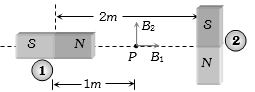
Two identical magnetic dipoles of magnetic moments $1.0 \, A-m^2$ each are placed at a separation of $2 \, m$ with their axes perpendicular to each other. The resultant magnetic field at a point $P$ midway between the dipoles is:
A
$5 \times 10^{-7} \, T$
B
$\sqrt{5} \times 10^{-7} \, T$
C
$10^{-7} \, T$
D
None of these
Solution
(B) The distance between the two dipoles is $2 \, m$. The point $P$ is midway between them,so the distance of $P$ from each dipole is $d = 1 \, m$.
For the $1^{st}$ magnet,point $P$ lies on its axial line (end-on position).
The magnetic field $B_1$ due to the $1^{st}$ magnet is given by:
$B_1 = \frac{\mu_0}{4\pi} \left( \frac{2M}{d^3} \right) = 10^{-7} \times \left( \frac{2 \times 1.0}{1^3} \right) = 2 \times 10^{-7} \, T$ (directed towards the right).
For the $2^{nd}$ magnet,point $P$ lies on its equatorial line (broad side-on position).
The magnetic field $B_2$ due to the $2^{nd}$ magnet is given by:
$B_2 = \frac{\mu_0}{4\pi} \left( \frac{M}{d^3} \right) = 10^{-7} \times \left( \frac{1.0}{1^3} \right) = 10^{-7} \, T$ (directed upwards).
Since $B_1$ and $B_2$ are mutually perpendicular,the resultant magnetic field $B_R$ is:
$B_R = \sqrt{B_1^2 + B_2^2} = \sqrt{(2 \times 10^{-7})^2 + (10^{-7})^2} = \sqrt{4 \times 10^{-14} + 1 \times 10^{-14}} = \sqrt{5 \times 10^{-14}} = \sqrt{5} \times 10^{-7} \, T$.
For the $1^{st}$ magnet,point $P$ lies on its axial line (end-on position).
The magnetic field $B_1$ due to the $1^{st}$ magnet is given by:
$B_1 = \frac{\mu_0}{4\pi} \left( \frac{2M}{d^3} \right) = 10^{-7} \times \left( \frac{2 \times 1.0}{1^3} \right) = 2 \times 10^{-7} \, T$ (directed towards the right).
For the $2^{nd}$ magnet,point $P$ lies on its equatorial line (broad side-on position).
The magnetic field $B_2$ due to the $2^{nd}$ magnet is given by:
$B_2 = \frac{\mu_0}{4\pi} \left( \frac{M}{d^3} \right) = 10^{-7} \times \left( \frac{1.0}{1^3} \right) = 10^{-7} \, T$ (directed upwards).
Since $B_1$ and $B_2$ are mutually perpendicular,the resultant magnetic field $B_R$ is:
$B_R = \sqrt{B_1^2 + B_2^2} = \sqrt{(2 \times 10^{-7})^2 + (10^{-7})^2} = \sqrt{4 \times 10^{-14} + 1 \times 10^{-14}} = \sqrt{5 \times 10^{-14}} = \sqrt{5} \times 10^{-7} \, T$.
0 likes
View Solution38
DifficultMCQ
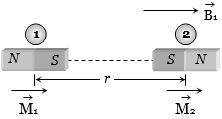
Two short magnets are placed along the same axis with their like poles facing each other. They repel each other with a force which varies inversely as:
A
Square of the distance
B
Cube of the distance
C
Distance
D
Fourth power of the distance
Solution
(D) Both magnets are placed in the magnetic field of one another. The magnetic field $B_1$ produced by magnet $1$ at the position of magnet $2$ (on its axial line) is given by:
$B_1 = \frac{\mu_0}{4\pi} \cdot \frac{2M_1}{r^3}$
The potential energy $U$ of a magnetic dipole $M_2$ in an external magnetic field $B_1$ is given by $U = -M_2 B_1 \cos \theta$. Since the magnets are placed along the same axis with like poles facing each other,the magnetic moments are aligned,so $\theta = 0^\circ$ and $\cos 0^\circ = 1$. Thus:
$U = -M_2 B_1 = -M_2 \left( \frac{\mu_0}{4\pi} \cdot \frac{2M_1}{r^3} \right) = -\frac{\mu_0}{4\pi} \cdot \frac{2M_1 M_2}{r^3}$
The force $F$ between the magnets is given by the negative gradient of the potential energy:
$F = -\frac{dU}{dr} = -\frac{d}{dr} \left( -\frac{\mu_0}{4\pi} \cdot \frac{2M_1 M_2}{r^3} \right)$
$F = \frac{\mu_0}{4\pi} \cdot 2M_1 M_2 \cdot \frac{d}{dr} (r^{-3}) = \frac{\mu_0}{4\pi} \cdot 2M_1 M_2 \cdot (-3r^{-4})$
$F = -\frac{\mu_0}{4\pi} \cdot \frac{6M_1 M_2}{r^4}$
The magnitude of the force is $F = \frac{\mu_0}{4\pi} \cdot \frac{6M_1 M_2}{r^4}$.
Therefore,the force varies inversely as the fourth power of the distance,i.e.,$F \propto \frac{1}{r^4}$.
$B_1 = \frac{\mu_0}{4\pi} \cdot \frac{2M_1}{r^3}$
The potential energy $U$ of a magnetic dipole $M_2$ in an external magnetic field $B_1$ is given by $U = -M_2 B_1 \cos \theta$. Since the magnets are placed along the same axis with like poles facing each other,the magnetic moments are aligned,so $\theta = 0^\circ$ and $\cos 0^\circ = 1$. Thus:
$U = -M_2 B_1 = -M_2 \left( \frac{\mu_0}{4\pi} \cdot \frac{2M_1}{r^3} \right) = -\frac{\mu_0}{4\pi} \cdot \frac{2M_1 M_2}{r^3}$
The force $F$ between the magnets is given by the negative gradient of the potential energy:
$F = -\frac{dU}{dr} = -\frac{d}{dr} \left( -\frac{\mu_0}{4\pi} \cdot \frac{2M_1 M_2}{r^3} \right)$
$F = \frac{\mu_0}{4\pi} \cdot 2M_1 M_2 \cdot \frac{d}{dr} (r^{-3}) = \frac{\mu_0}{4\pi} \cdot 2M_1 M_2 \cdot (-3r^{-4})$
$F = -\frac{\mu_0}{4\pi} \cdot \frac{6M_1 M_2}{r^4}$
The magnitude of the force is $F = \frac{\mu_0}{4\pi} \cdot \frac{6M_1 M_2}{r^4}$.
Therefore,the force varies inversely as the fourth power of the distance,i.e.,$F \propto \frac{1}{r^4}$.
0 likes
View Solution39
DifficultMCQ
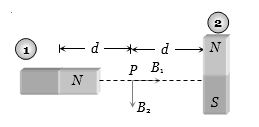
Two identical short bar magnets,each having magnetic moment $M$,are placed a distance of $2d$ apart with axes perpendicular to each other in a horizontal plane. The magnetic induction at a point midway between them is
A
$\frac{\mu_0}{4\pi}(\sqrt{2})\frac{M}{d^3}$
B
$\frac{\mu_0}{4\pi}(\sqrt{3})\frac{M}{d^3}$
C
$\left(\frac{2\mu_0}{\pi}\right)\frac{M}{d^3}$
D
$\frac{\mu_0}{4\pi}(\sqrt{5})\frac{M}{d^3}$
Solution
(D) Let the two magnets be placed such that point $P$ is at a distance $d$ from the center of each magnet.
For the first magnet,point $P$ lies on its axial line. The magnetic field due to this magnet at $P$ is $B_1 = \frac{\mu_0}{4\pi} \cdot \frac{2M}{d^3}$.
For the second magnet,point $P$ lies on its equatorial line. The magnetic field due to this magnet at $P$ is $B_2 = \frac{\mu_0}{4\pi} \cdot \frac{M}{d^3}$.
Since the axes are perpendicular,the fields $B_1$ and $B_2$ are perpendicular to each other.
The net magnetic field at $P$ is $B_{net} = \sqrt{B_1^2 + B_2^2}$.
Substituting the values: $B_{net} = \sqrt{\left(\frac{\mu_0}{4\pi} \cdot \frac{2M}{d^3}\right)^2 + \left(\frac{\mu_0}{4\pi} \cdot \frac{M}{d^3}\right)^2}$.
$B_{net} = \frac{\mu_0}{4\pi} \cdot \frac{M}{d^3} \sqrt{2^2 + 1^2} = \frac{\mu_0}{4\pi} \cdot \frac{\sqrt{5}M}{d^3}$.
For the first magnet,point $P$ lies on its axial line. The magnetic field due to this magnet at $P$ is $B_1 = \frac{\mu_0}{4\pi} \cdot \frac{2M}{d^3}$.
For the second magnet,point $P$ lies on its equatorial line. The magnetic field due to this magnet at $P$ is $B_2 = \frac{\mu_0}{4\pi} \cdot \frac{M}{d^3}$.
Since the axes are perpendicular,the fields $B_1$ and $B_2$ are perpendicular to each other.
The net magnetic field at $P$ is $B_{net} = \sqrt{B_1^2 + B_2^2}$.
Substituting the values: $B_{net} = \sqrt{\left(\frac{\mu_0}{4\pi} \cdot \frac{2M}{d^3}\right)^2 + \left(\frac{\mu_0}{4\pi} \cdot \frac{M}{d^3}\right)^2}$.
$B_{net} = \frac{\mu_0}{4\pi} \cdot \frac{M}{d^3} \sqrt{2^2 + 1^2} = \frac{\mu_0}{4\pi} \cdot \frac{\sqrt{5}M}{d^3}$.
0 likes
View Solution40
DifficultMCQ
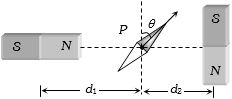
Two magnets $A$ and $B$ are identical and are arranged as shown in the figure. Their length is negligible in comparison to the separation between them. $A$ magnetic needle is placed between the magnets at point $P$,which gets deflected through an angle $\theta$ under the influence of the magnets. The ratio of distances $d_1$ and $d_2$ will be:
A
$(2\tan \theta )^{1/3}$
B
$(2\tan \theta )^{-1/3}$
C
$(2\cot \theta )^{1/3}$
D
$(2\cot \theta )^{-1/3}$
Solution
(C) The magnetic field due to magnet $A$ (axial position) at point $P$ is $B_1 = \frac{\mu_0}{4\pi} \cdot \frac{2M}{d_1^3}$.
The magnetic field due to magnet $B$ (equatorial position) at point $P$ is $B_2 = \frac{\mu_0}{4\pi} \cdot \frac{M}{d_2^3}$.
When the magnetic needle is in equilibrium at an angle $\theta$ with the direction of $B_1$,the resultant magnetic field makes an angle $\theta$ with $B_1$,such that $\tan \theta = \frac{B_2}{B_1}$.
Substituting the values,we get $\tan \theta = \frac{(\mu_0 / 4\pi) \cdot (M / d_2^3)}{(\mu_0 / 4\pi) \cdot (2M / d_1^3)} = \frac{d_1^3}{2d_2^3}$.
Therefore,$\frac{d_1^3}{d_2^3} = 2 \tan \theta$,which implies $\frac{d_1}{d_2} = (2 \tan \theta)^{1/3}$.
Wait,checking the equilibrium condition: The needle aligns with the resultant field. If $\theta$ is the deflection from the axis of magnet $A$ (field $B_1$),then $\tan \theta = B_2 / B_1$. Thus $\frac{d_1^3}{2d_2^3} = \tan \theta \Rightarrow \frac{d_1}{d_2} = (2 \tan \theta)^{1/3}$.
Re-evaluating the provided options and standard convention: If $\theta$ is the angle with the vertical (field $B_2$),then $\tan \theta = B_1 / B_2 = \frac{2d_2^3}{d_1^3} \Rightarrow \frac{d_1^3}{d_2^3} = 2 \cot \theta \Rightarrow \frac{d_1}{d_2} = (2 \cot \theta)^{1/3}$. Based on the figure,$\theta$ is the angle with the vertical,so option $C$ is correct.
The magnetic field due to magnet $B$ (equatorial position) at point $P$ is $B_2 = \frac{\mu_0}{4\pi} \cdot \frac{M}{d_2^3}$.
When the magnetic needle is in equilibrium at an angle $\theta$ with the direction of $B_1$,the resultant magnetic field makes an angle $\theta$ with $B_1$,such that $\tan \theta = \frac{B_2}{B_1}$.
Substituting the values,we get $\tan \theta = \frac{(\mu_0 / 4\pi) \cdot (M / d_2^3)}{(\mu_0 / 4\pi) \cdot (2M / d_1^3)} = \frac{d_1^3}{2d_2^3}$.
Therefore,$\frac{d_1^3}{d_2^3} = 2 \tan \theta$,which implies $\frac{d_1}{d_2} = (2 \tan \theta)^{1/3}$.
Wait,checking the equilibrium condition: The needle aligns with the resultant field. If $\theta$ is the deflection from the axis of magnet $A$ (field $B_1$),then $\tan \theta = B_2 / B_1$. Thus $\frac{d_1^3}{2d_2^3} = \tan \theta \Rightarrow \frac{d_1}{d_2} = (2 \tan \theta)^{1/3}$.
Re-evaluating the provided options and standard convention: If $\theta$ is the angle with the vertical (field $B_2$),then $\tan \theta = B_1 / B_2 = \frac{2d_2^3}{d_1^3} \Rightarrow \frac{d_1^3}{d_2^3} = 2 \cot \theta \Rightarrow \frac{d_1}{d_2} = (2 \cot \theta)^{1/3}$. Based on the figure,$\theta$ is the angle with the vertical,so option $C$ is correct.
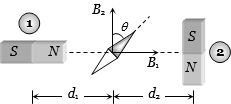
0 likes
View Solution41
MediumMCQ
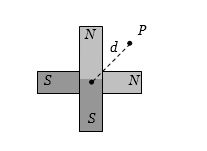
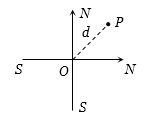
Two short magnets of equal dipole moments $M$ are fastened perpendicularly at their centre (figure). The magnitude of the magnetic field at a distance $d$ from the centre on the bisector of the right angle is
A
$\frac{\mu_0}{4\pi} \frac{M}{d^3}$
B
$\frac{\mu_0}{4\pi} \frac{M\sqrt{2}}{d^3}$
C
$\frac{\mu_0}{4\pi} \frac{2\sqrt{2}M}{d^3}$
D
$\frac{\mu_0}{4\pi} \frac{2M}{d^3}$
Solution
(C) The resultant magnetic moment of the two magnets is given by the vector sum of the individual dipole moments. Since they are perpendicular,the net magnetic moment is $M_{net} = \sqrt{M^2 + M^2} = M\sqrt{2}$.
This net magnetic moment acts along the bisector of the angle between the two magnets.
The point $P$ lies on the axial line of this equivalent magnetic dipole.
The magnitude of the magnetic field on the axial line of a short magnet at a distance $d$ is given by $B = \frac{\mu_0}{4\pi} \frac{2M_{net}}{d^3}$.
Substituting $M_{net} = M\sqrt{2}$,we get $B = \frac{\mu_0}{4\pi} \frac{2(M\sqrt{2})}{d^3} = \frac{\mu_0}{4\pi} \frac{2\sqrt{2}M}{d^3}$.
This net magnetic moment acts along the bisector of the angle between the two magnets.
The point $P$ lies on the axial line of this equivalent magnetic dipole.
The magnitude of the magnetic field on the axial line of a short magnet at a distance $d$ is given by $B = \frac{\mu_0}{4\pi} \frac{2M_{net}}{d^3}$.
Substituting $M_{net} = M\sqrt{2}$,we get $B = \frac{\mu_0}{4\pi} \frac{2(M\sqrt{2})}{d^3} = \frac{\mu_0}{4\pi} \frac{2\sqrt{2}M}{d^3}$.
0 likes
View Solution42
MediumMCQ
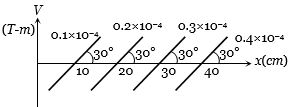
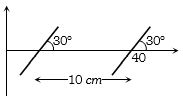
Some equipotential surfaces of the magnetic scalar potential are shown in the figure. The magnetic field at a point in the region is
A
$10^{-4} \, T$
B
$2 \times 10^{-4} \, T$
C
$0.5 \times 10^{-4} \, T$
D
None of these
Solution
(B) The magnetic field $B$ is related to the magnetic scalar potential $V$ by the relation $B = -\nabla V$. The magnitude of the magnetic field is given by $B = \frac{\Delta V}{\Delta r}$,where $\Delta r$ is the perpendicular distance between two equipotential surfaces.
From the figure,the change in potential between two consecutive surfaces is $\Delta V = 0.2 \times 10^{-4} - 0.1 \times 10^{-4} = 0.1 \times 10^{-4} \, T \cdot m$.
The distance along the x-axis between these surfaces is $\Delta x = 20 \, cm - 10 \, cm = 10 \, cm = 0.1 \, m$.
The perpendicular distance $\Delta r$ between the surfaces is $\Delta r = \Delta x \sin(30^\circ) = 0.1 \times \sin(30^\circ) = 0.1 \times 0.5 = 0.05 \, m$.
Therefore,the magnitude of the magnetic field is $B = \frac{\Delta V}{\Delta r} = \frac{0.1 \times 10^{-4}}{0.05} = 2 \times 10^{-4} \, T$.
From the figure,the change in potential between two consecutive surfaces is $\Delta V = 0.2 \times 10^{-4} - 0.1 \times 10^{-4} = 0.1 \times 10^{-4} \, T \cdot m$.
The distance along the x-axis between these surfaces is $\Delta x = 20 \, cm - 10 \, cm = 10 \, cm = 0.1 \, m$.
The perpendicular distance $\Delta r$ between the surfaces is $\Delta r = \Delta x \sin(30^\circ) = 0.1 \times \sin(30^\circ) = 0.1 \times 0.5 = 0.05 \, m$.
Therefore,the magnitude of the magnetic field is $B = \frac{\Delta V}{\Delta r} = \frac{0.1 \times 10^{-4}}{0.05} = 2 \times 10^{-4} \, T$.
0 likes
View Solution43
MediumMCQ
The work done in rotating a bar magnet from its equilibrium position by $60^{\circ}$ in a magnetic field is $W$. What is the torque required to hold it in this position?
A
$\sqrt{3} W$
B
$-W$
C
$\frac{\sqrt{3}}{2} W$
D
$2 W$
Solution
(A) The work done $W$ in rotating a magnetic dipole by an angle $\theta$ from the equilibrium position $(\theta = 0^{\circ})$ is given by $W = MB(1 - \cos \theta)$.
Given $\theta = 60^{\circ}$,we have $W = MB(1 - \cos 60^{\circ}) = MB(1 - 0.5) = \frac{MB}{2}$.
From this,we find $MB = 2W$.
The torque $\tau$ required to hold the magnet at an angle $\theta$ is given by $\tau = MB \sin \theta$.
Substituting the values,$\tau = MB \sin 60^{\circ} = (2W) \times \frac{\sqrt{3}}{2} = \sqrt{3} W$.
Given $\theta = 60^{\circ}$,we have $W = MB(1 - \cos 60^{\circ}) = MB(1 - 0.5) = \frac{MB}{2}$.
From this,we find $MB = 2W$.
The torque $\tau$ required to hold the magnet at an angle $\theta$ is given by $\tau = MB \sin \theta$.
Substituting the values,$\tau = MB \sin 60^{\circ} = (2W) \times \frac{\sqrt{3}}{2} = \sqrt{3} W$.
0 likes
View Solution44
MediumMCQ
The magnetic moment of a magnet is $20 \, C.G.S$ units. How much work is required to rotate it by $30^{\circ}$ from its equilibrium position in a magnetic field of $0.3 \, C.G.S$ units?
A
$6 \, C.G.S$
B
$3\sqrt{3} \, C.G.S$
C
$3(2 - \sqrt{3}) \, C.G.S$
D
$3 \, C.G.S$
Solution
(C) The work done $W$ in rotating a magnetic dipole in a magnetic field from an angle $\theta_1$ to $\theta_2$ is given by $W = MB(\cos \theta_1 - \cos \theta_2)$.
Here,the initial position is the equilibrium position,so $\theta_1 = 0^{\circ}$.
The final position is $\theta_2 = 30^{\circ}$.
Given: Magnetic moment $M = 20 \, C.G.S$ and magnetic field $B = 0.3 \, C.G.S$.
Substituting the values:
$W = 20 \times 0.3 \times (\cos 0^{\circ} - \cos 30^{\circ})$
$W = 6 \times (1 - \frac{\sqrt{3}}{2})$
$W = 3 \times (2 - \sqrt{3}) \, C.G.S$ units.
Here,the initial position is the equilibrium position,so $\theta_1 = 0^{\circ}$.
The final position is $\theta_2 = 30^{\circ}$.
Given: Magnetic moment $M = 20 \, C.G.S$ and magnetic field $B = 0.3 \, C.G.S$.
Substituting the values:
$W = 20 \times 0.3 \times (\cos 0^{\circ} - \cos 30^{\circ})$
$W = 6 \times (1 - \frac{\sqrt{3}}{2})$
$W = 3 \times (2 - \sqrt{3}) \, C.G.S$ units.
0 likes
View Solution45
MediumMCQ
The magnetic moment of a magnet is $2.5 \, J \, T^{-1}$. How much work in $J$ must be done to rotate it from its stable equilibrium position to an unstable equilibrium position in a magnetic field of $0.2 \, T$?
A
$0.5$
B
$1$
C
$2$
D
$0$
Solution
(B) The work done $W$ in rotating a magnetic dipole in a magnetic field is given by the formula: $W = MB(\cos \theta_1 - \cos \theta_2)$.
Here,the initial position is stable equilibrium,so $\theta_1 = 0^\circ$.
The final position is unstable equilibrium,so $\theta_2 = 180^\circ$.
Given: Magnetic moment $M = 2.5 \, J \, T^{-1}$ and magnetic field $B = 0.2 \, T$.
Substituting the values: $W = MB(\cos 0^\circ - \cos 180^\circ)$.
$W = (2.5) \times (0.2) \times (1 - (-1))$.
$W = 0.5 \times (1 + 1) = 0.5 \times 2 = 1 \, J$.
Here,the initial position is stable equilibrium,so $\theta_1 = 0^\circ$.
The final position is unstable equilibrium,so $\theta_2 = 180^\circ$.
Given: Magnetic moment $M = 2.5 \, J \, T^{-1}$ and magnetic field $B = 0.2 \, T$.
Substituting the values: $W = MB(\cos 0^\circ - \cos 180^\circ)$.
$W = (2.5) \times (0.2) \times (1 - (-1))$.
$W = 0.5 \times (1 + 1) = 0.5 \times 2 = 1 \, J$.
0 likes
View Solution46
MediumMCQ
$A$ bar magnet having a magnetic moment of $2 \times 10^4 \, JT^{-1}$ is free to rotate in a horizontal plane. $A$ horizontal magnetic field $B = 6 \times 10^{-4} \, T$ exists in the space. The work done in taking the magnet slowly from a direction parallel to the field to a direction $60^{\circ}$ from the field is.....$J$
A
$2$
B
$4$
C
$6$
D
$8$
Solution
(C) The work done $W$ in rotating a magnetic dipole in a magnetic field is given by the formula:
$W = MB(\cos \theta_1 - \cos \theta_2)$
Given:
Magnetic moment $M = 2 \times 10^4 \, JT^{-1}$
Magnetic field $B = 6 \times 10^{-4} \, T$
Initial angle $\theta_1 = 0^{\circ}$ (parallel to the field)
Final angle $\theta_2 = 60^{\circ}$
Substituting the values:
$W = (2 \times 10^4) \times (6 \times 10^{-4}) \times (\cos 0^{\circ} - \cos 60^{\circ})$
$W = 12 \times (1 - 0.5)$
$W = 12 \times 0.5 = 6 \, J$
Thus,the work done is $6 \, J$.
$W = MB(\cos \theta_1 - \cos \theta_2)$
Given:
Magnetic moment $M = 2 \times 10^4 \, JT^{-1}$
Magnetic field $B = 6 \times 10^{-4} \, T$
Initial angle $\theta_1 = 0^{\circ}$ (parallel to the field)
Final angle $\theta_2 = 60^{\circ}$
Substituting the values:
$W = (2 \times 10^4) \times (6 \times 10^{-4}) \times (\cos 0^{\circ} - \cos 60^{\circ})$
$W = 12 \times (1 - 0.5)$
$W = 12 \times 0.5 = 6 \, J$
Thus,the work done is $6 \, J$.
0 likes
View Solution47
EasyMCQ
$A$ short bar magnet of magnetic moment $0.4 \, J T^{-1}$ is placed in a uniform magnetic field of $0.16 \, T$. The magnet is in stable equilibrium when the potential energy is ....... $J$.
A
$0.064$
B
$-0.064$
C
$0$
D
$-0.082$
Solution
(B) Given: Magnetic moment $M = 0.4 \, J T^{-1}$ and Magnetic field $B = 0.16 \, T$.
The potential energy $U$ of a magnetic dipole in a uniform magnetic field is given by the formula $U = -\vec{M} \cdot \vec{B} = -MB \cos \theta$.
For stable equilibrium,the magnetic moment $\vec{M}$ must be aligned with the magnetic field $\vec{B}$,which means the angle $\theta = 0^{\circ}$.
Substituting the values into the formula:
$U = -MB \cos(0^{\circ})$
$U = -(0.4 \, J T^{-1}) \times (0.16 \, T) \times 1$
$U = -0.064 \, J$.
Thus,the potential energy in stable equilibrium is $-0.064 \, J$.
The potential energy $U$ of a magnetic dipole in a uniform magnetic field is given by the formula $U = -\vec{M} \cdot \vec{B} = -MB \cos \theta$.
For stable equilibrium,the magnetic moment $\vec{M}$ must be aligned with the magnetic field $\vec{B}$,which means the angle $\theta = 0^{\circ}$.
Substituting the values into the formula:
$U = -MB \cos(0^{\circ})$
$U = -(0.4 \, J T^{-1}) \times (0.16 \, T) \times 1$
$U = -0.064 \, J$.
Thus,the potential energy in stable equilibrium is $-0.064 \, J$.
0 likes
View Solution48
MediumMCQ
$A$ magnetic needle suspended parallel to a magnetic field requires $\sqrt{3} \, J$ of work to turn it through $60^{\circ}$. The torque needed to maintain the needle in this position will be.....$J$
A
$2\sqrt{3}$
B
$3$
C
$\sqrt{3}$
D
$1.5$
Solution
(B) Work done in changing the orientation of a magnetic needle of magnetic moment $M$ in a magnetic field $B$ from position $\theta_{1}$ to $\theta_{2}$ is given by:
$W = MB(\cos \theta_{1} - \cos \theta_{2})$
Given $\theta_{1} = 0^{\circ}$ and $\theta_{2} = 60^{\circ}$,the work done is:
$W = MB(\cos 0^{\circ} - \cos 60^{\circ}) = MB(1 - 0.5) = 0.5 MB$
Given $W = \sqrt{3} \, J$,we have $0.5 MB = \sqrt{3} \implies MB = 2\sqrt{3} \, J$.
The torque $\tau$ required to maintain the needle at an angle $\theta = 60^{\circ}$ is given by:
$\tau = MB \sin \theta$
$\tau = MB \sin 60^{\circ} = (2\sqrt{3}) \times \frac{\sqrt{3}}{2} = 3 \, J$.
$W = MB(\cos \theta_{1} - \cos \theta_{2})$
Given $\theta_{1} = 0^{\circ}$ and $\theta_{2} = 60^{\circ}$,the work done is:
$W = MB(\cos 0^{\circ} - \cos 60^{\circ}) = MB(1 - 0.5) = 0.5 MB$
Given $W = \sqrt{3} \, J$,we have $0.5 MB = \sqrt{3} \implies MB = 2\sqrt{3} \, J$.
The torque $\tau$ required to maintain the needle at an angle $\theta = 60^{\circ}$ is given by:
$\tau = MB \sin \theta$
$\tau = MB \sin 60^{\circ} = (2\sqrt{3}) \times \frac{\sqrt{3}}{2} = 3 \, J$.
0 likes
View Solution49
MediumMCQ
$A$ bar magnet is hung by a thin cotton thread in a uniform horizontal magnetic field and is in equilibrium state. The energy required to rotate it by $60^{\circ}$ is $W$. Now,the torque required to keep the magnet in this new position is
A
$\frac{\sqrt{3} W}{2}$
B
$\frac{2W}{\sqrt{3}}$
C
$\frac{W}{\sqrt{3}}$
D
$\sqrt{3} W$
Solution
(D) At equilibrium,the initial potential energy of the dipole is $U_{i} = -MB_{H} \cos 0^{\circ} = -MB_{H}$.
The final potential energy of the dipole after rotating by $60^{\circ}$ is $U_{f} = -MB_{H} \cos 60^{\circ} = -\frac{MB_{H}}{2}$.
The work done $W$ is the change in potential energy: $W = U_{f} - U_{i} = -\frac{MB_{H}}{2} - (-MB_{H}) = \frac{MB_{H}}{2}$.
From this,we get $MB_{H} = 2W$.
The torque required to keep the magnet in this new position is $\tau = MB_{H} \sin 60^{\circ}$.
Substituting $MB_{H} = 2W$,we get $\tau = (2W) \times \frac{\sqrt{3}}{2} = \sqrt{3} W$.
The final potential energy of the dipole after rotating by $60^{\circ}$ is $U_{f} = -MB_{H} \cos 60^{\circ} = -\frac{MB_{H}}{2}$.
The work done $W$ is the change in potential energy: $W = U_{f} - U_{i} = -\frac{MB_{H}}{2} - (-MB_{H}) = \frac{MB_{H}}{2}$.
From this,we get $MB_{H} = 2W$.
The torque required to keep the magnet in this new position is $\tau = MB_{H} \sin 60^{\circ}$.
Substituting $MB_{H} = 2W$,we get $\tau = (2W) \times \frac{\sqrt{3}}{2} = \sqrt{3} W$.
0 likes
View Solution50
MediumMCQ
Due to a small magnet,the magnetic intensity at a distance $x$ in the end-on position (axial position) is $9 \ Gauss$. What will be the intensity at a distance $\frac{x}{2}$ in the broadside-on position (equatorial position)?
A
$9$
B
$4$
C
$36$
D
$4.5$
Solution
(C) The magnetic field on the axial position of a short magnet is given by $B_{axial} = \frac{2M}{x^3} = 9 \ Gauss$ ... $(i)$.
The magnetic field on the equatorial position of a short magnet is given by $B_{equatorial} = \frac{M}{r^3}$,where $r = \frac{x}{2}$.
Substituting the value of $r$: $B_{equatorial} = \frac{M}{(\frac{x}{2})^3} = \frac{8M}{x^3}$ ... $(ii)$.
From equation $(i)$,we have $\frac{M}{x^3} = \frac{9}{2} = 4.5 \ Gauss$.
Substituting this into equation $(ii)$: $B_{equatorial} = 8 \times 4.5 = 36 \ Gauss$.
The magnetic field on the equatorial position of a short magnet is given by $B_{equatorial} = \frac{M}{r^3}$,where $r = \frac{x}{2}$.
Substituting the value of $r$: $B_{equatorial} = \frac{M}{(\frac{x}{2})^3} = \frac{8M}{x^3}$ ... $(ii)$.
From equation $(i)$,we have $\frac{M}{x^3} = \frac{9}{2} = 4.5 \ Gauss$.
Substituting this into equation $(ii)$: $B_{equatorial} = 8 \times 4.5 = 36 \ Gauss$.
0 likes
View SolutionMagnetism and Matter — Magnetic field due to magnetic dipole and Dipole in Magnetic Field and Poential Energy and Work Done · Frequently Asked Questions
1Are these Magnetism and Matter questions useful for JEE and NEET?
Yes. All questions in this section are mapped to JEE Main and NEET exam patterns. Previous year questions from JEE Main, NEET, GUJCET and state-level exams are included with full solutions.
2Can I switch to Hindi or Gujarati for these questions?
Yes. Use the language tabs in the hero section or the sidebar to view the same questions and solutions in English, Hindi or Gujarati.
3How do I generate a question paper from this subtopic?
Use the Vedclass Exam Paper Generator — select the chapter and subtopic, set difficulty, and generate Sets A, B, C, D automatically. First 3 chapters of every subject are free.
Vedclass Products
For Students
Vedclass Test Series
Mock tests in real JEE/NEET style with performance analysis. 5-day free trial.
Start Free TrialFor Teachers
Exam Paper Generator
Generate Set A/B/C/D papers from this chapter in 2 minutes. 3 chapters free.
Try FreeFor Institutes
Online Exam Module
Live online exams with unlimited students, 360° analytics & white-label branding.
See DemoFor Teachers & Institutes
Generate a Magnetism and Matter Exam Paper in 2 Minutes
Select subtopic & difficulty — Sets A, B, C, D auto-generated with No Repeat logic.
First 3 chapters of every subject are free — no payment required.