
A English
Bar Magnet and Magnetic Dipole and Magnetic Moment Questions in English
Class 12 Physics · Magnetism and Matter · Bar Magnet and Magnetic Dipole and Magnetic Moment
136+
Questions
English
Language
100%
With Solutions
Showing 49 of 136 questions in English
1
EasyMCQ
The unit of magnetic moment is
A
$Ampere \cdot m^2$
B
$Ampere \cdot m$
C
$Weber \cdot m^2$
D
$Weber/m$
Solution
(A) The magnetic moment $(M)$ is defined as the product of pole strength $(m)$ and the magnetic length $(2l)$.
The $SI$ unit of pole strength is $Ampere \cdot meter$ $(A \cdot m)$.
The $SI$ unit of length is $meter$ $(m)$.
Therefore,the unit of magnetic moment is $(Ampere \cdot meter) \times meter = Ampere \cdot meter^2$ $(A \cdot m^2)$.
The $SI$ unit of pole strength is $Ampere \cdot meter$ $(A \cdot m)$.
The $SI$ unit of length is $meter$ $(m)$.
Therefore,the unit of magnetic moment is $(Ampere \cdot meter) \times meter = Ampere \cdot meter^2$ $(A \cdot m^2)$.
0 likes
View Solution2
EasyMCQ
$A$ circular loop carrying a current is replaced by an equivalent magnetic dipole. $A$ point on the axis of the loop is
A
An end-on position
B
$A$ broad side-on position
C
Both $(a)$ and $(b)$
D
Neither $(a)$ nor $(b)$
Solution
(A) magnetic dipole is characterized by its magnetic moment vector $\vec{M}$.
For a circular current loop,the magnetic moment $\vec{M}$ is directed along the axis of the loop.
Any point located on the line passing through the magnetic moment vector (the axis) is defined as the end-on position (also known as the axial position).
Therefore,a point on the axis of the loop is an end-on position.
For a circular current loop,the magnetic moment $\vec{M}$ is directed along the axis of the loop.
Any point located on the line passing through the magnetic moment vector (the axis) is defined as the end-on position (also known as the axial position).
Therefore,a point on the axis of the loop is an end-on position.
0 likes
View Solution3
EasyMCQ
The resultant magnetic moment of a neon atom will be
A
Infinity
B
$\mu_B$
C
Zero
D
$\mu_B/2$
Solution
(C) Neon $(Ne)$ is a noble gas with an atomic number of $10$.
Its electronic configuration is $1s^2 2s^2 2p^6$.
Since all the orbitals are completely filled,all electrons are paired.
Due to the pairing of electrons,the spin magnetic moments and orbital magnetic moments cancel each other out.
Therefore,the net resultant magnetic moment of a neon atom is $0$.
Its electronic configuration is $1s^2 2s^2 2p^6$.
Since all the orbitals are completely filled,all electrons are paired.
Due to the pairing of electrons,the spin magnetic moments and orbital magnetic moments cancel each other out.
Therefore,the net resultant magnetic moment of a neon atom is $0$.
0 likes
View Solution4
MediumMCQ
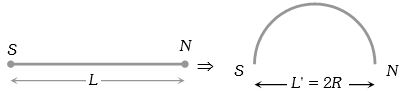
An iron rod of length $L$ and magnetic moment $M$ is bent in the form of a semicircle. Now its magnetic moment will be
A
$M$
B
$\frac{2M}{\pi}$
C
$\frac{M}{\pi}$
D
$M\pi$
Solution
(B) The magnetic moment of a rod is given by $M = m \times L$,where $m$ is the pole strength and $L$ is the length of the rod.
When the rod is bent into a semicircle,the length $L$ becomes the arc length of the semicircle,so $L = \pi R$,where $R$ is the radius of the semicircle.
Thus,the radius $R = \frac{L}{\pi}$.
The new distance between the poles (the diameter of the semicircle) is $L' = 2R = \frac{2L}{\pi}$.
The pole strength $m$ remains unchanged.
Therefore,the new magnetic moment $M'$ is given by $M' = m \times L' = m \times \frac{2L}{\pi}$.
Since $M = m \times L$,we can substitute $M$ into the equation:
$M' = \frac{2M}{\pi}$.
When the rod is bent into a semicircle,the length $L$ becomes the arc length of the semicircle,so $L = \pi R$,where $R$ is the radius of the semicircle.
Thus,the radius $R = \frac{L}{\pi}$.
The new distance between the poles (the diameter of the semicircle) is $L' = 2R = \frac{2L}{\pi}$.
The pole strength $m$ remains unchanged.
Therefore,the new magnetic moment $M'$ is given by $M' = m \times L' = m \times \frac{2L}{\pi}$.
Since $M = m \times L$,we can substitute $M$ into the equation:
$M' = \frac{2M}{\pi}$.
0 likes
View Solution5
EasyMCQ
$A$ magnet is placed in iron powder and then taken out,then maximum iron powder is at
A
Some away from north pole
B
Some away from south pole
C
The middle of the magnet
D
The end of the magnet
Solution
(D) When a magnet is placed in iron powder and then removed,the maximum amount of iron powder adheres to the ends of the magnet. This occurs because the magnetic field strength is strongest at the poles (the ends) of the magnet,resulting in a greater magnetic force acting on the iron particles at these locations.
0 likes
View Solution6
MediumMCQ
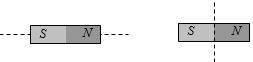
$A$ magnet of magnetic moment $M$ and pole strength $m$ is divided into two equal parts. The magnetic moment of each part will be:
A
$M$
B
$M/2$
C
$M/4$
D
$2M$
Solution
(B) The magnetic moment of a magnet is given by $M = m \times l$,where $m$ is the pole strength and $l$ is the magnetic length.
Case $1$: If the magnet is cut along its axis (longitudinally),the new pole strength becomes $m' = m/2$ and the length remains $l' = l$.
Therefore,the new magnetic moment $M' = m' \times l' = (m/2) \times l = M/2$.
Case $2$: If the magnet is cut perpendicular to its axis,the pole strength remains $m' = m$ and the new length becomes $l' = l/2$.
Therefore,the new magnetic moment $M' = m' \times l' = m \times (l/2) = M/2$.
In both cases,the magnetic moment of each part is $M/2$.
Case $1$: If the magnet is cut along its axis (longitudinally),the new pole strength becomes $m' = m/2$ and the length remains $l' = l$.
Therefore,the new magnetic moment $M' = m' \times l' = (m/2) \times l = M/2$.
Case $2$: If the magnet is cut perpendicular to its axis,the pole strength remains $m' = m$ and the new length becomes $l' = l/2$.
Therefore,the new magnetic moment $M' = m' \times l' = m \times (l/2) = M/2$.
In both cases,the magnetic moment of each part is $M/2$.
0 likes
View Solution7
EasyMCQ
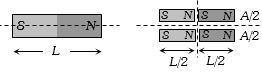
If a magnet of pole strength $m$ is divided into four parts such that the length and width of each part is half that of the initial one,then the pole strength of each part will be
A
$m/4$
B
$m/2$
C
$m/8$
D
$4m$
Solution
(B) The pole strength $m$ of a magnet is directly proportional to its cross-sectional area $A$ (i.e.,$m \propto A$).
When the magnet is cut into four parts such that the length and width of each part are halved,the cross-sectional area of each part becomes $A' = (width/2) \times (thickness/2) = A/4$ if we consider the cross-section as a rectangle. However,the question specifies the width is halved. If the magnet is cut along its length and width,the cross-sectional area $A$ is halved by the cut along the width. Thus,the new pole strength $m'$ is proportional to the new area $A' = A/2$.
Therefore,$m' = m/2$.
When the magnet is cut into four parts such that the length and width of each part are halved,the cross-sectional area of each part becomes $A' = (width/2) \times (thickness/2) = A/4$ if we consider the cross-section as a rectangle. However,the question specifies the width is halved. If the magnet is cut along its length and width,the cross-sectional area $A$ is halved by the cut along the width. Thus,the new pole strength $m'$ is proportional to the new area $A' = A/2$.
Therefore,$m' = m/2$.
0 likes
View Solution8
EasyMCQ
The magnetism of a magnet is due to
A
The spin motion of electrons
B
Earth
C
Pressure of big magnet inside the earth
D
Cosmic rays
Solution
(A) The magnetism of a magnet is primarily due to the spin motion of electrons. Each electron in an atom revolves in an orbit around the nucleus, which is equivalent to a tiny current loop, creating an orbital magnetic dipole moment $\vec{M}_{l} = \text{current} \times \text{area}$.
In addition to orbital motion, every electron possesses an intrinsic spin motion around its own axis, which generates a spin magnetic dipole moment $\vec{M}_{s}$. The net magnetic dipole moment $\vec{M}$ of the atom is the vector sum of $\vec{M}_{l}$ and $\vec{M}_{s}$. Since $\vec{M}_{s}$ is significantly greater than $\vec{M}_{l}$, the magnetism of a magnet is predominantly attributed to the spin of electrons.
In addition to orbital motion, every electron possesses an intrinsic spin motion around its own axis, which generates a spin magnetic dipole moment $\vec{M}_{s}$. The net magnetic dipole moment $\vec{M}$ of the atom is the vector sum of $\vec{M}_{l}$ and $\vec{M}_{s}$. Since $\vec{M}_{s}$ is significantly greater than $\vec{M}_{l}$, the magnetism of a magnet is predominantly attributed to the spin of electrons.
0 likes
View Solution9
MediumMCQ
The magnetic field at a point $x$ on the axis of a small bar magnet is equal to the field at a point $y$ on the equator of the same magnet. The ratio of the distances of $x$ and $y$ from the centre of the magnet is
A
$2^{-3}$
B
$2^{-1/3}$
C
$2^3$
D
$2^{1/3}$
Solution
(D) The magnetic field on the axis of a short bar magnet at a distance $x$ is given by $B_{axis} = \frac{\mu_0}{4\pi} \frac{2M}{x^3}$.
The magnetic field on the equatorial line of a short bar magnet at a distance $y$ is given by $B_{equator} = \frac{\mu_0}{4\pi} \frac{M}{y^3}$.
Given that the magnetic fields are equal,$B_{axis} = B_{equator}$.
Therefore,$\frac{\mu_0}{4\pi} \frac{2M}{x^3} = \frac{\mu_0}{4\pi} \frac{M}{y^3}$.
Simplifying the equation,we get $\frac{2}{x^3} = \frac{1}{y^3}$.
Rearranging for the ratio,$\frac{x^3}{y^3} = 2$.
Taking the cube root on both sides,$\frac{x}{y} = 2^{1/3}$.
The magnetic field on the equatorial line of a short bar magnet at a distance $y$ is given by $B_{equator} = \frac{\mu_0}{4\pi} \frac{M}{y^3}$.
Given that the magnetic fields are equal,$B_{axis} = B_{equator}$.
Therefore,$\frac{\mu_0}{4\pi} \frac{2M}{x^3} = \frac{\mu_0}{4\pi} \frac{M}{y^3}$.
Simplifying the equation,we get $\frac{2}{x^3} = \frac{1}{y^3}$.
Rearranging for the ratio,$\frac{x^3}{y^3} = 2$.
Taking the cube root on both sides,$\frac{x}{y} = 2^{1/3}$.
0 likes
View Solution10
EasyMCQ
$A$ bar magnet having centre $O$ has a length of $4 \ cm$. Point $P_1$ is in the broad side-on (equatorial) position and $P_2$ is in the end side-on (axial) position with $OP_1 = OP_2 = 10 \ m$. The ratio of magnetic intensities $H$ at $P_1$ and $P_2$ is:
A
$H_1:H_2 = 16:100$
B
$H_1:H_2 = 1:2$
C
$H_1:H_2 = 2:1$
D
$H_1:H_2 = 100:16$
Solution
(B) For a short bar magnet of magnetic moment $M$,the magnetic intensity at an axial point (end-on position) at distance $d$ is given by $H_{axial} = \frac{2M}{4\pi d^3}$.
For the same magnet,the magnetic intensity at an equatorial point (broad side-on position) at the same distance $d$ is given by $H_{equatorial} = \frac{M}{4\pi d^3}$.
Given $OP_1 = OP_2 = d = 10 \ m$,where $P_1$ is at the equatorial position and $P_2$ is at the axial position.
Therefore,$H_1 = H_{equatorial} = \frac{M}{4\pi d^3}$ and $H_2 = H_{axial} = \frac{2M}{4\pi d^3}$.
The ratio is $\frac{H_1}{H_2} = \frac{M/4\pi d^3}{2M/4\pi d^3} = \frac{1}{2}$.
Thus,the ratio $H_1:H_2 = 1:2$.
For the same magnet,the magnetic intensity at an equatorial point (broad side-on position) at the same distance $d$ is given by $H_{equatorial} = \frac{M}{4\pi d^3}$.
Given $OP_1 = OP_2 = d = 10 \ m$,where $P_1$ is at the equatorial position and $P_2$ is at the axial position.
Therefore,$H_1 = H_{equatorial} = \frac{M}{4\pi d^3}$ and $H_2 = H_{axial} = \frac{2M}{4\pi d^3}$.
The ratio is $\frac{H_1}{H_2} = \frac{M/4\pi d^3}{2M/4\pi d^3} = \frac{1}{2}$.
Thus,the ratio $H_1:H_2 = 1:2$.
0 likes
View Solution11
EasyMCQ
In the case of a bar magnet,lines of magnetic induction:
A
Start from the north pole and end at the south pole
B
Run continuously through the bar and outside
C
Emerge in circular paths from the middle of the bar
D
Are produced only at the north pole like rays of light from a bulb
Solution
(B) Magnetic lines of induction (or magnetic field lines) in a bar magnet are continuous and form closed loops.
Outside the magnet,the field lines emerge from the north pole and enter the south pole.
Inside the magnet,the field lines run from the south pole to the north pole to complete the closed loop.
Therefore,they run continuously through the bar and outside.
Outside the magnet,the field lines emerge from the north pole and enter the south pole.
Inside the magnet,the field lines run from the south pole to the north pole to complete the closed loop.
Therefore,they run continuously through the bar and outside.
0 likes
View Solution12
EasyMCQ
$A$ long magnet is cut into two parts in such a way that the ratio of their lengths is $2 : 1$. The ratio of the pole strengths of both the sections is
A
Equal
B
In the ratio of $2 : 1$
C
In the ratio of $1 : 2$
D
In the ratio of $4 : 1$
Solution
(A) The pole strength of a magnet is a property determined by the cross-sectional area and the intensity of magnetization of the material.
When a magnet is cut perpendicular to its length,the cross-sectional area remains unchanged.
Since the material properties and the cross-sectional area do not change,the pole strength of each piece remains the same as that of the original magnet.
Therefore,the ratio of the pole strengths of the two sections is $1 : 1$,which means they are equal.
When a magnet is cut perpendicular to its length,the cross-sectional area remains unchanged.
Since the material properties and the cross-sectional area do not change,the pole strength of each piece remains the same as that of the original magnet.
Therefore,the ratio of the pole strengths of the two sections is $1 : 1$,which means they are equal.
0 likes
View Solution13
EasyMCQ
Magnetic field intensity is defined as
A
Magnetic moment per unit volume
B
Magnetic induction force acting on a unit magnetic pole
C
Number of lines of force crossing per unit area
D
Number of lines of force crossing per unit volume
Solution
(B) The magnetic field intensity $(H)$ at a point is defined as the force experienced by a unit north pole placed at that point.
Mathematically,it is given by $H = F/m$,where $F$ is the magnetic force and $m$ is the pole strength.
Therefore,it represents the magnetic induction force acting on a unit magnetic pole.
Thus,option $(b)$ is the correct definition.
Mathematically,it is given by $H = F/m$,where $F$ is the magnetic force and $m$ is the pole strength.
Therefore,it represents the magnetic induction force acting on a unit magnetic pole.
Thus,option $(b)$ is the correct definition.
0 likes
View Solution14
EasyMCQ
$A$ magnetic needle is kept in a non-uniform magnetic field. It experiences
A
$A$ force and a torque
B
$A$ force but not a torque
C
$A$ torque but not a force
D
Neither a torque nor a force
Solution
(A) magnetic needle acts as a magnetic dipole.
In a non-uniform magnetic field,the magnetic force acting on the two poles of the needle will be different in both magnitude and direction.
Because the magnetic field is non-uniform,the net force on the dipole is non-zero,resulting in a translational force.
Additionally,because the forces on the two poles are not collinear and have different magnitudes,they create a net torque,causing the needle to rotate.
Therefore,the magnetic needle experiences both a force and a torque.
In a non-uniform magnetic field,the magnetic force acting on the two poles of the needle will be different in both magnitude and direction.
Because the magnetic field is non-uniform,the net force on the dipole is non-zero,resulting in a translational force.
Additionally,because the forces on the two poles are not collinear and have different magnitudes,they create a net torque,causing the needle to rotate.
Therefore,the magnetic needle experiences both a force and a torque.
0 likes
View Solution15
EasyMCQ
The magnetic induction in air at a distance $d$ from an isolated point pole of strength $m$ unit will be:
A
$\frac{m}{d}$
B
$\frac{m}{d^2}$
C
$md$
D
$md^2$
Solution
(B) The magnetic field $B$ at a distance $d$ from an isolated magnetic pole of strength $m$ is given by the formula $B = \frac{\mu_0}{4\pi} \frac{m}{d^2}$ in the $SI$ system.
In the $C.G.S.$ system,the constant $\frac{\mu_0}{4\pi}$ is taken as $1$. Therefore,the magnetic induction is $B = \frac{m}{d^2}$.
In the $C.G.S.$ system,the constant $\frac{\mu_0}{4\pi}$ is taken as $1$. Therefore,the magnetic induction is $B = \frac{m}{d^2}$.
0 likes
View Solution16
MediumMCQ
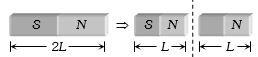
$A$ long magnetic needle of length $2L$,magnetic moment $M$,and pole strength $m$ is broken into two equal pieces at the middle. The magnetic moment and pole strength of each piece will be
A
$\frac{M}{2}, \frac{m}{2}$
B
$M, \frac{m}{2}$
C
$\frac{M}{2}, m$
D
$M, m$
Solution
(C) When a magnetic needle is cut perpendicular to its length into two equal pieces,the pole strength $m$ of each new piece remains the same as the original,because the cross-sectional area of the magnet does not change.
The length of each new piece becomes $L' = \frac{2L}{2} = L$.
The magnetic moment $M'$ of each new piece is given by the product of its pole strength and its new length:
$M' = m \times L' = m \times L$.
Since the original magnetic moment $M = m \times (2L) = 2mL$,we can write:
$M' = \frac{M}{2}$.
Therefore,the magnetic moment of each piece is $\frac{M}{2}$ and the pole strength is $m$.
The length of each new piece becomes $L' = \frac{2L}{2} = L$.
The magnetic moment $M'$ of each new piece is given by the product of its pole strength and its new length:
$M' = m \times L' = m \times L$.
Since the original magnetic moment $M = m \times (2L) = 2mL$,we can write:
$M' = \frac{M}{2}$.
Therefore,the magnetic moment of each piece is $\frac{M}{2}$ and the pole strength is $m$.
0 likes
View Solution17
EasyMCQ
What happens to the force between two magnetic poles when their pole strength and the distance between them are both doubled?
A
Force increases to two times the previous value
B
No change
C
Force decreases to half the previous value
D
Force increases to four times the previous value
Solution
(B) The force $F$ between two magnetic poles of strengths $m_1$ and $m_2$ separated by a distance $r$ is given by Coulomb's law for magnetism: $F = k \frac{m_1 m_2}{r^2}$.
Given that the new pole strengths are $m_1' = 2m_1$ and $m_2' = 2m_2$,and the new distance is $r' = 2r$.
The new force $F'$ is given by: $F' = k \frac{(2m_1)(2m_2)}{(2r)^2}$.
$F' = k \frac{4 m_1 m_2}{4 r^2} = k \frac{m_1 m_2}{r^2} = F$.
Therefore,the force remains unchanged.
Given that the new pole strengths are $m_1' = 2m_1$ and $m_2' = 2m_2$,and the new distance is $r' = 2r$.
The new force $F'$ is given by: $F' = k \frac{(2m_1)(2m_2)}{(2r)^2}$.
$F' = k \frac{4 m_1 m_2}{4 r^2} = k \frac{m_1 m_2}{r^2} = F$.
Therefore,the force remains unchanged.
0 likes
View Solution18
EasyMCQ
The force between two unit pole strengths placed at a distance of $1 \, m$ is:
A
$1 \, N$
B
$\frac{10^{-7}}{4\pi} \, N$
C
$10^{-7} \, N$
D
$4\pi \times 10^{-7} \, N$
Solution
(C) The force $F$ between two magnetic poles of strengths $m_1$ and $m_2$ separated by a distance $r$ is given by Coulomb's law for magnetism:
$F = \frac{\mu_0}{4\pi} \cdot \frac{m_1 m_2}{r^2}$
Given that the pole strengths are unit pole strengths,$m_1 = 1 \, Am$ and $m_2 = 1 \, Am$.
The distance $r = 1 \, m$.
The value of $\frac{\mu_0}{4\pi} = 10^{-7} \, N/A^2$.
Substituting these values into the formula:
$F = 10^{-7} \times \frac{1 \times 1}{1^2} = 10^{-7} \, N$.
$F = \frac{\mu_0}{4\pi} \cdot \frac{m_1 m_2}{r^2}$
Given that the pole strengths are unit pole strengths,$m_1 = 1 \, Am$ and $m_2 = 1 \, Am$.
The distance $r = 1 \, m$.
The value of $\frac{\mu_0}{4\pi} = 10^{-7} \, N/A^2$.
Substituting these values into the formula:
$F = 10^{-7} \times \frac{1 \times 1}{1^2} = 10^{-7} \, N$.
0 likes
View Solution19
EasyMCQ
If a hole is made at the centre of a bar magnet,then its magnetic moment will
A
Increase
B
Decrease
C
Not change
D
None of these
Solution
(C) The magnetic moment $M$ of a bar magnet is defined as the product of its pole strength $m$ and the magnetic length $2l$,given by $M = m \times 2l$.
When a hole is made at the centre of the bar magnet,the material of the magnet is removed from the central region.
However,the pole strength $m$ depends on the magnetic material at the ends of the magnet,which remains unaffected by a hole at the centre.
The magnetic length $2l$ (the distance between the poles) also remains unchanged.
Since both the pole strength and the magnetic length remain constant,the magnetic moment $M$ of the bar magnet does not change.
When a hole is made at the centre of the bar magnet,the material of the magnet is removed from the central region.
However,the pole strength $m$ depends on the magnetic material at the ends of the magnet,which remains unaffected by a hole at the centre.
The magnetic length $2l$ (the distance between the poles) also remains unchanged.
Since both the pole strength and the magnetic length remain constant,the magnetic moment $M$ of the bar magnet does not change.
0 likes
View Solution20
EasyMCQ
The direction of the magnetic field lines of a bar magnet is:
A
From south pole to north pole
B
From north pole to south pole
C
Across the bar magnet
D
From south pole to north pole inside the magnet and from north pole to south pole outside the magnet
Solution
(D) Magnetic field lines are continuous closed loops.
Outside the bar magnet,the magnetic field lines originate from the north pole and terminate at the south pole.
Inside the bar magnet,the magnetic field lines travel from the south pole to the north pole to complete the closed loop.
Therefore,the correct description is that they move from the south pole to the north pole inside the magnet and from the north pole to the south pole outside the magnet.
Outside the bar magnet,the magnetic field lines originate from the north pole and terminate at the south pole.
Inside the bar magnet,the magnetic field lines travel from the south pole to the north pole to complete the closed loop.
Therefore,the correct description is that they move from the south pole to the north pole inside the magnet and from the north pole to the south pole outside the magnet.
0 likes
View Solution21
MediumMCQ
The force between two identical bar magnets whose centres are $r \ m$ apart is $4.8 \ N$,when their axes are in the same line. If the separation is increased to $2r$,the force between them is reduced to . . . . . . $N$.
A
$2.4$
B
$1.2$
C
$0.6$
D
$0.3$
Solution
(D) For two short bar magnets placed coaxially,the force of interaction $F$ is inversely proportional to the fourth power of the distance $r$ between their centers,i.e.,$F \propto \frac{1}{r^4}$.
Given the initial force $F_1 = 4.8 \ N$ at distance $r_1 = r$.
When the distance is increased to $r_2 = 2r$,the new force $F_2$ is given by:
$\frac{F_2}{F_1} = \left( \frac{r_1}{r_2} \right)^4$
$\frac{F_2}{4.8} = \left( \frac{r}{2r} \right)^4 = \left( \frac{1}{2} \right)^4 = \frac{1}{16}$
$F_2 = \frac{4.8}{16} = 0.3 \ N$.
Given the initial force $F_1 = 4.8 \ N$ at distance $r_1 = r$.
When the distance is increased to $r_2 = 2r$,the new force $F_2$ is given by:
$\frac{F_2}{F_1} = \left( \frac{r_1}{r_2} \right)^4$
$\frac{F_2}{4.8} = \left( \frac{r}{2r} \right)^4 = \left( \frac{1}{2} \right)^4 = \frac{1}{16}$
$F_2 = \frac{4.8}{16} = 0.3 \ N$.
0 likes
View Solution22
EasyMCQ
$A$ permanent magnet:
A
Attracts all substances
B
Attracts only magnetic substances
C
Attracts magnetic substances and repels all non-magnetic substances
D
Attracts non-magnetic substances and repels magnetic substances
Solution
(B) permanent magnet is a material that produces a magnetic field. This magnetic field exerts a force on magnetic materials (such as iron,nickel,and cobalt),causing them to be attracted to the magnet. Non-magnetic substances do not interact with the magnetic field in this way,meaning they are neither attracted nor repelled by the magnet. Therefore,a permanent magnet attracts only magnetic substances.
0 likes
View Solution23
EasyMCQ
The incorrect statement regarding the lines of force of the magnetic field $B$ is:
A
Magnetic intensity is a measure of lines of force passing through unit area held normal to it.
B
Magnetic lines of force form a closed curve.
C
Inside a magnet,its magnetic lines of force move from the north pole of a magnet towards its south pole.
D
Due to a magnet,magnetic lines of force never cut each other.
Solution
(C) Magnetic field lines are continuous closed loops. Outside a magnet,they travel from the north pole to the south pole. However,inside a magnet,they travel from the south pole to the north pole to complete the closed loop. Therefore,the statement in option $C$ is incorrect.
0 likes
View Solution24
EasyMCQ
If a piece of metal is thought to be a magnet,which one of the following observations would offer conclusive evidence?
A
It attracts a known magnet
B
It repels a known magnet
C
Neither $(a)$ nor $(b)$
D
It attracts a steel screw driver
Solution
(B) The correct answer is $B$. Attraction can occur between a magnet and a magnetic material (like iron or steel) or between opposite poles of two magnets. However,repulsion only occurs when like poles of two magnets face each other. Therefore,repulsion is the only conclusive test for magnetism.
0 likes
View Solution25
EasyMCQ
$A$ magnet,when placed perpendicular to a uniform magnetic field of strength $10^{-4} \ Wb/m^2$,experiences a maximum torque of $4 \times 10^{-5} \ N \cdot m$. What is its magnetic moment in $A \cdot m^2$?
A
$0.4$
B
$0.2$
C
$0.16$
D
$0.04$
Solution
(A) The torque $\tau$ experienced by a magnetic dipole in a magnetic field is given by $\tau = M B \sin \theta$.
For maximum torque,$\theta = 90^\circ$,so $\tau_{\max} = M B$.
Given: $\tau_{\max} = 4 \times 10^{-5} \ N \cdot m$ and $B = 10^{-4} \ Wb/m^2$.
Substituting the values: $4 \times 10^{-5} = M \times 10^{-4}$.
Solving for $M$: $M = \frac{4 \times 10^{-5}}{10^{-4}} = 4 \times 10^{-1} = 0.4 \ A \cdot m^2$.
For maximum torque,$\theta = 90^\circ$,so $\tau_{\max} = M B$.
Given: $\tau_{\max} = 4 \times 10^{-5} \ N \cdot m$ and $B = 10^{-4} \ Wb/m^2$.
Substituting the values: $4 \times 10^{-5} = M \times 10^{-4}$.
Solving for $M$: $M = \frac{4 \times 10^{-5}}{10^{-4}} = 4 \times 10^{-1} = 0.4 \ A \cdot m^2$.
0 likes
View Solution26
EasyMCQ
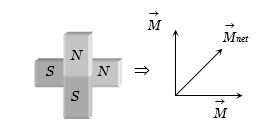
Two magnets,each of magnetic moment $M$,are placed so as to form a cross at right angles to each other. The magnetic moment of the system will be
A
$2 \,M$
B
$\sqrt{2} \,M$
C
$0.5 \,M$
D
$M$
Solution
(B) The magnetic moment is a vector quantity. When two magnets of equal magnetic moment $M$ are placed at right angles to each other,their resultant magnetic moment $M_{net}$ is given by the vector sum of the individual magnetic moments.
Since the angle between the two magnetic moments is $90^{\circ}$,the magnitude of the resultant magnetic moment is calculated as:
$M_{net} = \sqrt{M^2 + M^2 + 2MM \cos(90^{\circ})}$
Since $\cos(90^{\circ}) = 0$,this simplifies to:
$M_{net} = \sqrt{M^2 + M^2} = \sqrt{2M^2} = \sqrt{2} \,M$
Since the angle between the two magnetic moments is $90^{\circ}$,the magnitude of the resultant magnetic moment is calculated as:
$M_{net} = \sqrt{M^2 + M^2 + 2MM \cos(90^{\circ})}$
Since $\cos(90^{\circ}) = 0$,this simplifies to:
$M_{net} = \sqrt{M^2 + M^2} = \sqrt{2M^2} = \sqrt{2} \,M$
0 likes
View Solution27
MediumMCQ
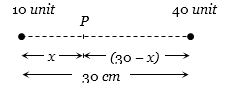
Two like magnetic poles of strength $10$ and $40$ $SI$ units are separated by a distance of $30 \, cm$. The intensity of the magnetic field is zero on the line joining them at:
A
At a point $10 \, cm$ from the stronger pole
B
At a point $20 \, cm$ from the stronger pole
C
At the mid-point
D
At infinity
Solution
(B) Let the magnetic field be zero at point $P$,which lies at a distance $x$ from the $10$ unit pole.
Since the poles are like,the null point lies between them.
The distance of $P$ from the $40$ unit pole is $(30 - x)$.
At point $P$,the magnetic field intensities due to both poles must be equal in magnitude and opposite in direction:
$\frac{\mu_0}{4\pi} \cdot \frac{10}{x^2} = \frac{\mu_0}{4\pi} \cdot \frac{40}{(30 - x)^2}$
$\frac{1}{x^2} = \frac{4}{(30 - x)^2}$
Taking the square root on both sides:
$\frac{1}{x} = \frac{2}{30 - x}$
$30 - x = 2x$
$3x = 30 \Rightarrow x = 10 \, cm$.
Thus,the point is at a distance of $10 \, cm$ from the $10$ unit pole and $(30 - 10) = 20 \, cm$ from the stronger ($40$ unit) pole.
Therefore,the correct option is $(b)$.
Since the poles are like,the null point lies between them.
The distance of $P$ from the $40$ unit pole is $(30 - x)$.
At point $P$,the magnetic field intensities due to both poles must be equal in magnitude and opposite in direction:
$\frac{\mu_0}{4\pi} \cdot \frac{10}{x^2} = \frac{\mu_0}{4\pi} \cdot \frac{40}{(30 - x)^2}$
$\frac{1}{x^2} = \frac{4}{(30 - x)^2}$
Taking the square root on both sides:
$\frac{1}{x} = \frac{2}{30 - x}$
$30 - x = 2x$
$3x = 30 \Rightarrow x = 10 \, cm$.
Thus,the point is at a distance of $10 \, cm$ from the $10$ unit pole and $(30 - 10) = 20 \, cm$ from the stronger ($40$ unit) pole.
Therefore,the correct option is $(b)$.
0 likes
View Solution28
MediumMCQ
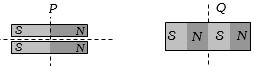
Two similar bar magnets $P$ and $Q$,each of magnetic moment $M$,are taken. If $P$ is cut along its axial line and $Q$ is cut along its equatorial line,all the four pieces obtained have:
A
Equal pole strength
B
Magnetic moment $\frac{M}{4}$
C
Magnetic moment $\frac{M}{2}$
D
Magnetic moment $M$
Solution
(C) Let the original pole strength be $m$,length be $L$,and magnetic moment be $M = m \times L$.
Case $1$: Magnet $P$ is cut along its axial line (longitudinally).
Each piece has length $L' = L$ and pole strength $m' = \frac{m}{2}$.
The new magnetic moment is $M' = m' \times L' = \frac{m}{2} \times L = \frac{M}{2}$.
Case $2$: Magnet $Q$ is cut along its equatorial line (transversely).
Each piece has length $L' = \frac{L}{2}$ and pole strength $m' = m$.
The new magnetic moment is $M' = m' \times L' = m \times \frac{L}{2} = \frac{M}{2}$.
Thus,all four pieces obtained have a magnetic moment of $\frac{M}{2}$.
Case $1$: Magnet $P$ is cut along its axial line (longitudinally).
Each piece has length $L' = L$ and pole strength $m' = \frac{m}{2}$.
The new magnetic moment is $M' = m' \times L' = \frac{m}{2} \times L = \frac{M}{2}$.
Case $2$: Magnet $Q$ is cut along its equatorial line (transversely).
Each piece has length $L' = \frac{L}{2}$ and pole strength $m' = m$.
The new magnetic moment is $M' = m' \times L' = m \times \frac{L}{2} = \frac{M}{2}$.
Thus,all four pieces obtained have a magnetic moment of $\frac{M}{2}$.
0 likes
View Solution29
EasyMCQ
There is no couple acting when two bar magnets are placed coaxially separated by a distance because
A
There are no forces on the poles
B
The forces are parallel and their lines of action do not coincide
C
The forces are perpendicular to each other
D
The forces act along the same line
Solution
(D) couple is defined as two equal and opposite forces acting along different lines of action,which produces a torque.
For two bar magnets placed coaxially,the magnetic force between them acts along the axis connecting their centers.
Since the forces on the poles of the magnets act along the same line (the common axis),the perpendicular distance between the lines of action of the forces is zero.
Therefore,the torque $\vec{\tau} = \vec{r} \times \vec{F} = 0$.
Thus,no couple acts on the magnets.
For two bar magnets placed coaxially,the magnetic force between them acts along the axis connecting their centers.
Since the forces on the poles of the magnets act along the same line (the common axis),the perpendicular distance between the lines of action of the forces is zero.
Therefore,the torque $\vec{\tau} = \vec{r} \times \vec{F} = 0$.
Thus,no couple acts on the magnets.
0 likes
View Solution30
MediumMCQ
$A$ bar magnet of magnetic moment $3.0 \, A-m^2$ is placed in a uniform magnetic induction field of $2 \times 10^{-5} \, T$. If each pole of the magnet experiences a force of $6 \times 10^{-4} \, N$,the length of the magnet is.....$m$
A
$0.5$
B
$0.3$
C
$0.2$
D
$0.1$
Solution
(D) The magnetic moment $M$ of a bar magnet is given by $M = m \times L$,where $m$ is the pole strength and $L$ is the length of the magnet.
The force $F$ experienced by each pole in a uniform magnetic field $B$ is given by $F = m \times B$.
From this,the pole strength is $m = \frac{F}{B}$.
Substituting $m$ into the magnetic moment formula: $M = \left( \frac{F}{B} \right) \times L$.
Rearranging for $L$: $L = \frac{M \times B}{F}$.
Given: $M = 3.0 \, A-m^2$,$B = 2 \times 10^{-5} \, T$,and $F = 6 \times 10^{-4} \, N$.
$L = \frac{3.0 \times 2 \times 10^{-5}}{6 \times 10^{-4}} = \frac{6 \times 10^{-5}}{6 \times 10^{-4}} = 0.1 \, m$.
Therefore,the length of the magnet is $0.1 \, m$.
The force $F$ experienced by each pole in a uniform magnetic field $B$ is given by $F = m \times B$.
From this,the pole strength is $m = \frac{F}{B}$.
Substituting $m$ into the magnetic moment formula: $M = \left( \frac{F}{B} \right) \times L$.
Rearranging for $L$: $L = \frac{M \times B}{F}$.
Given: $M = 3.0 \, A-m^2$,$B = 2 \times 10^{-5} \, T$,and $F = 6 \times 10^{-4} \, N$.
$L = \frac{3.0 \times 2 \times 10^{-5}}{6 \times 10^{-4}} = \frac{6 \times 10^{-5}}{6 \times 10^{-4}} = 0.1 \, m$.
Therefore,the length of the magnet is $0.1 \, m$.
0 likes
View Solution31
EasyMCQ
Two lines of force due to a bar magnet:
A
Intersect at the neutral point
B
Intersect near the poles of the magnet
C
Intersect on the equatorial axis of the magnet
D
Do not intersect at all
Solution
(D) Magnetic field lines represent the direction of the magnetic field at any given point. If two magnetic field lines were to intersect,it would imply that there are two different directions for the magnetic field at the point of intersection,which is physically impossible. Therefore,magnetic field lines due to a bar magnet never intersect each other.
0 likes
View Solution32
EasyMCQ
The ultimate individual unit of magnetism in any magnet is called
A
North pole
B
South pole
C
Dipole
D
Quadrupole
Solution
(C) In magnetism,isolated magnetic monopoles do not exist. Even at the atomic level,magnetism arises from current loops or electron spin,which inherently form a magnetic dipole. Therefore,the smallest fundamental unit of magnetism is a magnetic dipole.
0 likes
View Solution33
EasyMCQ
The magnetic field lines due to a bar magnet are correctly shown in
A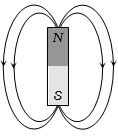
B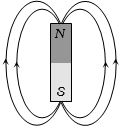
C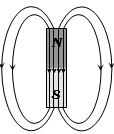
D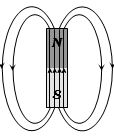
Solution
(D) is the correct option.
Magnetic field lines form continuous closed loops.
Outside the magnet,the field lines are directed from the north pole to the south pole.
Inside the magnet,the field lines are directed from the south pole to the north pole,ensuring the continuity of the closed loops.
Magnetic field lines form continuous closed loops.
Outside the magnet,the field lines are directed from the north pole to the south pole.
Inside the magnet,the field lines are directed from the south pole to the north pole,ensuring the continuity of the closed loops.
0 likes
View Solution34
EasyMCQ
The magnetic lines of force inside a bar magnet
A
Are from south-pole to north-pole of the magnet
B
Are from north-pole to south-pole of the magnet
C
Do not exist
D
Depend upon the area of cross-section of the bar magnet
Solution
(A) Magnetic field lines form continuous closed loops. Outside the magnet,the magnetic field lines emerge from the north pole and enter the south pole. Inside the magnet,to complete the closed loop,the magnetic field lines travel from the south pole to the north pole. Therefore,the correct option is $A$.
0 likes
View Solution35
EasyMCQ
The torque on a bar magnet due to the earth's magnetic field is maximum when the axis of the magnet is
A
Perpendicular to the field of the earth
B
Parallel to the vertical component of the earth's field
C
At an angle of $33^{\circ}$ with respect to the $N-S$ direction
D
Along the North-South $(N-S)$ direction
Solution
(A) The torque $\tau$ acting on a bar magnet of magnetic moment $M$ placed in an external magnetic field $B$ is given by the formula $\tau = MB \sin \theta$,where $\theta$ is the angle between the magnetic axis and the magnetic field.
For the earth's magnetic field,the torque is $\tau = M B_H \sin \theta$,where $B_H$ is the horizontal component of the earth's magnetic field.
The torque $\tau$ is maximum when $\sin \theta$ is maximum,which occurs at $\theta = 90^{\circ}$.
Therefore,the torque is maximum when the axis of the magnet is perpendicular to the earth's magnetic field.
For the earth's magnetic field,the torque is $\tau = M B_H \sin \theta$,where $B_H$ is the horizontal component of the earth's magnetic field.
The torque $\tau$ is maximum when $\sin \theta$ is maximum,which occurs at $\theta = 90^{\circ}$.
Therefore,the torque is maximum when the axis of the magnet is perpendicular to the earth's magnetic field.
0 likes
View Solution36
EasyMCQ
Magnetic dipole moment is a
A
Scalar quantity
B
Vector quantity
C
Constant quantity
D
None of these
Solution
(B) The magnetic dipole moment,denoted by $\vec{M}$ or $\vec{m}$,is defined as the product of the pole strength $(q_m)$ and the magnetic length $(2\vec{l})$ of the magnet.
Since it has both magnitude and a specific direction (from the South pole to the North pole),it is a vector quantity.
Therefore,the correct option is $B$.
Since it has both magnitude and a specific direction (from the South pole to the North pole),it is a vector quantity.
Therefore,the correct option is $B$.
0 likes
View Solution37
EasyMCQ
The magnetic moment of a magnet of length $10\, cm$ and pole strength $4.0\, Am$ will be......$A\,m^2$.
A
$0.4$
B
$1.6$
C
$20$
D
$8$
Solution
(A) The magnetic moment $M$ of a bar magnet is given by the product of its pole strength $m$ and its magnetic length $L$.
Given:
Pole strength $m = 4.0\, Am$
Length $L = 10\, cm = 0.1\, m$
Formula: $M = m \times L$
Calculation: $M = 4.0\, Am \times 0.1\, m = 0.4\, A\, m^2$.
Therefore,the correct option is $A$.
Given:
Pole strength $m = 4.0\, Am$
Length $L = 10\, cm = 0.1\, m$
Formula: $M = m \times L$
Calculation: $M = 4.0\, Am \times 0.1\, m = 0.4\, A\, m^2$.
Therefore,the correct option is $A$.
0 likes
View Solution38
MediumMCQ
The effective length of a magnet is $31.4 \, cm$ and its pole strength is $0.5 \, Am$. The magnetic moment,if it is bent in the form of a semicircle,will be.....$A m^2$.
A
$0.1$
B
$0.01$
C
$0.2$
D
$1.2$
Solution
(A) The initial magnetic moment $M$ is given by $M = m \times L$,where $m = 0.5 \, Am$ and $L = 31.4 \, cm = 0.314 \, m$.
So,$M = 0.5 \times 0.314 = 0.157 \, Am^2$.
When the magnet is bent into a semicircle,the new effective length (distance between poles) $L'$ becomes the diameter of the semicircle.
If $R$ is the radius,then the arc length $L = \pi R$,so $R = L / \pi$.
The new distance between poles is $L' = 2R = 2L / \pi$.
The new magnetic moment $M'$ is $M' = m \times L' = m \times (2L / \pi) = (2 / \pi) \times M$.
Substituting the values: $M' = (2 / 3.14) \times (0.5 \times 0.314) = (2 / 3.14) \times 0.157 = 2 \times 0.05 = 0.1 \, Am^2$.
So,$M = 0.5 \times 0.314 = 0.157 \, Am^2$.
When the magnet is bent into a semicircle,the new effective length (distance between poles) $L'$ becomes the diameter of the semicircle.
If $R$ is the radius,then the arc length $L = \pi R$,so $R = L / \pi$.
The new distance between poles is $L' = 2R = 2L / \pi$.
The new magnetic moment $M'$ is $M' = m \times L' = m \times (2L / \pi) = (2 / \pi) \times M$.
Substituting the values: $M' = (2 / 3.14) \times (0.5 \times 0.314) = (2 / 3.14) \times 0.157 = 2 \times 0.05 = 0.1 \, Am^2$.
0 likes
View Solution39
DifficultMCQ
The time period of a freely suspended magnet is $4 \ s$. If it is broken in length into two equal parts and one part is suspended in the same way,then its time period will be: (in $s$)
A
$4$
B
$2$
C
$0.5$
D
$0.25$
Solution
(B) The time period of a freely suspended magnet is given by $T = 2\pi \sqrt{\frac{I}{MB_H}} = 4 \ s$.
When the magnet is cut into two equal halves along its length,the new magnetic moment becomes $M' = \frac{M}{2}$.
The new moment of inertia $I'$ for one half is calculated as $I' = \frac{m'l'^2}{12}$,where $m' = \frac{m}{2}$ and $l' = \frac{l}{2}$.
Thus,$I' = \frac{(m/2)(l/2)^2}{12} = \frac{1}{8} \cdot \frac{ml^2}{12} = \frac{I}{8}$.
The new time period $T'$ is $T' = 2\pi \sqrt{\frac{I'}{M'B_H}} = 2\pi \sqrt{\frac{I/8}{(M/2)B_H}}$.
Simplifying this,$T' = 2\pi \sqrt{\frac{1}{4} \cdot \frac{I}{MB_H}} = \frac{1}{2} \cdot 2\pi \sqrt{\frac{I}{MB_H}} = \frac{T}{2}$.
Substituting $T = 4 \ s$,we get $T' = \frac{4}{2} = 2 \ s$.
When the magnet is cut into two equal halves along its length,the new magnetic moment becomes $M' = \frac{M}{2}$.
The new moment of inertia $I'$ for one half is calculated as $I' = \frac{m'l'^2}{12}$,where $m' = \frac{m}{2}$ and $l' = \frac{l}{2}$.
Thus,$I' = \frac{(m/2)(l/2)^2}{12} = \frac{1}{8} \cdot \frac{ml^2}{12} = \frac{I}{8}$.
The new time period $T'$ is $T' = 2\pi \sqrt{\frac{I'}{M'B_H}} = 2\pi \sqrt{\frac{I/8}{(M/2)B_H}}$.
Simplifying this,$T' = 2\pi \sqrt{\frac{1}{4} \cdot \frac{I}{MB_H}} = \frac{1}{2} \cdot 2\pi \sqrt{\frac{I}{MB_H}} = \frac{T}{2}$.
Substituting $T = 4 \ s$,we get $T' = \frac{4}{2} = 2 \ s$.
0 likes
View Solution40
EasyMCQ
Which of the following statements is true about the magnetic moments of atoms of different elements?
A
All have a magnetic moment.
B
None has a magnetic moment.
C
All acquire a magnetic moment under an external magnetic field and in the same direction as the field.
D
None of the above statements are accurate.
Solution
(D) The magnetic moment of an atom arises from the spin and orbital angular momentum of its electrons.
Different elements have different electronic configurations,leading to varying magnetic properties.
Some atoms have a permanent magnetic moment due to unpaired electrons,while others do not.
Furthermore,the interaction between atoms in a material determines the net magnetic behavior.
Therefore,it is not universally true that all atoms have a magnetic moment,nor is it true that none have one,nor do all atoms align in the same direction under an external field.
Thus,none of the provided statements are accurate.
Different elements have different electronic configurations,leading to varying magnetic properties.
Some atoms have a permanent magnetic moment due to unpaired electrons,while others do not.
Furthermore,the interaction between atoms in a material determines the net magnetic behavior.
Therefore,it is not universally true that all atoms have a magnetic moment,nor is it true that none have one,nor do all atoms align in the same direction under an external field.
Thus,none of the provided statements are accurate.
0 likes
View Solution41
EasyMCQ
The magnetic moment of an atomic neon is
A
Zero
B
$\mu_B/2$
C
$\mu_B$
D
$3\mu_B/2$
Solution
(A) The electronic configuration of neon $(Ne)$ is $1s^2 2s^2 2p^6$.
Since all the orbitals are completely filled,all electrons are paired.
Due to the pairing of electrons,the spin magnetic moments and orbital magnetic moments cancel each other out.
Therefore,the net magnetic moment of a neon atom is zero.
Since all the orbitals are completely filled,all electrons are paired.
Due to the pairing of electrons,the spin magnetic moments and orbital magnetic moments cancel each other out.
Therefore,the net magnetic moment of a neon atom is zero.
0 likes
View Solution42
MediumMCQ
$A$ cylindrical rod magnet has a length of $5 \, cm$ and a diameter of $1 \, cm$. It has a uniform magnetization of $5.30 \times 10^3 \, A/m$. What is its magnetic dipole moment?
A
$1 \times 10^{-2} \, J/T$
B
$2.08 \times 10^{-2} \, J/T$
C
$3.08 \times 10^{-2} \, J/T$
D
$1.52 \times 10^{-2} \, J/T$
Solution
(B) The magnetic dipole moment $M$ is given by the product of magnetization $I$ and the volume $V$ of the magnet,i.e.,$M = I \times V$.
Given: Magnetization $I = 5.30 \times 10^3 \, A/m$,length $l = 5 \, cm = 0.05 \, m$,and diameter $d = 1 \, cm$,so radius $r = 0.5 \, cm = 0.005 \, m$.
The volume of the cylindrical rod is $V = \pi r^2 l$.
Substituting the values:
$V = \pi \times (0.005)^2 \times 0.05 = \pi \times (2.5 \times 10^{-5}) \times 0.05 = 3.927 \times 10^{-6} \, m^3$.
Now,calculating the dipole moment:
$M = (5.30 \times 10^3) \times (3.927 \times 10^{-6}) \approx 2.08 \times 10^{-2} \, J/T$.
Given: Magnetization $I = 5.30 \times 10^3 \, A/m$,length $l = 5 \, cm = 0.05 \, m$,and diameter $d = 1 \, cm$,so radius $r = 0.5 \, cm = 0.005 \, m$.
The volume of the cylindrical rod is $V = \pi r^2 l$.
Substituting the values:
$V = \pi \times (0.005)^2 \times 0.05 = \pi \times (2.5 \times 10^{-5}) \times 0.05 = 3.927 \times 10^{-6} \, m^3$.
Now,calculating the dipole moment:
$M = (5.30 \times 10^3) \times (3.927 \times 10^{-6}) \approx 2.08 \times 10^{-2} \, J/T$.
0 likes
View Solution43
DifficultMCQ
Each atom of an iron bar $(5 \, cm \times 1 \, cm \times 1 \, cm)$ has a magnetic moment of $1.8 \times 10^{-23} \, A \cdot m^2$. Given that the density of iron is $7.78 \times 10^3 \, kg/m^3$,the atomic weight is $56 \, g/mol$,and Avogadro's number is $6.02 \times 10^{23} \, mol^{-1}$,calculate the magnetic moment of the bar in the state of magnetic saturation in $A \cdot m^2$.
A
$4.75$
B
$5.74$
C
$7.54$
D
$75.4$
Solution
(C) $1$. Calculate the number of atoms per unit volume $(n)$:
$n = \frac{\rho N_A}{M} = \frac{7.78 \times 10^3 \times 6.02 \times 10^{23}}{56 \times 10^{-3}} \approx 8.36 \times 10^{28} \, atoms/m^3$.
$2$. Calculate the volume of the bar $(V)$:
$V = 5 \, cm \times 1 \, cm \times 1 \, cm = 5 \times 10^{-6} \, m^3$.
$3$. Calculate the total number of atoms $(N)$:
$N = n \times V = 8.36 \times 10^{28} \times 5 \times 10^{-6} = 4.18 \times 10^{23} \, atoms$.
$4$. Calculate the total magnetic moment $(M_{total})$:
$M_{total} = N \times \mu_{atom} = 4.18 \times 10^{23} \times 1.8 \times 10^{-23} \approx 7.52 \, A \cdot m^2$.
Rounding to the nearest provided option,the result is $7.54 \, A \cdot m^2$.
$n = \frac{\rho N_A}{M} = \frac{7.78 \times 10^3 \times 6.02 \times 10^{23}}{56 \times 10^{-3}} \approx 8.36 \times 10^{28} \, atoms/m^3$.
$2$. Calculate the volume of the bar $(V)$:
$V = 5 \, cm \times 1 \, cm \times 1 \, cm = 5 \times 10^{-6} \, m^3$.
$3$. Calculate the total number of atoms $(N)$:
$N = n \times V = 8.36 \times 10^{28} \times 5 \times 10^{-6} = 4.18 \times 10^{23} \, atoms$.
$4$. Calculate the total magnetic moment $(M_{total})$:
$M_{total} = N \times \mu_{atom} = 4.18 \times 10^{23} \times 1.8 \times 10^{-23} \approx 7.52 \, A \cdot m^2$.
Rounding to the nearest provided option,the result is $7.54 \, A \cdot m^2$.
0 likes
View Solution44
DifficultMCQ
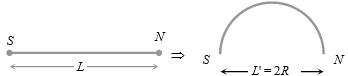
$A$ magnetic rod of length $L$ has a magnetic dipole moment $M$. If it is bent into a semicircle,what will be its new magnetic dipole moment?
A
$M$
B
$\frac{2M}{\pi}$
C
$\frac{M}{\pi}$
D
$M\pi$
Solution
(B) The initial magnetic dipole moment is $M = m \cdot L$,where $m$ is the pole strength.
When the rod is bent into a semicircle of radius $R$,its length $L$ becomes the arc length of the semicircle,so $L = \pi R$,which gives $R = \frac{L}{\pi}$.
The new magnetic dipole moment $M'$ is the product of the pole strength $m$ and the straight-line distance between the poles (the diameter $2R$).
$M' = m \cdot (2R) = m \cdot \left( \frac{2L}{\pi} \right)$.
Since $M = m \cdot L$,we substitute $M$ into the equation:
$M' = \frac{2M}{\pi}$.
When the rod is bent into a semicircle of radius $R$,its length $L$ becomes the arc length of the semicircle,so $L = \pi R$,which gives $R = \frac{L}{\pi}$.
The new magnetic dipole moment $M'$ is the product of the pole strength $m$ and the straight-line distance between the poles (the diameter $2R$).
$M' = m \cdot (2R) = m \cdot \left( \frac{2L}{\pi} \right)$.
Since $M = m \cdot L$,we substitute $M$ into the equation:
$M' = \frac{2M}{\pi}$.
0 likes
View Solution45
DifficultMCQ
$A$ bar magnet with a magnetic moment of $3.0 \, A \cdot m^2$ is placed in a magnetic field of $2 \times 10^{-5} \, T$. If the force acting on each pole is $6 \times 10^{-4} \, N$,what is the length of the magnet in $m$?
A
$0.5$
B
$0.3$
C
$0.2$
D
$0.1$
Solution
(D) The magnetic moment $M$ of a bar magnet is given by $M = m \cdot L$,where $m$ is the pole strength and $L$ is the length of the magnet.
The force $F$ acting on a pole in a magnetic field $B$ is given by $F = m \cdot B$.
From the first equation,we have $m = \frac{M}{L}$.
Substituting this into the force equation: $F = \frac{M}{L} \cdot B$.
Given $M = 3.0 \, A \cdot m^2$,$B = 2 \times 10^{-5} \, T$,and $F = 6 \times 10^{-4} \, N$.
Substituting the values: $6 \times 10^{-4} = \frac{3.0}{L} \times 2 \times 10^{-5}$.
$L = \frac{3.0 \times 2 \times 10^{-5}}{6 \times 10^{-4}} = \frac{6 \times 10^{-5}}{6 \times 10^{-4}} = 10^{-1} = 0.1 \, m$.
The force $F$ acting on a pole in a magnetic field $B$ is given by $F = m \cdot B$.
From the first equation,we have $m = \frac{M}{L}$.
Substituting this into the force equation: $F = \frac{M}{L} \cdot B$.
Given $M = 3.0 \, A \cdot m^2$,$B = 2 \times 10^{-5} \, T$,and $F = 6 \times 10^{-4} \, N$.
Substituting the values: $6 \times 10^{-4} = \frac{3.0}{L} \times 2 \times 10^{-5}$.
$L = \frac{3.0 \times 2 \times 10^{-5}}{6 \times 10^{-4}} = \frac{6 \times 10^{-5}}{6 \times 10^{-4}} = 10^{-1} = 0.1 \, m$.
0 likes
View Solution46
MediumMCQ
Two magnetic poles have a pole strength of $0.01 \, A \cdot m$ each and are separated by a distance of $0.1 \, m$. What is the magnetic field at the midpoint between the two poles?
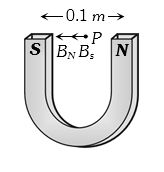
A
$2 \times 10^{-5} \, T$
B
$4 \times 10^{-6} \, T$
C
$8 \times 10^{-7} \, T$
D
Zero
Solution
(C) The pole strength $m = 0.01 \, A \cdot m$. The distance between the poles is $d = 0.1 \, m$. The midpoint is at a distance $r = d/2 = 0.05 \, m$ from each pole.
At the midpoint,the magnetic field due to the North pole $(B_N)$ is directed away from it,and the magnetic field due to the South pole $(B_S)$ is directed towards it. Both fields point in the same direction.
The magnitude of the magnetic field due to a single pole is given by $B = \frac{\mu_0}{4\pi} \frac{m}{r^2}$.
$B_N = B_S = 10^{-7} \times \frac{0.01}{(0.05)^2} = 10^{-7} \times \frac{0.01}{0.0025} = 10^{-7} \times 4 = 4 \times 10^{-7} \, T$.
The net magnetic field $B_{net} = B_N + B_S = 4 \times 10^{-7} + 4 \times 10^{-7} = 8 \times 10^{-7} \, T$.
At the midpoint,the magnetic field due to the North pole $(B_N)$ is directed away from it,and the magnetic field due to the South pole $(B_S)$ is directed towards it. Both fields point in the same direction.
The magnitude of the magnetic field due to a single pole is given by $B = \frac{\mu_0}{4\pi} \frac{m}{r^2}$.
$B_N = B_S = 10^{-7} \times \frac{0.01}{(0.05)^2} = 10^{-7} \times \frac{0.01}{0.0025} = 10^{-7} \times 4 = 4 \times 10^{-7} \, T$.
The net magnetic field $B_{net} = B_N + B_S = 4 \times 10^{-7} + 4 \times 10^{-7} = 8 \times 10^{-7} \, T$.
0 likes
View Solution47
DifficultMCQ
$A$ rod of length $5 \, cm$ and diameter $1 \, cm$ has a magnetization of $5.30 \times 10^3 \, A/m$. What is its magnetic moment?
A
$1 \times 10^{-2} \, J/T$
B
$2.08 \times 10^{-2} \, J/T$
C
$3.08 \times 10^{-2} \, J/T$
D
$1.52 \times 10^{-2} \, J/T$
Solution
(B) The magnetic moment $M$ is given by the product of magnetization $I$ and volume $V$ of the rod.
$M = I \times V$
Given:
Magnetization $I = 5.30 \times 10^3 \, A/m$
Length $l = 5 \, cm = 5 \times 10^{-2} \, m$
Radius $r = \text{diameter} / 2 = 0.5 \, cm = 0.5 \times 10^{-2} \, m$
Volume $V = \pi r^2 l = \pi \times (0.5 \times 10^{-2})^2 \times (5 \times 10^{-2}) \, m^3$
$V = 3.14159 \times 0.25 \times 10^{-4} \times 5 \times 10^{-2} \approx 3.927 \times 10^{-6} \, m^3$
Now,calculate the magnetic moment:
$M = (5.30 \times 10^3) \times (3.927 \times 10^{-6})$
$M \approx 20.813 \times 10^{-3} \, J/T = 2.08 \times 10^{-2} \, J/T$.
$M = I \times V$
Given:
Magnetization $I = 5.30 \times 10^3 \, A/m$
Length $l = 5 \, cm = 5 \times 10^{-2} \, m$
Radius $r = \text{diameter} / 2 = 0.5 \, cm = 0.5 \times 10^{-2} \, m$
Volume $V = \pi r^2 l = \pi \times (0.5 \times 10^{-2})^2 \times (5 \times 10^{-2}) \, m^3$
$V = 3.14159 \times 0.25 \times 10^{-4} \times 5 \times 10^{-2} \approx 3.927 \times 10^{-6} \, m^3$
Now,calculate the magnetic moment:
$M = (5.30 \times 10^3) \times (3.927 \times 10^{-6})$
$M \approx 20.813 \times 10^{-3} \, J/T = 2.08 \times 10^{-2} \, J/T$.
0 likes
View Solution48
EasyMCQ
$A$ bar magnet of magnetic moment $M$ is placed at right angles to a magnetic induction $B$. If a force $F$ is experienced by each pole of the magnet,the length of the magnet will be
A
$MB/F$
B
$BF/M$
C
$MF/B$
D
$F/MB$
Solution
(A) The magnetic moment $M$ of a bar magnet is given by $M = m \times L$,where $m$ is the pole strength and $L$ is the magnetic length of the magnet.
When a magnet is placed in a magnetic field $B$,the force experienced by each pole is given by $F = mB$.
From this,the pole strength is $m = F/B$.
Substituting the value of $m$ into the magnetic moment equation: $M = (F/B) \times L$.
Rearranging for the length $L$,we get: $L = MB/F$.
When a magnet is placed in a magnetic field $B$,the force experienced by each pole is given by $F = mB$.
From this,the pole strength is $m = F/B$.
Substituting the value of $m$ into the magnetic moment equation: $M = (F/B) \times L$.
Rearranging for the length $L$,we get: $L = MB/F$.
0 likes
View Solution49
MediumMCQ
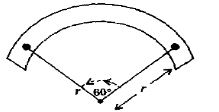
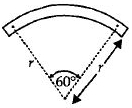
$A$ bar magnet of length $l$ and magnetic dipole moment $M$ is bent in the form of an arc as shown in the figure. The new magnetic dipole moment will be
A
$M$
B
$\frac{3}{\pi} M$
C
$\frac{2}{\pi} M$
D
$\frac{M}{2}$
Solution
(B) Let $m$ be the pole strength of each pole of the bar magnet of length $l$. Then,the initial magnetic dipole moment is given by:
$M = m \times l$ ......... $(i)$
When the bar magnet is bent into an arc of radius $r$ subtending an angle $\theta = 60^{\circ} = \frac{\pi}{3} \text{ radians}$ at the center,the arc length $l$ is:
$l = r \theta = r \times \frac{\pi}{3}$
$r = \frac{3l}{\pi}$
The new magnetic dipole moment $M^{\prime}$ is the product of pole strength $m$ and the straight-line distance (chord length) between the two poles.
The chord length $d$ is given by $2r \sin(\frac{\theta}{2}) = 2r \sin(30^{\circ}) = 2r \times \frac{1}{2} = r$.
Thus,$M^{\prime} = m \times d = m \times r$.
Substituting $r = \frac{3l}{\pi}$:
$M^{\prime} = m \times \frac{3l}{\pi} = \frac{3}{\pi} (m \times l) = \frac{3}{\pi} M$ (using equation $(i)$).
$M = m \times l$ ......... $(i)$
When the bar magnet is bent into an arc of radius $r$ subtending an angle $\theta = 60^{\circ} = \frac{\pi}{3} \text{ radians}$ at the center,the arc length $l$ is:
$l = r \theta = r \times \frac{\pi}{3}$
$r = \frac{3l}{\pi}$
The new magnetic dipole moment $M^{\prime}$ is the product of pole strength $m$ and the straight-line distance (chord length) between the two poles.
The chord length $d$ is given by $2r \sin(\frac{\theta}{2}) = 2r \sin(30^{\circ}) = 2r \times \frac{1}{2} = r$.
Thus,$M^{\prime} = m \times d = m \times r$.
Substituting $r = \frac{3l}{\pi}$:
$M^{\prime} = m \times \frac{3l}{\pi} = \frac{3}{\pi} (m \times l) = \frac{3}{\pi} M$ (using equation $(i)$).
0 likes
View SolutionMagnetism and Matter — Bar Magnet and Magnetic Dipole and Magnetic Moment · Frequently Asked Questions
1Are these Magnetism and Matter questions useful for JEE and NEET?
Yes. All questions in this section are mapped to JEE Main and NEET exam patterns. Previous year questions from JEE Main, NEET, GUJCET and state-level exams are included with full solutions.
2Can I switch to Hindi or Gujarati for these questions?
Yes. Use the language tabs in the hero section or the sidebar to view the same questions and solutions in English, Hindi or Gujarati.
3How do I generate a question paper from this subtopic?
Use the Vedclass Exam Paper Generator — select the chapter and subtopic, set difficulty, and generate Sets A, B, C, D automatically. First 3 chapters of every subject are free.
Vedclass Products
For Students
Vedclass Test Series
Mock tests in real JEE/NEET style with performance analysis. 5-day free trial.
Start Free TrialFor Teachers
Exam Paper Generator
Generate Set A/B/C/D papers from this chapter in 2 minutes. 3 chapters free.
Try FreeFor Institutes
Online Exam Module
Live online exams with unlimited students, 360° analytics & white-label branding.
See DemoFor Teachers & Institutes
Generate a Magnetism and Matter Exam Paper in 2 Minutes
Select subtopic & difficulty — Sets A, B, C, D auto-generated with No Repeat logic.
First 3 chapters of every subject are free — no payment required.