
A English
Earth Magnetism Questions in English
Class 12 Physics · Magnetism and Matter · Earth Magnetism
162+
Questions
English
Language
100%
With Solutions
Showing 49 of 162 questions in English
101
Medium
What is the dynamo effect?
Solution
(N/A) The dynamo effect is a physical process that explains how a celestial body,such as the Earth,generates its magnetic field.
It occurs in the Earth's outer core,which consists of molten iron and nickel.
As the Earth rotates,the molten metal in the outer core undergoes convective motion due to heat from the inner core.
This moving,electrically conducting fluid interacts with the Earth's existing magnetic field,inducing electric currents within the fluid.
These currents,in turn,generate their own magnetic fields,which reinforce and sustain the Earth's overall magnetic field.
This self-sustaining mechanism is known as the dynamo effect.
It occurs in the Earth's outer core,which consists of molten iron and nickel.
As the Earth rotates,the molten metal in the outer core undergoes convective motion due to heat from the inner core.
This moving,electrically conducting fluid interacts with the Earth's existing magnetic field,inducing electric currents within the fluid.
These currents,in turn,generate their own magnetic fields,which reinforce and sustain the Earth's overall magnetic field.
This self-sustaining mechanism is known as the dynamo effect.
0 likes
View Solution102
MediumMCQ
What is the angle between the axis of rotation and the magnetic axis of the Earth (in $°$)?
A
$0$
B
$11.3$
C
$23.5$
D
$90$
Solution
(B) The Earth's magnetic axis is tilted relative to its geographic axis (axis of rotation).
This angle of inclination between the magnetic axis and the geographic axis is approximately $11.3^{\circ}$.
This angle of inclination between the magnetic axis and the geographic axis is approximately $11.3^{\circ}$.
0 likes
View Solution103
Medium
Give the location of magnetic:
$(i)$ north pole
$(ii)$ south pole
$(i)$ north pole
$(ii)$ south pole
Solution
(N/A) $(i)$ The magnetic north pole is located at a latitude of $79.74^{\circ} N$ and a longitude of $71.8^{\circ} W$ in northern Canada.
$(ii)$ The magnetic south pole is located at $79.74^{\circ} S$ and $108.22^{\circ} E$ in Antarctica.
$(ii)$ The magnetic south pole is located at $79.74^{\circ} S$ and $108.22^{\circ} E$ in Antarctica.
0 likes
View Solution104
EasyMCQ
The pole near the geographic north pole is called ...... . The pole near the geographic south pole is called ...... .
A
North magnetic pole,South magnetic pole
B
South magnetic pole,North magnetic pole
C
Geographic north pole,Geographic south pole
D
Magnetic north pole,Magnetic south pole
Solution
(A) The Earth acts as a giant bar magnet. The magnetic pole of the Earth located near the geographic north pole is known as the $ \text{north magnetic pole} $ (or magnetic north pole).
Conversely, the magnetic pole of the Earth located near the geographic south pole is known as the $ \text{south magnetic pole} $ (or magnetic south pole).
Therefore, the correct sequence is: $(i)$ $ \text{north magnetic pole} $, $(ii)$ $ \text{south magnetic pole} $.
Conversely, the magnetic pole of the Earth located near the geographic south pole is known as the $ \text{south magnetic pole} $ (or magnetic south pole).
Therefore, the correct sequence is: $(i)$ $ \text{north magnetic pole} $, $(ii)$ $ \text{south magnetic pole} $.
0 likes
View Solution105
Medium
Define geographic meridian and magnetic meridian.
Solution
(N/A) $1$. Geographic Meridian: The geographic meridian at any place is a vertical plane passing through the geographic north and south poles of the Earth. It is the plane that contains the geographic axis of rotation of the Earth.
$2$. Magnetic Meridian: The magnetic meridian at any place is a vertical plane passing through the magnetic north and south poles of the Earth. It is the plane that contains the magnetic axis of the Earth,which is the line joining the Earth's magnetic poles.
$2$. Magnetic Meridian: The magnetic meridian at any place is a vertical plane passing through the magnetic north and south poles of the Earth. It is the plane that contains the magnetic axis of the Earth,which is the line joining the Earth's magnetic poles.
0 likes
View Solution106
Easy
What is magnetic declination?
Solution
(N/A) Magnetic declination is the angle between the magnetic meridian and the geographic meridian at a particular location on the Earth's surface.
It represents the difference between magnetic north (the direction a compass needle points) and true geographic north (the direction toward the North Pole).
This angle varies depending on the observer's position on the Earth and changes slowly over time due to the movement of the Earth's magnetic poles.
It represents the difference between magnetic north (the direction a compass needle points) and true geographic north (the direction toward the North Pole).
This angle varies depending on the observer's position on the Earth and changes slowly over time due to the movement of the Earth's magnetic poles.
0 likes
View Solution107
Medium
Fill in the blanks:
$(i)$ The declination is ...... at higher latitudes.
$(ii)$ The declination in India is ...... .
$(i)$ The declination is ...... at higher latitudes.
$(ii)$ The declination in India is ...... .
Solution
(N/A) $(i)$ The declination is greater at higher latitudes because the magnetic meridians converge towards the magnetic poles.
$(ii)$ The declination in India is small,as India is located at a lower latitude relative to the magnetic poles.
$(ii)$ The declination in India is small,as India is located at a lower latitude relative to the magnetic poles.
0 likes
View Solution108
Medium
Define the angle of dip and the angle of declination.
Solution
(N/A) $1$. Angle of Dip (Magnetic Inclination): The angle of dip is the angle that the total magnetic field of the Earth makes with the surface of the Earth (horizontal direction) at a given location. It is $0^{\circ}$ at the magnetic equator and $90^{\circ}$ at the magnetic poles.
$2$. Angle of Declination: The angle of declination is the angle between the geographic meridian (true north-south line) and the magnetic meridian (the plane containing the magnetic axis of the Earth) at a specific point on the Earth's surface.
$2$. Angle of Declination: The angle of declination is the angle between the geographic meridian (true north-south line) and the magnetic meridian (the plane containing the magnetic axis of the Earth) at a specific point on the Earth's surface.
0 likes
View Solution109
Easy
Name the elements of the earth's magnetic field.
Solution
(N/A) The earth's magnetic field at any point on the surface is completely specified by three physical quantities, which are known as the elements of the earth's magnetic field:
$1$. Magnetic Declination $(\theta)$: The angle between the geographic meridian and the magnetic meridian at a place.
$2$. Magnetic Inclination or Angle of Dip $(\delta)$: The angle made by the total magnetic field vector of the earth with the horizontal direction in the magnetic meridian.
$3$. Horizontal Component of the Earth's Magnetic Field $(B_H)$: The component of the earth's total magnetic field vector along the horizontal direction in the magnetic meridian.
$1$. Magnetic Declination $(\theta)$: The angle between the geographic meridian and the magnetic meridian at a place.
$2$. Magnetic Inclination or Angle of Dip $(\delta)$: The angle made by the total magnetic field vector of the earth with the horizontal direction in the magnetic meridian.
$3$. Horizontal Component of the Earth's Magnetic Field $(B_H)$: The component of the earth's total magnetic field vector along the horizontal direction in the magnetic meridian.
0 likes
View Solution110
Difficult
Assume the dipole model for Earth's magnetic field $B$,which is given by:
$B_{V} = \text{vertical component of magnetic field} = \frac{\mu_{0}}{4\pi} \frac{2m \cos \theta}{r^{3}}$
$B_{H} = \text{horizontal component of magnetic field} = \frac{\mu_{0}}{4\pi} \frac{m \sin \theta}{r^{3}}$
where $\theta = 90^{\circ} - \text{latitude}$ as measured from the magnetic equator.
$(a)$ Find the loci of points for which $|\vec{B}|$ is minimum.
$B_{V} = \text{vertical component of magnetic field} = \frac{\mu_{0}}{4\pi} \frac{2m \cos \theta}{r^{3}}$
$B_{H} = \text{horizontal component of magnetic field} = \frac{\mu_{0}}{4\pi} \frac{m \sin \theta}{r^{3}}$
where $\theta = 90^{\circ} - \text{latitude}$ as measured from the magnetic equator.
$(a)$ Find the loci of points for which $|\vec{B}|$ is minimum.
Solution
(A) Given that,$B_{V} = \frac{\mu_{0}}{4\pi} \frac{2m \cos \theta}{r^{3}}$ and $B_{H} = \frac{\mu_{0}}{4\pi} \frac{m \sin \theta}{r^{3}}$.
The magnitude of the magnetic field $B$ is given by $B = \sqrt{B_{V}^{2} + B_{H}^{2}}$.
Substituting the expressions:
$B^{2} = \left(\frac{\mu_{0}}{4\pi} \frac{m}{r^{3}}\right)^{2} (4 \cos^{2} \theta + \sin^{2} \theta)$
Using $\sin^{2} \theta = 1 - \cos^{2} \theta$:
$B^{2} = \left(\frac{\mu_{0}}{4\pi} \frac{m}{r^{3}}\right)^{2} (3 \cos^{2} \theta + 1)$
$B = \frac{\mu_{0}}{4\pi} \frac{m}{r^{3}} \sqrt{3 \cos^{2} \theta + 1}$.
For $B$ to be minimum,the term $(3 \cos^{2} \theta + 1)$ must be minimum. This occurs when $\cos \theta = 0$,which implies $\theta = 90^{\circ}$.
Since $\theta = 90^{\circ} - \text{latitude}$,$\theta = 90^{\circ}$ corresponds to a latitude of $0^{\circ}$,which is the magnetic equator. Thus,the locus of points where $|\vec{B}|$ is minimum is the magnetic equator.
The magnitude of the magnetic field $B$ is given by $B = \sqrt{B_{V}^{2} + B_{H}^{2}}$.
Substituting the expressions:
$B^{2} = \left(\frac{\mu_{0}}{4\pi} \frac{m}{r^{3}}\right)^{2} (4 \cos^{2} \theta + \sin^{2} \theta)$
Using $\sin^{2} \theta = 1 - \cos^{2} \theta$:
$B^{2} = \left(\frac{\mu_{0}}{4\pi} \frac{m}{r^{3}}\right)^{2} (3 \cos^{2} \theta + 1)$
$B = \frac{\mu_{0}}{4\pi} \frac{m}{r^{3}} \sqrt{3 \cos^{2} \theta + 1}$.
For $B$ to be minimum,the term $(3 \cos^{2} \theta + 1)$ must be minimum. This occurs when $\cos \theta = 0$,which implies $\theta = 90^{\circ}$.
Since $\theta = 90^{\circ} - \text{latitude}$,$\theta = 90^{\circ}$ corresponds to a latitude of $0^{\circ}$,which is the magnetic equator. Thus,the locus of points where $|\vec{B}|$ is minimum is the magnetic equator.
0 likes
View Solution111
Medium
Assume the dipole model for Earth's magnetic field $B$,which is given by:
$B_v = \text{vertical component of magnetic field} = \frac{\mu_0}{4\pi} \frac{2m \cos \theta}{r^3}$
$B_H = \text{horizontal component of magnetic field} = \frac{\mu_0}{4\pi} \frac{m \sin \theta}{r^3}$
where $\theta = 90^\circ - \text{latitude}$ as measured from the magnetic equator.
$(a)$ Find the loci of points for which the dip angle is zero.
$B_v = \text{vertical component of magnetic field} = \frac{\mu_0}{4\pi} \frac{2m \cos \theta}{r^3}$
$B_H = \text{horizontal component of magnetic field} = \frac{\mu_0}{4\pi} \frac{m \sin \theta}{r^3}$
where $\theta = 90^\circ - \text{latitude}$ as measured from the magnetic equator.
$(a)$ Find the loci of points for which the dip angle is zero.
Solution
(A) The dip angle $\delta$ is defined by the relation $\tan \delta = \frac{B_v}{B_H}$.
For the dip angle to be zero,we must have $\tan \delta = 0$,which implies $B_v = 0$.
Substituting the given expression for $B_v$:
$B_v = \frac{\mu_0}{4\pi} \frac{2m \cos \theta}{r^3} = 0$
Since $\frac{\mu_0}{4\pi}$,$m$,and $r^3$ are non-zero,we must have $\cos \theta = 0$.
This implies $\theta = 90^\circ$.
Given that $\theta = 90^\circ - \text{latitude}$,we have $90^\circ = 90^\circ - \text{latitude}$,which means $\text{latitude} = 0^\circ$.
Therefore,the locus of points where the dip angle is zero is the magnetic equator.
For the dip angle to be zero,we must have $\tan \delta = 0$,which implies $B_v = 0$.
Substituting the given expression for $B_v$:
$B_v = \frac{\mu_0}{4\pi} \frac{2m \cos \theta}{r^3} = 0$
Since $\frac{\mu_0}{4\pi}$,$m$,and $r^3$ are non-zero,we must have $\cos \theta = 0$.
This implies $\theta = 90^\circ$.
Given that $\theta = 90^\circ - \text{latitude}$,we have $90^\circ = 90^\circ - \text{latitude}$,which means $\text{latitude} = 0^\circ$.
Therefore,the locus of points where the dip angle is zero is the magnetic equator.
0 likes
View Solution112
Medium
Assume the dipole model for Earth's magnetic field $B$,which is given by:
$B_v = \text{vertical component of magnetic field} = \frac{\mu_0}{4\pi} \frac{2m \cos \theta}{r^3}$
$B_H = \text{horizontal component of magnetic field} = \frac{\mu_0}{4\pi} \frac{m \sin \theta}{r^3}$
where $\theta = 90^{\circ} - \text{latitude}$ as measured from the magnetic equator.
$(a)$ Find the loci of points for which the dip angle is $\pm 45^{\circ}$.
$B_v = \text{vertical component of magnetic field} = \frac{\mu_0}{4\pi} \frac{2m \cos \theta}{r^3}$
$B_H = \text{horizontal component of magnetic field} = \frac{\mu_0}{4\pi} \frac{m \sin \theta}{r^3}$
where $\theta = 90^{\circ} - \text{latitude}$ as measured from the magnetic equator.
$(a)$ Find the loci of points for which the dip angle is $\pm 45^{\circ}$.
Solution
(A) The dip angle $\delta$ is defined by the relation $\tan \delta = \frac{B_v}{B_H}$.
Given the expressions for the vertical component $B_v$ and the horizontal component $B_H$:
$B_v = \frac{\mu_0}{4\pi} \frac{2m \cos \theta}{r^3}$
$B_H = \frac{\mu_0}{4\pi} \frac{m \sin \theta}{r^3}$
Substituting these into the expression for $\tan \delta$:
$\tan \delta = \frac{\frac{\mu_0}{4\pi} \frac{2m \cos \theta}{r^3}}{\frac{\mu_0}{4\pi} \frac{m \sin \theta}{r^3}} = \frac{2 \cos \theta}{\sin \theta} = 2 \cot \theta$
We are looking for the loci of points where the dip angle $\delta = \pm 45^{\circ}$.
Since $\tan(\pm 45^{\circ}) = \pm 1$,we have:
$\pm 1 = 2 \cot \theta$
$\cot \theta = \pm 0.5$
$\tan \theta = \pm 2$
Since $\theta = 90^{\circ} - \lambda$ (where $\lambda$ is the latitude),the locus of points is defined by the condition $\tan(90^{\circ} - \lambda) = \pm 2$,which simplifies to $\cot \lambda = \pm 2$ or $\tan \lambda = \pm 0.5$.
Given the expressions for the vertical component $B_v$ and the horizontal component $B_H$:
$B_v = \frac{\mu_0}{4\pi} \frac{2m \cos \theta}{r^3}$
$B_H = \frac{\mu_0}{4\pi} \frac{m \sin \theta}{r^3}$
Substituting these into the expression for $\tan \delta$:
$\tan \delta = \frac{\frac{\mu_0}{4\pi} \frac{2m \cos \theta}{r^3}}{\frac{\mu_0}{4\pi} \frac{m \sin \theta}{r^3}} = \frac{2 \cos \theta}{\sin \theta} = 2 \cot \theta$
We are looking for the loci of points where the dip angle $\delta = \pm 45^{\circ}$.
Since $\tan(\pm 45^{\circ}) = \pm 1$,we have:
$\pm 1 = 2 \cot \theta$
$\cot \theta = \pm 0.5$
$\tan \theta = \pm 2$
Since $\theta = 90^{\circ} - \lambda$ (where $\lambda$ is the latitude),the locus of points is defined by the condition $\tan(90^{\circ} - \lambda) = \pm 2$,which simplifies to $\cot \lambda = \pm 2$ or $\tan \lambda = \pm 0.5$.
0 likes
View Solution113
Medium
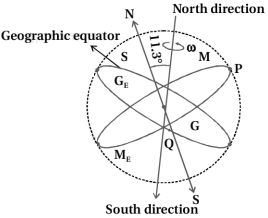
Consider the plane $S$ formed by the dipole axis and the axis of the Earth. Let $P$ be a point on the magnetic equator and in plane $S$. Let $Q$ be a point of intersection of the geographical and magnetic equators. Obtain the declination and dip angles at $P$ and $Q$.
Solution
(N/A) $1$. At point $P$: Since point $P$ lies in the plane $S$ formed by the dipole axis and the Earth's axis,the magnetic meridian coincides with the geographical meridian. Therefore,the declination at $P$ is $0^{\circ}$. Since $P$ lies on the magnetic equator,the angle of dip at $P$ is $0^{\circ}$.
$2$. At point $Q$: Point $Q$ is the intersection of the geographical and magnetic equators. The magnetic axis is tilted at an angle of $11.3^{\circ}$ with respect to the geographical axis. Consequently,the magnetic meridian at $Q$ makes an angle of $11.3^{\circ}$ with the geographical meridian. Therefore,the declination at $Q$ is $11.3^{\circ}$. Since $Q$ lies on the magnetic equator,the angle of dip at $Q$ is $0^{\circ}$.
$2$. At point $Q$: Point $Q$ is the intersection of the geographical and magnetic equators. The magnetic axis is tilted at an angle of $11.3^{\circ}$ with respect to the geographical axis. Consequently,the magnetic meridian at $Q$ makes an angle of $11.3^{\circ}$ with the geographical meridian. Therefore,the declination at $Q$ is $11.3^{\circ}$. Since $Q$ lies on the magnetic equator,the angle of dip at $Q$ is $0^{\circ}$.
0 likes
View Solution114
MediumMCQ
The horizontal component of the earth's magnetic field at any place is $0.36 \times 10^{-4} \; Wb/m^2$. If the angle of dip at that place is $60^{\circ}$,then the value of the vertical component of the earth's magnetic field will be ........ $\times 10^{-4} \; Wb/m^2$.
A
$0.12$
B
$0.40$
C
$0.24$
D
$0.622$
Solution
(D) The horizontal component of the earth's magnetic field is given by $B_H = 0.36 \times 10^{-4} \; Wb/m^2$.
The angle of dip is $\delta = 60^{\circ}$.
The vertical component $B_V$ is related to the horizontal component $B_H$ by the formula:
$B_V = B_H \tan \delta$
Substituting the given values:
$B_V = (0.36 \times 10^{-4}) \times \tan 60^{\circ}$
Since $\tan 60^{\circ} = \sqrt{3} \approx 1.732$:
$B_V = 0.36 \times 10^{-4} \times 1.732$
$B_V \approx 0.6235 \times 10^{-4} \; Wb/m^2$.
Rounding to the provided option,the value is $0.622 \times 10^{-4} \; Wb/m^2$.
The angle of dip is $\delta = 60^{\circ}$.
The vertical component $B_V$ is related to the horizontal component $B_H$ by the formula:
$B_V = B_H \tan \delta$
Substituting the given values:
$B_V = (0.36 \times 10^{-4}) \times \tan 60^{\circ}$
Since $\tan 60^{\circ} = \sqrt{3} \approx 1.732$:
$B_V = 0.36 \times 10^{-4} \times 1.732$
$B_V \approx 0.6235 \times 10^{-4} \; Wb/m^2$.
Rounding to the provided option,the value is $0.622 \times 10^{-4} \; Wb/m^2$.
0 likes
View Solution115
MediumMCQ
At an angle of $30^{\circ}$ to the magnetic meridian,the apparent dip is $45^{\circ}$. Find the true dip.
A
$\tan^{-1} \frac{1}{\sqrt{3}}$
B
$\tan^{-1} \frac{\sqrt{3}}{2}$
C
$\tan^{-1} \sqrt{3}$
D
$\tan^{-1} \frac{2}{\sqrt{3}}$
Solution
(B) The relationship between the true dip $(\delta)$ and the apparent dip $(\delta^{\prime})$ at an angle $\theta$ to the magnetic meridian is given by the formula: $\tan \delta^{\prime} = \frac{\tan \delta}{\cos \theta}$.
Rearranging for the true dip: $\tan \delta = \tan \delta^{\prime} \cos \theta$.
Given: $\delta^{\prime} = 45^{\circ}$ and $\theta = 30^{\circ}$.
Substituting the values: $\tan \delta = \tan 45^{\circ} \cos 30^{\circ}$.
Since $\tan 45^{\circ} = 1$ and $\cos 30^{\circ} = \frac{\sqrt{3}}{2}$,we get: $\tan \delta = 1 \times \frac{\sqrt{3}}{2} = \frac{\sqrt{3}}{2}$.
Therefore,the true dip is $\delta = \tan^{-1} \left( \frac{\sqrt{3}}{2} \right)$.
Rearranging for the true dip: $\tan \delta = \tan \delta^{\prime} \cos \theta$.
Given: $\delta^{\prime} = 45^{\circ}$ and $\theta = 30^{\circ}$.
Substituting the values: $\tan \delta = \tan 45^{\circ} \cos 30^{\circ}$.
Since $\tan 45^{\circ} = 1$ and $\cos 30^{\circ} = \frac{\sqrt{3}}{2}$,we get: $\tan \delta = 1 \times \frac{\sqrt{3}}{2} = \frac{\sqrt{3}}{2}$.
Therefore,the true dip is $\delta = \tan^{-1} \left( \frac{\sqrt{3}}{2} \right)$.
0 likes
View Solution116
MediumMCQ
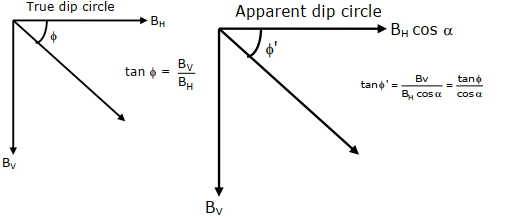
Choose the correct option regarding the relationship between true dip $(\phi)$ and apparent dip $(\phi^{\prime})$:
A
True dip is not mathematically related to apparent dip.
B
True dip is less than apparent dip.
C
True dip is always greater than the apparent dip.
D
True dip is always equal to apparent dip.
Solution
(B) The true dip $(\phi)$ is defined in the magnetic meridian,where the horizontal component of the Earth's magnetic field is $B_H$. The relation is given by $\tan \phi = \frac{B_V}{B_H}$,where $B_V$ is the vertical component.
When the dip circle is rotated by an angle $\alpha$ from the magnetic meridian,the horizontal component becomes $B_H \cos \alpha$,while the vertical component $B_V$ remains unchanged.
The apparent dip $(\phi^{\prime})$ is then given by $\tan \phi^{\prime} = \frac{B_V}{B_H \cos \alpha} = \frac{\tan \phi}{\cos \alpha}$.
Since $\cos \alpha \leq 1$,it follows that $\tan \phi^{\prime} \geq \tan \phi$. Because the tangent function is increasing in the range $[0, \pi/2]$,we have $\phi^{\prime} \geq \phi$.
Therefore,the true dip $(\phi)$ is always less than or equal to the apparent dip $(\phi^{\prime})$.
When the dip circle is rotated by an angle $\alpha$ from the magnetic meridian,the horizontal component becomes $B_H \cos \alpha$,while the vertical component $B_V$ remains unchanged.
The apparent dip $(\phi^{\prime})$ is then given by $\tan \phi^{\prime} = \frac{B_V}{B_H \cos \alpha} = \frac{\tan \phi}{\cos \alpha}$.
Since $\cos \alpha \leq 1$,it follows that $\tan \phi^{\prime} \geq \tan \phi$. Because the tangent function is increasing in the range $[0, \pi/2]$,we have $\phi^{\prime} \geq \phi$.
Therefore,the true dip $(\phi)$ is always less than or equal to the apparent dip $(\phi^{\prime})$.
0 likes
View Solution117
EasyMCQ
At a certain place,the angle of dip is $30^{\circ}$ and the horizontal component of the Earth's magnetic field is $0.5 \ G$. The Earth's total magnetic field (in $G$) at that place is:
A
$\frac{1}{\sqrt{3}}$
B
$\frac{1}{2}$
C
$\sqrt{3}$
D
$1$
Solution
(A) The horizontal component of the Earth's magnetic field is given by the formula: $B_H = B \cos \delta$,where $B$ is the total magnetic field and $\delta$ is the angle of dip.
Given: $B_H = 0.5 \ G$ and $\delta = 30^{\circ}$.
Substituting the values into the formula: $0.5 = B \cos 30^{\circ}$.
Since $\cos 30^{\circ} = \frac{\sqrt{3}}{2}$,we have $0.5 = B \times \frac{\sqrt{3}}{2}$.
Solving for $B$: $B = \frac{0.5 \times 2}{\sqrt{3}} = \frac{1}{\sqrt{3}} \ G$.
Given: $B_H = 0.5 \ G$ and $\delta = 30^{\circ}$.
Substituting the values into the formula: $0.5 = B \cos 30^{\circ}$.
Since $\cos 30^{\circ} = \frac{\sqrt{3}}{2}$,we have $0.5 = B \times \frac{\sqrt{3}}{2}$.
Solving for $B$: $B = \frac{0.5 \times 2}{\sqrt{3}} = \frac{1}{\sqrt{3}} \ G$.
0 likes
View Solution118
MediumMCQ
$A$ magnet hung at $45^{\circ}$ with the magnetic meridian makes an angle of $60^{\circ}$ with the horizontal. The actual value of the angle of dip is.
A
$\tan ^{-1}\left(\sqrt{\frac{3}{2}}\right)$
B
$\tan ^{-1}(\sqrt{6})$
C
$\tan ^{-1}\left(\sqrt{\frac{2}{3}}\right)$
D
$\tan ^{-1}\left(\sqrt{\frac{1}{2}}\right)$
Solution
(A) The apparent angle of dip $\theta^{\prime}$ in a plane making an angle $\alpha$ with the magnetic meridian is given by the relation: $\tan \theta^{\prime} = \frac{\tan \theta}{\cos \alpha}$,where $\theta$ is the actual angle of dip.
Given,$\theta^{\prime} = 60^{\circ}$ and $\alpha = 45^{\circ}$.
Substituting these values into the formula:
$\tan 60^{\circ} = \frac{\tan \theta}{\cos 45^{\circ}}$
$\sqrt{3} = \frac{\tan \theta}{1/\sqrt{2}}$
$\tan \theta = \sqrt{3} \times \frac{1}{\sqrt{2}} = \sqrt{\frac{3}{2}}$
Therefore,the actual angle of dip is $\theta = \tan ^{-1}\left(\sqrt{\frac{3}{2}}\right)$.
Given,$\theta^{\prime} = 60^{\circ}$ and $\alpha = 45^{\circ}$.
Substituting these values into the formula:
$\tan 60^{\circ} = \frac{\tan \theta}{\cos 45^{\circ}}$
$\sqrt{3} = \frac{\tan \theta}{1/\sqrt{2}}$
$\tan \theta = \sqrt{3} \times \frac{1}{\sqrt{2}} = \sqrt{\frac{3}{2}}$
Therefore,the actual angle of dip is $\theta = \tan ^{-1}\left(\sqrt{\frac{3}{2}}\right)$.
0 likes
View Solution119
EasyMCQ
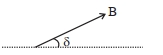
The vertical component of the earth's magnetic field is $6 \times 10^{-5} \text{ T}$ at a place where the angle of dip is $37^{\circ}$. The earth's resultant magnetic field at that place will be (Given $\tan 37^{\circ} = \frac{3}{4}$)
A
$8 \times 10^{-5} \text{ T}$
B
$6 \times 10^{-5} \text{ T}$
C
$5 \times 10^{-4} \text{ T}$
D
$1 \times 10^{-4} \text{ T}$
Solution
(D) The vertical component of the earth's magnetic field $(B_V)$ is related to the resultant magnetic field $(B)$ and the angle of dip $(\delta)$ by the formula:
$B_V = B \sin \delta$
Given that $B_V = 6 \times 10^{-5} \text{ T}$ and $\delta = 37^{\circ}$.
Since $\tan 37^{\circ} = \frac{3}{4}$,we can form a right-angled triangle with opposite side $3$ and adjacent side $4$. The hypotenuse is $\sqrt{3^2 + 4^2} = 5$.
Therefore,$\sin 37^{\circ} = \frac{3}{5}$.
Substituting the values into the formula:
$6 \times 10^{-5} = B \times \frac{3}{5}$
$B = \frac{6 \times 10^{-5} \times 5}{3}$
$B = 2 \times 10^{-5} \times 5$
$B = 10 \times 10^{-5} \text{ T} = 10^{-4} \text{ T}$
$B_V = B \sin \delta$
Given that $B_V = 6 \times 10^{-5} \text{ T}$ and $\delta = 37^{\circ}$.
Since $\tan 37^{\circ} = \frac{3}{4}$,we can form a right-angled triangle with opposite side $3$ and adjacent side $4$. The hypotenuse is $\sqrt{3^2 + 4^2} = 5$.
Therefore,$\sin 37^{\circ} = \frac{3}{5}$.
Substituting the values into the formula:
$6 \times 10^{-5} = B \times \frac{3}{5}$
$B = \frac{6 \times 10^{-5} \times 5}{3}$
$B = 2 \times 10^{-5} \times 5$
$B = 10 \times 10^{-5} \text{ T} = 10^{-4} \text{ T}$
0 likes
View Solution120
MediumMCQ
The Earth's magnetic field was flipped by $180^{\circ}$ a million years ago. This flip was relatively rapid and took $10^5 \, \text{years}$. Then, the average change in orientation per year during the flip was closest to ............ $s$.
A
$1$
B
$5$
C
$10$
D
$30$
Solution
(B) The total change in orientation is $180^{\circ}$.
Given that the duration of the flip is $10^5 \, \text{years}$.
The average change in orientation per year in degrees is $\frac{180^{\circ}}{10^5} = 1.8 \times 10^{-3} \, ^{\circ}/\text{year}$.
We know that $1^{\circ} = 60 \, \text{minutes}$ and $1 \, \text{minute} = 60 \, \text{seconds}$, so $1^{\circ} = 3600 \, \text{seconds}$.
Therefore, the average change in orientation per year in seconds is $1.8 \times 10^{-3} \times 3600 \, \text{s/year} = 6.48 \, \text{s/year}$.
Comparing this value with the given options, it is closest to $5 \, \text{s}$.
Given that the duration of the flip is $10^5 \, \text{years}$.
The average change in orientation per year in degrees is $\frac{180^{\circ}}{10^5} = 1.8 \times 10^{-3} \, ^{\circ}/\text{year}$.
We know that $1^{\circ} = 60 \, \text{minutes}$ and $1 \, \text{minute} = 60 \, \text{seconds}$, so $1^{\circ} = 3600 \, \text{seconds}$.
Therefore, the average change in orientation per year in seconds is $1.8 \times 10^{-3} \times 3600 \, \text{s/year} = 6.48 \, \text{s/year}$.
Comparing this value with the given options, it is closest to $5 \, \text{s}$.
0 likes
View Solution121
MediumMCQ
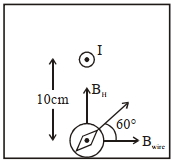
$A$ long vertical wire carries a steady current of $5.0 \, A$. $A$ sensitive magnetic compass is placed in a plane perpendicular to the wire and $10.0 \, cm$ south of it. It registers a deflection of $60^{\circ}$ north of east. The magnitude of the horizontal component of the earth's magnetic field is (permeability of free space is $4 \pi \times 10^{-7} \, N/A^2$):
A
$0.0 \, T$
B
$0.6 \times 10^{-5} \, T$
C
$1.0 \times 10^{-5} \, T$
D
$1.7 \times 10^{-5} \, T$
Solution
(B) The magnetic field due to a long straight wire at a distance $r$ is given by $B_{\text{wire}} = \frac{\mu_0 I}{2 \pi r}$.
Given $I = 5.0 \, A$ and $r = 10.0 \, cm = 0.1 \, m$.
$B_{\text{wire}} = \frac{4 \pi \times 10^{-7} \times 5.0}{2 \pi \times 0.1} = 1.0 \times 10^{-5} \, T$.
The compass needle aligns with the resultant magnetic field. The deflection is $60^{\circ}$ north of east. From the geometry of the vector addition,$\tan 60^{\circ} = \frac{B_{\text{wire}}}{B_H}$,where $B_H$ is the horizontal component of the earth's magnetic field.
Therefore,$B_H = \frac{B_{\text{wire}}}{\tan 60^{\circ}} = \frac{1.0 \times 10^{-5}}{\sqrt{3}} \approx 0.577 \times 10^{-5} \, T \approx 0.6 \times 10^{-5} \, T$.
Thus,option $(B)$ is the correct answer.
Given $I = 5.0 \, A$ and $r = 10.0 \, cm = 0.1 \, m$.
$B_{\text{wire}} = \frac{4 \pi \times 10^{-7} \times 5.0}{2 \pi \times 0.1} = 1.0 \times 10^{-5} \, T$.
The compass needle aligns with the resultant magnetic field. The deflection is $60^{\circ}$ north of east. From the geometry of the vector addition,$\tan 60^{\circ} = \frac{B_{\text{wire}}}{B_H}$,where $B_H$ is the horizontal component of the earth's magnetic field.
Therefore,$B_H = \frac{B_{\text{wire}}}{\tan 60^{\circ}} = \frac{1.0 \times 10^{-5}}{\sqrt{3}} \approx 0.577 \times 10^{-5} \, T \approx 0.6 \times 10^{-5} \, T$.
Thus,option $(B)$ is the correct answer.
0 likes
View Solution122
EasyMCQ
Planets producing larger magnetic field have larger
A
Rotational speed
B
Density
C
Mass
D
Size
Solution
(A) The correct answer is $A$.
According to the dynamo theory,the magnetic field of a planet is generated by the motion of molten,electrically conducting material in its core.
The strength of this magnetic field is directly related to the rotational speed of the planet.
Planets that rotate faster tend to have more vigorous convection and motion in their cores,which results in a stronger magnetic field.
Therefore,planets producing a larger magnetic field have a larger rotational speed.
According to the dynamo theory,the magnetic field of a planet is generated by the motion of molten,electrically conducting material in its core.
The strength of this magnetic field is directly related to the rotational speed of the planet.
Planets that rotate faster tend to have more vigorous convection and motion in their cores,which results in a stronger magnetic field.
Therefore,planets producing a larger magnetic field have a larger rotational speed.
0 likes
View Solution123
MediumMCQ
At a certain place,the vertical component of the Earth's magnetic field is $\sqrt{3}$ times the horizontal component of the Earth's magnetic field. If a magnetic needle is suspended freely in the air,then it will incline:
A
$30^{\circ}$ below horizontal
B
$60^{\circ}$ below horizontal
C
$30^{\circ}$ above horizontal
D
$45^{\circ}$ above horizontal
Solution
(B) The angle of dip (or inclination) $\theta$ is given by the relation $\tan \theta = \frac{B_V}{B_H}$,where $B_V$ is the vertical component and $B_H$ is the horizontal component of the Earth's magnetic field.
Given that $B_V = \sqrt{3} B_H$.
Substituting this into the formula,we get $\tan \theta = \frac{\sqrt{3} B_H}{B_H} = \sqrt{3}$.
Since $\tan 60^{\circ} = \sqrt{3}$,the angle of dip is $\theta = 60^{\circ}$.
Therefore,the magnetic needle will incline $60^{\circ}$ below the horizontal.
Given that $B_V = \sqrt{3} B_H$.
Substituting this into the formula,we get $\tan \theta = \frac{\sqrt{3} B_H}{B_H} = \sqrt{3}$.
Since $\tan 60^{\circ} = \sqrt{3}$,the angle of dip is $\theta = 60^{\circ}$.
Therefore,the magnetic needle will incline $60^{\circ}$ below the horizontal.
0 likes
View Solution124
MediumMCQ
The values of the apparent angles of dip in two planes at right angles to each other are $45^{\circ}$ and $30^{\circ}$ respectively. The true value of the angle of dip at the place is ............
A
$\cot^{-1}(1)$
B
$\cot^{-1}(2)$
C
$\cot^{-1}(3)$
D
$\cot^{-1}(4)$
Solution
(B) Let $\phi$ be the true angle of dip,and $\alpha_1$ and $\alpha_2$ be the apparent angles of dip in two mutually perpendicular planes.
The relationship between the true angle of dip and the apparent angles of dip is given by the formula:
$\cot^2 \phi = \cot^2 \alpha_1 + \cot^2 \alpha_2$
Given:
$\alpha_1 = 45^{\circ}$
$\alpha_2 = 30^{\circ}$
Substituting the values:
$\cot^2 \phi = \cot^2 45^{\circ} + \cot^2 30^{\circ}$
Since $\cot 45^{\circ} = 1$ and $\cot 30^{\circ} = \sqrt{3}$:
$\cot^2 \phi = (1)^2 + (\sqrt{3})^2$
$\cot^2 \phi = 1 + 3 = 4$
Taking the square root on both sides:
$\cot \phi = 2$
Therefore,the true angle of dip is:
$\phi = \cot^{-1}(2)$
The relationship between the true angle of dip and the apparent angles of dip is given by the formula:
$\cot^2 \phi = \cot^2 \alpha_1 + \cot^2 \alpha_2$
Given:
$\alpha_1 = 45^{\circ}$
$\alpha_2 = 30^{\circ}$
Substituting the values:
$\cot^2 \phi = \cot^2 45^{\circ} + \cot^2 30^{\circ}$
Since $\cot 45^{\circ} = 1$ and $\cot 30^{\circ} = \sqrt{3}$:
$\cot^2 \phi = (1)^2 + (\sqrt{3})^2$
$\cot^2 \phi = 1 + 3 = 4$
Taking the square root on both sides:
$\cot \phi = 2$
Therefore,the true angle of dip is:
$\phi = \cot^{-1}(2)$
0 likes
View Solution125
EasyMCQ
The value of horizontal component of earth's magnetic field at a place is $0.35 \times 10^{-4} \,T$. If the angle of dip is $60^{\circ}$,the value of vertical component of earth's magnetic field is nearly ............. $\times 10^{-4} \,T$.
A
$0.1$
B
$0.2$
C
$0.4$
D
$0.61$
Solution
(D) The horizontal component of the earth's magnetic field is given by $B_H = 0.35 \times 10^{-4} \,T$.
The angle of dip is $\delta = 60^{\circ}$.
The relationship between the vertical component $(B_V)$,horizontal component $(B_H)$,and the angle of dip $(\delta)$ is given by the formula: $B_V = B_H \tan \delta$.
Substituting the given values into the formula:
$B_V = (0.35 \times 10^{-4}) \times \tan(60^{\circ})$.
Since $\tan(60^{\circ}) = \sqrt{3} \approx 1.732$,we have:
$B_V = 0.35 \times 1.732 \times 10^{-4} \,T$.
$B_V \approx 0.6062 \times 10^{-4} \,T$.
Rounding to two decimal places,we get $B_V \approx 0.61 \times 10^{-4} \,T$.
Therefore,the correct option is $D$.
The angle of dip is $\delta = 60^{\circ}$.
The relationship between the vertical component $(B_V)$,horizontal component $(B_H)$,and the angle of dip $(\delta)$ is given by the formula: $B_V = B_H \tan \delta$.
Substituting the given values into the formula:
$B_V = (0.35 \times 10^{-4}) \times \tan(60^{\circ})$.
Since $\tan(60^{\circ}) = \sqrt{3} \approx 1.732$,we have:
$B_V = 0.35 \times 1.732 \times 10^{-4} \,T$.
$B_V \approx 0.6062 \times 10^{-4} \,T$.
Rounding to two decimal places,we get $B_V \approx 0.61 \times 10^{-4} \,T$.
Therefore,the correct option is $D$.
0 likes
View Solution126
MediumMCQ
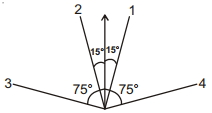
If the magnetic declination at a place is known to be $15^{\circ} \, E$,and a compass needle points as shown in the figure,then the geographic north is represented by which numbered direction?
A
$1$
B
$2$
C
$3$
D
$4$
Solution
(B) Magnetic declination is defined as the angle between the geographic meridian and the magnetic meridian at a given location.
Given that the declination is $15^{\circ} \, E$,it means the magnetic north is $15^{\circ}$ to the east of the geographic north.
In the provided figure,the compass needle points along the central arrow. Since the magnetic north is $15^{\circ}$ east of the geographic north,the geographic north must be $15^{\circ}$ to the west of the magnetic north (the direction of the compass needle).
Looking at the diagram,direction $2$ is $15^{\circ}$ to the left (west) of the central arrow (magnetic north).
Therefore,direction $2$ represents the geographic north.
Given that the declination is $15^{\circ} \, E$,it means the magnetic north is $15^{\circ}$ to the east of the geographic north.
In the provided figure,the compass needle points along the central arrow. Since the magnetic north is $15^{\circ}$ east of the geographic north,the geographic north must be $15^{\circ}$ to the west of the magnetic north (the direction of the compass needle).
Looking at the diagram,direction $2$ is $15^{\circ}$ to the left (west) of the central arrow (magnetic north).
Therefore,direction $2$ represents the geographic north.
0 likes
View Solution127
MediumMCQ
$A$ compass needle oscillates $20$ times per minute at a place where the dip is $30^{\circ}$ and $30$ times per minute where the dip is $60^{\circ}$. The ratio of total magnetic field due to the earth at the two places respectively is $\frac{4}{\sqrt{x}}$. The value of $x$ is $............$.
A
$244$
B
$242$
C
$245$
D
$243$
Solution
(D) The frequency of oscillation $f$ of a magnetic needle in a magnetic field is given by $f \propto \sqrt{B_H}$,where $B_H$ is the horizontal component of the Earth's magnetic field.
Given $B_H = B \cos \theta$,where $B$ is the total magnetic field and $\theta$ is the angle of dip.
Thus,$f \propto \sqrt{B \cos \theta}$.
Let $f_1 = 20 \text{ oscillations/min}$ at $\theta_1 = 30^{\circ}$ and $f_2 = 30 \text{ oscillations/min}$ at $\theta_2 = 60^{\circ}$.
$\frac{f_1}{f_2} = \sqrt{\frac{B_1 \cos \theta_1}{B_2 \cos \theta_2}}$
$\frac{20}{30} = \sqrt{\frac{B_1 \cos 30^{\circ}}{B_2 \cos 60^{\circ}}}$
$\frac{2}{3} = \sqrt{\frac{B_1 (\sqrt{3}/2)}{B_2 (1/2)}} = \sqrt{\frac{B_1 \sqrt{3}}{B_2}}$
Squaring both sides: $\frac{4}{9} = \frac{B_1 \sqrt{3}}{B_2} \Rightarrow \frac{B_1}{B_2} = \frac{4}{9\sqrt{3}} = \frac{4}{\sqrt{81 \times 3}} = \frac{4}{\sqrt{243}}$.
Comparing this with $\frac{4}{\sqrt{x}}$,we get $x = 243$.
Given $B_H = B \cos \theta$,where $B$ is the total magnetic field and $\theta$ is the angle of dip.
Thus,$f \propto \sqrt{B \cos \theta}$.
Let $f_1 = 20 \text{ oscillations/min}$ at $\theta_1 = 30^{\circ}$ and $f_2 = 30 \text{ oscillations/min}$ at $\theta_2 = 60^{\circ}$.
$\frac{f_1}{f_2} = \sqrt{\frac{B_1 \cos \theta_1}{B_2 \cos \theta_2}}$
$\frac{20}{30} = \sqrt{\frac{B_1 \cos 30^{\circ}}{B_2 \cos 60^{\circ}}}$
$\frac{2}{3} = \sqrt{\frac{B_1 (\sqrt{3}/2)}{B_2 (1/2)}} = \sqrt{\frac{B_1 \sqrt{3}}{B_2}}$
Squaring both sides: $\frac{4}{9} = \frac{B_1 \sqrt{3}}{B_2} \Rightarrow \frac{B_1}{B_2} = \frac{4}{9\sqrt{3}} = \frac{4}{\sqrt{81 \times 3}} = \frac{4}{\sqrt{243}}$.
Comparing this with $\frac{4}{\sqrt{x}}$,we get $x = 243$.
0 likes
View Solution128
DifficultMCQ
The horizontal component of Earth's magnetic field at a place is $3.5 \times 10^{-5} \,T$. $A$ very long straight conductor carrying a current of $\sqrt{2} \,A$ in the direction from South-East to North-West is placed. The force per unit length experienced by the conductor is $..............$ $\times 10^{-6} \,N/m$.
A
$35$
B
$15$
C
$74$
D
$64$
Solution
(A) The horizontal component of the Earth's magnetic field is $B_H = 3.5 \times 10^{-5} \,T$.
The current in the conductor is $i = \sqrt{2} \,A$.
The conductor is placed from South-East to North-West,which makes an angle of $\theta = 45^\circ$ with the horizontal magnetic field (North-South direction).
The force per unit length on a current-carrying conductor is given by $\frac{F}{\ell} = i B_H \sin \theta$.
Substituting the values: $\frac{F}{\ell} = \sqrt{2} \times (3.5 \times 10^{-5}) \times \sin(45^\circ)$.
Since $\sin(45^\circ) = \frac{1}{\sqrt{2}}$,we get $\frac{F}{\ell} = \sqrt{2} \times 3.5 \times 10^{-5} \times \frac{1}{\sqrt{2}} = 3.5 \times 10^{-5} \,N/m$.
Converting to the required format: $3.5 \times 10^{-5} = 35 \times 10^{-6} \,N/m$.
Therefore,the value is $35$.
The current in the conductor is $i = \sqrt{2} \,A$.
The conductor is placed from South-East to North-West,which makes an angle of $\theta = 45^\circ$ with the horizontal magnetic field (North-South direction).
The force per unit length on a current-carrying conductor is given by $\frac{F}{\ell} = i B_H \sin \theta$.
Substituting the values: $\frac{F}{\ell} = \sqrt{2} \times (3.5 \times 10^{-5}) \times \sin(45^\circ)$.
Since $\sin(45^\circ) = \frac{1}{\sqrt{2}}$,we get $\frac{F}{\ell} = \sqrt{2} \times 3.5 \times 10^{-5} \times \frac{1}{\sqrt{2}} = 3.5 \times 10^{-5} \,N/m$.
Converting to the required format: $3.5 \times 10^{-5} = 35 \times 10^{-6} \,N/m$.
Therefore,the value is $35$.
0 likes
View Solution129
EasyMCQ
If the angle of dip at places $A$ and $B$ are $30^{\circ}$ and $45^{\circ}$ respectively,the ratio of the horizontal component of the Earth's magnetic field at $A$ to that at $B$ will be.
$[\sin 45^{\circ}=\cos 45^{\circ}=\frac{1}{\sqrt{2}}, \quad \sin 30^{\circ}=\frac{1}{2}, \quad \cos 30^{\circ}=\frac{\sqrt{3}}{2}]$
$[\sin 45^{\circ}=\cos 45^{\circ}=\frac{1}{\sqrt{2}}, \quad \sin 30^{\circ}=\frac{1}{2}, \quad \cos 30^{\circ}=\frac{\sqrt{3}}{2}]$
A
$\sqrt{2}: 1$
B
$1: \sqrt{2}$
C
$\sqrt{2}: \sqrt{3}$
D
$\sqrt{3}: \sqrt{2}$
Solution
(D) The horizontal component of the Earth's magnetic field is given by the formula $H = B_e \cos \delta$,where $B_e$ is the total magnetic field of the Earth and $\delta$ is the angle of dip.
At place $A$,the angle of dip $\delta_A = 30^{\circ}$. Therefore,the horizontal component $H_A = B_e \cos 30^{\circ}$.
At place $B$,the angle of dip $\delta_B = 45^{\circ}$. Therefore,the horizontal component $H_B = B_e \cos 45^{\circ}$.
The ratio of the horizontal component at $A$ to that at $B$ is given by:
$\frac{H_A}{H_B} = \frac{B_e \cos 30^{\circ}}{B_e \cos 45^{\circ}} = \frac{\cos 30^{\circ}}{\cos 45^{\circ}}$
Substituting the values: $\frac{H_A}{H_B} = \frac{\sqrt{3}/2}{1/\sqrt{2}} = \frac{\sqrt{3}}{2} \times \sqrt{2} = \frac{\sqrt{3}}{\sqrt{2}}$.
Thus,the ratio is $\sqrt{3}: \sqrt{2}$.
At place $A$,the angle of dip $\delta_A = 30^{\circ}$. Therefore,the horizontal component $H_A = B_e \cos 30^{\circ}$.
At place $B$,the angle of dip $\delta_B = 45^{\circ}$. Therefore,the horizontal component $H_B = B_e \cos 45^{\circ}$.
The ratio of the horizontal component at $A$ to that at $B$ is given by:
$\frac{H_A}{H_B} = \frac{B_e \cos 30^{\circ}}{B_e \cos 45^{\circ}} = \frac{\cos 30^{\circ}}{\cos 45^{\circ}}$
Substituting the values: $\frac{H_A}{H_B} = \frac{\sqrt{3}/2}{1/\sqrt{2}} = \frac{\sqrt{3}}{2} \times \sqrt{2} = \frac{\sqrt{3}}{\sqrt{2}}$.
Thus,the ratio is $\sqrt{3}: \sqrt{2}$.
0 likes
View Solution130
EasyMCQ
At a certain place on the surface of the earth,the horizontal component of the earth's magnetic field is the same as the vertical component of the earth's magnetic field. What will be the angle of dip at that place (in $^{\circ}$)?
A
$60$
B
$45$
C
$30$
D
$90$
Solution
(B) The angle of dip $(I)$ is defined by the relationship between the vertical component $(Z_E)$ and the horizontal component $(H_E)$ of the earth's magnetic field as:
$\tan I = \frac{Z_E}{H_E}$
Given that the horizontal component is equal to the vertical component,we have:
$Z_E = H_E$
Substituting this into the formula:
$\tan I = \frac{Z_E}{Z_E} = 1$
Therefore,the angle of dip is:
$I = \tan^{-1}(1) = 45^{\circ}$
$\tan I = \frac{Z_E}{H_E}$
Given that the horizontal component is equal to the vertical component,we have:
$Z_E = H_E$
Substituting this into the formula:
$\tan I = \frac{Z_E}{Z_E} = 1$
Therefore,the angle of dip is:
$I = \tan^{-1}(1) = 45^{\circ}$
0 likes
View Solution131
EasyMCQ
In India,the magnetic declination at Delhi is . . . . . . .
A
$0^{\circ} 58^{\prime} W$
B
$0^{\circ} 41^{\prime} W$
C
$0^{\circ} 58^{\prime} E$
D
$0^{\circ} 41^{\prime} E$
Solution
(D) The magnetic declination at a specific location is the angle between the geographic meridian and the magnetic meridian. According to standard geographical and magnetic data for India,the magnetic declination at Delhi is approximately $0^{\circ} 41^{\prime} E$.
0 likes
View Solution132
EasyMCQ
The relation between $Z_E, H_E$,and $B_E$ is . . . . . . .
A
$B_E = \sqrt{Z_E^2 + H_E^2}$
B
$B_E = Z_E \cdot H_E$
C
$B_E = \frac{Z_E}{H_E}$
D
$B_E = \frac{H_E}{Z_E}$
Solution
(A) In the context of the Earth's magnetic field,$B_E$ represents the total magnetic field intensity,$H_E$ represents the horizontal component,and $Z_E$ represents the vertical component.
According to the vector resolution of the Earth's magnetic field,the total magnetic field $B_E$ is the vector sum of its horizontal and vertical components.
Since these components are perpendicular to each other,the magnitude is given by the Pythagorean theorem: $B_E = \sqrt{Z_E^2 + H_E^2}$.
According to the vector resolution of the Earth's magnetic field,the total magnetic field $B_E$ is the vector sum of its horizontal and vertical components.
Since these components are perpendicular to each other,the magnitude is given by the Pythagorean theorem: $B_E = \sqrt{Z_E^2 + H_E^2}$.
0 likes
View Solution133
EasyMCQ
At a place on Earth,the vertical component of Earth's magnetic field is $\sqrt{3}$ times its horizontal component. The angle of dip at this place is . . . . . . . (in $^{\circ}$)
A
$30$
B
$60$
C
$45$
D
$0$
Solution
(B) The angle of dip $(I)$ is defined by the relationship between the vertical component $(Z_E)$ and the horizontal component $(H_E)$ of the Earth's magnetic field as:
$\tan I = \frac{Z_E}{H_E}$
Given that the vertical component is $\sqrt{3}$ times the horizontal component:
$Z_E = \sqrt{3} H_E$
Substituting this into the formula:
$\tan I = \frac{\sqrt{3} H_E}{H_E} = \sqrt{3}$
Since $\tan 60^{\circ} = \sqrt{3}$,we have:
$I = 60^{\circ}$
$\tan I = \frac{Z_E}{H_E}$
Given that the vertical component is $\sqrt{3}$ times the horizontal component:
$Z_E = \sqrt{3} H_E$
Substituting this into the formula:
$\tan I = \frac{\sqrt{3} H_E}{H_E} = \sqrt{3}$
Since $\tan 60^{\circ} = \sqrt{3}$,we have:
$I = 60^{\circ}$
0 likes
View Solution134
EasyMCQ
The Earth's magnetic field at a place on the magnetic equator of the Earth is $0.5 \times 10^{-4} \text{ T}$. Consider the radius of the Earth at that place as $6400 \text{ km}$. Then the magnetic dipole moment of the Earth is . . . . . . $\text{Am}^2$. (Given: $\mu_0 = 4\pi \times 10^{-7} \text{ T m A}^{-1}$)
A
$1.05 \times 10^{23}$
B
$1.31 \times 10^{23}$
C
$1.15 \times 10^{23}$
D
$1.62 \times 10^{23}$
Solution
(B) The magnetic field $B$ at the magnetic equator of the Earth is given by the formula:
$B = \frac{\mu_0}{4\pi} \frac{m}{R^3}$
where $m$ is the magnetic dipole moment and $R$ is the radius of the Earth.
Given values:
$B = 0.5 \times 10^{-4} \text{ T}$
$R = 6400 \text{ km} = 6.4 \times 10^6 \text{ m}$
$\frac{\mu_0}{4\pi} = 10^{-7} \text{ T m A}^{-1}$
Substituting these values into the formula:
$0.5 \times 10^{-4} = 10^{-7} \times \frac{m}{(6.4 \times 10^6)^3}$
$m = \frac{0.5 \times 10^{-4} \times (6.4 \times 10^6)^3}{10^{-7}}$
$m = 0.5 \times 10^3 \times (6.4)^3 \times 10^{18}$
$m = 0.5 \times 262.144 \times 10^{21}$
$m = 131.072 \times 10^{21} = 1.31 \times 10^{23} \text{ Am}^2$
Thus,the magnetic dipole moment of the Earth is $1.31 \times 10^{23} \text{ Am}^2$.
$B = \frac{\mu_0}{4\pi} \frac{m}{R^3}$
where $m$ is the magnetic dipole moment and $R$ is the radius of the Earth.
Given values:
$B = 0.5 \times 10^{-4} \text{ T}$
$R = 6400 \text{ km} = 6.4 \times 10^6 \text{ m}$
$\frac{\mu_0}{4\pi} = 10^{-7} \text{ T m A}^{-1}$
Substituting these values into the formula:
$0.5 \times 10^{-4} = 10^{-7} \times \frac{m}{(6.4 \times 10^6)^3}$
$m = \frac{0.5 \times 10^{-4} \times (6.4 \times 10^6)^3}{10^{-7}}$
$m = 0.5 \times 10^3 \times (6.4)^3 \times 10^{18}$
$m = 0.5 \times 262.144 \times 10^{21}$
$m = 131.072 \times 10^{21} = 1.31 \times 10^{23} \text{ Am}^2$
Thus,the magnetic dipole moment of the Earth is $1.31 \times 10^{23} \text{ Am}^2$.
0 likes
View Solution135
EasyMCQ
At the place where the angle of dip is $60^{\circ}$,what is the relation between the vertical component $Z_{E}$ and the horizontal component $H_{E}$ of the Earth's magnetic field?
A
$Z_{E} = H_{E}$
B
$Z_{E} = \sqrt{3} H_{E}$
C
$H_{E} = \sqrt{3} Z_{E}$
D
$H_{E} = \frac{\sqrt{3}}{2} Z_{E}$
Solution
(B) The angle of dip $(I)$ is defined by the ratio of the vertical component $(Z_{E})$ to the horizontal component $(H_{E})$ of the Earth's magnetic field as follows:
$\tan I = \frac{Z_{E}}{H_{E}}$
Given that the angle of dip $I = 60^{\circ}$,we substitute this value into the equation:
$\tan 60^{\circ} = \frac{Z_{E}}{H_{E}}$
Since $\tan 60^{\circ} = \sqrt{3}$,we have:
$\sqrt{3} = \frac{Z_{E}}{H_{E}}$
Therefore,the relationship is:
$Z_{E} = \sqrt{3} H_{E}$
$\tan I = \frac{Z_{E}}{H_{E}}$
Given that the angle of dip $I = 60^{\circ}$,we substitute this value into the equation:
$\tan 60^{\circ} = \frac{Z_{E}}{H_{E}}$
Since $\tan 60^{\circ} = \sqrt{3}$,we have:
$\sqrt{3} = \frac{Z_{E}}{H_{E}}$
Therefore,the relationship is:
$Z_{E} = \sqrt{3} H_{E}$
0 likes
View Solution136
EasyMCQ
At a given place on the Earth,the angle between the Magnetic Meridian and the Geographic Meridian is called . . . . . . .
A
Magnetic latitude
B
Magnetic dip
C
Magnetic longitude
D
Magnetic declination
Solution
(D) The angle between the Geographic Meridian and the Magnetic Meridian at any point on the Earth's surface is known as the Magnetic Declination or simply Declination.
It represents the deviation of the magnetic compass needle from the true geographic north.
It represents the deviation of the magnetic compass needle from the true geographic north.
0 likes
View Solution137
EasyMCQ
The horizontal component of Earth's magnetic field at a place is $3 \times 10^{-5} \,T$. If the angle of dip at that place is $45^{\circ}$,the resultant magnetic field at that place is
A
$3 \times 10^{-5} \,T$
B
$\frac{3}{\sqrt{2}} \times 10^{-5} \,T$
C
$3 / 2 \sqrt{3} \times 10^{-5} \,T$
D
$3 \sqrt{2} \times 10^{-5} \,T$
Solution
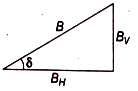
(D) Given:
Horizontal component of Earth's magnetic field,$B_H = 3 \times 10^{-5} \,T$
Angle of dip,$\delta = 45^{\circ}$
We know that the horizontal component $B_H$ is related to the resultant magnetic field $B$ by the formula:
$B_H = B \cos \delta$
Therefore,the resultant magnetic field $B$ is given by:
$B = \frac{B_H}{\cos \delta}$
Substituting the given values:
$B = \frac{3 \times 10^{-5}}{\cos 45^{\circ}}$
Since $\cos 45^{\circ} = \frac{1}{\sqrt{2}}$,we have:
$B = \frac{3 \times 10^{-5}}{1 / \sqrt{2}}$
$B = 3 \sqrt{2} \times 10^{-5} \,T$
Horizontal component of Earth's magnetic field,$B_H = 3 \times 10^{-5} \,T$
Angle of dip,$\delta = 45^{\circ}$
We know that the horizontal component $B_H$ is related to the resultant magnetic field $B$ by the formula:
$B_H = B \cos \delta$
Therefore,the resultant magnetic field $B$ is given by:
$B = \frac{B_H}{\cos \delta}$
Substituting the given values:
$B = \frac{3 \times 10^{-5}}{\cos 45^{\circ}}$
Since $\cos 45^{\circ} = \frac{1}{\sqrt{2}}$,we have:
$B = \frac{3 \times 10^{-5}}{1 / \sqrt{2}}$
$B = 3 \sqrt{2} \times 10^{-5} \,T$
0 likes
View Solution138
EasyMCQ
Which of the following statements proves that Earth has a magnetic field?
A
Earth is a planet rotating about the North-South axis.
B
Earth is surrounded by ionosphere.
C
$A$ large quantity of iron-ore is found in the Earth.
D
The intensity of cosmic rays (stream of charged particles) is more at the poles than at the equator.
Solution
(D) The intensity of the cosmic ray stream of charged particles is greater at the poles than at the equator because the Earth's magnetic field is strongest at the poles.
Charged particles (cosmic rays) are deflected by the Earth's magnetic field due to the Lorentz force,$F = q(v \times B)$.
This deflection is more pronounced near the equator,where the magnetic field lines are horizontal,causing many charged particles to be diverted away.
At the poles,the magnetic field lines are vertical,allowing more charged particles to reach the surface.
This variation in the intensity of cosmic rays provides direct evidence that the Earth possesses a magnetic field.
Charged particles (cosmic rays) are deflected by the Earth's magnetic field due to the Lorentz force,$F = q(v \times B)$.
This deflection is more pronounced near the equator,where the magnetic field lines are horizontal,causing many charged particles to be diverted away.
At the poles,the magnetic field lines are vertical,allowing more charged particles to reach the surface.
This variation in the intensity of cosmic rays provides direct evidence that the Earth possesses a magnetic field.
0 likes
View Solution139
EasyMCQ
Earth's magnetic field always has a horizontal component except at
A
equator
B
magnetic poles
C
a latitude of $60^{\circ}$
D
an altitude of $60^{\circ}$
Solution
(B) At the magnetic poles,the angle of dip (inclination),$\delta = 90^{\circ}$.
The horizontal component of the Earth's magnetic field $(B_{H})$ is given by the formula:
$B_{H} = B \cos \delta$
where $B$ is the net magnetic field of the Earth.
Substituting the value of $\delta$ at the poles:
$B_{H} = B \cos 90^{\circ}$
Since $\cos 90^{\circ} = 0$,we get:
$B_{H} = 0$
Therefore,at the magnetic poles,the horizontal component of the Earth's magnetic field is zero.
The horizontal component of the Earth's magnetic field $(B_{H})$ is given by the formula:
$B_{H} = B \cos \delta$
where $B$ is the net magnetic field of the Earth.
Substituting the value of $\delta$ at the poles:
$B_{H} = B \cos 90^{\circ}$
Since $\cos 90^{\circ} = 0$,we get:
$B_{H} = 0$
Therefore,at the magnetic poles,the horizontal component of the Earth's magnetic field is zero.
0 likes
View Solution140
EasyMCQ
The strength of Earth's magnetic field is:
A
constant everywhere
B
Zero everywhere
C
Having very high value
D
varying from place to place on Earth's surface
Solution
(D) The strength of the Earth's magnetic field is not uniform across the globe.
It varies from place to place on the Earth's surface.
This variation occurs because the strength of a magnetic field is directly related to the density of magnetic field lines at a particular location.
Since the magnetic field lines of the Earth are not distributed with uniform density,the magnetic field strength changes depending on the geographic location.
It varies from place to place on the Earth's surface.
This variation occurs because the strength of a magnetic field is directly related to the density of magnetic field lines at a particular location.
Since the magnetic field lines of the Earth are not distributed with uniform density,the magnetic field strength changes depending on the geographic location.
0 likes
View Solution141
EasyMCQ
At a certain place,the horizontal component of the Earth's magnetic field is $3.0 \ G$ and the angle of dip at that place is $30^{\circ}$. The magnetic field of the Earth at that location is: (in $G$)
A
$0.5$
B
$5.1$
C
$3.5$
D
$6.0$
Solution
(C) Given: Horizontal component of Earth's magnetic field $(B_H)$ = $3.0 \ G$. Angle of dip $(\delta)$ = $30^{\circ}$.
We know that the horizontal component of the Earth's magnetic field is given by the relation: $B_H = B \cos \delta$,where $B$ is the total magnetic field of the Earth.
Substituting the given values:
$3.0 = B \cos 30^{\circ}$
$3.0 = B \times \frac{\sqrt{3}}{2}$
$B = \frac{3.0 \times 2}{\sqrt{3}}$
$B = \frac{6.0}{1.732} \approx 3.464 \ G$
Rounding to one decimal place,we get $B \approx 3.5 \ G$.
Therefore,the magnetic field of the Earth at that location is $3.5 \ G$.
We know that the horizontal component of the Earth's magnetic field is given by the relation: $B_H = B \cos \delta$,where $B$ is the total magnetic field of the Earth.
Substituting the given values:
$3.0 = B \cos 30^{\circ}$
$3.0 = B \times \frac{\sqrt{3}}{2}$
$B = \frac{3.0 \times 2}{\sqrt{3}}$
$B = \frac{6.0}{1.732} \approx 3.464 \ G$
Rounding to one decimal place,we get $B \approx 3.5 \ G$.
Therefore,the magnetic field of the Earth at that location is $3.5 \ G$.
0 likes
View Solution142
EasyMCQ
If the vertical component of the Earth's magnetic field is $0.45 \ G$ at a location,and the angle of dip is $60^{\circ}$,then the magnetic field of the Earth at that location is: (in $G$)
A
$0.26$
B
$0.52$
C
$0.3$
D
$0.7$
Solution
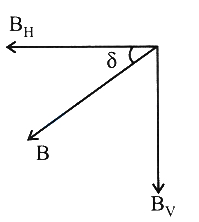
(B) Given:
Vertical component of Earth's magnetic field,$B_v = 0.45 \ G$
Angle of dip,$\delta = 60^{\circ}$
We know that the vertical component of the Earth's magnetic field is given by the formula:
$B_v = B \sin \delta$
Where $B$ is the total magnetic field of the Earth.
Rearranging the formula to solve for $B$:
$B = \frac{B_v}{\sin \delta}$
Substituting the given values:
$B = \frac{0.45}{\sin 60^{\circ}}$
Since $\sin 60^{\circ} = \frac{\sqrt{3}}{2} \approx 0.866$:
$B = \frac{0.45}{0.866} \approx 0.5196 \ G$
Rounding to two decimal places,we get:
$B \approx 0.52 \ G$
Vertical component of Earth's magnetic field,$B_v = 0.45 \ G$
Angle of dip,$\delta = 60^{\circ}$
We know that the vertical component of the Earth's magnetic field is given by the formula:
$B_v = B \sin \delta$
Where $B$ is the total magnetic field of the Earth.
Rearranging the formula to solve for $B$:
$B = \frac{B_v}{\sin \delta}$
Substituting the given values:
$B = \frac{0.45}{\sin 60^{\circ}}$
Since $\sin 60^{\circ} = \frac{\sqrt{3}}{2} \approx 0.866$:
$B = \frac{0.45}{0.866} \approx 0.5196 \ G$
Rounding to two decimal places,we get:
$B \approx 0.52 \ G$
0 likes
View Solution143
EasyMCQ
At a place,the horizontal component of the Earth's magnetic field is $3 \times 10^{-5} \ T$ and the magnetic declination is $30^{\circ}$. $A$ compass needle of magnetic moment $18 \ Am^2$ pointing towards geographic north at this place experiences a torque of:
A
$36 \times 10^{-5} \ Nm$
B
$18 \times 10^{-5} \ Nm$
C
$54 \times 10^{-5} \ Nm$
D
$27 \times 10^{-5} \ Nm$
Solution
(D) Given: Horizontal component of Earth's magnetic field $B_{H} = 3 \times 10^{-5} \ T$.
Magnetic declination $\phi = 30^{\circ}$.
Magnetic moment of the compass needle $M = 18 \ Am^2$.
The torque $\tau$ experienced by a magnetic dipole in a magnetic field is given by the formula $\tau = M B_{H} \sin \phi$.
Substituting the given values:
$\tau = 18 \times (3 \times 10^{-5}) \times \sin 30^{\circ}$
Since $\sin 30^{\circ} = 0.5$,
$\tau = 18 \times 3 \times 10^{-5} \times 0.5$
$\tau = 54 \times 10^{-5} \times 0.5$
$\tau = 27 \times 10^{-5} \ Nm$.
Magnetic declination $\phi = 30^{\circ}$.
Magnetic moment of the compass needle $M = 18 \ Am^2$.
The torque $\tau$ experienced by a magnetic dipole in a magnetic field is given by the formula $\tau = M B_{H} \sin \phi$.
Substituting the given values:
$\tau = 18 \times (3 \times 10^{-5}) \times \sin 30^{\circ}$
Since $\sin 30^{\circ} = 0.5$,
$\tau = 18 \times 3 \times 10^{-5} \times 0.5$
$\tau = 54 \times 10^{-5} \times 0.5$
$\tau = 27 \times 10^{-5} \ Nm$.
0 likes
View Solution144
DifficultMCQ
$A$ magnetic needle free to rotate in a vertical plane parallel to the magnetic meridian has its north tip pointing down at $30^{\circ}$ with the horizontal. The horizontal component of the earth's magnetic field at the place is $0.3 \ G$. Then the magnitude of the earth's magnetic field at the location is
A
$\frac{\sqrt{3}}{5} \ G$
B
$\sqrt{3} \ G$
C
$\frac{20}{\sqrt{3}} \ G$
D
$\frac{2}{\sqrt{3}} \ G$
Solution
(A) The angle of dip $\delta$ is the angle that the total magnetic field of the earth makes with the horizontal direction. Here,$\delta = 30^{\circ}$.
Given,the horizontal component of the earth's magnetic field is $B_H = 0.3 \ G$.
The relationship between the total magnetic field $B$,the horizontal component $B_H$,and the angle of dip $\delta$ is given by $B_H = B \cos \delta$.
Substituting the given values: $0.3 = B \cos 30^{\circ}$.
Since $\cos 30^{\circ} = \frac{\sqrt{3}}{2}$,we have $0.3 = B \times \frac{\sqrt{3}}{2}$.
Solving for $B$: $B = \frac{0.3 \times 2}{\sqrt{3}} = \frac{0.6}{\sqrt{3}} = \frac{0.6 \times \sqrt{3}}{3} = 0.2 \sqrt{3} \ G$.
Alternatively,$B = \frac{0.6}{\sqrt{3}} = \frac{6}{10 \sqrt{3}} = \frac{3}{5 \sqrt{3}} = \frac{\sqrt{3}}{5} \ G$.
Given,the horizontal component of the earth's magnetic field is $B_H = 0.3 \ G$.
The relationship between the total magnetic field $B$,the horizontal component $B_H$,and the angle of dip $\delta$ is given by $B_H = B \cos \delta$.
Substituting the given values: $0.3 = B \cos 30^{\circ}$.
Since $\cos 30^{\circ} = \frac{\sqrt{3}}{2}$,we have $0.3 = B \times \frac{\sqrt{3}}{2}$.
Solving for $B$: $B = \frac{0.3 \times 2}{\sqrt{3}} = \frac{0.6}{\sqrt{3}} = \frac{0.6 \times \sqrt{3}}{3} = 0.2 \sqrt{3} \ G$.
Alternatively,$B = \frac{0.6}{\sqrt{3}} = \frac{6}{10 \sqrt{3}} = \frac{3}{5 \sqrt{3}} = \frac{\sqrt{3}}{5} \ G$.
0 likes
View Solution145
MediumMCQ
The plane of a dip circle is set in the geographic meridian and the apparent dip is $\delta_1$. It is then set in a vertical plane perpendicular to the geographic meridian. The apparent dip angle is $\delta_2$. The declination $\theta$ at the place is
A
$\tan ^{-1}(\tan \delta_1 \tan \delta_2)$
B
$\tan ^{-1}(\tan \delta_1 + \tan \delta_2)$
C
$\tan ^{-1}(\frac{\tan \delta_1}{\tan \delta_2})$
D
$\tan ^{-1}(\tan \delta_1 - \tan \delta_2)$
Solution
(C) Let $\phi$ be the true dip angle and $\theta$ be the magnetic declination. When the dip circle is in the geographic meridian,the angle between the plane and the magnetic meridian is $\theta$. The apparent dip $\delta_1$ is given by $\tan \delta_1 = \frac{\tan \phi}{\cos \theta}$.
When the plane is perpendicular to the geographic meridian,the angle between the plane and the magnetic meridian is $(90^\circ - \theta)$. The apparent dip $\delta_2$ is given by $\tan \delta_2 = \frac{\tan \phi}{\cos(90^\circ - \theta)} = \frac{\tan \phi}{\sin \theta}$.
From these two equations,we have $\tan \phi = \tan \delta_1 \cos \theta$ and $\tan \phi = \tan \delta_2 \sin \theta$.
Equating the two expressions for $\tan \phi$: $\tan \delta_1 \cos \theta = \tan \delta_2 \sin \theta$.
Rearranging gives $\frac{\sin \theta}{\cos \theta} = \frac{\tan \delta_1}{\tan \delta_2}$,which implies $\tan \theta = \frac{\tan \delta_1}{\tan \delta_2}$.
Therefore,$\theta = \tan ^{-1}\left(\frac{\tan \delta_1}{\tan \delta_2}\right)$.
When the plane is perpendicular to the geographic meridian,the angle between the plane and the magnetic meridian is $(90^\circ - \theta)$. The apparent dip $\delta_2$ is given by $\tan \delta_2 = \frac{\tan \phi}{\cos(90^\circ - \theta)} = \frac{\tan \phi}{\sin \theta}$.
From these two equations,we have $\tan \phi = \tan \delta_1 \cos \theta$ and $\tan \phi = \tan \delta_2 \sin \theta$.
Equating the two expressions for $\tan \phi$: $\tan \delta_1 \cos \theta = \tan \delta_2 \sin \theta$.
Rearranging gives $\frac{\sin \theta}{\cos \theta} = \frac{\tan \delta_1}{\tan \delta_2}$,which implies $\tan \theta = \frac{\tan \delta_1}{\tan \delta_2}$.
Therefore,$\theta = \tan ^{-1}\left(\frac{\tan \delta_1}{\tan \delta_2}\right)$.
0 likes
View Solution146
EasyMCQ
If the angles of dip at two places are $30^{\circ}$ and $45^{\circ}$ respectively,then the ratio of horizontal components of earth's magnetic field at the two places will be
A
$\sqrt{3}: \sqrt{2}$
B
$1: \sqrt{2}$
C
$1: \sqrt{3}$
D
$1: 2$
Solution
(A) Let $B_e$ be the net magnetic field of the Earth at both locations. The horizontal component of the Earth's magnetic field $H$ is given by $H = B_e \cos \delta$,where $\delta$ is the angle of dip.
For the two places,the ratio of the horizontal components $H_1$ and $H_2$ is:
$\frac{H_1}{H_2} = \frac{B_e \cos \delta_1}{B_e \cos \delta_2} = \frac{\cos \delta_1}{\cos \delta_2}$
Given $\delta_1 = 30^{\circ}$ and $\delta_2 = 45^{\circ}$,we have:
$\frac{H_1}{H_2} = \frac{\cos 30^{\circ}}{\cos 45^{\circ}} = \frac{\sqrt{3}/2}{1/\sqrt{2}} = \frac{\sqrt{3}}{2} \times \sqrt{2} = \frac{\sqrt{3}}{\sqrt{2}}$
Therefore,the ratio $H_1: H_2 = \sqrt{3}: \sqrt{2}$.
For the two places,the ratio of the horizontal components $H_1$ and $H_2$ is:
$\frac{H_1}{H_2} = \frac{B_e \cos \delta_1}{B_e \cos \delta_2} = \frac{\cos \delta_1}{\cos \delta_2}$
Given $\delta_1 = 30^{\circ}$ and $\delta_2 = 45^{\circ}$,we have:
$\frac{H_1}{H_2} = \frac{\cos 30^{\circ}}{\cos 45^{\circ}} = \frac{\sqrt{3}/2}{1/\sqrt{2}} = \frac{\sqrt{3}}{2} \times \sqrt{2} = \frac{\sqrt{3}}{\sqrt{2}}$
Therefore,the ratio $H_1: H_2 = \sqrt{3}: \sqrt{2}$.
0 likes
View Solution147
DifficultMCQ
The plane of a dip circle is set in the geographic meridian and the apparent dip is $\delta_1$. It is then set in a vertical plane perpendicular to the geographic meridian. The apparent dip angle is $\delta_2$. The declination $\theta$ at the place is
A
$\theta=\operatorname{Tan}^{-1}\left(\tan \delta_1 \cdot \tan \delta_2\right)$
B
$\theta=\operatorname{Tan}^{-1}\left(\tan \delta_1+\tan \delta_2\right)$
C
$\theta=\operatorname{Tan}^{-1}\left(\frac{\tan \delta_1}{\tan \delta_2}\right)$
D
$\theta=\operatorname{Tan}^{-1}\left(\tan \delta_1-\tan \delta_2\right)$
Solution
(C) Let $\delta$ be the true angle of dip and $\theta$ be the magnetic declination.
When the dip circle is in the magnetic meridian,the apparent dip is $\delta$.
However,the problem states the plane is set in the geographic meridian. Let $\theta$ be the angle between the geographic meridian and the magnetic meridian.
The apparent dip $\delta_1$ in a plane making an angle $\theta$ with the magnetic meridian is given by $\tan \delta_1 = \frac{\tan \delta}{\cos \theta}$.
The apparent dip $\delta_2$ in a plane perpendicular to the first (making an angle $90^\circ - \theta$ with the magnetic meridian) is given by $\tan \delta_2 = \frac{\tan \delta}{\cos(90^\circ - \theta)} = \frac{\tan \delta}{\sin \theta}$.
From these two equations,we have $\tan \delta = \tan \delta_1 \cos \theta$ and $\tan \delta = \tan \delta_2 \sin \theta$.
Equating them: $\tan \delta_1 \cos \theta = \tan \delta_2 \sin \theta$.
Therefore,$\frac{\sin \theta}{\cos \theta} = \frac{\tan \delta_1}{\tan \delta_2}$,which implies $\tan \theta = \frac{\tan \delta_1}{\tan \delta_2}$.
Thus,$\theta = \operatorname{Tan}^{-1}\left(\frac{\tan \delta_1}{\tan \delta_2}\right)$.
When the dip circle is in the magnetic meridian,the apparent dip is $\delta$.
However,the problem states the plane is set in the geographic meridian. Let $\theta$ be the angle between the geographic meridian and the magnetic meridian.
The apparent dip $\delta_1$ in a plane making an angle $\theta$ with the magnetic meridian is given by $\tan \delta_1 = \frac{\tan \delta}{\cos \theta}$.
The apparent dip $\delta_2$ in a plane perpendicular to the first (making an angle $90^\circ - \theta$ with the magnetic meridian) is given by $\tan \delta_2 = \frac{\tan \delta}{\cos(90^\circ - \theta)} = \frac{\tan \delta}{\sin \theta}$.
From these two equations,we have $\tan \delta = \tan \delta_1 \cos \theta$ and $\tan \delta = \tan \delta_2 \sin \theta$.
Equating them: $\tan \delta_1 \cos \theta = \tan \delta_2 \sin \theta$.
Therefore,$\frac{\sin \theta}{\cos \theta} = \frac{\tan \delta_1}{\tan \delta_2}$,which implies $\tan \theta = \frac{\tan \delta_1}{\tan \delta_2}$.
Thus,$\theta = \operatorname{Tan}^{-1}\left(\frac{\tan \delta_1}{\tan \delta_2}\right)$.
0 likes
View Solution148
EasyMCQ
In the magnetic meridian of a certain place,the vertical component of the earth's magnetic field is $0.3464 \ G$ and the dip angle is $30^{\circ}$. The horizontal component of the earth's magnetic field at this location is (in $G$)
A
$0.4$
B
$0.6$
C
$0.7$
D
$0.8$
Solution
(B) The relationship between the vertical component $(B_V)$,horizontal component $(B_H)$,and the angle of dip $(\delta)$ is given by the formula: $\tan \delta = \frac{B_V}{B_H}$.
Given: $B_V = 0.3464 \ G$ and $\delta = 30^{\circ}$.
Rearranging the formula to solve for $B_H$: $B_H = \frac{B_V}{\tan \delta}$.
Substituting the values: $B_H = \frac{0.3464}{\tan 30^{\circ}}$.
Since $\tan 30^{\circ} = \frac{1}{\sqrt{3}} \approx 0.577$,we have $B_H = 0.3464 \times \sqrt{3}$.
Using $\sqrt{3} \approx 1.732$,we get $B_H = 0.3464 \times 1.732 \approx 0.6 \ G$.
Given: $B_V = 0.3464 \ G$ and $\delta = 30^{\circ}$.
Rearranging the formula to solve for $B_H$: $B_H = \frac{B_V}{\tan \delta}$.
Substituting the values: $B_H = \frac{0.3464}{\tan 30^{\circ}}$.
Since $\tan 30^{\circ} = \frac{1}{\sqrt{3}} \approx 0.577$,we have $B_H = 0.3464 \times \sqrt{3}$.
Using $\sqrt{3} \approx 1.732$,we get $B_H = 0.3464 \times 1.732 \approx 0.6 \ G$.
0 likes
View Solution149
EasyMCQ
At a certain place,the horizontal component of earth's magnetic field is $\frac{1}{\sqrt{3}}$ times the vertical component. The angle of dip at that place is (in $^{\circ}$)
A
$30$
B
$45$
C
$60$
D
$90$
Solution
(C) The angle of dip $\theta$ is related to the vertical component $B_V$ and the horizontal component $B_H$ of the Earth's magnetic field by the formula: $\tan \theta = \frac{B_V}{B_H}$.
Given that the horizontal component $B_H$ is $\frac{1}{\sqrt{3}}$ times the vertical component $B_V$,we have $B_H = \frac{1}{\sqrt{3}} B_V$.
Substituting this into the formula: $\tan \theta = \frac{B_V}{\frac{1}{\sqrt{3}} B_V} = \sqrt{3}$.
Since $\tan 60^{\circ} = \sqrt{3}$,the angle of dip is $\theta = 60^{\circ}$.
Given that the horizontal component $B_H$ is $\frac{1}{\sqrt{3}}$ times the vertical component $B_V$,we have $B_H = \frac{1}{\sqrt{3}} B_V$.
Substituting this into the formula: $\tan \theta = \frac{B_V}{\frac{1}{\sqrt{3}} B_V} = \sqrt{3}$.
Since $\tan 60^{\circ} = \sqrt{3}$,the angle of dip is $\theta = 60^{\circ}$.
0 likes
View SolutionMagnetism and Matter — Earth Magnetism · Frequently Asked Questions
1Are these Magnetism and Matter questions useful for JEE and NEET?
Yes. All questions in this section are mapped to JEE Main and NEET exam patterns. Previous year questions from JEE Main, NEET, GUJCET and state-level exams are included with full solutions.
2Can I switch to Hindi or Gujarati for these questions?
Yes. Use the language tabs in the hero section or the sidebar to view the same questions and solutions in English, Hindi or Gujarati.
3How do I generate a question paper from this subtopic?
Use the Vedclass Exam Paper Generator — select the chapter and subtopic, set difficulty, and generate Sets A, B, C, D automatically. First 3 chapters of every subject are free.
Vedclass Products
For Students
Vedclass Test Series
Mock tests in real JEE/NEET style with performance analysis. 5-day free trial.
Start Free TrialFor Teachers
Exam Paper Generator
Generate Set A/B/C/D papers from this chapter in 2 minutes. 3 chapters free.
Try FreeFor Institutes
Online Exam Module
Live online exams with unlimited students, 360° analytics & white-label branding.
See DemoFor Teachers & Institutes
Generate a Magnetism and Matter Exam Paper in 2 Minutes
Select subtopic & difficulty — Sets A, B, C, D auto-generated with No Repeat logic.
First 3 chapters of every subject are free — no payment required.