
A English
Electric potential Questions in English
Class 12 Physics · Electric Potential and Capacitance · Electric potential
432+
Questions
English
Language
100%
With Solutions
Showing 23 of 432 questions in English
401
EasyMCQ
$A$ hollow metal sphere of radius $15 \,cm$ is charged such that the potential on its surface is $20 \,V$. Then, the potential at the centre of the sphere is (in $V$)
A
$0$
B
$20$
C
$10$
D
$15$
Solution
(B) The radius of the hollow metallic sphere is $R = 15 \,cm$. The potential on the surface is $V_{surface} = 20 \,V$.
For a hollow metallic sphere, the electric field inside the sphere is zero $(E = 0)$.
Since the electric field is the negative gradient of the potential $(E = -dV/dr)$, if $E = 0$, then the potential $V$ must be constant throughout the interior of the sphere.
Therefore, the potential at the centre of the sphere is equal to the potential on its surface.
Thus, the potential at the centre is $20 \,V$.
For a hollow metallic sphere, the electric field inside the sphere is zero $(E = 0)$.
Since the electric field is the negative gradient of the potential $(E = -dV/dr)$, if $E = 0$, then the potential $V$ must be constant throughout the interior of the sphere.
Therefore, the potential at the centre of the sphere is equal to the potential on its surface.
Thus, the potential at the centre is $20 \,V$.
0 likes
View Solution402
EasyMCQ
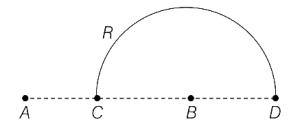
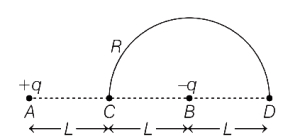
Electric charges $+q$ and $-q$ are placed at points $A$ and $B$ respectively,which are at a distance of $2L$ apart. If $C$ is the midpoint between $A$ and $B$,then the work done in moving a charge $+Q$ along the semi-circle $CRD$ is
A
$\frac{qQ}{2\pi\varepsilon_0 L}$
B
$\frac{qQ}{6\pi\varepsilon_0 L}$
C
$-\frac{qQ}{6\pi\varepsilon_0 L}$
D
$\frac{qQ}{4\pi\varepsilon_0 L}$
Solution
(C) The given situation is shown in the figure. The distance $AC = CB = L$. The point $D$ is at a distance $L$ from $B$,so $AD = 3L$ and $BD = L$.
Work done $W$ in moving a charge $Q$ along the semi-circle $CRD$ is equal to the change in potential energy of the system.
$W = U_{\text{final}} - U_{\text{initial}}$
$U_{\text{initial}}$ is the potential energy when $Q$ is at $C$:
$U_{\text{initial}} = \frac{kqQ}{AC} + \frac{k(-q)Q}{BC} + \frac{kq(-q)}{AB} = \frac{kqQ}{L} - \frac{kqQ}{L} - \frac{kq^2}{2L} = -\frac{kq^2}{2L}$
$U_{\text{final}}$ is the potential energy when $Q$ is at $D$:
$U_{\text{final}} = \frac{kqQ}{AD} + \frac{k(-q)Q}{BD} + \frac{kq(-q)}{AB} = \frac{kqQ}{3L} - \frac{kqQ}{L} - \frac{kq^2}{2L} = -\frac{2kqQ}{3L} - \frac{kq^2}{2L}$
$W = (-\frac{2kqQ}{3L} - \frac{kq^2}{2L}) - (-\frac{kq^2}{2L}) = -\frac{2kqQ}{3L}$
Substituting $k = \frac{1}{4\pi\varepsilon_0}$:
$W = -\frac{2}{3} \cdot \frac{1}{4\pi\varepsilon_0} \cdot \frac{qQ}{L} = -\frac{qQ}{6\pi\varepsilon_0 L}$
Work done $W$ in moving a charge $Q$ along the semi-circle $CRD$ is equal to the change in potential energy of the system.
$W = U_{\text{final}} - U_{\text{initial}}$
$U_{\text{initial}}$ is the potential energy when $Q$ is at $C$:
$U_{\text{initial}} = \frac{kqQ}{AC} + \frac{k(-q)Q}{BC} + \frac{kq(-q)}{AB} = \frac{kqQ}{L} - \frac{kqQ}{L} - \frac{kq^2}{2L} = -\frac{kq^2}{2L}$
$U_{\text{final}}$ is the potential energy when $Q$ is at $D$:
$U_{\text{final}} = \frac{kqQ}{AD} + \frac{k(-q)Q}{BD} + \frac{kq(-q)}{AB} = \frac{kqQ}{3L} - \frac{kqQ}{L} - \frac{kq^2}{2L} = -\frac{2kqQ}{3L} - \frac{kq^2}{2L}$
$W = (-\frac{2kqQ}{3L} - \frac{kq^2}{2L}) - (-\frac{kq^2}{2L}) = -\frac{2kqQ}{3L}$
Substituting $k = \frac{1}{4\pi\varepsilon_0}$:
$W = -\frac{2}{3} \cdot \frac{1}{4\pi\varepsilon_0} \cdot \frac{qQ}{L} = -\frac{qQ}{6\pi\varepsilon_0 L}$
0 likes
View Solution403
MediumMCQ
$A$ spherical drop of liquid carrying charge $Q$ has potential $V_0$ at its surface. If two drops of same charge and radius combine to form a single spherical drop,then the potential at the surface of the new drop is (Assume $V=0$ at infinity.)
A
$2^{1/3} V_0$
B
$4^{1/3} V_0$
C
$6^{1/3} V_0$
D
$2^{-1/3} V_0$
Solution
(B) Given,charge of each small spherical drop $= Q$ and potential at its surface $= V_0$. Let $r$ be the radius of each small drop. The potential is given by $V_0 = \frac{1}{4 \pi \varepsilon_0} \frac{Q}{r}$.
When two such drops combine to form a single large drop of radius $R$,the volume is conserved: $\frac{4}{3} \pi R^3 = 2 \times \frac{4}{3} \pi r^3$,which gives $R^3 = 2r^3$ or $R = 2^{1/3} r$.
The total charge on the new large drop is $Q' = Q + Q = 2Q$.
The potential at the surface of the new drop is $V' = \frac{1}{4 \pi \varepsilon_0} \frac{Q'}{R} = \frac{1}{4 \pi \varepsilon_0} \frac{2Q}{2^{1/3} r}$.
Substituting $V_0 = \frac{1}{4 \pi \varepsilon_0} \frac{Q}{r}$,we get $V' = V_0 \times \frac{2}{2^{1/3}} = V_0 \times 2^{1 - 1/3} = V_0 \times 2^{2/3} = V_0 \times (2^2)^{1/3} = 4^{1/3} V_0$.
When two such drops combine to form a single large drop of radius $R$,the volume is conserved: $\frac{4}{3} \pi R^3 = 2 \times \frac{4}{3} \pi r^3$,which gives $R^3 = 2r^3$ or $R = 2^{1/3} r$.
The total charge on the new large drop is $Q' = Q + Q = 2Q$.
The potential at the surface of the new drop is $V' = \frac{1}{4 \pi \varepsilon_0} \frac{Q'}{R} = \frac{1}{4 \pi \varepsilon_0} \frac{2Q}{2^{1/3} r}$.
Substituting $V_0 = \frac{1}{4 \pi \varepsilon_0} \frac{Q}{r}$,we get $V' = V_0 \times \frac{2}{2^{1/3}} = V_0 \times 2^{1 - 1/3} = V_0 \times 2^{2/3} = V_0 \times (2^2)^{1/3} = 4^{1/3} V_0$.
0 likes
View Solution404
MediumMCQ
Two isolated,concentric,conducting spherical shells have radii $R$ and $2R$ and uniform charges $q$ and $2q$ respectively. If $V_1$ and $V_2$ are potentials at points located at distances $3R$ and $\frac{R}{2}$,respectively,from the centre of the shells,then the ratio $\left(\frac{V_2}{V_1}\right)$ will be:
A
$2$
B
$1$
C
$\frac{1}{2}$
D
$0$
Solution
(A) The potential $V$ at a distance $r$ from the center of a conducting spherical shell of radius $R$ with charge $Q$ is given by:
$V = \frac{kQ}{R}$ for $r \le R$ and $V = \frac{kQ}{r}$ for $r > R$,where $k = \frac{1}{4\pi\epsilon_0}$.
For the point at distance $r = \frac{R}{2}$ (inside both shells):
The potential $V_2$ is the sum of potentials due to both shells:
$V_2 = \frac{kq}{R} + \frac{k(2q)}{2R} = \frac{kq}{R} + \frac{kq}{R} = \frac{2kq}{R}$.
For the point at distance $r = 3R$ (outside both shells):
The potential $V_1$ is the sum of potentials due to both shells treated as point charges at the center:
$V_1 = \frac{kq}{3R} + \frac{k(2q)}{3R} = \frac{3kq}{3R} = \frac{kq}{R}$.
Therefore,the ratio $\frac{V_2}{V_1} = \frac{2kq/R}{kq/R} = 2$.
$V = \frac{kQ}{R}$ for $r \le R$ and $V = \frac{kQ}{r}$ for $r > R$,where $k = \frac{1}{4\pi\epsilon_0}$.
For the point at distance $r = \frac{R}{2}$ (inside both shells):
The potential $V_2$ is the sum of potentials due to both shells:
$V_2 = \frac{kq}{R} + \frac{k(2q)}{2R} = \frac{kq}{R} + \frac{kq}{R} = \frac{2kq}{R}$.
For the point at distance $r = 3R$ (outside both shells):
The potential $V_1$ is the sum of potentials due to both shells treated as point charges at the center:
$V_1 = \frac{kq}{3R} + \frac{k(2q)}{3R} = \frac{3kq}{3R} = \frac{kq}{R}$.
Therefore,the ratio $\frac{V_2}{V_1} = \frac{2kq/R}{kq/R} = 2$.
0 likes
View Solution405
MediumMCQ
Two concentric hollow spherical shells have radii $r$ and $R$ $(R \gg r)$. $A$ charge $Q$ is distributed on them such that the surface charge densities are equal. The electric potential at the centre is
A
$\frac{Q(R+r)}{4 \pi \varepsilon_0(R^2+r^2)}$
B
$\frac{Q(R^2+r^2)}{4 \pi \varepsilon_0(R+r)}$
C
$\frac{Q}{4 \pi \varepsilon_0(R+r)}$
D
zero
Solution
(A) Let the surface charge density be $\sigma$. The total charge $Q$ is distributed on the two shells such that $\sigma_1 = \sigma_2 = \sigma$.
Total charge $Q = \sigma(4 \pi r^2) + \sigma(4 \pi R^2) = 4 \pi \sigma(r^2 + R^2)$.
Thus,$\sigma = \frac{Q}{4 \pi (r^2 + R^2)}$.
The electric potential at the centre of a spherical shell of radius $a$ with charge $q$ is $V = \frac{1}{4 \pi \varepsilon_0} \frac{q}{a}$.
For the two shells,the potential at the centre is the sum of the potentials due to each shell:
$V = \frac{1}{4 \pi \varepsilon_0} \left( \frac{q_1}{r} + \frac{q_2}{R} \right) = \frac{1}{4 \pi \varepsilon_0} \left( \frac{\sigma 4 \pi r^2}{r} + \frac{\sigma 4 \pi R^2}{R} \right)$.
$V = \frac{\sigma}{\varepsilon_0} (r + R)$.
Substituting the value of $\sigma$:
$V = \frac{Q}{4 \pi \varepsilon_0 (r^2 + R^2)} (r + R) = \frac{Q(R+r)}{4 \pi \varepsilon_0 (R^2+r^2)}$.
Total charge $Q = \sigma(4 \pi r^2) + \sigma(4 \pi R^2) = 4 \pi \sigma(r^2 + R^2)$.
Thus,$\sigma = \frac{Q}{4 \pi (r^2 + R^2)}$.
The electric potential at the centre of a spherical shell of radius $a$ with charge $q$ is $V = \frac{1}{4 \pi \varepsilon_0} \frac{q}{a}$.
For the two shells,the potential at the centre is the sum of the potentials due to each shell:
$V = \frac{1}{4 \pi \varepsilon_0} \left( \frac{q_1}{r} + \frac{q_2}{R} \right) = \frac{1}{4 \pi \varepsilon_0} \left( \frac{\sigma 4 \pi r^2}{r} + \frac{\sigma 4 \pi R^2}{R} \right)$.
$V = \frac{\sigma}{\varepsilon_0} (r + R)$.
Substituting the value of $\sigma$:
$V = \frac{Q}{4 \pi \varepsilon_0 (r^2 + R^2)} (r + R) = \frac{Q(R+r)}{4 \pi \varepsilon_0 (R^2+r^2)}$.
0 likes
View Solution406
DifficultMCQ
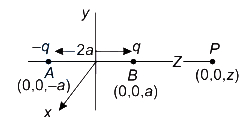
Two point charges $-q$ and $+q$ are located at points $(0,0,-a)$ and $(0,0, a)$ respectively. The electric potential at a point $(0,0, z)$,where $z>a$ is
A
$\frac{q a}{4 \pi \varepsilon_0 z^2}$
B
$\frac{q}{4 \pi \varepsilon_0 a}$
C
$\frac{2 q a}{4 \pi \varepsilon_0(z^2-a^2)}$
D
$\frac{2 q a}{4 \pi \varepsilon_0(z^2+a^2)}$
Solution
(C) The potential at point $P(0,0,z)$ due to the charge $+q$ located at $(0,0,a)$ is:
$V_1 = \frac{1}{4 \pi \varepsilon_0} \cdot \frac{q}{(z-a)}$
The potential at point $P(0,0,z)$ due to the charge $-q$ located at $(0,0,-a)$ is:
$V_2 = \frac{1}{4 \pi \varepsilon_0} \cdot \frac{-q}{(z-(-a))} = \frac{1}{4 \pi \varepsilon_0} \cdot \frac{-q}{(z+a)}$
The total electric potential $V$ at point $P$ is the algebraic sum of the potentials due to individual charges:
$V = V_1 + V_2$
$V = \frac{1}{4 \pi \varepsilon_0} \left[ \frac{q}{z-a} - \frac{q}{z+a} \right]$
$V = \frac{q}{4 \pi \varepsilon_0} \left[ \frac{(z+a) - (z-a)}{(z-a)(z+a)} \right]$
$V = \frac{q}{4 \pi \varepsilon_0} \left[ \frac{z+a-z+a}{z^2-a^2} \right]$
$V = \frac{q}{4 \pi \varepsilon_0} \left[ \frac{2a}{z^2-a^2} \right]$
$V = \frac{2qa}{4 \pi \varepsilon_0(z^2-a^2)}$
$V_1 = \frac{1}{4 \pi \varepsilon_0} \cdot \frac{q}{(z-a)}$
The potential at point $P(0,0,z)$ due to the charge $-q$ located at $(0,0,-a)$ is:
$V_2 = \frac{1}{4 \pi \varepsilon_0} \cdot \frac{-q}{(z-(-a))} = \frac{1}{4 \pi \varepsilon_0} \cdot \frac{-q}{(z+a)}$
The total electric potential $V$ at point $P$ is the algebraic sum of the potentials due to individual charges:
$V = V_1 + V_2$
$V = \frac{1}{4 \pi \varepsilon_0} \left[ \frac{q}{z-a} - \frac{q}{z+a} \right]$
$V = \frac{q}{4 \pi \varepsilon_0} \left[ \frac{(z+a) - (z-a)}{(z-a)(z+a)} \right]$
$V = \frac{q}{4 \pi \varepsilon_0} \left[ \frac{z+a-z+a}{z^2-a^2} \right]$
$V = \frac{q}{4 \pi \varepsilon_0} \left[ \frac{2a}{z^2-a^2} \right]$
$V = \frac{2qa}{4 \pi \varepsilon_0(z^2-a^2)}$
0 likes
View Solution407
DifficultMCQ
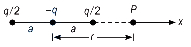
Along the $x$-axis,three charges $\frac{q}{2}, -q$ and $\frac{q}{2}$ are placed at $x=0, x=a$ and $x=2a$ respectively. The resultant electric potential at a point $P$ located at a distance $r$ from the charge $-q$ $(r > a)$ is ($\varepsilon_0$ is the permittivity of free space):
A
$\frac{q a}{4 \pi \varepsilon_0 r^2}$
B
$\frac{q a^2}{4 \pi \varepsilon_0 r^3}$
C
$\frac{q(a^2/4)}{4 \pi \varepsilon_0 r^3}$
D
$\frac{q}{4 \pi \varepsilon_0 r}$
Solution
(B) The charges are located at $x=0$ $(q/2)$,$x=a$ $(-q)$,and $x=2a$ $(q/2)$. Point $P$ is at distance $r$ from the charge $-q$ at $x=a$. Since $P$ is on the $x$-axis at distance $r$ from $x=a$,its coordinate is $x = a + r$.
The potential $V$ at point $P$ is the sum of potentials due to individual charges:
$V = \frac{1}{4 \pi \varepsilon_0} \left[ \frac{q/2}{r+a} - \frac{q}{r} + \frac{q/2}{r-a} \right]$
Factoring out $q/2$:
$V = \frac{q}{8 \pi \varepsilon_0} \left[ \frac{1}{r+a} - \frac{2}{r} + \frac{1}{r-a} \right]$
Combining the terms:
$V = \frac{q}{8 \pi \varepsilon_0} \left[ \frac{r(r-a) - 2(r^2-a^2) + r(r+a)}{r(r^2-a^2)} \right]$
Simplifying the numerator:
$V = \frac{q}{8 \pi \varepsilon_0} \left[ \frac{r^2 - ar - 2r^2 + 2a^2 + r^2 + ar}{r(r^2-a^2)} \right] = \frac{q}{8 \pi \varepsilon_0} \left[ \frac{2a^2}{r(r^2-a^2)} \right]$
Since $r \gg a$,we can approximate $r^2 - a^2 \approx r^2$:
$V \approx \frac{q}{8 \pi \varepsilon_0} \cdot \frac{2a^2}{r^3} = \frac{q a^2}{4 \pi \varepsilon_0 r^3}$
The potential $V$ at point $P$ is the sum of potentials due to individual charges:
$V = \frac{1}{4 \pi \varepsilon_0} \left[ \frac{q/2}{r+a} - \frac{q}{r} + \frac{q/2}{r-a} \right]$
Factoring out $q/2$:
$V = \frac{q}{8 \pi \varepsilon_0} \left[ \frac{1}{r+a} - \frac{2}{r} + \frac{1}{r-a} \right]$
Combining the terms:
$V = \frac{q}{8 \pi \varepsilon_0} \left[ \frac{r(r-a) - 2(r^2-a^2) + r(r+a)}{r(r^2-a^2)} \right]$
Simplifying the numerator:
$V = \frac{q}{8 \pi \varepsilon_0} \left[ \frac{r^2 - ar - 2r^2 + 2a^2 + r^2 + ar}{r(r^2-a^2)} \right] = \frac{q}{8 \pi \varepsilon_0} \left[ \frac{2a^2}{r(r^2-a^2)} \right]$
Since $r \gg a$,we can approximate $r^2 - a^2 \approx r^2$:
$V \approx \frac{q}{8 \pi \varepsilon_0} \cdot \frac{2a^2}{r^3} = \frac{q a^2}{4 \pi \varepsilon_0 r^3}$
0 likes
View Solution408
DifficultMCQ
Along the $X$-axis,three charges $\frac{q}{2}, -q$ and $\frac{q}{2}$ are placed at $x=0, x=a$ and $x=2a$ respectively. The resultant electric potential at $x=a+r$ (if $a << r$) is: ($\varepsilon_0$ is the permittivity of free space)
A
$\frac{q a}{4 \pi \varepsilon_0 r^2}$
B
$\frac{q a^2}{4 \pi \varepsilon_0 r^3}$
C
$\frac{q(a^2/4)}{4 \pi \varepsilon_0 r^3}$
D
$\frac{q}{4 \pi \varepsilon_0 r}$
Solution
(B) The electric potential $V$ at a point due to a system of charges is the algebraic sum of the potentials due to individual charges.
Let the point $P$ be at $x = a + r$. The distances of the charges from $P$ are:
For charge $\frac{q}{2}$ at $x=0$: distance $d_1 = (a+r) - 0 = r+a$
For charge $-q$ at $x=a$: distance $d_2 = (a+r) - a = r$
For charge $\frac{q}{2}$ at $x=2a$: distance $d_3 = |(a+r) - 2a| = |r-a| = r-a$ (since $r >> a$)
The total potential $V_P$ is:
$V_P = \frac{1}{4 \pi \varepsilon_0} \left[ \frac{q/2}{r+a} - \frac{q}{r} + \frac{q/2}{r-a} \right]$
$V_P = \frac{q}{4 \pi \varepsilon_0} \left[ \frac{1}{2(r+a)} - \frac{1}{r} + \frac{1}{2(r-a)} \right]$
$V_P = \frac{q}{4 \pi \varepsilon_0} \left[ \frac{r(r-a) - 2(r^2-a^2) + r(r+a)}{2r(r^2-a^2)} \right]$
$V_P = \frac{q}{4 \pi \varepsilon_0} \left[ \frac{r^2 - ar - 2r^2 + 2a^2 + r^2 + ar}{2r(r^2-a^2)} \right]$
$V_P = \frac{q}{4 \pi \varepsilon_0} \left[ \frac{2a^2}{2r(r^2-a^2)} \right] = \frac{q a^2}{4 \pi \varepsilon_0 r(r^2-a^2)}$
Since $r >> a$,we have $r^2 - a^2 \approx r^2$.
Therefore,$V_P = \frac{q a^2}{4 \pi \varepsilon_0 r^3}$.
Let the point $P$ be at $x = a + r$. The distances of the charges from $P$ are:
For charge $\frac{q}{2}$ at $x=0$: distance $d_1 = (a+r) - 0 = r+a$
For charge $-q$ at $x=a$: distance $d_2 = (a+r) - a = r$
For charge $\frac{q}{2}$ at $x=2a$: distance $d_3 = |(a+r) - 2a| = |r-a| = r-a$ (since $r >> a$)
The total potential $V_P$ is:
$V_P = \frac{1}{4 \pi \varepsilon_0} \left[ \frac{q/2}{r+a} - \frac{q}{r} + \frac{q/2}{r-a} \right]$
$V_P = \frac{q}{4 \pi \varepsilon_0} \left[ \frac{1}{2(r+a)} - \frac{1}{r} + \frac{1}{2(r-a)} \right]$
$V_P = \frac{q}{4 \pi \varepsilon_0} \left[ \frac{r(r-a) - 2(r^2-a^2) + r(r+a)}{2r(r^2-a^2)} \right]$
$V_P = \frac{q}{4 \pi \varepsilon_0} \left[ \frac{r^2 - ar - 2r^2 + 2a^2 + r^2 + ar}{2r(r^2-a^2)} \right]$
$V_P = \frac{q}{4 \pi \varepsilon_0} \left[ \frac{2a^2}{2r(r^2-a^2)} \right] = \frac{q a^2}{4 \pi \varepsilon_0 r(r^2-a^2)}$
Since $r >> a$,we have $r^2 - a^2 \approx r^2$.
Therefore,$V_P = \frac{q a^2}{4 \pi \varepsilon_0 r^3}$.

0 likes
View Solution409
DifficultMCQ
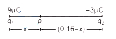
Two electric charges of $9 \mu C$ and $-3 \mu C$ are placed $0.16 \ m$ apart in air. There will be a point $P$ on the line joining the two charges and between them where the electric potential is zero. The distance of $P$ from the $9 \mu C$ charge is: (in $m$)
A
$0.14$
B
$0.12$
C
$0.08$
D
$0.06$
Solution
(B) Let $q_1 = 9 \mu C$ and $q_2 = -3 \mu C$. The distance between them is $d = 0.16 \ m$.
Let the point $P$ be at a distance $x$ from $q_1$. Then the distance of $P$ from $q_2$ is $(0.16 - x)$.
The electric potential $V$ at point $P$ due to both charges is the algebraic sum of the potentials:
$V = V_1 + V_2 = 0$
$\frac{1}{4 \pi \epsilon_0} \frac{q_1}{x} + \frac{1}{4 \pi \epsilon_0} \frac{q_2}{0.16 - x} = 0$
$\frac{9 \times 10^{-6}}{x} = - \frac{-3 \times 10^{-6}}{0.16 - x}$
$\frac{9}{x} = \frac{3}{0.16 - x}$
$3(0.16 - x) = x$
$0.48 - 3x = x$
$4x = 0.48$
$x = 0.12 \ m$
Thus,the distance of $P$ from the $9 \mu C$ charge is $0.12 \ m$.
Let the point $P$ be at a distance $x$ from $q_1$. Then the distance of $P$ from $q_2$ is $(0.16 - x)$.
The electric potential $V$ at point $P$ due to both charges is the algebraic sum of the potentials:
$V = V_1 + V_2 = 0$
$\frac{1}{4 \pi \epsilon_0} \frac{q_1}{x} + \frac{1}{4 \pi \epsilon_0} \frac{q_2}{0.16 - x} = 0$
$\frac{9 \times 10^{-6}}{x} = - \frac{-3 \times 10^{-6}}{0.16 - x}$
$\frac{9}{x} = \frac{3}{0.16 - x}$
$3(0.16 - x) = x$
$0.48 - 3x = x$
$4x = 0.48$
$x = 0.12 \ m$
Thus,the distance of $P$ from the $9 \mu C$ charge is $0.12 \ m$.
0 likes
View Solution410
MediumMCQ
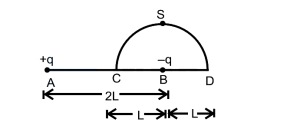
Two charges $+q$ and $-q$ are placed at points $A$ and $B$ respectively, which are at a distance $2L$ apart. $C$ is the midpoint of $A$ and $B$. The work done in moving a charge $+Q$ along the semicircle $CSD$ $(W_1)$ and along the line $CBD$ $(W_2)$ are:
A
$\frac{-Qq}{6 \pi \epsilon_0 L}, \frac{-Qq}{6 \pi \epsilon_0 L}$
B
$\frac{qQ}{4 \pi \epsilon_0 L}, \frac{qQ}{4 \pi \epsilon_0 L}$
C
$\frac{-Qq}{6 \pi \epsilon_0 L}, \frac{-Qq}{12 \pi \epsilon_0 L}$
D
$\frac{qQ}{4 \pi \epsilon_0 L}, 0$
Solution
(A) The work done in moving a charge $Q$ in an electrostatic field is path-independent and depends only on the initial and final positions.
Work done $W = Q(V_{final} - V_{initial})$.
Here, the initial point is $C$ and the final point is $D$.
Distance $AC = L$, $CB = L$, $BD = L$.
Potential at $C$ $(V_C)$: $V_C = \frac{1}{4 \pi \epsilon_0} [\frac{q}{AC} + \frac{-q}{CB}] = \frac{1}{4 \pi \epsilon_0} [\frac{q}{L} - \frac{q}{L}] = 0$.
Potential at $D$ $(V_D)$: $V_D = \frac{1}{4 \pi \epsilon_0} [\frac{q}{AD} + \frac{-q}{BD}] = \frac{1}{4 \pi \epsilon_0} [\frac{q}{3L} - \frac{q}{L}] = \frac{1}{4 \pi \epsilon_0} [\frac{q - 3q}{3L}] = \frac{-2q}{12 \pi \epsilon_0 L} = \frac{-q}{6 \pi \epsilon_0 L}$.
Since the electrostatic force is conservative, the work done along any path from $C$ to $D$ is the same:
$W_1 = W_2 = Q(V_D - V_C) = Q(\frac{-q}{6 \pi \epsilon_0 L} - 0) = \frac{-Qq}{6 \pi \epsilon_0 L}$.
Thus, $W_1 = W_2 = \frac{-Qq}{6 \pi \epsilon_0 L}$.
Work done $W = Q(V_{final} - V_{initial})$.
Here, the initial point is $C$ and the final point is $D$.
Distance $AC = L$, $CB = L$, $BD = L$.
Potential at $C$ $(V_C)$: $V_C = \frac{1}{4 \pi \epsilon_0} [\frac{q}{AC} + \frac{-q}{CB}] = \frac{1}{4 \pi \epsilon_0} [\frac{q}{L} - \frac{q}{L}] = 0$.
Potential at $D$ $(V_D)$: $V_D = \frac{1}{4 \pi \epsilon_0} [\frac{q}{AD} + \frac{-q}{BD}] = \frac{1}{4 \pi \epsilon_0} [\frac{q}{3L} - \frac{q}{L}] = \frac{1}{4 \pi \epsilon_0} [\frac{q - 3q}{3L}] = \frac{-2q}{12 \pi \epsilon_0 L} = \frac{-q}{6 \pi \epsilon_0 L}$.
Since the electrostatic force is conservative, the work done along any path from $C$ to $D$ is the same:
$W_1 = W_2 = Q(V_D - V_C) = Q(\frac{-q}{6 \pi \epsilon_0 L} - 0) = \frac{-Qq}{6 \pi \epsilon_0 L}$.
Thus, $W_1 = W_2 = \frac{-Qq}{6 \pi \epsilon_0 L}$.
0 likes
View Solution411
EasyMCQ
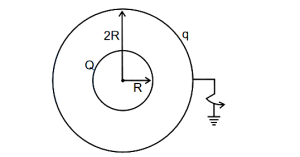
Consider two concentric conducting spheres of radii $R$ and $2R$ respectively. The inner sphere is given a charge $+Q$. The outer sphere is grounded. The potential at $r = \frac{3R}{2}$ is
A
$\frac{1}{4 \pi \varepsilon_0} \frac{Q}{6R}$
B
$0$
C
$\frac{1}{4 \pi \varepsilon_0} \frac{2Q}{3R}$
D
$\frac{1}{4 \pi \varepsilon_0} \frac{Q}{R}$
Solution
(A) Let $q$ be the charge appearing on the outer shell of radius $2R$ after earthing.
Since the outer shell is grounded,its potential must be zero.
The potential at the outer shell is the sum of potentials due to the inner charge $Q$ and the outer charge $q$:
$V_{\text{outer}} = \frac{KQ}{2R} + \frac{Kq}{2R} = 0$
Solving for $q$,we get $q = -Q$.
Now,we calculate the potential at a distance $r = \frac{3R}{2}$ from the center.
Since $R < r < 2R$,the point lies outside the inner sphere and inside the outer sphere.
The potential at this point is the sum of the potential due to the inner sphere (as a point charge) and the potential due to the outer shell (constant inside):
$V(r) = \frac{KQ}{r} + \frac{Kq}{2R}$
Substituting $r = \frac{3R}{2}$ and $q = -Q$:
$V = \frac{KQ}{3R/2} + \frac{K(-Q)}{2R} = \frac{2KQ}{3R} - \frac{KQ}{2R} = \frac{4KQ - 3KQ}{6R} = \frac{KQ}{6R} = \frac{1}{4 \pi \varepsilon_0} \frac{Q}{6R}$
Since the outer shell is grounded,its potential must be zero.
The potential at the outer shell is the sum of potentials due to the inner charge $Q$ and the outer charge $q$:
$V_{\text{outer}} = \frac{KQ}{2R} + \frac{Kq}{2R} = 0$
Solving for $q$,we get $q = -Q$.
Now,we calculate the potential at a distance $r = \frac{3R}{2}$ from the center.
Since $R < r < 2R$,the point lies outside the inner sphere and inside the outer sphere.
The potential at this point is the sum of the potential due to the inner sphere (as a point charge) and the potential due to the outer shell (constant inside):
$V(r) = \frac{KQ}{r} + \frac{Kq}{2R}$
Substituting $r = \frac{3R}{2}$ and $q = -Q$:
$V = \frac{KQ}{3R/2} + \frac{K(-Q)}{2R} = \frac{2KQ}{3R} - \frac{KQ}{2R} = \frac{4KQ - 3KQ}{6R} = \frac{KQ}{6R} = \frac{1}{4 \pi \varepsilon_0} \frac{Q}{6R}$
0 likes
View Solution412
DifficultMCQ
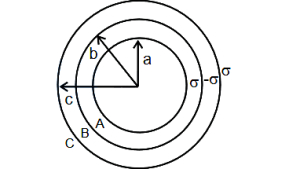
Three concentric metallic shells $A, B$ and $C$ of radii $a, b$ and $c$ $(a < b < c)$ have surface charge densities $+\sigma, -\sigma$ and $+\sigma$ respectively. The potential of shell $B$ is
A
$\quad(a+b+c) \frac{\sigma}{\varepsilon_0}$
B
$\frac{\sigma c}{\varepsilon_0}$
C
$\left(\frac{a^2}{c}-\frac{b^2}{c}+c\right) \frac{\sigma}{\varepsilon_0}$
D
$\left(\frac{a^2}{b}-b+c\right) \frac{\sigma}{\varepsilon_0}$
Solution
(D) The potential at the surface of shell $B$ is the sum of potentials due to all three shells $A, B$ and $C$.
$V_B = V_{A,B} + V_{B,B} + V_{C,B}$
Since the potential inside a shell is constant and equal to the potential at its surface,we have:
$V_{A,B} = \frac{k Q_A}{b} = \frac{1}{4\pi\varepsilon_0} \frac{\sigma(4\pi a^2)}{b} = \frac{\sigma a^2}{\varepsilon_0 b}$
$V_{B,B} = \frac{k Q_B}{b} = \frac{1}{4\pi\varepsilon_0} \frac{-\sigma(4\pi b^2)}{b} = -\frac{\sigma b}{\varepsilon_0}$
$V_{C,B} = \frac{k Q_C}{c} = \frac{1}{4\pi\varepsilon_0} \frac{\sigma(4\pi c^2)}{c} = \frac{\sigma c}{\varepsilon_0}$
Adding these,we get:
$V_B = \frac{\sigma a^2}{\varepsilon_0 b} - \frac{\sigma b}{\varepsilon_0} + \frac{\sigma c}{\varepsilon_0} = \frac{\sigma}{\varepsilon_0} \left( \frac{a^2}{b} - b + c \right)$
$V_B = V_{A,B} + V_{B,B} + V_{C,B}$
Since the potential inside a shell is constant and equal to the potential at its surface,we have:
$V_{A,B} = \frac{k Q_A}{b} = \frac{1}{4\pi\varepsilon_0} \frac{\sigma(4\pi a^2)}{b} = \frac{\sigma a^2}{\varepsilon_0 b}$
$V_{B,B} = \frac{k Q_B}{b} = \frac{1}{4\pi\varepsilon_0} \frac{-\sigma(4\pi b^2)}{b} = -\frac{\sigma b}{\varepsilon_0}$
$V_{C,B} = \frac{k Q_C}{c} = \frac{1}{4\pi\varepsilon_0} \frac{\sigma(4\pi c^2)}{c} = \frac{\sigma c}{\varepsilon_0}$
Adding these,we get:
$V_B = \frac{\sigma a^2}{\varepsilon_0 b} - \frac{\sigma b}{\varepsilon_0} + \frac{\sigma c}{\varepsilon_0} = \frac{\sigma}{\varepsilon_0} \left( \frac{a^2}{b} - b + c \right)$
0 likes
View Solution413
MediumMCQ
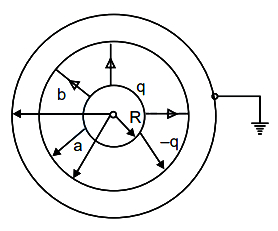
$A$ metal sphere of radius $R$ carrying charge $q$ is surrounded by a thick concentric metal shell of inner and outer radii $a$ and $b$ respectively. The net charge on the shell is zero. The potential at the centre of the sphere, when the outer surface of the shell is grounded, will be
A
$\frac{q}{4 \pi \epsilon_{0}}\left(\frac{1}{a}-\frac{1}{b}\right)$
B
$\frac{q}{4 \pi \epsilon_{0}} \frac{1}{a}$
C
$\frac{q}{4 \pi \epsilon_{0}}\left(\frac{1}{R}-\frac{1}{a}\right)$
D
$\frac{q}{4 \pi \epsilon_{0}} \frac{1}{R}$
Solution
(C) $1$. The inner sphere has charge $q$. Due to induction, a charge $-q$ is induced on the inner surface of the shell (radius $a$).
$2$. Since the shell is grounded, its potential is zero. Let the charge on the outer surface (radius $b$) be $q'$. The total charge on the shell is $Q_{shell} = -q + q' = 0$, which implies $q' = q$. However, because the shell is grounded, the charge $q'$ flows to the ground, leaving the outer surface with zero charge. Thus, the inner surface of the shell has charge $-q$ and the outer surface has charge $0$.
$3$. The potential at the centre of the sphere is the sum of potentials due to the sphere (radius $R$, charge $q$), the inner surface of the shell (radius $a$, charge $-q$), and the outer surface of the shell (radius $b$, charge $0$).
$4$. $V_{centre} = V_{sphere} + V_{inner_shell} + V_{outer_shell} = \frac{1}{4 \pi \epsilon_{0}} \frac{q}{R} + \frac{1}{4 \pi \epsilon_{0}} \frac{-q}{a} + \frac{1}{4 \pi \epsilon_{0}} \frac{0}{b} = \frac{q}{4 \pi \epsilon_{0}} \left( \frac{1}{R} - \frac{1}{a} \right)$.
$2$. Since the shell is grounded, its potential is zero. Let the charge on the outer surface (radius $b$) be $q'$. The total charge on the shell is $Q_{shell} = -q + q' = 0$, which implies $q' = q$. However, because the shell is grounded, the charge $q'$ flows to the ground, leaving the outer surface with zero charge. Thus, the inner surface of the shell has charge $-q$ and the outer surface has charge $0$.
$3$. The potential at the centre of the sphere is the sum of potentials due to the sphere (radius $R$, charge $q$), the inner surface of the shell (radius $a$, charge $-q$), and the outer surface of the shell (radius $b$, charge $0$).
$4$. $V_{centre} = V_{sphere} + V_{inner_shell} + V_{outer_shell} = \frac{1}{4 \pi \epsilon_{0}} \frac{q}{R} + \frac{1}{4 \pi \epsilon_{0}} \frac{-q}{a} + \frac{1}{4 \pi \epsilon_{0}} \frac{0}{b} = \frac{q}{4 \pi \epsilon_{0}} \left( \frac{1}{R} - \frac{1}{a} \right)$.
0 likes
View Solution414
DifficultMCQ
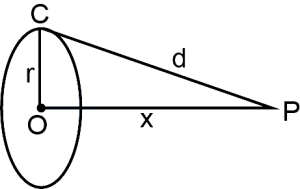
$A$ point charge $-q$ is carried from a point $A$ to another point $B$ on the axis of a charged ring of radius $r$ carrying a charge $+q$. If the point $A$ is at a distance $\frac{4}{3} r$ from the centre of the ring and the point $B$ is $\frac{3}{4} r$ from the centre but on the opposite side,what is the net work that needs to be done for this?
A
$-\frac{7}{5} \cdot \frac{q^{2}}{4 \pi \varepsilon_{0} r}$
B
$-\frac{1}{5} \cdot \frac{q^{2}}{4 \pi \varepsilon_{0} r}$
C
$\frac{7}{5} \cdot \frac{q^{2}}{4 \pi \varepsilon_{0} r}$
D
$\frac{1}{5} \cdot \frac{q^{2}}{4 \pi \varepsilon_{0} r}$
Solution
(B) The potential $V$ at a distance $x$ from the center of a ring of radius $r$ carrying charge $q$ is given by $V = \frac{1}{4 \pi \varepsilon_{0}} \cdot \frac{q}{\sqrt{x^{2} + r^{2}}}$.
For point $A$ at distance $x_A = \frac{4}{3}r$,the distance from the ring circumference is $d_A = \sqrt{(\frac{4}{3}r)^2 + r^2} = \sqrt{\frac{16}{9}r^2 + r^2} = \sqrt{\frac{25}{9}r^2} = \frac{5}{3}r$.
Thus,$V_A = \frac{1}{4 \pi \varepsilon_{0}} \cdot \frac{q}{5r/3} = \frac{1}{4 \pi \varepsilon_{0}} \cdot \frac{3q}{5r}$.
For point $B$ at distance $x_B = \frac{3}{4}r$ on the opposite side,the distance from the ring circumference is $d_B = \sqrt{(\frac{3}{4}r)^2 + r^2} = \sqrt{\frac{9}{16}r^2 + r^2} = \sqrt{\frac{25}{16}r^2} = \frac{5}{4}r$.
Thus,$V_B = \frac{1}{4 \pi \varepsilon_{0}} \cdot \frac{q}{5r/4} = \frac{1}{4 \pi \varepsilon_{0}} \cdot \frac{4q}{5r}$.
The work done $W$ in moving a charge $-q$ from $A$ to $B$ is $W = (-q)(V_B - V_A)$.
$W = -q \left( \frac{1}{4 \pi \varepsilon_{0}} \cdot \frac{4q}{5r} - \frac{1}{4 \pi \varepsilon_{0}} \cdot \frac{3q}{5r} \right) = -q \left( \frac{1}{4 \pi \varepsilon_{0}} \cdot \frac{q}{5r} \right) = -\frac{1}{5} \cdot \frac{q^2}{4 \pi \varepsilon_{0} r}$.
For point $A$ at distance $x_A = \frac{4}{3}r$,the distance from the ring circumference is $d_A = \sqrt{(\frac{4}{3}r)^2 + r^2} = \sqrt{\frac{16}{9}r^2 + r^2} = \sqrt{\frac{25}{9}r^2} = \frac{5}{3}r$.
Thus,$V_A = \frac{1}{4 \pi \varepsilon_{0}} \cdot \frac{q}{5r/3} = \frac{1}{4 \pi \varepsilon_{0}} \cdot \frac{3q}{5r}$.
For point $B$ at distance $x_B = \frac{3}{4}r$ on the opposite side,the distance from the ring circumference is $d_B = \sqrt{(\frac{3}{4}r)^2 + r^2} = \sqrt{\frac{9}{16}r^2 + r^2} = \sqrt{\frac{25}{16}r^2} = \frac{5}{4}r$.
Thus,$V_B = \frac{1}{4 \pi \varepsilon_{0}} \cdot \frac{q}{5r/4} = \frac{1}{4 \pi \varepsilon_{0}} \cdot \frac{4q}{5r}$.
The work done $W$ in moving a charge $-q$ from $A$ to $B$ is $W = (-q)(V_B - V_A)$.
$W = -q \left( \frac{1}{4 \pi \varepsilon_{0}} \cdot \frac{4q}{5r} - \frac{1}{4 \pi \varepsilon_{0}} \cdot \frac{3q}{5r} \right) = -q \left( \frac{1}{4 \pi \varepsilon_{0}} \cdot \frac{q}{5r} \right) = -\frac{1}{5} \cdot \frac{q^2}{4 \pi \varepsilon_{0} r}$.
0 likes
View Solution415
MediumMCQ
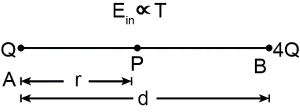
Two positive charges $Q$ and $4Q$ are placed at points $A$ and $B$ respectively,where $B$ is at a distance $d$ units to the right of $A$. The total electric potential due to these charges is minimum at point $P$ on the line segment joining $A$ and $B$. What is the distance of $P$ from $A$?
A
$\frac{d}{3}$ units to the right of $A$
B
$\frac{d}{3}$ units to the left of $A$
C
$\frac{d}{5}$ units to the right of $A$
D
$d$ units to the left of $A$
Solution
(A) The total electric potential $V$ at a point $P$ between the charges is given by $V = \frac{1}{4\pi\varepsilon_0} \left( \frac{Q}{r} + \frac{4Q}{d-r} \right)$,where $r$ is the distance of $P$ from $A$.
For the potential to be minimum,we set $\frac{dV}{dr} = 0$.
$\frac{dV}{dr} = \frac{1}{4\pi\varepsilon_0} \left( -\frac{Q}{r^2} + \frac{4Q}{(d-r)^2} \right) = 0$.
This implies $\frac{Q}{r^2} = \frac{4Q}{(d-r)^2}$,which is equivalent to the condition where the net electric field $E = 0$.
Taking the square root on both sides: $\frac{1}{r} = \frac{2}{d-r}$.
Solving for $r$: $d - r = 2r \Rightarrow 3r = d \Rightarrow r = \frac{d}{3}$.
Thus,the potential is minimum at a distance of $\frac{d}{3}$ units to the right of $A$.
For the potential to be minimum,we set $\frac{dV}{dr} = 0$.
$\frac{dV}{dr} = \frac{1}{4\pi\varepsilon_0} \left( -\frac{Q}{r^2} + \frac{4Q}{(d-r)^2} \right) = 0$.
This implies $\frac{Q}{r^2} = \frac{4Q}{(d-r)^2}$,which is equivalent to the condition where the net electric field $E = 0$.
Taking the square root on both sides: $\frac{1}{r} = \frac{2}{d-r}$.
Solving for $r$: $d - r = 2r \Rightarrow 3r = d \Rightarrow r = \frac{d}{3}$.
Thus,the potential is minimum at a distance of $\frac{d}{3}$ units to the right of $A$.
0 likes
View Solution416
MediumMCQ
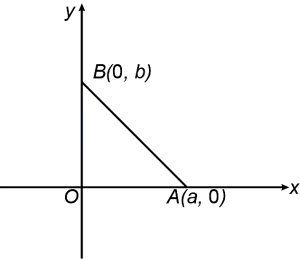
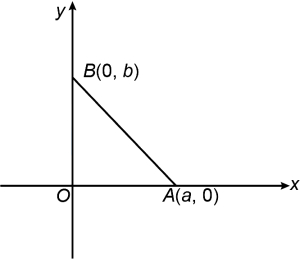
$A$ charge $+q$ is placed at the origin $O$ of $X-Y$ axes as shown in the figure. The work done in taking a charge $Q$ from $A$ to $B$ along the straight line $AB$ is
A
$\frac{q Q}{4 \pi \varepsilon_{0}}\left(\frac{a-b}{a b}\right)$
B
$\frac{q Q}{4 \pi \varepsilon_{0}}\left(\frac{b-a}{a b}\right)$
C
$\frac{q Q}{4 \pi \varepsilon_{0}}\left(\frac{b}{a^{2}}-\frac{1}{b}\right)$
D
$\frac{q Q}{4 \pi \varepsilon_{0}}\left(\frac{a}{b^{2}}-\frac{1}{b}\right)$
Solution
(A) The electric potential $V$ at a distance $r$ from a point charge $q$ is given by $V = \frac{q}{4 \pi \varepsilon_{0} r}$.
Since the electric field is conservative,the work done in moving a charge $Q$ from point $A$ to point $B$ is independent of the path and is given by $W = Q(V_B - V_A)$.
The potential at point $A(a, 0)$ is $V_A = \frac{q}{4 \pi \varepsilon_{0} a}$.
The potential at point $B(0, b)$ is $V_B = \frac{q}{4 \pi \varepsilon_{0} b}$.
Therefore,the work done is $W = Q \left( \frac{q}{4 \pi \varepsilon_{0} b} - \frac{q}{4 \pi \varepsilon_{0} a} \right)$.
$W = \frac{q Q}{4 \pi \varepsilon_{0}} \left( \frac{1}{b} - \frac{1}{a} \right) = \frac{q Q}{4 \pi \varepsilon_{0}} \left( \frac{a - b}{a b} \right)$.
Since the electric field is conservative,the work done in moving a charge $Q$ from point $A$ to point $B$ is independent of the path and is given by $W = Q(V_B - V_A)$.
The potential at point $A(a, 0)$ is $V_A = \frac{q}{4 \pi \varepsilon_{0} a}$.
The potential at point $B(0, b)$ is $V_B = \frac{q}{4 \pi \varepsilon_{0} b}$.
Therefore,the work done is $W = Q \left( \frac{q}{4 \pi \varepsilon_{0} b} - \frac{q}{4 \pi \varepsilon_{0} a} \right)$.
$W = \frac{q Q}{4 \pi \varepsilon_{0}} \left( \frac{1}{b} - \frac{1}{a} \right) = \frac{q Q}{4 \pi \varepsilon_{0}} \left( \frac{a - b}{a b} \right)$.
0 likes
View Solution417
MediumMCQ
The work done in carrying a charge $Q$ once around a circle of radius $r$ about a charge $q$ at the centre is
A
$\frac{q Q}{4 \pi \varepsilon_0 r}$
B
$\frac{q Q}{4 \pi \varepsilon_0} \frac{1}{\pi r}$
C
$\frac{q Q}{4 \pi \varepsilon_0}\left(\frac{1}{2 \pi r}\right)$
D
$0$
Solution
(D) The electrostatic force is a conservative force.
By definition,the work done by a conservative force in moving a charge along any closed path is always zero.
Since the charge $Q$ is moved once around a circle,which is a closed path,the total work done is $0$.
By definition,the work done by a conservative force in moving a charge along any closed path is always zero.
Since the charge $Q$ is moved once around a circle,which is a closed path,the total work done is $0$.
0 likes
View Solution418
EasyMCQ
Which one of the following is not a measurable quantity?
A
Voltage difference
B
Resistance
C
Voltage
D
Displacement current
Solution
(C) In physics,the absolute electric potential at a single point is not a uniquely measurable quantity because it depends on the choice of the reference point (where potential is assumed to be zero).
However,the potential difference (voltage) between two points is a well-defined and measurable quantity.
Resistance and displacement current are both physical quantities that can be measured directly using appropriate instruments.
Therefore,'Voltage' (when referring to absolute potential at a point) is not considered a measurable quantity in an absolute sense without a defined reference.
However,the potential difference (voltage) between two points is a well-defined and measurable quantity.
Resistance and displacement current are both physical quantities that can be measured directly using appropriate instruments.
Therefore,'Voltage' (when referring to absolute potential at a point) is not considered a measurable quantity in an absolute sense without a defined reference.
0 likes
View Solution419
MediumMCQ
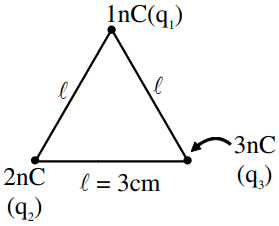
Two point charges of $1 \text{ nC}$ and $2 \text{ nC}$ are placed at two corners of an equilateral triangle of side $3 \text{ cm}$. The work done in bringing a charge of $3 \text{ nC}$ from infinity to the third corner of the triangle is . . . . . . $\mu\text{J}$. $( \frac{1}{4\pi\epsilon_{0}} = 9 \times 10^{9} \text{ N.m}^{2}/\text{C}^{2} )$
A
$2.7$
B
$5.4$
C
$3.3$
D
$27$
Solution
(A) The work done $W$ in bringing a charge $q_{3}$ to a point in the presence of charges $q_{1}$ and $q_{2}$ is given by the potential energy of the configuration:
$W = V \times q_{3} = (\frac{kq_{1}}{\ell} + \frac{kq_{2}}{\ell}) q_{3}$
Given: $q_{1} = 1 \times 10^{-9} \text{ C}$,$q_{2} = 2 \times 10^{-9} \text{ C}$,$q_{3} = 3 \times 10^{-9} \text{ C}$,$\ell = 3 \times 10^{-2} \text{ m}$,$k = 9 \times 10^{9} \text{ N.m}^{2}/\text{C}^{2}$.
Substituting the values:
$W = \frac{9 \times 10^{9}}{3 \times 10^{-2}} (1 \times 10^{-9} + 2 \times 10^{-9}) \times 3 \times 10^{-9}$
$W = (3 \times 10^{11}) \times (3 \times 10^{-9}) \times (3 \times 10^{-9})$
$W = 27 \times 10^{-7} \text{ J} = 2.7 \times 10^{-6} \text{ J} = 2.7 \text{ } \mu\text{J}$.
$W = V \times q_{3} = (\frac{kq_{1}}{\ell} + \frac{kq_{2}}{\ell}) q_{3}$
Given: $q_{1} = 1 \times 10^{-9} \text{ C}$,$q_{2} = 2 \times 10^{-9} \text{ C}$,$q_{3} = 3 \times 10^{-9} \text{ C}$,$\ell = 3 \times 10^{-2} \text{ m}$,$k = 9 \times 10^{9} \text{ N.m}^{2}/\text{C}^{2}$.
Substituting the values:
$W = \frac{9 \times 10^{9}}{3 \times 10^{-2}} (1 \times 10^{-9} + 2 \times 10^{-9}) \times 3 \times 10^{-9}$
$W = (3 \times 10^{11}) \times (3 \times 10^{-9}) \times (3 \times 10^{-9})$
$W = 27 \times 10^{-7} \text{ J} = 2.7 \times 10^{-6} \text{ J} = 2.7 \text{ } \mu\text{J}$.
0 likes
View Solution420
MediumMCQ
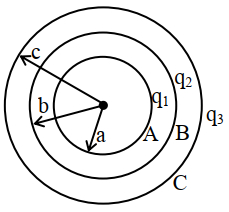
There are three concentric conducting spherical shells $A$,$B$,and $C$ of radii $a$,$b$,and $c$ respectively. The potentials of the spheres $A$,$B$,and $C$ respectively are:
A
$\frac{1}{4 \pi \epsilon_0}\left(\frac{q_1+q_2+q_3}{a}\right), \frac{1}{4 \pi \epsilon_0}\left(\frac{q_1+q_2+q_3}{b}\right), \frac{1}{4 \pi \epsilon_0}\left(\frac{q_1+q_2+q_3}{c}\right)$
B
$\frac{1}{4 \pi \epsilon_0}\left(\frac{q_1+q_2+q_3}{a}\right), \frac{1}{4 \pi \epsilon_0}\left(\frac{q_1+q_2}{b}+\frac{q_3}{c}\right), \frac{1}{4 \pi \epsilon_0}\left(\frac{q_1}{a}+\frac{q_2}{b}+\frac{q_3}{c}\right)$
C
$\frac{1}{4 \pi \epsilon_0}\left(\frac{q_1}{a}+\frac{q_2}{b}+\frac{q_3}{c}\right), \frac{1}{4 \pi \epsilon_0}\left(\frac{q_1+q_2}{b}+\frac{q_3}{c}\right), \frac{1}{4 \pi \epsilon_0}\left(\frac{q_1+q_2+q_3}{c}\right)$
D
$\frac{1}{4 \pi \epsilon_0}\left(\frac{q_1}{a}+\frac{q_2}{b}+\frac{q_3}{c}\right), \frac{1}{4 \pi \epsilon_0}\left(\frac{q_1+q_2+q_3}{b}\right), \frac{1}{4 \pi \epsilon_0}\left(\frac{q_1+q_2+q_3}{c}\right)$
Solution
(C) The potential at any point on a conducting spherical shell is the sum of the potentials due to all the charges present on the shells.
For a point at distance $r$ from the center,the potential due to a shell of radius $R$ and charge $q$ is $\frac{kq}{R}$ if $r \le R$ and $\frac{kq}{r}$ if $r > R$.
For sphere $A$ (radius $a$): It is inside $B$ and $C$,so the potential is $V_A = \frac{kq_1}{a} + \frac{kq_2}{b} + \frac{kq_3}{c} = \frac{1}{4 \pi \epsilon_0} \left( \frac{q_1}{a} + \frac{q_2}{b} + \frac{q_3}{c} \right)$.
For sphere $B$ (radius $b$): It is on the surface of $B$,inside $C$,and outside $A$. So,$V_B = \frac{kq_1}{b} + \frac{kq_2}{b} + \frac{kq_3}{c} = \frac{1}{4 \pi \epsilon_0} \left( \frac{q_1+q_2}{b} + \frac{q_3}{c} \right)$.
For sphere $C$ (radius $c$): It is on the surface of $C$,and outside $A$ and $B$. So,$V_C = \frac{kq_1}{c} + \frac{kq_2}{c} + \frac{kq_3}{c} = \frac{1}{4 \pi \epsilon_0} \left( \frac{q_1+q_2+q_3}{c} \right)$.
For a point at distance $r$ from the center,the potential due to a shell of radius $R$ and charge $q$ is $\frac{kq}{R}$ if $r \le R$ and $\frac{kq}{r}$ if $r > R$.
For sphere $A$ (radius $a$): It is inside $B$ and $C$,so the potential is $V_A = \frac{kq_1}{a} + \frac{kq_2}{b} + \frac{kq_3}{c} = \frac{1}{4 \pi \epsilon_0} \left( \frac{q_1}{a} + \frac{q_2}{b} + \frac{q_3}{c} \right)$.
For sphere $B$ (radius $b$): It is on the surface of $B$,inside $C$,and outside $A$. So,$V_B = \frac{kq_1}{b} + \frac{kq_2}{b} + \frac{kq_3}{c} = \frac{1}{4 \pi \epsilon_0} \left( \frac{q_1+q_2}{b} + \frac{q_3}{c} \right)$.
For sphere $C$ (radius $c$): It is on the surface of $C$,and outside $A$ and $B$. So,$V_C = \frac{kq_1}{c} + \frac{kq_2}{c} + \frac{kq_3}{c} = \frac{1}{4 \pi \epsilon_0} \left( \frac{q_1+q_2+q_3}{c} \right)$.
0 likes
View Solution421
DifficultMCQ
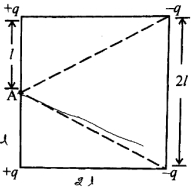
As shown in the figure,charges $+q, +q, -q$ and $-q$ are placed on the vertices of a square,each side length is $2l$. The electric potential at the mid-point '$A$' of the charges $+q$ and $+q$ is . . . . . . .
A
Zero
B
$\frac{2kq}{l}[1+\frac{1}{\sqrt{5}}]$
C
$\frac{kq}{l}[1-\frac{1}{\sqrt{5}}]$
D
$\frac{2kq}{l}[1-\frac{1}{\sqrt{5}}]$
Solution
(D) Point '$A$' is at a distance $l$ from the top $+q$ charge and the bottom $+q$ charge.
The distance from point '$A$' to both $-q$ charges is $\sqrt{(2l)^2 + l^2} = \sqrt{4l^2 + l^2} = \sqrt{5l^2} = l\sqrt{5}$.
The electric potential $V$ at point '$A$' due to all four charges is given by the sum of potentials from each charge:
$V_A = k(\frac{q}{l} + \frac{q}{l} - \frac{q}{l\sqrt{5}} - \frac{q}{l\sqrt{5}})$
$V_A = k(\frac{2q}{l} - \frac{2q}{l\sqrt{5}})$
$V_A = \frac{2kq}{l}(1 - \frac{1}{\sqrt{5}})$
Therefore,option $(D)$ is correct.
The distance from point '$A$' to both $-q$ charges is $\sqrt{(2l)^2 + l^2} = \sqrt{4l^2 + l^2} = \sqrt{5l^2} = l\sqrt{5}$.
The electric potential $V$ at point '$A$' due to all four charges is given by the sum of potentials from each charge:
$V_A = k(\frac{q}{l} + \frac{q}{l} - \frac{q}{l\sqrt{5}} - \frac{q}{l\sqrt{5}})$
$V_A = k(\frac{2q}{l} - \frac{2q}{l\sqrt{5}})$
$V_A = \frac{2kq}{l}(1 - \frac{1}{\sqrt{5}})$
Therefore,option $(D)$ is correct.
0 likes
View Solution422
MediumMCQ
Charge $1.6 \times 10^{-7} \text{ C}$ is distributed uniformly over the surface of a spherical conductor of radius $R$. The ratio of the electric potential inside the spherical conductor to the electric field on the surface is . . . . . . .
A
$1.6 \times 10^{-7} R^2$
B
$R$
C
$1.6 \times 10^{-7} R$
D
$\frac{1}{R}$
Solution
(B) The electric potential $V$ inside a spherical conductor is constant and equal to the potential on its surface,given by $V = \frac{kq}{R}$.
The electric field $E$ on the surface of the spherical conductor is given by $E = \frac{kq}{R^2}$.
To find the ratio of the electric potential inside to the electric field on the surface,we calculate:
$\frac{V}{E} = \frac{kq/R}{kq/R^2} = \frac{kq}{R} \times \frac{R^2}{kq} = R$.
Therefore,the ratio is $R$. Option $(B)$ is correct.
The electric field $E$ on the surface of the spherical conductor is given by $E = \frac{kq}{R^2}$.
To find the ratio of the electric potential inside to the electric field on the surface,we calculate:
$\frac{V}{E} = \frac{kq/R}{kq/R^2} = \frac{kq}{R} \times \frac{R^2}{kq} = R$.
Therefore,the ratio is $R$. Option $(B)$ is correct.
0 likes
View Solution423
MediumMCQ
The total charge on a uniformly charged spherical shell having radius $R$ is $Q$. Then electric potential at a distance $r = R/2$ from the centre of the shell is . . . . . . .
A
$Q / 4\pi\epsilon_0 R$
B
$Q / \pi\epsilon_0 R$
C
$Q / 2\pi\epsilon_0 R$
D
$Q / 8\pi\epsilon_0 R$
Solution
(A) For a uniformly charged spherical shell,the electric potential at any point inside the shell is constant and equal to the potential at its surface.
The potential at the surface of the shell is given by $V = \frac{1}{4\pi \epsilon_0} \frac{Q}{R}$.
Since the distance $r = R/2$ is less than the radius $R$ (i.e.,the point is inside the shell),the electric potential at this point is the same as the potential at the surface.
Therefore,the potential at $r = R/2$ is $V = \frac{Q}{4\pi \epsilon_0 R}$.
The potential at the surface of the shell is given by $V = \frac{1}{4\pi \epsilon_0} \frac{Q}{R}$.
Since the distance $r = R/2$ is less than the radius $R$ (i.e.,the point is inside the shell),the electric potential at this point is the same as the potential at the surface.
Therefore,the potential at $r = R/2$ is $V = \frac{Q}{4\pi \epsilon_0 R}$.
0 likes
View SolutionElectric Potential and Capacitance — Electric potential · Frequently Asked Questions
1Are these Electric Potential and Capacitance questions useful for JEE and NEET?
Yes. All questions in this section are mapped to JEE Main and NEET exam patterns. Previous year questions from JEE Main, NEET, GUJCET and state-level exams are included with full solutions.
2Can I switch to Hindi or Gujarati for these questions?
Yes. Use the language tabs in the hero section or the sidebar to view the same questions and solutions in English, Hindi or Gujarati.
3How do I generate a question paper from this subtopic?
Use the Vedclass Exam Paper Generator — select the chapter and subtopic, set difficulty, and generate Sets A, B, C, D automatically. First 3 chapters of every subject are free.
Vedclass Products
For Students
Vedclass Test Series
Mock tests in real JEE/NEET style with performance analysis. 5-day free trial.
Start Free TrialFor Teachers
Exam Paper Generator
Generate Set A/B/C/D papers from this chapter in 2 minutes. 3 chapters free.
Try FreeFor Institutes
Online Exam Module
Live online exams with unlimited students, 360° analytics & white-label branding.
See DemoFor Teachers & Institutes
Generate a Electric Potential and Capacitance Exam Paper in 2 Minutes
Select subtopic & difficulty — Sets A, B, C, D auto-generated with No Repeat logic.
First 3 chapters of every subject are free — no payment required.