
A English
Electric Field and usage of Gauss's Law Questions in English
Class 12 Physics · Electric Charges and Fields · Electric Field and usage of Gauss's Law
235+
Questions
English
Language
100%
With Solutions
Showing 50 of 235 questions in English
51
MediumMCQ
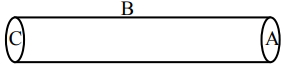
$A$ hollow cylinder has a charge $q$ within it. If $\phi$ is the electric flux in units of $V-m$ associated with the curved surface $B,$ the flux linked with the plane surface $A$ in units of $V-m$ will be
A
$\frac{q}{2\varepsilon_0}$
B
$\frac{\phi}{3}$
C
$\frac{q}{\varepsilon_0} - \phi$
D
$\frac{1}{2}\left(\frac{q}{\varepsilon_0} - \phi\right)$
Solution
(D) Let $\phi_A, \phi_B,$ and $\phi_C$ be the electric flux linked with the surfaces $A, B,$ and $C$ respectively.
According to Gauss's Law,the total electric flux through the closed surface is $\phi_{total} = \phi_A + \phi_B + \phi_C = \frac{q}{\varepsilon_0}$.
Due to the symmetry of the cylinder,the flux linked with the two plane surfaces $A$ and $C$ is equal,so $\phi_A = \phi_C$.
Substituting this into the Gauss's Law equation,we get $2\phi_A + \phi_B = \frac{q}{\varepsilon_0}$.
Given that the flux through the curved surface $B$ is $\phi_B = \phi$,we have $2\phi_A + \phi = \frac{q}{\varepsilon_0}$.
Rearranging for $\phi_A$,we get $2\phi_A = \frac{q}{\varepsilon_0} - \phi$.
Therefore,$\phi_A = \frac{1}{2}\left(\frac{q}{\varepsilon_0} - \phi\right)$.
According to Gauss's Law,the total electric flux through the closed surface is $\phi_{total} = \phi_A + \phi_B + \phi_C = \frac{q}{\varepsilon_0}$.
Due to the symmetry of the cylinder,the flux linked with the two plane surfaces $A$ and $C$ is equal,so $\phi_A = \phi_C$.
Substituting this into the Gauss's Law equation,we get $2\phi_A + \phi_B = \frac{q}{\varepsilon_0}$.
Given that the flux through the curved surface $B$ is $\phi_B = \phi$,we have $2\phi_A + \phi = \frac{q}{\varepsilon_0}$.
Rearranging for $\phi_A$,we get $2\phi_A = \frac{q}{\varepsilon_0} - \phi$.
Therefore,$\phi_A = \frac{1}{2}\left(\frac{q}{\varepsilon_0} - \phi\right)$.
0 likes
View Solution52
EasyMCQ
The electric field at a distance $\frac{3R}{2}$ from the centre of a charged conducting spherical shell of radius $R$ is $E.$ The electric field at a distance $\frac{R}{2}$ from the centre of the sphere is
A
$\frac{E}{2}$
B
$E$
C
$\frac{E}{3}$
D
Zero
Solution
(D) For a charged conducting spherical shell of radius $R$,the electric field at a distance $r$ from the centre is given by Gauss's Law.
For $r > R$,the shell acts as a point charge,so $E = \frac{1}{4\pi\epsilon_0} \frac{Q}{r^2}$.
For $r < R$,the electric field inside a charged conducting shell is always zero because there is no enclosed charge within a Gaussian surface drawn inside the conductor.
Since the distance $\frac{R}{2}$ is less than $R$,the electric field at this point is $0$.
For $r > R$,the shell acts as a point charge,so $E = \frac{1}{4\pi\epsilon_0} \frac{Q}{r^2}$.
For $r < R$,the electric field inside a charged conducting shell is always zero because there is no enclosed charge within a Gaussian surface drawn inside the conductor.
Since the distance $\frac{R}{2}$ is less than $R$,the electric field at this point is $0$.
0 likes
View Solution53
EasyMCQ
What is the flux through a cube of side $a$ if a point charge of $q$ is at one of its corners?
A
$\frac{q}{6\varepsilon_0}$
B
$\frac{q}{8\varepsilon_0}$
C
$\frac{q}{3\varepsilon_0}$
D
$\frac{q}{2\varepsilon_0}$
Solution
(B) According to Gauss's Law,the total electric flux through a closed surface is $\phi_{total} = \frac{q_{enclosed}}{\varepsilon_0}$.
When a point charge $q$ is placed at one corner of a cube,it is shared by $8$ identical cubes to enclose the charge completely in a symmetric manner.
Therefore,the flux through one cube is $\frac{1}{8}$ of the total flux through the larger symmetric enclosure.
Thus,the electric flux passing through the given cube is $\phi = \frac{1}{8} \left( \frac{q}{\varepsilon_0} \right) = \frac{q}{8\varepsilon_0}$.
When a point charge $q$ is placed at one corner of a cube,it is shared by $8$ identical cubes to enclose the charge completely in a symmetric manner.
Therefore,the flux through one cube is $\frac{1}{8}$ of the total flux through the larger symmetric enclosure.
Thus,the electric flux passing through the given cube is $\phi = \frac{1}{8} \left( \frac{q}{\varepsilon_0} \right) = \frac{q}{8\varepsilon_0}$.
0 likes
View Solution54
DifficultMCQ
The electric field in a certain region is acting radially outward and is given by $E = Ar$. $A$ charge contained in a sphere of radius $a$ centered at the origin of the field will be given by:
A
$4\pi \varepsilon_0 A a^2$
B
$A \varepsilon_0 a^2$
C
$4\pi \varepsilon_0 A a^3$
D
$\varepsilon_0 A a^2$
Solution
(C) According to Gauss's Law,the net electric flux $\phi$ through a closed surface is given by $\phi = \oint E \cdot dA = \frac{q_{en}}{\varepsilon_0}$.
Given the electric field $E = Ar$ is acting radially outward,for a spherical surface of radius $a$,the electric field at the surface is $E = Aa$.
The surface area of the sphere is $S = 4\pi a^2$.
Since the field is uniform over the surface of the sphere and directed radially outward,the flux is $\phi = E \times S = (Aa) \times (4\pi a^2) = 4\pi A a^3$.
Equating this to Gauss's Law: $4\pi A a^3 = \frac{q}{\varepsilon_0}$.
Therefore,the charge contained is $q = 4\pi \varepsilon_0 A a^3$.
Given the electric field $E = Ar$ is acting radially outward,for a spherical surface of radius $a$,the electric field at the surface is $E = Aa$.
The surface area of the sphere is $S = 4\pi a^2$.
Since the field is uniform over the surface of the sphere and directed radially outward,the flux is $\phi = E \times S = (Aa) \times (4\pi a^2) = 4\pi A a^3$.
Equating this to Gauss's Law: $4\pi A a^3 = \frac{q}{\varepsilon_0}$.
Therefore,the charge contained is $q = 4\pi \varepsilon_0 A a^3$.
0 likes
View Solution55
MediumMCQ
An infinite non-conducting sheet has a surface charge density $\sigma = 0.10 \, \mu C/m^2$ on one side. How far apart are equipotential surfaces whose potentials differ by $50 \, V$?
A
$8.85 \, m$
B
$8.85 \, cm$
C
$8.85 \, mm$
D
$88.5 \, mm$
Solution
(C) The electric field $E$ produced by an infinite non-conducting sheet is given by $E = \frac{\sigma}{2\varepsilon_0}$.
For a uniform electric field,the potential difference $V$ between two points separated by a distance $d$ is given by $V = E \times d$.
Substituting the expression for $E$,we get $V = \frac{\sigma}{2\varepsilon_0} \times d$.
Rearranging for $d$,we have $d = \frac{V \times 2\varepsilon_0}{\sigma}$.
Given: $V = 50 \, V$,$\sigma = 0.10 \, \mu C/m^2 = 0.10 \times 10^{-6} \, C/m^2$,and $\varepsilon_0 = 8.85 \times 10^{-12} \, C^2/(N \cdot m^2)$.
Substituting the values: $d = \frac{50 \times 2 \times 8.85 \times 10^{-12}}{0.10 \times 10^{-6}}$.
$d = \frac{100 \times 8.85 \times 10^{-12}}{10^{-7}} = 8.85 \times 10^{-3} \, m$.
$d = 8.85 \, mm$.
For a uniform electric field,the potential difference $V$ between two points separated by a distance $d$ is given by $V = E \times d$.
Substituting the expression for $E$,we get $V = \frac{\sigma}{2\varepsilon_0} \times d$.
Rearranging for $d$,we have $d = \frac{V \times 2\varepsilon_0}{\sigma}$.
Given: $V = 50 \, V$,$\sigma = 0.10 \, \mu C/m^2 = 0.10 \times 10^{-6} \, C/m^2$,and $\varepsilon_0 = 8.85 \times 10^{-12} \, C^2/(N \cdot m^2)$.
Substituting the values: $d = \frac{50 \times 2 \times 8.85 \times 10^{-12}}{0.10 \times 10^{-6}}$.
$d = \frac{100 \times 8.85 \times 10^{-12}}{10^{-7}} = 8.85 \times 10^{-3} \, m$.
$d = 8.85 \, mm$.
0 likes
View Solution56
MediumMCQ
An infinite nonconducting sheet of charge has a surface charge density of $10^{-7} \ C/m^2$. The separation between two equipotential surfaces near the sheet whose potential differ by $5 \ V$ is:
A
$0.88 \ cm$
B
$0.88 \ mm$
C
$0.88 \ m$
D
$5 \times 10^{-7} \ m$
Solution
(B) The electric field $E$ due to an infinite nonconducting sheet of charge is given by $E = \frac{\sigma}{2\varepsilon_0}$.
The potential difference $V$ between two points separated by a distance $d$ in a uniform electric field is $V = E \cdot d$.
Substituting the expression for $E$,we get $V = \frac{\sigma}{2\varepsilon_0} \cdot d$.
Rearranging for $d$,we have $d = \frac{2\varepsilon_0 V}{\sigma}$.
Given $\sigma = 10^{-7} \ C/m^2$,$V = 5 \ V$,and $\varepsilon_0 = 8.854 \times 10^{-12} \ C^2/(N \cdot m^2)$.
$d = \frac{2 \times 8.854 \times 10^{-12} \times 5}{10^{-7}} = 88.54 \times 10^{-5} \ m = 0.8854 \times 10^{-3} \ m = 0.88 \ mm$.
The potential difference $V$ between two points separated by a distance $d$ in a uniform electric field is $V = E \cdot d$.
Substituting the expression for $E$,we get $V = \frac{\sigma}{2\varepsilon_0} \cdot d$.
Rearranging for $d$,we have $d = \frac{2\varepsilon_0 V}{\sigma}$.
Given $\sigma = 10^{-7} \ C/m^2$,$V = 5 \ V$,and $\varepsilon_0 = 8.854 \times 10^{-12} \ C^2/(N \cdot m^2)$.
$d = \frac{2 \times 8.854 \times 10^{-12} \times 5}{10^{-7}} = 88.54 \times 10^{-5} \ m = 0.8854 \times 10^{-3} \ m = 0.88 \ mm$.
0 likes
View Solution57
DifficultMCQ
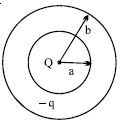
$A$ spherical shell with an inner radius $a$ and an outer radius $b$ is made of conducting material. $A$ point charge $+Q$ is placed at the centre of the spherical shell and a total charge $-q$ is placed on the shell. Charge $-q$ is distributed on the surfaces as:
A
$-Q$ on the inner surface,$-q$ on outer surface
B
$-Q$ on the inner surface,$-q + Q$ on the outer surface
C
$+Q$ on the inner surface,$-q - Q$ on the outer surface
D
The charge $-q$ is spread uniformly between the inner and outer surface.
Solution
(B) $1$. According to the property of conductors in electrostatic equilibrium,the electric field inside the material of the conductor must be zero.
$2$. By Gauss's Law,if we consider a Gaussian surface inside the conducting material,the net charge enclosed must be zero.
$3$. $A$ point charge $+Q$ is placed at the center. To make the net charge inside the conducting material zero,an induced charge of $-Q$ must appear on the inner surface of the shell (at radius $a$).
$4$. The total charge on the shell is given as $-q$. Let the charge on the outer surface be $q_{outer}$.
$5$. Since the total charge on the shell is the sum of the charges on the inner and outer surfaces,we have: $-Q + q_{outer} = -q$.
$6$. Solving for $q_{outer}$,we get: $q_{outer} = -q + Q$.
$7$. Therefore,the charge distribution is $-Q$ on the inner surface and $-q + Q$ on the outer surface.
$2$. By Gauss's Law,if we consider a Gaussian surface inside the conducting material,the net charge enclosed must be zero.
$3$. $A$ point charge $+Q$ is placed at the center. To make the net charge inside the conducting material zero,an induced charge of $-Q$ must appear on the inner surface of the shell (at radius $a$).
$4$. The total charge on the shell is given as $-q$. Let the charge on the outer surface be $q_{outer}$.
$5$. Since the total charge on the shell is the sum of the charges on the inner and outer surfaces,we have: $-Q + q_{outer} = -q$.
$6$. Solving for $q_{outer}$,we get: $q_{outer} = -q + Q$.
$7$. Therefore,the charge distribution is $-Q$ on the inner surface and $-q + Q$ on the outer surface.
0 likes
View Solution58
AdvancedMCQ
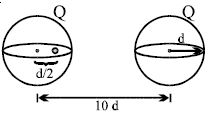
Two spherical,nonconducting,and very thin shells of uniformly distributed positive charge $Q$ and radius $d$ are located a distance $10d$ from each other. $A$ positive point charge $q$ is placed inside one of the shells at a distance $d/2$ from the center,on the line connecting the centers of the two shells,as shown in the figure. What is the net force on the charge $q$?
A
$\frac{qQ}{361\pi \varepsilon_0 d^2}$ to the left
B
$\frac{qQ}{361\pi \varepsilon_0 d^2}$ to the right
C
$\frac{362qQ}{361\pi \varepsilon_0 d^2}$ to the left
D
$\frac{360qQ}{361\pi \varepsilon_0 d^2}$ to the right
Solution
(A) According to the shell theorem,the electric field inside a uniformly charged spherical shell is zero. Therefore,the electric force on the charge $q$ due to the shell in which it is placed (let's call it shell $A$) is zero.
The electric force on the charge $q$ is only due to the other shell (shell $B$). The distance between the center of shell $B$ and the charge $q$ is $10d + d/2 = 19d/2$.
Since shell $B$ acts as a point charge $Q$ at its center for external points,the force is given by Coulomb's Law:
$F = \frac{1}{4\pi \varepsilon_0} \frac{Qq}{(19d/2)^2} = \frac{Qq}{4\pi \varepsilon_0 (361d^2/4)} = \frac{Qq}{361\pi \varepsilon_0 d^2}$.
Since both charges are positive,the force is repulsive,meaning it acts away from shell $B$,which is towards the left.
The electric force on the charge $q$ is only due to the other shell (shell $B$). The distance between the center of shell $B$ and the charge $q$ is $10d + d/2 = 19d/2$.
Since shell $B$ acts as a point charge $Q$ at its center for external points,the force is given by Coulomb's Law:
$F = \frac{1}{4\pi \varepsilon_0} \frac{Qq}{(19d/2)^2} = \frac{Qq}{4\pi \varepsilon_0 (361d^2/4)} = \frac{Qq}{361\pi \varepsilon_0 d^2}$.
Since both charges are positive,the force is repulsive,meaning it acts away from shell $B$,which is towards the left.
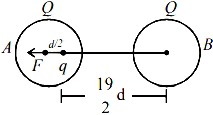
0 likes
View Solution59
MediumMCQ
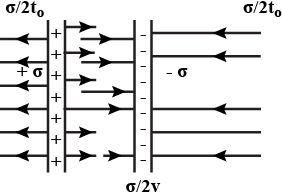
Two infinite sheets of uniform charge density $+\sigma$ and $-\sigma$ are parallel to each other as shown in the figure. The electric field is:

A
zero at points to the left or to the right of the sheets.
B
zero at the midpoint between the sheets.
C
$\sigma / \varepsilon_0$ at the midpoint between the sheets and is directed towards the right.
D
both $A$ and $C$ are correct.
Solution
(D) The electric field due to an infinite sheet of charge with surface charge density $\sigma$ is given by $E = \frac{\sigma}{2\varepsilon_0}$.
For a sheet with charge density $+\sigma$,the field is directed away from the sheet. For a sheet with charge density $-\sigma$,the field is directed towards the sheet.
Outside the plates,the fields due to the two sheets are equal in magnitude and opposite in direction,so the net electric field is $E = \frac{\sigma}{2\varepsilon_0} - \frac{\sigma}{2\varepsilon_0} = 0$.
Between the plates,the fields due to both sheets are directed from the positive sheet to the negative sheet (towards the right). Thus,the net electric field is $E = \frac{\sigma}{2\varepsilon_0} + \frac{\sigma}{2\varepsilon_0} = \frac{\sigma}{\varepsilon_0}$.
Therefore,the statements in $A$ and $C$ are correct.
For a sheet with charge density $+\sigma$,the field is directed away from the sheet. For a sheet with charge density $-\sigma$,the field is directed towards the sheet.
Outside the plates,the fields due to the two sheets are equal in magnitude and opposite in direction,so the net electric field is $E = \frac{\sigma}{2\varepsilon_0} - \frac{\sigma}{2\varepsilon_0} = 0$.
Between the plates,the fields due to both sheets are directed from the positive sheet to the negative sheet (towards the right). Thus,the net electric field is $E = \frac{\sigma}{2\varepsilon_0} + \frac{\sigma}{2\varepsilon_0} = \frac{\sigma}{\varepsilon_0}$.
Therefore,the statements in $A$ and $C$ are correct.
0 likes
View Solution60
DifficultMCQ
An electric field converges at the origin whose magnitude is given by the expression $E = 100\,r\,N/C$,where $r$ is the distance measured from the origin.
A
Total charge contained in any spherical volume with its centre at the origin is negative.
B
Total charge contained in any spherical volume,irrespective of the location of its centre,is negative.
C
Total charge contained in a spherical volume of radius $3\,cm$ with its centre at the origin has magnitude $3 \times 10^{-13}\,C$.
D
All of the above.
Solution
(D) Since the electric field converges at the origin,the electric field vector $\vec{E}$ is directed towards the origin. Thus,$\vec{E} = -100\,r\hat{r}$.
By Gauss's Law,$\oint \vec{E} \cdot d\vec{s} = \frac{q_{enclosed}}{\epsilon_0}$.
For a spherical surface of radius $r$ centered at the origin,the flux is $\Phi = E \cdot (4\pi r^2) = (-100r)(4\pi r^2) = -400\pi r^3$.
Since the flux is negative,the enclosed charge $q$ must be negative,which confirms that the charge contained in any spherical volume centered at the origin is negative.
For $r = 3\,cm = 0.03\,m$,the charge $q = \epsilon_0 \Phi = (8.854 \times 10^{-12}) \times (-400\pi \times (0.03)^3) \approx -3 \times 10^{-13}\,C$.
Thus,all the given statements are correct.
By Gauss's Law,$\oint \vec{E} \cdot d\vec{s} = \frac{q_{enclosed}}{\epsilon_0}$.
For a spherical surface of radius $r$ centered at the origin,the flux is $\Phi = E \cdot (4\pi r^2) = (-100r)(4\pi r^2) = -400\pi r^3$.
Since the flux is negative,the enclosed charge $q$ must be negative,which confirms that the charge contained in any spherical volume centered at the origin is negative.
For $r = 3\,cm = 0.03\,m$,the charge $q = \epsilon_0 \Phi = (8.854 \times 10^{-12}) \times (-400\pi \times (0.03)^3) \approx -3 \times 10^{-13}\,C$.
Thus,all the given statements are correct.
0 likes
View Solution61
AdvancedMCQ
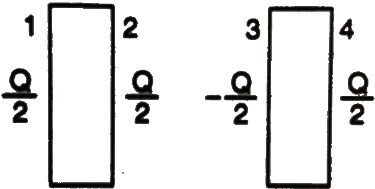
$X$ and $Y$ are large,parallel conducting plates close to each other. Each face has an area $A$. $X$ is given a charge $Q$. $Y$ is without any charge. Points $A, B$,and $C$ are as shown in the figure.

A
The field at $B$ is $\frac{Q}{2{\varepsilon _0}A}$
B
The field at $A$ and $C$ are of the same magnitude,but in opposite directions.
C
The fields at $A, B$,and $C$ are of the same magnitude.
D
All of the above
Solution
(D) When two large parallel conducting plates are placed close to each other,the charges on the outer faces are equal to half the sum of the total charges on the plates. Let the charges on the four faces be $q_1, q_2, q_3$,and $q_4$ from left to right.
$q_1 = q_4 = \frac{Q + 0}{2} = \frac{Q}{2}$
Since plate $X$ has total charge $Q$,$q_1 + q_2 = Q \implies q_2 = Q - \frac{Q}{2} = \frac{Q}{2}$.
Since plate $Y$ has total charge $0$,$q_3 + q_4 = 0 \implies q_3 = -q_4 = -\frac{Q}{2}$.
The electric field due to a single charged sheet is $E = \frac{\sigma}{2\varepsilon_0} = \frac{q}{2A\varepsilon_0}$.
At point $A$ (to the left of both plates): The fields from all four faces point to the left. $E_A = \frac{q_1 + q_2 + q_3 + q_4}{2A\varepsilon_0} = \frac{Q/2 + Q/2 - Q/2 + Q/2}{2A\varepsilon_0} = \frac{Q}{2A\varepsilon_0}$ (towards the left).
At point $B$ (between the plates): The fields from $q_1, q_2$ point to the right,and from $q_3, q_4$ point to the left. $E_B = \frac{q_1 + q_2 - q_3 - q_4}{2A\varepsilon_0} = \frac{Q/2 + Q/2 - (-Q/2) - Q/2}{2A\varepsilon_0} = \frac{Q}{2A\varepsilon_0}$ (towards the right).
At point $C$ (to the right of both plates): The fields from all four faces point to the right. $E_C = \frac{q_1 + q_2 + q_3 + q_4}{2A\varepsilon_0} = \frac{Q}{2A\varepsilon_0}$ (towards the right).
Thus,the magnitude of the electric field at $A, B$,and $C$ is $\frac{Q}{2A\varepsilon_0}$. Therefore,all statements are correct.
$q_1 = q_4 = \frac{Q + 0}{2} = \frac{Q}{2}$
Since plate $X$ has total charge $Q$,$q_1 + q_2 = Q \implies q_2 = Q - \frac{Q}{2} = \frac{Q}{2}$.
Since plate $Y$ has total charge $0$,$q_3 + q_4 = 0 \implies q_3 = -q_4 = -\frac{Q}{2}$.
The electric field due to a single charged sheet is $E = \frac{\sigma}{2\varepsilon_0} = \frac{q}{2A\varepsilon_0}$.
At point $A$ (to the left of both plates): The fields from all four faces point to the left. $E_A = \frac{q_1 + q_2 + q_3 + q_4}{2A\varepsilon_0} = \frac{Q/2 + Q/2 - Q/2 + Q/2}{2A\varepsilon_0} = \frac{Q}{2A\varepsilon_0}$ (towards the left).
At point $B$ (between the plates): The fields from $q_1, q_2$ point to the right,and from $q_3, q_4$ point to the left. $E_B = \frac{q_1 + q_2 - q_3 - q_4}{2A\varepsilon_0} = \frac{Q/2 + Q/2 - (-Q/2) - Q/2}{2A\varepsilon_0} = \frac{Q}{2A\varepsilon_0}$ (towards the right).
At point $C$ (to the right of both plates): The fields from all four faces point to the right. $E_C = \frac{q_1 + q_2 + q_3 + q_4}{2A\varepsilon_0} = \frac{Q}{2A\varepsilon_0}$ (towards the right).
Thus,the magnitude of the electric field at $A, B$,and $C$ is $\frac{Q}{2A\varepsilon_0}$. Therefore,all statements are correct.
0 likes
View Solution62
MediumMCQ
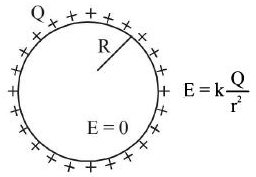
$A$ thin spherical shell of radius $R$ has charge $Q$ spread uniformly over its surface. Which of the following graphs most closely represents the electric field $E(r)$ produced by the shell in the range $0 \le r < \infty$,where $r$ is the distance from the centre of the shell?
A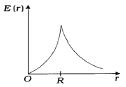
B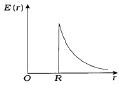
C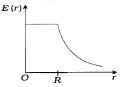
D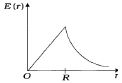
Solution
(B) According to Gauss's Law,for a thin spherical shell of radius $R$ with a uniformly distributed charge $Q$:
$1$. Inside the shell $(r < R)$: The electric field $E$ is zero because there is no enclosed charge.
$2$. Outside the shell $(r \ge R)$: The shell acts as a point charge located at its center,so the electric field is given by $E = k\frac{Q}{r^2}$,where $k = \frac{1}{4\pi\epsilon_0}$.
Thus,the graph of $E(r)$ versus $r$ should show $E = 0$ for $0 \le r < R$ and a $1/r^2$ decay for $r \ge R$. This corresponds to the graph shown in option $B$.
$1$. Inside the shell $(r < R)$: The electric field $E$ is zero because there is no enclosed charge.
$2$. Outside the shell $(r \ge R)$: The shell acts as a point charge located at its center,so the electric field is given by $E = k\frac{Q}{r^2}$,where $k = \frac{1}{4\pi\epsilon_0}$.
Thus,the graph of $E(r)$ versus $r$ should show $E = 0$ for $0 \le r < R$ and a $1/r^2$ decay for $r \ge R$. This corresponds to the graph shown in option $B$.
0 likes
View Solution63
DifficultMCQ
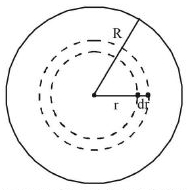
Let $\rho (r) = \frac{Q}{\pi R^4} r$ be the charge density distribution for a solid sphere of radius $R$ and total charge $Q$. For a point $p$ inside the sphere at distance $r_1$ from the centre of the sphere,the magnitude of the electric field is:
A
$0$
B
$\frac{Q}{4\pi \varepsilon_0 r_1^2}$
C
$\frac{Q r_1^2}{4\pi \varepsilon_0 R^4}$
D
$\frac{Q r_1^2}{4\pi \varepsilon_0 R^4}$
Solution
(C) To find the electric field at a distance $r_1$ from the center,we use Gauss's Law: $\oint E \cdot dA = \frac{q_{enc}}{\varepsilon_0}$.
For a spherical Gaussian surface of radius $r_1$,$E(4\pi r_1^2) = \frac{q_{enc}}{\varepsilon_0}$.
The charge enclosed $q_{enc}$ is the integral of the charge density $\rho(r)$ over the volume of the sphere of radius $r_1$:
$q_{enc} = \int_0^{r_1} \rho(r) (4\pi r^2) dr = \int_0^{r_1} \left( \frac{Q}{\pi R^4} r \right) (4\pi r^2) dr = \frac{4Q}{R^4} \int_0^{r_1} r^3 dr = \frac{4Q}{R^4} \left[ \frac{r^4}{4} \right]_0^{r_1} = \frac{Q r_1^4}{R^4}$.
Substituting this into Gauss's Law:
$E(4\pi r_1^2) = \frac{Q r_1^4}{\varepsilon_0 R^4} \implies E = \frac{Q r_1^4}{4\pi \varepsilon_0 R^4 r_1^2} = \frac{Q r_1^2}{4\pi \varepsilon_0 R^4}$.
For a spherical Gaussian surface of radius $r_1$,$E(4\pi r_1^2) = \frac{q_{enc}}{\varepsilon_0}$.
The charge enclosed $q_{enc}$ is the integral of the charge density $\rho(r)$ over the volume of the sphere of radius $r_1$:
$q_{enc} = \int_0^{r_1} \rho(r) (4\pi r^2) dr = \int_0^{r_1} \left( \frac{Q}{\pi R^4} r \right) (4\pi r^2) dr = \frac{4Q}{R^4} \int_0^{r_1} r^3 dr = \frac{4Q}{R^4} \left[ \frac{r^4}{4} \right]_0^{r_1} = \frac{Q r_1^4}{R^4}$.
Substituting this into Gauss's Law:
$E(4\pi r_1^2) = \frac{Q r_1^4}{\varepsilon_0 R^4} \implies E = \frac{Q r_1^4}{4\pi \varepsilon_0 R^4 r_1^2} = \frac{Q r_1^2}{4\pi \varepsilon_0 R^4}$.
0 likes
View Solution64
DifficultMCQ
Let there be a spherically symmetric charge distribution with charge density varying as $\rho (r) = \rho _0 \left( \frac{5}{4} - \frac{r}{R} \right)$ for $r \le R$,and $\rho (r) = 0$ for $r > R$,where $r$ is the distance from the origin. The electric field at a distance $r (r < R)$ from the origin is given by:
A
$\frac{\rho _0 r}{3 \varepsilon _0} \left( \frac{5}{4} - \frac{r}{R} \right)$
B
$\frac{4 \pi \rho _0 r}{3 \varepsilon _0} \left( \frac{5}{3} - \frac{r}{R} \right)$
C
$\frac{\rho _0 r}{4 \varepsilon _0} \left( \frac{5}{3} - \frac{r}{R} \right)$
D
$\frac{4 \pi \rho _0 r}{3 \varepsilon _0} \left( \frac{5}{4} - \frac{r}{R} \right)$
Solution
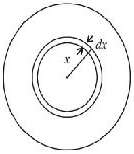
(C) Consider a spherical shell of radius $x$ and thickness $dx$. The charge on this shell is given by $dq = \rho(x) \cdot 4 \pi x^2 dx = \rho_0 \left( \frac{5}{4} - \frac{x}{R} \right) \cdot 4 \pi x^2 dx$.
The total charge $q$ enclosed within a sphere of radius $r$ $(r < R)$ is:
$q = \int_0^r dq = 4 \pi \rho_0 \int_0^r \left( \frac{5}{4} x^2 - \frac{x^3}{R} \right) dx$
$q = 4 \pi \rho_0 \left[ \frac{5}{4} \cdot \frac{r^3}{3} - \frac{1}{R} \cdot \frac{r^4}{4} \right] = 4 \pi \rho_0 \left( \frac{5 r^3}{12} - \frac{r^4}{4R} \right) = \pi \rho_0 r^3 \left( \frac{5}{3} - \frac{r}{R} \right)$.
Using Gauss's Law,the electric field $E$ at distance $r$ is:
$E \cdot 4 \pi r^2 = \frac{q}{\varepsilon_0}$
$E = \frac{1}{4 \pi \varepsilon_0 r^2} \cdot \left[ \pi \rho_0 r^3 \left( \frac{5}{3} - \frac{r}{R} \right) \right]$
$E = \frac{\rho_0 r}{4 \varepsilon_0} \left( \frac{5}{3} - \frac{r}{R} \right)$.
The total charge $q$ enclosed within a sphere of radius $r$ $(r < R)$ is:
$q = \int_0^r dq = 4 \pi \rho_0 \int_0^r \left( \frac{5}{4} x^2 - \frac{x^3}{R} \right) dx$
$q = 4 \pi \rho_0 \left[ \frac{5}{4} \cdot \frac{r^3}{3} - \frac{1}{R} \cdot \frac{r^4}{4} \right] = 4 \pi \rho_0 \left( \frac{5 r^3}{12} - \frac{r^4}{4R} \right) = \pi \rho_0 r^3 \left( \frac{5}{3} - \frac{r}{R} \right)$.
Using Gauss's Law,the electric field $E$ at distance $r$ is:
$E \cdot 4 \pi r^2 = \frac{q}{\varepsilon_0}$
$E = \frac{1}{4 \pi \varepsilon_0 r^2} \cdot \left[ \pi \rho_0 r^3 \left( \frac{5}{3} - \frac{r}{R} \right) \right]$
$E = \frac{\rho_0 r}{4 \varepsilon_0} \left( \frac{5}{3} - \frac{r}{R} \right)$.
0 likes
View Solution65
DifficultMCQ
The electrostatic potential inside a charged spherical ball is given by $\phi = ar^2 + b$,where $r$ is the distance from the centre and $a, b$ are constants. Then the charge density inside the ball is:
A
$-24\pi a\varepsilon_0 r$
B
$-6a\varepsilon_0 r$
C
$-24\pi a\varepsilon_0$
D
$-6a\varepsilon_0$
Solution
(D) The electric field $E$ is related to the potential $\phi$ by the relation $E = -\frac{d\phi}{dr}$.
Given $\phi = ar^2 + b$,we have $E = -\frac{d}{dr}(ar^2 + b) = -2ar$.
According to Gauss's Law in differential form,the charge density $\rho$ is given by $\nabla \cdot E = \frac{\rho}{\varepsilon_0}$.
In spherical coordinates,for a radially symmetric field $E(r)$,the divergence is $\frac{1}{r^2} \frac{d}{dr}(r^2 E) = \frac{\rho}{\varepsilon_0}$.
Substituting $E = -2ar$ into the equation:
$\frac{\rho}{\varepsilon_0} = \frac{1}{r^2} \frac{d}{dr}(r^2 (-2ar)) = \frac{1}{r^2} \frac{d}{dr}(-2ar^3) = \frac{1}{r^2} (-6ar^2) = -6a$.
Therefore,the charge density is $\rho = -6a\varepsilon_0$.
Given $\phi = ar^2 + b$,we have $E = -\frac{d}{dr}(ar^2 + b) = -2ar$.
According to Gauss's Law in differential form,the charge density $\rho$ is given by $\nabla \cdot E = \frac{\rho}{\varepsilon_0}$.
In spherical coordinates,for a radially symmetric field $E(r)$,the divergence is $\frac{1}{r^2} \frac{d}{dr}(r^2 E) = \frac{\rho}{\varepsilon_0}$.
Substituting $E = -2ar$ into the equation:
$\frac{\rho}{\varepsilon_0} = \frac{1}{r^2} \frac{d}{dr}(r^2 (-2ar)) = \frac{1}{r^2} \frac{d}{dr}(-2ar^3) = \frac{1}{r^2} (-6ar^2) = -6a$.
Therefore,the charge density is $\rho = -6a\varepsilon_0$.
0 likes
View Solution66
MediumMCQ
In a uniformly charged sphere of total charge $Q$ and radius $R$,the electric field $E$ is plotted as a function of distance $r$ from the center. The graph which would correspond to the above is:
A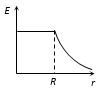
B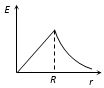
C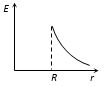
D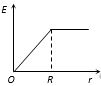
Solution
(B) For a uniformly charged sphere of total charge $Q$ and radius $R$:
$1$. Inside the sphere $(r < R)$: The electric field is given by $E = \frac{1}{4 \pi \varepsilon_0} \frac{Q r}{R^3}$. This shows that $E \propto r$,meaning the electric field increases linearly from the center $(r=0)$ to the surface $(r=R)$.
$2$. At the surface $(r = R)$: The electric field is maximum,$E = \frac{1}{4 \pi \varepsilon_0} \frac{Q}{R^2}$.
$3$. Outside the sphere $(r > R)$: The sphere behaves as a point charge at the center,so $E = \frac{1}{4 \pi \varepsilon_0} \frac{Q}{r^2}$. This shows that $E \propto \frac{1}{r^2}$,meaning the electric field decreases inversely with the square of the distance.
Comparing this behavior with the given options,the graph that shows a linear increase for $r < R$ and a $1/r^2$ decrease for $r > R$ is the correct one.
$1$. Inside the sphere $(r < R)$: The electric field is given by $E = \frac{1}{4 \pi \varepsilon_0} \frac{Q r}{R^3}$. This shows that $E \propto r$,meaning the electric field increases linearly from the center $(r=0)$ to the surface $(r=R)$.
$2$. At the surface $(r = R)$: The electric field is maximum,$E = \frac{1}{4 \pi \varepsilon_0} \frac{Q}{R^2}$.
$3$. Outside the sphere $(r > R)$: The sphere behaves as a point charge at the center,so $E = \frac{1}{4 \pi \varepsilon_0} \frac{Q}{r^2}$. This shows that $E \propto \frac{1}{r^2}$,meaning the electric field decreases inversely with the square of the distance.
Comparing this behavior with the given options,the graph that shows a linear increase for $r < R$ and a $1/r^2$ decrease for $r > R$ is the correct one.
0 likes
View Solution67
DifficultMCQ
This question has Statement-$1$ and Statement-$2$. Of the four choices given after the statements,choose the one that best describes the two statements.
An insulating solid sphere of radius $R$ has a uniformly positive charge density $\rho$. As a result of this uniform charge distribution,there is a finite value of electric potential at the centre of the sphere,at the surface of the sphere,and also at a point outside the sphere. The electric potential at infinity is zero.
Statement-$1$: When a charge $q$ is taken from the centre to the surface of the sphere,its potential energy changes by $\frac{q \rho R^2}{6 \epsilon_0}$.
Statement-$2$: The electric field at a distance $r (r < R)$ from the centre of the sphere is $\frac{\rho r}{3 \epsilon_0}$.
An insulating solid sphere of radius $R$ has a uniformly positive charge density $\rho$. As a result of this uniform charge distribution,there is a finite value of electric potential at the centre of the sphere,at the surface of the sphere,and also at a point outside the sphere. The electric potential at infinity is zero.
Statement-$1$: When a charge $q$ is taken from the centre to the surface of the sphere,its potential energy changes by $\frac{q \rho R^2}{6 \epsilon_0}$.
Statement-$2$: The electric field at a distance $r (r < R)$ from the centre of the sphere is $\frac{\rho r}{3 \epsilon_0}$.
A
Statement-$1$ is true,Statement-$2$ is true; Statement-$2$ is the correct explanation of Statement-$1$.
B
Statement-$1$ is true,Statement-$2$ is true; Statement-$2$ is not the correct explanation of Statement-$1$.
C
Statement-$1$ is true,Statement-$2$ is false.
D
Statement-$1$ is false,Statement-$2$ is true.
Solution
(A) The electric field inside a uniformly charged insulating sphere at distance $r < R$ is given by $E = \frac{\rho r}{3 \epsilon_0}$. Thus,Statement-$2$ is true.
The electric potential $V(r)$ inside a uniformly charged sphere is given by $V(r) = \frac{\rho}{6 \epsilon_0} (3R^2 - r^2)$.
At the centre $(r = 0)$,$V_{centre} = \frac{3 \rho R^2}{6 \epsilon_0} = \frac{\rho R^2}{2 \epsilon_0}$.
At the surface $(r = R)$,$V_{surface} = \frac{\rho}{6 \epsilon_0} (3R^2 - R^2) = \frac{2 \rho R^2}{6 \epsilon_0} = \frac{\rho R^2}{3 \epsilon_0}$.
The change in potential energy $\Delta U = q(V_{surface} - V_{centre}) = q \left( \frac{\rho R^2}{3 \epsilon_0} - \frac{\rho R^2}{2 \epsilon_0} \right) = q \left( \frac{2 \rho R^2 - 3 \rho R^2}{6 \epsilon_0} \right) = -\frac{q \rho R^2}{6 \epsilon_0}$.
Since the magnitude of change is $\frac{q \rho R^2}{6 \epsilon_0}$,Statement-$1$ is true. Statement-$2$ provides the formula for the electric field,which is used to derive the potential difference,making it the correct explanation.
The electric potential $V(r)$ inside a uniformly charged sphere is given by $V(r) = \frac{\rho}{6 \epsilon_0} (3R^2 - r^2)$.
At the centre $(r = 0)$,$V_{centre} = \frac{3 \rho R^2}{6 \epsilon_0} = \frac{\rho R^2}{2 \epsilon_0}$.
At the surface $(r = R)$,$V_{surface} = \frac{\rho}{6 \epsilon_0} (3R^2 - R^2) = \frac{2 \rho R^2}{6 \epsilon_0} = \frac{\rho R^2}{3 \epsilon_0}$.
The change in potential energy $\Delta U = q(V_{surface} - V_{centre}) = q \left( \frac{\rho R^2}{3 \epsilon_0} - \frac{\rho R^2}{2 \epsilon_0} \right) = q \left( \frac{2 \rho R^2 - 3 \rho R^2}{6 \epsilon_0} \right) = -\frac{q \rho R^2}{6 \epsilon_0}$.
Since the magnitude of change is $\frac{q \rho R^2}{6 \epsilon_0}$,Statement-$1$ is true. Statement-$2$ provides the formula for the electric field,which is used to derive the potential difference,making it the correct explanation.
0 likes
View Solution68
DifficultMCQ
The region between two concentric spheres of radii '$a$' and '$b$' (see figure) has a volume charge density $\rho = \frac{A}{r}$,where $A$ is a constant and $r$ is the distance from the centre. At the centre of the spheres is a point charge $Q$. The value of $A$ such that the electric field in the region between the spheres is constant,is:

A
$\frac{2Q}{\pi (a^2 - b^2)}$
B
$\frac{2Q}{\pi a^2}$
C
$\frac{Q}{2\pi a^2}$
D
$\frac{Q}{2\pi (b^2 - a^2)}$
Solution
(C) Consider a Gaussian surface as a sphere of radius $r$ such that $a < r < b$.
According to Gauss's law,$\oint_{S} \vec{E} \cdot d\vec{S} = \frac{q_{enclosed}}{\epsilon_0}$.
Here,$q_{enclosed} = Q + \int_{a}^{r} \rho(r') \cdot 4\pi r'^2 dr'$.
Given $\rho(r') = \frac{A}{r'}$,we have $q_{enclosed} = Q + \int_{a}^{r} \frac{A}{r'} \cdot 4\pi r'^2 dr' = Q + 4\pi A \int_{a}^{r} r' dr' = Q + 4\pi A \left[ \frac{r'^2}{2} \right]_{a}^{r} = Q + 2\pi A (r^2 - a^2)$.
Applying Gauss's law: $E \cdot 4\pi r^2 = \frac{Q + 2\pi A (r^2 - a^2)}{\epsilon_0}$.
$E = \frac{1}{4\pi \epsilon_0 r^2} [Q - 2\pi A a^2 + 2\pi A r^2] = \frac{1}{4\pi \epsilon_0} [\frac{Q - 2\pi A a^2}{r^2} + 2\pi A]$.
For the electric field $E$ to be constant (independent of $r$),the coefficient of $\frac{1}{r^2}$ must be zero.
Therefore,$Q - 2\pi A a^2 = 0$.
$A = \frac{Q}{2\pi a^2}$.
According to Gauss's law,$\oint_{S} \vec{E} \cdot d\vec{S} = \frac{q_{enclosed}}{\epsilon_0}$.
Here,$q_{enclosed} = Q + \int_{a}^{r} \rho(r') \cdot 4\pi r'^2 dr'$.
Given $\rho(r') = \frac{A}{r'}$,we have $q_{enclosed} = Q + \int_{a}^{r} \frac{A}{r'} \cdot 4\pi r'^2 dr' = Q + 4\pi A \int_{a}^{r} r' dr' = Q + 4\pi A \left[ \frac{r'^2}{2} \right]_{a}^{r} = Q + 2\pi A (r^2 - a^2)$.
Applying Gauss's law: $E \cdot 4\pi r^2 = \frac{Q + 2\pi A (r^2 - a^2)}{\epsilon_0}$.
$E = \frac{1}{4\pi \epsilon_0 r^2} [Q - 2\pi A a^2 + 2\pi A r^2] = \frac{1}{4\pi \epsilon_0} [\frac{Q - 2\pi A a^2}{r^2} + 2\pi A]$.
For the electric field $E$ to be constant (independent of $r$),the coefficient of $\frac{1}{r^2}$ must be zero.
Therefore,$Q - 2\pi A a^2 = 0$.
$A = \frac{Q}{2\pi a^2}$.
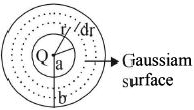
1 likes
View Solution69
MediumMCQ
An electrostatic field in a region is radially outward with magnitude $E = \alpha r$,where $\alpha$ is a constant and $r$ is the radial distance. The charge contained in a sphere of radius $R$ in this region (centered at the origin) is:
A
$4\pi \varepsilon_0 \alpha R^3$
B
$\pi \varepsilon_0 \alpha R^3$
C
$2\pi \varepsilon_0 \alpha R^3$
D
$8\pi \varepsilon_0 \alpha R^3$
Solution
(A) According to Gauss's Law,the total electric flux $\Phi_E$ through a closed surface is given by $\Phi_E = \oint \vec{E} \cdot d\vec{A} = \frac{Q_{enclosed}}{\varepsilon_0}$.
For a sphere of radius $R$ centered at the origin,the electric field is radially outward and its magnitude is $E = \alpha R$ at the surface.
The area of the sphere is $A = 4\pi R^2$.
The flux through the sphere is $\Phi_E = E \times A = (\alpha R) \times (4\pi R^2) = 4\pi \alpha R^3$.
Using Gauss's Law,$Q_{enclosed} = \varepsilon_0 \Phi_E$.
Therefore,$Q = \varepsilon_0 (4\pi \alpha R^3) = 4\pi \varepsilon_0 \alpha R^3$.
For a sphere of radius $R$ centered at the origin,the electric field is radially outward and its magnitude is $E = \alpha R$ at the surface.
The area of the sphere is $A = 4\pi R^2$.
The flux through the sphere is $\Phi_E = E \times A = (\alpha R) \times (4\pi R^2) = 4\pi \alpha R^3$.
Using Gauss's Law,$Q_{enclosed} = \varepsilon_0 \Phi_E$.
Therefore,$Q = \varepsilon_0 (4\pi \alpha R^3) = 4\pi \varepsilon_0 \alpha R^3$.
0 likes
View Solution70
MediumMCQ
The electric field $\vec{E} = E_0 y \hat{j}$ acts in a space where a cylinder of radius $r$ and length $l$ is placed with its axis parallel to the $y$-axis. The charge inside the volume of the cylinder is:
A
$E_0 \varepsilon_0 \frac{l^2}{2}$
B
$E_0 \varepsilon_0 \pi r^2 l^2$
C
$E_0 \varepsilon_0 \pi r^2 l$
D
$2 E_0 \varepsilon_0 \pi r^2 l$
Solution
(C) According to Gauss's Law, the total electric flux $\phi$ through a closed surface is given by $\phi = \oint \vec{E} \cdot d\vec{s} = \frac{Q_{in}}{\varepsilon_0}$.
For a cylinder with its axis along the $y$-axis, the electric field $\vec{E} = E_0 y \hat{j}$ is parallel to the curved surface and perpendicular to the circular end faces.
However, the flux through the curved surface is zero because $\vec{E} \cdot d\vec{s} = 0$ (as $d\vec{s}$ is radial).
At the bottom face $(y = 0)$, $\vec{E} = 0$, so flux is $0$.
At the top face $(y = l)$, $\vec{E} = E_0 l \hat{j}$ and the area vector $d\vec{s} = dA \hat{j}$.
The flux through the top face is $\phi = \int E_0 l dA = E_0 l \int dA = E_0 l (\pi r^2)$.
Thus, the total flux $\phi = E_0 l \pi r^2$.
Using Gauss's Law, $Q_{in} = \varepsilon_0 \phi = \varepsilon_0 E_0 \pi r^2 l$.
For a cylinder with its axis along the $y$-axis, the electric field $\vec{E} = E_0 y \hat{j}$ is parallel to the curved surface and perpendicular to the circular end faces.
However, the flux through the curved surface is zero because $\vec{E} \cdot d\vec{s} = 0$ (as $d\vec{s}$ is radial).
At the bottom face $(y = 0)$, $\vec{E} = 0$, so flux is $0$.
At the top face $(y = l)$, $\vec{E} = E_0 l \hat{j}$ and the area vector $d\vec{s} = dA \hat{j}$.
The flux through the top face is $\phi = \int E_0 l dA = E_0 l \int dA = E_0 l (\pi r^2)$.
Thus, the total flux $\phi = E_0 l \pi r^2$.
Using Gauss's Law, $Q_{in} = \varepsilon_0 \phi = \varepsilon_0 E_0 \pi r^2 l$.
0 likes
View Solution71
DifficultMCQ
For an infinite line of charge having charge density $\lambda$ lying along the $x$-axis,the work required in moving a charge $q$ from point $C$ to point $A$ along the arc $CA$ is:
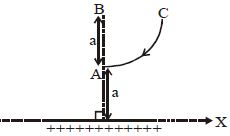
A
$\frac{q\lambda}{\pi \varepsilon_0} \ln \sqrt{2}$
B
$\frac{q\lambda}{4\pi \varepsilon_0} \ln 2$
C
$\frac{q\lambda}{2\pi \varepsilon_0} \ln 2$
D
$\frac{q\lambda}{2\pi \varepsilon_0} \ln \frac{1}{2}$
Solution
(B) The electric field due to an infinite line charge at a distance $r$ is $E = \frac{\lambda}{2\pi \varepsilon_0 r}$.
Since the electric field is conservative,the work done in moving a charge $q$ depends only on the initial and final positions.
Point $A$ is at a distance $r_A = a$ from the $x$-axis.
Point $C$ is at a distance $r_C = \sqrt{a^2 + a^2} = a\sqrt{2}$ from the $x$-axis.
The work done $W_{CA}$ is given by $W = q(V_A - V_C) = -q \int_{r_C}^{r_A} E dr$.
$W = -q \int_{a\sqrt{2}}^{a} \frac{\lambda}{2\pi \varepsilon_0 r} dr = -\frac{q\lambda}{2\pi \varepsilon_0} [\ln r]_{a\sqrt{2}}^{a}$.
$W = -\frac{q\lambda}{2\pi \varepsilon_0} (\ln a - \ln(a\sqrt{2})) = -\frac{q\lambda}{2\pi \varepsilon_0} \ln(\frac{a}{a\sqrt{2}})$.
$W = -\frac{q\lambda}{2\pi \varepsilon_0} \ln(\frac{1}{\sqrt{2}}) = \frac{q\lambda}{2\pi \varepsilon_0} \ln(\sqrt{2}) = \frac{q\lambda}{2\pi \varepsilon_0} \ln(2^{1/2}) = \frac{q\lambda}{4\pi \varepsilon_0} \ln 2$.
Since the electric field is conservative,the work done in moving a charge $q$ depends only on the initial and final positions.
Point $A$ is at a distance $r_A = a$ from the $x$-axis.
Point $C$ is at a distance $r_C = \sqrt{a^2 + a^2} = a\sqrt{2}$ from the $x$-axis.
The work done $W_{CA}$ is given by $W = q(V_A - V_C) = -q \int_{r_C}^{r_A} E dr$.
$W = -q \int_{a\sqrt{2}}^{a} \frac{\lambda}{2\pi \varepsilon_0 r} dr = -\frac{q\lambda}{2\pi \varepsilon_0} [\ln r]_{a\sqrt{2}}^{a}$.
$W = -\frac{q\lambda}{2\pi \varepsilon_0} (\ln a - \ln(a\sqrt{2})) = -\frac{q\lambda}{2\pi \varepsilon_0} \ln(\frac{a}{a\sqrt{2}})$.
$W = -\frac{q\lambda}{2\pi \varepsilon_0} \ln(\frac{1}{\sqrt{2}}) = \frac{q\lambda}{2\pi \varepsilon_0} \ln(\sqrt{2}) = \frac{q\lambda}{2\pi \varepsilon_0} \ln(2^{1/2}) = \frac{q\lambda}{4\pi \varepsilon_0} \ln 2$.
0 likes
View Solution72
MediumMCQ
Two concentric conducting thin spherical shells of radii $a$ and $b$ $(b > a)$ are given charges $Q$ and $-2Q$ respectively. The electric field along a line passing through the centre as a function of distance $(r)$ from the centre is given by:
A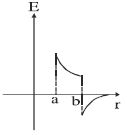
B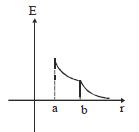
C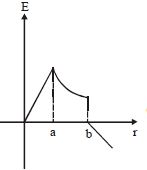
D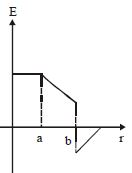
Solution
(A) For $r < a$,the electric field inside a conducting shell is zero,so $E = 0$.
For $a < r < b$,the electric field is due to the inner shell only. Using Gauss's Law,$E = \frac{kQ}{r^2}$.
For $r > b$,the total charge enclosed is $Q + (-2Q) = -Q$. Thus,the electric field is $E = \frac{k(-Q)}{r^2} = -\frac{kQ}{r^2}$.
Comparing these results with the given options,the graph showing $E = 0$ for $r < a$,a positive $1/r^2$ variation for $a < r < b$,and a negative $1/r^2$ variation for $r > b$ is represented by the first graph.
For $a < r < b$,the electric field is due to the inner shell only. Using Gauss's Law,$E = \frac{kQ}{r^2}$.
For $r > b$,the total charge enclosed is $Q + (-2Q) = -Q$. Thus,the electric field is $E = \frac{k(-Q)}{r^2} = -\frac{kQ}{r^2}$.
Comparing these results with the given options,the graph showing $E = 0$ for $r < a$,a positive $1/r^2$ variation for $a < r < b$,and a negative $1/r^2$ variation for $r > b$ is represented by the first graph.
0 likes
View Solution73
AdvancedMCQ
Consider a solid insulating sphere of radius $R$ with charge density varying as $\rho = \rho_0 r^2$,where $\rho_0$ is a constant and $r$ is measured from the centre. Consider two points $A$ and $B$ at distances $x$ and $y$ respectively $(x < R, y > R)$ from the centre. If the magnitudes of the electric fields at points $A$ and $B$ are equal,then:
A
$x^2y = R^3$
B
$x^3y^2 = R^5$
C
$x^2y^3 = R^5$
D
$\frac{x^4}{y} = R^5$
Solution
(B) For a point $A$ inside the sphere $(x < R)$,using Gauss's Law: $E_A \cdot 4\pi x^2 = \frac{q_{enclosed}}{\epsilon_0} = \frac{1}{\epsilon_0} \int_0^x \rho(r) \cdot 4\pi r^2 dr$.
Substituting $\rho = \rho_0 r^2$: $E_A \cdot 4\pi x^2 = \frac{4\pi \rho_0}{\epsilon_0} \int_0^x r^4 dr = \frac{4\pi \rho_0 x^5}{5\epsilon_0}$.
Thus,$E_A = \frac{\rho_0 x^3}{5\epsilon_0}$.
For a point $B$ outside the sphere $(y > R)$,the sphere acts as a point charge at the centre: $E_B = \frac{Q_{total}}{4\pi \epsilon_0 y^2}$.
$Q_{total} = \int_0^R \rho_0 r^2 \cdot 4\pi r^2 dr = 4\pi \rho_0 \int_0^R r^4 dr = \frac{4\pi \rho_0 R^5}{5}$.
So,$E_B = \frac{4\pi \rho_0 R^5}{5 \cdot 4\pi \epsilon_0 y^2} = \frac{\rho_0 R^5}{5\epsilon_0 y^2}$.
Given $E_A = E_B$,we have $\frac{\rho_0 x^3}{5\epsilon_0} = \frac{\rho_0 R^5}{5\epsilon_0 y^2}$.
Simplifying,we get $x^3 y^2 = R^5$.
Substituting $\rho = \rho_0 r^2$: $E_A \cdot 4\pi x^2 = \frac{4\pi \rho_0}{\epsilon_0} \int_0^x r^4 dr = \frac{4\pi \rho_0 x^5}{5\epsilon_0}$.
Thus,$E_A = \frac{\rho_0 x^3}{5\epsilon_0}$.
For a point $B$ outside the sphere $(y > R)$,the sphere acts as a point charge at the centre: $E_B = \frac{Q_{total}}{4\pi \epsilon_0 y^2}$.
$Q_{total} = \int_0^R \rho_0 r^2 \cdot 4\pi r^2 dr = 4\pi \rho_0 \int_0^R r^4 dr = \frac{4\pi \rho_0 R^5}{5}$.
So,$E_B = \frac{4\pi \rho_0 R^5}{5 \cdot 4\pi \epsilon_0 y^2} = \frac{\rho_0 R^5}{5\epsilon_0 y^2}$.
Given $E_A = E_B$,we have $\frac{\rho_0 x^3}{5\epsilon_0} = \frac{\rho_0 R^5}{5\epsilon_0 y^2}$.
Simplifying,we get $x^3 y^2 = R^5$.
0 likes
View Solution74
DifficultMCQ
$A$ long, straight wire is surrounded by a hollow, thin, long metal cylinder whose axis coincides with that of the wire. The wire has a charge per unit length of $\lambda$, and the cylinder has a net charge per unit length of $2\lambda$. The radius of the cylinder is $R$. Which of the following statements is correct?
A
Surface charge density on the inner surface of the cylinder is $-\frac{\lambda}{2\pi R}$.
B
Surface charge density on the outer surface of the cylinder is $\frac{3\lambda}{2\pi R}$.
C
The electric field outside the cylinder at a distance $r$ from the axis is $\frac{3\lambda}{2\pi \epsilon_0 r}$.
D
The electric field outside the cylinder at a distance $r$ from the axis is $\frac{2\lambda}{\pi \epsilon_0 r}$.
Solution
(B) According to Gauss's law, the electric field inside the conducting material of the cylinder must be zero.
Since the wire has a charge per unit length of $\lambda$, an induced charge of $-\lambda$ per unit length must appear on the inner surface of the cylinder.
The surface charge density on the inner surface is $\sigma_{in} = \frac{-\lambda}{2\pi R}$.
Since the net charge per unit length of the cylinder is $2\lambda$, the charge on the outer surface per unit length is $2\lambda - (-\lambda) = 3\lambda$.
The surface charge density on the outer surface is $\sigma_{out} = \frac{3\lambda}{2\pi R}$.
For a Gaussian surface of radius $r > R$, the total enclosed charge per unit length is $\lambda + 3\lambda = 4\lambda$.
Applying Gauss's law: $E(2\pi r) = \frac{4\lambda}{\epsilon_0} \implies E = \frac{2\lambda}{\pi \epsilon_0 r}$.
Comparing with the options, statement $B$ is correct.
Since the wire has a charge per unit length of $\lambda$, an induced charge of $-\lambda$ per unit length must appear on the inner surface of the cylinder.
The surface charge density on the inner surface is $\sigma_{in} = \frac{-\lambda}{2\pi R}$.
Since the net charge per unit length of the cylinder is $2\lambda$, the charge on the outer surface per unit length is $2\lambda - (-\lambda) = 3\lambda$.
The surface charge density on the outer surface is $\sigma_{out} = \frac{3\lambda}{2\pi R}$.
For a Gaussian surface of radius $r > R$, the total enclosed charge per unit length is $\lambda + 3\lambda = 4\lambda$.
Applying Gauss's law: $E(2\pi r) = \frac{4\lambda}{\epsilon_0} \implies E = \frac{2\lambda}{\pi \epsilon_0 r}$.
Comparing with the options, statement $B$ is correct.
0 likes
View Solution75
AdvancedMCQ
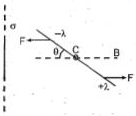
$A$ uniform rod $AB$ of mass $m$ and length $l$ is hinged at its midpoint $C$. The left half $(AC)$ of the rod has linear charge density $-\lambda$ and the right half $(CB)$ has $+\lambda$,where $\lambda$ is constant. $A$ large non-conducting sheet of uniform surface charge density $\sigma$ is also present near the rod. Initially,the rod is kept perpendicular to the sheet. The end $A$ of the rod is initially at a distance $d$. Now,the rod is rotated by a small angle $\theta$ in the plane of the paper and released. The time period of small angular oscillations is:
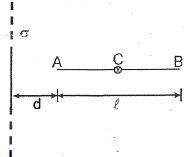
A
$T = 2\pi \sqrt{\frac{m\epsilon_0}{3\lambda\sigma}}$
B
$T = 2\pi \sqrt{\frac{2m\epsilon_0}{\lambda\sigma}}$
C
$T = 2\pi \sqrt{\frac{4m\epsilon_0}{3\lambda\sigma}}$
D
$T = 2\pi \sqrt{\frac{2m\epsilon_0}{3\lambda\sigma}}$
Solution
(D) The sheet produces a uniform electric field $E = \frac{\sigma}{2\epsilon_0}$ directed away from the sheet.
The force on the left half $(AC)$ is $F = qE = (\lambda \cdot \frac{l}{2}) \cdot \frac{\sigma}{2\epsilon_0} = \frac{\lambda l \sigma}{4\epsilon_0}$ acting to the left.
The force on the right half $(CB)$ is $F = qE = (\lambda \cdot \frac{l}{2}) \cdot \frac{\sigma}{2\epsilon_0} = \frac{\lambda l \sigma}{4\epsilon_0}$ acting to the right.
When the rod is rotated by a small angle $\theta$,the torque about the hinge $C$ is $\tau = 2 \cdot F \cdot (\frac{l}{4} \cos \theta) \approx 2 \cdot F \cdot \frac{l}{4} = \frac{Fl}{2} = \frac{\lambda l^2 \sigma}{8\epsilon_0}$.
Since $\tau = I\alpha$,where $I = \frac{ml^2}{12}$ is the moment of inertia about the center $C$,we have $\frac{ml^2}{12} \alpha = \frac{\lambda l^2 \sigma}{8\epsilon_0} \theta$.
$\alpha = \frac{12 \lambda \sigma}{8 m \epsilon_0} \theta = \frac{3 \lambda \sigma}{2 m \epsilon_0} \theta$.
Comparing with $\alpha = \omega^2 \theta$,we get $\omega^2 = \frac{3 \lambda \sigma}{2 m \epsilon_0}$.
The time period is $T = \frac{2\pi}{\omega} = 2\pi \sqrt{\frac{2m\epsilon_0}{3\lambda\sigma}}$.
The force on the left half $(AC)$ is $F = qE = (\lambda \cdot \frac{l}{2}) \cdot \frac{\sigma}{2\epsilon_0} = \frac{\lambda l \sigma}{4\epsilon_0}$ acting to the left.
The force on the right half $(CB)$ is $F = qE = (\lambda \cdot \frac{l}{2}) \cdot \frac{\sigma}{2\epsilon_0} = \frac{\lambda l \sigma}{4\epsilon_0}$ acting to the right.
When the rod is rotated by a small angle $\theta$,the torque about the hinge $C$ is $\tau = 2 \cdot F \cdot (\frac{l}{4} \cos \theta) \approx 2 \cdot F \cdot \frac{l}{4} = \frac{Fl}{2} = \frac{\lambda l^2 \sigma}{8\epsilon_0}$.
Since $\tau = I\alpha$,where $I = \frac{ml^2}{12}$ is the moment of inertia about the center $C$,we have $\frac{ml^2}{12} \alpha = \frac{\lambda l^2 \sigma}{8\epsilon_0} \theta$.
$\alpha = \frac{12 \lambda \sigma}{8 m \epsilon_0} \theta = \frac{3 \lambda \sigma}{2 m \epsilon_0} \theta$.
Comparing with $\alpha = \omega^2 \theta$,we get $\omega^2 = \frac{3 \lambda \sigma}{2 m \epsilon_0}$.
The time period is $T = \frac{2\pi}{\omega} = 2\pi \sqrt{\frac{2m\epsilon_0}{3\lambda\sigma}}$.
0 likes
View Solution76
MediumMCQ
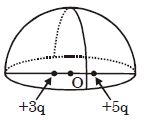
The figure shows a hollow hemisphere of radius $R$ in which two charges $3q$ and $5q$ are placed symmetrically about the centre $O$ on the planar surface. The electric flux over the curved surface is
A
$\frac{15q}{2\varepsilon_0}$
B
$\frac{4q}{\varepsilon_0}$
C
$\frac{q}{\varepsilon_0}$
D
$\frac{2q}{\varepsilon_0}$
Solution
(B) According to Gauss's Law,the total electric flux through a closed surface is $\phi_{total} = \frac{q_{enclosed}}{\varepsilon_0}$.
In this problem,the charges $3q$ and $5q$ are placed on the planar surface of the hemisphere. Since they are on the boundary,we can imagine a complete sphere by placing an identical hemisphere on top of the given one.
The total charge enclosed by this complete sphere is $Q_{enclosed} = 3q + 5q = 8q$.
By symmetry,the flux through the original hemisphere is half of the total flux through the complete sphere.
Therefore,the electric flux over the curved surface is $\phi = \frac{1}{2} \times \frac{Q_{enclosed}}{\varepsilon_0} = \frac{1}{2} \times \frac{8q}{\varepsilon_0} = \frac{4q}{\varepsilon_0}$.
In this problem,the charges $3q$ and $5q$ are placed on the planar surface of the hemisphere. Since they are on the boundary,we can imagine a complete sphere by placing an identical hemisphere on top of the given one.
The total charge enclosed by this complete sphere is $Q_{enclosed} = 3q + 5q = 8q$.
By symmetry,the flux through the original hemisphere is half of the total flux through the complete sphere.
Therefore,the electric flux over the curved surface is $\phi = \frac{1}{2} \times \frac{Q_{enclosed}}{\varepsilon_0} = \frac{1}{2} \times \frac{8q}{\varepsilon_0} = \frac{4q}{\varepsilon_0}$.
0 likes
View Solution77
MediumMCQ
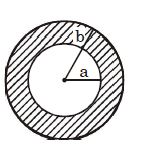
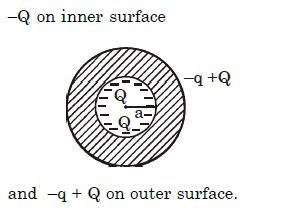
$A$ spherical shell with an inner radius $a$ and an outer radius $b$ is made of conducting material. $A$ point charge $+Q$ is placed at the centre of the spherical shell and a total charge $-q$ is placed on the shell. Find the final charge distribution on the surfaces.
A
$-Q$ on inner surface,$-q$ on outer surface
B
$-Q$ on inner surface,$(-q + Q)$ on outer surface
C
$+Q$ on the inner surface,$(-q - Q)$ on the outer surface
D
The charge $-q$ is spread uniformly between inner and outer surface
Solution
(B) $1$. According to the properties of a conductor in electrostatic equilibrium,the electric field inside the material of the conductor must be zero.
$2$. Consider a Gaussian surface inside the conducting material of the shell. By Gauss's Law,the total charge enclosed by this surface must be zero.
$3$. The total charge enclosed is the sum of the point charge $+Q$ at the center and the induced charge $q_{in}$ on the inner surface of the shell. Thus,$+Q + q_{in} = 0$,which implies $q_{in} = -Q$.
$4$. The shell has a total charge of $-q$. Let $q_{out}$ be the charge on the outer surface. Since the total charge is the sum of the charges on the inner and outer surfaces,we have $q_{in} + q_{out} = -q$.
$5$. Substituting $q_{in} = -Q$,we get $-Q + q_{out} = -q$,which gives $q_{out} = -q + Q$.
$6$. Therefore,the charge on the inner surface is $-Q$ and the charge on the outer surface is $(-q + Q)$.
$2$. Consider a Gaussian surface inside the conducting material of the shell. By Gauss's Law,the total charge enclosed by this surface must be zero.
$3$. The total charge enclosed is the sum of the point charge $+Q$ at the center and the induced charge $q_{in}$ on the inner surface of the shell. Thus,$+Q + q_{in} = 0$,which implies $q_{in} = -Q$.
$4$. The shell has a total charge of $-q$. Let $q_{out}$ be the charge on the outer surface. Since the total charge is the sum of the charges on the inner and outer surfaces,we have $q_{in} + q_{out} = -q$.
$5$. Substituting $q_{in} = -Q$,we get $-Q + q_{out} = -q$,which gives $q_{out} = -q + Q$.
$6$. Therefore,the charge on the inner surface is $-Q$ and the charge on the outer surface is $(-q + Q)$.
0 likes
View Solution78
MediumMCQ
The magnitude of electric field on the surface of a uniformly charged metallic spherical shell is $E$. If a hole is made in it using an insulating device,then the magnitude of electric field in the hole will be
A
$E/2$
B
Zero
C
$E$
D
$2E$
Solution
(A) The electric field just outside a charged conductor is given by $E = \sigma / \epsilon_0$,where $\sigma$ is the surface charge density.
This field is the result of the superposition of the field due to the small patch where the hole is made $(E_{patch})$ and the field due to the rest of the shell $(E_{rest})$.
At a point just outside the surface,$E_{patch} + E_{rest} = E = \sigma / \epsilon_0$.
Since the field due to a small patch is $E_{patch} = \sigma / (2\epsilon_0)$,we have $E_{rest} = E - E_{patch} = \sigma / (2\epsilon_0) = E/2$.
At a point just inside the surface,the fields are $E_{patch} - E_{rest} = \sigma / (2\epsilon_0) - \sigma / (2\epsilon_0) = 0$.
When a hole is made,the field inside the hole is due to the rest of the shell $(E_{rest})$,which is $E/2$.
This field is the result of the superposition of the field due to the small patch where the hole is made $(E_{patch})$ and the field due to the rest of the shell $(E_{rest})$.
At a point just outside the surface,$E_{patch} + E_{rest} = E = \sigma / \epsilon_0$.
Since the field due to a small patch is $E_{patch} = \sigma / (2\epsilon_0)$,we have $E_{rest} = E - E_{patch} = \sigma / (2\epsilon_0) = E/2$.
At a point just inside the surface,the fields are $E_{patch} - E_{rest} = \sigma / (2\epsilon_0) - \sigma / (2\epsilon_0) = 0$.
When a hole is made,the field inside the hole is due to the rest of the shell $(E_{rest})$,which is $E/2$.
0 likes
View Solution79
MediumMCQ
$A$ charge $Q$ is uniformly distributed over a large square plate of copper. The electric field at a point very close to the centre of the plane is $10 \ V/m$. If the copper plate is replaced by a plastic plate of the same geometrical dimensions and carrying the same charge $Q$ uniformly distributed,then the electric field at the point $P$ will be......$V/m$.
A
$5$
B
$0$
C
$10$
D
$20$
Solution
(C) For a large conducting plate (copper),the charge $Q$ distributes on both sides of the plate. The surface charge density on each side is $\sigma = \frac{Q}{2A}$. The electric field near the surface is $E = \frac{\sigma}{\epsilon_0} = \frac{Q}{2A\epsilon_0} = 10 \ V/m$.
For a non-conducting plate (plastic),the charge $Q$ is fixed on the surface where it is placed. If the charge is distributed over the entire surface area $A$,the surface charge density is $\sigma' = \frac{Q}{A}$. The electric field due to a non-conducting sheet is $E' = \frac{\sigma'}{2\epsilon_0} = \frac{Q}{2A\epsilon_0}$.
Comparing the two expressions,we see that $E' = E = 10 \ V/m$.
For a non-conducting plate (plastic),the charge $Q$ is fixed on the surface where it is placed. If the charge is distributed over the entire surface area $A$,the surface charge density is $\sigma' = \frac{Q}{A}$. The electric field due to a non-conducting sheet is $E' = \frac{\sigma'}{2\epsilon_0} = \frac{Q}{2A\epsilon_0}$.
Comparing the two expressions,we see that $E' = E = 10 \ V/m$.
0 likes
View Solution80
DifficultMCQ
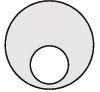
$A$ spherical portion has been removed from a solid sphere having a charge distributed uniformly in its volume as shown in the figure. The electric field inside the emptied space is
A
zero everywhere
B
nonzero and uniform
C
nonuniform
D
zero only at its center
Solution
(B) Consider a solid sphere of radius $R$ with uniform charge density $\rho$. The electric field at a point $\vec{r}$ inside the sphere is given by $\vec{E} = \frac{\rho \vec{r}}{3\epsilon_0}$.
When a smaller spherical cavity is created,the electric field in the cavity is the superposition of the field due to the original large sphere and the field due to a smaller sphere of opposite charge density $-\rho$ that fills the cavity.
Let $\vec{r}_1$ be the position vector from the center of the large sphere and $\vec{r}_2$ be the position vector from the center of the cavity.
The electric field in the cavity is $\vec{E} = \vec{E}_1 + \vec{E}_2 = \frac{\rho \vec{r}_1}{3\epsilon_0} + \frac{-\rho \vec{r}_2}{3\epsilon_0} = \frac{\rho}{3\epsilon_0} (\vec{r}_1 - \vec{r}_2)$.
Since $(\vec{r}_1 - \vec{r}_2) = \vec{d}$,where $\vec{d}$ is the constant vector connecting the center of the large sphere to the center of the cavity,the electric field $\vec{E} = \frac{\rho \vec{d}}{3\epsilon_0}$ is constant (uniform) and non-zero throughout the cavity.
When a smaller spherical cavity is created,the electric field in the cavity is the superposition of the field due to the original large sphere and the field due to a smaller sphere of opposite charge density $-\rho$ that fills the cavity.
Let $\vec{r}_1$ be the position vector from the center of the large sphere and $\vec{r}_2$ be the position vector from the center of the cavity.
The electric field in the cavity is $\vec{E} = \vec{E}_1 + \vec{E}_2 = \frac{\rho \vec{r}_1}{3\epsilon_0} + \frac{-\rho \vec{r}_2}{3\epsilon_0} = \frac{\rho}{3\epsilon_0} (\vec{r}_1 - \vec{r}_2)$.
Since $(\vec{r}_1 - \vec{r}_2) = \vec{d}$,where $\vec{d}$ is the constant vector connecting the center of the large sphere to the center of the cavity,the electric field $\vec{E} = \frac{\rho \vec{d}}{3\epsilon_0}$ is constant (uniform) and non-zero throughout the cavity.
0 likes
View Solution81
DifficultMCQ
$A$ solid ball of radius $R$ has a charge density $\rho$ given by $\rho = \rho_0 \left( 1 - \frac{r}{R} \right)$ for $0 \leq r \leq R$. The electric field outside the ball is
A
$\frac{\rho_0 R^3}{\varepsilon_0 r^2}$
B
$\frac{4\rho_0 R^3}{3\varepsilon_0 r^2}$
C
$\frac{3\rho_0 R^3}{4\varepsilon_0 r^2}$
D
$\frac{\rho_0 R^3}{12\varepsilon_0 r^2}$
Solution
(D) The total charge $q$ inside the ball is found by integrating the charge density over the volume of the ball:
$q = \int_0^R \rho(r) \cdot 4\pi r^2 dr$
$q = \int_0^R \rho_0 \left( 1 - \frac{r}{R} \right) 4\pi r^2 dr$
$q = 4\pi \rho_0 \int_0^R \left( r^2 - \frac{r^3}{R} \right) dr$
$q = 4\pi \rho_0 \left[ \frac{r^3}{3} - \frac{r^4}{4R} \right]_0^R$
$q = 4\pi \rho_0 \left( \frac{R^3}{3} - \frac{R^4}{4R} \right) = 4\pi \rho_0 \left( \frac{R^3}{12} \right) = \frac{\pi \rho_0 R^3}{3}$
Using Gauss's Law for a point outside the ball at distance $r$ $(r > R)$:
$E \cdot 4\pi r^2 = \frac{q}{\varepsilon_0}$
$E \cdot 4\pi r^2 = \frac{\pi \rho_0 R^3}{3 \varepsilon_0}$
$E = \frac{\rho_0 R^3}{12 \varepsilon_0 r^2}$
$q = \int_0^R \rho(r) \cdot 4\pi r^2 dr$
$q = \int_0^R \rho_0 \left( 1 - \frac{r}{R} \right) 4\pi r^2 dr$
$q = 4\pi \rho_0 \int_0^R \left( r^2 - \frac{r^3}{R} \right) dr$
$q = 4\pi \rho_0 \left[ \frac{r^3}{3} - \frac{r^4}{4R} \right]_0^R$
$q = 4\pi \rho_0 \left( \frac{R^3}{3} - \frac{R^4}{4R} \right) = 4\pi \rho_0 \left( \frac{R^3}{12} \right) = \frac{\pi \rho_0 R^3}{3}$
Using Gauss's Law for a point outside the ball at distance $r$ $(r > R)$:
$E \cdot 4\pi r^2 = \frac{q}{\varepsilon_0}$
$E \cdot 4\pi r^2 = \frac{\pi \rho_0 R^3}{3 \varepsilon_0}$
$E = \frac{\rho_0 R^3}{12 \varepsilon_0 r^2}$
0 likes
View Solution82
DifficultMCQ
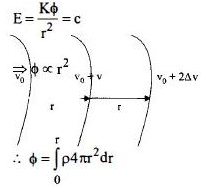
Within a spherical charge distribution of charge density $\rho(r)$,$N$ equipotential surfaces of potential $V_0, V_0 + \Delta V, V_0 + 2\Delta V, \dots, V_0 + N\Delta V$ (where $\Delta V > 0$) are drawn and have increasing radii $r_0, r_1, r_2, \dots, r_N$,respectively. If the difference in the radii of the surfaces is constant for all values of $V_0$ and $\Delta V$,then:
A
$\rho(r) = \text{constant}$
B
$\rho(r) \propto \frac{1}{r^2}$
C
$\rho(r) \propto \frac{1}{r}$
D
$\rho(r) \propto r$
Solution
(C) The relation between electric field $E$ and potential $V$ is given by $E = -\frac{dV}{dr}$.
Given that the difference in radii $\Delta r = r_{i+1} - r_i$ is constant for a constant potential difference $\Delta V$,it implies that the electric field $E = -\frac{\Delta V}{\Delta r}$ is constant.
For a spherical charge distribution,by Gauss's Law,the electric field at a distance $r$ is $E = \frac{q_{enclosed}}{4\pi\epsilon_0 r^2}$.
Since $E$ is constant,we have $q_{enclosed} \propto r^2$.
We know that $q_{enclosed} = \int_0^r \rho(r) 4\pi r^2 dr$.
Since $q_{enclosed} \propto r^2$,differentiating both sides with respect to $r$ gives $\frac{dq}{dr} \propto 2r$.
Thus,$\rho(r) 4\pi r^2 \propto r$,which implies $\rho(r) \propto \frac{1}{r}$.
Given that the difference in radii $\Delta r = r_{i+1} - r_i$ is constant for a constant potential difference $\Delta V$,it implies that the electric field $E = -\frac{\Delta V}{\Delta r}$ is constant.
For a spherical charge distribution,by Gauss's Law,the electric field at a distance $r$ is $E = \frac{q_{enclosed}}{4\pi\epsilon_0 r^2}$.
Since $E$ is constant,we have $q_{enclosed} \propto r^2$.
We know that $q_{enclosed} = \int_0^r \rho(r) 4\pi r^2 dr$.
Since $q_{enclosed} \propto r^2$,differentiating both sides with respect to $r$ gives $\frac{dq}{dr} \propto 2r$.
Thus,$\rho(r) 4\pi r^2 \propto r$,which implies $\rho(r) \propto \frac{1}{r}$.
0 likes
View Solution83
DifficultMCQ
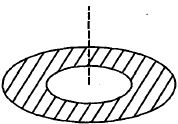
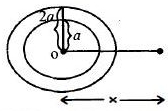
$A$ thin disc of radius $b = 2a$ has a concentric hole of radius $a$ in it (see figure). It carries uniform surface charge $\sigma$. If the electric field on its axis at height $h$ $(h << a)$ from its centre is given as $Ch$,then the value of $C$ is:
A
$\frac{\sigma}{4a\epsilon_0}$
B
$\frac{\sigma}{8a\epsilon_0}$
C
$\frac{\sigma}{a\epsilon_0}$
D
$\frac{\sigma}{2a\epsilon_0}$
Solution
(A) The electric field $E$ on the axis of a disc of radius $R$ at a distance $h$ from its center is given by $E = \frac{\sigma}{2\epsilon_0} \left( 1 - \frac{h}{\sqrt{R^2 + h^2}} \right)$.
For the disc with a hole,we can consider it as a large disc of radius $R_1 = 2a$ minus a smaller disc of radius $R_2 = a$.
The electric field $E_1$ due to the large disc is $E_1 = \frac{\sigma}{2\epsilon_0} \left( 1 - \frac{h}{\sqrt{(2a)^2 + h^2}} \right) = \frac{\sigma}{2\epsilon_0} \left( 1 - \frac{h}{2a \sqrt{1 + (h/2a)^2}} \right)$.
Since $h << a$,we use the binomial approximation $(1+x)^n \approx 1+nx$: $E_1 \approx \frac{\sigma}{2\epsilon_0} \left( 1 - \frac{h}{2a} \right)$.
The electric field $E_2$ due to the smaller disc is $E_2 = \frac{\sigma}{2\epsilon_0} \left( 1 - \frac{h}{\sqrt{a^2 + h^2}} \right) \approx \frac{\sigma}{2\epsilon_0} \left( 1 - \frac{h}{a} \right)$.
The net electric field $E = E_1 - E_2 = \frac{\sigma}{2\epsilon_0} \left[ (1 - \frac{h}{2a}) - (1 - \frac{h}{a}) \right] = \frac{\sigma}{2\epsilon_0} \left( \frac{h}{a} - \frac{h}{2a} \right) = \frac{\sigma}{2\epsilon_0} \left( \frac{h}{2a} \right) = \frac{\sigma h}{4a\epsilon_0}$.
Comparing this with $Ch$,we get $C = \frac{\sigma}{4a\epsilon_0}$.
For the disc with a hole,we can consider it as a large disc of radius $R_1 = 2a$ minus a smaller disc of radius $R_2 = a$.
The electric field $E_1$ due to the large disc is $E_1 = \frac{\sigma}{2\epsilon_0} \left( 1 - \frac{h}{\sqrt{(2a)^2 + h^2}} \right) = \frac{\sigma}{2\epsilon_0} \left( 1 - \frac{h}{2a \sqrt{1 + (h/2a)^2}} \right)$.
Since $h << a$,we use the binomial approximation $(1+x)^n \approx 1+nx$: $E_1 \approx \frac{\sigma}{2\epsilon_0} \left( 1 - \frac{h}{2a} \right)$.
The electric field $E_2$ due to the smaller disc is $E_2 = \frac{\sigma}{2\epsilon_0} \left( 1 - \frac{h}{\sqrt{a^2 + h^2}} \right) \approx \frac{\sigma}{2\epsilon_0} \left( 1 - \frac{h}{a} \right)$.
The net electric field $E = E_1 - E_2 = \frac{\sigma}{2\epsilon_0} \left[ (1 - \frac{h}{2a}) - (1 - \frac{h}{a}) \right] = \frac{\sigma}{2\epsilon_0} \left( \frac{h}{a} - \frac{h}{2a} \right) = \frac{\sigma}{2\epsilon_0} \left( \frac{h}{2a} \right) = \frac{\sigma h}{4a\epsilon_0}$.
Comparing this with $Ch$,we get $C = \frac{\sigma}{4a\epsilon_0}$.
0 likes
View Solution84
DifficultMCQ
The magnitude of the average electric field normally present in the atmosphere just above the surface of the Earth is about $150\, N/C$,directed inward towards the center of the Earth. This gives the total net surface charge carried by the Earth to be......$kC$ [Given ${\varepsilon _0} = 8.85 \times {10^{ - 12}}\,{C^2}/(N \cdot m^2), {R_E} = 6.37 \times {10^6}\,m$]
A
$+670$
B
$-670$
C
$-680$
D
$+680$
Solution
(C) Given:
Electric field $E = 150\, N/C$ (directed inward,so $E = -150\, N/C$)
Radius of Earth $R_E = 6.37 \times 10^6\, m$
Permittivity of free space $\epsilon_0 = 8.85 \times 10^{-12}\, C^2/(N \cdot m^2)$
According to Gauss's law,the electric flux $\phi$ through the surface of the Earth is $\phi = \frac{q}{\epsilon_0} = E \cdot A$,where $A = 4\pi R_E^2$ is the surface area of the Earth.
Thus,$q = \epsilon_0 \cdot E \cdot 4\pi R_E^2$
Substituting the values:
$q = (8.85 \times 10^{-12}) \times (-150) \times 4 \times 3.14159 \times (6.37 \times 10^6)^2$
$q \approx -6.80 \times 10^5\, C$
Converting to $kC$ $(1\, kC = 10^3\, C)$:
$q \approx -680\, kC$
Since the electric field is directed inward,the charge is negative.
Electric field $E = 150\, N/C$ (directed inward,so $E = -150\, N/C$)
Radius of Earth $R_E = 6.37 \times 10^6\, m$
Permittivity of free space $\epsilon_0 = 8.85 \times 10^{-12}\, C^2/(N \cdot m^2)$
According to Gauss's law,the electric flux $\phi$ through the surface of the Earth is $\phi = \frac{q}{\epsilon_0} = E \cdot A$,where $A = 4\pi R_E^2$ is the surface area of the Earth.
Thus,$q = \epsilon_0 \cdot E \cdot 4\pi R_E^2$
Substituting the values:
$q = (8.85 \times 10^{-12}) \times (-150) \times 4 \times 3.14159 \times (6.37 \times 10^6)^2$
$q \approx -6.80 \times 10^5\, C$
Converting to $kC$ $(1\, kC = 10^3\, C)$:
$q \approx -680\, kC$
Since the electric field is directed inward,the charge is negative.
0 likes
View Solution85
DifficultMCQ
$A$ spherically symmetric charge distribution is characterised by a charge density having the following variations:
$\rho (r) = \rho_0 \left( 1 - \frac{r}{R} \right)$ for $r < R$
$\rho (r) = 0$ for $r \ge R$
Where $r$ is the distance from the centre of the charge distribution and $\rho_0$ is a constant. The electric field at an internal point $(r < R)$ is:
$\rho (r) = \rho_0 \left( 1 - \frac{r}{R} \right)$ for $r < R$
$\rho (r) = 0$ for $r \ge R$
Where $r$ is the distance from the centre of the charge distribution and $\rho_0$ is a constant. The electric field at an internal point $(r < R)$ is:
A
$\frac{\rho_0}{4\varepsilon_0} \left( \frac{r}{3} - \frac{r^2}{4R} \right)$
B
$\frac{\rho_0}{\varepsilon_0} \left( \frac{r}{3} - \frac{r^2}{4R} \right)$
C
$\frac{\rho_0}{3\varepsilon_0} \left( \frac{r}{3} - \frac{r^2}{4R} \right)$
D
$\frac{\rho_0}{12\varepsilon_0} \left( \frac{r}{3} - \frac{r^2}{4R} \right)$
Solution
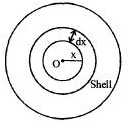
(B) According to Gauss's Law,the electric field $E$ at a distance $r$ from the centre of a spherically symmetric charge distribution is given by $E \cdot (4\pi r^2) = \frac{q_{enclosed}}{\varepsilon_0}$.
To find the enclosed charge $q$ within a sphere of radius $r < R$,we integrate the charge density over the volume:
$q = \int_0^r \rho(x) \cdot 4\pi x^2 dx$
Substituting $\rho(x) = \rho_0 \left( 1 - \frac{x}{R} \right)$:
$q = 4\pi \rho_0 \int_0^r \left( x^2 - \frac{x^3}{R} \right) dx$
$q = 4\pi \rho_0 \left[ \frac{x^3}{3} - \frac{x^4}{4R} \right]_0^r = 4\pi \rho_0 \left( \frac{r^3}{3} - \frac{r^4}{4R} \right)$
Now,using Gauss's Law:
$E \cdot 4\pi r^2 = \frac{4\pi \rho_0}{\varepsilon_0} \left( \frac{r^3}{3} - \frac{r^4}{4R} \right)$
Dividing both sides by $4\pi r^2$:
$E = \frac{\rho_0}{\varepsilon_0} \left( \frac{r}{3} - \frac{r^2}{4R} \right)$
To find the enclosed charge $q$ within a sphere of radius $r < R$,we integrate the charge density over the volume:
$q = \int_0^r \rho(x) \cdot 4\pi x^2 dx$
Substituting $\rho(x) = \rho_0 \left( 1 - \frac{x}{R} \right)$:
$q = 4\pi \rho_0 \int_0^r \left( x^2 - \frac{x^3}{R} \right) dx$
$q = 4\pi \rho_0 \left[ \frac{x^3}{3} - \frac{x^4}{4R} \right]_0^r = 4\pi \rho_0 \left( \frac{r^3}{3} - \frac{r^4}{4R} \right)$
Now,using Gauss's Law:
$E \cdot 4\pi r^2 = \frac{4\pi \rho_0}{\varepsilon_0} \left( \frac{r^3}{3} - \frac{r^4}{4R} \right)$
Dividing both sides by $4\pi r^2$:
$E = \frac{\rho_0}{\varepsilon_0} \left( \frac{r}{3} - \frac{r^2}{4R} \right)$
0 likes
View Solution86
DifficultMCQ
The surface charge density of a thin charged disc of radius $R$ is $\sigma$. The value of the electric field at the centre of the disc is $\frac{\sigma}{2\epsilon_0}$. With respect to the field at the centre,the electric field along the axis at a distance $R$ from the centre of the disc:
A
reduces by $70.7\%$
B
reduces by $29.3\%$
C
reduces by $9.7\%$
D
reduces by $14.6\%$
Solution
(A) The electric field at the centre of a disc is $E = \frac{\sigma}{2\epsilon_0}$.
The electric field at a distance $x$ along the axis of a disc is given by $E' = \frac{\sigma}{2\epsilon_0} \left(1 - \frac{x}{\sqrt{x^2 + R^2}}\right)$.
Given $x = R$,we substitute this into the formula:
$E' = \frac{\sigma}{2\epsilon_0} \left(1 - \frac{R}{\sqrt{R^2 + R^2}}\right) = \frac{\sigma}{2\epsilon_0} \left(1 - \frac{R}{\sqrt{2}R}\right) = E \left(1 - \frac{1}{\sqrt{2}}\right)$.
Since $\frac{1}{\sqrt{2}} \approx 0.707$,we have $E' = E(1 - 0.707) = 0.293E$.
The reduction in the electric field is $E - E' = E - 0.293E = 0.707E$.
The percentage reduction is $\frac{0.707E}{E} \times 100\% = 70.7\%$.
The electric field at a distance $x$ along the axis of a disc is given by $E' = \frac{\sigma}{2\epsilon_0} \left(1 - \frac{x}{\sqrt{x^2 + R^2}}\right)$.
Given $x = R$,we substitute this into the formula:
$E' = \frac{\sigma}{2\epsilon_0} \left(1 - \frac{R}{\sqrt{R^2 + R^2}}\right) = \frac{\sigma}{2\epsilon_0} \left(1 - \frac{R}{\sqrt{2}R}\right) = E \left(1 - \frac{1}{\sqrt{2}}\right)$.
Since $\frac{1}{\sqrt{2}} \approx 0.707$,we have $E' = E(1 - 0.707) = 0.293E$.
The reduction in the electric field is $E - E' = E - 0.293E = 0.707E$.
The percentage reduction is $\frac{0.707E}{E} \times 100\% = 70.7\%$.
0 likes
View Solution87
MediumMCQ
The electric potential $V(x)$ in a region around the origin is given by $V(x) = 4x^2 \text{ V}$. The electric charge enclosed in a cube of $1 \text{ m}$ side with its centre at the origin is (in coulomb):
A
$8 \varepsilon_0$
B
$-4 \varepsilon_0$
C
$0$
D
$-8 \varepsilon_0$
Solution
(C) The electric field $E$ is given by the negative gradient of the potential: $E = -\frac{dV}{dx} = -\frac{d}{dx}(4x^2) = -8x \text{ V/m}$.
According to Gauss's Law,the total flux $\phi$ through a closed surface is $\phi = \oint E \cdot dA = \frac{q_{\text{enclosed}}}{\varepsilon_0}$.
For a cube of side $L = 1 \text{ m}$ centered at the origin,the faces are at $x = 0.5 \text{ m}$ and $x = -0.5 \text{ m}$.
The electric field at $x = 0.5 \text{ m}$ is $E_1 = -8(0.5) = -4 \text{ V/m}$ (pointing towards the origin).
The electric field at $x = -0.5 \text{ m}$ is $E_2 = -8(-0.5) = 4 \text{ V/m}$ (pointing away from the origin).
The flux through the face at $x = 0.5 \text{ m}$ is $\phi_1 = E_1 \cdot A = -4 \times (1^2) = -4 \text{ V} \cdot \text{m}^2$.
The flux through the face at $x = -0.5 \text{ m}$ is $\phi_2 = E_2 \cdot A = 4 \times (1^2) = 4 \text{ V} \cdot \text{m}^2$.
The flux through the other four faces is zero because the electric field is parallel to these faces.
The net flux is $\phi_{\text{net}} = \phi_1 + \phi_2 = -4 + 4 = 0$.
Since $\phi_{\text{net}} = \frac{q_{\text{enclosed}}}{\varepsilon_0}$,we have $q_{\text{enclosed}} = 0$.
According to Gauss's Law,the total flux $\phi$ through a closed surface is $\phi = \oint E \cdot dA = \frac{q_{\text{enclosed}}}{\varepsilon_0}$.
For a cube of side $L = 1 \text{ m}$ centered at the origin,the faces are at $x = 0.5 \text{ m}$ and $x = -0.5 \text{ m}$.
The electric field at $x = 0.5 \text{ m}$ is $E_1 = -8(0.5) = -4 \text{ V/m}$ (pointing towards the origin).
The electric field at $x = -0.5 \text{ m}$ is $E_2 = -8(-0.5) = 4 \text{ V/m}$ (pointing away from the origin).
The flux through the face at $x = 0.5 \text{ m}$ is $\phi_1 = E_1 \cdot A = -4 \times (1^2) = -4 \text{ V} \cdot \text{m}^2$.
The flux through the face at $x = -0.5 \text{ m}$ is $\phi_2 = E_2 \cdot A = 4 \times (1^2) = 4 \text{ V} \cdot \text{m}^2$.
The flux through the other four faces is zero because the electric field is parallel to these faces.
The net flux is $\phi_{\text{net}} = \phi_1 + \phi_2 = -4 + 4 = 0$.
Since $\phi_{\text{net}} = \frac{q_{\text{enclosed}}}{\varepsilon_0}$,we have $q_{\text{enclosed}} = 0$.
0 likes
View Solution88
DifficultMCQ
$A$ positive point charge is released from rest at a distance $r_0$ from a positive line charge with uniform density. The speed $(v)$ of the point charge,as a function of instantaneous distance $r$ from the line charge,is proportional to
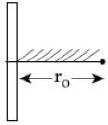
A
$v \propto e^{r/r_0}$
B
$v \propto \ln \left( \frac{r}{r_0} \right)$
C
$v \propto \sqrt{\ln \left( \frac{r}{r_0} \right)}$
D
$v \propto \frac{r}{r_0}$
Solution
(C) The electric field $E$ at a distance $r$ from a line charge with linear charge density $\lambda$ is given by $E = \frac{\lambda}{2\pi\varepsilon_0 r}$.
The potential difference $\Delta V$ between distance $r_0$ and $r$ is $\Delta V = -\int_{r_0}^{r} E \, dr = -\int_{r_0}^{r} \frac{\lambda}{2\pi\varepsilon_0 r} \, dr = -\frac{\lambda}{2\pi\varepsilon_0} \ln \left( \frac{r}{r_0} \right) = \frac{\lambda}{2\pi\varepsilon_0} \ln \left( \frac{r_0}{r} \right)$.
Using the work-energy theorem,the change in kinetic energy equals the work done by the electric field: $\frac{1}{2}mv^2 = q(V_i - V_f) = q \Delta V$.
Substituting the potential difference: $\frac{1}{2}mv^2 = q \left( \frac{\lambda}{2\pi\varepsilon_0} \ln \left( \frac{r}{r_0} \right) \right)$.
Since $m, q, \lambda, \pi, \varepsilon_0$ are constants,we have $v^2 \propto \ln \left( \frac{r}{r_0} \right)$,which implies $v \propto \sqrt{\ln \left( \frac{r}{r_0} \right)}$.
The potential difference $\Delta V$ between distance $r_0$ and $r$ is $\Delta V = -\int_{r_0}^{r} E \, dr = -\int_{r_0}^{r} \frac{\lambda}{2\pi\varepsilon_0 r} \, dr = -\frac{\lambda}{2\pi\varepsilon_0} \ln \left( \frac{r}{r_0} \right) = \frac{\lambda}{2\pi\varepsilon_0} \ln \left( \frac{r_0}{r} \right)$.
Using the work-energy theorem,the change in kinetic energy equals the work done by the electric field: $\frac{1}{2}mv^2 = q(V_i - V_f) = q \Delta V$.
Substituting the potential difference: $\frac{1}{2}mv^2 = q \left( \frac{\lambda}{2\pi\varepsilon_0} \ln \left( \frac{r}{r_0} \right) \right)$.
Since $m, q, \lambda, \pi, \varepsilon_0$ are constants,we have $v^2 \propto \ln \left( \frac{r}{r_0} \right)$,which implies $v \propto \sqrt{\ln \left( \frac{r}{r_0} \right)}$.
0 likes
View Solution89
DifficultMCQ
Let a total charge $2Q$ be distributed in a sphere of radius $R$,with the charge density given by $\rho(r) = kr$,where $r$ is the distance from the centre. Two charges $A$ and $B$,of $-Q$ each,are placed on diametrically opposite points,at equal distance $a$ from the centre. If $A$ and $B$ do not experience any force,then:
A
$a = \frac{R}{2^{1/4}}$
B
$a = 2^{-1/4}R$
C
$a = 8^{-1/4}R$
D
$a = R/\sqrt{3}$
Solution
(C) First,we find the constant $k$ in terms of $Q$ and $R$ by integrating the charge density over the volume of the sphere:
$2Q = \int_{0}^{R} \rho(r) 4\pi r^2 dr = \int_{0}^{R} (kr) 4\pi r^2 dr = 4\pi k \int_{0}^{R} r^3 dr = 4\pi k \frac{R^4}{4} = \pi k R^4$.
Thus,$k = \frac{2Q}{\pi R^4}$.
Next,we find the electric field $E$ at distance $a$ from the centre using Gauss's Law:
$E(4\pi a^2) = \frac{q_{enc}}{\varepsilon_0} = \frac{1}{\varepsilon_0} \int_{0}^{a} (kr) 4\pi r^2 dr = \frac{4\pi k}{\varepsilon_0} \frac{a^4}{4} = \frac{\pi k a^4}{\varepsilon_0}$.
$E = \frac{k a^2}{4\varepsilon_0} = \frac{(2Q/\pi R^4) a^2}{4\varepsilon_0} = \frac{Q a^2}{2\pi \varepsilon_0 R^4}$.
For charge $A$ (or $B$) to experience no force,the force due to the sphere must be balanced by the force due to the other charge:
$|qE| = \frac{1}{4\pi \varepsilon_0} \frac{|Q||-Q|}{(2a)^2} \implies Q \left( \frac{Q a^2}{2\pi \varepsilon_0 R^4} \right) = \frac{Q^2}{16\pi \varepsilon_0 a^2}$.
Simplifying: $\frac{a^2}{2 R^4} = \frac{1}{16 a^2} \implies a^4 = \frac{R^4}{8} \implies a = \frac{R}{8^{1/4}} = 8^{-1/4}R$.
$2Q = \int_{0}^{R} \rho(r) 4\pi r^2 dr = \int_{0}^{R} (kr) 4\pi r^2 dr = 4\pi k \int_{0}^{R} r^3 dr = 4\pi k \frac{R^4}{4} = \pi k R^4$.
Thus,$k = \frac{2Q}{\pi R^4}$.
Next,we find the electric field $E$ at distance $a$ from the centre using Gauss's Law:
$E(4\pi a^2) = \frac{q_{enc}}{\varepsilon_0} = \frac{1}{\varepsilon_0} \int_{0}^{a} (kr) 4\pi r^2 dr = \frac{4\pi k}{\varepsilon_0} \frac{a^4}{4} = \frac{\pi k a^4}{\varepsilon_0}$.
$E = \frac{k a^2}{4\varepsilon_0} = \frac{(2Q/\pi R^4) a^2}{4\varepsilon_0} = \frac{Q a^2}{2\pi \varepsilon_0 R^4}$.
For charge $A$ (or $B$) to experience no force,the force due to the sphere must be balanced by the force due to the other charge:
$|qE| = \frac{1}{4\pi \varepsilon_0} \frac{|Q||-Q|}{(2a)^2} \implies Q \left( \frac{Q a^2}{2\pi \varepsilon_0 R^4} \right) = \frac{Q^2}{16\pi \varepsilon_0 a^2}$.
Simplifying: $\frac{a^2}{2 R^4} = \frac{1}{16 a^2} \implies a^4 = \frac{R^4}{8} \implies a = \frac{R}{8^{1/4}} = 8^{-1/4}R$.
0 likes
View Solution90
MediumMCQ
If an insulated non-conducting sphere of radius $R$ has a uniform charge density $\rho$,the electric field at a distance $r$ from the center of the sphere $(r < R)$ will be:
A
$\frac{\rho R}{3\varepsilon_0}$
B
$\frac{\rho r}{\varepsilon_0}$
C
$\frac{\rho r}{3\varepsilon_0}$
D
$\frac{3\rho R}{\varepsilon_0}$
Solution
(C) According to Gauss's Law,for a non-conducting sphere with uniform charge density $\rho$,the electric flux through a Gaussian surface of radius $r$ (where $r < R$) is given by $\oint E \cdot dA = \frac{q_{enclosed}}{\varepsilon_0}$.
Since the sphere is non-conducting and the charge is distributed throughout the volume,the enclosed charge $q_{enclosed} = \rho \cdot V = \rho \cdot (\frac{4}{3}\pi r^3)$.
The surface area of the Gaussian sphere is $4\pi r^2$.
Thus,$E \cdot (4\pi r^2) = \frac{\rho \cdot \frac{4}{3}\pi r^3}{\varepsilon_0}$.
Solving for $E$,we get $E = \frac{\rho r}{3\varepsilon_0}$.
Since the sphere is non-conducting and the charge is distributed throughout the volume,the enclosed charge $q_{enclosed} = \rho \cdot V = \rho \cdot (\frac{4}{3}\pi r^3)$.
The surface area of the Gaussian sphere is $4\pi r^2$.
Thus,$E \cdot (4\pi r^2) = \frac{\rho \cdot \frac{4}{3}\pi r^3}{\varepsilon_0}$.
Solving for $E$,we get $E = \frac{\rho r}{3\varepsilon_0}$.
0 likes
View Solution91
EasyMCQ
Let $P(r) = \frac{Q}{\pi R^4} r$ be the charge density distribution for a solid sphere of radius $R$ and total charge $Q$. For a point $P$ inside the sphere at distance $r_1$ from the centre of the sphere,the magnitude of the electric field is
A
zero
B
$\frac{Q}{4\pi \varepsilon_0 r_1^2}$
C
$\frac{Q r_1^2}{4\pi \varepsilon_0 R^4}$
D
$\frac{Q r_1^2}{3\pi \varepsilon_0 R^4}$
Solution
(C) According to Gauss's Law,the electric field $E$ at a distance $r_1$ from the center is given by $\oint E \cdot dA = \frac{q_{enclosed}}{\varepsilon_0}$.
For a spherical surface of radius $r_1$,this becomes $E(4\pi r_1^2) = \frac{1}{\varepsilon_0} \int_0^{r_1} \rho(r) (4\pi r^2) dr$.
Substituting $\rho(r) = \frac{Q}{\pi R^4} r$,we get $E(4\pi r_1^2) = \frac{1}{\varepsilon_0} \int_0^{r_1} \left( \frac{Q}{\pi R^4} r \right) (4\pi r^2) dr$.
$E(4\pi r_1^2) = \frac{4\pi Q}{\pi R^4 \varepsilon_0} \int_0^{r_1} r^3 dr$.
$E(4\pi r_1^2) = \frac{4 Q}{R^4 \varepsilon_0} \left[ \frac{r^4}{4} \right]_0^{r_1} = \frac{Q r_1^4}{R^4 \varepsilon_0}$.
Solving for $E$,we get $E = \frac{Q r_1^4}{4\pi \varepsilon_0 R^4 r_1^2} = \frac{Q r_1^2}{4\pi \varepsilon_0 R^4}$.
For a spherical surface of radius $r_1$,this becomes $E(4\pi r_1^2) = \frac{1}{\varepsilon_0} \int_0^{r_1} \rho(r) (4\pi r^2) dr$.
Substituting $\rho(r) = \frac{Q}{\pi R^4} r$,we get $E(4\pi r_1^2) = \frac{1}{\varepsilon_0} \int_0^{r_1} \left( \frac{Q}{\pi R^4} r \right) (4\pi r^2) dr$.
$E(4\pi r_1^2) = \frac{4\pi Q}{\pi R^4 \varepsilon_0} \int_0^{r_1} r^3 dr$.
$E(4\pi r_1^2) = \frac{4 Q}{R^4 \varepsilon_0} \left[ \frac{r^4}{4} \right]_0^{r_1} = \frac{Q r_1^4}{R^4 \varepsilon_0}$.
Solving for $E$,we get $E = \frac{Q r_1^4}{4\pi \varepsilon_0 R^4 r_1^2} = \frac{Q r_1^2}{4\pi \varepsilon_0 R^4}$.
0 likes
View Solution92
MediumMCQ
Let $\rho (r) = \frac{Q}{\pi R^4} r$ be the volume charge density distribution for a solid sphere of radius $R$ and total charge $Q$. For a point $p$ inside the sphere at distance $r_1$ from the centre of the sphere,the magnitude of the electric field is:
A
$0$
B
$\frac{Q}{4\pi \varepsilon_0 r_1^2}$
C
$\frac{Q r_1}{4\pi \varepsilon_0 R^4}$
D
$\frac{Q r_1^2}{4\pi \varepsilon_0 R^4}$
Solution
(D) To find the electric field at a distance $r_1$ from the center,we first calculate the charge $q$ enclosed within a sphere of radius $r_1$.
The charge element $dq$ in a spherical shell of radius $r$ and thickness $dr$ is given by $dq = \rho(r) \cdot 4\pi r^2 dr$.
Substituting $\rho(r) = \frac{Q}{\pi R^4} r$,we get:
$dq = \left( \frac{Q}{\pi R^4} r \right) \cdot 4\pi r^2 dr = \frac{4Q}{R^4} r^3 dr$.
The total charge $q$ enclosed within radius $r_1$ is:
$q = \int_0^{r_1} \frac{4Q}{R^4} r^3 dr = \frac{4Q}{R^4} \left[ \frac{r^4}{4} \right]_0^{r_1} = \frac{Q r_1^4}{R^4}$.
Using Gauss's Law for a spherical surface of radius $r_1$:
$E \cdot 4\pi r_1^2 = \frac{q}{\varepsilon_0}$.
Substituting the value of $q$:
$E \cdot 4\pi r_1^2 = \frac{Q r_1^4}{\varepsilon_0 R^4}$.
Solving for $E$:
$E = \frac{Q r_1^4}{4\pi \varepsilon_0 R^4 r_1^2} = \frac{Q r_1^2}{4\pi \varepsilon_0 R^4}$.
The charge element $dq$ in a spherical shell of radius $r$ and thickness $dr$ is given by $dq = \rho(r) \cdot 4\pi r^2 dr$.
Substituting $\rho(r) = \frac{Q}{\pi R^4} r$,we get:
$dq = \left( \frac{Q}{\pi R^4} r \right) \cdot 4\pi r^2 dr = \frac{4Q}{R^4} r^3 dr$.
The total charge $q$ enclosed within radius $r_1$ is:
$q = \int_0^{r_1} \frac{4Q}{R^4} r^3 dr = \frac{4Q}{R^4} \left[ \frac{r^4}{4} \right]_0^{r_1} = \frac{Q r_1^4}{R^4}$.
Using Gauss's Law for a spherical surface of radius $r_1$:
$E \cdot 4\pi r_1^2 = \frac{q}{\varepsilon_0}$.
Substituting the value of $q$:
$E \cdot 4\pi r_1^2 = \frac{Q r_1^4}{\varepsilon_0 R^4}$.
Solving for $E$:
$E = \frac{Q r_1^4}{4\pi \varepsilon_0 R^4 r_1^2} = \frac{Q r_1^2}{4\pi \varepsilon_0 R^4}$.
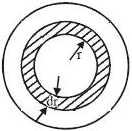
0 likes
View Solution93
EasyMCQ
$A$ and $B$ are two concentric spheres. If $A$ is given a charge $Q$ while $B$ is earthed as shown.
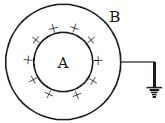
A
The charge density of $A$ and $B$ are same.
B
The field inside and outside $A$ is zero.
C
The field between $A$ and $B$ is not zero.
D
The field inside and outside $B$ is zero.
Solution
(C) When sphere $A$ is given a charge $Q$,it induces a charge $-Q$ on the inner surface of the earthed sphere $B$.
Since sphere $B$ is earthed,its potential becomes zero.
The electric field inside a conductor is zero,but in the region between the two spheres (where $r_A < r < r_B$),the electric field is due to the charge $Q$ on sphere $A$.
Using Gauss's Law,the electric field $E$ at a distance $r$ from the center is $E = \frac{1}{4\pi\epsilon_0} \frac{Q}{r^2}$,which is non-zero.
Outside the outer sphere $B$,the net charge is $Q + (-Q) = 0$,so the electric field outside $B$ is zero.
Thus,the field between $A$ and $B$ is not zero,and the field outside $B$ is zero.
Since sphere $B$ is earthed,its potential becomes zero.
The electric field inside a conductor is zero,but in the region between the two spheres (where $r_A < r < r_B$),the electric field is due to the charge $Q$ on sphere $A$.
Using Gauss's Law,the electric field $E$ at a distance $r$ from the center is $E = \frac{1}{4\pi\epsilon_0} \frac{Q}{r^2}$,which is non-zero.
Outside the outer sphere $B$,the net charge is $Q + (-Q) = 0$,so the electric field outside $B$ is zero.
Thus,the field between $A$ and $B$ is not zero,and the field outside $B$ is zero.
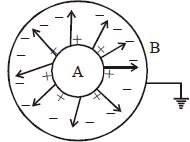
0 likes
View Solution94
MediumMCQ
Which graph shows the variation of the electric field of a uniformly charged non-conducting sphere with respect to the distance $(r)$ from the centre?
A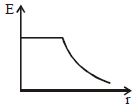
B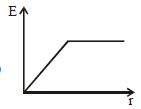
C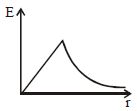
D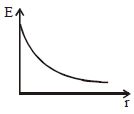
Solution
(C) For a uniformly charged non-conducting sphere of radius $R$ and total charge $Q$:
$1$. Inside the sphere $(r < R)$, the electric field is given by $E_{in} = \frac{kQr}{R^3}$, which means $E_{in} \propto r$. This is a linear relationship starting from the origin.
$2$. Outside the sphere $(r \geq R)$, the electric field is given by $E_{out} = \frac{kQ}{r^2}$, which means $E_{out} \propto \frac{1}{r^2}$. This is an inverse square relationship.
$3$. At the surface $(r = R)$, the electric field is maximum, $E_{max} = \frac{kQ}{R^2}$.
Combining these, the graph starts linearly from the origin up to $r = R$ and then follows an inverse square curve for $r > R$. This corresponds to graph $C$.
$1$. Inside the sphere $(r < R)$, the electric field is given by $E_{in} = \frac{kQr}{R^3}$, which means $E_{in} \propto r$. This is a linear relationship starting from the origin.
$2$. Outside the sphere $(r \geq R)$, the electric field is given by $E_{out} = \frac{kQ}{r^2}$, which means $E_{out} \propto \frac{1}{r^2}$. This is an inverse square relationship.
$3$. At the surface $(r = R)$, the electric field is maximum, $E_{max} = \frac{kQ}{R^2}$.
Combining these, the graph starts linearly from the origin up to $r = R$ and then follows an inverse square curve for $r > R$. This corresponds to graph $C$.
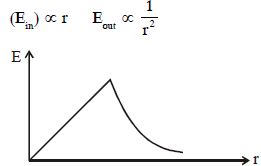
0 likes
View Solution95
MediumMCQ
Electric field inside a uniformly charged sphere of radius $R$ is (where $r$ is the distance from the centre,$r < R$):
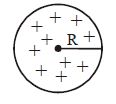
A
$\frac{KQr}{R^3}$
B
$\frac{KQ}{R^2}$
C
$\frac{KQr^2}{R^3}$
D
$\frac{2KQ}{R^2}$
Solution
(A) For a uniformly charged non-conducting sphere of radius $R$ and total charge $Q$,the volume charge density is $\rho = \frac{Q}{\frac{4}{3}\pi R^3}$.
Using Gauss's Law for a Gaussian surface of radius $r$ $(r < R)$:
$\oint E \cdot dA = \frac{q_{enclosed}}{\epsilon_0}$
$E(4\pi r^2) = \frac{\rho \cdot \frac{4}{3}\pi r^3}{\epsilon_0}$
Substituting $\rho = \frac{Q}{\frac{4}{3}\pi R^3}$:
$E(4\pi r^2) = \frac{Q}{\frac{4}{3}\pi R^3} \cdot \frac{\frac{4}{3}\pi r^3}{\epsilon_0} = \frac{Q r^3}{\epsilon_0 R^3}$
$E = \frac{Q r}{4\pi \epsilon_0 R^3}$
Since $K = \frac{1}{4\pi \epsilon_0}$,we get $E = \frac{KQr}{R^3}$.
Using Gauss's Law for a Gaussian surface of radius $r$ $(r < R)$:
$\oint E \cdot dA = \frac{q_{enclosed}}{\epsilon_0}$
$E(4\pi r^2) = \frac{\rho \cdot \frac{4}{3}\pi r^3}{\epsilon_0}$
Substituting $\rho = \frac{Q}{\frac{4}{3}\pi R^3}$:
$E(4\pi r^2) = \frac{Q}{\frac{4}{3}\pi R^3} \cdot \frac{\frac{4}{3}\pi r^3}{\epsilon_0} = \frac{Q r^3}{\epsilon_0 R^3}$
$E = \frac{Q r}{4\pi \epsilon_0 R^3}$
Since $K = \frac{1}{4\pi \epsilon_0}$,we get $E = \frac{KQr}{R^3}$.
0 likes
View Solution96
MediumMCQ
Find the ratio of the electric field at points $A$ and $B$. An infinitely long uniformly charged wire with linear charge density $\lambda$ is kept along the $z$-axis.
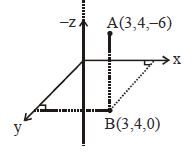
A
$1 : 2$
B
$1 : 6$
C
$6 : 1$
D
$1 : 1$
Solution
(D) The electric field $E$ at a perpendicular distance $r$ from an infinitely long uniformly charged wire is given by $E = \frac{\lambda}{2\pi\epsilon_0 r}$.
For point $A(3, 4, -6)$,the perpendicular distance $r_A$ from the $z$-axis is $r_A = \sqrt{x^2 + y^2} = \sqrt{3^2 + 4^2} = \sqrt{9 + 16} = 5$.
For point $B(3, 4, 0)$,the perpendicular distance $r_B$ from the $z$-axis is $r_B = \sqrt{x^2 + y^2} = \sqrt{3^2 + 4^2} = \sqrt{9 + 16} = 5$.
Since $r_A = r_B = 5$,the electric fields at points $A$ and $B$ are equal.
Therefore,the ratio of the electric field at $A$ and $B$ is $E_A : E_B = 1 : 1$.
For point $A(3, 4, -6)$,the perpendicular distance $r_A$ from the $z$-axis is $r_A = \sqrt{x^2 + y^2} = \sqrt{3^2 + 4^2} = \sqrt{9 + 16} = 5$.
For point $B(3, 4, 0)$,the perpendicular distance $r_B$ from the $z$-axis is $r_B = \sqrt{x^2 + y^2} = \sqrt{3^2 + 4^2} = \sqrt{9 + 16} = 5$.
Since $r_A = r_B = 5$,the electric fields at points $A$ and $B$ are equal.
Therefore,the ratio of the electric field at $A$ and $B$ is $E_A : E_B = 1 : 1$.
0 likes
View Solution97
MediumMCQ
The electrostatic field of a long uniformly charged wire varies with distance $r$ according to which relation?
A
$E \propto r$
B
$E \propto \frac{1}{r}$
C
$E \propto \frac{1}{r^2}$
D
$E \propto \frac{1}{r^3}$
Solution
(B) For an infinitely long uniformly charged wire with linear charge density $\lambda$,we use Gauss's Law to find the electric field at a distance $r$.
Consider a cylindrical Gaussian surface of radius $r$ and length $l$ coaxial with the wire.
The total electric flux $\Phi_E$ through the Gaussian surface is given by $\Phi_E = E \times (2\pi rl)$.
According to Gauss's Law,$\Phi_E = \frac{q_{enclosed}}{\epsilon_0}$.
Since the charge enclosed is $q_{enclosed} = \lambda l$,we have $E \times (2\pi rl) = \frac{\lambda l}{\epsilon_0}$.
Solving for $E$,we get $E = \frac{\lambda}{2\pi \epsilon_0 r}$.
Therefore,the electric field $E$ is inversely proportional to the distance $r$,i.e.,$E \propto \frac{1}{r}$.
Consider a cylindrical Gaussian surface of radius $r$ and length $l$ coaxial with the wire.
The total electric flux $\Phi_E$ through the Gaussian surface is given by $\Phi_E = E \times (2\pi rl)$.
According to Gauss's Law,$\Phi_E = \frac{q_{enclosed}}{\epsilon_0}$.
Since the charge enclosed is $q_{enclosed} = \lambda l$,we have $E \times (2\pi rl) = \frac{\lambda l}{\epsilon_0}$.
Solving for $E$,we get $E = \frac{\lambda}{2\pi \epsilon_0 r}$.
Therefore,the electric field $E$ is inversely proportional to the distance $r$,i.e.,$E \propto \frac{1}{r}$.
0 likes
View Solution98
MediumMCQ
Two parallel large thin metal sheets have equal surface charge densities $(\sigma = 26.4 \times 10^{-12} \, C/m^2)$ of opposite signs. The electric field between these sheets is
A
$1.5 \, N/C$
B
$1.5 \times 10^{-10} \, N/C$
C
$3 \, N/C$
D
$3 \times 10^{-10} \, N/C$
Solution
(C) The electric field $E$ between two large parallel thin metal sheets with equal and opposite surface charge densities $\sigma$ is given by the formula:
$E = \frac{\sigma}{\epsilon_0}$
Given:
$\sigma = 26.4 \times 10^{-12} \, C/m^2$
$\epsilon_0 = 8.85 \times 10^{-12} \, C^2/(N \cdot m^2)$
Substituting the values:
$E = \frac{26.4 \times 10^{-12}}{8.85 \times 10^{-12}}$
$E = \frac{26.4}{8.85} \approx 2.983 \approx 3 \, N/C$
Therefore,the electric field between the sheets is $3 \, N/C$.
$E = \frac{\sigma}{\epsilon_0}$
Given:
$\sigma = 26.4 \times 10^{-12} \, C/m^2$
$\epsilon_0 = 8.85 \times 10^{-12} \, C^2/(N \cdot m^2)$
Substituting the values:
$E = \frac{26.4 \times 10^{-12}}{8.85 \times 10^{-12}}$
$E = \frac{26.4}{8.85} \approx 2.983 \approx 3 \, N/C$
Therefore,the electric field between the sheets is $3 \, N/C$.
0 likes
View Solution99
MediumMCQ
The electric field at a distance $r$ from the centre in the space between two concentric metallic spherical shells of radii $r_1$ and $r_2$ carrying charges $Q_1$ and $Q_2$ respectively is $(r_1 < r < r_2)$.
A
$\frac{Q_1 + Q_2}{4\pi \epsilon_0 (r_1 + r_2)^2}$
B
$\frac{Q_1 + Q_2}{4\pi \epsilon_0 r^2}$
C
$\frac{Q_1}{4\pi \epsilon_0 r^2}$
D
$\frac{Q_2}{4\pi \epsilon_0 r^2}$
Solution
(C) According to Gauss's Law,the electric flux through a closed Gaussian surface is given by $\oint \vec{E} \cdot d\vec{A} = \frac{Q_{\text{enclosed}}}{\epsilon_0}$.
For a point at a distance $r$ such that $r_1 < r < r_2$,we consider a spherical Gaussian surface of radius $r$ concentric with the shells.
The only charge enclosed by this Gaussian surface is the charge $Q_1$ on the inner shell.
Therefore,$Q_{\text{enclosed}} = Q_1$.
Applying Gauss's Law: $E(4\pi r^2) = \frac{Q_1}{\epsilon_0}$.
Thus,the electric field is $E = \frac{Q_1}{4\pi \epsilon_0 r^2}$.
For a point at a distance $r$ such that $r_1 < r < r_2$,we consider a spherical Gaussian surface of radius $r$ concentric with the shells.
The only charge enclosed by this Gaussian surface is the charge $Q_1$ on the inner shell.
Therefore,$Q_{\text{enclosed}} = Q_1$.
Applying Gauss's Law: $E(4\pi r^2) = \frac{Q_1}{\epsilon_0}$.
Thus,the electric field is $E = \frac{Q_1}{4\pi \epsilon_0 r^2}$.
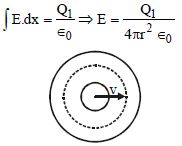
0 likes
View Solution100
DifficultMCQ
An infinitely long solid cylinder of radius $R$ has a uniform volume charge density $\rho$. It has a spherical cavity of radius $R/2$ with its centre on the axis of the cylinder,as shown in the figure. The magnitude of the electric field at the point $P$,which is at a distance $2R$ from the axis of the cylinder,is given by the expression $\frac{23\rho R}{16K\varepsilon_0}$. The value of $K$ is
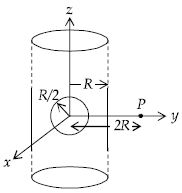
A
$6$
B
$5$
C
$7$
D
$4$
Solution
(A) To find the electric field at point $P$,we use the principle of superposition. We consider the cylinder with the cavity as the sum of a complete solid cylinder with charge density $\rho$ and a sphere with charge density $-\rho$.
$1$. Electric field due to the infinite solid cylinder of radius $R$ at distance $r = 2R$ from the axis:
Using Gauss's Law,$E_{cyl} \cdot (2\pi r L) = \frac{q_{enclosed}}{\varepsilon_0} = \frac{\rho \cdot \pi R^2 L}{\varepsilon_0}$.
$E_{cyl} = \frac{\rho R^2}{2 \varepsilon_0 r} = \frac{\rho R^2}{2 \varepsilon_0 (2R)} = \frac{\rho R}{4 \varepsilon_0}$.
$2$. Electric field due to the spherical cavity of radius $a = R/2$ at distance $r = 2R$ from its center:
Using the formula for the electric field outside a uniformly charged sphere,$E_{sph} = \frac{kQ}{r^2} = \frac{1}{4\pi \varepsilon_0} \cdot \frac{\rho \cdot (4/3)\pi a^3}{r^2}$.
Substituting $a = R/2$ and $r = 2R$:
$E_{sph} = \frac{\rho \cdot (4/3)\pi (R/2)^3}{4\pi \varepsilon_0 (2R)^2} = \frac{\rho \cdot (4/3) (R^3/8)}{4 \varepsilon_0 (4R^2)} = \frac{\rho R^3 / 6}{16 \varepsilon_0 R^2} = \frac{\rho R}{96 \varepsilon_0}$.
$3$. Net electric field at $P$:
Since the sphere has charge density $-\rho$,the field is in the opposite direction to the cylinder's field.
$E_{net} = E_{cyl} - E_{sph} = \frac{\rho R}{4 \varepsilon_0} - \frac{\rho R}{96 \varepsilon_0} = \frac{24\rho R - \rho R}{96 \varepsilon_0} = \frac{23\rho R}{96 \varepsilon_0}$.
Comparing this with the given expression $\frac{23\rho R}{16K\varepsilon_0}$:
$16K = 96 \implies K = 6$.
$1$. Electric field due to the infinite solid cylinder of radius $R$ at distance $r = 2R$ from the axis:
Using Gauss's Law,$E_{cyl} \cdot (2\pi r L) = \frac{q_{enclosed}}{\varepsilon_0} = \frac{\rho \cdot \pi R^2 L}{\varepsilon_0}$.
$E_{cyl} = \frac{\rho R^2}{2 \varepsilon_0 r} = \frac{\rho R^2}{2 \varepsilon_0 (2R)} = \frac{\rho R}{4 \varepsilon_0}$.
$2$. Electric field due to the spherical cavity of radius $a = R/2$ at distance $r = 2R$ from its center:
Using the formula for the electric field outside a uniformly charged sphere,$E_{sph} = \frac{kQ}{r^2} = \frac{1}{4\pi \varepsilon_0} \cdot \frac{\rho \cdot (4/3)\pi a^3}{r^2}$.
Substituting $a = R/2$ and $r = 2R$:
$E_{sph} = \frac{\rho \cdot (4/3)\pi (R/2)^3}{4\pi \varepsilon_0 (2R)^2} = \frac{\rho \cdot (4/3) (R^3/8)}{4 \varepsilon_0 (4R^2)} = \frac{\rho R^3 / 6}{16 \varepsilon_0 R^2} = \frac{\rho R}{96 \varepsilon_0}$.
$3$. Net electric field at $P$:
Since the sphere has charge density $-\rho$,the field is in the opposite direction to the cylinder's field.
$E_{net} = E_{cyl} - E_{sph} = \frac{\rho R}{4 \varepsilon_0} - \frac{\rho R}{96 \varepsilon_0} = \frac{24\rho R - \rho R}{96 \varepsilon_0} = \frac{23\rho R}{96 \varepsilon_0}$.
Comparing this with the given expression $\frac{23\rho R}{16K\varepsilon_0}$:
$16K = 96 \implies K = 6$.
0 likes
View SolutionElectric Charges and Fields — Electric Field and usage of Gauss's Law · Frequently Asked Questions
1Are these Electric Charges and Fields questions useful for JEE and NEET?
Yes. All questions in this section are mapped to JEE Main and NEET exam patterns. Previous year questions from JEE Main, NEET, GUJCET and state-level exams are included with full solutions.
2Can I switch to Hindi or Gujarati for these questions?
Yes. Use the language tabs in the hero section or the sidebar to view the same questions and solutions in English, Hindi or Gujarati.
3How do I generate a question paper from this subtopic?
Use the Vedclass Exam Paper Generator — select the chapter and subtopic, set difficulty, and generate Sets A, B, C, D automatically. First 3 chapters of every subject are free.
Vedclass Products
For Students
Vedclass Test Series
Mock tests in real JEE/NEET style with performance analysis. 5-day free trial.
Start Free TrialFor Teachers
Exam Paper Generator
Generate Set A/B/C/D papers from this chapter in 2 minutes. 3 chapters free.
Try FreeFor Institutes
Online Exam Module
Live online exams with unlimited students, 360° analytics & white-label branding.
See DemoFor Teachers & Institutes
Generate a Electric Charges and Fields Exam Paper in 2 Minutes
Select subtopic & difficulty — Sets A, B, C, D auto-generated with No Repeat logic.
First 3 chapters of every subject are free — no payment required.