
A English
Electric Field and usage of Gauss's Law Questions in English
Class 12 Physics · Electric Charges and Fields · Electric Field and usage of Gauss's Law
235+
Questions
English
Language
100%
With Solutions
Showing 50 of 235 questions in English
101
MediumMCQ
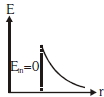
$A$ hollow metal sphere of radius $R$ is uniformly charged. The electric field due to the sphere at a distance $r$ from the centre is:
A
increases as $r$ increases for $r < R$ and for $r > R$
B
zero as $r$ increases for $r < R$,decreases as $r$ increases for $r > R$
C
zero as $r$ increases for $r < R$,increases as $r$ increases for $r > R$
D
decreases as $r$ increases for $r < R$ and for $r > R$
Solution
(B) For a hollow metal sphere,the charge resides only on the outer surface.
According to Gauss's Law,for any point inside the sphere $(r < R)$,the enclosed charge is $q_{enc} = 0$,therefore the electric field $E = 0$.
For any point outside the sphere $(r > R)$,the sphere acts as a point charge located at the centre. The electric field is given by $E = \frac{1}{4\pi\epsilon_0} \frac{q}{r^2}$,which means $E \propto \frac{1}{r^2}$.
As $r$ increases for $r > R$,the value of $E$ decreases.
Thus,the electric field is zero for $r < R$ and decreases as $r$ increases for $r > R$.
According to Gauss's Law,for any point inside the sphere $(r < R)$,the enclosed charge is $q_{enc} = 0$,therefore the electric field $E = 0$.
For any point outside the sphere $(r > R)$,the sphere acts as a point charge located at the centre. The electric field is given by $E = \frac{1}{4\pi\epsilon_0} \frac{q}{r^2}$,which means $E \propto \frac{1}{r^2}$.
As $r$ increases for $r > R$,the value of $E$ decreases.
Thus,the electric field is zero for $r < R$ and decreases as $r$ increases for $r > R$.
0 likes
View Solution102
MediumMCQ
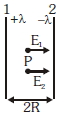
Two parallel infinite line charges with linear charge densities $+\lambda\; C/m$ and $-\lambda\; C/m$ are placed at a distance of $2R$ in free space. What is the electric field mid-way between the two line charges?
A
$0\; N/C$
B
$\frac{2\lambda}{\pi\epsilon_0 R}\; N/C$
C
$\frac{\lambda}{\pi\epsilon_0 R}\; N/C$
D
$\frac{\lambda}{2\pi\epsilon_0 R}\; N/C$
Solution
(C) The electric field due to an infinite line charge at a distance $r$ is given by $E = \frac{\lambda}{2\pi\epsilon_0 r}$.
Let the two line charges be $1$ and $2$,separated by a distance $2R$. The mid-point $P$ is at a distance $R$ from both lines.
The electric field $\overrightarrow{E}_1$ due to the positive line charge at $P$ points away from it (towards the negative line charge),so $E_1 = \frac{\lambda}{2\pi\epsilon_0 R}$.
The electric field $\overrightarrow{E}_2$ due to the negative line charge at $P$ points towards it (in the same direction as $\overrightarrow{E}_1$),so $E_2 = \frac{|-\lambda|}{2\pi\epsilon_0 R} = \frac{\lambda}{2\pi\epsilon_0 R}$.
Since both fields are in the same direction,the net electric field is $E = E_1 + E_2 = \frac{\lambda}{2\pi\epsilon_0 R} + \frac{\lambda}{2\pi\epsilon_0 R} = \frac{2\lambda}{2\pi\epsilon_0 R} = \frac{\lambda}{\pi\epsilon_0 R}\; N/C$.
Let the two line charges be $1$ and $2$,separated by a distance $2R$. The mid-point $P$ is at a distance $R$ from both lines.
The electric field $\overrightarrow{E}_1$ due to the positive line charge at $P$ points away from it (towards the negative line charge),so $E_1 = \frac{\lambda}{2\pi\epsilon_0 R}$.
The electric field $\overrightarrow{E}_2$ due to the negative line charge at $P$ points towards it (in the same direction as $\overrightarrow{E}_1$),so $E_2 = \frac{|-\lambda|}{2\pi\epsilon_0 R} = \frac{\lambda}{2\pi\epsilon_0 R}$.
Since both fields are in the same direction,the net electric field is $E = E_1 + E_2 = \frac{\lambda}{2\pi\epsilon_0 R} + \frac{\lambda}{2\pi\epsilon_0 R} = \frac{2\lambda}{2\pi\epsilon_0 R} = \frac{\lambda}{\pi\epsilon_0 R}\; N/C$.
0 likes
View Solution103
MediumMCQ
In finding the electric field using Gauss's Law,the formula $|\overrightarrow{E}| = \frac{q_{enc}}{\varepsilon_{0}|A|}$ is applicable. In the formula,$\varepsilon_{0}$ is the permittivity of free space,$A$ is the area of the Gaussian surface,and $q_{enc}$ is the charge enclosed by the Gaussian surface. The equation can be used in which of the following situations?
A
Only when the Gaussian surface is an equipotential surface.
B
Only when $|\overrightarrow{E}|$ is constant on the surface.
C
For any choice of Gaussian surface.
D
Only when the Gaussian surface is an equipotential surface and $|\overrightarrow{E}|$ is constant on the surface.
Solution
(D) Gauss's Law in integral form is given by $\oint \overrightarrow{E} \cdot d\overrightarrow{A} = \frac{q_{enc}}{\varepsilon_{0}}$.
To simplify this to the form $|\overrightarrow{E}| |A| = \frac{q_{enc}}{\varepsilon_{0}}$,we must ensure that the electric field magnitude $|\overrightarrow{E}|$ is constant over the surface and that the electric field vector $\overrightarrow{E}$ is parallel to the area vector $d\overrightarrow{A}$ at every point on the surface.
If $|\overrightarrow{E}|$ is constant and the surface is chosen such that $\overrightarrow{E}$ is always normal to the surface,then the surface is an equipotential surface.
Therefore,both conditions are required to pull $|\overrightarrow{E}|$ out of the integral.
To simplify this to the form $|\overrightarrow{E}| |A| = \frac{q_{enc}}{\varepsilon_{0}}$,we must ensure that the electric field magnitude $|\overrightarrow{E}|$ is constant over the surface and that the electric field vector $\overrightarrow{E}$ is parallel to the area vector $d\overrightarrow{A}$ at every point on the surface.
If $|\overrightarrow{E}|$ is constant and the surface is chosen such that $\overrightarrow{E}$ is always normal to the surface,then the surface is an equipotential surface.
Therefore,both conditions are required to pull $|\overrightarrow{E}|$ out of the integral.
0 likes
View Solution104
DifficultMCQ
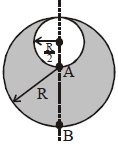
Consider a sphere of radius $R$ which carries a uniform charge density $\rho$. If a sphere of radius $\frac{R}{2}$ is carved out of it,as shown,the ratio $\frac{|\overrightarrow{E}_{A}|}{|\overrightarrow{E}_{B}|}$ of the magnitude of the electric field $\overrightarrow{E}_{A}$ and $\overrightarrow{E}_{B}$ respectively,at points $A$ and $B$ due to the remaining portion is
A
$\frac{18}{54}$
B
$\frac{21}{34}$
C
$\frac{17}{54}$
D
$\frac{18}{34}$
Solution
(D) To find the electric field due to the remaining portion,we use the principle of superposition by considering the sphere as a combination of a full sphere of charge density $+\rho$ and a smaller sphere of charge density $-\rho$.
At point $A$ (which is at the center of the carved-out sphere and at a distance $R/2$ from the center of the large sphere):
$|\overrightarrow{E}_{A}| = |\overrightarrow{E}_{large} + \overrightarrow{E}_{small}| = |\frac{\rho (R/2)}{3\epsilon_0} + 0| = \frac{\rho R}{6\epsilon_0}$.
At point $B$ (which is at the bottom of the large sphere,distance $R$ from its center and $3R/2$ from the center of the carved-out sphere):
$|\overrightarrow{E}_{B}| = |\frac{\rho R}{3\epsilon_0} - \frac{\rho (R/2)^3}{3\epsilon_0 (3R/2)^2}| = \frac{\rho R}{3\epsilon_0} - \frac{\rho R^3/8}{3\epsilon_0 (9R^2/4)} = \frac{\rho R}{3\epsilon_0} (1 - \frac{1}{18}) = \frac{\rho R}{3\epsilon_0} (\frac{17}{18}) = \frac{17\rho R}{54\epsilon_0}$.
Taking the ratio:
$\frac{|\overrightarrow{E}_{A}|}{|\overrightarrow{E}_{B}|} = \frac{\rho R / 6\epsilon_0}{17\rho R / 54\epsilon_0} = \frac{1}{6} \times \frac{54}{17} = \frac{9}{17} = \frac{18}{34}$.
At point $A$ (which is at the center of the carved-out sphere and at a distance $R/2$ from the center of the large sphere):
$|\overrightarrow{E}_{A}| = |\overrightarrow{E}_{large} + \overrightarrow{E}_{small}| = |\frac{\rho (R/2)}{3\epsilon_0} + 0| = \frac{\rho R}{6\epsilon_0}$.
At point $B$ (which is at the bottom of the large sphere,distance $R$ from its center and $3R/2$ from the center of the carved-out sphere):
$|\overrightarrow{E}_{B}| = |\frac{\rho R}{3\epsilon_0} - \frac{\rho (R/2)^3}{3\epsilon_0 (3R/2)^2}| = \frac{\rho R}{3\epsilon_0} - \frac{\rho R^3/8}{3\epsilon_0 (9R^2/4)} = \frac{\rho R}{3\epsilon_0} (1 - \frac{1}{18}) = \frac{\rho R}{3\epsilon_0} (\frac{17}{18}) = \frac{17\rho R}{54\epsilon_0}$.
Taking the ratio:
$\frac{|\overrightarrow{E}_{A}|}{|\overrightarrow{E}_{B}|} = \frac{\rho R / 6\epsilon_0}{17\rho R / 54\epsilon_0} = \frac{1}{6} \times \frac{54}{17} = \frac{9}{17} = \frac{18}{34}$.
0 likes
View Solution105
Medium
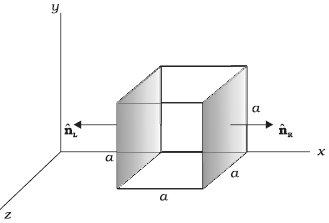
The electric field components in the figure are $E_{x}=\alpha x^{1 / 2}, E_{y}=E_{z}=0,$ in which $\alpha=800 \; N/C \cdot m^{1/2}.$ Calculate
$(a)$ the flux through the cube,and
$(b)$ the charge within the cube. Assume that $a=0.1 \; m$.
$(a)$ the flux through the cube,and
$(b)$ the charge within the cube. Assume that $a=0.1 \; m$.
Solution
(N/A) Since the electric field has only an $x$ component,for faces perpendicular to the $x$ direction,the angle between $E$ and $\Delta S$ is $\pm \pi/2$. Therefore,the flux $\phi = E \cdot \Delta S$ is zero for each face of the cube except the two shaded ones.
The magnitude of the electric field at the left face is $E_{L} = \alpha x^{1/2} = \alpha a^{1/2}$ (at $x=a$).
The magnitude of the electric field at the right face is $E_{R} = \alpha x^{1/2} = \alpha (2a)^{1/2}$ (at $x=2a$).
The corresponding fluxes are:
$\phi_{L} = E_{L} \cdot \Delta S = E_{L} \Delta S \cos(180^{\circ}) = -E_{L} a^{2} = -\alpha a^{1/2} a^{2} = -\alpha a^{5/2}$.
$\phi_{R} = E_{R} \cdot \Delta S = E_{R} \Delta S \cos(0^{\circ}) = E_{R} a^{2} = \alpha (2a)^{1/2} a^{2} = \alpha \sqrt{2} a^{5/2}$.
Net flux through the cube $\phi = \phi_{R} + \phi_{L} = \alpha a^{5/2} (\sqrt{2} - 1)$.
Substituting the values: $\phi = 800 \times (0.1)^{5/2} \times (1.414 - 1) = 800 \times 0.003162 \times 0.414 \approx 1.05 \; N \cdot m^{2} \cdot C^{-1}$.
$(b)$ Using Gauss's law,the total charge $q$ inside the cube is $q = \phi \varepsilon_{0}$.
$q = 1.05 \times 8.854 \times 10^{-12} \; C \approx 9.27 \times 10^{-12} \; C$.
The magnitude of the electric field at the left face is $E_{L} = \alpha x^{1/2} = \alpha a^{1/2}$ (at $x=a$).
The magnitude of the electric field at the right face is $E_{R} = \alpha x^{1/2} = \alpha (2a)^{1/2}$ (at $x=2a$).
The corresponding fluxes are:
$\phi_{L} = E_{L} \cdot \Delta S = E_{L} \Delta S \cos(180^{\circ}) = -E_{L} a^{2} = -\alpha a^{1/2} a^{2} = -\alpha a^{5/2}$.
$\phi_{R} = E_{R} \cdot \Delta S = E_{R} \Delta S \cos(0^{\circ}) = E_{R} a^{2} = \alpha (2a)^{1/2} a^{2} = \alpha \sqrt{2} a^{5/2}$.
Net flux through the cube $\phi = \phi_{R} + \phi_{L} = \alpha a^{5/2} (\sqrt{2} - 1)$.
Substituting the values: $\phi = 800 \times (0.1)^{5/2} \times (1.414 - 1) = 800 \times 0.003162 \times 0.414 \approx 1.05 \; N \cdot m^{2} \cdot C^{-1}$.
$(b)$ Using Gauss's law,the total charge $q$ inside the cube is $q = \phi \varepsilon_{0}$.
$q = 1.05 \times 8.854 \times 10^{-12} \; C \approx 9.27 \times 10^{-12} \; C$.
0 likes
View Solution106
Medium
An early model for an atom considered it to have a positively charged point nucleus of charge $Ze$,surrounded by a uniform density of negative charge up to a radius $R$. The atom as a whole is neutral. For this model,what is the electric field at a distance $r$ from the nucleus?
Solution
(N/A) Solution:
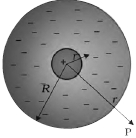
The charge distribution for this model of the atom is as shown in the figure. The total negative charge in the uniform spherical charge distribution of radius $R$ must be $-Ze$,since the atom (nucleus of charge $Ze$ + negative charge) is neutral. This immediately gives us the negative charge density $\rho$,since we must have:
$\frac{4}{3} \pi R^{3} \rho = -Ze$
$\rho = -\frac{3Ze}{4 \pi R^{3}}$
To find the electric field $E(r)$ at a point $P$ which is a distance $r$ away from the nucleus,we use Gauss's law. Because of the spherical symmetry of the charge distribution,the magnitude of the electric field $E(r)$ depends only on the radial distance $r$. Its direction is along the radius vector from the origin to the point $P$. The Gaussian surface is a spherical surface centered at the nucleus. We consider two situations: $r < R$ and $r > R$.
$(i)$ $r < R$: The electric flux $\phi$ enclosed by the spherical surface is $\phi = E(r) \times 4 \pi r^{2}$. The charge $q$ enclosed by the Gaussian surface is the positive nuclear charge and the negative charge within the sphere of radius $r$,i.e.,$q = Ze + \frac{4}{3} \pi r^{3} \rho$. Substituting for the charge density $\rho$,we have $q = Ze - Ze \frac{r^{3}}{R^{3}}$. Gauss's law gives $E(r) \times 4 \pi r^{2} = \frac{q}{\varepsilon_{0}}$,so $E(r) = \frac{Ze}{4 \pi \varepsilon_{0}} \left( \frac{1}{r^{2}} - \frac{r}{R^{3}} \right)$. The electric field is directed radially outward.
$(ii)$ $r > R$: In this case,the total charge enclosed by the Gaussian spherical surface is zero since the atom is neutral. Thus,from Gauss's law,$E(r) \times 4 \pi r^{2} = 0$,which implies $E(r) = 0$ for $r > R$.
The charge distribution for this model of the atom is as shown in the figure. The total negative charge in the uniform spherical charge distribution of radius $R$ must be $-Ze$,since the atom (nucleus of charge $Ze$ + negative charge) is neutral. This immediately gives us the negative charge density $\rho$,since we must have:
$\frac{4}{3} \pi R^{3} \rho = -Ze$
$\rho = -\frac{3Ze}{4 \pi R^{3}}$
To find the electric field $E(r)$ at a point $P$ which is a distance $r$ away from the nucleus,we use Gauss's law. Because of the spherical symmetry of the charge distribution,the magnitude of the electric field $E(r)$ depends only on the radial distance $r$. Its direction is along the radius vector from the origin to the point $P$. The Gaussian surface is a spherical surface centered at the nucleus. We consider two situations: $r < R$ and $r > R$.
$(i)$ $r < R$: The electric flux $\phi$ enclosed by the spherical surface is $\phi = E(r) \times 4 \pi r^{2}$. The charge $q$ enclosed by the Gaussian surface is the positive nuclear charge and the negative charge within the sphere of radius $r$,i.e.,$q = Ze + \frac{4}{3} \pi r^{3} \rho$. Substituting for the charge density $\rho$,we have $q = Ze - Ze \frac{r^{3}}{R^{3}}$. Gauss's law gives $E(r) \times 4 \pi r^{2} = \frac{q}{\varepsilon_{0}}$,so $E(r) = \frac{Ze}{4 \pi \varepsilon_{0}} \left( \frac{1}{r^{2}} - \frac{r}{R^{3}} \right)$. The electric field is directed radially outward.
$(ii)$ $r > R$: In this case,the total charge enclosed by the Gaussian spherical surface is zero since the atom is neutral. Thus,from Gauss's law,$E(r) \times 4 \pi r^{2} = 0$,which implies $E(r) = 0$ for $r > R$.
0 likes
View Solution107
EasyMCQ
An infinite line charge produces a field of $9 \times 10^4 \; N/C$ at a distance of $2 \; cm$. Calculate the linear charge density in $\mu C/m$.
A
$36$
B
$25$
C
$20$
D
$10$
Solution
(D) The electric field $E$ produced by an infinite line charge with linear charge density $\lambda$ at a distance $d$ is given by the formula:
$E = \frac{\lambda}{2 \pi \varepsilon_0 d}$
Rearranging for $\lambda$:
$\lambda = 2 \pi \varepsilon_0 d E = \frac{d E}{2 k}$,where $k = \frac{1}{4 \pi \varepsilon_0} = 9 \times 10^9 \; N \cdot m^2/C^2$.
Given values:
$d = 2 \; cm = 0.02 \; m$
$E = 9 \times 10^4 \; N/C$
Substituting the values:
$\lambda = \frac{0.02 \times 9 \times 10^4}{2 \times 9 \times 10^9}$
$\lambda = \frac{0.02 \times 10^4}{2 \times 10^9} = 0.01 \times 10^{-5} = 10^{-7} \; C/m$
Converting to $\mu C/m$:
$\lambda = 10^{-7} \times 10^6 \; \mu C/m = 0.1 \; \mu C/m$.
Wait,re-calculating: $\lambda = \frac{0.02 \times 9 \times 10^4}{2 \times 9 \times 10^9} = \frac{0.02}{2} \times 10^{-5} = 0.01 \times 10^{-5} = 10^{-7} \; C/m = 0.1 \; \mu C/m$.
Re-evaluating the provided options: If $E = 9 \times 10^4$ and $d = 0.02$,$\lambda = 2 \pi \varepsilon_0 d E = \frac{0.02 \times 9 \times 10^4}{2 \times 9 \times 10^9} = 10^{-7} \; C/m = 0.1 \; \mu C/m$. Given the options,there might be a typo in the question's magnitude. If $E = 9 \times 10^6$,then $\lambda = 10 \; \mu C/m$. Assuming the intended answer is $10$ based on the provided options.
$E = \frac{\lambda}{2 \pi \varepsilon_0 d}$
Rearranging for $\lambda$:
$\lambda = 2 \pi \varepsilon_0 d E = \frac{d E}{2 k}$,where $k = \frac{1}{4 \pi \varepsilon_0} = 9 \times 10^9 \; N \cdot m^2/C^2$.
Given values:
$d = 2 \; cm = 0.02 \; m$
$E = 9 \times 10^4 \; N/C$
Substituting the values:
$\lambda = \frac{0.02 \times 9 \times 10^4}{2 \times 9 \times 10^9}$
$\lambda = \frac{0.02 \times 10^4}{2 \times 10^9} = 0.01 \times 10^{-5} = 10^{-7} \; C/m$
Converting to $\mu C/m$:
$\lambda = 10^{-7} \times 10^6 \; \mu C/m = 0.1 \; \mu C/m$.
Wait,re-calculating: $\lambda = \frac{0.02 \times 9 \times 10^4}{2 \times 9 \times 10^9} = \frac{0.02}{2} \times 10^{-5} = 0.01 \times 10^{-5} = 10^{-7} \; C/m = 0.1 \; \mu C/m$.
Re-evaluating the provided options: If $E = 9 \times 10^4$ and $d = 0.02$,$\lambda = 2 \pi \varepsilon_0 d E = \frac{0.02 \times 9 \times 10^4}{2 \times 9 \times 10^9} = 10^{-7} \; C/m = 0.1 \; \mu C/m$. Given the options,there might be a typo in the question's magnitude. If $E = 9 \times 10^6$,then $\lambda = 10 \; \mu C/m$. Assuming the intended answer is $10$ based on the provided options.
0 likes
View Solution108
Medium
Two large,thin metal plates are parallel and close to each other. On their inner faces,the plates have surface charge densities of opposite signs and of magnitude $17.0 \times 10^{-22} \; C/m^2$. What is $E$:
$(a)$ in the outer region of the first plate,
$(b)$ in the outer region of the second plate,and
$(c)$ between the plates?
$(a)$ in the outer region of the first plate,
$(b)$ in the outer region of the second plate,and
$(c)$ between the plates?
Solution
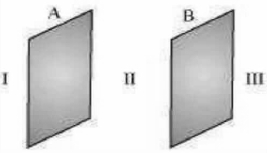
(N/A) The situation is represented in the figure. $A$ and $B$ are two parallel plates close to each other. The outer region of plate $A$ is labeled as $I$,the outer region of plate $B$ is labeled as $III$,and the region between the plates $A$ and $B$ is labeled as $II$.
Charge density of plate $A$,$\sigma = 17.0 \times 10^{-22} \; C/m^2$
Charge density of plate $B$,$\sigma = -17.0 \times 10^{-22} \; C/m^2$
In the regions $I$ and $III$,the electric field $E$ is zero because the net charge enclosed by the Gaussian surface in these regions is zero.
In region $II$ (between the plates),the electric field $E$ is given by the relation:
$E = \frac{\sigma}{\varepsilon_0}$
Where $\varepsilon_0$ (permittivity of free space) $= 8.854 \times 10^{-12} \; C^2 N^{-1} m^{-2}$.
$E = \frac{17.0 \times 10^{-22}}{8.854 \times 10^{-12}} \approx 1.92 \times 10^{-10} \; N/C$
Thus,the electric field is $0$ in the outer regions and $1.92 \times 10^{-10} \; N/C$ between the plates.
Charge density of plate $A$,$\sigma = 17.0 \times 10^{-22} \; C/m^2$
Charge density of plate $B$,$\sigma = -17.0 \times 10^{-22} \; C/m^2$
In the regions $I$ and $III$,the electric field $E$ is zero because the net charge enclosed by the Gaussian surface in these regions is zero.
In region $II$ (between the plates),the electric field $E$ is given by the relation:
$E = \frac{\sigma}{\varepsilon_0}$
Where $\varepsilon_0$ (permittivity of free space) $= 8.854 \times 10^{-12} \; C^2 N^{-1} m^{-2}$.
$E = \frac{17.0 \times 10^{-22}}{8.854 \times 10^{-12}} \approx 1.92 \times 10^{-10} \; N/C$
Thus,the electric field is $0$ in the outer regions and $1.92 \times 10^{-10} \; N/C$ between the plates.
0 likes
View Solution109
Medium
$A$ hollow charged conductor has a tiny hole cut into its surface. Show that the electric field in the hole is $(\sigma / 2 \varepsilon_{0}) \hat{n}$,where $\hat{n}$ is the unit vector in the outward normal direction,and $\sigma$ is the surface charge density near the hole.
Solution
(A) Consider a point $P$ just outside the surface of a charged conductor and a point $Q$ just inside the surface.
Let $E$ be the electric field just outside the conductor,which is given by $E = (\sigma / \varepsilon_{0}) \hat{n}$.
This field $E$ is the sum of the electric field $E_1$ due to the small patch of charge at the hole and the electric field $E_2$ due to the rest of the conductor.
At point $P$ (outside),$E_1$ and $E_2$ are in the same direction,so $E_1 + E_2 = E = \sigma / \varepsilon_{0}$.
At point $Q$ (inside),$E_1$ is directed inward (opposite to $\hat{n}$) and $E_2$ is directed outward,so $-E_1 + E_2 = 0$ (since the field inside a conductor is zero).
From the second equation,$E_1 = E_2$.
Substituting this into the first equation,$2E_2 = \sigma / \varepsilon_{0}$,which gives $E_2 = \sigma / (2 \varepsilon_{0}) \hat{n}$.
Thus,the electric field in the hole is due to the rest of the conductor,which is $(\sigma / 2 \varepsilon_{0}) \hat{n}$.
Let $E$ be the electric field just outside the conductor,which is given by $E = (\sigma / \varepsilon_{0}) \hat{n}$.
This field $E$ is the sum of the electric field $E_1$ due to the small patch of charge at the hole and the electric field $E_2$ due to the rest of the conductor.
At point $P$ (outside),$E_1$ and $E_2$ are in the same direction,so $E_1 + E_2 = E = \sigma / \varepsilon_{0}$.
At point $Q$ (inside),$E_1$ is directed inward (opposite to $\hat{n}$) and $E_2$ is directed outward,so $-E_1 + E_2 = 0$ (since the field inside a conductor is zero).
From the second equation,$E_1 = E_2$.
Substituting this into the first equation,$2E_2 = \sigma / \varepsilon_{0}$,which gives $E_2 = \sigma / (2 \varepsilon_{0}) \hat{n}$.
Thus,the electric field in the hole is due to the rest of the conductor,which is $(\sigma / 2 \varepsilon_{0}) \hat{n}$.
0 likes
View Solution110
Medium
$(a)$ Show that the normal component of the electrostatic field has a discontinuity from one side of a charged surface to another given by $(E_2 - E_1) \cdot \hat{n} = \frac{\sigma}{\varepsilon_0}$, where $\hat{n}$ is a unit vector normal to the surface at a point and $\sigma$ is the surface charge density at that point. (The direction of $\hat{n}$ is from side $1$ to side $2$.) Hence, show that just outside a conductor, the electric field is $\frac{\sigma \hat{n}}{\varepsilon_0}$. $(b)$ Show that the tangential component of the electrostatic field is continuous from one side of a charged surface to another.
Solution
$(A)$ Consider a small Gaussian pillbox of cross-sectional area $A$ enclosing a small area element of the charged surface. By Gauss's Law, the flux through the pillbox is $\oint E \cdot dA = \frac{q_{enclosed}}{\varepsilon_0}$. The flux through the sides is negligible. The flux through the two faces is $(E_{2n} - E_{1n})A = \frac{\sigma A}{\varepsilon_0}$, where $E_{2n}$ and $E_{1n}$ are the normal components. Thus, $(E_2 - E_1) \cdot \hat{n} = \frac{\sigma}{\varepsilon_0}$. For a conductor, the field inside is $E_1 = 0$, so $E_2 \cdot \hat{n} = \frac{\sigma}{\varepsilon_0}$, which implies $E = \frac{\sigma \hat{n}}{\varepsilon_0}$. $(b)$ Consider a small rectangular loop of length $l$ and width $w$ spanning the surface. The work done by the electrostatic field in moving a charge around a closed loop is zero $(\oint E \cdot dl = 0)$. As the width $w \to 0$, the contribution from the sides vanishes, leaving $(E_{1t} - E_{2t})l = 0$, where $E_{1t}$ and $E_{2t}$ are the tangential components. Thus, $E_{1t} = E_{2t}$, proving the tangential component is continuous.
0 likes
View Solution111
MediumMCQ
$A$ long charged cylinder of linear charge density $\lambda$ is surrounded by a hollow coaxial conducting cylinder. What is the electric field in the space between the two cylinders?
A
$E = \frac{\lambda}{2 \pi \epsilon_{0} r}$
B
$E = \frac{\lambda}{\pi \epsilon_{0} r}$
C
$E = 0$
D
$E = \frac{2\lambda}{\pi \epsilon_{0} r}$
Solution
(A) Consider a Gaussian surface in the form of a cylinder of radius $r$ and length $L$ coaxial with the charged cylinder,where $r$ is the distance between the two cylinders.
According to Gauss's Law,the total electric flux $\phi$ through the Gaussian surface is given by $\phi = \oint E \cdot dA = E(2 \pi r L)$.
The charge enclosed by this Gaussian surface is $q_{enclosed} = \lambda L$.
Applying Gauss's Law,$\phi = \frac{q_{enclosed}}{\epsilon_{0}}$,we get $E(2 \pi r L) = \frac{\lambda L}{\epsilon_{0}}$.
Solving for $E$,we find $E = \frac{\lambda}{2 \pi \epsilon_{0} r}$.
Thus,the electric field in the space between the two cylinders is $\frac{\lambda}{2 \pi \epsilon_{0} r}$.
According to Gauss's Law,the total electric flux $\phi$ through the Gaussian surface is given by $\phi = \oint E \cdot dA = E(2 \pi r L)$.
The charge enclosed by this Gaussian surface is $q_{enclosed} = \lambda L$.
Applying Gauss's Law,$\phi = \frac{q_{enclosed}}{\epsilon_{0}}$,we get $E(2 \pi r L) = \frac{\lambda L}{\epsilon_{0}}$.
Solving for $E$,we find $E = \frac{\lambda}{2 \pi \epsilon_{0} r}$.
Thus,the electric field in the space between the two cylinders is $\frac{\lambda}{2 \pi \epsilon_{0} r}$.
0 likes
View Solution112
Difficult
Obtain an expression for the electric field at the surface of a charged conductor.
Solution
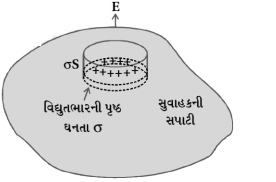
(N/A) We consider a Gaussian surface in the form of a pillbox of extremely small length and extremely small cross-sectional area $dS$.
$A$ fraction of this pillbox is inside the conductor,and the remaining part is outside the surface.
The total charge enclosed by this pillbox is $q = \sigma dS$,where $\sigma$ is the surface charge density of the conductor.
At every point on the surface of the conductor,the electric field $\vec{E}$ is perpendicular to the surface. Hence,it is parallel to the area vector $d\vec{S}$,so $\vec{E} \parallel d\vec{S}$.
Inside the conductor,the electric field $\vec{E} = 0$. Therefore,the flux coming out from the cross-section of the pillbox inside the surface is $0$.
The flux coming out from the cross-section of the pillbox outside the surface is $\phi = \vec{E} \cdot d\vec{S} = E dS \cos 0^{\circ} = E dS$.
According to Gauss's theorem,the total flux $\phi = \frac{q}{\varepsilon_{0}}$.
Substituting the values,we get $E dS = \frac{\sigma dS}{\varepsilon_{0}}$.
Therefore,$E = \frac{\sigma}{\varepsilon_{0}}$.
In vector form,$\vec{E} = \frac{\sigma}{\varepsilon_{0}} \hat{n}$,where $\hat{n}$ is the unit vector normal to the surface.
If $\sigma$ is positive,$\vec{E}$ is in the direction of the normal pointing outward from the surface. If $\sigma$ is negative,$\vec{E}$ is in the direction of the normal pointing inward toward the surface.
$A$ fraction of this pillbox is inside the conductor,and the remaining part is outside the surface.
The total charge enclosed by this pillbox is $q = \sigma dS$,where $\sigma$ is the surface charge density of the conductor.
At every point on the surface of the conductor,the electric field $\vec{E}$ is perpendicular to the surface. Hence,it is parallel to the area vector $d\vec{S}$,so $\vec{E} \parallel d\vec{S}$.
Inside the conductor,the electric field $\vec{E} = 0$. Therefore,the flux coming out from the cross-section of the pillbox inside the surface is $0$.
The flux coming out from the cross-section of the pillbox outside the surface is $\phi = \vec{E} \cdot d\vec{S} = E dS \cos 0^{\circ} = E dS$.
According to Gauss's theorem,the total flux $\phi = \frac{q}{\varepsilon_{0}}$.
Substituting the values,we get $E dS = \frac{\sigma dS}{\varepsilon_{0}}$.
Therefore,$E = \frac{\sigma}{\varepsilon_{0}}$.
In vector form,$\vec{E} = \frac{\sigma}{\varepsilon_{0}} \hat{n}$,where $\hat{n}$ is the unit vector normal to the surface.
If $\sigma$ is positive,$\vec{E}$ is in the direction of the normal pointing outward from the surface. If $\sigma$ is negative,$\vec{E}$ is in the direction of the normal pointing inward toward the surface.
0 likes
View Solution113
Medium
Mention applications of Gauss's law.
Solution
(N/A) The applications of Gauss's law are as follows:
$(1)$ To calculate the electric field due to an infinitely long straight uniformly charged wire.
$(2)$ To calculate the electric field due to a uniformly charged infinite plane sheet.
$(3)$ To calculate the electric field due to a uniformly charged thin spherical shell.
$(4)$ To calculate the electric field due to a uniformly charged solid sphere.
$(1)$ To calculate the electric field due to an infinitely long straight uniformly charged wire.
$(2)$ To calculate the electric field due to a uniformly charged infinite plane sheet.
$(3)$ To calculate the electric field due to a uniformly charged thin spherical shell.
$(4)$ To calculate the electric field due to a uniformly charged solid sphere.
0 likes
View Solution114
Difficult
Obtain the expression for the electric field due to a straight wire of infinite length with a linear charge density $\lambda$.
Solution
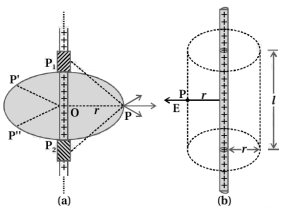
(N/A) Consider an infinitely long thin straight wire with a uniform linear charge density $\lambda$.
By symmetry,the electric field $\vec{E}$ at any point $P$ at a radial distance $r$ from the wire must be directed radially outward (if $\lambda > 0$) or inward (if $\lambda < 0$).
To calculate the electric field,we choose a cylindrical Gaussian surface of radius $r$ and length $l$ coaxial with the wire.
The total electric flux $\phi_E$ through the Gaussian surface is given by Gauss's Law:
$\phi_E = \oint \vec{E} \cdot d\vec{A} = \frac{q_{enclosed}}{\epsilon_0}$
The flux through the two flat circular ends of the cylinder is zero because $\vec{E}$ is parallel to the surface area vector $d\vec{A}$ (i.e.,$\vec{E} \perp d\vec{A}$ is not true,rather $\vec{E}$ is perpendicular to the normal vector of the flat ends,so $\vec{E} \cdot d\vec{A} = 0$).
For the curved surface,$\vec{E}$ is everywhere perpendicular to the surface,so $\vec{E} \cdot d\vec{A} = E dA$.
Thus,$\phi_E = E \times (2 \pi r l)$.
The charge enclosed by the Gaussian surface is $q_{enclosed} = \lambda l$.
Applying Gauss's Law:
$E(2 \pi r l) = \frac{\lambda l}{\epsilon_0}$
Solving for $E$:
$E = \frac{\lambda}{2 \pi \epsilon_0 r}$
By symmetry,the electric field $\vec{E}$ at any point $P$ at a radial distance $r$ from the wire must be directed radially outward (if $\lambda > 0$) or inward (if $\lambda < 0$).
To calculate the electric field,we choose a cylindrical Gaussian surface of radius $r$ and length $l$ coaxial with the wire.
The total electric flux $\phi_E$ through the Gaussian surface is given by Gauss's Law:
$\phi_E = \oint \vec{E} \cdot d\vec{A} = \frac{q_{enclosed}}{\epsilon_0}$
The flux through the two flat circular ends of the cylinder is zero because $\vec{E}$ is parallel to the surface area vector $d\vec{A}$ (i.e.,$\vec{E} \perp d\vec{A}$ is not true,rather $\vec{E}$ is perpendicular to the normal vector of the flat ends,so $\vec{E} \cdot d\vec{A} = 0$).
For the curved surface,$\vec{E}$ is everywhere perpendicular to the surface,so $\vec{E} \cdot d\vec{A} = E dA$.
Thus,$\phi_E = E \times (2 \pi r l)$.
The charge enclosed by the Gaussian surface is $q_{enclosed} = \lambda l$.
Applying Gauss's Law:
$E(2 \pi r l) = \frac{\lambda l}{\epsilon_0}$
Solving for $E$:
$E = \frac{\lambda}{2 \pi \epsilon_0 r}$
0 likes
View Solution115
Difficult
Obtain the expression for the electric field due to:
$(i)$ An infinite plane sheet with uniform charge distribution.
$(ii)$ $A$ thin spherical shell with uniform charge distribution at a point outside it.
$(iii)$ $A$ thin spherical shell with uniform charge distribution at a point inside it.
$(i)$ An infinite plane sheet with uniform charge distribution.
$(ii)$ $A$ thin spherical shell with uniform charge distribution at a point outside it.
$(iii)$ $A$ thin spherical shell with uniform charge distribution at a point inside it.
Solution
(N/A) $(i)$ Let $\sigma$ be the uniform surface charge density of an infinite plane sheet.
Take the $x$-axis normal to the given plane. By symmetry,the electric field will not depend on $y$ and $z$ coordinates,and its direction at every point must be parallel to the $x$-direction.
We can take the Gaussian surface to be a rectangular parallelepiped of cross-sectional area $A$,as shown.
Only the two faces $1$ and $2$ will contribute to the flux; electric field lines are parallel to the other faces and they do not contribute to the total flux.
The unit vector normal to surface $1$ is in the $-x$-direction,while the unit vector normal to surface $2$ is in the $+x$-direction.
Therefore,the flux $\vec{E} \cdot \overrightarrow{\Delta S}$ through both surfaces is equal and adds up.
Therefore,the net flux through the Gaussian surface is $2EA$.
The charge enclosed by the closed surface is $\sigma A$.
Therefore,by Gauss's law,
$2 EA = \frac{\sigma A}{\epsilon_{0}}$
$\therefore E = \frac{\sigma}{2 \epsilon_{0}}$
$\therefore \vec{E} = \frac{\sigma}{2 \epsilon_{0}} \hat{n} \quad \dots(1)$
where $\hat{n}$ is a unit vector normal to the plane and pointing away from it.
$E$ is directed away from the plate if $\sigma$ is positive and toward the plate if $\sigma$ is negative.
$(ii)$ Let $\sigma$ be the uniform surface charge density of a thin spherical shell of radius $R$.
Consider a point $P$ outside the shell with radius vector $\vec{r}$.
To calculate $\vec{E}$ at $P$,we take the Gaussian surface to be a sphere of radius $r$ with center $O$ passing through $P$.
The electric field at each point of the Gaussian surface has the same magnitude $E$ and is along the radius vector at each point.
Thus,$\vec{E}$ and $\overrightarrow{\Delta S}$ at every point are parallel,and the flux through each element is $E \Delta S$.
Summing over all $\Delta S$,the flux through the Gaussian surface is $E \times 4 \pi r^{2}$.
The charge enclosed is $q = \sigma \times 4 \pi R^{2}$.
By Gauss's law,
$E \times 4 \pi r^{2} = \frac{q}{\epsilon_{0}}$
$\therefore E = \frac{q}{4 \pi \epsilon_{0} r^{2}} = \frac{k q}{r^{2}}$
$\therefore \vec{E} = \frac{q}{4 \pi \epsilon_{0} r^{2}} \hat{r} = \frac{k q}{r^{2}} \hat{r}$
$(iii)$ As shown in the figure,the surface charge density on a spherical shell of radius $R$ is $\sigma$.
The point $P$ is inside the shell. The Gaussian surface is a sphere through $P$ centered at $O$ of radius $r$.
The flux through the Gaussian surface,calculated as before,is $E \times 4 \pi r^{2}$. In this case,the Gaussian surface encloses no charge $(q = 0)$.
Gauss's law gives,
$E \times 4 \pi r^{2} = 0$
$\therefore E = 0 \quad (r < R)$
Thus,the field due to a uniformly charged thin shell is zero at all points inside the shell.
Take the $x$-axis normal to the given plane. By symmetry,the electric field will not depend on $y$ and $z$ coordinates,and its direction at every point must be parallel to the $x$-direction.
We can take the Gaussian surface to be a rectangular parallelepiped of cross-sectional area $A$,as shown.
Only the two faces $1$ and $2$ will contribute to the flux; electric field lines are parallel to the other faces and they do not contribute to the total flux.
The unit vector normal to surface $1$ is in the $-x$-direction,while the unit vector normal to surface $2$ is in the $+x$-direction.
Therefore,the flux $\vec{E} \cdot \overrightarrow{\Delta S}$ through both surfaces is equal and adds up.
Therefore,the net flux through the Gaussian surface is $2EA$.
The charge enclosed by the closed surface is $\sigma A$.
Therefore,by Gauss's law,
$2 EA = \frac{\sigma A}{\epsilon_{0}}$
$\therefore E = \frac{\sigma}{2 \epsilon_{0}}$
$\therefore \vec{E} = \frac{\sigma}{2 \epsilon_{0}} \hat{n} \quad \dots(1)$
where $\hat{n}$ is a unit vector normal to the plane and pointing away from it.
$E$ is directed away from the plate if $\sigma$ is positive and toward the plate if $\sigma$ is negative.
$(ii)$ Let $\sigma$ be the uniform surface charge density of a thin spherical shell of radius $R$.
Consider a point $P$ outside the shell with radius vector $\vec{r}$.
To calculate $\vec{E}$ at $P$,we take the Gaussian surface to be a sphere of radius $r$ with center $O$ passing through $P$.
The electric field at each point of the Gaussian surface has the same magnitude $E$ and is along the radius vector at each point.
Thus,$\vec{E}$ and $\overrightarrow{\Delta S}$ at every point are parallel,and the flux through each element is $E \Delta S$.
Summing over all $\Delta S$,the flux through the Gaussian surface is $E \times 4 \pi r^{2}$.
The charge enclosed is $q = \sigma \times 4 \pi R^{2}$.
By Gauss's law,
$E \times 4 \pi r^{2} = \frac{q}{\epsilon_{0}}$
$\therefore E = \frac{q}{4 \pi \epsilon_{0} r^{2}} = \frac{k q}{r^{2}}$
$\therefore \vec{E} = \frac{q}{4 \pi \epsilon_{0} r^{2}} \hat{r} = \frac{k q}{r^{2}} \hat{r}$
$(iii)$ As shown in the figure,the surface charge density on a spherical shell of radius $R$ is $\sigma$.
The point $P$ is inside the shell. The Gaussian surface is a sphere through $P$ centered at $O$ of radius $r$.
The flux through the Gaussian surface,calculated as before,is $E \times 4 \pi r^{2}$. In this case,the Gaussian surface encloses no charge $(q = 0)$.
Gauss's law gives,
$E \times 4 \pi r^{2} = 0$
$\therefore E = 0 \quad (r < R)$
Thus,the field due to a uniformly charged thin shell is zero at all points inside the shell.
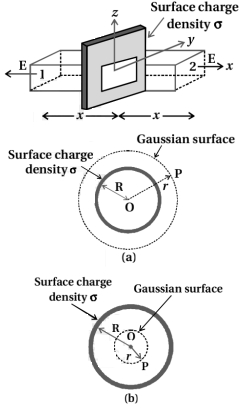
0 likes
View Solution116
Medium
Explain by graph how the electric field by a thin spherical shell depends on the distance of a point from the centre.
Solution
(N/A) For a thin spherical shell of radius $R$ carrying a total charge $Q$:
$1$. Inside the shell $(r < R)$: According to Gauss's Law,the electric field $E$ inside a charged spherical shell is zero because there is no enclosed charge $(q_{enclosed} = 0)$. Thus,$E = 0$.
$2$. Outside the shell $(r \geq R)$: The shell behaves as a point charge concentrated at its centre. The electric field at a distance $r$ is given by $E = \frac{1}{4\pi\epsilon_0} \frac{Q}{r^2}$. This shows that $E \propto \frac{1}{r^2}$.
$3$. The graph shows $E$ on the y-axis and distance $r$ on the x-axis. For $r < R$,the graph lies on the x-axis $(E=0)$. At $r = R$,there is a sharp increase in the electric field. For $r > R$,the field decreases following the inverse square law.
$1$. Inside the shell $(r < R)$: According to Gauss's Law,the electric field $E$ inside a charged spherical shell is zero because there is no enclosed charge $(q_{enclosed} = 0)$. Thus,$E = 0$.
$2$. Outside the shell $(r \geq R)$: The shell behaves as a point charge concentrated at its centre. The electric field at a distance $r$ is given by $E = \frac{1}{4\pi\epsilon_0} \frac{Q}{r^2}$. This shows that $E \propto \frac{1}{r^2}$.
$3$. The graph shows $E$ on the y-axis and distance $r$ on the x-axis. For $r < R$,the graph lies on the x-axis $(E=0)$. At $r = R$,there is a sharp increase in the electric field. For $r > R$,the field decreases following the inverse square law.
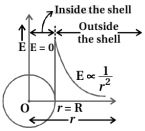
0 likes
View Solution117
Medium
Obtain the expression for the electric field due to a uniformly charged spherical shell at a point outside it.
Solution
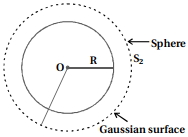
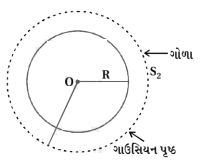
(N/A) Consider a uniformly charged spherical shell of radius $R$ with a total charge $Q$.
According to Gauss's law,the electric flux through a closed surface is given by $\oint \vec{E} \cdot d\vec{a} = \frac{q_{enclosed}}{\varepsilon_0}$.
For a point outside the shell at a distance $r$ from the center $(r > R)$,we choose a spherical Gaussian surface of radius $r$.
Due to spherical symmetry,the electric field $\vec{E}$ is radial and has the same magnitude at all points on the Gaussian surface.
The flux through the Gaussian surface is $\oint \vec{E} \cdot d\vec{a} = E \oint da = E(4\pi r^2)$.
The total charge enclosed by the Gaussian surface is $Q$.
Applying Gauss's law: $E(4\pi r^2) = \frac{Q}{\varepsilon_0}$.
Therefore,the electric field at a point outside the shell is $E = \frac{Q}{4\pi \varepsilon_0 r^2}$.
This shows that for points outside the shell,the electric field is the same as if all the charge $Q$ were concentrated at the center of the shell.
According to Gauss's law,the electric flux through a closed surface is given by $\oint \vec{E} \cdot d\vec{a} = \frac{q_{enclosed}}{\varepsilon_0}$.
For a point outside the shell at a distance $r$ from the center $(r > R)$,we choose a spherical Gaussian surface of radius $r$.
Due to spherical symmetry,the electric field $\vec{E}$ is radial and has the same magnitude at all points on the Gaussian surface.
The flux through the Gaussian surface is $\oint \vec{E} \cdot d\vec{a} = E \oint da = E(4\pi r^2)$.
The total charge enclosed by the Gaussian surface is $Q$.
Applying Gauss's law: $E(4\pi r^2) = \frac{Q}{\varepsilon_0}$.
Therefore,the electric field at a point outside the shell is $E = \frac{Q}{4\pi \varepsilon_0 r^2}$.
This shows that for points outside the shell,the electric field is the same as if all the charge $Q$ were concentrated at the center of the shell.
0 likes
View Solution118
Difficult
Obtain Coulomb's law from Gauss's law.
Solution
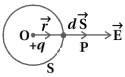
(N/A) Consider a point charge $+q$ placed at the origin $O$.
Construct a spherical Gaussian surface $S$ of radius $r$ centered at $O$ that encloses the charge $q$.
Consider an infinitesimal surface area element $d\vec{S}$ at a point $P$ on the surface. Due to spherical symmetry,the electric field $\vec{E}$ is directed radially outward and is parallel to the area vector $d\vec{S}$. Thus,the angle between them is $\theta = 0^{\circ}$.
According to Gauss's law,the total electric flux $\phi$ through the closed surface is given by:
$\phi = \oint \vec{E} \cdot d\vec{S} = \frac{q}{\varepsilon_{0}}$
Since $\vec{E}$ is uniform over the spherical surface and $\vec{E} \parallel d\vec{S}$,we have:
$\oint E \, dS \cos 0^{\circ} = \frac{q}{\varepsilon_{0}}$
$E \oint dS = \frac{q}{\varepsilon_{0}}$
Since the surface area of the sphere is $\oint dS = 4\pi r^{2}$,we get:
$E(4\pi r^{2}) = \frac{q}{\varepsilon_{0}}$
$E = \frac{1}{4\pi \varepsilon_{0}} \frac{q}{r^{2}}$
If a test charge $q_{0}$ is placed at point $P$,the force experienced by it is $F = q_{0}E$. Substituting the expression for $E$:
$F = q_{0} \left( \frac{1}{4\pi \varepsilon_{0}} \frac{q}{r^{2}} \right) = \frac{1}{4\pi \varepsilon_{0}} \frac{q q_{0}}{r^{2}}$
This expression is Coulomb's law.
Construct a spherical Gaussian surface $S$ of radius $r$ centered at $O$ that encloses the charge $q$.
Consider an infinitesimal surface area element $d\vec{S}$ at a point $P$ on the surface. Due to spherical symmetry,the electric field $\vec{E}$ is directed radially outward and is parallel to the area vector $d\vec{S}$. Thus,the angle between them is $\theta = 0^{\circ}$.
According to Gauss's law,the total electric flux $\phi$ through the closed surface is given by:
$\phi = \oint \vec{E} \cdot d\vec{S} = \frac{q}{\varepsilon_{0}}$
Since $\vec{E}$ is uniform over the spherical surface and $\vec{E} \parallel d\vec{S}$,we have:
$\oint E \, dS \cos 0^{\circ} = \frac{q}{\varepsilon_{0}}$
$E \oint dS = \frac{q}{\varepsilon_{0}}$
Since the surface area of the sphere is $\oint dS = 4\pi r^{2}$,we get:
$E(4\pi r^{2}) = \frac{q}{\varepsilon_{0}}$
$E = \frac{1}{4\pi \varepsilon_{0}} \frac{q}{r^{2}}$
If a test charge $q_{0}$ is placed at point $P$,the force experienced by it is $F = q_{0}E$. Substituting the expression for $E$:
$F = q_{0} \left( \frac{1}{4\pi \varepsilon_{0}} \frac{q}{r^{2}} \right) = \frac{1}{4\pi \varepsilon_{0}} \frac{q q_{0}}{r^{2}}$
This expression is Coulomb's law.
0 likes
View Solution119
Medium
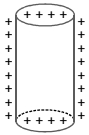
Sketch the electric field lines for a uniformly charged hollow cylinder shown in the figure.
Solution
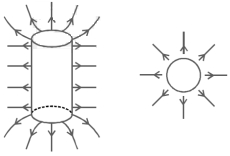
Electric field lines originate from positive charges and extend radially outward. For a uniformly charged hollow cylinder,the field lines are perpendicular to the surface of the cylinder. In the radial direction (perpendicular to the axis),the field lines point outward. Near the ends of the cylinder,the field lines curve outward,reflecting the non-uniformity of the field at the edges. This is illustrated in the provided figure.
0 likes
View Solution120
Medium
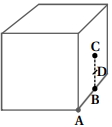
What will be the total electric flux through the faces of a cube of side length $a$ if a charge $q$ is placed at:
$(a)$ $A$: a corner of the cube.
$(b)$ $B$: the midpoint of an edge of the cube.
$(a)$ $A$: a corner of the cube.
$(b)$ $B$: the midpoint of an edge of the cube.
Solution
(N/A) cube has $8$ corners. If a charge $q$ is placed at one corner,it is shared equally by $8$ identical cubes surrounding that corner.
Therefore,the electric flux through one cube is given by Gauss's Law as:
$\phi = \frac{1}{8} \times \frac{q}{\epsilon_{0}} = \frac{q}{8 \epsilon_{0}}$
$(b)$ If the charge $q$ is placed at $B$,the midpoint of an edge of the cube,it is shared equally by $4$ identical cubes.
Therefore,the electric flux through one cube is:
$\phi = \frac{1}{4} \times \frac{q}{\epsilon_{0}} = \frac{q}{4 \epsilon_{0}}$
Therefore,the electric flux through one cube is given by Gauss's Law as:
$\phi = \frac{1}{8} \times \frac{q}{\epsilon_{0}} = \frac{q}{8 \epsilon_{0}}$
$(b)$ If the charge $q$ is placed at $B$,the midpoint of an edge of the cube,it is shared equally by $4$ identical cubes.
Therefore,the electric flux through one cube is:
$\phi = \frac{1}{4} \times \frac{q}{\epsilon_{0}} = \frac{q}{4 \epsilon_{0}}$
0 likes
View Solution121
Medium
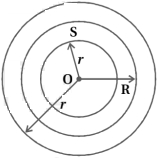
Consider a sphere of radius $R$ with charge density distributed as:
$\rho(r) = kr$ for $r \leq R$
$\rho(r) = 0$ for $r > R$
$(a)$ Find the electric field at all points $r$.
$(b)$ Suppose the total charge on the sphere is $2e$ where $e$ is the elementary charge. Where can two protons be embedded such that the force on each of them is zero? Assume that the introduction of the protons does not alter the charge distribution.
$\rho(r) = kr$ for $r \leq R$
$\rho(r) = 0$ for $r > R$
$(a)$ Find the electric field at all points $r$.
$(b)$ Suppose the total charge on the sphere is $2e$ where $e$ is the elementary charge. Where can two protons be embedded such that the force on each of them is zero? Assume that the introduction of the protons does not alter the charge distribution.
Solution
(N/A) Let us consider a Gaussian sphere of radius $r$. Using Gauss's Law: $\oint \vec{E} \cdot d\vec{S} = \frac{q_{enclosed}}{\epsilon_0}$.
For $r \leq R$,the enclosed charge is $q(r) = \int_0^r \rho(r) 4\pi r^2 dr = \int_0^r (kr) 4\pi r^2 dr = 4\pi k \int_0^r r^3 dr = \pi k r^4$.
Applying Gauss's Law: $E(4\pi r^2) = \frac{\pi k r^4}{\epsilon_0} \implies E = \frac{kr^2}{4\epsilon_0}$.
For $r > R$,the total charge is $Q = \pi k R^4 = 2e$. Thus,$E(4\pi r^2) = \frac{2e}{\epsilon_0} \implies E = \frac{2e}{4\pi \epsilon_0 r^2}$.
$(b)$ For the force on a proton to be zero,the electric field due to the sphere must be cancelled by the electric field due to the other proton. Let the protons be at distance $d$ from the center on opposite sides. The field from the sphere at distance $d$ is $E_s = \frac{q(d)}{4\pi \epsilon_0 d^2} = \frac{\pi k d^4}{4\pi \epsilon_0 d^2} = \frac{k d^2}{4\epsilon_0}$.
Since $Q = \pi k R^4 = 2e$,we have $k = \frac{2e}{\pi R^4}$. So $E_s = \frac{2e d^2}{4\pi \epsilon_0 R^4}$.
The field from the other proton at distance $2d$ is $E_p = \frac{e}{4\pi \epsilon_0 (2d)^2} = \frac{e}{16\pi \epsilon_0 d^2}$.
Equating $E_s = E_p$: $\frac{2e d^2}{4\pi \epsilon_0 R^4} = \frac{e}{16\pi \epsilon_0 d^2} \implies d^4 = \frac{R^4}{8} \implies d = \frac{R}{8^{1/4}} = \frac{R}{\sqrt[4]{8}}$.
For $r \leq R$,the enclosed charge is $q(r) = \int_0^r \rho(r) 4\pi r^2 dr = \int_0^r (kr) 4\pi r^2 dr = 4\pi k \int_0^r r^3 dr = \pi k r^4$.
Applying Gauss's Law: $E(4\pi r^2) = \frac{\pi k r^4}{\epsilon_0} \implies E = \frac{kr^2}{4\epsilon_0}$.
For $r > R$,the total charge is $Q = \pi k R^4 = 2e$. Thus,$E(4\pi r^2) = \frac{2e}{\epsilon_0} \implies E = \frac{2e}{4\pi \epsilon_0 r^2}$.
$(b)$ For the force on a proton to be zero,the electric field due to the sphere must be cancelled by the electric field due to the other proton. Let the protons be at distance $d$ from the center on opposite sides. The field from the sphere at distance $d$ is $E_s = \frac{q(d)}{4\pi \epsilon_0 d^2} = \frac{\pi k d^4}{4\pi \epsilon_0 d^2} = \frac{k d^2}{4\epsilon_0}$.
Since $Q = \pi k R^4 = 2e$,we have $k = \frac{2e}{\pi R^4}$. So $E_s = \frac{2e d^2}{4\pi \epsilon_0 R^4}$.
The field from the other proton at distance $2d$ is $E_p = \frac{e}{4\pi \epsilon_0 (2d)^2} = \frac{e}{16\pi \epsilon_0 d^2}$.
Equating $E_s = E_p$: $\frac{2e d^2}{4\pi \epsilon_0 R^4} = \frac{e}{16\pi \epsilon_0 d^2} \implies d^4 = \frac{R^4}{8} \implies d = \frac{R}{8^{1/4}} = \frac{R}{\sqrt[4]{8}}$.
0 likes
View Solution122
DifficultMCQ
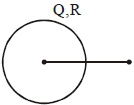
Consider the force $F$ on a charge $q$ due to a uniformly charged spherical shell of radius $R$ carrying charge $Q$ distributed uniformly over it. Which one of the following statements is true for $F$,if $q$ is placed at distance $r$ from the centre of the shell?
A
$F = \frac{1}{4 \pi \varepsilon_{0}} \frac{Qq}{r^{2}}$ for $r > R$
B
$\frac{1}{4 \pi \varepsilon_{0}} \frac{qQ}{R^{2}} > F > 0$ for $r < R$
C
$F = \frac{1}{4 \pi \varepsilon_{0}} \frac{Qq}{r^{2}}$ for all $r$
D
$F = \frac{1}{4 \pi \varepsilon_{0}} \frac{Qq}{R^{2}}$ for $r < R$
Solution
(A) According to Gauss's Law,for a uniformly charged spherical shell of radius $R$ and total charge $Q$:
$1$. For points outside the shell $(r > R)$,the shell behaves as if all its charge is concentrated at the centre. Thus,the electric field is $E = \frac{1}{4 \pi \varepsilon_{0}} \frac{Q}{r^{2}}$. The force on a charge $q$ is $F = qE = \frac{1}{4 \pi \varepsilon_{0}} \frac{Qq}{r^{2}}$.
$2$. For points inside the shell $(r < R)$,the electric field due to the shell is zero $(E = 0)$. Therefore,the force on a charge $q$ placed inside is $F = qE = 0$.
Comparing these results with the given options,statement $A$ is correct.
$1$. For points outside the shell $(r > R)$,the shell behaves as if all its charge is concentrated at the centre. Thus,the electric field is $E = \frac{1}{4 \pi \varepsilon_{0}} \frac{Q}{r^{2}}$. The force on a charge $q$ is $F = qE = \frac{1}{4 \pi \varepsilon_{0}} \frac{Qq}{r^{2}}$.
$2$. For points inside the shell $(r < R)$,the electric field due to the shell is zero $(E = 0)$. Therefore,the force on a charge $q$ placed inside is $F = qE = 0$.
Comparing these results with the given options,statement $A$ is correct.
0 likes
View Solution123
MediumMCQ
Two parallel large thin metal sheets have equal surface charge densities $\sigma = 26.4 \times 10^{-12} \ C/m^2$ of the same sign. The electric field between these sheets is:
A
$1.5 \ N/C$
B
$1.5 \times 10^{-10} \ N/C$
C
Zero
D
$3 \times 10^{-10} \ N/C$
Solution
(C) The electric field due to a single thin infinite sheet of charge is given by $E = \frac{\sigma}{2\epsilon_0}$.
Since both sheets have the same surface charge density $\sigma$ and the same sign,the electric field produced by the first sheet at a point between them is $E_1 = \frac{\sigma}{2\epsilon_0}$ (directed away from the sheet).
The electric field produced by the second sheet at the same point is $E_2 = \frac{\sigma}{2\epsilon_0}$ (directed away from the second sheet,which is in the opposite direction to $E_1$).
The net electric field $E_{net}$ between the sheets is the vector sum of these fields: $E_{net} = E_1 - E_2 = \frac{\sigma}{2\epsilon_0} - \frac{\sigma}{2\epsilon_0} = 0$.
Therefore,the electric field between the two parallel sheets is zero.
Since both sheets have the same surface charge density $\sigma$ and the same sign,the electric field produced by the first sheet at a point between them is $E_1 = \frac{\sigma}{2\epsilon_0}$ (directed away from the sheet).
The electric field produced by the second sheet at the same point is $E_2 = \frac{\sigma}{2\epsilon_0}$ (directed away from the second sheet,which is in the opposite direction to $E_1$).
The net electric field $E_{net}$ between the sheets is the vector sum of these fields: $E_{net} = E_1 - E_2 = \frac{\sigma}{2\epsilon_0} - \frac{\sigma}{2\epsilon_0} = 0$.
Therefore,the electric field between the two parallel sheets is zero.
0 likes
View Solution124
DifficultMCQ
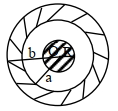
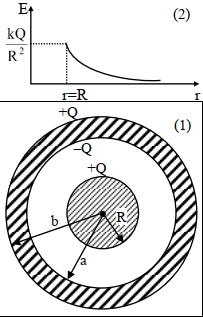
$A$ solid metal sphere of radius $R$ having charge $q$ is enclosed inside a concentric spherical shell of inner radius $a$ and outer radius $b$ as shown in the figure. The approximate variation of the electric field $\overrightarrow{E}$ as a function of distance $r$ from the centre $O$ is given by:
A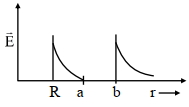
B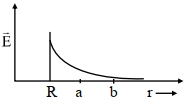
C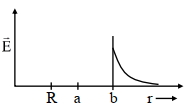
D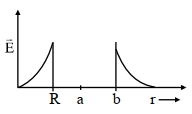
Solution
(A) For a solid metal sphere of radius $R$ with charge $q$ placed inside a conducting spherical shell of inner radius $a$ and outer radius $b$:
$1$. For $r < R$: The electric field inside a conductor is $E = 0$.
$2$. For $R \leq r < a$: The electric field is due to the central sphere,so $E = \frac{k q}{r^2}$.
$3$. For $a \leq r < b$: This region is inside the material of the conducting shell. The induced charge $-q$ on the inner surface $a$ cancels the field of the central charge $q$,so $E = 0$.
$4$. For $r \geq b$: The total charge enclosed is $q + 0 = q$ (assuming the shell is neutral),so $E = \frac{k q}{r^2}$.
Thus,the electric field is zero for $r < R$,follows $1/r^2$ for $R \leq r < a$,is zero for $a \leq r < b$,and follows $1/r^2$ for $r \geq b$.
$1$. For $r < R$: The electric field inside a conductor is $E = 0$.
$2$. For $R \leq r < a$: The electric field is due to the central sphere,so $E = \frac{k q}{r^2}$.
$3$. For $a \leq r < b$: This region is inside the material of the conducting shell. The induced charge $-q$ on the inner surface $a$ cancels the field of the central charge $q$,so $E = 0$.
$4$. For $r \geq b$: The total charge enclosed is $q + 0 = q$ (assuming the shell is neutral),so $E = \frac{k q}{r^2}$.
Thus,the electric field is zero for $r < R$,follows $1/r^2$ for $R \leq r < a$,is zero for $a \leq r < b$,and follows $1/r^2$ for $r \geq b$.
0 likes
View Solution125
DifficultMCQ
$A$ uniformly charged disc of radius $R$ having surface charge density $\sigma$ is placed in the $xy$-plane with its center at the origin. Find the electric field intensity along the $z$-axis at a distance $Z$ from the origin.
A
$E = \frac{\sigma}{2 \varepsilon_{0}} \left( 1 - \frac{Z}{(Z^{2} + R^{2})^{1/2}} \right)$
B
$E = \frac{\sigma}{2 \varepsilon_{0}} \left( 1 + \frac{Z}{(Z^{2} + R^{2})^{1/2}} \right)$
C
$E = \frac{2 \varepsilon_{0}}{\sigma} \left( \frac{1}{(Z^{2} + R^{2})^{1/2}} + Z \right)$
D
$E = \frac{\sigma}{2 \varepsilon_{0}} \left( \frac{1}{(Z^{2} + R^{2})} + \frac{1}{Z^{2}} \right)$
Solution
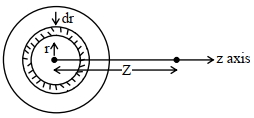
(A) To find the electric field at a distance $Z$ on the axis of a charged disc,consider an elemental ring of radius $r$ and thickness $dr$ on the disc.
The area of this elemental ring is $dA = 2\pi r dr$.
The charge on this elemental ring is $dq = \sigma dA = \sigma (2\pi r dr)$.
The electric field $dE$ due to this ring at a point $Z$ on the axis is given by the formula for a charged ring:
$dE = \frac{1}{4\pi \varepsilon_{0}} \frac{(dq) Z}{(Z^{2} + r^{2})^{3/2}} = \frac{1}{4\pi \varepsilon_{0}} \frac{(\sigma 2\pi r dr) Z}{(Z^{2} + r^{2})^{3/2}} = \frac{\sigma Z}{2 \varepsilon_{0}} \frac{r dr}{(Z^{2} + r^{2})^{3/2}}$.
To find the total electric field $E$,integrate $dE$ from $r = 0$ to $r = R$:
$E = \int_{0}^{R} \frac{\sigma Z}{2 \varepsilon_{0}} \frac{r dr}{(Z^{2} + r^{2})^{3/2}}$.
Let $u = Z^{2} + r^{2}$,then $du = 2r dr$,so $r dr = \frac{du}{2}$.
$E = \frac{\sigma Z}{4 \varepsilon_{0}} \int_{Z^{2}}^{Z^{2}+R^{2}} u^{-3/2} du = \frac{\sigma Z}{4 \varepsilon_{0}} \left[ \frac{u^{-1/2}}{-1/2} \right]_{Z^{2}}^{Z^{2}+R^{2}} = \frac{\sigma Z}{2 \varepsilon_{0}} \left[ -\frac{1}{\sqrt{u}} \right]_{Z^{2}}^{Z^{2}+R^{2}}$.
$E = \frac{\sigma Z}{2 \varepsilon_{0}} \left( \frac{1}{Z} - \frac{1}{\sqrt{Z^{2} + R^{2}}} \right) = \frac{\sigma}{2 \varepsilon_{0}} \left( 1 - \frac{Z}{\sqrt{Z^{2} + R^{2}}} \right)$.
The area of this elemental ring is $dA = 2\pi r dr$.
The charge on this elemental ring is $dq = \sigma dA = \sigma (2\pi r dr)$.
The electric field $dE$ due to this ring at a point $Z$ on the axis is given by the formula for a charged ring:
$dE = \frac{1}{4\pi \varepsilon_{0}} \frac{(dq) Z}{(Z^{2} + r^{2})^{3/2}} = \frac{1}{4\pi \varepsilon_{0}} \frac{(\sigma 2\pi r dr) Z}{(Z^{2} + r^{2})^{3/2}} = \frac{\sigma Z}{2 \varepsilon_{0}} \frac{r dr}{(Z^{2} + r^{2})^{3/2}}$.
To find the total electric field $E$,integrate $dE$ from $r = 0$ to $r = R$:
$E = \int_{0}^{R} \frac{\sigma Z}{2 \varepsilon_{0}} \frac{r dr}{(Z^{2} + r^{2})^{3/2}}$.
Let $u = Z^{2} + r^{2}$,then $du = 2r dr$,so $r dr = \frac{du}{2}$.
$E = \frac{\sigma Z}{4 \varepsilon_{0}} \int_{Z^{2}}^{Z^{2}+R^{2}} u^{-3/2} du = \frac{\sigma Z}{4 \varepsilon_{0}} \left[ \frac{u^{-1/2}}{-1/2} \right]_{Z^{2}}^{Z^{2}+R^{2}} = \frac{\sigma Z}{2 \varepsilon_{0}} \left[ -\frac{1}{\sqrt{u}} \right]_{Z^{2}}^{Z^{2}+R^{2}}$.
$E = \frac{\sigma Z}{2 \varepsilon_{0}} \left( \frac{1}{Z} - \frac{1}{\sqrt{Z^{2} + R^{2}}} \right) = \frac{\sigma}{2 \varepsilon_{0}} \left( 1 - \frac{Z}{\sqrt{Z^{2} + R^{2}}} \right)$.
0 likes
View Solution126
DifficultMCQ
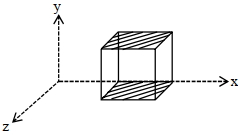
$A$ cube is placed inside an electric field,$\overrightarrow{E} = 150 y^2 \hat{j}$. The side of the cube is $0.5 \, m$ and it is placed in the field as shown in the figure. The charge inside the cube is $..... \times 10^{-11} \, C$.
A
$3.8$
B
$8.3$
C
$0.38$
D
$830$
Solution
(B) The electric field is given by $\overrightarrow{E} = 150 y^2 \hat{j}$. Since the electric field is only in the $y$-direction,the electric flux through the cube will only be due to the top and bottom surfaces.
For the bottom surface,$y = 0$:
$\Rightarrow E = 150(0)^2 = 0 \, N/C$
$\Rightarrow \phi_{\text{bottom}} = E \cdot A \cdot \cos(180^{\circ}) = 0$
For the top surface,$y = 0.5 \, m$:
$\Rightarrow E = 150(0.5)^2 = 150 \times 0.25 = 37.5 \, N/C$
The area of the top surface is $A = (0.5 \, m)^2 = 0.25 \, m^2$.
The electric flux through the top surface is $\phi_{\text{top}} = E \cdot A = 37.5 \times 0.25 = 9.375 \, N \cdot m^2/C$.
Total flux $\phi = \phi_{\text{top}} + \phi_{\text{bottom}} = 9.375 + 0 = 9.375 \, N \cdot m^2/C$.
By Gauss's law,$\phi = \frac{Q_{\text{in}}}{\epsilon_0}$.
$Q_{\text{in}} = \phi \cdot \epsilon_0 = 9.375 \times 8.854 \times 10^{-12} \approx 83.0 \times 10^{-12} \, C = 8.3 \times 10^{-11} \, C$.
For the bottom surface,$y = 0$:
$\Rightarrow E = 150(0)^2 = 0 \, N/C$
$\Rightarrow \phi_{\text{bottom}} = E \cdot A \cdot \cos(180^{\circ}) = 0$
For the top surface,$y = 0.5 \, m$:
$\Rightarrow E = 150(0.5)^2 = 150 \times 0.25 = 37.5 \, N/C$
The area of the top surface is $A = (0.5 \, m)^2 = 0.25 \, m^2$.
The electric flux through the top surface is $\phi_{\text{top}} = E \cdot A = 37.5 \times 0.25 = 9.375 \, N \cdot m^2/C$.
Total flux $\phi = \phi_{\text{top}} + \phi_{\text{bottom}} = 9.375 + 0 = 9.375 \, N \cdot m^2/C$.
By Gauss's law,$\phi = \frac{Q_{\text{in}}}{\epsilon_0}$.
$Q_{\text{in}} = \phi \cdot \epsilon_0 = 9.375 \times 8.854 \times 10^{-12} \approx 83.0 \times 10^{-12} \, C = 8.3 \times 10^{-11} \, C$.
0 likes
View Solution127
DifficultMCQ
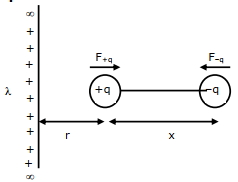
An electric dipole is placed on the $x$-axis in proximity to a line charge with a linear charge density of $3.0 \times 10^{-6} \, C/m$. The line charge is placed on the $z$-axis. The positive and negative charges of the dipole are at distances of $10 \, mm$ and $12 \, mm$ from the origin,respectively. If a total force of $4 \, N$ is exerted on the dipole,find the magnitude of the positive or negative charge of the dipole.
A
$815.1 \, nC$
B
$8.8 \, \mu C$
C
$0.485 \, mC$
D
$4.44 \, \mu C$
Solution
(D) The electric field due to an infinite line charge at a distance $r$ is given by $E = \frac{2k\lambda}{r}$.
Here,$r_1 = 10 \, mm = 10^{-2} \, m$ and $r_2 = 12 \, mm = 12 \times 10^{-3} \, m$.
The force on the positive charge is $F_1 = qE_1 = q \left( \frac{2k\lambda}{r_1} \right)$ (directed away from the line charge).
The force on the negative charge is $F_2 = qE_2 = q \left( \frac{2k\lambda}{r_2} \right)$ (directed towards the line charge).
The net force is $F_{net} = F_1 - F_2 = 2k\lambda q \left( \frac{1}{r_1} - \frac{1}{r_2} \right)$.
Substituting the values: $4 = 2 \times (9 \times 10^9) \times (3.0 \times 10^{-6}) \times q \times \left( \frac{1}{10 \times 10^{-3}} - \frac{1}{12 \times 10^{-3}} \right)$.
$4 = 54 \times 10^3 \times q \times \left( 100 - 83.33 \right) = 54 \times 10^3 \times q \times (16.67)$.
$4 = 900180 \times q \Rightarrow q \approx 4.44 \times 10^{-6} \, C = 4.44 \, \mu C$.
Here,$r_1 = 10 \, mm = 10^{-2} \, m$ and $r_2 = 12 \, mm = 12 \times 10^{-3} \, m$.
The force on the positive charge is $F_1 = qE_1 = q \left( \frac{2k\lambda}{r_1} \right)$ (directed away from the line charge).
The force on the negative charge is $F_2 = qE_2 = q \left( \frac{2k\lambda}{r_2} \right)$ (directed towards the line charge).
The net force is $F_{net} = F_1 - F_2 = 2k\lambda q \left( \frac{1}{r_1} - \frac{1}{r_2} \right)$.
Substituting the values: $4 = 2 \times (9 \times 10^9) \times (3.0 \times 10^{-6}) \times q \times \left( \frac{1}{10 \times 10^{-3}} - \frac{1}{12 \times 10^{-3}} \right)$.
$4 = 54 \times 10^3 \times q \times \left( 100 - 83.33 \right) = 54 \times 10^3 \times q \times (16.67)$.
$4 = 900180 \times q \Rightarrow q \approx 4.44 \times 10^{-6} \, C = 4.44 \, \mu C$.
0 likes
View Solution128
DifficultMCQ
The total charge enclosed in an incremental volume of $2 \times 10^{-9} \, m^{3}$ located at the origin is ...... $nC$,if the electric flux density of its field is given by $\vec{D} = e^{-x} \sin y \hat{i} - e^{-x} \cos y \hat{j} + 2z \hat{k} \, C/m^{2}$.
A
$4$
B
$6$
C
$8$
D
$10$
Solution
(A) According to Gauss's Law in differential form,the volume charge density $\rho$ is given by the divergence of the electric flux density $\vec{D}$:
$\rho = \nabla \cdot \vec{D}$
Given $\vec{D} = e^{-x} \sin y \hat{i} - e^{-x} \cos y \hat{j} + 2z \hat{k}$.
Calculating the divergence:
$\rho = \frac{\partial}{\partial x}(e^{-x} \sin y) + \frac{\partial}{\partial y}(-e^{-x} \cos y) + \frac{\partial}{\partial z}(2z)$
$\rho = -e^{-x} \sin y + e^{-x} \sin y + 2$
$\rho = 2 \, C/m^{3}$.
Since the volume is incremental and located at the origin $(0, 0, 0)$,the charge density $\rho$ is constant at $2 \, C/m^{3}$.
The total charge $Q$ is given by $Q = \rho \times \Delta V$.
$Q = 2 \, C/m^{3} \times (2 \times 10^{-9} \, m^{3}) = 4 \times 10^{-9} \, C$.
Since $1 \, nC = 10^{-9} \, C$,the total charge is $4 \, nC$.
$\rho = \nabla \cdot \vec{D}$
Given $\vec{D} = e^{-x} \sin y \hat{i} - e^{-x} \cos y \hat{j} + 2z \hat{k}$.
Calculating the divergence:
$\rho = \frac{\partial}{\partial x}(e^{-x} \sin y) + \frac{\partial}{\partial y}(-e^{-x} \cos y) + \frac{\partial}{\partial z}(2z)$
$\rho = -e^{-x} \sin y + e^{-x} \sin y + 2$
$\rho = 2 \, C/m^{3}$.
Since the volume is incremental and located at the origin $(0, 0, 0)$,the charge density $\rho$ is constant at $2 \, C/m^{3}$.
The total charge $Q$ is given by $Q = \rho \times \Delta V$.
$Q = 2 \, C/m^{3} \times (2 \times 10^{-9} \, m^{3}) = 4 \times 10^{-9} \, C$.
Since $1 \, nC = 10^{-9} \, C$,the total charge is $4 \, nC$.
0 likes
View Solution129
DifficultMCQ
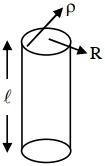
$A$ long cylindrical volume contains a uniformly distributed charge of density $\rho$. The radius of the cylindrical volume is $R$. $A$ charged particle $(q)$ revolves around the cylinder in a circular path at a distance $r$ from the axis. The kinetic energy of the particle is:
A
$\frac{\rho q R^{2}}{4 \varepsilon_{0}}$
B
$\frac{\rho q R^{2}}{2 \varepsilon_{0}}$
C
$\frac{q \rho}{4 \varepsilon_{0} R^{2}}$
D
$\frac{4 \varepsilon_{0} R^{2}}{q \rho}$
Solution
(A) For a point outside the cylinder at a distance $r$ from the axis,we use Gauss's Law: $\oint E \cdot dA = \frac{q_{enclosed}}{\varepsilon_{0}}$.
Considering a Gaussian surface of radius $r$ and length $\ell$,the enclosed charge is $q_{enc} = \rho \cdot \pi R^{2} \ell$.
Thus,$E(2 \pi r \ell) = \frac{\rho \pi R^{2} \ell}{\varepsilon_{0}}$,which gives the electric field $E = \frac{\rho R^{2}}{2 \varepsilon_{0} r}$.
The electrostatic force provides the necessary centripetal force for circular motion: $qE = \frac{mv^{2}}{r}$.
Substituting $E$: $q \left( \frac{\rho R^{2}}{2 \varepsilon_{0} r} \right) = \frac{mv^{2}}{r}$.
Simplifying,we get $mv^{2} = \frac{q \rho R^{2}}{2 \varepsilon_{0}}$.
The kinetic energy $K = \frac{1}{2} mv^{2} = \frac{q \rho R^{2}}{4 \varepsilon_{0}}$.
Considering a Gaussian surface of radius $r$ and length $\ell$,the enclosed charge is $q_{enc} = \rho \cdot \pi R^{2} \ell$.
Thus,$E(2 \pi r \ell) = \frac{\rho \pi R^{2} \ell}{\varepsilon_{0}}$,which gives the electric field $E = \frac{\rho R^{2}}{2 \varepsilon_{0} r}$.
The electrostatic force provides the necessary centripetal force for circular motion: $qE = \frac{mv^{2}}{r}$.
Substituting $E$: $q \left( \frac{\rho R^{2}}{2 \varepsilon_{0} r} \right) = \frac{mv^{2}}{r}$.
Simplifying,we get $mv^{2} = \frac{q \rho R^{2}}{2 \varepsilon_{0}}$.
The kinetic energy $K = \frac{1}{2} mv^{2} = \frac{q \rho R^{2}}{4 \varepsilon_{0}}$.
0 likes
View Solution130
MediumMCQ
In the figure,a very large plane sheet of positive charge is shown. $P_{1}$ and $P_{2}$ are two points at distances $l$ and $2l$ from the charge distribution. If $\sigma$ is the surface charge density,then the magnitude of electric fields $E_{1}$ and $E_{2}$ at $P_{1}$ and $P_{2}$ respectively are:
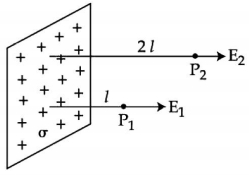
A
$E_{1} = \sigma / \varepsilon_{0}, E_{2} = \sigma / 2\varepsilon_{0}$
B
$E_{1} = 2\sigma / \varepsilon_{0}, E_{2} = \sigma / \varepsilon_{0}$
C
$E_{1} = E_{2} = \sigma / 2\varepsilon_{0}$
D
$E_{1} = E_{2} = \sigma / \varepsilon_{0}$
Solution
(C) The electric field due to an infinitely large,thin,non-conducting plane sheet of charge with surface charge density $\sigma$ is given by the formula $E = \frac{\sigma}{2\varepsilon_{0}}$.
This electric field is uniform,meaning it does not depend on the distance from the sheet.
Since $P_{1}$ and $P_{2}$ are both points in the vicinity of this large sheet,the electric field at both points will be the same regardless of their distances $l$ and $2l$.
Therefore,$E_{1} = E_{2} = \frac{\sigma}{2\varepsilon_{0}}$.
This electric field is uniform,meaning it does not depend on the distance from the sheet.
Since $P_{1}$ and $P_{2}$ are both points in the vicinity of this large sheet,the electric field at both points will be the same regardless of their distances $l$ and $2l$.
Therefore,$E_{1} = E_{2} = \frac{\sigma}{2\varepsilon_{0}}$.
0 likes
View Solution131
MediumMCQ
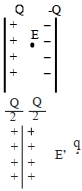
$A$ force of $10 \; N$ acts on a charged particle placed between two plates of a charged capacitor. If one plate of the capacitor is removed,then the force acting on that particle will be ...... $N$.
A
$5$
B
$10$
C
$20$
D
$0$
Solution
(A) The electric field between the plates of a parallel plate capacitor is given by $E = \frac{\sigma}{\epsilon_0} = \frac{Q}{A \epsilon_0}$.
The force on a charged particle $q$ is $F = qE = \frac{qQ}{A \epsilon_0} = 10 \; N$.
When one plate is removed,the remaining plate acts as a single charged sheet. The electric field due to a single charged sheet is $E^{\prime} = \frac{\sigma}{2 \epsilon_0} = \frac{Q}{2 A \epsilon_0}$.
Therefore,the new force acting on the particle is $F^{\prime} = qE^{\prime} = \frac{qQ}{2 A \epsilon_0} = \frac{1}{2} \left( \frac{qQ}{A \epsilon_0} \right) = \frac{1}{2} \times 10 \; N = 5 \; N$.
The force on a charged particle $q$ is $F = qE = \frac{qQ}{A \epsilon_0} = 10 \; N$.
When one plate is removed,the remaining plate acts as a single charged sheet. The electric field due to a single charged sheet is $E^{\prime} = \frac{\sigma}{2 \epsilon_0} = \frac{Q}{2 A \epsilon_0}$.
Therefore,the new force acting on the particle is $F^{\prime} = qE^{\prime} = \frac{qQ}{2 A \epsilon_0} = \frac{1}{2} \left( \frac{qQ}{A \epsilon_0} \right) = \frac{1}{2} \times 10 \; N = 5 \; N$.
0 likes
View Solution132
MediumMCQ
The volume charge density of a sphere of radius $6 \, m$ is $2 \, \mu C \, m^{-3}$. The number of lines of force per unit surface area coming out from the surface of the sphere is $.... \times 10^{10} \, N C^{-1}$. [Given: Permittivity of vacuum $\epsilon_{0} = 8.85 \times 10^{-12} \, C^{2} N^{-1} m^{-2}$]
A
$44$
B
$43$
C
$45$
D
$42$
Solution
(C) The number of electric field lines per unit area is equivalent to the electric field intensity $E$ at that surface.
For a uniformly charged sphere of radius $R$ and volume charge density $\rho$,the electric field at the surface $(r = R)$ is given by Gauss's Law as $E = \frac{q}{4 \pi \epsilon_{0} R^{2}}$.
Since $q = \rho \times \text{Volume} = \rho \times \frac{4}{3} \pi R^{3}$,we substitute this into the expression for $E$:
$E = \frac{\rho \times \frac{4}{3} \pi R^{3}}{4 \pi \epsilon_{0} R^{2}} = \frac{\rho R}{3 \epsilon_{0}}$.
Given $\rho = 2 \, \mu C \, m^{-3} = 2 \times 10^{-6} \, C \, m^{-3}$,$R = 6 \, m$,and $\epsilon_{0} = 8.85 \times 10^{-12} \, C^{2} N^{-1} m^{-2}$.
$E = \frac{2 \times 10^{-6} \times 6}{3 \times 8.85 \times 10^{-12}} = \frac{12 \times 10^{-6}}{26.55 \times 10^{-12}} \approx 0.4519 \times 10^{6} \times 10^{6} = 0.4519 \times 10^{12} \, N C^{-1}$.
Rounding to the nearest integer as per the options,we get $45 \times 10^{10} \, N C^{-1}$.
For a uniformly charged sphere of radius $R$ and volume charge density $\rho$,the electric field at the surface $(r = R)$ is given by Gauss's Law as $E = \frac{q}{4 \pi \epsilon_{0} R^{2}}$.
Since $q = \rho \times \text{Volume} = \rho \times \frac{4}{3} \pi R^{3}$,we substitute this into the expression for $E$:
$E = \frac{\rho \times \frac{4}{3} \pi R^{3}}{4 \pi \epsilon_{0} R^{2}} = \frac{\rho R}{3 \epsilon_{0}}$.
Given $\rho = 2 \, \mu C \, m^{-3} = 2 \times 10^{-6} \, C \, m^{-3}$,$R = 6 \, m$,and $\epsilon_{0} = 8.85 \times 10^{-12} \, C^{2} N^{-1} m^{-2}$.
$E = \frac{2 \times 10^{-6} \times 6}{3 \times 8.85 \times 10^{-12}} = \frac{12 \times 10^{-6}}{26.55 \times 10^{-12}} \approx 0.4519 \times 10^{6} \times 10^{6} = 0.4519 \times 10^{12} \, N C^{-1}$.
Rounding to the nearest integer as per the options,we get $45 \times 10^{10} \, N C^{-1}$.
0 likes
View Solution133
DifficultMCQ
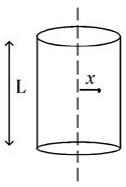
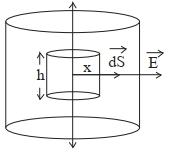
$A$ long cylindrical volume contains a uniformly distributed charge of density $\rho \; C m^{-3}$. The electric field inside the cylindrical volume at a distance $x = \frac{2 \varepsilon_{0}}{\rho} \; m$ from its axis is $....... V m^{-1}$.
A
$2$
B
$1$
C
$0$
D
$3$
Solution
(B) Using Gauss's Law for a cylindrical Gaussian surface of radius $x$ and length $h$ inside the volume:
$\oint \vec{E} \cdot d\vec{S} = \frac{q_{enclosed}}{\varepsilon_{0}}$
Since the electric field is radial and uniform on the curved surface,the flux through the curved surface is $E(2\pi x h)$. The flux through the flat ends is zero.
The charge enclosed is $q_{enclosed} = \rho \times V = \rho \times (\pi x^2 h)$.
Applying Gauss's Law:
$E(2\pi x h) = \frac{\rho \pi x^2 h}{\varepsilon_{0}}$
$E = \frac{\rho x}{2\varepsilon_{0}}$
Given $x = \frac{2\varepsilon_{0}}{\rho}$,substituting this into the expression for $E$:
$E = \frac{\rho}{2\varepsilon_{0}} \times \left( \frac{2\varepsilon_{0}}{\rho} \right) = 1 \; V m^{-1}$.
$\oint \vec{E} \cdot d\vec{S} = \frac{q_{enclosed}}{\varepsilon_{0}}$
Since the electric field is radial and uniform on the curved surface,the flux through the curved surface is $E(2\pi x h)$. The flux through the flat ends is zero.
The charge enclosed is $q_{enclosed} = \rho \times V = \rho \times (\pi x^2 h)$.
Applying Gauss's Law:
$E(2\pi x h) = \frac{\rho \pi x^2 h}{\varepsilon_{0}}$
$E = \frac{\rho x}{2\varepsilon_{0}}$
Given $x = \frac{2\varepsilon_{0}}{\rho}$,substituting this into the expression for $E$:
$E = \frac{\rho}{2\varepsilon_{0}} \times \left( \frac{2\varepsilon_{0}}{\rho} \right) = 1 \; V m^{-1}$.
0 likes
View Solution134
DifficultMCQ
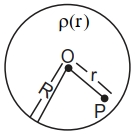
$A$ spherically symmetric charge distribution is considered with charge density varying as
$\rho(r)=\begin{cases} \rho_{0}\left(\frac{3}{4}-\frac{r}{R}\right) & \text{for } r \leq R \\ 0 & \text{for } r>R \end{cases}$
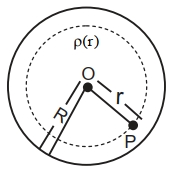
Where,$r (r < R)$ is the distance from the centre $O$ (as shown in figure). The electric field at point $P$ will be.
$\rho(r)=\begin{cases} \rho_{0}\left(\frac{3}{4}-\frac{r}{R}\right) & \text{for } r \leq R \\ 0 & \text{for } r>R \end{cases}$
Where,$r (r < R)$ is the distance from the centre $O$ (as shown in figure). The electric field at point $P$ will be.
A
$\frac{\rho_{0} r}{4 \varepsilon_{0}}\left(\frac{3}{4}-\frac{r}{R}\right)$
B
$\frac{\rho_{0} r}{3 \varepsilon_{0}}\left(\frac{3}{4}-\frac{r}{R}\right)$
C
$\frac{\rho_{0} r}{4 \varepsilon_{0}}\left(1-\frac{r}{R}\right)$
D
$\frac{\rho_{0} r}{5 \varepsilon_{0}}\left(1-\frac{r}{R}\right)$
Solution
(C) According to Gauss's Law,the electric flux through a Gaussian surface is given by $\oint \vec{E} \cdot d\vec{s} = \frac{Q_{\text{in}}}{\varepsilon_{0}}$.
For a spherical Gaussian surface of radius $r$ $(r < R)$,the electric field $E$ is uniform and directed radially outward,so $\oint \vec{E} \cdot d\vec{s} = E(4\pi r^2)$.
The charge enclosed $Q_{\text{in}}$ is calculated by integrating the charge density $\rho(r)$ over the volume of the sphere of radius $r$:
$Q_{\text{in}} = \int_{0}^{r} \rho(r') 4\pi r'^2 dr' = \int_{0}^{r} \rho_{0} \left(\frac{3}{4} - \frac{r'}{R}\right) 4\pi r'^2 dr'$
$Q_{\text{in}} = 4\pi \rho_{0} \int_{0}^{r} \left(\frac{3}{4}r'^2 - \frac{r'^3}{R}\right) dr' = 4\pi \rho_{0} \left[ \frac{3}{4} \cdot \frac{r^3}{3} - \frac{r^4}{4R} \right] = 4\pi \rho_{0} \left( \frac{r^3}{4} - \frac{r^4}{4R} \right) = \pi \rho_{0} r^3 \left( 1 - \frac{r}{R} \right)$.
Applying Gauss's Law:
$E(4\pi r^2) = \frac{\pi \rho_{0} r^3}{\varepsilon_{0}} \left( 1 - \frac{r}{R} \right)$
$E = \frac{\rho_{0} r}{4\varepsilon_{0}} \left( 1 - \frac{r}{R} \right)$.
For a spherical Gaussian surface of radius $r$ $(r < R)$,the electric field $E$ is uniform and directed radially outward,so $\oint \vec{E} \cdot d\vec{s} = E(4\pi r^2)$.
The charge enclosed $Q_{\text{in}}$ is calculated by integrating the charge density $\rho(r)$ over the volume of the sphere of radius $r$:
$Q_{\text{in}} = \int_{0}^{r} \rho(r') 4\pi r'^2 dr' = \int_{0}^{r} \rho_{0} \left(\frac{3}{4} - \frac{r'}{R}\right) 4\pi r'^2 dr'$
$Q_{\text{in}} = 4\pi \rho_{0} \int_{0}^{r} \left(\frac{3}{4}r'^2 - \frac{r'^3}{R}\right) dr' = 4\pi \rho_{0} \left[ \frac{3}{4} \cdot \frac{r^3}{3} - \frac{r^4}{4R} \right] = 4\pi \rho_{0} \left( \frac{r^3}{4} - \frac{r^4}{4R} \right) = \pi \rho_{0} r^3 \left( 1 - \frac{r}{R} \right)$.
Applying Gauss's Law:
$E(4\pi r^2) = \frac{\pi \rho_{0} r^3}{\varepsilon_{0}} \left( 1 - \frac{r}{R} \right)$
$E = \frac{\rho_{0} r}{4\varepsilon_{0}} \left( 1 - \frac{r}{R} \right)$.
0 likes
View Solution135
AdvancedMCQ
The potential due to an electrostatic charge distribution is $V(r) = \frac{q e^{-\alpha r}}{4 \pi \varepsilon_{0} r}$,where $\alpha$ is positive. The net charge within a sphere centred at the origin and of radius $1/\alpha$ is
A
$2q / e$
B
$(1 - 1/e) q$
C
$q/e$
D
$(1 + 1/e) q$
Solution
(A) The electric field $E$ is given by the negative gradient of the potential: $E = -\frac{dV}{dr}$.
Substituting $V(r) = \frac{q e^{-\alpha r}}{4 \pi \varepsilon_{0} r}$,we get:
$E = -\frac{d}{dr} \left( \frac{q e^{-\alpha r}}{4 \pi \varepsilon_{0} r} \right) = -\frac{q}{4 \pi \varepsilon_{0}} \left( \frac{r(-\alpha e^{-\alpha r}) - e^{-\alpha r}}{r^2} \right) = \frac{q e^{-\alpha r}}{4 \pi \varepsilon_{0} r^2} (1 + \alpha r)$.
At $r = 1/\alpha$,the electric field is:
$E(1/\alpha) = \frac{q e^{-1}}{4 \pi \varepsilon_{0} (1/\alpha)^2} (1 + \alpha(1/\alpha)) = \frac{q}{e} \cdot \frac{1}{4 \pi \varepsilon_{0} (1/\alpha^2)} \cdot 2 = \frac{2q \alpha^2}{4 \pi \varepsilon_{0} e}$.
According to Gauss's Law,the flux $\phi$ through a sphere of radius $r$ is $\phi = E \cdot 4 \pi r^2 = \frac{q_{\text{enclosed}}}{\varepsilon_{0}}$.
Substituting $E$ at $r = 1/\alpha$:
$\phi = \left( \frac{2q \alpha^2}{4 \pi \varepsilon_{0} e} \right) \cdot 4 \pi (1/\alpha)^2 = \frac{2q}{e \varepsilon_{0}}$.
Equating this to $\frac{q_{\text{enclosed}}}{\varepsilon_{0}}$,we find $q_{\text{enclosed}} = 2q/e$.
Substituting $V(r) = \frac{q e^{-\alpha r}}{4 \pi \varepsilon_{0} r}$,we get:
$E = -\frac{d}{dr} \left( \frac{q e^{-\alpha r}}{4 \pi \varepsilon_{0} r} \right) = -\frac{q}{4 \pi \varepsilon_{0}} \left( \frac{r(-\alpha e^{-\alpha r}) - e^{-\alpha r}}{r^2} \right) = \frac{q e^{-\alpha r}}{4 \pi \varepsilon_{0} r^2} (1 + \alpha r)$.
At $r = 1/\alpha$,the electric field is:
$E(1/\alpha) = \frac{q e^{-1}}{4 \pi \varepsilon_{0} (1/\alpha)^2} (1 + \alpha(1/\alpha)) = \frac{q}{e} \cdot \frac{1}{4 \pi \varepsilon_{0} (1/\alpha^2)} \cdot 2 = \frac{2q \alpha^2}{4 \pi \varepsilon_{0} e}$.
According to Gauss's Law,the flux $\phi$ through a sphere of radius $r$ is $\phi = E \cdot 4 \pi r^2 = \frac{q_{\text{enclosed}}}{\varepsilon_{0}}$.
Substituting $E$ at $r = 1/\alpha$:
$\phi = \left( \frac{2q \alpha^2}{4 \pi \varepsilon_{0} e} \right) \cdot 4 \pi (1/\alpha)^2 = \frac{2q}{e \varepsilon_{0}}$.
Equating this to $\frac{q_{\text{enclosed}}}{\varepsilon_{0}}$,we find $q_{\text{enclosed}} = 2q/e$.
0 likes
View Solution136
AdvancedMCQ
Two mutually perpendicular infinitely long straight conductors carrying uniformly distributed charges of linear densities $\lambda_{1}$ and $\lambda_{2}$ are positioned at a distance $r$ from each other. Force between the conductors depends on $r$ as
A
$1/r$
B
$1/r^{2}$
C
$r$
D
$r^{0}$
Solution
(D) Consider the arrangement given.
The electric field $E_{1}$ produced by the first infinitely long conductor at a perpendicular distance $R$ is given by $E_{1} = \frac{2k\lambda_{1}}{R}$.
Consider a small element of length $dl$ on the second conductor at a distance $l$ from the point closest to the first conductor. The distance $R$ from the first conductor to this element is $R = \sqrt{r^{2} + l^{2}}$.
The force $dF$ on the charge element $dq = \lambda_{2} dl$ is $dF = E_{1} dq = \frac{2k\lambda_{1}}{\sqrt{r^{2} + l^{2}}} \lambda_{2} dl$.
Due to symmetry,the components of force perpendicular to the second conductor cancel out. The net force $F$ is the integral of the components along the second conductor: $F = \int_{-\infty}^{\infty} dF \cos \theta$,where $\cos \theta = \frac{r}{R} = \frac{r}{\sqrt{r^{2} + l^{2}}}$.
Substituting $\cos \theta$,we get $F = \int_{-\infty}^{\infty} \frac{2k\lambda_{1}\lambda_{2}}{\sqrt{r^{2} + l^{2}}} \cdot \frac{r}{\sqrt{r^{2} + l^{2}}} dl = 2k\lambda_{1}\lambda_{2}r \int_{-\infty}^{\infty} \frac{dl}{r^{2} + l^{2}}$.
Using the substitution $l = r \tan \theta$,$dl = r \sec^{2} \theta d\theta$,the integral becomes $2k\lambda_{1}\lambda_{2}r \int_{-\pi/2}^{\pi/2} \frac{r \sec^{2} \theta d\theta}{r^{2} \sec^{2} \theta} = 2k\lambda_{1}\lambda_{2} \int_{-\pi/2}^{\pi/2} d\theta = 2k\lambda_{1}\lambda_{2} [\theta]_{-\pi/2}^{\pi/2} = 2\pi k\lambda_{1}\lambda_{2}$.
Since the result is independent of $r$,the force is proportional to $r^{0}$.
The electric field $E_{1}$ produced by the first infinitely long conductor at a perpendicular distance $R$ is given by $E_{1} = \frac{2k\lambda_{1}}{R}$.
Consider a small element of length $dl$ on the second conductor at a distance $l$ from the point closest to the first conductor. The distance $R$ from the first conductor to this element is $R = \sqrt{r^{2} + l^{2}}$.
The force $dF$ on the charge element $dq = \lambda_{2} dl$ is $dF = E_{1} dq = \frac{2k\lambda_{1}}{\sqrt{r^{2} + l^{2}}} \lambda_{2} dl$.
Due to symmetry,the components of force perpendicular to the second conductor cancel out. The net force $F$ is the integral of the components along the second conductor: $F = \int_{-\infty}^{\infty} dF \cos \theta$,where $\cos \theta = \frac{r}{R} = \frac{r}{\sqrt{r^{2} + l^{2}}}$.
Substituting $\cos \theta$,we get $F = \int_{-\infty}^{\infty} \frac{2k\lambda_{1}\lambda_{2}}{\sqrt{r^{2} + l^{2}}} \cdot \frac{r}{\sqrt{r^{2} + l^{2}}} dl = 2k\lambda_{1}\lambda_{2}r \int_{-\infty}^{\infty} \frac{dl}{r^{2} + l^{2}}$.
Using the substitution $l = r \tan \theta$,$dl = r \sec^{2} \theta d\theta$,the integral becomes $2k\lambda_{1}\lambda_{2}r \int_{-\pi/2}^{\pi/2} \frac{r \sec^{2} \theta d\theta}{r^{2} \sec^{2} \theta} = 2k\lambda_{1}\lambda_{2} \int_{-\pi/2}^{\pi/2} d\theta = 2k\lambda_{1}\lambda_{2} [\theta]_{-\pi/2}^{\pi/2} = 2\pi k\lambda_{1}\lambda_{2}$.
Since the result is independent of $r$,the force is proportional to $r^{0}$.
0 likes
View Solution137
AdvancedMCQ
An isolated sphere of radius $R$ contains a uniform volume distribution of positive charge. Which of the curves shown below correctly illustrates the dependence of the magnitude of the electric field of the sphere as a function of the distance $r$ from its centre?
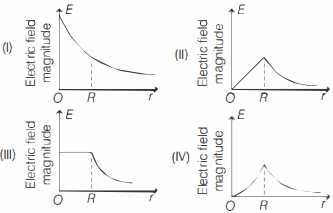
A
$I$
B
$II$
C
$III$
D
$IV$
Solution
(B) For a solid sphere of radius $R$ with a uniform volume charge density $\rho$,the electric field $E$ at a distance $r$ from the centre is given by:
$1$. Inside the sphere $(r < R)$: Using Gauss's Law,$E \cdot 4\pi r^2 = \frac{q_{enclosed}}{\epsilon_0} = \frac{\rho \cdot \frac{4}{3}\pi r^3}{\epsilon_0}$. This simplifies to $E = \frac{\rho r}{3\epsilon_0}$,which means $E \propto r$. Thus,the graph is a straight line passing through the origin.
$2$. Outside the sphere $(r \geq R)$: The sphere behaves like a point charge at its centre. The electric field is $E = \frac{1}{4\pi\epsilon_0} \cdot \frac{q}{r^2}$,which means $E \propto \frac{1}{r^2}$. Thus,the graph is a hyperbola.
At the surface $(r = R)$,the electric field is maximum,with a value of $E_{max} = \frac{kq}{R^2}$.
Comparing these characteristics with the given options,curve $II$ correctly represents this variation.
$1$. Inside the sphere $(r < R)$: Using Gauss's Law,$E \cdot 4\pi r^2 = \frac{q_{enclosed}}{\epsilon_0} = \frac{\rho \cdot \frac{4}{3}\pi r^3}{\epsilon_0}$. This simplifies to $E = \frac{\rho r}{3\epsilon_0}$,which means $E \propto r$. Thus,the graph is a straight line passing through the origin.
$2$. Outside the sphere $(r \geq R)$: The sphere behaves like a point charge at its centre. The electric field is $E = \frac{1}{4\pi\epsilon_0} \cdot \frac{q}{r^2}$,which means $E \propto \frac{1}{r^2}$. Thus,the graph is a hyperbola.
At the surface $(r = R)$,the electric field is maximum,with a value of $E_{max} = \frac{kq}{R^2}$.
Comparing these characteristics with the given options,curve $II$ correctly represents this variation.
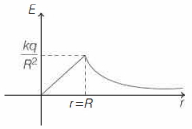
0 likes
View Solution138
AdvancedMCQ
At a distance $l$ from a uniformly charged long wire, a charged particle is thrown radially outward with a velocity $u$ in the direction perpendicular to the wire. When the particle reaches a distance $2l$ from the wire, its speed is found to be $\sqrt{2}u$. The magnitude of the velocity, when it is a distance $4l$ away from the wire is (ignore gravity)
A
$\sqrt{3}u$
B
$2u$
C
$2\sqrt{2}u$
D
$4u$
Solution
(A) Let the linear charge density of the wire be $\lambda$. The potential difference between two points at distances $r_1$ and $r_2$ from a long charged wire is given by $V_1 - V_2 = \frac{\lambda}{2\pi\varepsilon_0} \ln\left(\frac{r_2}{r_1}\right)$.
Applying the principle of conservation of energy between point $A$ (at distance $l$) and point $B$ (at distance $2l$):
$qV_A + \frac{1}{2}mu^2 = qV_B + \frac{1}{2}m(\sqrt{2}u)^2$
$q(V_A - V_B) = \frac{1}{2}m(2u^2 - u^2) = \frac{1}{2}mu^2$
$q \frac{\lambda}{2\pi\varepsilon_0} \ln\left(\frac{2l}{l}\right) = \frac{1}{2}mu^2$
$q \frac{\lambda}{2\pi\varepsilon_0} \ln(2) = \frac{1}{2}mu^2 \quad \dots(i)$
Now, applying energy conservation between point $A$ (at distance $l$) and point $C$ (at distance $4l$):
$qV_A + \frac{1}{2}mu^2 = qV_C + \frac{1}{2}mv^2$
$\frac{1}{2}mv^2 = q(V_A - V_C) + \frac{1}{2}mu^2$
$\frac{1}{2}mv^2 = q \frac{\lambda}{2\pi\varepsilon_0} \ln\left(\frac{4l}{l}\right) + \frac{1}{2}mu^2$
$\frac{1}{2}mv^2 = q \frac{\lambda}{2\pi\varepsilon_0} \ln(4) + \frac{1}{2}mu^2$
Since $\ln(4) = 2\ln(2)$, we have:
$\frac{1}{2}mv^2 = 2 \left(q \frac{\lambda}{2\pi\varepsilon_0} \ln(2)\right) + \frac{1}{2}mu^2$
Substituting from equation $(i)$:
$\frac{1}{2}mv^2 = 2 \left(\frac{1}{2}mu^2\right) + \frac{1}{2}mu^2 = \frac{3}{2}mu^2$
$v^2 = 3u^2 \Rightarrow v = \sqrt{3}u$.
Applying the principle of conservation of energy between point $A$ (at distance $l$) and point $B$ (at distance $2l$):
$qV_A + \frac{1}{2}mu^2 = qV_B + \frac{1}{2}m(\sqrt{2}u)^2$
$q(V_A - V_B) = \frac{1}{2}m(2u^2 - u^2) = \frac{1}{2}mu^2$
$q \frac{\lambda}{2\pi\varepsilon_0} \ln\left(\frac{2l}{l}\right) = \frac{1}{2}mu^2$
$q \frac{\lambda}{2\pi\varepsilon_0} \ln(2) = \frac{1}{2}mu^2 \quad \dots(i)$
Now, applying energy conservation between point $A$ (at distance $l$) and point $C$ (at distance $4l$):
$qV_A + \frac{1}{2}mu^2 = qV_C + \frac{1}{2}mv^2$
$\frac{1}{2}mv^2 = q(V_A - V_C) + \frac{1}{2}mu^2$
$\frac{1}{2}mv^2 = q \frac{\lambda}{2\pi\varepsilon_0} \ln\left(\frac{4l}{l}\right) + \frac{1}{2}mu^2$
$\frac{1}{2}mv^2 = q \frac{\lambda}{2\pi\varepsilon_0} \ln(4) + \frac{1}{2}mu^2$
Since $\ln(4) = 2\ln(2)$, we have:
$\frac{1}{2}mv^2 = 2 \left(q \frac{\lambda}{2\pi\varepsilon_0} \ln(2)\right) + \frac{1}{2}mu^2$
Substituting from equation $(i)$:
$\frac{1}{2}mv^2 = 2 \left(\frac{1}{2}mu^2\right) + \frac{1}{2}mu^2 = \frac{3}{2}mu^2$
$v^2 = 3u^2 \Rightarrow v = \sqrt{3}u$.
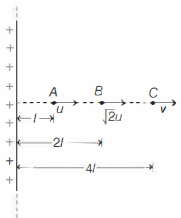
0 likes
View Solution139
MediumMCQ
Consider a uniform spherical volume charge distribution of radius $R$. Which of the following graphs correctly represents the magnitude of the electric field $E$ at a distance $r$ from the centre of the sphere?
A
B
C
D
Solution
(A) For a uniform spherical volume charge distribution of radius $R$ and total charge $Q$,the electric field $E$ at a distance $r$ from the centre is given by Gauss's Law:
$1$. Inside the sphere $(r < R)$:
$E = \frac{k Q r}{R^3}$
Here,$E \propto r$,which represents a straight line passing through the origin.
$2$. Outside the sphere $(r \geq R)$:
$E = \frac{k Q}{r^2}$
Here,$E \propto \frac{1}{r^2}$,which represents a curve decreasing as $r$ increases.
At the surface $(r = R)$,the electric field is maximum,$E_{max} = \frac{k Q}{R^2}$.
Comparing this with the given options,the graph that shows a linear increase for $r < R$ and a $1/r^2$ decrease for $r \geq R$ is option $A$.
$1$. Inside the sphere $(r < R)$:
$E = \frac{k Q r}{R^3}$
Here,$E \propto r$,which represents a straight line passing through the origin.
$2$. Outside the sphere $(r \geq R)$:
$E = \frac{k Q}{r^2}$
Here,$E \propto \frac{1}{r^2}$,which represents a curve decreasing as $r$ increases.
At the surface $(r = R)$,the electric field is maximum,$E_{max} = \frac{k Q}{R^2}$.
Comparing this with the given options,the graph that shows a linear increase for $r < R$ and a $1/r^2$ decrease for $r \geq R$ is option $A$.
0 likes
View Solution140
EasyMCQ
The electric field in a region is radially outward and at a point is given by $E = 250 r \, V/m$ (where $r$ is the distance of the point from the origin). Calculate the charge contained in a sphere of radius $20 \, cm$ centered at the origin in Coulombs $(C)$.
A
$2.22 \times 10^{-6}$
B
$2.22 \times 10^{-8}$
C
$2.22 \times 10^{-10}$
D
$0$
Solution
(C) According to Gauss's Law,the total electric flux $\Phi_E$ through a closed surface is given by $\Phi_E = \oint E \cdot dA = \frac{Q_{enclosed}}{\varepsilon_0}$.
Given the electric field $E = 250 r$ is radially outward,for a sphere of radius $r = 20 \, cm = 0.2 \, m$,the surface area is $A = 4 \pi r^2$.
The flux is $\Phi_E = E \cdot A = (250 r) \cdot (4 \pi r^2) = 1000 \pi r^3$.
Substituting $r = 0.2 \, m$:
$\Phi_E = 1000 \pi (0.2)^3 = 1000 \pi (0.008) = 8 \pi \, V \cdot m$.
Now,using $\Phi_E = \frac{Q}{\varepsilon_0}$,we have $Q = \Phi_E \cdot \varepsilon_0$.
$Q = 8 \pi \cdot (8.854 \times 10^{-12}) \approx 25.13 \times 8.854 \times 10^{-12} \approx 2.22 \times 10^{-10} \, C$.
Given the electric field $E = 250 r$ is radially outward,for a sphere of radius $r = 20 \, cm = 0.2 \, m$,the surface area is $A = 4 \pi r^2$.
The flux is $\Phi_E = E \cdot A = (250 r) \cdot (4 \pi r^2) = 1000 \pi r^3$.
Substituting $r = 0.2 \, m$:
$\Phi_E = 1000 \pi (0.2)^3 = 1000 \pi (0.008) = 8 \pi \, V \cdot m$.
Now,using $\Phi_E = \frac{Q}{\varepsilon_0}$,we have $Q = \Phi_E \cdot \varepsilon_0$.
$Q = 8 \pi \cdot (8.854 \times 10^{-12}) \approx 25.13 \times 8.854 \times 10^{-12} \approx 2.22 \times 10^{-10} \, C$.
0 likes
View Solution141
MediumMCQ
The electric field intensity at $P$ and $Q$,in the shown arrangement,are in the ratio:
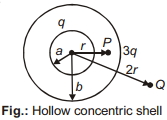
A
$1: 2$
B
$2: 1$
C
$1: 1$
D
$4: 3$
Solution
(C) The electric field at a point due to a charged spherical shell is given by $E = \frac{kQ}{r^2}$ for points outside the shell and $E = 0$ for points inside the shell.
For point $P$ (at distance $r$ from the center,which is outside the inner shell of charge $q$ and inside the outer shell of charge $3q$):
$E_P = \frac{kq}{r^2} + 0 = \frac{kq}{r^2} \quad \dots (i)$
For point $Q$ (at distance $2r$ from the center,which is outside both shells):
$E_Q = \frac{kq}{(2r)^2} + \frac{k(3q)}{(2r)^2} = \frac{kq}{4r^2} + \frac{3kq}{4r^2} = \frac{4kq}{4r^2} = \frac{kq}{r^2} \quad \dots (ii)$
Comparing $(i)$ and $(ii)$,the ratio of electric field intensities is:
$E_P : E_Q = \frac{kq}{r^2} : \frac{kq}{r^2} = 1 : 1$.
For point $P$ (at distance $r$ from the center,which is outside the inner shell of charge $q$ and inside the outer shell of charge $3q$):
$E_P = \frac{kq}{r^2} + 0 = \frac{kq}{r^2} \quad \dots (i)$
For point $Q$ (at distance $2r$ from the center,which is outside both shells):
$E_Q = \frac{kq}{(2r)^2} + \frac{k(3q)}{(2r)^2} = \frac{kq}{4r^2} + \frac{3kq}{4r^2} = \frac{4kq}{4r^2} = \frac{kq}{r^2} \quad \dots (ii)$
Comparing $(i)$ and $(ii)$,the ratio of electric field intensities is:
$E_P : E_Q = \frac{kq}{r^2} : \frac{kq}{r^2} = 1 : 1$.
0 likes
View Solution142
MediumMCQ
Consider an atom with atomic number $Z$ as consisting of a positive point charge at the centre and surrounded by a distribution of negative electricity uniformly distributed within a sphere of radius $R$. The electric field at a point inside the atom at a distance $r$ from the centre is
A
$\frac{Ze}{4\pi\varepsilon_0}\left[\frac{1}{r^2}-\frac{r}{R^3}\right]$
B
$\frac{Ze}{4\pi\varepsilon_0}\left[\frac{1}{r^2}+\frac{1}{R^3}\right]$
C
$\frac{2Ze}{4\pi\varepsilon_0 r^2}$
D
$0$
Solution
(A) The total electric field $E$ at a distance $r$ $(r < R)$ is the vector sum of the field due to the central positive charge and the field due to the uniform negative charge distribution.
$1$. The electric field due to the central positive charge $+Ze$ at distance $r$ is $E_1 = \frac{1}{4\pi\varepsilon_0} \frac{Ze}{r^2}$.
$2$. The negative charge $-Ze$ is uniformly distributed in a sphere of radius $R$. Using Gauss's Law,the electric field $E_2$ due to this sphere at distance $r$ is $E_2 = \frac{1}{4\pi\varepsilon_0} \frac{(Ze)r}{R^3}$.
$3$. Since the fields are in opposite directions,the net electric field is $E = E_1 - E_2 = \frac{Ze}{4\pi\varepsilon_0} \left[ \frac{1}{r^2} - \frac{r}{R^3} \right]$.
$1$. The electric field due to the central positive charge $+Ze$ at distance $r$ is $E_1 = \frac{1}{4\pi\varepsilon_0} \frac{Ze}{r^2}$.
$2$. The negative charge $-Ze$ is uniformly distributed in a sphere of radius $R$. Using Gauss's Law,the electric field $E_2$ due to this sphere at distance $r$ is $E_2 = \frac{1}{4\pi\varepsilon_0} \frac{(Ze)r}{R^3}$.
$3$. Since the fields are in opposite directions,the net electric field is $E = E_1 - E_2 = \frac{Ze}{4\pi\varepsilon_0} \left[ \frac{1}{r^2} - \frac{r}{R^3} \right]$.
0 likes
View Solution143
EasyMCQ
For two infinitely long charged parallel sheets with the same surface charge density $\sigma$,the electric field at point $P$ between them is:
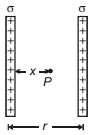
A
$\frac{\sigma}{2x} - \frac{\sigma}{2(r-x)}$
B
$\frac{\sigma}{2\varepsilon_0 x} + \frac{\sigma}{2\pi(r-x)\varepsilon_0}$
C
$\frac{\sigma}{\varepsilon_0}$
D
$0$
Solution
(D) The electric field due to an infinitely long charged sheet with surface charge density $\sigma$ is given by $E = \frac{\sigma}{2\varepsilon_0}$.
Let the left sheet be at position $0$ and the right sheet be at position $r$. Both sheets have a positive surface charge density $\sigma$.
At a point $P$ located at a distance $x$ from the left sheet,the electric field due to the left sheet $(E_1)$ points to the right and is given by $E_1 = \frac{\sigma}{2\varepsilon_0}$.
The electric field due to the right sheet $(E_2)$ at point $P$ points to the left and is given by $E_2 = \frac{\sigma}{2\varepsilon_0}$.
The net electric field $E_{net}$ at point $P$ is the vector sum of these two fields:
$E_{net} = E_1 - E_2 = \frac{\sigma}{2\varepsilon_0} - \frac{\sigma}{2\varepsilon_0} = 0$.
Therefore,the electric field at point $P$ is $0$.
Let the left sheet be at position $0$ and the right sheet be at position $r$. Both sheets have a positive surface charge density $\sigma$.
At a point $P$ located at a distance $x$ from the left sheet,the electric field due to the left sheet $(E_1)$ points to the right and is given by $E_1 = \frac{\sigma}{2\varepsilon_0}$.
The electric field due to the right sheet $(E_2)$ at point $P$ points to the left and is given by $E_2 = \frac{\sigma}{2\varepsilon_0}$.
The net electric field $E_{net}$ at point $P$ is the vector sum of these two fields:
$E_{net} = E_1 - E_2 = \frac{\sigma}{2\varepsilon_0} - \frac{\sigma}{2\varepsilon_0} = 0$.
Therefore,the electric field at point $P$ is $0$.
0 likes
View Solution144
MediumMCQ
If the electric field intensity in a fair weather atmosphere is $100 \, V/m$,then the total charge on the earth's surface is ............ $C$ (radius of the earth is $6400 \, km$).
A
$4.55 \times 10^7$
B
$4.55 \times 10^8$
C
$4.55 \times 10^5$
D
$4.55 \times 10^6$
Solution
(C) Given: Electric field intensity $E = 100 \, V/m$,Radius of the earth $R = 6400 \, km = 6.4 \times 10^6 \, m$.
According to Gauss's Law,the electric flux $\Phi$ through a closed surface is given by $\Phi = E \cdot A = \frac{q}{\varepsilon_0}$,where $A$ is the surface area of the earth $(A = 4\pi R^2)$.
Therefore,the total charge $q$ is given by $q = E \cdot A \cdot \varepsilon_0$.
Substituting the values:
$q = 100 \times 4 \times 3.14 \times (6.4 \times 10^6)^2 \times 8.854 \times 10^{-12}$
$q = 100 \times 4 \times 3.14 \times 40.96 \times 10^{12} \times 8.854 \times 10^{-12}$
$q \approx 4.55 \times 10^5 \, C$.
Thus,the total charge on the earth's surface is approximately $4.55 \times 10^5 \, C$.
According to Gauss's Law,the electric flux $\Phi$ through a closed surface is given by $\Phi = E \cdot A = \frac{q}{\varepsilon_0}$,where $A$ is the surface area of the earth $(A = 4\pi R^2)$.
Therefore,the total charge $q$ is given by $q = E \cdot A \cdot \varepsilon_0$.
Substituting the values:
$q = 100 \times 4 \times 3.14 \times (6.4 \times 10^6)^2 \times 8.854 \times 10^{-12}$
$q = 100 \times 4 \times 3.14 \times 40.96 \times 10^{12} \times 8.854 \times 10^{-12}$
$q \approx 4.55 \times 10^5 \, C$.
Thus,the total charge on the earth's surface is approximately $4.55 \times 10^5 \, C$.
0 likes
View Solution145
EasyMCQ
The given figure shows two parallel plates $A$ and $B$ with charge densities $+\sigma$ and $-\sigma$ respectively. The electric intensity will be zero in which region?

A
$I$ only
B
$II$ only
C
$III$ only
D
Both $I$ and $III$
Solution
(D) The electric field due to an infinite charged sheet with surface charge density $\sigma$ is given by $E = \frac{\sigma}{2\epsilon_0}$.
For plate $A$ (charge density $+\sigma$),the electric field points away from the plate. For plate $B$ (charge density $-\sigma$),the electric field points towards the plate.
In region $I$ (to the left of plate $A$): The field due to $A$ is $E_A = \frac{\sigma}{2\epsilon_0}$ (to the left) and the field due to $B$ is $E_B = \frac{\sigma}{2\epsilon_0}$ (to the right). The net electric field is $E_{net} = E_B - E_A = \frac{\sigma}{2\epsilon_0} - \frac{\sigma}{2\epsilon_0} = 0$.
In region $II$ (between the plates): The field due to $A$ is $E_A = \frac{\sigma}{2\epsilon_0}$ (to the right) and the field due to $B$ is $E_B = \frac{\sigma}{2\epsilon_0}$ (to the right). The net electric field is $E_{net} = E_A + E_B = \frac{\sigma}{\epsilon_0} \neq 0$.
In region $III$ (to the right of plate $B$): The field due to $A$ is $E_A = \frac{\sigma}{2\epsilon_0}$ (to the right) and the field due to $B$ is $E_B = \frac{\sigma}{2\epsilon_0}$ (to the left). The net electric field is $E_{net} = E_A - E_B = \frac{\sigma}{2\epsilon_0} - \frac{\sigma}{2\epsilon_0} = 0$.
Therefore,the electric intensity is zero in both regions $I$ and $III$.
For plate $A$ (charge density $+\sigma$),the electric field points away from the plate. For plate $B$ (charge density $-\sigma$),the electric field points towards the plate.
In region $I$ (to the left of plate $A$): The field due to $A$ is $E_A = \frac{\sigma}{2\epsilon_0}$ (to the left) and the field due to $B$ is $E_B = \frac{\sigma}{2\epsilon_0}$ (to the right). The net electric field is $E_{net} = E_B - E_A = \frac{\sigma}{2\epsilon_0} - \frac{\sigma}{2\epsilon_0} = 0$.
In region $II$ (between the plates): The field due to $A$ is $E_A = \frac{\sigma}{2\epsilon_0}$ (to the right) and the field due to $B$ is $E_B = \frac{\sigma}{2\epsilon_0}$ (to the right). The net electric field is $E_{net} = E_A + E_B = \frac{\sigma}{\epsilon_0} \neq 0$.
In region $III$ (to the right of plate $B$): The field due to $A$ is $E_A = \frac{\sigma}{2\epsilon_0}$ (to the right) and the field due to $B$ is $E_B = \frac{\sigma}{2\epsilon_0}$ (to the left). The net electric field is $E_{net} = E_A - E_B = \frac{\sigma}{2\epsilon_0} - \frac{\sigma}{2\epsilon_0} = 0$.
Therefore,the electric intensity is zero in both regions $I$ and $III$.
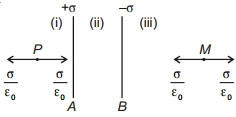
0 likes
View Solution146
MediumMCQ
The electric field at $20 \,cm$ from the centre of a uniformly charged non-conducting sphere of radius $10 \,cm$ is $E$. Then at a distance $5 \,cm$ from the centre it will be
A
$16 E$
B
$4 E$
C
$2 E$
D
$E/2$
Solution
(C) For a uniformly charged non-conducting sphere of radius $R = 10 \,cm$ and total charge $Q$:
At a point outside the sphere $(r > R)$,the electric field is given by $E = \frac{kQ}{r^2}$.
Given $r = 20 \,cm = 0.2 \,m$,so $E = \frac{kQ}{(0.2)^2} = \frac{kQ}{0.04}$.
Thus,$kQ = 0.04 E$.
At a point inside the sphere $(r < R)$,the electric field is given by $E' = \frac{kQr}{R^3}$.
Given $r = 5 \,cm = 0.05 \,m$ and $R = 10 \,cm = 0.1 \,m$.
Substituting the values: $E' = \frac{(kQ)(0.05)}{(0.1)^3} = \frac{(0.04 E)(0.05)}{0.001} = \frac{0.002 E}{0.001} = 2 E$.
At a point outside the sphere $(r > R)$,the electric field is given by $E = \frac{kQ}{r^2}$.
Given $r = 20 \,cm = 0.2 \,m$,so $E = \frac{kQ}{(0.2)^2} = \frac{kQ}{0.04}$.
Thus,$kQ = 0.04 E$.
At a point inside the sphere $(r < R)$,the electric field is given by $E' = \frac{kQr}{R^3}$.
Given $r = 5 \,cm = 0.05 \,m$ and $R = 10 \,cm = 0.1 \,m$.
Substituting the values: $E' = \frac{(kQ)(0.05)}{(0.1)^3} = \frac{(0.04 E)(0.05)}{0.001} = \frac{0.002 E}{0.001} = 2 E$.
0 likes
View Solution147
MediumMCQ
If a small sphere of mass $m$ and charge $q$ is hung from a silk thread at an angle $\theta$ with the surface of a vertical charged conducting plate,then for equilibrium of the sphere,the surface charge density of the plate is
A
$\varepsilon_0\left(\frac{m g}{q}\right) \tan \theta$
B
$\varepsilon_0\left(\frac{2 m g}{q}\right) \tan \theta$
C
$\varepsilon_0(m g q) \tan \theta$
D
$\varepsilon_0\left(\frac{m g}{3 q}\right) \tan \theta$
Solution
(A) For the equilibrium of the sphere,the forces acting on it are the tension $T$ in the thread,the gravitational force $mg$ acting downwards,and the electrostatic force $F_e = qE$ acting horizontally away from the plate.
Since the plate is a large conducting sheet,the electric field $E$ near its surface is given by $E = \frac{\sigma}{2\varepsilon_0}$. However,for a charged conducting plate,the field is $E = \frac{\sigma}{\varepsilon_0}$.
The horizontal component of tension balances the electrostatic force: $T \sin \theta = qE = q \left(\frac{\sigma}{\varepsilon_0}\right)$.
The vertical component of tension balances the gravitational force: $T \cos \theta = mg$.
Dividing the two equations: $\frac{T \sin \theta}{T \cos \theta} = \frac{q \sigma / \varepsilon_0}{mg}$.
$\tan \theta = \frac{q \sigma}{\varepsilon_0 m g}$.
Solving for $\sigma$,we get $\sigma = \frac{\varepsilon_0 m g \tan \theta}{q}$.
Since the plate is a large conducting sheet,the electric field $E$ near its surface is given by $E = \frac{\sigma}{2\varepsilon_0}$. However,for a charged conducting plate,the field is $E = \frac{\sigma}{\varepsilon_0}$.
The horizontal component of tension balances the electrostatic force: $T \sin \theta = qE = q \left(\frac{\sigma}{\varepsilon_0}\right)$.
The vertical component of tension balances the gravitational force: $T \cos \theta = mg$.
Dividing the two equations: $\frac{T \sin \theta}{T \cos \theta} = \frac{q \sigma / \varepsilon_0}{mg}$.
$\tan \theta = \frac{q \sigma}{\varepsilon_0 m g}$.
Solving for $\sigma$,we get $\sigma = \frac{\varepsilon_0 m g \tan \theta}{q}$.
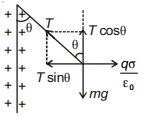
0 likes
View Solution148
MediumMCQ
Two long thin charged rods with charge density $\lambda$ each are placed parallel to each other at a distance $d$ apart. The force per unit length exerted on one rod by the other will be (where $k = \frac{1}{4 \pi \varepsilon_0}$)
A
$\frac{k 2 \lambda}{d}$
B
$\frac{k 2 \lambda^2}{d}$
C
$\frac{k 2 \lambda}{d^2}$
D
$\frac{k 2 \lambda^2}{d^2}$
Solution
(B) The electric field $E$ produced by a long thin charged rod with linear charge density $\lambda$ at a perpendicular distance $d$ is given by $E = \frac{\lambda}{2 \pi \varepsilon_0 d}$.
Since $k = \frac{1}{4 \pi \varepsilon_0}$,we can write $2k = \frac{2}{4 \pi \varepsilon_0} = \frac{1}{2 \pi \varepsilon_0}$.
Substituting this into the expression for the electric field,we get $E = \frac{2k \lambda}{d}$.
The force $F$ on a charge $q$ in an electric field $E$ is $F = qE$. For a length $l$ of the second rod,the charge is $q = \lambda l$.
Therefore,the force per unit length is $\frac{F}{l} = \frac{(\lambda l) E}{l} = \lambda E$.
Substituting the value of $E$,we get $\frac{F}{l} = \lambda \left( \frac{2k \lambda}{d} \right) = \frac{2k \lambda^2}{d}$.
Since $k = \frac{1}{4 \pi \varepsilon_0}$,we can write $2k = \frac{2}{4 \pi \varepsilon_0} = \frac{1}{2 \pi \varepsilon_0}$.
Substituting this into the expression for the electric field,we get $E = \frac{2k \lambda}{d}$.
The force $F$ on a charge $q$ in an electric field $E$ is $F = qE$. For a length $l$ of the second rod,the charge is $q = \lambda l$.
Therefore,the force per unit length is $\frac{F}{l} = \frac{(\lambda l) E}{l} = \lambda E$.
Substituting the value of $E$,we get $\frac{F}{l} = \lambda \left( \frac{2k \lambda}{d} \right) = \frac{2k \lambda^2}{d}$.
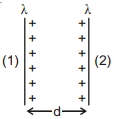
0 likes
View Solution149
EasyMCQ
Gauss's law can help in the easy calculation of the electric field due to:
A
Moving charge only
B
Any charge configuration
C
Any symmetrical charge configuration
D
Some special symmetric charge configuration
Solution
(D) The correct option is $D$.
Gauss's law states that the total electric flux through a closed surface is equal to $\frac{1}{\epsilon_0}$ times the net charge enclosed by the surface.
While Gauss's law is universally true for any charge distribution,it is only useful for the 'easy' calculation of the electric field when the charge distribution possesses a high degree of symmetry (such as spherical,cylindrical,or planar symmetry).
In such cases,we can choose a Gaussian surface where the electric field magnitude is constant and the angle between the electric field vector and the area vector is either $0^{\circ}$ or $90^{\circ}$,simplifying the surface integral $\oint E \cdot dA$.
Gauss's law states that the total electric flux through a closed surface is equal to $\frac{1}{\epsilon_0}$ times the net charge enclosed by the surface.
While Gauss's law is universally true for any charge distribution,it is only useful for the 'easy' calculation of the electric field when the charge distribution possesses a high degree of symmetry (such as spherical,cylindrical,or planar symmetry).
In such cases,we can choose a Gaussian surface where the electric field magnitude is constant and the angle between the electric field vector and the area vector is either $0^{\circ}$ or $90^{\circ}$,simplifying the surface integral $\oint E \cdot dA$.
0 likes
View Solution150
EasyMCQ
If the atmospheric electric field is approximately $150 \,V/m$ and the radius of the Earth is $6400 \,km$,then the total charge on the Earth's surface is .......... coulomb.
A
$6.8 \times 10^5$
B
$6.8 \times 10^6$
C
$6.8 \times 10^4$
D
$6.8 \times 10^9$
Solution
(A) Given:
Electric field $E = 150 \,V/m$
Radius of the Earth $R = 6400 \,km = 6.4 \times 10^6 \,m$
Permittivity of free space $\varepsilon_0 = 8.854 \times 10^{-12} \,C^2/(N \cdot m^2)$
Using Gauss's Law for a spherical surface:
$E = \frac{q}{4 \pi \varepsilon_0 R^2}$
Rearranging to solve for charge $q$:
$q = E \cdot 4 \pi \varepsilon_0 R^2$
Substituting the values:
$q = 150 \times 4 \times 3.14159 \times 8.854 \times 10^{-12} \times (6.4 \times 10^6)^2$
$q = 150 \times 4 \times 3.14159 \times 8.854 \times 10^{-12} \times 40.96 \times 10^{12}$
$q \approx 6.8 \times 10^5 \,C$
Thus,the total charge on the Earth's surface is approximately $6.8 \times 10^5 \,C$.
Electric field $E = 150 \,V/m$
Radius of the Earth $R = 6400 \,km = 6.4 \times 10^6 \,m$
Permittivity of free space $\varepsilon_0 = 8.854 \times 10^{-12} \,C^2/(N \cdot m^2)$
Using Gauss's Law for a spherical surface:
$E = \frac{q}{4 \pi \varepsilon_0 R^2}$
Rearranging to solve for charge $q$:
$q = E \cdot 4 \pi \varepsilon_0 R^2$
Substituting the values:
$q = 150 \times 4 \times 3.14159 \times 8.854 \times 10^{-12} \times (6.4 \times 10^6)^2$
$q = 150 \times 4 \times 3.14159 \times 8.854 \times 10^{-12} \times 40.96 \times 10^{12}$
$q \approx 6.8 \times 10^5 \,C$
Thus,the total charge on the Earth's surface is approximately $6.8 \times 10^5 \,C$.
0 likes
View SolutionElectric Charges and Fields — Electric Field and usage of Gauss's Law · Frequently Asked Questions
1Are these Electric Charges and Fields questions useful for JEE and NEET?
Yes. All questions in this section are mapped to JEE Main and NEET exam patterns. Previous year questions from JEE Main, NEET, GUJCET and state-level exams are included with full solutions.
2Can I switch to Hindi or Gujarati for these questions?
Yes. Use the language tabs in the hero section or the sidebar to view the same questions and solutions in English, Hindi or Gujarati.
3How do I generate a question paper from this subtopic?
Use the Vedclass Exam Paper Generator — select the chapter and subtopic, set difficulty, and generate Sets A, B, C, D automatically. First 3 chapters of every subject are free.
Vedclass Products
For Students
Vedclass Test Series
Mock tests in real JEE/NEET style with performance analysis. 5-day free trial.
Start Free TrialFor Teachers
Exam Paper Generator
Generate Set A/B/C/D papers from this chapter in 2 minutes. 3 chapters free.
Try FreeFor Institutes
Online Exam Module
Live online exams with unlimited students, 360° analytics & white-label branding.
See DemoFor Teachers & Institutes
Generate a Electric Charges and Fields Exam Paper in 2 Minutes
Select subtopic & difficulty — Sets A, B, C, D auto-generated with No Repeat logic.
First 3 chapters of every subject are free — no payment required.