
A English
Alternating Current, Voltage (rms and Average) Questions in English
Class 12 Physics · Alternating Current · Alternating Current, Voltage (rms and Average)
180+
Questions
English
Language
100%
With Solutions
Showing 50 of 180 questions in English
51
MediumMCQ
The effective value ($RMS$ value) of the current $i = 2\sin(100\pi t) + 2\sin(100\pi t + 30^\circ)$ is:
A
$2\sqrt{2+\sqrt{3}} \, A$
B
$\sqrt{2+\sqrt{3}} \, A$
C
$2 \, A$
D
None of these
Solution
(D) The given current is $i = i_1 + i_2$,where $i_1 = 2\sin(100\pi t)$ and $i_2 = 2\sin(100\pi t + 30^\circ)$.
Using the phasor addition method,the resultant current $i = I_0 \sin(100\pi t + \phi)$.
The amplitude $I_0$ is given by $I_0 = \sqrt{I_{01}^2 + I_{02}^2 + 2I_{01}I_{02}\cos(\theta)}$,where $I_{01} = 2$,$I_{02} = 2$,and $\theta = 30^\circ$.
$I_0 = \sqrt{2^2 + 2^2 + 2(2)(2)\cos(30^\circ)} = \sqrt{4 + 4 + 8(\frac{\sqrt{3}}{2})} = \sqrt{8 + 4\sqrt{3}}$.
$I_0 = \sqrt{4(2 + \sqrt{3})} = 2\sqrt{2 + \sqrt{3}}$.
The $RMS$ value (effective value) $I_{rms} = \frac{I_0}{\sqrt{2}} = \frac{2\sqrt{2 + \sqrt{3}}}{\sqrt{2}} = \sqrt{2}\sqrt{2 + \sqrt{3}} = \sqrt{4 + 2\sqrt{3}} = \sqrt{(\sqrt{3}+1)^2} = \sqrt{3} + 1 \, A$.
Since this value is not among the options,the correct choice is $D$.
Using the phasor addition method,the resultant current $i = I_0 \sin(100\pi t + \phi)$.
The amplitude $I_0$ is given by $I_0 = \sqrt{I_{01}^2 + I_{02}^2 + 2I_{01}I_{02}\cos(\theta)}$,where $I_{01} = 2$,$I_{02} = 2$,and $\theta = 30^\circ$.
$I_0 = \sqrt{2^2 + 2^2 + 2(2)(2)\cos(30^\circ)} = \sqrt{4 + 4 + 8(\frac{\sqrt{3}}{2})} = \sqrt{8 + 4\sqrt{3}}$.
$I_0 = \sqrt{4(2 + \sqrt{3})} = 2\sqrt{2 + \sqrt{3}}$.
The $RMS$ value (effective value) $I_{rms} = \frac{I_0}{\sqrt{2}} = \frac{2\sqrt{2 + \sqrt{3}}}{\sqrt{2}} = \sqrt{2}\sqrt{2 + \sqrt{3}} = \sqrt{4 + 2\sqrt{3}} = \sqrt{(\sqrt{3}+1)^2} = \sqrt{3} + 1 \, A$.
Since this value is not among the options,the correct choice is $D$.
0 likes
View Solution52
MediumMCQ
If $I_1, I_2, I_3$ and $I_4$ are the respective $r.m.s.$ values of the time-varying currents as shown in the four cases $I, II, III$ and $IV$,then identify the correct relation.

A
$I_1 = I_2 = I_3 = I_4$
B
$I_3 > I_1 = I_2 > I_4$
C
$I_3 > I_4 > I_2 = I_1$
D
$I_3 > I_2 > I_1 > I_4$
Solution
(B) The $r.m.s.$ value of a current is defined as $I_{rms} = \sqrt{\frac{1}{T} \int_0^T i^2 dt}$.
For case $I$ and $II$,the current is a rectified sine wave: $i = |I_0 \sin(\omega t)|$. The $r.m.s.$ value is $I_1 = I_2 = \frac{I_0}{\sqrt{2}} \approx 0.707 I_0$.
For case $III$,the current is a square wave: $i = I_0$ for half cycle and $-I_0$ for the other half. The $r.m.s.$ value is $I_3 = \sqrt{\frac{1}{T} (I_0^2 \cdot \frac{T}{2} + (-I_0)^2 \cdot \frac{T}{2})} = I_0$.
For case $IV$,the current is a triangular wave: $i = \frac{2I_0}{T} t$ for $0 < t < T/2$. The $r.m.s.$ value is $I_4 = \sqrt{\frac{1}{T} \int_0^T i^2 dt} = \frac{I_0}{\sqrt{3}} \approx 0.577 I_0$.
Comparing the values: $I_3 = I_0$,$I_1 = I_2 = 0.707 I_0$,and $I_4 = 0.577 I_0$.
Thus,the correct relation is $I_3 > I_1 = I_2 > I_4$.
For case $I$ and $II$,the current is a rectified sine wave: $i = |I_0 \sin(\omega t)|$. The $r.m.s.$ value is $I_1 = I_2 = \frac{I_0}{\sqrt{2}} \approx 0.707 I_0$.
For case $III$,the current is a square wave: $i = I_0$ for half cycle and $-I_0$ for the other half. The $r.m.s.$ value is $I_3 = \sqrt{\frac{1}{T} (I_0^2 \cdot \frac{T}{2} + (-I_0)^2 \cdot \frac{T}{2})} = I_0$.
For case $IV$,the current is a triangular wave: $i = \frac{2I_0}{T} t$ for $0 < t < T/2$. The $r.m.s.$ value is $I_4 = \sqrt{\frac{1}{T} \int_0^T i^2 dt} = \frac{I_0}{\sqrt{3}} \approx 0.577 I_0$.
Comparing the values: $I_3 = I_0$,$I_1 = I_2 = 0.707 I_0$,and $I_4 = 0.577 I_0$.
Thus,the correct relation is $I_3 > I_1 = I_2 > I_4$.
0 likes
View Solution53
MediumMCQ
In an $ac$ circuit,the instantaneous voltage $e(t)$ and current $i(t)$ are given by $e(t) = 5[\cos \omega t + \sqrt{3} \sin \omega t] \ V$ and $i(t) = 5[\sin(\omega t + \frac{\pi}{4})] \ A$. Determine the phase relationship between voltage and current.
A
Current leads voltage by $\frac{\pi}{4}$
B
Voltage leads current by $\frac{\pi}{3}$
C
Voltage leads current by $\frac{\pi}{6}$
D
Current leads voltage by $\frac{\pi}{12}$
Solution
(D) Given voltage $e(t) = 5[\cos \omega t + \sqrt{3} \sin \omega t]$.
Multiplying and dividing by $2$,we get $e(t) = 10[\frac{1}{2} \cos \omega t + \frac{\sqrt{3}}{2} \sin \omega t]$.
Using the identity $\sin(A+B) = \sin A \cos B + \cos A \sin B$,we can write $e(t) = 10 \sin(\omega t + \frac{\pi}{3})$.
The current is given as $i(t) = 5 \sin(\omega t + \frac{\pi}{4})$.
The phase of voltage is $\phi_v = \frac{\pi}{3}$ and the phase of current is $\phi_i = \frac{\pi}{4}$.
The phase difference is $\Delta \phi = \phi_v - \phi_i = \frac{\pi}{3} - \frac{\pi}{4} = \frac{4\pi - 3\pi}{12} = \frac{\pi}{12}$.
Since $\phi_v > \phi_i$,the voltage leads the current by $\frac{\pi}{12}$. However,checking the options,the current leads the voltage by $-\frac{\pi}{12}$ or voltage leads current by $\frac{\pi}{12}$. Given the standard interpretation of such problems,if the current leads by $\frac{\pi}{12}$ is not an option,we re-evaluate: $\phi_i - \phi_v = \frac{\pi}{4} - \frac{\pi}{3} = -\frac{\pi}{12}$. Thus,voltage leads current by $\frac{\pi}{12}$. Since this is not listed,let's re-check the calculation: $\frac{\pi}{3} \approx 60^\circ$,$\frac{\pi}{4} = 45^\circ$. $60^\circ - 45^\circ = 15^\circ = \frac{\pi}{12}$. The correct physical result is voltage leads current by $\frac{\pi}{12}$. Given the provided options,there might be a typo in the question's options,but based on the math,the phase difference is $\frac{\pi}{12}$.
Multiplying and dividing by $2$,we get $e(t) = 10[\frac{1}{2} \cos \omega t + \frac{\sqrt{3}}{2} \sin \omega t]$.
Using the identity $\sin(A+B) = \sin A \cos B + \cos A \sin B$,we can write $e(t) = 10 \sin(\omega t + \frac{\pi}{3})$.
The current is given as $i(t) = 5 \sin(\omega t + \frac{\pi}{4})$.
The phase of voltage is $\phi_v = \frac{\pi}{3}$ and the phase of current is $\phi_i = \frac{\pi}{4}$.
The phase difference is $\Delta \phi = \phi_v - \phi_i = \frac{\pi}{3} - \frac{\pi}{4} = \frac{4\pi - 3\pi}{12} = \frac{\pi}{12}$.
Since $\phi_v > \phi_i$,the voltage leads the current by $\frac{\pi}{12}$. However,checking the options,the current leads the voltage by $-\frac{\pi}{12}$ or voltage leads current by $\frac{\pi}{12}$. Given the standard interpretation of such problems,if the current leads by $\frac{\pi}{12}$ is not an option,we re-evaluate: $\phi_i - \phi_v = \frac{\pi}{4} - \frac{\pi}{3} = -\frac{\pi}{12}$. Thus,voltage leads current by $\frac{\pi}{12}$. Since this is not listed,let's re-check the calculation: $\frac{\pi}{3} \approx 60^\circ$,$\frac{\pi}{4} = 45^\circ$. $60^\circ - 45^\circ = 15^\circ = \frac{\pi}{12}$. The correct physical result is voltage leads current by $\frac{\pi}{12}$. Given the provided options,there might be a typo in the question's options,but based on the math,the phase difference is $\frac{\pi}{12}$.
0 likes
View Solution54
DifficultMCQ
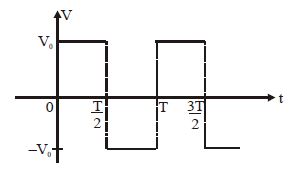
The mean and $rms$ value of an alternating voltage for a half cycle,as shown in the figure,are respectively:
A
$V_0, V_0$
B
$\frac{V_0}{2}, V_0$
C
$\frac{3V_0}{2}, \frac{V_0}{2}$
D
$\frac{V_0}{4}, \frac{V_0}{2}$
Solution
(A) For the given square wave,the voltage $V(t)$ is $V_0$ for $0 < t < T/2$ and $-V_0$ for $T/2 < t < T$.
$1$. Mean value for a half cycle ($0$ to $T/2$):
$V_{mean} = \frac{1}{T/2} \int_0^{T/2} V_0 dt = \frac{2}{T} [V_0 t]_0^{T/2} = \frac{2}{T} \cdot V_0 \cdot \frac{T}{2} = V_0$.
$2$. $rms$ value for a full cycle (or half cycle):
$V_{rms} = \sqrt{\frac{1}{T} \int_0^T V^2 dt} = \sqrt{\frac{1}{T} [\int_0^{T/2} V_0^2 dt + \int_{T/2}^T (-V_0)^2 dt]} = \sqrt{\frac{1}{T} [V_0^2 \cdot \frac{T}{2} + V_0^2 \cdot \frac{T}{2}]} = \sqrt{\frac{1}{T} \cdot V_0^2 \cdot T} = V_0$.
Thus,the mean and $rms$ values are $V_0$ and $V_0$ respectively.
$1$. Mean value for a half cycle ($0$ to $T/2$):
$V_{mean} = \frac{1}{T/2} \int_0^{T/2} V_0 dt = \frac{2}{T} [V_0 t]_0^{T/2} = \frac{2}{T} \cdot V_0 \cdot \frac{T}{2} = V_0$.
$2$. $rms$ value for a full cycle (or half cycle):
$V_{rms} = \sqrt{\frac{1}{T} \int_0^T V^2 dt} = \sqrt{\frac{1}{T} [\int_0^{T/2} V_0^2 dt + \int_{T/2}^T (-V_0)^2 dt]} = \sqrt{\frac{1}{T} [V_0^2 \cdot \frac{T}{2} + V_0^2 \cdot \frac{T}{2}]} = \sqrt{\frac{1}{T} \cdot V_0^2 \cdot T} = V_0$.
Thus,the mean and $rms$ values are $V_0$ and $V_0$ respectively.
0 likes
View Solution55
MediumMCQ
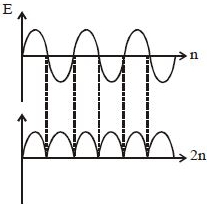
If the frequency of the source $e.m.f.$ in an $ac$ circuit is $n,$ the power varies with a frequency :-
A
$n$
B
$2n$
C
$n/2$
D
Zero
Solution
(B) The instantaneous voltage in an $ac$ circuit is given by $V = V_0 \sin(\omega t),$ where $\omega = 2\pi n$ and $n$ is the frequency of the source.
The instantaneous power $P$ in the circuit is given by $P = V \cdot I = V_0 \sin(\omega t) \cdot I_0 \sin(\omega t + \phi) = V_0 I_0 \sin(\omega t) \sin(\omega t + \phi).$
Using the trigonometric identity $\sin A \sin B = \frac{1}{2} [\cos(A-B) - \cos(A+B)],$ we get:
$P = \frac{V_0 I_0}{2} [\cos(\phi) - \cos(2\omega t + \phi)].$
Since the power expression contains a term with $2\omega,$ the frequency of the power variation is $2n.$
The instantaneous power $P$ in the circuit is given by $P = V \cdot I = V_0 \sin(\omega t) \cdot I_0 \sin(\omega t + \phi) = V_0 I_0 \sin(\omega t) \sin(\omega t + \phi).$
Using the trigonometric identity $\sin A \sin B = \frac{1}{2} [\cos(A-B) - \cos(A+B)],$ we get:
$P = \frac{V_0 I_0}{2} [\cos(\phi) - \cos(2\omega t + \phi)].$
Since the power expression contains a term with $2\omega,$ the frequency of the power variation is $2n.$
0 likes
View Solution56
DifficultMCQ
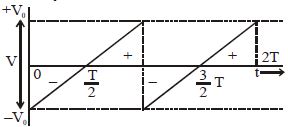
Find the $RMS$ value for the saw-tooth voltage of peak value $V_0$ from $t = 0$ to $t = 2T$ as shown in the figure.
A
$V_0$
B
$\frac{V_0}{2}$
C
$\frac{V_0}{\sqrt{2}}$
D
$\frac{V_0}{\sqrt{3}}$
Solution
(D) The voltage waveform is periodic with a period of $T$. Let us consider one cycle from $t = 0$ to $t = T$.
In the interval $t = 0$ to $t = T$,the voltage $V(t)$ varies linearly from $-V_0$ to $+V_0$.
The equation of the line passing through $(0, -V_0)$ and $(T, V_0)$ is given by:
$V(t) = \frac{V_0 - (-V_0)}{T - 0} t - V_0 = \frac{2V_0}{T} t - V_0$
The $RMS$ value $V_{rms}$ is defined as:
$V_{rms} = \sqrt{\frac{1}{T} \int_0^T V^2 dt}$
Substituting $V(t)$:
$V_{rms}^2 = \frac{1}{T} \int_0^T \left( \frac{2V_0}{T} t - V_0 \right)^2 dt$
Let $u = \frac{2V_0}{T} t - V_0$,then $du = \frac{2V_0}{T} dt$,so $dt = \frac{T}{2V_0} du$.
When $t=0, u=-V_0$; when $t=T, u=V_0$.
$V_{rms}^2 = \frac{1}{T} \int_{-V_0}^{V_0} u^2 \left( \frac{T}{2V_0} \right) du = \frac{1}{2V_0} \left[ \frac{u^3}{3} \right]_{-V_0}^{V_0} = \frac{1}{2V_0} \left( \frac{V_0^3}{3} - \frac{(-V_0)^3}{3} \right) = \frac{1}{2V_0} \left( \frac{2V_0^3}{3} \right) = \frac{V_0^2}{3}$
Therefore,$V_{rms} = \frac{V_0}{\sqrt{3}}$.
In the interval $t = 0$ to $t = T$,the voltage $V(t)$ varies linearly from $-V_0$ to $+V_0$.
The equation of the line passing through $(0, -V_0)$ and $(T, V_0)$ is given by:
$V(t) = \frac{V_0 - (-V_0)}{T - 0} t - V_0 = \frac{2V_0}{T} t - V_0$
The $RMS$ value $V_{rms}$ is defined as:
$V_{rms} = \sqrt{\frac{1}{T} \int_0^T V^2 dt}$
Substituting $V(t)$:
$V_{rms}^2 = \frac{1}{T} \int_0^T \left( \frac{2V_0}{T} t - V_0 \right)^2 dt$
Let $u = \frac{2V_0}{T} t - V_0$,then $du = \frac{2V_0}{T} dt$,so $dt = \frac{T}{2V_0} du$.
When $t=0, u=-V_0$; when $t=T, u=V_0$.
$V_{rms}^2 = \frac{1}{T} \int_{-V_0}^{V_0} u^2 \left( \frac{T}{2V_0} \right) du = \frac{1}{2V_0} \left[ \frac{u^3}{3} \right]_{-V_0}^{V_0} = \frac{1}{2V_0} \left( \frac{V_0^3}{3} - \frac{(-V_0)^3}{3} \right) = \frac{1}{2V_0} \left( \frac{2V_0^3}{3} \right) = \frac{V_0^2}{3}$
Therefore,$V_{rms} = \frac{V_0}{\sqrt{3}}$.
0 likes
View Solution57
MediumMCQ
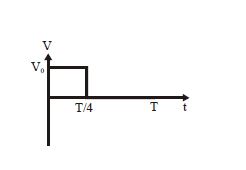
$A$ periodic voltage $V$ varies with time $t$ as shown in the figure. $T$ is the time period. The $r.m.s.$ value of the voltage is:
A
$\frac{V_0}{8}$
B
$\frac{V_0}{2}$
C
$V_0$
D
$\frac{V_0}{4}$
Solution
(B) The $r.m.s.$ value of a periodic function is given by $V_{rms} = \sqrt{\frac{1}{T} \int_0^T V^2 dt}$.
From the figure,the voltage $V$ is $V_0$ for $0 \le t < \frac{T}{4}$ and $0$ for $\frac{T}{4} \le t < T$.
Substituting these values into the formula:
$V_{rms} = \sqrt{\frac{1}{T} \left( \int_0^{T/4} V_0^2 dt + \int_{T/4}^T 0^2 dt \right)}$
$V_{rms} = \sqrt{\frac{1}{T} \left( V_0^2 [t]_0^{T/4} + 0 \right)}$
$V_{rms} = \sqrt{\frac{1}{T} \cdot V_0^2 \cdot \frac{T}{4}}$
$V_{rms} = \sqrt{\frac{V_0^2}{4}}$
$V_{rms} = \frac{V_0}{2}$
From the figure,the voltage $V$ is $V_0$ for $0 \le t < \frac{T}{4}$ and $0$ for $\frac{T}{4} \le t < T$.
Substituting these values into the formula:
$V_{rms} = \sqrt{\frac{1}{T} \left( \int_0^{T/4} V_0^2 dt + \int_{T/4}^T 0^2 dt \right)}$
$V_{rms} = \sqrt{\frac{1}{T} \left( V_0^2 [t]_0^{T/4} + 0 \right)}$
$V_{rms} = \sqrt{\frac{1}{T} \cdot V_0^2 \cdot \frac{T}{4}}$
$V_{rms} = \sqrt{\frac{V_0^2}{4}}$
$V_{rms} = \frac{V_0}{2}$
0 likes
View Solution58
MediumMCQ
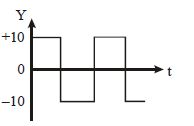
The $r.m.s.$ voltage of the waveform shown is:
A
$10 \ V$
B
$7 \ V$
C
$6.37 \ V$
D
None of these
Solution
(A) The given waveform is a square wave with amplitude $V_0 = 10 \ V$ and $-V_0 = -10 \ V$.
For a square wave,the instantaneous voltage $V(t)$ is $10 \ V$ for half the period and $-10 \ V$ for the other half.
The $r.m.s.$ voltage is defined as $V_{r.m.s.} = \sqrt{\frac{1}{T} \int_{0}^{T} V^2(t) \ dt}$.
Since $V^2(t) = (10)^2 = 100$ throughout the entire period $T$,we have:
$V_{r.m.s.} = \sqrt{\frac{1}{T} \int_{0}^{T} 100 \ dt} = \sqrt{\frac{1}{T} \cdot 100 \cdot T} = \sqrt{100} = 10 \ V$.
Thus,the correct option is $A$.
For a square wave,the instantaneous voltage $V(t)$ is $10 \ V$ for half the period and $-10 \ V$ for the other half.
The $r.m.s.$ voltage is defined as $V_{r.m.s.} = \sqrt{\frac{1}{T} \int_{0}^{T} V^2(t) \ dt}$.
Since $V^2(t) = (10)^2 = 100$ throughout the entire period $T$,we have:
$V_{r.m.s.} = \sqrt{\frac{1}{T} \int_{0}^{T} 100 \ dt} = \sqrt{\frac{1}{T} \cdot 100 \cdot T} = \sqrt{100} = 10 \ V$.
Thus,the correct option is $A$.
0 likes
View Solution59
DifficultMCQ
The $r.m.s.$ value of the given current $I = I_0 + I_1 \sin \omega t$ is
A
$\sqrt{I_0^2 + I_1^2}$
B
$\sqrt{I_0^2 + \frac{I_1^2}{2}}$
C
$\frac{I_0}{\sqrt{2}}$
D
$\sqrt{I_1^2 + I_0^2}$
Solution
(B) The $r.m.s.$ value of a current is defined as $I_{rms} = \sqrt{\frac{1}{T} \int_{0}^{T} I^2 dt}$.
Given $I = I_0 + I_1 \sin \omega t$,we have $I^2 = I_0^2 + I_1^2 \sin^2 \omega t + 2 I_0 I_1 \sin \omega t$.
Integrating over one complete time period $T = \frac{2\pi}{\omega}$:
$I_{rms}^2 = \frac{1}{T} \int_{0}^{T} (I_0^2 + I_1^2 \sin^2 \omega t + 2 I_0 I_1 \sin \omega t) dt$.
Since the average value of $\sin \omega t$ over a full cycle is $0$,the term $\int_{0}^{T} 2 I_0 I_1 \sin \omega t dt = 0$.
The average value of $\sin^2 \omega t$ over a full cycle is $\frac{1}{2}$.
Thus,$I_{rms}^2 = I_0^2 + I_1^2 \left( \frac{1}{2} \right) + 0 = I_0^2 + \frac{I_1^2}{2}$.
Therefore,$I_{rms} = \sqrt{I_0^2 + \frac{I_1^2}{2}}$.
Given $I = I_0 + I_1 \sin \omega t$,we have $I^2 = I_0^2 + I_1^2 \sin^2 \omega t + 2 I_0 I_1 \sin \omega t$.
Integrating over one complete time period $T = \frac{2\pi}{\omega}$:
$I_{rms}^2 = \frac{1}{T} \int_{0}^{T} (I_0^2 + I_1^2 \sin^2 \omega t + 2 I_0 I_1 \sin \omega t) dt$.
Since the average value of $\sin \omega t$ over a full cycle is $0$,the term $\int_{0}^{T} 2 I_0 I_1 \sin \omega t dt = 0$.
The average value of $\sin^2 \omega t$ over a full cycle is $\frac{1}{2}$.
Thus,$I_{rms}^2 = I_0^2 + I_1^2 \left( \frac{1}{2} \right) + 0 = I_0^2 + \frac{I_1^2}{2}$.
Therefore,$I_{rms} = \sqrt{I_0^2 + \frac{I_1^2}{2}}$.
0 likes
View Solution60
MediumMCQ
The voltage of an $AC$ source varies with time according to the equation,$V = 100 \sin(100 \pi t) \cos(100 \pi t)$. Where $t$ is in seconds and $V$ is in volts. Then:
A
The peak voltage of the source is $100 \text{ V}$.
B
The peak voltage of the source is $(100 / \sqrt{2}) \text{ V}$.
C
The peak voltage of the source is $50 \text{ V}$.
D
The frequency of the source is $50 \text{ Hz}$.
Solution
(C) Given the equation: $V = 100 \sin(100 \pi t) \cos(100 \pi t)$.
Using the trigonometric identity $\sin(2\theta) = 2 \sin \theta \cos \theta$,we can rewrite the equation as:
$V = 50 \times (2 \sin(100 \pi t) \cos(100 \pi t))$
$V = 50 \sin(200 \pi t)$.
Comparing this with the standard form $V = V_0 \sin(\omega t)$,where $V_0$ is the peak voltage and $\omega = 2 \pi f$:
Peak voltage $V_0 = 50 \text{ V}$.
Angular frequency $\omega = 200 \pi \text{ rad/s}$.
Since $\omega = 2 \pi f$,we have $200 \pi = 2 \pi f$,which gives $f = 100 \text{ Hz}$.
Thus,the peak voltage is $50 \text{ V}$ and the frequency is $100 \text{ Hz}$. Therefore,option $C$ is correct.
Using the trigonometric identity $\sin(2\theta) = 2 \sin \theta \cos \theta$,we can rewrite the equation as:
$V = 50 \times (2 \sin(100 \pi t) \cos(100 \pi t))$
$V = 50 \sin(200 \pi t)$.
Comparing this with the standard form $V = V_0 \sin(\omega t)$,where $V_0$ is the peak voltage and $\omega = 2 \pi f$:
Peak voltage $V_0 = 50 \text{ V}$.
Angular frequency $\omega = 200 \pi \text{ rad/s}$.
Since $\omega = 2 \pi f$,we have $200 \pi = 2 \pi f$,which gives $f = 100 \text{ Hz}$.
Thus,the peak voltage is $50 \text{ V}$ and the frequency is $100 \text{ Hz}$. Therefore,option $C$ is correct.
0 likes
View Solution61
MediumMCQ
An alternating voltage is given by: $e = e_1 \sin \omega t + e_2 \cos \omega t$. Then the root mean square $(RMS)$ value of the voltage is given by:
A
$\sqrt{e_1^2 + e_2^2}$
B
$\sqrt{e_1 e_2}$
C
$\sqrt{\frac{e_1 e_2}{2}}$
D
$\sqrt{\frac{e_1^2 + e_2^2}{2}}$
Solution
(D) The given voltage is $e = e_1 \sin \omega t + e_2 \cos \omega t$.
We can rewrite this as $e = E_0 \sin(\omega t + \phi)$,where $E_0 = \sqrt{e_1^2 + e_2^2}$ is the peak voltage.
The root mean square $(RMS)$ value of an alternating voltage $e = E_0 \sin(\omega t + \phi)$ is given by $V_{rms} = \frac{E_0}{\sqrt{2}}$.
Substituting the value of $E_0$,we get $V_{rms} = \frac{\sqrt{e_1^2 + e_2^2}}{\sqrt{2}} = \sqrt{\frac{e_1^2 + e_2^2}{2}}$.
We can rewrite this as $e = E_0 \sin(\omega t + \phi)$,where $E_0 = \sqrt{e_1^2 + e_2^2}$ is the peak voltage.
The root mean square $(RMS)$ value of an alternating voltage $e = E_0 \sin(\omega t + \phi)$ is given by $V_{rms} = \frac{E_0}{\sqrt{2}}$.
Substituting the value of $E_0$,we get $V_{rms} = \frac{\sqrt{e_1^2 + e_2^2}}{\sqrt{2}} = \sqrt{\frac{e_1^2 + e_2^2}{2}}$.
0 likes
View Solution62
EasyMCQ
In an $A.C.$ circuit,$I_{\text{rms}}$ and $I_{0}$ are related as:
A
$I_{\text{rms}} = \frac{1}{\pi} I_{0}$
B
$I_{\text{rms}} = \frac{1}{\sqrt{2}} I_{0}$
C
$I_{\text{rms}} = \sqrt{2} I_{0}$
D
$I_{\text{rms}} = \pi I_{0}$
Solution
(B) The root mean square $(I_{\text{rms}})$ value of an alternating current is defined as the square root of the mean of the squares of the instantaneous current over one complete cycle.
For a sinusoidal alternating current given by $I = I_{0} \sin(\omega t)$,the $I_{\text{rms}}$ is calculated as:
$I_{\text{rms}} = \sqrt{\frac{1}{T} \int_{0}^{T} I^{2} dt}$
Substituting $I = I_{0} \sin(\omega t)$:
$I_{\text{rms}} = \sqrt{\frac{1}{T} \int_{0}^{T} I_{0}^{2} \sin^{2}(\omega t) dt}$
$I_{\text{rms}} = I_{0} \sqrt{\frac{1}{T} \int_{0}^{T} \frac{1 - \cos(2\omega t)}{2} dt}$
$I_{\text{rms}} = I_{0} \sqrt{\frac{1}{2T} [t - \frac{\sin(2\omega t)}{2\omega}]_{0}^{T}}$
Since $\sin(2\omega T) = \sin(4\pi) = 0$,we get:
$I_{\text{rms}} = I_{0} \sqrt{\frac{T}{2T}} = \frac{I_{0}}{\sqrt{2}}$
Therefore,the correct relation is $I_{\text{rms}} = \frac{1}{\sqrt{2}} I_{0}$.
For a sinusoidal alternating current given by $I = I_{0} \sin(\omega t)$,the $I_{\text{rms}}$ is calculated as:
$I_{\text{rms}} = \sqrt{\frac{1}{T} \int_{0}^{T} I^{2} dt}$
Substituting $I = I_{0} \sin(\omega t)$:
$I_{\text{rms}} = \sqrt{\frac{1}{T} \int_{0}^{T} I_{0}^{2} \sin^{2}(\omega t) dt}$
$I_{\text{rms}} = I_{0} \sqrt{\frac{1}{T} \int_{0}^{T} \frac{1 - \cos(2\omega t)}{2} dt}$
$I_{\text{rms}} = I_{0} \sqrt{\frac{1}{2T} [t - \frac{\sin(2\omega t)}{2\omega}]_{0}^{T}}$
Since $\sin(2\omega T) = \sin(4\pi) = 0$,we get:
$I_{\text{rms}} = I_{0} \sqrt{\frac{T}{2T}} = \frac{I_{0}}{\sqrt{2}}$
Therefore,the correct relation is $I_{\text{rms}} = \frac{1}{\sqrt{2}} I_{0}$.
0 likes
View Solution63
MediumMCQ
In a circuit,current varies with time as $i = 2\sqrt{t}$. The root mean square value of current for the interval $t = 2\,s$ to $t = 4\,s$ is:
A
$\sqrt{3}\,A$
B
$2\sqrt{3}\,A$
C
$\sqrt{3}/2\,A$
D
$(4 - 2\sqrt{2})\,A$
Solution
(B) The root mean square $(RMS)$ current is defined as $I_{rms} = \sqrt{\frac{1}{T_2 - T_1} \int_{T_1}^{T_2} i^2 dt}$.
Given $i = 2\sqrt{t}$,so $i^2 = 4t$.
The time interval is from $T_1 = 2\,s$ to $T_2 = 4\,s$,so $T_2 - T_1 = 4 - 2 = 2\,s$.
Now,calculate the integral: $\int_{2}^{4} 4t \,dt = [2t^2]_{2}^{4} = 2(4^2 - 2^2) = 2(16 - 4) = 2(12) = 24$.
Substitute these values into the $RMS$ formula:
$I_{rms} = \sqrt{\frac{24}{2}} = \sqrt{12} = \sqrt{4 \times 3} = 2\sqrt{3}\,A$.
Given $i = 2\sqrt{t}$,so $i^2 = 4t$.
The time interval is from $T_1 = 2\,s$ to $T_2 = 4\,s$,so $T_2 - T_1 = 4 - 2 = 2\,s$.
Now,calculate the integral: $\int_{2}^{4} 4t \,dt = [2t^2]_{2}^{4} = 2(4^2 - 2^2) = 2(16 - 4) = 2(12) = 24$.
Substitute these values into the $RMS$ formula:
$I_{rms} = \sqrt{\frac{24}{2}} = \sqrt{12} = \sqrt{4 \times 3} = 2\sqrt{3}\,A$.
0 likes
View Solution64
MediumMCQ
If an alternating current is given by $i = a \sin(\omega t) + b \cos(\omega t)$,then the $rms$ value of the current is
A
$\frac{a}{\sqrt{2}} + \frac{b}{\sqrt{2}}$
B
$\frac{a + b}{\sqrt{2}}$
C
$\sqrt{\frac{a^2 + b^2}{2}}$
D
$\frac{a^2 + b^2}{\sqrt{2}}$
Solution
(C) The given equation is $i = a \sin(\omega t) + b \cos(\omega t)$.
We can rewrite this as $i = \sqrt{a^2 + b^2} \left( \frac{a}{\sqrt{a^2 + b^2}} \sin(\omega t) + \frac{b}{\sqrt{a^2 + b^2}} \cos(\omega t) \right)$.
Let $\frac{a}{\sqrt{a^2 + b^2}} = \cos \phi$ and $\frac{b}{\sqrt{a^2 + b^2}} = \sin \phi$.
Then $i = \sqrt{a^2 + b^2} \sin(\omega t + \phi)$.
The peak value (amplitude) of the current is $i_0 = \sqrt{a^2 + b^2}$.
The $rms$ value of an alternating current is given by $i_{rms} = \frac{i_0}{\sqrt{2}}$.
Substituting the value of $i_0$,we get $i_{rms} = \frac{\sqrt{a^2 + b^2}}{\sqrt{2}} = \sqrt{\frac{a^2 + b^2}{2}}$.
We can rewrite this as $i = \sqrt{a^2 + b^2} \left( \frac{a}{\sqrt{a^2 + b^2}} \sin(\omega t) + \frac{b}{\sqrt{a^2 + b^2}} \cos(\omega t) \right)$.
Let $\frac{a}{\sqrt{a^2 + b^2}} = \cos \phi$ and $\frac{b}{\sqrt{a^2 + b^2}} = \sin \phi$.
Then $i = \sqrt{a^2 + b^2} \sin(\omega t + \phi)$.
The peak value (amplitude) of the current is $i_0 = \sqrt{a^2 + b^2}$.
The $rms$ value of an alternating current is given by $i_{rms} = \frac{i_0}{\sqrt{2}}$.
Substituting the value of $i_0$,we get $i_{rms} = \frac{\sqrt{a^2 + b^2}}{\sqrt{2}} = \sqrt{\frac{a^2 + b^2}{2}}$.
0 likes
View Solution65
MediumMCQ
In an $AC$ circuit,the current is given by $I = 100 \sin(200 \pi t)$. The time required for the current to achieve its peak value will be:
A
$\frac{1}{100} \, s$
B
$\frac{1}{200} \, s$
C
$\frac{1}{300} \, s$
D
$\frac{1}{400} \, s$
Solution
(D) The given equation for current is $I = I_0 \sin(\omega t)$,where $I_0 = 100 \, A$ and $\omega = 200 \pi \, rad/s$.
For the current to reach its peak value $(I = I_0)$,the argument of the sine function must be $\frac{\pi}{2}$.
Thus,$\omega t = \frac{\pi}{2}$.
Substituting the value of $\omega$: $200 \pi t = \frac{\pi}{2}$.
Solving for $t$: $t = \frac{\pi}{2 \times 200 \pi} = \frac{1}{400} \, s$.
For the current to reach its peak value $(I = I_0)$,the argument of the sine function must be $\frac{\pi}{2}$.
Thus,$\omega t = \frac{\pi}{2}$.
Substituting the value of $\omega$: $200 \pi t = \frac{\pi}{2}$.
Solving for $t$: $t = \frac{\pi}{2 \times 200 \pi} = \frac{1}{400} \, s$.
0 likes
View Solution66
MediumMCQ
Find the effective value of current $i = 2\sin(100\pi t) + 2\cos(100\pi t + 30^{\circ})$.
A
$2\,A$
B
$2\sqrt{2}\,A$
C
$\sqrt{2}\,A$
D
$4\,A$
Solution
(C) Given the current equation: $i = 2\sin(100\pi t) + 2\cos(100\pi t + 30^{\circ})$.
Using the trigonometric identity $\cos(A + B) = \cos A \cos B - \sin A \sin B$,we expand the second term:
$i = 2\sin(100\pi t) + 2[\cos(100\pi t)\cos(30^{\circ}) - \sin(100\pi t)\sin(30^{\circ})]$.
Substitute $\cos(30^{\circ}) = \frac{\sqrt{3}}{2}$ and $\sin(30^{\circ}) = \frac{1}{2}$:
$i = 2\sin(100\pi t) + 2[\cos(100\pi t) \cdot \frac{\sqrt{3}}{2} - \sin(100\pi t) \cdot \frac{1}{2}]$.
$i = 2\sin(100\pi t) + \sqrt{3}\cos(100\pi t) - \sin(100\pi t)$.
$i = \sin(100\pi t) + \sqrt{3}\cos(100\pi t)$.
This is in the form $i = I_m \sin(100\pi t + \phi)$,where the amplitude $I_m = \sqrt{1^2 + (\sqrt{3})^2} = \sqrt{1 + 3} = \sqrt{4} = 2\,A$.
The effective value ($RMS$ value) is given by $I_{\text{rms}} = \frac{I_m}{\sqrt{2}}$.
$I_{\text{rms}} = \frac{2}{\sqrt{2}} = \sqrt{2}\,A$.
Using the trigonometric identity $\cos(A + B) = \cos A \cos B - \sin A \sin B$,we expand the second term:
$i = 2\sin(100\pi t) + 2[\cos(100\pi t)\cos(30^{\circ}) - \sin(100\pi t)\sin(30^{\circ})]$.
Substitute $\cos(30^{\circ}) = \frac{\sqrt{3}}{2}$ and $\sin(30^{\circ}) = \frac{1}{2}$:
$i = 2\sin(100\pi t) + 2[\cos(100\pi t) \cdot \frac{\sqrt{3}}{2} - \sin(100\pi t) \cdot \frac{1}{2}]$.
$i = 2\sin(100\pi t) + \sqrt{3}\cos(100\pi t) - \sin(100\pi t)$.
$i = \sin(100\pi t) + \sqrt{3}\cos(100\pi t)$.
This is in the form $i = I_m \sin(100\pi t + \phi)$,where the amplitude $I_m = \sqrt{1^2 + (\sqrt{3})^2} = \sqrt{1 + 3} = \sqrt{4} = 2\,A$.
The effective value ($RMS$ value) is given by $I_{\text{rms}} = \frac{I_m}{\sqrt{2}}$.
$I_{\text{rms}} = \frac{2}{\sqrt{2}} = \sqrt{2}\,A$.
0 likes
View Solution67
MediumMCQ
For an alternating current $I = I_0 \cos(\omega t)$,what is the $rms$ value and peak value of the current?
A
$I_0, \frac{I_0}{\sqrt{2}}$
B
$\frac{I_0}{\sqrt{2}}, I_0$
C
$I_0, \frac{I_0}{2}$
D
$2I_0, \frac{I_0}{\sqrt{2}}$
Solution
(B) The given equation for the alternating current is $I = I_0 \cos(\omega t)$.
Comparing this with the standard form $I = I_{peak} \cos(\omega t)$,the peak value of the current is $I_{peak} = I_0$.
The root mean square $(rms)$ value of an alternating current is defined as $I_{rms} = \frac{I_{peak}}{\sqrt{2}}$.
Substituting the value of $I_{peak}$,we get $I_{rms} = \frac{I_0}{\sqrt{2}}$.
Therefore,the $rms$ value is $\frac{I_0}{\sqrt{2}}$ and the peak value is $I_0$.
Comparing this with the standard form $I = I_{peak} \cos(\omega t)$,the peak value of the current is $I_{peak} = I_0$.
The root mean square $(rms)$ value of an alternating current is defined as $I_{rms} = \frac{I_{peak}}{\sqrt{2}}$.
Substituting the value of $I_{peak}$,we get $I_{rms} = \frac{I_0}{\sqrt{2}}$.
Therefore,the $rms$ value is $\frac{I_0}{\sqrt{2}}$ and the peak value is $I_0$.
0 likes
View Solution68
DifficultMCQ
The current in a circuit varies with time as $I = 2 \sqrt{t}$. The $rms$ value of the current for the interval $t = 2 \, s$ to $t = 4 \, s$ is:
A
$\sqrt{3} \, A$
B
$2\sqrt{3} \, A$
C
$\sqrt{3}/2 \, A$
D
$(4 - 2\sqrt{2}) \, A$
Solution
(B) The $rms$ value of current is defined as $I_{rms} = \sqrt{\frac{1}{T_2 - T_1} \int_{T_1}^{T_2} I^2 dt}$.
Given $I = 2\sqrt{t}$,so $I^2 = 4t$.
The interval is from $T_1 = 2 \, s$ to $T_2 = 4 \, s$,so the duration is $T_2 - T_1 = 4 - 2 = 2 \, s$.
Calculating the integral: $\int_{2}^{4} 4t \, dt = [2t^2]_{2}^{4} = 2(4^2 - 2^2) = 2(16 - 4) = 2(12) = 24$.
Now,the mean square value is $\langle I^2 \rangle = \frac{1}{2} \times 24 = 12 \, A^2$.
Therefore,$I_{rms} = \sqrt{12} = 2\sqrt{3} \, A$.
Given $I = 2\sqrt{t}$,so $I^2 = 4t$.
The interval is from $T_1 = 2 \, s$ to $T_2 = 4 \, s$,so the duration is $T_2 - T_1 = 4 - 2 = 2 \, s$.
Calculating the integral: $\int_{2}^{4} 4t \, dt = [2t^2]_{2}^{4} = 2(4^2 - 2^2) = 2(16 - 4) = 2(12) = 24$.
Now,the mean square value is $\langle I^2 \rangle = \frac{1}{2} \times 24 = 12 \, A^2$.
Therefore,$I_{rms} = \sqrt{12} = 2\sqrt{3} \, A$.
0 likes
View Solution69
EasyMCQ
The $AC$ voltage across a resistance can be measured using a
A
moving coil galvanometer
B
hot wire voltmeter
C
potential coil galvanometer
D
moving magnet galvanometer
Solution
(B) standard $DC$ voltmeter cannot measure $AC$ voltage because the average value of an alternating voltage over a full cycle is zero, causing the instrument to show a zero reading.
To measure $AC$ voltage, we use an instrument that operates on the heating effect of current, which is independent of the direction of the current.
A hot wire voltmeter works on the principle of the heating effect of current $(H = I^2Rt)$, where the deflection is proportional to the square of the current (or voltage). Therefore, it can measure the $RMS$ value of $AC$ voltage.
To measure $AC$ voltage, we use an instrument that operates on the heating effect of current, which is independent of the direction of the current.
A hot wire voltmeter works on the principle of the heating effect of current $(H = I^2Rt)$, where the deflection is proportional to the square of the current (or voltage). Therefore, it can measure the $RMS$ value of $AC$ voltage.
0 likes
View Solution70
DifficultMCQ
$A$ current in a circuit is given by $i = 3 + 4 \sin \omega t$. The effective value of the current is
A
$5$
B
$\sqrt{7}$
C
$\sqrt{17}$
D
$\sqrt{10}$
Solution
(C) The given current is $i = I_0 + I_1 \sin \omega t$,where $I_0 = 3$ and $I_1 = 4$.
The effective $(RMS)$ value of current is defined as $I_{rms} = \sqrt{\frac{1}{T} \int_0^T i^2 dt}$.
Substituting $i = I_0 + I_1 \sin \omega t$:
$I_{rms} = \sqrt{\frac{1}{T} \int_0^T (I_0^2 + I_1^2 \sin^2 \omega t + 2 I_0 I_1 \sin \omega t) dt}$.
Using the properties of integration over a full cycle:
$\frac{1}{T} \int_0^T dt = 1$,$\frac{1}{T} \int_0^T \sin^2 \omega t dt = \frac{1}{2}$,and $\frac{1}{T} \int_0^T \sin \omega t dt = 0$.
Thus,$I_{rms} = \sqrt{I_0^2 + \frac{I_1^2}{2}}$.
Substituting the values $I_0 = 3$ and $I_1 = 4$:
$I_{rms} = \sqrt{3^2 + \frac{4^2}{2}} = \sqrt{9 + \frac{16}{2}} = \sqrt{9 + 8} = \sqrt{17}$.
The effective $(RMS)$ value of current is defined as $I_{rms} = \sqrt{\frac{1}{T} \int_0^T i^2 dt}$.
Substituting $i = I_0 + I_1 \sin \omega t$:
$I_{rms} = \sqrt{\frac{1}{T} \int_0^T (I_0^2 + I_1^2 \sin^2 \omega t + 2 I_0 I_1 \sin \omega t) dt}$.
Using the properties of integration over a full cycle:
$\frac{1}{T} \int_0^T dt = 1$,$\frac{1}{T} \int_0^T \sin^2 \omega t dt = \frac{1}{2}$,and $\frac{1}{T} \int_0^T \sin \omega t dt = 0$.
Thus,$I_{rms} = \sqrt{I_0^2 + \frac{I_1^2}{2}}$.
Substituting the values $I_0 = 3$ and $I_1 = 4$:
$I_{rms} = \sqrt{3^2 + \frac{4^2}{2}} = \sqrt{9 + \frac{16}{2}} = \sqrt{9 + 8} = \sqrt{17}$.
0 likes
View Solution71
MediumMCQ
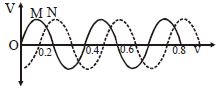
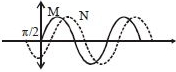
Two sinusoidal voltages of the same frequency are shown in the diagram. What is the frequency and the phase relationship between the voltages? (Frequency in $Hz$ $\to$ Phase lead of $N$ over $M$ in radian)
A
$0.4 \to -\pi/4$
B
$2.5 \to -\pi/2$
C
$2.5 \to +\pi/2$
D
$2.5 \to -\pi/4$
Solution
(B) From the graph,the time period $T$ (time taken to complete one full cycle) for wave $M$ is $0.4 \, s$.
Therefore,the frequency $f = \frac{1}{T} = \frac{1}{0.4} = 2.5 \, Hz$.
Wave $M$ starts at $t=0$ with a value of $0$,while wave $N$ reaches the same point at $t=0.1 \, s$.
The time shift $\Delta t$ between the two waves is $0.1 \, s$.
The phase difference $\Delta \phi$ is given by $\Delta \phi = \frac{2\pi}{T} \times \Delta t = \frac{2\pi}{0.4} \times 0.1 = \frac{2\pi}{4} = \frac{\pi}{2}$.
Since wave $N$ lags behind wave $M$,the phase lead of $N$ over $M$ is $-\frac{\pi}{2}$ radians.
Therefore,the frequency $f = \frac{1}{T} = \frac{1}{0.4} = 2.5 \, Hz$.
Wave $M$ starts at $t=0$ with a value of $0$,while wave $N$ reaches the same point at $t=0.1 \, s$.
The time shift $\Delta t$ between the two waves is $0.1 \, s$.
The phase difference $\Delta \phi$ is given by $\Delta \phi = \frac{2\pi}{T} \times \Delta t = \frac{2\pi}{0.4} \times 0.1 = \frac{2\pi}{4} = \frac{\pi}{2}$.
Since wave $N$ lags behind wave $M$,the phase lead of $N$ over $M$ is $-\frac{\pi}{2}$ radians.
0 likes
View Solution72
DifficultMCQ
If a direct current of $a$ ampere is superimposed with an alternating current $I = b \sin \omega t$,then the effective value of the resulting current is
A
$[\frac{a^2 + b^2}{2}]^{1/2}$
B
$[a^2 + \frac{1}{2}b^2]^{1/2}$
C
$[a^2 + b^2]^{1/2}$
D
$[\frac{1}{2}a^2 + b^2]^{1/2}$
Solution
(B) The resulting current is $I = a + b \sin \omega t$.
The effective $(RMS)$ value of the current is defined as $I_{rms} = \sqrt{\frac{1}{T} \int_{0}^{T} I^2 dt}$.
Squaring both sides,we get $I_{rms}^2 = \frac{1}{T} \int_{0}^{T} (a + b \sin \omega t)^2 dt$.
Expanding the integrand: $I_{rms}^2 = \frac{1}{T} \int_{0}^{T} (a^2 + b^2 \sin^2 \omega t + 2ab \sin \omega t) dt$.
Integrating over one full time period $T$:
$\int_{0}^{T} a^2 dt = a^2 T$
$\int_{0}^{T} b^2 \sin^2 \omega t dt = b^2 \int_{0}^{T} \frac{1 - \cos 2\omega t}{2} dt = \frac{b^2 T}{2}$
$\int_{0}^{T} 2ab \sin \omega t dt = 0$ (since the average of a sine wave over a full cycle is zero).
Substituting these values: $I_{rms}^2 = \frac{1}{T} (a^2 T + \frac{b^2 T}{2} + 0) = a^2 + \frac{b^2}{2}$.
Therefore,$I_{rms} = \sqrt{a^2 + \frac{b^2}{2}}$.
The effective $(RMS)$ value of the current is defined as $I_{rms} = \sqrt{\frac{1}{T} \int_{0}^{T} I^2 dt}$.
Squaring both sides,we get $I_{rms}^2 = \frac{1}{T} \int_{0}^{T} (a + b \sin \omega t)^2 dt$.
Expanding the integrand: $I_{rms}^2 = \frac{1}{T} \int_{0}^{T} (a^2 + b^2 \sin^2 \omega t + 2ab \sin \omega t) dt$.
Integrating over one full time period $T$:
$\int_{0}^{T} a^2 dt = a^2 T$
$\int_{0}^{T} b^2 \sin^2 \omega t dt = b^2 \int_{0}^{T} \frac{1 - \cos 2\omega t}{2} dt = \frac{b^2 T}{2}$
$\int_{0}^{T} 2ab \sin \omega t dt = 0$ (since the average of a sine wave over a full cycle is zero).
Substituting these values: $I_{rms}^2 = \frac{1}{T} (a^2 T + \frac{b^2 T}{2} + 0) = a^2 + \frac{b^2}{2}$.
Therefore,$I_{rms} = \sqrt{a^2 + \frac{b^2}{2}}$.
0 likes
View Solution73
DifficultMCQ
The $r.m.s.$ value of current for a variable current $i = i_1 \cos \omega t + i_2 \sin \omega t$ is:
A
$\frac{1}{\sqrt{2}} (i_1 + i_2)$
B
$\frac{1}{\sqrt{2}} (i_1 + i_2)^2$
C
$\frac{1}{\sqrt{2}} (i_1^2 + i_2^2)^{1/2}$
D
$\frac{1}{2} (i_1^2 + i_2^2)^{1/2}$
Solution
(C) The given current is $i = i_1 \cos \omega t + i_2 \sin \omega t$.
The $r.m.s.$ value of current is defined as $i_{rms} = \sqrt{\frac{1}{T} \int_0^T i^2 dt}$.
First,calculate $i^2 = (i_1 \cos \omega t + i_2 \sin \omega t)^2 = i_1^2 \cos^2 \omega t + i_2^2 \sin^2 \omega t + 2 i_1 i_2 \sin \omega t \cos \omega t$.
Integrating over a full time period $T = \frac{2\pi}{\omega}$:
$\int_0^T \cos^2 \omega t dt = \frac{T}{2}$,$\int_0^T \sin^2 \omega t dt = \frac{T}{2}$,and $\int_0^T \sin \omega t \cos \omega t dt = 0$.
Thus,the mean square value is $i_{rms}^2 = \frac{1}{T} [i_1^2 (\frac{T}{2}) + i_2^2 (\frac{T}{2}) + 0] = \frac{i_1^2 + i_2^2}{2}$.
Therefore,$i_{rms} = \sqrt{\frac{i_1^2 + i_2^2}{2}} = \frac{1}{\sqrt{2}} (i_1^2 + i_2^2)^{1/2}$.
The $r.m.s.$ value of current is defined as $i_{rms} = \sqrt{\frac{1}{T} \int_0^T i^2 dt}$.
First,calculate $i^2 = (i_1 \cos \omega t + i_2 \sin \omega t)^2 = i_1^2 \cos^2 \omega t + i_2^2 \sin^2 \omega t + 2 i_1 i_2 \sin \omega t \cos \omega t$.
Integrating over a full time period $T = \frac{2\pi}{\omega}$:
$\int_0^T \cos^2 \omega t dt = \frac{T}{2}$,$\int_0^T \sin^2 \omega t dt = \frac{T}{2}$,and $\int_0^T \sin \omega t \cos \omega t dt = 0$.
Thus,the mean square value is $i_{rms}^2 = \frac{1}{T} [i_1^2 (\frac{T}{2}) + i_2^2 (\frac{T}{2}) + 0] = \frac{i_1^2 + i_2^2}{2}$.
Therefore,$i_{rms} = \sqrt{\frac{i_1^2 + i_2^2}{2}} = \frac{1}{\sqrt{2}} (i_1^2 + i_2^2)^{1/2}$.
0 likes
View Solution74
MediumMCQ
The average value of alternating current $I = I_0 \sin \omega t$ in the time interval $[0, \frac{\pi}{\omega}]$ is:
A
$\frac{2I_0}{\pi}$
B
$2I_0$
C
$\frac{4I_0}{\pi}$
D
$\frac{I_0}{\pi}$
Solution
(A) The average value of current $I$ over a time interval $[t_1, t_2]$ is given by $I_{av} = \frac{1}{t_2 - t_1} \int_{t_1}^{t_2} I \, dt$.
Here,$t_1 = 0$ and $t_2 = \frac{\pi}{\omega}$.
$I_{av} = \frac{1}{\frac{\pi}{\omega} - 0} \int_0^{\frac{\pi}{\omega}} I_0 \sin \omega t \, dt$
$I_{av} = \frac{\omega}{\pi} I_0 \left[ \frac{-\cos \omega t}{\omega} \right]_0^{\frac{\pi}{\omega}}$
$I_{av} = \frac{I_0}{\pi} [-\cos(\omega \cdot \frac{\pi}{\omega}) - (-\cos(0))]$
$I_{av} = \frac{I_0}{\pi} [-\cos(\pi) + \cos(0)]$
$I_{av} = \frac{I_0}{\pi} [-(-1) + 1] = \frac{I_0}{\pi} [1 + 1] = \frac{2I_0}{\pi}$.
Here,$t_1 = 0$ and $t_2 = \frac{\pi}{\omega}$.
$I_{av} = \frac{1}{\frac{\pi}{\omega} - 0} \int_0^{\frac{\pi}{\omega}} I_0 \sin \omega t \, dt$
$I_{av} = \frac{\omega}{\pi} I_0 \left[ \frac{-\cos \omega t}{\omega} \right]_0^{\frac{\pi}{\omega}}$
$I_{av} = \frac{I_0}{\pi} [-\cos(\omega \cdot \frac{\pi}{\omega}) - (-\cos(0))]$
$I_{av} = \frac{I_0}{\pi} [-\cos(\pi) + \cos(0)]$
$I_{av} = \frac{I_0}{\pi} [-(-1) + 1] = \frac{I_0}{\pi} [1 + 1] = \frac{2I_0}{\pi}$.
0 likes
View Solution75
MediumMCQ
Find the time required for $50\,Hz$ alternating current to change its value from zero to maximum value.
A
$2.5\, s$
B
$5\, s$
C
$2.5\, ms$
D
$5\, ms$
Solution
(D) The instantaneous current is given by $I = I_0 \sin(\omega t)$.
To change from zero to maximum value,the current must go from $I = 0$ to $I = I_0$.
Thus,$\sin(\omega t) = 1$.
This implies $\omega t = \frac{\pi}{2}$.
Substituting $\omega = 2\pi f$,we get $2\pi f t = \frac{\pi}{2}$.
Given frequency $f = 50\,Hz$,the equation becomes $2\pi(50)t = \frac{\pi}{2}$.
$100\pi t = \frac{\pi}{2}$.
$t = \frac{1}{200}\,s = 0.005\,s = 5\,ms$.
To change from zero to maximum value,the current must go from $I = 0$ to $I = I_0$.
Thus,$\sin(\omega t) = 1$.
This implies $\omega t = \frac{\pi}{2}$.
Substituting $\omega = 2\pi f$,we get $2\pi f t = \frac{\pi}{2}$.
Given frequency $f = 50\,Hz$,the equation becomes $2\pi(50)t = \frac{\pi}{2}$.
$100\pi t = \frac{\pi}{2}$.
$t = \frac{1}{200}\,s = 0.005\,s = 5\,ms$.
0 likes
View Solution76
MediumMCQ
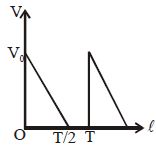
The average value of the potential difference $V$ shown in the figure is:
A
$V_0$
B
$\frac{V_0}{2}$
C
$\frac{V_0}{4}$
D
$\frac{2V_0}{3}$
Solution
(C) The average value of a periodic function is given by the area under the curve over one complete time period divided by the time period.
From the figure,the potential difference $V$ is non-zero only from $t = 0$ to $t = T/2$ within one cycle of duration $T$.
The area under the $V-t$ graph for one cycle is the area of the triangle with base $T/2$ and height $V_0$:
$\text{Area} = \frac{1}{2} \times \text{base} \times \text{height} = \frac{1}{2} \times \frac{T}{2} \times V_0 = \frac{V_0 T}{4}$.
The average value $\langle V \rangle$ is:
$\langle V \rangle = \frac{\text{Area}}{T} = \frac{\frac{V_0 T}{4}}{T} = \frac{V_0}{4}$.
From the figure,the potential difference $V$ is non-zero only from $t = 0$ to $t = T/2$ within one cycle of duration $T$.
The area under the $V-t$ graph for one cycle is the area of the triangle with base $T/2$ and height $V_0$:
$\text{Area} = \frac{1}{2} \times \text{base} \times \text{height} = \frac{1}{2} \times \frac{T}{2} \times V_0 = \frac{V_0 T}{4}$.
The average value $\langle V \rangle$ is:
$\langle V \rangle = \frac{\text{Area}}{T} = \frac{\frac{V_0 T}{4}}{T} = \frac{V_0}{4}$.
0 likes
View Solution77
DifficultMCQ
Match the following:
| Currents | $r.m.s.$ values |
|---|---|
| $(A) \ x_0 \sin \omega t$ | $(i) \ x_0$ |
| $(B) \ x_0 \sin \omega t \cos \omega t$ | $(ii) \ \frac{x_0}{\sqrt{2}}$ |
| $(C) \ x_0 \sin \omega t + x_0 \cos \omega t$ | $(iii) \ \frac{x_0}{2\sqrt{2}}$ |
A
$(A \to i), (B \to ii), (C \to iii)$
B
$(A \to ii), (B \to iii), (C \to i)$
C
$(A \to i), (B \to iii), (C \to ii)$
D
None
Solution
(B) $(1)$ For $x = x_0 \sin \omega t$,the $r.m.s.$ value is $I_{rms} = \frac{x_0}{\sqrt{2}}$. Thus,$(A \to ii)$.
$(2)$ For $x = x_0 \sin \omega t \cos \omega t = \frac{x_0}{2} \sin(2\omega t)$,the peak value is $\frac{x_0}{2}$. The $r.m.s.$ value is $\frac{x_0/2}{\sqrt{2}} = \frac{x_0}{2\sqrt{2}}$. Thus,$(B \to iii)$.
$(3)$ For $x = x_0 \sin \omega t + x_0 \cos \omega t = \sqrt{2} x_0 \sin(\omega t + \frac{\pi}{4})$,the peak value is $\sqrt{2} x_0$. The $r.m.s.$ value is $\frac{\sqrt{2} x_0}{\sqrt{2}} = x_0$. Thus,$(C \to i)$.
$(2)$ For $x = x_0 \sin \omega t \cos \omega t = \frac{x_0}{2} \sin(2\omega t)$,the peak value is $\frac{x_0}{2}$. The $r.m.s.$ value is $\frac{x_0/2}{\sqrt{2}} = \frac{x_0}{2\sqrt{2}}$. Thus,$(B \to iii)$.
$(3)$ For $x = x_0 \sin \omega t + x_0 \cos \omega t = \sqrt{2} x_0 \sin(\omega t + \frac{\pi}{4})$,the peak value is $\sqrt{2} x_0$. The $r.m.s.$ value is $\frac{\sqrt{2} x_0}{\sqrt{2}} = x_0$. Thus,$(C \to i)$.
0 likes
View Solution78
DifficultMCQ
The current in an $AC$ circuit is given by $i = i_1 \sin \omega t + i_2 \cos \omega t$. Its $r.m.s.$ value is:
A
$\frac{i_1 + i_2}{\sqrt{2}}$
B
$\sqrt{\frac{i_1^2 + i_2^2}{2}}$
C
$\frac{\sqrt{i_1^2 + i_2^2}}{2}$
D
$\sqrt{\frac{i_1 + i_2}{2}}$
Solution
(B) The given current is $i = i_1 \sin \omega t + i_2 \cos \omega t$.
We can rewrite this as $i = I_0 \sin(\omega t + \phi)$,where $I_0$ is the peak current.
The square of the peak current is $I_0^2 = i_1^2 + i_2^2$.
Thus,$I_0 = \sqrt{i_1^2 + i_2^2}$.
The $r.m.s.$ value of a sinusoidal current is given by $I_{rms} = \frac{I_0}{\sqrt{2}}$.
Substituting the value of $I_0$,we get $I_{rms} = \frac{\sqrt{i_1^2 + i_2^2}}{\sqrt{2}} = \sqrt{\frac{i_1^2 + i_2^2}{2}}$.
We can rewrite this as $i = I_0 \sin(\omega t + \phi)$,where $I_0$ is the peak current.
The square of the peak current is $I_0^2 = i_1^2 + i_2^2$.
Thus,$I_0 = \sqrt{i_1^2 + i_2^2}$.
The $r.m.s.$ value of a sinusoidal current is given by $I_{rms} = \frac{I_0}{\sqrt{2}}$.
Substituting the value of $I_0$,we get $I_{rms} = \frac{\sqrt{i_1^2 + i_2^2}}{\sqrt{2}} = \sqrt{\frac{i_1^2 + i_2^2}{2}}$.
0 likes
View Solution79
MediumMCQ
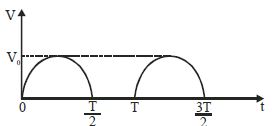
What will be the $r.m.s.$ value of the given $A.C.$ voltage over one complete cycle?
A
$V_0$
B
$\frac{V_0}{\sqrt{2}}$
C
$\frac{V_0}{2}$
D
$\frac{V_0}{4}$
Solution
(C) The given waveform represents a half-wave rectified $A.C.$ signal.
For one complete cycle of period $T$,the voltage $V(t)$ is defined as:
$V(t) = V_0 \sin(\omega t)$ for $0 \le t \le T/2$
$V(t) = 0$ for $T/2 < t \le T$
where $\omega = \frac{2\pi}{T}$.
The $r.m.s.$ value is defined as $V_{rms} = \sqrt{\frac{1}{T} \int_{0}^{T} V^2(t) dt}$.
$V_{rms}^2 = \frac{1}{T} \left[ \int_{0}^{T/2} (V_0 \sin(\omega t))^2 dt + \int_{T/2}^{T} 0^2 dt \right]$
$V_{rms}^2 = \frac{V_0^2}{T} \int_{0}^{T/2} \sin^2(\frac{2\pi t}{T}) dt$
Using the identity $\sin^2 \theta = \frac{1 - \cos(2\theta)}{2}$:
$V_{rms}^2 = \frac{V_0^2}{T} \int_{0}^{T/2} \frac{1 - \cos(\frac{4\pi t}{T})}{2} dt = \frac{V_0^2}{2T} \left[ t - \frac{T}{4\pi} \sin(\frac{4\pi t}{T}) \right]_{0}^{T/2}$
$V_{rms}^2 = \frac{V_0^2}{2T} \left[ (\frac{T}{2} - 0) - (0 - 0) \right] = \frac{V_0^2}{2T} \cdot \frac{T}{2} = \frac{V_0^2}{4}$
Therefore,$V_{rms} = \sqrt{\frac{V_0^2}{4}} = \frac{V_0}{2}$.
For one complete cycle of period $T$,the voltage $V(t)$ is defined as:
$V(t) = V_0 \sin(\omega t)$ for $0 \le t \le T/2$
$V(t) = 0$ for $T/2 < t \le T$
where $\omega = \frac{2\pi}{T}$.
The $r.m.s.$ value is defined as $V_{rms} = \sqrt{\frac{1}{T} \int_{0}^{T} V^2(t) dt}$.
$V_{rms}^2 = \frac{1}{T} \left[ \int_{0}^{T/2} (V_0 \sin(\omega t))^2 dt + \int_{T/2}^{T} 0^2 dt \right]$
$V_{rms}^2 = \frac{V_0^2}{T} \int_{0}^{T/2} \sin^2(\frac{2\pi t}{T}) dt$
Using the identity $\sin^2 \theta = \frac{1 - \cos(2\theta)}{2}$:
$V_{rms}^2 = \frac{V_0^2}{T} \int_{0}^{T/2} \frac{1 - \cos(\frac{4\pi t}{T})}{2} dt = \frac{V_0^2}{2T} \left[ t - \frac{T}{4\pi} \sin(\frac{4\pi t}{T}) \right]_{0}^{T/2}$
$V_{rms}^2 = \frac{V_0^2}{2T} \left[ (\frac{T}{2} - 0) - (0 - 0) \right] = \frac{V_0^2}{2T} \cdot \frac{T}{2} = \frac{V_0^2}{4}$
Therefore,$V_{rms} = \sqrt{\frac{V_0^2}{4}} = \frac{V_0}{2}$.
0 likes
View Solution80
DifficultMCQ
$A$ current in a circuit is given by $i = 3 + 4 \sin \omega t$. Then the effective value ($RMS$ value) of the current is:
A
$5$
B
$\sqrt{7}$
C
$\sqrt{17}$
D
$\sqrt{10}$
Solution
(C) The given current is $i = 3 + 4 \sin \omega t$.
To find the $RMS$ value,we first calculate the mean square value $i^2_{rms} = \overline{i^2}$.
$i^2 = (3 + 4 \sin \omega t)^2 = 9 + 16 \sin^2 \omega t + 24 \sin \omega t$.
Taking the average over a full cycle:
$\overline{i^2} = \overline{9} + 16 \overline{\sin^2 \omega t} + 24 \overline{\sin \omega t}$.
We know that $\overline{\sin^2 \omega t} = 1/2$ and $\overline{\sin \omega t} = 0$ over a full cycle.
Therefore,$i^2_{rms} = 9 + 16(1/2) + 0 = 9 + 8 = 17$.
The $RMS$ value is $i_{rms} = \sqrt{\overline{i^2}} = \sqrt{17}$.
To find the $RMS$ value,we first calculate the mean square value $i^2_{rms} = \overline{i^2}$.
$i^2 = (3 + 4 \sin \omega t)^2 = 9 + 16 \sin^2 \omega t + 24 \sin \omega t$.
Taking the average over a full cycle:
$\overline{i^2} = \overline{9} + 16 \overline{\sin^2 \omega t} + 24 \overline{\sin \omega t}$.
We know that $\overline{\sin^2 \omega t} = 1/2$ and $\overline{\sin \omega t} = 0$ over a full cycle.
Therefore,$i^2_{rms} = 9 + 16(1/2) + 0 = 9 + 8 = 17$.
The $RMS$ value is $i_{rms} = \sqrt{\overline{i^2}} = \sqrt{17}$.
0 likes
View Solution81
MediumMCQ
$A$ complex current wave is given by $i = 5 + 5 \sin(100 \omega t) \text{ A}$. Its average value over one time period is given as......$\text{A}$
A
$10$
B
$5$
C
$\sqrt{50}$
D
$0$
Solution
(B) The given current wave is $i = 5 + 5 \sin(100 \omega t)$.
To find the average value over one time period $T$,we use the formula $\langle i \rangle = \frac{1}{T} \int_{0}^{T} i \, dt$.
Substituting the expression for $i$:
$\langle i \rangle = \frac{1}{T} \int_{0}^{T} (5 + 5 \sin(100 \omega t)) \, dt$.
This can be split into two parts:
$\langle i \rangle = \frac{1}{T} \int_{0}^{T} 5 \, dt + \frac{1}{T} \int_{0}^{T} 5 \sin(100 \omega t) \, dt$.
The average value of a sine function over one complete cycle is $0$,i.e.,$\langle \sin(100 \omega t) \rangle = 0$.
Therefore,$\langle i \rangle = 5 + 0 = 5 \text{ A}$.
To find the average value over one time period $T$,we use the formula $\langle i \rangle = \frac{1}{T} \int_{0}^{T} i \, dt$.
Substituting the expression for $i$:
$\langle i \rangle = \frac{1}{T} \int_{0}^{T} (5 + 5 \sin(100 \omega t)) \, dt$.
This can be split into two parts:
$\langle i \rangle = \frac{1}{T} \int_{0}^{T} 5 \, dt + \frac{1}{T} \int_{0}^{T} 5 \sin(100 \omega t) \, dt$.
The average value of a sine function over one complete cycle is $0$,i.e.,$\langle \sin(100 \omega t) \rangle = 0$.
Therefore,$\langle i \rangle = 5 + 0 = 5 \text{ A}$.
0 likes
View Solution82
MediumMCQ
If an $AC$ main supply is given to be $220\,V$,the average $emf$ during a positive half cycle will be.....$V$.
A
$198$
B
$200$
C
$240$
D
$200\sqrt{2}$
Solution
(A) The given $AC$ voltage is the $rms$ value,so $E_{rms} = 220\,V$.
The peak voltage $E_{0}$ is related to $E_{rms}$ by the formula $E_{rms} = \frac{E_{0}}{\sqrt{2}}$,which gives $E_{0} = E_{rms} \times \sqrt{2} = 220\sqrt{2}\,V$.
The average $emf$ over a positive half cycle is given by the formula $E_{avg} = \frac{2}{\pi} E_{0}$.
Substituting the value of $E_{0}$,we get $E_{avg} = \frac{2}{\pi} \times 220\sqrt{2}$.
Using $\pi \approx 3.14$ and $\sqrt{2} \approx 1.414$,we get $E_{avg} = \frac{2}{3.14} \times 220 \times 1.414 \approx 0.637 \times 311.13 \approx 198.18\,V$.
Rounding to the nearest integer,the average $emf$ is $198\,V$.
The peak voltage $E_{0}$ is related to $E_{rms}$ by the formula $E_{rms} = \frac{E_{0}}{\sqrt{2}}$,which gives $E_{0} = E_{rms} \times \sqrt{2} = 220\sqrt{2}\,V$.
The average $emf$ over a positive half cycle is given by the formula $E_{avg} = \frac{2}{\pi} E_{0}$.
Substituting the value of $E_{0}$,we get $E_{avg} = \frac{2}{\pi} \times 220\sqrt{2}$.
Using $\pi \approx 3.14$ and $\sqrt{2} \approx 1.414$,we get $E_{avg} = \frac{2}{3.14} \times 220 \times 1.414 \approx 0.637 \times 311.13 \approx 198.18\,V$.
Rounding to the nearest integer,the average $emf$ is $198\,V$.
0 likes
View Solution83
MediumMCQ
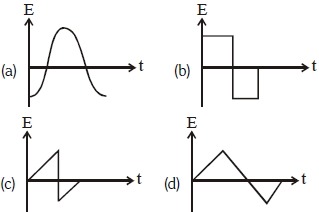
The variation of $EMF$ with time for four types of generators is shown in the figures. Which amongst them can be called $AC$?
A
$(a)$ and $(d)$
B
$(a), (b), (c)$ and $(d)$
C
$(a)$ and $(b)$
D
Only $(a)$
Solution
(B) An alternating current $(AC)$ is defined as a current that periodically reverses its direction and changes its magnitude with time.
In the given graphs,the $EMF$ (and consequently the current) in all four cases $(a), (b), (c),$ and $(d)$ crosses the time axis,meaning the $EMF$ changes its polarity (sign) periodically.
Since the polarity of the $EMF$ changes in all four graphs,all of them represent alternating $EMF$ or $AC$ waveforms.
Therefore,the correct option is $(b)$.
In the given graphs,the $EMF$ (and consequently the current) in all four cases $(a), (b), (c),$ and $(d)$ crosses the time axis,meaning the $EMF$ changes its polarity (sign) periodically.
Since the polarity of the $EMF$ changes in all four graphs,all of them represent alternating $EMF$ or $AC$ waveforms.
Therefore,the correct option is $(b)$.
0 likes
View Solution84
Medium
$A$ light bulb is rated at $100\;W$ for a $220\;V$ supply. Find
$(a)$ the resistance of the bulb;
$(b)$ the peak voltage of the source; and
$(c)$ the rms current through the bulb.
$(a)$ the resistance of the bulb;
$(b)$ the peak voltage of the source; and
$(c)$ the rms current through the bulb.
Solution
(N/A) Given power $P = 100\;W$ and rms voltage $V = 220\;V$.
The resistance of the bulb is calculated as:
$R = \frac{V^2}{P} = \frac{(220\;V)^2}{100\;W} = 484\;\Omega$
$(b)$ The peak voltage $(V_m)$ of the source is given by:
$V_m = \sqrt{2} \times V = 1.414 \times 220\;V \approx 311\;V$
$(c)$ The rms current $(I)$ through the bulb is calculated using $P = I \times V$:
$I = \frac{P}{V} = \frac{100\;W}{220\;V} \approx 0.454\;A$
The resistance of the bulb is calculated as:
$R = \frac{V^2}{P} = \frac{(220\;V)^2}{100\;W} = 484\;\Omega$
$(b)$ The peak voltage $(V_m)$ of the source is given by:
$V_m = \sqrt{2} \times V = 1.414 \times 220\;V \approx 311\;V$
$(c)$ The rms current $(I)$ through the bulb is calculated using $P = I \times V$:
$I = \frac{P}{V} = \frac{100\;W}{220\;V} \approx 0.454\;A$
0 likes
View Solution85
Medium
$(a)$ The peak voltage of an $ac$ supply is $300 \; V$. What is the $rms$ voltage?
$(b)$ The $rms$ value of current in an $ac$ circuit is $10 \; A$. What is the peak current?
$(b)$ The $rms$ value of current in an $ac$ circuit is $10 \; A$. What is the peak current?
Solution
(N/A) Given,peak voltage $V_{0} = 300 \; V$.
The $rms$ voltage is given by the relation $V_{rms} = \frac{V_{0}}{\sqrt{2}}$.
Substituting the values: $V_{rms} = \frac{300}{1.414} \approx 212.1 \; V$.
$(b)$ Given,$rms$ current $I_{rms} = 10 \; A$.
The peak current $I_{0}$ is given by the relation $I_{0} = \sqrt{2} \times I_{rms}$.
Substituting the values: $I_{0} = 1.414 \times 10 = 14.14 \; A$.
The $rms$ voltage is given by the relation $V_{rms} = \frac{V_{0}}{\sqrt{2}}$.
Substituting the values: $V_{rms} = \frac{300}{1.414} \approx 212.1 \; V$.
$(b)$ Given,$rms$ current $I_{rms} = 10 \; A$.
The peak current $I_{0}$ is given by the relation $I_{0} = \sqrt{2} \times I_{rms}$.
Substituting the values: $I_{0} = 1.414 \times 10 = 14.14 \; A$.
0 likes
View Solution86
Medium
What are $DC$ signals and $AC$ signals? Why do we prefer an $AC$ signal?
Solution
(N/A) $DC$ signals (current or voltage) do not change their direction with time. They are unidirectional signals.
If the voltage obtained from a source varies like a sine function with time,then such a voltage is called an alternating voltage ($AC$ voltage).
The current driven in a circuit by an $AC$ voltage is called an alternating current ($AC$ current).
$AC$ is preferred over $DC$ for the following reasons:
$1$. $AC$ voltages can be easily and efficiently converted from one voltage level to another using transformers,which is not possible with $DC$.
$2$. Electrical energy can be transmitted and distributed over long distances much more economically using $AC$ compared to $DC$.
If the voltage obtained from a source varies like a sine function with time,then such a voltage is called an alternating voltage ($AC$ voltage).
The current driven in a circuit by an $AC$ voltage is called an alternating current ($AC$ current).
$AC$ is preferred over $DC$ for the following reasons:
$1$. $AC$ voltages can be easily and efficiently converted from one voltage level to another using transformers,which is not possible with $DC$.
$2$. Electrical energy can be transmitted and distributed over long distances much more economically using $AC$ compared to $DC$.
0 likes
View Solution87
Medium
What are $A.C.$ signals?
Solution
(N/A) An $A.C.$ (Alternating Current) signal is an electric current or voltage that periodically reverses its direction and changes its magnitude continuously with time.
Unlike $D.C.$ (Direct Current),which flows in a single direction,$A.C.$ follows a sinusoidal waveform in most power applications.
The mathematical expression for an $A.C.$ voltage is typically given by $V(t) = V_m \sin(\omega t + \phi)$,where $V_m$ is the peak voltage,$\omega$ is the angular frequency,and $\phi$ is the phase constant.
$A.C.$ is widely used for power distribution because its voltage can be easily stepped up or down using transformers.
Unlike $D.C.$ (Direct Current),which flows in a single direction,$A.C.$ follows a sinusoidal waveform in most power applications.
The mathematical expression for an $A.C.$ voltage is typically given by $V(t) = V_m \sin(\omega t + \phi)$,where $V_m$ is the peak voltage,$\omega$ is the angular frequency,and $\phi$ is the phase constant.
$A.C.$ is widely used for power distribution because its voltage can be easily stepped up or down using transformers.
0 likes
View Solution88
Medium
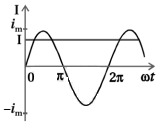
Define the root mean square (rms) value of an alternating current and provide its formula. Also,show the relationship between the rms current and the peak current on a graph of current versus $\omega t$.
Solution
(N/A) The root mean square (rms) value of an alternating current is defined as the equivalent steady direct current $(DC)$ which,when flowing through a given resistor,produces the same amount of heat in a given time as the alternating current does over a complete cycle.
The rms current is denoted by $I$ or $I_{rms}$.
The relationship between the rms current $I$ and the peak current $I_{m}$ is given by:
$I = \frac{I_{m}}{\sqrt{2}} \approx 0.707 I_{m}$
Mathematically,it is defined as:
$I_{rms} = \sqrt{\overline{I}^{2}} = \sqrt{\frac{1}{T} \int_{0}^{T} I_{m}^{2} \sin^{2}(\omega t) dt} = \sqrt{\frac{1}{2} I_{m}^{2}} = \frac{I_{m}}{\sqrt{2}}$
Similarly,for voltage:
$V = \frac{V_{m}}{\sqrt{2}} \approx 0.707 V_{m}$
These relations show that $V = IR$ holds for $AC$ circuits using rms values,similar to $DC$ circuits.
The graph of current versus $\omega t$ shows the sinusoidal variation of current with peak value $I_{m}$ and the constant rms value $I$ represented as a horizontal line.
The rms current is denoted by $I$ or $I_{rms}$.
The relationship between the rms current $I$ and the peak current $I_{m}$ is given by:
$I = \frac{I_{m}}{\sqrt{2}} \approx 0.707 I_{m}$
Mathematically,it is defined as:
$I_{rms} = \sqrt{\overline{I}^{2}} = \sqrt{\frac{1}{T} \int_{0}^{T} I_{m}^{2} \sin^{2}(\omega t) dt} = \sqrt{\frac{1}{2} I_{m}^{2}} = \frac{I_{m}}{\sqrt{2}}$
Similarly,for voltage:
$V = \frac{V_{m}}{\sqrt{2}} \approx 0.707 V_{m}$
These relations show that $V = IR$ holds for $AC$ circuits using rms values,similar to $DC$ circuits.
The graph of current versus $\omega t$ shows the sinusoidal variation of current with peak value $I_{m}$ and the constant rms value $I$ represented as a horizontal line.
0 likes
View Solution89
Medium
What is $AC$ voltage? Write the equation for $AC$ voltage.
Solution
(N/A) $AC$ voltage is a voltage that periodically reverses its direction and changes its magnitude continuously with time.
The equation for $AC$ voltage is given by:
$v(t) = V_m \sin(\omega t + \phi)$
Where:
$v(t)$ is the instantaneous voltage at time $t$.
$V_m$ is the peak or maximum voltage (amplitude).
$\omega$ is the angular frequency,where $\omega = 2\pi f$ ($f$ is the frequency).
$t$ is the time.
$\phi$ is the phase constant.
The equation for $AC$ voltage is given by:
$v(t) = V_m \sin(\omega t + \phi)$
Where:
$v(t)$ is the instantaneous voltage at time $t$.
$V_m$ is the peak or maximum voltage (amplitude).
$\omega$ is the angular frequency,where $\omega = 2\pi f$ ($f$ is the frequency).
$t$ is the time.
$\phi$ is the phase constant.
0 likes
View Solution90
EasyMCQ
What is the sum of the instantaneous current values over one complete $AC$ cycle?
A
$0$
B
$I_{max}$
C
$I_{rms}$
D
$2I_{max}$
Solution
(A) The instantaneous current in an $AC$ circuit is given by $I(t) = I_{max} \sin(\omega t)$.
To find the sum (or integral) of the instantaneous current values over one complete cycle of period $T$,we calculate the integral $\int_{0}^{T} I(t) dt$.
$\int_{0}^{T} I_{max} \sin(\omega t) dt = I_{max} [-\frac{\cos(\omega t)}{\omega}]_{0}^{T}$.
Since $\omega = \frac{2\pi}{T}$,we have $\omega T = 2\pi$.
Substituting the limits: $I_{max} [-\frac{\cos(2\pi)}{\omega} - (-\frac{\cos(0)}{\omega})] = I_{max} [-\frac{1}{\omega} + \frac{1}{\omega}] = 0$.
Therefore,the sum of the instantaneous current values over one complete $AC$ cycle is $0$.
To find the sum (or integral) of the instantaneous current values over one complete cycle of period $T$,we calculate the integral $\int_{0}^{T} I(t) dt$.
$\int_{0}^{T} I_{max} \sin(\omega t) dt = I_{max} [-\frac{\cos(\omega t)}{\omega}]_{0}^{T}$.
Since $\omega = \frac{2\pi}{T}$,we have $\omega T = 2\pi$.
Substituting the limits: $I_{max} [-\frac{\cos(2\pi)}{\omega} - (-\frac{\cos(0)}{\omega})] = I_{max} [-\frac{1}{\omega} + \frac{1}{\omega}] = 0$.
Therefore,the sum of the instantaneous current values over one complete $AC$ cycle is $0$.
0 likes
View Solution91
Medium
What is $rms$ (root mean square) value? Write the formula of $rms$ current for an alternating current.
Solution
(N/A) The $rms$ (root mean square) value of an alternating current is defined as the square root of the mean of the squares of the instantaneous currents over one complete cycle.
It is also known as the virtual or effective value of the alternating current.
It represents the value of a steady direct current which,when passed through a resistor for a given time,produces the same amount of heat as the alternating current does in the same resistor and in the same time.
The formula for $rms$ current $(I_{rms})$ in terms of peak current $(I_0)$ is given by:
$I_{rms} = \frac{I_0}{\sqrt{2}} \approx 0.707 I_0$
It is also known as the virtual or effective value of the alternating current.
It represents the value of a steady direct current which,when passed through a resistor for a given time,produces the same amount of heat as the alternating current does in the same resistor and in the same time.
The formula for $rms$ current $(I_{rms})$ in terms of peak current $(I_0)$ is given by:
$I_{rms} = \frac{I_0}{\sqrt{2}} \approx 0.707 I_0$
0 likes
View Solution92
MediumMCQ
What is the maximum voltage of $220\, V$ (in $, V$)?
A
$220$
B
$311$
C
$440$
D
$155$
Solution
(B) The given voltage $V_{rms} = 220\, V$ represents the root mean square value of the alternating voltage.
The relationship between the peak voltage $(V_0)$ and the root mean square voltage $(V_{rms})$ is given by the formula: $V_0 = V_{rms} \times \sqrt{2}$.
Substituting the given value: $V_0 = 220 \times 1.414$.
$V_0 \approx 311.08\, V$.
Therefore,the maximum voltage is approximately $311\, V$.
The relationship between the peak voltage $(V_0)$ and the root mean square voltage $(V_{rms})$ is given by the formula: $V_0 = V_{rms} \times \sqrt{2}$.
Substituting the given value: $V_0 = 220 \times 1.414$.
$V_0 \approx 311.08\, V$.
Therefore,the maximum voltage is approximately $311\, V$.
0 likes
View Solution93
MediumMCQ
In India,$AC$ voltage becomes zero how many times in $1$ $sec$?
A
$50$
B
$100$
C
$25$
D
$200$
Solution
(B) In India,the frequency of $AC$ supply is $f = 50 \ Hz$.
This means the current completes $50$ cycles in $1$ $sec$.
In one complete cycle of a sine wave,the voltage passes through zero twice (once at the start/end and once at the half-cycle point).
Therefore,the number of times the voltage becomes zero in $1$ $sec$ is $2 \times f$.
Calculation: $2 \times 50 = 100$ times.
This means the current completes $50$ cycles in $1$ $sec$.
In one complete cycle of a sine wave,the voltage passes through zero twice (once at the start/end and once at the half-cycle point).
Therefore,the number of times the voltage becomes zero in $1$ $sec$ is $2 \times f$.
Calculation: $2 \times 50 = 100$ times.
0 likes
View Solution94
Medium
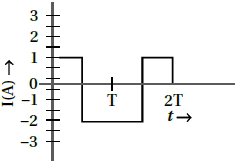
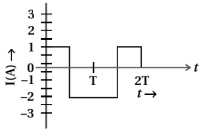
The alternating current in a circuit is described by the graph shown in the figure. Calculate the root mean square $(I_{rms})$ current for this waveform.
Solution
(N/A) The given waveform is a periodic square wave. The current $I(t)$ takes the value $I_1 = 1 \text{ A}$ for time interval $0 < t < T/2$ and $I_2 = -2 \text{ A}$ for time interval $T/2 < t < T$.
The root mean square current $I_{rms}$ is defined as:
$I_{rms} = \sqrt{\frac{1}{T} \int_{0}^{T} I^2(t) dt}$
Substituting the values:
$I_{rms} = \sqrt{\frac{1}{T} \left[ \int_{0}^{T/2} (1)^2 dt + \int_{T/2}^{T} (-2)^2 dt \right]}$
$I_{rms} = \sqrt{\frac{1}{T} \left[ (1 \times T/2) + (4 \times T/2) \right]}$
$I_{rms} = \sqrt{\frac{1}{T} \left[ \frac{T}{2} + 2T \right]} = \sqrt{\frac{1}{T} \left( \frac{5T}{2} \right)}$
$I_{rms} = \sqrt{2.5} \approx 1.58 \text{ A}$.
The root mean square current $I_{rms}$ is defined as:
$I_{rms} = \sqrt{\frac{1}{T} \int_{0}^{T} I^2(t) dt}$
Substituting the values:
$I_{rms} = \sqrt{\frac{1}{T} \left[ \int_{0}^{T/2} (1)^2 dt + \int_{T/2}^{T} (-2)^2 dt \right]}$
$I_{rms} = \sqrt{\frac{1}{T} \left[ (1 \times T/2) + (4 \times T/2) \right]}$
$I_{rms} = \sqrt{\frac{1}{T} \left[ \frac{T}{2} + 2T \right]} = \sqrt{\frac{1}{T} \left( \frac{5T}{2} \right)}$
$I_{rms} = \sqrt{2.5} \approx 1.58 \text{ A}$.
0 likes
View Solution95
Easy
Both alternating current and direct current are measured in amperes. But how is the ampere defined for an alternating current?
Solution
(N/A) For a direct current $(DC)$,$1$ ampere is defined as $1$ coulomb of charge flowing per second.
An alternating current $(AC)$ changes its direction periodically with the source frequency. If we were to measure the average current,it would be zero over a full cycle,which is not useful for power measurement.
Therefore,the $AC$ ampere is defined based on a property that is independent of the direction of current,which is the heating effect (Joule's heating).
$1$ ampere of $AC$ is defined as the value of alternating current that produces the same amount of heat in a given resistor as $1$ ampere of $DC$ would produce in the same resistor over the same time interval. This is known as the root-mean-square $(RMS)$ value of the current.
An alternating current $(AC)$ changes its direction periodically with the source frequency. If we were to measure the average current,it would be zero over a full cycle,which is not useful for power measurement.
Therefore,the $AC$ ampere is defined based on a property that is independent of the direction of current,which is the heating effect (Joule's heating).
$1$ ampere of $AC$ is defined as the value of alternating current that produces the same amount of heat in a given resistor as $1$ ampere of $DC$ would produce in the same resistor over the same time interval. This is known as the root-mean-square $(RMS)$ value of the current.
0 likes
View Solution96
DifficultMCQ
An $AC$ current is given by $I = I_{1} \sin \omega t + I_{2} \cos \omega t$. $A$ hot wire ammeter will give a reading of:
A
$\sqrt{\frac{I_{1}^{2}-I_{2}^{2}}{2}}$
B
$\sqrt{\frac{I_{1}^{2}+I_{2}^{2}}{2}}$
C
$\frac{I_{1}+I_{2}}{\sqrt{2}}$
D
$\frac{I_{1}+I_{2}}{2 \sqrt{2}}$
Solution
(B) The given current is $I = I_{1} \sin \omega t + I_{2} \cos \omega t$.
This can be rewritten in the form $I = I_{0} \sin(\omega t + \phi)$,where $I_{0}$ is the peak current.
The amplitude $I_{0}$ is given by $\sqrt{I_{1}^{2} + I_{2}^{2}}$.
$A$ hot wire ammeter measures the root mean square $(RMS)$ value of the current.
The $RMS$ value is defined as $I_{rms} = \frac{I_{0}}{\sqrt{2}}$.
Substituting the value of $I_{0}$,we get $I_{rms} = \sqrt{\frac{I_{1}^{2} + I_{2}^{2}}{2}}$.
This can be rewritten in the form $I = I_{0} \sin(\omega t + \phi)$,where $I_{0}$ is the peak current.
The amplitude $I_{0}$ is given by $\sqrt{I_{1}^{2} + I_{2}^{2}}$.
$A$ hot wire ammeter measures the root mean square $(RMS)$ value of the current.
The $RMS$ value is defined as $I_{rms} = \frac{I_{0}}{\sqrt{2}}$.
Substituting the value of $I_{0}$,we get $I_{rms} = \sqrt{\frac{I_{1}^{2} + I_{2}^{2}}{2}}$.
0 likes
View Solution97
MediumMCQ
An $AC$ source rated $220\, V, 50\, Hz$ is connected to a resistor. The time taken by the current to change from its maximum value to the $rms$ value is:
A
$2.5\, ms$
B
$25\, ms$
C
$2.5\, s$
D
$0.25\, ms$
Solution
(A) The instantaneous current in an $AC$ circuit is given by $i = i_{0} \cos(\omega t)$,where $i_{0}$ is the peak current.
At $t = 0$,the current is at its maximum value,$i = i_{0}$.
The $rms$ value of the current is $i_{rms} = \frac{i_{0}}{\sqrt{2}}$.
We need to find the time $t$ when $i = \frac{i_{0}}{\sqrt{2}}$.
Setting $\cos(\omega t) = \frac{1}{\sqrt{2}}$,we get $\omega t = \frac{\pi}{4}$.
Substituting $\omega = 2\pi f$,we have $2\pi f t = \frac{\pi}{4}$.
Solving for $t$,$t = \frac{1}{8f}$.
Given $f = 50\, Hz$,$t = \frac{1}{8 \times 50} = \frac{1}{400}\, s$.
$t = 0.0025\, s = 2.5\, ms$.
At $t = 0$,the current is at its maximum value,$i = i_{0}$.
The $rms$ value of the current is $i_{rms} = \frac{i_{0}}{\sqrt{2}}$.
We need to find the time $t$ when $i = \frac{i_{0}}{\sqrt{2}}$.
Setting $\cos(\omega t) = \frac{1}{\sqrt{2}}$,we get $\omega t = \frac{\pi}{4}$.
Substituting $\omega = 2\pi f$,we have $2\pi f t = \frac{\pi}{4}$.
Solving for $t$,$t = \frac{1}{8f}$.
Given $f = 50\, Hz$,$t = \frac{1}{8 \times 50} = \frac{1}{400}\, s$.
$t = 0.0025\, s = 2.5\, ms$.
0 likes
View Solution98
DifficultMCQ
An alternating current is given by the equation $i = i_{1} \sin \omega t + i_{2} \cos \omega t$. The rms current will be
A
$\frac{1}{\sqrt{2}}(i_{1}^{2} + i_{2}^{2})^{1/2}$
B
$\frac{1}{\sqrt{2}}(i_{1} + i_{2})^{2}$
C
$\frac{1}{2}(i_{1}^{2} + i_{2}^{2})^{1/2}$
D
$\frac{1}{\sqrt{2}}(i_{1} + i_{2})$
Solution
(A) The given equation is $i = i_{1} \sin \omega t + i_{2} \cos \omega t$.
We can rewrite $\cos \omega t$ as $\sin(\omega t + 90^{\circ})$.
So,$i = i_{1} \sin \omega t + i_{2} \sin(\omega t + 90^{\circ})$.
This represents the superposition of two sinusoidal currents with a phase difference of $90^{\circ}$.
The resultant peak current $i_{0}$ is given by $i_{0} = \sqrt{i_{1}^{2} + i_{2}^{2} + 2i_{1}i_{2} \cos(90^{\circ})}$.
Since $\cos(90^{\circ}) = 0$,we get $i_{0} = \sqrt{i_{1}^{2} + i_{2}^{2}}$.
The root mean square (rms) current is defined as $i_{rms} = \frac{i_{0}}{\sqrt{2}}$.
Therefore,$i_{rms} = \frac{\sqrt{i_{1}^{2} + i_{2}^{2}}}{\sqrt{2}} = \frac{1}{\sqrt{2}}(i_{1}^{2} + i_{2}^{2})^{1/2}$.
We can rewrite $\cos \omega t$ as $\sin(\omega t + 90^{\circ})$.
So,$i = i_{1} \sin \omega t + i_{2} \sin(\omega t + 90^{\circ})$.
This represents the superposition of two sinusoidal currents with a phase difference of $90^{\circ}$.
The resultant peak current $i_{0}$ is given by $i_{0} = \sqrt{i_{1}^{2} + i_{2}^{2} + 2i_{1}i_{2} \cos(90^{\circ})}$.
Since $\cos(90^{\circ}) = 0$,we get $i_{0} = \sqrt{i_{1}^{2} + i_{2}^{2}}$.
The root mean square (rms) current is defined as $i_{rms} = \frac{i_{0}}{\sqrt{2}}$.
Therefore,$i_{rms} = \frac{\sqrt{i_{1}^{2} + i_{2}^{2}}}{\sqrt{2}} = \frac{1}{\sqrt{2}}(i_{1}^{2} + i_{2}^{2})^{1/2}$.
0 likes
View Solution99
DifficultMCQ
The alternating current is given by $i = \left\{\sqrt{42} \sin \left(\frac{2 \pi}{T} t\right) + 10\right\} \text{ A}$. The $r.m.s.$ value of this current is $\text{A}$.
A
$11$
B
$13$
C
$9$
D
$15$
Solution
(A) The given current is $i = i_1 + i_2$,where $i_1 = \sqrt{42} \sin \left(\frac{2 \pi}{T} t\right)$ and $i_2 = 10$.
The $r.m.s.$ value of a composite current $i = i_1 + i_2$ is given by $I_{rms} = \sqrt{I_{1,rms}^2 + I_{2,rms}^2}$.
For the sinusoidal component $i_1$,the $r.m.s.$ value is $I_{1,rms} = \frac{I_0}{\sqrt{2}} = \frac{\sqrt{42}}{\sqrt{2}} = \sqrt{21}$.
For the constant component $i_2 = 10$,the $r.m.s.$ value is $I_{2,rms} = 10$.
Therefore,$I_{rms} = \sqrt{(\sqrt{21})^2 + 10^2} = \sqrt{21 + 100} = \sqrt{121} = 11 \text{ A}$.
The $r.m.s.$ value of a composite current $i = i_1 + i_2$ is given by $I_{rms} = \sqrt{I_{1,rms}^2 + I_{2,rms}^2}$.
For the sinusoidal component $i_1$,the $r.m.s.$ value is $I_{1,rms} = \frac{I_0}{\sqrt{2}} = \frac{\sqrt{42}}{\sqrt{2}} = \sqrt{21}$.
For the constant component $i_2 = 10$,the $r.m.s.$ value is $I_{2,rms} = 10$.
Therefore,$I_{rms} = \sqrt{(\sqrt{21})^2 + 10^2} = \sqrt{21 + 100} = \sqrt{121} = 11 \text{ A}$.
0 likes
View Solution100
DifficultMCQ
$A$ $10\, \Omega$ resistance is connected across $220\, V - 50\, Hz$ $AC$ supply. The time taken by the current to change from its maximum value to the rms value is $....\, ms$.
A
$2.5$
B
$1.5$
C
$4.5$
D
$3.0$
Solution
(A) The instantaneous current in an $AC$ circuit is given by $i = i_0 \sin(\omega t)$.
At maximum value,$i = i_0$,so $i_0 = i_0 \sin(\omega t_1) \Rightarrow \omega t_1 = \frac{\pi}{2}$.
At rms value,$i = \frac{i_0}{\sqrt{2}}$,so $\frac{i_0}{\sqrt{2}} = i_0 \sin(\omega t_2) \Rightarrow \omega t_2 = \frac{\pi}{4}$.
The time taken to change from maximum value to rms value is $\Delta t = t_1 - t_2$.
$\Delta t = \frac{\pi}{2\omega} - \frac{\pi}{4\omega} = \frac{\pi}{4\omega}$.
Since $\omega = 2\pi f$,we have $\Delta t = \frac{\pi}{4(2\pi f)} = \frac{1}{8f}$.
Given $f = 50\, Hz$,$\Delta t = \frac{1}{8 \times 50} = \frac{1}{400}\, s$.
Converting to milliseconds: $\Delta t = \frac{1}{400} \times 1000\, ms = 2.5\, ms$.
At maximum value,$i = i_0$,so $i_0 = i_0 \sin(\omega t_1) \Rightarrow \omega t_1 = \frac{\pi}{2}$.
At rms value,$i = \frac{i_0}{\sqrt{2}}$,so $\frac{i_0}{\sqrt{2}} = i_0 \sin(\omega t_2) \Rightarrow \omega t_2 = \frac{\pi}{4}$.
The time taken to change from maximum value to rms value is $\Delta t = t_1 - t_2$.
$\Delta t = \frac{\pi}{2\omega} - \frac{\pi}{4\omega} = \frac{\pi}{4\omega}$.
Since $\omega = 2\pi f$,we have $\Delta t = \frac{\pi}{4(2\pi f)} = \frac{1}{8f}$.
Given $f = 50\, Hz$,$\Delta t = \frac{1}{8 \times 50} = \frac{1}{400}\, s$.
Converting to milliseconds: $\Delta t = \frac{1}{400} \times 1000\, ms = 2.5\, ms$.
0 likes
View SolutionAlternating Current — Alternating Current, Voltage (rms and Average) · Frequently Asked Questions
1Are these Alternating Current questions useful for JEE and NEET?
Yes. All questions in this section are mapped to JEE Main and NEET exam patterns. Previous year questions from JEE Main, NEET, GUJCET and state-level exams are included with full solutions.
2Can I switch to Hindi or Gujarati for these questions?
Yes. Use the language tabs in the hero section or the sidebar to view the same questions and solutions in English, Hindi or Gujarati.
3How do I generate a question paper from this subtopic?
Use the Vedclass Exam Paper Generator — select the chapter and subtopic, set difficulty, and generate Sets A, B, C, D automatically. First 3 chapters of every subject are free.
Vedclass Products
For Students
Vedclass Test Series
Mock tests in real JEE/NEET style with performance analysis. 5-day free trial.
Start Free TrialFor Teachers
Exam Paper Generator
Generate Set A/B/C/D papers from this chapter in 2 minutes. 3 chapters free.
Try FreeFor Institutes
Online Exam Module
Live online exams with unlimited students, 360° analytics & white-label branding.
See DemoFor Teachers & Institutes
Generate a Alternating Current Exam Paper in 2 Minutes
Select subtopic & difficulty — Sets A, B, C, D auto-generated with No Repeat logic.
First 3 chapters of every subject are free — no payment required.