
A English
Alternating Current, Voltage (rms and Average) Questions in English
Class 12 Physics · Alternating Current · Alternating Current, Voltage (rms and Average)
180+
Questions
English
Language
100%
With Solutions
Showing 50 of 180 questions in English
101
EasyMCQ
The peak voltage of the $ac$ source is equal to:
A
the $rms$ value of the $ac$ source
B
$\sqrt{2}$ times the $rms$ value of the $ac$ source
C
$\frac{1}{\sqrt{2}}$ times the $rms$ value of the $ac$ source
D
the value of voltage supplied to the circuit
Solution
(B) For an alternating current $(ac)$ source,the relationship between the peak voltage $(V_0)$ and the root mean square $(rms)$ voltage $(V_{rms})$ is given by the formula: $V_{rms} = \frac{V_0}{\sqrt{2}}$.
Rearranging this formula to solve for the peak voltage,we get: $V_0 = \sqrt{2} \times V_{rms}$.
Therefore,the peak voltage is $\sqrt{2}$ times the $rms$ value of the $ac$ source.
Rearranging this formula to solve for the peak voltage,we get: $V_0 = \sqrt{2} \times V_{rms}$.
Therefore,the peak voltage is $\sqrt{2}$ times the $rms$ value of the $ac$ source.
0 likes
View Solution102
DifficultMCQ
$A$ resistance of $40 \,\Omega$ is connected to a source of alternating current rated $220 \,V, 50 \,Hz$. Find the time taken by the current to change from its maximum value to its $rms$ value.
A
$2.5 \,ms$
B
$1.25 \,ms$
C
$2.5 \,s$
D
$0.25 \,s$
Solution
(A) The instantaneous current in an $AC$ circuit is given by $I = I_0 \sin(\omega t)$.
At maximum value,the phase $\omega t_1 = \frac{\pi}{2}$.
At $rms$ value,the current is $I = \frac{I_0}{\sqrt{2}}$,so $\sin(\omega t_2) = \frac{1}{\sqrt{2}}$. The first instance after the peak is $\omega t_2 = \frac{3\pi}{4}$.
The phase difference is $\Delta \phi = \omega t_2 - \omega t_1 = \frac{3\pi}{4} - \frac{\pi}{2} = \frac{\pi}{4}$.
Given frequency $f = 50 \,Hz$,the angular frequency $\omega = 2\pi f = 2\pi \times 50 = 100\pi \,rad/s$.
The time taken is $t = \frac{\Delta \phi}{\omega} = \frac{\pi / 4}{100\pi} = \frac{1}{400} \,s$.
Converting to milliseconds: $t = 0.0025 \,s = 2.5 \,ms$.
At maximum value,the phase $\omega t_1 = \frac{\pi}{2}$.
At $rms$ value,the current is $I = \frac{I_0}{\sqrt{2}}$,so $\sin(\omega t_2) = \frac{1}{\sqrt{2}}$. The first instance after the peak is $\omega t_2 = \frac{3\pi}{4}$.
The phase difference is $\Delta \phi = \omega t_2 - \omega t_1 = \frac{3\pi}{4} - \frac{\pi}{2} = \frac{\pi}{4}$.
Given frequency $f = 50 \,Hz$,the angular frequency $\omega = 2\pi f = 2\pi \times 50 = 100\pi \,rad/s$.
The time taken is $t = \frac{\Delta \phi}{\omega} = \frac{\pi / 4}{100\pi} = \frac{1}{400} \,s$.
Converting to milliseconds: $t = 0.0025 \,s = 2.5 \,ms$.
0 likes
View Solution103
MediumMCQ
The current flowing through an $AC$ circuit is given by $I = 5 \sin(120 \pi t) \text{ A}$. How long will the current take to reach the peak value starting from zero?
A
$\frac{1}{60} \text{ s}$
B
$60 \text{ s}$
C
$\frac{1}{120} \text{ s}$
D
$\frac{1}{240} \text{ s}$
Solution
(D) The given equation for current is $I = I_0 \sin(\omega t)$,where $I_0 = 5 \text{ A}$ and $\omega = 120 \pi \text{ rad/s}$.
The angular frequency $\omega$ is related to the time period $T$ by the formula $\omega = \frac{2 \pi}{T}$.
Substituting the value of $\omega$: $120 \pi = \frac{2 \pi}{T} \Rightarrow T = \frac{2 \pi}{120 \pi} = \frac{1}{60} \text{ s}$.
The current reaches its peak value at $t = \frac{T}{4}$ (one-quarter of the time period).
Therefore,the time taken is $t = \frac{1/60}{4} = \frac{1}{240} \text{ s}$.
The angular frequency $\omega$ is related to the time period $T$ by the formula $\omega = \frac{2 \pi}{T}$.
Substituting the value of $\omega$: $120 \pi = \frac{2 \pi}{T} \Rightarrow T = \frac{2 \pi}{120 \pi} = \frac{1}{60} \text{ s}$.
The current reaches its peak value at $t = \frac{T}{4}$ (one-quarter of the time period).
Therefore,the time taken is $t = \frac{1/60}{4} = \frac{1}{240} \text{ s}$.
0 likes
View Solution104
MediumMCQ
For a domestic $AC$ supply of $220 \,V$ at $50 \,cps$,the potential difference between the terminals of a two-pin electric outlet in a room is (in volt) given by
A
$V(t)=220 \sqrt{2} \cos 100 \pi t$
B
$V(t)=220 \cos 50 t$
C
$V(t)=220 \cos 100 \pi t$
D
$V(t)=220 \sqrt{2} \cos 50 t$
Solution
(A) For a domestic $AC$ supply,the given voltage $220 \,V$ represents the root-mean-square $(V_{\text{rms}})$ value.
The peak voltage $(V_{\text{max}})$ is calculated as $V_{\text{max}} = V_{\text{rms}} \times \sqrt{2} = 220 \sqrt{2} \,V$.
The frequency $f$ is $50 \,cps$ (or $50 \,Hz$). The angular frequency $\omega$ is given by $\omega = 2 \pi f = 2 \pi \times 50 = 100 \pi \,rad/s$.
The instantaneous potential difference $V(t)$ is expressed as $V(t) = V_{\text{max}} \cos(\omega t)$.
Substituting the values,we get $V(t) = 220 \sqrt{2} \cos(100 \pi t) \,V$.
The peak voltage $(V_{\text{max}})$ is calculated as $V_{\text{max}} = V_{\text{rms}} \times \sqrt{2} = 220 \sqrt{2} \,V$.
The frequency $f$ is $50 \,cps$ (or $50 \,Hz$). The angular frequency $\omega$ is given by $\omega = 2 \pi f = 2 \pi \times 50 = 100 \pi \,rad/s$.
The instantaneous potential difference $V(t)$ is expressed as $V(t) = V_{\text{max}} \cos(\omega t)$.
Substituting the values,we get $V(t) = 220 \sqrt{2} \cos(100 \pi t) \,V$.
0 likes
View Solution105
EasyMCQ
Hot wire ammeters are used for measuring
A
Both $AC$ and $DC$
B
Only $AC$
C
Only $DC$
D
Neither $AC$ nor $DC$
Solution
(A) The correct answer is $A$.
$A$ hot wire ammeter is a device used to measure the intensity of $AC$ or $DC$ current.
It operates based on the thermal expansion of a wire that is heated due to the flow of electric current through it.
The heat produced in the wire is proportional to the square of the current $(H \propto I^2 R t)$.
Since the heating effect depends on the square of the current,it is independent of the direction of the current flow.
Therefore,it can measure both the $DC$ and the $rms$ value of $AC$.
$A$ hot wire ammeter is a device used to measure the intensity of $AC$ or $DC$ current.
It operates based on the thermal expansion of a wire that is heated due to the flow of electric current through it.
The heat produced in the wire is proportional to the square of the current $(H \propto I^2 R t)$.
Since the heating effect depends on the square of the current,it is independent of the direction of the current flow.
Therefore,it can measure both the $DC$ and the $rms$ value of $AC$.
0 likes
View Solution106
EasyMCQ
In alternating current circuits,the $a.c.$ meters measure
A
$r.m.s.$ value
B
Peak value
C
Mean value
D
Mean square value
Solution
(A) In alternating current $(a.c.)$ circuits,the current and voltage vary sinusoidally with time.
Since the average value of an alternating current over a complete cycle is zero,standard $a.c.$ meters (like ammeters and voltmeters) are designed to measure the root mean square $(r.m.s.)$ value.
The $r.m.s.$ value represents the effective value of the alternating current,which is equivalent to the direct current $(d.c.)$ that would produce the same amount of heat in a resistor.
Therefore,the correct option is $A$.
Since the average value of an alternating current over a complete cycle is zero,standard $a.c.$ meters (like ammeters and voltmeters) are designed to measure the root mean square $(r.m.s.)$ value.
The $r.m.s.$ value represents the effective value of the alternating current,which is equivalent to the direct current $(d.c.)$ that would produce the same amount of heat in a resistor.
Therefore,the correct option is $A$.
0 likes
View Solution107
MediumMCQ
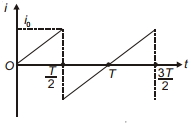
The mean value of current for half cycle for a current variation shown by the graph is
A
$\frac{i_0}{2}$
B
$i_0$
C
$\frac{i_0}{\sqrt{3}}$
D
$\frac{i_0}{3}$
Solution
(A) The mean value of current $i_{\text{mean}}$ over a time interval $t_1$ to $t_2$ is given by $i_{\text{mean}} = \frac{1}{t_2 - t_1} \int_{t_1}^{t_2} i(t) dt$.
For the first half cycle ($0$ to $T/2$),the current $i(t)$ represents a straight line passing through the origin with slope $m = \frac{i_0}{T/2} = \frac{2i_0}{T}$.
Thus,$i(t) = \frac{2i_0}{T} t$.
Now,calculating the mean current for the interval $0$ to $T/2$:
$i_{\text{mean}} = \frac{1}{T/2 - 0} \int_{0}^{T/2} \frac{2i_0}{T} t dt$
$i_{\text{mean}} = \frac{2}{T} \cdot \frac{2i_0}{T} \int_{0}^{T/2} t dt$
$i_{\text{mean}} = \frac{4i_0}{T^2} \left[ \frac{t^2}{2} \right]_{0}^{T/2}$
$i_{\text{mean}} = \frac{4i_0}{T^2} \cdot \frac{1}{2} \left( \frac{T^2}{4} - 0 \right)$
$i_{\text{mean}} = \frac{2i_0}{T^2} \cdot \frac{T^2}{4} = \frac{i_0}{2}$.
For the first half cycle ($0$ to $T/2$),the current $i(t)$ represents a straight line passing through the origin with slope $m = \frac{i_0}{T/2} = \frac{2i_0}{T}$.
Thus,$i(t) = \frac{2i_0}{T} t$.
Now,calculating the mean current for the interval $0$ to $T/2$:
$i_{\text{mean}} = \frac{1}{T/2 - 0} \int_{0}^{T/2} \frac{2i_0}{T} t dt$
$i_{\text{mean}} = \frac{2}{T} \cdot \frac{2i_0}{T} \int_{0}^{T/2} t dt$
$i_{\text{mean}} = \frac{4i_0}{T^2} \left[ \frac{t^2}{2} \right]_{0}^{T/2}$
$i_{\text{mean}} = \frac{4i_0}{T^2} \cdot \frac{1}{2} \left( \frac{T^2}{4} - 0 \right)$
$i_{\text{mean}} = \frac{2i_0}{T^2} \cdot \frac{T^2}{4} = \frac{i_0}{2}$.
0 likes
View Solution108
EasyMCQ
$A$ $110 \, V$ $d.c.$ heater is used on an $a.c.$ source,such that the heat produced is the same as it produces when connected to $110 \, V$ $d.c.$ in the same time intervals. What would be the $r.m.s.$ value of the alternating voltage?
A
$110$
B
$220$
C
$330$
D
$440$
Solution
(A) The heat produced by a heater in a resistance $R$ over time $t$ is given by $H = \frac{V^2}{R} t$.
For $d.c.$ voltage,$H_{dc} = \frac{V_{dc}^2}{R} t$.
For $a.c.$ voltage,the heat produced is determined by the $r.m.s.$ value of the voltage,$H_{ac} = \frac{V_{rms}^2}{R} t$.
Given that the heat produced is the same in both cases $(H_{ac} = H_{dc})$,we have:
$\frac{V_{rms}^2}{R} t = \frac{V_{dc}^2}{R} t$
$V_{rms}^2 = V_{dc}^2$
$V_{rms} = V_{dc}$
Given $V_{dc} = 110 \, V$,therefore $V_{rms} = 110 \, V$.
For $d.c.$ voltage,$H_{dc} = \frac{V_{dc}^2}{R} t$.
For $a.c.$ voltage,the heat produced is determined by the $r.m.s.$ value of the voltage,$H_{ac} = \frac{V_{rms}^2}{R} t$.
Given that the heat produced is the same in both cases $(H_{ac} = H_{dc})$,we have:
$\frac{V_{rms}^2}{R} t = \frac{V_{dc}^2}{R} t$
$V_{rms}^2 = V_{dc}^2$
$V_{rms} = V_{dc}$
Given $V_{dc} = 110 \, V$,therefore $V_{rms} = 110 \, V$.
0 likes
View Solution109
DifficultMCQ
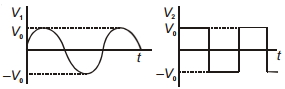
The sinusoidal potential difference $V_1$ shown in the figure is applied across a resistor $R$,producing heat at a rate $W$. What is the rate of heat dissipation when the square wave potential difference $V_2$ as shown in the figure is applied across the same resistor?
A
$\frac{W}{2}$
B
$W$
C
$\sqrt{2} W$
D
$2 W$
Solution
(D) The rate of heat dissipation (power) in a resistor is given by $P = \frac{V_{rms}^2}{R}$.
For the sinusoidal potential difference $V_1$ with peak value $V_0$,the root-mean-square $(RMS)$ voltage is $V_{rms} = \frac{V_0}{\sqrt{2}}$.
Thus,the rate of heat dissipation is $W = \frac{(V_0 / \sqrt{2})^2}{R} = \frac{V_0^2}{2R}$.
For the square wave potential difference $V_2$ with peak value $V_0$,the voltage alternates between $+V_0$ and $-V_0$. The $RMS$ value for this square wave is $V_{rms} = V_0$.
Thus,the new rate of heat dissipation is $W' = \frac{V_0^2}{R}$.
Comparing the two expressions:
$W' = 2 \times \left( \frac{V_0^2}{2R} \right) = 2W$.
Therefore,the rate of heat dissipation becomes $2W$.
For the sinusoidal potential difference $V_1$ with peak value $V_0$,the root-mean-square $(RMS)$ voltage is $V_{rms} = \frac{V_0}{\sqrt{2}}$.
Thus,the rate of heat dissipation is $W = \frac{(V_0 / \sqrt{2})^2}{R} = \frac{V_0^2}{2R}$.
For the square wave potential difference $V_2$ with peak value $V_0$,the voltage alternates between $+V_0$ and $-V_0$. The $RMS$ value for this square wave is $V_{rms} = V_0$.
Thus,the new rate of heat dissipation is $W' = \frac{V_0^2}{R}$.
Comparing the two expressions:
$W' = 2 \times \left( \frac{V_0^2}{2R} \right) = 2W$.
Therefore,the rate of heat dissipation becomes $2W$.
0 likes
View Solution110
MediumMCQ
An $AC$ source is rated $222 \,V, 60 \,Hz$. The average voltage is calculated in a time interval of $16.67 \,ms$. It
A
Must be zero
B
May be zero
C
Is never zero
D
Is $(111 \sqrt{2}) \,V$
Solution
(A) The time period $T$ of the $AC$ source is given by $T = \frac{1}{f} = \frac{1}{60 \,Hz} \approx 0.01667 \,s = 16.67 \,ms$.
The average value of an alternating voltage $V(t) = V_m \sin(\omega t)$ over one complete cycle (time interval $T$) is given by $V_{avg} = \frac{1}{T} \int_{0}^{T} V_m \sin(\omega t) \,dt$.
Since the integral of a sine function over one complete period is zero,the average voltage over $16.67 \,ms$ must be zero.
The average value of an alternating voltage $V(t) = V_m \sin(\omega t)$ over one complete cycle (time interval $T$) is given by $V_{avg} = \frac{1}{T} \int_{0}^{T} V_m \sin(\omega t) \,dt$.
Since the integral of a sine function over one complete period is zero,the average voltage over $16.67 \,ms$ must be zero.
0 likes
View Solution111
MediumMCQ
$A$ direct current of $5\,A$ is superposed on an alternating current $I = 10 \sin \omega t$ flowing through a wire. The effective value of the resulting current will be
A
$7.5\,A$
B
$5\sqrt{3}\,A$
C
$5\sqrt{5}\,A$
D
$15\,A$
Solution
(B) The total current $I$ flowing through the wire is given by the sum of the direct current and the alternating current: $I = 5 + 10 \sin \omega t$.
The effective value ($RMS$ value) of the current is defined as $I_{\text{eff}} = \sqrt{\frac{1}{T} \int_0^T I^2 dt}$.
Substituting the expression for $I$: $I_{\text{eff}} = \sqrt{\frac{1}{T} \int_0^T (5 + 10 \sin \omega t)^2 dt}$.
Expanding the square: $(5 + 10 \sin \omega t)^2 = 25 + 100 \sin^2 \omega t + 100 \sin \omega t$.
Integrating over one complete cycle $(T)$:
$1$. The integral of $25$ over $T$ is $25T$.
$2$. The integral of $100 \sin^2 \omega t$ over $T$ is $100 \times (T/2) = 50T$.
$3$. The integral of $100 \sin \omega t$ over $T$ is $0$.
Thus,$I_{\text{eff}} = \sqrt{\frac{1}{T} (25T + 50T + 0)} = \sqrt{25 + 50} = \sqrt{75} = 5\sqrt{3}\,A$.
The effective value ($RMS$ value) of the current is defined as $I_{\text{eff}} = \sqrt{\frac{1}{T} \int_0^T I^2 dt}$.
Substituting the expression for $I$: $I_{\text{eff}} = \sqrt{\frac{1}{T} \int_0^T (5 + 10 \sin \omega t)^2 dt}$.
Expanding the square: $(5 + 10 \sin \omega t)^2 = 25 + 100 \sin^2 \omega t + 100 \sin \omega t$.
Integrating over one complete cycle $(T)$:
$1$. The integral of $25$ over $T$ is $25T$.
$2$. The integral of $100 \sin^2 \omega t$ over $T$ is $100 \times (T/2) = 50T$.
$3$. The integral of $100 \sin \omega t$ over $T$ is $0$.
Thus,$I_{\text{eff}} = \sqrt{\frac{1}{T} (25T + 50T + 0)} = \sqrt{25 + 50} = \sqrt{75} = 5\sqrt{3}\,A$.
0 likes
View Solution112
MediumMCQ
$A$ standard filament lamp consumes $100\,W$ when connected to $200\,V$ $AC$ mains supply. The peak current through the bulb will be $........\,A$.
A
$0.707$
B
$1$
C
$1.414$
D
$2$
Solution
(A) The power consumed by the lamp is given by $P = V_{rms} \times I_{rms}$.
Given $P = 100\,W$ and $V_{rms} = 200\,V$.
Therefore,the root mean square current $I_{rms} = \frac{P}{V_{rms}} = \frac{100}{200} = 0.5\,A$.
The peak current $I_{peak}$ is related to the $RMS$ current by the formula $I_{peak} = I_{rms} \times \sqrt{2}$.
Substituting the value of $I_{rms}$,we get $I_{peak} = 0.5 \times \sqrt{2} = \frac{\sqrt{2}}{2} = \frac{1}{\sqrt{2}} \approx 0.707\,A$.
Given $P = 100\,W$ and $V_{rms} = 200\,V$.
Therefore,the root mean square current $I_{rms} = \frac{P}{V_{rms}} = \frac{100}{200} = 0.5\,A$.
The peak current $I_{peak}$ is related to the $RMS$ current by the formula $I_{peak} = I_{rms} \times \sqrt{2}$.
Substituting the value of $I_{rms}$,we get $I_{peak} = 0.5 \times \sqrt{2} = \frac{\sqrt{2}}{2} = \frac{1}{\sqrt{2}} \approx 0.707\,A$.
0 likes
View Solution113
DifficultMCQ
An alternating current at any instant is given by $i = [6 + \sqrt{56} \sin (100 \pi t + \frac{\pi}{3})] \ A$. The rms value of the current is . . . . . . . (in $A$)
A
$5$
B
$6$
C
$7$
D
$8$
Solution
(D) The given current is $i = I_{dc} + I_{ac} \sin(\omega t + \phi)$,where $I_{dc} = 6 \ A$ and the peak value of the alternating component is $I_m = \sqrt{56} \ A$.
The root mean square (rms) value of a composite current is given by the formula $I_{\text{rms}} = \sqrt{I_{dc}^2 + \frac{I_m^2}{2}}$.
Substituting the values:
$I_{\text{rms}} = \sqrt{6^2 + \frac{(\sqrt{56})^2}{2}}$
$I_{\text{rms}} = \sqrt{36 + \frac{56}{2}}$
$I_{\text{rms}} = \sqrt{36 + 28}$
$I_{\text{rms}} = \sqrt{64}$
$I_{\text{rms}} = 8 \ A$.
The root mean square (rms) value of a composite current is given by the formula $I_{\text{rms}} = \sqrt{I_{dc}^2 + \frac{I_m^2}{2}}$.
Substituting the values:
$I_{\text{rms}} = \sqrt{6^2 + \frac{(\sqrt{56})^2}{2}}$
$I_{\text{rms}} = \sqrt{36 + \frac{56}{2}}$
$I_{\text{rms}} = \sqrt{36 + 28}$
$I_{\text{rms}} = \sqrt{64}$
$I_{\text{rms}} = 8 \ A$.
0 likes
View Solution114
AdvancedMCQ
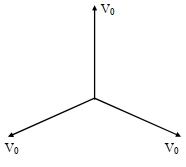
The instantaneous voltages at three terminals marked $X, Y$ and $Z$ are given by
$V_x = V_0 \sin \omega t$
$V_y = V_0 \sin \left(\omega t + \frac{2 \pi}{3}\right)$
$V_z = V_0 \sin \left(\omega t + \frac{4 \pi}{3}\right)$
An ideal voltmeter is configured to read the $rms$ value of the potential difference between its terminals. It is connected between points $X$ and $Y$ and then between $Y$ and $Z$. The reading$(s)$ of the voltmeter will be:
$[A]$ $V_{XY}^{rms} = V_0 \sqrt{\frac{3}{2}}$
$[B]$ $V_{YZ}^{rms} = V_0 \sqrt{\frac{1}{2}}$
$[C]$ $V_{XY}^{rms} = V_0$
$[D]$ independent of the choice of the two terminals
$V_x = V_0 \sin \omega t$
$V_y = V_0 \sin \left(\omega t + \frac{2 \pi}{3}\right)$
$V_z = V_0 \sin \left(\omega t + \frac{4 \pi}{3}\right)$
An ideal voltmeter is configured to read the $rms$ value of the potential difference between its terminals. It is connected between points $X$ and $Y$ and then between $Y$ and $Z$. The reading$(s)$ of the voltmeter will be:
$[A]$ $V_{XY}^{rms} = V_0 \sqrt{\frac{3}{2}}$
$[B]$ $V_{YZ}^{rms} = V_0 \sqrt{\frac{1}{2}}$
$[C]$ $V_{XY}^{rms} = V_0$
$[D]$ independent of the choice of the two terminals
A
$A, C$
B
$A, B$
C
$A, D$
D
$A, C, D$
Solution
(C) The potential difference between terminals $X$ and $Y$ is $V_{XY} = V_x - V_y = V_0 [\sin \omega t - \sin(\omega t + 2\pi/3)]$.
Using the formula $\sin A - \sin B = 2 \sin((A-B)/2) \cos((A+B)/2)$,we get:
$V_{XY} = V_0 [2 \sin(-\pi/3) \cos(\omega t + \pi/3)] = V_0 [2 \cdot (-\sqrt{3}/2) \cos(\omega t + \pi/3)] = -\sqrt{3} V_0 \cos(\omega t + \pi/3) = \sqrt{3} V_0 \sin(\omega t + \pi/3 - \pi/2) = \sqrt{3} V_0 \sin(\omega t - \pi/6)$.
The peak value of $V_{XY}$ is $\sqrt{3} V_0$. The $rms$ value is $V_{XY}^{rms} = \frac{\sqrt{3} V_0}{\sqrt{2}} = V_0 \sqrt{\frac{3}{2}}$.
Similarly,for $V_{YZ} = V_y - V_z$,the peak value is also $\sqrt{3} V_0$,so $V_{YZ}^{rms} = V_0 \sqrt{\frac{3}{2}}$.
Thus,both $V_{XY}^{rms}$ and $V_{YZ}^{rms}$ are equal to $V_0 \sqrt{\frac{3}{2}}$. Therefore,options $A$ and $D$ are correct.
Using the formula $\sin A - \sin B = 2 \sin((A-B)/2) \cos((A+B)/2)$,we get:
$V_{XY} = V_0 [2 \sin(-\pi/3) \cos(\omega t + \pi/3)] = V_0 [2 \cdot (-\sqrt{3}/2) \cos(\omega t + \pi/3)] = -\sqrt{3} V_0 \cos(\omega t + \pi/3) = \sqrt{3} V_0 \sin(\omega t + \pi/3 - \pi/2) = \sqrt{3} V_0 \sin(\omega t - \pi/6)$.
The peak value of $V_{XY}$ is $\sqrt{3} V_0$. The $rms$ value is $V_{XY}^{rms} = \frac{\sqrt{3} V_0}{\sqrt{2}} = V_0 \sqrt{\frac{3}{2}}$.
Similarly,for $V_{YZ} = V_y - V_z$,the peak value is also $\sqrt{3} V_0$,so $V_{YZ}^{rms} = V_0 \sqrt{\frac{3}{2}}$.
Thus,both $V_{XY}^{rms}$ and $V_{YZ}^{rms}$ are equal to $V_0 \sqrt{\frac{3}{2}}$. Therefore,options $A$ and $D$ are correct.
0 likes
View Solution115
MediumMCQ
An alternating current is given by $I = I_A \sin \omega t + I_B \cos \omega t$. The r.m.s. current will be
A
$\sqrt{I_A^2 + I_B^2}$
B
$\frac{\sqrt{I_A^2 + I_B^2}}{2}$
C
$\sqrt{\frac{I_A^2 + I_B^2}{2}}$
D
$\frac{|I_A + I_B|}{\sqrt{2}}$
Solution
(C) The given current is $I = I_A \sin \omega t + I_B \cos \omega t$.
We can rewrite this as $I = \sqrt{I_A^2 + I_B^2} \sin(\omega t + \phi)$,where $\tan \phi = \frac{I_B}{I_A}$.
This represents a sinusoidal current with peak value $I_0 = \sqrt{I_A^2 + I_B^2}$.
The r.m.s. value of a sinusoidal current $I = I_0 \sin(\omega t + \phi)$ is given by $I_{rms} = \frac{I_0}{\sqrt{2}}$.
Substituting the value of $I_0$,we get $I_{rms} = \frac{\sqrt{I_A^2 + I_B^2}}{\sqrt{2}} = \sqrt{\frac{I_A^2 + I_B^2}{2}}$.
We can rewrite this as $I = \sqrt{I_A^2 + I_B^2} \sin(\omega t + \phi)$,where $\tan \phi = \frac{I_B}{I_A}$.
This represents a sinusoidal current with peak value $I_0 = \sqrt{I_A^2 + I_B^2}$.
The r.m.s. value of a sinusoidal current $I = I_0 \sin(\omega t + \phi)$ is given by $I_{rms} = \frac{I_0}{\sqrt{2}}$.
Substituting the value of $I_0$,we get $I_{rms} = \frac{\sqrt{I_A^2 + I_B^2}}{\sqrt{2}} = \sqrt{\frac{I_A^2 + I_B^2}{2}}$.
0 likes
View Solution116
MediumMCQ
An electric bulb rated as $100 \ W-220 \ V$ is connected to an $ac$ source of $rms$ voltage $220 \ V$. The peak value of current through the bulb is: (in $A$)
A
$0.64$
B
$0.45$
C
$2.2$
D
$0.32$
Solution
(A) The power rating of the bulb is $P = 100 \ W$ and the voltage rating is $V_{rms} = 220 \ V$.
Using the formula for power in an $ac$ circuit,$P = V_{rms} \times I_{rms}$.
Therefore,the $rms$ current is $I_{rms} = \frac{P}{V_{rms}} = \frac{100}{220} \approx 0.4545 \ A$.
The peak current $I_0$ is related to the $rms$ current by the relation $I_0 = \sqrt{2} \times I_{rms}$.
Substituting the values,$I_0 = 1.414 \times 0.4545 \approx 0.64 \ A$.
Using the formula for power in an $ac$ circuit,$P = V_{rms} \times I_{rms}$.
Therefore,the $rms$ current is $I_{rms} = \frac{P}{V_{rms}} = \frac{100}{220} \approx 0.4545 \ A$.
The peak current $I_0$ is related to the $rms$ current by the relation $I_0 = \sqrt{2} \times I_{rms}$.
Substituting the values,$I_0 = 1.414 \times 0.4545 \approx 0.64 \ A$.
0 likes
View Solution117
MediumMCQ
An alternating current is represented by the equation,$i = 100 \sqrt{2} \sin(100 \pi t) \ A$. The $\text{RMS}$ value of current and the frequency of the given alternating current are:
A
$100 \sqrt{2} \ A, 100 \ Hz$
B
$\frac{100}{\sqrt{2}} \ A, 100 \ Hz$
C
$100 \ A, 50 \ Hz$
D
$50 \sqrt{2} \ A, 50 \ Hz$
Solution
(C) The standard equation for alternating current is $i = i_0 \sin(\omega t)$.
Comparing this with the given equation $i = 100 \sqrt{2} \sin(100 \pi t)$,we get the peak current $i_0 = 100 \sqrt{2} \ A$ and angular frequency $\omega = 100 \pi \ rad/s$.
The $\text{RMS}$ value of current is given by $i_{rms} = \frac{i_0}{\sqrt{2}} = \frac{100 \sqrt{2}}{\sqrt{2}} = 100 \ A$.
The frequency $f$ is given by $f = \frac{\omega}{2 \pi} = \frac{100 \pi}{2 \pi} = 50 \ Hz$.
Thus,the $\text{RMS}$ value is $100 \ A$ and the frequency is $50 \ Hz$.
Comparing this with the given equation $i = 100 \sqrt{2} \sin(100 \pi t)$,we get the peak current $i_0 = 100 \sqrt{2} \ A$ and angular frequency $\omega = 100 \pi \ rad/s$.
The $\text{RMS}$ value of current is given by $i_{rms} = \frac{i_0}{\sqrt{2}} = \frac{100 \sqrt{2}}{\sqrt{2}} = 100 \ A$.
The frequency $f$ is given by $f = \frac{\omega}{2 \pi} = \frac{100 \pi}{2 \pi} = 50 \ Hz$.
Thus,the $\text{RMS}$ value is $100 \ A$ and the frequency is $50 \ Hz$.
0 likes
View Solution118
MediumMCQ
An $ac$ current is represented as $i = 5 \sqrt{2} + 10 \cos \left(650 \pi t + \frac{\pi}{6}\right) \text{ A}$. The $r.m.s$ value of the current is:
A
$50 \text{ A}$
B
$100 \text{ A}$
C
$10 \text{ A}$
D
$5 \sqrt{2} \text{ A}$
Solution
(C) The given current is $i = 5 \sqrt{2} + 10 \cos \left(650 \pi t + \frac{\pi}{6}\right)$.
To find the $r.m.s$ value,we use the formula $I_{rms} = \sqrt{\langle i^2 \rangle}$.
First,calculate $i^2 = \left(5 \sqrt{2} + 10 \cos \left(650 \pi t + \frac{\pi}{6}\right)\right)^2$.
$i^2 = (5 \sqrt{2})^2 + (10 \cos \left(650 \pi t + \frac{\pi}{6}\right))^2 + 2(5 \sqrt{2})(10 \cos \left(650 \pi t + \frac{\pi}{6}\right))$.
$i^2 = 50 + 100 \cos^2 \left(650 \pi t + \frac{\pi}{6}\right) + 100 \sqrt{2} \cos \left(650 \pi t + \frac{\pi}{6}\right)$.
Taking the average over a full cycle,$\langle \cos \theta \rangle = 0$ and $\langle \cos^2 \theta \rangle = \frac{1}{2}$.
$\langle i^2 \rangle = 50 + 100 \left(\frac{1}{2}\right) + 0 = 50 + 50 = 100$.
Therefore,$I_{rms} = \sqrt{100} = 10 \text{ A}$.
To find the $r.m.s$ value,we use the formula $I_{rms} = \sqrt{\langle i^2 \rangle}$.
First,calculate $i^2 = \left(5 \sqrt{2} + 10 \cos \left(650 \pi t + \frac{\pi}{6}\right)\right)^2$.
$i^2 = (5 \sqrt{2})^2 + (10 \cos \left(650 \pi t + \frac{\pi}{6}\right))^2 + 2(5 \sqrt{2})(10 \cos \left(650 \pi t + \frac{\pi}{6}\right))$.
$i^2 = 50 + 100 \cos^2 \left(650 \pi t + \frac{\pi}{6}\right) + 100 \sqrt{2} \cos \left(650 \pi t + \frac{\pi}{6}\right)$.
Taking the average over a full cycle,$\langle \cos \theta \rangle = 0$ and $\langle \cos^2 \theta \rangle = \frac{1}{2}$.
$\langle i^2 \rangle = 50 + 100 \left(\frac{1}{2}\right) + 0 = 50 + 50 = 100$.
Therefore,$I_{rms} = \sqrt{100} = 10 \text{ A}$.
0 likes
View Solution119
MediumMCQ
The $r.m.s.$ value of the current $i = 3 + 4 \sin(\omega t + \pi/3)$ is:
A
$5 \ A$
B
$\sqrt{17} \ A$
C
$\frac{5}{\sqrt{2}} \ A$
D
$\frac{7}{\sqrt{2}} \ A$
Solution
(B) The given current is $i = 3 + 4 \sin(\omega t + \pi/3)$.
To find the $r.m.s.$ value,we use the formula $I_{rms} = \sqrt{\langle i^2 \rangle}$.
First,calculate $i^2 = (3 + 4 \sin(\omega t + \pi/3))^2 = 9 + 16 \sin^2(\omega t + \pi/3) + 24 \sin(\omega t + \pi/3)$.
Taking the average over a full cycle,$\langle 9 \rangle = 9$,$\langle \sin^2(\omega t + \pi/3) \rangle = 1/2$,and $\langle \sin(\omega t + \pi/3) \rangle = 0$.
Thus,$\langle i^2 \rangle = 9 + 16(1/2) + 24(0) = 9 + 8 = 17$.
Therefore,$I_{rms} = \sqrt{17} \ A$.
To find the $r.m.s.$ value,we use the formula $I_{rms} = \sqrt{\langle i^2 \rangle}$.
First,calculate $i^2 = (3 + 4 \sin(\omega t + \pi/3))^2 = 9 + 16 \sin^2(\omega t + \pi/3) + 24 \sin(\omega t + \pi/3)$.
Taking the average over a full cycle,$\langle 9 \rangle = 9$,$\langle \sin^2(\omega t + \pi/3) \rangle = 1/2$,and $\langle \sin(\omega t + \pi/3) \rangle = 0$.
Thus,$\langle i^2 \rangle = 9 + 16(1/2) + 24(0) = 9 + 8 = 17$.
Therefore,$I_{rms} = \sqrt{17} \ A$.
0 likes
View Solution120
MediumMCQ
Match the following current $\text{r.m.s.}$ values:
| $(A) \ x_0 \sin \omega t$ | $(i) \ x_0$ |
| $(B) \ x_0 \sin \omega t \cos \omega t$ | $(ii) \ \frac{x_0}{\sqrt{2}}$ |
| $(C) \ x_0 \sin \omega t + x_0 \cos \omega t$ | $(iii) \ \frac{x_0}{2 \sqrt{2}}$ |
A
$(A \rightarrow i), (B \rightarrow ii), (C \rightarrow iii)$
B
$(A \rightarrow ii), (B \rightarrow iii), (C \rightarrow i)$
C
$(A \rightarrow i), (B \rightarrow iii), (C \rightarrow ii)$
D
None
Solution
(B) $(1)$ For $x = x_0 \sin \omega t$, the peak value is $x_0$. The $\text{r.m.s.}$ value is $\frac{x_0}{\sqrt{2}}$. Thus, $(A \rightarrow ii)$.
$(2)$ For $x = x_0 \sin \omega t \cos \omega t = \frac{x_0}{2} \sin(2 \omega t)$, the peak value is $\frac{x_0}{2}$. The $\text{r.m.s.}$ value is $\frac{x_0/2}{\sqrt{2}} = \frac{x_0}{2 \sqrt{2}}$. Thus, $(B \rightarrow iii)$.
$(3)$ For $x = x_0 \sin \omega t + x_0 \cos \omega t = x_0 \sqrt{2} \sin(\omega t + \pi/4)$, the peak value is $x_0 \sqrt{2}$. The $\text{r.m.s.}$ value is $\frac{x_0 \sqrt{2}}{\sqrt{2}} = x_0$. Thus, $(C \rightarrow i)$.
Therefore, the correct matching is $(A \rightarrow ii), (B \rightarrow iii), (C \rightarrow i)$.
$(2)$ For $x = x_0 \sin \omega t \cos \omega t = \frac{x_0}{2} \sin(2 \omega t)$, the peak value is $\frac{x_0}{2}$. The $\text{r.m.s.}$ value is $\frac{x_0/2}{\sqrt{2}} = \frac{x_0}{2 \sqrt{2}}$. Thus, $(B \rightarrow iii)$.
$(3)$ For $x = x_0 \sin \omega t + x_0 \cos \omega t = x_0 \sqrt{2} \sin(\omega t + \pi/4)$, the peak value is $x_0 \sqrt{2}$. The $\text{r.m.s.}$ value is $\frac{x_0 \sqrt{2}}{\sqrt{2}} = x_0$. Thus, $(C \rightarrow i)$.
Therefore, the correct matching is $(A \rightarrow ii), (B \rightarrow iii), (C \rightarrow i)$.
0 likes
View Solution121
EasyMCQ
The instantaneous value of current in an $A.C.$ circuit is $I = 3 \sin \left(50 \pi t + \frac{\pi}{4}\right) \text{ A}$. The current will be maximum for the first time at
A
$\frac{1}{50} \text{ s}$
B
$\frac{1}{100} \text{ s}$
C
$\frac{1}{200} \text{ s}$
D
$\frac{1}{600} \text{ s}$
Solution
(C) The instantaneous current is given by $I = 3 \sin \left(50 \pi t + \frac{\pi}{4}\right)$.
For the current to be maximum,the sine function must be equal to $1$,which means the argument of the sine function must be $\frac{\pi}{2}$.
So,$50 \pi t + \frac{\pi}{4} = \frac{\pi}{2}$.
Subtracting $\frac{\pi}{4}$ from both sides,we get $50 \pi t = \frac{\pi}{2} - \frac{\pi}{4} = \frac{\pi}{4}$.
Dividing by $50 \pi$,we get $t = \frac{\pi}{4 \times 50 \pi} = \frac{1}{200} \text{ s}$.
For the current to be maximum,the sine function must be equal to $1$,which means the argument of the sine function must be $\frac{\pi}{2}$.
So,$50 \pi t + \frac{\pi}{4} = \frac{\pi}{2}$.
Subtracting $\frac{\pi}{4}$ from both sides,we get $50 \pi t = \frac{\pi}{2} - \frac{\pi}{4} = \frac{\pi}{4}$.
Dividing by $50 \pi$,we get $t = \frac{\pi}{4 \times 50 \pi} = \frac{1}{200} \text{ s}$.
0 likes
View Solution122
EasyMCQ
An alternating e.m.f. is given by $e = e_0 \sin \omega t$. In how much time will the e.m.f. have half its maximum value,if $e$ starts from zero? $(T = \text{time period}, \sin 30^{\circ} = 1/2)$
A
$T/8$
B
$T/4$
C
$T/12$
D
$T/16$
Solution
(C) The given equation for alternating e.m.f. is $e = e_0 \sin \omega t$.
We want to find the time $t$ when $e = e_0/2$.
Substituting this into the equation: $e_0/2 = e_0 \sin \omega t$.
This simplifies to $\sin \omega t = 1/2$.
Since $\sin 30^{\circ} = 1/2$ and $30^{\circ} = \pi/6$ radians,we have $\omega t = \pi/6$.
We know that $\omega = 2\pi/T$,where $T$ is the time period.
Substituting $\omega$ into the equation: $(2\pi/T) \cdot t = \pi/6$.
Solving for $t$: $t = (\pi/6) \cdot (T/2\pi) = T/12$.
Thus,the time taken is $T/12$.
We want to find the time $t$ when $e = e_0/2$.
Substituting this into the equation: $e_0/2 = e_0 \sin \omega t$.
This simplifies to $\sin \omega t = 1/2$.
Since $\sin 30^{\circ} = 1/2$ and $30^{\circ} = \pi/6$ radians,we have $\omega t = \pi/6$.
We know that $\omega = 2\pi/T$,where $T$ is the time period.
Substituting $\omega$ into the equation: $(2\pi/T) \cdot t = \pi/6$.
Solving for $t$: $t = (\pi/6) \cdot (T/2\pi) = T/12$.
Thus,the time taken is $T/12$.
0 likes
View Solution123
EasyMCQ
In an a.c. circuit $I=100 \sin 200 \pi t$. The time required for the current to achieve its peak value will be
A
$\frac{1}{100} \ s$
B
$\frac{1}{200} \ s$
C
$\frac{1}{300} \ s$
D
$\frac{1}{400} \ s$
Solution
(D) The given equation for the alternating current is $I = 100 \sin(200 \pi t)$.
Comparing this with the standard form $I = I_0 \sin(\omega t)$,the peak value $I_0$ is $100 \ A$.
The current reaches its peak value when $\sin(200 \pi t) = 1$.
This occurs when the argument of the sine function is equal to $\frac{\pi}{2}$.
So,$200 \pi t = \frac{\pi}{2}$.
Dividing both sides by $\pi$,we get $200 t = \frac{1}{2}$.
Therefore,$t = \frac{1}{2 \times 200} = \frac{1}{400} \ s$.
Comparing this with the standard form $I = I_0 \sin(\omega t)$,the peak value $I_0$ is $100 \ A$.
The current reaches its peak value when $\sin(200 \pi t) = 1$.
This occurs when the argument of the sine function is equal to $\frac{\pi}{2}$.
So,$200 \pi t = \frac{\pi}{2}$.
Dividing both sides by $\pi$,we get $200 t = \frac{1}{2}$.
Therefore,$t = \frac{1}{2 \times 200} = \frac{1}{400} \ s$.
0 likes
View Solution124
MediumMCQ
An alternating current is given by $I=100 \sin (50 \pi t)$. How many times will the current become zero in one second (in $times$)?
A
$50$
B
$25$
C
$40$
D
$100$
Solution
(A) The given alternating current equation is $I = I_0 \sin(\omega t)$.
Comparing this with the given equation $I = 100 \sin(50 \pi t)$, we get angular frequency $\omega = 50 \pi \text{ rad/s}$.
We know that $\omega = 2 \pi f$, where $f$ is the frequency.
So, $2 \pi f = 50 \pi$, which gives $f = 25 \text{ Hz}$.
This means the current completes $25$ cycles in one second.
In one complete cycle of a sine wave, the current becomes zero twice (at the start/end and at the half-cycle point).
Therefore, in $25$ cycles, the current will become zero $25 \times 2 = 50$ times in one second.
Comparing this with the given equation $I = 100 \sin(50 \pi t)$, we get angular frequency $\omega = 50 \pi \text{ rad/s}$.
We know that $\omega = 2 \pi f$, where $f$ is the frequency.
So, $2 \pi f = 50 \pi$, which gives $f = 25 \text{ Hz}$.
This means the current completes $25$ cycles in one second.
In one complete cycle of a sine wave, the current becomes zero twice (at the start/end and at the half-cycle point).
Therefore, in $25$ cycles, the current will become zero $25 \times 2 = 50$ times in one second.
0 likes
View Solution125
DifficultMCQ
The alternating voltage is given by $v=v_0 \sin \left(\omega t+\frac{\pi}{3}\right)$. When will the voltage be maximum for the first time?
A
$\frac{T}{6}$
B
$\frac{T}{3}$
C
$\frac{T}{2}$
D
$\frac{T}{12}$
Solution
(D) For the voltage to be maximum,the sine function must equal $1$.
$\sin \left(\omega t+\frac{\pi}{3}\right) = 1$
Since $\sin \left(\frac{\pi}{2}\right) = 1$,we have:
$\omega t + \frac{\pi}{3} = \frac{\pi}{2}$
$\omega t = \frac{\pi}{2} - \frac{\pi}{3}$
$\omega t = \frac{\pi}{6}$
Substituting $\omega = \frac{2\pi}{T}$:
$\left(\frac{2\pi}{T}\right) t = \frac{\pi}{6}$
$t = \frac{\pi}{6} \times \frac{T}{2\pi}$
$t = \frac{T}{12}$
$\sin \left(\omega t+\frac{\pi}{3}\right) = 1$
Since $\sin \left(\frac{\pi}{2}\right) = 1$,we have:
$\omega t + \frac{\pi}{3} = \frac{\pi}{2}$
$\omega t = \frac{\pi}{2} - \frac{\pi}{3}$
$\omega t = \frac{\pi}{6}$
Substituting $\omega = \frac{2\pi}{T}$:
$\left(\frac{2\pi}{T}\right) t = \frac{\pi}{6}$
$t = \frac{\pi}{6} \times \frac{T}{2\pi}$
$t = \frac{T}{12}$
0 likes
View Solution126
MediumMCQ
The a.c. source of e.m.f. with instantaneous value $e$ is given by $e = 200 \sin(50t) \text{ V}$. The r.m.s. value of current in a circuit of resistance $50 \ \Omega$ is: (in $\text{ A}$)
A
$0.2828$
B
$2.828$
C
$28.28$
D
$282.8$
Solution
(B) The instantaneous e.m.f. is given by $e = 200 \sin(50t) \text{ V}$.
Comparing this with the standard equation $e = e_0 \sin(\omega t)$, we get the peak e.m.f. $e_0 = 200 \text{ V}$.
The peak current $I_0$ is calculated using Ohm's law: $I_0 = \frac{e_0}{R} = \frac{200}{50} = 4 \text{ A}$.
The r.m.s. value of current $I_{\text{rms}}$ is given by the formula $I_{\text{rms}} = \frac{I_0}{\sqrt{2}}$.
Substituting the values: $I_{\text{rms}} = \frac{4}{\sqrt{2}} = 2 \sqrt{2} \text{ A}$.
Since $\sqrt{2} \approx 1.414$, we have $I_{\text{rms}} = 2 \times 1.414 = 2.828 \text{ A}$.
Comparing this with the standard equation $e = e_0 \sin(\omega t)$, we get the peak e.m.f. $e_0 = 200 \text{ V}$.
The peak current $I_0$ is calculated using Ohm's law: $I_0 = \frac{e_0}{R} = \frac{200}{50} = 4 \text{ A}$.
The r.m.s. value of current $I_{\text{rms}}$ is given by the formula $I_{\text{rms}} = \frac{I_0}{\sqrt{2}}$.
Substituting the values: $I_{\text{rms}} = \frac{4}{\sqrt{2}} = 2 \sqrt{2} \text{ A}$.
Since $\sqrt{2} \approx 1.414$, we have $I_{\text{rms}} = 2 \times 1.414 = 2.828 \text{ A}$.
0 likes
View Solution127
EasyMCQ
In an $a.c.$ circuit,the instantaneous current and $emf$ are represented as $I = I_0 \sin(\omega t - \pi / 6)$ and $E = E_0 \sin(\omega t + \pi / 3)$ respectively. The voltage leads the current by
A
$\pi / 2$
B
$\pi / 4$
C
$\pi / 3$
D
$\pi / 6$
Solution
(A) The phase of the current is $\phi_I = \omega t - \pi / 6$.
The phase of the voltage is $\phi_E = \omega t + \pi / 3$.
The phase difference between voltage and current is given by $\Delta \phi = \phi_E - \phi_I$.
Substituting the values,we get $\Delta \phi = (\omega t + \pi / 3) - (\omega t - \pi / 6)$.
$\Delta \phi = \pi / 3 + \pi / 6 = 2\pi / 6 + \pi / 6 = 3\pi / 6 = \pi / 2$.
Since $\Delta \phi$ is positive,the voltage leads the current by $\pi / 2$.
The phase of the voltage is $\phi_E = \omega t + \pi / 3$.
The phase difference between voltage and current is given by $\Delta \phi = \phi_E - \phi_I$.
Substituting the values,we get $\Delta \phi = (\omega t + \pi / 3) - (\omega t - \pi / 6)$.
$\Delta \phi = \pi / 3 + \pi / 6 = 2\pi / 6 + \pi / 6 = 3\pi / 6 = \pi / 2$.
Since $\Delta \phi$ is positive,the voltage leads the current by $\pi / 2$.
0 likes
View Solution128
MediumMCQ
$A$ group of lamps having a total power rating of $1000 \,W$ is supplied by an $AC$ voltage of $E = 200 \sin(310t + 60^{\circ})$. The $r.m.s.$ value of the current flowing through the circuit is:
A
$10 \,A$
B
$5 \sqrt{2} \,A$
C
$20 \,A$
D
$10 \sqrt{2} \,A$
Solution
(B) The power in an $AC$ circuit is given by $P = V_{rms} I_{rms} \cos \phi$.
Given $P = 1000 \,W$ and the peak voltage $V_0 = 200 \,V$.
The $r.m.s.$ voltage is $V_{rms} = \frac{V_0}{\sqrt{2}} = \frac{200}{\sqrt{2}} \,V$.
Assuming the lamps are purely resistive, the phase angle $\phi = 0^{\circ}$, so $\cos \phi = 1$.
Thus, $1000 = \left( \frac{200}{\sqrt{2}} \right) I_{rms} \times 1$.
$I_{rms} = \frac{1000 \times \sqrt{2}}{200} = 5 \sqrt{2} \,A$.
Given $P = 1000 \,W$ and the peak voltage $V_0 = 200 \,V$.
The $r.m.s.$ voltage is $V_{rms} = \frac{V_0}{\sqrt{2}} = \frac{200}{\sqrt{2}} \,V$.
Assuming the lamps are purely resistive, the phase angle $\phi = 0^{\circ}$, so $\cos \phi = 1$.
Thus, $1000 = \left( \frac{200}{\sqrt{2}} \right) I_{rms} \times 1$.
$I_{rms} = \frac{1000 \times \sqrt{2}}{200} = 5 \sqrt{2} \,A$.
0 likes
View Solution129
EasyMCQ
The instantaneous values of current and voltage in an $AC$ circuit are given by $I = 6 \sin(100 \pi t + \frac{\pi}{4})$ and $V = 5 \sin(100 \pi t - \frac{\pi}{4})$. Then,
A
voltage leads the current by $45^{\circ}$
B
current leads the voltage by $45^{\circ}$
C
voltage leads the current by $90^{\circ}$
D
current leads the voltage by $90^{\circ}$
Solution
(D) The instantaneous current is given by $I = 6 \sin(100 \pi t + \frac{\pi}{4})$.
The instantaneous voltage is given by $V = 5 \sin(100 \pi t - \frac{\pi}{4})$.
The phase of the current is $\phi_I = 100 \pi t + \frac{\pi}{4}$.
The phase of the voltage is $\phi_V = 100 \pi t - \frac{\pi}{4}$.
The phase difference between current and voltage is $\Delta \phi = \phi_I - \phi_V = (100 \pi t + \frac{\pi}{4}) - (100 \pi t - \frac{\pi}{4}) = \frac{\pi}{4} + \frac{\pi}{4} = \frac{\pi}{2}$.
Since $\Delta \phi = \frac{\pi}{2}$ (or $90^{\circ}$) and the phase of the current is greater than the phase of the voltage,the current leads the voltage by $90^{\circ}$.
The instantaneous voltage is given by $V = 5 \sin(100 \pi t - \frac{\pi}{4})$.
The phase of the current is $\phi_I = 100 \pi t + \frac{\pi}{4}$.
The phase of the voltage is $\phi_V = 100 \pi t - \frac{\pi}{4}$.
The phase difference between current and voltage is $\Delta \phi = \phi_I - \phi_V = (100 \pi t + \frac{\pi}{4}) - (100 \pi t - \frac{\pi}{4}) = \frac{\pi}{4} + \frac{\pi}{4} = \frac{\pi}{2}$.
Since $\Delta \phi = \frac{\pi}{2}$ (or $90^{\circ}$) and the phase of the current is greater than the phase of the voltage,the current leads the voltage by $90^{\circ}$.
0 likes
View Solution130
EasyMCQ
The average value of an $A$.$C$. voltage given by $V = V_{m} \sin(\omega t)$ over the time interval $t = 0$ to $t = \frac{\pi}{\omega}$ is:
A
$\frac{V_{m}}{\pi}$
B
$0$
C
$V_{m}$
D
$\frac{2 V_{m}}{\pi}$
Solution
(D) The average value of an $A$.$C$. voltage $V = V_{m} \sin(\omega t)$ over the time interval $t = 0$ to $t = \frac{\pi}{\omega}$ is calculated as follows:
$V_{av} = \frac{\int_{0}^{\frac{\pi}{\omega}} V dt}{\int_{0}^{\frac{\pi}{\omega}} dt}$
$V_{av} = \frac{\int_{0}^{\frac{\pi}{\omega}} V_{m} \sin(\omega t) dt}{\frac{\pi}{\omega} - 0}$
$V_{av} = \frac{V_{m}}{\frac{\pi}{\omega}} \left[ -\frac{\cos(\omega t)}{\omega} \right]_{0}^{\frac{\pi}{\omega}}$
$V_{av} = \frac{V_{m} \omega}{\pi} \left( -\frac{1}{\omega} \right) [\cos(\pi) - \cos(0)]$
$V_{av} = -\frac{V_{m}}{\pi} [-1 - 1]$
$V_{av} = -\frac{V_{m}}{\pi} [-2] = \frac{2 V_{m}}{\pi}$
$V_{av} = \frac{\int_{0}^{\frac{\pi}{\omega}} V dt}{\int_{0}^{\frac{\pi}{\omega}} dt}$
$V_{av} = \frac{\int_{0}^{\frac{\pi}{\omega}} V_{m} \sin(\omega t) dt}{\frac{\pi}{\omega} - 0}$
$V_{av} = \frac{V_{m}}{\frac{\pi}{\omega}} \left[ -\frac{\cos(\omega t)}{\omega} \right]_{0}^{\frac{\pi}{\omega}}$
$V_{av} = \frac{V_{m} \omega}{\pi} \left( -\frac{1}{\omega} \right) [\cos(\pi) - \cos(0)]$
$V_{av} = -\frac{V_{m}}{\pi} [-1 - 1]$
$V_{av} = -\frac{V_{m}}{\pi} [-2] = \frac{2 V_{m}}{\pi}$
0 likes
View Solution131
EasyMCQ
In an $A.C.$ circuit,the instantaneous current and $E.M.F.$ are represented as $i = i_0 \sin(\omega t - \frac{\pi}{6})$ and $E = E_0 \sin(\omega t + \frac{\pi}{3})$ respectively. The voltage leads the current by
A
$\frac{\pi}{2}$
B
$\frac{\pi}{4}$
C
$\frac{\pi}{3}$
D
$\frac{\pi}{6}$
Solution
(A) The phase of the current is $\phi_i = -\frac{\pi}{6}$.
The phase of the voltage is $\phi_E = +\frac{\pi}{3}$.
The phase difference $\phi$ by which the voltage leads the current is given by $\phi = \phi_E - \phi_i$.
Substituting the values,we get $\phi = \frac{\pi}{3} - (-\frac{\pi}{6})$.
$\phi = \frac{\pi}{3} + \frac{\pi}{6} = \frac{2\pi + \pi}{6} = \frac{3\pi}{6} = \frac{\pi}{2}$.
Therefore,the voltage leads the current by $\frac{\pi}{2}$.
The phase of the voltage is $\phi_E = +\frac{\pi}{3}$.
The phase difference $\phi$ by which the voltage leads the current is given by $\phi = \phi_E - \phi_i$.
Substituting the values,we get $\phi = \frac{\pi}{3} - (-\frac{\pi}{6})$.
$\phi = \frac{\pi}{3} + \frac{\pi}{6} = \frac{2\pi + \pi}{6} = \frac{3\pi}{6} = \frac{\pi}{2}$.
Therefore,the voltage leads the current by $\frac{\pi}{2}$.
0 likes
View Solution132
MediumMCQ
An alternating e.m.f. is given as $e = e_0 \sin \omega t$. In what time will the e.m.f. have half its maximum value if $e$ starts from zero?
$(T = \text{time period}, \sin 30^{\circ} = \cos 60^{\circ} = 0.5)$
$(T = \text{time period}, \sin 30^{\circ} = \cos 60^{\circ} = 0.5)$
A
$\frac{T}{12}$
B
$\frac{T}{8}$
C
$\frac{T}{16}$
D
$\frac{T}{4}$
Solution
(A) Let $t^{\prime}$ be the time when the e.m.f. is half its maximum value.
Given the equation $e = e_0 \sin \omega t$,we set $e = \frac{e_0}{2}$.
$\frac{e_0}{2} = e_0 \sin (\omega t^{\prime})$
$\frac{1}{2} = \sin (\omega t^{\prime})$
Since $\sin 30^{\circ} = 0.5$,we have $\omega t^{\prime} = \frac{\pi}{6}$.
Substituting $\omega = \frac{2\pi}{T}$,we get:
$(\frac{2\pi}{T}) t^{\prime} = \frac{\pi}{6}$
$t^{\prime} = \frac{T}{12}$.
Given the equation $e = e_0 \sin \omega t$,we set $e = \frac{e_0}{2}$.
$\frac{e_0}{2} = e_0 \sin (\omega t^{\prime})$
$\frac{1}{2} = \sin (\omega t^{\prime})$
Since $\sin 30^{\circ} = 0.5$,we have $\omega t^{\prime} = \frac{\pi}{6}$.
Substituting $\omega = \frac{2\pi}{T}$,we get:
$(\frac{2\pi}{T}) t^{\prime} = \frac{\pi}{6}$
$t^{\prime} = \frac{T}{12}$.
0 likes
View Solution133
EasyMCQ
An alternating voltage is represented by $V = 80 \sin(100 \pi t) \cos(100 \pi t) \text{ V}$. The peak voltage is (in $\text{ V}$)
A
$20$
B
$40$
C
$30$
D
$50$
Solution
(B) The given equation is $V = 80 \sin(100 \pi t) \cos(100 \pi t)$.
Using the trigonometric identity $\sin(2\theta) = 2 \sin \theta \cos \theta$,we can rewrite the equation as:
$V = 40 \times (2 \sin(100 \pi t) \cos(100 \pi t))$
$V = 40 \sin(200 \pi t)$.
Comparing this with the standard form of alternating voltage $V = V_0 \sin(\omega t)$,where $V_0$ is the peak voltage,
we get $V_0 = 40 \text{ V}$.
Using the trigonometric identity $\sin(2\theta) = 2 \sin \theta \cos \theta$,we can rewrite the equation as:
$V = 40 \times (2 \sin(100 \pi t) \cos(100 \pi t))$
$V = 40 \sin(200 \pi t)$.
Comparing this with the standard form of alternating voltage $V = V_0 \sin(\omega t)$,where $V_0$ is the peak voltage,
we get $V_0 = 40 \text{ V}$.
0 likes
View Solution134
MediumMCQ
The instantaneous value of an alternating current is given by $I = 50 \sin(100 \pi t)$. It will achieve a value of $25 \ A$ after a time interval of (given $\sin 30^{\circ} = 0.5$):
A
$\frac{1}{300} \ s$
B
$\frac{1}{100} \ s$
C
$\frac{1}{200} \ s$
D
$\frac{1}{600} \ s$
Solution
(D) The given equation for the instantaneous current is $I = 50 \sin(100 \pi t)$.
We need to find the time $t$ when $I = 25 \ A$.
Substituting the values into the equation:
$25 = 50 \sin(100 \pi t)$
$\frac{25}{50} = \sin(100 \pi t)$
$0.5 = \sin(100 \pi t)$
Since $\sin 30^{\circ} = 0.5$ and $30^{\circ} = \frac{\pi}{6}$ radians,we have:
$100 \pi t = \frac{\pi}{6}$
Dividing both sides by $100 \pi$:
$t = \frac{\pi}{6 \times 100 \pi}$
$t = \frac{1}{600} \ s$.
We need to find the time $t$ when $I = 25 \ A$.
Substituting the values into the equation:
$25 = 50 \sin(100 \pi t)$
$\frac{25}{50} = \sin(100 \pi t)$
$0.5 = \sin(100 \pi t)$
Since $\sin 30^{\circ} = 0.5$ and $30^{\circ} = \frac{\pi}{6}$ radians,we have:
$100 \pi t = \frac{\pi}{6}$
Dividing both sides by $100 \pi$:
$t = \frac{\pi}{6 \times 100 \pi}$
$t = \frac{1}{600} \ s$.
0 likes
View Solution135
EasyMCQ
The peak value of an alternating emf $e$ given by $e = e_0 \cos \omega t$ is $10 \ V$ and its frequency is $50 \ Hz$. At time $t = \frac{1}{600} \ s$,the instantaneous e.m.f is:
A
$10 \ V$
B
$\frac{10}{\sqrt{3}} \ V$
C
$5 \ V$
D
$5 \sqrt{3} \ V$
Solution
(D) The given equation for alternating emf is $e = e_0 \cos \omega t$.
Given peak value $e_0 = 10 \ V$ and frequency $f = 50 \ Hz$.
The angular frequency is $\omega = 2 \pi f = 2 \pi \times 50 = 100 \pi \ rad/s$.
Substituting the values into the equation at $t = \frac{1}{600} \ s$:
$e = 10 \cos(100 \pi \times \frac{1}{600})$
$e = 10 \cos(\frac{\pi}{6})$
Since $\cos(\frac{\pi}{6}) = \frac{\sqrt{3}}{2}$,we get:
$e = 10 \times \frac{\sqrt{3}}{2} = 5 \sqrt{3} \ V$.
Given peak value $e_0 = 10 \ V$ and frequency $f = 50 \ Hz$.
The angular frequency is $\omega = 2 \pi f = 2 \pi \times 50 = 100 \pi \ rad/s$.
Substituting the values into the equation at $t = \frac{1}{600} \ s$:
$e = 10 \cos(100 \pi \times \frac{1}{600})$
$e = 10 \cos(\frac{\pi}{6})$
Since $\cos(\frac{\pi}{6}) = \frac{\sqrt{3}}{2}$,we get:
$e = 10 \times \frac{\sqrt{3}}{2} = 5 \sqrt{3} \ V$.
0 likes
View Solution136
EasyMCQ
An alternating e.m.f. is $e = e_0 \sin \omega t$. In what time will the e.m.f. reach half its maximum value,if $e$ starts from zero? ($T$ = time period)
A
$\frac{T}{12}$
B
$\frac{T}{16}$
C
$\frac{T}{4}$
D
$\frac{T}{8}$
Solution
(A) Given the alternating e.m.f. equation: $e = e_0 \sin \omega t$.
We want to find the time $t$ when $e = \frac{e_0}{2}$.
Substituting the value into the equation: $\frac{e_0}{2} = e_0 \sin \omega t$.
This simplifies to: $\sin \omega t = \frac{1}{2}$.
Since $\sin 30^{\circ} = \frac{1}{2}$,we have $\omega t = 30^{\circ} = \frac{\pi}{6} \text{ radians}$.
Substituting $\omega = \frac{2\pi}{T}$: $\left( \frac{2\pi}{T} \right) t = \frac{\pi}{6}$.
Solving for $t$: $t = \frac{T}{12}$.
We want to find the time $t$ when $e = \frac{e_0}{2}$.
Substituting the value into the equation: $\frac{e_0}{2} = e_0 \sin \omega t$.
This simplifies to: $\sin \omega t = \frac{1}{2}$.
Since $\sin 30^{\circ} = \frac{1}{2}$,we have $\omega t = 30^{\circ} = \frac{\pi}{6} \text{ radians}$.
Substituting $\omega = \frac{2\pi}{T}$: $\left( \frac{2\pi}{T} \right) t = \frac{\pi}{6}$.
Solving for $t$: $t = \frac{T}{12}$.
0 likes
View Solution137
DifficultMCQ
An alternating e.m.f. is given by $e = e_{0} \sin(\omega t)$. In what time will the e.m.f. reach half its maximum value,if $e$ starts from zero? ($T$ = Time period)
A
$T/12$
B
$T/16$
C
$T/8$
D
$T/4$
Solution
(A) The given equation for the alternating e.m.f. is $e = e_{0} \sin(\omega t)$.
We know that $\omega = \frac{2\pi}{T}$,so the equation becomes $e = e_{0} \sin\left(\frac{2\pi t}{T}\right)$.
We want to find the time $t$ when $e = \frac{e_{0}}{2}$.
Substituting this into the equation: $\frac{e_{0}}{2} = e_{0} \sin\left(\frac{2\pi t}{T}\right)$.
$\frac{1}{2} = \sin\left(\frac{2\pi t}{T}\right)$.
Since $\sin(30^{\circ}) = \sin\left(\frac{\pi}{6}\right) = \frac{1}{2}$,we have $\frac{2\pi t}{T} = \frac{\pi}{6}$.
Solving for $t$: $t = \frac{\pi}{6} \times \frac{T}{2\pi} = \frac{T}{12}$.
We know that $\omega = \frac{2\pi}{T}$,so the equation becomes $e = e_{0} \sin\left(\frac{2\pi t}{T}\right)$.
We want to find the time $t$ when $e = \frac{e_{0}}{2}$.
Substituting this into the equation: $\frac{e_{0}}{2} = e_{0} \sin\left(\frac{2\pi t}{T}\right)$.
$\frac{1}{2} = \sin\left(\frac{2\pi t}{T}\right)$.
Since $\sin(30^{\circ}) = \sin\left(\frac{\pi}{6}\right) = \frac{1}{2}$,we have $\frac{2\pi t}{T} = \frac{\pi}{6}$.
Solving for $t$: $t = \frac{\pi}{6} \times \frac{T}{2\pi} = \frac{T}{12}$.
0 likes
View Solution138
MediumMCQ
An alternating current of frequency $50 \,Hz$ has a peak value of $14.14 \,A$. The time taken by the alternating current to reach from zero to its maximum value and the root mean square (r.m.s.) value of the current are respectively:
A
$0.025 \,s, 5 \,A$
B
$0.005 \,s, 5 \,A$
C
$0.005 \,s, 10 \,A$
D
$0.025 \,s, 10 \,A$
Solution
(C) Given frequency $f = 50 \,Hz$. The time period $T$ is given by $T = \frac{1}{f} = \frac{1}{50} = 0.02 \,s$.
The time taken to reach from zero to the maximum value (peak) is one-quarter of the time period:
$t = \frac{T}{4} = \frac{0.02}{4} = 0.005 \,s$.
The peak current $I_0 = 14.14 \,A$. The r.m.s. value of the current $I_{rms}$ is given by:
$I_{rms} = \frac{I_0}{\sqrt{2}} = \frac{14.14}{1.414} = 10 \,A$.
Thus,the time taken is $0.005 \,s$ and the r.m.s. value is $10 \,A$.
The time taken to reach from zero to the maximum value (peak) is one-quarter of the time period:
$t = \frac{T}{4} = \frac{0.02}{4} = 0.005 \,s$.
The peak current $I_0 = 14.14 \,A$. The r.m.s. value of the current $I_{rms}$ is given by:
$I_{rms} = \frac{I_0}{\sqrt{2}} = \frac{14.14}{1.414} = 10 \,A$.
Thus,the time taken is $0.005 \,s$ and the r.m.s. value is $10 \,A$.
0 likes
View Solution139
MediumMCQ
An alternating voltage is given by $E = 100 \sin \left(\omega t + \frac{\pi}{6}\right) \text{ V}$. The voltage will be maximum for the first time when $t$ is $(T = \text{periodic time})$:
A
$\frac{T}{12}$
B
$\frac{T}{2}$
C
$\frac{T}{6}$
D
$\frac{T}{3}$
Solution
(C) Given,the alternating voltage is $E = 100 \sin \left(\omega t + \frac{\pi}{6}\right) \text{ V}$.
For the voltage to be maximum,the sine term must be equal to $1$.
$\sin \left(\omega t + \frac{\pi}{6}\right) = 1$
Since $\sin \frac{\pi}{2} = 1$,we have:
$\omega t + \frac{\pi}{6} = \frac{\pi}{2}$
$\omega t = \frac{\pi}{2} - \frac{\pi}{6} = \frac{3\pi - \pi}{6} = \frac{2\pi}{6} = \frac{\pi}{3}$
Using the relation $\omega = \frac{2\pi}{T}$,we substitute $\omega$:
$\left(\frac{2\pi}{T}\right) t = \frac{\pi}{3}$
$t = \frac{\pi}{3} \times \frac{T}{2\pi} = \frac{T}{6}$
Thus,the voltage will be maximum for the first time at $t = \frac{T}{6}$.
For the voltage to be maximum,the sine term must be equal to $1$.
$\sin \left(\omega t + \frac{\pi}{6}\right) = 1$
Since $\sin \frac{\pi}{2} = 1$,we have:
$\omega t + \frac{\pi}{6} = \frac{\pi}{2}$
$\omega t = \frac{\pi}{2} - \frac{\pi}{6} = \frac{3\pi - \pi}{6} = \frac{2\pi}{6} = \frac{\pi}{3}$
Using the relation $\omega = \frac{2\pi}{T}$,we substitute $\omega$:
$\left(\frac{2\pi}{T}\right) t = \frac{\pi}{3}$
$t = \frac{\pi}{3} \times \frac{T}{2\pi} = \frac{T}{6}$
Thus,the voltage will be maximum for the first time at $t = \frac{T}{6}$.
0 likes
View Solution140
EasyMCQ
The average value of alternating current over a complete cycle is
A
zero
B
$I_{rms}$
C
$\frac{I_0}{\sqrt{2}}$
D
$2 I_0$
Solution
(A) The alternating current is represented by the equation $I = I_0 \sin(\omega t)$.
To find the average value over a complete cycle of period $T$,we integrate the current over the interval $[0, T]$ and divide by the total time $T$.
$I_{avg} = \frac{1}{T} \int_{0}^{T} I_0 \sin(\omega t) dt$.
Since $\omega = \frac{2\pi}{T}$,the integral of $\sin(\omega t)$ over a full period is zero because the positive area of the sine wave cancels out the negative area.
Therefore,the average value of alternating current over a complete cycle is $0$.
To find the average value over a complete cycle of period $T$,we integrate the current over the interval $[0, T]$ and divide by the total time $T$.
$I_{avg} = \frac{1}{T} \int_{0}^{T} I_0 \sin(\omega t) dt$.
Since $\omega = \frac{2\pi}{T}$,the integral of $\sin(\omega t)$ over a full period is zero because the positive area of the sine wave cancels out the negative area.
Therefore,the average value of alternating current over a complete cycle is $0$.
0 likes
View Solution141
EasyMCQ
The instantaneous value of an $AC$ is given by $I = 5 \sin (\omega t + \phi) \text{ A}$. The rms value of current is
A
$5 \text{ A}$
B
$\frac{5}{\sqrt{2}} \text{ A}$
C
$5 \sqrt{2} \text{ A}$
D
$2.5 \text{ A}$
Solution
(B) The instantaneous current is given by the equation $I = I_{0} \sin (\omega t + \phi)$,where $I_{0}$ is the peak current.
Comparing this with the given equation $I = 5 \sin (\omega t + \phi)$,we find the peak current $I_{0} = 5 \text{ A}$.
The root mean square $(rms)$ value of an alternating current is related to the peak current by the formula $I_{rms} = \frac{I_{0}}{\sqrt{2}}$.
Substituting the value of $I_{0}$,we get $I_{rms} = \frac{5}{\sqrt{2}} \text{ A}$.
Comparing this with the given equation $I = 5 \sin (\omega t + \phi)$,we find the peak current $I_{0} = 5 \text{ A}$.
The root mean square $(rms)$ value of an alternating current is related to the peak current by the formula $I_{rms} = \frac{I_{0}}{\sqrt{2}}$.
Substituting the value of $I_{0}$,we get $I_{rms} = \frac{5}{\sqrt{2}} \text{ A}$.
0 likes
View Solution142
MediumMCQ
One complete set of negative and positive values of alternating quantities is called
A
time period
B
amplitude
C
frequency
D
cycle
Solution
(D) An alternating quantity varies periodically with time. One complete set of positive and negative values of an alternating quantity is defined as a $cycle$. It represents the complete variation of the quantity before it starts repeating itself.
0 likes
View Solution143
EasyMCQ
The rms value of current $I_{\text{rms}}$ is
A
$\frac{I_{0}}{2 \pi}$
B
$\frac{I_{0}}{\sqrt{2}}$
C
$\frac{2 I_{0}}{\pi}$
D
$\sqrt{2} I_{0}$
Solution
(B) The root mean square $(I_{\text{rms}})$ value of an alternating current is defined as the square root of the mean of the squares of the instantaneous current over one complete cycle.
For a sinusoidal alternating current given by $I = I_{0} \sin(\omega t)$,the $I_{\text{rms}}$ value is calculated as:
$I_{\text{rms}} = \sqrt{\frac{1}{T} \int_{0}^{T} I^{2} dt} = \frac{I_{0}}{\sqrt{2}}$
where $I_{0}$ is the peak value (amplitude) of the current.
For a sinusoidal alternating current given by $I = I_{0} \sin(\omega t)$,the $I_{\text{rms}}$ value is calculated as:
$I_{\text{rms}} = \sqrt{\frac{1}{T} \int_{0}^{T} I^{2} dt} = \frac{I_{0}}{\sqrt{2}}$
where $I_{0}$ is the peak value (amplitude) of the current.
0 likes
View Solution144
EasyMCQ
Alternating voltage:
A
is independent of time
B
varies directly with time
C
varies inversely with time
D
varies sinusoidally with time
Solution
(D) An alternating voltage is defined as a voltage that changes its magnitude and direction periodically with time. The standard mathematical expression for an alternating voltage is $V(t) = V_m \sin(\omega t)$,where $V_m$ is the peak voltage and $\omega$ is the angular frequency. Since this expression follows a sine function,the alternating voltage varies sinusoidally with time.
0 likes
View Solution145
MediumMCQ
The frequency of $AC$ mains in India is (in $\text{ Hz}$)
A
$110$
B
$50$
C
$60$
D
$120$
Solution
(B) The standard frequency of alternating current $(AC)$ mains supplied in India is $50 \text{ Hz}$.
Frequency is defined as the number of cycles per second,which is equivalent to $50 \text{ cycles/second}$ or $50 \text{ s}^{-1}$.
Frequency is defined as the number of cycles per second,which is equivalent to $50 \text{ cycles/second}$ or $50 \text{ s}^{-1}$.
0 likes
View Solution146
EasyMCQ
$AC$ measuring instruments measure
A
peak value
B
rms value
C
any value
D
average value
Solution
(B) $AC$ measuring instruments,such as $AC$ ammeters and voltmeters,are designed to measure the root mean square $(rms)$ value of the alternating current or voltage. This is because the heating effect of current,which is the principle behind most analog measuring instruments,is proportional to the square of the current,making the $rms$ value the most physically significant quantity for power calculations.
0 likes
View Solution147
EasyMCQ
The output of a step-down transformer is measured to be $24 \ V$,when connected to a $12 \ W$ light bulb. The value of peak current is $...... \ A$. (in $A$)
A
$1.41$
B
$0.71$
C
$2$
D
$2.83$
Solution
(B) The output power of the transformer is given by $P_s = V_s I_s$,where $V_s$ is the $RMS$ voltage and $I_s$ is the $RMS$ current.
Given $P_s = 12 \ W$ and $V_s = 24 \ V$.
Therefore,the $RMS$ current $I_s = \frac{P_s}{V_s} = \frac{12}{24} = 0.5 \ A$.
The peak current $I_m$ is related to the $RMS$ current $I_s$ by the formula $I_m = \sqrt{2} I_s$.
Substituting the value of $I_s$,we get $I_m = \sqrt{2} \times 0.5 \approx 1.414 \times 0.5 = 0.707 \ A$.
Rounding to two decimal places,the peak current is $0.71 \ A$.
Given $P_s = 12 \ W$ and $V_s = 24 \ V$.
Therefore,the $RMS$ current $I_s = \frac{P_s}{V_s} = \frac{12}{24} = 0.5 \ A$.
The peak current $I_m$ is related to the $RMS$ current $I_s$ by the formula $I_m = \sqrt{2} I_s$.
Substituting the value of $I_s$,we get $I_m = \sqrt{2} \times 0.5 \approx 1.414 \times 0.5 = 0.707 \ A$.
Rounding to two decimal places,the peak current is $0.71 \ A$.
0 likes
View Solution148
EasyMCQ
For an $AC$ current $I = 50 \cos(100t + 45^{\circ}) \ A$. The value of $I_{rms} =$ . . . . . . $A$.
A
Zero
B
$50 \sqrt{2}$
C
$25$
D
$25 \sqrt{2}$
Solution
(D) The given equation for the alternating current is $I = I_m \cos(\omega t + \phi)$,where $I_m$ is the peak current.
Comparing this with the given equation $I = 50 \cos(100t + 45^{\circ}) \ A$,we find the peak current $I_m = 50 \ A$.
The root mean square current $I_{rms}$ is related to the peak current $I_m$ by the formula $I_{rms} = \frac{I_m}{\sqrt{2}}$.
Substituting the value of $I_m$,we get $I_{rms} = \frac{50}{\sqrt{2}}$.
To simplify,multiply the numerator and denominator by $\sqrt{2}$: $I_{rms} = \frac{50 \sqrt{2}}{2} = 25 \sqrt{2} \ A$.
Therefore,the correct option is $D$.
Comparing this with the given equation $I = 50 \cos(100t + 45^{\circ}) \ A$,we find the peak current $I_m = 50 \ A$.
The root mean square current $I_{rms}$ is related to the peak current $I_m$ by the formula $I_{rms} = \frac{I_m}{\sqrt{2}}$.
Substituting the value of $I_m$,we get $I_{rms} = \frac{50}{\sqrt{2}}$.
To simplify,multiply the numerator and denominator by $\sqrt{2}$: $I_{rms} = \frac{50 \sqrt{2}}{2} = 25 \sqrt{2} \ A$.
Therefore,the correct option is $D$.
0 likes
View Solution149
EasyMCQ
An electric current has both $DC$ and $AC$ components. The $DC$ component is $8 \ A$ and the $AC$ component is given as $I = 6 \sin \omega t$. The $rms$ value of the resultant current is . . . . . . (in $A$)
A
$8.05$
B
$9.05$
C
$11.58$
D
$13.58$
Solution
(B) The resultant current is given by $I = 8 + 6 \sin \omega t$.
To find the $rms$ value,we first calculate the mean square value $\langle I^2 \rangle$.
$\langle I^2 \rangle = \langle (8 + 6 \sin \omega t)^2 \rangle$
$\langle I^2 \rangle = \langle 64 + 96 \sin \omega t + 36 \sin^2 \omega t \rangle$
Using the properties of average values over a full cycle: $\langle \sin \omega t \rangle = 0$ and $\langle \sin^2 \omega t \rangle = \frac{1}{2}$.
$\langle I^2 \rangle = 64 + 96(0) + 36(\frac{1}{2})$
$\langle I^2 \rangle = 64 + 18 = 82 \ A^2$
$I_{rms} = \sqrt{\langle I^2 \rangle} = \sqrt{82} \approx 9.05 \ A$.
To find the $rms$ value,we first calculate the mean square value $\langle I^2 \rangle$.
$\langle I^2 \rangle = \langle (8 + 6 \sin \omega t)^2 \rangle$
$\langle I^2 \rangle = \langle 64 + 96 \sin \omega t + 36 \sin^2 \omega t \rangle$
Using the properties of average values over a full cycle: $\langle \sin \omega t \rangle = 0$ and $\langle \sin^2 \omega t \rangle = \frac{1}{2}$.
$\langle I^2 \rangle = 64 + 96(0) + 36(\frac{1}{2})$
$\langle I^2 \rangle = 64 + 18 = 82 \ A^2$
$I_{rms} = \sqrt{\langle I^2 \rangle} = \sqrt{82} \approx 9.05 \ A$.
0 likes
View Solution150
EasyMCQ
The peak value of an alternating current is $5 \ A$ and its frequency is $60 \ Hz$. Find its $rms$ value and the time taken to reach the peak value of current starting from zero.
A
$3.536 \ A, 4.167 \ ms$
B
$3.536 \ A, 15 \ ms$
C
$6.07 \ A, 10 \ ms$
D
$2.536 \ A, 4.167 \ ms$
Solution
(A) The $rms$ value of the alternating current is given by $I_{rms} = \frac{I_m}{\sqrt{2}}$.
Given $I_m = 5 \ A$,we have $I_{rms} = \frac{5}{1.414} \approx 3.536 \ A$.
The time taken to reach the peak value from zero is one-fourth of the time period $T$.
Since $T = \frac{1}{f} = \frac{1}{60} \ s$,the time $t = \frac{T}{4} = \frac{1}{4 \times 60} \ s$.
$t = \frac{1}{240} \ s \approx 0.004167 \ s = 4.167 \ ms$.
Given $I_m = 5 \ A$,we have $I_{rms} = \frac{5}{1.414} \approx 3.536 \ A$.
The time taken to reach the peak value from zero is one-fourth of the time period $T$.
Since $T = \frac{1}{f} = \frac{1}{60} \ s$,the time $t = \frac{T}{4} = \frac{1}{4 \times 60} \ s$.
$t = \frac{1}{240} \ s \approx 0.004167 \ s = 4.167 \ ms$.
0 likes
View SolutionAlternating Current — Alternating Current, Voltage (rms and Average) · Frequently Asked Questions
1Are these Alternating Current questions useful for JEE and NEET?
Yes. All questions in this section are mapped to JEE Main and NEET exam patterns. Previous year questions from JEE Main, NEET, GUJCET and state-level exams are included with full solutions.
2Can I switch to Hindi or Gujarati for these questions?
Yes. Use the language tabs in the hero section or the sidebar to view the same questions and solutions in English, Hindi or Gujarati.
3How do I generate a question paper from this subtopic?
Use the Vedclass Exam Paper Generator — select the chapter and subtopic, set difficulty, and generate Sets A, B, C, D automatically. First 3 chapters of every subject are free.
Vedclass Products
For Students
Vedclass Test Series
Mock tests in real JEE/NEET style with performance analysis. 5-day free trial.
Start Free TrialFor Teachers
Exam Paper Generator
Generate Set A/B/C/D papers from this chapter in 2 minutes. 3 chapters free.
Try FreeFor Institutes
Online Exam Module
Live online exams with unlimited students, 360° analytics & white-label branding.
See DemoFor Teachers & Institutes
Generate a Alternating Current Exam Paper in 2 Minutes
Select subtopic & difficulty — Sets A, B, C, D auto-generated with No Repeat logic.
First 3 chapters of every subject are free — no payment required.