
A English
Alternating Current, Voltage (rms and Average) Questions in English
Class 12 Physics · Alternating Current · Alternating Current, Voltage (rms and Average)
180+
Questions
English
Language
100%
With Solutions
Showing 50 of 180 questions in English
1
EasyMCQ
Alternating current cannot be measured by a $DC$ ammeter because:
A
$AC$ cannot pass through a $DC$ ammeter.
B
The average value of a complete cycle is zero.
C
$DC$ ammeter will get damaged.
D
$AC$ changes its direction.
Solution
(B) In a $DC$ ammeter,a coil is free to rotate in the magnetic field of a fixed magnet.
If an alternating current is passed through such a coil,the torque will reverse its direction each time the current changes direction.
Since the frequency of $AC$ is typically high,the coil cannot follow the rapid changes in torque due to its inertia.
Consequently,the average value of the torque over a complete cycle is zero,and the pointer remains at the zero position.
If an alternating current is passed through such a coil,the torque will reverse its direction each time the current changes direction.
Since the frequency of $AC$ is typically high,the coil cannot follow the rapid changes in torque due to its inertia.
Consequently,the average value of the torque over a complete cycle is zero,and the pointer remains at the zero position.
0 likes
View Solution2
EasyMCQ
If the instantaneous current is given by $i = 4 \cos(\omega t + \phi)$ amperes,then the $r.m.s.$ value of the current is:
A
$4 \text{ amperes}$
B
$2\sqrt{2} \text{ amperes}$
C
$4\sqrt{2} \text{ amperes}$
D
$\text{Zero amperes}$
Solution
(B) The instantaneous current is given by the equation $i = i_0 \cos(\omega t + \phi)$,where $i_0$ is the peak current.
Comparing this with the given equation $i = 4 \cos(\omega t + \phi)$,we find the peak current $i_0 = 4 \text{ A}$.
The $r.m.s.$ value of an alternating current is related to the peak current by the formula $i_{r.m.s.} = \frac{i_0}{\sqrt{2}}$.
Substituting the value of $i_0$,we get $i_{r.m.s.} = \frac{4}{\sqrt{2}} = \frac{4 \times \sqrt{2}}{\sqrt{2} \times \sqrt{2}} = \frac{4\sqrt{2}}{2} = 2\sqrt{2} \text{ A}$.
Therefore,the correct option is $B$.
Comparing this with the given equation $i = 4 \cos(\omega t + \phi)$,we find the peak current $i_0 = 4 \text{ A}$.
The $r.m.s.$ value of an alternating current is related to the peak current by the formula $i_{r.m.s.} = \frac{i_0}{\sqrt{2}}$.
Substituting the value of $i_0$,we get $i_{r.m.s.} = \frac{4}{\sqrt{2}} = \frac{4 \times \sqrt{2}}{\sqrt{2} \times \sqrt{2}} = \frac{4\sqrt{2}}{2} = 2\sqrt{2} \text{ A}$.
Therefore,the correct option is $B$.
0 likes
View Solution3
EasyMCQ
In an $AC$ circuit,the peak value of voltage is $423 \ V$. Its effective voltage is .......... $V$.
A
$400$
B
$323$
C
$300$
D
$340$
Solution
(C) The effective voltage (also known as the root mean square voltage,$V_{rms}$) is related to the peak voltage $(V_0)$ by the formula: $V_{rms} = \frac{V_0}{\sqrt{2}}$.
Given that the peak voltage $V_0 = 423 \ V$.
Substituting the value into the formula:
$V_{rms} = \frac{423}{\sqrt{2}} \approx \frac{423}{1.414} \approx 299.15 \ V$.
Rounding to the nearest whole number,we get $V_{rms} = 300 \ V$.
Therefore,the correct option is $C$.
Given that the peak voltage $V_0 = 423 \ V$.
Substituting the value into the formula:
$V_{rms} = \frac{423}{\sqrt{2}} \approx \frac{423}{1.414} \approx 299.15 \ V$.
Rounding to the nearest whole number,we get $V_{rms} = 300 \ V$.
Therefore,the correct option is $C$.
1 likes
View Solution4
EasyMCQ
The peak value of an alternating current is $6 \ A$. What is the root mean square (r.m.s.) value of the current?
A
$3 \ A$
B
$3\sqrt{3} \ A$
C
$3\sqrt{2} \ A$
D
$2\sqrt{3} \ A$
Solution
(C) The relationship between the peak current $(I_0)$ and the root mean square current $(I_{rms})$ for a sinusoidal alternating current is given by the formula:
$I_{rms} = \frac{I_0}{\sqrt{2}}$
Given that the peak value $I_0 = 6 \ A$,we substitute this value into the formula:
$I_{rms} = \frac{6}{\sqrt{2}}$
To simplify,multiply the numerator and denominator by $\sqrt{2}$:
$I_{rms} = \frac{6 \times \sqrt{2}}{\sqrt{2} \times \sqrt{2}} = \frac{6\sqrt{2}}{2} = 3\sqrt{2} \ A$
Therefore,the r.m.s. value of the current is $3\sqrt{2} \ A$.
$I_{rms} = \frac{I_0}{\sqrt{2}}$
Given that the peak value $I_0 = 6 \ A$,we substitute this value into the formula:
$I_{rms} = \frac{6}{\sqrt{2}}$
To simplify,multiply the numerator and denominator by $\sqrt{2}$:
$I_{rms} = \frac{6 \times \sqrt{2}}{\sqrt{2} \times \sqrt{2}} = \frac{6\sqrt{2}}{2} = 3\sqrt{2} \ A$
Therefore,the r.m.s. value of the current is $3\sqrt{2} \ A$.
0 likes
View Solution5
MediumMCQ
$A$ generator produces a voltage that is given by $V = 240 \sin(120t)$,where $t$ is in seconds. The frequency and $r.m.s.$ voltage are:
A
$60 \text{ Hz and } 240 \text{ V}$
B
$19 \text{ Hz and } 120 \text{ V}$
C
$19 \text{ Hz and } 170 \text{ V}$
D
$754 \text{ Hz and } 70 \text{ V}$
Solution
(C) The given voltage equation is $V = 240 \sin(120t)$.
Comparing this with the standard form $V = V_m \sin(\omega t)$,we get the peak voltage $V_m = 240 \text{ V}$ and angular frequency $\omega = 120 \text{ rad/s}$.
The frequency $f$ is given by $f = \frac{\omega}{2\pi} = \frac{120}{2 \times 3.14159} \approx 19.1 \text{ Hz}$.
The $r.m.s.$ voltage is given by $V_{rms} = \frac{V_m}{\sqrt{2}} = \frac{240}{1.414} \approx 169.7 \text{ V} \approx 170 \text{ V}$.
Thus,the frequency is $19 \text{ Hz}$ and the $r.m.s.$ voltage is $170 \text{ V}$.
Comparing this with the standard form $V = V_m \sin(\omega t)$,we get the peak voltage $V_m = 240 \text{ V}$ and angular frequency $\omega = 120 \text{ rad/s}$.
The frequency $f$ is given by $f = \frac{\omega}{2\pi} = \frac{120}{2 \times 3.14159} \approx 19.1 \text{ Hz}$.
The $r.m.s.$ voltage is given by $V_{rms} = \frac{V_m}{\sqrt{2}} = \frac{240}{1.414} \approx 169.7 \text{ V} \approx 170 \text{ V}$.
Thus,the frequency is $19 \text{ Hz}$ and the $r.m.s.$ voltage is $170 \text{ V}$.
0 likes
View Solution6
EasyMCQ
If ${E_0}$ represents the peak value of the voltage in an ac circuit,the r.m.s. value of the voltage will be
A
$\frac{E_0}{\pi}$
B
$\frac{E_0}{2}$
C
$\frac{E_0}{\sqrt{\pi}}$
D
$\frac{E_0}{\sqrt{2}}$
Solution
(D) In an alternating current $(AC)$ circuit,the instantaneous voltage is given by $E = E_0 \sin(\omega t)$.
The root mean square $(r.m.s.)$ value of an alternating voltage is defined as the square root of the mean of the squares of the instantaneous values over one complete cycle.
Mathematically,$E_{rms} = \sqrt{\frac{1}{T} \int_{0}^{T} E^2 dt}$.
Substituting $E = E_0 \sin(\omega t)$,we get $E_{rms} = \sqrt{\frac{1}{T} \int_{0}^{T} E_0^2 \sin^2(\omega t) dt}$.
Solving this integral,we obtain $E_{rms} = \frac{E_0}{\sqrt{2}}$.
The root mean square $(r.m.s.)$ value of an alternating voltage is defined as the square root of the mean of the squares of the instantaneous values over one complete cycle.
Mathematically,$E_{rms} = \sqrt{\frac{1}{T} \int_{0}^{T} E^2 dt}$.
Substituting $E = E_0 \sin(\omega t)$,we get $E_{rms} = \sqrt{\frac{1}{T} \int_{0}^{T} E_0^2 \sin^2(\omega t) dt}$.
Solving this integral,we obtain $E_{rms} = \frac{E_0}{\sqrt{2}}$.
0 likes
View Solution7
EasyMCQ
The peak value of $220 \, V$ of $ac$ mains is ...... $V$.
A
$155.6$
B
$220$
C
$311$
D
$440$
Solution
(C) The given value of $220 \, V$ represents the root mean square $(rms)$ voltage of the $ac$ mains.
The relationship between the peak voltage $(V_0)$ and the $rms$ voltage $(V_{rms})$ is given by the formula: $V_0 = V_{rms} \times \sqrt{2}$.
Substituting the given values: $V_0 = 220 \times 1.414$.
$V_0 = 311.08 \, V \approx 311 \, V$.
Therefore,the correct option is $C$.
The relationship between the peak voltage $(V_0)$ and the $rms$ voltage $(V_{rms})$ is given by the formula: $V_0 = V_{rms} \times \sqrt{2}$.
Substituting the given values: $V_0 = 220 \times 1.414$.
$V_0 = 311.08 \, V \approx 311 \, V$.
Therefore,the correct option is $C$.
0 likes
View Solution8
EasyMCQ
$A$ $40 \ \Omega$ electric heater is connected to a $200 \ V, 50 \ Hz$ mains supply. The peak value of electric current flowing in the circuit is approximately......$A$
A
$2.5$
B
$5$
C
$7$
D
$10$
Solution
(C) The root mean square $(RMS)$ current is given by Ohm's law: $I_{rms} = \frac{V_{rms}}{R} = \frac{200 \ V}{40 \ \Omega} = 5 \ A$.
The peak current $(I_0)$ is related to the $RMS$ current by the formula: $I_0 = I_{rms} \times \sqrt{2}$.
Substituting the values: $I_0 = 5 \times 1.414 = 7.07 \ A$.
Therefore,the peak value of the electric current is approximately $7 \ A$.
The peak current $(I_0)$ is related to the $RMS$ current by the formula: $I_0 = I_{rms} \times \sqrt{2}$.
Substituting the values: $I_0 = 5 \times 1.414 = 7.07 \ A$.
Therefore,the peak value of the electric current is approximately $7 \ A$.
0 likes
View Solution9
EasyMCQ
The frequency of $AC$ mains in India is ....... $Hz$.
A
$30$
B
$50$
C
$60$
D
$120$
Solution
(B) The standard frequency of alternating current $(AC)$ supplied in the power mains in India is $50 \text{ Hz}$. This means the current completes $50$ cycles per second.
0 likes
View Solution10
MediumMCQ
The $r.m.s.$ value of an $AC$ of $50 \ Hz$ is $10 \ A$. The time taken by the alternating current in reaching from zero to maximum value and the peak value of current will be:
A
$2 \times 10^{-2} \ s$ and $14.14 \ A$
B
$1 \times 10^{-2} \ s$ and $7.07 \ A$
C
$5 \times 10^{-3} \ s$ and $7.07 \ A$
D
$5 \times 10^{-3} \ s$ and $14.14 \ A$
Solution
(D) The time period $T$ of the alternating current is given by $T = \frac{1}{\nu} = \frac{1}{50} \ s = 0.02 \ s$.
The time taken to reach the maximum value from zero is one-fourth of the time period:
$t = \frac{T}{4} = \frac{0.02}{4} = 0.005 \ s = 5 \times 10^{-3} \ s$.
The peak value of the current $(i_0)$ is related to the $r.m.s.$ value $(i_{rms})$ by the formula:
$i_0 = i_{rms} \times \sqrt{2} = 10 \times 1.414 = 14.14 \ A$.
Therefore,the time taken is $5 \times 10^{-3} \ s$ and the peak value is $14.14 \ A$.
The time taken to reach the maximum value from zero is one-fourth of the time period:
$t = \frac{T}{4} = \frac{0.02}{4} = 0.005 \ s = 5 \times 10^{-3} \ s$.
The peak value of the current $(i_0)$ is related to the $r.m.s.$ value $(i_{rms})$ by the formula:
$i_0 = i_{rms} \times \sqrt{2} = 10 \times 1.414 = 14.14 \ A$.
Therefore,the time taken is $5 \times 10^{-3} \ s$ and the peak value is $14.14 \ A$.
0 likes
View Solution11
EasyMCQ
The root mean square $(RMS)$ value of the alternating current is equal to:
A
Twice the peak value
B
Half the peak value
C
$1/\sqrt{2}$ times the peak value
D
Equal to the peak value
Solution
(C) The root mean square $(RMS)$ value of an alternating current is defined as the value of the steady current which,when flowing through a given resistor for a given time,produces the same amount of heat as the alternating current does over the same period.
Mathematically,for a sinusoidal alternating current $I = I_0 \sin(\omega t)$,the $RMS$ value $(I_{rms})$ is given by:
$I_{rms} = \sqrt{\frac{1}{T} \int_{0}^{T} I^2 dt}$
Solving this integral over one complete cycle yields:
$I_{rms} = \frac{I_0}{\sqrt{2}}$
Where $I_0$ is the peak value of the current.
Therefore,the $RMS$ value is $\frac{1}{\sqrt{2}}$ times the peak value.
Mathematically,for a sinusoidal alternating current $I = I_0 \sin(\omega t)$,the $RMS$ value $(I_{rms})$ is given by:
$I_{rms} = \sqrt{\frac{1}{T} \int_{0}^{T} I^2 dt}$
Solving this integral over one complete cycle yields:
$I_{rms} = \frac{I_0}{\sqrt{2}}$
Where $I_0$ is the peak value of the current.
Therefore,the $RMS$ value is $\frac{1}{\sqrt{2}}$ times the peak value.
0 likes
View Solution12
EasyMCQ
The peak value of an alternating e.m.f. $E$ given by $E = E_0 \cos \omega t$ is $10 \ V$ and its frequency is $50 \ Hz$. At time $t = \frac{1}{600} \ s$,the instantaneous e.m.f. is:
A
$10 \ V$
B
$5\sqrt{3} \ V$
C
$5 \ V$
D
$1 \ V$
Solution
(B) Given: Peak value $E_0 = 10 \ V$,frequency $f = 50 \ Hz$,and time $t = \frac{1}{600} \ s$.
The instantaneous e.m.f. is given by $E = E_0 \cos(\omega t)$.
Since $\omega = 2\pi f$,we have $\omega = 2 \times \pi \times 50 = 100\pi \ rad/s$.
Substituting the values into the equation:
$E = 10 \cos(100\pi \times \frac{1}{600})$
$E = 10 \cos(\frac{\pi}{6})$
Since $\cos(\frac{\pi}{6}) = \frac{\sqrt{3}}{2}$,we get:
$E = 10 \times \frac{\sqrt{3}}{2} = 5\sqrt{3} \ V$.
The instantaneous e.m.f. is given by $E = E_0 \cos(\omega t)$.
Since $\omega = 2\pi f$,we have $\omega = 2 \times \pi \times 50 = 100\pi \ rad/s$.
Substituting the values into the equation:
$E = 10 \cos(100\pi \times \frac{1}{600})$
$E = 10 \cos(\frac{\pi}{6})$
Since $\cos(\frac{\pi}{6}) = \frac{\sqrt{3}}{2}$,we get:
$E = 10 \times \frac{\sqrt{3}}{2} = 5\sqrt{3} \ V$.
0 likes
View Solution13
EasyMCQ
An $ac$ generator produces an output voltage $E = 170 \sin(377t) \text{ volts}$,where $t$ is in seconds. The frequency of the $ac$ voltage is......$Hz$.
A
$50$
B
$110$
C
$60$
D
$230$
Solution
(C) The standard equation for an $ac$ voltage is given by $E = E_0 \sin(\omega t)$,where $\omega$ is the angular frequency.
Comparing this with the given equation $E = 170 \sin(377t)$,we get $\omega = 377 \text{ rad/s}$.
The relationship between angular frequency $\omega$ and frequency $\nu$ is $\omega = 2\pi \nu$.
Therefore,$\nu = \frac{\omega}{2\pi} = \frac{377}{2 \times 3.14159} \approx 60.03 \text{ Hz}$.
Rounding to the nearest integer,the frequency is $60 \text{ Hz}$.
Comparing this with the given equation $E = 170 \sin(377t)$,we get $\omega = 377 \text{ rad/s}$.
The relationship between angular frequency $\omega$ and frequency $\nu$ is $\omega = 2\pi \nu$.
Therefore,$\nu = \frac{\omega}{2\pi} = \frac{377}{2 \times 3.14159} \approx 60.03 \text{ Hz}$.
Rounding to the nearest integer,the frequency is $60 \text{ Hz}$.
0 likes
View Solution14
EasyMCQ
In general,in an alternating current circuit:
A
The average value of current is zero
B
The average value of the square of the current is zero
C
Average power dissipation is zero
D
The phase difference between voltage and current is zero
Solution
(A) For an alternating current given by $I = I_0 \sin(\omega t)$,the average value of current over a complete cycle is given by $I_{avg} = \frac{1}{T} \int_0^T I_0 \sin(\omega t) dt = 0$. This is because the positive and negative half-cycles cancel each other out.
The average value of the square of the current is $I_{rms}^2 = \frac{I_0^2}{2}$,which is not zero.
Average power dissipation is given by $P_{avg} = V_{rms} I_{rms} \cos(\phi)$,which is generally not zero unless the circuit is purely reactive.
The phase difference between voltage and current is not necessarily zero; it depends on the components $(R, L, C)$ in the circuit.
The average value of the square of the current is $I_{rms}^2 = \frac{I_0^2}{2}$,which is not zero.
Average power dissipation is given by $P_{avg} = V_{rms} I_{rms} \cos(\phi)$,which is generally not zero unless the circuit is purely reactive.
The phase difference between voltage and current is not necessarily zero; it depends on the components $(R, L, C)$ in the circuit.
0 likes
View Solution15
EasyMCQ
An alternating current is given by the equation $i = i_1 \cos \omega t + i_2 \sin \omega t$. The r.m.s. current is given by
A
$\frac{1}{\sqrt{2}}(i_1 + i_2)$
B
$\frac{1}{\sqrt{2}}(i_1 + i_2)^2$
C
$\frac{1}{\sqrt{2}}(i_1^2 + i_2^2)^{1/2}$
D
$\frac{1}{2}(i_1^2 + i_2^2)^{1/2}$
Solution
(C) The given equation is $i = i_1 \cos \omega t + i_2 \sin \omega t$.
This can be rewritten as $i = I_0 \sin(\omega t + \phi)$,where the amplitude $I_0 = \sqrt{i_1^2 + i_2^2}$.
The root mean square (r.m.s.) current is defined as $i_{rms} = \frac{I_0}{\sqrt{2}}$.
Substituting the value of $I_0$,we get $i_{rms} = \frac{\sqrt{i_1^2 + i_2^2}}{\sqrt{2}} = \frac{1}{\sqrt{2}}(i_1^2 + i_2^2)^{1/2}$.
This can be rewritten as $i = I_0 \sin(\omega t + \phi)$,where the amplitude $I_0 = \sqrt{i_1^2 + i_2^2}$.
The root mean square (r.m.s.) current is defined as $i_{rms} = \frac{I_0}{\sqrt{2}}$.
Substituting the value of $I_0$,we get $i_{rms} = \frac{\sqrt{i_1^2 + i_2^2}}{\sqrt{2}} = \frac{1}{\sqrt{2}}(i_1^2 + i_2^2)^{1/2}$.
0 likes
View Solution16
EasyMCQ
An electric lamp is connected to a $220 V, 50 Hz$ supply. The peak value of the voltage is......$V$.
A
$210$
B
$211$
C
$311$
D
$320$
Solution
(C) The root mean square voltage is given as $V_{rms} = 220 V$.
The relationship between the peak voltage $(V_0)$ and the $RMS$ voltage $(V_{rms})$ is $V_0 = V_{rms} \times \sqrt{2}$.
Substituting the values: $V_0 = 220 \times 1.414$.
$V_0 = 311.08 V$.
Rounding to the nearest integer,the peak voltage is $311 V$.
Therefore,the correct option is $C$.
The relationship between the peak voltage $(V_0)$ and the $RMS$ voltage $(V_{rms})$ is $V_0 = V_{rms} \times \sqrt{2}$.
Substituting the values: $V_0 = 220 \times 1.414$.
$V_0 = 311.08 V$.
Rounding to the nearest integer,the peak voltage is $311 V$.
Therefore,the correct option is $C$.
0 likes
View Solution17
EasyMCQ
In a circuit,the value of the alternating current is measured by a hot wire ammeter as $10 \ A$. Its peak value will be: (in $A$)
A
$10$
B
$20$
C
$14.14$
D
$7.07$
Solution
(C) hot wire ammeter measures the root mean square $(rms)$ value of an alternating current.
Given,$I_{rms} = 10 \ A$.
The relationship between the peak value $(I_0)$ and the $rms$ value $(I_{rms})$ is given by $I_0 = I_{rms} \times \sqrt{2}$.
Substituting the value: $I_0 = 10 \times 1.414 = 14.14 \ A$.
Therefore,the peak value of the current is $14.14 \ A$.
Given,$I_{rms} = 10 \ A$.
The relationship between the peak value $(I_0)$ and the $rms$ value $(I_{rms})$ is given by $I_0 = I_{rms} \times \sqrt{2}$.
Substituting the value: $I_0 = 10 \times 1.414 = 14.14 \ A$.
Therefore,the peak value of the current is $14.14 \ A$.
0 likes
View Solution18
EasyMCQ
The voltage of domestic $AC$ is $220\,V$. What does this represent?
A
Mean voltage
B
Peak voltage
C
Root mean voltage
D
Root mean square voltage
Solution
(D) In an alternating current $(AC)$ circuit,the voltage provided for domestic use is specified as $220\,V$.
This value represents the Root Mean Square $(RMS)$ voltage of the supply.
The $RMS$ value is defined as the square root of the mean of the squares of the instantaneous voltages over one complete cycle.
It is the equivalent $DC$ voltage that would produce the same amount of heat in a resistor as the $AC$ voltage.
This value represents the Root Mean Square $(RMS)$ voltage of the supply.
The $RMS$ value is defined as the square root of the mean of the squares of the instantaneous voltages over one complete cycle.
It is the equivalent $DC$ voltage that would produce the same amount of heat in a resistor as the $AC$ voltage.
0 likes
View Solution19
EasyMCQ
The r.m.s. voltage of domestic electricity supply is $220 \ V$. Electrical appliances should be designed to withstand an instantaneous voltage of......$V$.
A
$20$
B
$310$
C
$330$
D
$440$
Solution
(B) The root mean square (r.m.s.) voltage is given as $V_{rms} = 220 \ V$.
The relationship between the peak voltage $(V_0)$ and the r.m.s. voltage is $V_0 = \sqrt{2} \times V_{rms}$.
Substituting the given value: $V_0 = 1.414 \times 220 \ V$.
$V_0 \approx 311 \ V$.
Therefore,electrical appliances should be designed to withstand an instantaneous peak voltage of approximately $311 \ V$,which is closest to $310 \ V$ among the given options.
The relationship between the peak voltage $(V_0)$ and the r.m.s. voltage is $V_0 = \sqrt{2} \times V_{rms}$.
Substituting the given value: $V_0 = 1.414 \times 220 \ V$.
$V_0 \approx 311 \ V$.
Therefore,electrical appliances should be designed to withstand an instantaneous peak voltage of approximately $311 \ V$,which is closest to $310 \ V$ among the given options.
0 likes
View Solution20
EasyMCQ
The frequency of an alternating voltage is $50 \text{ cycles/sec}$ and its amplitude is $120 \text{ V}$. Then the $r.m.s.$ value of voltage is ........ $V$.
A
$101.3$
B
$84.8$
C
$70.7$
D
$56.5$
Solution
(B) The $r.m.s.$ value of an alternating voltage is related to its peak amplitude $(V_0)$ by the formula: $V_{rms} = \frac{V_0}{\sqrt{2}}$.
Given the amplitude $V_0 = 120 \text{ V}$.
Substituting the value: $V_{rms} = \frac{120}{1.414} \approx 84.8 \text{ V}$.
Thus,the correct option is $B$.
Given the amplitude $V_0 = 120 \text{ V}$.
Substituting the value: $V_{rms} = \frac{120}{1.414} \approx 84.8 \text{ V}$.
Thus,the correct option is $B$.
0 likes
View Solution21
MediumMCQ
$A$ resistance of $20 \, \Omega$ is connected to a source of an alternating potential $V = 220 \sin(100 \pi t)$. The time taken by the current to change from its peak value to its r.m.s. value is:
A
$0.2 \, \text{s}$
B
$0.25 \, \text{s}$
C
$25 \times 10^{-3} \, \text{s}$
D
$2.5 \times 10^{-3} \, \text{s}$
Solution
(D) The peak value of current is $i_0$ and the r.m.s. value is $i_{rms} = \frac{i_0}{\sqrt{2}}$.
Given the alternating current equation $i = i_0 \sin(100 \pi t)$.
At peak value,the phase $\omega t_1 = \frac{\pi}{2}$,so $t_1 = \frac{\pi}{2 \times 100 \pi} = \frac{1}{200} \, \text{s}$.
At r.m.s. value,$i = \frac{i_0}{\sqrt{2}}$,so $\sin(100 \pi t_2) = \frac{1}{\sqrt{2}} = \sin(\frac{\pi}{4})$.
Thus,$100 \pi t_2 = \frac{\pi}{4} \Rightarrow t_2 = \frac{1}{400} \, \text{s}$.
The time taken is $\Delta t = t_1 - t_2 = \frac{1}{200} - \frac{1}{400} = \frac{2-1}{400} = \frac{1}{400} \, \text{s}$.
$\Delta t = 0.0025 \, \text{s} = 2.5 \times 10^{-3} \, \text{s}$.
Given the alternating current equation $i = i_0 \sin(100 \pi t)$.
At peak value,the phase $\omega t_1 = \frac{\pi}{2}$,so $t_1 = \frac{\pi}{2 \times 100 \pi} = \frac{1}{200} \, \text{s}$.
At r.m.s. value,$i = \frac{i_0}{\sqrt{2}}$,so $\sin(100 \pi t_2) = \frac{1}{\sqrt{2}} = \sin(\frac{\pi}{4})$.
Thus,$100 \pi t_2 = \frac{\pi}{4} \Rightarrow t_2 = \frac{1}{400} \, \text{s}$.
The time taken is $\Delta t = t_1 - t_2 = \frac{1}{200} - \frac{1}{400} = \frac{2-1}{400} = \frac{1}{400} \, \text{s}$.
$\Delta t = 0.0025 \, \text{s} = 2.5 \times 10^{-3} \, \text{s}$.
0 likes
View Solution22
EasyMCQ
Voltage and current in an $ac$ circuit are given by $V = 5\sin(100\pi t - \frac{\pi}{6})$ and $I = 4\sin(100\pi t + \frac{\pi}{6})$. Which of the following statements is correct?
A
Voltage leads the current by $30^o$
B
Current leads the voltage by $30^o$
C
Current leads the voltage by $60^o$
D
Voltage leads the current by $60^o$
Solution
(C) The given equations are $V = 5\sin(100\pi t - \frac{\pi}{6})$ and $I = 4\sin(100\pi t + \frac{\pi}{6})$.
Comparing these with the standard forms $V = V_m\sin(\omega t + \phi_1)$ and $I = I_m\sin(\omega t + \phi_2)$,we get the phase angles as $\phi_1 = -\frac{\pi}{6}$ and $\phi_2 = \frac{\pi}{6}$.
The phase difference is $\Delta \phi = \phi_2 - \phi_1 = \frac{\pi}{6} - (-\frac{\pi}{6}) = \frac{2\pi}{6} = \frac{\pi}{3}$.
Since $\frac{\pi}{3}$ radians is equal to $60^o$ and $\phi_2 > \phi_1$,the current leads the voltage by $60^o$.
Comparing these with the standard forms $V = V_m\sin(\omega t + \phi_1)$ and $I = I_m\sin(\omega t + \phi_2)$,we get the phase angles as $\phi_1 = -\frac{\pi}{6}$ and $\phi_2 = \frac{\pi}{6}$.
The phase difference is $\Delta \phi = \phi_2 - \phi_1 = \frac{\pi}{6} - (-\frac{\pi}{6}) = \frac{2\pi}{6} = \frac{\pi}{3}$.
Since $\frac{\pi}{3}$ radians is equal to $60^o$ and $\phi_2 > \phi_1$,the current leads the voltage by $60^o$.
0 likes
View Solution23
MediumMCQ
If an $AC$ main supply is given to be $220 \ V$,what would be the average e.m.f. during a positive half cycle?
A
$198 \ V$
B
$386 \ V$
C
$256 \ V$
D
None of these
Solution
(A) The given $AC$ supply voltage is the root mean square value,$V_{rms} = 220 \ V$.
The peak voltage $V_0$ is given by $V_0 = V_{rms} \times \sqrt{2}$.
The average e.m.f. $(V_{av})$ over a positive half cycle is given by the formula $V_{av} = \frac{2}{\pi} V_0$.
Substituting the value of $V_0$,we get $V_{av} = \frac{2}{\pi} \times (V_{rms} \times \sqrt{2}) = \frac{2\sqrt{2}}{\pi} V_{rms}$.
Substituting $V_{rms} = 220 \ V$,we get $V_{av} = \frac{2 \times 1.414}{3.1416} \times 220 \approx 198 \ V$.
The peak voltage $V_0$ is given by $V_0 = V_{rms} \times \sqrt{2}$.
The average e.m.f. $(V_{av})$ over a positive half cycle is given by the formula $V_{av} = \frac{2}{\pi} V_0$.
Substituting the value of $V_0$,we get $V_{av} = \frac{2}{\pi} \times (V_{rms} \times \sqrt{2}) = \frac{2\sqrt{2}}{\pi} V_{rms}$.
Substituting $V_{rms} = 220 \ V$,we get $V_{av} = \frac{2 \times 1.414}{3.1416} \times 220 \approx 198 \ V$.
0 likes
View Solution24
EasyMCQ
In an $ac$ circuit,the $r.m.s.$ value of current,$I_{rms}$ is related to the peak current,$I_0$ by the relation:
A
$I_{rms} = \frac{1}{\pi} I_0$
B
$I_{rms} = \frac{1}{\sqrt{2}} I_0$
C
$I_{rms} = \sqrt{2} I_0$
D
$I_{rms} = \pi I_0$
Solution
(B) The $r.m.s.$ (root mean square) value of an alternating current is defined as the square root of the mean of the squares of the instantaneous currents over one complete cycle.
For a sinusoidal alternating current given by $I = I_0 \sin(\omega t)$,the $r.m.s.$ value is calculated as:
$I_{rms} = \sqrt{\frac{1}{T} \int_{0}^{T} I^2 dt} = \sqrt{\frac{1}{T} \int_{0}^{T} I_0^2 \sin^2(\omega t) dt}$
Solving this integral over one period $T$ gives:
$I_{rms} = \frac{I_0}{\sqrt{2}}$
Therefore,the correct relation is $I_{rms} = \frac{1}{\sqrt{2}} I_0$.
For a sinusoidal alternating current given by $I = I_0 \sin(\omega t)$,the $r.m.s.$ value is calculated as:
$I_{rms} = \sqrt{\frac{1}{T} \int_{0}^{T} I^2 dt} = \sqrt{\frac{1}{T} \int_{0}^{T} I_0^2 \sin^2(\omega t) dt}$
Solving this integral over one period $T$ gives:
$I_{rms} = \frac{I_0}{\sqrt{2}}$
Therefore,the correct relation is $I_{rms} = \frac{1}{\sqrt{2}} I_0$.
0 likes
View Solution25
EasyMCQ
An alternating voltage is represented as $E = 20 \sin 300t$. The average value of voltage over one cycle will be ....... $V$.
A
$0$
B
$10$
C
$20\sqrt{2}$
D
$\frac{20}{\sqrt{2}}$
Solution
(A) The given alternating voltage is $E = 20 \sin 300t$.
The average value of a sinusoidal alternating voltage over one complete cycle is defined as the integral of the voltage over the time period $T$ divided by the time period $T$.
Mathematically,$E_{avg} = \frac{1}{T} \int_{0}^{T} E_0 \sin(\omega t) dt$.
Since the sine function is symmetric about the time axis,the area under the positive half-cycle is equal to the area under the negative half-cycle.
Therefore,the positive and negative values cancel each other out,resulting in an average value of $0$ over one complete cycle.
The average value of a sinusoidal alternating voltage over one complete cycle is defined as the integral of the voltage over the time period $T$ divided by the time period $T$.
Mathematically,$E_{avg} = \frac{1}{T} \int_{0}^{T} E_0 \sin(\omega t) dt$.
Since the sine function is symmetric about the time axis,the area under the positive half-cycle is equal to the area under the negative half-cycle.
Therefore,the positive and negative values cancel each other out,resulting in an average value of $0$ over one complete cycle.
0 likes
View Solution26
EasyMCQ
The ratio of the peak value to the root mean square (r.m.s.) value of an alternating current is:
A
$1$
B
$1/2$
C
$\sqrt{2}$
D
$1/\sqrt{2}$
Solution
(C) For an alternating current,the relationship between the peak value $(I_0)$ and the root mean square value $(I_{rms})$ is given by $I_{rms} = \frac{I_0}{\sqrt{2}}$.
Rearranging this formula to find the ratio of the peak value to the r.m.s. value:
$\frac{I_0}{I_{rms}} = \sqrt{2}$.
Therefore,the ratio is $\sqrt{2}$.
Rearranging this formula to find the ratio of the peak value to the r.m.s. value:
$\frac{I_0}{I_{rms}} = \sqrt{2}$.
Therefore,the ratio is $\sqrt{2}$.
0 likes
View Solution27
MediumMCQ
$A$ $280 \ \Omega$ electric bulb is connected to a $200 \ V$ electric line. The peak value of current in the bulb will be:
A
About $1 \ A$
B
Zero
C
About $2 \ A$
D
About $4 \ A$
Solution
(A) The given voltage $V_{rms} = 200 \ V$ and resistance $R = 280 \ \Omega$.
First,calculate the root mean square current $(I_{rms})$:
$I_{rms} = \frac{V_{rms}}{R} = \frac{200}{280} = \frac{5}{7} \ A \approx 0.714 \ A$.
The peak value of current $(I_0)$ is related to $I_{rms}$ by the formula $I_0 = I_{rms} \times \sqrt{2}$.
$I_0 = \frac{5}{7} \times 1.414 \approx 0.714 \times 1.414 \approx 1.01 \ A$.
Therefore,the peak value of current is about $1 \ A$.
First,calculate the root mean square current $(I_{rms})$:
$I_{rms} = \frac{V_{rms}}{R} = \frac{200}{280} = \frac{5}{7} \ A \approx 0.714 \ A$.
The peak value of current $(I_0)$ is related to $I_{rms}$ by the formula $I_0 = I_{rms} \times \sqrt{2}$.
$I_0 = \frac{5}{7} \times 1.414 \approx 0.714 \times 1.414 \approx 1.01 \ A$.
Therefore,the peak value of current is about $1 \ A$.
0 likes
View Solution28
EasyMCQ
An $ac$ source is rated at $220V, 50 Hz$. The time taken for voltage to change from its peak value to zero is.....$sec$.
A
$50$
B
$0.02$
C
$5$
D
$5 \times 10^{-3}$
Solution
(D) The frequency of the $ac$ source is $f = 50 \text{ Hz}$.
The time period $T$ of the $ac$ cycle is given by $T = 1/f = 1/50 \text{ s} = 0.02 \text{ s}$.
The voltage varies as $V = V_0 \sin(\omega t)$. The peak value occurs at $t = T/4$ and the voltage is zero at $t = T/2$ (or at $t=0$ for the start of the cycle).
The time taken to go from the peak value $(V = V_0)$ to zero $(V = 0)$ corresponds to a quarter of the time period.
Therefore,the required time $t = T/4 = 0.02 / 4 = 0.005 \text{ s} = 5 \times 10^{-3} \text{ s}$.
The time period $T$ of the $ac$ cycle is given by $T = 1/f = 1/50 \text{ s} = 0.02 \text{ s}$.
The voltage varies as $V = V_0 \sin(\omega t)$. The peak value occurs at $t = T/4$ and the voltage is zero at $t = T/2$ (or at $t=0$ for the start of the cycle).
The time taken to go from the peak value $(V = V_0)$ to zero $(V = 0)$ corresponds to a quarter of the time period.
Therefore,the required time $t = T/4 = 0.02 / 4 = 0.005 \text{ s} = 5 \times 10^{-3} \text{ s}$.
0 likes
View Solution29
EasyMCQ
If the value of potential in an $AC$ circuit is $10 \ V$,then the peak value of potential is
A
$\frac{10}{\sqrt{2}} \ V$
B
$10\sqrt{2} \ V$
C
$20\sqrt{2} \ V$
D
$\frac{20}{\sqrt{2}} \ V$
Solution
(B) In an $AC$ circuit,the given value of potential is considered to be the root mean square $(RMS)$ value unless specified otherwise.
Given: $V_{rms} = 10 \ V$.
The relationship between the peak value $(V_0)$ and the $RMS$ value $(V_{rms})$ is given by the formula: $V_0 = \sqrt{2} \times V_{rms}$.
Substituting the given value: $V_0 = \sqrt{2} \times 10 = 10\sqrt{2} \ V$.
Therefore,the peak value of the potential is $10\sqrt{2} \ V$.
Given: $V_{rms} = 10 \ V$.
The relationship between the peak value $(V_0)$ and the $RMS$ value $(V_{rms})$ is given by the formula: $V_0 = \sqrt{2} \times V_{rms}$.
Substituting the given value: $V_0 = \sqrt{2} \times 10 = 10\sqrt{2} \ V$.
Therefore,the peak value of the potential is $10\sqrt{2} \ V$.
0 likes
View Solution30
MediumMCQ
If an alternating voltage is represented as $E = 141 \sin(628 t)$,then the rms value of the voltage and the frequency are respectively:
A
$141 \text{ V}, 628 \text{ Hz}$
B
$100 \text{ V}, 50 \text{ Hz}$
C
$100 \text{ V}, 100 \text{ Hz}$
D
$141 \text{ V}, 100 \text{ Hz}$
Solution
(C) The given equation for alternating voltage is $E = 141 \sin(628 t)$.
Comparing this with the standard form $E = E_0 \sin(\omega t)$,we get the peak voltage $E_0 = 141 \text{ V}$ and angular frequency $\omega = 628 \text{ rad/s}$.
The root mean square (rms) voltage is given by $E_{rms} = \frac{E_0}{\sqrt{2}} = \frac{141}{1.414} \approx 100 \text{ V}$.
The angular frequency is related to frequency $f$ by the formula $\omega = 2 \pi f$.
Substituting the values,$628 = 2 \times 3.14 \times f$.
$f = \frac{628}{6.28} = 100 \text{ Hz}$.
Thus,the rms voltage is $100 \text{ V}$ and the frequency is $100 \text{ Hz}$.
Comparing this with the standard form $E = E_0 \sin(\omega t)$,we get the peak voltage $E_0 = 141 \text{ V}$ and angular frequency $\omega = 628 \text{ rad/s}$.
The root mean square (rms) voltage is given by $E_{rms} = \frac{E_0}{\sqrt{2}} = \frac{141}{1.414} \approx 100 \text{ V}$.
The angular frequency is related to frequency $f$ by the formula $\omega = 2 \pi f$.
Substituting the values,$628 = 2 \times 3.14 \times f$.
$f = \frac{628}{6.28} = 100 \text{ Hz}$.
Thus,the rms voltage is $100 \text{ V}$ and the frequency is $100 \text{ Hz}$.
0 likes
View Solution31
EasyMCQ
The maximum value of $a.c.$ voltage in a circuit is $707 \ V$. Its $rms$ value is.....$V$
A
$70.7$
B
$100$
C
$500$
D
$707$
Solution
(C) The relationship between the peak voltage $(E_0)$ and the root mean square voltage $(E_{rms})$ is given by the formula: $E_{rms} = \frac{E_0}{\sqrt{2}}$.
Given that the maximum voltage $E_0 = 707 \ V$.
Substituting the value: $E_{rms} = \frac{707}{1.414} \approx 500 \ V$.
Therefore,the correct option is $C$.
Given that the maximum voltage $E_0 = 707 \ V$.
Substituting the value: $E_{rms} = \frac{707}{1.414} \approx 500 \ V$.
Therefore,the correct option is $C$.
1 likes
View Solution32
MediumMCQ
The voltage of an $ac$ supply varies with time $(t)$ as $V = 120\sin(100\pi t)\cos(100\pi t)$. The maximum voltage and frequency respectively are:
A
$120 \, V, 100 \, Hz$
B
$\frac{120}{\sqrt{2}} \, V, 100 \, Hz$
C
$60 \, V, 200 \, Hz$
D
$60 \, V, 100 \, Hz$
Solution
(D) Given the voltage equation: $V = 120 \sin(100\pi t) \cos(100\pi t)$.
Using the trigonometric identity $\sin(2\theta) = 2 \sin \theta \cos \theta$,we can rewrite the equation as:
$V = 60 \times (2 \sin(100\pi t) \cos(100\pi t))$
$V = 60 \sin(200\pi t)$.
Comparing this with the standard form $V = V_{\max} \sin(\omega t)$,we get:
Maximum voltage $V_{\max} = 60 \, V$.
Angular frequency $\omega = 200\pi \, rad/s$.
Since $\omega = 2\pi \nu$,the frequency $\nu$ is:
$\nu = \frac{\omega}{2\pi} = \frac{200\pi}{2\pi} = 100 \, Hz$.
Thus,the maximum voltage is $60 \, V$ and the frequency is $100 \, Hz$.
Using the trigonometric identity $\sin(2\theta) = 2 \sin \theta \cos \theta$,we can rewrite the equation as:
$V = 60 \times (2 \sin(100\pi t) \cos(100\pi t))$
$V = 60 \sin(200\pi t)$.
Comparing this with the standard form $V = V_{\max} \sin(\omega t)$,we get:
Maximum voltage $V_{\max} = 60 \, V$.
Angular frequency $\omega = 200\pi \, rad/s$.
Since $\omega = 2\pi \nu$,the frequency $\nu$ is:
$\nu = \frac{\omega}{2\pi} = \frac{200\pi}{2\pi} = 100 \, Hz$.
Thus,the maximum voltage is $60 \, V$ and the frequency is $100 \, Hz$.
0 likes
View Solution33
MediumMCQ
In a certain circuit,the current changes with time according to $i = 2\sqrt{t}$. The r.m.s. value of the current between $t = 2 \ s$ and $t = 4 \ s$ will be:
A
$3 \ A$
B
$3\sqrt{3} \ A$
C
$2\sqrt{3} \ A$
D
$(2 - \sqrt{2}) \ A$
Solution
(C) The r.m.s. value of current is defined as $i_{rms} = \sqrt{\frac{1}{T} \int_{t_1}^{t_2} i^2 \ dt}$,where $T = t_2 - t_1 = 4 - 2 = 2 \ s$.
First,calculate the mean square current $\overline{i^2}$:
$\overline{i^2} = \frac{1}{2} \int_{2}^{4} (2\sqrt{t})^2 \ dt = \frac{1}{2} \int_{2}^{4} 4t \ dt$
$\overline{i^2} = 2 \int_{2}^{4} t \ dt = 2 \left[ \frac{t^2}{2} \right]_{2}^{4} = [t^2]_{2}^{4} = 4^2 - 2^2 = 16 - 4 = 12 \ A^2$.
Now,find the r.m.s. value:
$i_{rms} = \sqrt{\overline{i^2}} = \sqrt{12} = 2\sqrt{3} \ A$.
First,calculate the mean square current $\overline{i^2}$:
$\overline{i^2} = \frac{1}{2} \int_{2}^{4} (2\sqrt{t})^2 \ dt = \frac{1}{2} \int_{2}^{4} 4t \ dt$
$\overline{i^2} = 2 \int_{2}^{4} t \ dt = 2 \left[ \frac{t^2}{2} \right]_{2}^{4} = [t^2]_{2}^{4} = 4^2 - 2^2 = 16 - 4 = 12 \ A^2$.
Now,find the r.m.s. value:
$i_{rms} = \sqrt{\overline{i^2}} = \sqrt{12} = 2\sqrt{3} \ A$.
0 likes
View Solution34
DifficultMCQ
Match the following:
Currents $r.m.s.$ values
$(1) x_0 \sin \omega t$ $(i) x_0$
$(2) x_0 \sin \omega t \cos \omega t$ $(ii) \frac{x_0}{\sqrt{2}}$
$(3) x_0 \sin \omega t + x_0 \cos \omega t$ $(iii) \frac{x_0}{2\sqrt{2}}$
Currents $r.m.s.$ values
$(1) x_0 \sin \omega t$ $(i) x_0$
$(2) x_0 \sin \omega t \cos \omega t$ $(ii) \frac{x_0}{\sqrt{2}}$
$(3) x_0 \sin \omega t + x_0 \cos \omega t$ $(iii) \frac{x_0}{2\sqrt{2}}$
A
$1-(i), 2-(ii), 3-(iii)$
B
$1-(ii), 2-(iii), 3-(i)$
C
$1-(i), 2-(iii), 3-(ii)$
D
None of these
Solution
(B) The $r.m.s.$ value of a current $I(t)$ is given by $I_{rms} = \sqrt{\frac{1}{T} \int_0^T I^2(t) dt}$.
For $(1)$,$I = x_0 \sin \omega t$. The $r.m.s.$ value is $\frac{x_0}{\sqrt{2}}$. Thus,$1-(ii)$.
For $(2)$,$I = x_0 \sin \omega t \cos \omega t = \frac{x_0}{2} \sin(2\omega t)$. The peak value is $\frac{x_0}{2}$,so the $r.m.s.$ value is $\frac{x_0/2}{\sqrt{2}} = \frac{x_0}{2\sqrt{2}}$. Thus,$2-(iii)$.
For $(3)$,$I = x_0 \sin \omega t + x_0 \cos \omega t = \sqrt{2} x_0 \sin(\omega t + \frac{\pi}{4})$. The peak value is $\sqrt{2} x_0$,so the $r.m.s.$ value is $\frac{\sqrt{2} x_0}{\sqrt{2}} = x_0$. Thus,$3-(i)$.
Therefore,the correct match is $1-(ii), 2-(iii), 3-(i)$.
For $(1)$,$I = x_0 \sin \omega t$. The $r.m.s.$ value is $\frac{x_0}{\sqrt{2}}$. Thus,$1-(ii)$.
For $(2)$,$I = x_0 \sin \omega t \cos \omega t = \frac{x_0}{2} \sin(2\omega t)$. The peak value is $\frac{x_0}{2}$,so the $r.m.s.$ value is $\frac{x_0/2}{\sqrt{2}} = \frac{x_0}{2\sqrt{2}}$. Thus,$2-(iii)$.
For $(3)$,$I = x_0 \sin \omega t + x_0 \cos \omega t = \sqrt{2} x_0 \sin(\omega t + \frac{\pi}{4})$. The peak value is $\sqrt{2} x_0$,so the $r.m.s.$ value is $\frac{\sqrt{2} x_0}{\sqrt{2}} = x_0$. Thus,$3-(i)$.
Therefore,the correct match is $1-(ii), 2-(iii), 3-(i)$.
0 likes
View Solution35
MediumMCQ
If $i = t^2$ for $0 < t < T$,then the $r.m.s.$ value of the current is:
A
$\frac{T^2}{\sqrt{2}}$
B
$\frac{T^2}{2}$
C
$\frac{T^2}{\sqrt{5}}$
D
None of these
Solution
(C) The $r.m.s.$ value of a current $i(t)$ over a time interval $T$ is given by the formula: $i_{rms} = \sqrt{\frac{1}{T} \int_{0}^{T} i^2 dt}$.
Given $i = t^2$,we substitute this into the formula:
$i_{rms} = \sqrt{\frac{1}{T} \int_{0}^{T} (t^2)^2 dt} = \sqrt{\frac{1}{T} \int_{0}^{T} t^4 dt}$.
Performing the integration:
$\int_{0}^{T} t^4 dt = \left[ \frac{t^5}{5} \right]_{0}^{T} = \frac{T^5}{5}$.
Now,substitute this back into the $r.m.s.$ expression:
$i_{rms} = \sqrt{\frac{1}{T} \cdot \frac{T^5}{5}} = \sqrt{\frac{T^4}{5}} = \frac{T^2}{\sqrt{5}}$.
Thus,the correct option is $C$.
Given $i = t^2$,we substitute this into the formula:
$i_{rms} = \sqrt{\frac{1}{T} \int_{0}^{T} (t^2)^2 dt} = \sqrt{\frac{1}{T} \int_{0}^{T} t^4 dt}$.
Performing the integration:
$\int_{0}^{T} t^4 dt = \left[ \frac{t^5}{5} \right]_{0}^{T} = \frac{T^5}{5}$.
Now,substitute this back into the $r.m.s.$ expression:
$i_{rms} = \sqrt{\frac{1}{T} \cdot \frac{T^5}{5}} = \sqrt{\frac{T^4}{5}} = \frac{T^2}{\sqrt{5}}$.
Thus,the correct option is $C$.
0 likes
View Solution36
EasyMCQ
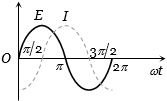
The variation of the instantaneous current $(I)$ and the instantaneous emf $(E)$ in a circuit is as shown in the figure. Which of the following statements is correct?
A
The voltage lags behind the current by $\pi / 2$.
B
The voltage leads the current by $\pi / 2$.
C
The voltage and the current are in phase.
D
The voltage leads the current by $\pi$.
Solution
(B) From the given figure,the emf $(E)$ starts from zero at $\omega t = 0$ and reaches its maximum at $\omega t = \pi / 2$. Thus,$E = E_0 \sin(\omega t)$.
The current $(I)$ starts from its minimum value at $\omega t = 0$ and reaches zero at $\omega t = \pi / 2$. This indicates that the current follows the equation $I = I_0 \sin(\omega t - \pi / 2)$.
Comparing the phases,the phase of the voltage is $\omega t$ and the phase of the current is $(\omega t - \pi / 2)$.
Therefore,the voltage leads the current by a phase angle of $\pi / 2$.
The current $(I)$ starts from its minimum value at $\omega t = 0$ and reaches zero at $\omega t = \pi / 2$. This indicates that the current follows the equation $I = I_0 \sin(\omega t - \pi / 2)$.
Comparing the phases,the phase of the voltage is $\omega t$ and the phase of the current is $(\omega t - \pi / 2)$.
Therefore,the voltage leads the current by a phase angle of $\pi / 2$.
0 likes
View Solution37
MediumMCQ
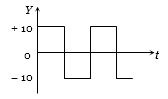
The $r.m.s.$ voltage of the waveform shown is......$V$
A
$10$
B
$7$
C
$6.37$
D
None of these
Solution
(A) The given waveform is a square wave with amplitude $V_0 = 10 \ V$.
For a square wave that oscillates between $+V_0$ and $-V_0$,the instantaneous voltage $V(t)$ is either $+V_0$ or $-V_0$.
The $r.m.s.$ voltage is defined as $V_{rms} = \sqrt{\frac{1}{T} \int_0^T V^2(t) dt}$.
Since $V^2(t) = V_0^2$ at all times,
$V_{rms} = \sqrt{\frac{1}{T} \int_0^T V_0^2 dt} = \sqrt{\frac{V_0^2}{T} \cdot T} = V_0$.
Given $V_0 = 10 \ V$,therefore $V_{rms} = 10 \ V$.
For a square wave that oscillates between $+V_0$ and $-V_0$,the instantaneous voltage $V(t)$ is either $+V_0$ or $-V_0$.
The $r.m.s.$ voltage is defined as $V_{rms} = \sqrt{\frac{1}{T} \int_0^T V^2(t) dt}$.
Since $V^2(t) = V_0^2$ at all times,
$V_{rms} = \sqrt{\frac{1}{T} \int_0^T V_0^2 dt} = \sqrt{\frac{V_0^2}{T} \cdot T} = V_0$.
Given $V_0 = 10 \ V$,therefore $V_{rms} = 10 \ V$.
0 likes
View Solution38
MediumMCQ
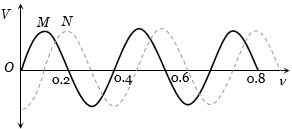
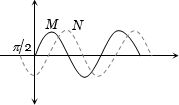
Two sinusoidal voltages of the same frequency are shown in the diagram. What is the frequency, and the phase relationship between the voltages? (Frequency in $Hz$, Phase lead of $N$ over $M$ in radians)
A
$0.4 \, Hz, -\pi/4 \, \text{radians}$
B
$2.5 \, Hz, -\pi/2 \, \text{radians}$
C
$2.5 \, Hz, +\pi/2 \, \text{radians}$
D
$2.5 \, Hz, -\pi/4 \, \text{radians}$
Solution
(B) From the graph, the time period $T$ (time taken to complete one full cycle) for wave $M$ is $0.4 \, s$.
Therefore, the frequency $\nu = \frac{1}{T} = \frac{1}{0.4} = 2.5 \, Hz$.
Wave $M$ starts at $t = 0$ with zero value and positive slope, representing $\sin(\omega t)$.
Wave $N$ starts at $t = 0$ with a negative value, reaching its peak later than $M$. Specifically, $N$ is delayed by a quarter of a cycle compared to $M$.
A delay of a quarter cycle corresponds to a phase lag of $\frac{\pi}{2}$ radians.
Thus, the phase lead of $N$ over $M$ is $-\frac{\pi}{2}$ radians.
Therefore, the frequency $\nu = \frac{1}{T} = \frac{1}{0.4} = 2.5 \, Hz$.
Wave $M$ starts at $t = 0$ with zero value and positive slope, representing $\sin(\omega t)$.
Wave $N$ starts at $t = 0$ with a negative value, reaching its peak later than $M$. Specifically, $N$ is delayed by a quarter of a cycle compared to $M$.
A delay of a quarter cycle corresponds to a phase lag of $\frac{\pi}{2}$ radians.
Thus, the phase lead of $N$ over $M$ is $-\frac{\pi}{2}$ radians.
0 likes
View Solution39
MediumMCQ
The heat produced in a resistor by an $AC$ current is three times the heat produced by a $2 \, A$ $DC$ current. What is the $rms$ value of the $AC$ current in $A$?
A
$6$
B
$2$
C
$3.46$
D
$0.66$
Solution
(C) The heat produced by an $AC$ current in a resistor $R$ over time $t$ is given by $H_{AC} = I_{rms}^2 Rt$.
The heat produced by a $DC$ current $I_{DC} = 2 \, A$ in the same resistor $R$ over the same time $t$ is $H_{DC} = I_{DC}^2 Rt$.
According to the problem,$H_{AC} = 3 \times H_{DC}$.
Substituting the formulas: $I_{rms}^2 Rt = 3 \times (2^2) Rt$.
Canceling $R$ and $t$ from both sides: $I_{rms}^2 = 3 \times 4 = 12$.
Therefore,$I_{rms} = \sqrt{12} = 2\sqrt{3} \approx 3.46 \, A$.
The heat produced by a $DC$ current $I_{DC} = 2 \, A$ in the same resistor $R$ over the same time $t$ is $H_{DC} = I_{DC}^2 Rt$.
According to the problem,$H_{AC} = 3 \times H_{DC}$.
Substituting the formulas: $I_{rms}^2 Rt = 3 \times (2^2) Rt$.
Canceling $R$ and $t$ from both sides: $I_{rms}^2 = 3 \times 4 = 12$.
Therefore,$I_{rms} = \sqrt{12} = 2\sqrt{3} \approx 3.46 \, A$.
0 likes
View Solution40
MediumMCQ
For an $A.C.$ current $I = 100 \sin(200 \pi t)$,after what time does the current reach its maximum value?
A
$\frac{1}{100} \ s$
B
$\frac{1}{200} \ s$
C
$\frac{1}{300} \ s$
D
$\frac{1}{400} \ s$
Solution
(D) The given equation is $I = I_0 \sin(\omega t)$,where $I_0 = 100 \ A$ and $\omega = 200 \pi \ rad/s$.
The current reaches its maximum value when $\sin(\omega t) = 1$,which occurs at $\omega t = \frac{\pi}{2}$.
Substituting the value of $\omega$: $(200 \pi) t = \frac{\pi}{2}$.
Solving for $t$: $t = \frac{\pi}{2 \times 200 \pi} = \frac{1}{400} \ s$.
The current reaches its maximum value when $\sin(\omega t) = 1$,which occurs at $\omega t = \frac{\pi}{2}$.
Substituting the value of $\omega$: $(200 \pi) t = \frac{\pi}{2}$.
Solving for $t$: $t = \frac{\pi}{2 \times 200 \pi} = \frac{1}{400} \ s$.
0 likes
View Solution41
EasyMCQ
An $AC$ source has a voltage of $220V$ and a frequency of $50\,Hz$. How much time (in $sec$) does it take for the voltage to reach zero from its maximum value?
A
$50$
B
$0.02$
C
$5$
D
$5 \times 10^{-3}$
Solution
(D) The time period $T$ of the $AC$ source is given by $T = 1/f = 1/50 = 0.02\,sec$.
The voltage reaches its maximum value at $t = T/4$ and reaches zero at $t = T/2$ (relative to the start of the cycle).
However,the time taken to go from the maximum value to zero is exactly one-quarter of the time period.
Time $t = T/4 = 0.02 / 4 = 0.005\,sec = 5 \times 10^{-3}\,sec$.
The voltage reaches its maximum value at $t = T/4$ and reaches zero at $t = T/2$ (relative to the start of the cycle).
However,the time taken to go from the maximum value to zero is exactly one-quarter of the time period.
Time $t = T/4 = 0.02 / 4 = 0.005\,sec = 5 \times 10^{-3}\,sec$.
0 likes
View Solution42
MediumMCQ
The current in a circuit is given by $i = 2\sqrt{t}$. What is the $r.m.s.$ value of the current between $t = 2 \ s$ and $t = 4 \ s$?
A
$3 \ A$
B
$3\sqrt{3} \ A$
C
$2\sqrt{3} \ A$
D
$(2 - \sqrt{2}) \ A$
Solution
(C) The $r.m.s.$ value of current is defined as $i_{rms} = \sqrt{\frac{1}{T} \int_{t_1}^{t_2} i^2 \ dt}$,where $T = t_2 - t_1 = 4 - 2 = 2 \ s$.
First,calculate the mean square value $\overline{i^2} = \frac{1}{T} \int_{2}^{4} (2\sqrt{t})^2 \ dt$.
$\overline{i^2} = \frac{1}{2} \int_{2}^{4} 4t \ dt = 2 \int_{2}^{4} t \ dt$.
Evaluating the integral: $2 \left[ \frac{t^2}{2} \right]_{2}^{4} = [t^2]_{2}^{4} = 4^2 - 2^2 = 16 - 4 = 12$.
Finally,$i_{rms} = \sqrt{\overline{i^2}} = \sqrt{12} = 2\sqrt{3} \ A$.
First,calculate the mean square value $\overline{i^2} = \frac{1}{T} \int_{2}^{4} (2\sqrt{t})^2 \ dt$.
$\overline{i^2} = \frac{1}{2} \int_{2}^{4} 4t \ dt = 2 \int_{2}^{4} t \ dt$.
Evaluating the integral: $2 \left[ \frac{t^2}{2} \right]_{2}^{4} = [t^2]_{2}^{4} = 4^2 - 2^2 = 16 - 4 = 12$.
Finally,$i_{rms} = \sqrt{\overline{i^2}} = \sqrt{12} = 2\sqrt{3} \ A$.
0 likes
View Solution43
MediumMCQ
What is the $r.m.s.$ value of the current $i = t^2$ for the time interval $0 < t < T$?
A
$\frac{T^2}{\sqrt{2}}$
B
$\frac{T^2}{2}$
C
$\frac{T^2}{\sqrt{5}}$
D
None of these
Solution
(C) The $r.m.s.$ value of a current $i(t)$ over a time interval $T$ is given by the formula: $i_{rms} = \sqrt{\frac{1}{T} \int_{0}^{T} i^2 dt}$.
Given $i = t^2$,we have $i^2 = t^4$.
Substituting this into the formula:
$i_{rms} = \sqrt{\frac{1}{T} \int_{0}^{T} t^4 dt}$.
Evaluating the integral: $\int_{0}^{T} t^4 dt = \left[ \frac{t^5}{5} \right]_{0}^{T} = \frac{T^5}{5}$.
Now,substitute back into the expression:
$i_{rms} = \sqrt{\frac{1}{T} \cdot \frac{T^5}{5}} = \sqrt{\frac{T^4}{5}} = \frac{T^2}{\sqrt{5}}$.
Given $i = t^2$,we have $i^2 = t^4$.
Substituting this into the formula:
$i_{rms} = \sqrt{\frac{1}{T} \int_{0}^{T} t^4 dt}$.
Evaluating the integral: $\int_{0}^{T} t^4 dt = \left[ \frac{t^5}{5} \right]_{0}^{T} = \frac{T^5}{5}$.
Now,substitute back into the expression:
$i_{rms} = \sqrt{\frac{1}{T} \cdot \frac{T^5}{5}} = \sqrt{\frac{T^4}{5}} = \frac{T^2}{\sqrt{5}}$.
0 likes
View Solution44
DifficultMCQ
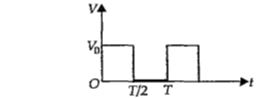
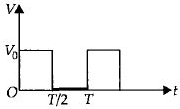
The $r.m.s.$ value of potential difference $V$ shown in the figure is
A
$\frac{V_0}{\sqrt{3}}$
B
$V_0$
C
$\frac{V_0}{\sqrt{2}}$
D
$\frac{V_0}{2}$
Solution
(C) Given the potential difference $V$ as a function of time $t$:
$V = V_0$ for $0 \leq t \leq \frac{T}{2}$
$V = 0$ for $\frac{T}{2} \leq t \leq T$
The $r.m.s.$ value is defined as:
$V_{rms} = \sqrt{\frac{1}{T} \int_0^T V^2 dt}$
Substituting the given values:
$V_{rms} = \sqrt{\frac{1}{T} \left( \int_0^{T/2} V_0^2 dt + \int_{T/2}^T 0^2 dt \right)}$
$V_{rms} = \sqrt{\frac{1}{T} \left( V_0^2 [t]_0^{T/2} + 0 \right)}$
$V_{rms} = \sqrt{\frac{V_0^2}{T} \cdot \frac{T}{2}}$
$V_{rms} = \sqrt{\frac{V_0^2}{2}}$
$V_{rms} = \frac{V_0}{\sqrt{2}}$
$V = V_0$ for $0 \leq t \leq \frac{T}{2}$
$V = 0$ for $\frac{T}{2} \leq t \leq T$
The $r.m.s.$ value is defined as:
$V_{rms} = \sqrt{\frac{1}{T} \int_0^T V^2 dt}$
Substituting the given values:
$V_{rms} = \sqrt{\frac{1}{T} \left( \int_0^{T/2} V_0^2 dt + \int_{T/2}^T 0^2 dt \right)}$
$V_{rms} = \sqrt{\frac{1}{T} \left( V_0^2 [t]_0^{T/2} + 0 \right)}$
$V_{rms} = \sqrt{\frac{V_0^2}{T} \cdot \frac{T}{2}}$
$V_{rms} = \sqrt{\frac{V_0^2}{2}}$
$V_{rms} = \frac{V_0}{\sqrt{2}}$
0 likes
View Solution45
EasyMCQ
The phase difference between the voltage and the current in an $AC$ circuit is $\pi / 4$. If the frequency is $50 \ Hz$,then this phase difference will be equivalent to a time of:
A
$0.02 \ s$
B
$0.25 \ s$
C
$2.5 \ ms$
D
$25 \ ms$
Solution
(C) The relationship between phase difference $\phi$ and time difference $\Delta t$ is given by $\Delta t = \frac{T}{2\pi} \times \phi$.
Given frequency $f = 50 \ Hz$,the time period $T = \frac{1}{f} = \frac{1}{50} \ s$.
The phase difference $\phi = \frac{\pi}{4}$.
Substituting these values into the formula:
$\Delta t = \frac{(1/50)}{2\pi} \times \frac{\pi}{4} = \frac{1}{50 \times 2 \times 4} = \frac{1}{400} \ s$.
$\Delta t = 0.0025 \ s = 2.5 \ ms$.
Given frequency $f = 50 \ Hz$,the time period $T = \frac{1}{f} = \frac{1}{50} \ s$.
The phase difference $\phi = \frac{\pi}{4}$.
Substituting these values into the formula:
$\Delta t = \frac{(1/50)}{2\pi} \times \frac{\pi}{4} = \frac{1}{50 \times 2 \times 4} = \frac{1}{400} \ s$.
$\Delta t = 0.0025 \ s = 2.5 \ ms$.
0 likes
View Solution46
EasyMCQ
The instantaneous values of current and emf in an $AC$ circuit are $I = 1/\sqrt{2} \sin(314t) \, A$ and $E = \sqrt{2} \sin(314t - \pi/6) \, V$ respectively. The phase difference between $E$ and $I$ will be
A
$-\pi/6 \, rad$
B
$-\pi/3 \, rad$
C
$\pi/6 \, rad$
D
$\pi/3 \, rad$
Solution
(A) The instantaneous current is given by $I = I_0 \sin(\omega t + \phi_I)$,where $\phi_I = 0$.
The instantaneous emf is given by $E = E_0 \sin(\omega t + \phi_E)$,where $\phi_E = -\pi/6$.
The phase difference between $E$ and $I$ is defined as $\Delta \phi = \phi_E - \phi_I$.
Substituting the values,we get $\Delta \phi = (-\pi/6) - (0) = -\pi/6 \, rad$.
Therefore,the phase difference is $-\pi/6 \, rad$.
The instantaneous emf is given by $E = E_0 \sin(\omega t + \phi_E)$,where $\phi_E = -\pi/6$.
The phase difference between $E$ and $I$ is defined as $\Delta \phi = \phi_E - \phi_I$.
Substituting the values,we get $\Delta \phi = (-\pi/6) - (0) = -\pi/6 \, rad$.
Therefore,the phase difference is $-\pi/6 \, rad$.
0 likes
View Solution47
MediumMCQ
What is the $r.m.s.$ value of an alternating current which,when passed through a resistor,produces heat that is thrice the heat produced by a direct current of $2 \ A$ in the same resistor (in $A$)?
A
$6$
B
$2$
C
$3.46$
D
$0.66$
Solution
(C) The heat produced by an alternating current $(ac)$ is given by $H_{ac} = i_{rms}^2Rt$.
The heat produced by a direct current $(dc)$ is given by $H_{dc} = i^2Rt$.
According to the problem,$H_{ac} = 3 \times H_{dc}$.
Substituting the formulas: $i_{rms}^2Rt = 3 \times i^2Rt$.
Canceling $R$ and $t$ from both sides,we get $i_{rms}^2 = 3 \times i^2$.
Given $i = 2 \ A$,we have $i_{rms}^2 = 3 \times (2)^2 = 3 \times 4 = 12$.
Therefore,$i_{rms} = \sqrt{12} = 2\sqrt{3} \approx 3.46 \ A$.
The heat produced by a direct current $(dc)$ is given by $H_{dc} = i^2Rt$.
According to the problem,$H_{ac} = 3 \times H_{dc}$.
Substituting the formulas: $i_{rms}^2Rt = 3 \times i^2Rt$.
Canceling $R$ and $t$ from both sides,we get $i_{rms}^2 = 3 \times i^2$.
Given $i = 2 \ A$,we have $i_{rms}^2 = 3 \times (2)^2 = 3 \times 4 = 12$.
Therefore,$i_{rms} = \sqrt{12} = 2\sqrt{3} \approx 3.46 \ A$.
0 likes
View Solution48
EasyMCQ
In an $AC$ circuit,when an $AC$ ammeter is connected,it reads $i$ current. If a student uses a $DC$ ammeter in place of the $AC$ ammeter,the reading in the $DC$ ammeter will be:
A
$\frac{i}{\sqrt{2}}$
B
$\sqrt{2} \, i$
C
$0.637 \, i$
D
zero
Solution
(D) An $AC$ ammeter is designed to measure the root-mean-square $(RMS)$ value of an alternating current.
In contrast,a $DC$ ammeter is designed to measure the average value of current over a complete cycle.
For a sinusoidal alternating current,the average value over one complete cycle is defined as $I_{avg} = \frac{1}{T} \int_{0}^{T} I_{0} \sin(\omega t) dt = 0$.
Since the $DC$ ammeter measures the average current,it will show a reading of zero.
In contrast,a $DC$ ammeter is designed to measure the average value of current over a complete cycle.
For a sinusoidal alternating current,the average value over one complete cycle is defined as $I_{avg} = \frac{1}{T} \int_{0}^{T} I_{0} \sin(\omega t) dt = 0$.
Since the $DC$ ammeter measures the average current,it will show a reading of zero.
0 likes
View Solution49
DifficultMCQ
An $AC$ current is given by $I = I_0 + I_1 \sin \omega t$. Then its $rms$ value will be:
A
$\sqrt{I_0^2 + 0.5 I_1^2}$
B
$\sqrt{I_0^2 + 0.5 I_0^2}$
C
$0$
D
$I_0 / \sqrt{2}$
Solution
(A) The $rms$ value of a current $I(t)$ over a time period $T$ is defined as $I_{rms} = \sqrt{\frac{1}{T} \int_{0}^{T} I(t)^2 dt}$.
Given $I = I_0 + I_1 \sin \omega t$, we square the expression: $I^2 = I_0^2 + I_1^2 \sin^2 \omega t + 2 I_0 I_1 \sin \omega t$.
Now, integrate over one full cycle $T = \frac{2\pi}{\omega}$:
$I_{rms}^2 = \frac{1}{T} \int_{0}^{T} (I_0^2 + I_1^2 \sin^2 \omega t + 2 I_0 I_1 \sin \omega t) dt$.
Since the average value of $\sin \omega t$ over a full cycle is $0$, the term $\int_{0}^{T} 2 I_0 I_1 \sin \omega t dt = 0$.
The average value of $\sin^2 \omega t$ over a full cycle is $\frac{1}{2}$.
Thus, $I_{rms}^2 = I_0^2 + I_1^2 \left( \frac{1}{2} \right) = I_0^2 + 0.5 I_1^2$.
Therefore, $I_{rms} = \sqrt{I_0^2 + 0.5 I_1^2}$.
Given $I = I_0 + I_1 \sin \omega t$, we square the expression: $I^2 = I_0^2 + I_1^2 \sin^2 \omega t + 2 I_0 I_1 \sin \omega t$.
Now, integrate over one full cycle $T = \frac{2\pi}{\omega}$:
$I_{rms}^2 = \frac{1}{T} \int_{0}^{T} (I_0^2 + I_1^2 \sin^2 \omega t + 2 I_0 I_1 \sin \omega t) dt$.
Since the average value of $\sin \omega t$ over a full cycle is $0$, the term $\int_{0}^{T} 2 I_0 I_1 \sin \omega t dt = 0$.
The average value of $\sin^2 \omega t$ over a full cycle is $\frac{1}{2}$.
Thus, $I_{rms}^2 = I_0^2 + I_1^2 \left( \frac{1}{2} \right) = I_0^2 + 0.5 I_1^2$.
Therefore, $I_{rms} = \sqrt{I_0^2 + 0.5 I_1^2}$.
0 likes
View Solution50
MediumMCQ
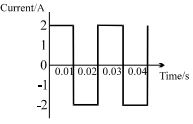
The direct current which would give the same heating effect in an equal constant resistance as the current shown in the figure,i.e.,the $r.m.s.$ current,is.....$A$
A
$0$
B
$\sqrt{2}$
C
$2$
D
$2\sqrt{2}$
Solution
(C) The $r.m.s.$ (root mean square) value of a current is defined as the value of the steady direct current which,when flowing through a given resistor for a given time,produces the same amount of heat as the alternating current does in the same resistor for the same time.
For the given square wave current:
$I(t) = 2 \text{ A}$ for $0 < t < 0.01 \text{ s}$
$I(t) = -2 \text{ A}$ for $0.01 < t < 0.02 \text{ s}$
The time period $T = 0.02 \text{ s}$.
The $r.m.s.$ current is given by the formula:
$I_{rms} = \sqrt{\frac{1}{T} \int_{0}^{T} I^2(t) dt}$
$I_{rms} = \sqrt{\frac{1}{0.02} \left[ \int_{0}^{0.01} (2)^2 dt + \int_{0.01}^{0.02} (-2)^2 dt \right]}$
$I_{rms} = \sqrt{\frac{1}{0.02} \left[ 4 \times 0.01 + 4 \times 0.01 \right]}$
$I_{rms} = \sqrt{\frac{1}{0.02} \left[ 0.04 + 0.04 \right]}$
$I_{rms} = \sqrt{\frac{0.08}{0.02}} = \sqrt{4} = 2 \text{ A}$.
Thus,the $r.m.s.$ current is $2 \text{ A}$.
For the given square wave current:
$I(t) = 2 \text{ A}$ for $0 < t < 0.01 \text{ s}$
$I(t) = -2 \text{ A}$ for $0.01 < t < 0.02 \text{ s}$
The time period $T = 0.02 \text{ s}$.
The $r.m.s.$ current is given by the formula:
$I_{rms} = \sqrt{\frac{1}{T} \int_{0}^{T} I^2(t) dt}$
$I_{rms} = \sqrt{\frac{1}{0.02} \left[ \int_{0}^{0.01} (2)^2 dt + \int_{0.01}^{0.02} (-2)^2 dt \right]}$
$I_{rms} = \sqrt{\frac{1}{0.02} \left[ 4 \times 0.01 + 4 \times 0.01 \right]}$
$I_{rms} = \sqrt{\frac{1}{0.02} \left[ 0.04 + 0.04 \right]}$
$I_{rms} = \sqrt{\frac{0.08}{0.02}} = \sqrt{4} = 2 \text{ A}$.
Thus,the $r.m.s.$ current is $2 \text{ A}$.
0 likes
View SolutionAlternating Current — Alternating Current, Voltage (rms and Average) · Frequently Asked Questions
1Are these Alternating Current questions useful for JEE and NEET?
Yes. All questions in this section are mapped to JEE Main and NEET exam patterns. Previous year questions from JEE Main, NEET, GUJCET and state-level exams are included with full solutions.
2Can I switch to Hindi or Gujarati for these questions?
Yes. Use the language tabs in the hero section or the sidebar to view the same questions and solutions in English, Hindi or Gujarati.
3How do I generate a question paper from this subtopic?
Use the Vedclass Exam Paper Generator — select the chapter and subtopic, set difficulty, and generate Sets A, B, C, D automatically. First 3 chapters of every subject are free.
Vedclass Products
For Students
Vedclass Test Series
Mock tests in real JEE/NEET style with performance analysis. 5-day free trial.
Start Free TrialFor Teachers
Exam Paper Generator
Generate Set A/B/C/D papers from this chapter in 2 minutes. 3 chapters free.
Try FreeFor Institutes
Online Exam Module
Live online exams with unlimited students, 360° analytics & white-label branding.
See DemoFor Teachers & Institutes
Generate a Alternating Current Exam Paper in 2 Minutes
Select subtopic & difficulty — Sets A, B, C, D auto-generated with No Repeat logic.
First 3 chapters of every subject are free — no payment required.