
A English
Alternating Current, Voltage (rms and Average) Questions in English
Class 12 Physics · Alternating Current · Alternating Current, Voltage (rms and Average)
180+
Questions
English
Language
100%
With Solutions
Showing 30 of 180 questions in English
151
EasyMCQ
What is the average value of the $AC$ voltage over a complete cycle?
A
$\frac{2 V_{\max }}{\pi}$
B
$\frac{V_{\max }}{2}$
C
Zero
D
$V_{\max }$
Solution
(C) The instantaneous value of an alternating voltage is given by $V(t) = V_{\max} \sin(\omega t)$.
To find the average value over a complete cycle (from $t = 0$ to $t = T$),we integrate the function over the period $T$ and divide by the period:
$V_{\text{avg}} = \frac{1}{T} \int_{0}^{T} V_{\max} \sin(\omega t) dt$.
Since $\omega = \frac{2\pi}{T}$,the integral becomes:
$V_{\text{avg}} = \frac{V_{\max}}{T} \int_{0}^{T} \sin\left(\frac{2\pi}{T} t\right) dt$.
The integral of the sine function over a full period is zero because the positive area of the first half-cycle exactly cancels out the negative area of the second half-cycle.
Therefore,$V_{\text{avg}} = 0$.
To find the average value over a complete cycle (from $t = 0$ to $t = T$),we integrate the function over the period $T$ and divide by the period:
$V_{\text{avg}} = \frac{1}{T} \int_{0}^{T} V_{\max} \sin(\omega t) dt$.
Since $\omega = \frac{2\pi}{T}$,the integral becomes:
$V_{\text{avg}} = \frac{V_{\max}}{T} \int_{0}^{T} \sin\left(\frac{2\pi}{T} t\right) dt$.
The integral of the sine function over a full period is zero because the positive area of the first half-cycle exactly cancels out the negative area of the second half-cycle.
Therefore,$V_{\text{avg}} = 0$.
0 likes
View Solution152
EasyMCQ
Find the time required for a $50 \text{ Hz}$ alternating current to reach its $rms$ value from zero. (in $\text{ ms}$)
A
$2.5$
B
$5.0$
C
$10.0$
D
$15.0$
Solution
(A) The instantaneous current is given by $i = i_{m} \sin(\omega t)$.
At the $rms$ value, $i = i_{rms} = \frac{i_{m}}{\sqrt{2}}$.
Substituting this into the equation: $\frac{i_{m}}{\sqrt{2}} = i_{m} \sin(\omega t)$.
$\sin(\omega t) = \frac{1}{\sqrt{2}}$, which implies $\omega t = \frac{\pi}{4}$.
Since $\omega = 2 \pi f$, we have $2 \pi f t = \frac{\pi}{4}$.
$t = \frac{1}{8f}$.
Given $f = 50 \text{ Hz}$, $t = \frac{1}{8 \times 50} = \frac{1}{400} \text{ s}$.
$t = 0.0025 \text{ s} = 2.5 \text{ ms}$.
At the $rms$ value, $i = i_{rms} = \frac{i_{m}}{\sqrt{2}}$.
Substituting this into the equation: $\frac{i_{m}}{\sqrt{2}} = i_{m} \sin(\omega t)$.
$\sin(\omega t) = \frac{1}{\sqrt{2}}$, which implies $\omega t = \frac{\pi}{4}$.
Since $\omega = 2 \pi f$, we have $2 \pi f t = \frac{\pi}{4}$.
$t = \frac{1}{8f}$.
Given $f = 50 \text{ Hz}$, $t = \frac{1}{8 \times 50} = \frac{1}{400} \text{ s}$.
$t = 0.0025 \text{ s} = 2.5 \text{ ms}$.
0 likes
View Solution153
EasyMCQ
At time $t=0 \text{ s}$, the voltage of an $AC$ generator starts from $0 \text{ V}$ and becomes $2 \text{ V}$ at time $t=\frac{1}{100 \pi} \text{ s}$. The voltage increases up to $100 \text{ V}$, after which it starts to decrease. Find the frequency of the generator. (in $\text{ Hz}$)
A
$100$
B
$1$
C
$2$
D
$5$
Solution
(B) The instantaneous voltage of an $AC$ generator is given by $V = V_m \sin(\omega t)$, where $V_m$ is the peak voltage and $\omega = 2 \pi \nu$ is the angular frequency.
Given: $V_m = 100 \text{ V}$, $V = 2 \text{ V}$ at $t = \frac{1}{100 \pi} \text{ s}$.
Substituting these values into the equation:
$2 = 100 \sin\left(2 \pi \nu \times \frac{1}{100 \pi}\right)$
$2 = 100 \sin\left(\frac{\nu}{50}\right)$
$\frac{2}{100} = \sin\left(\frac{\nu}{50}\right)$
Since the angle $\frac{\nu}{50}$ is very small, we can use the approximation $\sin(\theta) \approx \theta$:
$\frac{1}{50} = \frac{\nu}{50}$
$\nu = 1 \text{ Hz}$.
Given: $V_m = 100 \text{ V}$, $V = 2 \text{ V}$ at $t = \frac{1}{100 \pi} \text{ s}$.
Substituting these values into the equation:
$2 = 100 \sin\left(2 \pi \nu \times \frac{1}{100 \pi}\right)$
$2 = 100 \sin\left(\frac{\nu}{50}\right)$
$\frac{2}{100} = \sin\left(\frac{\nu}{50}\right)$
Since the angle $\frac{\nu}{50}$ is very small, we can use the approximation $\sin(\theta) \approx \theta$:
$\frac{1}{50} = \frac{\nu}{50}$
$\nu = 1 \text{ Hz}$.
0 likes
View Solution154
EasyMCQ
If the rms current in a $50 \text{ Hz}$ $AC$ circuit is $5 \text{ A}$,and at time $t=0$,the current $I$ is $0$. The value of current $I$ at $t=\frac{1}{300} \text{ s}$ is . . . . . . $A$.
A
$\frac{5}{6}$
B
$5 \sqrt{\frac{3}{2}}$
C
$5 \sqrt{2}$
D
$\frac{5}{\sqrt{2}}$
Solution
(B) Given: $I_{rms} = 5 \text{ A}$,frequency $f = 50 \text{ Hz}$.
At $t=0$,$I=0$,so the equation for current is $I = I_0 \sin(\omega t)$.
First,calculate the peak current $I_0 = \sqrt{2} \times I_{rms} = 5\sqrt{2} \text{ A}$.
Next,calculate the angular frequency $\omega = 2\pi f = 2\pi \times 50 = 100\pi \text{ rad/s}$.
Now,substitute $t = \frac{1}{300} \text{ s}$ into the equation:
$I = 5\sqrt{2} \sin(100\pi \times \frac{1}{300})$
$I = 5\sqrt{2} \sin(\frac{\pi}{3})$
Since $\sin(\frac{\pi}{3}) = \frac{\sqrt{3}}{2}$,we get:
$I = 5\sqrt{2} \times \frac{\sqrt{3}}{2} = 5 \sqrt{\frac{2 \times 3}{4}} = 5 \sqrt{\frac{3}{2}} \text{ A}$.
At $t=0$,$I=0$,so the equation for current is $I = I_0 \sin(\omega t)$.
First,calculate the peak current $I_0 = \sqrt{2} \times I_{rms} = 5\sqrt{2} \text{ A}$.
Next,calculate the angular frequency $\omega = 2\pi f = 2\pi \times 50 = 100\pi \text{ rad/s}$.
Now,substitute $t = \frac{1}{300} \text{ s}$ into the equation:
$I = 5\sqrt{2} \sin(100\pi \times \frac{1}{300})$
$I = 5\sqrt{2} \sin(\frac{\pi}{3})$
Since $\sin(\frac{\pi}{3}) = \frac{\sqrt{3}}{2}$,we get:
$I = 5\sqrt{2} \times \frac{\sqrt{3}}{2} = 5 \sqrt{\frac{2 \times 3}{4}} = 5 \sqrt{\frac{3}{2}} \text{ A}$.
0 likes
View Solution155
EasyMCQ
$A$ sinusoidal voltage produced by an $AC$ generator at any instant $t$ is given by the equation $V = 311 \sin(314t)$. The $rms$ value of voltage and frequency are respectively:
A
$200 \ V, 50 \ Hz$
B
$220 \ V, 100 \ Hz$
C
$220 \ V, 50 \ Hz$
D
$200 \ V, 100 \ Hz$
Solution
(C) The given equation is $V = V_0 \sin(\omega t)$,where $V_0 = 311 \ V$ and $\omega = 314 \ rad/s$.
The $rms$ value of voltage is given by $V_{rms} = \frac{V_0}{\sqrt{2}}$.
$V_{rms} = \frac{311}{1.414} \approx 220 \ V$.
The angular frequency is $\omega = 2\pi f$.
$314 = 2 \times 3.14 \times f$.
$314 = 6.28 \times f$.
$f = \frac{314}{6.28} = 50 \ Hz$.
Thus,the $rms$ voltage is $220 \ V$ and the frequency is $50 \ Hz$.
The $rms$ value of voltage is given by $V_{rms} = \frac{V_0}{\sqrt{2}}$.
$V_{rms} = \frac{311}{1.414} \approx 220 \ V$.
The angular frequency is $\omega = 2\pi f$.
$314 = 2 \times 3.14 \times f$.
$314 = 6.28 \times f$.
$f = \frac{314}{6.28} = 50 \ Hz$.
Thus,the $rms$ voltage is $220 \ V$ and the frequency is $50 \ Hz$.
0 likes
View Solution156
EasyMCQ
An alternating current is given by $i = i_1 \sin \omega t + i_2 \cos \omega t$. The rms current is given by
A
$\frac{i_1 - i_2}{\sqrt{2}}$
B
$\sqrt{\frac{i_1^2 + i_2^2}{2}}$
C
$\sqrt{\frac{i_1^2 + i_2^2}{\sqrt{2}}}$
D
$\frac{i_1 + i_2}{\sqrt{2}}$
Solution
(B) The given equation is $i = i_1 \sin \omega t + i_2 \cos \omega t$.
We can rewrite this as $i = A \sin(\omega t + \phi)$,where $A$ is the amplitude of the resultant current.
To find $A$,we compare the coefficients: $i_1 = A \cos \phi$ and $i_2 = A \sin \phi$.
Squaring and adding these equations: $i_1^2 + i_2^2 = A^2 \cos^2 \phi + A^2 \sin^2 \phi = A^2(\cos^2 \phi + \sin^2 \phi) = A^2$.
Thus,the amplitude $A = \sqrt{i_1^2 + i_2^2}$.
The root mean square (rms) value of a sinusoidal current $i = A \sin(\omega t + \phi)$ is given by $i_{rms} = \frac{A}{\sqrt{2}}$.
Substituting the value of $A$,we get $i_{rms} = \sqrt{\frac{i_1^2 + i_2^2}{2}}$.
We can rewrite this as $i = A \sin(\omega t + \phi)$,where $A$ is the amplitude of the resultant current.
To find $A$,we compare the coefficients: $i_1 = A \cos \phi$ and $i_2 = A \sin \phi$.
Squaring and adding these equations: $i_1^2 + i_2^2 = A^2 \cos^2 \phi + A^2 \sin^2 \phi = A^2(\cos^2 \phi + \sin^2 \phi) = A^2$.
Thus,the amplitude $A = \sqrt{i_1^2 + i_2^2}$.
The root mean square (rms) value of a sinusoidal current $i = A \sin(\omega t + \phi)$ is given by $i_{rms} = \frac{A}{\sqrt{2}}$.
Substituting the value of $A$,we get $i_{rms} = \sqrt{\frac{i_1^2 + i_2^2}{2}}$.
0 likes
View Solution157
EasyMCQ
The frequency of an alternating current is $ 50 \,Hz $. What is the minimum time taken by the current to reach its peak value from its $ rms $ value?
A
$ 0.02 \,s $
B
$ 5 \times 10^{-3} \,s $
C
$ 10 \times 10^{-3} \,s $
D
$ 2.5 \times 10^{-3} \,s $
Solution
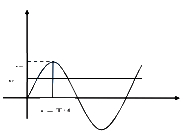
(D) The instantaneous current is given by $ I = I_0 \sin(\omega t) $.
At the $ rms $ value, $ I = I_{rms} = \frac{I_0}{\sqrt{2}} $.
So, $ \frac{I_0}{\sqrt{2}} = I_0 \sin(\omega t_1) \Rightarrow \sin(\omega t_1) = \frac{1}{\sqrt{2}} $.
This gives $ \omega t_1 = \frac{\pi}{4} $.
Since $ \omega = \frac{2\pi}{T} $, we have $ \frac{2\pi}{T} t_1 = \frac{\pi}{4} \Rightarrow t_1 = \frac{T}{8} $.
The peak value occurs at $ t_2 = \frac{T}{4} $.
The time taken to reach the peak value from the $ rms $ value is $ \Delta t = t_2 - t_1 = \frac{T}{4} - \frac{T}{8} = \frac{T}{8} $.
Given frequency $ f = 50 \,Hz $, the time period is $ T = \frac{1}{f} = \frac{1}{50} \,s = 0.02 \,s $.
Therefore, $ \Delta t = \frac{0.02}{8} = 0.0025 \,s = 2.5 \times 10^{-3} \,s $.
Thus, option $ D $ is correct.
At the $ rms $ value, $ I = I_{rms} = \frac{I_0}{\sqrt{2}} $.
So, $ \frac{I_0}{\sqrt{2}} = I_0 \sin(\omega t_1) \Rightarrow \sin(\omega t_1) = \frac{1}{\sqrt{2}} $.
This gives $ \omega t_1 = \frac{\pi}{4} $.
Since $ \omega = \frac{2\pi}{T} $, we have $ \frac{2\pi}{T} t_1 = \frac{\pi}{4} \Rightarrow t_1 = \frac{T}{8} $.
The peak value occurs at $ t_2 = \frac{T}{4} $.
The time taken to reach the peak value from the $ rms $ value is $ \Delta t = t_2 - t_1 = \frac{T}{4} - \frac{T}{8} = \frac{T}{8} $.
Given frequency $ f = 50 \,Hz $, the time period is $ T = \frac{1}{f} = \frac{1}{50} \,s = 0.02 \,s $.
Therefore, $ \Delta t = \frac{0.02}{8} = 0.0025 \,s = 2.5 \times 10^{-3} \,s $.
Thus, option $ D $ is correct.
0 likes
View Solution158
EasyMCQ
In Karnataka,the normal domestic power supply $AC$ is $220 \text{ V}, 50 \text{ Hz}$. Here $220 \text{ V}$ and $50 \text{ Hz}$ refer to:
A
Peak value of voltage and frequency
B
Rms value of voltage and frequency
C
Mean value of voltage and frequency
D
Peak value of voltage and angular frequency
Solution
(B) In India,including Karnataka,the standard domestic $AC$ power supply is specified as $220 \text{ V}, 50 \text{ Hz}$.
By convention,the voltage value provided for $AC$ circuits is the Root Mean Square $(RMS)$ value,as it represents the effective voltage that would produce the same heating effect as an equivalent $DC$ voltage.
The frequency of $50 \text{ Hz}$ represents the number of cycles per second of the alternating current.
Therefore,$220 \text{ V}$ is the $RMS$ voltage and $50 \text{ Hz}$ is the frequency.
By convention,the voltage value provided for $AC$ circuits is the Root Mean Square $(RMS)$ value,as it represents the effective voltage that would produce the same heating effect as an equivalent $DC$ voltage.
The frequency of $50 \text{ Hz}$ represents the number of cycles per second of the alternating current.
Therefore,$220 \text{ V}$ is the $RMS$ voltage and $50 \text{ Hz}$ is the frequency.
0 likes
View Solution159
EasyMCQ
The $ rms $ value of current in a $ 50 \,Hz $ $ AC $ circuit is $ 6 \,A $. The average value of $ AC $ current over a complete cycle is:
A
$ 6 \sqrt{2} \,A $
B
$ \frac{3}{\pi \sqrt{2}} \,A $
C
Zero
D
$ \frac{6}{\pi \sqrt{2}} \,A $
Solution
(C) The $ AC $ current is represented by the equation $ I = I_{\text{max}} \sin(\omega t) $.
For a complete cycle,the average value of current $ I_{\text{avg}} $ is defined as the integral of current over the time period $ T $ divided by the time period $ T $.
$ I_{\text{avg}} = \frac{1}{T} \int_{0}^{T} I_{\text{max}} \sin(\omega t) dt $.
Since the integral of $ \sin(\omega t) $ over a complete period $ T $ is zero,the average current over a complete cycle is always $ 0 $.
Therefore,for any sinusoidal $ AC $ current,the average value over a complete cycle is $ 0 $.
For a complete cycle,the average value of current $ I_{\text{avg}} $ is defined as the integral of current over the time period $ T $ divided by the time period $ T $.
$ I_{\text{avg}} = \frac{1}{T} \int_{0}^{T} I_{\text{max}} \sin(\omega t) dt $.
Since the integral of $ \sin(\omega t) $ over a complete period $ T $ is zero,the average current over a complete cycle is always $ 0 $.
Therefore,for any sinusoidal $ AC $ current,the average value over a complete cycle is $ 0 $.
0 likes
View Solution160
DifficultMCQ
$A$ multimeter reads a voltage of a certain $A$.$C$. source as $ 100 \,V $. What is the peak value of voltage of the $A$.$C$. source (in $\,V$)?
A
$200$
B
$100$
C
$141.4$
D
$400$
Solution
(C) The root mean square $(RMS)$ value of voltage,$ V_{rms} $,and the peak voltage,$ V_{0} $,of an $A$.$C$. source are related by the formula:
$ V_{rms} = \frac{V_{0}}{\sqrt{2}} $
Given that the multimeter reads the $RMS$ value,$ V_{rms} = 100 \,V $.
To find the peak voltage $ V_{0} $,we rearrange the formula:
$ V_{0} = V_{rms} \times \sqrt{2} $
Substituting the given value:
$ V_{0} = 100 \times 1.414 = 141.4 \,V $
Thus,the peak value of the voltage of the $A$.$C$. source is $ 141.4 \,V $.
$ V_{rms} = \frac{V_{0}}{\sqrt{2}} $
Given that the multimeter reads the $RMS$ value,$ V_{rms} = 100 \,V $.
To find the peak voltage $ V_{0} $,we rearrange the formula:
$ V_{0} = V_{rms} \times \sqrt{2} $
Substituting the given value:
$ V_{0} = 100 \times 1.414 = 141.4 \,V $
Thus,the peak value of the voltage of the $A$.$C$. source is $ 141.4 \,V $.
0 likes
View Solution161
MediumMCQ
$A$ resistance of $20 \Omega$ is connected to a source of an alternating potential $V = 200 \sin (10 \pi t)$. If $t$ is the time taken by the current to change from the peak value to rms value,then $t$ is (in seconds).
A
$25 \times 10^{-1}$
B
$2.5 \times 10^{-4}$
C
$25 \times 10^{-2}$
D
$2.5 \times 10^{-2}$
Solution
(D) Given: $R = 20 \Omega$,$V = 200 \sin (10 \pi t)$.
Using Ohm's law,$I = \frac{V}{R} = \frac{200}{20} \sin (10 \pi t) = 10 \sin (10 \pi t)$.
The peak current is $I_0 = 10 \text{ A}$.
The rms current is $I_{\text{rms}} = \frac{I_0}{\sqrt{2}} = \frac{10}{\sqrt{2}} \text{ A}$.
At peak value,$10 = 10 \sin (10 \pi t_1) \Rightarrow \sin (10 \pi t_1) = 1 \Rightarrow 10 \pi t_1 = \frac{\pi}{2} \Rightarrow t_1 = \frac{1}{20} \text{ s}$.
At rms value,$\frac{10}{\sqrt{2}} = 10 \sin (10 \pi t_2) \Rightarrow \sin (10 \pi t_2) = \frac{1}{\sqrt{2}} \Rightarrow 10 \pi t_2 = \frac{\pi}{4} \Rightarrow t_2 = \frac{1}{40} \text{ s}$.
The time taken to change from peak to rms is $\Delta t = t_1 - t_2 = \frac{1}{20} - \frac{1}{40} = \frac{1}{40} = 0.025 \text{ s} = 2.5 \times 10^{-2} \text{ s}$.
Using Ohm's law,$I = \frac{V}{R} = \frac{200}{20} \sin (10 \pi t) = 10 \sin (10 \pi t)$.
The peak current is $I_0 = 10 \text{ A}$.
The rms current is $I_{\text{rms}} = \frac{I_0}{\sqrt{2}} = \frac{10}{\sqrt{2}} \text{ A}$.
At peak value,$10 = 10 \sin (10 \pi t_1) \Rightarrow \sin (10 \pi t_1) = 1 \Rightarrow 10 \pi t_1 = \frac{\pi}{2} \Rightarrow t_1 = \frac{1}{20} \text{ s}$.
At rms value,$\frac{10}{\sqrt{2}} = 10 \sin (10 \pi t_2) \Rightarrow \sin (10 \pi t_2) = \frac{1}{\sqrt{2}} \Rightarrow 10 \pi t_2 = \frac{\pi}{4} \Rightarrow t_2 = \frac{1}{40} \text{ s}$.
The time taken to change from peak to rms is $\Delta t = t_1 - t_2 = \frac{1}{20} - \frac{1}{40} = \frac{1}{40} = 0.025 \text{ s} = 2.5 \times 10^{-2} \text{ s}$.
0 likes
View Solution162
EasyMCQ
An alternating current is given by $i = (3 \sin \omega t + 4 \cos \omega t) \ A$. The $rms$ current will be:
A
$\frac{7}{\sqrt{2}} \ A$
B
$\frac{1}{\sqrt{2}} \ A$
C
$\frac{5}{\sqrt{2}} \ A$
D
$\frac{3}{\sqrt{2}} \ A$
Solution
(C) The given alternating current is $i = 3 \sin \omega t + 4 \cos \omega t$.
We can express this in the form $i = I_0 \sin(\omega t + \phi)$,where $I_0$ is the peak current.
Using the identity $a \sin \theta + b \cos \theta = \sqrt{a^2 + b^2} \sin(\theta + \phi)$,we get:
$I_0 = \sqrt{3^2 + 4^2} = \sqrt{9 + 16} = \sqrt{25} = 5 \ A$.
The $rms$ current is given by the formula $I_{rms} = \frac{I_0}{\sqrt{2}}$.
Substituting the value of $I_0$,we get $I_{rms} = \frac{5}{\sqrt{2}} \ A$.
We can express this in the form $i = I_0 \sin(\omega t + \phi)$,where $I_0$ is the peak current.
Using the identity $a \sin \theta + b \cos \theta = \sqrt{a^2 + b^2} \sin(\theta + \phi)$,we get:
$I_0 = \sqrt{3^2 + 4^2} = \sqrt{9 + 16} = \sqrt{25} = 5 \ A$.
The $rms$ current is given by the formula $I_{rms} = \frac{I_0}{\sqrt{2}}$.
Substituting the value of $I_0$,we get $I_{rms} = \frac{5}{\sqrt{2}} \ A$.
0 likes
View Solution163
EasyMCQ
$A$ bulb of resistance $280 \Omega$ is supplied with a $200 V$ $AC$ supply. What is the peak current?
A
Nearly $1 A$
B
Nearly $2 A$
C
Nearly $1.4 A$
D
Nearly $2.8 A$
Solution
(A) The given voltage $V = 200 V$ is the $RMS$ voltage $(V_{rms})$.
Peak voltage is given by the formula $V_{peak} = \sqrt{2} \times V_{rms}$.
Substituting the values,$V_{peak} = 1.414 \times 200 = 282.8 V$.
Peak current is given by $I_{peak} = \frac{V_{peak}}{R}$.
Substituting the values,$I_{peak} = \frac{282.8}{280} \approx 1.01 A$.
Therefore,the peak current is nearly $1 A$.
Peak voltage is given by the formula $V_{peak} = \sqrt{2} \times V_{rms}$.
Substituting the values,$V_{peak} = 1.414 \times 200 = 282.8 V$.
Peak current is given by $I_{peak} = \frac{V_{peak}}{R}$.
Substituting the values,$I_{peak} = \frac{282.8}{280} \approx 1.01 A$.
Therefore,the peak current is nearly $1 A$.
0 likes
View Solution164
EasyMCQ
Why is $220 \ V$ $AC$ more dangerous than $220 \ V$ $DC$?
A
The $DC$ attracts
B
Peak voltage for $AC$ is much larger
C
The body offers less resistance to $AC$
D
Due to some other reason
Solution
(B) The $rms$ value of $AC$ is given as $V_{rms} = 220 \ V$.
The peak value $(V_0)$ of $AC$ is calculated as $V_0 = \sqrt{2} \times V_{rms} = 1.414 \times 220 \approx 311 \ V$.
For $DC$,the voltage remains constant at $220 \ V$.
Since the peak voltage of $220 \ V$ $AC$ is $311 \ V$,which is significantly higher than the constant $220 \ V$ of $DC$,$220 \ V$ $AC$ is more dangerous than $220 \ V$ $DC$.
The peak value $(V_0)$ of $AC$ is calculated as $V_0 = \sqrt{2} \times V_{rms} = 1.414 \times 220 \approx 311 \ V$.
For $DC$,the voltage remains constant at $220 \ V$.
Since the peak voltage of $220 \ V$ $AC$ is $311 \ V$,which is significantly higher than the constant $220 \ V$ of $DC$,$220 \ V$ $AC$ is more dangerous than $220 \ V$ $DC$.
0 likes
View Solution165
EasyMCQ
If the emf of an $AC$ source is given by $E = 6 \sin \omega t + 4 \sin 2 \omega t \text{ V}$,then the rms value of the emf is
A
$\sqrt{10} \text{ V}$
B
$\sqrt{26} \text{ V}$
C
$\sqrt{32} \text{ V}$
D
$\sqrt{20} \text{ V}$
Solution
(B) The given emf is $E = 6 \sin \omega t + 4 \sin 2 \omega t \text{ V}$.
For a non-sinusoidal periodic waveform $E = E_1 \sin \omega t + E_2 \sin 2 \omega t + \dots$,the rms value is given by $E_{\text{rms}} = \sqrt{\frac{E_1^2 + E_2^2 + \dots}{2}}$.
Here,$E_1 = 6 \text{ V}$ and $E_2 = 4 \text{ V}$.
Substituting these values into the formula:
$E_{\text{rms}} = \sqrt{\frac{6^2 + 4^2}{2}}$
$E_{\text{rms}} = \sqrt{\frac{36 + 16}{2}}$
$E_{\text{rms}} = \sqrt{\frac{52}{2}}$
$E_{\text{rms}} = \sqrt{26} \text{ V}$.
Thus,the rms value of the emf is $\sqrt{26} \text{ V}$.
For a non-sinusoidal periodic waveform $E = E_1 \sin \omega t + E_2 \sin 2 \omega t + \dots$,the rms value is given by $E_{\text{rms}} = \sqrt{\frac{E_1^2 + E_2^2 + \dots}{2}}$.
Here,$E_1 = 6 \text{ V}$ and $E_2 = 4 \text{ V}$.
Substituting these values into the formula:
$E_{\text{rms}} = \sqrt{\frac{6^2 + 4^2}{2}}$
$E_{\text{rms}} = \sqrt{\frac{36 + 16}{2}}$
$E_{\text{rms}} = \sqrt{\frac{52}{2}}$
$E_{\text{rms}} = \sqrt{26} \text{ V}$.
Thus,the rms value of the emf is $\sqrt{26} \text{ V}$.
0 likes
View Solution166
EasyMCQ
The rms value of the emf given by $E = (8 \sin \omega t + 6 \cos \omega t) \text{ V}$ is:
A
$5 \sqrt{2} \text{ V}$
B
$7 \sqrt{2} \text{ V}$
C
$10 \text{ V}$
D
$10 \sqrt{2} \text{ V}$
Solution
(A) The given emf is $E = 8 \sin \omega t + 6 \cos \omega t$.
We can express this in the form $E = A \sin(\omega t + \phi)$,where $A$ is the peak amplitude.
Comparing $8 \sin \omega t + 6 \cos \omega t$ with $A \sin(\omega t + \phi) = A \sin \omega t \cos \phi + A \cos \omega t \sin \phi$,we get:
$A \cos \phi = 8$ and $A \sin \phi = 6$.
Squaring and adding these equations:
$A^2(\cos^2 \phi + \sin^2 \phi) = 8^2 + 6^2$
$A^2 = 64 + 36 = 100$
$A = 10 \text{ V}$.
The rms value $E_{rms}$ is related to the peak value $A$ by the formula $E_{rms} = \frac{A}{\sqrt{2}}$.
$E_{rms} = \frac{10}{\sqrt{2}} = \frac{10 \times \sqrt{2}}{2} = 5 \sqrt{2} \text{ V}$.
We can express this in the form $E = A \sin(\omega t + \phi)$,where $A$ is the peak amplitude.
Comparing $8 \sin \omega t + 6 \cos \omega t$ with $A \sin(\omega t + \phi) = A \sin \omega t \cos \phi + A \cos \omega t \sin \phi$,we get:
$A \cos \phi = 8$ and $A \sin \phi = 6$.
Squaring and adding these equations:
$A^2(\cos^2 \phi + \sin^2 \phi) = 8^2 + 6^2$
$A^2 = 64 + 36 = 100$
$A = 10 \text{ V}$.
The rms value $E_{rms}$ is related to the peak value $A$ by the formula $E_{rms} = \frac{A}{\sqrt{2}}$.
$E_{rms} = \frac{10}{\sqrt{2}} = \frac{10 \times \sqrt{2}}{2} = 5 \sqrt{2} \text{ V}$.
0 likes
View Solution167
MediumMCQ
The $RMS$ value of emf given by $E = (8 \sin \omega t + 6 \cos \omega t) \text{ V}$ is
A
$5 \sqrt{2} \text{ V}$
B
$7 \sqrt{2} \text{ V}$
C
$10 \text{ V}$
D
$10 \sqrt{2} \text{ V}$
Solution
(A) The given emf is $E = 8 \sin \omega t + 6 \cos \omega t$.
We can rewrite this in the form $E = E_0 \sin(\omega t + \phi)$.
To do this,multiply and divide by $\sqrt{8^2 + 6^2} = \sqrt{64 + 36} = \sqrt{100} = 10$.
$E = 10 \left( \frac{8}{10} \sin \omega t + \frac{6}{10} \cos \omega t \right)$.
Let $\cos \phi = \frac{8}{10} = 0.8$ and $\sin \phi = \frac{6}{10} = 0.6$.
Then $E = 10 (\sin \omega t \cos \phi + \cos \omega t \sin \phi) = 10 \sin(\omega t + \phi)$.
Comparing this with $E = E_0 \sin(\omega t + \phi)$,we get the peak value $E_0 = 10 \text{ V}$.
The $RMS$ value is given by $E_{RMS} = \frac{E_0}{\sqrt{2}}$.
$E_{RMS} = \frac{10}{\sqrt{2}} = 5 \sqrt{2} \text{ V}$.
We can rewrite this in the form $E = E_0 \sin(\omega t + \phi)$.
To do this,multiply and divide by $\sqrt{8^2 + 6^2} = \sqrt{64 + 36} = \sqrt{100} = 10$.
$E = 10 \left( \frac{8}{10} \sin \omega t + \frac{6}{10} \cos \omega t \right)$.
Let $\cos \phi = \frac{8}{10} = 0.8$ and $\sin \phi = \frac{6}{10} = 0.6$.
Then $E = 10 (\sin \omega t \cos \phi + \cos \omega t \sin \phi) = 10 \sin(\omega t + \phi)$.
Comparing this with $E = E_0 \sin(\omega t + \phi)$,we get the peak value $E_0 = 10 \text{ V}$.
The $RMS$ value is given by $E_{RMS} = \frac{E_0}{\sqrt{2}}$.
$E_{RMS} = \frac{10}{\sqrt{2}} = 5 \sqrt{2} \text{ V}$.
0 likes
View Solution168
MediumMCQ
The frequency of an alternating voltage is $50 \ Hz$. The time taken for the instantaneous voltage to increase from zero to half of its peak voltage is:
A
$\frac{1}{800} \ s$
B
$\frac{1}{600} \ s$
C
$\frac{1}{300} \ s$
D
$\frac{1}{200} \ s$
Solution
(B) The instantaneous voltage $V$ is given by $V = V_0 \sin(\omega t)$,where $V_0$ is the peak voltage and $\omega = 2\pi f$.
Given $f = 50 \ Hz$,so $\omega = 2 \times \pi \times 50 = 100\pi \ rad/s$.
We want to find the time $t$ when $V = \frac{V_0}{2}$.
Substituting this into the equation: $\frac{V_0}{2} = V_0 \sin(100\pi t)$.
$\sin(100\pi t) = \frac{1}{2}$.
Since $\sin(30^\circ) = \frac{1}{2}$,we have $100\pi t = \frac{\pi}{6}$.
$t = \frac{\pi}{6 \times 100\pi} = \frac{1}{600} \ s$.
Given $f = 50 \ Hz$,so $\omega = 2 \times \pi \times 50 = 100\pi \ rad/s$.
We want to find the time $t$ when $V = \frac{V_0}{2}$.
Substituting this into the equation: $\frac{V_0}{2} = V_0 \sin(100\pi t)$.
$\sin(100\pi t) = \frac{1}{2}$.
Since $\sin(30^\circ) = \frac{1}{2}$,we have $100\pi t = \frac{\pi}{6}$.
$t = \frac{\pi}{6 \times 100\pi} = \frac{1}{600} \ s$.
0 likes
View Solution169
EasyMCQ
An $AC$ current is given by the expression,$I(t) = 50 \sin(200 \pi t)$ in amperes. The frequency and $RMS$ value of the current respectively are
A
$100 \text{ Hz}, 50 \sqrt{2} \text{ A}$
B
$100 \text{ Hz}, 25 \sqrt{2} \text{ A}$
C
$200 \text{ Hz}, 50 \sqrt{2} \text{ A}$
D
$200 \text{ Hz}, 25 \sqrt{2} \text{ A}$
Solution
(B) The standard equation for an alternating current is given by $I(t) = I_0 \sin(\omega t)$,where $I_0$ is the peak current and $\omega$ is the angular frequency.
Comparing this with the given equation $I(t) = 50 \sin(200 \pi t)$,we find the peak current $I_0 = 50 \text{ A}$ and the angular frequency $\omega = 200 \pi \text{ rad/s}$.
The $RMS$ value of the current is calculated as $I_{RMS} = \frac{I_0}{\sqrt{2}} = \frac{50}{\sqrt{2}} = 25 \sqrt{2} \text{ A}$.
The frequency $f$ is related to the angular frequency by the formula $\omega = 2 \pi f$.
Substituting the value of $\omega$,we get $200 \pi = 2 \pi f$,which simplifies to $f = 100 \text{ Hz}$.
Thus,the frequency is $100 \text{ Hz}$ and the $RMS$ value is $25 \sqrt{2} \text{ A}$.
Comparing this with the given equation $I(t) = 50 \sin(200 \pi t)$,we find the peak current $I_0 = 50 \text{ A}$ and the angular frequency $\omega = 200 \pi \text{ rad/s}$.
The $RMS$ value of the current is calculated as $I_{RMS} = \frac{I_0}{\sqrt{2}} = \frac{50}{\sqrt{2}} = 25 \sqrt{2} \text{ A}$.
The frequency $f$ is related to the angular frequency by the formula $\omega = 2 \pi f$.
Substituting the value of $\omega$,we get $200 \pi = 2 \pi f$,which simplifies to $f = 100 \text{ Hz}$.
Thus,the frequency is $100 \text{ Hz}$ and the $RMS$ value is $25 \sqrt{2} \text{ A}$.
0 likes
View Solution170
EasyMCQ
$A$ resistance of $20 \Omega$ is connected to an alternating current source of $110 V$. If the frequency of the $A.C.$ source is $50 Hz$,then the time taken by the current to change from its maximum value to the $R.M.S.$ value is
A
$4 ms$
B
$2.5 s$
C
$2 s$
D
$2.5 ms$
Solution
(D) The instantaneous current in an $A.C.$ circuit is given by $i = i_0 \sin(\omega t + \phi)$.
At maximum value,$i = i_0$,which occurs at $\omega t_1 = \frac{\pi}{2}$.
At $R.M.S.$ value,$i = i_{R.M.S.} = \frac{i_0}{\sqrt{2}}$,which occurs at $\omega t_2 = \frac{\pi}{4}$ (or $\frac{3\pi}{4}$).
The time interval $\Delta t = t_1 - t_2$ is given by $\omega \Delta t = \frac{\pi}{2} - \frac{\pi}{4} = \frac{\pi}{4}$.
Since $\omega = 2 \pi f$,we have $2 \pi f \Delta t = \frac{\pi}{4}$.
Substituting $f = 50 Hz$,we get $2 \pi (50) \Delta t = \frac{\pi}{4}$.
$100 \pi \Delta t = \frac{\pi}{4} \Rightarrow \Delta t = \frac{1}{400} s$.
$\Delta t = 0.0025 s = 2.5 ms$.
At maximum value,$i = i_0$,which occurs at $\omega t_1 = \frac{\pi}{2}$.
At $R.M.S.$ value,$i = i_{R.M.S.} = \frac{i_0}{\sqrt{2}}$,which occurs at $\omega t_2 = \frac{\pi}{4}$ (or $\frac{3\pi}{4}$).
The time interval $\Delta t = t_1 - t_2$ is given by $\omega \Delta t = \frac{\pi}{2} - \frac{\pi}{4} = \frac{\pi}{4}$.
Since $\omega = 2 \pi f$,we have $2 \pi f \Delta t = \frac{\pi}{4}$.
Substituting $f = 50 Hz$,we get $2 \pi (50) \Delta t = \frac{\pi}{4}$.
$100 \pi \Delta t = \frac{\pi}{4} \Rightarrow \Delta t = \frac{1}{400} s$.
$\Delta t = 0.0025 s = 2.5 ms$.
0 likes
View Solution171
EasyMCQ
An alternating current is given by $i = 2 \sin \omega t + 6 \cos \omega t$. The $R.M.S.$ current in amperes is,
A
$2 \sqrt{5}$
B
$2 \sqrt{10}$
C
$\sqrt{5}$
D
$10 \sqrt{2}$
Solution
(A) The given equation is $i = 2 \sin \omega t + 6 \cos \omega t$.
This is of the form $i = a \sin \omega t + b \cos \omega t$,where $a = 2$ and $b = 6$.
The peak current $i_0$ is given by $i_0 = \sqrt{a^2 + b^2}$.
$i_0 = \sqrt{2^2 + 6^2} = \sqrt{4 + 36} = \sqrt{40} = 2 \sqrt{10} \ A$.
The $R.M.S.$ current $i_{rms}$ is related to the peak current $i_0$ by the formula $i_{rms} = \frac{i_0}{\sqrt{2}}$.
$i_{rms} = \frac{2 \sqrt{10}}{\sqrt{2}} = 2 \sqrt{5} \ A$.
This is of the form $i = a \sin \omega t + b \cos \omega t$,where $a = 2$ and $b = 6$.
The peak current $i_0$ is given by $i_0 = \sqrt{a^2 + b^2}$.
$i_0 = \sqrt{2^2 + 6^2} = \sqrt{4 + 36} = \sqrt{40} = 2 \sqrt{10} \ A$.
The $R.M.S.$ current $i_{rms}$ is related to the peak current $i_0$ by the formula $i_{rms} = \frac{i_0}{\sqrt{2}}$.
$i_{rms} = \frac{2 \sqrt{10}}{\sqrt{2}} = 2 \sqrt{5} \ A$.
0 likes
View Solution172
EasyMCQ
For a domestic $AC$ supply of $220 \ V$ at $50 \ \text{cycles per sec}$, the potential difference between the terminals of a two-pin electric outlet in a room is given by
A
$V(t) = 220 \sqrt{2} \cos(100 \pi t)$
B
$V(t) = 220 \sin(50 t)$
C
$V(t) = 220 \cos(100 \pi t)$
D
$V(t) = 220 \sqrt{2} \cos(50 t)$
Solution
(A) The root mean square voltage is given as $V_{rms} = 220 \ V$.
The peak voltage $V_0$ is related to $V_{rms}$ by the formula $V_0 = V_{rms} \sqrt{2}$.
Therefore, $V_0 = 220 \sqrt{2} \ V$.
The angular frequency $\omega$ is given by $\omega = 2 \pi f$, where $f = 50 \ \text{Hz}$.
Thus, $\omega = 2 \pi \times 50 = 100 \pi \ \text{rad/s}$.
The instantaneous potential difference is given by $V(t) = V_0 \cos(\omega t)$.
Substituting the values, we get $V(t) = 220 \sqrt{2} \cos(100 \pi t)$.
The peak voltage $V_0$ is related to $V_{rms}$ by the formula $V_0 = V_{rms} \sqrt{2}$.
Therefore, $V_0 = 220 \sqrt{2} \ V$.
The angular frequency $\omega$ is given by $\omega = 2 \pi f$, where $f = 50 \ \text{Hz}$.
Thus, $\omega = 2 \pi \times 50 = 100 \pi \ \text{rad/s}$.
The instantaneous potential difference is given by $V(t) = V_0 \cos(\omega t)$.
Substituting the values, we get $V(t) = 220 \sqrt{2} \cos(100 \pi t)$.
0 likes
View Solution173
EasyMCQ
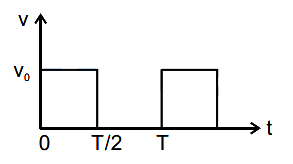
The rms value of the potential difference $v$ shown in the figure is
A
$\frac{v_{0}}{2}$
B
$v_{0}$
C
$\frac{v_{0}}{\sqrt{3}}$
D
$\frac{v_{0}}{\sqrt{2}}$
Solution
(D) The root mean square (rms) value of a periodic function $v(t)$ is defined as $V_{rms} = \sqrt{\frac{1}{T} \int_{0}^{T} v^2(t) dt}$.
From the given figure,the potential difference $v(t)$ is $V_0$ for the interval $0 \le t < \frac{T}{2}$ and $0$ for the interval $\frac{T}{2} \le t < T$.
Thus,$V_{rms}^2 = \frac{1}{T} \left[ \int_{0}^{T/2} V_0^2 dt + \int_{T/2}^{T} 0^2 dt \right]$.
$V_{rms}^2 = \frac{1}{T} \left[ V_0^2 \cdot \frac{T}{2} + 0 \right] = \frac{V_0^2}{2}$.
Taking the square root on both sides,we get $V_{rms} = \frac{V_0}{\sqrt{2}}$.
From the given figure,the potential difference $v(t)$ is $V_0$ for the interval $0 \le t < \frac{T}{2}$ and $0$ for the interval $\frac{T}{2} \le t < T$.
Thus,$V_{rms}^2 = \frac{1}{T} \left[ \int_{0}^{T/2} V_0^2 dt + \int_{T/2}^{T} 0^2 dt \right]$.
$V_{rms}^2 = \frac{1}{T} \left[ V_0^2 \cdot \frac{T}{2} + 0 \right] = \frac{V_0^2}{2}$.
Taking the square root on both sides,we get $V_{rms} = \frac{V_0}{\sqrt{2}}$.
0 likes
View Solution174
EasyMCQ
An alternating current in a circuit is given by $I = 20 \sin (100 \pi t + 0.05 \pi) \ A$. The r.m.s. value and the frequency of the current respectively are:
A
$10 \ A$ and $100 \ Hz$
B
$10 \ A$ and $50 \ Hz$
C
$10 \sqrt{2} \ A$ and $50 \ Hz$
D
$10 \sqrt{2} \ A$ and $100 \ Hz$
Solution
(C) The given equation for alternating current is $I = I_0 \sin(\omega t + \phi)$,where $I_0 = 20 \ A$ and $\omega = 100 \pi \ rad/s$.
The root mean square (r.m.s.) value of the current is given by $I_{rms} = \frac{I_0}{\sqrt{2}}$.
Substituting the value of $I_0$: $I_{rms} = \frac{20}{\sqrt{2}} = 10 \sqrt{2} \ A$.
The angular frequency is $\omega = 2 \pi f = 100 \pi$.
Solving for frequency $f$: $f = \frac{100 \pi}{2 \pi} = 50 \ Hz$.
Therefore,the r.m.s. value is $10 \sqrt{2} \ A$ and the frequency is $50 \ Hz$.
The root mean square (r.m.s.) value of the current is given by $I_{rms} = \frac{I_0}{\sqrt{2}}$.
Substituting the value of $I_0$: $I_{rms} = \frac{20}{\sqrt{2}} = 10 \sqrt{2} \ A$.
The angular frequency is $\omega = 2 \pi f = 100 \pi$.
Solving for frequency $f$: $f = \frac{100 \pi}{2 \pi} = 50 \ Hz$.
Therefore,the r.m.s. value is $10 \sqrt{2} \ A$ and the frequency is $50 \ Hz$.
0 likes
View Solution175
EasyMCQ
An alternating current of $rms$ value $10 \, A$ is passed through a $12 \, \Omega$ resistor. The maximum potential difference across the resistor is
A
$20 \, V$
B
$90 \, V$
C
$169.68 \, V$
D
none
Solution
(C) Given: $I_{rms} = 10 \, A$ and $R = 12 \, \Omega$.
The peak current $I_0$ is given by the relation $I_0 = I_{rms} \times \sqrt{2}$.
$I_0 = 10 \times 1.414 = 14.14 \, A$.
The maximum potential difference $V_0$ across the resistor is given by Ohm's law: $V_0 = I_0 \times R$.
$V_0 = 14.14 \times 12 = 169.68 \, V$.
The peak current $I_0$ is given by the relation $I_0 = I_{rms} \times \sqrt{2}$.
$I_0 = 10 \times 1.414 = 14.14 \, A$.
The maximum potential difference $V_0$ across the resistor is given by Ohm's law: $V_0 = I_0 \times R$.
$V_0 = 14.14 \times 12 = 169.68 \, V$.
0 likes
View Solution176
MediumMCQ
The electric current in the circuit is given as $i = i_{0}(t / T)$. The r.m.s current for the period $t = 0$ to $t = T$ is . . . . . .
A
$i_{0} / \sqrt{2}$
B
$i_{0}$
C
$i_{0} / \sqrt{6}$
D
$i_{0} / \sqrt{3}$
Solution
(D) The root mean square (r.m.s) current is defined as $i_{rms} = \sqrt{\frac{1}{T} \int_{0}^{T} i^2 dt}$.
Given $i = i_{0}(t / T)$,we have $i^2 = i_{0}^2 (t^2 / T^2)$.
Substituting this into the formula:
$i_{rms}^2 = \frac{1}{T} \int_{0}^{T} \frac{i_{0}^2 t^2}{T^2} dt = \frac{i_{0}^2}{T^3} \int_{0}^{T} t^2 dt$.
Evaluating the integral: $\int_{0}^{T} t^2 dt = \left[ \frac{t^3}{3} \right]_{0}^{T} = \frac{T^3}{3}$.
Therefore,$i_{rms}^2 = \frac{i_{0}^2}{T^3} \cdot \frac{T^3}{3} = \frac{i_{0}^2}{3}$.
Taking the square root,we get $i_{rms} = \frac{i_{0}}{\sqrt{3}}$.
Given $i = i_{0}(t / T)$,we have $i^2 = i_{0}^2 (t^2 / T^2)$.
Substituting this into the formula:
$i_{rms}^2 = \frac{1}{T} \int_{0}^{T} \frac{i_{0}^2 t^2}{T^2} dt = \frac{i_{0}^2}{T^3} \int_{0}^{T} t^2 dt$.
Evaluating the integral: $\int_{0}^{T} t^2 dt = \left[ \frac{t^3}{3} \right]_{0}^{T} = \frac{T^3}{3}$.
Therefore,$i_{rms}^2 = \frac{i_{0}^2}{T^3} \cdot \frac{T^3}{3} = \frac{i_{0}^2}{3}$.
Taking the square root,we get $i_{rms} = \frac{i_{0}}{\sqrt{3}}$.
0 likes
View Solution177
MediumMCQ
What is the approximate percentage value of the ratio of maximum voltage to its rms value in an $LCR$ $AC$ circuit (in $\%$)?
A
$22.8$
B
$70.7$
C
$50$
D
$141.4$
Solution
(D) The relationship between maximum (peak) voltage $V_0$ and root mean square (rms) voltage $V_{rms}$ for a sinusoidal $AC$ circuit is given by $V_{rms} = \frac{V_0}{\sqrt{2}}$.
Rearranging this formula,we get the ratio of maximum voltage to $rms$ voltage as $\frac{V_0}{V_{rms}} = \sqrt{2}$.
Given that $\sqrt{2} \approx 1.414$,we convert this ratio into a percentage by multiplying by $100\%$.
Therefore,the percentage value is $1.414 \times 100\% = 141.4\%$.
Rearranging this formula,we get the ratio of maximum voltage to $rms$ voltage as $\frac{V_0}{V_{rms}} = \sqrt{2}$.
Given that $\sqrt{2} \approx 1.414$,we convert this ratio into a percentage by multiplying by $100\%$.
Therefore,the percentage value is $1.414 \times 100\% = 141.4\%$.
0 likes
View Solution178
DifficultMCQ
The output voltage of a step-down transformer is measured to be $24 \text{ V}$,when connected to a $12 \text{ W}$ light bulb. The value of the peak current is . . . . . . .
A
$2\sqrt{2} \text{ A}$
B
$\sqrt{2} \text{ A}$
C
$2 \text{ A}$
D
$\frac{1}{\sqrt{2}} \text{ A}$
Solution
(D) The power $P$ is given by the formula $P = V_{rms} \times I_{rms}$.
Given $P = 12 \text{ W}$ and $V_{rms} = 24 \text{ V}$,we can calculate the root mean square current $I_{rms}$ as:
$I_{rms} = \frac{P}{V_{rms}} = \frac{12}{24} = 0.5 \text{ A}$.
The peak current $I_0$ is related to the $I_{rms}$ by the formula $I_0 = I_{rms} \times \sqrt{2}$.
Substituting the value of $I_{rms}$,we get:
$I_0 = 0.5 \times \sqrt{2} = \frac{1}{2} \times \sqrt{2} = \frac{1}{\sqrt{2}} \text{ A}$.
Given $P = 12 \text{ W}$ and $V_{rms} = 24 \text{ V}$,we can calculate the root mean square current $I_{rms}$ as:
$I_{rms} = \frac{P}{V_{rms}} = \frac{12}{24} = 0.5 \text{ A}$.
The peak current $I_0$ is related to the $I_{rms}$ by the formula $I_0 = I_{rms} \times \sqrt{2}$.
Substituting the value of $I_{rms}$,we get:
$I_0 = 0.5 \times \sqrt{2} = \frac{1}{2} \times \sqrt{2} = \frac{1}{\sqrt{2}} \text{ A}$.
0 likes
View Solution179
MediumMCQ
In an $AC$ generator,induced emf $\varepsilon = 0$ at $t = 0$,then its value . . . . . .
A
minimum at time $\frac{2\pi}{3\omega}$
B
minimum at time $\frac{\pi}{2\omega}$
C
maximum at time $\frac{2\pi}{\omega}$
D
maximum at time $\frac{\pi}{2\omega}$
Solution
(D) The induced emf in an $AC$ generator is given by the equation $\varepsilon = \varepsilon_0 \sin(\omega t)$.
At $t = 0$,$\varepsilon = \varepsilon_0 \sin(0) = 0$.
The emf reaches its maximum value when $\sin(\omega t) = 1$.
This occurs when $\omega t = \frac{\pi}{2}$.
Solving for $t$,we get $t = \frac{\pi}{2\omega}$.
Therefore,the induced emf is maximum at time $t = \frac{\pi}{2\omega}$.
At $t = 0$,$\varepsilon = \varepsilon_0 \sin(0) = 0$.
The emf reaches its maximum value when $\sin(\omega t) = 1$.
This occurs when $\omega t = \frac{\pi}{2}$.
Solving for $t$,we get $t = \frac{\pi}{2\omega}$.
Therefore,the induced emf is maximum at time $t = \frac{\pi}{2\omega}$.
0 likes
View Solution180
MediumMCQ
The peak value of an alternating current is $5 \text{ A}$ and frequency is $60 \text{ Hz}$. How long will the current,starting from zero,take to reach the peak value?
A
$1$/$120$ s
B
$1$/$240$ s
C
$1$/$30$ s
D
$1$/$60$ s
Solution
(B) The instantaneous current is given by the equation $I = I_0 \sin(\omega t)$,where $I_0$ is the peak current and $\omega$ is the angular frequency.
To reach the peak value,the sine function must be equal to $1$,which occurs when the phase angle $\omega t = \frac{\pi}{2}$.
Substituting $\omega = 2 \pi f$,we get $2 \pi f t = \frac{\pi}{2}$.
Solving for time $t$,we get $t = \frac{1}{4f}$.
Given the frequency $f = 60 \text{ Hz}$,we substitute this value into the equation:
$t = \frac{1}{4 \times 60} = \frac{1}{240} \text{ s}$.
Therefore,the current takes $1/240 \text{ s}$ to reach its peak value from zero.
To reach the peak value,the sine function must be equal to $1$,which occurs when the phase angle $\omega t = \frac{\pi}{2}$.
Substituting $\omega = 2 \pi f$,we get $2 \pi f t = \frac{\pi}{2}$.
Solving for time $t$,we get $t = \frac{1}{4f}$.
Given the frequency $f = 60 \text{ Hz}$,we substitute this value into the equation:
$t = \frac{1}{4 \times 60} = \frac{1}{240} \text{ s}$.
Therefore,the current takes $1/240 \text{ s}$ to reach its peak value from zero.
0 likes
View SolutionAlternating Current — Alternating Current, Voltage (rms and Average) · Frequently Asked Questions
1Are these Alternating Current questions useful for JEE and NEET?
Yes. All questions in this section are mapped to JEE Main and NEET exam patterns. Previous year questions from JEE Main, NEET, GUJCET and state-level exams are included with full solutions.
2Can I switch to Hindi or Gujarati for these questions?
Yes. Use the language tabs in the hero section or the sidebar to view the same questions and solutions in English, Hindi or Gujarati.
3How do I generate a question paper from this subtopic?
Use the Vedclass Exam Paper Generator — select the chapter and subtopic, set difficulty, and generate Sets A, B, C, D automatically. First 3 chapters of every subject are free.
Vedclass Products
For Students
Vedclass Test Series
Mock tests in real JEE/NEET style with performance analysis. 5-day free trial.
Start Free TrialFor Teachers
Exam Paper Generator
Generate Set A/B/C/D papers from this chapter in 2 minutes. 3 chapters free.
Try FreeFor Institutes
Online Exam Module
Live online exams with unlimited students, 360° analytics & white-label branding.
See DemoFor Teachers & Institutes
Generate a Alternating Current Exam Paper in 2 Minutes
Select subtopic & difficulty — Sets A, B, C, D auto-generated with No Repeat logic.
First 3 chapters of every subject are free — no payment required.