
A English
Rate law , Rate constant , Order of Reaction and Molecularity Questions in English
Class 12 Chemistry · Chemical Kinetics · Rate law , Rate constant , Order of Reaction and Molecularity
607+
Questions
English
Language
100%
With Solutions
Showing 50 of 607 questions in English
201
DifficultMCQ
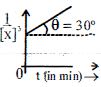
For a reaction: $3X \to 4Y$,calculate the rate of reaction based on the following graph when the concentration of $X$ is $0.1 \ M$.
A
$\frac{1}{9} \times 10^{-4} \ M \ \min^{-1}$
B
$\frac{1}{3\sqrt{3}} \times 10^{-4} \ M \ \min^{-1}$
C
$\frac{1}{9\sqrt{3}} \times 10^{-4} \ M \ \min^{-1}$
D
$3\sqrt{3} \times 10^{-4} \ M \ \min^{-1}$
Solution
(C) The rate law for the reaction $3X \to 4Y$ is given by $-\frac{1}{3} \frac{d[X]}{dt} = k[X]^n$.
For an $n$-th order reaction where $n \neq 1$,the integrated rate law is $\frac{1}{[X]^{n-1}} - \frac{1}{[X]_0^{n-1}} = 3(n-1)kt$.
Comparing this with the equation of a straight line $y = mx + c$,where $y = \frac{1}{[X]^3}$,we identify $n-1 = 3$,so $n = 4$.
The slope of the graph is $3(n-1)k = \tan 30^{\circ} = \frac{1}{\sqrt{3}}$.
Substituting $n-1 = 3$,we get $3(3)k = \frac{1}{\sqrt{3}}$,which implies $9k = \frac{1}{\sqrt{3}}$,or $k = \frac{1}{9\sqrt{3}}$.
The rate of reaction $r$ is given by $r = k[X]^n = \frac{1}{9\sqrt{3}} \times (0.1)^4$.
$r = \frac{1}{9\sqrt{3}} \times 10^{-4} \ M \ \min^{-1}$.
For an $n$-th order reaction where $n \neq 1$,the integrated rate law is $\frac{1}{[X]^{n-1}} - \frac{1}{[X]_0^{n-1}} = 3(n-1)kt$.
Comparing this with the equation of a straight line $y = mx + c$,where $y = \frac{1}{[X]^3}$,we identify $n-1 = 3$,so $n = 4$.
The slope of the graph is $3(n-1)k = \tan 30^{\circ} = \frac{1}{\sqrt{3}}$.
Substituting $n-1 = 3$,we get $3(3)k = \frac{1}{\sqrt{3}}$,which implies $9k = \frac{1}{\sqrt{3}}$,or $k = \frac{1}{9\sqrt{3}}$.
The rate of reaction $r$ is given by $r = k[X]^n = \frac{1}{9\sqrt{3}} \times (0.1)^4$.
$r = \frac{1}{9\sqrt{3}} \times 10^{-4} \ M \ \min^{-1}$.
0 likes
View Solution202
DifficultMCQ
Which of the following options correctly represents the relationship between $t_{7/8}$ and $t_{1/2}$ where $t_{7/8}$ represents the time required for the concentration to become $1/8$ of the original for a reaction of order $n$?
A
$t_{7/8} = (2^{n-1} - 1) \ t_{1/2}$
B
$t_{7/8} = t_{1/2} \ [2^{n-1} - 1]$
C
$t_{7/8} = t_{1/2} \ [2^{n-1} + 1]$
D
$t_{7/8} = t_{1/2} \ [2^{3(n-1)} - 1] / [2^{n-1} - 1]$
Solution
(D) For a reaction of order $n \neq 1$,the integrated rate law is $t = \frac{1}{k(n-1)} [\frac{1}{C_t^{n-1}} - \frac{1}{C_0^{n-1}}]$.
For $t_{1/2}$,$C_t = C_0 / 2$:
$t_{1/2} = \frac{1}{k(n-1)} [\frac{2^{n-1}}{C_0^{n-1}} - \frac{1}{C_0^{n-1}}] = \frac{2^{n-1} - 1}{k(n-1)C_0^{n-1}}$.
For $t_{7/8}$,$C_t = C_0 / 8 = C_0 / 2^3$:
$t_{7/8} = \frac{1}{k(n-1)} [\frac{8^{n-1}}{C_0^{n-1}} - \frac{1}{C_0^{n-1}}] = \frac{(2^3)^{n-1} - 1}{k(n-1)C_0^{n-1}} = \frac{2^{3(n-1)} - 1}{k(n-1)C_0^{n-1}}$.
Dividing $t_{7/8}$ by $t_{1/2}$:
$\frac{t_{7/8}}{t_{1/2}} = \frac{2^{3(n-1)} - 1}{2^{n-1} - 1}$.
Therefore,$t_{7/8} = t_{1/2} \ [\frac{2^{3(n-1)} - 1}{2^{n-1} - 1}]$.
For $t_{1/2}$,$C_t = C_0 / 2$:
$t_{1/2} = \frac{1}{k(n-1)} [\frac{2^{n-1}}{C_0^{n-1}} - \frac{1}{C_0^{n-1}}] = \frac{2^{n-1} - 1}{k(n-1)C_0^{n-1}}$.
For $t_{7/8}$,$C_t = C_0 / 8 = C_0 / 2^3$:
$t_{7/8} = \frac{1}{k(n-1)} [\frac{8^{n-1}}{C_0^{n-1}} - \frac{1}{C_0^{n-1}}] = \frac{(2^3)^{n-1} - 1}{k(n-1)C_0^{n-1}} = \frac{2^{3(n-1)} - 1}{k(n-1)C_0^{n-1}}$.
Dividing $t_{7/8}$ by $t_{1/2}$:
$\frac{t_{7/8}}{t_{1/2}} = \frac{2^{3(n-1)} - 1}{2^{n-1} - 1}$.
Therefore,$t_{7/8} = t_{1/2} \ [\frac{2^{3(n-1)} - 1}{2^{n-1} - 1}]$.
0 likes
View Solution203
DifficultMCQ
The mechanism of the reaction,$2NO_{(g)} + 2H_{2(g)} \to N_{2(g)} + 2H_2O_{(g)}$ is:
Step $1$: $2NO_{(g)} + H_{2(g)} \xrightarrow{\text{slow}} N_2 + H_2O_2$
Step $2$: $H_2O_2 + H_2 \xrightarrow{\text{fast}} 2H_2O$
Then the correct statement is:
Step $1$: $2NO_{(g)} + H_{2(g)} \xrightarrow{\text{slow}} N_2 + H_2O_2$
Step $2$: $H_2O_2 + H_2 \xrightarrow{\text{fast}} 2H_2O$
Then the correct statement is:
A
Rate $= k [NO]^2 [H_2]$
B
Rate $= k [H_2O_2] [H_2]$
C
On doubling the concentration of $H_2$,keeping the concentration of $NO$ constant,the rate will become double
D
If the initial concentration of $H_2$ and $NO$ is $C_0$ and after time $t$ the concentration of $N_2$ is $x$,then Rate $= k (C_0 - 2x)^2$
Solution
(A) The rate of a reaction is determined by the slowest step in the mechanism.
From Step $1$ (slow step),the rate law is given by: Rate $= k [NO]^2 [H_2]$.
Since the rate is directly proportional to the concentration of $H_2$ (first order with respect to $H_2$),doubling the concentration of $H_2$ while keeping $[NO]$ constant will double the rate of the reaction.
Therefore,both statement $A$ and statement $C$ are correct.
From Step $1$ (slow step),the rate law is given by: Rate $= k [NO]^2 [H_2]$.
Since the rate is directly proportional to the concentration of $H_2$ (first order with respect to $H_2$),doubling the concentration of $H_2$ while keeping $[NO]$ constant will double the rate of the reaction.
Therefore,both statement $A$ and statement $C$ are correct.
0 likes
View Solution204
DifficultMCQ
For the reaction between $A$ and $B$,the initial rate of reaction $(r_0)$ was measured for different initial concentrations of $A$ and $B$ as given below. Determine the order of the reaction with respect to $A$ and $B$ respectively.
| $[A] / mol \ L^{-1}$ | $0.2, 0.2, 0.4$ |
| $[B] / mol \ L^{-1}$ | $0.3, 0.1, 0.05$ |
| $r_0 / mol \ L^{-1} s^{-1}$ | $5.0 \times 10^{-5}, 5.0 \times 10^{-5}, 1.4 \times 10^{-4}$ |
A
$\frac{1}{2}, 0$
B
$\frac{3}{2}, \frac{1}{3}$
C
$\frac{3}{2}, 0$
D
$0, \frac{5}{2}$
Solution
(C) The rate law is given by $r = k[A]^x[B]^y$.
From the data:
$1) \ 5.0 \times 10^{-5} = k(0.2)^x(0.3)^y$
$2) \ 5.0 \times 10^{-5} = k(0.2)^x(0.1)^y$
$3) \ 1.4 \times 10^{-4} = k(0.4)^x(0.05)^y$
Dividing $(1)$ by $(2)$:
$1 = (0.3/0.1)^y = 3^y \implies y = 0$.
Dividing $(3)$ by $(1)$:
$\frac{1.4 \times 10^{-4}}{5.0 \times 10^{-5}} = \frac{k(0.4)^x(0.05)^0}{k(0.2)^x(0.3)^0}$
$2.8 = (0.4/0.2)^x = 2^x$
Taking $\log$ on both sides: $x \log 2 = \log 2.8 \implies x = \frac{\log 2.8}{\log 2} \approx 1.48 \approx \frac{3}{2}$.
Thus,the order with respect to $A$ is $\frac{3}{2}$ and with respect to $B$ is $0$.
From the data:
$1) \ 5.0 \times 10^{-5} = k(0.2)^x(0.3)^y$
$2) \ 5.0 \times 10^{-5} = k(0.2)^x(0.1)^y$
$3) \ 1.4 \times 10^{-4} = k(0.4)^x(0.05)^y$
Dividing $(1)$ by $(2)$:
$1 = (0.3/0.1)^y = 3^y \implies y = 0$.
Dividing $(3)$ by $(1)$:
$\frac{1.4 \times 10^{-4}}{5.0 \times 10^{-5}} = \frac{k(0.4)^x(0.05)^0}{k(0.2)^x(0.3)^0}$
$2.8 = (0.4/0.2)^x = 2^x$
Taking $\log$ on both sides: $x \log 2 = \log 2.8 \implies x = \frac{\log 2.8}{\log 2} \approx 1.48 \approx \frac{3}{2}$.
Thus,the order with respect to $A$ is $\frac{3}{2}$ and with respect to $B$ is $0$.
0 likes
View Solution205
MediumMCQ
For a certain reaction $A \to P$,the half-life for different initial concentrations of $A$ is mentioned below:
Which of the following option$(s)$ is/are correct?
| $[A_0]$ | $0.1 \ M$ | $0.025 \ M$ |
| $t_{1/2} \ (s)$ | $100 \ s$ | $50 \ s$ |
Which of the following option$(s)$ is/are correct?
A
The order is $1$
B
The order is $2$
C
For $[A_0] = 1 \ M$,$t_{1/2} = 25 \ s$
D
The unit of $k$ is $M^{-1} \ s^{-1}$
Solution
(NONE) For a reaction of order $n$,the half-life is related to the initial concentration by the relation: $t_{1/2} \propto [A_0]^{1-n}$.
Given data:
$1$) $[A_0]_1 = 0.1 \ M$,$(t_{1/2})_1 = 100 \ s$
$2$) $[A_0]_2 = 0.025 \ M$,$(t_{1/2})_2 = 50 \ s$
Taking the ratio: $\frac{(t_{1/2})_1}{(t_{1/2})_2} = \left( \frac{[A_0]_1}{[A_0]_2} \right)^{1-n}$
$\frac{100}{50} = \left( \frac{0.1}{0.025} \right)^{1-n}$
$2 = (4)^{1-n}$
$2 = (2^2)^{1-n} = 2^{2-2n}$
Equating exponents: $1 = 2 - 2n \implies 2n = 1 \implies n = 0.5$.
Since $n = 0.5$,the reaction is of order $0.5$. None of the provided options $A$ or $B$ are correct. For $n=0.5$,the unit of $k$ is $M^{1-0.5} \ s^{-1} = M^{0.5} \ s^{-1}$. Thus,$D$ is incorrect. Option $C$ is also incorrect based on the calculated order.
Given data:
$1$) $[A_0]_1 = 0.1 \ M$,$(t_{1/2})_1 = 100 \ s$
$2$) $[A_0]_2 = 0.025 \ M$,$(t_{1/2})_2 = 50 \ s$
Taking the ratio: $\frac{(t_{1/2})_1}{(t_{1/2})_2} = \left( \frac{[A_0]_1}{[A_0]_2} \right)^{1-n}$
$\frac{100}{50} = \left( \frac{0.1}{0.025} \right)^{1-n}$
$2 = (4)^{1-n}$
$2 = (2^2)^{1-n} = 2^{2-2n}$
Equating exponents: $1 = 2 - 2n \implies 2n = 1 \implies n = 0.5$.
Since $n = 0.5$,the reaction is of order $0.5$. None of the provided options $A$ or $B$ are correct. For $n=0.5$,the unit of $k$ is $M^{1-0.5} \ s^{-1} = M^{0.5} \ s^{-1}$. Thus,$D$ is incorrect. Option $C$ is also incorrect based on the calculated order.
0 likes
View Solution206
MediumMCQ
The hypothetical reaction : $2A + B \to C + D$ is catalyzed by $E$ as indicated in the possible mechanism below -
Step-$1$ : $A + E \rightleftharpoons AE$ (fast)
Step-$2$ : $AE + A \to A_2 + E$ (slow)
Step-$3$ : $A_2 + B \to C + D$ (fast)
What rate law best agrees with this mechanism?
Step-$1$ : $A + E \rightleftharpoons AE$ (fast)
Step-$2$ : $AE + A \to A_2 + E$ (slow)
Step-$3$ : $A_2 + B \to C + D$ (fast)
What rate law best agrees with this mechanism?
A
$r = k[A][B]$
B
$r = k[A][E]$
C
$r = k[A]^2[E]$
D
$r = k[A]^2[B]$
Solution
(C) The rate of the reaction is determined by the slowest step,which is Step-$2$: $r = k_2[AE][A]$.
Since $AE$ is an intermediate,we express its concentration using the equilibrium constant $K_{eq}$ from the fast Step-$1$: $K_{eq} = \frac{[AE]}{[A][E]}$,which gives $[AE] = K_{eq}[A][E]$.
Substituting this into the rate expression: $r = k_2(K_{eq}[A][E])[A] = k_2 K_{eq}[A]^2[E]$.
Letting $k = k_2 K_{eq}$,the rate law becomes $r = k[A]^2[E]$.
Since $AE$ is an intermediate,we express its concentration using the equilibrium constant $K_{eq}$ from the fast Step-$1$: $K_{eq} = \frac{[AE]}{[A][E]}$,which gives $[AE] = K_{eq}[A][E]$.
Substituting this into the rate expression: $r = k_2(K_{eq}[A][E])[A] = k_2 K_{eq}[A]^2[E]$.
Letting $k = k_2 K_{eq}$,the rate law becomes $r = k[A]^2[E]$.
0 likes
View Solution207
MediumMCQ
For a certain reaction $A_{(g)} \to B_{(g)}$,the half-life for different initial pressures of $A$ is given below:
The correct statement about the order of reaction is:
| $P_{A_0} \text{ (atm)}$ | $0.1$ | $0.025$ |
| $t_{1/2} \text{ (sec)}$ | $100$ | $50$ |
The correct statement about the order of reaction is:
A
$1$
B
$2$
C
$3$
D
$0.5$
Solution
(D) We know that the relationship between half-life $(t_{1/2})$ and initial pressure $(P_{A_0})$ for a reaction of order $n$ is given by:
$t_{1/2} \propto (P_{A_0})^{1-n}$
Therefore,$\frac{(t_{1/2})_1}{(t_{1/2})_2} = \left( \frac{(P_{A_0})_1}{(P_{A_0})_2} \right)^{1-n}$
Given: $(t_{1/2})_1 = 100 \text{ s}$,$(P_{A_0})_1 = 0.1 \text{ atm}$
$(t_{1/2})_2 = 50 \text{ s}$,$(P_{A_0})_2 = 0.025 \text{ atm}$
Substituting the values:
$\frac{100}{50} = \left( \frac{0.1}{0.025} \right)^{1-n}$
$2 = (4)^{1-n}$
$2^1 = (2^2)^{1-n}$
$2^1 = 2^{2(1-n)}$
Comparing the powers: $1 = 2(1-n)$
$0.5 = 1 - n$
$n = 1 - 0.5 = 0.5$
Thus,the order of the reaction is $0.5$.
$t_{1/2} \propto (P_{A_0})^{1-n}$
Therefore,$\frac{(t_{1/2})_1}{(t_{1/2})_2} = \left( \frac{(P_{A_0})_1}{(P_{A_0})_2} \right)^{1-n}$
Given: $(t_{1/2})_1 = 100 \text{ s}$,$(P_{A_0})_1 = 0.1 \text{ atm}$
$(t_{1/2})_2 = 50 \text{ s}$,$(P_{A_0})_2 = 0.025 \text{ atm}$
Substituting the values:
$\frac{100}{50} = \left( \frac{0.1}{0.025} \right)^{1-n}$
$2 = (4)^{1-n}$
$2^1 = (2^2)^{1-n}$
$2^1 = 2^{2(1-n)}$
Comparing the powers: $1 = 2(1-n)$
$0.5 = 1 - n$
$n = 1 - 0.5 = 0.5$
Thus,the order of the reaction is $0.5$.
0 likes
View Solution208
MediumMCQ
Select the incorrect option :
A
Each species appearing in balanced chemical equation must appear in kinetic rate law.
B
Bimolecular elementary reaction is always second order.
C
Hydrolysis of ester in alkaline medium is bimolecular second order reaction.
D
Order and molecularity may be same for a chemical reaction
Solution
(A) The rate law of a chemical reaction is determined experimentally and depends on the mechanism of the reaction.
Species appearing in the balanced chemical equation do not necessarily appear in the rate law,especially if they are intermediates or if the reaction is complex.
Therefore,option $A$ is incorrect.
Bimolecular elementary reactions involve the collision of two particles,making them second order,so $B$ is correct.
Alkaline hydrolysis of an ester (saponification) follows second-order kinetics,so $C$ is correct.
For elementary reactions,the order and molecularity are indeed the same,so $D$ is correct.
Species appearing in the balanced chemical equation do not necessarily appear in the rate law,especially if they are intermediates or if the reaction is complex.
Therefore,option $A$ is incorrect.
Bimolecular elementary reactions involve the collision of two particles,making them second order,so $B$ is correct.
Alkaline hydrolysis of an ester (saponification) follows second-order kinetics,so $C$ is correct.
For elementary reactions,the order and molecularity are indeed the same,so $D$ is correct.
0 likes
View Solution209
MediumMCQ
The half-life period of a gaseous reactant undergoing thermal decomposition was measured for various initial pressures $P_0$ as follows:
The order of reaction is -
| $P_0 \text{ (mmHg)}$ | $250$ | $300$ |
| $t_{1/2} \text{ (minutes)}$ | $135$ | $112.5$ |
The order of reaction is -
A
$0$
B
$1$
C
$2$
D
$3$
Solution
(C) For an $n$-th order reaction,the half-life $t_{1/2}$ is related to the initial pressure $P_0$ as $t_{1/2} \propto \frac{1}{P_0^{n-1}}$.
Therefore,$\frac{(t_{1/2})_1}{(t_{1/2})_2} = \left( \frac{(P_0)_2}{(P_0)_1} \right)^{n-1}$.
Substituting the given values:
$\frac{135}{112.5} = \left( \frac{300}{250} \right)^{n-1}$.
$1.2 = (1.2)^{n-1}$.
Comparing the exponents,$n - 1 = 1$,which gives $n = 2$.
Therefore,$\frac{(t_{1/2})_1}{(t_{1/2})_2} = \left( \frac{(P_0)_2}{(P_0)_1} \right)^{n-1}$.
Substituting the given values:
$\frac{135}{112.5} = \left( \frac{300}{250} \right)^{n-1}$.
$1.2 = (1.2)^{n-1}$.
Comparing the exponents,$n - 1 = 1$,which gives $n = 2$.
0 likes
View Solution210
MediumMCQ
When the concentration of a reactant,$A$,in a reaction $A \to \text{Products}$ is doubled,the rate of reaction increases seven times. The order of the reaction is between:
A
$0$ and $1$
B
$1$ and $2$
C
$2$ and $3$
D
$3$ and $4$
Solution
(C) The rate law for the reaction is given by $r = k[A]^x$,where $x$ is the order of the reaction.
Initially,$r = k[A]^x$ $(1)$.
When the concentration is doubled,the new rate becomes $7r$,so $7r = k[2A]^x$ $(2)$.
Dividing equation $(2)$ by equation $(1)$: $\frac{7r}{r} = \frac{k[2A]^x}{k[A]^x}$.
$7 = 2^x$.
Taking the logarithm on both sides: $\log(7) = x \log(2)$.
$x = \frac{\log(7)}{\log(2)} \approx \frac{0.845}{0.301} \approx 2.81$.
Since $2 < 2.81 < 3$,the order of the reaction is between $2$ and $3$.
Initially,$r = k[A]^x$ $(1)$.
When the concentration is doubled,the new rate becomes $7r$,so $7r = k[2A]^x$ $(2)$.
Dividing equation $(2)$ by equation $(1)$: $\frac{7r}{r} = \frac{k[2A]^x}{k[A]^x}$.
$7 = 2^x$.
Taking the logarithm on both sides: $\log(7) = x \log(2)$.
$x = \frac{\log(7)}{\log(2)} \approx \frac{0.845}{0.301} \approx 2.81$.
Since $2 < 2.81 < 3$,the order of the reaction is between $2$ and $3$.
0 likes
View Solution211
MediumMCQ
The given data are for the reaction:
$2NO_{(g)} + Cl_{2(g)} \to 2NOCl_{(g)}$ at $298 \ K$
The rate law for the reaction is:
$2NO_{(g)} + Cl_{2(g)} \to 2NOCl_{(g)}$ at $298 \ K$
| Experiment | $[Cl_2] \ (M)$ | $[NO] \ (M)$ | Rate $(mol \ L^{-1} \sec^{-1})$ |
| $I$ | $0.05$ | $0.05$ | $1 \times 10^{-3}$ |
| $II$ | $0.15$ | $0.05$ | $3 \times 10^{-3}$ |
| $III$ | $0.05$ | $0.15$ | $9 \times 10^{-3}$ |
The rate law for the reaction is:
A
$r = k[NO][Cl_2]$
B
$r = k[Cl_2][NO]^2$
C
$r = k[Cl_2]^2[NO]$
D
$r = k[Cl_2]$
Solution
(B) The rate law is expressed as $r = k[NO]^x[Cl_2]^y$.
From experiment $I$ and $II$,keeping $[NO]$ constant:
$\frac{3 \times 10^{-3}}{1 \times 10^{-3}} = \left(\frac{0.15}{0.05}\right)^y \implies 3 = 3^y \implies y = 1$.
From experiment $I$ and $III$,keeping $[Cl_2]$ constant:
$\frac{9 \times 10^{-3}}{1 \times 10^{-3}} = \left(\frac{0.15}{0.05}\right)^x \implies 9 = 3^x \implies x = 2$.
Thus,the rate law is $r = k[NO]^2[Cl_2]^1$ or $r = k[Cl_2][NO]^2$.
From experiment $I$ and $II$,keeping $[NO]$ constant:
$\frac{3 \times 10^{-3}}{1 \times 10^{-3}} = \left(\frac{0.15}{0.05}\right)^y \implies 3 = 3^y \implies y = 1$.
From experiment $I$ and $III$,keeping $[Cl_2]$ constant:
$\frac{9 \times 10^{-3}}{1 \times 10^{-3}} = \left(\frac{0.15}{0.05}\right)^x \implies 9 = 3^x \implies x = 2$.
Thus,the rate law is $r = k[NO]^2[Cl_2]^1$ or $r = k[Cl_2][NO]^2$.
0 likes
View Solution212
DifficultMCQ
For a chemical reaction $Y + 2Z \to$ Product,the rate-controlling step is $Y + \frac{1}{2}Z \to Q$. If the concentration of $Z$ is doubled,the rate of reaction will:
A
remain the same
B
become four times
C
become $1.414$ times
D
become double
Solution
(C) The rate of a reaction is determined by its rate-determining step.
Given the rate-determining step is $Y + \frac{1}{2}Z \to Q$,the rate law is expressed as: $Rate = k[Y][Z]^{1/2}$.
If the concentration of $Z$ is doubled,the new rate $(r')$ becomes:
$r' = k[Y][2Z]^{1/2} = k[Y] \times \sqrt{2} \times [Z]^{1/2}$.
$r' = \sqrt{2} \times Rate = 1.414 \times Rate$.
Therefore,the rate of reaction will become $1.414$ times the original rate.
Given the rate-determining step is $Y + \frac{1}{2}Z \to Q$,the rate law is expressed as: $Rate = k[Y][Z]^{1/2}$.
If the concentration of $Z$ is doubled,the new rate $(r')$ becomes:
$r' = k[Y][2Z]^{1/2} = k[Y] \times \sqrt{2} \times [Z]^{1/2}$.
$r' = \sqrt{2} \times Rate = 1.414 \times Rate$.
Therefore,the rate of reaction will become $1.414$ times the original rate.
0 likes
View Solution213
DifficultMCQ
The following data is given for the reaction between $A$ and $B$:
Which of the following are correct statements?
$(a)$ Rate constant of the reaction is $1 \ mol^{-1} \ L \ sec^{-1}$.
$(b)$ Rate law of the reaction is $k[A][B]$.
$(c)$ Rate of reaction increases four times on doubling the concentration of both the reactants.
| $S.NO.$ | $[A] \ mol \ L^{-1}$ | $[B] \ mol \ L^{-1}$ | $Rate \ mol \ L^{-1} \ sec^{-1}$ |
| $I$ | $1 \times 10^{-2}$ | $2 \times 10^{-2}$ | $2 \times 10^{-4}$ |
| $II$ | $2 \times 10^{-2}$ | $2 \times 10^{-2}$ | $4 \times 10^{-4}$ |
| $III$ | $2 \times 10^{-2}$ | $4 \times 10^{-2}$ | $8 \times 10^{-4}$ |
Which of the following are correct statements?
$(a)$ Rate constant of the reaction is $1 \ mol^{-1} \ L \ sec^{-1}$.
$(b)$ Rate law of the reaction is $k[A][B]$.
$(c)$ Rate of reaction increases four times on doubling the concentration of both the reactants.
A
$a, b$ and $c$
B
$a$ and $b$
C
$b$ and $c$
D
$c$ alone
Solution
(A) The rate law is given by $r = k[A]^x[B]^y$.
Comparing experiments $I$ and $II$:
$[A]$ is doubled,$[B]$ is constant,and the rate $r$ is doubled.
Therefore,$x = 1$.
Comparing experiments $II$ and $III$:
$[A]$ is constant,$[B]$ is doubled,and the rate $r$ is doubled.
Therefore,$y = 1$.
The rate law is $r = k[A][B]$. Statement $(b)$ is correct.
Using experiment $I$ to find $k$:
$2 \times 10^{-4} = k \times (1 \times 10^{-2}) \times (2 \times 10^{-2})$
$2 \times 10^{-4} = k \times (2 \times 10^{-4})$
$k = 1 \ mol^{-1} \ L \ sec^{-1}$. Statement $(a)$ is correct.
If both $[A]$ and $[B]$ are doubled:
$r' = k(2[A])(2[B]) = 4k[A][B] = 4r$.
Thus,the rate increases four times. Statement $(c)$ is correct.
Therefore,all statements $(a), (b),$ and $(c)$ are correct.
Comparing experiments $I$ and $II$:
$[A]$ is doubled,$[B]$ is constant,and the rate $r$ is doubled.
Therefore,$x = 1$.
Comparing experiments $II$ and $III$:
$[A]$ is constant,$[B]$ is doubled,and the rate $r$ is doubled.
Therefore,$y = 1$.
The rate law is $r = k[A][B]$. Statement $(b)$ is correct.
Using experiment $I$ to find $k$:
$2 \times 10^{-4} = k \times (1 \times 10^{-2}) \times (2 \times 10^{-2})$
$2 \times 10^{-4} = k \times (2 \times 10^{-4})$
$k = 1 \ mol^{-1} \ L \ sec^{-1}$. Statement $(a)$ is correct.
If both $[A]$ and $[B]$ are doubled:
$r' = k(2[A])(2[B]) = 4k[A][B] = 4r$.
Thus,the rate increases four times. Statement $(c)$ is correct.
Therefore,all statements $(a), (b),$ and $(c)$ are correct.
0 likes
View Solution214
MediumMCQ
For the reaction $2H_2 + 2NO \to N_2 + 2H_2O$,the following mechanism has been proposed:
$I$. $2NO \rightleftharpoons N_2O_2$ (fast)
$II$. $N_2O_2 + H_2 \xrightarrow{k_2} N_2O + H_2O$ (slow)
$III$. $N_2O + H_2 \to N_2 + H_2O$ (fast)
What will be the rate law of this reaction?
$I$. $2NO \rightleftharpoons N_2O_2$ (fast)
$II$. $N_2O_2 + H_2 \xrightarrow{k_2} N_2O + H_2O$ (slow)
$III$. $N_2O + H_2 \to N_2 + H_2O$ (fast)
What will be the rate law of this reaction?
A
$k[NO][H_2]^2$
B
$k[NO][H_2]$
C
$k[NO]^0[H_2]^3$
D
$k[NO]^2[H_2]$
Solution
(D) The rate of the reaction is determined by the slow step $(II)$:
$r = k_2 [N_2O_2] [H_2]$
Since $N_2O_2$ is an intermediate,we express its concentration using the equilibrium constant $(K_{eq})$ from the fast step $(I)$:
$K_{eq} = \frac{[N_2O_2]}{[NO]^2} \implies [N_2O_2] = K_{eq} [NO]^2$
Substituting this into the rate expression:
$r = k_2 (K_{eq} [NO]^2) [H_2]$
Let $k = k_2 K_{eq}$,then the rate law is:
$r = k [NO]^2 [H_2]$
$r = k_2 [N_2O_2] [H_2]$
Since $N_2O_2$ is an intermediate,we express its concentration using the equilibrium constant $(K_{eq})$ from the fast step $(I)$:
$K_{eq} = \frac{[N_2O_2]}{[NO]^2} \implies [N_2O_2] = K_{eq} [NO]^2$
Substituting this into the rate expression:
$r = k_2 (K_{eq} [NO]^2) [H_2]$
Let $k = k_2 K_{eq}$,then the rate law is:
$r = k [NO]^2 [H_2]$
0 likes
View Solution215
MediumMCQ
The rate constant of which of the following reactions is independent of the concentration of the reactants?
A
First order reactions
B
Zero order reactions
C
Second order reactions
D
All of these
Solution
(D) The rate constant $(k)$ is a characteristic property of a reaction at a given temperature.
It is independent of the initial concentration of the reactants for all orders of reactions.
It depends only on the temperature and the presence of a catalyst.
It is independent of the initial concentration of the reactants for all orders of reactions.
It depends only on the temperature and the presence of a catalyst.
0 likes
View Solution216
MediumMCQ
At a certain temperature,the half-life periods for the catalytic decomposition of $NH_3$ were found to be as follows:
What will be the pressure when the half-life period is $2.5 \ hrs$?
| Pressure $(mm \ Hg)$ | $50, 100, 200$ |
| Half-life period $(hrs)$ | $3.52, 1.76, 0.88$ |
What will be the pressure when the half-life period is $2.5 \ hrs$?
A
$117$
B
$206$
C
$70$
D
$160$
Solution
(C) For a reaction of order $n$,the half-life period $(t_{1/2})$ is related to the initial pressure $(P)$ as $(t_{1/2}) \propto P^{1-n}$.
Using the data: $\frac{(t_{1/2})_1}{(t_{1/2})_2} = (\frac{P_1}{P_2})^{1-n}$.
Taking the first two values: $\frac{3.52}{1.76} = (\frac{50}{100})^{1-n} \implies 2 = (\frac{1}{2})^{1-n} = 2^{n-1}$.
Comparing exponents: $n-1 = 1$,so $n = 2$.
Now,for $t_{1/2} = 2.5 \ hrs$,we use the relation $(t_{1/2}) \propto P^{1-2} \implies (t_{1/2}) \propto P^{-1} \implies (t_{1/2}) \times P = \text{constant}$.
Using the first data point: $3.52 \times 50 = 2.5 \times P_2$.
$P_2 = \frac{3.52 \times 50}{2.5} = \frac{176}{2.5} = 70.4 \ mm \ Hg$.
Rounding to the nearest integer,the pressure is $70 \ mm \ Hg$.
Using the data: $\frac{(t_{1/2})_1}{(t_{1/2})_2} = (\frac{P_1}{P_2})^{1-n}$.
Taking the first two values: $\frac{3.52}{1.76} = (\frac{50}{100})^{1-n} \implies 2 = (\frac{1}{2})^{1-n} = 2^{n-1}$.
Comparing exponents: $n-1 = 1$,so $n = 2$.
Now,for $t_{1/2} = 2.5 \ hrs$,we use the relation $(t_{1/2}) \propto P^{1-2} \implies (t_{1/2}) \propto P^{-1} \implies (t_{1/2}) \times P = \text{constant}$.
Using the first data point: $3.52 \times 50 = 2.5 \times P_2$.
$P_2 = \frac{3.52 \times 50}{2.5} = \frac{176}{2.5} = 70.4 \ mm \ Hg$.
Rounding to the nearest integer,the pressure is $70 \ mm \ Hg$.
0 likes
View Solution217
MediumMCQ
The rate of reaction at $273 \ K$ is $R_0$. The rate of reaction at $313 \ K$ will be (Assuming temperature coefficient equal to $2$).
A
$16 \ R_0$
B
$64 \ R_0$
C
$\frac{R_0}{32}$
D
$\frac{R_0}{16}$
Solution
(A) The rate of reaction increases with temperature according to the formula: $r_{new} = r_{initial} \times \mu^{(\Delta T / 10)}$.
Here,$\mu = 2$ (temperature coefficient),$T_1 = 273 \ K$,and $T_2 = 313 \ K$.
$\Delta T = T_2 - T_1 = 313 - 273 = 40 \ K$.
Substituting the values: $r_{new} = R_0 \times (2)^{(40 / 10)}$.
$r_{new} = R_0 \times (2)^4 = 16 \ R_0$.
Here,$\mu = 2$ (temperature coefficient),$T_1 = 273 \ K$,and $T_2 = 313 \ K$.
$\Delta T = T_2 - T_1 = 313 - 273 = 40 \ K$.
Substituting the values: $r_{new} = R_0 \times (2)^{(40 / 10)}$.
$r_{new} = R_0 \times (2)^4 = 16 \ R_0$.
0 likes
View Solution218
AdvancedMCQ
$Zn + 2H^{+} \to Zn^{2+} + H_2$
The half-life period is independent of the concentration of zinc at constant $pH$. For the constant concentration of $Zn$,the rate becomes $100$ times when $pH$ is decreased from $3$ to $2$. Identify the correct statements $(pH = -\log [H^{+}])$:
$(A)$ $\frac{dx}{dt} = k[Zn]^0[H^{+}]^2$
$(B)$ $\frac{dx}{dt} = k[Zn][H^{+}]^2$
$(C)$ Rate is not affected if the concentration of zinc is made four times and that of $H^{+}$ ion is halved.
$(D)$ Rate becomes four times if the concentration of $H^{+}$ ion is doubled at constant $Zn$ concentration.
The half-life period is independent of the concentration of zinc at constant $pH$. For the constant concentration of $Zn$,the rate becomes $100$ times when $pH$ is decreased from $3$ to $2$. Identify the correct statements $(pH = -\log [H^{+}])$:
$(A)$ $\frac{dx}{dt} = k[Zn]^0[H^{+}]^2$
$(B)$ $\frac{dx}{dt} = k[Zn][H^{+}]^2$
$(C)$ Rate is not affected if the concentration of zinc is made four times and that of $H^{+}$ ion is halved.
$(D)$ Rate becomes four times if the concentration of $H^{+}$ ion is doubled at constant $Zn$ concentration.
A
$A, C$
B
$A, C$ and $D$
C
$B, C$ and $D$
D
None
Solution
(C) $(I)$ Since $t_{1/2}$ is independent of concentration of $Zn$ at constant $pH$,the order with respect to $[Zn]$ is $1$.
$(II)$ Let the rate law be $r = k[Zn]^1[H^{+}]^x$.
When $pH = 3$,$[H^{+}] = 10^{-3} \ M$. When $pH = 2$,$[H^{+}] = 10^{-2} \ M$.
Given that for constant $[Zn]$,the rate increases by $100$ times when $pH$ changes from $3$ to $2$:
$\frac{r_2}{r_1} = \frac{k[Zn][10^{-2}]^x}{k[Zn][10^{-3}]^x} = 100$
$10^x = 100 \Rightarrow x = 2$.
Thus,the rate law is $\frac{dx}{dt} = k[Zn][H^{+}]^2$. Statement $(B)$ is correct.
$(III)$ Checking statement $(C)$: If $[Zn]$ becomes $4[Zn]$ and $[H^{+}]$ becomes $\frac{[H^{+}]}{2}$,then $r' = k[4Zn][\frac{H^{+}}{2}]^2 = k[4Zn][\frac{[H^{+}]^2}{4}] = k[Zn][H^{+}]^2 = r$. Thus,$(C)$ is correct.
$(IV)$ Checking statement $(D)$: If $[H^{+}]$ is doubled at constant $[Zn]$,then $r' = k[Zn][2H^{+}]^2 = 4k[Zn][H^{+}]^2 = 4r$. Thus,$(D)$ is correct.
Therefore,statements $(B)$,$(C)$,and $(D)$ are correct.
$(II)$ Let the rate law be $r = k[Zn]^1[H^{+}]^x$.
When $pH = 3$,$[H^{+}] = 10^{-3} \ M$. When $pH = 2$,$[H^{+}] = 10^{-2} \ M$.
Given that for constant $[Zn]$,the rate increases by $100$ times when $pH$ changes from $3$ to $2$:
$\frac{r_2}{r_1} = \frac{k[Zn][10^{-2}]^x}{k[Zn][10^{-3}]^x} = 100$
$10^x = 100 \Rightarrow x = 2$.
Thus,the rate law is $\frac{dx}{dt} = k[Zn][H^{+}]^2$. Statement $(B)$ is correct.
$(III)$ Checking statement $(C)$: If $[Zn]$ becomes $4[Zn]$ and $[H^{+}]$ becomes $\frac{[H^{+}]}{2}$,then $r' = k[4Zn][\frac{H^{+}}{2}]^2 = k[4Zn][\frac{[H^{+}]^2}{4}] = k[Zn][H^{+}]^2 = r$. Thus,$(C)$ is correct.
$(IV)$ Checking statement $(D)$: If $[H^{+}]$ is doubled at constant $[Zn]$,then $r' = k[Zn][2H^{+}]^2 = 4k[Zn][H^{+}]^2 = 4r$. Thus,$(D)$ is correct.
Therefore,statements $(B)$,$(C)$,and $(D)$ are correct.
0 likes
View Solution219
MediumMCQ
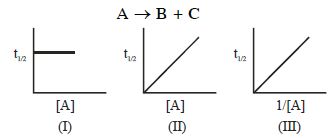
Consider the plots,given below,for the reaction $A \rightarrow B + C$. The plots respectively correspond to the reaction order:
A
$1, 0, 2$
B
$0, 1, 2$
C
$1, 2, 0$
D
$2, 1, 0$
Solution
(A) The half-life of a reaction of order $n$ is given by the relation $t_{1/2} \propto a^{1-n}$,where $a$ is the initial concentration.
For plot $(I)$,$t_{1/2}$ is independent of $[A]$,so $1-n = 0 \implies n = 1$.
For plot $(II)$,$t_{1/2} \propto [A]$,so $1-n = 1 \implies n = 0$.
For plot $(III)$,$t_{1/2} \propto [A]^1$,which is equivalent to $t_{1/2} \propto (1/[A])^{-1}$. Alternatively,for $n=2$,$t_{1/2} \propto 1/a$,so $t_{1/2} \propto [A]^{-1}$. The plot shows $t_{1/2}$ vs $1/[A]$ is linear,which corresponds to $n=2$ because $t_{1/2} = 1/(k[A])$.
Thus,the orders are $1, 0, 2$ respectively.
For plot $(I)$,$t_{1/2}$ is independent of $[A]$,so $1-n = 0 \implies n = 1$.
For plot $(II)$,$t_{1/2} \propto [A]$,so $1-n = 1 \implies n = 0$.
For plot $(III)$,$t_{1/2} \propto [A]^1$,which is equivalent to $t_{1/2} \propto (1/[A])^{-1}$. Alternatively,for $n=2$,$t_{1/2} \propto 1/a$,so $t_{1/2} \propto [A]^{-1}$. The plot shows $t_{1/2}$ vs $1/[A]$ is linear,which corresponds to $n=2$ because $t_{1/2} = 1/(k[A])$.
Thus,the orders are $1, 0, 2$ respectively.
0 likes
View Solution220
DifficultMCQ
Reaction : $2Br^{-} + H_2O_2 + 2H^{+} \to Br_2 + 2H_2O$
takes place in two steps :
$(a)$ $Br^{-} + H^{+} + H_2O_2 \xrightarrow{slow} HOBr + H_2O$
$(b)$ $HOBr + Br^{-} + H^{+} \xrightarrow{fast} H_2O + Br_2$
The order of the reaction is
takes place in two steps :
$(a)$ $Br^{-} + H^{+} + H_2O_2 \xrightarrow{slow} HOBr + H_2O$
$(b)$ $HOBr + Br^{-} + H^{+} \xrightarrow{fast} H_2O + Br_2$
The order of the reaction is
A
$3$
B
$6$
C
$2$
D
$0$
Solution
(A) For a multi-step reaction,the rate of the overall reaction is determined by the slowest step,which is known as the rate-determining step.
In the given mechanism,step $(a)$ is the slow step:
$Br^{-} + H^{+} + H_2O_2 \xrightarrow{slow} HOBr + H_2O$
The rate law for this reaction is given by the rate of the slow step:
$Rate = k[Br^{-}][H^{+}][H_2O_2]$
The order of the reaction is the sum of the powers of the concentration terms in the rate law expression:
$Order = 1 + 1 + 1 = 3$
Therefore,the order of the reaction is $3$.
In the given mechanism,step $(a)$ is the slow step:
$Br^{-} + H^{+} + H_2O_2 \xrightarrow{slow} HOBr + H_2O$
The rate law for this reaction is given by the rate of the slow step:
$Rate = k[Br^{-}][H^{+}][H_2O_2]$
The order of the reaction is the sum of the powers of the concentration terms in the rate law expression:
$Order = 1 + 1 + 1 = 3$
Therefore,the order of the reaction is $3$.
0 likes
View Solution221
MediumMCQ
For a chemical reaction,$2A + 2B \to C + D$,the order of reaction is $1$ with respect to $A$ and $1$ with respect to $B$. The initial rate of the reaction is $4 \times 10^{-2} \ mol \ L^{-1} \ s^{-1}$. When $50\%$ of the reactants are converted into products,the rate of the reaction would become:
A
$2 \times 10^{-2} \ mol \ L^{-1} \ s^{-1}$
B
$1 \times 10^{-2} \ mol \ L^{-1} \ s^{-1}$
C
$4 \times 10^{-2} \ mol \ L^{-1} \ s^{-1}$
D
$2 \times 10^{-1} \ mol \ L^{-1} \ s^{-1}$
Solution
(B) The rate law for the reaction is given by: $\text{rate} = k[A]^1[B]^1 = k[A][B]$.
Initial rate: $R_1 = k[A]_0[B]_0 = 4 \times 10^{-2} \ mol \ L^{-1} \ s^{-1}$.
When $50\%$ of the reactants are converted into products,the concentration of each reactant becomes half of its initial concentration:
$[A] = \frac{[A]_0}{2}$ and $[B] = \frac{[B]_0}{2}$.
New rate: $R_2 = k \left( \frac{[A]_0}{2} \right) \left( \frac{[B]_0}{2} \right) = \frac{1}{4} k[A]_0[B]_0$.
Substituting the initial rate value:
$R_2 = \frac{1}{4} \times (4 \times 10^{-2} \ mol \ L^{-1} \ s^{-1}) = 1 \times 10^{-2} \ mol \ L^{-1} \ s^{-1}$.
Therefore,the correct option is $B$.
Initial rate: $R_1 = k[A]_0[B]_0 = 4 \times 10^{-2} \ mol \ L^{-1} \ s^{-1}$.
When $50\%$ of the reactants are converted into products,the concentration of each reactant becomes half of its initial concentration:
$[A] = \frac{[A]_0}{2}$ and $[B] = \frac{[B]_0}{2}$.
New rate: $R_2 = k \left( \frac{[A]_0}{2} \right) \left( \frac{[B]_0}{2} \right) = \frac{1}{4} k[A]_0[B]_0$.
Substituting the initial rate value:
$R_2 = \frac{1}{4} \times (4 \times 10^{-2} \ mol \ L^{-1} \ s^{-1}) = 1 \times 10^{-2} \ mol \ L^{-1} \ s^{-1}$.
Therefore,the correct option is $B$.
0 likes
View Solution222
MediumMCQ
Consider the following two reactions:
$A \to \text{Product}; -\frac{d[A]}{dt} = k_1[A]^0$
$B \to \text{Product}; -\frac{d[B]}{dt} = k_2[B]$
The units of $k_1$ and $k_2$ are expressed in terms of molarity $(M)$ and time $(sec^{-1})$ as:
$A \to \text{Product}; -\frac{d[A]}{dt} = k_1[A]^0$
$B \to \text{Product}; -\frac{d[B]}{dt} = k_2[B]$
The units of $k_1$ and $k_2$ are expressed in terms of molarity $(M)$ and time $(sec^{-1})$ as:
A
$M \ sec^{-1}, sec^{-1}$
B
$M \ sec^{-1}, M \ sec^{-1}$
C
$sec^{-1}, M^{-1} \ sec^{-1}$
D
$M \ sec^{-1}, M \ sec^{-1}$
Solution
(A) For reaction $-I$: The rate law is $-\frac{d[A]}{dt} = k_1[A]^0$. Since the order is $0$,the unit of $k_1$ is $\text{concentration} \times \text{time}^{-1} = M \ sec^{-1}$.
For reaction $-II$: The rate law is $-\frac{d[B]}{dt} = k_2[B]^1$. Since the order is $1$,the unit of $k_2$ is $\text{time}^{-1} = sec^{-1}$.
For reaction $-II$: The rate law is $-\frac{d[B]}{dt} = k_2[B]^1$. Since the order is $1$,the unit of $k_2$ is $\text{time}^{-1} = sec^{-1}$.
0 likes
View Solution223
MediumMCQ
For a reaction,$AB_5 \to AB + 4B$,the rate can be expressed in the following ways:
$-\frac{d[AB_5]}{dt} = K[AB_5]$ ; $\frac{d[B]}{dt} = K_1[AB_5]$
What is the correct relation between $K$ and $K_1$?
$-\frac{d[AB_5]}{dt} = K[AB_5]$ ; $\frac{d[B]}{dt} = K_1[AB_5]$
What is the correct relation between $K$ and $K_1$?
A
$K_1 = K$
B
$K_1 = 2K$
C
$K_1 = 4K$
D
$2K_1 = K$
Solution
(C) For the reaction $AB_5 \to AB + 4B$,the rate of reaction is given by:
$Rate = -\frac{d[AB_5]}{dt} = \frac{1}{4} \frac{d[B]}{dt}$
Given that $-\frac{d[AB_5]}{dt} = K[AB_5]$ and $\frac{d[B]}{dt} = K_1[AB_5]$,we substitute these into the rate expression:
$K[AB_5] = \frac{1}{4} (K_1[AB_5])$
Dividing both sides by $[AB_5]$,we get:
$K = \frac{1}{4} K_1 \Rightarrow K_1 = 4K$
$Rate = -\frac{d[AB_5]}{dt} = \frac{1}{4} \frac{d[B]}{dt}$
Given that $-\frac{d[AB_5]}{dt} = K[AB_5]$ and $\frac{d[B]}{dt} = K_1[AB_5]$,we substitute these into the rate expression:
$K[AB_5] = \frac{1}{4} (K_1[AB_5])$
Dividing both sides by $[AB_5]$,we get:
$K = \frac{1}{4} K_1 \Rightarrow K_1 = 4K$
0 likes
View Solution224
MediumMCQ
For a reaction,$I^{-} + OCl^{-} \to IO^{-} + Cl^{-}$ in an aqueous medium,the rate of reaction is given by $\frac{d[IO^{-}]}{dt} = k[I^{-}][OCl^{-}]$. The overall order of reaction is
A
$1$
B
$0$
C
$1$
D
$2$
Solution
(D) The rate law for the given reaction is expressed as $Rate = k[I^{-}][OCl^{-}]$.
The order of reaction with respect to $I^{-}$ is $1$ and with respect to $OCl^{-}$ is $1$.
The overall order of reaction is the sum of the exponents of the concentration terms in the rate law expression.
Overall order $= 1 + 1 = 2$.
The order of reaction with respect to $I^{-}$ is $1$ and with respect to $OCl^{-}$ is $1$.
The overall order of reaction is the sum of the exponents of the concentration terms in the rate law expression.
Overall order $= 1 + 1 = 2$.
0 likes
View Solution225
MediumMCQ
$A_2 + B_2 \to 2AB$; $R.O.R = k[A_2]^a[B_2]^b$
Order of reaction with respect to $A_2$ and $B_2$ are respectively:
| Initial $[A_2]$ | Initial $[B_2]$ | $R.O.R. (r) \ M s^{-1}$ |
|---|---|---|
| $0.2$ | $0.2$ | $0.04$ |
| $0.1$ | $0.4$ | $0.04$ |
| $0.2$ | $0.4$ | $0.08$ |
Order of reaction with respect to $A_2$ and $B_2$ are respectively:
A
$a = 1, b = 1$
B
$a = 2, b = 0$
C
$a = 2, b = 1$
D
None
Solution
(A) Let the rate law be $r = k[A_2]^a[B_2]^b$.
From the table:
$1) 0.04 = k(0.2)^a(0.2)^b$
$2) 0.04 = k(0.1)^a(0.4)^b$
$3) 0.08 = k(0.2)^a(0.4)^b$
Dividing $(3)$ by $(1)$:
$\frac{0.08}{0.04} = \frac{k(0.2)^a(0.4)^b}{k(0.2)^a(0.2)^b} \implies 2 = (2)^b \implies b = 1$.
Dividing $(3)$ by $(2)$:
$\frac{0.08}{0.04} = \frac{k(0.2)^a(0.4)^b}{k(0.1)^a(0.4)^b} \implies 2 = (2)^a \implies a = 1$.
Thus,$a = 1$ and $b = 1$.
From the table:
$1) 0.04 = k(0.2)^a(0.2)^b$
$2) 0.04 = k(0.1)^a(0.4)^b$
$3) 0.08 = k(0.2)^a(0.4)^b$
Dividing $(3)$ by $(1)$:
$\frac{0.08}{0.04} = \frac{k(0.2)^a(0.4)^b}{k(0.2)^a(0.2)^b} \implies 2 = (2)^b \implies b = 1$.
Dividing $(3)$ by $(2)$:
$\frac{0.08}{0.04} = \frac{k(0.2)^a(0.4)^b}{k(0.1)^a(0.4)^b} \implies 2 = (2)^a \implies a = 1$.
Thus,$a = 1$ and $b = 1$.
0 likes
View Solution226
DifficultMCQ
For the hypothetical reaction $2X + G \to Q + 2M$,the rate expression is $\frac{d[Q]}{dt} = k[X]^2$. Which of the following is the most likely mechanism?
A
$2X + G \rightleftharpoons 2Q + R$ (fast)
$Q + R + G \to 2M$ (slow)
$Q + R + G \to 2M$ (slow)
B
$X + G \rightleftharpoons Q + R$ (fast)
$R + X \to 2M$ (slow)
$R + X \to 2M$ (slow)
C
$X + X \rightleftharpoons X_2$ (fast)
$X_2 \to Q + T$ (slow)
$T + G \to 2M$ (fast)
$X_2 \to Q + T$ (slow)
$T + G \to 2M$ (fast)
D
$G + G \rightleftharpoons G_2$ (fast)
$G_2 + X \to Q + T$ (slow)
$T + X \to 2M$ (fast)
$G_2 + X \to Q + T$ (slow)
$T + X \to 2M$ (fast)
Solution
(C) The rate-determining step $(RDS)$ is the slow step of the mechanism.
For option $C$:
Step $1$: $X + X \rightleftharpoons X_2$ (fast equilibrium)
Step $2$: $X_2 \to Q + T$ (slow,$RDS$)
Step $3$: $T + G \to 2M$ (fast)
The rate of the reaction is determined by the slow step: $r = k_2[X_2]$.
From the fast equilibrium in step $1$,the equilibrium constant $K_C = \frac{[X_2]}{[X]^2}$,which gives $[X_2] = K_C[X]^2$.
Substituting this into the rate expression: $r = k_2 K_C [X]^2 = k[X]^2$.
This matches the given rate law.
For option $C$:
Step $1$: $X + X \rightleftharpoons X_2$ (fast equilibrium)
Step $2$: $X_2 \to Q + T$ (slow,$RDS$)
Step $3$: $T + G \to 2M$ (fast)
The rate of the reaction is determined by the slow step: $r = k_2[X_2]$.
From the fast equilibrium in step $1$,the equilibrium constant $K_C = \frac{[X_2]}{[X]^2}$,which gives $[X_2] = K_C[X]^2$.
Substituting this into the rate expression: $r = k_2 K_C [X]^2 = k[X]^2$.
This matches the given rate law.
0 likes
View Solution227
MediumMCQ
Which of the following statements is false?
A
For an endothermic reaction,energy of product is greater than that of reactant.
B
The rate law for a reaction depends on the concentrations of all reactants that appear in the stoichiometric equation.
C
The rate of a zero order reaction is independent of the concentration of the catalyst.
D
The specific rate constant for a reaction is independent of the concentrations of the reacting species.
Solution
(B) The rate law for a reaction is an experimental quantity and does not necessarily depend on the stoichiometric coefficients of the reactants in the balanced chemical equation.
Therefore,the statement that the rate law depends on the concentrations of all reactants appearing in the stoichiometric equation is false.
Therefore,the statement that the rate law depends on the concentrations of all reactants appearing in the stoichiometric equation is false.
0 likes
View Solution228
MediumMCQ
Which one of the following statements regarding the order of a reaction is not correct?
A
Order is determined experimentally.
B
Order of reaction is equal to the sum of powers of concentration terms in the experimental rate law.
C
It is not affected by the stoichiometric coefficients of the reactants.
D
Order cannot be fractional.
Solution
(D) The order of a reaction is an experimental quantity and can be zero,an integer,or a fraction.
Since the order of a reaction can indeed be fractional,the statement that 'Order cannot be fractional' is incorrect.
Therefore,option $D$ is the correct answer.
Since the order of a reaction can indeed be fractional,the statement that 'Order cannot be fractional' is incorrect.
Therefore,option $D$ is the correct answer.
0 likes
View Solution229
MediumMCQ
For a reaction $X + Y \to Z$,the rate is given by $\text{rate} \propto [X]$. What are $(i)$ the molecularity and $(ii)$ the order of the reaction?
A
$(i) \text{ cannot be defined, } (ii) \, 1$
B
$(i) \, 2, (ii) \, 2$
C
$(i) \, 1, (ii) \, 1$
D
$(i) \, 1, (ii) \, 2$
Solution
(A) The reaction is $X + Y \to Z$.
Molecularity is defined as the number of reacting species (atoms,ions,or molecules) taking part in an elementary reaction,which must collide simultaneously to result in a chemical reaction.
Since the mechanism of the reaction is not provided,the molecularity of the overall reaction cannot be defined.
The order of a reaction is the sum of the powers of the concentration terms in the rate law expression.
Given $\text{rate} \propto [X]$,the rate law is $\text{rate} = k[X]^1[Y]^0$.
Thus,the order of the reaction is $1$.
Molecularity is defined as the number of reacting species (atoms,ions,or molecules) taking part in an elementary reaction,which must collide simultaneously to result in a chemical reaction.
Since the mechanism of the reaction is not provided,the molecularity of the overall reaction cannot be defined.
The order of a reaction is the sum of the powers of the concentration terms in the rate law expression.
Given $\text{rate} \propto [X]$,the rate law is $\text{rate} = k[X]^1[Y]^0$.
Thus,the order of the reaction is $1$.
0 likes
View Solution230
MediumMCQ
An elementary reaction between $A$ and $B$ is a second order reaction. Which of the following rate equations must be correct?
A
$r = k[A]^2[B]^0$
B
$r = k[A]^{3/2}[B]^{1/2}$
C
$r = k[A]^0[B]^2$
D
$r = k[A][B]$
Solution
(D) For an elementary reaction,the order of the reaction with respect to each reactant is equal to its stoichiometric coefficient in the balanced chemical equation.
Since the reaction is between $A$ and $B$ and is of second order,the sum of the stoichiometric coefficients must be $2$.
For an elementary reaction $aA + bB \rightarrow \text{Products}$,the rate law is $r = k[A]^a[B]^b$.
Given that the reaction is elementary and second order,the sum of the powers $a + b = 2$.
Option $D$ represents $r = k[A]^1[B]^1$,where $a=1$ and $b=1$,so $a+b=2$.
Therefore,the rate equation $r = k[A][B]$ is consistent with an elementary second-order reaction.
Since the reaction is between $A$ and $B$ and is of second order,the sum of the stoichiometric coefficients must be $2$.
For an elementary reaction $aA + bB \rightarrow \text{Products}$,the rate law is $r = k[A]^a[B]^b$.
Given that the reaction is elementary and second order,the sum of the powers $a + b = 2$.
Option $D$ represents $r = k[A]^1[B]^1$,where $a=1$ and $b=1$,so $a+b=2$.
Therefore,the rate equation $r = k[A][B]$ is consistent with an elementary second-order reaction.
0 likes
View Solution231
MediumMCQ
If $a$ is the initial concentration of the reactant,the half-life period of the reaction of $n^{th}$ order is inversely proportional to
A
$a^{n-1}$
B
$a^n$
C
$a^{1-n}$
D
$a^{n+1}$
Solution
(A) For a reaction of $n^{th}$ order,the half-life period $(t_{1/2})$ is given by the relation:
$t_{1/2} \propto \frac{1}{a^{n-1}}$
This implies that $t_{1/2}$ is inversely proportional to $a^{n-1}$.
$t_{1/2} \propto \frac{1}{a^{n-1}}$
This implies that $t_{1/2}$ is inversely proportional to $a^{n-1}$.
0 likes
View Solution232
MediumMCQ
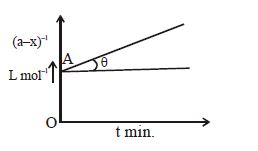
The following graph shows the relationship between $(a-x)^{-1}$ and time $t$ for a second-order reaction. If $\theta = \tan^{-1}(1/2)$ and $OA = 2 \ L \ mol^{-1}$,then the rate at the start of the reaction will be (in $mol \ L^{-1} \ min^{-1}$):
A
$1.25$
B
$0.5$
C
$0.125$
D
$5.0$
Solution
(C) For a second-order reaction,the integrated rate equation is given by: $\frac{1}{(a-x)} = \frac{1}{a} + Kt$.
Comparing this with the equation of a straight line $y = mx + c$,the slope $m = K$ and the intercept $c = \frac{1}{a}$.
Given $\theta = \tan^{-1}(1/2)$,the slope is $K = \tan \theta = 1/2 = 0.5 \ L \ mol^{-1} \ min^{-1}$.
The intercept $OA = \frac{1}{a} = 2 \ L \ mol^{-1}$,which gives the initial concentration $a = 1/2 = 0.5 \ mol \ L^{-1}$.
The rate of reaction at the start $(t=0)$ is given by $r = K[A]_0^2$.
Substituting the values: $r = 0.5 \times (0.5)^2 = 0.5 \times 0.25 = 0.125 \ mol \ L^{-1} \ min^{-1}$.
Comparing this with the equation of a straight line $y = mx + c$,the slope $m = K$ and the intercept $c = \frac{1}{a}$.
Given $\theta = \tan^{-1}(1/2)$,the slope is $K = \tan \theta = 1/2 = 0.5 \ L \ mol^{-1} \ min^{-1}$.
The intercept $OA = \frac{1}{a} = 2 \ L \ mol^{-1}$,which gives the initial concentration $a = 1/2 = 0.5 \ mol \ L^{-1}$.
The rate of reaction at the start $(t=0)$ is given by $r = K[A]_0^2$.
Substituting the values: $r = 0.5 \times (0.5)^2 = 0.5 \times 0.25 = 0.125 \ mol \ L^{-1} \ min^{-1}$.
0 likes
View Solution233
EasyMCQ
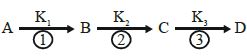
In the given reaction sequence,if $K_3 > K_2 > K_1$,then the rate-determining step is:
A
$1$
B
$2$
C
$3$
D
None of these
Solution
(A) In a multi-step reaction,the rate-determining step is the slowest step of the reaction mechanism.
Since the rate constant $K$ is directly proportional to the rate of the reaction,the step with the smallest rate constant will be the slowest step.
Given the condition $K_3 > K_2 > K_1$,the rate constant $K_1$ is the smallest.
Therefore,step $1$ is the slowest step and acts as the rate-determining step.
Since the rate constant $K$ is directly proportional to the rate of the reaction,the step with the smallest rate constant will be the slowest step.
Given the condition $K_3 > K_2 > K_1$,the rate constant $K_1$ is the smallest.
Therefore,step $1$ is the slowest step and acts as the rate-determining step.
0 likes
View Solution234
EasyMCQ
For a given reaction $t_{1/2} = \frac{1}{k \cdot a}$,the order of reaction will be:
A
$0$
B
$1$
C
$2$
D
$3$
Solution
(C) The half-life period $(t_{1/2})$ for a reaction of order $n$ is related to the initial concentration $(a)$ as $t_{1/2} \propto a^{1-n}$.
Given the expression $t_{1/2} = \frac{1}{k \cdot a}$,we can write this as $t_{1/2} \propto a^{-1}$.
Comparing the exponents of $a$,we get $1 - n = -1$.
Solving for $n$,we find $n = 2$.
Therefore,the reaction is of the second order.
Given the expression $t_{1/2} = \frac{1}{k \cdot a}$,we can write this as $t_{1/2} \propto a^{-1}$.
Comparing the exponents of $a$,we get $1 - n = -1$.
Solving for $n$,we find $n = 2$.
Therefore,the reaction is of the second order.
0 likes
View Solution235
AdvancedMCQ
The reaction of hydrogen and iodine monochloride is given as
$H_{2(g)} + 2ICl_{(g)} \to 2HCl_{(g)} + I_{2(g)}$
This reaction is of first order with respect to $H_{2(g)}$ and $ICl_{(g)}$. Which of the following mechanisms is consistent with the given information?
Mechanism $A$:
$H_{2(g)} + 2ICl_{(g)} \to 2HCl_{(g)} + I_{2(g)}$
Mechanism $B$:
$H_{2(g)} + ICl_{(g)} \to HCl_{(g)} + HI_{(g)}$ (Slow)
$HI_{(g)} + ICl_{(g)} \to HCl_{(g)} + I_{2(g)}$ (Fast)
$H_{2(g)} + 2ICl_{(g)} \to 2HCl_{(g)} + I_{2(g)}$
This reaction is of first order with respect to $H_{2(g)}$ and $ICl_{(g)}$. Which of the following mechanisms is consistent with the given information?
Mechanism $A$:
$H_{2(g)} + 2ICl_{(g)} \to 2HCl_{(g)} + I_{2(g)}$
Mechanism $B$:
$H_{2(g)} + ICl_{(g)} \to HCl_{(g)} + HI_{(g)}$ (Slow)
$HI_{(g)} + ICl_{(g)} \to HCl_{(g)} + I_{2(g)}$ (Fast)
A
$A$ only
B
$B$ only
C
$A$ and $B$ both
D
Neither $A$ nor $B$
Solution
(B) The rate law for the reaction is given as $Rate = k[H_{2}][ICl]$.
For Mechanism $A$,which is a single-step elementary reaction,the rate law would be $Rate = k[H_{2}][ICl]^2$. This does not match the given rate law.
For Mechanism $B$,the first step is the rate-determining step (slow step). The rate of the reaction is determined by this step: $Rate = k[H_{2}][ICl]$.
This matches the given information that the reaction is first order with respect to both $H_{2}$ and $ICl$. Therefore,only Mechanism $B$ is consistent.
For Mechanism $A$,which is a single-step elementary reaction,the rate law would be $Rate = k[H_{2}][ICl]^2$. This does not match the given rate law.
For Mechanism $B$,the first step is the rate-determining step (slow step). The rate of the reaction is determined by this step: $Rate = k[H_{2}][ICl]$.
This matches the given information that the reaction is first order with respect to both $H_{2}$ and $ICl$. Therefore,only Mechanism $B$ is consistent.
0 likes
View Solution236
MediumMCQ
For the reaction $Cl_{2(aq)} + H_2S_{(aq)} \to S_{(s)} + 2H^{+}_{(aq)} + 2Cl^{-}_{(aq)}$,the rate law is $r = K[Cl_2][H_2S]$. Which of the following mechanisms is/are consistent with this rate law?
$A. \ H_2S \rightleftharpoons H^{+} + HS^{-}$ (fast)
$Cl_2 + HS^{-} \to 2Cl^{-} + H^{+} + S$ (slow)
$B. \ Cl_2 + H_2S \to H^{+} + Cl^{-} + Cl^{+} + HS^{-}$ (slow)
$Cl^{+} + HS^{-} \to H^{+} + Cl^{-} + S$ (fast)
$A. \ H_2S \rightleftharpoons H^{+} + HS^{-}$ (fast)
$Cl_2 + HS^{-} \to 2Cl^{-} + H^{+} + S$ (slow)
$B. \ Cl_2 + H_2S \to H^{+} + Cl^{-} + Cl^{+} + HS^{-}$ (slow)
$Cl^{+} + HS^{-} \to H^{+} + Cl^{-} + S$ (fast)
A
Both $A$ and $B$
B
$A$ only
C
$B$ only
D
Neither $A$ nor $B$
Solution
(C) For mechanism $A$:
The rate is determined by the slow step: $r = k_2[Cl_2][HS^-]$.
From the fast equilibrium step,$K_{eq} = \frac{[H^+][HS^-]}{[H_2S]}$,so $[HS^-] = K_{eq} \frac{[H_2S]}{[H^+]}$.
Substituting this into the rate expression: $r = k_2 K_{eq} [Cl_2] \frac{[H_2S]}{[H^+]} = K' \frac{[Cl_2][H_2S]}{[H^+]}$. This does not match the given rate law.
For mechanism $B$:
The rate is determined by the slow step: $r = k_1[Cl_2][H_2S]$.
This matches the given rate law $r = K[Cl_2][H_2S]$.
Therefore,only mechanism $B$ is consistent.
The rate is determined by the slow step: $r = k_2[Cl_2][HS^-]$.
From the fast equilibrium step,$K_{eq} = \frac{[H^+][HS^-]}{[H_2S]}$,so $[HS^-] = K_{eq} \frac{[H_2S]}{[H^+]}$.
Substituting this into the rate expression: $r = k_2 K_{eq} [Cl_2] \frac{[H_2S]}{[H^+]} = K' \frac{[Cl_2][H_2S]}{[H^+]}$. This does not match the given rate law.
For mechanism $B$:
The rate is determined by the slow step: $r = k_1[Cl_2][H_2S]$.
This matches the given rate law $r = K[Cl_2][H_2S]$.
Therefore,only mechanism $B$ is consistent.
0 likes
View Solution237
MediumMCQ
Differential form of the rate equation is $\frac{dx}{dt} = k[P][Q]^{0.5}[R]^{0.5}$. Which statement about the above equation is wrong?
A
Order with respect to $P$ is $1$
B
Total order of the reaction is $2$
C
Order with respect to each of $Q$ and $R$ is $0.5$
D
Unit of specific reaction rate is $mol\ L^{-1}\ s^{-1}$
Solution
(D) The given rate law is $\text{rate} = k[P]^1[Q]^{0.5}[R]^{0.5}$.
$1$. The order with respect to $P$ is $1$,which is correct.
$2$. The total order of the reaction is the sum of the exponents of the concentration terms: $1 + 0.5 + 0.5 = 2$,which is correct.
$3$. The order with respect to $Q$ is $0.5$ and with respect to $R$ is $0.5$,which is correct.
$4$. The unit of the rate constant $k$ for a reaction of order $n$ is $(mol\ L^{-1})^{1-n} s^{-1}$. For $n = 2$,the unit is $(mol\ L^{-1})^{1-2} s^{-1} = mol^{-1}\ L\ s^{-1}$.
Therefore,the statement in option $D$ is incorrect because $mol\ L^{-1}\ s^{-1}$ is the unit for a zero-order reaction.
$1$. The order with respect to $P$ is $1$,which is correct.
$2$. The total order of the reaction is the sum of the exponents of the concentration terms: $1 + 0.5 + 0.5 = 2$,which is correct.
$3$. The order with respect to $Q$ is $0.5$ and with respect to $R$ is $0.5$,which is correct.
$4$. The unit of the rate constant $k$ for a reaction of order $n$ is $(mol\ L^{-1})^{1-n} s^{-1}$. For $n = 2$,the unit is $(mol\ L^{-1})^{1-2} s^{-1} = mol^{-1}\ L\ s^{-1}$.
Therefore,the statement in option $D$ is incorrect because $mol\ L^{-1}\ s^{-1}$ is the unit for a zero-order reaction.
0 likes
View Solution238
MediumMCQ
The mechanism of the reaction $A + 2B \to D$ is given by:
$2B \xrightarrow{k} B_2$ [Slow]
$B_2 + A \to D$ [Fast]
The rate law expression,order with respect to $A$,order with respect to $B$,and overall order are respectively:
$2B \xrightarrow{k} B_2$ [Slow]
$B_2 + A \to D$ [Fast]
The rate law expression,order with respect to $A$,order with respect to $B$,and overall order are respectively:
A
$Rate = k[B]^2, 0, 2, 2$
B
$Rate = k[A]^1[B]^2, 1, 2, 3$
C
$Rate = k[A]^2, 0, 2, 2$
D
$Rate = k[A]^2[B]^1, 1, 2, 3$
Solution
(A) In a multi-step reaction,the rate of the overall reaction is determined by the slowest step,which is known as the rate-determining step.
The slow step is: $2B \xrightarrow{k} B_2$.
The rate law for this step is: $Rate = k[B]^2$.
Comparing this to the general rate law expression $Rate = k[A]^x[B]^y$:
Order with respect to $A$ $(x)$ = $0$.
Order with respect to $B$ $(y)$ = $2$.
Overall order of the reaction = $x + y = 0 + 2 = 2$.
Therefore,the correct option is $A$.
The slow step is: $2B \xrightarrow{k} B_2$.
The rate law for this step is: $Rate = k[B]^2$.
Comparing this to the general rate law expression $Rate = k[A]^x[B]^y$:
Order with respect to $A$ $(x)$ = $0$.
Order with respect to $B$ $(y)$ = $2$.
Overall order of the reaction = $x + y = 0 + 2 = 2$.
Therefore,the correct option is $A$.
0 likes
View Solution239
MediumMCQ
The differential form of the rate equation is given by:
$dx/dt = k[P][Q]^{0.5}[R]^{0.5}$
Which statement about the above equation is wrong?
$dx/dt = k[P][Q]^{0.5}[R]^{0.5}$
Which statement about the above equation is wrong?
A
Order with respect to $P$ is $1$
B
Total order of the reaction is $2$
C
Order with respect to each of $Q$ and $R$ is $0.5$
D
Unit of specific reaction rate is $mol \, L^{-1} s^{-1}$
Solution
(D) The rate law is given by $Rate = k[P]^1[Q]^{0.5}[R]^{0.5}$.
$1$. The order with respect to $P$ is $1$,which is correct.
$2$. The total order of the reaction is the sum of the exponents: $1 + 0.5 + 0.5 = 2$,which is correct.
$3$. The order with respect to $Q$ and $R$ is $0.5$ each,which is correct.
$4$. The unit of the rate constant $k$ for a reaction of order $n$ is $(mol \, L^{-1})^{1-n} s^{-1}$. For $n = 2$,the unit is $(mol \, L^{-1})^{1-2} s^{-1} = (mol \, L^{-1})^{-1} s^{-1} = L \, mol^{-1} s^{-1}$. Therefore,the statement in option $D$ is wrong.
$1$. The order with respect to $P$ is $1$,which is correct.
$2$. The total order of the reaction is the sum of the exponents: $1 + 0.5 + 0.5 = 2$,which is correct.
$3$. The order with respect to $Q$ and $R$ is $0.5$ each,which is correct.
$4$. The unit of the rate constant $k$ for a reaction of order $n$ is $(mol \, L^{-1})^{1-n} s^{-1}$. For $n = 2$,the unit is $(mol \, L^{-1})^{1-2} s^{-1} = (mol \, L^{-1})^{-1} s^{-1} = L \, mol^{-1} s^{-1}$. Therefore,the statement in option $D$ is wrong.
0 likes
View Solution240
MediumMCQ
The numerical values of rate constants are same for first,second and third order reactions. Which one is true at a moment for rate of these three reactions if concentration of reactants is same and lesser than $1 \ M$?
A
$r_1 = r_2 = r_3$
B
$r_1 > r_2 > r_3$
C
$r_1 < r_2 < r_3$
D
None of these
Solution
(B) The rate laws for the reactions are given by:
$r_1 = k[A]^1$
$r_2 = k[A]^2$
$r_3 = k[A]^3$
Given that the rate constants are equal $(k_1 = k_2 = k_3 = k)$ and the concentration $[A] < 1 \ M$.
Let $[A] = x$,where $0 < x < 1$.
Then $r_1 = kx$,$r_2 = kx^2$,and $r_3 = kx^3$.
Since $x < 1$,it follows that $x > x^2 > x^3$.
Therefore,$kx > kx^2 > kx^3$,which implies $r_1 > r_2 > r_3$.
$r_1 = k[A]^1$
$r_2 = k[A]^2$
$r_3 = k[A]^3$
Given that the rate constants are equal $(k_1 = k_2 = k_3 = k)$ and the concentration $[A] < 1 \ M$.
Let $[A] = x$,where $0 < x < 1$.
Then $r_1 = kx$,$r_2 = kx^2$,and $r_3 = kx^3$.
Since $x < 1$,it follows that $x > x^2 > x^3$.
Therefore,$kx > kx^2 > kx^3$,which implies $r_1 > r_2 > r_3$.
0 likes
View Solution241
MediumMCQ
$t_{1/2} =$ constant confirms the first order reaction. If $a^2 t_{1/2} =$ constant,it confirms that the order of reaction is ($a =$ initial concentration of reactant).
A
$0$
B
$1$
C
$2$
D
$3$
Solution
(D) For a reaction of $n^{th}$ order,the half-life $t_{1/2}$ is related to the initial concentration $a$ as $t_{1/2} \propto a^{1-n}$.
This implies $t_{1/2} \times a^{n-1} =$ constant.
Given the condition $a^2 t_{1/2} =$ constant,we compare the exponents of $a$.
Here,$n-1 = 2$.
Therefore,$n = 3$.
Thus,it is a third-order reaction.
This implies $t_{1/2} \times a^{n-1} =$ constant.
Given the condition $a^2 t_{1/2} =$ constant,we compare the exponents of $a$.
Here,$n-1 = 2$.
Therefore,$n = 3$.
Thus,it is a third-order reaction.
0 likes
View Solution242
MediumMCQ
For the non-stoichiometric reaction $2A + B \to C + D$,the following kinetic data were obtained in three separate experiments,all at $298 \ K$.
For the reaction,the rate of formation of $C$ will be:
| Initial Conc. $(A)$ | Initial Conc. $(B)$ | Initial rate of formation of $C \ (mol \ L^{-1} \ s^{-1})$ |
| $0.1 \ M$ | $0.1 \ M$ | $1.2 \times 10^{-3}$ |
| $0.1 \ M$ | $0.2 \ M$ | $1.2 \times 10^{-3}$ |
| $0.2 \ M$ | $0.1 \ M$ | $2.4 \times 10^{-3}$ |
For the reaction,the rate of formation of $C$ will be:
A
$\frac{d[C]}{dt} = k[A][B]^2$
B
$\frac{d[C]}{dt} = k[A]$
C
$\frac{d[C]}{dt} = k[A][B]$
D
$\frac{d[C]}{dt} = k[A]^2[B]$
Solution
(B) Let the order of reaction with respect to $A$ and $B$ be $\alpha$ and $\beta$ respectively.
The rate law is given by: $\frac{d[C]}{dt} = k[A]^{\alpha}[B]^{\beta}$
From the given data:
$1.2 \times 10^{-3} = k[0.1]^{\alpha}[0.1]^{\beta} \quad (i)$
$1.2 \times 10^{-3} = k[0.1]^{\alpha}[0.2]^{\beta} \quad (ii)$
$2.4 \times 10^{-3} = k[0.2]^{\alpha}[0.1]^{\beta} \quad (iii)$
Dividing $(ii)$ by $(i)$:
$\frac{1.2 \times 10^{-3}}{1.2 \times 10^{-3}} = \frac{k[0.1]^{\alpha}[0.2]^{\beta}}{k[0.1]^{\alpha}[0.1]^{\beta}}$
$1 = 2^{\beta} \implies \beta = 0$
Dividing $(iii)$ by $(i)$:
$\frac{2.4 \times 10^{-3}}{1.2 \times 10^{-3}} = \frac{k[0.2]^{\alpha}[0.1]^{\beta}}{k[0.1]^{\alpha}[0.1]^{\beta}}$
$2 = 2^{\alpha} \implies \alpha = 1$
Thus,the rate law is: $\frac{d[C]}{dt} = k[A]^1[B]^0 = k[A]$.
The rate law is given by: $\frac{d[C]}{dt} = k[A]^{\alpha}[B]^{\beta}$
From the given data:
$1.2 \times 10^{-3} = k[0.1]^{\alpha}[0.1]^{\beta} \quad (i)$
$1.2 \times 10^{-3} = k[0.1]^{\alpha}[0.2]^{\beta} \quad (ii)$
$2.4 \times 10^{-3} = k[0.2]^{\alpha}[0.1]^{\beta} \quad (iii)$
Dividing $(ii)$ by $(i)$:
$\frac{1.2 \times 10^{-3}}{1.2 \times 10^{-3}} = \frac{k[0.1]^{\alpha}[0.2]^{\beta}}{k[0.1]^{\alpha}[0.1]^{\beta}}$
$1 = 2^{\beta} \implies \beta = 0$
Dividing $(iii)$ by $(i)$:
$\frac{2.4 \times 10^{-3}}{1.2 \times 10^{-3}} = \frac{k[0.2]^{\alpha}[0.1]^{\beta}}{k[0.1]^{\alpha}[0.1]^{\beta}}$
$2 = 2^{\alpha} \implies \alpha = 1$
Thus,the rate law is: $\frac{d[C]}{dt} = k[A]^1[B]^0 = k[A]$.
0 likes
View Solution243
MediumMCQ
The possible mechanism for the reaction $2NO + Br_2 \to 2NOBr$ is:
$NO + Br_2 \rightleftharpoons NOBr_2$ (Fast)
$NOBr_2 + NO \to 2NOBr$ (Slow)
The rate law expression is:
$NO + Br_2 \rightleftharpoons NOBr_2$ (Fast)
$NOBr_2 + NO \to 2NOBr$ (Slow)
The rate law expression is:
A
$r = K [NO][Br_2]$
B
$r = K [NO][NOBr_2]^2$
C
$r = K [NO]^2 [Br_2]$
D
$r = K [NOBr_2][NO]^2 [Br_2]$
Solution
(C) The rate of the reaction is determined by the slow step:
$r = k_2 [NOBr_2][NO]$
Since $NOBr_2$ is an intermediate,we express it in terms of reactants using the fast equilibrium step:
$K_{eq} = \frac{[NOBr_2]}{[NO][Br_2]}$
Therefore,$[NOBr_2] = K_{eq} [NO][Br_2]$
Substituting this into the rate expression:
$r = k_2 (K_{eq} [NO][Br_2]) [NO]$
$r = (k_2 K_{eq}) [NO]^2 [Br_2]$
Letting $K = k_2 K_{eq}$,the rate law is:
$r = K [NO]^2 [Br_2]$
$r = k_2 [NOBr_2][NO]$
Since $NOBr_2$ is an intermediate,we express it in terms of reactants using the fast equilibrium step:
$K_{eq} = \frac{[NOBr_2]}{[NO][Br_2]}$
Therefore,$[NOBr_2] = K_{eq} [NO][Br_2]$
Substituting this into the rate expression:
$r = k_2 (K_{eq} [NO][Br_2]) [NO]$
$r = (k_2 K_{eq}) [NO]^2 [Br_2]$
Letting $K = k_2 K_{eq}$,the rate law is:
$r = K [NO]^2 [Br_2]$
0 likes
View Solution244
DifficultMCQ
The rate law for the reaction below is given by the expression $Rate = k[A][B]$.
$A + B \to \text{Product}$
If the concentration of $B$ is increased from $0.1 \ M$ to $0.3 \ M$,keeping the concentration of $A$ constant at $0.1 \ M$,the rate constant $(k)$ will be:
$A + B \to \text{Product}$
If the concentration of $B$ is increased from $0.1 \ M$ to $0.3 \ M$,keeping the concentration of $A$ constant at $0.1 \ M$,the rate constant $(k)$ will be:
A
$3k$
B
$9k$
C
$k/3$
D
$k$
Solution
(D) The rate constant $(k)$ is a characteristic property of a reaction at a given temperature.
It does not depend on the concentration of the reactants.
Therefore,changing the concentration of $B$ will change the reaction rate,but the rate constant $(k)$ remains unchanged.
It does not depend on the concentration of the reactants.
Therefore,changing the concentration of $B$ will change the reaction rate,but the rate constant $(k)$ remains unchanged.
0 likes
View Solution245
DifficultMCQ
For the reaction $A + 2B \to C$,the rate equation is given as $\text{Rate} = K[A][B]$. If the concentration of $A$ is kept constant but that of $B$ is doubled,what will happen to the rate of the reaction?
A
It is halved
B
It remains the same
C
It is doubled
D
It is quadrupled
Solution
(C) The initial rate is given by $R = K[A][B]$.
When the concentration of $A$ is kept constant and the concentration of $B$ is doubled,the new concentration of $B$ becomes $[B]' = 2[B]$.
The new rate $R'$ is given by $R' = K[A][B]' = K[A](2[B])$.
Substituting the initial rate expression into the new rate expression,we get $R' = 2 \times (K[A][B]) = 2R$.
Therefore,the rate of the reaction is doubled.
When the concentration of $A$ is kept constant and the concentration of $B$ is doubled,the new concentration of $B$ becomes $[B]' = 2[B]$.
The new rate $R'$ is given by $R' = K[A][B]' = K[A](2[B])$.
Substituting the initial rate expression into the new rate expression,we get $R' = 2 \times (K[A][B]) = 2R$.
Therefore,the rate of the reaction is doubled.
1 likes
View Solution246
DifficultMCQ
For the reaction,$2N_2O_5 \to 4NO_2 + O_2$,the rate equation can be expressed in two ways $-\frac{d[N_2O_5]}{dt} = k[N_2O_5]$ and $+\frac{d[NO_2]}{dt} = k'[N_2O_5]$. $k$ and $k'$ are related as:
A
$k = k'$
B
$2k = k'$
C
$k = 2k'$
D
$k = 4k'$
Solution
(B) The rate of reaction is defined as the rate of disappearance of reactant divided by its stoichiometric coefficient,which is equal to the rate of appearance of product divided by its stoichiometric coefficient.
For the reaction $2N_2O_5 \to 4NO_2 + O_2$,the rate expression is:
$-\frac{1}{2} \frac{d[N_2O_5]}{dt} = \frac{1}{4} \frac{d[NO_2]}{dt}$
Given that $-\frac{d[N_2O_5]}{dt} = k[N_2O_5]$ and $\frac{d[NO_2]}{dt} = k'[N_2O_5]$,substitute these into the rate expression:
$\frac{1}{2} (k[N_2O_5]) = \frac{1}{4} (k'[N_2O_5])$
$\frac{k}{2} = \frac{k'}{4}$
$k' = 2k$ or $2k = k'$.
For the reaction $2N_2O_5 \to 4NO_2 + O_2$,the rate expression is:
$-\frac{1}{2} \frac{d[N_2O_5]}{dt} = \frac{1}{4} \frac{d[NO_2]}{dt}$
Given that $-\frac{d[N_2O_5]}{dt} = k[N_2O_5]$ and $\frac{d[NO_2]}{dt} = k'[N_2O_5]$,substitute these into the rate expression:
$\frac{1}{2} (k[N_2O_5]) = \frac{1}{4} (k'[N_2O_5])$
$\frac{k}{2} = \frac{k'}{4}$
$k' = 2k$ or $2k = k'$.
0 likes
View Solution247
MediumMCQ
The reaction rate between two substances $A$ and $B$ is expressed as: $\text{rate} = k[A]^n[B]^m$. If the concentration of $A$ is doubled and the concentration of $B$ is halved,the ratio of the new rate to the initial rate will be:
A
$2^{(m+n)}$
B
$n-m$
C
$\frac{1}{2^{(m+n)}}$
D
$2^{(n-m)}$
Solution
(D) The initial rate is given by: $Rate_1 = k[A]^n[B]^m$
When the concentration of $A$ is doubled $(2[A])$ and the concentration of $B$ is halved $([B]/2)$,the new rate is: $Rate_2 = k[2A]^n[\frac{1}{2}B]^m$
Taking the ratio of the new rate to the initial rate:
$\frac{Rate_2}{Rate_1} = \frac{k[2A]^n[\frac{1}{2}B]^m}{k[A]^n[B]^m}$
$= (2)^n \times (\frac{1}{2})^m$
$= 2^n \times 2^{-m} = 2^{(n-m)}$
When the concentration of $A$ is doubled $(2[A])$ and the concentration of $B$ is halved $([B]/2)$,the new rate is: $Rate_2 = k[2A]^n[\frac{1}{2}B]^m$
Taking the ratio of the new rate to the initial rate:
$\frac{Rate_2}{Rate_1} = \frac{k[2A]^n[\frac{1}{2}B]^m}{k[A]^n[B]^m}$
$= (2)^n \times (\frac{1}{2})^m$
$= 2^n \times 2^{-m} = 2^{(n-m)}$
0 likes
View Solution248
DifficultMCQ
In a chemical reaction $A$ is converted into $B$. The rates of reaction,starting with initial concentrations of $A$ as $2 \times 10^{-3} \ M$ and $1 \times 10^{-3} \ M$,are equal to $2.40 \times 10^{-4} \ M s^{-1}$ and $0.60 \times 10^{-4} \ M s^{-1}$ respectively. The order of reaction with respect to reactant $A$ will be
A
$0$
B
$1.5$
C
$1$
D
$2$
Solution
(D) The rate law for the reaction $A \to B$ is given by $r = k[A]^x$,where $x$ is the order of reaction.
For the first condition: $2.40 \times 10^{-4} = k(2 \times 10^{-3})^x$ $(i)$
For the second condition: $0.60 \times 10^{-4} = k(1 \times 10^{-3})^x$ $(ii)$
Dividing equation $(i)$ by equation $(ii)$:
$\frac{2.40 \times 10^{-4}}{0.60 \times 10^{-4}} = \frac{k(2 \times 10^{-3})^x}{k(1 \times 10^{-3})^x}$
$4 = (2)^x$
Since $4 = 2^2$,we have $x = 2$.
Therefore,the order of reaction with respect to $A$ is $2$.
For the first condition: $2.40 \times 10^{-4} = k(2 \times 10^{-3})^x$ $(i)$
For the second condition: $0.60 \times 10^{-4} = k(1 \times 10^{-3})^x$ $(ii)$
Dividing equation $(i)$ by equation $(ii)$:
$\frac{2.40 \times 10^{-4}}{0.60 \times 10^{-4}} = \frac{k(2 \times 10^{-3})^x}{k(1 \times 10^{-3})^x}$
$4 = (2)^x$
Since $4 = 2^2$,we have $x = 2$.
Therefore,the order of reaction with respect to $A$ is $2$.
0 likes
View Solution249
MediumMCQ
For the reaction,$2A + B \to \text{products}$,when the concentrations of $A$ and $B$ both were doubled,the rate of the reaction increased from $0.3 \ mol \ L^{-1} \ s^{-1}$ to $2.4 \ mol \ L^{-1} \ s^{-1}$. When the concentration of $A$ alone is doubled,the rate increased from $0.3 \ mol \ L^{-1} \ s^{-1}$ to $0.6 \ mol \ L^{-1} \ s^{-1}$. Which one of the following statements is correct?
A
Total order of the reaction is $4$
B
Order of the reaction with respect to $B$ is $2$
C
Order of the reaction with respect to $B$ is $1$
D
Order of the reaction with respect to $A$ is $2$
Solution
(B) The rate law for the reaction is given by: $Rate = K [A]^x [B]^y$
Initial rate: $0.3 = K [A]^x [B]^y$ $(1)$
When both concentrations are doubled: $2.4 = K [2A]^x [2B]^y = K [A]^x [B]^y \times 2^{x+y} = 0.3 \times 2^{x+y}$
$2^{x+y} = 2.4 / 0.3 = 8 = 2^3$,so $x + y = 3$ $(2)$
When only $A$ is doubled: $0.6 = K [2A]^x [B]^y = K [A]^x [B]^y \times 2^x = 0.3 \times 2^x$
$2^x = 0.6 / 0.3 = 2 = 2^1$,so $x = 1$
Substituting $x = 1$ into $x + y = 3$,we get $y = 2$
Thus,the order with respect to $A$ is $1$ and with respect to $B$ is $2$.
Initial rate: $0.3 = K [A]^x [B]^y$ $(1)$
When both concentrations are doubled: $2.4 = K [2A]^x [2B]^y = K [A]^x [B]^y \times 2^{x+y} = 0.3 \times 2^{x+y}$
$2^{x+y} = 2.4 / 0.3 = 8 = 2^3$,so $x + y = 3$ $(2)$
When only $A$ is doubled: $0.6 = K [2A]^x [B]^y = K [A]^x [B]^y \times 2^x = 0.3 \times 2^x$
$2^x = 0.6 / 0.3 = 2 = 2^1$,so $x = 1$
Substituting $x = 1$ into $x + y = 3$,we get $y = 2$
Thus,the order with respect to $A$ is $1$ and with respect to $B$ is $2$.
0 likes
View Solution250
MediumMCQ
For an elementary chemical reaction,$A_2 \underset{k_{-1}}{\overset{k_1}{\longleftrightarrow}} 2A$,the expression for $\frac{d[A]}{dt}$ is
A
$k_1[A_2] - k_{-1}[A]^2$
B
$2k_1[A_2] - k_{-1}[A]^2$
C
$k_1[A_2] + k_{-1}[A]^2$
D
$2k_1[A_2] - 2k_{-1}[A]^2$
Solution
(D) For the elementary reaction $A_2 \underset{k_{-1}}{\overset{k_1}{\longleftrightarrow}} 2A$,the rate of reaction can be expressed in terms of the change in concentration of reactants and products.
The rate of disappearance of $A_2$ is $-\frac{d[A_2]}{dt} = k_1[A_2] - k_{-1}[A]^2$.
The rate of appearance of $A$ is $\frac{1}{2} \frac{d[A]}{dt} = k_1[A_2] - k_{-1}[A]^2$.
Multiplying both sides by $2$,we get $\frac{d[A]}{dt} = 2k_1[A_2] - 2k_{-1}[A]^2$.
The rate of disappearance of $A_2$ is $-\frac{d[A_2]}{dt} = k_1[A_2] - k_{-1}[A]^2$.
The rate of appearance of $A$ is $\frac{1}{2} \frac{d[A]}{dt} = k_1[A_2] - k_{-1}[A]^2$.
Multiplying both sides by $2$,we get $\frac{d[A]}{dt} = 2k_1[A_2] - 2k_{-1}[A]^2$.
0 likes
View SolutionChemical Kinetics — Rate law , Rate constant , Order of Reaction and Molecularity · Frequently Asked Questions
1Are these Chemical Kinetics questions useful for JEE and NEET?
Yes. All questions in this section are mapped to JEE Main and NEET exam patterns. Previous year questions from JEE Main, NEET, GUJCET and state-level exams are included with full solutions.
2Can I switch to Hindi or Gujarati for these questions?
Yes. Use the language tabs in the hero section or the sidebar to view the same questions and solutions in English, Hindi or Gujarati.
3How do I generate a question paper from this subtopic?
Use the Vedclass Exam Paper Generator — select the chapter and subtopic, set difficulty, and generate Sets A, B, C, D automatically. First 3 chapters of every subject are free.
Vedclass Products
For Students
Vedclass Test Series
Mock tests in real JEE/NEET style with performance analysis. 5-day free trial.
Start Free TrialFor Teachers
Exam Paper Generator
Generate Set A/B/C/D papers from this chapter in 2 minutes. 3 chapters free.
Try FreeFor Institutes
Online Exam Module
Live online exams with unlimited students, 360° analytics & white-label branding.
See DemoFor Teachers & Institutes
Generate a Chemical Kinetics Exam Paper in 2 Minutes
Select subtopic & difficulty — Sets A, B, C, D auto-generated with No Repeat logic.
First 3 chapters of every subject are free — no payment required.