
A English
Rate law , Rate constant , Order of Reaction and Molecularity Questions in English
Class 12 Chemistry · Chemical Kinetics · Rate law , Rate constant , Order of Reaction and Molecularity
607+
Questions
English
Language
100%
With Solutions
Showing 50 of 607 questions in English
151
MediumMCQ
For the reaction $A + B \rightarrow \text{Product}$,if the concentration of $A$ is doubled,the reaction rate doubles. When the concentration of $B$ is doubled,the reaction rate remains unchanged. What is the overall order of the reaction?
A
$1$
B
$0$
C
$2$
D
$3$
Solution
(A) The rate law for the reaction can be expressed as: $\text{Rate} = k[A]^x[B]^y$.
$1$. When the concentration of $A$ is doubled,the rate doubles: $2 \times \text{Rate} = k[2A]^x[B]^y$,which implies $2^x = 2$,so $x = 1$.
$2$. When the concentration of $B$ is doubled,the rate remains unchanged: $\text{Rate} = k[A]^x[2B]^y$,which implies $2^y = 1$,so $y = 0$.
$3$. The overall order of the reaction is $x + y = 1 + 0 = 1$.
$1$. When the concentration of $A$ is doubled,the rate doubles: $2 \times \text{Rate} = k[2A]^x[B]^y$,which implies $2^x = 2$,so $x = 1$.
$2$. When the concentration of $B$ is doubled,the rate remains unchanged: $\text{Rate} = k[A]^x[2B]^y$,which implies $2^y = 1$,so $y = 0$.
$3$. The overall order of the reaction is $x + y = 1 + 0 = 1$.
0 likes
View Solution152
MediumMCQ
For the reaction $A + 2B \rightarrow \text{Product } (P)$,the rate law is given by $\frac{d[P]}{dt} = K[A]^2[B]$. If $[A]$ is taken in large excess,what will be the order of the reaction?
A
$0$
B
$1$
C
$2$
D
$3$
Solution
(B) The given rate law is $\text{Rate} = K[A]^2[B]$.
When a reactant is taken in large excess,its concentration remains effectively constant throughout the reaction.
Since $[A]$ is in large excess,$[A] \approx \text{constant}$.
Therefore,the rate law becomes $\text{Rate} = K' [B]$,where $K' = K[A]^2$.
This is a pseudo-first-order reaction.
Thus,the order of the reaction with respect to $[B]$ is $1$.
When a reactant is taken in large excess,its concentration remains effectively constant throughout the reaction.
Since $[A]$ is in large excess,$[A] \approx \text{constant}$.
Therefore,the rate law becomes $\text{Rate} = K' [B]$,where $K' = K[A]^2$.
This is a pseudo-first-order reaction.
Thus,the order of the reaction with respect to $[B]$ is $1$.
0 likes
View Solution153
MediumMCQ
For a gaseous reaction,the rate is given by $Rate = k [A] [B]$. If the volume of the container is reduced to $1/4$ of its initial volume,the rate of the reaction will become how many times the initial rate?
A
$1/8$
B
$8$
C
$1/16$
D
$16$
Solution
(D) The rate law is given by $Rate = k [A] [B]$.
Since concentration $[C] = n/V$,if the volume $V$ is reduced to $V/4$,the concentration of each reactant becomes $4$ times the initial concentration.
New rate $Rate' = k [4A] [4B] = 16 \times k [A] [B]$.
Therefore,the rate of the reaction becomes $16$ times the initial rate.
Since concentration $[C] = n/V$,if the volume $V$ is reduced to $V/4$,the concentration of each reactant becomes $4$ times the initial concentration.
New rate $Rate' = k [4A] [4B] = 16 \times k [A] [B]$.
Therefore,the rate of the reaction becomes $16$ times the initial rate.
0 likes
View Solution154
EasyMCQ
For a reaction $A + B \rightarrow \text{Product}$,the order with respect to $A$ is $2$ and with respect to $B$ is $3$. If the concentration of both is doubled,by how much will the rate increase?
A
$10$
B
$6$
C
$32$
D
$16$
Solution
(C) The rate law for the reaction is given by $r = k[A]^2[B]^3$.
When the concentrations of both $A$ and $B$ are doubled,the new rate $r'$ becomes:
$r' = k[2A]^2[2B]^3$
$r' = k \times 4[A]^2 \times 8[B]^3$
$r' = 32 \times k[A]^2[B]^3$
$r' = 32r$
Therefore,the rate will increase by a factor of $32$.
When the concentrations of both $A$ and $B$ are doubled,the new rate $r'$ becomes:
$r' = k[2A]^2[2B]^3$
$r' = k \times 4[A]^2 \times 8[B]^3$
$r' = 32 \times k[A]^2[B]^3$
$r' = 32r$
Therefore,the rate will increase by a factor of $32$.
0 likes
View Solution155
MediumMCQ
For the catalytic decomposition of $AB_3$, the half-life period is $4 \, \text{hours}$ at $50 \, \text{mm}$ and $2 \, \text{hours}$ at $100 \, \text{mm}$. What is the order of the reaction?
A
$3$
B
$1$
C
$2$
D
$0$
Solution
(C) The relationship between half-life $(t_{1/2})$ and initial concentration $(a)$ for a reaction of order $n$ is given by: $t_{1/2} \propto a^{1-n}$.
Given:
For $a_1 = 50 \, \text{mm}$, $t_{1/2,1} = 4 \, \text{hours}$.
For $a_2 = 100 \, \text{mm}$, $t_{1/2,2} = 2 \, \text{hours}$.
Using the ratio: $\frac{t_{1/2,1}}{t_{1/2,2}} = \left( \frac{a_1}{a_2} \right)^{1-n}$.
Substituting the values: $\frac{4}{2} = \left( \frac{50}{100} \right)^{1-n}$.
$2 = \left( \frac{1}{2} \right)^{1-n} = (2^{-1})^{1-n} = 2^{n-1}$.
Comparing the exponents: $1 = n - 1$, which gives $n = 2$.
Given:
For $a_1 = 50 \, \text{mm}$, $t_{1/2,1} = 4 \, \text{hours}$.
For $a_2 = 100 \, \text{mm}$, $t_{1/2,2} = 2 \, \text{hours}$.
Using the ratio: $\frac{t_{1/2,1}}{t_{1/2,2}} = \left( \frac{a_1}{a_2} \right)^{1-n}$.
Substituting the values: $\frac{4}{2} = \left( \frac{50}{100} \right)^{1-n}$.
$2 = \left( \frac{1}{2} \right)^{1-n} = (2^{-1})^{1-n} = 2^{n-1}$.
Comparing the exponents: $1 = n - 1$, which gives $n = 2$.
0 likes
View Solution156
MediumMCQ
What is the relationship between the half-life period $(t_{1/2})$ and the initial concentration $([R]_0)$ for a reaction of order $n$?
A
$t_{1/2} \propto [R]_0$
B
$t_{1/2} \propto [R]_0^{1-n}$
C
$t_{1/2} \propto [R]_0^{n-1}$
D
$t_{1/2} \propto [R]_0^{n-2}$
Solution
(B) For a reaction of order $n$ (where $n \neq 1$),the integrated rate law is given by:
$k = \frac{1}{(n-1)t} \left( \frac{1}{[R]^{n-1}} - \frac{1}{[R]_0^{n-1}} \right)$
At half-life,$t = t_{1/2}$ and $[R] = \frac{[R]_0}{2}$.
Substituting these values:
$k = \frac{1}{(n-1)t_{1/2}} \left( \frac{1}{([R]_0/2)^{n-1}} - \frac{1}{[R]_0^{n-1}} \right)$
$k = \frac{1}{(n-1)t_{1/2}} \left( \frac{2^{n-1} - 1}{[R]_0^{n-1}} \right)$
Rearranging for $t_{1/2}$:
$t_{1/2} = \frac{2^{n-1} - 1}{k(n-1)} \times \frac{1}{[R]_0^{n-1}}$
Therefore,$t_{1/2} \propto \frac{1}{[R]_0^{n-1}}$ or $t_{1/2} \propto [R]_0^{1-n}$.
$k = \frac{1}{(n-1)t} \left( \frac{1}{[R]^{n-1}} - \frac{1}{[R]_0^{n-1}} \right)$
At half-life,$t = t_{1/2}$ and $[R] = \frac{[R]_0}{2}$.
Substituting these values:
$k = \frac{1}{(n-1)t_{1/2}} \left( \frac{1}{([R]_0/2)^{n-1}} - \frac{1}{[R]_0^{n-1}} \right)$
$k = \frac{1}{(n-1)t_{1/2}} \left( \frac{2^{n-1} - 1}{[R]_0^{n-1}} \right)$
Rearranging for $t_{1/2}$:
$t_{1/2} = \frac{2^{n-1} - 1}{k(n-1)} \times \frac{1}{[R]_0^{n-1}}$
Therefore,$t_{1/2} \propto \frac{1}{[R]_0^{n-1}}$ or $t_{1/2} \propto [R]_0^{1-n}$.
0 likes
View Solution157
MediumMCQ
For the reaction $A + B \rightarrow$ products,doubling the concentration of $A$ increases the reaction rate by four times,but doubling the concentration of $B$ has no effect on the reaction rate. What is the rate law?
A
Rate $= K[A][B]$
B
Rate $= K[A]^2$
C
Rate $= K[A]^2[B]$
D
Rate $= K[A]^2[B]^2$
Solution
(B) The general rate law is given by: $\text{Rate} = K[A]^x[B]^y$.
When the concentration of $A$ is doubled,the rate increases by $4$ times $(2^2 = 4)$,which implies the order with respect to $A$ is $x = 2$.
When the concentration of $B$ is doubled,the rate remains unchanged,which implies the order with respect to $B$ is $y = 0$.
Substituting these values into the rate law: $\text{Rate} = K[A]^2[B]^0 = K[A]^2$.
When the concentration of $A$ is doubled,the rate increases by $4$ times $(2^2 = 4)$,which implies the order with respect to $A$ is $x = 2$.
When the concentration of $B$ is doubled,the rate remains unchanged,which implies the order with respect to $B$ is $y = 0$.
Substituting these values into the rate law: $\text{Rate} = K[A]^2[B]^0 = K[A]^2$.
0 likes
View Solution158
DifficultMCQ
For a second-order reaction where the initial concentrations of both reactants are equal,it takes $3000 \ s$ for the reaction to be $60\%$ complete. How much time (in $s$) will it take for the reaction to be $20\%$ complete?
A
$550$
B
$280$
C
$3030$
D
$500$
Solution
(D) The rate constant for a second-order reaction with equal initial concentrations is given by $k = \frac{1}{t} \cdot \frac{x}{a(a-x)}$.
Let the initial concentration $a = 1$.
For $60\%$ completion,$x = 0.6$ and $t = 3000 \ s$.
$k = \frac{1}{3000} \cdot \frac{0.6}{1(1-0.6)} = \frac{1}{3000} \cdot \frac{0.6}{0.4} = \frac{1}{3000} \cdot 1.5 = \frac{1}{2000} \ s^{-1}$.
For $20\%$ completion,$x = 0.2$ and $a = 1$.
$t = \frac{1}{k} \cdot \frac{x}{a(a-x)} = 2000 \cdot \frac{0.2}{1(1-0.2)} = 2000 \cdot \frac{0.2}{0.8} = 2000 \cdot 0.25 = 500 \ s$.
Let the initial concentration $a = 1$.
For $60\%$ completion,$x = 0.6$ and $t = 3000 \ s$.
$k = \frac{1}{3000} \cdot \frac{0.6}{1(1-0.6)} = \frac{1}{3000} \cdot \frac{0.6}{0.4} = \frac{1}{3000} \cdot 1.5 = \frac{1}{2000} \ s^{-1}$.
For $20\%$ completion,$x = 0.2$ and $a = 1$.
$t = \frac{1}{k} \cdot \frac{x}{a(a-x)} = 2000 \cdot \frac{0.2}{1(1-0.2)} = 2000 \cdot \frac{0.2}{0.8} = 2000 \cdot 0.25 = 500 \ s$.
0 likes
View Solution159
EasyMCQ
For the reaction $2A + B \rightarrow A_2B$,if the concentration of reactant $A$ is doubled and the concentration of reactant $B$ is halved,the rate of the reaction will:
A
Increase by $4$ times
B
Decrease by $2$ times
C
Increase by $2$ times
D
Remain the same
Solution
(C) The rate law for the reaction $2A + B \rightarrow A_2B$ is given by $Rate = k[A]^x[B]^y$.
Assuming the reaction is elementary,the rate law is $Rate = k[A]^2[B]^1$.
Let the initial rate be $R_1 = k[A]^2[B]$.
When the concentration of $A$ is doubled $(2[A])$ and $B$ is halved $([B]/2)$,the new rate $R_2$ is:
$R_2 = k(2[A])^2([B]/2) = k(4[A]^2)([B]/2) = 2k[A]^2[B]$.
Comparing $R_2$ with $R_1$,we get $R_2 = 2R_1$.
Therefore,the rate of the reaction increases by $2$ times.
Assuming the reaction is elementary,the rate law is $Rate = k[A]^2[B]^1$.
Let the initial rate be $R_1 = k[A]^2[B]$.
When the concentration of $A$ is doubled $(2[A])$ and $B$ is halved $([B]/2)$,the new rate $R_2$ is:
$R_2 = k(2[A])^2([B]/2) = k(4[A]^2)([B]/2) = 2k[A]^2[B]$.
Comparing $R_2$ with $R_1$,we get $R_2 = 2R_1$.
Therefore,the rate of the reaction increases by $2$ times.
0 likes
View Solution160
MediumMCQ
$A$ chemical reaction proceeds through the following steps:
Step-$I$: $2A \rightleftharpoons X$ (fast)
Step-$II$: $X + B \rightarrow Y$ (slow)
Step-$III$: $Y + B \rightarrow \text{Product}$ (fast)
The rate law for the overall reaction is:
Step-$I$: $2A \rightleftharpoons X$ (fast)
Step-$II$: $X + B \rightarrow Y$ (slow)
Step-$III$: $Y + B \rightarrow \text{Product}$ (fast)
The rate law for the overall reaction is:
A
Rate $= K[A]^2$
B
Rate $= K[B]^2$
C
Rate $= K[A][B]$
D
Rate $= K[A]^2[B]$
Solution
(D) The rate of the reaction is determined by the slowest step,which is Step-$II$: $\text{Rate} = K_2[X][B]$.
From the fast equilibrium step (Step-$I$): $K_{eq} = \frac{[X]}{[A]^2}$,so $[X] = K_{eq}[A]^2$.
Substituting the value of $[X]$ into the rate expression for the slow step:
$\text{Rate} = K_2(K_{eq}[A]^2)[B] = K[A]^2[B]$,where $K = K_2 \times K_{eq}$.
From the fast equilibrium step (Step-$I$): $K_{eq} = \frac{[X]}{[A]^2}$,so $[X] = K_{eq}[A]^2$.
Substituting the value of $[X]$ into the rate expression for the slow step:
$\text{Rate} = K_2(K_{eq}[A]^2)[B] = K[A]^2[B]$,where $K = K_2 \times K_{eq}$.
0 likes
View Solution161
EasyMCQ
$A$ reaction between two different reactants cannot be a .....
A
First order reaction
B
Unimolecular reaction
C
Bimolecular reaction
D
Second order reaction
Solution
(B) The molecularity of a reaction is defined as the number of reacting species (atoms,ions,or molecules) taking part in an elementary reaction,which must collide simultaneously in order to bring about a chemical reaction.
For a reaction involving two different reactants,at least two molecules must collide to form products.
Therefore,such a reaction must be at least bimolecular (molecularity $\ge 2$).
It cannot be a unimolecular reaction because a unimolecular reaction involves the decomposition or rearrangement of a single reactant molecule.
For a reaction involving two different reactants,at least two molecules must collide to form products.
Therefore,such a reaction must be at least bimolecular (molecularity $\ge 2$).
It cannot be a unimolecular reaction because a unimolecular reaction involves the decomposition or rearrangement of a single reactant molecule.
0 likes
View Solution162
EasyMCQ
The rate law for the reaction between substances $A$ and $B$ is given by $\text{Rate} = k[A]^n[B]^m$. If the concentration of $A$ is doubled and the concentration of $B$ is halved,what is the ratio of the new rate to the initial rate?
A
$2^{(n+m)}$
B
$\frac{1}{2^{(m-n)}}$
C
$2^{(n-m)}$
D
$2^{(m-n)}$
Solution
(C) The initial rate is $R_1 = k[A]^n[B]^m$.
When the concentration of $A$ is doubled $([A]' = 2[A])$ and the concentration of $B$ is halved $([B]' = \frac{1}{2}[B])$,the new rate $R_2$ is:
$R_2 = k(2[A])^n(\frac{1}{2}[B])^m$
$R_2 = k \times 2^n \times [A]^n \times (\frac{1}{2})^m \times [B]^m$
$R_2 = 2^n \times 2^{-m} \times k[A]^n[B]^m$
$R_2 = 2^{(n-m)} \times R_1$
Therefore,the ratio of the new rate to the initial rate is $\frac{R_2}{R_1} = 2^{(n-m)}$.
When the concentration of $A$ is doubled $([A]' = 2[A])$ and the concentration of $B$ is halved $([B]' = \frac{1}{2}[B])$,the new rate $R_2$ is:
$R_2 = k(2[A])^n(\frac{1}{2}[B])^m$
$R_2 = k \times 2^n \times [A]^n \times (\frac{1}{2})^m \times [B]^m$
$R_2 = 2^n \times 2^{-m} \times k[A]^n[B]^m$
$R_2 = 2^{(n-m)} \times R_1$
Therefore,the ratio of the new rate to the initial rate is $\frac{R_2}{R_1} = 2^{(n-m)}$.
0 likes
View Solution163
MediumMCQ
The following reactions occur for the reaction of $NO$ with $Br_2$ to form $NOBr$:
$NO_{(g)} + Br_{2_{(g)}} \rightleftharpoons NOBr_{2_{(g)}}$
$NOBr_{2_{(g)}} + NO_{(g)} \rightarrow 2 NOBr_{(g)}$
If the second reaction is the rate-determining step,the order of the reaction with respect to $NO_{(g)}$ will be:
$NO_{(g)} + Br_{2_{(g)}} \rightleftharpoons NOBr_{2_{(g)}}$
$NOBr_{2_{(g)}} + NO_{(g)} \rightarrow 2 NOBr_{(g)}$
If the second reaction is the rate-determining step,the order of the reaction with respect to $NO_{(g)}$ will be:
A
$1$
B
$0$
C
$3$
D
$2$
Solution
(D) The rate-determining step is the second reaction: $NOBr_{2(g)} + NO_{(g)} \rightarrow 2 NOBr_{(g)}$.
The rate law for this step is: $Rate = k[NOBr_2][NO]$.
Since $NOBr_2$ is an intermediate,we express its concentration using the equilibrium constant $(K_c)$ of the first step: $NO_{(g)} + Br_{2(g)} \rightleftharpoons NOBr_{2(g)}$.
$K_c = \frac{[NOBr_2]}{[NO][Br_2]} \implies [NOBr_2] = K_c[NO][Br_2]$.
Substituting this into the rate law: $Rate = k \times K_c[NO][Br_2] \times [NO] = k'[NO]^2[Br_2]$.
Thus,the order of the reaction with respect to $NO_{(g)}$ is $2$.
The rate law for this step is: $Rate = k[NOBr_2][NO]$.
Since $NOBr_2$ is an intermediate,we express its concentration using the equilibrium constant $(K_c)$ of the first step: $NO_{(g)} + Br_{2(g)} \rightleftharpoons NOBr_{2(g)}$.
$K_c = \frac{[NOBr_2]}{[NO][Br_2]} \implies [NOBr_2] = K_c[NO][Br_2]$.
Substituting this into the rate law: $Rate = k \times K_c[NO][Br_2] \times [NO] = k'[NO]^2[Br_2]$.
Thus,the order of the reaction with respect to $NO_{(g)}$ is $2$.
0 likes
View Solution164
MediumMCQ
The mechanism of the reaction $2NO_{(g)} + Br_{2(g)} \rightarrow 2NOBr_{(g)}$ is given by:
$1) NO_{(g)} + Br_{2(g)} \rightleftharpoons NOBr_{2(g)}$ (fast)
$2) NOBr_{2(g)} + NO_{(g)} \rightarrow 2NOBr_{(g)}$ (slow)
If the second step is the rate-determining step,what is the order of the reaction with respect to $NO_{(g)}$?
$1) NO_{(g)} + Br_{2(g)} \rightleftharpoons NOBr_{2(g)}$ (fast)
$2) NOBr_{2(g)} + NO_{(g)} \rightarrow 2NOBr_{(g)}$ (slow)
If the second step is the rate-determining step,what is the order of the reaction with respect to $NO_{(g)}$?
A
$0$
B
$1$
C
$2$
D
$3$
Solution
(C) The rate of the reaction is determined by the slow step:
$Rate = k[NOBr_2][NO]$
Since $NOBr_2$ is an intermediate,we express its concentration using the equilibrium constant $K_{eq}$ from the first step:
$K_{eq} = \frac{[NOBr_2]}{[NO][Br_2]}$
$[NOBr_2] = K_{eq}[NO][Br_2]$
Substituting this into the rate equation:
$Rate = k \cdot K_{eq}[NO][Br_2] \cdot [NO]$
$Rate = k' [NO]^2 [Br_2]^1$
The order of reaction with respect to $NO_{(g)}$ is the exponent of $[NO]$,which is $2$.
$Rate = k[NOBr_2][NO]$
Since $NOBr_2$ is an intermediate,we express its concentration using the equilibrium constant $K_{eq}$ from the first step:
$K_{eq} = \frac{[NOBr_2]}{[NO][Br_2]}$
$[NOBr_2] = K_{eq}[NO][Br_2]$
Substituting this into the rate equation:
$Rate = k \cdot K_{eq}[NO][Br_2] \cdot [NO]$
$Rate = k' [NO]^2 [Br_2]^1$
The order of reaction with respect to $NO_{(g)}$ is the exponent of $[NO]$,which is $2$.
0 likes
View Solution165
EasyMCQ
Which of the following statements is incorrect?
A
The half-life of a first-order reaction is independent of its initial concentration.
B
For a first-order reaction,the rate of reaction remains constant.
C
The unit of $K$ for a second-order reaction is $mol^{-1} \text{ } L \text{ } s^{-1}$.
D
None of these.
Solution
(B) For a first-order reaction,the rate of reaction is given by $Rate = k[A]^1$. As the concentration of the reactant $[A]$ decreases over time,the rate of the reaction also decreases. Therefore,the statement that the rate remains constant is incorrect. The half-life of a first-order reaction is $t_{1/2} = 0.693/k$,which is independent of the initial concentration. The unit of the rate constant $k$ for a reaction of order $n$ is $(mol \text{ } L^{-1})^{1-n} \text{ } s^{-1}$. For $n=2$,the unit is $(mol \text{ } L^{-1})^{-1} \text{ } s^{-1} = mol^{-1} \text{ } L \text{ } s^{-1}$.
0 likes
View Solution166
MediumMCQ
If the rate of reaction is given by $Rate = K [A]^{3/2} [B]^{-1/2}$,then find the order of the reaction.
A
$1$
B
$-1/2$
C
$3/2$
D
$2$
Solution
(A) The rate law is given as $Rate = K [A]^{3/2} [B]^{-1/2}$.
The order of reaction is the sum of the powers of the concentration terms in the rate law expression.
Order $= \frac{3}{2} + (-\frac{1}{2}) = \frac{3-1}{2} = \frac{2}{2} = 1$.
The order of reaction is the sum of the powers of the concentration terms in the rate law expression.
Order $= \frac{3}{2} + (-\frac{1}{2}) = \frac{3-1}{2} = \frac{2}{2} = 1$.
0 likes
View Solution167
EasyMCQ
Which of the following for a chemical reaction can never be a fraction?
A
Rate constant
B
Order of reaction
C
Molecularity
D
Half-life
Solution
(C) Molecularity is defined as the number of reacting species (atoms,ions,or molecules) taking part in an elementary reaction,which must collide simultaneously in order to bring about a chemical reaction. Since it represents a count of particles,it must always be a whole number (integer) and cannot be zero or a fraction.
0 likes
View Solution168
MediumMCQ
For a reaction between substances $A$ and $B$,the rate law is given by: $\text{Rate} = K[A]^n[B]^m$. If the concentration of $A$ is doubled and the concentration of $B$ is halved,what will be the ratio of the new rate to the original rate?
A
$2^{\frac{1}{n+m}}$
B
$m+n$
C
$2^{n-m}$
D
$n-m$
Solution
(C) The initial rate is given by: $V_1 = K[A]^n[B]^m$ $(I)$
The new rate $V_2$ is calculated by substituting the new concentrations: $V_2 = K(2[A])^n([B]/2)^m$ $(II)$
Taking the ratio of equation $(II)$ to equation $(I)$:
$\frac{V_2}{V_1} = \frac{K(2[A])^n([B]/2)^m}{K[A]^n[B]^m} = \frac{2^n[A]^n \times [B]^m \times 2^{-m}}{[A]^n[B]^m} = 2^n \times 2^{-m} = 2^{n-m}$
The new rate $V_2$ is calculated by substituting the new concentrations: $V_2 = K(2[A])^n([B]/2)^m$ $(II)$
Taking the ratio of equation $(II)$ to equation $(I)$:
$\frac{V_2}{V_1} = \frac{K(2[A])^n([B]/2)^m}{K[A]^n[B]^m} = \frac{2^n[A]^n \times [B]^m \times 2^{-m}}{[A]^n[B]^m} = 2^n \times 2^{-m} = 2^{n-m}$
0 likes
View Solution169
MediumMCQ
The time required for a definite fraction of a reaction to complete is inversely proportional to the initial concentration of the reactant. Find the order of the reaction.
A
$0$
B
$1$
C
$2$
D
$3$
Solution
(C) For a reaction of order $n$,the time required for a definite fraction of the reaction to complete is given by the relation: $t \propto \frac{1}{[A]_0^{n-1}}$,where $[A]_0$ is the initial concentration of the reactant.
Given that the time is inversely proportional to the initial concentration,we have $t \propto \frac{1}{[A]_0^1}$.
Comparing the two expressions,we get $n - 1 = 1$,which implies $n = 2$.
Therefore,the reaction is of the second order.
Given that the time is inversely proportional to the initial concentration,we have $t \propto \frac{1}{[A]_0^1}$.
Comparing the two expressions,we get $n - 1 = 1$,which implies $n = 2$.
Therefore,the reaction is of the second order.
0 likes
View Solution170
EasyMCQ
For a hypothetical reaction $A + B + C \rightarrow \text{Product}$,the rate is given by $r = -\frac{d[A]}{dt} = K[A]^{1/2}[B]^{1/3}[C]^{1/4}$. The order of the reaction is:
A
$1$
B
$1/2$
C
$2$
D
$13/12$
Solution
(D) The order of a reaction is defined as the sum of the powers of the concentration terms in the rate law expression.
Given rate law: $r = K[A]^{1/2}[B]^{1/3}[C]^{1/4}$.
Order of reaction = $1/2 + 1/3 + 1/4$.
To add these fractions,find the least common multiple of the denominators $(2, 3, 4)$,which is $12$.
Order = $(6/12) + (4/12) + (3/12) = 13/12$.
Given rate law: $r = K[A]^{1/2}[B]^{1/3}[C]^{1/4}$.
Order of reaction = $1/2 + 1/3 + 1/4$.
To add these fractions,find the least common multiple of the denominators $(2, 3, 4)$,which is $12$.
Order = $(6/12) + (4/12) + (3/12) = 13/12$.
0 likes
View Solution171
MediumMCQ
For the reaction $2A + B \rightarrow \text{Product}$,the following mechanism is given. What is the order of the reaction?
$2A \rightleftharpoons A_2$ (fast)
$A_2 + B \rightarrow P$ (slow)
$2A \rightleftharpoons A_2$ (fast)
$A_2 + B \rightarrow P$ (slow)
A
$1.5$
B
$3$
C
$1$
D
$2$
Solution
(B) The rate of the reaction is determined by the slow step,which is the rate-determining step $(RDS)$.
Rate $= k[A_2][B]$.
Since $A_2$ is an intermediate,we express its concentration using the equilibrium constant $K_{eq}$ from the fast step:
$K_{eq} = \frac{[A_2]}{[A]^2} \implies [A_2] = K_{eq}[A]^2$.
Substituting this into the rate equation:
Rate $= k \cdot K_{eq}[A]^2[B] = k'[A]^2[B]^1$.
The order of the reaction is the sum of the powers of the concentration terms in the rate law:
Order $= 2 + 1 = 3$.
Rate $= k[A_2][B]$.
Since $A_2$ is an intermediate,we express its concentration using the equilibrium constant $K_{eq}$ from the fast step:
$K_{eq} = \frac{[A_2]}{[A]^2} \implies [A_2] = K_{eq}[A]^2$.
Substituting this into the rate equation:
Rate $= k \cdot K_{eq}[A]^2[B] = k'[A]^2[B]^1$.
The order of the reaction is the sum of the powers of the concentration terms in the rate law:
Order $= 2 + 1 = 3$.
0 likes
View Solution172
MediumMCQ
If the half-life of a reaction is halved when the initial concentration of the reactant is doubled,what is the order of the reaction?
A
$1$
B
$2$
C
$3$
D
$0$
Solution
(B) The relationship between half-life $(t_{1/2})$ and initial concentration $(a)$ for a reaction of order $n$ is given by: $t_{1/2} \propto \frac{1}{a^{n-1}}$.
Given that when initial concentration $a_2 = 2a_1$,the half-life becomes $(t_{1/2})_2 = \frac{(t_{1/2})_1}{2}$.
Substituting these values into the ratio: $\frac{(t_{1/2})_1}{(t_{1/2})_2} = \left( \frac{a_2}{a_1} \right)^{n-1}$.
$\frac{(t_{1/2})_1}{(t_{1/2})_1 / 2} = \left( \frac{2a_1}{a_1} \right)^{n-1}$.
$2 = (2)^{n-1}$.
Comparing the exponents: $n - 1 = 1$,which gives $n = 2$.
Therefore,the order of the reaction is $2$.
Given that when initial concentration $a_2 = 2a_1$,the half-life becomes $(t_{1/2})_2 = \frac{(t_{1/2})_1}{2}$.
Substituting these values into the ratio: $\frac{(t_{1/2})_1}{(t_{1/2})_2} = \left( \frac{a_2}{a_1} \right)^{n-1}$.
$\frac{(t_{1/2})_1}{(t_{1/2})_1 / 2} = \left( \frac{2a_1}{a_1} \right)^{n-1}$.
$2 = (2)^{n-1}$.
Comparing the exponents: $n - 1 = 1$,which gives $n = 2$.
Therefore,the order of the reaction is $2$.
0 likes
View Solution173
EasyMCQ
The unit of the rate constant for a second-order reaction is ......
A
$mol \cdot L^{-1} \cdot s^{-1}$
B
$mol^{-1} \cdot L \cdot s^{-1}$
C
$mol \cdot L^{-1} \cdot s$
D
$mol^{-1} \cdot L \cdot s^{-1}$
Solution
(B) The general formula for the unit of the rate constant $(k)$ for a reaction of order $(n)$ is given by: $(mol \cdot L^{-1})^{1-n} \cdot s^{-1}$.
For a second-order reaction,$n = 2$.
Substituting $n = 2$ into the formula: $(mol \cdot L^{-1})^{1-2} \cdot s^{-1} = (mol \cdot L^{-1})^{-1} \cdot s^{-1} = mol^{-1} \cdot L \cdot s^{-1}$.
For a second-order reaction,$n = 2$.
Substituting $n = 2$ into the formula: $(mol \cdot L^{-1})^{1-2} \cdot s^{-1} = (mol \cdot L^{-1})^{-1} \cdot s^{-1} = mol^{-1} \cdot L \cdot s^{-1}$.
0 likes
View Solution174
MediumMCQ
For the chemical reaction $2A + 2B + C \rightarrow \text{Product}$,the rate law is given by $r \propto [A] [B]^2$. What is the order of the reaction?
A
$0$
B
$1$
C
$2$
D
$3$
Solution
(D) The rate law for the reaction is given as $r = k[A]^x[B]^y[C]^z$.
Given the expression $r \propto [A]^1[B]^2$,the exponents of the concentrations are $1$ for $A$ and $2$ for $B$.
The order of the reaction is the sum of the powers of the concentration terms in the rate law expression.
Order $= 1 + 2 = 3$.
Given the expression $r \propto [A]^1[B]^2$,the exponents of the concentrations are $1$ for $A$ and $2$ for $B$.
The order of the reaction is the sum of the powers of the concentration terms in the rate law expression.
Order $= 1 + 2 = 3$.
0 likes
View Solution175
EasyMCQ
For the reaction $A + B \rightleftharpoons AB$,if the concentrations of both $A$ and $B$ are doubled,the rate of the reaction will become .......
A
Half
B
$1/4$ times
C
Four times
D
Remain constant
Solution
(C) The rate law for the elementary reaction $A + B \rightarrow AB$ is given by $r = k[A][B]$.
If the concentrations of $A$ and $B$ are doubled,the new rate $r'$ is:
$r' = k[2A][2B] = 4k[A][B] = 4r$.
Therefore,the rate of the reaction becomes $4$ times the original rate.
If the concentrations of $A$ and $B$ are doubled,the new rate $r'$ is:
$r' = k[2A][2B] = 4k[A][B] = 4r$.
Therefore,the rate of the reaction becomes $4$ times the original rate.
0 likes
View Solution176
EasyMCQ
For the reaction $A + 2B \rightleftharpoons 2C + D$,if the concentration of $A$ is increased four times and the concentration of $B$ is reduced to half,the rate of the reaction will be:
A
remain constant.
B
become half.
C
become double.
D
become $1/4$ of the original.
Solution
(A) The rate law for the reaction is $r = k[A][B]^2$.
Let the initial concentrations be $[A] = x$ and $[B] = y$.
Initial rate $r_1 = k(x)(y)^2 = kxy^2$.
New concentrations are $[A]' = 4x$ and $[B]' = y/2$.
New rate $r_2 = k(4x)(y/2)^2 = k(4x)(y^2/4) = kxy^2$.
Since $r_2 = r_1$,the rate remains constant.
Let the initial concentrations be $[A] = x$ and $[B] = y$.
Initial rate $r_1 = k(x)(y)^2 = kxy^2$.
New concentrations are $[A]' = 4x$ and $[B]' = y/2$.
New rate $r_2 = k(4x)(y/2)^2 = k(4x)(y^2/4) = kxy^2$.
Since $r_2 = r_1$,the rate remains constant.
0 likes
View Solution177
MediumMCQ
The mechanism for the reaction is given below:
$2P + Q \to S + T$
$P + Q \to R + S$ (slow)
$P + R \to T$ (fast)
The rate law expression for the reaction is:
$2P + Q \to S + T$
$P + Q \to R + S$ (slow)
$P + R \to T$ (fast)
The rate law expression for the reaction is:
A
$r = k[P]^2[Q]$
B
$r = k[P][Q]$
C
$r = k[P][R]$
D
$r = k[P]^2$
Solution
(B) The rate-determining step is the slow step of the reaction mechanism.
In this mechanism,the slow step is: $P + Q \to R + S$.
The rate of the reaction is determined by the slow step,so the rate law is given by the concentration of the reactants involved in the slow step.
Therefore,the rate law expression is $r = k[P][Q]$.
In this mechanism,the slow step is: $P + Q \to R + S$.
The rate of the reaction is determined by the slow step,so the rate law is given by the concentration of the reactants involved in the slow step.
Therefore,the rate law expression is $r = k[P][Q]$.
0 likes
View Solution178
AdvancedMCQ
Mechanism of a hypothetical reaction $X_2 + Y_2 \rightarrow 2XY$ is given below:
$(i)$ $X_2 \rightarrow X + X$ (fast)
$(ii)$ $X + Y_2 \rightleftharpoons XY + Y$ (slow)
$(iii)$ $X + Y \rightarrow XY$ (fast)
The overall order of the reaction will be
$(i)$ $X_2 \rightarrow X + X$ (fast)
$(ii)$ $X + Y_2 \rightleftharpoons XY + Y$ (slow)
$(iii)$ $X + Y \rightarrow XY$ (fast)
The overall order of the reaction will be
A
$2$
B
$0$
C
$1.5$
D
$1$
Solution
(C) The rate of the reaction is determined by the slow step $(ii)$:
$r = k[X][Y_2]$ $---$ $(1)$
From the fast equilibrium step $(i)$,we have:
$K_{eq} = \frac{[X]^2}{[X_2]}$
$[X]^2 = K_{eq}[X_2]$
$[X] = K_{eq}^{1/2}[X_2]^{1/2}$ $---$ $(2)$
Substituting equation $(2)$ into equation $(1)$:
$r = k \cdot K_{eq}^{1/2}[X_2]^{1/2}[Y_2]^1$
$r = k'[X_2]^{1/2}[Y_2]^1$
The overall order of the reaction is the sum of the exponents of the concentration terms in the rate law:
Order $= 0.5 + 1 = 1.5$
$r = k[X][Y_2]$ $---$ $(1)$
From the fast equilibrium step $(i)$,we have:
$K_{eq} = \frac{[X]^2}{[X_2]}$
$[X]^2 = K_{eq}[X_2]$
$[X] = K_{eq}^{1/2}[X_2]^{1/2}$ $---$ $(2)$
Substituting equation $(2)$ into equation $(1)$:
$r = k \cdot K_{eq}^{1/2}[X_2]^{1/2}[Y_2]^1$
$r = k'[X_2]^{1/2}[Y_2]^1$
The overall order of the reaction is the sum of the exponents of the concentration terms in the rate law:
Order $= 0.5 + 1 = 1.5$
0 likes
View Solution179
MediumMCQ
When the initial concentration of a reactant is doubled in a reaction,its half-life period is not affected. The order of the reaction is:
A
second
B
more than zero but less than first
C
zero
D
first
Solution
(D) The half-life period $(T_{1/2})$ of a reaction is related to the initial concentration $([A]_0)$ by the expression $T_{1/2} \propto [A]_0^{1-n}$,where $n$ is the order of the reaction.
For a first-order reaction $(n=1)$,$T_{1/2} = \frac{\ln 2}{k}$.
Since this expression does not contain the initial concentration term,the half-life of a first-order reaction is independent of the initial concentration of the reactant.
Therefore,if doubling the initial concentration does not affect the half-life,the reaction must be of the first order.
For a first-order reaction $(n=1)$,$T_{1/2} = \frac{\ln 2}{k}$.
Since this expression does not contain the initial concentration term,the half-life of a first-order reaction is independent of the initial concentration of the reactant.
Therefore,if doubling the initial concentration does not affect the half-life,the reaction must be of the first order.
0 likes
View Solution180
MediumMCQ
For a reaction between $A$ and $B$,the order with respect to $A$ is $2$ and the order with respect to $B$ is $3$. If the concentrations of both $A$ and $B$ are doubled,the rate will increase by a factor of:
A
$12$
B
$16$
C
$32$
D
$10$
Solution
(C) The rate law for the reaction is given by: $\text{Rate} = k[A]^2[B]^3$.
Let the initial rate be $r_1 = k[A]^2[B]^3$.
When the concentrations of both $A$ and $B$ are doubled,the new concentrations are $[A'] = 2[A]$ and $[B'] = 2[B]$.
The new rate $r_2$ is: $r_2 = k[2A]^2[2B]^3$.
$r_2 = k \cdot 4[A]^2 \cdot 8[B]^3$.
$r_2 = 32 \cdot k[A]^2[B]^3$.
$r_2 = 32 \cdot r_1$.
Therefore,the rate increases by a factor of $32$.
Let the initial rate be $r_1 = k[A]^2[B]^3$.
When the concentrations of both $A$ and $B$ are doubled,the new concentrations are $[A'] = 2[A]$ and $[B'] = 2[B]$.
The new rate $r_2$ is: $r_2 = k[2A]^2[2B]^3$.
$r_2 = k \cdot 4[A]^2 \cdot 8[B]^3$.
$r_2 = 32 \cdot k[A]^2[B]^3$.
$r_2 = 32 \cdot r_1$.
Therefore,the rate increases by a factor of $32$.
0 likes
View Solution181
AdvancedMCQ
In a reaction,$A + B \rightarrow$ product,the rate is doubled when the concentration of $B$ is doubled,and the rate increases by a factor of $8$ when the concentrations of both the reactants $(A$ and $B)$ are doubled. The rate law for the reaction can be written as:
A
rate $= k[A][B]^2$
B
rate $= k[A]^2[B]^2$
C
rate $= k[A][B]$
D
rate $= k[A]^2[B]$
Solution
(D) Let the order of reaction with respect to $A$ and $B$ be $x$ and $y$ respectively.
So,the rate law can be given as:
$R = k[A]^{x}[B]^{y} \dots (i)$
When the concentration of only $B$ is doubled,the rate is doubled:
$2R = k[A]^{x}[2B]^{y} \dots (ii)$
Dividing $(ii)$ by $(i)$:
$2 = 2^{y} \Rightarrow y = 1$
When concentrations of both $A$ and $B$ are doubled,the rate increases by a factor of $8$:
$8R = k[2A]^{x}[2B]^{y} \dots (iii)$
Dividing $(iii)$ by $(i)$:
$8 = 2^{x} \times 2^{y}$
Substituting $y = 1$:
$8 = 2^{x} \times 2^{1}$ $\Rightarrow 4 = 2^{x}$ $\Rightarrow x = 2$
Thus,the rate law is $R = k[A]^{2}[B]$.
So,the rate law can be given as:
$R = k[A]^{x}[B]^{y} \dots (i)$
When the concentration of only $B$ is doubled,the rate is doubled:
$2R = k[A]^{x}[2B]^{y} \dots (ii)$
Dividing $(ii)$ by $(i)$:
$2 = 2^{y} \Rightarrow y = 1$
When concentrations of both $A$ and $B$ are doubled,the rate increases by a factor of $8$:
$8R = k[2A]^{x}[2B]^{y} \dots (iii)$
Dividing $(iii)$ by $(i)$:
$8 = 2^{x} \times 2^{y}$
Substituting $y = 1$:
$8 = 2^{x} \times 2^{1}$ $\Rightarrow 4 = 2^{x}$ $\Rightarrow x = 2$
Thus,the rate law is $R = k[A]^{2}[B]$.
0 likes
View Solution182
EasyMCQ
Which one of the following statements for the order of a reaction is incorrect?
A
Order can be determined only experimentally.
B
Order is not influenced by stoichiometric coefficient of the reactants.
C
Order of a reaction is the sum of powers to the concentration terms of reactants to express the rate of reaction.
D
Order of reaction is always a whole number.
Solution
(D) The order of a reaction is defined as the sum of the powers of the concentration terms in the rate law expression.
It is an experimental quantity and is not necessarily related to the stoichiometric coefficients of the balanced chemical equation.
The order of a reaction can be zero,a whole number,or even a fraction.
Therefore,the statement that the order of reaction is always a whole number is incorrect.
It is an experimental quantity and is not necessarily related to the stoichiometric coefficients of the balanced chemical equation.
The order of a reaction can be zero,a whole number,or even a fraction.
Therefore,the statement that the order of reaction is always a whole number is incorrect.
0 likes
View Solution183
DifficultMCQ
The rate of the reaction: $2N_2O_5 \rightarrow 4NO_2 + O_2$ can be written in three ways.
$-\frac{d[N_2O_5]}{dt} = k[N_2O_5]$
$\frac{d[NO_2]}{dt} = k'[N_2O_5]$ ; $\frac{d[O_2]}{dt} = k''[N_2O_5]$
The relationship between $k$ and $k'$ and between $k$ and $k''$ are:
$-\frac{d[N_2O_5]}{dt} = k[N_2O_5]$
$\frac{d[NO_2]}{dt} = k'[N_2O_5]$ ; $\frac{d[O_2]}{dt} = k''[N_2O_5]$
The relationship between $k$ and $k'$ and between $k$ and $k''$ are:
A
$k' = 2k$ ; $k'' = k$
B
$k' = 2k$ ; $k'' = k/2$
C
$k' = 2k$ ; $k'' = 2k$
D
$k' = k$ ; $k'' = k$
Solution
(B) The rate of reaction is defined as:
$-\frac{1}{2} \frac{d[N_2O_5]}{dt} = \frac{1}{4} \frac{d[NO_2]}{dt} = \frac{d[O_2]}{dt}$
Substituting the given rate expressions:
$\frac{1}{2} k[N_2O_5] = \frac{1}{4} k'[N_2O_5] = k''[N_2O_5]$
Dividing by $[N_2O_5]$:
$\frac{k}{2} = \frac{k'}{4} = k''$
From $\frac{k}{2} = \frac{k'}{4}$,we get $k' = 2k$.
From $\frac{k}{2} = k''$,we get $k'' = \frac{k}{2}$.
$-\frac{1}{2} \frac{d[N_2O_5]}{dt} = \frac{1}{4} \frac{d[NO_2]}{dt} = \frac{d[O_2]}{dt}$
Substituting the given rate expressions:
$\frac{1}{2} k[N_2O_5] = \frac{1}{4} k'[N_2O_5] = k''[N_2O_5]$
Dividing by $[N_2O_5]$:
$\frac{k}{2} = \frac{k'}{4} = k''$
From $\frac{k}{2} = \frac{k'}{4}$,we get $k' = 2k$.
From $\frac{k}{2} = k''$,we get $k'' = \frac{k}{2}$.
0 likes
View Solution184
AdvancedMCQ
During the kinetic study of the reaction,$2A + B \rightarrow C + D,$ the following results were obtained:
Based on the above data,which one of the following is correct?
| $Run$ | $[A] / mol \ L^{-1}$ | $[B] / mol \ L^{-1}$ | Initial rate of formation of $D / mol \ L^{-1} \ min^{-1}$ |
| $I.$ | $0.1$ | $0.1$ | $6.0 \times 10^{-3}$ |
| $II.$ | $0.3$ | $0.2$ | $7.2 \times 10^{-2}$ |
| $III.$ | $0.3$ | $0.4$ | $2.88 \times 10^{-1}$ |
| $IV.$ | $0.4$ | $0.1$ | $2.40 \times 10^{-2}$ |
Based on the above data,which one of the following is correct?
A
Rate $= k[A]^2[B]$
B
Rate $= k[A][B]$
C
Rate $= k[A]^2[B]^2$
D
Rate $= k[A][B]^2$
Solution
(D) Let the order of reaction with respect to $A$ be $x$ and with respect to $B$ be $y$.
The rate law is given by: $\text{Rate} = k[A]^x[B]^y$
Using the data from the table:
$I. \ 6.0 \times 10^{-3} = k(0.1)^x(0.1)^y$
$II. \ 7.2 \times 10^{-2} = k(0.3)^x(0.2)^y$
$III. \ 2.88 \times 10^{-1} = k(0.3)^x(0.4)^y$
$IV. \ 2.40 \times 10^{-2} = k(0.4)^x(0.1)^y$
Dividing Eq. $(I)$ by Eq. $(IV)$:
$\frac{6.0 \times 10^{-3}}{2.40 \times 10^{-2}} = \left(\frac{0.1}{0.4}\right)^x \left(\frac{0.1}{0.1}\right)^y$
$0.25 = (0.25)^x \implies x = 1$
Dividing Eq. $(II)$ by Eq. $(III)$:
$\frac{7.2 \times 10^{-2}}{2.88 \times 10^{-1}} = \left(\frac{0.3}{0.3}\right)^x \left(\frac{0.2}{0.4}\right)^y$
$0.25 = (0.5)^y \implies (0.5)^2 = (0.5)^y \implies y = 2$
Therefore,the rate law is: $\text{Rate} = k[A]^1[B]^2 = k[A][B]^2$.
The rate law is given by: $\text{Rate} = k[A]^x[B]^y$
Using the data from the table:
$I. \ 6.0 \times 10^{-3} = k(0.1)^x(0.1)^y$
$II. \ 7.2 \times 10^{-2} = k(0.3)^x(0.2)^y$
$III. \ 2.88 \times 10^{-1} = k(0.3)^x(0.4)^y$
$IV. \ 2.40 \times 10^{-2} = k(0.4)^x(0.1)^y$
Dividing Eq. $(I)$ by Eq. $(IV)$:
$\frac{6.0 \times 10^{-3}}{2.40 \times 10^{-2}} = \left(\frac{0.1}{0.4}\right)^x \left(\frac{0.1}{0.1}\right)^y$
$0.25 = (0.25)^x \implies x = 1$
Dividing Eq. $(II)$ by Eq. $(III)$:
$\frac{7.2 \times 10^{-2}}{2.88 \times 10^{-1}} = \left(\frac{0.3}{0.3}\right)^x \left(\frac{0.2}{0.4}\right)^y$
$0.25 = (0.5)^y \implies (0.5)^2 = (0.5)^y \implies y = 2$
Therefore,the rate law is: $\text{Rate} = k[A]^1[B]^2 = k[A][B]^2$.
0 likes
View Solution185
AdvancedMCQ
For the reaction $A + B \rightarrow$ products,it is observed that
$(i)$ on doubling the initial concentration of $A$ only,the rate of reaction is also doubled and
$(ii)$ on doubling the initial concentration of both $A$ and $B$,there is a change by a factor of $8$ in the rate of the reaction.
The rate of this reaction is given by
$(i)$ on doubling the initial concentration of $A$ only,the rate of reaction is also doubled and
$(ii)$ on doubling the initial concentration of both $A$ and $B$,there is a change by a factor of $8$ in the rate of the reaction.
The rate of this reaction is given by
A
rate $= k[A][B]^2$
B
rate $= k[A]^2[B]^2$
C
rate $= k[A][B]$
D
rate $= k[A]^2[B]$
Solution
(A) For the reaction,$A + B \longrightarrow$ Products.
Let the rate law be: $\text{Rate} = k[A]^x[B]^y$.
From observation $(i)$,doubling $[A]$ doubles the rate: $2 \times \text{Rate} = k[2A]^x[B]^y \implies 2 = 2^x \implies x = 1$.
From observation $(ii)$,doubling both $[A]$ and $[B]$ increases the rate by a factor of $8$: $8 \times \text{Rate} = k[2A]^1[2B]^y$.
Dividing this by the original rate law: $8 = 2^1 \times 2^y \implies 8 = 2 \times 2^y \implies 4 = 2^y \implies y = 2$.
Thus,the rate law is: $\text{Rate} = k[A][B]^2$.
Let the rate law be: $\text{Rate} = k[A]^x[B]^y$.
From observation $(i)$,doubling $[A]$ doubles the rate: $2 \times \text{Rate} = k[2A]^x[B]^y \implies 2 = 2^x \implies x = 1$.
From observation $(ii)$,doubling both $[A]$ and $[B]$ increases the rate by a factor of $8$: $8 \times \text{Rate} = k[2A]^1[2B]^y$.
Dividing this by the original rate law: $8 = 2^1 \times 2^y \implies 8 = 2 \times 2^y \implies 4 = 2^y \implies y = 2$.
Thus,the rate law is: $\text{Rate} = k[A][B]^2$.
0 likes
View Solution186
AdvancedMCQ
The bromination of acetone that occurs in acid solution is represented by this equation.
$CH_3COCH_{3(aq)} + Br_{2(aq)} \rightarrow CH_3COCH_2Br_{(aq)} + H^+_{(aq)} + Br^-_{(aq)}$
These kinetic data were obtained for given reaction concentrations.
Initial concentrations,$M$
Initial rate,disappearance of $Br_2, M s^{-1}$
$5.7 \times 10^{-5}, 5.7 \times 10^{-5}, 1.14 \times 10^{-4}, 3.04 \times 10^{-4}$
Based on these data,the rate equation is
$CH_3COCH_{3(aq)} + Br_{2(aq)} \rightarrow CH_3COCH_2Br_{(aq)} + H^+_{(aq)} + Br^-_{(aq)}$
These kinetic data were obtained for given reaction concentrations.
Initial concentrations,$M$
| $[CH_3COCH_3]$ | $[Br_2]$ | $[H^+]$ |
| $0.30$ | $0.05$ | $0.05$ |
| $0.30$ | $0.10$ | $0.05$ |
| $0.30$ | $0.10$ | $0.10$ |
| $0.40$ | $0.05$ | $0.20$ |
Initial rate,disappearance of $Br_2, M s^{-1}$
$5.7 \times 10^{-5}, 5.7 \times 10^{-5}, 1.14 \times 10^{-4}, 3.04 \times 10^{-4}$
Based on these data,the rate equation is
A
Rate $= k [CH_3COCH_3][Br_2][H^+]^2$
B
Rate $= k [CH_3COCH_3][Br_2][H^+]$
C
Rate $= k [CH_3COCH_3][H^+]$
D
Rate $= k [CH_3COCH_3][Br_2]$
Solution
(C) Let the rate law be $\text{Rate} = k [CH_3COCH_3]^x [Br_2]^y [H^+]^z$.
Comparing experiments $(1)$ and $(2)$: $[CH_3COCH_3]$ and $[H^+]$ are constant,while $[Br_2]$ doubles. The rate remains $5.7 \times 10^{-5} M s^{-1}$. Thus,$y = 0$.
Comparing experiments $(2)$ and $(3)$: $[CH_3COCH_3]$ is constant,$[Br_2]$ is constant,and $[H^+]$ doubles. The rate increases from $5.7 \times 10^{-5}$ to $1.14 \times 10^{-4}$ (a factor of $2$). Thus,$z = 1$.
Comparing experiments $(1)$ and $(4)$: $[Br_2]$ is constant. $[CH_3COCH_3]$ increases by $4/3$ and $[H^+]$ increases by $4$. The rate increases from $5.7 \times 10^{-5}$ to $3.04 \times 10^{-4}$ (a factor of $\approx 5.33$). Since $5.33 = (4/3) \times 4$,we find $x = 1$.
Therefore,the rate law is $\text{Rate} = k [CH_3COCH_3][H^+]$.
Comparing experiments $(1)$ and $(2)$: $[CH_3COCH_3]$ and $[H^+]$ are constant,while $[Br_2]$ doubles. The rate remains $5.7 \times 10^{-5} M s^{-1}$. Thus,$y = 0$.
Comparing experiments $(2)$ and $(3)$: $[CH_3COCH_3]$ is constant,$[Br_2]$ is constant,and $[H^+]$ doubles. The rate increases from $5.7 \times 10^{-5}$ to $1.14 \times 10^{-4}$ (a factor of $2$). Thus,$z = 1$.
Comparing experiments $(1)$ and $(4)$: $[Br_2]$ is constant. $[CH_3COCH_3]$ increases by $4/3$ and $[H^+]$ increases by $4$. The rate increases from $5.7 \times 10^{-5}$ to $3.04 \times 10^{-4}$ (a factor of $\approx 5.33$). Since $5.33 = (4/3) \times 4$,we find $x = 1$.
Therefore,the rate law is $\text{Rate} = k [CH_3COCH_3][H^+]$.
0 likes
View Solution187
DifficultMCQ
The reaction of hydrogen and iodine monochloride is given as :
$H_{2(g)} + 2ICl_{(g)} \rightarrow 2HCl_{(g)} + I_{2(g)}$
This reaction is of first order with respect to $H_{2(g)}$ and $ICl_{(g)}$. The following mechanisms were proposed:
Mechanism $A$ :
$H_{2(g)} + 2ICl_{(g)} \rightarrow 2HCl_{(g)} + I_{2(g)}$
Mechanism $B$ :
$H_{2(g)} + ICl_{(g)} \rightarrow HCl_{(g)} + HI_{(g)}$ ; (slow)
$HI_{(g)} + ICl_{(g)} \rightarrow HCl_{(g)} + I_{2(g)}$ ; (fast)
Which of the above mechanism$(s)$ can be consistent with the given information about the reaction?
$H_{2(g)} + 2ICl_{(g)} \rightarrow 2HCl_{(g)} + I_{2(g)}$
This reaction is of first order with respect to $H_{2(g)}$ and $ICl_{(g)}$. The following mechanisms were proposed:
Mechanism $A$ :
$H_{2(g)} + 2ICl_{(g)} \rightarrow 2HCl_{(g)} + I_{2(g)}$
Mechanism $B$ :
$H_{2(g)} + ICl_{(g)} \rightarrow HCl_{(g)} + HI_{(g)}$ ; (slow)
$HI_{(g)} + ICl_{(g)} \rightarrow HCl_{(g)} + I_{2(g)}$ ; (fast)
Which of the above mechanism$(s)$ can be consistent with the given information about the reaction?
A
$A$ and $B$ both
B
Neither $A$ nor $B$
C
$A$ only
D
$B$ only
Solution
(D) The rate law for the reaction is given as $Rate = k[H_2]^1[ICl]^1$.
For Mechanism $A$,which is a single-step elementary reaction,the rate law would be $Rate = k[H_2][ICl]^2$. This does not match the given rate law.
For Mechanism $B$,the rate-determining step is the slow step: $H_{2(g)} + ICl_{(g)} \rightarrow HCl_{(g)} + HI_{(g)}$.
The rate law for this elementary step is $Rate = k[H_2][ICl]$.
This matches the given rate law,which is first order with respect to both $H_2$ and $ICl$. Therefore,only Mechanism $B$ is consistent with the given information.
For Mechanism $A$,which is a single-step elementary reaction,the rate law would be $Rate = k[H_2][ICl]^2$. This does not match the given rate law.
For Mechanism $B$,the rate-determining step is the slow step: $H_{2(g)} + ICl_{(g)} \rightarrow HCl_{(g)} + HI_{(g)}$.
The rate law for this elementary step is $Rate = k[H_2][ICl]$.
This matches the given rate law,which is first order with respect to both $H_2$ and $ICl$. Therefore,only Mechanism $B$ is consistent with the given information.
0 likes
View Solution188
MediumMCQ
$A$ reaction was found to be $2nd$ order with respect to the concentration of carbon monoxide. If the concentration of carbon monoxide is doubled,with everything else kept the same,the rate of reaction will
A
increase by a factor of $4$
B
double
C
remain unchanged
D
triple
Solution
(A) Since the reaction is $2nd$ order with respect to $CO$,the rate law is given as:
$r = k[CO]^2$
Let the initial concentration of $CO$ be $a$,so $[CO] = a$.
$r_1 = k(a)^2 = ka^2$
When the concentration is doubled,$[CO] = 2a$.
Therefore,$r_2 = k(2a)^2 = 4ka^2$.
Comparing the two rates,$r_2 = 4r_1$.
Thus,the rate of reaction increases by a factor of $4$.
$r = k[CO]^2$
Let the initial concentration of $CO$ be $a$,so $[CO] = a$.
$r_1 = k(a)^2 = ka^2$
When the concentration is doubled,$[CO] = 2a$.
Therefore,$r_2 = k(2a)^2 = 4ka^2$.
Comparing the two rates,$r_2 = 4r_1$.
Thus,the rate of reaction increases by a factor of $4$.
0 likes
View Solution189
DifficultMCQ
The following mechanism has been proposed for the reaction of $NO$ with $Br_2$ to form $NOBr$:
$NO_{(g)} + Br_{2(g)} \rightleftharpoons NOBr_{2(g)}$
$NOBr_{2(g)} + NO_{(g)} \longrightarrow 2NOBr_{(g)}$
If the second step is the rate-determining step,the order of the reaction with respect to $NO_{(g)}$ is:
$NO_{(g)} + Br_{2(g)} \rightleftharpoons NOBr_{2(g)}$
$NOBr_{2(g)} + NO_{(g)} \longrightarrow 2NOBr_{(g)}$
If the second step is the rate-determining step,the order of the reaction with respect to $NO_{(g)}$ is:
A
$3$
B
$2$
C
$1$
D
$0$
Solution
(B) Step $(i)$: $NO_{(g)} + Br_{2(g)} \rightleftharpoons NOBr_{2(g)}$ (Fast equilibrium)
Step $(ii)$: $NOBr_{2(g)} + NO_{(g)} \longrightarrow 2NOBr_{(g)}$ (Slow,rate-determining step)
The rate law is determined by the slow step: $\text{Rate} = k[NOBr_2][NO]$.
Since $NOBr_2$ is an intermediate,we express its concentration using the equilibrium constant $K_C$ from step $(i)$: $K_C = \frac{[NOBr_2]}{[NO][Br_2]}$.
Therefore,$[NOBr_2] = K_C[NO][Br_2]$.
Substituting this into the rate law: $\text{Rate} = k \cdot K_C[NO][Br_2][NO] = k'[NO]^2[Br_2]$.
The order of the reaction with respect to $NO_{(g)}$ is $2$.
Step $(ii)$: $NOBr_{2(g)} + NO_{(g)} \longrightarrow 2NOBr_{(g)}$ (Slow,rate-determining step)
The rate law is determined by the slow step: $\text{Rate} = k[NOBr_2][NO]$.
Since $NOBr_2$ is an intermediate,we express its concentration using the equilibrium constant $K_C$ from step $(i)$: $K_C = \frac{[NOBr_2]}{[NO][Br_2]}$.
Therefore,$[NOBr_2] = K_C[NO][Br_2]$.
Substituting this into the rate law: $\text{Rate} = k \cdot K_C[NO][Br_2][NO] = k'[NO]^2[Br_2]$.
The order of the reaction with respect to $NO_{(g)}$ is $2$.
0 likes
View Solution190
DifficultMCQ
Consider the reaction,$2A + B \rightarrow$ products. When concentration of $B$ alone was doubled,the half-life did not change. When the concentration of $A$ alone was doubled,the rate increased by two times. The unit of rate constant for this reaction is
A
$s^{-1}$
B
$L \ mol^{-1} \ s^{-1}$
C
no unit
D
$mol \ L^{-1} \ s^{-1}$
Solution
(B) For a reaction,the rate law can be expressed as $Rate = k[A]^x[B]^y$.
$1$. When the concentration of $B$ is doubled,the half-life does not change. This indicates that the reaction is of first order with respect to $B$ $(y=1)$,as the half-life of a first-order reaction is independent of the initial concentration of the reactant.
$2$. When the concentration of $A$ is doubled,the rate increases by two times. This indicates that the reaction is of first order with respect to $A$ $(x=1)$.
$3$. The overall order of the reaction is $n = x + y = 1 + 1 = 2$.
$4$. The unit of the rate constant for a reaction of order $n$ is $(mol \ L^{-1})^{1-n} \ s^{-1}$. For $n=2$,the unit is $(mol \ L^{-1})^{1-2} \ s^{-1} = (mol \ L^{-1})^{-1} \ s^{-1} = L \ mol^{-1} \ s^{-1}$.
$1$. When the concentration of $B$ is doubled,the half-life does not change. This indicates that the reaction is of first order with respect to $B$ $(y=1)$,as the half-life of a first-order reaction is independent of the initial concentration of the reactant.
$2$. When the concentration of $A$ is doubled,the rate increases by two times. This indicates that the reaction is of first order with respect to $A$ $(x=1)$.
$3$. The overall order of the reaction is $n = x + y = 1 + 1 = 2$.
$4$. The unit of the rate constant for a reaction of order $n$ is $(mol \ L^{-1})^{1-n} \ s^{-1}$. For $n=2$,the unit is $(mol \ L^{-1})^{1-2} \ s^{-1} = (mol \ L^{-1})^{-1} \ s^{-1} = L \ mol^{-1} \ s^{-1}$.
0 likes
View Solution191
DifficultMCQ
Consider the reaction:
$Cl_{2(aq)} + H_2S_{(aq)} \rightarrow S_{(s)} + 2H^{+}_{(aq)} + 2Cl^{-}_{(aq)}$
The rate equation for this reaction is:
$\text{rate} = k[Cl_2][H_2S]$
Which of these mechanisms is/are consistent with this rate equation?
$A.$ $Cl_2 + H_2S \rightarrow H^{+} + Cl^{-} + Cl^{+} + HS^{-}$ (slow)
$Cl^{+} + HS^{-} \rightarrow H^{+} + Cl^{-} + S$ (fast)
$B.$ $H_2S \rightleftharpoons H^{+} + HS^{-}$ (fast equilibrium)
$Cl_2 + HS^{-} \rightarrow 2Cl^{-} + H^{+} + S$ (slow)
$Cl_{2(aq)} + H_2S_{(aq)} \rightarrow S_{(s)} + 2H^{+}_{(aq)} + 2Cl^{-}_{(aq)}$
The rate equation for this reaction is:
$\text{rate} = k[Cl_2][H_2S]$
Which of these mechanisms is/are consistent with this rate equation?
$A.$ $Cl_2 + H_2S \rightarrow H^{+} + Cl^{-} + Cl^{+} + HS^{-}$ (slow)
$Cl^{+} + HS^{-} \rightarrow H^{+} + Cl^{-} + S$ (fast)
$B.$ $H_2S \rightleftharpoons H^{+} + HS^{-}$ (fast equilibrium)
$Cl_2 + HS^{-} \rightarrow 2Cl^{-} + H^{+} + S$ (slow)
A
$B$ only
B
Both $A$ and $B$
C
Neither $A$ nor $B$
D
$A$ only
Solution
(D) The rate-determining step $(RDS)$ is the slow step of the reaction mechanism.
For mechanism $A$:
The slow step is $Cl_2 + H_2S \rightarrow H^{+} + Cl^{-} + Cl^{+} + HS^{-}$.
The rate law derived from this step is $\text{rate} = k[Cl_2][H_2S]$,which matches the given rate equation.
For mechanism $B$:
The slow step is $Cl_2 + HS^{-} \rightarrow 2Cl^{-} + H^{+} + S$.
The rate law is $\text{rate} = k[Cl_2][HS^{-}]$.
From the fast equilibrium $H_2S \rightleftharpoons H^{+} + HS^{-}$,the equilibrium constant is $K = \frac{[H^{+}][HS^{-}]}{[H_2S]}$,so $[HS^{-}] = \frac{K[H_2S]}{[H^{+}]}$.
Substituting this into the rate law gives $\text{rate} = k' \frac{[Cl_2][H_2S]}{[H^{+}]}$,which does not match the given rate equation.
Therefore,only mechanism $A$ is consistent.
For mechanism $A$:
The slow step is $Cl_2 + H_2S \rightarrow H^{+} + Cl^{-} + Cl^{+} + HS^{-}$.
The rate law derived from this step is $\text{rate} = k[Cl_2][H_2S]$,which matches the given rate equation.
For mechanism $B$:
The slow step is $Cl_2 + HS^{-} \rightarrow 2Cl^{-} + H^{+} + S$.
The rate law is $\text{rate} = k[Cl_2][HS^{-}]$.
From the fast equilibrium $H_2S \rightleftharpoons H^{+} + HS^{-}$,the equilibrium constant is $K = \frac{[H^{+}][HS^{-}]}{[H_2S]}$,so $[HS^{-}] = \frac{K[H_2S]}{[H^{+}]}$.
Substituting this into the rate law gives $\text{rate} = k' \frac{[Cl_2][H_2S]}{[H^{+}]}$,which does not match the given rate equation.
Therefore,only mechanism $A$ is consistent.
0 likes
View Solution192
DifficultMCQ
For the non-stoichiometric reaction $2A + B \rightarrow C + D,$ the following kinetic data were obtained in three separate experiments,all at $298 \, K.$
The rate law for the formation of $C$ is:
| Initial Concentration $(A)$ | Initial Concentration $(B)$ | Initial rate of formation of $C$ $(mol \, L^{-1} \, s^{-1})$ |
| $0.1 \, M$ | $0.1 \, M$ | $1.2 \times 10^{-3}$ |
| $0.1 \, M$ | $0.2 \, M$ | $1.2 \times 10^{-3}$ |
| $0.2 \, M$ | $0.1 \, M$ | $2.4 \times 10^{-3}$ |
The rate law for the formation of $C$ is:
A
$\frac{d[C]}{dt} = k[A][B]$
B
$\frac{d[C]}{dt} = k[A]^{2}[B]$
C
$\frac{d[C]}{dt} = k[A][B]^{2}$
D
$\frac{d[C]}{dt} = k[A]$
Solution
(D) Let the rate of reaction be $\frac{d[C]}{dt} = k[A]^{x}[B]^{y}.$
From the given data:
$1.2 \times 10^{-3} = k[0.1]^{x}[0.1]^{y} \quad (i)$
$1.2 \times 10^{-3} = k[0.1]^{x}[0.2]^{y} \quad (ii)$
$2.4 \times 10^{-3} = k[0.2]^{x}[0.1]^{y} \quad (iii)$
Dividing equation $(i)$ by $(ii)$:
$\frac{1.2 \times 10^{-3}}{1.2 \times 10^{-3}} = \frac{k[0.1]^{x}[0.1]^{y}}{k[0.1]^{x}[0.2]^{y}}$
$1 = (0.5)^{y} \Rightarrow y = 0.$
Dividing equation $(i)$ by $(iii)$:
$\frac{1.2 \times 10^{-3}}{2.4 \times 10^{-3}} = \frac{k[0.1]^{x}[0.1]^{y}}{k[0.2]^{x}[0.1]^{y}}$
$0.5 = (0.5)^{x} \Rightarrow x = 1.$
Thus,the rate law is $\frac{d[C]}{dt} = k[A]^{1}[B]^{0} = k[A].$
From the given data:
$1.2 \times 10^{-3} = k[0.1]^{x}[0.1]^{y} \quad (i)$
$1.2 \times 10^{-3} = k[0.1]^{x}[0.2]^{y} \quad (ii)$
$2.4 \times 10^{-3} = k[0.2]^{x}[0.1]^{y} \quad (iii)$
Dividing equation $(i)$ by $(ii)$:
$\frac{1.2 \times 10^{-3}}{1.2 \times 10^{-3}} = \frac{k[0.1]^{x}[0.1]^{y}}{k[0.1]^{x}[0.2]^{y}}$
$1 = (0.5)^{y} \Rightarrow y = 0.$
Dividing equation $(i)$ by $(iii)$:
$\frac{1.2 \times 10^{-3}}{2.4 \times 10^{-3}} = \frac{k[0.1]^{x}[0.1]^{y}}{k[0.2]^{x}[0.1]^{y}}$
$0.5 = (0.5)^{x} \Rightarrow x = 1.$
Thus,the rate law is $\frac{d[C]}{dt} = k[A]^{1}[B]^{0} = k[A].$
0 likes
View Solution193
DifficultMCQ
Higher order $(> 3)$ reactions are rare due to:
A
shifting of equilibrium towards reactants due to elastic collisions
B
loss of active species on collision
C
low probability of simultaneous collision of all the reacting species
D
increase in entropy and activation energy as more molecules are involved
Solution
(C) Higher order $(> 3)$ reactions are rare because the probability of simultaneous collision of all the reacting species is extremely low.
For a reaction to occur,molecules must collide with sufficient energy and proper orientation.
As the number of molecules involved in a single step increases,the likelihood of them colliding at the same time and place decreases significantly.
For a reaction to occur,molecules must collide with sufficient energy and proper orientation.
As the number of molecules involved in a single step increases,the likelihood of them colliding at the same time and place decreases significantly.
0 likes
View Solution194
MediumMCQ
For the first order decomposition reaction of $N_2O_5$,it is found that -
$(a)$ $2N_2O_5 \rightarrow 4NO_{2(g)} + O_{2(g)}$ ; $-\frac{d[N_2O_5]}{dt} = k[N_2O_5]$
$(b)$ $N_2O_5 \rightarrow 2NO_{2(g)} + 1/2 O_{2(g)}$ ; $-\frac{d[N_2O_5]}{dt} = k'[N_2O_5]$
Which of the following is true?
$(a)$ $2N_2O_5 \rightarrow 4NO_{2(g)} + O_{2(g)}$ ; $-\frac{d[N_2O_5]}{dt} = k[N_2O_5]$
$(b)$ $N_2O_5 \rightarrow 2NO_{2(g)} + 1/2 O_{2(g)}$ ; $-\frac{d[N_2O_5]}{dt} = k'[N_2O_5]$
Which of the following is true?
A
$k = 2k'$
B
$k > 2k'$
C
$k^2 = k'$
D
$2k = k'$
Solution
(A) The rate of reaction is defined as the rate of disappearance of reactant divided by its stoichiometric coefficient.
For reaction $(a)$: $2N_2O_5 \rightarrow 4NO_{2(g)} + O_{2(g)}$
Rate $= -\frac{1}{2} \frac{d[N_2O_5]}{dt} = k_{rate}[N_2O_5]$
Given $-\frac{d[N_2O_5]}{dt} = k[N_2O_5]$,so Rate $= \frac{k}{2} [N_2O_5]$.
For reaction $(b)$: $N_2O_5 \rightarrow 2NO_{2(g)} + 1/2 O_{2(g)}$
Rate $= -\frac{d[N_2O_5]}{dt} = k'_{rate}[N_2O_5]$
Given $-\frac{d[N_2O_5]}{dt} = k'[N_2O_5]$,so Rate $= k' [N_2O_5]$.
Since the rate of the reaction is the same regardless of how the stoichiometry is written,we equate the rates:
$\frac{k}{2} [N_2O_5] = k' [N_2O_5]$
$k = 2k'$
For reaction $(a)$: $2N_2O_5 \rightarrow 4NO_{2(g)} + O_{2(g)}$
Rate $= -\frac{1}{2} \frac{d[N_2O_5]}{dt} = k_{rate}[N_2O_5]$
Given $-\frac{d[N_2O_5]}{dt} = k[N_2O_5]$,so Rate $= \frac{k}{2} [N_2O_5]$.
For reaction $(b)$: $N_2O_5 \rightarrow 2NO_{2(g)} + 1/2 O_{2(g)}$
Rate $= -\frac{d[N_2O_5]}{dt} = k'_{rate}[N_2O_5]$
Given $-\frac{d[N_2O_5]}{dt} = k'[N_2O_5]$,so Rate $= k' [N_2O_5]$.
Since the rate of the reaction is the same regardless of how the stoichiometry is written,we equate the rates:
$\frac{k}{2} [N_2O_5] = k' [N_2O_5]$
$k = 2k'$
0 likes
View Solution195
MediumMCQ
The reaction $2NO + Br_2 \rightarrow 2NOBr$ follows the mechanism given below:
$(I)$ $NO + Br_2 \rightleftharpoons NOBr_2$ ........ Fast
$(II)$ $NOBr_2 + NO \rightarrow 2NOBr$ ......... Slow
The overall order of this reaction is
$(I)$ $NO + Br_2 \rightleftharpoons NOBr_2$ ........ Fast
$(II)$ $NOBr_2 + NO \rightarrow 2NOBr$ ......... Slow
The overall order of this reaction is
A
$2$
B
$1$
C
$3$
D
None of these
Solution
(C) The rate of the reaction is determined by the slow step,which is step $(II)$:
$Rate = k[NOBr_2][NO]$
Since $NOBr_2$ is an intermediate,we use the equilibrium from step $(I)$ to express its concentration:
$K_{eq} = \frac{[NOBr_2]}{[NO][Br_2]}$
$[NOBr_2] = K_{eq}[NO][Br_2]$
Substituting this into the rate equation:
$Rate = k \cdot K_{eq}[NO][Br_2] \cdot [NO]$
$Rate = k'[NO]^2[Br_2]$
The overall order of the reaction is the sum of the powers of the concentration terms in the rate law:
$Order = 2 + 1 = 3$
$Rate = k[NOBr_2][NO]$
Since $NOBr_2$ is an intermediate,we use the equilibrium from step $(I)$ to express its concentration:
$K_{eq} = \frac{[NOBr_2]}{[NO][Br_2]}$
$[NOBr_2] = K_{eq}[NO][Br_2]$
Substituting this into the rate equation:
$Rate = k \cdot K_{eq}[NO][Br_2] \cdot [NO]$
$Rate = k'[NO]^2[Br_2]$
The overall order of the reaction is the sum of the powers of the concentration terms in the rate law:
$Order = 2 + 1 = 3$
0 likes
View Solution196
MediumMCQ
For a particular reaction,the rate expression is given as $r = k[A][B]^{0.5}$. If the volume of the vessel is reduced to one-fourth of the initial volume,the rate of reaction would
A
decrease $1/4$ times
B
increase by $8$ times
C
decrease by $1/8$ times
D
remain unaffected
Solution
(B) The rate law is given by $r = k[A][B]^{0.5}$.
Concentration is defined as $C = n/V$,where $n$ is the number of moles and $V$ is the volume.
If the volume $V$ is reduced to $V/4$,the concentration becomes $C' = n/(V/4) = 4(n/V) = 4C$.
Substituting the new concentrations $[A]' = 4[A]$ and $[B]' = 4[B]$ into the rate law:
$r' = k[A]'([B]')^{0.5} = k(4[A])(4[B])^{0.5}$.
$r' = k \times 4[A] \times 2[B]^{0.5} = 8 \times k[A][B]^{0.5}$.
$r' = 8r$.
Therefore,the rate of reaction increases by $8$ times.
Concentration is defined as $C = n/V$,where $n$ is the number of moles and $V$ is the volume.
If the volume $V$ is reduced to $V/4$,the concentration becomes $C' = n/(V/4) = 4(n/V) = 4C$.
Substituting the new concentrations $[A]' = 4[A]$ and $[B]' = 4[B]$ into the rate law:
$r' = k[A]'([B]')^{0.5} = k(4[A])(4[B])^{0.5}$.
$r' = k \times 4[A] \times 2[B]^{0.5} = 8 \times k[A][B]^{0.5}$.
$r' = 8r$.
Therefore,the rate of reaction increases by $8$ times.
0 likes
View Solution197
MediumMCQ
$A$ study of chemical kinetics of the reaction $A + B \to$ Products,gave the following data at $25 \ ^oC$.
Find out the rate law.
| $Exp. \ No.$ | $[A]$ | $[B]$ | $Rate$ |
| $1.$ | $1.0$ | $0.15$ | $4.2 \times 10^{-6}$ |
| $2.$ | $2.0$ | $0.15$ | $8.4 \times 10^{-6}$ |
| $3.$ | $1.0$ | $0.20$ | $5.6 \times 10^{-6}$ |
Find out the rate law.
A
$r = k[A]$
B
$r = k[B]$
C
$r = k[A][B]$
D
$r = k[A][B]^2$
Solution
(C) Let the rate law be $r = k[A]^x[B]^y$.
From experiment $1$ and $2$,$[B]$ is constant. Comparing the rates:
$\frac{8.4 \times 10^{-6}}{4.2 \times 10^{-6}} = (\frac{2.0}{1.0})^x \implies 2 = 2^x \implies x = 1$.
From experiment $1$ and $3$,$[A]$ is constant. Comparing the rates:
$\frac{5.6 \times 10^{-6}}{4.2 \times 10^{-6}} = (\frac{0.20}{0.15})^y \implies \frac{4}{3} = (\frac{4}{3})^y \implies y = 1$.
Thus,the rate law is $r = k[A]^1[B]^1$ or $r = k[A][B]$.
From experiment $1$ and $2$,$[B]$ is constant. Comparing the rates:
$\frac{8.4 \times 10^{-6}}{4.2 \times 10^{-6}} = (\frac{2.0}{1.0})^x \implies 2 = 2^x \implies x = 1$.
From experiment $1$ and $3$,$[A]$ is constant. Comparing the rates:
$\frac{5.6 \times 10^{-6}}{4.2 \times 10^{-6}} = (\frac{0.20}{0.15})^y \implies \frac{4}{3} = (\frac{4}{3})^y \implies y = 1$.
Thus,the rate law is $r = k[A]^1[B]^1$ or $r = k[A][B]$.
0 likes
View Solution198
MediumMCQ
For the $2^{nd}$ order reaction $R \rightarrow P$,the following graph holds true. Identify the incorrect statement.
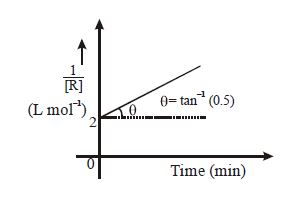
A
The half life $(t_{1/2})$ of reaction is $4 \ min$
B
Initial concentration of $R$ is $2 \ M$
C
Initial concentration of $R$ is $0.5 \ M$
D
Time required for $75\%$ completion of reaction is $0.2 \ hours$
Solution
(B) For a $2^{nd}$ order reaction,the integrated rate law is $\frac{1}{[R]} = kt + \frac{1}{[R]_0}$.
Comparing this with the equation of a straight line $y = mx + c$,we get the slope $k = \tan(\theta) = \tan(\tan^{-1}(0.5)) = 0.5 \ L \ mol^{-1} \ min^{-1}$ and the intercept $\frac{1}{[R]_0} = 2 \ L \ mol^{-1}$.
Thus,$[R]_0 = \frac{1}{2} = 0.5 \ M$. This makes option $B$ incorrect and option $C$ correct.
The half-life is $t_{1/2} = \frac{1}{k[R]_0} = \frac{1}{0.5 \times 0.5} = \frac{1}{0.25} = 4 \ min$. So,option $A$ is correct.
For $75\%$ completion,$[R] = [R]_0 - 0.75[R]_0 = 0.25[R]_0 = 0.125 \ M$.
Using the rate law: $\frac{1}{0.125} = 0.5 \times t + 2 \implies 8 = 0.5t + 2 \implies 0.5t = 6 \implies t = 12 \ min$.
Since $12 \ min = \frac{12}{60} \ hours = 0.2 \ hours$,option $D$ is correct.
Therefore,the incorrect statement is $B$.
Comparing this with the equation of a straight line $y = mx + c$,we get the slope $k = \tan(\theta) = \tan(\tan^{-1}(0.5)) = 0.5 \ L \ mol^{-1} \ min^{-1}$ and the intercept $\frac{1}{[R]_0} = 2 \ L \ mol^{-1}$.
Thus,$[R]_0 = \frac{1}{2} = 0.5 \ M$. This makes option $B$ incorrect and option $C$ correct.
The half-life is $t_{1/2} = \frac{1}{k[R]_0} = \frac{1}{0.5 \times 0.5} = \frac{1}{0.25} = 4 \ min$. So,option $A$ is correct.
For $75\%$ completion,$[R] = [R]_0 - 0.75[R]_0 = 0.25[R]_0 = 0.125 \ M$.
Using the rate law: $\frac{1}{0.125} = 0.5 \times t + 2 \implies 8 = 0.5t + 2 \implies 0.5t = 6 \implies t = 12 \ min$.
Since $12 \ min = \frac{12}{60} \ hours = 0.2 \ hours$,option $D$ is correct.
Therefore,the incorrect statement is $B$.
0 likes
View Solution199
DifficultMCQ
For the reaction $X_{2(g)} + Y_{2(g)} \rightarrow 2XY_{(g)}$,the following data are observed:
Calculate the rate constant of the reaction (in $M^{1-n} \ sec^{-1}$),where $n$ is the order of the reaction.
| $[X_{2}] \ (M)$ | $[Y_{2}] \ (M)$ | Rate of appearance of $XY \ (M \ sec^{-1})$ |
| $0.1$ | $0.1$ | $5 \times 10^{-6}$ |
| $0.2$ | $0.1$ | $10^{-5}$ |
| $0.2$ | $0.2$ | $4 \times 10^{-5}$ |
Calculate the rate constant of the reaction (in $M^{1-n} \ sec^{-1}$),where $n$ is the order of the reaction.
A
$2.5 \times 10^{-4}$
B
$5 \times 10^{-3}$
C
$2.5 \times 10^{-3}$
D
$5 \times 10^{-4}$
Solution
(C) The rate of reaction is defined as $Rate = -\frac{d[X_{2}]}{dt} = -\frac{d[Y_{2}]}{dt} = \frac{1}{2} \frac{d[XY]}{dt}$.
Let the rate law be $Rate = k[X_{2}]^{a}[Y_{2}]^{b}$.
From the data:
$1$) $5 \times 10^{-6} = k(0.1)^{a}(0.1)^{b}$
$2$) $10^{-5} = k(0.2)^{a}(0.1)^{b}$
Dividing $(2)$ by $(1)$: $2 = 2^{a} \implies a = 1$.
$3$) $4 \times 10^{-5} = k(0.2)^{a}(0.2)^{b}$
Dividing $(3)$ by $(2)$: $4 = 2^{b} \implies b = 2$.
Thus,$Rate = k[X_{2}][Y_{2}]^{2}$.
The rate of appearance of $XY$ is $\frac{d[XY]}{dt} = 2 \times Rate = 2k[X_{2}][Y_{2}]^{2}$.
Using the first data point: $5 \times 10^{-6} = 2k(0.1)(0.1)^{2} = 2k(10^{-3})$.
$k = \frac{5 \times 10^{-6}}{2 \times 10^{-3}} = 2.5 \times 10^{-3} \ M^{-2} \ sec^{-1}$.
Let the rate law be $Rate = k[X_{2}]^{a}[Y_{2}]^{b}$.
From the data:
$1$) $5 \times 10^{-6} = k(0.1)^{a}(0.1)^{b}$
$2$) $10^{-5} = k(0.2)^{a}(0.1)^{b}$
Dividing $(2)$ by $(1)$: $2 = 2^{a} \implies a = 1$.
$3$) $4 \times 10^{-5} = k(0.2)^{a}(0.2)^{b}$
Dividing $(3)$ by $(2)$: $4 = 2^{b} \implies b = 2$.
Thus,$Rate = k[X_{2}][Y_{2}]^{2}$.
The rate of appearance of $XY$ is $\frac{d[XY]}{dt} = 2 \times Rate = 2k[X_{2}][Y_{2}]^{2}$.
Using the first data point: $5 \times 10^{-6} = 2k(0.1)(0.1)^{2} = 2k(10^{-3})$.
$k = \frac{5 \times 10^{-6}}{2 \times 10^{-3}} = 2.5 \times 10^{-3} \ M^{-2} \ sec^{-1}$.
0 likes
View Solution200
DifficultMCQ
For a particular reaction,the variation of the rate constant with temperature is given by $\ln k_t = \ln k_0 + \left( \frac{\ln (2.5)}{10} \right) \times t$ $(t \geqslant 0 \, ^{\circ}C)$. Here,$k_0$ is the rate constant at $0 \, ^{\circ}C$ and $k_t$ is the rate constant at $t \, ^{\circ}C$. The temperature coefficient of the reaction,assuming that the rate constant increases by the same factor for every $10 \, ^{\circ}C$ rise in temperature,is:
A
$2$
B
$2.5$
C
$5$
D
$0.4$
Solution
(B) The given expression is $\ln k_t = \ln k_0 + \left( \frac{\ln (2.5)}{10} \right) \times t$.
Taking the exponential of both sides,we get $k_t = k_0 \times (2.5)^{t/10}$.
The temperature coefficient is defined as the ratio of rate constants at temperatures differing by $10 \, ^{\circ}C$,i.e.,$\frac{k_{t+10}}{k_t}$.
Substituting the values: $\frac{k_{t+10}}{k_t} = \frac{k_0 \times (2.5)^{(t+10)/10}}{k_0 \times (2.5)^{t/10}} = (2.5)^{(t+10-t)/10} = (2.5)^{10/10} = 2.5$.
Thus,the temperature coefficient is $2.5$.
Taking the exponential of both sides,we get $k_t = k_0 \times (2.5)^{t/10}$.
The temperature coefficient is defined as the ratio of rate constants at temperatures differing by $10 \, ^{\circ}C$,i.e.,$\frac{k_{t+10}}{k_t}$.
Substituting the values: $\frac{k_{t+10}}{k_t} = \frac{k_0 \times (2.5)^{(t+10)/10}}{k_0 \times (2.5)^{t/10}} = (2.5)^{(t+10-t)/10} = (2.5)^{10/10} = 2.5$.
Thus,the temperature coefficient is $2.5$.
0 likes
View SolutionChemical Kinetics — Rate law , Rate constant , Order of Reaction and Molecularity · Frequently Asked Questions
1Are these Chemical Kinetics questions useful for JEE and NEET?
Yes. All questions in this section are mapped to JEE Main and NEET exam patterns. Previous year questions from JEE Main, NEET, GUJCET and state-level exams are included with full solutions.
2Can I switch to Hindi or Gujarati for these questions?
Yes. Use the language tabs in the hero section or the sidebar to view the same questions and solutions in English, Hindi or Gujarati.
3How do I generate a question paper from this subtopic?
Use the Vedclass Exam Paper Generator — select the chapter and subtopic, set difficulty, and generate Sets A, B, C, D automatically. First 3 chapters of every subject are free.
Vedclass Products
For Students
Vedclass Test Series
Mock tests in real JEE/NEET style with performance analysis. 5-day free trial.
Start Free TrialFor Teachers
Exam Paper Generator
Generate Set A/B/C/D papers from this chapter in 2 minutes. 3 chapters free.
Try FreeFor Institutes
Online Exam Module
Live online exams with unlimited students, 360° analytics & white-label branding.
See DemoFor Teachers & Institutes
Generate a Chemical Kinetics Exam Paper in 2 Minutes
Select subtopic & difficulty — Sets A, B, C, D auto-generated with No Repeat logic.
First 3 chapters of every subject are free — no payment required.