
A English
Properties of Phenols Questions in English
Class 12 Chemistry · Alcohols, Phenols and Ethers · Properties of Phenols
751+
Questions
English
Language
100%
With Solutions
Showing 49 of 751 questions in English
351
MediumMCQ
In the reaction
Phenol $\xrightarrow{NaOH} (A)$ $\xrightarrow[140^{\circ}C]{CO_2, HCl} (B)$
here $B$ is
Phenol $\xrightarrow{NaOH} (A)$ $\xrightarrow[140^{\circ}C]{CO_2, HCl} (B)$
here $B$ is
A
chlorobenzene
B
benzaldehyde
C
benzoic acid
D
salicylic acid
Solution
(D) The reaction sequence is the Kolbe-Schmitt reaction.
$1$. Phenol reacts with $NaOH$ to form sodium phenoxide $(A)$.
$2$. Sodium phenoxide reacts with $CO_2$ at $140^{\circ}C$ under pressure,followed by acidification with $HCl$,to yield salicylic acid $(B)$ as the major product.
Therefore,the correct option is $D$.
$1$. Phenol reacts with $NaOH$ to form sodium phenoxide $(A)$.
$2$. Sodium phenoxide reacts with $CO_2$ at $140^{\circ}C$ under pressure,followed by acidification with $HCl$,to yield salicylic acid $(B)$ as the major product.
Therefore,the correct option is $D$.
0 likes
View Solution352
MediumMCQ
Assertion : Resorcinol turns $FeCl_3$ solution purple.
Reason : Resorcinol has a phenolic group.
Reason : Resorcinol has a phenolic group.
A
If both Assertion and Reason are correct and the Reason is a correct explanation of the Assertion.
B
If both Assertion and Reason are correct but Reason is not a correct explanation of the Assertion.
C
If the Assertion is correct but Reason is incorrect.
D
If both the Assertion and Reason are incorrect.
Solution
(A) Phenols react with neutral $FeCl_3$ solution to form a violet or purple colored complex.
Resorcinol $(1,3-dihydroxybenzene)$ contains two phenolic $-OH$ groups attached to the benzene ring.
Since it contains a phenolic group,it gives a characteristic purple color with $FeCl_3$ solution.
Therefore,both the Assertion and the Reason are correct,and the Reason is the correct explanation of the Assertion.
Resorcinol $(1,3-dihydroxybenzene)$ contains two phenolic $-OH$ groups attached to the benzene ring.
Since it contains a phenolic group,it gives a characteristic purple color with $FeCl_3$ solution.
Therefore,both the Assertion and the Reason are correct,and the Reason is the correct explanation of the Assertion.
0 likes
View Solution353
MediumMCQ
Assertion : Phenol is a stronger acid than ethanol.
Reason : Groups with $+M$ effect decrease acidity at $p-$position.
Reason : Groups with $+M$ effect decrease acidity at $p-$position.
A
If both Assertion and Reason are correct and the Reason is a correct explanation of the Assertion.
B
If both Assertion and Reason are correct but Reason is not a correct explanation of the Assertion.
C
If the Assertion is correct but Reason is incorrect.
D
If both the Assertion and Reason are incorrect.
Solution
(B) Phenol $(C_6H_5OH)$ is a stronger acid than ethanol $(C_2H_5OH)$ because the phenoxide ion $(C_6H_5O^-)$ formed after the loss of a proton is resonance-stabilized,whereas the ethoxide ion $(C_2H_5O^-)$ is not.
Groups with $+M$ effect (like $-OH$,$-OR$,$-NH_2$) increase electron density in the ring,which destabilizes the phenoxide ion and decreases the acidity of phenols when present at the $p-$position.
Both the Assertion and the Reason are scientifically correct statements,but the Reason does not explain why phenol is a stronger acid than ethanol.
Therefore,the correct option is $(b)$.
Groups with $+M$ effect (like $-OH$,$-OR$,$-NH_2$) increase electron density in the ring,which destabilizes the phenoxide ion and decreases the acidity of phenols when present at the $p-$position.
Both the Assertion and the Reason are scientifically correct statements,but the Reason does not explain why phenol is a stronger acid than ethanol.
Therefore,the correct option is $(b)$.
0 likes
View Solution354
MediumMCQ
Assertion: Phenyl is used as a household germicide.
Reason: Phenyl is a phenol derivative and phenol is an effective germicide.
Reason: Phenyl is a phenol derivative and phenol is an effective germicide.
A
$A$. If both Assertion and Reason are correct and the Reason is a correct explanation of the Assertion.
B
$B$. If both Assertion and Reason are correct but Reason is not a correct explanation of the Assertion.
C
$C$. If the Assertion is correct but Reason is incorrect.
D
$D$. If both the Assertion and Reason are incorrect.
Solution
(A) Phenol is an effective germicide.
Since phenyl is a derivative of phenol,it inherits the germicidal properties of phenol.
Therefore,both the Assertion and the Reason are correct,and the Reason is the correct explanation for the Assertion.
Since phenyl is a derivative of phenol,it inherits the germicidal properties of phenol.
Therefore,both the Assertion and the Reason are correct,and the Reason is the correct explanation for the Assertion.
0 likes
View Solution355
DifficultMCQ
Assertion: Phenol undergoes Kolbe reaction,ethanol does not.
Reason: Phenoxide ion is more basic than ethoxide ion.
Reason: Phenoxide ion is more basic than ethoxide ion.
A
If both Assertion and Reason are correct and the Reason is a correct explanation of the Assertion.
B
If both Assertion and Reason are correct but Reason is not a correct explanation of the Assertion.
C
If the Assertion is correct but Reason is incorrect.
D
If both the Assertion and Reason are incorrect.
Solution
(C) The Kolbe reaction involves the reaction of sodium phenoxide with $CO_2$ under pressure followed by acidification to form salicylic acid. This reaction is specific to phenols because the phenoxide ion is resonance-stabilized,making the ring electron-rich and susceptible to electrophilic attack by $CO_2$.
Ethanol does not undergo this reaction because it does not form a stable phenoxide-like intermediate. Thus,the Assertion is true.
Regarding the Reason,the phenoxide ion $(C_6H_5O^-)$ is significantly less basic than the ethoxide ion $(C_2H_5O^-)$. This is because the negative charge on the phenoxide ion is delocalized into the benzene ring via resonance,whereas the ethoxide ion has no such stabilization and the alkyl group $(C_2H_5-)$ is electron-donating,which increases the electron density on the oxygen atom.
Therefore,the Reason is incorrect.
Ethanol does not undergo this reaction because it does not form a stable phenoxide-like intermediate. Thus,the Assertion is true.
Regarding the Reason,the phenoxide ion $(C_6H_5O^-)$ is significantly less basic than the ethoxide ion $(C_2H_5O^-)$. This is because the negative charge on the phenoxide ion is delocalized into the benzene ring via resonance,whereas the ethoxide ion has no such stabilization and the alkyl group $(C_2H_5-)$ is electron-donating,which increases the electron density on the oxygen atom.
Therefore,the Reason is incorrect.
0 likes
View Solution356
MediumMCQ
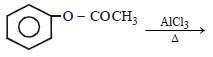
The product obtained is/are
A
$o-$ product
B
$m-$ product
C
$o-$ and $p-$ products
D
$o-, m-$ and $p-$ products
Solution
(C) The reaction shown is the Fries rearrangement.
When phenyl esters are treated with a Lewis acid like anhydrous $AlCl_3$,they undergo rearrangement to yield a mixture of $o-$hydroxyketone and $p-$hydroxyketone.
The reaction is as follows:
$Phenyl \ acetate \xrightarrow{AlCl_3, \Delta} o-hydroxyacetophenone + p-hydroxyacetophenone$.
When phenyl esters are treated with a Lewis acid like anhydrous $AlCl_3$,they undergo rearrangement to yield a mixture of $o-$hydroxyketone and $p-$hydroxyketone.
The reaction is as follows:
$Phenyl \ acetate \xrightarrow{AlCl_3, \Delta} o-hydroxyacetophenone + p-hydroxyacetophenone$.
0 likes
View Solution357
MediumMCQ
The compound that is most difficult to protonate is
A
$H_2O$
B
$CH_3OH$
C
$CH_3OCH_3$
D
$PhOH$
Solution
(D) Protonation involves the donation of a lone pair of electrons from the oxygen atom to a proton $(H^+)$.
Compounds with higher electron density on the oxygen atom are more basic and easier to protonate.
In $PhOH$ (phenol),the lone pair of electrons on the oxygen atom is delocalized into the benzene ring due to resonance.
This delocalization reduces the electron density on the oxygen atom,making it the least basic and therefore the most difficult to protonate among the given options.
Compounds with higher electron density on the oxygen atom are more basic and easier to protonate.
In $PhOH$ (phenol),the lone pair of electrons on the oxygen atom is delocalized into the benzene ring due to resonance.
This delocalization reduces the electron density on the oxygen atom,making it the least basic and therefore the most difficult to protonate among the given options.
0 likes
View Solution358
DifficultMCQ
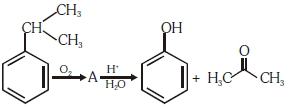
The structure of intermediate $A$ in the following reaction is
A
Isopropyl phenyl ether
B
Cumene hydroperoxide
C
Phenyl isopropyl peroxide
D
$2-$phenylpropan$-1-$yl hydroperoxide
Solution
(B) The reaction shown is the industrial preparation of phenol from cumene (isopropylbenzene).
In the first step,cumene is oxidized by atmospheric oxygen $(O_2)$ to form cumene hydroperoxide as the intermediate $A$.
In the second step,cumene hydroperoxide is treated with dilute acid $(H^+/H_2O)$ to yield phenol and acetone $(CH_3COCH_3)$ as products.
In the first step,cumene is oxidized by atmospheric oxygen $(O_2)$ to form cumene hydroperoxide as the intermediate $A$.
In the second step,cumene hydroperoxide is treated with dilute acid $(H^+/H_2O)$ to yield phenol and acetone $(CH_3COCH_3)$ as products.
0 likes
View Solution359
AdvancedMCQ
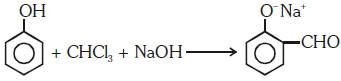
In the reaction shown,the electrophile involved is:
A
dichloromethyl cation $(\stackrel{\oplus}{C}HCl_2)$
B
formyl cation $(\stackrel{\oplus}{C}HO)$
C
dichloromethyl anion $(\stackrel{\ominus}{C}HCl_2)$
D
dichlorocarbene $(:CCl_2)$
Solution
(D) The given reaction is the Reimer-Tiemann reaction,where phenol reacts with chloroform $(CHCl_3)$ in the presence of aqueous sodium hydroxide $(NaOH)$ to form salicylaldehyde.
In this reaction,the electrophile is generated from chloroform.
First,$CHCl_3$ reacts with $OH^-$ to form the trichloromethyl anion $(\stackrel{\ominus}{C}Cl_3)$.
This anion then undergoes $\alpha$-elimination by losing a chloride ion $(Cl^-)$ to form dichlorocarbene $(:CCl_2)$.
Dichlorocarbene is an electron-deficient species with a sextet of electrons,making it a strong electrophile.
In this reaction,the electrophile is generated from chloroform.
First,$CHCl_3$ reacts with $OH^-$ to form the trichloromethyl anion $(\stackrel{\ominus}{C}Cl_3)$.
This anion then undergoes $\alpha$-elimination by losing a chloride ion $(Cl^-)$ to form dichlorocarbene $(:CCl_2)$.
Dichlorocarbene is an electron-deficient species with a sextet of electrons,making it a strong electrophile.
0 likes
View Solution360
DifficultMCQ
Identify the major products $P$,$Q$,and $R$ in the following sequence of reaction:
$\text{Benzene} + CH_3CH_2CH_2Cl$ $\xrightarrow{\text{Anhydrous } AlCl_3} P$ $\xrightarrow[(ii) H_3O^+/\Delta]{(i) O_2} Q + R$
$\text{Benzene} + CH_3CH_2CH_2Cl$ $\xrightarrow{\text{Anhydrous } AlCl_3} P$ $\xrightarrow[(ii) H_3O^+/\Delta]{(i) O_2} Q + R$
A
$\text{Propylbenzene, Benzaldehyde, Ethanol}$
B
$\text{Propylbenzene, Benzaldehyde, Benzoic acid}$
C
$\text{Cumene, Phenol, Propan-2-ol}$
D
$\text{Cumene, Phenol, Acetone}$
Solution
(D) $1$. The reaction of benzene with $n$-propyl chloride in the presence of anhydrous $AlCl_3$ is a Friedel-Crafts alkylation. The primary carbocation formed $(CH_3CH_2CH_2^+)$ undergoes a $1,2$-hydride shift to form a more stable secondary carbocation $(CH_3CH^+CH_3)$.
$2$. This secondary carbocation attacks the benzene ring to form isopropylbenzene,also known as cumene $(P)$.
$3$. Cumene $(P)$ undergoes oxidation with $O_2$ to form cumene hydroperoxide,which upon treatment with dilute acid $(H_3O^+/\Delta)$ undergoes rearrangement to yield phenol $(Q)$ and acetone $(R)$.
$2$. This secondary carbocation attacks the benzene ring to form isopropylbenzene,also known as cumene $(P)$.
$3$. Cumene $(P)$ undergoes oxidation with $O_2$ to form cumene hydroperoxide,which upon treatment with dilute acid $(H_3O^+/\Delta)$ undergoes rearrangement to yield phenol $(Q)$ and acetone $(R)$.
0 likes
View Solution361
MediumMCQ
Arrange the following compounds in increasing order of $C-OH$ bond length: methanol,phenol,$p-$ethoxyphenol.
A
$phenol < p-$ethoxyphenol $< methanol$
B
$methanol < phenol < p-$ethoxyphenol
C
$p-$ethoxyphenol $< phenol < methanol$
D
$methanol < p-$ethoxyphenol $< phenol$
Solution
(A) The $C-OH$ bond length depends on the extent of resonance (partial double bond character).
In $CH_3OH$,the $C-OH$ bond is a pure single bond,so it has the longest bond length.
In $phenol$,the lone pair on oxygen participates in resonance with the benzene ring,giving the $C-OH$ bond partial double bond character.
In $p-$ethoxyphenol,the $-OEt$ group is a strong electron-donating group ($+M$ effect). This increases the electron density in the ring,which opposes the resonance of the $-OH$ group,thereby reducing the partial double bond character of the $C-OH$ bond compared to phenol.
Therefore,the partial double bond character is: $phenol > p-$ethoxyphenol $> methanol$ (pure single bond).
Consequently,the bond length order is: $phenol < p-$ethoxyphenol $< methanol$.
In $CH_3OH$,the $C-OH$ bond is a pure single bond,so it has the longest bond length.
In $phenol$,the lone pair on oxygen participates in resonance with the benzene ring,giving the $C-OH$ bond partial double bond character.
In $p-$ethoxyphenol,the $-OEt$ group is a strong electron-donating group ($+M$ effect). This increases the electron density in the ring,which opposes the resonance of the $-OH$ group,thereby reducing the partial double bond character of the $C-OH$ bond compared to phenol.
Therefore,the partial double bond character is: $phenol > p-$ethoxyphenol $> methanol$ (pure single bond).
Consequently,the bond length order is: $phenol < p-$ethoxyphenol $< methanol$.
0 likes
View Solution362
MediumMCQ
Arrange the following compounds in increasing order of their acid strength: $Propan-1-ol$,$2,4,6-trinitrophenol$,$3-nitrophenol$,$3,5-dinitrophenol$,$phenol$,$4-methylphenol$.
A
$Propan-1-ol < 4-methylphenol < phenol < 3-nitrophenol < 3,5-dinitrophenol < 2,4,6-trinitrophenol$
B
$Propan-1-ol < phenol < 4-methylphenol < 3-nitrophenol < 3,5-dinitrophenol < 2,4,6-trinitrophenol$
C
$4-methylphenol < Propan-1-ol < phenol < 3-nitrophenol < 3,5-dinitrophenol < 2,4,6-trinitrophenol$
D
$2,4,6-trinitrophenol < 3,5-dinitrophenol < 3-nitrophenol < phenol < 4-methylphenol < Propan-1-ol$
Solution
(A) The acidity of compounds depends on the stability of the conjugate base formed after the loss of a proton.
$1$. $Propan-1-ol$ is an aliphatic alcohol and is the least acidic among the given compounds.
$2$. Among phenols,the presence of electron-donating groups (like $-CH_3$ in $4-methylphenol$) decreases acidity,while electron-withdrawing groups (like $-NO_2$) increase acidity.
$3$. The order of acidity is: $Propan-1-ol < 4-methylphenol < phenol < 3-nitrophenol < 3,5-dinitrophenol < 2,4,6-trinitrophenol$.
$1$. $Propan-1-ol$ is an aliphatic alcohol and is the least acidic among the given compounds.
$2$. Among phenols,the presence of electron-donating groups (like $-CH_3$ in $4-methylphenol$) decreases acidity,while electron-withdrawing groups (like $-NO_2$) increase acidity.
$3$. The order of acidity is: $Propan-1-ol < 4-methylphenol < phenol < 3-nitrophenol < 3,5-dinitrophenol < 2,4,6-trinitrophenol$.
0 likes
View Solution363
Medium
Write the structures of the major products expected from the following reactions:
$(a)$ Mononitration of $3-$methylphenol
$(b)$ Dinitration of $3-$methylphenol
$(c)$ Mononitration of phenyl methanoate.
$(a)$ Mononitration of $3-$methylphenol
$(b)$ Dinitration of $3-$methylphenol
$(c)$ Mononitration of phenyl methanoate.
Solution
(N/A) Mononitration of $3-$methylphenol gives $2-$nitro-$5-$methylphenol and $4-$nitro-$3-$methylphenol.
$(b)$ Dinitration of $3-$methylphenol gives $2,4-$dinitro-$5-$methylphenol.
$(c)$ Mononitration of phenyl methanoate gives $4-$nitrophenyl methanoate as the major product due to the ortho/para directing nature of the ester group.
$(b)$ Dinitration of $3-$methylphenol gives $2,4-$dinitro-$5-$methylphenol.
$(c)$ Mononitration of phenyl methanoate gives $4-$nitrophenyl methanoate as the major product due to the ortho/para directing nature of the ester group.
0 likes
View Solution364
Medium
Ortho and para nitrophenols are more acidic than phenol. Draw the resonance structures of the corresponding phenoxide ions.
Solution
(N/A) The acidity of phenols is determined by the stability of the corresponding phenoxide ion. The nitro group $(-NO_2)$ is a strong electron-withdrawing group ($-I$ and $-M$ effect). In ortho and para nitrophenols,the negative charge on the oxygen atom of the phenoxide ion is delocalized into the benzene ring and further stabilized by the electron-withdrawing nitro group at the ortho or para positions. This additional resonance stabilization makes the ortho and para nitrophenoxide ions significantly more stable than the phenoxide ion,thereby increasing the acidity of the parent phenols.
0 likes
View Solution365
Medium
Write the equations involved in the following reactions:
$(i)$ Reimer-Tiemann reaction
$(ii)$ Kolbe's reaction
$(i)$ Reimer-Tiemann reaction
$(ii)$ Kolbe's reaction
Solution
(N/A) $(i)$ Reimer-Tiemann reaction:
Phenol reacts with chloroform $(CHCl_3)$ in the presence of aqueous sodium hydroxide $(NaOH)$ to form an intermediate,which upon further reaction with $NaOH$ and subsequent acidification $(H^+)$ yields salicylaldehyde.
$(ii)$ Kolbe's reaction:
Phenol reacts with sodium hydroxide $(NaOH)$ to form sodium phenoxide,which then reacts with carbon dioxide $(CO_2)$ at $400 \ K$ and $4-7 \ atm$ pressure to form sodium salicylate. This intermediate is then treated with dilute hydrochloric acid $(Dil. \ HCl)$ to produce $2$-hydroxybenzoic acid (salicylic acid).
Phenol reacts with chloroform $(CHCl_3)$ in the presence of aqueous sodium hydroxide $(NaOH)$ to form an intermediate,which upon further reaction with $NaOH$ and subsequent acidification $(H^+)$ yields salicylaldehyde.
$(ii)$ Kolbe's reaction:
Phenol reacts with sodium hydroxide $(NaOH)$ to form sodium phenoxide,which then reacts with carbon dioxide $(CO_2)$ at $400 \ K$ and $4-7 \ atm$ pressure to form sodium salicylate. This intermediate is then treated with dilute hydrochloric acid $(Dil. \ HCl)$ to produce $2$-hydroxybenzoic acid (salicylic acid).
0 likes
View Solution366
Medium
Give the structures and $IUPAC$ names of monohydric phenols of molecular formula,$C_{7}H_{8}O$.
Solution
(N/A) The molecular formula $C_{7}H_{8}O$ corresponds to the methyl-substituted phenols,also known as cresols. There are three isomers possible for monohydric phenols with this formula:
$1$. $2$-Methylphenol ($o$-Cresol): The methyl group is at the ortho position relative to the hydroxyl group.
Structure: $A$ benzene ring with an $-OH$ group at position $1$ and a $-CH_{3}$ group at position $2$.
$2$. $3$-Methylphenol ($m$-Cresol): The methyl group is at the meta position relative to the hydroxyl group.
Structure: $A$ benzene ring with an $-OH$ group at position $1$ and a $-CH_{3}$ group at position $3$.
$3$. $4$-Methylphenol ($p$-Cresol): The methyl group is at the para position relative to the hydroxyl group.
Structure: $A$ benzene ring with an $-OH$ group at position $1$ and a $-CH_{3}$ group at position $4$.
$1$. $2$-Methylphenol ($o$-Cresol): The methyl group is at the ortho position relative to the hydroxyl group.
Structure: $A$ benzene ring with an $-OH$ group at position $1$ and a $-CH_{3}$ group at position $2$.
$2$. $3$-Methylphenol ($m$-Cresol): The methyl group is at the meta position relative to the hydroxyl group.
Structure: $A$ benzene ring with an $-OH$ group at position $1$ and a $-CH_{3}$ group at position $3$.
$3$. $4$-Methylphenol ($p$-Cresol): The methyl group is at the para position relative to the hydroxyl group.
Structure: $A$ benzene ring with an $-OH$ group at position $1$ and a $-CH_{3}$ group at position $4$.
0 likes
View Solution367
Medium
While separating a mixture of $o-$ and $p-$nitrophenols by steam distillation,name the isomer which will be steam volatile. Give reason.
Solution
(N/A) $o-$Nitrophenol is steam volatile.
Reason: $o-$Nitrophenol exhibits intramolecular $H-$bonding,which restricts its association with other molecules. In contrast,$p-$nitrophenol exhibits intermolecular $H-$bonding,leading to strong association between its molecules. Due to this,$o-$nitrophenol has a lower boiling point and is more steam volatile than $p-$nitrophenol.
Reason: $o-$Nitrophenol exhibits intramolecular $H-$bonding,which restricts its association with other molecules. In contrast,$p-$nitrophenol exhibits intermolecular $H-$bonding,leading to strong association between its molecules. Due to this,$o-$nitrophenol has a lower boiling point and is more steam volatile than $p-$nitrophenol.
0 likes
View Solution368
Difficult
Give two reactions that show the acidic nature of phenol. Compare the acidity of phenol with that of ethanol.
Solution
(N/A) The acidic nature of phenol can be demonstrated by the following two reactions:
$(i)$ Phenol reacts with sodium metal to form sodium phenoxide and hydrogen gas:
$C_6H_5OH + Na \rightarrow C_6H_5ONa + \frac{1}{2}H_2 \uparrow$
$(ii)$ Phenol reacts with sodium hydroxide to form sodium phenoxide and water:
$C_6H_5OH + NaOH \rightarrow C_6H_5ONa + H_2O$
Comparison of acidity:
The acidity of phenol is significantly higher than that of ethanol. This is because the phenoxide ion formed after the loss of a proton is stabilized by resonance,where the negative charge is delocalized over the benzene ring. In contrast,the ethoxide ion $(CH_3CH_2O^-)$ formed from ethanol does not undergo resonance stabilization.
$(i)$ Phenol reacts with sodium metal to form sodium phenoxide and hydrogen gas:
$C_6H_5OH + Na \rightarrow C_6H_5ONa + \frac{1}{2}H_2 \uparrow$
$(ii)$ Phenol reacts with sodium hydroxide to form sodium phenoxide and water:
$C_6H_5OH + NaOH \rightarrow C_6H_5ONa + H_2O$
Comparison of acidity:
The acidity of phenol is significantly higher than that of ethanol. This is because the phenoxide ion formed after the loss of a proton is stabilized by resonance,where the negative charge is delocalized over the benzene ring. In contrast,the ethoxide ion $(CH_3CH_2O^-)$ formed from ethanol does not undergo resonance stabilization.
0 likes
View Solution369
Difficult
Explain why $ortho$-nitrophenol is more acidic than $ortho$-methoxyphenol?
Solution
The $-NO_2$ group is an electron-withdrawing group $(EWG)$ due to both $-I$ and $-M$ effects. The presence of this group at the $ortho$ position decreases the electron density in the $O-H$ bond,facilitating the release of a proton $(H^+)$.
Furthermore,the $o$-nitrophenoxide ion formed after the loss of the proton is significantly stabilized by resonance involving the nitro group.
On the other hand,the $-OCH_3$ group is an electron-releasing group $(ERG)$ due to its $+M$ effect. This increases the electron density in the $O-H$ bond,making it harder to release the proton.
Therefore,$ortho$-nitrophenol is a stronger acid than $ortho$-methoxyphenol.
Furthermore,the $o$-nitrophenoxide ion formed after the loss of the proton is significantly stabilized by resonance involving the nitro group.
On the other hand,the $-OCH_3$ group is an electron-releasing group $(ERG)$ due to its $+M$ effect. This increases the electron density in the $O-H$ bond,making it harder to release the proton.
Therefore,$ortho$-nitrophenol is a stronger acid than $ortho$-methoxyphenol.
0 likes
View Solution370
Difficult
Explain how the $-OH$ group attached to a carbon of a benzene ring activates it towards electrophilic substitution.
Solution
(N/A) The $-OH$ group is an electron-donating group due to the presence of lone pairs on the oxygen atom.
Through resonance,these lone pairs are delocalized into the benzene ring,which increases the electron density,particularly at the ortho and para positions.
This increased electron density makes the benzene ring more susceptible to attack by an electrophile,thereby activating the ring towards electrophilic substitution reactions.
The resonance structures of phenol are as follows:
(The resonance structures show the delocalization of the lone pair from the oxygen atom into the ring,creating negative charges at the ortho and para positions.)
Through resonance,these lone pairs are delocalized into the benzene ring,which increases the electron density,particularly at the ortho and para positions.
This increased electron density makes the benzene ring more susceptible to attack by an electrophile,thereby activating the ring towards electrophilic substitution reactions.
The resonance structures of phenol are as follows:
(The resonance structures show the delocalization of the lone pair from the oxygen atom into the ring,creating negative charges at the ortho and para positions.)
0 likes
View Solution371
Medium
Explain the classification of phenols with examples.
Solution
(N/A) Phenols are classified based on the number of hydroxyl $(-OH)$ groups attached to the aromatic ring:
$1$. Monohydric phenols: These contain only one $-OH$ group attached to the benzene ring. Examples include phenol $(C_6H_5OH)$ and $o$-cresol.
$2$. Dihydric phenols: These contain two $-OH$ groups attached to the benzene ring. Examples include catechol ($1,2$-dihydroxybenzene) and resorcinol ($1,3$-dihydroxybenzene).
$3$. Trihydric phenols: These contain three $-OH$ groups attached to the benzene ring. An example is pyrogallol ($1,2,3$-trihydroxybenzene).
$1$. Monohydric phenols: These contain only one $-OH$ group attached to the benzene ring. Examples include phenol $(C_6H_5OH)$ and $o$-cresol.
$2$. Dihydric phenols: These contain two $-OH$ groups attached to the benzene ring. Examples include catechol ($1,2$-dihydroxybenzene) and resorcinol ($1,3$-dihydroxybenzene).
$3$. Trihydric phenols: These contain three $-OH$ groups attached to the benzene ring. An example is pyrogallol ($1,2,3$-trihydroxybenzene).
0 likes
View Solution372
Medium
Explain the acidic reactions of phenol and describe its acidic nature and strength.
Solution
(N/A) Acidic reactions of phenol: In the acidic reactions of phenol,the $O-H$ bond breaks,resulting in the formation of phenoxide ions.
$(i)$ Reaction with active metals $(Na, Al)$ and alkalis $(NaOH, KOH)$: Phenols react with active metals like sodium and potassium to form phenoxide compounds and release hydrogen gas.
$(ii)$ Reaction with aqueous alkali: Phenols react with aqueous sodium hydroxide to form sodium phenoxide.
This reaction of phenol with $NaOH$ demonstrates that phenol is a stronger acid than alcohols.
$(b)$ Acidic nature of phenol: The above reactions indicate that phenolic compounds are acidic in nature. In fact,phenols are Brønsted acids and can donate a proton to a strong base $(:B^-)$.
$(c)$ Acidity of phenols: The reactions of phenol with metals (sodium,aluminum) and sodium hydroxide prove that phenol is acidic in nature.
$(i)$ Reaction with active metals $(Na, Al)$ and alkalis $(NaOH, KOH)$: Phenols react with active metals like sodium and potassium to form phenoxide compounds and release hydrogen gas.
$(ii)$ Reaction with aqueous alkali: Phenols react with aqueous sodium hydroxide to form sodium phenoxide.
This reaction of phenol with $NaOH$ demonstrates that phenol is a stronger acid than alcohols.
$(b)$ Acidic nature of phenol: The above reactions indicate that phenolic compounds are acidic in nature. In fact,phenols are Brønsted acids and can donate a proton to a strong base $(:B^-)$.
$(c)$ Acidity of phenols: The reactions of phenol with metals (sodium,aluminum) and sodium hydroxide prove that phenol is acidic in nature.
0 likes
View Solution373
Difficult
Some compounds and their $pK_a$ values are given. Arrange them in decreasing order of their acidic strength.
$(i)$ Ethanol $(15.9)$,Phenol $(10.0)$,Cresol $(10.1)$,Water $(15.7)$
$(ii)$ $o$-Nitrophenol $(7.2)$,$m$-Nitrophenol $(8.3)$,Ethanol $(15.9)$,Water $(15.7)$,Phenol $(10.0)$
$(i)$ Ethanol $(15.9)$,Phenol $(10.0)$,Cresol $(10.1)$,Water $(15.7)$
$(ii)$ $o$-Nitrophenol $(7.2)$,$m$-Nitrophenol $(8.3)$,Ethanol $(15.9)$,Water $(15.7)$,Phenol $(10.0)$
Solution
(A) The acidic strength is inversely proportional to the $pK_a$ value. Lower $pK_a$ indicates higher acidic strength.
$(i)$ The $pK_a$ values are: Phenol $(10.0) <$ Cresol $(10.1) <$ Water $(15.7) <$ Ethanol $(15.9)$.
Therefore,the decreasing order of acidic strength is: $\text{Phenol} > \text{Cresol} > \text{Water} > \text{Ethanol}$.
$(ii)$ The $pK_a$ values are: $o$-Nitrophenol $(7.2) < m$-Nitrophenol $(8.3) <$ Phenol $(10.0) <$ Water $(15.7) <$ Ethanol $(15.9)$.
Therefore,the decreasing order of acidic strength is: $o\text{-Nitrophenol} > m\text{-Nitrophenol} > \text{Phenol} > \text{Water} > \text{Ethanol}$.
$(i)$ The $pK_a$ values are: Phenol $(10.0) <$ Cresol $(10.1) <$ Water $(15.7) <$ Ethanol $(15.9)$.
Therefore,the decreasing order of acidic strength is: $\text{Phenol} > \text{Cresol} > \text{Water} > \text{Ethanol}$.
$(ii)$ The $pK_a$ values are: $o$-Nitrophenol $(7.2) < m$-Nitrophenol $(8.3) <$ Phenol $(10.0) <$ Water $(15.7) <$ Ethanol $(15.9)$.
Therefore,the decreasing order of acidic strength is: $o\text{-Nitrophenol} > m\text{-Nitrophenol} > \text{Phenol} > \text{Water} > \text{Ethanol}$.
0 likes
View Solution374
Medium
Describe the electrophilic aromatic substitution reactions of phenol.
Solution
(N/A) Phenol undergoes electrophilic aromatic substitution reactions due to the activating effect of the $-OH$ group,which directs incoming electrophiles to the ortho and para positions.
$1$. Nitration:
- With dilute $HNO_3$ at $298 \ K$,phenol gives a mixture of $o$-nitrophenol and $p$-nitrophenol.
- With concentrated $HNO_3$,phenol is converted into $2,4,6$-trinitrophenol,commonly known as picric acid.
$2$. Sulphonation:
- Phenol reacts with concentrated $H_2SO_4$ to form $o$-phenolsulphonic acid at low temperature $(293 \ K)$ and $p$-phenolsulphonic acid at higher temperature $(373 \ K)$.
$1$. Nitration:
- With dilute $HNO_3$ at $298 \ K$,phenol gives a mixture of $o$-nitrophenol and $p$-nitrophenol.
- With concentrated $HNO_3$,phenol is converted into $2,4,6$-trinitrophenol,commonly known as picric acid.
$2$. Sulphonation:
- Phenol reacts with concentrated $H_2SO_4$ to form $o$-phenolsulphonic acid at low temperature $(293 \ K)$ and $p$-phenolsulphonic acid at higher temperature $(373 \ K)$.
0 likes
View Solution375
MediumMCQ
Write the nitration and bromination reactions of phenol.
A
Nitration with dilute $HNO_3$ and concentrated $HNO_3$.
B
Bromination with $Br_2$ in $CS_2$ and $Br_2$ water.
C
Only nitration reactions.
D
Only bromination reactions.
Solution
(A) Nitration of Phenol: The product depends on the concentration of $HNO_3$.
$(i)$ Nitration with dilute $HNO_3$: $A$ mixture of $o$-nitrophenol and $p$-nitrophenol is formed. $o$-Nitrophenol can be separated by steam distillation due to intramolecular hydrogen bonding,while $p$-nitrophenol has intermolecular hydrogen bonding.
$(ii)$ Nitration with concentrated $HNO_3$: Phenol reacts to form $2,4,6$-trinitrophenol (picric acid). To improve yield,phenol is first treated with concentrated $H_2SO_4$ to form phenol-$2,4$-disulphonic acid,which is then nitrated with concentrated $HNO_3$.
$(b)$ Bromination of Phenol:
$(i)$ With $Br_2$ in $CS_2$ at low temperature: Monobromophenols ($o$-bromophenol and $p$-bromophenol) are formed.
$(ii)$ With $Br_2$ water: Phenol reacts rapidly to form a white precipitate of $2,4,6$-tribromophenol.
$(i)$ Nitration with dilute $HNO_3$: $A$ mixture of $o$-nitrophenol and $p$-nitrophenol is formed. $o$-Nitrophenol can be separated by steam distillation due to intramolecular hydrogen bonding,while $p$-nitrophenol has intermolecular hydrogen bonding.
$(ii)$ Nitration with concentrated $HNO_3$: Phenol reacts to form $2,4,6$-trinitrophenol (picric acid). To improve yield,phenol is first treated with concentrated $H_2SO_4$ to form phenol-$2,4$-disulphonic acid,which is then nitrated with concentrated $HNO_3$.
$(b)$ Bromination of Phenol:
$(i)$ With $Br_2$ in $CS_2$ at low temperature: Monobromophenols ($o$-bromophenol and $p$-bromophenol) are formed.
$(ii)$ With $Br_2$ water: Phenol reacts rapidly to form a white precipitate of $2,4,6$-tribromophenol.
0 likes
View Solution376
Difficult
What are the products formed by the reaction of phenol with dilute $HNO_3$? By which method are these products separated,and what is the name of the compound that separates out and the reason for it?
Solution
(N/A) $(i)$ Nitration of phenol with dilute $HNO_3$ yields a mixture of $o$-nitrophenol and $p$-nitrophenol.
$(ii)$ The components of this nitrophenol mixture are separated by the steam distillation method.
$(iii)$ Upon steam distillation of the mixture of $o$- and $p$-nitrophenol,$o$-nitrophenol distills over with steam and is separated,while $p$-nitrophenol remains in the flask.
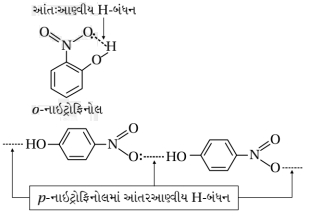
$(iv)$ $o$-nitrophenol is volatile with steam due to the presence of intramolecular hydrogen bonding,allowing it to be separated.
$p$-nitrophenol is less volatile in steam distillation and remains in the flask because it exhibits intermolecular $H$-bonding,as shown below.
$(ii)$ The components of this nitrophenol mixture are separated by the steam distillation method.
$(iii)$ Upon steam distillation of the mixture of $o$- and $p$-nitrophenol,$o$-nitrophenol distills over with steam and is separated,while $p$-nitrophenol remains in the flask.
$(iv)$ $o$-nitrophenol is volatile with steam due to the presence of intramolecular hydrogen bonding,allowing it to be separated.
$p$-nitrophenol is less volatile in steam distillation and remains in the flask because it exhibits intermolecular $H$-bonding,as shown below.
0 likes
View Solution377
Medium
Why is picric acid a stronger acid than carboxylic acids,despite being a phenolic compound?
Solution
(N/A) Picric acid is $2,4,6$-trinitrophenol.
It contains three electron-withdrawing $-NO_2$ groups.
The strong inductive $(-I)$ and resonance effects of these groups weaken the $O-H$ bond,facilitating the easy release of the hydrogen ion $(H^+)$.
Additionally,the resulting phenoxide ion is highly stabilized by the resonance effect of the three $-NO_2$ groups,making picric acid a very strong acid.
It contains three electron-withdrawing $-NO_2$ groups.
The strong inductive $(-I)$ and resonance effects of these groups weaken the $O-H$ bond,facilitating the easy release of the hydrogen ion $(H^+)$.
Additionally,the resulting phenoxide ion is highly stabilized by the resonance effect of the three $-NO_2$ groups,making picric acid a very strong acid.
0 likes
View Solution378
Medium
Which group is present in phenol? What is the effect of this group on the ring and its reactions?
Solution
(N/A) Phenol contains a hydroxyl $(-OH)$ group.
The $-OH$ group in phenol donates its lone pair of electrons on oxygen into the ring through resonance,making the ring electron-rich and activating it towards electrophilic substitution reactions. Thus,the $-OH$ group is an 'activating' group.
Due to resonance,the $-OH$ group increases electron density at the ortho and para positions. Consequently,electrophilic substitution reactions occur primarily at these $o, p$-positions. Therefore,the $-OH$ group is an 'ortho-para directing' group.
For example,electrophilic substitution reactions like nitration and bromination of phenol occur under mild conditions at the ortho and para positions. Due to the strong activating effect of the $-OH$ group,poly-substitution products like $2,4,6$-tribromophenol and $2,4,6$-trinitrophenol can be easily formed.
The $-OH$ group in phenol donates its lone pair of electrons on oxygen into the ring through resonance,making the ring electron-rich and activating it towards electrophilic substitution reactions. Thus,the $-OH$ group is an 'activating' group.
Due to resonance,the $-OH$ group increases electron density at the ortho and para positions. Consequently,electrophilic substitution reactions occur primarily at these $o, p$-positions. Therefore,the $-OH$ group is an 'ortho-para directing' group.
For example,electrophilic substitution reactions like nitration and bromination of phenol occur under mild conditions at the ortho and para positions. Due to the strong activating effect of the $-OH$ group,poly-substitution products like $2,4,6$-tribromophenol and $2,4,6$-trinitrophenol can be easily formed.
0 likes
View Solution379
Difficult
Explain how the $-OH$ group attached to the carbon of the benzene ring activates the benzene ring for electrophilic substitution reactions.
Solution
(N/A) In phenol,the $-OH$ group is attached to the carbon of the benzene ring. The $-OH$ group acts as an activating group for electrophilic substitution reactions in the benzene ring.
The oxygen atom of the $-OH$ group possesses lone pairs of electrons. Through resonance,these lone pairs are delocalized into the benzene ring,as shown in the following resonance structures:
$(I)$ $\leftrightarrow$ $(II)$ $\leftrightarrow$ $(III)$ $\leftrightarrow$ $(IV)$ $\leftrightarrow$ $(V)$
These resonance structures clearly show that the electron density increases at the ortho and para positions of the ring due to the negative charge. As a result,the benzene ring becomes electron-rich,making it more susceptible to attack by electrophiles. Thus,the $-OH$ group activates the benzene ring for electrophilic substitution reactions.
The oxygen atom of the $-OH$ group possesses lone pairs of electrons. Through resonance,these lone pairs are delocalized into the benzene ring,as shown in the following resonance structures:
$(I)$ $\leftrightarrow$ $(II)$ $\leftrightarrow$ $(III)$ $\leftrightarrow$ $(IV)$ $\leftrightarrow$ $(V)$
These resonance structures clearly show that the electron density increases at the ortho and para positions of the ring due to the negative charge. As a result,the benzene ring becomes electron-rich,making it more susceptible to attack by electrophiles. Thus,the $-OH$ group activates the benzene ring for electrophilic substitution reactions.
0 likes
View Solution380
Medium
Write a note on Kolbe's reaction.
Solution
(N/A) Kolbe's reaction is a chemical reaction used to synthesize salicylic acid from phenol.
$1$. Phenol is treated with sodium hydroxide $(NaOH)$ to form sodium phenoxide.
$2$. Sodium phenoxide is then reacted with carbon dioxide $(CO_2)$ at a temperature of $398 \ K$ and a pressure of $4-7 \ bar$.
$3$. This leads to the formation of sodium salicylate,which upon acidification with concentrated hydrochloric acid $(HCl)$ yields salicylic acid ($2$-hydroxybenzoic acid).
Reaction sequence:
$C_6H_5OH + NaOH \rightarrow C_6H_5ONa + H_2O$
$C_6H_5ONa + CO_2 \xrightarrow{398 \ K, 4-7 \ bar} C_6H_4(OH)COONa$
$C_6H_4(OH)COONa + H^+ \rightarrow C_6H_4(OH)COOH$ (Salicylic acid)
$1$. Phenol is treated with sodium hydroxide $(NaOH)$ to form sodium phenoxide.
$2$. Sodium phenoxide is then reacted with carbon dioxide $(CO_2)$ at a temperature of $398 \ K$ and a pressure of $4-7 \ bar$.
$3$. This leads to the formation of sodium salicylate,which upon acidification with concentrated hydrochloric acid $(HCl)$ yields salicylic acid ($2$-hydroxybenzoic acid).
Reaction sequence:
$C_6H_5OH + NaOH \rightarrow C_6H_5ONa + H_2O$
$C_6H_5ONa + CO_2 \xrightarrow{398 \ K, 4-7 \ bar} C_6H_4(OH)COONa$
$C_6H_4(OH)COONa + H^+ \rightarrow C_6H_4(OH)COOH$ (Salicylic acid)
0 likes
View Solution381
Difficult
Give the conversion of phenol to salicylic acid.
Solution
(N/A) This reaction is known as the $Kolbe-Schmidt$ reaction.
First,phenol reacts with sodium hydroxide $(NaOH)$ to form sodium phenoxide.
Sodium phenoxide is more reactive towards electrophilic aromatic substitution than phenol.
It reacts with carbon dioxide $(CO_2)$,a weak electrophile,at high pressure and temperature to form sodium salicylate,which upon acidification yields salicylic acid $(o-hydroxybenzoic \ acid)$.
First,phenol reacts with sodium hydroxide $(NaOH)$ to form sodium phenoxide.
Sodium phenoxide is more reactive towards electrophilic aromatic substitution than phenol.
It reacts with carbon dioxide $(CO_2)$,a weak electrophile,at high pressure and temperature to form sodium salicylate,which upon acidification yields salicylic acid $(o-hydroxybenzoic \ acid)$.
0 likes
View Solution382
Difficult
Write a note on Reimer-Tiemann reaction.
Solution
(N/A) The Reimer-Tiemann reaction is a chemical reaction used for the ortho-formylation of phenols.
When phenol is treated with chloroform $(CHCl_3)$ in the presence of an aqueous base like sodium hydroxide $(NaOH)$,a formyl group $(-CHO)$ is introduced at the ortho position of the benzene ring.
This reaction proceeds through the formation of a substituted benzal chloride intermediate,which upon hydrolysis with $NaOH$ followed by acidification with $HCl$,yields salicylaldehyde ($2$-hydroxybenzaldehyde).
The overall reaction can be represented as:
$C_6H_5OH + CHCl_3 + 3NaOH \rightarrow C_6H_4(OH)CHO + 3NaCl + 2H_2O$.
When phenol is treated with chloroform $(CHCl_3)$ in the presence of an aqueous base like sodium hydroxide $(NaOH)$,a formyl group $(-CHO)$ is introduced at the ortho position of the benzene ring.
This reaction proceeds through the formation of a substituted benzal chloride intermediate,which upon hydrolysis with $NaOH$ followed by acidification with $HCl$,yields salicylaldehyde ($2$-hydroxybenzaldehyde).
The overall reaction can be represented as:
$C_6H_5OH + CHCl_3 + 3NaOH \rightarrow C_6H_4(OH)CHO + 3NaCl + 2H_2O$.
0 likes
View Solution383
Medium
Which of the following compounds $(i)$ and $(ii)$ will not react with a mixture of $NaBr$ and $H_{2}SO_{4}$? Explain why?
$(i)$ $CH_{3}CH_{2}CH_{2}OH$
$(ii)$ Phenol (as shown in the image)
$(i)$ $CH_{3}CH_{2}CH_{2}OH$
$(ii)$ Phenol (as shown in the image)

Solution
(II) Compound $(ii)$,which is phenol,will not react with a mixture of $NaBr$ and $H_{2}SO_{4}$.
In phenol,the $C-O$ bond acquires partial double bond character due to resonance between the lone pair of electrons on the oxygen atom and the benzene ring.
This makes the $C-O$ bond much stronger and shorter,making it difficult to break the bond to replace the $-OH$ group with a $-Br$ atom.
In contrast,primary alcohols like $(i)$ $(CH_{3}CH_{2}CH_{2}OH)$ readily undergo substitution reactions with $NaBr$ and $H_{2}SO_{4}$ to form alkyl bromides.
In phenol,the $C-O$ bond acquires partial double bond character due to resonance between the lone pair of electrons on the oxygen atom and the benzene ring.
This makes the $C-O$ bond much stronger and shorter,making it difficult to break the bond to replace the $-OH$ group with a $-Br$ atom.
In contrast,primary alcohols like $(i)$ $(CH_{3}CH_{2}CH_{2}OH)$ readily undergo substitution reactions with $NaBr$ and $H_{2}SO_{4}$ to form alkyl bromides.
0 likes
View Solution384
Difficult
Give the conversion of phenol to salicylaldehyde.
Solution
(N/A) The conversion of phenol to salicylaldehyde is achieved through the $Reimer-Tiemann$ reaction.
When phenol is treated with chloroform $(CHCl_3)$ in the presence of aqueous sodium hydroxide $(NaOH)$ at $340 \ K$,an aldehyde group $(-CHO)$ is introduced at the ortho position of the phenol.
This reaction proceeds via the formation of a dichlorocarbene intermediate,which attacks the phenoxide ion.
The resulting intermediate is a substituted benzal chloride,which undergoes hydrolysis in the presence of alkali to yield salicylaldehyde $(2-hydroxybenzaldehyde)$.
When phenol is treated with chloroform $(CHCl_3)$ in the presence of aqueous sodium hydroxide $(NaOH)$ at $340 \ K$,an aldehyde group $(-CHO)$ is introduced at the ortho position of the phenol.
This reaction proceeds via the formation of a dichlorocarbene intermediate,which attacks the phenoxide ion.
The resulting intermediate is a substituted benzal chloride,which undergoes hydrolysis in the presence of alkali to yield salicylaldehyde $(2-hydroxybenzaldehyde)$.
0 likes
View Solution385
Medium
Give the reactions of phenol with zinc dust and oxidation.
Solution
(N/A) Reaction with zinc dust: Phenol is converted to benzene on heating with zinc dust. The reaction is: $C_6H_5OH + Zn \rightarrow C_6H_6 + ZnO$.
$(b)$ Oxidation: Oxidation of phenol with chromic acid $(Na_2Cr_2O_7 + \text{conc. } H_2SO_4)$ produces a conjugated diketone known as $1,4$-benzoquinone. The reaction is: $C_6H_5OH \xrightarrow{Na_2Cr_2O_7/H_2SO_4} C_6H_4O_2$ (benzoquinone).
$(b)$ Oxidation: Oxidation of phenol with chromic acid $(Na_2Cr_2O_7 + \text{conc. } H_2SO_4)$ produces a conjugated diketone known as $1,4$-benzoquinone. The reaction is: $C_6H_5OH \xrightarrow{Na_2Cr_2O_7/H_2SO_4} C_6H_4O_2$ (benzoquinone).
0 likes
View Solution386
Medium
Write the chemical equations for the following reactions:
$(i)$ Reimer-Tiemann reaction
$(ii)$ Kolbe's reaction
$(i)$ Reimer-Tiemann reaction
$(ii)$ Kolbe's reaction
Solution
(N/A) $(i)$ Reimer-Tiemann reaction:
In this reaction,the $-OH$ group is retained,and the reaction occurs at the ortho position. When phenol is heated with chloroform in the presence of sodium hydroxide,an aldehyde $(-CHO)$ group is introduced at the ortho position of the phenol,which is known as the Reimer-Tiemann reaction.
During this reaction,an intermediate substituted benzal chloride is formed,which undergoes hydrolysis in the presence of alkali $(NaOH)$ to form the product salicylaldehyde.
$(ii)$ Kolbe's reaction:
In this reaction,the $-OH$ group is retained,and $CO_2$ is attached at the ortho position. Phenol reacts with sodium hydroxide $(NaOH)$ to form sodium phenoxide.
The phenoxide ion is more reactive than phenol towards electrophilic aromatic substitution,so the phenoxide reacts with a weak electrophile like $CO_2$ to form the main product,ortho-hydroxybenzoic acid (salicylic acid).
In this reaction,the $-OH$ group is retained,and the reaction occurs at the ortho position. When phenol is heated with chloroform in the presence of sodium hydroxide,an aldehyde $(-CHO)$ group is introduced at the ortho position of the phenol,which is known as the Reimer-Tiemann reaction.
During this reaction,an intermediate substituted benzal chloride is formed,which undergoes hydrolysis in the presence of alkali $(NaOH)$ to form the product salicylaldehyde.
$(ii)$ Kolbe's reaction:
In this reaction,the $-OH$ group is retained,and $CO_2$ is attached at the ortho position. Phenol reacts with sodium hydroxide $(NaOH)$ to form sodium phenoxide.
The phenoxide ion is more reactive than phenol towards electrophilic aromatic substitution,so the phenoxide reacts with a weak electrophile like $CO_2$ to form the main product,ortho-hydroxybenzoic acid (salicylic acid).
0 likes
View Solution387
Medium
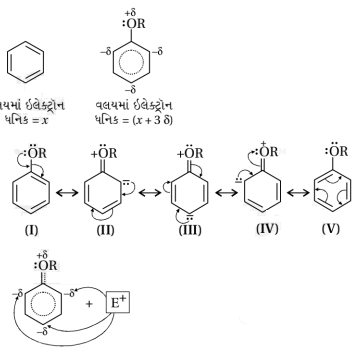
Explain why the alkoxy $(-OR)$ group is an ortho-para directing and ring-activating group for electrophilic aromatic substitution reactions.
Solution
(N/A) The $-OR$ group is activating: The alkoxy $(-OR)$ group donates its lone pair of electrons to the benzene ring through resonance. As a result,the electron density in the ring increases,making the ring electron-rich. This facilitates electrophilic substitution in the ring. Thus,the $(-OR)$ group activates the benzene ring.
$(b)$ The alkoxy group is ortho-para directing:
$(i)$ The resonance structures of alkoxybenzene are shown below.
$(ii)$ In the resonance structures,the electron density (negative charge) is increased at the ortho and para positions,making these carbons electron-rich.
$(iii)$ Consequently,electrophilic reagents are attracted to and attack at the ortho and para positions.
Thus,the alkoxy group is an ortho-para directing group for electrophilic substitution reactions.
$(b)$ The alkoxy group is ortho-para directing:
$(i)$ The resonance structures of alkoxybenzene are shown below.
$(ii)$ In the resonance structures,the electron density (negative charge) is increased at the ortho and para positions,making these carbons electron-rich.
$(iii)$ Consequently,electrophilic reagents are attracted to and attack at the ortho and para positions.
Thus,the alkoxy group is an ortho-para directing group for electrophilic substitution reactions.
0 likes
View Solution388
Medium
Provide the chemical equation for the bromination of anisole.
Solution
(N/A) The bromination of anisole is an electrophilic aromatic substitution reaction.
$1$. The $-OCH_3$ group is strongly activating,so the reaction occurs even in the absence of a Lewis acid catalyst like $FeBr_3$.
$2$. The reaction is carried out using bromine $(Br_2)$ in ethanoic acid $(CH_3COOH)$.
$3$. The reaction yields a mixture of ortho and para isomers,with $p$-bromoanisole being the major product $(90\%)$.
The chemical equation is:
$C_6H_5OCH_3 + Br_2 \xrightarrow{CH_3COOH} C_6H_4(Br)OCH_3$ (mixture of $o$-bromoanisole and $p$-bromoanisole).
$1$. The $-OCH_3$ group is strongly activating,so the reaction occurs even in the absence of a Lewis acid catalyst like $FeBr_3$.
$2$. The reaction is carried out using bromine $(Br_2)$ in ethanoic acid $(CH_3COOH)$.
$3$. The reaction yields a mixture of ortho and para isomers,with $p$-bromoanisole being the major product $(90\%)$.
The chemical equation is:
$C_6H_5OCH_3 + Br_2 \xrightarrow{CH_3COOH} C_6H_4(Br)OCH_3$ (mixture of $o$-bromoanisole and $p$-bromoanisole).
0 likes
View Solution389
Medium
Write the Friedel-Crafts reaction of anisole.
Solution
(N/A) Mechanism: Friedel-Crafts reactions of anisole proceed via electrophilic aromatic substitution $(S_{E}Ar)$ mechanism.
$(a)$ Alkylation of Anisole:
$(i)$ Reagent: $CH_{3}Cl$ (chloromethane)
$(ii)$ Catalyst: Anhydrous aluminum chloride $(AlCl_{3})$ in $CS_{2}$ solvent.
$(iii)$ Reaction: The methyl (alkyl) group attaches to the ortho and para positions of the $-OCH_{3}$ group.
$(iv)$ Product: The major product is $4$-methoxytoluene and the minor product is $2$-methoxytoluene.
$(b)$ Friedel-Crafts $(F.C.)$ Acylation of Anisole:
$(i)$ Reaction: In the acylation of anisole,the acyl $(-COCH_{3})$ group is introduced into the benzene ring at the ortho and para positions of $-OCH_{3}$ via $S_{E}Ar$ substitution.
$(ii)$ Reagent: Ethanoyl chloride $(CH_{3}COCl)$ or other acyl halides $(RCOCl)$.
$(iii)$ Catalyst: Lewis acid,anhydrous aluminum chloride $(AlCl_{3})$.
$(iv)$ Product: The acyl group $(-COCH_{3})$ attaches to the ortho and para positions of $-OCH_{3}$,forming $4$-methoxyacetophenone as the major product and $2$-methoxyacetophenone as the minor product.
$(a)$ Alkylation of Anisole:
$(i)$ Reagent: $CH_{3}Cl$ (chloromethane)
$(ii)$ Catalyst: Anhydrous aluminum chloride $(AlCl_{3})$ in $CS_{2}$ solvent.
$(iii)$ Reaction: The methyl (alkyl) group attaches to the ortho and para positions of the $-OCH_{3}$ group.
$(iv)$ Product: The major product is $4$-methoxytoluene and the minor product is $2$-methoxytoluene.
$(b)$ Friedel-Crafts $(F.C.)$ Acylation of Anisole:
$(i)$ Reaction: In the acylation of anisole,the acyl $(-COCH_{3})$ group is introduced into the benzene ring at the ortho and para positions of $-OCH_{3}$ via $S_{E}Ar$ substitution.
$(ii)$ Reagent: Ethanoyl chloride $(CH_{3}COCl)$ or other acyl halides $(RCOCl)$.
$(iii)$ Catalyst: Lewis acid,anhydrous aluminum chloride $(AlCl_{3})$.
$(iv)$ Product: The acyl group $(-COCH_{3})$ attaches to the ortho and para positions of $-OCH_{3}$,forming $4$-methoxyacetophenone as the major product and $2$-methoxyacetophenone as the minor product.
0 likes
View Solution390
Difficult
Write the chemical reactions for the preparation of anisole and phenetole from phenol.
Solution
(N/A) The preparation of anisole and phenetole from phenol involves two steps:
$1$. Formation of sodium phenoxide: Phenol reacts with $NaOH$ to form sodium phenoxide and water.
$C_6H_5OH + NaOH \rightarrow C_6H_5ONa + H_2O$
$2$. Williamson ether synthesis: Sodium phenoxide reacts with alkyl halides ($CH_3I$ or $CH_3CH_2I$) to form ethers.
For Anisole: $C_6H_5ONa + CH_3I \rightarrow C_6H_5OCH_3 + NaI$
For Phenetole: $C_6H_5ONa + CH_3CH_2I \rightarrow C_6H_5OCH_2CH_3 + NaI$
$1$. Formation of sodium phenoxide: Phenol reacts with $NaOH$ to form sodium phenoxide and water.
$C_6H_5OH + NaOH \rightarrow C_6H_5ONa + H_2O$
$2$. Williamson ether synthesis: Sodium phenoxide reacts with alkyl halides ($CH_3I$ or $CH_3CH_2I$) to form ethers.
For Anisole: $C_6H_5ONa + CH_3I \rightarrow C_6H_5OCH_3 + NaI$
For Phenetole: $C_6H_5ONa + CH_3CH_2I \rightarrow C_6H_5OCH_2CH_3 + NaI$
0 likes
View Solution391
Medium
Write the reactions of phenol with: $(i)$ $CH_3COCl$,$(ii)$ $(CH_3CO)_2O$,$(iii)$ $NaOH$,$(iv)$ chromic acid,and $(v)$ heating with zinc dust.
Solution
(N/A) $(i)$ Acetylation with acetyl chloride: $C_6H_5OH + CH_3COCl \xrightarrow{NaOH} C_6H_5OCOCH_3 + NaCl + H_2O$ (Phenyl ethanoate)
$(ii)$ Acetylation with acetic anhydride: $C_6H_5OH + (CH_3CO)_2O \xrightarrow{NaOH} C_6H_5OCOCH_3 + CH_3COOH$ (Phenyl ethanoate)
$(iii)$ Reaction with sodium hydroxide: $C_6H_5OH + NaOH \rightarrow C_6H_5ONa + H_2O$ (Sodium phenoxide)
$(iv)$ Oxidation with chromic acid: Phenol is oxidized to benzoquinone: $C_6H_5OH \xrightarrow{Na_2Cr_2O_7/H_2SO_4} O=C_6H_4=O$ (Benzoquinone)
$(v)$ Reduction with zinc dust: $C_6H_5OH + Zn \xrightarrow{\Delta} C_6H_6 + ZnO$ (Benzene)
$(ii)$ Acetylation with acetic anhydride: $C_6H_5OH + (CH_3CO)_2O \xrightarrow{NaOH} C_6H_5OCOCH_3 + CH_3COOH$ (Phenyl ethanoate)
$(iii)$ Reaction with sodium hydroxide: $C_6H_5OH + NaOH \rightarrow C_6H_5ONa + H_2O$ (Sodium phenoxide)
$(iv)$ Oxidation with chromic acid: Phenol is oxidized to benzoquinone: $C_6H_5OH \xrightarrow{Na_2Cr_2O_7/H_2SO_4} O=C_6H_4=O$ (Benzoquinone)
$(v)$ Reduction with zinc dust: $C_6H_5OH + Zn \xrightarrow{\Delta} C_6H_6 + ZnO$ (Benzene)
0 likes
View Solution392
Medium
Provide the alkylation and acylation reactions of anisole.
Solution
(N/A) Mechanism: Friedel-Crafts reactions of anisole proceed via electrophilic aromatic substitution $(S_{E}Ar)$ mechanism.
$(a)$ Alkylation of Anisole:
$(i)$ Reagent: $CH_{3}Cl$ (Chloromethane)
(ii) Catalyst: Anhydrous aluminum chloride $(AlCl_{3})$ in $CS_{2}$ solvent.
(iii) Reaction: The methyl (alkyl) group attaches to the ortho and para positions of the $-OCH_{3}$ group.
(iv) Product: The major product is $4$-methoxytoluene and the minor product is $2$-methoxytoluene.
$(b)$ Friedel-Crafts Acylation of Anisole:
$(i)$ Reaction: In the acylation of anisole,the acyl $(-COCH_{3})$ group is introduced into the benzene ring at the ortho and para positions relative to the $-OCH_{3}$ group via $S_{E}Ar$ substitution.
(ii) Reagent: Ethanoyl chloride $(CH_{3}COCl)$ and acyl halide $(RCOCl)$.
(iii) Catalyst: Lewis acid anhydrous aluminum chloride $(AlCl_{3})$.
(iv) Product: The acyl group $(-COCH_{3})$ attaches to the ortho and para positions of the $-OCH_{3}$ group,yielding $4$-methoxyacetophenone as the major product and $2$-methoxyacetophenone as the minor product.
$(a)$ Alkylation of Anisole:
$(i)$ Reagent: $CH_{3}Cl$ (Chloromethane)
(ii) Catalyst: Anhydrous aluminum chloride $(AlCl_{3})$ in $CS_{2}$ solvent.
(iii) Reaction: The methyl (alkyl) group attaches to the ortho and para positions of the $-OCH_{3}$ group.
(iv) Product: The major product is $4$-methoxytoluene and the minor product is $2$-methoxytoluene.
$(b)$ Friedel-Crafts Acylation of Anisole:
$(i)$ Reaction: In the acylation of anisole,the acyl $(-COCH_{3})$ group is introduced into the benzene ring at the ortho and para positions relative to the $-OCH_{3}$ group via $S_{E}Ar$ substitution.
(ii) Reagent: Ethanoyl chloride $(CH_{3}COCl)$ and acyl halide $(RCOCl)$.
(iii) Catalyst: Lewis acid anhydrous aluminum chloride $(AlCl_{3})$.
(iv) Product: The acyl group $(-COCH_{3})$ attaches to the ortho and para positions of the $-OCH_{3}$ group,yielding $4$-methoxyacetophenone as the major product and $2$-methoxyacetophenone as the minor product.
0 likes
View Solution393
Medium
Describe the reactions of nitration and bromination of phenol.
Solution
(N/A) Nitration of phenol:
$(i)$ With dilute $HNO_3$ at low temperature,phenol yields a mixture of $o$-nitrophenol and $p$-nitrophenol.
$(ii)$ With concentrated $HNO_3$,phenol is converted to $2,4,6$-trinitrophenol (picric acid).
$(b)$ Bromination of phenol:
$(i)$ With $Br_2$ in $CS_2$ at $273 \ K$,phenol gives a mixture of $o$-bromophenol and $p$-bromophenol.
$(ii)$ With bromine water $(Br_{2(aq)})$,phenol undergoes polybromination to form $2,4,6$-tribromophenol as a white precipitate.
$(i)$ With dilute $HNO_3$ at low temperature,phenol yields a mixture of $o$-nitrophenol and $p$-nitrophenol.
$(ii)$ With concentrated $HNO_3$,phenol is converted to $2,4,6$-trinitrophenol (picric acid).
$(b)$ Bromination of phenol:
$(i)$ With $Br_2$ in $CS_2$ at $273 \ K$,phenol gives a mixture of $o$-bromophenol and $p$-bromophenol.
$(ii)$ With bromine water $(Br_{2(aq)})$,phenol undergoes polybromination to form $2,4,6$-tribromophenol as a white precipitate.
0 likes
View Solution394
MediumMCQ
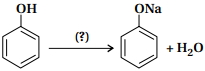
Identify the missing reagent in the following reaction:
A
$NaOH$
B
$NaCl$
C
$Na_2CO_3$
D
$NaHCO_3$
Solution
(A) The reaction shows the conversion of phenol $(C_6H_5OH)$ to sodium phenoxide $(C_6H_5ONa)$.
This is an acid-base reaction where phenol acts as an acid and reacts with a strong base like sodium hydroxide $(NaOH)$ to form sodium phenoxide and water $(H_2O)$.
The reaction is: $C_6H_5OH + NaOH \rightarrow C_6H_5ONa + H_2O$.
This is an acid-base reaction where phenol acts as an acid and reacts with a strong base like sodium hydroxide $(NaOH)$ to form sodium phenoxide and water $(H_2O)$.
The reaction is: $C_6H_5OH + NaOH \rightarrow C_6H_5ONa + H_2O$.
0 likes
View Solution395
MediumMCQ
Identify the missing reactant in the following reaction: $(CH_3CO)_2O + (?) \xrightarrow{H^+} \text{Aspirin} + CH_3COOH$
A
Salicylic acid
B
Phenol
C
Benzoic acid
D
Aniline
Solution
(A) The reaction shown is the acetylation of salicylic acid.
Salicylic acid reacts with acetic anhydride $(CH_3CO)_2O$ in the presence of an acid catalyst $(H^+)$ to form acetylsalicylic acid (commonly known as Aspirin) and acetic acid $(CH_3COOH)$.
The missing reactant is salicylic acid,which has the structure of a benzene ring with a $-COOH$ group and an $-OH$ group at the ortho position.
Salicylic acid reacts with acetic anhydride $(CH_3CO)_2O$ in the presence of an acid catalyst $(H^+)$ to form acetylsalicylic acid (commonly known as Aspirin) and acetic acid $(CH_3COOH)$.
The missing reactant is salicylic acid,which has the structure of a benzene ring with a $-COOH$ group and an $-OH$ group at the ortho position.
0 likes
View Solution396
Medium
Identify the missing reactant in the following reaction: $(?) + H^+ \xrightarrow{H_2O} \text{Salicylic acid} + CH_3COCH_3$
Solution
(A) The given reaction represents the acid-catalyzed hydrolysis of cumene hydroperoxide.
Cumene hydroperoxide undergoes rearrangement in the presence of an acid to form phenol and acetone $(CH_3COCH_3)$.
However,the product shown in the image is salicylic acid ($2$-hydroxybenzoic acid) along with acetone.
This specific reaction is the industrial preparation of salicylic acid from a substituted cumene hydroperoxide derivative,specifically $o$-carboxycumene hydroperoxide.
The missing reactant is $o$-carboxycumene hydroperoxide.
Cumene hydroperoxide undergoes rearrangement in the presence of an acid to form phenol and acetone $(CH_3COCH_3)$.
However,the product shown in the image is salicylic acid ($2$-hydroxybenzoic acid) along with acetone.
This specific reaction is the industrial preparation of salicylic acid from a substituted cumene hydroperoxide derivative,specifically $o$-carboxycumene hydroperoxide.
The missing reactant is $o$-carboxycumene hydroperoxide.
0 likes
View Solution397
Medium
Out of $o-$nitrophenol and $o-$cresol,which is more acidic?
Solution
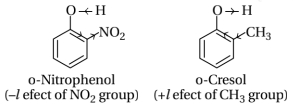
(N/A) The presence of an electron-withdrawing group ($-I$ or $-M$ effect) stabilizes the phenoxide ion,thereby increasing the acidic strength of the phenol. Conversely,an electron-donating group ($+I$ or $+M$ effect) destabilizes the phenoxide ion,decreasing the acidic strength.
In $o-$nitrophenol,the $-NO_2$ group exerts a strong $-I$ and $-M$ effect,which stabilizes the phenoxide ion.
In $o-$cresol,the $-CH_3$ group exerts a $+I$ effect,which destabilizes the phenoxide ion.
Therefore,$o-$nitrophenol is more acidic than $o-$cresol.
In $o-$nitrophenol,the $-NO_2$ group exerts a strong $-I$ and $-M$ effect,which stabilizes the phenoxide ion.
In $o-$cresol,the $-CH_3$ group exerts a $+I$ effect,which destabilizes the phenoxide ion.
Therefore,$o-$nitrophenol is more acidic than $o-$cresol.
0 likes
View Solution398
Medium
When phenol is treated with bromine water,a white precipitate is obtained. Give the structure and the name of the compound formed.
Solution
(N/A) When phenol reacts with bromine water,it undergoes electrophilic aromatic substitution at all ortho and para positions.
This results in the formation of $2,4,6-$Tribromophenol.
The reaction is as follows:
$C_6H_5OH + 3Br_2 \xrightarrow{H_2O} C_6H_2Br_3OH + 3HBr$
The product,$2,4,6-$Tribromophenol,appears as a white precipitate.
This results in the formation of $2,4,6-$Tribromophenol.
The reaction is as follows:
$C_6H_5OH + 3Br_2 \xrightarrow{H_2O} C_6H_2Br_3OH + 3HBr$
The product,$2,4,6-$Tribromophenol,appears as a white precipitate.
0 likes
View Solution399
Medium
Arrange the following compounds in increasing order of acidity and provide a suitable explanation: $o-\text{cresol}$,$\text{phenol}$,$o-\text{nitrophenol}$.
Solution
(N/A) The increasing order of acidic strength is: $o-\text{cresol} < \text{phenol} < o-\text{nitrophenol}$.
Explanation:
$1$. The acidity of phenols depends on the stability of the phenoxide ion formed after the loss of a proton $(H^+)$.
$2$. The $-CH_3$ group in $o-\text{cresol}$ is an electron-donating group ($+I$ and hyperconjugation effect),which destabilizes the phenoxide ion,thereby decreasing the acidic strength compared to phenol.
$3$. The $-NO_2$ group in $o-\text{nitrophenol}$ is a strong electron-withdrawing group ($-I$ and $-M$ effects),which stabilizes the phenoxide ion by dispersing the negative charge,thereby significantly increasing the acidic strength compared to phenol.
Explanation:
$1$. The acidity of phenols depends on the stability of the phenoxide ion formed after the loss of a proton $(H^+)$.
$2$. The $-CH_3$ group in $o-\text{cresol}$ is an electron-donating group ($+I$ and hyperconjugation effect),which destabilizes the phenoxide ion,thereby decreasing the acidic strength compared to phenol.
$3$. The $-NO_2$ group in $o-\text{nitrophenol}$ is a strong electron-withdrawing group ($-I$ and $-M$ effects),which stabilizes the phenoxide ion by dispersing the negative charge,thereby significantly increasing the acidic strength compared to phenol.
0 likes
View SolutionAlcohols, Phenols and Ethers — Properties of Phenols · Frequently Asked Questions
1Are these Alcohols, Phenols and Ethers questions useful for JEE and NEET?
Yes. All questions in this section are mapped to JEE Main and NEET exam patterns. Previous year questions from JEE Main, NEET, GUJCET and state-level exams are included with full solutions.
2Can I switch to Hindi or Gujarati for these questions?
Yes. Use the language tabs in the hero section or the sidebar to view the same questions and solutions in English, Hindi or Gujarati.
3How do I generate a question paper from this subtopic?
Use the Vedclass Exam Paper Generator — select the chapter and subtopic, set difficulty, and generate Sets A, B, C, D automatically. First 3 chapters of every subject are free.
Vedclass Products
For Students
Vedclass Test Series
Mock tests in real JEE/NEET style with performance analysis. 5-day free trial.
Start Free TrialFor Teachers
Exam Paper Generator
Generate Set A/B/C/D papers from this chapter in 2 minutes. 3 chapters free.
Try FreeFor Institutes
Online Exam Module
Live online exams with unlimited students, 360° analytics & white-label branding.
See DemoFor Teachers & Institutes
Generate a Alcohols, Phenols and Ethers Exam Paper in 2 Minutes
Select subtopic & difficulty — Sets A, B, C, D auto-generated with No Repeat logic.
First 3 chapters of every subject are free — no payment required.