
A English
Properties of Phenols Questions in English
Class 12 Chemistry · Alcohols, Phenols and Ethers · Properties of Phenols
751+
Questions
English
Language
100%
With Solutions
Showing 50 of 751 questions in English
401
Difficult
Explain why the $-OH$ group in phenols is more strongly held as compared to the $-OH$ group in alcohols?
Solution
(N/A) In phenol, the oxygen atom of the $-OH$ group is directly attached to the $sp^{2}$ hybridized carbon atom of the benzene ring.
Due to resonance, the $C-O$ bond acquires a partial double bond character.
This makes the $C-O$ bond in phenol shorter $(136 \ pm)$ and stronger compared to the $C-O$ bond in alcohols $(142 \ pm)$, where the carbon is $sp^{3}$ hybridized and the bond is a pure single bond.
Due to resonance, the $C-O$ bond acquires a partial double bond character.
This makes the $C-O$ bond in phenol shorter $(136 \ pm)$ and stronger compared to the $C-O$ bond in alcohols $(142 \ pm)$, where the carbon is $sp^{3}$ hybridized and the bond is a pure single bond.
0 likes
View Solution402
Medium
Explain why nucleophilic substitution reactions are not very common in phenol.
Solution
In phenol,the oxygen atom of the $-OH$ group is directly attached to an $sp^{2}$ hybridized carbon atom of the benzene ring.
Due to resonance,the $C-O$ bond acquires a partial double bond character.
This makes the $C-O$ bond shorter and stronger compared to the $C-O$ bond in alcohols,making it difficult to break.
Furthermore,the benzene ring is electron-rich,which causes repulsion between the incoming nucleophile and the electron-rich ring,thus hindering nucleophilic substitution reactions.
Due to resonance,the $C-O$ bond acquires a partial double bond character.
This makes the $C-O$ bond shorter and stronger compared to the $C-O$ bond in alcohols,making it difficult to break.
Furthermore,the benzene ring is electron-rich,which causes repulsion between the incoming nucleophile and the electron-rich ring,thus hindering nucleophilic substitution reactions.
0 likes
View Solution403
Medium
Write the steps to carry out the conversion of phenol to aspirin.
Solution
(N/A) The conversion of phenol to aspirin involves two main stages:
$1$. Conversion of phenol to salicylic acid (Kolbe's reaction):
Phenol is treated with $NaOH$ to form sodium phenoxide. This is then reacted with $CO_2$ at $400 \ K$ and $4-7 \ atm$ pressure,followed by acidification with $H^+$ to yield salicylic acid.
$2$. Acetylation of salicylic acid:
Salicylic acid is reacted with acetic anhydride $(CH_3CO)_2O$ in the presence of an acid catalyst $(H^+)$. This process,known as acetylation,replaces the phenolic hydrogen with an acetyl group to form aspirin ($2$-acetoxybenzoic acid) and acetic acid $(CH_3COOH)$.
$1$. Conversion of phenol to salicylic acid (Kolbe's reaction):
Phenol is treated with $NaOH$ to form sodium phenoxide. This is then reacted with $CO_2$ at $400 \ K$ and $4-7 \ atm$ pressure,followed by acidification with $H^+$ to yield salicylic acid.
$2$. Acetylation of salicylic acid:
Salicylic acid is reacted with acetic anhydride $(CH_3CO)_2O$ in the presence of an acid catalyst $(H^+)$. This process,known as acetylation,replaces the phenolic hydrogen with an acetyl group to form aspirin ($2$-acetoxybenzoic acid) and acetic acid $(CH_3COOH)$.
0 likes
View Solution404
Medium
In Kolbe's reaction,instead of phenol,the phenoxide ion is treated with carbon dioxide. Why?
Solution
(N/A) The phenoxide ion is more reactive than phenol towards electrophilic aromatic substitution. This is because the $-O^-$ group is a stronger electron-donating group than the $-OH$ group due to the presence of a full negative charge,which increases the electron density on the benzene ring. Consequently,the ring becomes more nucleophilic,facilitating the attack of $CO_2$,which is a weak electrophile.
0 likes
View Solution405
Medium
The dipole moment of phenol is smaller than that of methanol. Why?
Solution
(N/A) In phenol, the $C-O$ bond is less polar due to the electron-withdrawing $-I$ effect of the $sp^2$ hybridized carbon of the benzene ring, which pulls the electron density away from the oxygen atom.
In methanol, the $C-O$ bond is more polar due to the electron-releasing $+I$ effect of the methyl group, which pushes electron density towards the oxygen atom.
Consequently, the net dipole moment of phenol $(\mu = 1.54 \ D)$ is smaller than that of methanol $(\mu = 1.71 \ D)$.
In methanol, the $C-O$ bond is more polar due to the electron-releasing $+I$ effect of the methyl group, which pushes electron density towards the oxygen atom.
Consequently, the net dipole moment of phenol $(\mu = 1.54 \ D)$ is smaller than that of methanol $(\mu = 1.71 \ D)$.
0 likes
View Solution406
Medium
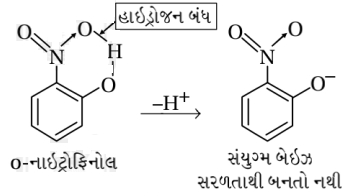
Explain why $p-$nitrophenol is more acidic than $o-$nitrophenol?
Solution
(N/A) The acidic strength of phenols is determined by the stability of the phenoxide ion formed after the loss of a proton $(H^+)$.
In $o-$nitrophenol,an intramolecular hydrogen bond is formed between the $-OH$ group and the $-NO_2$ group,which makes the release of the proton $(H^+)$ more difficult.
In $p-$nitrophenol,the $-NO_2$ group is far from the $-OH$ group,so no intramolecular hydrogen bonding occurs.
Furthermore,the $-NO_2$ group exerts a strong electron-withdrawing $-I$ and $-M$ effect,which stabilizes the phenoxide ion by dispersing the negative charge.
Due to the absence of intramolecular hydrogen bonding and the effective stabilization of the phenoxide ion,$p-$nitrophenol is more acidic than $o-$nitrophenol.
In $o-$nitrophenol,an intramolecular hydrogen bond is formed between the $-OH$ group and the $-NO_2$ group,which makes the release of the proton $(H^+)$ more difficult.
In $p-$nitrophenol,the $-NO_2$ group is far from the $-OH$ group,so no intramolecular hydrogen bonding occurs.
Furthermore,the $-NO_2$ group exerts a strong electron-withdrawing $-I$ and $-M$ effect,which stabilizes the phenoxide ion by dispersing the negative charge.
Due to the absence of intramolecular hydrogen bonding and the effective stabilization of the phenoxide ion,$p-$nitrophenol is more acidic than $o-$nitrophenol.
0 likes
View Solution407
Medium
The carbon-oxygen bond in phenol is slightly stronger than that in methanol. Why?
Solution
(N/A) In phenol,the lone pair of electrons on the oxygen atom is involved in resonance with the benzene ring.
This resonance gives the $C-O$ bond a partial double bond character.
In contrast,there is no such resonance in methanol,where the $C-O$ bond is a pure single bond.
Additionally,the carbon atom attached to oxygen in phenol is $sp^2$ hybridized,while in methanol,it is $sp^3$ hybridized.
The $sp^2$ hybridized carbon is more electronegative and holds the electron pair more tightly,contributing to a shorter and stronger bond compared to the $sp^3$ hybridized carbon in methanol.
This resonance gives the $C-O$ bond a partial double bond character.
In contrast,there is no such resonance in methanol,where the $C-O$ bond is a pure single bond.
Additionally,the carbon atom attached to oxygen in phenol is $sp^2$ hybridized,while in methanol,it is $sp^3$ hybridized.
The $sp^2$ hybridized carbon is more electronegative and holds the electron pair more tightly,contributing to a shorter and stronger bond compared to the $sp^3$ hybridized carbon in methanol.
0 likes
View Solution408
Medium
Arrange water,ethanol and phenol in increasing order of acidity and give reason for your answer.
Solution
(N/A) The acidic strength of a substance depends on the stability of the conjugate base. The more stable the conjugate base,the stronger the acid.
$1$. Phenol forms a phenoxide ion,which is stabilized by resonance.
$2$. Water forms a hydroxide ion,which is less stable than the phenoxide ion but more stable than the ethoxide ion.
$3$. Ethanol forms an ethoxide ion,where the $+I$ effect of the ethyl group increases the electron density on the oxygen atom,destabilizing the conjugate base.
Therefore,the order of acidic strength is: $\text{ethanol} < \text{water} < \text{phenol}$.
$1$. Phenol forms a phenoxide ion,which is stabilized by resonance.
$2$. Water forms a hydroxide ion,which is less stable than the phenoxide ion but more stable than the ethoxide ion.
$3$. Ethanol forms an ethoxide ion,where the $+I$ effect of the ethyl group increases the electron density on the oxygen atom,destabilizing the conjugate base.
Therefore,the order of acidic strength is: $\text{ethanol} < \text{water} < \text{phenol}$.
0 likes
View Solution409
Medium
$(A)$ Name the starting material used in the industrial preparation of phenol.
$(B)$ Write the complete reaction for the bromination of phenol in aqueous and non-aqueous medium.
$(C)$ Explain why a Lewis acid is not required in the bromination of phenol.
$(B)$ Write the complete reaction for the bromination of phenol in aqueous and non-aqueous medium.
$(C)$ Explain why a Lewis acid is not required in the bromination of phenol.
Solution
(N/A) The starting material used in the industrial preparation of phenol is cumene (isopropylbenzene).
$(B)$ Bromination of phenol:
$1$. In aqueous medium (using $Br_2$ water): Phenol reacts with bromine water to give a white precipitate of $2,4,6$-tribromophenol.
$C_6H_5OH + 3Br_2(aq) \rightarrow C_6H_2(OH)Br_3 + 3HBr$
$2$. In non-aqueous medium (using $CS_2$ or $CHCl_3$ at low temperature): Phenol reacts with $Br_2$ to give a mixture of $o$-bromophenol and $p$-bromophenol.
$C_6H_5OH + Br_2 \xrightarrow{CS_2, 298 K} C_6H_4(OH)Br (ortho) + C_6H_4(OH)Br (para)$
$(C)$ $A$ Lewis acid is not required because the $-OH$ group in phenol is a strongly activating group. It increases the electron density in the benzene ring to such an extent that the electrophilic substitution reaction occurs readily even without the presence of a Lewis acid catalyst.
$(B)$ Bromination of phenol:
$1$. In aqueous medium (using $Br_2$ water): Phenol reacts with bromine water to give a white precipitate of $2,4,6$-tribromophenol.
$C_6H_5OH + 3Br_2(aq) \rightarrow C_6H_2(OH)Br_3 + 3HBr$
$2$. In non-aqueous medium (using $CS_2$ or $CHCl_3$ at low temperature): Phenol reacts with $Br_2$ to give a mixture of $o$-bromophenol and $p$-bromophenol.
$C_6H_5OH + Br_2 \xrightarrow{CS_2, 298 K} C_6H_4(OH)Br (ortho) + C_6H_4(OH)Br (para)$
$(C)$ $A$ Lewis acid is not required because the $-OH$ group in phenol is a strongly activating group. It increases the electron density in the benzene ring to such an extent that the electrophilic substitution reaction occurs readily even without the presence of a Lewis acid catalyst.
0 likes
View Solution410
Medium
How can phenol be converted to aspirin?
Solution
(N/A) Phenol is converted to aspirin through the following steps:
$1$. Kolbe reaction: Phenol is treated with $NaOH$ followed by $CO_2$ at $4-7 \ atm$ pressure and $393 \ K$ to form salicylic acid ($2$-hydroxybenzoic acid).
$2$. Acetylation: Salicylic acid is treated with acetic anhydride in the presence of an acid catalyst to form aspirin (acetylsalicylic acid).
$1$. Kolbe reaction: Phenol is treated with $NaOH$ followed by $CO_2$ at $4-7 \ atm$ pressure and $393 \ K$ to form salicylic acid ($2$-hydroxybenzoic acid).
$2$. Acetylation: Salicylic acid is treated with acetic anhydride in the presence of an acid catalyst to form aspirin (acetylsalicylic acid).
0 likes
View Solution411
MediumMCQ
Complete the following reaction: $C_6H_5OH + ArN_2^+Cl^- \xrightarrow{OH^-} ?$
A
$p-hydroxyazobenzene$ derivative
B
$o-hydroxyazobenzene$ derivative
C
$m-hydroxyazobenzene$ derivative
D
$diphenyl$ ether
Solution
(A) The reaction between phenol $(C_6H_5OH)$ and an arenediazonium salt $(ArN_2^+Cl^-)$ in the presence of a base $(OH^-)$ is an electrophilic aromatic substitution reaction known as coupling reaction.
In this reaction,the diazonium cation acts as an electrophile and attacks the electron-rich phenol ring.
Since the $-OH$ group is ortho/para-directing,the coupling primarily occurs at the para-position to form $p-hydroxyazobenzene$ derivatives $(Ar-N=N-C_6H_4-OH)$.
In this reaction,the diazonium cation acts as an electrophile and attacks the electron-rich phenol ring.
Since the $-OH$ group is ortho/para-directing,the coupling primarily occurs at the para-position to form $p-hydroxyazobenzene$ derivatives $(Ar-N=N-C_6H_4-OH)$.
0 likes
View Solution412
Medium
Explain why the reactivity of the benzene ring increases due to the presence of the $-OH$ group in phenol.
Solution
(N/A) The $-OH$ group is an electron-donating group that activates the benzene ring towards electrophilic substitution reactions due to the following reasons:
$(a)$ Resonance Effect: The lone pair of electrons on the oxygen atom of the $-OH$ group is delocalized into the benzene ring through resonance. This increases the electron density at the ortho and para positions of the ring,making them more susceptible to attack by electrophiles.
$(b)$ Inductive Effect: The oxygen atom is more electronegative than carbon,which exerts a $-I$ effect,tending to withdraw electrons. However,the $+R$ (resonance) effect of the $-OH$ group is much stronger than its $-I$ effect.
Conclusion: Since the resonance effect dominates,the overall electron density in the benzene ring of phenol increases,especially at the ortho and para positions. Consequently,phenol is more reactive than benzene towards electrophilic aromatic substitution,and the $-OH$ group acts as an activating group.
$(a)$ Resonance Effect: The lone pair of electrons on the oxygen atom of the $-OH$ group is delocalized into the benzene ring through resonance. This increases the electron density at the ortho and para positions of the ring,making them more susceptible to attack by electrophiles.
$(b)$ Inductive Effect: The oxygen atom is more electronegative than carbon,which exerts a $-I$ effect,tending to withdraw electrons. However,the $+R$ (resonance) effect of the $-OH$ group is much stronger than its $-I$ effect.
Conclusion: Since the resonance effect dominates,the overall electron density in the benzene ring of phenol increases,especially at the ortho and para positions. Consequently,phenol is more reactive than benzene towards electrophilic aromatic substitution,and the $-OH$ group acts as an activating group.
0 likes
View Solution413
DifficultMCQ
An aromatic compound $X$ when heated with $Zn$ powder gives benzoic acid,but when heated with soda lime,it gives phenol. Identify the compound $X$.
A
$o$-Hydroxybenzoic acid
B
$p$-Hydroxybenzoic acid
C
$m$-Hydroxybenzoic acid
D
None of these
Solution
(A) The reaction sequence is as follows:
$1$. When $o$-hydroxybenzoic acid (salicylic acid) is heated with $Zn$ dust,the $-OH$ group is reduced to $H$,yielding benzoic acid.
$2$. When $o$-hydroxybenzoic acid is heated with soda lime $(NaOH + CaO)$,decarboxylation occurs,removing the $-COOH$ group and yielding phenol.
Therefore,the compound $X$ is $o$-hydroxybenzoic acid.
$1$. When $o$-hydroxybenzoic acid (salicylic acid) is heated with $Zn$ dust,the $-OH$ group is reduced to $H$,yielding benzoic acid.
$2$. When $o$-hydroxybenzoic acid is heated with soda lime $(NaOH + CaO)$,decarboxylation occurs,removing the $-COOH$ group and yielding phenol.
Therefore,the compound $X$ is $o$-hydroxybenzoic acid.
0 likes
View Solution414
EasyMCQ
Give the reaction for heating of phenol with zinc powder.
A
Formation of benzene and zinc oxide
B
Formation of phenoxide and zinc
C
Formation of cyclohexanol
D
No reaction occurs
Solution
(A) When phenol is heated with zinc dust,it undergoes reduction to form benzene and zinc oxide.
$C_6H_5OH + Zn \rightarrow C_6H_6 + ZnO$
$C_6H_5OH + Zn \rightarrow C_6H_6 + ZnO$
0 likes
View Solution415
Medium
Match the reaction in Column-$I$ with the product in Column-$II$.
| Column-$I$ (Reaction) | Column-$II$ (Product) |
|---|---|
| $(A)$ Dinitration of $4$-methylphenol | $(i)$ $2$-nitro-$4$-methylphenol + $2$-nitro-$5$-methylphenol |
| $(B)$ Mononitration of phenyl ethanoate | $(ii)$ $2,4$-dinitro-$5$-methylphenol |
| $(C)$ Dinitration of $3$-methylphenol | $(iii)$ $4$-nitrophenyl ethanoate |
| $(D)$ Mononitration of $3$-methylphenol | $(iv)$ $2,6$-dinitro-$4$-methylphenol |
Solution
(A-IV, B-III, C-II, D-I) Dinitration of $4$-methylphenol ($p$-cresol) leads to the formation of $2,6$-dinitro-$4$-methylphenol,which corresponds to $(iv)$.
$(B)$ Mononitration of phenyl ethanoate gives $4$-nitrophenyl ethanoate as the major product,which corresponds to $(iii)$.
$(C)$ Dinitration of $3$-methylphenol ($m$-cresol) leads to the formation of $2,4$-dinitro-$5$-methylphenol,which corresponds to $(ii)$.
$(D)$ Mononitration of $3$-methylphenol leads to a mixture of $2$-nitro-$4$-methylphenol and $2$-nitro-$5$-methylphenol,which corresponds to $(i)$.
Therefore,the correct matching is: $(A-iv, B-iii, C-ii, D-i)$.
$(B)$ Mononitration of phenyl ethanoate gives $4$-nitrophenyl ethanoate as the major product,which corresponds to $(iii)$.
$(C)$ Dinitration of $3$-methylphenol ($m$-cresol) leads to the formation of $2,4$-dinitro-$5$-methylphenol,which corresponds to $(ii)$.
$(D)$ Mononitration of $3$-methylphenol leads to a mixture of $2$-nitro-$4$-methylphenol and $2$-nitro-$5$-methylphenol,which corresponds to $(i)$.
Therefore,the correct matching is: $(A-iv, B-iii, C-ii, D-i)$.
0 likes
View Solution416
MediumMCQ
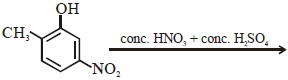
The major product of the following reaction is:
A
$2-$methyl$-4,6-$dinitrophenol
B
$2-$methyl$-3,4-$dinitrophenol
C
$2-$methyl$-4,5-$dinitrophenol
D
$2-$methyl$-3,5-$dinitrophenol
Solution
(A) The reaction involves the nitration of $2$-methyl$-4-$nitrophenol using concentrated $HNO_3$ and concentrated $H_2SO_4$.
The $-OH$ group is a strong activating group and is ortho/para directing.
The $-CH_3$ group is also ortho/para directing.
The $-NO_2$ group is meta directing.
In $2$-methyl$-4-$nitrophenol,the positions ortho to the $-OH$ group are position $6$ (which is vacant) and position $3$ (which is also vacant).
However,position $6$ is less sterically hindered compared to position $3$,which is adjacent to the $-CH_3$ group.
Therefore,the incoming $-NO_2^+$ electrophile attacks the $6$-position to form $2$-methyl$-4,6-$dinitrophenol as the major product.
The $-OH$ group is a strong activating group and is ortho/para directing.
The $-CH_3$ group is also ortho/para directing.
The $-NO_2$ group is meta directing.
In $2$-methyl$-4-$nitrophenol,the positions ortho to the $-OH$ group are position $6$ (which is vacant) and position $3$ (which is also vacant).
However,position $6$ is less sterically hindered compared to position $3$,which is adjacent to the $-CH_3$ group.
Therefore,the incoming $-NO_2^+$ electrophile attacks the $6$-position to form $2$-methyl$-4,6-$dinitrophenol as the major product.
0 likes
View Solution417
EasyMCQ
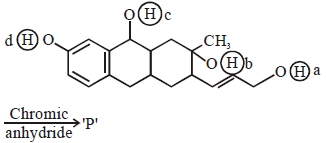
Consider the following reaction:
The product $'P'$ gives a positive ceric ammonium nitrate test. This is because of the presence of which of these $-OH$ group$(s)$?
The product $'P'$ gives a positive ceric ammonium nitrate test. This is because of the presence of which of these $-OH$ group$(s)$?
A
$(c)$ and $(d)$
B
$(b)$ only
C
$(d)$ only
D
$(b)$ and $(d)$
Solution
(D) Ceric ammonium nitrate test is used to detect the presence of alcoholic $-OH$ groups. It gives a red/yellow color with alcohols.
In the given reaction,the starting material is treated with chromic anhydride (a strong oxidizing agent). The primary alcohol group at position '$a$' is oxidized to an aldehyde,and the secondary alcohol group at position '$c$' is oxidized to a ketone.
The resulting product '$P$' contains the tertiary alcohol group at position '$b$' and the phenolic $-OH$ group at position '$d$'.
However,the ceric ammonium nitrate test is specifically positive for aliphatic alcohols (primary,secondary,and tertiary). Phenols also give a positive test (often red/brown color).
Looking at the structure of '$P$',the tertiary alcohol at '$b$' and the phenol at '$d$' remain. Both are capable of giving a positive ceric ammonium nitrate test. Therefore,the presence of both '$b$' and '$d$' groups contributes to the positive test.
In the given reaction,the starting material is treated with chromic anhydride (a strong oxidizing agent). The primary alcohol group at position '$a$' is oxidized to an aldehyde,and the secondary alcohol group at position '$c$' is oxidized to a ketone.
The resulting product '$P$' contains the tertiary alcohol group at position '$b$' and the phenolic $-OH$ group at position '$d$'.
However,the ceric ammonium nitrate test is specifically positive for aliphatic alcohols (primary,secondary,and tertiary). Phenols also give a positive test (often red/brown color).
Looking at the structure of '$P$',the tertiary alcohol at '$b$' and the phenol at '$d$' remain. Both are capable of giving a positive ceric ammonium nitrate test. Therefore,the presence of both '$b$' and '$d$' groups contributes to the positive test.
0 likes
View Solution418
MediumMCQ
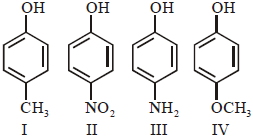
The increasing order of boiling points of the following compounds is:
A
$I < IV < II < III$
B
$IV < I < II < III$
C
$I < III < IV < II$
D
$III < I < II < IV$
Solution
(A) The boiling point of compounds depends on intermolecular forces,primarily hydrogen bonding and dipole-dipole interactions. The compounds are:
$I$: $p$-cresol ($4$-methylphenol)
$II$: $p$-nitrophenol
$III$: $p$-aminophenol
$IV$: $p$-methoxyphenol
Comparing their boiling points:
$p$-cresol $(I)$ has a boiling point of $\approx 202^{\circ}C$.
$p$-methoxyphenol $(IV)$ has a boiling point of $\approx 243^{\circ}C$.
$p$-nitrophenol $(II)$ has a boiling point of $\approx 279^{\circ}C$.
$p$-aminophenol $(III)$ has a boiling point of $\approx 284^{\circ}C$.
Thus,the increasing order of boiling points is $I < IV < II < III$.
$I$: $p$-cresol ($4$-methylphenol)
$II$: $p$-nitrophenol
$III$: $p$-aminophenol
$IV$: $p$-methoxyphenol
Comparing their boiling points:
$p$-cresol $(I)$ has a boiling point of $\approx 202^{\circ}C$.
$p$-methoxyphenol $(IV)$ has a boiling point of $\approx 243^{\circ}C$.
$p$-nitrophenol $(II)$ has a boiling point of $\approx 279^{\circ}C$.
$p$-aminophenol $(III)$ has a boiling point of $\approx 284^{\circ}C$.
Thus,the increasing order of boiling points is $I < IV < II < III$.
0 likes
View Solution419
MediumMCQ
$A$ solution of phenol in chloroform when treated with aqueous $NaOH$ gives compound $P$ as a major product. The mass percentage of carbon in $P$ is $..............$ (to the nearest integer)
(Atomic mass : $C = 12$; $H = 1$; $O = 16$)
(Atomic mass : $C = 12$; $H = 1$; $O = 16$)
A
$70.56$
B
$68.85$
C
$65.52$
D
$60.75$
Solution
(B) The reaction of phenol with chloroform $(CHCl_3)$ in the presence of aqueous $NaOH$ is the Reimer-Tiemann reaction,which yields salicylaldehyde ($o$-hydroxybenzaldehyde) as the major product $P$.
The molecular formula of salicylaldehyde $(P)$ is $C_7H_6O_2$.
The molar mass of $C_7H_6O_2 = (7 \times 12) + (6 \times 1) + (2 \times 16) = 84 + 6 + 32 = 122 \ g/mol$.
The mass percentage of carbon in $P$ is given by:
$\text{Mass } \% C = \frac{\text{Total mass of Carbon}}{\text{Molar mass of } P} \times 100$
$\text{Mass } \% C = \frac{7 \times 12}{122} \times 100 = \frac{84}{122} \times 100 \approx 68.85\%$.
Rounding to the nearest integer,we get $69\%$.
The molecular formula of salicylaldehyde $(P)$ is $C_7H_6O_2$.
The molar mass of $C_7H_6O_2 = (7 \times 12) + (6 \times 1) + (2 \times 16) = 84 + 6 + 32 = 122 \ g/mol$.
The mass percentage of carbon in $P$ is given by:
$\text{Mass } \% C = \frac{\text{Total mass of Carbon}}{\text{Molar mass of } P} \times 100$
$\text{Mass } \% C = \frac{7 \times 12}{122} \times 100 = \frac{84}{122} \times 100 \approx 68.85\%$.
Rounding to the nearest integer,we get $69\%$.
0 likes
View Solution420
MediumMCQ
Which of the following substituted phenols is the strongest acid?
A
$p$-methylphenol
B
$p$-nitrophenol
C
$p$-methoxyphenol
D
$p$-ethylphenol
Solution
(B) The acidity of substituted phenols depends on the electronic effects of the substituent groups attached to the benzene ring.
Electron-withdrawing groups $(EWG)$ increase acidity by stabilizing the phenoxide ion through $-I$ and $-R$ effects.
Electron-donating groups $(EDG)$ decrease acidity by destabilizing the phenoxide ion through $+I$ and $+R$ effects.
In the given options:
$(A)$ $-CH_3$ is an $EDG$ ($+I$ and hyperconjugation).
$(B)$ $-NO_2$ is a strong $EWG$ ($-I$ and $-R$ effects).
$(C)$ $-OCH_3$ is an $EDG$ ($+R$ effect dominates over $-I$).
$(D)$ $-C_2H_5$ is an $EDG$ ($+I$ effect).
Since $-NO_2$ is the only strong electron-withdrawing group among the choices,$p$-nitrophenol is the strongest acid.
Electron-withdrawing groups $(EWG)$ increase acidity by stabilizing the phenoxide ion through $-I$ and $-R$ effects.
Electron-donating groups $(EDG)$ decrease acidity by destabilizing the phenoxide ion through $+I$ and $+R$ effects.
In the given options:
$(A)$ $-CH_3$ is an $EDG$ ($+I$ and hyperconjugation).
$(B)$ $-NO_2$ is a strong $EWG$ ($-I$ and $-R$ effects).
$(C)$ $-OCH_3$ is an $EDG$ ($+R$ effect dominates over $-I$).
$(D)$ $-C_2H_5$ is an $EDG$ ($+I$ effect).
Since $-NO_2$ is the only strong electron-withdrawing group among the choices,$p$-nitrophenol is the strongest acid.
0 likes
View Solution421
MediumMCQ
Which of the following compounds is most reactive in electrophilic aromatic substitution?
A
Phenol
B
Chlorobenzene
C
Nitrobenzene
D
Benzene
Solution
(A) The reactivity of aromatic compounds towards electrophilic aromatic substitution depends on the electron density of the benzene ring.
Groups that donate electrons to the ring (via resonance or induction) increase electron density and thus increase reactivity.
Groups that withdraw electrons from the ring decrease electron density and thus decrease reactivity.
$1$. $-OH$ group: Shows a strong $+R$ (resonance) effect,which significantly increases the electron density of the benzene ring,making it highly reactive.
$2$. Benzene: Has no substituent,serving as the reference.
$3$. $-Cl$ group: Shows a $-I$ (inductive) effect,which withdraws electron density,making it less reactive than benzene.
$4$. $-NO_2$ group: Shows a strong $-R$ (resonance) effect,which strongly withdraws electron density,making it the least reactive.
Therefore,the order of reactivity is: $\text{Phenol} > \text{Benzene} > \text{Chlorobenzene} > \text{Nitrobenzene}$.
Thus,phenol is the most reactive.
Groups that donate electrons to the ring (via resonance or induction) increase electron density and thus increase reactivity.
Groups that withdraw electrons from the ring decrease electron density and thus decrease reactivity.
$1$. $-OH$ group: Shows a strong $+R$ (resonance) effect,which significantly increases the electron density of the benzene ring,making it highly reactive.
$2$. Benzene: Has no substituent,serving as the reference.
$3$. $-Cl$ group: Shows a $-I$ (inductive) effect,which withdraws electron density,making it less reactive than benzene.
$4$. $-NO_2$ group: Shows a strong $-R$ (resonance) effect,which strongly withdraws electron density,making it the least reactive.
Therefore,the order of reactivity is: $\text{Phenol} > \text{Benzene} > \text{Chlorobenzene} > \text{Nitrobenzene}$.
Thus,phenol is the most reactive.
0 likes
View Solution422
MediumMCQ
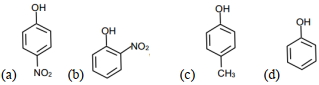
Order of acidic nature
A
$a > c > d > b$
B
$b > a > d > c$
C
$a > b > d > c$
D
$d > c > b > a$
Solution
(C) The acidic strength of phenols depends on the stability of the phenoxide ion formed after the loss of a proton. Electron-withdrawing groups $(-EWG)$ increase acidity,while electron-donating groups $(-EDG)$ decrease it.
$(a)$ $p$-Nitrophenol: The $-NO_2$ group at the para position exerts a strong $-M$ (mesomeric) and $-I$ (inductive) effect,significantly stabilizing the phenoxide ion.
$(b)$ $o$-Nitrophenol: The $-NO_2$ group at the ortho position exerts $-M$ and $-I$ effects,but also forms an intramolecular hydrogen bond with the $-OH$ group,which stabilizes the neutral molecule and makes the release of $H^+$ slightly less favorable compared to $p$-nitrophenol.
$(d)$ Phenol: Has no substituent.
$(c)$ $p$-Cresol: The $-CH_3$ group at the para position exerts a $+I$ and $+H$ (hyperconjugation) effect,which destabilizes the phenoxide ion,making it the least acidic.
Thus,the correct order of acidic strength is $p$-nitrophenol $(a) > o$-nitrophenol $(b) >$ phenol $(d) > p$-cresol $(c)$.
Therefore,the correct option is $C$.
$(a)$ $p$-Nitrophenol: The $-NO_2$ group at the para position exerts a strong $-M$ (mesomeric) and $-I$ (inductive) effect,significantly stabilizing the phenoxide ion.
$(b)$ $o$-Nitrophenol: The $-NO_2$ group at the ortho position exerts $-M$ and $-I$ effects,but also forms an intramolecular hydrogen bond with the $-OH$ group,which stabilizes the neutral molecule and makes the release of $H^+$ slightly less favorable compared to $p$-nitrophenol.
$(d)$ Phenol: Has no substituent.
$(c)$ $p$-Cresol: The $-CH_3$ group at the para position exerts a $+I$ and $+H$ (hyperconjugation) effect,which destabilizes the phenoxide ion,making it the least acidic.
Thus,the correct order of acidic strength is $p$-nitrophenol $(a) > o$-nitrophenol $(b) >$ phenol $(d) > p$-cresol $(c)$.
Therefore,the correct option is $C$.
0 likes
View Solution423
MediumMCQ
Phenol $+$ Aniline $\xrightarrow[{KOH}]{{C_6H_5N_2^+Cl^{-}}}$ Major Product $:$ Product will be $:$
A
Azobenzene
B
$p$-Hydroxyazobenzene
C
$p$-Amino-$p'$-hydroxyazobenzene
D
$p$-Aminoazobenzene
Solution
(B) The reaction of phenol with benzenediazonium chloride $(C_6H_5N_2^+Cl^-)$ in the presence of a base $(KOH)$ is an electrophilic aromatic substitution reaction known as a coupling reaction.
In this reaction,the diazonium cation acts as an electrophile and attacks the electron-rich ring of phenol at the para-position to form $p$-hydroxyazobenzene.
Since the question mentions both phenol and aniline,but the diazonium salt is derived from aniline $(C_6H_5N_2^+Cl^-)$,the coupling occurs between the diazonium salt and the phenol to yield $p$-hydroxyazobenzene.
In this reaction,the diazonium cation acts as an electrophile and attacks the electron-rich ring of phenol at the para-position to form $p$-hydroxyazobenzene.
Since the question mentions both phenol and aniline,but the diazonium salt is derived from aniline $(C_6H_5N_2^+Cl^-)$,the coupling occurs between the diazonium salt and the phenol to yield $p$-hydroxyazobenzene.
0 likes
View Solution424
MediumMCQ
Which of the following compounds gives a pink colour on reaction with phthalic anhydride in conc. $H_2SO_4$ followed by treatment with $NaOH$?
A
$2-$propylphenol
B
$4-$methyl$-5-$propylbenzene$-1,2-$diol
C
$2-$methyl$-5-$propylbenzene$-1,3-$diol
D
$4-$propylphenol
Solution
(A) The reaction of phenols with phthalic anhydride in the presence of concentrated $H_2SO_4$ is a condensation reaction that forms phthalein dyes.
For a phenol to form a phthalein dye (which shows a pink colour in basic medium),it must have a free para-position relative to the hydroxyl $(-OH)$ group to allow for the electrophilic aromatic substitution $(EAS)$ by the phthalic anhydride intermediate.
In $2$-propylphenol,the para-position is free,allowing the reaction to proceed to form the corresponding phthalein derivative,which turns pink upon treatment with $NaOH$.
For a phenol to form a phthalein dye (which shows a pink colour in basic medium),it must have a free para-position relative to the hydroxyl $(-OH)$ group to allow for the electrophilic aromatic substitution $(EAS)$ by the phthalic anhydride intermediate.
In $2$-propylphenol,the para-position is free,allowing the reaction to proceed to form the corresponding phthalein derivative,which turns pink upon treatment with $NaOH$.
0 likes
View Solution425
DifficultMCQ
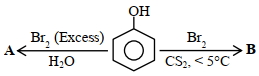
The correct options for the products $A$ and $B$ of the following reactions are:
A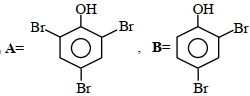
B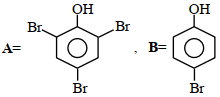
C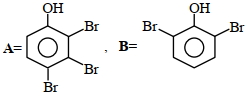
D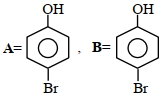
Solution
(A) $1$. When phenol reacts with bromine water ($Br_2$ in $H_2O$),the highly activating $-OH$ group causes rapid electrophilic substitution at all ortho and para positions,resulting in the formation of $2,4,6$-tribromophenol as product $A$.
$2$. When phenol reacts with bromine in a non-polar solvent like carbon disulfide $(CS_2)$ at low temperature $(< 5^{\circ}C)$,the reaction is less vigorous,leading to monobromination. The major product $B$ is $p$-bromophenol due to steric hindrance at the ortho position.
$2$. When phenol reacts with bromine in a non-polar solvent like carbon disulfide $(CS_2)$ at low temperature $(< 5^{\circ}C)$,the reaction is less vigorous,leading to monobromination. The major product $B$ is $p$-bromophenol due to steric hindrance at the ortho position.
0 likes
View Solution426
EasyMCQ
Which one of the following phenols does not give colour when condensed with phthalic anhydride in the presence of conc. $H_2SO_4$?
A
Phenol
B
$p$-Cresol
C
Resorcinol
D
Catechol
Solution
(B) The condensation of phenols with phthalic anhydride in the presence of conc. $H_2SO_4$ is a test for the presence of a free $ortho$ or $para$ position relative to the $-OH$ group.
$p$-Cresol has the $para$ position blocked by a $-CH_3$ group and the $ortho$ positions are also hindered or do not react to form the characteristic phthalein dye color under these specific conditions.
Therefore,$p$-cresol does not give a coloured product.
$p$-Cresol has the $para$ position blocked by a $-CH_3$ group and the $ortho$ positions are also hindered or do not react to form the characteristic phthalein dye color under these specific conditions.
Therefore,$p$-cresol does not give a coloured product.
0 likes
View Solution427
DifficultMCQ
The given reaction can occur in the presence of:
$(1)$ Bromine water
$(2)$ $Br_2$ in $CS_2, 273 \ K$
$(3)$ $Br_2 / FeBr_3$
$(4)$ $Br_2$ in $CHCl_3, 273 \ K$
Choose the correct answer from the options given below:
[Image: Phenol reacting to form p-bromophenol as the major product]
$(1)$ Bromine water
$(2)$ $Br_2$ in $CS_2, 273 \ K$
$(3)$ $Br_2 / FeBr_3$
$(4)$ $Br_2$ in $CHCl_3, 273 \ K$
Choose the correct answer from the options given below:
[Image: Phenol reacting to form p-bromophenol as the major product]
A
$(1)$ and $(3)$ only
B
$(2)$,$(3)$ and $(4)$ only
C
$(1)$,$(2)$ and $(4)$ only
D
$(2)$ and $(4)$ only
Solution
(B) The reaction shows the monobromination of phenol to form $p$-bromophenol as the major product.
$(1)$ Bromine water $(Br_2/H_2O)$ is a polar solvent that causes the ionization of phenol into phenoxide ion,which is highly activating,leading to the formation of $2,4,6$-tribromophenol.
$(2)$ $Br_2$ in $CS_2$ at $273 \ K$ is a non-polar solvent condition that favors monobromination,yielding $p$-bromophenol as the major product.
$(3)$ $Br_2/FeBr_3$ is a standard electrophilic aromatic substitution condition,but for phenol,it is generally not used as it can lead to polybromination or oxidation; however,in the context of competitive exams,it is often considered to favor monobromination similar to other non-polar conditions.
$(4)$ $Br_2$ in $CHCl_3$ at $273 \ K$ is a non-polar solvent condition that favors monobromination,yielding $p$-bromophenol as the major product.
Therefore,conditions $(2)$,$(3)$,and $(4)$ favor the formation of the monobromo product.
$(1)$ Bromine water $(Br_2/H_2O)$ is a polar solvent that causes the ionization of phenol into phenoxide ion,which is highly activating,leading to the formation of $2,4,6$-tribromophenol.
$(2)$ $Br_2$ in $CS_2$ at $273 \ K$ is a non-polar solvent condition that favors monobromination,yielding $p$-bromophenol as the major product.
$(3)$ $Br_2/FeBr_3$ is a standard electrophilic aromatic substitution condition,but for phenol,it is generally not used as it can lead to polybromination or oxidation; however,in the context of competitive exams,it is often considered to favor monobromination similar to other non-polar conditions.
$(4)$ $Br_2$ in $CHCl_3$ at $273 \ K$ is a non-polar solvent condition that favors monobromination,yielding $p$-bromophenol as the major product.
Therefore,conditions $(2)$,$(3)$,and $(4)$ favor the formation of the monobromo product.
0 likes
View Solution428
MediumMCQ
The oxidation of phenol with chromic acid gives
A
$A$ simple diketone
B
$A$ conjugated diketone
C
$Ortho$-benzoquinone
D
An aldehyde
Solution
(B) When phenol is oxidized with chromic acid $(H_2CrO_4)$,it undergoes oxidation to form $p$-benzoquinone.
$p$-Benzoquinone is a cyclic conjugated diketone.
Therefore,the correct description of the product is a conjugated diketone.
$p$-Benzoquinone is a cyclic conjugated diketone.
Therefore,the correct description of the product is a conjugated diketone.
0 likes
View Solution429
MediumMCQ
Given below are two statements:
Statement $I$: The acidic strength of monosubstituted nitrophenol is higher than phenol because of the electron-withdrawing nitro group.
Statement $II$: $o$-nitrophenol,$m$-nitrophenol,and $p$-nitrophenol will have the same acidic strength as they have one nitro group attached to the phenolic ring.
In the light of the above statements,choose the most appropriate answer from the options given below:
Statement $I$: The acidic strength of monosubstituted nitrophenol is higher than phenol because of the electron-withdrawing nitro group.
Statement $II$: $o$-nitrophenol,$m$-nitrophenol,and $p$-nitrophenol will have the same acidic strength as they have one nitro group attached to the phenolic ring.
In the light of the above statements,choose the most appropriate answer from the options given below:
A
Both Statement $I$ and Statement $II$ are incorrect.
B
Statement $I$ is correct but Statement $II$ is incorrect.
C
Statement $I$ is incorrect but Statement $II$ is correct.
D
Both Statement $I$ and Statement $II$ are correct.
Solution
(B) Statement $I$ is correct: The $-NO_2$ group is a strong electron-withdrawing group $(EWG)$ due to both $-I$ and $-M$ effects. It stabilizes the phenoxide ion,thereby increasing the acidic strength of nitrophenols compared to phenol.
Statement $II$ is incorrect: The acidic strength of nitrophenols depends on the position of the $-NO_2$ group. The $-M$ effect is operative at ortho and para positions,while only the $-I$ effect is operative at the meta position. Therefore,their acidic strengths are different. The order of acidic strength is $p$-nitrophenol > $o$-nitrophenol > $m$-nitrophenol > phenol.
Statement $II$ is incorrect: The acidic strength of nitrophenols depends on the position of the $-NO_2$ group. The $-M$ effect is operative at ortho and para positions,while only the $-I$ effect is operative at the meta position. Therefore,their acidic strengths are different. The order of acidic strength is $p$-nitrophenol > $o$-nitrophenol > $m$-nitrophenol > phenol.
0 likes
View Solution430
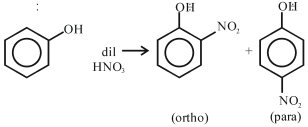
MediumMCQ
Phenol on reaction with dilute $HNO_3$ gives two products. Which method will be most effective for large scale separation?
A
Chromatographic separation
B
Fractional Crystallisation
C
Steam distillation
D
Sublimation
Solution
(C) The reaction of phenol with dilute $HNO_3$ produces a mixture of $o$-nitrophenol and $p$-nitrophenol.
$o$-Nitrophenol exhibits intramolecular $H$-bonding,which reduces its intermolecular attraction,making it steam volatile.
$p$-Nitrophenol exhibits intermolecular $H$-bonding,which leads to higher boiling points and lower volatility.
Therefore,steam distillation is the most effective method for separating these two isomers on a large scale.
$o$-Nitrophenol exhibits intramolecular $H$-bonding,which reduces its intermolecular attraction,making it steam volatile.
$p$-Nitrophenol exhibits intermolecular $H$-bonding,which leads to higher boiling points and lower volatility.
Therefore,steam distillation is the most effective method for separating these two isomers on a large scale.
0 likes
View Solution431
EasyMCQ
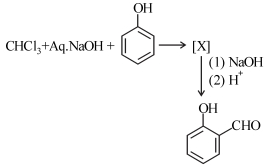
The intermediate $X$,in the reaction shown below,is ..... .
A
$2-$trichloromethylphenol
B
$2-$dichloromethylphenol
C
Sodium $2-$dichloromethylphenoxide
D
Sodium $2-$trichloromethylphenoxide
Solution
(C) The reaction shown is the Reimer-Tiemann reaction,which involves the treatment of phenol with chloroform $(CHCl_3)$ in the presence of an aqueous base $(NaOH)$.
$1$. The base deprotonates the phenol to form a phenoxide ion.
$2$. The chloroform reacts with the base to generate the electrophile,dichlorocarbene $(:CCl_2)$.
$3$. The phenoxide ion attacks the dichlorocarbene to form an intermediate,which is sodium $2$-dichloromethylphenoxide.
$4$. This intermediate is then hydrolyzed to form salicylaldehyde.
Therefore,the intermediate $X$ is sodium $2$-dichloromethylphenoxide.
$1$. The base deprotonates the phenol to form a phenoxide ion.
$2$. The chloroform reacts with the base to generate the electrophile,dichlorocarbene $(:CCl_2)$.
$3$. The phenoxide ion attacks the dichlorocarbene to form an intermediate,which is sodium $2$-dichloromethylphenoxide.
$4$. This intermediate is then hydrolyzed to form salicylaldehyde.
Therefore,the intermediate $X$ is sodium $2$-dichloromethylphenoxide.
0 likes
View Solution432
EasyMCQ
In the following reaction:
$C_6H_5CH(CH_3)_2 + O_2$ $\xrightarrow{} C_6H_5C(CH_3)_2OOH$ $\xrightarrow{H^+/H_2O} A + B$
The compounds $A$ and $B$ respectively are $......$
$C_6H_5CH(CH_3)_2 + O_2$ $\xrightarrow{} C_6H_5C(CH_3)_2OOH$ $\xrightarrow{H^+/H_2O} A + B$
The compounds $A$ and $B$ respectively are $......$
A
Toluene,$CH_3COOH$
B
Resorcinol,$CH_3COOH$
C
Phenol,$CH_3COCH_3$
D
Catechol,$CH_3COCH_3$
Solution
(C) The given reaction is the industrial preparation of phenol from cumene (isopropylbenzene).
$1$. Cumene is oxidized to cumene hydroperoxide $(C_6H_5C(CH_3)_2OOH)$ using $O_2$.
$2$. Upon treatment with dilute acid $(H^+/H_2O)$,the cumene hydroperoxide undergoes rearrangement to form phenol $(C_6H_5OH)$ and acetone $(CH_3COCH_3)$.
Therefore,the products $A$ and $B$ are phenol and acetone respectively.
$1$. Cumene is oxidized to cumene hydroperoxide $(C_6H_5C(CH_3)_2OOH)$ using $O_2$.
$2$. Upon treatment with dilute acid $(H^+/H_2O)$,the cumene hydroperoxide undergoes rearrangement to form phenol $(C_6H_5OH)$ and acetone $(CH_3COCH_3)$.
Therefore,the products $A$ and $B$ are phenol and acetone respectively.
0 likes
View Solution433
EasyMCQ
Halogenation of which one of the following will yield $m$-substituted product with respect to the methyl group as a major product?
A
$3-$methylbenzaldehyde
B
$2-$nitrotoluene
C
$2-$methylphenol
D
$3-$nitrotoluene
Solution
(C) In electrophilic aromatic substitution,the incoming electrophile attacks the position that is ortho or para to the most strongly activating group (the group with the strongest electron-releasing effect).
For $2$-methylphenol ($o$-cresol),the $-OH$ group is a much stronger activating group than the $-CH_3$ group.
The $-OH$ group directs the electrophile to its ortho and para positions.
The para position with respect to the $-OH$ group is the meta position with respect to the $-CH_3$ group.
Therefore,halogenation of $2$-methylphenol yields the $m$-substituted product with respect to the methyl group as the major product.
For $2$-methylphenol ($o$-cresol),the $-OH$ group is a much stronger activating group than the $-CH_3$ group.
The $-OH$ group directs the electrophile to its ortho and para positions.
The para position with respect to the $-OH$ group is the meta position with respect to the $-CH_3$ group.
Therefore,halogenation of $2$-methylphenol yields the $m$-substituted product with respect to the methyl group as the major product.
0 likes
View Solution434
MediumMCQ
Compound $'P'$ on nitration with dil. $HNO_{3}$ yields two isomers $(A)$ and $(B).$ These isomers can be separated by steam distillation. Isomers $(A)$ and $(B)$ show the intramolecular and intermolecular hydrogen bonding respectively. Compound $(P)$ on reaction with conc. $HNO_{3}$ yields a yellow compound $'C',$ a strong acid. The number of oxygen atoms present in compound $'C'$ is:
A
$7$
B
$6$
C
$5$
D
$4$
Solution
(A) $1$. Compound $'P'$ is phenol $(C_6H_5OH)$.
$2$. Nitration of phenol with dil. $HNO_3$ gives a mixture of $o$-nitrophenol and $p$-nitrophenol.
$3$. $o$-Nitrophenol shows intramolecular $H$-bonding and is steam volatile,while $p$-nitrophenol shows intermolecular $H$-bonding and is not steam volatile.
$4$. Reaction of phenol with conc. $HNO_3$ yields $2,4,6$-trinitrophenol,commonly known as picric acid.
$5$. The chemical formula of picric acid is $C_6H_3N_3O_7$.
$6$. The number of oxygen atoms in picric acid $('C')$ is $7$.
$2$. Nitration of phenol with dil. $HNO_3$ gives a mixture of $o$-nitrophenol and $p$-nitrophenol.
$3$. $o$-Nitrophenol shows intramolecular $H$-bonding and is steam volatile,while $p$-nitrophenol shows intermolecular $H$-bonding and is not steam volatile.
$4$. Reaction of phenol with conc. $HNO_3$ yields $2,4,6$-trinitrophenol,commonly known as picric acid.
$5$. The chemical formula of picric acid is $C_6H_3N_3O_7$.
$6$. The number of oxygen atoms in picric acid $('C')$ is $7$.
0 likes
View Solution435
DifficultMCQ
In the given conversion,the compound $A$ is:
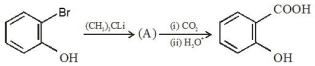
A
$2-$lithiophenol
B
Dilithium salt of $2-$bromophenol
C
$2-$tert-butoxyphenol
D
$2-$tert-butylphenol
Solution
(B) The reaction of $2$-bromophenol with $2$ equivalents of an organolithium reagent (like $n-BuLi$ or $t-BuLi$) involves two steps:
$1$. Acid-base reaction: The phenolic $-OH$ proton is acidic and is deprotonated by the first equivalent of the organolithium reagent to form a lithium phenoxide salt.
$2$. Halogen-metal exchange: The second equivalent of the organolithium reagent reacts with the aryl bromide to form an aryllithium species.
Thus,the intermediate $A$ is the dilithium salt of $2$-bromophenol,which has the structure of a benzene ring with an $-OLi$ group at the ortho position relative to a $-Li$ group. This species then reacts with $CO_2$ followed by acidic workup $(H_3O^+)$ to yield salicylic acid.
$1$. Acid-base reaction: The phenolic $-OH$ proton is acidic and is deprotonated by the first equivalent of the organolithium reagent to form a lithium phenoxide salt.
$2$. Halogen-metal exchange: The second equivalent of the organolithium reagent reacts with the aryl bromide to form an aryllithium species.
Thus,the intermediate $A$ is the dilithium salt of $2$-bromophenol,which has the structure of a benzene ring with an $-OLi$ group at the ortho position relative to a $-Li$ group. This species then reacts with $CO_2$ followed by acidic workup $(H_3O^+)$ to yield salicylic acid.
0 likes
View Solution436
MediumMCQ
Given below are two statements.
Statement $I$: Phenols are weakly acidic.
Statement $II$: Therefore they are freely soluble in $NaOH$ solution and are weaker acids than alcohols and water.
Choose the most appropriate option.
Statement $I$: Phenols are weakly acidic.
Statement $II$: Therefore they are freely soluble in $NaOH$ solution and are weaker acids than alcohols and water.
Choose the most appropriate option.
A
Both Statement $I$ and Statement $II$ are correct.
B
Both Statement $I$ and Statement $II$ are incorrect.
C
Statement $I$ is correct but Statement $II$ is incorrect.
D
Statement $I$ is incorrect but Statement $II$ is correct.
Solution
(C) Phenols are weakly acidic,so Statement $I$ is correct.
Phenols are more acidic than alcohols and water because the phenoxide ion is resonance-stabilized.
While phenols are soluble in $NaOH$ due to the formation of sodium phenoxide,the claim that they are weaker acids than alcohols and water is false.
Therefore,Statement $II$ is incorrect.
Phenols are more acidic than alcohols and water because the phenoxide ion is resonance-stabilized.
While phenols are soluble in $NaOH$ due to the formation of sodium phenoxide,the claim that they are weaker acids than alcohols and water is false.
Therefore,Statement $II$ is incorrect.
0 likes
View Solution437
MediumMCQ
Arrange the following compounds in decreasing order of their acidic strength:
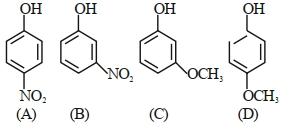
A
$A > B > C > D$
B
$B > A > C > D$
C
$A > C > B > D$
D
$D > C > B > A$
Solution
(A) The acidic strength of phenols depends on the nature of the substituents attached to the benzene ring. Electron-withdrawing groups $(EWG)$ increase acidity,while electron-donating groups $(EDG)$ decrease it.
$A$: $p$-Nitrophenol ($-NO_2$ is a strong $EWG$ at para position,strong $-I$ and $-M$ effect).
$B$: $m$-Nitrophenol ($-NO_2$ is an $EWG$ at meta position,only $-I$ effect).
$C$: $m$-Methoxyphenol ($-OCH_3$ is an $EDG$ by $+M$ effect but acts as an $EWG$ by $-I$ effect at meta position).
$D$: $p$-Methoxyphenol ($-OCH_3$ is a strong $EDG$ by $+M$ effect at para position).
Comparing the effects:
$A$ is the most acidic due to strong $-M$ effect of $-NO_2$ at para position.
$B$ is next,as $-NO_2$ at meta position only shows $-I$ effect.
$C$ is less acidic than $B$ because $-OCH_3$ at meta position acts as an $EWG$ ($-I$ effect) but is less effective than $-NO_2$.
$D$ is the least acidic due to the strong $+M$ electron-donating effect of $-OCH_3$ at para position.
Therefore,the decreasing order of acidic strength is $A > B > C > D$.
$A$: $p$-Nitrophenol ($-NO_2$ is a strong $EWG$ at para position,strong $-I$ and $-M$ effect).
$B$: $m$-Nitrophenol ($-NO_2$ is an $EWG$ at meta position,only $-I$ effect).
$C$: $m$-Methoxyphenol ($-OCH_3$ is an $EDG$ by $+M$ effect but acts as an $EWG$ by $-I$ effect at meta position).
$D$: $p$-Methoxyphenol ($-OCH_3$ is a strong $EDG$ by $+M$ effect at para position).
Comparing the effects:
$A$ is the most acidic due to strong $-M$ effect of $-NO_2$ at para position.
$B$ is next,as $-NO_2$ at meta position only shows $-I$ effect.
$C$ is less acidic than $B$ because $-OCH_3$ at meta position acts as an $EWG$ ($-I$ effect) but is less effective than $-NO_2$.
$D$ is the least acidic due to the strong $+M$ electron-donating effect of $-OCH_3$ at para position.
Therefore,the decreasing order of acidic strength is $A > B > C > D$.
0 likes
View Solution438
MediumMCQ
The difference in the reaction of phenol with bromine in chloroform $(CHCl_3)$ and bromine in water medium is due to:
A
Hyperconjugation in substrate
B
Polarity of solvent
C
Free radical formation
D
Electromeric effect of the substrate
Solution
(B) The difference in the reaction products is observed due to the polarity of the solvent:
$(i)$ In a polar solvent like water,phenol ionizes to form the phenoxide ion $(C_6H_5O^-)$,which is much more reactive towards electrophilic aromatic substitution than phenol itself,leading to polybromination ($2$,$4$,$6$-tribromophenol).
$(ii)$ In a non-polar solvent like chloroform $(CHCl_3)$,phenol does not ionize significantly,and the reaction proceeds to form monobrominated products (o-bromophenol and p-bromophenol).
$(i)$ In a polar solvent like water,phenol ionizes to form the phenoxide ion $(C_6H_5O^-)$,which is much more reactive towards electrophilic aromatic substitution than phenol itself,leading to polybromination ($2$,$4$,$6$-tribromophenol).
$(ii)$ In a non-polar solvent like chloroform $(CHCl_3)$,phenol does not ionize significantly,and the reaction proceeds to form monobrominated products (o-bromophenol and p-bromophenol).
0 likes
View Solution439
DifficultMCQ
Identify the major products $A$ and $B$ for the reaction sequence given below.
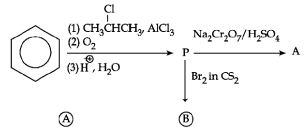
A
Phenol and $p$-bromophenol
B
$p$-benzoquinone and $p$-bromophenol
C
$p$-benzoquinone and $2,4,6$-tribromophenol
D
Phenol and $2,4,6$-tribromophenol
Solution
(B) $1$. The reaction of benzene with isopropyl chloride in the presence of $AlCl_3$ (Friedel-Crafts alkylation) gives cumene (isopropylbenzene).
$2$. Oxidation of cumene with $O_2$ followed by treatment with $H^+/H_2O$ yields phenol $(P)$ and acetone.
$3$. Phenol $(P)$ reacts with $Na_2Cr_2O_7/H_2SO_4$ (strong oxidizing agent) to form $p$-benzoquinone $(A)$.
$4$. Phenol $(P)$ reacts with $Br_2$ in $CS_2$ (a non-polar solvent) to give $p$-bromophenol $(B)$ as the major product due to the low polarity of the medium,which prevents further bromination.
$2$. Oxidation of cumene with $O_2$ followed by treatment with $H^+/H_2O$ yields phenol $(P)$ and acetone.
$3$. Phenol $(P)$ reacts with $Na_2Cr_2O_7/H_2SO_4$ (strong oxidizing agent) to form $p$-benzoquinone $(A)$.
$4$. Phenol $(P)$ reacts with $Br_2$ in $CS_2$ (a non-polar solvent) to give $p$-bromophenol $(B)$ as the major product due to the low polarity of the medium,which prevents further bromination.
0 likes
View Solution440
MediumMCQ
Compound $I$ is heated with Conc. $HI$ to give a hydroxy compound $A$ which is further heated with $Zn$ dust to give compound $B$. Identify $A$ and $B$.
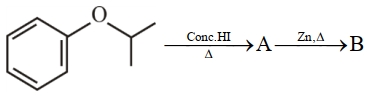
A
$A = \text{propan-2-ol}, B = \text{propene}$
B
$A = \text{phenol}, B = \text{p-benzoquinone}$
C
$A = \text{o-isopropylphenol}, B = \text{isopropylbenzene}$
D
$A = \text{phenol}, B = \text{benzene}$
Solution
(D) The reaction of an alkyl aryl ether with concentrated $HI$ involves the cleavage of the $C-O$ bond between the alkyl group and the oxygen atom. This is because the $C(aryl)-O$ bond has partial double bond character due to resonance and is stronger.
Thus,the reaction of phenyl isopropyl ether with $HI$ yields phenol $(A)$ and isopropyl iodide.
However,in the context of the given options,the reaction proceeds to form phenol $(A)$.
When phenol $(A)$ is heated with $Zn$ dust,it undergoes reduction to form benzene $(B)$.
Thus,the reaction of phenyl isopropyl ether with $HI$ yields phenol $(A)$ and isopropyl iodide.
However,in the context of the given options,the reaction proceeds to form phenol $(A)$.
When phenol $(A)$ is heated with $Zn$ dust,it undergoes reduction to form benzene $(B)$.
0 likes
View Solution441
MediumMCQ
$A$ compound $'X'$ is acidic and it is soluble in $NaOH$ solution,but insoluble in $NaHCO_3$ solution. Compound $'X'$ also gives a violet colour with neutral $FeCl_3$ solution. The compound $'X'$ is:
A
Cyclohexanol
B
Phenol
C
Benzyl alcohol
D
Cyclohexylmethanol
Solution
(B) $1$. The compound $'X'$ is acidic and soluble in $NaOH$ but insoluble in $NaHCO_3$. This indicates that the compound is more acidic than water but less acidic than carbonic acid $(H_2CO_3)$. Phenols typically satisfy this condition.
$2$. The compound gives a violet colour with neutral $FeCl_3$ solution. This is a characteristic test for the presence of a phenolic group ($-OH$ group attached directly to a benzene ring).
$3$. Among the given options,Phenol $(C_6H_5OH)$ is the only compound that contains a phenolic group and satisfies all the given chemical properties.
$4$. The reaction with $FeCl_3$ is: $6C_6H_5OH + FeCl_3 \rightarrow [Fe(C_6H_5O)_6]^{3-} + 6H^+ + 3HCl$ (forming a violet complex).
$2$. The compound gives a violet colour with neutral $FeCl_3$ solution. This is a characteristic test for the presence of a phenolic group ($-OH$ group attached directly to a benzene ring).
$3$. Among the given options,Phenol $(C_6H_5OH)$ is the only compound that contains a phenolic group and satisfies all the given chemical properties.
$4$. The reaction with $FeCl_3$ is: $6C_6H_5OH + FeCl_3 \rightarrow [Fe(C_6H_5O)_6]^{3-} + 6H^+ + 3HCl$ (forming a violet complex).
0 likes
View Solution442
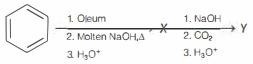
MediumMCQ
The major products $X$ and $Y$ in the following sequence of transformations are:
A
$X = \text{3-hydroxybenzenesulfonic acid}, Y = \text{3-carboxybenzenesulfonic acid}$
B
$X = \text{phenol}, Y = \text{benzoic acid}$
C
$X = \text{2-hydroxybenzenesulfonic acid}, Y = \text{2-hydroxybenzoic acid}$
D
$X = \text{phenol}, Y = \text{2-hydroxybenzoic acid}$
Solution
(D) The reaction sequence is as follows:
$1$. Benzene reacts with oleum $(H_2SO_4 + SO_3)$ to form benzenesulfonic acid.
$2$. Benzenesulfonic acid reacts with molten $NaOH$ followed by $H_3O^+$ to form phenol $(X)$.
$3$. Phenol $(X)$ reacts with $NaOH$ to form sodium phenoxide.
$4$. Sodium phenoxide reacts with $CO_2$ under pressure followed by $H_3O^+$ (Kolbe-Schmitt reaction) to form salicylic acid $(Y)$,which is $2$-hydroxybenzoic acid.
Therefore,$X = \text{phenol}$ and $Y = \text{2-hydroxybenzoic acid}$.
$1$. Benzene reacts with oleum $(H_2SO_4 + SO_3)$ to form benzenesulfonic acid.
$2$. Benzenesulfonic acid reacts with molten $NaOH$ followed by $H_3O^+$ to form phenol $(X)$.
$3$. Phenol $(X)$ reacts with $NaOH$ to form sodium phenoxide.
$4$. Sodium phenoxide reacts with $CO_2$ under pressure followed by $H_3O^+$ (Kolbe-Schmitt reaction) to form salicylic acid $(Y)$,which is $2$-hydroxybenzoic acid.
Therefore,$X = \text{phenol}$ and $Y = \text{2-hydroxybenzoic acid}$.
0 likes
View Solution443
DifficultMCQ
Reaction of phenol with $NaOH$ followed by heating with $CO_{2}$ under high pressure,and subsequent acidification gives compound $X$ as the major product,which can be purified by steam distillation. When reacted with acetic anhydride in the presence of a trace amount of conc. $H_{2}SO_{4}$,compound $X$ produces $Y$ as the major product. Compound $Y$ is $....$
A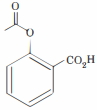
B
C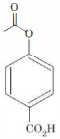
D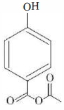
Solution
(A) The reaction of phenol with $NaOH$ followed by heating with $CO_{2}$ under high pressure and subsequent acidification is the Kolbe-Schmitt reaction,which yields salicylic acid $(X)$ as the major product.
Salicylic acid $(X)$ can be purified by steam distillation due to intramolecular hydrogen bonding.
When salicylic acid $(X)$ is reacted with acetic anhydride in the presence of a trace amount of conc. $H_{2}SO_{4}$,the phenolic $-OH$ group undergoes acetylation to produce acetylsalicylic acid (aspirin) $(Y)$ as the major product.
The structure of acetylsalicylic acid $(Y)$ corresponds to option $A$.
Salicylic acid $(X)$ can be purified by steam distillation due to intramolecular hydrogen bonding.
When salicylic acid $(X)$ is reacted with acetic anhydride in the presence of a trace amount of conc. $H_{2}SO_{4}$,the phenolic $-OH$ group undergoes acetylation to produce acetylsalicylic acid (aspirin) $(Y)$ as the major product.
The structure of acetylsalicylic acid $(Y)$ corresponds to option $A$.
0 likes
View Solution444
DifficultMCQ
The major product in the following reaction is:
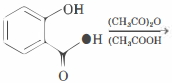
A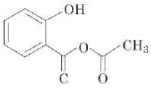
B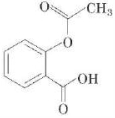
C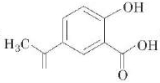
D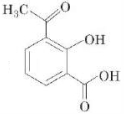
Solution
(B) The reactant in the given reaction is salicylic acid.
When salicylic acid reacts with acetic anhydride $(CH_3CO)_2O$ in the presence of acetic acid $(CH_3COOH)$,the phenolic $-OH$ group undergoes acetylation.
This reaction produces acetylsalicylic acid,which is commonly known as aspirin.
The structure of aspirin corresponds to option $B$.
When salicylic acid reacts with acetic anhydride $(CH_3CO)_2O$ in the presence of acetic acid $(CH_3COOH)$,the phenolic $-OH$ group undergoes acetylation.
This reaction produces acetylsalicylic acid,which is commonly known as aspirin.
The structure of aspirin corresponds to option $B$.
0 likes
View Solution445
MediumMCQ
The compound which reacts with excess bromine to produce $2,4,6$-tribromophenol is
A
$1,3$-cyclohexadiene
B
$1,3$-cyclohexanedione
C
salicylic acid
D
cyclohexanone
Solution
(C) The correct answer is $(C)$.
Salicylic acid $(C_6H_4(OH)COOH)$ reacts with excess bromine water to produce $2,4,6$-tribromophenol.
In this reaction,the $-COOH$ group is replaced by a bromine atom due to the high reactivity of the phenol ring,followed by electrophilic substitution at the remaining ortho and para positions.
The reaction is as follows:
$C_6H_4(OH)COOH + 2Br_2 \rightarrow C_6H_2(OH)Br_3 + CO_2 + HBr$.
Salicylic acid $(C_6H_4(OH)COOH)$ reacts with excess bromine water to produce $2,4,6$-tribromophenol.
In this reaction,the $-COOH$ group is replaced by a bromine atom due to the high reactivity of the phenol ring,followed by electrophilic substitution at the remaining ortho and para positions.
The reaction is as follows:
$C_6H_4(OH)COOH + 2Br_2 \rightarrow C_6H_2(OH)Br_3 + CO_2 + HBr$.
0 likes
View Solution446
MediumMCQ
Phenol on treatment with dil. $HNO_3$ gives two products $P$ and $Q$. $P$ is steam volatile but $Q$ is not. $P$ and $Q$ are,respectively:
A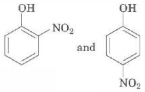
B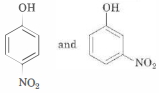
C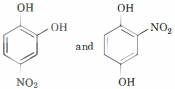
D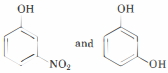
Solution
(A) When phenol is treated with dilute $HNO_3$ at low temperature,it undergoes electrophilic aromatic substitution to form a mixture of ortho-nitrophenol and para-nitrophenol.
$o$-Nitrophenol $(P)$ exhibits intramolecular hydrogen bonding,which makes it steam volatile.
$p$-Nitrophenol $(Q)$ exhibits intermolecular hydrogen bonding,leading to higher boiling point and it is not steam volatile.
Thus,$P$ is $o$-nitrophenol and $Q$ is $p$-nitrophenol.
$o$-Nitrophenol $(P)$ exhibits intramolecular hydrogen bonding,which makes it steam volatile.
$p$-Nitrophenol $(Q)$ exhibits intermolecular hydrogen bonding,leading to higher boiling point and it is not steam volatile.
Thus,$P$ is $o$-nitrophenol and $Q$ is $p$-nitrophenol.
0 likes
View Solution447
MediumMCQ
The reaction,
$C_6H_5OH + CHCl_3 \xrightarrow{NaOH/\Delta} \text{o-hydroxybenzaldehyde} + H^+$
is known as:
$C_6H_5OH + CHCl_3 \xrightarrow{NaOH/\Delta} \text{o-hydroxybenzaldehyde} + H^+$
is known as:
A
Perkin reaction
B
Sandmeyer reaction
C
Reimer-Tiemann reaction
D
Cannizzaro reaction
Solution
(C)
This reaction is known as the Reimer-Tiemann reaction.
In this reaction,phenol reacts with chloroform $(CHCl_3)$ in the presence of aqueous sodium hydroxide $(NaOH)$ to form salicylaldehyde (o-hydroxybenzaldehyde).
The mechanism involves the formation of dichlorocarbene $(:CCl_2)$ as an electrophilic intermediate,which attacks the phenoxide ion.
This reaction is known as the Reimer-Tiemann reaction.
In this reaction,phenol reacts with chloroform $(CHCl_3)$ in the presence of aqueous sodium hydroxide $(NaOH)$ to form salicylaldehyde (o-hydroxybenzaldehyde).
The mechanism involves the formation of dichlorocarbene $(:CCl_2)$ as an electrophilic intermediate,which attacks the phenoxide ion.
0 likes
View Solution448
DifficultMCQ
Among $I, II, III$ (Phenol,o-nitrophenol,and p-nitrophenol respectively),the boiling point follows the order:
A
$II < I < III$
B
$III < II < I$
C
$I < II < III$
D
$II < III < I$
Solution
(C) The boiling point of a compound depends upon the extent of intermolecular forces,specifically hydrogen bonding.
$(I)$ Phenol has intermolecular hydrogen bonding but lacks the strong electron-withdrawing group present in the others.
$(II)$ $o$-Nitrophenol exhibits intramolecular hydrogen bonding,which reduces the extent of intermolecular association,leading to a lower boiling point compared to the para isomer.
$(III)$ $p$-Nitrophenol exhibits strong intermolecular hydrogen bonding,which leads to molecular association and results in the highest boiling point.
Therefore,the correct order of boiling points is $I < II < III$.
$(I)$ Phenol has intermolecular hydrogen bonding but lacks the strong electron-withdrawing group present in the others.
$(II)$ $o$-Nitrophenol exhibits intramolecular hydrogen bonding,which reduces the extent of intermolecular association,leading to a lower boiling point compared to the para isomer.
$(III)$ $p$-Nitrophenol exhibits strong intermolecular hydrogen bonding,which leads to molecular association and results in the highest boiling point.
Therefore,the correct order of boiling points is $I < II < III$.
0 likes
View Solution449
MediumMCQ
In the reaction sequence,phenol reacts with $HNO_2$ to form $X$,which then reacts with phenol in the presence of $H_2SO_4$ to form $Y$. Identify the major products $X$ and $Y$.
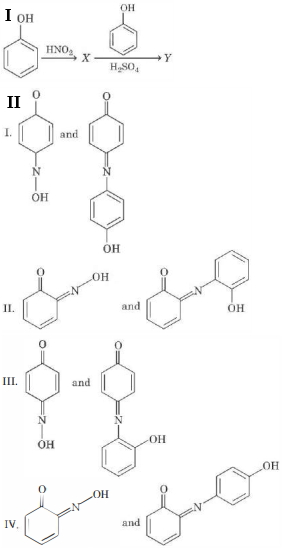
A
$I$
B
$II$
C
$III$
D
$IV$
Solution
(B) The reaction of phenol with $HNO_2$ (nitrous acid) leads to the formation of $p$-nitrosophenol,which exists in tautomeric equilibrium with $p$-benzoquinone monoxime $(X)$.
In the presence of $H_2SO_4$,the oxime group acts as an electrophile. The phenol molecule attacks the electrophilic carbon of the oxime group at the para-position to form the final product $Y$,which is an indophenol derivative. Looking at the structures provided in the options,option $II$ correctly represents the structure of $p$-benzoquinone monoxime $(X)$ and the corresponding indophenol product $(Y)$.
In the presence of $H_2SO_4$,the oxime group acts as an electrophile. The phenol molecule attacks the electrophilic carbon of the oxime group at the para-position to form the final product $Y$,which is an indophenol derivative. Looking at the structures provided in the options,option $II$ correctly represents the structure of $p$-benzoquinone monoxime $(X)$ and the corresponding indophenol product $(Y)$.
0 likes
View Solution450
MediumMCQ
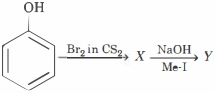
In the above sequence of reactions,the major products $X$ and $Y$ are
A
$X = \text{2-bromophenol}, Y = \text{2-bromo-1-methoxybenzene}$
B
$X = \text{2-bromophenol}, Y = \text{2-hydroxyphenol}$
C
$X = \text{4-bromophenol}, Y = \text{1-bromo-4-methoxybenzene}$
D
$X = \text{4-bromophenol}, Y = \text{4-hydroxyphenol}$
Solution
(C) The reaction sequence is as follows:
$1$. Phenol reacts with $Br_2$ in $CS_2$ (a non-polar solvent) at low temperature. This electrophilic aromatic substitution reaction favors the formation of the para-isomer due to steric hindrance at the ortho-position. Thus,$X$ is $4$-bromophenol.
$2$. In the second step,$4$-bromophenol reacts with $NaOH$ to form sodium $4$-bromophenoxide,which then undergoes a nucleophilic substitution reaction $(S_N2)$ with methyl iodide $(MeI)$ to form $1$-bromo-$4$-methoxybenzene $(Y)$. This is an example of Williamson's ether synthesis.
Therefore,the correct option is $C$.
$1$. Phenol reacts with $Br_2$ in $CS_2$ (a non-polar solvent) at low temperature. This electrophilic aromatic substitution reaction favors the formation of the para-isomer due to steric hindrance at the ortho-position. Thus,$X$ is $4$-bromophenol.
$2$. In the second step,$4$-bromophenol reacts with $NaOH$ to form sodium $4$-bromophenoxide,which then undergoes a nucleophilic substitution reaction $(S_N2)$ with methyl iodide $(MeI)$ to form $1$-bromo-$4$-methoxybenzene $(Y)$. This is an example of Williamson's ether synthesis.
Therefore,the correct option is $C$.
0 likes
View SolutionAlcohols, Phenols and Ethers — Properties of Phenols · Frequently Asked Questions
1Are these Alcohols, Phenols and Ethers questions useful for JEE and NEET?
Yes. All questions in this section are mapped to JEE Main and NEET exam patterns. Previous year questions from JEE Main, NEET, GUJCET and state-level exams are included with full solutions.
2Can I switch to Hindi or Gujarati for these questions?
Yes. Use the language tabs in the hero section or the sidebar to view the same questions and solutions in English, Hindi or Gujarati.
3How do I generate a question paper from this subtopic?
Use the Vedclass Exam Paper Generator — select the chapter and subtopic, set difficulty, and generate Sets A, B, C, D automatically. First 3 chapters of every subject are free.
Vedclass Products
For Students
Vedclass Test Series
Mock tests in real JEE/NEET style with performance analysis. 5-day free trial.
Start Free TrialFor Teachers
Exam Paper Generator
Generate Set A/B/C/D papers from this chapter in 2 minutes. 3 chapters free.
Try FreeFor Institutes
Online Exam Module
Live online exams with unlimited students, 360° analytics & white-label branding.
See DemoFor Teachers & Institutes
Generate a Alcohols, Phenols and Ethers Exam Paper in 2 Minutes
Select subtopic & difficulty — Sets A, B, C, D auto-generated with No Repeat logic.
First 3 chapters of every subject are free — no payment required.