
A English
General introduction of alcohol, Phenol and Ethers Questions in English
Class 12 Chemistry · Alcohols, Phenols and Ethers · General introduction of alcohol, Phenol and Ethers
100+
Questions
English
Language
100%
With Solutions
Showing 50 of 100 questions in English
1
EasyMCQ
Which of the following is a Lewis base?
A
$CO_2$
B
$SO_3$
C
$SO_2$
D
$ROH$
Solution
(D) Lewis base is defined as a substance that can donate a lone pair of electrons.
In $ROH$ (alcohol),the oxygen atom possesses two lone pairs of electrons,which it can donate to an electron-deficient species.
Therefore,$ROH$ acts as a Lewis base.
$CO_2$,$SO_3$,and $SO_2$ are Lewis acids because they are electron-deficient and can accept electron pairs.
In $ROH$ (alcohol),the oxygen atom possesses two lone pairs of electrons,which it can donate to an electron-deficient species.
Therefore,$ROH$ acts as a Lewis base.
$CO_2$,$SO_3$,and $SO_2$ are Lewis acids because they are electron-deficient and can accept electron pairs.
0 likes
View Solution2
EasyMCQ
Which of the following compounds contains the functional group $-OH$?
A
$1, 2-$ethanediol
B
$2-$butanone
C
Nitrobenzene
D
Ethanal
Solution
(A) The functional group $-OH$ represents an alcohol group.
$1, 2-$ethanediol,with the formula $HO-CH_2-CH_2-OH$,contains two hydroxyl $(-OH)$ groups.
$2-$butanone is a ketone,Nitrobenzene is a nitro compound,and Ethanal is an aldehyde.
$1, 2-$ethanediol,with the formula $HO-CH_2-CH_2-OH$,contains two hydroxyl $(-OH)$ groups.
$2-$butanone is a ketone,Nitrobenzene is a nitro compound,and Ethanal is an aldehyde.
0 likes
View Solution3
MediumMCQ
Glycerol is a
A
Primary alcohol
B
Monohydric alcohol
C
Secondary alcohol
D
Trihydric alcohol
Solution
(D) Glycerol $(CH_2(OH)-CH(OH)-CH_2(OH))$ contains three hydroxyl $(-OH)$ groups attached to three different carbon atoms.
Therefore,it is classified as a trihydric alcohol.
Therefore,it is classified as a trihydric alcohol.
0 likes
View Solution4
MediumMCQ
Cresols are:
A
Hydroxy toluenes
B
Dihydric phenols
C
Trihydric phenols
D
Trihydric alcohols
Solution
(A) Cresols are methylphenols,which are compounds consisting of a methyl group attached to a benzene ring along with a hydroxyl group.
They are commonly referred to as hydroxy toluenes.
The structure of $o$-cresol is shown in the image,where a $-CH_3$ group and an $-OH$ group are attached to the benzene ring.
Therefore,the correct option is $(A)$.
They are commonly referred to as hydroxy toluenes.
The structure of $o$-cresol is shown in the image,where a $-CH_3$ group and an $-OH$ group are attached to the benzene ring.
Therefore,the correct option is $(A)$.
0 likes
View Solution5
MediumMCQ
Ortho-dihydroxy benzene is
A
Carvacrol
B
Resorcinol
C
Catechol
D
Orcinol
Solution
(C) The structure of ortho-dihydroxy benzene consists of a benzene ring with two hydroxyl $(-OH)$ groups attached at adjacent positions (ortho positions).
This compound is commonly known as catechol.
This compound is commonly known as catechol.
0 likes
View Solution6
DifficultMCQ
Carbinol is
A
$C_2H_5OH$
B
$CH_3OH$
C
$(CH_3)_2CHOH$
D
$CH_3CH_2CH(OH)CH_3$
Solution
(B) The term $Carbinol$ is the common name used for $Methanol$ $(CH_3OH)$.
It is the simplest alcohol where a hydroxyl group $(-OH)$ is attached to a methyl group $(-CH_3)$.
It is the simplest alcohol where a hydroxyl group $(-OH)$ is attached to a methyl group $(-CH_3)$.
0 likes
View Solution7
EasyMCQ
The general formula of a primary alcohol is:
A
$>CHOH$
B
$>C-OH$
C
$-CH_2OH$
D
$=C(OH)_2$
Solution
(C) primary alcohol is defined as an alcohol in which the hydroxyl group $(-OH)$ is attached to a primary carbon atom (a carbon atom attached to only one other carbon atom or to no other carbon atoms).
Therefore,the functional group characteristic of a primary alcohol is represented by the structure $-CH_2OH$.
Therefore,the functional group characteristic of a primary alcohol is represented by the structure $-CH_2OH$.
0 likes
View Solution8
MediumMCQ
$1, 2, 3$-trihydroxybenzene is also known as
A
Pyrogallol
B
Phloroglucinol
C
Resorcinol
D
Quinol
Solution
(A) The structure of $1, 2, 3$-trihydroxybenzene consists of a benzene ring with three hydroxyl $(-OH)$ groups attached at the $1, 2,$ and $3$ positions.
This specific isomer of trihydroxybenzene is commonly known as $Pyrogallol$.
This specific isomer of trihydroxybenzene is commonly known as $Pyrogallol$.
0 likes
View Solution9
EasyMCQ
The characteristic grouping of secondary alcohols is
A
$ - CH_2OH $
B
$ >CHOH $
C
$ - C(OH)- $
D
$ >C(OH)_2 $
Solution
(B) secondary alcohol is an alcohol where the hydroxyl group $(-OH)$ is attached to a carbon atom that is bonded to two other carbon atoms.
This is represented by the characteristic group $ >CHOH $.
This is represented by the characteristic group $ >CHOH $.
0 likes
View Solution10
MediumMCQ
The compound $HO-CH_2-CH_2-OH$ is
A
Ethane glycol
B
Ethylene glycol
C
Ethylidene alcohol
D
Dimethyl alcohol
Solution
(B) The compound $HO-CH_2-CH_2-OH$ is a dihydric alcohol with two hydroxyl groups attached to adjacent carbon atoms.
Its $IUPAC$ name is $Ethane-1,2-diol$,and its common name is $Ethylene \ glycol$.
Its $IUPAC$ name is $Ethane-1,2-diol$,and its common name is $Ethylene \ glycol$.
0 likes
View Solution11
EasyMCQ
The structural formula of cyclohexanol is
A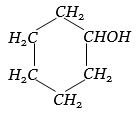
B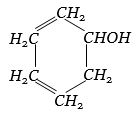
C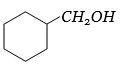
D
Solution
(A) Cyclohexanol is a cyclic alcohol with the molecular formula $C_6H_{11}OH$.
It consists of a saturated six-membered ring (cyclohexane ring) where one hydrogen atom is replaced by a hydroxyl $(-OH)$ group.
The structure shown in option $A$ correctly represents this,where the ring is fully saturated and has an $-OH$ group attached.
It consists of a saturated six-membered ring (cyclohexane ring) where one hydrogen atom is replaced by a hydroxyl $(-OH)$ group.
The structure shown in option $A$ correctly represents this,where the ring is fully saturated and has an $-OH$ group attached.
0 likes
View Solution12
MediumMCQ
Wood spirit is known as
A
Methanol
B
Ethanol
C
Acetone
D
Benzene
Solution
(A) Methanol is also referred to as wood alcohol or wood spirit or wood naphtha because the earliest method for its preparation was by the destructive distillation of wood.
0 likes
View Solution13
EasyMCQ
Which of the following is a simple ether?
A
$CH_3OCH_3$
B
$C_2H_5OCH_3$
C
$C_6H_5OCH_3$
D
$C_6H_5OC_2H_5$
Solution
(A) An ether is classified as a simple or symmetrical ether if the two alkyl or aryl groups attached to the oxygen atom are the same.
In $CH_3OCH_3$ (dimethyl ether),both groups attached to the oxygen atom are methyl groups $(-CH_3)$.
Therefore,$CH_3OCH_3$ is a simple ether.
In $CH_3OCH_3$ (dimethyl ether),both groups attached to the oxygen atom are methyl groups $(-CH_3)$.
Therefore,$CH_3OCH_3$ is a simple ether.
0 likes
View Solution14
EasyMCQ
An example of a compound with the functional group $'-O-'$ is
A
Acetic acid
B
Methyl alcohol
C
Diethyl ether
D
Acetone
Solution
(C) The functional group $'-O-'$ represents an ether,which has the general formula $R-O-R'$.
Diethyl ether $(C_2H_5-O-C_2H_5)$ contains this functional group and is a classic example of an ether.
Diethyl ether $(C_2H_5-O-C_2H_5)$ contains this functional group and is a classic example of an ether.
0 likes
View Solution15
MediumMCQ
The common name of $(CH_3)_2CH-O-CH_2-CH_2-CH_3$ is
A
Isopropyl propyl ether
B
Dipropyl ether
C
Di-isopropyl ether
D
Isopropyl propyl ketone
Solution
(A) The given compound is $(CH_3)_2CH-O-CH_2-CH_2-CH_3$.
In this ether,the oxygen atom is bonded to an isopropyl group $(CH_3)_2CH-$ and a propyl group $-CH_2-CH_2-CH_3$.
According to the common nomenclature system for ethers,the alkyl groups are named in alphabetical order followed by the word 'ether'.
Since 'Isopropyl' starts with '$I$' and 'Propyl' starts with '$P$',the common name is Isopropyl propyl ether.
In this ether,the oxygen atom is bonded to an isopropyl group $(CH_3)_2CH-$ and a propyl group $-CH_2-CH_2-CH_3$.
According to the common nomenclature system for ethers,the alkyl groups are named in alphabetical order followed by the word 'ether'.
Since 'Isopropyl' starts with '$I$' and 'Propyl' starts with '$P$',the common name is Isopropyl propyl ether.
0 likes
View Solution16
MediumMCQ
Which of the following are known as mercaptans?
A
Thio-alcohols
B
Thio-ethers
C
Thio-acids
D
Thio-aldehydes
Solution
(A) The term $mercaptans$ is the common name used for $thio-alcohols$ (also known as $thiols$),which have the general formula $R-SH$.
0 likes
View Solution17
EasyMCQ
Epoxides are
A
Cyclic ethers
B
Not ethers
C
Aryl-alkyl ethers
D
Ethers with another functional group
Solution
(A) Epoxides are three-membered cyclic ethers containing an oxygen atom in the ring.
For example,ethylene oxide is represented as:
$CH_2-CH_2$
$|$
$O$
For example,ethylene oxide is represented as:
$CH_2-CH_2$
$|$
$O$
0 likes
View Solution18
MediumMCQ
Carbolic acid is
A
$C_6H_5CHO$
B
$C_6H_6$
C
$C_6H_5COOH$
D
$C_6H_5OH$
Solution
(D) Phenol $(C_6H_5OH)$ was discovered by Runge in the middle oil fraction of coal-tar distillation.
It was named 'carbolic acid' (from Latin $carbo$ meaning coal and $oleum$ meaning oil).
In its pure form,it is a white crystalline solid,but it is often found as a liquid containing $5\%$ water at room temperature,which is commonly referred to as carbolic acid.
It was named 'carbolic acid' (from Latin $carbo$ meaning coal and $oleum$ meaning oil).
In its pure form,it is a white crystalline solid,but it is often found as a liquid containing $5\%$ water at room temperature,which is commonly referred to as carbolic acid.
0 likes
View Solution19
MediumMCQ
Give the $IUPAC$ name of the following compound:
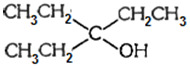
A
$2-$ethyl$-2-$butanol
B
$1-$ethyl$-1-$methyl-pentanol$-1$
C
$3-$ethyl-pentan$-3-$ol
D
Diethyl ethanol
Solution
(C) $1$. Identify the longest carbon chain containing the functional group $(-OH)$. The structure is $(CH_3CH_2)_3C-OH$.
$2$. The longest chain containing the $-OH$ group has $5$ carbon atoms,which is a pentane derivative.
$3$. Numbering the chain from either end gives the $-OH$ group at the $3^{rd}$ position.
$4$. There is an ethyl group attached at the $3^{rd}$ carbon atom.
$5$. Therefore,the $IUPAC$ name is $3-$ethylpentan$-3-$ol.
$2$. The longest chain containing the $-OH$ group has $5$ carbon atoms,which is a pentane derivative.
$3$. Numbering the chain from either end gives the $-OH$ group at the $3^{rd}$ position.
$4$. There is an ethyl group attached at the $3^{rd}$ carbon atom.
$5$. Therefore,the $IUPAC$ name is $3-$ethylpentan$-3-$ol.
0 likes
View Solution20
EasyMCQ
Diethyl ether is a metamer of which of the following?
A
$1-$Butanol
B
$2-$Methoxypropane
C
$2-$Butanol
D
$1-$Propanol
Solution
(B) Metamers are isomers that have the same molecular formula but differ in the distribution of alkyl groups on either side of the functional group (in this case,the ether oxygen atom).
Diethyl ether has the formula $C_2H_5-O-C_2H_5$ (molecular formula $C_4H_{10}O$).
$2-$Methoxypropane has the formula $CH_3-O-CH(CH_3)_2$ (molecular formula $C_4H_{10}O$).
Since both compounds have the same molecular formula but different alkyl groups attached to the oxygen atom (ethyl-ethyl in diethyl ether vs. methyl-isopropyl in $2-$methoxypropane),they are metamers.
Diethyl ether has the formula $C_2H_5-O-C_2H_5$ (molecular formula $C_4H_{10}O$).
$2-$Methoxypropane has the formula $CH_3-O-CH(CH_3)_2$ (molecular formula $C_4H_{10}O$).
Since both compounds have the same molecular formula but different alkyl groups attached to the oxygen atom (ethyl-ethyl in diethyl ether vs. methyl-isopropyl in $2-$methoxypropane),they are metamers.
0 likes
View Solution21
EasyMCQ
Which general formula represents the homologous series of alkanols?
A
$C_nH_{2n}O_2$
B
$C_nH_{2n}O$
C
$C_nH_{2n+1}O$
D
$C_nH_{2n+2}O$
Solution
(D) Alkanols are alcohols with the general formula $C_nH_{2n+1}OH$.
Expanding this,we get $C_nH_{2n+1+1}O$,which simplifies to $C_nH_{2n+2}O$.
Therefore,the general formula for the homologous series of alkanols is $C_nH_{2n+2}O$.
Expanding this,we get $C_nH_{2n+1+1}O$,which simplifies to $C_nH_{2n+2}O$.
Therefore,the general formula for the homologous series of alkanols is $C_nH_{2n+2}O$.
0 likes
View Solution22
EasyMCQ
Which of the following structures is an example of a symmetrical or simple ether?
A
$CH_3-CO-CH_3$
B
$CH_3-O-CH_2-CH_3$
C
$CH_3-CH_2-O-CH_2-CH_2-CH_3$
D
$(CH_3)_2CH-O-CH(CH_3)_2$
Solution
(D) symmetrical or simple ether is an ether in which the same alkyl or aryl group is attached to both sides of the oxygen atom.
In the structure $(CH_3)_2CH-O-CH(CH_3)_2$,the oxygen atom is bonded to two identical isopropyl groups.
Therefore,it is a symmetrical ether.
In the structure $(CH_3)_2CH-O-CH(CH_3)_2$,the oxygen atom is bonded to two identical isopropyl groups.
Therefore,it is a symmetrical ether.
0 likes
View Solution23
MediumMCQ
Ethyl methyl ether is .....
A
$CH_3 - CH_2 - O - CH_3$
B
$CH_3 - O - CH_2 - CH_3$
C
Both $CH_3 - CH_2 - O - CH_3$ and $CH_3 - O - CH_2 - CH_3$
D
$CH_3 - CH_2 - O - CH_2 - CH_3$
Solution
(C) Ethyl methyl ether consists of an ethyl group $(-CH_2CH_3)$ and a methyl group $(-CH_3)$ attached to an oxygen atom.
Both $CH_3 - CH_2 - O - CH_3$ and $CH_3 - O - CH_2 - CH_3$ represent the same molecule,as the oxygen atom is simply connected to one ethyl and one methyl group in both representations.
Therefore,both representations are correct.
Both $CH_3 - CH_2 - O - CH_3$ and $CH_3 - O - CH_2 - CH_3$ represent the same molecule,as the oxygen atom is simply connected to one ethyl and one methyl group in both representations.
Therefore,both representations are correct.
0 likes
View Solution24
EasyMCQ
Which structure represents cyclohexyl alcohol?
A
Cyclohexylmethanol
B
Cyclohexanol
C
Cyclohexane
D
None of these.
Solution
(B) The name 'cyclohexyl alcohol' refers to cyclohexanol,which consists of a hydroxyl group $(-OH)$ attached directly to a cyclohexane ring.
Option $A$ shows cyclohexylmethanol $(C_6H_{11}CH_2OH)$.
Option $B$ shows cyclohexanol $(C_6H_{11}OH)$.
Option $C$ shows cyclohexane $(C_6H_{12})$.
Option $A$ shows cyclohexylmethanol $(C_6H_{11}CH_2OH)$.
Option $B$ shows cyclohexanol $(C_6H_{11}OH)$.
Option $C$ shows cyclohexane $(C_6H_{12})$.
0 likes
View Solution25
EasyMCQ
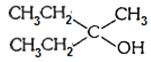
Give the $IUPAC$ name of the following compound:
A
$2-$ethyl$-2-$butanol
B
$3-$methyl$-3-$pentanol
C
$3-$ethyl$-3-$methyl$-2-$pentanol
D
$1,1-$dimethylbutanol
Solution
(B) $1$. Identify the longest carbon chain containing the functional group $(-OH)$. The longest chain has $5$ carbon atoms,so the parent alkane is pentane.
$2$. Number the chain from the end that gives the lowest number to the carbon attached to the $-OH$ group. Numbering from either side gives the $-OH$ group at position $3$.
$3$. The structure is $CH_3CH_2-C(CH_3)(OH)-CH_2CH_3$.
$4$. The longest chain is $5$ carbons long (pentane).
$5$. There is a methyl group at position $3$.
$6$. The $-OH$ group is at position $3$.
$7$. Therefore,the $IUPAC$ name is $3-$methylpentan$-3-$ol or $3-$methyl$-3-$pentanol.
$2$. Number the chain from the end that gives the lowest number to the carbon attached to the $-OH$ group. Numbering from either side gives the $-OH$ group at position $3$.
$3$. The structure is $CH_3CH_2-C(CH_3)(OH)-CH_2CH_3$.
$4$. The longest chain is $5$ carbons long (pentane).
$5$. There is a methyl group at position $3$.
$6$. The $-OH$ group is at position $3$.
$7$. Therefore,the $IUPAC$ name is $3-$methylpentan$-3-$ol or $3-$methyl$-3-$pentanol.
0 likes
View Solution26
MediumMCQ
What is the characteristic group of a secondary alcohol?
A
$-CH_2OH$
B
$-C(OH)_2-$
C
$>CHOH$
D
$>C(OH)_2$
Solution
(C) secondary alcohol is defined by the presence of a hydroxyl group $(-OH)$ attached to a carbon atom that is bonded to two other carbon atoms. The characteristic structural group is represented as $>CHOH$.
0 likes
View Solution27
MediumMCQ
Which of the following is a phenol?
A
Benzenol
B
Cresol
C
Catechol
D
All of the above
Solution
(D) Compounds in which the $OH$ group is directly attached to the benzene ring are called phenols.
Benzenol (phenol),cresol (methylphenol),and catechol (benzene$-1,2-$diol) all contain an $OH$ group attached to a benzene ring.
Therefore,all of the given compounds are phenols.
Benzenol (phenol),cresol (methylphenol),and catechol (benzene$-1,2-$diol) all contain an $OH$ group attached to a benzene ring.
Therefore,all of the given compounds are phenols.
0 likes
View Solution28
MediumMCQ
In phenols,
A
the $-OH$ group is attached to a side chain.
B
the $-OH$ group is directly attached to the benzene ring.
C
both $(A)$ and $(B)$.
D
none of these.
Solution
(B) Compounds in which the $-OH$ group is directly attached to the benzene ring are called phenols.
0 likes
View Solution29
MediumMCQ
What is cumene?
A
$o-$Methylphenol
B
$p-$Cresol
C
Isopropylbenzene
D
Phenyl $-n-$propane
Solution
(C) Cumene is the common name for $Isopropylbenzene$.
Its chemical structure consists of a benzene ring attached to an isopropyl group,represented as $C_6H_5CH(CH_3)_2$.
It is widely used as a precursor in the industrial production of phenol and acetone.
Its chemical structure consists of a benzene ring attached to an isopropyl group,represented as $C_6H_5CH(CH_3)_2$.
It is widely used as a precursor in the industrial production of phenol and acetone.
0 likes
View Solution30
MediumMCQ
Which of the following is known as carbolic acid?
A
Aqueous solution of phenol
B
Phenyl benzoate
C
Phenyl acetate
D
Salol
Solution
(A) $Phenol$ $(C_6H_5OH)$ is commonly known as carbolic acid. An aqueous solution of phenol is often referred to as carbolic acid.
0 likes
View Solution31
MediumMCQ
Which of the following is a dihydric alcohol?
A
Catechol
B
Resorcinol
C
Glycerol
D
Ethylene glycol
Solution
(D) dihydric alcohol is an alcohol that contains two hydroxyl $(-OH)$ groups.
Ethylene glycol,with the formula $HO-CH_2-CH_2-OH$,is a classic example of a dihydric alcohol.
Catechol and resorcinol are dihydric phenols,not alcohols.
Glycerol is a trihydric alcohol.
Ethylene glycol,with the formula $HO-CH_2-CH_2-OH$,is a classic example of a dihydric alcohol.
Catechol and resorcinol are dihydric phenols,not alcohols.
Glycerol is a trihydric alcohol.
0 likes
View Solution32
MediumMCQ
Alcohols are isomeric with which of the following?
A
Acids
B
Ethers
C
Esters
D
Aldehydes
Solution
(B) Alcohols and ethers with the same molecular formula are functional isomers of each other. For example,$CH_3CH_2OH$ (ethanol) and $CH_3OCH_3$ (dimethyl ether) both have the molecular formula $C_2H_6O$.
0 likes
View Solution33
MediumMCQ
How many ether isomers can be represented by the molecular formula $C_4H_{10}O$?
A
$4$
B
$3$
C
$2$
D
$1$
Solution
(B) The molecular formula $C_4H_{10}O$ corresponds to the following ether isomers:
$1$. $CH_3-O-CH_2CH_2CH_3$ (Methyl propyl ether)
$2$. $CH_3-O-CH(CH_3)_2$ (Methyl isopropyl ether)
$3$. $CH_3CH_2-O-CH_2CH_3$ (Diethyl ether)
Thus,there are $3$ possible ether isomers.
$1$. $CH_3-O-CH_2CH_2CH_3$ (Methyl propyl ether)
$2$. $CH_3-O-CH(CH_3)_2$ (Methyl isopropyl ether)
$3$. $CH_3CH_2-O-CH_2CH_3$ (Diethyl ether)
Thus,there are $3$ possible ether isomers.
0 likes
View Solution34
MediumMCQ
The general molecular formula,which represents the homologous series of alkanols is
A
$C_nH_{2n}O$
B
$C_nH_{2n}O_2$
C
$C_nH_{2n+2}O$
D
$C_nH_{2n+1}O$
Solution
(C) Alkanols are derivatives of alkanes,formed by replacing one hydrogen atom $(-H)$ of an alkane with a hydroxyl group $(-OH)$.
The general formula for alkanes is $C_nH_{2n+2}$.
Replacing one $H$ with $OH$ gives $C_nH_{2n+1}OH$,which simplifies to $C_nH_{2n+2}O$.
Therefore,the general molecular formula for the homologous series of alkanols is $C_nH_{2n+2}O$.
The general formula for alkanes is $C_nH_{2n+2}$.
Replacing one $H$ with $OH$ gives $C_nH_{2n+1}OH$,which simplifies to $C_nH_{2n+2}O$.
Therefore,the general molecular formula for the homologous series of alkanols is $C_nH_{2n+2}O$.
0 likes
View Solution35
MediumMCQ
The general molecular formula,which represents the homologous series of alkanols is
A
$C_nH_{2n+2}O$
B
$C_nH_{2n}O_2$
C
$C_nH_{2n}O$
D
$C_nH_{2n+1}O$
Solution
(A) Alkanols (alcohols) are derivatives of alkanes where one hydrogen atom is replaced by a hydroxyl $(-OH)$ group.
The general formula for an alkane is $C_nH_{2n+2}$.
Replacing one $H$ with $OH$ gives $C_nH_{2n+1}OH$,which simplifies to $C_nH_{2n+2}O$.
Thus,the correct general molecular formula is $C_nH_{2n+2}O$.
The general formula for an alkane is $C_nH_{2n+2}$.
Replacing one $H$ with $OH$ gives $C_nH_{2n+1}OH$,which simplifies to $C_nH_{2n+2}O$.
Thus,the correct general molecular formula is $C_nH_{2n+2}O$.
0 likes
View Solution36
MediumMCQ
Consider the structures $(a)$ and $(b)$ provided. Which of the following is a true statement regarding these compounds?
A
$(a)$ is a phenol while $(b)$ is an alcohol.
B
Both $(a)$ and $(b)$ are primary alcohols.
C
$(a)$ is a primary alcohol and $(b)$ is a secondary alcohol.
D
$(a)$ is a secondary alcohol and $(b)$ is a primary alcohol.
Solution
(D) In structure $(a)$,the $-OH$ group is attached to a carbon atom that is bonded to two other carbon atoms,making it a secondary alcohol.
In structure $(b)$,the $-OH$ group is attached to a carbon atom that is bonded to only one other carbon atom,making it a primary alcohol.
Therefore,$(a)$ is a secondary alcohol and $(b)$ is a primary alcohol.
In structure $(b)$,the $-OH$ group is attached to a carbon atom that is bonded to only one other carbon atom,making it a primary alcohol.
Therefore,$(a)$ is a secondary alcohol and $(b)$ is a primary alcohol.
0 likes
View Solution37
MediumMCQ
Which of the following epoxides will always undergo $S_N2$ mechanism in both acidic and basic conditions?
A
$CH_3-O-CH_3$
B
$C_6H_5-O-CH_3$
C
$CH_3-CH-CH_2-O$ (epoxide ring)
D
All of these
Solution
(C) The question refers to epoxides,which are cyclic ethers.
Epoxides undergo ring-opening reactions via the $S_N2$ mechanism.
In basic conditions,the nucleophile attacks the less sterically hindered carbon atom of the epoxide ring via $S_N2$.
In acidic conditions,the oxygen atom is protonated,which increases the electrophilicity of the ring carbons. Even in acidic conditions,the reaction proceeds via an $S_N2$-like mechanism where the nucleophile attacks the more substituted carbon if it has significant carbocation character,or the less substituted carbon due to steric factors.
However,for simple epoxides like propylene oxide $(CH_3-CH-CH_2-O)$,the $S_N2$ pathway is dominant in both conditions.
The options $A$ and $B$ are simple ethers,not epoxides,and do not typically undergo ring-opening $S_N2$ reactions.
Therefore,the epoxide structure provided in option $C$ is the correct answer.
Epoxides undergo ring-opening reactions via the $S_N2$ mechanism.
In basic conditions,the nucleophile attacks the less sterically hindered carbon atom of the epoxide ring via $S_N2$.
In acidic conditions,the oxygen atom is protonated,which increases the electrophilicity of the ring carbons. Even in acidic conditions,the reaction proceeds via an $S_N2$-like mechanism where the nucleophile attacks the more substituted carbon if it has significant carbocation character,or the less substituted carbon due to steric factors.
However,for simple epoxides like propylene oxide $(CH_3-CH-CH_2-O)$,the $S_N2$ pathway is dominant in both conditions.
The options $A$ and $B$ are simple ethers,not epoxides,and do not typically undergo ring-opening $S_N2$ reactions.
Therefore,the epoxide structure provided in option $C$ is the correct answer.
0 likes
View Solution38
MediumMCQ
The $IUPAC$ name of the given compound is:

A
$1,3-$ Dimethylphenol
B
$1-$ Hydroxy $-2,6-$ dimethylbenzene
C
$2,6-$ Dimethylphenol
D
$2-$ Hydroxy $-1,3-$ dimethylbenzene
Solution
(C) $1$. Identify the principal functional group: The $-OH$ group attached to the benzene ring makes it a phenol,which is the parent compound.
$2$. Number the ring: The carbon atom attached to the $-OH$ group is assigned position $1$.
$3$. Number the substituents: The two methyl groups are at positions $2$ and $6$.
$4$. Combine: The name is $2,6-$ dimethylphenol.
$2$. Number the ring: The carbon atom attached to the $-OH$ group is assigned position $1$.
$3$. Number the substituents: The two methyl groups are at positions $2$ and $6$.
$4$. Combine: The name is $2,6-$ dimethylphenol.
0 likes
View Solution39
EasyMCQ
How many sigma $(\sigma)$ bonds are in a molecule of diethyl ether,$C_2H_5OC_2H_5$?
A
$14$
B
$12$
C
$8$
D
$16$
Solution
(A) The structural formula of diethyl ether $(C_2H_5OC_2H_5)$ is $CH_3-CH_2-O-CH_2-CH_3$.
To count the total number of $\sigma$-bonds,we count all single bonds in the molecule:
- There are $10$ $C-H$ bonds.
- There are $2$ $C-C$ bonds.
- There are $2$ $C-O$ bonds.
Total number of $\sigma$-bonds = $10 + 2 + 2 = 14$.
To count the total number of $\sigma$-bonds,we count all single bonds in the molecule:
- There are $10$ $C-H$ bonds.
- There are $2$ $C-C$ bonds.
- There are $2$ $C-O$ bonds.
Total number of $\sigma$-bonds = $10 + 2 + 2 = 14$.
0 likes
View Solution40
DifficultMCQ
Grignard reagent cannot be prepared in an aqueous solution but can be prepared in an ether medium because .............
A
The reagent is highly reactive in ether medium
B
The reagent does not react with water
C
The reagent becomes inactive in water
D
The reagent reacts with water
Solution
(D) Grignard reagents $(R-Mg-X)$ are organometallic compounds that are highly reactive towards protic sources like water $(H_2O)$,alcohols $(R-OH)$,or acids $(R-COOH)$.
When a Grignard reagent reacts with water,it undergoes a rapid acid-base reaction to form an alkane $(R-H)$ and a metal hydroxide halide $(Mg(OH)X)$.
The reaction is: $R-Mg-X + H_2O \rightarrow R-H + Mg(OH)X$.
Therefore,the presence of water destroys the Grignard reagent,making ether an essential non-protic solvent for its preparation.
When a Grignard reagent reacts with water,it undergoes a rapid acid-base reaction to form an alkane $(R-H)$ and a metal hydroxide halide $(Mg(OH)X)$.
The reaction is: $R-Mg-X + H_2O \rightarrow R-H + Mg(OH)X$.
Therefore,the presence of water destroys the Grignard reagent,making ether an essential non-protic solvent for its preparation.
0 likes
View Solution41
DifficultMCQ
What is cumene?
A
Isopropylbenzene
B
$p-$Cresol
C
$o-$Methylphenol
D
$n-$Propylbenzene
Solution
(A) Cumene is the common name for $Isopropylbenzene$.
Its chemical structure is $C_6H_5CH(CH_3)_2$.
It is an important intermediate in the industrial production of phenol and acetone.
Its chemical structure is $C_6H_5CH(CH_3)_2$.
It is an important intermediate in the industrial production of phenol and acetone.
0 likes
View Solution42
Medium
Classify the following as primary,secondary,and tertiary alcohols:
$(i)$ $CH_3-C(CH_3)_2-CH_2OH$
$(ii)$ $CH_2=CH-CH_2OH$
$(iii)$ $CH_3-CH_2-CH_2-OH$
$(iv)$ $C_6H_5-CH(OH)-CH_3$
$(v)$ $C_6H_5-CH_2-CH(OH)-CH_3$
$(vi)$ $C_6H_5-CH=CH-C(OH)(CH_3)_2$
$(i)$ $CH_3-C(CH_3)_2-CH_2OH$
$(ii)$ $CH_2=CH-CH_2OH$
$(iii)$ $CH_3-CH_2-CH_2-OH$
$(iv)$ $C_6H_5-CH(OH)-CH_3$
$(v)$ $C_6H_5-CH_2-CH(OH)-CH_3$
$(vi)$ $C_6H_5-CH=CH-C(OH)(CH_3)_2$
Solution
(N/A) To classify alcohols,we look at the carbon atom to which the $-OH$ group is attached:
$1$. Primary $(1^{\circ})$ alcohol: The $-OH$ group is attached to a carbon atom bonded to only one other carbon atom.
- $(i)$ $CH_3-C(CH_3)_2-CH_2OH$: The $-CH_2OH$ carbon is attached to one quaternary carbon.
- $(ii)$ $CH_2=CH-CH_2OH$: The $-CH_2OH$ carbon is attached to one $sp^2$ hybridized carbon.
- $(iii)$ $CH_3-CH_2-CH_2-OH$: The $-CH_2OH$ carbon is attached to one primary carbon.
$2$. Secondary $(2^{\circ})$ alcohol: The $-OH$ group is attached to a carbon atom bonded to two other carbon atoms.
- $(iv)$ $C_6H_5-CH(OH)-CH_3$: The $-CH(OH)-$ carbon is attached to a phenyl group and a methyl group.
- $(v)$ $C_6H_5-CH_2-CH(OH)-CH_3$: The $-CH(OH)-$ carbon is attached to a $-CH_2C_6H_5$ group and a methyl group.
$3$. Tertiary $(3^{\circ})$ alcohol: The $-OH$ group is attached to a carbon atom bonded to three other carbon atoms.
- $(vi)$ $C_6H_5-CH=CH-C(OH)(CH_3)_2$: The $-C(OH)-$ carbon is attached to two methyl groups and one alkenyl group.
$1$. Primary $(1^{\circ})$ alcohol: The $-OH$ group is attached to a carbon atom bonded to only one other carbon atom.
- $(i)$ $CH_3-C(CH_3)_2-CH_2OH$: The $-CH_2OH$ carbon is attached to one quaternary carbon.
- $(ii)$ $CH_2=CH-CH_2OH$: The $-CH_2OH$ carbon is attached to one $sp^2$ hybridized carbon.
- $(iii)$ $CH_3-CH_2-CH_2-OH$: The $-CH_2OH$ carbon is attached to one primary carbon.
$2$. Secondary $(2^{\circ})$ alcohol: The $-OH$ group is attached to a carbon atom bonded to two other carbon atoms.
- $(iv)$ $C_6H_5-CH(OH)-CH_3$: The $-CH(OH)-$ carbon is attached to a phenyl group and a methyl group.
- $(v)$ $C_6H_5-CH_2-CH(OH)-CH_3$: The $-CH(OH)-$ carbon is attached to a $-CH_2C_6H_5$ group and a methyl group.
$3$. Tertiary $(3^{\circ})$ alcohol: The $-OH$ group is attached to a carbon atom bonded to three other carbon atoms.
- $(vi)$ $C_6H_5-CH=CH-C(OH)(CH_3)_2$: The $-C(OH)-$ carbon is attached to two methyl groups and one alkenyl group.
0 likes
View Solution43
Medium
Identify allylic alcohols in the given examples.
Solution
(B) An allylic alcohol is an alcohol in which the hydroxyl group $(-OH)$ is attached to a carbon atom that is adjacent to a carbon-carbon double bond $(C=C)$.
Based on the structural definitions,the alcohols identified as $(ii)$ and $(vi)$ contain the $-OH$ group attached to an $sp^3$ hybridized carbon atom next to a $C=C$ double bond,thus they are classified as allylic alcohols.
Based on the structural definitions,the alcohols identified as $(ii)$ and $(vi)$ contain the $-OH$ group attached to an $sp^3$ hybridized carbon atom next to a $C=C$ double bond,thus they are classified as allylic alcohols.
0 likes
View Solution44
Difficult
Write $IUPAC$ names of the following compounds:
$(i)$ $CH_3-CH(CH_3)-CH(OH)-C(CH_3)_2-CH_3$
$(ii)$ $CH_3-CH(OH)-CH_2-CH(OH)-CH(C_2H_5)-CH_2-CH_3$
$(iii)$ $CH_3-CH(OH)-CH(OH)-CH_3$
$(iv)$ $HO-CH_2-CH(OH)-CH_2-OH$
$(v)$ $2-Methylphenol$ (structure)
$(vi)$ $4-Methylphenol$ (structure)
$(vii)$ $2,5-Dimethylphenol$ (structure)
$(viii)$ $2,6-Dimethylphenol$ (structure)
$(ix)$ $CH_3-O-CH_2-CH(CH_3)-CH_3$
$(x)$ $C_6H_5-O-C_2H_5$
$(xi)$ $C_6H_5-O-C_7H_{15}(n-)$
$(xii)$ $CH_3-CH_2-O-CH(CH_3)-CH_2-CH_3$
$(i)$ $CH_3-CH(CH_3)-CH(OH)-C(CH_3)_2-CH_3$
$(ii)$ $CH_3-CH(OH)-CH_2-CH(OH)-CH(C_2H_5)-CH_2-CH_3$
$(iii)$ $CH_3-CH(OH)-CH(OH)-CH_3$
$(iv)$ $HO-CH_2-CH(OH)-CH_2-OH$
$(v)$ $2-Methylphenol$ (structure)
$(vi)$ $4-Methylphenol$ (structure)
$(vii)$ $2,5-Dimethylphenol$ (structure)
$(viii)$ $2,6-Dimethylphenol$ (structure)
$(ix)$ $CH_3-O-CH_2-CH(CH_3)-CH_3$
$(x)$ $C_6H_5-O-C_2H_5$
$(xi)$ $C_6H_5-O-C_7H_{15}(n-)$
$(xii)$ $CH_3-CH_2-O-CH(CH_3)-CH_2-CH_3$
Solution
(A) $(i)$ $2,2,4-Trimethylpentan-3-ol$
$(ii)$ $5-Ethylheptane-2,4-diol$
$(iii)$ $Butane-2,3-diol$
$(iv)$ $Propane-1,2,3-triol$
$(v)$ $2-Methylphenol$
$(vi)$ $4-Methylphenol$
$(vii)$ $2,5-Dimethylphenol$
$(viii)$ $2,6-Dimethylphenol$
$(ix)$ $1-Methoxy-2-methylpropane$
$(x)$ $Ethoxybenzene$
$(xi)$ $1-Phenoxyheptane$
$(xii)$ $2-Ethoxybutane$
$(ii)$ $5-Ethylheptane-2,4-diol$
$(iii)$ $Butane-2,3-diol$
$(iv)$ $Propane-1,2,3-triol$
$(v)$ $2-Methylphenol$
$(vi)$ $4-Methylphenol$
$(vii)$ $2,5-Dimethylphenol$
$(viii)$ $2,6-Dimethylphenol$
$(ix)$ $1-Methoxy-2-methylpropane$
$(x)$ $Ethoxybenzene$
$(xi)$ $1-Phenoxyheptane$
$(xii)$ $2-Ethoxybutane$
0 likes
View Solution45
Difficult
Write structures of the compounds whose $IUPAC$ names are as follows:
$(i)$ $2-$Methylbutan$-2-$ol
$(ii)$ $1-$Phenylpropan$-2-$ol
$(iii)$ $3,5-$Dimethylhexane$-1,3,5-$triol
$(iv)$ $2,3-$Diethylphenol
$(v)$ $1-$Ethoxypropane
$(vi)$ $2-$Ethoxy$-3-$methylpentane
$(vii)$ Cyclohexylmethanol
$(viii)$ $3-$Cyclohexylpentan$-3-$ol
$(ix)$ Cyclopent$-3-$en$-1-$ol
$(x)$ $4-$Chloro$-3-$ethylbutan$-1-$ol.
$(i)$ $2-$Methylbutan$-2-$ol
$(ii)$ $1-$Phenylpropan$-2-$ol
$(iii)$ $3,5-$Dimethylhexane$-1,3,5-$triol
$(iv)$ $2,3-$Diethylphenol
$(v)$ $1-$Ethoxypropane
$(vi)$ $2-$Ethoxy$-3-$methylpentane
$(vii)$ Cyclohexylmethanol
$(viii)$ $3-$Cyclohexylpentan$-3-$ol
$(ix)$ Cyclopent$-3-$en$-1-$ol
$(x)$ $4-$Chloro$-3-$ethylbutan$-1-$ol.
Solution
(N/A) $(i)$ $CH_3-C(OH)(CH_3)-CH_2-CH_3$
$(ii)$ $C_6H_5-CH_2-CH(OH)-CH_3$
$(iii)$ $HO-CH_2-CH_2-C(OH)(CH_3)-CH_2-C(OH)(CH_3)-CH_3$
$(iv)$ $2,3-$Diethylphenol structure with $-OH$ at position $1$ and $-C_2H_5$ groups at positions $2$ and $3$ on the benzene ring.
$(v)$ $CH_3-CH_2-O-CH_2-CH_2-CH_3$
$(vi)$ $CH_3-CH_2-O-CH(CH_3)-CH(CH_3)-CH_2-CH_3$
$(vii)$ Cyclohexane ring attached to $-CH_2OH$
$(viii)$ $CH_3-CH_2-C(OH)(C_6H_{11})-CH_2-CH_3$
$(ix)$ Cyclopentene ring with $-OH$ at position $1$ and double bond at position $3$
$(x)$ $Cl-CH_2-CH_2-CH(C_2H_5)-CH_2-OH$
$(ii)$ $C_6H_5-CH_2-CH(OH)-CH_3$
$(iii)$ $HO-CH_2-CH_2-C(OH)(CH_3)-CH_2-C(OH)(CH_3)-CH_3$
$(iv)$ $2,3-$Diethylphenol structure with $-OH$ at position $1$ and $-C_2H_5$ groups at positions $2$ and $3$ on the benzene ring.
$(v)$ $CH_3-CH_2-O-CH_2-CH_2-CH_3$
$(vi)$ $CH_3-CH_2-O-CH(CH_3)-CH(CH_3)-CH_2-CH_3$
$(vii)$ Cyclohexane ring attached to $-CH_2OH$
$(viii)$ $CH_3-CH_2-C(OH)(C_6H_{11})-CH_2-CH_3$
$(ix)$ Cyclopentene ring with $-OH$ at position $1$ and double bond at position $3$
$(x)$ $Cl-CH_2-CH_2-CH(C_2H_5)-CH_2-OH$
0 likes
View Solution46
Medium
What are alcohols,phenols,and ethers?
Solution
(N/A) Alcohols and phenols are formed by the replacement of a hydrogen atom in an aliphatic and aromatic hydrocarbon,respectively,by a hydroxyl $(-OH)$ group.
Ethers are formed by the replacement of the hydrogen atom in a hydrocarbon by an alkoxy or aryloxy group. Alternatively,ethers can be visualized as the replacement of the hydrogen atom of the $-OH$ group of an alcohol or phenol by an alkyl or aryl group.
Alcohols contain one or more than one $-OH$ group$(s)$ bonded directly to carbon atom$(s)$ of an aliphatic system (e.g.,$CH_3OH$).
Phenols contain one or more than one $-OH$ group$(s)$ bonded directly to the $sp^2$ hybridized carbon of an aromatic system (e.g.,$C_6H_5OH$).
Applications:
Ethanol is used for polishing wooden furniture and is commonly known as ordinary spirit.
Many essential compounds like sugar,cotton in fabrics,and paper are made of compounds containing $-OH$ groups.
Ethers are formed by the replacement of the hydrogen atom in a hydrocarbon by an alkoxy or aryloxy group. Alternatively,ethers can be visualized as the replacement of the hydrogen atom of the $-OH$ group of an alcohol or phenol by an alkyl or aryl group.
Alcohols contain one or more than one $-OH$ group$(s)$ bonded directly to carbon atom$(s)$ of an aliphatic system (e.g.,$CH_3OH$).
Phenols contain one or more than one $-OH$ group$(s)$ bonded directly to the $sp^2$ hybridized carbon of an aromatic system (e.g.,$C_6H_5OH$).
Applications:
Ethanol is used for polishing wooden furniture and is commonly known as ordinary spirit.
Many essential compounds like sugar,cotton in fabrics,and paper are made of compounds containing $-OH$ groups.
0 likes
View Solution47
Medium
Explain the classification of alcohols with examples.
Solution
(N/A) Alcohols and phenols can be classified as mono-,di-,tri-,or polyhydric compounds depending on whether they contain one,two,three,or many hydroxyl $(-OH)$ groups respectively in their structures.
$1$. Monohydric alcohols: Contain one $-OH$ group. Example: Ethanol $(C_2H_5OH)$.
$2$. Dihydric alcohols: Contain two $-OH$ groups. Example: Ethane-$1,2$-diol $(CH_2OH-CH_2OH)$.
$3$. Trihydric alcohols: Contain three $-OH$ groups. Example: Propane-$1,2,3$-triol $(CH_2OH-CHOH-CH_2OH)$.
$1$. Monohydric alcohols: Contain one $-OH$ group. Example: Ethanol $(C_2H_5OH)$.
$2$. Dihydric alcohols: Contain two $-OH$ groups. Example: Ethane-$1,2$-diol $(CH_2OH-CH_2OH)$.
$3$. Trihydric alcohols: Contain three $-OH$ groups. Example: Propane-$1,2,3$-triol $(CH_2OH-CHOH-CH_2OH)$.
0 likes
View Solution48
Medium
Give the classification of ethers with examples.
Solution
(N/A) Ethers are classified into two main categories based on the nature of the alkyl or aryl groups attached to the oxygen atom:
$1$. Symmetrical Ethers (Simple Ethers): In these ethers,the two alkyl or aryl groups attached to the oxygen atom are the same. For example,$CH_3-O-CH_3$ (Dimethyl ether) and $C_6H_5-O-C_6H_5$ (Diphenyl ether).
$2$. Unsymmetrical Ethers (Mixed Ethers): In these ethers,the two alkyl or aryl groups attached to the oxygen atom are different. For example,$CH_3-O-C_2H_5$ (Ethyl methyl ether) and $CH_3-O-C_6H_5$ (Methyl phenyl ether or Anisole).
$1$. Symmetrical Ethers (Simple Ethers): In these ethers,the two alkyl or aryl groups attached to the oxygen atom are the same. For example,$CH_3-O-CH_3$ (Dimethyl ether) and $C_6H_5-O-C_6H_5$ (Diphenyl ether).
$2$. Unsymmetrical Ethers (Mixed Ethers): In these ethers,the two alkyl or aryl groups attached to the oxygen atom are different. For example,$CH_3-O-C_2H_5$ (Ethyl methyl ether) and $CH_3-O-C_6H_5$ (Methyl phenyl ether or Anisole).
0 likes
View Solution49
Medium
Explain the common and $IUPAC$ nomenclature of alcohol compounds with examples.
Solution
(N/A) Common name of alcohol: To write the common name of alcohols,the name of the alkyl group attached to the hydroxyl group is written,followed by the word 'alcohol'.
$(b)$ $IUPAC$ nomenclature of alcohols:
$(i)$ Monohydric alcohols: In the $IUPAC$ system,the name of a monohydric alcohol is derived from the corresponding alkane by replacing the terminal $'e'$ with the suffix $'-ol'$.
$\Rightarrow$ The position of substituents is indicated by numbers $(1, 2, . . .)$.
$\Rightarrow$ The longest carbon chain (parent chain) is numbered starting from the end that gives the lowest possible number to the carbon atom attached to the hydroxyl group.
$\Rightarrow$ The positions of the $-OH$ group and other substituents are indicated by the numbers of the carbon atoms to which they are attached.
$(ii)$ Polyhydric alcohols: For $IUPAC$ names of polyhydric alcohols,the terminal $'e'$ of the alkane name is retained,and the suffix $'-ol'$ is added. The number of $-OH$ groups is indicated by prefixes like 'di','tri',etc.,before the suffix 'ol'.
Example: $CH_2OH-CH_2OH$ (Ethane-$1,2$-diol),$CH_2OH-CHOH-CH_2OH$ (Propane-$1,2,3$-triol).
$(b)$ $IUPAC$ nomenclature of alcohols:
$(i)$ Monohydric alcohols: In the $IUPAC$ system,the name of a monohydric alcohol is derived from the corresponding alkane by replacing the terminal $'e'$ with the suffix $'-ol'$.
$\Rightarrow$ The position of substituents is indicated by numbers $(1, 2, . . .)$.
$\Rightarrow$ The longest carbon chain (parent chain) is numbered starting from the end that gives the lowest possible number to the carbon atom attached to the hydroxyl group.
$\Rightarrow$ The positions of the $-OH$ group and other substituents are indicated by the numbers of the carbon atoms to which they are attached.
$(ii)$ Polyhydric alcohols: For $IUPAC$ names of polyhydric alcohols,the terminal $'e'$ of the alkane name is retained,and the suffix $'-ol'$ is added. The number of $-OH$ groups is indicated by prefixes like 'di','tri',etc.,before the suffix 'ol'.
Example: $CH_2OH-CH_2OH$ (Ethane-$1,2$-diol),$CH_2OH-CHOH-CH_2OH$ (Propane-$1,2,3$-triol).
0 likes
View Solution50
Medium
Provide the common and $\text{IUPAC}$ names for the following alcohols:
$(i) \ CH_3OH$
$(ii) \ CH_3CH_2CH_2OH$
$(iii) \ CH_3CH(OH)CH_3$
$(iv) \ CH_3CH_2CH_2CH_2OH$
$(v) \ CH_3CH(OH)CH_2CH_3$
$(vi) \ (CH_3)_2CHCH_2OH$
$(vii) \ (CH_3)_3C-OH$
$(viii) \ HOCH_2CH_2OH$
$(ix) \ CH_2OHCH(OH)CH_2OH$
$(x) \ CH_3CH_2OH$
$(i) \ CH_3OH$
$(ii) \ CH_3CH_2CH_2OH$
$(iii) \ CH_3CH(OH)CH_3$
$(iv) \ CH_3CH_2CH_2CH_2OH$
$(v) \ CH_3CH(OH)CH_2CH_3$
$(vi) \ (CH_3)_2CHCH_2OH$
$(vii) \ (CH_3)_3C-OH$
$(viii) \ HOCH_2CH_2OH$
$(ix) \ CH_2OHCH(OH)CH_2OH$
$(x) \ CH_3CH_2OH$
Solution
(N/A) The common and $\text{IUPAC}$ names are provided in the table below:
| No. | Compound | Common Name | $\text{IUPAC}$ Name |
| :--- | :--- | :--- | :--- |
| $(i)$ | $CH_3OH$ | Methyl alcohol | Methanol |
| $(ii)$ | $CH_3CH_2CH_2OH$ | $n$-Propyl alcohol | Propan$-1-$ol |
| $(iii)$ | $CH_3CH(OH)CH_3$ | Isopropyl alcohol | Propan$-2-$ol |
| $(iv)$ | $CH_3CH_2CH_2CH_2OH$ | $n$-Butyl alcohol | Butan$-1-$ol |
| $(v)$ | $CH_3CH(OH)CH_2CH_3$ | sec-Butyl alcohol | Butan$-2-$ol |
| $(vi)$ | $(CH_3)_2CHCH_2OH$ | Isobutyl alcohol | $2-$Methylpropan$-1-$ol |
| $(vii)$ | $(CH_3)_3C-OH$ | tert-Butyl alcohol | $2-$Methylpropan$-2-$ol |
| $(viii)$ | $HOCH_2CH_2OH$ | Ethylene glycol | Ethane$-1,2-$diol |
| $(ix)$ | $CH_2OHCH(OH)CH_2OH$ | Glycerol (Glycerin) | Propane$-1,2,3-$triol |
| $(x)$ | $CH_3CH_2OH$ | Ethyl alcohol | Ethanol |
| No. | Compound | Common Name | $\text{IUPAC}$ Name |
| :--- | :--- | :--- | :--- |
| $(i)$ | $CH_3OH$ | Methyl alcohol | Methanol |
| $(ii)$ | $CH_3CH_2CH_2OH$ | $n$-Propyl alcohol | Propan$-1-$ol |
| $(iii)$ | $CH_3CH(OH)CH_3$ | Isopropyl alcohol | Propan$-2-$ol |
| $(iv)$ | $CH_3CH_2CH_2CH_2OH$ | $n$-Butyl alcohol | Butan$-1-$ol |
| $(v)$ | $CH_3CH(OH)CH_2CH_3$ | sec-Butyl alcohol | Butan$-2-$ol |
| $(vi)$ | $(CH_3)_2CHCH_2OH$ | Isobutyl alcohol | $2-$Methylpropan$-1-$ol |
| $(vii)$ | $(CH_3)_3C-OH$ | tert-Butyl alcohol | $2-$Methylpropan$-2-$ol |
| $(viii)$ | $HOCH_2CH_2OH$ | Ethylene glycol | Ethane$-1,2-$diol |
| $(ix)$ | $CH_2OHCH(OH)CH_2OH$ | Glycerol (Glycerin) | Propane$-1,2,3-$triol |
| $(x)$ | $CH_3CH_2OH$ | Ethyl alcohol | Ethanol |
0 likes
View SolutionAlcohols, Phenols and Ethers — General introduction of alcohol, Phenol and Ethers · Frequently Asked Questions
1Are these Alcohols, Phenols and Ethers questions useful for JEE and NEET?
Yes. All questions in this section are mapped to JEE Main and NEET exam patterns. Previous year questions from JEE Main, NEET, GUJCET and state-level exams are included with full solutions.
2Can I switch to Hindi or Gujarati for these questions?
Yes. Use the language tabs in the hero section or the sidebar to view the same questions and solutions in English, Hindi or Gujarati.
3How do I generate a question paper from this subtopic?
Use the Vedclass Exam Paper Generator — select the chapter and subtopic, set difficulty, and generate Sets A, B, C, D automatically. First 3 chapters of every subject are free.
Vedclass Products
For Students
Vedclass Test Series
Mock tests in real JEE/NEET style with performance analysis. 5-day free trial.
Start Free TrialFor Teachers
Exam Paper Generator
Generate Set A/B/C/D papers from this chapter in 2 minutes. 3 chapters free.
Try FreeFor Institutes
Online Exam Module
Live online exams with unlimited students, 360° analytics & white-label branding.
See DemoFor Teachers & Institutes
Generate a Alcohols, Phenols and Ethers Exam Paper in 2 Minutes
Select subtopic & difficulty — Sets A, B, C, D auto-generated with No Repeat logic.
First 3 chapters of every subject are free — no payment required.