
A English
Properties of Ethers Questions in English
Class 12 Chemistry · Alcohols, Phenols and Ethers · Properties of Ethers
343+
Questions
English
Language
100%
With Solutions
Showing 50 of 343 questions in English
1
MediumMCQ
Diethyl ether and methyl $n$-propyl ether are:
A
Position isomers
B
Functional isomers
C
Metamers
D
Chain isomers
Solution
(C) The chemical formulas for the given ethers are:
Diethyl ether: $C_2H_5-O-C_2H_5$
Methyl $n$-propyl ether: $CH_3-O-C_3H_7$
Metamerism arises due to the difference in the distribution of carbon atoms on either side of the functional group $(-O-)$.
Since the alkyl groups attached to the oxygen atom are different in the two compounds,they are metamers.
Diethyl ether: $C_2H_5-O-C_2H_5$
Methyl $n$-propyl ether: $CH_3-O-C_3H_7$
Metamerism arises due to the difference in the distribution of carbon atoms on either side of the functional group $(-O-)$.
Since the alkyl groups attached to the oxygen atom are different in the two compounds,they are metamers.
0 likes
View Solution2
DifficultMCQ
On heating diethyl ether with conc. $HI$,$2$ moles of which of the following is formed?
A
Ethanol
B
Iodoform
C
Ethyl iodide
D
Methyl iodide
Solution
(C) When diethyl ether $(C_2H_5-O-C_2H_5)$ is heated with excess concentrated $HI$,it undergoes cleavage to form $2$ moles of ethyl iodide $(C_2H_5I)$ and $1$ mole of water $(H_2O)$.
The reaction is: $C_2H_5-O-C_2H_5 + 2HI \to 2C_2H_5I + H_2O$.
The reaction is: $C_2H_5-O-C_2H_5 + 2HI \to 2C_2H_5I + H_2O$.
0 likes
View Solution3
DifficultMCQ
In the given reaction,the product is:
$C_6H_5OH + C_2H_5I \xrightarrow{C_2H_5O^- / C_2H_5OH} \text{Product}$
$C_6H_5OH + C_2H_5I \xrightarrow{C_2H_5O^- / C_2H_5OH} \text{Product}$
A
$C_2H_5OC_2H_5$
B
$C_6H_5OC_2H_5$
C
$C_6H_5OC_6H_5$
D
$C_6H_5I$
Solution
(B) The reaction involves the nucleophilic substitution of ethyl iodide $(C_2H_5I)$ by the phenoxide ion $(C_6H_5O^-)$.
$1$. Phenol $(C_6H_5OH)$ reacts with the ethoxide ion $(C_2H_5O^-)$ in ethanol to form the phenoxide ion $(C_6H_5O^-)$.
$2$. The phenoxide ion acts as a nucleophile and attacks the ethyl iodide $(C_2H_5I)$ via an $S_N2$ mechanism.
$3$. The reaction is: $C_6H_5O^- + C_2H_5I \rightarrow C_6H_5OC_2H_5 + I^-$.
$4$. The product formed is ethyl phenyl ether $(C_6H_5OC_2H_5)$,also known as phenetole.
$1$. Phenol $(C_6H_5OH)$ reacts with the ethoxide ion $(C_2H_5O^-)$ in ethanol to form the phenoxide ion $(C_6H_5O^-)$.
$2$. The phenoxide ion acts as a nucleophile and attacks the ethyl iodide $(C_2H_5I)$ via an $S_N2$ mechanism.
$3$. The reaction is: $C_6H_5O^- + C_2H_5I \rightarrow C_6H_5OC_2H_5 + I^-$.
$4$. The product formed is ethyl phenyl ether $(C_6H_5OC_2H_5)$,also known as phenetole.
0 likes
View Solution4
DifficultMCQ
When alkyl halide is heated with dry $Ag_2O$,it produces
A
Ester
B
Ether
C
Ketone
D
Alcohol
Solution
(B) Alkyl halides react with dry silver oxide $(Ag_2O)$ to form ethers.
The general reaction is: $2R-X + Ag_2O \xrightarrow{\Delta} R-O-R + 2AgX$.
For example,when methyl chloride reacts with dry $Ag_2O$: $2CH_3Cl + Ag_2O \xrightarrow{\Delta} CH_3OCH_3 + 2AgCl$ (methoxy methane).
The general reaction is: $2R-X + Ag_2O \xrightarrow{\Delta} R-O-R + 2AgX$.
For example,when methyl chloride reacts with dry $Ag_2O$: $2CH_3Cl + Ag_2O \xrightarrow{\Delta} CH_3OCH_3 + 2AgCl$ (methoxy methane).
0 likes
View Solution5
MediumMCQ
The oxygen atom in an ether is:
A
Very active
B
Replaceable
C
Comparatively inert
D
Active
Solution
(C) Ethers are represented by the general formula $R-O-R'$. The oxygen atom in ethers is bonded to two alkyl or aryl groups. Due to the stability of the $C-O$ bond and the lack of a reactive functional group like the hydroxyl group in alcohols,the oxygen atom in ethers is comparatively inert towards most reagents under normal conditions.
0 likes
View Solution6
EasyMCQ
Which of the following does not contain an acyl group?
A
Acid chloride
B
Amide
C
Ester
D
Ether
Solution
(D) An acyl group has the general formula $RCO-$.
$1$. Acid chloride: $RCOCl$ (contains $RCO-$ group).
$2$. Amide: $RCONH_2$ (contains $RCO-$ group).
$3$. Ester: $RCOOR'$ (contains $RCO-$ group).
$4$. Ether: $ROR'$ (does not contain $RCO-$ group).
Therefore,ether does not contain an acyl group.
$1$. Acid chloride: $RCOCl$ (contains $RCO-$ group).
$2$. Amide: $RCONH_2$ (contains $RCO-$ group).
$3$. Ester: $RCOOR'$ (contains $RCO-$ group).
$4$. Ether: $ROR'$ (does not contain $RCO-$ group).
Therefore,ether does not contain an acyl group.
0 likes
View Solution7
MediumMCQ
In ethers,the $C-O-C$ bond angle is ........ $^{\circ}$
A
$180$
B
$90$
C
$110$
D
$160$
Solution
(C) The oxygen atom in ether is $sp^3$ hybridized,which typically results in a tetrahedral geometry with a bond angle of $109^{\circ} 28^{\prime}$.
In ethers,the two lone pairs on the oxygen atom exert repulsion on the bond pairs,which would normally decrease the bond angle.
However,the presence of bulky alkyl groups attached to the oxygen atom causes steric repulsion between them.
This steric repulsion between the alkyl groups counterbalances the lone pair-bond pair repulsion,resulting in a $C-O-C$ bond angle that is slightly larger than the tetrahedral angle,approximately $110^{\circ}$.
In ethers,the two lone pairs on the oxygen atom exert repulsion on the bond pairs,which would normally decrease the bond angle.
However,the presence of bulky alkyl groups attached to the oxygen atom causes steric repulsion between them.
This steric repulsion between the alkyl groups counterbalances the lone pair-bond pair repulsion,resulting in a $C-O-C$ bond angle that is slightly larger than the tetrahedral angle,approximately $110^{\circ}$.
0 likes
View Solution8
MediumMCQ
According to the Lewis concept of acids and bases,ether is:
A
Acidic
B
Basic
C
Neutral
D
Amphoteric
Solution
(B) According to the Lewis concept,a base is an electron pair donor.
In ethers $(R-O-R)$,the oxygen atom possesses two lone pairs of electrons.
Since the oxygen atom can donate these lone pairs,ether acts as a Lewis base.
Thus,the correct option is $(B)$.
In ethers $(R-O-R)$,the oxygen atom possesses two lone pairs of electrons.
Since the oxygen atom can donate these lone pairs,ether acts as a Lewis base.
Thus,the correct option is $(B)$.
0 likes
View Solution9
MediumMCQ
The structure of diethyl ether is confirmed by
A
Kolbe's synthesis
B
Frankland's synthesis
C
Wurtz's synthesis
D
Williamson's synthesis
Solution
(D) Kolbe's synthesis is a method of synthesizing aromatic $o-$hydroxycarboxylic acids (Salicylic acid) by the action of $CO_2$ on the alkaline salt of phenol.
The preparation of dialkyl zinc from zinc and alkyl iodide is called the Frankland reaction.
In Wurtz's reaction,two alkyl halides are reacted with sodium metal in dry ether solution to form a higher alkane.
Williamson's synthesis involves the reaction of an alkyl halide with a sodium alkoxide to form symmetrical or unsymmetrical ethers. The reaction is represented as:
$CH_3CH_2-X + CH_3CH_2-O^-Na^+ \rightarrow CH_3CH_2-O-CH_2CH_3 + NaX$
(where $X$ = halide group).
Thus,the structure of diethyl ether is confirmed by Williamson's synthesis.
The preparation of dialkyl zinc from zinc and alkyl iodide is called the Frankland reaction.
In Wurtz's reaction,two alkyl halides are reacted with sodium metal in dry ether solution to form a higher alkane.
Williamson's synthesis involves the reaction of an alkyl halide with a sodium alkoxide to form symmetrical or unsymmetrical ethers. The reaction is represented as:
$CH_3CH_2-X + CH_3CH_2-O^-Na^+ \rightarrow CH_3CH_2-O-CH_2CH_3 + NaX$
(where $X$ = halide group).
Thus,the structure of diethyl ether is confirmed by Williamson's synthesis.
0 likes
View Solution10
MediumMCQ
The reaction given below is known as:
$C_2H_5ONa + IC_2H_5 \xrightarrow{} C_2H_5OC_2H_5 + NaI$
$C_2H_5ONa + IC_2H_5 \xrightarrow{} C_2H_5OC_2H_5 + NaI$
A
Kolbe's synthesis
B
Wurtz's synthesis
C
Williamson's synthesis
D
Grignard's synthesis
Solution
(C) The given reaction is: $C_2H_5ONa + IC_2H_5 \to C_2H_5OC_2H_5 + NaI$.
This is a reaction between a sodium alkoxide $(C_2H_5ONa)$ and an alkyl halide $(IC_2H_5)$ to form an ether $(C_2H_5OC_2H_5)$.
This method of preparing symmetrical or unsymmetrical ethers is known as $Williamson's$ synthesis.
This is a reaction between a sodium alkoxide $(C_2H_5ONa)$ and an alkyl halide $(IC_2H_5)$ to form an ether $(C_2H_5OC_2H_5)$.
This method of preparing symmetrical or unsymmetrical ethers is known as $Williamson's$ synthesis.
0 likes
View Solution11
MediumMCQ
In the reaction $Ar-OH + RX \xrightarrow{\text{alkali}} A$,$A$ is
A
An aldehyde
B
An aryl chloride
C
An ether
D
$A$ ketone
Solution
(C) The reaction between a phenol $(Ar-OH)$ and an alkyl halide $(RX)$ in the presence of an alkali (like $NaOH$) is known as the Williamson ether synthesis.
In this reaction,the alkali converts the phenol into a phenoxide ion $(Ar-O^-)$,which then acts as a nucleophile and attacks the alkyl halide $(RX)$ via an $S_N2$ mechanism to form an alkyl aryl ether $(Ar-O-R)$.
Therefore,the product $A$ is an ether.
In this reaction,the alkali converts the phenol into a phenoxide ion $(Ar-O^-)$,which then acts as a nucleophile and attacks the alkyl halide $(RX)$ via an $S_N2$ mechanism to form an alkyl aryl ether $(Ar-O-R)$.
Therefore,the product $A$ is an ether.
0 likes
View Solution12
MediumMCQ
Williamson's synthesis is used to prepare
A
Acetone
B
Diethyl ether
C
$P.V.C.$
D
Bakelite
Solution
(B) Williamson's synthesis is a laboratory method for the preparation of symmetrical and unsymmetrical ethers.
The reaction involves the nucleophilic substitution $(S_N2)$ of an alkyl halide by an alkoxide ion.
The reaction is: $C_2H_5Br + C_2H_5ONa \rightarrow C_2H_5-O-C_2H_5 + NaBr$.
Thus,it is used to prepare $C_2H_5-O-C_2H_5$ (Diethyl ether).
The reaction involves the nucleophilic substitution $(S_N2)$ of an alkyl halide by an alkoxide ion.
The reaction is: $C_2H_5Br + C_2H_5ONa \rightarrow C_2H_5-O-C_2H_5 + NaBr$.
Thus,it is used to prepare $C_2H_5-O-C_2H_5$ (Diethyl ether).
0 likes
View Solution13
MediumMCQ
When an alkyl halide is allowed to react with a sodium alkoxide,the product most likely is:
A
An aldehyde
B
$A$ ketone
C
An ether
D
$A$ carboxylic acid
Solution
(C) $RX + RONa \to R-O-R + NaX$
This reaction is known as Williamson's synthesis.
In this reaction,an alkyl halide $(RX)$ reacts with a sodium alkoxide $(RONa)$ to form an ether $(R-O-R)$ and a sodium halide $(NaX)$.
This reaction is known as Williamson's synthesis.
In this reaction,an alkyl halide $(RX)$ reacts with a sodium alkoxide $(RONa)$ to form an ether $(R-O-R)$ and a sodium halide $(NaX)$.
0 likes
View Solution14
MediumMCQ
In Williamson synthesis,ethoxyethane is prepared by:
A
Passing ethanol over heated alumina
B
Sodium ethoxide with ethyl chloride
C
Ethyl alcohol with sulphuric acid
D
Ethyl iodide and dry silver oxide
Solution
(B) Williamson synthesis involves the reaction of an alkoxide with an alkyl halide to form an ether.
For the preparation of ethoxyethane $(CH_3CH_2OCH_2CH_3)$,sodium ethoxide $(CH_3CH_2ONa)$ reacts with ethyl chloride $(CH_3CH_2Cl)$:
$CH_3CH_2ONa + CH_3CH_2Cl \to CH_3CH_2OCH_2CH_3 + NaCl$
Therefore,the correct option is $(B)$.
For the preparation of ethoxyethane $(CH_3CH_2OCH_2CH_3)$,sodium ethoxide $(CH_3CH_2ONa)$ reacts with ethyl chloride $(CH_3CH_2Cl)$:
$CH_3CH_2ONa + CH_3CH_2Cl \to CH_3CH_2OCH_2CH_3 + NaCl$
Therefore,the correct option is $(B)$.
0 likes
View Solution15
MediumMCQ
The compound formed when ethyl bromide is heated with dry silver oxide is
A
Dimethyl ether
B
Diethyl ether
C
Methyl alcohol
D
Ethyl alcohol
Solution
(B) The reaction of ethyl bromide with dry silver oxide $(Ag_2O)$ is a Williamson ether synthesis type reaction.
$2 C_2H_5Br + Ag_2O (\text{dry}) \to C_2H_5 - O - C_2H_5 + 2 AgBr$
Thus,the product formed is diethyl ether.
If moist $Ag_2O$ is used,it acts as $AgOH$ and produces ethyl alcohol:
$C_2H_5Br + AgOH \to C_2H_5OH + AgBr$
$2 C_2H_5Br + Ag_2O (\text{dry}) \to C_2H_5 - O - C_2H_5 + 2 AgBr$
Thus,the product formed is diethyl ether.
If moist $Ag_2O$ is used,it acts as $AgOH$ and produces ethyl alcohol:
$C_2H_5Br + AgOH \to C_2H_5OH + AgBr$
0 likes
View Solution16
MediumMCQ
The reagent used for the preparation of higher ether from halogenated ethers is
A
conc. $H_2SO_4$
B
Sodium alkoxide
C
Dry silver oxide
D
Grignard reagent
Solution
(D) The reaction of a halogenated ether with a Grignard reagent is a standard method to increase the carbon chain length of the ether.
$CH_3OCH_2Cl + CH_3MgBr \rightarrow CH_3OCH_2CH_3 + MgBrCl$
Here,$CH_3OCH_2Cl$ is a halogenated ether and $CH_3MgBr$ is a Grignard reagent,which acts as a nucleophile to replace the halogen atom,resulting in a higher ether.
$CH_3OCH_2Cl + CH_3MgBr \rightarrow CH_3OCH_2CH_3 + MgBrCl$
Here,$CH_3OCH_2Cl$ is a halogenated ether and $CH_3MgBr$ is a Grignard reagent,which acts as a nucleophile to replace the halogen atom,resulting in a higher ether.
0 likes
View Solution17
MediumMCQ
Which of the following is industrially prepared by passing ethylene into hypochlorous acid?
A
Ethylene glycol
B
Ethylene oxide
C
Ethylene dinitrate
D
Ethane
Solution
(B) The industrial preparation of ethylene oxide involves the reaction of ethylene with hypochlorous acid to form ethylene chlorohydrin,which is then treated with a base to yield ethylene oxide.
$H_2C=CH_2 + HOCl \to Cl-CH_2-CH_2-OH$ (Ethylene chlorohydrin)
$Cl-CH_2-CH_2-OH + NaOH \to C_2H_4O$ (Ethylene oxide) $+ NaCl + H_2O$
Note: While ethylene glycol can be produced from ethylene oxide,the direct product of passing ethylene into hypochlorous acid followed by base treatment is ethylene oxide.
$H_2C=CH_2 + HOCl \to Cl-CH_2-CH_2-OH$ (Ethylene chlorohydrin)
$Cl-CH_2-CH_2-OH + NaOH \to C_2H_4O$ (Ethylene oxide) $+ NaCl + H_2O$
Note: While ethylene glycol can be produced from ethylene oxide,the direct product of passing ethylene into hypochlorous acid followed by base treatment is ethylene oxide.
0 likes
View Solution18
DifficultMCQ
In which case is methyl $t$-butyl ether formed?
A
$(C_2H_5)_3CONa + CH_3Cl$
B
$(CH_3)_3CONa + CH_3Cl$
C
$(CH_3)_3CONa + C_2H_5Cl$
D
$(CH_3)_3CONa + CH_3Cl$
Solution
(B) The formation of methyl $t$-butyl ether occurs via the Williamson ether synthesis.
This reaction involves the nucleophilic substitution of an alkoxide ion with an alkyl halide.
To obtain methyl $t$-butyl ether,we require sodium $t$-butoxide $(CH_3)_3CONa$ and methyl chloride $(CH_3Cl)$.
The reaction is: $(CH_3)_3CONa + CH_3Cl \rightarrow (CH_3)_3COCH_3 + NaCl$.
This reaction involves the nucleophilic substitution of an alkoxide ion with an alkyl halide.
To obtain methyl $t$-butyl ether,we require sodium $t$-butoxide $(CH_3)_3CONa$ and methyl chloride $(CH_3Cl)$.
The reaction is: $(CH_3)_3CONa + CH_3Cl \rightarrow (CH_3)_3COCH_3 + NaCl$.
0 likes
View Solution19
DifficultMCQ
Methylphenyl ether can be obtained by reacting
A
Phenolate ions and methyl iodide
B
Methoxide ions and bromobenzene
C
Methanol and phenol
D
Bromobenzene and methyl bromide
Solution
(A) The reaction is a $Williamson$ synthesis.
$Methylphenyl$ ether $(Anisole)$ is prepared by the reaction of phenolate ions $(C_6H_5O^-)$ with methyl iodide $(CH_3I)$ via an $S_N2$ mechanism.
$C_6H_5O^- + CH_3I \to C_6H_5OCH_3 + I^-$
$Methylphenyl$ ether $(Anisole)$ is prepared by the reaction of phenolate ions $(C_6H_5O^-)$ with methyl iodide $(CH_3I)$ via an $S_N2$ mechanism.
$C_6H_5O^- + CH_3I \to C_6H_5OCH_3 + I^-$
0 likes
View Solution20
AdvancedMCQ
Which of the following products is formed when ether is exposed to air?
A
Oxide
B
Alkanes
C
Alkenes
D
Peroxide of diethyl ether
Solution
(D) When ethers are exposed to air and light for a long period,they undergo auto-oxidation to form explosive peroxides.
For diethyl ether,the reaction is:
$C_2H_5-O-C_2H_5 + O_2 \xrightarrow{hv} CH_3-CH(OOH)-O-C_2H_5$
Thus,the product formed is a peroxide of diethyl ether.
For diethyl ether,the reaction is:
$C_2H_5-O-C_2H_5 + O_2 \xrightarrow{hv} CH_3-CH(OOH)-O-C_2H_5$
Thus,the product formed is a peroxide of diethyl ether.
0 likes
View Solution21
MediumMCQ
Which one of the following reactions does not yield an alkyl halide?
A
Diethyl ether $+$ $Cl_2$ (in the dark)
B
Diethyl ether $+$ $HI$
C
Diethyl ether $+$ $PCl_5$
D
Diethyl ether $\xrightarrow{\text{Reduction}} X$ $\xrightarrow{SO_2Cl_2}$
Solution
(A) $1$. The reaction of diethyl ether with $Cl_2$ in the dark leads to substitution of $\alpha$-hydrogen atoms,forming $\alpha,\alpha'$-dichlorodiethyl ether,which is not an alkyl halide.
$2$. Diethyl ether reacts with $HI$ to form ethyl iodide $(C_2H_5I)$,which is an alkyl halide.
$3$. Diethyl ether reacts with $PCl_5$ to form ethyl chloride $(C_2H_5Cl)$,which is an alkyl halide.
$4$. Therefore,the reaction of diethyl ether with $Cl_2$ in the dark does not yield an alkyl halide.
$2$. Diethyl ether reacts with $HI$ to form ethyl iodide $(C_2H_5I)$,which is an alkyl halide.
$3$. Diethyl ether reacts with $PCl_5$ to form ethyl chloride $(C_2H_5Cl)$,which is an alkyl halide.
$4$. Therefore,the reaction of diethyl ether with $Cl_2$ in the dark does not yield an alkyl halide.
0 likes
View Solution22
MediumMCQ
When ether is exposed to air for some time,an explosive substance produced is:
A
Peroxide
B
$TNT$
C
Oxide
D
Superoxide
Solution
(A) When ethers are exposed to air and light for some time,they undergo autoxidation to form explosive peroxides and hydroperoxides. The reaction involves the formation of an ether peroxide by the radical mechanism.
$R-CH_2-O-R' + O_2 \xrightarrow{h\nu} R-CH(OOH)-O-R'$
$R-CH_2-O-R' + O_2 \xrightarrow{h\nu} R-CH(OOH)-O-R'$
0 likes
View Solution23
MediumMCQ
Which of the following ethers is a liquid at room temperature?
A
$C_2H_5OCH_3$
B
$CH_3OCH_3$
C
$C_2H_5OC_2H_5$
D
None of these
Solution
(C) $CH_3OCH_3$ (dimethyl ether) has a boiling point of $248 \ K$ and $C_2H_5OCH_3$ (ethyl methyl ether) has a boiling point of $281 \ K$,both of which are gases at room temperature $(298 \ K)$.
$C_2H_5OC_2H_5$ (diethyl ether) has a boiling point of $308 \ K$,which makes it a low-boiling liquid at room temperature.
$C_2H_5OC_2H_5$ (diethyl ether) has a boiling point of $308 \ K$,which makes it a low-boiling liquid at room temperature.
0 likes
View Solution24
MediumMCQ
In the following reaction,$C_2H_5OC_2H_5 + 4[H] \xrightarrow{\text{Red } P + HI} 2X + H_2O$,$X$ is
A
Ethane
B
Ethylene
C
Butane
D
Propane
Solution
(A) The reaction of diethyl ether $(C_2H_5OC_2H_5)$ with excess $HI$ in the presence of red phosphorus $(P)$ is a reduction reaction.
Step $1$: $C_2H_5OC_2H_5 + 2HI \rightarrow 2C_2H_5I + H_2O$
Step $2$: $2C_2H_5I + 4[H] \xrightarrow{\text{Red } P} 2C_2H_6 + 2I_2$
Thus,$X$ is $C_2H_6$,which is Ethane.
Step $1$: $C_2H_5OC_2H_5 + 2HI \rightarrow 2C_2H_5I + H_2O$
Step $2$: $2C_2H_5I + 4[H] \xrightarrow{\text{Red } P} 2C_2H_6 + 2I_2$
Thus,$X$ is $C_2H_6$,which is Ethane.
0 likes
View Solution25
MediumMCQ
Diethyl ether absorbs oxygen to form
A
Red coloured sweet smelling compound
B
Acetic acid
C
Ether suboxide
D
Ether peroxide
Solution
(D) Diethyl ether reacts with atmospheric oxygen in the presence of light to form ether peroxide. This is an auto-oxidation process.
$CH_3-CH_2-O-CH_2-CH_3 + O_2 \xrightarrow{h\nu} CH_3-CH(OOH)-O-CH_2-CH_3$
$CH_3-CH_2-O-CH_2-CH_3 + O_2 \xrightarrow{h\nu} CH_3-CH(OOH)-O-CH_2-CH_3$
0 likes
View Solution26
MediumMCQ
Diethyl ether can be decomposed by heating with
A
$HI$
B
$NaOH$
C
$Water$
D
$KMnO_4$
Solution
(A) Diethyl ether $(C_2H_5OC_2H_5)$ reacts with concentrated $HI$ upon heating to undergo cleavage of the $C-O$ bond.
The reaction is: $C_2H_5OC_2H_5 + HI \to C_2H_5OH + C_2H_5I$.
Thus,$HI$ is the reagent used for the decomposition of ethers.
The reaction is: $C_2H_5OC_2H_5 + HI \to C_2H_5OH + C_2H_5I$.
Thus,$HI$ is the reagent used for the decomposition of ethers.
0 likes
View Solution27
MediumMCQ
On boiling with concentrated hydrobromic acid,phenyl ethyl ether will yield:
A
Phenol and ethyl bromide
B
Phenol and ethane
C
Bromobenzene and ethanol
D
Bromobenzene and ethane
Solution
(A) The reaction of phenyl ethyl ether $(C_6H_5-O-C_2H_5)$ with concentrated hydrobromic acid $(HBr)$ involves the cleavage of the $C-O$ bond.
Since the $C-O$ bond between the phenyl group and oxygen has partial double bond character due to resonance,it is stronger and does not break easily.
Therefore,the cleavage occurs at the $O-C_2H_5$ bond,resulting in the formation of phenol $(C_6H_5OH)$ and ethyl bromide $(C_2H_5Br)$.
The reaction is: $C_6H_5OC_2H_5 + HBr \rightarrow C_6H_5OH + C_2H_5Br$.
Since the $C-O$ bond between the phenyl group and oxygen has partial double bond character due to resonance,it is stronger and does not break easily.
Therefore,the cleavage occurs at the $O-C_2H_5$ bond,resulting in the formation of phenol $(C_6H_5OH)$ and ethyl bromide $(C_2H_5Br)$.
The reaction is: $C_6H_5OC_2H_5 + HBr \rightarrow C_6H_5OH + C_2H_5Br$.
0 likes
View Solution28
MediumMCQ
Ether is formed when ethyl alcohol is heated with conc. $H_2SO_4$. The conditions are
A
Excess of $H_2SO_4$ and $170^{\circ}C$
B
Excess of $C_2H_5OH$ and $140^{\circ}C$
C
Excess of $C_2H_5OH$ and $180^{\circ}C$
D
Excess of conc. $H_2SO_4$ and $100^{\circ}C$
Solution
(B) When excess ethanol $(C_2H_5OH)$ is heated with concentrated sulphuric acid $(H_2SO_4)$ at $413 \ K$ $(140^{\circ}C)$,intermolecular dehydration occurs to form Diethyl ether $(C_2H_5-O-C_2H_5)$.
$2C_2H_5OH \xrightarrow{conc. H_2SO_4, 413 K} C_2H_5-O-C_2H_5 + H_2O$
Conversely,when ethanol is heated with excess concentrated sulphuric acid at a higher temperature of $443 \ K$ $(170^{\circ}C)$,intramolecular dehydration occurs to form Ethene $(C_2H_4)$.
$C_2H_5OH \xrightarrow{conc. H_2SO_4, 443 K} C_2H_4 + H_2O$
$2C_2H_5OH \xrightarrow{conc. H_2SO_4, 413 K} C_2H_5-O-C_2H_5 + H_2O$
Conversely,when ethanol is heated with excess concentrated sulphuric acid at a higher temperature of $443 \ K$ $(170^{\circ}C)$,intramolecular dehydration occurs to form Ethene $(C_2H_4)$.
$C_2H_5OH \xrightarrow{conc. H_2SO_4, 443 K} C_2H_4 + H_2O$
0 likes
View Solution29
MediumMCQ
The ether $C_6H_5-O-CH_2-C_6H_5$ when treated with $HI$ produces:
A
$C_6H_5-CH_2I + C_6H_5OH$
B
$C_6H_5-CH_2OH + C_6H_5I$
C
$C_6H_5-CH_2I + C_6H_5I$
D
$C_6H_5-CH_2OH + C_6H_5OH$
Solution
(A) The reaction of an alkyl aryl ether with $HI$ involves the cleavage of the $C-O$ bond.
In the given ether,$C_6H_5-O-CH_2-C_6H_5$,the oxygen is attached to a phenyl group $(C_6H_5-)$ and a benzyl group $(-CH_2-C_6H_5)$.
The $C-O$ bond between the oxygen and the phenyl group is stronger due to partial double bond character (resonance),while the $C-O$ bond between the oxygen and the benzyl group is weaker because the resulting carbocation $(C_6H_5CH_2^+)$ is resonance-stabilized.
Therefore,the $HI$ attacks the benzyl carbon,leading to the formation of benzyl iodide $(C_6H_5CH_2I)$ and phenol $(C_6H_5OH)$.
In the given ether,$C_6H_5-O-CH_2-C_6H_5$,the oxygen is attached to a phenyl group $(C_6H_5-)$ and a benzyl group $(-CH_2-C_6H_5)$.
The $C-O$ bond between the oxygen and the phenyl group is stronger due to partial double bond character (resonance),while the $C-O$ bond between the oxygen and the benzyl group is weaker because the resulting carbocation $(C_6H_5CH_2^+)$ is resonance-stabilized.
Therefore,the $HI$ attacks the benzyl carbon,leading to the formation of benzyl iodide $(C_6H_5CH_2I)$ and phenol $(C_6H_5OH)$.
0 likes
View Solution30
MediumMCQ
Dimethyl ether when heated with excess $HI$ gives
A
$CH_3I$ and $CH_3OH$
B
$2CH_3I$ and $H_2O$
C
$C_2H_6 + CH_3I$ and $CH_3OH$
D
$CH_3I$ and $HCHO$
Solution
(B) When dimethyl ether $(CH_3-O-CH_3)$ is heated with excess $HI$,the ether linkage is cleaved.
In the first step,one $C-O$ bond breaks to form $CH_3I$ and $CH_3OH$.
In the second step,the excess $HI$ reacts with the formed $CH_3OH$ to produce another molecule of $CH_3I$ and water $(H_2O)$.
The overall reaction is: $CH_3-O-CH_3 + 2HI \to 2CH_3I + H_2O$.
In the first step,one $C-O$ bond breaks to form $CH_3I$ and $CH_3OH$.
In the second step,the excess $HI$ reacts with the formed $CH_3OH$ to produce another molecule of $CH_3I$ and water $(H_2O)$.
The overall reaction is: $CH_3-O-CH_3 + 2HI \to 2CH_3I + H_2O$.
0 likes
View Solution31
MediumMCQ
Acetyl chloride does not react with
A
Diethyl ether
B
Aniline
C
Phenol
D
Ethanol
Solution
(A) Acetyl chloride $(CH_3COCl)$ is an acylating agent.
It reacts with nucleophiles like alcohols $(R-OH)$,phenols $(Ar-OH)$,and amines $(R-NH_2)$ to form esters and amides,respectively.
Diethyl ether $(C_2H_5-O-C_2H_5)$ is an inert solvent and does not possess an active hydrogen atom (nucleophilic site) to react with acetyl chloride under normal conditions.
Therefore,the correct answer is $A$.
It reacts with nucleophiles like alcohols $(R-OH)$,phenols $(Ar-OH)$,and amines $(R-NH_2)$ to form esters and amides,respectively.
Diethyl ether $(C_2H_5-O-C_2H_5)$ is an inert solvent and does not possess an active hydrogen atom (nucleophilic site) to react with acetyl chloride under normal conditions.
Therefore,the correct answer is $A$.
0 likes
View Solution32
MediumMCQ
The products formed in the following reaction are $C_6H_5-OCH_3 + HI \xrightarrow{\text{heat}}$
A
$C_6H_5-I$ and $CH_3-OH$
B
$C_6H_5-OH$ and $CH_3-I$
C
$C_6H_5-CH_3$ and $HOI$
D
$C_6H_6$ and $CH_3OI$
Solution
(B) The reaction of anisole $(C_6H_5OCH_3)$ with $HI$ involves the cleavage of the $C-O$ bond.
In alkyl aryl ethers,the $O-CH_3$ bond is weaker than the $O-C_6H_5$ bond because the $O-C_6H_5$ bond has partial double bond character due to resonance.
Therefore,the $HI$ attacks the methyl group,leading to the formation of phenol $(C_6H_5OH)$ and methyl iodide $(CH_3I)$.
The reaction is: $C_6H_5OCH_3 + HI \xrightarrow{\text{heat}} C_6H_5OH + CH_3I$.
In alkyl aryl ethers,the $O-CH_3$ bond is weaker than the $O-C_6H_5$ bond because the $O-C_6H_5$ bond has partial double bond character due to resonance.
Therefore,the $HI$ attacks the methyl group,leading to the formation of phenol $(C_6H_5OH)$ and methyl iodide $(CH_3I)$.
The reaction is: $C_6H_5OCH_3 + HI \xrightarrow{\text{heat}} C_6H_5OH + CH_3I$.
0 likes
View Solution33
DifficultMCQ
Etherates are:
A
Ethers
B
Solutions in ether
C
Complexes of ethers with Lewis acids
D
Complexes of ethers with Lewis bases
Solution
(C) Etherates are coordination complexes formed when ethers (acting as Lewis bases due to the lone pairs on oxygen) donate a pair of electrons to a Lewis acid (like $BF_3$).
For example,$BF_3 + (C_2H_5)_2O \rightarrow BF_3 \cdot O(C_2H_5)_2$.
For example,$BF_3 + (C_2H_5)_2O \rightarrow BF_3 \cdot O(C_2H_5)_2$.
0 likes
View Solution34
MediumMCQ
An ether is more volatile than an alcohol having the same molecular formula. This is due to
A
Dipolar character of ethers
B
Alcohols having resonance structures
C
Inter-molecular hydrogen bonding in ethers
D
Inter-molecular hydrogen bonding in alcohols
Solution
(D) Due to inter-molecular hydrogen bonding in alcohols,the boiling point of alcohols is much higher than that of ethers.
Because ethers do not form inter-molecular hydrogen bonds,they have weaker intermolecular forces,making them more volatile.
Because ethers do not form inter-molecular hydrogen bonds,they have weaker intermolecular forces,making them more volatile.
0 likes
View Solution35
MediumMCQ
When ether is reacted with $O_2$,it undergoes explosion due to the formation of:
A
Peroxide
B
Acid
C
Ketone
D
$TNT$
Solution
(A) When ethers are stored in the presence of atmospheric oxygen,they slowly oxidize to produce hydroperoxides and dialkyl peroxides,both of which are highly unstable and explosive.
This process of oxidation by atmospheric oxygen is known as autoxidation.
The reaction is represented as:
$R-O-CH_2-R + O_2 \rightarrow R-O-CH(OOH)-R + R-O-O-CH_2-R$
Thus,the explosion is caused by the formation of peroxides.
This process of oxidation by atmospheric oxygen is known as autoxidation.
The reaction is represented as:
$R-O-CH_2-R + O_2 \rightarrow R-O-CH(OOH)-R + R-O-O-CH_2-R$
Thus,the explosion is caused by the formation of peroxides.
0 likes
View Solution36
DifficultMCQ
The compound which does not react with sodium is
A
$C_2H_5OH$
B
$CH_3-O-CH_3$
C
$CH_3COOH$
D
$CH_3-CH(OH)-CH_3$
Solution
(B) Sodium $(Na)$ reacts with compounds containing acidic hydrogen atoms (like $-OH$ or $-COOH$ groups) to release hydrogen gas $(H_2)$.
$C_2H_5OH$ (ethanol),$CH_3COOH$ (acetic acid),and $CH_3-CH(OH)-CH_3$ (propan$-2-$ol) all contain an acidic hydrogen atom attached to an oxygen atom.
$CH_3-O-CH_3$ (dimethyl ether) is an ether and does not contain any replaceable hydrogen atom attached to an oxygen atom.
Therefore,it does not react with sodium metal.
$C_2H_5OH$ (ethanol),$CH_3COOH$ (acetic acid),and $CH_3-CH(OH)-CH_3$ (propan$-2-$ol) all contain an acidic hydrogen atom attached to an oxygen atom.
$CH_3-O-CH_3$ (dimethyl ether) is an ether and does not contain any replaceable hydrogen atom attached to an oxygen atom.
Therefore,it does not react with sodium metal.
0 likes
View Solution37
MediumMCQ
Methyl-tert-butyl ether on heating with $HI$ of one molar concentration gives
A
$CH_3I + (CH_3)_3COH$
B
$CH_3OH + (CH_3)_3CI$
C
$CH_3I + (CH_3)_3CI$
D
None of the above
Solution
(B) The reaction of ethers with $HI$ depends on the stability of the carbocation formed.
In the case of methyl-tert-butyl ether,the protonation of the oxygen atom occurs first.
$(CH_3)_3C-O-CH_3 + HI \to (CH_3)_3C-O^+(H)-CH_3 + I^-$.
Since the tert-butyl group can form a stable $3^{\circ}$ carbocation,the $I^-$ ion attacks the tert-butyl group via an $S_N1$ mechanism,leading to the formation of tert-butyl iodide and methanol.
$(CH_3)_3C-O^+(H)-CH_3 \to (CH_3)_3C^+ + CH_3OH$.
$(CH_3)_3C^+ + I^- \to (CH_3)_3CI$.
Thus,the products are $(CH_3)_3CI$ and $CH_3OH$.
In the case of methyl-tert-butyl ether,the protonation of the oxygen atom occurs first.
$(CH_3)_3C-O-CH_3 + HI \to (CH_3)_3C-O^+(H)-CH_3 + I^-$.
Since the tert-butyl group can form a stable $3^{\circ}$ carbocation,the $I^-$ ion attacks the tert-butyl group via an $S_N1$ mechanism,leading to the formation of tert-butyl iodide and methanol.
$(CH_3)_3C-O^+(H)-CH_3 \to (CH_3)_3C^+ + CH_3OH$.
$(CH_3)_3C^+ + I^- \to (CH_3)_3CI$.
Thus,the products are $(CH_3)_3CI$ and $CH_3OH$.
0 likes
View Solution38
MediumMCQ
$A$ compound does not react with $2,4-$dinitrophenylhydrazine and $Na$. The compound is:
A
Acetone
B
Acetaldehyde
C
$CH_3OH$
D
$CH_3OCH_3$
Solution
(D) $2,4-$dinitrophenylhydrazine $(2,4-DNP)$ is a reagent used to detect carbonyl groups (aldehydes and ketones). Since the compound does not react with $2,4-DNP$,it is not an aldehyde or a ketone.
$Na$ metal reacts with compounds containing active hydrogen atoms,such as alcohols $(R-OH)$. Since the compound does not react with $Na$,it does not contain an active hydrogen atom (i.e.,it is not an alcohol).
Among the options:
$A$) Acetone is a ketone.
$B$) Acetaldehyde is an aldehyde.
$C$) $CH_3OH$ is an alcohol.
$D$) $CH_3OCH_3$ (dimethyl ether) is an ether,which does not contain a carbonyl group nor an active hydrogen atom. Therefore,it does not react with $2,4-DNP$ or $Na$.
$Na$ metal reacts with compounds containing active hydrogen atoms,such as alcohols $(R-OH)$. Since the compound does not react with $Na$,it does not contain an active hydrogen atom (i.e.,it is not an alcohol).
Among the options:
$A$) Acetone is a ketone.
$B$) Acetaldehyde is an aldehyde.
$C$) $CH_3OH$ is an alcohol.
$D$) $CH_3OCH_3$ (dimethyl ether) is an ether,which does not contain a carbonyl group nor an active hydrogen atom. Therefore,it does not react with $2,4-DNP$ or $Na$.
0 likes
View Solution39
AdvancedMCQ
Which of the following reactions is correctly represented?
A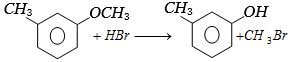
B
C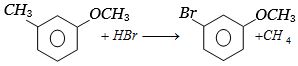
D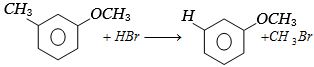
Solution
(A) The reaction of an alkyl aryl ether with $HBr$ involves the protonation of the ether oxygen atom to form a protonated ether (oxonium salt).
The halide ion $(Br^-)$ then performs a nucleophilic attack on the less sterically hindered alkyl group (in this case,the methyl group attached to the oxygen) via an $S_N2$ mechanism.
This results in the cleavage of the $C-O$ bond between the oxygen and the methyl group,producing a phenol ($m$-methylphenol) and an alkyl halide $(CH_3Br)$.
The halide ion $(Br^-)$ then performs a nucleophilic attack on the less sterically hindered alkyl group (in this case,the methyl group attached to the oxygen) via an $S_N2$ mechanism.
This results in the cleavage of the $C-O$ bond between the oxygen and the methyl group,producing a phenol ($m$-methylphenol) and an alkyl halide $(CH_3Br)$.
0 likes
View Solution40
MediumMCQ
Diethyl ether finds use in medicine as
A
$A$. $A$ pain killer
B
$B$. $A$ hypnotic
C
$C$. An antiseptic
D
$D$. An anaesthetic
Solution
(D) Diethyl ether $(C_2H_5-O-C_2H_5)$ was historically used as a general anaesthetic in medicine.
Therefore,the correct option is $(D)$.
Therefore,the correct option is $(D)$.
0 likes
View Solution41
MediumMCQ
Ether can be used
A
As a general anaesthetic
B
As a refrigerant
C
In perfumery
D
All of these
Solution
(D) Ether $(Diethyl \ ether)$ is an industrial solvent used for oils,fats,gum,resin,perfume,etc.
$Diethyl \ ether$ produces cooling on evaporation.
Hence,it is used as a refrigerant.
$Diethyl \ ether$ was also widely used as an anesthetic agent.
Therefore,all the given options are correct.
$Diethyl \ ether$ produces cooling on evaporation.
Hence,it is used as a refrigerant.
$Diethyl \ ether$ was also widely used as an anesthetic agent.
Therefore,all the given options are correct.
0 likes
View Solution42
MediumMCQ
What will be the products of the reaction if methoxybenzene reacts with $HI$?
A
Methyl alcohol (methanol) + iodobenzene
B
Methyl iodide (iodomethane) + benzene
C
Methyl iodide + phenol
D
Methyl iodide + iodobenzene
Solution
(C) The reaction of methoxybenzene $(C_6H_5OCH_3)$ with $HI$ involves the cleavage of the $C-O$ bond.
Since the $C_6H_5-O$ bond has partial double bond character due to resonance,it is stronger and harder to break than the $CH_3-O$ bond.
Therefore,the $HI$ attacks the $CH_3$ group,resulting in the formation of methyl iodide $(CH_3I)$ and phenol $(C_6H_5OH)$.
The reaction is: $C_6H_5OCH_3 + HI \rightarrow C_6H_5OH + CH_3I$.
Since the $C_6H_5-O$ bond has partial double bond character due to resonance,it is stronger and harder to break than the $CH_3-O$ bond.
Therefore,the $HI$ attacks the $CH_3$ group,resulting in the formation of methyl iodide $(CH_3I)$ and phenol $(C_6H_5OH)$.
The reaction is: $C_6H_5OCH_3 + HI \rightarrow C_6H_5OH + CH_3I$.
0 likes
View Solution43
DifficultMCQ
Which of the following will be obtained by keeping ether in contact with air for a long time?
A
$C_2H_5 - O - CH(CH_3) - O - OH$
B
$C_2H_5 - OCH_2 - OH$
C
$C_2H_5 - O - C_2H_5OH$
D
$CH_3 - O - CH(CH_3) - O - OH$
Solution
(A) When ethers are kept in contact with air for a long time,they undergo autoxidation to form explosive peroxides.
For diethyl ether $(C_2H_5 - O - C_2H_5)$,the reaction with atmospheric oxygen leads to the formation of $1$-ethoxyethyl hydroperoxide.
The reaction is: $C_2H_5 - O - C_2H_5 \xrightarrow{O_2, \text{light}} C_2H_5 - O - CH(CH_3) - O - OH$.
For diethyl ether $(C_2H_5 - O - C_2H_5)$,the reaction with atmospheric oxygen leads to the formation of $1$-ethoxyethyl hydroperoxide.
The reaction is: $C_2H_5 - O - C_2H_5 \xrightarrow{O_2, \text{light}} C_2H_5 - O - CH(CH_3) - O - OH$.
0 likes
View Solution44
MediumMCQ
Which of the following compounds on boiling with $KMnO_4$ (alk.) and subsequent acidification will not give benzoic acid?
A
Benzyl alcohol
B
Acetophenone
C
Anisole
D
Toluene
Solution
(C) The oxidation of alkyl benzenes or their derivatives with side chains having at least one benzylic hydrogen atom using alkaline $KMnO_4$ followed by acidification yields benzoic acid.
$1$. Benzyl alcohol $(C_6H_5CH_2OH)$ oxidizes to benzoic acid.
$2$. Acetophenone $(C_6H_5COCH_3)$ oxidizes to benzoic acid.
$3$. Toluene $(C_6H_5CH_3)$ oxidizes to benzoic acid.
$4$. Anisole $(C_6H_5OCH_3)$ is an ether. The methoxy group attached to the benzene ring is stable under these conditions and does not undergo oxidation to a carboxylic acid group. Therefore,it does not yield benzoic acid.
$1$. Benzyl alcohol $(C_6H_5CH_2OH)$ oxidizes to benzoic acid.
$2$. Acetophenone $(C_6H_5COCH_3)$ oxidizes to benzoic acid.
$3$. Toluene $(C_6H_5CH_3)$ oxidizes to benzoic acid.
$4$. Anisole $(C_6H_5OCH_3)$ is an ether. The methoxy group attached to the benzene ring is stable under these conditions and does not undergo oxidation to a carboxylic acid group. Therefore,it does not yield benzoic acid.
0 likes
View Solution45
MediumMCQ
Which of the following compounds is resistant to nucleophilic attack by hydroxyl ions?
A
Methyl acetate
B
Acetonitrile
C
Dimethyl ether
D
Acetamide
Solution
(C) The correct answer is $C$.
Dimethyl ether $(CH_3-O-CH_3)$ is an ether.
Ethers are generally resistant to nucleophilic attack by hydroxyl ions $(OH^-)$ because the lone pairs on the oxygen atom and the electron-donating effect of the alkyl groups create high electron density around the oxygen,which repels the incoming nucleophile.
In contrast,esters $(CH_3COOCH_3)$,nitriles $(CH_3CN)$,and amides $(CH_3CONH_2)$ contain a carbonyl or cyano group that is highly susceptible to nucleophilic attack.
Dimethyl ether $(CH_3-O-CH_3)$ is an ether.
Ethers are generally resistant to nucleophilic attack by hydroxyl ions $(OH^-)$ because the lone pairs on the oxygen atom and the electron-donating effect of the alkyl groups create high electron density around the oxygen,which repels the incoming nucleophile.
In contrast,esters $(CH_3COOCH_3)$,nitriles $(CH_3CN)$,and amides $(CH_3CONH_2)$ contain a carbonyl or cyano group that is highly susceptible to nucleophilic attack.
0 likes
View Solution46
MediumMCQ
When anisole is heated with $HI$,the product is
A
Phenyl iodide and methyl iodide
B
Phenol and methanol
C
Phenyl iodide and methanol
D
Methyl iodide and phenol
Solution
(D) The reaction of anisole $(C_6H_5OCH_3)$ with $HI$ involves the cleavage of the $C-O$ bond.
Since the $C_6H_5-O$ bond has partial double bond character due to resonance,it is stronger and harder to break than the $CH_3-O$ bond.
Therefore,the $HI$ attacks the methyl group,resulting in the formation of methyl iodide $(CH_3I)$ and phenol $(C_6H_5OH)$.
The reaction is: $C_6H_5OCH_3 + HI \rightarrow C_6H_5OH + CH_3I$.
Since the $C_6H_5-O$ bond has partial double bond character due to resonance,it is stronger and harder to break than the $CH_3-O$ bond.
Therefore,the $HI$ attacks the methyl group,resulting in the formation of methyl iodide $(CH_3I)$ and phenol $(C_6H_5OH)$.
The reaction is: $C_6H_5OCH_3 + HI \rightarrow C_6H_5OH + CH_3I$.
0 likes
View Solution47
MediumMCQ
Acetic anhydride reacts with diethyl ether in the presence of anhydrous $AlCl_3$ to form:
A
Ethyl acetate
B
Methyl propionate
C
Methyl acetate
D
Propionic acid
Solution
(A) The reaction of acetic anhydride with diethyl ether in the presence of anhydrous $AlCl_3$ is a cleavage reaction of the ether.
The reaction proceeds as follows:
$(CH_3CO)_2O + (C_2H_5)_2O \xrightarrow{AlCl_3} 2 CH_3COOC_2H_5$
The product formed is ethyl acetate.
The reaction proceeds as follows:
$(CH_3CO)_2O + (C_2H_5)_2O \xrightarrow{AlCl_3} 2 CH_3COOC_2H_5$
The product formed is ethyl acetate.
0 likes
View Solution48
DifficultMCQ
An organic compound of molecular formula $C_4H_{10}O$ does not react with sodium. With excess of $HI$,it gives only one type of alkyl halide. The compound is
A
Ethoxyethane
B
$2-$Methoxypropane
C
$1-$Methoxypropane
D
$1-$Butanol
Solution
(A) The molecular formula $C_4H_{10}O$ corresponds to either an alcohol or an ether.
Since the compound does not react with sodium metal,it cannot be an alcohol; therefore,it must be an ether.
When an ether reacts with excess $HI$,it undergoes cleavage to form alkyl halides.
The problem states that only one type of alkyl halide is formed,which implies that the ether must be symmetrical.
Ethoxyethane $(C_2H_5-O-C_2H_5)$ is a symmetrical ether.
The reaction is: $C_2H_5OC_2H_5 + 2HI \to 2C_2H_5I + H_2O$.
Since the compound does not react with sodium metal,it cannot be an alcohol; therefore,it must be an ether.
When an ether reacts with excess $HI$,it undergoes cleavage to form alkyl halides.
The problem states that only one type of alkyl halide is formed,which implies that the ether must be symmetrical.
Ethoxyethane $(C_2H_5-O-C_2H_5)$ is a symmetrical ether.
The reaction is: $C_2H_5OC_2H_5 + 2HI \to 2C_2H_5I + H_2O$.
0 likes
View Solution49
MediumMCQ
What is the major product obtained when diethyl ether reacts with concentrated $HI$ at $0^o C$?
A
$C_2H_5OH$
B
$C_2H_5I$
C
Both $C_2H_5OH$ and $C_2H_5I$
D
None of the above
Solution
(C) The reaction of diethyl ether $(C_2H_5-O-C_2H_5)$ with concentrated $HI$ at $0^o C$ proceeds via the protonation of the ether oxygen atom.
Step $1$: Protonation of ether: $C_2H_5-O-C_2H_5 + HI \rightarrow C_2H_5-O^+(H)-C_2H_5 + I^-$.
Step $2$: Nucleophilic attack by $I^-$ on one of the ethyl groups: $I^- + C_2H_5-O^+(H)-C_2H_5 \rightarrow C_2H_5I + C_2H_5OH$.
Since both alkyl groups are identical,the reaction produces one molecule of ethyl iodide $(C_2H_5I)$ and one molecule of ethanol $(C_2H_5OH)$.
Therefore,both products are formed.
Step $1$: Protonation of ether: $C_2H_5-O-C_2H_5 + HI \rightarrow C_2H_5-O^+(H)-C_2H_5 + I^-$.
Step $2$: Nucleophilic attack by $I^-$ on one of the ethyl groups: $I^- + C_2H_5-O^+(H)-C_2H_5 \rightarrow C_2H_5I + C_2H_5OH$.
Since both alkyl groups are identical,the reaction produces one molecule of ethyl iodide $(C_2H_5I)$ and one molecule of ethanol $(C_2H_5OH)$.
Therefore,both products are formed.
0 likes
View Solution50
MediumMCQ
In which of the following transformations is phosphorus pentachloride $(PCl_5)$ used as a reagent?
A
$H_2C = CH_2 \rightarrow CH_3CH_2Cl$
B
$H_3C - O - CH_3 \rightarrow 2CH_3Cl$
C
$CH_3CH_2OH \rightarrow CH_3CH_2Cl$
D
$HC \equiv CH \rightarrow CH_2 = CHCl$
Solution
(B) Phosphorus pentachloride $(PCl_5)$ is commonly used to convert alcohols or ethers into alkyl chlorides.
Specifically,the reaction with dimethyl ether is: $CH_3-O-CH_3 + PCl_5 \rightarrow 2CH_3Cl + POCl_3$.
Therefore,the correct transformation is $H_3C-O-CH_3 \rightarrow 2CH_3Cl$.
Specifically,the reaction with dimethyl ether is: $CH_3-O-CH_3 + PCl_5 \rightarrow 2CH_3Cl + POCl_3$.
Therefore,the correct transformation is $H_3C-O-CH_3 \rightarrow 2CH_3Cl$.
0 likes
View SolutionAlcohols, Phenols and Ethers — Properties of Ethers · Frequently Asked Questions
1Are these Alcohols, Phenols and Ethers questions useful for JEE and NEET?
Yes. All questions in this section are mapped to JEE Main and NEET exam patterns. Previous year questions from JEE Main, NEET, GUJCET and state-level exams are included with full solutions.
2Can I switch to Hindi or Gujarati for these questions?
Yes. Use the language tabs in the hero section or the sidebar to view the same questions and solutions in English, Hindi or Gujarati.
3How do I generate a question paper from this subtopic?
Use the Vedclass Exam Paper Generator — select the chapter and subtopic, set difficulty, and generate Sets A, B, C, D automatically. First 3 chapters of every subject are free.
Vedclass Products
For Students
Vedclass Test Series
Mock tests in real JEE/NEET style with performance analysis. 5-day free trial.
Start Free TrialFor Teachers
Exam Paper Generator
Generate Set A/B/C/D papers from this chapter in 2 minutes. 3 chapters free.
Try FreeFor Institutes
Online Exam Module
Live online exams with unlimited students, 360° analytics & white-label branding.
See DemoFor Teachers & Institutes
Generate a Alcohols, Phenols and Ethers Exam Paper in 2 Minutes
Select subtopic & difficulty — Sets A, B, C, D auto-generated with No Repeat logic.
First 3 chapters of every subject are free — no payment required.