
A English
Properties of alcohol Questions in English
Class 12 Chemistry · Alcohols, Phenols and Ethers · Properties of alcohol
889+
Questions
English
Language
100%
With Solutions
Showing 48 of 889 questions in English
1
EasyMCQ
The high boiling point of ethanol $({78.2 \ ^\circ C})$ compared to dimethyl ether $({-23.6 \ ^\circ C})$,though both have the same molecular formula $C_2H_6O$,is due to
A
Hydrogen bonding
B
Ionic bonding
C
Coordinate covalent bonding
D
Resonance
Solution
(A) Although ethanol and dimethyl ether have the same molecular formula $C_2H_6O$,ethanol has a boiling point of $78.2 \ ^\circ C$ while dimethyl ether has a boiling point of $-23.6 \ ^\circ C$.
This difference is due to the presence of intermolecular hydrogen bonding in ethanol,which is absent in dimethyl ether.
This difference is due to the presence of intermolecular hydrogen bonding in ethanol,which is absent in dimethyl ether.
0 likes
View Solution2
EasyMCQ
Methanol and ethanol are miscible in water due to
A
Covalent character
B
Hydrogen bonding character
C
Oxygen bonding character
D
None of these
Solution
(B) Methanol $(CH_3OH)$ and ethanol $(C_2H_5OH)$ contain a polar covalent $O-H$ bond.
Because of this,they are capable of forming hydrogen bonds with water molecules.
This ability to form hydrogen bonds makes them miscible in water.
Because of this,they are capable of forming hydrogen bonds with water molecules.
This ability to form hydrogen bonds makes them miscible in water.
0 likes
View Solution3
MediumMCQ
Which one has the highest boiling point?
A
Acetone
B
Ethyl alcohol
C
Diethyl ether
D
Chloroform
Solution
(B) The boiling point depends on the strength of intermolecular forces.
Ethyl alcohol $(C_2H_5OH)$ exhibits intermolecular hydrogen bonding,which is a strong dipole-dipole interaction.
Acetone,diethyl ether,and chloroform exhibit weaker dipole-dipole or London dispersion forces.
Therefore,ethyl alcohol has the highest boiling point among the given options.
Ethyl alcohol $(C_2H_5OH)$ exhibits intermolecular hydrogen bonding,which is a strong dipole-dipole interaction.
Acetone,diethyl ether,and chloroform exhibit weaker dipole-dipole or London dispersion forces.
Therefore,ethyl alcohol has the highest boiling point among the given options.
0 likes
View Solution4
MediumMCQ
Glycerol has strong intermolecular hydrogen bonding; therefore,it is:
A
Sweet
B
Reactive
C
Explosive
D
Viscous
Solution
(D) Glycerol $(CH_2OH-CHOH-CH_2OH)$ contains three $-OH$ groups,which facilitate extensive intermolecular hydrogen bonding. This strong network of hydrogen bonds restricts the flow of molecules,making it highly viscous.
0 likes
View Solution5
MediumMCQ
To remove last traces of water from alcohol,the metal used is
A
Sodium
B
Potassium
C
Calcium
D
Aluminium
Solution
(C) The metal used to remove the last traces of water from alcohol is $Calcium$ $(Ca)$. $Calcium$ reacts with water to form $Calcium$ hydroxide $(Ca(OH)_2)$,which is a solid and can be easily separated,thereby drying the alcohol.
0 likes
View Solution6
EasyMCQ
Lead pipes are corroded quickly by
A
Dil. $H_2SO_4$
B
Conc. $H_2SO_4$
C
Acetic acid
D
Water
Solution
(C) Lead is resistant to corrosion by dilute $H_2SO_4$ and $HCl$ due to the formation of an insoluble protective layer of $PbSO_4$ or $PbCl_2$ on its surface.
However,lead is readily corroded by organic acids like acetic acid in the presence of oxygen (air).
The reaction is: $Pb + 2CH_3COOH + \frac{1}{2}O_2 \to Pb(CH_3COO)_2 + H_2O$.
However,lead is readily corroded by organic acids like acetic acid in the presence of oxygen (air).
The reaction is: $Pb + 2CH_3COOH + \frac{1}{2}O_2 \to Pb(CH_3COO)_2 + H_2O$.
0 likes
View Solution7
DifficultMCQ
In $CH_3CH_2OH$,the bond that undergoes heterolytic cleavage most readily is
A
$C-C$
B
$C-O$
C
$C-H$
D
$O-H$
Solution
(D) The heterolytic cleavage of a bond depends on the difference in electronegativity between the bonded atoms.
In $CH_3CH_2OH$,the $O-H$ bond is the most polar because oxygen is significantly more electronegative than hydrogen.
Therefore,the $O-H$ bond undergoes heterolytic cleavage most readily to form $CH_3CH_2O^-$ and $H^+$,or in some cases $CH_3CH_2^+$ and $OH^-$,depending on the reaction conditions.
Among the given options,the $O-H$ bond is the most susceptible to heterolytic cleavage due to the high electronegativity of the oxygen atom.
In $CH_3CH_2OH$,the $O-H$ bond is the most polar because oxygen is significantly more electronegative than hydrogen.
Therefore,the $O-H$ bond undergoes heterolytic cleavage most readily to form $CH_3CH_2O^-$ and $H^+$,or in some cases $CH_3CH_2^+$ and $OH^-$,depending on the reaction conditions.
Among the given options,the $O-H$ bond is the most susceptible to heterolytic cleavage due to the high electronegativity of the oxygen atom.
0 likes
View Solution8
DifficultMCQ
How many isomers of $C_5H_{11}OH$ will be primary alcohols?
A
$2$
B
$3$
C
$4$
D
$5$
Solution
(C) primary alcohol is defined by the structure $R-CH_2-OH$. The isomers of $C_5H_{11}OH$ that are primary alcohols are:
$1$. $CH_3-CH_2-CH_2-CH_2-CH_2-OH$ (pentan-$1$-ol)
$2$. $CH_3-CH(CH_3)-CH_2-CH_2-OH$ ($3$-methylbutan-$1$-ol)
$3$. $CH_3-CH_2-CH(CH_3)-CH_2-OH$ ($2$-methylbutan-$1$-ol)
$4$. $CH_3-C(CH_3)_2-CH_2-OH$ ($2,2$-dimethylpropan-$1$-ol)
Thus,there are $4$ primary alcohol isomers.
$1$. $CH_3-CH_2-CH_2-CH_2-CH_2-OH$ (pentan-$1$-ol)
$2$. $CH_3-CH(CH_3)-CH_2-CH_2-OH$ ($3$-methylbutan-$1$-ol)
$3$. $CH_3-CH_2-CH(CH_3)-CH_2-OH$ ($2$-methylbutan-$1$-ol)
$4$. $CH_3-C(CH_3)_2-CH_2-OH$ ($2,2$-dimethylpropan-$1$-ol)
Thus,there are $4$ primary alcohol isomers.
0 likes
View Solution9
MediumMCQ
The number of possible alcoholic isomers for $C_4H_{10}O$ are
A
$4$
B
$2$
C
$3$
D
$5$
Solution
(A) $1$. $CH_3-CH_2-CH_2-CH_2-OH$ (butan$-1-$ol)
$2$. $CH_3-CH(OH)-CH_2-CH_3$ (butan$-2-$ol)
$3$. $CH_3-CH(CH_3)-CH_2-OH$ ($2-$methylpropan$-1-$ol)
$4$. $CH_3-C(OH)(CH_3)-CH_3$ ($2-$methylpropan$-2-$ol)
There are a total of $4$ possible alcoholic isomers for the molecular formula $C_4H_{10}O$.
$2$. $CH_3-CH(OH)-CH_2-CH_3$ (butan$-2-$ol)
$3$. $CH_3-CH(CH_3)-CH_2-OH$ ($2-$methylpropan$-1-$ol)
$4$. $CH_3-C(OH)(CH_3)-CH_3$ ($2-$methylpropan$-2-$ol)
There are a total of $4$ possible alcoholic isomers for the molecular formula $C_4H_{10}O$.
0 likes
View Solution10
MediumMCQ
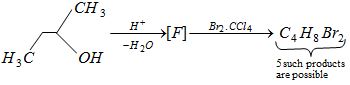
The dehydration of $butan-2-ol$ in the presence of $H^{+}$ yields $[F]$. How many structural isomers of $[F]$ are possible?
A
$2$
B
$1$
C
$6$
D
$3$
Solution
(A) The dehydration of $butan-2-ol$ $(CH_3CH_2CH(OH)CH_3)$ in the presence of $H^{+}$ involves the elimination of a water molecule to form an alkene $[F]$.
The possible alkenes formed are:
$1$. $But-1-ene$ $(CH_3CH_2CH=CH_2)$
$2$. $But-2-ene$ $(CH_3CH=CHCH_3)$
Both $But-1-ene$ and $But-2-ene$ are structural isomers of each other.
Therefore,there are $2$ possible structural isomers for $[F]$.
The possible alkenes formed are:
$1$. $But-1-ene$ $(CH_3CH_2CH=CH_2)$
$2$. $But-2-ene$ $(CH_3CH=CHCH_3)$
Both $But-1-ene$ and $But-2-ene$ are structural isomers of each other.
Therefore,there are $2$ possible structural isomers for $[F]$.
0 likes
View Solution11
DifficultMCQ
Among the following compounds,which one can be dehydrated very easily?
A
$CH_3-CH_2-C(OH)(CH_3)-CH_2-CH_3$
B
$CH_3-CH_2-CH_2-CH(OH)-CH_3$
C
$CH_3-CH_2-CH_2-CH_2-CH_2-OH$
D
$CH_3-CH_2-CH(CH_3)-CH_2-CH_2-OH$
Solution
(A) The dehydration of alcohols follows the order: $3^\circ > 2^\circ > 1^\circ$ alcohol,because the rate-determining step involves the formation of a carbocation intermediate.
$CH_3-CH_2-C(OH)(CH_3)-CH_2-CH_3$ is a $3^\circ$ alcohol,which forms a stable $3^\circ$ carbocation upon dehydration.
$CH_3-CH_2-CH_2-CH(OH)-CH_3$ is a $2^\circ$ alcohol.
$CH_3-CH_2-CH_2-CH_2-CH_2-OH$ and $CH_3-CH_2-CH(CH_3)-CH_2-CH_2-OH$ are $1^\circ$ alcohols.
Since the $3^\circ$ carbocation is the most stable,the $3^\circ$ alcohol undergoes dehydration most easily.
$CH_3-CH_2-C(OH)(CH_3)-CH_2-CH_3$ is a $3^\circ$ alcohol,which forms a stable $3^\circ$ carbocation upon dehydration.
$CH_3-CH_2-CH_2-CH(OH)-CH_3$ is a $2^\circ$ alcohol.
$CH_3-CH_2-CH_2-CH_2-CH_2-OH$ and $CH_3-CH_2-CH(CH_3)-CH_2-CH_2-OH$ are $1^\circ$ alcohols.
Since the $3^\circ$ carbocation is the most stable,the $3^\circ$ alcohol undergoes dehydration most easily.
0 likes
View Solution12
MediumMCQ
Which of the following gives the most stable carbocation upon dehydration?
A
$(CH_3)_2CHOH$
B
$(CH_3)_3COH$
C
$CH_3CH_2OH$
D
$CH_3CH_2OCH_2CH_3$
Solution
(B) Dehydration of alcohols involves the formation of a carbocation intermediate.
$3^{\circ}$ alcohols form $3^{\circ}$ carbocations,which are the most stable due to the inductive effect and hyperconjugation.
In $(CH_3)_3COH$,the dehydration leads to the formation of the tert-butyl carbocation,$(CH_3)_3C^+$,which is a $3^{\circ}$ carbocation and highly stable.
Therefore,the correct option is $B$.
$3^{\circ}$ alcohols form $3^{\circ}$ carbocations,which are the most stable due to the inductive effect and hyperconjugation.
In $(CH_3)_3COH$,the dehydration leads to the formation of the tert-butyl carbocation,$(CH_3)_3C^+$,which is a $3^{\circ}$ carbocation and highly stable.
Therefore,the correct option is $B$.
0 likes
View Solution13
MediumMCQ
$A$ reaction between $CH_3MgBr$ (methyl magnesium bromide) and $C_2H_5OH$ (ethyl alcohol) gives:
A
Methane
B
Ethane
C
Propane
D
Butane
Solution
(A) Grignard reagents $(RMgX)$ are strong bases and react with compounds containing active hydrogen atoms (like alcohols,water,or amines) to form alkanes.
The reaction is as follows:
$C_2H_5OH + CH_3MgBr \rightarrow CH_4 + Mg(OC_2H_5)Br$
Here,the $CH_3^-$ group from the Grignard reagent abstracts the acidic proton $(H^+)$ from the ethyl alcohol $(C_2H_5OH)$ to form methane $(CH_4)$.
The reaction is as follows:
$C_2H_5OH + CH_3MgBr \rightarrow CH_4 + Mg(OC_2H_5)Br$
Here,the $CH_3^-$ group from the Grignard reagent abstracts the acidic proton $(H^+)$ from the ethyl alcohol $(C_2H_5OH)$ to form methane $(CH_4)$.
0 likes
View Solution14
MediumMCQ
Which of the following compounds will form a hydrocarbon on reaction with Grignard reagent?
A
$CH_3CH_2OH$
B
$CH_3CHO$
C
$CH_3COCH_3$
D
$CH_3CO_2CH_3$
Solution
(A) Compounds containing active hydrogen atoms (such as those in $ROH, H_2O, RNH_2$,or $RCOOH$) react with Grignard reagents $(R'MgX)$ to form hydrocarbons (alkanes) via an acid-base reaction.
$CH_3CH_2OH + CH_3MgBr \rightarrow CH_4 + Mg(Br)(OCH_2CH_3)$
In this reaction,the ethanol $(CH_3CH_2OH)$ provides an active hydrogen atom attached to the oxygen,which reacts with the alkyl group of the Grignard reagent to produce methane $(CH_4)$,which is a hydrocarbon. Other options like aldehydes $(CH_3CHO)$ and ketones $(CH_3COCH_3)$ undergo nucleophilic addition reactions with Grignard reagents to form alcohols,not hydrocarbons.
$CH_3CH_2OH + CH_3MgBr \rightarrow CH_4 + Mg(Br)(OCH_2CH_3)$
In this reaction,the ethanol $(CH_3CH_2OH)$ provides an active hydrogen atom attached to the oxygen,which reacts with the alkyl group of the Grignard reagent to produce methane $(CH_4)$,which is a hydrocarbon. Other options like aldehydes $(CH_3CHO)$ and ketones $(CH_3COCH_3)$ undergo nucleophilic addition reactions with Grignard reagents to form alcohols,not hydrocarbons.
0 likes
View Solution15
MediumMCQ
$CH_3MgI$ will give methane with
A
$C_2H_5OH$
B
$CH_3-CH_2-NH_2$
C
$CH_3-CO-CH_3$
D
Both $(a)$ and $(b)$
Solution
(D) $CH_3MgI$ is a Grignard reagent,which acts as a strong base and a nucleophile.
It reacts with compounds containing active hydrogen atoms (like those attached to $O$,$N$,or $S$) to form alkanes.
$(a)$ $CH_3MgI + C_2H_5OH \to CH_4 + C_2H_5OMgI$
$(b)$ $CH_3MgI + CH_3-CH_2-NH_2 \to CH_4 + CH_3CH_2NHMgI$
Since both $C_2H_5OH$ and $CH_3-CH_2-NH_2$ contain active hydrogen atoms,both will produce methane.
It reacts with compounds containing active hydrogen atoms (like those attached to $O$,$N$,or $S$) to form alkanes.
$(a)$ $CH_3MgI + C_2H_5OH \to CH_4 + C_2H_5OMgI$
$(b)$ $CH_3MgI + CH_3-CH_2-NH_2 \to CH_4 + CH_3CH_2NHMgI$
Since both $C_2H_5OH$ and $CH_3-CH_2-NH_2$ contain active hydrogen atoms,both will produce methane.
0 likes
View Solution16
MediumMCQ
Ethylene may be obtained by dehydration of which of the following with concentrated $H_2SO_4$ at $160 - 170\,^{\circ}C$?
A
$C_2H_5OH$
B
$CH_3OH$
C
$CH_3CH_2CH_2OH$
D
$(CH_3)_2CHCH_2OH$
Solution
(A) The dehydration of ethanol $(C_2H_5OH)$ with concentrated $H_2SO_4$ at $160-170\,^{\circ}C$ leads to the formation of ethylene $(CH_2=CH_2)$ through an elimination reaction.
The chemical equation is:
$CH_3-CH_2-OH \xrightarrow[160-170\,^{\circ}C]{Conc. H_2SO_4} CH_2=CH_2 + H_2O$
The chemical equation is:
$CH_3-CH_2-OH \xrightarrow[160-170\,^{\circ}C]{Conc. H_2SO_4} CH_2=CH_2 + H_2O$
0 likes
View Solution17
DifficultMCQ
When $3, 3-$dimethyl$-2-$butanol is heated with ${H_2SO_4}$,the major product obtained is:
A
$cis$ and $trans$ isomers of $2, 3-$dimethyl$-2-$butene
B
$3, 3-$dimethyl$-1-$butene
C
$2, 3-$dimethyl$-2-$butene
D
$2, 3-$dimethyl$-1-$butene
Solution
(C) The dehydration of $3, 3-$dimethyl$-2-$butanol with ${H_2SO_4}$ proceeds via the formation of a carbocation.
$1.$ Protonation of the alcohol group leads to the formation of a $2^o$ carbocation: $CH_3-CH^+-C(CH_3)_2-CH_3$.
$2.$ This $2^o$ carbocation undergoes a $1, 2-$methyl shift to form a more stable $3^o$ carbocation: $CH_3-CH(CH_3)-C^+(CH_3)-CH_3$.
$3.$ Loss of a proton from the $3^o$ carbocation yields the most stable alkene,which is $2, 3-$dimethyl$-2-$butene,according to Saytzeff's rule.
$1.$ Protonation of the alcohol group leads to the formation of a $2^o$ carbocation: $CH_3-CH^+-C(CH_3)_2-CH_3$.
$2.$ This $2^o$ carbocation undergoes a $1, 2-$methyl shift to form a more stable $3^o$ carbocation: $CH_3-CH(CH_3)-C^+(CH_3)-CH_3$.
$3.$ Loss of a proton from the $3^o$ carbocation yields the most stable alkene,which is $2, 3-$dimethyl$-2-$butene,according to Saytzeff's rule.
0 likes
View Solution18
MediumMCQ
Which compound decolorizes aqueous bromine and gives white fumes of $HCl$ on reaction with $PCl_5$?
A
$CH_3COCH_2CH = CH_2$
B
$CH_3CH_2CH_2CH_2CH_3$
C
$CH_3CH = CHCH_2CH_2OH$
D
$CH_3OCH_2CH_2CH_2CH_2OH$
Solution
(C) $1$. To decolorize aqueous bromine,the compound must contain an unsaturated bond (alkene or alkyne).
$2$. To give white fumes of $HCl$ on reaction with $PCl_5$,the compound must contain an alcoholic group $(-OH)$.
$3$. Option $C$ $(CH_3CH = CHCH_2CH_2OH)$ contains both a double bond (for bromine decolorization) and an $-OH$ group (for $HCl$ fumes).
$4$. The reaction is: $CH_3CH = CHCH_2CH_2OH + PCl_5 \rightarrow CH_3CH = CHCH_2CH_2Cl + HCl + POCl_3$.
$2$. To give white fumes of $HCl$ on reaction with $PCl_5$,the compound must contain an alcoholic group $(-OH)$.
$3$. Option $C$ $(CH_3CH = CHCH_2CH_2OH)$ contains both a double bond (for bromine decolorization) and an $-OH$ group (for $HCl$ fumes).
$4$. The reaction is: $CH_3CH = CHCH_2CH_2OH + PCl_5 \rightarrow CH_3CH = CHCH_2CH_2Cl + HCl + POCl_3$.
0 likes
View Solution19
MediumMCQ
Ethyl alcohol on heating with conc. $H_2SO_4$ gives
A
$CH_3COOC_2H_5$
B
$C_2H_6$
C
$C_2H_4$
D
$C_2H_2$
Solution
(C) When ethyl alcohol $(CH_3CH_2OH)$ is heated with concentrated $H_2SO_4$ at $443 \ K$,it undergoes dehydration to form ethene $(C_2H_4)$.
$CH_3-CH_2-OH \xrightarrow[443 \ K]{Conc. \ H_2SO_4} CH_2=CH_2 + H_2O$
$CH_3-CH_2-OH \xrightarrow[443 \ K]{Conc. \ H_2SO_4} CH_2=CH_2 + H_2O$
0 likes
View Solution20
MediumMCQ
In the following reaction: $CH_3-CH_2-CH(OH)-CH_3 \xrightarrow[475 \ K]{H_2SO_4}$
A
$CH_3-CH=CH-CH_3$ predominates
B
$CH_2=CH-CH_2-CH_3$ predominates
C
Both are formed in equal amounts
D
The amount of production depends on the nature of catalyst
Solution
(A) According to $Saytzeff's$ rule,in the dehydration of alcohols,the more stable (more substituted) alkene is the major product.
$CH_3-CH=CH-CH_3$ $(but-2-ene)$ is more substituted and stable than $CH_2=CH-CH_2-CH_3$ $(but-1-ene)$.
Therefore,$CH_3-CH=CH-CH_3$ is the major product.
$CH_3-CH=CH-CH_3$ $(but-2-ene)$ is more substituted and stable than $CH_2=CH-CH_2-CH_3$ $(but-1-ene)$.
Therefore,$CH_3-CH=CH-CH_3$ is the major product.
0 likes
View Solution21
DifficultMCQ
When isobutyl magnesium bromide in dry ether is treated with absolute ethyl alcohol,the products formed are
A
$CH_3-CH(CH_3)-CH_2OH$ and $CH_3-CH_2-MgBr$
B
$CH_3-CH(CH_3)-CH_2-CH_2-CH_3$ and $Mg(OH)Br$
C
$CH_3-CH(CH_3)-CH_3$ and $CH_3-CH_2-OMgBr$
D
$CH_3-CH(CH_3)-CH_3$,$CH_2=CH_2$ and $Mg(OH)Br$
Solution
(C) Grignard reagents $(R-MgX)$ act as strong bases and react with compounds containing active hydrogen atoms (such as alcohols,$R'-OH$) to form alkanes $(R-H)$.
In this reaction,the isobutyl group $(CH_3-CH(CH_3)-CH_2^-)$ from the Grignard reagent abstracts the acidic proton from the ethyl alcohol to form isobutane $(CH_3-CH(CH_3)-CH_3)$.
The reaction is:
$CH_3-CH(CH_3)-CH_2-MgBr + CH_3-CH_2-OH \rightarrow CH_3-CH(CH_3)-CH_3 + CH_3-CH_2-OMgBr$.
In this reaction,the isobutyl group $(CH_3-CH(CH_3)-CH_2^-)$ from the Grignard reagent abstracts the acidic proton from the ethyl alcohol to form isobutane $(CH_3-CH(CH_3)-CH_3)$.
The reaction is:
$CH_3-CH(CH_3)-CH_2-MgBr + CH_3-CH_2-OH \rightarrow CH_3-CH(CH_3)-CH_3 + CH_3-CH_2-OMgBr$.
0 likes
View Solution22
MediumMCQ
On passing vapours of an organic liquid over finely divided $Cu$ at $573 \, K$,the product was an alkene. This reaction is:
A
Catalytic oxidation of primary alcohol
B
Catalytic dehydrogenation of secondary alcohol
C
Catalytic dehydrogenation of tertiary alcohol
D
Catalytic dehydration of tertiary alcohol
Solution
(D) The correct answer is $D$. When vapours of a tertiary alcohol are passed over heated copper $(Cu)$ at $573 \, K$,it undergoes dehydration to form an alkene because tertiary alcohols lack $\alpha$-hydrogen atoms required for dehydrogenation.
$CH_3-C(OH)(CH_3)-CH_3 \xrightarrow{Cu, 573 \, K} CH_3-C(CH_3)=CH_2 + H_2O$
$CH_3-C(OH)(CH_3)-CH_3 \xrightarrow{Cu, 573 \, K} CH_3-C(CH_3)=CH_2 + H_2O$
0 likes
View Solution23
MediumMCQ
The reaction $CH_3-C(CH_3)(OH)-CH_3 \xrightarrow{H_2SO_4} CH_3-C(CH_3)=CH_2$ is an example of:
A
Sulphonation
B
Dehydration
C
Alkylation
D
Decomposition
Solution
(B) The reaction involves the removal of a water molecule $(H_2O)$ from an alcohol $(2\text{-methylpropan-}2\text{-ol})$ in the presence of a dehydrating agent like $H_2SO_4$ to form an alkene $(2\text{-methylpropene})$.
This process is known as a dehydration reaction.
This process is known as a dehydration reaction.
0 likes
View Solution24
MediumMCQ
Ethyl hydrogen sulphate is obtained by the reaction of $H_2SO_4$ on
A
Ethylene
B
Ethane
C
Ethyl chloride
D
Ethanol
Solution
(D) The reaction of ethanol with concentrated sulfuric acid at $110 \, ^\circ C$ leads to the formation of ethyl hydrogen sulphate.
$CH_3CH_2OH + H_2SO_4 \xrightarrow{110 \, ^\circ C} CH_3CH_2HSO_4 + H_2O$
Thus,ethyl hydrogen sulphate is obtained from ethanol.
$CH_3CH_2OH + H_2SO_4 \xrightarrow{110 \, ^\circ C} CH_3CH_2HSO_4 + H_2O$
Thus,ethyl hydrogen sulphate is obtained from ethanol.
0 likes
View Solution25
MediumMCQ
The product obtained by heating ethanol with concentrated $H_2SO_4$ at $165^{\circ}C - 170^{\circ}C$ is:
A
$(C_2H_5)_2SO_4$
B
$CH_2 = CH_2$
C
$CH_3COOH$
D
$C_2H_5HSO_4$
Solution
(B) The reaction is an acid-catalyzed dehydration of ethanol.
When ethanol $(C_2H_5OH)$ is heated with concentrated $H_2SO_4$ at $165^{\circ}C - 170^{\circ}C$,it undergoes intermolecular dehydration to form ethene $(CH_2 = CH_2)$ and water.
The chemical equation is: $C_2H_5OH \xrightarrow{\text{Conc. } H_2SO_4, 170^{\circ}C} CH_2 = CH_2 + H_2O$.
When ethanol $(C_2H_5OH)$ is heated with concentrated $H_2SO_4$ at $165^{\circ}C - 170^{\circ}C$,it undergoes intermolecular dehydration to form ethene $(CH_2 = CH_2)$ and water.
The chemical equation is: $C_2H_5OH \xrightarrow{\text{Conc. } H_2SO_4, 170^{\circ}C} CH_2 = CH_2 + H_2O$.
0 likes
View Solution26
MediumMCQ
Identify the final product in the following reaction sequence: $CH \equiv CH$ $\xrightarrow[H_2SO_4]{HgSO_4}$ $\xrightarrow[H_2O]{CH_3MgBr}$ $\xrightarrow{P/Br_2}$
A
$CH_3-CH(Br)-CH_3$
B
$CH_3-CH_2-CH_2-Br$
C
$CH_2=CH-Br$
D
$Br-CH=CH-CH_3$
Solution
(A) The reaction sequence is as follows:
$1$. Hydration of ethyne: $CH \equiv CH + H_2O \xrightarrow{HgSO_4/H_2SO_4} CH_3CHO$ (Ethanal)
$2$. Reaction with Grignard reagent: $CH_3CHO + CH_3MgBr \xrightarrow{H_2O} CH_3-CH(OH)-CH_3$ (Propan$-2-$ol)
$3$. Bromination: $CH_3-CH(OH)-CH_3 \xrightarrow{P/Br_2} CH_3-CH(Br)-CH_3$ ($2$-Bromopropane).
$1$. Hydration of ethyne: $CH \equiv CH + H_2O \xrightarrow{HgSO_4/H_2SO_4} CH_3CHO$ (Ethanal)
$2$. Reaction with Grignard reagent: $CH_3CHO + CH_3MgBr \xrightarrow{H_2O} CH_3-CH(OH)-CH_3$ (Propan$-2-$ol)
$3$. Bromination: $CH_3-CH(OH)-CH_3 \xrightarrow{P/Br_2} CH_3-CH(Br)-CH_3$ ($2$-Bromopropane).
0 likes
View Solution27
MediumMCQ
Formation of $2-$butene as the major product by dehydration of $2-$butanol is according to:
A
Markownikoff rule
B
Saytzeff rule
C
Peroxide effect
D
Anti-Markownikoff rule
Solution
(B) The dehydration of $2-$butanol $(CH_3-CH(OH)-CH_2-CH_3)$ involves the removal of a water molecule to form an alkene.
According to the $Saytzeff$ rule,in elimination reactions,the more substituted alkene (the one with more alkyl groups attached to the double-bonded carbons) is the major product.
In this case,$2-$butene $(CH_3-CH=CH-CH_3)$ is more substituted than $1-$butene $(CH_2=CH-CH_2-CH_3)$,hence it is the major product.
According to the $Saytzeff$ rule,in elimination reactions,the more substituted alkene (the one with more alkyl groups attached to the double-bonded carbons) is the major product.
In this case,$2-$butene $(CH_3-CH=CH-CH_3)$ is more substituted than $1-$butene $(CH_2=CH-CH_2-CH_3)$,hence it is the major product.
0 likes
View Solution28
MediumMCQ
When ethyl alcohol is heated with red phosphorus and $HI$,then which of the following is formed?
A
$C_2H_6$
B
$CH_4$
C
$C_3H_8$
D
$C_2H_4$
Solution
(A) The reaction of ethyl alcohol with $HI$ in the presence of red phosphorus is a reduction reaction.
Red phosphorus acts as a reducing agent that reduces the alcohol to the corresponding alkane.
The chemical equation is:
$CH_3CH_2OH + 2HI \xrightarrow{\text{Red } P} CH_3CH_3 + H_2O + I_2$
Thus,ethyl alcohol is reduced to ethane $(C_2H_6)$.
Red phosphorus acts as a reducing agent that reduces the alcohol to the corresponding alkane.
The chemical equation is:
$CH_3CH_2OH + 2HI \xrightarrow{\text{Red } P} CH_3CH_3 + H_2O + I_2$
Thus,ethyl alcohol is reduced to ethane $(C_2H_6)$.
0 likes
View Solution29
MediumMCQ
Identify $Z$ in the following series:
$CH_2=CH_2$ $\xrightarrow{HBr} X$ $\xrightarrow{Hydrolysis} Y$ $\xrightarrow[I_2 \ \text{excess}]{Na_2CO_3} Z$
$CH_2=CH_2$ $\xrightarrow{HBr} X$ $\xrightarrow{Hydrolysis} Y$ $\xrightarrow[I_2 \ \text{excess}]{Na_2CO_3} Z$
A
$C_2H_5I$
B
$C_2H_5OH$
C
$CHI_3$
D
$CH_3CHO$
Solution
(C) $CH_2=CH_2 \xrightarrow{HBr} CH_3-CH_2Br (X)$
$CH_3-CH_2Br \xrightarrow{Hydrolysis} CH_3-CH_2OH (Y)$
$CH_3-CH_2OH \xrightarrow[I_2 \ \text{excess}]{Na_2CO_3} CHI_3 (Z) + HCOONa + NaI + H_2O$
This is the iodoform test,where ethanol reacts with iodine in the presence of base to form a yellow precipitate of iodoform $(CHI_3)$.
$CH_3-CH_2Br \xrightarrow{Hydrolysis} CH_3-CH_2OH (Y)$
$CH_3-CH_2OH \xrightarrow[I_2 \ \text{excess}]{Na_2CO_3} CHI_3 (Z) + HCOONa + NaI + H_2O$
This is the iodoform test,where ethanol reacts with iodine in the presence of base to form a yellow precipitate of iodoform $(CHI_3)$.
0 likes
View Solution30
EasyMCQ
Lucas reagent is
A
Anhydrous $ZnCl_2$ + conc. $HCl$
B
Hydrous $ZnCl_2$ + dil. $HCl$
C
Conc. $HNO_3$ + anhydrous $ZnCl_2$
D
Conc. $HNO_3$ + anhydrous $MgCl_2$
Solution
(A) Lucas reagent is a solution of anhydrous $ZnCl_2$ in concentrated $HCl$.
This reagent is used to classify alcohols of low molecular weight. The reaction involves the substitution of the hydroxyl group $(-OH)$ with a chloride ion $(Cl^-)$.
The reaction proceeds via an $SN1$ mechanism,where the rate of reaction depends on the stability of the carbocation intermediate. Tertiary alcohols react fastest,followed by secondary,while primary alcohols react very slowly or not at all at room temperature.
Therefore,the correct composition is anhydrous $ZnCl_2$ and concentrated $HCl$.
This reagent is used to classify alcohols of low molecular weight. The reaction involves the substitution of the hydroxyl group $(-OH)$ with a chloride ion $(Cl^-)$.
The reaction proceeds via an $SN1$ mechanism,where the rate of reaction depends on the stability of the carbocation intermediate. Tertiary alcohols react fastest,followed by secondary,while primary alcohols react very slowly or not at all at room temperature.
Therefore,the correct composition is anhydrous $ZnCl_2$ and concentrated $HCl$.
0 likes
View Solution31
DifficultMCQ
The following reaction is known as:
$C_2H_5OH + SOCl_2 \xrightarrow{\text{Pyridine}} C_2H_5Cl + SO_2 + HCl$
$C_2H_5OH + SOCl_2 \xrightarrow{\text{Pyridine}} C_2H_5Cl + SO_2 + HCl$
A
Kharasch effect
B
Darzen's procedure
C
Williamson's synthesis
D
Hunsdiecker synthesis reaction
Solution
(B) The reaction of an alcohol with thionyl chloride $(SOCl_2)$ in the presence of pyridine is a standard method for the preparation of alkyl chlorides.
This specific reaction is known as Darzen's procedure.
It is preferred because the by-products ($SO_2$ and $HCl$) are gases,which escape,leaving behind pure alkyl chloride.
This specific reaction is known as Darzen's procedure.
It is preferred because the by-products ($SO_2$ and $HCl$) are gases,which escape,leaving behind pure alkyl chloride.
0 likes
View Solution32
MediumMCQ
When ethyl alcohol $({C_2}{H_5}OH)$ reacts with thionyl chloride,in the presence of pyridine,the product obtained is
A
$CH_3CH_2Cl + HCl$
B
$CH_3COCl + HCl + SO_2$
C
$CH_3CH_2Cl + H_2O + SO_2$
D
$C_2H_5Cl + HCl + SO_2$
Solution
(D) The reaction of ethyl alcohol with thionyl chloride in the presence of pyridine is known as the Darzens process.
The reaction is: $C_2H_5OH + SOCl_2 \xrightarrow{\text{Pyridine}} C_2H_5Cl + SO_2 + HCl$.
Pyridine is used to neutralize the $HCl$ produced in the reaction,which drives the reaction to completion.
The reaction is: $C_2H_5OH + SOCl_2 \xrightarrow{\text{Pyridine}} C_2H_5Cl + SO_2 + HCl$.
Pyridine is used to neutralize the $HCl$ produced in the reaction,which drives the reaction to completion.
0 likes
View Solution33
EasyMCQ
What is the decreasing order of reactivity of $HX$ in the reaction $ROH + HX \to RX + H_2O$?
A
$HI > HBr > HCl > HF$
B
$HBr > HCl > HI > HF$
C
$HCl > HBr > HI > HF$
D
$HF > HBr > HCl > HI$
Solution
(A) The reactivity of hydrogen halides $(HX)$ towards alcohols depends on the strength of the $H-X$ bond.
As the size of the halogen atom increases from $F$ to $I$,the bond dissociation energy of the $H-X$ bond decreases.
Therefore,the ease of cleavage of the $H-X$ bond increases in the order $HF < HCl < HBr < HI$.
Thus,the decreasing order of reactivity is $HI > HBr > HCl > HF$.
As the size of the halogen atom increases from $F$ to $I$,the bond dissociation energy of the $H-X$ bond decreases.
Therefore,the ease of cleavage of the $H-X$ bond increases in the order $HF < HCl < HBr < HI$.
Thus,the decreasing order of reactivity is $HI > HBr > HCl > HF$.
0 likes
View Solution34
MediumMCQ
$R-OH + HX \to R-X + H_2O$. In the above reaction,the reactivity of different alcohols is:
A
$Tertiary > Secondary > Primary$
B
$Tertiary < Secondary < Primary$
C
$Tertiary < Secondary > Primary$
D
$Secondary < Primary < Tertiary$
Solution
(A) The reaction $R-OH + HX \to R-X + H_2O$ proceeds via the formation of a carbocation intermediate.
The stability of the carbocation formed determines the reactivity of the alcohol.
The stability order of carbocations is $3^o > 2^o > 1^o$.
Therefore,the reactivity order of alcohols towards $HX$ is $3^o > 2^o > 1^o$ (Tertiary > Secondary > Primary).
The stability of the carbocation formed determines the reactivity of the alcohol.
The stability order of carbocations is $3^o > 2^o > 1^o$.
Therefore,the reactivity order of alcohols towards $HX$ is $3^o > 2^o > 1^o$ (Tertiary > Secondary > Primary).
0 likes
View Solution35
MediumMCQ
When ethyl alcohol and $KI$ react in the presence of $Na_2CO_3$,yellow crystals of which of the following are formed?
A
$CHI_3$
B
$CH_3I$
C
$CH_2I_2$
D
$C_2H_5I$
Solution
(A) The reaction of ethyl alcohol $(C_2H_5OH)$ with $KI$ in the presence of $Na_2CO_3$ is an iodoform test.
Ethyl alcohol is oxidized to acetaldehyde,which then reacts with iodine (generated in situ) in the presence of base to form iodoform $(CHI_3)$.
$C_2H_5OH + 4I_2 + 6Na_2CO_3 \rightarrow CHI_3 + HCOONa + 5NaI + 5NaHCO_3$.
$CHI_3$ appears as yellow crystals.
Ethyl alcohol is oxidized to acetaldehyde,which then reacts with iodine (generated in situ) in the presence of base to form iodoform $(CHI_3)$.
$C_2H_5OH + 4I_2 + 6Na_2CO_3 \rightarrow CHI_3 + HCOONa + 5NaI + 5NaHCO_3$.
$CHI_3$ appears as yellow crystals.
0 likes
View Solution36
DifficultMCQ
Chloroform can be obtained from
A
Methanol
B
Methanal
C
Propanol-$1$
D
Propanol-$2$
Solution
(D) $CaOCl_2 + H_2O \to Ca(OH)_2 + Cl_2$
$CH_3-CH(OH)-CH_3 + Cl_2 \to CH_3-CO-CH_3 + 2HCl$
$CH_3-CO-CH_3 + 3Cl_2 \to CCl_3-CO-CH_3 + 3HCl$
$2CCl_3-CO-CH_3 + Ca(OH)_2 \to 2CHCl_3 + (CH_3COO)_2Ca$
Chloroform is obtained from Propanol-$2$ via the haloform reaction.
$CH_3-CH(OH)-CH_3 + Cl_2 \to CH_3-CO-CH_3 + 2HCl$
$CH_3-CO-CH_3 + 3Cl_2 \to CCl_3-CO-CH_3 + 3HCl$
$2CCl_3-CO-CH_3 + Ca(OH)_2 \to 2CHCl_3 + (CH_3COO)_2Ca$
Chloroform is obtained from Propanol-$2$ via the haloform reaction.
0 likes
View Solution37
DifficultMCQ
What is the composition of Lucas reagent?
A
Concentrated $HCl +$ anhydrous $ZnCl_2$
B
Dilute $HCl +$ hydrated $ZnCl_2$
C
Concentrated $HNO_3 +$ anhydrous $ZnCl_2$
D
Concentrated $HCl +$ anhydrous $MgCl_2$
Solution
(A) Lucas reagent is a solution of anhydrous zinc chloride $(ZnCl_2)$ in concentrated hydrochloric acid $(HCl)$.
It is primarily used to distinguish between primary,secondary,and tertiary alcohols based on the rate of reaction to form alkyl chlorides.
It is primarily used to distinguish between primary,secondary,and tertiary alcohols based on the rate of reaction to form alkyl chlorides.
0 likes
View Solution38
AdvancedMCQ
Which of the following compounds gives trichloromethane on distilling with bleaching powder?
A
Methanal
B
Phenol
C
Ethanol
D
Methanol
Solution
(C) $C_2H_5OH$ (ethanol) undergoes the haloform reaction with bleaching powder $(CaOCl_2)$.
$1. CaOCl_2 + H_2O \to Ca(OH)_2 + Cl_2$
$2. CH_3CH_2OH + Cl_2 \to CH_3CHO + 2HCl$
$3. CH_3CHO + 3Cl_2 \to CCl_3CHO + 3HCl$
$4. 2CCl_3CHO + Ca(OH)_2 \to 2CHCl_3 + (HCOO)_2Ca$
Thus,ethanol produces trichloromethane $(CHCl_3)$.
$1. CaOCl_2 + H_2O \to Ca(OH)_2 + Cl_2$
$2. CH_3CH_2OH + Cl_2 \to CH_3CHO + 2HCl$
$3. CH_3CHO + 3Cl_2 \to CCl_3CHO + 3HCl$
$4. 2CCl_3CHO + Ca(OH)_2 \to 2CHCl_3 + (HCOO)_2Ca$
Thus,ethanol produces trichloromethane $(CHCl_3)$.
0 likes
View Solution39
EasyMCQ
Iodoform is formed on warming $I_2$ and $NaOH$ with:
A
$C_2H_5OH$
B
$CH_3OH$
C
$HCOOH$
D
$C_6H_6$
Solution
(A) The iodoform test is given by compounds containing the $CH_3CO-$ group or the $CH_3CH(OH)-$ group.
$C_2H_5OH$ (ethanol) contains the $CH_3CH(OH)-$ group.
When $C_2H_5OH$ is warmed with $I_2$ and $NaOH$,it undergoes the iodoform reaction to produce yellow crystals of iodoform $(CHI_3)$.
The reaction is: $C_2H_5OH + 4I_2 + 6NaOH \rightarrow CHI_3 + HCOONa + 5NaI + 5H_2O$.
$C_2H_5OH$ (ethanol) contains the $CH_3CH(OH)-$ group.
When $C_2H_5OH$ is warmed with $I_2$ and $NaOH$,it undergoes the iodoform reaction to produce yellow crystals of iodoform $(CHI_3)$.
The reaction is: $C_2H_5OH + 4I_2 + 6NaOH \rightarrow CHI_3 + HCOONa + 5NaI + 5H_2O$.
0 likes
View Solution40
DifficultMCQ
In the following sequence of reactions,the product $C$ is: $CH_3-CH_2-CH_2-Br$ $\xrightarrow{KOH(alc)} (A)$ $\xrightarrow{HBr} (B)$ $\xrightarrow{KOH(aq.)} (C)$
A
$A.$ Propan$-2-$ol
B
$B.$ Propan$-1-$ol
C
$C.$ Propyne
D
$D.$ Propene
Solution
(A) $CH_3-CH_2-CH_2-Br$ undergoes dehydrohalogenation with alcoholic $KOH$ to form propene $(A)$.
Propene then reacts with $HBr$ via Markovnikov addition to form $2$-bromopropane $(B)$.
Finally,$2$-bromopropane reacts with aqueous $KOH$ via nucleophilic substitution to form propan-$2$-ol $(C)$.
$CH_3-CH_2-CH_2-Br$ $\xrightarrow{KOH(alc)} CH_3-CH=CH_2 (A)$ $\xrightarrow{HBr} CH_3-CH(Br)-CH_3 (B)$ $\xrightarrow{KOH(aq.)} CH_3-CH(OH)-CH_3 (C)$
Propene then reacts with $HBr$ via Markovnikov addition to form $2$-bromopropane $(B)$.
Finally,$2$-bromopropane reacts with aqueous $KOH$ via nucleophilic substitution to form propan-$2$-ol $(C)$.
$CH_3-CH_2-CH_2-Br$ $\xrightarrow{KOH(alc)} CH_3-CH=CH_2 (A)$ $\xrightarrow{HBr} CH_3-CH(Br)-CH_3 (B)$ $\xrightarrow{KOH(aq.)} CH_3-CH(OH)-CH_3 (C)$
0 likes
View Solution41
DifficultMCQ
When phenyl magnesium bromide reacts with $t-$butanol,the product would be
A
Benzene
B
Phenol
C
$t-$butyl benzene
D
$t-$butyl phenyl ether
Solution
(A) Phenyl magnesium bromide $(PhMgBr)$ is a Grignard reagent,which acts as a strong base.
$t-$butanol $((CH_3)_3COH)$ contains an acidic proton on the hydroxyl group.
When they react,the Grignard reagent abstracts the acidic proton from the alcohol to form an alkane.
The reaction is: $(CH_3)_3COH + PhMgBr \to PhH + (CH_3)_3COMgBr$.
Thus,the product formed is benzene $(PhH)$.
$t-$butanol $((CH_3)_3COH)$ contains an acidic proton on the hydroxyl group.
When they react,the Grignard reagent abstracts the acidic proton from the alcohol to form an alkane.
The reaction is: $(CH_3)_3COH + PhMgBr \to PhH + (CH_3)_3COMgBr$.
Thus,the product formed is benzene $(PhH)$.
0 likes
View Solution42
EasyMCQ
But$-2-$ol is:
A
Primary alcohol
B
Secondary alcohol
C
Tertiary alcohol
D
Aldehyde
Solution
(B) The structure of But$-2-$ol is $CH_3-CH(OH)-CH_2-CH_3$.
In this molecule,the hydroxyl group $(-OH)$ is attached to a carbon atom that is further bonded to two other carbon atoms.
Therefore,it is a secondary $(2^{\circ})$ alcohol.
In this molecule,the hydroxyl group $(-OH)$ is attached to a carbon atom that is further bonded to two other carbon atoms.
Therefore,it is a secondary $(2^{\circ})$ alcohol.
0 likes
View Solution43
EasyMCQ
$pent-3-ol$ is a
A
Primary alcohol
B
Tertiary alcohol
C
Secondary alcohol
D
None of these
Solution
(C) The structure of $pent-3-ol$ is $CH_3-CH_2-CH(OH)-CH_2-CH_3$.
In this molecule,the hydroxyl group $(-OH)$ is attached to a carbon atom that is bonded to two other carbon atoms.
Therefore,it is a secondary alcohol.
In this molecule,the hydroxyl group $(-OH)$ is attached to a carbon atom that is bonded to two other carbon atoms.
Therefore,it is a secondary alcohol.
0 likes
View Solution44
DifficultMCQ
Glycerine has:
A
One primary and two secondary $-OH$ groups
B
One secondary and two primary $-OH$ groups
C
Three primary $-OH$ groups
D
Three secondary $-OH$ groups
Solution
(B) The structural formula of Glycerine (Glycerol) is $CH_2(OH)-CH(OH)-CH_2(OH)$.
In this structure,the two terminal $-OH$ groups are attached to primary carbon atoms,and the middle $-OH$ group is attached to a secondary carbon atom.
Therefore,it contains two primary and one secondary $-OH$ groups.
In this structure,the two terminal $-OH$ groups are attached to primary carbon atoms,and the middle $-OH$ group is attached to a secondary carbon atom.
Therefore,it contains two primary and one secondary $-OH$ groups.
0 likes
View Solution45
EasyMCQ
Which of the following is a tertiary alcohol?
A
$CH_2OH-CHOH-CH_2OH$
B
$CH_3-CH_2-CH_2OH$
C
$CH_3-C(CH_3)(OH)-CH_3$
D
$CH_3-CH_2-OH$
Solution
(C) In a tertiary alcohol,the hydroxyl group $(-OH)$ is attached to a tertiary carbon atom (a carbon atom bonded to three other carbon atoms).
In $CH_3-C(CH_3)(OH)-CH_3$ ($2$-methylpropan-$2$-ol),the carbon atom bearing the $-OH$ group is bonded to three methyl groups,making it a tertiary alcohol.
In $CH_3-C(CH_3)(OH)-CH_3$ ($2$-methylpropan-$2$-ol),the carbon atom bearing the $-OH$ group is bonded to three methyl groups,making it a tertiary alcohol.
0 likes
View Solution46
MediumMCQ
Which of the following is a primary alcohol?
A
Butan-$2$-ol
B
Butan-$1$-ol
C
Propan-$2$-ol
D
Isopropyl alcohol
Solution
(B) primary alcohol is one in which the $-OH$ group is attached to a primary carbon atom (a carbon atom bonded to only one other carbon atom).
$1$. Butan-$1$-ol $(CH_3CH_2CH_2CH_2OH)$: The $-OH$ group is attached to a terminal carbon,which is bonded to only one other carbon. Thus,it is a primary alcohol.
$2$. Butan-$2$-ol $(CH_3CH(OH)CH_2CH_3)$: The $-OH$ group is attached to a carbon bonded to two other carbons. Thus,it is a secondary alcohol.
$3$. Propan-$2$-ol (Isopropyl alcohol) $(CH_3CH(OH)CH_3)$: The $-OH$ group is attached to a carbon bonded to two other carbons. Thus,it is a secondary alcohol.
Therefore,butan-$1$-ol is the primary alcohol.
$1$. Butan-$1$-ol $(CH_3CH_2CH_2CH_2OH)$: The $-OH$ group is attached to a terminal carbon,which is bonded to only one other carbon. Thus,it is a primary alcohol.
$2$. Butan-$2$-ol $(CH_3CH(OH)CH_2CH_3)$: The $-OH$ group is attached to a carbon bonded to two other carbons. Thus,it is a secondary alcohol.
$3$. Propan-$2$-ol (Isopropyl alcohol) $(CH_3CH(OH)CH_3)$: The $-OH$ group is attached to a carbon bonded to two other carbons. Thus,it is a secondary alcohol.
Therefore,butan-$1$-ol is the primary alcohol.
0 likes
View Solution47
MediumMCQ
Cyclohexanol is a
A
Primary alcohol
B
Secondary alcohol
C
Tertiary alcohol
D
Phenol
Solution
(B) Cyclohexanol is a secondary alcohol because the $-OH$ group is linked to a $2^o$ carbon atom in the cyclohexane ring.
0 likes
View Solution48
DifficultMCQ
Methylated spirit is
A
Methanol
B
Methanol $+$ ethanol
C
Methanoic acid
D
Methanamide
Solution
(B) Methylated spirit is a mixture of $5-10 \%$ methanol and the remaining ethanol.
It is also known as denatured alcohol because the addition of methanol makes it toxic and unfit for human consumption.
It is also known as denatured alcohol because the addition of methanol makes it toxic and unfit for human consumption.
0 likes
View SolutionAlcohols, Phenols and Ethers — Properties of alcohol · Frequently Asked Questions
1Are these Alcohols, Phenols and Ethers questions useful for JEE and NEET?
Yes. All questions in this section are mapped to JEE Main and NEET exam patterns. Previous year questions from JEE Main, NEET, GUJCET and state-level exams are included with full solutions.
2Can I switch to Hindi or Gujarati for these questions?
Yes. Use the language tabs in the hero section or the sidebar to view the same questions and solutions in English, Hindi or Gujarati.
3How do I generate a question paper from this subtopic?
Use the Vedclass Exam Paper Generator — select the chapter and subtopic, set difficulty, and generate Sets A, B, C, D automatically. First 3 chapters of every subject are free.
Vedclass Products
For Students
Vedclass Test Series
Mock tests in real JEE/NEET style with performance analysis. 5-day free trial.
Start Free TrialFor Teachers
Exam Paper Generator
Generate Set A/B/C/D papers from this chapter in 2 minutes. 3 chapters free.
Try FreeFor Institutes
Online Exam Module
Live online exams with unlimited students, 360° analytics & white-label branding.
See DemoFor Teachers & Institutes
Generate a Alcohols, Phenols and Ethers Exam Paper in 2 Minutes
Select subtopic & difficulty — Sets A, B, C, D auto-generated with No Repeat logic.
First 3 chapters of every subject are free — no payment required.