
A English
Properties of Phenols Questions in English
Class 12 Chemistry · Alcohols, Phenols and Ethers · Properties of Phenols
751+
Questions
English
Language
100%
With Solutions
Showing 49 of 751 questions in English
251
DifficultMCQ
Product $(A)$ is
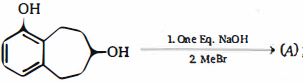
A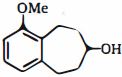
B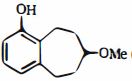
C
D
None of these
Solution
(A) The starting material is a dihydroxy compound containing both a phenolic $-OH$ group and an aliphatic $-OH$ group.
Phenolic $-OH$ is more acidic than aliphatic $-OH$ due to the resonance stabilization of the phenoxide ion.
When one equivalent of $NaOH$ is added,it selectively deprotonates the more acidic phenolic $-OH$ group to form a phenoxide ion.
Subsequent reaction with $CH_3Br$ proceeds via an $S_N2$ mechanism,where the phenoxide oxygen acts as a nucleophile and attacks the methyl bromide,resulting in the formation of a methoxy group at the phenolic position while the aliphatic $-OH$ group remains unaffected.
Thus,the product $(A)$ is the structure with a methoxy group at the phenolic position.
Phenolic $-OH$ is more acidic than aliphatic $-OH$ due to the resonance stabilization of the phenoxide ion.
When one equivalent of $NaOH$ is added,it selectively deprotonates the more acidic phenolic $-OH$ group to form a phenoxide ion.
Subsequent reaction with $CH_3Br$ proceeds via an $S_N2$ mechanism,where the phenoxide oxygen acts as a nucleophile and attacks the methyl bromide,resulting in the formation of a methoxy group at the phenolic position while the aliphatic $-OH$ group remains unaffected.
Thus,the product $(A)$ is the structure with a methoxy group at the phenolic position.
0 likes
View Solution252
MediumMCQ
Product $(B)$ of the above reaction is:

A
Cyclohexa$-1,2-$diol
B
Phenol
C
$3-$Methoxyphenol
D
Resorcinol
Solution
(B) The starting material is a dibromo-epoxide. Treatment with $2 \text{ moles}$ of $NaOCH_3$ in $CH_3OH$ leads to the elimination of $2 \text{ moles}$ of $HBr$ to form an epoxide ring fused to a cyclohexadiene system.
Upon treatment with $H_3O^+$,the epoxide ring undergoes acid-catalyzed opening followed by rearrangement to form a more stable aromatic system.
The final product $(B)$ is phenol $(C_6H_5OH)$.
Upon treatment with $H_3O^+$,the epoxide ring undergoes acid-catalyzed opening followed by rearrangement to form a more stable aromatic system.
The final product $(B)$ is phenol $(C_6H_5OH)$.
0 likes
View Solution253
MediumMCQ
Predict the major product for the following reaction:
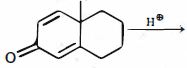
A
$4-$methylphenol derivative
B
$1-$naphthol derivative
C
$5-$methyl$-5,6,7,8-$tetrahydronaphthalen$-2-$ol
D
$5,6,7,8-$tetrahydronaphthalen$-1-$ol
Solution
(C) The reaction proceeds via the following steps:
$1$. Protonation of the carbonyl oxygen by $H^{\oplus}$ to form a resonance-stabilized carbocation.
$2$. $A$ $1,2$-methyl shift occurs to rearrange the carbocation to a more stable position.
$3$. Subsequent deprotonation and aromatization lead to the formation of the stable aromatic product,$5$-methyl-$5,6,7,8$-tetrahydronaphthalen-$2$-ol.
$1$. Protonation of the carbonyl oxygen by $H^{\oplus}$ to form a resonance-stabilized carbocation.
$2$. $A$ $1,2$-methyl shift occurs to rearrange the carbocation to a more stable position.
$3$. Subsequent deprotonation and aromatization lead to the formation of the stable aromatic product,$5$-methyl-$5,6,7,8$-tetrahydronaphthalen-$2$-ol.
0 likes
View Solution254
MediumMCQ
The major reason that phenol is a better Bronsted acid than cyclohexanol is that
A
it is a better proton donor.
B
the cyclohexyl group is an electron donating group by induction,which destabilizes the anion formed in the reaction by resonance.
C
phenol is able to stabilize the anion formed in the reaction.
D
the phenyl group is an electron withdrawing group by induction,which stabilizes the anion formed in the reaction.
Solution
(D) $ (d) $
The acidity of a compound depends on the stability of its conjugate base (anion).
In phenol,the $sp^2$ hybridized carbon atom of the phenyl ring is more electronegative than the $sp^3$ hybridized carbon of the cyclohexyl ring.
This creates an electron-withdrawing inductive effect ($-I$ effect) that stabilizes the phenoxide ion.
In contrast,the cyclohexyl group is electron-donating by induction,which destabilizes the cyclohexoxide ion.
The acidity of a compound depends on the stability of its conjugate base (anion).
In phenol,the $sp^2$ hybridized carbon atom of the phenyl ring is more electronegative than the $sp^3$ hybridized carbon of the cyclohexyl ring.
This creates an electron-withdrawing inductive effect ($-I$ effect) that stabilizes the phenoxide ion.
In contrast,the cyclohexyl group is electron-donating by induction,which destabilizes the cyclohexoxide ion.
0 likes
View Solution255
MediumMCQ
Decarboxylation of sodium salicylate with soda lime forms
A
Salicylic acid
B
Phenol
C
Benzene
D
None of these
Solution
(B) The decarboxylation of sodium salicylate with soda lime $(NaOH + CaO)$ involves the removal of the $-COONa$ group as $Na_2CO_3$.
This reaction converts sodium salicylate into phenol.
The chemical reaction is as follows:
$C_6H_4(OH)COONa + NaOH \xrightarrow{CaO} C_6H_5OH + Na_2CO_3$
This reaction converts sodium salicylate into phenol.
The chemical reaction is as follows:
$C_6H_4(OH)COONa + NaOH \xrightarrow{CaO} C_6H_5OH + Na_2CO_3$
0 likes
View Solution256
DifficultMCQ
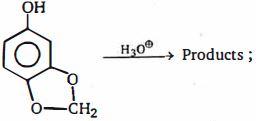
The product$(s)$ of the reaction is/are:
A
$1,2,4-$trihydroxybenzene
B
$1,2,3-$trihydroxybenzene
C
$HCHO$
D
Both $(a)$ and $(c)$
Solution
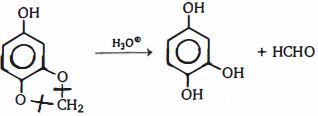
(D) The given reaction is an acid-catalyzed hydrolysis of a cyclic acetal derivative of a phenol.
In the presence of $H_3O^+$,the cyclic acetal ring undergoes hydrolysis to release the parent phenol and formaldehyde.
The starting material is a derivative of $1,2,4$-trihydroxybenzene where the $1,2$-dihydroxy group is protected as a cyclic acetal (methylenedioxy group).
Upon hydrolysis,the methylenedioxy group is cleaved to yield $1,2,4$-trihydroxybenzene and formaldehyde $(HCHO)$.
Thus,the products are $1,2,4$-trihydroxybenzene and $HCHO$.
Therefore,the correct option is $(d)$.
In the presence of $H_3O^+$,the cyclic acetal ring undergoes hydrolysis to release the parent phenol and formaldehyde.
The starting material is a derivative of $1,2,4$-trihydroxybenzene where the $1,2$-dihydroxy group is protected as a cyclic acetal (methylenedioxy group).
Upon hydrolysis,the methylenedioxy group is cleaved to yield $1,2,4$-trihydroxybenzene and formaldehyde $(HCHO)$.
Thus,the products are $1,2,4$-trihydroxybenzene and $HCHO$.
Therefore,the correct option is $(d)$.
0 likes
View Solution257
DifficultMCQ
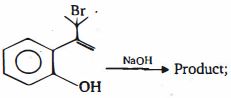
The product of the following reaction is:
A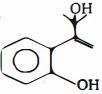
B
C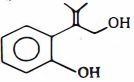
D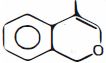
Solution
(B) The reaction involves the treatment of $2-(1-bromo-1-methylethyl)phenol$ with $NaOH$.
$NaOH$ acts as a base and deprotonates the phenolic $-OH$ group to form a phenoxide ion.
The phenoxide oxygen then acts as a nucleophile and attacks the carbon atom attached to the bromine atom via an intramolecular $S_N2$ or $S_N2$-like mechanism,displacing the bromide ion.
This results in the formation of a cyclic ether (a chroman derivative).
$NaOH$ acts as a base and deprotonates the phenolic $-OH$ group to form a phenoxide ion.
The phenoxide oxygen then acts as a nucleophile and attacks the carbon atom attached to the bromine atom via an intramolecular $S_N2$ or $S_N2$-like mechanism,displacing the bromide ion.
This results in the formation of a cyclic ether (a chroman derivative).
0 likes
View Solution258
DifficultMCQ
Identify the reactant $x$ in the following chemical reaction:
$Phenol + (x) \xrightarrow[(2) H^+]{(1) NaOH} Salicylaldehyde$
$Phenol + (x) \xrightarrow[(2) H^+]{(1) NaOH} Salicylaldehyde$
A
$CH_3Cl$
B
$CH_2Cl_2$
C
$CHCl_3$
D
$CCl_4$
Solution
(C) The given reaction is the Reimer-Tiemann reaction.
In this reaction,phenol reacts with chloroform $(CHCl_3)$ in the presence of aqueous sodium hydroxide $(NaOH)$ to form salicylaldehyde (o-hydroxybenzaldehyde) as the major product.
Therefore,the reactant $(x)$ is chloroform,$CHCl_3$.
In this reaction,phenol reacts with chloroform $(CHCl_3)$ in the presence of aqueous sodium hydroxide $(NaOH)$ to form salicylaldehyde (o-hydroxybenzaldehyde) as the major product.
Therefore,the reactant $(x)$ is chloroform,$CHCl_3$.
0 likes
View Solution259
MediumMCQ
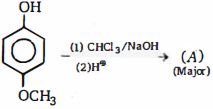
The product $(A)$ is:
A
$4-$methoxysalicylaldehyde
B
$2-$hydroxy$-5-$methoxybenzaldehyde
C
$5-$methoxy$-2-$hydroxybenzoic acid
D
$2-$hydroxy$-4-$methoxybenzoic acid
Solution
(B) The reaction given is the Reimer-Tiemann reaction,which involves the formylation of phenols using $CHCl_3$ and $NaOH$ followed by acidic workup.
In the starting material,$4$-methoxyphenol,the $-OH$ group is a strong ortho/para directing group,and the $-OCH_3$ group is also an ortho/para directing group.
The $-OH$ group is more strongly activating than the $-OCH_3$ group.
Therefore,the formylation occurs at the position ortho to the $-OH$ group.
Since the para position to the $-OH$ group is already occupied by the $-OCH_3$ group,the formylation occurs at the ortho position,resulting in $2$-hydroxy-$5$-methoxybenzaldehyde.
In the starting material,$4$-methoxyphenol,the $-OH$ group is a strong ortho/para directing group,and the $-OCH_3$ group is also an ortho/para directing group.
The $-OH$ group is more strongly activating than the $-OCH_3$ group.
Therefore,the formylation occurs at the position ortho to the $-OH$ group.
Since the para position to the $-OH$ group is already occupied by the $-OCH_3$ group,the formylation occurs at the ortho position,resulting in $2$-hydroxy-$5$-methoxybenzaldehyde.
0 likes
View Solution260
MediumMCQ
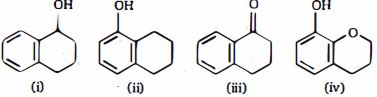
The increasing order of the rate of reaction with $Br_2 / AlCl_3$ is:
A
$iii < i < ii < iv$
B
$iv < ii < i < iii$
C
$ii < iv < iii < i$
D
$iv < ii < iii < i$
Solution
(A) The reaction with $Br_2 / AlCl_3$ is an electrophilic aromatic substitution reaction. The rate of this reaction depends on the electron density of the aromatic ring. Higher electron density increases the rate of reaction.
$(i)$ The ring has a weak electron-withdrawing group attached.
(ii) The ring has a strong electron-donating group $(-OH)$ and a weak electron-donating group.
(iii) The ring has a strong electron-withdrawing carbonyl group $(C=O)$.
(iv) The ring has a strong electron-donating group $(-OH)$ and an oxygen atom that provides additional electron density via resonance.
Comparing the electronic effects:
- (iii) has a strong electron-withdrawing group,making it the slowest.
- $(i)$ has a weak electron-withdrawing effect.
- (ii) has strong electron-donating groups.
- (iv) has the strongest electron-donating effect due to the additional oxygen atom.
Thus,the increasing order of the rate of reaction is $iii < i < ii < iv$.
$(i)$ The ring has a weak electron-withdrawing group attached.
(ii) The ring has a strong electron-donating group $(-OH)$ and a weak electron-donating group.
(iii) The ring has a strong electron-withdrawing carbonyl group $(C=O)$.
(iv) The ring has a strong electron-donating group $(-OH)$ and an oxygen atom that provides additional electron density via resonance.
Comparing the electronic effects:
- (iii) has a strong electron-withdrawing group,making it the slowest.
- $(i)$ has a weak electron-withdrawing effect.
- (ii) has strong electron-donating groups.
- (iv) has the strongest electron-donating effect due to the additional oxygen atom.
Thus,the increasing order of the rate of reaction is $iii < i < ii < iv$.
0 likes
View Solution261
DifficultMCQ
The action of bromine water (excess) on salicylic acid results in the formation of
A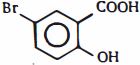
B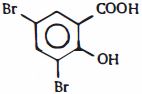
C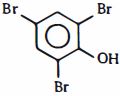
D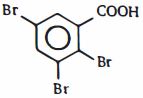
Solution
(C) When salicylic acid ($2$-hydroxybenzoic acid) is treated with excess bromine water,it undergoes electrophilic aromatic substitution.
The $-OH$ group is strongly activating and ortho/para directing,while the $-COOH$ group is deactivating.
Due to the strong activation by the $-OH$ group,the bromine atoms substitute at the available ortho and para positions relative to the $-OH$ group.
Additionally,the $-COOH$ group is a good leaving group in the presence of excess bromine,leading to ipso substitution where the $-COOH$ group is replaced by a $-Br$ atom.
Thus,the final product is $2,4,6$-tribromophenol.
The $-OH$ group is strongly activating and ortho/para directing,while the $-COOH$ group is deactivating.
Due to the strong activation by the $-OH$ group,the bromine atoms substitute at the available ortho and para positions relative to the $-OH$ group.
Additionally,the $-COOH$ group is a good leaving group in the presence of excess bromine,leading to ipso substitution where the $-COOH$ group is replaced by a $-Br$ atom.
Thus,the final product is $2,4,6$-tribromophenol.
0 likes
View Solution262
MediumMCQ
The nitration of phenol with dilute $HNO_3$ at low temperature yields a mixture of two isomers $(A)$ and $(B)$. Product $(A)$ is more volatile than product $(B)$. Identify $(A)$.
A
o-Nitrophenol
B
m-Nitrophenol
C
p-Nitrophenol
D
Nitrobenzene
Solution
(A) The nitration of phenol with dilute $HNO_3$ at low temperature gives a mixture of $o$-nitrophenol and $p$-nitrophenol.
$o$-Nitrophenol is more volatile due to the presence of intramolecular hydrogen bonding,which prevents intermolecular association.
$p$-Nitrophenol is less volatile because it forms intermolecular hydrogen bonding,leading to association of molecules and higher boiling point.
Therefore,$(A)$ is $o$-nitrophenol.
$o$-Nitrophenol is more volatile due to the presence of intramolecular hydrogen bonding,which prevents intermolecular association.
$p$-Nitrophenol is less volatile because it forms intermolecular hydrogen bonding,leading to association of molecules and higher boiling point.
Therefore,$(A)$ is $o$-nitrophenol.
0 likes
View Solution263
MediumMCQ
Which of the following is a true statement about the reaction shown?
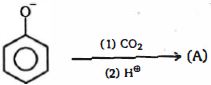
A
Ortho isomer is major if $PhONa$ is used.
B
Para isomer is major if $PhOK$ is used.
C
Product formed is further used for the preparation of the drug aspirin.
D
All of these.
Solution
(D) The reaction is the Kolbe-Schmitt reaction.
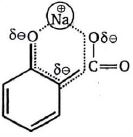
When $PhONa$ is used,the $Na^{\oplus}$ cation is small and coordinates with both the phenoxide oxygen and the incoming $CO_2$,stabilizing the ortho-transition state via chelation,making the ortho-isomer the major product.
When $PhOK$ is used,the $K^{\oplus}$ cation is larger and less effective at chelation,which reduces the preference for the ortho-position and makes the para-isomer more competitive.
The product formed (salicylic acid) is a key intermediate in the synthesis of aspirin (acetylsalicylic acid).
Therefore,all the given statements are true.
When $PhONa$ is used,the $Na^{\oplus}$ cation is small and coordinates with both the phenoxide oxygen and the incoming $CO_2$,stabilizing the ortho-transition state via chelation,making the ortho-isomer the major product.
When $PhOK$ is used,the $K^{\oplus}$ cation is larger and less effective at chelation,which reduces the preference for the ortho-position and makes the para-isomer more competitive.
The product formed (salicylic acid) is a key intermediate in the synthesis of aspirin (acetylsalicylic acid).
Therefore,all the given statements are true.
0 likes
View Solution264
AdvancedMCQ
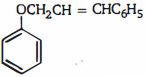
What is the product obtained by heating the following allylic ether of phenol?
A
$2-$($3$-phenylprop$-2-$en$-1-$yl)phenol
B
$2-$($1$-phenylprop$-2-$en$-1-$yl)phenol
C
$2-$phenoxyprop$-1-$ene
D
$4-$($1$-phenylprop$-2-$en$-1-$yl)phenol
Solution
(B) The reaction is a Claisen rearrangement,which involves the thermal [$3$,$3$]-sigmatropic rearrangement of an allyl aryl ether to an ortho-allyl phenol.
In the given reactant,the allyl group is $CH_2-CH=CH-C_6H_5$.
During the [$3$,$3$]-sigmatropic shift,the bond between the oxygen and the $CH_2$ group breaks,and a new bond forms between the ortho-carbon of the phenol ring and the gamma-carbon of the allyl group.
This results in the inversion of the allyl group,attaching the $CH(C_6H_5)CH=CH_2$ moiety to the ortho position of the phenol ring.
Therefore,the product is $2-$($1$-phenylprop$-2-$en$-1-$yl)phenol.
In the given reactant,the allyl group is $CH_2-CH=CH-C_6H_5$.
During the [$3$,$3$]-sigmatropic shift,the bond between the oxygen and the $CH_2$ group breaks,and a new bond forms between the ortho-carbon of the phenol ring and the gamma-carbon of the allyl group.
This results in the inversion of the allyl group,attaching the $CH(C_6H_5)CH=CH_2$ moiety to the ortho position of the phenol ring.
Therefore,the product is $2-$($1$-phenylprop$-2-$en$-1-$yl)phenol.
0 likes
View Solution265
MediumMCQ
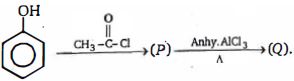
Product $(Q)$ in this reaction is
A
Phenyl methyl ether
B
Phenyl acetate
C
$p$-Hydroxyacetophenone
D
$p$-Methoxyphenol
Solution
(C) The reaction of phenol with acetyl chloride $(CH_3COCl)$ in the presence of a base forms phenyl acetate as product $(P)$.
This is an esterification reaction.
When phenyl acetate $(P)$ is heated with anhydrous $AlCl_3$,it undergoes Fries rearrangement to form a mixture of $o$-hydroxyacetophenone and $p$-hydroxyacetophenone.
$p$-Hydroxyacetophenone is the major product $(Q)$ at higher temperatures.
Therefore,the correct option is $(C)$.
This is an esterification reaction.
When phenyl acetate $(P)$ is heated with anhydrous $AlCl_3$,it undergoes Fries rearrangement to form a mixture of $o$-hydroxyacetophenone and $p$-hydroxyacetophenone.
$p$-Hydroxyacetophenone is the major product $(Q)$ at higher temperatures.
Therefore,the correct option is $(C)$.
0 likes
View Solution266
DifficultMCQ
The major product of the acetylation of salicylic acid with $Ac_2O/H^+$ followed by heating with anhydrous $AlCl_3$ is
A
$3-$acetylsalicylic acid
B
$5-$acetylsalicylic acid
C
$4-$acetylsalicylic acid
D
$2-$acetylsalicylic acid
Solution
(B) $1$. Acetylation of salicylic acid with $Ac_2O/H^+$ yields acetylsalicylic acid (aspirin),where the phenolic $-OH$ group is acetylated to form an ester.
$2$. Heating this ester with anhydrous $AlCl_3$ triggers a Fries rearrangement.
$3$. In the Fries rearrangement of phenyl esters,the acyl group migrates from the phenolic oxygen to the ortho or para position of the benzene ring.
$4$. Due to the presence of the bulky $-COOH$ group at the ortho position,steric hindrance makes the ortho-substitution less favorable.
$5$. Therefore,the major product is the para-substituted isomer,which is $5$-acetylsalicylic acid (relative to the $-COOH$ group at position $1$ and $-OH$ at position $2$,the para position is $5$).
$2$. Heating this ester with anhydrous $AlCl_3$ triggers a Fries rearrangement.
$3$. In the Fries rearrangement of phenyl esters,the acyl group migrates from the phenolic oxygen to the ortho or para position of the benzene ring.
$4$. Due to the presence of the bulky $-COOH$ group at the ortho position,steric hindrance makes the ortho-substitution less favorable.
$5$. Therefore,the major product is the para-substituted isomer,which is $5$-acetylsalicylic acid (relative to the $-COOH$ group at position $1$ and $-OH$ at position $2$,the para position is $5$).
0 likes
View Solution267
DifficultMCQ
The unknown product $(A)$ in the following reaction is:
Salicylic acid + $2I-Cl \rightarrow (A)$
Salicylic acid + $2I-Cl \rightarrow (A)$
A
$3,5-$diiodosalicylic acid
B
$3,4-$diiodosalicylic acid
C
$3,5-$dichlorosalicylic acid
D
$3,6-$diiodosalicylic acid
Solution
(A) The reaction of salicylic acid $(2-hydroxybenzoic \ acid)$ with $I-Cl$ is an electrophilic aromatic substitution reaction.
The $-OH$ group is a strong activating group and is ortho/para directing.
The $-COOH$ group is a deactivating group and is meta directing.
In salicylic acid,the $-OH$ group directs the incoming electrophile $(I^+)$ to the ortho and para positions relative to itself.
The positions ortho and para to the $-OH$ group are the $3$ and $5$ positions of the benzene ring.
Therefore,the electrophilic iodination occurs at the $3$ and $5$ positions,resulting in $3,5-diiodosalicylic \ acid$.
The $-OH$ group is a strong activating group and is ortho/para directing.
The $-COOH$ group is a deactivating group and is meta directing.
In salicylic acid,the $-OH$ group directs the incoming electrophile $(I^+)$ to the ortho and para positions relative to itself.
The positions ortho and para to the $-OH$ group are the $3$ and $5$ positions of the benzene ring.
Therefore,the electrophilic iodination occurs at the $3$ and $5$ positions,resulting in $3,5-diiodosalicylic \ acid$.
0 likes
View Solution268
DifficultMCQ
Product $(A)$ in this reaction is
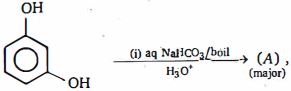
A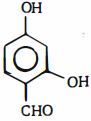
B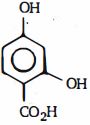
C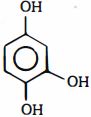
D
No reaction
Solution
(B) This is an example of the Kolbe-Schmidt reaction. The starting material is resorcinol ($1$,$3$-dihydroxybenzene).
When boiled with aqueous $NaHCO_3$,$CO_2$ is generated in situ.
The electron-donating hydroxyl groups activate the benzene ring towards electrophilic aromatic substitution.
The electrophile $CO_2$ attacks the position ortho to one hydroxyl group and para to the other,which is the most activated position.
After acidification with $H_3O^+$,the final product $(A)$ is $2,4-$dihydroxybenzoic acid.
When boiled with aqueous $NaHCO_3$,$CO_2$ is generated in situ.
The electron-donating hydroxyl groups activate the benzene ring towards electrophilic aromatic substitution.
The electrophile $CO_2$ attacks the position ortho to one hydroxyl group and para to the other,which is the most activated position.
After acidification with $H_3O^+$,the final product $(A)$ is $2,4-$dihydroxybenzoic acid.
0 likes
View Solution269
MediumMCQ
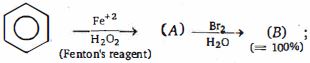
The major product $(B)$ of this reaction is:
A
$2-$Bromophenol
B
$3-$Bromophenol
C
$4-$Bromophenol
D
$2,4,6-$Tribromophenol
Solution
(D) $1$. The reaction of benzene with Fenton's reagent $(Fe^{+2} / H_2O_2)$ produces phenol as product $(A)$.
$2$. Phenol reacts with bromine water $(Br_2 / H_2O)$ to undergo electrophilic aromatic substitution.
$3$. Due to the strong activating effect of the $-OH$ group,the reaction proceeds to substitute all available ortho and para positions,resulting in the formation of $2,4,6-$tribromophenol as the major product $(B)$.
$2$. Phenol reacts with bromine water $(Br_2 / H_2O)$ to undergo electrophilic aromatic substitution.
$3$. Due to the strong activating effect of the $-OH$ group,the reaction proceeds to substitute all available ortho and para positions,resulting in the formation of $2,4,6-$tribromophenol as the major product $(B)$.
0 likes
View Solution270
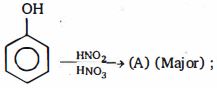
MediumMCQ
The product $(A)$ is
A
p-Nitrosophenol
B
o-Nitrophenol
C
p-Nitrophenol
D
m-Nitrophenol
Solution
(A) The reaction of phenol with $HNO_2$ (nitrous acid) at low temperature yields $p$-nitrosophenol as the major product $(A)$.
Subsequently,$p$-nitrosophenol can be oxidized by $HNO_3$ to form $p$-nitrophenol.
Therefore,the product $(A)$ formed in the first step is $p$-nitrosophenol.
Subsequently,$p$-nitrosophenol can be oxidized by $HNO_3$ to form $p$-nitrophenol.
Therefore,the product $(A)$ formed in the first step is $p$-nitrosophenol.
0 likes
View Solution271
DifficultMCQ
Compound $A$ $(C_7H_8O)$ is insoluble in water,dilute $HCl$,and aqueous $NaHCO_3$,but it dissolves in dilute $NaOH$. When $A$ is treated with $Br_2$ water,it is converted into a compound $C_7H_5OBr_3$ rapidly. The structure of $A$ is
A
Anisole
B
$o$-Cresol
C
$m$-Cresol
D
$p$-Cresol
Solution
(B) The molecular formula $C_7H_8O$ corresponds to either an ether (anisole) or a phenol (cresol).
Since the compound is insoluble in water and $NaHCO_3$ but soluble in $NaOH$,it must be a phenol because phenols are acidic enough to react with $NaOH$ to form water-soluble phenoxide salts.
Anisole (an ether) does not react with $NaOH$.
Phenols react rapidly with $Br_2$ water to form a tribromo derivative.
$o$-Cresol ($2$-methylphenol) reacts with $Br_2$ water to form $3,4,6$-tribromo-$2$-methylphenol $(C_7H_5OBr_3)$.
Therefore,the compound $A$ is $o$-cresol.
Since the compound is insoluble in water and $NaHCO_3$ but soluble in $NaOH$,it must be a phenol because phenols are acidic enough to react with $NaOH$ to form water-soluble phenoxide salts.
Anisole (an ether) does not react with $NaOH$.
Phenols react rapidly with $Br_2$ water to form a tribromo derivative.
$o$-Cresol ($2$-methylphenol) reacts with $Br_2$ water to form $3,4,6$-tribromo-$2$-methylphenol $(C_7H_5OBr_3)$.
Therefore,the compound $A$ is $o$-cresol.
0 likes
View Solution272
MediumMCQ
Identify the end product $(B)$ of the following sequence of reactions:
Phenol $\xrightarrow[100^{\circ}C]{\text{conc. } H_2SO_4} A$ $\xrightarrow{Br_2/H_2O \text{ (excess)}} B$
Phenol $\xrightarrow[100^{\circ}C]{\text{conc. } H_2SO_4} A$ $\xrightarrow{Br_2/H_2O \text{ (excess)}} B$
A
$2,6-$dibromo$-4-$sulfophenol
B
$2,4-$dibromophenol
C
$2,4,6-$tribromophenol
D
$2-$bromo$-4-$sulfophenol
Solution
(C) $1$. When phenol is treated with concentrated $H_2SO_4$ at $100^{\circ}C$,the major product formed is $p$-phenolsulfonic acid $(A)$.
$2$. When $p$-phenolsulfonic acid is treated with excess bromine water $(Br_2/H_2O)$,the $-SO_3H$ group is replaced by a bromine atom due to its high reactivity and the stability of the resulting $2,4,6$-tribromophenol product. This is an example of ipso substitution.
$3$. Therefore,the end product $(B)$ is $2,4,6$-tribromophenol.
$2$. When $p$-phenolsulfonic acid is treated with excess bromine water $(Br_2/H_2O)$,the $-SO_3H$ group is replaced by a bromine atom due to its high reactivity and the stability of the resulting $2,4,6$-tribromophenol product. This is an example of ipso substitution.
$3$. Therefore,the end product $(B)$ is $2,4,6$-tribromophenol.
0 likes
View Solution273
AdvancedMCQ
Phenol reacts with acetone in the presence of concentrated sulphuric acid to form a $C_{15}H_{16}O_2$ product. Which of the following compounds is this product?
A
B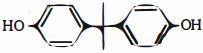
C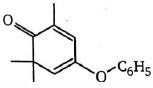
D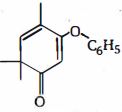
Solution
(B) The reaction of phenol with acetone in the presence of concentrated sulphuric acid is an electrophilic aromatic substitution reaction.
Two molecules of phenol react with one molecule of acetone to form bisphenol-$A$ $(C_{15}H_{16}O_2)$.
The reaction proceeds as follows:
$2C_6H_5OH + CH_3COCH_3 \xrightarrow{conc. H_2SO_4} (HOC_6H_4)_2C(CH_3)_2 + H_2O$.
This product is bisphenol-$A$,which corresponds to the structure shown in option $B$.
Two molecules of phenol react with one molecule of acetone to form bisphenol-$A$ $(C_{15}H_{16}O_2)$.
The reaction proceeds as follows:
$2C_6H_5OH + CH_3COCH_3 \xrightarrow{conc. H_2SO_4} (HOC_6H_4)_2C(CH_3)_2 + H_2O$.
This product is bisphenol-$A$,which corresponds to the structure shown in option $B$.
0 likes
View Solution274
MediumMCQ
Which of the following substances will increase the acidity of phenol?
A
Dil. $H_2SO_4$
B
Dil. $HCl$
C
Conc. $H_2SO_4$
D
Conc. $CH_3COOH$
Solution
(C) The acidity of phenol is increased by the presence of electron-withdrawing groups on the benzene ring.
When phenol reacts with concentrated $H_2SO_4$,it undergoes electrophilic aromatic substitution (sulfonation) to form phenol$-4-$sulfonic acid.
The $-SO_3H$ group is a strong electron-withdrawing group due to its $-I$ and $-M$ effects.
This electron-withdrawing effect stabilizes the phenoxide ion formed after the loss of a proton,thereby increasing the acidity of the resulting compound compared to phenol.
Therefore,Conc. $H_2SO_4$ is the correct substance.
When phenol reacts with concentrated $H_2SO_4$,it undergoes electrophilic aromatic substitution (sulfonation) to form phenol$-4-$sulfonic acid.
The $-SO_3H$ group is a strong electron-withdrawing group due to its $-I$ and $-M$ effects.
This electron-withdrawing effect stabilizes the phenoxide ion formed after the loss of a proton,thereby increasing the acidity of the resulting compound compared to phenol.
Therefore,Conc. $H_2SO_4$ is the correct substance.
0 likes
View Solution275
MediumMCQ
Identify the type of reaction shown in the following chemical equation:
$C_6H_5OH + 3Br_2 \rightarrow C_6H_2Br_3OH + 3HBr$
$C_6H_5OH + 3Br_2 \rightarrow C_6H_2Br_3OH + 3HBr$
A
Nucleophilic addition
B
Nucleophilic substitution
C
Electrophilic addition
D
Electrophilic substitution
Solution
(D) The given reaction is the bromination of phenol.
In this reaction,the electrophile $Br^+$ attacks the electron-rich benzene ring of phenol.
This results in the replacement of hydrogen atoms on the aromatic ring with bromine atoms.
Therefore,this is an example of an aromatic electrophilic substitution reaction.
The correct option is $(D)$.
In this reaction,the electrophile $Br^+$ attacks the electron-rich benzene ring of phenol.
This results in the replacement of hydrogen atoms on the aromatic ring with bromine atoms.
Therefore,this is an example of an aromatic electrophilic substitution reaction.
The correct option is $(D)$.
0 likes
View Solution276
MediumMCQ
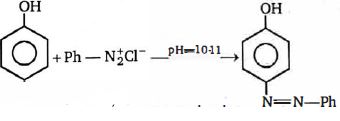
Characteristics of the above reaction is:
A
$C-N$ coupling reaction; Carbocation is intermediate
B
$N-N$ coupling reaction; Carbocation is intermediate
C
$C-N$ coupling reaction; Carbanion is intermediate
D
$N-N$ coupling reaction; Carbanion is intermediate
Solution
(C) The reaction shown is an electrophilic aromatic substitution,specifically a diazo coupling reaction between phenol and benzenediazonium chloride in a basic medium $(pH = 10-11)$.
In a basic medium,phenol exists as a phenoxide ion,which is highly activated towards electrophilic substitution.
The phenoxide ion undergoes resonance,where the negative charge is delocalized onto the ortho and para positions of the benzene ring.
This creates a carbanion-like intermediate at the para position,which then attacks the electrophilic nitrogen atom of the diazonium salt.
This results in the formation of a $C-N$ bond,making it a $C-N$ coupling reaction.
In a basic medium,phenol exists as a phenoxide ion,which is highly activated towards electrophilic substitution.
The phenoxide ion undergoes resonance,where the negative charge is delocalized onto the ortho and para positions of the benzene ring.
This creates a carbanion-like intermediate at the para position,which then attacks the electrophilic nitrogen atom of the diazonium salt.
This results in the formation of a $C-N$ bond,making it a $C-N$ coupling reaction.
0 likes
View Solution277
MediumMCQ
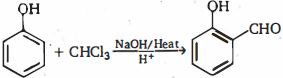
The reaction shown in the figure is known as:
A
Perkin reaction
B
Sandmeyer reaction
C
Reimer-Tiemann reaction
D
Cannizzaro reaction
Solution
(C) The reaction of phenol with $CHCl_3$ in the presence of aqueous $NaOH$ followed by acidification $(H^+)$ leads to the formation of salicylaldehyde (ortho-hydroxybenzaldehyde).
This specific chemical transformation is known as the Reimer-Tiemann reaction.
In this reaction,the electrophile is dichlorocarbene $(:CCl_2)$,which is generated from $CHCl_3$ and $NaOH$.
This specific chemical transformation is known as the Reimer-Tiemann reaction.
In this reaction,the electrophile is dichlorocarbene $(:CCl_2)$,which is generated from $CHCl_3$ and $NaOH$.
0 likes
View Solution278
DifficultMCQ
The major product of the given reaction is
$3-methoxyphenol$ $\xrightarrow[{(ii) \ H_2SO_4, \ heat}]{{(i) \ OHCCH_2COCl}}$
$3-methoxyphenol$ $\xrightarrow[{(ii) \ H_2SO_4, \ heat}]{{(i) \ OHCCH_2COCl}}$
A
$7-$methoxy-2H-chromen$-2-$one
B
$5-$methoxy-2H-chromen$-2-$one
C
$5-$methoxy-chroman$-4-$one
D
$7-$methoxy-chroman$-4-$one
Solution
(A) The reaction of $3-methoxyphenol$ with $OHCCH_2COCl$ involves the esterification of the phenolic $-OH$ group with the acid chloride group $(-COCl)$,as acid chlorides are more reactive than aldehydes.
This forms an intermediate ester: $3-methoxyphenyl \ 2-formylacetate$.
In the presence of concentrated $H_2SO_4$ and heat,this intermediate undergoes an intramolecular Pechmann-type condensation (cyclisation) between the aldehyde group and the ortho-position of the benzene ring.
Since the starting material is $3-methoxyphenol$,the cyclisation can occur at the $2$ or $6$ positions. The $6$-position is less sterically hindered than the $2$-position (which is between the $-OMe$ and the ester group),leading to $7-methoxy-2H-chromen-2-one$ as the major product.
This forms an intermediate ester: $3-methoxyphenyl \ 2-formylacetate$.
In the presence of concentrated $H_2SO_4$ and heat,this intermediate undergoes an intramolecular Pechmann-type condensation (cyclisation) between the aldehyde group and the ortho-position of the benzene ring.
Since the starting material is $3-methoxyphenol$,the cyclisation can occur at the $2$ or $6$ positions. The $6$-position is less sterically hindered than the $2$-position (which is between the $-OMe$ and the ester group),leading to $7-methoxy-2H-chromen-2-one$ as the major product.
0 likes
View Solution279
DifficultMCQ
The major product of the following reaction is
$2-(2-hydroxyethyl)phenol$ $\xrightarrow[2. \, CH_3I \, (1. \, eq.)]{1. \, K_2CO_3}$
$2-(2-hydroxyethyl)phenol$ $\xrightarrow[2. \, CH_3I \, (1. \, eq.)]{1. \, K_2CO_3}$
A
$2-$($2$-methoxyethyl)phenol
B
$1-$($2$-hydroxyethyl)$-2-$methoxybenzene
C
$2,3-$dihydrobenzofuran
D
$2-$vinyl$-1-$methoxybenzene
Solution
(B) The starting material is $2-(2-hydroxyethyl)phenol$,which contains both a phenolic $-OH$ group and an aliphatic $-OH$ group.
$K_2CO_3$ is a mild base that selectively deprotonates the more acidic phenolic $-OH$ group $(pK_a \approx 10)$ compared to the aliphatic $-OH$ group $(pK_a \approx 16)$.
The resulting phenoxide ion is resonance-stabilized by the benzene ring,making it the preferred site for nucleophilic substitution.
Upon addition of $CH_3I$ $(1. \, eq.)$,the phenoxide ion acts as a nucleophile and attacks the methyl iodide via an $S_N2$ mechanism to form the methyl ether at the phenolic position.
Therefore,the major product is $1-(2-hydroxyethyl)-2-methoxybenzene$.
$K_2CO_3$ is a mild base that selectively deprotonates the more acidic phenolic $-OH$ group $(pK_a \approx 10)$ compared to the aliphatic $-OH$ group $(pK_a \approx 16)$.
The resulting phenoxide ion is resonance-stabilized by the benzene ring,making it the preferred site for nucleophilic substitution.
Upon addition of $CH_3I$ $(1. \, eq.)$,the phenoxide ion acts as a nucleophile and attacks the methyl iodide via an $S_N2$ mechanism to form the methyl ether at the phenolic position.
Therefore,the major product is $1-(2-hydroxyethyl)-2-methoxybenzene$.
0 likes
View Solution280
DifficultMCQ
The following reaction is known as:
$Phenol + HCl + HCN \xrightarrow{Anhyd. ZnCl_2} Salicylaldehyde$
$Phenol + HCl + HCN \xrightarrow{Anhyd. ZnCl_2} Salicylaldehyde$
A
Perkin reaction
B
Gatterman-Koch Formylation
C
Kolbe's reaction
D
Gattermann reaction
Solution
(D) The given reaction is known as the Gattermann reaction (specifically,the Gattermann formylation of phenol).
In this reaction,an aromatic compound like phenol is treated with a mixture of $HCN$ and dry $HCl$ gas in the presence of a Lewis acid catalyst such as anhydrous $ZnCl_2$ or $AlCl_3$ to introduce a formyl $(-CHO)$ group into the aromatic ring.
In this reaction,an aromatic compound like phenol is treated with a mixture of $HCN$ and dry $HCl$ gas in the presence of a Lewis acid catalyst such as anhydrous $ZnCl_2$ or $AlCl_3$ to introduce a formyl $(-CHO)$ group into the aromatic ring.
0 likes
View Solution281
DifficultMCQ
Which one of the following statements is not correct?
A
Alcohols are weaker acids than water.
B
Acid strength of alcohols decreases in the following order: $RCH_2OH > R_2CHOH > R_3COH$.
C
Carbon-oxygen bond length in methanol, $CH_3OH$ is shorter than that of $C-O$ bond length in phenol.
D
The bond angle $C-O-H$ in methanol is $108.9^o$.
Solution
(C) The $C-O$ bond length in alcohol is $142 \ pm$ and in phenol it is $136 \ pm$. The $C-O$ bond length in phenol is shorter than that in methanol due to the conjugation of unshared pair of electrons on oxygen with the ring, which imparts double bond character to the $C-O$ bond. Thus, statement $C$ is incorrect.
0 likes
View Solution282
DifficultMCQ
Phthalic acid reacts with resorcinol in the presence of concentrated $H_2SO_4$ to give
A
Phenolphthalein
B
Alizarin
C
Coumarin
D
Fluorescein
Solution
(D) The reaction between phthalic acid and resorcinol in the presence of concentrated $H_2SO_4$ is a condensation reaction.
Phthalic acid undergoes dehydration with two molecules of resorcinol to form a dye known as Fluorescein.
The reaction is: $\text{Phthalic acid} + 2 \times \text{Resorcinol} \xrightarrow{\text{Conc. } H_2SO_4} \text{Fluorescein} + 2H_2O$.
Phthalic acid undergoes dehydration with two molecules of resorcinol to form a dye known as Fluorescein.
The reaction is: $\text{Phthalic acid} + 2 \times \text{Resorcinol} \xrightarrow{\text{Conc. } H_2SO_4} \text{Fluorescein} + 2H_2O$.
0 likes
View Solution283
DifficultMCQ
Which one of the following substituents at para position is most effective in stabilizing the phenoxide ion?
A
$-CH_3$
B
$-OCH_3$
C
$-COCH_3$
D
$-CH_2OH$
Solution
(C) The stability of the phenoxide ion is increased by electron-withdrawing groups $(EWG)$ through the delocalization of the negative charge on the oxygen atom into the benzene ring.
$-CH_3$ and $-CH_2OH$ are electron-donating groups $(EDG)$ and decrease the stability of the phenoxide ion.
$-OCH_3$ acts as an electron-donating group via the resonance effect ($+R$ effect),which outweighs its inductive electron-withdrawing effect ($-I$ effect),thus destabilizing the phenoxide ion.
$-COCH_3$ is a strong electron-withdrawing group due to both the inductive effect $(-I)$ and the resonance effect $(-R)$.
Therefore,the $-COCH_3$ group is the most effective in stabilizing the phenoxide ion at the para position.
$-CH_3$ and $-CH_2OH$ are electron-donating groups $(EDG)$ and decrease the stability of the phenoxide ion.
$-OCH_3$ acts as an electron-donating group via the resonance effect ($+R$ effect),which outweighs its inductive electron-withdrawing effect ($-I$ effect),thus destabilizing the phenoxide ion.
$-COCH_3$ is a strong electron-withdrawing group due to both the inductive effect $(-I)$ and the resonance effect $(-R)$.
Therefore,the $-COCH_3$ group is the most effective in stabilizing the phenoxide ion at the para position.
0 likes
View Solution284
DifficultMCQ
Which one of the following compounds will not be soluble in sodium bicarbonate?
A
$2, 4, 6-$Trinitrophenol
B
Benzoic acid
C
$o-$Nitrophenol
D
Benzene sulphonic acid
Solution
(C) Sodium bicarbonate $(NaHCO_3)$ is a weak base. Only acids stronger than carbonic acid $(H_2CO_3)$ can react with it to evolve $CO_2$ gas and become soluble.
$2, 4, 6-$Trinitrophenol (picric acid),benzoic acid,and benzene sulphonic acid are stronger acids than carbonic acid and are soluble in $NaHCO_3$.
$o-$Nitrophenol is a weaker acid than carbonic acid. Additionally,it forms intramolecular hydrogen bonding between the $-OH$ group and the $-NO_2$ group,which makes the acidic proton less available for reaction with the base. Therefore,it is not soluble in sodium bicarbonate.
$2, 4, 6-$Trinitrophenol (picric acid),benzoic acid,and benzene sulphonic acid are stronger acids than carbonic acid and are soluble in $NaHCO_3$.
$o-$Nitrophenol is a weaker acid than carbonic acid. Additionally,it forms intramolecular hydrogen bonding between the $-OH$ group and the $-NO_2$ group,which makes the acidic proton less available for reaction with the base. Therefore,it is not soluble in sodium bicarbonate.
0 likes
View Solution285
MediumMCQ
What is the structure of the major product when phenol is treated with bromine water?
A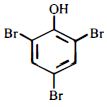
B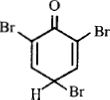
C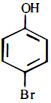
D
Solution
(A) Phenol has an activating (electron-releasing) $-OH$ group,which strongly activates the benzene ring towards electrophilic substitution. Bromine water provides $Br^{+}$ ions easily. Due to the high reactivity of phenol,the reaction does not stop at the mono- or di-bromo stage but proceeds to form a fully brominated product,$2,4,6-\text{tribromophenol}$,as a white precipitate.
0 likes
View Solution286
DifficultMCQ
The reaction of phenol with benzoyl chloride to give phenyl benzoate is known as
A
Claisen reaction
B
Schotten-Baumann reaction
C
Reimer-Tiemann reaction
D
Gatterman-Koch reaction
Solution
(B) The reaction between phenol $(C_6H_5OH)$ and benzoyl chloride $(C_6H_5COCl)$ in the presence of an aqueous base (like $NaOH$) is known as the Schotten-Baumann reaction.
This reaction involves the benzoylation of the phenol,where the hydrogen atom of the hydroxyl group is replaced by a benzoyl group $(C_6H_5CO-)$ to form an ester,phenyl benzoate $(C_6H_5COOC_6H_5)$,and $HCl$ is removed as a byproduct.
The base neutralizes the $HCl$ produced,driving the reaction forward.
This reaction involves the benzoylation of the phenol,where the hydrogen atom of the hydroxyl group is replaced by a benzoyl group $(C_6H_5CO-)$ to form an ester,phenyl benzoate $(C_6H_5COOC_6H_5)$,and $HCl$ is removed as a byproduct.
The base neutralizes the $HCl$ produced,driving the reaction forward.
0 likes
View Solution287
EasyMCQ
Phenol on heating with $CHCl_3$ and $NaOH$ gives salicylaldehyde. The reaction is called
A
Reimer - Tiemann reaction
B
Claisen reaction
C
Cannizzaro's reaction
D
Hell - Volhard - Zelinsky reaction
Solution
(A) The reaction of phenol with chloroform $(CHCl_3)$ in the presence of aqueous sodium hydroxide $(NaOH)$ followed by acidification leads to the formation of salicylaldehyde (o-hydroxybenzaldehyde) as the major product. This specific chemical transformation is known as the Reimer - Tiemann reaction.
0 likes
View Solution288
AdvancedMCQ
The products formed in the reaction of cumene with $O_2$ followed by treatment with dil. $HCl$ are
A
$Phenol$ and $Acetone$
B
$Benzyl$ $alcohol$ and $Acetaldehyde$
C
$Benzene$ and $Propene$
D
$Benzaldehyde$ and $Methane$
Solution
(A) Cumene $(Isopropylbenzene)$ reacts with $O_2$ to form cumene hydroperoxide.
Upon further treatment with dil. $HCl$,cumene hydroperoxide undergoes rearrangement to yield $Phenol$ and $Acetone$ as the final products.
Upon further treatment with dil. $HCl$,cumene hydroperoxide undergoes rearrangement to yield $Phenol$ and $Acetone$ as the final products.
0 likes
View Solution289
DifficultMCQ
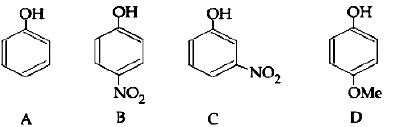
The increasing order of $pKa$ values of the following compounds is:
A
$C < B < A < D$
B
$B < C < D < A$
C
$D < A < C < B$
D
$B < C < A < D$
Solution
(C) The acidity of phenols is determined by the stability of the phenoxide ion formed after the loss of a proton. Electron-withdrawing groups $(EWG)$ increase acidity (decrease $pKa$),while electron-donating groups $(EDG)$ decrease acidity (increase $pKa$).
$A$: Phenol (reference).
$B$: $p$-nitrophenol ($-NO_2$ is a strong $EWG$,increases acidity).
$C$: $m$-nitrophenol ($-NO_2$ is an $EWG$,increases acidity but less than $p$-isomer due to lack of resonance effect).
$D$: $p$-methoxyphenol ($-OCH_3$ is an $EDG$,decreases acidity).
Acidity order: $B > C > A > D$.
Since $pKa = -\log(Ka)$,the increasing order of $pKa$ is the reverse of the acidity order: $D < A < C < B$.
$A$: Phenol (reference).
$B$: $p$-nitrophenol ($-NO_2$ is a strong $EWG$,increases acidity).
$C$: $m$-nitrophenol ($-NO_2$ is an $EWG$,increases acidity but less than $p$-isomer due to lack of resonance effect).
$D$: $p$-methoxyphenol ($-OCH_3$ is an $EDG$,decreases acidity).
Acidity order: $B > C > A > D$.
Since $pKa = -\log(Ka)$,the increasing order of $pKa$ is the reverse of the acidity order: $D < A < C < B$.
0 likes
View Solution290
DifficultMCQ
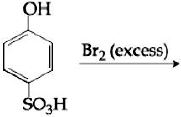
The major product of the following reaction is:
A
$2,4,6-$Tribromophenol
B
$2-$Bromo$-4-$sulfophenol
C
$2,4,6-$Tribromophenol
D
$2,6-$Dibromo$-4-$sulfophenol
Solution
(A) When $p$-hydroxybenzenesulfonic acid is treated with excess $Br_2$,the $-SO_3H$ group is replaced by a $Br$ atom because the $-OH$ group is a strong activating group and the $-SO_3H$ group is a good leaving group in this electrophilic substitution reaction. This phenomenon is known as the ipso effect. The final product is $2,4,6$-tribromophenol.
0 likes
View Solution291
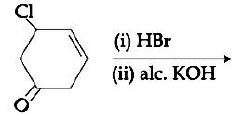
DifficultMCQ
The major product of the following reaction is
A
$6-$chlorocyclohex$-2-$en$-1-$one
B
phenol
C
$2-$chlorocyclohexa$-1,3-$dien$-1-$one
D
$6-$hydroxycyclohex$-2-$en$-1-$one
Solution
(B) The reaction proceeds as follows:
$1$. The starting material is $6$-chlorocyclohex-$2$-en-$1$-one.
$2$. Addition of $HBr$ across the double bond follows Markovnikov's rule,resulting in the formation of $6$-chloro-$3$-bromocyclohexan-$1$-one.
$3$. Treatment with alcoholic $KOH$ $(alc. KOH)$ causes dehydrohalogenation (elimination of $HBr$ and $HCl$),leading to the formation of cyclohexa-$2,4$-dien-$1$-one.
$4$. This intermediate undergoes tautomerization to form the more stable aromatic product,phenol $(C_6H_5OH)$.
$1$. The starting material is $6$-chlorocyclohex-$2$-en-$1$-one.
$2$. Addition of $HBr$ across the double bond follows Markovnikov's rule,resulting in the formation of $6$-chloro-$3$-bromocyclohexan-$1$-one.
$3$. Treatment with alcoholic $KOH$ $(alc. KOH)$ causes dehydrohalogenation (elimination of $HBr$ and $HCl$),leading to the formation of cyclohexa-$2,4$-dien-$1$-one.
$4$. This intermediate undergoes tautomerization to form the more stable aromatic product,phenol $(C_6H_5OH)$.
0 likes
View Solution292
DifficultMCQ
Which of the following compounds reacts with ethylmagnesium bromide and also decolourizes bromine water solution?
A
$2-$acetylbenzonitrile
B
Methyl $2-$($2$-cyanophenyl)acetate
C
$1-$methoxy$-2-$vinylbenzene
D
$2-$vinylphenol
Solution
(D) To react with ethylmagnesium bromide (a Grignard reagent),the compound must contain an acidic hydrogen or an electrophilic functional group like a carbonyl or nitrile. To decolourize bromine water,the compound must contain an unsaturated bond (alkene or alkyne).
$A$: Contains a ketone and a nitrile group (reacts with Grignard) but no alkene (does not decolourize $Br_2$ water).
$B$: Contains a nitrile and an ester group (reacts with Grignard) but no alkene (does not decolourize $Br_2$ water).
$C$: Contains an alkene (decolourizes $Br_2$ water) but no acidic hydrogen or reactive electrophilic group for Grignard reagent.
$D$: Contains a phenolic $-OH$ group (acidic hydrogen,reacts with Grignard) and a vinyl group (alkene,decolourizes $Br_2$ water). Thus,$D$ is the correct answer.
$A$: Contains a ketone and a nitrile group (reacts with Grignard) but no alkene (does not decolourize $Br_2$ water).
$B$: Contains a nitrile and an ester group (reacts with Grignard) but no alkene (does not decolourize $Br_2$ water).
$C$: Contains an alkene (decolourizes $Br_2$ water) but no acidic hydrogen or reactive electrophilic group for Grignard reagent.
$D$: Contains a phenolic $-OH$ group (acidic hydrogen,reacts with Grignard) and a vinyl group (alkene,decolourizes $Br_2$ water). Thus,$D$ is the correct answer.
0 likes
View Solution293
DifficultMCQ
$p$-Hydroxybenzophenone upon reaction with bromine in carbon tetrachloride gives
A
$3-$Bromo$-4-$hydroxybenzophenone
B
$2-$Bromo$-4-$hydroxybenzophenone
C
$4-$($4$-Bromophenyl)hydroxybenzene
D
$3-$Bromo$-4-$hydroxybenzophenone
Solution
(D) The reaction of $p$-hydroxybenzophenone with $Br_2$ in $CCl_4$ is an electrophilic aromatic substitution reaction.
In $p$-hydroxybenzophenone,there are two benzene rings. One ring is attached to a carbonyl group $(-CO-)$,which is an electron-withdrawing group ($-R$ effect),deactivating the ring towards electrophilic aromatic substitution $(EAS)$.
The other ring is attached to a hydroxyl group $(-OH)$,which is a strong electron-donating group ($+R$ effect),activating the ring towards $EAS$.
The $-OH$ group is ortho/para directing. Since the para position is already occupied by the carbonyl group,the incoming electrophile $(Br^+)$ will attack the ortho position relative to the $-OH$ group.
Thus,the product formed is $3$-bromo-$4$-hydroxybenzophenone.
In $p$-hydroxybenzophenone,there are two benzene rings. One ring is attached to a carbonyl group $(-CO-)$,which is an electron-withdrawing group ($-R$ effect),deactivating the ring towards electrophilic aromatic substitution $(EAS)$.
The other ring is attached to a hydroxyl group $(-OH)$,which is a strong electron-donating group ($+R$ effect),activating the ring towards $EAS$.
The $-OH$ group is ortho/para directing. Since the para position is already occupied by the carbonyl group,the incoming electrophile $(Br^+)$ will attack the ortho position relative to the $-OH$ group.
Thus,the product formed is $3$-bromo-$4$-hydroxybenzophenone.
0 likes
View Solution294
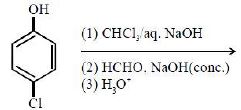
DifficultMCQ
The major products of the following reaction are:
A
$4-$chlorosalicylic acid and methanol
B
$2-$hydroxy$-5-$chlorobenzyl alcohol and formic acid
C
$2-$hydroxy$-5-$chlorobenzyl alcohol and formic acid
D
$4-$chlorosalicylic acid and methanol
Solution
(B) The reaction proceeds in two main steps:
$1$. Reimer-Tiemann reaction: $4$-chlorophenol reacts with $CHCl_3$ and aqueous $NaOH$ to form $5$-chloro$-2-$hydroxybenzaldehyde.
$2$. Cannizzaro reaction: The aldehyde formed reacts with $HCHO$ and concentrated $NaOH$ (cross-Cannizzaro reaction). The aldehyde is reduced to the corresponding alcohol ($5$-chloro$-2-$hydroxybenzyl alcohol),and $HCHO$ is oxidized to sodium formate $(HCOONa)$.
$3$. Acidification: Finally,treatment with $H_3O^+$ converts the phenoxide and formate salt into $5$-chloro$-2-$hydroxybenzyl alcohol and formic acid $(HCOOH)$.
$1$. Reimer-Tiemann reaction: $4$-chlorophenol reacts with $CHCl_3$ and aqueous $NaOH$ to form $5$-chloro$-2-$hydroxybenzaldehyde.
$2$. Cannizzaro reaction: The aldehyde formed reacts with $HCHO$ and concentrated $NaOH$ (cross-Cannizzaro reaction). The aldehyde is reduced to the corresponding alcohol ($5$-chloro$-2-$hydroxybenzyl alcohol),and $HCHO$ is oxidized to sodium formate $(HCOONa)$.
$3$. Acidification: Finally,treatment with $H_3O^+$ converts the phenoxide and formate salt into $5$-chloro$-2-$hydroxybenzyl alcohol and formic acid $(HCOOH)$.
0 likes
View Solution295
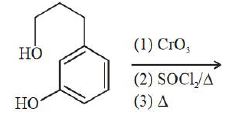
DifficultMCQ
The major product of the following reaction is:
A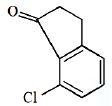
B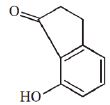
C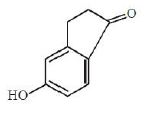
D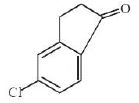
Solution
(C) Step $1$: Oxidation of the primary alcohol group with $CrO_3$ yields a carboxylic acid group. The phenolic $-OH$ group remains unaffected under these conditions.
Step $2$: Treatment with $SOCl_2/\Delta$ converts the carboxylic acid into an acid chloride $(-COCl)$.
Step $3$: Heating $(\Delta)$ induces a Friedel-Crafts acylation reaction. The acid chloride group undergoes intramolecular cyclization with the ortho-position of the phenol ring to form a cyclic ketone (indanone derivative).
The final product is a $5$-hydroxy-indanone derivative.
Step $2$: Treatment with $SOCl_2/\Delta$ converts the carboxylic acid into an acid chloride $(-COCl)$.
Step $3$: Heating $(\Delta)$ induces a Friedel-Crafts acylation reaction. The acid chloride group undergoes intramolecular cyclization with the ortho-position of the phenol ring to form a cyclic ketone (indanone derivative).
The final product is a $5$-hydroxy-indanone derivative.
0 likes
View Solution296
DifficultMCQ
What will be the major product when $m$-cresol is reacted with propargyl bromide $(HC \equiv C-CH_2Br)$ in the presence of $K_2CO_3$ in acetone?
A
$3-$methylphenyl prop$-2-$ynyl ether
B
$2-$propargyl$-5-$methylphenol
C
$2-$propargyl$-3-$methylphenol
D
$4-$propargyl$-3-$methylphenol
Solution
(A) $m$-Cresol reacts with $K_2CO_3$ to form the phenoxide ion ($m$-methylphenoxide).
This phenoxide ion acts as a nucleophile in an $S_N2$ reaction with propargyl bromide $(HC \equiv C-CH_2Br)$.
The oxygen atom of the phenoxide ion attacks the electrophilic carbon of the propargyl bromide,displacing the bromide ion.
This results in the formation of an ether linkage,yielding $3$-methylphenyl prop-$2$-ynyl ether as the major product.
This phenoxide ion acts as a nucleophile in an $S_N2$ reaction with propargyl bromide $(HC \equiv C-CH_2Br)$.
The oxygen atom of the phenoxide ion attacks the electrophilic carbon of the propargyl bromide,displacing the bromide ion.
This results in the formation of an ether linkage,yielding $3$-methylphenyl prop-$2$-ynyl ether as the major product.
0 likes
View Solution297
DifficultMCQ
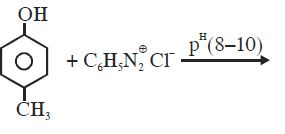
What will be the product of the reaction shown below?
A
$4-$methyl$-2-$(phenylazo)phenol
B
$2-$methyl$-4-$(phenylazo)phenol
C
$2-$phenyl$-4-$methylphenol
D
$4-$methylphenyl benzenediazoate
Solution
(A) The reaction is an electrophilic aromatic substitution known as a coupling reaction between a phenol and a benzenediazonium salt.
In $p$-cresol ($4$-methylphenol),the para position is already occupied by a methyl group.
Therefore,the electrophilic attack by the benzenediazonium ion $(C_6H_5N_2^+)$ occurs at the ortho position relative to the hydroxyl $(-OH)$ group.
This results in the formation of $4-$methyl$-2-$(phenylazo)phenol.
In $p$-cresol ($4$-methylphenol),the para position is already occupied by a methyl group.
Therefore,the electrophilic attack by the benzenediazonium ion $(C_6H_5N_2^+)$ occurs at the ortho position relative to the hydroxyl $(-OH)$ group.
This results in the formation of $4-$methyl$-2-$(phenylazo)phenol.
0 likes
View Solution298
DifficultMCQ
The major product in the given reaction is:

A
Phenyl $3-$nitrobenzoate
B
$4-$nitrophenyl benzoate
C
$2-$nitrophenyl benzoate
D
$4-$nitrophenyl $4-$nitrobenzoate
Solution
(B) The reaction is the nitration of phenyl benzoate using concentrated $HNO_3$ and $H_2SO_4$.
In phenyl benzoate $(C_6H_5COOC_6H_5)$,there are two benzene rings. The ring attached to the oxygen atom of the ester group is more activated towards electrophilic aromatic substitution due to the $+M$ effect of the oxygen atom.
The $-CO-$ group attached to the other ring is electron-withdrawing ($-I$ and $-M$ effects),which deactivates that ring.
Therefore,the electrophile $(NO_2^+)$ attacks the ring attached to the oxygen atom.
Due to the $+M$ effect of the $-O-$ group,the ortho and para positions are activated. The para position is sterically less hindered than the ortho position,making the para-substituted product the major one.
Thus,the major product is $4$-nitrophenyl benzoate.
In phenyl benzoate $(C_6H_5COOC_6H_5)$,there are two benzene rings. The ring attached to the oxygen atom of the ester group is more activated towards electrophilic aromatic substitution due to the $+M$ effect of the oxygen atom.
The $-CO-$ group attached to the other ring is electron-withdrawing ($-I$ and $-M$ effects),which deactivates that ring.
Therefore,the electrophile $(NO_2^+)$ attacks the ring attached to the oxygen atom.
Due to the $+M$ effect of the $-O-$ group,the ortho and para positions are activated. The para position is sterically less hindered than the ortho position,making the para-substituted product the major one.
Thus,the major product is $4$-nitrophenyl benzoate.
0 likes
View Solution299
MediumMCQ
Which of the following reaction$(s)$ is/are correct?
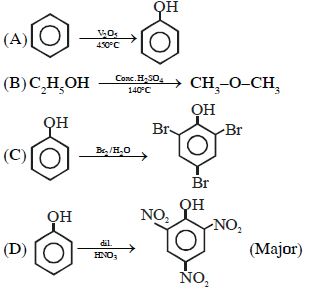
A
$(A), (B), (C), (D)$
B
$(B), (C), (D)$
C
Only $(C)$
D
Only $(D)$
Solution
(C) Let us analyze each reaction:
$(A)$ Benzene to phenol using $V_2O_5$ at $450^{\circ}C$ is not a standard industrial or laboratory method for phenol synthesis. The reaction is incorrect.
$(B)$ Dehydration of ethanol $(C_2H_5OH)$ with $Conc. H_2SO_4$ at $140^{\circ}C$ yields diethyl ether $(C_2H_5-O-C_2H_5)$,not dimethyl ether $(CH_3-O-CH_3)$. The reaction is incorrect.
$(C)$ Phenol reacts with bromine water $(Br_2/H_2O)$ to form $2,4,6$-tribromophenol as a white precipitate. This reaction is correct.
$(D)$ Phenol reacts with dilute $HNO_3$ at low temperature to form a mixture of $o$-nitrophenol and $p$-nitrophenol. The product shown is picric acid ($2,4,6$-trinitrophenol),which is formed by reaction with concentrated $HNO_3$. The reaction is incorrect.
Therefore,only $(C)$ is correct.
$(A)$ Benzene to phenol using $V_2O_5$ at $450^{\circ}C$ is not a standard industrial or laboratory method for phenol synthesis. The reaction is incorrect.
$(B)$ Dehydration of ethanol $(C_2H_5OH)$ with $Conc. H_2SO_4$ at $140^{\circ}C$ yields diethyl ether $(C_2H_5-O-C_2H_5)$,not dimethyl ether $(CH_3-O-CH_3)$. The reaction is incorrect.
$(C)$ Phenol reacts with bromine water $(Br_2/H_2O)$ to form $2,4,6$-tribromophenol as a white precipitate. This reaction is correct.
$(D)$ Phenol reacts with dilute $HNO_3$ at low temperature to form a mixture of $o$-nitrophenol and $p$-nitrophenol. The product shown is picric acid ($2,4,6$-trinitrophenol),which is formed by reaction with concentrated $HNO_3$. The reaction is incorrect.
Therefore,only $(C)$ is correct.
0 likes
View SolutionAlcohols, Phenols and Ethers — Properties of Phenols · Frequently Asked Questions
1Are these Alcohols, Phenols and Ethers questions useful for JEE and NEET?
Yes. All questions in this section are mapped to JEE Main and NEET exam patterns. Previous year questions from JEE Main, NEET, GUJCET and state-level exams are included with full solutions.
2Can I switch to Hindi or Gujarati for these questions?
Yes. Use the language tabs in the hero section or the sidebar to view the same questions and solutions in English, Hindi or Gujarati.
3How do I generate a question paper from this subtopic?
Use the Vedclass Exam Paper Generator — select the chapter and subtopic, set difficulty, and generate Sets A, B, C, D automatically. First 3 chapters of every subject are free.
Vedclass Products
For Students
Vedclass Test Series
Mock tests in real JEE/NEET style with performance analysis. 5-day free trial.
Start Free TrialFor Teachers
Exam Paper Generator
Generate Set A/B/C/D papers from this chapter in 2 minutes. 3 chapters free.
Try FreeFor Institutes
Online Exam Module
Live online exams with unlimited students, 360° analytics & white-label branding.
See DemoFor Teachers & Institutes
Generate a Alcohols, Phenols and Ethers Exam Paper in 2 Minutes
Select subtopic & difficulty — Sets A, B, C, D auto-generated with No Repeat logic.
First 3 chapters of every subject are free — no payment required.