
A English
Properties of Phenols Questions in English
Class 12 Chemistry · Alcohols, Phenols and Ethers · Properties of Phenols
751+
Questions
English
Language
100%
With Solutions
Showing 49 of 751 questions in English
451
MediumMCQ
The acidity of the following compounds follows the order:
$I$: Phenol
$II$: $p$-Methoxyphenol
$III$: $p$-Nitrophenol
$IV$: $m$-Nitrophenol
$I$: Phenol
$II$: $p$-Methoxyphenol
$III$: $p$-Nitrophenol
$IV$: $m$-Nitrophenol
A
$I > II > III > IV$
B
$IV > III > II > I$
C
$III > IV > I > II$
D
$III > II > IV > I$
Solution
(C) The correct acidity order is $III > IV > I > II$.
In substituted phenols,electron-withdrawing groups $(EWG)$ like the nitro $(-NO_2)$ group increase acidity by stabilizing the phenoxide ion through delocalization of the negative charge.
$p$-Nitrophenol $(III)$ is more acidic than $m$-nitrophenol $(IV)$ because the $-NO_2$ group at the para position exerts both $-I$ and $-R$ effects,whereas at the meta position,it only exerts the $-I$ effect.
Phenol $(I)$ is less acidic than nitrophenols but more acidic than $p$-methoxyphenol $(II)$.
$p$-Methoxyphenol $(II)$ contains a methoxy $(-OCH_3)$ group,which is an electron-donating group $(EDG)$ due to the $+R$ effect,destabilizing the phenoxide ion and decreasing the acidity.
In substituted phenols,electron-withdrawing groups $(EWG)$ like the nitro $(-NO_2)$ group increase acidity by stabilizing the phenoxide ion through delocalization of the negative charge.
$p$-Nitrophenol $(III)$ is more acidic than $m$-nitrophenol $(IV)$ because the $-NO_2$ group at the para position exerts both $-I$ and $-R$ effects,whereas at the meta position,it only exerts the $-I$ effect.
Phenol $(I)$ is less acidic than nitrophenols but more acidic than $p$-methoxyphenol $(II)$.
$p$-Methoxyphenol $(II)$ contains a methoxy $(-OCH_3)$ group,which is an electron-donating group $(EDG)$ due to the $+R$ effect,destabilizing the phenoxide ion and decreasing the acidity.
0 likes
View Solution452
DifficultMCQ
Phenol reacts with $CO_2$ in the presence of sodium hydroxide followed by acidification to give a steam volatile compound $X$. The compound $X$ on treatment with acetic anhydride in the presence of a catalytic amount of $H_2SO_4$ produces $Y$. Among the following:
$(i)$ antipyretic
$(ii)$ anti-inflammatory
$(iii)$ narcotic analgesic
$(iv)$ antiplatelet
the properties shown by compound $Y$ are
$(i)$ antipyretic
$(ii)$ anti-inflammatory
$(iii)$ narcotic analgesic
$(iv)$ antiplatelet
the properties shown by compound $Y$ are
A
$i, ii, iii$ and $iv$
B
$i, ii$ and $iii$ only
C
$ii, iii$ and $iv$ only
D
$i, ii$ and $iv$ only
Solution
(D) The reaction of phenol with $CO_2$ in the presence of $NaOH$ followed by acidification is the Kolbe-Schmitt reaction,which yields salicylic acid as compound $X$.
Treatment of salicylic acid $(X)$ with acetic anhydride in the presence of $H_2SO_4$ (acetylation) yields acetylsalicylic acid,commonly known as Aspirin,as compound $Y$.
Aspirin is a non-narcotic analgesic. It exhibits the following properties:
$(i)$ Antipyretic (reduces fever)
$(ii)$ Anti-inflammatory (reduces inflammation)
$(iv)$ Antiplatelet (prevents blood clotting)
It is not a narcotic analgesic.
Therefore,the correct properties are $(i), (ii)$ and $(iv)$.
Treatment of salicylic acid $(X)$ with acetic anhydride in the presence of $H_2SO_4$ (acetylation) yields acetylsalicylic acid,commonly known as Aspirin,as compound $Y$.
Aspirin is a non-narcotic analgesic. It exhibits the following properties:
$(i)$ Antipyretic (reduces fever)
$(ii)$ Anti-inflammatory (reduces inflammation)
$(iv)$ Antiplatelet (prevents blood clotting)
It is not a narcotic analgesic.
Therefore,the correct properties are $(i), (ii)$ and $(iv)$.
0 likes
View Solution453
DifficultMCQ
The increasing order of $pK_{a}$ for the following phenols is:
$1$. $2, 4-$Dinitrophenol
$2$. $4-$Nitrophenol
$3$. $2, 4, 5-$Trimethylphenol
$4$. Phenol
$5$. $3-$Chlorophenol
$1$. $2, 4-$Dinitrophenol
$2$. $4-$Nitrophenol
$3$. $2, 4, 5-$Trimethylphenol
$4$. Phenol
$5$. $3-$Chlorophenol
A
$(3), (4), (5), (2), (1)$
B
$(1), (2), (5), (4), (3)$
C
$(1), (5), (2), (4), (3)$
D
$(3), (5), (4), (2), (1)$
Solution
(A) The acidity of phenols is determined by the stability of the phenoxide ion formed after the loss of a proton.
Electron-withdrawing groups ($-I$ and $-M$ effects) stabilize the phenoxide ion and increase acidity,thereby decreasing $pK_{a}$.
Electron-donating groups ($+I$ and $+M$ effects) destabilize the phenoxide ion and decrease acidity,thereby increasing $pK_{a}$.
Comparing the substituents:
$1$. $2, 4-$Dinitrophenol: Two strong $-M$ and $-I$ groups (most acidic).
$2$. $4-$Nitrophenol: One strong $-M$ and $-I$ group.
$5$. $3-$Chlorophenol: One $-I$ group (weakly acidic).
$4$. Phenol: No substituent.
$3$. $2, 4, 5-$Trimethylphenol: Three $+I$ groups (least acidic).
Decreasing order of acidity: $(1) > (2) > (5) > (4) > (3)$.
Since $pK_{a} = -\log(K_{a})$,the increasing order of $pK_{a}$ is the reverse of the acidity order: $(3) < (4) < (5) < (2) < (1)$.
Electron-withdrawing groups ($-I$ and $-M$ effects) stabilize the phenoxide ion and increase acidity,thereby decreasing $pK_{a}$.
Electron-donating groups ($+I$ and $+M$ effects) destabilize the phenoxide ion and decrease acidity,thereby increasing $pK_{a}$.
Comparing the substituents:
$1$. $2, 4-$Dinitrophenol: Two strong $-M$ and $-I$ groups (most acidic).
$2$. $4-$Nitrophenol: One strong $-M$ and $-I$ group.
$5$. $3-$Chlorophenol: One $-I$ group (weakly acidic).
$4$. Phenol: No substituent.
$3$. $2, 4, 5-$Trimethylphenol: Three $+I$ groups (least acidic).
Decreasing order of acidity: $(1) > (2) > (5) > (4) > (3)$.
Since $pK_{a} = -\log(K_{a})$,the increasing order of $pK_{a}$ is the reverse of the acidity order: $(3) < (4) < (5) < (2) < (1)$.
0 likes
View Solution454
DifficultMCQ
$A$ trisubstituted compound '$A$',$C_{10}H_{12}O_2$ gives a neutral $FeCl_3$ test positive. Treatment of compound '$A$' with $NaOH$ and $CH_3Br$ gives $C_{11}H_{14}O_2$,with hydroiodic acid $(HI)$ gives methyl iodide,and with hot conc. $NaOH$ gives a compound $B$,$C_{10}H_{12}O_2$. Compound '$A$' also decolorises alkaline $KMnO_4$. The number of $\pi$ bonds present in the compound '$A$' is $...........$
A
$2$
B
$4$
C
$3$
D
$1$
Solution
(B) $1$. Compound '$A$' is trisubstituted and gives a positive neutral $FeCl_3$ test,indicating it is a phenol derivative.
$2$. The formula $C_{10}H_{12}O_2$ with a benzene ring ($6$ carbons) leaves $4$ carbons for substituents. The degree of unsaturation is $10 - 12/2 + 1 = 5$. Since the benzene ring accounts for $4$ degrees of unsaturation ($3$ $\pi$ bonds + $1$ ring),there is $1$ additional $\pi$ bond or ring present in the side chains.
$3$. The compound decolorises alkaline $KMnO_4$,confirming the presence of an alkene or an oxidizable side chain.
$4$. The reaction with $HI$ gives methyl iodide,indicating the presence of a methoxy group $(-OCH_3)$ or a similar ether linkage. However,the initial test with $NaOH$ and $CH_3Br$ suggests the presence of a phenolic $-OH$ group which gets methylated.
$5$. Given the structure is trisubstituted on a benzene ring,the total $\pi$ bonds are $3$ (from the benzene ring) + $1$ (from the alkene side chain) = $4$ $\pi$ bonds.
$2$. The formula $C_{10}H_{12}O_2$ with a benzene ring ($6$ carbons) leaves $4$ carbons for substituents. The degree of unsaturation is $10 - 12/2 + 1 = 5$. Since the benzene ring accounts for $4$ degrees of unsaturation ($3$ $\pi$ bonds + $1$ ring),there is $1$ additional $\pi$ bond or ring present in the side chains.
$3$. The compound decolorises alkaline $KMnO_4$,confirming the presence of an alkene or an oxidizable side chain.
$4$. The reaction with $HI$ gives methyl iodide,indicating the presence of a methoxy group $(-OCH_3)$ or a similar ether linkage. However,the initial test with $NaOH$ and $CH_3Br$ suggests the presence of a phenolic $-OH$ group which gets methylated.
$5$. Given the structure is trisubstituted on a benzene ring,the total $\pi$ bonds are $3$ (from the benzene ring) + $1$ (from the alkene side chain) = $4$ $\pi$ bonds.
0 likes
View Solution455
AdvancedMCQ
The correct order of $pK_{a}$ values for the following compounds is:
$(a)$ Phenol
$(b)$ $p$-Dimethylaminophenol
$(c)$ $p$-Nitrophenol
$(d)$ $p$-Isopropylphenol
$(a)$ Phenol
$(b)$ $p$-Dimethylaminophenol
$(c)$ $p$-Nitrophenol
$(d)$ $p$-Isopropylphenol
A
$c > a > d > b$
B
$b > d > a > c$
C
$b > a > d > c$
D
$a > b > c > d$
Solution
(B) The acidity of phenols is determined by the stability of the phenoxide ion formed after the loss of a proton.
Electron-withdrawing groups $(-EWG)$ increase acidity,while electron-donating groups $(-EDG)$ decrease acidity.
$1$. Compound $(c)$ has a $-NO_{2}$ group,which exerts a strong $-M$ and $-I$ effect,making it the most acidic.
$2$. Compound $(a)$ is phenol,which has no substituent.
$3$. Compound $(d)$ has an isopropyl group,which exerts a $+I$ effect and hyperconjugation,making it less acidic than phenol.
$4$. Compound $(b)$ has a $-N(CH_{3})_{2}$ group,which exerts a strong $+M$ effect,making it the least acidic.
Therefore,the order of acidic strength is $(c) > (a) > (d) > (b)$.
Since $pK_{a} \propto \frac{1}{\text{acidic strength}}$,the order of $pK_{a}$ values is $(b) > (d) > (a) > (c)$.
Electron-withdrawing groups $(-EWG)$ increase acidity,while electron-donating groups $(-EDG)$ decrease acidity.
$1$. Compound $(c)$ has a $-NO_{2}$ group,which exerts a strong $-M$ and $-I$ effect,making it the most acidic.
$2$. Compound $(a)$ is phenol,which has no substituent.
$3$. Compound $(d)$ has an isopropyl group,which exerts a $+I$ effect and hyperconjugation,making it less acidic than phenol.
$4$. Compound $(b)$ has a $-N(CH_{3})_{2}$ group,which exerts a strong $+M$ effect,making it the least acidic.
Therefore,the order of acidic strength is $(c) > (a) > (d) > (b)$.
Since $pK_{a} \propto \frac{1}{\text{acidic strength}}$,the order of $pK_{a}$ values is $(b) > (d) > (a) > (c)$.
0 likes
View Solution456
DifficultMCQ
An organic compound $A$ with empirical formula $C_6H_6O$ gives a sooty flame on burning. Its reaction with bromine solution in a low polarity solvent results in a high yield of $B$. $B$ is:
A
$4-$Bromophenol
B
$3-$Bromo$-2,3-$dihydrofuran derivative
C
$2,3-$Dibromo$-4-$ethyltetrahydrofuran derivative
D
$2-$Bromophenol
Solution
(A) The empirical formula $C_6H_6O$ corresponds to phenol $(C_6H_5OH)$.
Phenol is an aromatic compound,which burns with a sooty flame.
When phenol reacts with bromine $(Br_2)$ in a low polarity solvent like $CS_2$ or $CHCl_3$ at low temperature,the electrophilic substitution occurs primarily at the para-position due to steric hindrance at the ortho-position.
Thus,the major product $B$ is $4$-bromophenol.
Phenol is an aromatic compound,which burns with a sooty flame.
When phenol reacts with bromine $(Br_2)$ in a low polarity solvent like $CS_2$ or $CHCl_3$ at low temperature,the electrophilic substitution occurs primarily at the para-position due to steric hindrance at the ortho-position.
Thus,the major product $B$ is $4$-bromophenol.
0 likes
View Solution457
MediumMCQ
Match the reagents in List-$I$ with the product in List-$II$ obtained from phenol.
Choose the correct answer from the options given below:
| List-$I$ | List-$II$ |
|---|---|
| $a$. $(i)$ $NaOH$,$(ii)$ $CO_2$,$(iii)$ $H^{+}$ | $i$. Benzoquinone |
| $b$. $(i)$ Aqueous $NaOH + CHCl_3$,$(ii)$ $H^{+}$ | $ii$. Benzene |
| $c$. $Zn$ dust,$\Delta$ | $iii$. Salicylaldehyde |
| $d$. $Na_2Cr_2O_7, H_2SO_4$ | $iv$. Salicylic acid |
Choose the correct answer from the options given below:
A
$a-iii, b-iv, c-i, d-ii$
B
$a-ii, b-i, c-iv, d-iii$
C
$a-iv, b-iii, c-ii, d-i$
D
$a-iv, b-ii, c-i, d-iii$
Solution
(C) The reactions of phenol are as follows:
$a$. Phenol reacts with $(i)$ $NaOH$,$(ii)$ $CO_2$,$(iii)$ $H^{+}$ to form Salicylic acid (Kolbe's reaction). Thus,$a-iv$.
$b$. Phenol reacts with $(i)$ Aqueous $NaOH + CHCl_3$,$(ii)$ $H^{+}$ to form Salicylaldehyde (Reimer-Tiemann reaction). Thus,$b-iii$.
$c$. Phenol reacts with $Zn$ dust upon heating to form Benzene. Thus,$c-ii$.
$d$. Phenol reacts with $Na_2Cr_2O_7$ and $H_2SO_4$ (chromic acid) to form Benzoquinone. Thus,$d-i$.
Therefore,the correct matching is $a-iv, b-iii, c-ii, d-i$.
$a$. Phenol reacts with $(i)$ $NaOH$,$(ii)$ $CO_2$,$(iii)$ $H^{+}$ to form Salicylic acid (Kolbe's reaction). Thus,$a-iv$.
$b$. Phenol reacts with $(i)$ Aqueous $NaOH + CHCl_3$,$(ii)$ $H^{+}$ to form Salicylaldehyde (Reimer-Tiemann reaction). Thus,$b-iii$.
$c$. Phenol reacts with $Zn$ dust upon heating to form Benzene. Thus,$c-ii$.
$d$. Phenol reacts with $Na_2Cr_2O_7$ and $H_2SO_4$ (chromic acid) to form Benzoquinone. Thus,$d-i$.
Therefore,the correct matching is $a-iv, b-iii, c-ii, d-i$.
0 likes
View Solution458
MediumMCQ
The strongest acid among the following is:
A
$3-$Nitrophenol
B
$3-$Chlorophenol
C
$3-$Methylphenol
D
Phenol
Solution
(A) The acidity of substituted phenols depends on the electronic effects of the substituents. Electron-withdrawing groups $(EWG)$ increase acidity by stabilizing the phenoxide ion,while electron-donating groups $(EDG)$ decrease acidity.
$1$. $-NO_2$ is a strong electron-withdrawing group ($-I$ and $-M$ effect).
$2$. $-Cl$ is an electron-withdrawing group ($-I$ effect).
$3$. $-CH_3$ is an electron-donating group ($+I$ and hyperconjugation).
Comparing the substituents,the $-NO_2$ group has the strongest electron-withdrawing effect,making $3-$nitrophenol the most acidic among the given options.
$1$. $-NO_2$ is a strong electron-withdrawing group ($-I$ and $-M$ effect).
$2$. $-Cl$ is an electron-withdrawing group ($-I$ effect).
$3$. $-CH_3$ is an electron-donating group ($+I$ and hyperconjugation).
Comparing the substituents,the $-NO_2$ group has the strongest electron-withdrawing effect,making $3-$nitrophenol the most acidic among the given options.
0 likes
View Solution459
MediumMCQ
$A$ compound '$X$' when treated with phthalic anhydride in the presence of concentrated $H_2SO_4$ yields '$Y$'. '$Y$' is used as an acid/base indicator. '$X$' and '$Y$' are respectively:
A
Carbolic acid,Phenolphthalein
B
Anisole,methyl orange
C
Salicylaldehyde,Phenolphthalein
D
Toluidine,Phenolphthalein
Solution
(A) The reaction of phenol (also known as carbolic acid) with phthalic anhydride in the presence of concentrated $H_2SO_4$ is a condensation reaction.
Two molecules of phenol react with one molecule of phthalic anhydride to form phenolphthalein,which is a well-known acid-base indicator.
Therefore,'$X$' is phenol (carbolic acid) and '$Y$' is phenolphthalein.
Two molecules of phenol react with one molecule of phthalic anhydride to form phenolphthalein,which is a well-known acid-base indicator.
Therefore,'$X$' is phenol (carbolic acid) and '$Y$' is phenolphthalein.
0 likes
View Solution460
MediumMCQ
The correct order for acidity of the following hydroxyl compounds is:
$A. CH_3OH$
$B. (CH_3)_3COH$
$C. C_6H_5OH$
$D. p-CH_3OC_6H_4OH$
$E. p-O_2NC_6H_4OH$
Choose the correct answer from the options given below:
$A. CH_3OH$
$B. (CH_3)_3COH$
$C. C_6H_5OH$
$D. p-CH_3OC_6H_4OH$
$E. p-O_2NC_6H_4OH$
Choose the correct answer from the options given below:
A
$E > C > D > A > B$
B
$D > E > C > A > B$
C
$C > E > D > B > A$
D
$E > D > C > B > A$
Solution
(A) The acidity of hydroxyl compounds depends on the stability of the conjugate base formed after the loss of a proton $(H^+)$.
$1$. $E$ ($p$-nitrophenol) is the most acidic because the $-NO_2$ group is a strong electron-withdrawing group ($-I$ and $-M$ effect),which stabilizes the phenoxide ion significantly.
$2$. $C$ (phenol) is more acidic than aliphatic alcohols due to resonance stabilization of the phenoxide ion.
$3$. $D$ ($p$-methoxyphenol) is less acidic than phenol because the $-OCH_3$ group exerts a $+M$ effect,which destabilizes the phenoxide ion.
$4$. Between $A$ $(CH_3OH)$ and $B$ $((CH_3)_3COH)$,$A$ is more acidic because the three methyl groups in $B$ exert a strong $+I$ effect,which destabilizes the alkoxide ion.
Thus,the correct order of acidity is $E > C > D > A > B$.
$1$. $E$ ($p$-nitrophenol) is the most acidic because the $-NO_2$ group is a strong electron-withdrawing group ($-I$ and $-M$ effect),which stabilizes the phenoxide ion significantly.
$2$. $C$ (phenol) is more acidic than aliphatic alcohols due to resonance stabilization of the phenoxide ion.
$3$. $D$ ($p$-methoxyphenol) is less acidic than phenol because the $-OCH_3$ group exerts a $+M$ effect,which destabilizes the phenoxide ion.
$4$. Between $A$ $(CH_3OH)$ and $B$ $((CH_3)_3COH)$,$A$ is more acidic because the three methyl groups in $B$ exert a strong $+I$ effect,which destabilizes the alkoxide ion.
Thus,the correct order of acidity is $E > C > D > A > B$.
0 likes
View Solution461
MediumMCQ
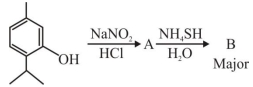
Compound '$B$' is
A
The starting material (thymol)
B
$4-$amino$-2-$isopropyl$-5-$methylphenol
C
$2-$isopropyl$-5-$methylbenzenethiol
D
$4-$mercapto$-2-$isopropyl$-5-$methylphenol
Solution
(B) The reaction sequence is as follows:
$1$. The starting material is $2$-isopropyl-$5$-methylphenol (thymol).
$2$. Treatment with $NaNO_2/HCl$ performs electrophilic aromatic substitution (nitrosation) at the para-position relative to the $-OH$ group,forming $A$ (a nitroso compound).
$3$. Treatment of the nitroso compound with $NH_4SH$ (ammonium hydrosulfide) reduces the $-NO$ group to an $-NH_2$ group,yielding $B$ as $4$-amino-$2$-isopropyl-$5$-methylphenol.
$1$. The starting material is $2$-isopropyl-$5$-methylphenol (thymol).
$2$. Treatment with $NaNO_2/HCl$ performs electrophilic aromatic substitution (nitrosation) at the para-position relative to the $-OH$ group,forming $A$ (a nitroso compound).
$3$. Treatment of the nitroso compound with $NH_4SH$ (ammonium hydrosulfide) reduces the $-NO$ group to an $-NH_2$ group,yielding $B$ as $4$-amino-$2$-isopropyl-$5$-methylphenol.
0 likes
View Solution462
DifficultMCQ
The ascending order of acidity of the $-OH$ group in the following compounds is:
$A$. $Bu-OH$
$B$. $p$-nitrophenol
$C$. $p$-methoxyphenol
$D$. Phenol
$E$. $2,4$-dinitrophenol
Choose the correct answer from the options given below:
$A$. $Bu-OH$
$B$. $p$-nitrophenol
$C$. $p$-methoxyphenol
$D$. Phenol
$E$. $2,4$-dinitrophenol
Choose the correct answer from the options given below:
A
$A < C < D < B < E$
B
$C < A < D < B < E$
C
$C < D < B < A < E$
D
$A < C < D < B < E$
Solution
(A) The acidity of phenols depends on the stability of the phenoxide ion formed after the loss of a proton. Electron-withdrawing groups $(-EWG)$ increase acidity by stabilizing the negative charge,while electron-donating groups $(-EDG)$ decrease acidity by destabilizing it.
$1$. $E$ ($2,4$-dinitrophenol): Has two $-NO_2$ groups (strong $-M$ and $-I$ effect),making it the most acidic.
$2$. $B$ ($p$-nitrophenol): Has one $-NO_2$ group ($-M$ and $-I$ effect),making it more acidic than phenol.
$3$. $D$ (Phenol): The reference compound.
$4$. $C$ ($p$-methoxyphenol): The $-OCH_3$ group has a $+M$ effect,which destabilizes the phenoxide ion,making it less acidic than phenol.
$5$. $A$ $(Bu-OH)$: Aliphatic alcohols are significantly less acidic than phenols because the alkoxide ion is not resonance-stabilized.
Thus,the order of acidity is: $A < C < D < B < E$.
$1$. $E$ ($2,4$-dinitrophenol): Has two $-NO_2$ groups (strong $-M$ and $-I$ effect),making it the most acidic.
$2$. $B$ ($p$-nitrophenol): Has one $-NO_2$ group ($-M$ and $-I$ effect),making it more acidic than phenol.
$3$. $D$ (Phenol): The reference compound.
$4$. $C$ ($p$-methoxyphenol): The $-OCH_3$ group has a $+M$ effect,which destabilizes the phenoxide ion,making it less acidic than phenol.
$5$. $A$ $(Bu-OH)$: Aliphatic alcohols are significantly less acidic than phenols because the alkoxide ion is not resonance-stabilized.
Thus,the order of acidity is: $A < C < D < B < E$.
0 likes
View Solution463
DifficultMCQ
The phenolic group can be identified by a positive:
A
Phthalein dye test
B
Lucas test
C
Tollen's test
D
Carbylamine test
Solution
(A) The Phthalein dye test is used for the identification of phenols. When a phenol is heated with phthalic anhydride in the presence of concentrated $H_2SO_4$,a phthalein dye is formed.
$1$. Carbylamine test: Used for the identification of primary amines.
$2$. Lucas test: Used for the differentiation between $1^{\circ}$,$2^{\circ}$,and $3^{\circ}$ alcohols.
$3$. Tollen's test: Used for the identification of aldehydes.
$1$. Carbylamine test: Used for the identification of primary amines.
$2$. Lucas test: Used for the differentiation between $1^{\circ}$,$2^{\circ}$,and $3^{\circ}$ alcohols.
$3$. Tollen's test: Used for the identification of aldehydes.
0 likes
View Solution464
DifficultMCQ
Given below are two statements: one is labelled as Assertion $A$ and the other is labelled as Reason $R$:
Assertion $A$: Aryl halides cannot be prepared by the replacement of the hydroxyl group of phenol by a halogen atom.
Reason $R$: Phenols react with halogen acids violently.
In the light of the above statements,choose the most appropriate from the options given below:
Assertion $A$: Aryl halides cannot be prepared by the replacement of the hydroxyl group of phenol by a halogen atom.
Reason $R$: Phenols react with halogen acids violently.
In the light of the above statements,choose the most appropriate from the options given below:
A
Both $A$ and $R$ are true but $R$ is $NOT$ the correct explanation of $A$.
B
$A$ is false but $R$ is true.
C
$A$ is true but $R$ is false.
D
Both $A$ and $R$ are true and $R$ is the correct explanation of $A$.
Solution
(C) Assertion $(A)$ is true. The $C-O$ bond in phenol has partial double bond character due to resonance,making it very strong and difficult to break by nucleophilic substitution with halogen acids.
Reason $(R)$ is false. Phenols do not react with halogen acids under normal conditions because the $C-O$ bond is strong and the formation of a phenyl carbocation is highly unfavorable.
Therefore,$A$ is true but $R$ is false.
Reason $(R)$ is false. Phenols do not react with halogen acids under normal conditions because the $C-O$ bond is strong and the formation of a phenyl carbocation is highly unfavorable.
Therefore,$A$ is true but $R$ is false.
0 likes
View Solution465
DifficultMCQ
Match List-$I$ with List-$II$:
Choose the correct answer from the options given below:
| List-$I$ (Compound) | List-$II$ ($pK_a$ value) |
| $A$. Ethanol | $I$. $10.0$ |
| $B$. Phenol | $II$. $15.9$ |
| $C$. $m$-Nitrophenol | $III$. $7.1$ |
| $D$. $p$-Nitrophenol | $IV$. $8.3$ |
Choose the correct answer from the options given below:
A
$A-II, B-I, C-IV, D-III$
B
$A-IV, B-I, C-II, D-III$
C
$A-III, B-IV, C-I, D-II$
D
$A-I, B-II, C-III, D-IV$
Solution
(A) The $pK_a$ values for the given compounds are as follows:
$A$. Ethanol: $15.9$
$B$. Phenol: $10.0$
$C$. $m$-Nitrophenol: $8.3$
$D$. $p$-Nitrophenol: $7.1$
Therefore,the correct matching is $A-II, B-I, C-IV, D-III$.
$A$. Ethanol: $15.9$
$B$. Phenol: $10.0$
$C$. $m$-Nitrophenol: $8.3$
$D$. $p$-Nitrophenol: $7.1$
Therefore,the correct matching is $A-II, B-I, C-IV, D-III$.
0 likes
View Solution466
DifficultMCQ
When phenol is treated with chloroform in the presence of sodium hydroxide,followed by hydrolysis in the presence of an acid,the product formed is:
A
Salicylic acid
B
Benzene-$1,2$-diol
C
Benzene-$1,3$-diol
D
$2$-Hydroxybenzaldehyde
Solution
(D) The reaction described is the Reimer-Tiemann reaction.
In this reaction,phenol reacts with chloroform $(CHCl_3)$ in the presence of an aqueous base like sodium hydroxide $(NaOH)$ to form an intermediate,which upon acidic hydrolysis yields $2$-hydroxybenzaldehyde (also known as salicylaldehyde) as the major product.
The chemical equation is:
$C_6H_5OH + CHCl_3 + 3NaOH \rightarrow C_6H_4(OH)(CHO) + 3NaCl + 2H_2O$
In this reaction,phenol reacts with chloroform $(CHCl_3)$ in the presence of an aqueous base like sodium hydroxide $(NaOH)$ to form an intermediate,which upon acidic hydrolysis yields $2$-hydroxybenzaldehyde (also known as salicylaldehyde) as the major product.
The chemical equation is:
$C_6H_5OH + CHCl_3 + 3NaOH \rightarrow C_6H_4(OH)(CHO) + 3NaCl + 2H_2O$
0 likes
View Solution467
DifficultMCQ
Salicylaldehyde is synthesized from phenol when reacted with:
A
$CHCl_3, NaOH$
B
$CO_2, NaOH$
C
$CCl_4, NaOH$
D
$CH_2Cl_2, NaOH$
Solution
(A) The reaction of phenol with $CHCl_3$ (chloroform) in the presence of aqueous $NaOH$ is known as the Reimer-Tiemann reaction.
This reaction introduces a formyl group $(-CHO)$ at the ortho position of the phenol ring,resulting in the formation of salicylaldehyde ($2$-hydroxybenzaldehyde).
This reaction introduces a formyl group $(-CHO)$ at the ortho position of the phenol ring,resulting in the formation of salicylaldehyde ($2$-hydroxybenzaldehyde).
0 likes
View Solution468
DifficultMCQ
Given below are two statements: One is labelled as $Assertion$ $A$ and the other is labelled as $Reason$ $R$:
Assertion $A$: $pK_a$ value of phenol is $10.0$ while that of ethanol is $15.9$.
Reason $R$: Ethanol is a stronger acid than phenol.
In the light of the above statements,choose the correct answer from the options given below:
Assertion $A$: $pK_a$ value of phenol is $10.0$ while that of ethanol is $15.9$.
Reason $R$: Ethanol is a stronger acid than phenol.
In the light of the above statements,choose the correct answer from the options given below:
A
$A$ is true but $R$ is false.
B
$A$ is false but $R$ is true.
C
Both $A$ and $R$ are true and $R$ is the correct explanation of $A$.
D
Both $A$ and $R$ are true but $R$ is $NOT$ the correct explanation of $A$.
Solution
(A) The $pK_a$ value is inversely proportional to the acid strength. $A$ lower $pK_a$ value indicates a stronger acid.
Phenol has a $pK_a$ of $10.0$,whereas ethanol has a $pK_a$ of $15.9$. Thus,phenol is a stronger acid than ethanol.
This is because the phenoxide ion (conjugate base of phenol) is stabilized by resonance,whereas the ethoxide ion (conjugate base of ethanol) is destabilized by the $+I$ effect of the ethyl group.
Therefore,$Assertion$ $A$ is true,but $Reason$ $R$ is false.
Phenol has a $pK_a$ of $10.0$,whereas ethanol has a $pK_a$ of $15.9$. Thus,phenol is a stronger acid than ethanol.
This is because the phenoxide ion (conjugate base of phenol) is stabilized by resonance,whereas the ethoxide ion (conjugate base of ethanol) is destabilized by the $+I$ effect of the ethyl group.
Therefore,$Assertion$ $A$ is true,but $Reason$ $R$ is false.
0 likes
View Solution469
DifficultMCQ
The product of the following reaction is $P$.
$4-hydroxybenzaldehyde + PhMgBr (1 \text{ equiv.}) \xrightarrow{aq. NH_4Cl} P$
The number of hydroxyl groups present in the product $P$ is . . . . . . .
$4-hydroxybenzaldehyde + PhMgBr (1 \text{ equiv.}) \xrightarrow{aq. NH_4Cl} P$
The number of hydroxyl groups present in the product $P$ is . . . . . . .
A
$1$
B
$10$
C
$15$
D
$2$
Solution
(A) The reactant is $4-hydroxybenzaldehyde$,which contains both an aldehyde group $(-CHO)$ and a phenolic hydroxyl group $(-OH)$.
When $PhMgBr$ (a Grignard reagent) is added,it acts as a strong base and reacts with the acidic phenolic $-OH$ group first.
$4-hydroxybenzaldehyde + PhMgBr \rightarrow 4-formylphenoxide magnesium bromide + Benzene$
The $Ph^-$ from $PhMgBr$ abstracts the acidic proton from the phenolic $-OH$ group to form benzene $(C_6H_6)$ and the magnesium salt of the phenol.
Upon workup with $aq. NH_4Cl$,the magnesium salt is protonated back to the original $4-hydroxybenzaldehyde$.
Therefore,the final product $P$ is $4-hydroxybenzaldehyde$,which contains $1$ hydroxyl group.
When $PhMgBr$ (a Grignard reagent) is added,it acts as a strong base and reacts with the acidic phenolic $-OH$ group first.
$4-hydroxybenzaldehyde + PhMgBr \rightarrow 4-formylphenoxide magnesium bromide + Benzene$
The $Ph^-$ from $PhMgBr$ abstracts the acidic proton from the phenolic $-OH$ group to form benzene $(C_6H_6)$ and the magnesium salt of the phenol.
Upon workup with $aq. NH_4Cl$,the magnesium salt is protonated back to the original $4-hydroxybenzaldehyde$.
Therefore,the final product $P$ is $4-hydroxybenzaldehyde$,which contains $1$ hydroxyl group.
0 likes
View Solution470
DifficultMCQ
Which of the following compounds will most easily be attacked by an electrophile?
A
Benzene
B
Toluene
C
Chlorobenzene
D
Phenol
Solution
(D) The reactivity of a benzene ring towards an electrophilic substitution reaction depends on the electron density of the ring.
Groups that donate electrons to the ring (via resonance or inductive effect) increase the electron density,making it more susceptible to electrophilic attack.
- In $C_6H_6$ (Benzene),there is no substituent.
- In $C_6H_5CH_3$ (Toluene),the $-CH_3$ group is electron-donating via the inductive effect and hyperconjugation.
- In $C_6H_5Cl$ (Chlorobenzene),the $-Cl$ group is electron-withdrawing via the inductive effect,although it donates electrons via resonance.
- In $C_6H_5OH$ (Phenol),the $-OH$ group is strongly electron-donating via resonance (+$M$ effect),which significantly increases the electron density of the benzene ring.
Therefore,phenol is the most reactive towards electrophilic attack.
Groups that donate electrons to the ring (via resonance or inductive effect) increase the electron density,making it more susceptible to electrophilic attack.
- In $C_6H_6$ (Benzene),there is no substituent.
- In $C_6H_5CH_3$ (Toluene),the $-CH_3$ group is electron-donating via the inductive effect and hyperconjugation.
- In $C_6H_5Cl$ (Chlorobenzene),the $-Cl$ group is electron-withdrawing via the inductive effect,although it donates electrons via resonance.
- In $C_6H_5OH$ (Phenol),the $-OH$ group is strongly electron-donating via resonance (+$M$ effect),which significantly increases the electron density of the benzene ring.
Therefore,phenol is the most reactive towards electrophilic attack.
0 likes
View Solution471
DifficultMCQ
Match List-$I$ with List-$II$.
| List-$I$ (Reactants) | List-$II$ (Products) |
|---|---|
| $A$. Phenol,$Zn / \Delta$ | $I$. Salicylaldehyde |
| $B$. Phenol,$CHCl_3, NaOH, HCl$ | $II$. Salicylic acid |
| $C$. Phenol,$CO_2, NaOH, HCl$ | $III$. Benzene |
| $D$. Phenol,Conc. $HNO_3$ | $IV$. Picric acid |
A
$A-IV, B-II, C-I, D-III$
B
$A-IV, B-I, C-II, D-III$
C
$A-III, B-I, C-II, D-IV$
D
$A-III, B-IV, C-I, D-II$
Solution
(C) The reactions are as follows:
$A$. Phenol reacts with $Zn$ dust upon heating to form Benzene $(III)$.
$B$. Phenol reacts with $CHCl_3$ and $NaOH$ followed by acidification $(HCl)$ to form Salicylaldehyde $(I)$ (Reimer-Tiemann reaction).
$C$. Phenol reacts with $CO_2$ and $NaOH$ followed by acidification $(HCl)$ to form Salicylic acid $(II)$ (Kolbe-Schmidt reaction).
$D$. Phenol reacts with concentrated $HNO_3$ to form $2,4,6$-trinitrophenol,commonly known as Picric acid $(IV)$.
Therefore,the correct matching is $A-III, B-I, C-II, D-IV$.
$A$. Phenol reacts with $Zn$ dust upon heating to form Benzene $(III)$.
$B$. Phenol reacts with $CHCl_3$ and $NaOH$ followed by acidification $(HCl)$ to form Salicylaldehyde $(I)$ (Reimer-Tiemann reaction).
$C$. Phenol reacts with $CO_2$ and $NaOH$ followed by acidification $(HCl)$ to form Salicylic acid $(II)$ (Kolbe-Schmidt reaction).
$D$. Phenol reacts with concentrated $HNO_3$ to form $2,4,6$-trinitrophenol,commonly known as Picric acid $(IV)$.
Therefore,the correct matching is $A-III, B-I, C-II, D-IV$.
0 likes
View Solution472
MediumMCQ
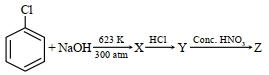
Identify compound $(Z)$ in the following reaction sequence.
A
$2-$Nitrophenol
B
$2,4-$Dinitrophenol
C
$2,4,6-$Trinitrophenol (Picric acid)
D
$4-$Nitrophenol
Solution
(C) The reaction sequence is as follows:
$1$. Chlorobenzene reacts with $NaOH$ at $623 \ K$ and $300 \ atm$ pressure to form sodium phenoxide $(X)$.
$2$. Sodium phenoxide $(X)$ on acidification with $HCl$ gives phenol $(Y)$.
$3$. Phenol $(Y)$ on treatment with concentrated $HNO_3$ undergoes electrophilic aromatic substitution (nitration) to form $2,4,6$-trinitrophenol,commonly known as picric acid $(Z)$.
$1$. Chlorobenzene reacts with $NaOH$ at $623 \ K$ and $300 \ atm$ pressure to form sodium phenoxide $(X)$.
$2$. Sodium phenoxide $(X)$ on acidification with $HCl$ gives phenol $(Y)$.
$3$. Phenol $(Y)$ on treatment with concentrated $HNO_3$ undergoes electrophilic aromatic substitution (nitration) to form $2,4,6$-trinitrophenol,commonly known as picric acid $(Z)$.
0 likes
View Solution473
MediumMCQ
Given below are two statements:
Statement $I$: Bromination of phenol in solvent with low polarity such as $CHCl_3$ or $CS_2$ requires Lewis acid catalyst.
Statement $II$: The Lewis acid catalyst polarises the bromine to generate $Br^{+}$.
In the light of the above statements,choose the correct answer from the options given below:
Statement $I$: Bromination of phenol in solvent with low polarity such as $CHCl_3$ or $CS_2$ requires Lewis acid catalyst.
Statement $II$: The Lewis acid catalyst polarises the bromine to generate $Br^{+}$.
In the light of the above statements,choose the correct answer from the options given below:
A
Statement $I$ is true but Statement $II$ is false.
B
Both Statement $I$ and Statement $II$ are true.
C
Both Statement $I$ and Statement $II$ are false.
D
Statement $I$ is false but Statement $II$ is true.
Solution
(D) Phenol is a highly activated aromatic ring due to the strong electron-donating effect of the $-OH$ group.
Because of this high activation,phenol undergoes electrophilic substitution (bromination) even in non-polar solvents like $CHCl_3$ or $CS_2$ without the need for a Lewis acid catalyst.
Therefore,Statement $I$ is false.
Statement $II$ correctly describes the general role of a Lewis acid in halogenation reactions (polarizing $Br_2$ to generate $Br^+$),but since Statement $I$ is false,the correct choice is that Statement $I$ is false but Statement $II$ is true.
Because of this high activation,phenol undergoes electrophilic substitution (bromination) even in non-polar solvents like $CHCl_3$ or $CS_2$ without the need for a Lewis acid catalyst.
Therefore,Statement $I$ is false.
Statement $II$ correctly describes the general role of a Lewis acid in halogenation reactions (polarizing $Br_2$ to generate $Br^+$),but since Statement $I$ is false,the correct choice is that Statement $I$ is false but Statement $II$ is true.
0 likes
View Solution474
MediumMCQ
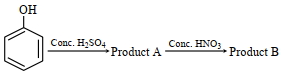
Consider the given chemical reaction sequence:
(Image provided)
Total sum of oxygen atoms in Product $A$ and Product $B$ are .........
(Image provided)
Total sum of oxygen atoms in Product $A$ and Product $B$ are .........
A
$10$
B
$11$
C
$15$
D
$14$
Solution
(D) The reaction of phenol with concentrated $H_2SO_4$ at $373 \ K$ yields phenol-$2,4$-disulphonic acid (Product $A$).
Chemical formula of Product $A$ $(C_6H_6O_7S_2)$: It contains $7$ oxygen atoms.
Reaction of phenol-$2,4$-disulphonic acid with concentrated $HNO_3$ yields $2,4,6$-trinitrophenol (Picric acid) (Product $B$).
Chemical formula of Product $B$ $(C_6H_3N_3O_7)$: It contains $7$ oxygen atoms.
Total sum of oxygen atoms = $7$ (in $A$) + $7$ (in $B$) = $14$.
Chemical formula of Product $A$ $(C_6H_6O_7S_2)$: It contains $7$ oxygen atoms.
Reaction of phenol-$2,4$-disulphonic acid with concentrated $HNO_3$ yields $2,4,6$-trinitrophenol (Picric acid) (Product $B$).
Chemical formula of Product $B$ $(C_6H_3N_3O_7)$: It contains $7$ oxygen atoms.
Total sum of oxygen atoms = $7$ (in $A$) + $7$ (in $B$) = $14$.
0 likes
View Solution475
MediumMCQ
Given below are two statements :
Statement $I$ : Picric acid is $2,4,6$-trinitrotoluene.
Statement $II$ : Phenol-$2,4$-disulphonic acid is treated with conc. $HNO_3$ to get picric acid.
In the light of the above statements,choose the most appropriate answer from the options given below :
Statement $I$ : Picric acid is $2,4,6$-trinitrotoluene.
Statement $II$ : Phenol-$2,4$-disulphonic acid is treated with conc. $HNO_3$ to get picric acid.
In the light of the above statements,choose the most appropriate answer from the options given below :
A
Statement $I$ is incorrect but Statement $II$ is correct.
B
Both Statement $I$ and Statement $II$ are incorrect.
C
Statement $I$ is correct but Statement $II$ is incorrect.
D
Both Statement $I$ and Statement $II$ are correct.
Solution
(A) Statement $I$ is incorrect because picric acid is $2,4,6$-trinitrophenol,not $2,4,6$-trinitrotoluene.
Statement $II$ is correct. Phenol is first treated with conc. $H_2SO_4$ to form phenol-$2,4$-disulphonic acid,which is then treated with conc. $HNO_3$ to yield picric acid ($2,4,6$-trinitrophenol) via electrophilic substitution.
Statement $II$ is correct. Phenol is first treated with conc. $H_2SO_4$ to form phenol-$2,4$-disulphonic acid,which is then treated with conc. $HNO_3$ to yield picric acid ($2,4,6$-trinitrophenol) via electrophilic substitution.
0 likes
View Solution476
MediumMCQ
In the Reimer-Tiemann reaction,phenol is converted into salicylaldehyde through an intermediate. The structure of the intermediate is . . . . . . .
A
B
C
D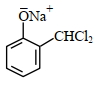
Solution
(D) The Reimer-Tiemann reaction involves the treatment of phenol with chloroform $(CHCl_3)$ in the presence of an aqueous base (like $NaOH$).
$1$. The base deprotonates the phenol to form a phenoxide ion.
$2$. The chloroform reacts with the base to generate a dichlorocarbene $(:CCl_2)$ intermediate,which acts as an electrophile.
$3$. The phenoxide ion attacks the dichlorocarbene to form an ortho-dichloromethyl phenoxide intermediate,which is represented as a benzene ring with an $-O^-Na^+$ group and a $-CHCl_2$ group at the ortho position.
$4$. This intermediate then undergoes hydrolysis with $NaOH$ followed by acidification to yield salicylaldehyde.
$1$. The base deprotonates the phenol to form a phenoxide ion.
$2$. The chloroform reacts with the base to generate a dichlorocarbene $(:CCl_2)$ intermediate,which acts as an electrophile.
$3$. The phenoxide ion attacks the dichlorocarbene to form an ortho-dichloromethyl phenoxide intermediate,which is represented as a benzene ring with an $-O^-Na^+$ group and a $-CHCl_2$ group at the ortho position.
$4$. This intermediate then undergoes hydrolysis with $NaOH$ followed by acidification to yield salicylaldehyde.
0 likes
View Solution477
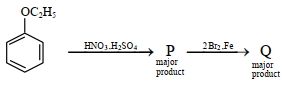
MediumMCQ
The ratio of the number of oxygen atoms to bromine atoms in the product $Q$ is $.... \times 10^{-1}$.
A
$10$
B
$12$
C
$16$
D
$15$
Solution
(D) $1$. Phenetole $(C_6H_5OC_2H_5)$ undergoes nitration with $HNO_3$ and $H_2SO_4$ to form $p$-nitrophenetole as the major product $(P)$.
$2$. $p$-Nitrophenetole then undergoes bromination with $Br_2$ in the presence of $Fe$ to form $2,6$-dibromo-$4$-nitrophenetole as the major product $(Q)$.
$3$. The molecular formula of $Q$ is $C_8H_7Br_2NO_3$.
$4$. In $Q$,the number of oxygen atoms is $3$ and the number of bromine atoms is $2$.
$5$. The ratio of oxygen atoms to bromine atoms is $\frac{3}{2} = 1.5$.
$6$. Expressing $1.5$ as $.... \times 10^{-1}$,we get $15 \times 10^{-1}$.
$7$. Therefore,the correct option is $D$.
$2$. $p$-Nitrophenetole then undergoes bromination with $Br_2$ in the presence of $Fe$ to form $2,6$-dibromo-$4$-nitrophenetole as the major product $(Q)$.
$3$. The molecular formula of $Q$ is $C_8H_7Br_2NO_3$.
$4$. In $Q$,the number of oxygen atoms is $3$ and the number of bromine atoms is $2$.
$5$. The ratio of oxygen atoms to bromine atoms is $\frac{3}{2} = 1.5$.
$6$. Expressing $1.5$ as $.... \times 10^{-1}$,we get $15 \times 10^{-1}$.
$7$. Therefore,the correct option is $D$.
0 likes
View Solution478
MediumMCQ
Which one of the following compounds will readily react with dilute $NaOH$?
A
$C_6H_5CH_2OH$
B
$C_2H_5OH$
C
$(CH_3)_3COH$
D
$C_6H_5OH$
Solution
(D) Phenol $(C_6H_5OH)$ is more acidic than water and aliphatic alcohols. Therefore,it reacts with a strong base like $NaOH$ to form sodium phenoxide and water.
$C_6H_5OH + NaOH \rightarrow C_6H_5O^-Na^+ + H_2O$
Aliphatic alcohols ($C_6H_5CH_2OH$,$C_2H_5OH$,$(CH_3)_3COH$) are less acidic than water and do not react with dilute $NaOH$.
$C_6H_5OH + NaOH \rightarrow C_6H_5O^-Na^+ + H_2O$
Aliphatic alcohols ($C_6H_5CH_2OH$,$C_2H_5OH$,$(CH_3)_3COH$) are less acidic than water and do not react with dilute $NaOH$.
0 likes
View Solution479
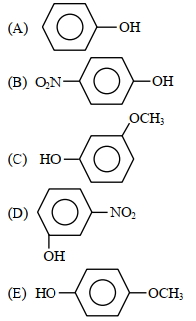
MediumMCQ
For the given compounds,the correct order of increasing $pK_{a}$ value is:
A
$(E) < (C) < (A) < (D) < (B)$
B
$(B) < (D) < (A) < (C) < (E)$
C
$(E) < (D) < (C) < (B) < (A)$
D
$(D) < (B) < (A) < (C) < (E)$
Solution
(A) The acidic strength of phenols is increased by electron-withdrawing groups $(-NO_2)$ and decreased by electron-donating groups $(-OCH_3)$.
$pK_{a}$ is inversely proportional to acidic strength.
$(A)$ Phenol
$(B)$ $p$-Nitrophenol (Strongest acid due to $-M$ and $-I$ effect of $-NO_2$)
$(C)$ $m$-Methoxyphenol ($-I$ effect of $-OCH_3$ increases acidity compared to phenol)
$(D)$ $o$-Nitrophenol (Strong acid due to $-I$ and $-M$ effect,but slightly weaker than $p$-nitrophenol due to intramolecular $H$-bonding)
$(E)$ $p$-Methoxyphenol (Strongest electron-donating effect $+M$ of $-OCH_3$ decreases acidity the most)
Acidic strength order: $(B) > (D) > (A) > (C) > (E)$
Therefore,the increasing order of $pK_{a}$ is: $(E) < (C) < (A) < (D) < (B)$.
$pK_{a}$ is inversely proportional to acidic strength.
$(A)$ Phenol
$(B)$ $p$-Nitrophenol (Strongest acid due to $-M$ and $-I$ effect of $-NO_2$)
$(C)$ $m$-Methoxyphenol ($-I$ effect of $-OCH_3$ increases acidity compared to phenol)
$(D)$ $o$-Nitrophenol (Strong acid due to $-I$ and $-M$ effect,but slightly weaker than $p$-nitrophenol due to intramolecular $H$-bonding)
$(E)$ $p$-Methoxyphenol (Strongest electron-donating effect $+M$ of $-OCH_3$ decreases acidity the most)
Acidic strength order: $(B) > (D) > (A) > (C) > (E)$
Therefore,the increasing order of $pK_{a}$ is: $(E) < (C) < (A) < (D) < (B)$.
0 likes
View Solution480
AdvancedMCQ
When benzene sulfonic acid and $p$-nitrophenol are treated with $NaHCO_3$,the gases released respectively are
A
$SO_2, NO_2$
B
$SO_2, NO$
C
$SO_2, CO_2$
D
$CO_2, CO_2$
Solution
(D) Benzene sulfonic acid $(C_6H_5SO_3H)$ is a strong acid,stronger than carbonic acid $(H_2CO_3)$. Therefore,it reacts with $NaHCO_3$ to release $CO_2$ gas.
$p$-Nitrophenol is more acidic than phenol due to the electron-withdrawing effect of the $-NO_2$ group. Its $pK_a$ value is approximately $7.15$,which is lower than that of carbonic acid ($pK_a \approx 6.35$ for $H_2CO_3$ in water). However,in many contexts,$p$-nitrophenol is considered acidic enough to react with $NaHCO_3$ to evolve $CO_2$ gas,as shown in the provided reaction scheme.
Both compounds react with $NaHCO_3$ to release $CO_2$ gas.
$p$-Nitrophenol is more acidic than phenol due to the electron-withdrawing effect of the $-NO_2$ group. Its $pK_a$ value is approximately $7.15$,which is lower than that of carbonic acid ($pK_a \approx 6.35$ for $H_2CO_3$ in water). However,in many contexts,$p$-nitrophenol is considered acidic enough to react with $NaHCO_3$ to evolve $CO_2$ gas,as shown in the provided reaction scheme.
Both compounds react with $NaHCO_3$ to release $CO_2$ gas.
0 likes
View Solution481
AdvancedMCQ
$I$. $1,2$-dihydroxybenzene
$II$. $1,3$-dihydroxybenzene
$III$. $1,4$-dihydroxybenzene
$IV$. Hydroxybenzene
The increasing order of boiling points of the above-mentioned compounds is:
$II$. $1,3$-dihydroxybenzene
$III$. $1,4$-dihydroxybenzene
$IV$. Hydroxybenzene
The increasing order of boiling points of the above-mentioned compounds is:
A
$IV < II < I < III$
B
$IV < I < II < III$
C
$I < II < III < IV$
D
$IV < III < II < I$
Solution
(B) The boiling point of phenolic compounds depends on intermolecular hydrogen bonding.
$IV$ (Hydroxybenzene or phenol) has only one $-OH$ group,so it has the lowest boiling point.
Among the dihydroxybenzenes $(I, II, III)$,the boiling point increases with the extent of intermolecular hydrogen bonding.
$I$ ($1,2$-dihydroxybenzene or catechol) exhibits strong intramolecular hydrogen bonding,which reduces its ability to form intermolecular hydrogen bonds,leading to a lower boiling point compared to $II$ and $III$.
$II$ ($1,3$-dihydroxybenzene or resorcinol) has a higher boiling point than $I$ due to more effective intermolecular hydrogen bonding.
$III$ ($1,4$-dihydroxybenzene or hydroquinone) has the highest boiling point because its symmetrical structure allows for the most efficient intermolecular hydrogen bonding in the solid state.
Therefore,the increasing order is $IV < I < II < III$.
$IV$ (Hydroxybenzene or phenol) has only one $-OH$ group,so it has the lowest boiling point.
Among the dihydroxybenzenes $(I, II, III)$,the boiling point increases with the extent of intermolecular hydrogen bonding.
$I$ ($1,2$-dihydroxybenzene or catechol) exhibits strong intramolecular hydrogen bonding,which reduces its ability to form intermolecular hydrogen bonds,leading to a lower boiling point compared to $II$ and $III$.
$II$ ($1,3$-dihydroxybenzene or resorcinol) has a higher boiling point than $I$ due to more effective intermolecular hydrogen bonding.
$III$ ($1,4$-dihydroxybenzene or hydroquinone) has the highest boiling point because its symmetrical structure allows for the most efficient intermolecular hydrogen bonding in the solid state.
Therefore,the increasing order is $IV < I < II < III$.
0 likes
View Solution482
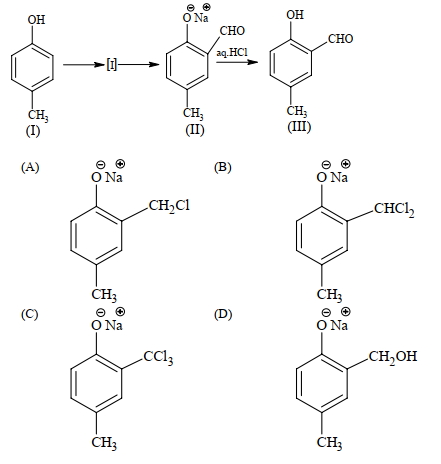
DifficultMCQ
The Reimer-Tiemann reaction introduces an aldehyde group onto the aromatic ring of phenol,ortho to the hydroxyl group. This reaction involves electrophilic aromatic substitution. This is a general method for the synthesis of substituted salicylaldehydes as depicted below.
$1.$ Which one of the following reagents is used in the above reaction?
$A.$ aq. $NaOH + CH_3Cl$
$B.$ aq. $NaOH + CH_2Cl_2$
$C.$ aq. $NaOH + CHCl_3$
$D.$ aq. $NaOH + CCl_4$
$2.$ The electrophile in this reaction is
$A.$ $:CHCl$
$B.$ $^{+}CHCl_2$
$C.$ $:CCl_2$
$D.$ $CCl_3^{-}$
$3.$ The structure of the intermediate $I$ is
(See provided image for structures $A$,$B$,$C$,$D$)
Give the answer for questions $1, 2$ and $3.$
$1.$ Which one of the following reagents is used in the above reaction?
$A.$ aq. $NaOH + CH_3Cl$
$B.$ aq. $NaOH + CH_2Cl_2$
$C.$ aq. $NaOH + CHCl_3$
$D.$ aq. $NaOH + CCl_4$
$2.$ The electrophile in this reaction is
$A.$ $:CHCl$
$B.$ $^{+}CHCl_2$
$C.$ $:CCl_2$
$D.$ $CCl_3^{-}$
$3.$ The structure of the intermediate $I$ is
(See provided image for structures $A$,$B$,$C$,$D$)
Give the answer for questions $1, 2$ and $3.$
A
$A, D, B$
B
$C, C, A$
C
$C, C, B$
D
$D, A, B$
Solution
(C) $1.$ The Reimer-Tiemann reaction uses chloroform $(CHCl_3)$ and an aqueous base $(NaOH)$ to generate the electrophile. Thus,the correct reagent is $aq. NaOH + CHCl_3$ (Option $C$).
$2.$ The active electrophile generated in the Reimer-Tiemann reaction is dichlorocarbene $(:CCl_2)$,which is formed by the dehydrohalogenation of chloroform (Option $C$).
$3.$ The intermediate $I$ formed by the attack of the dichlorocarbene electrophile on the phenoxide ion is the dichloromethyl-substituted phenoxide,which corresponds to structure $B$ in the provided image.
$2.$ The active electrophile generated in the Reimer-Tiemann reaction is dichlorocarbene $(:CCl_2)$,which is formed by the dehydrohalogenation of chloroform (Option $C$).
$3.$ The intermediate $I$ formed by the attack of the dichlorocarbene electrophile on the phenoxide ion is the dichloromethyl-substituted phenoxide,which corresponds to structure $B$ in the provided image.
0 likes
View Solution483
AdvancedMCQ
The correct statement$(s)$ about the following reaction sequence is(are):
Cumene $(C_9H_{12})$ $\xrightarrow[ii) H_3O^+]{i) O_2}$ $P$ $\xrightarrow{CHCl_3/NaOH}$ $Q$ (major) + $R$ (minor)
$Q$ $\xrightarrow[PhCH_2Br]{NaOH}$ $S$
$(A)$ $R$ is steam volatile
$(B)$ $Q$ gives dark violet coloration with $1 \%$ aqueous $FeCl_3$ solution
$(C)$ $S$ gives yellow precipitate with $2, 4-dinitrophenylhydrazine$
$(D)$ $S$ gives dark violet coloration with $1 \%$ aqueous $FeCl_3$ solution
Cumene $(C_9H_{12})$ $\xrightarrow[ii) H_3O^+]{i) O_2}$ $P$ $\xrightarrow{CHCl_3/NaOH}$ $Q$ (major) + $R$ (minor)
$Q$ $\xrightarrow[PhCH_2Br]{NaOH}$ $S$
$(A)$ $R$ is steam volatile
$(B)$ $Q$ gives dark violet coloration with $1 \%$ aqueous $FeCl_3$ solution
$(C)$ $S$ gives yellow precipitate with $2, 4-dinitrophenylhydrazine$
$(D)$ $S$ gives dark violet coloration with $1 \%$ aqueous $FeCl_3$ solution
A
$B, A$
B
$B, C$
C
$B, D$
D
$A, C$
Solution
(B) $1$. Cumene is oxidized to phenol $(P)$ via cumene hydroperoxide.
$2$. Reimer-Tiemann reaction of phenol $(P)$ with $CHCl_3/NaOH$ gives salicylaldehyde ($Q$,major) and $p$-hydroxybenzaldehyde ($R$,minor).
$3$. $Q$ (salicylaldehyde) has intramolecular hydrogen bonding,making it steam volatile.
$4$. $Q$ contains a phenolic $-OH$ group,so it gives a violet coloration with $FeCl_3$.
$5$. $S$ is formed by the reaction of $Q$ with $PhCH_2Br$ in the presence of $NaOH$ (Williamson ether synthesis),resulting in $2-(benzyloxy)benzaldehyde$.
$6$. $S$ contains an aldehydic group,so it gives a yellow precipitate with $2, 4-DNP$.
$7$. $S$ does not have a free phenolic $-OH$ group,so it does not give a violet coloration with $FeCl_3$.
Therefore,statements $(B)$ and $(C)$ are correct.
$2$. Reimer-Tiemann reaction of phenol $(P)$ with $CHCl_3/NaOH$ gives salicylaldehyde ($Q$,major) and $p$-hydroxybenzaldehyde ($R$,minor).
$3$. $Q$ (salicylaldehyde) has intramolecular hydrogen bonding,making it steam volatile.
$4$. $Q$ contains a phenolic $-OH$ group,so it gives a violet coloration with $FeCl_3$.
$5$. $S$ is formed by the reaction of $Q$ with $PhCH_2Br$ in the presence of $NaOH$ (Williamson ether synthesis),resulting in $2-(benzyloxy)benzaldehyde$.
$6$. $S$ contains an aldehydic group,so it gives a yellow precipitate with $2, 4-DNP$.
$7$. $S$ does not have a free phenolic $-OH$ group,so it does not give a violet coloration with $FeCl_3$.
Therefore,statements $(B)$ and $(C)$ are correct.
0 likes
View Solution484
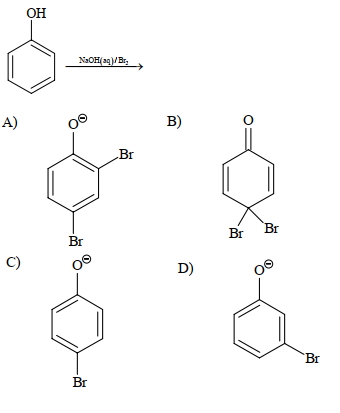
AdvancedMCQ
In the reaction of phenol with $NaOH(aq)/Br_2$,the intermediate$(s)$ is(are):
A
$(A, B, C)$
B
$(A, B, D)$
C
$(B, C, D)$
D
$(A, C, D)$
Solution
(A) The reaction of phenol with $NaOH(aq)$ forms the phenoxide ion,which is highly activated towards electrophilic aromatic substitution.
$Br_2$ acts as an electrophile.
The phenoxide ion undergoes electrophilic attack by $Br_2$ at the ortho and para positions.
Intermediate $C$ represents the $p$-bromophenoxide ion.
Intermediate $A$ represents the $o$-bromophenoxide ion.
Intermediate $B$ represents a dienone intermediate formed during the bromination process.
Thus,the intermediates involved in the reaction pathway are $A$,$B$,and $C$.
$Br_2$ acts as an electrophile.
The phenoxide ion undergoes electrophilic attack by $Br_2$ at the ortho and para positions.
Intermediate $C$ represents the $p$-bromophenoxide ion.
Intermediate $A$ represents the $o$-bromophenoxide ion.
Intermediate $B$ represents a dienone intermediate formed during the bromination process.
Thus,the intermediates involved in the reaction pathway are $A$,$B$,and $C$.
0 likes
View Solution485
AdvancedMCQ
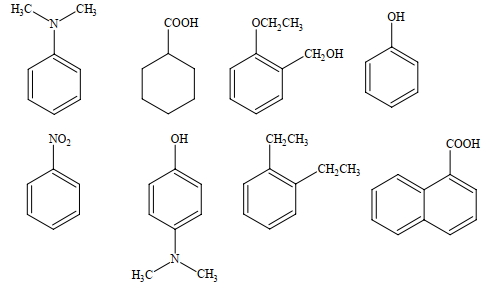
Amongst the following,the total number of compounds soluble in aqueous $NaOH$ is:
A
$5$
B
$4$
C
$6$
D
$3$
Solution
(B) Compounds that are acidic enough to react with aqueous $NaOH$ (a base) to form water-soluble salts are soluble in aqueous $NaOH$.
$1$. Cyclohexanecarboxylic acid (contains $-COOH$ group,acidic).
$2$. Phenol (contains phenolic $-OH$ group,acidic).
$3$. $4$-(Dimethylamino)phenol (contains phenolic $-OH$ group,acidic).
$4$. $1$-Naphthoic acid (contains $-COOH$ group,acidic).
Other compounds like $N,N$-dimethylaniline,$2$-ethoxybenzyl alcohol,nitrobenzene,and $1,2$-diethylbenzene are not sufficiently acidic to react with $NaOH$.
Therefore,the total number of compounds soluble in aqueous $NaOH$ is $4$.
$1$. Cyclohexanecarboxylic acid (contains $-COOH$ group,acidic).
$2$. Phenol (contains phenolic $-OH$ group,acidic).
$3$. $4$-(Dimethylamino)phenol (contains phenolic $-OH$ group,acidic).
$4$. $1$-Naphthoic acid (contains $-COOH$ group,acidic).
Other compounds like $N,N$-dimethylaniline,$2$-ethoxybenzyl alcohol,nitrobenzene,and $1,2$-diethylbenzene are not sufficiently acidic to react with $NaOH$.
Therefore,the total number of compounds soluble in aqueous $NaOH$ is $4$.
0 likes
View Solution486
DifficultMCQ
An organic compound $(C_8H_{10}O_2)$ rotates plane-polarized light. It produces a pink color with a neutral $FeCl_3$ solution. What is the total number of all the possible isomers for this compound?
A
$6$
B
$7$
C
$8$
D
$9$
Solution
(A) The molecular formula $C_8H_{10}O_2$ and the positive $FeCl_3$ test indicate that the compound is a phenol derivative.
Since the compound rotates plane-polarized light,it must be optically active,meaning it contains a chiral center.
The structure consists of a benzene ring with an $-OH$ group and a side chain of $-CH(OH)CH_3$.
There are three possible positions for the side chain relative to the $-OH$ group on the benzene ring: ortho,meta,and para.
For each of these three positions,the side chain $-CH(OH)CH_3$ contains a chiral carbon atom,which results in two enantiomers ($R$ and $S$ configurations).
Therefore,the total number of optically active isomers is $3 \times 2 = 6$.
Since the compound rotates plane-polarized light,it must be optically active,meaning it contains a chiral center.
The structure consists of a benzene ring with an $-OH$ group and a side chain of $-CH(OH)CH_3$.
There are three possible positions for the side chain relative to the $-OH$ group on the benzene ring: ortho,meta,and para.
For each of these three positions,the side chain $-CH(OH)CH_3$ contains a chiral carbon atom,which results in two enantiomers ($R$ and $S$ configurations).
Therefore,the total number of optically active isomers is $3 \times 2 = 6$.
0 likes
View Solution487
MediumMCQ
The compound that does $NOT$ liberate $CO_2$ on treatment with aqueous sodium bicarbonate solution is:
A
Benzoic acid
B
Benzenesulphonic acid
C
Salicylic acid
D
Carbolic acid (Phenol)
Solution
(D) Sodium bicarbonate $(NaHCO_3)$ reacts with acids that are stronger than carbonic acid $(H_2CO_3)$ to liberate $CO_2$ gas.
Benzoic acid,benzenesulphonic acid,and salicylic acid are stronger acids than $H_2CO_3$ and thus liberate $CO_2$.
Phenol (carbolic acid) is a weaker acid than $H_2CO_3$ and therefore does not react with $NaHCO_3$ to liberate $CO_2$.
Benzoic acid,benzenesulphonic acid,and salicylic acid are stronger acids than $H_2CO_3$ and thus liberate $CO_2$.
Phenol (carbolic acid) is a weaker acid than $H_2CO_3$ and therefore does not react with $NaHCO_3$ to liberate $CO_2$.
0 likes
View Solution488
DifficultMCQ
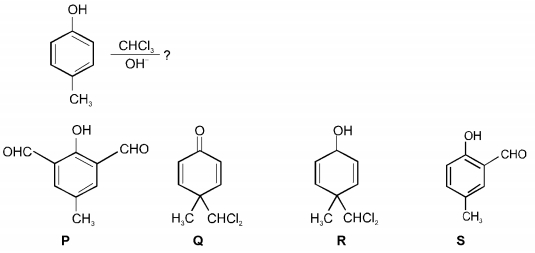
In the following Reimer-Tiemann reaction,the product$(s)$ formed is(are):
$p$-cresol + $CHCl_3$ + $OH^-$ $\rightarrow$ ?
$p$-cresol + $CHCl_3$ + $OH^-$ $\rightarrow$ ?
A
$B, D$
B
$B, C$
C
$A, C$
D
$A, D$
Solution
(A) The reaction is the Reimer-Tiemann reaction. $p$-cresol reacts with $CHCl_3$ and $OH^-$ to form an intermediate dichloromethyl cyclohexadienone derivative.
$1$. The phenoxide ion attacks the dichlorocarbene $(:CCl_2)$ generated from $CHCl_3$.
$2$. This leads to the formation of a cyclohexadienone intermediate ($Q$ and $R$ are related to these intermediates).
$3$. Hydrolysis and subsequent rearrangement lead to the formation of the major product $S$ ($2$-hydroxy$-5-$methylbenzaldehyde).
$4$. Some side products like $Q$ ($4$-methyl$-4-$dichloromethyl-cyclohexa$-2,5-$dienone) are also formed as minor products during the reaction process.
Thus,the major product is $S$ and the minor product is $Q$.
$1$. The phenoxide ion attacks the dichlorocarbene $(:CCl_2)$ generated from $CHCl_3$.
$2$. This leads to the formation of a cyclohexadienone intermediate ($Q$ and $R$ are related to these intermediates).
$3$. Hydrolysis and subsequent rearrangement lead to the formation of the major product $S$ ($2$-hydroxy$-5-$methylbenzaldehyde).
$4$. Some side products like $Q$ ($4$-methyl$-4-$dichloromethyl-cyclohexa$-2,5-$dienone) are also formed as minor products during the reaction process.
Thus,the major product is $S$ and the minor product is $Q$.
0 likes
View Solution489
AdvancedMCQ
The reactivity of compound $Z$ with different halogens under appropriate conditions is given below:
(Image of reaction: $Z$ ($3$-tert-butylphenol) reacts with $X_2$ to give mono-halo derivative for $X_2 = I_2$,di-halo for $X_2 = Br_2$,and tri-halo for $X_2 = Cl_2$)
The observed pattern of electrophilic substitution can be explained by:
$A$. The steric effect of the halogen
$B$. The steric effect of the tert-butyl group
$C$. The electronic effect of the phenolic group
$D$. The electronic effect of the tert-butyl group
(Image of reaction: $Z$ ($3$-tert-butylphenol) reacts with $X_2$ to give mono-halo derivative for $X_2 = I_2$,di-halo for $X_2 = Br_2$,and tri-halo for $X_2 = Cl_2$)
The observed pattern of electrophilic substitution can be explained by:
$A$. The steric effect of the halogen
$B$. The steric effect of the tert-butyl group
$C$. The electronic effect of the phenolic group
$D$. The electronic effect of the tert-butyl group
A
$A, B, C$
B
$A, B, D$
C
$A, C, D$
D
$B, C, D$
Solution
(A) The $-OH$ group is strongly activating and $o, p$-directing due to its powerful $+M$ effect.
$1$. The tert-butyl group $(-C(CH_3)_3)$ is a bulky group,which creates significant steric hindrance at the ortho position $(B)$ relative to it.
$2$. The halogen electrophile $(X^{\oplus})$ size increases in the order $Cl^{\oplus} < Br^{\oplus} < I^{\oplus}$.
$3$. With $I_2$,the electrophile is very large,so it only substitutes at the least hindered position $(A)$.
$4$. With $Br_2$,the electrophile is smaller,allowing substitution at $A$ and $C$.
$5$. With $Cl_2$,the electrophile is the smallest,allowing substitution at all three positions $(A, B, C)$.
Thus,the pattern is explained by the steric effect of the halogen $(A)$,the steric effect of the tert-butyl group $(B)$,and the electronic effect of the phenolic group $(C)$ which activates the ring. The correct combination is $A, B, C$.
$1$. The tert-butyl group $(-C(CH_3)_3)$ is a bulky group,which creates significant steric hindrance at the ortho position $(B)$ relative to it.
$2$. The halogen electrophile $(X^{\oplus})$ size increases in the order $Cl^{\oplus} < Br^{\oplus} < I^{\oplus}$.
$3$. With $I_2$,the electrophile is very large,so it only substitutes at the least hindered position $(A)$.
$4$. With $Br_2$,the electrophile is smaller,allowing substitution at $A$ and $C$.
$5$. With $Cl_2$,the electrophile is the smallest,allowing substitution at all three positions $(A, B, C)$.
Thus,the pattern is explained by the steric effect of the halogen $(A)$,the steric effect of the tert-butyl group $(B)$,and the electronic effect of the phenolic group $(C)$ which activates the ring. The correct combination is $A, B, C$.
0 likes
View Solution490
DifficultMCQ
If the reaction sequence given below is carried out with $15$ moles of acetylene,the amount of the product $D$ formed (in $g$) is. . . . . The yields of $A, B, C$ and $D$ are given in parentheses. [Given: Atomic mass of $H=1, C=12, O=16, Cl=35$]

A
$130$
B
$120$
C
$136$
D
$140$
Solution
(C) Step $1$: Cyclotrimerization of $15$ moles of acetylene $(HC \equiv CH)$ gives benzene $(A)$. Since $3$ moles of acetylene form $1$ mole of benzene,$15$ moles of acetylene would theoretically form $5$ moles of benzene. Given an $80\%$ yield,the actual amount of benzene $(A)$ formed is $5 \times 0.8 = 4$ moles.
Step $2$: Friedel-Crafts alkylation of $4$ moles of benzene with isopropyl chloride gives cumene $(B)$. Given a $50\%$ yield,the amount of cumene $(B)$ formed is $4 \times 0.5 = 2$ moles.
Step $3$: Cumene hydroperoxide rearrangement of $2$ moles of cumene gives phenol $(C)$. Given a $50\%$ yield,the amount of phenol $(C)$ formed is $2 \times 0.5 = 1$ mole.
Step $4$: Acetylation of $1$ mole of phenol with acetyl chloride $(CH_3COCl)$ in the presence of pyridine gives phenyl acetate $(D)$. Given a $100\%$ yield,the amount of phenyl acetate $(D)$ formed is $1$ mole.
The molar mass of phenyl acetate $(C_8H_8O_2)$ is $(8 \times 12) + (8 \times 1) + (2 \times 16) = 96 + 8 + 32 = 136 \ g/mol$.
Therefore,the mass of $1$ mole of $D$ is $136 \ g$.
Step $2$: Friedel-Crafts alkylation of $4$ moles of benzene with isopropyl chloride gives cumene $(B)$. Given a $50\%$ yield,the amount of cumene $(B)$ formed is $4 \times 0.5 = 2$ moles.
Step $3$: Cumene hydroperoxide rearrangement of $2$ moles of cumene gives phenol $(C)$. Given a $50\%$ yield,the amount of phenol $(C)$ formed is $2 \times 0.5 = 1$ mole.
Step $4$: Acetylation of $1$ mole of phenol with acetyl chloride $(CH_3COCl)$ in the presence of pyridine gives phenyl acetate $(D)$. Given a $100\%$ yield,the amount of phenyl acetate $(D)$ formed is $1$ mole.
The molar mass of phenyl acetate $(C_8H_8O_2)$ is $(8 \times 12) + (8 \times 1) + (2 \times 16) = 96 + 8 + 32 = 136 \ g/mol$.
Therefore,the mass of $1$ mole of $D$ is $136 \ g$.
0 likes
View Solution491
MediumMCQ
What amount of bromine will be required to convert $2 \ g$ of phenol into $2, 4, 6-$tribromophenol (in $g$)? $($Given molar mass in $g \ mol^{-1}$ of $C, H, O, Br$ are $12, 1, 16, 80$ respectively$)$
A
$10.22$
B
$6.0$
C
$4.0$
D
$20.44$
Solution
(A) The reaction of phenol with bromine water is: $C_6H_5OH + 3Br_2 \rightarrow C_6H_2Br_3OH + 3HBr$
Molar mass of phenol $(C_6H_5OH) = (6 \times 12) + (6 \times 1) + 16 = 72 + 6 + 16 = 94 \ g \ mol^{-1}$.
Moles of phenol = $\frac{2 \ g}{94 \ g \ mol^{-1}} = 0.02128 \ mol$.
According to the stoichiometry,$1 \ mol$ of phenol reacts with $3 \ mol$ of $Br_2$.
Moles of $Br_2$ required = $3 \times 0.02128 = 0.06384 \ mol$.
Molar mass of $Br_2 = 2 \times 80 = 160 \ g \ mol^{-1}$.
Mass of $Br_2$ required = $0.06384 \ mol \times 160 \ g \ mol^{-1} = 10.2144 \ g \approx 10.22 \ g$.
Molar mass of phenol $(C_6H_5OH) = (6 \times 12) + (6 \times 1) + 16 = 72 + 6 + 16 = 94 \ g \ mol^{-1}$.
Moles of phenol = $\frac{2 \ g}{94 \ g \ mol^{-1}} = 0.02128 \ mol$.
According to the stoichiometry,$1 \ mol$ of phenol reacts with $3 \ mol$ of $Br_2$.
Moles of $Br_2$ required = $3 \times 0.02128 = 0.06384 \ mol$.
Molar mass of $Br_2 = 2 \times 80 = 160 \ g \ mol^{-1}$.
Mass of $Br_2$ required = $0.06384 \ mol \times 160 \ g \ mol^{-1} = 10.2144 \ g \approx 10.22 \ g$.
0 likes
View Solution492
MediumMCQ
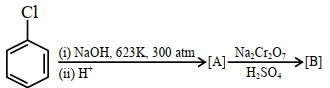
Identify the products $[A]$ and $[B]$,respectively in the following reaction:
A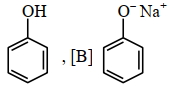
B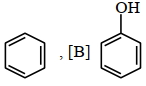
C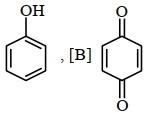
D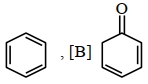
Solution
(C) The reaction of chlorobenzene with $NaOH$ at $623 \ K$ and $300 \ atm$ followed by acidification with $H^+$ gives phenol as product $[A]$.
Phenol on oxidation with chromic acid $(Na_2Cr_2O_7 / H_2SO_4)$ yields $p$-benzoquinone as product $[B]$.
Phenol on oxidation with chromic acid $(Na_2Cr_2O_7 / H_2SO_4)$ yields $p$-benzoquinone as product $[B]$.
0 likes
View Solution493
DifficultMCQ
Which of the following compounds is least likely to give effervescence of $CO_2$ in the presence of aqueous $NaHCO_3$?
A
$2,4,6-$Trinitrophenol
B
$4-$Nitrobenzoic acid
C
$PhNH_3^+ Cl^-$
D
$3-$Nitrophenol
Solution
(D) The reaction with aqueous $NaHCO_3$ to release $CO_2$ gas occurs only if the compound is more acidic than carbonic acid ($H_2CO_3$,$pK_a \approx 6.35$).
$1$. $2,4,6$-Trinitrophenol (Picric acid) is a very strong acid $(pK_a \approx 0.38)$ and readily reacts with $NaHCO_3$.
$2$. $4$-Nitrobenzoic acid is a strong organic acid $(pK_a \approx 3.4)$ and reacts with $NaHCO_3$.
$3$. $PhNH_3^+ Cl^-$ (Anilinium chloride) is the salt of a weak base and a strong acid. In aqueous solution,it exists as $PhNH_3^+$ and $Cl^-$. $PhNH_3^+$ is a weak acid $(pK_a \approx 4.6)$,which is stronger than $H_2CO_3$,so it can react with $NaHCO_3$ to release $CO_2$.
$4$. $3$-Nitrophenol is a weak acid $(pK_a \approx 8.39)$,which is less acidic than $H_2CO_3$ $(pK_a \approx 6.35)$. Therefore,it does not react with $NaHCO_3$ to give effervescence of $CO_2$.
$1$. $2,4,6$-Trinitrophenol (Picric acid) is a very strong acid $(pK_a \approx 0.38)$ and readily reacts with $NaHCO_3$.
$2$. $4$-Nitrobenzoic acid is a strong organic acid $(pK_a \approx 3.4)$ and reacts with $NaHCO_3$.
$3$. $PhNH_3^+ Cl^-$ (Anilinium chloride) is the salt of a weak base and a strong acid. In aqueous solution,it exists as $PhNH_3^+$ and $Cl^-$. $PhNH_3^+$ is a weak acid $(pK_a \approx 4.6)$,which is stronger than $H_2CO_3$,so it can react with $NaHCO_3$ to release $CO_2$.
$4$. $3$-Nitrophenol is a weak acid $(pK_a \approx 8.39)$,which is less acidic than $H_2CO_3$ $(pK_a \approx 6.35)$. Therefore,it does not react with $NaHCO_3$ to give effervescence of $CO_2$.
0 likes
View Solution494
DifficultMCQ
Product $(A)$ and $(B)$ respectively are $:-$
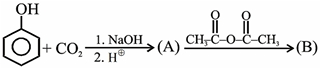
A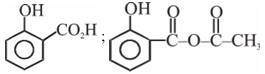
B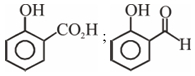
C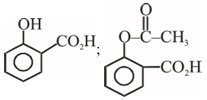
D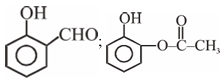
Solution
(A) The reaction of phenol with $CO_2$ in the presence of $NaOH$ followed by acidification is the Kolbe-Schmitt reaction,which yields salicylic acid ($2$-hydroxybenzoic acid) as product $(A)$.
Salicylic acid then reacts with acetic anhydride $(CH_3CO)_2O$ in the presence of an acid catalyst to undergo acetylation of the phenolic $-OH$ group,forming acetylsalicylic acid (aspirin) as product $(B)$.
Salicylic acid then reacts with acetic anhydride $(CH_3CO)_2O$ in the presence of an acid catalyst to undergo acetylation of the phenolic $-OH$ group,forming acetylsalicylic acid (aspirin) as product $(B)$.
0 likes
View Solution495
MediumMCQ
$A$ compound $x$ reacts with Bromine water and gives a white precipitate. If compound $x$ reacts with $Zn$ dust and forms benzene,then $x$ is:
A
Aniline
B
Phenol
C
Benzene diazonium chloride
D
Toluene
Solution
(B) $1$. Phenol $(C_6H_5OH)$ reacts with bromine water $(Br_2/H_2O)$ to form $2,4,6$-tribromophenol,which is a white precipitate.
$2$. Phenol reacts with zinc dust $(Zn)$ upon heating to undergo reduction,forming benzene $(C_6H_6)$ and zinc oxide $(ZnO)$.
$3$. The reaction is: $C_6H_5OH + Zn \rightarrow C_6H_6 + ZnO$.
$4$. Therefore,the compound $x$ is phenol.
$2$. Phenol reacts with zinc dust $(Zn)$ upon heating to undergo reduction,forming benzene $(C_6H_6)$ and zinc oxide $(ZnO)$.
$3$. The reaction is: $C_6H_5OH + Zn \rightarrow C_6H_6 + ZnO$.
$4$. Therefore,the compound $x$ is phenol.
0 likes
View Solution496
MediumMCQ
Rank the following compounds in order of increasing acidic strength.
A
$2 < 4 < 1 < 3$
B
$1 < 2 < 3 < 4$
C
$3 < 1 < 2 < 4$
D
$2 < 4 < 1 < 3$
Solution
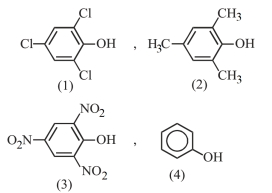
(A) The acidic strength of phenols depends on the nature of substituents attached to the benzene ring. Electron-withdrawing groups $(EWG)$ increase acidity by stabilizing the phenoxide ion,while electron-donating groups $(EDG)$ decrease acidity by destabilizing it.
$(1)$ $2,4,6$-trichlorophenol: Contains three $-Cl$ groups,which are electron-withdrawing by the inductive effect $(-I)$.
$(2)$ $2,4,6$-trimethylphenol: Contains three $-CH_3$ groups,which are electron-donating by the inductive effect $(+I)$ and hyperconjugation.
$(3)$ $2,4,6$-trinitrophenol (picric acid): Contains three $-NO_2$ groups,which are strong electron-withdrawing groups by both $-I$ and $-M$ (mesomeric) effects.
$(4)$ Phenol: Has no substituent.
Comparing the effects:
- $-CH_3$ $(EDG)$ makes the compound less acidic than phenol.
- $-Cl$ $(EWG)$ makes the compound more acidic than phenol.
- $-NO_2$ (strong $EWG$) makes the compound significantly more acidic than phenol.
Order of increasing acidity: $(2) < (4) < (1) < (3)$.
Thus,the correct option is $A$.
$(1)$ $2,4,6$-trichlorophenol: Contains three $-Cl$ groups,which are electron-withdrawing by the inductive effect $(-I)$.
$(2)$ $2,4,6$-trimethylphenol: Contains three $-CH_3$ groups,which are electron-donating by the inductive effect $(+I)$ and hyperconjugation.
$(3)$ $2,4,6$-trinitrophenol (picric acid): Contains three $-NO_2$ groups,which are strong electron-withdrawing groups by both $-I$ and $-M$ (mesomeric) effects.
$(4)$ Phenol: Has no substituent.
Comparing the effects:
- $-CH_3$ $(EDG)$ makes the compound less acidic than phenol.
- $-Cl$ $(EWG)$ makes the compound more acidic than phenol.
- $-NO_2$ (strong $EWG$) makes the compound significantly more acidic than phenol.
Order of increasing acidity: $(2) < (4) < (1) < (3)$.
Thus,the correct option is $A$.
0 likes
View Solution497
MediumMCQ
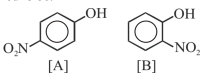
Out of the two compounds $A$ ($p$-nitrophenol) and $B$ ($o$-nitrophenol) shown below,the vapour pressure of $B$ at a particular temperature is expected to be:
A
higher than that of $A$
B
lower than that of $A$
C
same as that of $A$
D
can be higher or lower depending upon the size of the vessel tube.
Solution
(A) $o$-Nitrophenol $(B)$ exhibits intramolecular hydrogen bonding,which restricts intermolecular hydrogen bonding between its molecules. This makes it more volatile.
$p$-Nitrophenol $(A)$ exhibits intermolecular hydrogen bonding,which leads to the association of molecules,resulting in a higher boiling point and lower volatility.
Since vapour pressure is inversely related to boiling point,$o$-nitrophenol $(B)$ will have a higher vapour pressure than $p$-nitrophenol $(A)$.
$p$-Nitrophenol $(A)$ exhibits intermolecular hydrogen bonding,which leads to the association of molecules,resulting in a higher boiling point and lower volatility.
Since vapour pressure is inversely related to boiling point,$o$-nitrophenol $(B)$ will have a higher vapour pressure than $p$-nitrophenol $(A)$.
0 likes
View Solution498
MediumMCQ
Which of the following has the highest solubility in water?
A
Phenol
B
$p$-Cresol
C
$o$-Nitrophenol
D
$p$-Nitrophenol
Solution
(D) The solubility of organic compounds in water depends on their ability to form hydrogen bonds with water molecules.
$p$-Nitrophenol has a $-NO_2$ group which is a strong electron-withdrawing group.
This group increases the acidity of the phenolic $-OH$ group,making it more capable of forming strong intermolecular hydrogen bonds with water.
Additionally,$o$-Nitrophenol exhibits intramolecular hydrogen bonding,which reduces its ability to form hydrogen bonds with water,thereby decreasing its solubility.
$p$-Cresol contains a hydrophobic methyl group,which decreases its solubility compared to phenol.
Therefore,$p$-Nitrophenol is the most soluble among the given options.
$p$-Nitrophenol has a $-NO_2$ group which is a strong electron-withdrawing group.
This group increases the acidity of the phenolic $-OH$ group,making it more capable of forming strong intermolecular hydrogen bonds with water.
Additionally,$o$-Nitrophenol exhibits intramolecular hydrogen bonding,which reduces its ability to form hydrogen bonds with water,thereby decreasing its solubility.
$p$-Cresol contains a hydrophobic methyl group,which decreases its solubility compared to phenol.
Therefore,$p$-Nitrophenol is the most soluble among the given options.
0 likes
View Solution499
EasyMCQ
Identify the compound with the highest acidic strength from the following.
A
Ethanol
B
$t-$Butyl alcohol
C
Phenol
D
$p-$Nitrophenol
Solution
(D) Alcohols are generally neutral or very weakly acidic,whereas phenols are more acidic than alcohols.
Electron-withdrawing groups,such as the nitro group $(-NO_2)$,stabilize the phenoxide ion through $-I$ and $-M$ effects,thereby increasing the acidity of the phenol.
Since $p-$nitrophenol contains a strong electron-withdrawing $-NO_2$ group at the para position,it exhibits the highest acidic strength among the given compounds.
Electron-withdrawing groups,such as the nitro group $(-NO_2)$,stabilize the phenoxide ion through $-I$ and $-M$ effects,thereby increasing the acidity of the phenol.
Since $p-$nitrophenol contains a strong electron-withdrawing $-NO_2$ group at the para position,it exhibits the highest acidic strength among the given compounds.
0 likes
View SolutionAlcohols, Phenols and Ethers — Properties of Phenols · Frequently Asked Questions
1Are these Alcohols, Phenols and Ethers questions useful for JEE and NEET?
Yes. All questions in this section are mapped to JEE Main and NEET exam patterns. Previous year questions from JEE Main, NEET, GUJCET and state-level exams are included with full solutions.
2Can I switch to Hindi or Gujarati for these questions?
Yes. Use the language tabs in the hero section or the sidebar to view the same questions and solutions in English, Hindi or Gujarati.
3How do I generate a question paper from this subtopic?
Use the Vedclass Exam Paper Generator — select the chapter and subtopic, set difficulty, and generate Sets A, B, C, D automatically. First 3 chapters of every subject are free.
Vedclass Products
For Students
Vedclass Test Series
Mock tests in real JEE/NEET style with performance analysis. 5-day free trial.
Start Free TrialFor Teachers
Exam Paper Generator
Generate Set A/B/C/D papers from this chapter in 2 minutes. 3 chapters free.
Try FreeFor Institutes
Online Exam Module
Live online exams with unlimited students, 360° analytics & white-label branding.
See DemoFor Teachers & Institutes
Generate a Alcohols, Phenols and Ethers Exam Paper in 2 Minutes
Select subtopic & difficulty — Sets A, B, C, D auto-generated with No Repeat logic.
First 3 chapters of every subject are free — no payment required.