
A English
Preparation of Phenols Questions in English
Class 12 Chemistry · Alcohols, Phenols and Ethers · Preparation of Phenols
40+
Questions
English
Language
100%
With Solutions
Showing 40 of 40 questions in English
1
MediumMCQ
The following equation illustrates:
$C_6H_5Cl + 2NaOH \xrightarrow{623 \ K, 300 \ atm} C_6H_5ONa + NaCl + H_2O$
$C_6H_5Cl + 2NaOH \xrightarrow{623 \ K, 300 \ atm} C_6H_5ONa + NaCl + H_2O$
A
Dow's process
B
Kolbe's process
C
Carbylamine test
D
Haloform reaction
Solution
(A) The given reaction is the industrial method for the preparation of phenol from chlorobenzene,which is known as the $Dow's$ process.
In this process,chlorobenzene is fused with $NaOH$ at a temperature of $623 \ K$ and a pressure of $300 \ atm$ to form sodium phenoxide $(C_6H_5ONa)$,which upon acidification gives phenol.
In this process,chlorobenzene is fused with $NaOH$ at a temperature of $623 \ K$ and a pressure of $300 \ atm$ to form sodium phenoxide $(C_6H_5ONa)$,which upon acidification gives phenol.
0 likes
View Solution2
MediumMCQ
Benzene diazonium chloride on boiling with dilute sulphuric acid gives:
A
Toluene
B
Benzoic acid
C
Benzene
D
Phenol
Solution
(D) When benzene diazonium chloride is boiled with dilute sulphuric acid $(H_2SO_4)$,it undergoes hydrolysis to form phenol.
The reaction is as follows:
$C_6H_5N_2Cl + H_2O \xrightarrow{dil. H_2SO_4, \Delta} C_6H_5OH + N_2 + HCl$
Therefore,the correct option is $(D)$.
The reaction is as follows:
$C_6H_5N_2Cl + H_2O \xrightarrow{dil. H_2SO_4, \Delta} C_6H_5OH + N_2 + HCl$
Therefore,the correct option is $(D)$.
0 likes
View Solution3
DifficultMCQ
Sodium benzene sulphonate reacts with $NaOH$ and then on acidic hydrolysis,it gives
A
Phenol
B
Benzoic acid
C
Benzene
D
Disodium benzaldehyde
Solution
(A) The reaction of sodium benzene sulphonate with molten $NaOH$ followed by acidification is a standard industrial method for the preparation of phenol.
Step $1$: Sodium benzene sulphonate reacts with $NaOH$ to form sodium phenoxide $(C_6H_5ONa)$ and sodium sulphite $(Na_2SO_3)$.
Step $2$: The resulting sodium phenoxide is then subjected to acidic hydrolysis $(H^+ / H_2O)$ to yield phenol $(C_6H_5OH)$.
Therefore,the correct option is $A$.
Step $1$: Sodium benzene sulphonate reacts with $NaOH$ to form sodium phenoxide $(C_6H_5ONa)$ and sodium sulphite $(Na_2SO_3)$.
Step $2$: The resulting sodium phenoxide is then subjected to acidic hydrolysis $(H^+ / H_2O)$ to yield phenol $(C_6H_5OH)$.
Therefore,the correct option is $A$.
0 likes
View Solution4
MediumMCQ
Phenol is obtained by heating an aqueous solution of:
A
Aniline
B
Benzene diazonium chloride
C
Benzoic acid
D
None of these
Solution
(B) Phenol is prepared by boiling an aqueous solution of benzene diazonium chloride with water. The reaction is as follows:
$C_6H_5N_2Cl + H_2O \xrightarrow{\Delta} C_6H_5OH + N_2 + HCl$
Thus,the correct option is $(b)$.
$C_6H_5N_2Cl + H_2O \xrightarrow{\Delta} C_6H_5OH + N_2 + HCl$
Thus,the correct option is $(b)$.
0 likes
View Solution5
MediumMCQ
Oxidation of which of the following by air in the presence of $V_2O_5$ gives phenol?
A
Toluene
B
Benzene
C
Benzaldehyde
D
Phenyl acetic acid
Solution
(B) The catalytic oxidation of benzene $(C_6H_6)$ by air in the presence of vanadium pentoxide $(V_2O_5)$ at high temperature is a method for the preparation of phenol $(C_6H_5OH)$.
The reaction is as follows:
$2C_6H_6 + O_2 \xrightarrow{V_2O_5} 2C_6H_5OH$
Therefore,the correct option is $(B)$.
The reaction is as follows:
$2C_6H_6 + O_2 \xrightarrow{V_2O_5} 2C_6H_5OH$
Therefore,the correct option is $(B)$.
0 likes
View Solution6
MediumMCQ
The Dow process is used to convert chlorobenzene into which of the following?
A
Benzene
B
Nitrobenzene
C
Phenol
D
Gammaxene
Solution
(C) In the Dow process,chlorobenzene is fused with $NaOH$ at a high temperature of $623 \ K$ $(350^{\circ}C)$ and a high pressure of $320 \ atm$ to form sodium phenoxide.
This sodium phenoxide is then acidified with $HCl$ to yield phenol $(C_6H_5OH)$.
The reaction is:
$C_6H_5Cl + 2NaOH \xrightarrow{623 \ K, 320 \ atm} C_6H_5ONa + NaCl + H_2O$
$C_6H_5ONa + HCl \rightarrow C_6H_5OH + NaCl$
This sodium phenoxide is then acidified with $HCl$ to yield phenol $(C_6H_5OH)$.
The reaction is:
$C_6H_5Cl + 2NaOH \xrightarrow{623 \ K, 320 \ atm} C_6H_5ONa + NaCl + H_2O$
$C_6H_5ONa + HCl \rightarrow C_6H_5OH + NaCl$
0 likes
View Solution7
MediumMCQ
The cumene process is the most important commercial method for the manufacture of phenol. Cumene is:
A
$1$-methylethylbenzene
B
Ethylbenzene
C
Vinylbenzene
D
Propylbenzene
Solution
(A) The cumene process involves the oxidation of cumene to cumene hydroperoxide,followed by acid-catalyzed cleavage to produce phenol and acetone. Cumene is isopropylbenzene,which is systematically named as $1$-methylethylbenzene.
0 likes
View Solution8
MediumMCQ
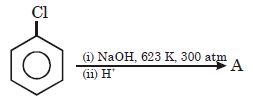
What is $A$ in the following reaction?
A
$2-$chlorophenol
B
Benzene
C
Phenol
D
$4-$chlorophenol
Solution
(C) The given reaction is the Dow process,which is used for the industrial preparation of phenol from chlorobenzene.
In this process,chlorobenzene is fused with $NaOH$ at a high temperature of $623 \ K$ and a high pressure of $300 \ atm$.
This reaction produces sodium phenoxide as an intermediate,which upon acidification with $H^+$ yields phenol $(C_6H_5OH)$ as the final product $A$.
In this process,chlorobenzene is fused with $NaOH$ at a high temperature of $623 \ K$ and a high pressure of $300 \ atm$.
This reaction produces sodium phenoxide as an intermediate,which upon acidification with $H^+$ yields phenol $(C_6H_5OH)$ as the final product $A$.
0 likes
View Solution9
MediumMCQ
Consider the following sequence of reactions:
$C_6H_6 + CH_3CH=CH_2$ $\xrightarrow[heat]{H_3PO_4} A$ $\xrightarrow[2. H_3O^{+}, heat]{1. O_2, heat} B + C$
The products $(B)$ and $(C)$ are:
$C_6H_6 + CH_3CH=CH_2$ $\xrightarrow[heat]{H_3PO_4} A$ $\xrightarrow[2. H_3O^{+}, heat]{1. O_2, heat} B + C$
The products $(B)$ and $(C)$ are:
A
benzaldehyde and acetaldehyde
B
benzoic acid and acetic acid
C
phenol and propionaldehyde
D
phenol and acetone
Solution
(D) The reaction sequence describes the industrial preparation of phenol from benzene and propene via the cumene process.
$1$. Benzene reacts with propene in the presence of $H_3PO_4$ to form cumene (isopropylbenzene),which is product $A$.
$2$. Cumene is oxidized by $O_2$ to form cumene hydroperoxide.
$3$. Upon treatment with $H_3O^{+}$ and heat,cumene hydroperoxide undergoes rearrangement to yield phenol $(B)$ and acetone $(C)$.
$1$. Benzene reacts with propene in the presence of $H_3PO_4$ to form cumene (isopropylbenzene),which is product $A$.
$2$. Cumene is oxidized by $O_2$ to form cumene hydroperoxide.
$3$. Upon treatment with $H_3O^{+}$ and heat,cumene hydroperoxide undergoes rearrangement to yield phenol $(B)$ and acetone $(C)$.
0 likes
View Solution10
DifficultMCQ
Which of the following will give phenol with $O_2$ in the presence of an acid catalyst?
A
$Cumene$
B
$Chlorobenzene$
C
$Benzene$
D
$Toluene$
Solution
(A) The industrial process for the production of phenol involves the oxidation of $Cumene$ (isopropylbenzene) with $O_2$ in the presence of an acid catalyst.
This reaction forms $Cumene$ hydroperoxide as an intermediate.
$Cumene$ hydroperoxide then undergoes acid-catalyzed rearrangement to yield phenol and acetone as the final products.
This reaction forms $Cumene$ hydroperoxide as an intermediate.
$Cumene$ hydroperoxide then undergoes acid-catalyzed rearrangement to yield phenol and acetone as the final products.
0 likes
View Solution11
DifficultMCQ
Identify product $C$ in the following reaction sequence:
Nitrobenzene $\xrightarrow{Sn+HCl} A$ $\xrightarrow{HNO_2, 0^{\circ}C-5^{\circ}C} B$ $\xrightarrow{H_2O, \Delta} C$
Nitrobenzene $\xrightarrow{Sn+HCl} A$ $\xrightarrow{HNO_2, 0^{\circ}C-5^{\circ}C} B$ $\xrightarrow{H_2O, \Delta} C$
A
p-Aminophenol
B
Phenol
C
Benzene
D
p-Chlorophenol
Solution
(B) $1$. Nitrobenzene reacts with $Sn+HCl$ (a reducing agent) to form aniline $(A)$:
$C_6H_5NO_2 + 6[H] \xrightarrow{Sn+HCl} C_6H_5NH_2 + 2H_2O$
$2$. Aniline $(A)$ reacts with nitrous acid $(HNO_2)$ at $0^{\circ}C-5^{\circ}C$ to form benzene diazonium chloride $(B)$:
$C_6H_5NH_2 + HNO_2 + HCl \xrightarrow{0^{\circ}C-5^{\circ}C} C_6H_5N_2^+Cl^- + 2H_2O$
$3$. Benzene diazonium chloride $(B)$ on heating with water undergoes hydrolysis to form phenol $(C)$:
$C_6H_5N_2^+Cl^- + H_2O \xrightarrow{\Delta} C_6H_5OH + N_2 + HCl$
Therefore,the product $C$ is phenol.
$C_6H_5NO_2 + 6[H] \xrightarrow{Sn+HCl} C_6H_5NH_2 + 2H_2O$
$2$. Aniline $(A)$ reacts with nitrous acid $(HNO_2)$ at $0^{\circ}C-5^{\circ}C$ to form benzene diazonium chloride $(B)$:
$C_6H_5NH_2 + HNO_2 + HCl \xrightarrow{0^{\circ}C-5^{\circ}C} C_6H_5N_2^+Cl^- + 2H_2O$
$3$. Benzene diazonium chloride $(B)$ on heating with water undergoes hydrolysis to form phenol $(C)$:
$C_6H_5N_2^+Cl^- + H_2O \xrightarrow{\Delta} C_6H_5OH + N_2 + HCl$
Therefore,the product $C$ is phenol.
0 likes
View Solution12
DifficultMCQ
In the given reaction,identify $A$:
$C_6H_5-CH(CH_3)_2 + O_2$ $\rightarrow A$ $\xrightarrow{H_2O/H^+} C_6H_5OH + CH_3COCH_3$
$C_6H_5-CH(CH_3)_2 + O_2$ $\rightarrow A$ $\xrightarrow{H_2O/H^+} C_6H_5OH + CH_3COCH_3$
A
Cumene hydroperoxide
B
Phenol
C
Phenyl acetate
D
Phenoxy acetone
Solution
(A) The given reaction is the industrial preparation of phenol from cumene (isopropylbenzene).
$1$. In the first step,cumene reacts with oxygen $(O_2)$ to form cumene hydroperoxide $(A)$.
$2$. In the second step,cumene hydroperoxide is treated with dilute acid $(H_2O/H^+)$ to yield phenol $(C_6H_5OH)$ and acetone $(CH_3COCH_3)$.
Therefore,$A$ is cumene hydroperoxide,which has the structure $C_6H_5-C(CH_3)_2-OOH$.
$1$. In the first step,cumene reacts with oxygen $(O_2)$ to form cumene hydroperoxide $(A)$.
$2$. In the second step,cumene hydroperoxide is treated with dilute acid $(H_2O/H^+)$ to yield phenol $(C_6H_5OH)$ and acetone $(CH_3COCH_3)$.
Therefore,$A$ is cumene hydroperoxide,which has the structure $C_6H_5-C(CH_3)_2-OOH$.
0 likes
View Solution13
MediumMCQ
Which of the following reactions will not yield phenol?
A
Chlorobenzene $\xrightarrow{NaOH(aq.), \text{Room temperature}}$
B
Benzenediazonium chloride $\xrightarrow{H_2O, \text{Warm}}$
C
Benzene $\xrightarrow[(ii) NaOH, \text{Heating}]{(i) \text{Oleum}, (iii) H^\oplus}$
D
All will yield phenol
Solution
(A) The reaction of chlorobenzene with aqueous $NaOH$ at room temperature does not occur because the $C-Cl$ bond in chlorobenzene has partial double bond character due to resonance,making it resistant to nucleophilic substitution under mild conditions. High temperature and pressure are required for this reaction (Dow process). Therefore,option $A$ will not yield phenol.
0 likes
View Solution14
MediumMCQ
Isopropylbenzene on air oxidation in the presence of dilute acid gives
A
$C_6H_5COOH$
B
$C_6H_5COCH_3$
C
$C_6H_5CHO$
D
$C_6H_5OH$
Solution
(D) The air oxidation of isopropylbenzene (cumene) in the presence of air followed by treatment with dilute acid is the industrial process for the production of phenol and acetone.
$1$. Isopropylbenzene reacts with $O_2$ to form cumene hydroperoxide.
$2$. Cumene hydroperoxide,upon treatment with dilute acid $(H^+)$,undergoes rearrangement to yield phenol $(C_6H_5OH)$ and acetone $(CH_3COCH_3)$.
The reaction is:
$C_6H_5CH(CH_3)_2 + O_2 \xrightarrow{H^+} C_6H_5OH + CH_3COCH_3$
Therefore,the correct option is $D$.
$1$. Isopropylbenzene reacts with $O_2$ to form cumene hydroperoxide.
$2$. Cumene hydroperoxide,upon treatment with dilute acid $(H^+)$,undergoes rearrangement to yield phenol $(C_6H_5OH)$ and acetone $(CH_3COCH_3)$.
The reaction is:
$C_6H_5CH(CH_3)_2 + O_2 \xrightarrow{H^+} C_6H_5OH + CH_3COCH_3$
Therefore,the correct option is $D$.
0 likes
View Solution15
Medium
Give the equations of reactions for the preparation of phenol from cumene.
Solution
(N/A) The preparation of phenol from cumene involves two steps:
$1$. Oxidation of cumene to cumene hydroperoxide:
$C_6H_5-CH(CH_3)_2 + O_2 \xrightarrow{368-408 \ K} C_6H_5-C(CH_3)_2-OOH$
$2$. Acid-catalyzed cleavage of cumene hydroperoxide to phenol and acetone:
$C_6H_5-C(CH_3)_2-OOH \xrightarrow{H^+, 323-363 \ K} C_6H_5OH + CH_3COCH_3$
$1$. Oxidation of cumene to cumene hydroperoxide:
$C_6H_5-CH(CH_3)_2 + O_2 \xrightarrow{368-408 \ K} C_6H_5-C(CH_3)_2-OOH$
$2$. Acid-catalyzed cleavage of cumene hydroperoxide to phenol and acetone:
$C_6H_5-C(CH_3)_2-OOH \xrightarrow{H^+, 323-363 \ K} C_6H_5OH + CH_3COCH_3$
0 likes
View Solution16
Medium
Write the chemical reaction for the preparation of phenol from chlorobenzene.
Solution
(N/A) Chlorobenzene is fused with $NaOH$ (at $623 \, K$ and $320 \, atm$ pressure) to produce sodium phenoxide,which gives phenol on acidification.
The reaction is as follows:
$C_6H_5Cl + 2NaOH \xrightarrow{623 \, K, 320 \, atm} C_6H_5ONa + NaCl + H_2O$
$C_6H_5ONa + HCl \rightarrow C_6H_5OH + NaCl$
The reaction is as follows:
$C_6H_5Cl + 2NaOH \xrightarrow{623 \, K, 320 \, atm} C_6H_5ONa + NaCl + H_2O$
$C_6H_5ONa + HCl \rightarrow C_6H_5OH + NaCl$
0 likes
View Solution17
Medium
You are given benzene,conc. $H_2SO_4$ and $NaOH$. Write the equations for the preparation of phenol using these reagents.
Solution
(N/A) $1.$ Sulfonation of benzene: $C_6H_6 + conc. H_2SO_4 \xrightarrow{\Delta} C_6H_5SO_3H + H_2O$
$2.$ Fusion with sodium hydroxide: $C_6H_5SO_3H + 2NaOH \xrightarrow{\Delta} C_6H_5ONa + Na_2SO_3 + H_2O$
$3.$ Acidification: $C_6H_5ONa + H^+ \rightarrow C_6H_5OH + Na^+$
(Note: $H_2SO_4$ can also be used for the final acidification step instead of $HCl$ or $H^+$).
$2.$ Fusion with sodium hydroxide: $C_6H_5SO_3H + 2NaOH \xrightarrow{\Delta} C_6H_5ONa + Na_2SO_3 + H_2O$
$3.$ Acidification: $C_6H_5ONa + H^+ \rightarrow C_6H_5OH + Na^+$
(Note: $H_2SO_4$ can also be used for the final acidification step instead of $HCl$ or $H^+$).
0 likes
View Solution18
Medium
Describe the methods and processes for the production of phenol.
Solution
(A) Phenol was first isolated from coal tar in the early nineteenth century. Currently,phenol is produced commercially through synthetic methods.
In the laboratory,phenol is prepared from benzene derivatives using the following methods:
$(i)$ From haloarenes: Chlorobenzene is fused with $NaOH$ at $623 \ K$ and $300 \ atm$ pressure to form sodium phenoxide,which upon acidification gives phenol.
$(ii)$ From benzenesulphonic acid: Benzene is sulphonated with oleum $(H_2S_2O_7)$ to form benzenesulphonic acid,which is then converted to sodium phenoxide by fusion with molten $NaOH$,followed by acidification to yield phenol.
$(iii)$ From diazonium salts: $A$ diazonium salt is prepared by treating an aromatic primary amine with nitrous acid $(HNO_2)$ at $273-278 \ K$. The diazonium salt is then hydrolysed to phenol by warming with water or by treating with dilute acids.
$(iv)$ From cumene: Cumene (isopropylbenzene) is oxidised in the presence of air to cumene hydroperoxide,which is then converted to phenol and acetone by treatment with dilute acid.
In the laboratory,phenol is prepared from benzene derivatives using the following methods:
$(i)$ From haloarenes: Chlorobenzene is fused with $NaOH$ at $623 \ K$ and $300 \ atm$ pressure to form sodium phenoxide,which upon acidification gives phenol.
$(ii)$ From benzenesulphonic acid: Benzene is sulphonated with oleum $(H_2S_2O_7)$ to form benzenesulphonic acid,which is then converted to sodium phenoxide by fusion with molten $NaOH$,followed by acidification to yield phenol.
$(iii)$ From diazonium salts: $A$ diazonium salt is prepared by treating an aromatic primary amine with nitrous acid $(HNO_2)$ at $273-278 \ K$. The diazonium salt is then hydrolysed to phenol by warming with water or by treating with dilute acids.
$(iv)$ From cumene: Cumene (isopropylbenzene) is oxidised in the presence of air to cumene hydroperoxide,which is then converted to phenol and acetone by treatment with dilute acid.
0 likes
View Solution19
Medium
What happens when benzene diazonium chloride is heated with water?
Solution
(N/A) When benzene diazonium chloride $(C_6H_5N_2^+Cl^-)$ is heated with water,it undergoes hydrolysis to form phenol $(C_6H_5OH)$,nitrogen gas $(N_2)$,and hydrochloric acid $(HCl)$.
The chemical reaction is as follows:
$C_6H_5N_2^+Cl^- + H_2O \xrightarrow{\Delta} C_6H_5OH + N_2 + HCl$
The chemical reaction is as follows:
$C_6H_5N_2^+Cl^- + H_2O \xrightarrow{\Delta} C_6H_5OH + N_2 + HCl$
0 likes
View Solution20
MediumMCQ
Hydrolysis of which compound will give carbolic acid?
A
Cumene
B
Benzenediazonium chloride
C
Benzal chloride
D
Ethylene glycol ketal
Solution
(B) Carbolic acid is the common name for phenol $(C_6H_5OH)$.
When benzenediazonium chloride $(C_6H_5N_2^+Cl^-)$ is treated with water (hydrolysis),it yields phenol,nitrogen gas $(N_2)$,and hydrochloric acid $(HCl)$.
The reaction is as follows:
$C_6H_5N_2^+Cl^- + H_2O \rightarrow C_6H_5OH + N_2 + HCl$
When benzenediazonium chloride $(C_6H_5N_2^+Cl^-)$ is treated with water (hydrolysis),it yields phenol,nitrogen gas $(N_2)$,and hydrochloric acid $(HCl)$.
The reaction is as follows:
$C_6H_5N_2^+Cl^- + H_2O \rightarrow C_6H_5OH + N_2 + HCl$
0 likes
View Solution21
AdvancedMCQ
In the following reaction,
$X \xrightarrow[(ii) \text{ aq. acid}]{(i) \text{ O}_2, \text{ catalyst, heat}} \text{Phenol} + Y (C_6H_{10}O)$
$X$ and $Y$ respectively,are $......$
$X \xrightarrow[(ii) \text{ aq. acid}]{(i) \text{ O}_2, \text{ catalyst, heat}} \text{Phenol} + Y (C_6H_{10}O)$
$X$ and $Y$ respectively,are $......$
A
Cyclohexylbenzene and hex$-4-$enal
B
Cyclohexylbenzene and diallyl ether
C
Cyclohex$-1-$enylbenzene and cyclohexanone
D
Cyclohexylbenzene and cyclohexanone
Solution
(D) The reaction shown is the industrial preparation of phenol from cumene-like hydroperoxidation. The starting material $X$ is cyclohexylbenzene. Upon oxidation with $O_2$ in the presence of a catalyst and heat,it forms a hydroperoxide intermediate. Subsequent treatment with aqueous acid leads to the cleavage of the hydroperoxide into phenol and cyclohexanone $(Y)$.
Thus,$X$ is cyclohexylbenzene and $Y$ is cyclohexanone.
Thus,$X$ is cyclohexylbenzene and $Y$ is cyclohexanone.
0 likes
View Solution22
MediumMCQ
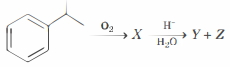
$X, Y$ and $Z$ in the following reaction sequence are
A
$X = \text{Cumene hydroperoxide}, Y = \text{Cyclohexadiene}, Z = \text{Isopropanol}$
B
$X = \text{Cumene hydroperoxide}, Y = \text{Phenol}, Z = \text{Propene}$
C
$X = \text{Cumene alcohol}, Y = \text{Phenol}, Z = \text{Acetone}$
D
$X = \text{Cumene hydroperoxide}, Y = \text{Phenol}, Z = \text{Acetone}$
Solution
(D) The reaction sequence represents the industrial preparation of phenol from cumene (isopropylbenzene).
$1$. Cumene is oxidized in the presence of air $(O_2)$ to form cumene hydroperoxide $(X)$.
$2$. Cumene hydroperoxide is then treated with dilute acid $(H^+, H_2O)$ to undergo rearrangement,yielding phenol $(Y)$ and acetone $(Z)$.
$1$. Cumene is oxidized in the presence of air $(O_2)$ to form cumene hydroperoxide $(X)$.
$2$. Cumene hydroperoxide is then treated with dilute acid $(H^+, H_2O)$ to undergo rearrangement,yielding phenol $(Y)$ and acetone $(Z)$.
0 likes
View Solution23
MediumMCQ
In the preparation of phenol from cumene in the presence of air,the intermediate formed is:
A
Cumene hydroperoxide
B
Acetophenone
C
Benzene
D
Phenol
Solution
(A) In the industrial preparation of phenol,cumene $(isopropylbenzene)$ is oxidized by air to form cumene hydroperoxide as an intermediate.
This intermediate is then hydrolyzed in the presence of an acid to form phenol and acetone as the final products.
This intermediate is then hydrolyzed in the presence of an acid to form phenol and acetone as the final products.
0 likes
View Solution24
MediumMCQ
Which one of the following reaction sequences is an incorrect method to prepare phenol?
A
Aniline,$NaNO_2 + HCl$,$H_2O$,heating
B
Cumene,$O_2, H_3O^+$
C
Chlorobenzene,$NaOH$,$STP$ condition
D
Benzene,oleum,$NaOH$,$H_3O^+$
Solution
(C) The preparation of phenol from chlorobenzene requires harsh conditions (high temperature and high pressure,e.g.,$623 \ K$ and $300 \ atm$) because the $C-Cl$ bond in chlorobenzene has partial double bond character due to resonance.
Under $STP$ conditions,chlorobenzene does not react with $NaOH$ to form phenol.
Therefore,the reaction sequence involving chlorobenzene and $NaOH$ under $STP$ conditions is incorrect for the preparation of phenol.
Under $STP$ conditions,chlorobenzene does not react with $NaOH$ to form phenol.
Therefore,the reaction sequence involving chlorobenzene and $NaOH$ under $STP$ conditions is incorrect for the preparation of phenol.
0 likes
View Solution25
MediumMCQ
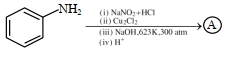
Identify the product $(A)$ in the following reaction.
A
$4-$aminophenol
B
Phenol
C
$4-$chloroaniline
D
$4-$chlorophenol
Solution
(B) The reaction sequence is as follows:
$1$. Aniline reacts with $NaNO_2 + HCl$ at $0-5 \ ^\circ C$ to form benzenediazonium chloride.
$2$. Benzenediazonium chloride reacts with $Cu_2Cl_2$ (Sandmeyer reaction) to form chlorobenzene.
$3$. Chlorobenzene reacts with $NaOH$ at $623 \ K$ and $300 \ atm$ (Dow's process),followed by acidification $(H^+)$,to form phenol.
Therefore,the final product $(A)$ is phenol.
$1$. Aniline reacts with $NaNO_2 + HCl$ at $0-5 \ ^\circ C$ to form benzenediazonium chloride.
$2$. Benzenediazonium chloride reacts with $Cu_2Cl_2$ (Sandmeyer reaction) to form chlorobenzene.
$3$. Chlorobenzene reacts with $NaOH$ at $623 \ K$ and $300 \ atm$ (Dow's process),followed by acidification $(H^+)$,to form phenol.
Therefore,the final product $(A)$ is phenol.
0 likes
View Solution26
MediumMCQ
Identify the substrate $X$ in the following reaction. $X + O_2 \text{ (air)}$ $\xrightarrow[\text{ii) dil } HCl, \Delta]{\text{i) Co-naphthenate, } 423 \ K} \text{Phenol} + \text{Acetone}$
A
Chlorobenzene
B
Benzene sulphonic acid
C
Benzenamine
D
Isopropyl benzene
Solution
(D) The given reaction is the industrial preparation of phenol from cumene (isopropyl benzene).
$1.$ Cumene (isopropyl benzene) reacts with $O_2$ (air) in the presence of cobalt naphthenate at $423 \ K$ to form cumene hydroperoxide.
$2.$ The cumene hydroperoxide is then treated with dilute $HCl$ and heated to yield phenol and acetone as by-products.
Therefore,the substrate $X$ is isopropyl benzene.
$1.$ Cumene (isopropyl benzene) reacts with $O_2$ (air) in the presence of cobalt naphthenate at $423 \ K$ to form cumene hydroperoxide.
$2.$ The cumene hydroperoxide is then treated with dilute $HCl$ and heated to yield phenol and acetone as by-products.
Therefore,the substrate $X$ is isopropyl benzene.
0 likes
View Solution27
MediumMCQ
What is the intermediate product obtained in the preparation of phenol from aniline?
A
Anilinium cation
B
Benzene diazonium chloride
C
Benzene
D
Sodium phenoxide
Solution
(B) The preparation of phenol from aniline involves two main steps:
$1$. Aniline is treated with $NaNO_2$ and $HCl$ at $0-5 \ ^\circ C$ to form benzene diazonium chloride.
$2$. Benzene diazonium chloride is then hydrolyzed by boiling with water to produce phenol.
Therefore,the intermediate product is benzene diazonium chloride.
$1$. Aniline is treated with $NaNO_2$ and $HCl$ at $0-5 \ ^\circ C$ to form benzene diazonium chloride.
$2$. Benzene diazonium chloride is then hydrolyzed by boiling with water to produce phenol.
Therefore,the intermediate product is benzene diazonium chloride.
0 likes
View Solution28
EasyMCQ
Which among the following is not a method for the preparation of phenol?
A
Aniline $\xrightarrow[(ii) H_2O, \Delta]{(i) NaNO_2 + HCl, 273 K}$ Phenol
B
Cumene $\xrightarrow[(ii) dil. HCl, \Delta]{(i) O_2 / Co-naphthenate, 423 K}$ Phenol
C
Chlorobenzene $\xrightarrow[(ii) H_3O^+]{(i) NaOH, 623 K, 150 atm}$ Phenol
D
Benzene + conc. $H_2SO_4 \xrightarrow{\Delta}$ Phenol
Solution
(D) The preparation of phenol involves specific industrial and laboratory methods.
$A$. Aniline can be converted to phenol via benzene diazonium chloride (diazotization followed by hydrolysis). This is a standard method.
$B$. Cumene oxidation is the most common industrial method for producing phenol.
$C$. The Dow process involves the reaction of chlorobenzene with $NaOH$ at high temperature and pressure to form sodium phenoxide,which upon acidification yields phenol. This is a standard method.
$D$. Benzene reacts with concentrated $H_2SO_4$ to form benzene sulfonic acid,not phenol directly. Phenol is obtained from benzene sulfonic acid by fusion with $NaOH$ followed by acidification. Therefore,the reaction as written is incorrect.
$A$. Aniline can be converted to phenol via benzene diazonium chloride (diazotization followed by hydrolysis). This is a standard method.
$B$. Cumene oxidation is the most common industrial method for producing phenol.
$C$. The Dow process involves the reaction of chlorobenzene with $NaOH$ at high temperature and pressure to form sodium phenoxide,which upon acidification yields phenol. This is a standard method.
$D$. Benzene reacts with concentrated $H_2SO_4$ to form benzene sulfonic acid,not phenol directly. Phenol is obtained from benzene sulfonic acid by fusion with $NaOH$ followed by acidification. Therefore,the reaction as written is incorrect.
0 likes
View Solution29
MediumMCQ
Cumene on air oxidation in the presence of cobalt naphthenate forms:
A
Cumene hydroperoxide
B
Acetone
C
Phenol
D
Phenol + acetone
Solution
(A) The air oxidation of cumene (isopropylbenzene) in the presence of cobalt naphthenate as a catalyst leads to the formation of cumene hydroperoxide.
This is the first step in the industrial preparation of phenol and acetone from cumene.
The reaction is:
$C_6H_5-CH(CH_3)_2 + O_2 \xrightarrow{\text{Co-naphthenate}} C_6H_5-C(CH_3)_2OOH$
Thus,the product formed is cumene hydroperoxide.
This is the first step in the industrial preparation of phenol and acetone from cumene.
The reaction is:
$C_6H_5-CH(CH_3)_2 + O_2 \xrightarrow{\text{Co-naphthenate}} C_6H_5-C(CH_3)_2OOH$
Thus,the product formed is cumene hydroperoxide.
0 likes
View Solution30
EasyMCQ
Which catalyst is used in the conversion of chlorobenzene to phenol by the Raschig process?
A
Calcium phosphate
B
Calcium carbonate
C
Calcium sulphate
D
Calcium chloride
Solution
(A) In the Raschig process,chlorobenzene is hydrolyzed to phenol by reacting it with steam at a high temperature of $698 \ K$ in the presence of a catalyst.
The catalyst used in this reaction is calcium phosphate,represented by the chemical formula $Ca_3(PO_4)_2$.
The reaction is as follows:
$C_6H_5Cl + H_2O \xrightarrow{698 \ K, \ Ca_3(PO_4)_2} C_6H_5OH + HCl$
Therefore,the correct option is $A$.
The catalyst used in this reaction is calcium phosphate,represented by the chemical formula $Ca_3(PO_4)_2$.
The reaction is as follows:
$C_6H_5Cl + H_2O \xrightarrow{698 \ K, \ Ca_3(PO_4)_2} C_6H_5OH + HCl$
Therefore,the correct option is $A$.
0 likes
View Solution31
MediumMCQ
Name the catalyst used in the commercial preparation of phenol.
A
Silica
B
Calcium phosphate
C
Anhydrous aluminium chloride
D
Cobalt naphthenate
Solution
(D) In the commercial preparation of phenol from cumene (isopropylbenzene),the process involves oxidation to cumene hydroperoxide followed by acid-catalyzed cleavage. However,in the specific industrial oxidation of toluene to benzoic acid and subsequently to phenol,or in the oxidation of benzene,$Cobalt \ naphthenate$ is commonly used as a catalyst.
0 likes
View Solution32
EasyMCQ
In Dow's process,the starting raw material is
A
phenol
B
chlorobenzene
C
aniline
D
diazobenzene
Solution
(B) In Dow's process,chlorobenzene is treated with $NaOH$ at $573-623 \ K$ and $200 \ atm$ pressure to form sodium phenoxide,which upon subsequent acid hydrolysis with $HCl$ yields phenol as the final product.
The reaction sequence is:
$C_6H_5Cl + 2NaOH \xrightarrow{573-623 \ K, 200 \ atm} C_6H_5ONa + NaCl + H_2O$
$C_6H_5ONa + HCl \rightarrow C_6H_5OH + NaCl$
Thus,the starting raw material is chlorobenzene.
The reaction sequence is:
$C_6H_5Cl + 2NaOH \xrightarrow{573-623 \ K, 200 \ atm} C_6H_5ONa + NaCl + H_2O$
$C_6H_5ONa + HCl \rightarrow C_6H_5OH + NaCl$
Thus,the starting raw material is chlorobenzene.
0 likes
View Solution33
MediumMCQ
The products $X$ and $Z$ in the following reaction sequence are:
$\text{Benzene} + CH_3-CH=CH_2$ $\xrightarrow{AlCl_3/\text{ether}, \text{Heat}} X$ $\xrightarrow{O_2/130^{\circ}C} Z$
$\text{Benzene} + CH_3-CH=CH_2$ $\xrightarrow{AlCl_3/\text{ether}, \text{Heat}} X$ $\xrightarrow{O_2/130^{\circ}C} Z$
A
Isopropylbenzene and acetone
B
Cumene peroxide and acetone
C
Isopropylbenzene and isopropyl alcohol
D
Phenol and acetone
Solution
(D) The reaction sequence is the industrial preparation of phenol from cumene.
Step $1$: Benzene reacts with propene in the presence of $AlCl_3/\text{ether}$ and heat to form isopropylbenzene,which is also known as cumene $(X)$.
Step $2$: Cumene $(X)$ is then oxidized by $O_2$ at $130^{\circ}C$ to form cumene hydroperoxide,which upon further treatment with acid yields phenol and acetone $(Z)$.
Therefore,$X$ is isopropylbenzene (cumene) and $Z$ represents the final products,phenol and acetone.
Step $1$: Benzene reacts with propene in the presence of $AlCl_3/\text{ether}$ and heat to form isopropylbenzene,which is also known as cumene $(X)$.
Step $2$: Cumene $(X)$ is then oxidized by $O_2$ at $130^{\circ}C$ to form cumene hydroperoxide,which upon further treatment with acid yields phenol and acetone $(Z)$.
Therefore,$X$ is isopropylbenzene (cumene) and $Z$ represents the final products,phenol and acetone.
0 likes
View Solution34
DifficultMCQ
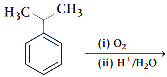
What by-product is formed in the process of making phenol from cumene?
A
propan$-2-$ol
B
$n$-propanol
C
propanal
D
propan$-2-$one
Solution
(D) Cumene (isopropylbenzene) is oxidised in the presence of air to form cumene hydroperoxide.
On treating with dilute acid,it undergoes rearrangement to form phenol and acetone (propan$-2-$one) as a by-product.
On treating with dilute acid,it undergoes rearrangement to form phenol and acetone (propan$-2-$one) as a by-product.
0 likes
View Solution35
MediumMCQ
Isopropyl benzene on aerial oxidation followed by acid hydrolysis of the resulting compound yields.
A
$ (CH_3)_2 CO, C_6 H_5-C_6 H_5 $
B
$ (CH_3)_2 CO, C_6 H_5 CH_3 $
C
$ (CH_3)_2 CO, C_6 H_5 OH $
D
$ (CH_3)_2 CHOH, C_6 H_5 CH_3 $
Solution
(C) The process described is the industrial preparation of phenol from cumene (isopropyl benzene).
$1$. Isopropyl benzene (cumene) undergoes aerial oxidation to form cumene hydroperoxide.
$2$. Cumene hydroperoxide,upon treatment with dilute acid (acid hydrolysis),decomposes to give phenol $(C_6H_5OH)$ and acetone $((CH_3)_2CO)$.
$1$. Isopropyl benzene (cumene) undergoes aerial oxidation to form cumene hydroperoxide.
$2$. Cumene hydroperoxide,upon treatment with dilute acid (acid hydrolysis),decomposes to give phenol $(C_6H_5OH)$ and acetone $((CH_3)_2CO)$.
0 likes
View Solution36
DifficultMCQ
The major product formed in the following reaction sequence is:
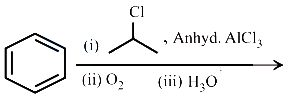
A
Phenol
B
$2-$Phenylpropan$-2-$ol
C
$4-$Isopropylphenol
D
$2-$Isopropylphenol
Solution
(A) The given reaction sequence is the industrial method for the preparation of phenol,known as the cumene process.
Step $(i)$: Benzene reacts with isopropyl chloride in the presence of anhydrous $AlCl_3$ (Friedel-Crafts alkylation) to form cumene (isopropylbenzene).
Step (ii): Cumene is oxidized by $O_2$ to form cumene hydroperoxide.
Step (iii): Acid-catalyzed hydrolysis of cumene hydroperoxide yields phenol and acetone $(CH_3COCH_3)$ as products.
Therefore,the major organic product formed is phenol.
Step $(i)$: Benzene reacts with isopropyl chloride in the presence of anhydrous $AlCl_3$ (Friedel-Crafts alkylation) to form cumene (isopropylbenzene).
Step (ii): Cumene is oxidized by $O_2$ to form cumene hydroperoxide.
Step (iii): Acid-catalyzed hydrolysis of cumene hydroperoxide yields phenol and acetone $(CH_3COCH_3)$ as products.
Therefore,the major organic product formed is phenol.
0 likes
View Solution37
MediumMCQ
Phenol is mainly manufactured from a compound $X$ by subjecting it to oxidation in air followed by treating with dilute acid. Identify the compound $X$.
A
Benzenediazonium chloride
B
Benzaldehyde
C
Toluene
D
Cumene
Solution
(D) The industrial preparation of phenol is known as the cumene process.
In this process,cumene (isopropylbenzene) is oxidized in the presence of air to form cumene hydroperoxide.
This hydroperoxide is then treated with dilute acid to yield phenol and acetone as a byproduct.
The reaction is:
$C_6H_5CH(CH_3)_2$ $\xrightarrow{O_2} C_6H_5C(CH_3)_2OOH$ $\xrightarrow{H^+, H_2O} C_6H_5OH + CH_3COCH_3$
Thus,the compound $X$ is cumene.
In this process,cumene (isopropylbenzene) is oxidized in the presence of air to form cumene hydroperoxide.
This hydroperoxide is then treated with dilute acid to yield phenol and acetone as a byproduct.
The reaction is:
$C_6H_5CH(CH_3)_2$ $\xrightarrow{O_2} C_6H_5C(CH_3)_2OOH$ $\xrightarrow{H^+, H_2O} C_6H_5OH + CH_3COCH_3$
Thus,the compound $X$ is cumene.
0 likes
View Solution38
DifficultMCQ
Identify $A$,$B$,and $C$,respectively,in the following reaction sequence:
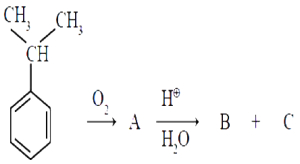
A
| $A$: Cumene hydroperoxide | $B$: Phenol | $C$: Acetone |
B
| $A$: Benzoic acid | $B$: Phenol | $C$: Acetone |
C
| $A$: Benzene | $B$: Phenol | $C$: Acetone |
D
| $A$: Cumyl alcohol | $B$: Phenol | $C$: Acetone |
Solution
(A) The reaction sequence represents the industrial preparation of phenol from cumene (isopropylbenzene).
$1$. Cumene reacts with $O_2$ (air) to form cumene hydroperoxide $(A)$.
$2$. Cumene hydroperoxide,upon acidic hydrolysis $(H^+ / H_2O)$,undergoes rearrangement to yield phenol $(B)$ and acetone $(C)$.
Reaction:
$C_6H_5-CH(CH_3)_2 + O_2 \rightarrow C_6H_5-C(CH_3)_2-OOH (A)$
$C_6H_5-C(CH_3)_2-OOH \xrightarrow{H^+ / H_2O} C_6H_5OH (B) + CH_3COCH_3 (C)$
$1$. Cumene reacts with $O_2$ (air) to form cumene hydroperoxide $(A)$.
$2$. Cumene hydroperoxide,upon acidic hydrolysis $(H^+ / H_2O)$,undergoes rearrangement to yield phenol $(B)$ and acetone $(C)$.
Reaction:
$C_6H_5-CH(CH_3)_2 + O_2 \rightarrow C_6H_5-C(CH_3)_2-OOH (A)$
$C_6H_5-C(CH_3)_2-OOH \xrightarrow{H^+ / H_2O} C_6H_5OH (B) + CH_3COCH_3 (C)$
0 likes
View Solution39
EasyMCQ
Which one of the following reactions gives phenol as a major product?
A
Reaction of benzene with conc. $HNO_3$ and conc. $H_2SO_4$
B
Reaction of aniline with $NaNO_2 / HCl$ followed by treatment with warm water
C
Reaction of benzene with hot water
D
Sodium salt of benzoic acid with soda lime reaction
Solution
(B) Step $1$: Aniline reacts with $NaNO_2$ and $HCl$ at $273-278 \ K$ to form benzene diazonium chloride.
Step $2$: Benzene diazonium chloride,when treated with warm water,undergoes hydrolysis to form phenol,$N_2$ gas,and $HCl$.
Step $2$: Benzene diazonium chloride,when treated with warm water,undergoes hydrolysis to form phenol,$N_2$ gas,and $HCl$.
0 likes
View Solution40
EasyMCQ
Boiling water reacts with $C_6H_5N_2^+Cl^-$ to give:
A
aniline
B
benzylamine
C
phenol
D
benzaldehyde
Solution
(C) The reaction of benzenediazonium chloride $(C_6H_5N_2^+Cl^-)$ with boiling water is a standard method for the preparation of phenol.
The reaction proceeds as follows:
$C_6H_5N_2^+Cl^- + H_2O \xrightarrow{\Delta} C_6H_5OH + N_2 \uparrow + HCl$
Here,the diazonium group is replaced by a hydroxyl group $(-OH)$,resulting in the formation of phenol.
The reaction proceeds as follows:
$C_6H_5N_2^+Cl^- + H_2O \xrightarrow{\Delta} C_6H_5OH + N_2 \uparrow + HCl$
Here,the diazonium group is replaced by a hydroxyl group $(-OH)$,resulting in the formation of phenol.
0 likes
View SolutionAlcohols, Phenols and Ethers — Preparation of Phenols · Frequently Asked Questions
1Are these Alcohols, Phenols and Ethers questions useful for JEE and NEET?
Yes. All questions in this section are mapped to JEE Main and NEET exam patterns. Previous year questions from JEE Main, NEET, GUJCET and state-level exams are included with full solutions.
2Can I switch to Hindi or Gujarati for these questions?
Yes. Use the language tabs in the hero section or the sidebar to view the same questions and solutions in English, Hindi or Gujarati.
3How do I generate a question paper from this subtopic?
Use the Vedclass Exam Paper Generator — select the chapter and subtopic, set difficulty, and generate Sets A, B, C, D automatically. First 3 chapters of every subject are free.
Vedclass Products
For Students
Vedclass Test Series
Mock tests in real JEE/NEET style with performance analysis. 5-day free trial.
Start Free TrialFor Teachers
Exam Paper Generator
Generate Set A/B/C/D papers from this chapter in 2 minutes. 3 chapters free.
Try FreeFor Institutes
Online Exam Module
Live online exams with unlimited students, 360° analytics & white-label branding.
See DemoFor Teachers & Institutes
Generate a Alcohols, Phenols and Ethers Exam Paper in 2 Minutes
Select subtopic & difficulty — Sets A, B, C, D auto-generated with No Repeat logic.
First 3 chapters of every subject are free — no payment required.