
A English
Properties of Phenols Questions in English
Class 12 Chemistry · Alcohols, Phenols and Ethers · Properties of Phenols
751+
Questions
English
Language
100%
With Solutions
Showing 50 of 751 questions in English
301
DifficultMCQ
What will be the major product of the given reaction?
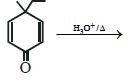
A
$1-$ethyl$-2-$methylbenzene
B
$4-$ethyl$-4-$methylcyclohexa$-2,5-$dien$-1-$one (starting material)
C
$4-$ethyl$-4-$methylphenol
D
$3-$ethyl$-4-$methylphenol
Solution
(D) The given reaction is an acid-catalyzed rearrangement of a cross-conjugated dienone,known as the Dienone-Phenol rearrangement.
$1$. The oxygen atom of the carbonyl group gets protonated by $H_3O^+$.
$2$. This increases the electrophilicity of the carbonyl carbon.
$3$. $A$ $1,2-$shift occurs where one of the alkyl groups (methyl or ethyl) migrates to the adjacent carbon to restore aromaticity.
$4$. The ethyl group has a higher migratory aptitude than the methyl group.
$5$. Upon migration of the ethyl group,the system aromatizes to form a substituted phenol.
$6$. The resulting product is $4-$ethyl$-4-$methylcyclohexa$-2,5-$dien$-1-$one rearranging to $4-$ethyl$-3-$methylphenol (or similar depending on the specific migration path). However,looking at the options provided,the migration of the ethyl group leads to the formation of $4-$ethyl$-3-$methylphenol.
$1$. The oxygen atom of the carbonyl group gets protonated by $H_3O^+$.
$2$. This increases the electrophilicity of the carbonyl carbon.
$3$. $A$ $1,2-$shift occurs where one of the alkyl groups (methyl or ethyl) migrates to the adjacent carbon to restore aromaticity.
$4$. The ethyl group has a higher migratory aptitude than the methyl group.
$5$. Upon migration of the ethyl group,the system aromatizes to form a substituted phenol.
$6$. The resulting product is $4-$ethyl$-4-$methylcyclohexa$-2,5-$dien$-1-$one rearranging to $4-$ethyl$-3-$methylphenol (or similar depending on the specific migration path). However,looking at the options provided,the migration of the ethyl group leads to the formation of $4-$ethyl$-3-$methylphenol.
0 likes
View Solution302
MediumMCQ
The main product of the following reaction will be:
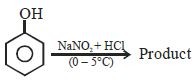
A
Phenyl diazonium chloride
B
$3-$Nitrosophenol
C
$4-$Nitrosophenol
D
$1,4-$Dinitrosobenzene
Solution
(C) When phenol reacts with $NaNO_2$ and $HCl$ at $0-5^{\circ}C$,the electrophile $NO^+$ (nitrosonium ion) is generated.
This electrophile attacks the electron-rich benzene ring of phenol,primarily at the para-position due to steric hindrance at the ortho-position.
Thus,the major product formed is $4$-nitrosophenol.
This electrophile attacks the electron-rich benzene ring of phenol,primarily at the para-position due to steric hindrance at the ortho-position.
Thus,the major product formed is $4$-nitrosophenol.
0 likes
View Solution303
DifficultMCQ
Phenol reacts with bromine in carbon disulphide $(CS_2)$ at low temperature to give:
A
$m-$Bromophenol
B
$p-$Bromophenol
C
$o-$ and $p-$Bromophenol
D
$2,4,6-$Tribromophenol
Solution
(C) When phenol reacts with bromine $(Br_2)$ in a non-polar solvent like carbon disulphide $(CS_2)$ at low temperature,the reaction is controlled to produce monobrominated products.
Since the $-OH$ group is ortho-para directing,the reaction yields a mixture of $o-$bromophenol and $p-$bromophenol.
In contrast,when phenol reacts with bromine water,it leads to the formation of $2,4,6-$tribromophenol due to the high polarity of the solvent.
Since the $-OH$ group is ortho-para directing,the reaction yields a mixture of $o-$bromophenol and $p-$bromophenol.
In contrast,when phenol reacts with bromine water,it leads to the formation of $2,4,6-$tribromophenol due to the high polarity of the solvent.
0 likes
View Solution304
EasyMCQ
The following reaction is known as:
$Phenol \xrightarrow[H^{+}]{CHCl_3 / NaOH} \text{Salicylaldehyde}$
$Phenol \xrightarrow[H^{+}]{CHCl_3 / NaOH} \text{Salicylaldehyde}$
A
Gattermann aldehyde synthesis
B
Duff reaction
C
Perkin reaction
D
Reimer-Tiemann reaction
Solution
(D) The $Reimer-Tiemann$ reaction is a chemical reaction used for the $ortho$-formylation of phenols.
In this reaction,phenol reacts with chloroform $(CHCl_3)$ in the presence of an aqueous base $(NaOH)$ to form salicylaldehyde as the major product.
In this reaction,phenol reacts with chloroform $(CHCl_3)$ in the presence of an aqueous base $(NaOH)$ to form salicylaldehyde as the major product.
0 likes
View Solution305
MediumMCQ
Phenol does not react with which of the following?
A
Alkali metals
B
Sodium hydroxide
C
Potassium hydroxide
D
Sodium bicarbonate
Solution
(D) Phenol $(C_6H_5OH)$ is a weak acid.
It reacts with strong bases like $NaOH$ and $KOH$ to form phenoxide salts.
It also reacts with alkali metals like $Na$ to evolve $H_2$ gas.
However,phenol is a weaker acid than carbonic acid $(H_2CO_3)$.
Therefore,it does not react with sodium bicarbonate $(NaHCO_3)$ to evolve $CO_2$ gas.
The reaction is: $C_6H_5OH + NaHCO_3 \rightarrow \text{No reaction}$.
It reacts with strong bases like $NaOH$ and $KOH$ to form phenoxide salts.
It also reacts with alkali metals like $Na$ to evolve $H_2$ gas.
However,phenol is a weaker acid than carbonic acid $(H_2CO_3)$.
Therefore,it does not react with sodium bicarbonate $(NaHCO_3)$ to evolve $CO_2$ gas.
The reaction is: $C_6H_5OH + NaHCO_3 \rightarrow \text{No reaction}$.
0 likes
View Solution306
MediumMCQ
The main product of the following reaction will be:
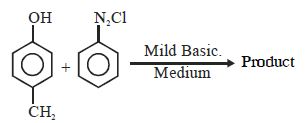
A
$4-$methylphenol coupled with benzene diazonium chloride at the para position.
B
$2-$(phenylazo)$-4-$methylphenol.
C
$3-$(phenylazo)$-4-$methylphenol.
D
Phenyl$-4-$methylphenyl ether.
Solution
(B) The reaction between $p$-cresol ($4$-methylphenol) and benzene diazonium chloride in a mild basic medium is an electrophilic aromatic substitution reaction,specifically a coupling reaction.
In $p$-cresol,the para position is already occupied by a methyl group $(-CH_3)$.
Therefore,the electrophile (benzene diazonium ion,$C_6H_5N_2^+$) attacks the ortho position relative to the hydroxyl $(-OH)$ group.
The resulting product is $2$-(phenylazo)-$4$-methylphenol.
In $p$-cresol,the para position is already occupied by a methyl group $(-CH_3)$.
Therefore,the electrophile (benzene diazonium ion,$C_6H_5N_2^+$) attacks the ortho position relative to the hydroxyl $(-OH)$ group.
The resulting product is $2$-(phenylazo)-$4$-methylphenol.
0 likes
View Solution307
MediumMCQ
Which of the following does not give a bicarbonate test with $NaHCO_3$?
A
$2,4,6-$Trinitrophenol (Picric acid)
B
p-Hydroxybenzenesulfonic acid
C
Phenol
D
p-Hydroxybenzoic acid
Solution
(C) The bicarbonate test is used to detect the presence of acidic groups that are stronger than carbonic acid $(H_2CO_3)$.
$NaHCO_3$ reacts with acids to evolve $CO_2$ gas if the acid is stronger than $H_2CO_3$ $(pK_a \approx 6.35)$.
$1$. $2,4,6$-Trinitrophenol $(pK_a \approx 0.38)$ is a strong acid and reacts with $NaHCO_3$.
$2$. $p$-Hydroxybenzenesulfonic acid $(pK_a \approx 2.5)$ is a strong acid and reacts with $NaHCO_3$.
$3$. Phenol $(pK_a \approx 10)$ is a very weak acid,much weaker than $H_2CO_3$,and therefore does not react with $NaHCO_3$ to evolve $CO_2$.
$4$. $p$-Hydroxybenzoic acid $(pK_a \approx 4.5)$ is stronger than $H_2CO_3$ and reacts with $NaHCO_3$.
Thus,phenol does not give the bicarbonate test.
$NaHCO_3$ reacts with acids to evolve $CO_2$ gas if the acid is stronger than $H_2CO_3$ $(pK_a \approx 6.35)$.
$1$. $2,4,6$-Trinitrophenol $(pK_a \approx 0.38)$ is a strong acid and reacts with $NaHCO_3$.
$2$. $p$-Hydroxybenzenesulfonic acid $(pK_a \approx 2.5)$ is a strong acid and reacts with $NaHCO_3$.
$3$. Phenol $(pK_a \approx 10)$ is a very weak acid,much weaker than $H_2CO_3$,and therefore does not react with $NaHCO_3$ to evolve $CO_2$.
$4$. $p$-Hydroxybenzoic acid $(pK_a \approx 4.5)$ is stronger than $H_2CO_3$ and reacts with $NaHCO_3$.
Thus,phenol does not give the bicarbonate test.
0 likes
View Solution308
DifficultMCQ
The main product of the following reaction will be:
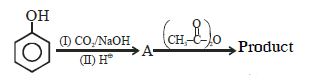
A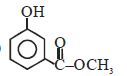
B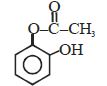
C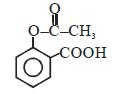
D
All of these
Solution
(C) The reaction sequence is as follows:
$1$. Phenol reacts with $CO_2$ in the presence of $NaOH$ followed by acidification $(H^+)$,which is the Kolbe-Schmitt reaction. This yields salicylic acid ($2$-hydroxybenzoic acid) as intermediate $A$.
$2$. Salicylic acid then reacts with acetic anhydride $(CH_3CO)_2O$ (acetylation of the phenolic -$OH$ group) to form acetylsalicylic acid,commonly known as Aspirin.
$1$. Phenol reacts with $CO_2$ in the presence of $NaOH$ followed by acidification $(H^+)$,which is the Kolbe-Schmitt reaction. This yields salicylic acid ($2$-hydroxybenzoic acid) as intermediate $A$.
$2$. Salicylic acid then reacts with acetic anhydride $(CH_3CO)_2O$ (acetylation of the phenolic -$OH$ group) to form acetylsalicylic acid,commonly known as Aspirin.
0 likes
View Solution309
DifficultMCQ
In the given reaction sequence,identify the final product $B$:
Phenol $\xrightarrow[(2) CO_2]{(1) OH^-} A$ $\xrightarrow[Pyridine]{CH_3COCl} B$
Phenol $\xrightarrow[(2) CO_2]{(1) OH^-} A$ $\xrightarrow[Pyridine]{CH_3COCl} B$
A
$2-$Methoxycarbonylphenol
B
$2-$Acetoxycarbonylphenol
C
$2-$Acetoxybenzoic acid
D
$2-$Hydroxy$-1-$benzofuran$-3-$one
Solution
(C) The reaction sequence is as follows:
Step $1$: Phenol reacts with $OH^-$ followed by $CO_2$ and $H^+$ (Kolbe-Schmitt reaction) to form Salicylic acid $(A)$,which is $2$-hydroxybenzoic acid.
Step $2$: Salicylic acid reacts with acetyl chloride $(CH_3COCl)$ in the presence of pyridine (acetylation). The phenolic $-OH$ group is acetylated to form Acetylsalicylic acid (Aspirin),which is $2$-acetoxybenzoic acid.
The structure of $2$-acetoxybenzoic acid is a benzene ring with a $-COOH$ group at the ortho position and an $-OCOCH_3$ group at the other ortho position (relative to the original $-OH$ position).
Step $1$: Phenol reacts with $OH^-$ followed by $CO_2$ and $H^+$ (Kolbe-Schmitt reaction) to form Salicylic acid $(A)$,which is $2$-hydroxybenzoic acid.
Step $2$: Salicylic acid reacts with acetyl chloride $(CH_3COCl)$ in the presence of pyridine (acetylation). The phenolic $-OH$ group is acetylated to form Acetylsalicylic acid (Aspirin),which is $2$-acetoxybenzoic acid.
The structure of $2$-acetoxybenzoic acid is a benzene ring with a $-COOH$ group at the ortho position and an $-OCOCH_3$ group at the other ortho position (relative to the original $-OH$ position).
0 likes
View Solution310
EasyMCQ
The product $(A)$ in the following reaction is:
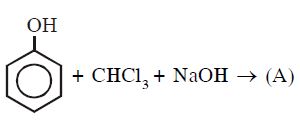
A
Salicylaldehyde
B
m-Hydroxybenzaldehyde
C
Anisole
D
Salicylic acid
Solution
(A) The given reaction is the Reimer-Tiemann reaction.
In this reaction,phenol reacts with chloroform $(CHCl_3)$ in the presence of an aqueous base (like $NaOH$) to form an intermediate,which upon hydrolysis yields salicylaldehyde (o-hydroxybenzaldehyde) as the major product.
The reaction is:
$C_6H_5OH + CHCl_3 + 3NaOH \rightarrow C_6H_4(OH)(CHO) + 3NaCl + 2H_2O$
In this reaction,phenol reacts with chloroform $(CHCl_3)$ in the presence of an aqueous base (like $NaOH$) to form an intermediate,which upon hydrolysis yields salicylaldehyde (o-hydroxybenzaldehyde) as the major product.
The reaction is:
$C_6H_5OH + CHCl_3 + 3NaOH \rightarrow C_6H_4(OH)(CHO) + 3NaCl + 2H_2O$
0 likes
View Solution311
DifficultMCQ
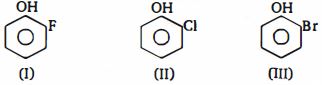
The correct order of boiling point for the given compounds is:
A
$I > II > III$
B
$III > II > I$
C
$II > I > III$
D
$III > I > II$
Solution
(B) The boiling point of these ortho-substituted phenols depends on the extent of intramolecular hydrogen bonding and molecular weight.
In $o$-fluorophenol $(I)$,$o$-chlorophenol $(II)$,and $o$-bromophenol $(III)$,intramolecular hydrogen bonding is present in all three.
However,the boiling point is primarily influenced by the molecular weight and the strength of intermolecular forces (van der Waals forces) which increase with the size of the halogen atom.
As the size of the halogen atom increases from $F < Cl < Br$,the molecular weight and the magnitude of van der Waals forces increase,leading to a higher boiling point.
Therefore,the correct order of boiling point is $III > II > I$.
In $o$-fluorophenol $(I)$,$o$-chlorophenol $(II)$,and $o$-bromophenol $(III)$,intramolecular hydrogen bonding is present in all three.
However,the boiling point is primarily influenced by the molecular weight and the strength of intermolecular forces (van der Waals forces) which increase with the size of the halogen atom.
As the size of the halogen atom increases from $F < Cl < Br$,the molecular weight and the magnitude of van der Waals forces increase,leading to a higher boiling point.
Therefore,the correct order of boiling point is $III > II > I$.
0 likes
View Solution312
AdvancedMCQ
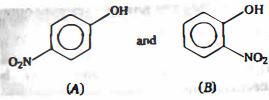
Out of the two compounds shown below,the vapour pressure of $B$ at a particular temperature is expected to be:
A
higher than that of $A$
B
lower than that of $A$
C
same as that of $A$
D
can be higher or lower depending upon the size of the vessel
Solution
(A) Compound $(A)$ is $p$-nitrophenol,which exhibits intermolecular hydrogen bonding,leading to association of molecules and higher boiling point.
Compound $(B)$ is $o$-nitrophenol,which exhibits intramolecular hydrogen bonding,preventing association of molecules and resulting in a lower boiling point.
Since vapour pressure is inversely proportional to the boiling point,compound $(B)$ will have a higher vapour pressure than compound $(A)$.
Compound $(B)$ is $o$-nitrophenol,which exhibits intramolecular hydrogen bonding,preventing association of molecules and resulting in a lower boiling point.
Since vapour pressure is inversely proportional to the boiling point,compound $(B)$ will have a higher vapour pressure than compound $(A)$.
0 likes
View Solution313
MediumMCQ
The major product of the reaction is $CH_3-CH=CH-C_6H_4-OH + HBr \rightarrow ?$
A
$CH_3-CH(Br)-CH_2-C_6H_5$
B
$CH_3-CH_2-CH(Br)-C_6H_4-OH$
C
$CH_3-CH(Br)-CH_2-C_6H_4-Br$
D
$CH_3-CH_2-CH(Br)-C_6H_4-Br$
Solution
(B) The reaction involves the addition of $HBr$ to the alkene group present in the molecule. The phenol group ($-OH$ attached to the benzene ring) does not undergo nucleophilic substitution reaction $(N.S.R.)$ with $HBr$ because the $C-OH$ bond has partial double bond character due to resonance. Therefore,the reaction is an electrophilic addition reaction $(E.A.R.)$ across the double bond. According to Markovnikov's rule,the $Br^-$ ion attaches to the more substituted carbon atom of the double bond. The reaction is: $CH_3-CH=CH-C_6H_4-OH + HBr \rightarrow CH_3-CH(Br)-CH_2-C_6H_4-OH$. Comparing this with the given options,the correct structure is represented by option $B$.
0 likes
View Solution314
MediumMCQ
One of the functional groups present in the product of the reaction between phenol and chloroform in an alkaline medium is:
A
$-COOH$
B
$-CHO$
C
$-CH_2OH$
D
$-CH_2Cl$
Solution
(B) The reaction between phenol and chloroform in the presence of an alkaline medium (like $NaOH$ or $KOH$) is known as the $Reimer-Tiemann$ reaction.
In this reaction,phenol is converted into salicylaldehyde $(2-hydroxybenzaldehyde)$.
The product,salicylaldehyde,contains a phenolic hydroxyl group $(-OH)$ and an aldehyde group $(-CHO)$.
Therefore,the functional group present in the product is $-CHO$.
In this reaction,phenol is converted into salicylaldehyde $(2-hydroxybenzaldehyde)$.
The product,salicylaldehyde,contains a phenolic hydroxyl group $(-OH)$ and an aldehyde group $(-CHO)$.
Therefore,the functional group present in the product is $-CHO$.
0 likes
View Solution315
AdvancedMCQ
The structure of salol is
A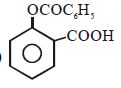
B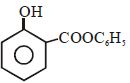
C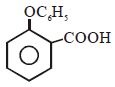
D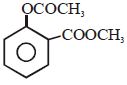
Solution
(B) Salol is the common name for phenyl salicylate.
It is an ester formed by the reaction of salicylic acid $(2-hydroxybenzoic \ acid)$ with phenol.
The structure consists of a benzene ring with a hydroxyl group $(-OH)$ at the ortho position and a phenyl ester group $(-COOC_6H_5)$ at the adjacent position.
Therefore,the correct structure is represented by option $B$.
It is an ester formed by the reaction of salicylic acid $(2-hydroxybenzoic \ acid)$ with phenol.
The structure consists of a benzene ring with a hydroxyl group $(-OH)$ at the ortho position and a phenyl ester group $(-COOC_6H_5)$ at the adjacent position.
Therefore,the correct structure is represented by option $B$.
0 likes
View Solution316
DifficultMCQ
The acidic property of phenol can be explained when it is reacted with:
A
$NaOH$
B
$NaHCO_3$
C
$Na$
D
Both $(A)$ and $(C)$
Solution
(D) Phenol $(C_6H_5OH)$ is a weak acid.
It reacts with strong bases like sodium hydroxide $(NaOH)$ to form sodium phenoxide $(C_6H_5ONa)$ and water.
It also reacts with active metals like sodium $(Na)$ to liberate hydrogen gas $(H_2)$.
However,phenol is not acidic enough to react with sodium bicarbonate $(NaHCO_3)$ to evolve carbon dioxide $(CO_2)$.
Therefore,the acidic nature of phenol is demonstrated by its reaction with both $NaOH$ and $Na$.
It reacts with strong bases like sodium hydroxide $(NaOH)$ to form sodium phenoxide $(C_6H_5ONa)$ and water.
It also reacts with active metals like sodium $(Na)$ to liberate hydrogen gas $(H_2)$.
However,phenol is not acidic enough to react with sodium bicarbonate $(NaHCO_3)$ to evolve carbon dioxide $(CO_2)$.
Therefore,the acidic nature of phenol is demonstrated by its reaction with both $NaOH$ and $Na$.
0 likes
View Solution317
MediumMCQ
In the following reaction sequence,identify $Q$:
$p\text{-Chloronitrobenzene}$ $\xrightarrow[\Delta, P]{NaOH} P$ $\xrightarrow{C_6H_5CH_2Cl} Q$
$p\text{-Chloronitrobenzene}$ $\xrightarrow[\Delta, P]{NaOH} P$ $\xrightarrow{C_6H_5CH_2Cl} Q$
A
$4-$Nitrophenyl phenyl ether
B
$1-$Nitro$-4-$(benzyloxy)benzene
C
$4-$Nitrophenyl benzyl ether
D
$2-$Benzyl$-4-$nitrophenol
Solution
(B) The reaction of $p$-chloronitrobenzene with $NaOH$ under heating and pressure is a nucleophilic aromatic substitution reaction. The strong electron-withdrawing $-NO_2$ group at the para position activates the ring towards nucleophilic attack,replacing the $-Cl$ atom with an $-OH$ group to form $p$-nitrophenol $(P)$.
$P = p\text{-Nitrophenol} (O_2N-C_6H_4-OH)$.
In the second step,$p$-nitrophenol reacts with benzyl chloride $(C_6H_5CH_2Cl)$ in the presence of a base (implied). The phenoxide ion $(O_2N-C_6H_4-O^-)$ acts as a nucleophile and attacks the benzyl chloride via an $S_N2$ mechanism,resulting in the formation of an ether linkage.
$O_2N-C_6H_4-O^- + C_6H_5CH_2Cl \rightarrow O_2N-C_6H_4-O-CH_2-C_6H_5 + Cl^-$.
The product $Q$ is $1\text{-nitro-4-(benzyloxy)benzene}$ (also known as $4\text{-nitrophenyl benzyl ether}$).
$P = p\text{-Nitrophenol} (O_2N-C_6H_4-OH)$.
In the second step,$p$-nitrophenol reacts with benzyl chloride $(C_6H_5CH_2Cl)$ in the presence of a base (implied). The phenoxide ion $(O_2N-C_6H_4-O^-)$ acts as a nucleophile and attacks the benzyl chloride via an $S_N2$ mechanism,resulting in the formation of an ether linkage.
$O_2N-C_6H_4-O^- + C_6H_5CH_2Cl \rightarrow O_2N-C_6H_4-O-CH_2-C_6H_5 + Cl^-$.
The product $Q$ is $1\text{-nitro-4-(benzyloxy)benzene}$ (also known as $4\text{-nitrophenyl benzyl ether}$).
0 likes
View Solution318
EasyMCQ
The reaction of phenol with concentrated $HNO_3$ is given by:
Phenol $\xrightarrow{Conc. HNO_3}$ Product
What is the major product?
Phenol $\xrightarrow{Conc. HNO_3}$ Product
What is the major product?
A
$o-$nitrophenol
B
$p-$nitrophenol
C
$m-$nitrophenol
D
Picric acid
Solution
(D) When phenol is treated with concentrated $HNO_3$,it undergoes nitration to form $2,4,6-$trinitrophenol,which is commonly known as Picric acid.
The reaction is as follows:
Phenol $+ 3HNO_3 \text{ (conc.)} \xrightarrow{H_2SO_4} 2,4,6-\text{trinitrophenol (Picric acid)} + 3H_2O$.
The reaction is as follows:
Phenol $+ 3HNO_3 \text{ (conc.)} \xrightarrow{H_2SO_4} 2,4,6-\text{trinitrophenol (Picric acid)} + 3H_2O$.
0 likes
View Solution319
AdvancedMCQ
Benzene $+ HNO_{3(conc.)}$ $\xrightarrow{H_2SO_4} A$ $\xrightarrow[{(ii) OH^{-}}]{{(i) Sn/HCl}} B$ $\xrightarrow[{0 - 5 \ ^oC}]{NaNO_2 + HCl} C$ $\xrightarrow{H_2O/H^{+}} D$. What is $D$?
A
$3-$aminobenzoic acid
B
Phenol
C
Benzene
D
Chlorobenzene
Solution
(B) $1$. Benzene reacts with conc. $HNO_3$ in the presence of $H_2SO_4$ to form nitrobenzene $(A)$.
$2$. Nitrobenzene is reduced by $Sn/HCl$ followed by treatment with $OH^-$ to form aniline $(B)$.
$3$. Aniline reacts with $NaNO_2 + HCl$ at $0-5 \ ^oC$ to form benzene diazonium chloride $(C)$.
$4$. Benzene diazonium chloride on hydrolysis with $H_2O/H^+$ yields phenol $(D)$.
$2$. Nitrobenzene is reduced by $Sn/HCl$ followed by treatment with $OH^-$ to form aniline $(B)$.
$3$. Aniline reacts with $NaNO_2 + HCl$ at $0-5 \ ^oC$ to form benzene diazonium chloride $(C)$.
$4$. Benzene diazonium chloride on hydrolysis with $H_2O/H^+$ yields phenol $(D)$.
0 likes
View Solution320
DifficultMCQ
Phenol $\xrightarrow[\Delta]{H^\oplus} X$ $\xrightarrow[(1) O_3]{(2) H_2O/Zn} Y;$ $Y$ is
A
$CH_3-(CH_2)_4-CHO$
B
$OHC-(CH_2)_4-CHO$
C
$CH_3-CH_2-CHO$
D
$OHC-CH_2-CHO$
Solution
(B) The reaction of phenol with $H^\oplus$ under heating conditions typically involves dehydration or rearrangement,but in the context of this specific sequence,it refers to the reduction of phenol to cyclohexene (often via hydrogenation or specific catalytic conditions). However,a more standard interpretation for this sequence is the reduction of phenol to cyclohexene followed by ozonolysis.
$1$. Phenol $\xrightarrow{H_2/Ni, \Delta} \text{Cyclohexanol}$ $\xrightarrow{H^+, \Delta} \text{Cyclohexene} (X)$.
$2$. Ozonolysis of cyclohexene $(X)$:
Cyclohexene $\xrightarrow[(1) O_3]{(2) H_2O/Zn} OHC-(CH_2)_4-CHO$ (Hexanedial) $(Y)$.
Thus,the product $Y$ is hexanedial.
$1$. Phenol $\xrightarrow{H_2/Ni, \Delta} \text{Cyclohexanol}$ $\xrightarrow{H^+, \Delta} \text{Cyclohexene} (X)$.
$2$. Ozonolysis of cyclohexene $(X)$:
Cyclohexene $\xrightarrow[(1) O_3]{(2) H_2O/Zn} OHC-(CH_2)_4-CHO$ (Hexanedial) $(Y)$.
Thus,the product $Y$ is hexanedial.
0 likes
View Solution321
MediumMCQ
Which of the following can not react with $NaHCO_3$?
A
Phenol
B
Cyclohexanol
C
Cyclohexylacetylene
D
All of the above
0 likes
View Solution322
EasyMCQ
Phenol $\xrightarrow{Br_2 / H_2O}$ Product formed is
A
$2,4,6-$ Tribromoaniline
B
$2-$ Bromophenol and $4-$ Bromophenol
C
Picric acid
D
$2,4,6-$ Tribromophenol
Solution
(D) When phenol reacts with bromine water $(Br_2 / H_2O)$,it undergoes electrophilic aromatic substitution at all available ortho and para positions.
Due to the strong activating effect of the $-OH$ group,the reaction occurs rapidly to form a white precipitate of $2,4,6-$ tribromophenol.
Due to the strong activating effect of the $-OH$ group,the reaction occurs rapidly to form a white precipitate of $2,4,6-$ tribromophenol.
0 likes
View Solution323
MediumMCQ
Choose the incorrect option based on the reaction:
$(P)$ + $CH_3-CO-Cl \rightarrow (Q)$
Where $(P)$ is salicylic acid and the structure of $(Q)$ is given as:
$(Q)$ is a benzene ring with an $-OH$ group and a $-COO-CO-CH_3$ group at ortho position.
$(P)$ + $CH_3-CO-Cl \rightarrow (Q)$
Where $(P)$ is salicylic acid and the structure of $(Q)$ is given as:
$(Q)$ is a benzene ring with an $-OH$ group and a $-COO-CO-CH_3$ group at ortho position.
A
$(Q)$ has common name Aspirin
B
$(P)$ has chemical name salicylic acid
C
$(Q)$ is analgesic in nature
D
None of the above
Solution
(A) The reaction of salicylic acid $(P)$ with acetyl chloride $(CH_3COCl)$ typically results in the acetylation of the phenolic $-OH$ group to form acetylsalicylic acid,which is known as Aspirin.
However,the structure provided for $(Q)$ in the image shows acetylation of the carboxylic acid group (forming a mixed anhydride),which is not the standard synthesis of Aspirin.
Given the options:
$1$. $(P)$ is indeed salicylic acid.
$2$. Aspirin is an analgesic.
$3$. The structure shown for $(Q)$ is not Aspirin (Aspirin is $2-$acetoxybenzoic acid).
Therefore,the statement '$(Q)$ has common name Aspirin' is incorrect because the structure provided for $(Q)$ is not Aspirin.
However,the structure provided for $(Q)$ in the image shows acetylation of the carboxylic acid group (forming a mixed anhydride),which is not the standard synthesis of Aspirin.
Given the options:
$1$. $(P)$ is indeed salicylic acid.
$2$. Aspirin is an analgesic.
$3$. The structure shown for $(Q)$ is not Aspirin (Aspirin is $2-$acetoxybenzoic acid).
Therefore,the statement '$(Q)$ has common name Aspirin' is incorrect because the structure provided for $(Q)$ is not Aspirin.
0 likes
View Solution324
MediumMCQ
Phenol $+ (HCN + HCl) \xrightarrow[(2)\,\,{H_2}O]{(1)\,ZnCl_2} X$ ; $X$ is
A
$4-$hydroxybenzonitrile
B
$4-$chlorophenol
C
$4-$hydroxybenzaldehyde
D
$4-$hydroxybenzoic acid
Solution
(C) The reaction of phenol with $HCN$ and $HCl$ in the presence of $ZnCl_2$ is a variation of the Gattermann formylation reaction.
This reaction introduces a formyl group $(-CHO)$ onto the benzene ring of phenol,primarily at the para position due to the activating and ortho/para-directing nature of the $-OH$ group.
The reaction proceeds via the formation of an imine intermediate,which upon hydrolysis with water $(H_2O)$ yields the corresponding aldehyde.
Therefore,the product $X$ is $4$-hydroxybenzaldehyde.
This reaction introduces a formyl group $(-CHO)$ onto the benzene ring of phenol,primarily at the para position due to the activating and ortho/para-directing nature of the $-OH$ group.
The reaction proceeds via the formation of an imine intermediate,which upon hydrolysis with water $(H_2O)$ yields the corresponding aldehyde.
Therefore,the product $X$ is $4$-hydroxybenzaldehyde.
0 likes
View Solution325
DifficultMCQ
Identify the product $X$ in the following reaction: $C_6H_5MgBr + C_6H_5OH \rightarrow X$
A
$C_6H_5-O-C_6H_5$
B
$C_6H_5-O-C_6H_4-OH$
C
$C_6H_5-C_6H_5$
D
$C_6H_6$
Solution
(D) The reaction between a Grignard reagent $(C_6H_5MgBr)$ and a phenol $(C_6H_5OH)$ is an acid-base reaction.
Phenols are acidic in nature due to the presence of the hydroxyl group attached to the benzene ring.
The Grignard reagent acts as a strong base and abstracts the acidic proton from the phenol.
The reaction is:
$C_6H_5MgBr + C_6H_5OH \rightarrow C_6H_6 + C_6H_5OMgBr$
Here,$C_6H_6$ (benzene) is formed as the product $X$.
Phenols are acidic in nature due to the presence of the hydroxyl group attached to the benzene ring.
The Grignard reagent acts as a strong base and abstracts the acidic proton from the phenol.
The reaction is:
$C_6H_5MgBr + C_6H_5OH \rightarrow C_6H_6 + C_6H_5OMgBr$
Here,$C_6H_6$ (benzene) is formed as the product $X$.
0 likes
View Solution326
MediumMCQ
The electrophile involved in the Reimer-Tiemann reaction is
A
$:CHCl_2^+$
B
$:CCl_2$
C
$:CCl_3^-$
D
$:CHO^-$
Solution
(B) In the Reimer-Tiemann reaction,phenol reacts with chloroform $(CHCl_3)$ in the presence of an aqueous base ($NaOH$ or $KOH$).
The first step involves the formation of dichlorocarbene $(:CCl_2)$ from chloroform.
$CHCl_3 + OH^- \rightarrow :CCl_2 + H_2O + Cl^-$.
This dichlorocarbene $(:CCl_2)$ acts as an electrophile and attacks the phenoxide ion to initiate the reaction.
Therefore,the correct electrophile is $:CCl_2$.
The first step involves the formation of dichlorocarbene $(:CCl_2)$ from chloroform.
$CHCl_3 + OH^- \rightarrow :CCl_2 + H_2O + Cl^-$.
This dichlorocarbene $(:CCl_2)$ acts as an electrophile and attacks the phenoxide ion to initiate the reaction.
Therefore,the correct electrophile is $:CCl_2$.
0 likes
View Solution327
MediumMCQ
The reaction of $CH_3CH=CH-C_6H_4-OH$ with $HBr$ gives:
A
$CH_3CHBr-CH_2-C_6H_4-OH$
B
$CH_3CH_2CHBr-C_6H_4-OH$
C
$CH_3CHBr-CH_2-C_6H_4-Br$
D
$CH_3CH_2CHBr-C_6H_4-Br$
Solution
(A) The reaction involves the electrophilic addition of $HBr$ to the alkene group $CH_3CH=CH-$.
According to Markovnikov's rule,the $H^+$ ion attaches to the carbon atom with more hydrogen atoms,and the $Br^-$ ion attaches to the carbon atom with fewer hydrogen atoms.
However,the presence of the $-OH$ group on the benzene ring makes the ring highly activated towards electrophilic substitution.
In the presence of $HBr$,the alkene double bond undergoes addition,and the $-OH$ group is a strong ortho/para directing group.
Given the structure $CH_3CH=CH-C_6H_4-OH$ (where the $-OH$ is at the para position relative to the propenyl group),the addition of $HBr$ to the double bond follows Markovnikov's rule to form $CH_3CHBr-CH_2-C_6H_4-OH$.
According to Markovnikov's rule,the $H^+$ ion attaches to the carbon atom with more hydrogen atoms,and the $Br^-$ ion attaches to the carbon atom with fewer hydrogen atoms.
However,the presence of the $-OH$ group on the benzene ring makes the ring highly activated towards electrophilic substitution.
In the presence of $HBr$,the alkene double bond undergoes addition,and the $-OH$ group is a strong ortho/para directing group.
Given the structure $CH_3CH=CH-C_6H_4-OH$ (where the $-OH$ is at the para position relative to the propenyl group),the addition of $HBr$ to the double bond follows Markovnikov's rule to form $CH_3CHBr-CH_2-C_6H_4-OH$.
0 likes
View Solution328
DifficultMCQ
Which of the following is the strongest ortho-para directing group?
A
$-OH$
B
$-Cl$
C
$-OCH_3$
D
$-CH_3$
Solution
(A) The strength of an ortho-para directing group is determined by its ability to donate electrons to the benzene ring via the resonance effect ($+R$ or $+M$ effect).
Among the given groups,the $-OH$ group has a strong $+R$ effect due to the lone pair on the oxygen atom,which is directly attached to the ring.
While $-OCH_3$ also has a $+R$ effect,the $-OH$ group is generally considered a stronger activator because the oxygen atom in $-OH$ is less sterically hindered and more effective at resonance donation compared to the methoxy group.
$-CH_3$ acts via hyperconjugation ($+H$ effect),which is weaker than the resonance effect.
$-Cl$ has a $-I$ effect that outweighs its $+R$ effect,making it a deactivating group.
Therefore,$-OH$ is the strongest ortho-para directing group among the options.
Among the given groups,the $-OH$ group has a strong $+R$ effect due to the lone pair on the oxygen atom,which is directly attached to the ring.
While $-OCH_3$ also has a $+R$ effect,the $-OH$ group is generally considered a stronger activator because the oxygen atom in $-OH$ is less sterically hindered and more effective at resonance donation compared to the methoxy group.
$-CH_3$ acts via hyperconjugation ($+H$ effect),which is weaker than the resonance effect.
$-Cl$ has a $-I$ effect that outweighs its $+R$ effect,making it a deactivating group.
Therefore,$-OH$ is the strongest ortho-para directing group among the options.
0 likes
View Solution329
MediumMCQ
Heating benzoic acid with $X$ and phenol with $Y$ gives benzene. $X$ and $Y$ are respectively:
A
$Zn$ dust and sodalime
B
Sodalime and $Zn$ dust
C
$Zn$ dust and $NaOH$
D
Sodalime
Solution
(B) $1$. Benzoic acid $(C_6H_5COOH)$ reacts with sodalime $(NaOH + CaO)$ to undergo decarboxylation,yielding benzene $(C_6H_6)$. Thus,$X$ is sodalime.
$2$. Phenol $(C_6H_5OH)$ reacts with $Zn$ dust to undergo reduction,yielding benzene $(C_6H_6)$. Thus,$Y$ is $Zn$ dust.
$3$. Therefore,$X$ is sodalime and $Y$ is $Zn$ dust.
$2$. Phenol $(C_6H_5OH)$ reacts with $Zn$ dust to undergo reduction,yielding benzene $(C_6H_6)$. Thus,$Y$ is $Zn$ dust.
$3$. Therefore,$X$ is sodalime and $Y$ is $Zn$ dust.
0 likes
View Solution330
DifficultMCQ
The order of acidic strength of $X, Y$ and $Z$ is:
Phenol reacts with dilute $HNO_3$ to form $X$ ($o$-nitrophenol) and $Y$ ($p$-nitrophenol). Phenol reacts with concentrated $HNO_3$ and $H_2SO_4$ to form $Z$ ($2,4,6$-trinitrophenol or picric acid).
Phenol reacts with dilute $HNO_3$ to form $X$ ($o$-nitrophenol) and $Y$ ($p$-nitrophenol). Phenol reacts with concentrated $HNO_3$ and $H_2SO_4$ to form $Z$ ($2,4,6$-trinitrophenol or picric acid).
A
$X > Y > Z$
B
$Z > X > Y$
C
$Y > Z > X$
D
$Z > Y > X$
Solution
(D) $1$. $X$ is $o$-nitrophenol,$Y$ is $p$-nitrophenol,and $Z$ is $2,4,6$-trinitrophenol (picric acid).
$2$. The acidic strength of phenols increases with the presence of electron-withdrawing groups $(-NO_2)$ on the benzene ring due to the stabilization of the phenoxide ion.
$3$. $Z$ ($2,4,6$-trinitrophenol) has three $-NO_2$ groups,which exert a strong $-I$ and $-M$ effect,making it the most acidic.
$4$. Between $X$ ($o$-nitrophenol) and $Y$ ($p$-nitrophenol),$p$-nitrophenol $(Y)$ is more acidic than $o$-nitrophenol $(X)$ because $o$-nitrophenol forms intramolecular hydrogen bonding,which stabilizes the molecule and makes the release of the $H^+$ ion slightly more difficult compared to $p$-nitrophenol.
$5$. Therefore,the order of acidic strength is $Z > Y > X$.
$2$. The acidic strength of phenols increases with the presence of electron-withdrawing groups $(-NO_2)$ on the benzene ring due to the stabilization of the phenoxide ion.
$3$. $Z$ ($2,4,6$-trinitrophenol) has three $-NO_2$ groups,which exert a strong $-I$ and $-M$ effect,making it the most acidic.
$4$. Between $X$ ($o$-nitrophenol) and $Y$ ($p$-nitrophenol),$p$-nitrophenol $(Y)$ is more acidic than $o$-nitrophenol $(X)$ because $o$-nitrophenol forms intramolecular hydrogen bonding,which stabilizes the molecule and makes the release of the $H^+$ ion slightly more difficult compared to $p$-nitrophenol.
$5$. Therefore,the order of acidic strength is $Z > Y > X$.
0 likes
View Solution331
DifficultMCQ
Benzene $+ CH_3CH_2CH_2Cl$ $\xrightarrow{AlCl_3} M$ $\xrightarrow{(i) O_2/\Delta , (ii) H_3O^+} N + \text{phenol}$. Here $M$ and $N$ are
A
Isopropylbenzene and $CH_3COCH_3$
B
Isopropylbenzene and $CH_3CH_2CHO$
C
Propylbenzene and $CH_3CH_2CHO$
D
Propylbenzene and $CH_3COCH_3$
Solution
(A) $1$. The reaction of benzene with $n$-propyl chloride in the presence of $AlCl_3$ is a Friedel-Crafts alkylation. Due to the rearrangement of the primary carbocation to a more stable secondary carbocation,the major product $M$ is isopropylbenzene (cumene).
$2$. Cumene $(M)$ reacts with $O_2$ at high temperature to form cumene hydroperoxide.
$3$. Upon treatment with $H_3O^+$,cumene hydroperoxide undergoes acid-catalyzed rearrangement to yield phenol and acetone $(CH_3COCH_3)$.
$4$. Thus,$M$ is isopropylbenzene and $N$ is acetone $(CH_3COCH_3)$.
$2$. Cumene $(M)$ reacts with $O_2$ at high temperature to form cumene hydroperoxide.
$3$. Upon treatment with $H_3O^+$,cumene hydroperoxide undergoes acid-catalyzed rearrangement to yield phenol and acetone $(CH_3COCH_3)$.
$4$. Thus,$M$ is isopropylbenzene and $N$ is acetone $(CH_3COCH_3)$.
0 likes
View Solution332
DifficultMCQ
The rate of electrophilic substitution reaction in phenol is:
A
Slower than in benzene
B
Faster than in benzene
C
Equal to that in benzene
D
None of the above
Solution
(B) In phenol,the $-OH$ group is a strongly activating group due to the $+R$ (resonance) effect.
It increases the electron density in the benzene ring,especially at the ortho and para positions.
Since electrophilic substitution reactions are favored by high electron density,the presence of the $-OH$ group makes the ring much more reactive towards electrophiles compared to benzene.
Therefore,the rate of electrophilic substitution in phenol is faster than in benzene.
It increases the electron density in the benzene ring,especially at the ortho and para positions.
Since electrophilic substitution reactions are favored by high electron density,the presence of the $-OH$ group makes the ring much more reactive towards electrophiles compared to benzene.
Therefore,the rate of electrophilic substitution in phenol is faster than in benzene.
0 likes
View Solution333
MediumMCQ
What product is formed when phenol reacts with dilute $HNO_3$?
A
Meta and para-nitrophenol
B
Ortho and para-nitrophenol
C
$2, 4, 6-$ Trinitrophenol
D
Ortho and meta-nitrophenol
Solution
(B) When phenol reacts with dilute $HNO_3$ at low temperature $(298 \ K)$,it undergoes electrophilic aromatic substitution to form a mixture of ortho-nitrophenol and para-nitrophenol.
Ortho-nitrophenol is steam volatile due to intramolecular hydrogen bonding,while para-nitrophenol is less volatile due to intermolecular hydrogen bonding.
Therefore,the correct option is $B$.
Ortho-nitrophenol is steam volatile due to intramolecular hydrogen bonding,while para-nitrophenol is less volatile due to intermolecular hydrogen bonding.
Therefore,the correct option is $B$.
0 likes
View Solution334
DifficultMCQ
What is the product formed when phenol reacts with $Br_2$ in $CCl_4$ at low temperature?
A
$m-$ bromophenol
B
$o-$ and $p-$ bromophenol
C
$p-$ bromophenol
D
$2, 4, 6-$ tribromophenol
Solution
(B) When phenol reacts with bromine $(Br_2)$ in a non-polar solvent like carbon tetrachloride $(CCl_4)$ at low temperature,the reaction is a mono-substitution reaction.
Due to the low polarity of the solvent,the ionization of phenol is suppressed,leading to the formation of a mixture of ortho and para isomers.
The major product is $p-$ bromophenol,while $o-$ bromophenol is the minor product.
Due to the low polarity of the solvent,the ionization of phenol is suppressed,leading to the formation of a mixture of ortho and para isomers.
The major product is $p-$ bromophenol,while $o-$ bromophenol is the minor product.
0 likes
View Solution335
MediumMCQ
Which of the following is true regarding the solubility of $p$-nitrophenol and salicylaldehyde in a base?
A
The solubility of both is almost negligible.
B
$p$-Nitrophenol has higher solubility.
C
Salicylaldehyde has higher solubility.
D
The solubility of both is approximately the same.
Solution
(B) $p$-Nitrophenol is a stronger acid than salicylaldehyde because the nitro group $(-NO_2)$ is a strong electron-withdrawing group,which stabilizes the phenoxide ion through resonance and inductive effects.
Salicylaldehyde exhibits intramolecular hydrogen bonding,which makes it less acidic and less reactive towards bases compared to $p$-nitrophenol.
Therefore,$p$-nitrophenol dissolves more readily in an aqueous base (like $NaOH$) to form a water-soluble salt,whereas salicylaldehyde is less soluble.
Thus,the correct option is $B$.
Salicylaldehyde exhibits intramolecular hydrogen bonding,which makes it less acidic and less reactive towards bases compared to $p$-nitrophenol.
Therefore,$p$-nitrophenol dissolves more readily in an aqueous base (like $NaOH$) to form a water-soluble salt,whereas salicylaldehyde is less soluble.
Thus,the correct option is $B$.
0 likes
View Solution336
EasyMCQ
The acidic nature of phenol is due to which of the following?
A
Resonance stabilization of the phenoxide ion
B
Tautomerism in phenol
C
Higher electronegativity of $O$ compared to $H$
D
None of the above
Solution
(A) Phenol $(C_6H_5OH)$ dissociates to form a phenoxide ion $(C_6H_5O^-)$ and a proton $(H^+)$.
The phenoxide ion is stabilized by resonance,where the negative charge on the oxygen atom is delocalized over the ortho and para positions of the benzene ring.
This resonance stabilization makes the phenoxide ion more stable than the phenol molecule,thereby facilitating the release of the $H^+$ ion and imparting acidic character to phenol.
The phenoxide ion is stabilized by resonance,where the negative charge on the oxygen atom is delocalized over the ortho and para positions of the benzene ring.
This resonance stabilization makes the phenoxide ion more stable than the phenol molecule,thereby facilitating the release of the $H^+$ ion and imparting acidic character to phenol.
0 likes
View Solution337
DifficultMCQ
What is the product formed when salicylic acid is heated with sodalime?
A
Phenol
B
Benzyl alcohol
C
Benzene
D
Benzoic acid
Solution
(A) Salicylic acid $(C_6H_4(OH)COOH)$ undergoes decarboxylation when heated with sodalime $(NaOH + CaO)$.
First,the carboxylic acid group is removed as $Na_2CO_3$,and the phenolic group remains attached to the benzene ring.
The reaction is: $C_6H_4(OH)COOH + 2NaOH \xrightarrow{\Delta, CaO} C_6H_5OH + Na_2CO_3 + H_2O$.
The product formed is phenol.
First,the carboxylic acid group is removed as $Na_2CO_3$,and the phenolic group remains attached to the benzene ring.
The reaction is: $C_6H_4(OH)COOH + 2NaOH \xrightarrow{\Delta, CaO} C_6H_5OH + Na_2CO_3 + H_2O$.
The product formed is phenol.
0 likes
View Solution338
MediumMCQ
Which of the following reagents can be used to distinguish between phenol and benzoic acid?
A
Aqueous $NaHCO_3$
B
Aqueous $NaNO_3$
C
Aqueous $NaOH$
D
Concentrated $H_2SO_4$
Solution
(A) Benzoic acid is a stronger acid than phenol.
Benzoic acid reacts with aqueous $NaHCO_3$ to evolve $CO_2$ gas,which is observed as effervescence.
Phenol is a weaker acid and does not react with aqueous $NaHCO_3$ to evolve $CO_2$ gas.
Therefore,aqueous $NaHCO_3$ is used to distinguish between them.
Benzoic acid reacts with aqueous $NaHCO_3$ to evolve $CO_2$ gas,which is observed as effervescence.
Phenol is a weaker acid and does not react with aqueous $NaHCO_3$ to evolve $CO_2$ gas.
Therefore,aqueous $NaHCO_3$ is used to distinguish between them.
0 likes
View Solution339
MediumMCQ
How can $2,4,6$-trinitrophenol (picric acid) and benzoic acid be distinguished?
A
Aqueous $NaHCO_3$
B
Aqueous $NaOH$
C
Aqueous $FeCl_3$
D
Aqueous $Na_2CO_3$
Solution
(C) Picric acid ($2,4,6$-trinitrophenol) is a strong acid due to the presence of three electron-withdrawing $-NO_2$ groups,which makes it acidic enough to react with $NaHCO_3$ to evolve $CO_2$ gas. However,benzoic acid is a weaker acid compared to picric acid but still reacts with $NaHCO_3$.
Actually,the most effective way to distinguish them is using aqueous $FeCl_3$. Phenols,including picric acid,give a characteristic color (often violet,green,or red) with neutral $FeCl_3$ solution due to the formation of a complex,whereas benzoic acid does not give this test. Therefore,aqueous $FeCl_3$ is the correct reagent.
Actually,the most effective way to distinguish them is using aqueous $FeCl_3$. Phenols,including picric acid,give a characteristic color (often violet,green,or red) with neutral $FeCl_3$ solution due to the formation of a complex,whereas benzoic acid does not give this test. Therefore,aqueous $FeCl_3$ is the correct reagent.
0 likes
View Solution340
MediumMCQ
Which of the following compounds is the most acidic?
A
$p-$Cresol
B
$p-$Chlorophenol
C
$p-$Nitrophenol
D
$p-$Aminophenol
Solution
(C) The acidity of phenols is determined by the stability of the phenoxide ion formed after the loss of a proton.
Electron-withdrawing groups $(EWG)$ increase acidity by stabilizing the negative charge on the phenoxide ion through inductive and resonance effects.
Electron-donating groups $(EDG)$ decrease acidity by destabilizing the phenoxide ion.
Comparing the substituents:
$1$. $-CH_3$ (in $p-$Cresol) is an $EDG$ (+$I$ effect).
$2$. $-Cl$ (in $p-$Chlorophenol) is an $EWG$ (-$I$ effect).
$3$. $-NO_2$ (in $p-$Nitrophenol) is a strong $EWG$ (-$I$ and -$M$ effects).
$4$. $-NH_2$ (in $p-$Aminophenol) is an $EDG$ (+$M$ effect).
Since the $-NO_2$ group provides the strongest electron-withdrawing effect,$p-$Nitrophenol is the most acidic among the given compounds.
Electron-withdrawing groups $(EWG)$ increase acidity by stabilizing the negative charge on the phenoxide ion through inductive and resonance effects.
Electron-donating groups $(EDG)$ decrease acidity by destabilizing the phenoxide ion.
Comparing the substituents:
$1$. $-CH_3$ (in $p-$Cresol) is an $EDG$ (+$I$ effect).
$2$. $-Cl$ (in $p-$Chlorophenol) is an $EWG$ (-$I$ effect).
$3$. $-NO_2$ (in $p-$Nitrophenol) is a strong $EWG$ (-$I$ and -$M$ effects).
$4$. $-NH_2$ (in $p-$Aminophenol) is an $EDG$ (+$M$ effect).
Since the $-NO_2$ group provides the strongest electron-withdrawing effect,$p-$Nitrophenol is the most acidic among the given compounds.
0 likes
View Solution341
MediumMCQ
What product is obtained during the hydrogenation of phenol in the presence of a nickel catalyst at $160\,^oC$?
A
Benzene
B
Cyclohexane
C
Cyclohexanol
D
Hexanol
Solution
(C) The hydrogenation of phenol $(C_6H_5OH)$ in the presence of a nickel catalyst at $160\,^oC$ involves the reduction of the aromatic ring.
The reaction is: $C_6H_5OH + 3H_2 \xrightarrow{Ni, 160\,^oC} C_6H_{11}OH$.
The product formed is cyclohexanol.
The reaction is: $C_6H_5OH + 3H_2 \xrightarrow{Ni, 160\,^oC} C_6H_{11}OH$.
The product formed is cyclohexanol.
0 likes
View Solution342
MediumMCQ
When phenol is treated with $CHCl_3$ and $NaOH$,which of the following products is obtained?
A
Benzaldehyde
B
Salicylaldehyde
C
Salicylic acid
D
Benzoic acid
Solution
(B) The reaction of phenol with $CHCl_3$ and aqueous $NaOH$ is known as the $Reimer-Tiemann$ reaction.
In this reaction,a formyl group $(-CHO)$ is introduced at the ortho position of the phenol ring.
The product formed is $2$-hydroxybenzaldehyde,which is commonly known as $Salicylaldehyde$.
In this reaction,a formyl group $(-CHO)$ is introduced at the ortho position of the phenol ring.
The product formed is $2$-hydroxybenzaldehyde,which is commonly known as $Salicylaldehyde$.
0 likes
View Solution343
MediumMCQ
Which of the following reactions is used to obtain salicylic acid from phenol?
A
Reimer-Tiemann reaction
B
Kolbe-Schmitt reaction
C
Kolbe's electrolysis
D
None of the above
Solution
(B) The conversion of phenol to salicylic acid is achieved by the $Kolbe-Schmitt$ reaction.
In this process,phenol is treated with sodium hydroxide $(NaOH)$ to form sodium phenoxide,which is then reacted with carbon dioxide $(CO_2)$ under high pressure $(4-7 \ atm)$ and temperature $(400 \ K)$,followed by acidification to yield salicylic acid $(2-hydroxybenzoic \ acid)$.
In this process,phenol is treated with sodium hydroxide $(NaOH)$ to form sodium phenoxide,which is then reacted with carbon dioxide $(CO_2)$ under high pressure $(4-7 \ atm)$ and temperature $(400 \ K)$,followed by acidification to yield salicylic acid $(2-hydroxybenzoic \ acid)$.
0 likes
View Solution344
MediumMCQ
In the Liebermann nitroso reaction,what is the sequence of color changes observed in phenol?
A
Brown or red $\to$ Green $\to$ Deep blue
B
Red $\to$ Deep blue $\to$ Green
C
Red $\to$ Green $\to$ White
D
White $\to$ Red $\to$ Green
Solution
(A) The Liebermann nitroso reaction is a test for phenols.
When phenol is treated with sodium nitrite $(NaNO_2)$ and concentrated sulfuric acid $(H_2SO_4)$,it forms a nitroso compound.
The reaction proceeds with a characteristic color change:
$1$. The solution initially turns red or brown.
$2$. Upon dilution with water,it turns green.
$3$. Finally,upon adding an alkali (like $NaOH$),it turns deep blue.
Therefore,the sequence is Brown or red $\to$ Green $\to$ Deep blue.
When phenol is treated with sodium nitrite $(NaNO_2)$ and concentrated sulfuric acid $(H_2SO_4)$,it forms a nitroso compound.
The reaction proceeds with a characteristic color change:
$1$. The solution initially turns red or brown.
$2$. Upon dilution with water,it turns green.
$3$. Finally,upon adding an alkali (like $NaOH$),it turns deep blue.
Therefore,the sequence is Brown or red $\to$ Green $\to$ Deep blue.
0 likes
View Solution345
MediumMCQ
What will be the product $X$ in the following reaction?

A
Sodium salicylate
B
Sodium benzoate
C
Phenyl sodium carbonate
D
Salicylic acid
Solution
(A) The given reaction is the Kolbe-Schmitt reaction.
In this reaction,sodium phenoxide reacts with carbon dioxide $(CO_2)$ at $390 \ K$ and high pressure to form an intermediate,which is sodium salicylate $(X)$.
This intermediate $X$ is then acidified with $HCl$ to produce salicylic acid.
The structure of sodium salicylate $(X)$ is a benzene ring with an $-OH$ group at the ortho position relative to a $-COONa$ group.
In this reaction,sodium phenoxide reacts with carbon dioxide $(CO_2)$ at $390 \ K$ and high pressure to form an intermediate,which is sodium salicylate $(X)$.
This intermediate $X$ is then acidified with $HCl$ to produce salicylic acid.
The structure of sodium salicylate $(X)$ is a benzene ring with an $-OH$ group at the ortho position relative to a $-COONa$ group.
0 likes
View Solution346
DifficultMCQ
What is obtained when phenol is treated with excess bromine water?
A
$m-$bromophenol
B
$o-$ and $p-$bromophenol
C
$2,4-$dibromophenol
D
$2,4,6-$tribromophenol
Solution
(D) When phenol is treated with bromine water,the $-OH$ group strongly activates the benzene ring towards electrophilic substitution.
Due to this high activation,the reaction occurs at all available ortho and para positions simultaneously.
This results in the formation of a white precipitate of $2,4,6-$tribromophenol.
Due to this high activation,the reaction occurs at all available ortho and para positions simultaneously.
This results in the formation of a white precipitate of $2,4,6-$tribromophenol.
0 likes
View Solution347
MediumMCQ
Which of the following compounds will react with an acid chloride to form an ester?
A
$C_6H_5OH$
B
$CH_3COOH$
C
$CH_3COCl$
D
None of these
Solution
(A) Alcohols and phenols react with acid chlorides $(RCOCl)$ in the presence of a base (like pyridine) to form esters.
The reaction is: $R-OH + R'-COCl \xrightarrow{\text{pyridine}} R'-COOR + HCl$.
Among the given options,$C_6H_5OH$ (phenol) is an alcohol/phenol derivative that can undergo this reaction (acylation) to form an ester (phenyl ester).
$CH_3COOH$ is a carboxylic acid and $CH_3COCl$ is an acid chloride itself,so they do not form esters with acid chlorides.
The reaction is: $R-OH + R'-COCl \xrightarrow{\text{pyridine}} R'-COOR + HCl$.
Among the given options,$C_6H_5OH$ (phenol) is an alcohol/phenol derivative that can undergo this reaction (acylation) to form an ester (phenyl ester).
$CH_3COOH$ is a carboxylic acid and $CH_3COCl$ is an acid chloride itself,so they do not form esters with acid chlorides.
0 likes
View Solution348
DifficultMCQ
Assertion : Phenol on oxidation with $KMnO_4$ gives meso-tartaric acid.
Reason : Pure phenol is colourless but turns pink due to oxidation to phenoquinone.
Reason : Pure phenol is colourless but turns pink due to oxidation to phenoquinone.
A
If both Assertion and Reason are correct and the Reason is a correct explanation of the Assertion.
B
If both Assertion and Reason are correct but Reason is not a correct explanation of the Assertion.
C
If the Assertion is correct but Reason is incorrect.
D
If both the Assertion and Reason are incorrect.
Solution
(D) The Assertion is incorrect because the oxidation of phenol with $KMnO_4$ does not yield meso-tartaric acid; it typically leads to the formation of $p$-benzoquinone or other oxidation products depending on conditions.
The Reason is correct because pure phenol is a colourless crystalline solid that turns pink or red upon exposure to air and light due to the formation of phenoquinone (a type of quinone) via atmospheric oxidation.
Since the Assertion is incorrect and the Reason is correct,the correct option is $D$.
The Reason is correct because pure phenol is a colourless crystalline solid that turns pink or red upon exposure to air and light due to the formation of phenoquinone (a type of quinone) via atmospheric oxidation.
Since the Assertion is incorrect and the Reason is correct,the correct option is $D$.
0 likes
View Solution349
DifficultMCQ
Assertion : Reimer-Tiemann reaction of phenol with $CCl_4$ in $NaOH$ at $340 \ K$ gives salicylic acid as the major product. Reason : The reaction occurs through intermediate formation of dichlorocarbene.
A
If both Assertion and Reason are correct and the Reason is a correct explanation of the Assertion.
B
If both Assertion and Reason are correct but Reason is not a correct explanation of the Assertion.
C
If the Assertion is correct but Reason is incorrect.
D
If both the Assertion and Reason are incorrect.
Solution
(C) The Reimer-Tiemann reaction of phenol with $CHCl_3$ in $NaOH$ proceeds through the formation of a dichlorocarbene $(:CCl_2)$ intermediate to yield salicylaldehyde. However,when phenol reacts with $CCl_4$ in $NaOH$,the reaction proceeds via a different mechanism involving a trichloromethyl anion intermediate to yield salicylic acid. Therefore,the assertion is correct,but the reason is incorrect because dichlorocarbene is not the intermediate when $CCl_4$ is used.
0 likes
View Solution350
MediumMCQ
Which of the following fact$(s)$ explain$(s)$ why $p-$nitrophenol is more acidic than phenol?
$I$. $-I$ Effect of the nitro group.
$II$. Greater resonance effect of the $p-$nitrophenoxy group.
$III$. Steric effect of the bulky nitro group.
$I$. $-I$ Effect of the nitro group.
$II$. Greater resonance effect of the $p-$nitrophenoxy group.
$III$. Steric effect of the bulky nitro group.
A
$I$ and $II$
B
$I$ and $III$
C
$II$ and $III$
D
$II$ alone
Solution
(A) $p-$nitrophenol is more acidic than phenol primarily due to the electron-withdrawing nature of the $-NO_2$ group.
$1$. The $-NO_2$ group exerts a strong $-I$ (inductive) effect,which stabilizes the phenoxide ion by withdrawing electron density through the sigma bond.
$2$. The $-NO_2$ group also exerts a strong $-M$ (mesomeric/resonance) effect,which further stabilizes the negative charge on the oxygen atom of the phenoxide ion by delocalizing it into the benzene ring and onto the oxygen atoms of the nitro group.
$3$. The steric effect of the nitro group is not responsible for the increased acidity of $p-$nitrophenol compared to phenol.
Therefore,statements $I$ and $II$ are correct.
$1$. The $-NO_2$ group exerts a strong $-I$ (inductive) effect,which stabilizes the phenoxide ion by withdrawing electron density through the sigma bond.
$2$. The $-NO_2$ group also exerts a strong $-M$ (mesomeric/resonance) effect,which further stabilizes the negative charge on the oxygen atom of the phenoxide ion by delocalizing it into the benzene ring and onto the oxygen atoms of the nitro group.
$3$. The steric effect of the nitro group is not responsible for the increased acidity of $p-$nitrophenol compared to phenol.
Therefore,statements $I$ and $II$ are correct.
0 likes
View SolutionAlcohols, Phenols and Ethers — Properties of Phenols · Frequently Asked Questions
1Are these Alcohols, Phenols and Ethers questions useful for JEE and NEET?
Yes. All questions in this section are mapped to JEE Main and NEET exam patterns. Previous year questions from JEE Main, NEET, GUJCET and state-level exams are included with full solutions.
2Can I switch to Hindi or Gujarati for these questions?
Yes. Use the language tabs in the hero section or the sidebar to view the same questions and solutions in English, Hindi or Gujarati.
3How do I generate a question paper from this subtopic?
Use the Vedclass Exam Paper Generator — select the chapter and subtopic, set difficulty, and generate Sets A, B, C, D automatically. First 3 chapters of every subject are free.
Vedclass Products
For Students
Vedclass Test Series
Mock tests in real JEE/NEET style with performance analysis. 5-day free trial.
Start Free TrialFor Teachers
Exam Paper Generator
Generate Set A/B/C/D papers from this chapter in 2 minutes. 3 chapters free.
Try FreeFor Institutes
Online Exam Module
Live online exams with unlimited students, 360° analytics & white-label branding.
See DemoFor Teachers & Institutes
Generate a Alcohols, Phenols and Ethers Exam Paper in 2 Minutes
Select subtopic & difficulty — Sets A, B, C, D auto-generated with No Repeat logic.
First 3 chapters of every subject are free — no payment required.