
A English
Mix Examples-Alcohol, Phenol and Ethers Questions in English
Class 12 Chemistry · Alcohols, Phenols and Ethers · Mix Examples-Alcohol, Phenol and Ethers
159+
Questions
English
Language
100%
With Solutions
Showing 50 of 159 questions in English
1
AdvancedMCQ
$1.12 \, mL$ of a gas is produced at $STP$ by the action of $4.12 \, mg$ of alcohol with methyl magnesium iodide. The molecular mass of the alcohol is:
A
$16$
B
$41.2$
C
$82.4$
D
$156$
Solution
(C) The reaction of an alcohol $(ROH)$ with methyl magnesium iodide $(CH_3MgI)$ produces methane gas $(CH_4)$:
$ROH + CH_3MgI \to CH_4 \uparrow + Mg(OR)I$
According to the stoichiometry,$1 \, mol$ of alcohol produces $1 \, mol$ of $CH_4$ gas.
At $STP$,$1 \, mol$ of any gas occupies $22400 \, mL$.
Given that $1.12 \, mL$ of $CH_4$ is produced from $4.12 \, mg$ of alcohol.
Therefore,$22400 \, mL$ of $CH_4$ would be produced by:
$\text{Molecular mass} = \frac{4.12 \, mg}{1.12 \, mL} \times 22400 \, mL/mol$
$= 4.12 \times 20000 \, mg/mol = 82400 \, mg/mol = 82.4 \, g/mol$.
Thus,the molecular mass of the alcohol is $82.4 \, g/mol$.
$ROH + CH_3MgI \to CH_4 \uparrow + Mg(OR)I$
According to the stoichiometry,$1 \, mol$ of alcohol produces $1 \, mol$ of $CH_4$ gas.
At $STP$,$1 \, mol$ of any gas occupies $22400 \, mL$.
Given that $1.12 \, mL$ of $CH_4$ is produced from $4.12 \, mg$ of alcohol.
Therefore,$22400 \, mL$ of $CH_4$ would be produced by:
$\text{Molecular mass} = \frac{4.12 \, mg}{1.12 \, mL} \times 22400 \, mL/mol$
$= 4.12 \times 20000 \, mg/mol = 82400 \, mg/mol = 82.4 \, g/mol$.
Thus,the molecular mass of the alcohol is $82.4 \, g/mol$.
0 likes
View Solution2
MediumMCQ
The isomer of diethyl ether is
A
$(CH_3)_2CHOH$
B
$(CH_3)_3COH$
C
$C_3H_7OH$
D
$(C_2H_5)_2CHOH$
Solution
(A) The molecular formula for diethyl ether $(C_2H_5-O-C_2H_5)$ is $C_4H_{10}O$.
An isomer must have the same molecular formula.
For option $A$,the compound is butan$-2-$ol,which has the molecular formula $C_4H_{10}O$.
Since both compounds share the same molecular formula but have different functional groups (ether vs alcohol),they are functional isomers of each other.
An isomer must have the same molecular formula.
For option $A$,the compound is butan$-2-$ol,which has the molecular formula $C_4H_{10}O$.
Since both compounds share the same molecular formula but have different functional groups (ether vs alcohol),they are functional isomers of each other.
0 likes
View Solution3
MediumMCQ
Diethyl ether is not associated with which one of these isomers?
A
Butanoic acid
B
Methyl propionate
C
Stereoisomerism
D
None of these
Solution
(D) The molecular formula of diethyl ether is $C_4H_{10}O$.
$(a)$ Butanoic acid has the formula $C_4H_8O_2$.
$(b)$ Methyl propionate has the formula $C_4H_8O_2$.
$(c)$ Stereoisomerism is a type of isomerism,not an isomer itself.
Diethyl ether $(C_4H_{10}O)$ is a functional isomer of alcohols like butan$-1-$ol $(C_4H_{10}O)$. It is not an isomer of butanoic acid or methyl propionate,nor is it associated with stereoisomerism. Since none of the options represent isomers of diethyl ether,the correct answer is $(d)$.
$(a)$ Butanoic acid has the formula $C_4H_8O_2$.
$(b)$ Methyl propionate has the formula $C_4H_8O_2$.
$(c)$ Stereoisomerism is a type of isomerism,not an isomer itself.
Diethyl ether $(C_4H_{10}O)$ is a functional isomer of alcohols like butan$-1-$ol $(C_4H_{10}O)$. It is not an isomer of butanoic acid or methyl propionate,nor is it associated with stereoisomerism. Since none of the options represent isomers of diethyl ether,the correct answer is $(d)$.
0 likes
View Solution4
MediumMCQ
The number of possible isomers of the compound with molecular formula $C_7H_8O$ is
A
$3$
B
$5$
C
$7$
D
$9$
Solution
(B) The molecular formula $C_7H_8O$ corresponds to a degree of unsaturation (double bond equivalent) of $4$,which suggests the presence of a benzene ring $(C_6H_5-)$.
Possible isomers include:
$1$. Benzyl alcohol $(C_6H_5CH_2OH)$
$2$. $o$-Cresol ($2$-methylphenol)
$3$. $m$-Cresol ($3$-methylphenol)
$4$. $p$-Cresol ($4$-methylphenol)
$5$. Anisole (Methoxybenzene,$C_6H_5OCH_3$)
Thus,there are $5$ possible isomers.
Possible isomers include:
$1$. Benzyl alcohol $(C_6H_5CH_2OH)$
$2$. $o$-Cresol ($2$-methylphenol)
$3$. $m$-Cresol ($3$-methylphenol)
$4$. $p$-Cresol ($4$-methylphenol)
$5$. Anisole (Methoxybenzene,$C_6H_5OCH_3$)
Thus,there are $5$ possible isomers.
0 likes
View Solution5
DifficultMCQ
$A$ new carbon-carbon bond formation is possible in
A
Cannizzaro reaction
B
Friedel-Crafts alkylation
C
Reimer-Tiemann reaction
D
Both $(b)$ and $(c)$
Solution
(D) New carbon-carbon bond formation takes place in Friedel-Crafts alkylation and Reimer-Tiemann reaction.
In Friedel-Crafts alkylation,the following mechanism is involved:
$R-Cl + AlCl_3 \rightleftharpoons R^{\oplus} + AlCl_4^- + HCl$
Here,a new $C-C$ bond is formed between the carbon of the benzene ring and the alkyl group.
Similarly,in the Reimer-Tiemann reaction:
$C_6H_5OH + CHCl_3 + 3NaOH \rightarrow C_6H_4(OH)(CHO) + 3NaCl + 2H_2O$
Here,a new $C-C$ bond is formed between the carbon of the benzene ring and the $-CHO$ group.
In Friedel-Crafts alkylation,the following mechanism is involved:
$R-Cl + AlCl_3 \rightleftharpoons R^{\oplus} + AlCl_4^- + HCl$
Here,a new $C-C$ bond is formed between the carbon of the benzene ring and the alkyl group.
Similarly,in the Reimer-Tiemann reaction:
$C_6H_5OH + CHCl_3 + 3NaOH \rightarrow C_6H_4(OH)(CHO) + 3NaCl + 2H_2O$
Here,a new $C-C$ bond is formed between the carbon of the benzene ring and the $-CHO$ group.
0 likes
View Solution6
MediumMCQ
In which one of the following conversions is phosphorus pentachloride $(PCl_5)$ used as a reagent?
A
$H_2C=CH_2 \to CH_3CH_2Cl$
B
$CH_3-O-CH_3 \to CH_3Cl$
C
$CH_3CH_2OH \to CH_3CH_2Cl$
D
Both $(b)$ and $(c)$
Solution
(D) $PCl_5$ is a chlorinating agent that reacts with alcohols and ethers to form alkyl chlorides.
$1$. Reaction with alcohol: $CH_3CH_2OH + PCl_5 \to CH_3CH_2Cl + POCl_3 + HCl$
$2$. Reaction with ether: $CH_3-O-CH_3 + PCl_5 \to 2CH_3Cl + POCl_3$
Since both conversions involve the use of $PCl_5$ to produce alkyl chlorides,the correct option is $(d)$.
$1$. Reaction with alcohol: $CH_3CH_2OH + PCl_5 \to CH_3CH_2Cl + POCl_3 + HCl$
$2$. Reaction with ether: $CH_3-O-CH_3 + PCl_5 \to 2CH_3Cl + POCl_3$
Since both conversions involve the use of $PCl_5$ to produce alkyl chlorides,the correct option is $(d)$.
0 likes
View Solution7
MediumMCQ
Ethanol is prepared industrially by
A
Hydration of ethylene
B
Fermentation of sugars
C
Both the above
D
None of these
Solution
(C) The correct answer is $(C)$.
$1$. Hydration of ethylene (alkenes):
$CH_2 = CH_2 + H_2SO_4 \to CH_3 - CH_2 - HSO_4$
$CH_3 - CH_2 - HSO_4 + H_2O \xrightarrow{\Delta} CH_3 - CH_2 - OH + H_2SO_4$
$2$. Fermentation of sugars:
$C_{12}H_{22}O_{11} + H_2O \xrightarrow{\text{Invertase}} C_6H_{12}O_6 (\text{Glucose}) + C_6H_{12}O_6 (\text{Fructose})$
$C_6H_{12}O_6 \xrightarrow{\text{Zymase}} 2C_2H_5OH + 2CO_2$
Both methods are used for the industrial production of ethanol.
$1$. Hydration of ethylene (alkenes):
$CH_2 = CH_2 + H_2SO_4 \to CH_3 - CH_2 - HSO_4$
$CH_3 - CH_2 - HSO_4 + H_2O \xrightarrow{\Delta} CH_3 - CH_2 - OH + H_2SO_4$
$2$. Fermentation of sugars:
$C_{12}H_{22}O_{11} + H_2O \xrightarrow{\text{Invertase}} C_6H_{12}O_6 (\text{Glucose}) + C_6H_{12}O_6 (\text{Fructose})$
$C_6H_{12}O_6 \xrightarrow{\text{Zymase}} 2C_2H_5OH + 2CO_2$
Both methods are used for the industrial production of ethanol.
0 likes
View Solution8
MediumMCQ
An organic compound $A$ reacts with sodium metal and forms $B.$ On heating with conc. $H_2SO_4,$ $A$ gives diethyl ether. $A$ and $B$ are
A
$C_2H_5OH$ and $C_2H_5ONa$
B
$C_3H_7OH$ and $CH_3ONa$
C
$CH_3OH$ and $CH_3ONa$
D
$C_4H_9OH$ and $C_4H_9ONa$
Solution
(A) The reaction of an alcohol with sodium metal produces a sodium alkoxide and hydrogen gas:
$2C_2H_5OH + 2Na \to 2C_2H_5ONa + H_2$
Here,$A$ is $C_2H_5OH$ (ethanol) and $B$ is $C_2H_5ONa$ (sodium ethoxide).
When ethanol is heated with concentrated $H_2SO_4$ at $413 \ K,$ it undergoes intermolecular dehydration to form diethyl ether:
$2C_2H_5OH \xrightarrow{\text{conc. } H_2SO_4, 413 \ K} C_2H_5-O-C_2H_5 + H_2O$
$2C_2H_5OH + 2Na \to 2C_2H_5ONa + H_2$
Here,$A$ is $C_2H_5OH$ (ethanol) and $B$ is $C_2H_5ONa$ (sodium ethoxide).
When ethanol is heated with concentrated $H_2SO_4$ at $413 \ K,$ it undergoes intermolecular dehydration to form diethyl ether:
$2C_2H_5OH \xrightarrow{\text{conc. } H_2SO_4, 413 \ K} C_2H_5-O-C_2H_5 + H_2O$
0 likes
View Solution9
DifficultMCQ
Read the following statements carefully :
$(A)$ $A$ secondary alcohol on oxidation gives a ketone
$(B)$ Ethanol reacts with conc. $H_2SO_4$ at $180\,^{\circ}C$ to yield ethylene
$(C)$ Methanol reacts with iodine and sodium hydroxide to give a yellow precipitate of iodoform
$(D)$ Hydrogen gas is liberated when sodium is added to alcohol. Select the correct statements from the above set:
$(A)$ $A$ secondary alcohol on oxidation gives a ketone
$(B)$ Ethanol reacts with conc. $H_2SO_4$ at $180\,^{\circ}C$ to yield ethylene
$(C)$ Methanol reacts with iodine and sodium hydroxide to give a yellow precipitate of iodoform
$(D)$ Hydrogen gas is liberated when sodium is added to alcohol. Select the correct statements from the above set:
A
$A, B$
B
$C, D$
C
$A, B, D$
D
$A, C, D$
Solution
(C) Secondary alcohols undergo oxidation to form ketones. For example,$CH_3-CH(OH)-CH_3 \xrightarrow{[O]} CH_3-CO-CH_3$. This statement is correct.
$(B)$ Ethanol undergoes dehydration with conc. $H_2SO_4$ at $180\,^{\circ}C$ to yield ethylene $(CH_2=CH_2)$. This statement is correct.
$(C)$ Methanol $(CH_3OH)$ does not contain the $CH_3-CH(OH)-$ group,so it does not give the iodoform test. This statement is incorrect.
$(D)$ Alcohols react with active metals like sodium to liberate hydrogen gas: $2R-OH + 2Na \to 2R-ONa + H_2$. This statement is correct.
Therefore,statements $(A), (B),$ and $(D)$ are correct.
$(B)$ Ethanol undergoes dehydration with conc. $H_2SO_4$ at $180\,^{\circ}C$ to yield ethylene $(CH_2=CH_2)$. This statement is correct.
$(C)$ Methanol $(CH_3OH)$ does not contain the $CH_3-CH(OH)-$ group,so it does not give the iodoform test. This statement is incorrect.
$(D)$ Alcohols react with active metals like sodium to liberate hydrogen gas: $2R-OH + 2Na \to 2R-ONa + H_2$. This statement is correct.
Therefore,statements $(A), (B),$ and $(D)$ are correct.
0 likes
View Solution10
MediumMCQ
In which of the following reactions is phenol or sodium phenoxide $NOT$ formed?
A
$C_6H_5N_2Cl + \text{alc. } KOH \to$
B
$C_6H_5OCl + NaOH \to$
C
$C_6H_5N_2Cl + \text{aq. } NaOH \to$
D
$C_6H_5N_2Cl \xrightarrow[\Delta]{H_2O}$
Solution
(A) . $C_6H_5N_2Cl + \text{alc. } KOH$ typically leads to the formation of benzene or other side products, not phenol or sodium phenoxide.
$B$. $C_6H_5OCl + NaOH$ (phenyl hypochlorite) does not follow a standard pathway to phenol.
$C$. $C_6H_5N_2Cl + \text{aq. } NaOH$ can form phenol.
$D$. $C_6H_5N_2Cl + H_2O/\Delta$ is the standard hydrolysis reaction to form phenol.
$B$. $C_6H_5OCl + NaOH$ (phenyl hypochlorite) does not follow a standard pathway to phenol.
$C$. $C_6H_5N_2Cl + \text{aq. } NaOH$ can form phenol.
$D$. $C_6H_5N_2Cl + H_2O/\Delta$ is the standard hydrolysis reaction to form phenol.
0 likes
View Solution11
DifficultMCQ
Which of the following statements is not correct?
A
Phenol is more acidic than acetic acid.
B
Ethanol is less acidic than phenol.
C
Ethanol has a lower boiling point than ethane.
D
Ethyne is a non-linear molecule.
Solution
(A) The correct answer is $A$ and $C$.
$1$. Phenol $(K_a \approx 10^{-10})$ is less acidic than acetic acid $(K_a \approx 1.75 \times 10^{-5})$,making statement $A$ incorrect.
$2$. Ethanol $(K_a \approx 10^{-18})$ is less acidic than phenol,making statement $B$ correct.
$3$. Ethanol $(CH_3CH_2OH)$ exhibits intermolecular hydrogen bonding,resulting in a much higher boiling point $(78 \ ^\circ C)$ compared to ethane ($CH_3CH_3$,boiling point $-89 \ ^\circ C$),making statement $C$ incorrect.
$4$. Ethyne $(HC \equiv CH)$ is a linear molecule,making statement $D$ incorrect.
Note: In many standard contexts,this question is considered to have multiple incorrect statements $(A, C, D)$.
$1$. Phenol $(K_a \approx 10^{-10})$ is less acidic than acetic acid $(K_a \approx 1.75 \times 10^{-5})$,making statement $A$ incorrect.
$2$. Ethanol $(K_a \approx 10^{-18})$ is less acidic than phenol,making statement $B$ correct.
$3$. Ethanol $(CH_3CH_2OH)$ exhibits intermolecular hydrogen bonding,resulting in a much higher boiling point $(78 \ ^\circ C)$ compared to ethane ($CH_3CH_3$,boiling point $-89 \ ^\circ C$),making statement $C$ incorrect.
$4$. Ethyne $(HC \equiv CH)$ is a linear molecule,making statement $D$ incorrect.
Note: In many standard contexts,this question is considered to have multiple incorrect statements $(A, C, D)$.
0 likes
View Solution12
MediumMCQ
What is $Cresol$?
A
$A$. $A$ mixture of three cresols with little phenol
B
$B$. Used as a dye for wood
C
$C$. $A$ soapy solution of cresols
D
$D$. $A$ compound having an aldehyde group
Solution
(C) $Cresol$ is a common name for methylphenols. It is a mixture of three isomers: $o-cresol$,$m-cresol$,and $p-cresol$. Lysol,which is a common disinfectant,is a soapy solution of cresols.
0 likes
View Solution13
DifficultMCQ
Which of the following compounds will undergo a Friedel-Crafts alkylation reaction?
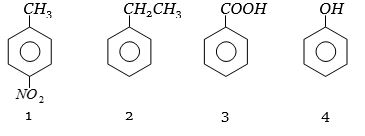
A
$1, 2$ and $4$
B
$1$ and $3$
C
$2$ and $4$
D
$1$ and $2$
Solution
(C) Friedel-Crafts alkylation is an electrophilic aromatic substitution reaction. It occurs readily in benzene rings that are activated by electron-donating groups (e.g.,$-OH$,$-CH_2CH_3$).
$1.$ $p$-Nitrotoluene: The $-NO_2$ group is strongly electron-withdrawing,deactivating the ring.
$2.$ Ethylbenzene: The $-CH_2CH_3$ group is electron-donating,activating the ring.
$3.$ Benzoic acid: The $-COOH$ group is strongly electron-withdrawing,deactivating the ring.
$4.$ Phenol: The $-OH$ group is strongly electron-donating,activating the ring.
Therefore,compounds $2$ and $4$ will undergo Friedel-Crafts alkylation.
$1.$ $p$-Nitrotoluene: The $-NO_2$ group is strongly electron-withdrawing,deactivating the ring.
$2.$ Ethylbenzene: The $-CH_2CH_3$ group is electron-donating,activating the ring.
$3.$ Benzoic acid: The $-COOH$ group is strongly electron-withdrawing,deactivating the ring.
$4.$ Phenol: The $-OH$ group is strongly electron-donating,activating the ring.
Therefore,compounds $2$ and $4$ will undergo Friedel-Crafts alkylation.
0 likes
View Solution14
MediumMCQ
Which of the following compounds does not form phenol or phenoxide upon reaction under standard laboratory conditions?
A
$C_6H_5Cl$
B
$C_6H_5COOH$
C
$C_6H_5N_2Cl$
D
$C_6H_5SO_3Na$
Solution
(B) $C_6H_5Cl$ (Chlorobenzene) forms phenol via the Dow process $(NaOH, 623 \ K, 300 \ atm)$.
$C_6H_5N_2Cl$ (Benzenediazonium chloride) forms phenol upon warming with water $(H_2O/H^+)$.
$C_6H_5SO_3Na$ (Sodium benzenesulfonate) forms sodium phenoxide upon fusion with $NaOH$.
$C_6H_5COOH$ (Benzoic acid) is a carboxylic acid and does not yield phenol or phenoxide under these standard industrial or laboratory conversion methods.
$C_6H_5N_2Cl$ (Benzenediazonium chloride) forms phenol upon warming with water $(H_2O/H^+)$.
$C_6H_5SO_3Na$ (Sodium benzenesulfonate) forms sodium phenoxide upon fusion with $NaOH$.
$C_6H_5COOH$ (Benzoic acid) is a carboxylic acid and does not yield phenol or phenoxide under these standard industrial or laboratory conversion methods.
0 likes
View Solution15
MediumMCQ
When a mixture of ethanol and methanol is heated in the presence of concentrated $H_2SO_4$,the resulting organic product or products is/are:
A
$CH_3OC_2H_5$
B
$CH_3OCH_3$ and $C_2H_5OC_2H_5$
C
$CH_3OC_2H_5$ and $CH_3OCH_3$
D
$CH_3OC_2H_5$,$CH_3OCH_3$ and $C_2H_5OC_2H_5$
Solution
(D) The intermolecular dehydration of alcohols in the presence of concentrated $H_2SO_4$ at $413 \ K$ leads to the formation of ethers.
When a mixture of methanol $(CH_3OH)$ and ethanol $(C_2H_5OH)$ is used,all possible combinations of symmetric and asymmetric ethers are formed:
$1. \ CH_3OH + CH_3OH \xrightarrow{H_2SO_4} CH_3OCH_3 + H_2O$
$2. \ C_2H_5OH + C_2H_5OH \xrightarrow{H_2SO_4} C_2H_5OC_2H_5 + H_2O$
$3. \ CH_3OH + C_2H_5OH \xrightarrow{H_2SO_4} CH_3OC_2H_5 + H_2O$
Thus,the resulting mixture contains $CH_3OC_2H_5$,$CH_3OCH_3$,and $C_2H_5OC_2H_5$.
When a mixture of methanol $(CH_3OH)$ and ethanol $(C_2H_5OH)$ is used,all possible combinations of symmetric and asymmetric ethers are formed:
$1. \ CH_3OH + CH_3OH \xrightarrow{H_2SO_4} CH_3OCH_3 + H_2O$
$2. \ C_2H_5OH + C_2H_5OH \xrightarrow{H_2SO_4} C_2H_5OC_2H_5 + H_2O$
$3. \ CH_3OH + C_2H_5OH \xrightarrow{H_2SO_4} CH_3OC_2H_5 + H_2O$
Thus,the resulting mixture contains $CH_3OC_2H_5$,$CH_3OCH_3$,and $C_2H_5OC_2H_5$.
0 likes
View Solution16
MediumMCQ
Which of the following compounds will evolve hydrogen on treatment with metal?
A
$C_2H_5OH$
B
$CH_3COOH$
C
$(a)$ and $(b)$ both
D
None of these
Solution
(C) Both alcohols and carboxylic acids react with active metals like sodium $(Na)$ to evolve hydrogen gas.
$2C_2H_5OH + 2Na \to 2C_2H_5ONa + H_2 \uparrow$
$2CH_3COOH + 2Na \to 2CH_3COONa + H_2 \uparrow$
Therefore,both $(a)$ and $(b)$ are correct.
$2C_2H_5OH + 2Na \to 2C_2H_5ONa + H_2 \uparrow$
$2CH_3COOH + 2Na \to 2CH_3COONa + H_2 \uparrow$
Therefore,both $(a)$ and $(b)$ are correct.
0 likes
View Solution17
MediumMCQ
Which of the following reactions will yield $2-propanol$? Select the correct answer from $a, b, c$ and $d$.
$I. \, CH_2 = CH - CH_3 + H_2O \xrightarrow{H^+} $
$II. \, CH_3 - CHO \xrightarrow[(ii) \, H_2O]{(i) \, CH_3MgI} $
$III. \, CH_2O \xrightarrow[(ii) \, H_2O]{(i) \, C_2H_5MgI} $
$IV. \, CH_2 = CH - CH_3 \xrightarrow{KMnO_4} $
$I. \, CH_2 = CH - CH_3 + H_2O \xrightarrow{H^+} $
$II. \, CH_3 - CHO \xrightarrow[(ii) \, H_2O]{(i) \, CH_3MgI} $
$III. \, CH_2O \xrightarrow[(ii) \, H_2O]{(i) \, C_2H_5MgI} $
$IV. \, CH_2 = CH - CH_3 \xrightarrow{KMnO_4} $
A
$I$ and $II$
B
$II$ and $III$
C
$III$ and $I$
D
$II$ and $IV$
Solution
(A) $I$. Acid-catalyzed hydration of propene: $CH_2 = CH - CH_3 + H_2O \xrightarrow{H^+} CH_3 - CH(OH) - CH_3$ $(2-propanol)$.
$II$. Reaction of acetaldehyde with methylmagnesium iodide: $CH_3CHO + CH_3MgI$ $\rightarrow CH_3CH(OMgI)CH_3$ $\xrightarrow{H_2O} CH_3CH(OH)CH_3$ $(2-propanol)$.
$III$. Reaction of formaldehyde with ethylmagnesium iodide: $HCHO + C_2H_5MgI$ $\rightarrow C_2H_5CH_2OMgI$ $\xrightarrow{H_2O} C_2H_5CH_2OH$ $(1-propanol)$.
$IV$. Oxidation of propene with $KMnO_4$ yields propane$-1,2-$diol.
Therefore,reactions $I$ and $II$ yield $2-propanol$.
$II$. Reaction of acetaldehyde with methylmagnesium iodide: $CH_3CHO + CH_3MgI$ $\rightarrow CH_3CH(OMgI)CH_3$ $\xrightarrow{H_2O} CH_3CH(OH)CH_3$ $(2-propanol)$.
$III$. Reaction of formaldehyde with ethylmagnesium iodide: $HCHO + C_2H_5MgI$ $\rightarrow C_2H_5CH_2OMgI$ $\xrightarrow{H_2O} C_2H_5CH_2OH$ $(1-propanol)$.
$IV$. Oxidation of propene with $KMnO_4$ yields propane$-1,2-$diol.
Therefore,reactions $I$ and $II$ yield $2-propanol$.
0 likes
View Solution18
MediumMCQ
What will be the order of reactivity of the following alcohols towards concentrated $HCl$?
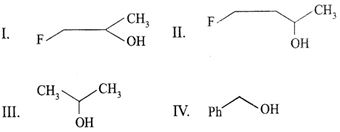
A
$I > II > III > IV$
B
$I > III > II > IV$
C
$IV > III > II > I$
D
$IV > III > I > II$
Solution
(C) Alcohols react with $HX$ or $HCl$ via the cleavage of the $C-OH$ bond,resulting in the formation of a carbocation intermediate. The reactivity of the alcohol is directly proportional to the stability of the carbocation formed.
The carbocations formed from the given alcohols are:
$I. F-CH_2-CH^+-CH_3$ (Secondary carbocation with $-I$ effect of $F$ at $\beta$-position)
$II. F-CH_2-CH_2-CH^+-CH_3$ (Secondary carbocation with $-I$ effect of $F$ at $\gamma$-position)
$III. CH_3-CH^+-CH_3$ (Secondary carbocation)
$IV. Ph-CH_2^+$ (Resonance-stabilized benzylic carbocation)
Carbocation $IV$ is the most stable due to resonance.
In $I$,$II$,and $III$,all are secondary carbocations. The stability is affected by the electron-withdrawing inductive effect ($-I$ effect) of the fluorine atom,which destabilizes the positive charge. The closer the $-I$ group is to the positive charge,the more it destabilizes the carbocation.
Thus,the stability order is $III > II > I$.
Combining these,the overall stability order of the carbocations (and thus the reactivity order of the alcohols) is $IV > III > II > I$.
The carbocations formed from the given alcohols are:
$I. F-CH_2-CH^+-CH_3$ (Secondary carbocation with $-I$ effect of $F$ at $\beta$-position)
$II. F-CH_2-CH_2-CH^+-CH_3$ (Secondary carbocation with $-I$ effect of $F$ at $\gamma$-position)
$III. CH_3-CH^+-CH_3$ (Secondary carbocation)
$IV. Ph-CH_2^+$ (Resonance-stabilized benzylic carbocation)
Carbocation $IV$ is the most stable due to resonance.
In $I$,$II$,and $III$,all are secondary carbocations. The stability is affected by the electron-withdrawing inductive effect ($-I$ effect) of the fluorine atom,which destabilizes the positive charge. The closer the $-I$ group is to the positive charge,the more it destabilizes the carbocation.
Thus,the stability order is $III > II > I$.
Combining these,the overall stability order of the carbocations (and thus the reactivity order of the alcohols) is $IV > III > II > I$.
0 likes
View Solution19
DifficultMCQ
What will be obtained by the hydrolysis of the following compound in aqueous acetone?
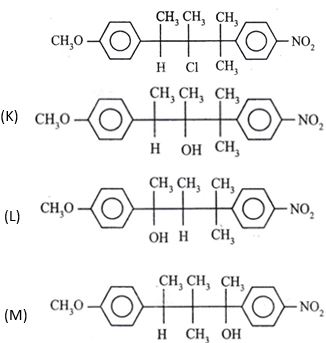
A
$A$ mixture of $(K)$ and $(L)$
B
$A$ mixture of $(K)$ and $(M)$
C
Only $(M)$
D
Only $(K)$
Solution
(A) The hydrolysis of the given compound proceeds via an $S_{N}1$ mechanism involving the formation of a carbocation intermediate.
Upon the loss of the chloride ion,a secondary carbocation is formed.
This carbocation can undergo a $1,2$-hydride shift to form a more stable carbocation,which is stabilized by the electron-donating methoxy group $(-OCH_3)$ on the phenyl ring.
The initial carbocation leads to the formation of product $(K)$ upon attack by water.
The rearranged carbocation leads to the formation of product $(L)$ upon attack by water.
Therefore,a mixture of $(K)$ and $(L)$ is obtained as the final product.
Upon the loss of the chloride ion,a secondary carbocation is formed.
This carbocation can undergo a $1,2$-hydride shift to form a more stable carbocation,which is stabilized by the electron-donating methoxy group $(-OCH_3)$ on the phenyl ring.
The initial carbocation leads to the formation of product $(K)$ upon attack by water.
The rearranged carbocation leads to the formation of product $(L)$ upon attack by water.
Therefore,a mixture of $(K)$ and $(L)$ is obtained as the final product.
0 likes
View Solution20
MediumMCQ
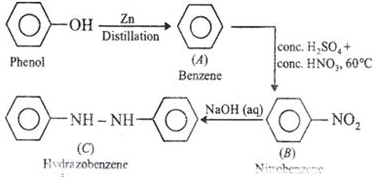
What are the substances $A, B$ and $C$ in the following reaction?
$\text{Phenol}$ $\xrightarrow{Zn} A$ $\xrightarrow[\text{conc. } H_2SO_4]{HNO_3, 60^{\circ}C} B$ $\xrightarrow{Zn, NaOH(aq)} C$
$\text{Phenol}$ $\xrightarrow{Zn} A$ $\xrightarrow[\text{conc. } H_2SO_4]{HNO_3, 60^{\circ}C} B$ $\xrightarrow{Zn, NaOH(aq)} C$
A
Benzene,Nitrobenzene and Aniline
B
Benzene,Dinitrobenzene and $m$-Toluidine
C
Toluene,Nitrobenzene and $m$-Toluidine
D
Benzene,Nitrobenzene and Hydrazobenzene
Solution
(D) $1$. Phenol reacts with $Zn$ dust to form Benzene $(A)$.
$2$. Benzene undergoes nitration with a mixture of conc. $HNO_3$ and conc. $H_2SO_4$ at $60^{\circ}C$ to form Nitrobenzene $(B)$.
$3$. Nitrobenzene on reduction with $Zn$ and $NaOH(aq)$ forms Hydrazobenzene $(C)$.
$2$. Benzene undergoes nitration with a mixture of conc. $HNO_3$ and conc. $H_2SO_4$ at $60^{\circ}C$ to form Nitrobenzene $(B)$.
$3$. Nitrobenzene on reduction with $Zn$ and $NaOH(aq)$ forms Hydrazobenzene $(C)$.
0 likes
View Solution21
MediumMCQ
Which of the following substances does not dissolve in a sodium carbonate solution?
A
$2,4,6-$trinitrophenol
B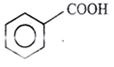
Benzoic acid
C
$2-$nitrophenol
D
Benzenesulfonic acid
Solution
(C) substance will dissolve in a sodium carbonate $(Na_2CO_3)$ solution if it is a stronger acid than carbonic acid $(H_2CO_3)$.
Benzoic acid $(pK_a \approx 4.2)$ and benzenesulfonic acid $(pK_a < 0)$ are stronger acids than carbonic acid $(pK_a \approx 6.35)$,so they dissolve.
$2$,$4$,$6$-trinitrophenol (picric acid) is also a strong acid $(pK_a \approx 0.38)$ and dissolves in $Na_2CO_3$.
$2$-nitrophenol is a weaker acid $(pK_a \approx 7.2)$ than carbonic acid due to intramolecular hydrogen bonding,which makes it less acidic and prevents it from reacting with sodium carbonate to form a soluble salt.
Benzoic acid $(pK_a \approx 4.2)$ and benzenesulfonic acid $(pK_a < 0)$ are stronger acids than carbonic acid $(pK_a \approx 6.35)$,so they dissolve.
$2$,$4$,$6$-trinitrophenol (picric acid) is also a strong acid $(pK_a \approx 0.38)$ and dissolves in $Na_2CO_3$.
$2$-nitrophenol is a weaker acid $(pK_a \approx 7.2)$ than carbonic acid due to intramolecular hydrogen bonding,which makes it less acidic and prevents it from reacting with sodium carbonate to form a soluble salt.
0 likes
View Solution22
MediumMCQ
What is the order of acidic strength for the following compounds?
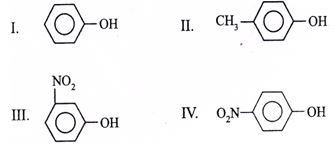
A
$II < I < III < IV$
B
$I < IV < III < II$
C
$II < I < IV < III$
D
$IV < III < I < II$
Solution
(D) The acidic strength of phenols depends on the nature of the substituent attached to the benzene ring.
$-NO_2$ is an electron-withdrawing group $(EWG)$,which increases acidic strength by stabilizing the phenoxide ion through $-I$ and $-M$ effects.
$-CH_3$ is an electron-donating group $(EDG)$,which decreases acidic strength by destabilizing the phenoxide ion through $+I$ and hyperconjugation effects.
Comparing the compounds:
$IV$ ($p$-nitrophenol) has the strongest $-M$ effect from the $-NO_2$ group at the para position.
$III$ ($m$-nitrophenol) has only the $-I$ effect from the $-NO_2$ group.
$I$ is phenol itself.
$II$ ($p$-cresol) has the $+I$ effect from the $-CH_3$ group.
Thus,the correct order of acidic strength is $IV > III > I > II$.
$-NO_2$ is an electron-withdrawing group $(EWG)$,which increases acidic strength by stabilizing the phenoxide ion through $-I$ and $-M$ effects.
$-CH_3$ is an electron-donating group $(EDG)$,which decreases acidic strength by destabilizing the phenoxide ion through $+I$ and hyperconjugation effects.
Comparing the compounds:
$IV$ ($p$-nitrophenol) has the strongest $-M$ effect from the $-NO_2$ group at the para position.
$III$ ($m$-nitrophenol) has only the $-I$ effect from the $-NO_2$ group.
$I$ is phenol itself.
$II$ ($p$-cresol) has the $+I$ effect from the $-CH_3$ group.
Thus,the correct order of acidic strength is $IV > III > I > II$.
0 likes
View Solution23
DifficultMCQ
What will be the product $A$?
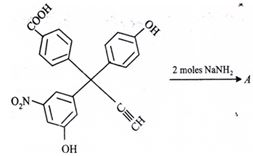
A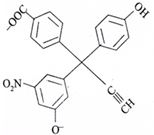
B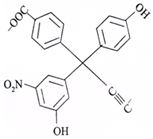
C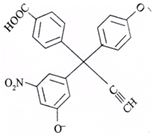
D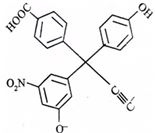
Solution
$(A)$ The acidic strength of the functional groups present in the molecule follows the order: $-COOH > \text{phenolic } -OH > \text{terminal alkyne } (-C \equiv CH)$.
Given that $2 \text{ moles}$ of $NaNH_2$ are used, $NaNH_2$ is a strong base that will deprotonate the two most acidic protons.
The most acidic proton is the carboxylic acid proton $(-COOH)$, followed by the phenolic $-OH$ group (specifically the one activated by the electron-withdrawing $-NO_2$ group).
Therefore, the $-COOH$ group becomes $-COO^-$ and the phenolic $-OH$ group (ortho to $-NO_2$) becomes $-O^-$. The terminal alkyne and the other phenolic $-OH$ remain unchanged. This corresponds to option $A$.
Given that $2 \text{ moles}$ of $NaNH_2$ are used, $NaNH_2$ is a strong base that will deprotonate the two most acidic protons.
The most acidic proton is the carboxylic acid proton $(-COOH)$, followed by the phenolic $-OH$ group (specifically the one activated by the electron-withdrawing $-NO_2$ group).
Therefore, the $-COOH$ group becomes $-COO^-$ and the phenolic $-OH$ group (ortho to $-NO_2$) becomes $-O^-$. The terminal alkyne and the other phenolic $-OH$ remain unchanged. This corresponds to option $A$.
0 likes
View Solution24
MediumMCQ
When phenol is treated with $CHCl_3$ and $NaOH$ followed by acidification,salicylaldehyde is produced. Which of the following intermediates is involved in the above reaction?
A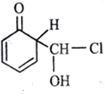
B
C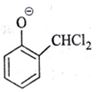
D
Both $(B)$ and $(C)$
Solution
(D) The reaction described is the Reimer-Tiemann reaction.
$1$. First,$CHCl_3$ reacts with $OH^-$ to generate the electrophile dichlorocarbene,$:CCl_2$.
$2$. The phenoxide ion attacks the dichlorocarbene to form a cyclohexadienyl anion intermediate,which is represented by structure $(B)$.
$3$. This intermediate undergoes a proton shift to form the ortho-dichloromethyl phenoxide ion,which is represented by structure $(C)$.
$4$. Therefore,both $(B)$ and $(C)$ are intermediates involved in the mechanism of the Reimer-Tiemann reaction.
$1$. First,$CHCl_3$ reacts with $OH^-$ to generate the electrophile dichlorocarbene,$:CCl_2$.
$2$. The phenoxide ion attacks the dichlorocarbene to form a cyclohexadienyl anion intermediate,which is represented by structure $(B)$.
$3$. This intermediate undergoes a proton shift to form the ortho-dichloromethyl phenoxide ion,which is represented by structure $(C)$.
$4$. Therefore,both $(B)$ and $(C)$ are intermediates involved in the mechanism of the Reimer-Tiemann reaction.
0 likes
View Solution25
DifficultMCQ
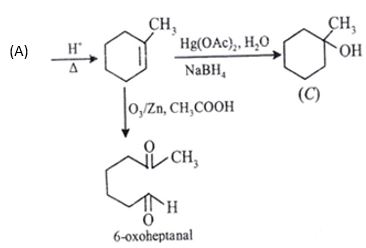
Identify $A$ in the following reaction.
A
$2-$methylcyclohexanol
B
$1-$methylcyclohexanol
C
$3-$methylcyclohexanol
D
$4-$methylcyclohexanol
Solution
(A) The reaction sequence shows that $A$ undergoes acid-catalyzed dehydration $(H^+, \Delta)$ to form $1$-methylcyclohexene.
Ozonolysis of $1$-methylcyclohexene $(O_3/Zn, CH_3COOH)$ yields $6$-oxoheptanal,which confirms the structure of the alkene.
Acid-catalyzed dehydration of $2$-methylcyclohexanol gives $1$-methylcyclohexene as the major product according to Zaitsev's rule.
Therefore,$A$ is $2$-methylcyclohexanol.
Ozonolysis of $1$-methylcyclohexene $(O_3/Zn, CH_3COOH)$ yields $6$-oxoheptanal,which confirms the structure of the alkene.
Acid-catalyzed dehydration of $2$-methylcyclohexanol gives $1$-methylcyclohexene as the major product according to Zaitsev's rule.
Therefore,$A$ is $2$-methylcyclohexanol.
0 likes
View Solution26
MediumMCQ
Which of the following compounds will give a tribromo derivative upon reaction with bromine water?
A
$m$-cresol
B
Benzyl alcohol
C
$o$-cresol
D
$p$-cresol
Solution
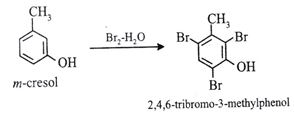
(A) The reaction of phenols with bromine water is an electrophilic aromatic substitution reaction. The $-OH$ group is a strong activating group and directs the incoming electrophile $(Br^+)$ to the ortho and para positions.
For a compound to form a tribromo derivative,it must have both ortho positions and the para position relative to the $-OH$ group vacant.
In $m$-cresol ($3$-methylphenol),the $-OH$ group is at position $1$ and the $-CH_3$ group is at position $3$. The positions $2$,$4$,and $6$ are vacant and available for electrophilic substitution.
Thus,$m$-cresol reacts with bromine water to form $2,4,6$-tribromo-$3$-methylphenol.
Other options ($o$-cresol and $p$-cresol) have one of the ortho or para positions blocked by the $-CH_3$ group,preventing the formation of a tribromo derivative.
For a compound to form a tribromo derivative,it must have both ortho positions and the para position relative to the $-OH$ group vacant.
In $m$-cresol ($3$-methylphenol),the $-OH$ group is at position $1$ and the $-CH_3$ group is at position $3$. The positions $2$,$4$,and $6$ are vacant and available for electrophilic substitution.
Thus,$m$-cresol reacts with bromine water to form $2,4,6$-tribromo-$3$-methylphenol.
Other options ($o$-cresol and $p$-cresol) have one of the ortho or para positions blocked by the $-CH_3$ group,preventing the formation of a tribromo derivative.
0 likes
View Solution27
MediumMCQ
What is the increasing order of reactivity of the following alkyl halides in the Williamson synthesis?
$I. \, CH_2 = CHCH_2Cl$
$II. \, CH_3CH_2CH_2Br$
$III. \, (CH_3)_3CCH_2Br$
$IV. \, CH_3CH_2CH_2Cl$
$I. \, CH_2 = CHCH_2Cl$
$II. \, CH_3CH_2CH_2Br$
$III. \, (CH_3)_3CCH_2Br$
$IV. \, CH_3CH_2CH_2Cl$
A
$III < IV < II < I$
B
$III < II < IV < I$
C
$IV < III < II < I$
D
$III < IV < I < II$
Solution
(A) Williamson synthesis proceeds via an $S_N2$ mechanism. The reactivity of alkyl halides in $S_N2$ reactions depends on steric hindrance and the nature of the leaving group.
$1$. Steric hindrance: Primary $(1^o)$ halides are more reactive than bulky ones. $III$ is a neopentyl bromide,which is highly sterically hindered,making it the least reactive.
$2$. Leaving group: Bromide $(Br^-)$ is a better leaving group than chloride $(Cl^-)$.
$3$. Allylic effect: Allyl halides $(I)$ are highly reactive in $S_N2$ reactions due to the resonance stabilization of the transition state.
Comparing the given compounds:
- $I$ $(CH_2=CHCH_2Cl)$: Allylic halide (highly reactive).
- $II$ $(CH_3CH_2CH_2Br)$: $1^o$ bromide (good leaving group).
- $IV$ $(CH_3CH_2CH_2Cl)$: $1^o$ chloride (poorer leaving group than $Br^-$).
- $III$ $((CH_3)_3CCH_2Br)$: Sterically hindered $1^o$ bromide (neopentyl).
The order of reactivity is $III < IV < II < I$.
$1$. Steric hindrance: Primary $(1^o)$ halides are more reactive than bulky ones. $III$ is a neopentyl bromide,which is highly sterically hindered,making it the least reactive.
$2$. Leaving group: Bromide $(Br^-)$ is a better leaving group than chloride $(Cl^-)$.
$3$. Allylic effect: Allyl halides $(I)$ are highly reactive in $S_N2$ reactions due to the resonance stabilization of the transition state.
Comparing the given compounds:
- $I$ $(CH_2=CHCH_2Cl)$: Allylic halide (highly reactive).
- $II$ $(CH_3CH_2CH_2Br)$: $1^o$ bromide (good leaving group).
- $IV$ $(CH_3CH_2CH_2Cl)$: $1^o$ chloride (poorer leaving group than $Br^-$).
- $III$ $((CH_3)_3CCH_2Br)$: Sterically hindered $1^o$ bromide (neopentyl).
The order of reactivity is $III < IV < II < I$.
0 likes
View Solution28
MediumMCQ
Which of the following substances releases hydrogen gas upon reacting with $Na$ metal?
A
$C_2H_5OH$
B
$CH_3COOH$
C
Both $A$ and $B$
D
None of these
Solution
(C) Both $C_2H_5OH$ (ethanol) and $CH_3COOH$ (acetic acid) contain an acidic hydrogen atom attached to an oxygen atom.
When these substances react with sodium $(Na)$ metal,they undergo a displacement reaction to release hydrogen gas $(H_2)$:
$2C_2H_5OH + 2Na \rightarrow 2C_2H_5ONa + H_2 \uparrow$
$2CH_3COOH + 2Na \rightarrow 2CH_3COONa + H_2 \uparrow$
When these substances react with sodium $(Na)$ metal,they undergo a displacement reaction to release hydrogen gas $(H_2)$:
$2C_2H_5OH + 2Na \rightarrow 2C_2H_5ONa + H_2 \uparrow$
$2CH_3COOH + 2Na \rightarrow 2CH_3COONa + H_2 \uparrow$
0 likes
View Solution29
MediumMCQ
What will be the composition of the resulting solution when ethyl acetate is mixed with aqueous sodium chloride?
A
$CH_3COOC_2H_5 + NaCl$
B
$CH_3Cl + C_2H_5COONa$
C
$CH_3COCl + C_2H_5OH + NaOH$
D
$CH_3COONa + C_2H_5OH$
Solution
(A) Ethyl acetate is an ester. Esters are generally stable in neutral aqueous solutions. Aqueous $NaCl$ is a neutral salt solution and does not act as a strong nucleophile or catalyst to hydrolyze the ester under standard conditions. Therefore,no chemical reaction occurs,and the composition remains $CH_3COOC_2H_5 + NaCl$.
0 likes
View Solution30
MediumMCQ
Which of the following reactions will produce a primary alcohol?
A
Hydration of propene in the presence of dilute sulphuric acid
B
Reaction of propene with borane followed by water
C
Reaction of propanone with methyl magnesium bromide followed by hydrolysis
D
Catalytic reduction of butanal
Solution
(B, D) $1$. Hydration of propene $(CH_3-CH=CH_2)$ with dilute $H_2SO_4$ follows Markovnikov's rule to give propan$-2-$ol (secondary alcohol).
$2$. Hydroboration-oxidation of propene $(CH_3-CH=CH_2)$ with $BH_3$ followed by $H_2O_2/OH^-$ follows anti-Markovnikov's rule to give propan$-1-$ol (primary alcohol).
$3$. Reaction of propanone $(CH_3COCH_3)$ with $CH_3MgBr$ followed by hydrolysis gives $2-$methylpropan$-2-$ol (tertiary alcohol).
$4$. Catalytic reduction of butanal $(CH_3CH_2CH_2CHO)$ with $H_2/Ni$ gives butan$-1-$ol (primary alcohol).
Both options $B$ and $D$ produce primary alcohols. However,in standard multiple-choice contexts where only one is expected,both are chemically valid. Given the phrasing,both are correct.
$2$. Hydroboration-oxidation of propene $(CH_3-CH=CH_2)$ with $BH_3$ followed by $H_2O_2/OH^-$ follows anti-Markovnikov's rule to give propan$-1-$ol (primary alcohol).
$3$. Reaction of propanone $(CH_3COCH_3)$ with $CH_3MgBr$ followed by hydrolysis gives $2-$methylpropan$-2-$ol (tertiary alcohol).
$4$. Catalytic reduction of butanal $(CH_3CH_2CH_2CHO)$ with $H_2/Ni$ gives butan$-1-$ol (primary alcohol).
Both options $B$ and $D$ produce primary alcohols. However,in standard multiple-choice contexts where only one is expected,both are chemically valid. Given the phrasing,both are correct.
0 likes
View Solution31
MediumMCQ
The solubility of anhydrous $AlCl_3$ and hydrous $AlCl_3$ in diethyl ether are $S_1$ and $S_2$ respectively. Then:
A
$S_1 = S_2$
B
$S_1 > S_2$
C
$S_1 < S_2$
D
$S_1 < S_1$ but not $S_1 = S_2$
Solution
(B) Anhydrous $AlCl_3$ is a strong Lewis acid and is electron-deficient.
It readily dissolves in diethyl ether because the lone pairs of electrons on the oxygen atom of diethyl ether are donated to the $Al$ atom of $AlCl_3$,forming a coordinate bond.
In contrast,hydrous $AlCl_3$ (usually $AlCl_3 \cdot 6H_2O$) contains water molecules already coordinated to the $Al^{3+}$ ion,which satisfies its electron deficiency and makes it a much weaker Lewis acid.
Therefore,the solubility of anhydrous $AlCl_3$ $(S_1)$ is significantly higher than that of hydrous $AlCl_3$ $(S_2)$.
Thus,$S_1 > S_2$.
It readily dissolves in diethyl ether because the lone pairs of electrons on the oxygen atom of diethyl ether are donated to the $Al$ atom of $AlCl_3$,forming a coordinate bond.
In contrast,hydrous $AlCl_3$ (usually $AlCl_3 \cdot 6H_2O$) contains water molecules already coordinated to the $Al^{3+}$ ion,which satisfies its electron deficiency and makes it a much weaker Lewis acid.
Therefore,the solubility of anhydrous $AlCl_3$ $(S_1)$ is significantly higher than that of hydrous $AlCl_3$ $(S_2)$.
Thus,$S_1 > S_2$.
0 likes
View Solution32
DifficultMCQ
If the starting material is $1-$methyl$-1,2-$epoxycyclopentane,determine which compound correctly represents the product of its reaction with sodium methoxide in methanol.
A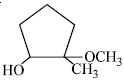
B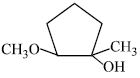
C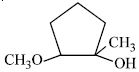
D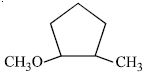
Solution
(B) The reaction of $1-$methyl$-1,2-$epoxycyclopentane with sodium methoxide $(CH_3ONa)$ in methanol $(CH_3OH)$ is a nucleophilic ring-opening reaction of an epoxide under basic conditions.
In basic conditions,the nucleophile $(CH_3O^-)$ attacks the less sterically hindered carbon atom of the epoxide ring.
In $1-$methyl$-1,2-$epoxycyclopentane,the two carbons of the epoxide are the $C1$ (which is tertiary,attached to a methyl group) and $C2$ (which is secondary).
The nucleophile $(CH_3O^-)$ will attack the less hindered $C2$ position.
This leads to the opening of the epoxide ring,where the oxygen atom remains attached to the $C1$ position and becomes a hydroxyl group $(-OH)$ after protonation,while the methoxy group $(-OCH_3)$ attaches to the $C2$ position.
The resulting product is $2-$methoxy$-2-$methylcyclopentan$-1-$ol,where the $-OCH_3$ and $-OH$ groups are in a trans-configuration relative to each other.
In basic conditions,the nucleophile $(CH_3O^-)$ attacks the less sterically hindered carbon atom of the epoxide ring.
In $1-$methyl$-1,2-$epoxycyclopentane,the two carbons of the epoxide are the $C1$ (which is tertiary,attached to a methyl group) and $C2$ (which is secondary).
The nucleophile $(CH_3O^-)$ will attack the less hindered $C2$ position.
This leads to the opening of the epoxide ring,where the oxygen atom remains attached to the $C1$ position and becomes a hydroxyl group $(-OH)$ after protonation,while the methoxy group $(-OCH_3)$ attaches to the $C2$ position.
The resulting product is $2-$methoxy$-2-$methylcyclopentan$-1-$ol,where the $-OCH_3$ and $-OH$ groups are in a trans-configuration relative to each other.
0 likes
View Solution33
DifficultMCQ
Oxalic acid + $A \rightarrow$ Glycerol monooxalate. If $A \xrightarrow{conc.\,H_2SO_4} B$,then $B$ is:

A
B
C
$HO-CH_2-O-CH_2-OH$
D
Acrolein $(CH_2=CH-CHO)$
Solution
(D) Oxalic acid reacts with glycerol to form glycerol monooxalate. Thus,$A$ is glycerol $(CH_2OH-CHOH-CH_2OH)$.
When glycerol $(A)$ is heated with $conc.\,H_2SO_4$,it undergoes dehydration to produce acrolein $(CH_2=CH-CHO)$.
Therefore,$B$ is acrolein.
When glycerol $(A)$ is heated with $conc.\,H_2SO_4$,it undergoes dehydration to produce acrolein $(CH_2=CH-CHO)$.
Therefore,$B$ is acrolein.
0 likes
View Solution34
AdvancedMCQ
Identify the reaction schemes $A, B, C$ for the conversion of vinylcyclohexane to the respective alcohols,given the following methods:
$I-$ Acid-catalyzed hydration
$II-$ Hydroboration-oxidation $(HBO)$
$III-$ Oxymercuration-demercuration
$I-$ Acid-catalyzed hydration
$II-$ Hydroboration-oxidation $(HBO)$
$III-$ Oxymercuration-demercuration
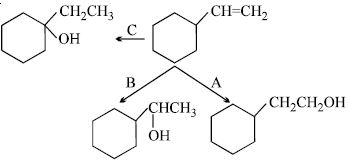
A
$I$ in all cases
B
$I, II, III$
C
$II, III, I$
D
$III, I, II$
Solution
(C) The starting material is vinylcyclohexane. Let's analyze the products:
$1$. Product $A$ is $2$-cyclohexylethanol,which is an anti-Markovnikov product. This is formed by hydroboration-oxidation $(II)$.
$2$. Product $B$ is $1$-cyclohexylethanol,which is a Markovnikov product formed without rearrangement. This is characteristic of oxymercuration-demercuration $(III)$.
$3$. Product $C$ is $1$-ethyl$-1-$cyclohexanol,which is a Markovnikov product formed via rearrangement (carbocation intermediate). This is characteristic of acid-catalyzed hydration $(I)$.
Therefore,the sequence $A, B, C$ corresponds to $II, III, I$.
$1$. Product $A$ is $2$-cyclohexylethanol,which is an anti-Markovnikov product. This is formed by hydroboration-oxidation $(II)$.
$2$. Product $B$ is $1$-cyclohexylethanol,which is a Markovnikov product formed without rearrangement. This is characteristic of oxymercuration-demercuration $(III)$.
$3$. Product $C$ is $1$-ethyl$-1-$cyclohexanol,which is a Markovnikov product formed via rearrangement (carbocation intermediate). This is characteristic of acid-catalyzed hydration $(I)$.
Therefore,the sequence $A, B, C$ corresponds to $II, III, I$.
0 likes
View Solution35
AdvancedMCQ
$A$ $\xleftarrow{CH_3OH, CH_3O^{-}}$ ($1$-methyl$-6-$oxabicyclo[$3.1$.$0$]hexane) $\xrightarrow{CH_3OH, H_2SO_4}$ $B$
$A$ $\&$ $B$ are :
$A$ $\&$ $B$ are :
A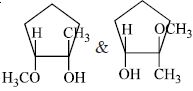
B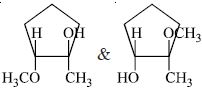
C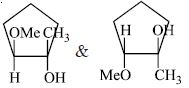
D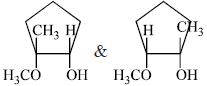
Solution
(A) The starting material is $1$-methyl-$6$-oxabicyclo$[3.1.0]$hexane.
$1$. Reaction with $CH_3OH/CH_3O^{-}$ (Basic medium): This is an $S_N2$ reaction. The nucleophile $CH_3O^{-}$ attacks the less sterically hindered carbon (the $CH_2$ group of the epoxide ring). This results in the opening of the epoxide ring with the $OCH_3$ group at the less substituted carbon and the $OH$ group at the more substituted carbon (tertiary carbon).
$2$. Reaction with $CH_3OH/H_2SO_4$ (Acidic medium): This is an $S_N1$-like reaction. The epoxide oxygen is protonated,making the ring carbons more electrophilic. The more substituted carbon (tertiary carbon) can better stabilize the partial positive charge in the transition state. Therefore,the nucleophile $CH_3OH$ attacks the more substituted carbon,resulting in the $OCH_3$ group at the tertiary carbon and the $OH$ group at the less substituted carbon.
$1$. Reaction with $CH_3OH/CH_3O^{-}$ (Basic medium): This is an $S_N2$ reaction. The nucleophile $CH_3O^{-}$ attacks the less sterically hindered carbon (the $CH_2$ group of the epoxide ring). This results in the opening of the epoxide ring with the $OCH_3$ group at the less substituted carbon and the $OH$ group at the more substituted carbon (tertiary carbon).
$2$. Reaction with $CH_3OH/H_2SO_4$ (Acidic medium): This is an $S_N1$-like reaction. The epoxide oxygen is protonated,making the ring carbons more electrophilic. The more substituted carbon (tertiary carbon) can better stabilize the partial positive charge in the transition state. Therefore,the nucleophile $CH_3OH$ attacks the more substituted carbon,resulting in the $OCH_3$ group at the tertiary carbon and the $OH$ group at the less substituted carbon.
0 likes
View Solution36
DifficultMCQ
In the given diol,which of the following statements is correct regarding the acidity of the hydroxyl groups at $C_2$ and $C_5$?
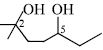
A
$OH$ at $C_2$ is more basic than that at $C_5$
B
$OH$ at $C_2$ is more acidic than at $C_5$
C
Both have the same basicity
D
Both have the same acidic strength
Solution
(A) The acidity of an alcohol depends on the stability of the resulting alkoxide ion.
$C_2$ is a tertiary $(3^{\circ})$ carbon,while $C_5$ is a secondary $(2^{\circ})$ carbon.
In the $OH$ group at $C_2$,the electron-donating inductive effect ($+I$ effect) of the three alkyl groups attached to $C_2$ destabilizes the negative charge on the oxygen atom of the alkoxide ion.
In contrast,the $OH$ group at $C_5$ is attached to a secondary carbon,which has a weaker $+I$ effect compared to the tertiary carbon.
Therefore,the alkoxide ion formed from the $OH$ at $C_5$ is more stable than the one formed from the $OH$ at $C_2$.
Since greater stability of the conjugate base implies higher acidity,the $OH$ group at $C_5$ is more acidic than the $OH$ group at $C_2$.
Conversely,the $OH$ group at $C_2$ is more basic than the $OH$ group at $C_5$ because the conjugate base of the $C_2$ alcohol is less stable and thus more reactive (more basic).
$C_2$ is a tertiary $(3^{\circ})$ carbon,while $C_5$ is a secondary $(2^{\circ})$ carbon.
In the $OH$ group at $C_2$,the electron-donating inductive effect ($+I$ effect) of the three alkyl groups attached to $C_2$ destabilizes the negative charge on the oxygen atom of the alkoxide ion.
In contrast,the $OH$ group at $C_5$ is attached to a secondary carbon,which has a weaker $+I$ effect compared to the tertiary carbon.
Therefore,the alkoxide ion formed from the $OH$ at $C_5$ is more stable than the one formed from the $OH$ at $C_2$.
Since greater stability of the conjugate base implies higher acidity,the $OH$ group at $C_5$ is more acidic than the $OH$ group at $C_2$.
Conversely,the $OH$ group at $C_2$ is more basic than the $OH$ group at $C_5$ because the conjugate base of the $C_2$ alcohol is less stable and thus more reactive (more basic).
0 likes
View Solution37
AdvancedMCQ
Identify product $B$ in the following reaction sequence:
$(CH_3)_2C=C(CH_3)_2$ $\xrightarrow{X_2, H_2O} A$ $\xrightarrow{OH^{-}} B$
$(CH_3)_2C=C(CH_3)_2$ $\xrightarrow{X_2, H_2O} A$ $\xrightarrow{OH^{-}} B$
A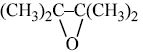
B
$(CH_3)_2C(OH)-C(Cl)(CH_3)_2$
C
$(CH_3)_2C(OH)-C(OH)(CH_3)_2$
D
None
Solution
(A) The reaction of $2,3$-dimethyl-$2$-butene with $X_2$ and $H_2O$ forms a halohydrin $(A)$,which is $(CH_3)_2C(OH)-C(X)(CH_3)_2$.
Subsequent treatment of the halohydrin with a base $(OH^{-})$ results in an intramolecular nucleophilic substitution $(S_N2)$,leading to the formation of an epoxide $(B)$.
The product $B$ is $2,2,3,3$-tetramethyloxirane,which is represented by the structure shown in option $A$.
Subsequent treatment of the halohydrin with a base $(OH^{-})$ results in an intramolecular nucleophilic substitution $(S_N2)$,leading to the formation of an epoxide $(B)$.
The product $B$ is $2,2,3,3$-tetramethyloxirane,which is represented by the structure shown in option $A$.

0 likes
View Solution38
AdvancedMCQ
Based on the provided reaction scheme,determine the total number of stereoisomers of $B$.
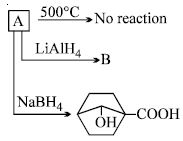
A
$2$
B
$4$
C
$3$
D
$6$
Solution
(A) The reaction scheme shows that compound $A$ reacts with $NaBH_4$ to form a hydroxy-acid derivative. Since $NaBH_4$ reduces ketones but not carboxylic acids,$A$ must be a keto-acid. The product of $NaBH_4$ reduction is a hydroxy-acid with a bicyclic structure.
$LiAlH_4$ is a stronger reducing agent that reduces both the ketone and the carboxylic acid group to alcohols.
Thus,$B$ is a diol with the structure of a bicyclo[$2.2$.$1$]heptane derivative containing two hydroxyl groups.
Specifically,the reduction of the keto-acid yields a diol where the two hydroxyl groups are attached to the bicyclic framework.
This structure contains two chiral centers at the bridgehead or substituted carbons.
For a bicyclic system with two chiral centers,the number of stereoisomers is $2^n$,where $n$ is the number of chiral centers.
Given the rigid bicyclic geometry,there are $2$ possible stereoisomers (the $cis$ and $trans$ forms relative to the bridge).
$LiAlH_4$ is a stronger reducing agent that reduces both the ketone and the carboxylic acid group to alcohols.
Thus,$B$ is a diol with the structure of a bicyclo[$2.2$.$1$]heptane derivative containing two hydroxyl groups.
Specifically,the reduction of the keto-acid yields a diol where the two hydroxyl groups are attached to the bicyclic framework.
This structure contains two chiral centers at the bridgehead or substituted carbons.
For a bicyclic system with two chiral centers,the number of stereoisomers is $2^n$,where $n$ is the number of chiral centers.
Given the rigid bicyclic geometry,there are $2$ possible stereoisomers (the $cis$ and $trans$ forms relative to the bridge).
0 likes
View Solution39
AdvancedMCQ
What is the major organic product of the following reaction?
(Image of $2-$methyl$-2,3-$dihydrobenzofuran with an $^{18}O$ atom in the ring,reacting with $H_3O^+$)
(Image of $2-$methyl$-2,3-$dihydrobenzofuran with an $^{18}O$ atom in the ring,reacting with $H_3O^+$)
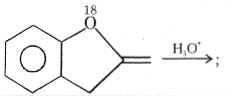
A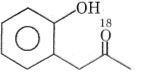
B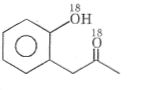
C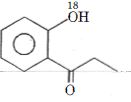
D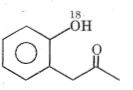
Solution
(B) The reaction involves the acid-catalyzed ring opening of a cyclic ether (dihydrobenzofuran derivative).
$1$. Protonation of the ether oxygen $(^{18}O)$ occurs first.
$2$. The bond between the oxygen and the more substituted carbon (the benzylic carbon) breaks to form a stable carbocation intermediate (stabilized by the benzene ring).
$3$. Water attacks the carbocation,followed by deprotonation to form the alcohol.
$4$. The $^{18}O$ atom remains attached to the carbon that was part of the ring,which becomes the hydroxyl group in the final product.
Therefore,the product is $2-$($2$-hydroxyethyl)phenol where the $^{18}O$ is part of the $-OH$ group.
$1$. Protonation of the ether oxygen $(^{18}O)$ occurs first.
$2$. The bond between the oxygen and the more substituted carbon (the benzylic carbon) breaks to form a stable carbocation intermediate (stabilized by the benzene ring).
$3$. Water attacks the carbocation,followed by deprotonation to form the alcohol.
$4$. The $^{18}O$ atom remains attached to the carbon that was part of the ring,which becomes the hydroxyl group in the final product.
Therefore,the product is $2-$($2$-hydroxyethyl)phenol where the $^{18}O$ is part of the $-OH$ group.
0 likes
View Solution40
MediumMCQ
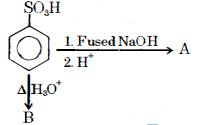
In the given reaction sequence,identify the correct reagents to prepare $A$ from $B$. The starting material is benzenesulfonic acid. The reaction with $\Delta / H_3O^+$ yields $B$ (benzene),and the reaction with $1. \text{Fused } NaOH, 2. H^+$ yields $A$ (phenol). Therefore,to prepare $A$ (phenol) from $B$ (benzene),the correct sequence of reagents is:
A
$Cl_2 / AlCl_3 ; Mg(THF) ; O_2 / H^{+}$
B
$HNO_3 + H_2SO_4 ; Sn + HCl ; NaNO_2 + HCl ; \text{Steam}$
C
$CH_3-CH=CH_2 / H^{+} ; O_2 / hv ; H^{+}$
D
All of these
Solution
(D) The starting material is benzenesulfonic acid.
$1$. Reaction with $\Delta / H_3O^+$ (desulfonation) gives $B$ which is benzene $(C_6H_6)$.
$2$. Reaction with $1. \text{Fused } NaOH, 2. H^+$ gives $A$ which is phenol $(C_6H_5OH)$.
$3$. We need to convert benzene $(B)$ to phenol $(A)$.
Option $A$: Benzene $\xrightarrow{Cl_2/AlCl_3}$ Chlorobenzene $\xrightarrow{Mg/THF}$ Phenylmagnesium chloride $\xrightarrow{O_2/H^+}$ Phenol. This is correct.
Option $B$: Benzene $\xrightarrow{HNO_3/H_2SO_4}$ Nitrobenzene $\xrightarrow{Sn/HCl}$ Aniline $\xrightarrow{NaNO_2/HCl}$ Benzenediazonium chloride $\xrightarrow{\text{Steam}}$ Phenol. This is correct.
Option $C$: Benzene $\xrightarrow{CH_3-CH=CH_2/H^+}$ Cumene $\xrightarrow{O_2/hv}$ Cumene hydroperoxide $\xrightarrow{H^+}$ Phenol. This is correct.
Since all sequences lead to the formation of phenol from benzene,the correct option is $D$.
$1$. Reaction with $\Delta / H_3O^+$ (desulfonation) gives $B$ which is benzene $(C_6H_6)$.
$2$. Reaction with $1. \text{Fused } NaOH, 2. H^+$ gives $A$ which is phenol $(C_6H_5OH)$.
$3$. We need to convert benzene $(B)$ to phenol $(A)$.
Option $A$: Benzene $\xrightarrow{Cl_2/AlCl_3}$ Chlorobenzene $\xrightarrow{Mg/THF}$ Phenylmagnesium chloride $\xrightarrow{O_2/H^+}$ Phenol. This is correct.
Option $B$: Benzene $\xrightarrow{HNO_3/H_2SO_4}$ Nitrobenzene $\xrightarrow{Sn/HCl}$ Aniline $\xrightarrow{NaNO_2/HCl}$ Benzenediazonium chloride $\xrightarrow{\text{Steam}}$ Phenol. This is correct.
Option $C$: Benzene $\xrightarrow{CH_3-CH=CH_2/H^+}$ Cumene $\xrightarrow{O_2/hv}$ Cumene hydroperoxide $\xrightarrow{H^+}$ Phenol. This is correct.
Since all sequences lead to the formation of phenol from benzene,the correct option is $D$.
0 likes
View Solution41
DifficultMCQ
Cyclohexanol and phenol can be distinguished by
A
$Br_2/H_2O$
B
Neutral $FeCl_3$
C
$PhN_2^+ Cl^-$
D
All of these
Solution
(D) Phenol is an aromatic compound with an acidic hydroxyl group,while cyclohexanol is an aliphatic cyclic alcohol.
$1$. $Br_2/H_2O$: Phenol reacts with bromine water to form a white precipitate of $2,4,6$-tribromophenol,whereas cyclohexanol does not show this reaction.
$2$. Neutral $FeCl_3$: Phenol gives a characteristic violet color with neutral $FeCl_3$ due to the formation of a complex,while cyclohexanol does not.
$3$. $PhN_2^+ Cl^-$: Phenol undergoes a coupling reaction with benzene diazonium chloride in a basic medium to form an azo dye (orange-red),while cyclohexanol does not.
Since all three reagents can distinguish between them,the correct answer is $D$.
$1$. $Br_2/H_2O$: Phenol reacts with bromine water to form a white precipitate of $2,4,6$-tribromophenol,whereas cyclohexanol does not show this reaction.
$2$. Neutral $FeCl_3$: Phenol gives a characteristic violet color with neutral $FeCl_3$ due to the formation of a complex,while cyclohexanol does not.
$3$. $PhN_2^+ Cl^-$: Phenol undergoes a coupling reaction with benzene diazonium chloride in a basic medium to form an azo dye (orange-red),while cyclohexanol does not.
Since all three reagents can distinguish between them,the correct answer is $D$.
0 likes
View Solution42
DifficultMCQ
What is $Z$ in the following sequence of reaction?
$Z$ $\xrightarrow{PCl_5} X$ $\xrightarrow{Alc. KOH} Y$ $\xrightarrow{dil. H_2SO_4} Z$
$Z$ $\xrightarrow{PCl_5} X$ $\xrightarrow{Alc. KOH} Y$ $\xrightarrow{dil. H_2SO_4} Z$
A
$CH_3-CH_2-CH_2-OH$
B
$CH_3-CH(OH)-CH_3$
C
$CH_3-CH_2-CH(OH)-CH_2-CH_3$
D
$CH_3-CH=CH_2$
Solution
(B) $Z$ is Propan$-2-$ol. The reaction sequence is as follows:
$CH_3-CH(OH)-CH_3 (Z)$ $\xrightarrow{PCl_5} CH_3-CHCl-CH_3 (X)$ $\xrightarrow{Alc. KOH} CH_3-CH=CH_2 (Y)$ $\xrightarrow{dil. H_2SO_4} CH_3-CH(OH)-CH_3 (Z)$.
In the case of Propan$-1-$ol (Option $A$),the reaction would yield Propan$-2-$ol as the final product due to Markovnikov addition of water to the intermediate propene,meaning $Z$ would not be regenerated.
$CH_3-CH(OH)-CH_3 (Z)$ $\xrightarrow{PCl_5} CH_3-CHCl-CH_3 (X)$ $\xrightarrow{Alc. KOH} CH_3-CH=CH_2 (Y)$ $\xrightarrow{dil. H_2SO_4} CH_3-CH(OH)-CH_3 (Z)$.
In the case of Propan$-1-$ol (Option $A$),the reaction would yield Propan$-2-$ol as the final product due to Markovnikov addition of water to the intermediate propene,meaning $Z$ would not be regenerated.
0 likes
View Solution43
MediumMCQ
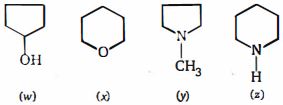
Arrange the following $(w, x, y, z)$ in decreasing order of their boiling points.
A
$w > x > z > y$
B
$w > x > y > z$
C
$w > z > y > x$
D
$w > z > x > y$
Solution
(D) The boiling point $(B.P.)$ depends on the strength and extent of intermolecular forces,primarily hydrogen bonding and molecular weight/surface area.
$(w)$ is cyclopentanol,which forms strong intermolecular $H$-bonding.
$(z)$ is piperidine,which also forms $H$-bonding,but $N-H \dots N$ bonds are weaker than $O-H \dots O$ bonds.
$(x)$ is tetrahydropyran (an ether) and $(y)$ is $N$-methylpyrrolidine (a tertiary amine),which do not form $H$-bonds with themselves.
Comparing molecular weights and polarities,the order is: $(w) > (z) > (x) > (y)$.
Therefore,the correct option is $(D)$.
$(w)$ is cyclopentanol,which forms strong intermolecular $H$-bonding.
$(z)$ is piperidine,which also forms $H$-bonding,but $N-H \dots N$ bonds are weaker than $O-H \dots O$ bonds.
$(x)$ is tetrahydropyran (an ether) and $(y)$ is $N$-methylpyrrolidine (a tertiary amine),which do not form $H$-bonds with themselves.
Comparing molecular weights and polarities,the order is: $(w) > (z) > (x) > (y)$.
Therefore,the correct option is $(D)$.
0 likes
View Solution44
AdvancedMCQ
Which of the following compounds has the most acidic hydrogen?
A
$2-$phenyl$-1,3-$dioxolane
B
$2-$phenyl$-1,3-$dithiolane
C
$2-$phenylimidazolidine
D
$3-$phenyloxazolidine
Solution
(B) The acidity of a compound is determined by the stability of its conjugate base. When the hydrogen atom attached to the central carbon is removed,a carbanion is formed.
In $2-$phenyl$-1,3-$dithiolane,the resulting carbanion is stabilized by:
$1$. Resonance with the phenyl ring.
$2$. The presence of sulfur atoms,which have empty $3d$ orbitals that can accommodate the negative charge through $p\pi-d\pi$ back-bonding (often referred to as $d$-orbital resonance).
Sulfur is more effective at stabilizing the adjacent negative charge compared to oxygen (which is more electronegative but lacks low-lying $d$-orbitals) or nitrogen (which is less electronegative and has no $d$-orbitals). Therefore,$2$-phenyl$-1,3-$dithiolane has the most acidic hydrogen.
In $2-$phenyl$-1,3-$dithiolane,the resulting carbanion is stabilized by:
$1$. Resonance with the phenyl ring.
$2$. The presence of sulfur atoms,which have empty $3d$ orbitals that can accommodate the negative charge through $p\pi-d\pi$ back-bonding (often referred to as $d$-orbital resonance).
Sulfur is more effective at stabilizing the adjacent negative charge compared to oxygen (which is more electronegative but lacks low-lying $d$-orbitals) or nitrogen (which is less electronegative and has no $d$-orbitals). Therefore,$2$-phenyl$-1,3-$dithiolane has the most acidic hydrogen.
0 likes
View Solution45
MediumMCQ
The reaction of elemental sulphur with a Grignard reagent followed by acidification leads to the formation of:
A
mercaptan
B
sulphoxide
C
thioether
D
sulphonic acid
Solution
(A) The reaction of a Grignard reagent $(RMgX)$ with elemental sulphur $(S)$ involves the nucleophilic attack of the alkyl group $(R^-)$ on the sulphur atom,resulting in the formation of a metal thiolate intermediate $(R-SMgX)$.
Upon subsequent acidification (addition of $H^+$),the metal thiolate is protonated to yield a thiol,also known as a mercaptan $(R-SH)$.
Upon subsequent acidification (addition of $H^+$),the metal thiolate is protonated to yield a thiol,also known as a mercaptan $(R-SH)$.
0 likes
View Solution46
DifficultMCQ
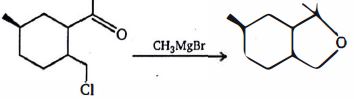
Consider all steps and intermediates. Which of the following is a correct statement?
A
Nucleophilic addition
B
Nucleophilic substitution reaction
C
Product obtained is chiral
D
All
Solution
(D) The reaction proceeds in two main steps:
$1$. The Grignard reagent $(CH_3MgBr)$ acts as a nucleophile and attacks the carbonyl carbon,which is a nucleophilic addition reaction.
$2$. The resulting alkoxide ion then performs an intramolecular nucleophilic substitution $(S_N2)$ by attacking the carbon attached to the chlorine atom,displacing the chloride ion.
$3$. The final cyclic ether product contains chiral centers,making it a chiral molecule.
Therefore,all the given statements are correct.
$1$. The Grignard reagent $(CH_3MgBr)$ acts as a nucleophile and attacks the carbonyl carbon,which is a nucleophilic addition reaction.
$2$. The resulting alkoxide ion then performs an intramolecular nucleophilic substitution $(S_N2)$ by attacking the carbon attached to the chlorine atom,displacing the chloride ion.
$3$. The final cyclic ether product contains chiral centers,making it a chiral molecule.
Therefore,all the given statements are correct.
0 likes
View Solution47
MediumMCQ
Consider the following reaction:
Which response contains all the correct statements about this process?
$1.$ Dehydration
$2.$ $E_2$ mechanism
$3.$ Carbon skeleton migration
$4.$ Most stable alkene will form
$5.$ Single-step reaction
Which response contains all the correct statements about this process?
$1.$ Dehydration
$2.$ $E_2$ mechanism
$3.$ Carbon skeleton migration
$4.$ Most stable alkene will form
$5.$ Single-step reaction

A
$1, 3$
B
$1, 2, 3$
C
$1, 2, 5$
D
$1, 3, 4$
Solution
(D) The reaction is the acid-catalyzed dehydration of an alcohol using $H_3PO_4$ and heat.
$1.$ It is a dehydration reaction as a water molecule is removed.
$2.$ The mechanism is $E_1$,not $E_2$,as it involves the formation of a carbocation intermediate.
$3.$ The reaction involves a $1,2-methyl$ shift (carbon skeleton migration) to form a more stable carbocation.
$4.$ The major product is the most stable alkene (the one with more $\alpha-hydrogens$,i.e.,$12 \alpha-H$ in this case).
$5.$ It is a multi-step reaction involving carbocation formation and rearrangement.
Therefore,statements $1, 3,$ and $4$ are correct.
$1.$ It is a dehydration reaction as a water molecule is removed.
$2.$ The mechanism is $E_1$,not $E_2$,as it involves the formation of a carbocation intermediate.
$3.$ The reaction involves a $1,2-methyl$ shift (carbon skeleton migration) to form a more stable carbocation.
$4.$ The major product is the most stable alkene (the one with more $\alpha-hydrogens$,i.e.,$12 \alpha-H$ in this case).
$5.$ It is a multi-step reaction involving carbocation formation and rearrangement.
Therefore,statements $1, 3,$ and $4$ are correct.
0 likes
View Solution48
DifficultMCQ
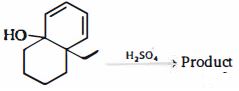
Identify the major product of the following reaction:
A
$1-$ethyl$-1,2,3,4-$tetrahydronaphthalene
B
$5-$ethyl$-1,2,3,4-$tetrahydronaphthalene
C
$1,2-$diethylbenzene
D
$1-$ethyl$-5,6,7,8-$tetrahydronaphthalene
Solution
(A) The reaction involves the acid-catalyzed dehydration of an alcohol.
$1$. Protonation of the $-OH$ group occurs to form a good leaving group $(-OH_2^+)$.
$2$. Loss of water generates a carbocation.
$3$. The carbocation undergoes a $1,2$-ethyl shift to rearrange into a more stable intermediate.
$4$. Subsequent loss of a proton $(H^+)$ leads to the formation of the aromatic product,$1$-ethyl-$1,2,3,4$-tetrahydronaphthalene.
$1$. Protonation of the $-OH$ group occurs to form a good leaving group $(-OH_2^+)$.
$2$. Loss of water generates a carbocation.
$3$. The carbocation undergoes a $1,2$-ethyl shift to rearrange into a more stable intermediate.
$4$. Subsequent loss of a proton $(H^+)$ leads to the formation of the aromatic product,$1$-ethyl-$1,2,3,4$-tetrahydronaphthalene.
0 likes
View Solution49
DifficultMCQ
In the given esterification reaction,the labelled $^{18}O$ will be found in:

A
$H_2O$
B
Methyl benzoate
C
Both $(a)$ and $(b)$
D
Benzoic acid
Solution
(B) In the esterification reaction between a carboxylic acid and an alcohol,the carboxylic acid loses an $OH$ group and the alcohol loses an $H$ atom to form water.
Since the alcohol $CH_3-^{18}OH$ contains the labelled oxygen,the oxygen atom in the resulting ester $Ph-CO-^{18}O-CH_3$ will be the labelled $^{18}O$.
Therefore,the labelled $^{18}O$ will be found in the methyl benzoate.
Since the alcohol $CH_3-^{18}OH$ contains the labelled oxygen,the oxygen atom in the resulting ester $Ph-CO-^{18}O-CH_3$ will be the labelled $^{18}O$.
Therefore,the labelled $^{18}O$ will be found in the methyl benzoate.
0 likes
View Solution50
MediumMCQ
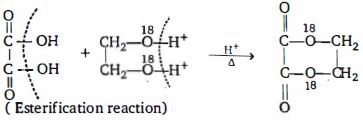
$HOOC-COOH + HO^{18}CH_2-CH_2^{18}OH \xrightarrow[H^+]{\Delta} (A)$; Product $(A)$ is:
A
Cyclic ester with oxygen atoms from the acid
B
Cyclic ester with $^{18}O$ atoms from the alcohol in the ring
C
Cyclic ester with $^{18}O$ atoms in the carbonyl group
D
Linear monoester
Solution
(B) In the esterification reaction,the $-OH$ group is removed from the carboxylic acid and the $-H$ atom is removed from the alcohol.
$R-COOH + HO^{18}-R' \xrightarrow{H^+} R-CO-^{18}O-R' + H_2O$.
Since the $^{18}O$ isotope is present in the ethylene glycol,it will be part of the ester linkage $(C-^{18}O-C)$ in the cyclic product $(A)$.
$R-COOH + HO^{18}-R' \xrightarrow{H^+} R-CO-^{18}O-R' + H_2O$.
Since the $^{18}O$ isotope is present in the ethylene glycol,it will be part of the ester linkage $(C-^{18}O-C)$ in the cyclic product $(A)$.
0 likes
View SolutionAlcohols, Phenols and Ethers — Mix Examples-Alcohol, Phenol and Ethers · Frequently Asked Questions
1Are these Alcohols, Phenols and Ethers questions useful for JEE and NEET?
Yes. All questions in this section are mapped to JEE Main and NEET exam patterns. Previous year questions from JEE Main, NEET, GUJCET and state-level exams are included with full solutions.
2Can I switch to Hindi or Gujarati for these questions?
Yes. Use the language tabs in the hero section or the sidebar to view the same questions and solutions in English, Hindi or Gujarati.
3How do I generate a question paper from this subtopic?
Use the Vedclass Exam Paper Generator — select the chapter and subtopic, set difficulty, and generate Sets A, B, C, D automatically. First 3 chapters of every subject are free.
Vedclass Products
For Students
Vedclass Test Series
Mock tests in real JEE/NEET style with performance analysis. 5-day free trial.
Start Free TrialFor Teachers
Exam Paper Generator
Generate Set A/B/C/D papers from this chapter in 2 minutes. 3 chapters free.
Try FreeFor Institutes
Online Exam Module
Live online exams with unlimited students, 360° analytics & white-label branding.
See DemoFor Teachers & Institutes
Generate a Alcohols, Phenols and Ethers Exam Paper in 2 Minutes
Select subtopic & difficulty — Sets A, B, C, D auto-generated with No Repeat logic.
First 3 chapters of every subject are free — no payment required.