
A English
Properties of Phenols Questions in English
Class 12 Chemistry · Alcohols, Phenols and Ethers · Properties of Phenols
751+
Questions
English
Language
100%
With Solutions
Showing 50 of 751 questions in English
201
MediumMCQ
For the given reaction,identify the major products $A$ and $B$ respectively.
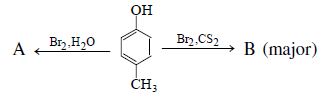
A
$A$ = $2,6-$dibromo$-4-$methylphenol,$B$ = $2-$bromo$-4-$methylphenol
B
$A$ = $2,6-$dibromo$-4-$methylphenol,$B$ = $2,6-$dibromo$-4-$methylphenol
C
$A$ = $2-$bromo$-4-$methylphenol,$B$ = $2,6-$dibromo$-4-$methylphenol
D
$A$ = $2,6-$dibromo$-4-$methylphenol,$B$ = $4-$bromo$-2-$methylphenol
Solution
(A) The reaction of $p$-cresol ($4$-methylphenol) with $Br_2$ in water $(Br_2, H_2O)$ is a polar reaction that leads to the formation of a white precipitate of $2,6-$dibromo$-4-$methylphenol $(A)$ due to the high reactivity of the phenoxide ion.
In contrast,the reaction with $Br_2$ in a non-polar solvent like $CS_2$ at low temperature leads to mono-bromination,yielding $2-$bromo$-4-$methylphenol $(B)$ as the major product.
In contrast,the reaction with $Br_2$ in a non-polar solvent like $CS_2$ at low temperature leads to mono-bromination,yielding $2-$bromo$-4-$methylphenol $(B)$ as the major product.
0 likes
View Solution202
AdvancedMCQ
In the given reaction: $[X] +$ Acetic anhydride $\rightarrow$ Aspirin,$[X]$ will be:
A
Benzoic acid
B
$o-$ methoxybenzoic acid
C
$o-$ Hydroxybenzoic acid
D
$p-$ Hydroxybenzoic acid
Solution
(C) Aspirin is chemically known as $2-$acetoxybenzoic acid.
It is prepared by the acetylation of salicylic acid ($o-$hydroxybenzoic acid) using acetic anhydride in the presence of an acid catalyst.
The reaction is: $C_7H_6O_3$ (Salicylic acid) + $(CH_3CO)_2O$ (Acetic anhydride) $\rightarrow$ $C_9H_8O_4$ (Aspirin) + $CH_3COOH$ (Acetic acid).
Therefore,$[X]$ is $o-$hydroxybenzoic acid.
It is prepared by the acetylation of salicylic acid ($o-$hydroxybenzoic acid) using acetic anhydride in the presence of an acid catalyst.
The reaction is: $C_7H_6O_3$ (Salicylic acid) + $(CH_3CO)_2O$ (Acetic anhydride) $\rightarrow$ $C_9H_8O_4$ (Aspirin) + $CH_3COOH$ (Acetic acid).
Therefore,$[X]$ is $o-$hydroxybenzoic acid.
0 likes
View Solution203
DifficultMCQ
Sodium bicarbonate reacts with salicylic acid to form:
A
$C_6H_4(OH)COONa$
B
$C_6H_4(ONa)COOH$
C
$C_6H_4(ONa)COONa$
D
$C_6H_4(OH)COOH$
Solution
(A) Salicylic acid $(C_6H_4(OH)COOH)$ contains both a carboxylic acid group $(-COOH)$ and a phenolic hydroxyl group $(-OH)$.
Sodium bicarbonate $(NaHCO_3)$ is a weak base that is strong enough to react with the more acidic carboxylic acid group but not strong enough to react with the less acidic phenolic hydroxyl group.
The reaction is as follows:
$C_6H_4(OH)COOH + NaHCO_3 \rightarrow C_6H_4(OH)COONa + H_2O + CO_2$
Thus,the product formed is sodium salicylate $(C_6H_4(OH)COONa)$.
Sodium bicarbonate $(NaHCO_3)$ is a weak base that is strong enough to react with the more acidic carboxylic acid group but not strong enough to react with the less acidic phenolic hydroxyl group.
The reaction is as follows:
$C_6H_4(OH)COOH + NaHCO_3 \rightarrow C_6H_4(OH)COONa + H_2O + CO_2$
Thus,the product formed is sodium salicylate $(C_6H_4(OH)COONa)$.
0 likes
View Solution204
DifficultMCQ
In the given reaction,$[X]$ will be:
$2\text{-hydroxybenzoic acid} \rightarrow{200^{\circ}C} [X]$
$2\text{-hydroxybenzoic acid} \rightarrow{200^{\circ}C} [X]$
A
Phenyl salicylate
B
Aspirin
C
Phenol
D
Benzoic acid
Solution
(C) The reaction involves the heating of $2\text{-hydroxybenzoic acid}$ (salicylic acid) at $200^{\circ}C$.
At this temperature,salicylic acid undergoes decarboxylation to form phenol and carbon dioxide.
The reaction is: $C_6H_4(OH)COOH \rightarrow{200^{\circ}C} C_6H_5OH CO_2$.
Therefore,$[X]$ is phenol.
At this temperature,salicylic acid undergoes decarboxylation to form phenol and carbon dioxide.
The reaction is: $C_6H_4(OH)COOH \rightarrow{200^{\circ}C} C_6H_5OH CO_2$.
Therefore,$[X]$ is phenol.
0 likes
View Solution205
MediumMCQ
When phenol is treated with $PCl_5$,the yield of chlorobenzene is generally poor because of the formation of
A
Benzoyl chloride
B
$p-chlorophenol$
C
$o-chlorophenol$
D
Triphenyl phosphate
Solution
(D) The $(-OH)$ group on phenol,unlike that of an alcohol,is difficult to replace by a halogen atom.
When phenol reacts with $PCl_5$,the main reaction pathway leads to the formation of triphenyl phosphate,$(PhO)_3P=O$,as the major product.
The reaction is represented as:
$3C_6H_5OH + POCl_3 \rightarrow (C_6H_5O)_3PO + 3HCl$
Due to this side reaction,the yield of chlorobenzene is very low.
When phenol reacts with $PCl_5$,the main reaction pathway leads to the formation of triphenyl phosphate,$(PhO)_3P=O$,as the major product.
The reaction is represented as:
$3C_6H_5OH + POCl_3 \rightarrow (C_6H_5O)_3PO + 3HCl$
Due to this side reaction,the yield of chlorobenzene is very low.
0 likes
View Solution206
MediumMCQ
Phenol with Hinsberg's reagent gives
A
Sulphone
B
Sulphanilic acid
C
Sulphonic ester
D
Sulphonal
Solution
(C) Phenol $(PhOH)$ reacts with Hinsberg's reagent $(PhSO_{2}Cl)$ in the presence of a base to form a phenyl sulphonate ester $(Ph-O-SO_{2}-Ph)$ and hydrochloric acid.
This reaction is an example of esterification where the phenolic oxygen attacks the sulfur atom of the sulfonyl chloride.
This reaction is an example of esterification where the phenolic oxygen attacks the sulfur atom of the sulfonyl chloride.
0 likes
View Solution207
DifficultMCQ
Phenol $\xrightarrow[(ii) CO_2 / 140^{\circ}C]{(i) NaOH} A$ $\xrightarrow{H^{+} / H_2O} B$ $\xrightarrow[CH_3COOH, \Delta]{Al_2O_3} C$
In this reaction,the end product $C$ is :
In this reaction,the end product $C$ is :
A
salicylaldehyde
B
salicylic acid
C
phenyl acetate
D
aspirin
Solution
(D) The reaction sequence is as follows:
$1$. Phenol reacts with $NaOH$ followed by $CO_2$ at $140^{\circ}C$ (Kolbe-Schmitt reaction) to form sodium salicylate,which upon acidification gives $B$ (salicylic acid).
$2$. Salicylic acid $(C_6H_4(OH)COOH)$ reacts with acetic acid $(CH_3COOH)$ in the presence of $Al_2O_3$ (or $H_2SO_4$) to undergo acetylation of the phenolic $-OH$ group.
$3$. The product $C$ is acetylsalicylic acid,commonly known as aspirin.
$1$. Phenol reacts with $NaOH$ followed by $CO_2$ at $140^{\circ}C$ (Kolbe-Schmitt reaction) to form sodium salicylate,which upon acidification gives $B$ (salicylic acid).
$2$. Salicylic acid $(C_6H_4(OH)COOH)$ reacts with acetic acid $(CH_3COOH)$ in the presence of $Al_2O_3$ (or $H_2SO_4$) to undergo acetylation of the phenolic $-OH$ group.
$3$. The product $C$ is acetylsalicylic acid,commonly known as aspirin.
0 likes
View Solution208
MediumMCQ
In the Liebermann’s nitroso reaction,the changes in the colour of phenol occur as:
A
Brown or red-greenish red-deep blue
B
red-deep blue-green
C
red-green-white
D
white-red-green
Solution
(A) In Liebermann's nitroso reaction,phenol is treated with sodium nitrite in the presence of concentrated sulphuric acid $(H_2SO_4)$ and heated gently to obtain a deep blue or green colour.
When this mixture is diluted with water,it turns red.
Upon adding an alkali like $NaOH$ solution,the solution turns deep blue.
Thus,the characteristic colour sequence observed is brown or red $\rightarrow$ greenish red $\rightarrow$ deep blue.
When this mixture is diluted with water,it turns red.
Upon adding an alkali like $NaOH$ solution,the solution turns deep blue.
Thus,the characteristic colour sequence observed is brown or red $\rightarrow$ greenish red $\rightarrow$ deep blue.
0 likes
View Solution209
DifficultMCQ
The product of the following reaction is:
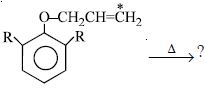
A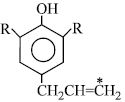
B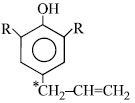
C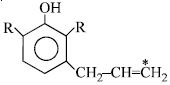
D
No reaction.
Solution
(B) The given reaction is a Claisen rearrangement,which is a $[3,3]$-sigmatropic rearrangement of an allyl aryl ether.
In this reaction,the allyl group migrates to the ortho position of the phenol ring.
The mechanism involves a cyclic transition state where the carbon atom marked with an asterisk $(^*)$ in the allyl group becomes attached to the ortho position of the benzene ring.
Therefore,the product is a phenol with the allyl group attached at the ortho position,where the carbon atom originally attached to the oxygen is now attached to the ring,and the terminal carbon $(^*)$ remains at the end of the allyl chain.
Thus,the correct structure is a phenol with a $-CH_2-CH=CH_2^*$ group at the ortho position.
In this reaction,the allyl group migrates to the ortho position of the phenol ring.
The mechanism involves a cyclic transition state where the carbon atom marked with an asterisk $(^*)$ in the allyl group becomes attached to the ortho position of the benzene ring.
Therefore,the product is a phenol with the allyl group attached at the ortho position,where the carbon atom originally attached to the oxygen is now attached to the ring,and the terminal carbon $(^*)$ remains at the end of the allyl chain.
Thus,the correct structure is a phenol with a $-CH_2-CH=CH_2^*$ group at the ortho position.
0 likes
View Solution210
DifficultMCQ
The reaction sequence is as follows:
$Catechol \xrightarrow{(i) CHCl_3 + KOH}{(ii) CH_2I_2 + NaOH} [X]$
Here $[X]$ is:
$Catechol \xrightarrow{(i) CHCl_3 + KOH}{(ii) CH_2I_2 + NaOH} [X]$
Here $[X]$ is:
A
$3,4-$Dihydroxybenzoic acid
B
$3,4-$Dihydroxybenzaldehyde
C
$1,3-$Benzodioxole$-5-$carboxaldehyde
D
$3,4-$Dimethoxybenzaldehyde
Solution
(C) The reaction proceeds in two steps:
Step $(i)$: $Catechol$ reacts with $CHCl_3$ and $KOH$ (Reimer-Tiemann reaction) to form $3,4-dihydroxybenzaldehyde$ (protocatechualdehyde).
Step $(ii)$: The resulting $3,4-dihydroxybenzaldehyde$ reacts with $CH_2I_2$ in the presence of $NaOH$. This is a Williamson ether synthesis type reaction where the two phenolic $-OH$ groups undergo cyclization with the methylene group $(CH_2)$ from $CH_2I_2$ to form a cyclic acetal/ether linkage.
The final product $[X]$ is $1,3-benzodioxole-5-carboxaldehyde$ (also known as piperonal).
Step $(i)$: $Catechol$ reacts with $CHCl_3$ and $KOH$ (Reimer-Tiemann reaction) to form $3,4-dihydroxybenzaldehyde$ (protocatechualdehyde).
Step $(ii)$: The resulting $3,4-dihydroxybenzaldehyde$ reacts with $CH_2I_2$ in the presence of $NaOH$. This is a Williamson ether synthesis type reaction where the two phenolic $-OH$ groups undergo cyclization with the methylene group $(CH_2)$ from $CH_2I_2$ to form a cyclic acetal/ether linkage.
The final product $[X]$ is $1,3-benzodioxole-5-carboxaldehyde$ (also known as piperonal).
0 likes
View Solution211
AdvancedMCQ
$Acetophenone$ $\xrightarrow{{HCO_3H}} A$ $\xrightarrow{{H_3O^{+}}} B + C$ $\mathop {\xrightarrow{{Phthalic \, Anhydride}}}\limits_{{H^{+}}} $ Indicator $(D)$
$C$ and $D$ are
$C$ and $D$ are
A
$\text{CH}_3\text{OH} \text{ & } \text{Cyclohexane derivative}$
B
$\text{PhOH} \text{ & } \text{Ester derivative}$
C
$\text{PhOH} \text{ & } \text{Phenolphthalein}$
D
$\text{CH}_3\text{OH} \text{ & } \text{o-Diacetylbenzene}$
Solution
(C) $1$. $Acetophenone$ $(C_6H_5COCH_3)$ undergoes $Baeyer-Villiger$ oxidation with peroxy acid $(HCO_3H)$ to form phenyl acetate ($A$,$C_6H_5OCOCH_3$).
$2$. Acid-catalyzed hydrolysis $(H_3O^{+})$ of phenyl acetate yields phenol ($C$,$C_6H_5OH$) and acetic acid ($B$,$CH_3COOH$).
$3$. Phenol $(C)$ reacts with phthalic anhydride in the presence of $H^{+}$ to form phenolphthalein $(D)$,which acts as an indicator.
$4$. Thus,$C$ is phenol $(PhOH)$ and $D$ is phenolphthalein.
$2$. Acid-catalyzed hydrolysis $(H_3O^{+})$ of phenyl acetate yields phenol ($C$,$C_6H_5OH$) and acetic acid ($B$,$CH_3COOH$).
$3$. Phenol $(C)$ reacts with phthalic anhydride in the presence of $H^{+}$ to form phenolphthalein $(D)$,which acts as an indicator.
$4$. Thus,$C$ is phenol $(PhOH)$ and $D$ is phenolphthalein.
0 likes
View Solution212
MediumMCQ
$m$-Aminophenol on treatment with $NaOH$ and $CO_2$ gives which of the following as major product?
A
$4-$amino$-2-$hydroxybenzoic acid
B
$4-$hydroxy$-6-$aminobenzoic acid
C
$4-$amino$-2-$hydroxybenzoic acid
D
$2-$hydroxy$-4-$aminobenzoic acid
Solution
(A) The reaction of $m$-aminophenol with $NaOH$ and $CO_2$ is a Kolbe-Schmitt reaction.
In $m$-aminophenol,the $-OH$ group is a strong ortho/para-directing group,and the $-NH_2$ group is also an ortho/para-directing group.
The $-OH$ group is more activating than the $-NH_2$ group.
Electrophilic substitution by $CO_2$ occurs at the position ortho to the $-OH$ group.
In $m$-aminophenol,the positions ortho to the $-OH$ group are positions $2$ and $6$.
Position $2$ is between the $-OH$ and $-NH_2$ groups,which is sterically hindered.
Position $6$ is ortho to the $-OH$ group and para to the $-NH_2$ group.
Therefore,the electrophilic attack occurs at the $6-$position (relative to $-OH$ at $1$),which corresponds to the $4-$position relative to the $-NH_2$ group.
The major product is $4$-amino-$2$-hydroxybenzoic acid.
In $m$-aminophenol,the $-OH$ group is a strong ortho/para-directing group,and the $-NH_2$ group is also an ortho/para-directing group.
The $-OH$ group is more activating than the $-NH_2$ group.
Electrophilic substitution by $CO_2$ occurs at the position ortho to the $-OH$ group.
In $m$-aminophenol,the positions ortho to the $-OH$ group are positions $2$ and $6$.
Position $2$ is between the $-OH$ and $-NH_2$ groups,which is sterically hindered.
Position $6$ is ortho to the $-OH$ group and para to the $-NH_2$ group.
Therefore,the electrophilic attack occurs at the $6-$position (relative to $-OH$ at $1$),which corresponds to the $4-$position relative to the $-NH_2$ group.
The major product is $4$-amino-$2$-hydroxybenzoic acid.
0 likes
View Solution213
MediumMCQ
The correct order of acid strength of the following compounds is:
$A$. Phenol
$B$. $p$-Cresol
$C$. $m$-Nitrophenol
$D$. $p$-Nitrophenol
$A$. Phenol
$B$. $p$-Cresol
$C$. $m$-Nitrophenol
$D$. $p$-Nitrophenol
A
$C > B > A > D$
B
$D > C > A > B$
C
$B > D > A > C$
D
$A > B > D > C$
Solution
(B) The acidity of phenols is determined by the stability of the phenoxide ion formed after the loss of a proton.
Electron-withdrawing groups $(EWG)$ increase acidity,while electron-donating groups $(EDG)$ decrease acidity.
$1$. $p$-Nitrophenol $(D)$ has a $-NO_2$ group at the para position,which exerts both $-I$ and $-M$ effects,strongly stabilizing the phenoxide ion.
$2$. $m$-Nitrophenol $(C)$ has a $-NO_2$ group at the meta position,which exerts only the $-I$ effect,providing moderate stabilization.
$3$. Phenol $(A)$ has no substituent.
$4$. $p$-Cresol $(B)$ has a $-CH_3$ group at the para position,which exerts $+I$ and hyperconjugation $(HC)$ effects,destabilizing the phenoxide ion.
Therefore,the correct order of acid strength is $D > C > A > B$.
Electron-withdrawing groups $(EWG)$ increase acidity,while electron-donating groups $(EDG)$ decrease acidity.
$1$. $p$-Nitrophenol $(D)$ has a $-NO_2$ group at the para position,which exerts both $-I$ and $-M$ effects,strongly stabilizing the phenoxide ion.
$2$. $m$-Nitrophenol $(C)$ has a $-NO_2$ group at the meta position,which exerts only the $-I$ effect,providing moderate stabilization.
$3$. Phenol $(A)$ has no substituent.
$4$. $p$-Cresol $(B)$ has a $-CH_3$ group at the para position,which exerts $+I$ and hyperconjugation $(HC)$ effects,destabilizing the phenoxide ion.
Therefore,the correct order of acid strength is $D > C > A > B$.
0 likes
View Solution214
DifficultMCQ
The order of stability of the conjugate base of the given acids is:
$(i)$ Phenol
(ii) $4-$Hydroxypyridine
(iii) Cyclohexanol
$(i)$ Phenol
(ii) $4-$Hydroxypyridine
(iii) Cyclohexanol
A
$ii > i > iii$
B
$i > ii > iii$
C
$iii > ii > i$
D
$iii > i > ii$
Solution
(A) The stability of the conjugate base depends on the ability of the molecule to disperse the negative charge.
$(i)$ Phenoxide ion: The negative charge is delocalized over the benzene ring.
(ii) $4-$Hydroxypyridine conjugate base: The negative charge on oxygen is delocalized into the pyridine ring,specifically onto the electronegative nitrogen atom,making it the most stable.
(iii) Cyclohexoxide ion: There is no resonance stabilization for the negative charge,making it the least stable.
Therefore,the order of stability of the conjugate base is $ii > i > iii$.
$(i)$ Phenoxide ion: The negative charge is delocalized over the benzene ring.
(ii) $4-$Hydroxypyridine conjugate base: The negative charge on oxygen is delocalized into the pyridine ring,specifically onto the electronegative nitrogen atom,making it the most stable.
(iii) Cyclohexoxide ion: There is no resonance stabilization for the negative charge,making it the least stable.
Therefore,the order of stability of the conjugate base is $ii > i > iii$.
0 likes
View Solution215
EasyMCQ
Identify the correct order of acidic strength for the following compounds:
$I$. Ortho-nitrophenol
$II$. Para-nitrophenol
$III$. Meta-nitrophenol
$I$. Ortho-nitrophenol
$II$. Para-nitrophenol
$III$. Meta-nitrophenol
A
$I > II > III$
B
$II > I > III$
C
$III > I > II$
D
$II > III > I$
Solution
(B) The acidic strength of substituted phenols depends on the electronic effects of the substituents.
$1$. $Para$-nitrophenol $(II)$ has a strong $-M$ (mesomeric) and $-I$ (inductive) effect from the $-NO_2$ group at the para position,which significantly stabilizes the phenoxide ion.
$2$. $Ortho$-nitrophenol $(I)$ also has $-M$ and $-I$ effects,but it forms an intramolecular hydrogen bond,which slightly reduces the stability of the phenoxide ion compared to the para isomer.
$3$. $Meta$-nitrophenol $(III)$ only exhibits the $-I$ effect because the $-M$ effect does not operate at the meta position. Therefore,it is the least acidic among the three.
Thus,the correct order of acidic strength is $II > I > III$.
$1$. $Para$-nitrophenol $(II)$ has a strong $-M$ (mesomeric) and $-I$ (inductive) effect from the $-NO_2$ group at the para position,which significantly stabilizes the phenoxide ion.
$2$. $Ortho$-nitrophenol $(I)$ also has $-M$ and $-I$ effects,but it forms an intramolecular hydrogen bond,which slightly reduces the stability of the phenoxide ion compared to the para isomer.
$3$. $Meta$-nitrophenol $(III)$ only exhibits the $-I$ effect because the $-M$ effect does not operate at the meta position. Therefore,it is the least acidic among the three.
Thus,the correct order of acidic strength is $II > I > III$.
0 likes
View Solution216
MediumMCQ
Benzoic acid and salicylic acid can be distinguished by
A
$FeCl_3$ solution
B
Litmus paper
C
$Br_2$ water
D
Both $(A)$ and $(C)$
Solution
(D) $1$. $FeCl_3$ test: Salicylic acid contains a phenolic $-OH$ group,which gives a violet color with neutral $FeCl_3$ solution. Benzoic acid does not contain a phenolic group and does not give this test.
$2$. $Br_2$ water test: Salicylic acid undergoes electrophilic substitution with $Br_2$ water to form a white precipitate of $2,4,6-tribromophenol$ due to the activating effect of the $-OH$ group. Benzoic acid does not react with $Br_2$ water under these conditions.
$3$. Therefore,both $FeCl_3$ solution and $Br_2$ water can be used to distinguish between them.
$2$. $Br_2$ water test: Salicylic acid undergoes electrophilic substitution with $Br_2$ water to form a white precipitate of $2,4,6-tribromophenol$ due to the activating effect of the $-OH$ group. Benzoic acid does not react with $Br_2$ water under these conditions.
$3$. Therefore,both $FeCl_3$ solution and $Br_2$ water can be used to distinguish between them.
0 likes
View Solution217
MediumMCQ
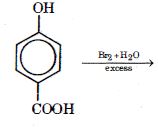
What is the product of the following reaction?
A
$2,4,6-$Tribromophenol
B
$3-$Bromo$-4-$hydroxybenzoic acid
C
$3,5-$Dibromo$-4-$hydroxybenzoic acid
D
$2-$Bromo$-4-$hydroxybenzoic acid
Solution
(A) The reaction of $p$-hydroxybenzoic acid with excess $Br_2$ in $H_2O$ leads to electrophilic aromatic substitution. The $-OH$ group is a strongly activating and $o/p$-directing group,while the $-COOH$ group is a deactivating and $m$-directing group. Due to the strong activating effect of the $-OH$ group,bromination occurs at the positions ortho to the $-OH$ group. Since the para position is already occupied by the $-COOH$ group,the bromine atoms substitute the hydrogen atoms at the two ortho positions relative to the $-OH$ group. However,in the presence of excess $Br_2$ and $H_2O$,the $-COOH$ group can also be displaced by bromine (decarboxylation-bromination),leading to the formation of $2,4,6$-tribromophenol.
0 likes
View Solution218
DifficultMCQ
Phenol condenses with phthalic anhydride in the presence of conc. $H_2SO_4$ to form:
A
methyl orange
B
phenolphthalein
C
phenyl red
D
salicylic acid
Solution
(B) When phenol reacts with phthalic anhydride in the presence of concentrated $H_2SO_4$ (acting as a dehydrating agent),a condensation reaction occurs.
Two molecules of phenol condense with one molecule of phthalic anhydride to produce phenolphthalein and water.
The reaction is: $2C_6H_5OH + C_8H_4O_3 \xrightarrow{conc. H_2SO_4, \Delta} C_{20}H_{14}O_4 (\text{phenolphthalein}) + H_2O$.
Two molecules of phenol condense with one molecule of phthalic anhydride to produce phenolphthalein and water.
The reaction is: $2C_6H_5OH + C_8H_4O_3 \xrightarrow{conc. H_2SO_4, \Delta} C_{20}H_{14}O_4 (\text{phenolphthalein}) + H_2O$.
0 likes
View Solution219
AdvancedMCQ
$C_6H_6 + CH_3-CH=CH_2$ $\xrightarrow{H_3PO_4} A$ $\xrightarrow{O_2, \text{heat}} B$ $\xrightarrow{\text{dil. } H_2SO_4} C + D$. $A, C$ and $D$ are:
A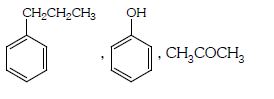
B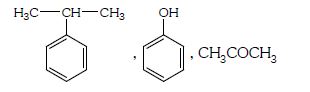
C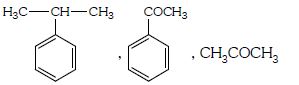
D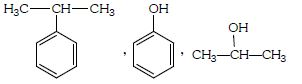
Solution
(B) The reaction sequence is the industrial preparation of phenol from cumene (cumene process).
$1$. Benzene reacts with propene in the presence of $H_3PO_4$ to form cumene (isopropylbenzene) as $A$.
$2$. Cumene $(A)$ is oxidized by $O_2$ under heat to form cumene hydroperoxide $(B)$.
$3$. Cumene hydroperoxide $(B)$ on treatment with dilute $H_2SO_4$ undergoes rearrangement to yield phenol $(C)$ and acetone $(D)$.
$1$. Benzene reacts with propene in the presence of $H_3PO_4$ to form cumene (isopropylbenzene) as $A$.
$2$. Cumene $(A)$ is oxidized by $O_2$ under heat to form cumene hydroperoxide $(B)$.
$3$. Cumene hydroperoxide $(B)$ on treatment with dilute $H_2SO_4$ undergoes rearrangement to yield phenol $(C)$ and acetone $(D)$.
0 likes
View Solution220
MediumMCQ
Which compound does not react with $NaHCO_3$?
A
Squaric acid
B
Salicylic acid
C
Carbolic acid (phenol)
D
Acetic acid
Solution
(C) The reaction of a compound with $NaHCO_3$ depends on its acidity. Compounds that are more acidic than carbonic acid ($H_2CO_3$,$pK_a \approx 6.35$) will react with $NaHCO_3$ to evolve $CO_2$ gas.
$1$. Squaric acid $(pK_a \approx 1.5)$ is a strong acid and reacts with $NaHCO_3$.
$2$. Salicylic acid $(pK_a \approx 2.97)$ is more acidic than carbonic acid and reacts with $NaHCO_3$.
$3$. Acetic acid $(pK_a \approx 4.76)$ is more acidic than carbonic acid and reacts with $NaHCO_3$.
$4$. Carbolic acid (phenol) $(pK_a \approx 10)$ is a very weak acid,significantly less acidic than carbonic acid. Therefore,it does not react with $NaHCO_3$ to evolve $CO_2$ gas.
$1$. Squaric acid $(pK_a \approx 1.5)$ is a strong acid and reacts with $NaHCO_3$.
$2$. Salicylic acid $(pK_a \approx 2.97)$ is more acidic than carbonic acid and reacts with $NaHCO_3$.
$3$. Acetic acid $(pK_a \approx 4.76)$ is more acidic than carbonic acid and reacts with $NaHCO_3$.
$4$. Carbolic acid (phenol) $(pK_a \approx 10)$ is a very weak acid,significantly less acidic than carbonic acid. Therefore,it does not react with $NaHCO_3$ to evolve $CO_2$ gas.
0 likes
View Solution221
MediumMCQ
The correct order of acidic strength of the following compounds:
$A.$ Phenol
$B.$ Cresol
$C.$ $m-$Nitrophenol
$D.$ $p-$Nitrophenol
$A.$ Phenol
$B.$ Cresol
$C.$ $m-$Nitrophenol
$D.$ $p-$Nitrophenol
A
$A > B > C > D$
B
$C > B > A > D$
C
$D > C > A > B$
D
$B > D > A > C$
Solution
(C) The acidic strength of phenols depends on the nature of the substituent attached to the benzene ring.
Electron-withdrawing groups $(EWG)$ like $-NO_2$ increase acidity by stabilizing the phenoxide ion through $-I$ and $-M$ effects.
Electron-donating groups $(EDG)$ like $-CH_3$ (in Cresol) decrease acidity by destabilizing the phenoxide ion through $+I$ and hyperconjugation effects.
$1$. $p-$Nitrophenol $(D)$: The $-NO_2$ group at the para position exerts both $-I$ and $-M$ effects,making it the most acidic.
$2$. $m-$Nitrophenol $(C)$: The $-NO_2$ group at the meta position exerts only the $-I$ effect,making it less acidic than $p-$Nitrophenol but more acidic than Phenol.
$3$. Phenol $(A)$: The reference compound.
$4$. Cresol $(B)$: The $-CH_3$ group is an electron-donating group,which decreases the acidic strength compared to Phenol.
Therefore,the correct order of acidic strength is $D > C > A > B$.
Electron-withdrawing groups $(EWG)$ like $-NO_2$ increase acidity by stabilizing the phenoxide ion through $-I$ and $-M$ effects.
Electron-donating groups $(EDG)$ like $-CH_3$ (in Cresol) decrease acidity by destabilizing the phenoxide ion through $+I$ and hyperconjugation effects.
$1$. $p-$Nitrophenol $(D)$: The $-NO_2$ group at the para position exerts both $-I$ and $-M$ effects,making it the most acidic.
$2$. $m-$Nitrophenol $(C)$: The $-NO_2$ group at the meta position exerts only the $-I$ effect,making it less acidic than $p-$Nitrophenol but more acidic than Phenol.
$3$. Phenol $(A)$: The reference compound.
$4$. Cresol $(B)$: The $-CH_3$ group is an electron-donating group,which decreases the acidic strength compared to Phenol.
Therefore,the correct order of acidic strength is $D > C > A > B$.
0 likes
View Solution222
MediumMCQ
Which of the following is the most acidic compound?
A
Cyclohexanol
B
$1,2,3,4-$Tetrahydronaphthalen$-1-$ol
C
$1-$Naphthol
D
$C_2H_5OH$
Solution
(C) The acidity of a compound depends on the stability of its conjugate base (phenoxide or alkoxide ion).
$1$-Naphthol (option $C$) is the most acidic among the given choices because the negative charge on the oxygen atom in its conjugate base is stabilized by resonance across the naphthalene ring system,which is more extensive than in the other compounds.
Cyclohexanol and $C_2H_5OH$ are aliphatic alcohols and are much less acidic than naphthols or phenols.
$1,2,3,4$-Tetrahydronaphthalen-$1$-ol is a secondary alcohol where the hydroxyl group is not directly attached to the aromatic ring,making it less acidic than $1$-naphthol.
$1$-Naphthol (option $C$) is the most acidic among the given choices because the negative charge on the oxygen atom in its conjugate base is stabilized by resonance across the naphthalene ring system,which is more extensive than in the other compounds.
Cyclohexanol and $C_2H_5OH$ are aliphatic alcohols and are much less acidic than naphthols or phenols.
$1,2,3,4$-Tetrahydronaphthalen-$1$-ol is a secondary alcohol where the hydroxyl group is not directly attached to the aromatic ring,making it less acidic than $1$-naphthol.
0 likes
View Solution223
MediumMCQ
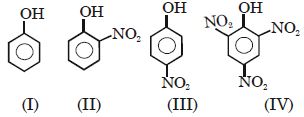
What is the correct order of $K_a$ values for the given compounds?
A
$IV > II > III > I$
B
$III > IV > II > I$
C
$IV > III > II > I$
D
$IV > III > I > II$
Solution
(C) The acidic strength is directly proportional to the $K_a$ value and inversely proportional to the $pK_a$ value.
Electron-withdrawing groups ($-M$ and $-I$ effects) increase the acidic strength of phenols by stabilizing the phenoxide ion.
Compound $(I)$ is phenol.
Compound $(II)$ is $o$-nitrophenol ($-I$ and $-M$ effect of one $NO_2$ group).
Compound $(III)$ is $p$-nitrophenol ($-I$ and $-M$ effect of one $NO_2$ group).
Compound $(IV)$ is $2,4,6$-trinitrophenol (picric acid),which has three $NO_2$ groups exerting strong $-I$ and $-M$ effects.
Comparing $(II)$ and $(III)$,$p$-nitrophenol $(III)$ is more acidic than $o$-nitrophenol $(II)$ due to intramolecular hydrogen bonding in $(II)$ which stabilizes the undissociated form.
Thus,the order of acidic strength (and $K_a$) is: $(IV) > (III) > (II) > (I)$.
Electron-withdrawing groups ($-M$ and $-I$ effects) increase the acidic strength of phenols by stabilizing the phenoxide ion.
Compound $(I)$ is phenol.
Compound $(II)$ is $o$-nitrophenol ($-I$ and $-M$ effect of one $NO_2$ group).
Compound $(III)$ is $p$-nitrophenol ($-I$ and $-M$ effect of one $NO_2$ group).
Compound $(IV)$ is $2,4,6$-trinitrophenol (picric acid),which has three $NO_2$ groups exerting strong $-I$ and $-M$ effects.
Comparing $(II)$ and $(III)$,$p$-nitrophenol $(III)$ is more acidic than $o$-nitrophenol $(II)$ due to intramolecular hydrogen bonding in $(II)$ which stabilizes the undissociated form.
Thus,the order of acidic strength (and $K_a$) is: $(IV) > (III) > (II) > (I)$.
0 likes
View Solution224
DifficultMCQ
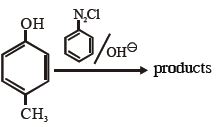
In the following reaction,the main product will be:
A
$4-$methylphenyl$-4-$hydroxyphenyl-diazene
B
$2-$phenylazo$-4-$methylphenol
C
$4-$hydroxy-benzyl-phenyl-diazene
D
$4-$methylphenyl-phenyldiazenyl-ether
Solution
(B) The reaction is an electrophilic aromatic substitution known as a coupling reaction between a phenol and a diazonium salt in an alkaline medium.
In an alkaline medium,the $-OH$ group of $p$-cresol ($4$-methylphenol) is deprotonated to form a phenoxide ion $(-O^-)$.
The phenoxide ion is a strongly activating group that directs the electrophile (the diazonium cation,$Ph-N_2^+$) to the ortho position relative to the $-OH$ group.
Since the para position is already occupied by a methyl group $(-CH_3)$,the coupling occurs at the ortho position,resulting in $2$-phenylazo-$4$-methylphenol.
In an alkaline medium,the $-OH$ group of $p$-cresol ($4$-methylphenol) is deprotonated to form a phenoxide ion $(-O^-)$.
The phenoxide ion is a strongly activating group that directs the electrophile (the diazonium cation,$Ph-N_2^+$) to the ortho position relative to the $-OH$ group.
Since the para position is already occupied by a methyl group $(-CH_3)$,the coupling occurs at the ortho position,resulting in $2$-phenylazo-$4$-methylphenol.
0 likes
View Solution225
AdvancedMCQ
Suppose the following reaction:
$CH_3-CH_2-OH$ $\xrightarrow{Cl_2/NaOH} A$ $\xrightarrow{\text{Phenol}/OH^-} \text{Major Product}$
The structure of the Major Product will be:
$CH_3-CH_2-OH$ $\xrightarrow{Cl_2/NaOH} A$ $\xrightarrow{\text{Phenol}/OH^-} \text{Major Product}$
The structure of the Major Product will be:
A
$2-$hydroxybenzaldehyde
B
$2-$(trichloromethyl)phenol
C
$4-$hydroxybenzaldehyde
D
$CHCl_3$
Solution
(A) $1$. The reaction of $CH_3-CH_2-OH$ with $Cl_2/NaOH$ is a haloform reaction. Ethanol undergoes oxidation and chlorination to form $CHCl_3$ (chloroform) and sodium formate $(HCOONa)$. Here,$A$ is $CHCl_3$.
$2$. The reaction of phenol with $CHCl_3$ in the presence of aqueous $NaOH$ is the Reimer-Tiemann reaction.
$3$. In the Reimer-Tiemann reaction,an aldehyde group $(-CHO)$ is introduced at the ortho position of the phenol ring.
$4$. Therefore,the major product formed is $2-$hydroxybenzaldehyde (salicylaldehyde).
$2$. The reaction of phenol with $CHCl_3$ in the presence of aqueous $NaOH$ is the Reimer-Tiemann reaction.
$3$. In the Reimer-Tiemann reaction,an aldehyde group $(-CHO)$ is introduced at the ortho position of the phenol ring.
$4$. Therefore,the major product formed is $2-$hydroxybenzaldehyde (salicylaldehyde).
0 likes
View Solution226
AdvancedMCQ
Suppose the following reaction:
Benzene $(C_6H_6) + CH_3-CH=CH_2$ $\xrightarrow{H^{\oplus}} A$ $\xrightarrow{O_2} B$ $\xrightarrow{H^{\oplus} / \Delta} C + CH_3-CO-CH_3$
The structure of intermediate compound $B$ will be
Benzene $(C_6H_6) + CH_3-CH=CH_2$ $\xrightarrow{H^{\oplus}} A$ $\xrightarrow{O_2} B$ $\xrightarrow{H^{\oplus} / \Delta} C + CH_3-CO-CH_3$
The structure of intermediate compound $B$ will be
A
Phenol
B
Isopropyl phenyl ether
C
Cumene hydroperoxide
D
$2-$phenyl$-1-$propanol hydroperoxide
Solution
(C) The reaction sequence is the industrial process for the preparation of phenol,known as the cumene process.
$1$. Benzene reacts with propene in the presence of an acid catalyst $(H^{\oplus})$ to form cumene (isopropylbenzene) as compound $A$.
$C_6H_6 + CH_3-CH=CH_2 \xrightarrow{H^{\oplus}} C_6H_5-CH(CH_3)_2$ $(A)$
$2$. Cumene $(A)$ is then oxidized by $O_2$ to form cumene hydroperoxide as compound $B$.
$C_6H_5-CH(CH_3)_2 + O_2 \rightarrow C_6H_5-C(CH_3)_2-O-OH$ $(B)$
$3$. Cumene hydroperoxide $(B)$ undergoes acid-catalyzed rearrangement $(H^{\oplus} / \Delta)$ to yield phenol $(C)$ and acetone $(CH_3-CO-CH_3)$.
$C_6H_5-C(CH_3)_2-O-OH \xrightarrow{H^{\oplus} / \Delta} C_6H_5OH + CH_3-CO-CH_3$
Thus,the intermediate compound $B$ is cumene hydroperoxide.
$1$. Benzene reacts with propene in the presence of an acid catalyst $(H^{\oplus})$ to form cumene (isopropylbenzene) as compound $A$.
$C_6H_6 + CH_3-CH=CH_2 \xrightarrow{H^{\oplus}} C_6H_5-CH(CH_3)_2$ $(A)$
$2$. Cumene $(A)$ is then oxidized by $O_2$ to form cumene hydroperoxide as compound $B$.
$C_6H_5-CH(CH_3)_2 + O_2 \rightarrow C_6H_5-C(CH_3)_2-O-OH$ $(B)$
$3$. Cumene hydroperoxide $(B)$ undergoes acid-catalyzed rearrangement $(H^{\oplus} / \Delta)$ to yield phenol $(C)$ and acetone $(CH_3-CO-CH_3)$.
$C_6H_5-C(CH_3)_2-O-OH \xrightarrow{H^{\oplus} / \Delta} C_6H_5OH + CH_3-CO-CH_3$
Thus,the intermediate compound $B$ is cumene hydroperoxide.
0 likes
View Solution227
MediumMCQ
The reaction of phenol with chloroform in the presence of dilute sodium hydroxide introduces which one of the following functional groups?
A
$-CHCl_2$
B
$-CHO$
C
$-CH_2Cl$
D
$-COOH$
Solution
(B) The reaction described is the Reimer-Tiemann reaction.
In this reaction,phenol reacts with chloroform $(CHCl_3)$ in the presence of an aqueous base like sodium hydroxide $(NaOH)$ to form salicylaldehyde.
The reaction introduces a formyl group $(-CHO)$ at the ortho position of the phenol ring.
The chemical equation is: $C_6H_5OH + CHCl_3 + 3NaOH \rightarrow C_6H_4(OH)(CHO) + 3NaCl + 2H_2O$.
In this reaction,phenol reacts with chloroform $(CHCl_3)$ in the presence of an aqueous base like sodium hydroxide $(NaOH)$ to form salicylaldehyde.
The reaction introduces a formyl group $(-CHO)$ at the ortho position of the phenol ring.
The chemical equation is: $C_6H_5OH + CHCl_3 + 3NaOH \rightarrow C_6H_4(OH)(CHO) + 3NaCl + 2H_2O$.
0 likes
View Solution228
DifficultMCQ
Which one of the following is most reactive towards electrophilic attack?
A
Phenol $(C_6H_5OH)$
B
Chlorobenzene $(C_6H_5Cl)$
C
Benzyl alcohol $(C_6H_5CH_2OH)$
D
Nitrobenzene $(C_6H_5NO_2)$
Solution
(A) Electrophilic aromatic substitution is favored by electron-donating groups $(EDG)$ on the benzene ring,which increase the electron density of the ring.
$1$. Phenol ($-OH$ group): The $-OH$ group is a strong electron-donating group due to its $+M$ (mesomeric) effect,which significantly increases the electron density on the benzene ring,making it highly reactive towards electrophilic attack.
$2$. Chlorobenzene ($-Cl$ group): The $-Cl$ group is electron-withdrawing due to its $-I$ effect,although it donates electrons via the $+M$ effect. Overall,it deactivates the ring compared to benzene.
$3$. Benzyl alcohol ($-CH_2OH$ group): The $-CH_2OH$ group is weakly electron-donating due to the inductive effect,but it is much less effective than the $-OH$ group directly attached to the ring.
$4$. Nitrobenzene ($-NO_2$ group): The $-NO_2$ group is a strong electron-withdrawing group ($-I$ and $-M$ effects),which significantly decreases the electron density on the ring,making it the least reactive towards electrophilic attack.
Therefore,phenol is the most reactive towards electrophilic attack.
$1$. Phenol ($-OH$ group): The $-OH$ group is a strong electron-donating group due to its $+M$ (mesomeric) effect,which significantly increases the electron density on the benzene ring,making it highly reactive towards electrophilic attack.
$2$. Chlorobenzene ($-Cl$ group): The $-Cl$ group is electron-withdrawing due to its $-I$ effect,although it donates electrons via the $+M$ effect. Overall,it deactivates the ring compared to benzene.
$3$. Benzyl alcohol ($-CH_2OH$ group): The $-CH_2OH$ group is weakly electron-donating due to the inductive effect,but it is much less effective than the $-OH$ group directly attached to the ring.
$4$. Nitrobenzene ($-NO_2$ group): The $-NO_2$ group is a strong electron-withdrawing group ($-I$ and $-M$ effects),which significantly decreases the electron density on the ring,making it the least reactive towards electrophilic attack.
Therefore,phenol is the most reactive towards electrophilic attack.
0 likes
View Solution229
DifficultMCQ
Phenol $\xrightarrow[\Delta ]{Zn} A$ $\xrightarrow[\text{Anhydrous } AlCl_3]{CH_3Cl} B$ $\xrightarrow[\Delta ]{KMnO_4/OH^{-}} C$
The product $C$ is
The product $C$ is
A
Benzene
B
Benzyl alcohol
C
Benzoic acid
D
Benzaldehyde
Solution
(C) $1$. Phenol reacts with $Zn$ dust upon heating to form benzene $(A)$.
$C_6H_5OH + Zn \xrightarrow{\Delta} C_6H_6 + ZnO$
$2$. Benzene undergoes Friedel-Crafts alkylation with $CH_3Cl$ in the presence of anhydrous $AlCl_3$ to form toluene $(B)$.
$C_6H_6 + CH_3Cl \xrightarrow{\text{Anhydrous } AlCl_3} C_6H_5CH_3 + HCl$
$3$. Toluene is oxidized by alkaline $KMnO_4$ upon heating to form benzoic acid $(C)$.
$C_6H_5CH_3 \xrightarrow[\Delta]{KMnO_4/OH^-} C_6H_5COOH$
Thus,the final product $C$ is benzoic acid.
$C_6H_5OH + Zn \xrightarrow{\Delta} C_6H_6 + ZnO$
$2$. Benzene undergoes Friedel-Crafts alkylation with $CH_3Cl$ in the presence of anhydrous $AlCl_3$ to form toluene $(B)$.
$C_6H_6 + CH_3Cl \xrightarrow{\text{Anhydrous } AlCl_3} C_6H_5CH_3 + HCl$
$3$. Toluene is oxidized by alkaline $KMnO_4$ upon heating to form benzoic acid $(C)$.
$C_6H_5CH_3 \xrightarrow[\Delta]{KMnO_4/OH^-} C_6H_5COOH$
Thus,the final product $C$ is benzoic acid.
0 likes
View Solution230
DifficultMCQ
What will be the product $(A)$ in the following reaction?
$p$-cresol $\xrightarrow[(ii) H^+]{(i) CHCl_3/KOH} (A)$
$p$-cresol $\xrightarrow[(ii) H^+]{(i) CHCl_3/KOH} (A)$
A
$2-$hydroxy$-5-$methylbenzaldehyde
B
$4-$hydroxybenzaldehyde
C
$2-$hydroxy$-4-$methylbenzaldehyde
D
$4-$methylphenol
Solution
(A) The reaction of $p$-cresol with $CHCl_3$ and $KOH$ is a Reimer-Tiemann reaction.
In the Reimer-Tiemann reaction,a formyl group $(-CHO)$ is introduced into the ortho position of the phenol ring.
For $p$-cresol,the para position is already occupied by a methyl group $(-CH_3)$.
Therefore,the formyl group will be introduced at the ortho position relative to the hydroxyl $(-OH)$ group.
This results in the formation of $2$-hydroxy-$5$-methylbenzaldehyde.
In the Reimer-Tiemann reaction,a formyl group $(-CHO)$ is introduced into the ortho position of the phenol ring.
For $p$-cresol,the para position is already occupied by a methyl group $(-CH_3)$.
Therefore,the formyl group will be introduced at the ortho position relative to the hydroxyl $(-OH)$ group.
This results in the formation of $2$-hydroxy-$5$-methylbenzaldehyde.
0 likes
View Solution231
MediumMCQ
Which of the following reactions will form a tri-bromo derivative of phenol?
A
Phenol reacting with $Br_2$ in $H_2O$.
B
o-Cresol reacting with $Br_2$ in $H_2O$.
C
Phenol reacting with $Br_2$ in $CS_2$ at $0-5^{\circ}C$.
D
Phenol reacting with $Br_2$ in $H_2O$.
Solution
(A) When phenol reacts with bromine water $(Br_2 / H_2O)$,the phenol ionizes to form the phenoxide ion. The phenoxide ion is highly activated towards electrophilic aromatic substitution due to the strong electron-donating effect of the $O^-$ group. This leads to the rapid substitution of bromine atoms at all available ortho and para positions,resulting in the formation of $2,4,6-$tribromophenol as a white precipitate.
In contrast,when phenol reacts with bromine in a non-polar solvent like $CS_2$ at low temperatures,the reaction is less vigorous,and mono-brominated products (ortho-bromophenol or para-bromophenol) are formed.
In contrast,when phenol reacts with bromine in a non-polar solvent like $CS_2$ at low temperatures,the reaction is less vigorous,and mono-brominated products (ortho-bromophenol or para-bromophenol) are formed.
0 likes
View Solution232
MediumMCQ
The electrophile involved in the reaction shown below is:
$C_6H_5OH + CHCl_3 + NaOH \rightarrow C_6H_4(ONa)CHO$
$C_6H_5OH + CHCl_3 + NaOH \rightarrow C_6H_4(ONa)CHO$
A
dichlorocarbene $(:CCl_2)$
B
trichloromethyl anion $(\mathop{C}\limits^{\ominus}Cl_3)$
C
formyl cation $(\mathop{C}\limits^{\oplus}HO)$
D
dichloromethyl cation $(\mathop{C}\limits^{+}HCl_2)$
Solution
(A) The reaction shown is the $Reimer-Tiemann$ reaction.
In this reaction,phenol reacts with chloroform $(CHCl_3)$ in the presence of an aqueous base like $NaOH$ to form salicylaldehyde.
The active electrophile generated in this reaction is dichlorocarbene $(:CCl_2)$,which is formed by the reaction of chloroform with a base.
In this reaction,phenol reacts with chloroform $(CHCl_3)$ in the presence of an aqueous base like $NaOH$ to form salicylaldehyde.
The active electrophile generated in this reaction is dichlorocarbene $(:CCl_2)$,which is formed by the reaction of chloroform with a base.
0 likes
View Solution233
MediumMCQ
The sequence of reactions is: $Phenol$ $\xrightarrow[\Delta]{Zn \, dust} X$ $\xrightarrow[\text{Anhydrous } AlCl_3]{CH_3Cl} Y$ $\xrightarrow[\Delta]{KMnO_4} Z$. The final product $Z$ is:
A
Benzene
B
Toluene
C
Benzaldehyde
D
Benzoic acid
Solution
(D) Step $1$: Phenol reacts with $Zn$ dust upon heating to form Benzene $(X)$.
$C_6H_5OH + Zn \xrightarrow{\Delta} C_6H_6 (X) + ZnO$.
Step $2$: Benzene undergoes Friedel-Crafts alkylation with $CH_3Cl$ in the presence of anhydrous $AlCl_3$ to form Toluene $(Y)$.
$C_6H_6 + CH_3Cl \xrightarrow{\text{Anhydrous } AlCl_3} C_6H_5CH_3 (Y) + HCl$.
Step $3$: Toluene is oxidized by alkaline $KMnO_4$ upon heating to form Benzoic acid $(Z)$.
$C_6H_5CH_3 \xrightarrow[\Delta]{KMnO_4} C_6H_5COOH (Z)$.
$C_6H_5OH + Zn \xrightarrow{\Delta} C_6H_6 (X) + ZnO$.
Step $2$: Benzene undergoes Friedel-Crafts alkylation with $CH_3Cl$ in the presence of anhydrous $AlCl_3$ to form Toluene $(Y)$.
$C_6H_6 + CH_3Cl \xrightarrow{\text{Anhydrous } AlCl_3} C_6H_5CH_3 (Y) + HCl$.
Step $3$: Toluene is oxidized by alkaline $KMnO_4$ upon heating to form Benzoic acid $(Z)$.
$C_6H_5CH_3 \xrightarrow[\Delta]{KMnO_4} C_6H_5COOH (Z)$.
0 likes
View Solution234
DifficultMCQ
The reactant is $4-hydroxy-3-methylbenzenesulfonic acid$. The reaction with $Br_2$ in $H_2O$ (bromine water) is an electrophilic aromatic substitution. The $-OH$ group is strongly activating and ortho/para directing. The $-SO_3H$ group is a good leaving group in the presence of excess bromine water. Predict the product of the reaction: $\xrightarrow{Br_2, H_2O} \text{Product}$
A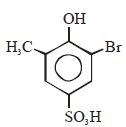
B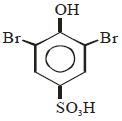
C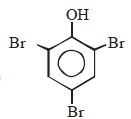
D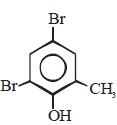
Solution
(D) The starting material is $4-hydroxy-3-methylbenzenesulfonic acid$.
In the presence of $Br_2$ and $H_2O$,the $-OH$ group activates the ring towards electrophilic substitution at the ortho positions.
The $-SO_3H$ group at the para position is a good leaving group and is displaced by the bromine electrophile.
Since the ortho positions relative to the $-OH$ group are at $C-2$ and $C-6$,and the $C-3$ position is already occupied by a $-CH_3$ group,bromine will substitute at the $C-2$ position and the $C-4$ position (replacing the $-SO_3H$ group).
Thus,the product is $2,4-dibromo-6-methylphenol$ (or $2,6-dibromo-4-methylphenol$ depending on numbering,but based on the provided options,the structure corresponds to $2,4-dibromo-6-methylphenol$).
In the presence of $Br_2$ and $H_2O$,the $-OH$ group activates the ring towards electrophilic substitution at the ortho positions.
The $-SO_3H$ group at the para position is a good leaving group and is displaced by the bromine electrophile.
Since the ortho positions relative to the $-OH$ group are at $C-2$ and $C-6$,and the $C-3$ position is already occupied by a $-CH_3$ group,bromine will substitute at the $C-2$ position and the $C-4$ position (replacing the $-SO_3H$ group).
Thus,the product is $2,4-dibromo-6-methylphenol$ (or $2,6-dibromo-4-methylphenol$ depending on numbering,but based on the provided options,the structure corresponds to $2,4-dibromo-6-methylphenol$).
0 likes
View Solution235
DifficultMCQ
Phenol $(C_6H_6O)$ $\xrightarrow{Br_2 \text{ in } CS_2}$ $X$ (Major product)
Phenol $(C_6H_6O)$ $\xrightarrow{Br_2 \text{ in } H_2O}$ $Y$ (Major product)
What are $X$ and $Y$ in the above reaction respectively?
Phenol $(C_6H_6O)$ $\xrightarrow{Br_2 \text{ in } H_2O}$ $Y$ (Major product)
What are $X$ and $Y$ in the above reaction respectively?
A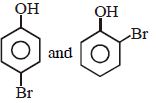
B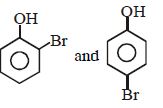
C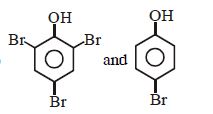
D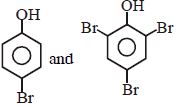
Solution
(D) $1$. When phenol reacts with $Br_2$ in a non-polar solvent like $CS_2$ or $CHCl_3$ at low temperature,the reaction is monobromination. The major product is $p$-bromophenol due to less steric hindrance compared to $o$-bromophenol. Thus,$X$ is $p$-bromophenol.
$2$. When phenol reacts with $Br_2$ in water $(H_2O)$,the phenol ionizes to form the phenoxide ion,which is highly activating. This leads to rapid electrophilic substitution at all ortho and para positions,resulting in the formation of $2,4,6$-tribromophenol as the major product. Thus,$Y$ is $2,4,6$-tribromophenol.
$2$. When phenol reacts with $Br_2$ in water $(H_2O)$,the phenol ionizes to form the phenoxide ion,which is highly activating. This leads to rapid electrophilic substitution at all ortho and para positions,resulting in the formation of $2,4,6$-tribromophenol as the major product. Thus,$Y$ is $2,4,6$-tribromophenol.
0 likes
View Solution236
MediumMCQ
Phenol,when it first reacts with concentrated sulphuric acid and then concentrated nitric acid,gives:
A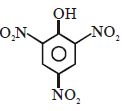
B
C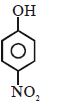
D
Solution
(A) When phenol reacts with concentrated sulphuric acid,it undergoes sulphonation to form phenol-$2,4-$disulphonic acid.
This intermediate,upon further treatment with concentrated nitric acid,undergoes nitration to yield $2,4,6-$trinitrophenol,which is commonly known as picric acid.
This intermediate,upon further treatment with concentrated nitric acid,undergoes nitration to yield $2,4,6-$trinitrophenol,which is commonly known as picric acid.
0 likes
View Solution237
DifficultMCQ
The correct order of boiling point for the given compounds is:
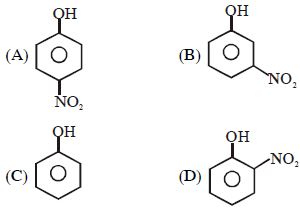
A
$p$-nitrophenol $(A)$
B
$m$-nitrophenol $(B)$
C
Phenol $(C)$
D
$o$-nitrophenol $(D)$
Solution
(D) The boiling point of these compounds depends on intermolecular hydrogen bonding.
$p$-Nitrophenol $(A)$ and $m$-nitrophenol $(B)$ exhibit strong intermolecular hydrogen bonding,leading to higher boiling points. Among these,$p$-nitrophenol has a higher boiling point than $m$-nitrophenol due to better packing and stronger intermolecular forces.
$o$-Nitrophenol $(D)$ exhibits intramolecular hydrogen bonding,which reduces the extent of intermolecular hydrogen bonding,resulting in a lower boiling point compared to $p$- and $m$-isomers.
Phenol $(C)$ has the lowest boiling point among these as it lacks the additional polar $-NO_2$ group which increases the molecular weight and dipole-dipole interactions.
Thus,the order of boiling point is $A > B > D > C$.
$p$-Nitrophenol $(A)$ and $m$-nitrophenol $(B)$ exhibit strong intermolecular hydrogen bonding,leading to higher boiling points. Among these,$p$-nitrophenol has a higher boiling point than $m$-nitrophenol due to better packing and stronger intermolecular forces.
$o$-Nitrophenol $(D)$ exhibits intramolecular hydrogen bonding,which reduces the extent of intermolecular hydrogen bonding,resulting in a lower boiling point compared to $p$- and $m$-isomers.
Phenol $(C)$ has the lowest boiling point among these as it lacks the additional polar $-NO_2$ group which increases the molecular weight and dipole-dipole interactions.
Thus,the order of boiling point is $A > B > D > C$.
0 likes
View Solution238
MediumMCQ
Which of the following is pyrogallol?
A
B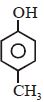
C
D
Solution
(A) Pyrogallol is benzene-$1,2,3$-triol.
It consists of a benzene ring with three hydroxyl $(-OH)$ groups attached at the $1, 2,$ and $3$ positions.
Option $A$ represents benzene-$1,2,3$-triol,which is pyrogallol.
It consists of a benzene ring with three hydroxyl $(-OH)$ groups attached at the $1, 2,$ and $3$ positions.
Option $A$ represents benzene-$1,2,3$-triol,which is pyrogallol.
0 likes
View Solution239
DifficultMCQ
Phenol is
A
Antimicrobial
B
Antiseptic
C
Disinfectant
D
All of these
Solution
(D) Phenol $(C_6H_5OH)$ exhibits properties that allow it to act as an antimicrobial agent.
At lower concentrations (typically $0.2 \%$),it acts as an antiseptic,which can be applied to living tissues.
At higher concentrations (typically $1 \%$),it acts as a disinfectant,which is used for inanimate objects like floors and instruments.
Therefore,phenol possesses all these characteristics.
At lower concentrations (typically $0.2 \%$),it acts as an antiseptic,which can be applied to living tissues.
At higher concentrations (typically $1 \%$),it acts as a disinfectant,which is used for inanimate objects like floors and instruments.
Therefore,phenol possesses all these characteristics.
0 likes
View Solution240
DifficultMCQ
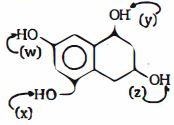
The decreasing order of acidic strength of different $(-OH)$ groups is:
A
$w > x > y > z$
B
$w > z > x > y$
C
$z > w > x > y$
D
$z > x > w > y$
Solution
(A) The acidic strength of $-OH$ groups depends on the stability of the conjugate base formed after the loss of a proton.
$1$. The group labeled $w$ is a phenolic $-OH$ group,which is significantly more acidic than alcoholic $-OH$ groups due to the resonance stabilization of the phenoxide ion.
$2$. Among the remaining alcoholic groups $(x, y, z)$,the acidity is influenced by the inductive effect $(-I)$ of the phenyl ring.
$3$. Group $x$ is directly attached to the phenyl ring,experiencing the strongest $-I$ effect of the ring.
$4$. Group $y$ is attached to a carbon adjacent to the phenyl ring,experiencing a weaker $-I$ effect and some $+I$ effect from the alkyl chain.
$5$. Group $z$ is further away,experiencing the least $-I$ effect and more $+I$ effect from the alkyl chain,making it the least acidic.
Thus,the decreasing order of acidic strength is $w > x > y > z$.
$1$. The group labeled $w$ is a phenolic $-OH$ group,which is significantly more acidic than alcoholic $-OH$ groups due to the resonance stabilization of the phenoxide ion.
$2$. Among the remaining alcoholic groups $(x, y, z)$,the acidity is influenced by the inductive effect $(-I)$ of the phenyl ring.
$3$. Group $x$ is directly attached to the phenyl ring,experiencing the strongest $-I$ effect of the ring.
$4$. Group $y$ is attached to a carbon adjacent to the phenyl ring,experiencing a weaker $-I$ effect and some $+I$ effect from the alkyl chain.
$5$. Group $z$ is further away,experiencing the least $-I$ effect and more $+I$ effect from the alkyl chain,making it the least acidic.
Thus,the decreasing order of acidic strength is $w > x > y > z$.
0 likes
View Solution241
MediumMCQ
Which of the following compounds will not give effervescence with sodium carbonate?
A
$C_6H_5CO_2H$
B
$C_6H_5SO_3H$
C
$C_6H_5OH$
D
$2,4,6-\text{trinitrophenol}$
Solution
(C) Compounds that are more acidic than carbonic acid $(H_2CO_3)$ react with sodium carbonate $(Na_2CO_3)$ to release $CO_2$ gas,which causes effervescence.
$1$. $C_6H_5CO_2H$ (benzoic acid),$C_6H_5SO_3H$ (benzenesulfonic acid),and $2,4,6-\text{trinitrophenol}$ (picric acid) are all stronger acids than $H_2CO_3$ and will give effervescence.
$2$. Phenol $(C_6H_5OH)$ is a weaker acid than $H_2CO_3$. Therefore,it does not react with $Na_2CO_3$ to release $CO_2$ gas.
Thus,the correct option is $(c)$.
$1$. $C_6H_5CO_2H$ (benzoic acid),$C_6H_5SO_3H$ (benzenesulfonic acid),and $2,4,6-\text{trinitrophenol}$ (picric acid) are all stronger acids than $H_2CO_3$ and will give effervescence.
$2$. Phenol $(C_6H_5OH)$ is a weaker acid than $H_2CO_3$. Therefore,it does not react with $Na_2CO_3$ to release $CO_2$ gas.
Thus,the correct option is $(c)$.
0 likes
View Solution242
MediumMCQ
Which of the following is the strongest Bronsted acid?
A
Aniline
B
Cyclohexylamine
C
Cyclohexanol
D
Phenol
Solution
(D) To determine the strongest Bronsted acid,we compare the stability of the conjugate bases formed after the loss of a proton $(H^+)$.
$(1)$ The conjugate bases of amines $(R-NH_2)$ are amides $(R-NH^-)$,which are highly unstable due to the negative charge on the less electronegative nitrogen atom.
$(2)$ The conjugate base of an alcohol $(R-OH)$ is an alkoxide $(R-O^-)$,where the negative charge is on the more electronegative oxygen atom,making it more stable than the amide ion.
$(3)$ The conjugate base of phenol $(C_6H_5OH)$ is the phenoxide ion $(C_6H_5O^-)$. In the phenoxide ion,the negative charge on the oxygen atom is delocalized into the benzene ring through resonance,which significantly stabilizes the conjugate base.
Since the phenoxide ion is the most stable conjugate base among the options,phenol is the strongest Bronsted acid.
$(1)$ The conjugate bases of amines $(R-NH_2)$ are amides $(R-NH^-)$,which are highly unstable due to the negative charge on the less electronegative nitrogen atom.
$(2)$ The conjugate base of an alcohol $(R-OH)$ is an alkoxide $(R-O^-)$,where the negative charge is on the more electronegative oxygen atom,making it more stable than the amide ion.
$(3)$ The conjugate base of phenol $(C_6H_5OH)$ is the phenoxide ion $(C_6H_5O^-)$. In the phenoxide ion,the negative charge on the oxygen atom is delocalized into the benzene ring through resonance,which significantly stabilizes the conjugate base.
Since the phenoxide ion is the most stable conjugate base among the options,phenol is the strongest Bronsted acid.
0 likes
View Solution243
MediumMCQ
The increasing order of acidic strength of the given compounds is:

A
$III < I < IV < II$
B
$II < I < IV < III$
C
$I < III < IV < II$
D
$I < III < II < IV$
Solution
(A) The acidic strength of phenols depends on the nature of the substituent attached to the benzene ring.
Electron-withdrawing groups $(EWG)$ increase acidic strength by stabilizing the phenoxide ion,while electron-donating groups $(EDG)$ decrease it.
$(I)$ $p$-cresol: $-CH_3$ group shows $+I$ and $+H$ effects $(EDG)$.
$(II)$ $p$-cyanophenol: $-CN$ group shows strong $-I$ and $-M$ effects $(EWG)$.
$(III)$ $p$-methoxyphenol: $-OCH_3$ group shows $+M$ effect (strong $EDG$) and $-I$ effect.
$(IV)$ Phenol: No substituent.
Comparing the effects: The $-OCH_3$ group in $(III)$ is a stronger electron donor than the $-CH_3$ group in $(I)$ due to the $+M$ effect. Thus,$(III)$ is the least acidic.
The order of acidity is: $(III) < (I) < (IV) < (II)$.
Therefore,the correct option is $A$.
Electron-withdrawing groups $(EWG)$ increase acidic strength by stabilizing the phenoxide ion,while electron-donating groups $(EDG)$ decrease it.
$(I)$ $p$-cresol: $-CH_3$ group shows $+I$ and $+H$ effects $(EDG)$.
$(II)$ $p$-cyanophenol: $-CN$ group shows strong $-I$ and $-M$ effects $(EWG)$.
$(III)$ $p$-methoxyphenol: $-OCH_3$ group shows $+M$ effect (strong $EDG$) and $-I$ effect.
$(IV)$ Phenol: No substituent.
Comparing the effects: The $-OCH_3$ group in $(III)$ is a stronger electron donor than the $-CH_3$ group in $(I)$ due to the $+M$ effect. Thus,$(III)$ is the least acidic.
The order of acidity is: $(III) < (I) < (IV) < (II)$.
Therefore,the correct option is $A$.
0 likes
View Solution244
MediumMCQ
Rank the following compounds in the order of increasing acidity:
$(I)$ Cyclohexanol
$(II)$ Cyclohexylamine
$(III)$ Phenol
$(I)$ Cyclohexanol
$(II)$ Cyclohexylamine
$(III)$ Phenol
A
$II < I < III$
B
$I < III < II$
C
$III < II < I$
D
$II < I < III$
Solution
(A) The acidic strength of a compound is directly proportional to the stability of its conjugate base.
$(I)$ Cyclohexanol forms a cyclohexoxide ion $(C_6H_{11}O^-)$.
$(II)$ Cyclohexylamine forms a cyclohexylamide ion $(C_6H_{11}NH^-)$.
$(III)$ Phenol forms a phenoxide ion $(C_6H_5O^-)$,which is resonance-stabilized.
Comparing the stability of conjugate bases:
$C_6H_{11}NH^-$ is the least stable because nitrogen is less electronegative than oxygen.
$C_6H_{11}O^-$ is more stable than $C_6H_{11}NH^-$.
$C_6H_5O^-$ is the most stable due to resonance stabilization.
Therefore,the order of increasing acidity is: $II < I < III$.
$(I)$ Cyclohexanol forms a cyclohexoxide ion $(C_6H_{11}O^-)$.
$(II)$ Cyclohexylamine forms a cyclohexylamide ion $(C_6H_{11}NH^-)$.
$(III)$ Phenol forms a phenoxide ion $(C_6H_5O^-)$,which is resonance-stabilized.
Comparing the stability of conjugate bases:
$C_6H_{11}NH^-$ is the least stable because nitrogen is less electronegative than oxygen.
$C_6H_{11}O^-$ is more stable than $C_6H_{11}NH^-$.
$C_6H_5O^-$ is the most stable due to resonance stabilization.
Therefore,the order of increasing acidity is: $II < I < III$.
0 likes
View Solution245
MediumMCQ
Among the given pairs,in which pair is the second compound more acidic than the first?
A
$Br-CH_2-NO_2$ and $CH_3-CH_3$
B
$CH_3-C(=O)-CH_2-CN$ and $CH_3-C(=O)-CH_3$
C
$4-$acetylphenol and phenol
D
p-cresol and phenol
Solution
(C) The acidity of a compound depends on the stability of its conjugate base. Electron-withdrawing groups $(EWG)$ increase acidity by stabilizing the conjugate base,while electron-donating groups $(EDG)$ decrease acidity by destabilizing it.
$(A)$ $Br-CH_2-NO_2$ is more acidic than $CH_3-CH_3$ because the $NO_2$ group is a strong $EWG$.
$(B)$ $CH_3-C(=O)-CH_2-CN$ is more acidic than $CH_3-C(=O)-CH_3$ because the $CN$ group is a strong $EWG$.
$(C)$ $4-$acetylphenol is more acidic than phenol because the acetyl group $(-COCH_3)$ is an $EWG$ ($-I$ and $-M$ effect).
$(D)$ p-cresol is less acidic than phenol because the methyl group $(-CH_3)$ is an $EDG$ ($+I$ and $+H$ effect).
Since the question asks for the pair where the second compound is more acidic than the first,options $(A)$,$(B)$,and $(C)$ satisfy this condition. However,in standard multiple-choice formats,if only one answer is expected,$(C)$ is a classic example of substituent effects on phenol acidity.
$(A)$ $Br-CH_2-NO_2$ is more acidic than $CH_3-CH_3$ because the $NO_2$ group is a strong $EWG$.
$(B)$ $CH_3-C(=O)-CH_2-CN$ is more acidic than $CH_3-C(=O)-CH_3$ because the $CN$ group is a strong $EWG$.
$(C)$ $4-$acetylphenol is more acidic than phenol because the acetyl group $(-COCH_3)$ is an $EWG$ ($-I$ and $-M$ effect).
$(D)$ p-cresol is less acidic than phenol because the methyl group $(-CH_3)$ is an $EDG$ ($+I$ and $+H$ effect).
Since the question asks for the pair where the second compound is more acidic than the first,options $(A)$,$(B)$,and $(C)$ satisfy this condition. However,in standard multiple-choice formats,if only one answer is expected,$(C)$ is a classic example of substituent effects on phenol acidity.
0 likes
View Solution246
DifficultMCQ
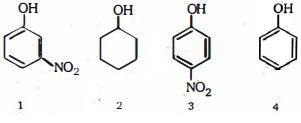
Rank the following compounds in order of decreasing acid strength (most acidic $\to$ least acidic):
A
$2 > 4 > 1 > 3$
B
$1 > 3 > 4 > 2$
C
$3 > 1 > 2 > 4$
D
$3 > 1 > 4 > 2$
Solution
(D) The acidity of a compound depends on the stability of its conjugate base.
$1$. Compound $3$ ($p$-nitrophenol) is the most acidic because the $-NO_2$ group exerts both $-I$ and $-M$ effects,which strongly stabilize the phenoxide ion through resonance and induction.
$2$. Compound $1$ ($m$-nitrophenol) is the next most acidic because the $-NO_2$ group exerts only a $-I$ effect from the meta position,which stabilizes the phenoxide ion,but less effectively than the $-M$ effect.
$3$. Compound $4$ (phenol) is less acidic than the nitrophenols because the phenoxide ion is stabilized only by resonance with the benzene ring.
$4$. Compound $2$ (cyclohexanol) is the least acidic because it is an aliphatic alcohol,and the alkoxide ion formed is destabilized by the $+I$ effect of the alkyl group and lacks resonance stabilization.
Therefore,the correct order of decreasing acid strength is $3 > 1 > 4 > 2$.
$1$. Compound $3$ ($p$-nitrophenol) is the most acidic because the $-NO_2$ group exerts both $-I$ and $-M$ effects,which strongly stabilize the phenoxide ion through resonance and induction.
$2$. Compound $1$ ($m$-nitrophenol) is the next most acidic because the $-NO_2$ group exerts only a $-I$ effect from the meta position,which stabilizes the phenoxide ion,but less effectively than the $-M$ effect.
$3$. Compound $4$ (phenol) is less acidic than the nitrophenols because the phenoxide ion is stabilized only by resonance with the benzene ring.
$4$. Compound $2$ (cyclohexanol) is the least acidic because it is an aliphatic alcohol,and the alkoxide ion formed is destabilized by the $+I$ effect of the alkyl group and lacks resonance stabilization.
Therefore,the correct order of decreasing acid strength is $3 > 1 > 4 > 2$.
0 likes
View Solution247
MediumMCQ
Which of the following phenols has the largest $pK_a$ value (i.e.,is least acidic)?
A
$p$-chlorophenol
B
$p$-nitrophenol
C
$p$-methylphenol
D
$p$-cyanophenol
Solution
(C) The acidity of phenols is determined by the stability of the phenoxide ion formed after the loss of a proton. Electron-withdrawing groups $(EWG)$ increase acidity (decrease $pK_a$),while electron-donating groups $(EDG)$ decrease acidity (increase $pK_a$).
$1$. $p$-nitrophenol $(-NO_2)$: Strong $-M$ and $-I$ effect,highly acidic.
$2$. $p$-cyanophenol $(-CN)$: Strong $-M$ and $-I$ effect,highly acidic.
$3$. $p$-chlorophenol $(-Cl)$: $-I$ effect dominates,acidic.
$4$. $p$-methylphenol $(-CH_3)$: $+I$ and hyperconjugation effect $(EDG)$,least acidic.
Since $p$-methylphenol is the least acidic,it has the largest $pK_a$ value.
$1$. $p$-nitrophenol $(-NO_2)$: Strong $-M$ and $-I$ effect,highly acidic.
$2$. $p$-cyanophenol $(-CN)$: Strong $-M$ and $-I$ effect,highly acidic.
$3$. $p$-chlorophenol $(-Cl)$: $-I$ effect dominates,acidic.
$4$. $p$-methylphenol $(-CH_3)$: $+I$ and hyperconjugation effect $(EDG)$,least acidic.
Since $p$-methylphenol is the least acidic,it has the largest $pK_a$ value.
0 likes
View Solution248
MediumMCQ
Which of the following is the most acidic?
A
Phenol
B
$p$-Cresol
C
$m$-Nitrophenol
D
$p$-Nitrophenol
Solution
(D) The acidity of phenols is determined by the stability of the phenoxide ion formed after the loss of a proton. Electron-withdrawing groups $(EWG)$ stabilize the phenoxide ion and increase acidity,while electron-donating groups $(EDG)$ destabilize it and decrease acidity.
$1$. Phenol: Reference compound.
$2$. $p$-Cresol: The $-CH_3$ group is an electron-donating group ($+I$ and hyperconjugation),which destabilizes the phenoxide ion,making it less acidic than phenol.
$3$. $m$-Nitrophenol: The $-NO_2$ group is a strong electron-withdrawing group ($-I$ and $-M$). In the meta position,only the $-I$ effect operates,which increases acidity.
$4$. $p$-Nitrophenol: The $-NO_2$ group at the para position exerts both $-I$ and $-M$ effects. The $-M$ effect is very strong in stabilizing the negative charge on the phenoxide ion through resonance.
Since the $-M$ effect is stronger than the $-I$ effect,$p$-nitrophenol is the most acidic among the given options.
$1$. Phenol: Reference compound.
$2$. $p$-Cresol: The $-CH_3$ group is an electron-donating group ($+I$ and hyperconjugation),which destabilizes the phenoxide ion,making it less acidic than phenol.
$3$. $m$-Nitrophenol: The $-NO_2$ group is a strong electron-withdrawing group ($-I$ and $-M$). In the meta position,only the $-I$ effect operates,which increases acidity.
$4$. $p$-Nitrophenol: The $-NO_2$ group at the para position exerts both $-I$ and $-M$ effects. The $-M$ effect is very strong in stabilizing the negative charge on the phenoxide ion through resonance.
Since the $-M$ effect is stronger than the $-I$ effect,$p$-nitrophenol is the most acidic among the given options.
0 likes
View Solution249
MediumMCQ
Which of the following substituents will decrease the acidic strength of phenol?
A
$-NO_2$
B
$-CN$
C
$-CH_3$
D
$-CHO$
Solution
(C) The acidic strength of phenol is determined by the stability of the phenoxide ion formed after the loss of a proton.
Electron-withdrawing groups ($-I$ or $-M$ effect) increase the acidic strength by stabilizing the phenoxide ion.
Electron-donating groups ($+I$ or $+M$ effect) decrease the acidic strength by destabilizing the phenoxide ion.
Among the given options,$-NO_2$,$-CN$,and $-CHO$ are electron-withdrawing groups,whereas $-CH_3$ exhibits a $+I$ (inductive) effect,which increases electron density on the ring and destabilizes the phenoxide ion,thereby decreasing the acidic strength.
Electron-withdrawing groups ($-I$ or $-M$ effect) increase the acidic strength by stabilizing the phenoxide ion.
Electron-donating groups ($+I$ or $+M$ effect) decrease the acidic strength by destabilizing the phenoxide ion.
Among the given options,$-NO_2$,$-CN$,and $-CHO$ are electron-withdrawing groups,whereas $-CH_3$ exhibits a $+I$ (inductive) effect,which increases electron density on the ring and destabilizes the phenoxide ion,thereby decreasing the acidic strength.
0 likes
View Solution250
MediumMCQ
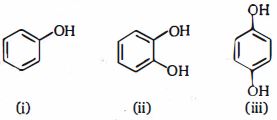
Among $(i)-(iii)$,the boiling point follows the order:
A
$(ii) < (i) < (iii)$
B
$(iii) < (ii) < (i)$
C
$(i) < (ii) < (iii)$
D
$(ii) < (iii) < (i)$
Solution
(A) $(i)$ is phenol,$(ii)$ is catechol (ortho-dihydroxybenzene),and $(iii)$ is hydroquinone (para-dihydroxybenzene).
In $(ii)$,intramolecular $H$-bonding occurs,which reduces the extent of intermolecular association,leading to a lower boiling point.
In $(iii)$,strong intermolecular $H$-bonding occurs between molecules,leading to a significantly higher boiling point.
$(i)$ has intermediate boiling point due to intermolecular $H$-bonding,but it has only one $-OH$ group compared to two in $(ii)$ and $(iii)$.
Thus,the order of boiling point is $(ii) < (i) < (iii)$.
In $(ii)$,intramolecular $H$-bonding occurs,which reduces the extent of intermolecular association,leading to a lower boiling point.
In $(iii)$,strong intermolecular $H$-bonding occurs between molecules,leading to a significantly higher boiling point.
$(i)$ has intermediate boiling point due to intermolecular $H$-bonding,but it has only one $-OH$ group compared to two in $(ii)$ and $(iii)$.
Thus,the order of boiling point is $(ii) < (i) < (iii)$.
0 likes
View SolutionAlcohols, Phenols and Ethers — Properties of Phenols · Frequently Asked Questions
1Are these Alcohols, Phenols and Ethers questions useful for JEE and NEET?
Yes. All questions in this section are mapped to JEE Main and NEET exam patterns. Previous year questions from JEE Main, NEET, GUJCET and state-level exams are included with full solutions.
2Can I switch to Hindi or Gujarati for these questions?
Yes. Use the language tabs in the hero section or the sidebar to view the same questions and solutions in English, Hindi or Gujarati.
3How do I generate a question paper from this subtopic?
Use the Vedclass Exam Paper Generator — select the chapter and subtopic, set difficulty, and generate Sets A, B, C, D automatically. First 3 chapters of every subject are free.
Vedclass Products
For Students
Vedclass Test Series
Mock tests in real JEE/NEET style with performance analysis. 5-day free trial.
Start Free TrialFor Teachers
Exam Paper Generator
Generate Set A/B/C/D papers from this chapter in 2 minutes. 3 chapters free.
Try FreeFor Institutes
Online Exam Module
Live online exams with unlimited students, 360° analytics & white-label branding.
See DemoFor Teachers & Institutes
Generate a Alcohols, Phenols and Ethers Exam Paper in 2 Minutes
Select subtopic & difficulty — Sets A, B, C, D auto-generated with No Repeat logic.
First 3 chapters of every subject are free — no payment required.